MCP1790 - Voltage regulator Microchip - Free user manual and instructions
Find the device manual for free MCP1790 Microchip in PDF.


User questions about MCP1790 Microchip
0 question about this device. Answer the ones you know or ask your own.
Ask a new question about this device
Download the instructions for your Voltage regulator in PDF format for free! Find your manual MCP1790 - Microchip and take your electronic device back in hand. On this page are published all the documents necessary for the use of your device. MCP1790 by Microchip.
USER MANUAL MCP1790 Microchip
Note the following details of the code protection feature on Microchip devices:
• Microchip products meet the specification contained in their particular Microchip Data Sheet.
- Microchip believes that its family of products is one of the most secure families of its kind on the market today, when used in the intended manner and under normal conditions.
- There are dishonest and possibly illegal methods used to breach the code protection feature. All of these methods, to our knowledge, require using the Microchip products in a manner outside the operating specifications contained in Microchip's Data Sheets. Most likely, the person doing so is engaged in theft of intellectual property.
• Microchip is willing to work with the customer who is concerned about the integrity of their code.
- Neither Microchip nor any other semiconductor manufacturer can guarantee the security of their code. Code protection does not mean that we are guaranteeing the product as “unbreakable.”
Code protection is constantly evolving. We at Microchip are committed to continuously improving the code protection features of our products. Attempts to break Microchip's code protection feature may be a violation of the Digital Millennium Copyright Act. If such acts allow unauthorized access to your software or other copyrighted work, you may have a right to sue for relief under that Act.
Information contained in this publication regarding device applications and the like is provided only for your convenience and may be superseded by updates. It is your responsibility to ensure that your application meets with your specifications. MICROCHIP MAKES NO REPRESENTATIONS OR WARRANTIES OF ANY KIND WHETHER EXPRESS OR IMPLIED, WRITTEN OR ORAL, STATUTORY OR OTHERWISE, RELATED TO THE INFORMATION, INCLUDING BUT NOT LIMITED TO ITS CONDITION, QUALITY, PERFORMANCE, MERCHANTABILITY OR FITNESS FOR PURPOSE. Microchip disclaims all liability arising from this information and its use. Use of Microchip devices in life support and/or safety applications is entirely at the buyer's risk, and the buyer agrees to defend, indemnify and hold harmless Microchip from any and all damages, claims, suits, or expenses resulting from such use. No licenses are conveyed, implicitly or otherwise, under any Microchip intellectual property rights.
Trademarks
The Microchip name and logo, the Microchip logo, Accuron, dsPIC, KEELOQ, KEELOQ logo, MPLAB, PIC, PICmicro, PICSTART, rfPIC, SmartShunt and UNI/O are registered trademarks of Microchip Technology Incorporated in the U.S.A. and other countries.
FilterLab, Hampshire, Linear Active Thermistor, MXDEV, MXLAB, SEEVAL, SmartSensor and The Embedded Control Solutions Company are registered trademarks of Microchip Technology Incorporated in the U.S.A.
Analog-for-the-Digital Age, Application Maestro, CodeGuard, dsPICDEM, dsPICDEM.net, dsPICworks, dsSPEAK, ECAN, ECONOMONITOR, FanSense, In-Circuit Serial Programming, ICSP, ICEPIC, Mindi, MiWi, MPASM, MPLAB Certified logo, MPLIB, MPLINK, mTouch, nanoWatt XLP, PICkit, PICDEM, PICDEM.net, PICtail, PIC ^32 logo, PowerCal, PowerInfo, PowerMate, PowerTool, REAL ICE, rfLAB, Select Mode, Total Endurance, TSHARC, WiperLock and ZENA are trademarks of Microchip Technology Incorporated in the U.S.A. and other countries.
SQTP is a service mark of Microchip Technology Incorporated in the U.S.A.
All other trademarks mentioned herein are property of their respective companies.
© 2009, Microchip Technology Incorporated, Printed in the U.S.A., All Rights Reserved.
Printed on recycled paper.
QUALITY MANAGEMENT SYSTEM CERTIFIED BY DNV
=ISO/TS 16949:2002=
Microchip received ISO/TS-16949:2002 certification for its worldwide headquarters, design and wafer fabrication facilities in Chandler and Tempe, Arizona; Gresham, Oregon and design centers in California and India. The Company's quality system processes and procedures are for its PIC® MCUs and dsPIC® DSCs, KEELQQ® code hopping devices, Serial EEPROMs, microperipherals, nonvolatile memory and analog products. In addition, Microchip's quality system for the design and manufacture of development systems is ISO 9001:2000 certified.
Table of Contents
Preface ....1
Introduction....1
Document Layout .... 1
Conventions Used in this Guide 2
Recommended Reading.... 3
The Microchip Web Site 3
Customer Support 3
Document Revision History.... 3
Chapter 1. Product Overview
1.1 Introduction ...... 5
1.2 What is the TO220-3/TO263-3 Voltage Regulator Evaluation Board? ..... 5
1.3 What the TO220-3/TO263-3 Voltage Regulator Evaluation Board kit includes 6
Chapter 2. Installation and Operation
2.1 Introduction ...... 7
2.2 Features 7
2.3 Getting Started 7
Appendix A. Schematic and Layouts
A.1 Introduction 9
A.2 Board - Schematic 10
A.3 Board - Top Silk 11
A.4 Board - Top Copper 12
A.5 Board - Bottom Copper 13
Appendix B. Bill of Materials (BOM)
Worldwide Sales and Service 16
NOTES:
Preface
NOTICE TO CUSTOMERS
All documentation becomes dated, and this manual is no exception. Microchip tools and documentation are constantly evolving to meet customer needs, so some actual dialogs and/or tool descriptions may differ from those in this document. Please refer to our web site (www.microchip.com) to obtain the latest documentation available.
Documents are identified with a "DS" number. This number is located on the bottom of each page, in front of the page number. The numbering convention for the DS number is "DSXXXXXA", where "XXXXX" is the document number and "A" is the revision level of the document.
For the most up-to-date information on development tools, see the MPLAB ^® IDE on-line help. Select the Help menu, and then Topics to open a list of available on-line help files.
INTRODUCTION
This chapter contains general information that will be useful to know before using the TO220-3/TO263-3 Voltage Regulator Evaluation Board. Items discussed in this chapter include:
- Document Layout
- Conventions Used in this Guide
- Recommended Reading
• The Microchip Web Site - Customer Support
• Document Revision History
DOCUMENT LAYOUT
This document describes how to use the TO220-3/TO263-3 Voltage Regulator Evaluation Board as a development tool to emulate and debug firmware on a target board. The manual layout is as follows:
- Chapter 1. “Product Overview” – Contains information about the TO220-3/TO263-3 Voltage Regulator Evaluation Board.
- Chapter 2. “Installation and Operation” – Includes instructions on how to get started with this evaluation board and a description of the evaluation board operation.
- Appendix A. “Schematic and Layouts” – Shows the schematic and layout diagrams for the TO220-3/TO263-3 Voltage Regulator Evaluation Board.
- Appendix B. "Bill of Materials (BOM)" – Lists the parts used to build the TO220-3/TO263-3 Voltage Regulator Evaluation Board.
CONVENTIONS USED IN THIS GUIDE
This manual uses the following documentation conventions:
DOCUMENTATION CONVENTIONS
| Description Represents Examples | ||
| Arial font: | ||
| Italic characters Referenced books | MPLAB | ^ IDE User's Guide |
| Emphasized text ...is the only compiler... | ||
| Initial caps A window the Output | window | |
| A dialog the Settings dialog | ||
| A menu selection select Enable Programmer | ||
| Quotes A field name in a window or dialog | "Save project before build" | |
| Underlined, italic text with right angle bracket | A menu path File>Save | —— |
| Bold characters A dialog button | Click OK | |
| A tab | Click the Power tab | |
| N'Rnnnn | A number in verilog format, where N is the total number of digits, R is the radix and n is a digit. | 4'b0010, 2'hF1 |
| Text in angle brackets <> | A key on the keyboard | Press,, |
| Courier New font: | ||
| Plain Courier New | Sample source code | #define START |
| Filenames | autoexec.bat | |
| File paths | c:\mccl8\h | |
| Keywords | _asm, _endasm, static | |
| Command-line options | -Opa+, -Opa- | |
| Bit values | 0, 1 | |
| Constants | 0xFF, 'A' | |
| Italic Courier New | A variable argument | file.o, where file can be any valid filename |
| Square brackets [] | Optional arguments | mccl8 [options] file [options] |
| Curly brackets and pipe character: { | } | Choice of mutually exclusive arguments; an OR selection | errorlevel {0|1} |
| Ellipses... Replaces repeated text var_name [, | var_name...] | |
| Represents code supplied by user void main (void){ ...} | ||
RECOMMENDED READING
This user's guide describes how to use TO220-3/TO263-3 Voltage Regulator Evaluation Board. Other useful documents are listed below. The following Microchip documents are available and recommended as supplemental reference resources.
- MCP1790 Data Sheet - "70 mA, High Voltage Regulator", DS22075
- MCP1825 Data Sheet - "500 mA, Low Voltage, Low Quiescent Current LDO Regulator", DS22056
- MCP1826 Data Sheet - "1000 mA, Low Voltage, Low Quiescent Current LDO Regulator", DS22057
- MCP1827 Data Sheet - "1.5A, Low Voltage, Low Quiescent Current LDO Regulator", DS22001
These datasheets provide useful information regarding voltage regulator parameters that may be validated using this evaluation board.
Microchip provides online support via our web site at www.microchip.com. This web site is used as a means to make files and information easily available to customers. Accessible by using your favorite Internet browser, the web site contains the following information:
- Product Support – Data sheets and errata, application notes and sample programs, design resources, user's guides and hardware support documents, latest software releases and archived software
- General Technical Support – Frequently Asked Questions (FAQs), technical support requests, online discussion groups, Microchip consultant program member listing
- Business of Microchip – Product selector and ordering guides, latest Microchip press releases, listing of seminars and events, listings of Microchip sales offices, distributors and factory representatives
CUSTOMER SUPPORT
Users of Microchip products can receive assistance through several channels:
• Distributor or Representative
- Local Sales Office
• Field Application Engineer (FAE)
- Technical Support
Customers should contact their distributor, representative or field application engineer (FAE) for support. Local sales offices are also available to help customers. A listing of sales offices and locations is included in the back of this document.
Technical support is available through the web site at: http://support.microchip.com
DOCUMENT REVISION HISTORY
Revision A (April 2009)
- Initial Release of this Document.
NOTES:
Chapter 1. Product Overview
1.1 INTRODUCTION
The TO220-3 / TO263-3 Voltage Regulator Evaluation Board is designed to provide functional evaluation of Microchip Voltage Regulators that utilize the TO220-3 and TO263-3 package and the following device pinouts:
| Pin Number U1 footprint | |
| Pin 1 V | IN |
| Pin 2 GND | |
| Pin 3 V | OUT |
The TO220-3 / TO263-3 Voltage Regulator Evaluation Board does not come with a voltage regulator soldered onto the board. This allows the user to attach the voltage regulator of their choosing to the board and perform quiescent current, ground current, PSRR, and other desired tests.
The TO220-3 / TO263-3 Voltage Regulator Evaluation Board is based upon a modular concept which will allow the user to plug in additional boards to increase the test capability of the voltage regulator. Planned additional modulare plugin boards currently consist of an Input Voltage Linestep Board, Output Voltage Loadstep Board, and several other device packages.
1.2 WHAT IS THE TO220-3/TO263-3 VOLTAGE REGULATOR EVALUATION BOARD?
The TO220-3 / TO263-3 Voltage Regulator Evaluation Board is designed to evaluate and test voltage regulators. By soldering the desired device to the evaluation board, the user can easily validate several parameters of the device.
1.2.1 Functional Blocks
The TO220-3 / TO263-3 Voltage Regulator Evaluation Board can be broken up into three functional blocks. These blocks are:
- Input Capacitance
• Ground Current Measurement - Load Resistor
1.2.2 Input Capacitance
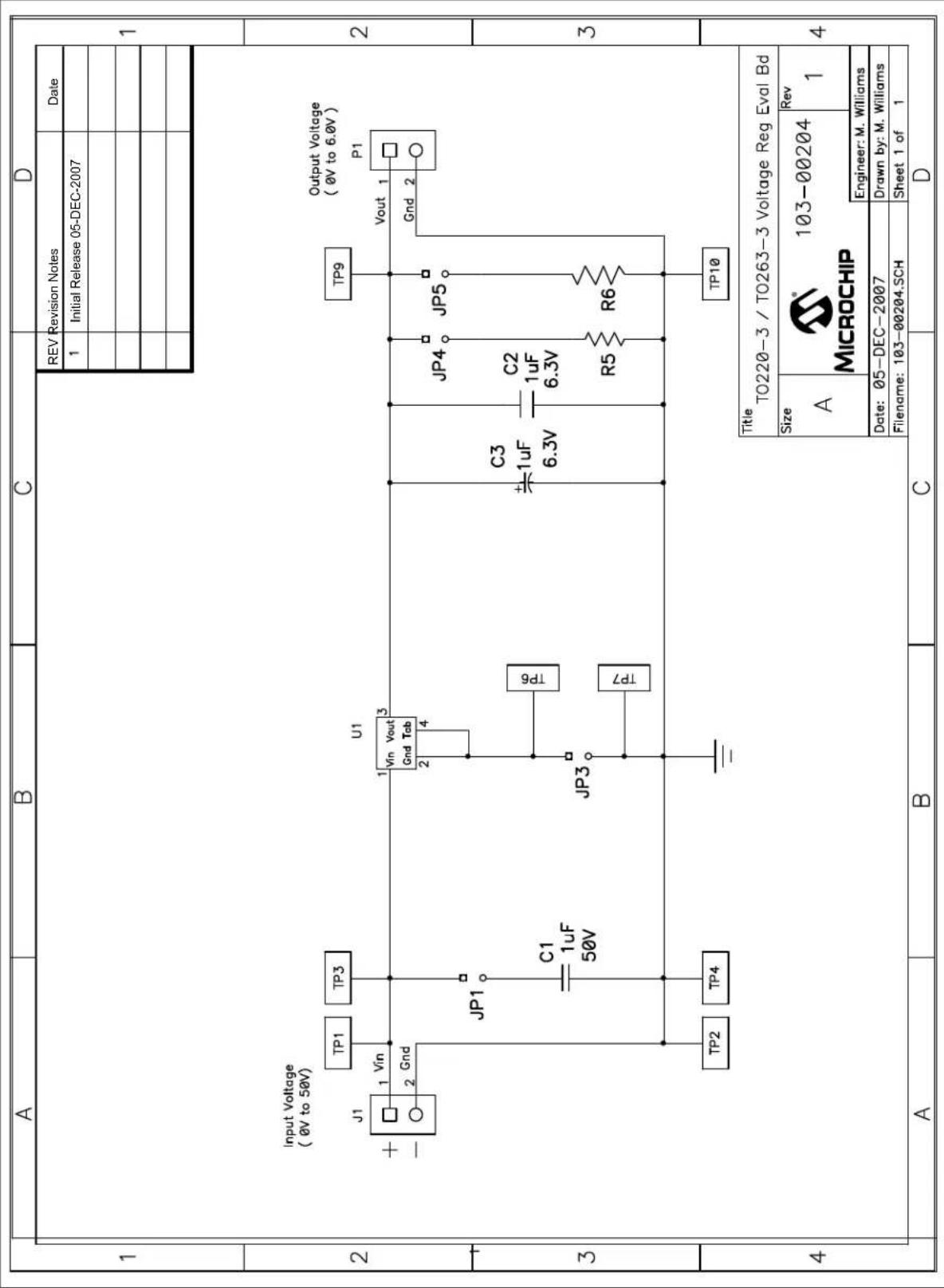
Jumper JP1 connects the input capacitance to the circuit. The input capacitor is disconnected when performing Power Supply Ripple Rejection tests. By default, C_1 is populated with a 1 F, 50V, XR7 ceramic capacitor.
1.2.3 Ground Current Measurement
Jumper JP3 allows measurement of ground current. When a current meter is connected to TP6 and TP7 and jumper JP3 is removed, the ground current of the device may be measured.
1.2.4 Load Resistor
R_5 may be populated with the desired load resistor value for the device being evaluated. JP4 connects R_5 to the device output. R_6 may also be populated with a load resistor. JP5 connects R_6 to the device output.
1.2.5 Output Capacitor
C_2 may be populated with the desired surface mount output capacitance. By default, C_2 is populated with a 1 F, 6.3V, XR7 ceramic capacitor. C_3 is provided for the user to populate with a radial lead through-hole capacitor with 0.100" lead spacing.
1.2.6 Power Supply
J1 or TP1 and TP2 are connected to the user's power supply.
1.3 WHAT THE TO220-3/TO263-3 VOLTAGE REGULATOR EVALUATION BOARD KIT INCLUDES
This TO220-3/TO263-3 Voltage Regulator Evaluation Board kit includes:
• One TO220-3/TO263-3 Voltage Regulator Evaluation Board, 102-00204
- Important Information "Read First"
Chapter 2. Installation and Operation
2.1 INTRODUCTION
The TO220-3/TO263-3 Voltage Regulator Evaluation Board is designed to be used to facilitate evaluation of Microchip's voltage regulators or to be used as a stand-alone voltage regulator board. Jumpers have been placed on the board to facilitate testing of specific voltage regulator parameters.
The TO220-3/TO263-3 Voltage Regulator Evaluation Board kit comes with a 1 uF ceramic input and output capacitor soldered to the board. The board has two unpopulated resistor locations that may be used for loads. The board also has one unpopulated output capacitor location that may be populated with a through-hole radial lead capacitor.
2.2 FEATURES
The TO220-3/TO263-3 Voltage Regulator Evaluation Board has the following features:
- Input and Output headers for future connection to Line Step and Load Step modules
- Ample testpoints to attach multimeters, power supplies, and loads
- Jumper to select ground current measurement
- Jumpers to connect output load resistors
- Jumper to connect input capacitor to circuit
- Footprint for an additional through-hole radial lead output capacitor
2.3 GETTING STARTED
The TO220-3/TO263-3 Voltage Regulator Evaluation Board is fully assembled and tested. All that is required for operating is a user supplied voltage regulator and a supply voltage source. Some of the tests that may be completed using the TO220-3/TO263-3 Voltage Regulator Evaluation Board shall now be described.
2.3.1 Ground Current and Quiescent Current
When measuring ground current, jumper JP3 should be removed, otherwise leave jumper JP3 on. To measure ground current, perform the following steps:
- Add desired load resistors to R_5 and R_6 .
- Remove jumpers JP3, JP4 and JP5.
- Connect an ammeter across testpoints TP6(+) and TP7(-). Select appropriate meter scale for device being evaluated.
- Connect a voltmeter across testpoints TP9(+) and TP10(-).
- Add jumper JP1.
- Apply source voltage to testpoints TP1(+) and TP2(-).
-
Verify the voltage across testpoints TP10 and TP9 is within the expected range of the device being tested.
-
Read the Ground Current directly from the ammeter connected to testpoints TP6 and TP7.
- Vary the input voltage to obtain data for ground current versus input voltage. With no load attached to the output of the voltage regulator, the measured ground current is also called the quiescent current of the regulator.
- Add a load selection jumper, JP4 or JP5.
- Read the Ground Current directly from the ammeter connected to testpoints TP6 and TP7.
- The data collected will be the ground current versus load current.
2.3.2 Load Resistance
R_5 and R_6 are used to set desired load values. One choice is to set R_5 to the minimum current desired for testing. R_6 would then be set to a value desired for specific tests. Either value may be selected by adding their respective jumpers.
2.3.3 Line Step
Dynamic Line Step response may be evaluated by connecting an electronically switched input voltage to testpoints TP1(+) and TP2(-) or to connector J1. An oscilloscope is connected to TP3(Ch1 Trigger), TP9(Ch2) and TP10(Gnd). An appropriate load is selected using R_5 and JP4 or R_6 and JP5. The input voltage is then electronically switched from a low voltage to a high voltage. The corresponding voltage waveform data of the voltage regulator response is captured by the oscilloscope. Microchip will be offering a Line Step module that connects directly to connector J1. The Line Step module will be capable of switching between two voltage levels that the user supplies.
2.3.4 Load Step
Dynamic Load Step response may be evaluated by connecting an electronically switched load to testpoints TP9(+) and TP10(-) or to connector P1. An oscilloscope is connected to the electronic load switch signal (Ch1 Trigger) and to TP9(Ch2) and TP10(Gnd). The load is then electronically switched from a high resistance to a low resistance. The corresponding voltage waveform data of the voltage regulator response is captured by the oscilloscope. Microchip will be offering a Load Step module that connects directly to connector P1. The Load Step module will have several selectable load values populated onboard to cover a wide range of loads. The load will have the ability to be electronically or manually switched.
2.3.5 Power Supply Rejection Ratio (PSRR)
Power Supply Rejection Ratio tests are performed by removing the input capacitor jumper, JP1, and connecting an appropriate PSRR analyzer to the TO220-3/TO263-3 Voltage Regulator Evaluation Board. The PSRR analyzer may then sweep the input voltage frequencies and record the corresponding output voltages.
Appendix A. Schematic and Layouts
A.1 INTRODUCTION
This appendix contains the following schematis and layouts for the TO220-3/TO263-3 Voltage Regulator Evaluation Board:
- Board - Schematic
- Board - Top Silk
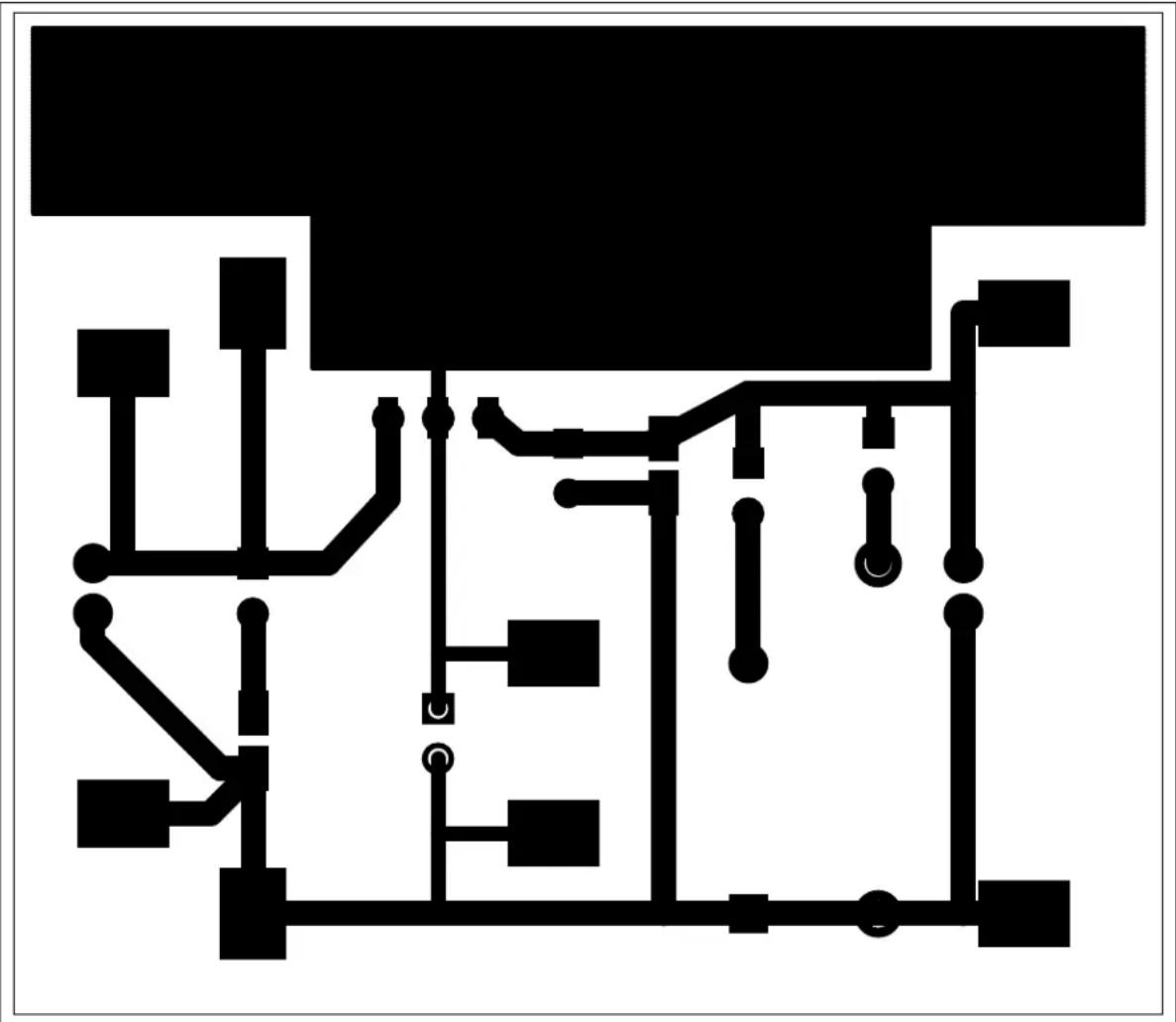
- Board - Top Copper
- Board - Bottom Copper
A.2 BOARD - SCHEMATIC
text_image
A B C D 1 Input Voltage ( 0V to 50V) J1 1 Vin 2 Gnd JP1 C1 1uF 50V TP2 TP4 U1 1 Vin Vout Gnd Tab 2 3 4 TP6 JP3 TP7 - TP10 TP9 Output Voltage ( 0V to 6.0V ) P1 Vout 1 Gnd 2 JP4 JP5 C3 1uF 6.3V C2 1uF 6.3V R5 R6 TP10 4 Title TO220-3 / TO263-3 Voltage Reg Eval Bd Size A MICROCHIP 103-00204 Rev Engineer: M. Williams Date: 05-DEC-2007 Drawn by: M. Williams Filename: 103-00204.SCH Sheet 1 of 1 REV Revision Notes Date 1 Initial Release 05-DEC-2007 1A.3 BOARD - TOP SILK

text_image
TO263-3/T0220-3 Voltage Reg Eval Board 102-00204 U1 TP1 VIN TP3 VIN MICROCHIP TP9 VOUT C3 C2 JP4 JP5 +VOUT VIN GND VOUT J1 +VIN JP1 TP6 JP3 IQ +IQ TP7 -IQ R5 R6 TP10 GND TP2 GND TP4 C1 GNDA.4 BOARD - TOP COPPER
natural_image
Pure electrical circuit lines without any symbolsA.5 BOARD - BOTTOM COPPER

NOTES:
Appendix B. Bill of Materials (BOM)
TABLE B-1: BILL OF MATERIALS (BOM)
| Qty | Reference Description | Manufacturer Part Number | ||
| 1 C1 | CAP CERAMIC 1 | .0 uF 50V X7R 0805 Murata Electronics | ® | GRM21BR71H105KA12L |
| 1 C2 | CAP CERAMIC 1 | .0 uF 16V X7R 0805 Kemet | ®Electronics C0 | 805C105K4RACTU |
| 1 C3 | DO NOT POPULATE — — | |||
| 1 J1 | 2 pin RA header, 0.100 centers,0.025 sq pins, 0.070 pcb to pin center height, 36 pins to a strip (yields 18 headers) | 3M | 929835-01-36-RK | |
| 4 JP1, JP3, JP4,JP5 | 2 pin header, 0.100 centers, 0.025 sq pins, 0.070 | Molex®Electronics | 22-28-4360 | |
| 4 JP1, JP3, JP4,JP5 | Connector, Jumper Shorting, Tin | Sullins Electronics | STC02SYAN | |
| 1 P1 | RA socket, 0.100 centers,0.025 sq pins, 0.070 pcb to pin center height | Sullins Electronics | PPPC021LGBN-RC | |
| 1 PCB | RoHS Compliant Bare PCB, TO220-3/TO263-3 Voltage Regulator Evaluation Board | Microchip Technology Inc. | 104-000204 | |
| 2 R5, R6 | DO NOT POPULATE — | — | ||
| 8 TP1, TP2, TP3,TP4, TP6, TP7,TP9, TP10 | SMT Testpoint | Keystone Electronics® | 5016 | |
| 2 U1, U2 | DO NOT POPULATE — | — | ||
| 4 On | Each Corner Bumpon Hemisphere, 0.44 x 0.20,Black | 3M | SJ-5003 (BLACK) | |
Note 1: The components listed in this Bill of Materials are representative of the PCB assembly. The released BOM used in manufacturing uses all RoHS-compliant components.
WORLDWIDE SALES AND SERVICE
AMERICAS
Corporate Office
2355 West Chandler Blvd.
Chandler, AZ 85224-6199
Tel: 480-792-7200
Fax: 480-792-7277
Technical Support:
http://support.microchip.com
Web Address:
www.microchip.com
Atlanta
Duluth, GA
Tel: 678-957-9614
Fax: 678-957-1455
Boston
Westborough, MA
Tel: 774-760-0087
Fax: 774-760-0088
Chicago
Itasca, IL
Tel: 630-285-0071
Fax: 630-285-0075
Cleveland
Independence, OH
Tel: 216-447-0464
Fax: 216-447-0643
Dallas
Addison, TX
Tel: 972-818-7423
Fax: 972-818-2924
Detroit
Farmington Hills, MI
Tel: 248-538-2250
Fax: 248-538-2260
Kokomo
Kokomo, IN
Tel: 765-864-8360
Fax: 765-864-8387
Los Angeles
Mission Viejo, CA
Tel: 949-462-9523
Fax: 949-462-9608
Santa Clara
Santa Clara, CA
Tel: 408-961-6444
Fax: 408-961-6445
Toronto
Mississauga, Ontario,
Canada
Tel: 905-673-0699
Fax: 905-673-6509
ASIA/PACIFIC
Asia Pacific Office
Suites 3707-14, 37th Floor
Tower 6, The Gateway
Harbour City, Kowloon
Hong Kong
Tel: 852-2401-1200
Fax: 852-2401-3431
Australia - Sydney
Tel: 61-2-9868-6733
Fax: 61-2-9868-6755
China - Beijing
Tel: 86-10-8528-2100
Fax: 86-10-8528-2104
China - Chengdu
Tel: 86-28-8665-5511
Fax: 86-28-8665-7889
China - Hong Kong SAR
Tel: 852-2401-1200
Fax: 852-2401-3431
China - Nanjing
Tel: 86-25-8473-2460
Fax: 86-25-8473-2470
China - Qingdao
Tel: 86-532-8502-7355
Fax: 86-532-8502-7205
China - Shanghai
Tel: 86-21-5407-5533
Fax: 86-21-5407-5066
China - Shenyang
Tel: 86-24-2334-2829
Fax: 86-24-2334-2393
China - Shenzhen
Tel: 86-755-8203-2660
Fax: 86-755-8203-1760
China - Wuhan
Tel: 86-27-5980-5300
Fax: 86-27-5980-5118
China - Xiamen
Tel: 86-592-2388138
Fax: 86-592-2388130
China - Xian
Tel: 86-29-8833-7252
Fax: 86-29-8833-7256
China - Zhuhai
Tel: 86-756-3210040
Fax: 86-756-3210049
ASIA/PACIFIC
India - Bangalore
Tel: 91-80-3090-4444
Fax: 91-80-3090-4080
India - New Delhi
Tel: 91-11-4160-8631
Fax: 91-11-4160-8632
India - Pune
Tel: 91-20-2566-1512
Fax: 91-20-2566-1513
Japan - Yokohama
Tel: 81-45-471-6166
Fax: 81-45-471-6122
Korea - Daegu
Tel: 82-53-744-4301
Fax: 82-53-744-4302
Korea - Seoul
Tel: 82-2-554-7200
Fax: 82-2-558-5932 or
82-2-558-5934
Malaysia - Kuala Lumpur
Tel: 60-3-6201-9857
Fax: 60-3-6201-9859
Malaysia - Penang
Tel: 60-4-227-8870
Fax: 60-4-227-4068
Philippines - Manila
Tel: 63-2-634-9065
Fax: 63-2-634-9069
Singapore
Tel: 65-6334-8870
Fax: 65-6334-8850
Taiwan - Hsin Chu
Tel: 886-3-6578-300
Fax: 886-3-6578-370
Taiwan - Kaohsiung
Tel: 886-7-536-4818
Fax: 886-7-536-4803
Taiwan - Taipei
Tel: 886-2-2500-6610
Fax: 886-2-2508-0102
Thailand - Bangkok
Tel: 66-2-694-1351
Fax: 66-2-694-1350
EUROPE
Austria - Wels
Tel: 43-7242-2244-39
Fax: 43-7242-2244-393
Denmark - Copenhagen
Tel: 45-4450-2828
Fax: 45-4485-2829
France - Paris
Tel: 33-1-69-53-63-20
Fax: 33-1-69-30-90-79
Germany - Munich
Tel: 49-89-627-144-0
Fax: 49-89-627-144-44
Italy - Milan
Tel: 39-0331-742611
Fax: 39-0331-466781
Netherlands - Drunen
Tel: 31-416-690399
Fax: 31-416-690340
Spain - Madrid
Tel: 34-91-708-08-90
Fax: 34-91-708-08-91
UK - Wokingham
Tel: 44-118-921-5869
Fax: 44-118-921-5820