VVCA - Unspecified Majella - Free user manual and instructions
Find the device manual for free VVCA Majella in PDF.


User questions about VVCA Majella
0 question about this device. Answer the ones you know or ask your own.
Ask a new question about this device
Download the instructions for your Unspecified in PDF format for free! Find your manual VVCA - Majella and take your electronic device back in hand. On this page are published all the documents necessary for the use of your device. VVCA by Majella.
USER MANUAL VVCA Majella
The VVCA is a fully analog dual voltage controlled amplifier (VCA). The unique part of this VCA is the velocity input, which makes it possible to modulate the incoming CV signal with a velocity voltage (or any other CV source). The VVCA is a linear dual VCA and can be used for both CV and audio signals. It is a straightforward 4HP module that adds velocity, and a whole new dimension to your modular setup!
FUNCTIONAL DIAGRAM

flowchart
graph LR
    A["CV"] --> B["VCA"]
    B --> C["VCA"]
    D["Signal"] --> E["~"]
    F["Velocity"] --> B
CONTENT
In the box of the assembled version of the VVCA contains the following
• Tested and Assembled VVCa Module
• 16pin to 16 pin ribbon cable
• Mounting hardware: two M3 screws
If anything of the above is missing. Please contact your dealer or support@majella-audio.com
- Doepfer A-100 Eurorack compatible (16 pin power connector, uses the 5V rail!)
• Power consumption: +/-12V (15mA), 5V (10mA)
POWER CONNECTION
This module is designed to be connected to your Eurorack system, using a 16-pin ribboncable. The -12V (red stripe) should be directed as shown in the picture below.
WARNING!
This module is designed for Eurorack systems. The supply should be +-12V and connected signals should not be out of the +-12V range! Do not reverse polarity when connecting the power, this will damage your module permanently!

text_image
-12VSPECIFICATIONS
• Dimensions: 128.5 x 20 x 2mm
CONNTECTIONS
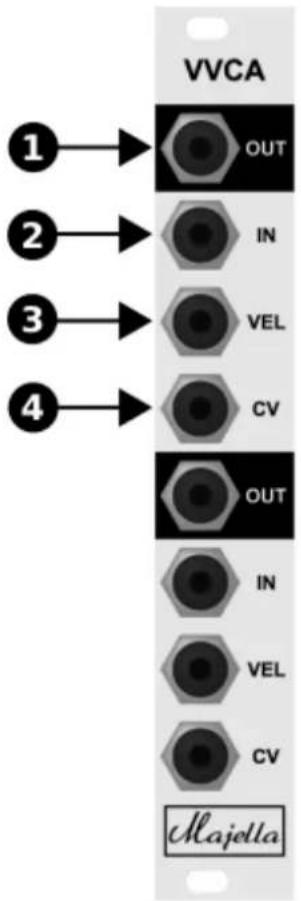
1. OUTPUT
The output of the VVCA has the same amplitude as the input when the velocity is 5V and the CV signal is 8V. The VVCA adds a tiny bit of "soft clipping" to the input signal, which we find "characteristic".
2. INPUT
The VVCA is designed to process 5V amplitude signals (common VCO outputs), but can also be used for DC signals (CV sources etc.).
3. VELOCITY
The velocity input is designed to use with 0-5V velocity control voltages, but other types of CV sources can also be connected to modulate the incoming CV signal (4).
4. CV INPUT
The CV input is designed for 0-8V control voltages, which is a common ADSR envelope output range.
text_image
VVCA 1 → OUT 2 → IN 3 → VEL 4 → CV OUT IN VEL CV MajellaVVCA User Manual version 1.0 9-09-2018
©2018

text_image
Majellahttps://majella-audio.com support@majella-audio.com
Designed and made in Holland