KLT-40GS - Oven Blodgett - Free user manual and instructions
Find the device manual for free KLT-40GS Blodgett in PDF.


User questions about KLT-40GS Blodgett
0 question about this device. Answer the ones you know or ask your own.
Ask a new question about this device
Download the instructions for your Oven in PDF format for free! Find your manual KLT-40GS - Blodgett and take your electronic device back in hand. On this page are published all the documents necessary for the use of your device. KLT-40GS by Blodgett.
USER MANUAL KLT-40GS Blodgett
natural_image
Exterior view of a stainless steel industrial mixing vessel with control panel and side-mounted unit (no visible text or symbols)BLODGETT


Your Service Agency's Address:
Model
Serial number
Kettle installed by
Installation checked by
IMPORTANT
WARNING: Improper installation, adjustment, alternation, service or maintenance can cause property damage, injury or death. Read the installation, operation and maintenance instructions thoroughly before installing or servicing this equipment.
INSTRUCTIONS TO BE FOLLOWED IN THE EVENT THE USER SMELLS GAS MUST BE POSTED IN A PROMINENT LOCATION. This information may be obtained by contacting your local gas supplier.
FOR YOUR SAFETY
Do not store or use gasoline or other flammable vapors or liquids in the vicinity of this or any other appliance.
Do not obstruct the flow of combustion and ventilation air. Keep the appliance area free and clear from combustibles. Adequate clearances must be maintained for servicing and proper operation.
The information contained in this manual is important for the proper installation, use, and maintenance of this kettle. Adherence to these procedures and instructions will result in satisfactory baking results and long, trouble free service. Please read this manual carefully and retain it for future reference.
ERRORS: Descriptive, typographic or pictorial errors are subject to correction. Specifications are subject to change without notice.
TABLE OF CONTENTS
INSTALLATION
Service Connections 2
Installation Information .... 3
Installation Codes and Standards 3
Exhaust Fans and Canopies ....3
All Exhaust Fan .... 3
Clearances 3
Kettle Installation & Utility Connection....4
Kettle Installation....4
Gas Connection....4
Water Connection 5
Electrical Connection 5
Performance Check 5
OPERATION
Safety & Gas Control Information....6
Kettle Controls....7
Kettle Operation 8
MAINTENANCE
Cleaning Instructions....9
Kettle Cleaning....9
Draw Off Valve Cleaning 9
What to do if Surface Rust Appears 10
Stainless Steel 10
Control Panel 10
Preventative Maintenance 11
SERVICE CONNECTIONS
| G Gas Connection - Supply gas through 3/4" pipe . A gas shut-off valve must be installed in supply piping convenient and adjacent to appliance. | |
| EC Electrical Connection - Unless other wise specified, Field Wire Electrical Connection to be 120 Volts, 60 Hertz single phase with grounding wire. Unit furnished with 8' cord and 3 prong plug. Total max. amps 4.0. | |
| HW | Hot Water Connection - 3/8" tubing to faucet (OPTIONAL) |
| CW | Hot Water Connection - 3/8" tubing to faucet (OPTIONAL) |
INSTALLATION CLEARANCE
| Left Side Right Side Rear | |
| 0" [0mm] 0" [0mm] 4" [102mm] |
■ BTU/Hour: 125,000
kW/Hour: 36.63
■ Gas Supply (Supply Pipe Pressure W.C.)
Natural 6"-14" (152-356mm)
☐ Propane 11"-14" (279-356mm)
DIMENSIONS ARE IN INCHES [MM]
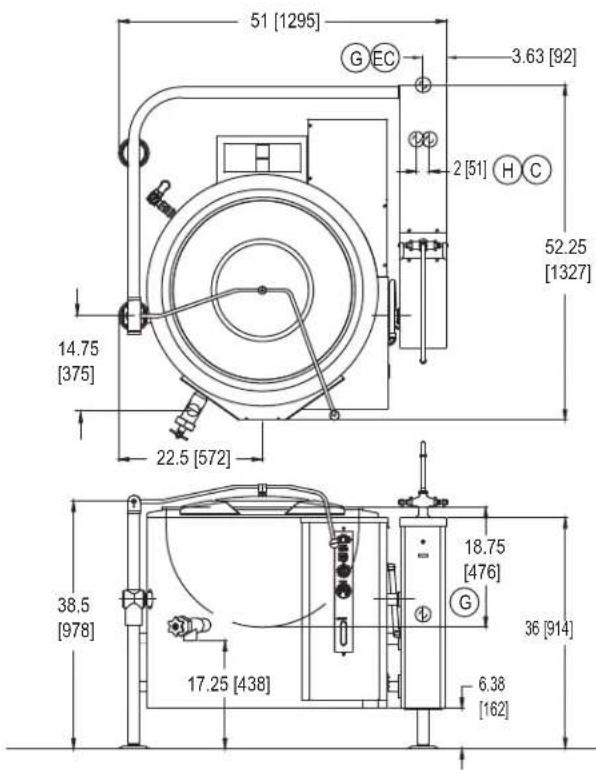
text_image
51 [1295] 3.63 [92] 2 [51] H C 52.25 [1327] 14.75 [375] 22.5 [572] 38.5 [978] 17.25 [438] 18.75 [476] G 6.38 [162]
REAR FLANGED FOOT DETAIL
2 EQUALLY SPACED
07/16" [11mm] HOLES
ON 2.5" [63mm] B.C.
* Use on non-combustible floors only.
* Shown with option faucet, cover and draw-off.

text_image
14.75 [375] 22.5 [572] 18.75 [476] 17.25 [438] 6.38 [162] 38.5 [978] 36 [914] 74.5 [1892] A 4 [102] MINIMUM 37.75 [959] 8.5 [216] H C G EC 21 [533] 33.5 [891]Figure 1
INSTALLATION CODES AND STANDARDS
Installation must conform with local codes, or in the absence of local codes, with the National Fuel Gas Code, ANSI Z223.1/NFPA 54, or the Natural Gas and Propane Installation Code, CSA B149.1, as applicable.
- The appliance and its individual shut off valve must be disconnected from the gas supply piping system during any pressure testing of that system at pressures in excess of 12 psi (3.5 kPa).
- The appliance must be isolated from the gas supply piping system by closing its individual manual shut off valve during any pressure testing of the gas supply piping system at test pressures equal to or less than 12 psi (3.5 kPa).
Electrical grounding must be provided in accordance with local codes, or in the absence of local codes, with the National Electrical Code, ANSI/NFPA 70, or the Canadian Electrical Code, CSA C22.2, as applicable.
The electrical diagram is located on the inside of side panel of left hand console.
EXHAUST FANS AND CANOPIES
Canopies are set over ranges, ovens and kettles for ventilation purposes. It is recommended that a canopy extend 6 inches past appliance and be located 7.5 feet from the floor. Filters should be installed at an angle of 45 degrees or more with the horizontal. This position prevents dripping of grease and facilitates collecting the run-off grease in a drip pan, usually installed with the filter. A strong exhaust fan tends to create a vacuum in the room and may interfere with burner performance or may extinguish pilot flames. Makeup air openings approximately equal to the fan area will relieve such vacuum. In case of unsatisfactory performance on any appliance, check operation with exhaust fan in the "OFF" position.
ALL EXHAUST FAN
he exhaust fan should be installed at least two feet above the vent opening at the top of the unit.
CLEARANCES
Adequate clearance must be provided in aisle and at the side and back. Adequate clearances for air openings into the combustion chamber must be provided, as well as for serviceability.
- Sides - 0 inches
- Back - 4 inches at flue box
- Floors - Non-combustible
All units must be installed in such a manner that the flow of combustion and ventilation air are not obstructed. Provisions for an adequate air supply must also be provided. Do not obstruct side of the unit, as combustion air enters through this area.
Information on the construction and installation of ventilating hoods may be obtained from the standard for "Vapor Removal from Cooking Equipment", NFPA No. 96 (latest edition), available from the National Fire Protection Association, Batterymarch Park, Quincy, MA, USA, 02269.
KETTLE INSTALLATION
- Uncrate carefully. Report any hidden freight damage to the freight company immediately.
- The pressure relief valve is located at the right rear of the unit. This area should be kept clear and should not be in an area where operators will normally stand. The elbow on the relief valve should be turned toward the floor. A maximum 3 foot, 3/4" diameter pipe may be used to extend to the floor, but must not be piped directly to a drain. It must vent to the atmosphere.
- Set the unit in place. Be certain to maintain minimum clearances as stated above.
- To level the unit use a spirit level in all directions on the top of the kettle (lid up). Adjust the bottom foot on each leg to overcome an uneven floor.
- Mark hole locations on floor through anchoring holes provided in flanged adjustable feet.
- Remove appliance and drill holes in locations marked on floor and insert proper anchoring devices.
- Set unit back in position and re-level left to right and front to back.
- Bolt and anchor appliances securely to the floor.
- Seal bolts and flanged feet with silastic or equivalent compound.
- Appliance location must allow air supply to unit and obstruction free clearance for air opening into the combustion chamber.
- Make service connections as indicated.
- Check the pressure gauge on the front panel before operating. If the pressure gauge does not indicate green vacuum zone (below 0 psi), see "Re-establishing Vacuum" section under SERVICE, after completing installation instructions.
GAS CONNECTION
The serial plate on the lower right side of the unit indicates the type of gas your unit is equipped to burn. Do NOT connect to any other gas type.
A 3/4" NPT line is provided at the rear for the connection. Each unit is equipped with an internal pressure regulator which is set for 3.5" W.C. manifold pressure for natural gas and 4.0" W.C. for propane gas. Use 1/8" pipe tap on the downstream side of the combination valve for checking pressure.
An adequate gas supply is imperative. Undersized or low pressure lines will restrict the volume of gas required for satisfactory performance. A steady pressure, minimum 6" W.C. for natural gas and minimum 11" W.C. for propane gas, is recommended. With all units operating simultaneously, the manifold pressure on all units should not show any appreciable drop. Fluctuations of more than 25% on natural gas, and 10% on propane gas, will create pilot problems and affect burner operating characteristics. Contact your gas company for correct supply line sizes.
Purge the supply line to clean out any dust, dirt, or other foreign matter before connecting the line to the unit. It is recommended that an individual manual shut off valve be installed in the gas supply line to the unit. Use pipe joint compound which is suitable for use with LP gas on all threaded connections. Test pipe connections thoroughly for gas leaks.

WARNING
All connections must be checked for leaks, after the unit has been put in operation. Use soapy water only for testing on all gases. Never use an open flame to check for gas leaks.

NOTICE
If applicable, the vent line from the gas appliance pressure regulator shall be installed to the outdoors in accordance with local codes or, in the absence of local codes, with the National Fuel Gas Code, ANSI Z223.1/NFPA 54, or the Natural Gas and Propane Installation Code CSA B149.1, as applicable.

NOTICE
If this equipment is being installed at over 2,000 feet altitude and was not so specified on order, contact service department. Failure to install with proper orifice sizing may void the warranty.
WATER CONNECTION
On units equipped with an optional water fill valve connect a water line (minimum 1/4") to the valve with a 1/4" NPT female fitting. Units with dual (hot and cold) valves must have the hot water line connected to side with the hot water valve (red) and cold water line to the cold water valve (blue). Plastic or rubber hose is not recommended, as it may melt against the hot kettle side.
ELECTRICAL CONNECTION

WARNING
Do not connect the kettle to the electrical supply until after the gas connection has been made.
- 120 VAC - 60 Hz - Single Phase

WARNING
ELECTRICAL GROUNDING INSTRUCTIONS
This appliance is equipped with a three-prong (grounding) plug for your protection against shock hazard and should be plugged directly into a properly grounded three-prong receptacle. Do not cut or remove the grounding prong from this plug. (120V units only).
Units with this electrical rating are factory supplied with a three-wired cord and three-prong plug which fits any standard 120V, three-prong grounded receptacle. A separate 15 amp supply is needed for each unit.
- 208/240 VAC - 60 Hz - Single and Three Phase
Units with this electrical rating are factory equipped with a transformer. To connect supply wires, remove cover from right console. Route supply wires and ground wire through the hole in the console with a strain relief fitting. Connect wires to the terminal block in the rear of the right console. Connect ground wire to lug. Replace cover. Three-phase units are wired as above, using only two supply wires. The third supply wire is not connected and must be properly terminated.
- 220 VAC - 50 Hz - Single Phase
Units equipped with this voltage ratings should be wired exactly as in (2.) above.
PERFORMANCE CHECK
The following items should be checked before or within the first 30 days of operation by a qualified service technician.
- Verify correct gas type against rating plate on unit.
- Verify correct voltage, cycle and phase against rating plate on unit.
- Gas pressure.
- Internal gas connections.
- Internal electrical connections.
- Burners - adjustment and ignition.
- Thermostat - cycle for operation check.
- Gas supply valve - check for operation.
- Check hinge and lid assembly.
- Draw-off valve - check operation.
- Advise user on cleaning procedure.
SAFETY INFORMATION
Contact the factory, the factory representative or a local service company to perform maintenance and repairs should the appliance malfunction.

CAUTION
If you smell gas during the lighting procedure, immediately shut off the gas supply until the leak has been corrected.

WARNING
In the event of main burner ignition failure, a 5 minute purge period must be observed prior to re-establishing ignition source.

WARNING
In the event you smell gas, shut down equipment at the main shut off valve and contact the local gas company or gas supplier for service.
GAS CONTROL INSTRUCTIONS
The units do not require "lighting" the pilot with a match.
Lighting
NOTE: Unit is shipped with gas combination valve turned "on".
- Open manual gas shut off valve.
- Set thermostat to OFF, and kettle in fully upright position, turn power switch ON.
- Set thermostat to maximum, initiating a 30 second pre-purge. Red "COOKING" pilot will come on, and after 30 seconds, the green "IGNITION" pilot will come on, lighting the main burners.
If after 36 seconds the burner fails to ignite or the "ignition light goes out, the system goes into Safety Lockout. De-energize the system by setting the thermostat to "OFF" for five minutes and try again.
- Set the thermostat to desired temperature setting. When temperature setting has been reached, the "IGNITION" pilot will go off, turning off the burner. The unit will then cycle on and off to maintain set temperature.
NOTE: When the kettle is tilted a safety switch will automatically turn off gas supply. The kettle will not operate once it has been tilted.
Daily Shutdown
- Turn power switch "OFF."
- Turn thermostat "OFF."
Complete Shutdown
- Turn power switch "OFF."
- Turn thermostat "OFF".
- Turn power supply to unit "OFF".
- Remove front access panel on left side and turn dial on combination valve to "OFF".
- Close manual gas shut off valve.
POWER SWITCH
This switch turns the main power to the unit on and off. It must be turned on to heat the kettle. It should be turned off when the kettle will not be in use for long periods.
This light is on whenever the main burner gas is on.
(RED) COOKING LIGHT
This light is on when the thermostat is calling for heat.
(AMBER) LOW WATER LIGHT
All kettles are supplied with sufficient distilled water in pressurized jacket. If at any time the water level falls below that required for proper operation, the kettle will not heat and this light will come on. See “Adding Water” in Service section.
THERMOSTAT
The thermostat selects the desired internal kettle operating temperature. The thermostat must be set at a desired setting in order for the burner to ignite.
For Reference:
| DIAL SETTING °C °F | ||
| 1 15 60 | ||
| 2 27 81 | ||
| 3 40 104 | ||
| 4 53 127 | ||
| 5 67 153 | ||
| 6 81 178 | ||
| 7 95 203 | ||
| 8 108 226 | ||
| 9 122 252 | ||
| 10 135 275 | ||
PRESSURE GAUGE
The pressure gauge indicates the internal operating pressure of the kettle. When cold, the gauge should point to the green vacuum zone. If it does not, refer to "Re-establishing Vacuum" section. Under normal operation with the kettle empty (thermostat set at 10 or 275^ ) the pressure should reach 30 psi. When loaded the pressure may be considerably less.
SIGHT GLASS
The sight glass indicates the minimum and maximum water level within the kettle. If water level falls below minimum level more distilled water should be added. See "Adding Water" in Service section.
PRESSURE RELIEF VALVE
The pressure relief valve is a safety device which prevents the internal kettle pressure from exceeding 50 psi. It should never be tampered with.
DAILY OPERATION
Daily operation should consist of turning on the power switch and setting thermostat for the desired temperature.
It is recommended the kettle be preheated prior to use. Milk or egg based products should be placed in the kettle before heating however, to prevent sticking. The kettle is preheated when the cooking light goes off the first time.
At the end of the day, or if the kettle will not be used for some time, shut the unit down by turning the power switch to "OFF".
Clean as required or on a daily basis. See "CLEANING INSTRUCTIONS" section.
END USE TIPS
- For easier cleaning add cold water to the kettle immediately after removing contents.
- When preparing foods containing vinegar or tomatoes, or those which have a high salt content, clean the kettle immediately after using to prevent pitting.
- Do not use salt to clean the kettle. This will scratch the surface.
- If using salt water to cook shellfish, be sure to rinse and wash the kettle thoroughly after use.
- Bring milk and egg products slowly up to temperature in a cold kettle to prevent product from adhering to the sides. When preparing milk-based products do not preheat the kettle.
- When planning actual cooking capacity, allow room at top for stirring without spilling.
- When preparing puddings from a mix, place the powder in a cold kettle, add a small amount of liquid, and stir to form a thin paste. Turn on the kettle and add the remainder of the liquid. Continue as per recipe instructions.
- When browning meat, bring the kettle up to temperature before adding. This will seal the juices in the meat.
GAS SAVING TIPS
Use these reminders to help develop energy-saving procedures and habits. Using less natural or propane gas saves energy as well as money.
- Turn off when not in use.
- Limit preheat times.
- Use lid when possible.
- Maintain equipment.
KETTLE CLEANING

WARNING
Disconnect the power supply to the appliance before cleaning or servicing.

WARNING
Never spray water into electric controls or components!

CAUTION
The equipment and its parts are hot. Use care when operating, cleaning and servicing.

CAUTION
Do not use cleaning agents that are corrosive.
Your kettle should be cleaned immediately after each use or when cooking a different product. Before cleaning, check that the kettle has cooled enough to touch it.
- Rinse the inside of the kettle thoroughly and drain to remove any food particles.
- Using a nylon brush, clean the kettle with a mild detergent and water. Never use steel wool or scouring powder as it will scratch stainless steel. Plain steel wool can leave small pieces of steel which can rust.
- Rinse the inside of the kettle thoroughly with clean water. Drain the kettle by tilting or the tangent draw-off valve, depending on model, to allow the detergent and water solution to drain.
- Wipe the exterior of the kettle with a clean, damp cloth.

WARNING
If you are cleaning a valve that is assembled to a kettle, be sure the kettle is completely empty of any product.
DRAW OFF VALVE CLEANING
- If equipped with a tangent draw-off valve, turn the large hex nut on the draw-off valve counterclockwise until it is completely disengaged from the threads. Grasp the valve knob and slowly pull out the valve stem and disk. Do not allow the disk to come in contact with hard surfaces as it can be damaged and cause valve leakage. Wash the valve stem, disk and handle. Insert a nylon brush, wet with detergent and water, into the valve body and tangent draw-off tube. Brush vigorously.
- Replace the valve stem assembly and turn the hex nut until snug. Rinse the kettle with clean warm water.
- Leave the draw-off valve open when the kettle is not in use.
Dairy Draw Off Valve Cleaning
- Remove the plug by first removing the handle, then turn the plug to line up with the pin and pull with both hands. It is important to use both hands because the plug is heavy.
- Put the plug in a plastic pail that contains a mild soap solution. A plastic pail works best, as it reduces the possibility of nicking or scratching the plug. If the plug gets scratched it may not seal correctly and could leak.
- Use a soft cloth or soft brush and clean all surfaces.
- Using both hands remove the valve from the soap and rinse well in another plastic pail that contains fresh water.
- Wash out the kettle as normal.
- Once the kettle is washed out, return the plug into the body. Be sure the plug is inserted into the notch and turned. Ensure the plug is tight and secure before letting go of it.
If you are cleaning a body and plug assembly, remove the plug and follow the above procedures. When finished with the plug, follow the same instructions for washing the body. Always use both hands when handling the plugs. Reassemble the plug into the body and use as normal.

NOTICE
Draw-off valve has a vulcanized rubber coated stem for better sealing. Do not over tighten. This may cause the rubber to pull away from stem and permanently damage it. This is not covered under warranty.
WHAT TO DO IF SURFACE RUST APPEARS
Metal utensils should never be used as they will scratch the surface of the equipment and rust may begin to form. To remove surface accumulation of rust from the inadvertent use of such utensils, the following procedure may be used.
CAUTION
Improper use of this procedure may damage your appliance!
- Use undiluted white vinegar with a non-abrasive scouring pad (plastic) or cloth on the affected area to remove the rust stain. The appliance should not be heated and remain at room temperature during the entire cleaning process.
- If the stain resists removal, additional exposure time with vinegar may be required, to a maximum of one hour.
- Thoroughly wash all of the vinegar away with fresh clear water. Dry the surface completely and allow one hour before using the appliance to cook.
Following daily and period maintenance procedures will prolong the life for your equipment. Climatic conditions - salt air - may require more thorough and frequent cleaning or the life of the equipment could be adversely affected.
STAINLESS STEEL
To remove normal dirt, grease or product residue from stainless steel, use ordinary soap and water (with or without detergent) applied with a sponge or cloth. Dry thoroughly with a clean cloth. Never use vinegar or any other corrosive cleaner.
To remove grease and food splatters or condensed vapours that have baked on the equipment, apply cleanser to a damp cloth or sponge and rub cleanser on the metal in the direction of the polishing lines. Rubbing cleanser as gently as possible in the direction of the polished lines will not mar the finish of the stainless steel. NEVER RUB WITH A CIRCULAR MOTION.
Soil and burn deposits which do not respond to the above procedure can usually be removed by rubbing the surface with SCOTCH-BRITE™ scouring pads or STAINLESS scouring pads. DO NOT USE ORDINARY STEEL WOOL as any particles left on the surface will rust and further spoil the appearance of the finish. NEVER USE A WIRE BRUSH, STEEL SCOURING PADS (EXCEPT STAINLESS), SCRAPER, FILE OR OTHER STEEL TOOLS. Surfaces which are marred collect dirt more rapidly and become more difficult to clean. Marring also increases the possibility of corrosive attack. Refinishing may then be required.
To remove heat tint: Darkened areas sometimes appear on stainless steel surfaces where the area has been subjected to excessive heat. These darkened areas are caused by thickening of the protective surface of the stainless steel and is not harmful. Heat tint can normally be removed by the foregoing, but tint which does not respond to this procedure calls for a vigorous scouring in the direction of the polish lines using SCOTCH-BRITE™ scouring pads or a STAINLESS scouring pad in combination with a powdered cleanser. Heat tint action may be lessened by not applying or by reducing heat to equipment during slack periods.
All food contact surfaces must be thoroughly drained and flushed prior to cooking in the kettle.
CONTROL PANEL
The textured control panel should be cleaned with warm water and mild soap. Never use an abrasive cloth or steel wool. Never use cleaning solvents with a hydrocarbon base.
Contact the factory, the factory representative or a local service company to perform maintenance and repairs.

WARNING
Disconnect the power supply to the appliance before cleaning or servicing.
Daily:
- Wash exposed cleanable areas.
Monthly:
- Blower wheel inlet and motor air vent should be cleansed if an accumulation of dust or lint is obvious.
Twice a Year: (minimum)
- Have an authorized service person clean and adjust the unit for maximum performance.
- The unit venting system should be examined and cleaned.
- Grease the screw jack tilt mechanism via the lubricating nipple. Use Petro-Canada type OG-2 or equivalent.
Annually:
- Have an authorized service person inspect the screw jack assembly for wear. The screw must be replaced immediately if the end play has reached 0.019" [0.5mm].