MegaPix DWC-MV74WI4 - Surveillance Camera Digital Watchdog - Free user manual and instructions
Find the device manual for free MegaPix DWC-MV74WI4 Digital Watchdog in PDF.


User questions about MegaPix DWC-MV74WI4 Digital Watchdog
0 question about this device. Answer the ones you know or ask your own.
Ask a new question about this device
Download the instructions for your Surveillance Camera in PDF format for free! Find your manual MegaPix DWC-MV74WI4 - Digital Watchdog and take your electronic device back in hand. On this page are published all the documents necessary for the use of your device. MegaPix DWC-MV74WI4 by Digital Watchdog.
USER MANUAL MegaPix DWC-MV74WI4 Digital Watchdog
MEGApix® 4MP Indoor/Outdoor Vandal Dome IP Camera
DWC-MV74Wi28
DWC-MV74Wi4
DWC-MV74Wi6
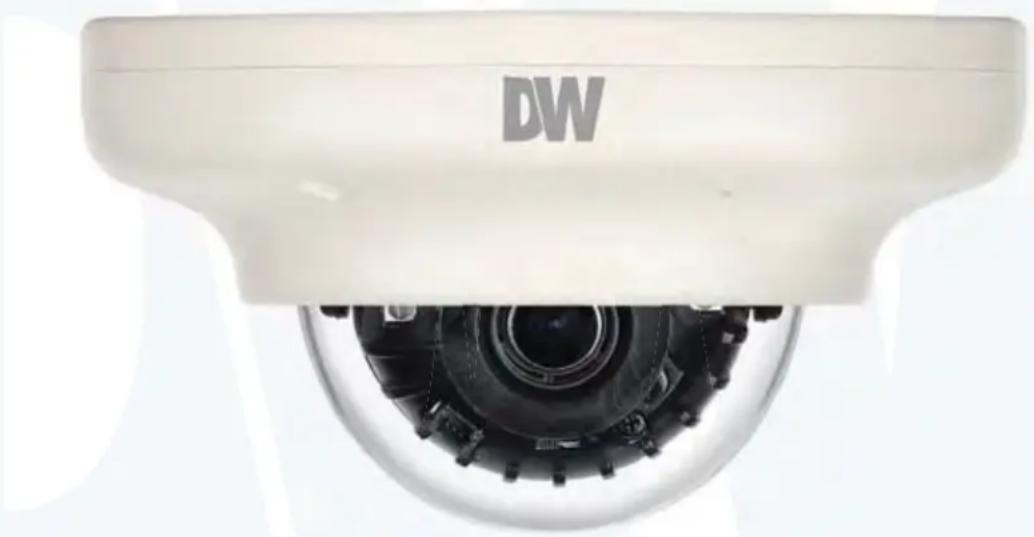
natural_image
Close-up of a white surveillance camera with 'DW' branding on the top (no additional text or symbols visible)User's Manual
Ver. 08/17
Before installing and using the camera, please read this manual carefully.
to keep it handy Be sure to keep it handy for future reference. For future reference.
INTRODUCTION
03 Important Safety Information
06 Features
07 Part Name
08 Dimensions
09 Product & Accessories
INSTALLION
10 Disassemble the Camera
11 Installation
12 Installation using Mount Bolt & Nut
14 Cabling
15 Inserting/Removing an SD Memory Card
NETWORK SETUP
16 IP Installer
17 Quick Start of Network Connection DDNS
18 Registration
19 Guide to Network Environment Setup Case (A\~D)
22 Port Forwarding
23 Starting IP Camera
WEB VIEWER SCREEN
24 Basic Screen
SETUP
25 Video & Audio Setup
32 Camera Setup
39 Network Setup
49 Trigger Action Setup
52 Events Setup
56 Record Setup
62 Security Setup
69 System Setup
APPENDIX
78 Current TCP/IP Settings
79 Changing IP Address and Subnet mask
80 Specifications
81 FAQ
82 Warranty
83 Limits & Exclusions

CAUTION
RISK OF ELECTRIC SHOCK. DO NOT OPEN.

CAUTION:
TO REDUCE THE RISK OF ELECTRIC SHOCK, DO NOT REMOVE COVER (OR BACK) NO USER SERVICEABLE PARTS INSIDE. REFER SERVICING TO QUALIFIED SERVICE PERSONNEL.
Warning Precaution
This symbol indicates that dangerous voltage consisting a risk of electric shock is present within this unit.

This exclamation point symbol is intended to alert the user to the presence of important operating and maintenance (servicing) instructions in the literature accompanying the appliance.
WARNING
To prevent damage which may result in fire or electric shock hazard, do not expose this appliance to rain or moisture.
WARNING
- Be sure to use only the standard adapter that is specified in the specification sheet. Using any other adapter could cause fire, electrical shock, or damage to the product.
- Incorrectly connecting the power supply or replacing battery may cause explosion, fire, electric shock, or damage to the product.
- Do not connect multiple cameras to a single adapter. Exceeding the capacity may cause excessive heat generation or fire.
- Securely plug the power cord into the power receptacle. Insecure connection may cause fire.
- When installing the camera, fasten it securely and firmly. A falling camera may cause personal injury.
- Do not place conductive objects (e.g. screw drivers, coins, metal items, etc.) or containers filled with water on top of the camera. Doing so may cause personal injury due to fire, electric shock, or falling objects.
- Do not install the unit in humid, dusty, or sooty locations. Doing so may cause fire or electric shock.
- If any unusual smells or smoke come from the unit, stop using the product. Immediately disconnect the power sorce and contact the service center. Continued use in such a condition may cause fire or electric shock.
- If this product fails to operate normally, contact the nearest service center. Never disassemble or modify this product in any way.
- When cleaning, do not spray water directly onto parts of the product. Doing so may cause fire or electric shock.
Precaution
Operating
- Before using, make sure power supply and all other parts are properly connected.
- While operating, if any abnormal condition or malfunction is observed, stop using the camera immediately and contact your dealer.
Handling
- Do not disassemble or tamper with parts inside the camera.
- Do not drop the camera or subject it to shock or vibration as this can damage the camera.
- Clean the clear dome cover with extra care. Scratches and dust can ruin the quality of the camera image.
Installation and Storage
- Do not install the camera in areas of extreme temperature, exceeding the allowed range.
- Avoid installing in humid or dusty environments.
- Avoid installing in places where radiation is present.
- Avoid installing in places where there are strong magnetic fields and electric signals.
- Avoid installing in places where the camera would be subject to strong vibrations.
-
Never expose the camera to rain or water.
-
Read these instructions. - All these safety and operating instructions should be read before the product is installed or operated.
- Keep these instructions. - The safety, operating and use instructions should be retained for future reference.
- Heed all warnings. - All warnings on the product and in the operating instructions should be adhered to.
-
Follow all instructions. - All operating and use instructions should be followed.
-
Do not use this device near water. - For example: near a bath tub, wash bowl, kitchen sink, laundry tub, in a wet basement; near a swimming pool; etc.
-
Clean only with dry cloth. - Unplug this product from the wall outlet before cleaning. Do not use liquid cleaners.
-
Do not block any ventilation openings. Install in accordance with the manufacturer's instructions. - Slots and openings in the cabinet are provided for ventilation, to ensure reliable operation of the product, and to protect it from over-heating. The openings should never be blocked by placing the product on bed, sofa, rug or other similar surface. This product should not be placed in a built-in installation such as a bookcase or rack unless proper ventilation is provided and the manufacturer's instructions have been adhere to.
-
Do not install near any heat sources such as radiators, heat registers, or other apparatus (including amplifiers) that produce heat.
-
Do not defeat the safety purpose of the polarized or grounding-type plug. A polarized plug has two blades with one wider than the other. A grounding type plug has two blades and a third grounding prong. The wide blade or the third prong are provided for your safety. If the provided plug does not fit into your outlet, consult an electrician for replacement of the obsolete outlet.
-
Protect the power cord from being walked on or pinched particularly at plugs, convenience receptacles, and the point where they exit from the apparatus.
-
Only use attachments/accessories specified by the manufacturer.
-
Use only with cart, stand, tripod, bracket, or table specified by the manufacturer, or sold with the apparatus. When a cart is used, use caution when moving the cart/apparatus combination to avoid injury from tip-over.

-
Unplug this apparatus during lightning storms or when unused for long periods of time.
-
Refer all servicing to qualified service personnel. Servicing is required when the apparatus has been damaged in any way, such as power supply cord or plug is damaged, liquid has been spilled or objects have fallen into the apparatus, the apparatus has been exposed to rain or moisture, does not operate normally, or has been dropped.
natural_image
Symbol of a trash bin crossed out by two diagonal lines, no text or labels presentDisposal of Old Appliances
- When this crossed-out wheel bin symbol is attached to a product it means the product is covered by the European Directive 2002/96/EC.
- All electrical and electronic products should be disposed of separately form the municipal waste stream stream in accordance to laws designated by the government or the local authorities.
- The correct disposal of your old appliance will help prevent potential negative consequences for the environment and human health.
- For more detailed information about disposal of your old appliance, please contact your city office, waste disposal service or the shop where you purchased the product.
FCC
This equipment has been tested and found to comply with the limits for a Class A digital device, pursuant to part 15 of the FCC Rules.
These limits are designed to provide reasonable protection against harmful interference when the equipment is operated in a commercial environment.
This equipment generates, uses, and can radiate radio frequency energy and, if not installed and used in accordance with the instruction manual, may cause harmful interference to radio communications. Operation of this equipment in a residential area is likely to cause harmful interference in which case the user will be required to correct the interference at his own expense.
■ 4MP 1/3" CMOS Sensor at Real-Time 30fps
■ 2.8mm, 4.0mm and 6.0mm Fixed Lens Options
■ True Wide Dynamic Range (WDR)
■ Dual Codecs (H.264, MJPEG) with Simultaneous Streaming
■ 50' Smart IR™ with Intelligent Camera Sync
■ Smart DNR™ 3D Digital Noise Reduction
■ True Day/Night with Mechanical IR Cut Filter
■ Programmable Privacy Zones
■ Dynamic Range Compression (DRC)
■ Auto Gain Control (AGC)
■ Backlight Compensation (BLC)
■ Auto White Balance (AWB)
■ Motion Detection
■ Micro SD/SDHC/SDXC Class 10 Card Slot for Event and Continuous Recording(Card Not Included)
■ Web Server Built-in
■ PoE Class 3 / DC12V
■ ONVIF Conformant, Profile S
■ IP66 Weather and Tampering Resistant
■ IK10-Rated Impact-Resistant
■ 5 Year Warranty
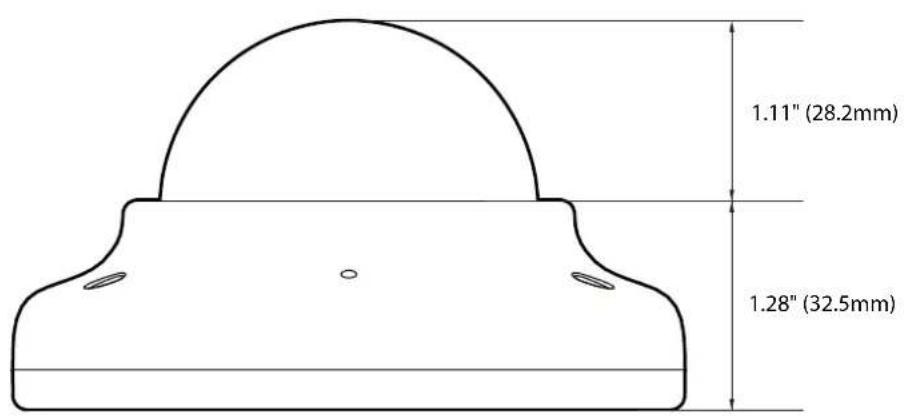
Unit: Inch (mm)
text_image
1.11" (28.2mm) 1.28" (32.5mm)
text_image
4.1" (105mm)
text_image
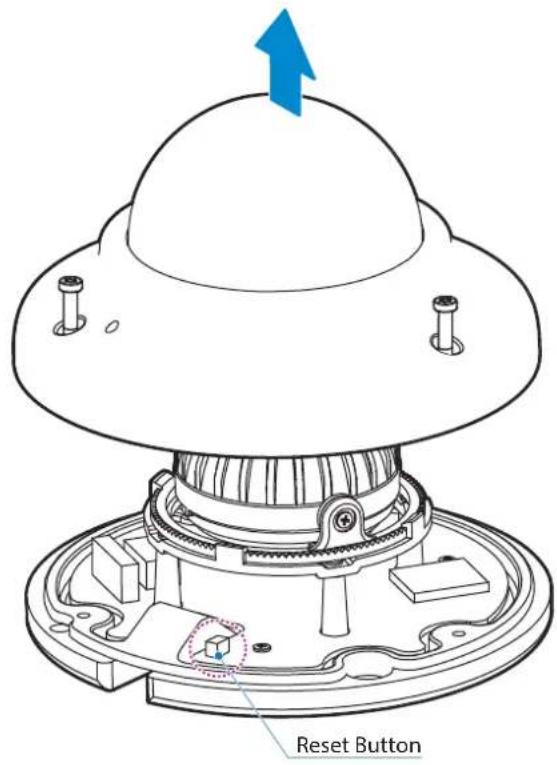
Dome Cover Lens IR Switch Gimbal Reset Button Bottom Case DC Power Cable RJ-45 Cable IR LED SD Card SlotInstallation -
Disassemble the camera
Before installing your camera, you have to read the following cautions.
-
You have to check whether the location can bear five times of the weight of your camera.
-
Don't let the cable to be caught in improper place or the electric line cover to be damaged. Otherwise it may cause a breakdown or fire.
-
When installing your camera, don't allow any person to approach the installation site. If you have any valuable things under the place, move them away.
text_image
Reset Button1 Detach the dome cover by torx wrench provided from bottom case before installation the camera.
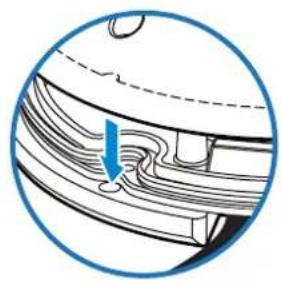
Match the one screw hole on the dome cover and camera bottom specially.
natural_image
Diagram of a car's exhaust pipe with a blue arrow indicating flow direction (no text or symbols)Reset to the Factory Default
Press the reset button for 5 seconds to return the setup to the factory default.
Warning:
If you press the 'Reset' button, you will lose all setting data. If needed, please, make a note for further installation.

text_image
LED ON/OFF2 The camera has a manual IR switch, located under the camera's lens. You can use this switch to manually turn the IR LED board on or off according to the installation needs.
Installation - Installation

text_image
Template Sheet ② ③ ③ ④ ⑤ ⑥ ⑦1 Disassemble the camera. See the section 'Installation - Disassemble the camera' for details.
2 Using the template sheet, make the cabling hole on the wall/ceiling.
3 Connect the network cable and power cable respectively. See the section 'Installation - Cabling' for details.
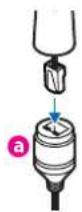
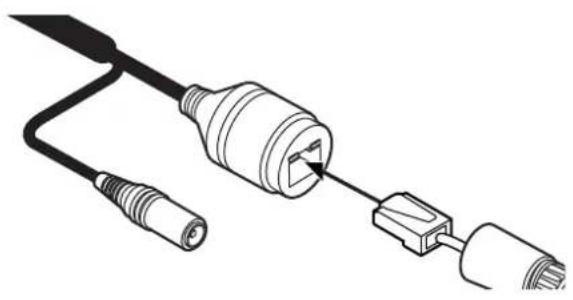
Put the Lan cable into (a), then (b) will be assembled to (a) tightly. As a final step, (c) need to be assembled to (b) without making any space.


4 Once removing the rubber stopper, fix the bottom case on the ceiling.
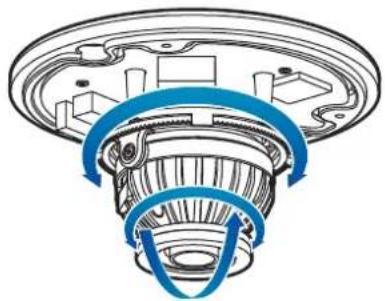
5 To achieve desired view direction and orientation, rotate 3-axis gimbal. To fix the setting, tighten the tilt stopper screw.
natural_image
Technical diagram of a mechanical assembly with blue arrows indicating flow or motion (no text or symbols)6 Attach the dome cover to the bottom case.
7 Detach the protection film from the dome cover.
Installation -
Installation Using Mount Bolt & Nut
text_image
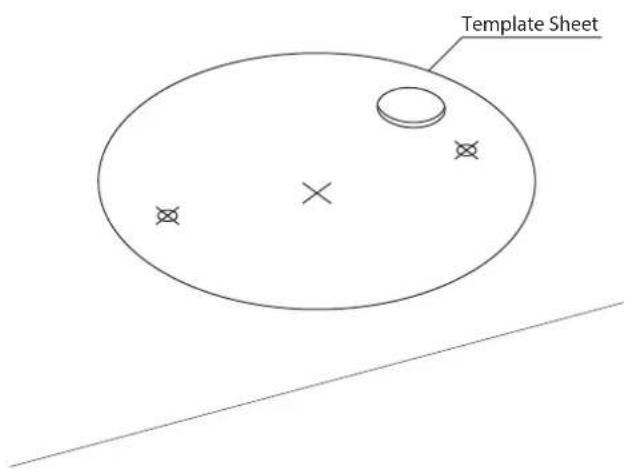
Template Sheet1 Disassemble the camera. See the section 'Installation - Disassemble the camera' for details.
2 Using the template sheet, make the cabling holes on the ceiling panel.

natural_image
Technical line drawing of a mechanical component with two cylindrical pins and a base, no text or symbols present3 Insert the 2 mount bolts into bottom case of camera.

text_image
Technical diagram showing mechanical assembly with labeled components and motion arrows4 Insert the mount bolts into template holes after connecting the cable.
5 Fix the bottom case by tightening mount nuts to mount bolts on the ceiling panel.

natural_image
Diagram of a mechanical component with a shaft and wheel, enclosed in a circular frame (no text or symbols)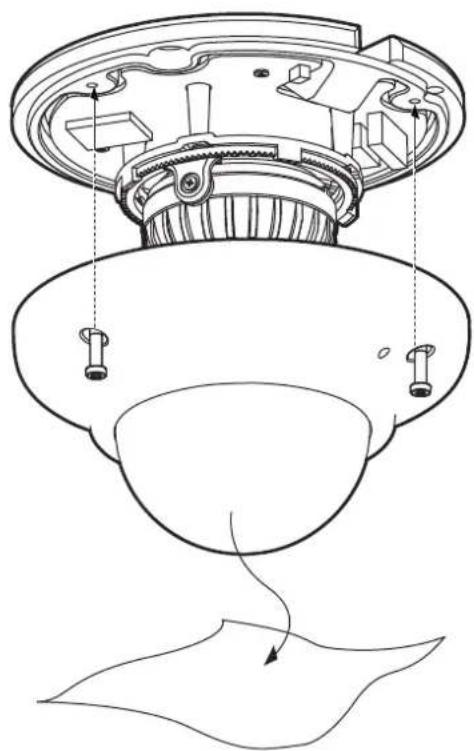
natural_image
Technical line drawing of a ceiling lamp with internal components and a base structure (no text or symbols)6 To achieve desired view direction and orientation, rotate 3-axis gimbal. To fix the setting, tighten the tilt stopper screw.

natural_image
Technical diagram of a mechanical assembly with blue arrows indicating motion or force direction (no text or labels)7 Attach the dome cover to the bottom case.
8 Detach the protection film from the dome cover.
Two Options
Use a PoE-enabled switch to connect data and power through a single cable and begin viewing and recording images instantly. A non-PoE switch will require an adaptor for power transmission.
1. Using a PoE-Enabled Switch
The Camera is PoE-compliant, allowing transmission of power and data via a single Ethernet cable. PoE eliminates the need for the different cables used to power, record, or control the camera. Follow the illustration below to connect the camera to a PoE-enabled switch using an Ethernet cable.
2. Using a Non-PoE Switch
If a PoE-enabled switch is not used, use a power adaptor for power transmission and non-PoE switch for data transmission.
Follow the illustrations below to connect the camera without a PoE-enabled Switch.
natural_image
Line drawing of a cable connector with two connectors and a connector pin (no text or symbols)
text_image
Ethernet cable Ethernet cable Power
natural_image
Technical line drawing of a mechanical assembly with no visible text or symbolsThe memory card is an external data storage device that has been developed to offer an entirely new way to record and share video, audio, and text data using digital devices.
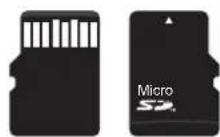
Recommended SD Card Specification (Not Included)
- Type: Micro SD (SD/SDHC/SDXC)
- Manufacturer: Transcend, Kingston, Toshiba, SanDisk
- Capacity: 4GB\~128GB
- Class: UHS-I U3 Class 10
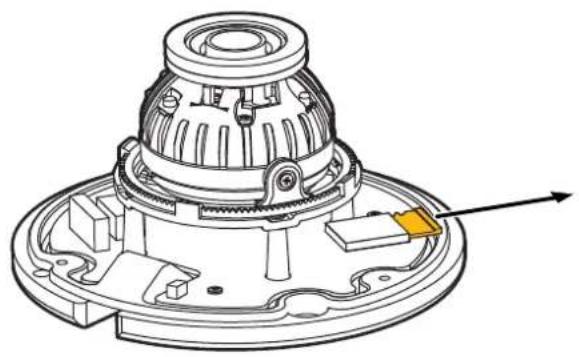
1 Insert the SD card in the arrow direction.
Don't insert the SD memory card while it's upside down by force. Otherwise, it may damage the SD memory card.
Use the tweezers when inserting or picking out the SD card.
natural_image
Technical line drawing of a mechanical assembly with no visible text or symbols2 Removing a SD Memory Card Gently press down on the exposed end of the memory card as shown in the diagram to eject the memory card from the slot.
☒ Pressing too hard on the SD memory card can cause the card to shoot out uncontrollably from the slot when released.
If you have saved data in the SD memory card, removing the SD memory card prior to setting record to OFF will cause damage to the data stored in the card.
Network Setup - DW IP Finder™
text_image
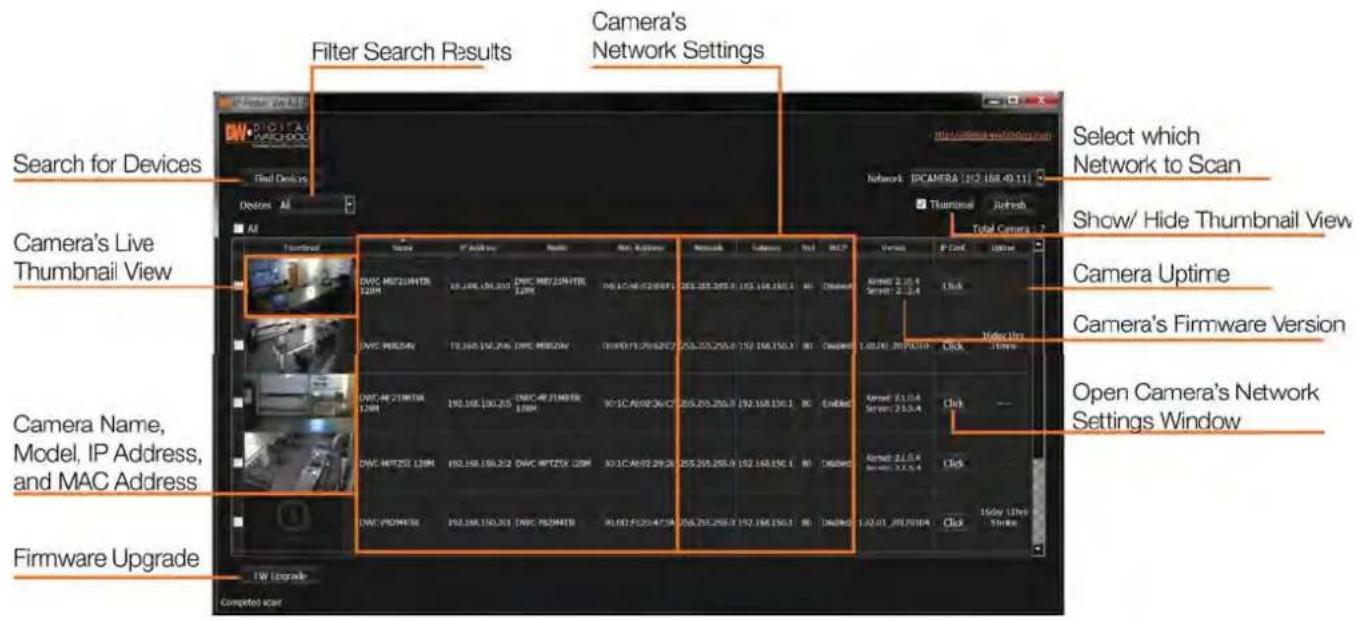
Filter Search Results Camera's Network Settings Search for Devices Find Devices Device All All Total Camera 12 Select which Network to Scan Show/ Hide Thumbnail View Camera Uptime Camera's Firmware Version Open Camera's Network Settings Window Camera's Live Thumbnail View Camera Name, Model, IP Address, and MAC Address Firmware Upgrade 1W Upgrade Competed scar① Go to: http://www.digital-watchdog.com
② Search for 'IP Finder' on the quick search bar at the top of the page.
③ The latest DW IP Finder™ software will appear in the search results. Click on the link to download the file to your computer.
4 The software will scan your network for all supported cameras and display the results in the table. Allow up to 5 seconds for the DW IP Finder™ to find the camera on the network.
5 Check the box next to 'Display Camera Thumbnail' to view a JPEG image of the camera's view next to the camera name on supported models.
6 Select a camera from the list by double-clicking on the camera's image or clicking on the 'Click' button under the IP Conf. column. The camera's network information will appear. If necessary, you can adjust the camera's network type.
Select 'DHCP' if the internet service is dynamic IP to allow the camera's network information to be filled out automatically.
Select 'Static' to manually enter the camera's network information. You can adjust the camera's network type, IP address, subnet mask, Gateway and DNS information.
Contact your network administrator for more information.
The camera's default network information is: Default TCP/IP information - IP: DHCP

text_image
Pro Camera Settings Camera Name DWC-MB4MIALPR MAC Address 100 F1:20:A4:2E IP Configuration Mode DHCP Static IP IP Address 192.168.10..123 Neomask 255.255.255.0 Gateway 192.168.10..1 DNS 192.168.10..1 Ports Web Port 80 Control Port 0 Video Port 0 Audio Transmit 0 Audio Receive 0 Username admin Password •••••• View Camera Website Reboot Apply Cancel7To view the camera's web client, click on 'View Camera Website'.
A 'Port Forwarding' has to be set in your network's router for external access to the camera.
8 To save the changes made to the camera's settings, input ID and PW of the camera for authentication.
9 If the camera needs to be rebooted after the settings were changed, press the 'Reboot' button. The camera will power cycle and will appear back in the search results once the reboot is complete.
Default ID / PW : admin / admin
10 Click 'Save' to save changed values.
To update the camera's firmware from the DW IP Finder™, click on the firmware tab, upload the firmware file and select the cameras to update. You can update multiple cameras at the same time.
Network Setup -
Quick Start of Network Connection
Please follow the steps below to complete the initial setup of the network function.
① Please do not power on the IP Camera until instructed.
i Temporarily disable any proxy servers configured in internet Explorer.
If connecting the IP Camera directly to a modem, power down and reset the modem. Leave the modem powered down until configurations are utilized with the IP Camera and the IP Camera has been correctly connected to the modem.
-
Connect the IP Camera and PC to the configured network.
-
Open the IP Installer on a PC, then search for the IP camera.
If you have a DHCP server, it will automatically set the Camera IP.
If you do not have a DHCP server, Camera IP is set to 192.168.1.80 after one minute. In this case, PC IP must be changed to the IP to be able to access the 192.168.1.80.
- If multiple numbers of camera are connected it should be distinguished by the mac address of the Camera.
- Click the Camera IP, and connect to the WEB PAGE.
- Default ID/Password to access IP Camera are both the word: admin.
Familiarize yourself with the Viewer Interface Screen.6.
please install VLC to display live video.7.
- The IP setting can be set to 'STATIC' at IP Installer or web viewer followed by Setup -> Network -> Network Settings
- If the IP Camera is connected to a network which utilizes a router, you must have Port Forwarding configured on your personal router to forward all ports to the IP address you have assigned the IP Camera.
- After configuring Port Forwarding on your router (if necessary), you may access your IP Camera on your local network by opening Internet Explorer and specifying the IP address and Web Port that you have assigned to the IP Camera.
Example: http://192.168.0.200:8888
If you leave your Web Port set to 80, you don't need to specify the port in the Address Bar to access to your IP Camera.
- Access your IP Camera via the Internet :
If you use a static IP address assigned by your ISP
1) Open Internet Explorer.
2) Type the IP of the IP Camera.
3) If you use a router, type the routers' static IP and the web port number of the IP Camera.
If you have a dynamic address provided by your ISP
1) Open Internet Explorer and visit the DDNS website.
2) Register the IP Camera.
3) Reboot the IP Camera.
4) Give the DDNS server 10 minutes to locate your IP Camera's IP information.
5) Click the refresh button in the Internet Explore.
6) After your camera is connected, select your camera.
If you have DYNAMIC IP service from your Internet Service Provider (ISP), you can't tell the current IP address of the IP Camera. To solve this problem, you have to register to our DDNS service.
At first, you have to check if you are using dynamic addressing. If so, register your IP Video Server on our DDNS website before you configure, setup, or install the IP Camera.
Even though your IP is not dynamic, you will get benefit if you register to DDNS. In this case, just remember 'hostname.dyndns.com/gate1' instead of complicated series of numbers like http://201.23.4.76:8078.
For more details, contact our Support Center.
To use a public DDNS called 'dyndns' or 'no-ip', refer to the detail information on how to use the service. (Visit the web site : http://www.dyndns.com or http://www.no-ip.com)
Please configure the IP Camera at the installation site. You must determine your network scenario in order to configure the IP Camera with the proper TCP/IP settings. This tutorial will guide you through the process. Before actually configuring the IP Camera, determine settings to be applied. Record those settings to be used to configure your IP Camera for reference.
When configuring your IP Camera, treat the IP Camera as another PC on your network. You will assign it several addresses and other TCP/IP properties to match your current network.
This step-by-step tutorial will teach what IP addresses and network configurations should be assigned based on the network scenario.
- The following descriptions are several basic network scenarios. Determine which scenario describes your network. If your network does not match one of the scenarios below and you are unsure how to setup your IP Camera, contact your network administrator and then call our Support Center.
You cannot control the rectangular gray areas and only the ISP has access to the devices.
- Before you begin, locate any information and settings received from your Internet Service Provider (ISP). You may need to refer to these IP addresses at a later time during the configuration.
| Current TCP/IP Settings | |
| IP Address | |
| Subnet Mask | |
| Default Gateway | |
| Primary DNS Server | |
| Secondary DNS Server (Option) | |
Static Dynamic

If you were not given any IP addresses or the ISP was responsible for the setup and installation of your Internet connection, go to step 2.
If you are not using a router on your network, your 'Current TCP/IP Settings' (from the previous section) and 'Assigned IP Addresses from My ISP' will be exactly the same.
- You must determine whether the IP address is STATIC or DYNAMIC. At this moment, you are only concerned about the ISP. Did they provide you with a STATIC or DYNAMIC address? If you are unsure, contact your ISP.
- Configure your IP Camera's TCP/IP settings for network connectivity by selecting Setup from the main interface and selecting TCP/IP located on the left of the Setup screen.
- If prompted for ID and Password, use 'admin' for both entries.
The default web port number is 80. If port 80 is blocked by the ISP, a value between 1025 \~ 60000 should be used. If TCP port 80 is blocked, consult the ISP
Case A:

flowchart
graph LR
    A["Internet"] --> B["Phone Line or CATV"]
    B --> C["Cable/xDSL Modem (ISP Provided)"]
    C --> D["Personal Router W/Intergrated Switch"]
    D --> E["PC"]
    E --> F["Camera"]
    F --> G["Dynamic IP + Personal Router [Most SOHO"]]
Case B:

flowchart
graph LR
    A["Internet"] -->|Public Line| B["Gateway or Router at ISP"]
    B --> C["Personal Router W/Integrated Switch"]
    C --> D["PC"]
    E["Camera"] --> C
    style A fill:#f9f,stroke:#333
    style D fill:#bbf,stroke:#333
Configure your IP Camera's TCP/IP properties as follows :
Network Type: STATIC (even though you have Dynamic IP from your ISP, use STATIC on the IP Camera)
Internet Address :2A private IP address such as 192.168.0.200 (Example)
You need to assign an IP address to the IP Camera just as you do with PC.
The IP address you assign must be unique to your network and match your network as well. For information on how to choose a unique IP and match your network, read the FAQ.
The IP address you assign must be a private IP. For information on how to choose a private IP please, read the FAQ.
Subnet Mask :3255.255.255.0 (Example)
You must use the same subnet mask as the one you noted under 'Current TCP/IP Settings'.
Default Gateway:4.92.168.0.1 (Example)
This IP address must be the IP address of your router. (private or LAN side)
Use the same Default Gateway you noted under 'Current TCP/IP Settings'.
Preferred DNS Server :5ise the 1st DNS Server from 'Assigned IP Address from My ISP'.
If you did not receive any IP addresses from your ISP, contact the ISP and acquire the IP address of their DNS server.
DDNS Server : Use the DDNS server.
This is the same site you will register later to accommodate dynamic IP from your ISP.
8888Web Port:7.
Do not use the default port 80 as this number must be changed.
You may select any number between 1025 \~ 60000.
Case C:
Static(Fixed) IP [Dedicated line directly to the IP Camera]

flowchart
graph LR
    A["Internet"] -->|Phone Line or CATV| B["Cable/xDSL Modem (ISP Provided)"]
    B --> C["Camera"]
    style A fill:#f9f,stroke:#333
    style C fill:#bbf,stroke:#333
Configure your IP Camera's TCP/IP properties as follows :
STATICNetwork Type:1.
Internet Address :2A static IP address received from your ISP such as 24.107.88.125 (Example)
You need to assign an IP address to the IP Camera just as you do with PC.
Subnet Mask : Subnet mask assigned from your ISP such as 255.255.255.240 (Example)
Default Gateway:424.107.88.113 (Example)
Use the assigned default gateway from your ISP
Preferred DNS Server :5Jse the 1st DNS Server from 'Assigned IP Address from My ISP'
If you have not received any IP addresses from your ISP, contact them to acquire the IP address of their DNS server.
DDNS Server :6 Use the DDNS server
① This is the same site you will register later to utilize our DDNS service.
80Web Port:7.
You may select any number between 1025 \~ 60000.
Case D:
Dynamic IP + DSL/Cable Modem [Connected directly to the IP Camera]
flowchart
graph LR
    A["Internet"] -->|Public Line| B["Gateway or Router at ISP"]
    B --> C["Camera"]
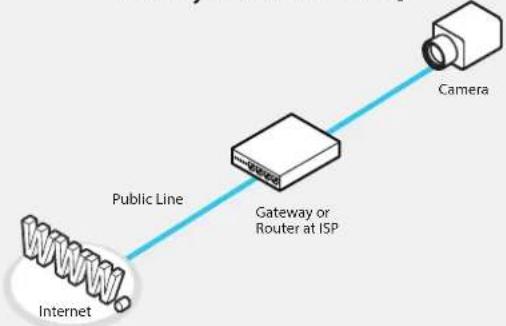
To connect the IP Camera directly to a modem, power down and reset the modem. Leave the modem powered down until configurations are finalized with the IP Camera and the IP Camera has been connected correctly to the modem. Then power on the modem, followed by the IP Camera.
Configure your IP Camera's TCP/IP properties as follows :
DYNAMICNetwork Type:1.
Use the DDNS serverDDNS Server :2.
This is the same site you will register later to accommodate dynamic IP from your ISP.
80Web Port:3.
You may select any number between 1025 \~ 60000.
Network Setup - Port Forwarding
After entering the correct TCP/IP settings, you are ready for 'Port Forwarding'(Cases A, B).
- Please record the TCP/IP settings of your IP Camera for future reference. You may need this information to access your IP Camera and to configure 'Port Forwarding'.
| IP Camera TCP/IP Settings | |
| IP Address | |
| Subnet Mask | |
| Default Gateway | |
| Preferred DNS Server | |
| DDNS Server | |
| Web Port | |
- After clicking 'Apply', the system will prompt for a reboot. Please allow the system 50 seconds to reboot and accept the changes. After 50 seconds, close the configuration screen. The view will display 'Trying to Reconnect'. If the ACTIVE light on the IP Camera has gone off and is now back on again flashing, the IP Camera has rebooted. After the system reboots completely, remove the power supply from the unit and close Internet Explorer.
- Return your PC/Laptop TCP/IP properties to their original settings.
- Before installing the IP Camera, you must use 'Port Forwarding' on your personal router (Cases A, B).
You will need to forward 1 ports:
- Web Port
All the ports will be forwarded to the IP address you assigned to the IP Camera.
In the example above, you would forward:
· 8888→192.168.0.200
For information on how to use 'Port Forwarding', please read Appendix C.
After forwarding correctly the Web Port, through your router (if applicable), install the IP Camera in a proper location.
- Locate the serial number located on the label attached to the bottom of the IP Camera, you will need this for DDNS registration.
- Connect the IP Camera to your router or cable/DSL modem (per your network scenario) via a Cat5/5e UTP Ethernet network cable.
- Supply power to the IP Camera.
- After 1 minute, verify the IP Camera indicators:
- LINK : Flickering/Solid
- After configuring Port Forwarding on your computer (if necessary), access your IP Camera on your local network by opening Internet Explorer and specifying the IP address and Web Port assigned to the IP Camera.
i Examples: http://192.168.0.200:8888 or http://24.106.88.123
If you left your Web Port set to 80, do not need to specify the port in the Address Bar to access the IP Camera.
Access your IP Camera via the Internet :6.
If you use Case B, C
1) Open Internet Explorer.
2) Type the IP of the IP Camera.
If you use Case A, D
1) Open Internet Explorer.
2) Visit the DDNS website.
3) Register the IP Camera.
4) Give the DDNS server 10 minutes (MAX) to locate your IP Camera's IP information. You may reboot the server to send an immediate request to our DDNS server.
5) After your camera is connected, select your camera.
The difference between B and C is that B needs to set the port forwarding.
① Since the type of DDNS differs from the service type, refer to the related service site.

text_image
DW DIGITAL WATCHDOG. Complete surveillance setup 1 2 3 4 5 SETUP LIVE BUFFERING 500 ms CHANNEL SELECT Stream-1 FULL SCREEN PTZ CONTROL 200M IRIS FOCUS SPEED © Digital Watchdog. All Rights Reserved PROXET SPEAKER ALARM INPUT PROXET Tour RELAY OUT MOTION Camera Time 2005-01-02 00:01:00Web viewer is optimized with explorer10 or above version and Firefox.
If VLC is not installed or VLC plugin is not supported (Chrome), Live buffering and Channel select menu on 3, 4 will be changed to Live Viewer menu, and then if HTML5(MJPEG) is selected on Live Viewer menu, then you can check the video.
1 Live video display. This is the region for live video stream from the camera.
2 Setup popup button. Click it to open the Setup page to setup details of IP camera like Video, Network, Events, System and etc. See the section 'Setup'.
3 When the image goes unsmoothly because of bad network connection, it stored image during setup time and shows the image on the live view screen.
User will see the delayed images as much as setup time.
4 Channel Select button. Select a stream produced from the camera between Stream 1 \~ 3 to display it in the live view screen.
Refer the 'Setup > Video & Audio > Video' to setup the Video Stream.
5 Below "Menu" is supported in accordance with models.
PTZ Control
This camera model does not supports the zoom and focus.
Preset
Does not support.
Speaker Control
Does not support.
Alarm Input
Does not support.
Relay Out
Does not support.
6 Motion
It shows the Motion event status.
Event Alert Icon (✗) appears if 'Motion Detection' is activated.
7 Camera Time
Display the camera time.
Setup - Video & Audio Setup
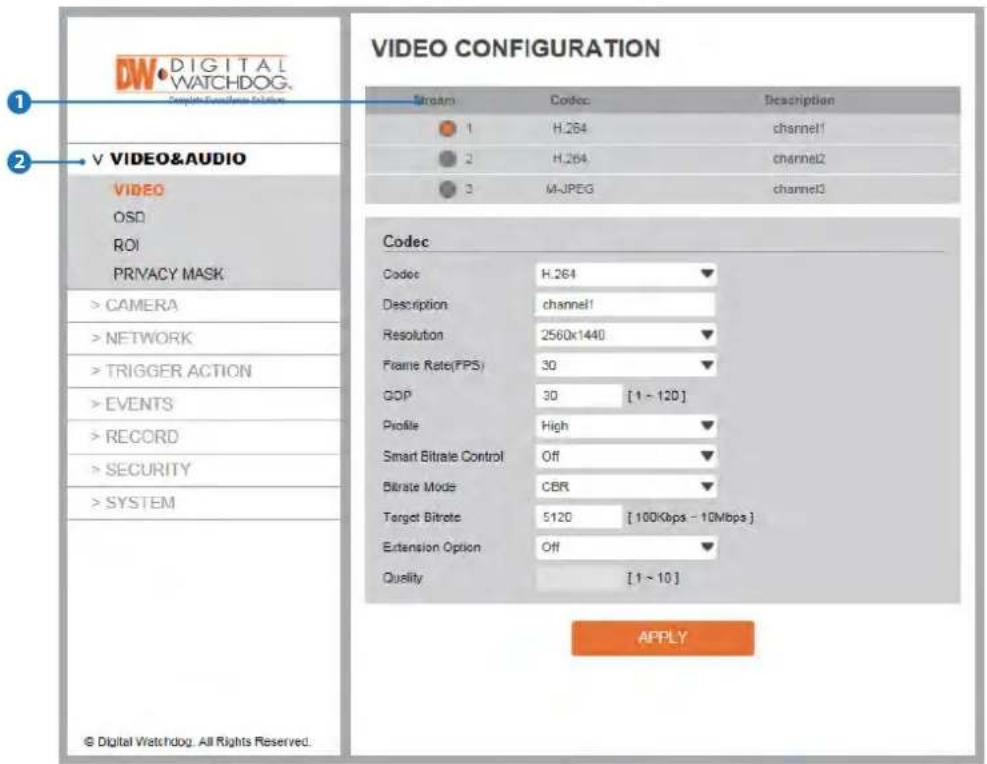
Video Configuration
text_image
DV• DIGITAL WATCHDOG. V VIDEO&AUDIO VIDEO OSD ROI PRIVACY MASK >CAMERA >NETWORK >TRIGGER ACTION >EVENTS >RECORD >SECURITY >SYSTEM VIDEO CONFIGURATION Strain Codes Description 1 H.264 channel1 2 H.264 channel2 3 M-JPEG channel3 Codec Code: H.264 ▼ Description channel1 Resolution 2560x1440 ▼ Frame Rate(FPS) 30 ▼ GOP 30 [1 - 120] Profile High ▼ Smart Bitrate Control Off ▼ Bitrate Mode CBR ▼ Target Bitrate 5120 [100Kbps - 10Mbps ] Extension Option Off ▼ Quality [1 - 10] APPLY © Digital Watchdog. All Rights Reserved.1 Detail Page
When you selects an item from the menu, you can set the details for the selected item.
2 Setup Constitution
Video&Audio
[VIDEO, OSD, ROI, PRIVACY MASK]
Camera
[IMAGE ADJUSTMENT, EXPOSURE, DAY&NIGHT, BACKLIGHT, WHITE BALANCE, IMAGE, VIDEO]
Network
[ STATUS, NETWORK SETTING, AUTO IP, ONVIF, UPNP, DDNS, FTP, SMTP, SNMP, RTSP INFORMATION ]
Trigger Action
[ ACTION RULES, IMAGE TRANSFER ]
Events
[ EVENT RULES, MOTION, TEMPERATURE ]
Record
[ MANAGEMENT, RECORD LIST, STORAGE ]
Security
[IP ADDRESS FILTER, RTSP AUTHENTICATION, IEEE 802.1x, HTTPS, CERTIFICATES, SERVICE]
System
[INFORMATION, FIRMWARE UPDATE, DATE&TIME, DST, USER MANAGEMENT, LOG, FACTORY RESET, RESTART]
Setup - Video & Audio Setup
Video Configuration

text_image
VIDEO CONFIGURATION Stream Codec Description 1 H.264 channel1 2 H.264 channel2 3 M-JPEG channel3 Codec Codec H.264 Description channel1 Resolution 2560x1440 Frame Rate(TPS) 30 GOP 30 [1 - 120] Profile High Smart Bitrate Control Off Bitrate Mode CBR Target Bitrate 5120 [100Kbps - 10Mbps] Extension Option Off Quality [1 - 10] APPLY1 Live Video Channel Setup
The video can be configured to variety settings with a combination of codec and resolution.
The camera performance has to be considered when setting multiple channels. This effects on the performance of the camera.
2 Codec
Choose the video codec. According to the selected codec, the subcategories can be changed automatically.
When MJPEG codec is selected, it will be able to set whether to use the relevant channel for image transfer.
3 Description
Input the additional description about the selected channel. Max. 30 alphabets are allowed(Including space). For the description, English Alphabets, numbers and special characters (-_@.) can be used.
4 Resolution
Select the video resolution.
※ Available resolution can be depends on the codec setup between the channels.
| NTSC | PAL | |
| 4M | 2560 x 1440 | 2560 x 1440 |
| 3M | 2304 x 1296 | 2304 x 1296 |
| 1080p/i | 1920 x 1080 | 1920 x 1080 |
| 720p/i | 1280 x 720 | 1280 x 720 |
| SVGA | 800 x 600 | 800 x 600 |
| VGA | 640 x 480 | 640 x 480 |
| 4CIF | 704 x 576 | 704 x 576 |
| 704 x 480 | 704 x 480 | |
| CIF | 352 x 288 | 352 x 288 |
| 352 x 240 | 352 x 240 |
5 Frame Rate
Select the maximum Frame Rate.
Available Frame Rate can be different although same codecs were set up.
Setup - Video & Audio Setup
Video Configuration

text_image
VIDEO CONFIGURATION Strain Codec Description 1 H.264 channel1 2 H.264 channel2 3 M-JPEG channel3 Codec Codec H.264 Description channel1 Resolution 2560x1440 Frame Rate(FPS) 30 GOP 30 [1 - 120] Profile High Smart Bitrate Control Off Bitrate Mode CBR Target Bitrate 5120 [100Kbps ~ 10Mbps] Extension Option Off Quality [1 - 10] APPLY6 GOP(Group of Pictures) Size
Set up the number of frames (P-frame) which contain only changed information based on basic frame (I-frame). Regarding videos with lots of movement, if you set GOP size bigger, only the number of P-frames is bigger. As a result, video resolution will be low but 'File size' and 'Bit-rate can be decreased.
GOP(Group of Pictures) Size is..
I-frame and P-frame can be created for MPEG4 and H.264 video compression. I-frame(=key-frame) means the whole image data for one specific scene of video. P-frame is image data which has been changed information compared to I-frame GOP is made up of one I-frame and corresponding several P-frames. To improve video quality, set the number of P-frames smaller and to decrease image size, set the number of P-frames bigger.
7 Profile
The profile defines the subset of bit stream features in an H.264 stream, including color reproduction and additional video compression.
Baseline
A simple profile with a low compression ratio.
Main
An intermediate profile with a medium compression ratio.
High
A complex profile with a high compression ratio.
8 Smart Bitrate Control
Off
Does not use the Smart Bitrate Control.
CVBR (Framerate priority)
This Mode is for cameras which do not want absolute any frame drop, but still want to get lower bitrate. It has limitation when the Target bitrate is set to be very low, but actual motion is big or scene is very noisy.
CVBR (Quality priority)
When the Target bitrate is set to very low, and motion is big, then LBR will try to drop frames, and make the final fps to be lower, so that it can save its and make the output frames to have better quality.
CBR
This Mode is a CBR alike mode which is close to traditional security IPCAM, and it's not designed for LBR, It's provided as an option in LBR library just to help comparison.
Setup - Video & Audio Setup
Video Configuration
text_image
VIDEO CONFIGURATION Stream Codec Description 1 H.264 channel1 2 H.264 chsnine2 3 M-JPEG channel3 Codec Codec H.264 ▼ Description channel1 Resolution 2560x1440 ▼ Frame Rate(FPS) 30 ▼ GOP 30 [1 - 120] Profile High ▼ Smart Bitrate Control Off ▼ Bitrate Mode CBR ▼ Target Bitrate 5120 [100Kbps ~ 10Mbps ] Extension Option Off ▼ Quality [1 - 10] 9 10 11 12 13 APPLY9 Bitrate Mode
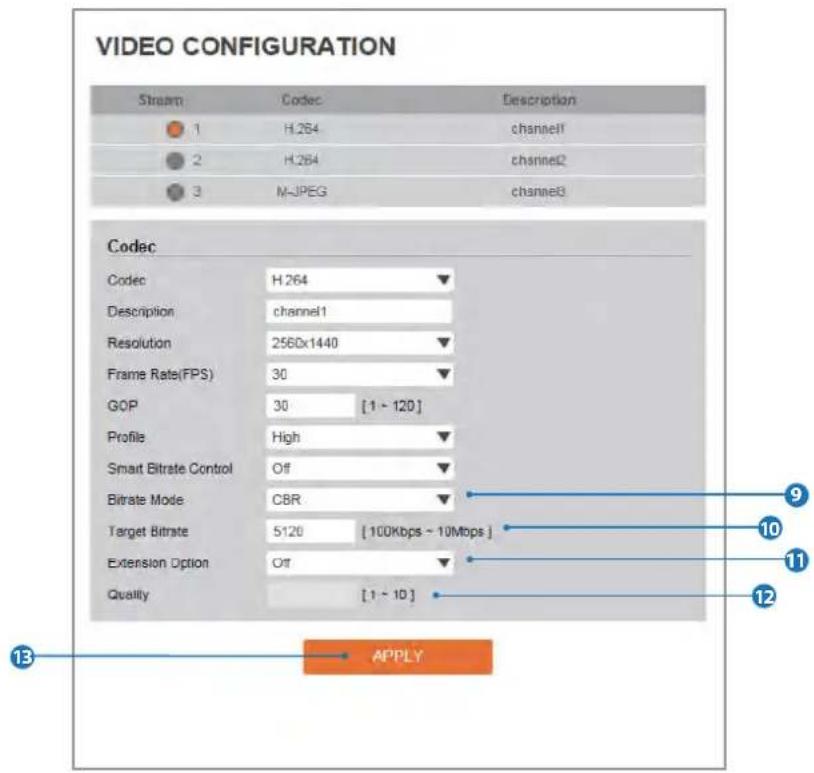
Select the bit rate control scheme of video compression from CBR (Constant Bit Rate) or VBR (Variable Bit Rate).
CBR
To guarantee the designated constant bit rate, the quality of video are controlled in this mode. Therefore, the quality of video is likely to be varying when network traffic is changing.
VBR
To guarantee the designated quality, the bit rate of video stream is changed in this mode. Therefore, the frame rate of video is likely to be varying when network traffic is changing.
This category won't be appear if you select the codec.
10 Target Bitrate
If Bitrate Control is set to be CBR, you can set the Target Bitrate.
11 Extension Option
OFF
Does not use the extension option.
SVC-T On
Scalable video coding is a type of video encoding algorithm that can be applied to streaming, so that, they could be transmitted over lossy, low bandwidth networks effectively.
12 Quality
For VBR control mode, The Target Quality of video can be setup.
13 Click 'Apply' to make above setting effective.
text_image
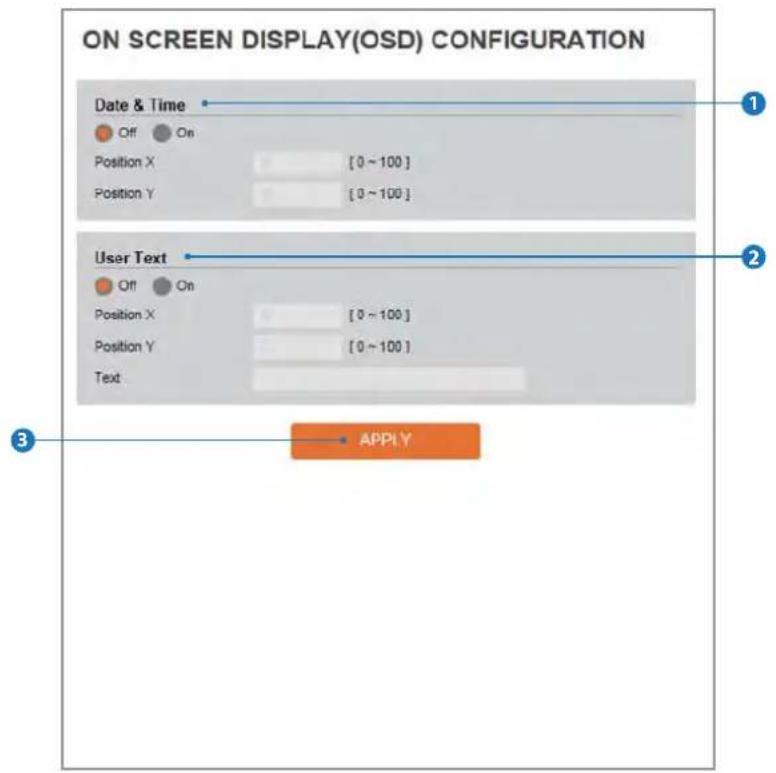
ON SCREEN DISPLAY(OSD) CONFIGURATION Date & Time Off On Position X [0 ~ 100] Position Y [0 ~ 100] User Text Off On Position X [0 ~ 100] Position Y [0 ~ 100] Text APPLY1 Date / Time
Display the current time.
2 User Text
Output the TEXT entered by the user.
Support a maximum of 30 characters.
3 Click 'Apply' to make above setting effective.
Setup - Video & Audio Setup
Region of Interest Configuration
text_image
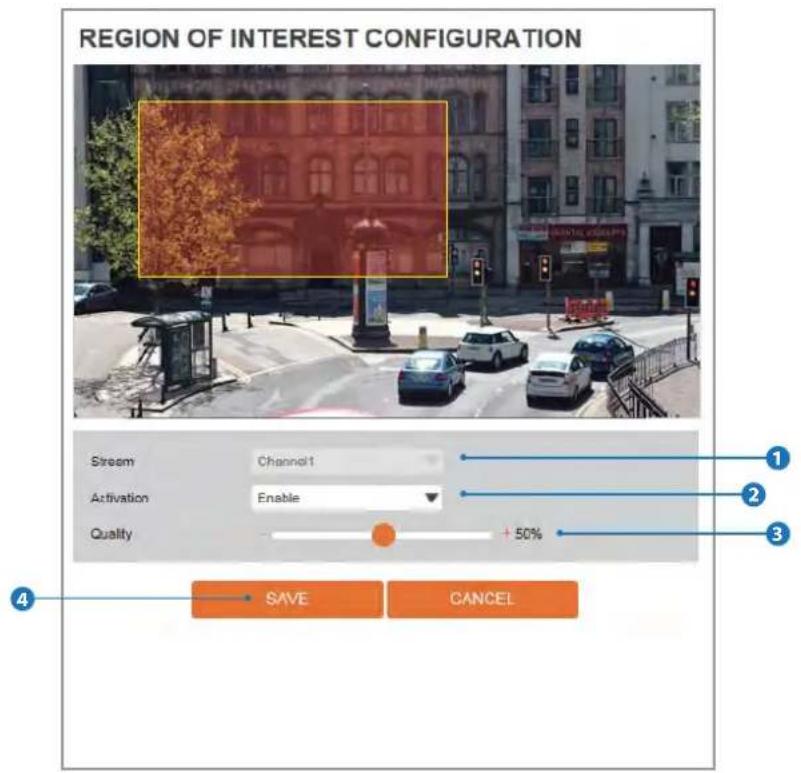
REGION OF INTEREST CONFIGURATION Stream Channel 1 Activation Enable Quality +50% SAVE CANCELRegion of interest function gives much more efficiency picture quality for indicated area to improve picture qualities of movement scene at the same bandwidth.
1 Stream
Select the Stream.
Currently it supports only Channel1.
2 Activation
The Region of interest can be enable or disable.
3 Quality
Set the quality of the set area.
4 Click 'Save' to save the current settings.
Click 'Cancel' to return to the previous setting.
Setup - Video & Audio Setup Privacy Mask Configuration

text_image
PRIVACY MASK CONFIGURATION Activation On Off Area Area1 CLEAR AREA SAVE CANCELUse this function to mask areas that you want to hide on screen to protect privacy.
1 Activation
The Privacy mask function can be enable or disable.
2 Area
Select the Area1 \~ Area4 and Set the privacy area.
3 Click 'Save' to save the current settings.
Click 'Cancel' to return to the previous setting.
Click 'Clear Area' to delete the selected Area1\~Area4.
Setup - Camera Setup Camera Image Adjustment

text_image
IMAGE ADJUSTMENT Sharpness + 51 Brightness + 51 Contrast + 51 Saturation + 26 Hue + 49 SAVE CANCEL DEFAULT1 Sharpness
Using this control, sharpness of image can be adjusted to meet your preference.
2 Brightness
Using this control, brightness of image can be adjusted to meet your preference.
3 Contrast
Using this control, contrast of image can be adjusted to meet your preference.
4 Saturation
Using this control, Saturation of image can be adjusted to meet your preference.
5 Hue
Using this control, Hue of image can be adjusted to meet your preference.
6 Click 'Save' to save the current settings.
Click 'Cancel' to return to the previous setting.
Click 'Default' to settings to the factory defaults.
Setup - Camera Setup Camera Exposure Settings
text_image
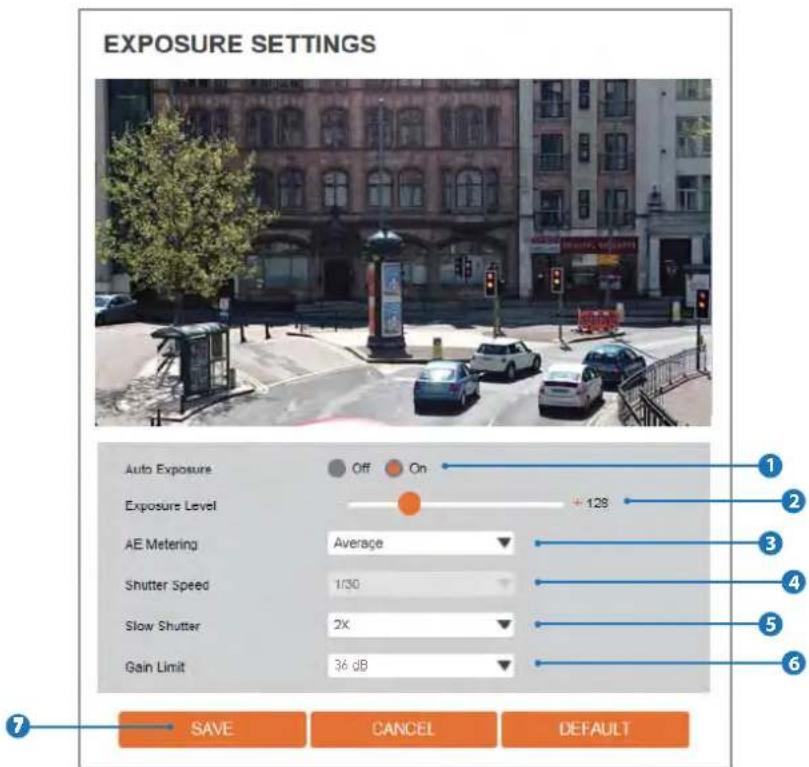
EXPOSURE SETTINGS Auto Exposure Off On Exposure Level +128 AE Metering Average Shutter Speed 1/30 Slow Shutter 2X Gain Limit 36 dB SAVE CANCEL DEFAULT1 Auto Exposure
Automatic exposure(AE) automatically sets the aperture or shutter speed, based on the external lighting conditions for the photo.
2 Exposure Level
If this value is increases, the image becomes brighter.
3 AE metering
AE metering mode refers to the way in which a camera determines the exposure.
4 Shutter Speed
If this speed is faster, the moving object can be photographed without the ghost effect. However, picture can be dark if there is no sufficient lighting.
5 Slow Shutter
Slow shutter Level lets you adjust the amount of light striking the sensor, and essentially determines when the video sensor sends out its batch of data for processing.
6 Gain Limit
The smaller number makes the daker image.
7 Click 'Save' to save the current settings.
Click 'Cancel' to return to the previous setting.
Click 'Default' to settings to the factory defaults.
Setup - Camera Setup Camera Day & Night Settings
text_image
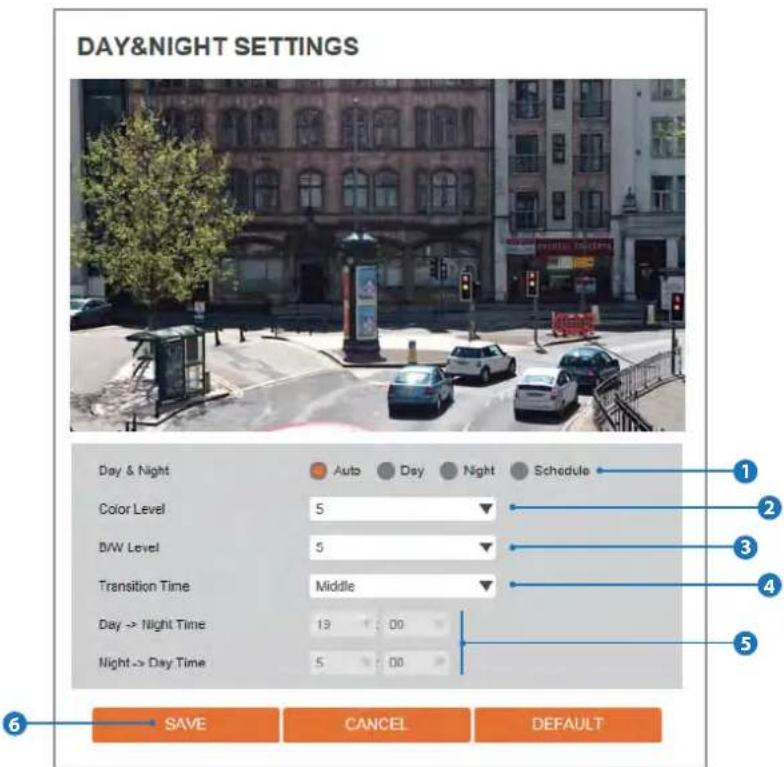
DAY&NIGHT SETTINGS Day & Night Auto Day Night Schedule Color Level 5 B/W Level 5 Transition Time Middle Day -> Night Time 19 00 Night -> Day Time 5 00 SAVE CANCEL DEFAULT1 Day & Night
Auto: In this mode, the IR cut filter is removed automatically depending on the light condition around.
Day: In this mode, the IR cut filter is applied to the image sensor all the time. Thus, the sensitivity will be reduced in the dark light condition but the better color reproduction performance are obtained.
Night: In this mode, the IR cut filter on the image sensor is removed all the time. The sensitivity will be enhanced in the dark light condition but the image is black and white.
Schedule: In this mode, Day / Night mode is converted accordance with the scheduled time.
2 Color Level
It is a level to change Night mode into Day mode when Day & Night mode is Auto.
3 B/W Level
It is a level to change Day mode into Night mode when Day & Night mode is Auto.
4 Transition Time
If it is set to Auto, to determine the rate at which Day / Night is converted.
5 If it is set to schedule mode, Set the time that Day / Night is converted.
6 Click 'Save' to save the current settings.
Click 'Cancel' to return to the previous setting.
Click 'Default' to settings to the factory defaults.
Setup - Camera Setup Camera Backlight Settings
text_image
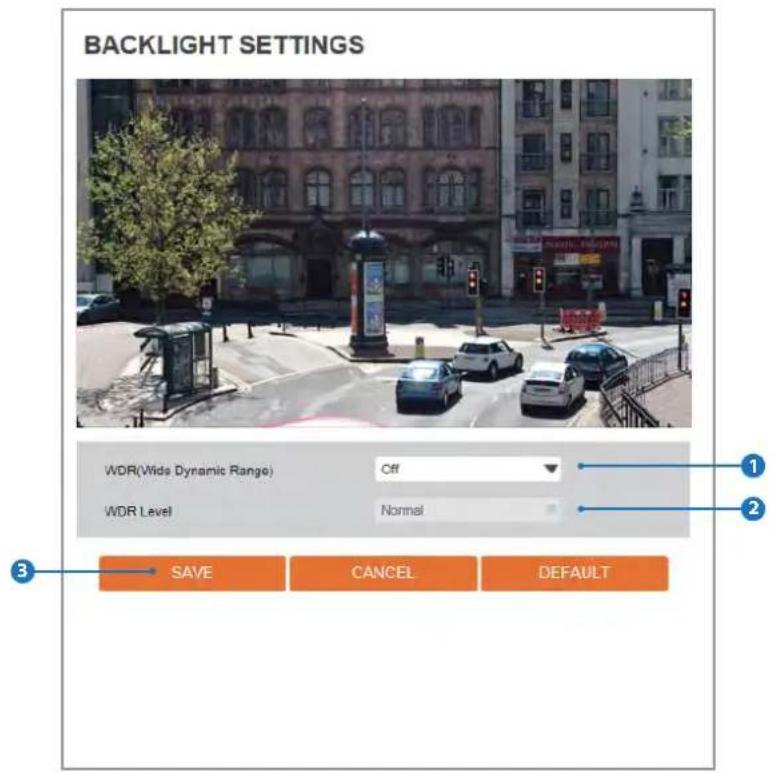
BACKLIGHT SETTINGS WDR(Wide Dynamic Range) Off WDR Level Normal SAVE CANCEL DEFAULTThis is a feature used for problematic light conditions where the contrast from light to dark areas is very high.
1 WDR (Wide Dynamic Range)
The WDR function can be enable or disable.
2 WDR Level
Select the WDR level depending on the difference in brightness between the darkest and lightest part of an image.
3 Click 'Save' to save the current settings.
Click 'Cancel' to return to the previous setting.
Click 'Default' to settings to the factory defaults.
text_image
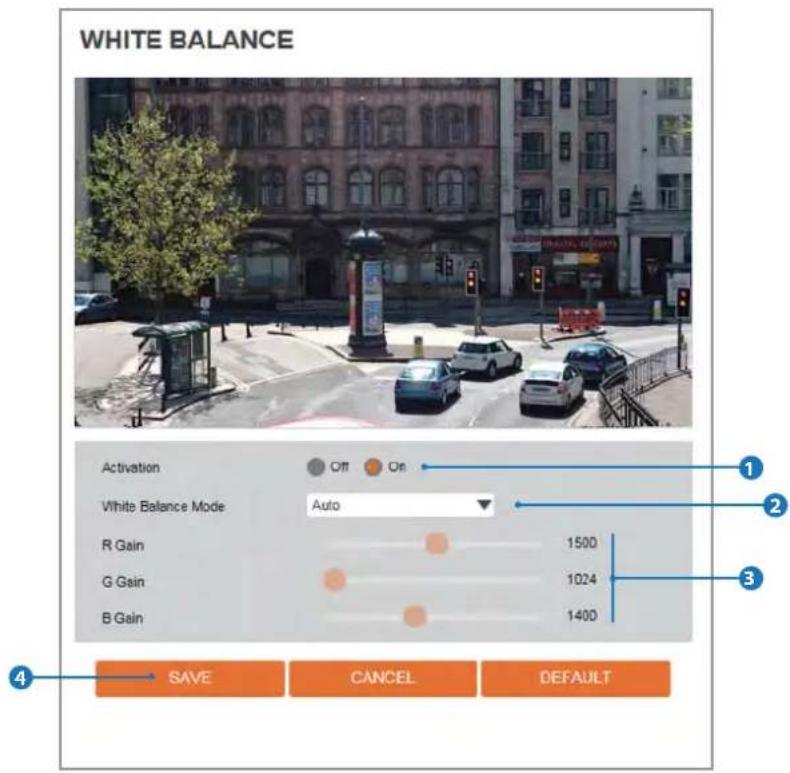
WHITE BALANCE Activation Off On White Balance Mode Auto R Gain 1500 G Gain 1024 B Gain 1400 SAVE CANCEL DEFAULT1 Activation
White Balance can be enable or disable.
2 White Balance Mode
Select White Balance depending on the lighting conditions.
3 RGB Gain
The R/G/B gain can be set only when the White Balance Mode is set to Manual.
4 Click 'Save' to save the current settings.
Click 'Cancel' to return to the previous setting.
* Click 'Default' to settings to the factory defaults.
Setup - Camera Setup
Camera Image Enhancement

text_image
IMAGE ENHANCEMENT 3D Noise Reduction Mirror Flip +3 Off On Off On SAVE CANCEL DEFAULT1 3D Noise Reduction
3DNR function enables to suppress noise and retain good video quality in low light conditions.
2 Mirror
Reverse the video from side to side.
3 Flip
Reverse the video from up to down.
4 Click 'Save' to save the current settings.
Click 'Cancel' to return to the previous setting.
Click 'Default' to settings to the factory defaults.

text_image
VIDEO ENHANCEMENT Flickerless 50Hz 60Hz SAVE CANCEL DEFAULT
Flicker
This function Enable to enhance the flicker situation.

Click 'Save' to save the current settings.
Click 'Cancel' to return to the previous setting.
Click 'Default' to settings to the factory defaults.
NETWORK STATUS
| MAC Address | 64.76:57:CE:00.43 |
| IP Address | 192.168.1.33 |
| Subnet Mask | 255.255.0.0 |
| Default Gateway | 192.168.1.1 |
| Preferred DNS Server | 203.248.252.2 |
| Alternate DNS Server | 164.124.101.2 |
| HTTP Port | 80 |
| RTSP Port | 554 |
This menu will show you all the information of Network setting in the camera. However, you cannot change those here.
text_image
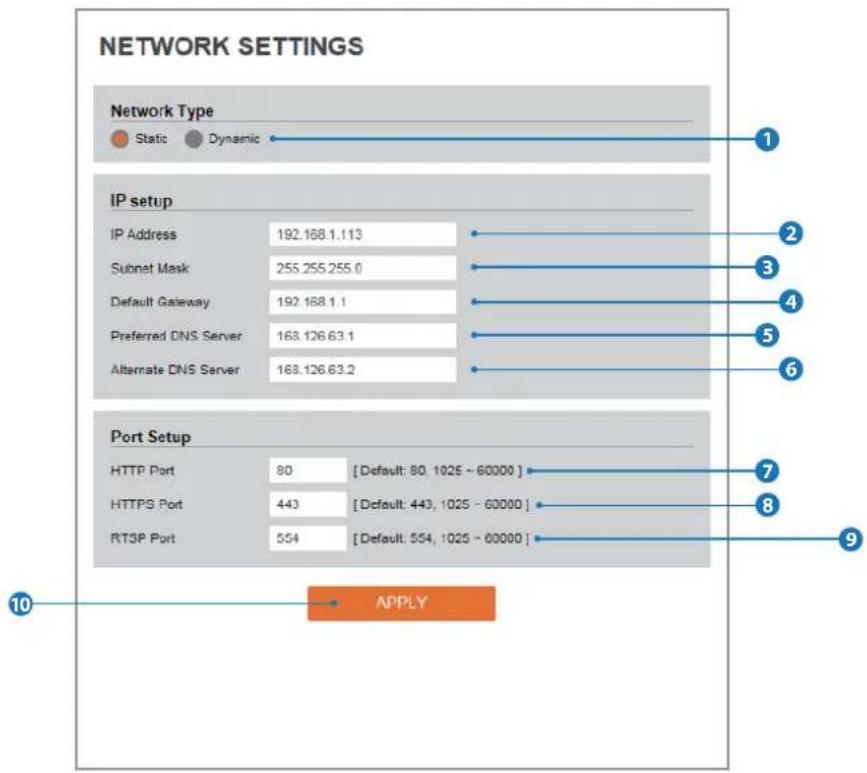
NETWORK SETTINGS Network Type Static Dynamic IP setup IP Address 192.168.1.113 Subset Mask 255.255.255.0 Default Gateway 192.168.1.1 Preferred DNS Server 168.126.63.1 Alternate DNS Server 168.126.63.2 Port Setup HTTP Port 80 [Default: 80, 1025 ~ 60000] HTTPS Port 443 [Default: 443, 1025 ~ 60000] RTSP Port 554 [Default: 554, 1025 ~ 60000] 10 APPLY1 Network Type
Define network IP address type from the Static Mode for the fixed IP or the Dynamic Mode by the dynamic IP address. If you select the Static Mode, you must fill out IP Address, Subnet Mask, Gateway, DNS Server and all ports. If you select the Dynamic Mode, the IP address will be allocated automatically by DHCP equipment. If you click the Apply button to update changes, the system will be re-booted. In this case, you have to reconnect the camera using new IP address.
2 IP Address
Define the IP address. The address is consisted of four numbers separated by dots and the range of each number is from 0 to 255.
3 Subnet Mask
Define the Subnet Mask. Format is same as the IP address.
4 Default Gateway
Default the Gateway IP Address. Format is same as the IP address.
5 Preferred DNS Server
Define the DNS server IP address. Format is same as the IP address.
6 Alternate DNS Server
Define the Secondary DNS server IP address. Format is same as the IP address.
7 HTTP Port
The HTTP port can be set to 80 which default or in between 1025 to 60000.
8 HTTPS Port
The HTTPS port can be set to 443 which default or in between -en1025 to 60000.
9 RTSP Port
The RTSP port can be set to 554 which default or in between 1025 to 60000.
10 Click 'Apply' to make above setting effective.
If the network type is dynamic, the IP address is changed in below cases. Therefore, the IP address needs to be searched again, and the camera needs to be reconnected in these cases.
- When the camera power is on / off.
- After Firmware update, Default set and reboot.
Setup - Network Setup
Auto IP Settings

text_image
AUTO IP SETTINGS General Setting Off On UNIQUE ID s832a4fb-8821-4c35-b232-66c415d874a5 AUTO IP ADDRESS 169.254.189.3 APPLY1 General Setting
Auto IP Settings function can be enable or disable.
2 Auto IP Settings Information
It displays the unique id or Auto IP address.
3 Click 'Apply' to make above setting effective.
text_image
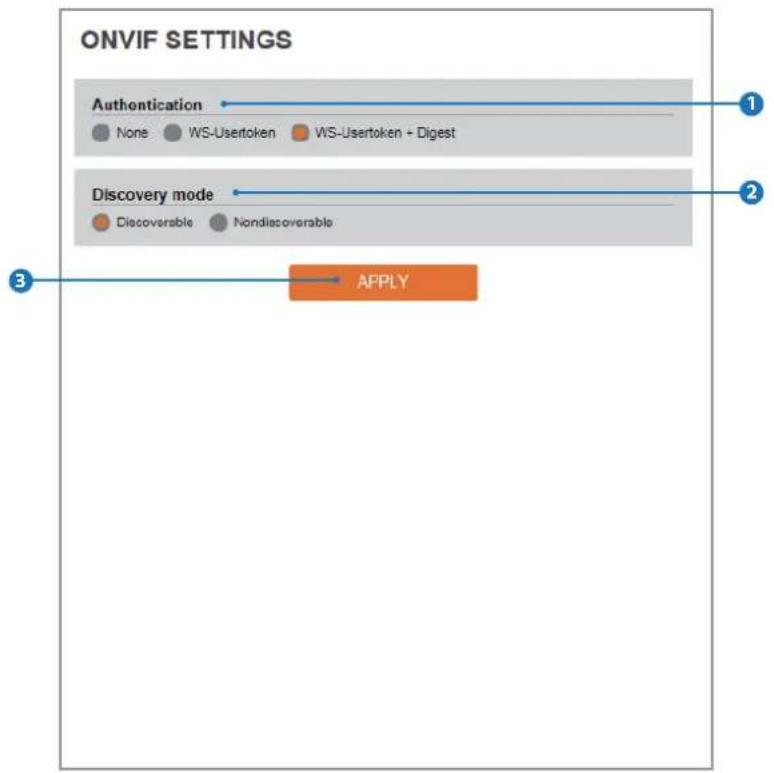
ONVIF SETTINGS Authentication None WS-Usertoken WS-Usertoken + Digest Discovery mode Discoverable Nondiscoverable APPLY1 Authentication
None: Allows to access without ONVIF authentication.
WS - Usertoken: Allows to access with WS-User
Token of ONVIF authentication.
WS - Usertoken + Digest: Allows to access with WS-User
Token and Digest of ONVIF authentication.
2 Discovery Mode
The discovery function can be enable or disable.
3 Click 'Apply' to make above setting effective.

text_image
UPNP SETTINGS General Setting Off On Device Information FriendlyName APPLY1 General Setting
UPNP function can be enable or disable.
2 Friendly Name
Define the friendly name.
3 Click 'Apply' to make above setting effective.

text_image
DDNS SETTINGS Disable Public: DDNS Address www.no-id.com! Host Name User Name Password 1 2 3 APPLY1 DDNS Disable
If it is selected, DDNS service does not work.
2 Public DDNS
To use public DDNS service, select a site address listed in the list. After filling out the Host Name of the site, the setup is completed by entering User Name and Password registered in that DDNS site.
| DDNS Provider Site Address | |
| DynDNS | www.dyndns.com |
| No-IP | www.no-ip.com |
If you setup DDNS properly, the IP address of your camera will be updated automatically whenever IP address is changed or system is rebooted.
If IP updating to DDNS site is failed, camera will keep retrying in 1min. interval.
3 Click 'Apply' to make above setting effective.
text_image
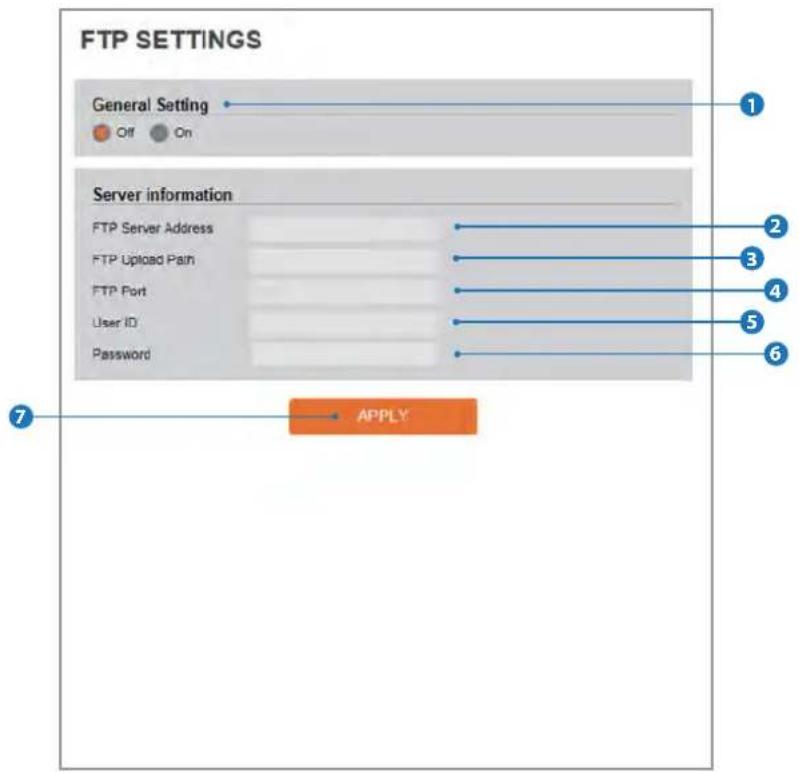
FTP SETTINGS General Setting Off On Server information FTP Server Address FTP Upload Path FTP Port User ID Password 1 2 3 4 5 6 7 APPLYTo transfer / save the image to the relevant sites through FTP, then FTP needs to be setup.
1 General Setting
FTP function can be enable or disable.
2 FTP Server Address
Define FTP Server IP Address. If IP Address form is incorrect, a Message box will be shown to try again.
3 FTP Upload Path
Define a path in FTP server to store video. For the path name, English Alphabets, numbers and special characters (/\~!@ \$ ^ ()_-{}[];,) can be used.
4 FTP Port
Define the FTP Server Port. If Port is not appropriate, it is impossible to access to FTP Server.
5 User ID
Define User ID to access to the FTP Server. Fill out the correct User ID registered in the FTP Server.
6 Password
Define Password to access to the FTP Server. Fill out the correct Password registered in the FTP Server.
7 Click 'Apply' to make above setting effective.
Refer the above screen image for the example.

text_image
SMTP SETTINGS General Setting Off On Account information Mode PLAIN SSL/TLS SMTP Server Address PORT User ID Password E-Mail Sender E-Mail Receiver Mail Contents Title Message 11 APPLYTo send / save the image to the relevant sites by Email, SMTP needs to be setup.
1 General Setting
SMTP function can be enable or disable.
2 Mode
Select Security mode of SMTP from Plain or SSL / TLS. After checking account setup of your SMTP Server, you may select one.
3 SMTP Server Address
Define the SMTP Server Address. If the IP Address form is incorrect, a Message box will be shown to try again.
4 Port
Define the Port used in the Plain or SSL / TLS security mode in the above.
5 User ID
Define the User ID to access to SMTP Server. Fill out the correct User ID registered in the SMTP Server.
6 Password
Define the Password to access to SMTP Server. Fill out the correct Password registered in the SMTP Server.
7 E-Mail Sender
Define the e-mail address of E-Mail Sender. It will be displayed as the sender when the camera sends an E-mail.
8 E-Mail Receiver
Define the e-mail address of E-Mail Receiver. It will be displayed as the Receiver when the camera sends an E-mail.
9 Title
Define the title of the E-Mail when the camera sends an E-mail.
The title of the Email is limited to 40 characters including the spaces.
10 Message
Define the contents of E-Mail when camera sends an E-mail. The message of the Email is limited to 40 characters including the spaces.
11 Click 'Apply' to make above setting effective.

text_image
SNMP SETTINGS SNMP v1/v2c SNMPV1 Off On SNMPV2 Off On Read Community Write Community SnmpTrap Off On TrapAddress TrapCommunity SNMP v3 Mode Read Activation Off On Read Name Security Level no auth, no priv Authentication Algorithm MDS Authentication Password Private-Key Algorithm DES Private-Key Password 1 2 3 4 5 6 7 8 9 10 11 APPLY1 SNMPv1/SNMPv2
Select the SNMPv1/SNMPv2 option and type the names of Read community and Write community.
SNMP trap can be used to check periodically for operational thresholds or failures that are defined in the MIB.
2 SNMP Trap
SNMP trap can be enable or disable.
SNMPv3 contains cryptographic security, a higher security level, which allows you to set the Authentication password and the Encryption password.
3 Mode
Select the either Read or Read/Write mode.
4 Activation
It can be enable or disable selected mode.
5 Read/Write name
Define Read name and Write name.
6 Security Level
Select one of no auth, no priv/auth, no priv/auth, priv
⑦ Authentication Algorithm
Select MD5 or SHA as the authentication method.
8 Authentication Password
The Authentication Password is an encryption for authentication and they are at least 8 digits and up to 30 digits allowed.
9 Private-Key Algorithm
Select DES or AES as the encryption algorithm.
10 Private-Key Password
Information protection password is a private encryp-tion and they are at least 8 digits and up to 30 digits allowed.
11 Click 'Apply' to make above setting effective.
text_image
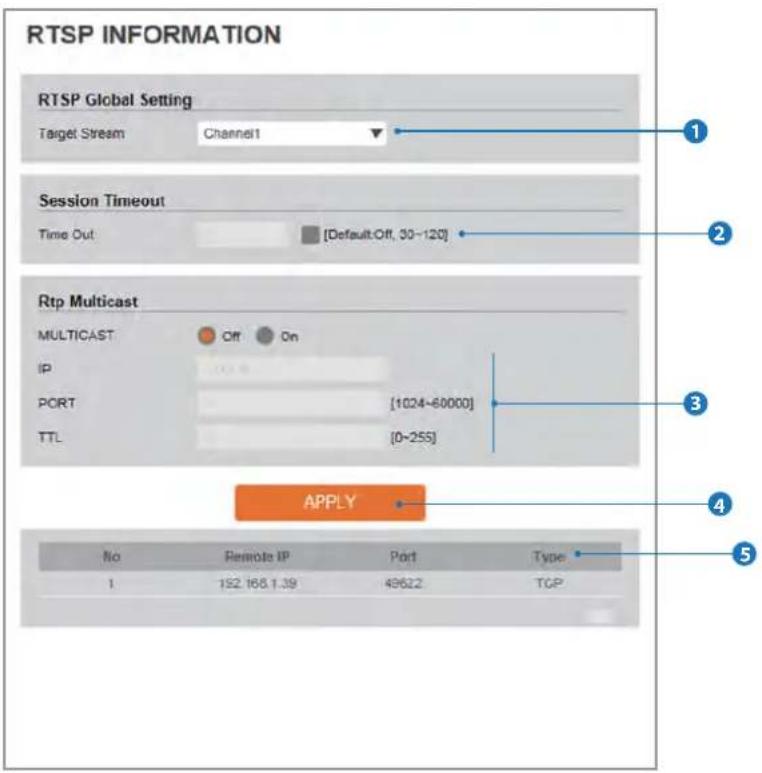
RTSP INFORMATION RTSP Global Setting Target Stream Channel1 Session Timeout Time Out [Default:Off, 30-120] Rtp Multicast MULTICAST Off On IP PORT [1024-60000] TTL [0-255] APPLY No Remote IP Port Type 1 192.168.1.39 49622 TCP1 Target Stream
Select the channel you want to set.
2 Time out
Set the RTSP time out.
The session is disconnected after the specified time out.
3 RTP Multicast
Check RTP Multicast On/Off. To activate RTP Multicast,
-
Click "On" button
-
Enter accessible RTP Multicast IP, port for video stream control, RTP packet TTL
-
Click "Apply" button.
It is possible to set each RTP Multicast for CH1\~3.
4 Click 'Apply' to make above setting effective.
Click this button when completed setup each channels.
5 It shows RTSP Connection information.
Setup - Trigger Action Setup Action Rules Configuration
text_image
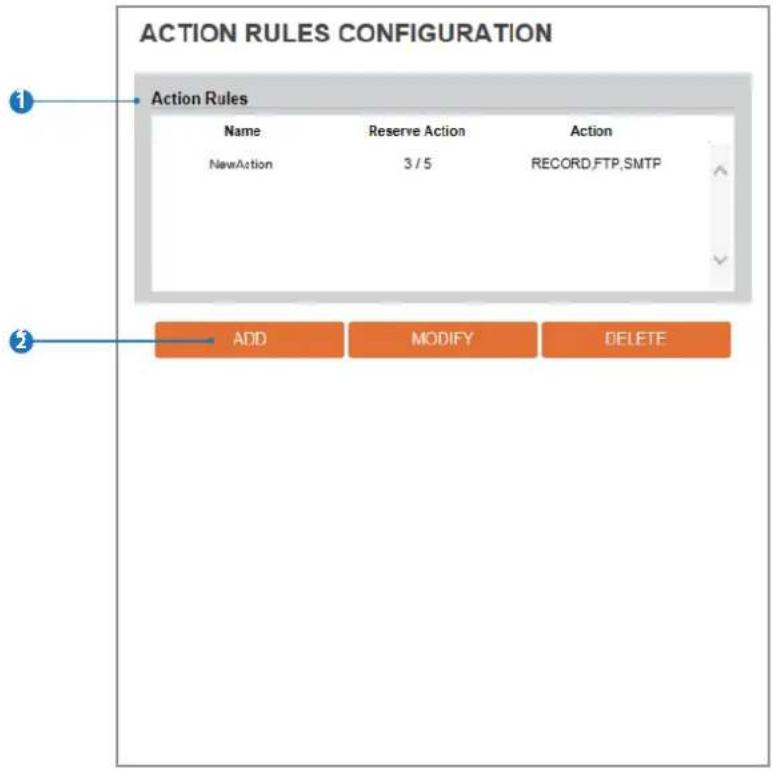
ACTION RULES CONFIGURATION Action Rules Name Reserve Action Action NewAction 3 / 5 RECORD FTP, SMTP ADD MODIFY DELETE1 Action rules List
It indicates the custom action rule information added to Action rules list.
2 Click 'Add' to add custom action rules.
Click 'Modify' to modify selected item from the action rules list.
Click 'Delete' to delete selected item from the action rules list.
Setup - Trigger Action Setup
Action Rules Add / Modify
text_image
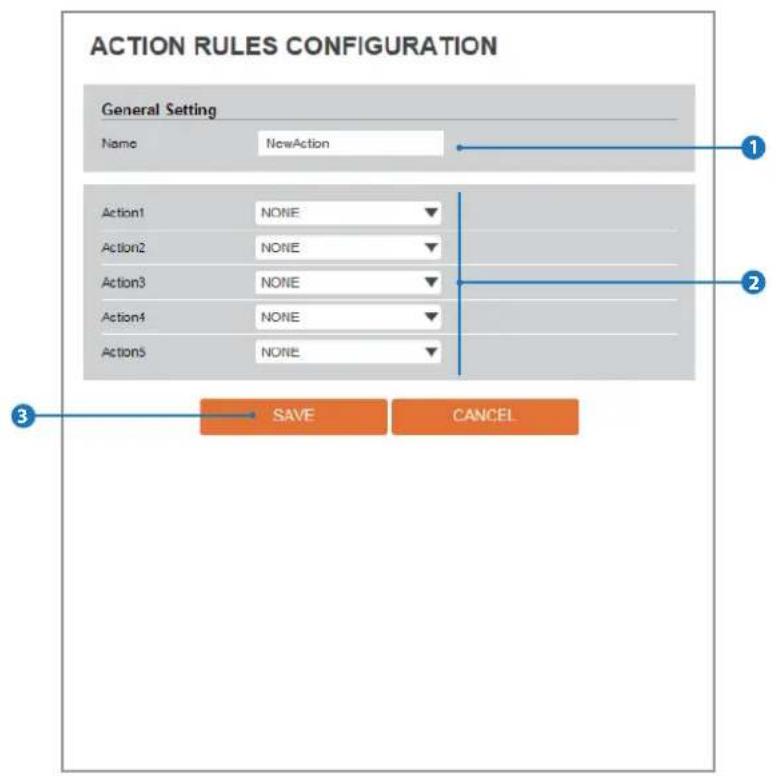
ACTION RULES CONFIGURATION General Setting Name NewAction Action1 NONE Action2 NONE Action3 NONE Action4 NONE Action5 NONE SAVE CANCEL
Name
Define name of action rules.

Action1 \~ Aciton5
Select the action to take If the event occurs.

Click 'Save' to save the current settings.
Click 'Cancel' to return to the previous menu.
Setup - Trigger Action Setup
Image Transfer Configuration

text_image
IMAGE TRANSFER CONFIGURATION Pre/Post Alarm Image Number Of Image 2 Image Per Seconds(s) [1 ~ 5] Pre-Alarm Duration 3 Second(s) [1 ~ 5] Post-Alarm Duration 3 Second(s) [1 ~ 30] APPLY1 Pre / Post Alarm Image
Image Transfer due to event is configured by setting Image transfer rate and Pre / Post alarm duration.
| Descriptions | |
| Number of Image | Define Number of image transferred per second. |
| Pre-alarm Duration | Define duration of image transfer before an event. |
| Post-alarm Duration | Define duration of image transfer after an event. |
2 Click 'Apply' to make above setting effective.
Setup - Events Setup
Event Rules Configuration
text_image
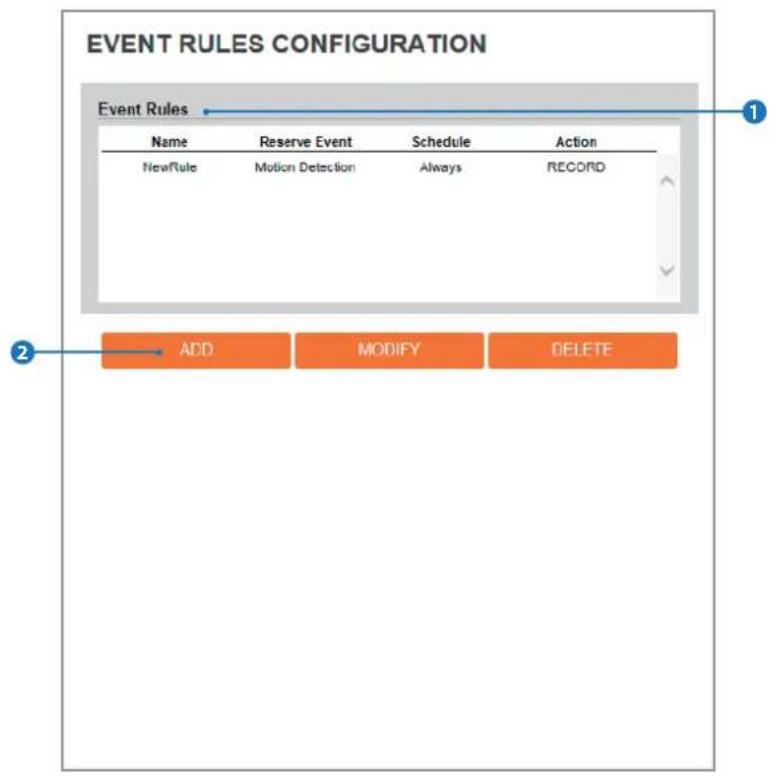
EVENT RULES CONFIGURATION Event Rules Name Reserve Event Schedule Action NewRule Motion Detection Always RECORD ADD MODIFY DELETE1 Event Rules List
It indicates the custom Event Rule information added to Event Rules list.
2 Click 'Add' to add custom event rules.
Click 'Modify' to modify selected item from the event rules list.
Click 'Delete' to delete selected item from the event rules list.
Setup - Events Setup Event Rules Configuration
text_image
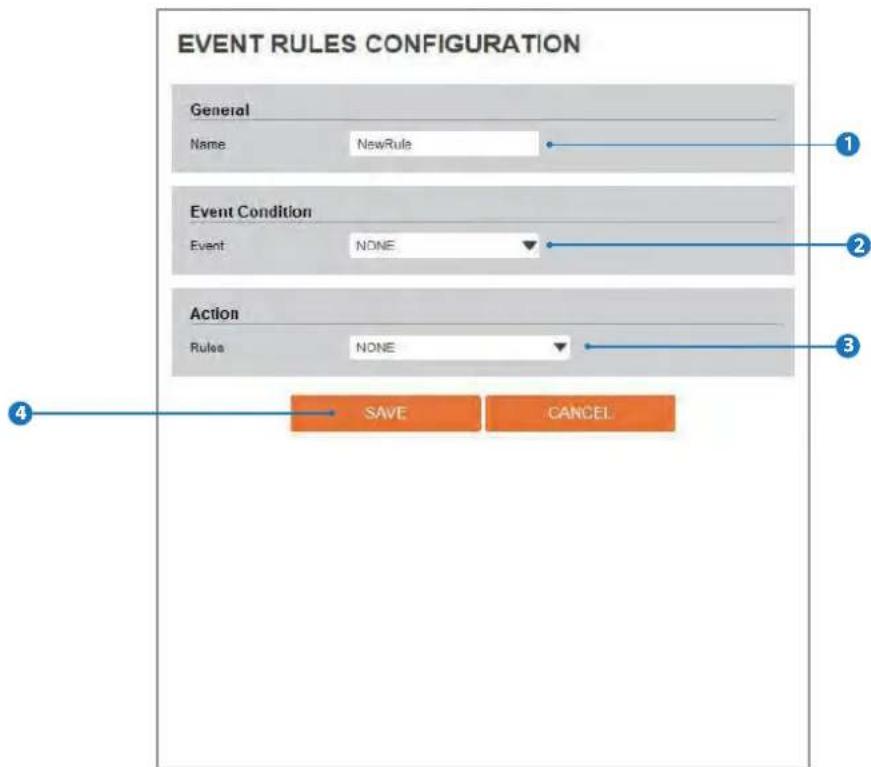
EVENT RULES CONFIGURATION General Name NewRule Event Condition Event NONE Action Rules NONE SAVE CANCEL
Name
Define the Event rule name.

Event
Select the event among motion detection, Network Disconnected, Temperature Critical.
Click 'Cancel' to return to the previous setting.
You need a event one more.

Rules
Select the action rule defined in the Trigger Action-Action rule menu.

Click 'Save' to save the current settings.
Click 'Cancel' to return to the previous setting.
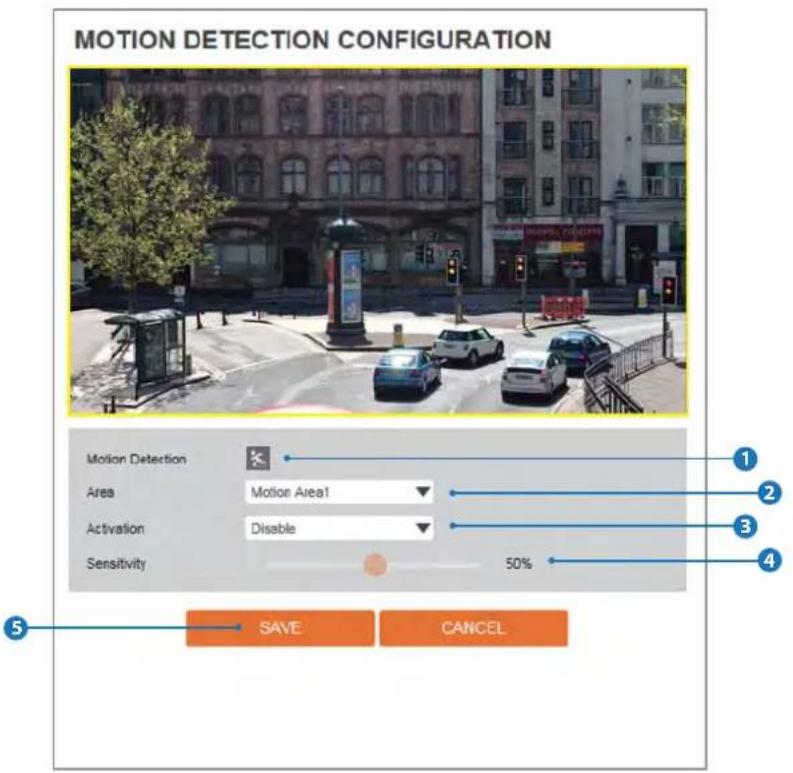
text_image
MOTION DETECTION CONFIGURATION Motion Detection Area Motion Area1 Activation Disable Sensitivity 50% SAVE CANCEL1 Motion Detection
It shows the Motion event status.
Event Alert Icon( ) appears if 'Motion Detection' is activated.
2 Area
Set the motion detected area.
※ You can set up to four areas.
3 Activation
Enable or Disable motion detection function.
4 Sensitivity
Define the sensitivity of motion detection. If High value is selected, it will detect very small motion while it becomes relatively insensitive when Low value is selected.
5 Click 'Save' to save the current settings.
* Click 'Cancel' to return to the previous setting.
Setup - Events Setup
Temperature

text_image
TEMPERATURE General Setting Mode Fahrenheit Threshold 150 [122~212] Temperature 116 °F 3 1 2 3 4 APPLY
Mode
Select the either Fahrenheit and Celsius.

Threshold
Define the temperature at which the event trigger is occurred.

Temperature
It indicates the current temperature of the IP camera.

Click 'Apply' to make above setting effective.
Setup - Record Setup Record Configuration
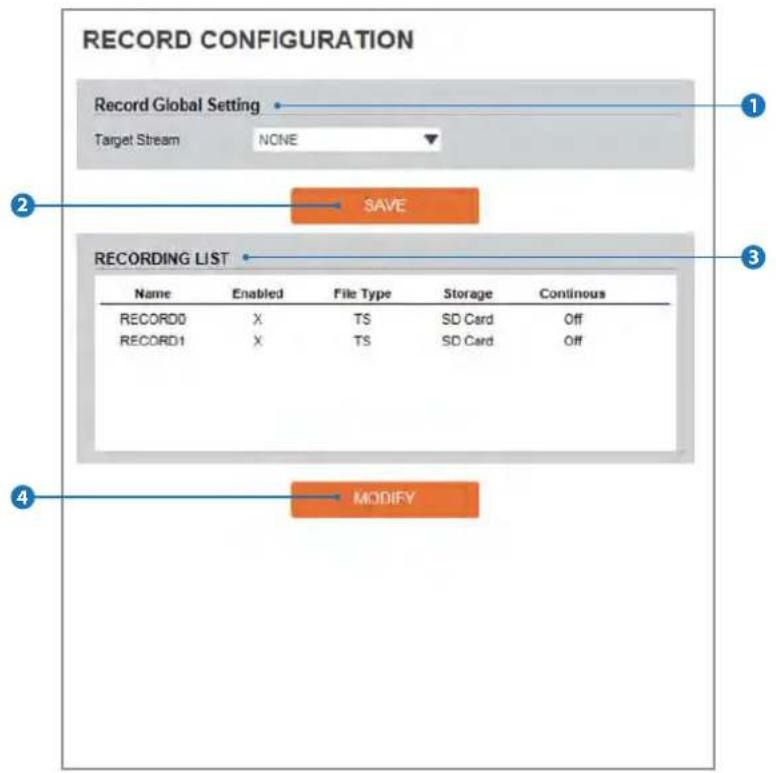
text_image
RECORD CONFIGURATION Record Global Setting Target Stream NONE SAVE RECORDING LIST Name Enabled File Type Storage Continuous RECORD0 X TS SD Card Off RECORD1 X TS SD Card Off MODIFY1 Target Stream
Select the channel you want to record video.
2 Click 'Save' to save the current settings.
3 Recording List
Display the information about the recording settings.
4 Click 'Modify' to modify the selected item in the recording list.
Setup - Record Setup Record Configuration

text_image
RECORD CONFIGURATION Record Settings Enabled Off On File Type TS Storage SD Card Continuous Off On Pre Duration 5 [0 - 5] Post Duration 5 [1 - 240] SAVE CANCEL1 Enabled
The Recording function can be enable or disable.
2 File Type
Select the recording file type.
Currently only supports Ts Type.
3 Storage
Select the storage type.
4 Continuous
If continuous mode is turned on, Start the continuous recording without any other setting.
5 Pre Duration
Define duration of recording before an event.
6 Post Duration
Define duration of image transfer after an event.
7 Click 'Save' to save the current settings.
Click 'Cancel' to return to the previous setting.
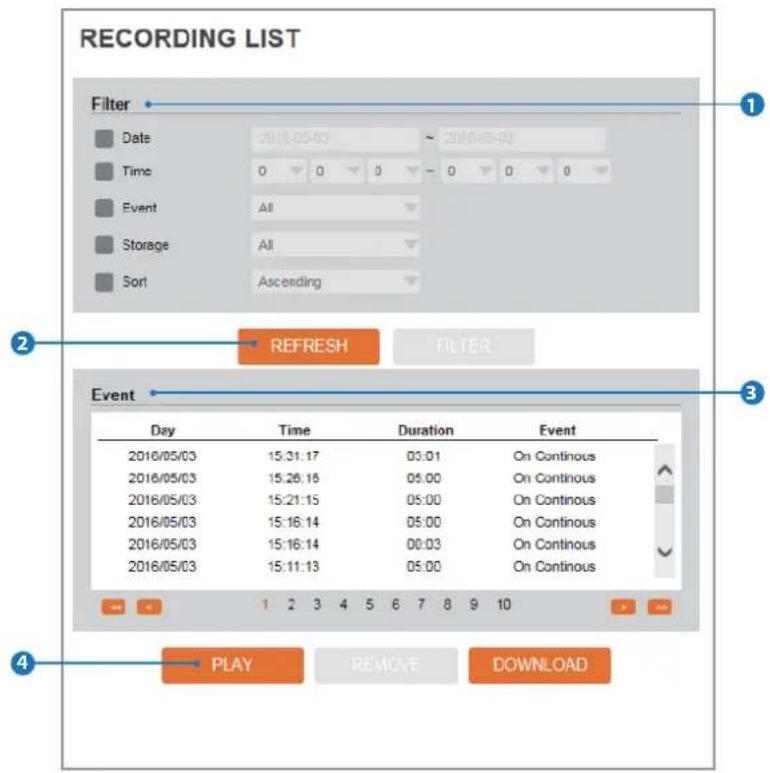
text_image
RECORDING LIST Filter Date 2016/05/03 ~ 2016/05/03 Time 0 0 0 - 0 0 0 Event All Storage All Sort Ascending 2 REFRESH FILTER Event Day Time Duration Event 2016/05/03 15:31:17 03:01 On Continuous 2016/05/03 15:26:16 05:00 On Continuous 2016/05/03 15:21:15 05:00 On Continuous 2016/05/03 15:16:14 05:00 On Continuous 2016/05/03 15:16:14 00:03 On Continuous 2016/05/03 15:11:13 05:00 On Continuous 1 2 3 4 5 6 7 8 9 10 PLAY REMOVE DOWNLOAD
Filter
Select the date / time, event, sort or storage format to filter the recorded video.

Click the 'Refresh' button to refresh the records list.
Click 'Filter' to view the filtered recorded video.

Recording List
Dispaly the information to the recording video.

Click 'Play' to view the selected item in list of recorded video.
Click 'Remove' to delete the selected item in list of recorded video.
Click 'Download' to download the selected item in list of recorded video.
RECORDING VIDEO
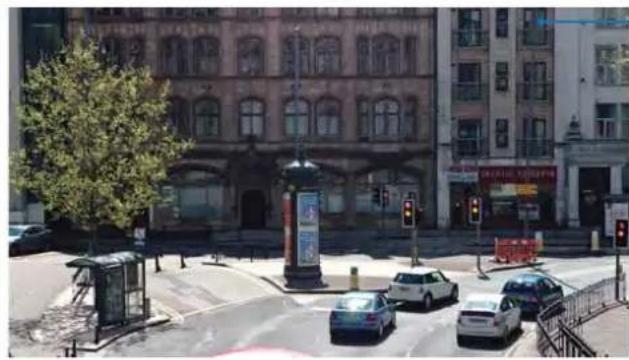
natural_image
Street scene with parked cars and a large historic building in the background, no visible text or signage1
Recording Video
| Token | 00010043572645b5 |
| Status | Completed |
| Start Time | 2016/05/03 15:31:17 |
| End Time | 2016/05/03 15:34:18 |
| Recording Time | 03:01 |
2
REPLAY
BACK
1 Recording Video Viewer
Play the recorded video.
2 Recording Video Information
Display the information about the recorded video.
3 Click 'Replay' to view the recorded video again.
Click 'Back' to return to the previous menu.
Setup - Record Setup Storage Configuration
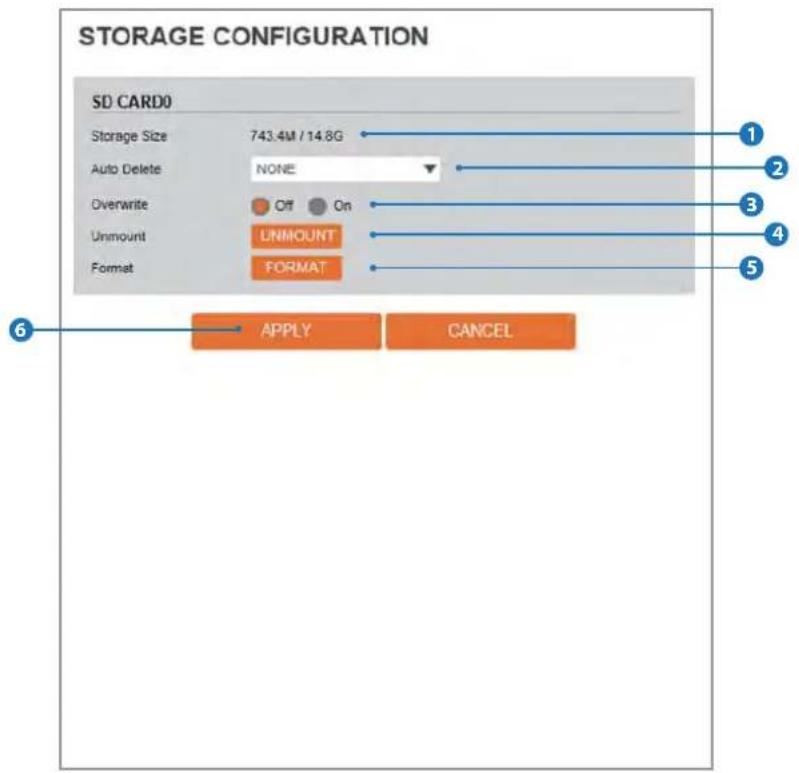
Display the SD card information mounted from device.
When you select the item in Storage list, You can set the functions related to the SD card.
Setup - Record Setup Storage Configuration
text_image
STORAGE CONFIGURATION SD CARD0 Storage Size 743.4M / 14.8G Auto Delete NONE Overwrite Off On Unmount UNMOUNT Format FORMAT 6 APPLY CANCEL1 Storage Size
Total capacity of SD card and the remainder of it are displayed.
2 Auto Delete
Select the period for Auto delete. The image data stored before period will be deleted automatically. Delete all stored image older than selected time.
3 Overwrite
If it is set ON and remained space of SD card reach to less than 8MB, new data will start to be overwritten on the oldest data. However, if it is set OFF and remained space of SD card reach to less than 8MB, image recording will be stopped.
4 Unmount
remove the SD card from the device.
5 Format
Delete the all contents that stored in SD card.
6 Click 'Apply' to make above setting effective. Click 'Cancel' to return to the previous setting.
Setup - Security Setup
IP Address Filter Configuration
text_image
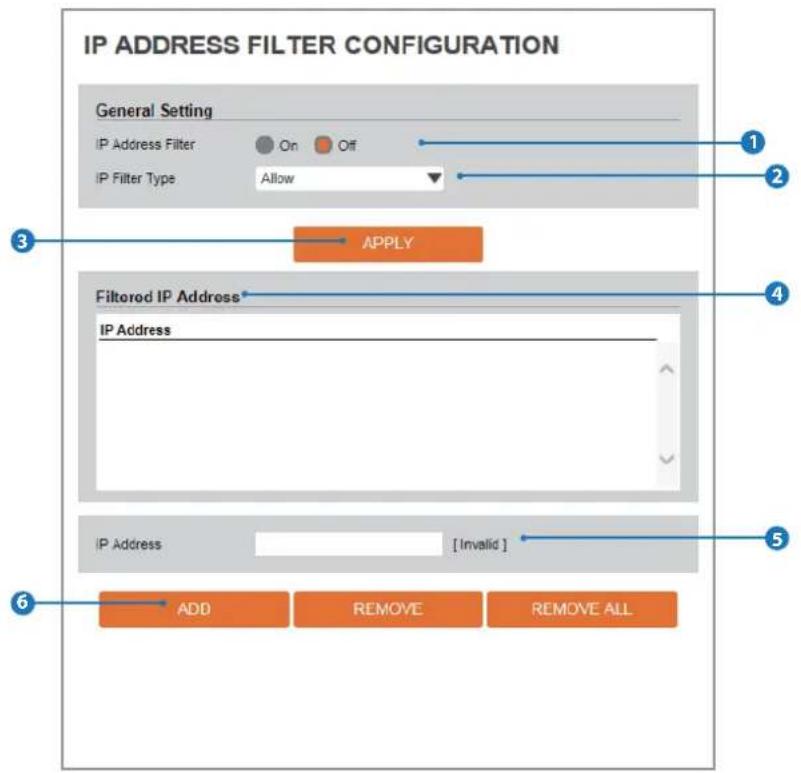
IP ADDRESS FILTER CONFIGURATION General Setting IP Address Filter On Off IP Filter Type Allow 1 2 3 APPLY Filtered IP Address IP Address IP Address [Invalid] 4 5 6 ADD REMOVE REMOVE ALL1 IP Address Filter
IP filter function can be enable or disable.
2 IP Filter Type
Select the recording IP filter type.
3 Click 'Apply' to make above setting effective.
4 Filter IP Address
Display the filterd IP address.
5 IP Address
Define the IP address you want to apply the IP filter.
6 Click 'Add' to add the ip address to the list.
Click 'Remove' to remove the ip address selected in the list.
Click 'Remove All' to remove all ip in the list.
Setup - Security Setup
RTSP Authentication Configuration
flowchart
graph LR
    A["RTSP Authentication"] --> B["Enable"]
    A --> C["Disable"]
    D["APPLY"] --> E["End"]
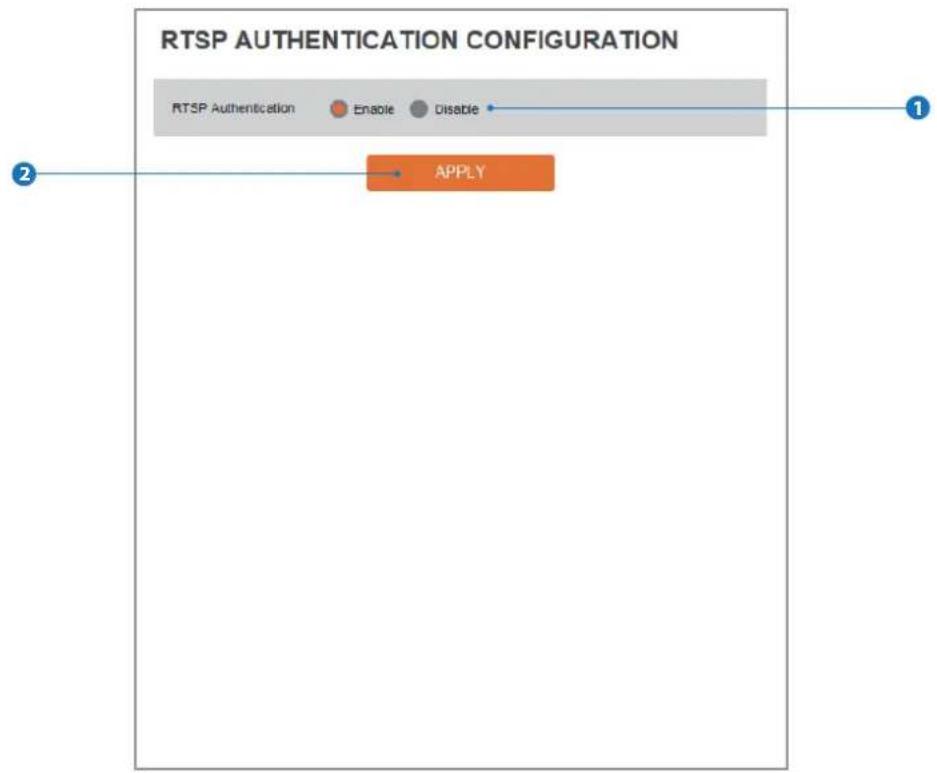
1 RTSP Authentication
RTSP Authentication can be enable or disable.
2 Click 'Apply' to make above setting effective.

text_image
IEEE 802.1X CONFIGURATION General Setting IEEE 802.1x On Off Protocol MDS EAPOL Version 1 ID Password Verity CA Certificate NONE Certificate NONE 1 2 3 4 5 6 7 8 9 APPLYThe feature is needed when connecting the camera to the network protected by the IEEE 802.1X.
1 IEEE 802.1x
The IEEE 802.1x feature can be enable or disable.
2 Protocol
MD5: It provides one-way password-based network authentication of the client.
PEAP: It is similar to TTLS in that it does not require a certifi-cate on the client side.
MD5: It does not require a certificate on the client side.
TLS: It relies on client-side and server-side certificates to perform authentication.
3 EAPOL Version
Select the EAPOL Version.
4 ID
Type the ID to identify the client in the IEEE 802.1X authen-tication server.
5 Password
Type the Password to identify the client in the IEEE 802.1X authentication server.
6 Verify
Verify Password.
7 CA Certificate
Select the CA certificate required for TLS, TTLS, and PEAP authentication.
8 Certificate
Select the client certificate required for TLS authen-tication
9 Click 'Apply' to make above setting effective.
HTTPS CONFIGURATION
- If no certificates are available go to certificates to manage.
Certificates
Certificate
NONE


HTTPS connection Policy
Administrator
HTTP and HTTPS


Operator
HTTP and HTTPS


Viewer
HTTP and HTTPS


APPLY
HTTPS encrypts session data over SSL or TLS protocols instead of using plain text in socket communications.
1 Certificate
Select an installed certificate.
If you can not select a certificate, please install the certificate from the Security->Certificates menu.
2 HTTPS connection Policy
Select one of "HTTP", "HTTPS", "HTTP and HTTPS" depending on the connected user authority.
3 Click 'Apply' to make above setting effective.
When HTTPS mode is chosen, input https://
Setup - Security Setup
Certificates Configuration
flowchart
graph TD
    A["Server/Client Certificates"] --> B["Certificate Name"]
    B --> C["ISSUED On"]
    B --> D["Expires On"]
    E["CREATE SELF-SIGNED CERTIFICATE"] --> F["PROPERTIES"]
    E --> G["DELETE"]
    H["CREATE CERTIFICATE SIGNING REQUEST"] --> I["INSTALL CERTIFICATE"]
    J["CA Certificate"] --> K["Certificate Name"]
    K --> L["ISSUED On"]
    K --> M["Expires On"]
    N["INSTALL CERTIFICATE"] --> O["PROPERTIES"]
    N --> P["DELETE"]
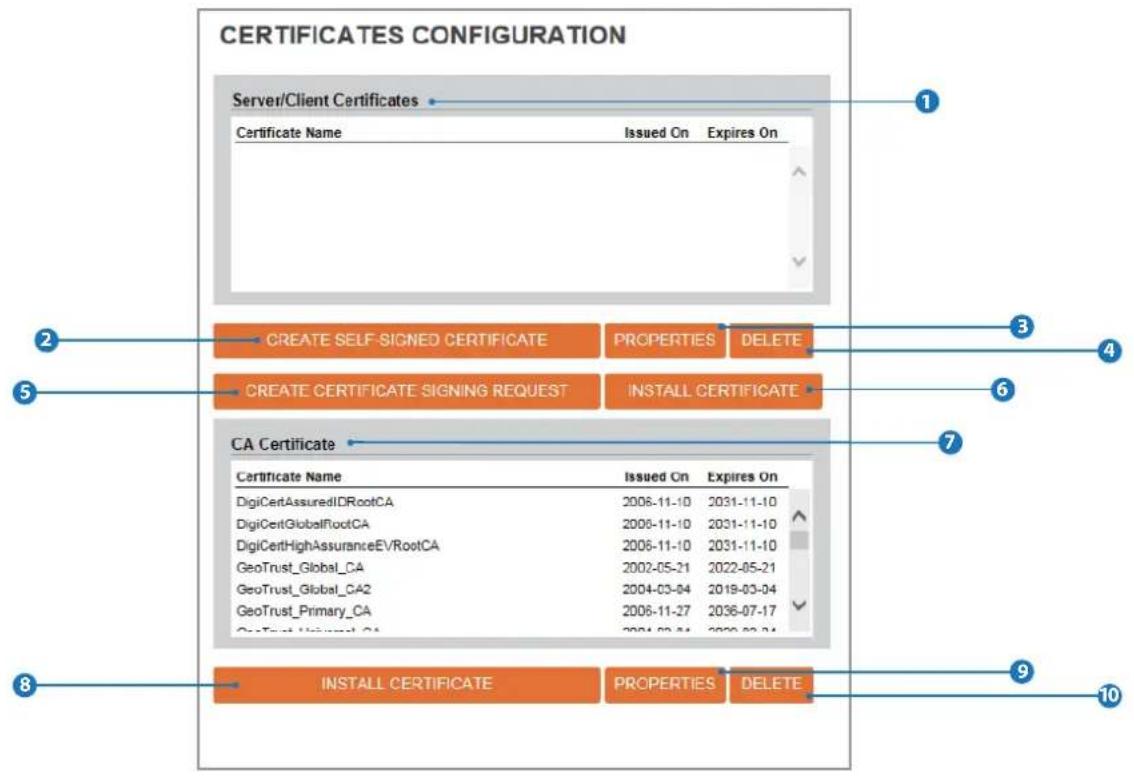
1 Server/Client Certificates
It show the installed certificates.
2 Create Self-Signed Certificate
A self-signed SSL certificate is an identity certificate signed by its own creator, but they are considered to be less trust -worthy.
3 Properties
Shows information about the selected certificate.
4 Delete
Delete the selected certificate.
5 Create Certificate signing request
This is the encoded data that contains the necessary information for issuing the certificate.
※ they must be filled in when creating the CSR (Certificate Signing Request).
6 Install Certificate
Install Certification
7 CA Certificate
It show the installed CA certificates.
8 Install CA Certificate
Install Certification, see the detail page.
9 Properties
Shows information about the selected certificate.
10 Delete
Delete the selected CA certificate.
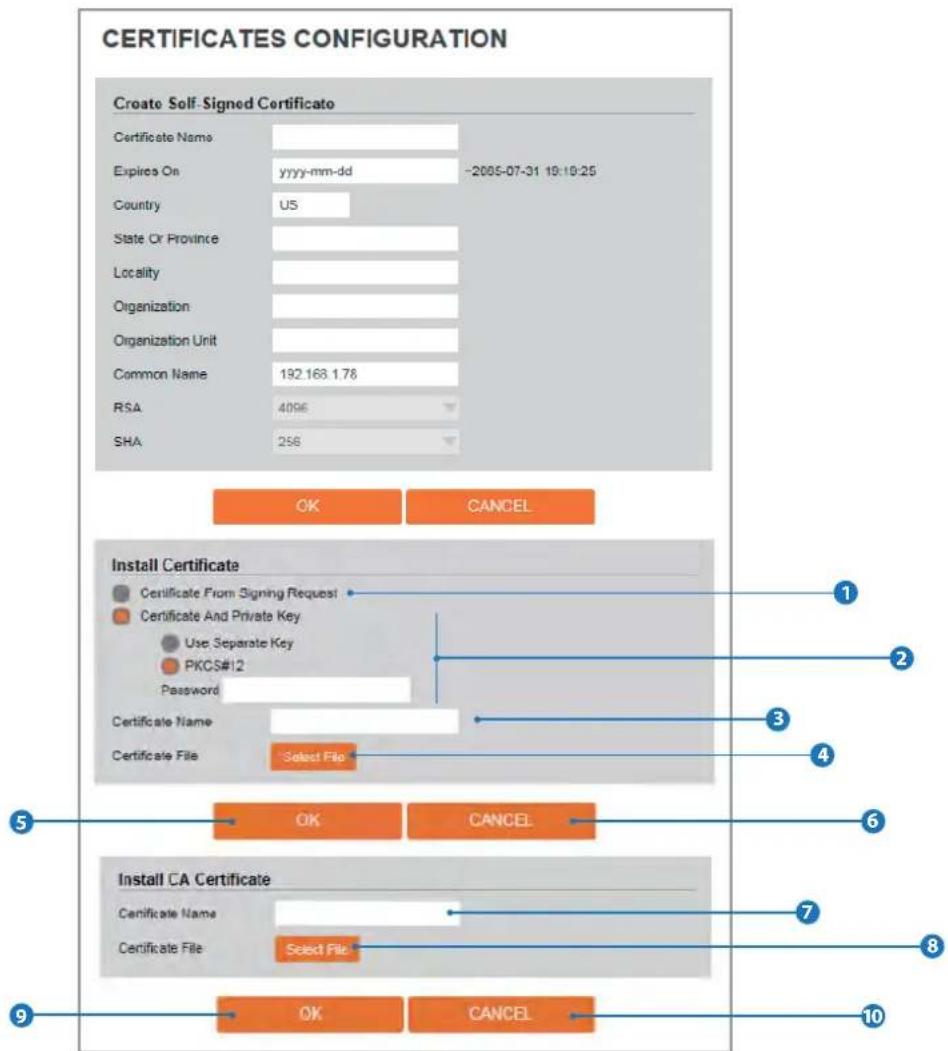
text_image
CERTIFICATES CONFIGURATION Create Self-Signed Certificate Certificate Name Expires On yyyy-mm-dd -2005-07-31 19:10:25 Country US State Or Province Locality Organization Organization Unit Common Name 192.168.1.78 RSA 4096 SHA 256 OK CANCEL Install Certificate Certificate From Signing Request Certificate And Private Key Use Separate Key PKCS#12 Password Certificate Name Select File Install CA Certificate Certificate Name Select File OK CANCELDetail for Install Certification.
1 Certificate From Signing Request
Select to install signed certificate returned from the CA.
2 Certificate And Private Key
Select to install Certificate And Private Key to install a certi-ficate and private key.
Use Seperate Key: Too install certificate uploading Certifi-cate and Private Key file.
PKCS#12" : "PKCS#12" is cryptography standard. if you want to install using PKCS#12, must enter the password.
3 Certificate Name
Enter a unique name to identify certificate.
4 Select File
Choose certification file.
5 OK
Request installing certificate.
6 Cancel
Cancel install certificate and then back to certificates configuration.
Detail for Install CA Certification.
7 Certificate Name
Enter a unique name to identify CA certificate.
8 Select File
Choose CA certification file
9 OK
Request installing CA certificate.
10 Cancel
Cancel install CA certificate and then back to certi-ficates configuration.
Setup - Security Setup
Service Configuration
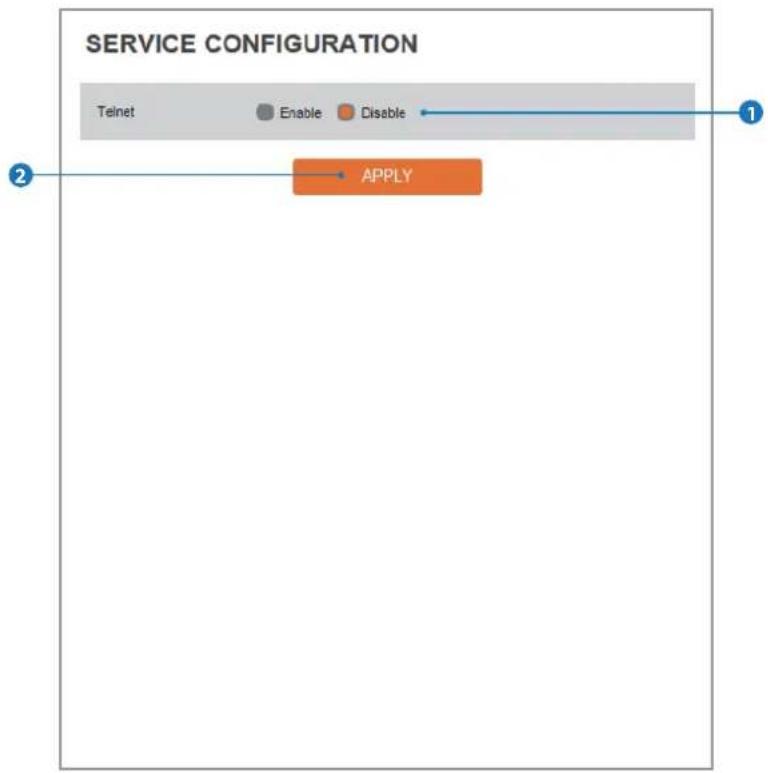
text_image
SERVICE CONFIGURATION Teinet Enable Disable APPLY① Telnet
The Telnet function can be enable or disable.
2 Click 'Apply' to make above setting effective.
Setup - System Setup System Information
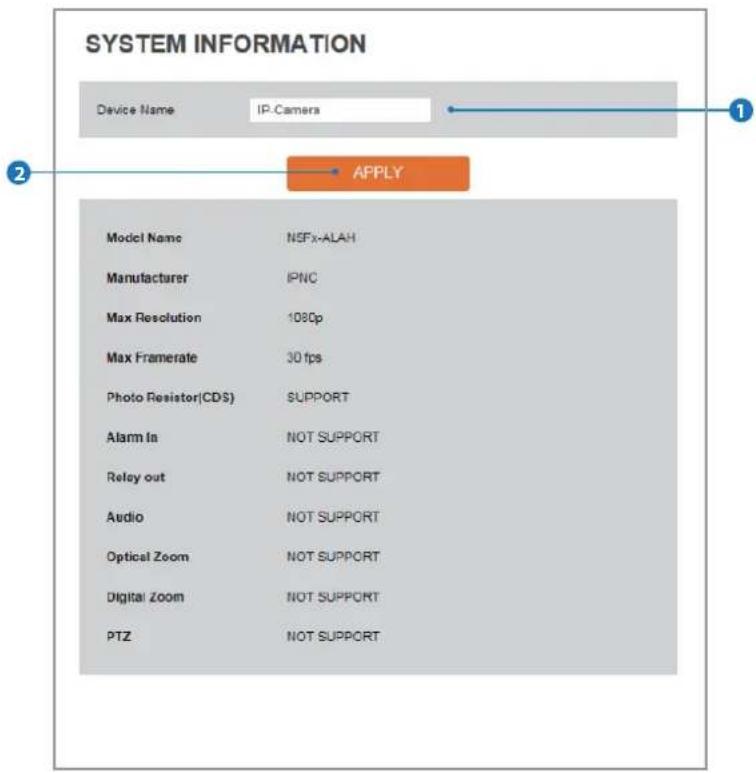
text_image
SYSTEM INFORMATION Device Name IP-Camera 2 APPLY Model Name NSFx-ALAH Manufacturer IPNC Max Resolution 1080p Max Framerate 30 fps Photo Resistor(CDS) SUPPORT Alarm In NOT SUPPORT Relay out NOT SUPPORT Audio NOT SUPPORT Optical Zoom NOT SUPPORT Digital Zoom NOT SUPPORT PTZ NOT SUPPORTSystem Capability information.
1 Device Name
You can define the device name.
6 Click 'Apply' to make above setting effective.
text_image
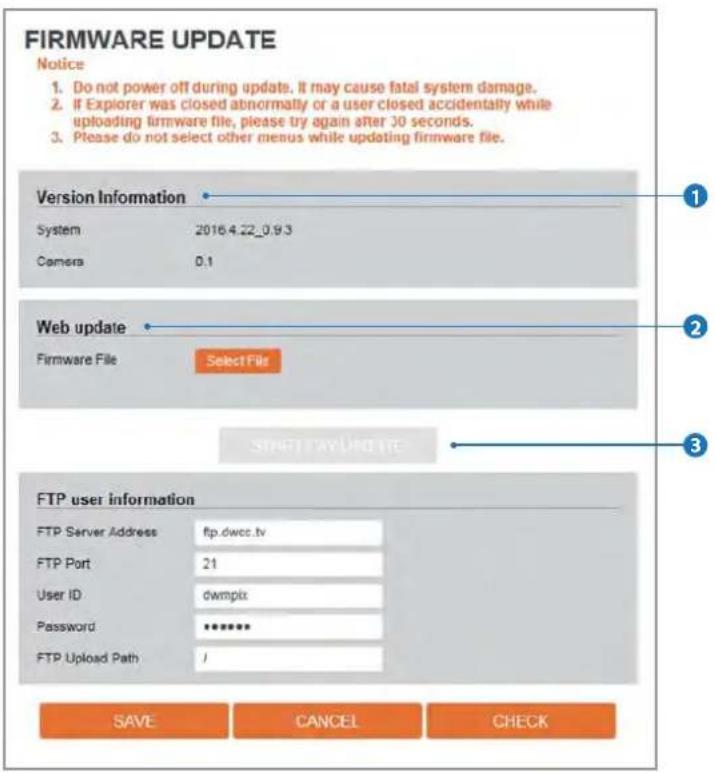
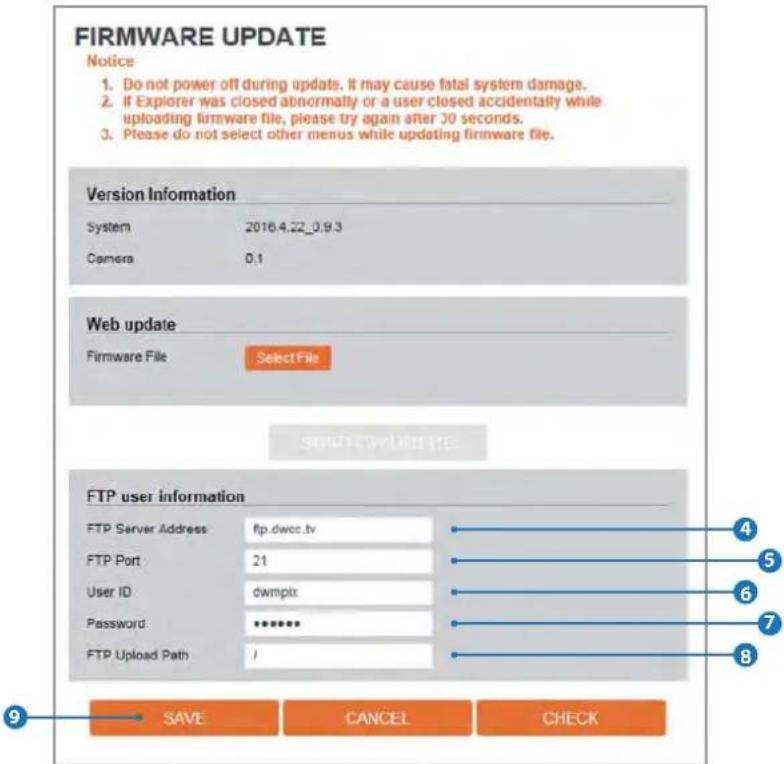
FIRMWARE UPDATE Notice 1. Do not power off during update. It may cause fatal system damage. 2. If Explorer was closed abnormally or a user closed accidentally while uploading firmware file, please try again after 30 seconds. 3. Please do not select other menus while updating firmware file. Version Information System 2016.4.22_0.9.3 Camera 0.1 Web update Firmware File SelectFile START/WY Uganda FTP user information FTP Server Address ftp.dwcc.tv FTP Port 21 User ID dwmpix Password ****** FTP Upload Path / SAVE CANCEL CHECK1 Version Information
It shows the current Firmware Version in the system.
2 Web Update
Select the Firmwar file in your computer by clicking [Select file] button.
3 Start F / W Update
Click this button to start update. Progress of uploading will be displayed using Progress Bar. If you assign the wrong file name, an error massage will be shown.
Warning:
-
Do not turn off the power of camera during the Firmware update. Otherwise, the system can be stuck to be unstable. If updating is finished, the system will be rebooted automatically.
-
Please make sure to check the 'Notice' shown on screen. If firmware update is completed, the camera will reboot automatically and 'Setup window' will be closed.
text_image
FIRMWARE UPDATE Notice 1. Do not power off during update. It may cause fatal system damage. 2. If Explorer was closed abnormally or a user closed accidentally while uploading firmware file, please try again after 30 seconds. 3. Please do not select other menus while updating firmware file. Version Information System 2016 4.22_0.9.3 Camera 0.1 Web update Firmware File SelectFile FTP user information FTP Server Address ftp.dwcc.tv FTP Port 21 User ID dwmptx Password ••••••• FTP Upload Path / SAVE CANCEL CHECK4 FTP Server Address
Define FTP Server IP Address. If IP Address form is incorrect, a Message box will be shown to try again.
5 FTP Port
Define the FTP Server Port. If Port is not appropriate, it is impossible to access to FTP Server.
6 User ID
Define User ID to access to the FTP Server. Fill out the correct User ID registered in the FTP Server.
7 Password
Define Password to access to the FTP Server. Fill out the correct Password registered in the FTP Server.
8 FTP Upload Path
Define a path in FTP server to store video. For the path name, English Alphabets, numbers and special characters (/\~!@\$ ^ () _ - { } [ ];,) can be used.
9 Click 'Save' to make above setting effective.
| SAVE Save FTP information | |
| CANCEL Click 'Cancel' to return to the previous setting. | |
| CHECK | Check the F/W file and if the file exists, 'F/W Update' button will appear and click it to update for F/W. |
Setup - System Setup Date & Time Settings

text_image
DATE&TIME SETTINGS TimeZone Setup TimeZone (GMT 00) Greenwich Mean Time, Lisbon, London, APPLY Current Date & Time Date 2016-07-06 Time 17:07:49 New Camera Date & Time Synchronize with my computer Date 2016-07-07 Time 09:07:35 Setup manually Date 2005 01 01 Time 00 00 00 Synchronize with time server (NTP) NTP Server pool.rtp.org APPLY1 TimeZone Setup
Choose TimeZone for camera. It will be activated after clicking 'Apply' button.
Prior to setting below 'New Camera Date & Time', set correct Timezone first.
2 Current Date & Time
Shows the current date and time setting in the Camera.
3 Synchronize with my computer
Set the date / time using those of PC currently connected.
4 Setup manually
Set the date / time by typing manually.
5 Synchronize with time sever Time Zone (NTP)
Choose time server available to connect to current camera. Date & Time will be updated automatically every hour when connected.
6 Click 'Apply' to make above setting effective.

text_image
DST SETTINGS General Setting Off On Date&Time Settings Start Time Jan First Sun 0 o'clock End Time Jan First Sun 0 o'clock 3 APPLYDaylight Saving Time (DST) is the practice of setting the clocks forward one hour from standard time during the summer months, and back again in the fall, in order to make better use of natural daylight.
1 General Setting
DST function can be enable or disable.
2 Date&Time Settings
Set the Start time and end time that the DST apply.
3 Click 'Apply' to make above setting effective.
Setup - System Setup Users Management

text_image
USER MANAGEMENT ID Authority admin Administrator ADD MODIFY DELETE1 Users
List all the user accounts for authentication.
2 Add
Register a new user

text_image
ID Password Verify UserAuthority Operator APPLY CANCEL| ID Enter | a new user ID except Admin since it exists. |
| Password | Enter the user Password. |
| Verify | Enter the user Password again for verification. |
| User Authority | Select Operator or Viewer.Viewer: Only monitoring is allowed.Operator: Most of the functions are allowed except 'Setup'.Administrator: All functions are allowed. |
The ID and Password are limited to 10 characters.
Click 'Apply' to make above setting effective.
Click 'Cancel' to return to the previous menu.
3 Modify
Modify the information of the user accounts registered. For admin account, only Password function can be modified.
4 Delete
Delete the selected user account. Admin account cannot be deleted.
Setup - System Setup
System Log
text_image
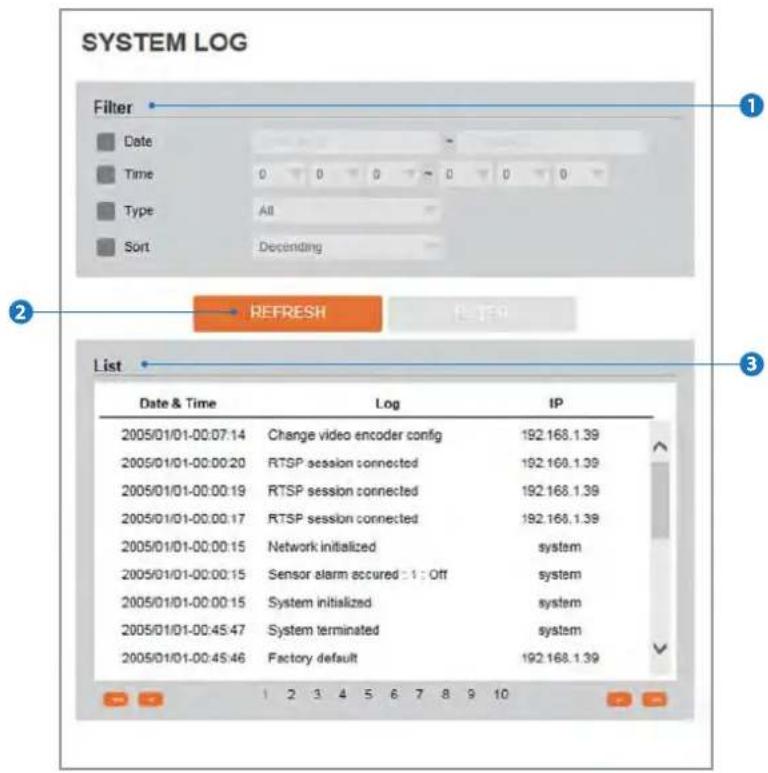
SYSTEM LOG Filter Date Time 0 0 0 0 0 0 0 Type All Sort Decending 1 2 REFRESH List Date & Time Log IP 2005/01/01-00:07:14 Change video encoder config 192.168.1.39 2005/01/01-00:00:20 RTSP session connected 192.168.1.39 2005/01/01-00:00:19 RTSP session connected 192.168.1.39 2005/01/01-00:00:17 RTSP session connected 192.168.1.39 2005/01/01-00:00:15 Network initialized system 2005/01/01-00:00:15 Sensor alarm accured : 1 : Off system 2005/01/01-00:00:15 System initialized system 2005/01/01-00:45:47 System terminated system 2005/01/01-00:45:46 Factory default 192.168.1.39 1 2 3 4 5 6 7 8 9 10
Filter
Select a date, sort or type of log to filter the log.

Click the 'Refresh' button to refresh the log list.
Click 'Filter' to view the filtered log.

System Log List
The filtered log is displayed.
Setup - System Setup
Factory Reset
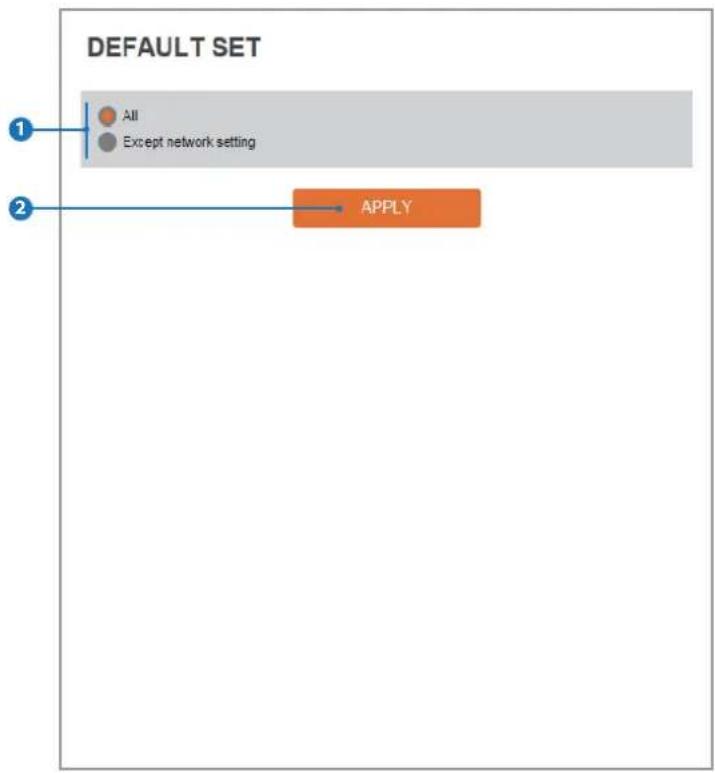
text_image
DEFAULT SET 1 All Except network setting 2 APPLY1 Reset to the factory defaults
Return the setup to the factory default.
All
Reset all Settings to the factory defaults.
Except Network Settings
Except Network related settings, reset all others to the factory default.
2 Click 'Apply' to make above setting effective.
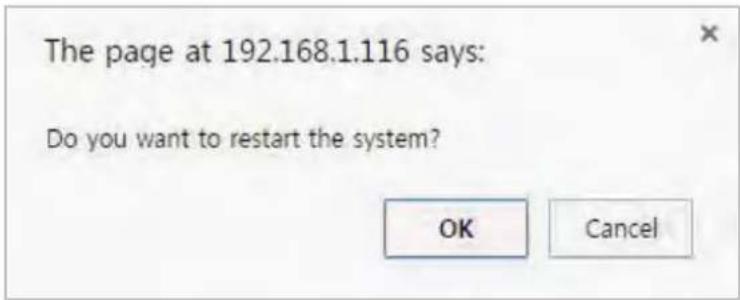
text_image
The page at 192.168.1.116 says: Do you want to restart the system? OK CancelIf you click the 'RESTART' menu, a message box will be shown to confirm. Click the 'Ok' button to restart.
If your IP settings are obtained automatically, you could use the MS-DOS prompt (or Command Prompt) to determine your IP address. For information on how to do this, please read the FAQ.
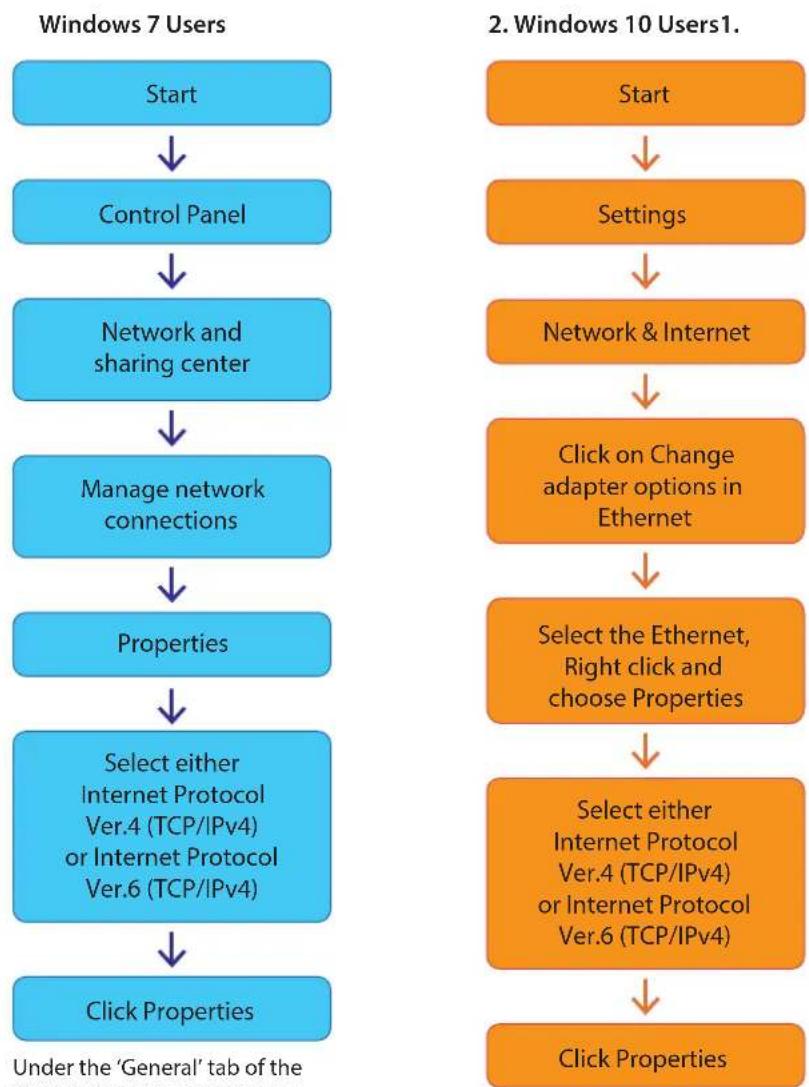
flowchart
graph TD
    A["Start"] --> B["Control Panel"]
    B --> C["Network and sharing center"]
    C --> D["Manage network connections"]
    D --> E["Properties"]
    E --> F["Select either Internet Protocol Ver.4 (TCP/IPv4) or Internet Protocol Ver.6 (TCP/IPv4)"]
    F --> G["Click Properties"]
Under the 'General' tab of the TCP/IP Properties you will see your IP address information.
Under the 'General' tab of the TCP/IP Properties you will see your IP address information.

Select 'Use the following IP address'
Select 'Use the following IP address'
| CAMERA | |
| Image Sensor | 1/3" 4.0M CMOS |
| Total Pixels | 2688(H) X 1520(V) |
| Focal Length | 2.8mm, F1.8 / 4mm, 6mm, F2.0 |
| Angle | D : 104°, H : 90°, V : 55° (2.8mm)D : 101°, H : 81°, V : 43° (4mm)D : 59°, H : 51°, V : 29° (6mm) |
| Shutter Speed | Auto / Manual (1/15 ~ 1/32000), Anti-Flicker, Slow Shutter(off, 2X, 3X, 5X, 6X, 7.5X, 10X) |
| MIN. Illumination | 2.8mm : 0.33Lux, 0Lux with IR (F1.8)4mm : 0.41Lux, 0Lux with IR (F2.0)6mm : 0.41Lux, 0Lux with IR (F2.0) |
| IR | H2IR, 50ft |
| WDR | WDR(2x, 3x) |
| Day & Night | TDN |
| DNR | 3D-DNR |
| Privacy Zone | 16 Programmable Zone |
| AGC | Auto |
| Other Image Processing | Configurable Exposure, White Balance, Sharpness |
| Event Notification | FTP, E-mail, SD card |
| ENCODER(VIDEO&AUDIO) | |
| Video Compression | H.264, MJPEG |
| H.264 Profile | BP/MP/HP |
| Multiple Profile Streaming Performance | 1440p30 + 480p30 with H.264 + MJPEG |
| Video Bitrate | 100kbps~10Mbps, Multi-rate for Preview and Recording |
| Bitrate Control | Multi Streaming CBR/VBR at H.264 (Controllable frame rate and Band width) |
| Edge Storage | Micro SD/SDHC/SDXC |
| SECURITY & NETWORK | |
| Network Protocol | IPv4ONVIF, TCP/IP, UDP, RTP(UDP/TCP), RTSP, NTP, HTTP, HTTPS, SSL, DNS, DDNS, DHCP, FTP, SMTP, ICMP, SNMPv1/v2c/v3(MIB-2) |
| Security | HTTPS(SSL), IP filtering, 802.1x, Digest Authentication(ID/PW) |
| Plug in | CGI API, ONVIF |
| GENERAL | |
| Support Languages | English |
| Power | (Adaptor is not Included)DC12V : Max 5.6WPOE IEEE 802.3af Class3 :Max 7.4W |
| Temperature | -4°F~122°F (-20°C~50°C) |
| Material | Aluminum Die-casting |
| Dimensions(DXH) | 4.13 x 2.38 in (105 x 60.7mm) |
| Weight | 0.95lbs (350g) |
| Certification FCC, CE, ROHS, IP66, IK-10 | |
1. My POWER light is not on?
Power is not being supplied to the unit. Please use the power supply shipped with the unit and verify that a power source is active from the attached power outlet used to connect the adapter. You can test this by plugging in any other electrical device and verify its operation. After using the power supply shipped with the product, checking the power source, and reinserting the power connector into the IP Camera, please call our Support Center. The power supply may be defective.
2. My ACTIVE light is not flashing?
Verify the power supply to the unit. Poweroff and back on again, wait 1 minute, if the ACTIVE light still does not begin to flash, you will have to set the unit to its factory default (THIS WILL DELETE ANY CONFIGURATION AND SET THE UNIT TO THE FACTORY DEFAULTS). Power on the unit and insert the end of a paper clip into the small recessed opening on the back of the unit. Use the clip to press the button located within that opening.
3. My LINK light is not flashing or solid?
Verify the cable connection. 99% of the time the cable's connection to the unit is causing this problem. Try using a different network cable or crossover cable (for PC connection only). Try reinserting the cable, if this still doesn't solve the problem call our Support Center.
4. I can access the video server on my LAN, but not from the Internet.
Verify that your router (if applicable) has port forwarding properly configured. If accessing from our DDNS service, verify correct serial number. Firewall issues may prevent user access.
5. How do I open an MS-DOS or Command Prompt?
Start > (All) Programs > Accessories > Command Prompt
6. How do all out my IP address information if my settings were automatically detected?
1) Open a Command Prompt
2) At the prompt type - "ipconfig / all" (without the quotes)
3) Near the end of the information supplied, should be your current IP address, subnet mask, default gateway and DNS servers
7. I can't connect!!
In the case of a connection failure. Modem Reboot > Modem Reboot Finished > Router Reboot > Router Reboot Finished > IP Camera Reboot > IP Camera Reboot Finish > Verify DDNS and IP Camera connection, if applicable.
8. How do I "PING" an IP address?
1) Open an MS-DOS (or Command) prompt
2) At the prompt type - "ping xxx.xxx.xxx.xxx" (without the quotes and replace the "x"s with an IP address)
3) Press Enter
9. I'm accessing my video server remotely over the Internet and the video stream is choppy, is this normal?
Yes. The frames per second received remotely are determined by your bandwidth capabilities both at your site where the IP Camera is installed and your remote location. The lower of the two sites will determine how fast your video stream is received. It is recommended to have at least a 256Kb/sec upstream connection from the site where the IP Camera is installed. Lower speeds will operate properly, but provide poor remote performance. The Faster the Internet connection at both ends, the faster the video stream.
10. How do I enable or check VLC on my browser
Internet Explorer
Open Internet Explorer > Tools on the menu bar > Internet Options > Security Tab > Custom Level > Scroll down and verify that you are prompted or have enabled plug-ins to be downloaded and executed. > click OK > restart browser.
Chrome
Open Chrome > Chrome menu settings > Advanced settings > Individual information - content settings > Run automatically
11. How do I reset the unit to factory defaults?
Refer to the previous functions page and find the reset button. Power ON the unit and use a paper clip to push the reset button within that opening. You should then see the ACTIVE light turn off and after a few seconds the ACTIVE light will begin to flash, signifying a successful reboot. If the ACTIVE light does not turn off after depressing the reset button, please try holding the button in for a few seconds and releasing. YOU WILL LOSE ALL DATA THAT HAD BEEN ENTERED PREVIOUSLY AND THE IP CAM -ERA WILL BE SET TO ITS FACTORY RESETS.
Digital Watchdog (referred to as "the Warrantor") warrants the Camera against defects in materials or workmanships as follows:
Labor: For the initial five (5) years from the date of original purchase if the camera is determined to be defective, the Warrantor will repair or replace the unit with new or refurbished product at its option, at no charge.
Parts: In addition, the Warrantor will supply replacement parts for the initial five (5) years.
To obtain warranty or out of warranty service, please contact a technical support representative at 1+ (866) 446-3595, Monday through Friday from 9:00AM to 8:00PM EST.
A purchase receipt or other proof of the date of the original purchase is required before warranty service is rendered. This warranty only covers failures due to defects in materials and workmanship which arise during normal use. This warranty does not cover damages which occurs in shipment or failures which are caused by products not supplied by the Warrantor or failures which result from accident, misuse, abuse, neglect, mishandling, misapplication, alteration, modification, faulty installation, set-up adjustments, improper antenna, inadequate signal pickup, maladjustments of consumer controls, improper operation, power line surge, improper voltage supply, lightning damage, rental use of the product or service by anyone other than an authorized repair facility or damage that is attributable to acts of God.
There are no express warranties except as listed above. The Warrantor will not be liable for incidental or consequential damages (including, without limitation, damage to recording media) resulting from the use of these products, or arising out of any breach of the warranty. All express and implied warranties, including the warranties of merchantability and fitness for particular purpose, are limited to the applicable warranty period set forth above.
Some states do not allow the exclusion or limitation of incidental or consequential damages or limitations on how long an implied warranty lasts, so the above exclusions or limitations may not apply to you. This warranty gives you specific legal rights, and you may also have other rights from vary from state to state.
If the problem is not handled to your satisfaction, then write to the following address:
Digital Watchdog, Inc. ATTN: RMA Department 5436 W Crenshaw St Tampa, FL 33634
Service calls which do not involve defective materials or workmanship as determined by the Warrantor, in its sole discretion, are not covered. Cost of such service calls are the responsibility of the purchaser.

DIGITAL
WATCHDOG™
Complete Surveillance Solutions
East Coast Headquarters Office: 5436 W Crenshaw St, Tampa, FL 33634
West Coast Headquarters Office: 16220 Bloomfield Ave., Cerritos, CA 90703
PH: 866-446-35951 FAX: 813-888-9262
www.Digital-Watchdog.com Technical Support:
USA & Canada 1+ (866) 446-3595
International 1+ (813) 888-9555
French Canadian 1+ (514) 360-1309
Support Hours: Monday-Friday 9:00am to 8:00pm EST