JP655SMSS - Stove GE - Free user manual and instructions
Find the device manual for free JP655SMSS GE in PDF.


User questions about JP655SMSS GE
0 question about this device. Answer the ones you know or ask your own.
Ask a new question about this device
Download the instructions for your Stove in PDF format for free! Find your manual JP655SMSS - GE and take your electronic device back in hand. On this page are published all the documents necessary for the use of your device. JP655SMSS by GE.
USER MANUAL JP655SMSS GE
Safety Instructions ..... 2–4
Operating Instructions
Cookware Tips .....8, 9
Dual Surface Element ..... 7
Features of Your Cooktop .....5
Surface Elements....6,7
Temperature Limiter .....7
Care and Cleaning
Control Knobs .... 10
Glass Cooktop ..... 11, 12
Stainless Steel Surfaces ..... 10
Troubleshooting Tips ..... 13
Consumer Support
Consumer Support ..... 16
Warranty....15
Write the model and serial numbers here:
Model #
Serial # ____
You can find them on a label under the cooktop.
Owner's Manual
JP340
JP346
JP356
JP655
IMPORTANT SAFETY INFORMATION. READ ALL INSTRUCTIONS BEFORE USING.
▲ WARNING!
For your safety, the information in this manual must be followed to minimize the risk of fire or explosion, electric shock, or to prevent property damage, personal injury, or loss of life.

SAFETY PRECAUTIONS
When using electrical appliances, basic safety precautions should be followed, including the following:
■ Use this appliance only for its intended use as described in this manual.
Do not attempt to repair or replace any part of your cooktop unless it is specifically recommended in this manual. All other servicing should be referred to a qualified technician.
Before performing any service, disconnect the cooktop power supply at the household distribution panel by removing the fuse or switching off the circuit breaker.
Be sure your appliance is properly installed and grounded by a qualified technician in accordance with the provided installation instructions. This appliance must be supplied with the proper voltage and frequency, and connected to an individual, properly grounded branch circuit, protected by a circuit breaker or fuse acceptable for the indicated wattage on the name plate.

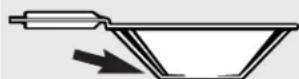
natural_image
Simple line drawing of a bowl with a handle and small object at the bottom (no text or symbols)Name plate location
■Have the installer show you the location of the circuit breaker or fuse. Mark it for easy reference.
Do not leave children alone—children should not be left alone or unattended in an area where an appliance is in use. They should never be allowed to sit or stand on any part of the appliance.
■ Teach children not to play with the controls or any other part of the cooktop.
- Do not allow anyone to climb, stand or hang on the cooktop.
CAUTION: Items of interest to children should not be stored in cabinets above
a cooktop—children climbing on the cooktop to reach items could be seriously injured.
■ Always keep combustible wall coverings, curtains or drapes a safe distance from your cooktop.
■ Always keep dishtowels, dish cloths, pot holders and other linens a safe distance away from your cooktop.
■ Always keep wooden and plastic utensils and canned food a safe distance away from your cooktop. They may become hot and could cause burns.
Never wear loose-fitting or hanging garments while using the appliance. Flammable material could be ignited if brought in contact with hot surface elements and may cause severe burns.
Use only dry pot holders—moist or damp pot holders on hot surfaces may result in burns from steam. Do not let pot holders touch hot surface elements. Do not use a towel or other bulky cloth. Such cloths can catch fire on a hot surface element.
For your safety, never use your appliance for warming or heating the room.
Do not use water on grease fires. Never pick up a flaming pan. Turn the controls off. Smother a flaming pan on a surface element by covering the pan completely with a well-fitting lid, cookie sheet or flat tray. Use a multi-purpose dry chemical or foam-type extinguisher.
Flaming grease outside a pan can be put out by covering with baking soda or, if available, by using a multi-purpose dry chemical or foam-type fire extinguisher.
Do not flame foods on the cooktop. If you do flame foods under the hood, turn the fan on.
Do not let cooking grease or other flammable materials accumulate on the cooktop.

WARNING!
SAFETY PRECAUTIONS
Do not touch surface elements. These surfaces may be hot enough to burn even though they are dark in color. During and after use, do not touch, or let clothing or other flammable materials contact the surface elements or areas nearby the surface elements; allow sufficient time for cooling first.
Potentially hot surfaces include the cooktop and areas facing the cooktop.
To minimize the possibility of burns, ignition of flammable materials and spillage, the handle of a container should be turned toward the center of the cooktop without extending over any nearby surface elements.
■ Always turn the surface element control to off before removing the cookware.
Use proper pan size—select cookware having flat bottoms large enough to cover the surface element heating element. The use of undersized cookware will expose a portion of the surface element to direct contact and may result in ignition of clothing. Proper relationship of cookware to surface element will also improve efficiency.
Never leave surface elements unattended at high heat settings. Boilovers cause smoking and greasy spillovers that may catch on fire.
Only certain types of glass, glass/ceramic, earthenware or other glazed containers are suitable for cooktop cooking; others may break because of the sudden change in temperature.
- Keep an eye on foods being fried at high or medium-high heat settings.
■ Foods for frying should be as dry as possible. Frost on frozen foods or moisture on fresh foods can cause hot fat to bubble up and over the sides of the pan.
■ Use little fat for effective shallow or deep-fat frying. Filling the pan too full of fat can cause spillovers when food is added.
If a combination of oils or fats will be used in frying, stir together before heating, or as fats melt slowly.
■Always heat fat slowly, and watch as it heats.
■ Use a deep fat thermometer whenever possible to prevent overheating fat beyond the smoking point.
Never try to move a pan of hot fat, especially a deep fat fryer. Wait until the fat is cool.
- Do not store flammable materials near the cooktop.
- Keep the hood and grease filters clean to maintain good venting and to avoid grease fires.
Do not store or use combustible materials, gasoline or other flammable vapors and liquids in the vicinity of this or any appliance.
Clean only parts listed in this Owner's Manual.
Do not leave paper products, cooking utensils or food on the cooktop when not in use.
- Keep cooktop clean and free of accumulation of grease or spillovers which may ignite.
■Never heat unopened food containers. Pressure buildup may make container burst and cause injury.
■ Never leave jars or cans of fat drippings on or near your cooktop.
■Never use your appliance for warming or heating the room.

COOK MEAT AND POULTRY THOROUGHLY...
Cook meat and poultry thoroughly—meat to at least an INTERNAL temperature of 160^ F and poultry to at least an INTERNAL temperature of 180^ F. Cooking to these temperatures usually protects against foodborne illness.
IMPORTANT SAFETY INFORMATION. READ ALL INSTRUCTIONS BEFORE USING.
WARNING!
RADIANT SURFACE ELEMENTS

Use care when touching the cooktop. The glass surface of the cooktop will retain heat after the controls have been turned off.
- Avoid scratching the glass cooktop. The cooktop can be scratched with items such as sharp instruments, rings or other jewelry and rivets on clothing.
■Never use the glass cooktop surface as a cutting board.
- Do not place or store items on top of the glass cooktop surface when it is not in use.
Be careful when placing spoons or other stirring utensils on glass cooktop surface when it is in use. They may become hot and could cause burns.
■Avoid heating an empty pan. Doing so may damage the cooktop and the pan.
- Do not allow water, other liquids or grease to remain on the cooktop.
To minimize the possibility of burns, always be certain that the controls for all surface elements are at the off position and the entire glass surface is cool before attempting to clean the cooktop.
Do not operate the glass surface elements if the glass is broken. Spillovers or cleaning solution may penetrate a broken cooktop and create a risk of electrical shock. Contact a qualified technician immediately should your glass cooktop become broken.
Clean the cooktop with caution. If a wet sponge or cloth is used to wipe spills on a hot surface element, be careful to avoid steam burns. Some cleansers can produce noxious fumes if applied to a hot surface.
NOTE: We recommend that you avoid wiping any surface element areas until they have cooled and the indicator light has gone off. Sugar spills are the exception to this. Please see the Cleaning the Glass Cooktop section.
To avoid possible damage to the cooking surface, do not apply the cleaning cream to the glass surface when it is hot.
■ After cleaning, use a dry cloth or paper towel to remove all the cleaning cream residue.
Read and follow all instructions and warnings on the cleaning cream labels.
■ Use care when touching the cooktop. The glass surface of the cooktop will retain heat after the controls have been turned OFF.
Do not stand on the glass cooktop.
Large scratches or impacts to glass cooktops can lead to broken or shattered glass.

READ AND FOLLOW THIS SAFETY INFORMATION CAREFULLY.
SAVE THESE INSTRUCTIONS
Features of your cooktop. GEAppliances.com
Throughout this manual, features and appearance may vary from your model.

| Feature Index (Features and appearances may vary.) | Explained on page | |
| 1 | Single Surface Element 6, 7 | |
| 2 | Dual Surface Element 7 | |
| 3 | Left Rear Surface Element Control Knob 6 | |
| 4 | Left Front Surface Element Control Knob 6 | |
| 5 | Surface Element ON Indicator Light 6 | |
| 6 | Right Rear Surface Element Control Knob 6 | |
| 7 | Dual Surface Element Control Knob 7 | |
| 8 | Hot Surface Indicator Light(s) 6 | |
| 9 | Dual Surface Element Selector Knob | 7 |
| 10 | Center Surface Element Control Knob | 6 |
| 11 | Right Front Surface Element Control Knob | 6 |
Using the surface elements.
Throughout this manual, features and appearance may vary from your model.

natural_image
Hand pressing down on a surface with a downward arrow and striped pattern (no text or symbols)How to Set
Push the knob down and turn in either direction to the setting you want. When the control is in any position other than OFF, it may be rotated without pushing it down.
At both OFF and HI the control clicks into position. You may hear slight clicking sounds during cooking, indicating the control is keeping the power level you set.
The controls for the radiant surface elements can be set anywhere between LO and HI for an unlimited number of heat settings. With the infinite switch the element cycles on and off to maintain your selected control setting.
The ON indicator light will glow when any surface element is on.
A HOT SURFACE indicator light will glow when any radiant element is turned on and will remain on until the surface is cooled to approximately 150°F.
NOTE:
It comes on when the element is hot to the touch.
It stays on even after the element is turned off.
It glows brightly until the element is cooled to approximately 150^ F.
Be sure you turn the control knob to OFF when you finish cooking.
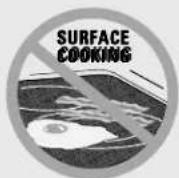
Never cook directly on the glass. Always use cookware.
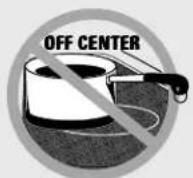
Always center the pan on the surface element you are using.
About the radiant surface elements...
The radiant cooktop features heating elements beneath a smooth glass surface.
NOTE: A slight odor is normal when a new cooktop is used for the first time. It is caused by the heating of new parts and insulating materials and will disappear in a short time.
NOTE: On models with light-colored glass cooktops, it is normal for the cooking zones to change color when hot or cooling down. This is temporary and will disappear as glass cools to room temperature.
The surface element will cycle on and off to maintain your selected control setting.
It is safe to place hot cookware (from the oven or surface) on the glass cooktop when the surface is cool.
Even after the surface elements are turned off, the glass cooktop retains enough heat to continue cooking. To avoid overcooking, remove pans from the surface elements when the food is cooked.
Avoid placing utensils that could become hot or plastics that could melt on the surface element until it has cooled completely.
Water stains (mineral deposits) are removable using the cleaning cream or full strength white vinegar.
■ Use of window cleaner may leave an iridescent film on the cooktop. The cleaning cream will remove this discoloration.
Don't store heavy items above the cooktop. If they drop onto the cooktop, they can cause damage.
Do not use the surface as a cutting board.

text_image
DRAGINGDo not slide cookware across the cooktop because it can scratch the glass. The glass is scratch-resistant, not scratchproof.
text_image
OFF 10 1 2 3 4 5 6 7 8 9 Small surface element setting Large surface element settingDual Surface Element (on some models)
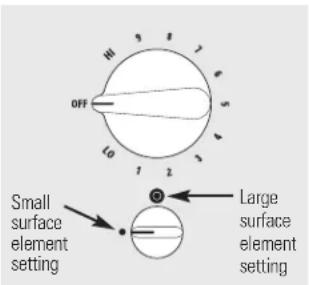
The right front surface element has 2 cooking sizes to select from so you can match the size of the element to the size of the cookware you are using.
To use the large surface element, turn the SELECTOR knob to ☑Push down and turn the control knob to the desired setting. The element will heat the entire area contained by the larger circle.
To use the small surface element, turn the SELECTOR knob to .Push in and turn the control knob to the desired setting. The element will only heat the area inside the smaller circle.
Surface Elements Cycle On and Off
Surface elements will cycle on and off to maintain the temperature you have selected.
All radiant surface elements have a temperature limiter that protects the glass cooktop from getting too hot.
The temperature limiter may cycle the elements off while cooking if:
The pan boils dry.
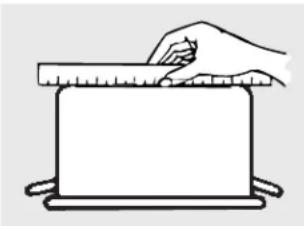
The pan bottom is not flat.
The pan is off-center.
There is no pan on the element.
Selecting types of cookware.
The following information will help you choose cookware which will give good performance on glass cooktops.
natural_image
Simple line drawing of a hand holding a ruler above a blank rectangular object (no text or symbols)Check pans for flat bottoms by using a straight edge.
Stainless Steel:
recommended
Porcelain Enamel on Cast Iron:
recommended if bottom of pan is coated
Aluminum:
heavy weight recommended
Good conductivity. Aluminum residues sometimes appear as scratches on the cooktop, but can be removed if cleaned immediately. Because of its low melting point, thin weight aluminum should not be used.
Porcelain Enamel on Steel:
not recommended
Heating empty pans can cause permanent damage to cooktop glass.
The enamel can melt and bond to the ceramic cooktop.
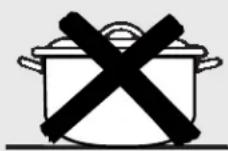
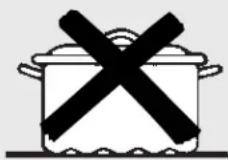

Pans with rounded, curved, ridged or warped bottoms are not recommended.
Copper Bottom:
recommended
Copper may leave residues which can appear as scratches. The residues can be removed, as long as the cooktop is cleaned immediately. However, do not let these pots boil dry. Overheated metal can bond to glass cooktops. An overheated copper bottom pot will leave a residue that will permanently stain the cooktop if not removed immediately.
Glass-ceramic:
not recommended
Poor performance. Will scratch the surface.
Stoneware:
not recommended
Poor performance. May scratch the surface.
Cast Iron:
not recommended—unless designed specifically for glass cooktops
Poor conductivity and slow to absorb heat. Will scratch the cooktop surface.
NOTE: Follow all cookware manufacturer's recommendations when using any type of cookware on the ceramic cooktop.
natural_image
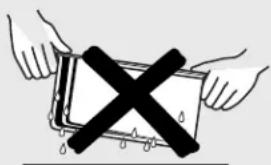
Illustration of two hands holding a rectangular object with a black X symbol, no text or symbols presentDo not place wet pans on the glass cooktop.
natural_image
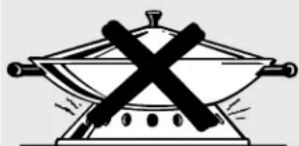
Simple line drawing of a pan with a crossed X mark on top, no text or symbols presentDo not use woks with support rings on the glass cooktop.
Use flat-bottomed woks on the glass cooktop.
For Best Results
Place only dry pans on the surface elements. Do not place lids on the surface elements, particularly wet lids.
Do not use woks that have support rings. This type of wok will not heat on glass surface elements.
We recommend that you use only a flat-bottomed wok. They are available at your local retail store. The bottom of the wok should have the same diameter as the surface element to ensure proper contact.
Some special cooking procedures require specific cookware such as pressure cookers, deep-fat fryers, etc. All cookware must have flat bottoms and be the correct size.
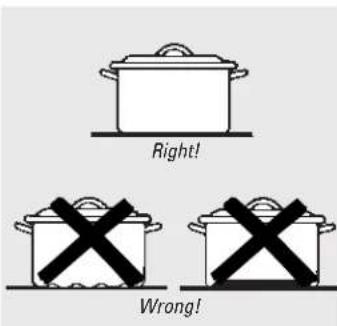
text_image
Right! Wrong!Note: Flat-bottomed canners are required for glass cooktops.
Observe the Following Points in Canning
Pots that extend beyond 1" of the surface element's circle are not recommended for most surface cooking. However, when canning with water-bath or pressure canner, larger-diameter pots may be used. This is because boiling water temperatures (even under pressure) are not harmful to the cooktop surfaces surrounding the surface elements.
HOWEVER, DO NOT USE LARGE-DIAMETER CANNERS OR OTHER LARGE-DIAMETER POTS FOR FRYING OR BOILING FOODS OTHER THAN WATER. Most syrup or sauce mixtures—and all types of frying—cook at temperatures much higher than boiling water. Such temperatures could eventually harm the glass cooktop surfaces.
1 Be sure the canner fits over the center of the surface element. If your cooktop or its location does not allow the canner to be centered on the surface element, use smaller-diameter pots for good canning results.
2 Flat-bottomed canners must be used. Do not use canners with flanged or rippled bottoms (often found in enamelware) because they don't make enough contact with the surface elements and take a long time to boil water.
3 When canning, use recipes and procedures from reputable sources. Reliable recipes and procedures are available from the manufacturer of your canner; manufacturers of glass jars for canning, such as Ball and Kerr brand; and the United States Department of Agriculture Extension Service.
4 Remember that canning is a process that generates large amounts of steam. To avoid burns from steam or heat, be careful when canning.
NOTE: If your house has low voltage, canning may take longer than expected, even though directions have been carefully followed. The process time will be shortened by:
(1) using a pressure canner, and
(2) starting with HOT tap water for fastest heating of large quantities of water.
CAUTION:
■ Safe canning requires that harmful microorganisms are destroyed and that the jars are sealed completely. When canning foods in a water-bath canner, a gentle but steady boil must be maintained for the required time. When canning foods in a pressure canner, the pressure must be maintained for the required time.
After you have adjusted the controls, it is very important to make sure the prescribed boil or pressure levels are maintained for the required time.
Since you must make sure to process the canning jars for the prescribed time, with no interruption in processing time, do not can on any cooktop surface element if your canner is not flat.
Care and cleaning of the cooktop.
Be sure electrical power is off and all surfaces are cool before cleaning any part of the cooktop.
How to Remove Protective Shipping Film and Packaging Tape
Carefully grasp a corner of the protective shipping film with your fingers and slowly peel it from the appliance surface. Do not use any sharp items to remove the film. Remove all of the film before using the appliance for the first time.
To assure no damage is done to the finish of the product, the safest way to remove the adhesive from packaging tape on new appliances is an application of a household liquid dishwashing detergent. Apply with a soft cloth and allow to soak.
NOTE: The adhesive must be removed from all parts. It cannot be removed if it is baked on.

text_image
Molded rib Stem Spring clip Clear grooveControl Knobs
The control knobs may be removed for easier cleaning.
Make sure the knobs are in the OFF positions and pull them straight off the stems for cleaning.
The knobs can be cleaned in a dishwasher or they may also be washed with soap and water. Do not remove chrome accent skirt (on some models). Make sure the insides of the knobs are dry before replacing.
Replace the knobs in the OFF position to ensure proper placement.
Stainless Steel Surfaces (on some models)
Do not use a steel wool pad; it will scratch the surface.
To clean the stainless steel surface, use warm sudsy water or a stainless steel cleaner or polish. Always wipe the surface in the direction of the grain. Follow the cleaner instructions for cleaning the stainless steel surface.
To inquire about purchasing stainless steel appliance cleaner or polish, or to find the location of a dealer nearest you, please call our toll-free number:
National Parts Center 1.800.626.2002
GEAppliances.com
Cleaning the glass cooktop. GEAppliances.com
Clean your cooktop after each spill. Use ceramic cooktop cleaner.
Normal Daily Use Cleaning
ONLY use ceramic cooktop cleaner on the glass cooktop. Other creams may not be as effective.
To maintain and protect the surface of your glass cooktop, follow these steps:
Before using the cooktop for the first time, clean it with ceramic cooktop cleaner. This helps protect the top and makes cleanup easier.
2 Daily use of ceramic cooktop cleaner will help keep the cooktop looking new.
3 Shake the cleaning cream well. Apply a few drops of ceramic cooktop cleaner directly to the cooktop.
4 Use a paper towel or cleaning pad for ceramic cooktops to clean the entire cooktop surface.
5 Use a dry cloth or paper towel to remove all cleaning residue. No need to rinse.
NOTE: It is very important that you DO NOT heat the cooktop until it has been cleaned thoroughly.
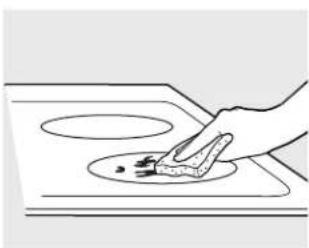
natural_image
Hand using a tool to clean or mark a circular object on a stovetop (no text or symbols visible)Use a cleaning pad for ceramic cooktops.
Burned-On Residue
WARNING: DAMAGE to your glass surface may occur if you use scrub pads other than those recommended.
1 Allow the cooktop to cool.
2 Spread a few drops of ceramic cooktop cleaner on the entire burned residue area.
3 Using the included cleaning pad for ceramic cooktops, rub the residue area, applying pressure as needed.
4 If any residue remains, repeat the steps listed above as needed.
For additional protection, after all residue has been removed, polish the entire surface with ceramic cooktop cleaner and a paper towel.
natural_image
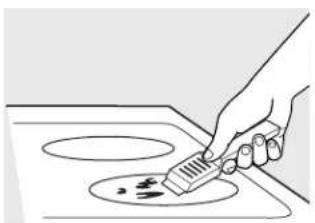
Line drawing of a hand using a spatula to clean or store food on an induction cooktop (no text or symbols)The ceramic cooktop scraper and all recommended supplies are available through our Parts Center. See instructions under "To Order Parts" section on next page.
NOTE: Do not use a dull or nicked blade.
Heavy, Burned-On Residue
1 Allow the cooktop to cool.
2 Use a single-edge razor blade scraper at approximately a 45^ angle against the glass surface and scrape the soil. It will be necessary to apply pressure to the razor scraper in order to remove the residue.
3 After scraping with the razor scraper, spread a few drops of ceramic cooktop cleaner on the entire burned residue area. Use the cleaning pad to remove any remaining residue.
4 For additional protection, after all residue has been removed, polish the entire surface with ceramic cooktop cleaner and a paper towel.
Cleaning the glass cooktop.
Metal Marks and Scratches
7 Be careful not to slide pots and pans across your cooktop. It will leave metal markings on the cooktop surface. These marks are removable using ceramic cooktop cleaner with a cleaning pad for ceramic cooktops.
2 If pots with a thin overlay of aluminum or copper are allowed to boil dry, the overlay may leave black discoloration on the cooktop. This should be removed immediately before heating again or the discoloration may be permanent.
WARNING: Carefully check the bottom of pans for roughness that would scratch the cooktop.
Glass surface—potential for permanent damage.
Our testing shows that if you are cooking high sugar mixtures such as jelly or fudge and have a spillover, it can cause permanent damage to the glass surface unless the spillover is immediately removed.
Damage from Sugary Spills and Melted Plastic
1 Turn off all surface elements. Remove hot pans.
2 Wearing an oven mitt:
a. Use a single-edge razor blade scraper (ceramic cooktop scraper) to move the spill to a cool area on the cooktop.
b. Remove the spill with paper towels.
3 Any remaining spillover should be left until the surface of the cooktop has cooled.
4 Don't use the surface elements again until all of the residue has been completely removed.
NOTE: If pitting or indentation in the glass surface has already occurred, the cooktop glass will have to be replaced. In this case, service will be necessary.
To Order Parts
To order ceramic cooktop cleaner and the cooktop scraper, please call our toll-free number:
National Parts Center 800.626.2002
Ceramic Cooktop Cleaner...#WX10X300
Ceramic Cooktop Scraper ...# WX10X0302
Kit....# WB64X5027
(Kit includes cream and cooktop scraper)
Cleaning Pads for
Ceramic Cooktops ....# WX10X350
Before you call for service... GEAppliances.com

Troubleshooting Tips Save time and money! Review the chart on this page first and you may not need to call for service.
| Problem Possible Causes What To Do | ||
| Surface elements will not maintain a rolling boil or cooking is slow | Improper cookware being used. | ·Use pans which are absolutely flat and match the diameter of the surface element selected. |
| Surface elements do not work properly blown | A fuse in your home may be or the circuit breaker tripped. | ·Replace the fuse or reset the circuit breaker. |
| Cooktop controls improperly set. element you are using. | ·Check to see the correct control is set for the surface | |
| Tiny scratches or metal marks or abrasions on radiant cooktop glass surface | Incorrect cleaning methods being used. | ·Use recommended cleaning procedures. |
| Cookware with rough bottoms being used or coarse particles (salt or sand) were between the cookware and the surface of the cooktop. | ·Be sure cookware bottoms and cookware are clean before use. Use cookware with smooth bottoms. Tiny scratches are not removable but will become less visible in time as a result of cleaning. | |
| Cookware has been slid across the cooktop surface. | ||
| Areas of discoloration or dark streaks on the cooktop | Improper cookware being used. | ·Marks from aluminum and copper pans as well as mineral deposits from water or food can be removed with the cleaning cream. |
| Hot surface on a model with a light-colored cooktop. | ·This is normal. The surface may appear discolored when it is hot. This is temporary and will disappear as the glass cools. | |
| Food spillovers not cleaned before next use. | ·See the Cleaning the glass cooktop section. | |
| Incorrect cleaning methods being used. | ·Use recommended cleaning procedures. | |
| Plastic melted to the surface | Hot cooktop came into contact with plastic placed on the hot cooktop. | ·See the Glass surface—potential for permanent damage section in the Cleaning the glass cooktop section. |
| Pitting (or indentation) of the cooktop | Hot sugar mixture spilled on the cooktop. | ·Call a qualified technician for replacement. |
| Frequent cycling off and on of surface elements | Improper cookware being used. | ·Use only flat cookware to minimize cycling. See Surface elements cycle on and off section. |
| Control knob will not turn | Cooktop controls improperly set. | ·When the knob is in the OFF position, it must be pushed in before it can be turned. When the knob is in any other position, it can be turned without being pushed in. |
Notes.
GE Electric Cooktop Warranty.
All warranty service provided by our Factory Service Centers, or an authorized Customer Care ^® technician. To schedule service, visit us on-line at GEAppliances.com, or call 800.GE.CARES (800.432.2737). Please have serial number and model number available when calling for service.
Staple your receipt here. Proof of the original purchase date is needed to obtain service under the warranty.
For The Period Of: GE Will Replace:
One Year
From the date of the
Any part of the cooktop which fails due to a defect in materials or workmanship. During this limited one-year warranty, GE will also provide, free of charge, all labor ome service to replace the defective part.
What GE Will Not Cover:
■ Service trips to your home to teach you how to use the product.
- Improper installation, delivery or maintenance.
Failure of the product if it is abused, misused, or used for other than the intended purpose or used commercially.
■ Damage to the glass cooktop caused by use of cleaners other than the recommended cleaning creams and pads.
Damage to the glass cooktop caused by hardened spills of sugary materials or melted plastic that are not cleaned according to the directions in the Owner's Manual.
■ Replacement of house fuses or resetting of circuit breakers.
Damage to the product caused by accident, fire, floods or acts of God.
■ Incidental or consequential damage caused by possible defects with this appliance.
■ Damage caused after delivery.
■ Product not accessible to provide required service.
EXCLUSION OF IMPLIED WARRANTIES—Your sole and exclusive remedy is product repair as provided in this Limited Warranty. Any implied warranties, including the implied warranties of merchantability or fitness for a particular purpose, are limited to one year or the shortest period allowed by law.
This warranty is extended to the original purchaser and any succeeding owner for products purchased for home use within the USA. If the product is located in an area where service by a GE Authorized Servicer is not available, you may be responsible for a trip charge or you may be required to bring the product to an Authorized GE Service location. In Alaska, the warranty excludes the cost of shipping or service calls to your home.
Some states do not allow the exclusion or limitation of incidental or consequential damages. This warranty gives you specific legal rights, and you may also have other rights which vary from state to state. To know what your legal rights are, consult your local or state consumer affairs office or your state's Attorney General.
Warrantor: General Electric Company. Louisville, KY 40225
GE Appliances Website
GEAppliances.com
Have a question or need assistance with your appliance? Try the GE Appliances Website 24 hours a day, any day of the year! For greater convenience and faster service, you can now download Owner's Manuals, order parts or even schedule service on-line.
Schedule Service GEAppliances.com
Expert GE repair service is only one step away from your door. Get on-line and schedule your service at your convenience any day of the year! Or call 800.GE.CARES (800.432.2737) during normal business hours.
Real Life Design Studio GEAppliances.com
GE supports the Universal Design concept—products, services and environments that can be used by people of all ages, sizes and capabilities. We recognize the need to design for a wide range of physical and mental abilities and impairments. For details of GE's Universal Design applications, including kitchen design ideas for people with disabilities, check out our Website today. For the hearing impaired, please call 800.TDD.GEAC (800.833.4322).
Extended Warranties GEAppliances.com
Purchase a GE extended warranty and learn about special discounts that are available while your warranty is still in effect. You can purchase it on-line anytime, or call 800.626.2224 during normal business hours. GE Consumer Home Services will still be there after your warranty expires.
Parts and Accessories GEAppliances.com
Individuals qualified to service their own appliances can have parts or accessories sent directly to their homes (VISA, MasterCard and Discover cards are accepted). Order on-line today, 24 hours every day or by phone at 800.626.2002 during normal business hours.
Instructions contained in this manual cover procedures to be performed by any user. Other servicing generally should be referred to qualified service personnel. Caution must be exercised, since improper servicing may cause unsafe operation.

Contact Us GEAppliances.com
If you are not satisfied with the service you receive from GE, contact us on our Website with all the details including your phone number, or write to: General Manager, Customer Relations
GE Appliances, Appliance Park
Louisville, KY 40225

Register Your Appliance GEAppliances.com
Register your new appliance on-line—at your convenience! Timely product registration will allow for enhanced communication and prompt service under the terms of your warranty, should the need arise. You may also mail in the preprinted registration card included in the packing material.
Radiante Estufa
Instrucciones
de seguridad....2-4
natural_image
Hand pressing down on a surface with a downward arrow and striped pattern (no text or symbols)Cómo operar
natural_image
Simple line drawing of a hand holding a ruler above a blank rectangular object (no text or symbols)natural_image
Illustration of two hands holding a rectangular object with a black X symbol, no text or symbols presentnatural_image
Simple line drawing of a pan with crossed black lines indicating resistance or explosion (no text or symbols)natural_image
Line drawing of a hand using a tool to clean or restore a circular object on an induction cooktop (no text or symbols)natural_image
Line drawing of a hand using a tool to clean or store contents on a stovetop (no text or symbols)Garante: General Electric Company. Louisville, KY 40225
General Manager, Customer Relations
GE Appliances, Appliance Park
Louisville, KY 40225
