
CL-42G - Television Infiniton - Free user manual and instructions
Find the device manual for free CL-42G Infiniton in PDF.


| Product Type | Refrigerator with ice compartment |
| Brand | Infiniton |
| Model | CL-42G |
| Total Capacity | 48 L |
| Dimensions (H x W x D) | 501 x 445 x 470 mm |
| Weight | 15 kg |
| Energy Efficiency Class | F (new ERP) |
| Annual Energy Consumption | 100 kWh/year |
| Noise Level | 41 dB(A) |
| Climate Class | T, ST (16°C to 38°C) |
| Refrigerant | R600a (isobutane) |
| Defrost Type | Manual defrost |
| Control Type | Mechanical thermostat knob |
| Fresh Zone | Yes (0-star ice box, temperature -2°C to 2°C) |
| Door Reversibility | Yes (left or right opening) |
| Number of Shelves | 1 wire shelf + 1 plastic shelf |
| Door Balconies | 2 bottle racks |
| Color | White |
| Power Supply | 220-240 V ~50 Hz |
| Cooling System | Compressor with R600a refrigerant |
| Installation Clearance | 100 mm behind, 100 mm sides, 200 mm above |
| Safety Features | Child lock, warning for flammable refrigerant, anti-tip |
Frequently Asked Questions - CL-42G Infiniton
User questions about CL-42G Infiniton
0 question about this device. Answer the ones you know or ask your own.
Ask a new question about this device
Download the instructions for your Television in PDF format for free! Find your manual CL-42G - Infiniton and take your electronic device back in hand. On this page are published all the documents necessary for the use of your device. CL-42G by Infiniton.
USER MANUAL CL-42G Infiniton
natural_image
Black rectangular refrigerator with a flat top and two small legs at the bottom (no visible text or symbols)CL-42G
natural_image
Interior view of a white refrigerator with open doors showing internal compartments (no text or symbols visible)
superior.
natural_image
Simple line drawing of a trash bin with crossed lines indicating no waste or discharge (no text or symbols)• Gama Blanca: rmablanca.infiniton.es
• Gama Marrón: rma.infiniton.es
natural_image
Black rectangular refrigerator with two small feet at the bottom (no visible text or symbols)CL-42G
In the interest of your safety and to ensure the correct use, before installing and first using the appliance, read this user manual carefully, including its hints and warnings. To avoid unnecessary mistakes and accidents, it is important to ensure that all people using the appliance are thoroughly familiar with its operation and safetyfeatures. Save these instructions and make sure that theyremain with the appliance if it is moved or so ld, so that everyone using it through its life will be properly informed on appliance use and safety.
For the safety of life and property keep the precautions of these user's instructions as the manufacturer is not responsible for damages caused by omission.
Children and vulnerable people safety
- This appliance can be used by children aged from 8 years and above and persons with reduced physical, sensory or mental capabilities or lack of experience and knowledge if they have been given super vision or instruction concerning use of the appliance in a safe way and understand the hazards involved.
- Children aged from 3 to 8 years are allowed to load and unload this appliance.
- Children should be supervised to ensure that they do not play with the appliance.
- Cleaning and user maintenance shall not be made by children unless they are aged from 8 years and above and supervised.
- Keep all packaging well away from children. There is risk of suffocation.

Safety information
- If you are discarding the appliance pull the plug out of the socket, cut the connection cable (as close to the appliance as you can) and remove the door to prevent playing children to suffer electric shock or to close themselves into it.
- If this appliance featuring magnetic door seals is to replace an older appliance having a spring lock (latch) on the door or lid, be sure to make that spring lack unusable before you discard the old appliance. This will prevent it from becoming a death trap for a child.
General safety
⚠ WARNING! Keep ventilation openings, in the appliance enclosure or in the built-in structure, clear of obstruction.
⚠ WARNING! Do not use mechanical devices other means to accelerate the defrosting than those recommended by the manufacturer.
⚠ WARNING! Do not damage the refrigerant circuit.
WARNING! Do not use other electrical appliances (such as ice cream makers) inside of refrigerating appliances, unless they are approved for this purpose by the manufacture.
⚠ WARNING! Do not touch the light bulb if it has been on for a long period of time because it could be very hot. ^1
⚠ WARNING! When positioning the appliance, ensure the supply cord is not trapped or damaged.
WARNING! Do not locate multiple portable socket-outlets or portable power suppliers at the rear of the appliance.
- Do not store explosive substances such as aerosol cans with a flammable propellant in this appliance.
- The refrigerant isobutane (R-600a) is contained within the refrigerant circuit of the appliance, a natural gas with a high level of environmental compatibility, which is nevertheless flammable.
- During transportation and installation of the appliance, be certain that none of the components of the refrigerant circuit become damaged.
- avoid open flames and sources of ignition
- thoroughly ventilate the room in which the appliance is situated
- It is dangerous to alter the specifications or modify this product in any way. Any damage to the cord may cause a short circuit, fire and/or electric shock.
- This appliance is intended to be used in household and similar applications such as
- staff kitchen areas in shops, offices and other working environments;
- farm houses and by clients in hotels, motels and other residential type environments;
- bed and breakfast type environments;
- catering and similar non-retail applications.
- bed and breakfast type environments; - catering and similar non-retail applications.
⚠ WARNING! Any electrical components (plug, power cord, compressor and etc.) must be replaced by a certified service agent or service personnel.
WARNING! The light bulb supplied with this appliance is a “special use lamp bulb” usable only with the appliance supplied. This “special use lamp” is not usable for domestic lighting ^1 .
• Power cord must not be lengthened.
- Make sure that the power plug is not squashed or damaged by the back of the appliance. A squashed or damaged power plug may overheat and cause a fire.
- Make sure that you can come to the mains plug of the appliance.
- Do not pull the mains cable.
- If the power plug socket is loose, do not insert the power plug. There is a risk of electric shock or fire.
- You must not operate the appliance without the lamp.
- This appliance is heavy. Care should be taken when moving it.
- Do not remove nor touch items from the freezer compartment if you hands are damp/wet, as this could cause skin abrasions or frost/freezer burns.
- Avoid prolonged exposure of the appliance to direct sunlight.
Daily use
- Do not put hot on the plastic parts in the appliance.
-
Do not place food products directly against the rear wall.
-
Frozen food must not be re-frozen once it has been thawed out. ^1)
- Store pre-packed frozen food in accordance with the frozen foodmanufacture8s instructions ^1 .
- Appliance's manufactures storage strictly adhered to.
Refer to relevant instructions.
- Do not place carbonated of fizzy drinks in the freezer compartment as it creates pressure on the container, which may cause it to explode, resulting in damage to the appliance ^1) .
- Ice lollies can cause frost burns if consumed straight from the appliance. ^1)
• To avoid contamination of food, please respect the following instructions - Opening the door for long periods can cause a significant increase of the temperature in the compartments of the appliance.
- Clean regularly surfaces that can come in with food and accessible drainage
- Clean water tanks if they have not been used for 48h; flush the water system connected to a water supply if water has not been drawn for 5 days.
- Store raw meat and fish in suitable containers in the refrigerator, so that it is not in contact with or drip onto other food.
-
Two-star frozen-food compartments (if they are presented in the appliance) are suitable for storing pre-frozen food, storing or making ice-cream and making ice cubes.
-
One-, two- and three -star compartments (if are presented in the appliance) are not for the freezing of fresh food.
- If the appliance is left empty for long periods, switch off, defrost, clean, dry and leave the open to prevent mount developing within appliance.
Care and cleaning
- Before maintenance, switch off the appliance disconnect the mains plug from the mains socket.
- Do not clean the appliance with metal objects.
- Do not use sharp objects to remove frost from appliance. Use a plastic scraper. ^1)
- Regularly examine the drain in the refrigerator defrosted water. If necessary, clean the drain.
If the drain is blocked, water will collect in to bottom of the appliance. ^2)
Installation
Important! For electrical connection carefully follow the instructions given in specific paragraphs.
- Unpack the appliance and check if there are damages on it. Do not connect the appliance if it is damaged. Report possible damages immediately to the place you bought it. In that case retain packing.
- It is advisable to wait at least four hours before connecting the appliance to allow the oil to flow back in the compressor.
- Adequate air circulation should be around the appliance, lacking this leads to overheating. To achieve sufficient ventilation follow the instructions relevant to installation.
- Wherever possible the spacers of the product should be against a wall to avoid touching or catching warm parts (compressor, con-denser) to prevent possible burn.
- The appliance must not be located close to radiators or cookers.
- Make sure that the mains plug is accessible after the installation of the appliance.
Service
- Any electrical work required to do the servicing the appliance should be carried out by a electrician or competent person.
- This product must be serviced by an authorized Service Center, and only genuine spare parts be used.
Energy saving
- Don't put hot food in the appliance;
- Don’t pack food close together as this prevents circulating;
- Make sure food don't touch the back of the compartment(s);
- If electricity goes off, don't open the door(s);
- Don't open the door(s) frequently;
- Don't keep the door (s) open for too long time;
- Don't set the thermostat on exceeding cold temperatures;
- Some accessories, such as drawers, can be removed to get larger storage volume andower energy consumption.
Environment Protection
This appliance does not contain gasses which could damage the ozone layer, in either its refrigerant circuit or insulation materials. The appliance shall not be discarded together with the urban refuse and rubbish. The insulation foam contains flammable gases: the appliance shall be disposed according to the appliance regulations to obtain from your local authorities. Avoid damaging the cooling unit, especially the heat exchanger.
The materials used on this appliancemarked by the symbol ⚙ a re recyclable.
The symbol on the product or on its packaging indicates that this product may not be treated household waste. Instead it should be to the appropriate collection point for the recycling of electrical and electronic equipment. By ensuring this product is disposed of correctly, you will help prevent potential negative consequences for the environment and human health,
which could otherwise be caused by inappropriate waste handling of this product. For more detailed information about recycling of this product, please contact your local council, your household waste disposal service or the shop where you purchased the product.
Packaging materials
The materials with the symbol are recyclable. Dispose the packaging in a suitable collection containers to recycle it.
Disposal of the appliance
- Disconnect the mains plug from the mains socket.
- Cut off the mains cable and discard it.

WARNING! During using, service and disposal the appliance, please pay attention to symbol as left side, which is located on rear of appliance (rear panel or compressor
There are
flammable materials in refrigerant pipes and compressor.
Please be far away fire source during using, service and disposal.
2. PRODUCT PARTS & FEATURES
DETAIL OF CLIMATE CLASS
- Extended temperate (SN):' this refrigerating appliance is intended to be used at ambient temperatures ranging from 10^ to 32^ ;
- Temperate (N):' this refrigerating appliance is intended to be used at ambient temperatures ranging from 16°C to 32°C';
- Subtropical (ST):' this refrigerating appliance is intended to be used at ambient temperatures ranging from 16°C to 38°C';
- Tropical (T):' this refrigerating appliance is intended to be used at ambient temperatures ranging from 16°C to 43°C'; 2.
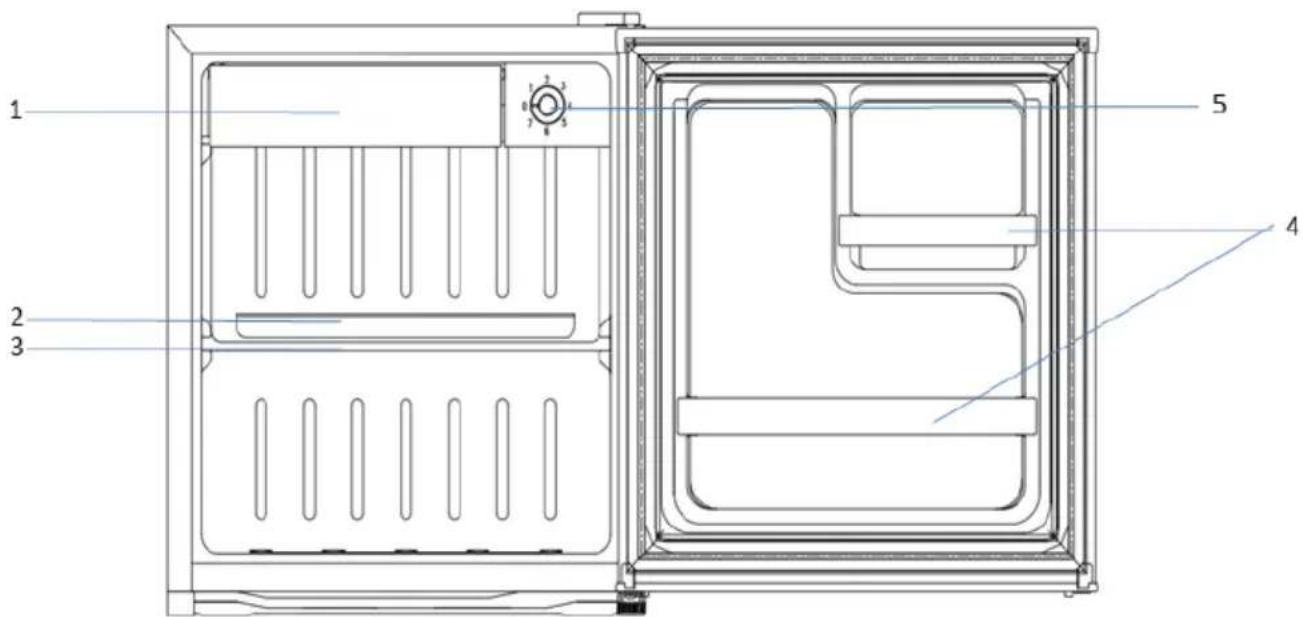
- Ice compartment
- Drip tray
- Shelving
- Bottle racks
- Defrost button
| Total capacity 48 liters |
| Mechanical control |
| Manual defrosting |
| Energy class A+/F (new ERP) |
| Weight : 15 Kg |
| Dimensions (W x H x D): 501 x 445 x 470 mm |
| Color: White |
| Anual energy consumption (kWh/year): 100 |
| Energy consumption (kWh/24h): 0,127 (E16) 0,419 (E32) |
| Fresh Zone: Ice compartment |
| Noise level (dB): 41 |
| Coolant: R600A |
| Includes wire shelf and 2 balconies (door) |
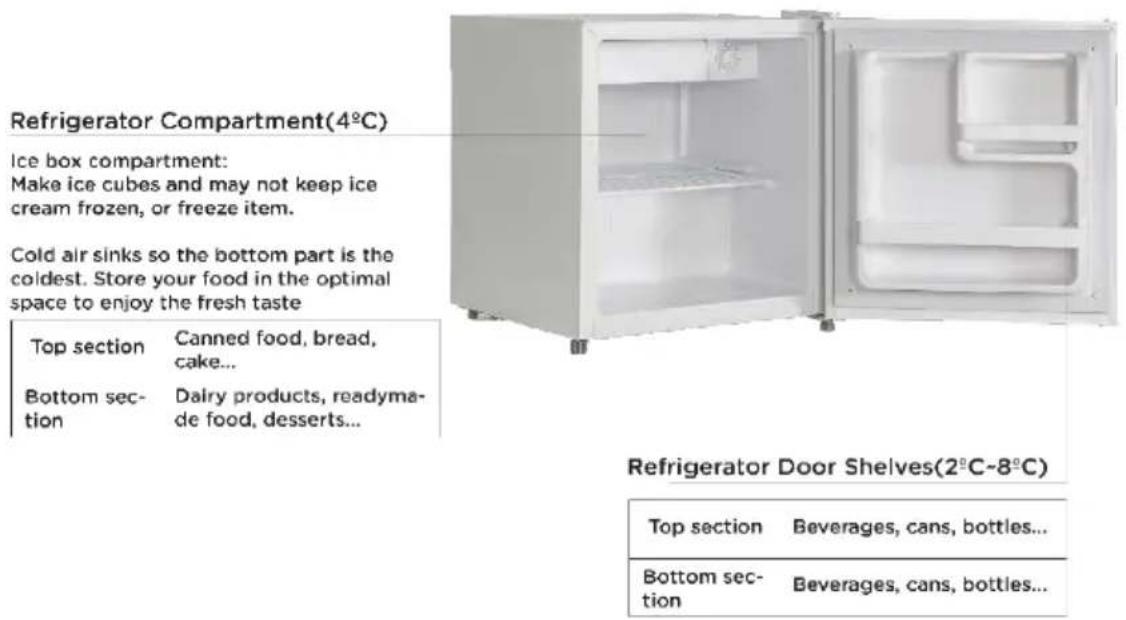
FRESH ZONE
You can find a cool compartment (fresh zone or 0-stars ice box) at the top of the fridge. Fresh zone will maintain a temperature from -2^ to 2^ . You can use the fresh zone when you wish to keep some goods or beverage colder than in fridge cavity.
NOTE: Fresh zone box is not a freezer, it does not have any freezing stars. Food or drinks will be colder but in any case goods will be frozen. Please, do not use the fresh zone to frozen food or to add ice cubes inside.
PACKING AND MOVING
Before unpacking the product, memorize the position of each accessory, in case you must pack it again in the future.
Do not lift or pull the door or the door handle during transport.
When moving, the device can not be tilted more than 45 degrees (the angle with respect to the vertical direction). Please avoid strong vibrations and blows to the device as they could affect its operation.
The content of the packaging should be as follows (* the final content may vary depending on the model purchased):
- Wire shelf (1)
- Plastic shelf (1)
- User's manual and warranty (1)
3. INSTALLATION
APPLIANCE POSITION
- Good ventilation around the refrigerator is required to allow easy dissipation of heat, freezing high efficiency and low energy consumption. For this purpose, you should leave around the fridge enough open space. It is recommended to keep 100 mm between the back of the refrigerator and the wall at least 100 mm of space between the sides and the obstacle or wall 200mm above the top of the appliance and free space in the front to allow opening doors.
- Do not pull or bend the power cable while the device is working. In addition, it is forbidden to keep the power cable by the compressor at the back of the refrigerator, as the surface
temperature is quite high when the device is turned on.
- Place the appliance away from sources of heat and direct sunlight.
- The ground on which the refrigerator will be placed must be smooth and solid. Do not place the unit on any soft material such as foam, plastic, etc. In the event that the appliance is level, tighten the screws until it succeeds.
- It is forbidden for the refrigerator to be placed near any volatilizable or combustible product such as gas, petrol, alcohol, lacquer and banana oil. These objects / materials can not be placed either inside the refrigerator.
- The appliance cannot be placed in a horizontal or inclined position at an angle greater than 45 degrees and cannot be placed in the opposite position (face down).
FRIDGE DOOR
The side to which the refrigerator door opens can be altered on the right side to the left, if the place of installation so requires.
Remove the screws (6) securing the top cover (7) and 1. remove it.
Remove the two screws (1) securing the right upper 2. hinge (5) to the structure and remove.
Lift the door and place it on a padded surface to 3. prevent scratching.
Remove the two screws (8) securing the lower hinge 4. (2) and remove.
- Remove the front foot (4) and pass to the right side.
Before inserting the lower hinge (2) remove the plug 6. (9) and reverse the direction of the lower hinge. Then install the lower hinge (2) on the left side of the lower structure with two screws (8).
- Fit the plug (9) in the lower hinge (2).
Place the door in the correct position ensuring that 8. this is supported on the lower hinge (2).
Keeping the door in the closed position secure the 9. upper hinge (5) on the left side of the upper structure with two screws (1). Remember not to tighten the screws (1) until the top of the door is level with respect to the upper structure.
- Install the top cover in the part above the apparatus using the screws (6).

BEFORE FIRST USE
Before using the device, remove all wrappings, including corks and rubber straps. Adjust the feet and clean the outside and inside of the refrigerator with a warm cloth. Do not start the refrigerator immediately after installation, it must be started after 2-6 hours of standing to ensure proper operation. To avoid damage to the power cable and any consequential incidents, the power cable should not be covered by the appliance itself or other objects. Before switching on, please check if the voltage range of the refrigerator is the same as the power supply. When the refrigerator is first installed, allow it to stabilize at normal operating temperatures for 2-3 hours before filling with fresh or frozen food. If the operation is interrupted, wait 5 minutes before restarting.
4. USING YOUR APPLIANCE
In order to use the appliance as best as you can, please read carefully the following tips on food placement:
- Keep space between the food to facilitate air circulation.
- Food should be stored in an airtight package to prevent drying or odor.
- Hot food should be warm before introducing it in the refrigerator. Otherwise the temperature and therefore the electrical consumption will increase.
- Reducing the frequency of door opening can reduce energy consumption.
- Fridge temperature can be controlled manually with the temperature control knob. However, consider that the number displayed on the knob does not directly represent the temperature, since it depends on external factors such as the number of times the refrigerator door is opened.
STORING FOOD IN THE REFRIGERATOR COMPARTMENT
The fridge freezer compartment helps to extend the storage time of fresh perishable foods.
Fresh food care
For best results:
- Store foods that are very fresh and of good quality. Ensure that food is well wrapped or covered before it is stored. This will prevent food from dehydrating, deteriorating in colour or losing taste and will help maintain freshness. It will also prevent odour transfer. Vegetables and fruit need not be wrapped if they are stored in the vegetable container of the fridge.
- Make sure that strong smelling foods are wrapped or covered and stored away from foods such as butter, milk and cream which can be tainted by strong odours.
- Cool hot foods down before placing them in the fridge.
Dairy foods and eggs
- Most pre-packed dairy foods have a recommended ‘use by /best before/best by/ date stamped on them. Store them in the fridge and use within the recommended time.
- Butter can become tainted by strong smelling foods so it is best stored in a sealed container.
- Eggs should be stored in the fridge.
Red meat
- Place fresh red meat on a plate and loosely cover with waxed paper, plastic wrap or foil.
- Store cooked and raw meat on separate plates. This will prevent any juice lost from the raw meat from contaminating the cooked
Poultry
- Fresh whole birds should be rinsed inside and out with cold running water, dried and placed on a plate. Cover loosely with plastic wrap or foil.
- Poultry pieces should also be stored this way. Whole poultry should never be stuffed until just before cooking, otherwise food
Fish and seafood
- Whole fish and fillets should be used on the day of purchase. Until required, refrigerate on a plate loosely covered with plastic wrap, waxed paper or foil.
- If storing overnight or longer, take particular care to select very fresh fish. Whole fish should be rinsed in cold water to remove loose scales and dirt and then patted dry with paper towels. Place whole fish or fillets in a sealed plastic bag.
- Keep shellfish chilled at all times. Use within 1 - 2 days.
Precooked foods and leftovers
• These should be stored in suitable covered containers so that the food will not dry out.
- Keep for only 1 - 2 days.
- Reheat leftovers only once and until steaming hot
DEFROST
Water stored in the food or the air entering the refrigerator door opening can form a layer of ice inside. This will reduce the level of cooling when the layer is thick. When this layer is more than 2mm thick, you should proceed to thawing.
Notes: It is not recommended to heat the freezer chamber directly with hot water or use a hair dryer while defrosting to prevent deformation inside it.
It is not recommended to scrape the ice or separated from containers that were frozen food directly using sharp objects or wooden bars, to avoid damaging the interior of the chamber or the surface of the vaporizer food.
You can start defrosting by pressing the "Defrost" button, this will stop the compressor. Remember to press it again to start the appliance again.
*The detailed instructions are made for different refrigerator/freezer models. This information may not apply to the model purchased.
5. CLEANING AND MAINTENANCE
The appliance should be maintained and cleaned frequently. For your safety, take out the plug of the socket before cleaning.
To clean the refrigerator's cavity, please, consider the following notes:
- Clean it with clean water or a neutral cleaner. Dry then with a dry cloth.
- Clean the door seals carefully.
Regarding external cleaning, clean the dust with a dry cloth and in case needed with neutral odor.
To replace the inner light, desinstall the cover and replace the light with similar one (E14, 220V710W) as it is defined in the following drawings:
Electronic components, such as the on / off button, should be cleaned dry.
Do not use cleaning products such as washing powder, cleaning poder abrasive, alkaline cleaning products, chemical cloths, thinners, alcohol, petroleum products and hot water to clean the refrigerator, as they can damage the painted cover and plastics.
Note: Please note that some models do not include an inside light.
DISCONNECTING THE APPLIANCE
Power failure
After an interruption of the power supply, the appliance can store food for several hours, even if it is summer. To keep the temperature cavity, please:
- Do not put on the fridge more food.
- Do not open the door frequently.
Disconnecting the appliance during holidays Please take out the food with the shortest life before going on vacation and close the door firmly. If you are leaving for a long period, it is recommended to remove all the food from the refrigerator and cut the supply. Leave the door open to avoid bad smells inside.
If you disconnect the appliance from the power supply, please wait unless 5 minutes to connect it again.
7. AFTER SALES SERVICES
This device is designed to ensure maximum reliability. However, if a problem occurs, you can get to determine the cause if you follow the directions suggested in this chapter.
Do not open your computer, danger of electrocution.
If you cannot solve the problem contact the seller or the manufacturer.
All users should become familiar with the instructions. Knowing what can go wrong can be of help to prevent further problems are caused.

Any attempt to fix the device without having contacted the manufacturer will void the warranty.
| Problem Solution | |
| The appliance doesn’t work | ·Certify that the device is properly connected, that the fuse is not blown or that there has been a failure in the electrical supply. |
| The appliance cools too much | ·The temperature controller may be placed in the highest position.·If you have placed food containing plenty of moisture under cooling outputs, this is normal and is not a problem. |
| The food is too warm | ·Food can be fitted too close which will block the airflow.There may be placed hot foods or too much food in the refrigerator.·The door can not be closed properly. Gums door may be damaged.·Maybe the refrigerator is not being ventilated. It may not be sufficient clearance between the upper and side spaces of the refrigerator and other surfaces. |
| There is water thawing spread into the apparatus and soil | ·Certify that the tube and the drain hose are not blocked.·Certify that the drain compartment is properly placed. |
| Condensation formed in the outside of the appliance | This can happen when the humidity is high during the cold seasons, for example. The phenomenon is the same when cold water is placed in a glass, and no problem. Wipe with a dry cloth. |
| A noise like that water does is heard when running | It is the noise of the refrigerant passing through the tubes. It doesn’t represent any problem. |
| The side panel of the appliance is hot. | This will happen when the door is opened or closed frequently, when operated in the appliance or when it operates during the summer with high outdoor ambient temperature. In this case, don’t touch the panel, as this is the concentrated heat inside the structure and no problem. |
8. ENVIRONMENTAL INFORMATION
natural_image
Symbol of a trash bin crossed out by two diagonal lines, with no text or labels present.This appliance is labelled in compliance with European directive 2012/19/EU for Waste Electrical and Electronic Equipment (WEEE). By ensuring that this appliance is disposed of correctly, you will help prevent
any possible damage to the environment and to human health, which might otherwise be caused if it were disposed of in the wrong way.
The symbol on the product indicates that it may not be treated as normal household waste. It should be taken to a collection point for the recycling of electrical and electronic goods.
This appliance requires specialist waste disposal. For further information regarding the treatment, recover and recycling of this product please contact your local council, your household waste disposal service, or the shop where you purchased it.
For more detailed information about treatment, recovery and recycling of this product, please contact your local city office, your household waste disposal service or the shop where you purchased the product.

The packaging materials are recyclable product. These materials can be deposited in public collection point for recycling.

For devices containing batteries or rechargeable batteries, these parts must be removed and disposed of in clearly marked recycling bins. Please go to the nearest recycling bin in your location or common
store. Please comply with your legal obligations and contribute protecting our environment.
- ERP TABLE
| Model: CL-42G | ||||||
| Type of refrigeration appliance: | ||||||
| Low noise appliance | No | Design type | Freestanding | |||
| Wine storage appliance No | Other refrigerating appliance | Yes | ||||
| General product parameters | ||||||
| Parameter Value Parameter | Value | |||||
| Overall dimensions (mm) | Height 501 Total volume | (dm3 or L) | 46 | |||
| Width 445 | ||||||
| depth 470 | ||||||
| EEI 124,2 Energy efficiency | class | F | ||||
| Airbone acoustical noise emissions dB (A) re 1 pW) | 41 | Airbone acoustical noise emission class | C | |||
| Annual energy consumption kWh7a) | 100 | Climate class: | T. ST | |||
| Minimum ambient temperature (°C), for which the refrigerating appliance is suitable | 16 | Maximum ambient temperature (°C), for which the refrigerating appliance is suitable | 38 | |||
| Winter setting | No | |||||
| Compartment Parameters: | ||||||
| Compartment type | Compartment parameters and values | |||||
| Compartment Volume (dm3 or l) | Recommended temperature setting for optimised food storage (°C) | Freezing capacity (kg/24 h) | Defrosting type (autodefrost = A, manual defrost = | |||
| M) | ||||||
| Pantry No | — — — — | |||||
| Wine storage | No — — — — | |||||
| Cellar No | — — — — | |||||
| Fresh food | Yes 46 4 — M | |||||
| Chill No — | — — — | |||||
| 1-star | No — — — — | |||||
| 2-star | No — — — — | |||||
| 3-star | No — — — — | |||||
| 4-star | Yes | 37.0 | -18 | 2.00 | M | |
| 2-star section | No — — — — | |||||
| Variable temperature | No — — — — | |||||
| For 4-star compartments | ||||||
| Fast freeze facility | No | |||||
| Light source parameters | ||||||
| Type of light source | LED | |||||
| Light source energy efficiency class | Class N/A | |||||
| Note: the light source based on manufacture's declaration Determined in according with Commission Delegated Regulation (EU) 2019/2015. | ||||||
| Additional information: ---- | ||||||
To find out more about your product, consult the online EPREL database. As defined in Commission Delegated Regulation (EU) 2019/2016, all information relating to this refrigeration appliance is available on the EPREL Base (European Product Database for energy labeling). This database enables you to consult the information and technical documentation of your refrigeration appliance. You can access the EPREL Database by scanning the QR code on the energy label of your appliance or by going directly to: www.ec.europa.eu and searching the reference of your refrigeration appliance.
PROCEDURE IN CASE OF FAILURE OF AN INFINITON PRODUCT
Dear customers, to request technical assistance or repair of your Infiniton product, you have our website, operating 24 hours a day and 7 days a week:
• Gama Blanca: rmablanca.infiniton.es
• Gama Marrón: rma.infiniton.es
Alternatively, if they wish, they can request technical assistance via email:
• Gama Blanca: rmablanca@infiniton.es
• Gama Marrón: rma@infiniton.es
To streamline all procedures, the following information should always be indicated:
- Name and surname
- Telephone 1
- Telephone 2
- Full address
- Postal Code
- Population
- Brand
- Product model
- Serial number
- Failure presented by the product
If they wish, they can request technical assistance through the number 902 676 518 or 958 087 169, available only for white range products (except for free-standing microwaves).
INFINITON
MANUAL DE USUARIO
USERS MANUAL
MANUAL DE USUÁRIO

natural_image
Black rectangular refrigerator with a flat top and two small legs at the bottom (no visible text or symbols)CL-42G
natural_image
Interior view of a white refrigerator with open doors showing internal compartments (no text or symbols visible)Estanterias de la puerta(2 ^ C\~8 ^ C)
natural_image
Simple line drawing of a trash bin with crossed lines indicating no waste or discharge (no text or symbols)• Linha Branca: rmablanca.infiniton.es
• Linha Marrom: rma.infiniton.es
natural_image
Empty white rectangle with a thin black border (no text or symbols)


- Children and vulnerable people safety
- Safety information
- General safety
- Daily use
- Care and cleaning
- Installation
- Service
- Energy saving
- Environment Protection
- Packaging materials
- Disposal of the appliance
- PRODUCT PARTS & FEATURES
- DETAIL OF CLIMATE CLASS
- FRESH ZONE
- PACKING AND MOVING
- INSTALLATION
- APPLIANCE POSITION
- FRIDGE DOOR
- BEFORE FIRST USE
- USING YOUR APPLIANCE
- STORING FOOD IN THE REFRIGERATOR COMPARTMENT
- Fresh food care
- Red meat
- Poultry
- Fish and seafood
- Precooked foods and leftovers
- DEFROST
- CLEANING AND MAINTENANCE
- DISCONNECTING THE APPLIANCE
- Power failure
- AFTER SALES SERVICES
- ENVIRONMENTAL INFORMATION
- PROCEDURE IN CASE OF FAILURE OF AN INFINITON PRODUCT
- INFINITON
Brand : Infiniton
Model : CL-42G
Category : Television