Quant Gemi - Synthesizer Noise Engineering - Free user manual and instructions
Find the device manual for free Quant Gemi Noise Engineering in PDF.


| Product Type | Eurorack Synthesizer Module |
| Brand | Noise Engineering |
| Model | Quant Gemi |
| Width (HP) | 10 HP |
| Depth | 35 mm (including ribbon cable) |
| Weight | Approx. 120 g |
| Power Requirements | +12V: 80 mA, -12V: 20 mA |
| Power Connector | 10-pin ribbon cable (Doepfer standard) |
| Main Functions | Quantization, chord generation, scale mapping, CV processing |
| Inputs | 3 CV inputs (1V/oct), 1 trigger input |
| Outputs | 3 quantized CV outputs (0-10V), 1 gate output |
| Controls | 3 knobs (scale, root, chord type), 1 button |
| LED Indicators | Power, CV input activity, gate status |
| Protection | Reverse power protection |
| Construction Material | PCB with aluminum front panel |
| Operating Temperature | 10°C to 50°C |
| Maintenance | Wipe with a dry, lint-free cloth. Do not use solvents. |
| Safety Precautions | Do not expose to moisture. Disconnect power before handling. |
| Repairability | User-replaceable fuse; contact Noise Engineering for service. |
| Compliance | RoHS, CE |
Frequently Asked Questions - Quant Gemi Noise Engineering
User questions about Quant Gemi Noise Engineering
0 question about this device. Answer the ones you know or ask your own.
Ask a new question about this device
Download the instructions for your Synthesizer in PDF format for free! Find your manual Quant Gemi - Noise Engineering and take your electronic device back in hand. On this page are published all the documents necessary for the use of your device. Quant Gemi by Noise Engineering.
USER MANUAL Quant Gemi Noise Engineering
Noise Engineering Quant Gemi
Quad octave switch and mult

Overview
| Type | Quad octave switch/mult |
| Size | 4HP Eurorack |
| Depth | .8 Inches |
| Power | 2x5 Eurorack |
| +12 mA | 40mA |
| -12 mA | 40mA |
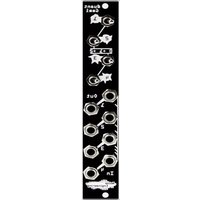
Quant Gemi is a small transposition/split utility. Each channel can be used to transpose a sequence up 0, 1, or 2 octaves. The channels are also normalled together so the same sequence can be split up to 4 ways and transposed separately.
Etymology
Quant -- from Latin quantus: “how many” Gemi -- from Latin gemino: “to pair or double”
"Multiple doubling"
Input & output voltages
QG is designed to work with the widest range of voltages possible, so anything within -8v to +8v should work fine, if you really need a 16-octave melody in your patch somewhere.
Power
To power your Noise Engineering module, turn off your case. Plug one end of your ribbon cable into your power board so that the red stripe on the ribbon cable is aligned to the side that says -12v and each pin on the power header is plugged into the connector on the ribbon. Make sure no pins are overhanging the connector.
Line up the red stripe on the ribbon cable so that it matches the white stripe and/or -12v indication on the board and plug in the connector.
Screw your module into your case BEFORE powering on the module. You risk bumping the module's PCB against something metallic and damaging it if it's not properly secured when powered on.
You should be good to go if you followed these instructions. Now go make some noise!
A final note. Some modules have other headers -- they may have a different number of pins or may say NOT POWER. In general, unless a manual tells you otherwise, DO NOT CONNECT THOSE TO POWER.

Warranty
Noise Engineering backs all our products with a product warranty: we guarantee our products to be free from manufacturing defects (materials or workmanship) for one year from the date of the original retail purchase (receipt or invoice required). The cost of shipping to Noise Engineering is paid by the user. Modules requiring warranty repair will either be repaired or replaced at Noise Engineering's discretion. If you believe you have a product that has a defect that is out of warranty, please contact us.
This warranty does not cover damage due to improper handling, storage, use, or abuse, modifications, or improper power or other voltage application.
Interface
Switches 1-4:
Adds 0, 1, or 2 volts (octaves) to the input CV.
Inputs 1-4:
CV inputs. These are normalled together so QG can be used as a mult. Patching to a second input breaks the normal.
Outputs 1-4:
CV outputs. Transposed sequence comes out here!
Patch Tutorial
Patch 1:
Patch a pitch sequencer (like Mimetic Digitalis) to QG's first input. Patch the output to an oscillator. Use the first switch to transpose the sequence.
Patch 2:
QG can be used as a mult. Patch the additional outputs to other pitch CV destinations and use the switches to transpose each channel separately. This is useful for a number of things; route the same sequence to both pitch inputs of a complex oscillator like Loquelic Iteritas and use QG's octave switches to change timbre. Similarly, patch one channel to an oscillator and one channel to a keytracking filter's 1v/8va input and use QG's transposition to change timbre in a subtractive patch.
Patch 3:
Using a precision adder like Quantus Pax, QG can be used to transpose multiple sequences. Take the outputs of QP and route them to channels 1-4 on QG to transpose them separately. Conversely, patch an output of QG to one of QP's xpose inputs to transpose multiple sequences at once.
![graph TD A["Input 1"] --> B["Quant Gemini"] B --> C["2"] C --> D["0 + 1 + 2"] D --> E["3"] E --> F["Output Out"] F --> G["In 4"] G --> H["Noise Engineering"]](/content/2026/06/1205897/images/a9c47c439a1e12d06fab176ed4496ca4bb2d215428f070586e0c39947a923d2d.jpg)
Design Notes
The QG was a pretty simple design dreamed up when we decided to make the QP and several other modules that we have in the pipeline. The schematic was pretty simple and we had a mockup pretty quickly. The first version was pretty spot on except for two things: we didn't think to normal the jacks, and the switches were not ideally laid out. We revised the hardware, making both of these changes, and voila!


Brand : Noise Engineering
Model : Quant Gemi
Category : Synthesizer