Reason Lite 11.3 - Audio software PROPELLERHEAD - Free user manual and instructions
Find the device manual for free Reason Lite 11.3 PROPELLERHEAD in PDF.


User questions about Reason Lite 11.3 PROPELLERHEAD
0 question about this device. Answer the ones you know or ask your own.
Ask a new question about this device
Download the instructions for your Audio software in PDF format for free! Find your manual Reason Lite 11.3 - PROPELLERHEAD and take your electronic device back in hand. On this page are published all the documents necessary for the use of your device. Reason Lite 11.3 by PROPELLERHEAD.
USER MANUAL Reason Lite 11.3 PROPELLERHEAD
The information in this document is subject to change without notice and does not represent a commitment on the part of Reason Studios AB. The software described herein is subject to a License Agreement and may not be copied to any other media except as specifically allowed in the License Agreement. No part of this publication may be copied, reproduced or otherwise transmitted or recorded, for any purpose, without prior written permission by Reason Studios AB. ©2020 Reason Studios and its licensors. All specifications subject to change without notice. Reason, Reason Intro, Reason Lite and Rack Extension are trademarks of Reason Studios AB. All other commercial symbols are protected trademarks and trade names of their respective holders. All rights reserved.
Table of Contents
Introduction 19
Welcome! 20
About this chapter 20
About this manual 20
About the Reason Lite operating system versions 20
Conventions in the manual 20
The Authorization system 22
Registering Reason Lite 22
Running Reason Lite with Internet Verification 22
Running Reason Lite in Demo Mode 23
Reassigning the Function Keys in macOS 24
About automatic program updates 25
Common Operations and Concepts 27
About this chapter 28
Areas, windows and basic navigation 28
Song window overview 28
The Browser 29
The Main Mixer 30
The Tutorial area 30
The Rack 31
The Sequencer 32
The Transport Panel 32
The ReGroove Mixer 33
Navigating between the areas 33
Showing/hiding the Navigators 33
About different Themes 34
Using several Reason Lite Song windows 34
The Tool Window 35
The On-screen Piano Keys window 35
General window techniques 37
Resizing 37
Scrolling 38
Zooming in the Sequencer 39
Scrolling and zooming using a wheel mouse 40
Editing parameters 41
Knobs 41
Faders and sliders 42
Buttons 42
Fold/Unfold buttons 43
Multi Mode selectors 43
Numerical controls 44
Alpha-numeric controls 44
Numerical segment displays 45
Tool Tips 46
Context menus 47
Parameter context menus 47
Device context menus 48
Main Mixer channel strip context menu 49
Rack "background" context menu 50
Main Mixer "background" context menu 50
Sequencer context menus 50
Undo and Redo 51
On-screen Piano Keys 53
About this chapter 54
Using the On-screen Piano Keys 54
Opening the Piano Keys window 54
Mouse mode 55
Computer Keys mode 56
Audio Basics 59
About this chapter 60
How Reason Lite communicates with your audio hardware 60
Manual audio routing 61
Audio quality 61
Audio settings 62
About audio levels 64
System signal paths 67
Audio Track signal paths 67
Instrument Track signal paths 68
General information about audio and computers 69
About latency 69
About processors 70
About RAM 70
Sequencer Functions 71
About this chapter 72
Introduction 72
Sequencer area overview 72
Song View and Edit Mode 73
Toolbar overview 74
Track List overview 74
Tracks overview 75
Lanes overview 75
Clips overview 76
Inspector overview 76
Ruler overview 76
Edit/Arrangement Pane overview 76
Track scrollbar overview 77
Song Navigator overview 77
Transport Panel overview 77
Track details 78
Track definition 78
The relationship between the track, the rack and the
Main Mixer 79
Master Keyboard Input 84
The relationship between tracks, lanes, clips and events 85
Track types 85
Track List elements 87
Creating tracks 87
Selecting tracks 91
Resizing tracks 92
Moving tracks 92
Deleting tracks 93
Duplicating/copying tracks and devices 93
Coloring tracks 94
Naming tracks 95
Folding tracks 95
Muting tracks 95
Soloing tracks 96
Lane details 97
Audio lane 97
Note lane 98
Parameter automation lane 99
Pattern lane 100
Creating/adding lanes 101
Deleting lanes 103
Moving note lanes 104
Copying (duplicating) note lanes 104
Muting lanes 105
Clip basics 105
Clip types 105
Toolbar details 106
Toolbar tools 106
Alternate tools 109
Edit Mode buttons 109
Snap 109
Sequencer Toolbar keyboard shortcuts 111
Ruler details 112
Transport Panel details 112
Transport keyboard commands 116
About the Inspector 117
About subticks in the Position and Length displays 117
About the "Match Values" function 117
Recording in the Sequencer 119
About this chapter 120
General recording functions 120
Record enabling 120
Click and Pre-count 124
Loop mode 126
General recording procedure 127
Undoing a recording 128
Recording tips 128
Audio recording details 128
Setting up the audio track 128
Recording audio 133
Recording audio in Loop mode 135
Overdubbing audio using the "Dub" function 136
Duplicating audio tracks using the "Alt" function 136
Recording over or into an existing audio clip 137
Recording audio from Mix Channel outputs 138
Recording a mixdown of several audio tracks 140
Note recording details 144
Setting up the instrument track 144
Recording notes 144
Recording notes in Loop mode 144
Recording over or into an existing note clip 145
Recording notes using the "Dub" and "Alt" functions 146
Parameter automation recording details 148
Performance controllers vs. track parameter automation 148
Recording performance controller automation 149
Recording parameter automation into Note Clips 150
Recording performance controller automation over or into an existing clip 150
About performance controller automation on multiple lanes 151
Recording parameter automation 151
Recording parameter automation in Loop mode 152
Recording parameter automation over or into an existing clip 153
Adjusting automated parameters during playback - "Live mode" 154
Recording parameter automation on multiple tracks 154
Pattern automation recording details 155
Recording pattern automation 155
Tempo automation recording 156
Recording tempo automation 156
Arranging in the Sequencer 159
About this chapter 160
Clip handling 160
Creating Clips 160
Selecting clips 160
Setting audio clip Level and Fades 163
Deleting clips 164
Resizing (masking) clips 165
About masked recordings and events 166
Tempo scaling clips 168
Moving clips 170
About overlapping clips 172
Duplicating clips 172
Cutting, Copying and Pasting clips 172
Naming clips 173
Coloring clips 173
Splitting clips 174
Crossfading audio clips 175
Joining clips 176
Reversing clips 178
Muting clips 178
Merging clips on note lanes 179
Bounce in Place 179
Matching clips using the "Match Values" function 182
Inserting bars 184
Removing bars 184
About removing bars that contain audio recordings 185
Audio Editing in the
Sequencer 187
About this chapter 188
Edit Modes, Stretch & Transpose Types and Clip Types 188
Edit Modes 188
Selecting Stretch and Transpose Type 188
Clip Types 189
Opening audio clips for editing 190
Editing audio in Slice Edit mode 191
Audio clip elements in Slice Edit mode 191
Slice Edit mode tools 191
Selecting Slices and Slice Markers 192
Adding Slice Markers 193
Deleting Slice Markers 194
Repositioning Slice Markers 194
Moving/stretching Slices 194
Nudging Slices 196
Quantizing audio 196
Split at Slices 197
Bounce Clip to REX Loop 197
Revert All Slices 198
Editing audio in Pitch Edit mode 199
Pitch Editor elements 199
Selecting notes 200
Auditioning notes 200
Correcting pitches 201
Changing transposition 201
Resetting pitches 201
Splitting the clip at notes 201
Reverting all notes 201
Attenuating pitch drift/vibrato 202
Editing transition times 202
Moving notes and changing note lengths 203
Quantizing notes 204
Splitting and joining notes 204
About switching from Pitch Edit mode to Slice Edit mode 205
Audio pitch editing in the Inspector 205
Editing audio in the Comp Editor 207
Audio clip elements in the Comp Editor 207
The relationship between Clips, Comp Rows and
Recordings 211
Comp Editor window handling 213
Comp Editor audio editing tools 213
Selecting a Comp Row for playback in a Single Take clip 214
Selecting Comp Rows 215
Deleting Comp Rows 216
Moving Comp Rows 216
Duplicating Comp Rows 216
Cutting, copying and pasting Comp Rows 217
Adjusting the Comp Row Level 217
Adjusting the Recording Offset 218
Comping audio 219
Adding Cuts 219
Adding Segments 220
Adding Crossfades to Cuts 220
Deleting Cuts 221
Moving Cuts 22
Changing Comp Row assignments 222
Bounce Clip(s) to New Recording(s) 223
Creating a comped audio clip 224
Common audio editing functions 228
Delete Unused Recordings 228
Bounce Clip(s) to New Sample(s) 228
Bouncing audio to MIDI notes 228
Normalizing audio clips 230
Reversing audio clips 231
Changing the tempo and transposition of the audio 232
Tempo scaling Clips 232
Transposing Audio Clips 233
Audio and tempo matching 235
Matching imported audio to the song tempo 235
Editing audio using the Inspector 236
Editing recordings and cuts in the Inspector 236
Matching audio values using the "Match Values"
function 236
Note and Automation Editing 239
About this chapter 240
The Edit Mode 240
Selecting what to edit 241
Opening note and automation clips for editing 241
Edit Mode elements 243
Edit Mode window handling 245
Note Edit Modes 245
Creating empty clips 248
Tool Window editing tools 249
Note editing 250
Selecting notes 250
Drawing notes 251
Deleting notes 254
Resizing notes 254
Muting notes 256
Splitting notes 257
Moving notes 258
Duplicating notes 261
Using Cut, Copy and Paste 262
Quantize 263
Pitch (Transpose) 266
Extract Notes to Lanes 267
Scale Tempo 270
Editing note velocity 271
Reverse 273
Multi Lanes editing 275
Overview 275
Selecting multiple lanes for editing 275
Editing notes in Multi Lanes mode 276
Automation editing 277
Overview 277
Editing parameter automation 277
Drawing parameter automation events 280
Creating curves between automation points 281
Deleting automation events 282
Reversing automation events 282
Editing performance controller automation 282
About Automation Cleanup 284
Editing pattern automation 285
Drawing pattern automation 286
Moving, resizing and duplicating pattern automation clips 287
Deleting pattern automation clips 287
The "Convert Pattern Automation to Notes" function 288
Editing tempo automation 288
About tempo changes and tempo automation of audio tracks 289
Automating time signature 290
Moving, resizing and duplicating time signature automation clips 291
Deleting time signature automation clips 291
Note and automation editing in the Inspector 292
Editing notes and events in the Inspector 292
Matching notes or events using the "Match Values" function 292
Working with Blocks in the Sequencer 295
About this chapter 296
Introduction 296
The idea behind Blocks 296
Arrangement Views 297
Song View (with Blocks disabled) 297
Song View (with Blocks enabled) 297
Block View 298
Editing Blocks in the Block View 298
Selecting a Block for editing 298
Renaming Blocks 299
Defining the Block length 299
Changing Block color 299
Recording in the Block View 299
Editing clips in the Block View 299
Arranging clips in the Block View 300
Arranging Blocks in the Song View 300
Creating Block Automation Clips 300
Resizing Block Automation Clips 302
Reassigning Blocks in Block Automation Clips 302
Muting lanes in Block Automation Clips 303
Converting Block Automation Clips to Song Clips 305
Combining Block Automation Clips with Song Clips 307
Working with the Rack 311
About this chapter 312
Rack device procedures 312
Navigating in the rack 312
Resizing and detaching the rack 313
About Device Groups 314
Creating devices 316
Selecting devices 318
Deleting devices 320
Re-ordering devices 320
Re-routing devices 322
Creating new rack columns 322
About the "Sort Selected Device Groups" function 322
Replacing devices 323
Duplicating devices 324
Cut, Copy and Paste devices 324
Naming devices 325
Folding and unfolding devices 326
Working with Players 327
About this chapter 328
Overview 328
General recording methods 329
Using Players 330
Creating Players 330
Chaining Players 330
Replacing Players 330
Deleting Players 330
Naming Players 330
About Players in Combinators 331
Common Player device parameters 331
Scales & Chords 332
Scales 332
Filter Notes 333
Chords 334
Working with Rack Extensions 337
About this chapter 338
What are Rack Extensions? 338
Future compatibility 338
Trying and buying Rack Extensions 338
Trial versions of Rack Extensions 338
Buying Rack Extensions 338
Installing and managing Rack Extensions 339
Using Rack Extensions in Reason Lite 340
About missing Rack Extensions 342
Working with VST Plugins 343
About this chapter 344
About VST plugins 344
VST compatibility in Reason Lite 344
Installing and enabling VST plugins 344
About VST licenses 344
Installing VST plugins under Windows 344
Installing VST plugins under Mac 345
Enabling VST plugins in Reason Lite 345
Using VST plugins in Reason Lite 346
Adding VSTs to the rack 346
The Plugin Rack Device 347
Front panel 347
Rear panel 348
About auto-routing of VSTs in the rack 349
The Plugin Window 349
Editing the VST parameters 351
Automating VST parameters 351
CV modulation of VST parameters 352
Remote controlling VST parameters 355
Selecting VST programs 357
About saving songs that contain VSTs 357
Combining VST plugins in Combinator devices 357
About missing VST plugins 358
Managing VST plugins 358
Plugin Status 359
Defining custom VST folders 360
Sounds, Patches and the Browser 361
About this chapter 362
About patches 362
Reason Lite devices that use patches 362
Loading patches 363
Setting browse focus 366
Saving patches 367
Copying and pasting patches between devices 368
Initializing patches and resetting device parameters 368
About ReFills 369
Using Locations and Favorites 378
Favorites Lists 378
Selecting and auditioning samples 381
Selecting multiple files 381
Cross-browsing patch files 382
Create Instrument/Create Effect 383
Using the "Search" function 384
Loading files 384
About browse lists 385
Handling Missing Sounds 386
Reason Lite file formats 388
Routing Audio and CV 389
About this chapter 390
Signal types 390
Audio signals 390
CV/Gate signals 390
P-LAN signals 391
About MIDI routing 391
About cables 391
Cable appearance 391
Checking and following cable connections 392
Cable color 393
Automatic routing 393
Auto-routing of audio input signals 393
Auto-routing of Instrument devices 394
Auto-routing of Effect devices 394
Auto-routing of CV/Gate signals 395
Auto-routing devices after they have been created 395
Manual routing 396
Connecting cables 397
Connecting cables using pop-up menus 397
Disconnecting cables 398
Disconnecting devices 398
Using CV and Gate 398
Routing CV and Gate signals 398
About CV Trim knobs 398
The Main Mixer 399
About this chapter 400
Overview 400
The Audio Track, its device and mixer channel strip 401
The Mix Channel device and channel strip 402
The Master Section device and mixer strip 403
Navigating in the Main Mixer 404
Viewing the Main Mixer area 404
Scrolling and navigating in the Main Mixer 404
Showing and hiding channel strip sections 405
Switching between channels, rack devices and tracks 406
Managing mixer channels 407
Creating and deleting channels 407
Selecting channels 407
Moving channels 408
Copying and duplicating channels 408
Copy channel settings 409
Resetting channel settings 409
Naming mixer channels 409
Coloring mixer channels 410
The channel strip 411
Input section 411
Dynamics section 412
EQ section 415
The Spectrum EQ Window 416
Insert FX section 419
FX Sends section 420
Fader section 421
Channel Header section 423
The Master Section strip 424
Master Compressor section 425
FX Send section 426
Master Inserts section 427
FX Return section 428
Master Fader section 429
Master Section Header 430
Automating mixer parameters 430
Working with effects 430
Insert FX 430
Send FX 435
Output Busses 438
Creating an Output Bus 438
Deleting an Output Bus 440
Recording a sub-mix onto an audio track 441
Parallel Channels 442
Creating Parallel Channels 442
Deleting Parallel Channels 445
Naming Parallel Channels 445
Solo, Mute and Send FX logic 446
Solo and Mute logic 446
Send FX level and mute logic 448
Remote controlling the Main Mixer 450
Remote controlling a single mixer channel 450
Remote controlling multiple mixer channels 450
Advanced routing tips and tricks 453
Chaining Send effects from Redrum or Mixer devices 453
Using compression sidechaining 455
Using the Mix Channel and Audio Track devices' Direct Outs 456
Creating an input channel for recording with effects 457
Delay Compensation 461
About this chapter 462
About Delay Compensation in Reason Lite 462
Activating the Delay Compensation 462
Delay Compensation rules and limitations 463
How the Delay Compensation works 466
Delay Compensation in individual mixer channels 466
Delay Compensation with Busses and Parallel Channels 470
Delay Compensation to Send FX busses 471
About the Master Insert FX 471
Problematic configurations 472
About using the Direct Out connections of the mixer channels 476
About the Metronome Click 476
Recording with Delay Compensation 476
Playing and monitoring with Delay Compensation 476
About bouncing mixer channels 476
Song File Handling 477
About this chapter 478
Opening Songs 478
Opening a Reason Lite Song 478
Opening a Reason Lite Demo Song 479
Opening the last Song at program launch 479
Closing Songs 479
Closing a Song 479
Creating Songs 479
Creating a new Song 479
Setting up a Default Song 480
Creating a new Song from a template 480
Saving Songs 481
Saving a Song 481
Saving and optimizing a Song 481
Including Song Information 482
About Self-Contained Songs 483
Making a Song appear as a Template Song 484
A note about saving Songs as audio files 484
Audio data and Scratch Disk settings 485
About audio data in Song files 485
Changing Scratch Disk folder location 485
About "Orphan Audio Streams" 486
Importing and exporting Standard MIDI Files 486
Importing Standard MIDI Files 486
Exporting Standard MIDI Files 487
Importing and Exporting Audio 489
About this chapter 490
Importing audio 490
Audio formats, sample rates and tempo matching 490
About tempo matching imported audio 490
Importing audio to the sequencer 491
Exporting audio 494
Exporting Songs or parts of Songs 494
Bouncing Mixer Channels 496
Bouncing Audio Clips 498
Sampling 501
About this chapter 502
Overview 502
One-click sampling 502
The Edit Sample window 502
About sample format, rate and resolution 503
General sampling functions 503
Setting up for sampling 503
Sampling 505
The Sample buttons 505
Sampling procedure 505
The Song Samples location 508
Editing samples 510
The Edit Sample window 510
Setting Sample Start and End 512
Cropping samples 514
Normalizing samples 514
Reversing samples 514
Fading in/out samples 515
Looping samples 516
Saving edited samples 518
Renaming samples 518
Sample management 519
About Assigned and Unassigned samples 519
Saving samples in a song 520
Deleting samples from a song 520
Loading samples into a device 521
Duplicating samples 522
Exporting samples 523
About self-contained samples 525
The ReGroove Mixer 527
Introduction 528
ReGroove basics 528
The ReGroove Mixer 529
Global parameters 529
Channel parameters 530
Copy, Paste and Initialize ReGroove channels 534
Groove Settings 535
Working with grooves 538
Applying grooves to your music 538
Commit to Groove - making the grooves "permanent" 541
Creating your own ReGroove patches 542
Groovy tips & tricks 543
ReGroove patches in the Factory Sounds bank 544
Remote - Playing and Controlling Devices 545
About the various MIDI inputs 546
About Remote 546
Setting up 547
Automatic set-up using the Easy MIDI Inputs function 547
Adding a specific control surface or keyboard 548
Other functions 551
Example Setups 551
Remote basics 552
About Standard vs Remote Override mapping 552
About mapping variations 552
Locking a surface to a device 554
Locking a surface 554
Unlocking a surface 556
Remote Override 557
Activating Remote Override Edit mode 557
Remote Override mapping 558
Additional Remote Overrides... 561
Assigning Additional Overrides 562
Keyboard Control 563
Enabling Keyboard Control 563
Editing Keyboard Control 563
Saving Remote Setups 564
Synchronization and Advanced MIDI 565
About this chapter 566
Synchronization to MIDI Clock 566
What is synchronization and MIDI Clock? 566
Using Reason Lite as MIDI Clock Host 566
Syncing Reason Lite to an external MIDI application or instrument 568
Syncing Reason Lite to another program on the same computer 568
External synchronization considerations 569
Synchronization using Ableton Link 571
About Ableton Link 571
Synchronizing Reason Lite's sequencer with Ableton Link 571
Advanced MIDI - The External Control Bus inputs 573
About the External Control Bus inputs 573
Routing MIDI to devices 574
Receiving Controller data via MIDI 574
About recording Pattern Changes 574
Optimizing Performance 575
Introduction 576
Checking Processing Power 576
Optimization and latency reduction 576
About Latency Compensation 577
Optimizing your computer system 578
Optimizing Songs 580
RAM requirements 582
Hardware Interface 583
Introduction 584
Sampling Input section 585
Advanced MIDI Device 586
More Audio 586
The Big Meter 587
Redrum Drum Computer 589
Introduction 590
Sampling in Redrum 590
About file formats 591
Using patches 592
Loading a patch 592
Checking the sounds in a patch 592
Creating a new patch 593
Creating an empty patch 593
Programming patterns 594
Pattern basics 594
Pattern tutorial 595
Setting pattern length 596
Setting pattern resolution 597
Step dynamics 597
Pattern Shuffle 598
Flam 598
The Pattern Enable switch 599
The Enable Pattern Section switch 599
Pattern functions 600
Chaining patterns 600
Converting Pattern data to notes in the main sequencer 601
Redrum parameters 602
Drum sound settings 602
Global settings 605
Using Redrum as a sound module 606
Connections 607
Subtractor Synthesizer 609
Introduction 610
Loading and Saving Patches 610
The Oscillator Section 611
Oscillator 1 Waveform 611
Setting Oscillator 1 Frequency - Octave/Semitone/Cent 613
Oscillator Keyboard Tracking 613
Using Oscillator 2 613
Oscillator 2 Waveform 614
Noise Generator 614
Phase Offset Modulation 615
Frequency Modulation (FM) 617
Ring Modulation 618
The Filter Section 619
Filter 1 Type 619
Filter 1 Frequency 622
Resonance 622
Filter Keyboard Track (Kbd) 622
Filter 2 623
Envelopes - General 624
Amplitude Envelope 625
Filter Envelope 625
Mod Envelope 626
LFO Section 627
LFO 1 Parameters 627
LFO 2 Parameters 628
Play Parameters 629
Velocity Control 629
Pitch Bend and Modulation Wheels 630
Legato 631
Retrig 631
Portamento (Time) 631
Setting Number of Voices - Polyphony 632
About the Low Bandwidth button 632
External Modulation 632
Connections 633
Audio Output 633
Sequencer Control 633
Modulation Inputs 634
Modulation Outputs 634
Gate Inputs 634
Monotone Bass Synthesizer 635
Introduction 636
Panel overview 637
Signal flow 638
Playing and using Monotone 639
Loading and saving patches 639
Global output controls 639
Global performance and "play" controls 639
Panel reference 640
The Oscillator section 640
The Filter section 641
The Amplifier section 643
Chorus 644
Delay 645
The LFO section 645
The Envelope section 646
Connections 647
Sequencer Control inputs 647
Modulation inputs 647
Audio Output 647
ID8 Instrument Device 649
Introduction 650
The Sounds 650
The ID8 and Standard MIDI Files 650
Using the ID8 651
Selecting Sounds 651
Controlling Sounds 651
About saving edited Sounds 652
MIDI Out Device 653
Introduction 654
Using the MIDI Out Device 654
Setting up for controlling an external MIDI instrument 654
Controlling the sound of your external MIDI instrument 655
Using MIDI Program Change 655
Recording MIDI Controller automation 656
Modulating MIDI Controllers from CV signals 661
Connections 663
Sequencer Control 663
CV In to MIDI CC Out 663
Tips & Tricks 663
Audio recording of MIDI controlled external instruments 663
Scream 4 Sound Destruction Unit 667
Scream 4 Sound Destruction Unit 668
Parameters 668
CV inputs and outputs 672
Screamy tips and tricks 673
RV7000 Mk II Advanced Reverb 675
Overview 676
About the Patch format 676
Connections 676
The main panel 677
The Remote Programmer 677
Reverb algorithms and parameters 678
Common effect device parameters 678
About the main panel parameters 678
Selecting an algorithm 678
Small Space 679
Room 679
Hall 680
Arena 680
Plate 680
Spring 680
Echo 681
Multi Tap 681
Reverse 682
Convolution 683
The EQ section 686
The Gate section 687
CV Inputs 688
The MClass Effects 689
The MClass effects 690
The MClass Equalizer 691
The MClass Stereo Imager 692
The MClass Compressor 693
The MClass Maximizer 696
Half-Rack Effects 697
Common effect device features 698
DDL-1 Digital Delay Line 700
CF-101 Chorus/Flanger 701
Spider Audio Merger & Splitter 703
Spider CV Merger & Splitter 705
The Combinator 709
Introduction 710
Creating Combinator devices 711
Combinator elements 712
About internal and external connections 713
About External Routing 713
Adding devices to a Combi 715
About the Insertion line 715
Creating new devices in a Combi 715
Adding devices using drag and drop 716
Adding devices using copy/paste 717
Adding a Combi to a Combi 717
Combining two Combis 717
Combining devices in a Combi with devices in the rack 717
Combi handling 717
Moving the entire Combi 717
Moving devices within a Combi 718
Moving devices out of a Combi 718
Deleting devices in a Combi 718
Uncombining devices 718
Sequencer tracks and playing Combis 718
The Controller panel 719
Select backdrop... 720
Using the Programmer 721
Key Mapping instrument devices 722
Setting Velocity Ranges for instrument devices 723
Using Modulation Routing 724
CV Connections 727
Matrix Pattern Sequencer 729
Introduction 730
About the three Output types 730
Programming patterns 731
Pattern basics 731
Tutorial 734
Using Curve Patterns 736
Setting Pattern Length 737
Using Tied Notes 737
Setting Pattern Resolution 738
Pattern Shuffle 738
Pattern Mute 738
Pattern Functions 739
Chaining Patterns 739
Converting Pattern data to notes in the main sequencer 740
Example usage 741
Using the Matrix for modulation 741
Programming "Acid Style" lead lines 742
Triggering samples 742
The Line Mixer 6:2 743
Introduction 744
Channel parameters 744
The Auxiliary Return section 744
Master level 744
Connections 745
Menu and Dialog Reference 747
Reason Lite menu (macOS) 748
File menu 749
Edit menu 753
Preferences - General 766
Preferences - Audio 769
Preferences - Control Surfaces 773
Preferences - Sync 777
Preferences - Advanced 778
Preferences - Language (Windows only) 780
Create menu 781
Options menu 782
Window menu (Windows version) 787
Window menu (macOS version) 789
Help menu 791
Key Commands 793
About the Key Commands chapter 794
General keyboard shortcuts 794
General modifier keys 795
Transport keyboard shortcuts 795
Sequencer keyboard shortcuts 796
Sequencer modifier keys 797
Arrow keys 798
Save dialog keyboard shortcuts 798
On-screen Piano Keys keyboard shortcuts 798
Redrum keyboard shortcuts 799
Redrum modifier keys 799
Matrix keyboard shortcuts 799
Matrix modifier keys 799
MIDI Out Device keyboard shortcuts 800
Index 801

Chapter 1 Introduction
Welcome!
This is the Operation Manual for Reason Lite Version 1.1 music production software from Reason Studios. The information in this manual is also available as html files in the on-line Reason Lite Help system.
If you haven't already, don't forget to check out the Video Tutorials web site, which can be accessed from the Reason Lite Help menu.
Also, be sure to regularly check out www.reasonstudios.com for the latest news!
About this chapter
The Introduction chapter describes some of the general conventions used throughout the Reason Lite Operation Manual. It also contains instructions on how to utilize the Reason Lite authorization system.
About this manual
In this Operation Manual, all aspects of the Reason Lite program are described in detail. The first chapters deal with general methods and techniques, e.g. how to connect audio sources, mix and record. Then follow descriptions of all rack devices in Reason Lite.
! Note that the screenshots throughout this manual is from Reason 11 or Reason 11 Intro. This means there are devices in the screenshots that are not present in Reason Lite!
! The information in this document is subject to change without notice and does not represent a commitment on the part of Reason Studios AB.
About the Reason Lite operating system versions
Reason Lite comes in two platform versions: one for Windows (7)/8/10 (64-bit) and one for macOS 10.11 (EI Capitan) or later. The screenshots in this manual were taken from both platform versions of Reason Lite, and some screenshots remain from older versions of Reason Lite. Since the program layout is more or less identical in these versions, there shouldn't be any problem following the instructions.
Conventions in the manual
This manual describes both the Windows and macOS versions of Reason Lite; wherever the versions differ this is clearly stated in the text.
Text conventions
The text conventions are pretty straightforward. The examples below describe when certain text styles are used:
→ This style instructs the user to perform the task(s) described in the sentence.
! This text style means IMPORTANT INFORMATION. Read carefully to avoid problems!
- This text style is used for tips and additional info.
Key command conventions
In the manual, computer keyboard commands are indicated with brackets. For example:
→Hold down [Shift] and press [C].
However, some modifier keys are different on Windows and Mac computers. Whenever this is the case, the manual separates the commands with “(Win)” and “(Mac)” indications as in the following example:
→ Hold down Ctrl or Cmd and press [S] to save your song.
References to context menus
Whenever the manual instructs you to select an item from the "context menu", it means that you should right-click (or [Ctrl]-click if you're using a Mac with single-button mouse) on the specific area, section or device, and then select the item from the pop-up menu that appears - the context menu. The item list in context menus varies depending on where in the application you click. See "Context menus" for an overview of the context menus in Reason Lite.
Frames and circles (call-outs)
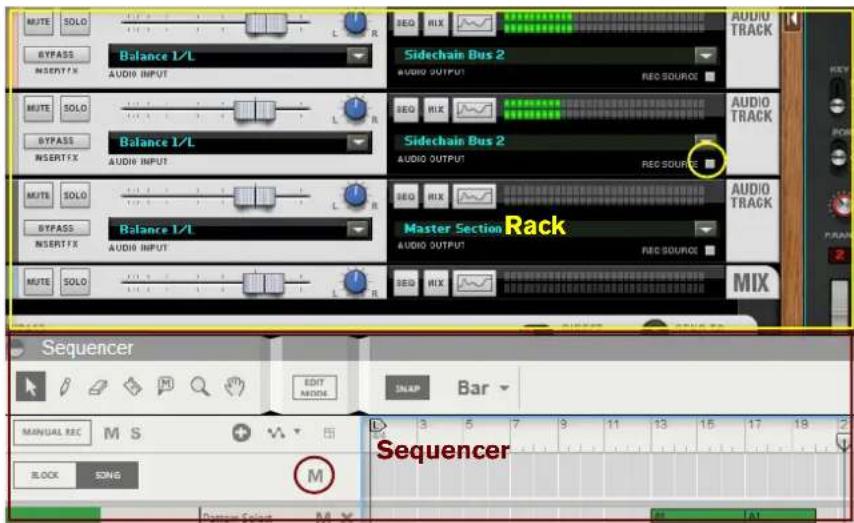
In pictures throughout this manual there might be circles and/or rectangles highlighting certain areas or objects. These are indicated by filled lines according to the examples in the picture above. Sometimes these highlighting frames/circles might also be accompanied by descriptive texts. The different colors of the frames and texts are only to enhance the contrast to the background pictures.
Dashed arrows
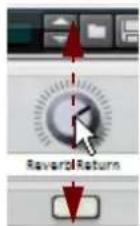
A dashed arrow in a picture indicates the directions in which the mouse pointer (or other tool) should be dragged to perform the desired operation. The example in the picture above shows in which directions (up and down) to drag the pointer to change the knob's setting.
The Authorization system
Reason Lite uses an authorization system designed to be as flexible as possible, while at the same time providing the best possible copy protection for the product. Here's how it works:
- The core of the authorization system is your license number, which is registered to your user account on the Reason Studios web site.
• If you have a working Internet connection you can run Reason Lite with Internet Verification.
The program will then contact the Reason Studios web site and verify that Reason Lite is registered to your user account.
- If you don't have a working Internet connection, you can run Reason Lite in Demo Mode.
In Demo Mode you can work as usual and even save your work. However, you cannot open songs in Demo Mode (for details, see "Running Reason Lite in Demo Mode").
Registering Reason Lite
To be able to run Reason Lite in authorized mode (see "Running Reason Lite with Internet Verification"), the program must be registered to your account on the Reason Studios web site.
→ Follow the instructions printed on the License card/sticker, to register Reason Lite.
Running Reason Lite with Internet Verification
When you launch Reason Lite the following window appears:
! Note that this procedure requires a working Internet connection (and that your Reason Lite license has been registered to your user account as described in "Registering Reason Lite").
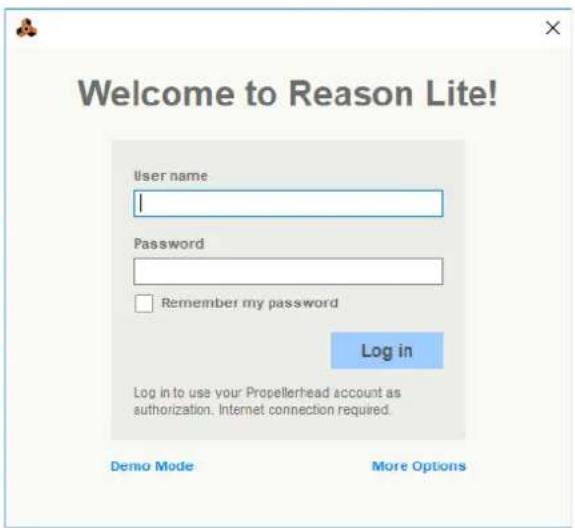
→ Enter the User name and Password for your Reason Studios account and click the Log in button. Reason Lite launches in Authorized Mode.
! It is not possible to run two instances of Reason Lite (on different computers) authorized to the same user account. Reason Lite will then enter Demo Mode (see "Running Reason Lite in Demo Mode").
Running Reason Lite in Demo Mode
If you don't have a Reason Lite license - or don't have Internet connection - you can run Reason Lite in Demo Mode:
1. Launch Reason Lite.
The following window appears:
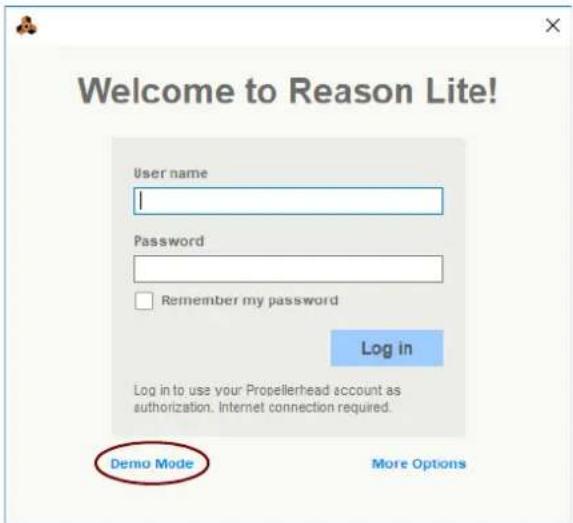
2. Click "Demo Mode".
Reason Lite launches in Demo Mode.
The Demo Mode LED lights up to the right on the Transport Panel:
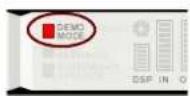
Running Reason Lite in Demo Mode allows you to perform all operations as in Authorized Mode, with three exceptions:
- You cannot export audio or bounce mixer channels to disk.
- You will not have access to any Rack Extension devices (except for the included Rack Extensions).
- You cannot open songs.
The only songs that can be opened in Demo Mode are the dedicated demo songs (file extension ".reltdemo" (Reason Lite Demo Song)). See "Opening a Reason Lite Demo Song".
If you lose the Internet connection while running Reason Lite with Internet Verification, the program will automatically enter Demo Mode. You can continue to work, and save your songs as usual. When you reconnect to the Internet, Reason Lite will automatically revert to authorized mode and the Demo Mode indicator will go off.
Reassigning the Function Keys in macOS
When you work with Reason Lite, you will do a lot of navigating between the three main areas - the main mixer, the rack and the sequencer. The quickest way to switch between these areas is to use the function keys F5, F6 and F7 (see "Navigating between the areas" for details). Also, the F2, F3, F4 and F8 keys are shortcuts for showing and hiding the Spectrum EQ window, Browser, On-screen Piano Keys window and the Tool Window, respectively.
However, on many Macintosh models (especially MacBooks), the function keys double as hardware control buttons. For example, they might control the volume of the built-in speaker, the display brightness or keyboard backlight. To make these keys actually work as function keys for software such as Reason Lite, you need to hold the "Fn" key while pressing them.
This can work perfectly OK, but to get the best workflow in Reason Lite we recommend that you change this behavior, so that pressing e.g. the F5 key actually sends "F5" to Reason Lite (and you hold down the Fn key to get the hardware control functions instead). Here is how you change this:
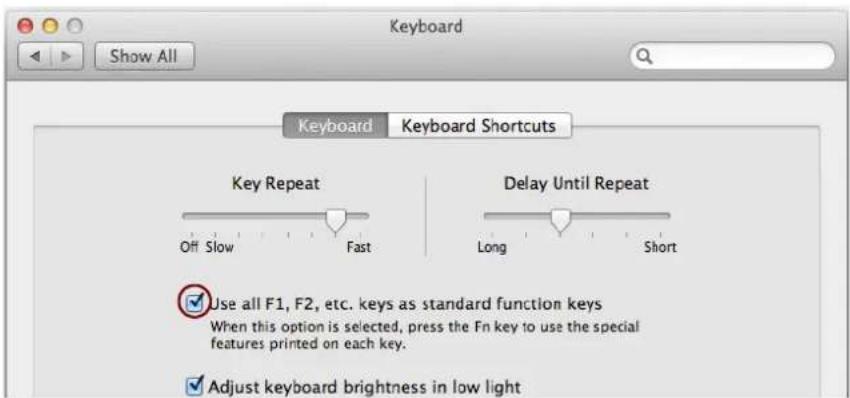
- Open the System Preferences in macOS and select the "Keyboard" item.
The "Keyboard" preferences are shown.
- Select the "Keyboard" tab and make sure the checkbox "Use all F1, F2, etc. keys as standard function keys" is ticked.
Now you can use F2-F8 for controlling functions in Reason Lite. To use hardware control features such as volume and display brightness, you need to hold down the "Fn" key before pressing the function keys.
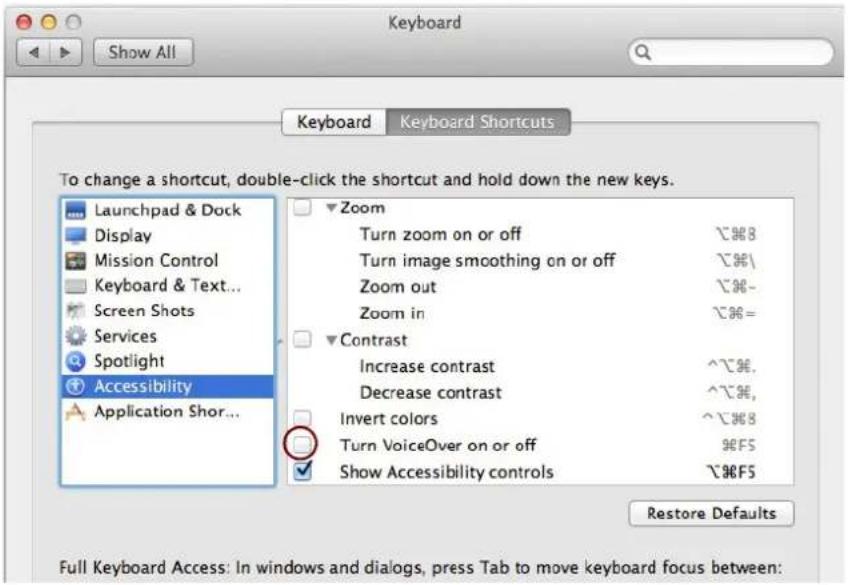
Some function keys might also be pre-assigned to macOS keyboard shortcuts, which will have priority over software such as Reason Lite. This is easily changed:
- Click the "Keyboard Shortcuts" tab in the "Keyboard" window.
The Keyboards Shortcuts window shows lists of keyboard shortcuts assigned to system functions. For example, [Cmd]+[F5] is in the Accessibility group assigned to turn VoiceOver on or off. In Reason Lite, this is the keyboard shortcut for detaching the main mixer into a separate window.
- Scroll down to the "Turn VoiceOver on or off" item in the Accessibility group and either remove the tick from the checkbox or assign it to another keyboard shortcut.
- Now, you're finished with the settings and can close the "Keyboard" window.
From now on, the function keys and keyboard shortcuts will perform their intended functions in Reason Lite.
About automatic program updates
Reason Lite supports automatic program updates (within each major release version). When you launch Reason Lite it automatically checks for new updates on the Reason Studios web site - provided your computer is connected to the Internet.
If you are working with Reason Lite off-line, and then connect to the Internet, you can manually check for updates by selecting the "Check for Updates..." item on the Help menu.
! Note that the automatic program update function only works within each major Reason Lite release version, i.e. there will be no automatic update between Reason Lite 10.x and 11.x.
Each time a new Reason Lite version is available, an "update bar" appears at the top of the Reason Lite song document after launch. In the update bar you can choose to either download the update now or later:
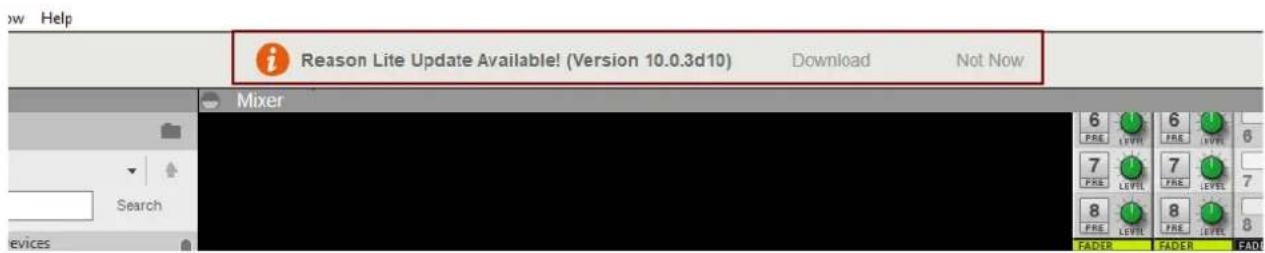
If you click "Not Now" Reason Lite will wait a number of days before it checks for updates again.
If you click "Download" the update is downloaded and prepared for installation. A download progress bar appears in the update bar:
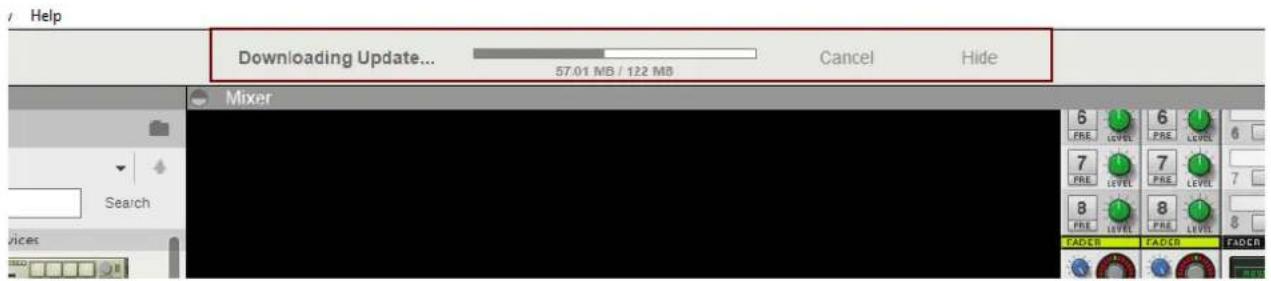
→If you want to abort the download, click "Cancel".
→If you want to hide the download progress bar, click "Hide".
When the download is ready, two options are available:

→ Click "Restart and Install Now" to install the update and launch the updated version of Reason Lite.
→ Click "Install on Quit" to continue running the current Reason Lite version and install the update after you quit the current Reason Lite session.
Chapter 2
Common Operations and Concepts
About this chapter
This chapter gives a basic overview of the Reason Lite application and describes general methods and techniques employed throughout the Reason Lite software. It also explains the terminology used throughout the program, manuals and help files.
Areas, windows and basic navigation
Song window overview
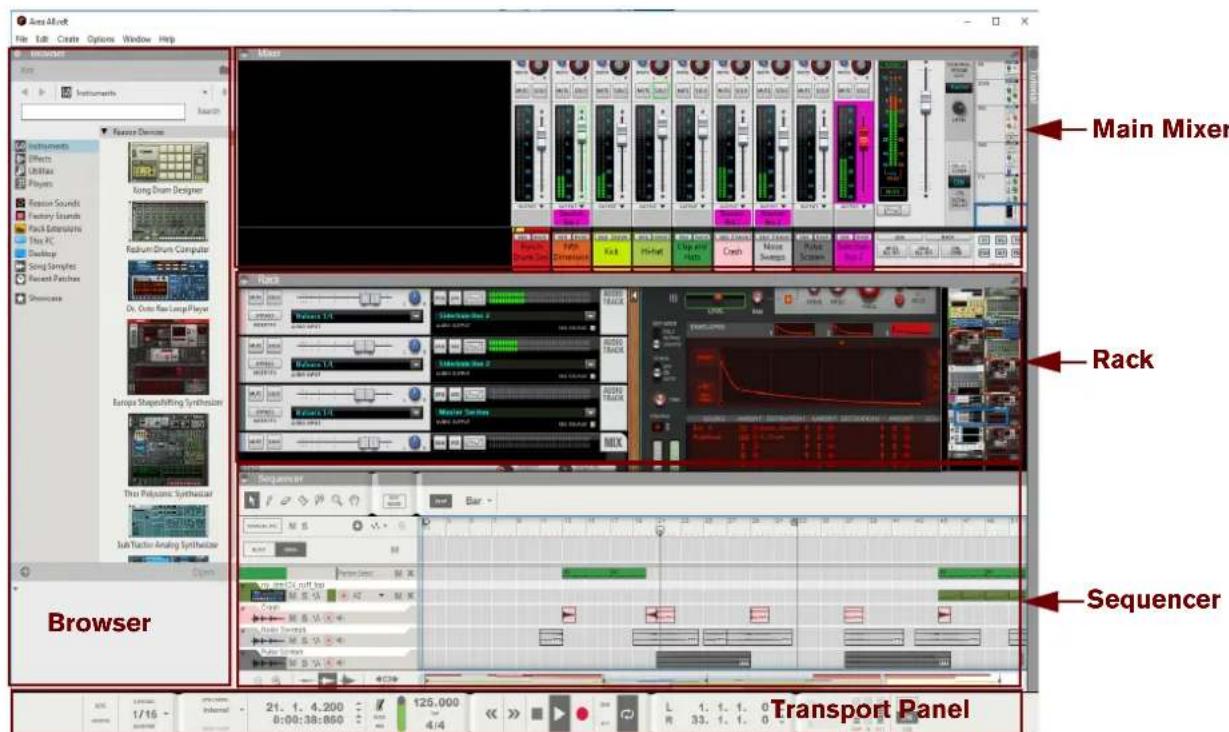
A Reason Lite Song window with its Browser, Main Mixer, Rack and Sequencer areas.
The Reason Lite graphical user interface is divided into four main areas:
• The Browser
The Browser is where you create devices, load patches into devices and load songs.
• The Main Mixer
The Main Mixer is located at the top in the Reason Lite Song window. Here are the channel strips for the audio and instrument tracks in your song.
• The Rack
The Rack is where all sound and effects devices you use in your song are located. The Rack resembles a traditional hardware rack, where sound modules and effects units can be mounted.
• The Sequencer
The Sequencer is where you record your audio and instrument tracks. Here you can also record automation of device parameters in the Rack and of channel strip parameters in the Main Mixer. The Sequencer also incorporates the Transport Panel, where all sequencer transport controls are located.
The areas can be viewed together, as in the picture above, in pairs or separately - see "Navigating between the areas". The areas can also be resized - see "Resizing".
The Browser
The Browser to the left in the Song window (and also in the Rack window, if the Rack is detached) features short-cuts for creating devices, loading patches and songs, and sample management functions. By pressing [F3] you can toggle between Show and Hide Browser.
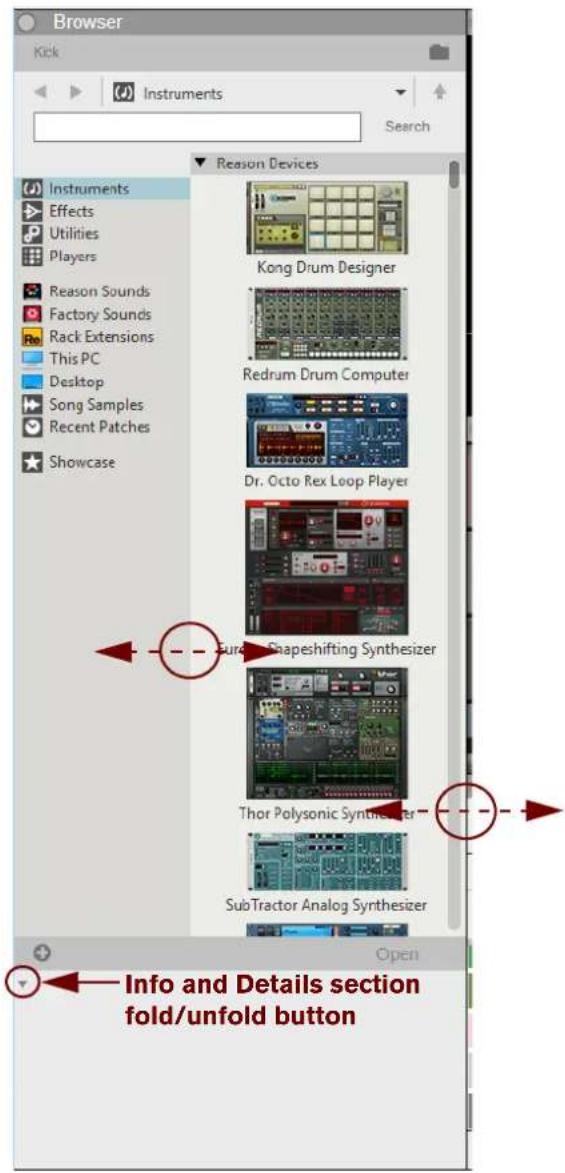
The Browser with the Instruments palette selected.
- See "About using the Browser in the detached rack" and "Creating devices" for information on how to use the "Device" functions.
• See "Using the Browser" for information on how to browse for patches and songs.
• See the "Sampling" chapter for information on how to use the "Song Samples" functions.
The Main Mixer
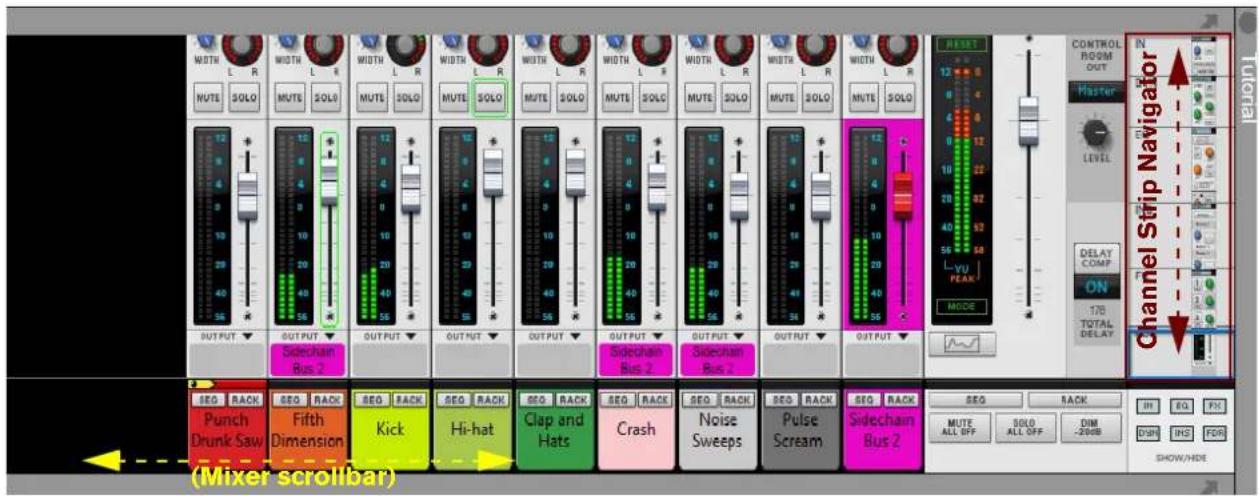
The Main Mixer with the Fader sections currently scrolled into view.
In the Main Mixer, all channel strips of the Reason Lite song are visible. You can scroll vertically in the Main Mixer by clicking and dragging inside the frame in the Channel Strip Navigator to the right. This way you will be able to access all channel strip parameters. If you have a lot of channels ins your song you can also scroll horizontally by clicking and dragging the Mixer scrollbar at the bottom of the Main Mixer area.
- By pressing function key [F5], or by double clicking the gray Mixer header, you can maximize the Main Mixer area.
- To the right on the Mixer header is the Detach Main Mixer icon. Clicking this, or holding Ctrl or Cmd and pressing [F5], will detach the Main Mixer and place it in a separate window.
This is especially useful if you are using multiple screens with your computer.
The Detach Mixer icon
The Detach Mixer icon for the Main Mixer.
For more details about the Main Mixer, please refer to "The Main Mixer" chapter.
The Tutorial area
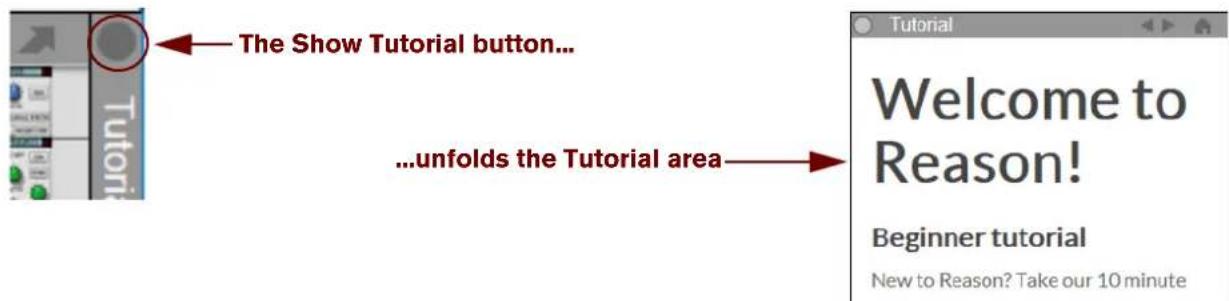
→ Click the Show Tutorial button to unfold the Tutorial area:
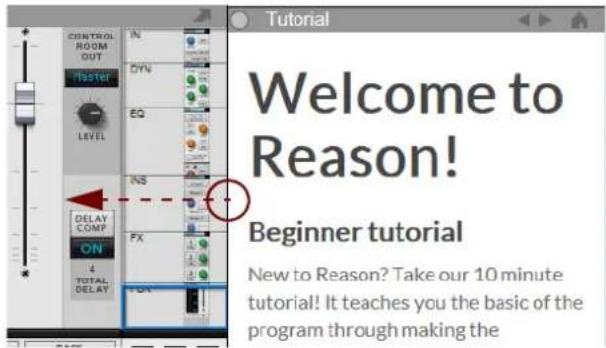
→Resize the Tutorial area to make it easier to view:
The Rack
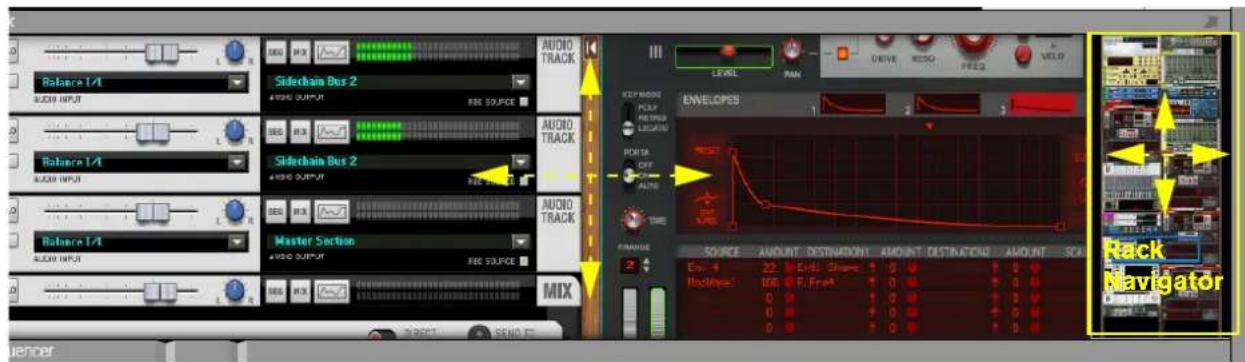
The Rack with two rack columns next to each other, and the Rack Navigator to the right.
In the Rack, all instruments, effects and mixer channel devices of the Reason Lite song are visible. You can scroll vertically and horizontally in the Rack by clicking and dragging the frame in the Rack Navigator. You could also click anywhere outside the frame in the Rack Navigator to immediately jump to the desired position. Alternatively, place the pointer on any of the wooden "side panels" in the rack, and click and drag in any direction. This way you will be able to access all devices in the rack.
- By pressing function key [F6], or by double clicking the gray Rack header, you can maximize the Rack area.
- To the right on the Rack header is the Detach Rack icon. Clicking this, or holding Ctrl or Cmd and pressing [F6], will detach the Rack and place it in a separate window.
This is especially useful if you are using multiple screens with your computer.
The Detach button for the Rack.
When you detach the Rack, the Transport Panel at the bottom of the Sequencer will be duplicated below the Rack in the new window. This way, you will be able to control the Sequencer transport functions without needing to change window. There is also a second instance of the Browser available to the left in the detached Rack. By pressing [F3] you can toggle between Show and Hide Browser in the detached Rack.
For more details on how to work with the Rack, refer to "Working with the Rack".
The Sequencer
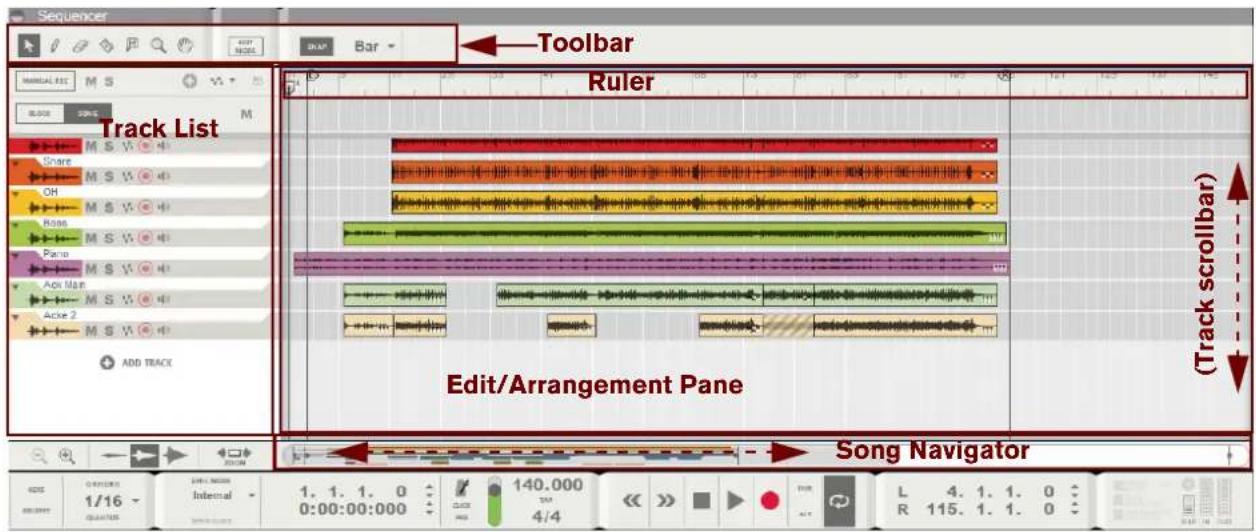
The Sequencer with a number of recorded audio tracks.
To the left in the Sequencer, all tracks in the Reason Lite song are listed in the Track List. By clicking on a track in the Track List you select the track for playback from a connected MIDI master keyboard and/or for recording.
At the top to the left is the Toolbar, with various sequencer editing tools.
The big center section of the Sequencer is called the Edit/Arrangement Pane. Here is where all recorded sequencer data is displayed.
You can scroll in the Sequencer (if necessary) by using the Track scrollbar to the right and the Song Navigator at the bottom of the Sequencer - see "Scrolling" and "Zooming in the Sequencer".
- By pressing function key [F7], or by double clicking the Sequencer header, you can maximize the Sequencer area.
For more details about the sequencer, refer to "Sequencer Functions".
The Transport Panel

At the bottom of the Reason Lite Song window is the sequencer Transport Panel. From here you control the sequencer transport functions, such as Rewind, Fast Forward, Stop, Play and Record. You can also set Tempo and Time Signature and various other parameters.
The Transport Panel is always available together with the Sequencer. If you have detached the Rack, a duplicate of the Transport Panel will be also present in the Rack window.
To the right on the Transport Panel are indicators for Audio In and Out levels, DSP Load, Disk Overload, Audio Calculation, Demo Mode and Automation Override status.
- The Transport Panel can be shown/hidden from the Windows menu.
For more details about the Transport Panel, please refer to "Transport Panel details".
The ReGroove Mixer

To the left on the Toolbar in the sequencer is the "Groove" button. Clicking this will bring up the ReGroove Mixer.
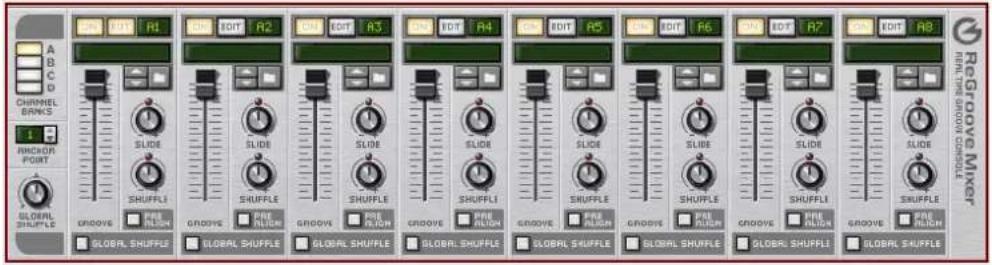
The ReGroove Mixer is used for adding advanced grooves to your instrument tracks in the Sequencer.
To hide the ReGroove Mixer, just click the "Groove" button again.
For more details about the ReGroove Mixer, please refer to "The ReGroove Mixer".
Navigating between the areas
By using the functions keys [F5], [F6] and [F7] you can quickly and easily navigate between the Main Mixer, Rack and Sequencer areas of the Reason Lite window.
→ Press [F5] to toggle between a maximized Main Mixer area and the previous view.
→ Press [F6] to toggle between a maximized Rack area and the previous view.
→ Press [F7] to toggle between a maximized Sequencer area and the previous view.
! If the Main Mixer and/or the Rack are detached in separate windows, you have to press [F5] to view the Main Mixer window, [F6] to view the Rack window and [F7] to view the Sequencer window. It's not possible to toggle between views/windows by repeatedly pressing the same function key.
It's also possible to press any of the [F5], [F6] and [F7] function keys simultaneously in different combinations to switch between combined area views. For example, pressing [F5] and [F6] simultaneously will bring up a combined maximized view of the Main Mixer and Rack areas in the Reason Lite window. The Sequencer area will then automatically become minimized
Pressing all three function keys simultaneously, or holding Ctrl or Cmd and pressing [F7], will bring up all areas together, equally sized.
! Note that using three function keys simultaneously is not supported on all computer keyboards.
! If the Main Mixer and/or the Rack are detached in separate windows, pressing any of the [F5], [F6] and [F7] keys in combination will automatically attach the corresponding (detached) window(s).
To select an area for editing etc., simply click anywhere in the desired area. The selected area will then be surrounded by a thin blue rectangle.
Showing/hiding the Navigators
Deselecting "Show Navigators" on the Options menu will hide the Channel Strip Navigator in the Main Mixer and the Rack Navigator in the rack.
Selecting "Show Navigators" will show the navigators again.
About different Themes
In Reason Lite you can choose from a couple of different visual themes, i.e. how the user interface should be visually presented. The selected theme affects the Sequencer, Browser and Transport Panel areas - the Rack and Main Mixer always use the default theme.
→ Select Preferences from the Edit menu (Win) or Reason Lite menu (Mac) and then choose the Theme in the Appearance section on the General tab:
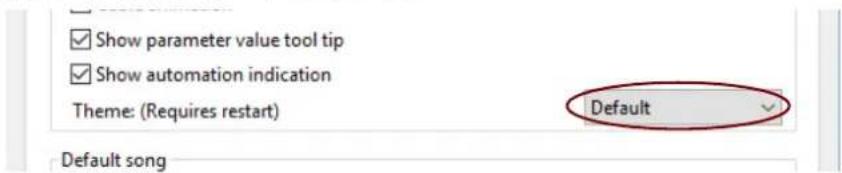
The selected Theme becomes active after restart of Reason Lite:
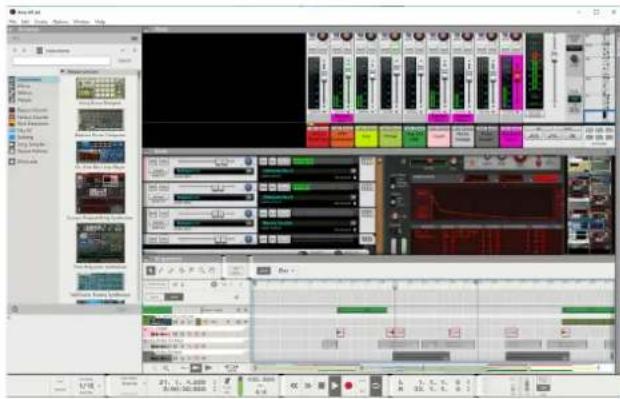
The "Default" theme.
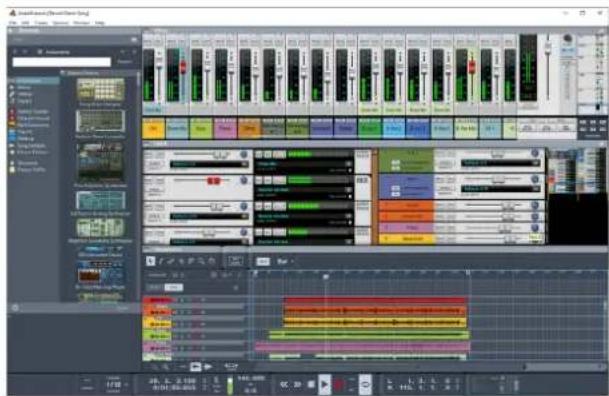
The "Blue" theme.
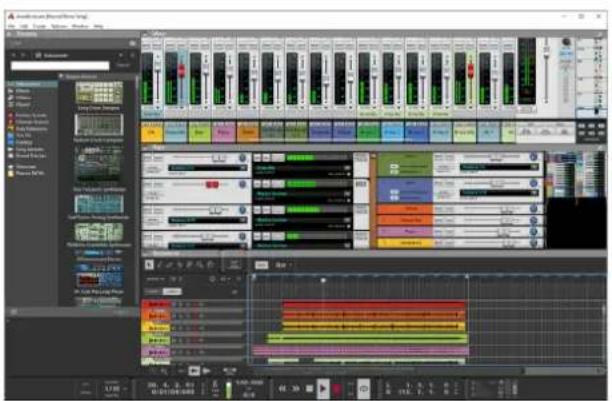
The "Dark" theme.
(The "Blue" and "Dark" theme screenshots are from Reason 10.)
Using several Reason Lite Song windows
You can have several Songs open at the same time. Each Song will appear in a separate Song window, complete with Main Mixer, Rack, Sequencer and Transport Panel. Each Song window can be moved, minimized and resized using the standard Windows and Mac procedures.
The Tool Window
The Tool Window is a floating window which features two tabs that contain functions for editing in the sequencer and for editing grooves for the ReGroove mixer. The Tool Window can be accessed from the Window menu.
Open the Tool Window by selecting "Show Tool Window" from the Window menu. Alternatively, press [F8]. The [F8] key can be used for toggling between showing and hiding the Tool Window.
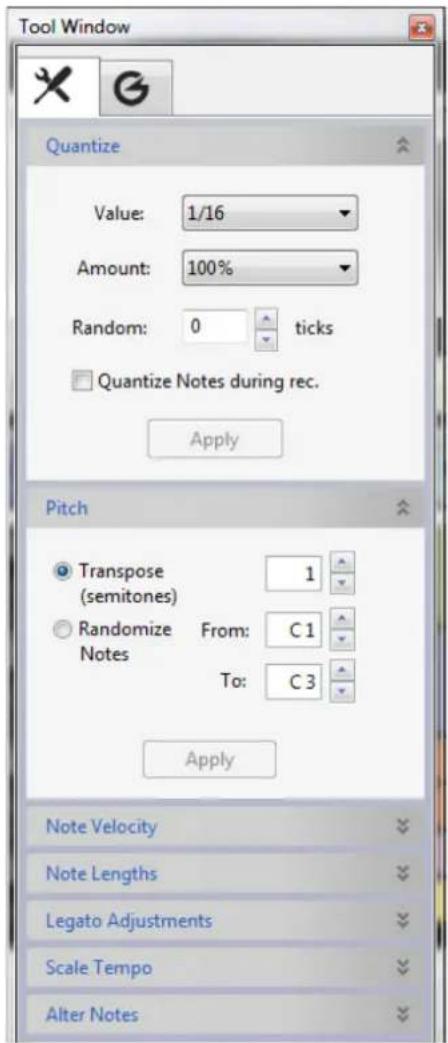
The Tool Window.
- See the "Note and Automation Editing" chapter for information on how to use the various functions of the "Sequencer Tools" tab.
• See "The ReGroove Mixer" chapter for information on how to use the functions of the "Groove Settings" tab.
The On-screen Piano Keys window
The On-screen Piano Keys floating window features a virtual keyboard which lets you play instrument devices without needing to have a MIDI master keyboard connected to your computer. The On-screen Piano Keys window can be accessed from the Window menu.
→ Open the On-screen Piano Keys window by pressing [F4], or by clicking the "Keys" button to the left on the Transport Panel. Alternatively, select "Show On-screen Piano Keys" from the Window menu.
The [F4] key can be used for toggling between showing and hiding the On-screen Piano Keys window.
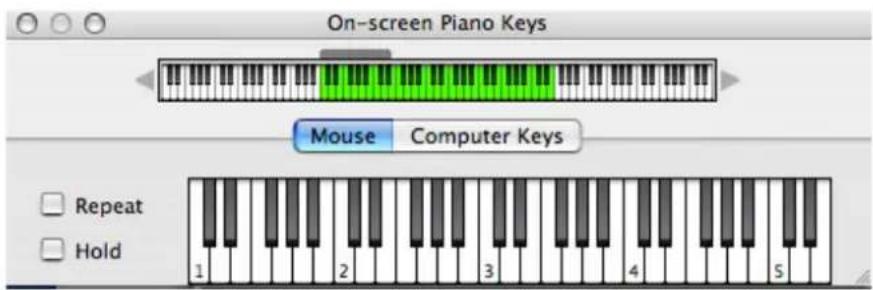
The On-screen Piano Keys window in "Mouse" mode.
See "On-screen Piano Keys" for more information.
General window techniques
Resizing
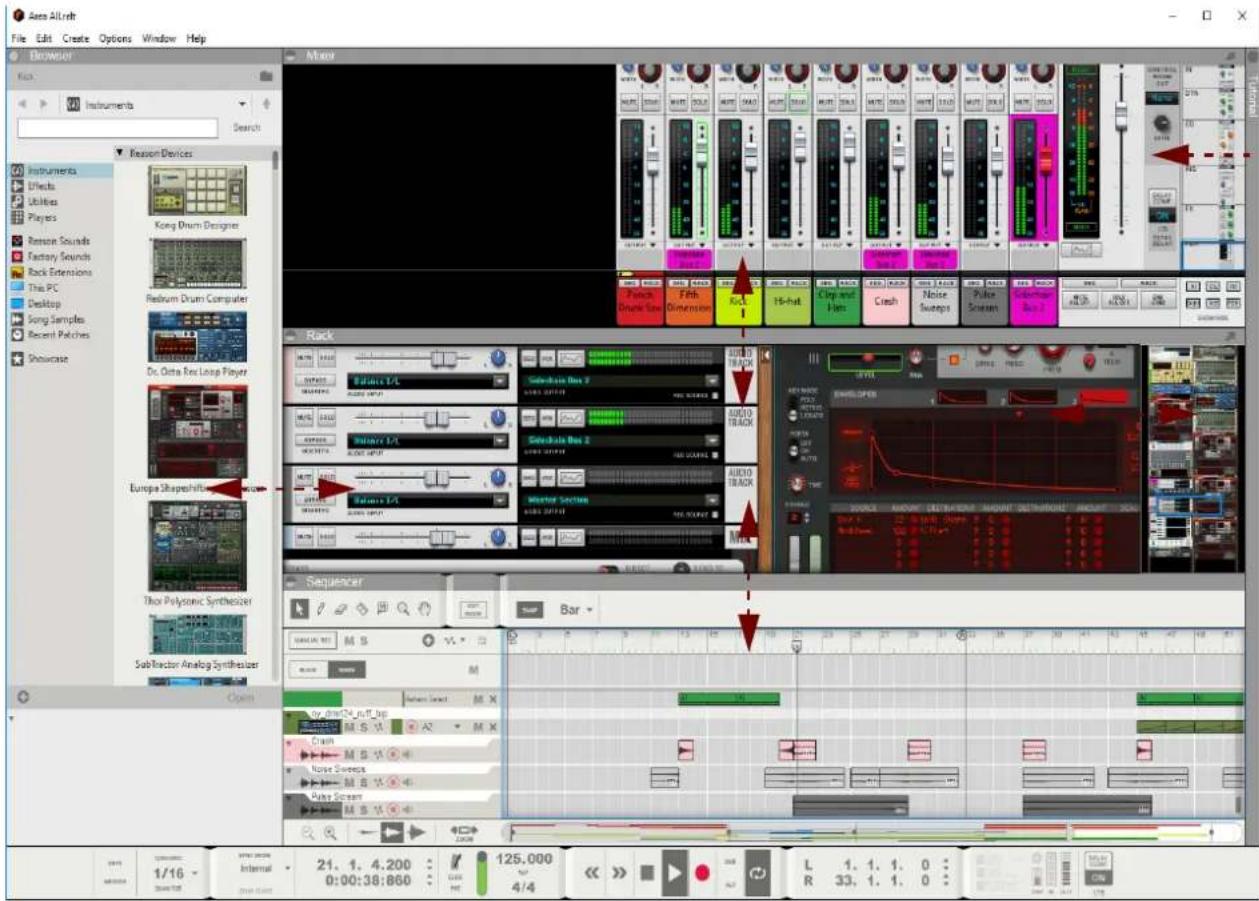
Adjustable headers in the Reason Lite Song window.
Between each area in the Reason Lite Song window are gray headers that separate the areas from each other. Some of the headers can be adjusted, making it possible to resize the areas. The horizontal dividers between the Main Mixer and Rack, and between the Rack and Sequencer can be adjusted, as well as the vertical dividers between the Browser and the other areas - and the divider to the left of the Rack Navigator in the Rack.
When you place the mouse pointer on these types of headers, the pointer changes to a double-arrow symbol. Clicking and dragging these headers makes it possible to resize the adjacent areas.
→ You can also click the circular button on the header of any of the areas to show/hide the corresponding area:
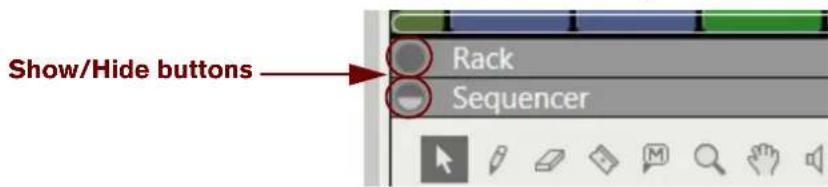
The Show/Hide buttons of the Rack and Sequencer areas.
Scrolling
Reason Lite offers a few different options for scrolling in the different areas.
Scrolling with the Navigators and scrollbars
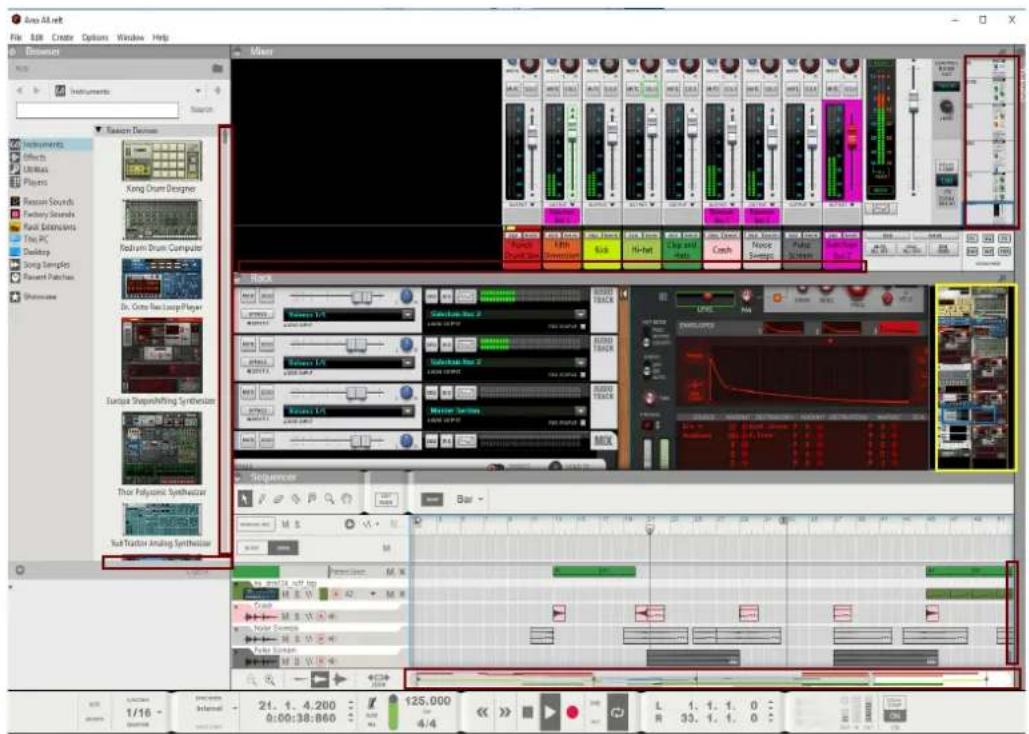
Navigators/scrollbars in a Reason Lite Song window.
Whenever there is information "outside" the visible screen area, you may want to scroll to the desired destination. The Reason Lite Song window features a number of Navigators that can be used for scrolling. Navigators are present in the Main Mixer, in the Rack and in the Sequencer.
The Main Mixer and the Sequencer have horizontal and vertical Navigators/scrollbars.
The Rack has only one Navigator which can be used for scrolling both vertically and horizontally (when using more than two rack columns next to each other). The Rack Navigator can also be resized by moving the vertical edge to the left of the Rack Navigator. Resizing the Rack Navigator will also resize the rack devices inside the Navigator, making them easier to distinguish.
To scroll with a Navigator, click anywhere inside the frame in the Navigator and drag the frame to the desired position.
As the pointer enters the frame, it automatically switches to a hand symbol.
→ Alternatively, click anywhere in the Navigator area to immediately jump to the desired position.
- At high zoom values in the Sequencer, you can hold [Shift] and drag the Song Navigator frame to scroll with greater precision.
Scrolling with the Hand tool
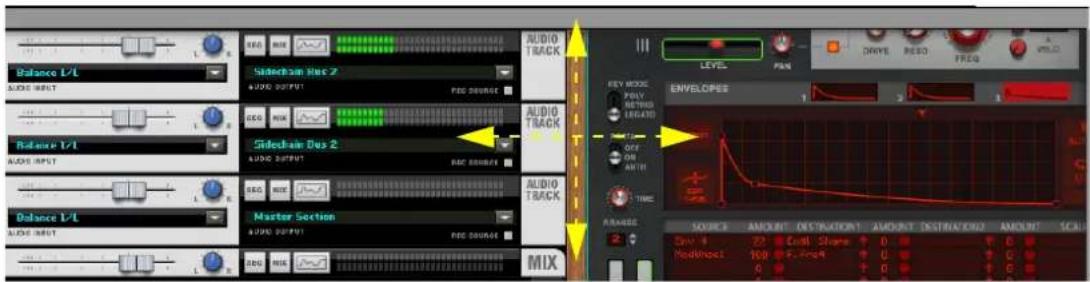
Scrolling with the Hand tool in the Rack.
In the Rack and Sequencer, you can also use the Hand tool for scrolling the view.
- In the Rack, place the pointer on either of the wooden side panels of a rack column.
The pointer will switch to a hand symbol.
- Click and drag the rack vertically and/or horizontally to scroll in the rack, as shown in the picture above.
If you are using only a single rack column, it's only possible to scroll vertically.
In the Sequencer you have to manually switch to the Hand Tool by selecting it from the sequencer Toolbar. With the Hand Tool selected, you can scroll in any direction on the Edit/Arrangement Pane. Refer to "Hand Tool" for more information.
Zooming in the Sequencer
In the Sequencer it's possible to zoom in and out horizontally using the Song Navigator. You can also use the Magnifying Glass Tool on the Sequencer Toolbar to zoom vertically - see "Magnifying Glass Tool". In addition to this, it's also possible to set a zoom level for the audio recordings inside the Audio Clips.
- See also "Scrolling and zooming using a wheel mouse".
Zooming vertically in the Sequencer
To zoom in vertically in the Sequencer arrangement, and thus increase the Track height, click on the "+" magnification button at the bottom of the Track List:
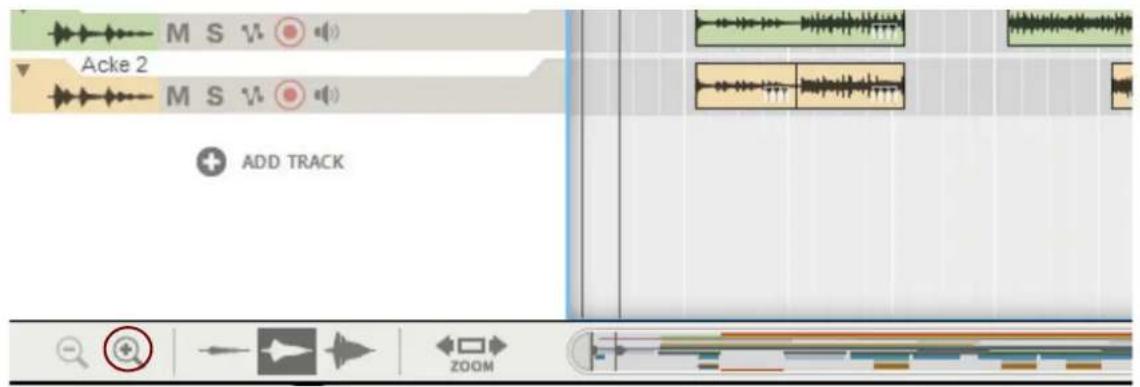
Increase the Track height by clicking the + magnification button at the bottom of the Track List.
→To zoom out vertically, click on the “-” magnification button.
- When the Sequencer is in Edit Mode, individual vertical zoom controls become available.
Waveform Zoom Mode

→ Choose between three zoom modes for the audio recording(s) inside all Audio Clips.
Using the Small Waveform Zoom Mode is especially useful if you have recorded with the Clip Safe function (see "Recording using the Clip Safe function in Propellerhead Balance") where the dynamic range can be quite wide.
! The zoom modes only affect the visual presentation of the waveform, not the audio levels.
Zooming horizontally in the Sequencer
You can also zoom in and out horizontally in the Sequencer by using the Song Navigator.

natural_image
Pure schematic lines without any text, numbers, or symbols→ To zoom in and out horizontally, click and drag a Song Navigator handle sideways.
The pointer changes to a double arrow symbol and you can now zoom in by resizing the Song Navigator Frame.
→ [Shift]-click on a Song Navigator handle and drag horizontally to zoom in and out symmetrically.
By right-clicking (Win) or [Ctrl]-clicking (Mac) inside the Song Navigator frame you can both scroll (drag sideways) and zoom (drag up or down) simultaneously.
Zooming to selection

natural_image
Technical diagram of a mechanical assembly with no visible text or symbols→ Click the Zoom To Selection button or press [Z] to do one of two things:
Zoom horizontally to fit the current selection (e.g. selected clips in the arrangement).
Zoom out horizontally to "Show All".
"Show All" happens if there is no selection, or if you are already zoomed in on the current selection (i.e. you can press Z repeatedly and go between zoomed in and zoomed out).
"Show All" means different things depending on the mode:
- If you're in Song mode, Show All = from the first clip to the last in song.
- If you're in Edit mode (with no open clip), Show All = all clips on this track.
- If you're in an open clip, Show All = see the whole clip.
→ Hold down [Shift] and click the Zoom To Selection button (or press [Shift]+[Z]) to zoom to the current selection both vertically and horizontally.
Scrolling and zooming using a wheel mouse
If you're using a mouse equipped with a scroll wheel, this can be used for the following scrolling and zooming operations:
Scrolling in the Main Mixer with a wheel mouse
→Spin the scroll wheel to scroll vertically in the Main Mixer.
→ Press [Shift] and spin the scroll wheel to scroll horizontally in the Main Mixer.
Scrolling in the Rack with a wheel mouse
→Spin the scroll wheel to scroll vertically in the Rack.
→ Press [Shift] and spin the scroll wheel to scroll horizontally in the Rack.
Note that the Rack must have at least two rack columns next to each other for this to work.
Scrolling in the Sequencer with a wheel mouse
→Spin the scroll wheel to scroll vertically on the Edit/Arrangement Pane.
→ Press [Shift] and spin the scroll wheel to scroll horizontally on the Edit/Arrangement Pane.
! Note that scrolling horizontally cannot be done when the Song Navigator frame is fully expanded.
Zooming in the Sequencer with a wheel mouse
→ Press Ctrl or Cmd and spin the scroll wheel to zoom in and out vertically on the Edit/Arrangement Pane.
→ Press [Ctrl]+Shift or [Cmd]+Shift and spin the scroll wheel to zoom in and out horizontally on the Edit/Arrangement Pane.
Editing parameters
Since a large part of Reason Lite is laid out like "real" hardware devices, such as the Main Mixer, instrument and effect devices etc., almost all controls are designed like their real world counterparts - mixer faders, effect unit knobs, transport buttons, etc. How to adjust these controls is described in the following paragraphs.
Knobs
To "turn" a knob, point at it, hold down the mouse button and drag up or down (as if the knob was a vertical slider).
Dragging upwards turns the knob clockwise and vice versa.
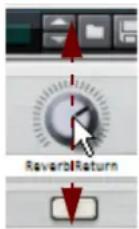
→ If you press [Shift] and drag, the knob will turn slower, allowing for higher precision.
You can also adjust the knob precision with the "Mouse Knob Range" setting on the General page in Preferences. This dialog is opened from the Edit menu (or from the Reason Lite menu if you are running macOS).
To reset a knob to its default value (usually zero, center pan or similar), press Ctrl or Cmd and click on the knob.
Faders and sliders
→ To move a fader or slider, click on the handle and drag in the fader/slider direction.
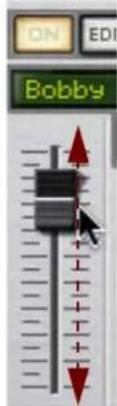
→ You can also click anywhere on the fader/slider to instantly move the handle to that position.
→ If you press [Shift] and drag, the fader/slider will move more slowly, allowing for higher precision.
To reset a fader/slider to its default value (usually zero, 100, center pan or similar), press Ctrl or Cmd and click on the fader/slider handle.
Buttons
Many functions and modes are controlled by clicking buttons. Many of the buttons in Reason Lite have a "built-in" LED, or the button itself lights up, indicating whether the button is on or not.
Fold/Unfold buttons
Fold/Unfold buttons are distinguished by a small triangle at the top to the left on a device. Clicking on a Fold/Unfold button will unfold the device panel so that more controls are visible and can be accessed for editing on the screen.
On some devices, such as the RV7000 Advanced Reverb, there are more than one Fold/Unfold button. Clicking on the second Fold/Unfold button on the unfolded front panel will open up the Remote Programmer panel from which more parameters can be accessed:
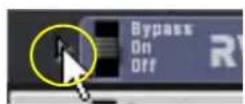
Click on the Fold/Unfold Button to unfold the front panel.

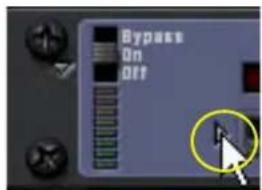
Click on the second Fold/Unfold Button on the unfolded panel to bring up the Remote Programmer.

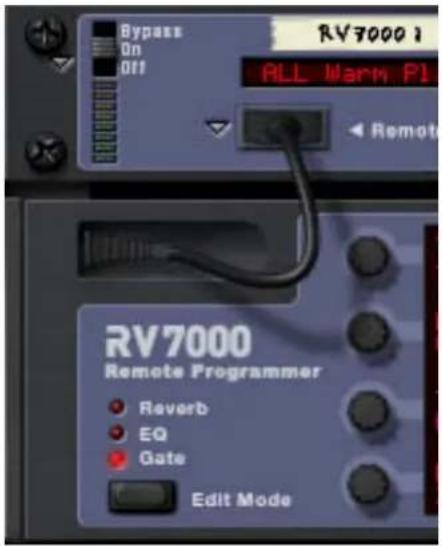
The Fold/Unfold buttons on an RV7000 Advanced Reverb device.
Multi Mode selectors
Some parameters allow you to select one of several modes. There are two different graphical representations of this in Reason Lite.
The multi mode selector type below consists of a button with the different modes listed above it:
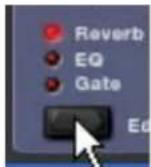
→ Click the button to step through the modes or click directly on one of the modes printed on the panel, or click on the corresponding LED, to select mode.
The currently selected mode is indicated by a lit LED.
The multi mode selector type below is a switch with more than two positions:
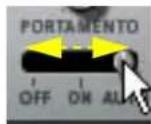
To change mode, click and drag the switch, or click directly at the desired switch position (just as when adjusting a slider).
Numerical controls
In Reason Lite devices, numerical values are often displayed in numerical displays with "spin controls" (up/down arrow buttons) on the side. Some parameter values, such as oscillator and LFO waveforms, are displayed graphically in the displays. There are two ways of changing values in these types of controls:
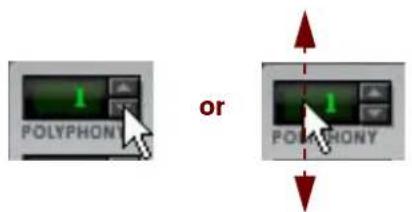
→By using the up and down buttons on the spin controls.
To adjust a value in single steps, click on its up or down arrow button. To scroll a value continuously, click on an arrow button and keep the mouse button depressed.
→ By clicking and holding the mouse button depressed in the actual display and then dragging the mouse up or down.
This allows you to make coarse adjustments very quickly.
Alpha-numeric controls
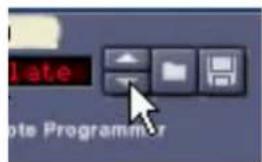
In Reason Lite, alpha-numeric values and/or device presets are displayed in alpha-numeric readouts with "spin controls" (up/down arrow buttons) on the side. There are two ways to change alpha-numeric/preset values:
or
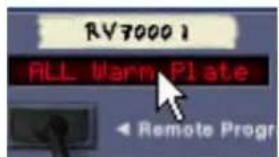
→By using the up and down buttons on the spin controls.
To adjust a value or select a preset in single steps, click on the up or down arrow button. To scroll a value continuously, click on an arrow button and keep the mouse button depressed.
→ By clicking and holding the mouse button depressed in the actual alpha-numeric display and selecting from the list that appears.
This allows you to make coarse adjustments very quickly or to immediately change to a preset anywhere in the list.
This type of control is used to select, e.g., patch and reverb algorithms and some oscillator waveforms.
Numerical segment displays
In the numerical segment displays on the sequencer Transport Panel and in the sequencer Inspector, values can be edited in a number of different ways. The editing principle is exactly the same for the Transport Panel and Inspector displays, which is shown in the two examples below.
Transport Panel segment displays
The segment displays of the Transport Panel can be edited as shown in the following Tempo display examples. The Tempo display segments show (from left to right) BPM and 1/1000 BPM:
Click on the left display segment to select the "whole BPM" value. Then, either click and drag up or down or use the mouse scroll wheel to change tempo in steps of 1 BPM. You can also use the [Up]/[Down] arrow keys on the computer keyboard to change the value.
Alternatively, type in the new tempo and press [Enter] on the computer keyboard.
You can also type in a number preceded by [+] or [-] to add or subtract the number from the current tempo value. Then, press [Enter] on the computer keyboard.
Click on the right display segment to select the "1/1000 BPM" value. Then, either click and drag up or down or use the mouse scroll wheel to change tempo in steps of 1/1000 BPM. You can also use the [Up]/[Down] arrow keys on the computer keyboard to change the value.
Alternatively, type in the new tempo and press [Enter] on the computer keyboard.
You can also type in a number preceded by [+] or [-] to add or subtract the number from the current tempo value. Then, press [Enter] on the computer keyboard.
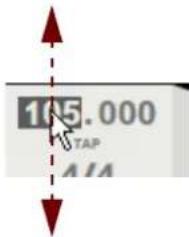
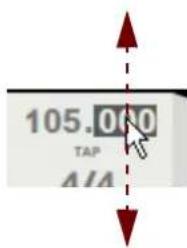
Double-click on the display, type in the new tempo and press [Enter] on the computer keyboard.
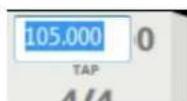
The other segment displays on the Transport Panel can be edited in the same way as described above. Some displays also features up/down arrow buttons.
Inspector segment displays
The segment displays in the Inspector can be edited as shown in the following Position display examples. The Position display segments show (from left to right) Bars, Beats, 1/16th Note and Ticks:
Click the up/down buttons to change the value in steps of 1 Bar (the leftmost segment).
Click in the display to select either the Bar, Beat, 1/16th note or Ticks segment. Then, click the up/down buttons to change the value of the selected segment in steps of 1 unit.
Click in the display to select either Bar, Beat, 1/16th note or Ticks. Then, click and drag the cursor up/down to change in steps of 1 unit. Alternatively, change the value with the mouse scroll wheel. You can also use the [Up]/[Down] arrow keys on the computer keyboard.
Click in the display to select either Bar, Beat, 1/16th note or Ticks. Then, type in a number and press [Enter].
Alternatively, select a segment, type in a number preceded by a [+] to add or a [-] to subtract the number from the current value. Then, press [Enter].
Double-click in the display. Then, type in the desired value and press [Enter].
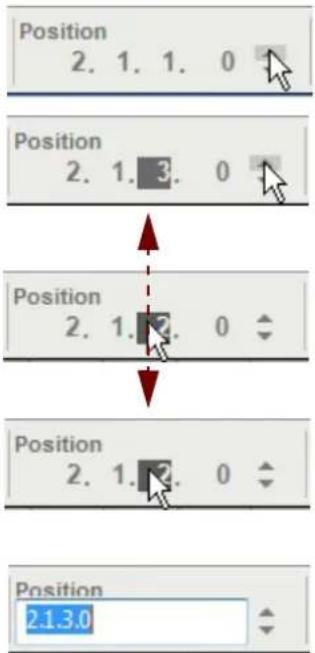
The other segment displays in the sequencer Inspector can be edited in the same way as described above.
Tool Tips
If you hover with the mouse over a control on a device panel and wait a moment, a tool tip appears. The tool tip shows the name of the parameter associated with that control and its current value. This helps you fine-tune settings, set several parameters to the same value, etc.
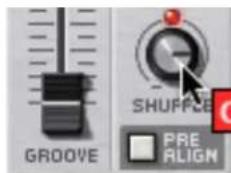
Channel A1 Shuffle: 66%
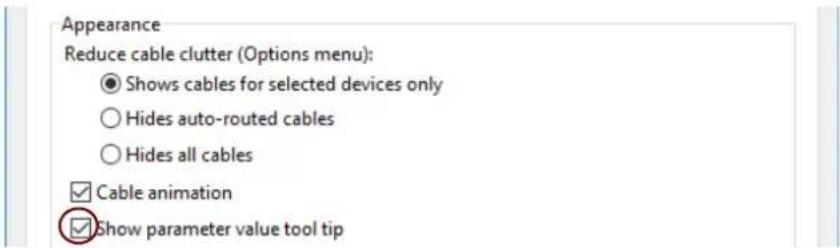
→ You can turn off the Tool Tips function by deactivating the option "Show parameter value tool tip" in the "Appearance" section on the General page in Preferences.
Context menus
Context menus are "tailored" to contain only menu items that are relevant to the current circumstances. Using the various context menus allows you to work more quickly and more efficiently with Reason Lite.
To bring up a context menu, right-click (Win) or [Ctrl]-click (Mac) on the desired object, section or area in Reason Lite.
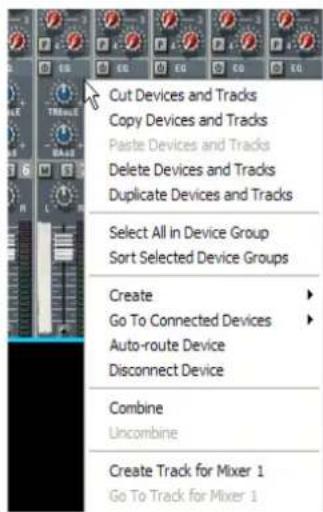
The Mixer 14:2 device panel context menu
If you are using a Mac with a two button mouse, you may want to set this up so that clicking the right mouse button generates a [Ctrl]-click. This way, you can right-click to bring up context menus.
The contents of the context menus depend on where you click. These are the primary types of context menus you will encounter in Reason Lite:
Parameter context menus
If you click on an automatable control (a mixer parameter, a device parameter, a fader, etc.), the context menu will contain the following items:
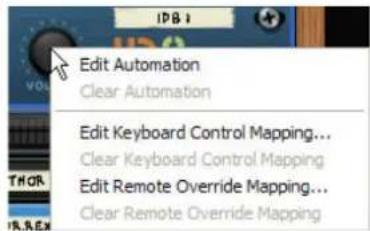
- Functions for editing and clearing the recorded automation data for the control.
- Functions for associating computer keyboard commands and/or MIDI messages to the parameter. This allows you to remote control parameters from a MIDI device or from the computer keyboard.
Device context menus
If you click anywhere on a device in the Rack (but not on a parameter or display), the context menu will contain the following items:
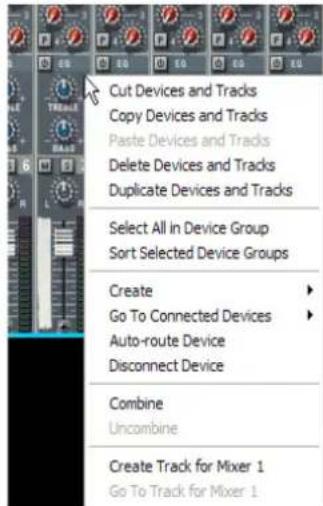
The Mixer 14:2 device panel context menu
- Cut, Copy, Paste, Delete and Duplicate Device and Track items, allowing you to rearrange and manage the devices in the rack.
- Commands for managing Device Groups.
- A duplicate of the Create menu, allowing you to create new devices.
- A "Go To" sub-menu, listing all devices connected to the current device.
Selecting a device from the Go To sub-menu scrolls the rack to bring that device into view.
• Auto-routing and Disconnect functions.
This allows you to automatically route (connect) or disconnect a selected device in a logical way.
- Combine and Uncombine are used when you want to use the selected device in, or exclude it from, a Combinator setup.
- A Browse Instruments item which lets you browse for sounds for a selected Instrument device.
This item is available only for Instrument devices.
• Additional device-specific items.
If the device is pattern-based, there will be various pattern functions (Cut/Copy/Paste, Clear, Shift, Randomize, etc.). These affect the currently selected pattern in the device.
If the device uses patches, there will be functions for managing patches.
Depending on the device there may also be various device-specific functions available. For example, the drum machine device has functions for manipulating the pattern for the selected drum sound only, etc.
- "Create Track for..." and "Delete Track for..." are used if you want to create a Sequencer Track for the selected device, or delete the Sequencer Track used for the device without deleting the actual device.
- The "Go To Track for ..." will scroll the corresponding Sequencer Track into view in the Sequencer.
- The "Lock Control Surface to this Device" lets you lock a connected control surface to the selected device.
- The "Track Color" item lets you select color for the associated Sequencer Track (and Main Mixer channel strip, if the selected device is an Audio Track device).
Main Mixer channel strip context menu
If you click anywhere on a channel strip in the Main Mixer (but not on a parameter or display), the context menu will contain the following items:
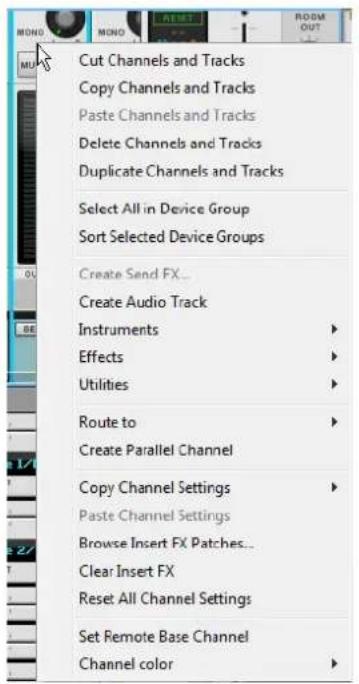
The Channel Strip context menu.
- Cut, Copy, Paste, Delete and Duplicate Channels and Track items, allowing you to rearrange and manage the channel strips in the Main Mixer.
- Commands for managing Device Groups.
- The "Create Send FX" lets you browse for an effects device, or Effect Combi patch, to connect and use as a send effect.
The send effect will be automatically connected to the first available Send FX connectors of the Master Section device in the Rack.
- A duplicate of the Create menu, allowing you to create new devices.
- "Route to" lets you create and connect to an Output Bus for sub-mixing.
- "Create Parallel Channel lets you create and connect to an additional channel for parallel processing.
- The "Copy Channel Settings" item lets you copy groups of settings for the selected channel strip.
The groups that can be selected are: "Dynamics", "Filters and EQ", "Insert FX", "FX Sends" and "All".
- The “Paste Channel Settings” item appears if you have previously copied any channel settings and want to paste these to the selected channel strip.
- The "Browse Insert FX Patches" lets you browse for, and load, Effect Combi patches to the Insert FX section.
- The "Clear Insert FX" lets you delete any Insert Effects devices used in the channel.
- The "Reset All Channel Settings" resets all channel strip parameters to their default values.
It also automatically removes any used Insert FX devices from the channel strip.
- The "Set Remote Base Channel" item lets you set the remote base channel to the selected channel strip.
This is useful when you remote control channel strips from a control surface via MIDI.
- The "Lock Control Surface to this Device" lets you lock a connected control surface to the selected channel strip.
- The "Channel Color" item lets you select color for the Main Mixer channel strip (and the associated Sequencer Track, if the selected channel has a track in the sequencer).
Rack "background" context menu
If you click in an empty area of the rack, the context menu will contain the following items:
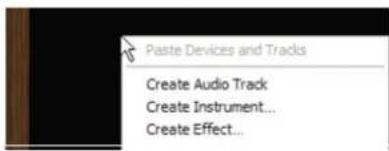
- A Paste Devices and Tracks item, allowing you to paste any copied or cut devices and tracks.
- A duplicate of the Create menu, allowing you to create new devices.
Main Mixer "background" context menu
If you click in an empty area of the Main Mixer, the context menu will contain the following items:
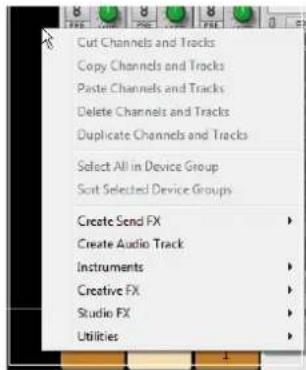
- A duplicate of the Create menu, allowing you to create new devices.
- The "Create Send FX" lets you browse for an effects device, or Effect Combi patch, to connect and use as a send effect.
The send effect will be automatically connected to the first available Send FX connectors of the Master Section device in the Rack.
Sequencer context menus
If you click in the Sequencer, the context menus will contain items related to editing tracks, clips and events. The available items will differ depending on in which section or lane you click (Track List, note lane, etc.), and depending on whether you click on a note or automation event or not.
For example, the sequencer context menus contain functions for inserting or removing bars, deleting tracks, changing or deleting note and automation events.
Undo and Redo
Virtually all actions in Reason Lite can be undone. This includes creation, deletion and reordering of devices in the rack, parameter value adjustments, recording and editing in the sequencer etc. You can undo hundreds of actions.
To undo the latest action, select "Undo" from the Edit menu, or hold down Ctrl or Cmd and press [Z].
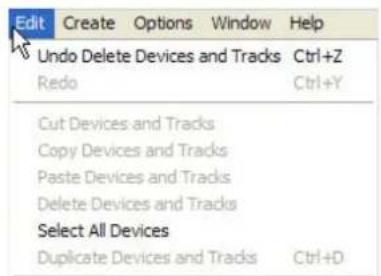
The action to be undone is indicated next to the Undo command on the Edit menu. For example, if your latest action was to delete some device(s) from the rack, the Edit menu will display "Undo Delete Devices and Tracks".
To redo the last undone action ("undo the undo operation"), select "Redo" from the Edit menu, or hold down Ctrl or Cmd and press [Y].
Similarly, the action to be redone is shown on the Edit menu.
About multiple Undos and Redos
The concept of multiple undos may require an explanation.
Let's say you have performed the following actions:
- Created a Mixer device.
- Created a synth device.
- Adjusted the Attack parameter of the synth device.
- Changed the panning for the synth device in the Mixer.
- Adjusted the playback tempo on the Transport Panel.
After these five actions, the Undo History will look as follows:
UNDO
- Adjust tempo
- Change pan
- Adjust Attack
- Create Synth Device
- Create Mixer Device
If you now select Undo, your latest action (the tempo change) will be undone, and moved to a "Redo list":
UNDO
REDO
- Change pan
- Adjust Attack
- Create Synth Device
- Create Mixer Device 5. Adjust tempo
Selecting Undo again undoes the next action in the list (the panning adjustment):
| UNDO | REDO |
| 3. Adjust Attack | |
| 2. Create Synth Device 4. Change pan | |
| 1. Create Mixer Device 5. Adjust tempo | |
If you now select Redo, the most recently undone action will be redone. In this case, your panning adjustment will be performed again (and added to the Undo History again):
| UNDO | REDO |
| 4. Change pan | |
| 3. Adjust Attack | |
| 2. Create Synth Device | |
| 1. Create Mixer Device 5. Adjust tempo |
At this point, you still have the option to Redo the tempo change. But if you instead perform another action (e.g. change the level of the synth device in the mixer), this would become the action at the top of the Undo History - and the Redo list would be cleared.
| UNDO | REDO |
| 5. Change level | |
| 4. Change pan | |
| 3. Adjust Attack | |
| 2. Create Synth Device | |
| 1. Create Mixer Device (Empty) |
You can no longer redo the "undone" tempo change!
Chapter 3
On-screen Piano Keys
About this chapter
This chapter describes the functions of the On-screen Piano Keys window.
The On-screen Piano Keys window enables you to play instrument devices using either your mouse or computer keyboard. This provides a simple and convenient way to input notes or chords when using the program without an attached MIDI master keyboard.
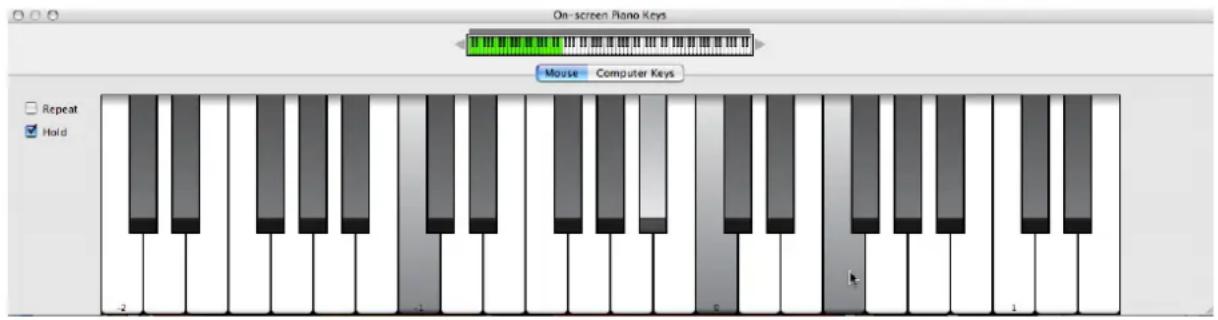
Using the On-screen Piano Keys
Opening the Piano Keys window
To open the window, press [F4] or select "Show On-screen Piano Keys" from the Windows menu - or click the Keys button to the left on the sequencer Transport Panel.
Like the Tool window, the On-Screen Piano Key window "floats" on top of other windows, remaining visible most of the time.
- You can choose between two basic operational modes to enter notes; "Mouse" or "Computer Keys".
Mouse Mode is for entering notes with the mouse, and Computer Keys Mode for using the computer keyboard to enter notes. The two modes are described separately below.
The respective buttons in the middle of the window are used to switch modes.
Mode buttons.
- Regardless of mode, the On-screen Piano Keys window always follows Master Keyboard input.
This means that the Piano Keys will trigger the device associated with the track that has Master Keyboard Input. The Piano Keys input is merged with any attached keyboard/control surface input so you can use both simultaneously.
- The available note range is 10 octaves (C -2 to E 8).
- When the On-screen Piano Keys window is in Mouse mode, you can resize it by clicking and dragging the window frame according to standard procedures.
This is especially useful in "Mouse" mode, since you can adapt the window to show the desired note range.
The Keyboard Navigator
This is present in both modes and shows the total key range. The green area indicates the key range available in the On-screen Piano Keys window.
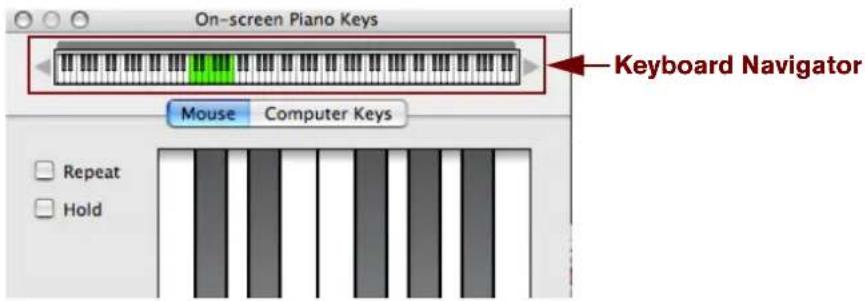
Keys that produce sound are indicated by a gray strip above the keyboard in the Keyboard Navigator. This is useful when playing a patch where only certain keys or key ranges produce sound, e.g. a REX file or a sampler patch.

Setting Octave range
There are several ways to set the Octave range:
→ Click the arrow buttons on either side of the Keyboard Navigator.
Each click will shift one octave up or down.

→Click and drag the green key range area in the Keyboard Navigator.
The current octave number is always shown for the leftmost key - by default the [A] key on the computer keyboard.
Mouse mode
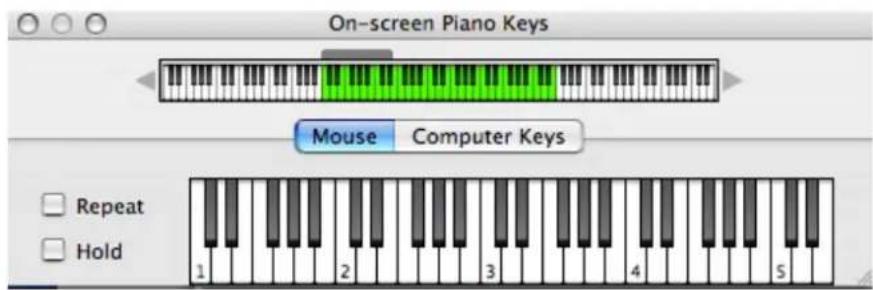
When Mouse Mode is selected, the Piano Keys window will show a standard piano keyboard.
→To enter notes, simply click on the keyboard with your mouse.
As described above, the record enabled track governs what instrument device is played.
→ The keys are velocity sensitive. The higher up on the key you click, the lower the velocity and vice versa.
The velocity range is between 40 and 127.
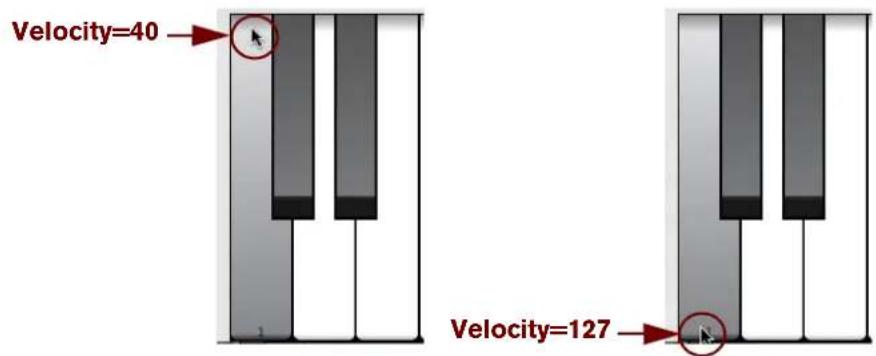
Low and high note velocities.
→ The keyboard octave range can be set using the arrow buttons at each side of the navigator keyboard.
Each C key is labeled with the octave number. You can also simply drag the green key range area to where you want. It will snap to octave ranges.
→In Mouse Mode, the keyboard can be resized both vertically and horizontally.
Resizing horizontally extends or diminishes the key range. By resizing the window vertically you change the key size for the keyboard, as well as the key range.
Adding sustain
If you press [Shift] when entering notes, the notes will sustain, just like when using a sustain pedal.
Repeat and Hold functions
→ The Repeat function will continuously repeat the last clicked note as quarter notes with a quarter note pause in between (at the current tempo).
This feature can be useful when tweaking synth parameters or browsing for patches. It is activated/deactivated by checking/unchecking the box.
→ The Hold function will keep any keys you click on pressed down for as long as Hold is active.
Hold is activated/deactivated by checking/unchecking the box.
Computer Keys mode
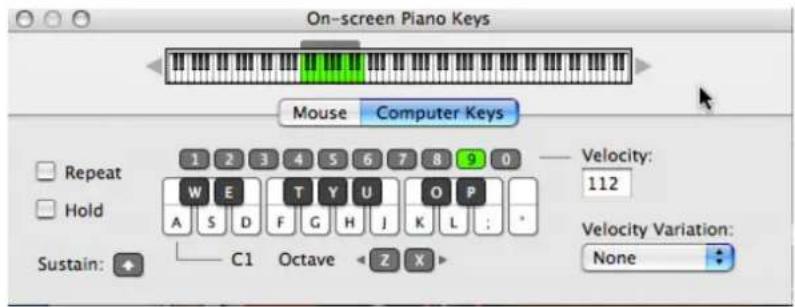
When Computer Keys Mode is selected, the On-screen Piano Keys window shows a graphic (partial) representation of a computer keyboard. The window cannot be resized in this mode.
→In Computer Keys Mode you can play notes and chords using your computer keyboard.
The Computer Keys keyboard range is fixed to 18 notes (from C to F), although the octave range will give you access to any notes within the ten octaves shown in the navigator. You can also click on the keys with your mouse to trigger notes. The numerical keys in the top row are not used to enter notes but to set velocity, see "Velocity".
→ The default layout of the Computer Keys logically reflects the layout of a piano keyboard's black and white keys.
The first (leftmost) key represents C and so on up to F an octave above. By default, the [A]-key will play the first C, the [W]-key a C# and so on, according to piano keyboard standards. If you wish, you can customize the note to key assignment in the Preferences - Advanced page (see "Preferences - Advanced").
Octave range
→ Press [Z] or [X] on your computer keyboard to shift one octave down or up, respectively.
There are also "Z" and "X" Octave buttons in the On-screen Piano Keys window that function in the same way.
See "Setting Octave range" for more ways of changing the Octave range.
Repeat and Hold functions
See "Repeat and Hold functions".
Adding sustain
→ Press [Shift] when entering notes to make the notes sustain, just like when using a sustain pedal.
There is also a Sustain button in the On-screen Piano Keys window that has the same functionality.
Velocity
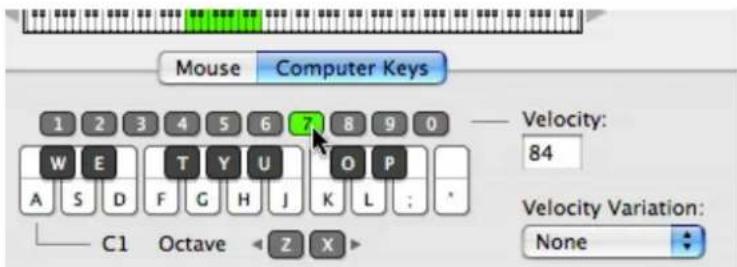
In Computer Keys Mode, note velocity for notes you enter is set using the numerical keys in the top row. The currently set value is also shown in the Velocity value field. The numerical keys correspond to the following velocity values:
| Numerical key | Velocity value |
| 1 | 1 |
| 2 | 14 |
| 3 | 28 |
| 4 | 42 |
| 5 | 56 |
| 6 | 70 |
| 7 | 84 |
| 8 98 (default) | |
| 9 112 | |
| 0 127 |
Velocity Variation
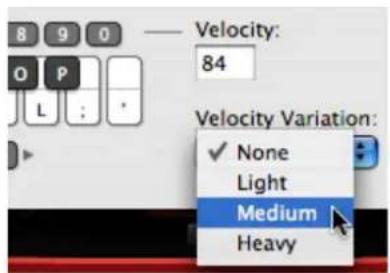
This feature will randomly vary the velocity values for the notes you enter. There are four modes; None (default), Light, Medium and Heavy. The degree of velocity variation is as follows.
| Item | Variation |
| None (default) 0 | |
| Light +/- 5% | |
| Medium +/- 10% | |
| Heavy +/- 25% |
Chapter 4
Audio Basics
About this chapter
This chapter contains some useful information about how audio is handled by Reason Lite and how the audio is routed. Some of it may seem a bit technical, but we recommend that you read it to get the most out of Reason Lite.
How Reason Lite communicates with your audio hardware
Reason Lite receives, generates and plays back digital audio - a stream of numerical values in the form of ones and zeroes. For you to be able to record and play back anything, the audio must be converted from analog to digital when recording, and from digital to analog when playing back through some kind of listening equipment (a set of speakers, headphones, etc.).
This conversion is most often handled by the audio card installed in your computer, or by an external audio interface connected via USB or FireWire. To achieve the best possible performance, Reason Lite requires that the audio card uses an ASIO driver on Windows systems. On macOS systems, Reason Lite supports Core Audio.
To receive and deliver digital audio to the computer's audio hardware, Reason Lite uses the driver you have selected in the Preferences dialog. In the Rack on screen, this connection is represented by the Hardware Interface (also known as the Hardware Device):

The Hardware Interface is always located at the top of the rack.
The Hardware Interface contains 64 input and 64 output "sockets", each with an indicator and a level meter. There are also two Sampling Inputs that can be used for sampling audio to sampler devices. 16 input and 16 output sockets are shown on the main panel, and an additional 48+48 sockets are shown if the "More Audio" button is activated on the main panel. Each one of these indicators represents a connection to an input or output on your hardware audio interface.
However, the number of available inputs and outputs depends on the number of inputs and outputs on your hardware audio interface. For example, if you are using a standard sound card with stereo inputs and outputs, only the first two inputs and outputs will be available. In the Hardware Interface, the indicators are lit green for all currently active and connected inputs and outputs. Activation of inputs and outputs on your hardware audio interface is done on the Audio page in the Preferences dialog (see "Active input and output channels").
Inputs and outputs that are currently connected have green indicators. Available but un-connected inputs and outputs have yellow indicators and any connections made to unavailable inputs and outputs have red indicators.

In this case, Inputs 1 and 2 are available, but not connected, Outputs 1 and 2 are available and connected, whereas Output 3 is unavailable, but connected on the back of the Hardware Interface.
! You never have to connect any cables to the Audio In jacks of the Hardware Interface to be able to record audio on sequencer tracks. This routing is made internally "in the background", which means you just have to select audio interface inputs from the Audio Input drop-down list - see "Selecting audio input(s) and defining mono or stereo".
Manual audio routing
In most cases, you will want to have the Main Mixer Master Section device connected to outputs 1 and 2 of the Hardware Interface. This connection is made automatically as soon as you create a new Song document. However, there might be situations where you want to manually route audio to other outputs of the Hardware Interface. For example if you want to use the Control Room Outputs of the Main Mixer (see "Control Room output section").
To send the sound of a device in the Rack to a specific output, you route the device output to the corresponding Output jack on the Hardware Interface. This is done by using the patch cables on the back of the rack, as described in "Manual routing". If we flip the rack around, by pressing the [Tab] key, the Hardware Interface looks like this:

On the rear of the Hardware Interface, Inputs 1 and 2 are available but not connected, Outputs 1 and 2 are available and connected, whereas Output 3 is connected but unavailable.
! You never have to connect any cables to the Audio In jacks of the Hardware Interface to be able to record audio on sequencer tracks. This routing is made internally "in the background", which means you just have to select audio interface inputs from the Audio Input drop-down list in the sequencer Track List - see "Selecting audio input(s) and defining mono or stereo".
Audio quality
The audio quality in a computer based recording system depends on two things:
• The quality of the software calculating the audio.
In our case, this is the Reason Lite DSP (Digital Signal Processing) code.
- The quality of the hardware audio interface used for recording and playing back the sound.
Software
- Reason Lite uses 32-bit floating point arithmetic for all internal audio operations, with 64-bit summing in the mix bus in the Main Mixer Master Section.
This ensures the highest possible audio quality throughout the entire signal chain.
- Reason Lite supports 16, 20, and 24 bit resolution for input and output audio.
- Reason Lite supports all standard sample rates between 44.1 kHz and 192 kHz.
Reason Lite also supports lower sampling frequencies, but using a sample rate of less than 44.1 kHz is not recommended since it might affect the audio quality negatively.
- A number of digital audio techniques that reduce the risk of "aliasing", background noise, unwanted distortion and "zipper noise" are implemented in Reason Lite.
Audio hardware
How good a hardware audio interface actually sounds depends on a number of things; its frequency range and frequency response curve, the resolution (bit depth), the signal to noise ratio, the distortion under various circumstances, etc. Furthermore, some designs are more prone to disturbance from the other electronics in the computer than others. Such disturbance might add hum or high pitched noise to the signal.
The only advice we can give is that if you are serious about sound, choose your audio hardware carefully!
Audio settings
Sample rate and resolution are properties of digital audio which determine the quality of the sound. Generally, higher sample rate and resolution result in better audio quality (but also larger audio files and higher demands on computer performance and audio hardware). The table below shows some common sample rate/resolution combinations:
| Sample rate: | Resolution: | Comment: |
| 44.1 kHz 16 bit This is the format used on standard audio CDs. | ||
| 44.1 kHz – 192 kHz | 24 bit These are formats used in professional studios and high-end recording equipment. | |
To cater for all different situations, Reason Lite supports multiple sample rates and resolutions.
Sample Rate settings for recording and playback
Reason Lite handles all internal audio processing in 32-bit floating point resolution, with 64-bit summing in the mix bus in the Main Mixer Master Section. However, the resolution of the input and output audio is determined by the hardware audio interface. That is, if you have a 24-bit audio card, Reason Lite will record and output audio in 24-bit resolution, and if you have a 20-bit audio card, audio will be recorded and played back in 20-bit resolution.
The recording and playback sample rate can be specified on the Audio tab in the Preferences dialog (accessed from the Edit menu (Win) or Reason Lite menu (Mac)):
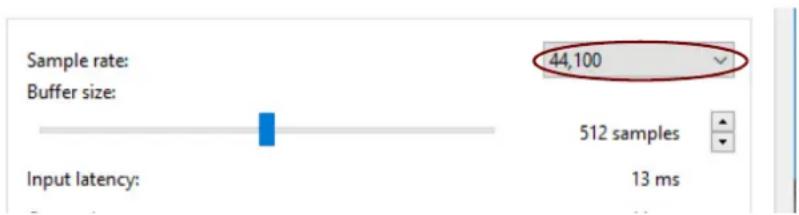
→ Select the desired sample rate from the drop-down menu.
Note that the available options on this pop-up menu depend on which sample rates are supported by the audio hardware.
! Reason Lite supports multiple sample rates in the same song!
Reason Lite allows import (or recording) of audio of any sample rate. If the original sample rate of a recording is different than the rate currently set for the audio card, Reason Lite will automatically do a sample rate conversion.
First, a real-time sample rate conversion algorithm is used (allowing the audio to be played back immediately). Meanwhile, in the background, the program calculates a sample rate conversion of the highest quality, which will be used as soon as it is calculated. The CALC progress indicator on the transport panel lights up whenever the program is doing high quality calculations in the background:
The CALC progress indicator on the Transport Panel appears when Reason Lite performs high quality audio calculations.
Buffer Size settings
The Buffer Size can be adjusted on the Audio tab in the Preferences dialog (accessed from the Edit menu (Win) or Reason Lite menu (Mac)):

→ Select Buffer Size by clicking and dragging the slider sideways.
The trick here is to find the optimum relationship between audio quality, DSP Load and latency. Experiment with different Sample Rate settings in combination with different Buffer Size settings to get the best result.
A professional audio interface used together with a state-of-the-art computer should normally be able to handle a combination of a high sampling frequency (96 kHz) and a small Buffer Size (64-128 samples) without problems. A budget priced audio interface normally requires a lower sampling frequency (44.1 kHz) in combination with a little higher Buffer Size (256-512 samples).
See "About latency" for more information about buffer size and latency. Also see "About audio rendering using the audio card buffer size setting" below for information on how to improve the DSP performance.
About MultiCore Audio Rendering
Reason Lite fully supports multicore audio rendering. This means that if your computer has multiple CPU Cores (Quad Core, for example), or multiple CPUs, Reason Lite takes advantage of this to significantly enhance the performance. A higher system performance allows for more tracks and devices in your songs.
If your computer has a multi-core CPU, or multiple CPUs, MultiCore Audio Rendering is active by default, as indicated on the "Audio" tab in Preferences:

- Also try the "Use hyper-threading audio rendering" to see if this improves the performance even further.
About audio rendering using the audio card buffer size setting
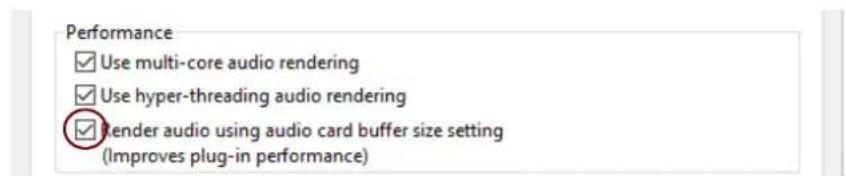
The "Render audio using audio card buffer size setting" function should be selected (checked) for best plugin performance. When selected, the audio batches are rendered internally according to the set Buffer size (see "Buffer Size settings" above). For example, if you have a Buffer size of 512 Samples, each audio batch will be 512 samples internally. Raising the Buffer size will let Reason Lite process larger audio batches in one go, which is often more efficient. Many plugins are also more efficient when doing larger audio batches, if you are using DSP-heavy VSTs (mastering effects, for example), these will run a lot smoother with this function selected.
! Note that old songs might sound different with this function selected, if the songs uses feedback routings and CV connections.
If unchecked (off), all audio batches are rendered internally at a fixed size of 64 samples - regardless of the Buffer size setting. This might be desirable if you are using feedback signal routings and CV connections in your songs, and want the internal latency of those connections to be fixed at a short value all the time. This might result in performance problems for DSP-heavy VSTs, though.
Unchecked will give the same performance as in previous Reason Lite versions.
Master Tune setting
By default, Reason Lite plays back a "middle A" at 440 Hz, which is the standard tuning in most instruments. However, if you are playing Reason Lite together with other instruments, you may want to adjust the tuning:
- Select "Preferences..." from the Edit menu (Win) or Reason Lite menu (Mac).
- Click the "Audio" tab.
- Adjust the global tuning with the Master Tune slider or button controls.

→If you like, you can also adjust the Master Tune during playback.
! The Master Tune setting affects the tuning of all sound sources in Reason Lite, including the Tuner function on the Audio Tracks. It also affects the tuning of the Redrum and Dr. Octo Rex loop player.
! Note that the Master Tune setting does NOT affect the pitch of the audio on audio tracks!
! Note that the Master Tune setting does NOT affect the pitch of any VST plugins used in the song!
About audio levels
When recording and playing back in Reason Lite, you should keep an eye on the Audio In and Audio Out Clip indicators on the Transport Panel, or on the Hardware Interface and the Big Meter. You should also keep an eye on the clip indicators on the Main Mixer Master Section. If any of the clip indicators light up, the audio level is too high, resulting in clipping (digital distortion).
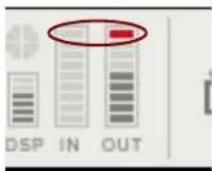
The Clip indicators will stay lit for a short moment, to make them easier to spot.
The Clip indicators on the Audio In and Audio Out meters on the Transport Panel.
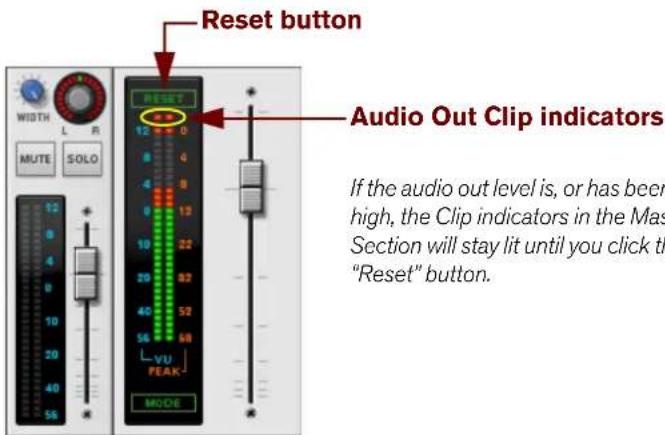
The Clip indicators in the Master Section of the Main Mixer.
! Note that if you use the Propellerhead Balance audio interface when recording audio tracks in Reason Lite, you can use the unique Clip Safe function. The Clip Safe function allows you to heal clipped input signals! See "Recording using the Clip Safe function in Propellerhead Balance" for more information.
! Note that the Main Mixer Master Section Clip indicators will only work if there are no other devices connected between the Master Section device and the Hardware Interface!
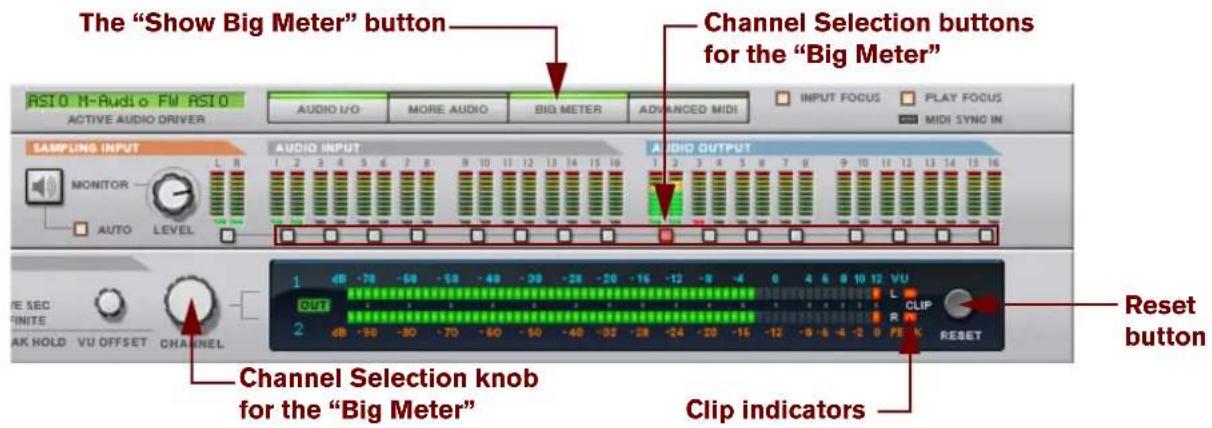
The Big Meter on the Hardware Interface.
To remedy Audio In clipping, adjust the level at the input source, i.e. on the hardware audio interface or on the preamp connected to the hardware audio interface.
! When recording or sampling external audio signals, clipping cannot be adjusted in the Reason Lite application - it must be adjusted at the audio input source!
! When sampling audio internally from devices in the rack, you have to adjust the Output Level on the source device to make sure clipping doesn't occur in the Hardware Interface.
To remedy Audio Out clipping, lower the master level on the Mixer (or other device) that is connected to the Hardware Interface, until Audio Out clipping doesn't light up on playback.
You could also use the MClass Maximizer as an insert effect on the Master Section in the Main Mixer to ensure that clipping never occurs - see "The MClass Maximizer".
To get a better overview of the levels, bring up the Big Meter on the Hardware Interface, by clicking the "Big Meter" button on the front panel. Then, select the input or output pairs to view in the Big Meter by clicking on the corresponding channel selection button below each input or output pairs. Alternatively, select channel by turning the channel selection knob.
If the audio level is, or has been, too high, the Clip indicators on the Big Meter will stay lit until you click the Reset button, or select new audio channels for the Big Meter.
! In some situations, the Audio Out Clip indicator on the Transport Panel and the Output Clip indicators on the Reason Lite Hardware Interface might light up if the metronome Click is active in the sequencer during play-back (see "Click and Pre-count"). This is nothing to worry about and won't cause any distortion in your song. To determine if the metronome is causing the clipping indication, just disable Click and see if the clipping stops.
! Note that it doesn't matter if the level meters on the individual devices (effects, Mixer channels, etc.) "hit the red". Output clipping can only occur in the Hardware Interface.
The technical reason for this is that internally, Reason Lite uses high resolution floating point processing, which ensures highest audio quality and virtually limitless headroom. In the Hardware Interface, the floating point audio is converted to the resolution used by the computer's audio interface, and that's where audio out clipping might occur.
If you are using multiple outputs
If you are using an audio interface with more than two outputs, you might want to have different devices connected to different outputs. If the Audio Out Clip indicator on the Transport Panel lights up, you should play back the section again while checking the Reason Lite Hardware Interface. Each output socket has a level meter - if the red meter segment lights up, the output is clipping.

Output 7 indicates audio clipping.
The indicator for Output 7 on the Hardware Interface indicates clipping.
→ If necessary, bring up the Big Meter and select the output pair where the clipping occurs. Lower the output level of the device connected to the clipping output, until no clipping occurs.
System signal paths
Depending on the track types in the sequencer, the default signal chain varies. In this section we're going to describe the default audio signal paths for Audio Tracks and Instrument Tracks.
Audio Track signal paths
When you're recording and playing back audio that originates from an external source, like a guitar or a vocalist, the audio signal must first travel from the source, via a hardware audio interface, into the Reason Lite application. Then, when played back, the audio travels from the Reason Lite application, via the hardware audio interface, to a speaker system or similar. The figure below shows a schematic overview of the audio signal paths for a "standard" auto-routed Audio Track in Reason Lite:
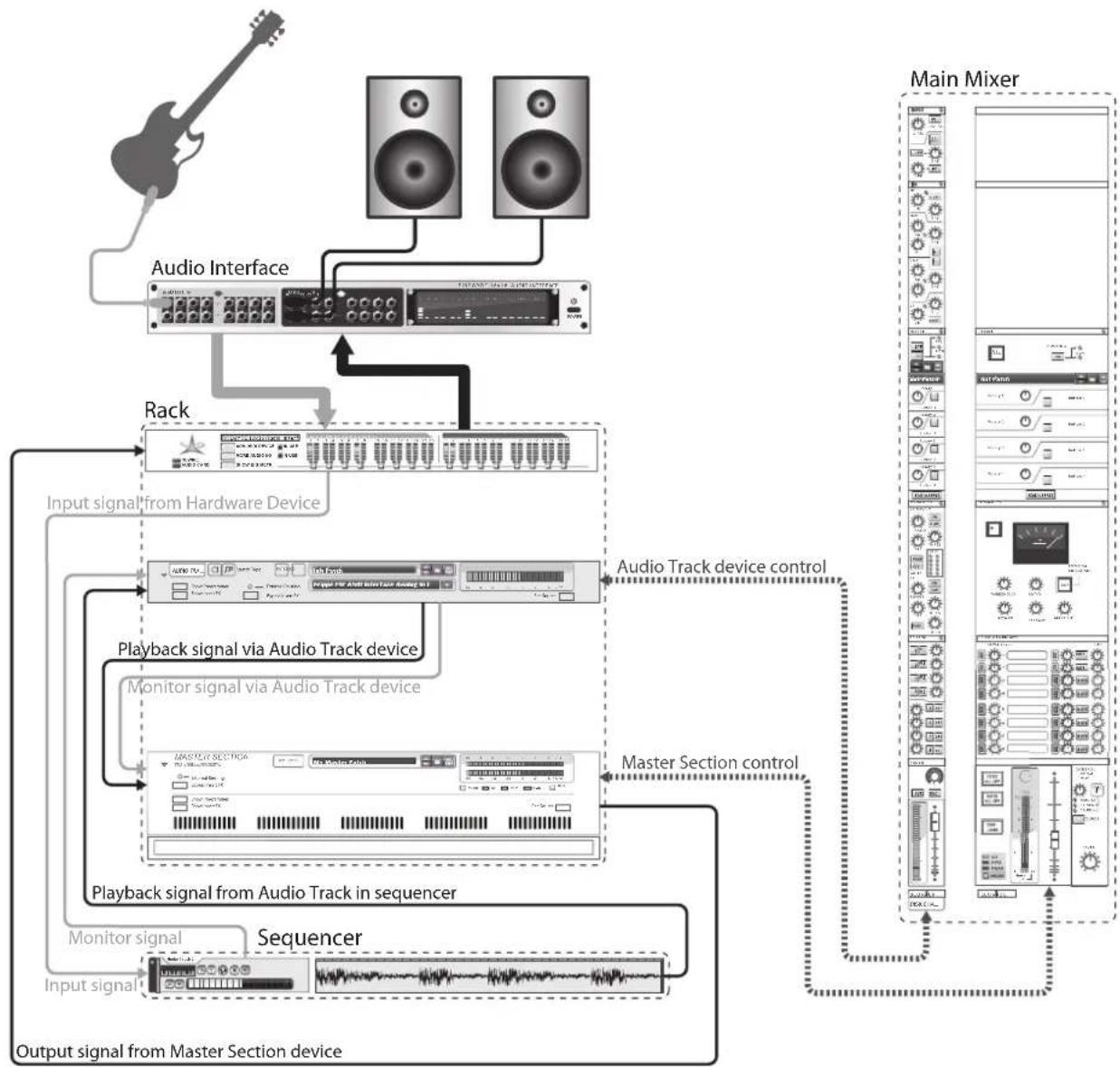
flowchart
graph TD
    A["Audio Interface"] --> B["Rack"]
    B --> C["Input signal from Hardware Device"]
    C --> D["Playback signal via Audio Track device"]
    D --> E["Monitor signal via Audio Track device"]
    E --> F["Master Section control"]
    F --> G["Output signal from Master Section device"]
    G --> H["Main Mixer"]
    H --> I["Audio Track device control"]
    I --> J["Master Section"]
    J --> K["Playback signal from Audio Track in sequencer"]
    K --> L["Monitor signal"]
    L --> M["Sequencer"]
    M --> N["Input signal"]
An Audio Track signal path in Reason Lite.
Instrument Track signal paths
When you're recording and playing back audio from an instrument device, like the ID8 Instrument device, the audio signal only has to travel only in one direction: from the Instrument device, via the hardware audio interface, to a speaker system or similar. The figure below shows a schematic overview of the audio signal paths for an auto-routed Instrument Track in Reason Lite:
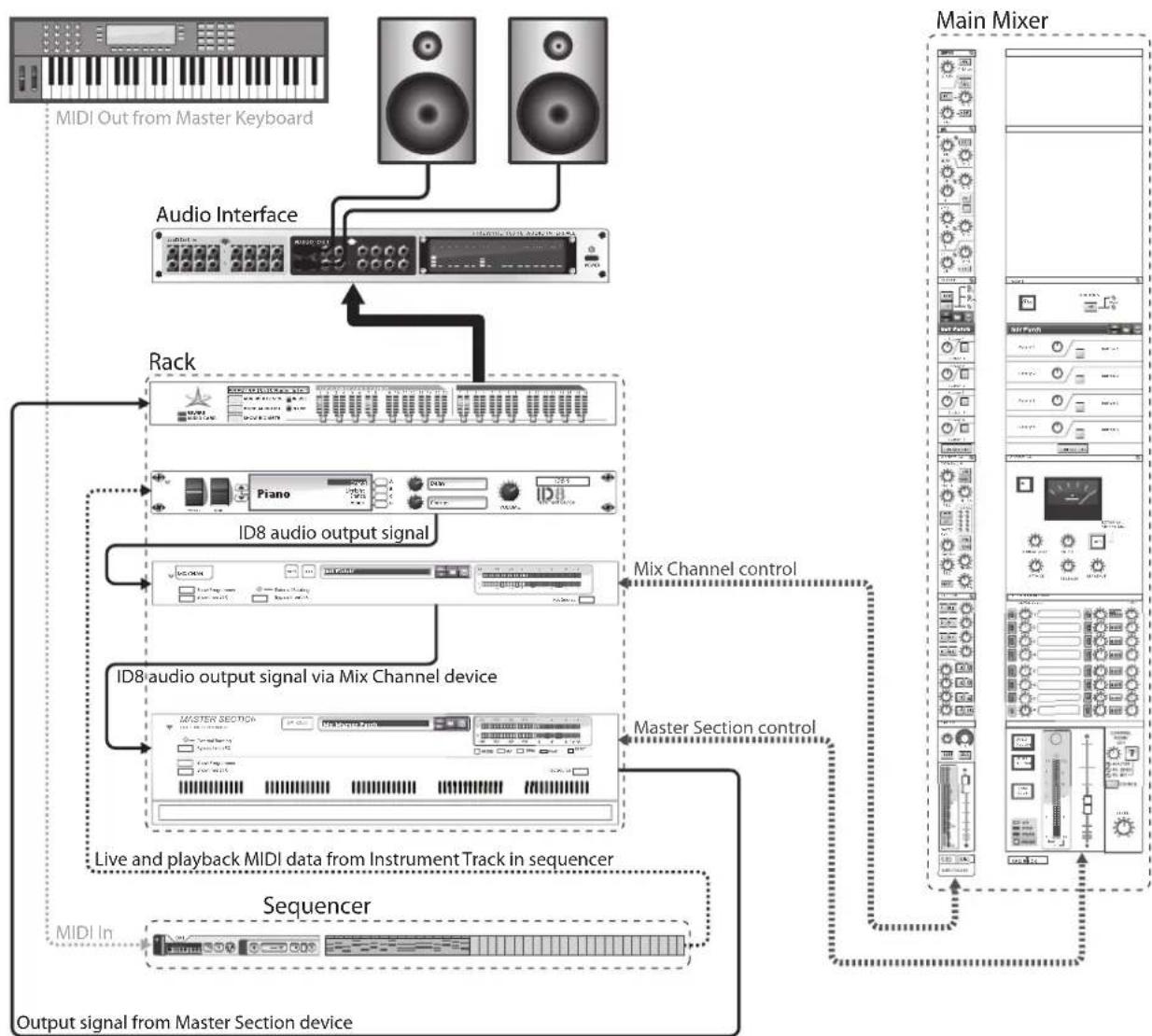
An Instrument Track signal path in Reason Lite.
General information about audio and computers
About latency
On any personal computer system, there is a delay between the moment you input a sound, or "tell" the hardware to play a sound, and when you actually hear it. This delay is referred to as the "latency" of the design. This imposes a problem for any system where you want real-time user input to affect the sound.
Why is there latency?
All audio applications receive and generate their audio in chunks. These chunks are then passed on to the audio card where they are temporarily stored before being converted into regular audio signals. The storage place for these chunks are called "buffers" (an analogy would be a bucket brigade, where a number of people each have a bucket, and water is poured from one bucket to another to reach its final destination).
The smaller the buffers and the fewer they are, the more responsive the system will be (lower latency). The general rules regarding the buffer size are these:
- A small buffer size reduces the latency (the time it takes for the audio to "travel" from the audio interface input(s) to the application and from the application to the audio interface output(s)).
However, a small buffer size also increases the DSP Load. Too small a buffer size setting could also make the sound crackle and distort. - A large buffer size reduces the DSP Load (allowing for more tracks to be played back simultaneously) and also ensures good audio quality.
However, a large buffer size also increases the latency.
A high sample rate will also reduce the latency. However, this will also raise the demands on the computer and its software. If the system can't cope with moving the data to and from the buffers fast enough, there will be problems that manifest themselves as glitches in audio playback.
To make things worse, audio playback is always competing with other activities on your computer. For example, a buffer size that works perfectly under normal circumstances might be too small when you try to open files during playback, switch over to another program while Reason Lite is playing or simply play back a very demanding song.
What is acceptable?
On a regular PC, the latency can vary quite a lot. This is an effect of the fact that computers and their operating systems were created for many purposes, not just for recording and playing back audio. For multimedia and games, a latency of a 100 ms might be perfectly acceptable, but for recording and playing back audio it is definitely not!
- PC audio cards running under Windows with a MME driver might at best give you a latency of around 160ms.
- The same card with a DirectX driver running under Windows provides at best around 40ms.
- A card specifically designed for low latency, with an ASIO driver under Windows, or a Core Audio driver under macOS, can usually give you figures as low as 2-3 ms. This is definitely good enough for audio applications. That's also why ASIO or Core Audio drivers are required to run Reason Lite.
Reducing latency
There are a few general methods for making sure latency is as low as possible:
→ Make sure you are using the latest version of the drivers for your hardware audio interface.
→ Adjust the Sample Rate and Buffer Size parameters as described in "Audio settings".
→Remove unnecessary background tasks on your computer.
This might be any background utility you have installed as well as networking, background Internet activities etc.
→Optimize your songs.
You might run into situations where you have to raise the Output Latency setting to be able to play back a very demanding song on your computer. Another option would be to actually optimize the song. See "Optimizing Performance" for details.
→Get a better audio interface.
This is only required if you find that you need to increase Output Latency because your audio card can't really cope with the songs you try to play.
→Get a faster computer.
This is only required if you find that you need to increase Output Latency because your computer can't really cope with the songs you try to play.
About processors
When you run Reason Lite, the numbers of physical CPU cores and the CPU clock speed are major factors determining how many audio tracks and devices you can use at the same time.
If you plan to buy a computer specifically for Reason Lite, you could play it safe and choose a computer with at least a dual-core Intel i7 processor, or equivalent AMD processor, running at 2.0 GHz or faster. MultiCore processors will give better performance and are highly recommended.
About RAM
Another important performance factor is the amount of installed RAM in the computer. Generally, one could say: the more the better, especially if you're running several applications simultaneously. To run Reason Lite, a minimum of 4 GB RAM is required, but more is highly recommended for larger songs/better performance.
Chapter 5
Sequencer Functions
About this chapter
This chapter describes the layout and general functions of the main sequencer. Recording, editing clips and events, arranging and working with Blocks in the sequencer are described in detail in the chapters "Recording in the Sequencer", "Audio Editing in the Sequencer", "Note and Automation Editing", "Arranging in the Sequencer" and "Working with Blocks in the Sequencer".
Introduction
The sequencer is where you record your songs. The sequencer can be used to record audio tracks as well as instrument tracks, performance controllers, parameter automation and pattern automation. You can also arrange your songs, or parts of your songs, in Blocks. In Blocks mode you can build complete "sections" - consisting of a desired number of bars and tracks - that can be reused throughout the song. This chapter mainly describes the Song View and Edit Mode. Functions specific to Blocks and the Blocks View are described in the separate chapter "Working with Blocks in the Sequencer".
! Reason Lite is limited to a total track count of 8 Instrument and/or Audio tracks.
In addition to the instrument/audio tracks, you can have an unlimited number of Automation tracks (see "Automation (non-instrument) track relationships").
Sequencer area overview
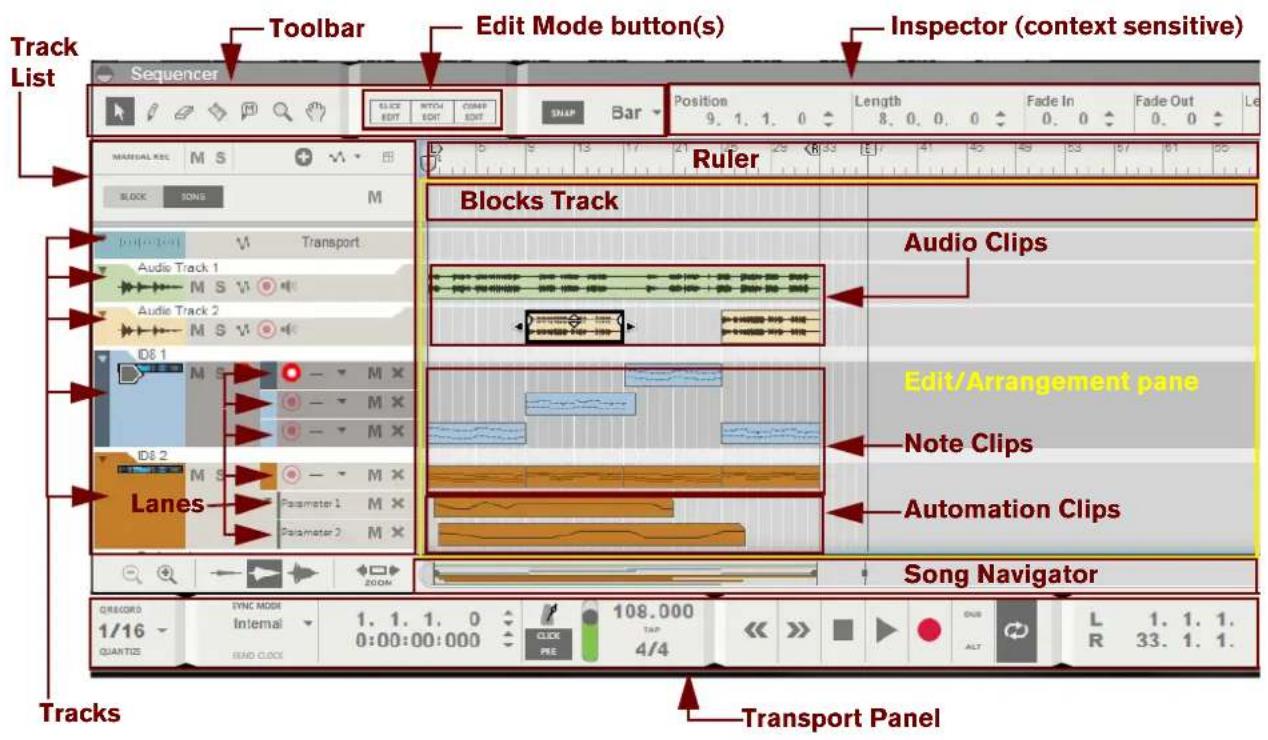
Song View and Edit Mode
The Song View is the "normal view" where you are working with your song arrangement. This mode gives a good overview of the contents of the tracks in your song. If the Enable Blocks function on the Options menu is active, the Blocks track is also visible at the top in the Track List. If the Enable Blocks function is off, there is no Blocks track in the Track List.
On the Blocks track you arrange the Block automation clips that control which Block should play back (see "Working with Blocks in the Sequencer").
Edit Mode is where you edit the contents of the clips in your song.
→ Click (any of) the Edit button(s) in the Toolbar to enter Edit Mode. Alternatively, hold down Ctrl or Cmd and press [E].
In Edit Mode the Edit Pane shows detailed information about the content of one track (see "Tracks overview"), or lane (see "Lanes overview") at a time and you can edit the events in individual clips (see "Clips overview").
- Instrument Tracks only have a single Edit Mode, whereas Audio Tracks have three different Edit Modes depending on what and how you want to edit.
- When you open a note or Comp audio clip by double-clicking it in Song View (or Block View), the sequencer automatically switches to Edit Mode. However, if you double-click a Single Take audio clip or parameter automation clip, it may open up for editing inline, directly in the Song View or Block View.
Song View
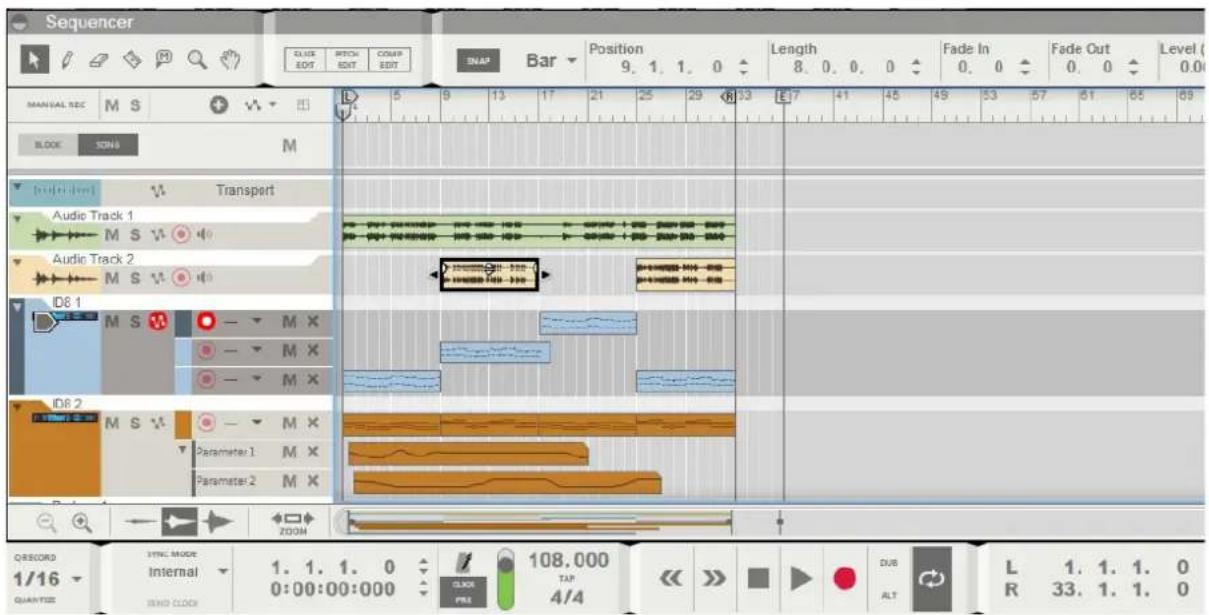
In the Song View, all clips on all tracks can be viewed. Use this mode to get an overview of your arrangement, and when you want to perform clip-based editing such as rearranging whole sections of your song, etc.
! Note that if the Enable Blocks function on the Options menu is off, there is no Blocks track in the Track List.
Edit Mode
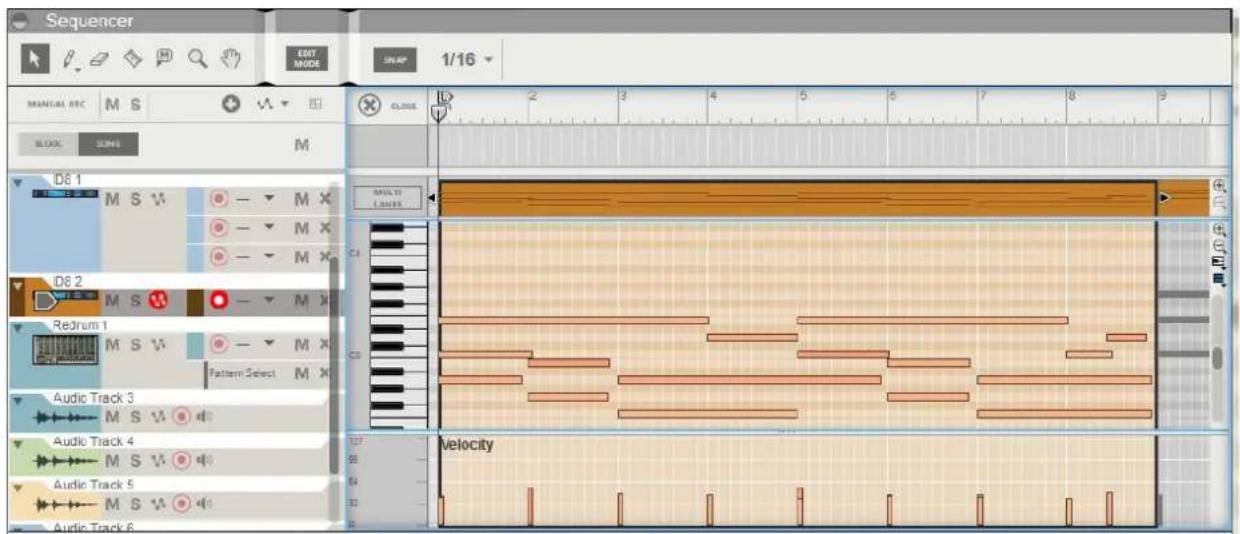
In Edit Mode, you get a close-up look at the recordings on a track. In Edit Mode, the Edit Pane can be divided into several horizontal edit rows, showing different types of events (notes, velocity, audio, parameter automation, etc.). This is the view mode of choice for fine editing the content of your recorded clips, and for drawing notes, performance controllers and other events manually.
Toolbar overview

The sequencer Toolbar features various sequencer editing tools as well as the Snap function. The tools can be used in both Edit Mode and the Song/Block Views, with slightly different purposes in the respective modes. See "Toolbar details" for details about each tool.
Track List overview
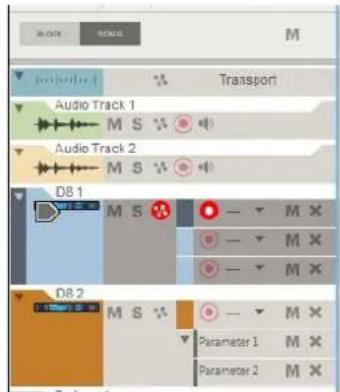
To the left in the sequencer, all tracks are listed in the Track List. Each track in the sequencer is associated with a specific device in the rack. By clicking on a device icon in the Track List you automatically set Master Keyboard Input (see "Setting Master Keyboard Input") to the corresponding device in the rack for playing and/or recording.
Tracks overview
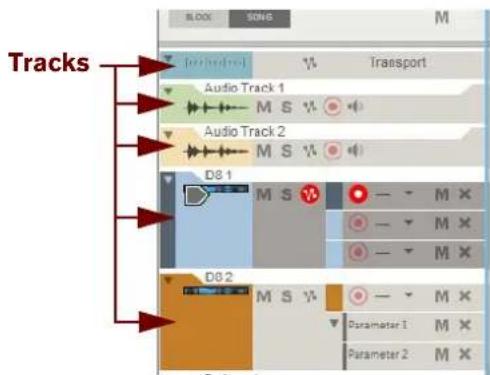
Most rack devices in a song automatically get their own dedicated track in the sequencer when you create the device. Each track can feature one or several lanes on which audio, note, performance controller, pattern and parameter automation events can be recorded - in clips. See "Track details" for more details about tracks.
! If the Blocks button on the Transport Panel is on, the Blocks Track is also shown at the top in the Track List.
Lanes overview
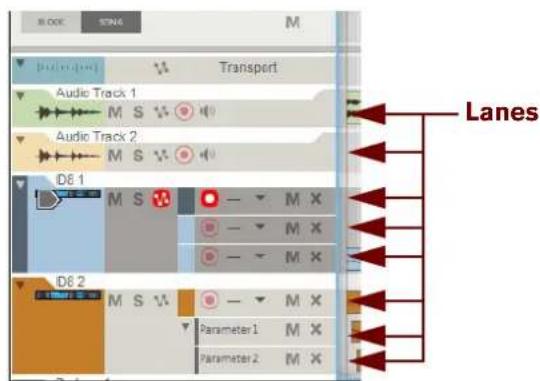
Each track consists of one (default) or several parallel lanes. The lanes can contain clips that feature note events or audio recordings, depending on track type. A track can also feature automation lanes that contain clips with parameter automation events - or pattern automation for pattern based devices. See "Lane details" for more details about lanes.
Clips overview
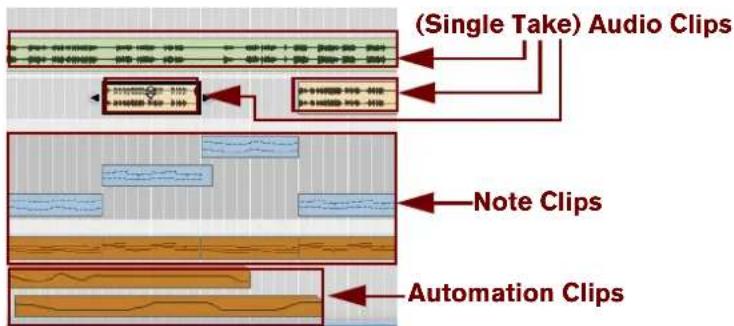
Note, audio, performance controller, pattern and parameter automation events are always contained in clips. A clip is basically a "container" for recorded data. Audio clips are displayed in the Edit/Arrange Pane as a rectangular box with one or two graphical audio waves inside (mono or stereo). Note events are displayed in a "piano roll" fashion in the clip. Performance controllers and parameter automation events are displayed as continuous lines, and pattern events are displayed as repeated rectangles in the clips. See "Clip basics" for information about the different clip types.
Inspector overview
| Position | Length | Fade In | Fade Out | Level (dB) | Transpose | |||||||||
| 9. | 1. | 1. | 0 | 8. | 0. | 0. | 0 | 0. | 0 | 0.00 | ||||
The context sensitive Inspector shows the properties of whatever is currently selected in the sequencer: clips, notes, automation events, audio comp rows and cuts etc. The properties of the selected item can be edited by changing the values in the various displays. See "About the Inspector" for more info.
Ruler overview

The Ruler is the song's "time line", measured in bars. In the Ruler, the Song Position Pointer indicates the current position in the song, i.e. in which bar the song is, or will begin, playing. The Ruler also shows the Left and Right Loop Locators as well as the Song End Marker. See "Ruler details" for more details.
Edit/Arrangement Pane overview
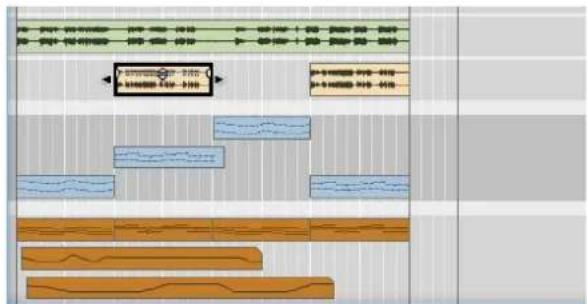
The big center section of the sequencer is called the Edit/Arrangement Pane. This is where all recorded events reside in clips - on one or more lanes on the respective track.
Track scrollbar overview
natural_image
Close-up of a ruler with measurement markings (no visible text or symbols)To the far right in the sequencer is the Track scrollbar. With the Track scrollbar you can scroll vertically on the Edit/Arrange Pane. See "Scrolling" and "Zooming in the Sequencer" for more details.
Song Navigator overview

natural_image
Pure horizontal line diagram with no text, numbers, or symbolsBelow the Edit/Arrangement Pane is the Song Navigator. With the Song Navigator you can scroll and zoom horizontally on the Edit/Arrangement Pane. The Song Navigator also features indicators for the Ruler's Loop Locators, Song Position Pointer and Song End Marker. In the Song Navigator, all clips on all lanes are displayed as colored lines, indicating their positions in the song. See "Scrolling" and "Zooming in the Sequencer" for more details.
Transport Panel overview

The Transport Panel features the sequencer transport controls (Rewind, Fast Forward, Stop, Play and Record) as well as controls for Tempo, Time Signature, Position, Time and Loop Locator placements and some other functions. See "Transport Panel details" for more details.
Track details
Track definition
The tracks in the sequencer are where you record your audio, note and automation to create your songs. A track is always associated with a device in the rack (except for the Transport track and Blocks track). An icon with a picture of the associated device is shown in the Track List on the left hand side in the sequencer. In the Track List, the name of the associated device is shown, as well as icons and buttons related to the specific track. Each track can incorporate various lane types (depending on track type). To the right of the Track List - on the Edit/Arrangement pane - each track has its own dedicated area for recorded events.
In the picture below, six sequencer tracks are shown. From the top down are the Transport Track (which is always present and cannot be moved or deleted), two audio tracks, two instrument tracks associated with one ID8 instrument device each, and one automation track for a Mix Channel strip.
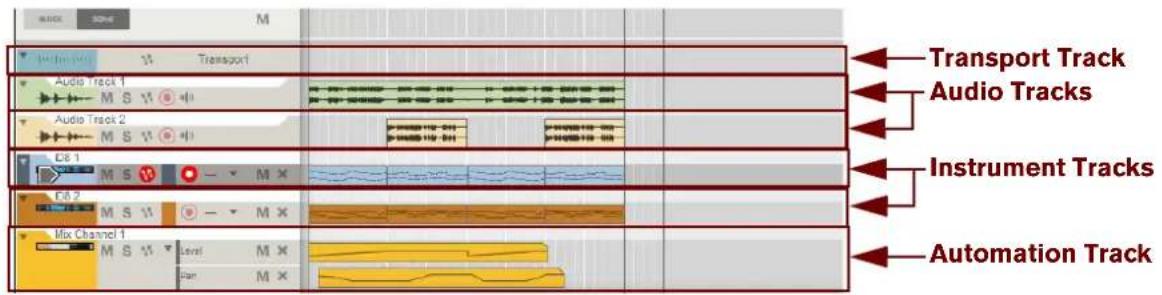
The relationship between the track, the rack and the Main Mixer
A track in the sequencer is always associated with a device in the rack; i.e. there can never be a sequencer track without an associated rack device (except for the Transport track and Blocks track). Audio Track devices and Mix Channel devices in the rack also have their corresponding channel strips in the Main Mixer. Mixer channel strips can be considered "remote controls" for their corresponding rack devices. Depending on track type, the signal chain differs somewhat. The picture below shows the signal flow in five scenarios with three different track types:
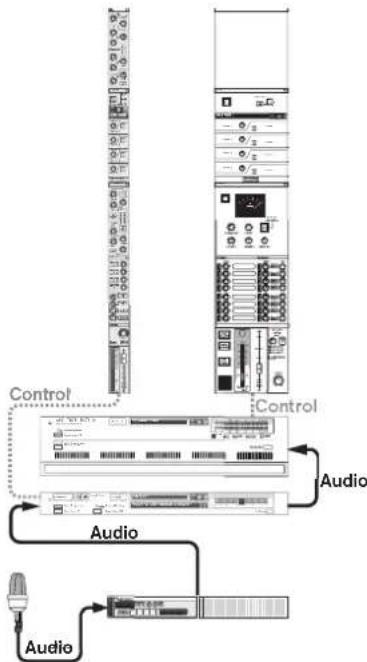
Audio Track
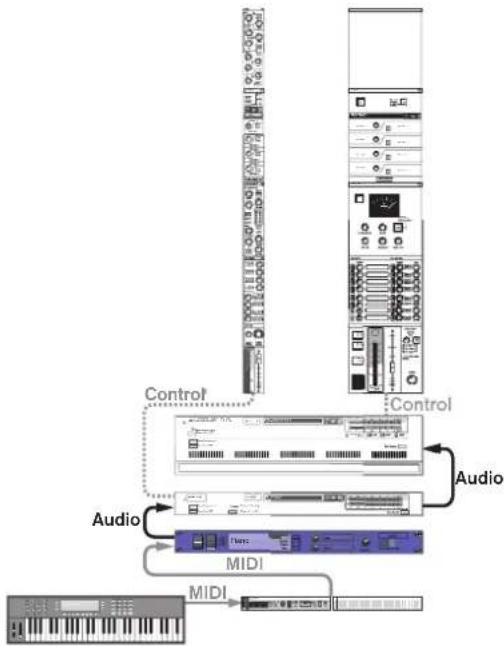
flowchart
graph TD
    A["Control"] --> B["Audio"]
    B --> C["MIDI"]
    C --> D["MIDI"]
    D --> E["Output"]
    style A fill:#f9f,stroke:#333
    style B fill:#ccf,stroke:#333
    style C fill:#cfc,stroke:#333
    style D fill:#fcc,stroke:#333
Instrument Track (for internal instrument)
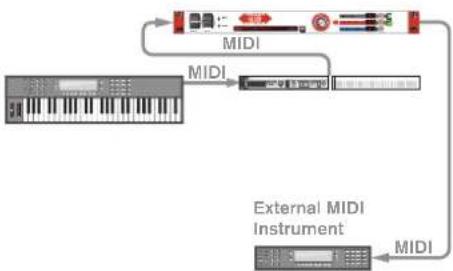
flowchart
graph TD
    A["External MIDI Instrument"] --> B["MIDI"]
    B --> C["MIDI"]
    C --> D["MIDI"]
    D --> E["MIDI"]
    E --> F["MIDI"]
    F --> G["MIDI"]
    G --> H["MIDI"]
    H --> I["MIDI"]
    I --> J["MIDI"]
    J --> K["MIDI"]
    K --> L["MIDI"]
    L --> M["MIDI"]
    M --> N["MIDI"]
    N --> O["MIDI"]
    O --> P["MIDI"]
    P --> Q["MIDI"]
    Q --> R["MIDI"]
    R --> S["MIDI"]
    S --> T["MIDI"]
    T --> U["MIDI"]
    U --> V["MIDI"]
    V --> W["MIDI"]
    W --> X["MIDI"]
    X --> Y["MIDI"]
    Y --> Z["MIDI"]
Instrument Track (for external MIDI instrument)
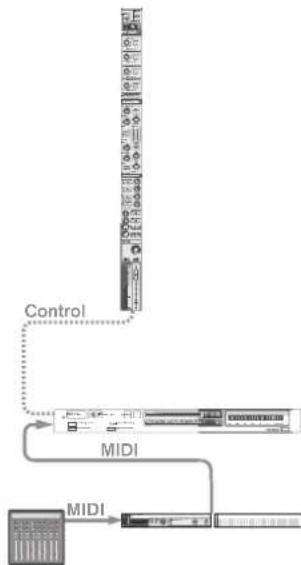
flowchart
graph TD
    A["Control"] --> B["MIDI"]
    B --> C["MIDI"]
    C --> D["Data Bus"]
    style A fill:#f9f,stroke:#333
    style B fill:#ccf,stroke:#333
    style C fill:#cfc,stroke:#333
Automation Track (for channel strip parameters)
flowchart
graph TD
    A["Yellow Port with I/O"] --> B["MIDI"]
    C["Gray Box"] --> D["MIDI"]
    D --> E["Internal I/O"]
Automation Track (for device parameters)
Audio track relationships
An audio track is always associated with an Audio Track device in the rack and its corresponding Audio Track channel strip in the Main Mixer. An Audio Track device can also house insert effects.
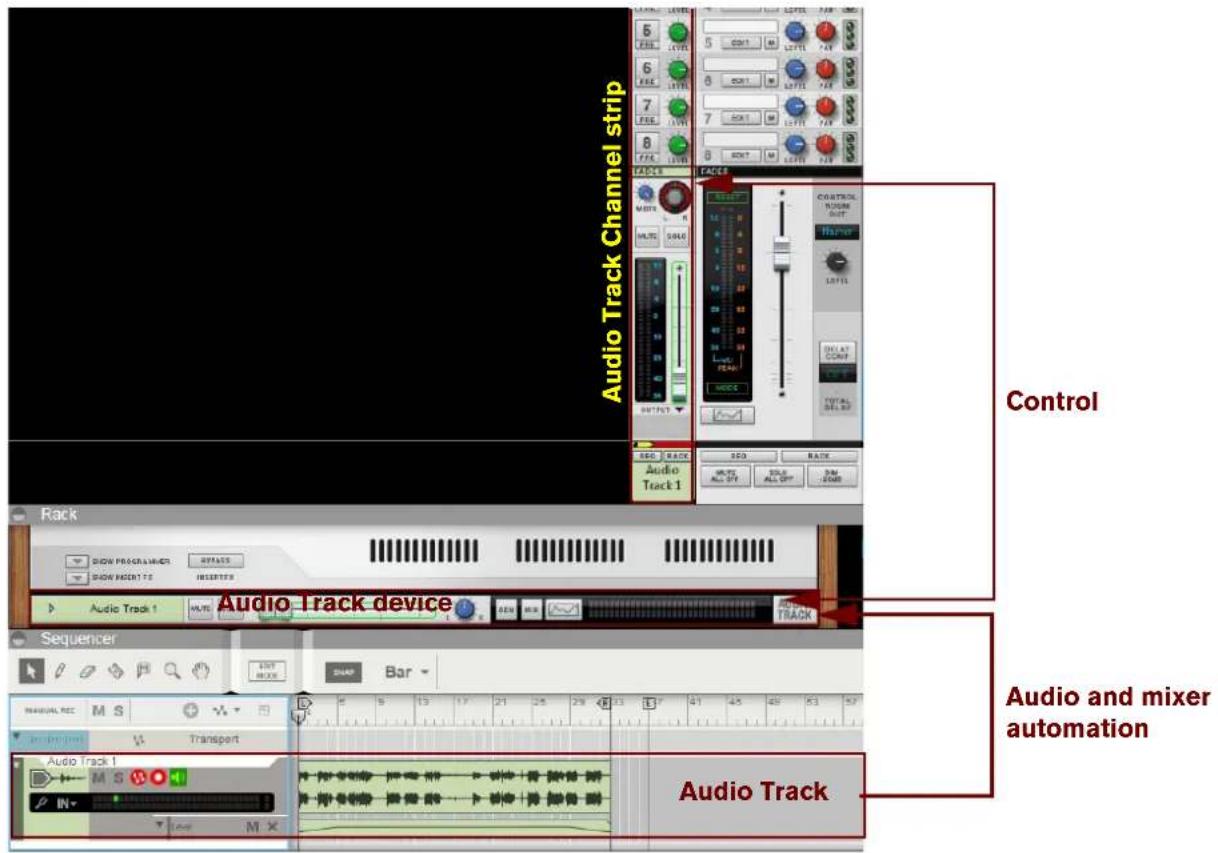
In the figure above, the audio track is associated with the Audio Track device in the rack, which in turn is controlled from the Audio Track channel strip in the Main Mixer. The audio track features recorded audio and mixer automation.
Instrument track relationships (for internal instruments)
An instrument track is always associated with an instrument device in the rack. The instrument device in the rack is, in most situations, connected to a Mix Channel device in the rack. The Mix Channel device in the rack is controlled from the corresponding channel strip in the Main Mixer. A Mix Channel device can also house insert effects.
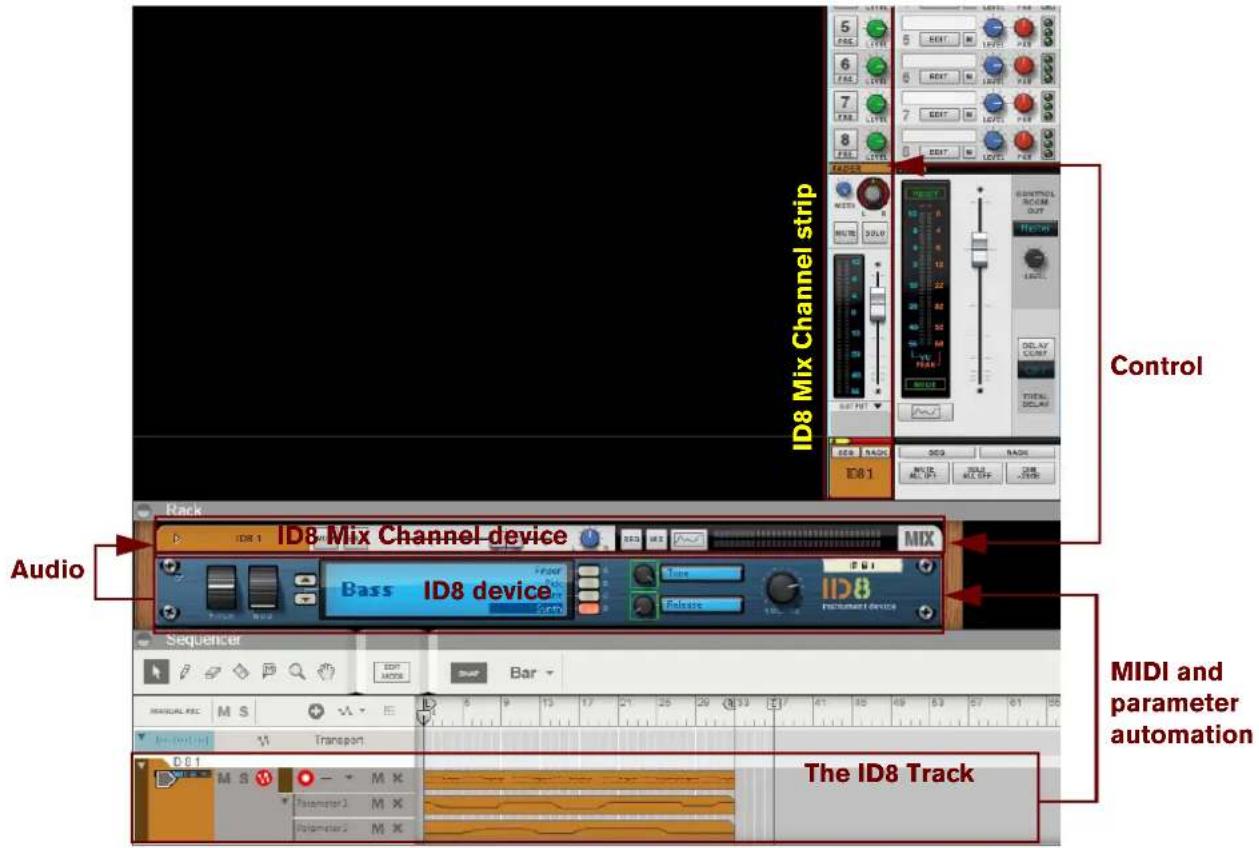
In the figure above, the ID8 track is associated with the ID8 instrument device in the rack. The ID8 instrument device is connected to the ID8 Mix Channel device in the rack, which in turn is controlled from the ID8 channel strip in the Main Mixer. The ID8 track features recorded MIDI notes and parameter automation.
Note that when you create an instrument, the connected Mix Channel device doesn't automatically get a track in the sequencer. If you want to record Mixer Channel automation, you have to first create a separate sequencer track for the Mix Channel device. See "Automation (non-instrument) track relationships".
Instrument track relationships (for external MIDI instruments)
If you want to control an external MIDI instrument from the Reason Lite sequencer you have to use the MIDI Out Device (see "MIDI Out Device"). The device works as a MIDI router in which you can define which MIDI Out Port and MIDI Channel you want the MIDI signals to be sent to from Reason Lite. Since there is no internal audio involved in this setup, there is no Audio Track device or Mix Channel device present in the configuration.
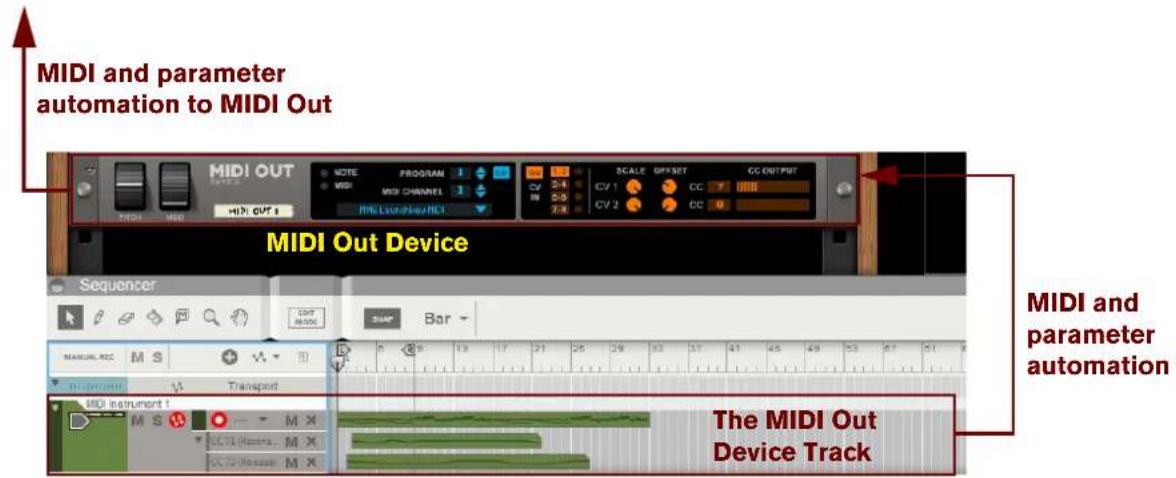
In the figure above, the MIDI Out Device track is associated with the MIDI Out Device in the rack. The MIDI Out Device track features recorded MIDI notes and parameter automation (MIDI CC#) that is sent via the MIDI Out Device to the desired MIDI Out Port and MIDI Channel.
Automation (non-instrument) track relationships
A pure automation track is always associated with a "non-instrument" device, i.e. a device which can't receive MIDI Note information. Consequently, an automation track can only consist of parameter automation lanes. Examples of non-instrument devices are Mix Channel devices with their corresponding Mix Channel strips, effect devices, mixer devices and Spider Merger & Splitter devices. The picture below shows an example with an automated Mix Channel:
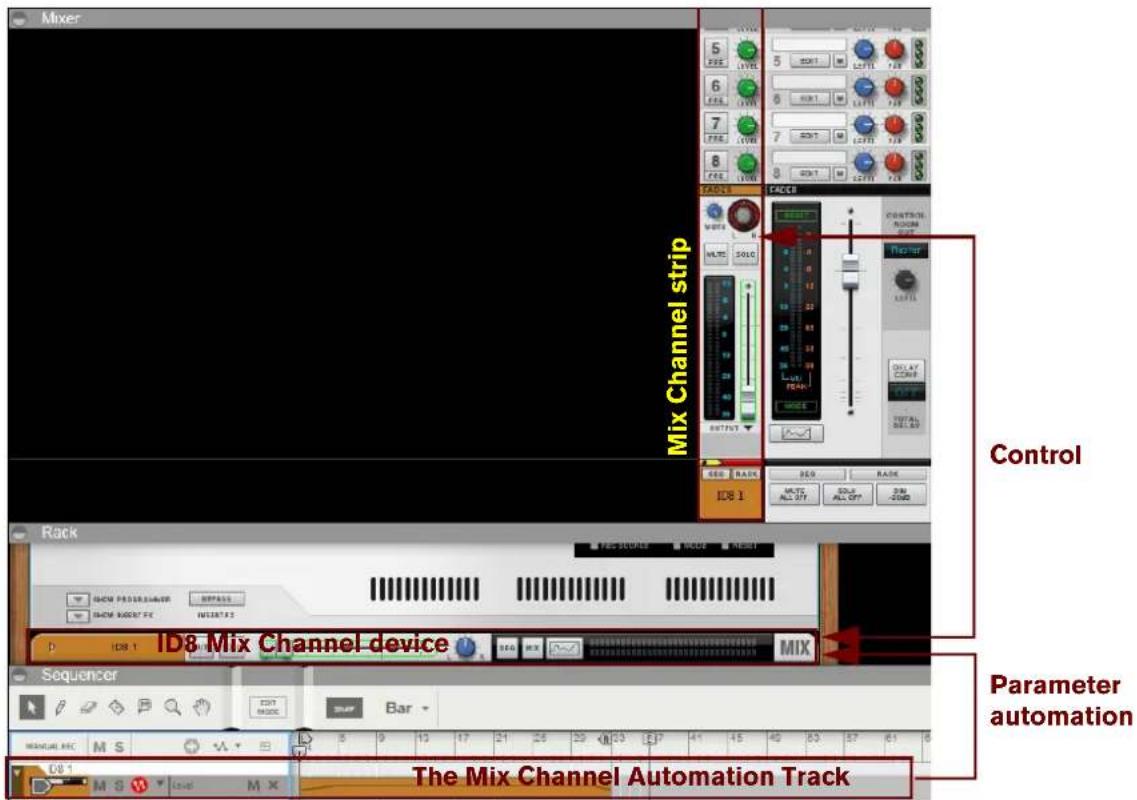
In the figure above, the Mix Channel automation track is associated with the Mix Channel device in the rack, which in turn is controlled from the channel strip in the Main Mixer.
The picture below shows an example with an automated MClass Equalizer device. Note that no mixer channel strip is involved in this situation since the automation only concerns a non-instrument device and not any Mix Channel device:
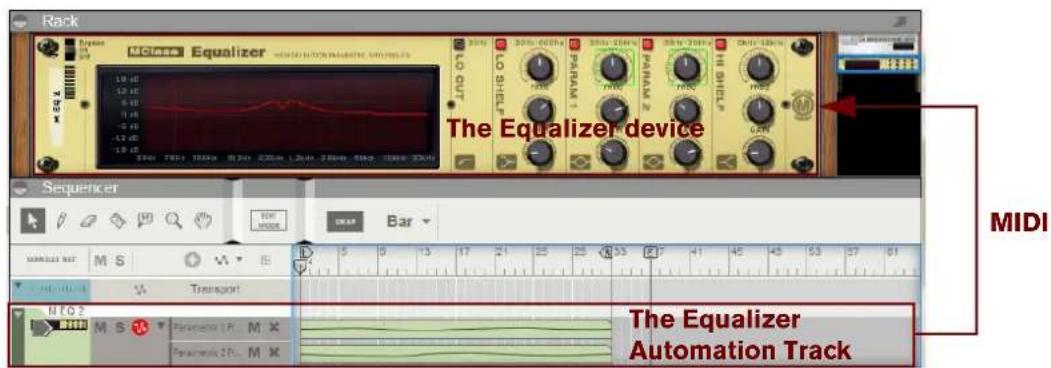
In the figure above, the Equalizer automation track is associated with the Equalizer device in the rack.
Master Keyboard Input
The standard way of routing MIDI from a connected MIDI master keyboard or control surface to a device in the rack is to set the Master Keyboard Input in the sequencer. When MIDI is routed to a selected track in the sequencer, the notes and controller data are automatically echoed to the associated device in the rack. However, it is also possible to set Master Keyboard Input from the rack, see "Playing devices from the rack".
- Setting Master Keyboard Input to an instrument track is necessary if you want to play notes on an instrument device from your MIDI master keyboard (and control the instrument device parameters via MIDI).
By locking additional MIDI keyboards to separate devices in the rack, you will be able to play and record on several sequencer tracks simultaneously, see "Locking a surface". - Setting Master Keyboard Input to an audio track is only necessary if you want to control the Main Mixer channel strip parameters via MIDI.
- Setting Master Keyboard Input to a “non-instrument” (parameter automation only) track is only necessary if you want to control the device’s parameters via MIDI.
Besides the standard routing described above, it's also possible to lock certain rack devices to specific control surfaces. See "Locking a surface" for more details.
! If you have several MIDI keyboards/control surfaces locked to individual devices in the rack, it is possible to control and record on several tracks simultaneously!
Setting Master Keyboard Input
→ To set Master Keyboard Input to a track and its associated device, click the device icon in the Track List.

Master Keyboard Input set to an instrument track.
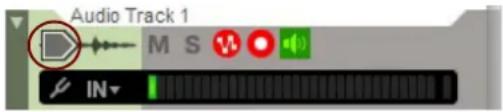
Master Keyboard Input set to an audio track.
The track gets a gray "arrow" symbol to the left, indicating that the track and associated device has Master Keyboard Input. The track and device will now respond to incoming MIDI data from a connected MIDI keyboard/control surface. By default, setting Master Keyboard Input also automatically selects the track, which is indicated by the gray color of the track in the Track List.
It's also possible to set Master Keyboard Input and track selection independently from each other by selecting "Separated" on the "Keyboards and Control Surfaces" page in Preferences - see "Preferences - Control Surfaces".
- Only one track at a time can have Master Keyboard Input. However, if you have locked additional MIDI keyboards to specific devices in the rack via Remote (see "Locking a surface"), you will be able to play and record these together with the track that has Master Keyboard Input.
The relationship between tracks, lanes, clips and events
A track is the top level in the sequencer Track List hierarchy. A track can consist of one or several parallel lanes. A lane can contain clips, which in turn can contain audio recordings, note events, performance controller events, parameter automation events or pattern events, depending on track type.
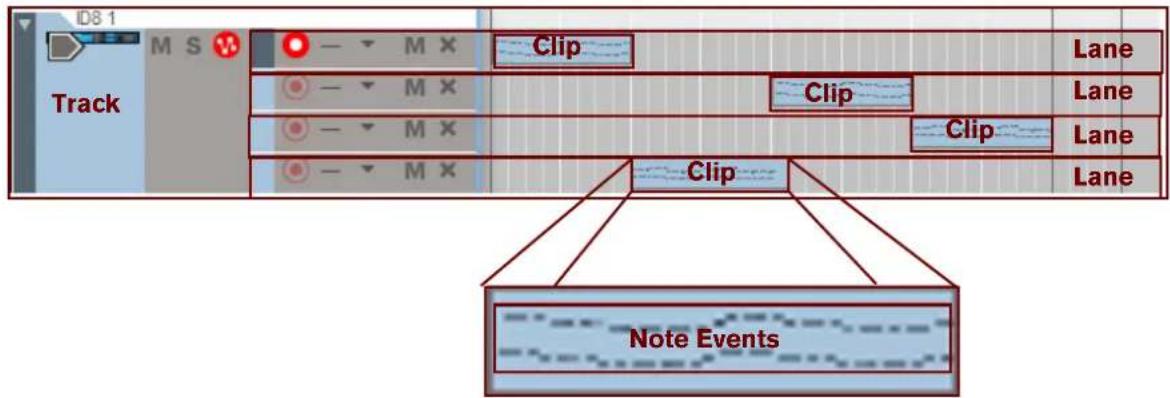
An instrument track with four note lanes featuring clips with note events.
- A device in the rack can never have more than one track in the sequencer.
- A clip is a “container” for various types of events (audio recordings, note, performance controller, parameter automation or pattern events).
Track types
These are the different track types:
• The Blocks track

The Blocks track is present at the top of the Track List only when the Enable Blocks function on the Options menu is on. On the Blocks track you can create Block Automation clips to decide which Blocks should play back. Refer to "Working with Blocks in the Sequencer" for more information about the Blocks feature.
• The Transport track

The Transport track is always present at the top of the Track List and cannot be moved or deleted. The Transport Track can have a maximum of two lanes: one containing time signature automation, and the other containing tempo automation. See "Automating time signature" and "Editing tempo automation" for more details.
- Audio tracks

An audio track can only have a single audio lane containing clips with mono or stereo audio recordings. However, each audio clip can contain several recordings, i.e. different "takes". You can view and comp these takes in the Comp Editor. See "Audio Editing in the Sequencer" for more details. An audio track can also have parameter automation lanes containing automation for the Audio Track Channel strip parameters in the Main Mixer.
- Instrument tracks
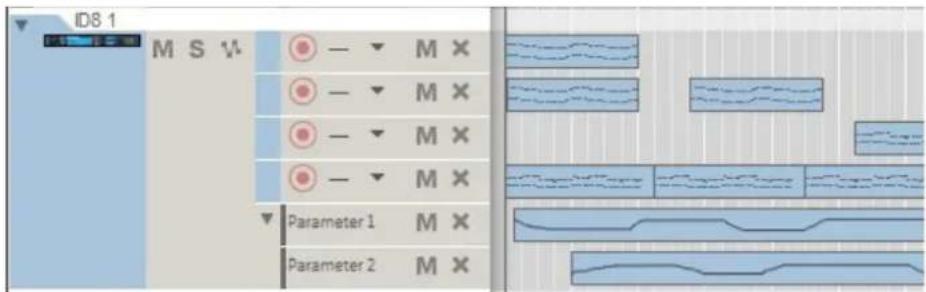
Devices that can receive MIDI notes, such as the ID8 device, will automatically be assigned a record enabled track when created. On an instrument track you can create a number of separate note lanes that can incorporate clips containing a combination of note and performance controller events. Multiple lanes are perfect if you, for example, are recording a drum track and want to record each drum sound on a separate lane. An instrument track can also have a number of parameter automation lanes that can contain clips with instrument parameter automation events.
- Parameter automation ("non-instrument") tracks

Tracks for devices that do not receive MIDI note data (e.g. effects and mixer devices and mixer channels in the Main Mixer) can only contain parameter automation lanes. These "non-instrument" devices are not automatically assigned a track when created. To automate parameters for non-instrument devices you need to manually create a track for these. The number of available lanes is limited by the number of parameters of each device. There can be one lane for each automatable parameter in the device.
Track List elements
In the picture below, a Track List with four different tracks is shown. From the top down are the Transport Track (which is always present and cannot be moved or deleted), an Audio Track associated with an Audio Track device, an Instrument Track associated with an ID8 Instrument device and an Automation Track associated with the Mix Channel device.
The Transport Track in the picture features two parameter Automation Lanes (for Time Signature and Tempo) that have been manually created for the track. The audio track features only a single audio lane. The ID8 1 track features four note lanes and has two parameter automation lanes added. The Mix Channel 1 track is associated with the Mix Channel 1 device and has three parameter automation lanes added.
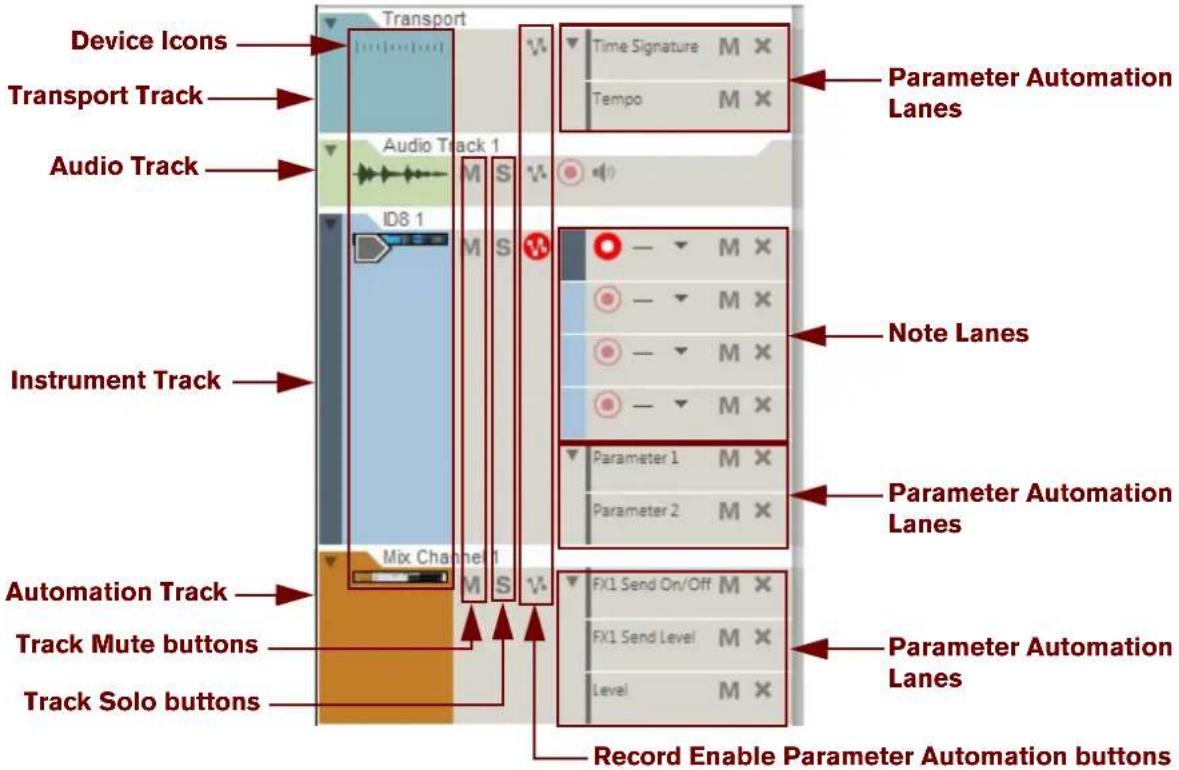
Depending on track type, the elements shown in the Track List can vary. The only common element for all track types is the "Record Enable Parameter Automation" button which should be enabled when you want to record parameter automation for the associated device. This and the other track elements will be described in detail later in this chapter.
Creating tracks
Regardless of the desired track type, you can always click the Add Track button at the bottom of the Track List and select the desired track type from the pop-up menu that appears:
Creating an audio track
An audio track can be created as follows:
- Hold down Ctrl or Cmd and press [T]. Alternatively, select "Create Audio Track" from the "Create" menu or from the context menu in the Track List, rack or Main Mixer.
→ Alternatively, double click the Audio Track device in the Utilities palette in the Browser.
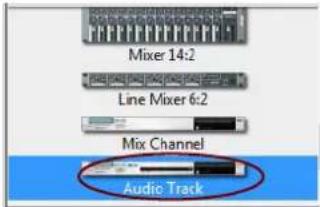
- An audio track is created in the sequencer and the associated Audio Track device is created in the rack. The Audio Track device's channel strip is created in the Main Mixer.
By default, the audio track is set up in mono. You can easily change to stereo by selecting "Stereo Input" in the "Audio Input" drop-down list - see "Selecting audio input(s) and defining mono or stereo". If you select "Stereo Input", the Audio Track channel strip in the Main Mixer automatically switches to a stereo channel.
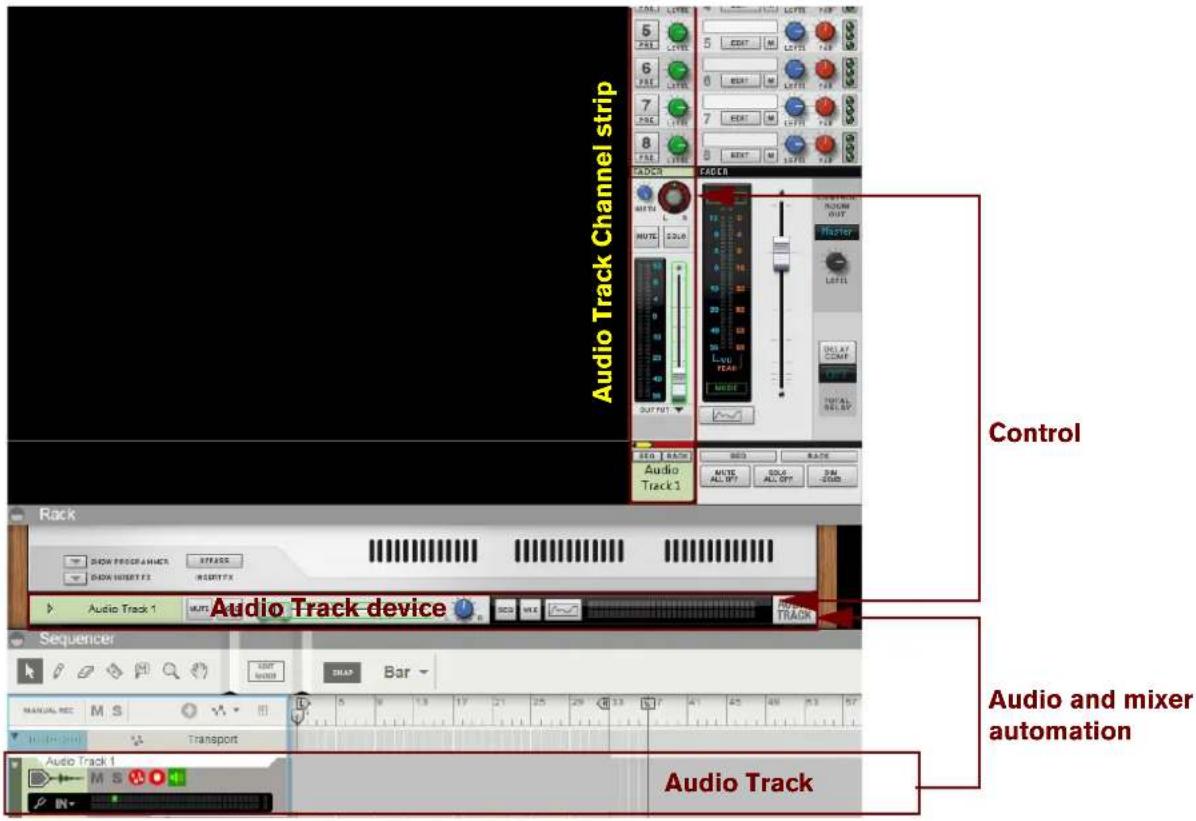
Creating an instrument track
To create an instrument track, you need only create the instrument device. An instrument track is automatically created when you create a device which can receive MIDI notes:
- Drag and drop or double click the desired instrument device from the Instruments palette in the Browser.
→Alternatively, select the desired instrument type from the "Create" menu.
Alternatively, to select an Instrument patch and automatically load the patch into the appropriate device type, hold down Ctrl or Cmd and press [I], or select "Create Instrument" from the "Create" menu to bring up the Patch Browser. Under Windows, you can also press [Insert] to open the Patch Browser. In the Patch Browser you can select and preview patches before loading them into the instrument.
- An instrument device is created in the rack and the associated track is automatically created in the sequencer. In addition, a Mix Channel device for the instrument is automatically created in the rack and its channel strip is created in the Main Mixer. All devices are automatically connected. The Mix Channel device automatically adapts its inputs to the created instrument type - if the instrument is in mono, the Mix Channel device will be in mono, and if the instrument has stereo outputs, the Mix Channel device will be in stereo.
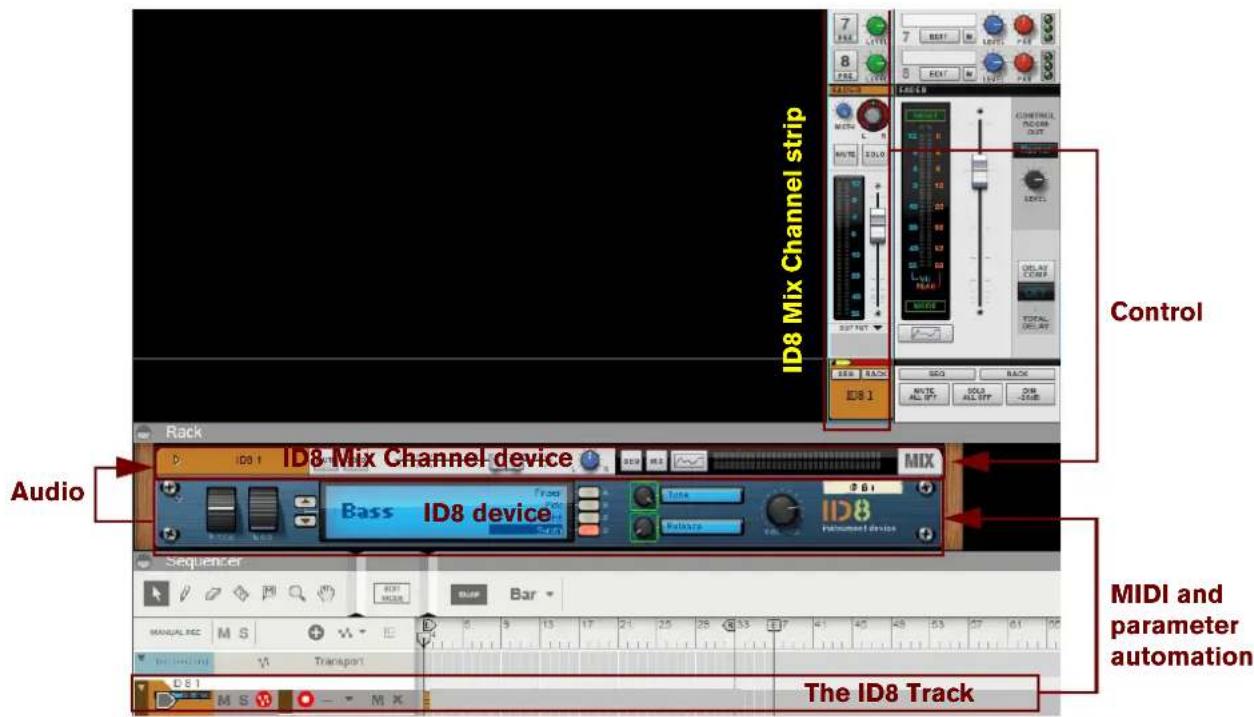
! Note that no automation track is created for the Mix Channel device. This has to be manually created if you want to automate any of the Mix Channel strip parameters (see "Creating a parameter automation track for a non-instrument device").
→ If you want to control an external MIDI instrument, create a MIDI Out Device from the "Create" menu or from the Instruments location in the Browser.
A MIDI Out Device is created in the rack and the associated track is automatically created in the sequencer. See "MIDI Out Device" for more details on how to configure the MIDI Out Device for controlling external MIDI instruments.
Creating a parameter automation track for a non-instrument device
For non-instrument devices, such as effects devices and Mix Channel devices, you need to manually create a track if you want to record parameter automation. You can do that either by following the description below or by following either of the two last descriptions in "Creating/adding parameter automation lanes".
The track creation procedure described below also applies if you have manually deleted a track for an instrument device or an Audio Track device and want to create a new track for the device:
1. Select the device by clicking on it in the rack.

A border around a device in the Rack indicates that it has been selected.
- Select "Create Track for ((patch) name of device)" from the Edit menu or the device context menu.
! Note that if a track already exists for the device, this menu item will not be available - a device can only have one track.
- The new track will be automatically associated with the device and will get the same name as the device.
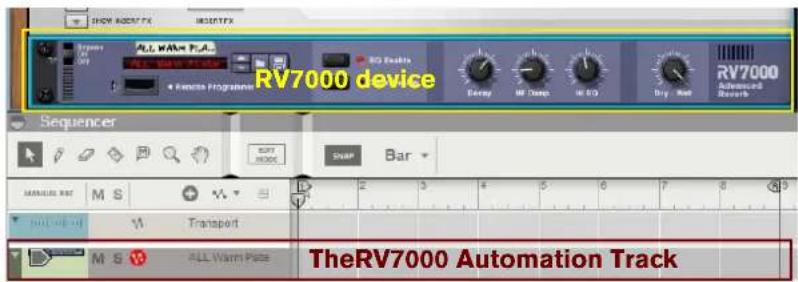
Another way of creating a parameter automation track is by holding Alt or Option and clicking on a parameter on the device panel. Alternatively, select "Edit Automation" from the parameter context menu.
If you press Alt or Option when you create a non-instrument device, this will automatically create an associated automation track for the device.
Short-cut for creating a Mix Channel track or Audio track
A faster way of creating a track for a Mix Channel device, or to create a new audio track (if you deleted the original one), is to go via the corresponding mixer channel strips in the Main Mixer:
- Scroll to the Main Mixer and locate the channel strip you want to create a track for.
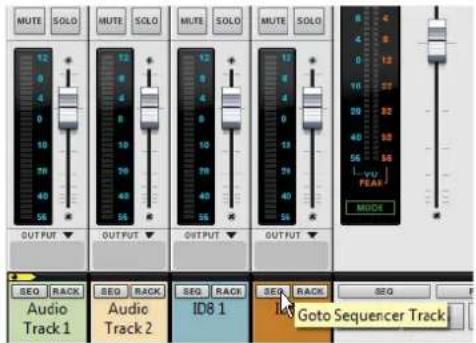
- [Shift]-click the SEQ (Goto Sequencer Track) button at the bottom of the channel strip.
A new track will be automatically created in the sequencer for the selected channel strip.
! If a track should already exist for the selected channel strip, [Shift]-clicking the SEQ (Goto Sequencer Track) button will only scroll the corresponding sequencer track into view, not create any new track.
Selecting tracks
→Select a track by clicking on it in the Track List.
A selected track gets a darker gray background color.
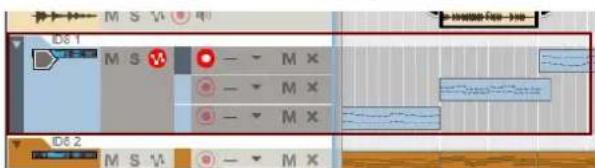
- Selecting a track in the sequencer will automatically scroll the corresponding device into view in the rack.
→ Double click a device icon in the Track List to automatically reveal the associated device in the rack.
- Selecting an audio track will set Edit Focus to its channel strip in the Main Mixer.
- Selecting another type of track (e.g. an instrument track) will set Edit Focus to the Mix Channel belonging to that device group.
See "About Device Groups" for information about device groups.
→ You can also select the next or previous track in the Track List list by using the up and down arrow keys on the computer keyboard.
! By default, selecting a track will automatically set Master Keyboard Input to that track. If you'd rather select tracks independent of the Master Keyboard Input selection, select "Separated" mode in the Preferences menu ("Keyboards and Control Surfaces" page). In "Separated" mode, you can select another track without automatically changing Master Keyboard Input. To change Master Keyboard Input, click the device icon on the desired track in the Track List.
→ It is possible to select several tracks by using standard [Shift], or Ctrl or Cmd, selection techniques.
This allows you to e.g. move or delete several tracks in one go.
- It is also possible to select several instrument tracks (by using standard [Shift], or Ctrl or Cmd, selection techniques) and then edit the Note Clips using the Multi Lanes function, see "Multi Lanes editing".
Resizing tracks
If you like you can resize tracks vertically, for a more detailed overview:
→ Click the bottom edge of the track in the Track List and drag down/up to resize the track height.
The cursor switches to a vertical "double arrow" as you hover over the bottom edge of a track in the Track List.
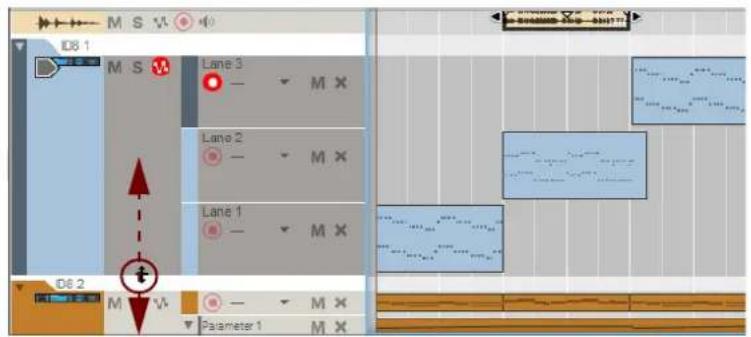
To resize multiple tracks in one go, select the desired tracks and drag the bottom edge of one of the selected tracks.
If the selected tracks have different heights to begin with, they will be scaled proportionally.
To scale multiple tracks to the same heights, hold Alt or Option and drag one of the track bottom edges.
→To scale all track heights proportionally, click the -/+ Track Height buttons:
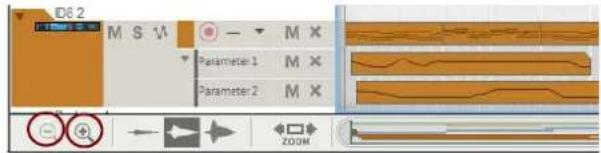
To set all track to the same height, hold Alt or Option and click the -/+ Track Height buttons:
! Note that folded tracks (see "Folding tracks") cannot be resized.
Moving tracks
To move a track to another position in the Track List, click on the track handle (the leftmost area of the track) and drag the track up or down.
A red insertion line is shown, indicating where the track will be placed after releasing the mouse button. All clips on all lanes of the track will be moved along with the track.
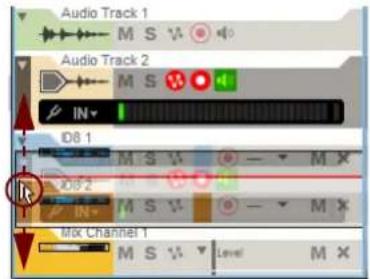
You can use the same technique to move several selected tracks at once. Use standard [Shift]-select or use Ctrl or Cmd to select non-adjacent tracks.
About sorting devices and channel strips according to the track order
Note that the order of the tracks in the sequencer Track List is totally independent from the device order in the rack - and from the channel strip order in the Main Mixer. However, it's possible to re-order devices and channel strips according to the track order in the Track List:
- Select the tracks in the Track List you want to re-order devices and channel strips after.
- Select "Sort Selected Device Groups" from the Edit menu or from the track's context menu.
The associated devices and channel strips are now re-ordered, in the rack and Main Mixer respectively, according to the order of the selected tracks in the Track List.
! Note that the re-ordering only affects the devices and channel strips of the selected tracks - all other devices and channel strips will remain unaffected.
Deleting tracks
The most common scenario would probably be to delete a track together with its associated device(s). However, it's also possible to delete only the track while keeping the associated device(s) in the rack.
Deleting tracks together with their associated devices
To delete one or several tracks together with their associated devices in the Rack, select the tracks and then select "Delete Track(s) and Device(s)" from the Edit menu or from the track's context menu. Alternatively, press [Delete] or [Backspace].
An alert appears which prompts you to confirm or cancel the deletion of the track(s) and device(s).
! If you're deleting the track for the Source Device or Mix Channel, and "Auto-group Devices and Tracks" on the Options menu is on, you will be asked if you want to delete the whole device group. If you hold down Ctrl or Cmd while deleting, the whole device group will be deleted without the alert.
See "About Device Groups" for more information about device groups.
Deleting tracks only
To delete one or several tracks, select them and then select "Delete Track(s)" from the Edit menu or from the track's context menu.
The tracks will be deleted without an alert but you can always use the Undo function. See "Undo and Redo".
! If you delete an audio track, all recordings on that track will be removed!
If you have deleted a track for a device and want to create a new track for the device, follow the descriptions in "Creating a parameter automation track for a non-instrument device" or "Short-cut for creating a Mix Channel track or Audio track".
Duplicating/copying tracks and devices
As it is not possible for a specific instance of a device to have more than one track, you cannot copy or duplicate only a track. These operations will instead duplicate/copy both the track (including all clips on the track) and its associated device(s) (with all settings). The duplicated/copied devices are really just like separate devices but with the same name and settings as the original devices, although their names will have the extension "Copy" to differentiate them from the original.
To make copies of tracks and their associated devices, complete with all lanes and recorded clips, use any of the following methods:
! Note that if "Auto-group Devices and Tracks" on the Options menu is on, the entire device group(s) associated with the track(s) will be copied/duplicated when you perform the procedures described below.
See "About Device Groups" for more information about device groups.
→ Hold down Ctrl or Option, click on the track handle and drag the selected track(s) to a new position in the track list.
→ Select the track in the Track List, hold down Ctrl or Cmd and press [D].
The duplicated track(s) will be inserted below the original track.
→ Select "Duplicate Device(s) and Track(s)" from the Edit menu or from the track's context menu.
To bring up the context menu, right-click (Win) or [Ctrl]-click (Mac) on the track in the Track List. The duplicated track(s) will be inserted below the original track.
→ Select "Copy Device(s) and Track(s)" from the Edit menu or from the track's context menu.
This allows you to insert the copied track(s) and device(s) by selecting "Paste" from the Edit menu or from the track's context menu. The copied track(s) will be pasted below the currently selected track.
! Note that if "Auto-group Devices and Tracks" on the Options menu is off, duplicated/copied devices will not have auto-routed audio connections. To hear the duplicated devices, select the device and choose "Auto-route Device" on the Edit menu or context menu. Alternatively, flip the rack around and connect the audio outputs to available (or new) Mix Channel devices. You might also want to mute the original track to avoid double notes.
To duplicate a selected audio track, with all recordings and mixer channel strip parameter settings, including any Insert FX, click the "Alt" or Dub" buttons on the Transport Panel - see "Duplicating audio tracks using the "Alt" function" and "Overdubbing audio using the "Dub" function".
- If you hold down [Shift] and select Paste from the Edit menu or context menu, the copied device(s) will be auto-routed to an available mixer channel. If necessary, an additional Mix Channel will be automatically created.
Coloring tracks
A track can be assigned a color in the sequencer as follows:
To assign a new color to a selected track, select "Track Color" from the Edit menu or from the track's context menu and then select color from the palette.
The track color is shown in the track background in the Track List. The associated Audio Track device or Mix Channel device in the rack and its corresponding channel strip in the Main Mixer will also be assigned the new color. The selected track color will be reflected in all new clips you record or draw on this track.
! If existing clips have the function “Use Track Color” active on the Clip context menu, these clips will also change color - otherwise they won’t. To manually change color of previously recorded clips, refer to “Coloring clips”.
To automatically set a new color for new tracks, make sure the "Auto-color New Sequencer Tracks" box in the Options menu is ticked.
The track color will be automatically selected from the palette when you create a new track.
Naming tracks
Devices (and tracks) get the name of their loaded patch by default, but you can override this by manually renaming:
→ Name, or rename, a track by double-clicking its name tag in the Track List, typing in a name and pressing [Return].
Note that naming/renaming a track also changes the name of the associated Source Device in the rack (and vice versa). Furthermore, renaming an audio track also changes the name of the associated Audio Track device in the rack as well as its corresponding channel strip in the Main Mixer. If you rename the track of a source device in a device group, its Mix Channel will get the same name. If you want a separate name for the Mix Channel, double-click in the Mix Channel name tag, in the rack or Main Mixer, type in a new name and press [Return].
See "About Device Groups" for more information about device groups.
Folding tracks
To minimize the visible height of the track, and thus allow for a better overview of the tracks in the sequencer, it's possible to fold tracks.
→ To fold/unfold a track, click on the small triangle on the track handle.
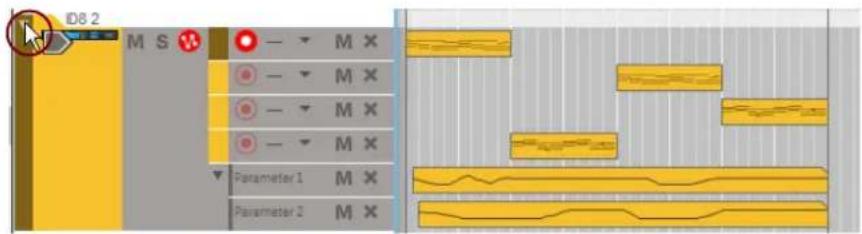
An unfolded track.

The same track folded.
A folded track will not show the individual lanes in the Track List, and on the Edit/Arrangement Pane the clips are shown as horizontal strips. If the folded track has several lanes, all the clips on the lanes will be shown as vertically stacked strips on the Arrangement Pane. No events in the clips are shown.
→ Basic clip operations (selecting, moving, copying etc.) are available also for folded tracks, although it is generally better to unfold a track if you want to edit its contents, as this gives you a better overview.
→ To fold/unfold all tracks in the sequencer in one go, press Alt or Option and click on a track handle triangle.
- It's also possible to fold/unfold only the parameter automation lanes on a track by clicking the triangle on the parameter automation tab. See "Parameter automation lane elements" for more details.
Muting tracks
To mute a track means to silence it, so that no data is sent from the track during playback. This can be useful when you are trying out different versions of an arrangement, for bringing elements in and out of the mix during playback.
! Note that muting a sequencer track is NOT the same as muting a mixer channel (see "MUTE/SOLO buttons").
→ To mute a track, click the corresponding Mute (M) button in the Track List.
Everything present on the track will be muted.
A red "M" button in the Track List indicates that the track is muted.
→To unmute the track, click the "M" button again.
Several tracks can have Mute active at the same time, in which case you can unmute them all by clicking the master "M" button at the top of the Track List.

It's also possible to mute individual lanes and individual clips on a track. Refer to "Muting lanes" and "Muting clips".
Soloing tracks
To solo a track means that all tracks in the sequencer, except for the soloed track, are muted.
! Note that soloing a sequencer track is NOT the same as soloing a mixer channel (see "MUTE/SOLO buttons").
→ To solo a track, click the corresponding Solo (S) button in the Track List. This mutes all other (un-soloed) tracks. Soloed tracks have green S buttons
Here, the "Filmscore Pad" track is soloed (indicated by the green "S" button). All other tracks are automatically muted (indicated by red "M" buttons).
→ To turn solo off, click the green "S" button again.
Several tracks can have Solo active at the same time, in which case you can turn off Solo for all of them by clicking the master "S" button at the top of the Track List.

Lane details
A track consists of one (default) or several parallel lanes. Depending on track type, the clips on the lanes can contain various types of events. A lane can also contain clips with performance controller and parameter automation events - or pattern selection for pattern based devices.
Audio lane

The audio lane is not distinguished by a separate lane tab in the Track List like the other lane types. This is simply because an audio track can only have a single audio lane. Consequently, all audio lane elements reside in the audio track section instead.
Audio lane elements
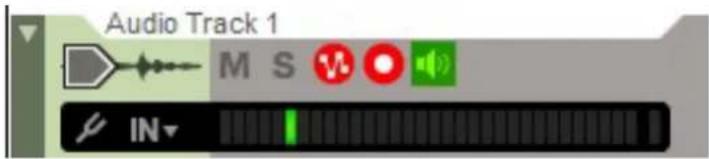
- Record Enable button
To the right of the Record Enable Parameter Automation button is the Record Enable button. Make sure this button is on (red) before recording audio on the track. By default, this is activated when you select an audio track. If you want to record several audio tracks at the same time you need to click their Record Enable buttons first.
- Monitor button
To the right of the Record Enable button is the Monitor button. Click this button to monitor the input signal of the track. The signal is monitored after the audio track channel strip which means that all channel strip parameters, including any Insert FX, Dynamics etc., will be monitored.
! The Monitor button activation/deactivation depends on the setting in the "Monitoring" section on the "Audio" page in Preferences. If "Manual" is selected, you will have to manually activate the Monitor button. If "Automatic" is selected, the Monitor button is automatically activated when the Record Enable button is on.
- Enable Tuner button
To the left below the Device icon is the Enable Tuner button. Click the button to switch to Tuner mode. The Input Meter to the right will switch to a Tuner.
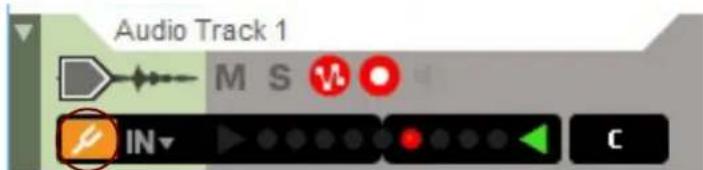
Audio track in Tuner mode.
In Tuner mode, you can tune a connected instrument - an electric guitar, for example. See "Using the Tuner" for more info.
- Select Audio Input drop-down list
To the right of the Tuner button is the Select Audio Input drop-down list. Here, you select which audio input(s) to use for the track. See "Selecting audio input(s) and defining mono or stereo" for more info.
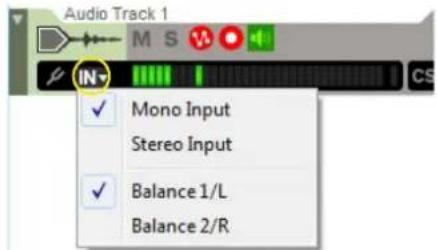
- Input Meter
The Input Meter shows the level(s) of the input signal(s). If the selected audio input is mono, the Input Meter displays a single LED bar. If the audio input is in stereo, the Input Meter displays two parallel LED bars. See "Setting input level(s)" for details about setting input levels.
Note lane

As the name implies, the note lane can contain clips that feature note events. Clips on a note lane can also contain performance controller events. One or several note lanes can be present on an instrument track.
Note lane elements
- Name
At the top to the left is the name of the lane. As soon as you create a note lane it will automatically be named "Lane n" where "n" is the number of the lane - in chronological order. You can change the name of the lane by double-clicking in the name field, typing in a new name and then pressing [Return] on the computer keyboard.
! Note that depending on the current magnification of the Edit/Arrangement Pane, the note lane names could sometimes be hidden. To make the note lane names visible, increase the vertical magnification of the Edit/Arrangement Pane, for example, by clicking the + magnification button below the sequencer Track Navigator.
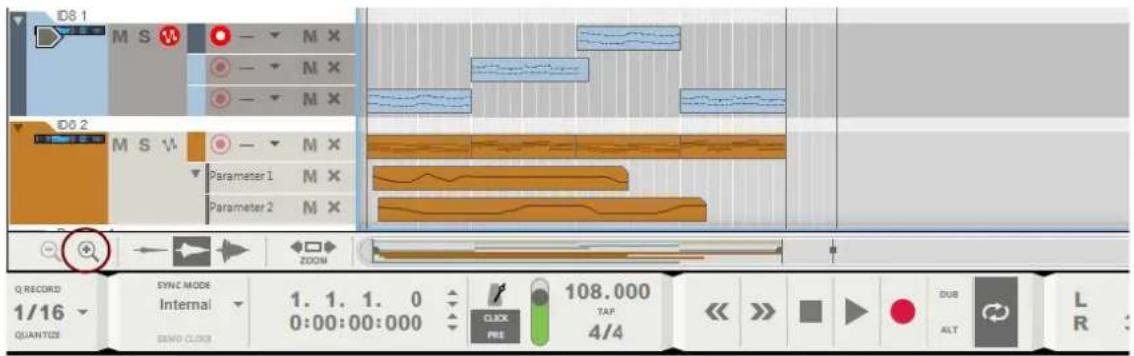
Increase the vertical magnification by clicking the + magnification button below the Track List.
- Record Enable button
Below the note lane name is the "Record Enable" button. Make sure this button is on (red) before recording on the lane. By default, the "Record Enable" button on the latest created/added note lane is automatically activated when you select an instrument track.
• Groove Select drop-down list
To the right of the "Record Enable" button is the "Groove Select" drop-down list. Here you can select a ReGroove channel for all clips on the lane. See more about ReGroove in "The ReGroove Mixer".
- M (Mute) button
Clicking the "M" button will mute the playback from the lane.
- Delete (X) button
To the far right is the "Delete Note Lane" (X) button. Clicking this button will delete the lane (and all clips on it). If there are clips on the lane, a dialog appears prompting you to confirm deletion.
Parameter automation lane
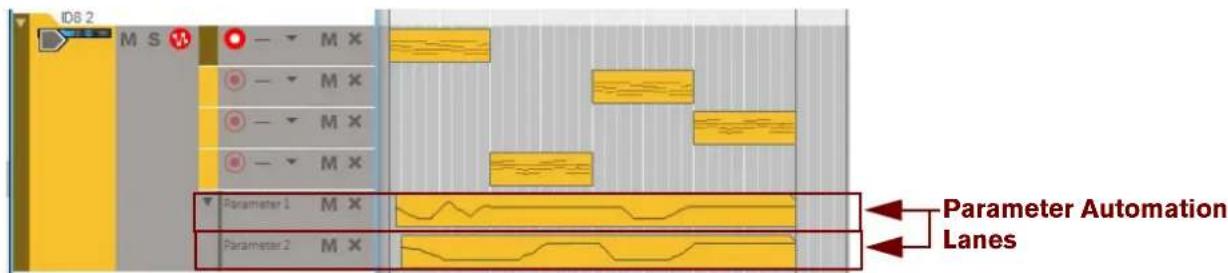
An instrument track with two parameter automation lanes.
Parameter automation is used for controlling changes of device parameter values in a song. You could, for example, automate a filter cutoff parameter and record filter sweeps at various positions in your song. These kind of parameter value changes are recorded on parameter automation lanes.
Parameter automation lanes can exist in all track types and can contain clips with device and/or channel strip parameter automation. A track can have as many automation lanes as its device has automatable parameters. For Mix Channel and Audio Track devices, parameter automation could be used for any of their corresponding channel strip controls.
Parameter automation lane elements
- Fold/Unfold button
Parameter automation lanes in a track can be folded/unfolded, as a group, by clicking the small triangle on the handle to the far left on the parameter automation lane tab.
To fold/unfold all parameter automation lanes on all tracks in the sequencer, hold down [Alt](Win) or [Option](Mac) and click on the triangle on a parameter automation lane tab.
- Name
The name of the automated parameter is displayed on the parameter automation lane tab. Since the name reflects the original device/channel strip parameter name, this cannot be changed.
• M (Mute) button
Clicking the "M" button will mute the parameter automation playback from the lane. Muting a parameter automation lane will freeze whatever value the parameter had when you muted the lane. Deactivating the Mute button reactivates the automation.
- Delete Automation Lane (X) button
To the far right is the "Delete Automation Lane" (X) button. Clicking this button will delete the lane (and all clips on it). If there are clips on the lane, a dialog appears prompting you to confirm deletion. See "Deleting parameter automation lanes" for alternative ways of deleting parameter automation lanes.
Pattern lane

A Redrum track featuring a pattern lane.
A pattern lane can only exist in a track featuring a pattern based device, such as the Redrum Drum Module or the Matrix Analog Pattern Sequencer. A pattern lane can only contain clips with pattern Bank and pattern Number automation data. There can only be a single pattern lane per track.
Pattern lane elements
- Name
The name of the automated parameter is displayed on the pattern automation lane tab. Since the name reflects the original device parameter name, this cannot be changed.
• M (Mute) button
Clicking the "M" button will mute the pattern automation playback from the lane. Muting a pattern automation lane will freeze whatever value the parameter had when you muted the lane. Deactivating the Mute button reactivates the pattern automation.
- Delete Pattern Lane (X) button
To the far right is the "Delete Pattern Lane" (X) button. Clicking this button will delete the lane (and all clips on it). If there are clips on the lane, a dialog appears prompting you to confirm deletion. See "Deleting pattern lanes" for alternative ways of deleting pattern lanes.
Creating/adding lanes
Adding note lanes
You can add additional note lanes on an instrument track. This can be useful under the following circumstances:
- If you want to overdub notes or performance automation but don't want to record in existing clips.
- If you want to record a series of takes on separate note lanes, to later decide which take is the "best" (or to edit together a composite).
- If you want to apply different ReGroove grooves to different parts of a track, or want different grooves on separate drums on a drum track.
You can create new note lanes for selected instrument tracks in the following ways:
→ Select "New Note Lane" from the Edit menu or from the context menu.
A new note lane will be created and automatically record enabled.
→ Click on the "New Note Lane" (Lanes +) button at the top of the Track List.
A new Note Lane will be created and automatically record enabled.
→ Click on the "Dub" button on the Transport Panel.
A new note lane will be created and automatically record enabled. See "Recording notes using the "Dub" and "Alt" functions" for more details.
→ Click on the "Alt" button on the Transport Panel.
A new note lane will be created and automatically record enabled. At the same time, the previous note lane, or (if loop is activated and the Song Position Pointer is between the Left and Right Locators) the clips between the Left and Right Locators, will be muted. See "Recording notes using the "Dub" and "Alt" functions" for more details.
- Note that the "Dub" and "Alt" functions can also be used on-the-fly during recording without stopping the sequencer.
Creating/adding parameter automation lanes
Parameter automation lanes can be created for all track types.
- During recording of a track, changing any parameter values on the device/channels strip will automatically create a new parameter automation lane for each unique parameter. See "Recording parameter automation" for more details.
Do as follows to manually create a parameter automation lane on a selected track:
→ Hold down Alt or Option and click on a device parameter in the rack, or on a channel strip parameter in the Main Mixer. Alternatively, select "Edit Automation" from the parameter's context menu.
A new parameter automation lane will be automatically created in the track for the corresponding device or channel strip. The automated parameter on the device in the rack or channel strip in the Main Mixer will get a green border, indicating that it has been automated.
! Note that if a track hasn't already been created for the device/channel strip, it will be automatically created during this operation.
Other ways of creating/adding a parameter automation lane are as follows:
- Click on the "Track Parameter Automation" drop-down list at the top of the Track List.
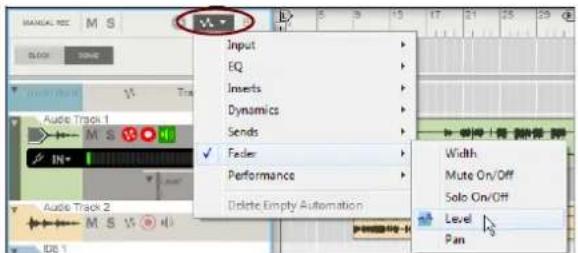
- Select the parameter you want to automate from the list.
A new parameter automation lane is automatically created on the selected track.
If you click the Track Parameter Automation drop-down list again, any selected parameters will have a symbol to the left of the parameter name, indicating that an automation lane already exists for the parameter.
The automated parameters on the device in the rack or channel strip in the Main Mixer will get green borders, indicating that they have been automated.
Creating a pattern lane
For pattern based devices such as the Redrum Drum Module and Matrix Analog Pattern Sequencer, a single pattern lane can be created on a selected track. Do either of the following:
→Click the "Create Pattern Lane" button at the top right of the Track List.
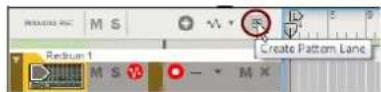
→ Select "Create Pattern Lane" from the Edit menu or from the context menu.
→ Hold down Alt or Option and click on the "Pattern" button section of the device in the rack.
→ Right-click (Win) or [Ctrl]-click (Mac) on the "Pattern" button section of the device in the rack and select "Edit Automation" from the context menu.
When you create a pattern lane, the bank buttons on the device in the rack get a green border to indicate that they have been automated.
→ Clicking the Pattern and/or Bank buttons on the device during recording will automatically create a pattern lane. See "Recording pattern automation" for more details.
Deleting lanes
Deleting note lanes
A note lane can be deleted as follows:
→ Click the "Delete Note Lane" (X) button on the lane tab in the Track List.
This will delete the lane (and all clips on it). If there are clips on the lane, a dialog appears prompting you to confirm deletion.
To delete the lane without the dialog, hold down Ctrl or Cmd and click the Delete Note Lane button.
Deleting parameter automation lanes
There are a number of different ways of deleting a parameter automation lane:
→ Click the "Delete Automation Lane" (X) button on the lane tab in the Track List.
This will delete the lane (and all clips on it). If there are clips on the lane, a dialog appears prompting you to confirm deletion.
→ To delete the lane without the dialog, hold down Ctrl or Cmd and click the Delete Automation Lane button.
Another way is this:
→ Right-click (Win) or [Ctrl]-click (Mac) on the automated device parameter in the rack and select "Clear Automation" from the context menu.
The green border around the device parameter disappears and the corresponding parameter automation lane is deleted from the track.
Alternatively, do the following:
-
Select a track by clicking on it.
-
Click on the "Track Parameter Automation" drop-down list at the top of the Track List.
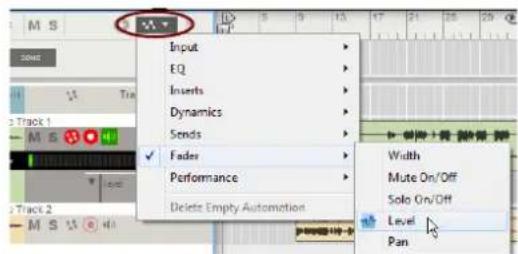
- De-select the parameter you want to delete from the list.
All selected parameters will have a symbol to the left of the parameter name in the list indicating that it has been selected. Selecting a parameter with a symbol in the list will automatically delete the corresponding lane, with its clips, from the track. If there are clips on the lane, a dialog appears prompting you to confirm deletion.
The green borders that surrounded the automated parameters on the device/channels strip will also be removed.
Deleting pattern lanes
There are two ways of deleting a pattern lane:
→ Click the "Delete Pattern Lane" (X) button on the lane tab in the Track List.
This will delete the lane (and all clips on it). If there are clips on the lane, a dialog appears prompting you to confirm deletion.
To delete the lane without the dialog, hold down Ctrl or Cmd and click the Delete Pattern Lane button.
Alternatively:
→ Right-click (Win) or [Ctrl]-click (Mac) on the automated pattern section on the device in the rack and select "Clear Automation" from the context menu.
The green border around the device pattern section disappears and the corresponding pattern lane is deleted from the track.
Moving note lanes
A note lane has a "handle" and can be moved vertically together with all clips on the lane. Move a note lane to another position on the same track like this:
- Click on the lane handle (the leftmost area of the lane).
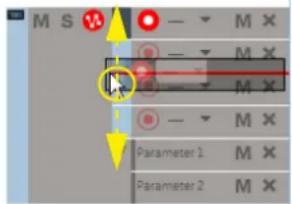
- Drag the note lane up or down and release at the desired destination.
Just as when moving tracks, a red insertion line is shown indicating where the note lane will be placed after you release the mouse button.
- It is also possible to move note lanes, with their clips, between tracks.
! Parameter automation lanes and pattern lanes cannot be moved since they are tightly connected with their associated devices. However, you can move or copy clips from one lane to another.
Copying (duplicating) note lanes
You can copy (duplicate) one note lane at a time, together with its clips, by doing the following:
The cursor gets a + sign next to it to indicate duplication. The destination of the duplicated note lane could be the same track or another track.
- Release the mouse button.
! Parameter automation lanes and pattern lanes cannot be duplicated.
Muting lanes
Muting a note lane
→To mute a note lane, click its "M" (Mute) button.
The note lane's "M" (Mute) button.
Muting a parameter automation lane
To mute a parameter automation lane, click its "M" (Mute) button.
The parameter automation lane's "M" (Mute) button.
Clip basics
Only the basic properties and functions pertaining to clips are described here. See "Arranging in the Sequencer" for in-depth details about what you can do with clips.
Clip types
Here are the different clip types:
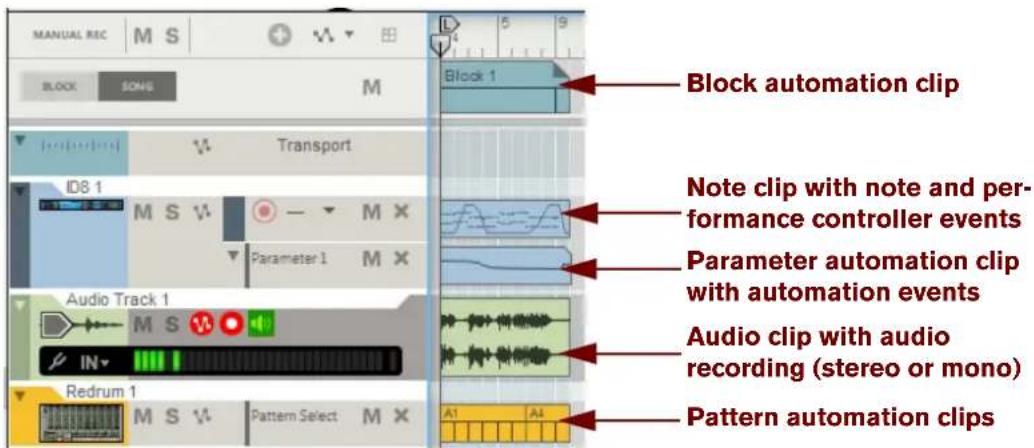
- Block automation clips (only if Blocks are on) that contain information of which Block should play back.
- Note clips contain note events with velocity values. Note clips can also contain performance controller events.
- Parameter automation clips contain events for an automated device/channel strip parameter.
A parameter automation clip can easily be distinguished by the shape of its frame: the top right corner is "cut off".
• Audio clips contain mono or stereo audio recordings.
If the audio clip is a Comp clip, or a Single Take clip which contains several takes, there is a small symbol in the lower right corner of the clip.
- Pattern automation clips contain device bank+pattern number.
Toolbar details

The Sequencer Toolbar can be found to the top left in the Sequencer Area. From the Sequencer Toolbar you can select various sequencer editing tools.
Toolbar tools
Selection Tool

The Selection (arrow) Tool is the main tool for selecting and moving tracks, note lanes, clips and events and recordings in clips. It's also used for resizing clips and events in clips. It is selected by default when a song is opened.
→ You can also select the Selection Tool by pressing [Q] on the computer keyboard.
→ Press Alt or Cmd to momentarily switch from the Selection Tool to the Pencil Tool - or to the Speaker Tool when editing an open audio clip inline - or to the Cut (Razor) Tool when editing an open audio clip in the Comp Editor.
Pencil Tool

The Pencil Tool is used for manually drawing clips and events in clips. It can also be used to edit the velocity values of notes in open note clips.
→ You can also select the Pencil Tool by pressing [W] on the computer keyboard.
→ Press Alt or Cmd to momentarily switch from the Pencil Tool to the Selection Tool.
! When a note clip is open in Edit Mode, there two different Pencil Tools are available - one for drawing single notes with varying lengths and one for drawing repetitive notes of the same length, see "Drawing notes".
Eraser Tool

The Eraser Tool is used for deleting clips and events. In audio Pitch Edit mode you can also join notes with the Eraser.
→ You can also select the Eraser Tool by pressing [E] on the computer keyboard.
→ Press Alt or Cmd to momentarily switch from the Eraser Tool to the Pencil Tool.
Razor Tool

The Razor Tool is used for splitting clips and notes - and for creating cuts when comping audio clips in Edit Mode.
→ You can also select the Razor Tool by pressing [R] on the computer keyboard.
→ Press Alt or Cmd to momentarily switch from the Razor Tool to the Pencil Tool - or to the Selection Tool when editing an open audio clip on the Edit Pane.
Mute Tool

The Mute Tool is used for muting clips in the arrangement - or lanes in Block automation clips (see "Muting lanes in Block Automation Clips").
→ You can also select the Mute Tool by pressing [T] on the computer keyboard.
→ Press Alt or Cmd to momentarily switch from the Mute Tool to the Razor Tool.
Magnifying Glass Tool

The Magnifying Glass Tool lets you zoom in and out both horizontally and vertically on the Arrangement Pane. The Magnifying Glass Tool offers a couple of possibilities:
→ To zoom in with the Magnifying Glass Tool, click in the Arrangement Pane where you want the origin of magnification.
Place the Magnifying Glass Tool in the Arrangement Pane and click.
After three clicks, the Arrangement Pane looks like this. The magnification is equal in vertical and horizontal directions.
→ To zoom out with the Magnifying Glass Tool, hold down Ctrl or Option and click.
You'll notice that the "+" sign in the Magnifying Glass Tool changes to a "-" sign.
→ You can also click and drag with the Magnifying Glass Tool to create a selection rectangle.
The view will then be zoomed in so that the selected area fills the entire Arrangement Pane.
Place the Magnifying Glass Tool on the Arrangement Pane, click and drag to create a selection.
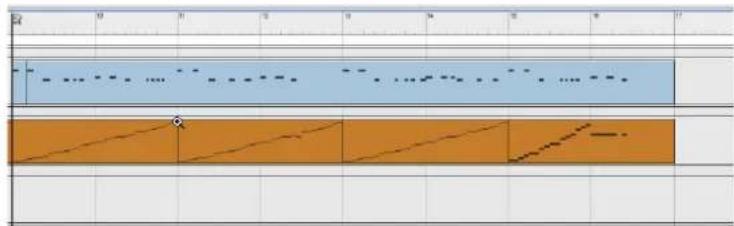
After releasing the mouse button, the zoomed selection fills up the Arrangement Pane. The magnification can be different in vertical and horizontal directions depending on the shape of the selection rectangle.
→ You can also select the Magnifying Glass Tool by pressing [Y] on the computer keyboard.
→ Press Alt or Cmd to momentarily switch from the Magnifying Glass Tool to the Hand Tool.
- It's also possible to zoom in the Arrangement Pane by using the Sequencer Area Navigators and Zoom To Selection function as described in "Zooming in the Sequencer" and "Zooming to selection".
Hand Tool

The Hand Tool is used for scrolling in the Edit/Arrangement Pane.
→ Select the Hand Tool and click anywhere in the Edit/Arrangement Pane, keep the mouse button depressed and drag to desired view.
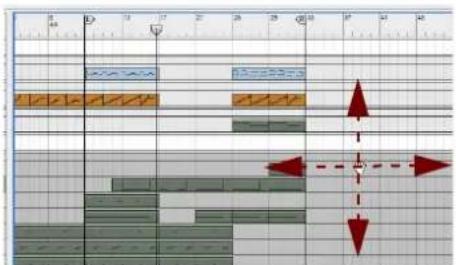
→ You can also select the Hand tool by pressing [U] on the computer keyboard.
→ Press Alt or Cmd to momentarily switch from the Hand Tool to the + Magnifying Glass Tool.
→ Press [Ctrl]+Alt or [Cmd]+Option to momentarily switch from the Hand Tool to the - Magnifying Glass Tool.
- It's also possible to scroll in the Edit/Arrangement Pane by using the Sequencer Area Navigators as described in "Scrolling with the Navigators and scrollbars".
Speaker Tool

The Speaker Tool is used for auditioning slices or notes in Single Take audio clips, and for auditioning individual recordings on Comp Rows in Comp Clips. See "Slice Edit mode tools", "Auditioning notes" and "Comp Editor audio editing tools" for details.
Alternate tools
For every tool mode described earlier, there is a so called alternate tool that can be momentarily selected by holding down Alt or Cmd on the computer keyboard. Below is a summary of the alternate tools:
| Selected tool | Alternate tool |
| Selection tool | Pencil tool (Speaker tool in inline editing of Audio Track or Cut (Razor) tool when editing audio clip in Comp Editor) |
| Pencil tool Selection tool | |
| Eraser tool Pencil tool | |
| Razor tool Pencil tool (Selection tool when editing open audio clip on the Edit Pane) | |
| Mute tool Razor tool | |
| Magnifying Glass tool Hand tool | |
| Hand tool + Magnifying Glass tool | |
| Hand tool - Magnifying Glass tool by pressing [Alt]-[Ctrl](Win) or [Option]-[Cmd](Mac) |
Edit Mode buttons

→ Click the Edit button (or Slice Edit/Pitch Edit/Comp Edit button for selected audio clips) to switch to Edit Mode.
Snap

The Snap function in the sequencer toolbar is used for "restricting" editing of clips and events to a user-selectable note value grid.
→ Activate the Snap function by pressing [S], or by clicking the Snap button:

! When moving clips or events, the Snap function can work either absolute (to the closest absolute position in the grid) - or relative to the clip(s)/event(s) original position(s), in steps of the set Snap value:
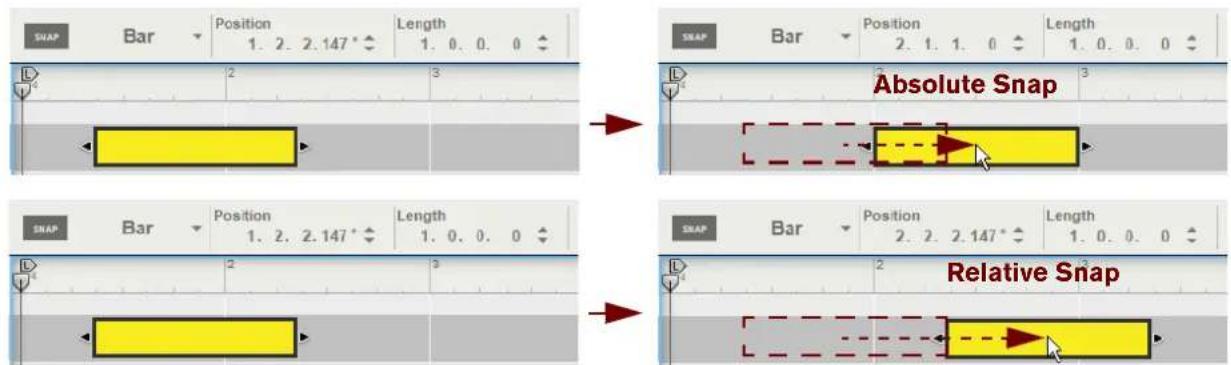
Absolute Snap set to "Bar" (top) and Relative Snap set to "Bar" (bottom).
→ Select the grid you wish to snap to by selecting the note value from the drop-down list:

- Click the drop-down list again and select if you want the Snap to be "Relative" or "Absolute" from the bottom of the drop-down menu.
! Note that you can select different Snap values for selected clips in the Arrange/Block View and for open clips in Edit Mode (see "About separate Snap values for selected clips and for open clips").
The Snap function affects the following operations:
- Moving the Song Position Pointer, Loop Locators and Song End Marker.
When you adjust the Locators with Snap activated, they will always snap to the selected Snap value on an absolute grid, regardless of the setting on the Snap drop-down menu.
- Moving clips and events, recordings and Comp Row cuts.
When you move objects with Snap activated, they will move relative or absolute to the Snap value, depending on what you selected on the Snap drop-down menu.
- Drawing clips.
When you create clips with the Pencil tool, their start and end positions will snap to the selected note value positions on an absolute grid.
- Drawing events in open clips.
The Snap value determines the absolute grid points on which you can draw a note or an automation point. The Snap value also determines the shortest possible note length that you can draw.
- Splitting clips with the Razor tool.
The Snap value determines the absolute grid to which a clip can be split.
- Nudging clips, events and recording.
When you nudge clips, events or recordings with Snap activated, they will move relative or absolute to the Snap value, depending on what you selected on the Snap drop-down menu.
- Creating Comp Row cuts
The Snap value determines the absolute grid to which you could add cuts in open Comp audio clips.
- Moving Comp Row cuts
The Snap value determines the relative or absolute grid to which you could move cuts in open Comp audio clips.
- Adding and moving Slice Markers
The Snap value determines the absolute grid to which you could add and move Slice Markers in open Single Take audio clips.
About the "Grid" value
The "Grid" value at the top in the list is dynamic and automatically changes the snap value, from "Bar" to "1/128", depending on the current horizontal zoom level on the Arrange/Edit pane.
The picture below shows the same clips in the Arrange pane at two different horizontal zoom levels:
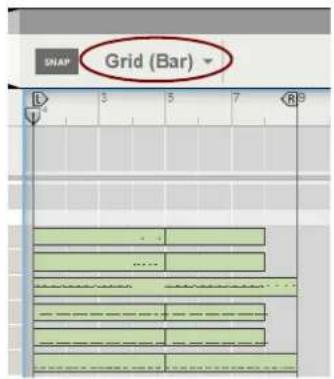
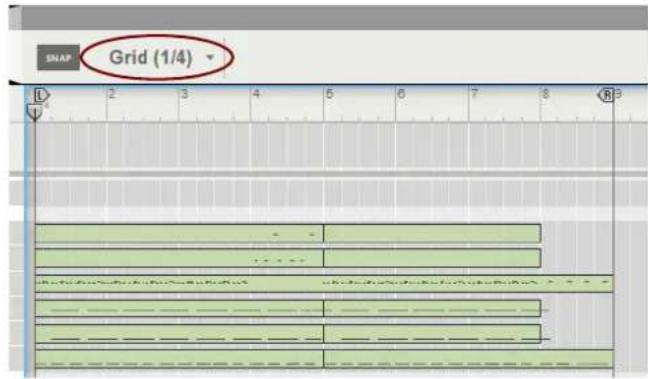
About separate Snap values for selected clips and for open clips
There are two different Snap settings, one for when a clip is open for editing in Edit Mode, and one for when no clip is open (e.g. in Song/Block View). Typically, you would set a fine Snap value (e.g. 1/16) for open clips in Edit Mode and have the other Snap value set to "Bar" for convenient clip arranging in the Song/Block View. You can also choose to turn Snap off in either of these modes, independently of the other setting.
- The Snap value for editing is used whenever a note clip or automation clip is open (including when an automation clip is opened in Arrange Mode).
However, there's one exception: If a note clip is open in Edit Mode and you click in the Clip Overview (see "Edit Mode elements"), the clip will remain open but the Snap value for arranging will be selected. This allows you to e.g. move or resize the clip in the Clip Overview just like in the Song/Blocks View, without closing it first.
Sequencer Toolbar keyboard shortcuts
Below is a complete list of the computer keyboard shortcuts for selecting tools on the sequencer Toolbar:
| Function | Key command |
| Selection tool select [Q] | |
| Pencil tool select [W] | |
| Eraser tool select [E] | |
| Razor tool select [R] | |
| Mute tool select [T] | |
| Magnifying Glass tool select [Y] | |
| Hand tool select [U] | |
| Snap On/Off [S] |
Ruler details
The Ruler is the song's time line. In the Ruler, the Song Position Pointer indicates the current position in the song, i.e. in which bar the song is, or will start, playing. The Ruler also shows the Left (L) and Right (R) Loop Locators as well as the Song End Marker (E).
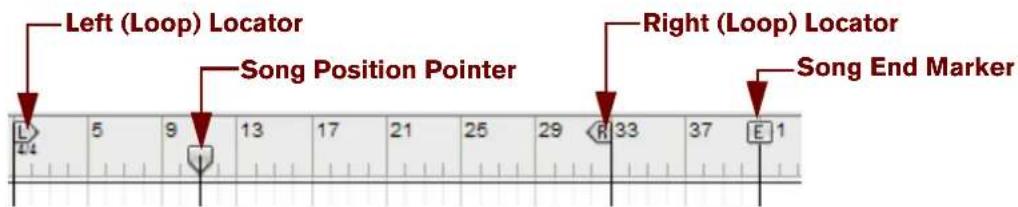
You can change the positions of the Song Position Pointer, Locators and Marker in the Ruler by clicking and dragging them to desired positions in the Ruler. Note that you have to click and drag the "flags" in the Ruler - not the lines. The Song Position Pointer and Loop Locators can also be moved by typing in new positions in the respective Position displays in the Sequencer Transport Panel (see "Song Position" and "Left and Right Locator Positions"). Another way of moving the Song Position Pointer is by using the Rewind and Fast Forward controls on the sequencer Transport Panel (see "Rewind and Fast Forward").
Transport Panel details
At the bottom of the Reason Lite window is the sequencer's Transport Panel. From here you control the sequencer transport functions. You can also set tempo, time signature and various other parameters.
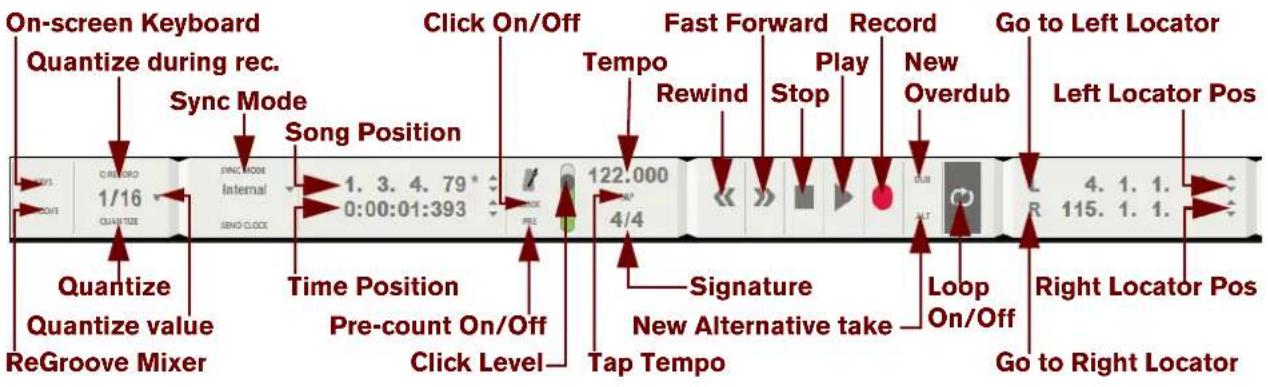
Keys
→ Click this button to bring up the On-screen Piano Keyboard floating window.
See the "On-screen Piano Keys" chapter for more information.
Groove
→ Click the Groove button to bring up the ReGroove Mixer.
Refer to "The ReGroove Mixer" chapter for more information.
Q Record
→ Click the Q Record (Quantize during recording) button to quantize notes as they are being recorded.
When the Q Record button is on, all recorded MIDI notes will be quantized to the currently selected quantization grid. Refer to "Quantize" for more information on quantization.
Quantize value
→ Select the desired quantization value from the drop down list.
Refer to "Quantize" for more information on quantization.
Quantize
→ Click the Quantize button to quantize the notes in the selected clips to the selected Quantize value - after they have been recorded.
Refer to "Quantize" for more information on quantization.
Sync Mode
Here you can set the desired synchronization mode for the Reason Lite sequencer: Internal, MIDI Clock (if applicable) or Ableton Link (if applicable). You can also choose "Send MIDI Clock" to sync other applications/instruments from Reason Lite (if applicable). See the chapter "Synchronization and Advanced MIDI" for more information about synchronization.
Song Position
The current song position is shown in the display. The song position is where the Song Position Pointer in the Ruler (see Ruler details) is at the moment. The display is divided into Bars, Beats, 1/16th Note and Ticks (there are 240 Ticks for each 16th note) segments. You can edit the position of the Song Position Pointer, and thus change the song playback position, according to the descriptions in "Transport Panel segment displays".
About subticks in the Song Position display
When editing notes and automation events in the sequencer you have a resolution of 240 ticks per 1/16th note, which allows for very accurate positioning. But for the Song Position Pointer, the internal resolution is even higher (15360 ppq) which means that the position can end up on a fraction of a tick, a so called subtick.
If the Song Position Pointer value is on a fraction of a tick, this is displayed with an asterisk (*) in the Tick section of the Song Position display.
![33. 4. 4.239 0:01:07:692 117.000 The position value contains fractions of ticks (subticks). [Ctrl]-click to clear subticks](/content/2026/06/1203202/images/6ede50c8c507a00e66f5654562df0ed8af0ea7b1e33a17db5e7278bc01387dfb.jpg)
To adjust the Song Position Pointer to the closest tick value, press Ctrl or Cmd and click on the asterisk in the display.
The Song Position Pointer will now adjust to the closest tick value and the asterisk disappears.
Time Position
The current position of the Song Position Pointer in the Ruler (see Ruler details) is shown in time format (hours, minutes, seconds and milliseconds) in the display. You can change the position in time of the Song Position Pointer, and thus change the song playback time position, according to the descriptions in "Transport Panel segment displays".
Click On/Off
→Click this button to hear an audible metronome click as the sequencer plays.
The click will sound on every beat, with the first beat in every bar accented (higher pitched). See "Click and Precount" for more details.
Pre(-count) On/Off
→ Click the Pre button to hear a pre-count (count-in) click sound before recording.
Pre-count will only be present before recording - not before regular playback. See "Click and Pre-count" for details about selecting number of pre-count bars etc.
Click Level
→ Adjust the audio level of the metronome (and Pre-count) with this slider.
See "Click and Pre-count" for more details.
Tempo
The current song tempo is shown in the display in BPM (Beats Per Minute) and 1/1000 of a BPM. You can edit the tempo according to the descriptions in "Transport Panel segment displays". The Tempo range is 1.000-999.999 BPM.
Tap Tempo
Instead of setting the Tempo with the Tempo control (see above), you can manually tap in the desired tempo in real-time.
→ Click the Tap button repeatedly to set desired sequencer tempo.
The tempo is defined by averaging the time between a minimum of two clicks and a maximum of 16 clicks. The more clicks, the more “steady” the tempo. The time-out between two series of clicks is 2 seconds. The detectable tap tempo range is 30-999.999 BPM.
Signature
The current song time signature is shown in the display. You can edit the time signature according to the descriptions in "Transport Panel segment displays".
The available Signatures are: 1/2-16/2, 1/4-16/4, 1/8-16/8 and 1/16-16/16.
Rewind and Fast Forward
→ Click on the Rewind or Fast Forward buttons to move the Song Position Pointer in steps of one bar (from its current position).
→ To move the Song Position Pointer several bars at once, click and hold the mouse button depressed.
Instead of clicking the buttons, you can use the computer keyboard:
→Press [4] on the numeric keypad for Rewind and [5] for Fast Forward.
→ If you click and hold the Rewind or Fast Forward buttons, or press and hold the [4] or [5] keys, the positioning speed will be faster after the first 20 bars.
Play and Stop
→ Click the Play button to start playback from the Song Position Pointer's current position.
→Alternatively, press [Enter] on the numeric keypad on the computer keyboard.
→ Click the Stop button to stop playback (or recording).
→ Alternatively, press [0] on the numeric keypad or [Shift]+[Return] on the computer keyboard.
By default, if you click the Stop button or use the keyboard "Stop" commands when the song is already stopped, the Song Position Pointer is moved according to the following rules:
- Clicking/pressing Stop the first time moves the Song Position Pointer to where playback was last started.
- Clicking/pressing Stop a second time moves the Song Position Pointer to the beginning of the song.
- If the Song Position Pointer already is at the beginning of the song, nothing happens.
This means you can always click twice on the Stop button in "stop mode", to return to the beginning of the song.
→Press [Spacebar] on the computer keyboard to toggle between Play and Stop.
- To have the Song Position Pointer automatically return to its last start position when you hit Stop, select "Return to last start position on stop" in the Miscellaneous section on the General tab in Preferences, see "Return to last start position on stop".
Record
→ Click the Record button to begin recording on the selected track/lane in your song.
Alternatively, press [*] on the numeric keypad or hold down Ctrl or Cmd and press [Return] on the computer keyboard. If Pre-count has been activated (see Pre(-count) On/Off above), the recording will begin after the set number of pre-count bars.
! Nothing you play during the pre-count period will be recorded.
Dub and Alt
Clicking on any of these buttons will add additional audio tracks or note lanes for overdub purposes. Refer to "Over-dubbing audio using the "Dub" function" and "Recording notes using the "Dub" and "Alt" functions" for more details about these functions.
Loop On/Off
→ Click the Loop button or press [L] to activate the Loop function.
When the loop function is activated, recording and playback will be continuously looped between the Left and Right Locators. Some general rules regarding loop mode are these:
- If the Song Position Pointer is to the left of (before) the Right Locator when playback is started, the song will play to the Right Locator and then immediately jump back and seamlessly continue from the Left Locator.
- If the Song Position Pointer is to the right of (after) the Right Locator when playback is started, the Locators will be ignored and the song will continue to play “un-looped”.
- If the Left Locator is to the right of the Right Locator, i.e. in “reversed” order, the song will play to the Right Locator and then immediately jump and seamlessly continue from the Left Locator, skipping the part of the song in-between the Locators. The song will then continue to play “un-looped”.
Go to Left and Right Locators
→ Click on the "L" or "R" button to move the Song Position Pointer to the Left or Right Locators respectively.
Alternatively, press [1] on the numeric keypad on the computer keyboard to move the Song Position Pointer to the Left Locator or [2] to move to the Right Locator.
Left and Right Locator Positions
The current positions of the Left and Right Locators in the Ruler (see Ruler details) are shown in the displays. The display is divided into Bar, Beat, 1/16th Note and Ticks (there are 240 Ticks for each 1/16th Note). You can change the positions of the Locators, and thus change the loop playback region, according to the descriptions in "Transport Panel segment displays".
Transport keyboard commands
Below is a complete list of the computer keyboard shortcuts for the Sequencer Transport functions:
| Function | Key command |
| Stop, Go to start position,Go to start of song | [0] on the numeric keypad or [Shift]+[Return] |
| Play [Enter] on the numeric keypad | |
| Toggle Stop/Play [Spacebar] | |
| Rewind [4] on the numeric keypad | |
| Fast Forward [5] on the numeric keypad | |
| Record [*] on the numeric keypad or | [Ctrl](Win) or [Cmd](Mac)+[Return] |
| Go to Left Locator [1] on the numeric keypad | |
| Go to Right Locator [2] on the numeric keypad | |
| Go to the start of the song [,] on the numeric keypad | |
| Move forward one bar [8] on the numeric keypad | |
| Go back one bar [7] on the numeric keypad | |
| Tempo up [+] on the numeric keypad | |
| Tempo down [-] on the numeric keypad | |
| Loop On/Off [/] on the numeric keypad or [L] | |
| Click On/Off [C] or [9] on the numeric keypad | |
| Pre-count On/Off | [Ctrl](Win) or [Cmd](Mac)+[P] |
| Set the Left and Right Loop Locators to encompass selected clips. | [Ctrl](Win) or [Cmd](Mac)+[L] |
| Set the Left and Right Loop Locators to encompass selected clips and start play-back in Loop Mode. | [P] |
About the Inspector

The Inspector, located above the Edit/Arrangement Pane, can be used for a number of different editing purposes pertaining to clips, events and recordings. The Inspector is context sensitive, meaning it will have different content and functionality depending on what is currently selected. How to edit using the Inspector is described in detail in the sections "Resizing clips using the Inspector", "Moving clips using the Inspector", "Editing recordings and cuts in the Inspector" and "Editing notes and events in the Inspector".
! When the Pencil Tool is selected, the Inspector isn't visible. Instead, menus pertaining to Time Signature, Pattern Automation and Blocks Automation are displayed.
About subticks in the Position and Length displays
When editing notes and automation events in the sequencer you have a resolution of 960 ppq (240 ticks per 1/16th note), which allows for very accurate positioning. But when you record, the internal resolution is even higher (15360 ppq) which means that notes and automation events can end up on a fraction of a tick, a so called subtick.
If the value is a fraction of a tick, this is displayed with an asterisk (*) in the Tick section of the Position or Length display.
![Position 17. 1. 3. 29 Length 7. 3. 1.210* The position value contains fractions of ticks (subticks). [Ctrl]-click to clear subticks](/content/2026/06/1203202/images/f307328a94b797f9f6ce853061c3939123f4387466040b5bf1338e138bd1b1e6.jpg)
To adjust the clip or event position (or length) to the closest tick value, press Ctrl or Cmd and click on the asterisk in the display.
The position or length value will now adjust to the closest tick value and the asterisk disappears.
! When it comes to audio editing, you will have access all the way down to the sub-tick level. This means there won't be any sub-tick asterisks when editing audio.
About the "Match Values" function
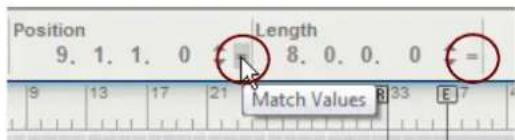
The "Match Values" function in the Inspector can be used to match the positions, lengths and/or values of several selected clips, notes, events or recordings to the position, length and/or value of the topmost (or leftmost) selected clip, note, event or recording. Refer to "Matching clips using the "Match Values" function", "Matching audio values using the "Match Values" function" and "Matching notes or events using the "Match Values" function".

Chapter 6
Recording in
the Sequencer
About this chapter
This chapter describes the different recording techniques that you can use in Reason Lite. The chapter covers both audio, notes and parameter automation recording. Before you read this chapter, it's recommended that you are familiar with the basic sequencer functions and definitions described in the "Sequencer Functions" chapter. A lot of functions are common for all types of recording methods. These will be described first in this chapter. Later in the chapter we will go into functions specific to audio, notes and parameter automation recording.
General recording functions
Record enabling
Before you can start recording on a track in the sequencer, the track needs to be record enabled. There are two types of buttons for record enabling: the Record Enable button, which is used when recording audio clips and note clips, and the Record Enable Parameter Automation button, which is used when recording device/channel strip parameter automation and tempo automation:
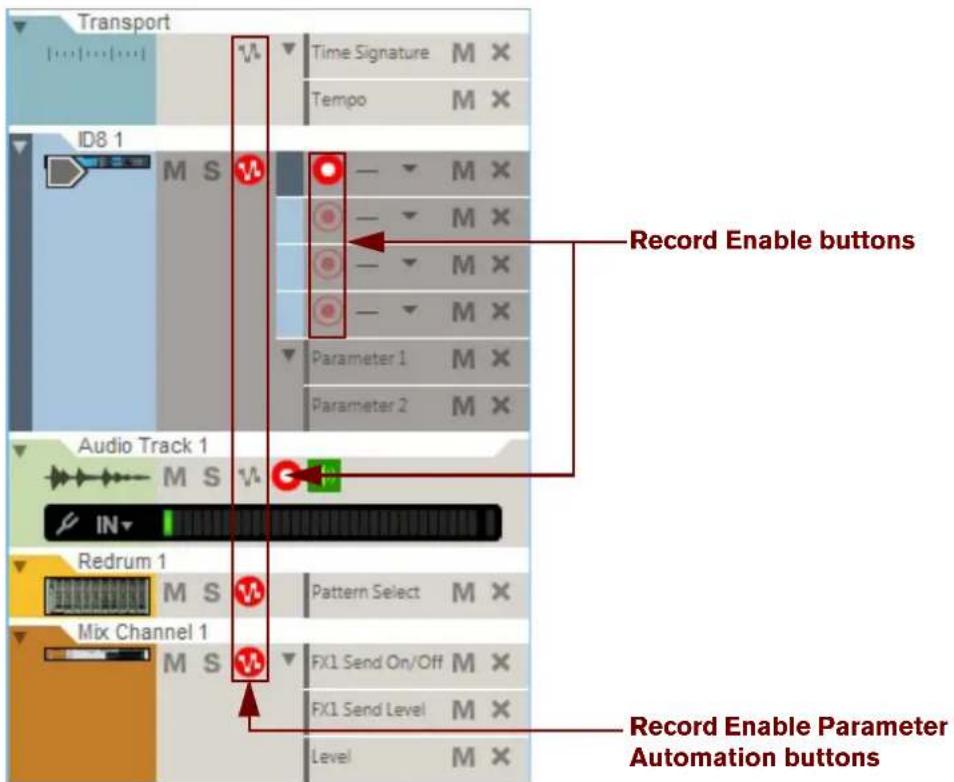
Five tracks with their Record Enable and Record Enable Parameter Automation buttons.
Activated Enable Record and Enable Record Parameter Automation buttons are indicated with a red color. Recording can be simultaneously enabled on an unlimited number of audio tracks (limited only by the computer's processing and hard disk performance) - plus one note lane on an instrument track. However, if you have locked several MIDI keyboard controllers to specific instrument devices in the rack - using Remote (see "Locking a surface") - you can record MIDI on these instrument tracks simultaneously. Recording of parameter automation can be simultaneously enabled on as many tracks as you like.
Record enabling an audio track

→ To record enable an audio track, click on the Record Enable button on the audio track.
The Record Enable button goes red.
Selecting an audio track will automatically record enable the track if you have selected "Standard" mode in the "Master Keyboard Input" section on the "Keyboard and Control Surfaces" page in the Preferences dialog (see "The Master Keyboard Input setting") - and if the Manual Rec button in the Track List is Off, see "About the Manual Rec function".
Also, depending on the setting in the "Monitoring" section on the "Audio" page in Preferences, monitoring of the input signal to the audio track may, or may not, be automatically activated - see "Monitoring".
Record enabling multiple audio tracks
→ If you want to record audio from separate audio inputs on several tracks at once, click the Record Enable buttons on all desired audio tracks in the Track List.
Each record enabled audio track will automatically unfold to show the Tuner button, the Select Audio Input drop-down list and the Input Meter. When recording audio on several tracks simultaneously, it doesn't matter which audio track has Master Keyboard Input.
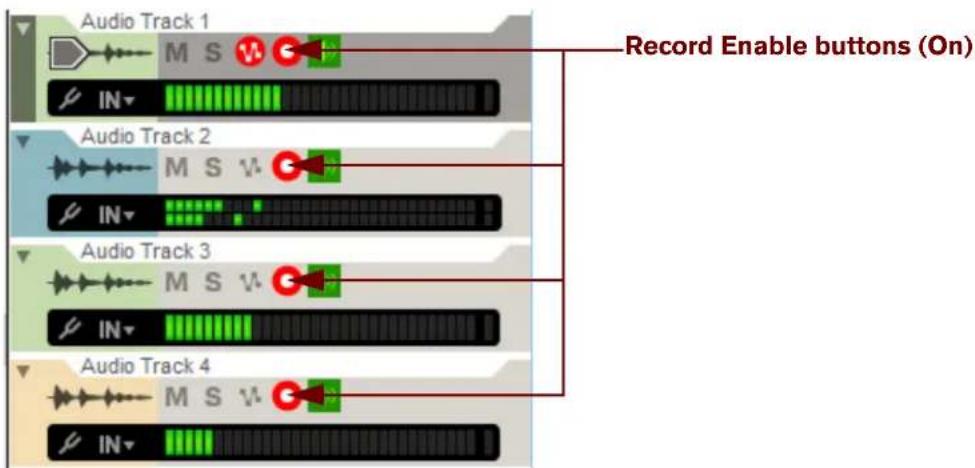
Multiple audio tracks record enabled, for recording audio on several tracks at once.
Record enabling an instrument track
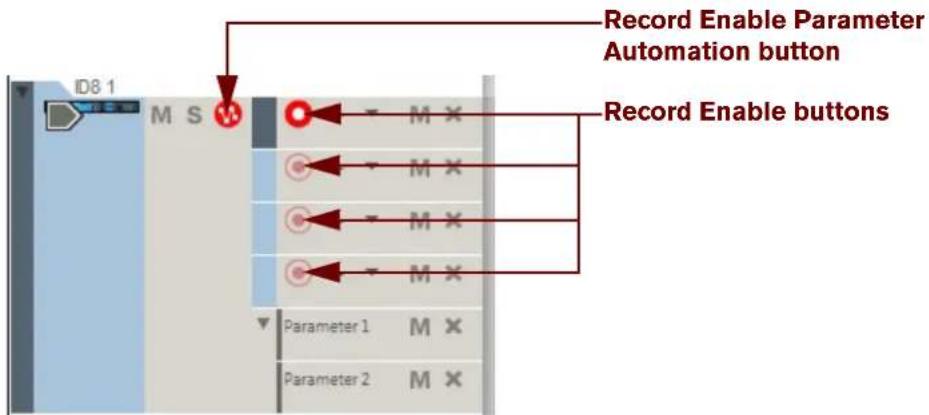
To record enable an instrument track, click on the Record Enable button on a note lane on the instrument track.
The Record Enable button lights up red and the track has Master Keyboard Input.
If you have selected "Standard" mode in the "Master Keyboard Input" section on the "Keyboard and Control Surfaces" page in the Preferences dialog (see "The Master Keyboard Input setting"), selecting an instrument track will automatically set Master Keyboard Input to that track - if the Manual Rec button in the Track List is Off, see "About the Manual Rec function". An instrument track that has Master Keyboard Input will automatically be record enabled, and will also be enabled for parameter automation recording, indicated by the red Record Enable Parameter Automation button.
→ If you want to record on another note lane on the instrument track, just click the corresponding Record Enable button on the note lane.
! Only one note lane on one instrument track can have Record Enable active at a time, unless you have locked additional MIDI keyboard controllers to specific instrument devices in the rack (see "Locking a surface" in the Remote chapter). If you only have one MIDI keyboard controller (assigned as Master Keyboard), you can only record notes on one note lane at a time (see "Setting Master Keyboard Input").
Record enabling several instrument tracks
If you have locked additional MIDI keyboard controllers to specific instrument devices in the rack (see "Locking a surface" in the Remote chapter), the corresponding tracks for all these locked devices are automatically record enabled - if the Manual Rec button in the Track List is Off, see "About the Manual Rec function". These additional record enabled tracks are all displayed with the gray "Master Keyboard Input" symbol to the left of the device icon in the track list, and their Record Enable buttons are also automatically switched on. The track with "normal" Master Keyboard Input is also indicated with the gray Master Keyboard Input symbol to the left of its device icon.
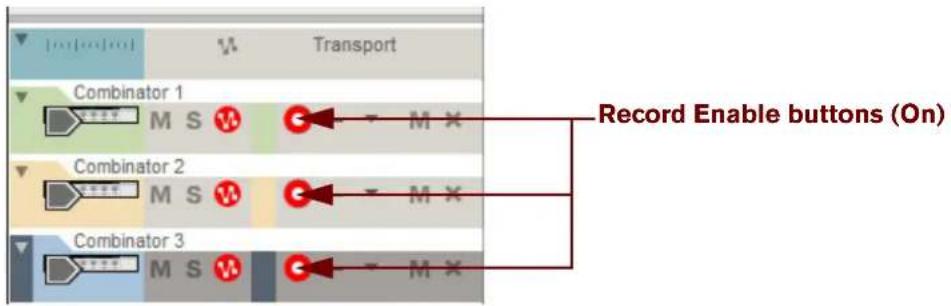
The "Combinator 3" track with Master Keyboard Input and the "Combinator 1" and "Combinator 2" tracks controlled from additional MIDI keyboards locked to the corresponding devices in the rack.
To manually enable/disable any additional record enabled instrument tracks that are locked to specific MIDI keyboard controllers, click the Record Enable buttons on a note lane on any of these tracks.
About the Manual Rec function

The Manual Rec button in the Track List.
The Manual Rec function in the Track List can be used if you don't want automatic record enabling of a selected track. For example, when you are finished recording your audio tracks and want to proceed with recording channel strip parameter automation, you probably don't want the audio tracks to be record enabled for audio.
→ Click the manual Rec button to disable automatic record enabling of selected tracks.
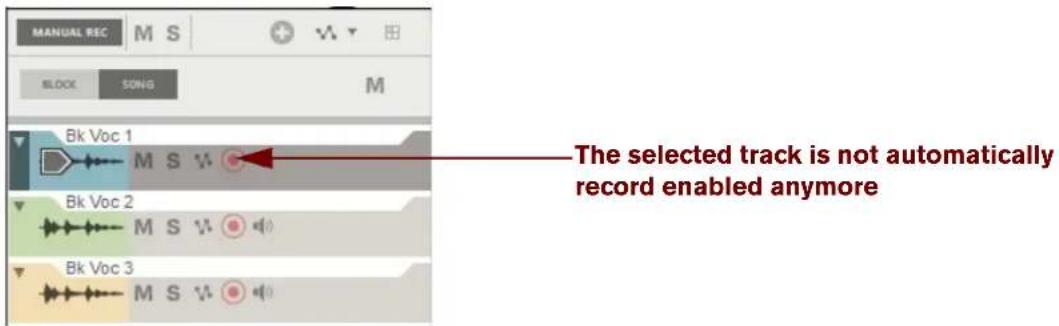
The Manual Rec function activated.
If you change your mind and want to record audio on an audio track, you have to manually record enable it by clicking its Record Enable button as described in "Record enabling an audio track". Alternatively, switch off the Manual Rec button to enable the automatic record enabling again.
! The Manual Rec function affects both audio tracks and instrument tracks.
Record enabling parameter automation
Parameter automation can be recorded on all track types, on one track at a time or on multiple tracks simultaneously.

→ Click on the Record Enable Parameter Automation button(s) on the desired track(s) in the Track List to enable parameter automation recording.
All tracks enabled for parameter automation recording will be indicated by red Record Enable Parameter Automation buttons.
→ Setting Master Keyboard Input to a track will automatically enable parameter automation recording, as indicated by the red Record Enable Parameter Automation button.
Record enabling pattern automation
Pattern automation can be recorded on tracks associated with pattern based devices such as the Redrum Drum Module, Dr. Octo Rex Loop Player or Matrix Analog Pattern Sequencer. Enabling pattern automation works in the same way as enabling regular parameter automation (see "Record enabling parameter automation").
! Note that enabling the Record Enable Parameter button on a track featuring a pattern based device will also allow automation recording of other device parameters besides the Bank and Pattern select buttons. Any additional device parameters will be recorded on separate parameter automation lanes just like with non-pattern devices.
Click and Pre-count
During recording and playback it's possible to have a metronome-style click sound to indicate the tempo of the song. In recording mode it's also possible to have the metronome click sound appear a selectable number of bars before the start of the actual recording, a so called pre-count. Activation of click and pre-count are managed on the Transport Panel:
The Click and Pre-count controls on the Transport Panel.
Click
→ Click the Click button to get an audible metronome click as the sequencer plays. Alternatively, press [C]. The click will sound on every beat, with the first beat in every bar accented (higher pitched).
Pre-count
→ Click the Pre button to get a pre-count (count-in) click sound before the recording starts. Alternatively, press Ctrl/Cmd+[P]
Pre-count will only be present before you record - not when you start regular playback.
! Note that Pre-count does not have any effect if you are using Ableton Link for synchronization, see "Synchronization using Ableton Link".
→ Select the number of pre-count bars by choosing "Number of Precount Bars" in the Options menu.
You can choose between 1 to 4 bars.
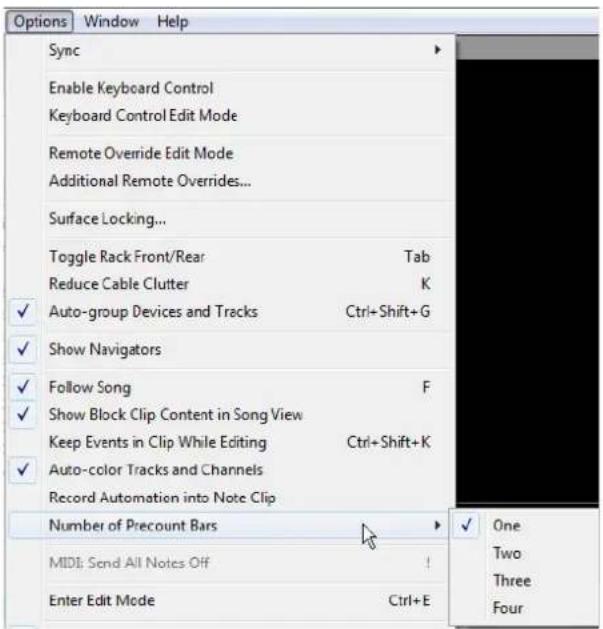
Selecting number of pre-count bars.
- Feel free to experiment with different pre-count settings. For up-tempo (faster) songs it's generally more convenient to have a little longer pre-count (3 or 4 bars) whereas for slower songs it's often sufficient with 1-2 bars.
Click Level
Click Level slider.
→ Adjust the audio level of the metronome click (and pre-count click) with the slider.
! Note that since the click sound is also routed via the selected audio card/interface on your computer - but not through the Reason Lite mixer, the click sound will be summed to the rest of the sounds playing in your song. A high Click Level setting could therefore cause the Audio Output Meter on the Transport Panel, and the "Big Meter" in the Reason Lite Hardware Interface, to indicate clipping. If this should occur, either lower the Click Level or deactivate Click to determine if it's the click sound or the recorded sounds that cause clipping.
Loop mode
In loop mode, the song is automatically looped between the Left and Right Loop Locators on the Edit/Arrangement Pane during playback and/or recording:
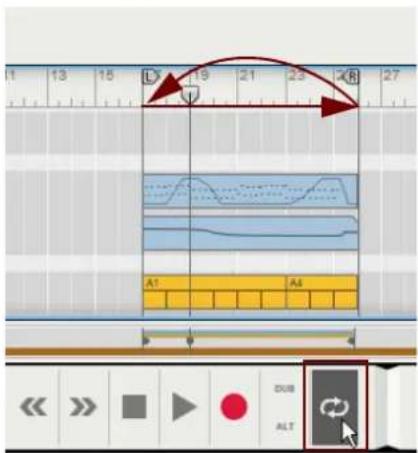
Loop mode activated by clicking the Loop button on the Transport Panel.
The behavior when recording in loop mode differs depending on what you're recording - audio, MIDI or parameter automation. Refer to "Recording audio in Loop mode", "Recording notes in Loop mode" and "Recording parameter automation in Loop mode".
General recording procedure
The following description applies to all types of recording: audio, MIDI and parameter automation. For specific details of audio, MIDI and parameter automation recording, refer to "Recording audio", "Recording notes", "Recording performance controller automation" and "Recording parameter automation".
- If desired, select Click and/or Pre-count according to the descriptions in "Click and Pre-count".
- Move the Song Position Pointer to the position in the Ruler where you want to start your recording (see "Ruler details").
- Click the Record button on the Transport Panel. Alternatively, press [*] on the numeric keypad, or hold down Ctrl or Cmd and press [Return].
The Record button turns red. If Pre-count is enabled, wait for the set number of pre-count bars before starting to record audio, MIDI or parameter automation. During pre-count, nothing will be recorded.
During pre-count, only the Record button is active (red) and nothing will be recorded.
- Start recording on the track.
As the recording begins, the Play button on the Transport Panel goes dark while the Record button remains red.
During recording, both the Play and Record buttons are active and any input data will be recorded.
If the lane is currently empty, a new clip is automatically created on the record enabled lane on the track. As the recording progresses, the clip expands following the Song Position Pointer. The clips are shaded in red during recording according to the picture below:

- When you're done recording, click the Stop button on the Transport Panel. Alternatively, press [Spacebar], [0] on the numeric keypad, or hold down [Shift] and press [Return].
The Record and Play buttons turn gray, the Song Position Pointer stops and the red shading of the clip(s) disappears. The clip(s) show the recorded events as different types of graphical objects, depending on clip type.
! If nothing was recorded in a note clip, clicking Stop will automatically remove the empty note clip.
Undoing a recording
→ If you're not satisfied with the finished recording, you can select "Undo Record Track" from the Edit menu or select the clip on the Edit/Arrangement Pane and press [Delete] or [Backspace].
This will delete the clip and its contents.
Undoing while recording a note clip
→ If you're not satisfied with your ongoing recording of a note clip, press [Delete] or [Backspace].
This will delete the current note clip and all its contents and at the same time create a new clip starting at the current song position. The sequencer will continue recording during the entire process.
! Note that this only works when recording note clips.
Recording tips
Lowering the Tempo during recording
If you are going to record complex/difficult takes, a good suggestion is to lower the song tempo during recording and then speed up the song to normal tempo again during playback. For audio tracks, Reason Lite features very sophisticated functions for audio stretching. Audio stretch enables you to alter the song tempo up or down without changing the pitch of the recorded audio. See "About tempo changes and tempo automation of audio tracks" for more details.
When recording MIDI, just lower the tempo when recording the difficult parts and speed up to normal tempo during playback.
Audio recording details
Setting up the audio track
Selecting audio input(s) and defining mono or stereo
→ Select audio input(s) for the track from the Audio Input drop-down list.
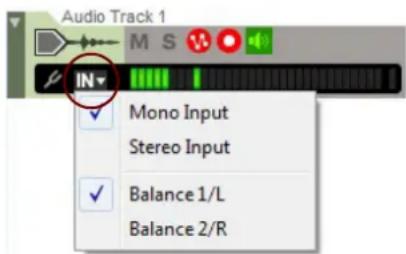
Selecting audio inputs for the Audio Track.
At the top of the drop-down list you can select whether you want to use mono or stereo inputs. Depending on your selection, the LED meter switches to a stereo or mono display. Further down in the drop-down list you can select the audio interface input(s) you want to use for the track.
- If you are using the Propellerhead Balance audio interface, selecting any of its input channels in the drop-down list will automatically switch on the corresponding Ready LEDs on the Balance front panel. Also, if you have selected "Mono Input" in the Audio Input drop-down list, the Audio Track will show a CS (Clip Safe) symbol to the right of the LED meter.
Setting input level(s)
Before you start recording audio on the track it's very important to set correct input level(s). The input signal should be loud enough to minimize noise and provide high quality, but not so loud that it causes clipping and distortion.
If you're using a 24-bit audio interface (recommended), aim at having the level of the input signal around -12dB on the track Input Meter according to the picture below. For 16-bit audio interfaces you may want to raise the level another couple of dB's.

To get a better view of the input levels, use the separate Recording Meter Window, see "The Recording Meter Window".
! If you are using the Propellerhead Balance audio interface you can use the special Clip Safe function to protect your recordings from accidental audio input clipping, see "Recording using the Clip Safe function in Propellerhead Balance".
! Always adjust the input level at the source (e.g. the preamp connected to, or built-in to the audio interface).
! If the input signal level should exceed 0dB (red clipping LEDs to the right) on the track Input Meter at any time during recording, there could be audible distortion in the recording:

If the input level should clip, at any time, the red clipping LED(s) in the Input Meter will be constantly lit until you click on the Input Meter. This is to notify that there is, or has been, too loud an input signal present on the track.
! The input level cannot be adjusted using the Channel strip controls in the Main Mixer. The Channel strip controls are used only for adjusting the level and characteristics of the monitored signal and/or the playback signal of an existing recording on the track.
Using the Clip Safe function with Propellerhead Balance
! Note that the Clip Safe function only works together with the Propellerhead Balance audio interface.
If you use the Propellerhead Balance audio interface together with Reason Lite, you will have access to the Clip Safe function. The Clip Safe function lets you record a mono signal with an additional "invisible" headroom. This is done by using both AD converters in Propellerhead Balance for the same mono signal, with the second AD converter dedicated to the additional headroom.
When recording with the Clip Safe function, Reason Lite records the mono signal in parallel using both AD converters. The original AD converter records the signal at normal level and the second AD converter records the same signal "padded" at a lower level.
In practice this means that if the input signal should exceed the normal 0dB clipping level during recording, the program will allow you to use the "padded" signal from the second AD converter and replace the clipped/distorted audio. The padded signal will be amplified in Reason Lite so that its level accurately reflects the original recording level. In other words, the resulting signal will be just as loud as the original signal - but without any clipping or distortion.
Proceed as follows to activate the Clip Safe function:
- Select "Mono Input" in the Audio Input drop-down list on the Audio Track and then select either "Balance 1/L" or "Balance 2/R".
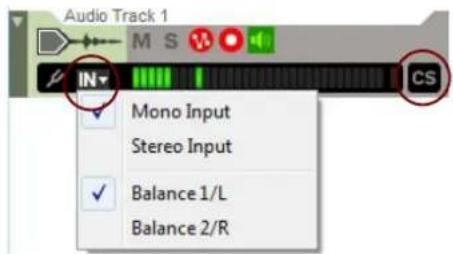
The CS (Clip Safe) symbol appears to the right of the level meter on the Audio Track.
- Press the Clip Safe button on the Propellerhead Balance front panel.
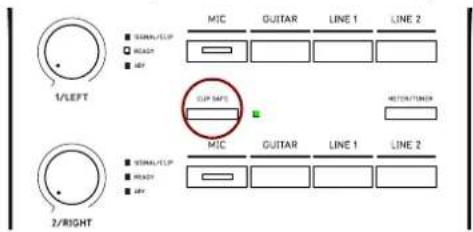
The Clip Safe button on the Propellerhead Balance audio interface.
A Clip Safe request signal is sent from the Balance interface to Reason Lite. Depending on what audio inputs are selected on the record enabled Audio Track(s), the following happens:
- If the Balance 1/L or 2/R input is selected as audio input (Mono) on one single record enabled Audio Track, the Clip Safe LED on the Balance interface turns green and the CS symbol on the Audio Track is lit.
When the Clip Safe LED on the Propellerhead Balance audio interface is green, the Clip Safe function is enabled. If the 1/L input is selected as audio input (Mono), the Right channel on the Balance interface is used for the additional headroom, and vice versa.
- If the Balance 1/L and 2/R inputs are selected as Stereo Input, the Clip Safe function is disabled and the Clip Safe LED on the Balance interface turns red. The CS symbol on the Audio Track also disappears.
The Clip Safe function requires both inputs to be available. Also, if the Balance 1/L (mono) and 2/R (mono) inputs are selected as audio inputs on other record enabled Audio Tracks, the Clip Safe function is disabled.
See "Recording using the Clip Safe function in Propellerhead Balance" for more information about using the Clip Safe function.
Monitoring
Monitoring means listening to the input signal of an audio track. Monitoring works according to the following principles:
- By default, monitoring is automatically enabled as soon as an audio track is record enabled.
This makes it possible to hear what you will be recording - before and during recording to disk.
- During playback of an audio track, monitoring is automatically disabled.
During playback, you will only hear the recorded signal - not any input signal.
- Note that you can manually activate or deactivate monitoring for a track by clicking the Monitor button.
The input signal is monitored after the Channel strip and Master Section in the Main Mixer which means that all mixer parameters, including any Insert Effects, Dynamics etc., will also be applied to the monitored signal.
! Note that the Main Mixer parameters will only affect the monitored (and/or played back) signal - they will not affect the signal being recorded to disk.
Depending on the technical specifications and/or settings in your hardware audio interface, the latency of the monitored input could become a problem. If this is the case, it's probably better to monitor the input signal before it reaches the Reason Lite program, i.e. directly on the external audio interface/mixer/preamp. If you don't want to monitor through the Reason Lite program you should select "External" or "Manual" in the Monitoring section on the Audio tab in the Preferences dialog:
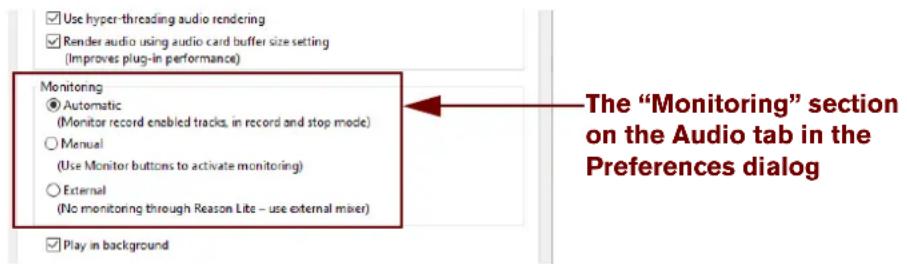
→ Select "Automatic" to select automatic monitoring of the Audio Track in Reason Lite.
Each time you select and/or record enable an Audio Track in the Track List, monitoring in Reason Lite will be automatically enabled. It's possible to manually disable monitoring in this mode if you like.
→ Select "Manual" to manually select if monitoring should be on or off.
This mode should be selected if you prefer to have manual control over monitoring, or when you are monitoring through external mixer or audio interface. In the latter case, you would select "Manual" mode and just don't click any monitor buttons.
→ Select "External" to deselect automatic monitoring of the Audio Track in Reason Lite.
When you select and/or record enable an Audio Track in the Track List, monitoring in Reason Lite will be automatically disabled. It's not possible to manually enable monitoring in this mode.
Using the Tuner
An audio track also features a built-in tuner function. The Tuner detects and displays the input pitch of a connected instrument - an electric guitar, for example.
- Click the "Enable Tuner" button below the device icon to switch to Tuner mode.
The Input Meter switches to a Tuner.
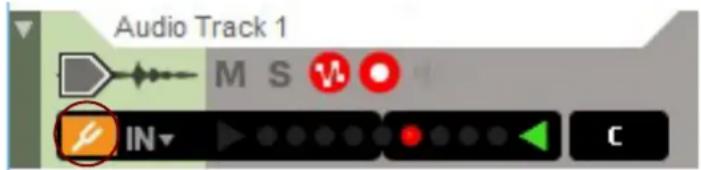
An audio track in Tuner mode.
- Play a note on the connected instrument and watch the Tuner.
When the input pitch is detected, the Tuner lights up and indicates how far the pitch is from the displayed note value to the right of the Tuner. The center LED on the Tuner Meter indicates a perfectly tuned note pitch. The green arrow LEDs on either side of the Tuner Meter indicate how the connected instrument should be tuned. The left arrow LED means raise the pitch and the right means lower the pitch.
! Note that the input note needs to sustain for a little while before the pitch can be detected.
The Recording Meter Window
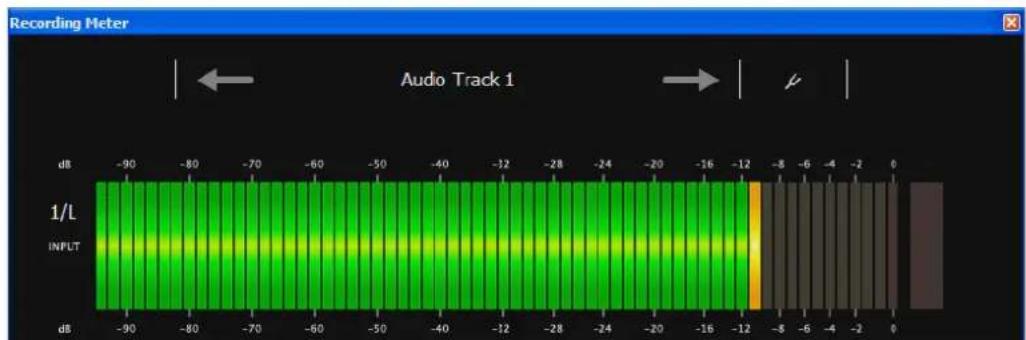
bar
Recording Meter | Label | Value | |---|---| | Audio Track 1 | -90 | | Audio Track 1 | -80 | | Audio Track 1 | -70 | | Audio Track 1 | -60 | | Audio Track 1 | -50 | | Audio Track 1 | -40 | | Audio Track 1 | -32 | | Audio Track 1 | -28 | | Audio Track 1 | -24 | | Audio Track 1 | -20 | | Audio Track 1 | -16 | | Audio Track 1 | -12 | | Audio Track 1 | -8 | | Audio Track 1 | -6 | | Audio Track 1 | -4 | | Audio Track 1 | -2 | | Audio Track 1 | 0 | INFLT dB INFLT dBThe main purpose of the Recording Meter floating window is to provide a good overview of recording levels and/or tuner values when you are located some distance away from the computer screen. The Recording Meter mirrors the information from the input level meter and Tuner of the currently selected record enabled Audio Track.
→ Toggle the Recording Meter window on and off by selecting "Show/Hide Recording Meter" from the Windows menu.
→ If you are using the Propellerhead Balance audio interface you can also press the Meter/Tuner button on the front panel to toggle the Recording Meter window on and off:
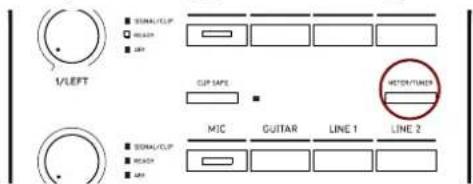
The Meter/Tuner button on the Propellerhead Balance audio interface.
→ Move the Recording Meter window by clicking on the window background and then dragging.
→ If you have manually record enabled several Audio Tracks in the sequencer, you can choose which track to display in the Recording Meter window by clicking the right/left arrows on either side of the Audio Track name. By default, the first record enabled Audio Track in the sequencer is displayed in the Recording Meter window.
→ Click the pitchfork symbol in the Recording Meter window to bring up the Tuner for the selected Audio Track. A large Tuner display is shown at the bottom of the Recording Meter window.
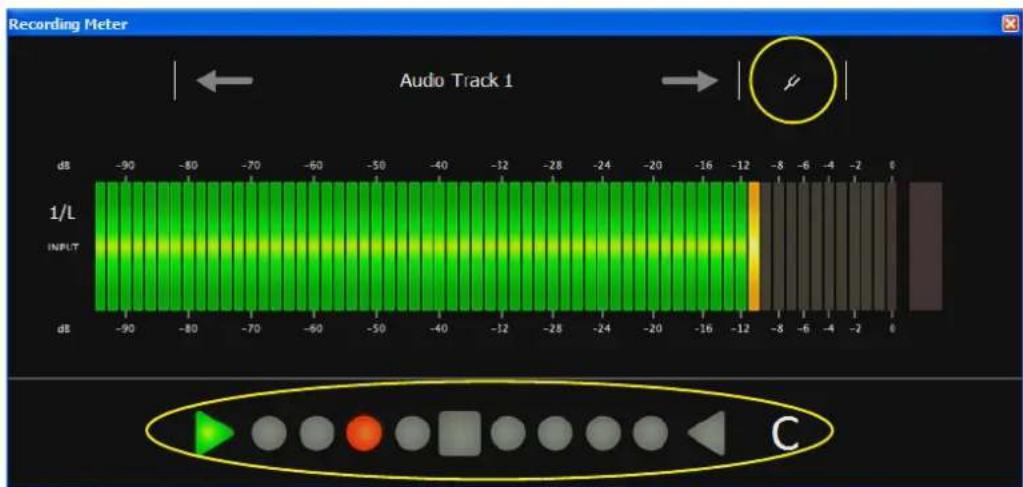
See "Using the Tuner" for more information about the Tuner.
Recording audio
! To minimize the song saving time, we strongly recommend saving the song before recording many or large audio recordings.
1. Set up the audio track according to the descriptions in "Setting up the audio track".
2. Record the track according to the descriptions in "General recording procedure".
3. When the recording is finished, the audio clip on the track shows the recorded audio as one or two continuous waves inside the clip, depending on whether the input was in mono or stereo:

An audio clip with a stereo audio recording.
Recording using the Clip Safe function in Propellerhead Balance
If you are recording using the Propellerhead Balance audio interface, you can utilize the Clip Safe function to protect your recordings from any accidental input signal clipping. The program can then take care of and heal any input signals that accidentally exceed 0dB.
See "Using the Clip Safe function with Propellerhead Balance" for more details.
! Note that the Clip Safe function can only be used when recording in mono (single audio input) and only on one record enabled Audio Track at a time.
Proceed as follows to set up and activate the Clip Safe function:
- Select the desired Audio Track for recording.
- Select audio input in the drop-down list.
! Note that you can only select the Balance In L or R (Mono Input) for the Clip Safe function to be available. - Press the Clip Safe button on the Balance front panel.
The Clip Safe LED on the Propellerhead Balance audio interface turns green. The CS indicator to the right of the input level meter on the Audio track is lit:

The Clip Safe LED on the Propellerhead Balance interface and the CS indicator on the Audio Track.
- Record the track according to the descriptions in "General recording procedure".
! We recommend that you aim at -12dB maximum recording level, even if you are using the Clip Safe function. Recording high input levels will result in very loud audio on the track, which could be problematic to mix with the rest of the instrument tracks in your song.
When the Clip Safe function is active, the Input Meter on the Audio Track, as well as the level meter in the Recording Meter window get their red LEDs replaced by yellow ones. The Recording Window also gets a Clip Safe symbol to the upper right:
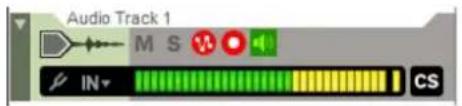
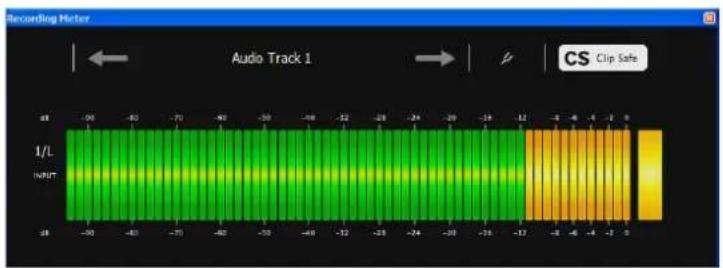
bar
Audio Track 1 | Frequency | Value | | :--- | :--- | | -28 | -90 | | -27 | -85 | | -26 | -80 | | -25 | -75 | | -24 | -70 | | -23 | -65 | | -22 | -60 | | -21 | -55 | | -20 | -50 | | -19 | -45 | | -18 | -40 | | -17 | -35 | | -16 | -30 | | -15 | -25 | | -14 | -20 | | -13 | -15 | | -12 | -10 | | -11 | -5 | | -10 | 0 | | -9 | 5 | | -8 | 10 | | -7 | 15 | | -6 | 20 | | -5 | 25 | | -4 | 30 | | -3 | 35 | | -2 | 40 | | -1 | 45 | | 0 | 50 | Audio Track 1 CS Clip SafeThe Input Meter on the Audio track and the Recording Meter gets yellow LEDs instead of red ones.
- When the recording is finished, the audio clip on the track shows the recorded audio as a continuous wave inside the clip.
The red vertical line(s) at the top of the of the audio clip indicate that Clip Safe was activated since the input level exceeded 0dB. The selected audio clip also gets an additional Heal (CS) button on its upper right hand side:

Audio recorded with the Clip Safe function active.
- Play back the track and hear where the signal clips.
You should hear this when the playhead passes over the red vertical line(s) in the audio clip. Sometimes, though, if the clipping is moderate it might not be audible.
- To permanently heal the audio clip and use the Clip Safe audio, click the Heal (CS) button to the upper right-hand side of the audio clip. Alternatively, select "Heal Clip Safe Clips" from the Edit menu or audio clip context menu.
Now, the clipped/distorted audio has been replaced by the "padded" Clip Safe audio and the recording should not clip or distort anymore. The area above the audio clip disappears, as does the Heal (CS) button.
- If you like, you can zoom out using the Waveform Zoom Level buttons to view the resulting waveform in its entirety in the Audio Clip (see "Waveform Zoom Mode").
→ The healing operation can also be performed on several selected audio clips in one go. Just select the desired clips and click a Heal (CS) button on one of the clips.
→ If you want to remove the Clip Safe parts and keep the clipped/distorted parts, just undo the healing operation using the standard Cmd/Ctrl+[Z] command.
If you want to permanently delete the Clip Safe audio and keep the clipped/distorted audio, select "Delete Clip Safe Audio" from the Edit menu or audio clip context menu. - In Edit Mode, the audio clip will have the same graphical appearance (the clipped/distorted parts indicated by red vertical lines, plus the Heal (CS) button to the right in the Clip Overview).
Recording audio in Loop mode
Recording audio in Loop mode is very useful if you want to record alternative takes of the same part of the song. For example, let's say you want to sing a couple of takes of the chorus part of your song to later create the perfect chorus by selecting the best parts of the different takes.
! To minimize the song saving time, we strongly recommend saving the song before recording many or large audio recordings.
Proceed as follows to record audio in Loop mode:
- Set up the audio track according to the descriptions in "Setting up the audio track".
- Set the Left and Right Locators to span the chorus part of your song.
- Enable the Loop function by pressing [L] or by clicking the Loop On/Off button on the Transport Panel:
Loop mode activated on the Transport Panel.
- Click the L button on the Transport Panel to move the Song Position Pointer (play head) to the Left Locator.

- Record the track according to the descriptions in "General recording procedure".
- Start singing to record audio on the track.
When the Song Position Pointer has reached the Right Locator, the recording starts over from the Left locator again and you can now record a second take. The audio recorded in the previous take won't be heard but is saved in the "background" on a Comp Row.
Continue recording for as many loop cycles as you like.
- When the recording is finished, the audio clip on the track shows the last recorded audio take as one or two continuous waves inside the clip (depending on whether the input was in mono or stereo).
! If you recorded the last loop cycle throughout the entire clip length, the audio clip will be a Single Take clip. If you stopped recording the last loop cycle somewhere in the middle of the clip, the clip will be a Comp Clip. - Double-click the clip to open it for editing.
- If the last loop cycle was recorded throughout the entire clip length, the clip opens in Slice Edit mode.
If so, open the clip in the Comp Editor by clicking the "Comp Edit" button in the Toolbar.
Otherwise, it opens in the Comp Editor right away. In the Comp Editor, you can see that there is one Comp Row for each of the recorded loop cycles (Takes):
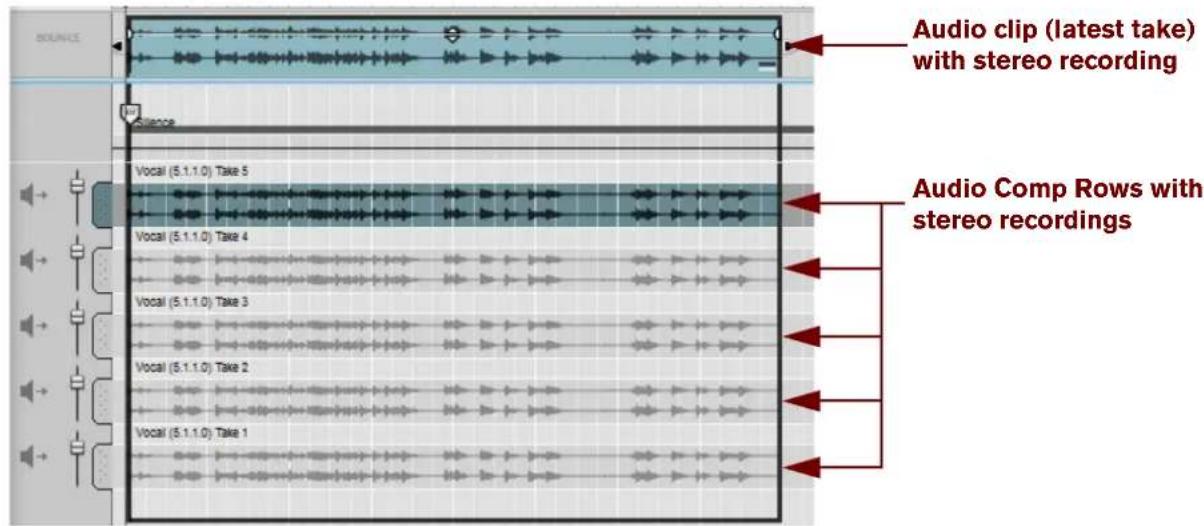
Audio recorded in Loop mode with 5 loop cycles (Takes) recorded.
From here, it's easy to assign the best parts from the different takes and comp them into a final clip. See "Creating a comped audio clip" for details.
! If you have recorded using the Clip Safe function with the Propellerhead Balance audio interface, any clipped parts are displayed with vertical red lines above each Comp Row. If you decide to heal the audio clip using the Heal (CS) button or "Heal Clip Safe Clips" from the Edit menu or context menu of the selected audio clip, the recordings on all Comp Rows are healed in one go.
Overdubbing audio using the "Dub" function
Back in the tape recorder days, overdubbing was used to record additional takes on additional tracks on the same section of the tape, to create a complete arrangement. For example, recording a vocal chorus part could be done by overdubbing the singer three or four times on additional tracks. Overdubbing in Reason Lite works in a similar way, but with much better control, and much better editing possibilities afterwards.
→ After you have recorded the first take on an audio track, click the "Dub" button on the Transport Panel.
This will create a new audio track with a duplicate of the original audio track settings, including the channel strip settings (with insert effects etc.). Now, you can continue recording on the new audio track as described in "Recording audio" and "Recording audio in Loop mode". Afterwards, you can edit the new track completely independently of the original track.
- The "Dub" function can also be used on-the-fly while recording.
Duplicating audio tracks using the "Alt" function
Closely related to the "Dub" function, described in "Overdubbing audio using the "Dub" function", is the "Alt" function. This function can be used to create a new audio track with an identical copy of the selected audio track's settings. The only difference between the "Alt" and "Dub" functions is that the Alt function will automatically mute the original audio track.
Select the audio track you want to duplicate and then click the "New Alt" button on the Transport Panel. This will create a new audio track with a duplicate of the original audio track settings, including the channel strip settings (with insert etc.). Now, you can continue recording on the new audio track as described in "Recording audio" and "Recording audio in Loop mode". Afterwards, you can edit the new track completely independently of the original track.
The "Alt" function can also be used on-the-fly while recording.
Recording over or into an existing audio clip
If you start recording over an existing clip on an audio track, the new recording will incorporate (replace, but not erase) the previous recording in the clip. When you open the audio clip in the Comp Editor afterwards, there will be one Comp Row for each of the takes, the same result as when recording audio in Loop mode (see "Recording audio in Loop mode").
Let's have a look at the following example:
In the picture below, we have the original audio clip spanning bars 1-8 on the track:
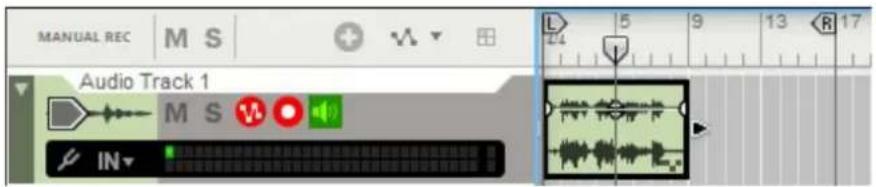
An audio track with an existing clip.
Now, we want to redo (re-record) the part that spans bars 5-6. We place the Song Position Pointer at bar 5 and record 2 bars:
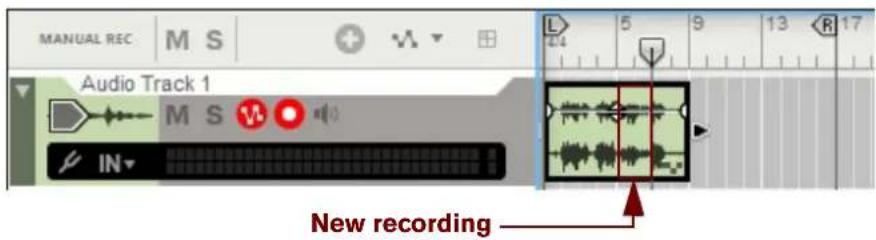
A new recording made on bars 5-6 on the audio track.
The new recording is made over the original clip. The recording in the original clip has therefore been incorporated into the start of bar 5 to the end of bar 6.
You can also see that the clip has become a Comp Clip, as indicated by the symbol (gray dots) at the lower right corner of the clip.
Now, let's double-click the clip to open it in the Comp Editor:
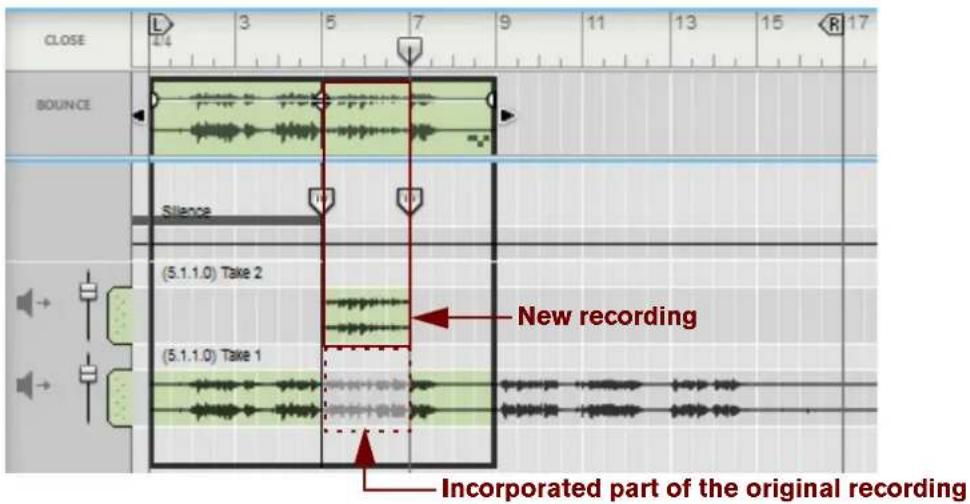
The new and original recordings (takes) in Edit Mode.
The new recording has incorporated bars 5-6 of the original recording. However, the original recording in bars 5-6 has been left totally unaffected. The entire original audio recording now resides on the "Take 1" Comp Row and the latest recording resides on the "Take 2" Comp Row. The resulting clip will now play back the "Take 1" recording in bars 1-4 and 7-8. Bars 5-6 will play back the "Take 2" recording.
See "Creating a comped audio clip" for details on how to extract parts from individual takes and comp into a final clip.
Recording audio from Mix Channel outputs
Besides recording external audio from the inputs of your audio interface, it's also possible to record audio internally from the outputs of Mix Channel or Audio Track devices. Typical applications for this could be:
- Recording the audio from an Output Bus (sub mixer) Mix Channel.
You might have the individual drums of your drum kit on separate tracks and these tracks are routed to a Mix Channel which is set to work as an Output Bus (see "Output Busses"). You then want to record the audio from the Output Bus onto a new Audio Track.
In this situation, all you need to do is create a new Audio Track, activate the Rec Source button on the Output Bus Mix Channel device, and then select the Output Bus in the Select Audio Input drop-down list on the Audio Track in the Track List. Then, record the audio from the Output Bus as described in "Recording audio".
• Re-recording of an audio track with effects applied.
- Recording when playing back an instrument or audio track while making live manipulations of effects or parameters.
- If you want to record the audio from an Instrument track onto an audio track, without making any live manipulations, you can also use the "Bounce Mixer Channels" function - see "Bouncing Mixer Channels".
The example below describes how to capture and record the audio from an ID8 device, but the general method can be used for other recording scenarios as well:
- Create an instrument track for the instrument device you want to record according to the descriptions in "Creating an instrument track".
You won't actually be recording on the instrument track in this situation. However, you will need the instrument track to be able to play the instrument device from your connected master keyboard.
-
Create an audio track according to the description in "Creating an audio track".
-
In the rack, locate the Mix Channel device connected to the ID8 instrument device and click its "Rec Source" button.
The "Rec Source" button on Mix Channel devices is used for real-time audio recording of devices connected to the Mix Channel device.
The "Rec Source" button on Audio Track devices are used for real-time re-recording of audio tracks.

Enabling the Rec Source button on the Mix Channel device in the rack.
- Locate the audio track and select "Stereo Input" and "ID8 1" as input source in the "Select Audio Input" drop-down list.
All Mix Channel and Audio Track devices that have their "Rec Source" button enabled will appear in the list. In this example, we only have the Rec Source button active on the "ID8 1" Mix Channel.
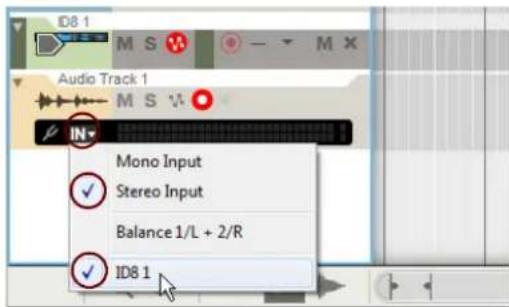
"Stereo Input" and "ID8 1" selected in the "Select Audio Input" drop-down list.
- Select the instrument track, in this example the ID8 1, so that it has Master Keyboard Input (red frame around the device icon) and disable the "Record Enable" button.
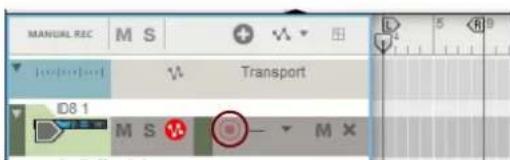
Select the ID8 1 track and disable the Record Enable button.
- Locate the audio track and record enable it by clicking the Record Enable button.
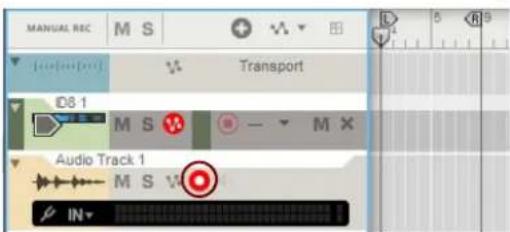
Engage Record Enable on the Disk Channel track.
! Don't set Master Keyboard Input to the audio track - only click the "Record Enable" button on the audio track! This way, the ID8 1 instrument track will still have Master Keyboard Input.
- Play the master keyboard and set the input level to the audio track by adjusting the Level Fader on the ID8 1 Mix Channel strip in the mixer.
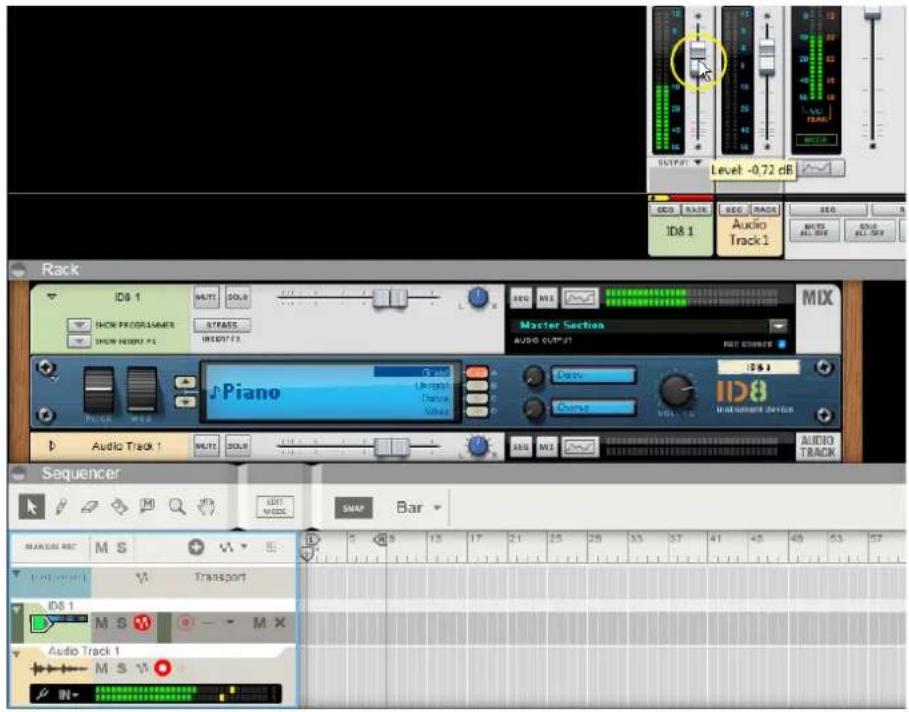
Adjusting the instrument's level to the audio track.
A Volume setting of -0.0 dB on the instrument device and a Level Fader setting of -0.0 dB on its corresponding Mix Channel strip in the mixer is often the optimal setting to avoid audio signal clipping. As when recording external audio, it's the track's Input Meter that should be observed for any clipping.
8. Start recording audio on the audio track according to the description in "Recording audio".
- By using the recording method described above, it's also possible to record the audio from previously recorded note clips on instrument tracks.
Recording a mixdown of several audio tracks
Another useful feature is to record a real-time mixdown of several previously recorded audio tracks onto a new, additional audio track. This is sometimes also referred to as recording stems or sub-mixes. Let's say we have four backing vocal tracks that we want to mix down and record on a new audio track. We can do this as follows:
- Create a new audio track according to the description in "Creating an audio track".
This is the track we're going to use for recording the mixdown. We name the track "Mixdown" to make it easier to distinguish.
- Locate the Master Section device in the rack and click its "Rec Source" button.

The "Rec Source" button on the Master Section device.
This will allow you to record the output from the Master Section onto the new audio track.
- Locate the four backing vocal Audio Track devices in the rack, or their corresponding channel strips in the mixer, and click their "Solo" buttons.
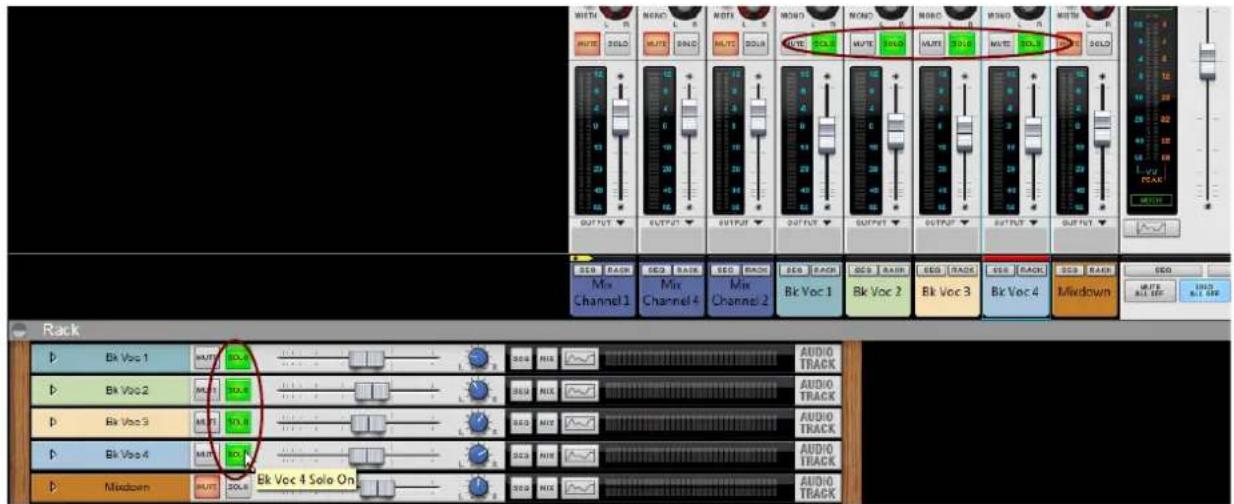
The four backing vocal Audio Track devices soloed.
Since we're going to record the four backing vocal tracks through the outputs of the Master Section, we only want the backing vocal tracks to sound. All other tracks in the song should therefore be muted.
- Select the "Mixdown" track in the sequencer and select "Stereo" and "Master Section" from the "Select Audio Input" drop-down list.
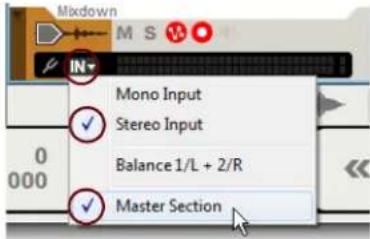
"Stereo" and "Master Section" selected as Audio Input source.
Selecting "Stereo" makes it possible to pan the backing vocal tracks in stereo before recording on the mixdown audio track.
- Adjust the parameters of each of the backing vocal track channel strips as desired.
- Don't forget to set the panning of each of the tracks to spread them in the stereo panorama.
- Select the "Mixdown" track in the sequencer and click the "Rec" button on the Transport Panel to start recording the mixdown.
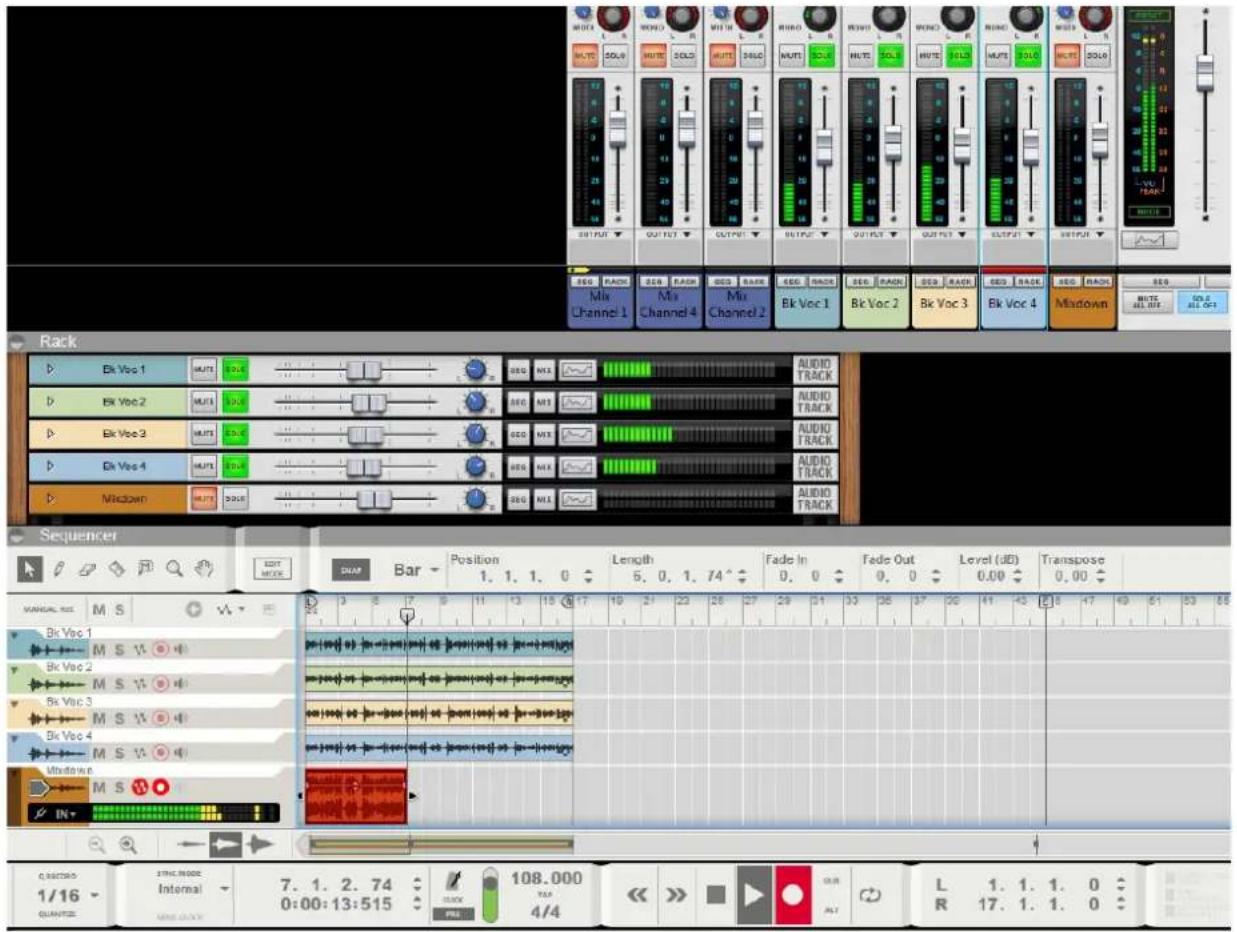
Recording the mixdown of the four backing vocal tracks to the "Mixdown" track.
- During recording, you might want to perform real-time adjustments of the backing vocal tracks' channel strip parameters to create a "live" mix.
-
When you have recorded the mixdown, click "Stop" on the Transport Panel.
-
Before you play back the song with the mixdown track, remember to un-solo the four backing vocal Audio Track devices/channel strips. Also, mute the four original backing vocal tracks in the sequencer to avoid "double" sounds.
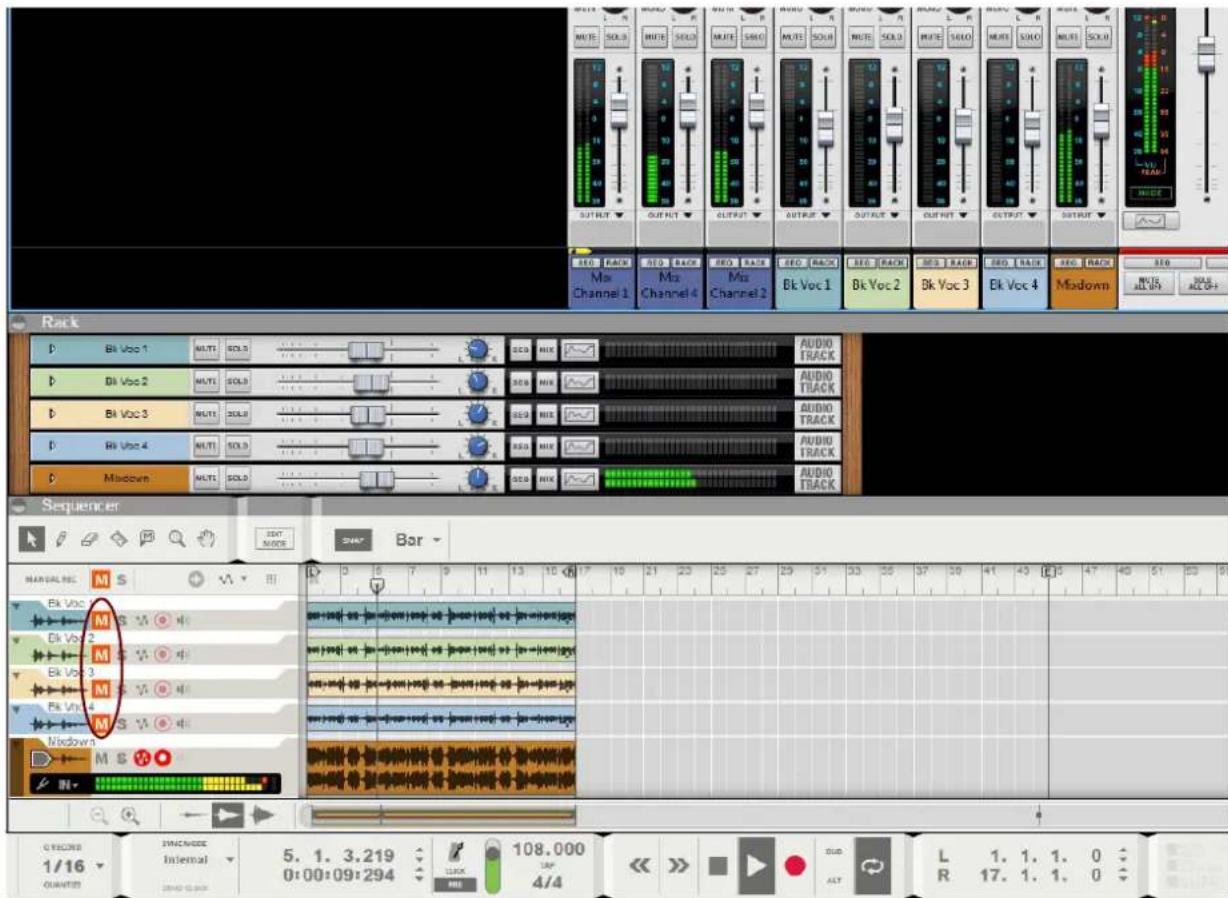
Playing back the Mixdown track with the original backing vocal tracks muted in the sequencer.
Another alternative, if you want to record several Audio Tracks or Mix Channels onto a single audio track, is to create a sub-mixer setup - see "Output Busses".
Note recording details
Note events can be recorded for instrument devices and are contained in note clips. Performance controller events, such as Mod Wheel, Pitch Bend and Aftertouch events, can also be recorded for instrument devices, and be contained in note clips, but they are described separately in "Parameter automation recording details".
Setting up the instrument track
To record notes for an instrument device - or for an external MIDI instrument - on a track in the sequencer, you need only create an instrument track as described in "Creating an instrument track". The instrument track will automatically have Master Keyboard Input and the note lane will automatically be record enabled. Since you will only be recording MIDI events on the instrument track - and no audio - there is no need to adjust audio levels etc. These can always be adjusted afterwards.
If you want to control an external MIDI instrument, simply create a MIDI Out Device and select the appropriate MIDI port and channel on the device panel. See "MIDI Out Device" for more details.
About "Quantize During Recording"

The Q Record (Quantize During Recording) button on the Transport Panel.
It's possible to quantize MIDI notes as they are being recorded. This will automatically align the start positions of the recorded notes to a pre-defined grid. Refer to "Quantize" for more details.
Recording notes
- Set up the instrument track according to the description in "Setting up the instrument track".
- Record the track according to the description in "General recording procedure".
- When the recording is finished, the note clip on the lane shows the recorded note events in a piano-roll fashion inside the clip:

A note clip with note events.
The note clip's start and end boundaries will automatically snap to the closest bar to make it easier to arrange (move etc.) later on.
! If no MIDI events (notes and/or performance controllers) were recorded, the empty note clip will be automatically removed from the lane after you have clicked Stop.
It's also possible to manually insert notes by drawing them with the Pencil tool. Refer to "Drawing notes".
- You can also use Player devices to automatically generate various types of MIDI Note sequences, patterns and chords when you record your instrument, see "Working with Players".
Recording notes in Loop mode
Recording on a note lane in Loop mode allows you to continuously add new notes in a defined section of your song:
- Set up the instrument track according to the description in "Setting up the instrument track".
-
Set the Left and Right Locators to span the desired part of your song.
-
Enable the Loop function by pressing [L] or by clicking the Loop On/Off button on the Transport Panel:
Loop mode activated on the Transport Panel.
- Click the L button on the Transport Panel to move the Song Position Pointer (play head) to the Left Locator.

- Record the track according to the description in "General recording procedure".
When the Song Position Pointer has reached the Right Locator, the recording starts over from the Left Locator again and you can record additional notes. Any new recorded notes will be added to the previously recorded ones and all notes will be heard during the recording.
Continue recording for as many loop cycles you like.
Recording over or into an existing note clip
Recording over or into an existing note clip will simply add new note events to the previously recorded events in the note clip as described in "Recording notes in Loop mode". However, If the new recording should start before the original clip, and expand into the original clip, a new clip will be created and will engulf the original clip. Let's have a look at the following example:
In the picture below, we have the original note clip spanning bars 4-13 on the track:
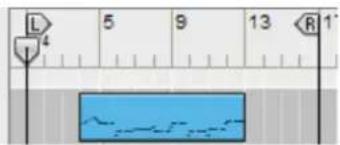
A note lane with an existing clip.
Now, we're going to record an intro which is going to span the first four bars:
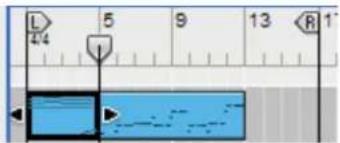
A new note clip recorded on bars 1-4 on the same note lane.
The new clip is partly recorded over the original clip. The part of the original clip that has been recorded over is incorporated in the new clip; the events from the original clip are now contained in the new clip, and the start of the original clip has been moved to bar 5, where the new clip ends.
! If you're recording over or into a masked clip and the new clip engulfs masked events, the masked events will be permanently deleted! See more about masked events in "About masked recordings and events".
Another, perhaps more convenient, way of overdubbing on an instrument track is to create additional note lanes and record new clips on these using the New Dub or New Alt functions described in "Recording notes using the "Dub" and "Alt" functions". This way, you will get a better overview of exactly what you added in each of your recordings.
Recording notes using the "Dub" and "Alt" functions
A practical way of recording additional MIDI events on an instrument track is to use the "Dub" and "Alt" functions.
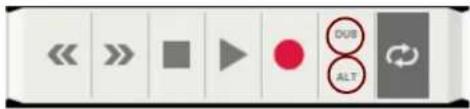
The "Dub" function
The "Dub" function creates additional record enabled note lanes on which you can record "overdubs". This is the function to use when you want to add new notes in the same section of the instrument track but want the notes to end up in new clips on additional note lanes instead of in the original clip. All note lanes will play back together.
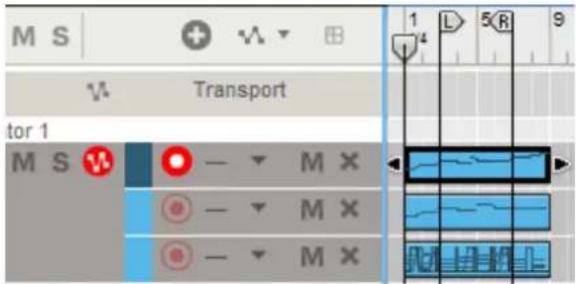
The "Dub" function used for creating two additional lanes for overdub purposes. Loop mode is Off.
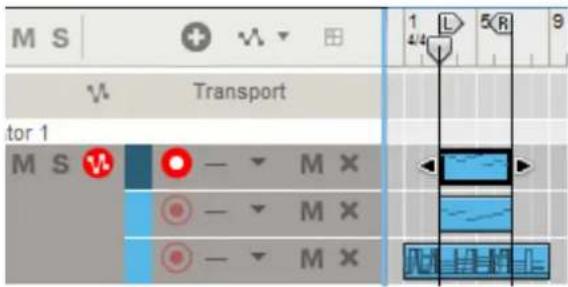
The "Dub" function used for creating two additional lanes for overdub purposes in Loop mode.
- Creating a new note lane using the "Dub" button can also be done on-the-fly while recording.
The "New Alt" function
The "Alt" function creates additional record enabled note lanes on which you can record alternative takes. At the same time, the previous note lane will be muted. Only the most recently added note lane will play back.
! Note that if Loop is activated and the Song Position Pointer is between the Locators, the clips between the Locators will be muted (instead of the lanes).
Here are two examples where the "Alt" function has been used:
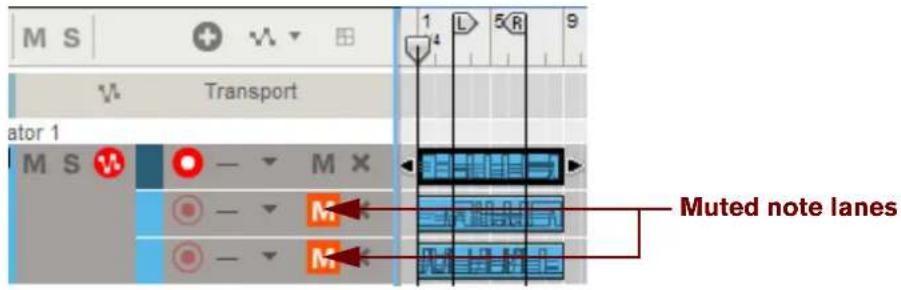
The "Alt" function used for creating two additional lanes for alternative takes. Loop mode is Off.
When using the "Alt" function with Loop mode off, the previous note lane will be automatically muted.
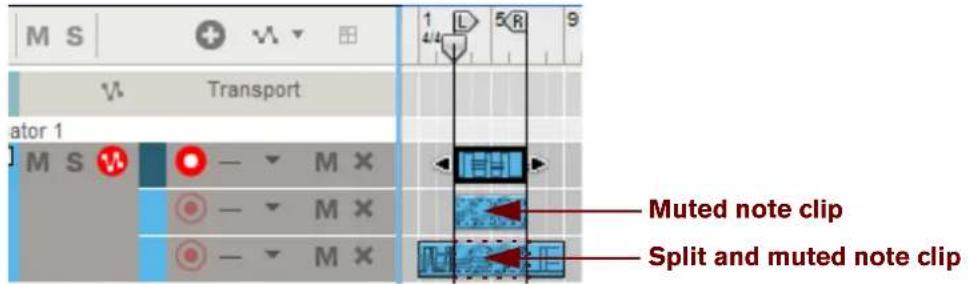
The "Alt" function used for creating two additional lanes for alternative takes in Loop mode.
When using the "Alt" function in Loop mode, the clips between the locators will be muted - not the entire note lane. If the locators are placed over an existing clip, as in the example above, clicking the "Alt" button in Loop mode will split the clip and mute the clip between the locators.
- Creating a new note lane using the "Alt" button can also be done on-the-fly while recording.
Parameter automation recording details
In Reason Lite, you can automate virtually any device and channel strip parameters and create completely automated mixes if you like. This is done by recording parameter events in the sequencer. It's also possible to record sequencer Tempo automation (see "Tempo automation recording").
Performance controllers vs. track parameter automation
Recording parameter automation can be done in two different ways; either as performance controller automation or as track parameter automation.
- Performance controller automation is automatically recorded together with note events in note clips on note lanes.
Any standard MIDI performance controllers that you apply when playing (Pitch Bend, Mod Wheel etc.) will be recorded as performance controller automation in the note clip. A clip on a note lane can contain any combination of note events and performance controller automation events.
- Track parameter automation creates separate parameter automation lanes on a track, one for each automated parameter.
Which method you should use depends on how you prefer to work. The main differences to take into account are the following:
- Performance controller automation allows you to contain the automation data in a note clip together with note events.
The key feature with performance controller automation is that it's contained together with the notes in the note clip. Moving the note clip moves the performance controller automation as well. Therefore, if your controller changes are part of your "note performance" (e.g. Pitch Bend and Sustain Pedal), then you want them as performance controllers (see "Recording performance controller automation").
Filter sweeps played together with the notes etc. can also be recorded as performance controllers (see "Recording parameter automation into Note Clips").
- If your parameter changes are for sound design or mixing purposes (e.g. a slow opening of a filter, a gradual change in level), they would probably work better as track parameter automation.
Track parameter automation is recorded on separate lanes on the track (one lane for each automatable parameter). Track parameter automation clips can be moved individually, independent from any note clips. See "Recording parameter automation".
Recording performance controller automation
If you use any MIDI performance controllers when recording on a note lane, these are automatically added to the recorded clip. This makes sense as performance controllers are usually recorded at the same time you record notes, as a part of the performance. Standard MIDI performance controllers are Pitch Bend, Modulation Wheel, Sustain Pedal, Aftertouch, Breath Control and Expression.
→ To record standard performance controller automation, just follow the descriptions in "Recording notes".
When you have recorded performance controllers in the note clip, the clip will have automation curves visible in it along with the recorded note data.

Performance controllers are shown as curves in the note clip. In this picture, Mod Wheel, Pitch Bend and Sustain Pedal controllers have been used.
Green borders will appear around the automated device parameters to indicate that they are automated.

The Pitch Bend and Mod Wheel parameters have been automated, indicated by the green borders.
! After you stop recording, you need to click Stop again, or click the "Automation Override" indicator to the right on the Transport Panel, for the green automation borders to appear on the device panel.
The Automation Override indicator on the Transport Panel.
The performance controller automation is shown differently in the clip depending on the type of controller used. Controllers with bipolar range (such as Pitch Bend) are shown as lines in the middle when at zero (no pitch bend) with curves travelling up or down from the zero value. Controllers with only positive values (such as Mod Wheel) have zero at the bottom of the clip with applied modulation shown as curves travelling up from the zero value. Controllers with off/on values (such as Sustain Pedal) are shown as rectangular curves (on - duration- off).
- If you open a note clip in Edit Mode (by double-clicking on the clip), the recorded performance data will show up on separate Performance Controller Edit Lanes on the Edit Pane.
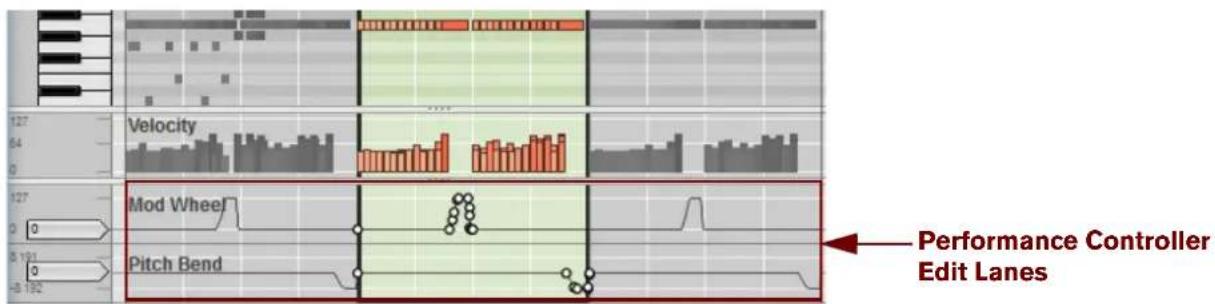
Performance controller automation on separate Edit lanes in Edit Mode.
- Note that you can record notes and performance controllers separately. I.e. you can first record notes on one note lane and then record performance controllers on another note lane on the same instrument track. The automation will be contained in note clips placed on a separate lane and can also be moved or muted separately.
! If several note lanes contain performance controller automation, the topmost lane has priority (see “About performance controller automation on multiple lanes”).
It's also possible to manually insert performance controller events by drawing events with the Pencil tool. Refer to "Drawing parameter automation events".
Recording parameter automation into Note Clips
Besides the standard performance controllers (Pitch Bend, Mod Wheel etc.), you can choose to record automation of any type of instrument device parameter into a note clip:
- Select "Record Automation into Note Clip" from the Options menu.

- While recording on a note lane according to the description in "Recording notes", tweak the parameter(s) you want to automate on the instrument device panel in the rack - or use a Remote MIDI controller (see "Remote - Playing and Controlling Devices").
Any parameter you tweak on the device will be recorded as automation inside the note clip - just like Performance Controller automation.
Green borders will appear around the automated device parameters to indicate that they are automated.
! After you stop recording, you need to click Stop again, or click the "Automation Override" indicator above the audio meters on the Transport Panel, for the green automation borders to appear on the device panel.
While this method is perfect for making a note clip self-contained, there are some trade-offs. If you use this method to record device parameters, you won't have the same overview as with track parameter automation. You also won't be able to later mute a separate parameter automation lane, or move to parameter lanes independently.
! It is possible to have overlapping track parameter automation and automation inside a note clip for the same parameter. In such a case, the track parameter automation overrides the note clip automation. As soon as the track parameter automation clip ends, any automation inside the remaining part of the note clip takes over.
Recording performance controller automation over or into an existing clip
- If you record over a note clip with performance automation data and you adjust any of the performance controllers used in the clip, the automation will be replaced with new performance events from this point onward until you stop recording.
However, if the new recording should start before the original clip's start position, a new clip will be created which will incorporate the original clip. The new automation data will replace the existing one, but any existing note events will not be affected (see "Recording parameter automation over or into an existing clip" and "Recording over or into an existing note clip").
About performance controller automation on multiple lanes
If you have several active (un-muted) note clips with performance controller automation on different lanes of the same track, and these note clips overlap position-wise, the following rule applies:
- Performance controllers in clips on the topmost lane override performance controllers of the same type in other overlapping clips on lanes below:

The clip on Lane 2 has Mod Wheel automation, and the clip on Lane 1 also has Mod Wheel automation - plus Pitch Bend and Sustain Pedal automation and note events. The Mod Wheel automation affecting the notes will follow the automation curve of the clip on Lane 2 for its duration. As soon as the clip on Lane 2 ends, the notes will be affected by the Mod Wheel automation in the clip on Lane 1.
Recording parameter automation
Parameter automation is the standard way to automate device and channel strip parameters. Each automated device/channel strip parameter will generate a separate automation lane on the track. It's also possible to record automation of the Tempo on the Transport Panel. This is described in detail in "Tempo automation recording".
Before you start recording parameter automation
Before you start recording automation of a device/channel strip parameter, you may want to set it to a suitable start value, what we call its "static value". By static value we mean the value the parameter should have whenever it is not automated in the song. Here is why:
Let's say you want to create a fade-out by recording a fader movement in a mixer channel strip. It's a good idea to first set the fader to the correct static value (i.e. the value the fader should have before you start the fade-out). The same thing is true if you want to create a filter sweep somewhere in the song: first set the filter frequency to the value it should have elsewhere in the song, then record the filter sweep. This makes it possible to set up a static mix first, and then add some automated parameter changes anywhere in the song while maintaining the static values elsewhere in the song.
You can think of the static value as a "default" or "fall-back" position for the duration of the song.
- You can change the static value at any time, by opening the automation clip in Edit Mode. See “Editing parameter automation in Edit Mode”.
Parameter automation recording procedure
- Make sure there is a sequencer track for the device you're going to record parameter automation for.
For audio track devices and for instrument devices, a sequencer track is automatically created together with the device. For mix channel and effect devices, that might not necessarily have a sequencer track, the easiest way to create a track for parameter automation is by right-clicking (Win) or [Ctrl]-clicking (Mac) on the device/channel strip parameter and selecting "Edit parameter Automation" from the pop-up.
- Set up the track for parameter automation recording according to the description in "Record enabling parameter automation".
If the track has note lanes you may want turn off the "Record Enable" button for the active note lane (unless you plan to record notes and parameter automation simultaneously of course).
! Note that it is not necessary for the track to be selected, or for the track to have Master Keyboard Input, to be able to record parameter automation. The "Automation Record Enable" button is completely independent from Master Keyboard Input. However, if you want to adjust the parameters from a control surface or MIDI Controller keyboard, this is most easily done by setting Master Keyboard Input to the track - see "Setting Master Keyboard Input".
3. Record the track according to the description in "General recording procedure".
4. Record the parameter automation by changing device/channel strip parameter(s) in the rack or in the mixer.
During recording, adjust the desired parameter(s), from the device panel or from a MIDI control surface. You can automate any parameter for the device - each parameter you tweak will automatically generate a separate parameter automation lane and a clip will be recorded on the corresponding lane from the point you changed the parameter.
- It is also possible to record automation of the channel strip EQ and Filter parameters from the Spectrum EQ window, see "The Spectrum EQ Window".
- When you're done, click the "Stop" button on the Transport Panel to stop recording.
In the Song View or Blocks View, the parameter automation clip(s) on the lane(s) show the recorded parameter automation events as curves or lines inside the clip.

If you click the "Stop" button again, or click the "Automation Override" indicator on the Transport Panel, the automated parameters on the device(s) will be marked with green borders, indicating that they have been automated.
If you play back the recorded section again, the automated parameters will change automatically. Outside the clip boundaries, the parameters will have their original settings (the static values they had before you started recording).
- It's also possible to manually insert parameter automation events by drawing events with the Pencil tool. Refer to "Drawing parameter automation events".
Recording parameter automation in Loop mode
Recording parameter automation events in Loop mode works similar to "non-looped" recording (see "Recording parameter automation"), except that for every new loop cycle any changed parameter value will replace the previously recorded value for the corresponding parameter.
Recording parameter automation over or into an existing clip
Recording parameter automation events over or into an existing automation clip will simply replace the previously recorded automation events. However, If the new recording should start before the start position of the original automation clip, and expand into the original clip, the new clip will merge with the original clip. After the new clip ends, the parameter automation in the original clip will "take over".
If you need to redo a section of the recorded automation in an existing clip, or simply record more automation for a parameter, proceed as follows:
-
Set up and start recording in the same way as described in "Parameter automation recording procedure".
As long as you don't change the parameter value, its automation data will be played back normally, and nothing will be changed. -
At the desired position, adjust the parameter.
As soon as you start changing the parameter value, the Automation Override indicator will light up on the transport panel.
The Automation Override indicator on the Transport Panel.
From this point on, the previously recorded automation values will be replaced with the new automation values. Automation recording is different from recording note events where nothing is erased when you record over previously recorded clips. A parameter automation “overdub” will replace any previous automation values at the same position for the duration of the recording. Automation clips logically cannot be “overdubbed” as a parameter cannot have more than one specific value at a given point in time.
- When you're done, click the "Stop" button on the Transport Panel to stop recording.
You have now replaced the automation values from where you started recording to where you stopped recording. The Automation Override indicator will still be lit but it will go off if you click Stop or Play on the Transport Panel.
→You can also click the "Automation Override" indicator during recording.
This “resets” the parameter to the previously recorded value and the automation recording will stop (making the previously recorded automation active again, from that position). You are still in record mode, so as soon as you adjust the parameter again, the Automation Override indicator will light up.
Adjusting automated parameters during playback - "Live mode"
Even if you have automated a device/channel strip parameter, you can still "grab it" and adjust it during playback, overriding the recorded automation:
1. During playback, adjust an automated parameter.
The Automation Override indicator lights up on the Transport Panel.
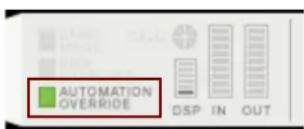
From this point onward, the recorded automation for the parameter is temporarily disabled.
2. To activate the previously recorded automation again, click the "Automation Override" indicator.
This returns the control of the parameter to the parameter automation lane in the sequencer.
- Note that you can also temporarily turn off automation for a parameter by clicking the "On" button (so that it goes dark) on the parameter automation lane in the sequencer (see "Muting a parameter automation lane").
Recording parameter automation on multiple tracks
Although only one track can have Master Keyboard Input, it is possible to record enable any number of tracks for automation recording.
→ Activate the Record Enable Parameter Automation button for all the tracks you wish to record automation for. When recording is activated, all automation record enabled tracks will record track parameter changes from their respective devices in the rack. This is especially useful if you have assigned parameters on several devices to a single control on a MIDI control surface, or have multiple control surfaces controlling different devices in the rack while you're recording. See "Remote - Playing and Controlling Devices" for details.
Pattern automation recording details
If your song contains pattern based devices such as the Redrum Drum Computer, Matrix Analog Pattern Sequencer or Dr. Octo Rex, you probably want to use more than a single pattern throughout the song. To facilitate this you can record pattern changes in the sequencer.
Recording pattern automation
-
Before you start recording on the track, make sure the "Record Enable Parameter Automation" button is on (red).
You can disable the "Record Enable" button for the note lane for now as it won't be needed. -
Make sure that the "Enable Pattern"/"Enable Loop Playback" button is activated on the device in the rack.
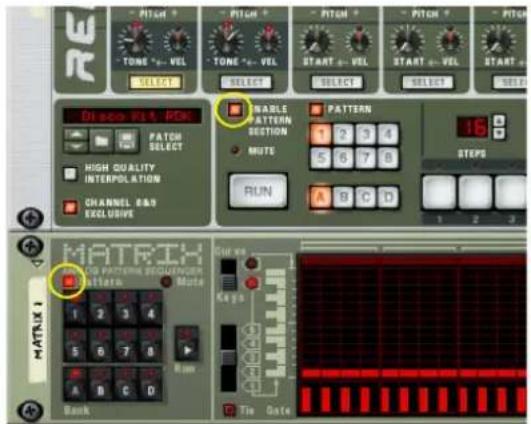
The "Enable Pattern" buttons on the Redrum (top) and Matrix (bottom) devices.
-
Set the desired start pattern on the pattern device.
-
Start recording on the track from the desired position.
When recording starts, the pattern device will automatically start. Although no clip will be created until you change pattern on the device for the first time, the start pattern is still being recorded.
- During recording, change patterns with the "Bank" and "Pattern" buttons on the device panel.
As soon as a Pattern or Bank value is changed on the device, a pattern lane is automatically created on the track. On the lane, a pattern clip is automatically created and the pattern selection is recorded in the clip. Make sure you change the patterns slightly in advance - the actual pattern change will be recorded (and happen) on the next downbeat according to the sequencer time signature setting.
- When you are done, click "Stop" on the Transport Panel to stop recording.
The automated pattern selection buttons on the device in the rack will marked with a green border, indicating that they have been automated. A pattern automation lane with pattern clips has also been created on the Edit/Arrangement Pane.

Pattern automation clips on the pattern automation lane.
- Pattern automation has no “static value”. Patterns will only be played back where there are pattern clips on the lane. Where the pattern lane has no clips, the device will stop and no pattern will be played back.
• Each pattern change will be recorded on a downbeat (at the start of a new bar in the sequencer).
You can move pattern changes to other positions by moving or resizing the pattern clips, see "Editing pattern automation".
- You can “punch in” on recorded pattern changes, to replace a section of the pattern lane with new pattern automation events. This can be done the same way as described in “Recording parameter automation over or into an existing clip”.
- After recording the pattern changes, you can use the function “Convert Pattern Track to Notes”, to transfer the notes in the patterns to regular notes in the main sequencer.
This allows you to create unlimited variations by later editing the notes in Edit mode. See “The “Convert Pattern Automation to Notes” function”.
- On the Redrum, Matrix and Dr. Octo Rex devices, you could also use the "Copy Pattern/Loop to Track" function.
This function lets you convert a defined range of pattern clips into notes in a new note clip. See "Copy Pattern to Track".
- You can also manually draw automation clips on the Pattern automation lane - see "Drawing pattern automation"
Tempo automation recording
In Reason Lite it's possible to record automation of the sequencer's tempo. This means that a song can automatically change tempo whenever you like. You can record tempo automation events on the parameter automation lanes on the Transport track.
Recording tempo automation
Automating tempo is done much in the same way as with other parameter automation. You record the tempo changes by changing the Tempo value on the Transport Panel. When you later play back, audio clips will automatically be stretched to follow the tempo changes (unless you have disabled stretch for the clips - see "About disabling Stretch for audio clips"). Note clips and automation clips will always follow tempo changes.
To record tempo automation, do as follows:
- Set the desired song tempo in the Tempo display on the Transport Panel.
This will be your static value, i.e. the tempo of the song wherever there is no clip present on the tempo automation lane.
This will both select the Transport track and create a Tempo automation lane at the same time. The Tempo display will also be marked with a border, indicating that the Tempo parameter has been automated.
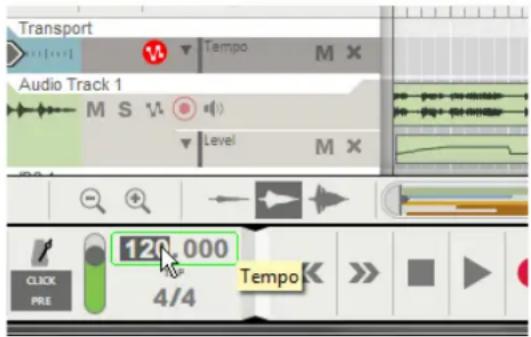
- Start recording in the sequencer and record the tempo changes by changing the value in the Tempo display. Click and drag up/down in either of the display segments to change tempo in BPM steps or 1/1000 BPM steps.
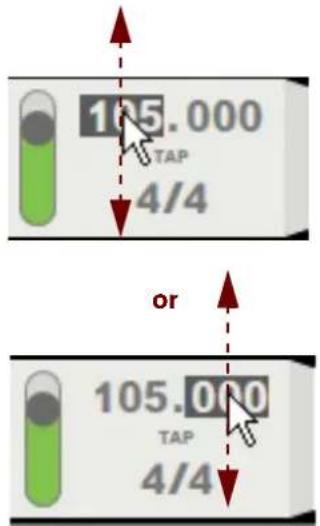
- You can also manually draw Tempo automation events in the parameter automation clip, using the Pencil tool - see "Drawing tempo automation events".

Chapter 7
Arranging in
the Sequencer
About this chapter
This chapter describes how you can arrange and work with the clips in your song. The chapter covers both audio, note and parameter automation clip arrangement. Special arrangement techniques pertaining to the Blocks View are described in the separate chapter "Working with Blocks in the Sequencer".
Before reading this chapter, it's recommended that you are familiar with the sequencer functions and definitions described in the "Sequencer Functions" and "Recording in the Sequencer" chapters.
Clip handling
Clip arrangement in the sequencer is done mainly in the Song View - but could also be done in Edit Mode, if the clips you're arranging are on the same lane. The descriptions in this chapter refer to arrangement in the Song View, unless otherwise stated.
Creating Clips
Clips are created automatically when you record, but you can also create empty clips and add notes and other events in them by drawing with the Pencil Tool.
→ To create a clip, double click with the Selection (Arrow) Tool on a track.
This will create an empty clip with the length of the current Snap value setting (e.g. 1 bar). To create longer clips, double click, keep the mouse button pressed and drag to the right.
→ You can also create clips by selecting the Pencil Tool and drawing on a Lane in the sequencer.
Selecting clips
→To select any type of clip in the Song View, just click on it.
A selected clip is indicated with a thick black border with Clip Resize handles on either side. In Edit Mode, the Clip Resize handles appear in the Clip Overview area.
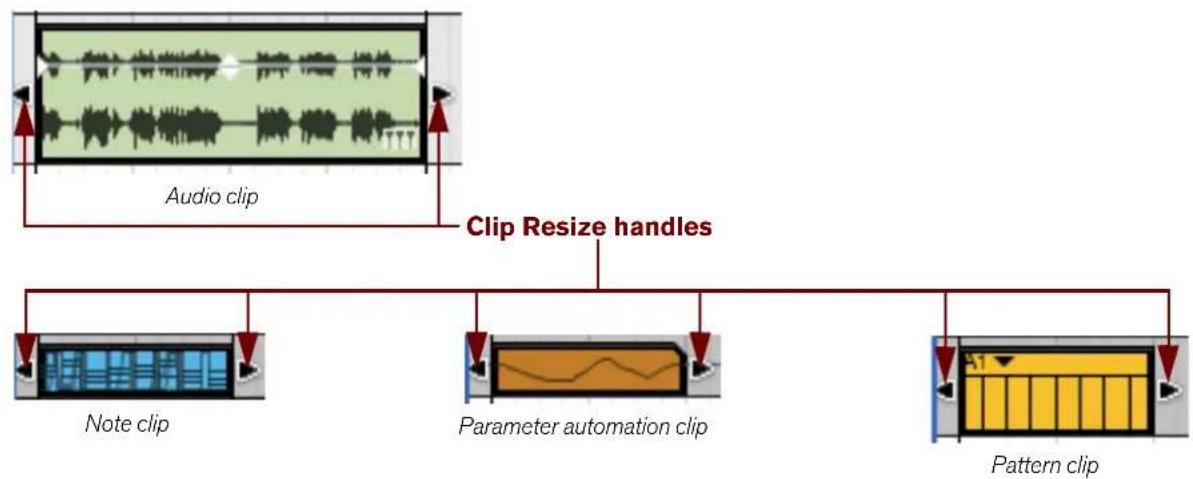
flowchart
graph TD
    A["Audio clip"] --> B["Clip Resize handles"]
    B --> C["Note clip"]
    B --> D["Parameter automation clip"]
    B --> E["Pattern clip"]
Selected clips in Song View.
→To de-select clips, just click anywhere on the Arrange Pane background.
Inspector displays for selected clips
In the sequencer Inspector, the Position and Length displays shows the start position and length of the selected clip. For selected audio clips, four additional displays are shown: Fade In, Fade Out, Level and Transpose. If several clips are selected, the displays show the values for the earliest (or topmost) selected clip in the song.
| Position2. 1. 1. 0 ⇌ = | Length8. 0. 0. 0 ⇌ | Fade In0. 0 ⇌ | Fade Out0. 0 ⇌ | Level (dB)0.00 ⇌ | Transpose0.00 ⇌ |
The Inspector displays for selected Audio Clips.
- Clip Position display
The clip Position display shows at what position in the song the clip begins. The display readout is divided into Bar, Beat, 1/16 Note and Ticks (1/16th note=240 Ticks). The position can be edited according to the descriptions in "Moving clips using the Inspector".
- Clip Length display
The clip Length display shows the length of the clip. The display readout is divided into (from left to right) Bar, Beat, 1/16 Note and Ticks. The length can be edited according to the descriptions in "Resizing clips using the Inspector".
- Fade In and Fade Out displays (audio clips only)
The Fade In and Fade Out displays for selected audio clips show the Fade In and Fade Out times for the audio in the clip. The readout is divided into 1/16 Note and Ticks. The Fade times can be edited as described in "Inspector segment displays".
• Level display (audio clips only)
The Level display for selected audio clips shows the level of the audio in the clip. The readout is divided into dB and 1/100 dB. The level can be edited as described in "Inspector segment displays".
- Transpose display
The Transpose display shows the transposition of the audio recordings in the selected Audio Clip(s) - relative to the original pitch. The display readout is divided into (from left to right) Semitones and Cents, See "Transposing Audio Clips".
Selecting multiple clips
In Song View, several clips can be selected, e.g. for cutting, copying, pasting, deletion, moving or resizing purposes. If you select multiple note clips, these can be opened for Multi Lanes editing, see "Multi Lanes editing".
→ Press [Ctrl](Win) or [Shift](Mac) and select the clips.
Under Windows, you can also press [Shift] and click to select a range of clips on the same lane.
→ Draw a selection rectangle with the Selection Tool (arrow) on the Arrange Pane background.
 or [Shift](Mac) and select the clips. - 1](/content/2026/06/1203202/images/0e7a8547c7c6e006fe6b873f7f27d6a5e6a4f4bfd4ac7cbe65e70eadcafabcbb.jpg)
flowchart
graph LR
    A["Input Data Input"] --> B["Data Transformation"]
    B --> C["Output Data Output"]
    subgraph Input
        D["Input Data"]
        E["Input Data"]
        F["Input Data"]
        G["Input Data"]
        H["Input Data"]
        I["Input Data"]
        J["Input Data"]
        K["Input Data"]
    end
    subgraph Output
        L["Output Data"]
        M["Output Data"]
        N["Output Data"]
        O["Output Data"]
        P["Output Data"]
        Q["Output Data"]
    end
Click, hold and draw a rectangle with the Selection Tool to select multiple clips.
All clips that are touched by the selection rectangle will be automatically selected when the mouse button is released.
→ If you hold down [Shift] when you select clips with the selection rectangle technique, any previously selected clips will remain selected.
This allows you to make multiple, non-contiguous selections: first select some clips, then hold [Shift] and select some more clips, and so on.
→ Use the "Select All" function on the Edit menu or on the clip context menu to select all clips in the song. Alternatively, hold down Ctrl or Cmd and press [A].
- You can also select multiple clips in the Clip Overview area in Edit Mode - if the clips are on the same lane.

Two selected clips in the Clip Overview area in Edit Mode.
Selecting clips with the arrow keys
Another way of selecting clips on the Arrange Pane is to use the arrow keys on the computer keyboard.
→ Press the [Left] or [Right] arrow keys to select the previous or next clip on the lane.
→ Press the [Up] or [Down] arrow key to select the closest clip on the lane above or below.
→ Hold down [Shift] and use the [Left]/[Right] arrow keys to make multiple selections on the same lane.
Setting audio clip Level and Fades
Besides the Clip Resize handles, a selected audio clip also has Fade In and Fade Out handles plus a Clip Level handle. These can be edited at any time, either by using the handles as described below, or using the Inspector as described in "Fade In and Fade Out displays (audio clips only)" and "Level display (audio clips only)":
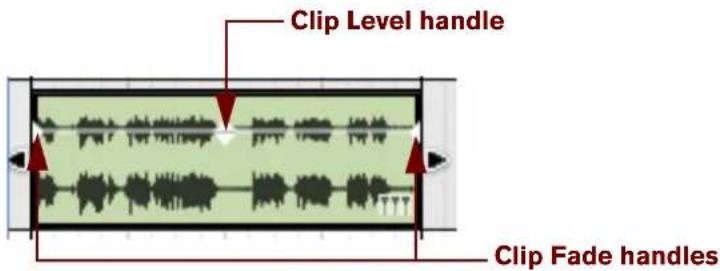
A selected audio clip in Arrange Mode.
Fade In and Fade Out Handles
→ Click and drag these handles horizontally to introduce a fade in and/or fade out of the audio in the clip. The Fade settings can be set individually for each audio clip in the song. The fading is non-destructive and can be changed at any time. If Snap is activated (see "Snap"), the set Snap value is taken into account when setting the fade time(s).
Clip Level Handle
→ Click and drag this handle vertically to adjust the audio level in the audio clip. The Level can be set individually for each audio clip in the song. The Level setting is non-destructive and can be changed at any time.
Deleting clips
To delete a clip, select it and press [Delete] or [Backspace] or select "Delete" from the Edit or context menu. You can also draw selection rectangles with the Selection tool, encompassing several clips and delete them all at once. The same rules apply as when selecting clips (see "Selecting clips").
! If you delete an audio clip which contains recordings that are not used elsewhere in the song, those audio recordings will be permanently deleted! However, if you accidentally erase an audio clip, you can always use the "Undo" function.
Deleting clips with the Eraser tool
You can also use the Eraser tool to delete clips on the Arrange Pane. The Eraser tool can be used in two ways: you can click on single clips or you can make a selection rectangle encompassing several clips:
→Select the Eraser Tool and click on the clip you want to delete.
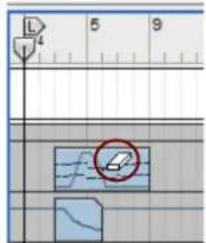
Select the Eraser Tool and click on the clip you want to delete.
Alternatively, if you want to delete multiple clips:
→ Select the Eraser Tool, click and hold the mouse button and draw a selection rectangle on the Edit/Arrange Pane background.
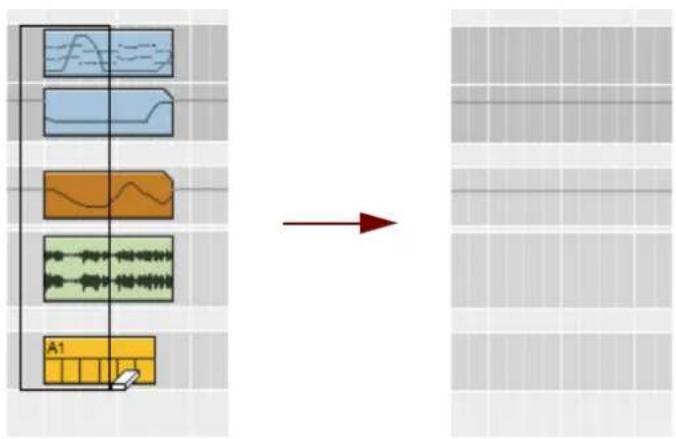
flowchart
graph LR
    A["Input Signal"] --> B["Waveform Signal"]
    B --> C["Sine Wave"]
    C --> D["Amplitude Conversion"]
    D --> E["Output Signal"]
    style A fill:#f9f,stroke:#333
    style E fill:#bbf,stroke:#333
Click, hold and draw a rectangle with the Eraser Tool to erase multiple clips.
All clips that are touched by the selection rectangle will be deleted once you release the mouse button.
Resizing (masking) clips
All clip types can be resized by clicking and dragging either of the Clip Resize handles on the selected clip(s). This can be done both in the Song View and in Edit Mode. In Edit Mode, the Clip Resize handles appear in the Clip Overview area.
Clip Resize handles
A selected note clip.
If you resize a clip and make it smaller, any recordings or events that now lie outside the clip boundaries will not sound, or have any effect, when played back. However, they are not deleted - just masked. If you make the clip larger again, the recordings or events that were masked will become visible and will play back again. See "About masked recordings and events".
If you enlarge an unmasked clip, nothing special will happen except that the clip "window" becomes larger.
- If you resize an audio clip which uses Fade In and/or Fade Out, the fade slopes will follow along, unaffected, with the clip boundaries.
Resizing multiple clips
It's possible to resize several clips by first selecting the clips, and then dragging a Clip Resize handle on one of the selected clips. All selected clips will be resized by the same amount.
Resizing clips using the Inspector
Another way of resizing clips is to change the clip length(s) in the Inspector. This can be done in the following way:
→ Select one or several clips on the Arrange Pane and then change the Length value in the Inspector by clicking on the up/down arrow buttons.
In the example below, we expand the clip lengths by 2 bars by clicking the up arrow button twice.
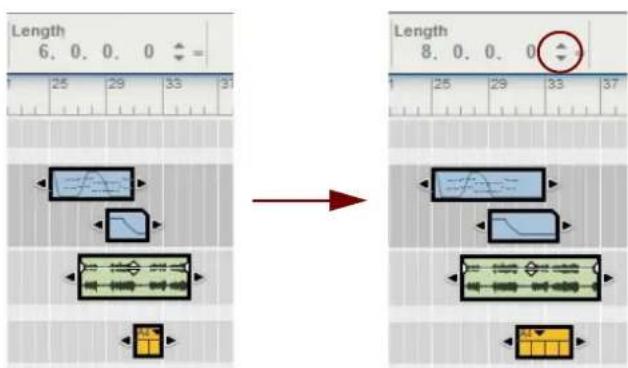
flowchart
graph TD
    A["Rectangle Structure"] --> B["Arrow"]
    B --> C["Rectangle Structure"]
    style A fill:#f9f,stroke:#333
    style B fill:#bbf,stroke:#333
    style C fill:#dfd,stroke:#333
All selected clips become 2 bars longer.
- See "Inspector segment displays" for more details on how to edit in the Inspector displays.
- If the Tick segment in the Length display shows an asterisk (*), it means that the value is a fraction of a Tick - a subtick. See "About subticks in the Position and Length displays" for more info.
About masked recordings and events
A note or parameter automation clip which contains masked events is indicated by white corners on the left, right or both clip boundaries:
The position of the white corners indicate on which side of the clip boundary the masked events exist:

! Audio clips don't have any indication if they contain masked recordings.
Masked recordings in audio clips
If you resize an audio clip and make it smaller, the masked part of the recording will be silent during playback. If you open a masked audio clip in the Comp Editor, the part of the recording that will actually play back is shown in the Clip Overview area. The masked part of the recording will appear grayed out on a Comp Row:
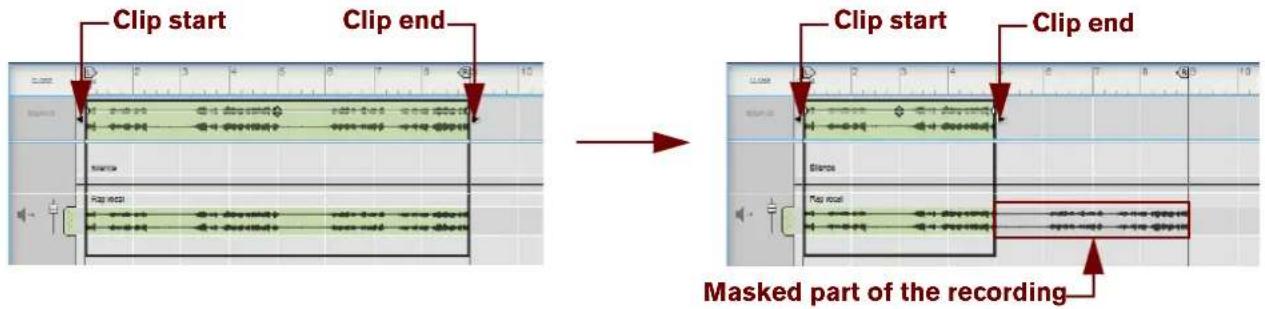
An open audio clip before and after masking.
Masked events in note and parameter automation clips
In the picture below is an open note clip in Edit Mode with notes and performance controller events, before and after resizing the clip:
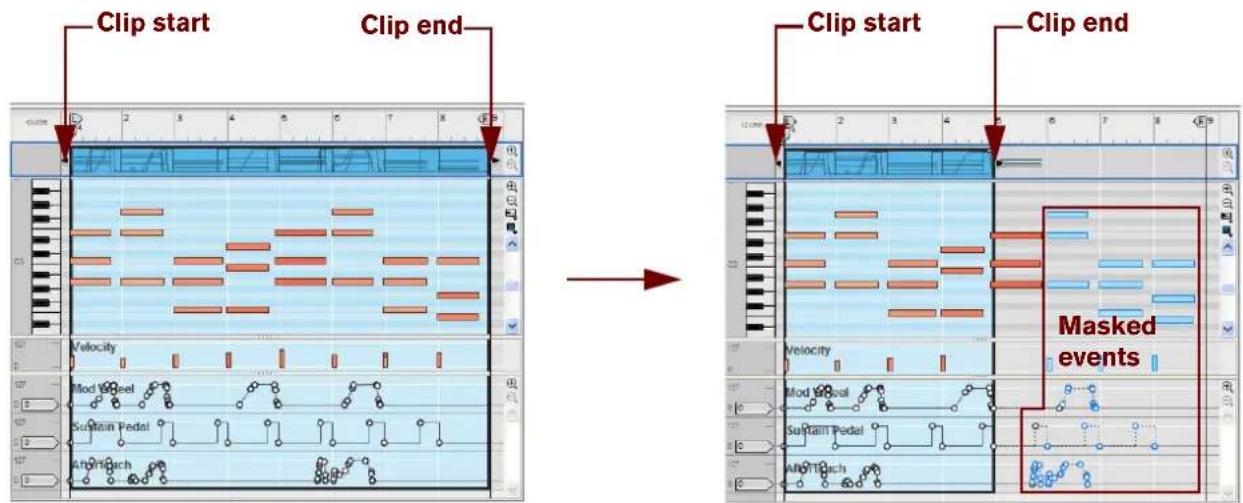
An 8-bar note clip with notes and performance controller events.
The same note clip resized to 4 bars
After resizing the clip from 8 to 4 bars, all events that begin in bars 5-8 are now masked and won't play back. All masked events will still be there - and follow along with the clip if the clip should be moved, cut or copied.
Masked events will be a blue color on the Note Edit Lane, to indicate that they won't play back. The first three-note chord in the masked area is still an orange color. That's because the notes begin in bar 4 (just before the downbeat) and thus will play back in their entirety, also after resizing the clip.
Masked performance controller events, parameter automation events and pattern automation events will be inactive - but could still affect the masked clip (see "About masked performance controllers and automation events" below). Outside a masked clip, the controller/parameter/pattern values will default to their Static Values in the masked area (see "Static Value Handles").
! Note that just switching to Edit Mode won't show masked events. A clip has to be opened before you can view these events. You can remove all masked note and parameter automation events using the "Crop Events to Clips" function on the Edit menu (see "The "Crop Events to Clips" function").
About masked performance controllers and automation events
Masked performance controller and parameter automation events just outside a clip can still affect the clip, since they affect the curve shape. The example below shows a masked note clip with Mod Wheel performance controller.
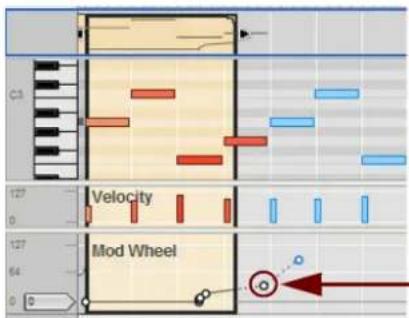
Masked event which still affects the clip
The first Mod Wheel automation event to the right of the masked part of the clip determines the direction of the automation curve from the last event in the unmasked area. These types of automation events are not blue, but black and white, just like unmasked events.
The result in this example is that the Mod Wheel value will continue to rise all the way to the end of the masked clip, at which point the value will drop down to the Static Value - in this case "0".
The "Crop Events to Clips" function
There may be situations when you want to delete all masked events, i.e. events located outside the left and/or right clip boundaries. This function only works for note and parameter automation clips and will delete all masked notes that begin in the masked clip section, plus any performance controller or parameter automation events:
- Reduce the size of the clips to your liking.
- Select one or several clips and choose "Crop Events To Clips" from the Edit menu or from the context menu.
- After the cropping operation, all events outside the clip have been deleted.
Tempo scaling clips
It is possible to tempo scale the content of clips, i.e. make the clip play back at faster or slower tempos. This can be achieved in two different ways:
- By manually stretching selected clip(s).
- By editing the tempo scaling numerically in the Tool Window.
! Tempo scaling can be applied to all clip types, except for Time Signature automation clips.
! Note that Pattern Automation Clips will only be resized - the pattern tempo in the source device will NOT be scaled but will still be synced to the main sequencer tempo!
Below, we will describe how to use the "scale tempo" tool to manually stretch clips. Numerical tempo scaling in the Tool Window is explained in "Scale Tempo" in the "Note and Automation Editing" chapter.
-
Select one or several clips, either on the arrangement pane in Song/Blocks View, or in the Clip Overview in Edit Mode.
-
With the Arrow Tool selected, hold down Ctrl or Option and place the mouse cursor over one of the Clip Resize handles.
When you reach any of the Clip Resize handles, the arrow symbol switches to a "scale tempo" arrow.
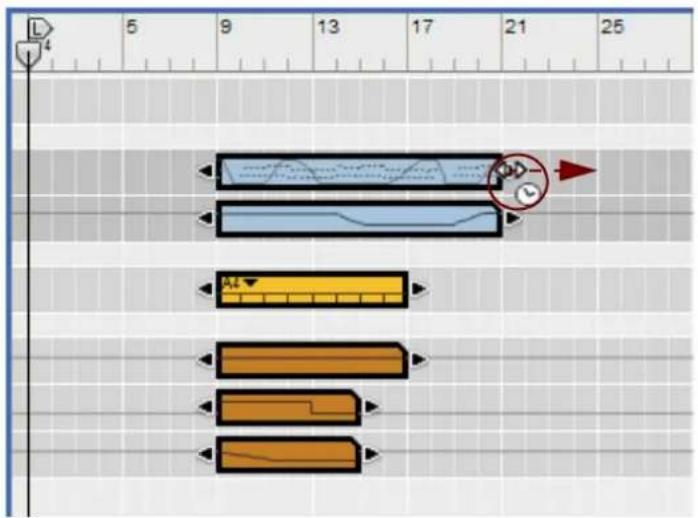
- Hold down Ctrl/Option and click and drag the cursor sideways in either direction to scale the tempo of the clip contents.
In this example, we make the "stretched" clip four bars longer by dragging the right clip handle one bar to the right.
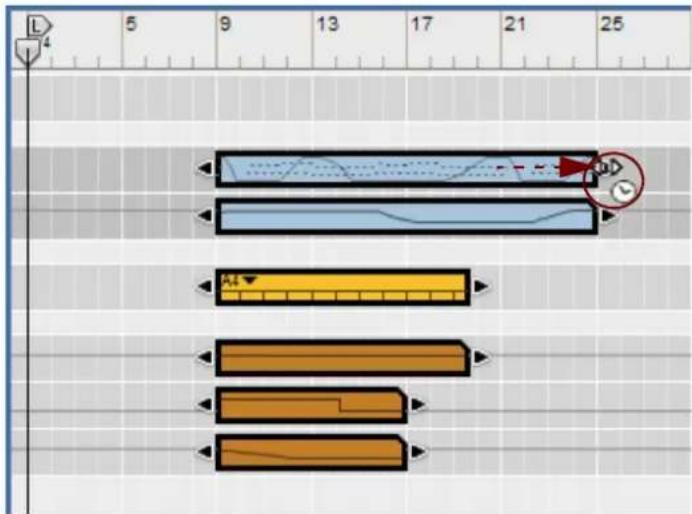
Now, all clips have been tempo scaled and the clip content have been stretched to match the new clip length. Note that the content of all selected clips have been scaled proportionally. The Pattern Clip has only been resized, though. The pattern tempo in the source device has NOT been scaled.
For more details about tempo scaling audio clips, refer to "Tempo scaling Clips" in the "Audio Editing in the Sequencer" chapter.
Moving clips
Moving clips on the same lane
→To move a clip, drag and drop it to the desired destination on the lane.
It's also possible to select and move several clips by dragging and dropping them at the desired destination. If the Snap function is selected (see "Snap"), you will only be able to move the clip(s) in steps of the selected Snap value - or to absolute positions on the grid, depending on the Snap settings.
→ You can also use the "Cut" and "Paste" functions on the Edit menu or context menu to cut the selected clip(s) and then paste them at the current Song Position Pointer position (see "Cutting, Copying and Pasting clips").
Nudging clip positions
You can use the left and right arrow keys on the computer keyboard to "nudge" the positions of selected clips in a couple of different ways:
-
Select the Snap value by which you want to nudge the clip(s).
-
Press Ctrl or Cmd and use the Left and Right arrow keys to move the clip position back or forward by the set Snap value.
It doesn't matter if Snap is on or off - the clip will always be moved in steps of the set Snap value.
→ Press [Ctrl]+Alt or [Cmd]+Option and use the left and right arrow keys to move the clip position back or forward in Tick increments.
There are 240 ticks per 1/16 note so this is very fine editing - check the tick positions in the inspector when you nudge because typically you won't "see" the position changes unless you're working at a high zoom level.
→ Press [Ctrl]+Shift or [Cmd]+Shift and use the left and right arrow keys to move the clip position back or forward in Beat increments.
Moving clips using the Inspector
Another way of moving clips is to change the clip position in the Inspector. This can be done in the following way:
→ Select one or several clips on the Arrange Pane. Then, change the Position value in the Inspector, either by clicking on the Up/Down spin controls, or by using any of the methods described in "Inspector segment displays".
In this example, we move the clips position 2 bars forward by clicking the "Up" spin control twice.
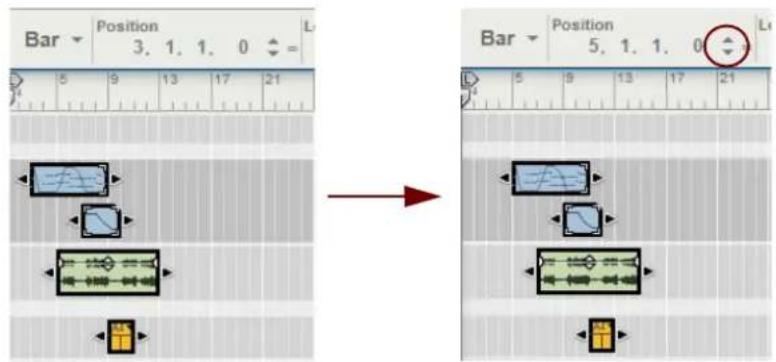
All selected clips are moved forward by 2 bars.
- If the Tick segment in the Position display shows an asterisk (*), it means that the value is a fraction of a Tick - a subtick. See "About subticks in the Position and Length displays" for more info.
Moving clips between lanes
You can move clips between lanes, either on the same track or between lanes on different tracks:
→ Click and drag the clip(s) to the desired position on the new lane.
The set Snap value is taken in to account if the function is activated (see "Snap"). It's also possible to move several selected clips in one go.
→ Hold down [Shift] when you drag the clip(s), to restrict the clips to vertical movement.
! If you want to move several clips in the Windows version of Reason Lite, press the [Shift] key after you have pressed the mouse button, otherwise pressing [Shift] will select or deselect clips, and that's not what we want here.
! For a successful result, it's important that the source and destination lanes are of the same, or similar, type (see "About alien clips" below).
About alien clips
An alien clip is a clip containing types of event, or different parameter range/resolution, other than that the lane is intended for. For example, if we move a note clip from a note lane to a parameter automation lane, the note clip would become alien and won't play back on the automation lane:

If a note clip is moved from a note lane to a parameter automation lane, for example, the clip becomes alien.
An alien clip can be distinguished by its red stripes, which indicate that the clip is currently inactive. If you place the cursor over an alien clip, a tool tip appears with detailed information:
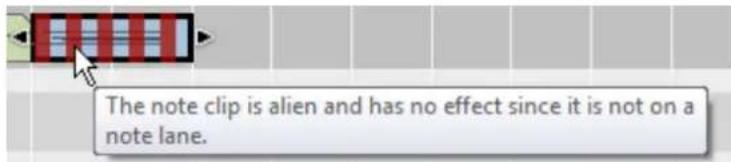
Tool tip for an alien note clip.
- A parameter automation clip can also become alien if it is moved to a parameter automation lane for a parameter with a different range or resolution.
In most cases, you can resolve this by first selecting the clip and then selecting "Adjust Alien Clips to Lane" from the Edit menu or from the context menu.
For example, if a parameter automation clip for a parameter that has a bipolar (-64 to 63) value range is moved to a parameter automation lane with a unipolar (0 to 127) value range, it will become alien. Selecting "Adjust Alien Clips to Lane" from the Edit menu or context menu will adjust the parameter automation events of the clip to fit the range of the parameter on the destination lane.
Moving clips with performance controller automation to another track
If you move note clips that contain performance controller automation events to another track (for a different type of instrument device), there are a few things to note:
- If you have only recorded standard performance controllers (Pitch Bend, Mod Wheel and Sustain pedal) in the note clip, these will usually translate without any problems when moved to another device track.
Be aware that all devices do not respond to all performance controllers - the Dr. Octo Rex device, for example, does not respond to Aftertouch, Expression or Breath performance controller data.
- If you have recorded non-standard controller parameters for a device in the note clip using the “Record Automation into Note Clip” option (see “Recording parameter automation into Note Clips”) some automated parameters may not have an equivalent parameter in the target device.
In such cases the automation data for an incompatible controller will simply be ignored.
- Parameters common to most instrument devices (filters, envelopes etc.) will be transferred to the target device whenever applicable.
About overlapping clips
If you move or resize clips so that the clips overlap each other, the following rules apply:
- Clips or sections of clips that are hidden (overlapped) will not play back.
Any lane can only play back a single clip at a time - if you want to mix two clips, put them on separate lanes (note clips) or on separate tracks (audio clips). See "Adding note lanes" and "Duplicating/copying tracks and devices".
- The clip with the latest start position have priority (and will be played back).
This means if a shorter clip is placed "in the middle" of a longer clip, as in the picture below, the sequencer will play the beginning of the long clip, then the shorter overlapping clip and then the end of the long clip.
natural_image
Pure diagram of a rectangular block with arrows indicating direction, no text or symbols present! If both clips start at the same position and have the same length, the clip which was moved last will sound. Consequently, the “hidden” clip won’t play back at all.
! Note that it's possible to cross-fade adjacent audio clips, for smooth overlaps. See "Crossfading audio clips".
Duplicating clips
To duplicate selected clips, hold down Ctrl or Option, then click with the Selection Tool and drag a copy of the clip(s) to the desired destination.
As you begin dragging, the cursor displays a "+" sign next to it to indicate duplication.
- You can use the Duplicate function ([Ctrl]/[Cmd]-[D]) to quickly make copies of clips, lined up after each other and spaced according to the Snap value.
- It's also possible to duplicate only a part of one or several clips by using the Razor Tool as described in "Duplicating a part of one or several clips"
Cutting, Copying and Pasting clips
You can move or duplicate clips using the "Cut", "Copy" and "Paste" commands on the Edit menu or the context menu. When you paste, the clips will end up at the current song position, on their original lane(s).
If you paste a clip into another Reason Lite song document, the pasted clip will be placed on the track with edit focus, if possible. Typically, you can just select a track in the other document, place the song position pointer where you want, and paste the clip(s) onto the selected track.
New tracks will be created when necessary. Since all tracks must have a device associated with them, the new tracks will be associated with empty Combinator devices. You can then use the Patch browser on the Combinator to select a suitable patch and device type. The above rules also apply when pasting alien clips and parameter automation clips.
Using Cut/Copy and Paste to repeat clips
When you cut or copy clips, the song position will automatically move to the end of the selection (or, if Snap is activated, to the closest Snap value position after the end of the longest clip). This allows you to quickly repeat a section of clips in the following way:
- Make sure the sequencer is stopped.
- Activate Snap (see "Snap") and set the Snap value to "Bar" (or to the length of the section you want to repeat).
- Select the clips you want to repeat.
Since you can select clips on several tracks, this is a quick way to copy entire song sections.
The song position is moved to the closest snap value after the end of the longest clip in the selection (provided that the sequencer is stopped).
The copied section is pasted in, and the song position is moved to the end of pasted selection.
- Paste again, as many times as you want to repeat the selection.
Naming clips
- You can name an individual clip by selecting it and then selecting "Add Labels to Clips" from the Edit menu or context menu.
A text field is opened.
- Type in a name for the clip and then press [Return].
When adding labels to several selected clips in one go, they will all receive generic names according to the clip type (e.g. "untitled note clip"). Double-clicking on a label in a clip opens the text field where you can type in the label text.
Renaming clips
→ To rename a clip, double-click on the label, type in a new name and press [Return].
Removing labels from clips
To remove labels from clips, select them and choose "Remove Labels From Clips" from the Edit menu or context menu.
Alternatively, double-click on the clip label, press [Backspace] or [Delete] and then press [Return].
Coloring clips
By default Clips are set to "Use Track Color", and will have the same color as their tracks. You can override this by selecting individual colors from the Clip Color submenu.
→ Select "Clip Color" from the Edit menu or the context menu and then choose a color from the palette on the sub-menu.
All selected clips will be colored according to the selected color. If you record new clips on the lane, they will be colored according to the set track color.
Splitting clips
You can split clips using the Razor Tool in Arrange Mode. To split a single clip, proceed as follows:
- Select the Razor Tool and place it where you want to split the clip.
On the Razor Tool's left edge is a cross-hair which indicates where the split will take place. If activated, the Snap setting is taken into account (see "Snap").
- Click with the Razor Tool to split the clip at the cross-hair's position.
The clip is now split into two separate clips.
A vertical line appears where the clip is split.
! Recordings and events in a split clip will always remain intact, e.g. notes in a note clip will not be split even if they span over the split point.
It's also possible to split clips on all tracks in a song:
- Place the Razor Tool's cross-hair on the Ruler where you want to split the clips on all tracks and lanes of the song.
- Click in the Ruler to split the clips on all tracks and lanes at the current position.
Clips on tracks and lanes - including tracks and lanes that might not be visible - on the Arrange Pane will also be split.
You can also cut out a section of one or several clips in one go to:
- Place the Razor Tool on the Arrange Pane background close to where you want to split the clips.
- Click and drag with the Razor Tool to select the split section - on one or several lanes.
- Release the mouse button to split the clips.
If you want to "cut" out a section of all clips on all tracks in the song, this can be done as follows:
- Place the Razor Tool's cross-hair on the Ruler where you want to split the clips on all tracks of the song.
- Click and drag the Razor Tool in either direction on the Ruler to make a range selection.
- Release the mouse button to split the clips on all tracks and lanes in the song.
! Clips on tracks and lanes that might be scrolled out of view on the Arrange Pane will also be split.
Duplicating a part of one or several clips
By using either of the methods described above, it's also possible to duplicate the "split" section of the clip(s) and then move them to a new destination. Here's how:
- With the Razor Tool selected, hold down Ctrl or Cmd and drag to create a duplicate of the "cut out" section of the clip(s). Then, use the Selection Tool to move the duplicated clip(s) to a new destination. The original clips will remain uncut, just as they were before the operation.
Crossfading audio clips
When two audio clips have overlapping edges, it's possible to add a crossfade in the overlap area. By "crossfade" we mean "crossfade to previous clip".
- Drag one of the audio clips so that it overlaps the edge of the other audio clip:

natural_image
Audio waveform visualization with green and orange tones, no text or symbols presentMoving the last (orange) clip....

natural_image
Audio waveform visualization with green and orange tones, no text or symbols present...so that it partly overlaps the first (green) clip.
- Press [X] or right click the last (orange) clip and select "Crossfade" from the bottom of the context menu.
The overlap area is now crossfaded, as shown by the white crossfade curves:

- You can adjust the crossfade zone by clicking on either edge of the crossfade zone and drag sideways:
This actually resizes the clips; adjusting the left edge changes the start of the orange clip and adjusting the right edge changes the end of the green clip.
natural_image
Audio waveform visualization showing sound waves and a transition from green to orange (no text or symbols)Adjusting the right edge of the crossfade zone.
- You can also change the crossfade symmetry by clicking the crossfade curve and dragging sideways:
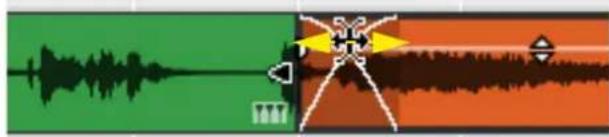
natural_image
Audio waveform visualization showing sound waves and a human silhouette (no text or symbols)Adjusting the crossfade symmetry.
To remove a crossfade, select the last (orange) clip and press [X] - or deselect Crossfade from the context menu:
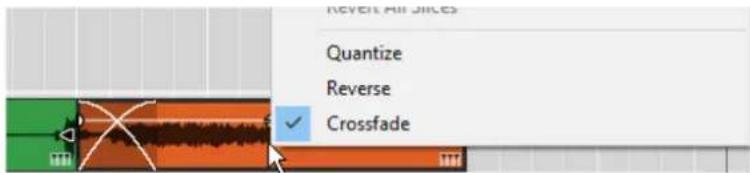
Joining clips
Separate clips on the same lane can be joined into one clip. You can also join clips that aren't directly adjacent on the lane, or clips that overlap each other.
- Select the clips you wish to join.
- Select "Join Clips" from the Edit menu or from the clip context menu. Alternatively, hold down Ctrl or Cmd and press [J].
A single clip is created. If there was a gap between the clips before the operation, this area will be empty - the original positions of all events in the original clips will be preserved in the joined clip.
- Only clips on the same lane can be joined.
It's possible to select several clips on several lanes, but only selected clips on the same lanes will be joined.
- You can also join selected clips that have other non-selected clips in-between them.
The non-selected clips in-between will then overlap and mask the joined clip at their current positions.
! If you join note or parameter automation clips that contain masked events in the area(s) between the clips, the masked events will be permanently deleted! This is to make the resulting clip play back the same as the original clips did before joining. (See "Masked events in note and parameter automation clips").
! If you join overlapping note or parameter automation clips, the events in the clip which lies on top will replace and permanently delete the events in the overlapped region of the "hidden" clip.
About joining audio clips
Joining audio clips basically works in the same way as joining note and parameter automation clips - except when it comes to joining overlapping audio clips. What happens if you join overlapping audio clips is that the clips will be placed on separate Comp Rows - and be automatically comped to a "final" clip. No recording will be deleted. Let's have a look at the example in the picture below:

flowchart
graph LR
    A["Audio Signal"] --> B["Audio Channel"]
    B --> C["Audio Fusion"]
    C --> D["Audio Mask"]
    D --> E["Audio Output"]
    style A fill:#f9f,stroke:#333
    style E fill:#bbf,stroke:#333
The original audio clip (blue) with an overlapping audio clip (yellow) selected in Arrange Mode.
The two audio clips joined into a single audio clip in Arrange Mode.
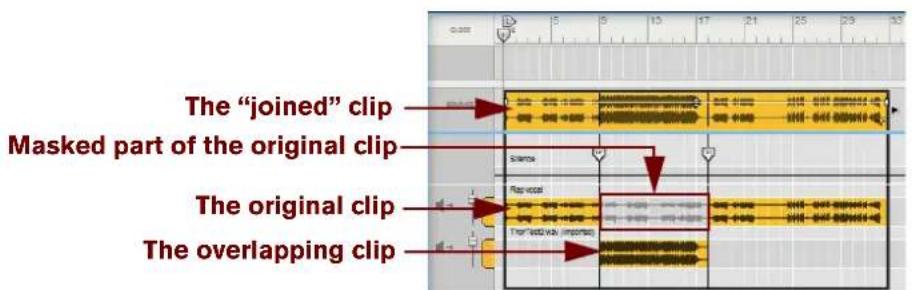
The "joined" audio clip open in the Comp Editor.
As you can see, the entire audio recording in the original clip is preserved - only masked where the overlapping clip is located. If you change your mind afterwards, you will still be able to access the entire original recording.
- If overlapping clips have different Clip Levels, the Comp Row Levels will change to these levels after joining. The Clip Level in the joined clip will be set to -0 dB.
- If overlapping clips use Fade In and/or Fade Out and the clips overlap in the Fade In/Out area(s), the Fade(s) will be removed after joining.
Also, if you join audio clips that aren't directly adjacent, any Fade Out in the first clip and Fade In in the second clip will be removed.
- Any Cut Crossfades used in comped audio clips will be preserved after the joining.
About joining crossfaded audio clips
If audio clips you are joining have a crossfade between them, this is what happens:
- Select the two crossfaded clips:

- Select "Join Clips" from the Edit menu or from the clip context menu. Alternatively, hold down Ctrl or Cmd and press [J].
The "joined" clip shows up on the track:

natural_image
Audio waveform display with multiple channels and a central peak (no text or symbols)3. Double click the clip to open it in Comp Edit Mode:
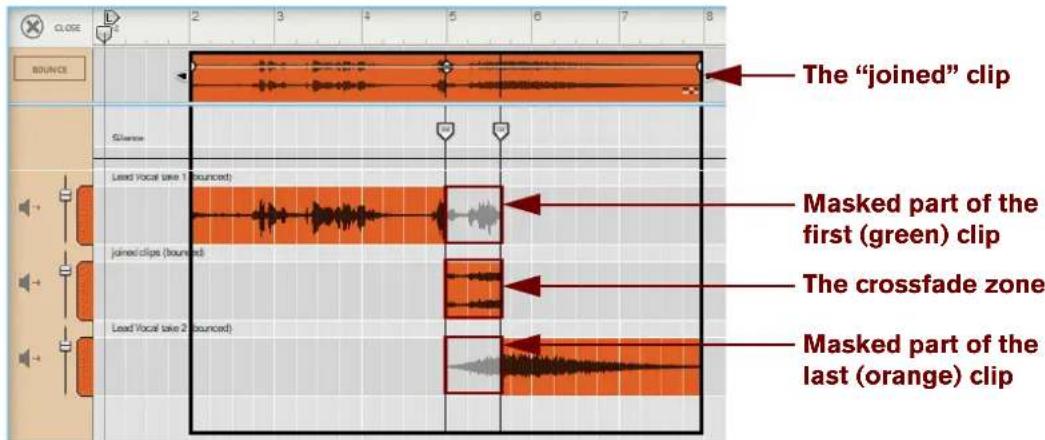
As you can see, the crossfade zone has been automatically bounced to a new recording on a separate Comp Row.
! Note that even though we joined two mono audio clips, the resulting audio clip automatically becomes stereo (with two identical mono audio "channels"). This happens by default when crossfaded audio clips are bounced, but does not affect the audible result.
Reversing clips
It's also possible to reverse clips, i.e. play the content of the clip "backwards" (from the end to the start). This works a little differently for audio clips and note clips. Please refer to "Reverse" for information about reversing note and automation clips, and to "Reversing audio clips" for information about reversing audio clips.
Muting clips
Clips can be muted as follows:
→ Select the Mute Tool from the Toolbar and click on the clips you want to mute.
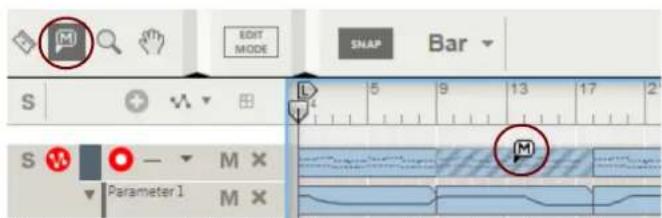
Muted clips are indicated with gray stripes, borders and events:
Muted clips.
→ Select the clips and then select "Mute Clips" from the Edit menu or from the clip context menu. Alternatively, select the clips and press [M] on the computer keyboard to mute them.
Unmuting clips
Muted clips can be unmuted as follows:
→Click on muted clips with the Mute Tool.
- Select muted clips with the Arrow Tool and select "Unmute Clips" from the Edit menu or context menu - or press [M].
! Muted clips cannot be joined with other clips.
! Muted note clips will not be included when using the "Merge Note Lanes on Tracks" function described in the "Merging clips on note lanes" section.
Merging clips on note lanes
Several note lanes on a track can be merged into a single note lane:
- Select the track with the note lanes you wish to merge.

A selected instrument track with separate note lanes.
- Select "Merge Note Lanes on Tracks" from the Edit menu or from the context menu.
The clips on all note lanes will be merged on the topmost note lane.

The same instrument track after merging.
- If there are time gaps between the clips on the lanes, several clips will be created on the merged note lane.
- Muted note lanes or muted clips on the track will not be included in the merge.
- It's also possible to select several tracks and merge the note lanes on each individual track, all in one go.
Bounce in Place
The Bounce in Place function lets you bounce the sound generated from playing back note or audio clips, with any insert effects and channel strip coloration - but without Send FX and Master Section settings - to a new audio clip on a new audio track. The Bounce in Place function is mainly intended for creative audio work, for example:
- creating audio clips out of note clips, that you could then manipulate the slices in - or cut up.
- creating audio clips out of note (or audio) clips - with the sound from any effects included.
- creating audio clips out of note clips that you could then reverse (see "Reversing clips").
This is great for reverberated drum hits or vocals etc. that you could then play backwards for interesting effects.
- for creating audio clips that you could use as samples in any sample player device (see "Bounce Clip(s) to New Sample(s)") or as REX loops in the Dr Octo Rex (see "Bounce Clip to REX Loop").
- If you want to bounce entire tracks to audio, use the Bounce Mixer Channels function instead. See "Bouncing Mixer Channels".
! Note that if you bounce audio clips that are in mono, the bounced clip will be in stereo because the bounce is post-pan on the channel strip. Thus, if a mono channel is panned left or right, the two channels will not be identical. Also, even though the audio clip is in mono, there may be insert fx turning the channel to stereo.
Here is an example of how you can use the Bounce in Place function:
1. Select the clip you want to bounce.
In this example we choose a note clip on an ID8 instrument track:

2. Select "Bounce in Place" from the context menu (or Edit menu). (If you bounce an audio clip, select "Bounce > Bounce in Place" instead).
A new audio clip is created on a new audio track, colored and named according to the original track - with the addition of the word "Bounced" in the destination track name. The destination track inherits the settings from the source track, i.e. mixer settings and any Output Bus routing.
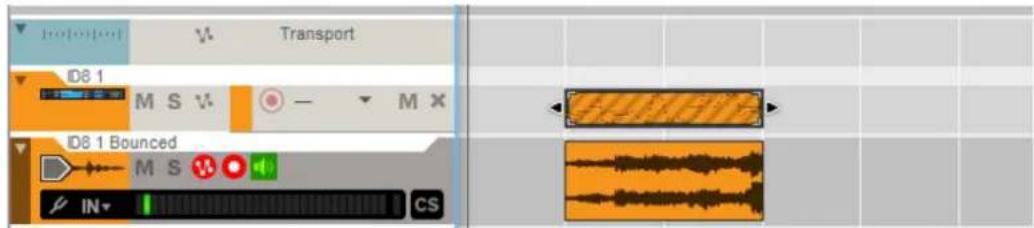
The bounced audio clip always has the same position and length as the original source clip.
Note also that the source clip is automatically muted.
3. If the source clip generated any sustaining (or reverberating) audio, this might be masked in the bounced audio clip. To reveal any audio tail, just resize (expand) the bounced clip:
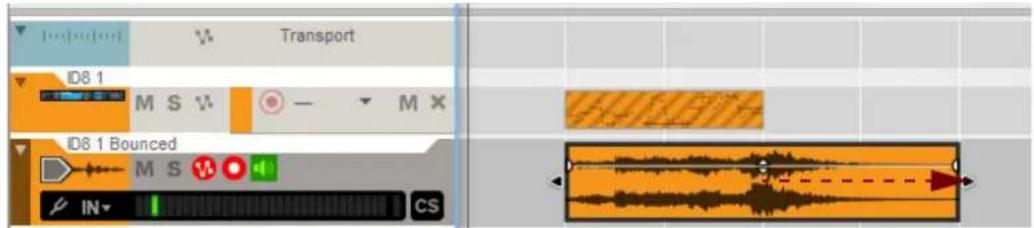
Expand the bounced audio clip to reveal any sustaining audio tail.
- Similarly, if a note clip should contain any notes that extend to the right outside the clip boundary, the audio from the notes will be bounced to the new audio clip in its entirety.
The audio from the extended note(s) will be masked in the audio clip, so you will have to expand the bounced audio clip to hear the complete rendering.
! The maximum length of any sustaining/reverberating "tail" in the bounced clip is automatically limited to 5 seconds after the last "note off" in the original note clip - or 5 seconds after the end of an audio clip.
- Completely masked notes in a source clip will not be rendered to audio - only the notes you can hear.
- Any parameter automation of the source device that affects the audio are also taken into account when bouncing.
This means that what you heard when you played back the source track is exactly what you will hear when you play back the bounced clip on the destination track.
Bouncing multiple clips
If you have selected multiple clips to "Bounce in Place", this is what happens:
- Clips that are on the same source track will result in bounced clips on the same destination track.
- If the clips are on different source tracks, the bounced clips will be on separate, new destination tracks.
Bouncing overlapping clips
If you have selected multiple overlapping clips to "Bounce in Place", this is what happens:
- The separate ranges for each of the source clips are bounced. The bounced clips are then placed overlapping in the same way on the destination track.
Bouncing clips on instrument tracks that use several Mix Channels
- If you want to bounce a note clip for an instrument that uses separate Mix Channels (e.g. individual outputs of an instrument device connected to separate Mix Channels), a separate audio track will be created for each used Mix Channel.
On each of these audio tracks there will be a separate audio clip rendered from each of the Mix Channels.
About tracks with no Mix Channel of their own
- If a track's device is not connected to its own separate Mix Channel, the Bounce in Place function will be disabled.
For example, if an instrument device is connected to a Mixer 14:2, which has other instrument devices connected to it, and then routed to a single Mix Channel device, there's no obvious way to isolate the audio from a single instrument device (since other devices connected to the Mixer 14:2 might be playing as well). Thus, the Bounce in Place function will be disabled.
Matching clips using the "Match Values" function
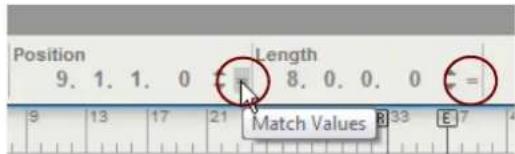
The "Match Value" function in the Inspector can be used for matching the positions or lengths of several selected clips to the position and/or length of the topmost selected clip (or leftmost if the clips are on the same lane).
Matching clip positions
To match clip positions:
-
Select a couple of clips on the Arrange Pane.
-
Click the "Match Values" button to the right of the Position display to move all selected clips to the start position of the topmost clip - or leftmost clip, if the clips are on the same lane.
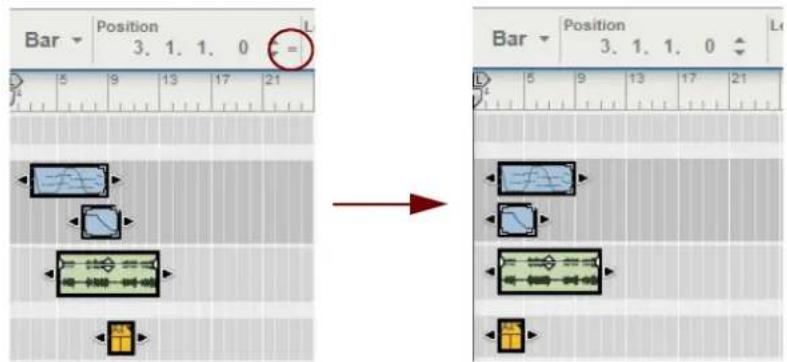
flowchart
graph TD
    A["Position 3.1.0"] --> B["Bar"]
    B --> C["Position 3.1.0"]
    C --> D["Bar"]
    D --> E["Position 3.1.0"]
    E --> F["Bar"]
All selected clips are moved to the start position of the topmost selected clip.
! Note: If you match the position of several clips on the same lane, they will all start at the same position, and thus overlap.
Matching clip lengths
Another Match Value function in the Inspector can be used to match the lengths of several selected clips to the length of the topmost (or leftmost if on the same lane) selected clip:
-
Select a couple of clips on the Arrange Pane.
-
Click the "Match Values" button to the right of the Length display to resize all selected clips to the length of the topmost clip - or leftmost clip, if the clips are on the same lane.
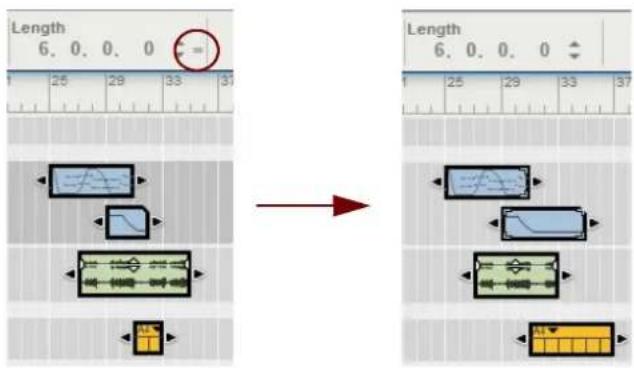
flowchart
graph TD
    A["Rectangle Structure"] --> B["Arrow"]
    B --> C["Segmented Block Structure"]
    style A fill:#f9f,stroke:#333
    style C fill:#bbf,stroke:#333
All selected clips are resized to a length of 6 bars - the same as the topmost selected clip.
Matching audio clip levels, fades and transposition
In addition to Position and Length matching, audio clips can have their Fades, Levels and Transpose values matched:
-
In Arrange Mode, select a couple of audio clips.
-
Click the "Match Values" buttons to the right of the respective displays to match to the values of the topmost clip - or leftmost clip if the clips are on the same lane.
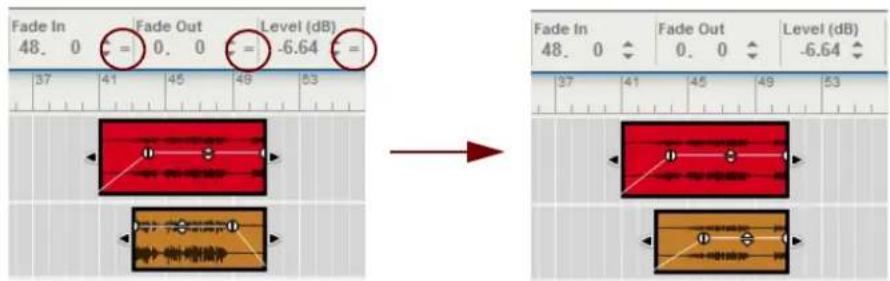
After having clicked the Match Values buttons, all selected audio clips get the same values as the topmost selected audio clip.
Inserting bars
The "Insert Bars Between Locators" function on the Edit menu, or context menu, can be used for inserting empty bars between the Left and Right Locators. All clips that intersect the locator positions on all tracks after the Left Locator are split and moved to the Right Locator to make room for the inserted bars.
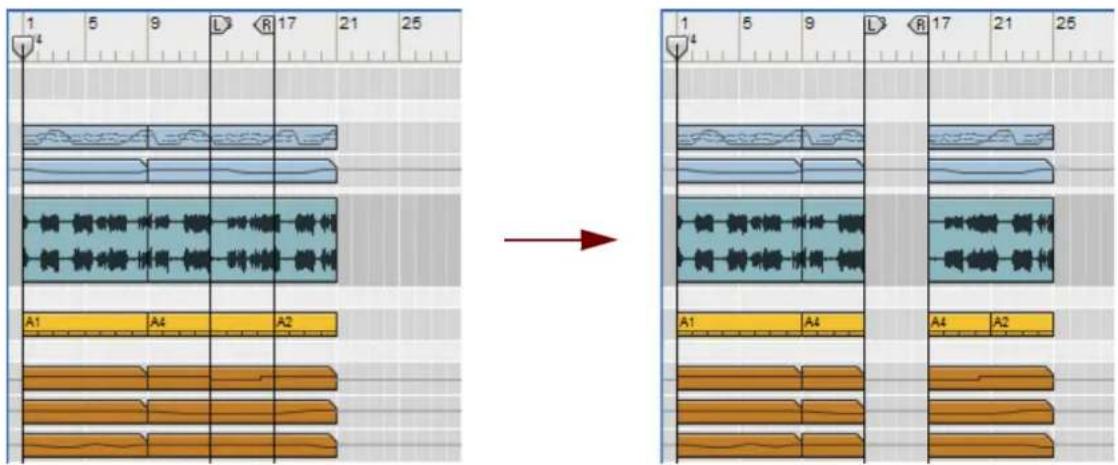
Different tracks with lanes before and after insertion of 4 extra bars between bars 13-17.
Removing bars
The "Remove Bars Between Locators" function on the Edit menu, or context menu, removes all events between the Left and Right Locators. All clips that intersect the locator positions will be cut (when necessary), and the cut section (between the locators) will be removed. All clips that originally were located to the right of the Right Locator will then be moved to the Left Locator, closing the gap.
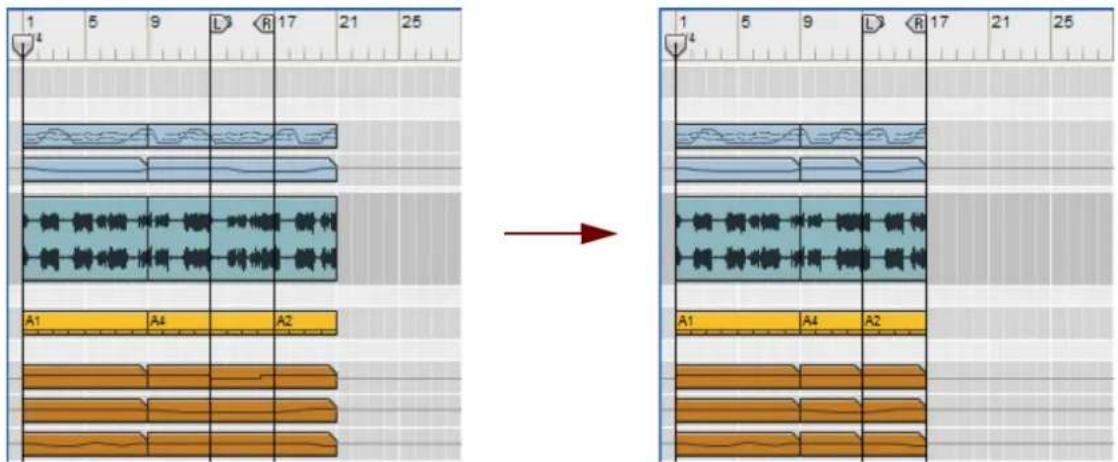
Different tracks with lanes before and after removal of 4 bars starting at bar 13.
! Any removed note and parameter automation events between the Left and Right Locators will be deleted!
About removing bars that contain audio recordings
As opposed to note and parameter automation events, audio recordings in removed bars will not be deleted. Instead, they will be placed on a Comp Row and masked. If we open the second audio clip in the previous example in Edit Mode, we can see that the audio recording in the removed bars has been moved forward and masked:
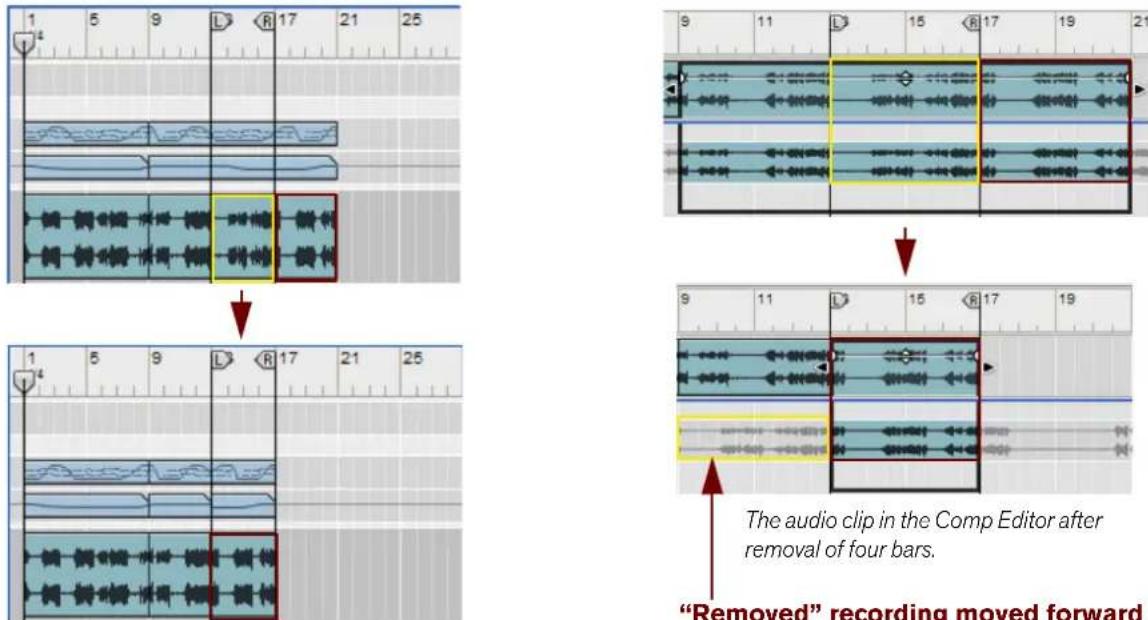
The audio clip in Song View before and after removal of four bars (yellow frame) between the locators.
"Removed" recording moved forward on the Comp Row and masked

Chapter 8
Audio Editing in the Sequencer
About this chapter
This chapter describes how to edit audio clips after you have recorded them in the sequencer. General sequencer functions, recording, note and automation editing, and arranging in the sequencer are described in detail in the chapters "Sequencer Functions", "Recording in the Sequencer", "Note and Automation Editing" and "Arranging in the Sequencer".
Edit Modes, Stretch & Transpose Types and Clip Types
After you have recorded your audio clips, you might want to adjust levels, trim starts and ends, add fades etc. If you have recorded several takes in your audio clips, or several cycles in Loop Mode, you can also cut out segments of the various takes and compile (comp) them into a final “perfect” audio clip.
You can also quantize audio clips, manually change the timing of individual notes or beats in the clips and even export audio clips as REX files.
In addition to this you can also edit and correct the pitches of monophonic audio recordings, in the Pitch Edit mode.
Edit Modes
There are three main ways you can edit your audio clips:
• In Slice Edit mode.
Slice editing can be made on Single Take clips (see "Clip Types" below). Single Take clips can be opened for editing in Slice Edit mode in the Arrange View, similar to when editing parameter automation clips. Slice editing allows you to adjust the positions (timing) of the automatically detected and distributed transient slice markers that appear in the audio clip. The timing can be adjusted by moving and stretching (warping) the audio slices. See "Editing audio in Slice Edit mode".
• In Pitch Edit mode.
In Pitch Edit mode you can graphically correct and edit the pitches of monophonic audio in Single Take clips - perfect for vocal pitch correction/manipulation. See "Editing audio in Pitch Edit mode" for more information.
- In Comp Edit mode, to create compiled clips out of multiple recordings in the clip.
In Comp Edit mode you can cut out segments of several Takes (recordings) and compile into a final clip. Here you can also insert silence segments to e.g. remove noise from silent parts in your audio clips. See "Editing audio in the Comp Editor".
Selecting Stretch and Transpose Type
When you are stretching, transposing and/or changing the tempo of the audio it's important that the Stretch and Transpose Type for the corresponding audio clip - or Comp Rows in Comp clips - is set according to the type of audio that's in the clip. Otherwise, the sonic result might not be what you'd expect.
The Stretch and Transpose Type, together with the Clip Type, also determines the default Edit Mode in which the clip will open when you double-click it, see "Opening audio clips for editing". However, you can always change the Edit Mode for a clip manually, if you like.
Stretch and Transpose Type can be selected as follows:
→ In Arrange View select all the desired audio clip(s), then select the desired Stretch and Transpose Type from the Edit menu or clip context menu.
! For Comp Clips, the active Stretch and Transpose Type for all active Comp Rows are shown in the menu - if the Stretch and Transpose Type is the same. If there are active Comp Rows with different Stretch and Transpose Types, none of the options on the menu are shown as selected.
Selecting a Stretch and Transpose Type from the sub-menu for a Comp Clip will change the stretch and transpose type for all active Comp Rows in the clip.
If there are Slice/Pitch Edits done to any of these Comp Rows (and these edits cannot be preserved in the new Stretch Type), there will be an alert asking if you want to bounce the clip to a new recording.
- For polyphonic material, select "Allround".
The formants are transposed along with the audio.
- For monophonic material select "Melody".
The formants are transposed along with the audio.
- For vocal material select "Vocal".
The formants are preserved and are not transposed along with the audio. This will keep the original character of the vocal and will only affect the pitch. "Vocal" is also the default Stretch and Transpose Type for editing audio in Pitch Edit mode, see "Editing audio in Pitch Edit mode".
! For the Stretch and Transpose function to be active, make sure that you have selected Enable Stretch from the clip context menu!
Clip Types
An audio clip can be either a Single Take clip or a Comp clip:
- A Single Take clip is set to play back only a single Take (Comp Row) throughout the audio clip.
If you have recorded only once in an audio clip, or recorded several complete Takes, the clip is automatically set to Single Take mode. A Single Take clip could also contain several Comp Rows, where one Comp Row has been manually selected for playback. The symbol in the lower right corner of a Single Take clip depends on the selected Stretch and Transpose Type and also determines what Edit Mode the clip will open in:
- A Single Take clip, which has the "Allround" or "Melody" Stretch and Transpose Type looks as follows:
natural_image
Orange background with a black waveform pattern resembling decaying waves or decirals (no text or symbols)A single Take clip with "Allround" or "Melody" Stretch and Transpose Type.
When you double-click these types of clips, they will automatically open in Slice Edit mode.
- A Single Take clip, which has the "Vocal" Stretch and Transpose Type looks as follows:
natural_image
Orange background with black waveform patterns (no text or symbols)A single Take clip with "Vocal" Stretch and Transpose Type.
When you double-click these types of clips, they will automatically open in Pitch Edit mode.
- A Comp clip is built up by segments from several recordings on multiple Comp Rows in the clip.
If you have recorded (or imported) several takes (recordings) in the same audio clip - or recorded several loops in Loop Mode - and then compiled segments of the various Comp Rows in the Comp Editor, the clip becomes a Comp clip.
- Comp clips are distinguished by the following symbol in the lower right corner:
natural_image
Orange background with black waveform patterns (no text or symbols)A Comp clip, regardless of selected Stretch and Transpose Type.
When you double-click these types of clips, they will automatically open in Comp Edit mode.


Opening audio clips for editing
In the Arrange View, audio recordings are displayed as one or two (mono or stereo) waves in the audio clips. The selected audio clip in the pictures below contain mono recordings.
→ Open an audio clip by double-clicking it, or by selecting it and pressing [Return].
The audio clip opens in its default Edit Mode, as indicated by the symbol at the bottom right of the clip.

Double-click an audio clip in the arrangement...
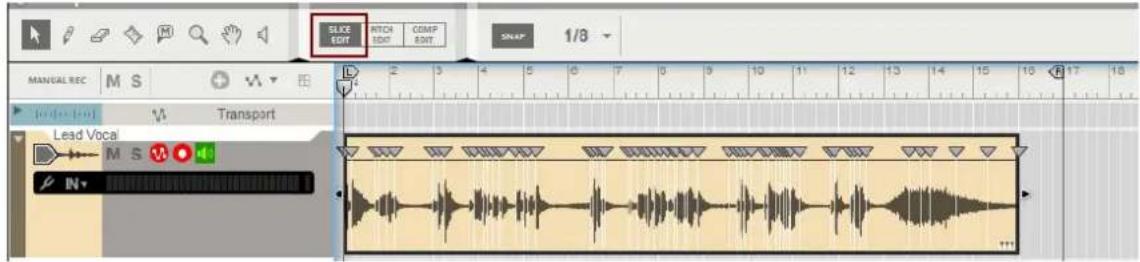
...to open it for editing in its default Edit Mode. Here, Slice Edit mode is the default Edit Mode.
• The clip opens in its default Edit Mode (Slice Edit, Pitch Edit or Comp Edit).
When the audio clip is in Slice Edit mode you can stretch, move and quantize audio slices etc., see "Editing audio in Slice Edit mode". When the clip is open in Pitch Edit mode you can pitch-correct and transpose individual notes (pitches) in monophonic audio recordings, see "Editing audio in Pitch Edit mode". When the clip is open in Comp Edit mode you can alternate the playback between several recordings and compile into a single recording, see "Editing audio in the Comp Editor".
→ Alternatively, select the clip and click any of the Edit buttons in the Toolbar (Slice Edit/Pitch Edit/Comp Edit) to open the clip for editing in the desired Edit Mode.
- If Reason Lite detects monophonic, melodic audio when you import an audio file, the clip will be automatically set to Vocal stretch type. If you then open the clip for editing, it will default to Pitch Edit mode.
It is also possible to open a clip for editing as follows:
→ Select the Single Take clip, hold down Ctrl or Cmd and press [E].
The clip opens in its default Edit Mode (Slice Edit, Pitch Edit or Comp Edit).
Closing a clip
→ To close a Single Take clip and return to the Arrange View, press [Esc].
Alternatively, to close a Single Take clip in Slice Edit mode, click outside the open clip on the Arrange Pane, but not on the same track.
→ To close a Comp Clip, press [Esc] or click the "Close" button in the Comp Editor.
Editing audio in Slice Edit mode
! If you plan to comp the audio in your clips in Comp Edit mode, always do that before you start to work with slice stretching etc. in Slice Edit mode. It will save you a lot of work if all the comping has been done beforehand!
! To get the best sound quality when you are stretching and quantizing audio it's important that you have selected the correct Stretch Type for the audio clip, see "Opening audio clips for editing".
Audio clip elements in Slice Edit mode
When a clip is open for editing in Slice Edit mode, it could look like this:
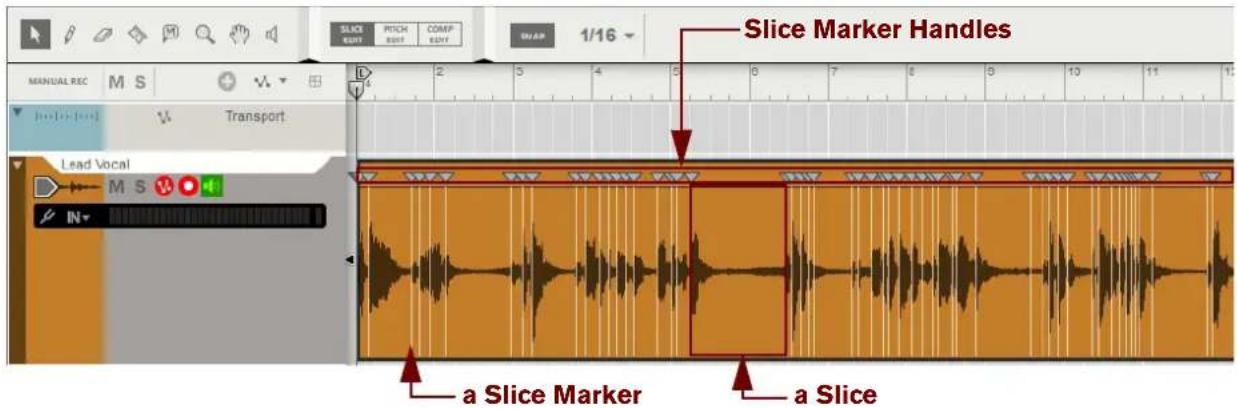
A Single Take clip open in Slice Edit mode.
- You might have to zoom in quite a bit on the clip to get a good view of the Slices, see "Zooming in the Sequencer".
- Slice Markers with handles
When a Single Take audio clip is opened in Slice Edit mode, Reason Lite automatically detects the transients in the sound and marks these with vertical white lines - Slice Markers. By moving Slice Markers left or right you stretch (warp) the audio between the nearest Slice Markers on either side, i.e. you change the timing without affecting the pitch. You can manually add and remove Slice Markers. It is also possible to "decouple" and move the Slice Markers without stretching the audio.
- Slices
Slices are the areas between two adjacent Slice Markers. Each slice represents a part of the audio in the clip.
Slice Edit mode tools
When editing audio in Slice Edit mode, some of the Toolbar tools have different functionality than when editing note and automation clips. There are also some additional tools that are unique to slice editing of audio.
Speaker Tool
It's possible to audition individual Slices without needing to start playback of the sequencer:
→ Select the Speaker Tool in the Toolbar and click in the waveform area on the Slice you want to audition.
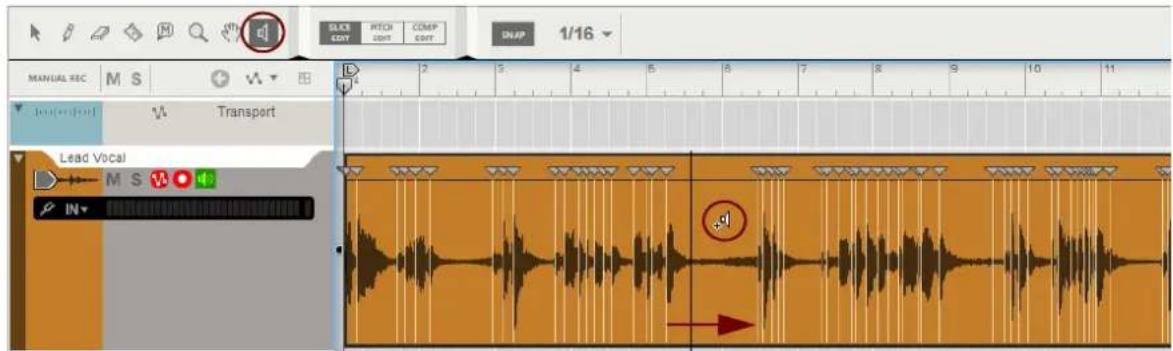
The Slice is played back once in its entirety, from the start Slice Marker to the end Slice Marker of the desired Slice, each time you click.
- With the Selection Tool (Arrow) selected, pressing Alt or Cmd will momentarily switch to the Speaker Tool.
! Note that auditioning Slices will play back the unprocessed sound - bypassing the Main Mixer settings.
Selecting Slices and Slice Markers
A Slice is the portion of audio between two adjacent Slice Markers. A Slice Marker indicates the beginning of a Slice - and consequently the end of the preceding Slice (if it's not the first Slice in the clip).
→ To select a Slice Marker, click the Slice Marker or its handle:

As you hover over a Slice Marker or a Slice Marker Handle, the arrow switches to a double-arrow. A selected Slice Marker is indicated by a black Slice Marker Handle.
To select several individual Slice Markers, hold down Ctrl/Shift and click the desired Slice Markers or their handles.
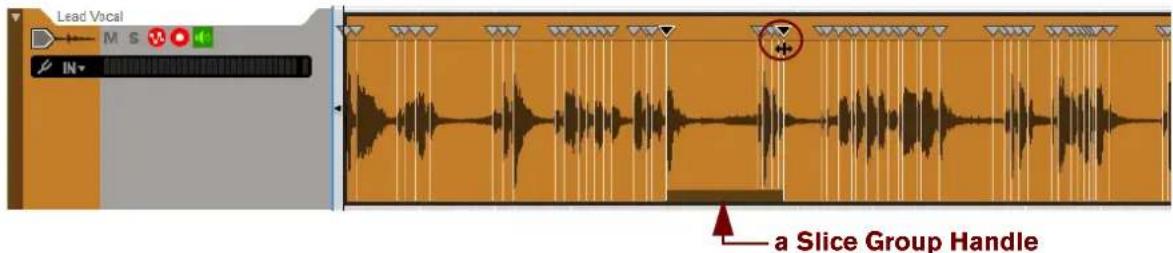
If more than one Slice Marker has been selected, a Slice Group Handle appears below the waveform. You could then click and drag the Slice Group Handle sideways to move all selected Slice Markers as a group, see "Moving several Slice Markers".
To select a range of Slice Markers, draw a rectangle with the Selection Tool (Arrow), in the Slice Marker Handles area or in the waveform area, that touches the desired Slice Markers:

Draw a rectangle over the desired Slice Markers to select a complete range.

As you release the mouse button all touched Slice Markers are selected.
The range of Slice Markers can then be moved as a group by clicking and dragging the Slice Group Handle sideways. You can also stretch the range in an "accordion style" fashion by clicking and dragging any of the selected Slice Marker Handles in the range, see "Stretching a range of Slices".
Under Windows it's also possible to select a range of Slice Markers by clicking a Slice Marker and then holding down [Shift] and clicking the first or last Slice Marker in the desired range.
→ You can expand a Slice/Slice Marker selection range by holding [Shift] and pressing the left/right arrow keys.
To select all Slices/Slice Markers in the clip, select "Select All" from the clip's context menu or from the Edit Menu.
Now, you can move all Slice Markers as a group by dragging the Slice Group Handle sideways (see "Moving several Slice Markers"), or stretch the entire range of Slices (see "Stretching a range of Slices").
Adding Slice Markers
When you open a Single Take clip in Slice Edit mode, there will be a Slice Marker at each transient, plus one at the start and one at the end of the clip. If you are not satisfied with Reason Lite's automatic Slice Marker assignments you can add Slice Markers manually:
! You might want to turn off Snap to be able to position the Slice Markers more precisely (see "Snap").
1. Open the Single Take clip for editing in Slice Edit mode.
2. Select the Pencil Tool from the Toolbar.
3. Click in the open clip to add new Slice Markers.
If you are not satisfied with the position of the Slice Marker, you can reposition it afterwards, see "Repositioning Slice Markers".
! You cannot add Slice Markers before the first Slice Marker or after the end Slice Marker in the clip.
Deleting Slice Markers
To delete Slice Markers, proceed as follows:
- Select the desired Slice Marker(s) as described in "Selecting Slices and Slice Markers".
- Press [Delete] or [Backspace] to delete the marked Slice Makers.
This deletes the Slice Markers but not the audio that's in the clip.
! If you delete Slice Markers that were previously moved, the stretched audio will revert to the original timing.
! You cannot delete the first Slice Marker or the end Slice Marker in the clip.
Repositioning Slice Markers
To reposition a Slice Marker without stretching the audio, proceed as follows:
! You might want to turn off Snap to be able to position the Slice Marker more precisely (see "Snap").
1. Place the Selection Tool (Arrow) on a Slice Marker or Slice Marker Handle.
The arrow switches to a double-arrow symbol.
! You cannot move Slice Markers past their closest adjacent Slice Markers.
Moving/stretching Slices
Stretching can be used for adjusting the timing of the transients in the audio clip. You can also use stretching to create special effects such as increasing or decreasing the lengths of the Slices. Stretching can be applied on single Slices as well as on a selection of Slices.
! To get the best sound quality when you are stretching audio it's important that you have selected the correct Stretch and Transpose Type for the audio track, see "Opening audio clips for editing".
! You might want to turn off Snap to be able to position the Slice Marker more precisely (see "Snap").
! You cannot move Slice Markers past their closest adjacent Slice Markers.
Preview vs. High Quality Stretching
Reason Lite features very sophisticated audio stretch and transpose algorithms for pristine results. Reason Lite always performs audio stretching in two parallel steps:
- A real-time "preview" stretch so that you can instantly hear the result of your changes.
- A high quality stretch "in the background" to further improve the sonic results.
As soon as high quality stretch is in progress, the "Calc" indicator on the Transport Panel shows a progress meter:
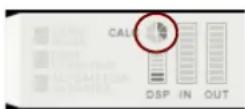
The CALC progress meter appears when Reason Lite performs high quality stretching of audio.
Since the high quality stretch is performed in the background, you can still continue to work with your song without any interruption. When the high quality stretch data has been calculated, the Calc indicator goes out and the high quality audio data will be heard on playback.
Moving a Slice Marker
To adjust the timing of a single note or beat, just click and drag its Slice Marker to the desired position. If Snap is on, the Slice Marker will snap to the grid as set with the Snap value. When you move a Slice Marker, the slices on either side of it will be stretched accordingly.
Moving several Slice Markers
If you need to adjust the timing of several notes or beats (e.g. move all snare hits a little later in the beat), proceed as follows:
-
Select the desired Slice Markers as described in "Selecting Slices and Slice Markers".
-
Click and drag the Slice Group Handle to move all selected Slice Markers.
As you hover over the Slice Group Handle, the arrow switches to a double-arrow
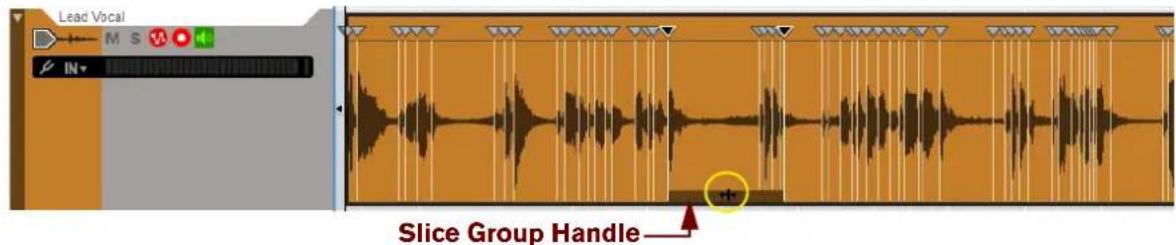
All selected Slice Markers will be moved as a group. The Slices between the selected Slice Markers and their closest unselected Slice Markers will be stretched.
- It's also possible to move a range of Slices by selecting a range of Slice Markers as described in "Selecting Slices and Slice Markers" and then dragging the Slice Group Handle sideways.
This is useful if you want to move a whole phrase (e.g. a vocal phrase) later or earlier in the clip.
! You cannot move the selection past any unselected Slice Markers.
Stretching a range of Slices
It is also possible to stretch a range of Slices, proportionally, in an "accordion style" fashion:
- Select the desired range of Slice Markers as described in "Selecting Slices and Slice Markers".
The range is indicated by a light gray Stretch Range Marker above the waveform.
→ If you drag the start or end Slice Marker in the range, the whole range will be stretched as if it were a single slice:
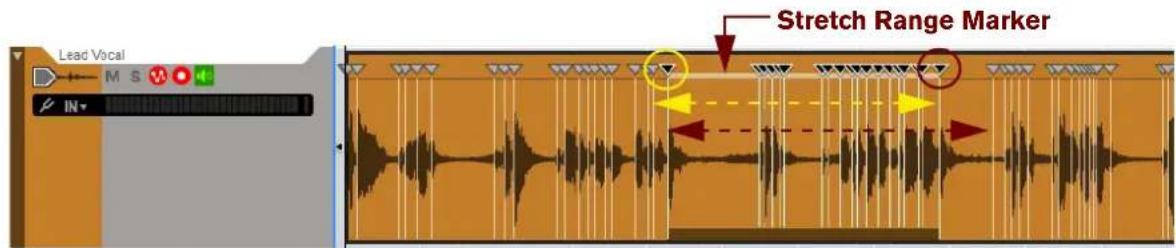
→ If you drag a Slice Marker within the selected range, all selected Slices will be stretched proportionally against the start and end Slice Markers of the selected range:

Nudging Slices
You can nudge the Slice Marker(s) by using the following standard key commands:
→ Hold down Ctrl or Cmd and press the left/right arrow keys to nudge in Snap value steps.
→ Hold down [Ctrl]+Shift or [Cmd]+Shift to nudge in Beat steps.
→ Hold down [Ctrl]+Alt or [Cmd]+Option to nudge in Ticks steps.
Quantizing audio
Audio quantizing can be made in the Quantize section on the Transport Panel, in the Tool Window or from the context menu or Edit menu.
! Audio can only be quantized after recording, not during recording.
! Quantize requires that the clips have Stretch enabled (see "Enable/Disable Stretch (Audio Clips)").
! To get the best sound quality when you are quantizing audio it's important that you have selected the correct Stretch Type for the audio clip, see "Opening audio clips for editing".
! Note that quantization of audio clips that have "Vocal" Stretch and Transpose Type is made on the pitch transitions (where the "notes" start) and not on the level transients as in Slice Edit mode, see "Editing audio in Pitch Edit mode".
! The difference between quantizing audio and MIDI notes is that several Slice Markers cannot be quantized to the same position. Instead, only the Slice Markers closest to the quantization grid will be moved - the remaining Slice Markers will be left unaffected.
It's possible to use the quantize audio function in the following ways:
Quantizing selected Slice Marker(s) in Slice Edit mode
Quantizing Slice Markers has the same effect as moving the Slice Markers to a quantization grid:
- Select the Slice Markers you want to quantize:
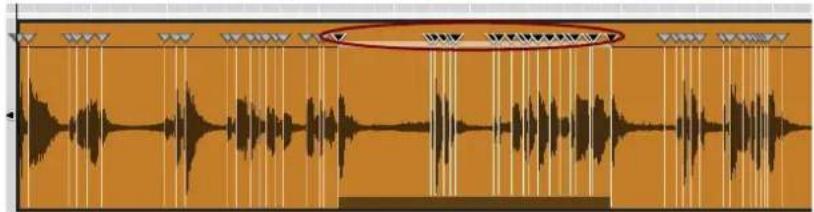
A range of Slice Markers selected for quantization.
- Select Quantize Value (and Amount and/or Random values) in the Tool Window and click Apply:
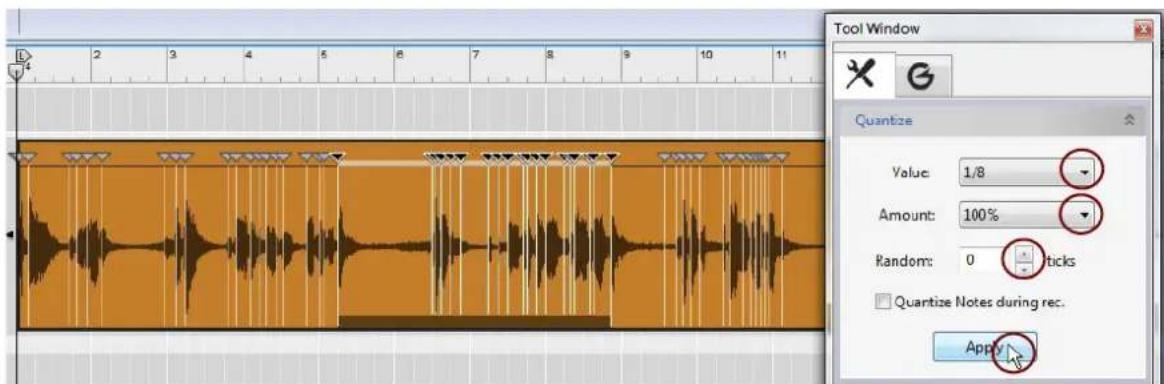
The selected Slice Markers that are closest to the quantization grid are automatically moved to the quantization grid.
- Note that you can quantize to "Shuffle" in the Value list - this will use the Global Shuffle setting made in the ReGroove Mixer, see "Global Shuffle".
→ Alternatively, select Quantize Value and click the Quantize button on the Transport Panel.
This alternative is very handy if you only want to quantize to a set quantization value, and don't need the extra options featured in the Tool Window.
Quantizing one or several selected Single Take audio clips in the Arrange View
This will quantize all Slice Markers that are closest to the quantization grid in the selected clip(s).
Split at Slices
The Split at Slices function allows you to create separate audio clips out of a Single Take clip. Splitting can be useful if you, for example, want to reverse parts of the original clip or if you want to export single or multiple Slices as separate samples for use in any of Reason Lite's sampler devices. The split point(s) will be located at the selected Slice Markers in the clip.
The following example shows how the "Split at Slices" function can be used:
- Select the split points for the new clips by selecting the desired Slice Markers in the open Single Take clip:

The selected Slice Markers define the split points for the new clips.
- Select "Split at Slices" from the context menu or Edit menu.

The original Single Take clip is now split into four separate audio clips and the clips are automatically closed.
If you like, you can now select the desired clip(s) and move, reverse (see "Reversing audio clips") or choose to bounce the clip(s) to samples (see "Bounce Clip(s) to New Sample(s)").
Bounce Clip to REX Loop
A great feature with Single Take clips is that you can bounce them to REX Loops. You could then load your bounced REX file for further processing in a Dr Octo Rex device, for example! Here is how:
- Open a Single Take clip in Slice Edit mode.
- Make sure the Slice Markers are located exactly where you want them in the clip.
This is where the slices in the REX Loop will appear after bouncing.
→ You might have to remove some Slice Markers in the clip to reduce the number of slices in the final REX Loop, see "Deleting Slice Markers".
3. Adjust the audio clip length to the closest full Beat.
This way you make sure that the REX Loop will sound the same as the original audio clip.
! If the clip is not adjusted to a full Beat, Reason Lite will automatically expand the clip end to the closest full Beat during the bounce operation.
- Select "Bounce > Bounce Clip to REX Loop" from the context menu or Edit menu.
The bounced REX file ends up in the "All Self-contained Samples" folder in the Song Samples location in the Browser, and is named after the original clip name:
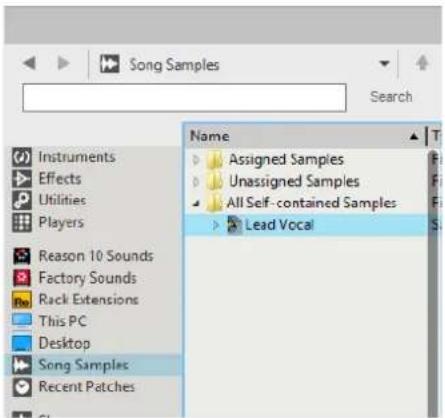
- To load the bounced REX file in a new Dr Octo Rex device, either double click the REX file or select the REX file and click the "Create" button at the bottom of the Browser.
This is a shortcut for creating a Dr Octo Rex device and loading the selected REX Loop in Slot 1 of the Dr Octo Rex device in one go.
- Refer to the "Dr. Octo Rex Loop Player" chapter for information on how to work with REX Loops in the Dr Octo Rex device.
! If you want to load your REX Loop in another sampler device, you first have to un-self-contain the REX file, see “Un-self-containing” a Song”. Then, create the sampler device and load the un-self-contained REX file from disk.
About exporting bounced REX Loops to disk
You can also export your bounced REX Loops to disk if you like:
-
Select the REX Loop in the Song Samples location in the Browser and select Export Sample(s) from the context menu or Edit menu.
-
Choose a location for the REX Loop (and change the file name, if desired).
-
Click Save.
The REX Loop is exported and saved in .rx2 format.
Revert All Slices
If you get lost in the Slice Edit mode editing, there is a handy command for reverting the Slice Markers back to where they were before you started editing the clip:
-
Open the Single Take clip in Slice Edit mode.
-
Select "Revert All Slices" from the context menu or Edit menu.
This will revert all slice edits and the clip will play back with its original timing. Any manually removed Slice Markers will reappear, and any manually added Slice Markers will be removed.
Editing audio in Pitch Edit mode
In Pitch Edit mode you can correct and/or transpose the pitches of individual detected notes in monophonic recordings. Pitch Edit mode is developed especially for editing and correcting the pitches of vocal recordings. The audio pitch editing is made graphically in a way similar to other pitch correction/editing software on the market.
! As soon as you open an audio clip in Pitch Edit mode, the Stretch and Transpose Type will be automatically set to "Vocal".
Pitch Editor elements
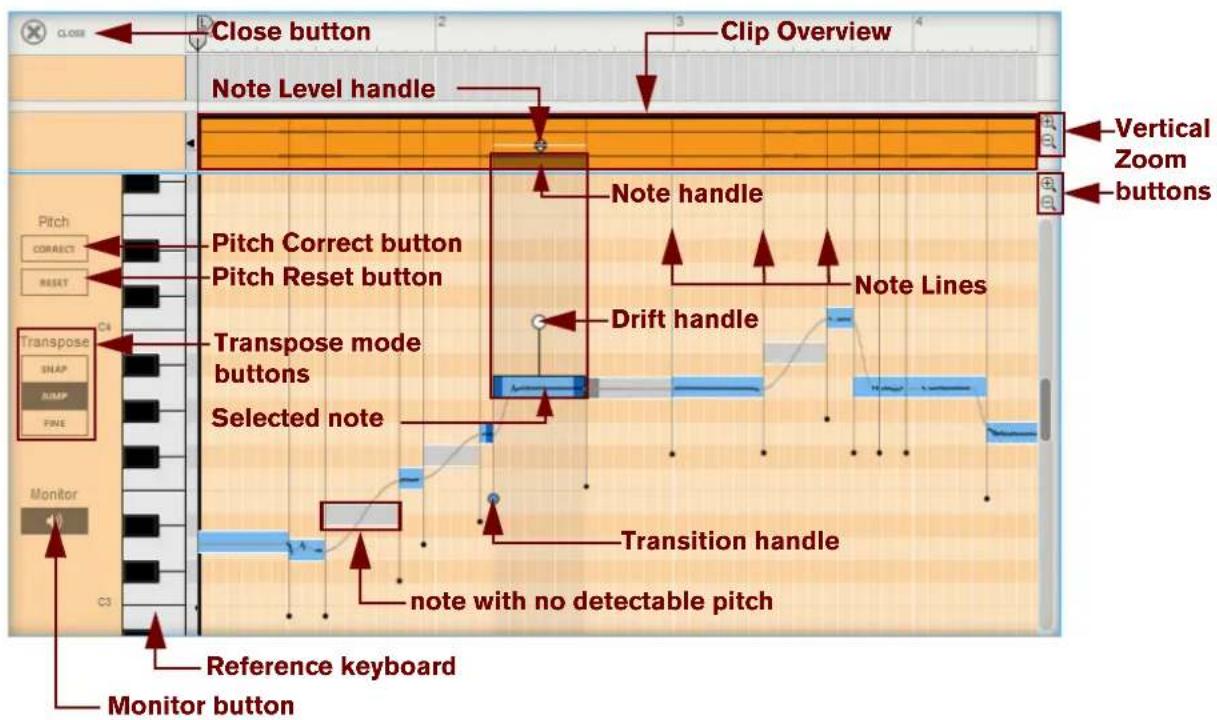
A clip with a lead vocal stereo recording open in Pitch Edit mode.
The Pitch Editor contains the following elements:
- Close button
Click this button to close the audio clip and exit to the Arrange View.
- Clip Overview
The Clip Overview area at the top shows the clips on the selected audio track. In the Clip Overview area, selected audio clips are displayed in the same fashion as in the Arrange View, i.e. with Clip Resize handles. However, in Pitch Edit mode the Level handle and Fade handles are not available. You can select one or several audio clips in the Clip Overview and perform clip-based editing (e.g. moving and resizing) - just like in the Arrange View.
- Note Level handle
With the Note Level handle you can adjust the level(s) of the selected note(s).
- Note handle
Hold this and move sideways to move the note back or forth in time. The range is limited by the adjacent notes, which are indicated by the Note Lines, see "Moving notes and changing note lengths".
• Note Lines
These indicate where the notes start and end. You can adjust the start/end positions by click-holding a Note Line and dragging it sideways. Changing the position(s) and/or length(s) will also automatically stretch the note(s). See "Moving notes and changing note lengths".
- Drift handle
The Drift handle appears when you select the note(s). Drag the Drift handle downwards to reduce the amount of any natural pitch drift/vibrato present in the selected note(s), see “Attenuating pitch drift/vibrato”.
- Transition handle
The Transition handle(s) control the pitch transition times between the selected note(s) and the previous adjacent note(s), see "Editing transition times".
- Pitch Correct button
The Correct button transposes all selected notes to their nearest exact semitone. If no note is selected, the Correct function corrects all notes in the open audio clip.
- Pitch Reset button
The Reset button removes any transposition/pitch correction changes you have made for all selected notes. If no note is selected the Reset function resets the pitches of all notes in the audio clip.
- Transpose mode buttons
This is a three-way switch that determines what happens when you drag notes up/down on the note pane:
Snap = the notes snap to absolute semitones.
Jump (default) = the notes snap relative to their original pitches, i.e. moves in semitone steps but preserves any fine tuning.
Fine = the notes can be transposed freely, in cents.
See "Changing transposition" for more details about transposing notes.
- Monitor button
With the Monitor button on, you will hear the pitch of a note as a continuous reference tone, when you click the note and hold the mouse button depressed. The reference tone changes pitch when you drag the note up/down on the note pane. The reference tone reflects the pitch+fine-tune setting of the note. It doesn't matter where in the note you click.
• Reference Keyboard
The Reference Keyboard is there as a visual guide for the notes on the note pane.
Selecting notes
Selecting notes in Pitch Edit mode can be done as follows:
→ Click a note on the note pane, or on the note's corresponding section in the clip overview.
→ You can also select one or several notes by dragging a selection rectangle on the note pane,
→ Select all notes on the note pane by selecting "Select All" from the Edit menu or context menu.
→ Click anywhere on the note pane background to deselect the note(s).
Auditioning notes
It's possible to audition individual notes without needing to start playback of the sequencer:
→ Select the Speaker Tool in the Toolbar and click on the desired note, or its corresponding section in the clip overview.
Each time you click, the note is played back once in its entirety.
- With the Selection Tool (Arrow) selected, pressing Alt or Cmd will momentarily switch to the Speaker Tool.
! Note that auditioning notes plays back the unprocessed audio - bypassing the Main Mixer settings.
Correcting pitches
- Select the note(s) you want to pitch-correct. If no note is selected, all notes will be affected by the pitch correction.
- Click the Correct button to the left of the note pane.
The Correct function moves all selected notes to their nearest exact note pitch.
→ Alternatively, hold down [Shift]+Ctrl or [Shift]+Cmd and press [C].
→ To undo the pitch correction and revert to the original pitch(es), click the Reset button.
If no note is selected, the Reset function will reset the pitches of all corrected (and transposed) notes in the clip!
Changing transposition
-
Select the note(s) you want to transpose.
-
Click and drag the note(s) up/down on the note pane to transpose.
The Transpose buttons to the left of the note pane determine how the notes will be transposed:
Snap = the notes will snap to absolute semitones.
Jump (default) = the notes will snap relative to their original pitches, i.e. move in semitone steps but preserves any fine tuning.
Fine = the notes will be transposed freely, in cents.
→ You can also fine-tune by holding down [Alt]+Shift or [Cmd]+Shift while dragging the notes up/down on the note pane.
- If the Monitor button is on a reference tone, with the pitch of the held note, will play continuously.
→ To undo the transposition and revert to the original pitch(es), click the Reset button.
If no note is selected, the Revert function will reset the pitches of all transposed (and pitch-corrected) notes in the clip!
→ Alternatively, you can edit the transposition numerically in the Inspector, see "Note" and "Fine-tune".
Resetting pitches
→ Click the Reset button to reset any transposition and/or pitch correction and revert to the original pitch(es) of the selected note(s).
If no note is selected, the Reset function will reset the pitches of all transposed and pitch-corrected notes in the open audio clip!
Splitting the clip at notes
It's possible to split an audio clip at the edges of selected notes in Pitch Edit mode (similar to splitting at slices in Slice Edit mode):
- Select the note(s) where you want to split the clip and then select "Split at Notes" from the Edit menu or context menu.
Reverting all notes
It's possible to "undo" all edits you have made in Pitch Edit mode (similar to the "Revert Slices" function in Slice Edit mode):
→ Select "Revert All Notes" from the Edit menu or context menu.
The clip will be completely re-analyzed and any pitch, timing and timbre edits will revert to the original.
Attenuating pitch drift/vibrato
You can attenuate the pitch drift or vibrato for each note individually:
- Select the note(s) you want to change the pitch drift/vibrato for.
- Lower the Drift handle to "straighten out" the pitch curve in the note, removing large scale pitch drift.
The default setting is always 100%, which means you can only attenuate the pitch drift/vibrato - not increase it.
→ Alternatively, you can edit the Drift numerically in the Inspector, see "Drift".
- If you want to preserve small pitch fluctuations in the note, you can use the Preserve Expression parameter in the Inspector, see "Preserve".
Editing transition times
When you have recorded your audio and haven't (yet) made any pitch changes (transpositions) of notes, editing the transition times won't have any effect at all.
! It's only after you have edited note pitches (moved notes up/down on the note pane) that editing transition times will have any effect.
You can edit the pitch transition times between transposed notes as follows:
- Select the note(s) you want to change the transition time(s) for.
- Drag the Transition handle(s) up/down to control the pitch transition between the selected note(s) and the previous adjacent note(s).
The important thing here is to get a smooth pitch curve (the line) from the preceding note to the following note. Adjust the Transition handle until the pitch curve is a smooth line between the notes. The dark blue colored transition zones in the notes themselves indicate the transition times. The Transition times can be max 200 ms - or half of the note length (if the note length is less than 400 ms).
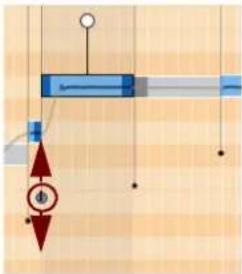
natural_image
Pure electrical circuit lines without any symbols→ Alternatively, you can edit the Transition times numerically in the Inspector, see "Transition".
- To get the best result when editing transition times you might also have to change the actual note positions without moving/stretching the audio, see "Changing note start positions (without affecting the audio)".
Moving notes and changing note lengths
Moving notes
To move a note back or forth in time, proceed as follows:
-
Select the note(s) you want to move.
-
Click and hold the Note handle in the Clip Overview and drag sideways.
The closest adjacent notes will then be stretched. You may want to deactivate the Snap function if you want to fine-adjust the note position(s).
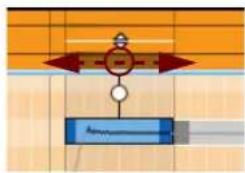
→ Alternatively, you can move the note(s) numerically in the Inspector, see "Position".
- If you want to change the note start position(s) and/or note lengths, see "Changing note start positions and lengths".
Changing note start positions and lengths
To change note lengths, and thus stretch the note(s), proceed as follows:
-
Select the note(s) you want to adjust.
-
Click and hold the desired Note line, on the note pane or in the Clip Overview, and drag sideways.
Adjusting the length of a note automatically changes the start position of the consecutive note - and vice versa. You may want to deactivate the Snap function if you want to fine-adjust the note(s).
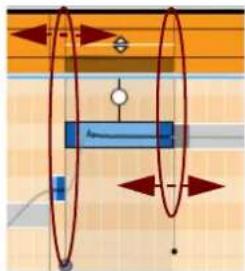
natural_image
Pure electrical circuit lines without any symbolsChanging note start positions (without affecting the audio)
Similar to when editing in Slice Edit mode it's possible to "decouple" the notes from the actual audio in the note. This can be useful if the automatic note placement wasn't perfect and you have a hard time adjusting the transition times between transposed notes (see "Editing transition times").
→ Hold down Ctrl or Option and drag the note line sideways to change the note start/length without affecting the audio.
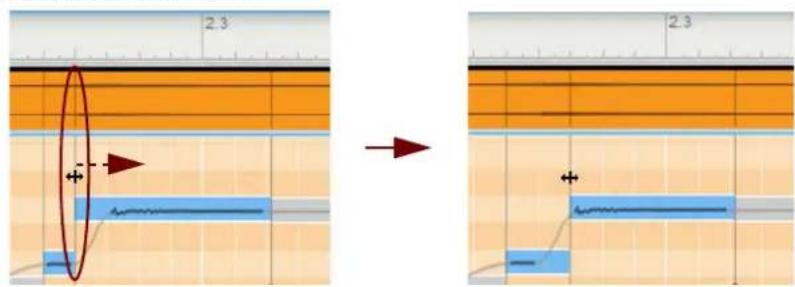
AUDIO EDITING IN THE SEQUENCER

You may want to deactivate the Snap function if you want to adjust the note start position with greater precision. As you can see in the picture above, the pitch curve is left unaffected (unstretched) and only the note start/length is affected.
Proportional stretching of multiple notes
Like in Slice Edit mode it's possible stretch a range of notes, proportionally, in an "accordion style" fashion:
- Select the desired consecutive range of Notes on the Note pane.
→ If you drag the start or end Note line in the range, the whole range will be stretched as if it were a single note:
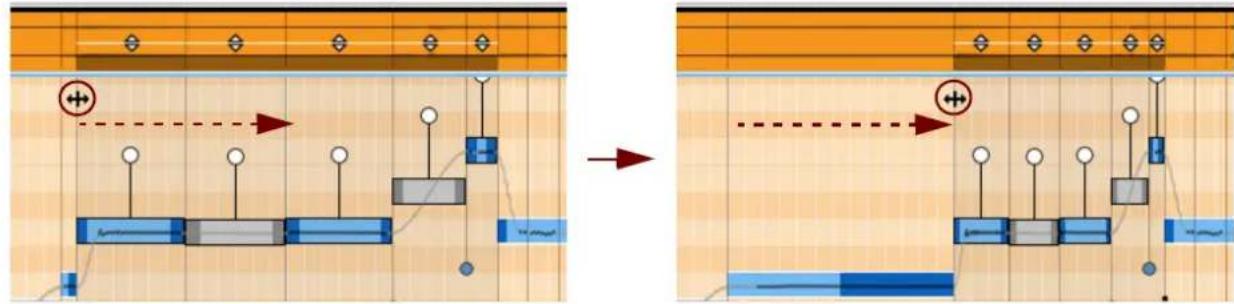
flowchart
graph TD
    A["Input Path"] --> B{Check Point}
    B -->|Yes| C["Process Step 1"]
    B -->|No| D["Process Step 2"]
    C --> E["Output Path"]
    D --> F["Feedback Loop"]
    style A fill:#f9f,stroke:#333
    style F fill:#bbf,stroke:#333
→ If you drag a Note line within the selected range, all selected notes will be stretched proportionally against the start and end Note lines of the selected range.
Quantizing notes
Quantizing notes in Pitch Edit mode works just like when quantizing in Slice Edit mode, see "Quantizing audio".
! Note, though, that the quantization is made on the pitch transitions (where the notes start) and not on the level transients as in Slice Edit mode.
Splitting and joining notes
Splitting notes
To split a note, proceed as follows:
-
Select the Razor tool from the Toolbar.
-
Click on a note where you want to split it, or click in the Clip Overview at the desired split position. You may want to deactivate the Snap function if you want to split the note with more precision.
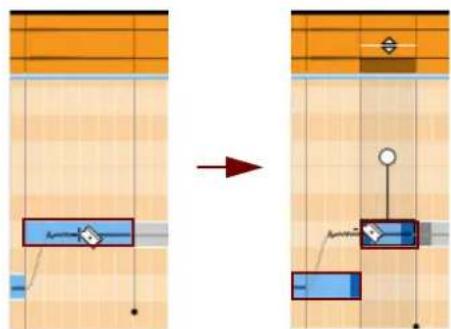
flowchart
graph TD
    A["A"] --> B["Red Arrow"]
    B --> C["Blue Box with Arrow"]
The two halves of the note are now re-analyzed and placed in suitable pitch positions of the note range. This could mean that the new notes are placed differently than the original note.
Joining notes
To join notes, proceed as follows:
-
Select the Eraser tool from the Toolbar.
-
Click on a note that you want to join with the preceding note, or click in the corresponding section in the Clip Overview.
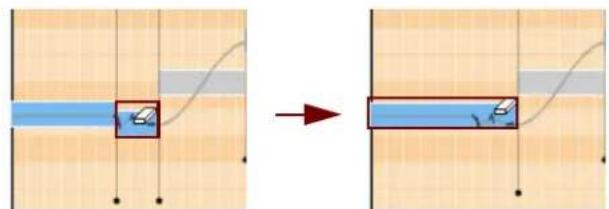
The new "joint" note is now re-analyzed and placed on the suitable pitch position in the note range. This could mean that the new note is placed differently than the original notes.
To join several notes in one go, draw a selection rectangle with the Eraser tool and then release the mouse button.
The result will be one long note, re-analyzed and placed on the most suitable pitch position in the note range.
About switching from Pitch Edit mode to Slice Edit mode
When you have edited an audio clip in Pitch Edit mode and then switch to Slice Edit mode (with the "Vocal" Stretch and Transpose Type still selected), the slices are now based on the note transitions from Pitch Edit mode, and not on the level transients.
Audio pitch editing in the Inspector
In Pitch Edit mode a series of additional audio pitch editing boxes appear in the Inspector. These are unique to the Pitch Edit mode and apply to selected notes on the note pane:
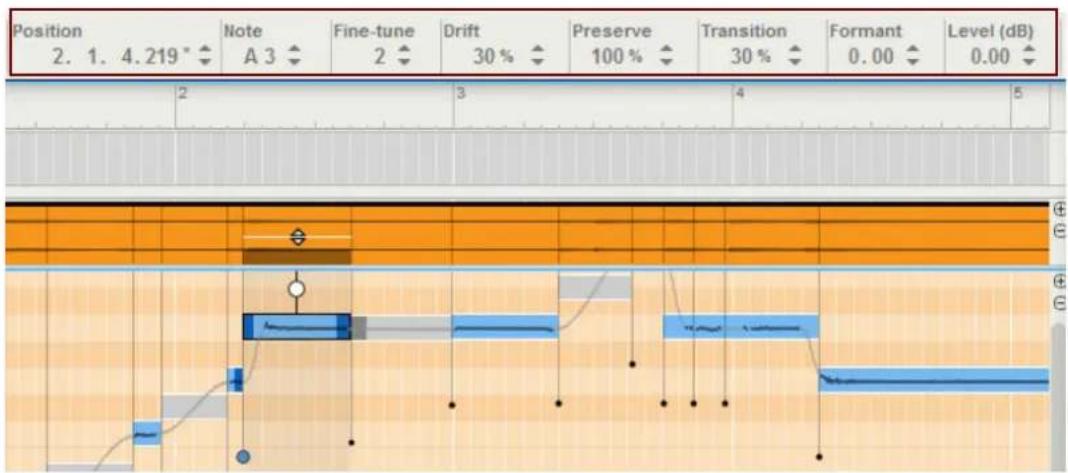
The Inspector elements for a selected note in Pitch Edit mode.
Position
Here you can edit the start position of the note in Bars, Beats, 1/16th notes and Ticks.
Note
Here you can set the note value to transpose to, in semitone steps. If the note has a Fine-tune setting, this will be preserved also after the semitone Note transposition.
Fine-tune
Here you can detune the note up/down in steps of 1 cent. If you fine-tune more than +/- 50 cents, the Note value will change and the fine-tuning will now be based on the new Note value instead. This way you will be able to use the Fine-tune function throughout the entire MIDI note range.
Drift
Here you can attenuate the pitch drift/vibrato of the audio in the note. The default 100% keeps the pitch drift/vibrato unaffected, and at 0% the audio in the note doesn't contain any pitch drift/vibrato at all.
Preserve
The Preserve Expression function works in tandem with the Drift function. If you raise the Preserve Expression value, small pitch fluctuations (vibrato and other expressions) are maintained even when you “straighten out” the note by lowering the Drift value.
Transition
This controls the pitch transition time between the selected note and the preceding note.
There are dark blue colored transition zones in the notes themselves, which changes according to your edits. The Transition times can be max 200 ms - or half the note length (if the note length is less than 400 ms).
Formant
Here you can edit the formant "position" of the selected note(s). Changing the Formant downwards creates a deeper tone and changing it upwards generates a brighter tone to the vocals.
Range +/-1 octave, in steps of 0.01 semitones.
Level
Here you can change the level of the selected note(s). The range is -inf to +18 dB.
Editing audio in the Comp Editor
In this section we will describe audio editing procedures that are common for Single Take clips and Comp clips when edited in the Comp Editor. Comp clip specific procedures are described in "Comping audio".
Audio clip elements in the Comp Editor
When an audio clip is open for editing in Comp Edit mode, its contents are shown on the Edit Pane below the Clip Overview area. An open audio clip can have one or several Comp Rows on which the audio recordings reside. The number of Comp Rows depends on how you recorded your audio clip. If you only recorded once in the clip, there will only be one single Comp Row. If you have recorded several times in the same clip, or several cycles in Loop Mode, there will be one Comp Row for each take, or cycle.
There are vertical zoom controls for resizing the Clip Overview area and the Comp Row area. You can also scroll in the Comp Row area by using the scroll bars on the right hand side of the Edit Pane.
Single Take clips in the Comp Editor
For Single Take clips, only the recording on the selected Comp Row is played back. If there is only one single Take (Comp Row) in the clip, this will play back by default. This is how an open Single Take clip with only one recording on one Comp Row could look like when opened in Comp Edit mode:
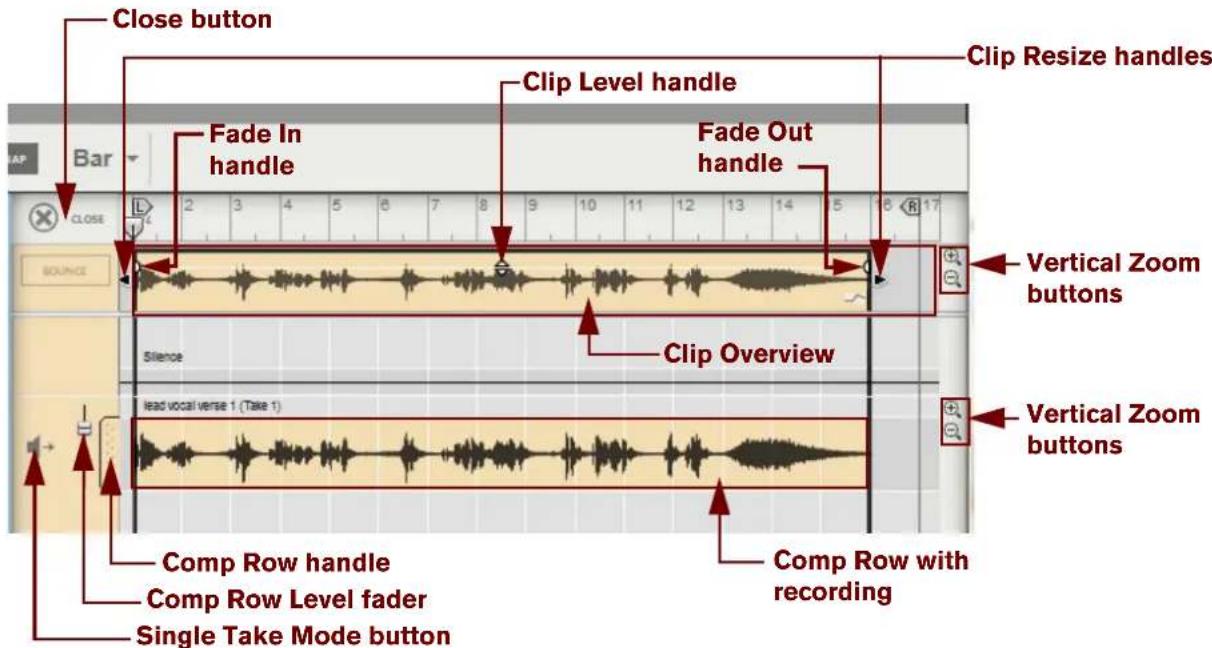
A Single Take clip open in the Comp Editor.
- Clip Overview
The Clip Overview area at the top shows the clips on the selected audio track. In the Clip Overview area, selected audio clips are displayed in the same fashion as in the Arrange View, i.e. with Clip Resize handles, Level handle and Fade handles. You can select one or several audio clips in the Clip Overview and perform clip-based editing (e.g. moving and resizing) - just like in the Arrange View.
- Clip Resize handles
By clicking and dragging either of the handles, you can change the position and length of the clip.
- Fade In and Fade Out handles
Click and drag these handles horizontally to introduce a fade in and/or fade out of the audio in the clip. The fading is non-destructive and can be changed at any time. If Snap is activated (see "Snap"), the set (Arrange Mode) Snap value is taken into account when moving the Fade Handles.
- Close button
Click this button to close the audio clip and exit to the Arrange View.
- Clip Level handle
Click and drag this handle vertically to adjust the audio level of the recordings in the clip. The level adjustment is non-destructive and can be changed at any time.
• C o m p R o w
Depending on how you recorded the audio clip, there can be one or several Comp Rows, containing one audio recording each. Comp Rows can be described as "virtual tracks" in the sense that you can have many parallel Comp Rows in an audio clip but only play back from one Comp Row at a time (see "Creating a comped audio clip"). In Single Take clips, only the audio recording on the currently selected Comp Row will play back.
- Comp Row handle
If there are several Comp Rows in the audio clip, it's possible to rearrange the order of the Comp Rows by clicking and dragging the Comp Row handles vertically.
- Comp Row Level fader
Use the Comp Row Level fader to adjust the volume of the recording on the corresponding Comp Row. This is especially useful in Comp Mode, when you want to trim and balance the levels of the recordings on several Comp Rows.
- Single Take Mode button
Click this to manually select the desired Comp Row for playback - and thus set the clip to Single Take Mode.
! If the clip only has one single Comp Row, this is automatically selected "in the background" by default - i.e. its Single Take Mode button is not depressed.
Comp clips in the Comp Editor
A Comp clip consists of several Comp Rows, with one recording on each Comp Row. If you have recorded several takes in an audio clip and want to cut out sections of the various takes and comp into a final clip, this can be done in the Comp Editor (see "Creating a comped audio clip"). This is how an already comped audio clip could look like in Comp Edit mode:

A Comp clip open in the Comp Editor.
From the top down in the preceding picture, the Edit Pane contains the following elements:
- Bounce button
Clicking this button will bounce the recordings of the comped clip to a new recording, automatically select the bounced recording's Comp Row - and thus set the clip type to Single Take. The same thing happens automatically if you click the Slice Edit or Pitch Edit buttons in the Toolbar.
- Cut Row
The area between the Clip Overview and the topmost Comp Row is called the Cut Row. This is where the Cut Handles are placed.
• Segment Focus Indicator
The gray Segment Focus Indicator appears if you click on the Cut Row, or if you double-click on a Comp Row. A Segment is the area between two Cuts. The Segment Focus Indicator shows which segment currently has edit focus. Edit focus is required for editing using keyboard short-cuts (see the "Keyboard Commands" pdf document).
- Cut Crossfade Zones
When you have comped an audio clip by creating cuts and assigning different Comp Rows to the resulting segments, it's possible to set individual crossfades between the segments. This makes it possible to get smooth transitions between the audio recordings in the different segments. Any crossfades are indicated by boxes. The widths of the boxes indicate the crossfade times.
- Cut Handles and Cut Lines
Each cut in a comped audio clip is indicated by a Cut Handle and a Cut Line. The Cuts indicate where the playback changes from one segment to another (in most situations from one Comp Row to another). You can edit the Cut positions by clicking and dragging any of the Cut Handles or Cut Lines sideways.
- Silence Row
The Silence Row can be used for inserting silent segments in the comped audio clip, e.g. for removing breath noise between vocal phrases.
• C o m p R o w s
All of your audio recordings reside on Comp Rows. Depending on how you recorded the audio clip, there might be one or several Comp Rows, each containing one audio recording. The most recent take is on the topmost Comp Row. In a Comp clip, the colored part(s) of each Comp Row (or Silence Row) will play back. All Comp Rows used in the clip have colored Comp Row Handles. Any unused Comp Rows in the clip are indicated by gray Comp Row Handles.
The relationship between Clips, Comp Rows and Recordings
In the Comp Editor, the contents of an open clip are displayed on the Comp Row(s) on the Edit Pane:
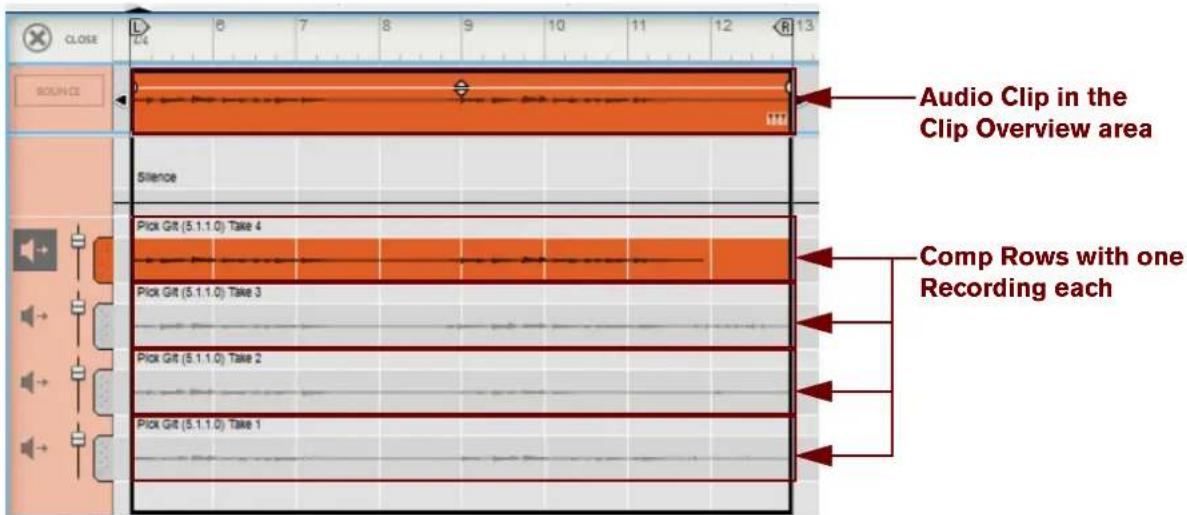
A Single Take clip with four Comp Rows, with the topmost Comp Row manually selected for playback.
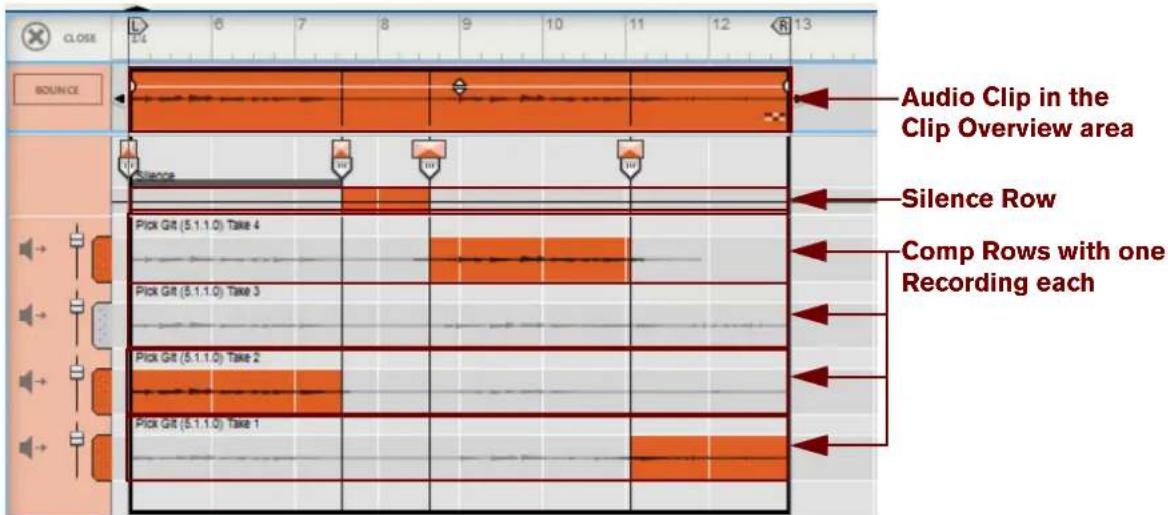
A Comp clip with alternating playback from four Comp Rows.
- A recorded audio clip, or an audio clip containing imported audio, can consist of one or several Comp Rows. The number of Comp Rows and their position can be unique for each individual audio clip. Any edits you make in an audio clip will never interfere with other clips in the Song.
- On each Comp Row there is one single Recording, i.e. the audio that you have recorded or imported. If the clip was recorded in one single take, it will have a single Comp Row. If the clip was recorded in several takes one after another, or recorded in Loop Mode, it will contain one Comp Row for each take or loop. Also, if you imported audio files to a clip, each audio file will end up on a separate Comp Row.
- Only one Comp Row can play back at a time.
In a Single Take clip with more than one Comp Row, only the Comp Row you have selected by clicking the Single Take Mode button will play back. In a Comp clip, you can alternate the playback between the Comp Rows by assigning regions of the different Comp Rows to different Segments in the Clip. What you hear when you play back an audio clip is displayed in the Clip Overview area at the top on the Edit Pane. (The Clip Overview area displays the same content as the clip in the Arrange View.)
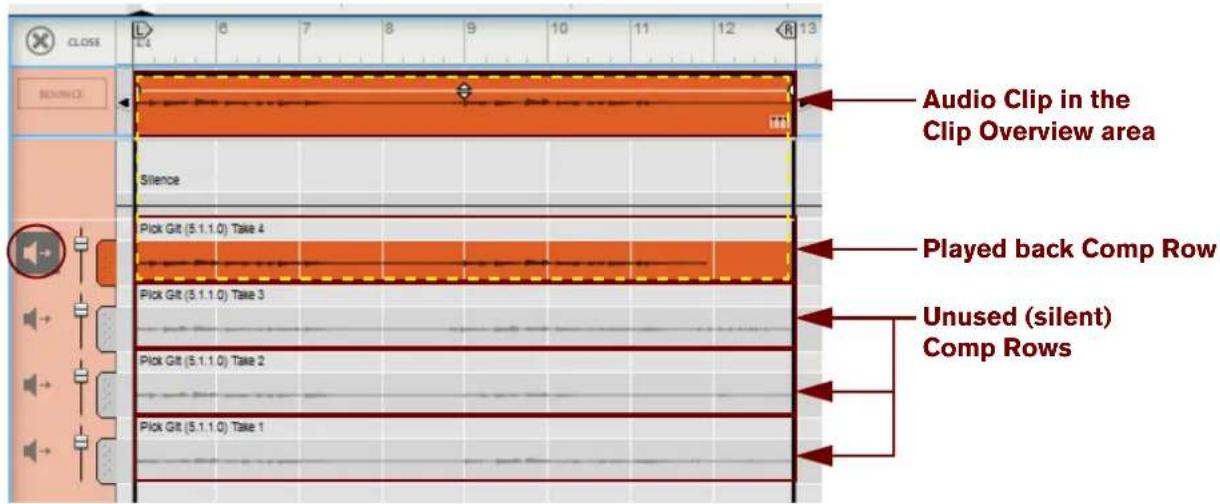
A Single Take clip with four Comp Rows, with the topmost Comp Row manually selected for playback.
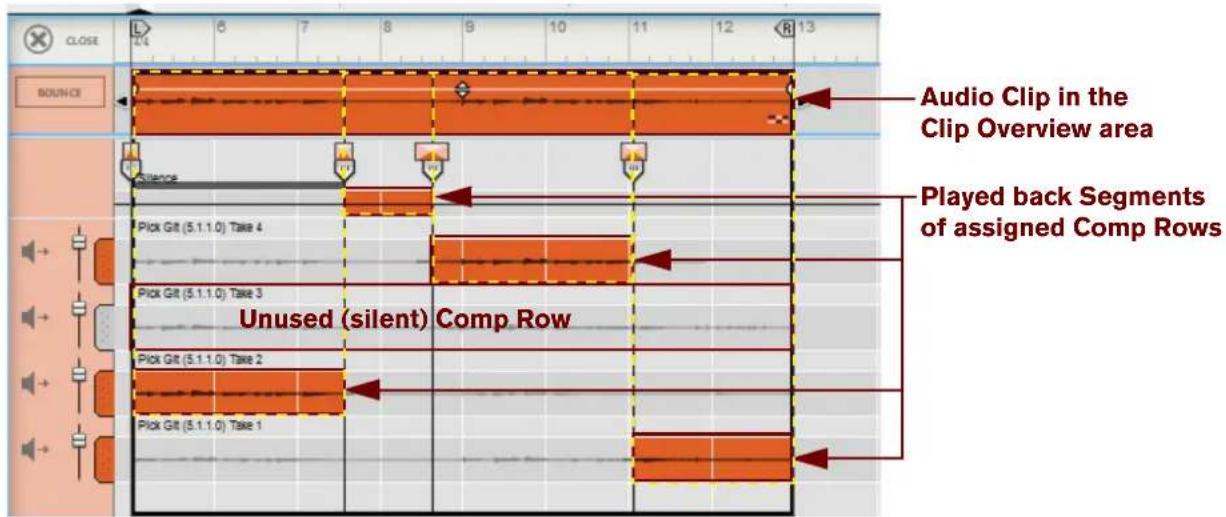
A Comp clip with alternating playback from three Comp Rows plus the Silence Row.
- The Comp Row configuration, and the Recordings on the Comp Rows, are unique to each individual audio clip. This means that you could move Comp Rows up or down on the Edit Pane, change Comp Row Levels and Cross-fades, or move Recordings back and forth on the Comp Rows, without affecting any neighboring audio clips.
- If you duplicate a Clip, or a Comp Row with its Recording, you can freely edit the duplicated Clip, Comp Row or Recording without affecting the original.
However, the actual audio data is not duplicated. Reason Lite features a very sophisticated internal audio management system which re-uses Recordings throughout the entire Song whenever necessary. This means that the Song file size won't increase when you duplicate audio clips or Comp Rows.
Comp Editor window handling
Resizing, zooming and scrolling
→ The Magnifying Glass tool can be used for zooming in and out (see "Magnifying Glass Tool").
→ The Hand tool can be used for scrolling the view in any direction (see "Hand Tool").
→ Use the Song Navigator to scroll and zoom horizontally (see "Areas, windows and basic navigation").
→ Click on a Song Navigator Handle and drag horizontally to zoom in and out horizontally (see "Areas, windows and basic navigation").
→ Shift-click on a Song Navigator Handle and drag horizontally to zoom in and out horizontally, symmetrically (see "Areas, windows and basic navigation").
→ Right-click (Win) or Ctrl-click (Mac) inside the Song Navigator frame and drag up or down to zoom in and out and scroll at the same time (see "Areas, windows and basic navigation").
→ Use the Track Navigator to scroll vertically in the Track List (see "Areas, windows and basic navigation").
→ Click the Zoom buttons below the Track Navigator to zoom in and out vertically (see "Areas, windows and basic navigation").
- For extensive editing, you may want to maximize the Sequencer and/or detach the Main Mixer and Rack so that the sequencer covers the entire computer screen. Refer to "Areas, windows and basic navigation".
Comp Editor audio editing tools
When editing audio in the Comp Editor, some of the Toolbar tools have different functionality as when editing note and automation clips. There are also some additional tools that are unique to audio editing.
Razor (Cut) Tool
When editing audio in the Comp Editor, the Razor Tool on the sequencer Toolbar is used for creating Cuts. When you place the Razor Tool over the Comp Rows, Silence Row or Cut Row, it changes into a "Cut Tool".
- With the Selection Tool selected, hold down Alt or Cmd to temporarily switch to the Cut Tool.
→ Click with the Razor Tool on a Comp Row to assign the recording to the right of the cursor to a new Segment.
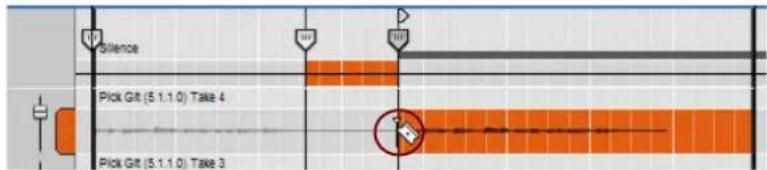
Assigning the recording on the "Take4" Comp Row to a new segment.
See "Adding Cuts" for more details on how to use the Cut Tool.
The Razor Tool can also be used for assigning a complete Segment, with a start and end Cut, by clicking and dragging (swiping) the Razor Tool horizontally on the desired Comp Row. See "Adding Segments" for more details on how to swipe with the Cut Tool.
Speaker Tool
It's possible to audition individual recordings on Comp Rows, without needing to start playback of the sequencer. This is very useful when you're going to select what Comp Rows to use in the clip:
- Make sure the Speaker Tool is selected and place the cursor at the position on the Comp Row you would like to audition.
The cursor switches to a speaker symbol with crosshairs next to it.
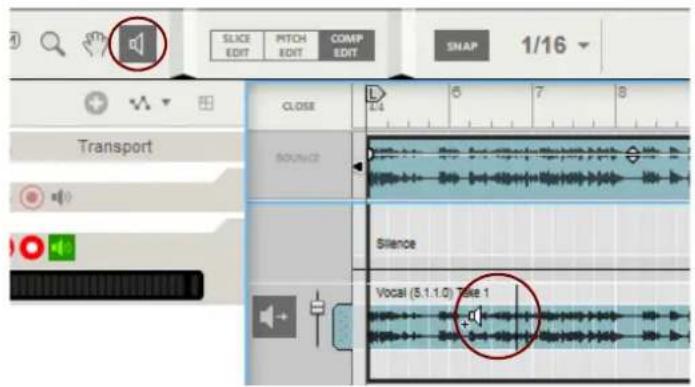
Auditioning a recording on a Comp Row.
- Click and hold the mouse button depressed for as long as you want to listen.
The playback starts at the current crosshairs position and proceeds for as long as you keep the mouse button depressed. The playback position is indicated by a vertical moving line on the auditioned Comp Row.
With the Selection Tool (Arrow) selected, holding down [Alt]+Shift or [Cmd]+Shift will switch to the Speaker Tool.
! Note that auditioning recordings on Comp Rows will play back the unprocessed sound of the recording - bypassing any settings in the Main Mixer.
- Using the Speaker Tool, it's possible to audition recordings anywhere on any Comp Rows. The Comp Row doesn't have to be selected - it's even possible to audition recordings on masked Comp Row segments.
Selecting a Comp Row for playback in a Single Take clip
In a Single Take clip, only the selected Comp Row will play back throughout the entire clip length. It's also possible to change Comp Row Levels and Recording Offsets in a Single Take clip. The picture below shows an open Single Take clip in the Comp Editor. The clip consists of four separate takes, each on a separate Comp Row. When played back, the recording on the selected "Take 4" Comp Row will play back:
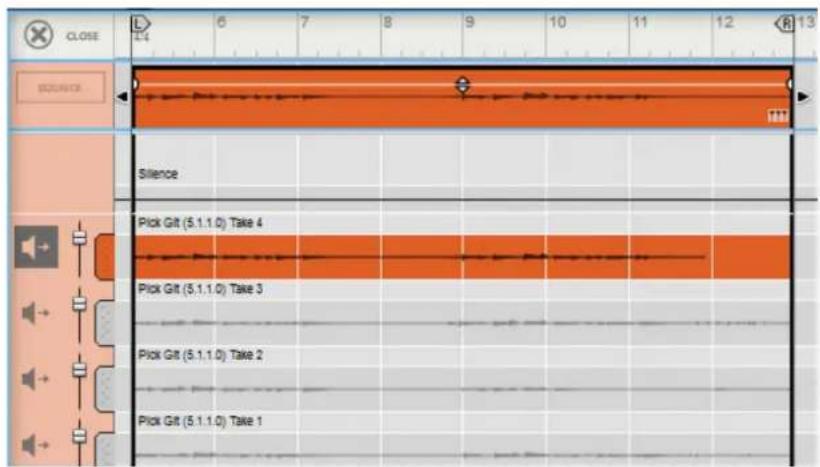
A Single Take clip open in the Comp Editor with four recorded takes.
If you want to change which Comp Row should play back in a Single Take clip:
→ Click the Single Take Mode button for the Comp Row you want to play back.
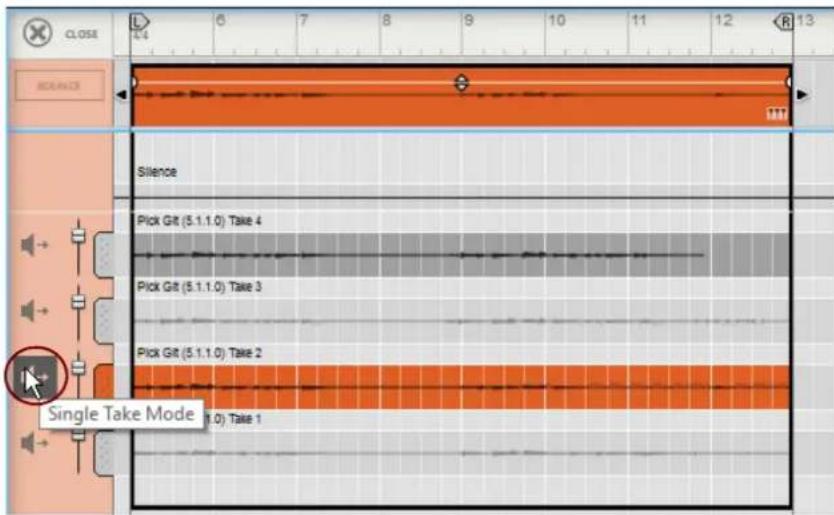
The "Take 2" Comp Row is now manually selected for playback throughout the clip.
Now, the "Take 2" Comp Row will play back instead when the sequencer is started.
Selecting Comp Rows
To select a Comp Row, e.g. for moving, cutting, copying, duplication or deletion, click (don't double-click!) with the Selection Tool anywhere on the Comp Row, or on the Comp Row Handle.
The selected Comp Row is shown in a darker color:
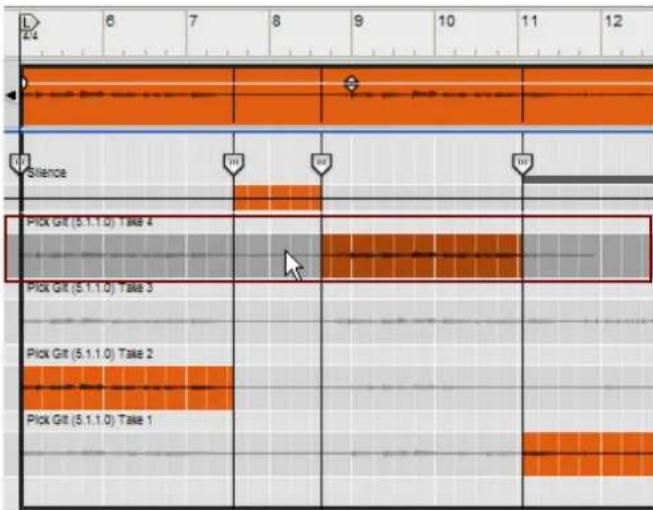
The selected Comp Row is shown in a darker color.
→ Select multiple Comp Rows by holding down Ctrl or Cmd and clicking with the Selection Tool.
→ Select a range of Comp Rows by holding down [Shift] and clicking with the Selection Tool on the first and last Comp Row in the desired range.
! Don't double-click on a Comp Row to select it. Double-clicking on a Comp Row will automatically assign the recording on it to the segment at the current click position.
Deleting Comp Rows
→ Select one or several Comp Rows (see "Selecting Comp Rows") and then press [Backspace] or [Delete], or select "Delete" from the Edit menu or context menu.
→ Alternatively, select the Eraser Tool and click anywhere on the Comp Row you wish to delete.
Moving Comp Rows
Moving Comp Rows up or down on the Edit Pane can be useful to make it faster and easier and to access the desired Comp Rows when editing a comped clip. Let's say you have recorded six takes but you're only going to edit takes 1, 3 and 5. In this case, it would be more practical to have these Comp Rows right below one another at the top of the Edit Pane.
→ To move a single Comp Row up or down, click and hold the Comp Row Handle and drag vertically.
A red insertion line is shown, indicating where the Comp Row will be placed after you release the mouse button.
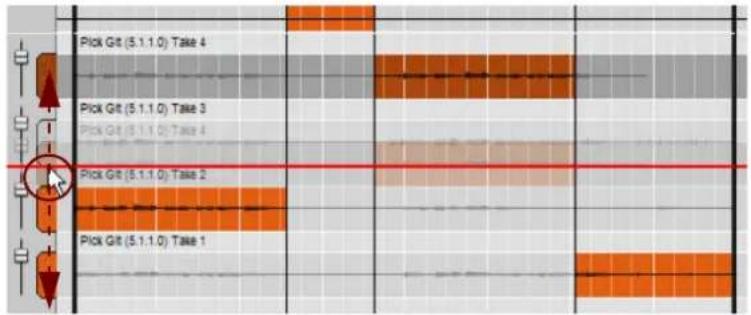
Moving a Comp Row.
To move several Comp Rows in one go, select them and then click and hold one of the selected Comp Row Handles and drag to the new destination.
A red insertion line is shown, indicating where the Comp Rows will be placed after you release the mouse button. Note that if you move non-adjacent Comp Rows, they will be placed as a group (adjacent) on the Edit Pane.
To move Comp Rows between clips, use the cut/copy and paste functions described in "Cutting, copying and pasting Comp Rows".
→ Moving Comp Rows sideways is the same as changing the Recording Offsets - see "Adjusting the Recording Offset" for more details.
Duplicating Comp Rows
Duplicating Comp Rows can be useful if you want to re-use the same part of a take several times in a comped clip. Duplicate the Comp Row and then adjust the Recording Offset (see "Adjusting the Recording Offset") in the duplicated Comp Row to access the same part of the recording in another segment of the comped clip. Duplicating Comp Rows will not use up any more space on your hard disk, so you can do this as many times as you like.
To duplicate one or several Comp Rows, select them and hold Ctrl or Cmd and press [D], or select "Duplicate Comp Rows" from the Edit menu or context menu.
The duplicated Comp Rows will be placed below the lowest selected Comp Row. Note that if you duplicate non-adjacent Comp Rows, they will be placed as a group (adjacent) below the lowest selected Comp Row.
→ You can also duplicate a Comp Row and assign the duplicated Comp Row to a new segment in one go. With the Razor (Cut) Tool selected, hold down Ctrl or Option and click, or swipe, on a Comp Row to assign a new segment to a duplicate of the recording on a new, additional Comp Row.
Cutting, copying and pasting Comp Rows
To move recordings between clips, you can cut or copy and paste Comp Rows as follows:
- Select one or several Comp Rows and then hold Ctrl or Cmd and press [X] to cut or [C] to copy the Comp Rows to the clipboard memory. Alternatively, select "Cut" or "Copy" from the Edit menu or context menu.
- Open the audio clip into which you want to paste the Comp Row(s). This can be in the same song or a different one.
- To paste the cut or copied Comp Rows, hold down Ctrl or Cmd and press [V] - or select "Paste" from the Edit menu or context menu.
The pasted Comp Rows will be placed at the top of the Edit Pane. Note that if you paste non-adjacent Comp Rows, they will be placed below each other, starting at the top of the Edit Pane.
! If you paste Comp Rows into another song, the actual audio recordings will be added to that song as well and consequently increase the file size.
Adjusting the Comp Row Level
If you are comping different Takes where the levels differ a bit, you might want to adjust the levels individually for the Takes:
-
Click on a Comp Row to select it. The Comp Row is displayed in a darker color to indicate it's selected.
-
Adjust the level, either by clicking and dragging the Comp Row Level Fader, or by adjusting it in the Level (dB) display in the Inspector. The Level (dB) display is divided into dB and 1/100th of a dB.
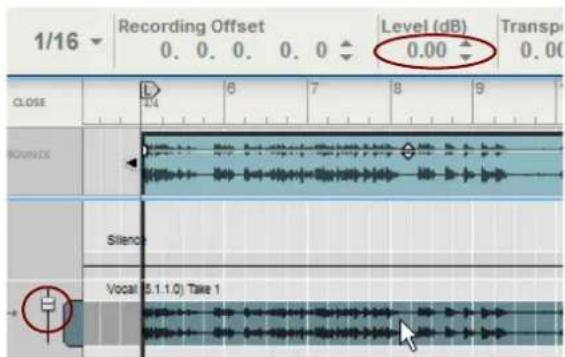
Adjusting the audio level of a recording on a Comp Row.
- Repeat the procedure for the other Comp Rows, if necessary.
It's also possible to edit the entire Clip Level in the Comp Editor by clicking and dragging the Clip Level Handle in the Clip Overview. Any level adjustments you make on the Comp Row and in the Clip Overview are summed.
Adjusting the Recording Offset
In some situations you might want to move, or nudge, the entire recording on a Comp Row to make it play back exactly when you want. Maybe you just need to fine tune the position by a couple of Ticks:
-
Click on the Comp Row to select it.
-
Either click and drag the recording horizontally, or adjust the position in the Recording Offset display in the Inspector.
The Recording Offset display is divided into Bars, Beats, 1/16th notes, Ticks and Subticks. There are 240 Ticks for each 1/16th note and 16 Subticks for each Tick.
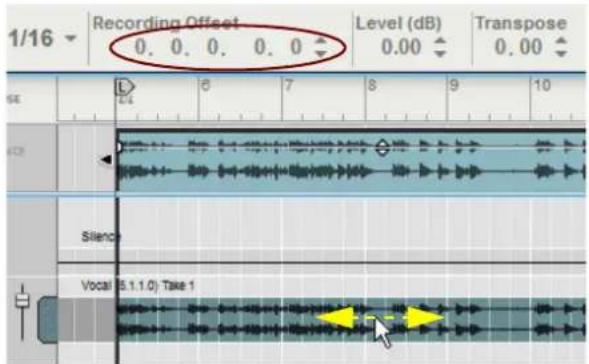
The "Recording Offset" display shows the offset of the recording on the selected Comp Row relative to the Clip Position.
If you move the recording on the selected Comp Row back or forth, the Offset Display will update. Similarly, if you resize the Clip by changing its start position (left Clip Handle), the Offset Display will also update.
However, If you resize the clip using its right Clip Handle, or move the entire clip, all recordings on all Comp Rows will follow along and the Recording Offset will remain unaffected.
Adjusting the offset (position) of a recording on a Comp Row.
You can also nudge the Recording Offset of the selected recording by using the arrow keys on the keyboard.
To nudge the recording in Snap value steps, hold Ctrl or Cmd and press the left/right arrow keys. Note that Snap doesn't have to be activated for this to work.
To nudge the recording in steps of Ticks, hold [Ctrl]+Alt or [Cmd]+Opt and press the left/right arrow keys.
To nudge the recording in steps of Beats, hold [Ctrl]+Shift or [Cmd]+Shift and press the left/right arrow keys.
To make it easier to find the exact positions in the recording, you can audition the recording at desired positions (see "Speaker Tool").
Comping audio
In this section we will describe procedures that are specific to audio editing in Comp clips. At the end of this section is a detailed example on how to use the various procedures to create a complete comped audio clip - see "Creating a comped audio clip". General audio editing procedures are described in "Editing audio in the Comp Editor".
Adding Cuts
! If the clip is in Single Take mode, because a Single Take Mode button is depressed, you will have to click that Single Take Mode button to deselect the Comp Row before you can start adding Cuts!
! If the clip only contains one single (not manually selected) Comp Row, and thus is a Single Take clip, adding a Cut on the Silence Row will automatically turn the clip into a Comp clip.
→ Place the Razor Tool on the Comp Row which contains the recording you want to assign, and click.
A new Cut Handle is added on the Cut Row. The recording to the right of the Cut Line on the Comp Row is assigned to a new Segment:
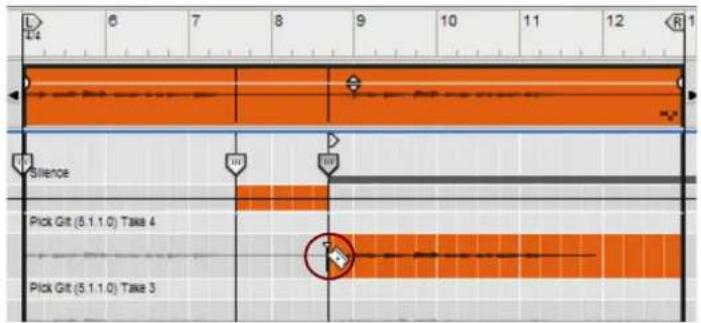
Assigning the recording on the "Take4" Comp Row to a new Segment.
→ Click with the Razor Tool on the Silence Row to assign silence to a new Segment to the right of the cursor.
→ Click with the Razor Tool on the Cut Row to create a new Cut without changing the currently assigned recording.
A new Cut Handle is added on the Cut Row. The previous recording assignment is retained throughout the new segment.
- If you hold down Ctrl or Option and click with the Razor tool on a Comp Row, this will first create a duplicate of the Comp Row. Then, the duplicated Comp Row will be assigned to the new Segment.
You can then adjust the timing (Recording Offset) or level of the duplicated Comp Row as needed, without affecting any segments playing the original Comp Row.
! Note that Snap is taken into account (if activated).
- A quick way to toggle Snap on or off is to press [S].
For a practical example on how to add Cuts, see "Creating a comped audio clip". - It's also possible to assign a complete Segment, with a start and end Cut, by swiping with the Cut Tool on the Comp Rows - see "Adding Segments".
Adding Segments
The Razor Tool can be used for assigning a complete Segment, with a start and end Cut, by clicking and dragging (swiping) the Razor Tool horizontally on the desired Comp Row.
→ Swipe (click-hold and drag) with the Razor Tool to assign a part of a Comp Row to a new segment.
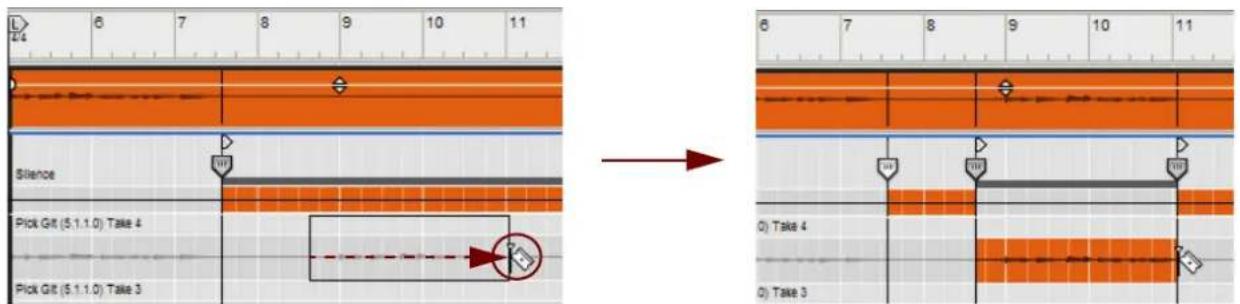
Place the Razor Tool on the desired start position on a Comp Row and swipe...
...and release where you want the segment to end.
To insert a new Segment in an existing Segment, swipe with the Razor Tool on a Comp Row or on the Cut Row. Swiping on a Comp Row will automatically assign the recording on that Comp Row to the new segment. Swiping on the Cut Row will insert a new segment but won't change the recording assignment. The result after inserting a new segment in an existing segment is three separate segments. Swiping over an existing Cut will remove that Cut.
- If you hold down Ctrl or Option and click or swipe with the Razor tool on a Comp Row, this will first create a duplicate of the Comp Row. Then, this duplicated Comp Row will be assigned to the new Segment.
You can then adjust the timing (Recording Offset) or level of the duplicated Comp Row as needed, without affecting any segments playing the original Comp Row.
! Note that Snap is taken into account (if activated).
- A quick way to toggle Snap on or off is to press [S].
- For a practical example on how to add a Segment, see "Creating a comped audio clip".
Adding Crossfades to Cuts
To add a crossfade zone to a Cut (between two Segments), proceed as follows:
→ Select a Cut Handle and then drag the Cut Crossfade Handle to the right.
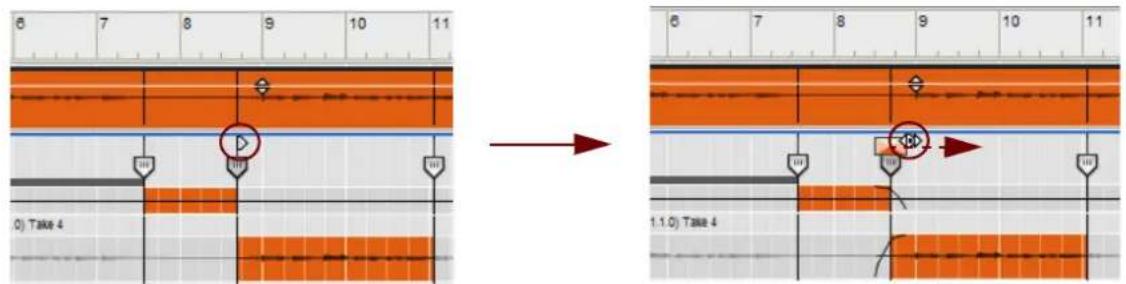
Click and drag the Cut Crossfade Handle...
...to introduce a crossfade between the segments.
The crossfade slopes are indicated by curves on the assigned Segments. The longer the crossfade time, the flatter the curves.
→ To remove a crossfade, simply drag the Cut Crossfade Handle all the way to the left.
Deleting Cuts
To delete a Cut, click on the left Cut Handle and press [Backspace] or [Delete], or select "Delete" from the Edit menu or context menu.
The segment to the right of the deleted Cut will be deleted. The segment to the left of the deleted Cut will expand and replace the deleted segment:
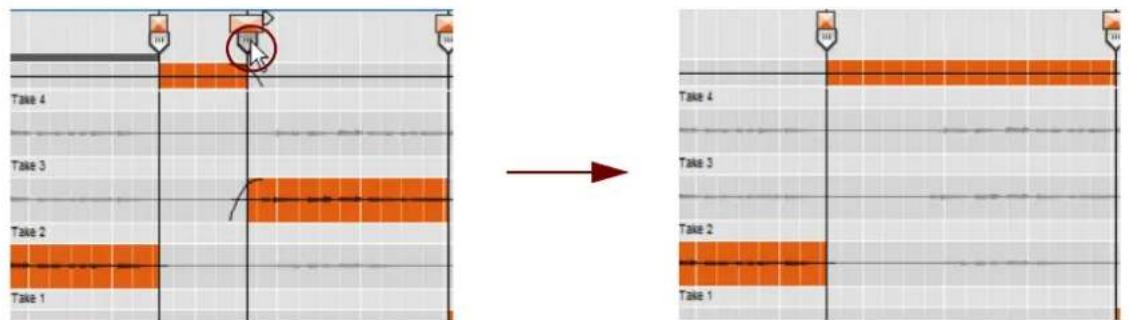
Click on a Cut Handle to select it.
Press [Backspace] or [Delete] to delete the segment to the right of the Cut Handle.
→Alternatively, select the Eraser Tool and click on the Cut Handle.
Moving Cuts
Moving Cuts has a similar effect to resizing a clip, i.e. you select what part of the recording on the Comp Row should be active for playback. Recordings outside the active segment on the Comp Row will be masked (silent) but not affected in any other way.
To move a Cut, click and hold its right Cut Handle, or Cut Line, and drag it horizontally in either direction. The segment to the left of the Cut Line will be resized. The segment to the right of the resized segment will now have a new start position:
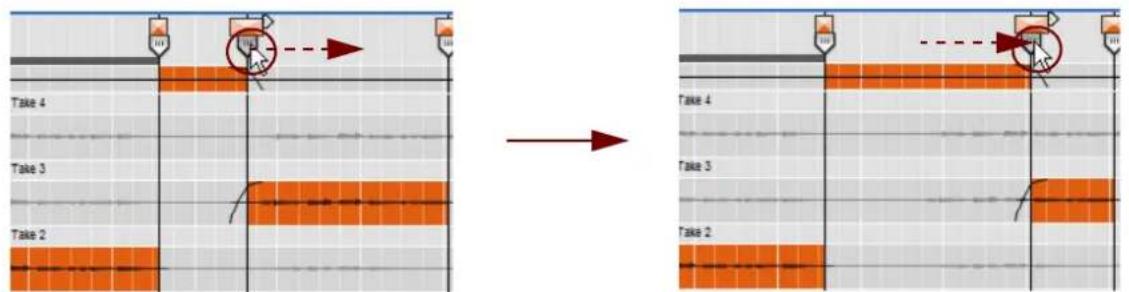
flowchart
graph TD
    A["Take 2"] --> B["Take 3"]
    B --> C["Take 4"]
    C --> D["End"]

    style A fill:#f9f,stroke:#333
    style B fill:#f9f,stroke:#333
    style C fill:#f9f,stroke:#333
    style D fill:#f9f,stroke:#333

    %% Red arrows indicate direction of movement: Start at Take 2, End at Take 4
Click on a Cut Handle to select it.
Drag the Cut Handle to horizontally to move it.
! Recordings in the segments will not be moved back or forth - only masked according to the current positions of the Cut Handles/Lines. Any Cut Crossfades will also move along with the Cut Handles/Lines.
! Two Cuts can never exist on the same position. If you drag a Cut to the position of another Cut and release the mouse button, the moved Cut will disappear. If you do this by mistake, you can always use the Undo function.
To move a Cut and have the recording on the Comp Row move along with the Cut, select the Comp Row and the Cut Handle using the standard [Ctrl]-click (Win) or [Shift]-click method. Then, click and drag the Cut to the desired position.
! Note that Snap is taken into account (if activated).
- It's also possible to use the Inspector to move Cuts numerically - see "Editing recordings and cuts in the Inspector".
Changing Comp Row assignments
When you have created a comped audio clip, you might later want to change which Comp Rows are assigned to play:
→ Choose the Selection Tool and double-click on the Comp Row that contains the recording you want to assign to the Segment.
Make sure you double-click in the area between the desired Segment's Cut Lines.
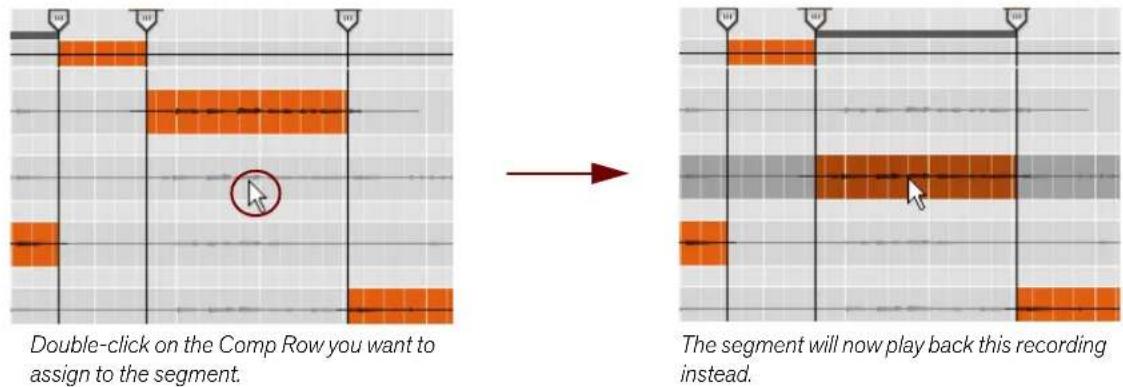
You can also use keyboard commands to change comp row assignments and segment focus as follows:
→ Hold down Ctrl or Cmd and press the up/down arrow keys to select which Comp Row that should be assigned.
To change Segment focus, hold down [Ctrl]+[Alt]+Shift or [Cmd]+[Option]+Shift and press the left/right arrow keys.
This will move the Segment Focus Indicator between the segments. Note that you can still change comp row assignments using this keyboard command together with the up/down arrow keys.
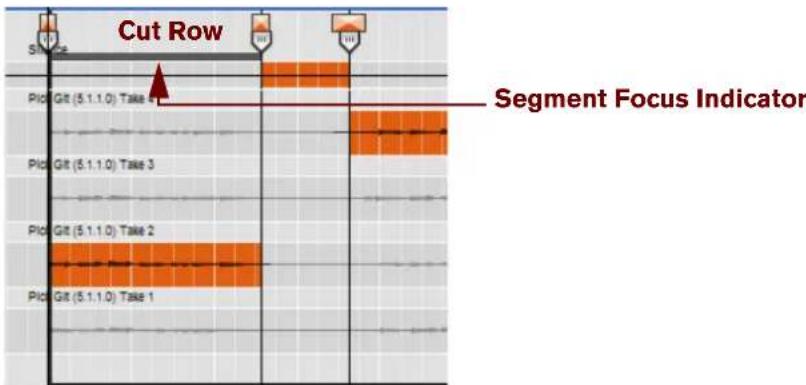
bar
Cut Row | Segment | Value | | :--- | :--- | | Segment Focus Indicator (Orange bars) | 1 | | Segment Focus Indicator (Orange bars) | 2 | | Segment Focus Indicator (Orange bars) | 3 | | Segment Focus Indicator (Orange bars) | 4 | | Segment Focus Indicator (Orange bars) | 5 | | Segment Focus Indicator (Orange bars) | 6 | | Segment Focus Indicator (Orange bars) | 7 | | Segment Focus Indicator (Orange bars) | 8 | | Segment Focus Indicator (Orange bars) | 9 | | Segment Focus Indicator (Orange bars) | 10 | | Segment Focus Indicator (Orange bars) | 11 | | Segment Focus Indicator (Orange bars) | 12 | | Segment Focus Indicator (Orange bars) | 13 | | Segment Focus Indicator (Orange bars) | 14 | | Segment Focus Indicator (Orange bars) | 15 | | Segment Focus Indicator (Orange bars) | 16 | | Segment Focus Indicator (Orange bars) | 17 | | Segment Focus Indicator (Orange bars) | 18 | | Segment Focus Indicator (Orange bars) | 19 | | Segment Focus Indicator (Orange bars) | 20 | | Segment Focus Indicator (Orange bars) | 21 | | Segment Focus Indicator (Orange bars) | 22 | | Segment Focus Indicator (Orange bars) | 23 | | Segment Focus Indicator (Orange bars) | 24 | | Segment Focus Indicator (Orange bars) | 25 | | Segment Focus Indicator (Orange bars) | 26 | | Segment Focus Indicator (Orange bars) | 27 | | Segment Focus Indicator (Orange bars) | 28 | | Segment Focus Indicator (Orange bars) | 29 | | Segment Focus Indicator (Orange bars) | 30 | | Segment Focus Indicator (Orange bars) | 31 | | Segment Focus Indicator (Orange bars) | 32 | | Segment Focus Indicator (Orange bars) | 33 | | Segment Focus Indicator (Orange bars) | 34 | | Segment Focus Indicator (Orange bars) | 35 | | Segment Focus Indicator (Orange bars) | 36 | | Segment Focus Indicator (Orange bars) | 37 | | Segment Focus Indicator (Orange bars) | 38 | | Segment Focus Indicator (Orange bars) | 39 | | Segment Focus Indicator (Orange bars) | 40 | | Segment Focus Indicator (Orange bars) | 41 | | Segment Focus Indicator (Orange bars) | 42 | | Segment Focus Indicator (Orange bars) | 43 | | Segment Focus Indicator (Orange bars) | 44 | | Segment Focus Indicator (Orange bars) | 45 | | Segment Focus Indicator (Orange bars) | 46 | | Segment Focus Indicator (Orange bars) | 47 | | Segment Focus Indicator (Orange bars) | 48 | | Segment Focus Indicator (Orange bars) | 49 | | Segment Focus Indicator (Orange bars) | 50 | | Segment Focus Indicator (Orange bars) | 51 | | Segment Focus Indicator (Orange bars) | 52 | | Segment Focus Indicator (Orange bars) | 53 | | Segment Focus Indicator (Orange bars) | 54 | | Segment Focus Indicator (Orange bars) | 55 | | Segment Focus Indicator (Orange bars) | 56 | | Segment Focus Indicator (Orange bars) | 57 | | Segment Focus Indicator (Orange bars) | 58 | | Segment Focus Indicator (Orange bars) | 59 | | Segment Focus Indicator (Orange bars) | 60 | | Segment Focus Indicator (Orange bars) | 61 | | Segment Focus Indicator (Orange bars) | 62 | | Segment Focus Indicator (Orange bars) | 63 | | Segment Focus Indicator (Orange bars) | 64 | | Segment Focus Indicator (Orange bars) | 65 | | Segment Focus Indicator (Orange bars) | 66 | | Segment Focus Indicator (Orange bars) | 67 | | Segment Focus Indicator (Orange bars) | 68 | | Segment Focus Indicator (Orange bars) | 69 | | Segment Focus Indicator (Orange bars) | 70 | | Segment Focus Indicator (Orange bars) | 71 | | Segment Focus Indicator (Orange bars) | 72 | | Segment Focus Indicator (Orange bars) | 73 | | Segment Focus Indicator (Orange bars) | 74 | | Segment Focus Indicator (Orange bars) | 75 | | Segment Focus Indicator (Orange bars) | 76 | | Segment Focus Indicator (Orange bars) | 77 | | Segment Focus Indicator (Orange bars) | 78 | | Segment Focus Indicator (Orange bars) | 79 | | Segment Focus Indicator (Orange bars) | 80 | | Segment Focus Indicator (Orange bars) | 81 | | Segment Focus Indicator (Orange bars) | 82 | | Segment Focus Indicator (Orange bars) | 83 | | Segment Focus Indicator (Orange bars) | 84 | | Segment Focus Indicator (Orange bars) | 85 | | Segment Focus Indicator (Orange bars) | 86 | | Segment Focus Indicator (Orange bars) | 87 | | Segment Focus Indicator (Orange bars) | 88 | | Segment Focus Indicator (Orange bars) | 89 | | Segment Focus Indicator (Orange bars) | 90 | | Segment Focus Indicator (Orange bars) | 91 | | Segment Focus Indicator (Orange bars) | 92 | | Segment Focus Indicator (Orange bars) | 93 | | Segment Focus Indicator (Orange bars) | 94 | | Segment Focus Indicator (Orange bars) | 95 | | Segment Focus Indicator (Orange bars) | 96 | | Segment Focus Indicator (Orange bars) | 97 | | Segment Focus Indicator (Orange bars) | 98 | | Segment Focus Indicator (Orange bars) | 99 | | Segment Focus Indicator (Orange bars) | 100 | Segment Focus Indicator (Orange bars) Segment focus indicator on the cut row Segment focus indicator on the cut row Segment focus indicator on the cut row Segment focus indicator on the cut row Segment focus indicator on the cut row Segment focus indicator on the cut row Segment focus indicator on the cut row Segment focus indicator on the cut row Segment focus indicator on the cut row Segment focus indicator on the cut row Segment focus indicator on the cut row Segment focus indicator on the cut row Segment focus indicator on the cut row Segment focus indicator of the cut row Segment focus indicator of the cut row Segment focus indicator of the cut row Segment focus indicator of the cut row Segment focus indicator of the cut row Segment focus indicator of the cut row Segment focus indicator of the cut row Segment focus indicator of the cut row Segment focus indicator of the cut row Segment focus indicator of the cut row Segment focus indicator of the cut row Segment focus indicator of the cut row Segment focus indicator of the cut rowThe Segment Focus Indicator shows which segment has currently focus.
Bounce Clip(s) to New Recording(s)
! The function described below is exactly the same as clicking the "Bounce" button to the left in the Clip Overview, see "Bounce button".
A very nice way to "clean up" among the recordings in a comped audio clip is to bounce the clip to a new recording. Bouncing to a new recording is also a prerequisite to be able to edit the clip in Slice Edit mode and stretch and quantize the audio.
What happens is that the audio recordings in all segments of the comped clip, including any Cut Crossfades and individual Comp Row Levels, are combined into a single recording on an additional Comp Row. After the clip has been bounced to a new recording, you can delete the unused recordings to reduce the file size. Bouncing clips to new recordings can be made for one or several selected audio clips:
→ Select the clip(s) in the Clip Overview area in the Comp Editor, or select the clip(s) in the Arrange View, and then select "Bounce > Bounce Clip(s) to New Recording(s)" from the Edit menu or context menu.
A new "combined" recording is created on a new Comp Row, which is created above the other Comp Rows on the Edit Pane. The new Comp Row is assigned the suffix "(bounced)".
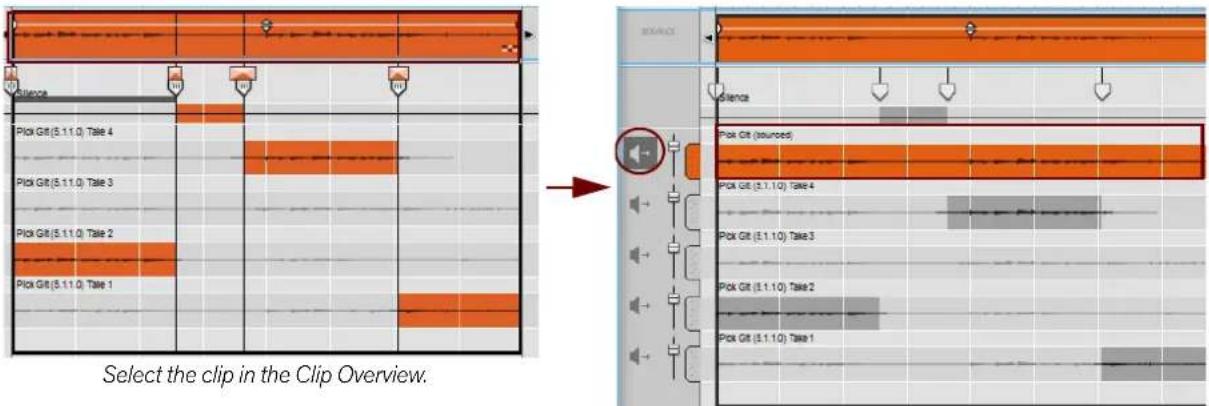
Select "Bounce Clip to New Recording" to create a new "combined" recording on an additional Comp Row.
As the clip is bounced, the clip automatically switches from a Comp clip to a Single Take clip. If you play back the clip now, you will only hear the bounced recording on the automatically selected (topmost) Comp Row. However, the clip will sound exactly the same as before the bounce.
If you're happy with the result and don't plan to edit the clip any further, you can use the "Delete Unused Recordings" function to delete the recordings on the original Comp Rows and reduce the file size (see "Delete Unused Recordings"). If file size is not an issue, you can keep the original takes in the clip. This way you can switch to Comp Mode at any time if you need to edit the comp.
- The "Bounce Clip to New Recording" function is very useful if you have imported a large audio file and only want to use a part of it. You can bounce the part of the clip you want use to a new recording and then delete the remaining unused part on the Comp Row to reduce the file size.
- It's also possible to bounce Audio Clips to disk and to a Sample - see "Bouncing Audio Clips" and "Bounce Clip(s) to New Sample(s)".
Creating a comped audio clip
If you have recorded more than one loop cycle of audio in Loop Mode (see "Recording audio in Loop mode"), or recorded over or into an existing audio clip (see "Recording over or into an existing audio clip"), each recording has been placed on a separate Comp Row. If you like, you can now select the best parts (segments) of the recordings on the various Comp Rows and create a final "comped" audio clip. All editing described below is non-destructive and can be changed at any time:
1. Open the audio clip in Comp Edit mode.
Each take has generated a separate Comp Row, each with a separate recording on it. The latest take, on the top-most Comp Row, is the one that will play back.
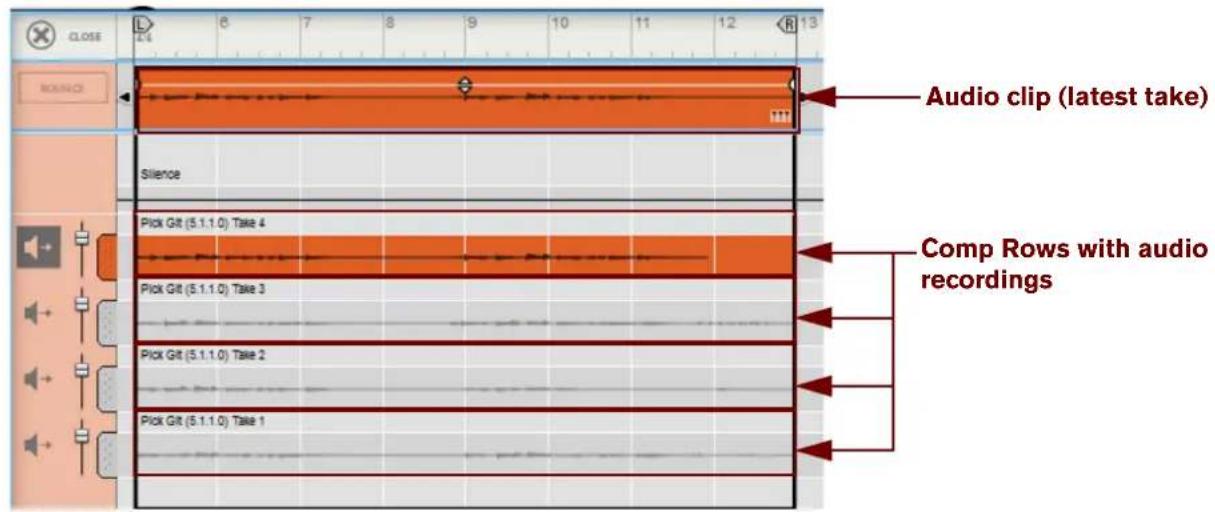
An audio clip (in Single Take Mode) with four separate takes recorded in Loop Mode.
! If the clip is in Single Take Mode, because a Single Take Mode button is depressed (as in the picture above), you will have to click that Single Take Mode button to deselect the Comp Row before you can start adding Cuts!
2. Locate the best parts of the recordings in the different Comp Rows.
Audition the recordings on the Comp Rows to decide which recordings to use at what position in the comped clip. Select the Speaker Tool and click-hold at desired positions on the different Comp Rows (see "Speaker Tool" for details).
- If you're using the Selection Tool, you can temporarily switch to the Speaker Tool by holding down [Alt]+Shift or [Cmd]+Shift.
3. Double-click with the Selection Tool on the Comp Row you want to use first in the clip.
In this example, we decide to use the recording on the "Take 2" Comp Row:
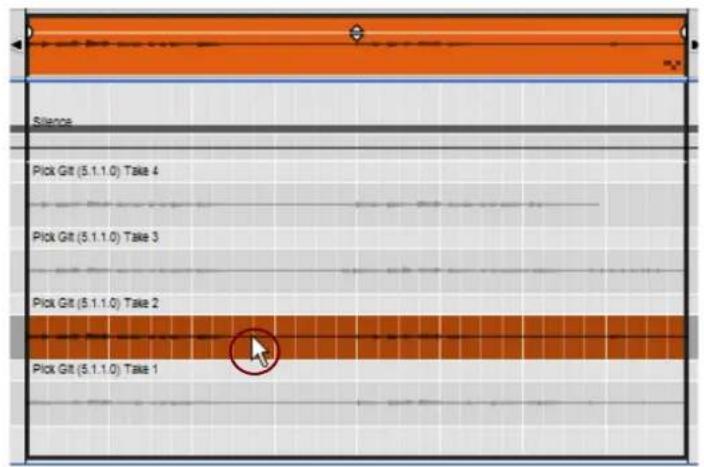
Double-click on the "Take 2" Comp Row to assign it to the first segment of the clip.
4. Select the Razor Tool in the Sequencer Toolbar - or, with the Selection Tool still selected, hold down [Alt](Win) or [Cmd](Mac).
We want the recording on the "Take 2" Comp Row to play until beat 3 of Bar 7. After beat 3 of bar 7 we want the clip to be silent to get rid of some background noise that could be heard when we recorded without playing anything. Therefore, place the Razor Tool on the Silence Row at Beat 3 of bar 7 and click:
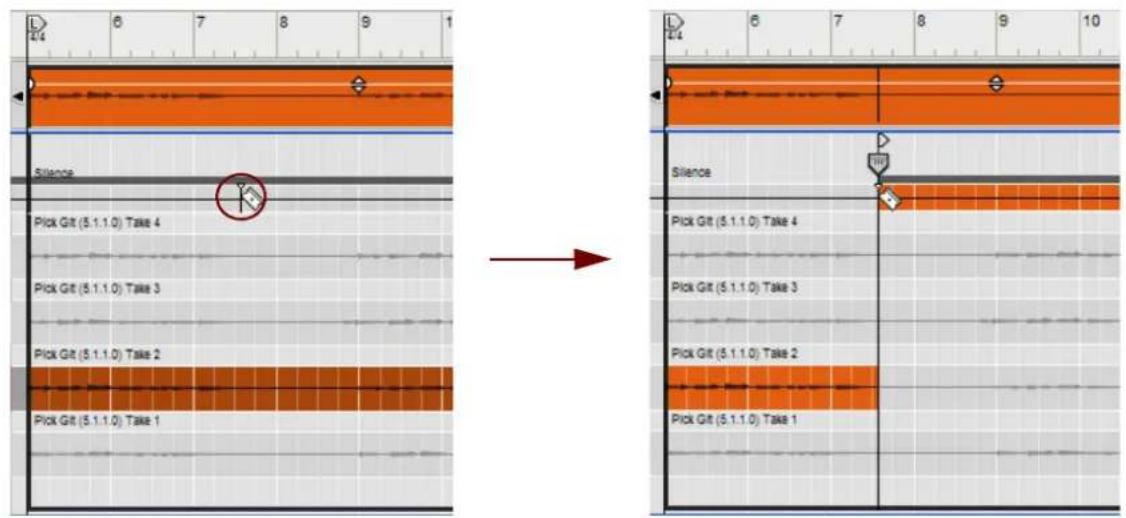
Place the Razor Tool on the Silence Row at beat 3 of bar 7...
...and click to assign the Silence Row to the second segment of the clip.
Now, you have assigned the recording on the "Take 2" Comp Row from the beginning of the clip to beat 3 of bar 7. At the same time you have assigned the Silence Row to a second segment of the clip.
5. Use the Audition Tool to find a suitable recording to assign to a new segment in the clip.
We found a good recording that we want to use on the "Take 4" Comp Row between beat 3 and 4 of bar 8 until beat 1 of bar 11.
6. Assign a complete segment by swiping with the Razor Tool.
Swipe with the Razor Tool on the "Take 4" Comp Row from beat 3 and 4 of bar 8 until beat 1 of bar 11:
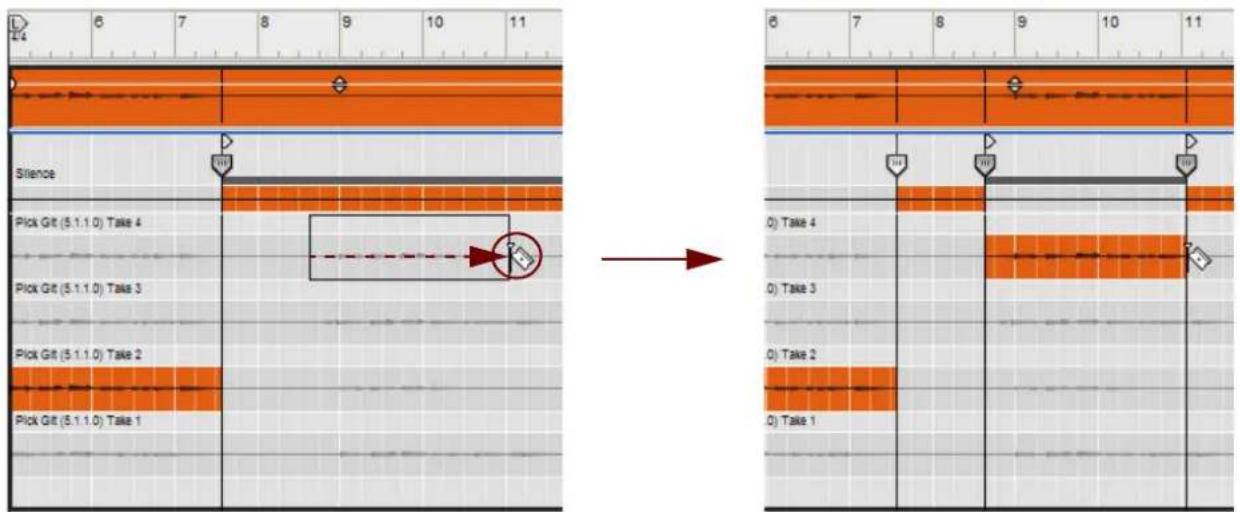
Place the Razor Tool between beat 3 and 4 of bar 8 on the "Take 4" Comp Row and swipe...
...and release at beat 1 of bar 11.
Now the recording on the "Take 4" Comp Row is assigned to a third segment in the clip. Two new Cut Handles have been added: one at the beginning of the swiped segment and one at the end.
7. Assign a recording to the last segment of the clip.
We used the Audition Tool and found that the recording on the "Take 1" Comp Row was just what we were looking for to play through to the end of the clip. Since a fourth segment was already created when you swiped in the previous step, you just need to double-click with the Selection Tool on the "Take 1" Comp Row, to the right of the last Cut Line, to assign the recording to the fourth segment:
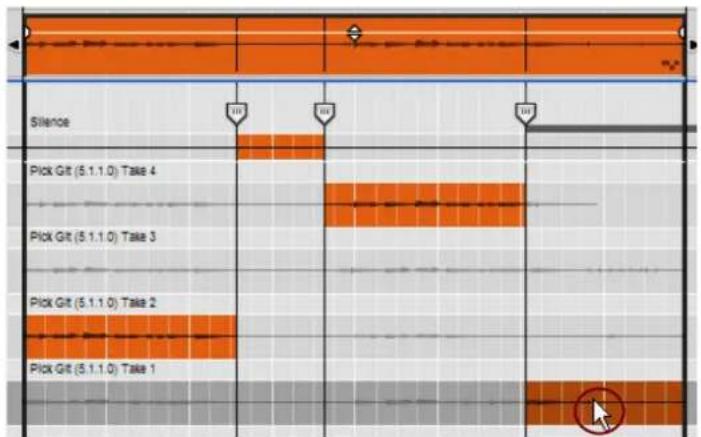
Double-click on the "Take 1" Comp Row, to the right of the last Cut Line, to assign it to the last segment in the clip.
- To eliminate any clicks that might occur between the recordings in the different segments of our clip, let's introduce some crossfades.
Crossfades can be applied by first selecting a Cut Handle and then clicking with the Selection Tool and dragging the Cut Crossfade Handles that appear above the selected Cut Handle:
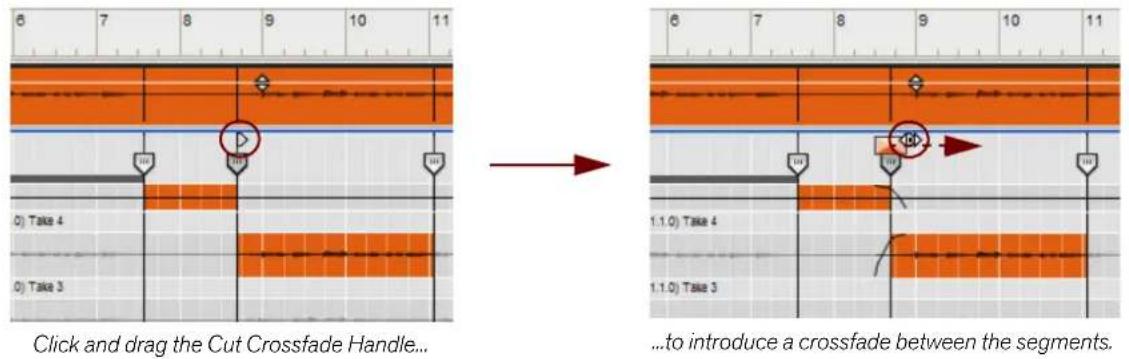
The crossfade slopes are indicated by curves on the assigned Segments. The longer the crossfade time, the flatter the curves.
Repeat the procedure for the other Cut Crossfade Handles in the clip if needed.
- If you want to set the same crossfade time for several Cuts, select the Cut Handles and use the "Match Value" function in the Inspector (see "Matching Cut Crossfades").
- Finally, you might want to trim the audio levels of the different recordings on the Comp Rows in the clip.
Click with the Selection Tool and drag the Comp Row Level Faders on the respective Comp Row to achieve a balanced audio level throughout the clip. The Comp Row level adjustments can be made anytime during the creation of the comped audio clip.
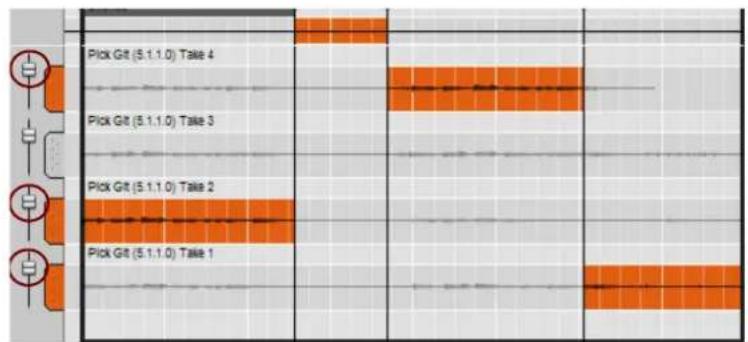
Adjusting the individual Comp Row audio levels.
- If you want to set the same level for several Comp Rows, select the Comp Rows and use the "Match Value" function in the Inspector (see "Matching Comp Row Levels").
→ When you're satisfied with your comped clip, you might want to click the "Bounce" button to generate a single recording that plays back your comped audio.
The clip is then also automatically set to Single Take mode, which makes it possible to edit the clip in Slice Edit mode, where you can stretch and quantize the audio etc. (see "Editing audio in Slice Edit mode"), or in Pitch Edit mode, where you can correct and edit the pitches of monophonic audio recordings (see "Editing audio in Pitch Edit mode").
Bouncing also helps you keep things organized and can be a way to create a "snapshot" of your current comp, for comparison while you continue to fine-tune the edits.
- If you're finished with a comp and want to keep the file size down, you can use the "Bounce" function together with the "Delete Unused Recordings" function to permanently remove all original takes (see "Delete Unused Recordings").
Common audio editing functions
The functions below apply to all audio clip types.
Delete Unused Recordings
After you have edited your audio clips in the Comp Editor, there might be unused recordings left on Comp Rows that you don't plan to use. To reduce the file size of your song, you can choose to delete all unused recordings in one or several audio clips.
→ Select the clip(s) in the Clip Overview area in the Comp Editor, or select the clip(s) in the Arrange View, and then select "Delete Unused Recordings" from the Edit menu or context menu.
All recordings that are not used in the clip(s) will be permanently deleted.
- If a clip is in Single Take Mode, only the selected Comp Row will be played back - all other Comp Rows are per definition “unused”. However, there may still be Cuts and assigned Segments among these Comp Rows, visible and audible if you switch the clip to Comp Mode.
As a safety measure, if you use the "Delete Unused Recordings" function on such a clip, you will be asked to confirm that you really want to remove all Comp Rows other than the selected one.
- After deleting audio recordings, you will have to use the "Save and Optimize" function on the File menu to minimize the Song file size - see "Saving and optimizing a Song".
Bounce Clip(s) to New Sample(s)
You can bounce one or several Audio Clips to new Song Samples. You could then edit the samples in the Edit Sample window and then load into a sampler device for playback. Proceed as follows:
→ Select the clips in the Clip Overview area in the Comp Editor, or select them in the Arrange View, and then select "Bounce > Bounce Clip(s) to New Sample(s)" from the Edit menu or context menu.
The Audio Clips are bounced to new Song Samples and named according to the Audio Clip name (if the clip was named) or according to the Audio Track name with serial numbers. The bounced Audio Clips then end up as sample files in the Song Samples location in the Browser. Refer to "Sampling" for more details about sampling and sample editing.
About the "Bounce Clip to Disk" function
The "Bounce > Bounce Clip to Disk" function on the Edit menu and clip context menu allows you to export the audio of a selected clip to disk as a single WAV or AIFF file. This might be useful if you want to process an audio clip in an external application and then re-import the clip to the track again. See "Bouncing Audio Clips" for more details.
Bouncing audio to MIDI notes
It's possible to convert Single Take audio clips to note clips. This is especially useful for monophonic audio that can be edited in Pitch Edit mode. But if you like to experiment you could try it on polyphonic audio as well. The result in any situation will be a monophonic note clip on a default Subtractor instrument track.
→ Select one or several Single Take audio clips in the Arrange View and select "Bounce > Bounce Audio Clips To MIDI" from the Edit menu or context menu.
A Subtractor instrument track is automatically created for each of the audio tracks. On the Subtractor track(s) a note clip for each of the selected audio clips are created.
→ Alternatively, drag one or several Single Take audio clips and drop onto an Instrument track.
The audio clips are automatically converted into note clips as you drop them on the Instrument track. Once dropped, you could play back the note clips using the present Instrument sound.
- Clips that have "Vocal" Stretch and Transpose Type selected will generate Note clips with different MIDI notes in them.
- Clips that have "Allround" or "Melody" Stretch and Transpose Type selected will generate Note clips with only MIDI note C3 in them. In other words, you will basically only get a "rhythm" played by note C3.
This can be very useful if you, for example, want to bounce drums to MIDI notes. You may then have to move the MIDI notes to the correct notes in the generated Note clip afterwards.
! If you drag Single Take audio clips from several audio tracks, you will need the same number of Instrument tracks to be able to drop all clips. As a rule of thumb, always create the instrument tracks right below the respective audio track.
Normalizing audio clips
Normalizing means increasing the overall audio level so that the loudest peak in the sound touches 0 dB. Normalizing can be made on any audio clip, regardless of if they are Single Take clips or Comp clips.
- Select the Audio Clip(s) in the Arrange View, or in the Clip Overview in the Comp Editor.
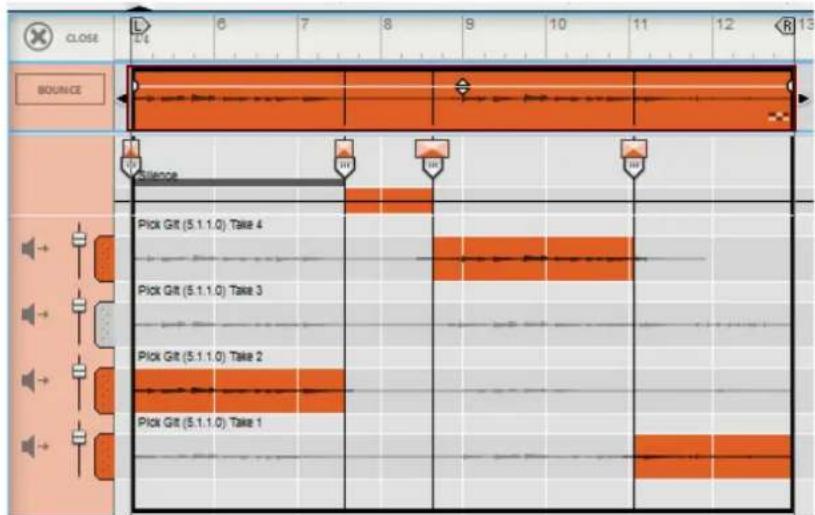
A comped audio clip selected in the Clip Overview in the Comp Editor.
- Select "Normalize Clips" from the Edit menu or context menu.
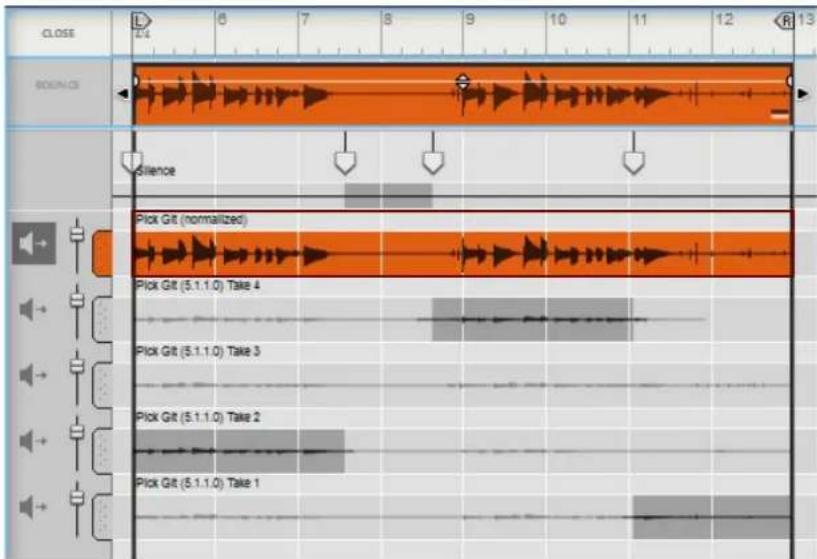
A new Comp Row is automatically created at the top and named after the Audio Track, with the extension "(normalized)". The new Comp Row contains the "bounced" normalized audio and the Audio Clip has also automatically switched to Single Take Mode. The original audio is preserved on their original Comp Rows.
! Only the audio within the Audio Clip boundaries will be normalized. Any masked audio will be disregarded.
! Note that normalizing a clip that contains audio that already reaches the full headroom (touches 0 dB) won't have any effect.
! When you normalize a Single Take clip, Reason Lite automatically re-analyses the audio and distributes new Slice Markers at the detected transients.
Reversing audio clips
Reversing an audio clip means playing it backwards, from the end to the start. Reversing can be made on any Audio Clips, regardless of whether they are Single Take clips or Comp clips.
- Select the Audio Clip(s) in the Arrange View, or in the Clip Overview in the Comp Editor.
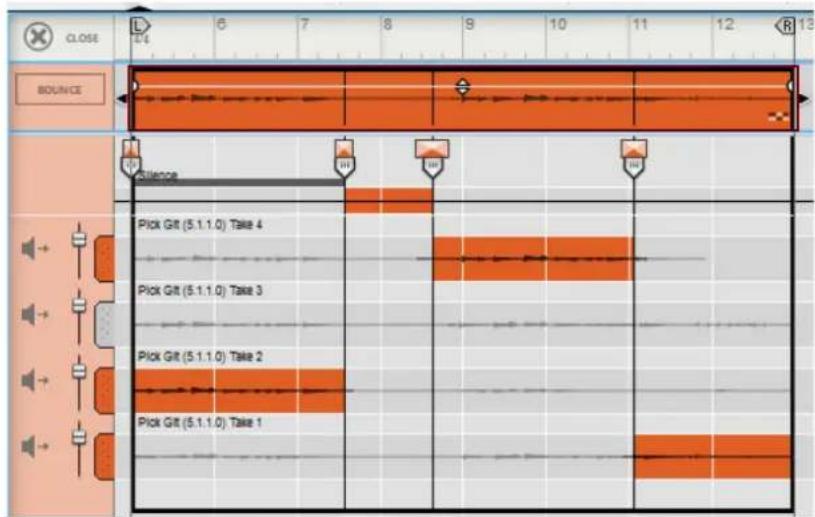
A comped audio clip selected in the Clip Overview in the Comp Editor.
- Select "Reverse" from the Edit menu or context menu.
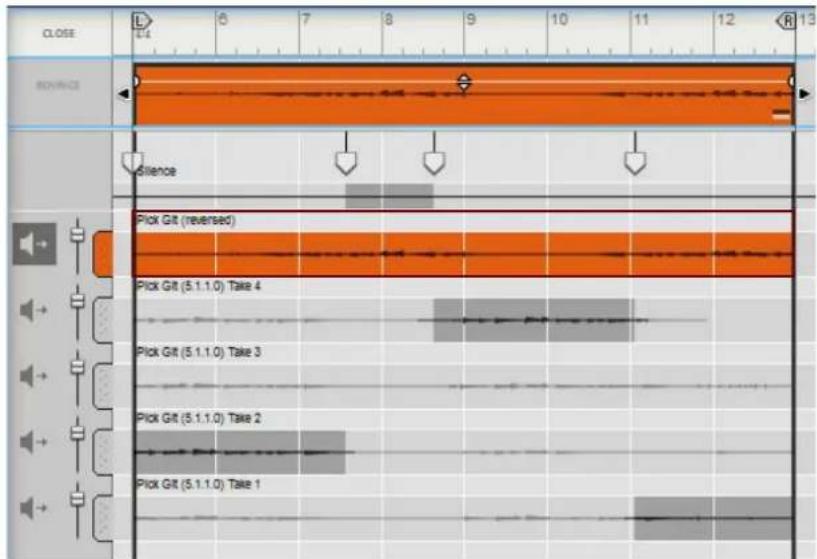
A new Comp Row is automatically created at the top and named after the Audio Track, with the extension "(reversed)". The new Comp Row contains the "bounced" reversed audio and the Audio Clip has also switched to Single Take Mode. The original audio is preserved on their original Comp Rows.
! Only the audio within the Audio Clip boundaries will be reversed. Any masked audio will be disregarded.
! When you reverse a Single Take clip, Reason Lite automatically re-analyses the audio and distributes new Slice Markers at the detected transients.
- You can also reverse Note and Automation Clips (and individual events in these), see "Reverse".
Changing the tempo and transposition of the audio
Tempo scaling Clips
Besides the automatic time stretching function applied when you change the Tempo in the main sequencer, there is a Scale Tempo function which can be applied to scale the tempo of one or several clips. The Scale Tempo function works in the same way for audio clips, note clips and parameter automation clips. However, it might be interesting to see what happens when you tempo scale an audio clip.
1. Open an audio clip in the Comp Editor.
In this example we use a Comp clip with four Comp Rows and a number of Cuts. The tempo scaling works exactly the same way, regardless if the clip is a Single Take clip or Comp clip.
2. With the Arrow Tool selected, hold down [Ctrl](Win) or [Option](Mac) and place the mouse cursor over one of the Clip Resize handles (in the Clip Overview).
When you reach any of the Clip Resize handles, the arrow symbol switches to a "scale tempo" arrow.
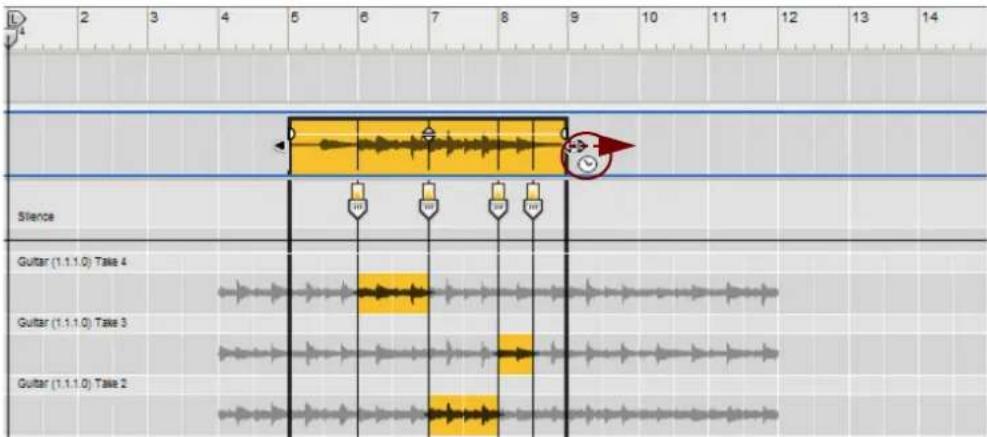
3. Hold down [Ctrl](Win)/[Option](Mac) and click and drag the cursor sideways in either direction to scale the tempo of the clip.
In this example, we make the clip one bar longer by dragging the right clip handle one bar to the right.
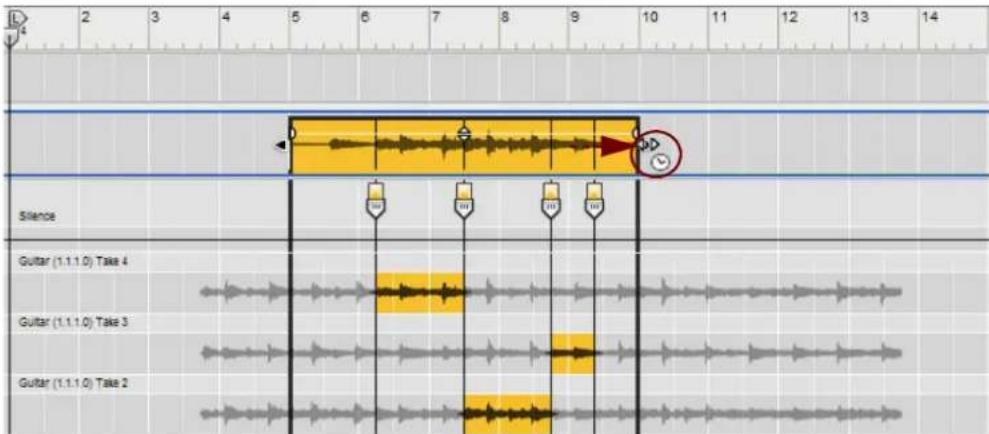
Now, the audio clip has been tempo scaled and the audio recordings have been stretched to match the new clip length. Note that the distance between the Cuts, as well as the lengths of the recordings on all Comp Rows have been expanded proportionally.
! When you use the Scale Tempo function on Single Take clips (in the Arrange View), the Slice Markers will follow proportionally.
The Scale Tempo function can also be applied to clips numerically in the Tool Window, see "Scale Tempo".
! When you scale the tempo of large clips, it could take a while before the high quality stretch is finished, see "Preview vs. High Quality Stretching".
Transposing Audio Clips
Audio clips can be transposed. That is, all the audio recordings in a selected audio clip can be transposed up or down 12 semitones, in steps of 1 Cent, relative to their original pitch. The transposition can be applied to all types of audio - including polyphonic material.
! The transposition is non-destructive, i.e. the original audio is always preserved and left unaffected.
! To get the best sound quality when you are transposing audio it's important that you have selected the correct Stretch and Transpose Type for the audio track, see "Opening audio clips for editing".
- Select one or several audio clips.
The Transpose display shows up to the right in the Inspector:
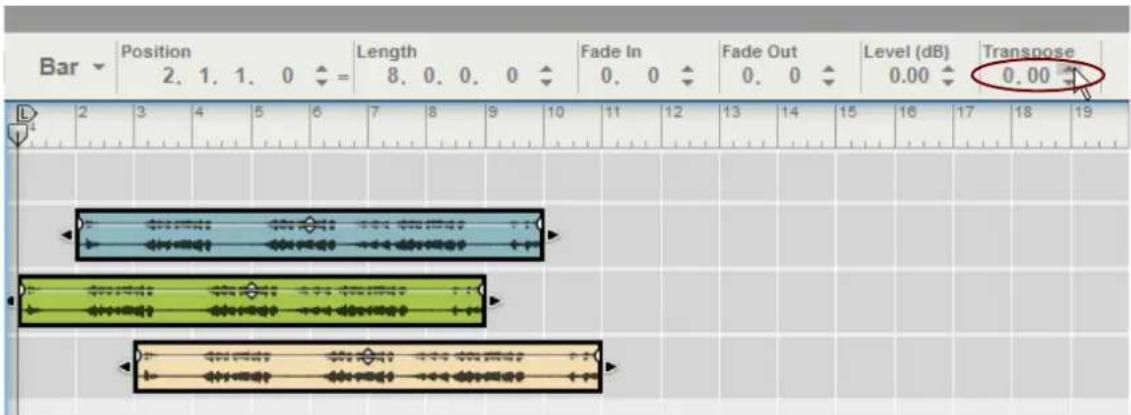
Three audio clips selected on the arrangement pane in the Song View.
- Click the up/down arrow button next to the Transpose display to change the transposition in Semitones and Cents.
The audio in the selected clips are now transposed relative to their original pitch.
→ You can also edit the transposition value by clicking and dragging the respective display segment up/down or entering numeric values according to standard procedures.
- It's also possible to transpose individual Comp Rows in a Comp clip - see "Transposing Comp Rows" below.
- Audio Clips and MIDI notes in Note Clips can be transposed in whole semitone steps in the Transpose section in the Tool Window - see "Pitch (Transpose)".
- If you want to edit and/or correct the pitches of individual notes in monophonic audio recordings (e.g. vocal recordings), you can open the audio clip in Pitch Edit mode, see "Editing audio in Pitch Edit mode".
Transposing Comp Rows
Besides the Audio Clip Transpose function described above, individual Comp Rows in a Comp clip can be individually transposed:
- Open a comped audio clip in the Comp Editor and select a Comp Row to be transposed.
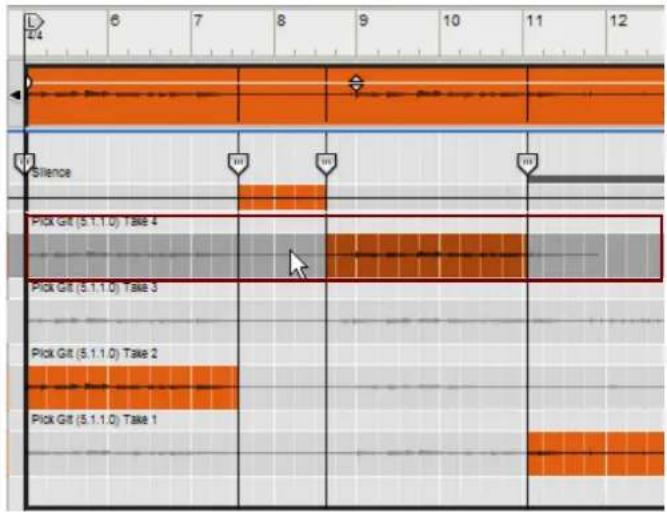
The selected Comp Row is shown in a darker color.
- Change the Transpose value in the Inspector as desired.
- Select another Comp Row and change its Transpose value in the Inspector as desired.
Now the Comp Rows will have individual transposition values.
- If you decide to change the Transpose value for the entire audio clip - by selecting the clip in the Clip Overview - the relative transpositions of the Comp Rows will be preserved.
Audio and tempo matching
Matching imported audio to the song tempo
Audio files created by the Export or Bounce functions in Reason Lite include information about their original tempo. When you import such an audio file, it will automatically be stretched to fit the tempo in the new song.
However, if you have imported audio which has a steady, but unknown, tempo, you can adjust the imported clip to the song tempo. You can either use the Clip Tempo Scaling function to manually "stretch" the audio clip as described in "Tempo scaling Clips".
Another way is to disable the automatic stretch for the audio clip and then adjust the sequencer tempo to match the clip. This is done in two steps: first you adjust the song tempo to the imported audio clip without Stretch enabled and then adjust the song tempo back to original - with Stretch enabled on the audio clip:
- Select the clip containing the imported audio file and choose "Disable Stretch" from the Edit menu or context menu.
Disabling Stretch makes the audio recording in the clip play back at the same tempo regardless of song tempo in the sequencer.
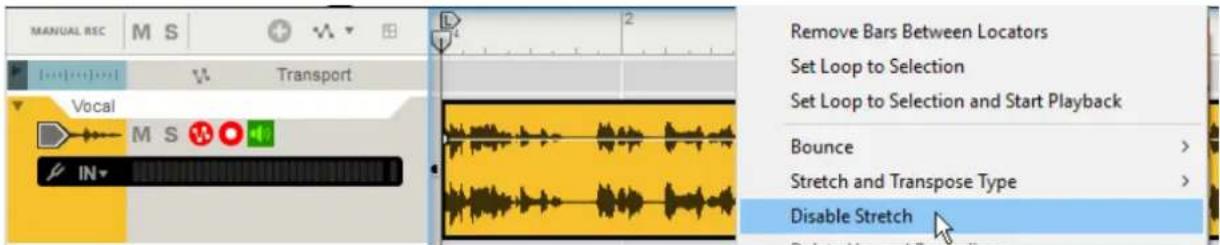
Disabling Stretch on a clip containing an imported audio recording.
- Start the sequencer and adjust the sequencer Tempo, up or down, to match the tempo of the audio recording in the clip.
If necessary, enable the metronome click in the sequencer to get an audible tempo reference. Continue adjusting the tempo of the song until it matches the tempo of the audio recording.
-
Adjust the length of the clip so that it plays the entire audio file (or as much as you want).
-
Select the clip and select "Bounce > Bounce Clip to New Recording" from the Edit menu or context menu.
The new recording will sound the same, but include information about the tempo you set in step 2.
-
With the audio clip still selected, choose "Enable Stretch" from the Edit menu or context menu.
-
Adjust the song tempo back to the original BPM.
As you adjust the song tempo, the tempo of the audio recording will follow along accordingly - without affecting the original pitch of the recording. This is done by stretching the audio. Reason Lite does this automatically in two parallel steps: a real-time "preview" stretch so that you can instantly hear the result of your tempo changes, then a high quality stretch "in the background" to further improve the sonic results. As soon as high quality stretch is in progress, the "Calc" indicator on the Transport Panel shows a progress meter:
The CALC progress meter appears when Reason Lite performs high quality stretching of audio.
Since the high quality stretch is performed in the background, you can still continue to work with your song without any interruption. When the high quality stretch data has been calculated, the Calc indicator goes out and the high quality audio data will be heard on playback.
Editing audio using the Inspector
The Inspector can be used for editing audio recordings numerically.
! For Inspector editing specific to Pitch Edit mode, please refer to "Audio pitch editing in the Inspector".
Editing recordings and cuts in the Inspector
If you select a Comp Row, the three displays change to show the Recording Offset, Comp Row Level and Comp Row Transpose value:
| Recording Offset0. 0. 0. 0. 0 ⇧ | Level (dB)0.00 ⇧ | Transpose0.00 ⇧ |
If you select a Cut Handle in Comp Mode, two displays appear, showing the Cut Handle's Position and Crossfade time:
| Cut Position8, 3, 3, 0, 0 ⇧ | Cut Crossfade6, 79, 4 ⇧ |
→ Edit the values by clicking on a segment in a display and then dragging up/down, using the up/down spin controls, or typing in new values. Snap is not taken into account.
See "Inspector segment displays" for details on how to edit in the Inspector displays.
Editing multiple recordings or multiple cuts in the Inspector
When you edit values for several selected Comp Rows or objects (Cut Handles etc.), the changes will always be relative. For example, if you change the Recording Offset, Level or Transpose values when several Comp Rows are selected, the recordings will all be changed by the same amount; their relative values will be retained.
- If several Comp Rows are selected, the displays will show the values for the topmost selected Comp Row.
- If several Cut Handles are selected, the displays will show the Position and Crossfade values for earliest Cut Handle in the clip.
- If several Comp Rows, or several Cut Handles, are selected and any of their values differ, Match Value buttons appear next to the corresponding display.
For Cut Handles, only Crossfade values can be matched - not the Positions. See "Matching audio values using the "Match Values" function".
- If Comp Rows and Cut Handles are selected in combination (e.g. for moving Cuts and recordings together as a group), no displays are shown in the Inspector.
Matching audio values using the "Match Values" function

The Match Values buttons appear as '=' signs.
The "Match Values" function in the Inspector can be used for matching Recording Offsets, Comp Row Levels and Transpose values of several selected Comp Rows to the offset/level/value of the topmost selected Comp Row. It can also be used for matching Cut Crossfade values of several selected Cut Handles to the Crossfade value of the Cut Handle with the earliest start position in the clip.
The "Match Values" function can also be used for matching the following parameters of several selected notes in Pitch Edit mode: Note, Fine-tune, Drift, Preserve Expression, Transition, Formant and Level. See "Audio pitch editing in the Inspector" for more info.
Matching Recording Offsets
Matching Recording Offsets is useful if you want to make sure that the Recordings on multiple Comp Rows start at the exact same position.
- Select more than one Comp Row and then place the Selection Tool on the Recording Offset Match Value button.
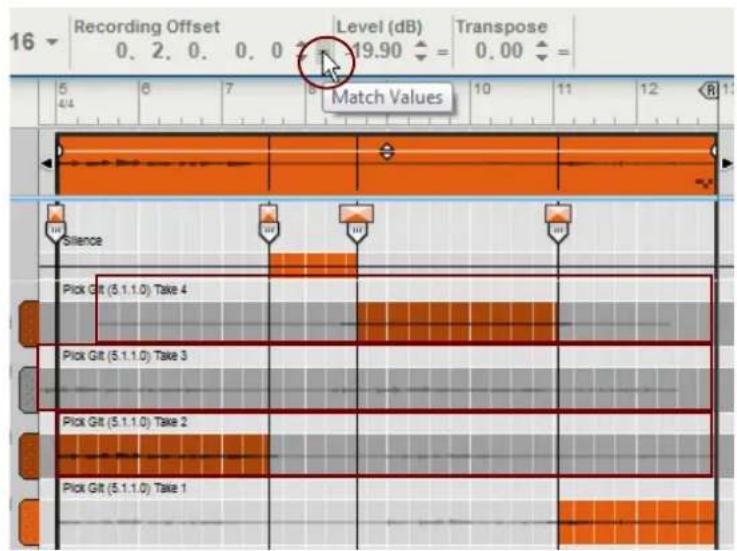
Three selected Comp Rows (the three topmost).
The topmost Comp Row has the Recording Offset set to 2 beats.
- Click the Match Value button to the right of the "Recording Offset" display.
The Recording Offsets on all selected Comp Rows have now been moved to 2 beats.
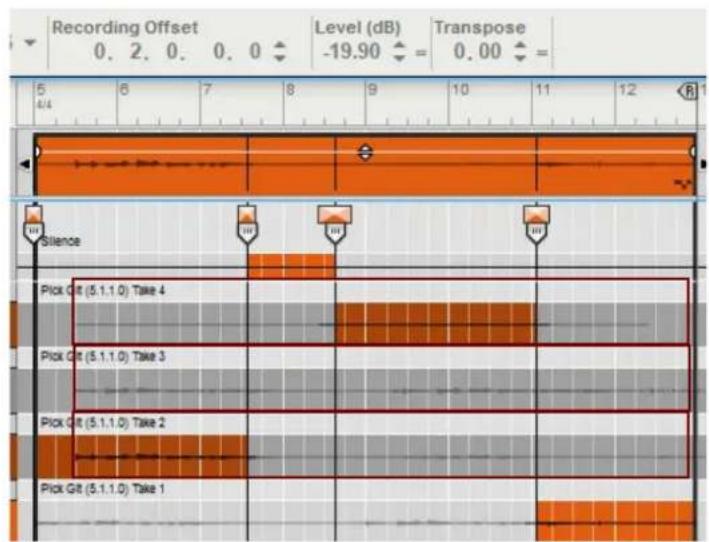
The Recording Offsets of the recordings on the three topmost Comp Rows have been moved to 2 beats.
Matching Comp Row Levels
Here's an example showing how to match Comp Row Levels:
→ Select several Comp Rows and then click the Level Match Value button.
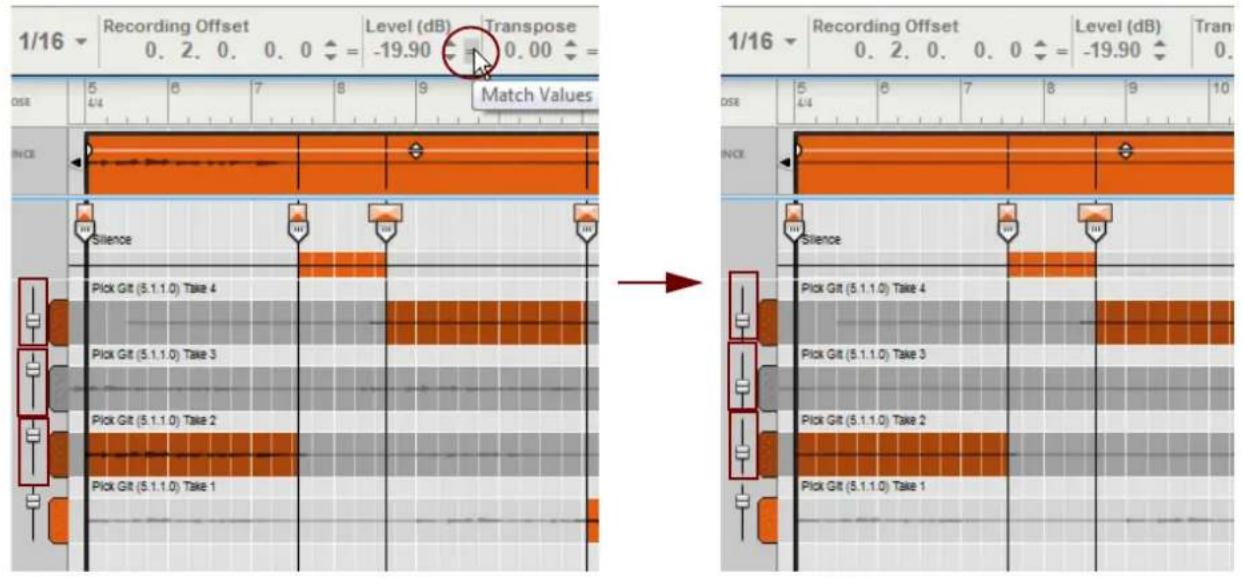
The Levels on the three selected Comp Rows are matched and adjusted to -19.90 dB.
Matching Comp Row Transpose values
→Select several Comp Rows and then click the Transpose Match Value button.
The transposition is matched to the Transpose value of the topmost selected Comp Row.
Matching Cut Crossfades
Matching Cut Crossfades is a time-saving function if you want to apply the same Crossfade times to several Cuts throughout the clip. If you want to eliminate any clicks between segments in your comped clip, you could apply a Cut Crossfade to the first Cut and then match the other Cuts to get the same Crossfade times in one go:
→ Select several Cut Handles and click the Cut Crossfade Match Value button.
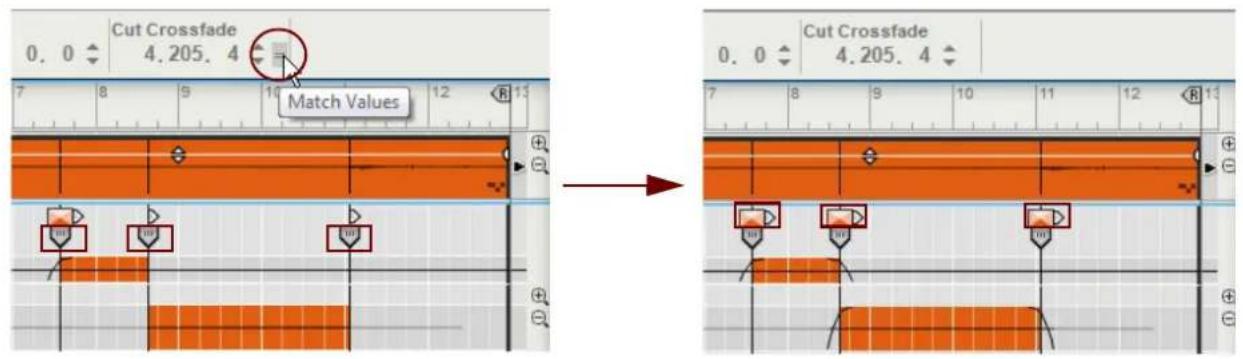
The Crossfades of the selected Cuts are matched and adjusted to the Crossfade times of the earliest selected Cut.
Chapter 9
Note and Automation
Editing
About this chapter
This chapter describes how to edit note and parameter automation events after they have been recorded in the sequencer. It also describes how to manually create note and automation events in clips. General sequencer functions, recording, editing audio, arranging in the sequencer and working with Blocks are described in detail in the chapters "Sequencer Functions", "Recording in the Sequencer", "Audio Editing in the Sequencer", "Arranging in the Sequencer" and "Working with Blocks in the Sequencer".
The Edit Mode
After you have recorded in note clips or parameter automation clips, you might want to edit and correct any mistakes you made during the recording. For example, if you accidentally hit the wrong key or used the Mod Wheel too extensively when you recorded a note clip, there is no need to redo the recording. Individual notes and parameter automation events can easily be edited and corrected in a number of different ways.
Edit Mode in the sequencer is where you can perform detailed editing of note and automation events.
To enter Edit Mode, either double-click a note clip in the Song/Block View, or select the note clip and press [Return] - or click the Edit button in the Toolbar, or right click a note clip and select Edit from the context menu. Alternatively, hold down Ctrl or Cmd and press [E].
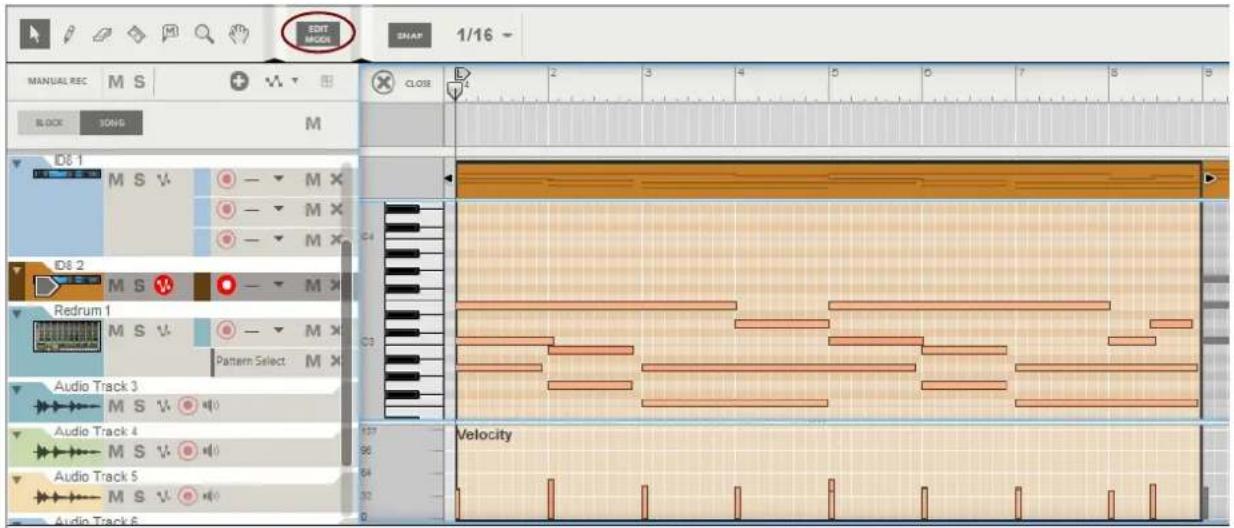
Double-clicking a note clip in the Song/Block View opens it for editing in Edit Mode.
→ Exit Edit Mode by pressing [Esc], or by clicking the Close or Edit button, or by holding Ctrl or Cmd and pressing [E].

Click the Close button to close the clip and revert to the Song/Blocks View.
→ Toggle between the Song/Block View and Edit Mode by pressing [Shift]+[Tab] or by holding Ctrl or Cmd and pressing [E].
Selecting what to edit
The Edit Mode shows the contents of a single lane at a time on the Edit Pane - unless you use the Multi Lanes function, described in "Multi Lanes editing", where you can see the contents of multiple note lanes in a "ghosted" fashion underneath the currently open clip. On instrument tracks, only one note lane can have edit focus at a time.
- If a track is selected when you enter Edit Mode, the contents of the note lane with edit focus will be shown.
Also, all parameter automation lanes will be shown at the bottom of the Edit Pane. If a single clip was selected on the note lane with edit focus when you switched to Edit Mode, it will automatically be opened. If no clip was selected, the events will be grayed out. To be able to edit or draw notes and/or automation events, you need to open the clip, for example by double-clicking it (see "Opening note and automation clips for editing"). - If the selected track has multiple note lanes, the contents of the currently selected note lane will be shown.
To switch edit focus between note lanes, click on the note lane handle in the Track List.
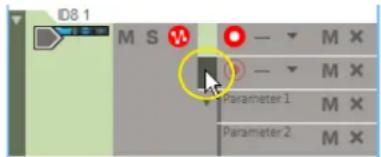
A note lane handle.
- You can change track and note lane edit focus at any time, by clicking in the Track List.
This way you can stay in Edit Mode and change edit focus between different tracks and note lanes, without having to go back to the Song/Block View.
Opening note and automation clips for editing
Open a note clip for editing
Note clips can contain both note events - with velocity values - and performance controller events. By default, performance controllers include Mod Wheel, Pitch Bend, Sustain Pedal, Aftertouch, Expression and Breath Controller. However, the controller configuration can easily be changed (see "Creating new performance controller automation lanes" and "Deleting performance controller automation lanes").
In the Song/Block View, note events are displayed in a "piano roll" fashion whereas performance controllers are displayed as curves or lines in the clip. In the Song/Block View, it's not possible to distinguish one performance controller from another since all controllers are displayed together in the clip. The note clip in the picture below contains note events and Mod Wheel and Pitch Bend performance controller events:
→ To edit the events in a note clip, open the clip by double-clicking it, or select it and press [Return].
Opening a note clip in the Song/Block View automatically switches the sequencer to Edit Mode.

Double-clicking a note clip in the Song/Block View...
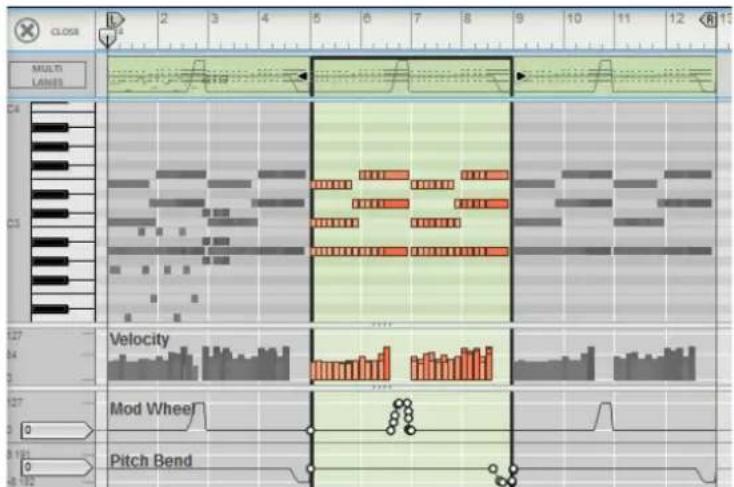
...opens it for editing in Edit Mode. An open clip in Edit Mode is highlighted.
→ Double-click on a closed (grayed out events) note clip in Edit Mode to open it for editing in Edit Mode. You can double-click in the Clip Overview, Note Edit Lane or any of the Performance Controller Edit Lanes (if any).
To close a clip, press [Esc], click outside the open clip in the Clip Overview, or click the Close button. If you opened the clip from the Song/Block View, pressing [Esc] will automatically switch the sequencer back to the Song/Block View.
Open a parameter automation clip for editing
A parameter automation clip contains automation events for a single parameter.
→ Double-click a parameter automation clip in the Song/Block View to open it for editing in the Song/Block View. Alternatively, select the clip and click the Edit Inline button in the Toolbar.
The parameter automation lane expands in height to make it easier to edit the automation events. Now you can edit the parameter automation events without needing to switch to Edit Mode. This is very practical if you want to perform quick editing of automation events.

A parameter automation clip before and after opening it in the Song/Block View.
To close an open parameter automation clip in the Song/Block View, press [Esc] or click on another lane. See "Editing parameter automation in the Song/Block View" for information on how to edit parameter automation events in the Song/Block View.
To open a parameter automation clip in the Song/Block View for editing in Edit Mode, double-click the clip and then click the Open In Edit Mode button. Alternatively, select the clip and click the Edit Mode button in the Toolbar.
→ Double-click on a parameter automation clip in Edit Mode to open it for editing in Edit Mode.

A parameter automation clip before and after opening it in Edit Mode.
To close an open parameter automation clip in Edit Mode, press [Esc] or click anywhere on another lane.
See "Editing parameter automation in Edit Mode" for information on how to edit parameter automation events in Edit Mode.
Edit Mode elements
In Edit Mode, a note clip is divided into various Edit Lanes which are used for editing different types of events and values (i.e. note events, velocity values and performance controller automation events). At the bottom, any parameter automation lanes on the track will also be shown. The different Edit Lanes can be resized by adjusting the horizontal dividers between the lanes. You can also scroll and zoom on each Edit Lane by using the scroll bars and Vertical Zoom tools on the right hand side of the Edit Pane.
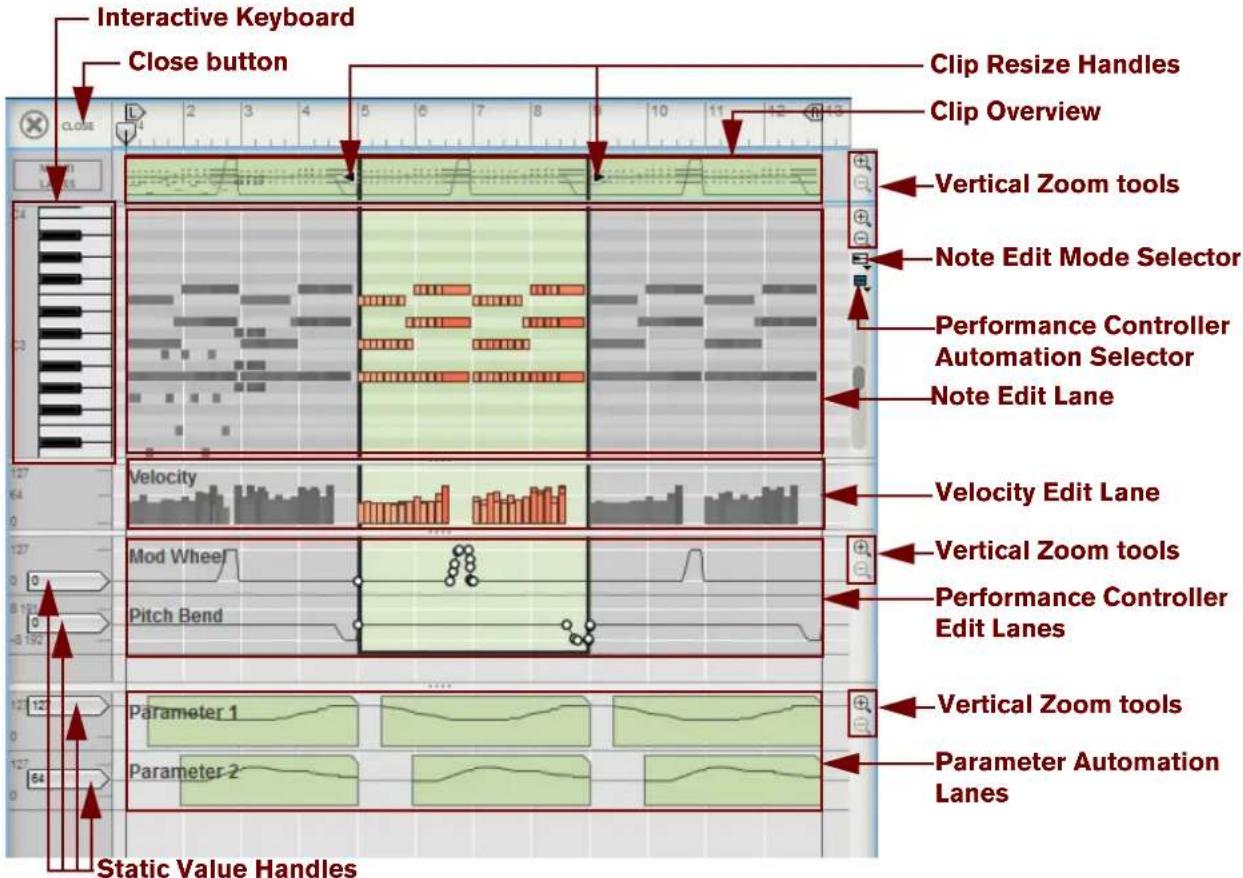
The picture shows three note clips in Edit Mode. The center clip is open for editing and therefore highlighted. Adjacent (closed) clips on the same lane are visible but the events are grayed out.
From the top down in the picture above, the Edit Pane contains the following elements:
- Interactive Keyboard
The interactive Keyboard highlights the notes you play on your MIDI keyboard, as well as notes you edit on the Edit Pane. You can also play (and record) notes by clicking on the Interactive Keyboard.
- Close button
Click the Close button to exit Edit Mode and return to the Song/Block View.
- Clip Resize Handles
By clicking and dragging either of the handles, you can change the position and length of the clip.
- Clip Overview
The Clip Overview shows the note clips of the note lane which has edit focus. You can select one or several clips in the Clip Overview and perform clip-based editing (e.g. moving and resizing) - just like in Arrange Mode.
- Note Edit Mode Selector
To the right of the Note Edit Lane, below the Vertical Zoom tools, is the Note Edit Mode Selector. Click to choose between Key Edit, Drum Edit or REX Edit Mode. Depending on selected mode, the Note Edit Lane will display differently. See more about the different modes in "Note Edit Modes".
• Performance Controller Automation Selector
Each performance controller you used when recording the note clip has its own separate Performance Controller Edit Lane. You can add or delete performance controller edit lanes from the clip using this selector. See the "Creating new performance controller automation lanes" and "Deleting performance controller automation lanes" for more details.
• Note Edit Lane
Here you can edit the notes of one open clip at a time. Note events are displayed as orange horizontal "boxes" in a piano roll fashion on the Note Edit Lane. The left side of each box indicates Note On (key down) and the right side Note Off (key up). The color intensity of each box indicates the velocity for the corresponding note. Depending on selected Note Edit Mode (see "Note Edit Modes"), the contents of the Note Edit Lane will display differently.
• Velocity Edit Lane
The Velocity Edit Lane shows the velocity values for each of the recorded notes. Velocity values are automatically recorded together with notes. See more about editing velocity values in “Editing note velocity”.
• Performance Controller Edit Lanes
On the Performance Controller Edit Lanes are the performance controller events for Mod Wheel, Pitch Bend, Sustain Pedal etc. Performance controller events are automatically distributed on separate lanes for each recognized controller during recording. Even though performance controllers belong to separate note clips, they will affect all active parallel note lanes on a track. See "Automation editing" for details on how to edit performance controller events.
• Parameter Automation Lanes
Any recorded parameter automation will be shown in separate clips, on separate Parameter Automation Lanes. Parameter automation clips don't "belong" to the note lane or to any note clips, and will not be opened together with note clips. Double-clicking on a parameter automation clip will open it for editing. See "Automation editing".
• Static Value Handles
The Static Value Handles to the left of the Performance Controller Edit Lanes and Parameter Automation Lanes indicate to what value the automated controller/parameter will default to where there are no clips on the lane. Basically, this value reflects the parameter's initial value, before it was automated. You can easily change a parameter's Static Value by dragging the Static Value Handle up or down. See "Automation editing" for more details.
Edit Mode window handling
Resizing, zooming and scrolling
→You can resize or hide Edit Lanes by dragging the dividers between them.
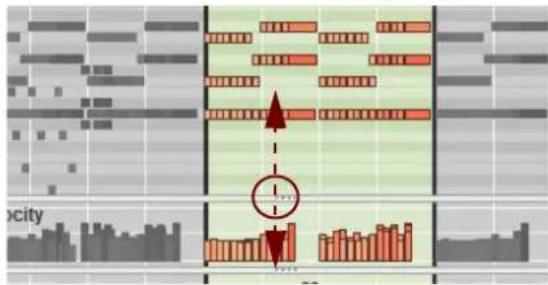
Where applicable, individual zoom controls and scrollbars are available to the right of each Edit Lane.
→ The Magnifying Glass tool can be used for zooming in and out (see "Magnifying Glass Tool").
→ The Hand tool can be used for scrolling the view in any direction (see "Hand Tool").
→ Use the Song Navigator to scroll and zoom horizontally (see "Areas, windows and basic navigation").
→ Click on a Song Navigator Handle and drag horizontally to zoom in and out horizontally (see "Areas, windows and basic navigation").
→ Shift-click on a Song Navigator Handle and drag horizontally to zoom in and out horizontally, symmetrically (see "Areas, windows and basic navigation").
→ Shift-click or Right-click (Win) or Ctrl-click (Mac) inside the Song Navigator and drag up or down to zoom in and out horizontally, symmetrically (see "Areas, windows and basic navigation").
→Use the Scrollbars to scroll vertically in the respective Edit Lanes.
→ Click the Zoom buttons to the right to zoom in and out vertically in the respective Edit Lanes.
- For extensive editing, you may want to maximize the sequencer and/or have it in a separate window covering the entire computer screen. Refer to "Areas, windows and basic navigation".
Note Edit Modes
When you switch to Edit Mode, the device used on the selected instrument track determines which Note Edit Mode is selected. For instrument tracks associated with synth devices such as the ID 8 device, for example, Key Edit Mode is automatically selected. For Redrum tracks Drum Edit Mode is selected and for Dr. Octo Rex tracks the REX Edit Mode is automatically selected.
In all three Note Edit Modes, the note events are shown as "boxes", with the note length indicated by the width of the box and the velocity values indicated by the color intensity of the box (the darker the color, the higher the velocity). The basic note editing procedures are the same for all three Note Edit Modes.
→ You can manually change Note Edit Mode by clicking the Note Edit Mode button in the upper right corner of the Note Edit Lane and selecting another mode from the pop-up menu.
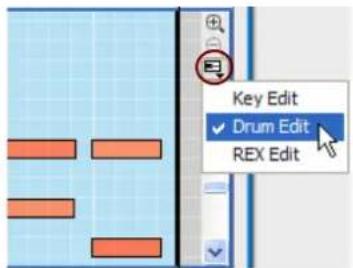
Selecting Note Edit Mode.
The selected Note Edit Mode is automatically remembered for each note lane on a track. The next time you switch to Edit Mode, the correct Note Edit Mode will be recalled for that note lane.
Key Edit Mode
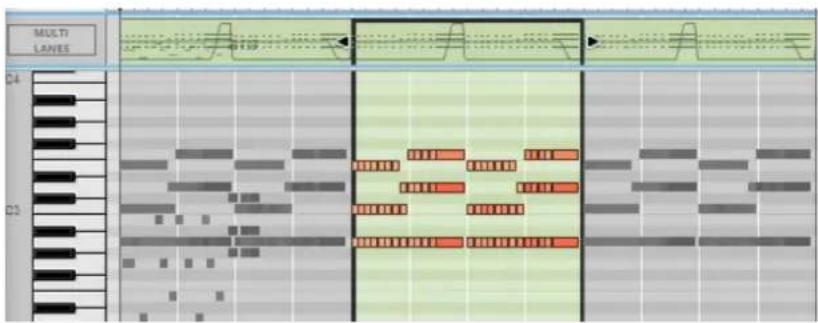
Key Edit Mode.
Key Edit Mode is best suited for viewing and editing notes recorded for instrument devices, such as the ID 8. The piano keyboard to the left indicates the notes values, covering the entire MIDI note range (C-2 to G8). By clicking on any of the keys, you can audition the notes. As soon as the mouse pointer reaches the keyboard section, the cursor changes to a speaker symbol.
- Note that the black and white keys are reflected in the background colors of the Note Edit Lane grid, making it easier to locate the desired note when drawing and moving note events.
Drum Edit Mode
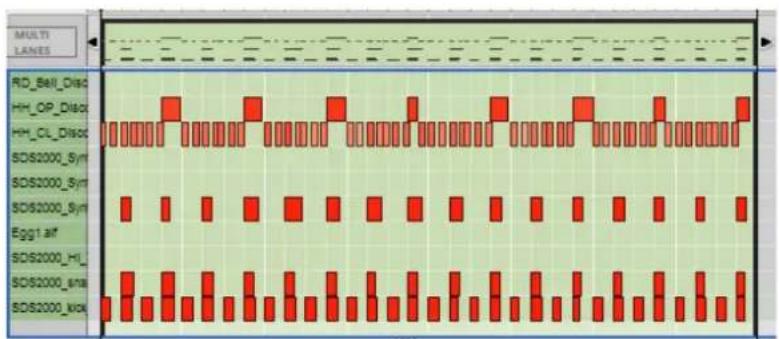
Drum Edit Mode.
Drum Edit Mode is best suited for viewing and editing notes recorded for a Redrum device. In Drum Edit Mode the keyboard has been replaced by a list showing the corresponding Redrum drum sound channel names. If the track is associated with another type of instrument device, the list shows MIDI note numbers (0-127) instead. By clicking on any of the names (or note numbers) in the list, you can audition the sounds.
REX Edit Mode
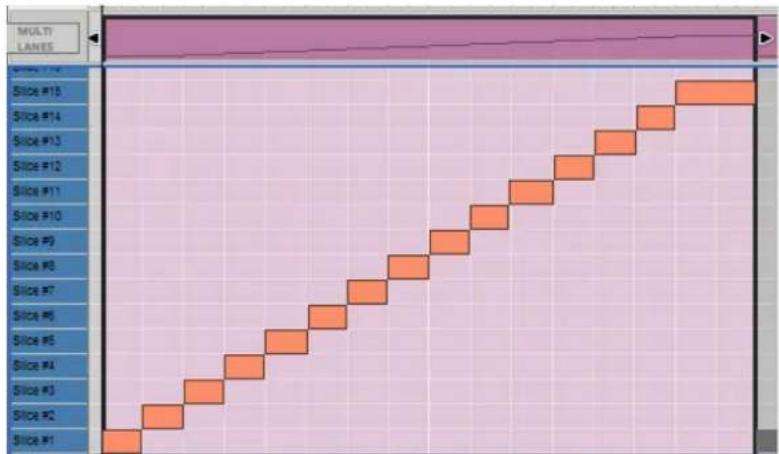
bar
| Slice | Value | |---|---| | Slice #1 | 0 | | Slice #2 | 1 | | Slice #3 | 2 | | Slice #4 | 3 | | Slice #5 | 4 | | Slice #6 | 5 | | Slice #7 | 6 | | Slice #8 | 7 | | Slice #9 | 8 | | Slice #10 | 9 | | Slice #11 | 10 | | Slice #12 | 11 | | Slice #13 | 12 | | Slice #14 | 13 | | Slice #15 | 14 | | Slice #16 | 15 | | Slice #17 | 16 | | Slice #18 | 17 | | Slice #19 | 18 | | Slice #20 | 19 | | Slice #21 | 20 | | Slice #22 | 21 | | Slice #23 | 22 | | Slice #24 | 23 | | Slice #25 | 24 | | Slice #26 | 25 | | Slice #27 | 26 | | Slice #28 | 27 | | Slice #29 | 28 | | Slice #30 | 29 | | Slice #31 | 30 | | Slice #32 | 31 | | Slice #33 | 32 | | Slice #34 | 33 | | Slice #35 | 34 | | Slice #36 | 35 | | Slice #37 | 36 | | Slice #38 | 37 | | Slice #39 | 38 | | Slice #40 | 39 | | Slice #41 | 40 | | Slice #42 | 41 | | Slice #43 | 42 | | Slice #44 | 43 | | Slice #45 | 44 | | Slice #46 | 45 | | Slice #47 | 46 | | Slice #48 | 47 | | Slice #49 | 48 | | Slice #50 | 49 | | Slice #51 | 50 | | Slice #52 | 51 | | Slice #53 | 52 | | Slice #54 | 53 | | Slice #55 | 54 | | Slice #56 | 55 | | Slice #57 | 56 | | Slice #58 | 57 | | Slice #59 | 58 | | Slice #60 | 59 | | Slice #61 | 60 | | Slice #62 | 61 | | Slice #63 | 62 | | Slice #64 | 63 | | Slice #65 | 64 | | Slice #66 | 65 | | Slice #67 | 66 | | Slice #68 | 67 | | Slice #69 | 68 | | Slice #70 | 69 | | Slice #71 | 70 | | Slice #72 | 71 | | Slice #73 | 72 | | Slice #74 | 73 | | Slice #75 | 74 | | Slice #76 | 75 | | Slice #77 | 76 | | Slice #78 | 77 | | Slice #79 | 78 | | Slice #80 | 79 | | Slice #81 | 80 | | Slice #82 | 81 | | Slice #83 | 82 | | Slice #84 | 83 | | Slice #85 | 84 | | Slice #86 | 85 | | Slice #87 | 86 | | Slice #88 | 87 | | Slice #89 | 88 | | Slice #90 | 89 | | Slice #91 | 90 | | Slice #92 | 91 | | Slice #93 | 92 | | Slice #94 | 93 | | Slice #95 | 94 | | Slice #96 | 95 | | Slice #97 | 96 | | Slice #98 | 97 | | Slice #99 | 98 | | Slice #100 | 99 |REX Edit Mode.
REX Edit Mode is designed for viewing and editing Dr. Octo Rex Loop Player slices. In REX Edit Mode the keyboard has been replaced by a list showing the corresponding loop slice numbers in a Dr. Octo Rex device. Slice #1 in the list corresponds to the note C3. By clicking on any of the slice numbers in the list, you can audition the corresponding sound of the Rex loop.
Creating empty clips
When you record in the sequencer, clips are automatically created on the record enabled lane when necessary. However, there might be situations when you want to manually draw empty clips in the Song/Block View to record or edit in later on:
→ To create an empty clip, double click with the Selection (Arrow) Tool on a track.
This will create an empty clip with the length of the current Snap value setting (e.g. 1 bar). To create longer clips, double click, keep the mouse button pressed and drag to the right.
Alternatively, do as follows:
- Select the Pencil Tool from the sequencer Toolbar.
- Place the Pencil on the lane where you want the clip to begin.
If you want to create a note clip, draw it on a note lane. If you want to create a parameter automation clip, draw it on a parameter automation lane. If Snap is activated, the clip start and end boundaries will snap to the set Snap value (see "Snap").
- Click and drag the Pencil to the right where you want the clip to end.

An empty note clip in the Song View created using the Pencil Tool.
→ You can also draw empty clips in Edit Mode. A note clip should then be drawn in the Clip Overview and a parameter automation clip on the corresponding Parameter Automation Lane.
If you draw on the Edit Pane in Edit Mode, a note will be created instead. If necessary, a new clip will be automatically created to surround the note.
- See also "Drawing notes" and "Drawing parameter automation events".
Tool Window editing tools
The Sequencer Tools tab in the Tool Window is very useful when you want to perform various note and parameter automation editing tasks. Here is how you access the Tool Window and the contents of the Sequencer Tools tab:
-
Open the Tool Window by selecting "Show Tool Window" from the Window menu. Alternatively, press [F8]. The [F8] key can be used for toggling between showing and hiding the Tool Window.
-
Click the Sequencer Tools tab.
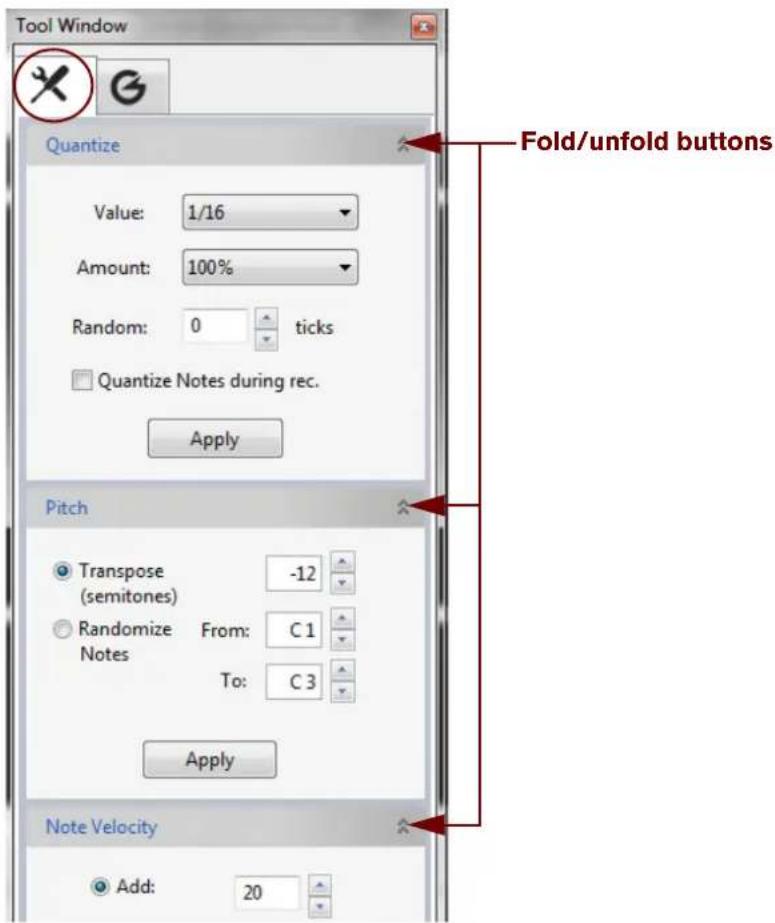
The Sequencer Tools page has a number of panes, each with separate functions.
→ Click on the arrow buttons to the right of the function name to fold/unfold the corresponding pane.
→ Hold down Alt or Option and click an arrow button to fold/unfold all panes simultaneously.
The values in the displays on the various panes can be edited in similar ways as in the Inspector. For single-segment displays, you can either use the spin controls or click in the display and select a value from a list, or drag up or down to change the value. For multi-segment displays, click on a specific segment (e.g. bars, beats, 1/16ths or ticks) and then use the spin controls to set the value. Alternatively, click on a segment and drag up or down.
Note editing
Notes can be edited using the mouse in Edit Mode. It's also possible to edit notes by using the functions on the Tools tab in the Tool Window. Notes can also be numerically edited in the Inspector, as described in "Note and automation editing in the Inspector".
Selecting notes
To select notes in an open clip in Edit Mode, use one of the following methods:
→ Click on a note event with the Selection (Arrow) Tool.

The Selection tool.
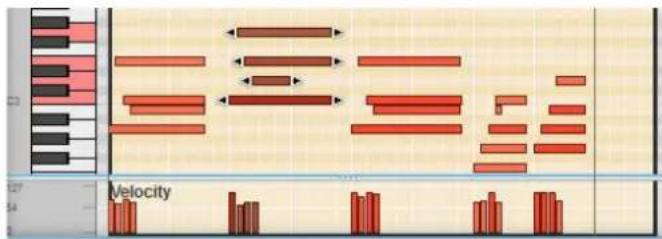
- Selected notes are distinguished by a darker color and by the handles at both edges.
The selected notes are also highlighted in the interactive keyboard to the left.
To select several notes, hold down Ctrl or Shift and click on the desired notes, one after the other. You can deselect individual notes by Ctrl-clicking or Shift-clicking them again. In Windows it's also possible to select a range of notes by [Shift]-clicking the first and last note in the range.
→ You can also click and drag a selection rectangle around the notes you want to select.
→ You can select the next or previous note on the lane by pressing the right or left arrow key on the computer keyboard.
Holding down [Shift] and using the arrow keys allows you to make multiple selections.
To select all notes of the same pitch (note value) in a clip, double-click the corresponding key in the keyboard display to the left in Key Edit Mode.
To select notes of the same pitch(es) of one or several notes, first select the note(s) in the open clip and then use the function "Select Notes of Same Pitch" on the Edit menu or context menu.
To select all notes in the open clip, use the "Select All" function on the Edit menu. Alternatively, hold down Ctrl or Cmd and press [A].
→ To deselect all notes, click somewhere in an empty area in the clip (where there are no events).
Drawing notes
Notes are usually drawn and edited in Key Edit Mode on the Note Edit Lane, but the actions described below also apply to the Drum Edit Mode and the REX Edit Mode.
! If you want to restrict note input to certain note values (e.g. 1/16th notes), activate Snap (see "Snap") and set the snap value accordingly.
Drawing single notes
→ Double click with the Selection (Arrow) tool in the open clip to insert a note with a length of the current Snap value.
This will create a note with the length of the current Snap value setting (e.g. 1/16th note). To create longer notes, double click, keep the mouse button pressed and drag to the right.
Alternatively, do as follows:
- Select the Pencil tool.
- With the Selection (Arrow) tool selected, you can toggle temporarily between the Selection tool and the Pencil tool by holding down Alt or Cmd. To switch between the Pencil and "Multiple notes" tools (see "Drawing multiple notes of the same length"), hold down [Alt]+Ctrl or [Cmd]+Option.
- Click at the desired position on the Note Edit Lane.
A note will be inserted at the closest Snap value position. By default, the note will be given the Velocity value '100'. (This can be edited afterwards according to the descriptions in "Editing note velocity"). If an open or closed clip is already present on the Note Lane, at the position where you draw the note, the note will be placed in that clip. If no clip is available, refer to "About drawing notes outside an open clip" and "About drawing notes outside a closed clip" below.
- If you just click, and Snap is activated, the note will get the length of the set Snap value.
If Snap is off, the note will get the length of the shortest possible Snap value, i.e. 1/28th note.
- If you click and keep the mouse button depressed, you can drag to the right to set the length of the note.
If Snap is on, the length will be a multiple of the Snap value.
! If you are drawing drum notes for a Redrum device, refer to the info about drum note lengths in "About resizing drum notes".
Drawing multiple notes of the same length
- Click the Pencil tool (twice) and select "Draw multiple notes".
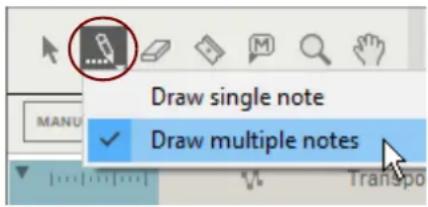
- With the Selection (Arrow) tool selected, you can toggle temporarily between the Selection tool and the Pencil tool by holding down Alt or Cmd. To switch between the “Multiple notes” and “single notes” tools, hold down [Alt]+Ctrl or [Cmd]+Option.
- Select the desired note length from the Snap value selector:

- Click at the desired position on the Note Edit Lane, click and draw sideways to the right:
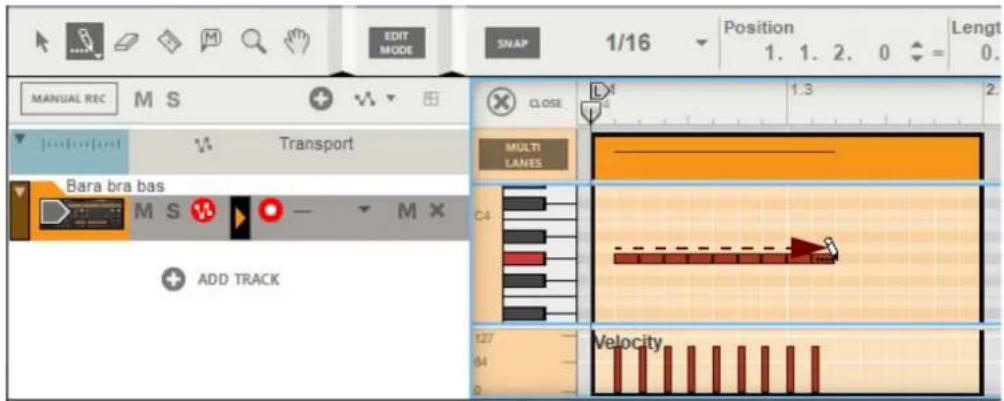
Multiple notes of the currently selected Snap value length are now added after one another (at the same pitch) in the note clip. By default, the notes will be given the Velocity value '100'. (This can be edited afterwards according to the descriptions in "Editing note velocity").
About drawing notes outside an open clip
If you draw notes outside the boundaries of an open clip, the result depends on the setting "Keep Events in Clip While Editing" on the Options menu:
- If the "Keep Events in Clip While Editing" option is active, the notes will belong to the open clip after they have been drawn, but become masked since they are drawn outside the clip boundaries.
The clip position and length will remain unchanged.
- If "Keep Events in Clip While Editing" is deactivated and you draw notes outside the clip, the notes will be placed in an existing clip - or in another new clip on the lane, depending on where you draw.
The picture below shows three scenarios when drawing a note outside an open clip with the "Keep Events in Clip While Editing" option off:
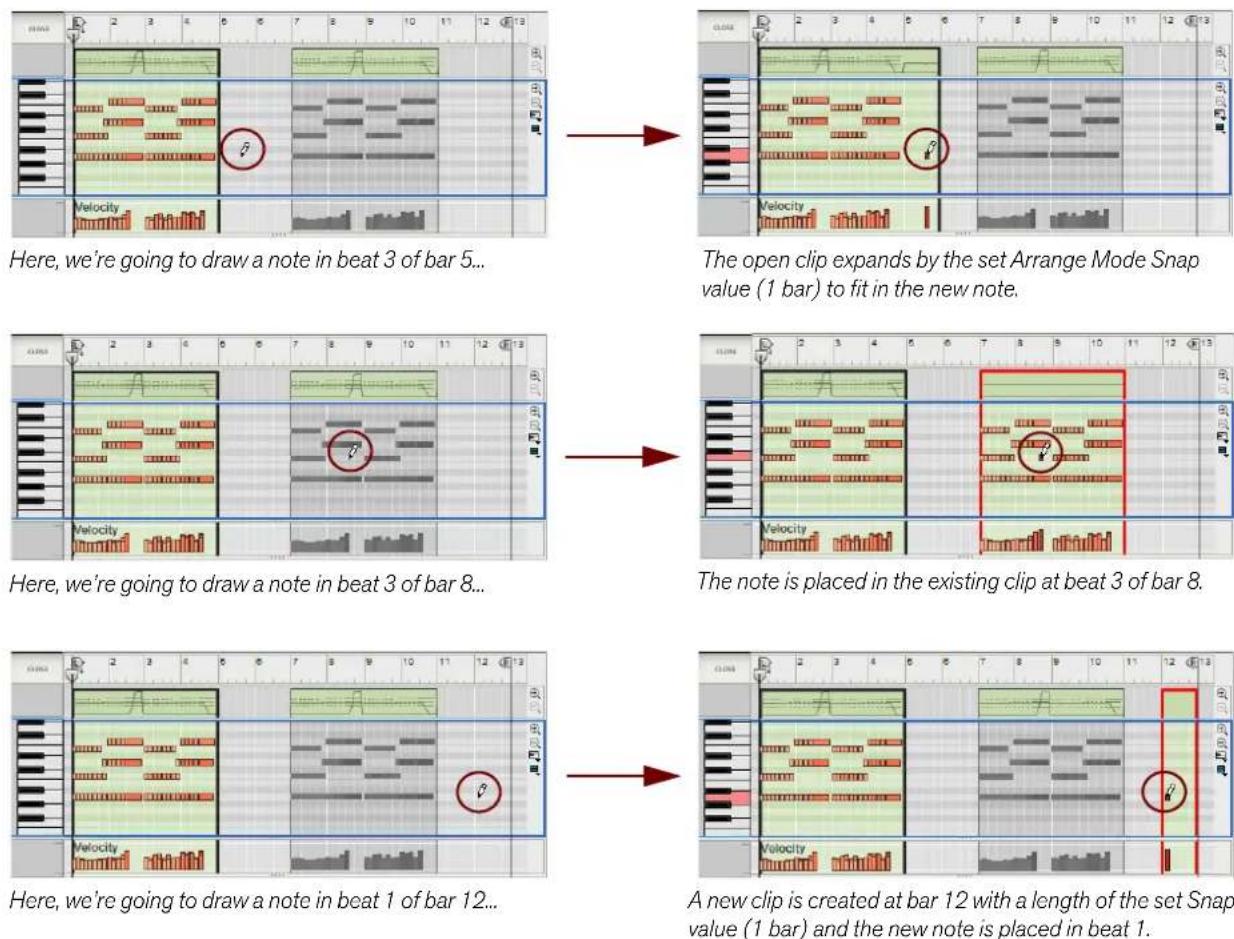
About drawing notes outside a closed clip
If you draw notes outside the boundaries of a closed clip in Edit Mode, i.e. where there are no clips available on the lane, a new clip will be automatically created and opened. The clip length is determined by the Song/Block View Snap value, if Snap is activated.
This works best with "Keep Events in Clip while Editing" turned OFF because then you can continue drawing notes - the clip will be resized to fit the new notes.
Deleting notes
You can delete notes by doing any of the following:
→ To delete individual notes, double click the note with the Selection (Arrow) tool.
→ Select one or several notes with the Selection (Arrow) tool and press [Backspace] or [Delete], or select "Delete" from the Edit or context menu.
→ Select the Eraser tool and click on the notes you want to delete.

The Eraser tool.
→ You can also draw a selection rectangle with the Eraser tool to delete several notes in one go.
Resizing notes
Resizing notes manually
When you select a note on the Edit Pane, a handle appears on either edge of the note. You can click any of these handles and drag sideways to make the note shorter or longer.
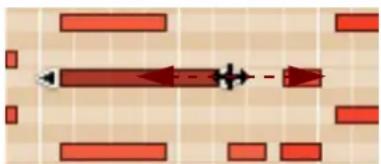
natural_image
Pure diagram of a mechanical or fluid flow path with no text, numbers, or symbols- If Snap is on (see "Snap"), the beginning and/or end of the note will be magnetic to the (absolute) Snap value positions.
- If several notes are selected, the note you resize with the mouse will be magnetic to absolute Snap value positions. The other selected notes will be resized by the current Snap value relative to their original positions or lengths.
- When resizing notes, the event may extend outside the clip boundaries.
As long as the start position of events is inside the clip, the note will play for the whole duration, i.e. it won't be cut off when the clip ends.
! If a note is resized to the left, outside the clip start position, the note will no longer belong to that clip and will thus be masked (silent). to unmask the note, resize the clip to the left so that the note's start position gets inside the clip.
About resizing drum notes
Redrum drum notes can be resized, just like any other notes. However, the audible result of this depends on the settings of the Decay/Gate switch and the Length knob for the drum sound on the Redrum device panel:
- If Decay mode is selected, the drum sound will play to its end, regardless of the note length in the sequencer.
Or rather, it will fade out according to the Length parameter setting on the Redrum device panel.
- If Gate mode is selected, the note lengths in the sequencer affect the resulting sound.
However, the maximum length of the sound is determined by the Length knob setting - the sound will be cut off after this length, regardless of the note length in the sequencer. Also, even if the Length knob is set to its maximum value, the sound will not play longer than the length of the drum sample.
Resizing notes with the "Note Lengths" function
The Note Lengths pane in the Tool Window.
The "Note Lengths" function on the Sequencer Tools tab in the Tool Window allows you to add or subtract length values to the selected notes.
Note length resizing can be applied to:
- Individual (selected) note events in a note clip.
This has to be done in Edit Mode.
- All note events in one or several selected note clips.
This is done in Arrange Mode. If the clips are on the same lane, it can also be done in Edit Mode.
! In Edit Mode, select clip(s) by clicking on it/them in the Clip Overview.
- All note events in all note clips on one or several selected instrument tracks.
This has to be done in the Song/Block View.
→ Click the "Add" or "Sub" radio button and select the length value to add or subtract in the corresponding display. Then, click "Apply".
→ Click the "Fixed" radio button to set all notes to the length defined in the display. Then, click "Apply".
Resizing notes with the "Legato Adjustments" function
The Legato Adjustments pane in the Tool Window.
The "Legato Adjustments" function can be used to extend each selected note so that it reaches the start position of the next selected note. You can also shorten the note length for the first of two selected overlapping notes and set a gap between them. You specify the desired gap or overlap in the displays. Only the note length is affected by Legato Adjustments - note start positions are never changed.
Legato adjustments can be applied to:
- Individual (selected) note events in a note clip.
This has to be done in Edit Mode.
- All note events in one or several selected note clips.
This is done in the Song/Block View. If the clips are on the same lane, it can also be done in Edit Mode.
! In Edit Mode, select clip(s) by clicking on it/them in the Clip Overview.
- All note events in all note clips on one or several selected instrument tracks.
This has to be done in the Song/Block View.
- "Side By Side (Abut)" extends the selected note(s) to the start of the next selected note(s):
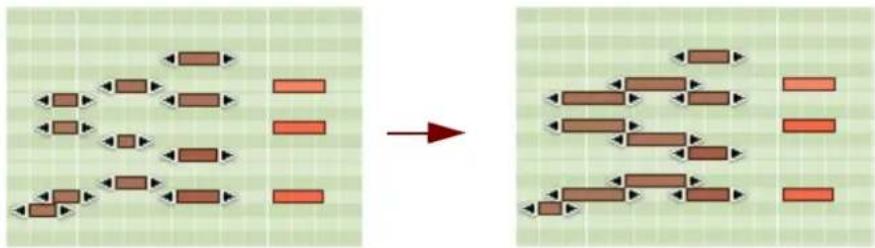
flowchart
graph TD
    A["Grid Structure"] --> B["Transformation"]
    B --> C["Structured Layout"]
    style A fill:#f9f,stroke:#333
    style C fill:#bbf,stroke:#333
A group of notes before and after applying the "Side By Side (Abut)" legato function.
- "Overlap" extends the selected note(s) to overlap the next selected note(s) by a set amount.
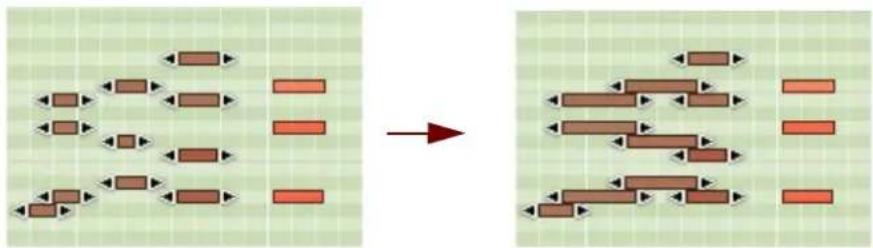
flowchart
graph LR
    A["2x3 Grid Structure"] --> B["3x3 Grid Structure"]
    style A fill:#f9f,stroke:#333
    style B fill:#bbf,stroke:#333
A group of notes before and after applying the "Overlap" legato function with an overlap of 1/16th note.
→ "Gap by" introduces a gap between selected notes, which you specify in the "Gap by:" display.
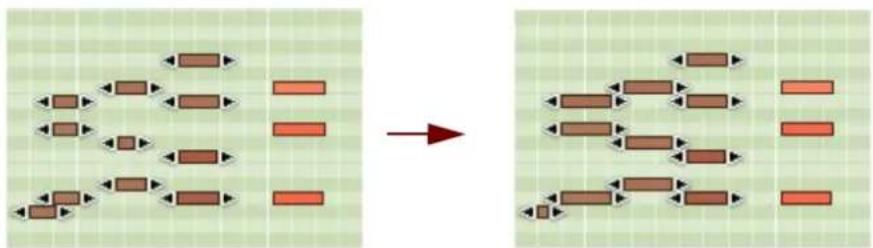
flowchart
graph LR
    A["Sequence Block"] --> B["Final Structure"]
    style A fill:#f9f,stroke:#333
    style B fill:#bbf,stroke:#333
A group of notes before and after applying the "Gap" legato function with a gap value of 1/16th note.
Resizing notes in the Inspector
You can also edit the length of notes numerically in the inspector. See "Note and automation editing in the Inspector".
Muting notes
You can mute individual notes in an open note clip:
- Select the Mute tool.
2. Click the notes you want to mute.
Muted notes are highlighted in blue in the open clip:
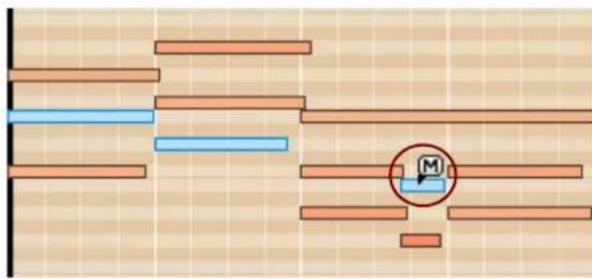
→ To mute multiple notes in one go, select the desired notes with the Selection (Arrow) tool and press [M]. Press [M] again to unmute the selected notes.
Splitting notes
You can split (slice) one or several notes in an open note clip by using the Razor Tool:
1. Select the Razor tool.
The Razor tool.
2. Place the Razor where you want to split the note, and then click:
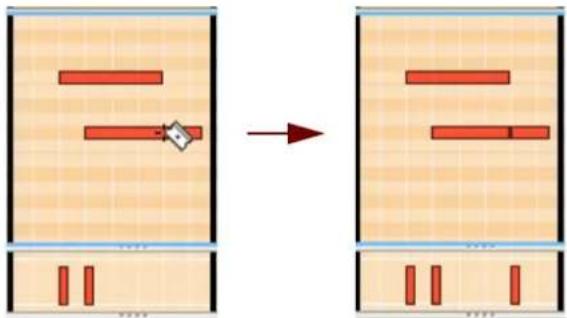
flowchart
graph TD
    A["Rectangular Block"] --> B["Horizontal Bar"]
    style A fill:#f9f,stroke:#333
    style B fill:#bbf,stroke:#333
A note before and after splitting it.
→ You can also split several notes by selecting the Razor tool and drawing a selection rectangle that intersects the desired split points:
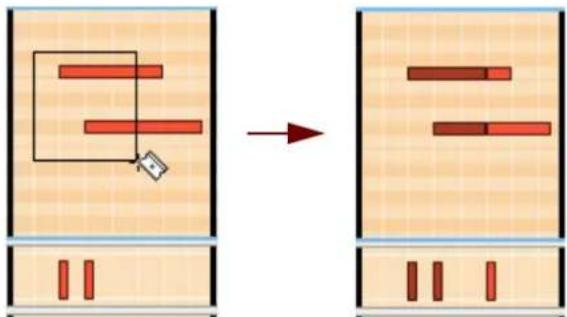
flowchart
graph TD
    A["Rectangular Block with Red Strips"] --> B["Horizontal Bar with Black Arrow"]
    style A fill:#f9f,stroke:#333
    style B fill:#bbf,stroke:#333
Splitting two notes by drawing a selection rectangle with the Razor tool.
The split notes get the same velocity values as their "parent" notes.
Moving notes
Moving notes manually
To move a note, click and drag it to a new position, or new pitch (note number), using the Selection Tool. If several notes are selected, all will be moved. If Snap is on (see "Snap"), the moved events will keep their relative distance to the Snap value positions - or will be moved to new positions on an absolute grid - depending on whether you have selected "Absolute" or "Relative" in the Snap value list.
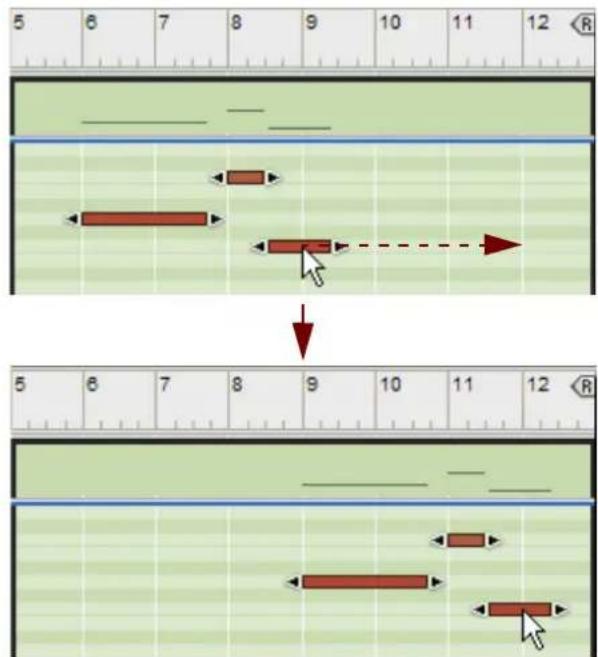
- By default, when manually moving notes to new pitches (note numbers), the notes will trigger and sound. This makes it easier to move (transpose) the notes to where you want them.
If you don't want notes to sound during editing, it's possible to disable the function in the Preferences dialog by deselecting the "Trigger Notes While Editing" box:
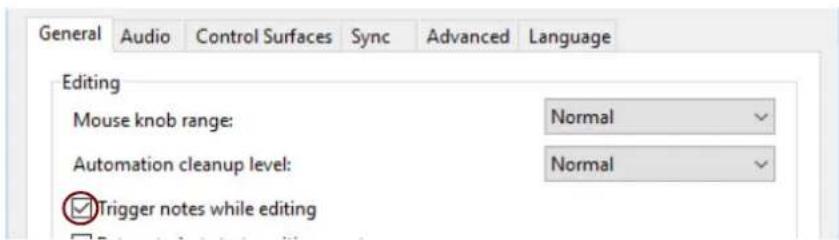
The "Trigger notes while editing" function in the Preferences dialog.
→ If you hold down [Shift] when you drag, the movement is restricted to horizontal or vertical direction.
This helps you move notes without accidentally transposing them, or transpose notes without accidentally changing their position.
→ You can also edit the note pitches numerically using the "Pitch (Transpose)" function in the Tool Window.
See "Pitch (Transpose)".
→ You can also move selected notes to a new note clip, on a new additional note lane, by right-clicking (Win) or [Ctrl]-clicking (Mac) and selecting "Move Selected Notes to New Lane" from the context menu.
A new note clip and note lane will be automatically created.
About moving notes outside or between clips
If you want to move notes outside the boundaries of an open clip, the result depends on the setting "Keep Events in Clip While Editing" on the Options menu:
- If the “Keep Events in Clip While Editing” option is active, the notes will belong to the open clip after they have been moved, but become masked since they are moved outside the clip boundaries.
The clip position and length will remain unchanged.
- If "Keep Events in Clip While Editing" is deactivated and you move notes outside the clip, the notes will be placed in an existing clip - or in a new clip on the lane, depending on to where you move them to.
The picture below shows three scenarios when moving three notes outside a clip with the "Keep Events in Clip While Editing" option off:
We're going to move the last three notes in the clip to beat 3 in bar 5.
The open clip expands by the set Song/Block View Snap value (1 bar) to fit in the moved notes.
Here, we're going to move the last three notes in the clip to beat 4 in bar 10.
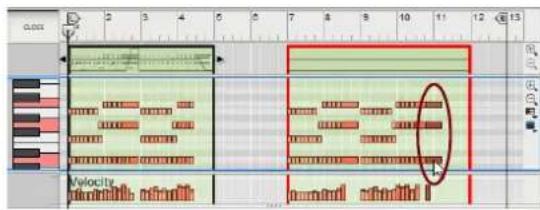
The notes are placed in the other existing clip at beat 4 in bar 10.
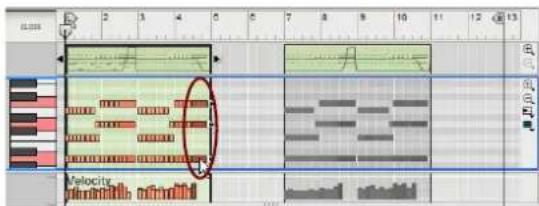
Here, we're going to move the last three notes in the clip to beat 1 in bar 12.
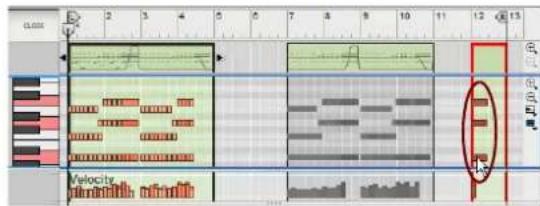
A new clip is created at bar 12 with a length of the set Sna value (1 bar) and the notes are placed in beat 1.
Changing note pitches (transpose) with the arrow keys
You can use the up/down arrow keys to change the pitches of selected notes by moving them up or down:
→ Hold Ctrl or Cmd and use the up or down arrow key to move the selected notes in semi-tone steps.
You can also move/transpose notes in whole octave steps:
To move the selected notes up/down in octave steps, hold [Shift]+Ctrl or [Shift]+Cmd and use the up or down arrow key.
Nudging note positions with the arrow keys
You can use the left or right arrow keys to "nudge" the positions of selected note events:
→ Hold Ctrl or Cmd and use the left or right arrow key to move the position back or forward by the set Snap value.
→ Hold [Ctrl]+Alt or [Cmd]+Option and use the left or right arrow key to move the position back or forward in Tick increments.
There are 240 ticks per 1/16 note so this allows for very fine editing. Check the Tick value in the Inspector when you nudge because typically you won't see the position changes on the Edit Pane, unless you have zoomed in a lot.
→ Hold [Ctrl]+Shift or [Cmd]+Shift and use the left or right arrow key to move the position back or forward in Beat increments.
About nudging notes outside an open clip
If you nudge notes outside the boundaries of an open clip, the notes will belong to the open clip, but become masked since they are nudged outside the clip boundaries. The "Keep Events in Clip While Editing" setting has no effect when nudging notes. If you want to move notes between clips, or to a new clip, you have to do that using the Selection Tool as described in "About moving notes outside or between clips".
Moving notes with the "Alter Notes" function
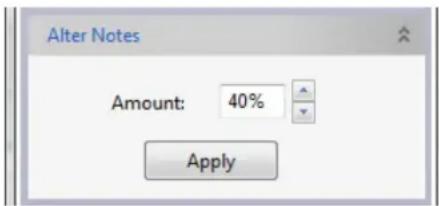
The Alter Notes pane in the Tool Window.
The “Alter Notes” function on the Sequencer Tools tab in the Tool Window alters the positions between the selected notes, in a random fashion.
The "Alter Notes" function can be applied to:
- Individual (selected) note events in a note clip.
This has to be done in Edit Mode.
- All note events in one or several selected note clips.
This is done in the Song/Block View. If the clips are on the same lane, it can also be done in Edit Mode.
! In Edit Mode, select clip(s) by clicking on it/them in the Clip Overview.
- All note events in all note clips on one or several selected instrument tracks.
This has to be done in the Song/Block View.
- The Alter Notes function will only use the note positions that already exist among the selected notes.
→Adjust the alteration amount in with the Amount display.
- This function is especially useful for experimenting with rearranging Dr. Octo Rex loop slices. Select some slices on a Dr. Octo Rex track and use Alter Notes to rearrange the slices and create instant variations, without losing the timing and rhythmic feel of the loop.
Moving notes with the "Extract Notes to Lanes" and "Explode" functions
It's possible to move defined notes in a clip to new clips on new, additional lanes. See "Extract Notes to Lanes".
Moving notes in the Inspector
You can also edit the note positions and pitches numerically in the inspector. See "Note and automation editing in the Inspector".
Duplicating notes
Duplicating notes manually
→ To duplicate selected notes, hold down Ctrl or Cmd and press [D].
This will duplicate the selection and place it after the selection, at the closest Snap value after the last note in the selection. Repeat the command to continue the duplication for as many times as you like.
To duplicate selected notes, hold down Ctrl or Option and click and drag a copy of the selection, similar to when moving notes manually (see "Moving notes").
→ You can also duplicate selected notes to a new note clip by right-clicking (Win) or [Ctrl]-clicking (Mac) and selecting "Duplicate Selected Notes to New Lane" from the context menu.
This will automatically copy the selection and paste it in a new note clip on a new, additional note lane.
Duplicating notes with the "Extract Notes to Lanes" function
It's possible to duplicate defined notes in a clip and automatically place them on new, additional lanes. See "Extract Notes to Lanes".
Using Cut, Copy and Paste
You can move or duplicate events using the Cut, Copy and Paste commands on the Edit menu or context menu.
- When you use Cut or Copy, the Song Position Pointer is automatically moved to the end of the selection. This is very useful for repeating events, i.e. pasting the selection several times one after another in the song.
Pasting events outside an open clip
When you use the Paste command, the events will appear at the Song Position Pointer, on the original lane. Depending on the "Keep Events in Clip While Editing" setting in the Preferences dialog, the following rules apply:
- If the "Keep Events in Clip While Editing" option is active, the notes will belong to the open clip after they have been pasted, but become masked since they are pasted outside the clip boundaries. The clip position and length will remain unchanged.
- If "Keep Events in Clip While Editing" is deactivated and you paste notes outside the clip, the notes will be placed in an existing clip - or in another new clip on the lane, depending on where you paste them. The picture below shows three scenarios where three notes are being cut and pasted at different positions outside the open clip with the "Keep Events in Clip While Editing" option off. We determine the paste positions by moving the Song Position Pointer:
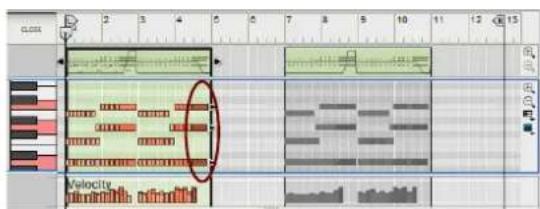
We're going to cut the last three notes in the open clip and paste at beat 3 in bar 5.
The open clip expands by the set Song/Block View Snap value (1 bar) to fit in the pasted notes.
Here, we're going to cut the last three notes in the open clip and paste at beat 4 in bar 10.
The notes are pasted in the other existing clip at beat 4 in bar 10.
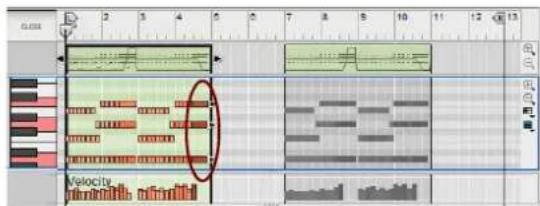
Here, we're going to cut the last three notes in the open clip and paste at beat 1 in bar 12.

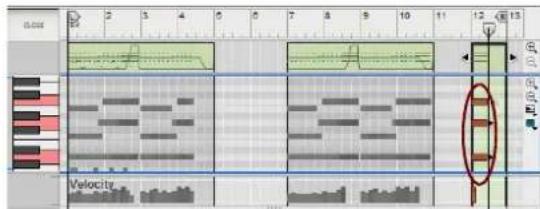
A new clip is created at bar 12, with a length of the set Sna value (1 bar), and the notes are pasted in beat 1.
Quantize
The "Quantize" function on the Transport Panel and on the Sequencer Tools tab in the Tool Window is normally used for applying quantization to notes - but can also be used for quantizing recorded audio. Clicking the Quantize or Apply button will automatically align the start positions of the selected notes or audio slices to a pre-defined, absolute grid. You can also choose to automatically quantize MIDI notes as they are being recorded - see "Quantizing notes during recording".
Quantization can be applied to:
- Individual (selected) notes in a note clip or in an audio clip in Pitch Edit mode.
This has to be done in Edit Mode/Pitch Edit mode.
- Individual (selected) audio slices in a Single Take audio clip.
This has to be done in Slice Edit mode.
- All notes in one or several selected note clips.
This is done in the Song/Block View. If the clips are on the same lane, it can also be done in Edit Mode.
- All audio recordings in one or several selected Single Take audio clips.
This is done in the Song/Block View. If the clips are on the same lane, it can also be done in the Comp Editor.
! In Edit mode, select clip(s) by clicking on it/them in the Clip Overview.
- All notes in all note clips and/or all audio slices in all Single Take audio clips on one or several selected tracks.
This has to be done in the Song/Block View.
The quantization grid is selected in the Quantize Value drop-down list on the Transport Panel and/or in the Quantize pane on the Tools tab in the Tool Window:
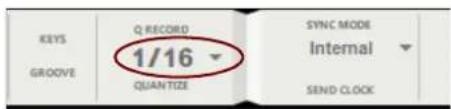
The Quantize Value drop-down list on the Transport Panel.
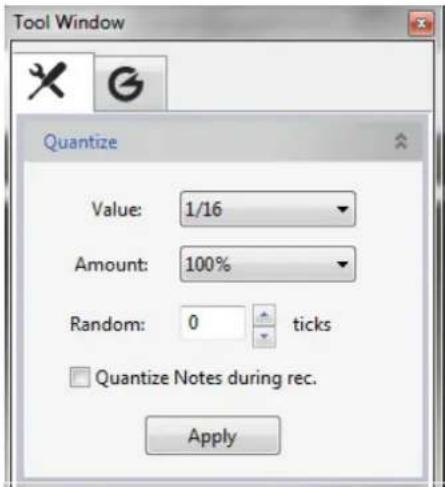
The Quantize pane in the Tool Window.
In most situations the Quantize functions on the Transport Panel are probably sufficient. However, if you want more in-depth quantization functionality, perform the quantization in the Tool Window instead.
- You could also use the ReGroove functions for groove quantizing of notes. See "The ReGroove Mixer"
Quantizing after recording
- Select the note(s)/audio slices, note clip(s)/Single Take audio clips or instrument and audio track(s) you want to quantize.
Only the notes/audio slices in the clip(s) will be affected - not any parameter automation events.
- Select a quantize value from the Quantize Value drop-down list on the Transport Panel, or from the Value drop-down list in the Tool Window.
This determines to which note value grid the notes/audio slices will be moved when you quantize. For example, if you select 1/16, the notes/audio slices will be moved to (or closer to) the closest sixteenth note position.
! Since several audio slices cannot be quantized to the same position, only the slices closest to the quantize grid will be moved - the other slices will be ignored.
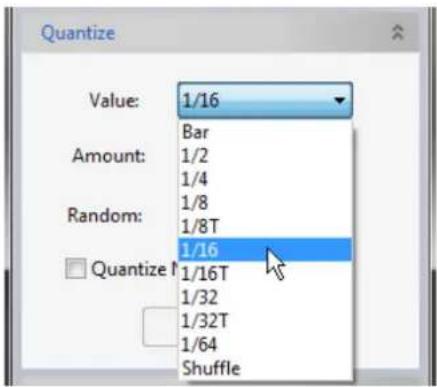
The Quantize Value drop-down list in the Tool Window.
A 'T' letter next to some quantization value means Triplets. The effect of using triplets is that three notes are equally distributed over the same time period as two "regular" (non-triplet) notes of the same note value.
- Select a value from the Quantize Amount drop-down list.
This is a percentage, governing how much each note or audio slice should be moved. If you select 100%, the notes/audio slices will be moved all the way to the closest Quantize value positions; if you select 50%, the notes/audio slices will be moved half-way, etc.
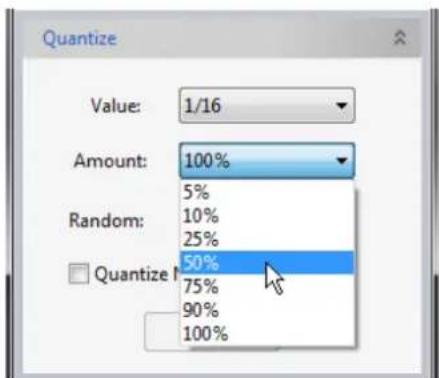
The Quantize Amount drop-down list in the Tool Window.
- Click the Quantize button on the Transport Panel or the Apply button in the Tool Window.
The selected notes are quantized.
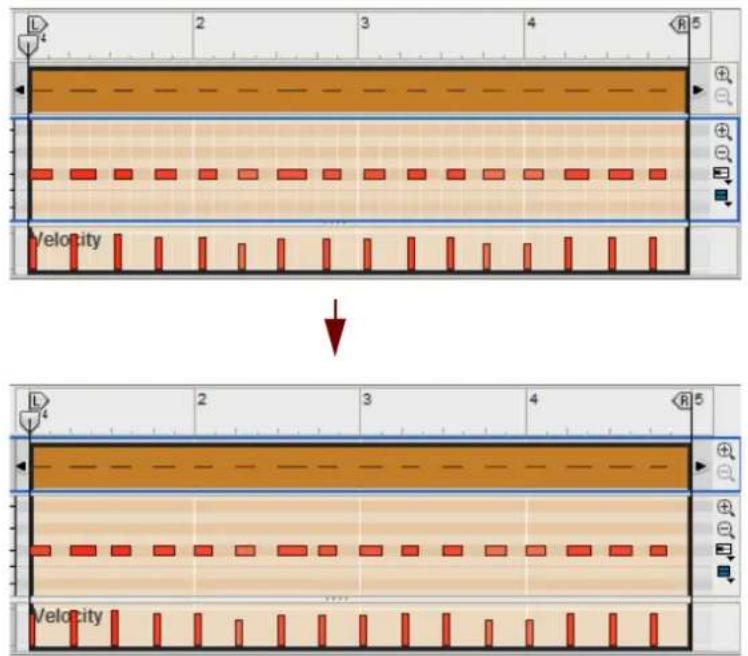
A sloppily recorded hi-hat pattern is quantized to straight 1/4 notes (Quantize Value 1/4, Amount 100%).
- Quantization can also be applied to note(s), audio slice(s), clip(s) and track(s) by right-clicking(Win) or [Ctrl]-clicking(Mac) and selecting "Quantize" from the context menu.
The current settings on the "Quantize" pane in the Tool Window will apply when performing this operation.
Random
You can offset the quantized notes/audio slices using the Random function. The notes/audio slices will be quantized according to the Value and Amount settings, but the note/slice positions will be randomly offset by the set tick value. E.g. if you set Random to 10 ticks, the notes/slice positions will randomly vary within a +/- 10 tick range after applying quantization.
Quantize to Shuffle
In the Value drop-down list, you will also find an option called "Shuffle". If this is selected when you quantize, the notes/audio slices are moved towards sixteenth note positions, but with Shuffle applied.
Shuffle creates a "swing feel" by delaying the even-numbered sixteenth notes (the sixteenth notes that fall in between the eighth notes). The amount of Shuffle is set with the Global Shuffle control in the ReGroove Mixer. Quantizing to Shuffle is useful if you want to match the timing with pattern devices in the song (if Shuffle is activated in their patterns).
A more flexible way of doing this for notes and note clips is to use the ReGroove mixer - see "The ReGroove Mixer" chapter for details.
! The Amount setting applies as when quantizing to "regular" note values.
Quantizing notes during recording
It's also possible to quantize input notes directly during recording. Activation of this function can be made in the Tool Window and/or on the Transport Panel:
→ Enable note quantization by ticking the "Quantize Notes During Recording" check box.
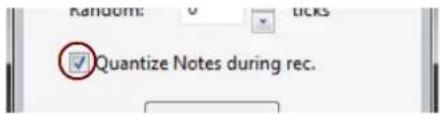
The Quantize Notes During Recording check box on the Sequencer Tools tab.
→ Alternatively, click the Q Rec button on the Transport Panel.

The Q Record (Quantize Notes During Recording) button on the Transport Panel.
It doesn't matter where you activate or deactivate this function - the current state is automatically mirrored at the other location.
Any notes recorded after having activated this function will be automatically quantized to the current settings on the "Quantize" pane in the Tool Window, see "Quantize".
! Audio cannot be quantized during recording!
Pitch (Transpose)
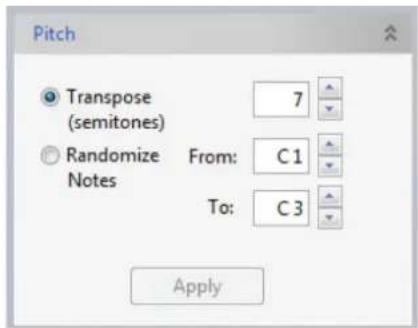
The Pitch pane in the Tool Window.
The "Pitch" function in the Tool Window transposes selected MIDI notes, or all notes in selected note clips, or the audio recordings in selected audio clips, up or down in whole semitone steps.
There is also a Randomize function which randomly transposes the pitch of selected MIDI notes in a note clip.
The "Pitch" function can be applied to:
- Individual (selected) note events in a note clip.
This has to be done in Edit Mode.
- Individual (selected) comp rows in a Comp audio clip.
This has to be done in Edit Mode (see "Transposing Comp Rows").
- All note events in one or several selected note clips.
This is done in the Song/Block View. If the clips are on the same lane, it can also be done in Edit Mode.
- All audio recordings in one or several selected audio clips.
This is done in the Song/Block View. If the clips are on the same lane, it can also be done in the Comp Editor.
! In Edit Mode, select clip(s) by clicking on it/them in the Clip Overview.
- All note events in all note clips on one or several selected instrument tracks.
This has to be done in the Song/Block View.
- All audio recordings in all audio clips on one or several selected audio tracks.
This has to be done in the Song/Block View.
! In Song/Block View you can transpose a combination of selected note clips/tracks and audio clips/tracks in one go!
Transpose (Semitones)
- Click the “Transpose (Semitones)” radio button and then select the number of semi-tones to transpose the selected notes, note clips and/or audio clips up or down. Click “Apply” to transpose.
! For MIDI notes and note clips the transposition is “absolute”, i.e. the notes are permanently moved to new note positions in the clip.
! For audio clips the transposition is non-destructive, i.e. the audio is transposed relative to their original pitch/key without affecting the original audio. For audio clips the relative Transpose amount is also displayed in the Transpose display in the Inspector for the selected audio clip(s). See “Transposing Audio Clips” for more details about transposing audio clips. - You can also transpose notes by manually moving them using the mouse or arrow keys, as described in "Moving notes manually" and "Changing note pitches (transpose) with the arrow keys".
- You can also transpose notes numerically in the inspector. See “Note and automation editing in the Inspector”.
Randomize Notes
→ Click the "Randomize Notes" radio button and then select the note range to which to transpose the selected MIDI notes. Click "Apply" to transpose.
The selected notes will be randomly transposed within the set note range.
Extract Notes to Lanes
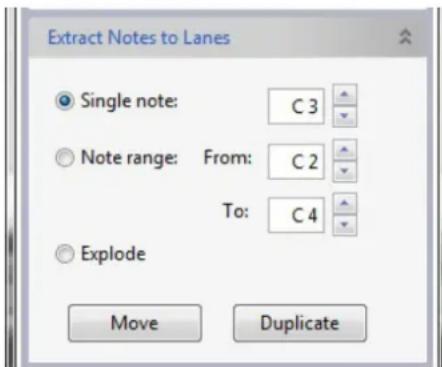
The Extract Notes to Lanes pane in the Tool Window.
The "Extract Notes to Lanes" function on the Sequencer Tools tab in the Tool Window is used for moving or duplicating user-defined notes of a certain pitch, or notes within a defined pitch range, to a new note clip on a new, additional note lane. This function is very useful if you, for example, have recorded a drum track, with all notes in the same clip, and then want to extract individual drum sounds (note pitches in this case) to separate lanes to be able to edit them more easily - or to apply ReGroove channels (see "The ReGroove Mixer").
The "Extract Notes to Lanes" function can be applied to:
- Notes of defined pitches in one or several selected note clips.
If the clips are on the same lane, this can be done in Edit Mode. If the clips are on separate lanes, this has to be done in the Song/Block View.
! In Edit Mode, select clip(s) by clicking on it/them in the Clip Overview.
- Notes of defined pitches in all note clips on one or several selected instrument tracks.
This has to be done in the Song/Block View.
Extract Notes to Lanes example
We have recorded a 4-bar drum beat, consisting of kick, snare and open+closed hi-hat, in a single clip on a note lane. Now, we want to extract the open and closed hi-hat sounds to a new separate note lane. Normally, this could be done in the Song/Block View, but to better show what happens with the individual note events, we will show this in Edit Mode:
-
Open the note clip in Edit Mode.
-
Click in the Clip Overview to enable the "Extract Notes to Lanes" function.
Since the Extract Notes to Lanes function applies to selected clips and not to selected notes, you have to click in the Clip Overview to enable the function. (In the Song/Block View, you just select the clip by clicking on it).
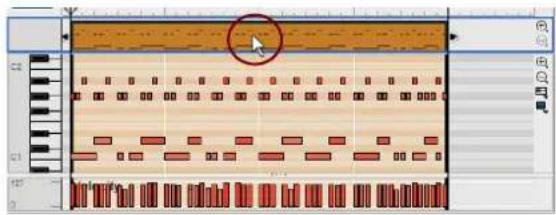
Click in the Clip Overview to enable the Extract Notes to Lanes function.
- Define which notes you want to move on the "Extract Notes to Lanes" pane in the Tool Window.
We want to move the open and closed hi-hat notes, i.e. the note range from G#1 to B1. We therefore click the "Note Range" radio button and then select the note range in the "From:" and "To:" displays.
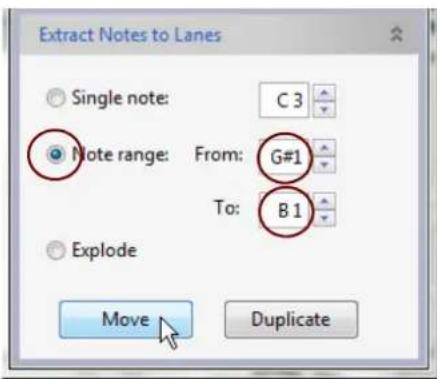
Select the notes to be moved.
4. Click the "Move" button on the "Extract Notes to Lanes" pane.
The open and closed hi-hat notes are now moved to a new clip on a new note lane. If we click in the Note Edit lane and scroll, we can see the moved hi-hat notes in the new clip:
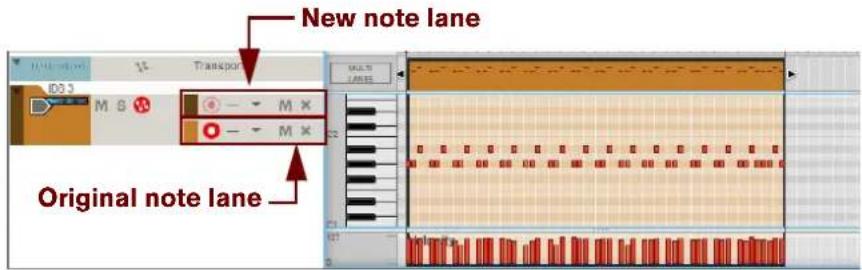
The moved notes in a new clip on a new note lane.
If we exit to the Song/Block View, we can see both the original clip and the new clip:
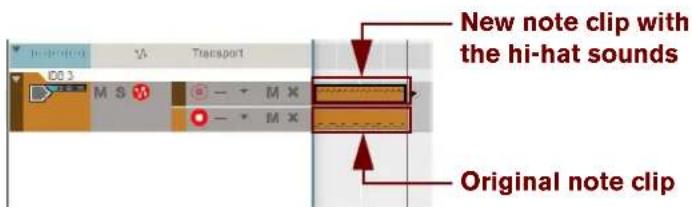
The original clip and the new clip in the Song/Block View.
→ If you want to move or duplicate notes of a certain note number only, click the "Single Note" radio button and select the note pitch in the display. Then click, the "Move" or "Duplicate" button.
Only the notes of the selected note number will be moved or duplicated to a new clip on a new note lane.
- The "Extract Notes to Lanes" function is available both in Edit Mode and the Song/Block View, since it's applied to defined notes in clips and not to manually selected notes.
! Any recorded performance controller automation will remain on the original note lane.
The "Explode" function
→ Click the "Explode" radio button to move or duplicate notes of the same note numbers to new clips on separate note lanes.
Notes of the same note number will be moved or duplicated to new separate clips on separate note lanes. A new lane will be created for each of the used note numbers in the original clip
- The "Explode" function is perfect if you have recorded a drum track and want to move, or duplicate, each individual drum sound to a separate note lane for further editing. Applying different ReGroove channels to each of the generated note lanes could provide extremely nice grooves to the rhythm! See "The ReGroove Mixer" for more details.
Scale Tempo
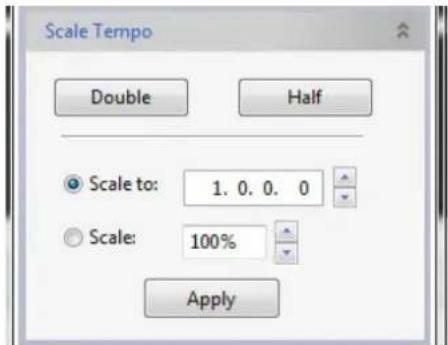
The Scale Tempo pane in the Tool Window.
The "Scale Tempo" function in the Tool Window can be applied to selected notes and/or automation events. It can also be applied to selected note, audio and automation clips. The Scale Tempo function will make the selection play back faster (Scale factor above 100%) or slower (Scale factor below 100%). For notes and automation events, this is achieved by changing the position of the events (starting from the earliest selected event) and adjusting the length of the notes accordingly. For audio clips, high-quality stretching is applied to all audio recordings in the clip.
Tempo scaling can be applied to:
- Individual (selected) note and/or parameter automation events in a clip.
This has to be done in Edit Mode.
- All note and/or parameter automation events and/or audio recordings in one or several selected clips.
This is done in the Song/Block View. If the clips are on the same lane, it can also be done in Edit Mode.
! In Edit Mode, select the clip(s) by clicking on it/them in the Clip Overview.
- All note and/or parameter automation events and/or audio recordings in all clips on one or several selected tracks.
This has to be done in the Song/Block View.
- The "Double" and "Half" buttons are "shortcuts" to Scale factors 200% and 50%, respectively.
These are probably the most common values used, simulating double tempo and half tempo scaling.
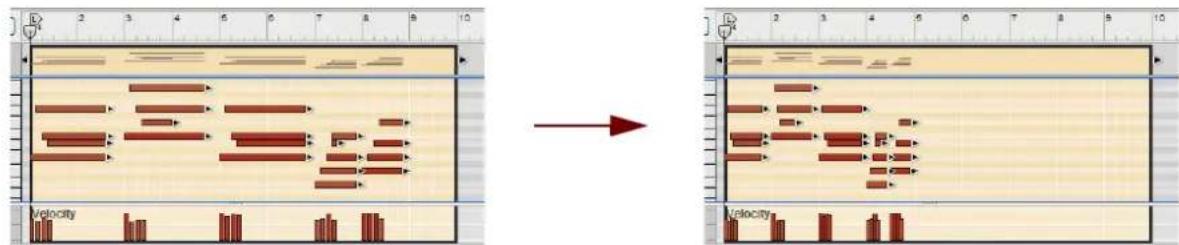
The result of applying Scale Tempo on note events with the Scale factor 200% (double speed).
- The "Scale to" function can be used for scaling selected clips, or selected events in an open clip, to a fix length. The segments in the "Scale to" box are divided into, bars, beats, 1/16th notes and tics.
! The Scale Tempo function affects note, performance controller, parameter automation, pattern change, tempo automation events and audio clips! It does NOT affect time signature automation.
! When you are tempo scaling audio clips, make sure you have selected the appropriate Stretch Type, otherwise the sonic result might not be what you'd expect, see "Opening audio clips for editing".
! Note that Pattern Automation Clips will only be resized - the pattern tempo in the source device will NOT be scaled but will still be synced to the main sequencer tempo!
Editing note velocity
Editing note velocity manually
The velocity values of notes can be edited manually on the Velocity Edit Lane:
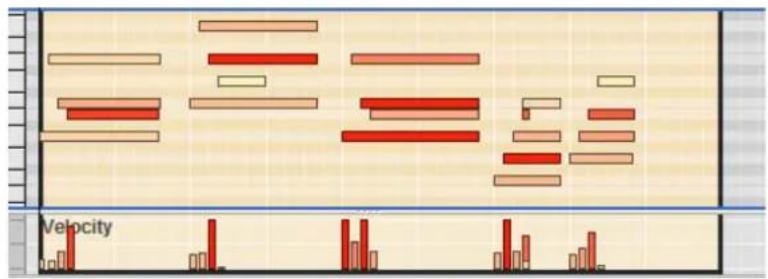
bar
| Category | Value 1 | Value 2 | Value 3 | Value 4 | Value 5 | Value 6 | Value 7 | Value 8 | |---|---|---|---|---|---|---|---|---| | Top Panel | 0 | 0 | 0 | 0 | 0 | 0 | 0 | 0 | | Middle Panel | 0 | 0 | 0 | 0 | 0 | 0 | 0 | 0 | | Bottom Panel | 0 | 0 | 0 | 0 | 0 | 0 | 0 | 0 |The velocity values are shown as bars, with taller bars indicating higher velocity. Note also that the color intensity of the notes and velocity bars reflect the velocity values.
To change the velocity of a note, click on its velocity bar with the Pencil tool and drag the bar up or down. Clicking above or below a bar immediately adjusts the velocity to the level at which you click.
You can also edit the velocity of several notes at once by clicking and dragging with the Pencil tool.
→ When the Pencil Tool is selected and you press Ctrl or Option on the Velocity Edit Lane, the pencil will change to a cross.
This is the Line Tool which is a special tool only available on the Velocity Edit Lane. By dragging across the velocity "bars", at the desired height, you can quickly draw velocity ramps.
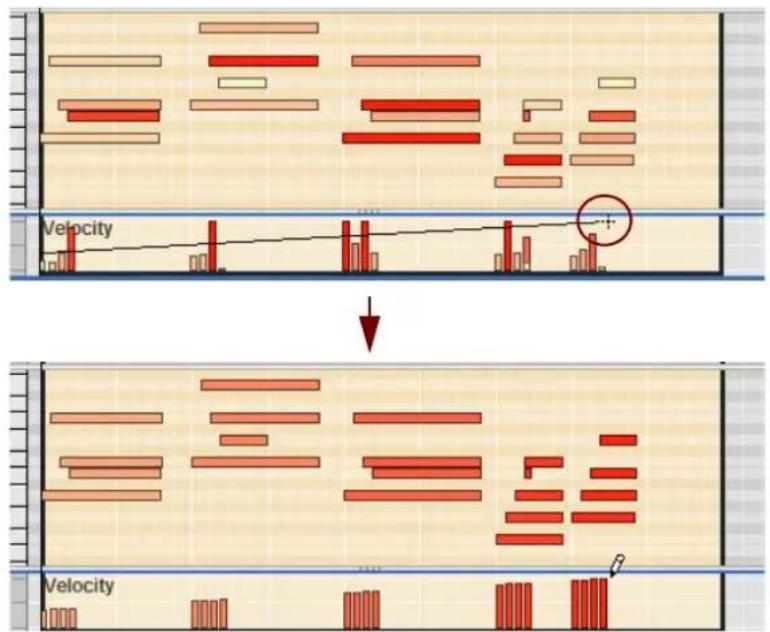
Drawing a velocity ramp with the Line Tool.
The Line Tool is probably the preferred method for creating regular, smooth ramps, or for giving all the notes the same velocity (by drawing a straight line), while the Pencil tool can be used for creating more irregular curves.
→ If you hold down [Shift] when you edit velocity values, only selected notes will be affected.
This can be very useful, especially in "crowded" sections with lots of notes.
Consider for example if you have a busy drum beat, and want to adjust the velocity of the hi-hat notes only. Simply dragging with the Line- or Pencil tool would change the velocity of all other drum notes in the area too, but if you first select the hi-hat notes on the Drum Edit lane and press [Shift] as you draw, you can edit their velocity without affecting any other notes.
Editing note velocity with the "Note Velocity" function
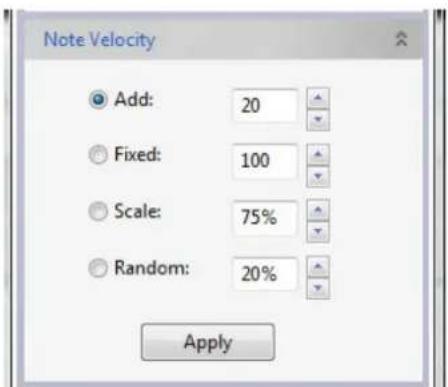
The Note Velocity pane in the Tool Window.
The "Note Velocity" function in the Tool Window can be used for adjusting the velocity of selected notes in a number of different ways.
Note velocity can be applied to:
- Individual (selected) notes in a note clip.
This has to be done in Edit Mode.
- All notes in one or several selected note clips.
This is done in the Song/Block View. If the clips are on the same lane, it can also be done in Edit Mode.
! In Edit Mode, select clip(s) by clicking on it/them in the Clip Overview.
- All notes in all note clips on one or several selected instrument tracks.
This has to be done in the Song/Block View.
→ The "Add" function lets you add a fixed value to the existing velocity values.
To subtract, choose a negative value. Note that the allowed range is 1-127.
→ "Fixed" allows you to set a fixed velocity value for all selected notes.
→ The "Scale" function allows you to scale velocities by a percentage factor.
Scaling by a factor of more than 100% will increase the velocity values, but also make the difference between soft and hard notes bigger.
Scaling by a factor of less than 100% will decrease the velocity values, but also make the difference between soft and hard notes smaller.
→ "Random" will randomize the velocity values by a set percentage value.
- By combining the "Add" and "Scale" functions, you can adjust the "dynamics" of the notes in various ways. For example, by using a Scale factor below 100% and adding a suitable value in the "Add" display, you can "compress" the velocity (decreasing the difference between the velocity values without lowering the average velocity level).
Editing note velocity in the Inspector
You can also edit velocity values numerically in the Inspector. See "Note and automation editing in the Inspector".
Reverse
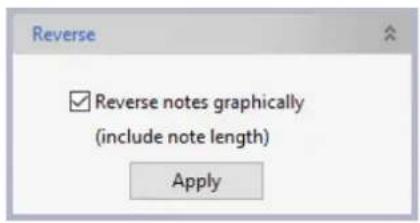
The Reverse pane in the Tool Window.
It's possible to reverse note (and automation) clips and events, i.e. play the events of the clip "backwards" (from the end to the start). The main difference between reversing note (and automation) clips compared to audio clips is that in note clips the notes and automation points are reversed (mirrored) - not the actual audio that the notes generate. With audio clips, however, the actual audio is reversed (played backwards).
The Reverse function can be applied to:
- Individual (selected) note events in a note clip.
This has to be done in Edit Mode.
- Individual (selected) automation points in a note clip or in an automation clip.
For note clips this has to be done in Edit Mode.
- All note and automation events in one or several selected note and automation clips.
This is done in the Song/Block View. If the clips are on the same lane, it can also be done in Edit Mode.
- All audio recordings in one or several selected audio clips.
This is done in the Song/Block View. If the clips are on the same lane, it can also be done in the Comp Editor. See "Reversing audio clips" for more details about reversing audio clips.
! In Edit Mode, select clip(s) by clicking on it/them in the Clip Overview.
- All note and automation events in all note and automation clips on one or several selected instrument tracks. This has to be done in the Song/Block View.
- All audio recordings in all audio clips (and all automation clips, if any) on one or several selected audio tracks. This has to be done in the Song/Block View.
! In Song/Block View you can reverse a combination of selected note clips/tracks and audio clips/tracks in one go!
There are two different types of Reverse functions for note clips: the "Reverse notes graphically" and the "musical reverse". The "Reverse notes graphically" function considers the note lengths when the new start positions are calculated, whereas the "musical reverse" function only considers the notes' start positions.
Here is an example of a masked note clip in Edit mode, with automation points before and after using the "Reverse notes graphically" function:
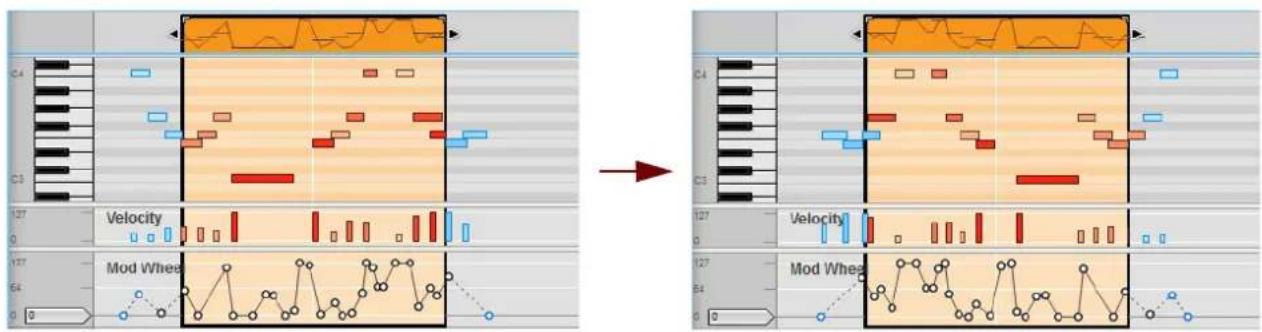
As you can see, all end positions (Note Offs) of the notes become the new start positions (Note Ons) after the reverse procedure. Also, any masked notes and automation points are also "flipped around".
Here are examples of using the Reverse functions on a selected note clip and on selected notes in a note clip:
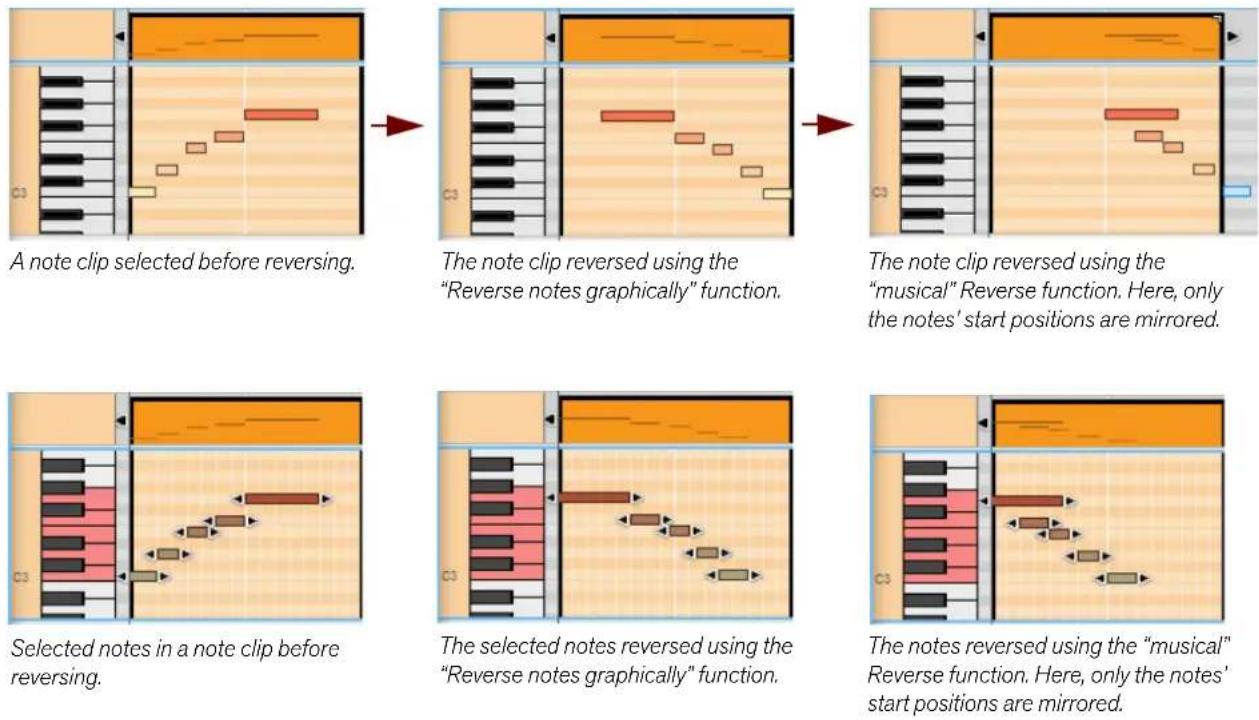
Multi Lanes editing
Overview
Multi Lanes editing lets you have note clips of multiple lanes visible at the same time on the Edit pane, in a layered fashion. This makes it a lot easier to edit notes in relation to other notes in other clips:
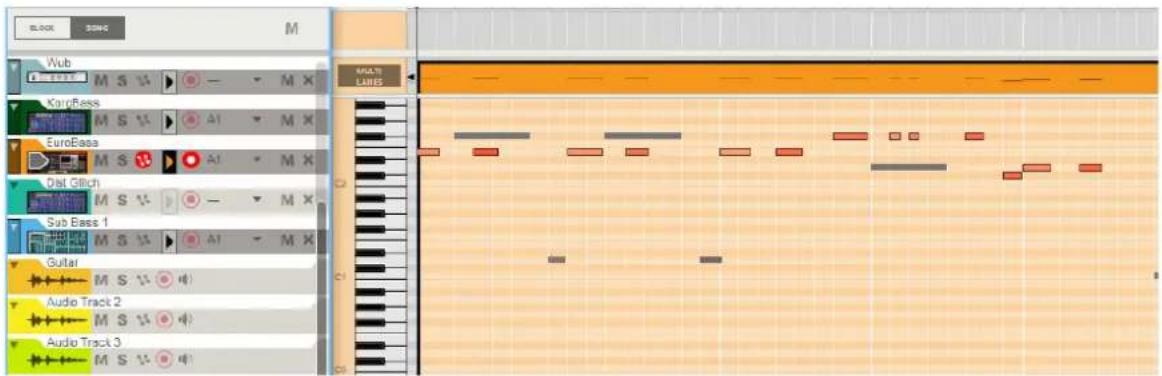
Four clips on four different lanes in Multi Lanes edit mode, with the note lane on the EuroBass tack currently selected.
Selecting multiple lanes for editing
The easiest ways of selecting what note lanes should be available for Multi Lanes editing are these:
- By selecting multiple instrument tracks in the track list and then entering Edit mode in the Sequencer.
- By selecting multiple note clips on the Arrange pane and pressing [Return], or right clicking one of the selected clips and then selecting "Edit" from the context menu.
→ In Edit mode, make sure the Multi Lanes button is on:
The Edit pane now shows all (un-muted) clips on all selected lanes in a layered fashion, with the notes of the currently selected note lane in red and the notes of the other lanes in grey:
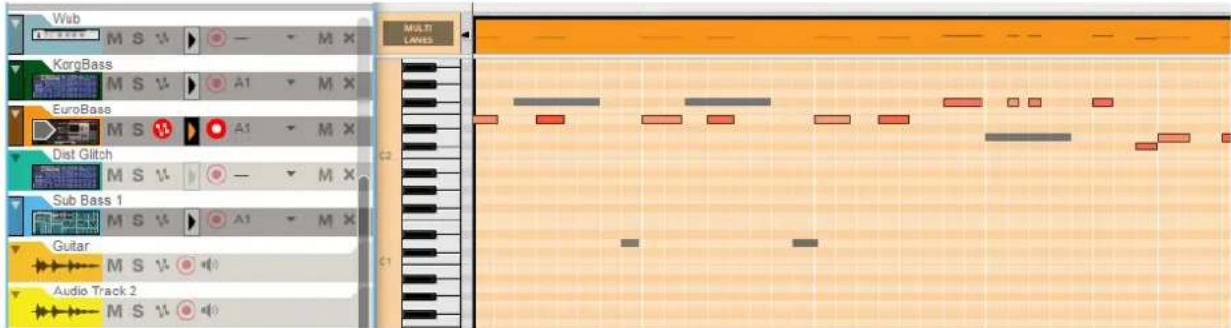
- If a single sequencer track contains multiple lanes, selecting the track will automatically display all clips on all un-muted lanes:
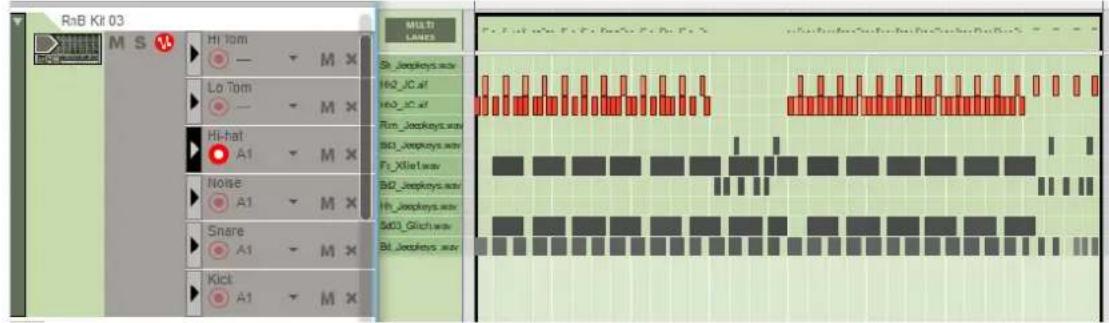
The RnB Kit 03 track, which contains six lanes, selected for Multi Lanes editing.
With the Multi Lanes editing feature, the functions "Move/Duplicate Selected Notes to New Lane" and "Extract Notes to Lanes" are very useful, especially when working with drum tracks.
Editing notes in Multi Lanes mode
Editing notes in Multi Lanes editing mode is done in the same way as when editing one clip on one lane at a time, as described earlier in this chapter. The only important thing to bear in mind is which lane you want to edit:
→ Select the lane you want to edit, either by clicking the desired Lane selector in the track list...
The lane on the EuroBass track is currently selected.
→... or by clicking a note on the Edit pane:
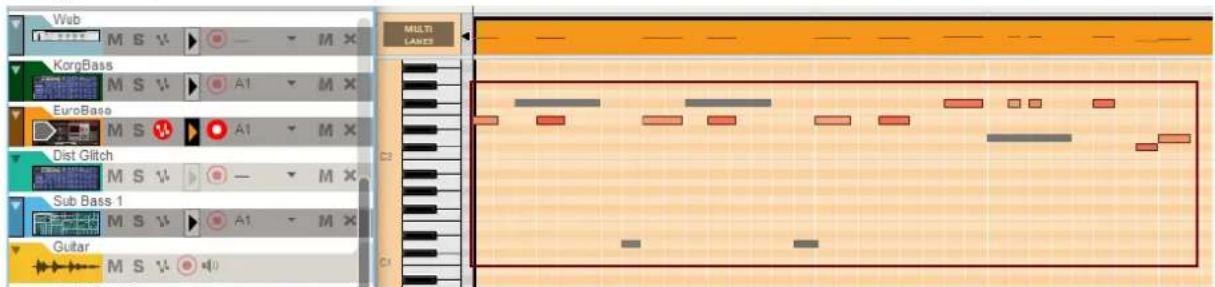
The notes of the currently selected EuroBass lane shown in red on the Edit pane and the notes of the other lanes are shown in grey.
- If you click any of the grey notes on the Edit pane, the lane that this note belongs to is automatically selected in the track list.
Now, all notes of the newly selected lane become red, and the notes of the other lanes become grey.
! It's not possible to edit multiple notes on multiple lanes together - only notes of the currently selected lane can be edited together (e.g. moved, transposed, etc.).
! If the tracks selected for Multi Lanes editing has different Note Edit Modes (e.g. REX Edit Mode or Drum Edit Mode), you might want to switch to regular Key Edit Mode for the entire note range to become visible and accessible on the Edit pane. See "Note Edit Modes" for more details.
Automation editing
Overview
Parameter automation is stored in clips as automation events (points), connected by lines. When recorded or drawn, the automation lines are straight. However, if you wish you could edit the lines into curves afterwards.
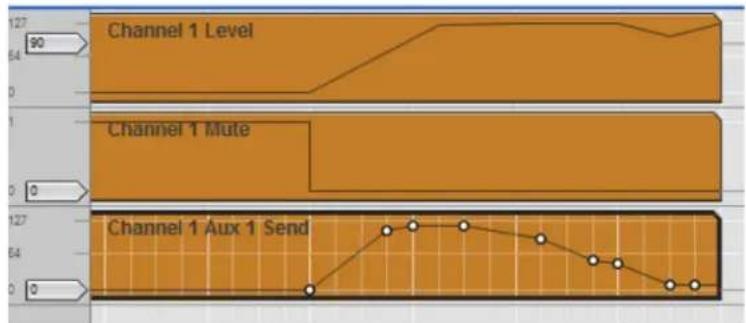
line
| Channel | Value | |---------|-------| | Channel 1 Level | 90 | | Channel 1 Mute | 0 | | Channel 1 Aux 1 Send | 0 |Automation lanes for a Mixer 14:2 Level slider (top), Mute button (middle) and Aux Send slider (bottom) in Edit Mode. The Aux Send automation clip at the bottom is open for editing.
- Parameter automation is contained in automation clips on Parameter Automation Lanes (see "Edit Mode elements").
Each automated parameter has its own Parameter Automation Lane.
- Performance controller automation is stored on Performance Controller Edit Lanes in note clips (see "Edit Mode elements").
Editing parameter automation
Parameter automation events can be edited both in the Song/Block View and Edit Mode. In the Song/Block View the parameter automation clip can be opened in sort of a "semi edit mode", which shows the automation events of the selected clip. You can also edit the parameter's Static Value. Editing automation events works in the same way, whether in the Song/Block View or in Edit mode.
Editing parameter automation in the Song/Block View
→ In the Song/Block View, double-click the parameter automation clip on the parameter automation lane.
The parameter automation clip is now opened in the Song/Block View:

A parameter automation clip before and after opening it in the Song/Block View.
Here you can edit the parameter's Static Value (see "Static Value Handles") with the up/down arrow buttons to the left of the open clip. Alternatively, double-click and type in a new Static Value in the box.
In the open parameter automation clip, it's possible to move, add and delete automation events in the same way as in Edit Mode using the Selection (Arrow), Pencil and Eraser tools - see "Editing parameter automation in Edit Mode".
- A selected automation event's position and value is also shown in the Inspector.
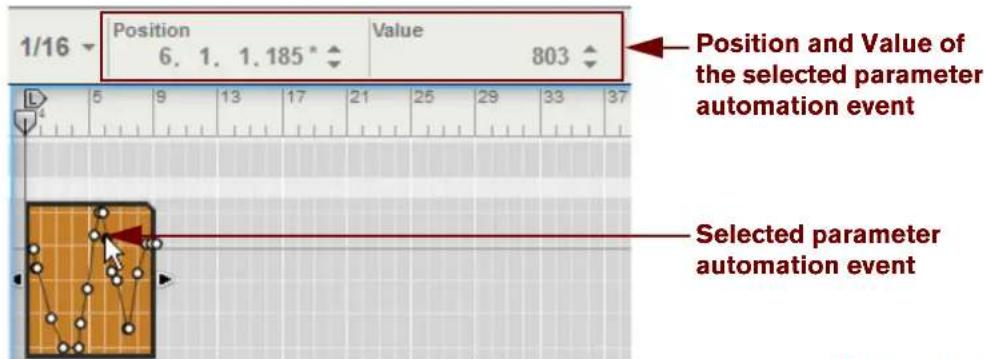
The event's position and value can be edited numerically in the displays - see "Note and automation editing in the Inspector".
To close an open parameter automation clip in the Song/Block View, press [Esc] or click on another lane on the Arrangement Pane.
→ If you resize the automation clip and make it longer, the first and/or last automation value will be extended all the way to the clip boundary.

In the picture above, a Mixer 14:2 Mute button is automated. The clip only contains a single automation point, but as we extend the clip in both directions, the value is automatically extended to the start and end of the clip. This means you can adjust the Mute automation time by moving and resizing the clip, without having to open the clip.
Editing parameter automation in Edit Mode
- Open the parameter automation clip in Edit Mode.
→ If the parameter automation clip is on an Instrument Track, just double-click a Note clip to enter Edit Mode.
→ If the parameter automation clip is not on an Instrument Track, first double-click the automation clip and then click the "Open In Edit Mode" button.
Use the dividers if necessary to locate the automation clip to edit - these are located at the bottom of the Edit/Arrange Pane (not in the note clip). Parameter automation clips are distinguished by a "cut off" upper right corner.
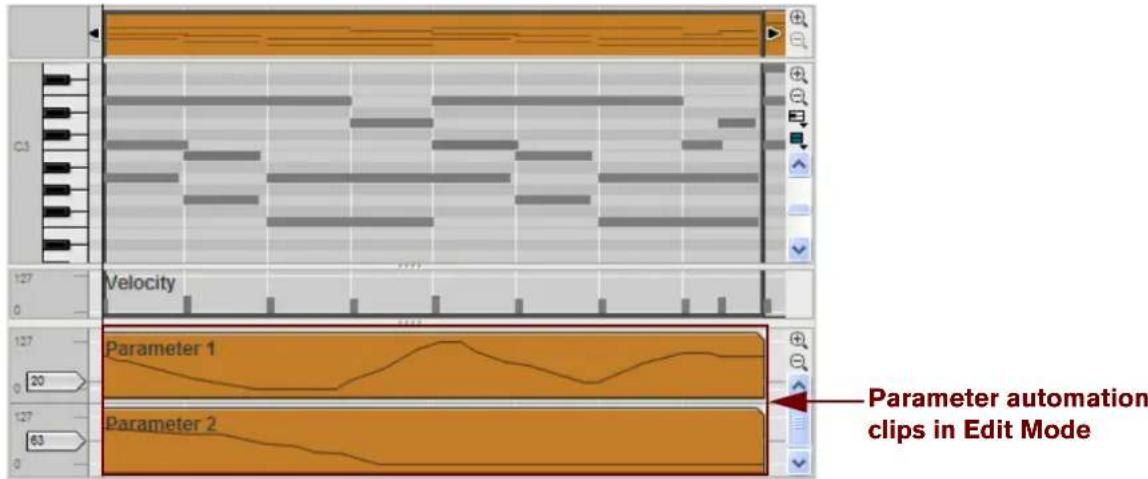
An instrument track in Edit Mode with parameter automation clips at the bottom.
- Open the parameter automation clip for editing by double-clicking it or by selecting it and pressing [Return].
The parameter automation clip is now open for editing.
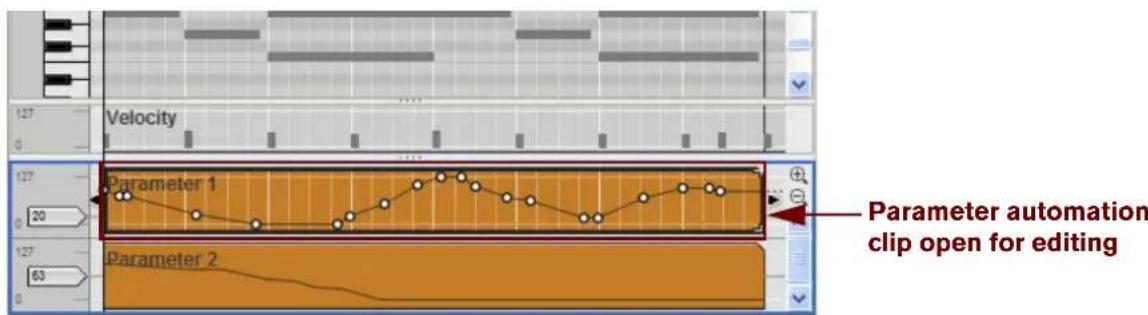
The "Parameter 1" automation clip open for editing in Edit Mode.
In Edit Mode, the parameter's Static Value is shown to the left in the automation lane. In this example, the Static Value is set to 20 - this means that the "Parameter 1" value will be set to 20 everywhere in the song except where there are automation clips for the parameter.
→ To change the Static Value, click and drag the handle up or down, or double-click and type in a new value.
To fine adjust the Static Value, hold down [Shift] when you click and drag.

- The Static Value can also be edited in the Song/Block view, see "Editing parameter automation in the Song/Block View".
- When a parameter automation clip is open, you can select, move, copy or delete automation events, using the Selection (Arrow) Tool.
When moving automation events with the Selection (Arrow) Tool, Snap (see "Snap") is taken into account if enabled. You can also resize the clip by dragging the clip handles.
If you resize the automation clip and make it longer, the duration of the first or last automation event will be extended all the way to the clip boundaries (see the last example in "Editing parameter automation in the Song/Block View").
• A selected automation event's position and value is also shown in the Inspector.
These values can be edited numerically in the Inspector displays. See "Note and automation editing in the Inspector".
About moving parameter automation events outside an open clip
If you move parameter automation events outside the boundaries of an open clip, the same rules apply as when moving note events outside an open clip. See "About moving notes outside or between clips".
Drawing parameter automation events
To add new parameter automation events, do any of the following:
→ Double click with the Selection (Arrow) Tool in the open automation clip to insert an automation point.
Double click, hold, and then drag to draw a series of automation points in the clip.
→ Click or drag with the Pencil Tool in the open automation clip.
When dragging, the resulting curve (i.e. the number of points) depends on two factors; the selected "Automation Cleanup" setting in the Preferences menu (see "About Automation Cleanup"), and the snap value if Snap is activated (see "Snap").
To add an additional automation point onto an automation line, hold down [Shift] and click with the Pencil tool at the position you want the point to be added.
This is also useful if the automation clip doesn't yet contain any automation points, and you want to add the first automation point with the same value as the Static Value.
Note that if the automation line is curved (see "Creating curves between automation points"), the line will become straight (not curved) to the right of the added point.
flowchart
graph TD
    A["Start"] --> B{Step 1}
    B --> C["Point 1"]
    C --> D{Step 2}
    D --> E["Point 2"]
    E --> F{Step 3}
    F --> G["Point 3"]
    G --> H{Step 4}
    H --> I["Point 4"]
    I --> J{Step 5}
    J --> K["Point 5"]
    K --> L{Step 6}
    L --> M["Point 6"]
    M --> N{Step 7}
    N --> O["Point 7"]
    O --> P{Step 8}
    P --> Q["Point 8"]
    Q --> R{Step 9}
    R --> S["Point 9"]
    S --> T{Step 10}
    T --> U["Point 10"]
flowchart
graph TD
    A["Top-Left"] --> B["Top-Right"]
    B --> C["Bottom-Left"]
    C --> D["Bottom-Right"]
    D --> E["Bottom-Right"]
    E --> F["Bottom-Left"]
    F --> G["Bottom-Right"]
    G --> H["Bottom-Right"]
    H --> I["Bottom-Left"]
    I --> J["Bottom-Right"]
    J --> K["Bottom-Right"]
    K --> L["Bottom-Left"]
    L --> M["Bottom-Right"]
    M --> N["Bottom-Right"]
    N --> O["Bottom-Left"]
    O --> P["Bottom-Right"]
    P --> Q["Bottom-Right"]
    Q --> R["Bottom-Left"]
    R --> S["Bottom-Right"]
    S --> T["Bottom-Right"]
    T --> U["Bottom-Left"]
    U --> V["Bottom-Right"]
    V --> W["Bottom-Right"]
Three examples of Shift-clicking automation points with the Pencil tool: adding the first point in an empty clip, adding a point on a straight line and adding a point on a curved line.
- Holding down Ctrl or Option and clicking or dragging with the Pencil tool will insert an automation range (the same parameter value over a period of time).
The length of the range is set with the Snap value.
Drawing an automation range.


- When the automated parameter is "stepped" rather than continuous, there will be abrupt steps between the automation events instead of linear ramps.
Examples of stepped parameters could be device buttons and multi-mode selectors, and the Sustain Pedal performance controller.
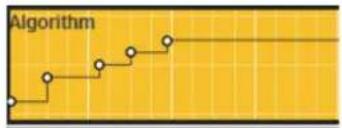
flowchart
graph TD
    A["Start"] --> B["Step 1"]
    B --> C["Step 2"]
    C --> D["Step 3"]
    D --> E["Step 4"]
    E --> F["End"]
Stepped automation.
About drawing parameter automation events outside an open clip
If you draw parameter automation events outside the boundaries of an open clip, the same rules apply as when drawing note events outside an open clip. See "About drawing notes outside an open clip".
Creating curves between automation points
When you record or draw automation, the lines between the automation points are always straight (vectors). This works perfectly fine in most situations. However, if you like you could change the straight lines into curves, to create different character to your parameter automation.
Creating curved automation works both in the Song/Blocks View and in Edit Mode.
- Open an automation clip (in the Song/Block View or in Edit Mode).
- With the Selection (Arrow) tool selected, click and drag an automation line to make it curved:
The arrow switches to a "curve tool" as you hover over an automation line.

Creating curved automation in an automation clip open in Song View.
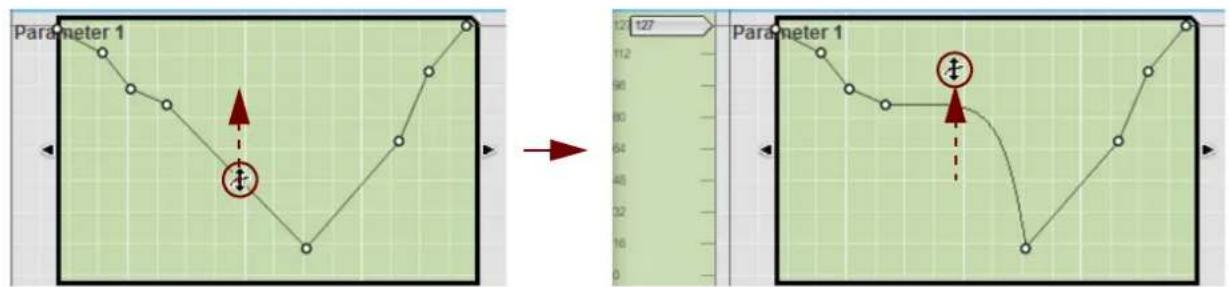
Creating curved automation in an automation clip open in Edit Mode.
→ To edit the curve shape, repeat the procedure above and drag in the desired direction.
→ To make a curve straight again, hold down [Shift] and click the automation line.
→ Double click an automation curve/line to add an automation point on the line.
! Note that it's not possible to create a curve from a straight horizontal automation line (which has automation points with the same value).
Deleting automation events
→ Deleting automation events is done in the same way as when deleting note events. I.e. click on events to select them or draw selection rectangles and then press [Backspace] or [Delete] - or use the Eraser tool (see "Deleting notes").
To clear all automation events in a clip, hold down Ctrl or Cmd and press [A] to select all events, then press [Backspace] or [Delete]. Alternatively, delete the clip (or remove the whole lane to clear all automation for that parameter).
→ If you want to delete single parameter automation events, you can double click on an event with the Selection (Arrow) tool in the clip.
Reversing automation events
It's possible to reverse the order of selected automation events in an open note or automation clip, see "Reverse".
Editing performance controller automation
→ To edit, draw or delete performance controller events, open the note clip in Edit Mode.
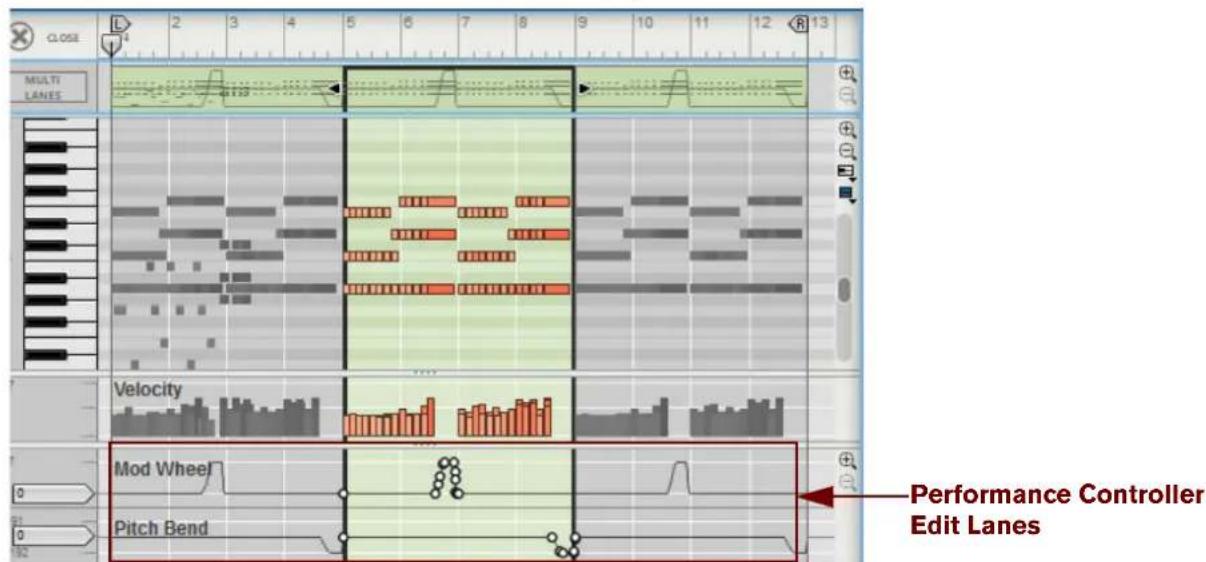
Performance controllers (Mod Wheel and Pitch Bend in the example above) are shown on separate Performance Controller Edit Lanes at the bottom of the open note clip. The performance controller curves are also indicated in the Clip Overview (top), and in the clip in the Song/Block View.
→ You can edit performance controller events using the Selection (Arrow), Pencil and Eraser tools, just like when editing parameter automation events in Edit Mode (see "Editing parameter automation in Edit Mode").
Creating new performance controller automation lanes
If you want to manually draw performance controller automation events for a controller which hasn't already been automated, you have to create a new Performance Controller Edit Lane for that parameter. Proceed as follows:
-
Open the note clip in Edit Mode.
-
Select the new performance controller to be automated by clicking on the Performance Controller Automation Selector and selecting it from the pop-up list that appears:
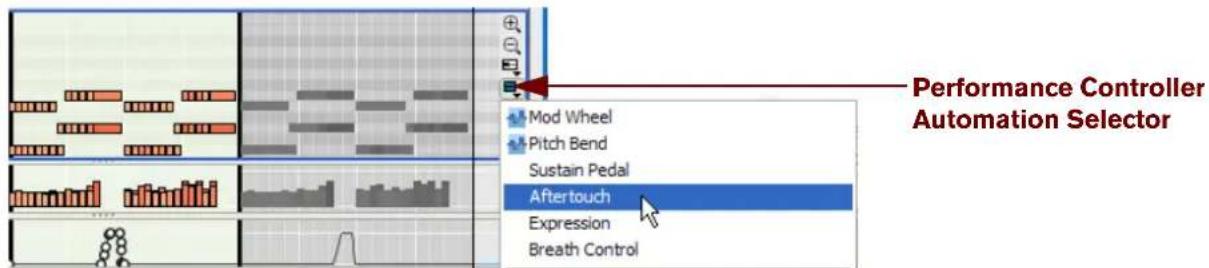
In this example, we select Aftertouch.
- A new Performance Controller Edit lane is created for the Aftertouch controller:

- Now, you can draw Aftertouch performance controller events in the clip using the Pencil Tool as described in "Drawing parameter automation events".
Afterwards, you can edit the performance controller events the same way as with regular parameter automation events (see "Editing parameter automation in Edit Mode").
→ It's also possible to add any of the available device panel parameters as a performance controller.
Just select the desired parameter from any of the sub-menus at the bottom of the Performance Controller Automation Selector pop-up menu.
Deleting performance controller automation lanes
→ To delete a performance controller automation lane, deselect it from the Performance Controller Automation Selector list.
This brings up a confirmation alert if there is data on the lane (in any clip). You can delete without the alert by pressing Ctrl or Cmd when you deselect the parameter from the list.
About Automation Cleanup
Automation Cleanup is a function for controlling the amount of parameter automation events that should be created during recording and/or manual drawing. The Automation Cleanup function applies to parameter automation events as well as to performance controller automation events. The Automation Cleanup level can be set in the Preferences menu and will apply to all new recorded automation events. You can also use the function on previously recorded parameter automation events. This is done on the Tools tab in the Tool Window.
Automation Cleanup in the "Preferences" menu
→ If you feel you get too many automation events when recording or drawing events, you can adjust the "Automation Cleanup" setting in the Preferences dialog - General page to "Heavy" or "Maximum":
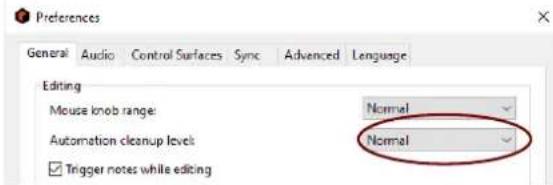
This automatically removes superfluous automation events next time you record or draw events and simplifies the curves. Note that Snap (see "Snap") also governs the number of events when drawing events.

Drawing automation with "Normal" Cleanup (left), and with "Maximum" Cleanup (right).
The "Automation Cleanup" function in the Tool Window
You can also apply Automation Cleanup to already recorded/drawn events. This is done on the Sequencer Tools tab in the Tool Window:
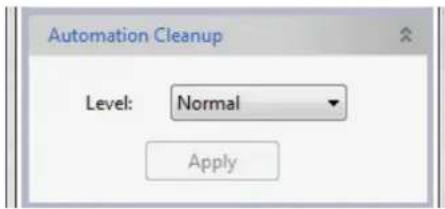
The Automation Cleanup pane in the Tool Window.
The "Automation Cleanup" function can be applied to:
- Individual (selected) parameter automation events in an open clip.
This has to be done in Edit Mode for performance controllers. For parameter automation, it can be done in both Edit Mode and the Song/Block View.
- All parameter automation events in one or several selected clips.
This is done in the Song/Block View. If the clips are on the same track, it can also be done in Edit Mode.
- All parameter automation events in all clips on one or several selected tracks.
This has to be done in the Song/Block View.
Editing pattern automation
Pattern automation clips are viewed and edited in the Pattern Select lane, which is available on Dr. Octo Rex, Redrum and Matrix tracks:
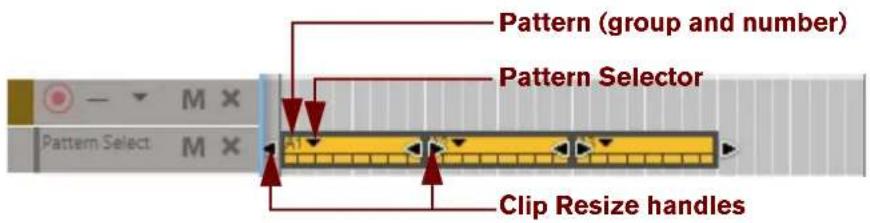
Pattern changes are shown as clips with a Pattern Selector at the top (when the clip is selected). A single pattern automation clip can only contain data for a single pattern. In practice this means that each pattern automation clip only contains one pattern automation "event". All pattern changes in the song will therefore require unique clips.
- Pattern (group and number)
The Pattern (group and number) indicate which pattern in the source device is playing in this clip. For Dr. Octo Rex devices, the Bank is of no importance.
- Pattern Selector
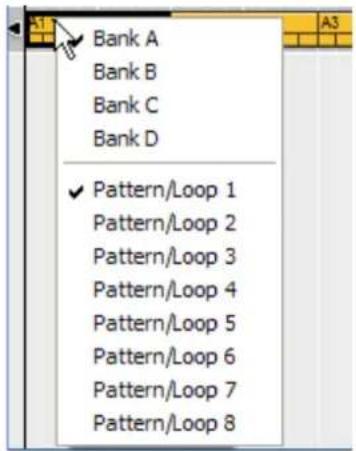
Click the Pattern Selector triangle, or double-click anywhere in the clip, to bring up a pop-up list featuring all available patterns (groups and numbers) of the source device. Select another pattern from the list if you wish to change pattern in the selected clip. If several pattern clips are selected, selecting a pattern for one of them will set them all to play that pattern.
- Clip Resize handles
Click and drag any of the Clip Resize handles horizontally to resize the clip and thus change the pattern playback start position and/or duration.
! If there is pattern automation for a device, it will only play patterns where there are pattern clips.
Drawing pattern automation
You can draw pattern automation clips on a Pattern Select lane as follows:
- Activate Snap and set the Snap value to the note position where you want to insert the pattern change clip (see "Snap").
It is probably a good idea to set the Snap value to "Bar", at least if you are working with patterns of a length corresponding to the time signature (e.g. 16 or 32 step patterns and 4/4 time signature). However, if you are working with patterns of another length, it can make sense to use other Snap values when drawing pattern automation clips.
- Select the Pencil Tool.
A Pattern/Loop drop-down list appears in the Inspector. Use this to select the pattern you wish the clip to play. For Dr. Octo Rex devices, the Bank is of no importance.
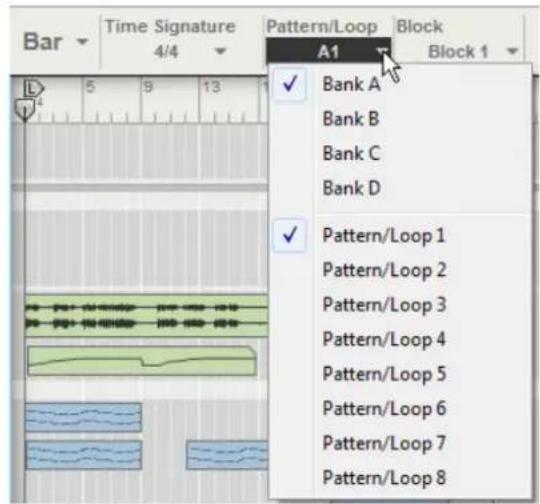
- Draw a clip for length you want the selected pattern to play.
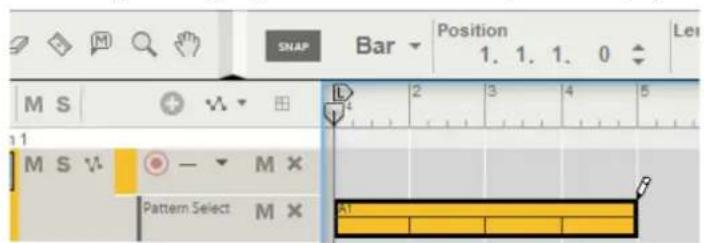
-
Continue using the same method to draw clips for all the patterns you wish to use.
-
Don't draw pattern change clips with Snap turned off, unless you want chaotic pattern changes!
→ If you want to add single pattern change clips, you can also double click with the Selection (Arrow) tool on the Pattern Select lane.
This will create an empty pattern change clip with the length of the current Snap value setting (e.g. 1 bar). To create longer clips, double click, keep the mouse button pressed and drag to the right.
Moving, resizing and duplicating pattern automation clips
- You can move, resize and duplicate pattern automation clips in the same way as with note or automation clips. However, it is recommended that Snap is activated (and in most cases set to "Bar") when you do this (see "Snap").
! If you resize a pattern automation clip by clicking and dragging the left resize handle, and thus change the start position, the clip will be masked (just like a note clip). This means the pattern won't necessarily begin on beat 1. A selected pattern automation clip that has a masked start position will indicate this in the Pattern Off-set display in the Inspector.
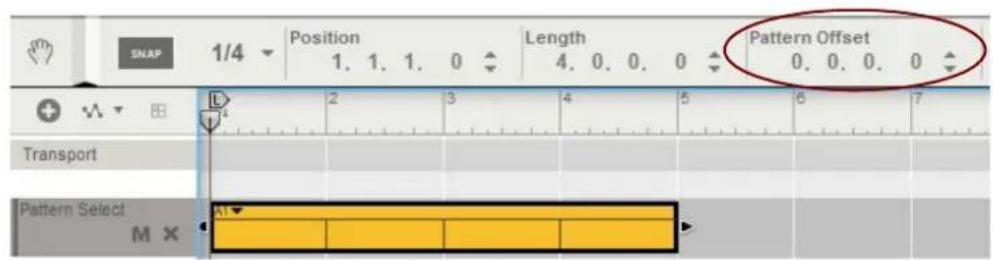
A pattern automation clip drawn between bar 1 and 5.
Now, if we resize the clip by dragging the left resize handle two beats to the right, the Pattern Offset will change but the pattern will play back as expected:
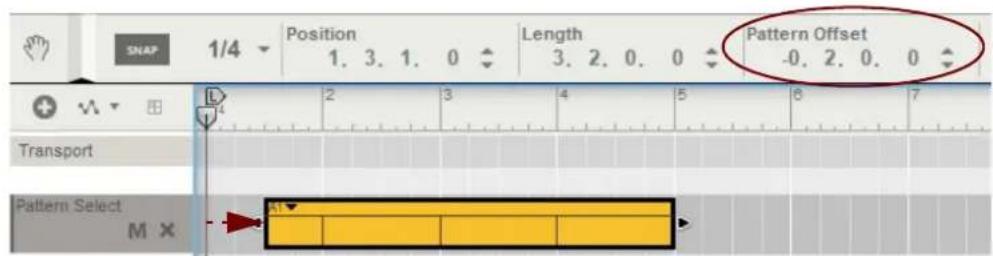
The same pattern automation clip "resized" to begin at beat 2.
- You can also move or duplicate pattern automation clips using the Cut, Copy and Paste commands on the Edit menu or context menu.
Again, the same rules apply as for note and parameter automation clips.
Deleting pattern automation clips
→ Deleting pattern automation clips is done in the same way as deleting note clips. i.e. you can select or draw selection rectangles and then press [Backspace] or use the Eraser tool etc.
To clear all automation in a clip, simply delete the clip (or remove the whole lane to clear all pattern change automation on the track).
The "Convert Pattern Automation to Notes" function
If you have recorded or drawn pattern automation on a Redrum or Matrix track, you can automatically convert the whole pattern automation lane into note events on an additional note lane. Proceed as follows:
- Select the track with the pattern automation.
- Select "Convert Pattern Automation to Notes" from the Edit menu or the track's context menu.
For each pattern automation clip, the corresponding device pattern is converted to note clips on an additional note lane on the track. The generated note lane will play back just the same as when you played the pattern device with the pattern changes.
- The pattern automation lane is automatically disabled (turned off) after this operation.
You can later go back to pattern automation if you wish, by turning on the pattern lane again.
Redrum specifics:
- The “Enable Pattern Section” switch on the Redrum device is automatically turned off when you use the “Convert Pattern Track to Notes” function.
Matrix specifics:
- Make sure that the correct track is selected (normally the track for the device that the Matrix is connected to)! Creating notes for the Matrix itself is pointless, as the Matrix cannot produce any sound.
- You may want to disconnect or even remove the Matrix device after performing this function.
This is because you probably don't want both the Matrix and the sequencer notes to play the device at the same time.
Editing tempo automation
Tempo automation is edited in the same way as regular parameter automation. See "Editing parameter automation".
Drawing tempo automation events
Drawing tempo automation events is done in the same way as drawing regular parameter automation events. See "Drawing parameter automation events".
- Even though Reason Lite supports a very wide tempo range (1.0 BPM to 999.999 BPM), the initial displayed editing range is 60-250 BPM in the left column in Edit Mode. This is only to make it easier to work with small tempo changes.
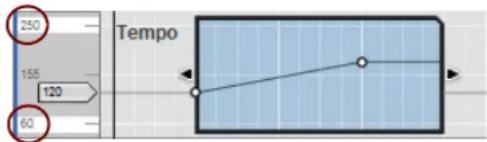
If you want higher tempi than 250 BPM, or lower than 60 BPM, you can easily expand the range, either by selecting and moving a tempo automation event above, or below, the clip border, by double-clicking the max or min values ("250" or "60" in the left column in the picture above) and typing in a new value, or by selecting an event and changing its value in the Value display in the Inspector.
About tempo changes and tempo automation of audio tracks
The built-in Stretch function allows you to change the tempo of the song without affecting the pitch of the recordings on the audio tracks. This is great if you want to adjust the tempo after you have recorded your audio tracks. In Reason Lite, the Stretch is enabled by default for all audio clips.
! The Stretch function also affects the sonic result when transposing audio clips using the Transpose function (see "Transposing Audio Clips").
There are three selectable Stretch and Transpose Type algorithms which are suitable for playing back different types of audio material:
- The "Allround" Stretch and Transpose Type is suited for most types of polyphonic audio material.
- The “Melody” Stretch and Transpose Type is best suited for sources sounding one note at a time e.g. solo instruments.
- The “Vocal” Stretch and Transpose Type is best suited for stretched and/or transposed vocal material. In the “Vocal” Stretch and Transpose Type the formants of the original vocal are preserved, which prevents the vocal from sounding artificial when transposed and/or stretched.
→ Select "Stretch and Transpose Type" from the Audio Track context menu or from the Edit menu.
Stretch preview vs. high quality stretch
Stretch and transposition of audio are always made in two parallel steps: a real-time "preview" so that you can instantly hear the result of your tempo changes or transpositions, and a high quality stretch "in the background" to further improve the sonic results. As soon as high quality stretch is in progress, the "Calc" indicator on the Transport Panel shows a progress indicator:
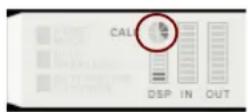
The CALC indicator appears when Reason Lite performs high quality stretching of audio.
Since the high quality stretch is performed in the background, you can still continue to work with your song without any interruption. When the high quality stretch is finished, the "Calc" indicator goes out and the high quality audio automatically replaces the "preview" audio.
About disabling Stretch for audio clips
In some situations, you might want to exclude audio clips from tempo automation. For example, if you have recorded dialogue or sound effects that shouldn't adapt to tempo changes. In such situations, you can select the audio clip(s) you want to exclude from the tempo changes and select "Disable Stretch" from the Edit menu or clip context menu.
! Note that disabling stretch does not affect the Transpose function for audio clips!
Automating time signature
Time signature automation events can only be manually drawn with the Pencil tool - not recorded like tempo automation, parameter automation or performance controller automation. A single time signature automation clip can only contain a single time signature value. In practice this means that each time signature automation clip can only contain one time signature automation "event". All time signature changes in the song will require a unique clip.
- Set the desired time signature in the Signature display on the Transport Panel.
This will be the Static Value, i.e. the time signature of the song wherever there is no clip present on the time signature automation lane.
This will select the Transport track and create a time signature automation lane in one go. The Signature display will also be displayed with a green border, indicating that the time signature has been automated.
It is generally a good idea to activate Snap (see "Snap") and have the Snap value set to "Bar" when drawing clips.
- Select the Pencil Tool.
When the Pencil tool is selected, a Time Signature drop-down list appears in the Inspector. Select the desired time signature from the drop-down list.
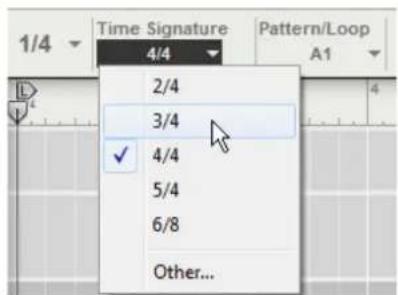
→ If you select "Other" the Edit Time Signature dialog appears where you can specify another time signature.
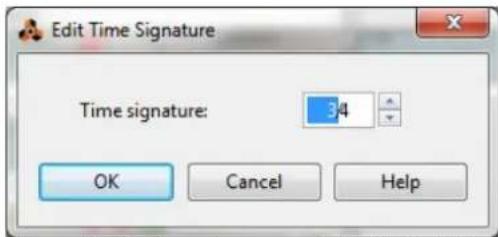
The available signatures are: 1/2-16/2, 1/4-16/4, 1/8-16/8 and 1/16-16/16. The Time Signature display in the dialog can be edited according to the descriptions in "Transport Panel segment displays".
- Draw a clip over the area on the Time Signature lane in the Transport track where you want the time signature to change.
The time signature will change for the duration of the clip.
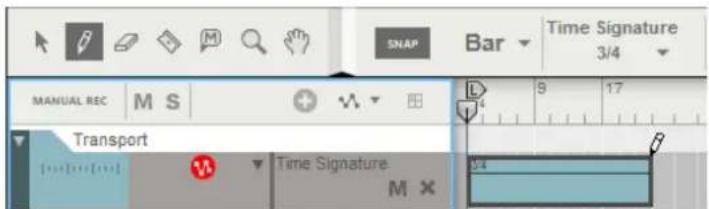
- Continue using the same general method wherever you want the time signature to change in your song.
→ If you want to add single time signature clips, you can also double click with the Selection (Arrow) tool on the Time Signature lane.
The clip gets the length of the currently selected Snap value.
→ You can change the time signature for the automation clip at any time by simply double-clicking the clip with the Selection (Arrow) Tool and changing the value on the pop-up that appears. Alternatively, select the clip and then click the small triangle in the clip to bring up the time signature pop-up.
There is no need to switch to Edit Mode unless you wish to change the time signature's Static Value.
Moving, resizing and duplicating time signature automation clips
→ You can move, resize and duplicate time signature automation clips in the same way as with note or automation clips.
However, it is recommended that Snap is activated (and in most cases set to "Bar") when you do this.
→ You can also move or duplicate clips using the Cut, Copy and Paste commands on the Edit menu or context menu.
Again, the same rules apply as for cutting, copying and pasting note and parameter automation clips.
Deleting time signature automation clips
→ Deleting time signature automation clips is done in the same way as deleting note clips. I.e. you can select or draw selection rectangles and then press [Backspace] or [Delete], or use the Eraser Tool.
→ To clear the time signature automation in a clip, simply delete the clip (or remove the whole Time Signature Lane to clear all time signature automation on the track).
Note and automation editing in the Inspector
In the Inspector you can edit note and automation events numerically using the displays.
Editing notes and events in the Inspector
If you select a note, four displays appear in the Inspector, showing the event (start) Position, Length, Note number and Velocity value:
| Position4. 1. 3. 0 ⇧ | Length0. 0. 0.219* ⇧ | NoteF 1 ⇧ | Vel68 ⇧ |
If you select a parameter automation event, two displays appear, showing the event's Position and Value:
| Position6. 1. 1.185* | Value | 803 |
If you select a pattern automation clip, three displays appear, showing the clip's Position, Length and Pattern Offset:
| Position1. 1. 1. 0 ⇧ | Length4. 0. 0. 0 ⇧ | Pattern Offset0. 0. 0. 0 ⇧ |
→ Edit the values by clicking on a segment in a display and then drag up/down, use the up/down spin controls, or type in new values. Snap is not taken into account.
See "Inspector segment displays" for details on how to edit in the Inspector displays.
! Note that when moving the position of events, these may end up outside the clip and be masked (not played). There will be no warning or indication if this should happen. However, since the clip is open in Edit Mode, you will be able to see if events are masked.
- If the Tick segment in the Position and/or Length displays shows an asterisk (*), it means that the value is a fraction of a Tick - a subtick. See “About subticks in the Position and Length displays” for more info.
Editing values for multiple notes or events in the Inspector
When you edit values for several selected events, the changes will always be relative. For example, if you change the position, length, pitch or velocity when several notes are selected, they will all be changed by the same amount, retaining their relative values.
- If several events are selected, the displays will show the values for the event with the earliest start position in the song.
If several selected events have the same start position, the displays will show the values for the event with the lowest Note value (for note events) or lowest Value (for automation events).
- If several events are selected and any of their values differ, Match Value buttons appear next to the corresponding display.
See "Matching notes or events using the "Match Values" function".
Matching notes or events using the "Match Values" function

The Match Values buttons appear as '=' signs.


The "Match Values" function in the Inspector can be used for matching the positions, lengths and velocities of several selected note events to the position/length/velocity of the selected event with the earliest start position in the song. It's always the values of the earliest event that are shown in the displays. Similarly, automation events can be matched to the position and/or value of the earliest selected automation event in the song.
If several selected events have the same start position, the matching will be to the values for the event with the lowest Note value (for note events) or lowest Value (for automation events).
Matching notes
Here's an example on how to match note values:
1. In Edit Mode, select several notes.
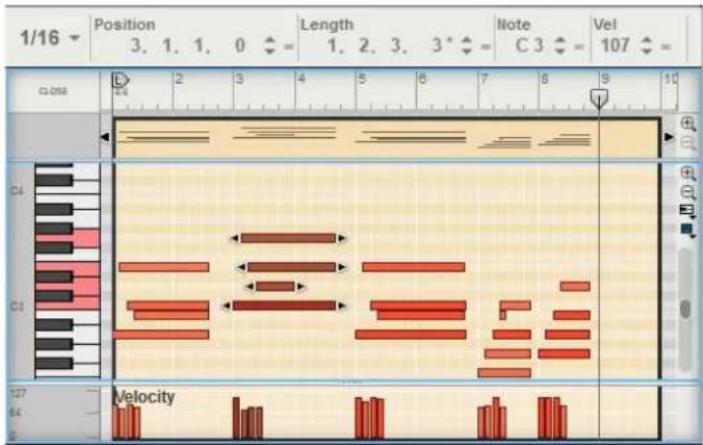
Four selected notes in Edit Mode.
2. Click the respective Match Values button to achieve the following results:
Position values matched
or
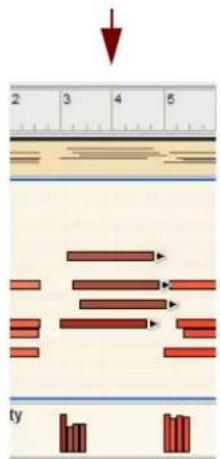
Length values matched
or
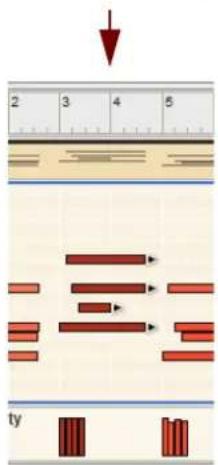
Velocity values matched
Matching parameter automation events
Matching parameter automation event values is useful if you want an automated device parameter to be modulated to the same value throughout the clip.
- Let's say you want to modulate a parameter to a maximum value of 80 several times throughout the clip. Then, just select all "max value" events, click the "Match Values" button and then adjust the Value to 80 for the selected events.
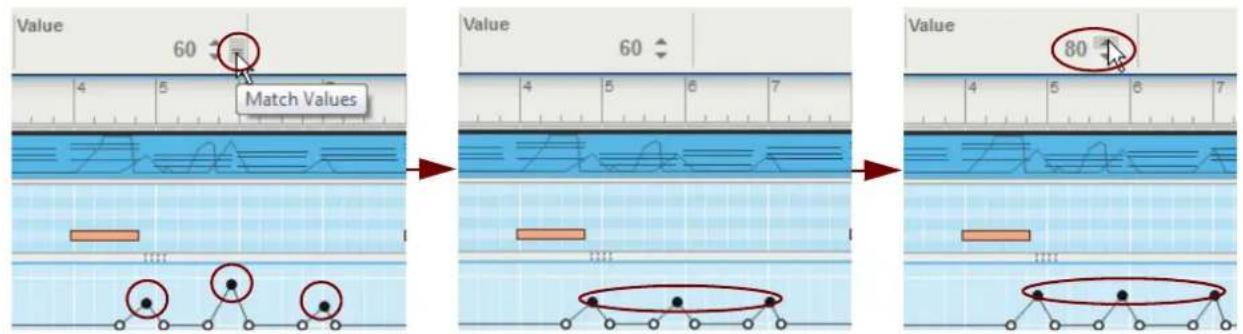
flowchart
graph LR
    A["Start"] --> B["Match Values"]
    B --> C["Step 1: Initial visual with horizontal bars and dots"]
    C --> D["Step 2: Final visual with horizontal bars and dots"]
    D --> E["Step 3: Final visual with vertical lines and dots"]
    E --> F["End"]
Matching automation events positions can be useful under the following circumstances:
- If you want to match the positions of single performance controller events on several Performance Controller Automation lanes.
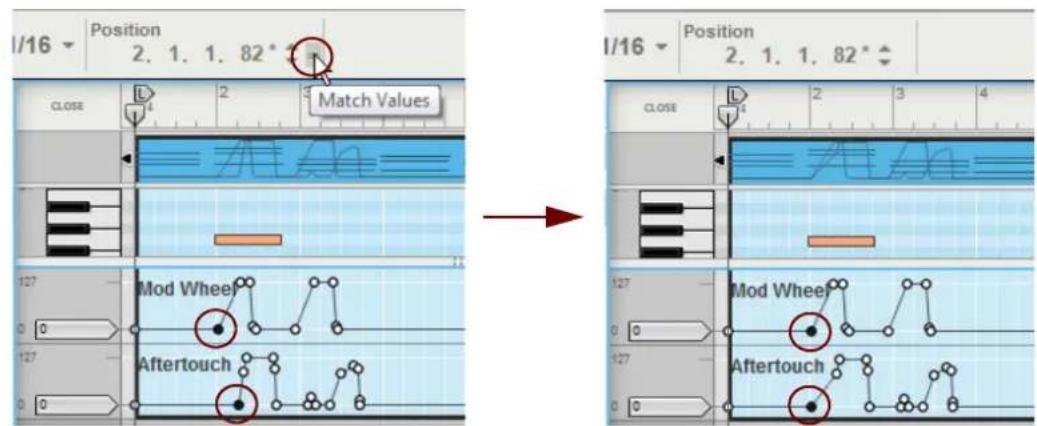
- If you want to match the position of two adjacent automation events in a clip to create an instant "jump" between the two values.
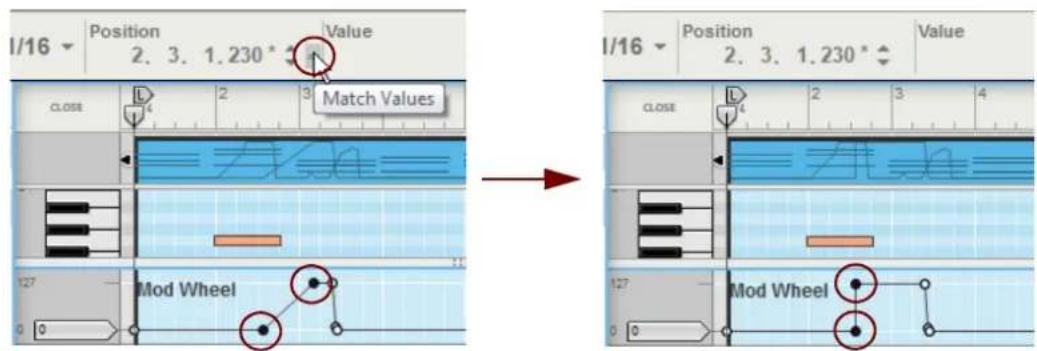
Matching the positions of several automation events in a single clip is not really useful. It will only place them in a "pile" on the same position. The effect during playback would be an instant jump between the extreme values. In practice, all events in between the extreme values will be disregarded.
Chapter 10
Working with Blocks in the Sequencer
About this chapter
This chapter describes how to work with Blocks and Block Automation Clips in the main sequencer. Basic sequencer functions, recording, editing clips and events and arranging in the sequencer are described in detail in the chapters "Sequencer Functions", "Recording in the Sequencer", "Audio Editing in the Sequencer", "Note and Automation Editing" and "Arranging in the Sequencer".
Introduction
The arrangement in the sequencer has two basic views: the Song View, which is exactly the same as the "Arrange Mode" in previous versions of the program, and the Blocks view. The Block View is designed for creating shorter multi-track "sections" that can be repeated anywhere in the song arrangement. In most situations a Block would probably consist of 4-8 bars.
An analogy to a Block would be a traditional drum machine pattern where you would record several (drum) instrument tracks and save as a complete "pattern". Then, you would build up your song arrangement by arranging your patterns, one after another, with repetitions etc.
The Song and Block Views share the same Track List but use separate clips and recordings. Any track and clip types can be used when working with Blocks, e.g. instrument tracks with note clips, audio tracks with audio clips, automation tracks with parameter automation clips and pattern tracks with pattern automation clips.
32 different Blocks are available in the program and each Block can be reused and repeated in the song arrangement as many times as you like. By working with Blocks you can create complete verse and chorus blocks and arrange and reuse them as desired in the song. When you arrange your Blocks in the song - using Block Automation Clips - you can also choose to temporarily mute desired lanes for the duration of each Block Automation Clip to create variations.
The idea behind Blocks
Working with the sequencer in a "pattern based" fashion appeals to many users. It is the way traditional hardware sequencers worked when they were first introduced on the market. The linear working method of most software sequencers also have many advantages. So, why not combine these two basic working methods to get the best of both worlds!
A very neat way of working with Blocks is by combining Block data with regular linear song data. In the picture below, Block data is being used as base for the song. Then, a number of shorter linear clips are used to override parts of the Block data to introduce nice variations in the song:
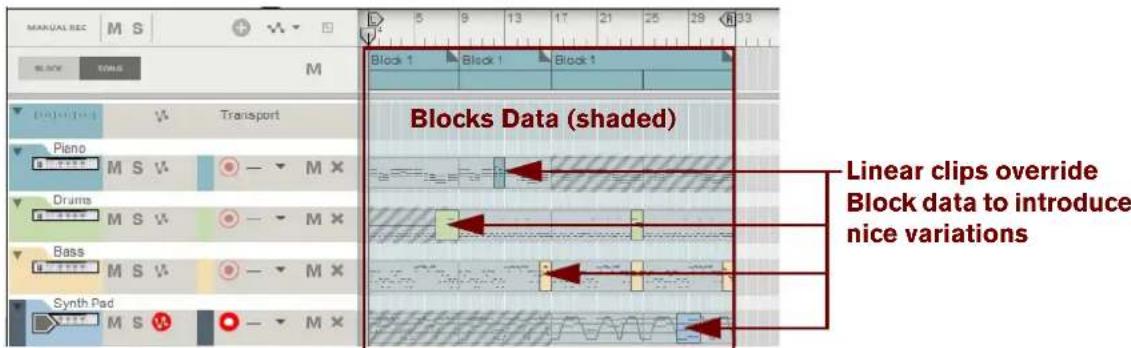
Linear clips override Block data to create nice variations in the final arrangement.
Arrangement Views
Song View (with Blocks disabled)
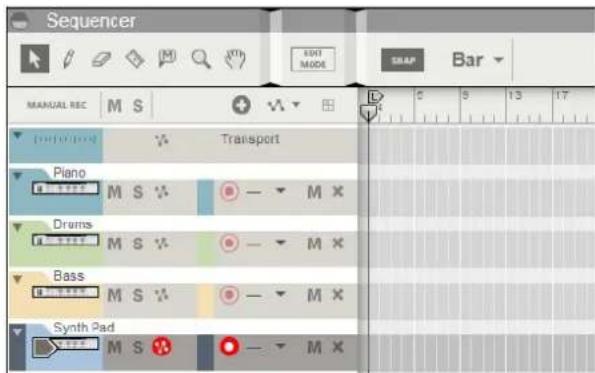
The sequencer in the Song View.
This is the Song View, which is the same as "Arrange Mode" in older versions of the program. Here you work with your song in a linear fashion, by recording and arranging your clips from the start of the song to the end. Songs created in previous versions of the program will automatically open up in the Song View, so it will all look very familiar.
Song View (with Blocks enabled)
When you create a new song, or a song from a template, the sequencer will automatically have the Blocks function activated. However, if you open a song that was previously saved with the Blocks function off, you will have to manually activate Blocks:
→ Select "Enable Blocks" on the Options menu to enable the Blocks function.
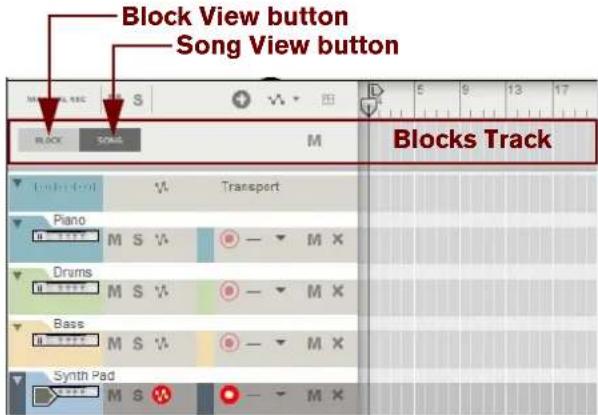
The sequencer in Song View with "Enable Blocks" activated
With Enable Blocks activated on the Options menu, an additional track - the Blocks Track - becomes available above the Transport Track. On the Blocks Track you can arrange your Block Automation Clips once you have recorded your Blocks. There are also two buttons to the left on the Blocks Track in the Track List: the Block and Song View buttons.
Block View
→ Click the Block button on the Blocks Track to switch to the Block View.
A colored area appears on the arrangement pane with the Block name at the top on the Blocks Track. By default, the Blocks are named "Block n" where "n" is a number between 1 and 32. If you like, you can rename your Blocks to more suitable names (see "Renaming Blocks"). The Block View is where you record the clips you want to include in a specific Block. The clips present in the colored Block area in the Block View are unique only to that specific Block.
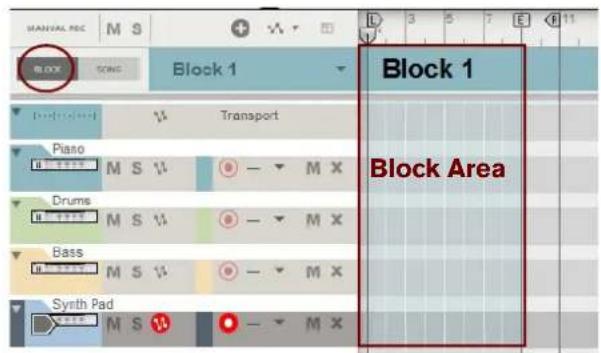
The sequencer in Block View
! The Song View and Block View share the Track List. However, the clips on the lanes are unique to the respective views. This means you can have clips in the Song View "on top" of clips in Blocks. See "Combining Block Automation Clips with Song Clips" for more details.
Editing Blocks in the Block View
Selecting a Block for editing
Selecting a Block for editing is done in the Block View. Select the Block you want to work with as follows:
-
Make sure "Enable Blocks" is activated on the Options menu.
-
Click the Block button on the Blocks Track to switch to Block View.
Block 1 appears by default on the arrangement pane:

- Select a Block (1-32) from the Blocks drop-down list in the Track List if desired.
In this example, we will stick to Block 1. The Block name is shown on the Blocks Track.

Renaming Blocks
If you don't want to use the default Block names you can easily rename them:
→ Double-click the Block name on the Blocks Track in the Block View, type in a new name and press [Return].

Defining the Block length
The length of a Block is defined using the End Marker in the Blocks view:
-
Select desired Block in the Block View as described in "Selecting a Block for editing".
-
Adjust the End Marker to the desired position by clicking and dragging it in the Ruler.

- The Block length is always defined from the beginning of the Ruler to the End Marker.
The Left and Right Loop Locators have no influence on the Block length.
- When the sequencer is running in Block View, it will automatically loop at the End Marker.
The Loop Locators can also be used in Block View to loop at other positions, if Loop On/Off is activated on the Transport Panel. However, in Song View the Loop Locator settings used in the Block View will be ignored.
- The Block length can be set individually for each of the 32 Blocks.
- The Block length can be changed at anytime by adjusting the End Marker in the Blocks view.
Changing Block color
Selecting separate colors for your blocks can be useful when you arrange your blocks in the Song View later on. All 32 Blocks already have default colors but these can easily be changed:
→ Select a color from the Block Color palette on the Blocks Track context menu or from the Edit menu. This applies the selected color to the Block. The sequencer tracks and any clips in the Block will maintain their original colors.
Recording in the Block View
Recording on tracks in the Block View is done in the same ways as when recording in the regular Song View.
! Any events or recordings to the right of the End Marker in the Block View will be ignored when the Block is played back in the Song View.
Refer to "Recording in the Sequencer" for details about recording.
Editing clips in the Block View
Editing events in clips in the Block View is done in the same way as when editing clips in the Song View.
→ Double-click desired clip to open it for editing in Edit Mode, or click the Edit Mode button in the Toolbar. Refer to "Note and Automation Editing" and "Audio Editing in the Sequencer" for details about editing clips.
Arranging clips in the Block View
Arranging clips in the Block View is done in the same ways as when arranging clips in the Song View.
! Any clips, or parts of clips, to the right of the End Marker in the Block View will be ignored when the Block is played back in the Song View.
Refer to "Arranging in the Sequencer".
Arranging Blocks in the Song View
Once you are finished with your clips on the tracks and lanes in the Block View, it is time to arrange the Blocks to build up your song in the Song View. Setting up the Blocks and their playing order is done by creating Block Automation Clips on the Blocks Track in the Song Arrange view.
The following section describes functions and routines that are specific to Block Automation Clips. General clip handling procedures (e.g. naming, coloring etc.) are described in the general "Clip handling" section.
Creating Block Automation Clips
A Block Automation Clip is very similar to a Pattern Clip (for a Redrum device, for example). A Block Automation Clip defines which Block should play back, and for how long. To create Block Automation Clips, proceed as follows:
- Click the Song button to switch to the Song View.
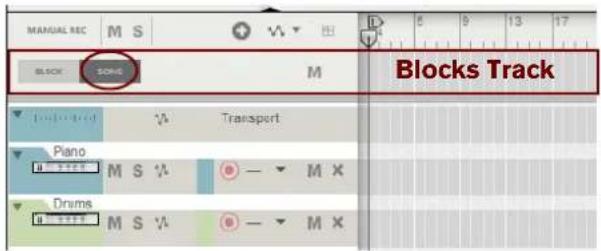
- Select the Pencil tool.
The Block selector appears in the Inspector:

- Select desired Block (1-32) from the Block Selector List.
In this example, we will use Block 1.
4. Draw a clip on the Blocks Track.
This creates a Block Automation Clip which instructs the sequencer to play back the events you have previously recorded in Block 1:
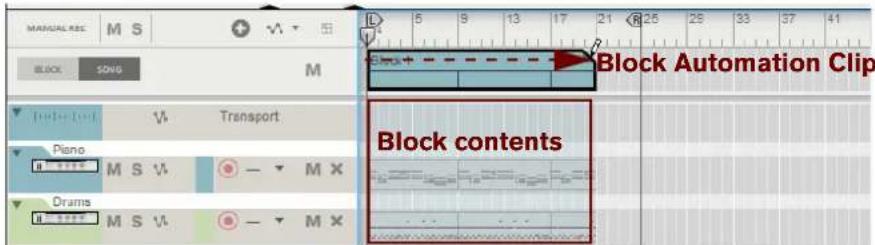
A Block Automation Clip drawn on the Blocks Track in the Song View.
The contents (clips and events) of Block 1 are displayed on the respective sequencer tracks in a ghosted fashion on a colored background. This way you will see what events and/or recordings the Block will play back. This also allows for muting of individual lanes in the Block (see "Muting lanes in Block Automation Clips").
The following rules apply to Block Automation Clips:
- If the Block Automation Clip is longer than the actual Block length (defined by the End Marker in the Block View), the Block is repeated over and over for as many times as necessary.
In the picture above, the Block length is 8 bars and the Block Automation Clip is 20 bars. This means that Block 1 is repeated at bars 9 and 17. The repetitions are indicated with thin vertical lines in the Block Automation Clip and on the sequencer tracks (similar to a Pattern Automation clip).
- If the Block Automation Clip is shorter than an even multiple of the Block length, the remaining content of the Block is masked out (muted) in the Song View arrangement.
In the picture above, the last 4 bars of the third repetition are masked out.
→ If you want to add single Block Automation Clips, you can also double click with the Selection (Arrow) tool on the Blocks Track.
The clip gets the length of the currently selected Snap value. To create longer clips, double click, hold and drag to the right.
Resizing Block Automation Clips
As with other clip types Block Automation Clips can be resized by clicking and dragging the clip handle(s) with the Selection (Arrow) tool or by editing the Position and Length values in the Inspector.
- If you resize a Block Automation Clip by clicking and dragging its left clip handle, and thus changing its start position, the Block Offset will change.
This means that the Block Automation Clip could start playing in the middle of the Block, i.e. not from the beginning. The picture below shows a Block Automation Clip before and after resizing the start position:
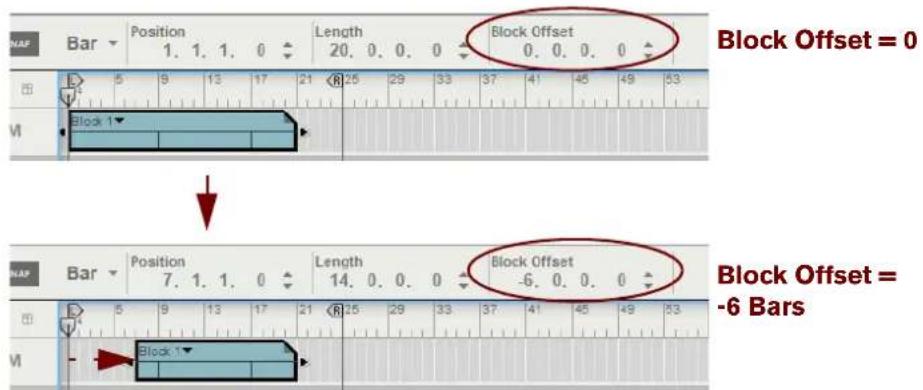
Changing the start position by resizing a Block Automation Clip
In the example above, the Block Automation Clip will begin playing at Bar 7, and will start playing back the events that begin at Bar 7 in the Block.
- If a Block contains sequencer tracks that use Pattern Automation (a Redrum track, for example), a Block Offset will make the pattern start playing back from the correct position within the pattern and sound just as you would expect.
Reassigning Blocks in Block Automation Clips
To assign another Block to an existing Block Automation Clip, click the small triangle button on the Block Automation Clip and select another Block from the drop-down list:
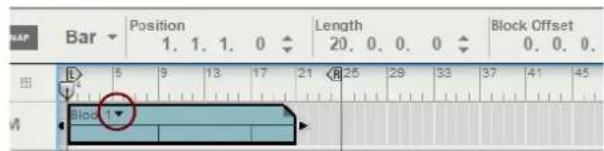
The Block Automation Clip color changes to the color of the new Block and the ghosted clips on the tracks switch to show the contents of the new Block.
Muting lanes in Block Automation Clips
When you have arranged your Block Automation Clips as desired on the Blocks Track, it is possible to mute individual lanes contained in any Block. These lanes will remain muted until the end of the Block Automation Clip.
This way you can use the same Block to create a song intro, by gradually introducing more and more sequencer tracks/lanes. The example below shows how to mute lanes in individual Block Automation Clips to create a song intro.
We are going to use one single Block - Block 1 - to create a song intro. The Block is 8 bars long and uses four sequencer tracks. In the Block View we have recorded on all four sequencer tracks:
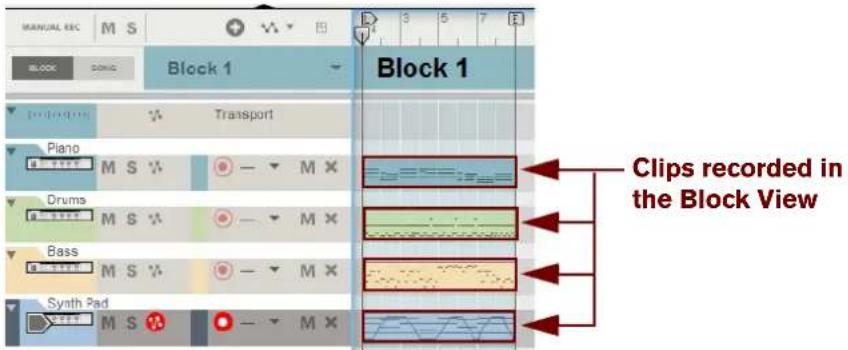
Block 1 in the Block View with four sequencer tracks.
Now, we want to arrange our song so we switch to the Song View and draw an 8 bar Block Automation Clip on the Blocks Track:
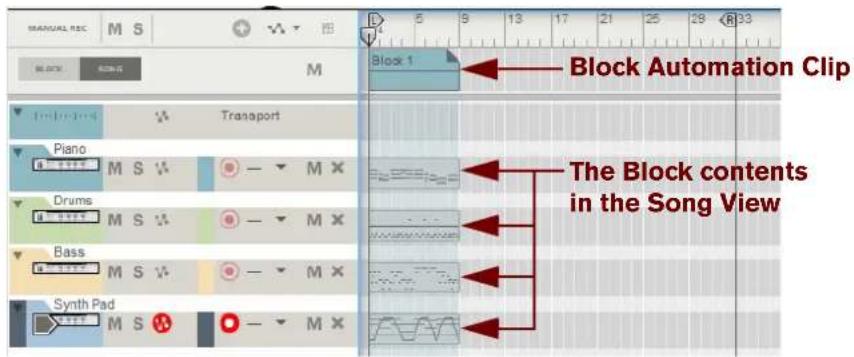
An 8 bar Block Automation Clip assigned to Block 1.
In our intro we want the Piano and Bass track to play the first eight bars. In the next eight bars we want to have the drums playing as well. Then, we want the song to continue for another 16 bars with all tracks playing except the Piano track.
To achieve this, we need to create several Block Automation Clips that play back the same Block. This is because when we're going to mute lanes later on, we need to define for how many bars we want the mutes to be active. The duration of the mutes are defined solely by the lengths of the Block Automation Clips.
We begin by copying and pasting the Block Automation Clip twice. Then we resize (expand) the last Block Automation Clip to 16 bars:
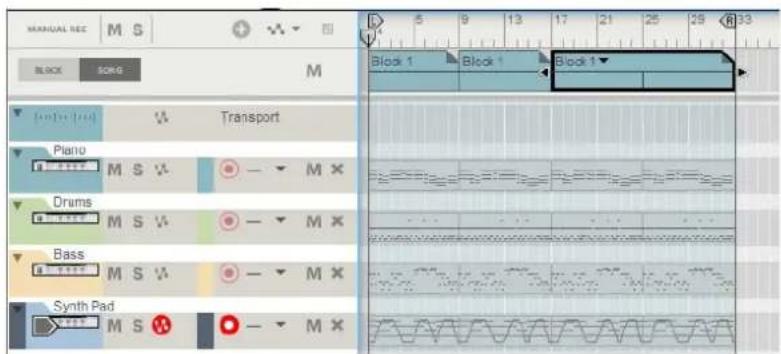
The Block Automation Clip assigned to Block 1 copied and pasted twice, with the last Block Automation Clip resized to 16 bars.
Now, we want to mute individual lanes for the duration of each Block Automation Clip to create our intro. We select the Mute tool from the Toolbar and click on the lanes we want to mute in each Block Automation Clip:
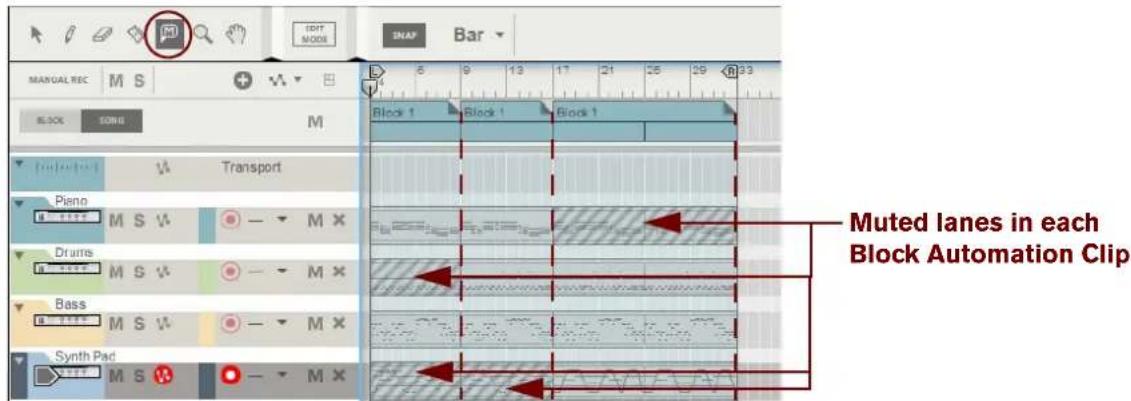
Muted lanes throughout the length of each Block Automation Clip.
Now, we have our intro with the Piano and Bass playing the first 8 bars. Then, the song continues for another 8 bars with Piano, Bass and Drums. Finally the song plays another 16 bars with Drums, Bass and Synth Pad. All we needed for this intro was one single 8 bar Block.
Note that the lanes will be muted for the duration of each Block Automation Clip. If the Block contents are repeated in the Block Automation Clip, as in the last clip above, the lane will be muted throughout the entire Block Automation Clip length. If you resize a Block Automation Clip, any muted lanes will be resized accordingly.
Converting Block Automation Clips to Song Clips
After you have arranged your Block Automation Clips in the Song View, you might want to convert the content of the Block(s) to "regular" clips on the sequencer tracks and lanes. There are a few ways of doing this:
Converting single Block Automation Clips to clips in the Song View
- Choose the Block Automation Clip(s) you want to convert by selecting it on the Blocks Track.
- Select "Convert Block Automation to Song Clips" from the Edit menu or Block Clip context menu.
All unmuted clips in the Block(s) are automatically converted to regular clips on the tracks. The Block Automation Clip and its contents are preserved and left unchanged:
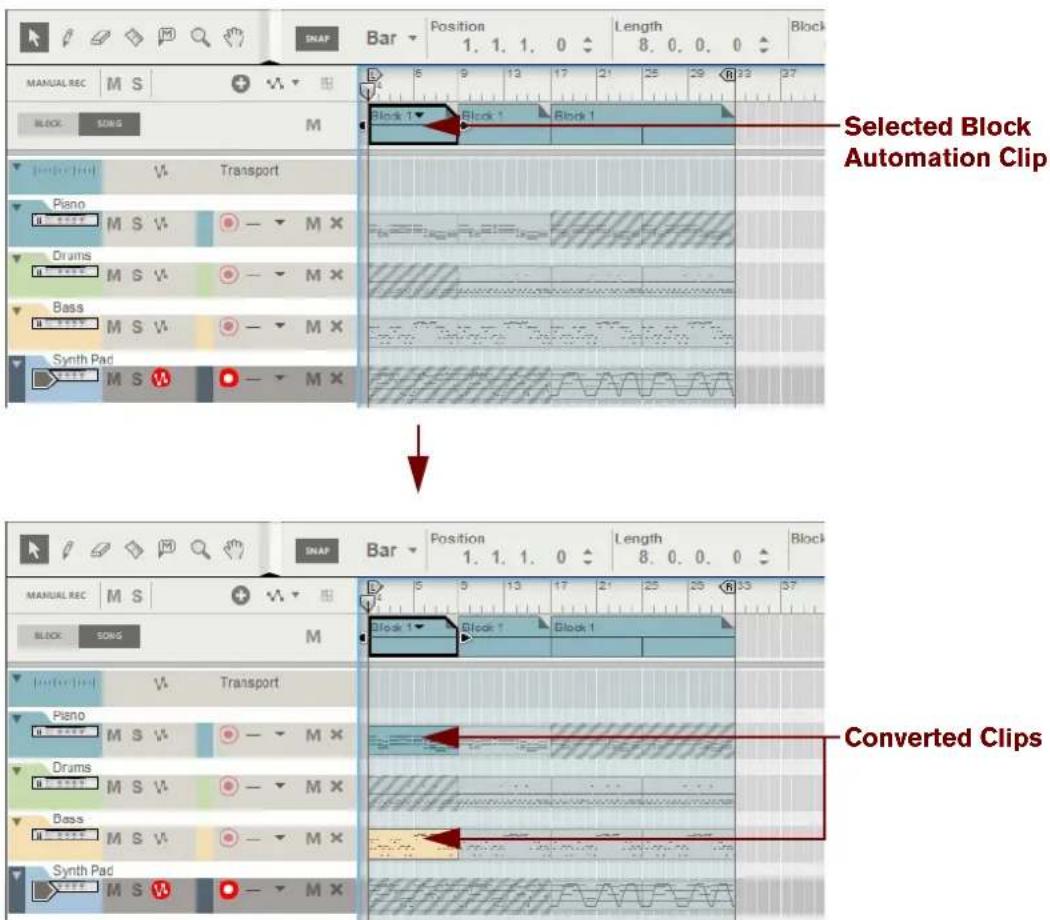
Before and after the "Convert Block Automation To Song Clips" command used on the first Block Automation Clip.
Converting all Block Automation Clips to clips in the Song View
→ Select "Convert Block Automation to Song Clips" from the Track List context menu.
All unmuted clips in all Block Automation Clips are automatically converted to regular clips on the tracks. The Block Automation Clips and their referenced Block contents still are preserved but the Blocks Track is automatically muted. This is made to reduce the clutter on the arrangement pane:
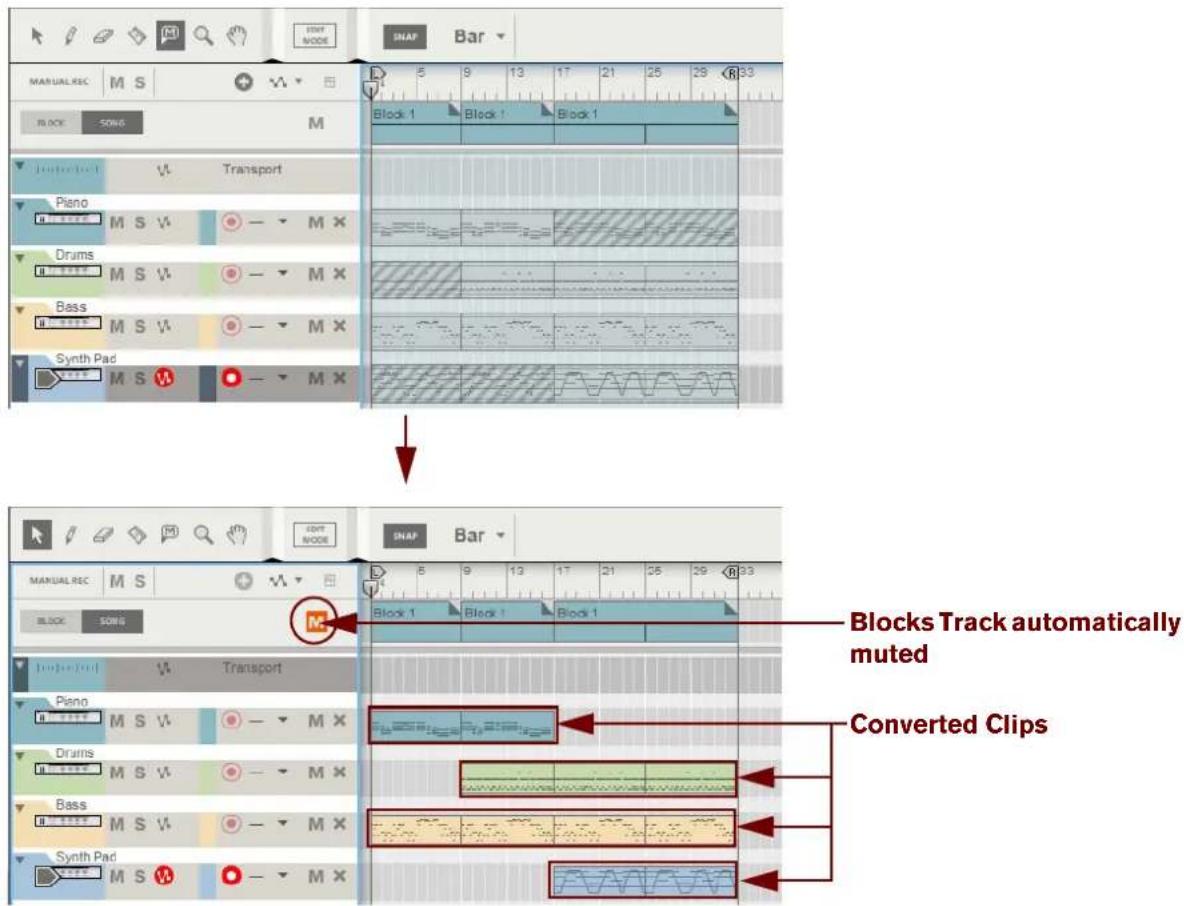
Before and after the "Convert Block Automation To Song Clips" command on the Track List context menu.
→ If you want to activate the Blocks Track again, click the "M" button on the Blocks Track.
Using Cut/Copy and Paste for individual clips
You can of course also use the standard Cut/Copy & Paste functions to copy clips from the Block View to the Song View, and vice versa.
- Select the clip(s) on the arrangement pane (in Blocks or Song View).
- Use the standard Cut or Copy command.
- Switch to the other View (Song or Blocks)
- Use the Paste command.
Combining Block Automation Clips with Song Clips
It's possible to combine Block Automation Clips with regular clips in the Song View. The general rule is that clips in the Song View have priority over Block data. This means that if a clip in the Song View overlaps a (ghosted) clip on the same lane in a Block, the Song Clip will play back and the clip in the Block "underneath" will be silent (masked):
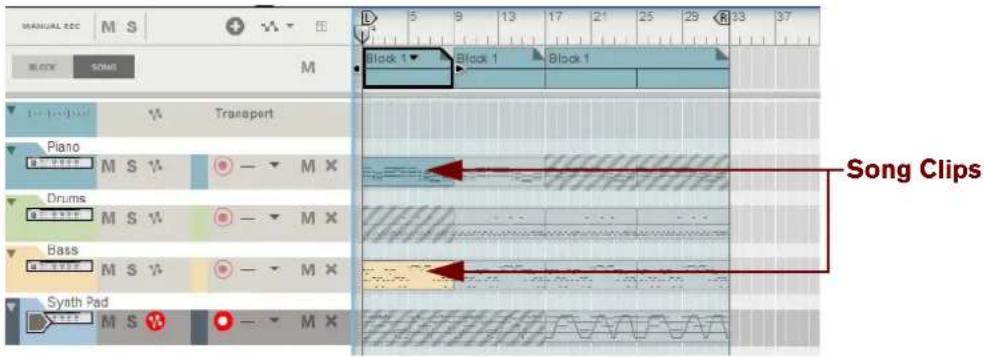
Song clips and Block Automation Clips in combination in the Song View.
If we play back the song in the picture above, this is what we will hear:
- In Bars 1-8 the song clips on the Piano and Bass tracks will play. Any Block data “underneath” these clips will be silent.
- In Bars 9-16 the Block data for the Piano, Drums and Bass tracks will play back since there are no overlapping Song Clips.
- In Bars 17-32 the Block data for the Drums, Bass and Synth Pad tracks will play back since there are no overlapping Song Clips.
Practical tips on combining Blocks and Song Clips
A nice way of working with Block Automation Clips and Song Clips is to first create a couple of Blocks in the Block View and then arrange Block Automation Clips in the Song View. When you have arranged your Block Automation Clips, you could record a couple of shorter Song Clips with variations in the Song View. Then, place these short clips at desired positions in the arrangement to create nice variations in the song, according to the example below:
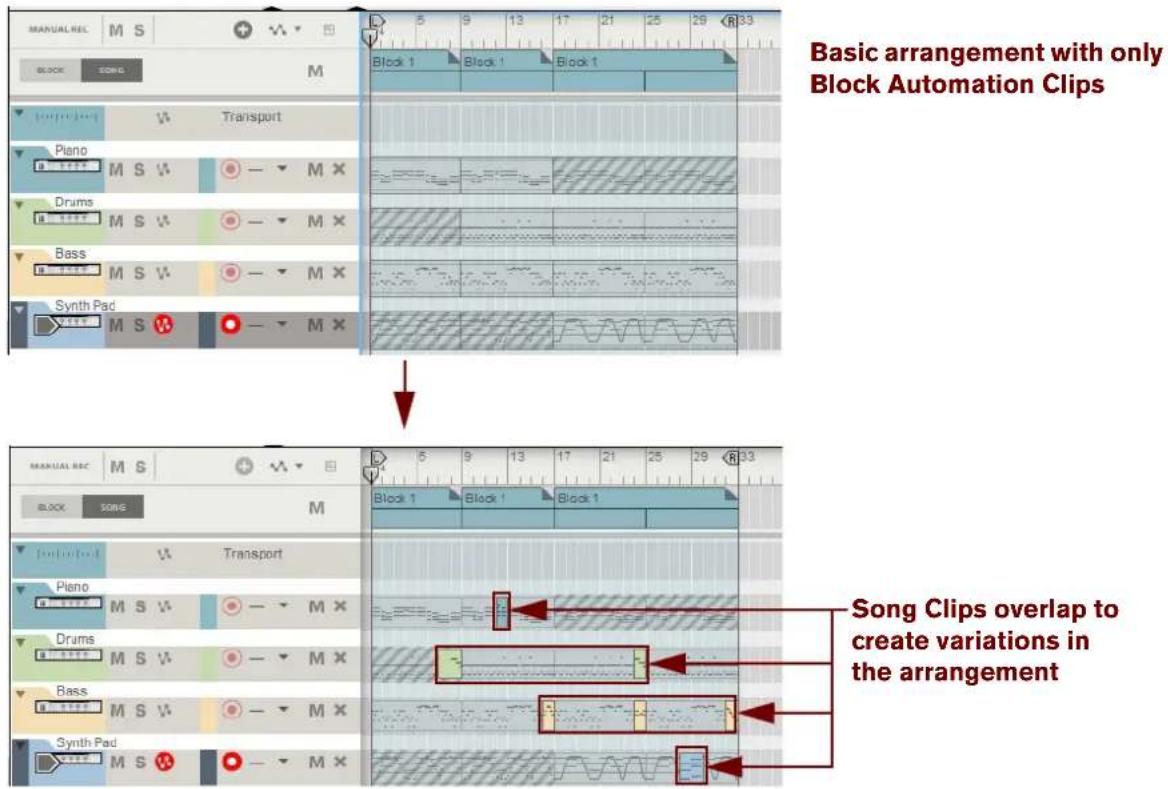
Short Song Clips combined with Block Automation Clips in the Song View to create nice variations.
Since Song Clips automatically mute (mask) the "underlying" Block data, short Song Clips are prefect for introducing temporary variations in a Block based song.
About Performance Controllers and Parameter Automation
Since the sequencer tracks and lanes are shared between the Blocks and the Song arrangement, the following rules apply regarding Performance Controller and Parameter Automation:
- Performance Controller and Parameter Automation data in the Song View arrangement always overrides automation in Blocks.
- If a sequencer track uses Parameter Automation in the Block, the automation will also affect all clips on the corresponding lanes in the Song View.
The picture below shows a piece of an arrangement with an instrument track which has one note lane and one parameter automation lane. The arrangement is built up by Blocks (the ghosted data) and one short Song Clip for variation in bars 28 through 29 (the blue clip on the note lane). The Block uses Mod Wheel Performance Controller automation (the gray line inside the note clips in the Block) and automation of the Rotary 4 parameter (the gray line in the parameter automation clips in the Block):
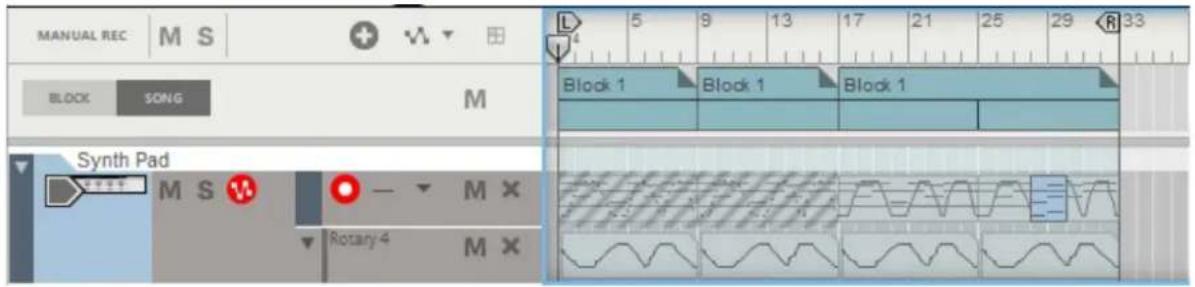
• The song only plays Block data from the start to bar 28.
During this time, the Rotary 4 automation is active. (However, no notes are played back in bars 1 through 16 since the note lane in the Block is muted.)
- At bar 17 the note lane is played back together with the Mod Wheel Performance Controller data in the Block. The Rotary 4 automation is still active.
- At bar 28 the (blue) Song Clip takes over the note playback and Mod Wheel Performance Controller automation.
Since the Mod Wheel isn't touched at all in the Song Clip, its value is set to zero. However, note that the Song Clip is still affected by the Rotary 4 automation in the Block!
- At bar 30 the note clip in the Block takes over again and controls note playback and Mod Wheel Performance Controller automation.
The Rotary 4 automation is still active.

Chapter 11
Working with the Rack
About this chapter
This chapter describes the procedures and techniques for managing devices and Device Groups in the rack.
Rack device procedures
The rack is where you create and configure your devices, and make parameter settings. This section describes all the procedures for managing the rack, that is, procedures and techniques common to all devices.
Navigating in the rack
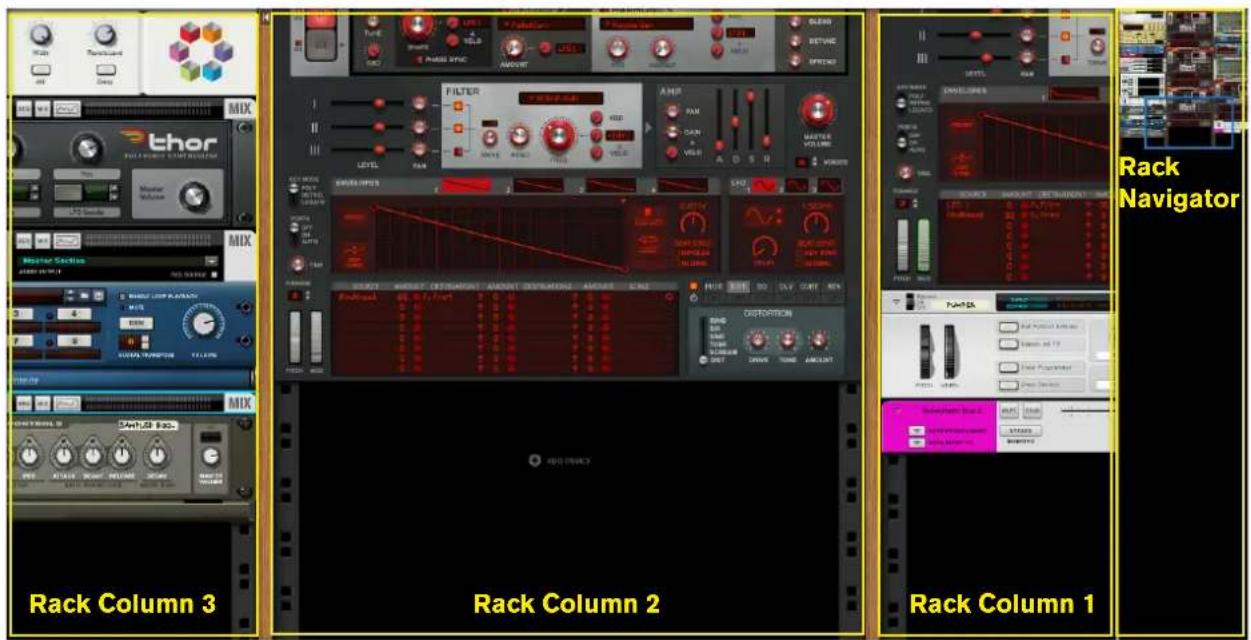
The rack, here with three rack columns visible.
The rack houses all the devices you use in your song. To make it easier to overview the devices, the rack can contain several rack columns next to each other. To navigate in the rack, use one of the following methods:
→ Click and drag the blue frame in the Rack Navigator to scroll continuously in the rack, both vertically and horizontally.
Just clicking in the Rack Navigator will directly scroll to the corresponding position in the rack.
→ If you're using a mouse equipped with a scroll wheel, you can use it to scroll up or down in the rack. Hold down [Shift] and use the scroll wheel to scroll horizontally in the rack.
→ Press the [Page Up] and [Page Down] buttons on the computer keyboard to move the view one "full screen" up or down in the rack column currently in view.
Note that the rack area must have Edit Focus, i.e. there must be a frame surrounding the rack area. Set Edit Focus by clicking anywhere in the rack area.
→ Press the [Home] and [End] buttons on the computer keyboard to scroll the top or bottom of the rack column currently in view.
Note that the rack area must have Edit Focus.
- When you select a track in the sequencer, or click the "Rack" button below a channel strip in the Main Mixer, the rack will automatically scroll to bring the associated device into view.
Resizing and detaching the rack
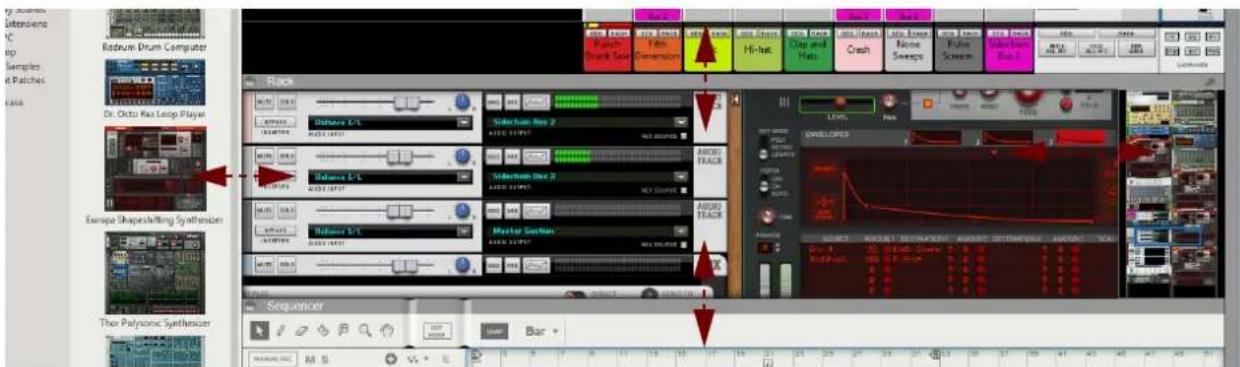
→ Resize the rack area by clicking and dragging either of the gray horizontal headers above or below the rack area, or by dragging the vertical Browser divider.
This will shrink the Main Mixer and/or sequencer areas and make more of the rack visible.
→ You can also resize the Rack Navigator area by clicking and dragging the vertical divider to the left of the Rack Navigator.
Dragging the divider to the left will expand the Rack Navigator area and enlarge the devices, making it easier to get a good overview of all devices in your rack.
→ To make the rack fill the entire song document window, press [F6] or double click the gray Rack header:

The rack header.
→ To toggle between show and hide rack, click the Show/Hide icon to the left on the gray rack header:

The Show/Hide icon on the rack header.
→ You can detach the rack area from the other areas altogether by holding Ctrl or Cmd and pressing [F6], or by clicking the "Detach" icon in the gray rack header.
This will place the rack in a separate window. (See "The Rack" for more info.)

The rack Detach icon.
- See also "Creating new rack columns" for information on how to create several rack columns.
About using the Browser in the detached rack
When the rack is detached, it also features a second instance of the Browser. The Browser is available to the left in the detached rack.
→ Click the Show/Hide icon, or press [F3] to bring up the Browser (or to hide it):
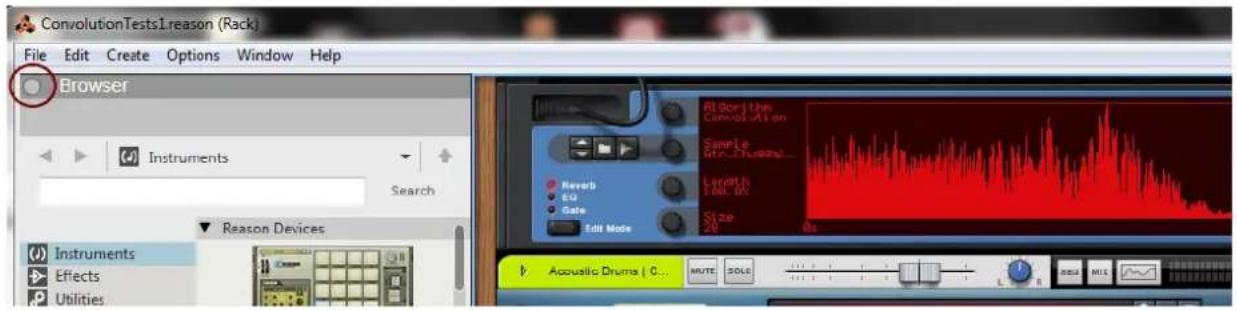
The Show/Hide icon on the Browser header in the detached rack.
- The Browser in the detached rack can be navigated independently from the Browser in the Song window, except only one can have browse focus at a time (see "Setting browse focus").
This means you can be in two completely different locations (or palettes) in the two Browsers.
About Device Groups
A Device Group is a series of interconnected devices that "belong together". A Device Group could be, for example, an instrument device connected to an effect device and then to a Mix Channel device.
A Device Group consists of the following:
• One (and only one) Source device (e.g. an instrument).
- The devices to which the Source device feeds its audio signals (e.g. and effect device).
- Any CV-only devices (a Matrix Sequencer, for example) that are CV-connected to devices in this group only.
- All sequencer tracks and Main Mixer channel strips for the devices in the group.
! A Device Group is only defined by the connections between the devices - it has nothing to do with the physical location of the devices in the rack.
By default, when you create an Instrument device, a new (or currently unused) Mix Channel device will be automatically connected to the Instrument device, as described in "Creating devices". In this situation, the Instrument device and the connected Mix Channel device will now be considered a Device Group - with the Instrument device as the Source device.
If you want to keep all devices in a Device Group physically together in the rack (e.g. if you want to move all devices in the group), there is an option "Auto-group Devices and Tracks" on the Options menu.
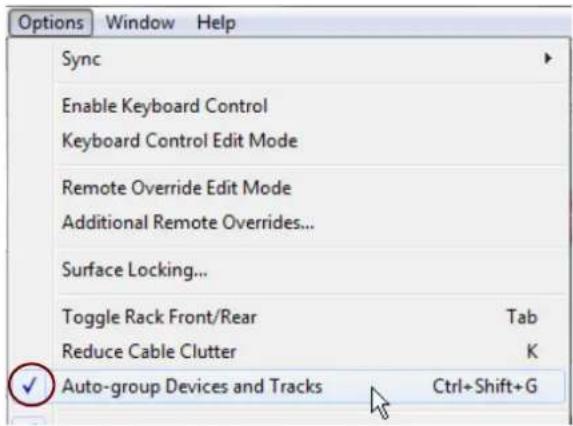
The "Auto-group Devices and Tracks" option.
The advantage of using the "Auto -group Devices and Tracks" option is that it's much easier to get a good visual overview over what devices are connected to each other and associated with specific sequencer tracks and with a specific channel strip in the Main Mixer. It's also easier to rearrange devices in the rack since all devices in the Device Group will move together if one device in the Device Group is moved.
The example below shows two ID8 devices connected to one Mix Channel device each. Let's say you want to move the ID8 1 device to another position in the rack. This is what will happen:
- Make sure "Auto-group Devices and Tracks" is selected on the Options menu - if not, select it from the menu or hold down [Ctrl]+Shift or [Cmd]+Shift and press [G].
- Click on the ID8 1 device panel (but not on a parameter or display) and drag and drop below the ID8 2 device in the rack.
As you can see, both the ID8 1 device and its connected Mix Channel device are moved together, as a group, to the new destination.
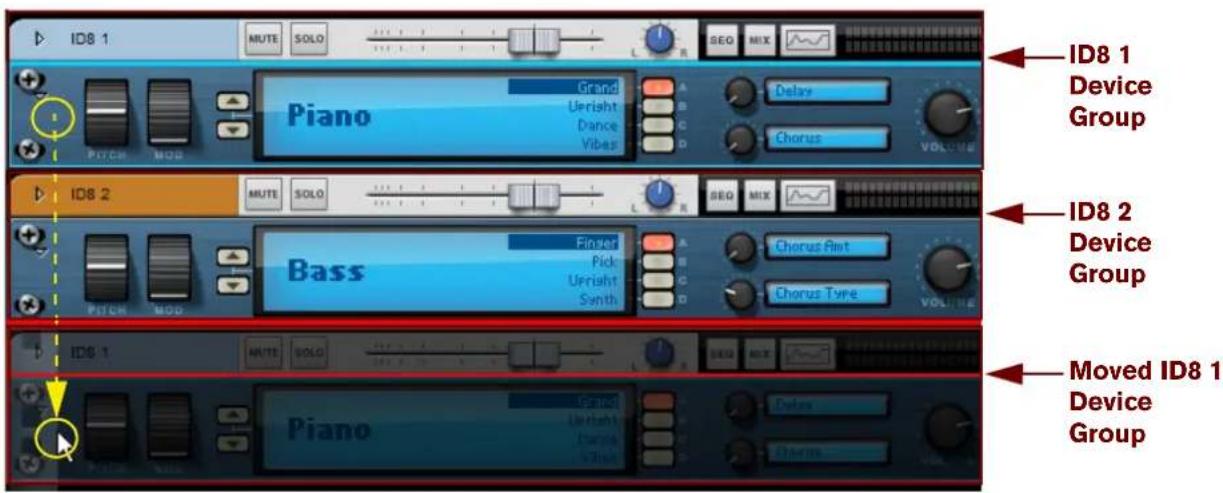
- If you want to view what devices belong to a specific Device Group, select a device and then select "Select All in Device Group" from the Edit menu or context menu.
Creating devices
Devices can be created in a number of different ways. These first methods apply to any device types:
→ Use drag and drop, or double-click a device in any of the device palettes in the Browser.
The devices are sorted in four different groups: Instruments, Effects, Utilities and Players. The Utilities group contains device types such as mixers, modulation devices, etc. In each device type group the devices are listed in the following sections: Reason Lite Devices, and then by Rack Extension and/or VST manufacturer in alphabetical order. The Players group is a little special; it contains a number of MIDI "generators" that can be used when recording Instrument tracks in the sequencer, see "Working with Players".
A device can be dropped in the rack or in the Track List in the Sequencer. As you drag a device to the rack or Sequencer Track List, a +-sign is shown together with an orange divider to indicate where the device will be placed:
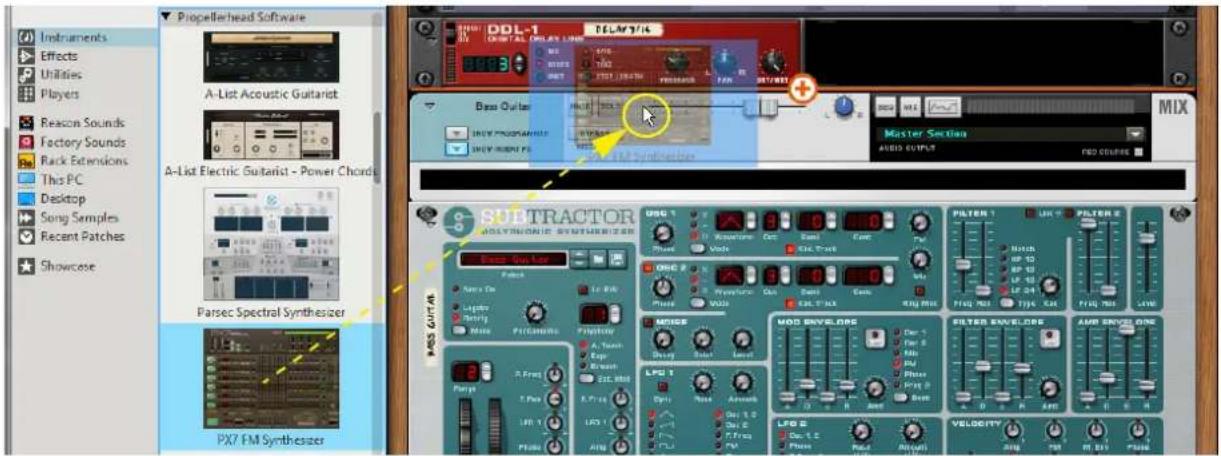
Adding a PX7 FM Synthesizer device by dragging from the Instruments device palette and dropping in the rack.
→ Use drag and drop from the Browser, Windows Explorer (Win), Finder (Mac), or double click a patch in the Browser.
When you drop a patch in the rack or in the Track List in the Sequencer the corresponding device is automatically created in the rack.
→ Click the Add Device icon in the rack background and select the desired device from the menu:
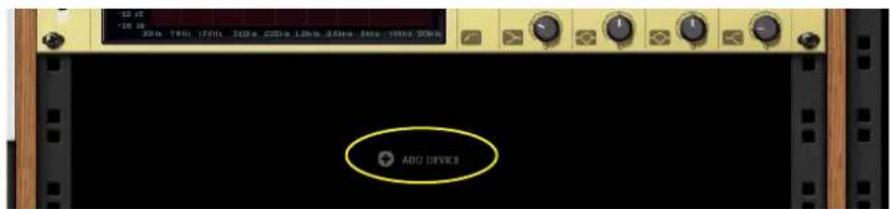
→Select desired device from the "Create" menu.
Any device type can be created. The "Create" menu is available both on the main menu and on the rack and device context menus and is divided into the three groups Instruments, Effects and Utilities. At the top of each group (Instruments/Effects/Utilities) are the devices you create most often. Below are all available devices, on sub-menus per manufacturer.
- When you have created an Instrument or Effect device that can load patches, it automatically gets "browse focus" (orange indicators). This means that the Browser automatically displays patches for the device you just created. See "Loading patches" for more information.
Automatic browse focus can be switched off if you like. This is done on the General tab in Preferences, see "New devices get browse focus".
- When you add a new device, Reason Lite attempts to automatically route it in a logical way.
For more information about the auto-routing features, see "Automatic routing".
Depending on what type of device you've created, and also the "Auto-Group Devices and Tracks" setting, the results will differ:
- If "Auto-Group Devices and Tracks" on the Options menu is not selected, the new device is added directly below the currently selected device in the rack.
If no device is selected, the new device is added at the bottom of the rack.
- If "Auto-Group Devices and Tracks" on the Options menu is selected, devices will not be created in the middle of existing Device Groups (except if they are effect devices - see "Effect devices specifics").
This means a device might not end up below the selected device in the rack, but below that device's Device Group.
! See below for information specific to certain device types.
Instrument device specifics
The following additional methods can be used for creating Instrument devices:
→Select "Create Instrument..." from the Create menu.
This will show the Instruments palette in the Browser. Here you can choose the Instrument device you want to create - see "Create Instrument/Create Effect".
- If you have created an Instrument device, a new sequencer track will be automatically created. Also, a new (or unused) Mix Channel device will be connected to the Instrument device. The Mix Channel device's channel strip will appear in the Main Mixer.
The track, the Mix Channel device and its channel strip will be given the same name as the created Instrument device. Master Keyboard Input will also automatically be set to the new track, allowing you to immediately play the created Instrument device via MIDI (see "Master Keyboard Input"). By default, the Instrument device and Mix Channel device will be treated as a "Device Group" from here on (see "About Device Groups").
! By default, the automatic creation of a sequencer track and Mix Channel device only applies to instrument devices, not to mixers or effect devices.
- If you hold down Alt or Option when you create an Instrument device (except when you drag and drop from the Browser), a sequencer track will not be created.
- If you hold down [Shift] when you create an Instrument device, there will be no automatic routing or connections made.
Audio Track device specifics
The following additional methods can be used for creating Audio Track devices:
→Select "Create Audio Track" from the Create menu.
This will create an Audio Track device (with its corresponding channel strip in the Main Mixer) and a sequencer track.
Mix Channel device specifics
- If you hold down Alt or Option when you create a Mix Channel device (from the Create menu or Browser), a sequencer track will be created for the device.
Effect devices specifics
The following additional method can be used for creating Effects devices:
→Select "Create Effect..." from the Create menu.
This will show the Effects palette in the Browser. Here you can choose the Effect device you want to create - see "Create Instrument/Create Effect".
The results when creating Effect devices depend on the following criteria:
- If an Audio Track (device or channel strip), or a Mix Channel (device or channel strip), was selected in the rack when you created an effect, the effect device will be added and connected as an insert effect, inside the Insert FX container for that Audio Track or Mix Channel device.
- If an Instrument device was selected in the rack when you created an effect device, the effect device will be added and connected as an "insert effect", between the Instrument device and the Mix Channel device.
- If a Mixer 14:2 or Line Mixer 6:2 was selected in the rack when you created an effect, the effect device will be added and connected as a Send Effect, on the first available Send FX connectors of the mixer device.
- If you hold down Alt or Option when you create an effect device, a sequencer track will be created for the device.
- If you hold down [Shift] when you create an effect device, the effect device will not be connected.
Mixer device specifics
- If you hold down Alt or Option when you create a mixer device, a sequencer track will be created for the mixer device.
- If you hold down [Shift] when you create a mixer device, it will not be connected to a Mix Channel device.
Selecting devices
Some operations, e.g. cutting, copying, moving and deleting devices (see "Cut, Copy and Paste devices" and "Deleting devices"), require that you select one or several devices in the rack. This is done according to the following:
→To select a single device, click on it in the rack.
The selected device is displayed with a colored border (based on the color scheme selected for your operating system).
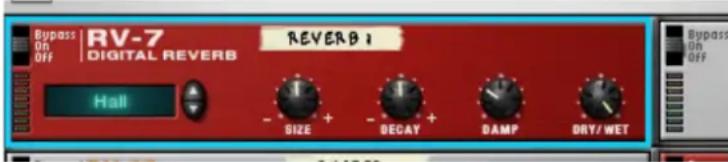
→ To select several devices, hold down [Shift] and click on the desired devices.
In other words, [Shift]-clicking a device selects it without de-selecting any other selected devices.
→ To de-select all devices, click in the empty area at the bottom of, or next to, the rack.
To de-select a device in a multiple selection, hold down [Shift] and click on it. All other selected devices remain selected.
→ You can also use the arrow keys on the computer keyboard to select the device directly above, below or next to the currently selected one.
When you use this method, Reason Lite will automatically scroll the rack so that the selected device is fully visible. This is a quick way of "stepping through" the rack. Narrow devices (e.g. half-width devices such as some effects) are ordered left-to-right, i.e. pressing the down arrow key will step through the devices from left to right before moving on the next device row.
→ If you hold down [Shift] when using the up or down arrow keys, the currently selected device will remain selected.
This allows you to select a range of devices.
Adjusting a parameter in a device will automatically select the device. In other words, you don't have to select a device as a separate operation before editing its parameters.
Playing devices from the rack
When you create an instrument device it automatically gets a corresponding sequencer track, and Master Keyboard Input is set to that track so you can play the instrument device from your MIDI keyboard. You can change Master Keyboard Input by selecting another sequencer track, but you can also change Master Keyboard Input from the rack. This is useful if you, for example, have the rack detached and maximized, so you can't see the sequencer area.
When you select a device in the rack it is surrounded by a colored border. At the top left of the border is a Master Keyboard Input tab:

The Master Keyboard Input tab on a selected ID8 device in the rack.
→ Click the Master Keyboard Input tab to automatically set Master Keyboard Input to the device.
Master Keyboard input is automatically switched in the sequencer as well and you can now play the device from your MIDI keyboard:
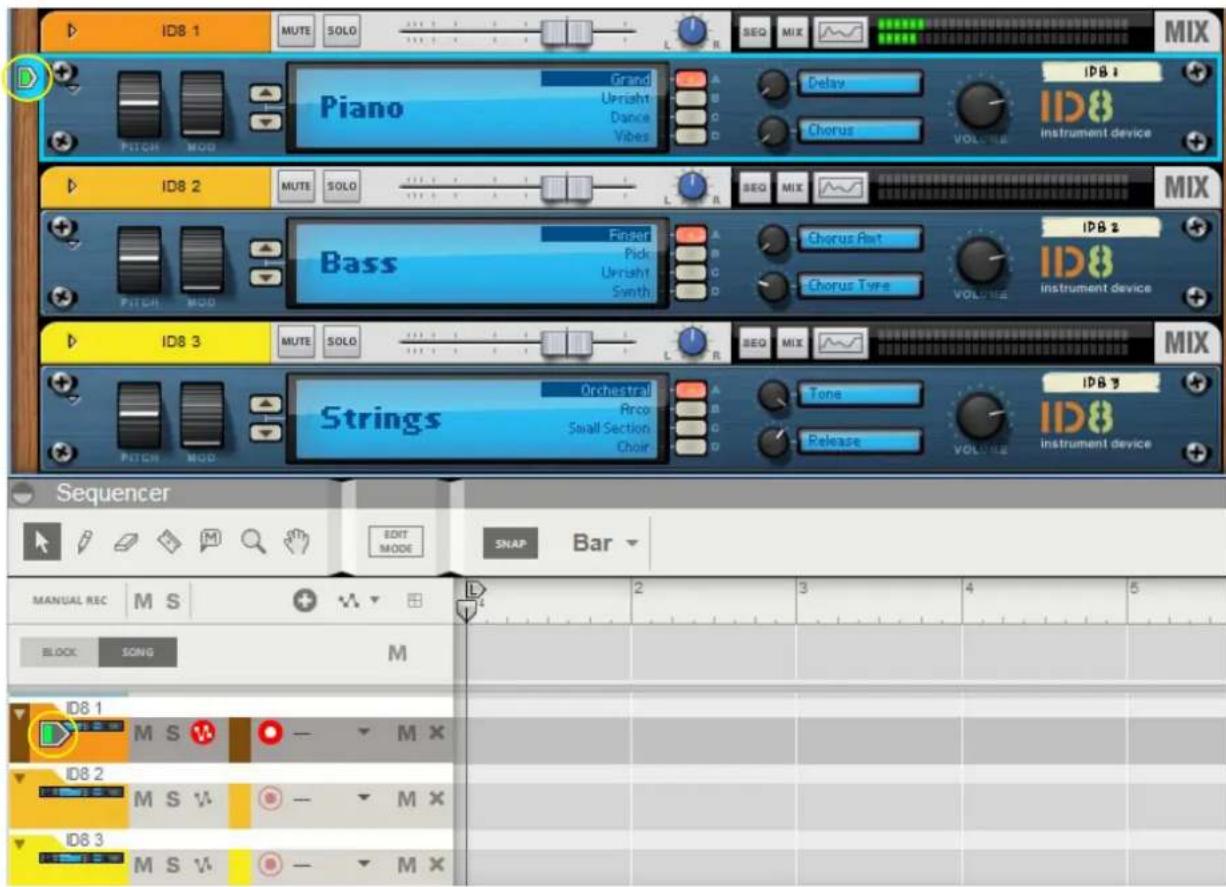
Master Keyboard Input set from the ID8 1 device in the rack.
When you play the device, incoming MIDI is indicated by the Master Keyboard Input symbols on the device in the rack as well as on the sequencer track.
- If a selected device doesn't have a sequencer track (e.g. effect devices), one will be automatically created if you click the Master Keyboard Input tab.
About selecting all devices in a Device Group
To select all devices in a Device Group, do as follows:
- Select any device in the desired Device Group.
- Select "Select All in Device Group" from the Edit menu or context menu.
All devices in the Device Group will be selected as indicated by the colored borders around the devices.
Deleting devices
To delete one or several devices, select them in the rack and use one of the following methods:
→Press [Backspace] or [Delete].
An alert appears asking you to confirm the deletion. Any cable connections to the device will also be deleted (or re-routed).
! If you have selected a Source device or a Mix Channel device and the "Auto-Group Devices and Tracks" on the Options menu is selected, an alert appears asking if you want to delete the device or the whole Device Group, including sequencer tracks and channel strips. (See "About Device Groups").
To delete devices or Device Groups without alerts, hold down Ctrl or Cmd and press [Backspace] or [Delete].
→ Select "Delete Devices and Tracks" from the Edit menu or the device context menu.
An alert appears asking you to confirm the deletion. This will delete the devices together with the associated sequencer track(s) also if the "Auto-group Devices and Tracks" option isn't selected. (It's possible to have devices without associated tracks but it is not possible to have a sequencer track without an associated device.)
To delete devices and tracks without alerts, hold down Ctrl or Cmd before selecting "Delete Devices and Tracks" from the Edit menu or the device context menu.
! If you delete a device connected between two other devices, the connection between the two other devices is automatically preserved.
! The Reason Lite Hardware Interface and the Master Section device at the top of the rack cannot be deleted.
Re-ordering devices
If you want to move an instrument device to another position in the rack, you probably also want its Mix Channel device and connected effects to move along with it. If the "Auto-group Devices and Tracks" on the "Options" menu is selected, all devices in the Device Group will follow along when you drag and drop a device included in a Device Group. However, it's still possible to re-order devices within each Device Group. See "About Device Groups" for more details. See also "About the "Sort Selected Device Groups" function" for information about automatic sorting of several Device Groups.
If the "Auto-group Devices and Tracks" on the "Options" menu is not selected, you can re-order and move devices individually in the rack - even outside the Device Groups:
- If you want to move more than one device at the same time, [Shift]-click the devices to select them.
- Click on the panel of one of the devices (but not on a control or display).
- With the mouse button pressed, drag the device(s) to the new destination in the rack.
An orange line indicates where the device(s) will be positioned. Note that when re-ordering devices with smaller width, the line can be to the left of a device (indicating that the moved device will be placed before the other device) or to the right of a device (indicating that the moved device will be placed after the other device).
- It's also possible to move devices to a new rack column to the left or right of the original rack (see "Creating new rack columns").
In this example an RV-7 reverb device is moved to two different destinations:
In this case, the line indicates that the RV-7 reverb device will be placed to the left of the phaser.
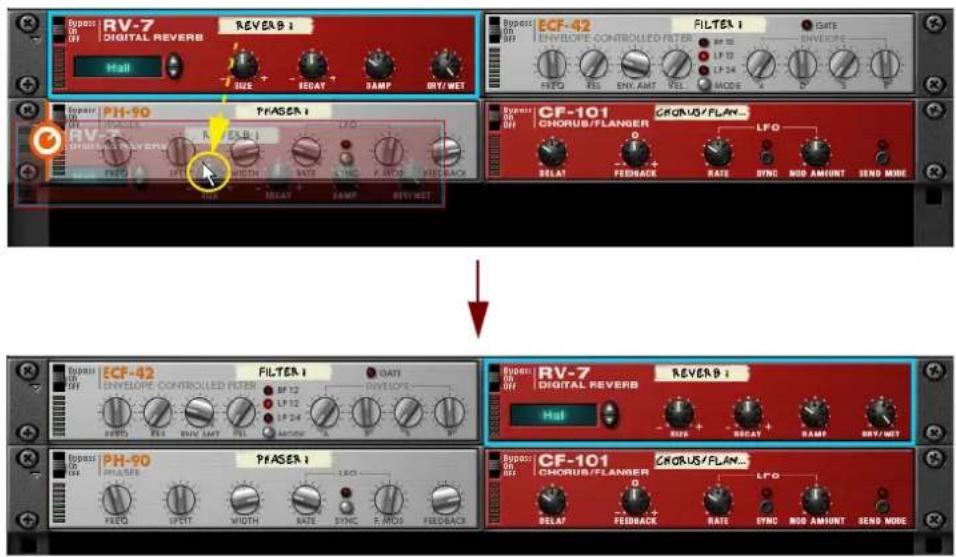
This is the result. Note that the filter device is moved to the left, to fill out the gap.
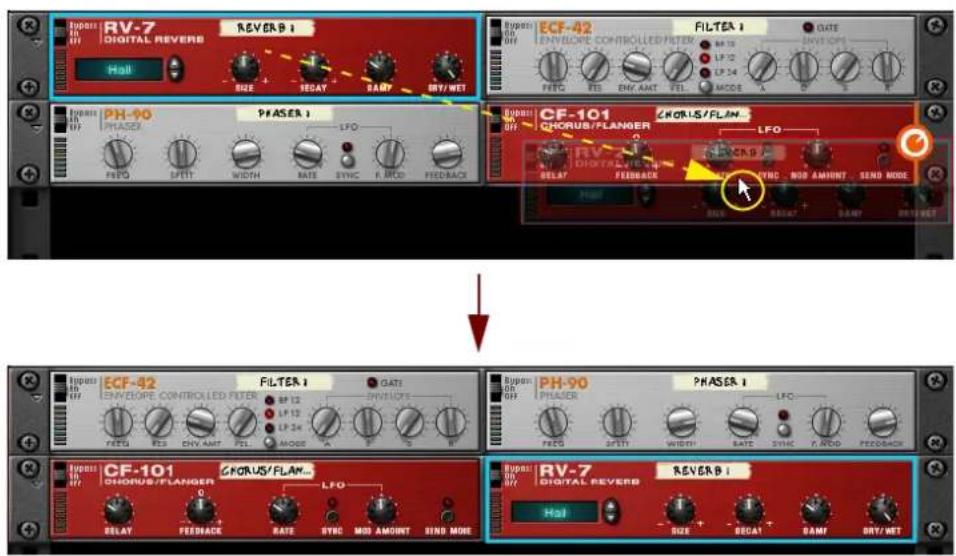
In this case, the line indicates that the reverb device will be placed to the right of the chorus/flanger.
This is the result. All three devices are moved to the left, to fill out the gap.
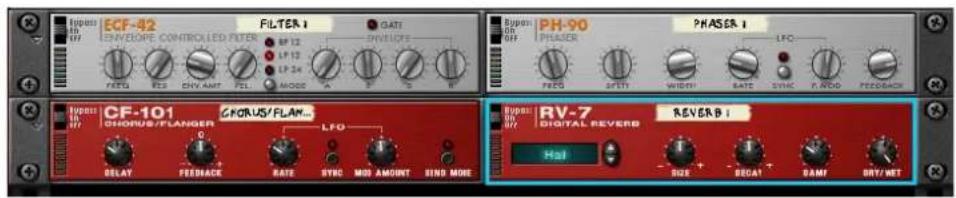
- Release the mouse button.
The device(s) are moved to the new position and the other devices in the rack are adjusted to fill up the gap(s).
! Note that if you start to move a device but change your mind, you can abort the operation by pressing [Esc] while keeping the mouse button depressed.
! Moving devices in the rack does not affect the order of the sequencer tracks or channel strips and vice versa. If you want the sequencer tracks and channel strips to be re-ordered as well, see "About the "Sort Selected Device Groups" function".
Re-routing devices
→ If you hold [Shift] and drag a device to a new position in the rack, it will be re-routed (as if you deleted it and created it in its new position).
This allows you to e.g. change the order of effect devices in a signal chain by Shift-dragging them.
See "Automatic routing" for more info on auto-routing.
Creating new rack columns
It's possible to move devices, or Device Groups, to new rack columns. This is very useful if your rack starts to get crowded, or if you want to arrange your devices in separate rack columns to get a better overview.
By default, when you create a new empty Song document, the rack consists of a single rack column featuring the Reason Lite Hardware Device and the Master Section device. When you create new devices from the "Create" menu, these will automatically be placed in that rack column.
By dragging and dropping devices to either side (left or right) of the original rack, you can move the devices and at the same time create a new rack column. You can create as many rack columns as you like - the only condition is that at least one device must be present in a neighboring rack column. In other words, you can't create empty rack columns.
In the example below, we drag and drop an RV7000 reverb device to the right of the original rack:
Click on the RV7000 device panel and drag to the right...
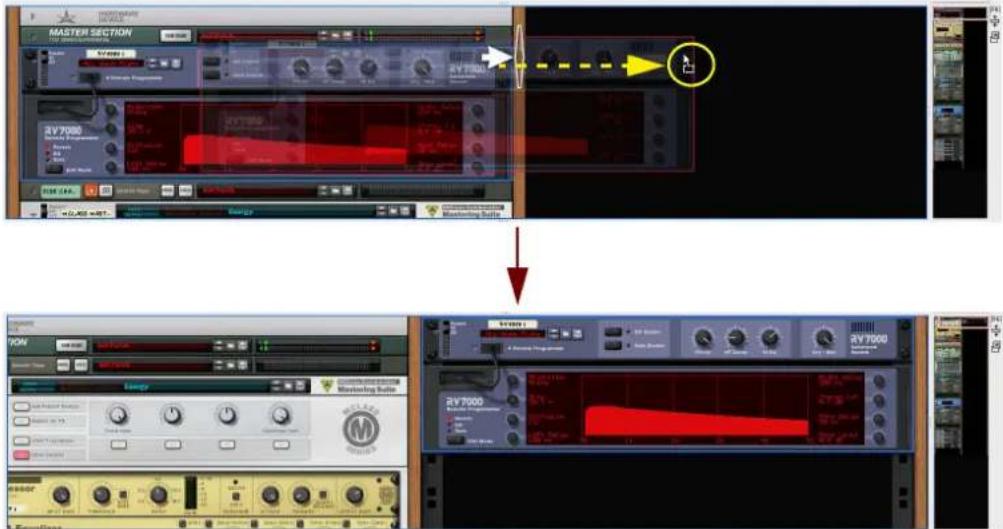
... Release the mouse button and the RV7000 device is automatically placed in a new rack column to the right.
A large white arrow symbol appears on the right wooden rack side of the original rack column to indicate that the device is about to be moved to a new rack column.
About the "Sort Selected Device Groups" function
When you are working with Device Groups (see "About Device Groups"), there is a very nice feature which allows you to visually organize and re-order the Device Groups, Main Mixer channel strips and sequencer tracks. With the "Sort Selected Device Groups" function on the Edit menu, it's possible to sort Device Groups and Main Mixer channel strips according to the current sequencer track order - or vice versa, depending on what's currently selected. To sort the Device Groups in the rack, and the channel strips in the Main Mixer, according to the current sequencer track order, proceed as follows:
- Select a track in the sequencer Track List rack and choose "Select All" from the Edit menu or track context menu.
Tracks are marked with darker colors to indicate they've been selected.
- Select "Sort Selected Device Groups" from the Edit menu or track context menu.
Now all Device Groups and channel strips in the Main Mixer will be automatically re-ordered according to the current track configuration in the sequencer. The topmost sequencer track will have its associated Device Group moved to the top in the rack. The remaining Device Groups will be re-ordered according to the remaining track order in the Track List. The Main Mixer channel strips will also be re-ordered according to the sequencer track order.
- If you have devices in several rack columns, the sorting will begin in the leftmost rack column and continue to the right through the rest of the rack columns. The number of devices in each rack column will not be changed.
- If you select several Device Groups in the rack and choose "Sort Selected Device Groups" from the Edit menu or device context menu, the tracks in the sequencer and the Main Mixer channel strips will be re-ordered according to the current Device Group order in the rack.
- If you select several channel strips in the Main Mixer and choose "Sort Selected Device Groups" from the Edit menu or channel strip context menu, the Device Groups in the rack and the tracks in the sequencer will be reordered according to the current channel strip order in the Main Mixer.
Replacing devices
If you want to replace an Instrument, Effect or Player device in the rack with another device of the same category, proceed as follows:
- Bring up the Device Palette in the Browser for the desired device type (Instruments, Effects or Players).
! Utility devices cannot be replaced using these methods!
2. Drag the desired device from the Device Palette to the rack and place on top of the device you want to replace.
The device to be replaced is dimmed in orange and gets a "replace" symbol in the center:
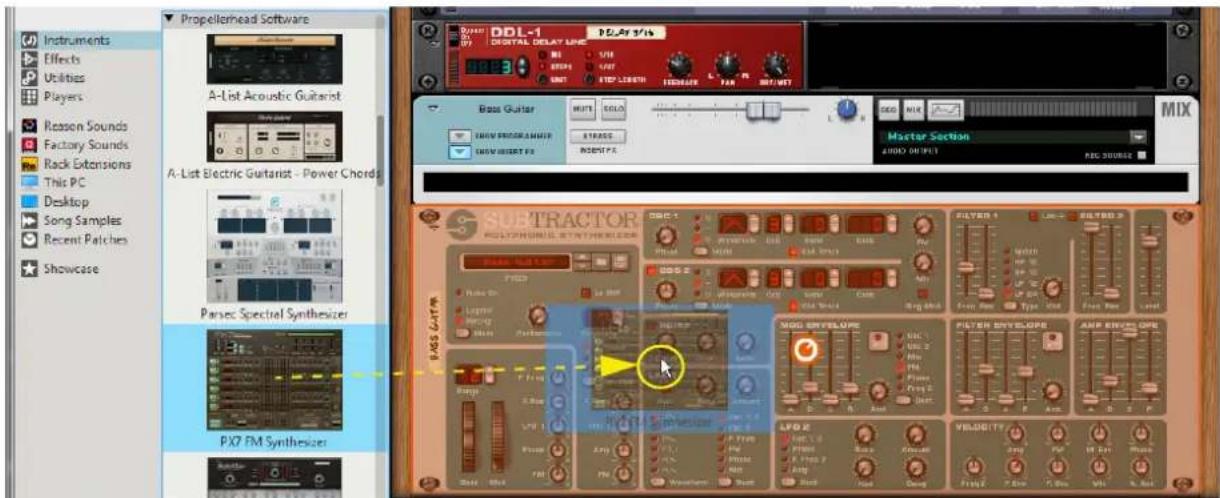
Replacing a Subtractor with a PX7 FM Synthesizer device.
- Release the mouse button to replace the device in the rack.
The new device is automatically routed like the previous device. The Mix Channel now also gets the name of the current patch in the new device. The new device also gets "browse focus" in the Browser, see "Loading patches".
→ You can also drag and drop devices on existing device icons in the Sequencer Track List. The result is exactly the same as dropping devices on existing devices in the rack.
→ You can also drag other device patches from the Browser, Windows Explorer or Finder (Mac) and drop on a device in the rack or Sequencer Track List to replace existing devices, see "Loading patches".
! Note that Instrument devices can only be replaced by other Instrument devices. The same goes for Effect devices.
Duplicating devices
Duplicating devices will have different results depending on the "Auto-group Devices and Tracks" setting on the Options menu (see "About Device Groups"):
To duplicate a device or a Device Group in the rack, hold down Ctrl or Option and drag the device to a new position.
- If “Auto-group Devices and Tracks” is not selected, a copy of the selected device will be created without any connections.
- If "Auto-group Devices and Tracks" is selected, a copy of the entire Device Group will be created with all connections preserved. A new track will also be created in the sequencer.
→ Select the device(s) and select “Duplicate Devices and Tracks” from the Edit menu or context menu. A duplicate (copy) of the device(s) or Device Group(s) will be created. New tracks for the device(s) or Device Groups will also be created in the sequencer.
→ If you hold down [Shift] when you duplicate devices, Reason Lite will attempt to automatically route them, just as when you move devices.
See "Automatic routing".
Cut, Copy and Paste devices
Selected devices or Device Groups can be moved or duplicated using the Cut, Copy and Paste Device functions on the Edit menu or device context menu. This allows you to copy one or several devices (such as an instrument device and all its "insert" effects) from one Reason Lite Song document to another. Cutting/Copying and Pasting will have different results depending on the "Auto-group Devices and Tracks" setting on the Options menu (see "About Device Groups"):
- Cut and Copy affects all selected devices or Device Groups, and works according to the standard procedures. That is, Cut moves the devices/Device Groups to the clipboard (removing them from the rack) while Copy creates copies of the devices/Device Groups and puts these in the clipboard memory, without affecting the rack.
To Cut, Copy and Paste a Device Group, make sure the “Auto-group Devices and Tracks” is selected on the Options menu. Then, select a device in the Device Group and proceed with the Cut/Copy and Paste procedure. All devices in the Device Group will be cut/copied and pasted with preserved connections (in the same Song or in another Song document). - When you Paste devices or Device Groups, these are inserted into the rack below the currently selected device. If no device is selected, the pasted devices/Device Groups will appear at the bottom of the rack column.
! As when creating devices, you cannot paste a Source device into an existing Device Group if "Auto-group Devices and Tracks" is on. It will be inserted below the Device Group. - If you Copy and Paste several devices, any connections between these are preserved.
- If you hold down [Shift] when you Paste a device, Reason Lite will attempt to automatically route it. The rules are the same as when moving or duplicating devices by dragging and dropping. See "Routing Audio and CV" for more information about automatic and manual routing.
Naming devices
Each device has a "tape strip" which shows the name of the device. When you create a new device it is automatically named according to the current patch in the device. Devices that don't use patches are automatically named according to the device type, with an index number (so that the first ID8 device r you create is called "ID8 1", the next "ID8 2" and so on). If you like, you can rename a device by clicking on its tape strip and typing a new name (up to 16 characters).
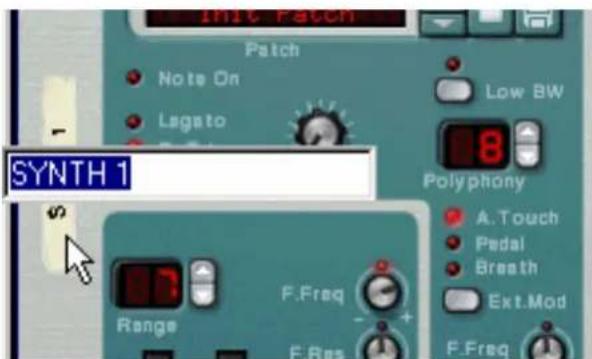
For instrument devices connected to Mix Channel devices, the device names are automatically copied to the tape strips for the corresponding Mix Channel devices and their channel strips in the Main Mixer, as well as on their corresponding sequencer tracks. Similarly, the names of the FX Returns in the Main Mixer show the names of the effect devices connected to the corresponding FX Return inputs.
- When you create a device for which an associated sequencer track is created, the track in the sequencer will be assigned the same name as the device. Renaming the device will also rename the corresponding sequencer track, and vice versa.
- Note that the mixer channel tape strips always show the patch name (or device name) of the source device connected to the Mix Channel device! This means that if you have an instrument device routed through one or several effect devices, the Mix Channel tape strip will show the name of the instrument device (as this is the Source device).
- You can rename Mix Channels manually, for example, if you use multiple outputs from a sampler device going to separate Mix Channels. If you later delete the custom name, the Mix Channel will default to showing the Source device's name. For audio tracks, the Audio Track device is always the Source device and will never change name unless you manually rename it.
- If you delete your custom device name, the name reverts back to the default name, i.e. the patch name or device name (for non patch devices).
Folding and unfolding devices
If you don't need to edit the parameters for a device, you can fold the device to make the rack more manageable and to avoid having to scroll a lot.
→ Click the "Fold/Unfold" button to the left on the device panel to fold the device.
The "Fold/Unfold" button on an RV7000 device.
→ To unfold the device, click the "Fold/Unfold" button again.
- In rack rows containing devices of smaller width, the "Fold/Unfold" button is placed to the left of the leftmost device and affects all devices in the row:
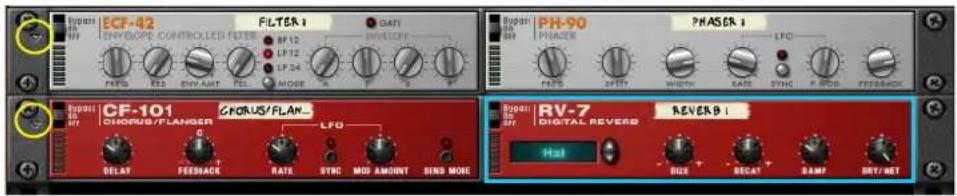
The "Fold/Unfold" buttons for devices of smaller width.
→ Hold down Alt or Option and click the "Fold/Unfold" button of an unfolded device to fold all devices in the current rack column.
Conversely, hold down Alt or Option and click the "Fold/Unfold" button of a folded device to unfold all devices in the current rack column.
- For folded devices, no parameters are shown and you cannot reroute any cables on the rear of the rack as long as the devices are folded.
However, if you want to make a connection to a folded device, you can drag a cable to it and hold it there for a moment. This will cause the folded device to automatically unfold and let you make the connection.
- Folded devices can be renamed, moved, duplicated and deleted just like unfolded devices.
- For devices that use patches, you can select patches in folded mode as well.
- Playback is not affected by folding.
Chapter 12
Working with Players
About this chapter
This chapter describes the procedures and techniques for working with the Players device type.
Overview
A Player is a special type of device that automatically processes, filters and generates MIDI Notes, based on input MIDI Notes to an Instrument device in the rack. Players can also play back MIDI on their own, without any MIDI input; this could for example be pattern sequencers.
The Player devices can be found in the Players palette below Utilities in the Reason Lite Browser:
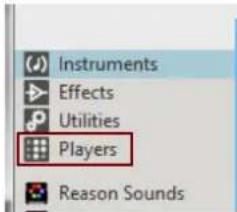
The Players palette in the Browser.
The basic idea behind Players is that you first create an Instrument device (or instrument track), then hook up one or more Player devices to the Instrument device. If the Player device is a chord generator, for example, you can have it generate chords in the desired key and scale by just playing single notes on your MIDI Control Keyboard. Absolutely great for inspiration!
Player devices are a little narrower than regular devices, and are always created directly above their corresponding Instrument device(s) - between the Instrument and the Mix Channel devices:

Two Player devices (in series) attached to an ID8 Instrument device in the rack.
General recording methods
Apart from sequencer Players, recording Instrument tracks using Players can be done in two different ways:
- By recording the notes exactly as you play them on your MIDI Control Keyboard.
This is the default mode and means you just record the notes straight onto the Instrument track from your MIDI Control Keyboard, just as you would a regular Instrument track (without any Player). During playback the recorded notes are then run through the Player, which generates the Player notes in real-time.
- By recording the notes that are generated by the Player(s).
This is called Direct Recording and means that instead of recording the notes you play on your MIDI control keyboard, you record the notes that are generated by the Player(s). This way you automatically get the rendered notes onto your Instrument track (as chords, arpeggios etc. depending on the Player(s)). During playback the recorded notes bypass the Player(s), so the result is exactly what you heard when you recorded.
The pictures below illustrates the two different recording modes:
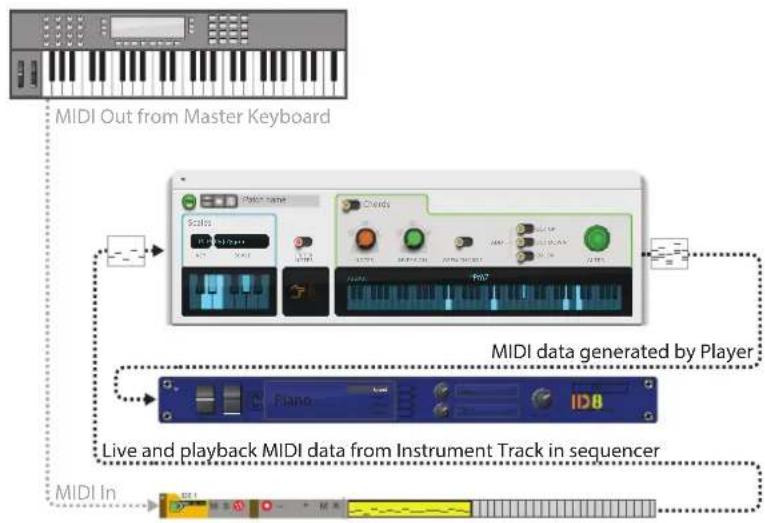
flowchart
graph TD
    A["MIDI Out from Master Keyboard"] --> B["Player name"]
    B --> C["Scalls"]
    B --> D["Clocks"]
    C --> E["Live and playback MIDI data from Instrument Track in sequencer"]
    D --> F["Player data generated by Player"]
    F --> G["Instrument Track in sequencer"]
    G --> H["MIDI In"]
The default recording mode principle.
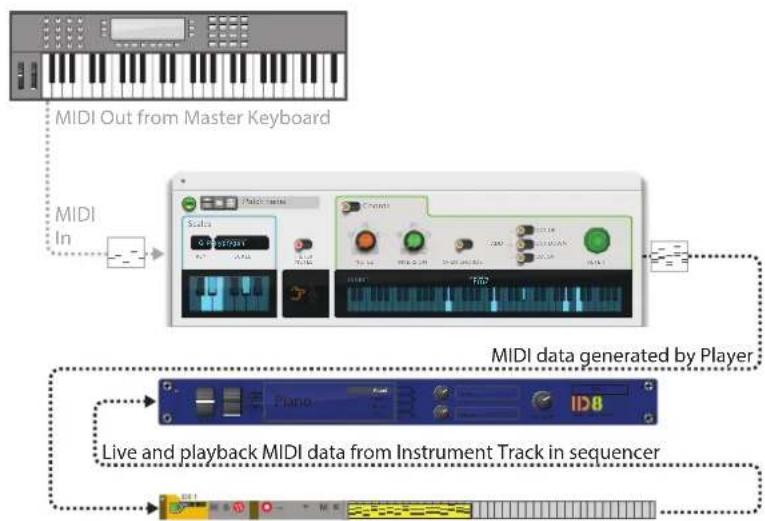
flowchart
graph TD
    A["MIDI Out from Master Keyboard"] --> B["Multi-Channel"]
    C["MIDI In"] --> D["Multi-Channel"]
    D --> E["Multi-Channel"]
    E --> F["MIDI data generated by Player"]
    G["Live and playback MIDI data from Instrument Track in sequencer"] --> H["Multi-Channel"]
    H --> I["Multi-Channel"]
    I --> J["MIDI data generated by Player"]
The Direct Record mode principle.
Using Players
Creating Players
Creating a Player device is very similar to creating other device types, with a few exceptions:
- A Player device can not be created on its own, without an associated instrument device.
- A Player device can only be created for devices in the Instrument palette. All Instrument types are supported: native devices, Rack Extensions and VST instruments.
Here are the different ways you can create a Player device:
→ Drag a Player from the Players palette and drop above an Instrument device (between the Instrument and Mix Channel devices) in the rack, to attach it to the Instrument device.
The insertion point is indicated by the standard orange insertion line with the + symbol:
→ Select the Instrument device you want to attach a Player to in the rack, and then double-click the Player device in the Players palette.
The Player device is attached to the Instrument device.
→ Right-click an Instrument device in the rack and select "Create > Players > Player device" from the context menu.
The Player device is attached to the Instrument device.
Chaining Players
If you like, you can attach several Player devices to a single Instrument device in the rack. Just follow the instructions in "Creating Players" above and make sure you insert the additional Player(s) somewhere in between the Instrument device and the top section of the topmost Player device.
! When you chain several Player devices the MIDI is processed from the top device and down.
Re-ordering chained Players
You can also rearrange the order of the chained Players:
→Drag the desired Player and drop at the new position.
The insertion point is indicated by the standard orange insertion line with the + symbol.
Replacing Players
Replacing a Player device with another Player device can be done in exactly the same way as when replacing other device types, see "Replacing devices".
Deleting Players
Deleting Players is done in exactly the same way as when deleting other device types, see "Deleting devices".
Naming Players
Naming Players is done in exactly the same way as when naming other device types, see "Naming devices".
About Players in Combinators
Players can also live inside Combinators, if there are instrument devices there. A Combinator device can also have Players attached to it (outside of it).
Common Player device parameters

Fold, Bypass All, Direct Record and Send to Track
At the top of the Player device - or above the topmost Player device, if you are using several chained Players - are the Fold, Bypass All, Direct Record and Send to Track buttons.
→ Click the triangular Fold button to fold/unfold all Player devices attached to the Instrument device.
→ Switch on Bypass All to send the MIDI from your MIDI Control Keyboard/On-screen Piano Keys straight to the instrument device, bypassing any Player devices.
→ Activate Direct Record to record the MIDI notes generated by the Player(s), instead of the notes you play from your MIDI Control Keyboard.
Direct Record mode is for when you use Players as an input tool (record chords, etc) and for when you want to capture your live tweaking (for example, play an arpeggiator and tweak the parameters in real time) and want to get the generated notes recorded straight into the note clip.
If you play back already recorded notes from the sequencer track of the instrument, they are not affected/processed by the Player (i.e they bypass the Player(s) and are sent directly to the instrument itself).
See "General recording methods" for more information.
→ Click the Send to Track button to render the notes generated by the Player(s), based on the notes in the original note clip(s) on the Instrument track in the sequencer.
The result is a new note clip on a new note lane, on the instrument's track. The original note clips on that track are automatically cut at the Left and Right Locators. The original clip(s) between the Locators are muted. Also, the Bypass All switch will automatically be turned on after the rendering is done.
! Only the section between the Left and Right Locators is rendered. If the Right Locator is to the left of the Left Locator position, the function doesn't do anything (like with Redrum etc.).
- If you have recorded in Direct Record mode, or used the Send Notes to Track function, the rendered notes are already in the note clip in the sequencer. If you don't need the Player(s) anymore after this you can just delete them to save some DSP load.
On button
→Click to activate or deactivate the Player.
When deactivated (off), the MIDI notes from your MIDI Control Keyboard bypass the Player.
Patch section
Here is where you can browse, load and save your Player patches. The functionality is exactly the same as for other patch based devices, see "About patches".
Inputs and Outputs
Player devices can also feature CV In/Out connectors as well as Audio In connectors on the rear panel.
Scales & Chords
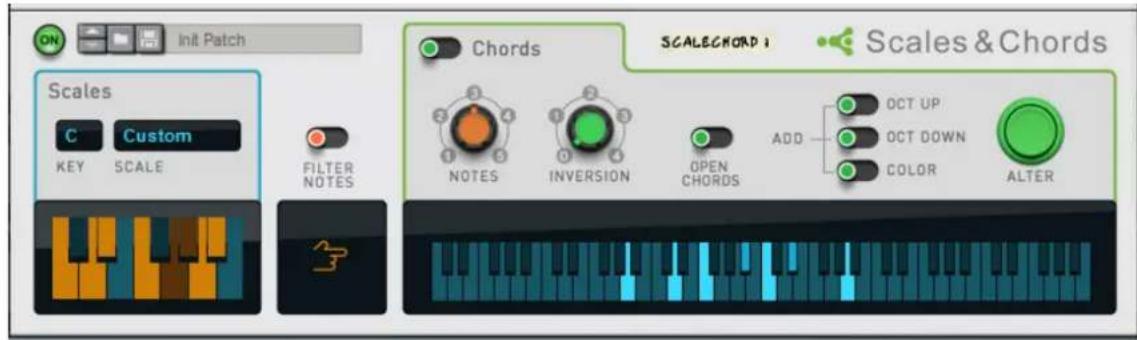
The Scales & Chords device either transposes incoming notes to fit a set scale, or transposes notes and generates chords that fit the desired scale. Scales & Chords has a number of built-in preset scales, and you can also create your own custom scales!
Here are some examples of how you can use it:
• to get chords from single note inputs.
• to get new chord voicings and progressions that feel fresh and inspires your music making.
• to experiment with existing note lines, by transforming them to different scales.
• to get the notes you play to automatically fit the music.
• to easily be able to play chords without using a MIDI Control Keyboard.
You could write single MIDI notes in a Note clip and have the Scales & Chords Player generate the chords for you.
• to get chords that sound right, without knowledge of tonality/scales.
Scales
In the Scales section you choose which key and scale you want.
- Note that all parameters in the Scales section can be automated, so you could change key and scale anywhere throughout your song if you like!
Key
→ Click to select the desired Key from the list that appears.
12 Keys are available, from C to B.
Scale
→Click to select the desired Scale from the list that appears.
13 scales are available, plus a Custom scale that you can create yourself (see below). The preset Scales are: Major, Minor, Lydian, Mixolydian, Spanish, Dorian, Phrygian, Harmonic Minor, Melodic Minor, Major Pentatonic, Minor Pentatonic, Hemi Pentatonic and Chromatic.
- The notes that fit the selected Key and Scale are displayed in light blue in the keyboard display in the Scales section:
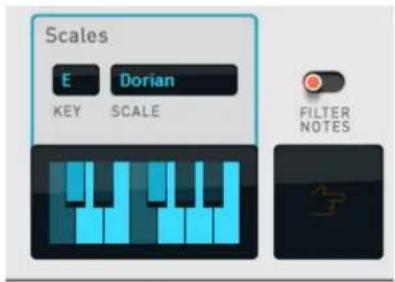
The Dorian scale in the key of E.
The notes in the selected Key and Scale are then automatically repeated throughout all octaves of the entire MIDI Note range.
- Notes you play on your MIDI Control Keyboard/On-screen Piano Keys are indicated in orange in the Scales keyboard display.
Creating a Custom Scale
→ Create a custom Scale by clicking the desired keys in the keyboard display in the Scale section:
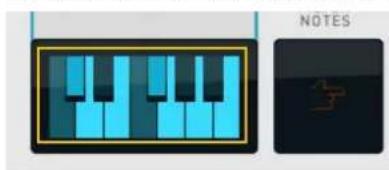
natural_image
Digital piano keyboard interface with blue keys and a black button labeled 'NOTES' (no readable text or symbols on the keys)Selected notes are colored light blue. The selected notes are then automatically repeated throughout all octaves of the entire MIDI Note range.
- You can easily switch between your Custom Scale and any of the preset Scales whenever you want, by clicking the "Scale" display and selecting the desired scale from the list that appears.
- Your Custom Scale is automatically saved with the song.
Your Custom Scale is also saved in the Scales & Chords patch, should you choose to save your settings as a patch.
Filter Notes
- When the Filter Notes switch is off (default), incoming notes outside the set Scale (see "Scales") are transposed to fit the scale.
Wrong notes are automatically transposed to the closest correct note. If the wrong note is equally near two correct notes, the wrong note is transposed to the lowest of the correct notes.
- When the Filter Notes switch is on, incoming notes that are outside the set scale will be filtered out (silent) instead of transposed.
The display below shows a hand symbol whenever wrong input notes are filtered out (silent).
Chords
→ Switch on the Chords function to generate chords out of single notes.
When you play a note, you will get a chord that fits the set Scale (see "Scales"), and contains the number of notes set with the "Notes" knob. The generated notes are shown in real-time in the keyboard display at the bottom of the Chords section:

natural_image
Illustration of a piano keyboard with blue keys and control buttons (no text or symbols)! If you play several notes at the same time you will get several chords, which might be cool or just weird. If notes in the generated chords should coincide, only one instance of the notes are played back (to avoid doubled/layered notes).
Notes
→ Set the desired number of notes in the generated chords.
Range: 1-5 notes.
Inversion
The Inversion knob defines which note in the generated chord should be the lowest. The function tries to keep the lowest generated note in the chord as close to the played root note as possible. Below is an example of inversions of a generated 4-note chord in the Scale C Major, played from a C note of the MIDI Control Keyboard:
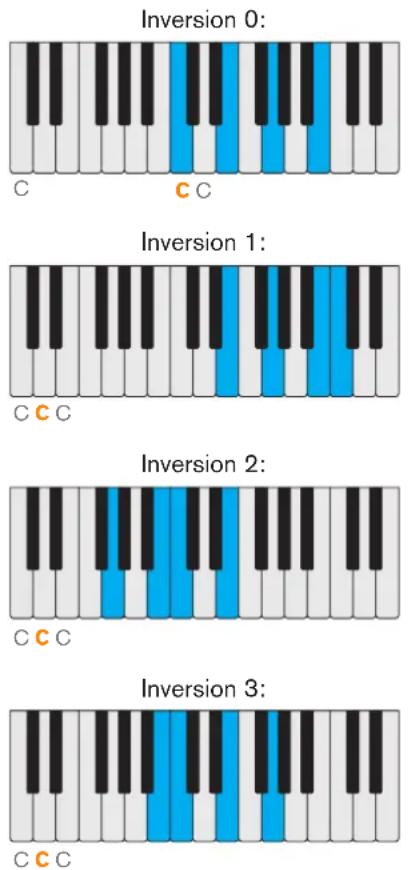
Inversions of a generated 4-note chord played from the (orange) C note.
! Note that the Inversion function is only relevant if the Inversion number is less than the selected "Notes" value. So, if the Notes value is 4, only a maximum Inversion value of 3 is useful.
Open Chords
When the Open Chords function is active, some notes in the generated chords are transposed in octave steps, so that the notes are not so close to each other. The transposition is different depending on the "Inversion" and the "Notes" settings.
Add
The Add functions can be used for adding notes to the generated chords:
- The Add Oct Up function adds a note one octave above the root note.
-
The Add Oct Down function adds a note one octave below the root note.
-
The Add Color function adds a note two thirds above the highest note in the tertian chord structure.
If the Notes value in the Chord section is 3, you will get a regular triad (e.g. a C major). Adding a sixth above top will mean adding a 9 (e.g. the note D). Similarly, if the Notes value in the Chord section is 4, this will add an 11; if the Notes value in the Chord section is 5, this will add a 13. - All three Add functions can be used together, simultaneously.
! If the added note is already used in the chord (due to inversions, open chord etc), the note is transposed up another octave (or down, in case of Oct Down).
Alter
The Alter button is a momentary button that turns off as soon as you release the mouse button (like the Trig button on The Echo, for example). It alters the chord slightly so that it goes outside the current scale. The result depends on the Key (as set in the Scale section), whether the current scale is major or minor and what note you play (relative to the Scale Key).
The chord is altered by having one of the chord notes changed. For example, a major chord may be changed to a minor chord, or vice versa.
Chapter 13
Working with
Rack Extensions
About this chapter
This chapter describes the procedures and techniques for managing Rack Extension devices.
What are Rack Extensions?
Rack Extensions are additional rack devices that can be purchased in the Reason Studios web shop at www.reasonstudios.com/shop and used together with the internal devices in the rack. Rack Extensions can be instruments, effects or utility devices, such as mixers and CV processors. Rack Extension devices are developed by Reason Studios as well as by 3rd party companies.
Rack Extension devices integrate fully with the Reason Lite rack:
- Cables can be connected on the rear panels, just like on the internal rack devices.
- CV signals can be routed like on the internal rack devices.
- Rack Extension devices are combinable with other Rack Extension and internal devices (see "The Combinator" chapter).
- Panel parameters are automatable and remotable.
Future compatibility
Rack Extensions are Windows and Mac-compatible and will work with any operating system and platform that Reason Lite supports - now and in the future.
Trying and buying Rack Extensions
Trial versions of Rack Extensions
You can try out a Rack Extension by going to the Reason Studios web shop at www.reasonstudios.com/shop and using the "Try" function. This gives you a trial license which will last for 30 days. During this time, the Rack Extension is fully operational, but requires that you run Reason Lite with Internet Verification, see "Running Reason Lite with Internet Verification".
When the trial license expires, the Rack Extension will be removed from the program menus. However, it will remain installed unless you manually uninstall it. Should you choose to purchase the Rack Extension later on, you don't need to download it again.
You can only try a Rack Extension once (one 30-day period).
Buying Rack Extensions
When you purchase a Rack Extension, a license is automatically written to your Reason Studios user account on the Reason Studios web site. Just like with your Reason Lite license, you can write a Rack Extension license to your authorized computer or Ignition Key hardware (or Propellerhead Balance audio interface). You can download and install the Rack Extension on as many computers as you like. However, to use the Rack Extension in Reason Lite you either need your authorized computer, your Ignition Key hardware with the Rack Extension license on it, or an Internet connection to run with Internet Verification.
! Rack Extension devices are not available when you run Reason Lite in Demo Mode.
If you move to another computer, you can download and install all your Rack Extensions by going to your user account on the Reason Studios web site (Your Products page, Rack Extensions tab) and clicking the "Sync All" button. This function is also excellent for making sure you got the latest versions and updates of all your Rack Extensions. Only files that are missing on your computer will be downloaded and installed.
Rack Extensions can be updated, with fixes and additions. Updates are posted on your Reason Studios user account page. An update can be free or paid. In both cases, the Rack Extension is backwards compatible, meaning that you can open older songs and patches and they will sound the same.
Rent-to-Own or subscribing to Rack Extensions
Alternatives to purchasing Rack Extension licenses one at a time is to either use the Rent-to-Own program, or to subscribe to a number of Rack Extensions for a monthly fee. To utilize Rent-to-Own and/or to subscribe to Rack Extensions, please go to the Reason Studios web shop at www.reasonstudios.com/shop.
! Rack Extension subscriptions are online only, and so are Rent-to-Own Rack Extensions (until they are fully paid). Rack Extensions included in a subscription can be used only with Internet verification, see "Running Reason Lite with Internet Verification".
Installing and managing Rack Extensions
Whenever you download and install a Rack Extension, from the web shop or your user account, this will be handled by an application called Authorizer. Authorizer is installed together with the Reason Lite installation, and will automatically launch when you Buy, Try or Download a Rack Extension from the Reason Studios web shop.
Authorizer checks what's already installed on your computer, downloads any missing files and puts them in the correct locations.
! Authorizer will automatically write Rack Extension licenses to your connected Ignition Key hardware and/or your authorized computer.
If you want to check what Rack Extensions are installed on the computer, you need to launch Authorizer:
Either select Rack Extensions from the Window menu in Reason Lite or locate the Authorizer program on your computer and launch it manually.
Authorizer lists all installed Rack Extensions:
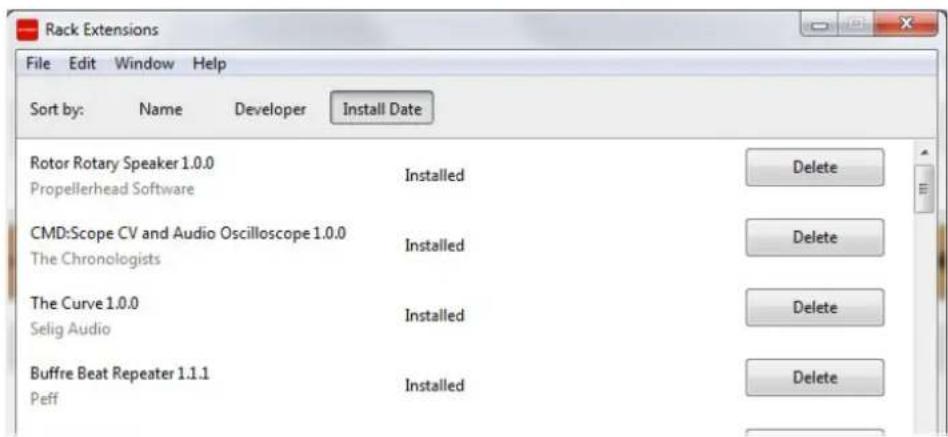
The Authorizer application lists the Rack Extension devices currently installed on your computer.
→ You can choose to display your installed Rack Extensions either by Name, Developer or by Install Date, by clicking the desired "Sort by:" button.
If you choose "Install Date", the latest installed Rack Extension is displayed at the top of the list.
! Note: All of the listed Rack Extensions may not be available for use in Reason Lite! For example, if you tried out a Rack Extension using a Trial license which has expired, the Rack Extension will still be installed and shown in the list. However, since you don't have a license for it, it won't be available for use in Reason Lite.
→ Click the Delete button to uninstall the corresponding Rack Extension device.
If you have purchased the Rack Extension, you can download it again at any time from your user account at the Reason Studios web site and reinstall it if you want.
Using Rack Extensions in Reason Lite
Rack Extensions behave just like internal Reason Lite devices, and are listed together with the Reason Lite devices in the Create menu subgroups and on the Device Palette in the Browser:
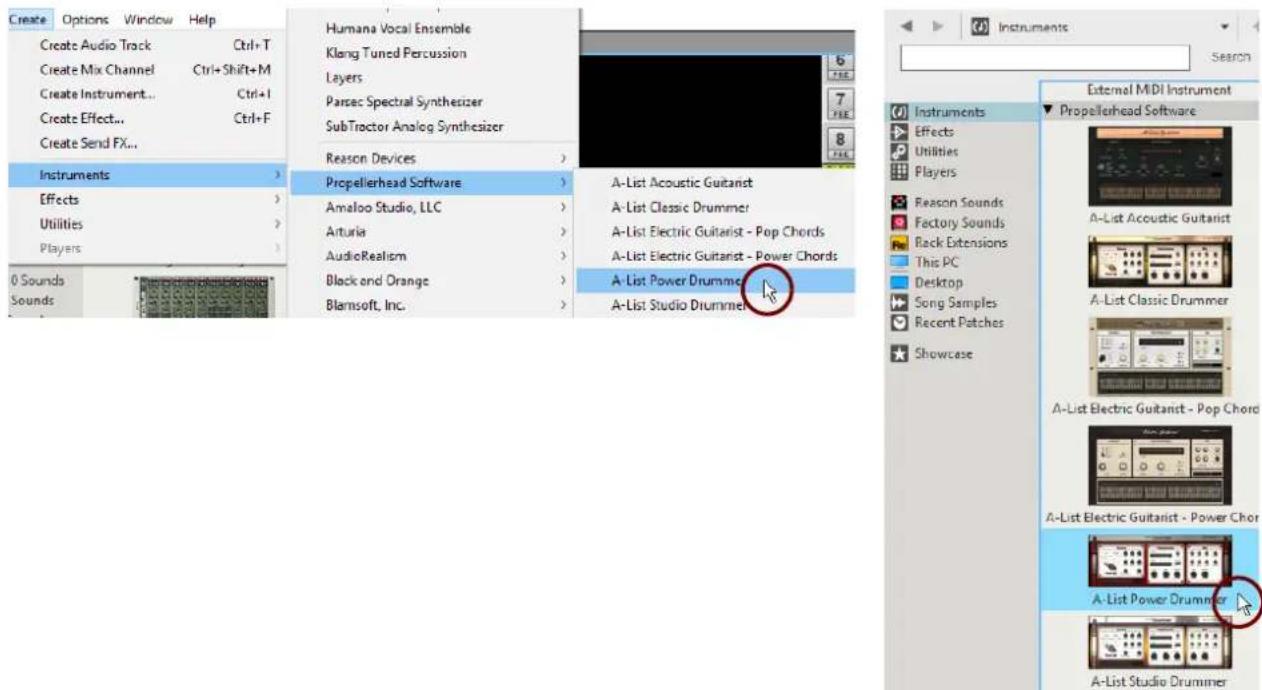
The A-List Power Drummer Rack Extension is available from the Create menu and on the Instruments palette in the Browser.
The installed Rack Extension devices are sorted in the appropriate subgroups and are listed, per manufacturer, in alphabetical order. However, Rack Extension devices from Reason Studios are always placed first in the list, below the internal Reason Lite devices.
To create a Rack Extension device, either select it in the appropriate subgroup in the Create menu, double click or drag and drop from the Device Palette in the Browser, or select "Create Instrument..." or "Create Effect..." from the Create menu.
The Rack Extension device is placed in the rack and routed according to the standard rules, see "Creating devices".
If a Rack Extension supports patches, you will find the included patches in the Rack Extension itself. To get there:
1. In the Browser, click "Rack Extensions" in the locations list to the left.
This lists all available Rack Extensions in alphabetical order:
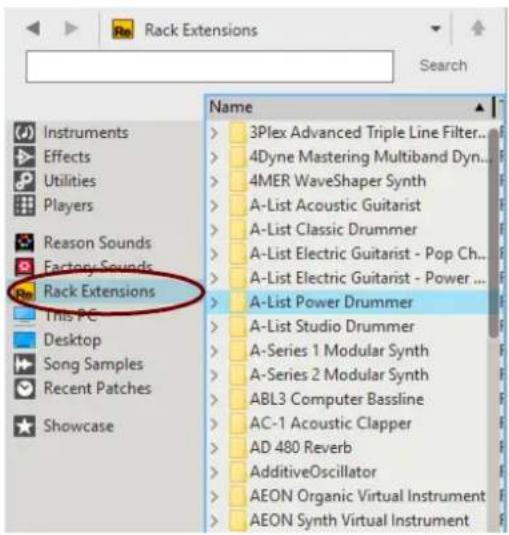
2. Double click a Rack Extension folder (or click the expansion triangle) in the list to browse its patch content.
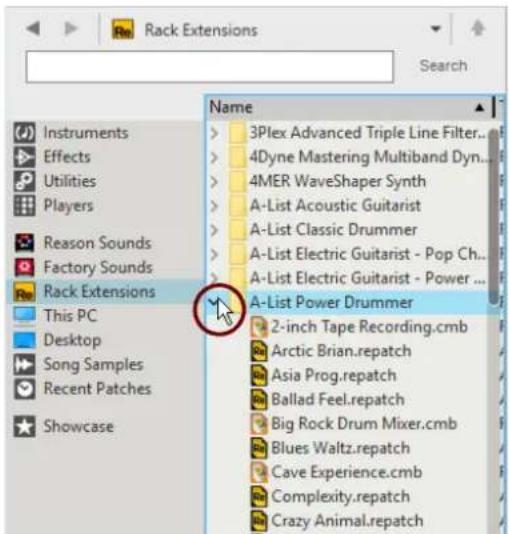
If you are browsing patches from a Rack Extension device (by clicking the "folder" button on the device panel), patches and folders for that specific device type are displayed in the Browser list right away.
About missing Rack Extensions
When you open a Reason Lite song from another user, it may have been created with Rack Extensions that you don't have. It might be a song from a friend, or a song that you have made using a Rack Extension with a trial license (that has since expired).
When you open such a song, the following alert appears:
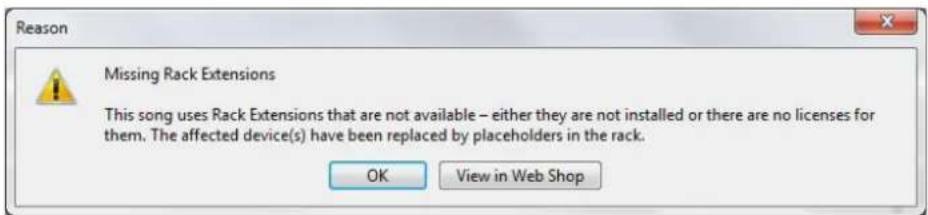
Now, you can choose to open the song without the Rack Extension(s), or go to the Reason Studios web shop and Try or Buy the missing Rack Extension(s). If you click OK, the song opens without the missing Rack Extension(s).
All such missing devices in a song are replaced by generic placeholder devices:
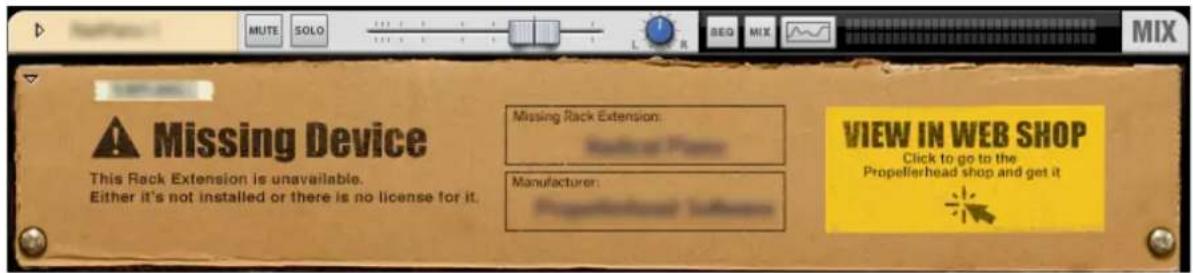
A "Missing Device" placeholder plate for a Rack Extension device, which is currently unavailable on your computer.
The placeholder device itself will be silent. If it's an effect, it will bypass the sound (or be silent, if connected as a send effect).
If you're collaborating with a friend you can safely save the song and send it back. When your friend opens the song, the Rack Extension device will be restored with all settings intact.
Acquiring missing Rack Extensions
If you change your mind and want to hear the song with the Rack Extension(s) included, you could either download a paid version or a trial version from the Reason Studios web shop:
- Click inside the "View in web shop" area on the placeholder panel to get to the Reason Studios web shop and Try or Buy the Rack Extension:
- After you have downloaded the (paid or trial) Rack Extension device(s), restart Reason Lite and open the song again.
Now, the Missing Device placeholders have been replaced by the downloaded Rack Extension(s) and the song will sound as originally intended.
Chapter 14
Working with VST
Plugins
About this chapter
This chapter describes the procedures and techniques for working with VST plugins in Reason Lite.
About VST plugins
VST (Virtual Studio Technology) is a software instruments and effects plug-in format designed by Steinberg. 64-bit VST 2.4 plugins are supported in Reason Lite. VST plugins integrate nicely with the Reason Lite rack:
- A VST Plugin is represented by a Plugin Rack Device in the Reason Lite rack.
- Cables can be connected on the rear panels of the Plugin Rack Devices, just like on the internal rack devices.
- CV signals can be routed like on the internal rack devices.
- Plugin Rack Devices are combinable with other Plugin Rack Devices, Rack Extensions and internal devices (see "The Combinator" chapter).
- Panel parameters are automatable and remotable.
VST compatibility in Reason Lite
- Reason Lite supports the VST 2.4 plugin format.
! VST 3 plugins are not supported.
- Both Windows and Mac VSTs are supported.
! Since Reason Lite is a 64-bit application, only 64-bit VSTs are supported.
! Multitimbrality in VSTs is currently not supported - only one channel per VST can be played back at a time. If you are using a multitimbral VST it will only receive on MIDI Channel 1.
Installing and enabling VST plugins
VST plugins are downloaded using your standard web browser. Installation is done individually for each VST, as designed by the plugin manufacturer. No special Reason Studios app or functions are required for installing VSTs.
About VST licenses
VST licenses and authorizations are handled by the individual VST manufacturers. VSTs cannot be authorized using the Reason Studios authorization system which is used for Reason Lite and Rack Extensions.
Installing VST plugins under Windows
At each launch, Reason Lite automatically scans for installed VST plugins in the following folders:
C:\Program Files\VSTplugins
C:\Program Files\Steinberg\VSTplugins
C:\Program Files\Common Files\Steinberg\VST2
→ If you don't have any VST plugins installed on your Windows computer you might have to manually create a folder named "VSTplugins" in C:\Program Files.
When you then install VST plugins later on, instruct the VST Installation program to install the dll files in the "C:\Program Files\VSTplugins" folder. If there is no installation program for the VST, manually place the VST dll files in this folder.
- It's also possible to define your own custom VST folders on the Advanced tab in Preferences, see "Defining custom VST folders".
Installing VST plugins under Mac
On a Mac OS computer Reason Lite automatically scans for installed VST plugins in the following folders at each launch:
Library/Audio/Plug-ins/VST
\~/Library/Audio/Plug-ins/VST
→ If you don't have any VST plugins installed on your Mac you might have to manually create a folder named "VST" in Library/Audio/Plug-ins/ and in \~/Library/Audio/Plug-ins/.
When you then install VST plugins later on, instruct the VST Installation program to install the files in the "Library/Audio/Plug-ins/VST" folder. If there is no installation program for the VST, manually place the VST files in this folder.
- It's also possible to define your own custom VST folders on the Advanced tab in Preferences, see "Defining custom VST folders".
Enabling VST plugins in Reason Lite
→ To make newly installed VST plugins s available in Reason Lite, simply (re)launch Reason Lite.
The available VST plugins are displayed on the corresponding palettes in the Reason Lite Browser; VST instruments on the "Instruments" palette and VST effects on the "Effects" palette. VSTs that are internally tagged with "Analysis" are placed on the "Utilities" palette.
- The VST plugins appear in the corresponding manufacturer sections, the same way as Rack Extensions are presented:
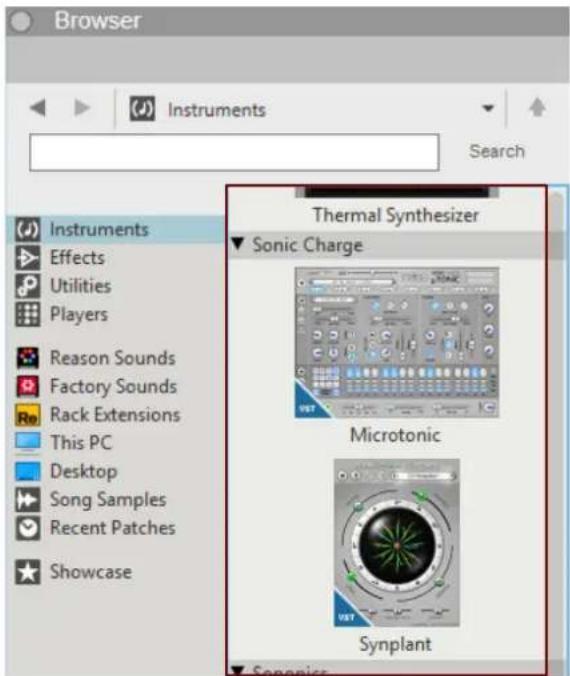
VST instruments and Rack Extensions on the Instruments palette in the Browser.
- VST plugins also have a small blue VST label at the bottom left of the device panel, to separate them from Rack Extension devices.
- Some VST plugins might be represented by a generic device "panel" in the Browser. If this is the case, you can have Reason Lite take a screenshot of the VST plugin panel and automatically replace the generic panel, see "Screenshot".
Using VST plugins in Reason Lite
VST plugins are listed together with Rack Extensions and Reason Lite devices in the Create menu subgroups and on the Device Palettes in the Browser;
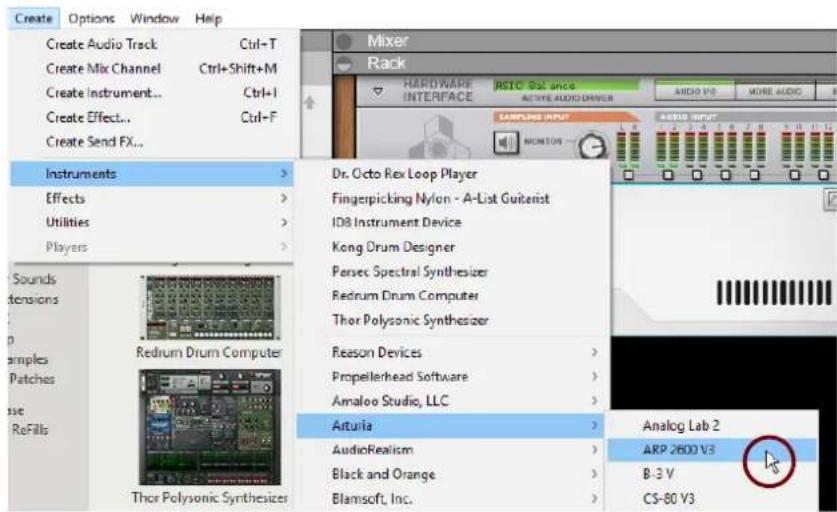
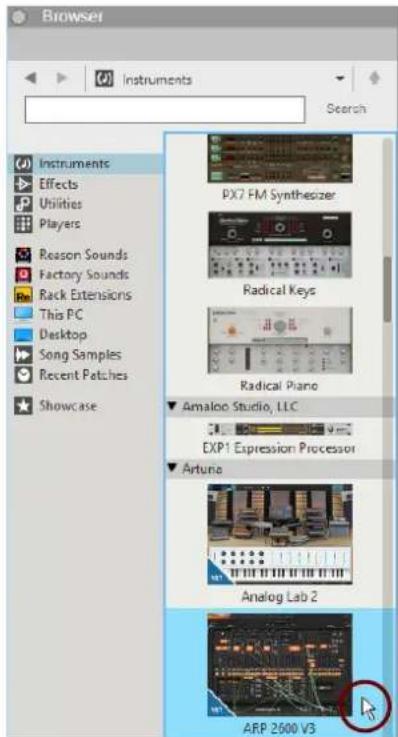
The Arturia ARP 2600 V3 VST instrument is available from the Create menu and on the Instruments device palette in the Browser.
The VST plugins are sorted in the appropriate subgroups and are listed, per manufacturer, in alphabetical order. Note though, that devices from Reason Studios are always placed first in the list, below the internal Reason Lite devices.
Adding VSTs to the rack
Adding VSTs to the rack is done in exactly the same way as when you add native devices and Rack Extensions.
- To create a VST, either select it in the appropriate subgroup in the Create menu, double click or drag and drop from the Device Palette in the Browser, or select "Create Instrument..." or "Create Effect..." from the Create menu.
The Plugin Rack Device is placed in the rack and is auto-routed according to the standard rules. See "About auto-routing of VSTs in the rack" for more details about auto-routing of VSTs.
Like with other devices, Instrument VST plugins automatically get a sequencer track, whereas effect and utility VSTs don't, by default.
- To edit the VST plugin, click the Open button on the Plugin Rack Device (see "The Plugin Rack Device" below). A Plugin Window opens up and displays the VST panel.
The Plugin Rack Device
When you create a VST in Reason Lite it's automatically housed in a Plugin Rack Device. The Plugin Rack Device is a "container" for the VST plugin and represents the VST in the Reason Lite rack. The Plugin Rack Device much resembles a Combinator device and features audio inputs and outputs as well as CV connectors and a CV Programmer section.
If the VST is detected as an instrument the Plugin Rack Device is automatically connected to a Mix Channel device, just like any other instrument device in Reason Lite.
Front panel

A Plugin Rack Device representing an Arturia ARP 2600 V3 VST instrument.
![Permut8 Sonic Charge [AR] Basic Delay VST PROG EFFECT CV PROGRAMMER Bypass On Off IN OUT](/content/2026/06/1203202/images/2e1857a39fcd53da25523bbf369be86108ffcb23ead0006dc6ac25bddbbc49ec.jpg)
A Plugin Rack Device representing a Sonic Charge Permut8 VST effect.
A Plugin Rack Device for a VST instrument has Pitch and Mod Wheel controls, whereas a Plugin Rack Device for a VST effect has the standard "Bypass/On/Off" switch (like any other Effect device in the rack).
! Note that setting the device in "Off" or "Bypass" will not disable the VST. This means the VST will still affect the CPU/DSP Load.
- The center and right sections of the Plugin Rack Device are identical, regardless of if it represents a VST instrument or VST effect.
- The Patch Load/Save section works in the same way as for the other device types in Reason Lite (see "Loading patches" and "Saving patches").
There are also Next/Previous VST Program buttons to the right of the patch display, where you can step through the programs loaded in the VST plugin itself, see "Selecting VST programs".
- Above the Patch Load/Save section is the name of the corresponding VST, as well as the manufacturer's name.
- Below the Patch Load/Save section is a button for unfolding the CV Programmer (see "The CV Programmer").
- The display shows a screenshot of the corresponding VST (or a default logo).
- At the bottom of the display is the Open button. Clicking this (or the image of the VST) brings up the VST in its Plugin Window (see "The Plugin Window").
- To the far right are audio input and output level meters, as well as indicators for Note On, Automation data and CV input.
- Below the indicators is an On/Off button for enabling/disabling the VST plugin completely.
Disabling a VST plugin will also reduce the CPU/DSP Load.
The CV Programmer
The CV Programmer of the Plugin Rack Device.
On the CV Programmer panel you can route CV signals from other (modulation) devices in the rack to parameters of the VST plugin. Each of the eight CV slots can receive a CV signal connected to the corresponding Modulation CV In connector on the rear panel of the Plugin Rack Device (see "Rear panel" below).
Refer to "CV modulation of VST parameters" for information on how to route CV signals to VST parameters.
Rear panel
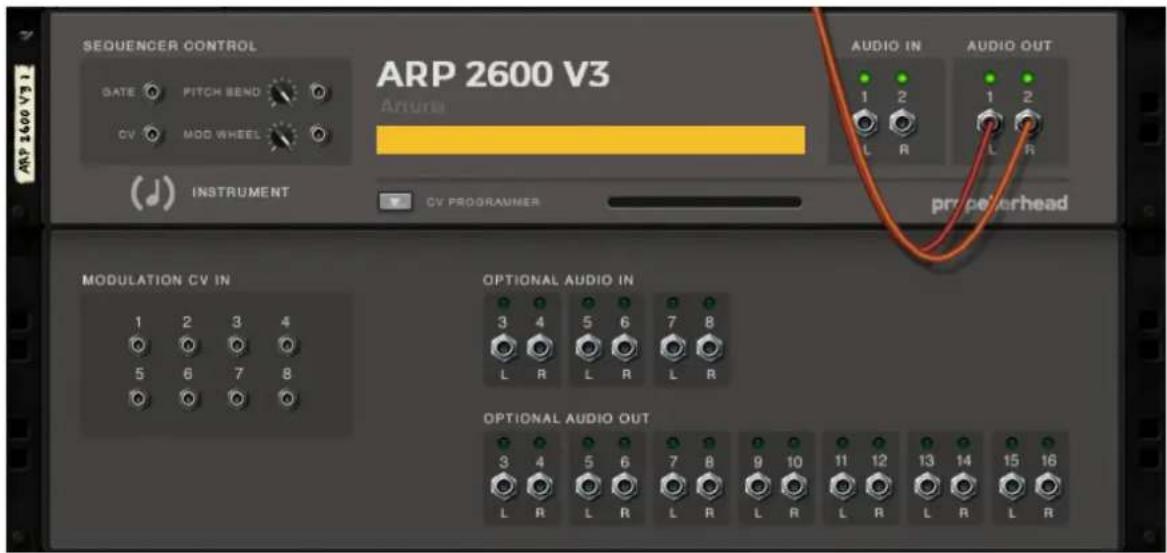
The rear panel of the Plugin Rack Device, with the CV Programmer unfolded.
The rear panel features Sequencer Control connectors for controlling VSTs from e.g. step sequencers and arpeggiator devices. This section is available only if the Plugin Rack Device represents a VST Instrument. To the right are audio inputs and outputs.
On the unfolded CV Programmer panel are eight CV modulation inputs, for controlling VST parameters from connected CV modulation sources.
To the right on the CV Programmer panel are optional audio inputs and outputs. If the VST supports the use of multiple audio inputs and/or outputs, the available jacks are indicated by green LEDs.
For more details about CV controlling VSTs, see "CV modulation of VST parameters".
About auto-routing of VSTs in the rack
Auto-routing of VST instruments
The auto-routing rules for VST instruments are very straight forward:
- VST instruments that output a stereo signal are automatically connected from Audio Out 1 (L) and 2 (R) of the Plugin Rack Device to the L and R inputs of a Mix Channel device.
- VST instruments that output a mono signal are automatically connected from Audio Out 1 (L) of the Plugin Rack Device to the L input of a Mix Channel device.
Auto-routing of VST effects
Unlike with native Reason Lite effects and Rack Extension effects, there can be mono VSTs, with mono in/mono out. Also, Reason Lite doesn't know whether a stereo VST effect device is "dual mono" or generates stereo from a mono signal.
There are two cases to be aware of:
- If you insert a Mono In-Mono Out VST effect in a stereo signal path, only the left output will be connected (resulting in a mono signal path):

flowchart
graph LR
    A["L"] --> B["Mono Plugin"]
    C["R"] --> B
    B --> D["mono"]
    D --> E["(to L input of next device)"]
- If you insert a Stereo VST effect in a mono signal path, Reason Lite will route it as mono in-stereo out (changing the signal path to stereo):

flowchart
graph LR
    A["mono L"] --> B["Stereo Plugin"]
    B --> C["R"]
The Plugin Window
The VST plugin panel is shown in a separate floating window - the Plugin Window - that is kept on top of the song window(s). Several Plugin Windows can be open at the same time.
Opening the Plugin Window
→ Open the Plugin Window by clicking the Open button - or the VST image - on the Plugin Rack Device panel:

The Plugin Window opens up and shows the VST panel:
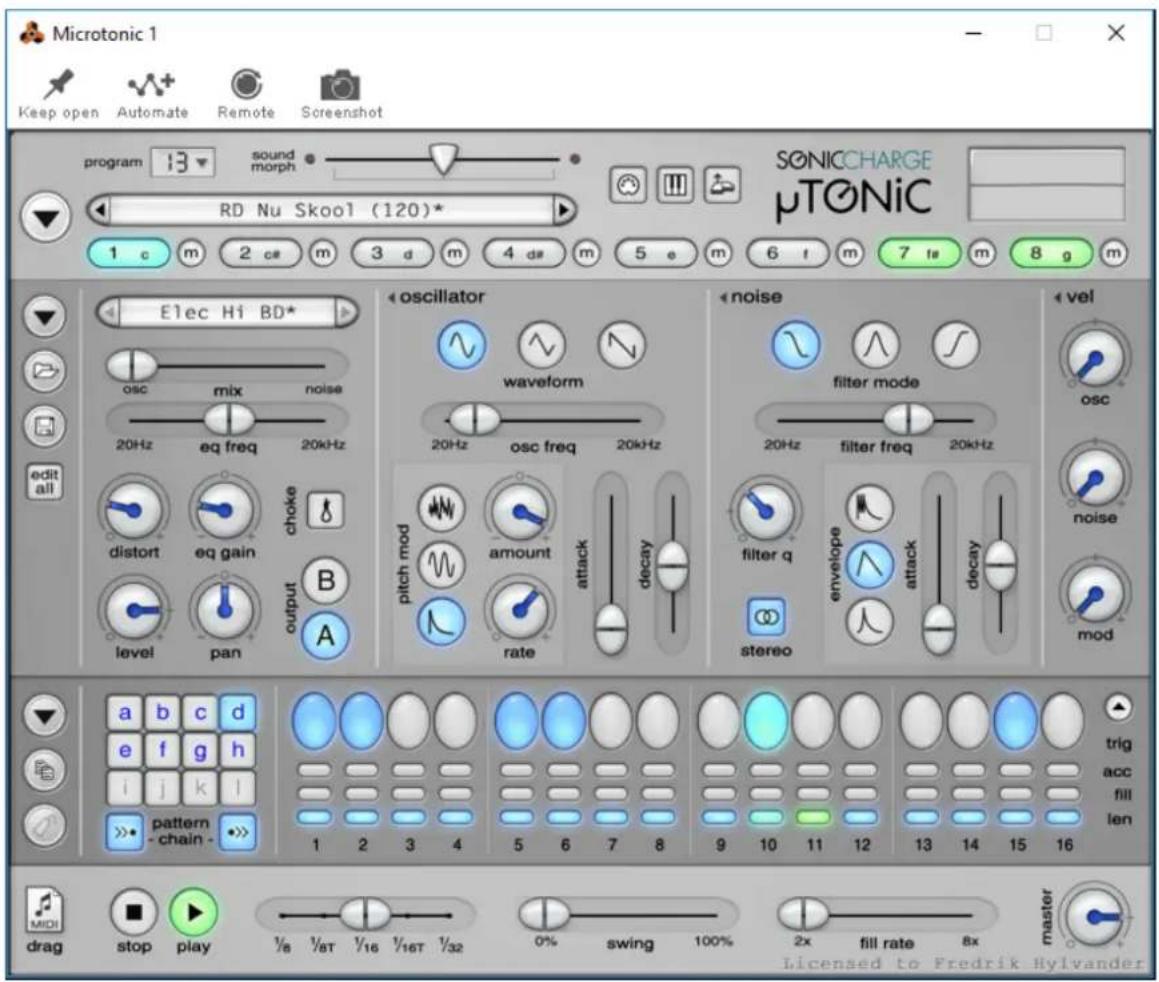
The MicroTonic VST in its Plugin Window.
General functions in the Plugin Window
- The title bar of the VST Plugin Window shows the name of the device instance (same as tape strip).
This is for helping you finding the correct Plugin Window, especially if there are several instances of the same plugin.
At the top of the Plugin Window are a number of icons:
- Keep open
If you activate the "Keep open" function, the Plugin Window(s) will not be automatically closed when you select another device in the rack. Having the "Keep open" selected on several Plugin Windows makes it possible to have several VST panels open at the same time.
• Automate
Click this button when you want to assign a VST parameter for automation in the Reason Lite sequencer, see "Automating VST parameters".
- Remote
Click this button and then select a VST parameter you want to remote control from your MIDI keyboard/control surface, see "Remote controlling VST parameters".
- Screenshot
Click the camera symbol to take a screenshot of the VST front panel:

The screenshot is then automatically scaled down and placed on the corresponding Palette in the Browser, and in the Plugin Rack Device display:

The screenshot of the MicroTonic VST is scaled down and displayed in the Browser and in the Plugin Rack Device.
Closing the Plugin Window
The Plugin Window can be closed in a number of different ways:
- By clicking the Open button on the Plugin Rack Device panel (the same as for opening the Plugin Window).
This works regardless of whether the "Keep open" function in the Plugin Window is on or off.
- By clicking the standard "window close" button in the upper corner of the Plugin Window.
This works regardless of whether the "Keep open" function in the Plugin Window is on or off.
- By selecting another device in the rack.
If the "Keep open" function in the Plugin Window is active, selecting another device in the rack will NOT close the Plugin Window (see "Keep open" above).
Editing the VST parameters
Editing a VST is done in the same way as when editing a native device or a Rack Extension device, only VSTs are edited in their Plugin Windows - not in the rack.
! Note that the standard "Reason Lite" functions, such as holding [Shift] while turning a knob/moving a slider to improve the precision - or holding Ctrl or Cmd to reset parameters to their default position/value - won't work for most VSTs. This is because the VST manufacturers define this type of functionality themselves.
! If the VST plugin has a built-in on-screen keyboard (etc), this can be used for auditioning sounds but you cannot use it for recording into Reason Lite's sequencer!
About Undo and Redo
The Undo/Redo functions in Reason Lite also work in most situations when editing VST parameters in the Plugin Window(s).
Automating VST parameters
Automating VST parameters in the Reason Lite sequencer works in a similar way as for native devices and Rack Extension devices. Basically, there are three ways of automating VST parameters in the Reason Lite sequencer:
→ Start recording in the Reason Lite sequencer and then edit the desired VST parameters while recording. Each of the edited VST parameters automatically gets their own automation lane on the sequencer track, with clips and automation points recorded. Make sure the Parameter Automation is record-enabled on the track first.
Another alternative is this:
- Click the Automate button in the Plugin Window.

- Then, click the parameter you want to automate on the VST panel.

The automated VST parameter gets an automation lane in the Reason Lite sequencer:

- Then, you can draw automation clips and automation points, the same way you would for a native device or a Rack Extension device.
A third alternative is to select the parameter from the Track Parameter Automation popup above the track list in the sequencer, see "Creating/adding parameter automation lanes".
CV modulation of VST parameters
There are eight CV inputs on the rear panel of the Plugin Rack Device. These CV inputs can be assigned on the CV Programmer panel of the Plugin Rack Device.
→ Click the CV Programmer button on the VST Rack Device panel to unfold the CV Programmer:
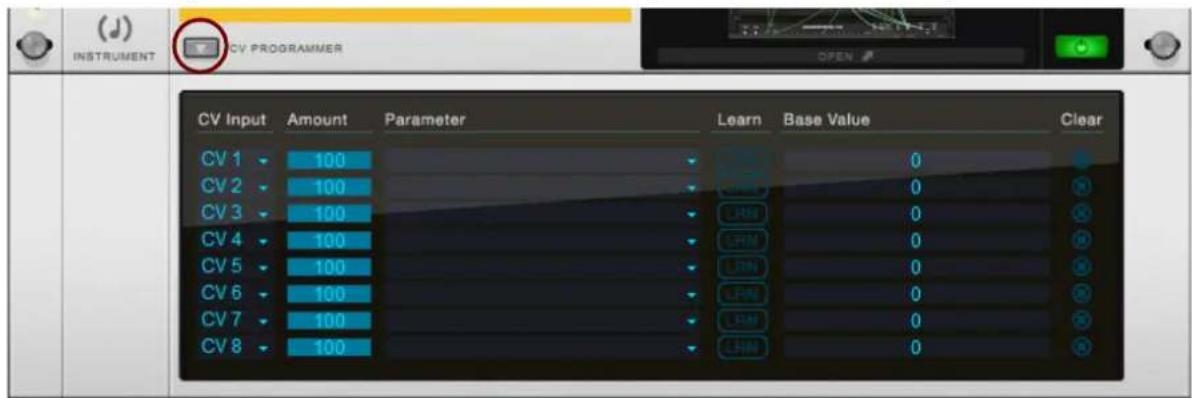
The CV Programmer of the Plugin Rack Device.
For each slot on the CV Programmer panel you can:
- Select a CV input.
Several slots can use the same CV input.
- Set a bipolar modulation Amount.
The range is -100 to 100.
- Select a VST destination parameter from a drop-down list.
This can also be done with Learn function (see below).
- Set a Base Value.
The Base Value is the value the parameter has the time you select it on the VST panel. This is similar to the "Static Value" used when automating parameters on native Reason Lite devices and Rack Extension devices. The exact Base Value is shown in the corresponding value slider.
- Clear the CV assignment.
CV controlling VST parameters using the Learn function
-
Press [Tab] to flip the rack around.
-
Connect a CV cable from the device you want to use as control source, to the CV IN 1 input of the Plugin Rack Device.
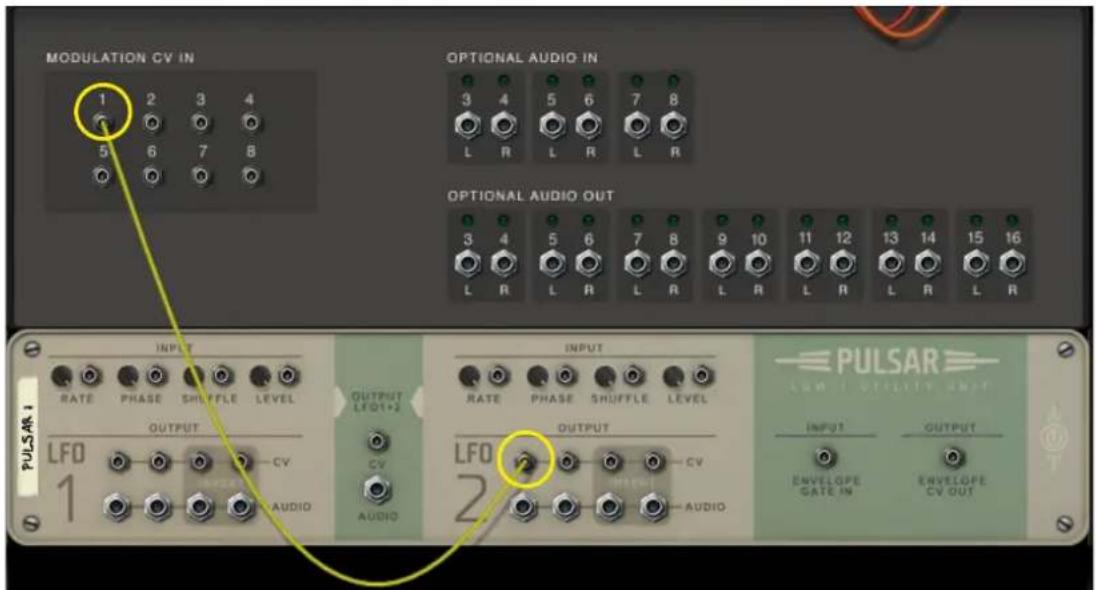
- Press [Tab] to flip the rack back to the front again.
4. Click the topmost Learn button.
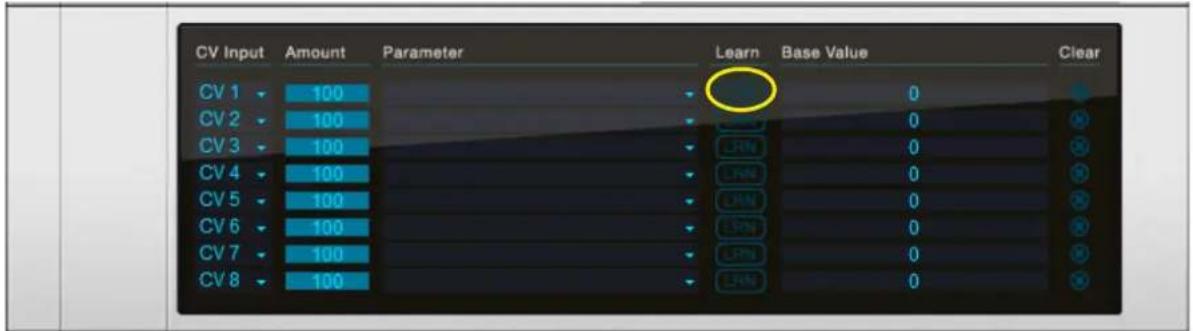
The Learn button lights up and the Plugin Window is opened and brought to front. In the Plugin Window, the text display tells you to move a parameter.
5. Click a parameter in the VST Plugin Window.

ARP 2600 V3 1

Keep open

Automate

Remote

Screenshot
Click a parameter.
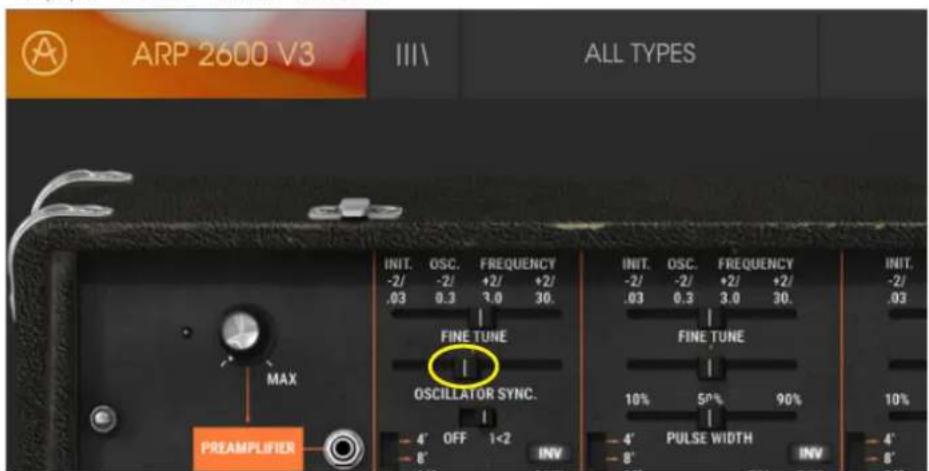
In this example we click the Fine Tune slider of Oscillator 1 to assign it.
The Fine Tune Osc1 parameter is now assigned in the Parameter column for CV slot 1:
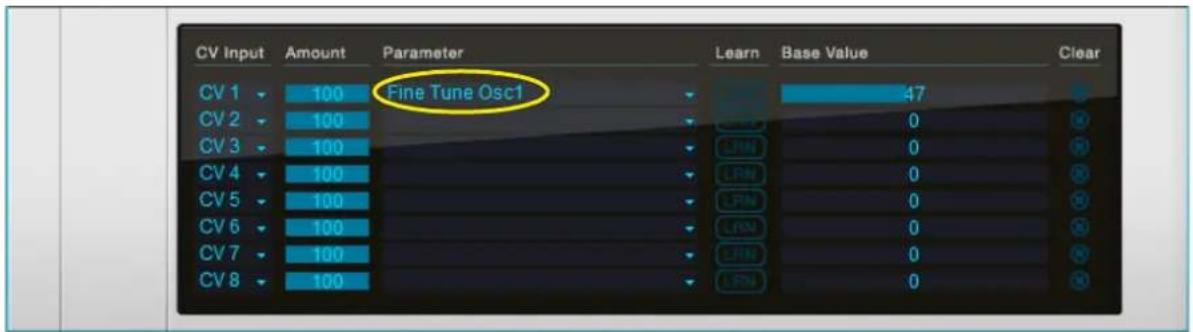
- If desired, change the CV (bipolar) modulation amount by clicking the Amount bar and dragging up/down:

- Repeat the procedure for the other CV slots you want to assign.
→ You can also change the VST parameter's "start" value by clicking the Base Value bar and dragging up/down.
→ If you want to reassign a VST parameter, just click the Parameter drop-down and select the desired VST parameter from the list:

Remote controlling VST parameters
It's possible to assign Remote Overrides to VST parameters, to be able to control VST parameters from your connected MIDI Control Keyboard/Surface.
Adding a Remote Override to a parameter
- Click the Remote button at the top of the Plugin Window.

The button is highlighted and a text display tells you to click a parameter.
- Click a parameter on the VST panel in the Plugin Window.

The Remote Override Edit dialog appears for this parameter:
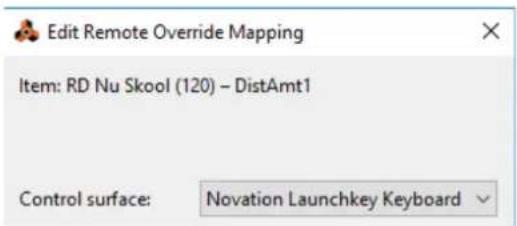
- Use the "Learn from control surface input" function and turn a knob on your MIDI Control Keyboard/Surface to assign a physical knob/slider to the VST parameter.
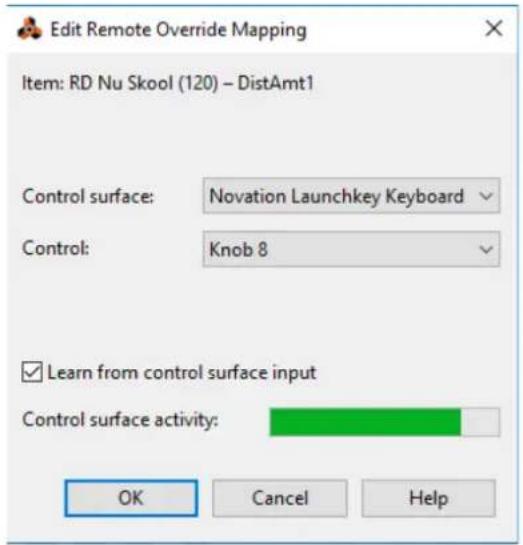
Knob 8 on the MIDI keyboard assigned to control the DistAmt1 parameter on the MicroTonic VST.
- Click OK to close the dialog.
Removing a Remote Override from a parameter
- Click the Remote button at the top of the Plugin Window.
The button is highlighted and a text display tells you to click a parameter.
- Click the parameter you want to remove from the Remote Override.
A context menu appears where you can select "Edit Remote Override Mapping..." (to reassign an override), or "Clear Remote Override Mapping" to remove the override.
Selecting VST programs
Programs for VST plugins can be selected from the Plugin Rack Device (if the VST supports programs). For example, if you load a bank (fxb) using Reason Lite's Browser, the fxb bank may contain a number of different programs, which are then loaded into the VST.
- Click the patch name display on the Plugin Rack Device to show the list of programs loaded in the VST plugin.
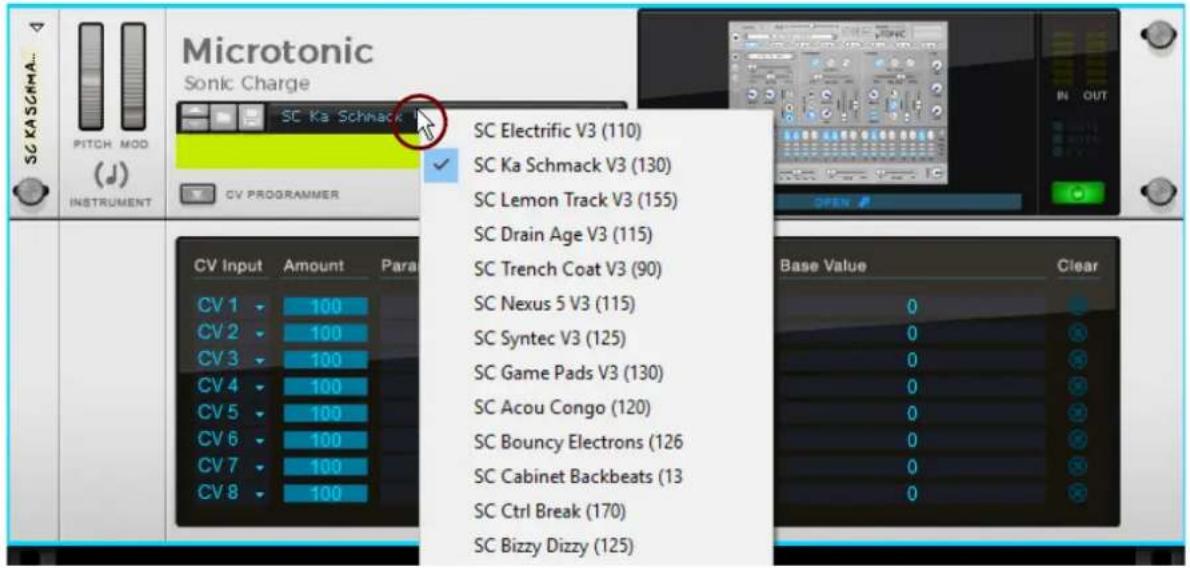
- Select the desired VST program/patch from the list.
→ Alternatively, click the VST Prog up/down selectors to step between and load the VST programs:

These methods also work if the VST has presets that are automatically loaded when you create the device.
! Note that the VST Prog selector buttons only appear if the plugin has a bank of programs or presets loaded.
About saving songs that contain VSTs
When you save a Reason Lite song document, all VST patch/program data is automatically embedded in the song document. This means that you can load VST patches/programs, edit them and then save the Reason Lite song without needing to save the edited VST patches/programs separately. This works exactly the same way as for patches in native Reason Lite devices and Rack Extension devices.
Combining VST plugins in Combinator devices
A Plugin Rack Device can be Combined just like any other device types. In the Combi Programmer, all VST parameters are listed. See "The Combinator" for more information.
About missing VST plugins
When you open a Reason Lite song from another user, it might have been created using VST plugins that you don't have. When you open such a song, any missing VSTs are replaced by empty Plugin Rack Devices in the rack:
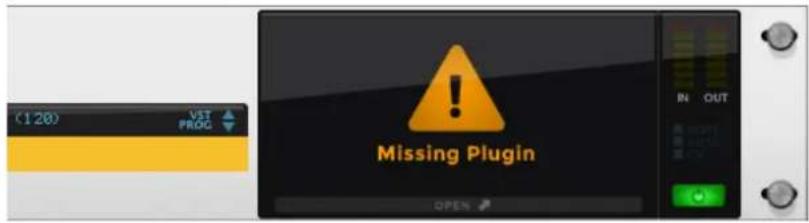
An empty Plugin Rack Device representing a VST which is currently unavailable on your computer.
• The empty VST device itself will be silent.
If it's an effect, it will bypass the audio (or be silent, if connected as a send effect).
- If you're collaborating with a friend you can safely save the song and send it back.
When your friend opens the song, the missing VST will be restored with all settings intact.
Managing VST plugins
To get an overview of the VST plugins currently installed on your computer - and to be able to disable any malfunctioning VSTs - there is the Manage Plugins window.
→Select "Manage Plugins" from the Window menu.
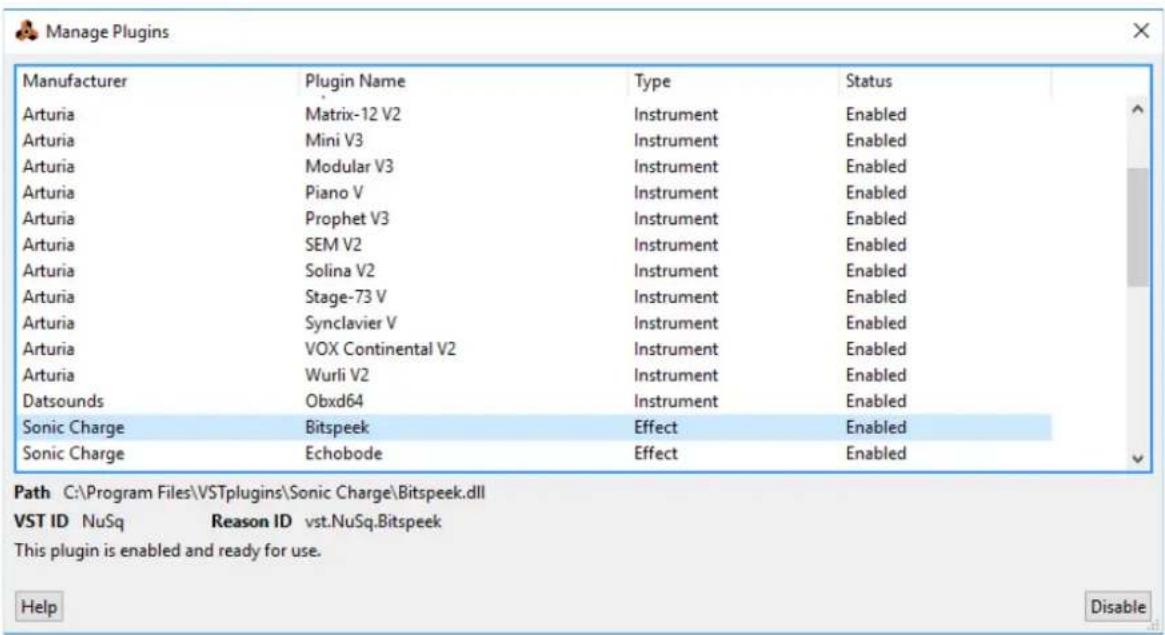
The Manage Plugins window.
Here, all VST plugins installed in your VST folder(s) on your computer are listed (see "Defining custom VST folders").
The Manage Plugins window is divided into the following columns:
• Manufacturer
Shows the name of the plugin manufacturer.
- Plugin Name
Shows the name of the plugin.
- Type
Shows whether the plugin is defined as an "Instrument", "Effect" or "Utility" in Reason Lite.
- Status
Shows the current status of the plugin (see "Plugin Status" below).
In the Plugin Management windows you can also:
→Click and drag the column headings to sort the list.
→Click a plugin to select it.
Additional info (path to the dll and comments about its status) is then shown in the Details area.
→ Click the Disable/Enable button to disable or enable the selected plugin (see "Plugin Status" below).
Plugin Status
A plugin can have four different Status values, with additional texts in the Details area.
Plugin Status: Enabled
- If the plugin was enabled in a previous session, the plugin is enabled and ready for use.
- If the plugin has been enabled during this session, it will be loaded when you restart Reason Lite.
Plugin Status: Disabled
- If the plugin was manually disabled in a previous session, it's now disabled.
- If the plugin has been manually disabled during this session, it will be disabled when you restart Reason Lite.
Plugin Status: Could not load
- If the plugin has the “Could not load” status, the plugin returned an error code and couldn’t be loaded. If you enable it, Reason Lite will attempt to load it the next time you restart.
Plugin Status: Crashed
- If the plugin has the “Crashed” status, it was automatically disabled because it crashed or caused Reason Lite to hang.
If you enable it, Reason Lite will attempt to load it the next time you restart.
Defining custom VST folders
It's possible to specify custom VST folders. This can be done on the Advanced tab in Preferences:
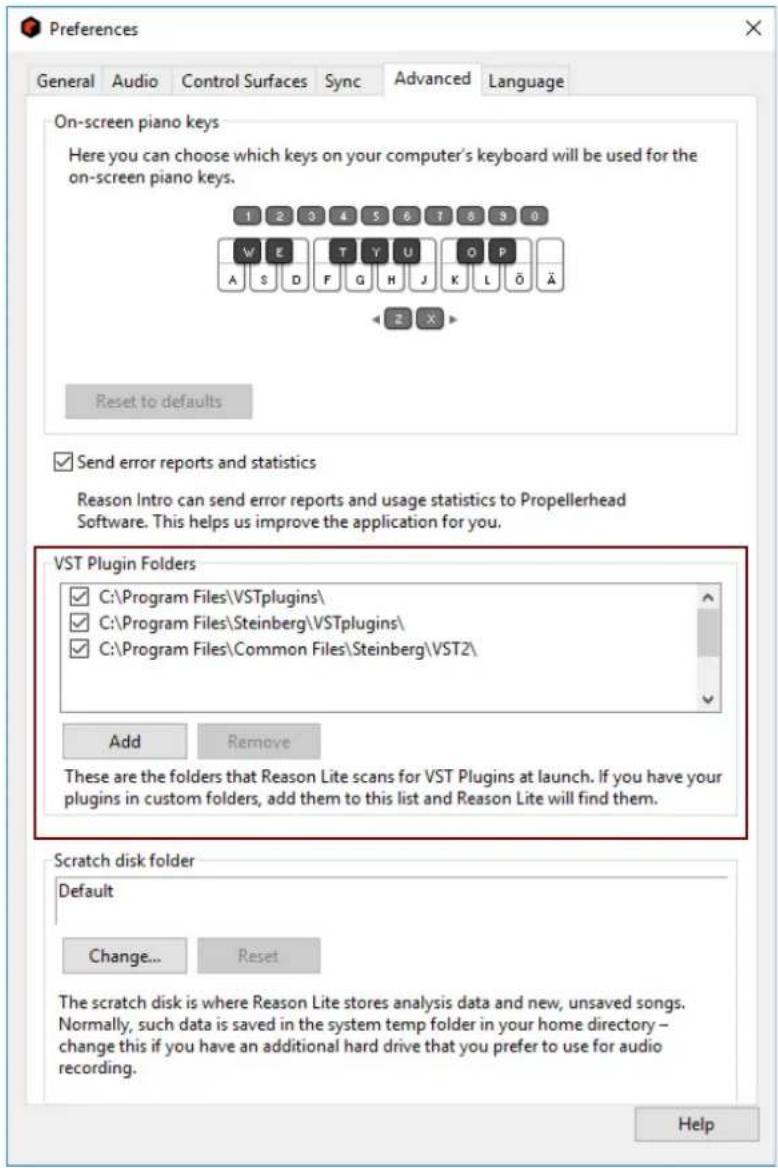
→ Tick the check boxes for the folders you want Reason Lite to scan for VST plugins at launch.
You will have to restart Reason Lite for the changes to take effect.
→ Click the Add button to add a custom VST Plugin folder.
Note that you will have to create the folder in the computer's file system before you can add it - you cannot create a new folder using the Add function.
You will then have to restart Reason Lite for the changes to take effect.
→ Click the Remove button to remove a custom VST Plugin folder.
Note that you don't delete the folder from the file system of your computer - you only make it unavailable in the list.
You then have to restart Reason Lite for the changes to take effect.
Chapter 15 Sounds, Patches and the Browser
About this chapter
This chapter deals with the following topics:
- Handling Patches.
See "About patches".
• Using the Patch Browser.
See "Using the Browser".
- ReFills and Reason Lite file formats.
See "About ReFills".
About patches
A patch contains settings for a specific device. Patches can be either separate files on your hard disk or files embedded in a ReFill (see "About ReFills" for info about ReFills). The devices that use patches are described below. The Mix Channel, Master Section and Audio Track devices can use Insert FX patches saved as Combinator devices. All other Reason Lite devices use either Presets or can only be programmed using the device panel parameters.
Reason Lite devices that use patches
- Subtractor and Monotone synth patches contain all settings on the device panel.
Loading a patch brings up a new sound, just like when loading programs or patches on a hardware synthesizer.
- Redrum Drum Computer patches contain a complete "drum kit", that is, information about which drum samples are used, together with the parameter settings for each drum sound.
Again, the actual samples are not included in the patch, only references to files. Also note that Redrum patches are separated from Redrum patterns - loading a new patch will not affect the patterns in the device.
- RV7000 MkII and Scream 4 effect patches contain all settings on their respective device panels.
Loading a patch brings up a new sound, just like when selecting programs or patches on a hardware effect device.
- The MIDI devices on the Players palette use patches that contain panel settings.
- The Combinator (Combi) patch format saves all settings and file references for each device in the Combi, along with the Combinator's own settings; key/velocity zones, modulation routing etc.
Any audio or CV routing from/to devices that are part of the Combi is also saved.
! Note that patches for devices included in a Combi are not saved individually - e.g. if a Combi includes a Subtractor, and you have tweaked its settings, these settings will be saved with the Combi, but will not be saved as a separate Subtractor patch unless you do so from within the Combi - see "Saving patches".
! Patches other than Combi patches do not include any cable routing information.
About the "Load Default Sound in New Devices" preference
On the "General" page in Preferences, there is an option (on by default) to load a default patch when creating a device. For some devices, there are a number of patches that exist outside category folders in the main Sound Bank folder for the device. These will be available on the browse list (see "About browse lists") directly after creating the device, which allows you check out a few sounds for a device without opening the browser.
Loading patches
Immediately after you have created a new device, the device automatically gets "browse focus". This means that the Browser is temporarily "locked" to the device and displays patches for the device you just created. Browse focus for a device is indicated by orange side bars in the rack and on the sequencer track - and that the patch section on the device is colored in orange. In the Browser the orange Browse Focus field at the top now shows patches only for the highlighted device in the rack:
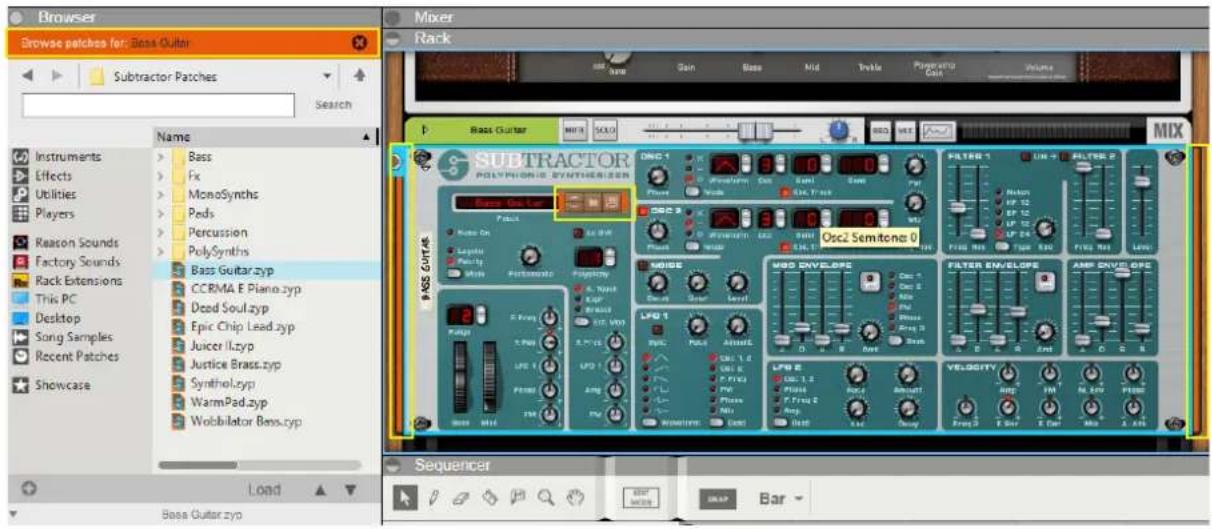
To load a patch for a device, use one of the following methods:
! For all the patch load methods described below, you can automatically revert back to the original patch, see "The Revert function".
→ Double click a patch in the Browser to automatically load it in the device that has browse focus.
→ Use the up/down arrow keys, or click the Load Previous/Load Next triangle buttons at the bottom of the Browser, to select a patch in the Browser and automatically load it in the device that has browse focus.
→ Click a patch in the Browser to select it, then click the Load button at the bottom of the Browser, or press [Enter] (not on the numeric key pad).
- Drag a patch from the Browser - or from the Windows Explorer (Win) or Finder (Mac) - and drop it on the device panel (or drop it on the device icon in the Sequencer Track List).
! Automatic browse focus can be turned off on the General page in Preferences, see "New devices get browse focus".
! If you drop patches for other devices (of the same device type (Instruments or Effects)), the existing device will be replaced by the new device. You can also drag and drop patches onto devices that don't support patches. In these situations, the new device replaces the current one and the dropped patch is automatically loaded in the new device.
! Note that Instrument devices can only be replaced by other Instrument devices. The same goes for Effect devices. Utility devices cannot be replaced using the "drag and drop" method!
→Click the Select Patch buttons on the device panel:

The Patch section of the Subtractor device.
→ Click on the Patch Name display on the device panel to bring up a a pop-up menu which lists all patches in the currently selected folder.
→Click the Browse Patch button on the device panel.
This is useful mainly if a device doesn't already have browse focus. Clicking the Browse Patch button sets browse focus to the device. Then, you can select and load patches as described above.
! On the panel of the Redrum there are also other Patch buttons, used for loading samples. Make sure you click on the button in the Patch section (next to the patch name display)!
→ Select "Browse Patches..." from the Edit menu or device context menu.
This is useful mainly if a device doesn't already have browse focus. Selecting Browse Patches sets browse focus to the device. Then, you can select and load patches as described above.
Note that the Edit menu reflects which device is selected - in other words, you must select the device for the corresponding Browse Patches item to appear on the Edit menu.
- Once you have loaded a patch, you can step between all the patches in the same folder by using the "Select Patch" buttons on the device panel:
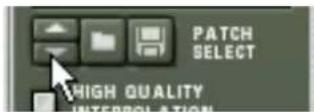
→ If you click on the Patch Name display on the device panel, a pop-up menu will appear, listing all patches in the currently selected folder.
This allows you to quickly load another patch, without having to step through the patches one by one. You can also choose to set browse focus to the device by selecting "Open Browser..." from this pop-up menu.
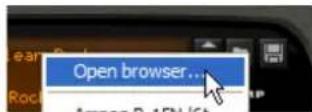
When you load a patch in any of the ways described above, the device's parameters will be set according to the values stored in the patch, and the name of the patch will be shown in the Patch Name display.
! Any parameter adjustments you make on the device panel after loading a patch will not affect the actual patch file. For this to happen, you need to save the patch - see "Saving patches".
! You can also load patches from a MIDI Master Keyboard or Control Surface - see "Remote - Playing and Controlling Devices".
The Revert function
A soon as you have loaded a new patch into a device that has browse focus, the Revert button becomes available at the bottom of the browser list:
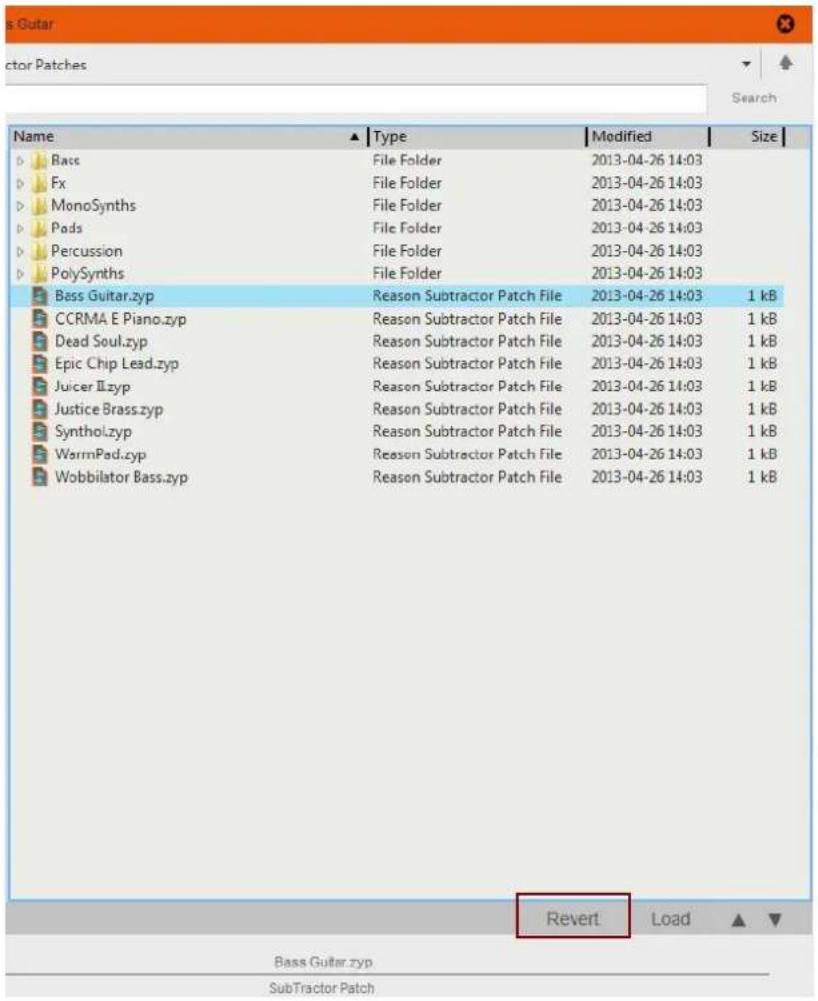
The Revert button appears as soon as you load new patches into a device that has browse focus.
The Revert function makes it possible to get back to the patch which was originally in the device - before you started loading new patches. This is very handy if you should change your mind and want your original patch back in your device. The Revert function also works if you have loaded patches for other device types, so called cross-browsing (see "Cross-browsing patch files").
If referenced samples are missing
As described above, patches for the Redrum, NN19, NN-XT, Kong and Dr. Octo Rex contain references to samples or REX files. Just like patches, samples can be independent files on the hard disk or elements within a ReFill. However, if sample files have been moved or renamed after a patch was saved, the sample file references in the patch will not be accurate.
If this is the case when you select a patch, the program will tell you so. You can then choose to either manually locate the missing files, to have the program search for them, or to proceed without the missing sounds. For details, see "Handling Missing Sounds".
! Proceeding without locating or replacing the missing samples will result in silent drum channels, key zones or loop slots (for the Redrum, NN19/NN-XT, Kong and Dr. Octo Rex respectively).
Clearing browse focus
To clear browse focus for a device, use one of the following methods:
→Click anywhere in the rack background.
→ Click the X symbol to the right on the orange browse focus label at the top in the Browser.
→ Select another sequencer track (if the rack is not detached).
Setting browse focus
Apart from when creating and loading patches into a device, browse focus can be set anytime you like. This is very useful if you're working in the sequencer where there are no browse buttons. Or if you want to set browse focus to a non-patch device and replace it with something else.
1. Select a device in the rack, or a track in the sequencer.
In this example we select a Redrum track in the sequencer. As soon as the track (or device) is selected, the Browser shows the track/device name on a gray background in the Browse Focus field:
2. Now, click the folder button in the Browse Focus field:
Browse focus is now set to the Redrum device:
- Now, you can browse and load new patches into the Redrum device.
- When you are done, clear the browse focus by clicking the X button in the browse focus field.
! If you are using two Browsers, the one in the Song window and the other in the detached rack window, browse focus can only be set in one of the Browsers at a time.
Saving patches
Saving device settings in a song
When you save a Reason Lite song, all settings for all devices are automatically included in the song file - there is no need to save the patches separately.
! It's important to realize that it's the actual settings that are saved in the Song - not references to patches on disk. The next time you open the song, all devices will be set as they were when you saved it (regardless of whether you have removed or edited any patches on disk).
! Note that device samples are not stored with the Song by default. This means that if you edit any Redrum samples in an external application and then open a Song containing devices that use these samples, the sound will be different. It's possible, however, to store actual device samples together with the Song using the "Self-Contain" feature. See "About Self-Contained Songs".
Saving device settings as patches on disk
Even though the device settings are stored with the song, you may want to save any settings you have made for a device as a separate patch file. This allows you to use the patch in other songs, and lets you try out other patches in your song without the risk of losing your original sound. A patch is saved as follows:
- Click the "Save Patch" button on the device panel:
- In the file dialog that appears, specify a location and name for the patch file and click Save.
- Under Windows, the different types of patch files have different file extensions.
File extensions are automatically added by Reason Lite when you save. Under macOS, file extensions are not needed but it may be a good idea to keep them if you want the saved files to be usable under Windows.
- If you have selected a patch, modified it and want to save it with the modifications, you could either save a separate, modified version of the patch (with a new name) or simply overwrite the old patch file on disk. As usual, you will be asked whether you really want to replace the existing patch file.
! Note that you can save a patch under the same name and location without having the save dialog appear by holding down Alt or Option and clicking the "Save Patch" button on the device panel. Be aware that this overwrites the original patch!
! Note also that you cannot save into a ReFill! This means that if you have opened a patch from within a ReFill, modified it and want to save it, you need to save it as a separate file in a new location (outside the ReFill). Preferably, you should also rename the modified patch file, to avoid confusion.
Copying and pasting patches between devices
A quick way to copy device parameter settings between devices of the same type is to use the "Copy Patch" and "Paste Patch" functions. The result is exactly the same as if you had saved a patch from one device and opened it on another device of the same type - this is just a quicker method.
! Copying and Pasting settings is possible with all device types that can use patches.
Proceed as follows:
- Select a patch, and/or make the desired settings on the source device. Make sure the device remains selected.
- Select "Copy Patch" from the Edit menu or from the device context menu.
- Select the destination device of the same type (in the same song or another song).
- Select "Paste Patch" from the Edit menu or from the device context menu.
The settings of the source device (including Redrum sample references) are applied to the destination device.
! Note that this operation simply copies the settings from one device to another. Adjusting the settings on one of the devices will not affect the other; neither will the settings affect any patch file on disk.
Copying Main Mixer Insert FX settings and paste as Combinator patches
You can copy Insert FX settings from Main Mixer channels and paste these as Combinator effect patches - or vice versa. To copy a Main Mixer channel Insert FX setting and paste into a Combinator device, follow the steps below:
- Select the desired Mix Channel/Audio Track device in the rack, or the desired Mixer Channel in the Main Mixer.
- Select "Copy Channel Settings -> Insert FX" from the Edit menu or device/Mix Channel context menu. The Insert FX devices with their settings and connections are placed on the computer's clipboard memory.
- Select the desired empty Combinator device in the rack - or create a new Combinator device and select it.
- Select "Paste Patch" from the Edit menu or the device context menu.
The Insert FX devices with their settings and connections are pasted into the Combinator device.
To copy an effect patch in a Combinator device and paste it as an Insert FX in a channel strip in the Main Mixer, proceed as follows:
- Select the Combinator device which contains the effects you want to copy.
- Select "Copy Patch" from the Edit menu or the device context menu.
The Combinator effect devices with their settings and connections are placed in the computer's clipboard memory.
- Select the desired Mix Channel/Audio Track device in the rack, or the desired channel strip in the Main Mixer.
- Select "Paste Channel Settings: Insert FX" from the Edit menu or the device context menu.
The Combinator devices with their settings and connections are pasted into the Insert FX section of the selected Mix Channel/Audio Track device.
Initializing patches and resetting device parameters
Sometimes it is useful to start with a "clean slate" when creating a synth sound, a drum kit or a sampler patch. This is achieved by selecting "Reset Device" from the Edit menu or from the device context menu. This resets all parameters to "default" values. Initializing a Redrum device will also remove all sample file references, allowing you to start from scratch.
About ReFills
A ReFill is a kind of component package for Reason Lite, which can contain sounds and effects patches, samples, SoundFonts and demo songs. If you like, you can compare ReFills to ROM cards for a hardware synthesizer. On your computer, ReFills appear as (often large) files with the extension ".rfl".
All sounds included with Reason Lite are embedded in a ReFill named "Factory Sounds", which was (downloaded and) copied to the hard disk during installation.
Additional Reason Studios ReFills are available for purchase. You can also download ReFills from other Reason Lite users on the Internet, purchase them from other sample manufacturers, etc.
- Samples (Wave and AIFF files) are compressed to about half their original file size when stored in ReFills, without loss of quality.
In Reason Lite, you can use the browser to list and access the embedded sounds and other components within the ReFills, just as if the ReFills were folders on your hard disk.
Furthermore, if a song makes use of components from ReFills, Reason Lite will tell you which ReFills are required.
Using the Browser
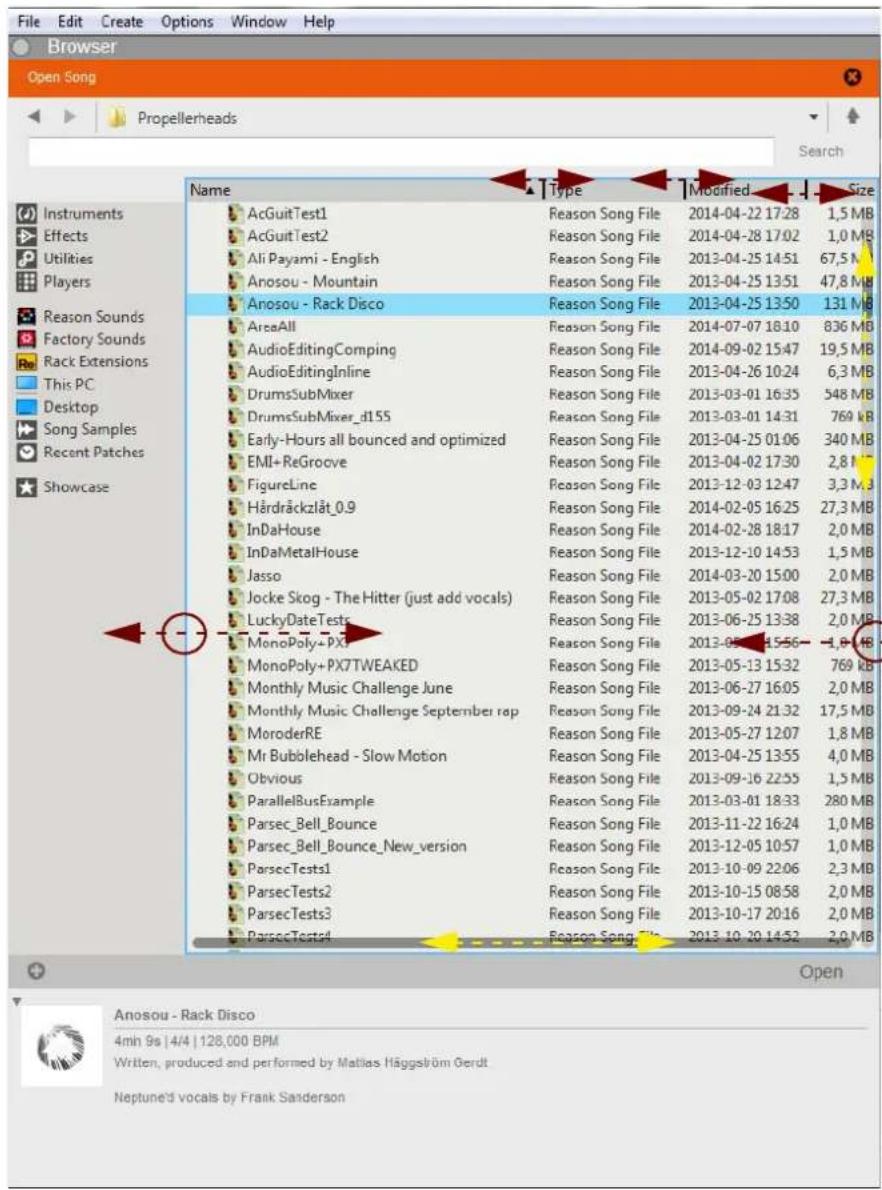
The Browser when using the File|Open... command.
The Browser is used when you open songs or load patches, samples, audio files and MIDI files, from regular file folders or from a ReFill.
→ Open and close the Browser by pressing [F3] or by selecting Show/Hide Browser from the Windows menu.
! If you have the rack detached in a separate window, you can have a second Browser in the rack window, see "About using the Browser in the detached rack".
The Browser can also be resized by dragging the edges of the browser list sideways, as shown in the picture above. Each column in the browse list can also be resized. You can also scroll horizontally and vertically (when applicable) using the scrollbars to the right and at the bottom of the browse list (yellow arrows in the picture above).
Besides standard file folder browsing, the Browser offers several useful functions:
- Search for files by name and/or type - see "Using the "Search" function".
- Use "cross-browsing" to search for patches belonging to any type of device.
For example, set browse focus from a Subtractor device by clicking its Browse Patch button. Instead of limiting the Browser to show only Subtractor patches, you can choose to browse for any type of instrument patch. If you select a patch with a different format than the device you are browsing from, the original device will be replaced by the new device. See "Cross-browsing patch files".
- Create Favorite Lists containing shortcuts to your favorite files for instant access.
See "Favorites Lists".
• Audition audio samples and loops on the fly.
- Save shortcuts to various locations on your local drive(s).
See "Using Locations and Favorites".
Opening the browser
Besides pressing [F3] you can use any of the following commands to open the Browser (what file types you can browse for depends on which method you used to open the Browser):
- By selecting "Open" from the File menu.
This opens the Browser where you can select to open a Song (relt and .reltdemo).
! If no Song document is open on the macOS version of Reason Lite, Reason Lite temporarily opens an empty Song document to be able to show the Browser. When a Song has been loaded, the empty document closes.
- By selecting "Browse Patches" on the Edit menu with a patch based device selected (or by clicking the "Browse Patches" button on the device panel).
This opens the Browser allowing you to browse for and load patches for the selected device, or use "cross-browsing" (see "Cross-browsing patch files") to select patches for other device types.
- By selecting “Browse Insert FX Patches” on the Edit menu with a Main Mixer Channel or Mix Channel/Audio Track device selected.
This opens the Browser, where you can browse for and load Combinator Effect patches.
- By selecting "Browse Samples" on the Edit menu with a sample based device selected (or by clicking the "Browse Samples" button on the device panel).
This opens the Browser, where you can browse for, preview and load samples in the supported audio formats.
- By selecting "Import Audio File" from the File menu.
This opens the Browser, allowing you to browse for, preview and load files in the supported audio formats to an audio track in the sequencer. See "Importing audio to the sequencer".
- By selecting "Import MIDI File" from the File menu.
This opens the Browser, allowing you to browse for MIDI files to import to instrument tracks in the sequencer. See "Importing Standard MIDI Files".
- By selecting "Create Instrument..." or "Create Effect..." from the Create menu.
This allows you to browse for and load patches for any device. See "Create Instrument/Create Effect".
Browser elements
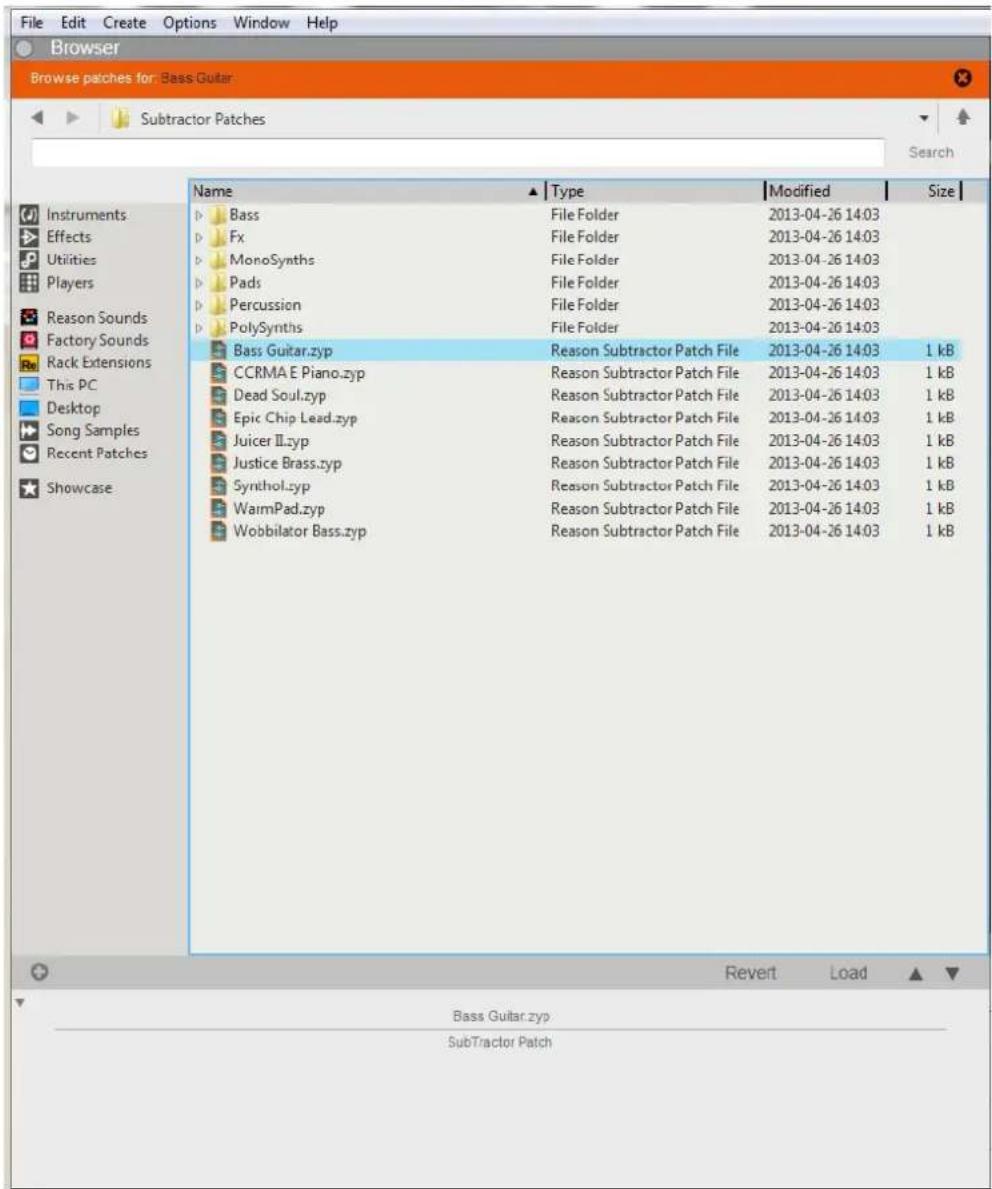
The Browser when using the Browse Patch button/function on a Subtractor device.
Regardless of what command you used for opening the Browser (Open/Browse Patch/Import Audio etc.), the Browser basically contains the same main elements:
Browse focus field
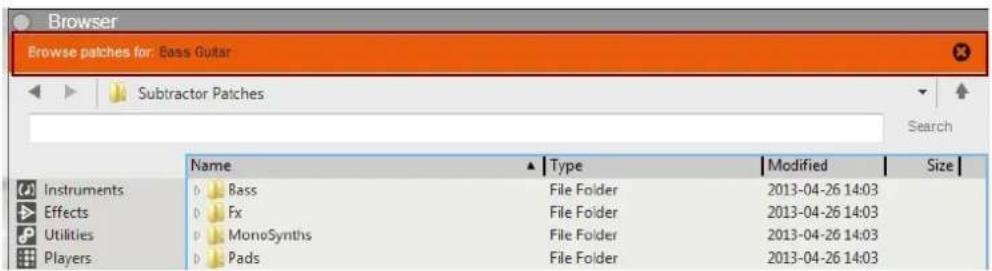
This field shows the name of the currently selected device in the rack - or the currently selected sequencer track. The Browse Focus field is orange when a device or track has browse focus - and gray when no focus is set. See "Setting browse focus" and "Clearing browse focus" for more information.
Root Folder drop-down list
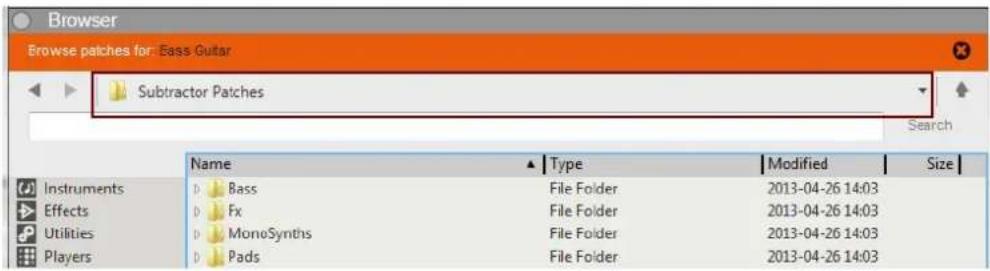
This field displays the name of the currently selected root folder.
→ Click in the name field to bring up a drop-down list where you can move up in the folder hierarchy.
Search results and Favorites lists, however, are shown as "flat" lists - with no folder hierarchy.
→ Click on the (arrow) button to the right of the root folder list to move up in the hierarchy one level at a time:
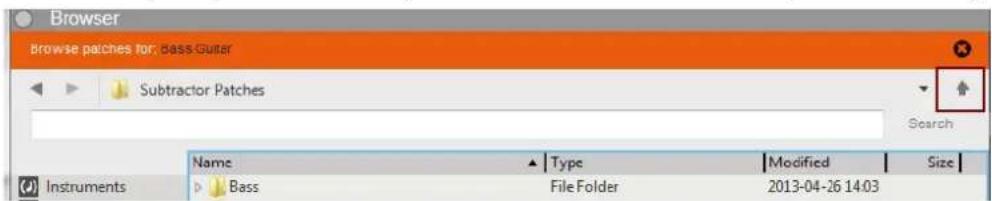
Back/Forward buttons
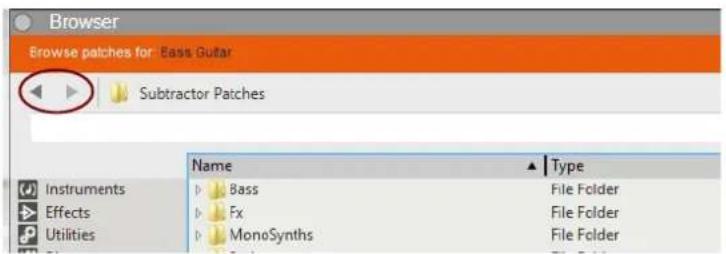
These arrow buttons allow you to move between the browser locations opened while browsing, much like pages in a web browser.
Locations and Favorites list
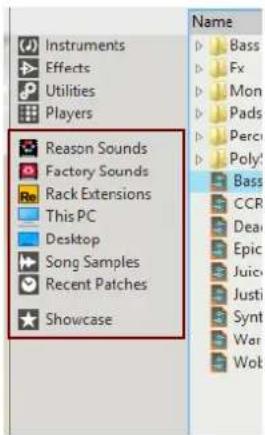
This list contains shortcuts to various locations. You can manually add any locations (on any local drive) to the bottom section of the list. The locations in the upper part of the list are default and cannot be changed. Selecting an item in the "Locations and Favorites" list will open the corresponding folder/ReFill as the root in the main files and folder list - see "Navigating in the Browser".
In the "Locations and Favorites" list you could also create your own "Favorites Lists". The "Favorite Lists" can contain shortcuts to your favorite patches, samples or song files - see "Favorites Lists".
Search text field
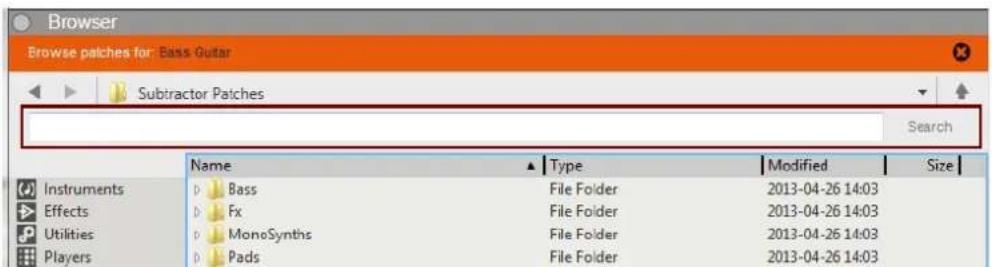
Here you can enter a text string and click Search to search for Song files, patches, audio files and samples. The Search function is described in "Using the "Search" function".
Browser list
| Name | Type | Modified | Size |
| Bass | File Folder | 2013-04-26 14:03 | |
| Fx | File Folder | 2013-04-26 14:03 | |
| MonoSynths | File Folder | 2013-04-26 14:03 | |
| Pads | File Folder | 2013-04-26 14:03 | |
| Percussion | File Folder | 2013-04-26 14:03 | |
| PolySynths | File Folder | 2013-04-26 14:03 | |
| Bass Guitar.zyp | Reason Subtractor Patch File | 2013-04-26 14:03 | 1 kB |
| CCRMA E Piano.zyp | Reason Subtractor Patch File | 2013-04-26 14:03 | 1 kB |
| Dead Soul.zyp | Reason Subtractor Patch File | 2013-04-26 14:03 | 1 kB |
| Epic Chip Lead.zyp | Reason Subtractor Patch File | 2013-04-26 14:03 | 1 kB |
| Juicer ILzyp | Reason Subtractor Patch File | 2013-04-26 14:03 | 1 kB |
| Justice Brass.zyp | Reason Subtractor Patch File | 2013-04-26 14:03 | 1 kB |
| Synthol.zyp | Reason Subtractor Patch File | 2013-04-26 14:03 | 1 kB |
| WarmPad.zyp | Reason Subtractor Patch File | 2013-04-26 14:03 | 1 kB |
| Wobbilator Bass.zyp | Reason Subtractor Patch File | 2013-04-26 14:03 | 1 kB |
This is the Browser list, showing the contents of a selected folder - see "Navigating in the Browser".
Patch Load section
At the bottom of the Browser list are a buttons for selecting and loading patches:
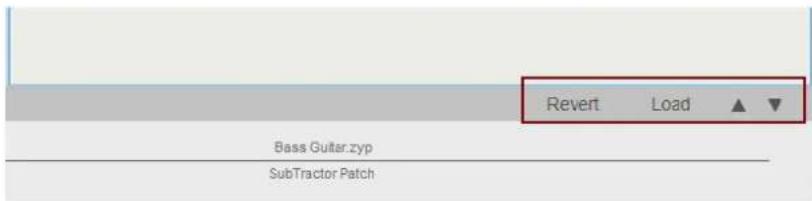
→ Click a patch in the Browser list and then click the Load button to load the patch in the device.
- Click the triangular Load Previous/Load Next buttons to automatically load the previous/next patch in the device.
Alternatively, press the up/down arrow keys on the computer keyboard.
→ Click the Revert button to revert to the patch that was originally in the device, before you loaded new patches.
See "The Revert function" for more details.
Info and Details


Anosou - Rack Disco
4min 9s | 4/4 | 128,000 BPM
Written, produced and performed by Maltias Håggström Gerdt
Neptune'd vocals by Frank Sanderson
The info pertaining to a selected Song file.
The "Info" section at the bottom of the Browser can show Song/ReFill splash images and also information about the item currently selected in the "Files and Folders" list. Exactly what information is shown here depends on the selected file type. For example, samples or REX files contain information about the file format and length of the selected file, while a selected song file can display comments from the author (see "Including Song Information") etc. If the selected file is part of a ReFill, this will be indicated regardless of the file type.
→ Click the triangular fold/unfold button at the top left to show/hide the Info and Details section.
Folding the Info and Details section automatically expands the Browse list/device palette downwards.
Audition section (for audio files and samples)
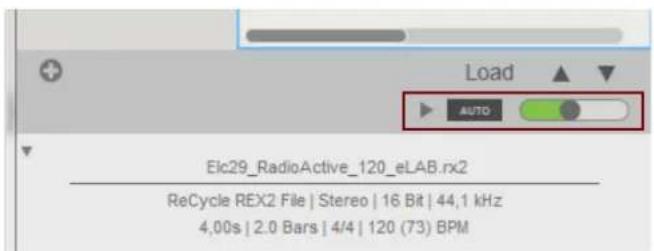
This section contains controls for auditioning audio files and samples. For other file types, the "Audition" section is not present.
Navigating in the Browser
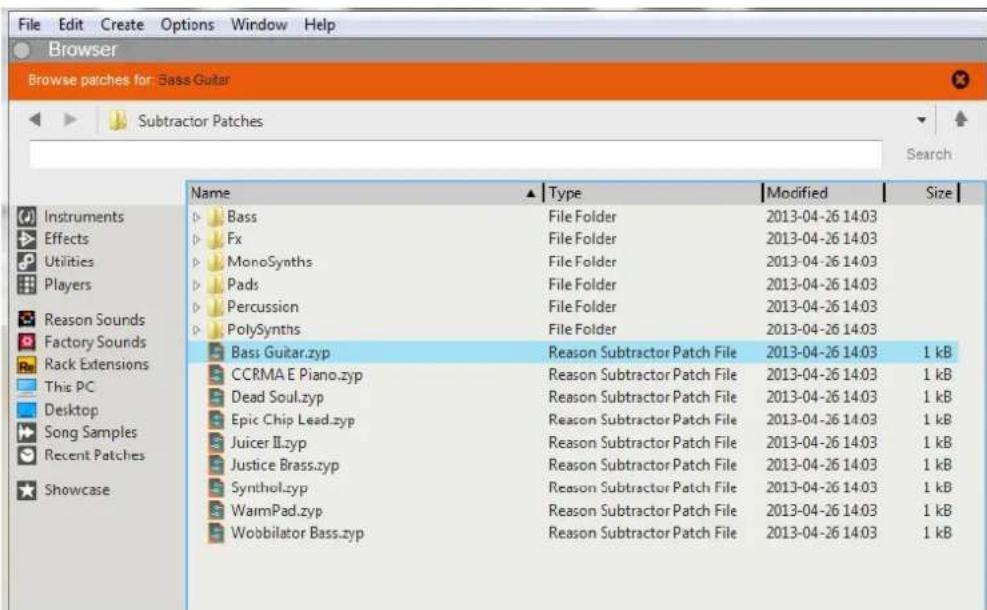
The Browser with browse focus set to a Subtractor device, allowing you to browse for and load Subtractor patches.
When navigating in the Browser, items are shown as a hierarchical list in a selected root folder, just like in your computer's file browser (Finder on Mac and Explorer on Windows).
All folders and sub-folders within a root folder are shown, but only files of the relevant type (i.e. songs/samples/patches etc.) can be viewed/selected in the Browser.
→ Click on the triangular symbol next to a closed folder to expand it. If the folder contains files of the relevant type, these will be shown.
→ Double-clicking a folder in the list opens it as the root folder in the Browser.
- The "Name", "Type", "Modified" and "Size" columns show the name of the folder or file, the file/folder type, the modification date and the size (files only), respectively.
- Clicking on a column header sorts the files accordingly (i.e. alphabetically, by file type, by modification date or by file size).
Click the same column again to toggle between ascending or descending display order.
- You can use the "Back/Forward" buttons to move between the different locations you have opened in the Browser.
When you hide the Browser the "location list" is cleared.
→ Use the up/down arrow buttons on the computer keyboard to step between files in the current Browser list and automatically load them into the device.
Only files will be stepped through, while folders are skipped.
- The Root Folder drop-down list to the right of the "Back/Forward" buttons allows you to move up in the folder hierarchy when the Browser points to a specific folder location (see "About hierarchic and flat lists" below).
→ If you want to browse for patches for other devices, click the X button on the orange field to clear the Browse focus from the existing device type.
If you select and load a patch for another device type, the new device will replace the device that previously had Browse focus.
About hierarchic and flat lists
In certain circumstances the Browser will display a flat list without any folder hierarchy. In such cases there will be an extra "Parent" column displaying the parent folder location for all files. The "Root Folder" drop-down list will then also contain a shortcut to the selected file's parent folder - the "Go To Parent Folder" item.
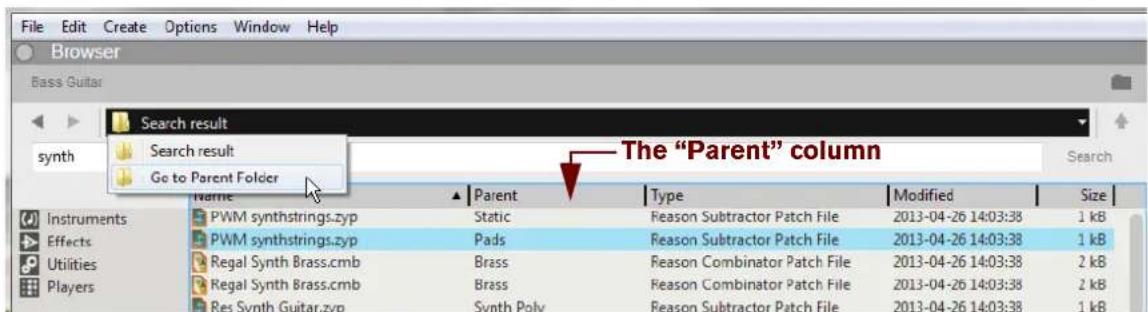
The Browser display for flat lists.
Flat lists are shown in the following cases:
- When the Browser is showing a search result - see "Using the "Search" function".
- When the Browser is showing a Favorites folder list - see "Favorites Lists".
- When the Browser is showing a browse list stored for a device in a saved song - see "About browse lists".
Using Locations and Favorites
To help you to find your files quickly, you can add shortcuts to the folders where you store your samples and patch files etc. By default, the Locations list contains eight fixed locations; the Reason Lite 11 Sounds location, the Reason Lite Factory Sounds location, the Rack Extensions location, This PC folder, the Desktop folder, the Song Samples location and the Recent Patches location. You can easily add your own locations below this list if you like.
- Selecting a Location or Favorite List in the list opens it as the root folder in the Browser.
To add a new Location, select a file, folder or ReFill in the main browser list and drag and drop it in the "Locations and Favorites" list.
Any new Locations will be added below the list of fixed locations. An insertion line is shown to indicate where in the list the new location will placed. Manually added locations can later be reordered by dragging and dropping.
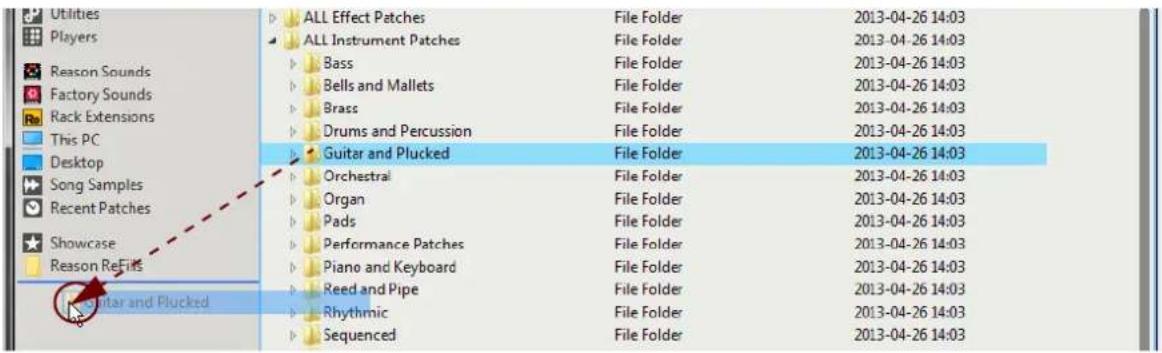
Adding a new Location.
! Even though it is possible to add individual ReFills as separate Locations, we strongly recommend that you create a ReFill folder in which you put all your ReFills; then add the ReFill folder as a Location:
The reason for this is that some ReFills (such as the Reason Electric Bass) consist of several ReFill files: one which contains patches and another that contains the samples. If you should add only the patch ReFill as a Location and not the samples ReFill, Reason Lite won't find the samples that correspond to the patches.
- If you don't want to put all your ReFills in one folder, you can create shortcuts (alias) to the ReFills and put all the shortcuts in a single folder which you then add as a Location.
To remove a Location (or Favorite List), select it in the "Locations and Favorites" list and press [Backspace] or [Delete] - or click the "Remove Favorite" button.
Alternatively, select "Delete" from the context menu.
! The default locations cannot be removed.
- Manually added locations are stored in the Preferences file in the Reason Lite application folder.
! If a stored location has been removed or is unavailable, a warning triangle with an exclamation mark is shown before the location name in the "Locations and Favorites" list.
Favorites Lists
"Favorites Lists" provide a way to group and order files that may be physically located at different places on your local drives. Any file that can be loaded in Reason Lite (songs, patches, samples etc.) can be added to a "Favorites List". Only shortcuts to the files are added - the original files aren't moved. You can also add devices to the list.
This is particularly useful for handling patches. By adding the patches you need for a given situation to a Favorite List, you can determine exactly which patches will be selectable for a device, and in what order. You can then sequentially step through these patches using patch select buttons on your MIDI keyboard or control surface device. See "Using Favorites - a practical example".
! We strongly recommend not to put ReFills in Favorite Lists. Instead, use Locations for ReFills, see "Using Locations and Favorites".
→ To add a New Favorite List, click the "Create New Favorite Lists" button.
The "Create New Favorites Lists" button
An empty "folder" is created, named "New Favorite List n". Favorite Lists are always indicated by a star icon. The Browser list remains unchanged.
→ To rename the "New Favorite List" folder, double-click it and type in a new name.
Alternatively, select "Rename" from the context menu.
To add a file to the "Favorite List" folder, select it in the Browser and drag it to the desired "Favorite List" folder.
You can also select multiple files using standard selection techniques - [Shift] and/or Ctrl or Command - and drag these into the folder in the same way.
→ Select the "Favorite List" folder to view the currently added files in the Browser list.
The Browser displays all files you have previously dragged to the Favorite List, regardless of file type:
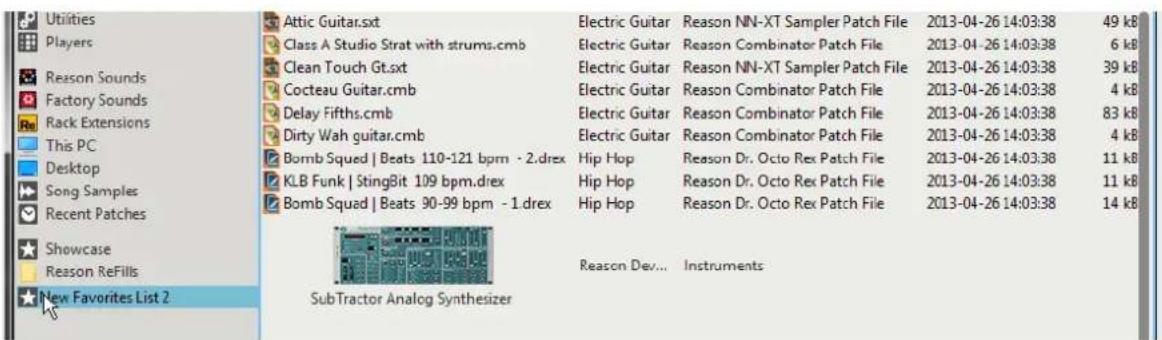
- When a "Favorites List" folder is selected in the Browser, an additional "Parent column" is shown (just like for Search results), listing the name of the original folder for each file in the list.
- Files in a "Favorites List" folder cannot be sorted by clicking the column headers. However, they can be reordered by using drag and drop in the Browser list.
To remove files from a "Favorites List" folder, select the folder and then select the files in the Browser list and press [Delete], or select "Delete Favorite(s)..." from the context menu.
This removes the shortcut only - the original file isn't affected.
To remove a "Favorites List" folder, select it and press [Backspace] or [Delete] - or select "Delete Favorites List..." from the context menu.
Using Favorites - a practical example
Here follows a practical example of how you can use Favorites for patch files:
You are preparing for a live gig as a keyboard player. You know the songs, and you have chosen suitable patches (in various device formats) for each song.
You want to use Reason Lite, but you want to be able to switch to the correct patch for each song using your MIDI keyboard, and not have to worry about fiddling with the computer during your performance.
Here is how this can be done by using Favorites:
-
Create a new Reason Lite song.
-
Create a device, for example a Combinator.
It doesn't matter which instrument device you choose at this point.
- Click the "Create New Favorites Lists" button.
A new folder appears in the list. Double-click it and type in an appropriate name (e.g. "The Band").
- Click the Reason Lite Factory Sound Bank and then expand the "All Instrument Patches" folder in the Browser list.
Now you can start locating the instrument patches you need by navigating in the Browser.
- When you have located a patch that you need for the gig, drag it from the Browser list into the Favorites List folder.
If this was a patch in a different format than the instrument you created, a device of this type will replace the original device (see "Cross-browsing patch files").
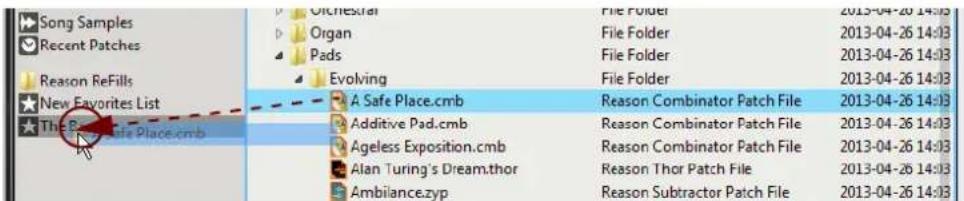
-
Continue to add new instrument patches in the same way until you have all the patches you need.
-
When you're done, select the (The Band) Favorites List folder.
All the patches you added are now listed in the Browser list.
-
Use drag and drop to order the patch files in the Browser list according to the set list.
-
Double click the first patch file in the (The Band) Favorites List.
The the patch is loaded in the appropriate device.
→ If you have a MIDI keyboard or control surface with programmable buttons, you can assign a button to "Select next patch" on the device.
Many MIDI keyboards and control surfaces have buttons assigned to patch selection - check the Control Surface Details document for information about your controllers. Alternatively, you can manually assign buttons for selecting patches - see the "Remote - Playing and Controlling Devices" chapter.
10.Save the Song.
-
At the gig, open the song, and the first patch will be loaded.
-
When the first song is finished, use the "next patch" button on the device or on your MIDI keyboard and the next patch in the (The Band) Favorites List will be loaded!
Selecting and auditioning samples
For audio files and samples and you can use the Audition controls in the Browser to preview the audio. This is done in the following way:
→ Select the audio file in the Browser list and click the triangular Play button.
The file is played back. During playback, the Play button in the Audition section switches to a square "Stop" button - click this to stop playback.
→ Alternatively, you can click the Auto button to automatically audition the file as soon as you select it in the Browser list.
The selected file is automatically played back. Again, click the Stop button to stop playback.
→ Adjust the playback level with the slider to the right of the Auto button.
Selecting multiple files
It is possible to select multiple files in the Browser, by using standard [Shift] or Ctrl or Cmd selection techniques. This, however, doesn't necessarily mean that the selected files can be loaded. There are some instances where selecting several files in the Browser file list is relevant:
- It is possible to simultaneously import multiple audio files to the sequencer.
See "Importing audio to the sequencer" for more info.
- You can select several files to add them to a Favorites List in one go - see "Favorites Lists". Note that this is only possible if a device does not have browse focus!
! In situations where several selected files (e.g. patches or songs) cannot be loaded, the Create/Load button in the Browser is grayed out.
Cross-browsing patch files
Cross-browsing patches is a powerful feature of the Browser. It allows you to browse for any type of instrument patches or effect patches, regardless of which instrument or effect device you opened the Browser from.
About instrument and effect patches
Patches are internally divided into two patch categories in the Browser; instrument patches and effect patches (the Browser "knows" what type of patch it is). This is because instrument patches and effect patches are fundamentally different - instruments are played, and effects are used to process sound - and you would logically browse for one or the other, but not both.
- When browsing patches from an existing instrument device, including instrument Combinators, no effects patches are shown in the Browser list.
- When browsing patches from an existing effect device, including effect Combinators, no instrument patches are shown in the Browser list.
! When browsing Insert FX patches for an audio track, Mix Channel or the Master Section, cross-browsing is not possible (you can only load effect Combinator patches).
Cross-browsing - an example:
- You are playing a Subtractor device but feel that the sound isn't quite what you had in mind, so you click the Browse Patch button on the Subtractor to set Browse focus and check out some other patches.
- After browsing Subtractor patches for a while, you still haven't found the type of sound you wanted, so you click the Root Folder drop-down list and select "Reason Factory Sound Bank" from the list:
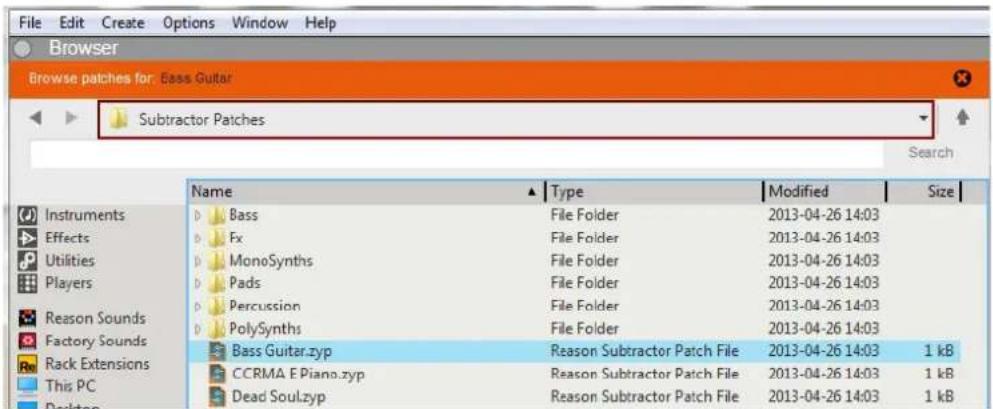
From here you can select instrument patches for any device. You decide to browse a folder containing Thor patches.
- As soon as you load a Thor patch from the Browser, a Thor device replaces the Subtractor device in the rack. The sequencer track which was previously assigned to the Subtractor is now assigned to a Thor with the selected patch loaded.
- The name of the sequencer track and the Mix Channel device (and channel strip in the main mixer) are automatically changed to the Thor patch name.
! Note that is only true if you haven't manually renamed the sequencer track earlier. If you renamed the sequencer track earlier, it will keep this name regardless of what device or patch you load. However, if you delete the custom name, the sequencer track and Mix Channel device will show the patch name again.
→ You can continue to browse and load patches and play your keyboard to try them out. Each time you load a patch that belongs to a different device, this device automatically replaces the previous device in the rack.
- Cross-browsing for an effect patch it works in the same way - loading an effect patch of a different format will replace the current effect device in the rack.
Special instances of cross-browsing
There are a few instances when replacing an existing device by loading other device patches might lead to lost cable connections in the rack:
- When a device is replaced by another device type, audio connections may be lost.
An example is replacing an Redrum, which can use up to 10 audio outputs, with a Subtractor which only has one audio output.
- When a device is replaced by another device type, CV connections on the back panel may be lost.
The only connections that are retained between device types are Sequencer Control CV/Gate in.
! If you encounter such situations and you want to restore the original connections, use the "Undo" function. Browsing back to the original device patch will not restore lost connections.
Create Instrument/Create Effect
These functions allow you to browse for any kind of instrument or effect patches. This is essentially the same as cross-browsing, except that you do not start with an existing device. The "Create Instrument/Effect" functions are very useful if you're looking for a specific type of sound or effect but don't know, or don't care, what devices are used. For example, you might be looking for a "pad" sound or a "delay effect". Once you've found what you're looking for, you can just load the sound or effect in the required device(s).
- Select "Create Instrument..." or "Create Effect..." from the Create menu.
The Browser opens. Depending on your selection, only Instrument Patches or Effect Patches are shown.
- When you load a patch, a corresponding device is created automatically.
If you load an instrument device patch, a corresponding sequencer track will also be automatically created. If an "empty" Mix Channel device isn't available in the rack, a new one will be automatically created - with its channel strip in the Main Mixer. The instrument device will be automatically connected to the Mix Channel device. Master Keyboard input will be set to the new track so that you can play the patch from your master keyboard. The sequencer track, Mix Channel and channel strip in the Main Mixer automatically gets the name of the loaded patch.
Using the "Search" function

The Search function allows you to search for patches, songs, audio files etc. The Search field is always available at the top of the Browser.
→Type in a search text and click the Search button.
- The search happens in the currently shown folder/location (shown above the Search field) - and in all its sub folders (if any).
The Root folder popup above the Search field shows "Searching
- If you like you can change the search location/folder and redo the search in the new location/folder.
- If the search takes a while, an alert window appears with a progress bar and a Stop button.
The search result view in the Browser list
- The search result is shown in alphabetical order as a flat list with files and folders whose names match the search string.
If there are no search hits, the Browser list is empty.
- A new "Parent" column also appears, listing the name of the parent folder for each file in the Browser list. If you select a file in the Browser list, you can pull down the "Root Folder" drop-down list and select "Go to Parent folder" - this opens the parent folder for the selected file.
To go back to the search result Browser list, click the Back button:

- When searching in the Instruments/Effects/Utilities palette, the search result view shows matching devices only, not the manufacturer headings.
Loading files
When you have navigated to the desired folder (on your hard disk or within a ReFill) and located the desired file, you load it by double clicking it in the Browser list, or by selecting it and clicking the Open/Load/Create/Import button. The name of the button differs depending on what command you used for locating the file.
- Once you have loaded a patch into a device (that now has browse focus), you can select and automatically load new patches by pressing the up/down arrow keys on your computer keyboard.
About browse lists
When you click the Open/Load/Create/Import button to open a file from the Browser, the file and folder list shown at that time is memorized for that device. This is called a "browse list".
For patches (and to a certain extent samples) this list provides a specific functionality:
- The browse list is what applies when changing patches using the Next/Previous Patch buttons on the front panel of a device (or from patch selectors on a control surface).
- The browse list is shown as the patch list when you click in the patch name field for a device.
- For samples, the browse list applies when changing samples using the Next/Previous Sample buttons on the front panel of a sampler device.
What can a browse list contain?
- When you load a patch or sample by clicking Load/Create/Import in the Browser, the resulting browse list will include the files contained in all currently open folders in the Browser.
If you open the Browser (set Browse focus) again from the same device, the same file and folder structure is shown.
- If you save the current song and reopen it, the items in the browse list will be shown as a "flat" list, and the "Root Folder" field will show "Document Browse List".
In these situations, the Browser will show the "Parent" column, listing the names of the source folders. The "Root Folder" drop-down list will also contain the item "Go to parent folder" for a selected file.
- A browse list could also be a Search result, or a Favorites List.
Favorites Lists provide a way of controlling/filtering which patches or samples will be available on a browse list for a device - see "Using Favorites - a practical example"!
! Note that if you opened a patch after having used cross-browsing (see "Cross-browsing patch files") or used the Search function (see "Using the "Search" function"), the active browse list could contain patches of different formats, and loading patches from the device panel could change the device type.
Handling Missing Sounds
Redrum patches and SoundFonts contain references to samples - files on your hard disk. If any of these files have been moved, renamed or removed when you try to open the patch or song, Reason Lite will alert you that files are missing by showing the "Missing Sounds" window. The "Missing Sounds" window also appears if patches in the song are part of a ReFill which has been moved, removed or is not installed on your computer:
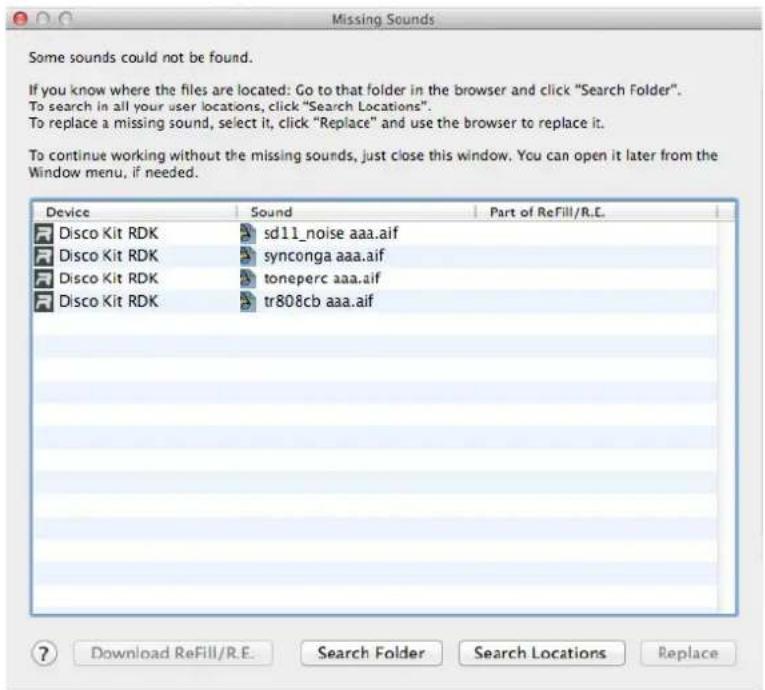
The "Missing Sounds" window.
The main display in the Missing Sounds window lists all missing files. The three columns show the following properties:
| Column | Description |
| Device | Shows the name of the device in which the missing sound is used, along with a device type icon. |
| Sound Shows the name of the missing file, along with a file type icon. | |
| Part of ReFill/R.E. | If the missing file is part of a ReFill (or a SoundFont within a ReFill) or a Rack Extension device, this column shows the name of the ReFill/SoundFont/Rack Extension. |
Below the main display are four buttons:
→ Select a file in the list and click the "Download ReFill/R.E." button to open your web browser and download (and purchase, if necessary) the ReFill/R.E from the Reason Studios website.
→ Click the "Search Folder" button to automatically search for and find the missing files in the currently selected folder in the Browser.
→ Click the "Search Locations" button to automatically search for and find the missing files in any of the Locations present in the Browser.
! If you have a lot of ReFills and folders in your Locations, the search could take a while.
If you want to abort the search, click the Cancel button in the "Searching..." window:
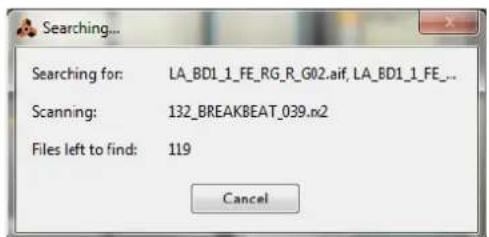
When you have found the sound you want to replace the missing sound with, double click it or select it and click the Replace button in the Browser:
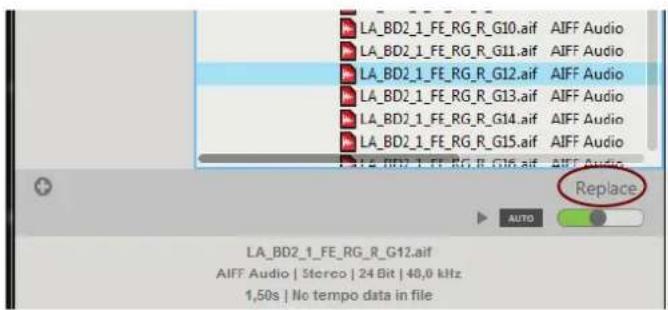
Replacing a missing sound.
The selected missing sound in the Missing Sounds window now disappears from the window and you can select the a new missing sound to replace.
→ If you want to replace a missing sound without searching for it, select the missing sound in the list and click the "Replace" button. Then use the Browser to select and replace the sample.
If you like, you could replace missing sounds with new sounds - it doesn't have to be the original ones. When you save the Patch or Song later on, the new sounds will permanently replace the previous (missing) sounds.
→Alternatively, close the Missing Sounds window.
The song or patch will still work, but with sounds missing. This means that sampler patches, drum machine patches and/or loop players will not play back correctly.
On the panels of the concerned devices, missing samples are indicated with an asterisk (*) before the file names:
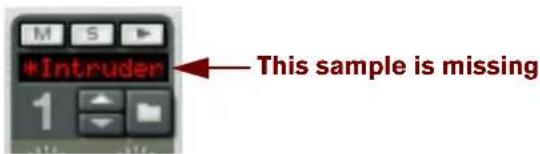
A Redrum device with a missing sample in one of its slots.
→ If you want to continue searching for and replacing missing sounds later on, you can open the Missing Sounds window again by selecting "Show Missing Sounds Window" from the Windows menu.
Reason Lite file formats
The following table lists the file formats that you can browse and open using Reason Lite's browser:
| File type | Extension | Description |
| Reason Lite Song .relt This is the main document format in | Reason Lite. It contains the recordings on all audio, instrument and automation tracks - and the device setup in the rack, along with references to any used instrument samples and loops - or it can contain the actual samples and loops if you have made the song "self-contained" (see "About Self-Contained Songs"). | |
| Reason Lite Demo Song .reltdemo A Reason Lite Demo Song is a factory made song intended to demo the sound and features of the Reason Lite program. Reason Lite Demo Songs are the only song file type that can be opened when you run Reason Lite in Demo Mode (without authorization). See "Opening a Reason Lite Demo Song". | ||
| Combinator Patch | .cmb | The Combinator can store/recall combinations of Reason Lite devices. Combinator patches (Combis) will save all panel settings (as well as sample references if used) for all devices that are part of the Combi. In addition, all routing (audio/CV) between devices in the Combi are included in the patch. Effect Combi patches are also used for Insert FX patches in the Main Mixer. |
| Subtractor Patch | .zyp | This is a patch for the Subtractor synth device, containing all panel settings. You store your synth sounds by saving Subtractor patches. |
| Redrum Patch | .drp | This is a patch for the Redrum drum machine device. It contains information about which drum samples are used, along with all drum sound settings. In effect, a Redrum patch is a stored drum kit. |
| RV7000 Patch .rv7 This is a patch for the RV7000 reverb effect, containing all panel settings. | ||
| Scream 4 Patch | .sm4 | This is a patch for the Scream 4 distortion effect, containing all panel settings. |
| Audio files and Samples | .wav, .aif, mp3 etc. | Audio files of various formats, resolutions and sample rates can be imported to Audio Tracks in Reason Lite. All sampler devices in Reason Lite can also load and play back samples and audio files in these formats. You can use files of different formats in the same device - one drum sound can be an 8-bit sample, the next a 16-bit sample, etc.The audio file format support differs depending on which computer OS you are using.In macOS, the following audio file formats are supported:.wav (not floating point), .aiff (not floating point), .3g2, .3gp, .mp1, .mp2, .mp3, .mpeg,.mpa, .snd, .au, .sd2, .ac3, .aac, .adts, .amr, .caf, .m4a ,m4r and .mp4.In Windows 7, the following audio file formats are supported:.wav (not floating point), .aif (not floating point), .mp3, .aac, .m4a and .wma |
| SoundFont Bank .sf2 The SoundFont format was co-developed by E-mu Systems and Creative Technologiesand is used with many audio cards and software synthesizers. SoundFont banks store wavetable synthesized sounds, allowing users to create and edit multi-sampled sounds in special Soundfont editing programs. The SoundFonts can then be played back in wavetable synthesizers, typically on audio cards, thereby effectively turning an ordinary sound card into a sampler.The NN-XT and NN19 Samplers and the Redrum drum machine allow you to browse and load SoundFonts. Regardless of which editing program was used to create them, these banks are similarly and hierarchically organized, with folders for instruments, pre-sets, samples etc. The NN-XT, NN19 and the Redrum lets you load individual samples and presets from a SoundFont bank, but not the complete SoundFont. | ||
| Rack Extension Patch | .repatch | These are patches for Rack Extension devices. All Rack Extension devices use the same file extension but the patch files contain different data depending on which device was used for creating them. |
| VST Patches | .fxp and .fxb | Reason Lite can read the VST patch formals fxp and fxb. Provided that the VSTs are installed and detected by Reason Lite, the patches can be opened in the corresponding VSTs. |
Chapter 16
Routing Audio and CV
About this chapter
This chapter describes the various signals used in Reason Lite and how you can route them.
Signal types
The following signal types are used in Reason Lite:
Audio signals
Besides the Spider CV and Matrix Pattern Sequencer, all Reason Lite devices have audio connectors on the back. The audio connectors carry audio signals to or from devices via virtual cables.
→Audio connectors are shown as large quarter inch jacks.
→ Audio Effects devices, which are used to process audio, have both audio inputs and outputs.
→ Instrument devices, which generate audio, have either mono or stereo left/right audio output connectors.
You do not have to use both outputs for devices with stereo outputs. Use the left output to use a mono signal from a stereo device.
To monitor audio outputs from devices, the signals can be routed, either via the Main Mixer or directly, to the physical outputs of your audio interface via the Reason Lite Hardware Interface (see "Manual audio routing"). Typically, if you are using an audio interface with stereo outputs, you will most likely use the Main Mixer to mix the audio signals to the master outputs.
To route audio input signals from your audio interface to audio tracks in the sequencer, you just have to select the appropriate input(s) from the Audio Input drop-down list on the corresponding audio track (see "Selecting audio input(s) and defining mono or stereo").
This means that you never have to manually patch input signals from the Audio In jacks of the Reason Lite Hardware Interface.
For more information about signal paths in Reason Lite, see "System signal paths".
CV/Gate signals
In the early days of synthesizers, before the MIDI protocol was invented, analog synthesizers could be interconnected using Control Voltage (CV) cables. For example, one cable would be used for controlling pitch while another would send a Gate voltage, basically telling a synth when to play a note and when to stop. The CV signal cables in Reason Lite emulate this analog control system. CV signals are typically used to modulate parameter values, and do not carry audio.
→CV/Gate connectors are shown as smaller mini jacks.
→CV is typically used for modulation purposes.
For example, you could modulate a parameter with a CV signal generated by an LFO or an envelope generator on another device.
→ Gate outputs/inputs are typically used to trigger events, such as note on/off values, envelopes etc.
Gate signals produce on/off values, plus a "value" which could be likened to (and used as) velocity.
→ You can only route CV/Gate signals from an output to an input (or vice versa).
You cannot route an input to another input or an output to another output.
P-LAN signals
P-LAN is the internal system used for routing audio signals from Mix Channel and Audio Track devices to the Main Mixer Master Section device - and from Mix Channel/Audio Track devices to other Mix Channel devices that are used as Output Busses (sub-mixers).
P-LAN connections are not indicated by cables or similar in the rack - only by an Audio Output display on the front and rear of Mix Channel and Audio Track devices:
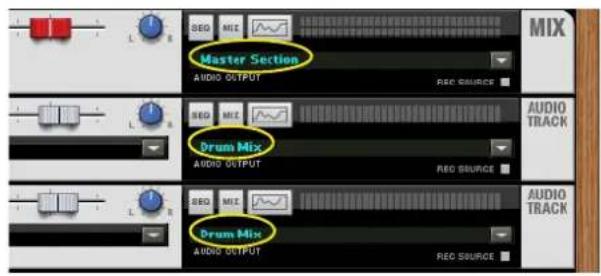
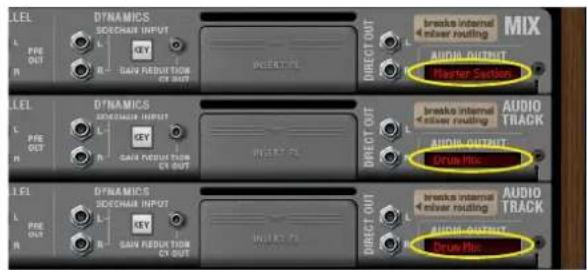
P-Lan signal destinations on Mix Channel and Audio Track devices (front and rear).
If you use the Direct Out jacks on an Audio Track device or Mix Channel device, the internal P-LAN connection is broken. In this case, the audio from the Mix Channel/Audio Track device is not sent to the Master Section.
About MIDI routing
Normally, MIDI (e.g. note and performance data) are sent to devices from their respective sequencer track. No cables are used in the rack to indicate MIDI connections.
For other ways to route MIDI to devices, see the chapters "Remote - Playing and Controlling Devices", "Synchronization and Advanced MIDI" and "MIDI Out Device".
About cables
Cable appearance
If there are many connections in Reason Lite, the cables can sometimes obscure the view, making it difficult to read the text printed on the back panels of the devices. Cables can be displayed in "normal" mode and in "Reduced Cable Clutter" mode.
→ Toggle cable display mode by pressing [K] or by selecting "Reduce Cable Clutter" on the Options menu:
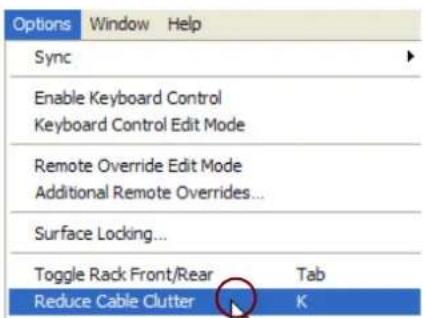
- In "normal" mode, i.e. with the option "Reduce Cable Clutter" deselected, all cables for all devices are displayed at the back of the rack.
- With "Reduce Cable Clutter" selected, the cable appearance depends on the settings in the "Appearance" section on the "General" page in Preferences:
√ Trigger notes while editing
□ Return to last start position on stop
Appearance
Reduce cable clutter (Options menu):
● Shows cables for selected devices only
○ Hides auto-routed cables
○ Hides all cables
→ Select "Show for selected devices only" to only display the cables for selected devices.
All other (non-selected) devices will have "transparent" cables to make it easier to distinguish the cables of selected devices.
→ Select "Hide auto-routed cables" to only display manually routed cables.
All devices with auto-routed cables will have "transparent" cables to make it easier to distinguish the manually routed cables.
→ Select "Hide all cables" to hide all auto-routed and manually routed cables.
All cable connections on devices will be indicated with colored dots in the jacks, and no cables will be displayed.
natural_image
Close-up of a metallic industrial control panel with numbered ports (1–5) and various connectors (no visible text or symbols)"Reduce Cable Clutter" selected with the "Hide All Cables" appearance.
- In "Reduced Cable Clutter" mode, it's still possible to connect and disconnect cables in the same way as when they are shown.
See "Manual routing" for a description of routing methods.
Checking and following cable connections
You can always check to which device a jack is connected. This is especially useful if the patch cables are hidden, but it is also practical if you have a lot of cables in your rack, or if the two connected devices are far from each other in the rack:
→ Hover with the pointer over a connector and wait a moment.
A tool tip appears, showing both the device name and connector that the cable is connected to.
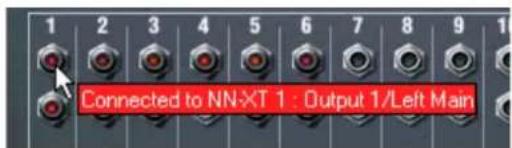
About the "Scroll to Connected Device" function
It's possible to scroll directly to a connected device as follows:
- Click and hold (or right-click (Win) or [Ctrl]-click (Mac)) on a connector.
A pop-up menu appears.
- Select "Scroll to Connected Device" from the pop-up menu.
The device in the other end of the cable will be scrolled into view in the rack.
Cable color
To allow for a better overview of the connections in the rack, the cables have different colors:
Green cables indicate effect device connections.
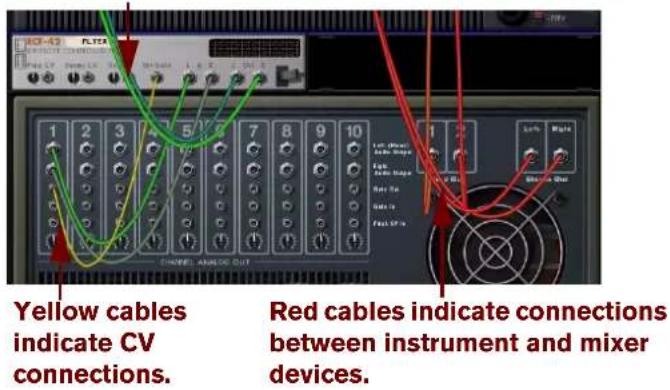
- Audio connections between instrument and mixer devices are different shades of red.
- Connections to and from effect devices are different shades of green.
• CV connections are different shades of yellow. - Combinator connections are blue.
Automatic routing
Auto-routing enables the automatic routing of cables between devices according to certain rules. Auto-routing is performed under the following circumstances:
- When you create a new (Empty) Song, the Master Out L & R on the Master Section device are by default connected to Outputs 1 & 2 of the Reason Lite Hardware Interface.
- When a new device is created.
- When moving, duplicating or pasting devices with [Shift] pressed.
- When selecting "Auto-route Device" from the Edit or context menu, with one or several devices selected in the rack.
- Audio input signals from the Reason Lite Hardware Interface to the audio tracks in the sequencer are automatically routed "in the background".
When applicable, auto-routing is performed in stereo.
Auto-routing of audio input signals
- Available audio inputs on your installed audio interface are auto-routed from the Hardware Interface to audio tracks in the sequencer "in the background".
This means that no patch cables are necessary for routing audio to audio tracks in the sequencer.
Auto-routing of Instrument devices
Routing to the Main Mixer
- When you create an instrument device, it is automatically connected to a new Mix Channel device in most situations.
However, if the instrument device is created directly below an unused (no inputs connected) Mix Channel device in the rack, it will be connected to this instead.
Routing to the Line Mixer
- If a Line Mixer 6:2 is selected when you create an Instrument device, or if you create an Instrument just below the mixer device in the rack, the instrument will be auto-routed to the first available inputs on the mixer device.
Auto-routing of Effect devices
Routing as a Main Mixer insert effect
- When you have a Mix Channel or Audio Track device selected and create an effect device, it will be automatically connected as an insert effect in the Mix Channel/Audio Track device. See "Adding Insert effects".
! The above does not apply to the Master Section device - see below!
It's also possible to select Effect Combi patches as insert effects - see "Loading Effect Combi patches".
Routing as a Main Mixer Master Section insert effect
Routing an effect device as an insert effect in the Maser Section device can be done in the following ways:
- Click the "Show Insert FX" button on the Master Section device and then click inside the Insert FX container. A red insertion line is shown.
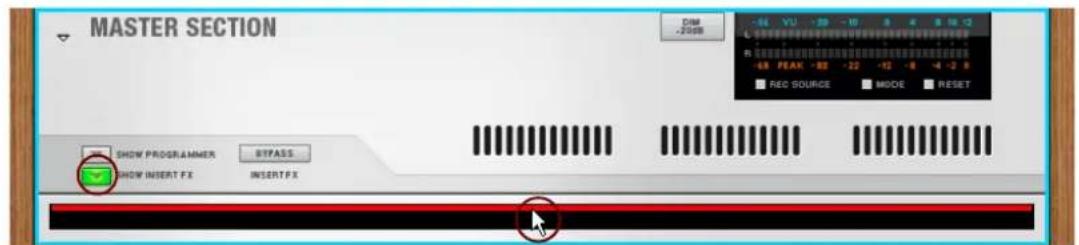
- Create an effect device from the Create menu, or by selecting it from the device context menu, or by double-clicking on the device in the "Devices" tab in the Tool Window.
The device will be automatically connected as an insert effect in the Master Section device.
→ By dragging and dropping an effect device from the "Devices" tab in the Tool Window to the open Insert FX container in the Master Section device, it will be automatically connected as an insert effect.
It's also possible to select Effect Combi patches as insert effects in the Master Section - see "Loading Effect Combi patches".
Routing as a Main Mixer Master Section send effect
- When you have the Master Section device selected and create an effect device, it will be automatically connected as a send effect to the first available Send FX connectors on the Master Section device. See “Creating Send effects”.
It's also possible to use the "Add Send FX" function to add effect devices or Effect Combi patches as send effects in the Master Section - see "Creating Send effects".
Routing directly to another device
- When you have an instrument device selected and create an effect, that effect will be connected as an "insert" effect between the instrument device and the Mix Channel/mixer device.
Examples of effects that work well as insert effects are distortion, compression and modulation effects.
Routing as a send effect to a mixer device
- When you have a mixer device (the Mixer 14:2 or Line Mixer 6:2) selected in the rack and create an effect device, it will be automatically connected as a send effect (to the first free Aux Send/Return jacks).
Auto-routing of CV/Gate signals
The Matrix Pattern Sequencer
- When you have an instrument device (e.g. a Subtractor/Combinator) selected and create a Matrix Pattern Sequencer, the Note and Gate CV signals will be auto-routed to the instrument device.
The Matrix Note and Gate CV outputs are automatically connected to the Sequencer Control CV and Gate inputs on the instrument device, respectively.
Auto-routing devices after they have been created
Some additional rules regarding auto-routing devices that are already in the rack:
To reroute a device already in the rack, you can select it and choose "Disconnect Device" and "Auto-route Device" from the Edit menu or context menu.
When you use "Auto-route Device" it will be connected in a logical way according to its current location in the rack.
→ If you hold [Shift] and drag a device to a new position in the rack, it will be re-routed (as if you deleted it and created it in its new position).
This allows you to e.g. change the order of effect devices in a signal chain by Shift-dragging them.
- If you delete a device connected between two devices, the connection between the two remaining devices is preserved.
A typical example might be if you have an effect device connected between an instrument device and a Mix Channel device. If you delete the effect device, the instrument device will be re-routed directly to the Mix Channel device.
- When you move a device in the rack, the connections are not affected.
- When you duplicate devices by dragging and dropping, or using copy and paste, the devices are not autorouted.
If you would like them to be auto-routed, hold down [Shift] while performing the operation.
! If you are duplicating a complete Device Group (see "Duplicating devices"), this will often include a Mix Channel. In this case, the Mix Channel will also be duplicated, with no need for further auto-routing.
Bypassing Auto-Routing
→ If you wish to create a new device without any auto-routing taking place, press [Shift] when creating the device.
Manual routing
To connect devices manually, you need to flip the rack around to see the back. This is done by pressing [Tab] or by selecting "Toggle Rack Front/Rear" from the Options menu.
Note that routing cables can be done regardless of the "Reduce Cable Clutter" setting on the Options menu. This means that you can connect cables even though they are hidden (see "Cable appearance").
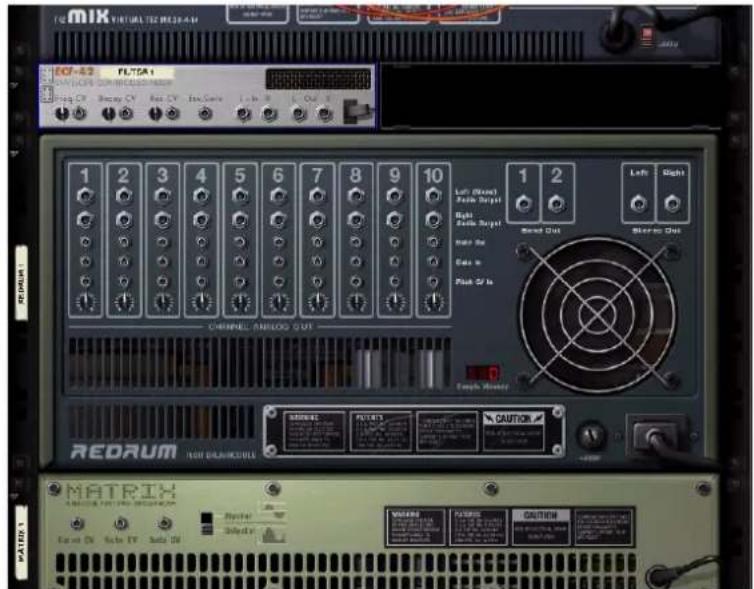
On the back of each device you will find connectors of two different types: audio and CV (Control Voltage, used for controlling parameters - see "Using CV and Gate"). Audio inputs and outputs are shown as large quarter inch jacks, while CV input and output jacks are smaller. For now, we'll stick to the audio connections.
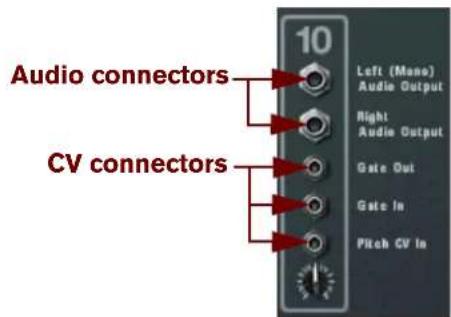
Audio and CV connectors.
- When the back of the rack is shown, you can still navigate in the rack by scrolling or by using the computer keyboard.
There are two ways to route signals from one device to another:
- By connecting virtual patch cables between inputs and outputs.
- By selecting connections from a pop-up menu.
Connecting cables
- Click on the desired input or output jack on one of the devices, and drag the pointer away from the jack (with the mouse button pressed).
A loose cable appears.
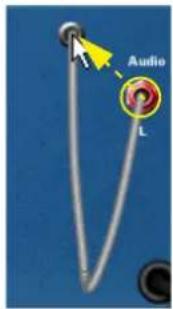
- Drag the cable to the jack on the other device.
When you move the cable end over a jack of the correct type (audio/CV, input/output) it will be highlighted to show that a connection is possible.
- Release the mouse button.
The cable is connected. If both input and output are in stereo and you connect the left channels, a cable for the right channel is automatically added.
! Dragging a cable to make a connection can be aborted by pressing [Esc] while keeping the mouse button pressed.
→ You can change an existing connection in the same way, by clicking on one end of the cable and dragging it to another connector.
Connecting cables using pop-up menus
- Right-click (Win) or [Ctrl]-click (Mac) on a connector.
A pop-up menu appears, listing all devices currently in the rack.
- If the connector is an audio output, the first alternative in the pop-up is to route to a new Mix Channel. This is useful if you want to route separate audio outputs (e.g. in Kong or Redrum) to separate Mix Channels.
- Move the pointer to the device you want to create a connection to.
A sub-menu appears, listing all suitable input/output connections. For example, if you clicked on an audio output on a device, the hierarchical sub-menus will list all audio inputs in all other devices.
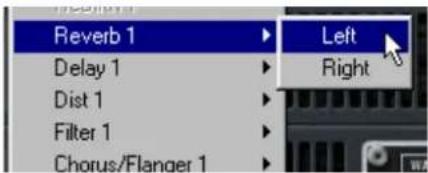
- If a device is grayed out on the pop-up menu, there are no suitable connections on the device.
- An asterisk (*) next to the connector name on the sub-menu indicates that the connection is already occupied. It's possible, however, to select an occupied connection. Doing so will disconnect the existing connection and replace it.
- Select the desired connector from the submenu.
The connection is created.
Disconnecting cables
There are two ways of manually disconnecting cables:
→ Click on one end of the cable, drag it away from the jack and drop it anywhere away from a jack.
→ Click and hold (or right-click (Win) or [Ctrl]-click (Mac)) on a connector and select "Disconnect" from the pop-up menu that appears.
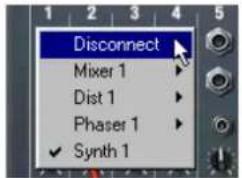
Disconnecting devices
It's also possible to disconnect all cables from selected devices in one go:
- Select the device(s) and then choose "Disconnect Device" from the Edit menu or device context menu. All cables on the selected device(s) are now disconnected simultaneously.
Using CV and Gate
CV/Gate is used for modulating and triggering device parameters. Each separate Device chapter lists the available CV/Gate connections and the parameters that can be modulated or used for modulation outputs for that device.
Routing CV and Gate signals
There are not really any hard and fast "rules" applicable to CV/Gate routing. A few points should be mentioned, though:
- The specific “Sequencer Control” inputs present on e.g. Subtractor are primarily intended for controlling these devices as (monophonic) instruments from the Matrix Pattern Sequencer.
If your intention is to use the Matrix CV/Gate outputs to create melodic patterns using these Instrument devices, you should use the Sequencer Control inputs.
The Matrix Pattern Sequencer can be used in many other ways, besides creating melodic patterns. For example you could use it to modulate any CV controllable parameter, with the added advantage of the modulation being synchronized to the tempo. - Conversely, if you would like to apply Gate or CV modulation to more than one voice, you should not use the Sequencer Control inputs, as these only function monophonically.
- Feel free to experiment: Use Gate signals to control parameter values and CV signals to trigger notes and envelopes, if you like.
See the chapter "Matrix Pattern Sequencer" for more tips about using CV.
- By routing CV to the rotary controls on a Combinator, you can CV control virtually any parameter on any device - see "CV Connections" in the Combinator chapter.
About CV Trim knobs
All CV inputs have an associated Trim knob. This is used to set the CV "sensitivity" for the associated parameter. The further clockwise a CV trim knob is set, the more pronounced the modulation effect.
- Turned fully clockwise, the modulation range will be 100% of the parameter range (0-127 for most parameters).
- Turned fully anti-clockwise, no CV modulation will be applied.
Chapter 17
The Main Mixer
About this chapter
This chapter describes the various procedures, parameters and functions in the Main Mixer as well as the relationship between mixer channels and the Audio Track/Mix Channel devices in the rack. The chapter also covers how to set up and use Insert and Send effects, as well as some advanced routing tips and tricks.
Overview
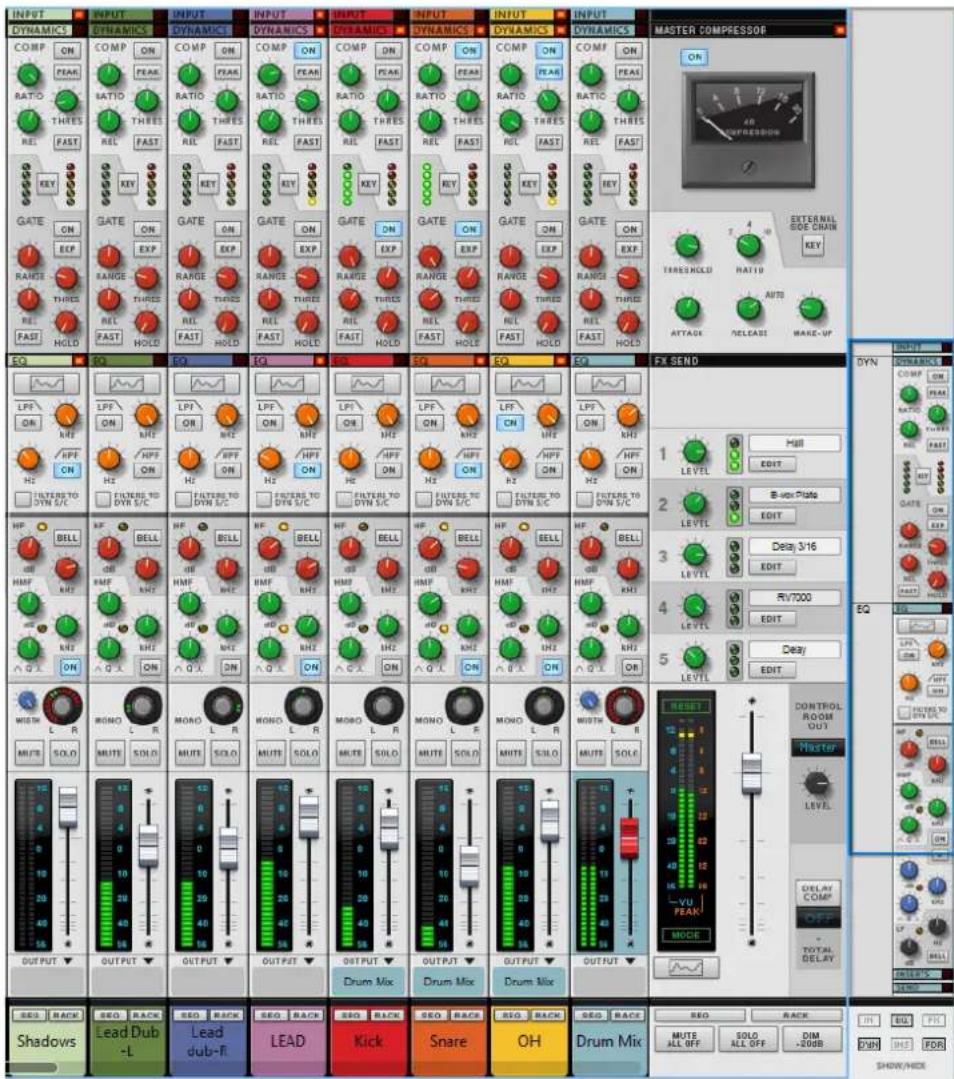
The Main Mixer is a fully equipped mixer with pro features to meet the most demanding mixing needs. You can have an unlimited number of channels, each with advanced eq and dynamics control.
The mixer can be viewed as a remote control for Audio Track and Mix Channel rack devices. This is where you control levels, make eq and effect settings etc., although the devices themselves "live" in the rack.
The Audio Track, its device and mixer channel strip
Audio Tracks and their associated rack devices are for recording/playing back audio.
When you create a new Audio Track, a corresponding Audio Track device is added to the rack and an Audio Track channel strip is added to the Main Mixer.
The track, device and channel strip all belong together. If you delete the device, the corresponding track and channel strip are also deleted.

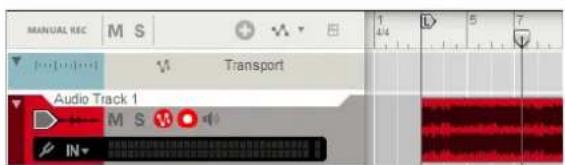

An Audio Track in the sequencer with its corresponding rack device and channel strip in the Main Mixer.
- Audio Track devices have no audio inputs on the back - the audio is fed internally to the Audio Track device from the associated sequencer track.
The Mix Channel device and channel strip
A Mix Channel device acts as a host to a source device (e.g. an instrument device). When you create an instrument, a Mix Channel device is added automatically to the rack and a corresponding Mix Channel strip is added to the Main Mixer. You can also create Mix Channels manually from the Devices tab in the Tool Window or from the Create menu. This is useful if you need to make manual mixer routings - see "Advanced routing tips and tricks" at the end of this chapter.
The Mix Channel device has inputs to which the source (instrument) device is connected. The Mix Channel device and channel strip will automatically be assigned the name of the connected source device, but this can be changed - see "Naming mixer channels".
A Mix Channel device will not automatically have a corresponding track created in the sequencer (but the connected source device will). Mix Channel tracks are created manually and used for automating channel strip parameters - see "Automating mixer parameters".


A Mix Channel device (with an ID8 source device connected) and the corresponding channel strip in the Main Mixer.
The Master Section device and mixer strip
The Master Section device is always present and is fixed in the rack, just below the Reason Lite Hardware Interface. This is where all your Audio Track and Mix channels are summed and mixed to stereo, and where you set up your Send effects and Master Insert effects. For descriptions of how to set up and use effects, see "Insert FX" and "Send FX".
The corresponding Master Section mixer strip is also fixed and is always visible to the right in the Main Mixer. The Master Section track is used for automating Master Section parameters - see "Automating mixer parameters".


The Master Section device and mixer strip.
Navigating in the Main Mixer
Viewing the Main Mixer area
There are several ways to bring the Main Mixer area into view:
- By dragging the gray Rack header downwards to reveal the mixer area.
- By pressing [F5] on your keyboard or selecting "View Main Mixer" from the Windows menu.
- By clicking the Show/Hide icon on the gray Mixer header.
- To view the mixer in a separate window, either click the Detach icon on the Mixer header, select "Detach Main Mixer Window" from the Windows menu or hold down Ctrl or Cmd and press [F5].
Scrolling and navigating in the Main Mixer
The Channel Strip Navigator and Mixer scrollbar allow you to navigate between channels in the Main Mixer or to focus on a specific channel strip area. The Channel Strip navigator area can be shown/hidden using the "Show Navigators" Options menu item.
The Channel Strip Navigator is the miniature mixer and channel strip area at the far right of the Main Mixer window. The blue rectangle shown inside the area acts much in the same way as a scrollbar in standard document windows. If you move the pointer inside the rectangle the pointer changes to a hand, allowing you to click and scroll. You can also click anywhere in the Navigator area to immediately get to the desired destination.
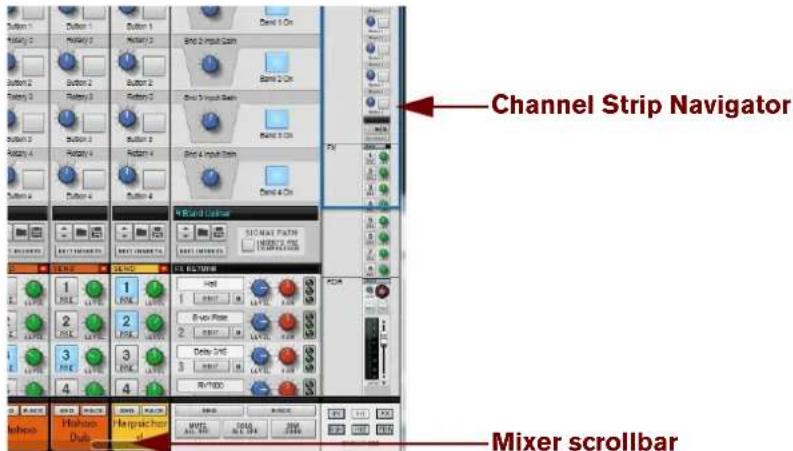
- The Mixer scrollbar allows you to scroll between all the channels in the mixer.
The Mixer scrollbar will only show and scroll the regular channel strips - the Master Section is always visible and fixed to the right in the Main Mixer area. - The Channel Strip Navigator area allows you to scroll between the various channel strip sections (channel strip sections can also be hidden, see below).
All areas of the channel strips and Master Section can be scrolled, except the Channel Header section (the area below the faders) which is always visible at the bottom. If the Main Mixer is detached, the fader section is also always visible and stays at the bottom.
• Alternatively, you can use a mouse scroll wheel or a trackpad to scroll. - The [left]/[right] arrow keys can be used to move between channels
- The [Page Up]/[Page Down] keys can be used to scroll vertically.
• The [Home] and [End] keys will scroll the mixer to the leftmost and rightmost channel strip, respectively.
Showing and hiding channel strip sections
Channel strips are divided into sections, which can be globally shown or hidden in the mixer. This enables you to hide sections that you don't need to tweak or to focus on specific sections. Hiding a section does not alter the mixer functionality in any way, sections are still active when hidden.
Each section has a section name header in the channel strip. The sections are as follows (from the top down): Input, Dynamics, EQ, Inserts, FX Sends and Fader. (See "The channel strip" for descriptions of each section.)
The section headers are always visible even if a section is hidden, as is the channel header (name label) section below the faders. Note that if the Main Mixer is detached from the rack, the fader section cannot be hidden.
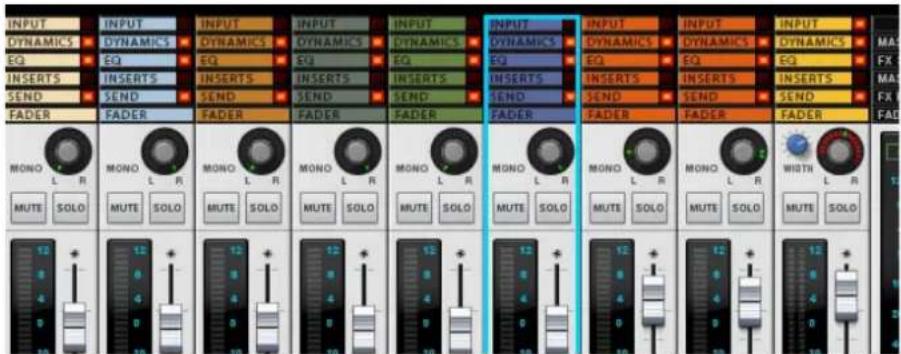
Section headers in the channel strip. A red light to the right of the section header name indicates that the section is in use for the channel. Here, all sections are hidden (except the Fader section), so that only the section headers are visible.
There are two ways to show/hide channel strip sections:
→ By using the Show/Hide buttons in the bottom right corner of the Channel Strip Navigator.
Each button enables you to show or hide the corresponding section. Hidden sections are indicated by grayed-out buttons. Hold down Alt or Option and click on any of the buttons to show or hide all sections in one go. Hold down Ctrl or Cmd and click on a button to show this section and hide all other sections.
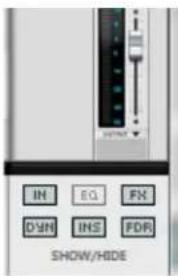
The Show/Hide buttons. Here, the EQ section is hidden.
→By double-clicking a section header in the channel strip.
This will also show or hide the corresponding section.
- Showing/hiding channel strip sections affects all channel strips, including the Master Section strip.
Differences between the channel strips and the Master Section strip
Showing/hiding mixer strip sections also affects the Master Section strip. There are a few differences in the Master Section and the channel strip sections when using the Show/Hide buttons:
- There is no Input section in the Master Section. If the Input section is shown, the Master Section will display a blank panel.
- The "EQ" Show/Hide button affects the FX Send section in the Master Section.
- The "FX Sends" Show/Hide button affects the FX Return section.
Switching between channels, rack devices and tracks
The RACK and SEQ buttons allow you to go to a channel's rack device or sequencer track directly from the Main Mixer. Both buttons are located in the Channel Header section of the Main Mixer:
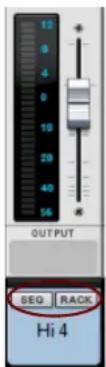
If you click the RACK button the following happens:
→ For Audio Track channels, this will bring the Audio Track rack device into view.
The rack area will be shown (if hidden) with the channel device in view.
→ For Mix channels, this will bring the Source device (i.e. the instrument device connected to the channel) into view.
[Shift]-clicking the RACK button for a Mix channel will instead bring the Mix Channel device into view.
The SEQ button allows you to go to a channel's sequencer track from the mixer. The SEQ button is also located in the Channel Header section. If you click the SEQ button the following happens:
→For Audio Track channels, this will bring the Audio Track into view.
The sequencer area will be shown (if hidden) with the track in view.
→For Mix channels, this will bring the track for the Source device into view.
[Shift]-clicking the SEQ button for a Mix channel will instead bring the Mix Channel automation track into view. If there isn't an automation track, one will automatically be created.
→ If you have previously deleted Mix Channel tracks and/or Audio tracks in the sequencer, clicking the SEQ buttons on the corresponding channel strips in the mixer will automatically create new sequencer tracks.
To find the mixer channel for a specific track in the sequencer, or for a specific Mix Channel or Audio Track device in the rack, proceed as follows:
-
Select the track in the sequencer, or select the Mix Channel/Audio Track device in the rack.
-
Bring the mixer into view.
The channel will get Edit Focus (see "Channel Header section") and be scrolled into view in the Main Mixer. If you have both the sequencer and Main Mixer in view, or the rack and Main Mixer, clicking a track in the Track List, or on a Mix Channel/Audio Track device in the rack, will flash the corresponding channel strip in the Main Mixer.
Managing mixer channels
Creating and deleting channels
Mixer channel strips are automatically created when you create Audio Track and Mix Channel devices. In most situations, a Mix Channel device (with its channel strip) is also automatically created when you create an instrument device (see "Creating devices").
To delete a channel, proceed as follows:
→ Select the channel strip in the Main Mixer, or select its device in the rack, and press [Delete] or [Backspace]. Alternatively, select "Delete Channels and Tracks" from the Edit menu or context menu.
This will delete the channel strip, device and associated track. An alert appears asking you to confirm deletion.
If there are devices connected to the Mix Channel device you delete, and "Auto-group Devices and Tracks" is selected on the Options menu, the alert will ask if you want to delete only the selected device, or all devices in the Device Group (see "About Device Groups" for more information).
Selecting channels
To select channels in the mixer you can use any of the following methods:
→ Clicking anywhere on a channel strip (including parameters) will select the channel.
If you are not editing parameters but want to select a channel, the channel header is a good place to click. You could also click anywhere on the channel strip background (where there are no parameters or displays).
→ If the Main Mixer has focus, you can use the left and right arrow keys to select channels.
The selection will move to the next adjacent channel (left or right) with each keystroke.
→ It is possible to select several channels, by using standard [Shift], or Ctrl or Cmd selection techniques.
This allows you to e.g. change the Fader levels of all selected channels simultaneously (see "Changing Fader section parameters on multiple channels simultaneously"), or move or delete several channels in one go. The last selected channel will be given edit focus which is indicated by a red strip in the channel header (see "Channel Header section").
To select all channels, use the "Select All Channels" item on the Edit menu or channel strip context menu.
The Main Mixer must have focus for this item to be available.
Moving channels
To move channels in the Main Mixer, simply select them and use standard drag and drop method. A red insertion line will show the insertion point, exactly like when moving devices in the rack or tracks in the sequencer.
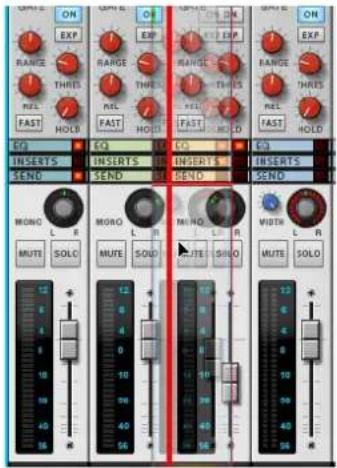
Moving a channel. The thicker red line indicates where the moved channel will be inserted.
Displaying channels, devices and tracks in the same order
Channel strips in the mixer, Audio Track and Mix Channel devices and tracks can be independently re-ordered. This allows you to set up the main work areas according to your preferences.
Should you wish to display mixer channels, devices in the rack and tracks in the same order, proceed as follows:
- Select the area where everything is in the order you want reflected in the other areas.
This could either be the Main Mixer, the sequencer or the rack.
- Use the "Select All" Edit menu item.
This menu item would be "Select All Devices" if the rack is selected, or "Select All Channels" if the mixer is selected. You could also select channels, tracks or devices manually.
- Select the "Sort Selected Device Groups" Edit menu item.
Channels, devices and tracks will now all be presented in the same order as the area you selected in the first step.
Copying and duplicating channels
Cut, Copy and Paste functions
Selected channels can be moved or copied using the "Cut/Copy/Paste Channels and Tracks" functions on the Edit menu or channel strip context menu. This allows you to copy one or several channels from one Song document to another. The following rules apply:
→ Cut and Copy affects all selected channels, and behaves according to the standard procedures.
Cut moves the channels to the clipboard, removing them from the rack, sequencer, and mixer, while Copy creates copies of the channels on the clipboard, leaving the originals as they were.
If the "Auto-group Devices and Track" option is activated on the Options menu, this will copy the channel's entire Device Group, including tracks and clips - see "About Device Groups".
→ If no channel is selected when pasting, channels will be added to the left of existing channels in the Main Mixer.
If a channel is selected when pasting, the copied channel(s) will be inserted to the right of the selected channel.
Duplicating channels
To make a duplicate copy of a mixer channel, with its settings and Insert FX (if any), hold down Ctrl or Option and drag the channel to where you want it.
Several selected channels can be duplicated. You can also select "Duplicate Channels and Tracks" functions on the Edit menu or mixer context menu.
→ If the “Auto-group Devices and Track” option is activated on the Options menu, this will duplicate the channel’s entire Device Group, including tracks and clips - see “About Device Groups”.
Copy channel settings
If you wish to copy mixer channel settings from one channel to another you can use this function.
- Select the channel you wish to copy settings from.
Copy channel settings only works when a single channel is selected, if several (or no) channels are selected the function is not available.
- Select "Copy Channel Settings >" on the Edit menu or channel context menu.
On the submenu you can select to copy channel settings from a single section (Dynamics, Filters and EO, Insert FX or FX Sends), or "All", which copies everything including any Insert FX devices with their settings.
- To paste the settings, select the channel you wish to copy channel settings to, then select "Paste Channel Settings" on the Edit menu or mixer context menu.
The type of settings you copied will be reflected in the paste menu item, e.g. "Paste Channel Settings: EQ" if you only copied the EQ section.
The copied channel settings remain on the clipboard (until you cut or copy again) so you can paste them to other channels if you so wish.
This can only be done with one selected channel at a time - pasting channel settings is not possible if several channels are selected.
→ Copying channel settings can also be done by selecting an Audio Track or Mix Channel device in the rack.
The procedure is the same. You can copy settings from a device to a mixer channel or vice versa.
Resetting channel settings
Resetting channel settings initializes all channel strip parameters to default values and removes any insert effects (see "Insert FX section") from the channel.
To initialize a mixer channel (or Mix Channel/Audio Track device), select "Reset All Channel Settings" from the Edit menu or channel/device context menu.
Channel settings reset is not possible if several channels are selected.
! Any Output Bus routings are not affected (see "Output Busses").
Naming mixer channels
New Audio Tracks will by default be named "Audio Track + number". When creating an Instrument, the Mix channel will take its name from the patch of the connected Instrument device.
→To enter a new name for a channel, double-click the name in the channel header.
A text field opens allowing you to enter a name for the channel.
Channel names are reflected - and can be changed - in all areas; the Track List, the Main Mixer and in the device. Mix Channel source devices and tracks have independent names from the Mix Channel device/channel strip. By default, a Mix channel takes its name from its source device (typically, the instrument device connected to it). If you change the name of the source device, the Mix channel name will change too.
If you want the source device and Mix channel to have different names, change the name of the Mix channel. To return to the default state (and use the source device name for the Mix channel), just delete the Mix channel name.
! There are special naming conventions when you are using Parallel Channels, see "Naming Parallel Channels".
Coloring mixer channels
Mixer channels are shown with the same color as their corresponding rack devices and tracks. The color is shown in the channel header and channel strip section headings:

A channel strip with all sections folded, except for the Fader section.
- You can change the color for a channel by selecting it and using the Channel Color submenu on the Edit menu or context menu. This will also change the color of the corresponding rack device and track (and vice versa).
- For Mix Channels connected to a source device (e.g. an instrument), the Channel Color submenu has a special setting called "Mirror Source Track Color". If this is on, any color settings you make will be reflected both in the source device (the instrument device and track) and in the channel strip.
This is true regardless of whether you change the color in the mixer, in the rack or in the sequencer.
• To make independent color settings for Mix Channels, turn off "Mirror Source Track Color" first.
For example, this is useful if you have a Redrum with separate outputs connected to different Mix Channels, and want these to have different colors in the mixer.
! If you change the color of an Output Bus channel, this will be reflected in the Output areas on all other channels connected to that Output Bus, see "Creating an Output Bus".
The channel strip
The channel strip is divided into sections, each marked with a section header. Mix Channel and Audio Track channel strips have identical parameters. Here is a detailed rundown of the parameters and functions in each section.
Input section
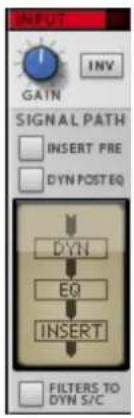
Input Gain
| Parameter | Description |
| Gain | This sets the input gain for the channel. Range is +/- 18 dB. If Gain is set to any other value than the default 0,0 dB or Invert Phase is on (see below), a LED is lit to the right in the section header to indicate the section is active. |
| INV (Invert Phase) | This inverts the phase of the input signal to correct eventual phase problems. For example, using multiple microphones during recording can sometimes cause phase-cancellation between microphones picking up the same sound source but at slightly different distances. Phase problems are most noticeable when signals are summed to mono. Out of phase signals are indicated by a lack of lower frequencies and a generally “hollow” sound quality. |
Signal Path section
The Dynamics, EQ and Insert effect sections will by default process a channel signal in that order, i.e. the order of the sections as shown in the channel strip (from the top down). By using the buttons in this section, the signal path order can be changed internally.
| Parameter | Description |
| Insert Pre | If this button is activated, the Insert effects are placed before the Dynamics and EQ sections in the signal path. |
| Dyn Post EQ | Activating this button places the EQ before the Dynamics and Insert sections in the signal path. |
| Insert Pre + Dyn Post EQ | If both buttons are activated, the order will be Insert, EQ and lastly Dynamics. |
| FILTERS TO DYN S/C | See "About the Filters To Dynamics Sidechain button". |
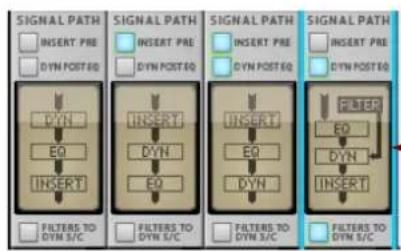
flowchart
graph TD
    A["SIGNAL PATH"] --> B["INSERT PRE"]
    A --> C["DYN POSTEQ"]
    D["SIGNAL PATH"] --> E["INSERT PRE"]
    D --> F["DYN POSTEQ"]
    G["SIGNAL PATH"] --> H["INSERT PRE"]
    G --> I["DYN POSTEQ"]
    J["SIGNAL PATH"] --> K["INSERT PRE"]
    J --> L["DYN POSTEQ"]
    M["SIGNAL PATH"] --> N["INSERT PRE"]
    M --> O["DYN POSTEQ"]
    P["FILTERS TO DYN S/C"] --> Q["INSERT"]
    P --> R["DYN"]
    S["FILTERS TO DYN S/C"] --> T["INSERT"]
    U["FILTERS TO DYN S/C"] --> V["DYN"]
The displays illustrate the selected signal path order of the processing for each channel.
Dynamics section
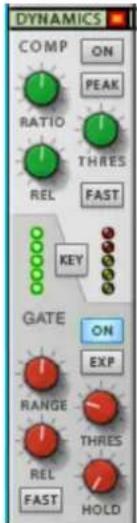
Each channel strip has a powerful dynamics section featuring compression/limiting and gating/expansion. The upper part of the section (with a white background) is the compressor/limiter, and the lower part (gray background) is the gate/expander. The compressor and gate processing can be independently switched in or out of the circuit.
Compressor/Limiter
Compressors reduce dynamic range by evening out the difference between loud and quiet signals. This makes signal levels easier to balance, and can add punch and sustain to the sound.
The Main Mixer's compressor/limiter is a flexible processor which has soft-knee (a gradual, smooth onset of compression) characteristics but can be switched to peak limiting, where levels above the set threshold are instantly reduced. The compressor also features automatic make-up gain.
The parameters are as follows:
| Parameter | Description |
| Comp “ON” button Activates/deactivates the compressor. | |
| RATIO | Sets the amount of gain reduction applied to the signal above the set Threshold. The Ratio can be set from 1:1 (no reduction) to Infinite:1. |
| PEAK button | When activated this changes the signal detection from RMS to Peak, which results in an instant attack time. Peak mode is suitable for compression of sounds with fast attacks like drums. |
| THRES (Threshold) | This sets the level at which onset of compression occurs. Signals below the Threshold setting are unaffected, but when the level exceeds the threshold, compression kicks in.Range: -52 dB to 0 dBAutomatic make-up gain (based on the Ratio and Threshold settings) is applied to compensate for level reduction caused by compression and maintain a steady output level. |
| REL (Release) | Release determines the time it takes before the compressor lets the sound through unaffected after the signal level drops below the set threshold. Set this to short values for "pumping" compressor effects, or to longer values for a smoother change of the dynamics. Range: 100ms to 1000ms. |
| FAST button | Attack - the time it takes for the compressor to react when signals rise above the set threshold level. If the FAST button is activated the attack will be fixed at 3ms for 20 dB gain reduction. |
| Meter The right LED meter shows the gain reduction applied by the compressor. | |
Gate/Expander
Gating or expansion will attenuate signals below a set threshold; the opposite of compression. It can be used to reduce or eliminate unwanted background noise that may be present when there is no signal to mask it. Gating is also commonly used to reduce microphone "bleeding", e.g. when recording a close-mic'ed drum kit you can use gating to silence the tom microphones when the toms aren't being played to tighten up the sound, and for special effects like "keying" (see below).
Higher expansion ratios (10:1 and above) are referred to as noise gating, where the channel is completely silenced if the level drops below the set threshold.
The Gate/expander has the following parameters:
| Parameter | Description |
| Gate “ON” button Activates/deactivates the gate. | |
| RANGE Sets the amount of gain reduction applied to signals below the set Threshold. The Range can be set from 0dB (no reduction) to -40dB. If the EXP button is on (see below), the RANGE knob sets the expansion amount. | |
| EXP button When activated this changes the operating mode from Gate to Expansion. The RANGE knob (see above) then sets the expansion amount. | |
| THRES (Threshold) | This sets the level at which the gate opens or closes. Signals below the Threshold setting are gated, but when the level exceeds the threshold, the gate opens.Range: -52 dB to 0 dBNote that the threshold for closing the gate is slightly lower than the threshold for opening the gate. This is to avoid undesirable gate triggering with signal levels close to the set threshold. |
| REL (Release) | Release determines the time it takes for the gate to go from open to fully closed. Fast release times will fade the signal abruptly once the level falls below the threshold, and longer release times will slowly fade out the signal.Range: 100ms to 1000ms. |
| FAST button | Attack - the time it takes for the gate to open - is normally1.5ms per 40dB. If the FAST button is activated the attack will be 100μs (microseconds) per 40 dB, which is useful for percussive material were the waveform rises steeply in a very short time. |
| HOLD | This determines the time the gate stays fully open after the signal falls below the threshold. Hold interacts with the Release parameter such that Release only starts acting after the set Hold time.Range: 0ms to 4000ms. |
| Meter The left LED meter shows the gain reduction applied by the gating/expansion. | |
About the Filters To Dynamics Sidechain button
When this button (found in both the Input and EQ sections) is activated, the Low Pass and High Pass filters can be used to filter the channel sidechain signal before the dynamic processing.
The channel signal itself will not be directly affected by the filters, only the sidechain signal. The filtered sidechain signal is what triggers the dynamic processing, but the dynamic processing is applied to the channel signal. This allows you to use frequency sensitive compression.
By trimming low and/or high frequencies you can specify which frequency range should trigger the compressor or gate. A typical application of frequency sensitive compression is "de-essing" where harsh sibilants in vocal material are reduced or eliminated. This is done by filtering the Sidechain signal so that only high frequencies ("s" noises) will trigger the compressor.
When the "Filters To Dyn S/C" is active, the LPF and HPF buttons are not available in the Spectrum EQ Window, see "The Spectrum EQ Window".
The Key button and the Dynamics Sidechain inputs
You can use external signals to trigger the Dynamics section. This is done by connecting an external signal output to the Sidechain inputs on the back of the Mix Channel or Audio Track rack device.
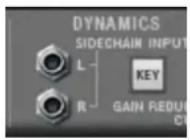
The Sidechain inputs.
When a cable is connected to the Sidechain inputs the "KEY" button is activated automatically and the Dynamics section for the channel will now be "keyed" i.e. triggered by the external signal instead of the channel signal.
For example, you could use a drum loop to trigger the gate for a channel playing a synth pad to create rhythmic chord effects.
See "Using compression sidechaining" for a description of further uses of sidechaining.
About Gain Reduction CV
The Gain Reduction CV out connector on the back of a Mix Channel or Audio Track rack device can be used to modulate other parameters with the amount of gain reduction applied by the compressor/gate. The gain reduction CV out can be used as an envelope follower as the CV follows the dynamics of the original signal.
For example, try using gain reduction CV to control filter frequency for "auto-wah" effects.
EQ section

This is a four-band EQ with parametric midrange controls and high and low frequency shelving bands. The EQ can be switched between two operating modes, each with slightly different curve characteristics. There is also a filter section with low pass and high pass filters.
The EQ can be placed before or after Dynamics in the signal path - see "Signal Path section".
The parameters are as follows:
| Parameter | Description |
| Spectrum EQ Window button | Click this button to bring up the Spectrum EQ Window where you can edit the EQ and Filter parameters graphically, see “The Spectrum EQ Window”. |
| LPF “ON” button | Activates/deactivates the low pass filter. A low pass filter lets low frequencies pass and cuts out the high frequencies. |
| HPF “ON” button | Activates/deactivates the high pass filter. A highpass filter is the opposite of a lowpass filter, cutting out lower frequencies and letting high frequencies pass. |
| LPF Frequency | The Low Pass filter (LPF) removes high frequencies from the signal, making the sound less bright. The LP filter has 12dB/Octave roll-off curve. Range is 100 Hz - 20 kHz. |
| HPF Frequency | The High Pass filter (HPF) removes low frequencies from the signal, causing a thinner sound. The HP filter slope has a 18 dB/Octave roll-off. Range is 20 Hz - 4 kHz. |
| FILTERS TO DYN S/C button | See “About the Filters To Dynamics Sidechain button”. |
| EQ “ON” button Activates/deactivates the EQ. (This does not affect the LPF/HPF filters.) | |
| “E” button | When the “E” button is activated the EQ will have slightly different curve characteristics.In normal mode (E button deactivated), the Gain setting will also affect the bandwidth (Q) for the HMF and LMF EQ sections. The higher the gain, the narrower the bandwidth and vice versa. With E mode activated, bandwidth is constant at all gain settings. (Check out the difference in “The Spectrum EQ Window” if you like.) |
| HF Gain/Frequency | The HF section provides high frequency shelving equalization. Frequencies above the set corner Frequency will be cut or boosted by the set HF Gain amount.The HF Gain control can cut or boost the selected frequency range +/- 20dB and the HF Frequency can be set between 1.5kHz - 22kHz. |
| HF BELL mode | When this button is activated, the HF EQ will switch to peaking characteristics. This means it works like a regular parametric EQ band, cutting or boosting the signal around the set frequency. Bell mode has a fixed bandwidth or "Q" (see below). |
| HMFGain/Frequency/Q | The high medium frequency EQ is fully parametric. HMF Gain is adjustable +/- 20dB. Center frequency range is 600 Hz - 7 kHz. The "Q" parameter adjusts the bandwidth around the set center frequency. Q range is 0.70 - 2.50. The higher the Q value, the narrower the affected frequency range - except in "E" mode (see above). |
| LMFGain/Frequency/Q | The low medium frequency EQ is also fully parametric. LMF Gain is adjustable +/- 20dB. Center frequency range is 200 Hz - 2 kHz. The "Q" parameter adjusts the bandwidth around the set center frequency. Q range is 0.70 - 2.50. The higher the Q value, the narrower the affected frequency range - except in "E" mode (see above). |
| LF Gain/Frequency | The LF section provides low frequency shelving equalization. All frequencies below the set Frequency will be cut or boosted by the set LF Gain amount.The LF Gain control can cut or boost the selected frequency range +/- 20dB and the LF Frequency can be set between 40 Hz - 600 Hz. |
| LF BELL mode | This works in the same way as described above for the HF filter, but affects the LF filter. |
The Spectrum EQ Window
The EQ section can also be displayed and edited "visually". This is done in the Spectrum EQ floating window. Besides the EQ functionality, the Spectrum EQ also features a spectrum analyzer which displays the audio frequency content of the selected mixer channel in real-time. Here is how you can work with the Spectrum EQ:
- Select "Show Spectrum EQ Window" from the Window menu (or press [F2]), or click the Spectrum EQ Window button on the desired channel strip (see "Spectrum EQ Window button") or on the device in the rack:
The Spectrum EQ window shows up and the (pre-Fader) frequency content of the currently selected mixer channel is displayed in gray during playback:
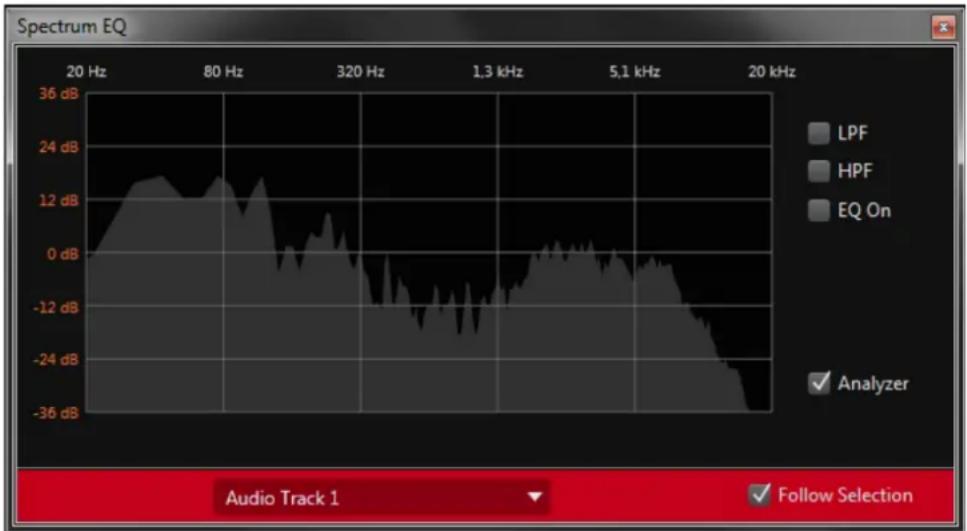
line
| Frequency | Value | | --------- | --------- | | 20 Hz | 36 dB | | 80 Hz | 24 dB | | 320 Hz | 12 dB | | 1.3 kHz | 0 dB | | 5.1 kHz | -12 dB | | 20 kHz | -24 dB | | Audio Track 1 | -36 dB | | Follow Selection | -36 dB |The Spectrum EQ Window with audio playing back.
! The LPF and HPF buttons are only present when the "FILTERS TO DYN S/C" button is off.
→ Click and drag the Spectrum EQ window frame to resize the window horizontally and vertically as desired.
→ Select the desired mixer channel for the Spectrum EQ by selecting it from the drop-down list at the bottom of the window.
! If "Master Section" is selected, no controls are available in the window, since the Master Section lacks these.
- If the "Follow Selection" checkbox is ticked, changing sequencer track, Mix Channel/Audio Track device in the rack, channel strip, or editing parameters on other channel strips will automatically change the Spectrum EQ Window focus to show the signal of the corresponding mixer channel.
2. Tick the "EQ On" box to activate the EQ in the channel strip and bring up the parameters in the window.
You can also activate the HPF and LPF Filters, E Mode, HF Bell mode and LF Bell mode for the selected mixer channel by ticking the corresponding check boxes in the window. The pictures below shows how the different objects in the Spectrum EQ window correspond to the channel strip parameters:
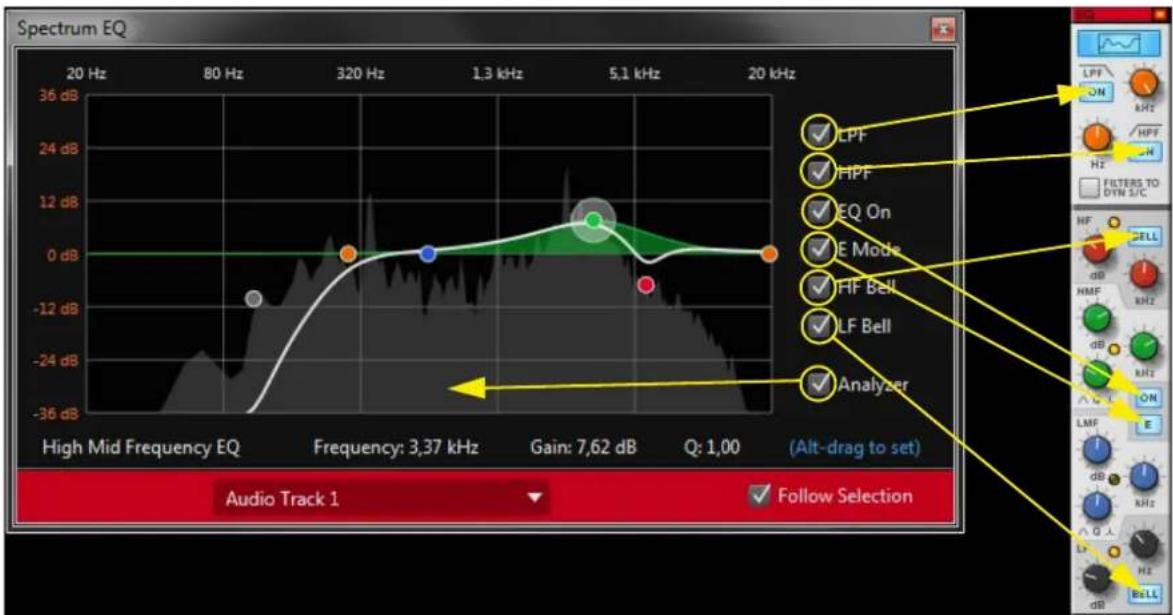
line
| Frequency | Gain (dB) | | --------- | --------- | | 320 | 0 | | 1.3 | 12 | | 5.1 | 0 | | 20 | -12 |The Spectrum EQ Window with the Filters, EQ, E Mode, Bell Mode and Analyzer functions active during audio playback.
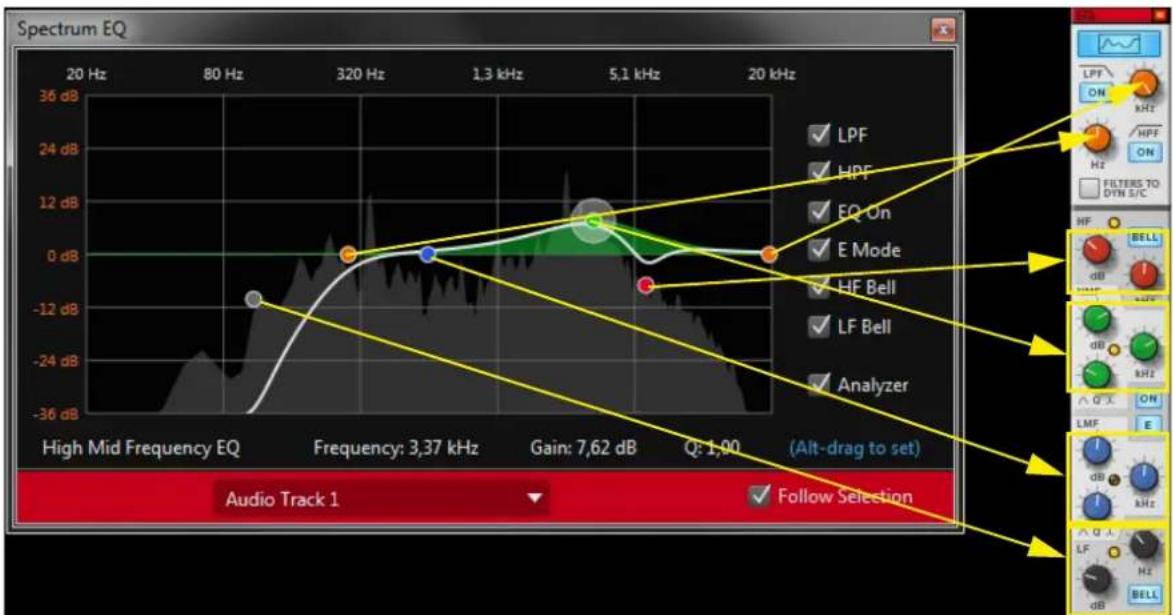
The Spectrum EQ editing objects (points) and what parameter(s) they affect in the mixer channel strip.
→ Click and drag any of the points in the window to change the frequency (and gain for the EQ points) value(s). Dragging sideways changes the frequency value and dragging vertically changes the gain (of the EQ points). As you edit the points, the corresponding channel strip parameter(s) are updated in real-time - and vice versa. The white line in the window shows the resulting EQ (and Filter, if activated) curve.
- Hold down [Shift] and drag to constrain the movement to vertical and/or horizontal. This allows you to change either frequency or gain without affecting the other.
→ [Ctrl]-click (Win) or [Cmd]-click (Mac) on an EQ point to reset its Gain value to 0dB.
- When you hover over a point, its current values are displayed numerically in the Frequency, Gain and Q fields below the graph. The parameter's (or section's) name is also displayed at the bottom left in the window: (The point remains selected until you touch another point with the mouse or click on the window background.)
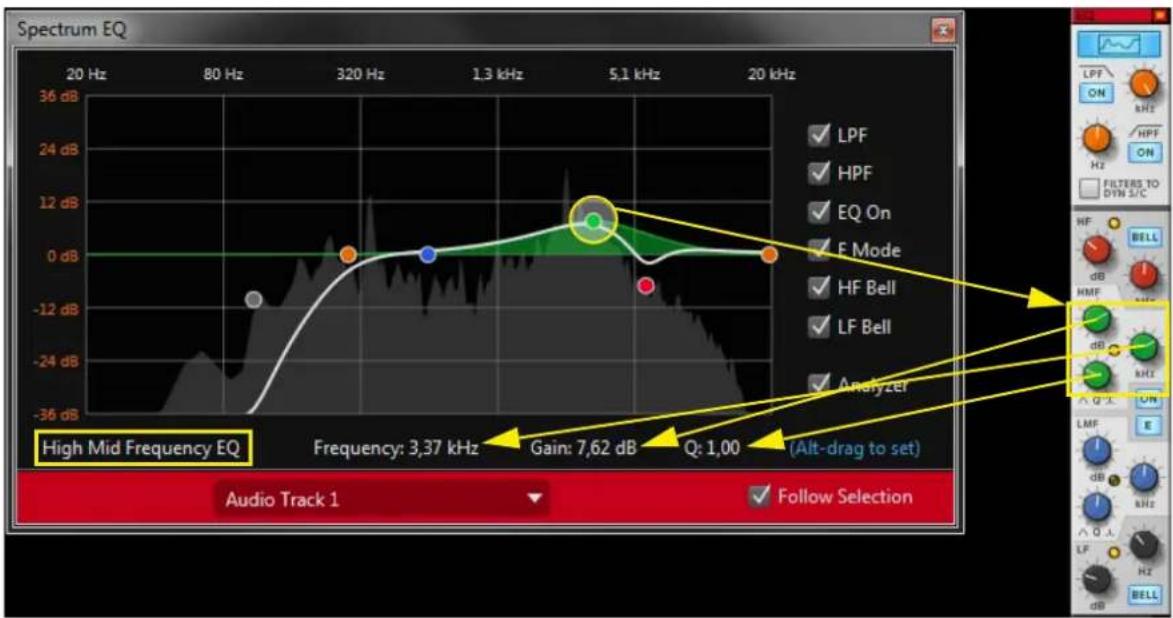
The HMF EQ point is selected and highlighted in the window.
! Note that the Analyzer always shows the audio frequencies before the Fader section. This means that any Filter and/or EQ changes you make will affect the displayed frequency content. Also, if you use any Insert FX, these could also affect the frequency content.
→ Hold down Alt/Option and drag an EQ point vertically to change its Q-value.
This is only valid for the HMF and LMF EQ points, since these are the only ones that have a Q parameter.
- It is possible to record parameter automation in the sequencer by dragging the points around in the Spectrum EQ Window during recording. Just make sure you have created a sequencer track for the channel you want to automate. See "Parameter automation recording procedure" for more details.
Insert FX section
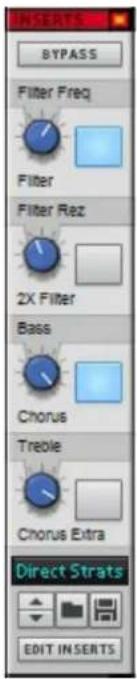
The channel strip Insert FX section allows you to load an Effect Combi patch, which can in turn contain any number of effects and other devices. Insert effect devices that belong to the patch are added to the Audio Track or Mix Channel device in the rack.
The main parts of this section are the assignable Rotary knobs and buttons. Combinator Effect patches in the Factory Sound Bank will have various parameters and switches assigned to these controls, and the labels will have names describing the parameter/function.
Insert effects process the whole channel signal, as opposed to Send effects where the effect balance is adjustable. Typical examples of when to use insert effects include compression, distortion and modulation effects such as chorus.
The Insert effects can be placed ahead of the Dynamics and EQ sections in the signal path - see "Signal Path section".
→ Loading Insert FX patches is done using the patch browser located at the bottom of the Insert FX section. Insert effects patches in Combinator format can be loaded.
- See "Insert FX" for descriptions of how to work with Insert effects.
- Assigning parameters to the Rotary controls and buttons is done in the Programmer section of the rack device.
- Creating your own Insert FX patches is done in the Combinator.
The Insert FX section in the channel strip contains the following parameters:
| Parameter | Description |
| Bypass Bypasses the Insert effect(s). | |
| Rotary knobs 1-4/Buttons 1-4 | The four rotary controls and buttons are programmable and provide control over selected parameters and functions in an effect Combi patch. Assigning parameters to the controls is done in the Programmer for the Audio Track or Mix Channel device - see “Insert FX”. |
| Patch browser | This is a standard patch browser for channel Insert FX where you can select/save patches in the Combinator Effect patch format. |
| Edit Inserts | This will bring the channel’s rack device into view with its Insert FX container opened, allowing you to edit the effect devices. |
FX Sends section
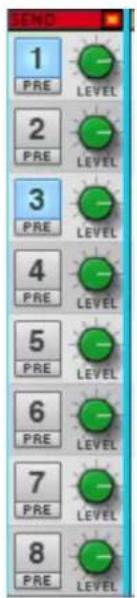
Send effects, which are global for all channels in the Main Mixer, are connected to the Master Section rack device. Up to 8 Send effects can be used simultaneously. For a description of how to use Send effects, see "Send FX".
The FX Sends section contains the following parameters:
| Parameter | Description |
| FX Send On 1-8 Activates the Send for the channel. | |
| Level 1-8 | The Send Level knobs control the amount of channel signal that is to be sent to the effect connected to the corresponding Send. |
| PRE button | Send channel output is normally taken post channel fader, so that changing the channel's volume also changes the send level. By activating the PRE button, the send output is taken pre channel fader. In this mode, the send level is independent of the channel fader. |
Fader section
The Fader section is used for controlling the level of the channel and its stereo placement in the mix. The section has the following parameters:
| Parameter | Description |
| Pan L/R | Use this control to set the left/right position of the channel in the stereo field. [Ctrl]-click (Win) or [Cmd]-click (Mac) the Pan knob to reset to the default "0" (center position). The pan law is "-3dB compensated", with "compensated" meaning that the signal becomes +3dB louder when it's panned hard left/right compared to when it's completely centered. |
| Width | Width will only be available on stereo channels. It allows you to control the width of the stereo field for the channel. Normally this is fully on (value 127) which represents full stereo. By decreasing this value the stereo width is narrowed. Turned fully off the channel output will be in mono. |
| MUTE/SOLO buttons | ! Note that the Mute and Solo functions in the Main Mixer are NOT the same as Mute and Solo of sequencer tracks (see "Muting tracks" and "Soloing tracks").Clicking a channel's Mute button silences the output of that channel. Click the button again to unmute the channel.Clicking a channel's Solo button silences all other mixer channels, so that you only hear the soloed channel. Several channels can be soloed at the same time, but if this is the case, note that soloed channels can't be muted with the Mute button. To mute one of several channels in solo mode you simply "un-solo" it. There are also Mute All Off/Solo All Off buttons in the Master Section - see "Master Section Header".If you are using Output Busses (see "Output Busses") and/or Parallel Channels (see "Parallel Channels"), the Solo and Mute functions affect the other concerned channels in an intelligent way, see "Solo, Mute and Send FX logic". |
| Channel Fader The channel fader is used to control the output level of each channel.By adjusting the faders, you can set the desired mix (balance) between channels.If a channel is an Output Bus (see "Output Busses"), the Fader section background is colored and the Fader knob is red. | |
| Channel Meter | The meter is a graphical representation of the channel output level. Stereo channels have two level bars and mono channels have one. If the signal level pushes the meter into the red, to avoid distortion try lowering either the output level of the device connected to the channel device or the channel fader itself. The meter is a VU meter, taking into account any VU offset set in the Big Meter of the Reason Lite Hardware Device - see "The Big Meter". |
| Output Bus Selector | Here you can route the channel to an Output Bus (sub-mixer) instead of to the default Master Section, see "Output Busses". |
About Level/Pan CV
On the back of the Programmer section of a Mix Channel or Audio Track device you will find CV inputs for the channel Level and Pan controls. These allow for automatic level and pan control from sources that output CV signals.
→ Press [Tab] to flip the Rack around, then click the "Show Programmer" button to access the CV jacks.
Changing Fader section parameters on multiple channels simultaneously
In the Fader section you can change parameter values in a "ganged" or "linked" fashion on several selected Mix Channels. You can change the Mute, Solo and Level fader parameters this way. The example below shows seven selected channels, where the Level is reduced on the KorgBass channel and the rest of the channels' Faders follow along (with the same amount of level change in dB for each channel):
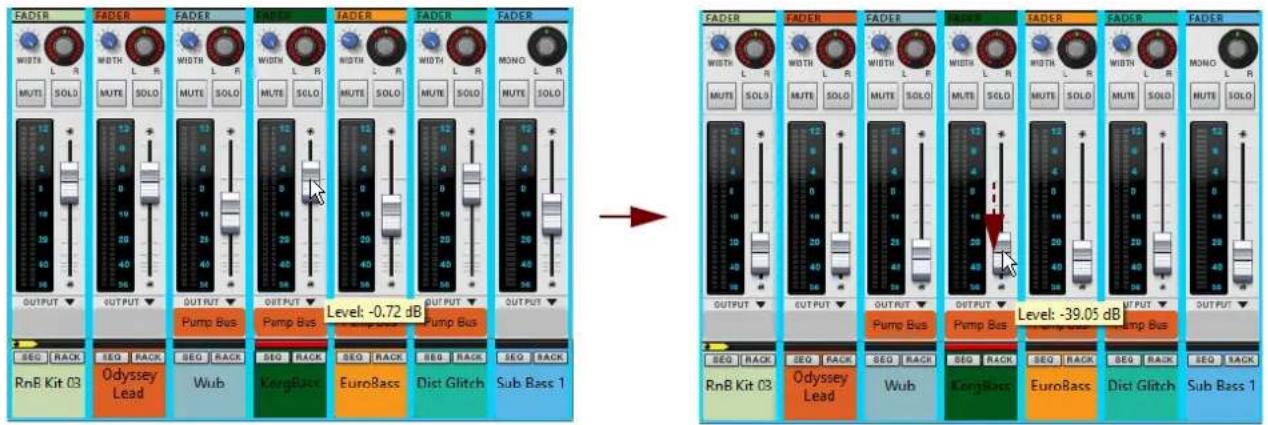
- If you don't release the mouse button you can change the level back and the other channel faders will follow along as expected.
! If you lower the level to minimum (or raise to max) so that all faders reach their end values, and then release the mouse button, changing the level again will move all faders together equally.
Channel Header section
The Channel Header is always visible at the bottom of the channel strip. It contains the following items:
The Edit Focus indicator - When you select a channel, the horizontal strip at the top of the Channel Header lights up red to indicate Edit Focus. The channel most recently clicked will have edit focus, regardless of how many channels are selected. When using Ctrl-click or Cmd-click to deselect previously selected channels, edit focus will be on the most recently deselected channel.
Edit Focus also reflects the last selected track or Mix device, which is useful when moving between work areas because the channel with Edit Focus will always be in view in the Main Mixer. For example, if you select an ID8 track in the sequencer, the Mix channel to which it is connected will be scrolled into view in the Mixer, and will be given Edit Focus.
The top strip is lit to indicate Edit Focus.
- When you are using the Spectrum EQ Window, and the “Follow Selection” box is ticked, the channel with Edit Focus is displayed in the window, see “The Spectrum EQ Window”.
The Remote Base Channel indicator - To the left in the same horizontal strip area a small yellow arrow symbol can be shown. This is the Remote Base Channel indicator, which shows which channel is considered the first or base channel when using Remote Control - see "Setting the Remote Base Channel".
The Remote Base indicator.
The RACK and SEQ buttons allow you to switch to a channel's rack device or sequencer track directly from the mixer - see "Switching between channels, rack devices and tracks".
The Channel Header area reflects the selected Track Color (see "Coloring mixer channels").
You can rename the channel by double-clicking on the name (see "Naming mixer channels").
Note that the Channel Header is a little shorter if the channel is a Parallel Channel (see "Parallel Channels").
The Master Section strip

The Master Section is where all your audio track and mix channels are mixed down to the Master Out bus. The Master Section strip contains a bus compressor and Insert FX section, both of which process the master bus, as well as send/return master level and pan controls for the eight FX Sends. Any processing applied to the master bus affects all channels that are routed to the Master Section.
Master Compressor section
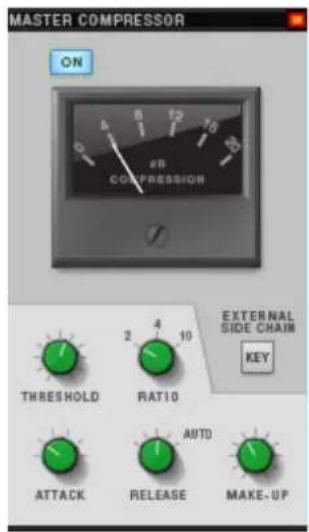
The Master Compressor is perfect for providing the final "fairy dust" to your mix. It can add punch and cohesion, and generally make the mix sound bigger and more powerful. The compressor is very straightforward in operation and features make-up gain as well as program-adaptive Release.
The Master Compressor can be applied pre or post Master Insert section - see "Master Inserts section".
The parameters are as follows:
| Parameter | Description | Range |
| On button Activates/deactivates the Master Compressor. | ||
| Meter The meter shows the amount of gain reduction in dB. 0dB - 20dB | ||
| Threshold This sets the level at which onset of compression occurs. The lower the Threshold, the more compression will be applied. | -30dB to 0dB | |
| Ratio | Ratio specifies the amount of gain reduction applied to signal levels above the set threshold. A 2:1 compression ratio effectively means that a signal level 2dB above threshold will have a signal gain of 1dB. | Fixed Ratios:2:1 / 4:1 / 10:1 |
| Attack | This governs how quickly the Master Compressor will react when signals rise above the set threshold. | Fixed settings (in ms):0.1 / 0.3 / 1 / 3 / 10 / 30 |
| Release When the signal level drops below the set threshold, this determines how long it takes before the compressor lets the sound through unaffected.If set to "Auto", the Release time will be program adaptive, so the Release time is automatically increased following long peaks and decreased following short peaks. | Fixed settings (in s):0.1 / 0.3 / 0.6 / 1.2 /Auto | |
| Make-Up Make-Up gain compensates for level reduction caused by compression and helps maintain a steady output level. | -5dB to 15dB | |
| KEY button/External Side Chain | When a cable is connected to the Sidechain inputs on the back of the Master Section device, the KEY button is activated automatically and the Master Compressor will now be triggered by the external signal instead of the master bus signal. When a sidechain source is connected you can turn the KEY button off to monitor the side-chain signal.See "Using compression sidechaining" for a description of how sidechaining can be used. | |
FX Send section
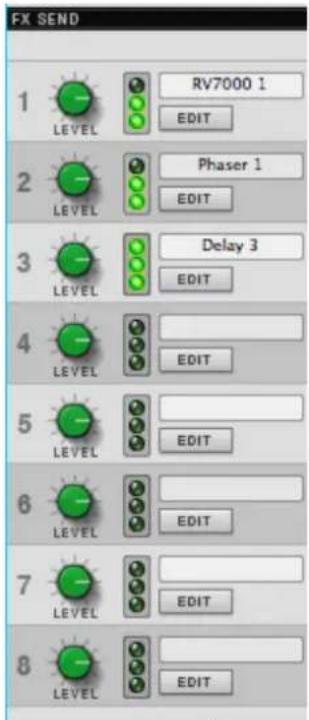
This section controls the master levels of the FX Sends. Send effect devices are connected to the Master Section via the eight FX Send and eight FX Return connectors on the back of the rack device.
See "Send FX" for a description of how to set up an use Send FX.
The Send bus can be monitored via the Control Room output - see "Control Room output section".
The section contains the following items:
| Parameter | Description |
| Level 1 - 8 | Adjusts the FX Send master level. The master send levels are normally left at default 0dB. if you wish to increase/decrease the effect balance, this is best done by increasing/decreasing the send levels for the individual channels using the effect. |
| Meter Shows the signal level of the send bus. | |
| EDIT button | This brings the connected effect device in the rack into view for easy editing of its parameters. |
| Name label | This automatically shows the name of the connected effect device. If you enter a new name for the label, this overrides the automatic naming. Deleting a manually entered name will bring back the automatic naming. |
Master Inserts section
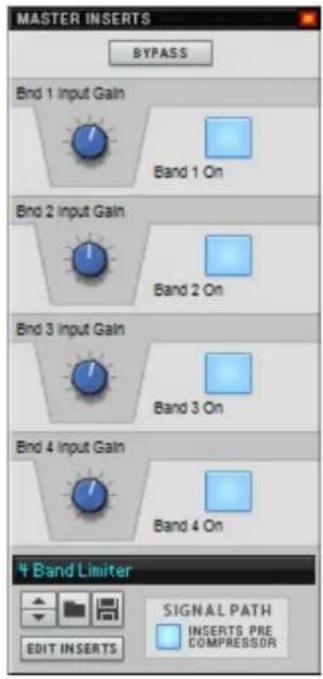
The Master Inserts Section is identical to the Insert FX section in the channel strips, except that it affects the master bus, i.e. the whole mix. You can load Combinator effect patches, which can include anything from a single device to a complex array of multiple devices, to process the master bus.
The Master Insert slot is ideally used to apply mastering effects for finalizing the mix.
Devices that belong to the Insert effect patch are added to the Master Section device in the rack.
The main parts of this section are the assignable rotary knobs and buttons. Combinator Effect patches in the Factory Sound Bank will have various parameters and switches assigned to these controls, and each label will have a name describing the assigned parameter/function.
The Master Insert effects can be placed ahead of the Master Compressor in the signal path. By default, the Master Insert effects are placed after the Master Compressor in the signal path. This makes sense, as you usually add a Maximizer or Mastering Combi patch as a Master Insert effect, and this must be last in the signal path to avoid clipping on the output. However, if necessary, you can place the Master Insert effects before the Master Compressor, by activating the "Inserts Pre Compressor" button.
→ Loading Insert FX patches is done using the patch browser located at the bottom of the Insert FX section. Insert effects in Combinator format can be loaded.
- See "Insert FX" for descriptions of how to work with Insert effects.
The Inserts section in the Master Section contains the following parameters:
| Parameter | Description |
| Bypass Bypasses the loaded Insert effect(s). | |
| Rotary knobs 1-4/Buttons 1-4 | The four rotary controls and buttons are programmable and provide control over selected parameters and functions in an effect patch. Assigning parameters to the controls is done in the Programmer for the Master Section rack device - see "Insert FX". |
| Patch browser | This is a standard patch browser for Master Insert FX where you can select/save patches in the Combinator Effect patch format. |
| Edit Inserts | This will bring the Master Section device into view in the rack, with its Insert FX container opened, allowing you to edit the effect devices. |
| Signal Path button | If activated, the “Inserts Pre Compressor” button will place the Inserts before the Master Compressor in the signal chain. If the Master Insert effects contain a maximizer or limiter, the inserts should normally be last (this button should be left in the off position). |
FX Return section
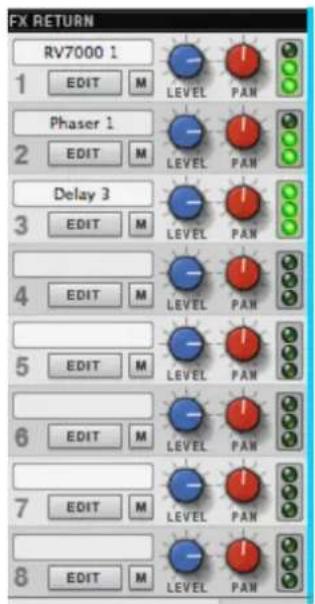
This section controls the master levels of the FX Returns. Send effect devices are connected to the Master Section via the eight FX Send and eight FX Return connectors on the Master Section device. See "Send FX" for a description of Send FX.
natural_image
Close-up of an electronic control panel with multiple ports and green/red cables (no visible text or symbols)Send/Return connectors on the Master Section device.
You can monitor the Return bus via the Control Room output - see "Control Room output section".
The section contains the following items:
| Parameter | Description |
| Level | Adjusts the FX Return master level. The master return levels are normally left at the default value, 0dB. If you wish to increase/decrease the effect balance, this is best done by increasing/decreasing the send levels for the individual channels using the effect. You can, however, use the FX Return level to change the overall balance of a send effect in the mix. |
| Pan Pan adjusts the return signal stereo balance. | |
| Meter Shows the signal level of the return bus. | |
| EDIT button | This brings the connected effect device in the rack into view for easy editing of its parameters. |
| Mute (M) This mutes the return signal for the send effect. | |
| Name label | This automatically shows the name of the last effect device in the send signal path. If you enter a new name for the label, this overrides the automatic naming. Deleting a manually entered name will bring back the automatic naming. |
Master Fader section
The Master Fader controls the final output level of the mix to be recorded or exported to a file. It should normally be set to 0dB. The Master Fader should never be used to adjust the monitoring level - this is what the Control Room bus is for (see below).
The section contains the following items:
| Parameter | Description |
| Master Fader Adjusts the level of the Master Out bus. | |
| Meter Shows the level of the Master Out bus. | |
| Mode | The Mode button switches the meter between VU/Peak/PPM modes - see "The Big Meter". |
| Reset This resets the meter, deleting any registered peaks. | |
Spectrum EQ (Spectrum Analyzer) Window button
Below the Meter is a button for bringing up the Spectrum EQ Window. Since there are no Filter or EQ sections in the Master Section, the Spectrum EQ Window is used only for displaying the frequency content of the Master Section.
Control Room output section
The Control Room outputs are located on the back of the Master Section device. To use the Control Room output section, the outputs have to be connected to your monitor system. This can be done by manually patching cables from the "Ctrl Room Out" connectors to a separate output pair on the Reason Lite Hardware Device - see "Manual audio routing".
The Control Room outputs, which are separate from the Master Out bus, are the outputs that you should monitor (listen) from. This allows you to monitor the main mix and to adjust your monitoring level without affecting the Master Out bus. You can also monitor the FX Send or Return buses in this section.
The section contains the following items:
| Parameter | Description |
| Monitor display/selector for Master/FX Send 1-8/FX Return 1-8 | Click the display to bring up a list where you can select what to monitor on the Ctrl Room Out jacks. You can select between Master, FX Send 1-8 and FX Return 1-8. One bus can be monitored at a time. |
| Control Room Out Level Adjusts the level of the Control Room Out bus. | |
Delay Comp
→ Click the Delay Comp button (or display) to activate delay compensation in the Main Mixer.
The total delay of the Main Mixer signal (at the Master Out) is displayed below the display. See the “Delay Compensation” chapter for more information about delay compensation in Reason Lite.
Master Section Header
The Header is always visible at the bottom of the Master Section. It contains the following items:
| Parameter | Description |
| SEQ / RACK buttons | The RACK and SEQ buttons allow you to switch to the Master Section rack device or automation track directly from the mixer - see “Switching between channels, rack devices and tracks”. |
| Mute/Solo All Off This allows you to switch off all channel Mute or Solo buttons in one go. | |
| DIM -20dB | This simply dims the Master Out level -20dB. Use this to temporarily lower the output level when answering the phone, etc. |
Automating mixer parameters
Automating mixer parameters works in the same way as for other parameters. Automation is part of the audio track or Mix channel track. See “Recording parameter automation”.
→ A quick way to automate a parameter is to right-click (Win) or [Ctrl]-click (Mac) on the parameter and select "Edit Automation" from the context menu.
This will create an automation lane (and track if needed) where you can record or draw automation.
- When you select a sequencer track, the "Record Enable Parameter Automation" button is automatically enabled, allowing for parameter automation to be recorded. However, when recording automation for Audio Track channel strip parameters, you may want to disable the regular Record Enable button to avoid recording audio by mistake.
Working with effects
Insert FX
By definition, insert effects are inserted in the signal chain and process the whole channel signal, as opposed to Send effects (see "Send FX") where the effect balance is adjustable. Typical insert effects are dynamics, distortion, chorus etc., plus mastering effects for the Master Section.
As mentioned earlier in this chapter, the channel strips and Master Section strip have a "slot" dedicated to insert effects - the Insert FX section. In the Insert FX section, you can choose to load Effect Combi patches using the standard Patch browser. However, it's also possible to manually create effect devices and use as insert effects.
- A very flexible way of using Insert FX is to have the effects in separate mixer channels and utilize parallel processing, see "Parallel Channels".
Adding Insert effects
To add an effect device as an insert effect, proceed as follows:
- Select a channel strip in the Main Mixer, a Mix Channel or Audio Track device in the rack, or an audio track or Mix Channel track in the sequencer.
- Select the desired effect device from the Create menu or from the context menu.
The effect device is created and automatically routed in the Insert FX container in the channel's rack device.
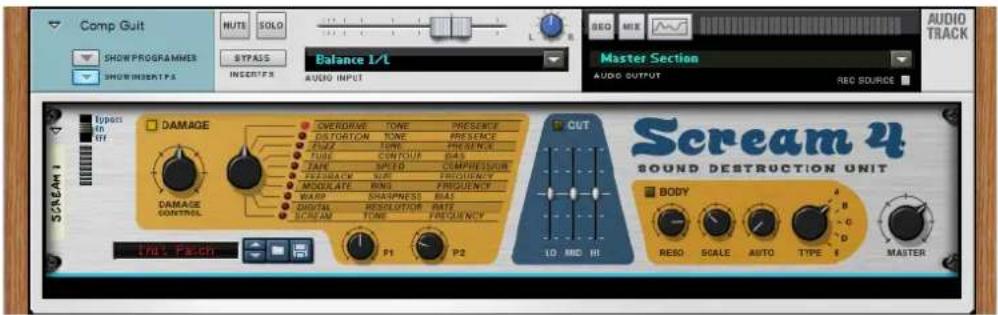
A Scream 4 device created as Insert FX in an Audio Track device.
- If you need to re-route any connections, press [Tab] to flip the rack around.
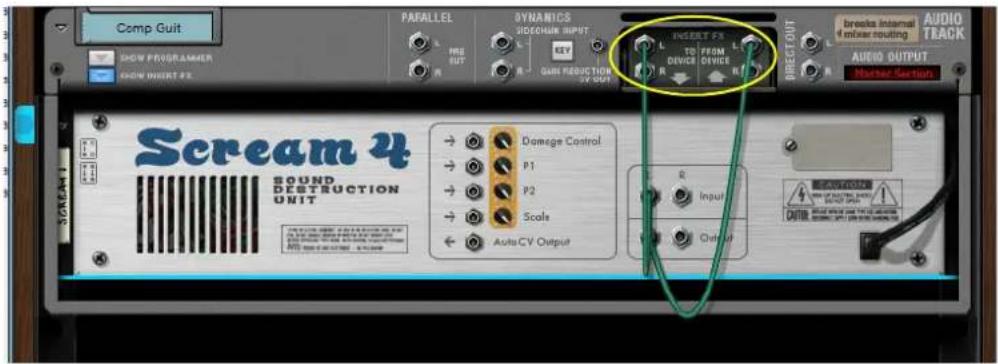
The "To Device" and "From Device" connections in the Insert FX slot in the Audio Track device.
! Note that the Mix Channel/Audio Track device must be unfolded to show the connections.
→ If desired, re-route the connections according to the standard routing procedures (see "Manual routing"). The signals always travel from the "To Devices" outputs, via the desired effect devices, to the "From Devices" inputs on the Mix Channel/Audio Track device.
- When the Show Insert FX button is on, you can add devices directly in the insert FX container area, drag devices in or out, etc. - just like with a Combinator (see "The Combinator").
! Note that if you add, load or route insert effects in stereo, and the Mix Channel/Audio Track device (and channel strip) is in mono, the channel will automatically switch to stereo.
Loading Effect Combi patches
It's possible to load Effect Combi patches directly into the Insert FX container of the channel. An Effect Combi patch loaded in the Insert FX container has the same functionality as a regular Combinator patch, with the following exceptions:
- Insert FX do not receive note and performance controller data (Pitch Bend, Mod Wheel etc.).
- If you load a Combinator patch which has a backdrop image, it is not shown in the Insert FX section in the rack.
To load an Effect Combi patch in the Insert FX section of a channel strip, proceed as follows:
- Click on the "Browse Insert FX Patch" button (with the folder icon).
The Patch browser opens.
- Navigate to an Effect Combinator patch and select it.
Effect Combinator patches can be found in the Effect Patches folder in the Reason Lite Sound Bank.
- Click "OK" to load the selected patch in the Insert FX section.
The Effect Combinator is loaded and patched in the Insert FX container in the channel's rack device, so you can hear the result of the effect immediately. The name of the patch is also shown in the display on the channel strip:
Editing and saving Insert effects
Insert effects can be edited from their device panels in the Insert FX container in the channel's rack device. You can also assign device parameters to the four buttons and knobs on the Insert FX Programmer panel. These buttons and knobs are mirrored on the Insert FX section of the channel strip.
Most of the Effect Combi patches already have a number of parameters assigned to the four buttons and knobs on the Insert FX Programmer panel. These assigned parameters can be edited at any time from the Insert FX section in the channel strip, and can also be automated on a Mix Channel/Audio Track in the sequencer.
To edit effect device parameters that are not assigned to the four knobs and buttons on the Insert FX Programmer panel, you have to access the device(s) in the rack.
- Click the "Edit Inserts" button to get to the channel's Insert FX container in the rack.
The channel's Insert FX container is scrolled into view, and unfolded, in the rack.
→ Now, you can edit the effect device(s) parameters, just like for any other devices in the rack.
To edit the parameter assignments on the Insert FX Programmer panel, click the "Show Programmer" button on the Mix Channel/Audio Track device.
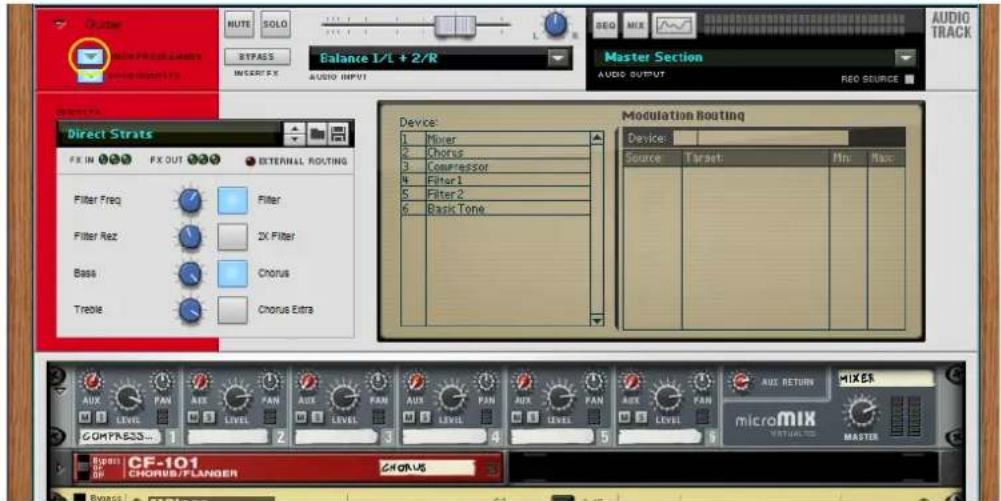
The parameter assignments are made in the same way as when creating/editing regular Combinator devices (see "The Combinator"). The parameters you assign to the Insert FX Programmer panel in the rack are automatically mirrored on the four knobs and buttons in the Insert FX section on the channel strip.
- If you like, you can choose to save your effect device setup in the Insert FX container (along with any parameter assignments) as an Effect Combi patch by clicking the "Save Insert FX Patch" button (with the floppy disc icon) on the Programmer panel.

This will bring up the Patch browser, where you can select name and location for your Effect Combi patch.
! You don't have to save your insert effect as an Effect Combi patch unless you want to use the effect chain in other songs later on. All settings are automatically stored when you save the Song document.
Bypassing Insert effects
→ Click the "Bypass" button at the top of the Insert FX section on the channel strip, or on the device in the rack, to bypass the insert effects for the channel.

The "Bypass" buttons on the channel strip and on the device.
Deleting Insert effects
Deletion of insert effects can be done either in the rack or with a mixer channel selected in the Main Mixer:
- Select a Mix Channel or Audio Track device in the rack or a mixer channel in the Main Mixer.
- Select "Clear Insert FX" from the Edit menu or context menu.
This will disconnect and delete all Insert FX devices of the selected channel. The deleted devices will be replaced by an internal straight-through connection.
Another way of deleting Insert FX is by manually removing them from the Insert FX container in the Mix Channel or Audio Track device in the rack:
- Unfold the Mix Channel/Audio Track device and click the "Show Insert FX" button.
- In the Insert FX container, select the device(s) you want to remove.
- Press [Backspace] or [Delete], or select "Delete Devices and Tracks" from the Edit or context menu.
An alert appears asking you to confirm the deletion. (See "Deleting devices" for more details).
Copying and Pasting Insert effects between mixer channels
To copy the insert effect(s) from one mixer channel and paste to another mixer channel, proceed as follows:
- Select the mixer channel which contains the Insert effect(s) you want to copy.
- Select "Copy Channel Settings" from the Edit or context menu and then select "Insert FX" from the sub-menu. If you select the Master Section, the "Copy Insert FX" item will appear directly on the Edit menu or context menu.
- Select the mixer channel to which you want to paste the Insert effects and choose "Paste Channel Settings: Insert FX" from the Edit menu or context menu.
If you select the Master Section, the "Paste Insert FX" item will appear directly on the Edit menu or context menu.
Send FX
Send effects are routed in parallel with the signal chain, and the effect balance can be adjusted - as opposed to Insert effects, which are inserted in the signal chain and process the whole channel signal (see "Insert FX"). Typical Send effects include reverbs and delays.
The Main Mixer can hold up to eight separate Send effects per Song. These eight Send effects can be used simultaneously by any or all mixer channels in the Song, at individually adjustable levels per mixer channel. The main Send FX controls, which include the FX Send and FX Return sub-sections, are located in the Master Section strip in the mixer. In these sections, you can control the FX Send and FX Return levels to and from all mixer channels, as well as panning for each of the Send effects.
In addition to the "global" Send FX controls in the Master Section, each mixer channel features a Send FX section, where you can control the levels to each of the Send effects for the specific mixer channel.
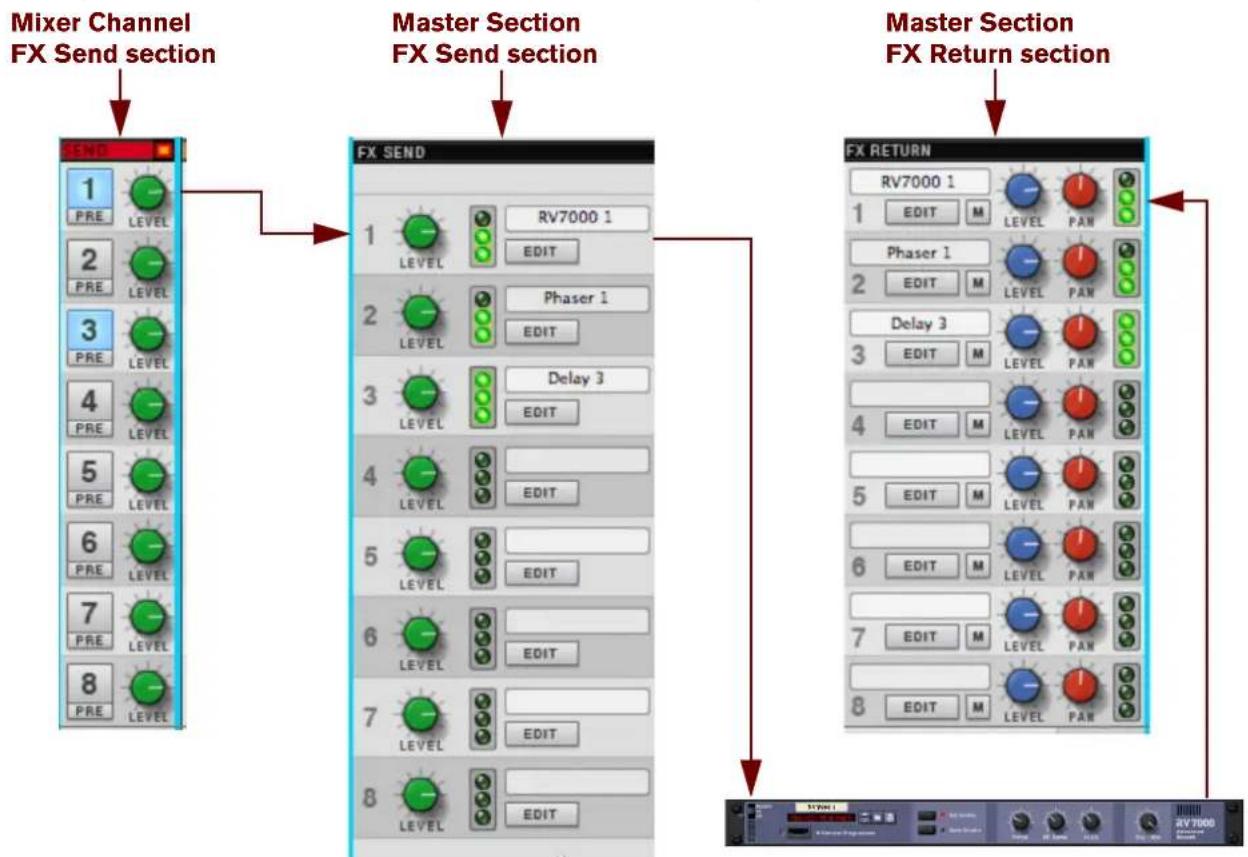
flowchart
graph TD
    A["Mixer Channel FX Send section"] --> B["FX SEND"]
    B --> C["Master Section FX Send section"]
    C --> D["FX RETURN"]
    D --> E["Master Section FX Return section"]
Creating Send effects
Send effects can be added as follows:
- In the Main Mixer, select a channel strip or the Master Section strip.
- Select "Create Send FX..." from the context menu.
The Browser appears (if it was hidden) and the Send FX section gets browse focus. Now, you can now browse for and load effect devices. You can also browse for Effects patches and load these into their corresponding devices, e.g. Effect Combinators.
! If all eight Send effect busses are already in use, the "Create Send FX..." item on the context menu is grayed out.
• Each FX Send and FX Return in the Master Section strip has a display that shows the name of the last effect in that send's signal path:
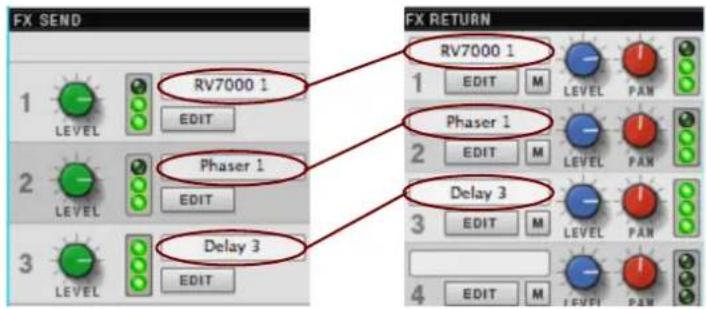
The names of three added Send effects are displayed in the Master Section strip.
- If you need to re-route any connections, press [Tab] to flip the rack around.
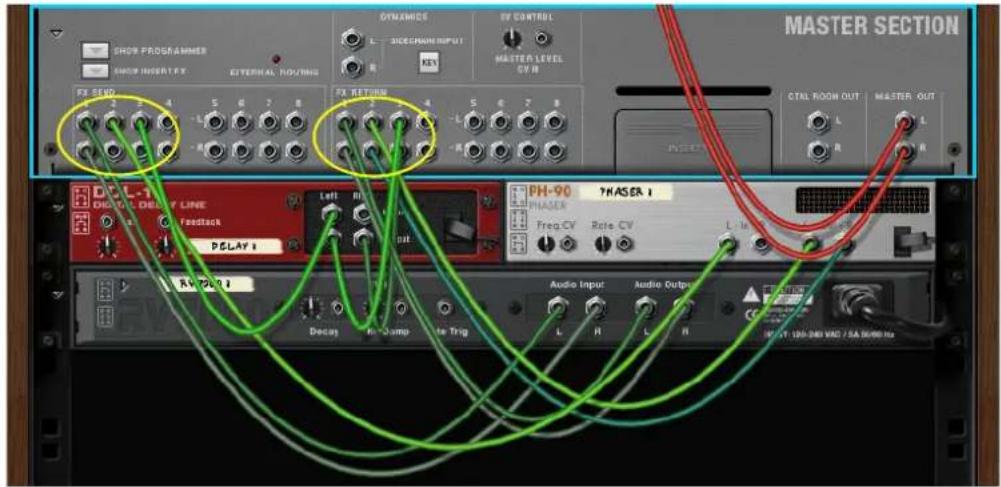
The Send FX connections on the Master Section device.
! Note that the Master Section device must be unfolded to show the connections.
As you can see, all Send effects are placed outside the Master Section device - as opposed to Insert effects, which are placed in the Insert FX container of the Master Section device.
- It's also possible to manually connect devices to the FX Send and FX Return connectors according to the standard routing procedures (see "Manual routing").
The signals always travel from the "FX Send" outputs, via the desired effect device(s), to the "FX Return" inputs on the Master Section device.
Editing and saving Send effects
→ Click the "Edit" buttons in the FX Send or FX Return sections to get to the corresponding Send effect device(s) in the rack.
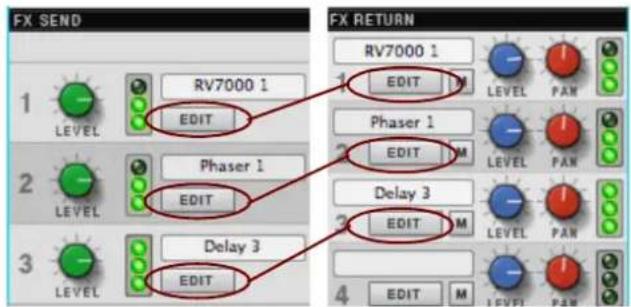
The Edit buttons for the Send effects in the FX Send and FX Return sections.
The corresponding Send effect devices are scrolled into view in the rack.
- Send effects can be edited from their device panels according to standard editing procedures.
Any edits you make will be automatically stored when you save the Song document. If you edit Effect Combin patches, these can also be saved separately as Combinator patches as usual.
Muting Send effects
→ Click one of the "M" buttons in the FX Return section to mute the FX Return for the corresponding Send effect.
All channels that currently use the muted send effect will be affected.
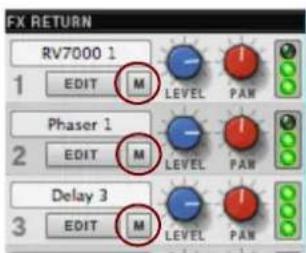
The Mute buttons for the Send effects in the FX Return section.
! The Mute buttons only mute the FX Return signals. If you should choose to route an FX Send output of the Master Section device to an effect, and then route the effect to a regular Mix Channel instead of an FX Return input, the Mute button will of course not have any effect.
Deleting Send effects
Deletion of Send effects is done in the rack according to the standard device deletion procedures:
→ Select the device(s) you want to delete and press [Backspace] or [Delete] - or select "Delete Devices and Tracks" from the Edit or context menu.
An alert appears asking you to confirm the deletion. (See "Deleting devices" for more details).
- When a Send effect has been deleted, the name will automatically be removed from the displays in the FX Send and FX Return sections in the Master Section strip.
Output Busses
Output Busses allow you to create sub-mixers. Sub-mixers can be very useful for pre-mixing a multi-mic'ed drum kit, or a horn section, for example. You can also use a sub-mixer configuration to route several external input signals (from separate microphones, for example) for recording onto a single audio track (see "Recording a sub-mix onto an audio track"). You can have as many mix busses as you like in a Reason Lite song.
- For multiple levels of sub-mixing, it's also possible to create an Output Bus that is fed by an existing Output Bus.
Creating an Output Bus
The fastest and easiest way of creating an Output Bus for several mixer channels is this:
- Select all mixer channel strips that you want to route to the same Output Bus.
- Press [Ctrl]+G or [Cmd]+G - or select "Route to > New Output Bus" from the Edit menu or context menu of one of the selected channels.
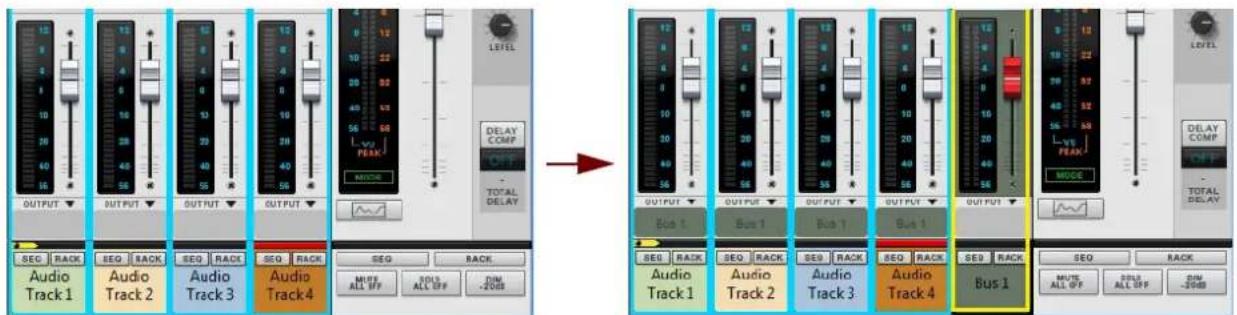
A new Output Bus channel, named "Bus 1", is created to the right and the selected channels are automatically routed to it as indicated on the channels' Output labels.
The step-by-step instructions below show how you can assign individual channels to an Output Bus - one channel at a time. The picture shows a number of Audio Tracks in a song with individual recordings of the drums of a drum kit:
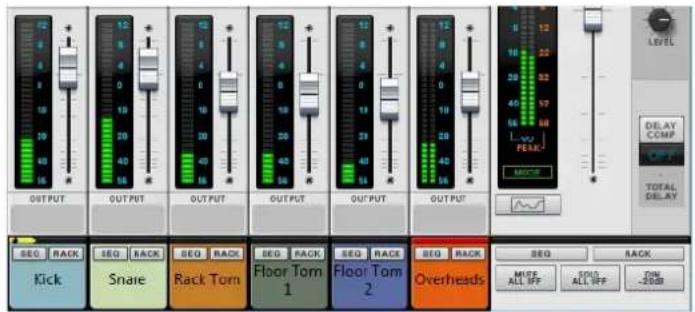
Audio Tracks with separate drum recordings routed to the Master Section.
Now, we want to create a sub-mixer which mixes only the individual drum channels. The advantage of doing this is that we can then control the sound and volume of the entire drum kit using only one single Mix Channel:
- Click the Output selector (the gray name tag) on the Kick channel and select "New Output Bus".
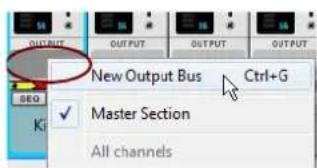
→ Alternatively, select the Kick channel strip and press [Ctrl]+G or [Cmd]+G.
A new Mix Channel is created in the Main Mixer and its corresponding Mix Channel device is created in the Rack. The Kick channel is now routed to the new Mix Channel via the internal P-Lan network.
The Output selector area on the Kick channel is colored and the name "Bus 1" is displayed to indicate the name of the Output Bus it is routed to:
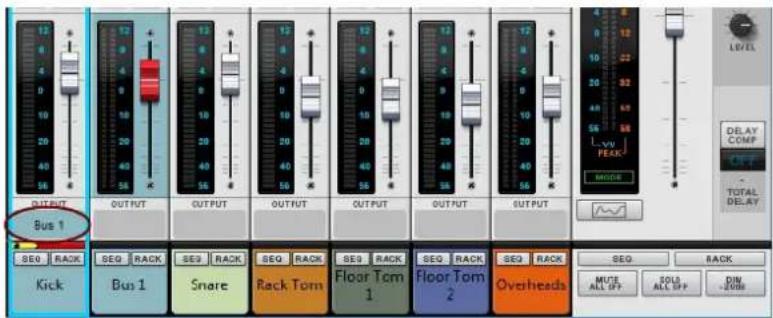
The Fader section of the new Output Bus channel gets a colored background and a red Fader knob to indicate it is an Output Bus.
- Click the Output selector on the Snare channel and select "Bus 1".
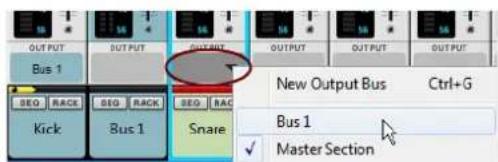
The Output selector area on the Snare channel is now colored in the same color as the Bus 1 channel and the Output Bus name is displayed:
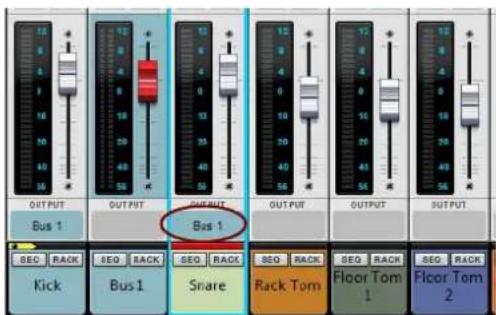
-
Repeat the procedure for the remaining drum channels in the Main Mixer.
-
If you like you could now rename the Output Bus channel, e.g. to Drum Mix, and drag the channel strip to the right of the individual drum channels for better overview:
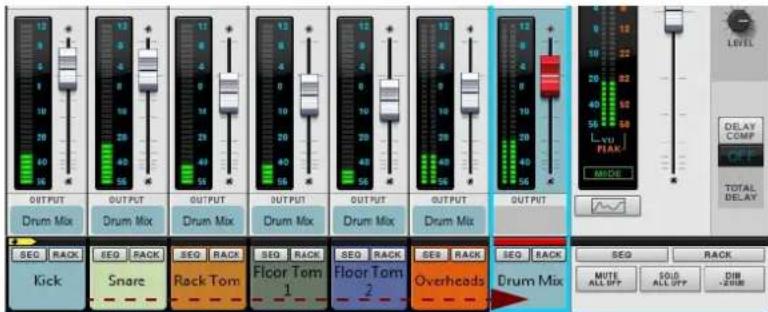
The changed Output Bus name is automatically displayed in the colored Output area on all channels routed to that Output Bus channel.
If you look in the rack, you can see that the Audio Output display on the Audio Track devices for the individual drum channel now show "Drum Mix" instead of the default "Master Section".
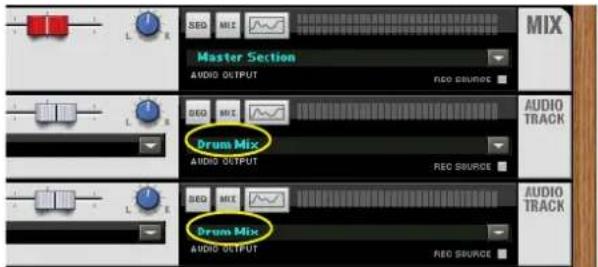
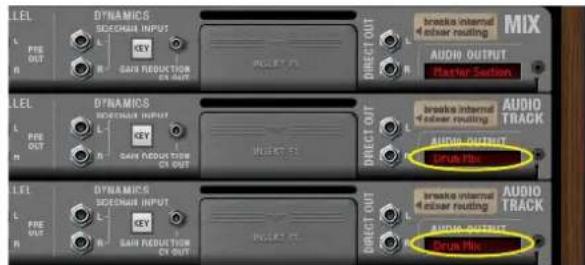
Output Bus destinations on the Audio Track devices in the rack (front and rear).
Rerouting channels
→ If you like you can change the Audio Output destinations - or create new Output Busses - by clicking the Audio Output selector on the device front panel, or in the Audio Output display on the rear panel, or in the Output selector area on the channel strip in the mixer.
! If you manually deassign all channels from the Drum Mix Output Bus channel, the Output Bus channel automatically becomes a regular Mix Channel. If you want to assign channels to this Mix Channel, and thus make it become an Output Bus channel again, click the Audio Output selector on the front panel, or in the Audio Output display on the rear panel, and select "All Channels > Drum Mix". These routings can also be made in the Output selector area on the channel strip in the mixer.
Deleting an Output Bus
To delete an Output Bus channel, select the Output Bus channel strip in the Main Mixer - or the device in the rack - and press [Delete] or [Backspace].
When you delete an Output Bus channel which has other mixer channels already routed to it, the source channels will be automatically re-routed to the default Master Section again via P-Lan.
On the Mix Channel/Audio Track devices in the rack, "Master Section" is now shown in the Audio Output displays to indicate that the channels have been re-routed to the Master Section device.
Recording a sub-mix onto an audio track
The example below shows an Output Bus (sub-mixer) configuration with four microphones connected to one input each on the audio interface and then routed from the Reason Lite Hardware Interface to the Direct Inputs on four Mix Channel devices. The four Mix Channel devices are routed to the "Drums SubMix" Output Bus for sub-mixing:
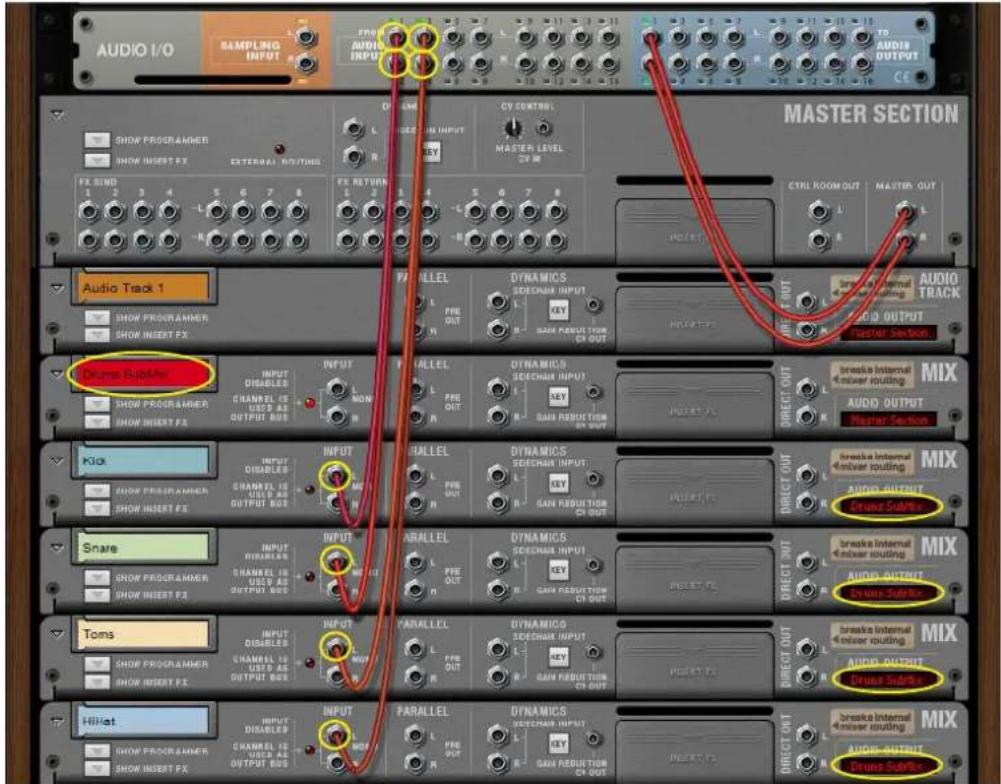
Direct routing of individual Audio Inputs to Mix Channels which, in turn, are routed to an Output Bus for sub-mixing.
To record the sub-mixed signals from the "Drums SubMix" Mix Channel onto Audio Track 1, click the Rec Source button on the "Drums SubMix" Mix Channel device, and then select "Stereo Input" and "Drums SubMix" as Audio Input source on the "Audio Track 1" device:
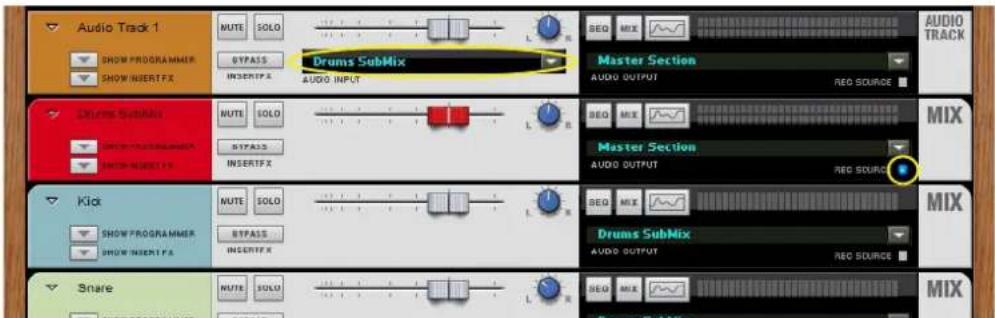
The Rec Source button on the Drums SubMix device activated and "Drums SubMix" selected as Audio Input on the Audio Track 1 device.
See "Recording audio from Mix Channel outputs" for more details.
- In the sub-mixer setups above, each source Mix Channel could also house individual Insert FX. See "Creating an input channel for recording with effects" for tips on how to record with FX.
Parallel Channels
A very flexible way of working with insert effects is to use parallel channels that host the effects, while keeping the dry signal of the source channel intact. This way you can freely control the levels of the dry signal and the separate effects - and also control the sound of each effect individually from each of the parallel channels.
You could, for example, have one parallel channel with a compressed distortion effect, another parallel channel with a Delay, and so on. Then, you can freely EQ the effects in each of the parallel channels, as well as control their levels individually from each Fader.
Creating Parallel Channels
Parallel channels can be created as follows:
- Select the source Mix/Audio Track channel strip in the Main Mixer, or its device in the rack.
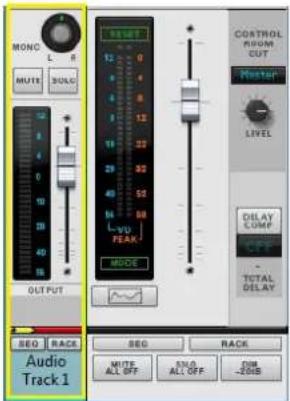
- Select "Create Parallel Channel" from the Edit menu or context menu.
A new Mix Channel is created and placed to the right of your original channel in the Main Mixer:
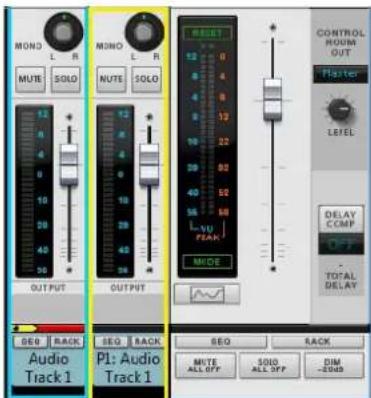
A Parallel Channel created for Audio Track 1.
The parallel Mix Channel is automatically named "P1:
→ If you want to add more parallel channels to your source channel, select the last created parallel channel and select "Create Parallel Channel" from the Edit menu or context menu.
This adds another parallel channel to your source channel:
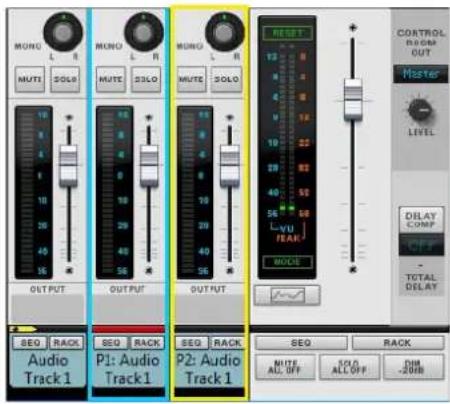
Another Parallel Channel created for Audio Track 1.
In the rack, the Parallel out jack(s) of the source Mix Channel/Audio Track device are automatically connected to the Direct Input jack(s) of the first parallel Mix Channel. The second parallel Mix Channel is then connected to the first parallel Mix Channel, and so on:
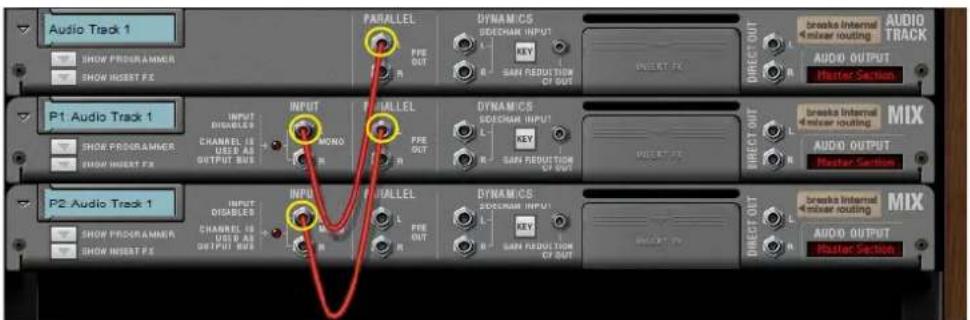
Source device
Parallel channel 1
Parallel channel 2
Parallel Channels 1 and 2 for the Audio Track 1 source channel in the rack.
! Since the Audio Track/Mix Channel device only has one pair of Parallel out jacks, any additional parallel channels have to be created from the last created parallel channel.
If your original channel is in mono, only the left parallel output is connected to the left input of the parallel channel.
- Now, you can create Insert FX in each of the parallel channels and process the signal of your source channel separately, in parallel.
It might also be a good idea to create a separate Output Bus for the source channel and all parallel channels, see "Creating an Output Bus".
Creating a Parallel Output Bus
Parallel channels can also be created for Output Bus channels, for parallel processing of the entire Bus signal. The following example shows a drum kit, with a channel for each drum, that we want to assign to an Output Bus and apply parallel compression to:
-
[Shift]-select all drum channels in the mixer.
-
Press [Ctrl]+G or [Cmd]+G to create a new Output Bus to automatically route the drum channels to.
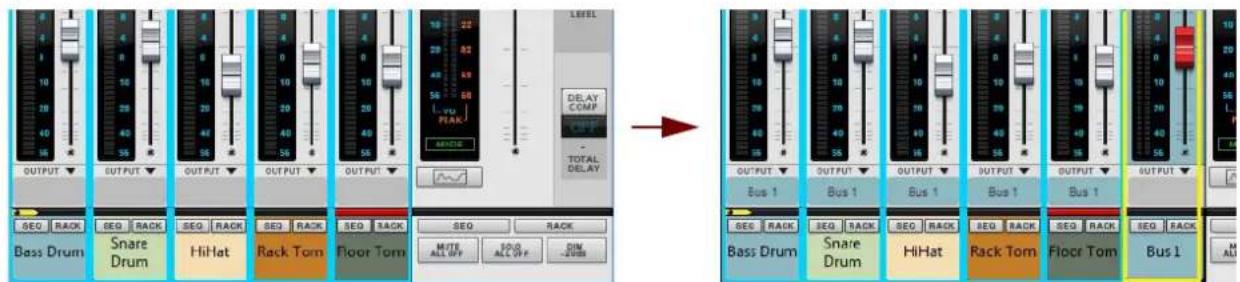
A new Output Bus channel, named "Bus 1", is created to the right and the selected channels are automatically routed to it as indicated on the channels' Output labels.
- Select the "Bus 1" channel in the mixer and select "Create Parallel Channel" from the Edit menu or context menu.
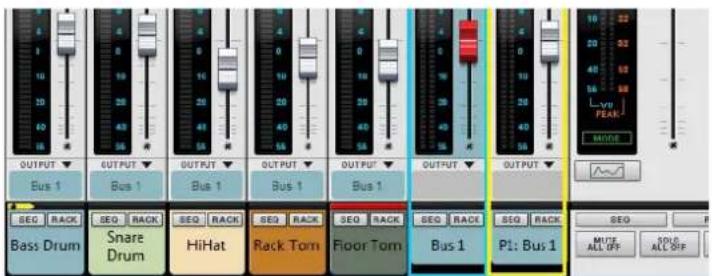
A parallel channel, the "P1: Bus 1" is created and the "Bus 1" Output Bus channel is automatically connected to it.
- Activate the Compressor in the "P1: Bus 1" parallel channel and raise the Compression Ratio up high.
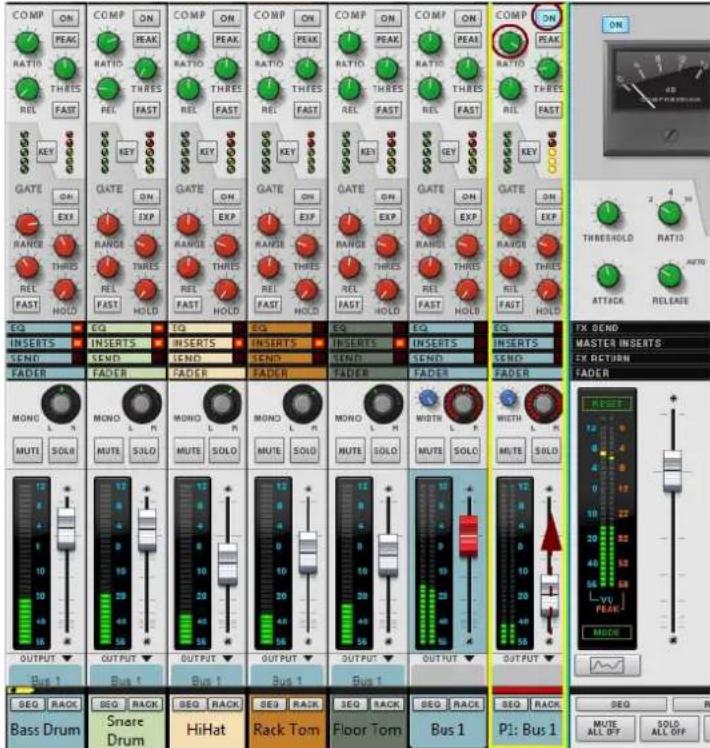
- Raise the Level fader on the "P1: Bus 1" channel to gradually introduce the heavily compressed sound (in parallel with the dry signal of the "Bus 1" channel).
Deleting Parallel Channels
To delete a Parallel Channel, select its mixer channel strip - or its device in the rack - and press [Delete] or [Backspace]. Confirm the deletion in the alert that appears.
Naming Parallel Channels
When you create a Parallel Channel it is automatically named after its source channel according to: "P1:
If you change the name of the source channel, all the parallel channel are automatically renamed accordingly. You can then manually rename each parallel channel afterwards if you like.
To revert to the automatically generated name, double-click the parallel channel's name, press [Delete] or [Backspace] and then [Enter].
Solo, Mute and Send FX logic
The Solo, Mute and Send FX functions in the channel strips are very straight-forward when you work with mixer channels that are routed straight to the Master Section. However, when you are using Output Busses for sub-mixing and/or Parallel Channels for parallel processing, the Solo, Mute and Send FX functions need to work intelligently to provide the desired result. This has been carefully taken care of in the Main Mixer in Reason Lite.
Solo and Mute logic
The Solo and Mute functions are designed to work intelligently in the following special scenarios:
- When several mixer channels are routed to an Output Bus.
- When a mixer channel has one or more Parallel Channels.
- When Output Busses are routed to other Output Busses.
- When Output Busses have Parallel Channels.
Solo and Mute examples
There are two ways a mixer channel can be soloed or muted:
- Manually, by clicking the corresponding Solo or Mute buttons. In these situations, the buttons light up in green (Solo) or red (Mute).
- Automatically, according to the state(s) of the other mixer channels. This happens when another mixer channel is affected by a manual Solo/Mute in another mixer channel. Automatically soloed/muted buttons light up in dimmed green (Solo) or dimmed red (Mute) color.
The examples in the figure below show how Solo and Mute work in different mixer channel configurations:
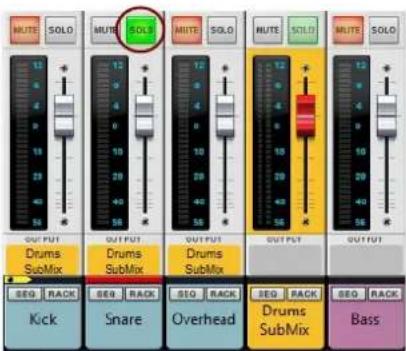
The Snare channel has been manually soloed.
Since the Snare channel is routed to the Drums SubMix Output Bus, the Drums SubMix bus is automatically soloed to let the Snare signal through to the Master Section.
All other mixer channels are automatically muted.
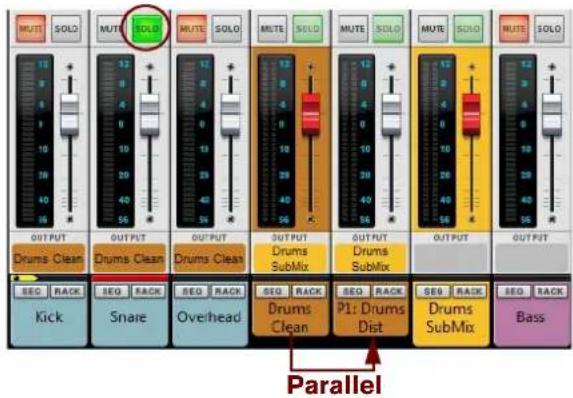
The Snare channel has been manually soloed.
Since the Snare channel is routed to the Drums Clean Output Bus, the Drums Clean Output Bus is automatically soloed to let the Snare signal through.
The Drums Clean Output Bus is routed to the Drums SubMix Output Bus. The Drums Clean channel also has a parallel channel; the Drums Dist, which is also routed to the Drums SubMix Output Bus.
This means that the Drums Clean, Drums Dist and Drums SubMix channels are automatically soloed to let the Snare signal through to the Master Section.
All other mixer channels are automatically muted.
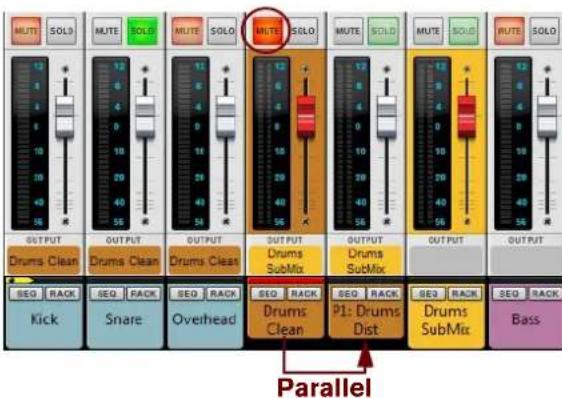
Now, if we manually mute the Drums Clean Output Bus channel from the previous example, its automatic solo is disabled, allowing you to hear the sound of the Drums Dist bus only.
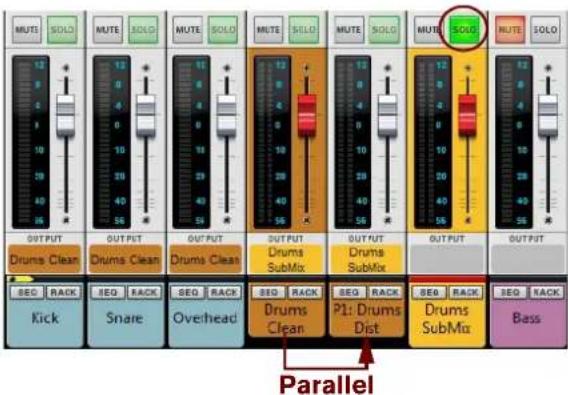
If we start from scratch again and click the Solo button in the Drums SubMix channel, all channels routed to the Drums SubMix Output Bus are automatically soloed.
All other mixer channels are automatically muted.
Below is another example of the Solo and Mute logic:
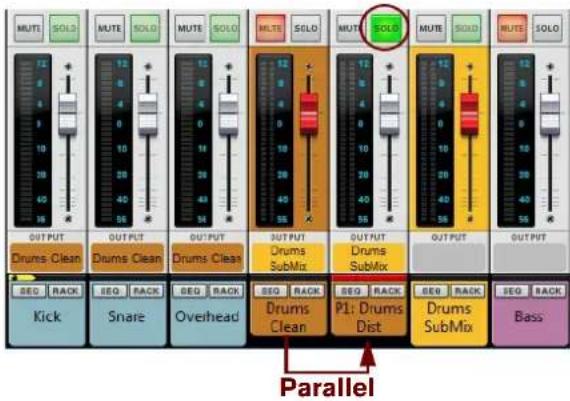
The Drums Dist parallel channel is manually soloed.
Its output bus, the Drums SubMix, is automatically soloed, as are the Kick, Snare and Overhead channels that are routed to the Drums Dist channel via the parallel connection from the Drums Clean channel.
The Drums Clean channel is automatically muted, as are the other remaining channels in the mixer.
Send FX level and mute logic
If you are using Send FX in your mixer channels, these need to behave intelligently when you are using Output Bus channels and/or Parallel Channels.
Send FX level examples
Since the eight Send FX busses in the Main Mixer are shared between all mixer channels, including Output Bus channels, there has to be a way to compensate the Send FX levels for changes in Output Bus levels. Therefore:
- If a channel is routed to an Output Bus, its Send FX levels will follow the Output Bus level.
One example would be if you have a number of drum channels routed to a "Drums" Output Bus, and add a reverb to the Snare channel using an FX Send. Now, if you raise or lower the Drums Output Bus level fader, the individual Snare reverb Send level will automatically adjust, so that the effect balance is maintained.
! Note that the automatic Send FX level adjustment is disabled if the Send FX PRE button is on.
! Note that the individual FX Send level knobs will not move to reflect the automatic level compensations.
Send FX mute examples
The example in the figure below shows how the Send FX behave when an Output Bus channel is muted:
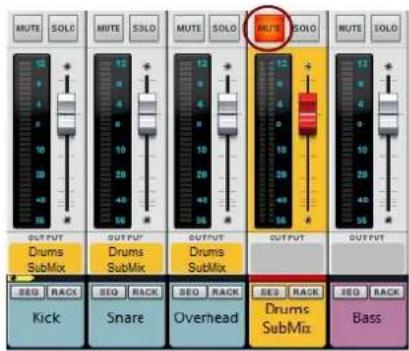
The Send FX outputs of all channels that are routed to the Drums SubMix Output Bus are automatically muted if you manually mute the Drums SubMix Output Bus channel.
The examples in the figure below show how the Send FX behave when you mute a Parallel Channel as well as a Parallel Channel plus an Output Bus:
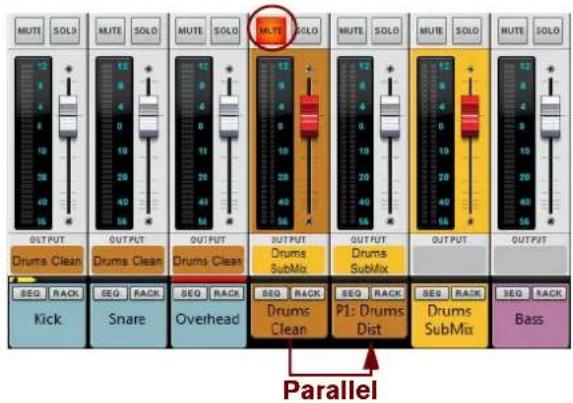
The Drums Clean Output Bus is manually muted.
Since the Drums Clean output bus is connected to an unmuted Parallel Channel, the Drums Dist channel, the Send FX outputs of the Kick, Snare and Overhead channels are not muted. However, if you should manually mute the Drums Dist channel, the Send FX outputs of the Kick, Snare and Overhead channels should be automatically muted.

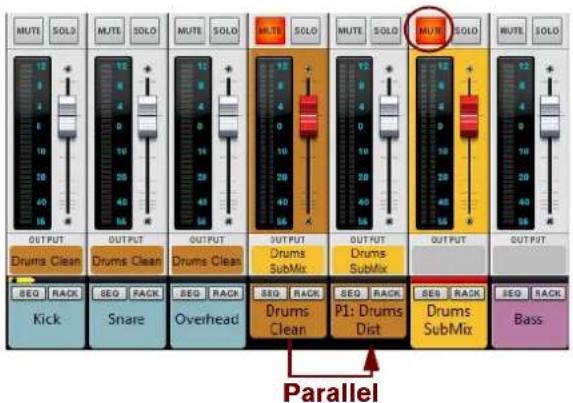
Now, if you also manually mute the Drums SubMix Output Bus, the Send FX outputs of all channels that eventually end up in the Drums SubMix Output Bus will be automatically muted.
Remote controlling the Main Mixer
There are two ways of Remote controlling the Main Mixer: one channel at a time, for detailed control of the parameters of one mixer channel at a time, or multiple channels simultaneously, for balancing levels etc.
Remote controlling a single mixer channel
You can control a single mixer channel, either by locking your control surface to the mixer channel, or by setting Master Keyboard Input to the mixer channel's track in the sequencer.
For example, if you set Master Keyboard Input to the audio track you're recording on, you will be able to adjust the monitor level and other parameters of the channels you're using when recording.
The extensive Remote control functionality in Reason Lite allows for detailed control of the parameters of one mixer channel at a time.
Remote controlling multiple mixer channels
The typical way of remote controlling the Main Mixer is to control the Master Section (by setting Master Keyboard Input to the Master Section track in the track list, or typically by locking your control surface). This lets you control the Master Section parameters plus mixer parameters for a number of channels (often 8 channels at a time, depending on the control surface). To define what channels to remote control at a given time, you need to set the "Remote Base Channel".
Setting the Remote Base Channel
The first (leftmost) mixer channel controlled by Remote is called the "Remote Base Channel". The current Remote Base Channel is indicated by a yellow arrow symbol in the mixer channel strip Header section:
The Remote Base Channel indicator.
To change the Remote Base Channel, proceed as follows:
→ Select a mixer channel and select "Set Remote Base Channel" from the Edit menu or context menu. The Remote Base Channel indicator will move to the selected mixer channel.
→ Alternatively, change Remote Base Channel via Remote (in steps of 1 or 8 channels).
Functions for changing the Remote Base Channel may already be mapped to buttons on your control surface - see the "Control Surface Details" pdf document. If not, you can set this up manually in the Additional Remote Overrides dialog on the Options menu - see "Additional Remote Overrides...".
Remote controlling multiple mixer channels - an example
If you want to remote control several channel strips at once from your control surface, you can proceed as follows:
→ Select the Master Section device in the rack or the Master Section Strip in the Main Mixer.
If you want to lock your control surface to the Master Section, select "Lock Xxxxx to This Device" from the Edit menu or context menu. ("Xxxxx" represents the name of your connected control surface.) This way, you can ensure that your control surface will always control the Main Mixer, regardless of where the edit focus is.
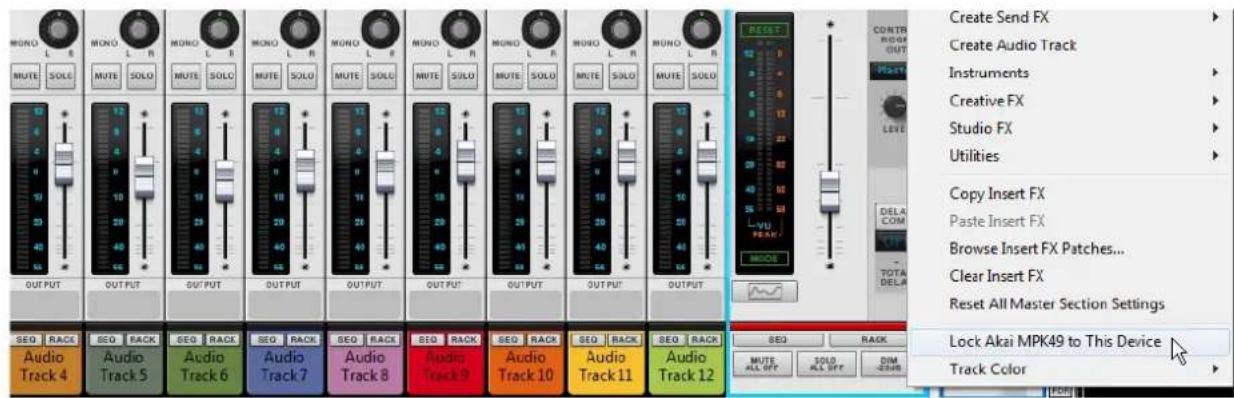
Selecting and locking the Master Section to the connected control surface.
Depending on your connected control surface, it may now be possible to control parameters of several channel strips at the same time. In this example, we're using a control surface which has nine sliders. These sliders are configured to control one channel strip Level Fader each, plus the Master Section Level Fader.
In the picture below, the Remote Base Channel is currently set to Audio Track 1. This means we can control the Level Faders of Audio Track 1 through Audio Track 8, plus the Master Section Level Fader, with the nine sliders on the control surface:
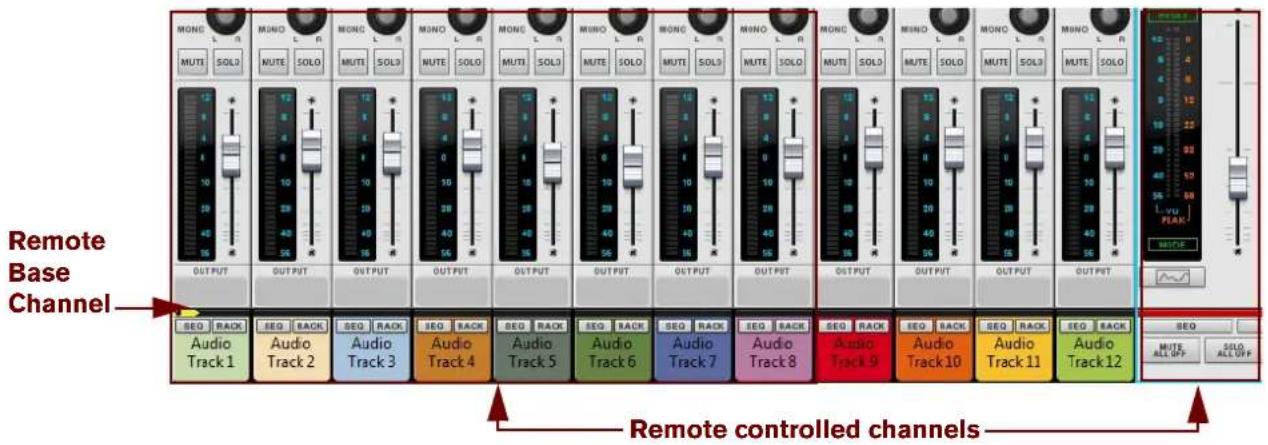
Controlling Audio Track 1 through Audio Track 8 and Master Section from the connected control surface.
On our control surface it's possible to select next and previous Remote Base Channel in steps of 8 channels. If we click the "Next" button on our control surface, the Remote Base Channel is set to Audio Track 9 and we can now control Audio Track 9 through Audio Track 12, plus the Master Section:
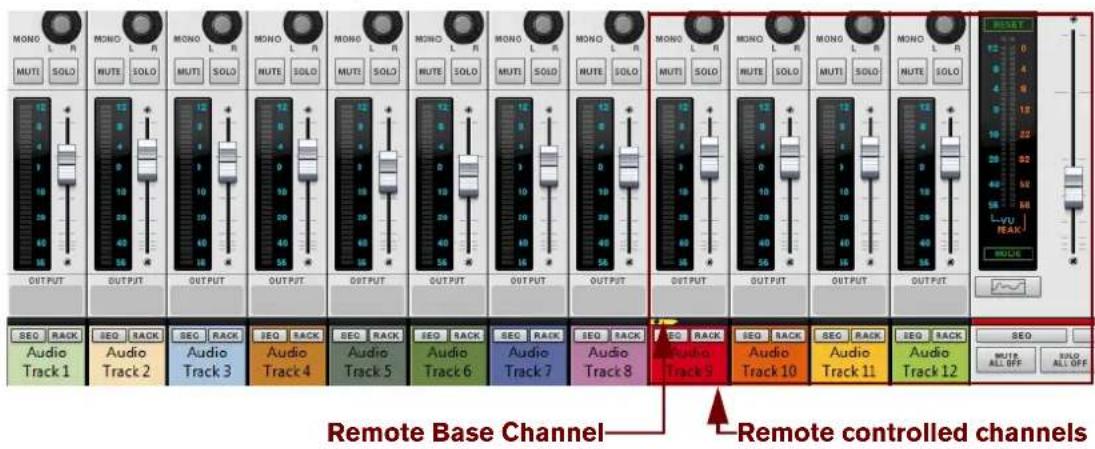
Controlling Audio Track 9 through Audio Track 12 and Master Section from the connected control surface.
If your control surface doesn't have buttons already assigned for controlling Remote Base Channel selection, you can manually assign controllers for this by using the Remote Override function described in "Remote Override mapping". Alternatively, select a channel strip and select "Set Remote Base Channel" from the Edit menu or context menu.
See "Remote - Playing and Controlling Devices" for more details about remote controlling Reason Lite. See also the "Control Surface Details" pdf document for information about parameter assignments on various common control surfaces.
Advanced routing tips and tricks
Chaining Send effects from Redrum or Mixer devices
The Redrum Drum Module and the Mixer 14:2 and 6:2 devices have separate Send FX connectors where you can add send effects individually for each device. The Redrum and Mixer devices also have separate Send FX level pots for each drum/mixer channel so that you could set the send effect levels individually for each drum/mixer channel in the device.
Let's say you want to add a Redrum device and use two of the Main Mixer's Send FX, but with individual settings for each of the Redrum device's internal channels. In the example below, we're going to chain the two Send Outs from the Redrum device to two send effects in the Main Mixer:
- Create two extra Mix Channel devices - one for each of the send effects we're going to chain.
In this example we name the Mix Channel devices "FX 1 Chaining" and FX 2 Chaining".
- Activate the Send FX bus you want to use in each of the mixer channels and also activate the corresponding Pre-fader button.
In this example, we activate the Send FX 1 bus on the FX1 Chaining channel and the Send FX 2 bus on the FX 2 Chaining channel. The Send FX 1 has a reverb connected and the Send FX 2 has a delay connected.
! The PRE buttons should be activated because we don't want the mixer channel faders to affect the Send levels.
- Lower the "FX 1 Chaining" and "FX 2 Chaining" mixer channel faders to zero.
This way, the effect signals won't be mixed with the rest of the Main Mixer channel signals in the mix bus, but are kept isolated in the Send FX busses. Now, our setup should look like this in the rack and in the Main Mixer:
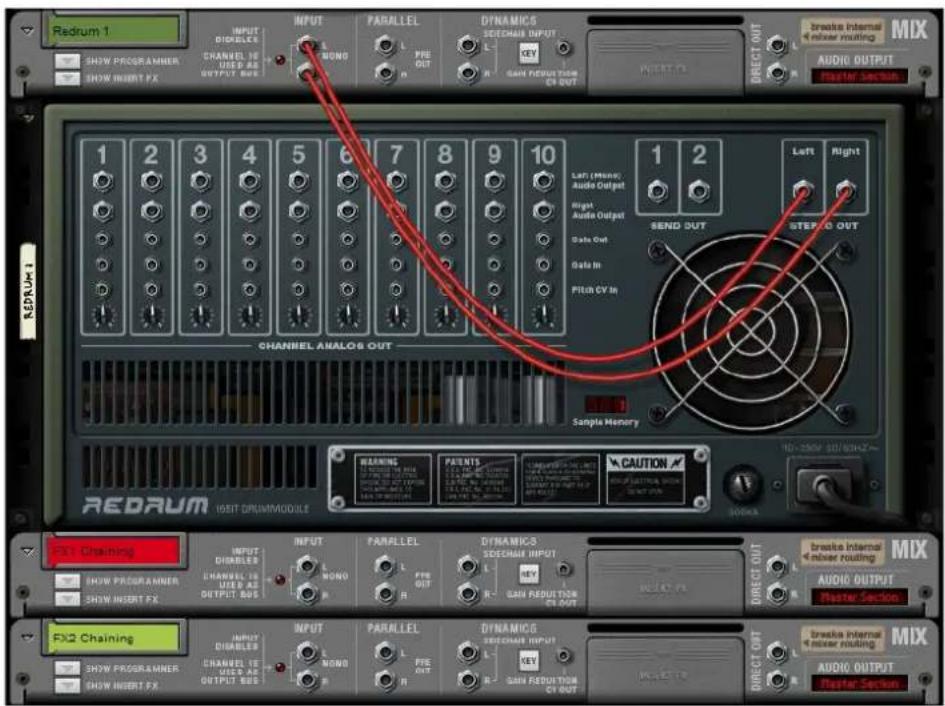
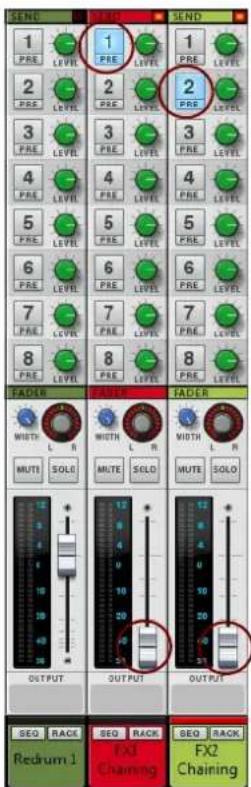
The device setup, plus two new Mix Channel devices added. To the right, the channel strips with activated FX Send busses.
4. Connect the Send Out 1 and 2 of the Redrum device to the Left inputs of each of the "FX 1 Chaining" and "FX 2 Chaining" Mix Channel devices.
Now, you should have a setup that looks something like this:
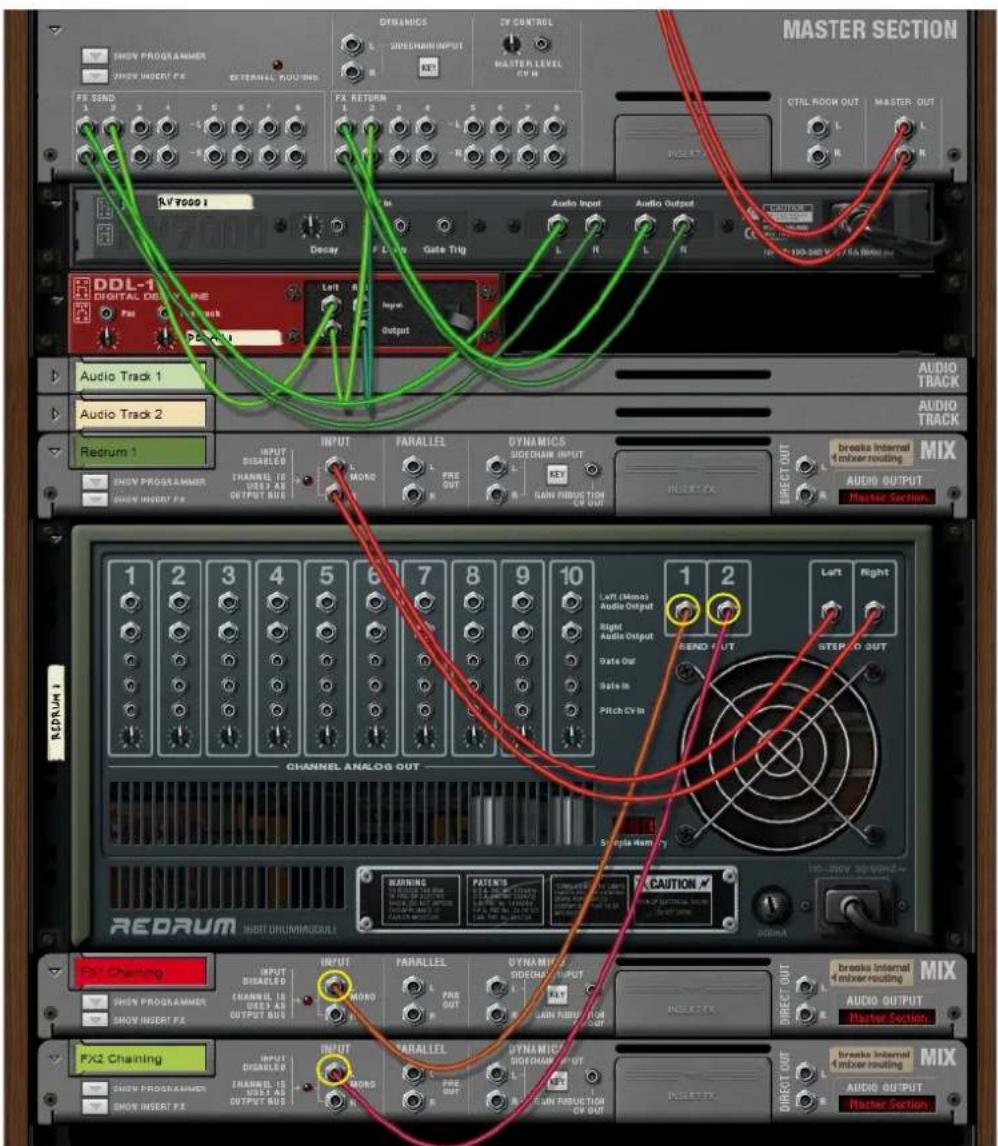
The Redrum Effect Sends chained to one Send FX bus each of the Master Section, via two new Mix Channel devices.
5. Set individual Send levels for each of Redrum's internal channels.
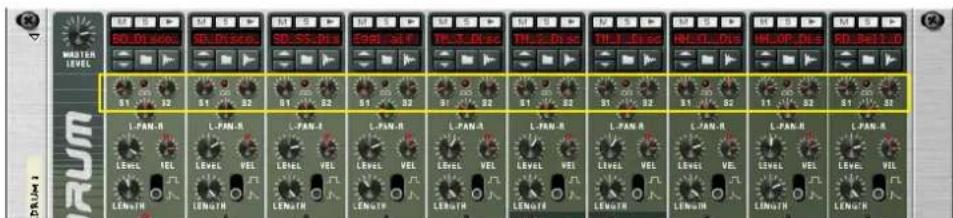
Now, you have individual send levels for each of the Redrum device's internal channels - and are still able to use the Send FXs in the rest of the Main Mixer channels like before.
Using compression sidechaining
Compression sidechaining is a feature which lets you control the Compressor, not from the internal channel signal, but from an external signal. A typical use case would be to let the signal from a kick drum channel control the compression of the bass channel. The result would be that the bass signal is compressed each time the kick drum signal is present on the sidechain input, allowing the kick sound to momentarily suppress the bass sound.
Compression sidechaining from an external channel
The example below shows an audio track with a kick sound that is tapped from the Kick Audio Track device's Parallel output and routed to the Dynamics Sidechain input of the Bass Audio Track device.
- The Key button is automatically activated when you connect a signal to the Sidechain Input.
This will force the Compressor to be controlled from the Sidechain input signal rather than from the internal signal.
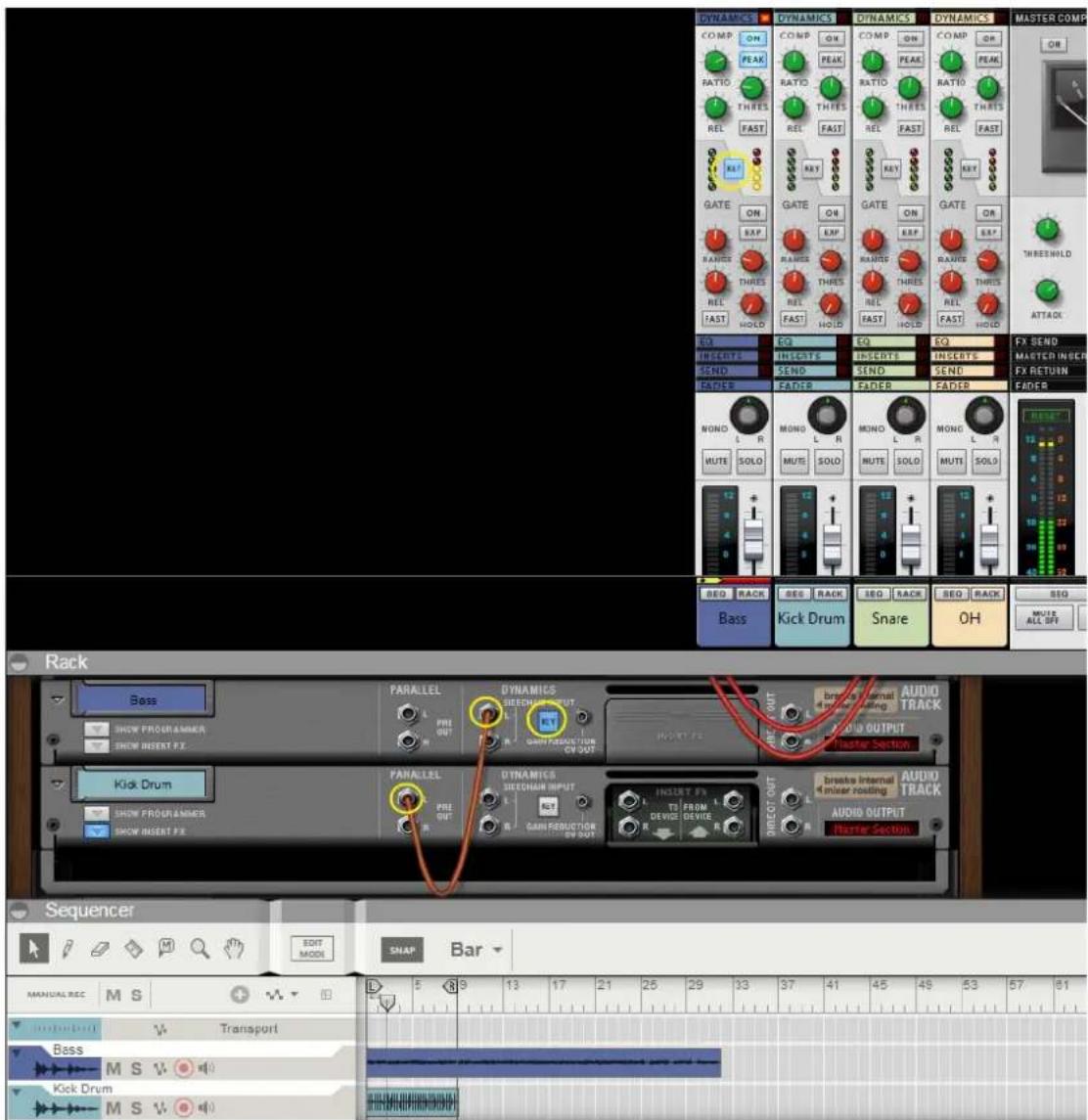
Compression Sidechaining of the Bass audio track from the Kick Drum audio track.
About compression sidechaining of several channels from one source channel
If you want to use compression sidechaining of several (destination) channels from a single source channel, there are some options of doing that:
- If you are already using both Parallel outputs for sidechaining, tap an additional sidechain signal from one of the Insert FX “To Device” outputs of the source channel.
This is useful if you are not using both "To Device" outputs for insert effects in the source channel. - Use a “Spider Audio Merger & Splitter” device to split the sidechain signal from the Parallel outputs and/or Insert FX “To Device” output into several signals.
Each of these signals can then be individually routed to each Sidechain Input of the desired destination Audio Track/Mix Channel devices. - Create an Output Bus (sub-mixer) and route all (destination) channels you want to control to this Output Bus. Then, route the sidechain signal from the source channel device to the Sidechain Input of the Output Bus Mix Channel device.
See "Output Busses" for information.
About internal compression sidechaining
Another typical application for compression sidechaining is to use the internal signal of the channel, filter it, and then feed to the compressor via "internal" sidechaining. This type of internal sidechaining can be used for de-essing, for example. No additional patching is required for this; you only have to activate the "Filters to Dynamics Sidechain" button in the Filter or EQ sections. See "About the Filters To Dynamics Sidechain button".
Using the Mix Channel and Audio Track devices' Direct Outs
The Mix Channel and Audio Track devices feature Direct Out connectors. By patching cables into these outputs, you break the internal signal chain from the device to the Master Section, and can route the channel output signals directly to the Reason Lite Hardware Device's outputs. This is a very nice feature if you want to use outboard mixing or summing, and route individual channel signals to separate outputs of your audio interface.
The example below shows how to route the Direct Outs of a number of Audio Track devices to separate outputs of the Reason Lite Hardware Interface:
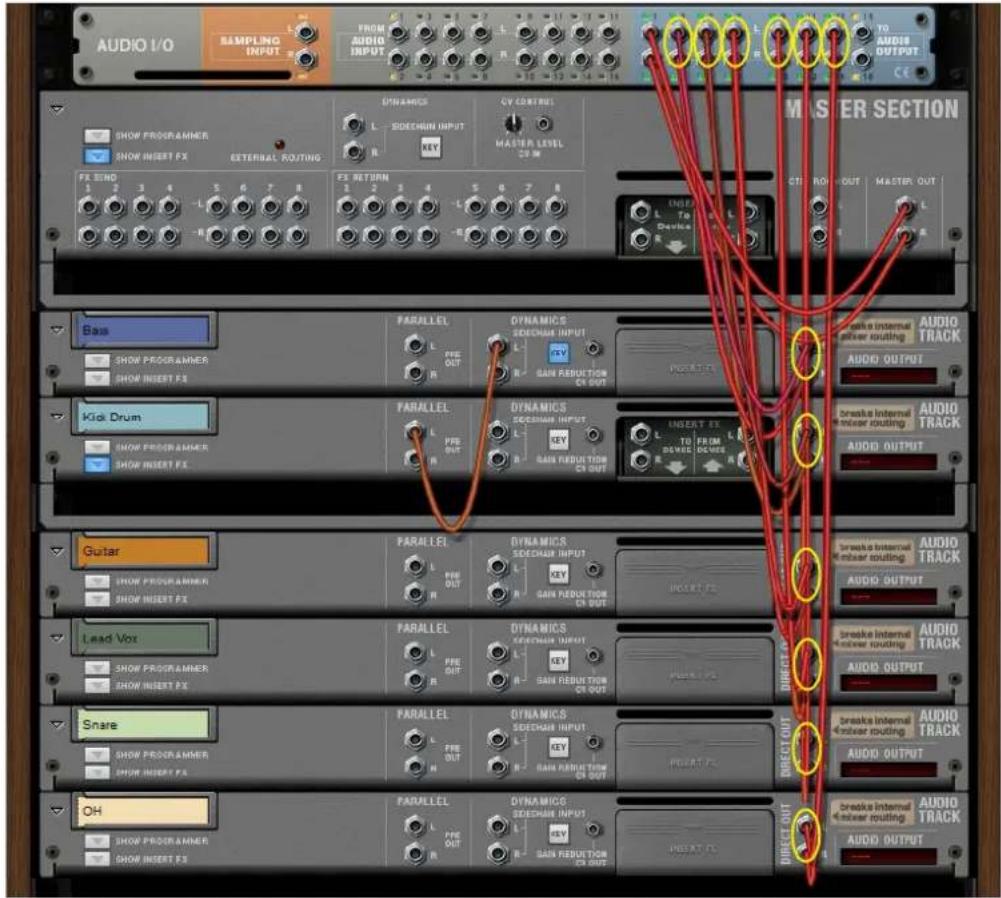
Direct routing of individual channel outputs to individual outputs on the Reason Lite Hardware Interface.
! Using the Direct Outs will break the internal P-LAN routing to the Master Section device. This is indicated by the red dashes (---) in the Audio Output display on the Audio Track/Mix Channel devices.
Creating an input channel for recording with effects
When you record on an audio track, the input signal is routed "dry" to the audio track. Then, when you play back the recorded audio, the signal goes via the channel strip, with all its settings and any Insert FX etc. However, there might be situations where you want to record a processed signal to the audio track. For example, if you record an electric guitar, you might want to record it with distortion effects or similar.
The example below shows a typical setup where a separate Mix Channel device is used for processing the input signal before it's routed to the audio track for recording:
- Begin by creating an Audio Track device and a separate Mix Channel device.
The Mix Channel device is going to be used for housing the effects we're going to record with.
- Create the effect(s) you want to use and patch them as Insert FX in the Mix Channel device.
In this example, we use a Scream 4 distortion device and an RV7000 reverb device connected in series.
3. Connect one of the Audio Ins of the Reason Lite Hardware Interface to the "Input L" of the Mix Channel device.
This manual patching from the Hardware Interface is made to route the input signal directly to the Mix Channel device, where we have our effects.
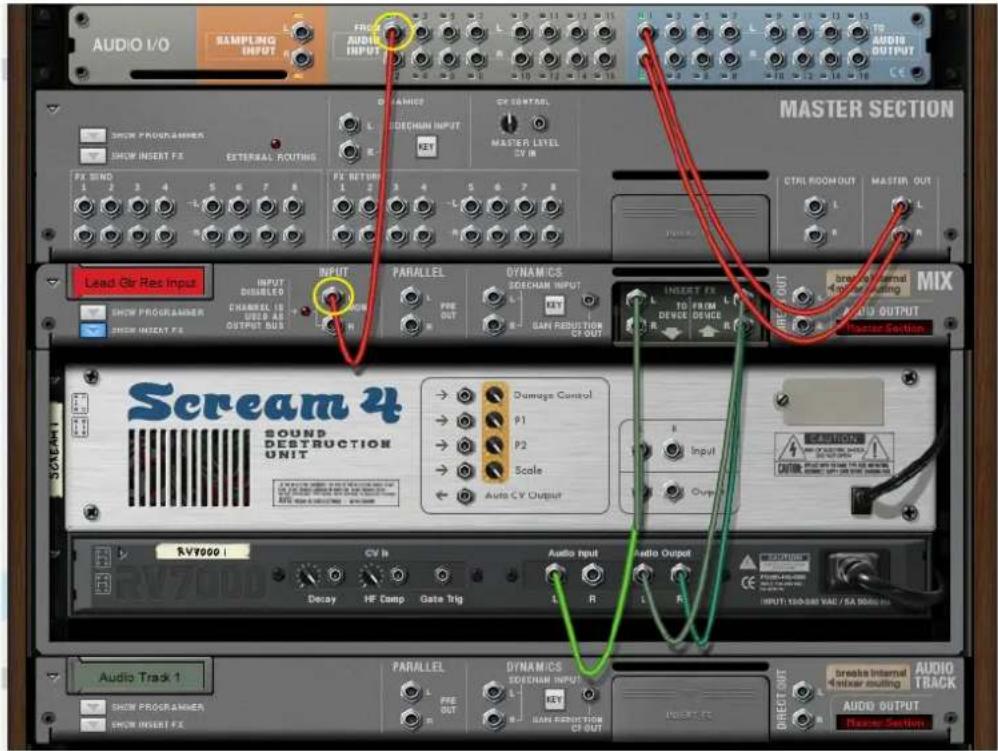
Direct routing of an Input signal from the Reason Lite Hardware Device to the Mix Channel device.
4. Flip the rack around to view the front.
5. Click the "Rec Source" button on the Mix Channel device.
This makes the Mix Channel device selectable as input source for the Audio Track device.

Rec Source enabled on the Mix Channel device.
- Finally, select the Mix Channel device as Input on the Audio Track in the sequencer (or in the Audio Input selector on the Audio Track device in the rack).
This will route the signal from the Mix Channel device's output directly to the input of the Audio Track.
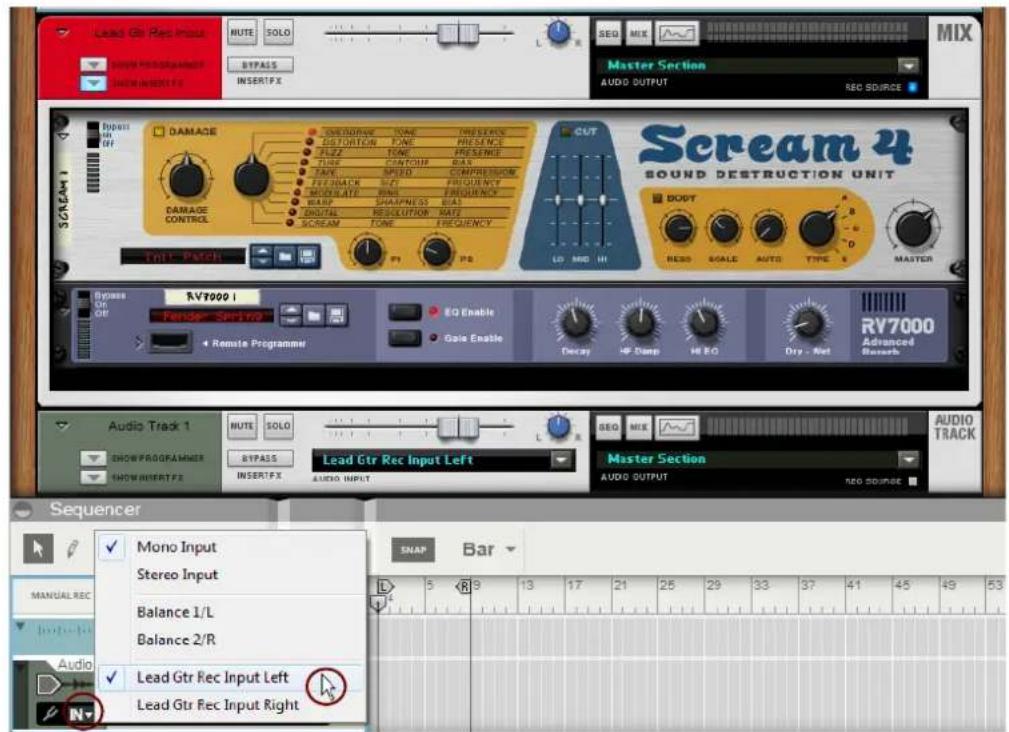
The Mix Channel device selected as audio input on the Audio Track in the sequencer.
Now, you can begin recording on the Audio Track according to the standard recording procedures described in "General recording procedure". The signal will be processed by the Insert FX of the Mix Channel device before being recorded on the track.
With this setup, you will always hear the sound of the input processed through the Amp device - just as if you had a real hardware amp turned on and mic'ed in the studio. If you don't want the "Lead Gtr Rec Input" Mix channel to be heard, just mute it in the Main Mixer.
Chapter 18
Delay
Compensation
About this chapter
This chapter describes how delay compensation is implemented in Reason Lite.
About Delay Compensation in Reason Lite
Delay compensation is desired because some effect devices have inherent latencies, due to internal processing (re-sampling, FFT, lookahead compression etc). When a signal passes through such a device, it gets delayed and thus "out-of-sync" with other signals. This is especially noticeable if you're using Parallel Channels in the Reason Lite mixer, because both the original channel and the parallel channel(s) carry the same source signal. If the effects on one of these parallel channels delay the signal, this will be heard as comb filtering, phasing, blurring, etc.
Traditionally, Reason hasn't had any delay compensation, mainly because of the totally free routing possibilities. However, now Reason and Reason Lite feature delay compensation for its native effect devices, Rack Extension effect devices and VST effect plugins.
Typically, there are two ways to achieve delay compensation:
By inserting "invisible" delays on the other signal paths, so that all paths are delayed equally.
By having the tracks with latency effects in their paths play back earlier.
- Reason Lite uses the first delay compensation method only, i.e. inserting delays in the other signal paths.
Activating the Delay Compensation
The delay compensation can be activated in the Master Section fader section, on the Transport panel, and on the Options menu.
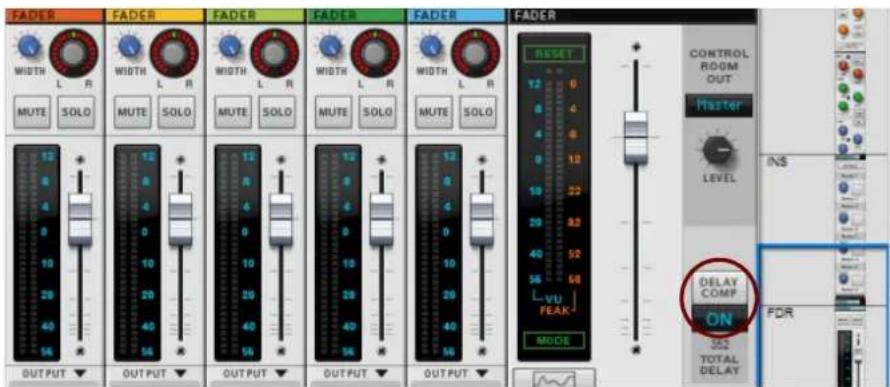
The Delay Compensation button in the Master Section of the Main Mixer.

The Delay Compensation button on the Transport panel.
→ Click the Delay Comp button to switch on/off the delay compensation.
When on, the delay compensation affects all configurations described in "Delay Compensation rules" below.
- The total signal path latency is displayed (in no. of samples) below the Delay Comp buttons.
Hovering over any of these latency figures brings up a tool tip which also displays the latency in milliseconds.
Delay Compensation rules and limitations
Due to the free routing possibilities in Reason Lite, delay compensation could become infinitely complicated. Therefore, we have chosen to keep it fairly simple by imposing some general rules and limitations.
! The delay compensation aims at getting a coherent mix using the main mixer in a *standard* configuration. If you do unconventional routings, the delay compensation may not work as intended and things might sound off. See "Problematic configurations" for examples of problematic routings.
Delay Compensation rules
Here are the basic rules for delay compensation in Reason Lite:
- Delay compensation can be applied to Effect devices that are connected in series between an instrument device and the inputs of a Mix Channel device:
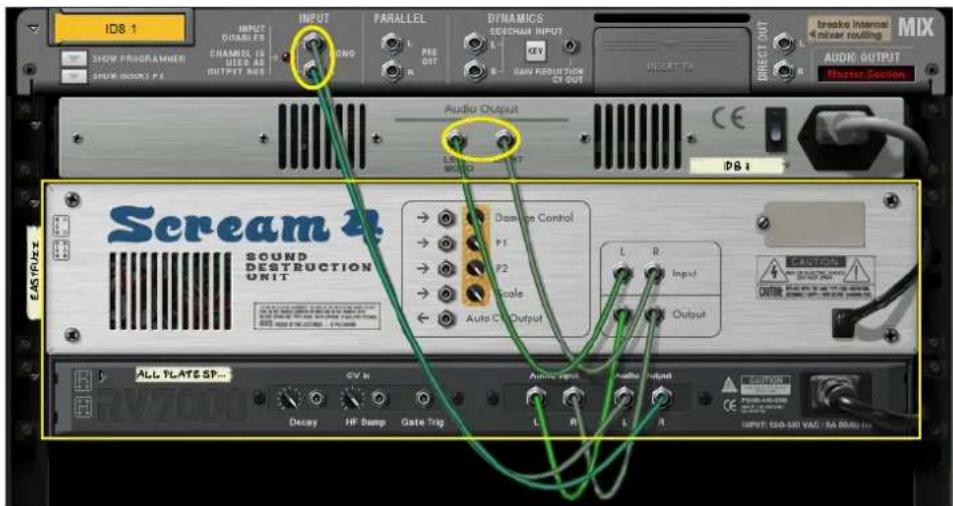
An ID8 instrument device routed via a Scream 4 effect and an RV7000 Reverb effect in series.
The configuration above can be described schematically in the following picture:
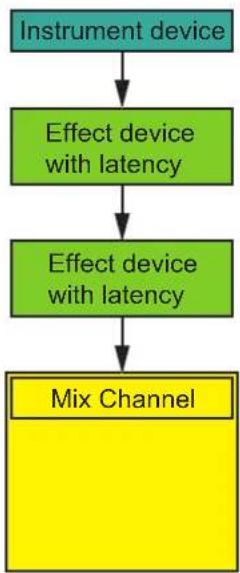
flowchart
graph TD
    A["Instrument device"] --> B["Effect device with latency"]
    B --> C["Effect device with latency"]
    C --> D["Mix Channel"]
- Delay compensation can be applied to Effects devices connected in series as Insert FX in the mixer channels (between the "To/From Insert FX" jacks on Audio Track and Mix Channel devices):
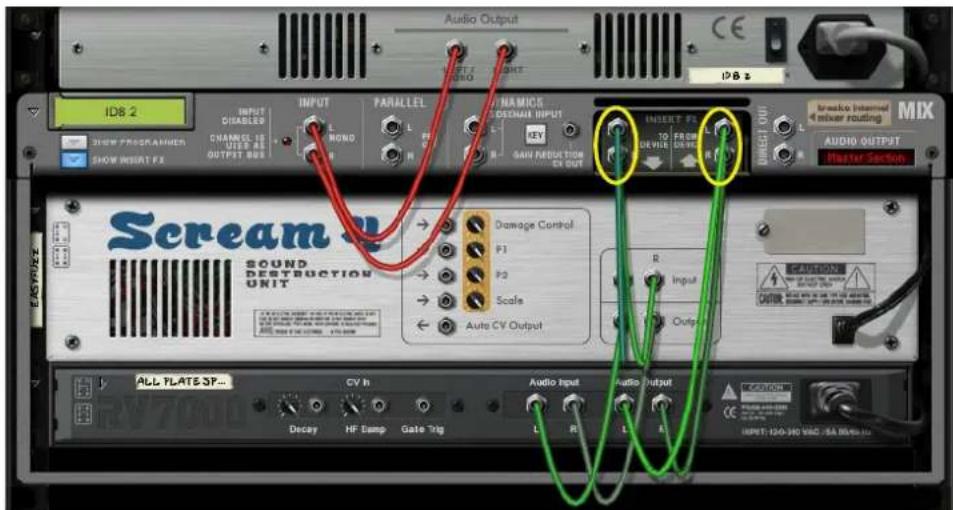
A Scream 4 and an RV7000 effect device routed in series as an Insert FX in a Mix Channel.
The configuration above can be described schematically in the following picture:
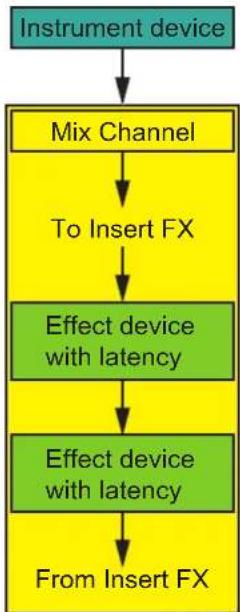
flowchart
graph TD
    A["Instrument device"] --> B["Mix Channel"]
    B --> C["To Insert FX"]
    C --> D["Effect device with latency"]
    D --> E["Effect device with latency"]
    E --> F["From Insert FX"]
- Delay compensation can be applied to Effect devices that are connected in series between the Parallel Out jacks of a Mix Channel or Audio Track device, to the Input jacks of another Mix Channel device:
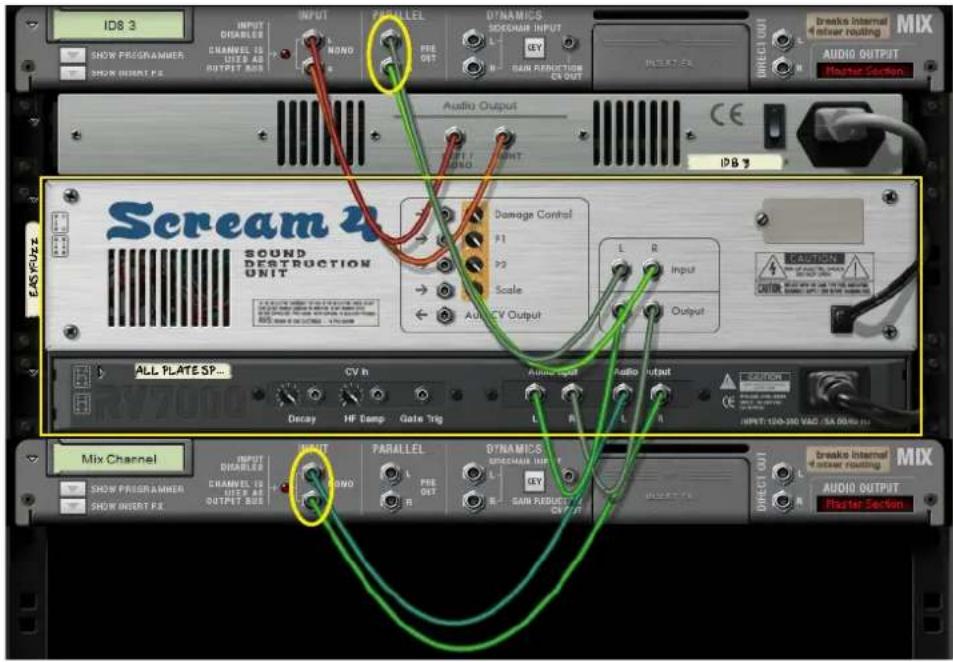
The Parallel Outs of a Mix Channel (ID8 3) routed via a Scream 4 and an RV7000 to another Mix Channel (Mix Channel).
The configuration above can be described schematically in the following picture:
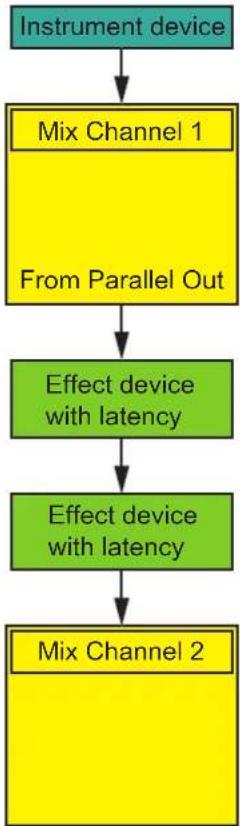
flowchart
graph TD
    A["Instrument device"] --> B["Mix Channel 1"]
    B --> C["From Parallel Out"]
    C --> D["Effect device with latency"]
    D --> E["Effect device with latency"]
    E --> F["Mix Channel 2"]
- Delay compensation can also be applied to combinations of the three examples above.
This could be, for example, if an Instrument device is routed in series via Effect devices to a Mix Channel device, and the Mix Channel device has Effect devices in series in its Insert FX section. Then, the latency is summed for all effect devices in the serial signal chain.
- Delay compensation can be applied to signals that are sent from the mixer channels to the Send FX busses.
This means that the signals from the Mix Channels are delay-compensated (if necessary) before they are sent to the Send FX busses.
- Reason Lite fully depends on getting latency values reported from the Effect devices/plugins.
In other words, Reason Lite doesn't measure any latency of the effect devices. However, you can manually adjust the delay compensation if needed (if things sound wrong due to plugins reporting wrong latencies etc.). See "Manually adjusting the latency values" for more details.
Delay Compensation limitations
- Only signals routed to a channel in Reason Lite's main mixer will be compensated. There is no delay compensation for the channels on a rack mixer, such as Mixer 14:2.
- Only signals that pass the Master Section will be compensated (not channels connected using Direct Outs, see "About using the Direct Out connections of the mixer channels").
- The delay compensation ignores the latency reported by devices connected as Send Effects (see "About Send FX Returns").
- With some non-standard routings (splits, loopbacks, cross-routing etc), delay compensation may not work or may be limited. See "Problematic configurations".
- Effects inside an Instrument Combinator are not delay-compensated (but Effect Combis are).
- CV, MIDI and automation signals are not delay-compensated.
- MIDI Clock sync and Ableton Link are not delay-compensated.
However, you can manually adjust the MIDI Clock Sync Offset, see "External synchronization considerations".
How the Delay Compensation works
Delay Compensation in individual mixer channels
As soon as you add an effect device/plugin as Insert FX in a Mix Channel or Audio Track device - or in the Master Section device - the sum of the reported inherent latencies of the effect devices in that channel is displayed (in samples) at the bottom of the Insert FX section on the corresponding channel strip in the main mixer. If you add more effect devices in an Insert FX chain, the latency figures are added and summed to a total latency value, which is then displayed in the respective Insert FX sections:

Latency values (in samples) displayed in the Insert FX sections on the main mixer channel strips.
- Hovering over any of these latency figures brings up a tool tip which also displays the latency in milliseconds.
What Reason Lite then does to compensate for the inherent latencies in effect devices is to automatically add "invisible delays" to the signals of the other mixer channels. The goal for the delay compensation is to have all mixer channel signals arriving at exactly the same time to the Master Section of the main mixer.
In the picture below, four mixer channels with different Insert FX devices are routed to the Master Section of the main mixer. Reason Lite checks which mixer channel has the longest combined inherent latency, by summing the effect device's reported latencies individually for each channel.
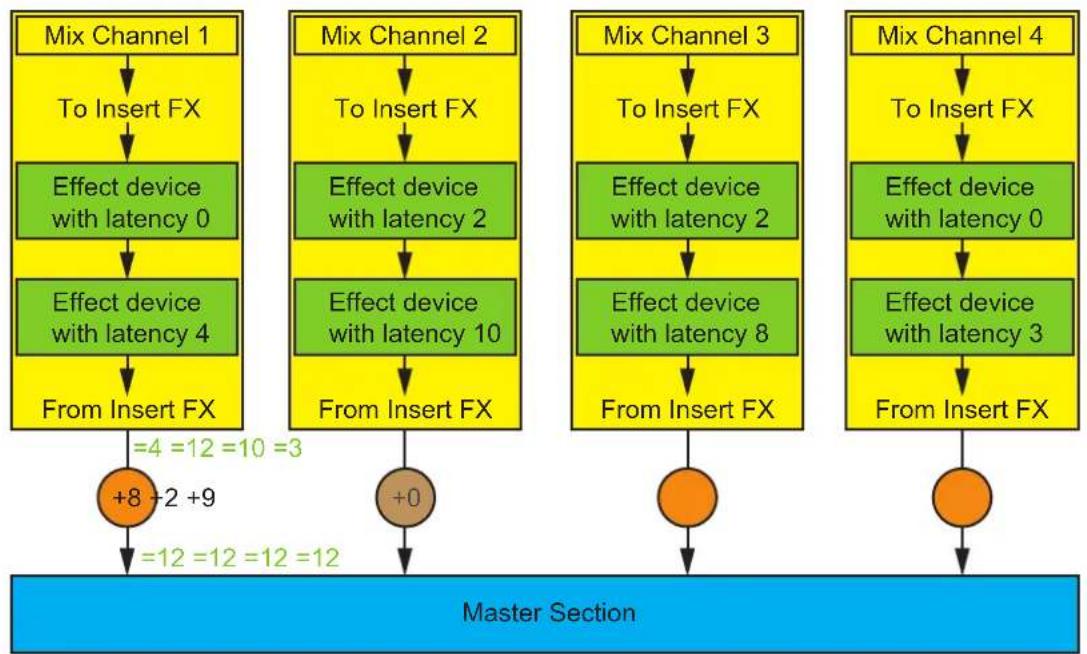
flowchart
graph TD
    A["Mix Channel 1"] --> B["To Insert FX"]
    B --> C["Effect device with latency 0"]
    C --> D["Effect device with latency 4"]
    D --> E["From Insert FX"]
    E --> F["+8 +2 +9"]
    F --> G["=12 =12 =12 =12"]
    H["Mix Channel 2"] --> I["To Insert FX"]
    I --> J["Effect device with latency 2"]
    J --> K["Effect device with latency 10"]
    K --> L["From Insert FX"]
    L --> M["+0"]
    M --> N["Master Section"]
    O["Mix Channel 3"] --> P["To Insert FX"]
    P --> Q["Effect device with latency 2"]
    Q --> R["Effect device with latency 8"]
    R --> S["From Insert FX"]
    S --> T["+0"]
    T --> N
    U["Mix Channel 4"] --> V["To Insert FX"]
    V --> W["Effect device with latency 0"]
    W --> X["Effect device with latency 3"]
    X --> Y["From Insert FX"]
    Y --> Z["+0"]
    Z --> N

= Delay Compensation = No Delay Compensation
Delay compensation principle for a number of mixer channels routed to the Master Section of the main mixer.
Mix Channel 2 has the longest inherent latency in the example above: 2+10=12 samples. The goal now is to add internal “invisible delays” to the signals from the other mixer channels so that the total delay for each channel is 12 samples.
This means that for Mix Channel 1 Reason Lite automatically adds a compensation delay of 8 samples (to add up to '12'). Mix Channel 2, which has the longest inherent latency, doesn't get any delay compensation at all. Mix Channel 3 gets a delay compensation of 2 samples (to add up to '12') and Mix Channel 4 gets a delay compensation of 9 samples (to add up to '12').
Now, the signals from all Mix Channels have a total delay of 12 samples and are thus perfectly "in sync" with each other when they reach the Master Section.
If you add more effect devices to any of the Mix Channels, the inherent latencies might become longer, and the delay compensation values are automatically recalculated and adjusted.
A more "graphical" way of looking at the delay compensation is shown in the picture below. Here the inherent latencies of the mixer channels and the delay compensation are represented by proportionally sized boxes, which could make it easier to understand the principle:
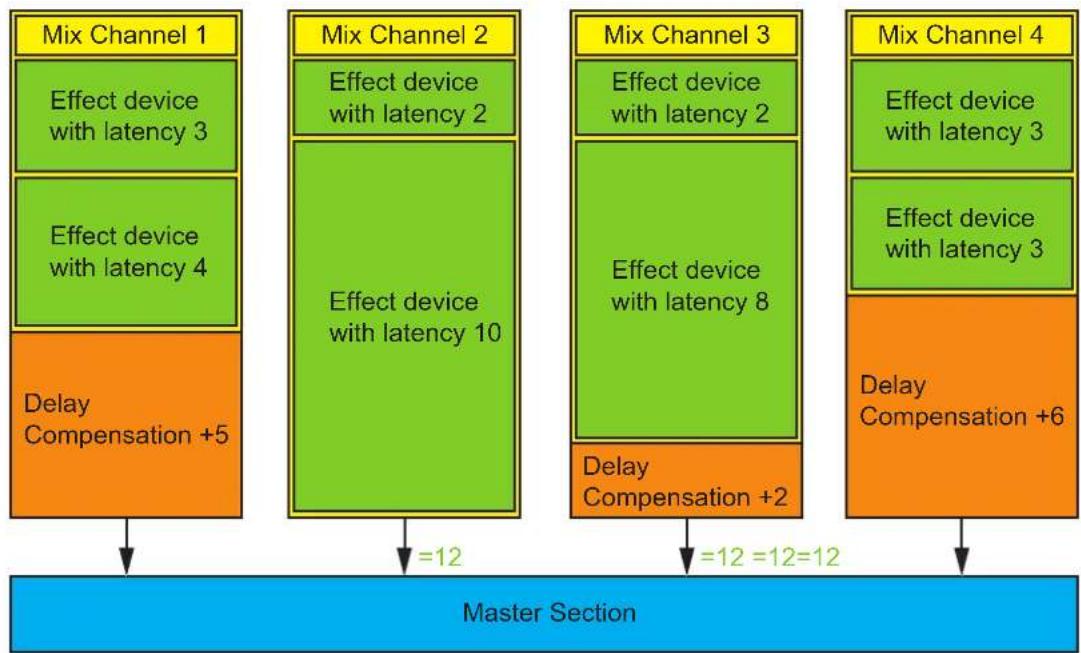
flowchart
graph TD
    A["Mix Channel 1"] --> B["Effect device with latency 3"]
    B --> C["Effect device with latency 4"]
    C --> D["Delay Compensation +5"]
    E["Mix Channel 2"] --> F["Effect device with latency 2"]
    F --> G["Effect device with latency 10"]
    G --> H["=12"]
    I["Mix Channel 3"] --> J["Effect device with latency 2"]
    J --> K["Effect device with latency 8"]
    K --> L["Delay Compensation +2"]
    M["Mix Channel 4"] --> N["Effect device with latency 3"]
    N --> O["Effect device with latency 3"]
    O --> P["Delay Compensation +6"]
    style A fill:#FFD700,stroke:#333
    style E fill:#FFD700,stroke:#333
    style I fill:#FFD700,stroke:#333
    style M fill:#FFD700,stroke:#333
    style B fill:#90EE90,stroke:#333
    style C fill:#90EE90,stroke:#333
    style F fill:#90EE90,stroke:#333
    style K fill:#90EE90,stroke:#333
    style L fill:#FFD700,stroke:#333
Delay compensation principle for a number of mixer channels routed to the Master Section of the main mixer.
As you can see in the picture above Mix Channel 2 doesn't get any delay compensation, since it has the longest inherent latency of the four channels.
Manually adjusting the latency values
There might be situations where you want to manually adjust the latency values. This could be, for example, if effect devices should report the wrong latency values and thus cause the audio to sound out of phase or weird in other ways.
On the rear panel of the Audio Track device's and Mix Channel device's Programmer section are two displays: the display to the left shows the total inherent latency for the channel (the sum of the reported inherent latencies of the effect devices in the signal chain), and the display to the right shows the number of samples you might have manually adjusted the latency value:
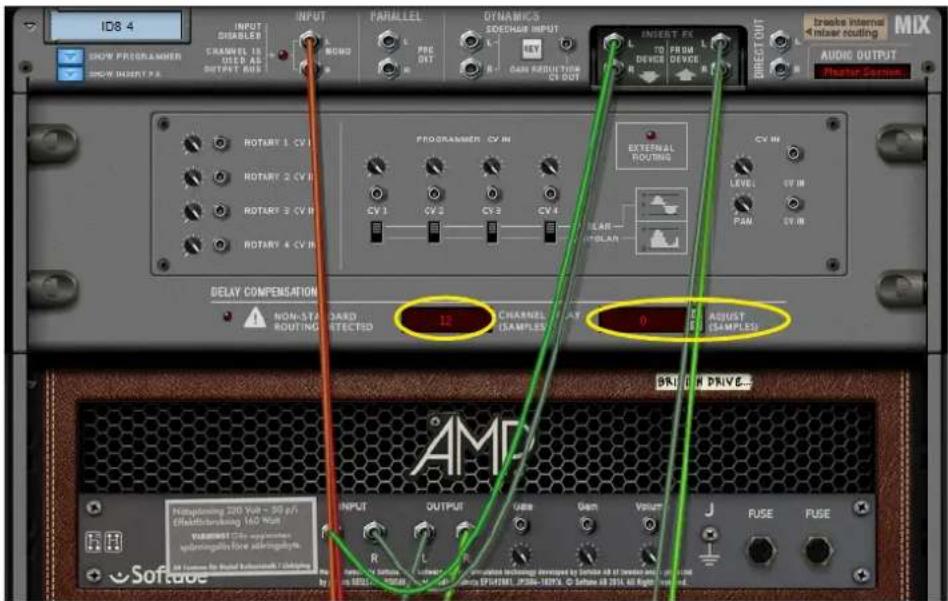
! Note that the Channel Delay figure can never be less than the sum of the reported inherent latencies of the effect devices in the signal chain.
The sum of the reported inherent latencies (Channel Delay) and any manual adjustment is displayed in the respective Insert FX sections on the main mixer channel strips:

The "Total signal path latency" figure displayed on the Transport panel is the sum of the individual channel which has the longest inherent latency, plus the inherent latency of the Master Inserts effect devices:

- Hovering over any of the latency figures in the three pictures above brings up a tool tip which displays the latency in milliseconds.
Delay Compensation with Busses and Parallel Channels
When using Parallel Channels and Output Busses the same principles apply, i.e. the total latencies for all mixer channels and busses should be the same when the signals reach the Master Section. Also, the latencies of the signals entering the same Output Bus must also be the same, to avoid phasing problems etc. In the picture below, a number of mixer channels, parallel channels and busses are used:
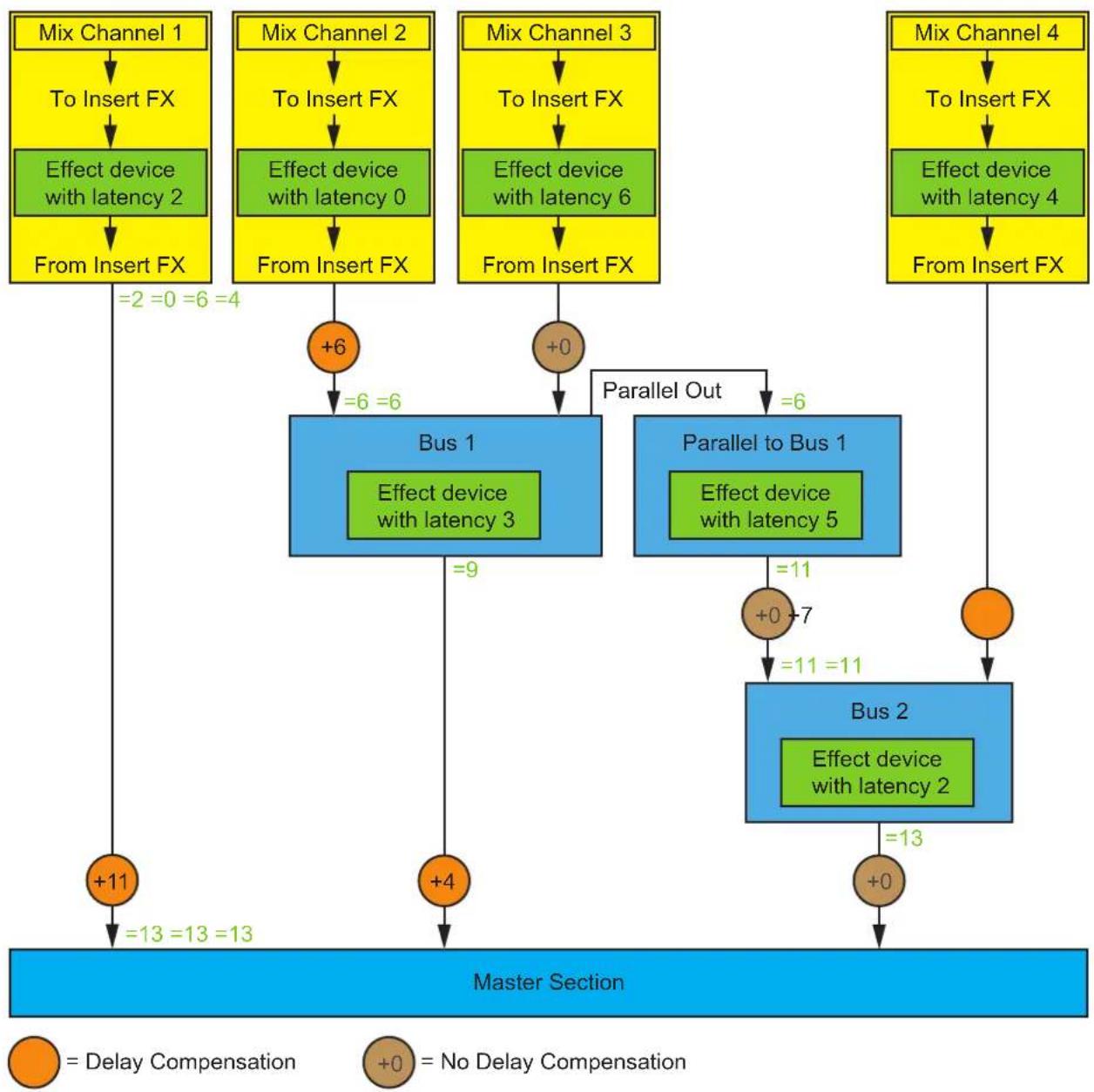
flowchart
graph TD
    A["Mix Channel 1"] --> B["To Insert FX"]
    B --> C["Effect device with latency 2"]
    C --> D["From Insert FX"]
    D --> E["+6"]
    E --> F["=6 =6"]
    F --> G["Bus 1"]
    G --> H["Effect device with latency 3"]
    H --> I["=9"]
    I --> J["+4"]
    J --> K["Master Section"]
    K --> L["+11"]
    L --> M["=13 =13 =13"]
    M --> N["+0 =No Delay Compensation"]
    O["Mix Channel 2"] --> P["To Insert FX"]
    P --> Q["Effect device with latency 0"]
    Q --> R["From Insert FX"]
    R --> S["+6"]
    S --> T["=6 =6"]
    T --> U["+0"]
    U --> V["Parallel Out"]
    V --> W["=6"]
    W --> X["+0 -7"]
    X --> Y["=11 =11"]
    Y --> Z["+0 +7"]
    Z --> AA["Parallel to Bus 1"]
    AA --> AB["Effect device with latency 5"]
    AB --> AC["=11"]
    AC --> AD["+0 -7"]
    AD --> AE["=13"]
    AE --> AF["+0"]
    AF --> AG["Master Section"]
Delay compensation when using Parallel Channels and Busses.
As you can see in the picture above, the signal chain with the longest inherent combined latency is: Mix Channel 3 > Bus 1 > Parallel Bus 1 > Bus 2 > Master Section; this signal chain is therefore not delay-compensated. All other signals are delay-compensated where necessary, which is indicated by the orange circles in the picture.
Delay Compensation to Send FX busses
Since each mixer channel is delay-compensated individually, we need to make sure that any signals from the mixer channels to the Send FX busses reaches the Send FX busses at the same time. To make the signals to each of the Send FX busses come "in sync", there is also a built-in delay compensation to the eight FX sends of each mixer channel.
About Send FX Returns
Reason Lite doesn't compensate for any inherent delays in the Send Effect devices themselves, as this would make the delay compensation scheme extremely complex. Also, Send FX are traditionally often used for delays and reverbs, where a little extra inherent delay won't matter much.
! In the situation where you might route the outputs of Send Effects back to separate Mix Channels, no delay compensation is being performed on the “return” Mix Channels.
About the Master Insert FX
Reason Lite considers all audio signals to pass through the Master Section in the main mixer; this is where all signals eventually should end up in sync. But the Master Section has an Insert FX section too, and effect devices used here can often have a significant inherent latency (maximizers, mastering EQs etc). However, since all signals pass through these effect devices in sync, no delay compensation is performed on the Master Insert FX devices. This is why the Master Section device in the rack lacks Channel Delay and Adjustment displays.
Problematic configurations
The examples below describe a number of “problematic” routings and how Reason Lite handles these regarding delay compensation.
When non-standard routings are detected, the red LED in the Delay Compensation section of the back of the Mix Channel/Audio Track device Programmer section lights up. Hovering over the LED brings up a tool tip, which describes the detected type of problem;
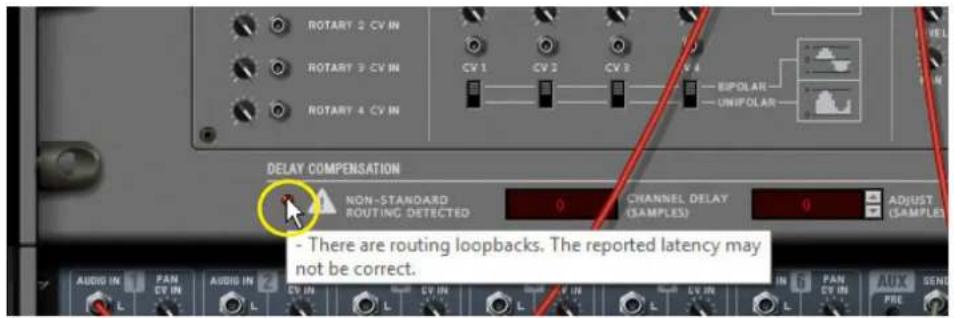
Parallel signal paths within the channel
In these types of configurations Reason Lite uses delay compensation only for the shortest signal path, i.e. the signal path that has the shortest inherent latency between the To Device and From Device connections:
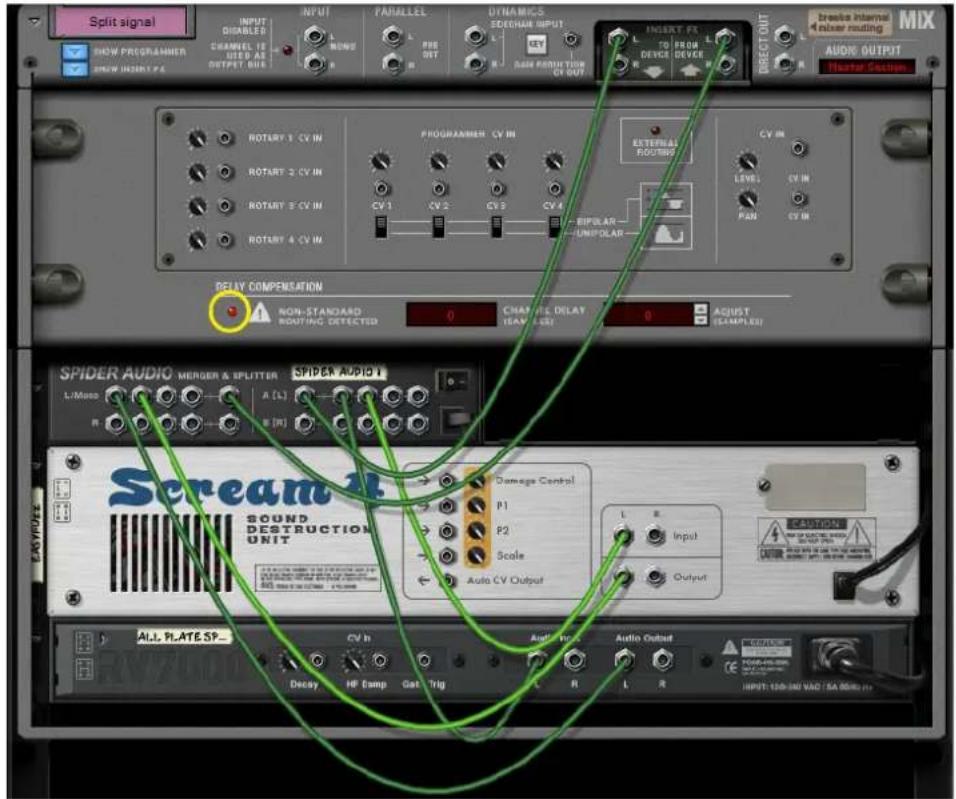
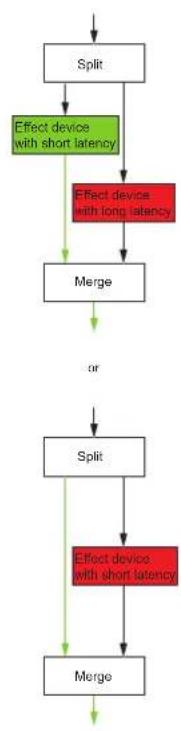
flowchart
graph TD
    A["Split"] --> B{Effect device with short latency}
    B --> C["Merge"]
    C --> D{or}
    D --> E["Split"]
    E --> F{Effect device with short latency}
    F --> G["Merge"]
    G --> H["End"]
Example of a parallel signal configuration where only the delay for the shortest path is used for delay compensation.
Sub-mixers with Send FX routings within the channel
In these types of configurations Reason Lite uses delay compensation only for the shortest signal path, i.e. the signal path that has the shortest inherent latency between the To Device and From Device connections. If there are send effects in the path, this means that the inherent latency will be the same, or longer with these effects. Therefore, send effects are always disregarded from any delay compensation:
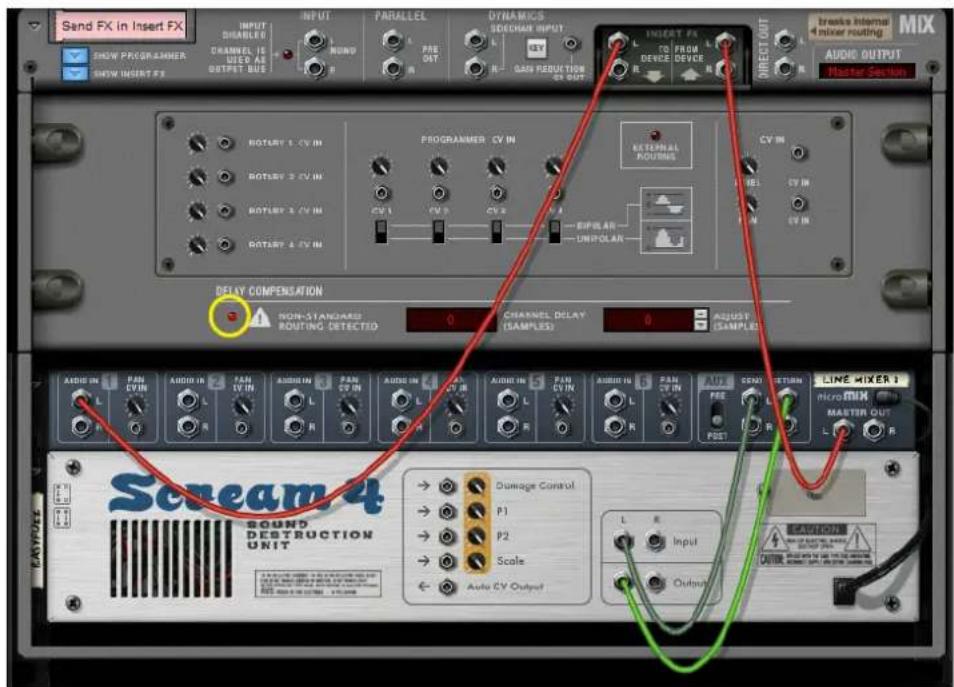
Example of an internal "send fx" routing inside an Insert FX configuration.
Loopback within the channel
In these types of configurations Reason Lite uses Delay compensation only for the shortest signal path, i.e. the signal path that has the shortest inherent latency between the To Device and From Device connections. If there are any feedback connections in the signal path, these will be disregarded from any delay compensation:
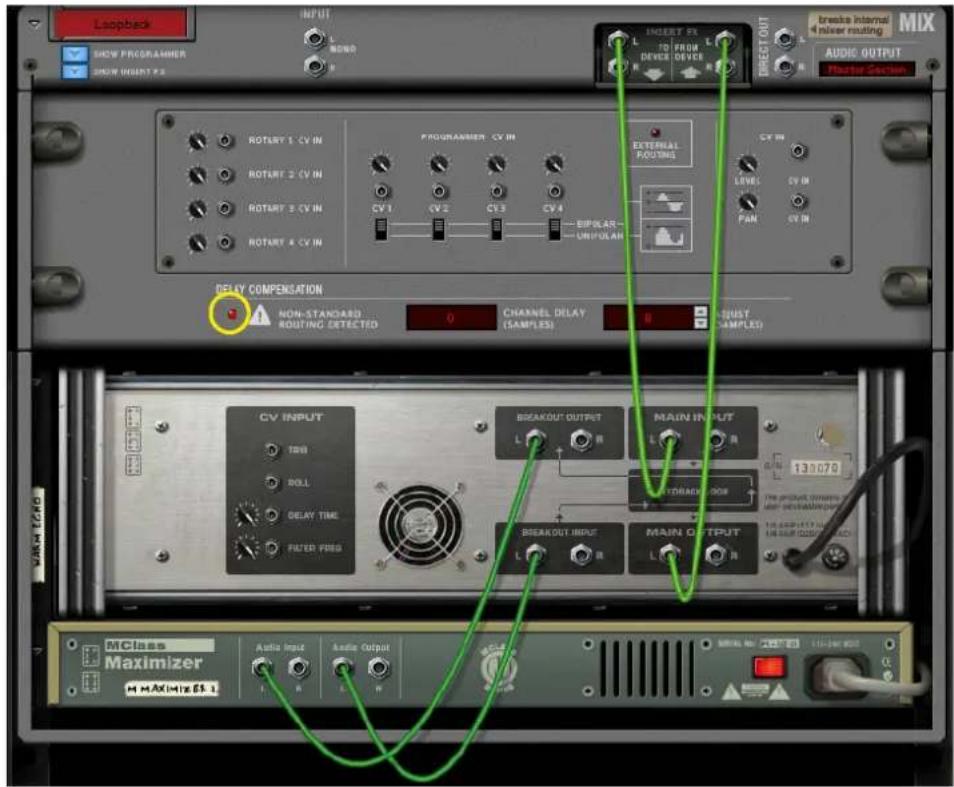
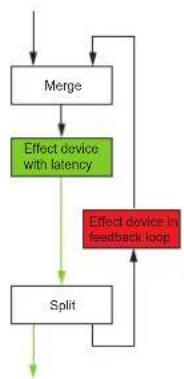
flowchart
graph TD
    A["Start"] --> B["Merge"]
    B --> C["Effect device with latency"]
    C --> D["Split"]
    D --> E["End"]
    F["Effect device in feedback loop"] --> C
Example of a feedback loop, which is disregarded from delay compensation.
External routing from the channel
If there are any connections to devices outside the Insert FX section, and these devices are routed to other mix channels (or to the Master Section), any inherent latencies in the external effect devices will be disregarded from any delay compensation:
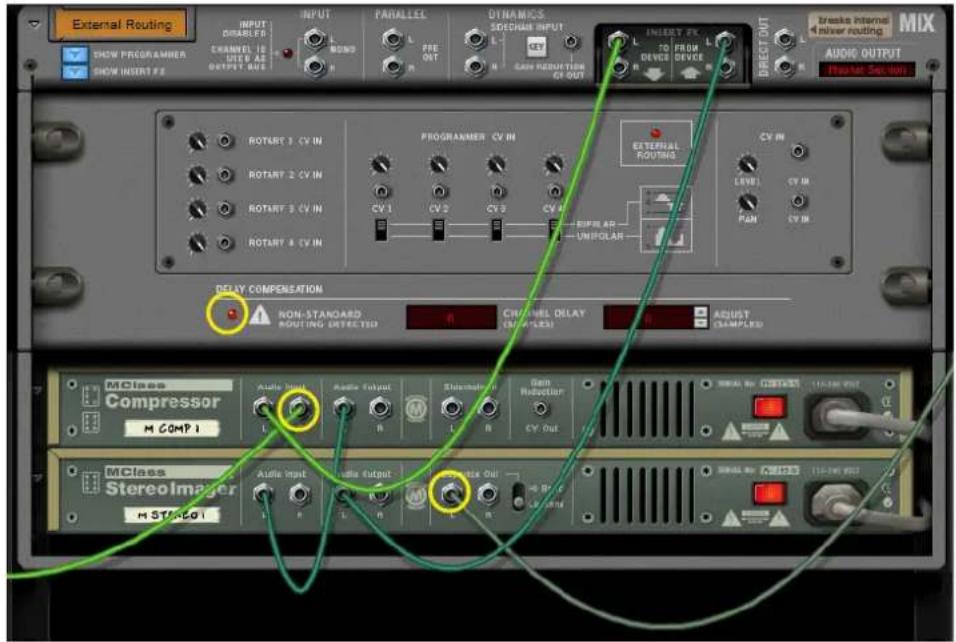
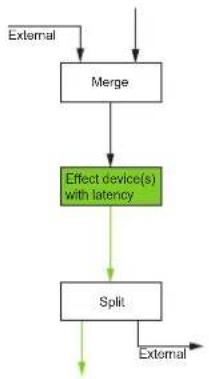
flowchart
graph TD
    A["External"] --> B["Merge"]
    B --> C["Effect device(s) with latency"]
    C --> D["Split"]
    D --> E["External"]
Example of an external routing from (any of) the Insert FX devices.
Broken signal path in the channel
If the effects signal path should be broken in the channel, the tool tip "Could not calculate latency. The default value of 0 samples was used" is displayed. This means that the program couldn't follow the signal path, which may be because it's not completely connected, for example:
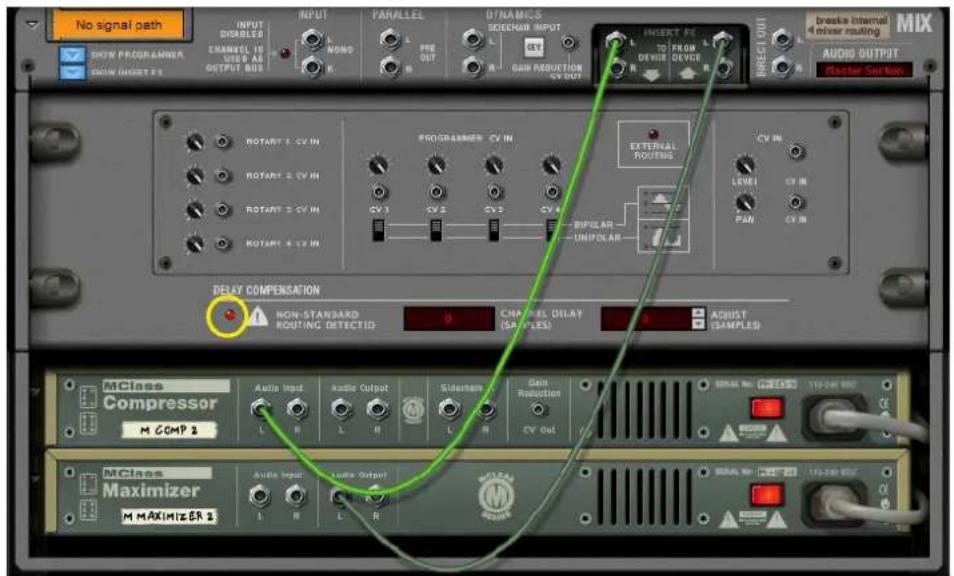
Example of a broken signal path in a channel.
About using the Direct Out connections of the mixer channels
Since connecting the Direct Outs of a Mix Channel or Audio Track device automatically disconnects it from the Master Section of the main mixer, any delay compensation is also automatically disabled. This is indicated by “-” in the Channel Delay display:
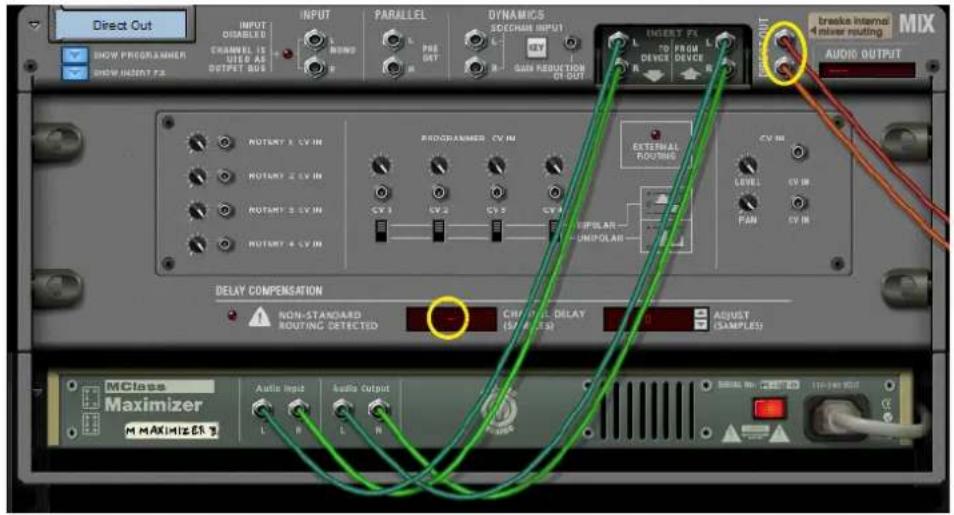
Example of when the Direct Outs are used in a channel.
About the Metronome Click
Reason Lite adds the Metronome Click (if selected) at the Hardware Interface (after the Master Section). This means that if there's a delay in the signal path, the Metronome would be heard before the rest of the audio on playback. Therefore, Reason Lite uses delay compensation also for the Metronome so it always plays back correctly in sync.
Recording with Delay Compensation
When you record audio using External Monitoring (Preferences - the Audio tab), Reason Lite repositions the audio according to the reported audio card latency. Recorded audio is positioned earlier on the track, by Input Latency + Output Latency. When delay compensation is active, the total delay time is then added to the audio repositioning.
Playing and monitoring with Delay Compensation
A problem with delay-based delay compensation is that all signal paths are delayed equally. Even if you have no Insert FXs in the signal path for your track, it might be delay-compensated (depending on what's in the rest of the channels in the mixer). This could make it hard to play instrument devices and monitor through Reason Lite. Some good advice could be to:
- Record and monitor through Reason Lite with delay compensation Off, and then switch it on after recording.
- You could also bypass the Insert FX on the channels with highest latency when recording. Also remember to bypass Master Insert FX when recording or playing.
About bouncing mixer channels
Delay compensation is taken into account when you bounce mixer channels - both to files on disk and to new tracks in the song - as well as when you use the "Bounce in Place" function.
Chapter 19
Song File Handling
About this chapter
This chapter describes how to open, create and save songs in various ways. It also describes how to save a song as a Template and how to import and export songs as Standard MIDI files.
Opening Songs
Opening a Reason Lite Song
! To be able to open a Reason Lite Song you need to run Reason Lite in Authorized mode. If you're using Reason Lite in Demo Mode (unauthorized), the "Open" item on the File menu is removed and replaced by "Open Demo Song". This allows you to open only the factory made Reason Lite Demo Songs (see "Opening a Reason Lite Demo Song"). See "Running Reason Lite with Internet Verification" for details on how to authorize Reason Lite.
! Note that it is not possible to open Reason Lite 11.2 (or earlier) songs in Reason Lite 11.3, due to the different file format!
To open a Reason Lite Song:
→Double click the Song file in Windows File Explorer (Win) or in Finder (Mac).
Or, if you want to open a Song file from within the program:
- Hold down Ctrl or Cmd and press [O], or select "Open" from the File menu. The Browser appears (if it was hidden) in the Song window.
! If no Song document was open on the macOS version of Reason Lite, Reason Lite temporarily opens an empty Song document to be able to show the Browser. When a Song has been loaded, the empty document closes. - Navigate in the Browser to the desired folder on disk or within a ReFill. See "Using the Browser" in the "Sounds and Patches" chapter.
- When you have located the Reason Lite (.reit or .reitdemo) Song file, select it and click "Open" (or double click the file). The song opens in a new document window.
- You can have several Songs open at the same time if you like. This allows you to drag and drop (and copy and paste) patterns, clips and patches between songs. However, all open songs consume some memory and processing power, so you might want to close the songs you are not working with at the moment.
It's also possible to have Reason Lite open the last song you worked on as soon as you launch the program. See "Opening the last Song at program launch" for more information.
If the "Missing Sounds" window appears
If the song includes samples, and these have been moved or renamed since the song was saved, the program will inform you that it cannot find all files. You can then choose to either manually locate the missing files, to have the program search for them or to proceed without the missing sounds. For details, see "Handling Missing Sounds" in the "Sounds and Patches" chapter.
If "Missing Device" panels appear in the rack
When you open a Reason Lite song made by another user, it may have been created with Rack Extension devices that you don't have. All such missing devices in a song will be replaced by generic "Missing Device" placeholder devices. See "About missing Rack Extensions" for more information.
Opening a Reason Lite Demo Song
Reason Lite Demo Songs are factory made songs that demonstrate how Reason Lite can be used in various musical projects. If you run Reason Lite in "Demo Mode" (unauthorized), you will only be able to open Demo Songs - but not regular Songs. If you run Reason Lite in authorized mode, the Open Demo Song item is available in addition to the regular Open item.
→ Select "Open Demo Song" from the File menu and select a Demo Song from the sub-menu.
You could also select "Download more Demo Songs" from the sub-menu. This will open your default web browser and direct you to the Reason Lite Demo Songs page on the Reason Studios web site. On this page you can download additional Reason Lite Demo Songs to your computer. You will then have to use the "Open Demo Song" command from the File menu to open the downloaded Demo Songs.
- You can also download more Reason Lite Demo Songs by selecting “Download more Demo Songs” from the Help menu.
- You can have several Demo Songs open at the same time if you like. This allows you to drag and drop (and copy and paste) patterns, clips and patches between songs. However, all open songs consume some memory and processing power, so you might want to close songs you don't need at the moment.
Opening the last Song at program launch
It's possible to instruct Reason Lite to automatically open the last Song you worked on each time you launch Reason Lite. You select this on the "General" tab in the "Preferences" dialog.
- Select "Preferences" from the Edit menu (Win) or "Reason Lite" menu (Mac) and then click the "General" tab.

- Tick in the "Load last song on startup" checkbox.
When you launch Reason Lite the next time, the last saved Song will automatically open in a document window.
Closing Songs
Closing a Song
To close a Song, hold down Ctrl or Cmd and press [W], or select "Close" from the File menu. Alternatively, click the close button in the upper corner of the Song document window.
If you have unsaved changes, you will be asked if you want to save the song before closing.
! Note that when you're closing the last open Song document in the Windows version of Reason Lite, the Reason Lite application will quit.
Creating Songs
Creating a new Song
To create a new song, hold down Ctrl or Cmd and press [N], or select "New" from the File menu. A new Song document window appears. By default, the new Song contains the following:
• The Hardware Interface device.
- The Main Mixer Master Section with its Master Section device in the Rack.
The Master Section device's Master Out L & R are connected to the Reason Lite Hardware Interface Audio Out 1 & 2.
• The Transport Track at the top of the Sequencer.
- Instead of creating an empty song each time you select "New", it's possible to automatically load an existing song to use as template for your new songs. For example, if you want to start with your own unique selection of devices, you can create and save a song and then instruct Reason Lite to use this song each time you create a new song. See "Setting up a Default Song".
An alternative to creating a new song is to use the "Create New from Template" command to open one of the factory made Template Songs. See "Creating a new Song from a template".
Setting up a Default Song
It's possible to specify a certain Song document which will automatically open as a "template" each time you select "New" from the File menu. The Default Song could be any Song you have created earlier, or a factory made Template Song. You can select this Default Song on the "General" tab in the "Preferences" dialog.
- Select "Preferences" from the Edit menu (Win) or "Reason Lite" menu (Mac) and then click the "General" tab.

- Click the "Template" radio button in the "Default Song" section.
- Click the folder icon to the right and select the Song you want to use as a template when creating new Songs.
Each time you create a new Song (by selecting "New" from the File menu), the selected Song will be loaded and used as a template for your new Song. On Windows platforms, the Song document will be named "Document n" where "n" is an incremental number. On macOS platforms, the document will be named "untitled n" where "n" is an incremental number. You can then save your Song with a new name.
! Make sure the "Load last song on start-up" checkbox is not ticked, otherwise the last song will be opened instead of the Template song you selected.
Creating a new Song from a template
To create a new song from a Template, select "New from Template" from the File menu and then select one of the Template Songs that appear in the sub-menu.
The selected Template Song appears in a new document window. On Windows platforms, the document will be named "Document n" where "n" is an incremental number. On macOS platforms, the document will be named "untitled n" where "n" is an incremental number. You can then save your Song with a new name.
- You could also create your own Template Songs and make them appear in the sub-menu. See "Making a Song appear as a Template Song".
- You can also download more Reason Lite Template Songs by selecting "Download more Template Songs" from the Help menu.
Saving Songs
Saving a Song
You will always be able to save your Songs in Reason Lite. It doesn't matter if you're running in authorized or unauthorized (Demo) mode.
The "Save" function
To save a Song, proceed as follows:
If this is the first time you're saving the song, a file dialog will appear where you can specify a name and destination.
- Specify a name and destination for the Song and click "Save".
Once you have saved a song, selecting "Save" will simply save it under the same name and in the same location, without showing a dialog.
- It's also possible to automatically include all samples used by the Reason devices and make the Song "self-contained". Refer to "About Self-Contained Songs" for details about how to include your own samples in your songs.
To reduce the file size of your song, you can use the "Save and Optimize" command described in "Saving and optimizing a Song".
It's also possible to include detailed information about your song. Refer to "Including Song Information" for more details.
The "Save As..." function
To save an existing Song under another name and/or in another location:
- Hold down [Ctrl]+Shift or [Cmd]+Shift and press [S], or select "Save As..." from the File menu. The "Save As" dialog appears.
- Specify a new name and/or new destination for the Song and click "Save".
- Using the “Save As...” function will automatically optimize the Song (see “Saving and optimizing a Song”).
Saving and optimizing a Song
When you record audio in the Sequencer, the recordings are stored in your Song document. If you remove recordings in your song while editing, there might be "empty" areas left in the document, similar to a fragmented hard disk. To "defragment" the Song document, and thus reduce the file size, you can use the "Save and Optimize" command on the File menu. Note that the "Save and Optimize" command can only be used on previously saved Song documents.
→Select "Save and Optimize" from the File menu.
The Song will be optimized and saved at the original location.
! Note that saving and optimizing a Song could take a couple of minutes if you have lots of audio recordings in it. Therefore, the best alternative would probably be to use the "Save" command while you're still working with your Song, and then use the "Save and Optimize" command as a final step when you've finished editing.
- Using the "Save As..." function automatically optimizes the Song.
- In some situations, it's possible to reduce the file size even further by deleting any recordings you haven't used in your Song. See "Delete Unused Recordings".
Including Song Information
Selecting "Song Information" on the File menu opens a dialog in which you can add information about your song. For example, if you plan to send the song to other Reason Lite users, this dialog allows you to add contact information, comments about the song, etc.
→Select "Song Information..." from the File menu.
The Song Information dialog opens.
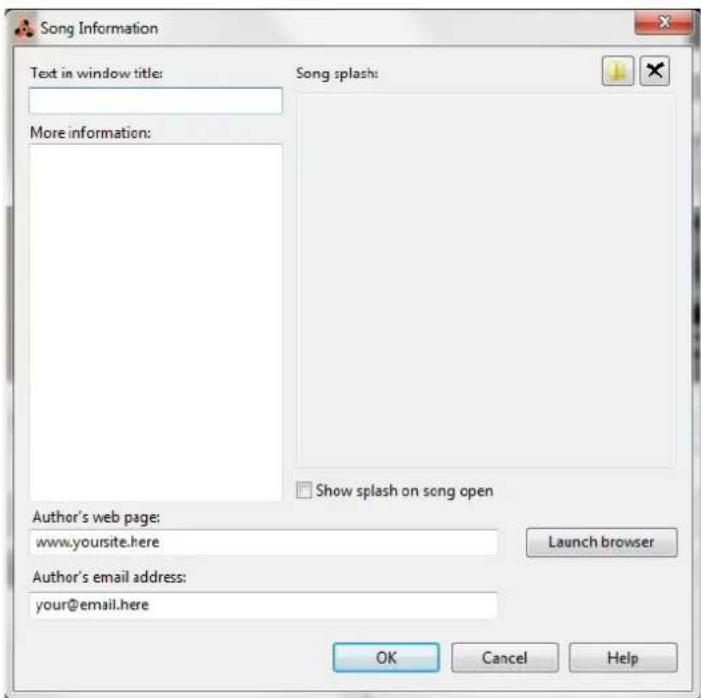
The Song Information dialog contains the following items:
• Text in window title:
The text you add here will be displayed directly after the file name in the song window's title bar.
- More information:
This is where you could add notes and comments about your song.
- Song splash:
This allows you to add a picture to the song. The picture will be displayed when the song is opened.
To add a splash picture, click the folder button at the upper right corner, locate and open the picture file in the file dialog that appears.
! Splash pictures must be JPEG files (Windows extension ".jpg") with a size of 256 x 256 pixels.
→ To remove the splash picture from the song, click the "cross" button at the upper right corner.
→ Tick the "Show splash on song open" check box to make the splash appear every time the song is opened.
• Author's web page:
Here, you can type in your web site URL. When a user opens your song, he/she can go directly to your web site by clicking the Browse button that appears in the splash (provided there's an Internet connection available).
• Author's e-mail address:
Here, you can specify your e-mail address if you want other Reason Lite users to e-mail you their comments, etc.
About Self-Contained Songs
The Song is the main file format in Reason Lite. A Song contains the device setup and all settings and connections in the Rack, all Main Mixer Channel settings as well as everything you have recorded in the Sequencer. However, this is not always sufficient. If you want to open your song on another computer, or send it to another Reason Lite user, you will also need to include all samples used by the instrument devices in the Song. To make this easier, Reason Lite allows you to create "self-contained" songs. A self-contained song contains not only the references to the used samples, but also the files themselves. You can choose exactly what files should be included in the self-contained song.
- An alternative to self-containing samples files could be to bounce Mixer Channels to Audio Tracks. This way, you could "convert" ReFill samples to audio so that your song would always sound the same, no matter on which computer you play it back. See "Bouncing Mixer Channels" for details.
To specify what files should be included in the self-contained song, proceed as follows:
1. Select "Song Self-Contain Settings..." from the File menu.
The "Song Self-Contain Settings" dialog appears, listing all samples and REX files used in the song:
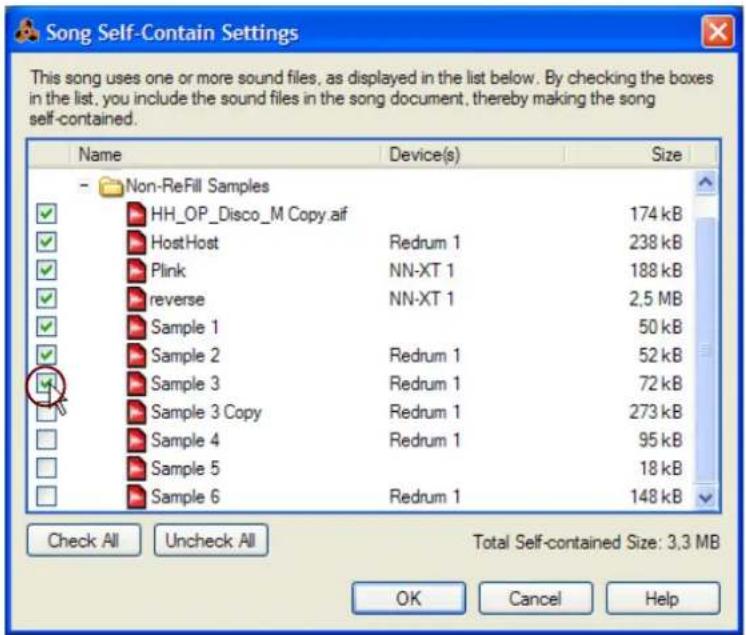
- Tick the checkboxes to the left of the "Name" column for the files you want to contain in the song.
Note that samples and REX files from ReFills can also be self-contained (but not un-self-contained, see below).
→ You can use the "Check All" button to tick all checkboxes in one go.
Similarly, the "Uncheck All" button unchecks all checkboxes.
- When you have marked the desired sounds, click "OK" to exit the dialog.
The next time you save your Song, the specified sounds will be automatically included in the Song file.
! Note that a self-contained song file will be larger than the original song file. However, samples included in a self-contained song are automatically compressed by approximately 50% of their original size. Since the compression is lossless, this does not in any way affect the sound quality.
"Un-self-containing" a Song
If you have a self-contained song which contains one or several sounds embedded in the song file, you may want to extract these sounds and make the song refer to them on disk as usual. This is done in the following way:
- Select "Song Self-Contain Settings..." from the File menu.
The "Song Self-Contain Settings" dialog appears.
- Locate the sounds you want to extract from the song file, and deactivate their checkboxes (or click the "Un-check All" button).
- Click "OK" to close the dialog.
Now, Reason Lite will check for each "extracted" sound file whether it is available (at its original, stored location) or not.
- If the program finds the sound file at the location stored in the song, it is simply removed from the song file, and the original file reference path is used.
This would be the case if you made the song self-contained yourself, and un-self-contain it on your own computer (provided that you haven't removed the original sound files from disk since you made the song self-contained).
- If the program doesn't find the sound file, a file dialog appears, allowing you to select a folder and name for the sound file.
The extracted file will be saved in the specified folder, and the path in the song will be adjusted. This would be the case if you were given the self-contained song by another user, for example.
! Note that it is not possible to un-self-contain samples that originate from ReFills!
! If you un-self-contain samples that were modified in the Edit Sample Window and feature Start and End Markers and/or loop crossfades, the Lossy Sample Export dialog appears. The available options are described further down in the "Exporting samples" section in the Sampling chapter. Note that the option you select in the Lossy Sample Export applies to all samples you have deselected in the Song Self-contain Settings dialog!
Making a Song appear as a Template Song
If you want Songs you have created to appear on the "New from Template" sub-menu, and be available for selection when you use the "New from Template" command (see "Creating a new Song from a template"), you need only move or copy the Song(s) to the Template Songs folder in the Music folder on your hard drive. The easiest way to get to this folder is by selecting File > New from Template > Show Template Folder. This brings up the Template folder in Windows Explorer or Finder on Mac.
A note about saving Songs as audio files
It's also possible to export your Songs as audio files in WAV or AIFF format. Refer to "Exporting Songs or parts of Songs" for more information.
Audio data and Scratch Disk settings
About audio data in Song files
If you record or import audio into an unsaved Song document, the audio is written to the "Scratch Disk folder" on your computer. As soon as you save (and name) the Song document, the audio is moved from the Scratch Disk folder to the Song document. From here on, all new recorded and/or imported audio is stored in the Song document.
Changing Scratch Disk folder location
The Scratch Disk is where Reason Lite stores new, unsaved songs, plus analysis data (waveform data and high-quality time stretch/transposed audio/sample rate conversion data).
By default, Reason Lite places the Scratch Disk folder in the system temp folder in your home directory. You can change the Scratch Disk folder location if you like:
- Select "Preferences" from the Edit menu (Win) or Reason Lite menu (Mac) and then click the "Advanced" tab.
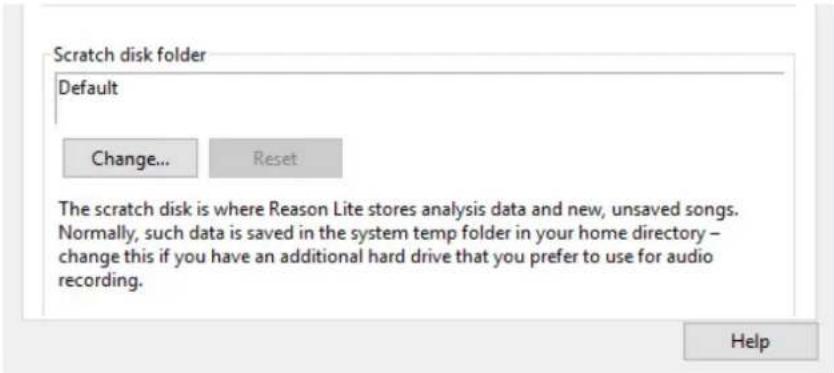
- Click the "Change" button in the Scratch Disk Folder section.
A system folder browser opens where you can select - or create - a new folder.
-
Select the folder where you want to locate the Scratch Disk Folder and click "OK".
-
Restart the computer and relaunch Reason Lite.
→ If you later want to revert to the default setting, click the "Reset" button on the "Advanced" tab.
The custom Scratch Disk Folder setting is removed and is replaced by the default setting. You will then have to re-start the computer for the change to take effect.
About unavailable Scratch Disk Folder
If a custom assigned Scratch Disk Folder isn't available when you launch Reason Lite, an alert saying: "The selected Scratch Disk folder isn't available. Reason Lite will use the default scratch disk for this session." is shown. This could happen if you have assigned the Scratch Disk folder to a removable disk and that disk is currently unavailable.
→ Click "OK" to use the default Scratch Disk Folder.
The next time you launch Reason Lite, it will look for the custom assigned Scratch Disk Folder again, and will do so every time you launch Reason Lite, until you reset the custom assignment by clicking the "Reset" button.
About "Orphan Audio Streams"
If your computer should malfunction (due to power loss etc.) during recording into a previously saved Song document, there is a good chance that your last unsaved audio recordings can be (at least partly) recovered:
- Restart your computer and launch Reason Lite.
- Open one of the Song documents that was open during the computer malfunction.
If the Song contained unsaved audio recordings, Reason Lite will find these and show an alert saying that the Song contains "orphan audio streams". You will be given the choice of deleting them or having them appear in new clips on a new audio track, for salvaging.
! Note that only audio recordings are possible to recover. Any new Instrument Tracks in an unsaved Song will be lost in the case of computer malfunction.
Importing and exporting Standard MIDI Files
Reason Lite can import and export Standard MIDI Files (SMF). This allows you to transfer MIDI data between Reason Lite and other applications.
Importing Standard MIDI Files
To import a Standard MIDI File to the Reason Lite sequencer, follow these steps:
- Create a new, empty Song document.
- Select "Import MIDI File..." from the File menu.
The Browser appears (if it was hidden).
- Select a Standard MIDI File (.mid) in the Browser and click "Import".
A number of new tracks are created in the Reason Lite sequencer. The tracks will have their original name, with their original MIDI channel added. Each track will be assigned an ID8 device, loaded with a sound that resembles the original sound. These assignments will only serve as a starting point to be able to play back the imported MIDI file. You may want to change sound, or replace the ID8 with another device if you have Reason installed.
- The Note events in the MIDI file will be imported into one or several Note Clips on a Note Lane on each Track.
- If the imported MIDI file is a Type 1 MIDI file, there will be one sequencer track for each track in the MIDI file.
- If the imported MIDI file is a Type 0 MIDI file (that is, it contains one track with MIDI events on multiple channels), there will be one sequencer track for each used MIDI channel.
- The Tempo setting, any Tempo Automation and any Time Signature automation in the MIDI file will be recognized.
- All controller data in the MIDI file is included.
This means that standard performance controllers (Pitch Bend, Mod Wheel etc.) are preserved properly and will be included in the note clip, just as when recording in Reason Lite. If there are separate MIDI Controllers in the imported MIDI file, these will be imported to separate Automation Lanes on the Instrument Tracks. There is a chance that some controller data may be imported to alien clips, due to different interpretations of a controller by a device in the rack and the MIDI instrument used to create the MIDI file (see "About alien clips").

Green frames will appear for automated parameters on the ID8 device panels. This helps you locate any unwanted controller automation.
Exporting Standard MIDI Files
To export all Instrument Tracks and Automation Tracks from the Reason Lite sequencer as a Standard MIDI File (SMF), do like this:
- Set the End Marker in the sequencer to where you want your song to end.
The MIDI file will contain all MIDI events on all tracks from the start of the song to the End marker.
- Select "Export MIDI File..." from the File menu.
The standard file browser appears.
- Type in a new file name (if desired) and select location for the file to be exported. Then, click "Save".
The default name for the MIDI File will be the Song's name followed by the ".mid" extension.
MIDI files exported by Reason Lite will have the following properties:
- The MIDI file will be of Type 1, with one MIDI track for each track in the Reason Lite sequencer.
The tracks will have the same names as in the Reason Lite sequencer.
- Since the Reason Lite sequencer doesn't use MIDI channels as such, all tracks will be set to MIDI channel 1.
- The sequencer Tempo, and any Tempo Automation and/or Time Signature Automation, is included in the MIDI file.
! Since an Instrument Track in Reason Lite could consist of different types of devices (plus FX etc.), there is no information about the actual sound in the exported MIDI File. The exported MIDI File only contains information about each instrument track and its MIDI Notes and/or MIDI Controller data laid out on the track. You will have to manually assign appropriate sounds to each track in the importing application.
Chapter 20
Importing and
Exporting Audio
About this chapter
This chapter describes the various techniques you can use to import and export audio to and from Reason Lite.
Importing audio
Audio formats, sample rates and tempo matching
The Reason Lite sequencer supports import of mono and stereo audio files of various formats, sample rates and resolutions. Reason Lite also supports import of REX (ReCycle rcy, rex and rx2) files. You can import several audio files at the same time, with each audio file ending up on a separate Audio Track in the sequencer - or on separate Comp Rows in a selected Audio Clip. You can import files of different formats on the same Audio Track - or even in the same Audio Clip. One audio file could be an 8-bit mono file sampled at 22.05 kHz, the next a 24-bit stereo file sampled at 192 kHz, etc. Reason Lite automatically converts sample rates and resolution with preserved audio quality. If the imported audio file includes tempo data that Reason Lite supports, Reason Lite automatically matches (stretches) the audio file to fit the current Song Tempo, without affecting the pitch.
- if the imported audio files' sample rates differ from the current audio hardware sample rate, Reason Lite will automatically sample rate convert.
This will first be done with a real-time algorithm, allowing for immediate playback. In the background, a high-quality sample rate conversion is performed. This is indicated by the CALC indicator on the transport panel. When done, Reason Lite will automatically switch to playing back the high-quality version and the CALC indicator will go out.
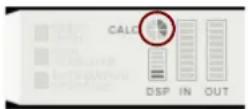
The CALC indicator indicates when Reason Lite performs high-quality stretching of audio.
About tempo matching imported audio
When you import an audio file, which has tempo data that Reason Lite can read, the audio will be automatically stretched to fit the current tempo in the song. However, if the tempo in the imported audio is unknown, you could manually tempo match (stretch) the imported audio in a couple of ways:
- By using the Scale Tempo "tool" to manually stretch the audio clips, see "Tempo scaling Clips".
- By using the Scale Tempo function in the Tool Window, see "Scale Tempo".
- If the imported audio has a steady - but unknown - tempo, you can adjust the imported audio to the song tempo as described in “Matching imported audio to the song tempo”.
Importing audio to the sequencer
! To minimize the song saving time, we strongly recommend to save the song before you import many or large audio files.
To import one or several audio files to tracks in the sequencer, proceed as follows:
- Select "Import Audio File..." from the File menu, or hold down [Ctrl]+Shift or [Cmd]+Option and press [I].
The "Import Audio File" function gets browser focus:
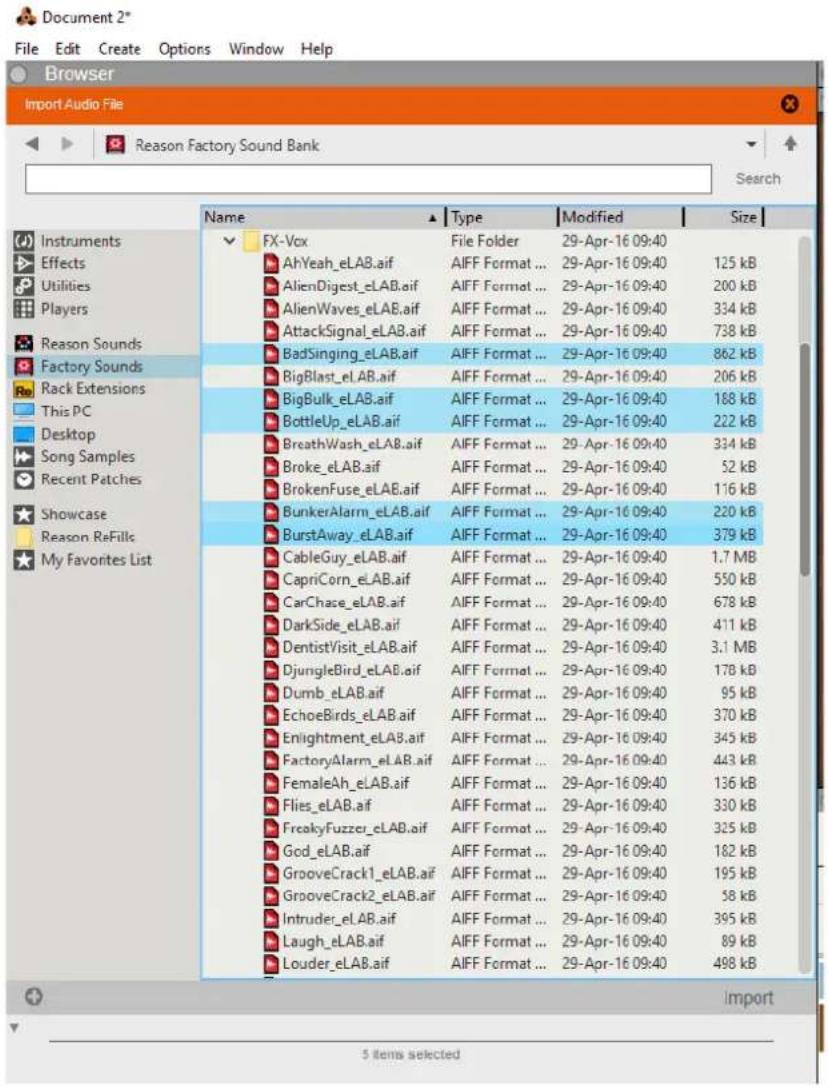
- Browse and select the audio file(s) you want to import.
When you select a single audio file, information about length, format, size and tempo (if included in the file) is shown in the information section, below the Browse list. If you like, you can also preview selected audio file by clicking the "Play" button in the "Audition" section. If you select several audio files, the total number of files and their total size are displayed in the Details section. You will not be able to preview the audio files when several files are selected.
→ You can also import samples from the Song Samples location in the Browser.
! If you select a REX file, this will be rendered to audio when imported and all information about slice positions etc. will be lost. The Song Tempo and any Tempo Automation starting at the Song Position Pointer will be taken into account during the import. After the import, the REX file will behave just like any imported audio file.
! If you are going to edit the imported REX file inline, and work with slices, audio quantizing, stretching etc. Reason Lite will automatically detect the transients in the audio and generate new slice markers that might not correspond to the original slice distribution of the imported REX file, see "Editing audio in Slice Edit mode".
3. Click "Import" to import the audio file(s).
Depending on the where the edit focus was when you selected "Import Audio File" from the Edit menu, the audio file(s) will be placed a little differently. In all scenarios, the imported audio file(s) will be placed at the current song position:
- If an audio track has edit focus in the sequencer track list and you have selected only a single audio file, the imported audio file will be placed in a new clip on this audio track.
- If you selected several audio files when using the Import Audio File command, each audio file will be imported to new audio tracks in the sequencer - in the order the files were selected in the Browser.
- If you selected only a single audio file and the edit focus is elsewhere in the application, a new audio track will be created for the imported audio file.
→ You can also drag one or several audio files from the Browser and drop in the sequencer track list.
The audio files will then be imported to separate audio tracks in the sequencer:
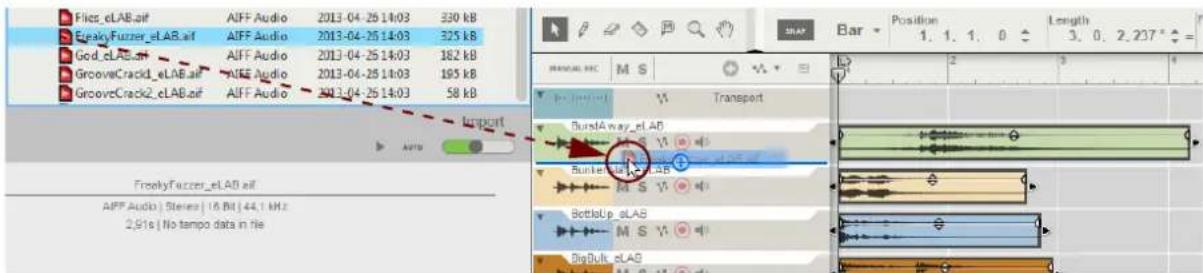
A + sign and a divider indicate where in the track list the imported audio file(s) will be placed.
→ You can also drag one or several audio files from the Browser and drop on an audio track on the Arrange Pane. The audio files will then be imported as separate audio clips, after one another, on the corresponding audio track. If Snap is active in the sequencer, this will be taken into consideration:
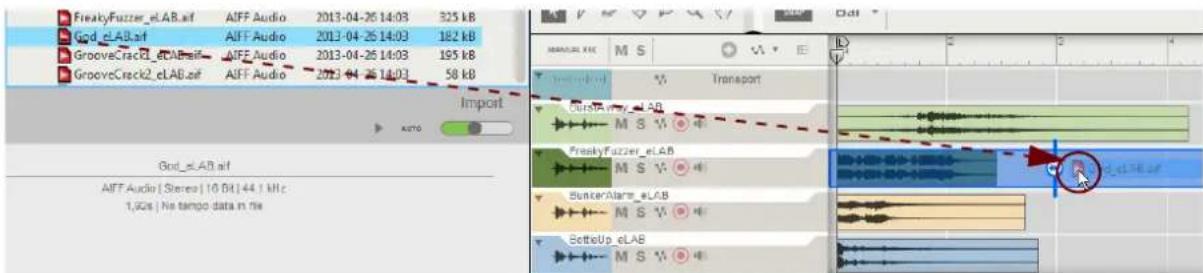
A waveform sign and an insertion point divider indicate where on the audio track the imported audio file(s) will be placed.
Import audio file(s) to an open Audio Clip
It's also possible to import audio files to open Audio Clips in the Comp Editor in the sequencer. Proceed as follows:
- Open the Audio Clip you wish to import the audio file(s) to in the Comp Editor.
- Select "Import Audio File..." from the File menu, or hold down [Ctrl]+Shift or [Cmd]+Option and press [I].
The "Import Audio File" function gets browser focus.
- Browse and select the audio file(s) you want to import.
→ You can also import samples from the Song Samples location in the Browser.
! If you select REX files, these will be rendered to audio when importing. The Song Tempo and any Tempo Automation starting at the Clip position will also be taken into account.
4. Click "Import" to import the selected audio file(s).
The audio file(s) will be imported as new recordings on new Comp Rows. The Comp Row(s) for the imported audio file(s) will be named "
Depending on if you selected one or several audio files, the following will happen:
- If you selected a single audio file, it will end up on the topmost Comp Row in the audio clip.
- If you selected several audio files, the first selected file will end up on the topmost Comp Row.
→ You can also drag one or several audio files from the Browser and drop it/them in the Comp Row area in the Comp Editor.
The audio files will then be imported to new separate Comp Rows in the Comp Editor. The horizontal divider indicates where the new Comp Row(s) will be inserted and the vertical divider indicates where the audio will begin. If Snap is active in the sequencer, this will be taken into consideration:
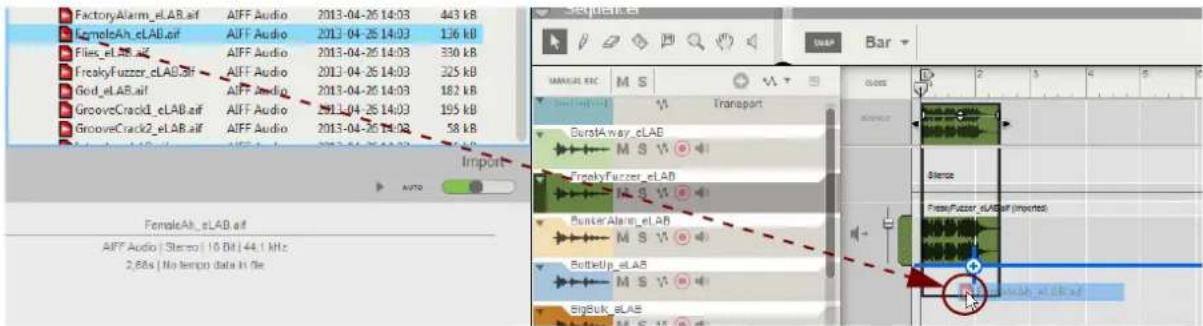
A + sign and a horizontal and a vertical divider indicate where in the Comp Row area the imported audio file(s) will be placed.
- If you like, you could now edit the Audio Clip and comp the recordings on the different Comp Rows according to the description in "Creating a comped audio clip".
Exporting audio
You can export audio from Reason Lite in some different ways. Besides exporting songs or parts of songs, it's also possible to export (bounce) audio from separate Mixer Channels, with or without the mixer settings. It's also possible to export (bounce) individual Audio Clips. You can choose a variety of sample rates for the exported/bounced audio, and also various audio file formats and resolutions.
Exporting Songs or parts of Songs
There are two ways of exporting the mix of all active sequencer tracks in a song:
- The "Export Song as Audio File..." on the File menu allows you to save the mix from the start of the song to the End Position Marker.
- The "Export Loop as Audio File..." on the File menu allows you to save the mix from the Left Locator to the Right Locator.
! When you export a song or a Loop, the signals for the exported audio file are taken from Outputs 1 and 2 of the Hardware Interface device. Any other used outputs on the Hardware Interface will be disregarded.
Proceed as follows to export the mix of an entire song, or a loop section of a song:
- Make sure the End Position Marker is placed where you want the song to end or, if you want to export a Loop, make sure the Left and Right Locators are placed around the Loop you want to export.
! Make sure you place the End Marker (when exporting a Song) or Right Locator (when exporting a Loop) so that any sustaining sounds are allowed to decay to silence. Otherwise, there will be an abrupt "cut" in the end of the exported audio file. This is probably not what you want. -
Select "Export Song as Audio File..." or "Export Loop as Audio File..." from the File menu.
The "Export Song as Audio File" or "Export Loop as Audio File" dialog appears. -
Choose location, File Name and File Format (AIFF or WAV) for the exported audio file at the bottom of the dialog and click "Save":
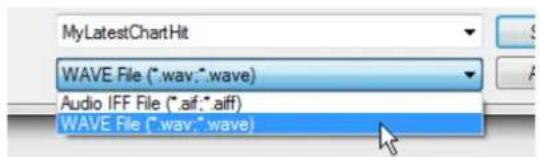
Choose a file name and select file format.
- Select "Sample Rate", "Bit Depth" (resolution) and "Dither" in the "Export Audio Settings" dialog and click "OK":
If you are exporting at 16-bit Bit Depth you will have the option of applying Dither. Dither means that a type of noise is added to the digital signal to improve low level sound quality when exporting high resolution audio at a lower bit depth. Reason Lite features a new, and very sophisticated, dithering algorithm with noise shaping.
→ Tick the "Dither" check box to improve the audio quality of exported audio at 16-bit resolution.
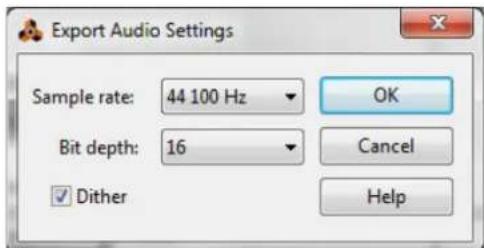
Select Sample Rate, Bit Depth and Dithering of the audio to be exported.
About Tempo data in exported audio files
In addition to the audio data, tempo data is automatically included in the exported audio file. The tempo data contains information about the song Tempo and any Tempo Automation used in the song/loop. If you import such an audio file into another Reason Lite song, it will automatically stretch to fit the current song tempo.
If the section to be exported contains audio for which high-quality stretching hasn't already been done, this will be calculated before the actual export happens. When Reason Lite performs high-quality stretching, the CALC indicator on the Transport Panel shows a progress bar:
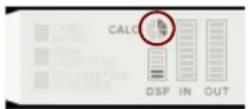
The CALC indicator indicates when Reason Lite performs high-quality stretching of audio.
- If high-quality stretching is still in progress when you export your audio file, the Export dialog will show a progress bar as well.
As soon as the high-quality stretching is finished, the dialog will be closed.
Bouncing Mixer Channels
Bouncing Mixer Channels basically means "recording" the audio outputs from Audio Track Channels and/or Mix Channels and then automatically creating separate audio files. The audio files can then be saved to disk or placed on new Audio Tracks in your song. If you choose to bounce to disk, the audio files will be automatically saved to disk as separate audio files. If you instead choose to bounce to new tracks, the bounced audio files will be automatically placed on new Audio Tracks in the sequencer.
The "bounce to disk" option is ideal if you want to export your sequencer tracks separately for further processing in external applications. The "bounce to track" option is great if you, for example, have instrument tracks with lots of resource consuming Insert FX etc. and therefore want to render them into audio to free up DSP resources in your song. You can choose to bounce the Mixer Channels, either throughout the entire song, or only between the Left and Right Locators. You can also choose to bounce with or without mixer settings.
! It's also possible to bounce individual clips to new audio clips on new audio tracks in the sequencer. If this is what you want to do, please refer to the "Bounce in Place" function.
To bounce Mixer Channels proceed as follows:
- Select "Bounce Mixer Channels..." from the File menu.
The "Bounce Mixer Channels" dialog appears:
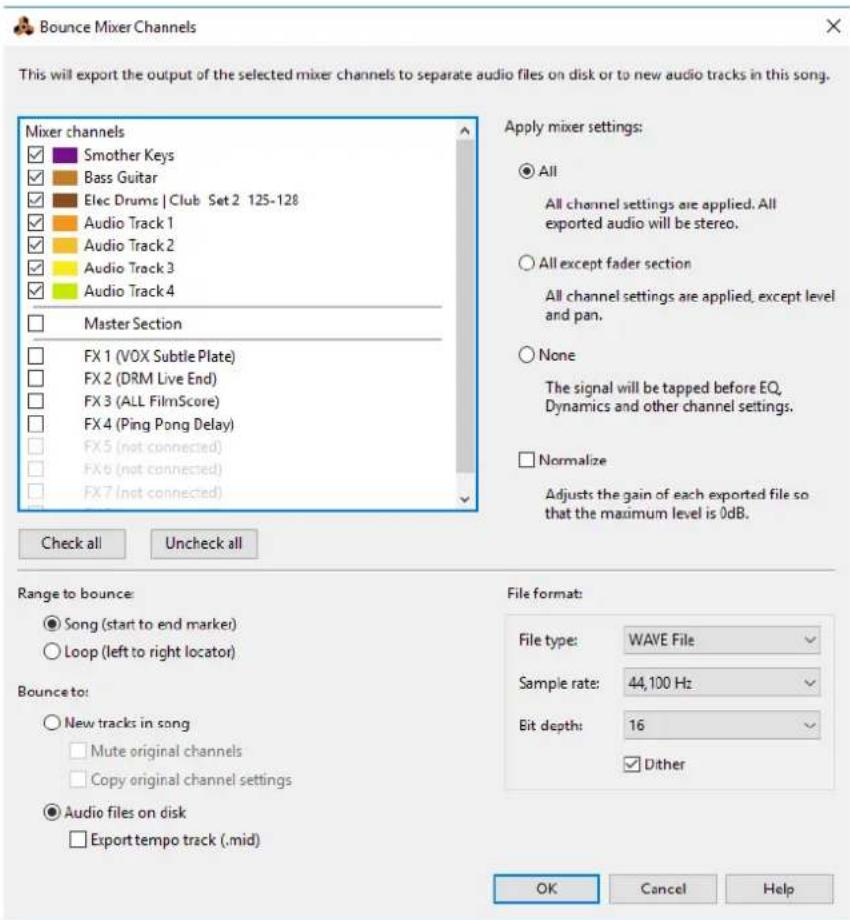
The "Bounce Mixer Channels" dialog.
When you open the "Bounce Mixer Channels" dialog, some channels in the Mixer Channels list might already be checked. This depends on what Mixer Channels (or their corresponding tracks or rack devices) were selected when you opened the dialog. The Master Section and FX Returns are never automatically checked when you open the dialog; you have to do that manually.
- Tick the check boxes for the Mixer Channels you want to bounce. Note that you can also bounce the Mixer Master Section and any FX Returns at the same time if you like.
The Mixer Channels in the list appear in the order they are placed in the Main Mixer, i.e. not necessarily in numerical or chronological order. The color tags in the list correspond to the Channel Strip colors in the Main Mixer. The Master Section is always listed as "Master Section" in the list and the eight FX Returns are listed as "FX 1 Return (
→ Click the "Check All" or "Uncheck All" buttons to activate or deactivate all checkboxes in one go.
3. Select what channel settings you want to use (or not use) by clicking one of the radio buttons in the "Apply Mixer Settings" section.
Select "All" to bounce the selected Mixer Channels with all its settings, including any Insert FX, Level and Pan. Since the Pan parameter is included, mono Mixer Channels will be bounced as stereo audio files.
→ Select "All except fader section" to bounce the selected Mixer Channels with all Mixer Channel settings, including any Insert FX, but excluding the Level, Pan, Stereo Width and Mute parameters of the Channel Strip. Stereo Mixer Channels will be bounced as stereo audio files whereas mono Mixer Channels will be bounced as mono audio files. For the Master Section, this option means including Insert FX and the Master Compressor, but not the master fader.
→ Select "None" to bounce the selected Mixer Channels before the Mixer Channel Strips, without applying any Mixer Channel parameters or Insert FX.
Bounced files will be in stereo if there's any stereo material on the Audio Track (or, for a Mix Channel, if it's connected in stereo). Otherwise, the bounced audio files will be in mono.
- Tick the "Normalize" check box to adjust all bounced audio files so the maximum level is 0 dB.
Normalizing is useful to get good levels when you proceed to use the bounced audio files in another application, or to avoid clipping.
- Select what range to bounce in the "Range to Bounce" section.
→ Select "Song" to bounce the entire song (from the beginning of the song to the End Marker).
→ Select "Loop" to bounce the section between the Left and Right Locators.
! Make sure you place the End Marker (when bouncing a Song) or Right Locator (when bouncing a Loop) so that any sustaining sounds are allowed to decay to silence. Otherwise, there will be an abrupt "cut" in the end of the bounced audio files.
6. Select destination for the bounced Mixer Channel(s) in the "Bounce to:" section.
→ Select "New Tracks in Song" to bounce the Mixer Channels to new Audio Tracks in the song.
When "New Tracks in Song" is selected, the File Format settings in the dialog are disabled (as is the "Export Tempo Track (.MID)" setting). The audio will be rendered at the current song's sample rate (i.e. what you have previously set up in the hardware audio interface), at full 32-bit float resolution.
Clicking OK will create a new Audio Track for each selected Mixer Channel, create an Audio Clip on each of these Tracks and render the Mixer Channel audio as a recording on a Comp Row in the Audio Clip.
The new Audio Tracks will get the names and colors of their corresponding (bounced) Mixer Channels. The Audio Clips will get the same color but will not be labeled (named).
The new recordings (on the Comp Rows) will get the name of their source Mixer Channels + "(Bounced)", e.g. "Picked Guitar (Bounced)" if the bounced Mixer Channel's name is "Picked Guitar".
Selecting "Mute Original Channels" will mute all bounced Mixer Channels (those selected in the Mixer Channels list) after the bouncing. If there are automation lanes for their Mute buttons, their ON buttons will be turned off.
If you selected "None" in the "Apply mixer settings" section, you will be given the option to copy the original mixer channel settings to the destination channels. To do this, tick the "Copy original channel settings" box.
! The "Mute Original Channels" setting does not affect the Master Section or the FX Returns.
→ Select "Audio Files on Disk" to bounce the Mixer Channels to audio files on disk.
When "Audio Files on Disk" is selected, the "Mute Original Channels" option in the dialog is automatically disabled. Choose File Type, Sample Rate, Bit Depth and any Dither in the "File Format" section.
Clicking OK will bring up a Save dialog which allows you to select a folder, or create a new folder. Clicking Save will then create one audio file per selected Mixer Channel and place in a sub-folder named "Bounced
The audio files will get the name of the bounced Mixer Channels, plus the File Type extension. If several selected Mixer Channels have the same name, an incremental number (starting with "-01") will be automatically added before the file extension.
The Song Tempo, and any Tempo Automation, is also included in the exported audio files. This means that if you import the audio files into another Reason Lite Song document, they will automatically be stretched to the Song Tempo of that song.
If "Export Tempo Track (.MID)" is activated, the bounce function will also export a separate MIDI file containing the Song Tempo, and any Tempo Automation data. The MIDI file will have the name of the song, with the extension ".MID". This MIDI file can then be imported to the tempo automation lane in another Reason Lite Song document, or to the tempo track in another DAW, to automatically set the song tempo and control any tempo automation in the sequencer.
! Note that the "Export Tempo Track" option is available only if you have selected "Audio Files on Disk" in the "Bounce to:" section and "Song" in the "Range to Bounce:" section.
Bouncing Audio Clips
The "Bounce Clip to Disk" function
The "Bounce Clip to Disk" function becomes available when a single Audio Clip is selected (in Arrange Mode or Edit Mode). The function allows you to bounce single Audio Clips, after the Clip Level and Fades but without the Mixer Channel settings, to disk for further processing in an external application, for example. Do like this to bounce an audio clip to disk:
- Select an Audio Clip and choose "Bounce Clip to Disk..." from the Edit menu or context menu.
The "Bounce Clip As Audio File" dialog appears. It looks the same, and has the same functionality, as the "Export Song as Audio File" and "Export Loop as Audio File" dialogs.
- Choose location, File Name and File Format (AIFF or WAV) for the bounced audio clip at the bottom of the dialog and click "Save".
(The default name in the dialog is the Clip name + extension, or (if there's no name label on the clip) the track name + extension.)
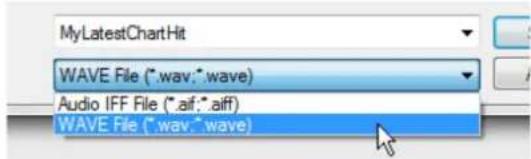
Choose a file name and select file format.
- Select "Sample Rate", "Bit Depth" (resolution) and "Dither" in the "Export Audio Settings" dialog and click "OK":
If you are exporting at 16-bit Bit Depth you will have the option of applying Dither. Dither means that a type of noise is added to the digital signal to improve low level sound quality when exporting high resolution audio at a lower bit depth. Reason Lite features a new, and very sophisticated, dithering algorithm with noise shaping.
→ Tick the "Dither" check box to improve the audio quality of exported audio at 16-bit resolution.
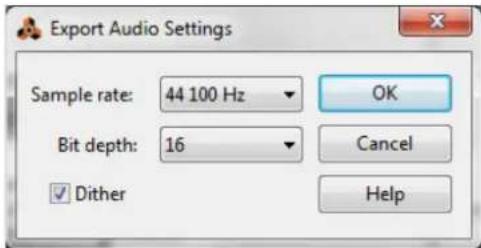
Select Sample Rate, Bit Depth and Dithering of the audio clip to be bounced.
The exported audio file will also contain tempo data as described in "About Tempo data in exported audio files".
About the "Bounce Clip to New Sample" function
You can bounce an Audio Clip to a new Song Sample if you like. You could then edit the sample and load into a sampler device for playback.
See "Bounce Clip(s) to New Sample(s)" in the "Audio Editing in the Sequencer" chapter for more details.
About the "Bounce Clip to New Recording" function
You can also bounce an Audio Clip to a new recording on an additional Comp Row in the Audio Clip. This is like a non-destructive "Flatten" operation. It will create a new recording from the clip output - ignoring Clip Level and Clip Fade In/Out settings. The recording will be placed on a new Comp Row at the top of the Comp Row list in the clip. The Audio Clip will then automatically switch to Single Mode.
See "Bounce Clip(s) to New Recording(s)" in the "Audio Editing in the Sequencer" chapter for more details.
About the "Bounce Clip to REX Loop" function
A Single Take clip, which is open for inline editing, features the function "Bounce Clip to REX Loop" on the Edit and context menu. This allows you to generate a REX loop out of the Single Take audio clip. The REX loop can then be used in a Dr Octo Rex device in Reason Lite and/or be exported to disk.
See "Bounce Clip to REX Loop" in the "Audio Editing in the Sequencer" chapter for more details.

Chapter 21
Sampling
About this chapter
This chapter describes how you can sample, edit samples and manage your samples in your songs. For more information about the specific devices that can sample and play back samples, please refer to the "Redrum Drum Computer" and "RV7000 Mk II Advanced Reverb" chapters.
Overview
The sampling feature allows you to sample external audio (or internally from the outputs of any device) and use in any of the devices that support sample files, i.e. Redrum and RV7000 Mk II.
One-click sampling
The sampling workflow has been designed to be as quick and easy as possible, so you don't lose any inspiration. Regardless which device you use when sampling - Redrum or RV7000 Mk II - sampling can be instantly accessed by simply clicking, or by clicking and holding the Sampling button(s) on these devices:
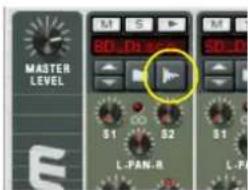
Sampling buttons on Redrum.
See "Sampling procedure" for more details on how to sample.
The Edit Sample window
All sampling parameters and functions are controlled from one single window - the Edit Sample window. This window is used when you're editing samples in any of the devices described above, See "Editing samples" for more details.
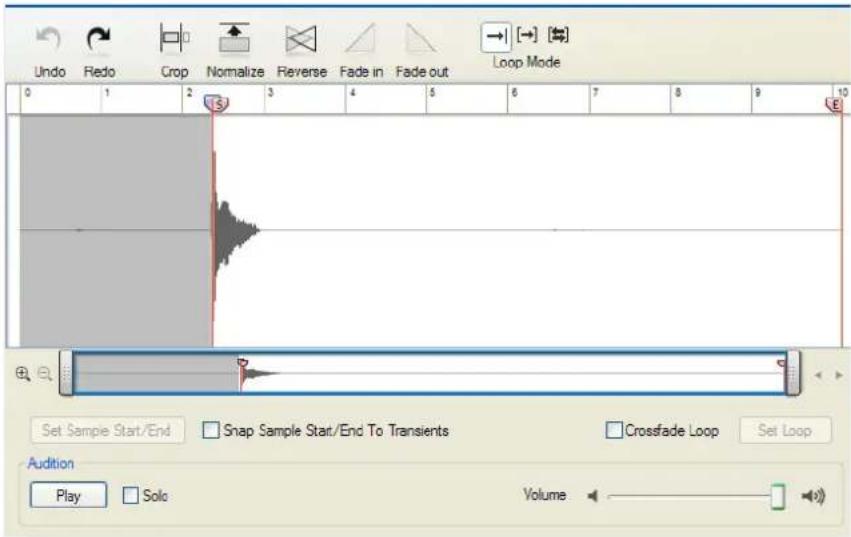
The Edit Sample window with a sample.
About sample format, rate and resolution
Whenever you sample in Reason Lite, the resulting audio files are stored in WAV format. The sample rate is determined by the settings on the Audio tab in Preferences (see "Audio settings"). The resolution (bit depth) is fixed at 16 bits.
Reason Lite is totally agnostic about what sample rate you use. If you like, you can change the sample rate at any time without affecting the pitch, playback speed etc. of your samples. What you have once sampled will always sound the same, regardless of the current audio settings.
General sampling functions
Setting up for sampling
If you want to sample external audio, e.g. from a mic or an instrument connected to the audio hardware on your computer, make sure you have set up the desired audio input(s) on the Audio tab in Preferences, see "Active input and output channels". Available audio inputs are indicated with yellow or green LEDs on the Hardware Interface in the rack:

Selecting audio input source(s)
To set up for sampling, you first need to make some connections on the Hardware Interface:
-
Navigate to the Hardware Interface and press [Tab] to flip the rack around.
-
Patch cables to the Sampling Inputs as follows:
To sample external audio, connect the desired Audio Input connector(s) to the Sampling Input connector(s) to the left on the rear of the Hardware Interface.
To sample the audio of a device in the rack, connect cables from the audio output(s) of the device to the Sampling Input connector(s) on the Hardware Interface.
• To sample in stereo, connect to both the Left and Right Sampling Input connectors.
- To sample in mono, connect only to the Left or Right Sampling Input connector.
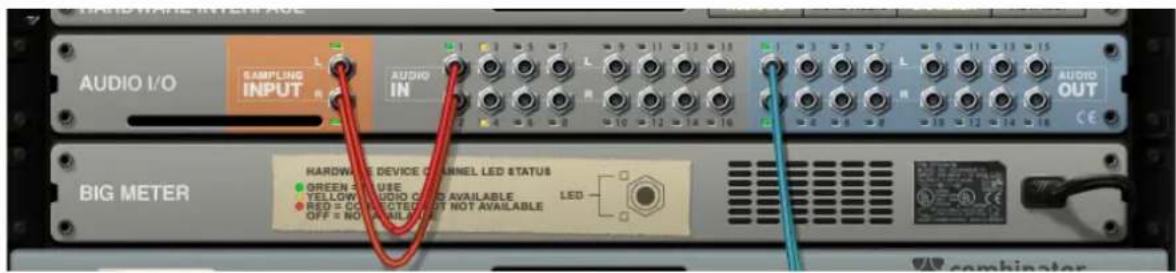
Audio Inputs 1&2 connected to Sampling Inputs L&R for sampling in stereo.
Setting audio input level
Once you have made the desired connections to the Sampling Input(s) on the Hardware Interface, it's important to check the audio input level to avoid clipping. If you are going to sample external audio via the audio hardware of your computer, you have to adjust the level at the source, i.e. on the pre-amp of the audio hardware (or connected instrument). A good suggestion is to use the Big Meter on the Hardware Interface to be able to monitor the input level(s) more easily.
→ Adjust the level at the source and make sure the level doesn't exceed 0 dB to avoid clipping.

→ If you sample internally, from the output(s) of a device in the rack, adjust the Output Level on the source device and check the levels with the Sampling Inputs selected on the Big Meter:
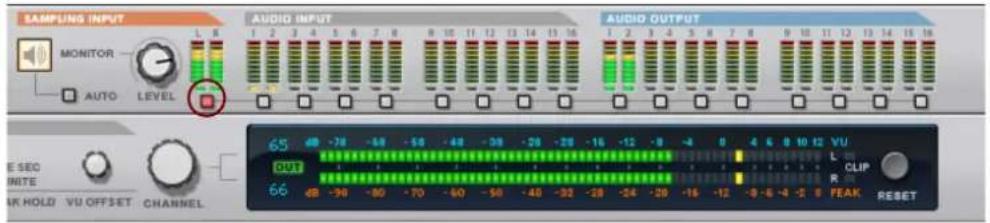
Monitoring and Monitor Level
To the left on the Hardware Interface are two buttons and one knob for monitoring the signals on the Sampling Inputs:

→ Click the Monitor button to activate monitoring of the signals present at the Sampling Inputs. Monitoring will always be active, regardless of if you sample or not.
→ Click the Auto button to activate monitoring only during sampling.
Monitoring will only be active during the actual sampling. When you don't sample, monitoring will be off.
→ Turn the Monitor knob to adjust the monitor signal level.
! The Monitor Level knob does not affect the level of the audio to be sampled - only the monitored signal.
Sampling
The Sample buttons
The Redrum and RV7000 Mk II devices feature one or several Sample buttons. The Sample buttons are located on the devices as follows:
Sampling buttons on Redrum.
Sampling procedure
- Make sure you have made the necessary connections and set the levels according to the descriptions in "Setting up for sampling".
- Click the Sample button on the device you want to sample to.
→ Alternatively, click and hold the Sample button depressed for as long as you want to sample.
When you use the "click and hold" method, sampling will be automatically terminated as soon as you release the mouse button. The sample will then end up in the device and in the Song Samples location in the Browser.
! If you're sampling into a Redrum, make sure you click/hold the Sample button for the desired drum channel.
A waveform display shows up with a moving "play head":
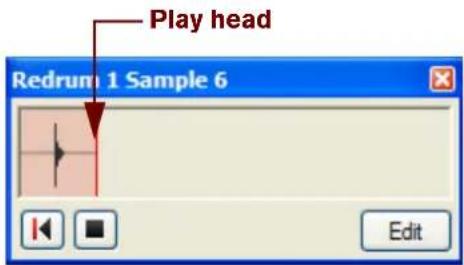
- Start playing or singing what you want to sample.
As soon as any audio is present on the Sampling Inputs on the Hardware Interface, the waveform display will indicate this by drawing a wave.
! The buffer size for sampled audio is 30 seconds. After 30 seconds, the play head will start over again from the beginning and start erasing any previously sampled audio.
→ If you want to restart the sampling manually, click the Restart Sampling button:
The "Restart Sampling" button.
This will erase any sampled audio and force the play head to restart from the beginning.
! Note that you cannot restart sampling this way if you use the "click and hold" sampling method.
- When you're satisfied with your recording, click the Stop Sampling button in the waveform display.
The "Stop Sampling" button.
The waveform display closes and the sample automatically ends up in the device, where you can play it back instantly:
By default, the sample is named "Sample 'n'" where 'n' is a serial number. As you will notice, any silence preceding the actual audio in the sample will be automatically disregarded. The entire sample is preserved, but this is done so you won't have to edit the sample start before playback.
Besides ending up in the device, the sample is also placed under the corresponding device icon in the Assigned Samples folder in the Song Samples location in the Browser:
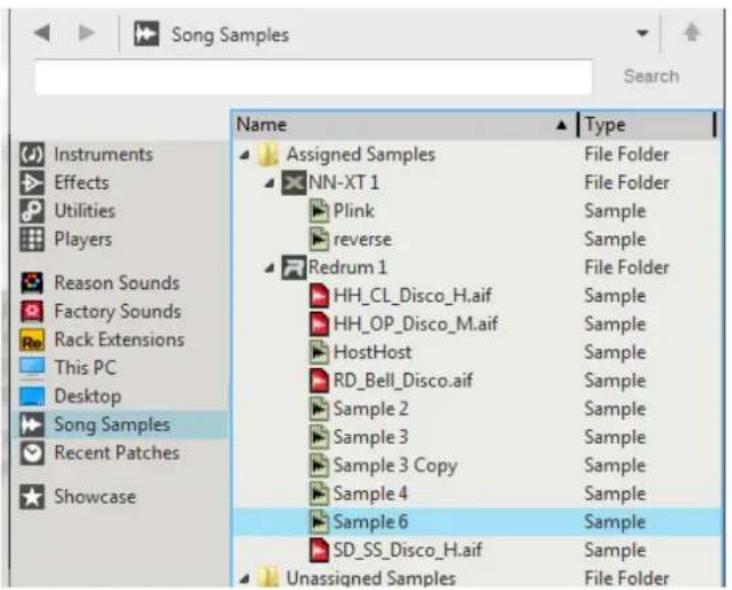
Here, all samples you use in your song are listed (see "The Song Samples location"). Here is also where you can open samples for editing (see "Editing samples").
The Song Samples location
The Song Samples location in the Browser is where all samples in your song are listed and can be accessed for preview and editing purposes. Besides your own samples, all Factory samples and any ReFills samples used in the song are also accessible for previewing and editing!
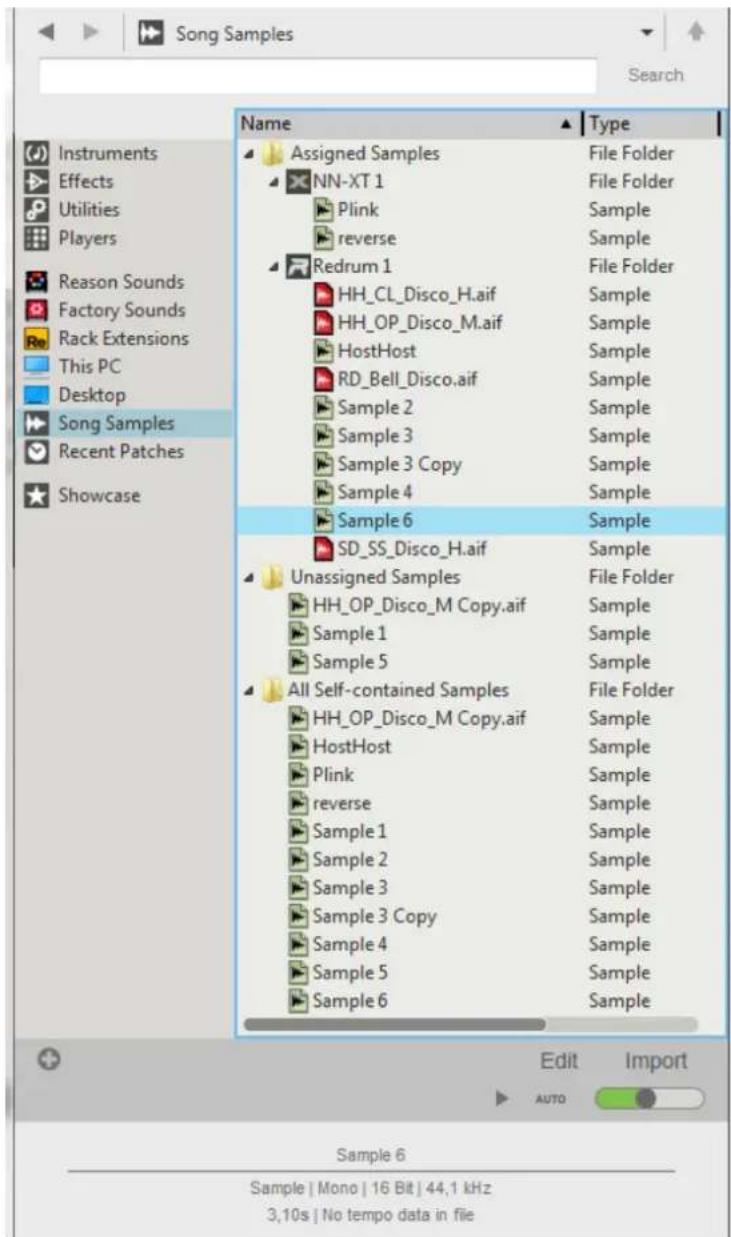
The Song Samples location in the Browser.
The Song Samples location in the Browser contains the following items:
- Assigned Samples folder
Here, all samples that are assigned to devices in the song are listed. All devices that contain assigned samples are listed as "sub-folders". Each device "sub-folder" shows the samples currently assigned to it. See "Assigned Samples" for more details.
- Unassigned Samples folder
If you remove a sound you have sampled from a device, the sound is automatically moved from the Assigned Samples folder to the Unassigned Samples folder. From here you can load the sample into other devices if you like. See "Unassigned Samples" for more details.
- All Self-contained Samples folder
All sounds you have sampled yourself, plus any duplicated samples from the Factory Soundbank and/or ReFills, automatically becomes self-contained and are always stored with the song. These samples are listed in the All Self-contained Samples folder. See "About self-contained samples" for more details.
- Edit button
Click the Edit button to open the selected sample for editing in the Edit Sample window (see "The Edit Sample window").
- Import button
Click this button to import the selected sample(s) to audio tracks in the sequencer.
- Play and Auto buttons
To audition a sample, select it in the Browser list and click the Play button. If you click the Auto button, simply selecting a sample in the list will automatically play it back.
• Volume slider
Adjust the preview volume of the sample with the slider. This does not affect the samples original volume.
The context menu of a selected sample contains the following functions:
• Edit Sample
Select this to open the sample for editing in the Edit Sample window (see "The Edit Sample window"). If several samples are selected, this item is grayed out.
- Duplicate Sample(s)
Select this to create a duplicate of the selected sample. The duplicated sample is placed in the All Self-contained Samples and Unassigned Samples folders. Several selected samples can be duplicated in one go. See "Duplicating samples" for more details.
- Export Sample(s)
Select this to export the selected sample to disk. A dialog appears where you can select file format. Note that it is not possible to export samples from the Factory Soundbank or from ReFills. Several selected samples can be exported in one go. See "Exporting samples" for more details.
- Delete Sample(s)
Select this to permanently delete the selected sample(s) from the song. Note that samples from the Factory Soundbank and from ReFills will not be deleted from their original locations - only from the song document. Several selected samples can be deleted in one go. See "Deleting samples from a song" for more details. Any samples you have recorded yourself will be permanently erased unless you have previously exported them to disk (see "Export Sample(s)" below).
Editing samples
The Edit Sample window
Any sample present in the All Self-contained Samples folder in the Song Samples location in the Browser can be edited.
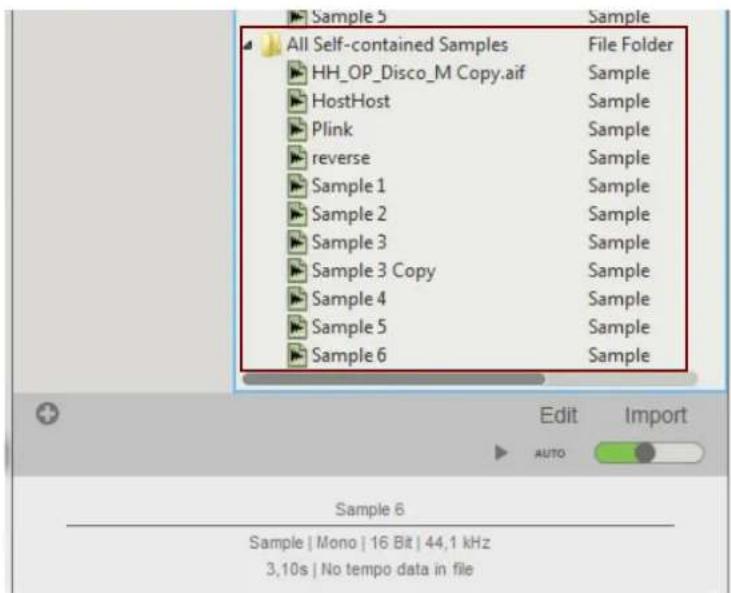
→ Select a sample in the Browser list and click the Edit button to open the sample in the Edit Sample window:
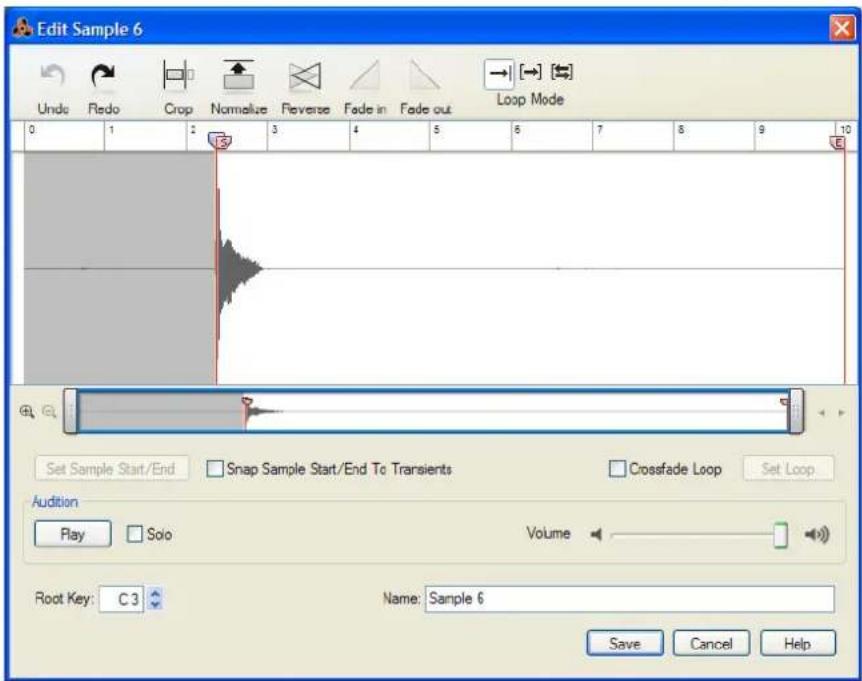
The Edit Sample window with an open sample.
The Edit Sample window can be resized in all directions by clicking and dragging the window frame. If you resize the window vertically, the displayed waveform will be resized vertically as well.
- Undo and Redo buttons
The Undo and Redo buttons work like the regular undo and redo functions in the main window menu, but these are used locally only for the Sample Edit window. The number of Undo and Redo steps in the Sample Edit window are limited to 10. Once you have clicked the Save button, you can still undo the entire sample editing procedure by using the Undo function in the main window.
- Crop button
Click the Crop button to crop the sample so that only the content between the Start (S) and End (E) locators is preserved. The rest of the sample will be permanently deleted. See "Cropping samples" for more info.
- Normalize button
Click the Normalize button to amplify the entire sample so that the loudest peak touches 0 dB. Note that the entire sample is normalized, regardless of any locator settings. See "Normalizing samples" for more info.
- Reverse button
Click the Reverse button to reverse (play backward) the entire sample. Note that the entire sample is reversed, regardless of any locator settings. See "Reversing samples" for more info.
- Fade In and Fade Out buttons
The Fade In and Fade Out buttons can be used to apply a fade in or fade out of the sample volume. See "Fading in/out samples" for more info.
- Loop Mode buttons
Click one of the Loop Mode buttons to select loop type. The default (leftmost) setting is "no loop". Then follow "Loop Forward" and "Loop Forward + Backward". See "Looping samples" for more info.
- Wave form pane
Here, the currently open sample is displayed as one (mono) or two (stereo) waveforms. The Start (S) and End (E) locators are also displayed. By default the Start locator is placed where the audio begins in the sample. This means that if you have started sampling before there were any audio present, the playback will automatically start where the audio begins. This way you won't have to manually move the Start locator in most situations.
- Waveform Navigator
Below the waveform pane is the horizontal Waveform Navigator. This can be operated in the same way as the Song Navigator in the sequencer (see "Scrolling with the Navigators and scrollbars", "Zooming horizontally in the Sequencer" and "Scrolling and zooming using a wheel mouse").
- Set Sample Start/End button
Set the desired sample playback region by clicking and dragging on the waveform pane. Then, click the Set Sample Start/End button to automatically place the Start and End locators at the beginning and end of the sample region. See "The Set Start/End function" for more info.
- Snap Sample Start/End To Transients button
Click the Snap Sample Start/End To Transients button to make the Start and End locators snap to suitable transients in the sample as you move the locators. This makes it easier to find appropriate start and end locations for the sample playback.
• Crossfade Loop checkbox
Tick the Crossfade Loop box to introduce a crossfade in the loop. Crossfade is useful to even out any clicks in the loop points, especially for sounds with fairly even volume throughout the loop region. See "The Crossfade Loop function" for more info.
- Set Loop button
Set the desired loop region by clicking and dragging on the waveform pane. Then, click the Set Loop button to automatically place the Left and Right Loop locators at the beginning and end of the loop region. See "The Set Loop function" for more info.
- Play button, Solo checkbox and Volume slider
Click the Play button to play back the sample from the current position of the play head until the end of the sample. As soon as playback is started the button switches to display Stop instead, giving you the option of stopping play-back. This is especially useful if your sample is looped. As an alternative to clicking the Play/Stop button you can press [Spacebar] to toggle between Play and Stop.
Tick the Solo checkbox to solo sample playback. This is useful if your song is playing in the background and you only want to listen to the sample.
Adjust the sample playback volume with the Volume slider to the right.
- Root Key
Set the sample Root Key (pitch) by clicking the spin controls, or by entering the desired note value in the display. If you know what note your sample is, select that note here. When you open the sample in a sampler device, the device will automatically transpose the sample correctly across the keyboard.
- Name
Type in desired name for your sample. Note that this will overwrite the original name of the sample in the Song Samples list in the Tool Window once you click Save. See "Renaming samples" for more info.
- Save and Cancel buttons
Click Save to save your sample. The sample will appear in the Song Samples location in the Browser. See "Saving edited samples" for more info.
Click Cancel to exit the Edit Sample window and discard from any edits you've made in the current sample.
Setting Sample Start and End
1. Open the sample by selecting it in the Browser list and clicking the Edit button - or select "Edit Sample" from the context menu.
The sample opens in the Edit Sample window.
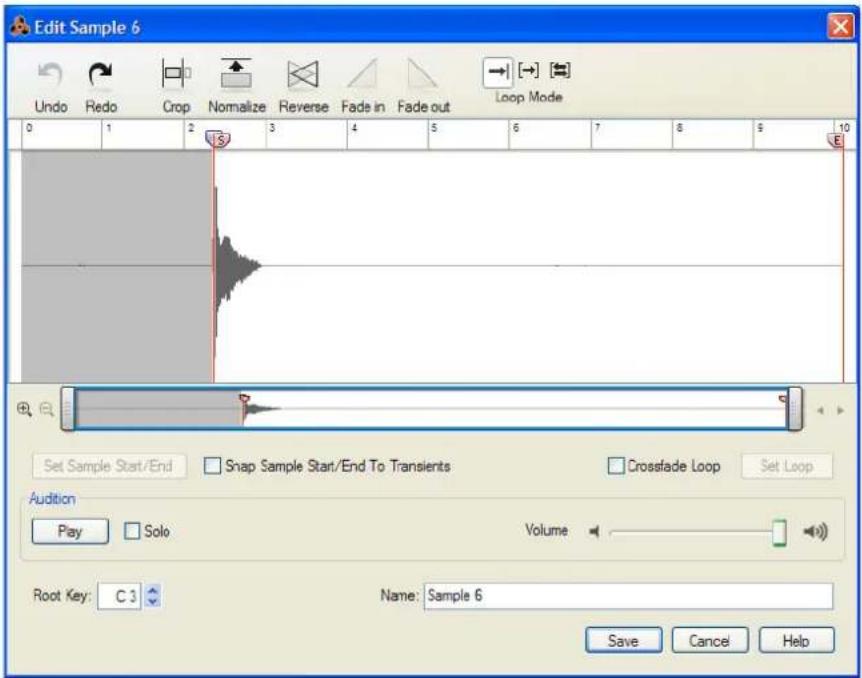
If you have recorded the sample yourself in Reason Lite, the Start (S) locator has been automatically placed at the first significant transient in the sound. The play head is also automatically placed at the Start locator.
-
If necessary, adjust the Start locator by clicking and dragging it back or forth in the Edit Sample window ruler. Play back the sample by clicking the Play button, or by pressing the [Spacebar].
-
To make it easier to fine adjust the locators, it could be wise to magnify the waveform pane horizontally using the Waveform Navigator. The Waveform Navigator works exactly as the Song Navigator in the Sequencer - see "Zooming horizontally in the Sequencer" and "Scrolling and zooming using a wheel mouse".
→ Tick the "Snap Sample Start/End To Transients" check box if you want the locators to snap to significant transients in the sample. - Adjust the End locator by clicking and dragging it back or forth in the Edit Sample window ruler.
The Set Start/End function
Another way of defining a sample's start and end positions is by using the Set Start/End function:
- Set the desired sample playback zone by clicking and dragging on the waveform pane.
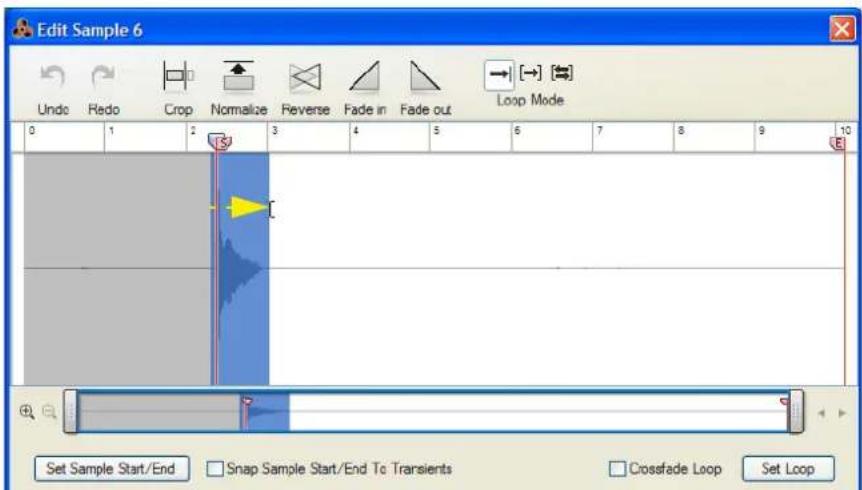
The defined zone is highlighted in blue color.
- Click the Set Sample Start/End button.
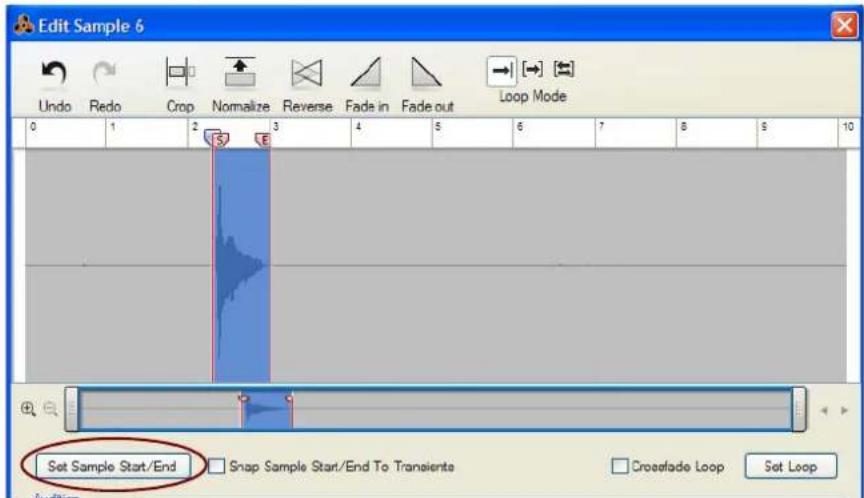
The Start and End locators are automatically placed at the beginning and end of the defined playback zone.
- Click anywhere on the Waveform pane to remove the highlight.
Cropping samples
Cropping a sample means deleting parts you don't want to keep, e.g. any silence in the beginning and/or in the end of a sample. The Crop function in the Edit Sample window deletes everything except what's in between the Start and End locators, or everything outside any highlighted part of the sample. To crop a sample, proceed as follows:
-
Set the Start and End locators where you want them - see "Setting Sample Start and End". Alternatively, click and drag in the Edit Sample window to highlight the section you want to keep.
-
Click the Crop button in the Edit Sample window.
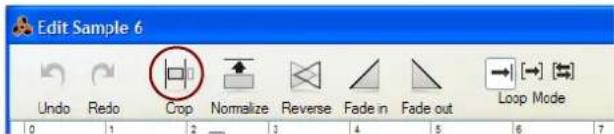
- If you highlighted a section by clicking and dragging in the Edit Sample window, everything except the highlighted part gets permanently deleted.
- If you didn't highlight a section of the sample, everything before the Start locator and after the End locator gets permanently deleted.
Normalizing samples
Normalizing means amplifying the volume of the sample so that the loudest peak in the sound touches 0 dB. The Normalize function normalizes either the entire sample, or the highlighted part of the sample.
-
Click and drag in the Edit Sample window to highlight the part of the sample you want to normalize. To normalize the entire sample, you don't have to do anything.
-
Click the Normalize button in the Edit Sample window.
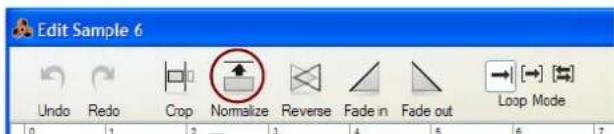
- If you highlighted a section of the sample, the highlighted part gets normalized.
- If you didn't highlight a section of the sample, the entire sample gets normalized regardless of any Locator settings. Since the entire sample is normalized, this means that any noise present in the sound will also be amplified. After the Normalize operation, the waveform is redrawn with the new volume values.
! Note that normalizing a sample that already use the full headroom (touches 0 dB) won't have any effect.
Reversing samples
Reversing a sample means playing it backwards, from the end to the start. The Reverse function reverses either the entire sample, or the highlighted part of the sample.
-
Click and drag in the Edit Sample window to highlight the part of the sample you want to reverse. To reverse the entire sample, you don't have to do anything.
-
Click the Reverse button in the Edit Sample window.
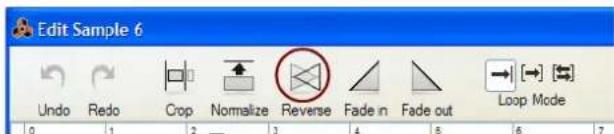
- If you highlighted a section of the sample, the highlighted part gets reversed.
- If you didn't highlight a section of the sample, the entire sample gets reversed regardless of any Locator settings.
After the Reverse operation, the waveform is redrawn with the reversed shape.
Fading in/out samples
Using short fades is useful if you want to remove clicks or pops in the beginning and/or end of the sample. You can also create longer fades to make a sound fade in and/or out nice and smoothly.
- Set the desired Fade In (or Fade Out) zone by clicking and dragging on the waveform pane.

The defined zone is highlighted in blue color.
- Click the Fade In (or Fade Out) button.
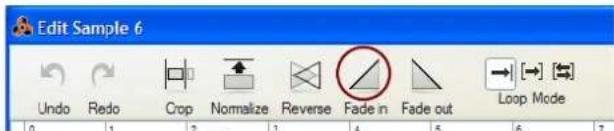
Clicking the Fade In button creates a fade in from complete silence at the beginning of the highlighted zone to the current volume at the end of the highlighted zone;
![Edit Sample 7 Undo Rado Crop Normalize Reverse Fade in Fade out 0.00 0.01 0.02 0.03 0.04 0.05 0.06 0.07 0.08 [1] 5](/content/2026/06/1203202/images/18232679ddf169a5e7daaa1febff1319841b4420733e678ced8ebf488c59f080.jpg)
Clicking the Fade Out button creates a fade out from the current volume at the beginning of the highlighted zone to complete silence at the end of the zone.
After the Fade operation, the waveform is redrawn with the new volume values.
- Click anywhere on the Waveform pane to remove the highlight.
Looping samples
Looping a sample means playing back the sample from the start and then playing back a defined zone in the sample over and over again (usually for as long as a key is depressed on the MIDI master keyboard). In practice, looping samples can be used to create "longer" sounds out of shorter ones. For example, if you have a flute sample you may want to loop the middle part of it so that you could make the sound sustain as for long as you like.
There are two different loop modes available in the Edit Sample window (besides the default non-loop mode):
- Loop Forward
In Loop Forward mode the sample is played back from the Start locator to the Right Loop locator, then playback starts over from the Left Loop locator and continues to the Right Loop locator over and over again.
- Loop Forward + Backward
In Loop Forward + Backward mode the sample is played back from the Start locator to the Right Loop locator, then the playback is reversed from the Right Loop locator to the Left Loop locator and then forward again to the Right Loop locator over and over again.
Adjusting the Loop locators
1. Click the Loop Forward or Loop Forward + Backward button.
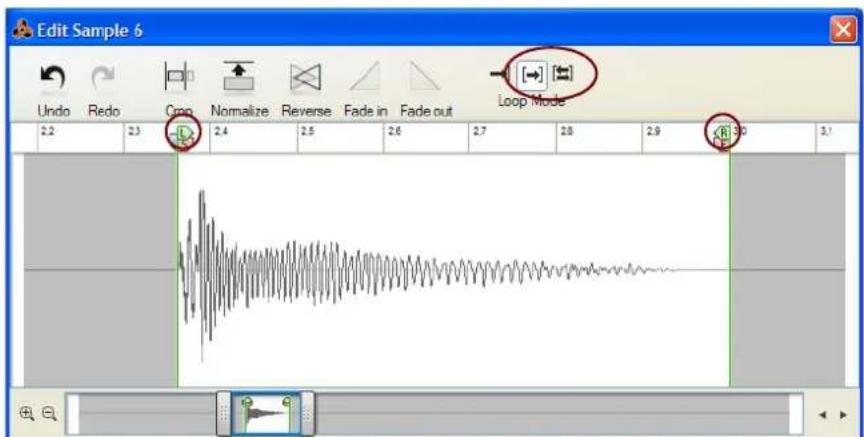
The Left (L) and Right (R) Loop locators appear on the Waveform pane.
2. Play back the sample and adjust the Loop locators to your liking.
If necessary, zoom in horizontally to more easily find suitable loop positions.
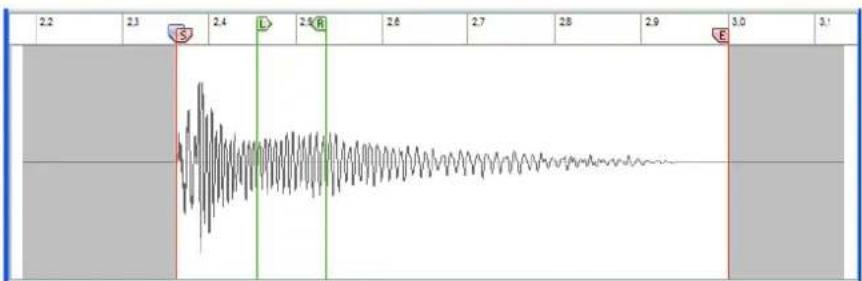
To make loops sound smoother, try using crossfades as described in "The Crossfade Loop function".
The Set Loop function
Another way of defining a sample's loop positions is by using the Set Loop function:
- Set the desired loop zone by clicking and dragging on the waveform pane.
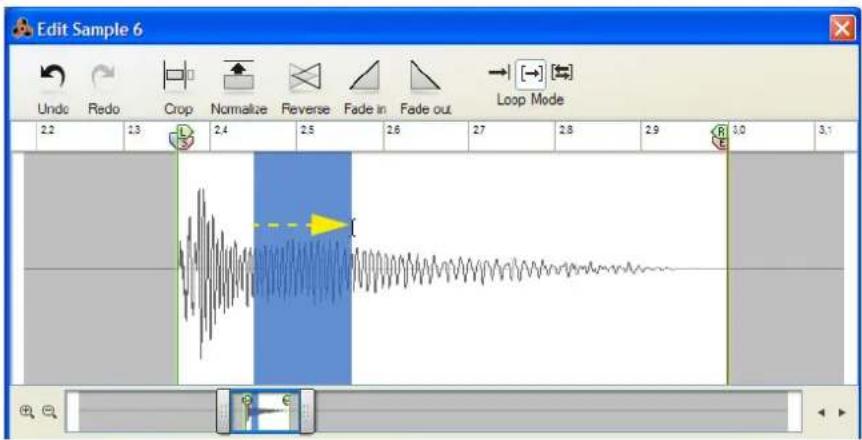
The defined zone is highlighted in blue color.
- Click the Set Loop button.
The Left and Right Loop locators are automatically placed at the beginning and end of the defined zone.
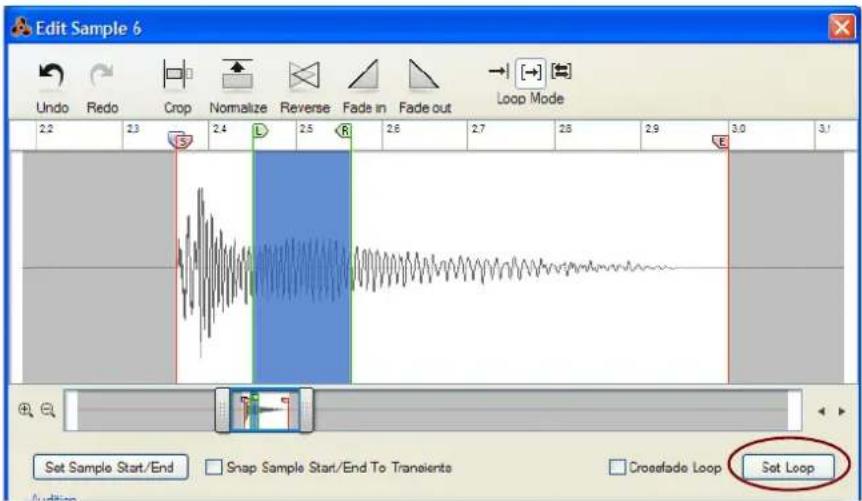
- Click anywhere on the Waveform pane to remove the highlight.
To make loops sound smoother, try using crossfades as described in "The Crossfade Loop function".
The Crossfade Loop function
Crossfades are useful for evening out clicks or transients at the loop points, especially in sounds with fairly constant volume throughout the loop zone. The Crossfade Loop function creates smooth volume crossfade around the Loop Locators.
→ Tick the Crossfade Loop box to automatically introduce a crossfade in the loop.

- When the Crossfade Loop function is active, moving the Left and/or Right Loop Locators will force them to automatically "snap" to suitable loop positions. If you move the Left Loop Locator, the Right Loop Locator will automatically self-adjust to a suitable loop position.
This way you will quickly reach a good result.
- Experiment by alternating the Loop Modes between Loop Forward and Loop Forward + Backward. Just changing Loop Mode can make the loop transitions much smoother in many situations.
A general tip when trying to create a smooth loop is to locate the loop zone where the volume and timbre is fairly constant over time. Big changes in volume and/or timbre in the loop zone will often result in quite pronounced or strange "pulsating" loops. Also, very short loop zones often tend to sound unnatural and "static".
Saving edited samples
→Click the Save button in the Edit Sample Window to save your edited sample.

The sample is saved, complete with all the edits you have made in the Edit Sample Window (Start, End, Loop settings, Name etc.) The sample will appear in the Song Samples location in the Browser, with the new name if this has been changed.
! If you have opened and edited a ReFill sample, a copy of this sample (including any edits) will be saved with its original name in the All Self-contained Samples folder.
Renaming samples
- Type in the desired name of your sample in the Name field in the Edit Sample Window.

- Click the Save button to save the sample with the new name.
! Note that saving a sample under a different name will simply replace the current name - it will not create a copy of the original sample!
Sample management
About Assigned and Unassigned samples
Assigned Samples
Samples can be assigned to devices that support sample playback, such as the Redrum. Samples that are assigned to a device can be found in the Assigned Samples folder in the Song Samples location in the Browser:
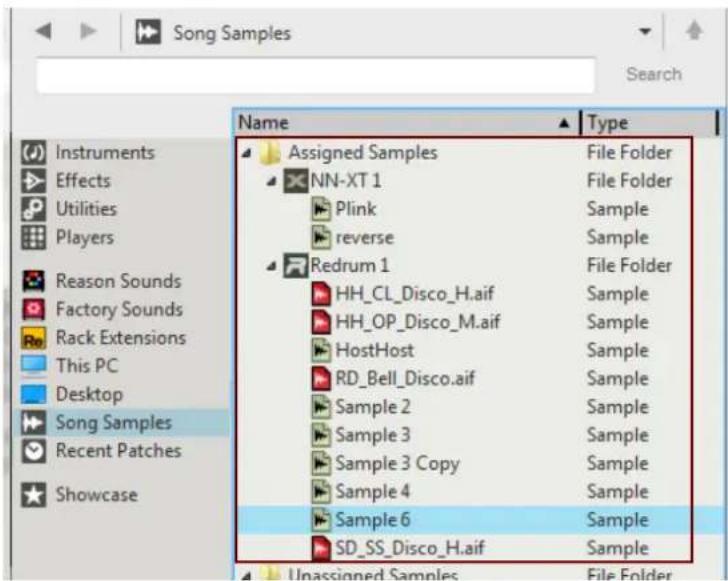
The Assigned Samples folder can contain various sub folders, one for each sampler device used in the current song. The song in the picture above contains two sampler devices; the "NN-XT 1" and the "Redrum 1". The instrument folders can be unfolded to display their current sample contents. Sounds you have sampled yourself as well as samples from the Factory Soundbank and from ReFills are displayed with icons.
Unassigned Samples
Samples that have been removed from a sampler device and have not (yet) been assigned to another sampler device are displayed in the Unassigned Samples folder:
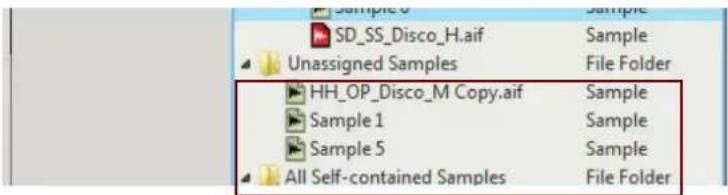
Unassigned samples can be assigned to any sampler device by simply loading them into a sampler device - see "Loading samples into a device".
Saving samples in a song
When you have recorded a sample, by clicking a Sample button on a sampler device, the sample is automatically stored in the All Self-contained Samples folder in the Song Samples location in the Browser:
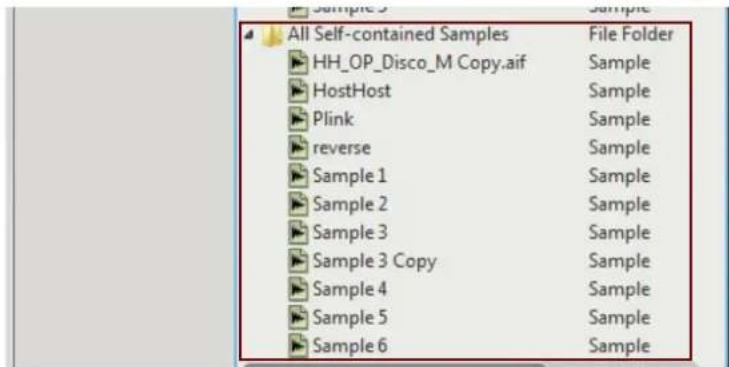
The samples you have recorded are automatically named "Sample 'n'" where 'n' is a serial number.
You can rename a sample by selecting it in the All Self-contained Samples folder, clicking the Edit button, then renaming it in the Edit Sample Window and then clicking the Save button.

As soon as you save your song, all samples you have recorded will be automatically saved as self-contained samples in the song document. This way you don't have to keep track of any "loose" samples on your computer.
Deleting samples from a song
It's only possible to delete samples you have recorded yourself in a Reason Lite song, i.e. samples that are located in the All Self-contained Samples folder in the Browser. Samples from the Factory Soundbank and from ReFills cannot be deleted because they are contained in ReFills.
To delete a sample in the All Self-contained Samples folder, select it and select "Delete Sample(s)" from the context menu.
! Since the selected sample also exists, either in the Assigned Samples folder or Unassigned Samples folder, it will be deleted from there as well. Similarly, if you select and delete a non-Factory Soundbank/ReFill sample from the Assigned Samples folder or Unassigned Samples folder, it will be deleted from the All Self-contained Samples folder as well.
Loading samples into a device
To load samples into a sampler device (Redrum and RV7000 Mk II) proceed as follows:
- Click on a Browse Sample button on the device.
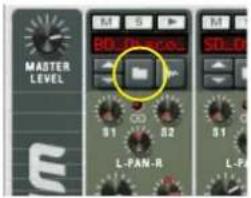
Browse Sample button on Redrum.
- Navigate to the desired location in the Browser.
In the picture below, we have clicked the Song Samples location and expanded all folders and subfolders:
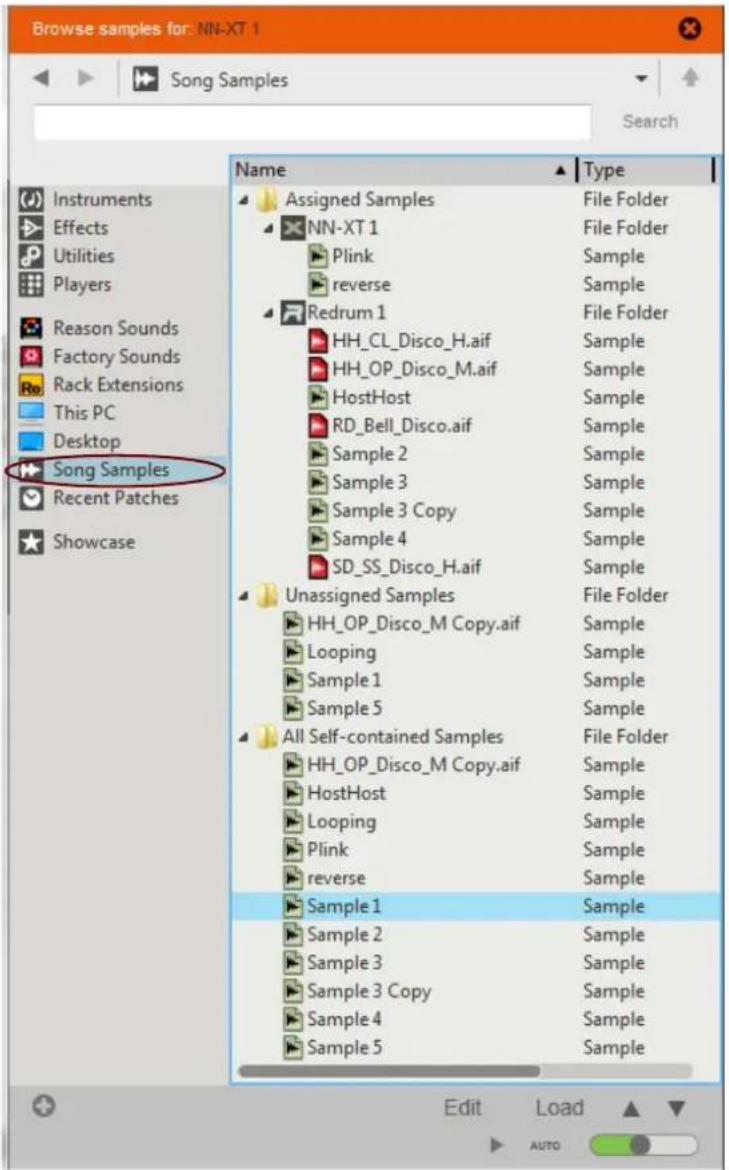
3. Select the sample you want to load into your device.
You can select a sample in any of the folders. If you like to audition a sample, click the Play button below the Browser list. To make samples automatically play upon selection, click the Auto button.
4. Click the Load button (or double click the sample) to load the selected sample into the device.
When the selected sample has been loaded into the device, the corresponding sample file icon in the Browser has been placed under the device's icon in the Assigned Samples folder. If the loaded sample was originally in the Unassigned Samples folder, it has now been moved from this folder to the Assigned Samples folder:
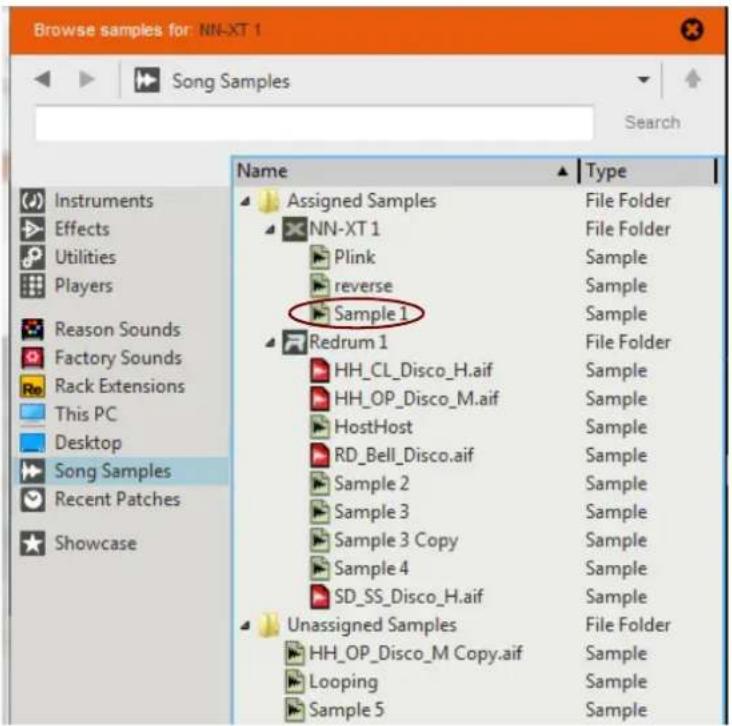
Duplicating samples
If you want to use an existing sample as base for new edits, you can do this by first duplicating the existing sample and then performing the edits on the duplicate. It's even possible to duplicate samples from the Factory Soundbank and from any existing ReFills! However, duplicated samples from the Factory Soundbank or from ReFills cannot be exported to disk as separate files, but can only be saved as self-contained samples inside the song document.
To duplicate a sample, proceed as follows:
- Select the desired sample in the Song Samples location in the Browser.
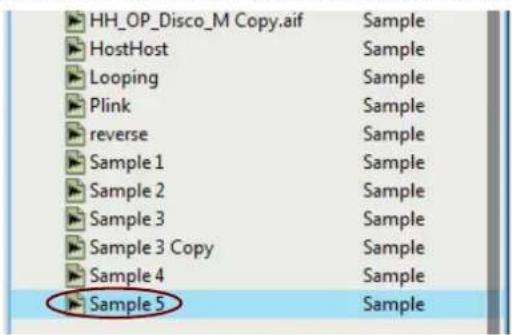
2. Select "Duplicate Sample(s)" from the context menu.
The duplicated sample appears - with its original name followed by the word "Copy" - in the All Self-contained Samples folder. The sample also appears in the Unassigned Samples folder:
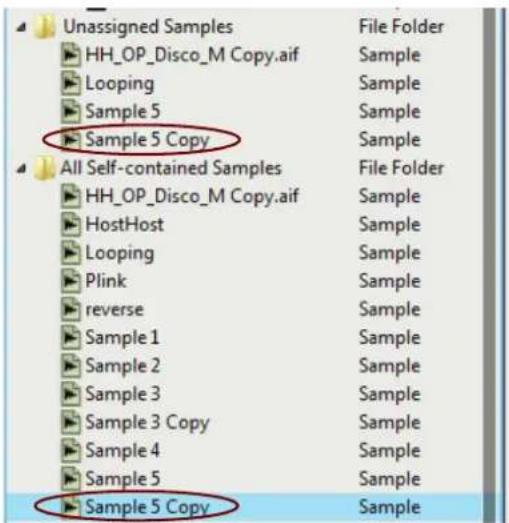
To edit and/or rename the duplicated sample, refer to "Editing samples" and "Renaming samples".
Exporting samples
If you like you can export samples that you have recorded in your song and save them as separate WAV or AIFF files to disk. Proceed as follows:
- Select desired sample(s) in the Song Samples location in the Browser.
! Note that it is not possible to export samples that originate from the Factory Soundbank or from a ReFill. - Select "Export Sample(s)" from the context menu.
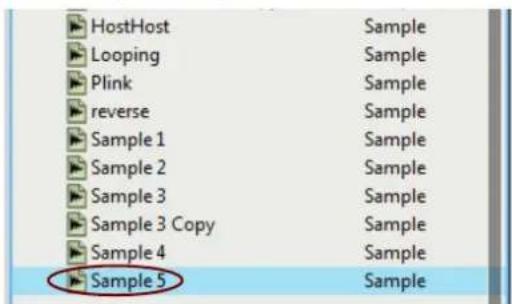
- If your sample(s) are not cropped, or use a Crossfade Loop, the Lossy Sample Export dialog appears:
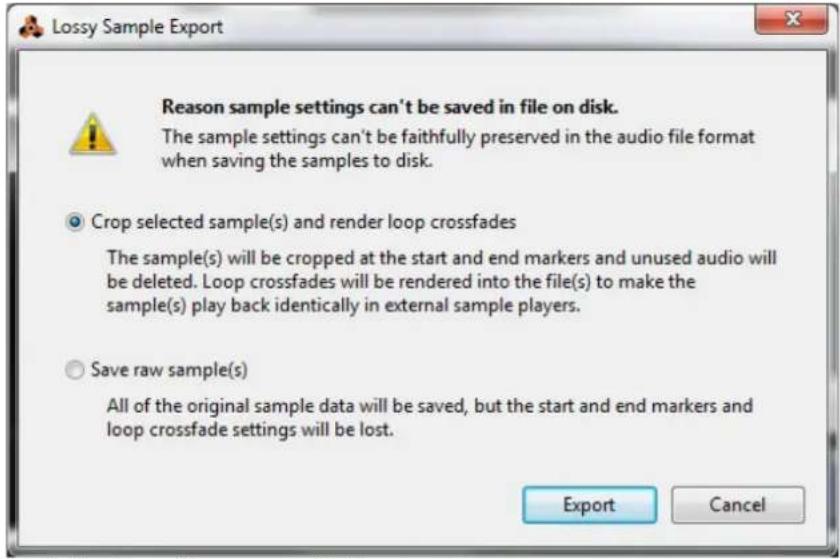
The following options are available:
- Crop selected sample(s) and render loop crossfades
This item shows up if you have edited the Start and/or End Markers and use a Loop with Crossfades. The sample will be cropped at the Start and End Markers and the crossfaded loop will be rendered into the sample.
! This will make the sample sound exactly the same when you import it to a sample playback device/application, but the sample data has been changed compared to the original.
- Crop selected sample(s)
This item shows up instead of the above item if no Loop is used. The sample will be cropped at the Start and End Markers.
- Save raw sample(s)
The sample will be exported without Start or End Marker position data but with Loop data, if any. If the loop is crossfaded, the crossfade will be removed.
! This will make the sample sound differently when you import it to a sample playback device/application.
- Click Export to proceed.
The "Export Sample as..." dialog appears;
-
Choose location for your sample file, type in desired name and choose WAV or AIFF file format.
-
Click Save to export the sample file to disk.
The sample is saved to disk using its original resolution (bit depth) and sample rate. The original self-contained sample in your song will remain intact.
About self-contained samples
All samples you record in a song automatically become self-contained. Self-contained means that the samples are automatically stored within the song when you save it. A great advantage with this is that you never have to keep track of any "loose" custom samples you use in your song - they are always included in the song document.
All self-contained samples in a song can be viewed by unfolding the All Self-contained Samples folder in the Song Samples location in the Browser:
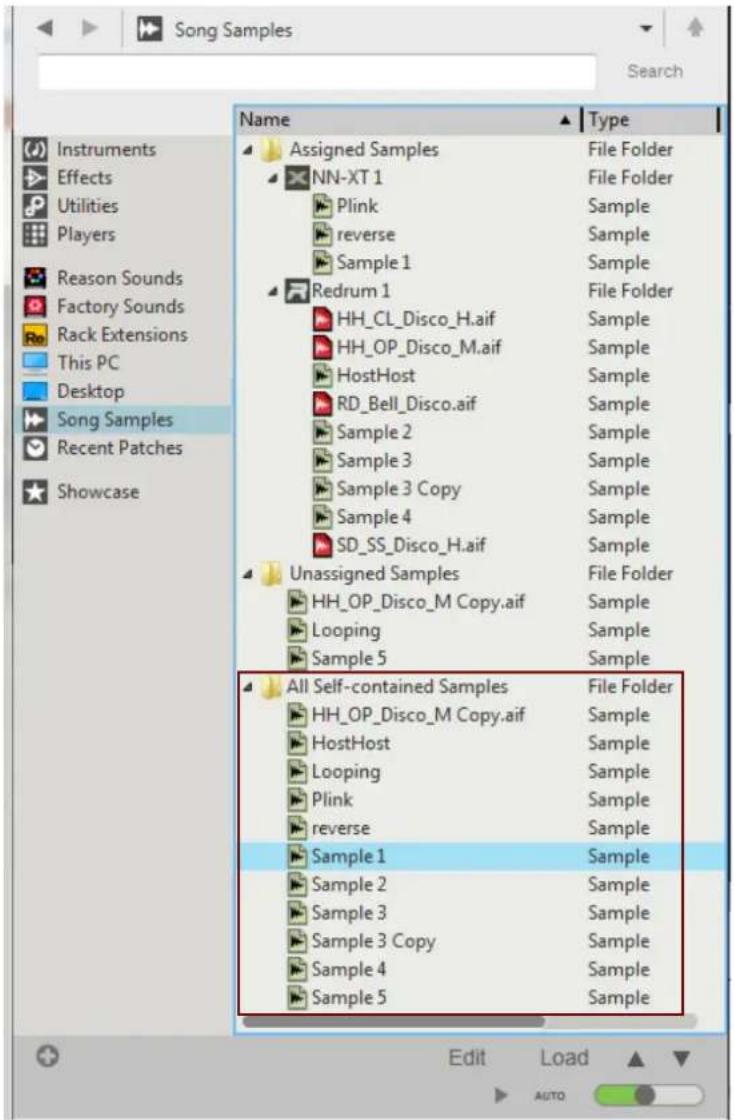
Self-contained samples can also be loaded into any sampler device from the Browser. See "Loading samples into a device" for more details.
Un-self-containing samples
There might be situations where you want to "un-self-contain" your own samples, i.e. export the samples to disk as separate files and at the same time remove them from the song document. This can be done by selecting "Song Self-Contain Settings..." from the File menu - see "About Self-Contained Songs" for more details.
Chapter 22
The ReGroove Mixer
Introduction
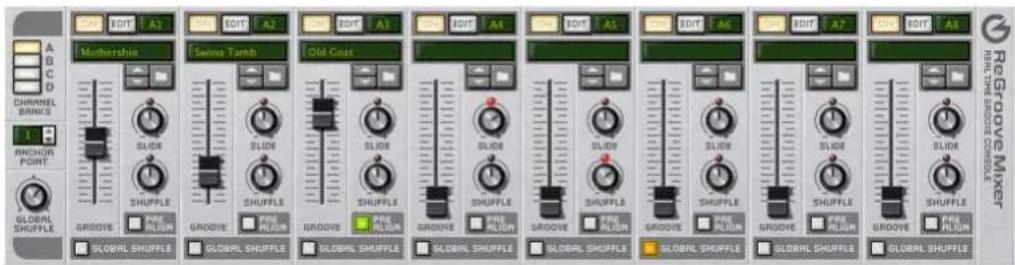
The ReGroove Mixer combines all the benefits of quantization, shuffle, and groove templates into a single integrated environment, giving you real-time creative control over the feel and timing of individual note lanes. The ReGroove Mixer, which extends from the top of the Transport Panel puts 32 channels of interactive groove control at your fingertips.
If you're familiar with mixing, you're already well on your way toward understanding the ReGroove Mixer. Think of it as a mixer with 32 busses but, instead of these busses modifying the volume of the input tracks, they modify the feel (or groove) of the input tracks. You can route any note lane to one of ReGroove's 32 channels, and that lane's feel and timing are modified, in real-time, by the channel's settings. Each ReGroove channel can use its own groove template or shuffle amount. In addition, each channel can slide notes forward or backward in time, allowing you to put certain tracks slightly ahead or behind the beat, which greatly alters the feel of your music.
! Note that ReGroove only works for notes on note lanes.
It's also possible to lock a control surface to control the ReGroove Mixer parameters via Remote - see "Locking a surface".
ReGroove basics
When working with grooves, you'll make use of three interacting sections within Reason Lite's interface:
- First, in the Sequencer, each note lane can be assigned to any of ReGroove's 32 channels.
You assign a note lane to a groove channel by selecting it with the Select Groove pop-up in each note lane.
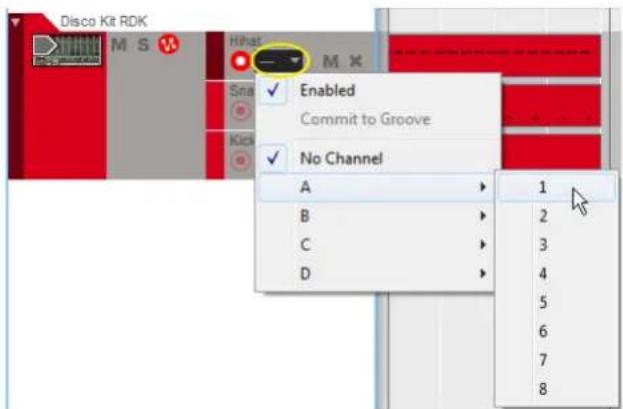
- Second is the ReGroove Mixer, which contains both global groove settings and channel-specific ones.
This is described on the following pages.
- Finally, there's the Groove Settings section of the Tool Window, which is accessed by clicking a ReGroove channel's Edit button.
Groove Settings allow you to set the intensity of various groove patch parameters. This is also where you save your own ReGroove patches. See "Groove Settings".
The ReGroove Mixer
→ Open the ReGroove Mixer by clicking the Groove button to the left on the Transport Panel.
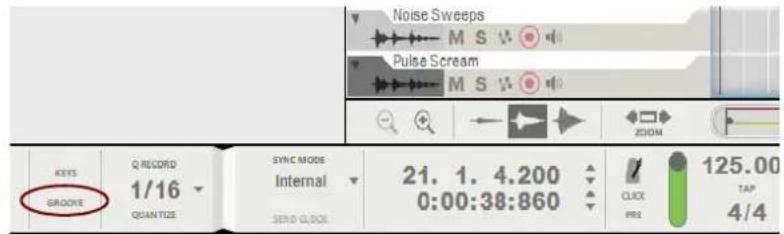
The ReGroove mixer is divided into two sections. On the left are the Global parameters, and on the right are the Channel parameters.
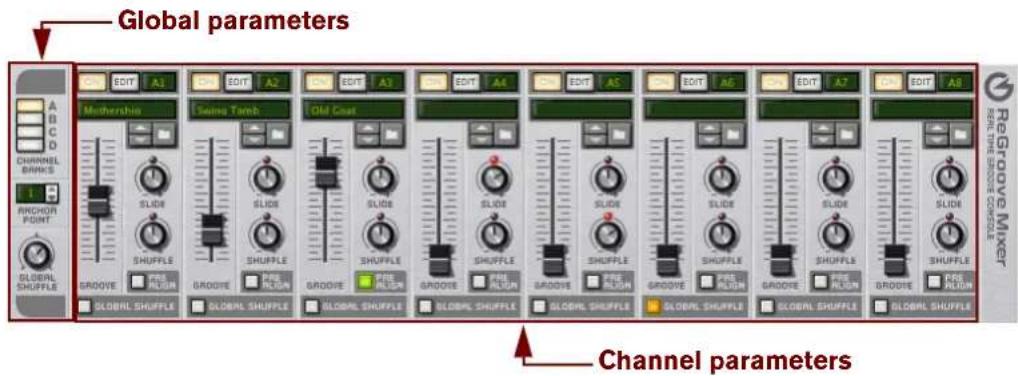
Global parameters
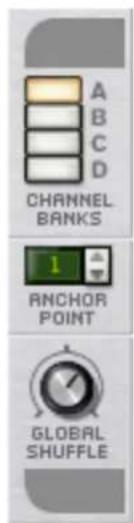
These parameters operate globally, rather than channel-by-channel.
Channel Banks
The ReGroove mixer consists of 32 channels, grouped into 4 banks (labeled A through D). Click a Channel Bank button to see and edit its corresponding bank of 8 channels.
Anchor Point
Normally, all groove patterns start at Bar 1 and repeat themselves throughout a song. For example, a 4-bar groove pattern will begin at Bar 1 and repeat its pattern every four bars. Many times, however, songs begin with blank measures, pickup measure or, perhaps, a short introduction. In these cases, you probably don't want the groove pattern to begin at Bar 1, but at some later bar. This is the purpose of the anchor point - it tells Reason Lite at which measure it should begin applying the groove settings.
For example, assume you have a song with a 1-bar pickup. Because the song really begins on bar 2, that's where you want your groove to begin. Setting the anchor point to 2 insures that the groove patterns all begin at measure 2.
Note: There is one exception to the rule that grooves start playing at their anchor point and repeat indefinitely throughout the song-and that's when they encounter a time-signature change. Grooves always restart at any measure containing a time signature change.
You can use this knowledge if, for example, you have a song section with an odd number of bars-inserting a time signature change will force all your grooves to restart at that measure.
Global Shuffle
This knob adjusts Reason Lite's global shuffle amount, and is used by any devices that employ patterns, such as the Dual Arpeggiator Player device, Redrum's internal sequencer, the Matrix pattern sequencer, and the RPG-8 arpeggiator. It also defines the shuffle value for any ReGroove channel for which the Global Shuffle option is activated.
Setting the Global Shuffle to a value of 50% results in a "straight" beat, with no swing applied. Setting the Global Shuffle to a value of 66% results in a perfect sixteenth-note triplet shuffle. Values between 50% and 66% have a less pronounced swing feel, and values greater than 66% are more exaggerated.
- If you are quantizing notes and/or audio Slices to "Shuffle" in the "Quantize" section in the Tool Window, these are quantized to the current Global Shuffle value.
Channel parameters
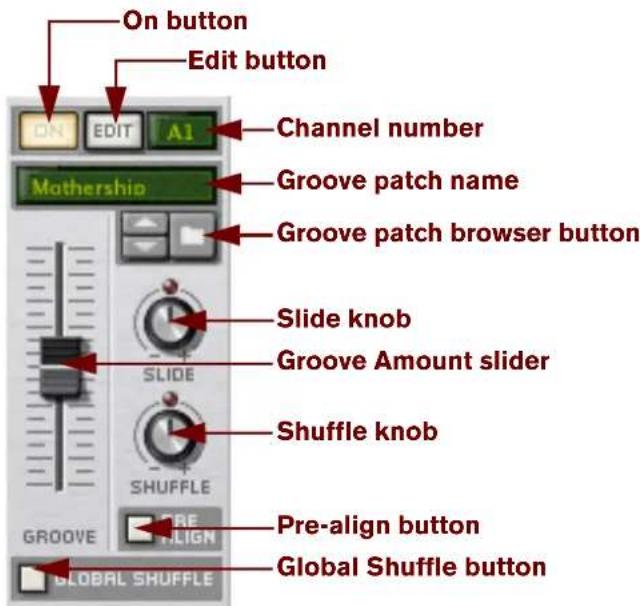
These parameters operate on a per-channel basis. Each of ReGroove's 32 channels (arranged in 4 banks of eight) contains an identical set of parameters.
On Button
This is an On/Bypass button for the channel. When the button is lit, the groove channel is active and any note lane assigned to this groove channel will be affected. When the button is not lit, the channel is disabled and any note lanes assigned to this groove channel will play back straight, without being "grooved."
This can be used for comparing the groove with the original, ungrooved beat. You can also do this for individual note lanes, by turning off the "Enabled" item on the Groove Select pop-up menu in the track list - see "Applying grooves to your music".
Edit Button
Click this button to open Reason Lite's floating Tool Window, and show the Groove tab, where you can view and edit additional "Groove Settings" for each channel.
Each ReGroove channel has its own groove settings, so clicking the Edit button in different channels will fill the Tool Window with groove settings specific to that channel.
Channel Number
This is a non-editable channel number label. Channels are numbered 1-8 and are grouped into 4 banks (A-D). Channel numbers are named accordingly. For example, A2 is the second channel in Bank A, and B5 is the fifth channel in Bank B.
Groove Patch Name
This shows the name of the groove patch currently loaded into the channel. If no groove patch is loaded, then no name appears. Click this area to bring up a list of the patches in the current folder, just as with patch displays on devices in the Reason Lite rack.
To remove a groove patch assignment and reset the channel to its default values, right-click (Win) or [Ctrl]-click (Mac) the Groove Patch name, or anywhere on the ReGroove panel background, and select "Initialize Channel" from the context menu.
This allows you to load groove patches and to step between them, just like device patches in the Reason Lite rack. ReGroove patches have a .grov extension. See "ReGroove patches in the Factory Sounds bank", later in this chapter, to learn more about the types of groove patches included with Reason Lite.
Slide
Use this knob to slide notes forward or backward in time. Musicians will frequently add energy and urgency to a track by "rushing" a particular beat or instrument a little. Similarly, they may "drag" a note a little in order to create a more laid back, shuffle-like feel. The Slide knob has a range of ±120 ticks, which allows you to slide notes up to a thirty-second note in either direction. Setting negative values makes notes play earlier in time (rushing the feel). Setting positive values makes notes play later in time (lagging the feel).
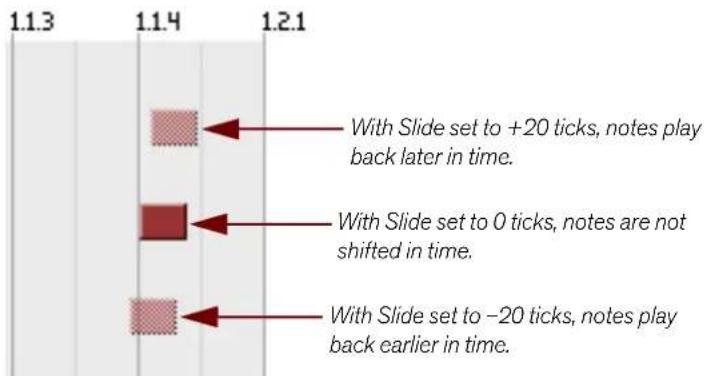
bar
| Time Interval | Notes Play Back Later in Time | Notes Play After Shift in Time | | ------------- | ----------------------------- | ------------------------------ | | 1.13 | - | - | | 1.14 | - | - | | 1.21 | - | - |For example, if you wanted to create a slightly "in the pocket" groove, you could create a snare lane and assign it to a ReGroove channel with a small amount of positive slide. This would delay the snare track slightly, giving your music a relaxed, laid back feel.
- If you have a track that you want to rush (set to a negative slide value), you should put an empty bar at the beginning of your sequence, making sure to set the Anchor Point to "2" (see "Anchor Point"). This insures that any notes assigned to Bar 1/Beat 1 will indeed play ahead of the beat (since you created an empty measure into which the early note can shift).
Shuffle
At its most basic level, this knob adds a sixteenth note "swing" feel to the ReGroove channel. A value of 50% results in a straight (no shuffle) feel, and a value of 66% creates a perfect triplet feel.
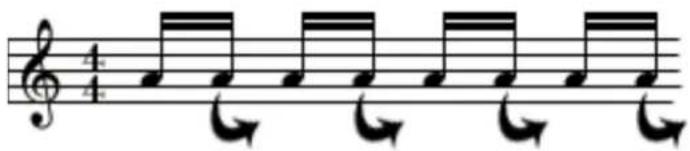
Shuffle works by changing the start time of every other sixteenth note.
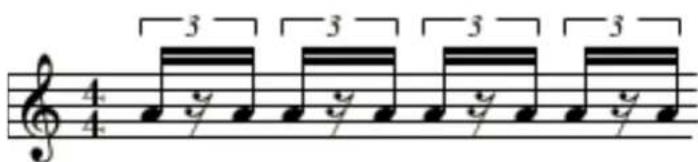
A shuffle value of 66% delays every other sixteenth note to create a perfect triplet feel.
You can also use this knob to "de-shuffle" a beat by dialing in values below 50%. For example, if you had a recording that was played with a perfect triplet feel, setting the Shuffle value to 34% will make the beat straight again!
Groove Amount
Use this fader to adjust how intensely the selected groove patch will modify your notes. At 0%, the groove patch will have no effect. At 100%, the groove patch will have its maximum effect. Obviously, values between these extremes will produce some amount of groove effect, but less than maximum.
As discussed in "Groove Settings", later in this chapter, several additional parameters are associated with groove patches and how they modify your notes. Specifically, the Groove Settings section of the Tool Window contains four "impact" settings (timing, velocity, note length, and randomness), and the Groove Amount fader acts like a "master" fader that scales these four parameters proportionally.
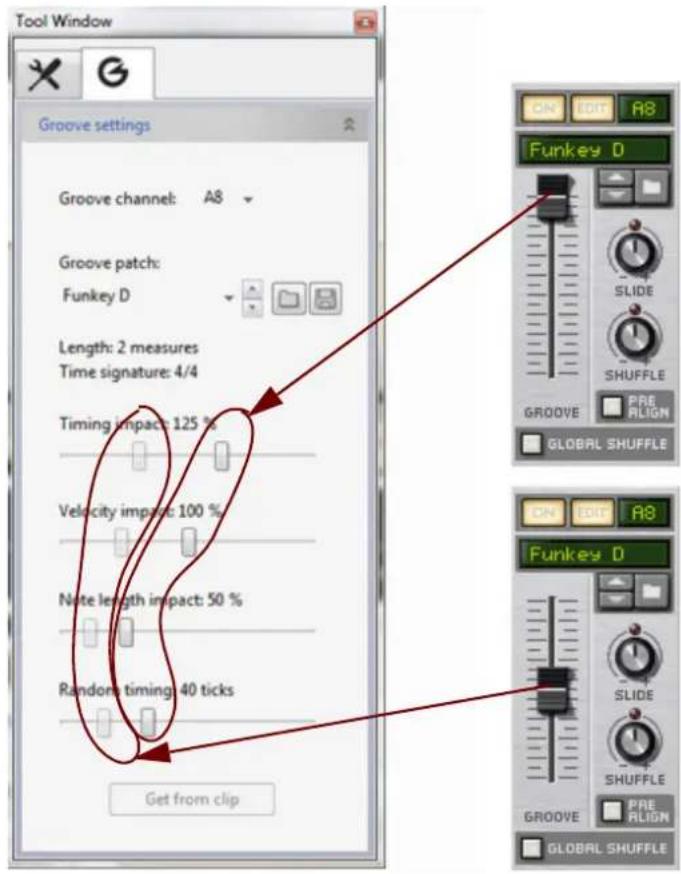
A Groove Amount of 100% modifies notes using all groove settings at their specified amounts.
A Groove Amount of 50% modifies notes using all groove settings at only half their specified amounts.
Pre-Align
Enabling this button causes any incoming notes to be quantized to a rigid, sixteenth note grid prior to having any additional groove modifications applied to them. This quantization, which occurs in real time and is non-destructive, is an easy way to align all incoming notes to a "straight" grid, so that any shuffle, slide, or groove modifications have the expected effect on the notes.
Global Shuffle
Enabling this button causes the ReGroove channel to use the "Global Shuffle" setting, rather than the channel's own shuffle setting. The channel's Shuffle knob will have no effect when a channel uses global shuffle. Using global shuffle is a good way to synchronize notes in a particular channel with those in pattern-based devices, such as Redrum's internal sequencer, the Matrix pattern sequencer, and the RPG-8 arpeggiator, all of which get their shuffle values from the Global Shuffle value.
Copy, Paste and Initialize ReGroove channels
To copy one ReGroove channel configuration into another:
- Decide which ReGroove channel you want to copy from, then right-click (Win) or [Ctrl]-click (Mac) on the Groove Patch Name (or anywhere else in that channel, except directly on a parameter).
A context menu appears.
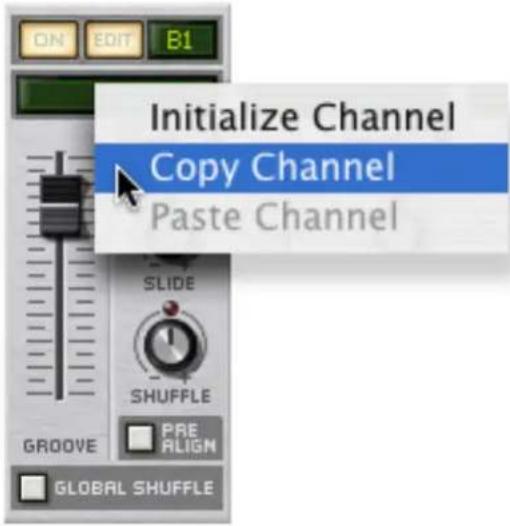
- Select "Copy Channel" from the context menu.
- Right-click (Win) or [Ctrl]-click (Mac) on the destination channel's Groove Patch Name, then select "Paste Channel" from the context menu.
Reason Lite copies all the ReGroove channel settings to this channel.
To initialize a ReGroove channel:
- Right-click (Win) or [Ctrl]-click (Mac) on the Groove Patch Name (or anywhere else in that channel, except directly on a parameter) to open a context menu.
- Select "Initialize Channel" from the context menu.
Reason Lite resets all channel parameters to their default values.
Groove Settings
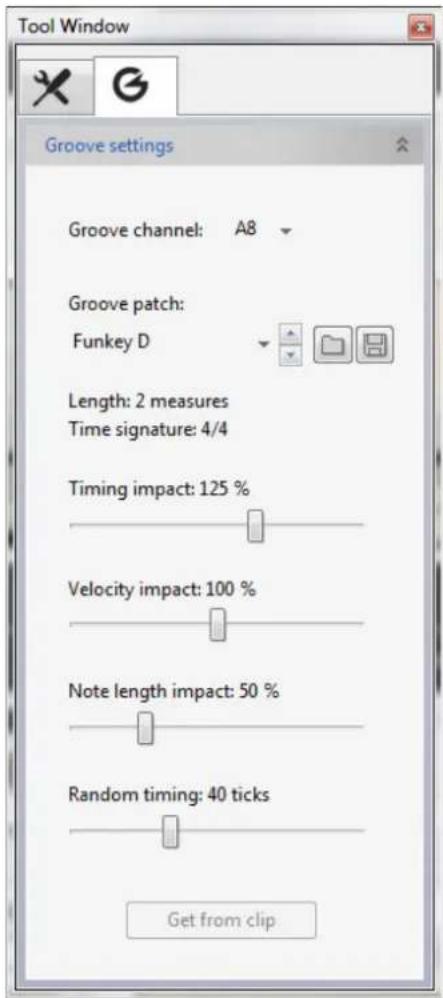
A groove patch consists of a groove template, which contains timing and dynamics information extracted from a performance, plus a collection of Impact parameters, which determine how strongly the groove patch applies the template settings. This section discusses the settings on the Groove tab in the Tool window, which is where all the Groove Patch settings are viewed and edited.
Groove channel
The Groove Settings display one mixer channel at a time. To select which ReGroove channel is currently displayed, select it from this pop-up (or click the Edit button for the channel in the ReGroove Mixer).
Groove patch name
This shows the name of the groove patch currently loaded into the channel. If no groove patch is loaded, then no name appears. Click this area to bring up a list of the patches in the current folder, just as with device patches in the Reason Lite rack. This area duplicates the functionality of the Groove Patch Name area in each channel of the Re-Groove Mixer.
Groove patch Load/Save
These buttons allow you to load and/or save groove patches, just like device patches in the Reason Lite rack. Re-Groove patches have a .grov extension. To learn more about the types of groove patches included with Reason Lite, see "ReGroove patches in the Factory Sounds bank".
Groove patch Length
This displays the groove's length, which is import for determining how often the groove repeats.
→ In general, if you apply different groove patches to different note lanes, you'll want their lengths to be multiples of one another.
For example, if one ReGroove channel uses a 4-bar groove, you might want to use 4-bar grooves on other channels or, perhaps, a multiple (such as 1-bar, 2-bar, or 8-bar grooves).
You can, of course, mix and match grooves with non-standard lengths, but you need to be aware of how these grooves will interact. For example, if one channel used a 3-bar groove and another used a 4-bar groove, the groove pattern would actually repeat every 12 bars (3-bars times 4-bars).
Groove patch Time signature
This displays the groove's time signature and should, in most cases, match the time signature of your sequence.
→ In general, if you apply different groove patches to different note lanes, you'll want them to share a common time signature.
You can, of course, mix and match time signatures to create polyrhythmic grooves, but you need to be aware of how these grooves interact. For example a 6/8 groove will shift notes in a radically different way than a 4/4 groove, so applying them simultaneously may or may not sound the way you expect.
Timing impact
This determines the extent to which timing information embedded in the groove template affects the position of your notes. A 50% setting means that notes are moved halfway to the positions defined in the groove template. 100% means they are moved exactly to the positions in the groove, and 200% means they are moved just as far past the groove template positions.
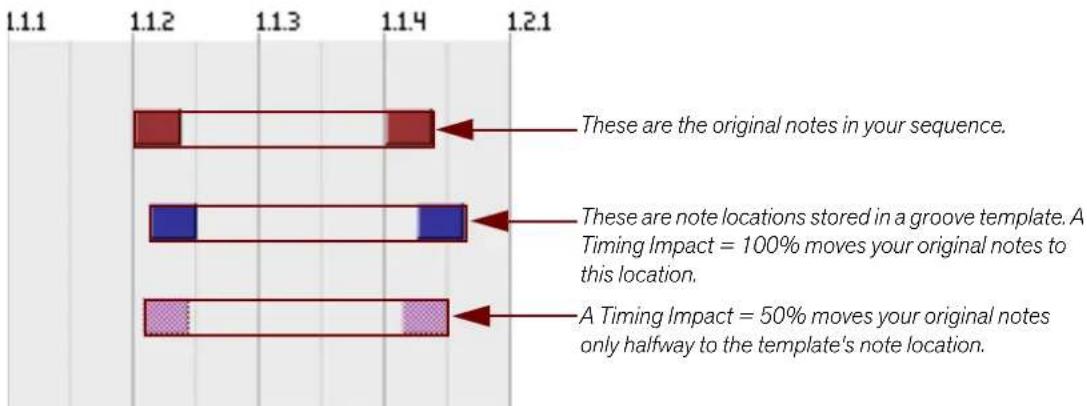
bar_stacked
| Category | Value | | -------- | ----- | | These are the original notes in your sequence. | 1.14 | | These are note locations stored in a groove template. A Timing Impact = 100% moves your original notes to this location. | 1.14 | | A Timing Impact = 50% moves your original notes only halfway to the template's note location. | 1.14 |→ This parameter works in conjunction with the ReGroove Mixer's Groove Amount fader, which can scale back the groove's timing impact.
For example, if the Groove Amount fader is set to 100%, then notes are moved by the indicated Timing Impact amount, but if the Groove Amount fader is set to 50%, then notes are moved by only half the Timing Impact amount.
Velocity impact
This determines the extent to which velocity information embedded in the groove template affects the velocity of your notes. Grooves modify only the relative differences between note velocities, not their absolute values. This way, soft passages remain soft and loud passages remain loud - the groove simply accents the notes differently. A 100% setting means that the feel is more or less exactly transferred from the template to your music. Values below this mean that less of the groove's dynamics affect your notes, and values above 100% dramatically increase the dynamic effect of the groove patch.
→ This parameter works in conjunction with the ReGroove Mixer's Groove Amount fader, which can scale back the groove's velocity impact.
For example, if the Groove Amount fader is set to 100%, then velocities are modified by the indicated Velocity Impact amount, but if the Groove Amount fader is set to 50%, then velocities are modified by only half the Velocity Impact amount.
Note length impact
This determines the extent to which note length information embedded in the groove template affects the length of your notes. This setting is not always relevant (such as with drum samples, which always play at their full length) and, consequently, most grooves in the Factory Sounds bank do not contain any length information (with the exception of the "Bass-Comp" category).
That said, when working with sustaining instruments, note length can have a dramatic impact on the performance's feel. Grooves modify only the relative differences between note lengths, not their absolute values. This way, legato or staccato passages retain some of their original intent when modified with a groove patch.
→ This parameter works in conjunction with the ReGroove Mixer's Groove Amount fader, which can scale back the groove's note length impact.
For example, if the Groove Amount fader is set to 100%, then note lengths are modified by the indicated Note Length Impact amount, but if the Groove Amount fader is set to 50%, then note lengths are modified by only half the Note Length Impact amount.
Random timing
This determines the extent to which note positions are randomized. This value defines the maximum distance that a note can be randomly shifted (in either a positive or negative direction). You may set an amount between 0 ticks (no randomization occurs) and 120 ticks, which allows notes to shift as much as a thirty-second note in either direction.
The effect is “polyphonic,” meaning that any notes originally beginning at the same position will still be moved by different amounts. It is also “semi-deterministic,” meaning that if you play a clip several times, without editing anything, all notes will play back at exactly the same positions each time. However, as soon as you edit the clip in any way, all random positions are recalculated.
→ This parameter works in conjunction with the ReGroove Mixer's Groove Amount fader, which can scale back the randomization.
For example, if the Groove Amount fader is set to 100%, then notes are randomized by the indicated Random Timing amount, but if the Groove Amount fader is set to 50%, then notes are randomized by only half the Random Timing amount.
Get from clip
This button converts the notes in a selected clip into a groove patch. The patch can then be used right away in the active ReGroove Mixer Channel or saved to disk as a new groove patch. Clicking this button has the same effect as selecting a clip and choosing "Get Groove From Clip" from the Edit (or context) menu. See "Creating your own ReGroove patches".
Working with grooves
Applying grooves to your music
Follow this example to learn basic ReGroove mixing techniques and hear the effect that various groove parameters have on your music.
- If it's not already visible in either the Sequencer or Rack, open the ReGroove Mixer by clicking the Groove button to the left on the Transport Panel in the Sequencer.
- Decide which note lane you are going to apply the groove to.
For the most obvious effect the track should contain a drumbeat based on straight (as opposed to shuffled) sixteenth notes. A hi-hat lane, for example, might be a good source for experimentation.
- Use the Groove Select pop-up on the chosen note lane to route those notes to a specific ReGroove mixer channel.
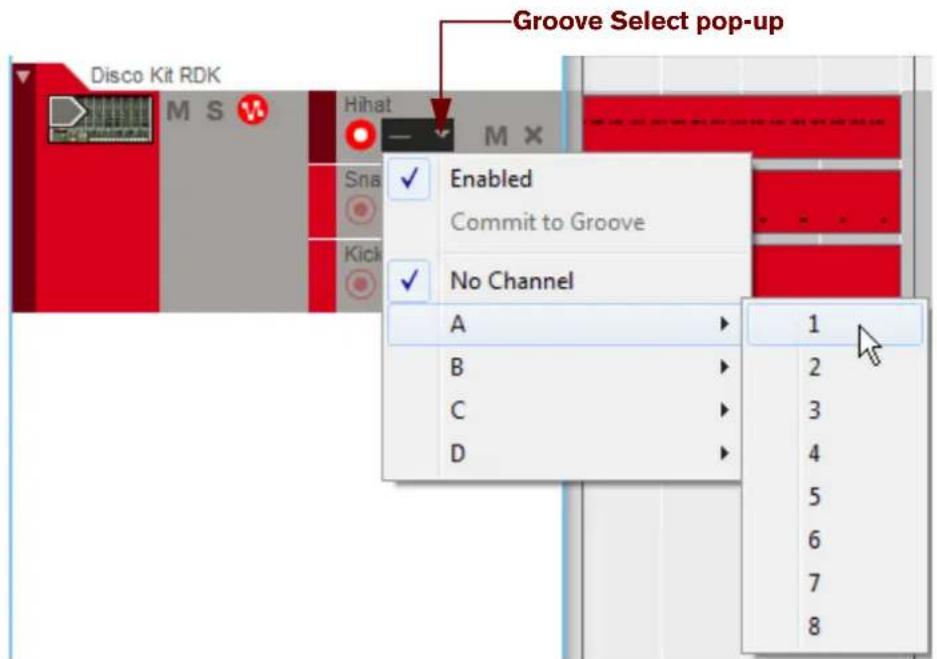
The "Enabled" item at the top of the pop-up menu allows you to turn ReGroove off for individual note lanes. This is useful for comparing with the original, ungrooved beat. If you want to do this for several note lanes set to a particular ReGroove channel, use the "On" button for the channel in the ReGroove mixer instead (see "On Button").
→ To turn ReGroove off for a note lane, select "No Channel".
4. In the ReGroove Mixer, make sure the channel you are using is activated - the On button should be lit.
- To hear some of the different possibilities, start by turning up the channel's Shuffle knob while you play the sequence.
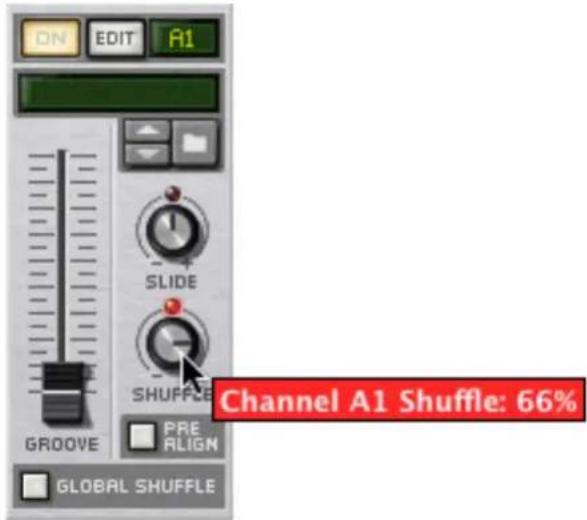
The music on that note lane (and any other note lane assigned to the same ReGroove channel) will start playing with a shuffle feel.
- Turn down Shuffle to its middle position (50%), and turn up the channel's Slide knob to hear its effect.
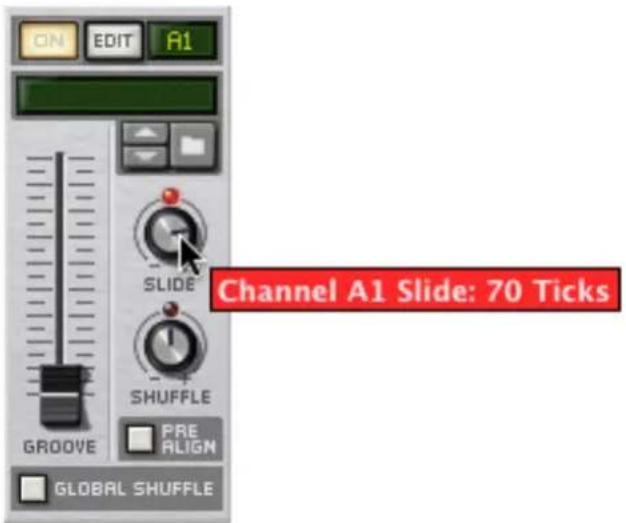
→ Note that, because slide shifts all notes by the same amount, you won't hear the results unless you play the track in conjunction with another track whose notes are not being slid (or with Click activated in the sequencer).
- Turn the Slide knob back to its middle position (0 Ticks), then click the channel's Browse button to set Browse focus to the ReGroove Patches folder in the Factory Sounds bank.
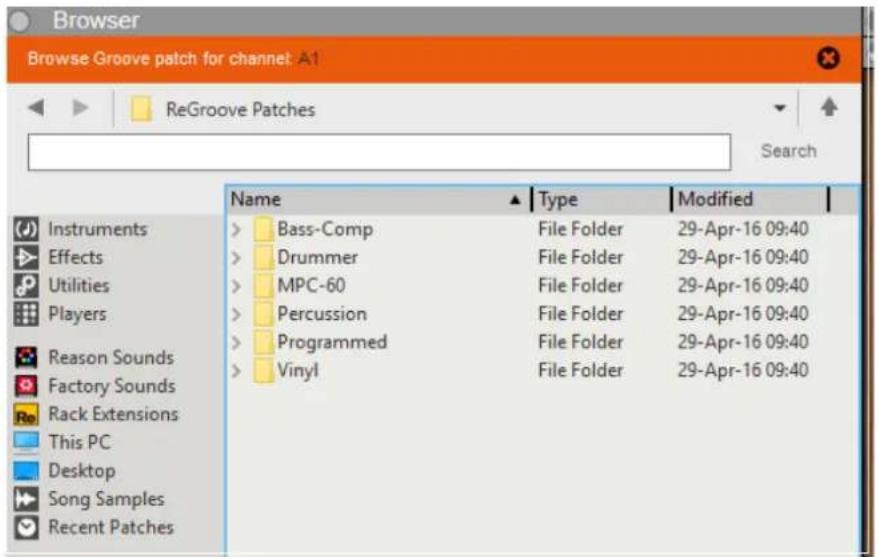
- Open the Vinyl folder, select the first groove patch in the list and click Load to load the groove patch.
- Pull up the Groove Amount fader on the channel, to about 80%.

- Click the Next Patch button to step through the groove patches in the folder and hear what they do to your music.
- On the ReGroove Mixer channel, click the Edit button to open that channel's groove settings in the floating Tool Window.
- Move the various horizontal faders and listen for their effect.
Note that none of the patches in the Vinyl folder make use of Note Length, so the Note Length Impact will have no effect.
- There are all sorts of creative and useful ways to apply grooves to your music. See "Groovy tips & tricks", later in this chapter, for some suggested techniques.
Commit to Groove - making the grooves "permanent"
When you assign a ReGroove channel to a note lane, this will only affect how the notes play back. The notes will still be shown with their original, ungrooved positions if you open the note clip.
If you want to edit grooved notes (e.g. adjust timing and velocity manually), it's useful to first actually move the notes to the grooved positions, permanently. This is done with the "Commit to Groove" function:
-
Select the track with the grooved note lane(s).
-
Select "Commit to Groove" from the Edit menu or the track context menu.
All notes on all lanes on the track will be moved to their grooved positions, and the Groove Select pop-up will be reset to "No Channel".
If you play back the track, it will sound exactly the same as before. If you look at the notes in Edit mode, their positions, length and velocity will now match what you hear.
Using Commit to Groove on some lanes only
"Commit to Groove" affects entire tracks, including all note lanes if there are several. If you only want to make the groove permanent for one of the lanes, here's a workaround:
- Click the Groove Select pop-up for the note lanes that should remain ReGrooved, and turn off "Enabled". This bypasses the ReGroove channel for those note lanes, but retains the channel selection.
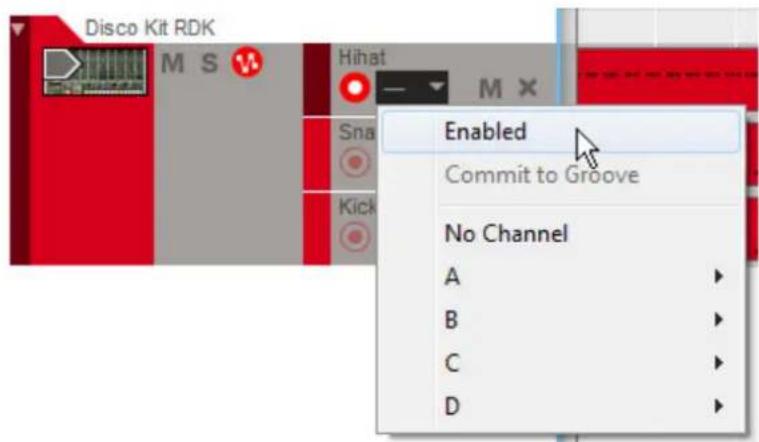
- Select "Commit to Groove".
Only the note lanes with ReGroove Enabled will be affected.
- Select "Enabled" again for the note lanes that should remain ReGrooved.
Creating your own ReGroove patches
To create your own ReGroove Patch, proceed as follows.
- Create a clip containing notes with the desired timing and dynamics (velocity).
Alternatively, you could import a MIDI File with the desired effect, or use the "Copy Loop To Track" function on a Dr. Octo Rex device to extract the notes from a REX loop.
→ Note that some MIDI clips will make better grooves than others.
To learn some of the characteristics of a good groove-making clip, see “Tips for selecting the best Groove-Making Clips” below.
-
Select the clip.
-
In the Tool Window's Groove section, select an unused Groove Channel.
-
Click the "Get from clip" button at the bottom of the Tool Window's Groove Settings tab.
Alternatively, you could select "Get Groove From Clip" from the clip's context menu.
- Set the various impact parameters as desired.
For a good starting point, you can simply leave them at their default settings.
- Click the Save Patch button in the Tool Window's Groove section and specify a name and location.
Your ReGroove patch is now ready to use. As discussed in "Applying grooves to your music", simply route one or more note lanes to the ReGroove channel assigned to your new groove, and pull up the Groove Amount fader on that channel.
Tips for selecting the best Groove-Making Clips
The following tips will help insure that your custom grooves work their best:
→ Include as many sixteenths notes as possible in the source clip.
If there are any sixteenth note gaps in your source material, there will be corresponding gaps in your groove patch. This means, when you apply the groove to a note lane, some notes will be grooved and some (those that fall in the gaps) will not.
→ Grooves use the relative differences between note velocities, not their absolute values.
If you don't want dramatic shifts in dynamics, avoid having widely varying velocities in your source clip.
→ Groove patches are always an exact number of bars, so if your source clip has an uneven length, the groove will be extended to the next bar.
We recommend that you adjust your source clip to an exact number of bars before creating a groove patch.
→ In general, you should use source clips whose length is an even multiple of 2 (for example, 1-bar, 2-bars, 4-bars, etc.)
You can create and use grooves that are an odd number in length (3, 7, 13, etc.), but unless you're well organized and plan to use these grooves in specific polyrhythmic pieces, their general effect on most tracks will be somewhat unpredictable.
Groovy tips & tricks
- Because you can route each note lane to any of the 32 ReGroove channels, the key to creating really dynamic grooves is to spread your instrumentation across multiple note lanes.
For instance, where you might normally create a Redrum sequence with kick, snare, and hi-hat all on the same track, putting these elements into different lanes will let you apply different grooves to them. For example, you might have a kick lane routed to a ReGroove channel with a slight shuffle feel, and you might send the snare to a ReGroove channel that slides the notes earlier in time to "push" the backbeat a little. Breaking things into lanes will definitely enable you to create beats that are more loaded with feel and personality than if you simply apply one groove setting to everything.
- See "Extract Notes to Lanes" for tips on how to automatically distribute notes from one note lane to several additional note lanes.
- When building a groove, start simple. Experiment with adjusting the slide parameter to move just the snare or hi-hat forward or backward in time.
Try applying slightly different amounts of shuffle to different percussion instruments. Small changes can sometimes have a big visceral effect, so use your ears (and not your eyes) when adjusting the various groove settings.
- Try applying the same groove patch to multiple lanes, but by varying amounts.
You are, of course, free to apply different groove patches to different lanes. Though, more often than not, your results might result in something that sounds more clumsy than groovy. The hottest grooves often have the most subtle of humanization.
- Don't forget to try sending sequenced REX files through the ReGroove mixer.
Depending on the material in the file and how it's sliced up, this can create all types of results-ranging from unusable to downright inspiring.
- If you're doubling instruments - that is two instruments play the exact same part - try sending one of the instruments to a ReGroove channel that has a small amount of random timing applied.
Random timing (which is accessible in the Groove Settings section of the Tools Window) will put some separation between the two instruments, making their performance sound more human. For example, if you have a clap doubling a snare, apply a little bit of random timing to the clap track, and it'll stand out more clearly in the mix.
- As described under the "Anchor Point" heading above, grooves restart whenever a new time signature appears.
You can use this knowledge to force a groove to restart, which might be required if your music contains sections of odd lengths. Simply add in a time signature event, with the same type of time signature as you already have in the song. The groove will restart where the event starts.
- Remember that groove patches have separate timing and velocity impacts and, as such, you can apply them independently.
For example, if you already have a track that has just the right groove timing, but you want to experiment with different dynamic feels, you can apply just the velocity portion of a groove by setting its Timing Impact parameter to 0. A groove's timing and velocity impact parameters can be accessed by clicking a ReGroove channel's Edit button, which opens the Groove Settings section of the Tools Window.
ReGroove patches in the Factory Sounds bank
Reason Lite ships with a ready-made assortment of groove patches, arranged in a number of different folders:
Bass-Comp, Drummer, and Percussion
Grooves in these categories were created by session musicians. Their performances were captured and analyzed, and the timing and velocity information was then extracted from the performances. The Bass-Comp patches also contain note length information, though the other categories do not.
MPC-60
These grooves were created by analyzing the audio output of an Akai MPC-60. Use these patches to get the same shuffle feeling as an original MPC-60. Note that these patches do not contain any velocity or note length information. There are some additional patches that use the Random Timing feature, which emulates the original MPC-60's behavior when loaded with a lot of information.
Programmed
These grooves were created by a session drum groove programmer. They were hand-crafted to emulate the feel of certain styles, and are divided into two genres: Hiphop and Pop-Rock. These grooves do not contain any note length information.
Vinyl
These grooves were created by sampling snippets from classic groove records, analyzing them with a special signal processing tool, then extracting both timing and velocity information from the samples. These grooves do not contain any note length information.
Chapter 23
Remote - Playing and
Controlling Devices
About the various MIDI inputs
This chapter describes how you can use Remote and the Easy MIDI Input function to set up your master keyboard and control surfaces, allowing you to play Reason Lite devices, adjust parameters and control various Reason Lite functions. This is the main way of sending MIDI to Reason Lite, but there are also some additional methods:
• Using the External Control Bus inputs.
The External Control Bus inputs (set up on the Preferences - Sync page and in the MIDI In device in the hardware interface) let you send MIDI directly to the individual devices in the rack. This is mainly used if you control Reason Lite from an external sequencer, etc. See "About the External Control Bus inputs".
- Sending MIDI Clock to Reason Lite.
This allows you to synchronize Reason Lite's tempo to other devices. See "Synchronization to MIDI Clock".
About Remote
MIDI from control surfaces (keyboards, remote control units etc.) is handled by a protocol called Remote. The Remote protocol allows for seamless integration between Reason Lite and control surface devices. It is basically a mapping system that provides direct hands-on control of parameters for each Reason Lite device - including transport and sequencer track selection!
At the time of this writing, Reason Lite supports a large number of control surfaces and keyboards - the knobs, faders and buttons on the devices are automatically mapped to parameters on each Reason Lite device.
Remote drivers for more control surfaces will be added continuously. Check the Reason Studios web page in case your model isn't listed on the Preferences - Control Surfaces page.
Remote controlling Reason Lite devices couldn't be made any simpler. Let Reason Lite automatically look for all available MIDI Input ports on your computer and automatically connect your master keyboard. Or, manually set up your control surface for use with Reason Lite - the program handles the rest!
Setting up
Automatic set-up using the Easy MIDI Inputs function
By default Reason Lite automatically scans and detects all available MIDI In port(s) on your computer. If you have a MIDI keyboard or MIDI control surface connected to your computer, Reason Lite automatically connects and lets you use it for controlling Reason Lite. This way you don't have to do any manual set-up but can start controlling Reason Lite right away.
At the bottom of the Control Surfaces tab in Preferences all currently available MIDI In Ports are listed:
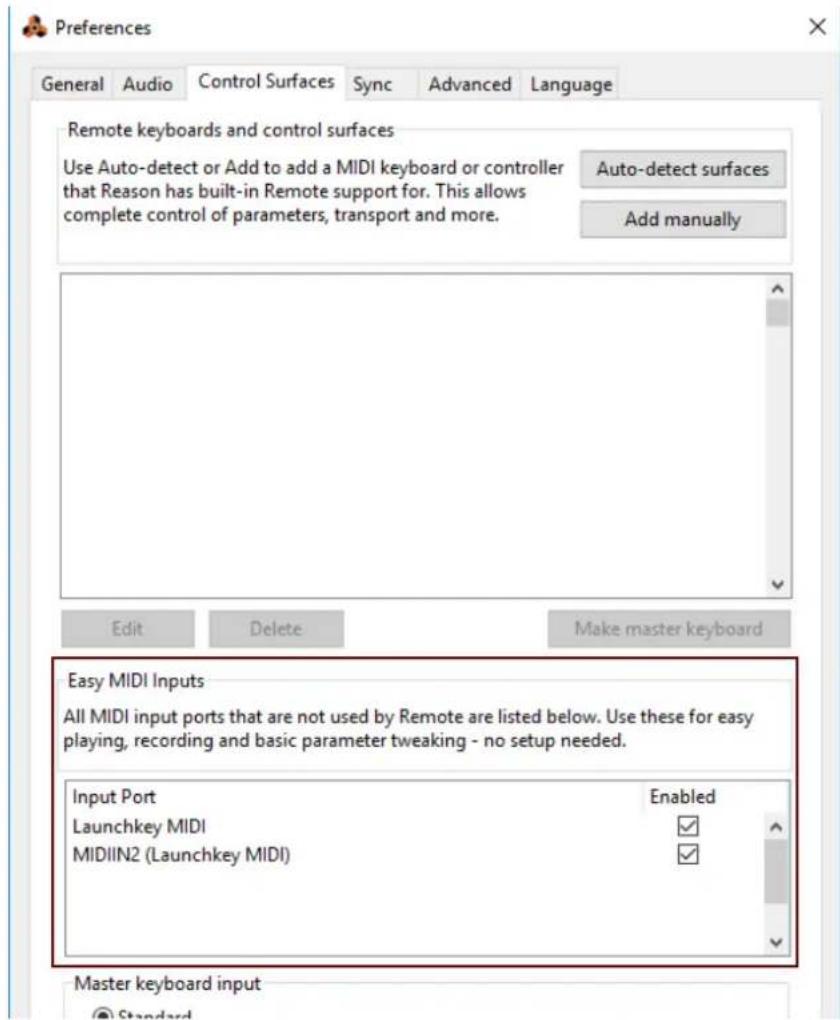
All available MIDI In Ports on your computer are listed in the Easy MIDI Inputs list.
- The Easy MIDI Inputs function supports input of MIDI Note On/Off (with Velocity) as well as standard performance controllers, such as Mod Wheel, Pitch Bend and Sustain Pedal.
You can also do manual Remote Overrides to assign Reason Lite parameters to knobs/sliders/buttons on your control keyboard/surface, see "Remote Override".
→ Deselect the Enabled box(es) to disable MIDI Ports you don't want to be available for Reason Lite.
For example, if you have a drum machine connected via USB to your computer, you might not want it to start sending MIDI Note data to Reason Lite, especially if it's synced to MIDI Clock to Reason Lite's sequencer.
Adding a specific control surface or keyboard
If your specific MIDI keyboard/control surface model is featured in the list of supported surfaces in Reason Lite you will get even more functionality if you add it in the "Remote keyboards and control surfaces" section at the top - with knobs/sliders/buttons already pre-assigned to parameters in Reason Lite.
This is how you add your specific control surfaces - including the master keyboard.
- Open the Preferences dialog and click the Control Surfaces tab.
- If your control surface is connected via USB (or if you have made a two-way MIDI connection), try clicking the Auto-detect Surfaces button.
Reason Lite sends an ID request to all MIDI ports and checks for answers from any connected control surfaces. Note that not all control surfaces support auto-detection.
! If a MIDI Port of your connected control surface/keyboard is already used by the Easy MIDI Inputs function (see "Automatic set-up using the Easy MIDI Inputs function"), this detection will override this and automatically remove the MIDI In Port from the Easy MIDI Inputs list.
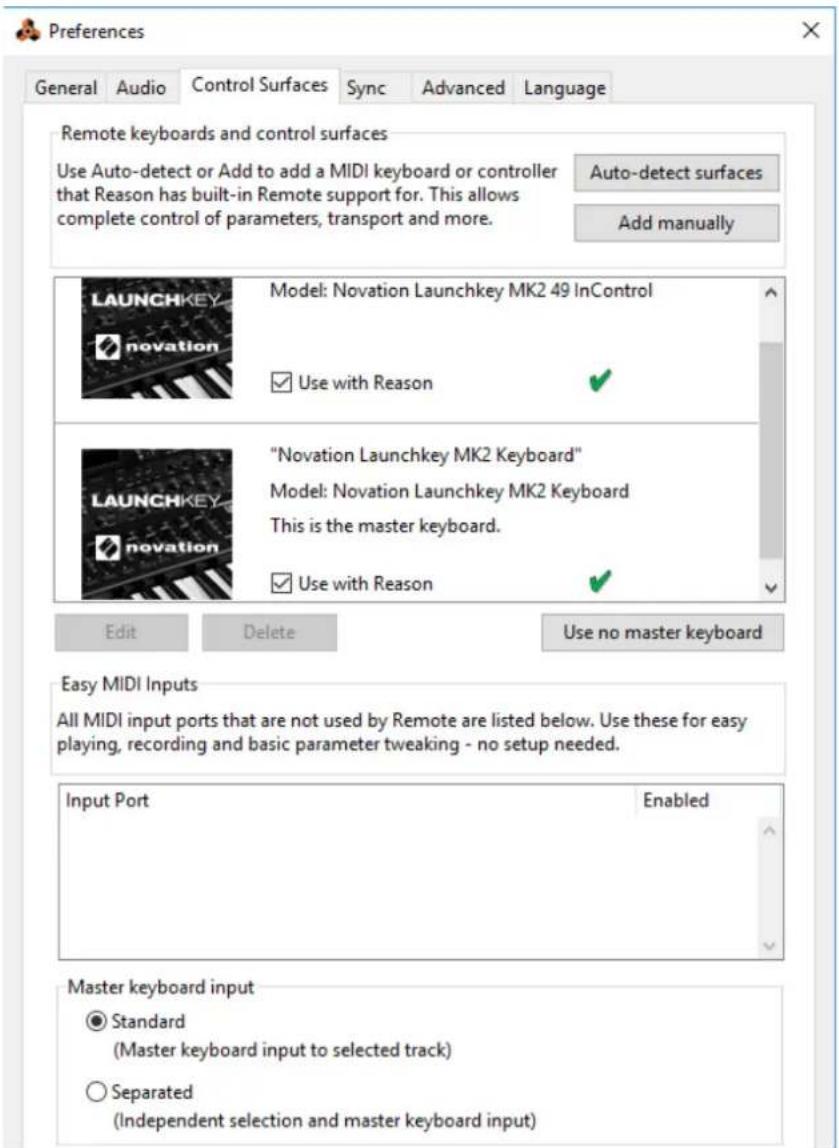
- To add a control surface manually, click the Add manually button.
This brings up a new dialog.
- Select the manufacturer of your control surface from the Manufacturer pop-up menu.
If you can't find it on the menu, see below.
- Select the model of your control surface from the Model pop-up menu.
If you can't find it on the menu, see below.
- An image of the selected control surface model is shown, often along with some information text - read this carefully.
For some control surfaces, you need to select a specific preset to use the surface with Reason Lite - this is noted here.
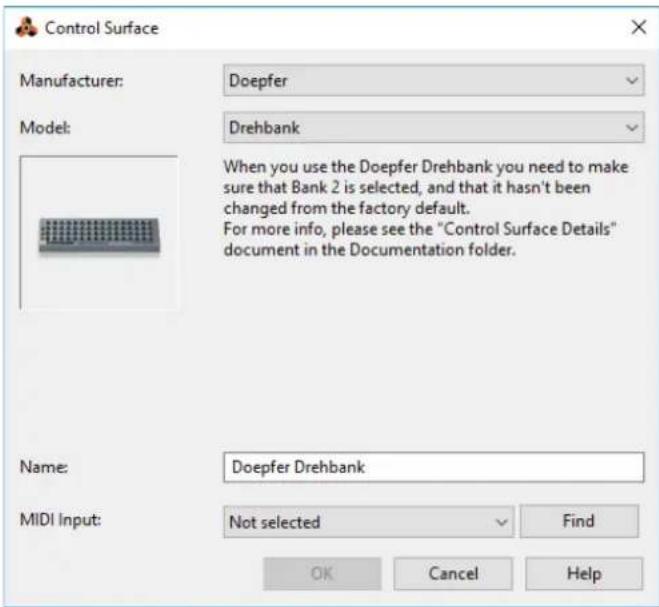
- Use the MIDI Input pop-up to select the input port to which you have connected the surface.
If in doubt, you can click the Find button and then tweak a control or play a key on the control surface to have Reason Lite find the correct input port for you.
→Some control surfaces may have more than one MIDI Input pop-up menu.
You need to select ports on all MIDI Input pop-up menus.
→Some control surfaces will have a MIDI Output pop-up menu.
In some cases this labeled "Optional" - then you don't have to make a selection. In other cases, a MIDI Output is required. This is the case if the control surface uses MIDI feedback - motor fader, displays, etc.
→ Reason Lite only "grabs" the MIDI inputs you are actually using.
MIDI inputs not selected here or on the Sync page (see "Advanced MIDI - The External Control Bus inputs") are available to other programs.
→ Note that other MIDI programs may "grab" all MIDI ports in your system when you launch them!
-
If you like, you can rename your control surface in the Name field.
-
Click OK to add the surface.
→ Depending on the surface model, alerts may appear, reminding you to select a specific preset etc.
In some cases, Reason Lite can restore a preset in the control surface to factory settings for you. In such cases you will be informed about this.
Finally you return to the Control Surfaces tab in Preferences, where your added surface is now listed.
If your control surface model isn't listed
If you can't find your control surface listed on the Manufacturer or Model pop-up menus when you try to add it, this means that there's no native support for that model. However, the program supports generic keyboards and controllers. These alternatives might be more useful than the Easy MIDI Input alternative described earlier - if you have a control surface (or keyboard with knobs buttons/sliders) that you want predefined parameter destinations for. Here's what to do:
→ Select "Other" on the Manufacturer pop-up menu and then one of the three options on the Model pop-up menu.
or, if the Manufacturer is listed but not your specific model:
→ Select one of the three "Other" options on the Model pop-up menu:
In both cases, the options are:
• MIDI Control Keyboard
Select this is you have a MIDI keyboard with programmable knobs, buttons or faders. You need to set up your control keyboard so that the controls send the correct MIDI CC messages, depending on which Reason Lite device you want to control - check out the MIDI Implementation Chart. If your control keyboard has templates or presets for Reason devices, these can be used if you run Reason Lite.
• MIDI Control Surface
Select this if you have a MIDI controller with programmable knobs, buttons or faders (but without keyboard). You need to set up your control surface so that the controllers send the correct MIDI CC messages, depending on which Reason Lite device you want to control - check out the MIDI Implementation Chart. If your control surface has templates or presets for Reason devices, these can be used if you run Reason Lite.
• MIDI Keyboard (No Controls)
Select this is you have a MIDI keyboard without programmable knobs, buttons or faders. This is used for playing only (including performance controllers such as pitch bend, mod wheel, etc.) - you cannot adjust Reason Lite device parameters with this type of control surface.
• MIDI Multichannel Control Keyboard
Select this is you have a MIDI keyboard with programmable controls that use multiple MIDI channels (different controls send the same MIDI CC but on different MIDI channels). With this model there is no automatic mapping to device parameters - you need to use Remote Overrides to map each control to a parameter on a device.
• MIDI Multichannel Control Surface
Select this is you have a MIDI control surface with programmable controls that use multiple MIDI channels (different controls send the same MIDI CC but on different MIDI channels). With this model there is no automatic mapping to device parameters - you need to use Remote Overrides to map each control to a parameter on a device.
After selecting a model, proceed with selecting MIDI input port as described above.
About the Master Keyboard
One of the control surfaces can be the Master Keyboard. This is like any other control surface, but it must have a keyboard and it cannot be locked to a specific Reason Lite device (in other words, it always follows the MIDI input to the sequencer). This is the surface you use to play the instrument devices in Reason Lite.
The first surface with a keyboard that is added (or found by auto-detect) is automatically selected to be the master keyboard.
This is shown in the "Remote keyboards and control surfaces" list on the Preferences page.
- If you want to use another surface as master keyboard, select it in the list and click the "Make Master Keyboard" button.
You can only have one surface as master keyboard at a time.
→ If you don't want to use any master keyboard at all, select the current master keyboard surface and click the same button (which is now labeled "Use No Master Keyboard").
Other functions
→To edit a surface, double click it in the list (or select it and click Edit).
This lets you change its name and MIDI port settings, if needed.
→To delete a surface, select it in the list and click Delete.
→ You can turn off a surface by deactivating its "Use with Reason Lite" checkbox.
This could be useful if the surface is connected to your system but you only want to use it with another program.
There is also the Sync tab in the Preferences. This is only used for External Control MIDI buses and for MIDI Clock Sync input. All hands-on MIDI control is set up on the Control Surfaces tab.
Example Setups
There are several possible variables when it comes to what type of setup you are using. Please read on.
A single MIDI keyboard with controls
With this setup, the keyboard is your master keyboard, which means it is always routed via the sequencer (it controls the device connected to the sequencer track with Master Keyboard Input). To control another device, you move the Master Keyboard Input (the keyboard symbol in the In column in the track list) to another sequencer track.
You can, however, use Remote Override to control parameters on other Reason Lite devices (or global Reason Lite functions such as transport).
A basic MIDI keyboard and an additional control surface
The keyboard and the control surface should be connected to separate MIDI ports (or use separate USB connections). Here, the basic MIDI keyboard is your master keyboard - it is used for playing and recording via the sequencer. You can have the control surface follow the master keyboard - this lets you tweak the parameters of the device you are playing (just like in the example above).
You can also lock the control surface to another device in the rack - this lets you play one device while adjusting the parameters of another.
A MIDI keyboard with controls plus one or more control surfaces
This is the ideal setup! Again, all keyboards and control surfaces should be connected to separate MIDI ports (or use separate USB connections). The master keyboard is routed via the sequencer track and you can use its controls to tweak the parameters of the device you are playing. The additional control surfaces could be locked to the Main Mixer or to different devices in the rack.
If you have additional MIDI keyboards locked to devices in the rack, you can also play and record on their corresponding sequencer tracks simultaneously. This is perfect if your band has several keyboard players who want to play and record their tracks simultaneously into Reason Lite!
For example, if you lock a control surface to the Main Mixer, you will always have control over levels, pans and additional channel strip parameters - see "Remote controlling the Main Mixer" and "Remote controlling multiple mixer channels". You could also have dedicated controls for transport, Undo/Redo, sequencer track MIDI focus selection, etc.
Remote basics
Parameters and functions for each Reason Lite device are mapped to controls on supported control surface devices. As soon as you have added your control surface(s) in the Preferences, you can start tweaking parameters!
- By default, all connected control surfaces follow the sequencer's current Master Keyboard Input.
This means that you set Master Keyboard Input to a track in the sequencer to route the control surface(s) to the track's device in the rack. You can bypass this functionality by locking a control surface to a specific device - see "Locking a surface to a device". Or you can simply use Remote Override mapping (see "Remote Override" for specific parameters - these will then be mapped to the selected controls regardless of Master Keyboard Input.
- The Reason Lite device associated with the track with Master Keyboard Input will have its parameters standard mapped to logical controls (faders, buttons etc.) on the control surface device.
E.g. if a Subtractor has Master Keyboard Input, your control surface will control the most important Subtractor parameters. If you set Master Keyboard Input to a track connected to an NN-XT, the control surface will now control parameters on the NN-XT device, and so on for each device. There are standard mapping variations for most devices as well - see "About mapping variations".
- Supported control surfaces with dedicated transport controls will be standard mapped to the equivalent transport controls in Reason Lite.
If you do not have transport controls on your control surface you can still map transport controls to controllers using Remote Override mapping - see "Remote Override mapping".
- Other important functions such as switching target track in the sequencer, selecting patches, Undo/Redo can also be remote controlled.
See "Additional Remote Overrides...".
About Standard vs Remote Override mapping
Reason Lite parameters are "standard-mapped" to supported control surface devices. There is nothing the user needs to set up to remote control any Reason Lite device. You can, however, use Remote Override mapping to map a specific parameter to a specific control if you should want to.
→ By using standard mapping, the remote mapping for each device will be the same for any new song created in Reason Lite, given you have the same set of control surfaces connected.
If you use Remote Override mapping (see "Remote Override"), the overrides will be saved with the current song, but won't be there if you create a new song.
→ Which parameters and functions that are standard mapped for each Reason Lite device depends on the control surface(s).
The "Control Surface Details" document contains some information about the standard mappings of the different control surface models. But you can also activate Remote Override Edit mode to see which parameters for each device are mapped to your control surface(s) - see "Remote Override".
→ Note that if you have several control surfaces connected, some parameters could be mapped to controls on more than one control surface.
This is not a conflict of any kind, but simply a consequence that stems from the fact that all control surfaces by default follow Master Keyboard Input. By using Surface Locking (see below) or Remote Override (see "Remote Override") you have full control over your control surfaces.
About mapping variations
Since there are often more parameters on a device than there are controls on the control surface, there are standard mapping variations available for most devices. When selecting a standard mapping variation, a new set of parameters will be mapped to the controls on your control surface for a selected Reason Lite device.
For example, if you have a control surface with 8 rotary knobs routed to a Subtractor, the knobs may control filter parameters by default. Selecting variation 2 may make the knobs control the oscillator settings, variation 3 may control LFOs and so on.
→ For devices that support keyboard shortcuts, you switch between mapping variations by holding down [Ctrl]+Alt or [Cmd]+Option and press the numerical keys [1] to [10] (not the numerical keypad), where [1] selects the default standard mapping.
How many mapping variations are available depends on the control surface and the Reason Lite device selected. The variation selected will stay active until you switch MIDI input to another device (or select another variation). If you switch back to the same device it will have its default standard mapping (variation [1]).
→ For control surfaces that have dedicated controls for selecting mapping variations these are used instead of keyboard shortcuts.
→ Locked devices (see "Locking a surface to a device") can also be locked to a specific mapping variation.
Locking a surface to a device
You can lock a control surface or an additional MIDI keyboard/controller to a specific device so that it is always "tweakable" and record enabled, regardless of which track has Master Keyboard input in the sequencer. This enables you to play and record notes for several devices simultaneously from multiple control surfaces/keyboards.
For example, you could lock a control surface to control the Main Mixer, so you can always control overall levels while playing/tweaking other devices. See "Remote controlling the Main Mixer" for an example.
• The master keyboard device cannot be locked!
If you select the master keyboard in the Preferences, you can click the "Use No Master Keyboard" button. You can then lock this control surface to a device and use its controllers to tweak parameters, but you will not be able to play the device.
- You can lock several control surfaces to the same device.
However, each control surface can only be locked to one device at a time.
- Info about which devices are locked (and to which control surfaces) is saved with the song.
! Control surfaces/keyboards that use the Easy MIDI Inputs function (see "Automatic set-up using the Easy MIDI Inputs function") cannot be locked to devices.
Locking a surface
There are basically two methods you can use to lock a Surface:
Using the Surface Locking dialog
- Select "Surface Locking..." from the Options menu.
The Surface Locking dialog opens.
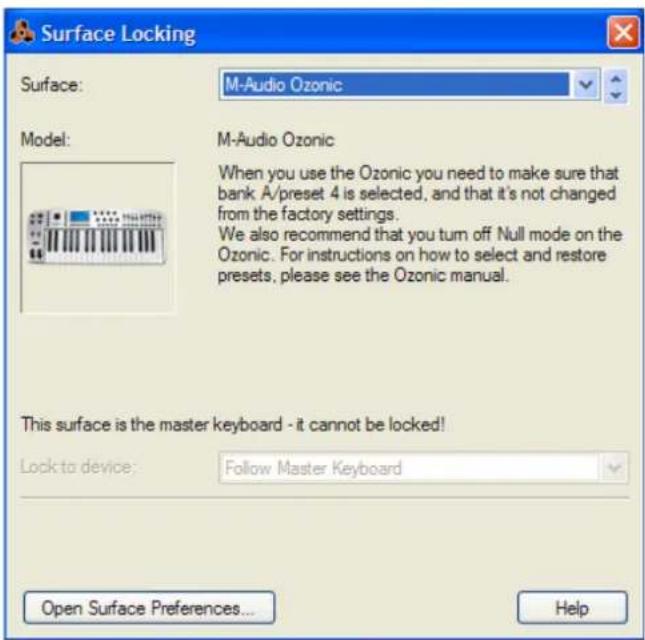
In this picture, the dialog has the master keyboard as the selected control surface - this cannot be locked.
- Pull down the Surface pop-up from at the top of the dialog and select the control surface you wish to lock to a device.

- Next, open the "Lock to device" pop-up menu.
On this pop-up, all devices in the current song are listed. The "Follow Master Keyboard" item which is selected by default, means that the control surface isn't locked (it instead follows the Master Keyboard Input in the sequencer).
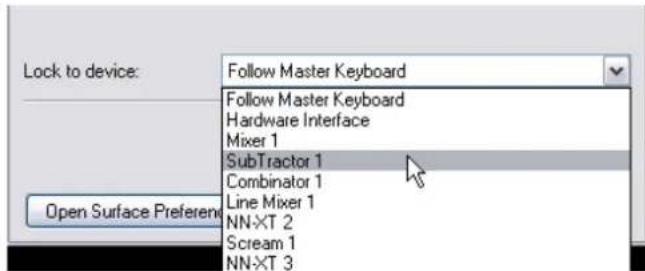
- Select the device you wish to lock to the selected control surface from the list.
→ If the selected control surface supports keyboard shortcuts for selecting mapping variations (see "About mapping variations") an additional "Always use Mapping" pop-up appears.
On this pop-up you can set whether you wish to lock a specific standard mapping variation or whether the device should switch mapping variations according to keyboard shortcuts. If the former is the case, select the mapping variation from the list. If the latter is the case, select "Follow Keyboard Shortcut".

- Close the dialog when you are done.
The device is now locked to the selected control surface. In Remote Override Edit mode (see "Activating Remote Override Edit mode") a locked device is shown with a lock symbol in the upper left corner of the device panel.
It's also possible to lock a control surface to the ReGroove Mixer (see "The ReGroove Mixer") to control its parameters via Remote!
Using the context menu
→ A quick way to lock devices is by right-clicking (Win) or [Ctrl]-clicking (Mac) on a device panel to bring up the context menu.
On the context menu, all installed control surfaces (apart from the master keyboard) are listed with the text "Lock to" plus the name of the control surface. Selecting one will lock the device to the control surface. On the context menu the control surface that is currently locked to this device will be ticked.
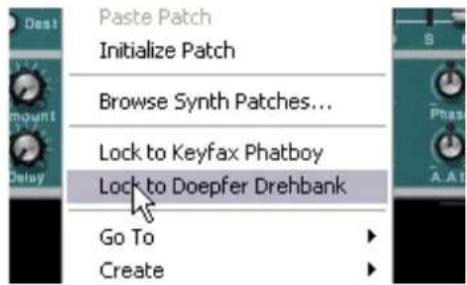
Unlocking a surface
→ To unlock a locked device, bring up the context menu for the locked device, and untick the "Lock to" item. This unlocks the device and the control surface will now follow master keyboard input.
→ Another way to unlock a surface is to open the Surface Locking dialog and selecting "Follow Master Keyboard" on the Lock to device pop-up.
Remote Override
Remote Override allows you to map parameters and functions to controls on your control surface device, overriding the standard mapping. It also allows you to control device parameters from Easy MIDI Inputs (that has no standard mapping).
Activating Remote Override Edit mode
1. Select "Remote Override Edit Mode" from the Options menu.
All unselected devices in the rack are grayed out, indicating Edit mode. Each selected device (including the Transport panel) will show a blue arrow symbol on every parameter that can be mapped to a control on a control surface.
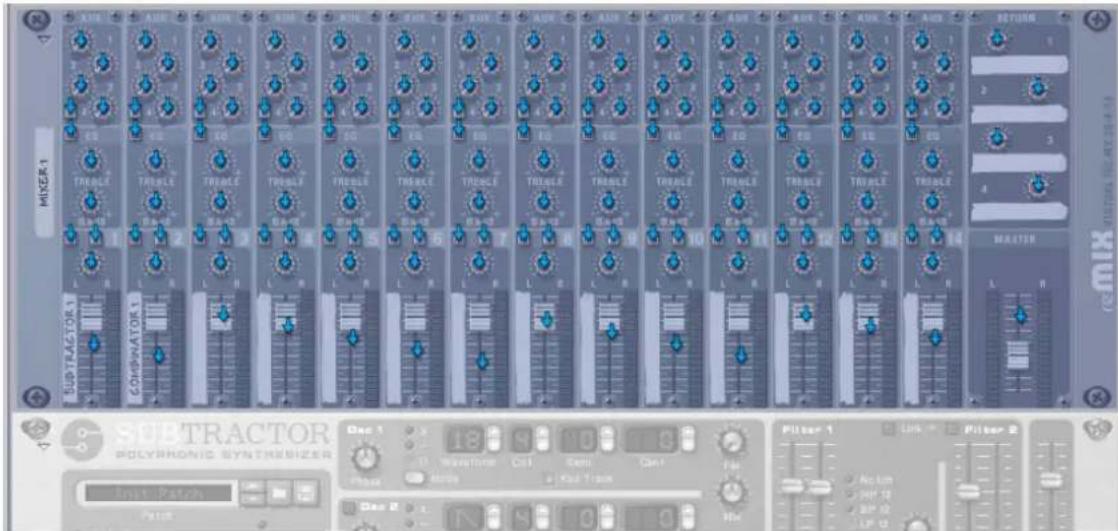
Remote Override Edit mode enabled with the mixer device selected.
To be able to see which parameters are currently mapped for a device, you have to direct Master Keyboard input to the sequencer track it is connected to:
2. Select a device in the rack and enable Master Keyboard input for its sequencer track.
Standard-mapped parameters are tagged with yellow knob symbols.
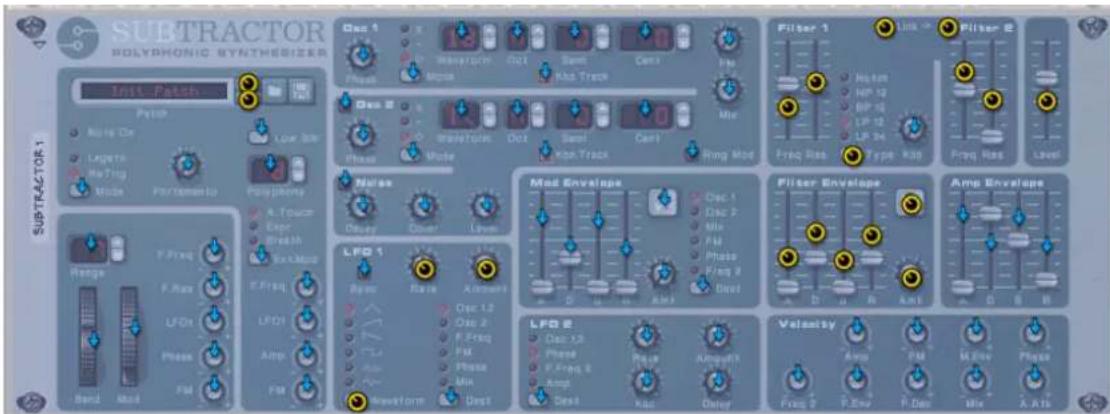
A Subtractor with standard-mapped parameters.
→ Note that you can select the Transport Panel as well!
Most items on the Transport panel can be mapped to controls. Note that by selecting the Transport panel any standard mapping will be shown automatically, unlike other devices where you have to first direct Master Keyboard input to the device from the sequencer.
→ If you point on a standard mapped parameter, a tooltip appears showing which control on the control surface device the parameter is mapped to.

Remote Override mapping
If Remote Override Edit Mode is enabled you can use the following methods to map a parameter to a control:
Method 1:
- Select the parameter you wish to map.
The arrow (or knob) changes to orange, indicating it is selected.
- Select "Edit Remote Override Mapping..." from the Edit menu.
You can also right-click (Win) or [Ctrl]-click (Mac) on the parameter to select the same item from the context menu.
The "Edit Remote Override Mapping" dialog opens. From here you have two ways to proceed:
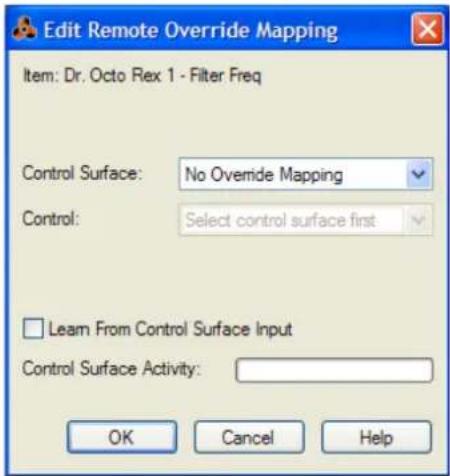
Either manually select the control surface and the control you wish to map the parameter to from the two corresponding pop-ups.
The Control Surface pop-up lists all installed control surface devices, and the Controls pop-up lists all the mappable controls for the selected control surface.
→ Or you can activate "Learn From Control Surface Input" and simply move (or press) the control you want to map the parameter to.
The "Control Surface Activity" field momentarily flickers as you turn the knob, and then the dialog shows the control surface and control it is mapped to.
→ If the control surface has a keyboard, you can also select keys as controls.
Keys work just like on/off buttons. If "Keyboard" is selected from the Controls pop-up, a Note Number field appears in the dialog.
3. Click OK to exit the dialog.
The mapped parameter now shows a lightning bolt icon, indicating it uses Remote Override mapping. Any overrides are always shown in Remote Override Edit mode. The device does not have to be selected or have Master Keyboard Input in the sequencer.
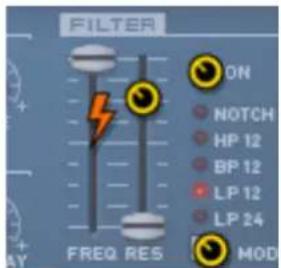
4. To exit Remote Override Edit Mode, deselect it from the Options menu.
You can also leave this mode by pressing [Esc].
Method 2:
1. Double-click the parameter you wish to map.
A rotating lightning bolt appears for the parameter - this indicates that "Learn From Control Surface" mode is active. You can leave this mode by pressing [Esc].
2. Now move (or press) the control you want to map the parameter to.
The parameter is now mapped to the control.
You do not always have to edit override mapping when Remote Override Edit mode is activated - see below.
Override mapping with Remote Override Edit mode deactivated
If Remote Override Edit Mode is enabled on the Options menu, mapped parameters are "tagged", and the arrow indicators show the assignable parameters. In this mode, however, you cannot operate Reason Lite normally. Remote Override Edit mode is primarily for overview of available parameters and the current assignments.
Another way to map parameters is to have "Remote Override Edit Mode" deactivated on the Options menu, and to simply right-click (PC) or [Ctrl]-click (Mac) on the parameter you wish to remote control.
This opens a pop-up menu, where one of the options will be "Edit Remote Override Mapping". Selecting this will open the Edit Remote Override Mapping dialog. Thus, you do not have to select Edit mode from the Options menu if you already know that a parameter is free and assignable.
Removing Remote Overrides
This can be done for a selected parameter in the following way:
- In Remote Override Edit Mode, select the parameter you wish to remove Remote Override for.
The lightning bolt changes to orange, indicating it is selected.
- Select "Clear Remote Override Mapping..." from the Edit menu.
You can also right-click (Win) or [Ctrl]-click (Mac) on the parameter to select the same item from the context menu. This is always available, regardless whether Remote Override Edit mode is selected or not.
Or you can remove all Remote Overrides for a device in one go:
-
Select the device you wish to remove Remote Override for.
-
Select "Clear All Remote Override Mappings for Device" from the Edit menu.
You can also right-click (Win) or [Ctrl]-click (Mac) on the device panel to select the same item from the context menu.
Copying/Pasting Remote Overrides
You can copy Remote Override mappings for a device and paste them into a device of the same type. This works as follows:
- With Remote Override Edit mode activated, select the device you want copy Remote Override mappings from, and the select "Copy Remote Override Mappings" from the Edit menu.
You can also right-click (Win) or [Ctrl]-click (Mac) on the device panel to select the same item from the context menu.
- Select the device you wish to paste the copied mappings to.
It has to be the same type of device you copied from. In case you copied Remote Override mappings from the Transport panel you can thus only paste the mappings into another song document.
- Select "Paste Remote Override Mappings" from the Edit menu.
Now the following happens:
→ If you are pasting in the mappings into a device in the same song document, a dialog appears informing that the overrides are already used.
You then have the choice of cancelling the operation, or to move the existing overrides to the new device.
→ If you are pasting into a device in another song, the copied Remote Override mappings are simply pasted. In this case, the original Remote Override mappings are not affected.
Additional Remote Overrides...
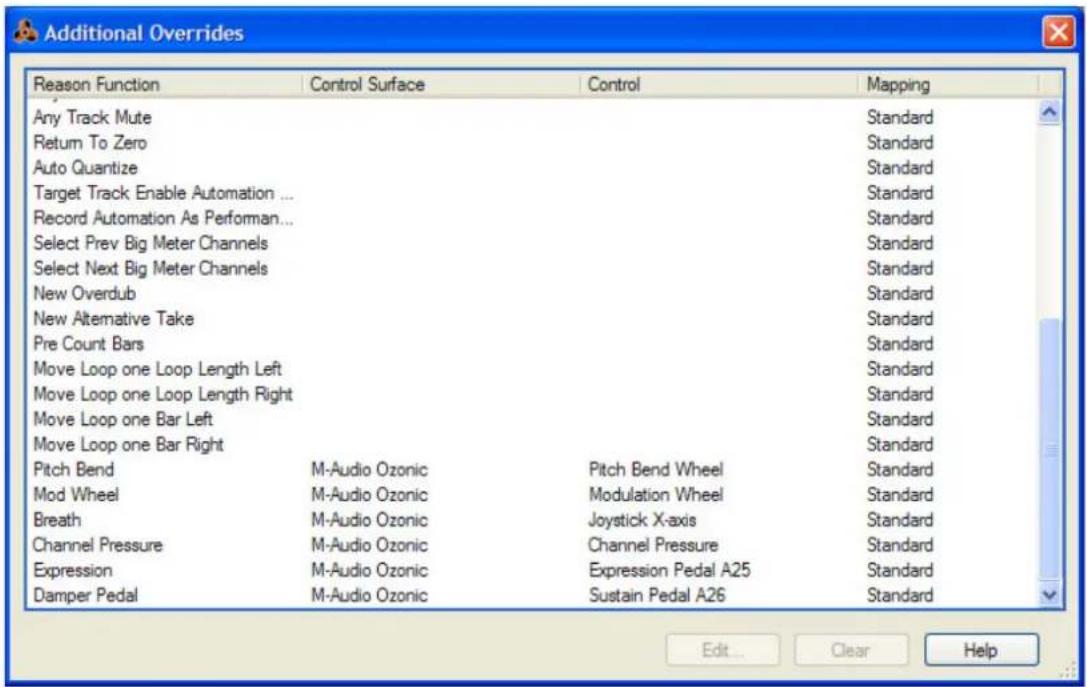
On the Options menu there is an item named "Additional Remote Overrides...". Selecting this opens a dialog with remote functions that cannot be assigned using Remote Override Edit mode, such as switching target tracks, Undo/Redo etc.
Although most of the items in this dialog are self-explanatory, some need to be described. These are as follows:
Target Track Delta and Target Previous/Next Track
→Target track is the track with Master Keyboard Input.
Assigning Target Previous/Next Track to two Button controls on a control surface allows you to move the Master Keyboard Input symbol up or down in the Track list.
→ Target Track Delta is meant to be used with Delta wheel controllers (a special control with no min/max range) to switch target track.
A Mackie Jog wheel is an example of this type of controller.
→Select Previous/Next Track can be assigned to standard button controls.
Select Patch for Target Device and Select Previous/Next Patch for Target Device
The target device is the device connected to the target track.
→Patch selection is usually standard-mapped to buttons on a control surface.
If you wish to override this standard patch selection mapping for devices globally to select patches for any patch device that currently has Master Keyboard Input, you can assign this here.
For example, you may always want to use the same buttons on a specific control surface for selecting patches.
→ Select Patch for Target Device is also meant to be assigned to a Delta-type control (see above).
This allows you to select patches for a device connected to the target track by spinning the wheel clockwise or anti-clockwise.
→ Select Previous/Next Patch can be assigned to standard button controls.
Select Keyboard Shortcut Variation (Delta)/Select Previous/Next Keyboard Shortcut Variation
By mapping controls to these, you can use your control surface to change which keyboard shortcut variation is selected in Reason Lite.
- The "Select Previous/Next" functions are typically mapped to buttons, allowing you to step between keyboard shortcut variations.
- The Delta function must be mapped to a delta-type control to work.
- The keyboard shortcut variation selection is a global setting in Reason Lite. It affects all added control surfaces (if they make use of keyboard shortcut variations and aren't locked to a specific device and variation in the Surface Locking dialog).
Undo/Redo
You can assign Undo/Redo to controls. This works just like the corresponding items on the Edit menu.
Document Name
This allows you show the name of the song in the display of the control surface. This only works for control surfaces that support this feature.
Assigning Additional Overrides
Assigning overrides in this dialog is similar to assigning standard Remote Overrides:
- Select a function/parameter in the list that you wish to assign to a control and click "Edit".
This opens the Edit Remote Override Mapping dialog, where you can assign a control to the selected function/parameter. You can also simply double click the item in the list to open this dialog.
- Click OK to close the dialog.
Clearing Additional Overrides
- Select "Additional Remote Overrides" from the Options menu.
In the Mapping column you can see which parameters/functions use overrides.
- Select the item currently assigned override mapping, and click "Clear".
Keyboard Control
Assigning computer keyboard remote commands does not involve MIDI, so there is no special setting up required. Keyboard commands can be assigned to parameters just as when using Remote Override mapping, but the functionality differs in one central aspect:
- Keyboard Control commands can only be used to toggle on/off or min/max values for an assigned parameter.
Hence, if you assign a computer keyboard remote command for a knob, slider or spin control, it will only switch between the minimum and maximum values for that parameter. The only exception to this are the multi-selector buttons used for various parameters such as envelope destination, for example. These will cycle through the available options when using keyboard control.
! Note that Keyboard Control cannot be used for the ReGroove Mixer parameters.
Enabling Keyboard Control
To enable Keyboard Control, select "Enable Keyboard Control" from the Options menu.
Editing Keyboard Control
To get an overview of which parameters are remote controllable select "Keyboard Control Edit Mode" from the Options menu.
When done, each device you select in the rack will show a yellow arrow symbol beside every parameter that can be assigned a keyboard control.
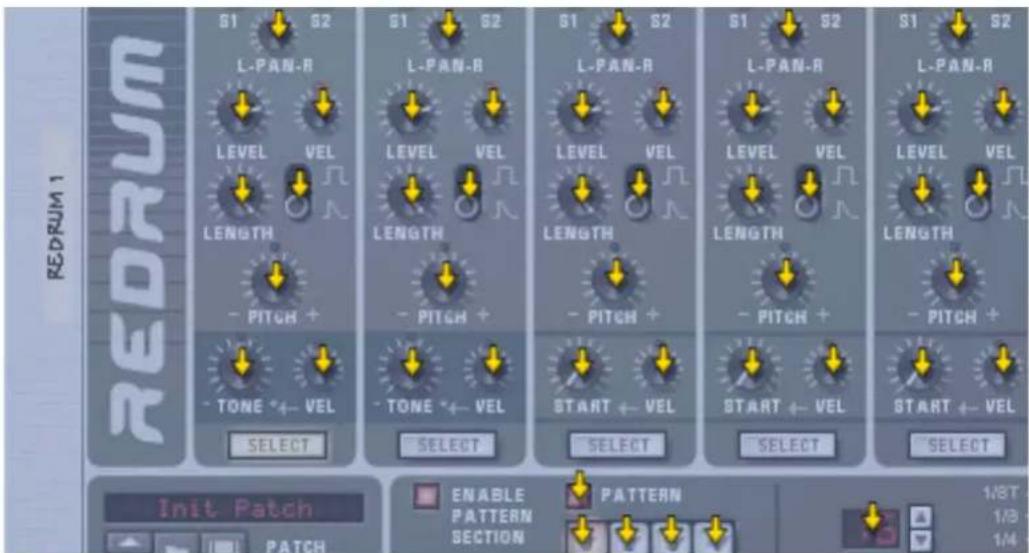
A section of a Redrum drum machine with Keyboard Control Edit Mode enabled.
! The Main Mixer channel strip parameters can also be controlled using the Keyboard Control function, but there is no Edit Mode for this. Instead, you have to right-click (Win) or [Ctrl]-click (Mac) on individual channel strip parameters and select "Edit Keyboard Control Mapping" from the context menu.
→ If you click on an assignable parameter to select it, you can then select "Edit Keyboard Control Mapping" from the Edit menu.
This opens a dialog allowing you to select a key command for that parameter.
You may use any key except the [Space bar], [Tab], [Enter], the Numeric keypad keys (which is reserved for Transport functions) and the function keys (except [F2] and [F3]) - or a combination of [Shift] + any key (with the same aforementioned exceptions).
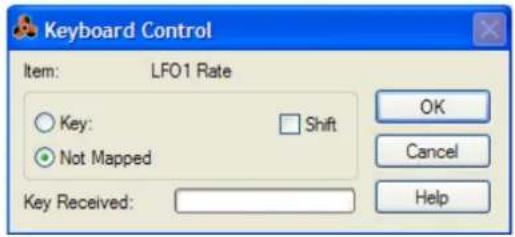
The Keyboard Control dialog.
→ Simply press the key (or Shift-key combination) you wish to use to remote control the parameter.
The "Key Received" field momentarily indicates that it is "learning" the keystroke(s), and then the dialog displays the name of the key you have pressed. If [Shift] was used, the box beside the word Shift in the dialog is ticked.
You can also double-click on the arrow for an assignable parameter to set up keyboard control:
A rotating yellow rectangle appears, indicating Learn mode. Press the key (or key combination) you wish to use to control the parameter.
The rotating stops and the rectangle will now display the key or key combination you used.
About the two Edit Keyboard Control Modes
If Keyboard Control Edit Mode is enabled (ticked) on the Options menu, assigned parameters in the rack are "tagged", showing the remote key for that parameter. In this mode, however, you cannot operate Reason Lite normally. This mode is primarily for overview of available parameters and the current assignments.
Another way to assign keyboard remote commands is to have "Keyboard Control Edit Mode" deselected on the Options menu, and to simply right-click (Win) or [Ctrl]-click (Mac) the parameter you wish to remote control.
This opens a pop-up menu, where one of the options will be "Edit Keyboard Control Mapping". Selecting this opens the Keyboard Control dialog. Thus, you do not have to enable/disable Edit mode from the Options menu if you know that a parameter is assignable.
! This is the only way Main Mixer channel strip parameters can be assigned to Keyboard Control.
Saving Remote Setups
There's no need to save MIDI Remote mapping as the Standard Remote mapping for each Reason Lite device to supported control surfaces is built-in, and is always available. You may, however, wish to save specific Remote Override mappings or Keyboard Control setups as a template:
→ This could be done by saving a song document containing all the devices that are affected by the related Key or Remote Override mappings, but without any sequencer data.
This song document could then be used as a starting point for any new song, by simply loading it, and immediately using "Save As" to save it under a new name.
A good idea could be to save these types of "Remote Template" songs in the Template Songs folder. See "Making a Song appear as a Template Song" for info on how to do this.
Chapter 24
Synchronization and
Advanced MIDI
About this chapter
This chapter describes how to synchronize Reason Lite to external MIDI Clock or Ableton Link and how to sync external equipment from Reason Lite's internal MIDI Clock. The chapter also describes how to use the External Control Bus inputs for advanced MIDI routing.
Synchronization to MIDI Clock
What is synchronization and MIDI Clock?
Synchronization, in this context, is when you make Reason Lite play at the same tempo as another MIDI device; where both start, stop and can locate to certain positions, together. This is done by transmitting MIDI Clock signals between Reason Lite and the other device. MIDI Clock is a very fast "metronome" that can be transmitted in a MIDI cable. As part of the MIDI Clock concept there are also instructions for Start, Stop and locating to sixteenth note positions.
You can set up synchronization between Reason Lite and hardware devices (tape recorders, drum machines, stand alone sequencers, workstations etc.) and other computer programs running on the same or on another computer.
Host/Device
In a synchronized system there is always one Host and one or more Devices. In our case, the host is the one that controls the tempo. In other words, it is only the tempo setting on the host that is of any relevance, since the devices follow the host's tempo.
- Reason Lite can act as Host or Device. That is, Reason Lite can transmit MIDI Clock signals and also receive them.
Using Reason Lite as MIDI Clock Host
Reason Lite can transmit standard MIDI Clock signal. It also sends Start, Stop, Continue and Song Position Pointer (SPP) MIDI messages so that you can also control the transport functions of the synced equipment from the Transport Panel in Reason Lite. To set up Reason Lite as a MIDI Clock host, proceed as follows:
- Select the desired MIDI Port from the Output drop-down menu in the "MIDI clock sync" section on the Sync tab in Preferences.
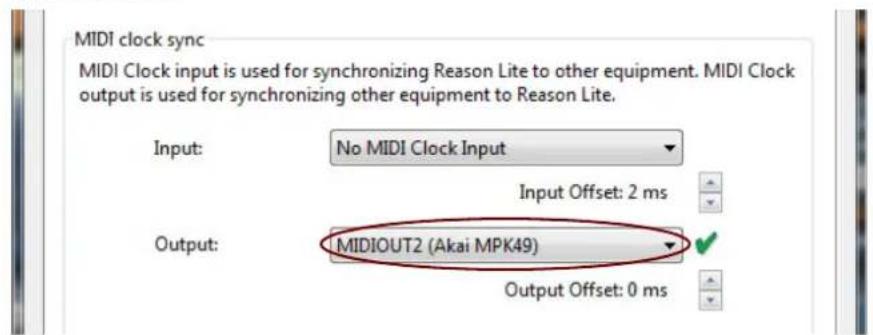
Selecting MIDI clock output port.
-
Close the Preferences window.
-
Select "Sync -> Send MIDI Clock" from the Options menu:
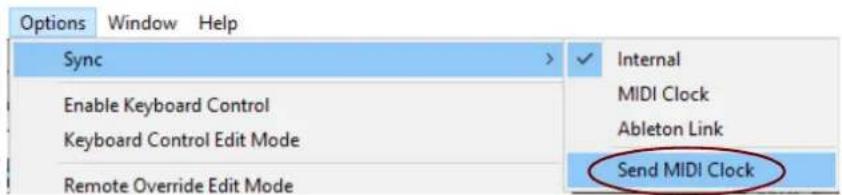
→ Alternatively, click the Send Clock button in the Sync Mode section on the Transport panel:
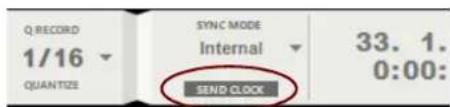
Now, you have set up Reason Lite as a MIDI Clock sync master. When you start the Reason Lite sequencer, MIDI Clock is sent out on the selected MIDI Out Port.
→ If your synced MIDI equipment is not in phase with the Reason Lite sequencer, you might have to change the Output Offset in the "MIDI clock sync" section on the Sync tab in Preferences.
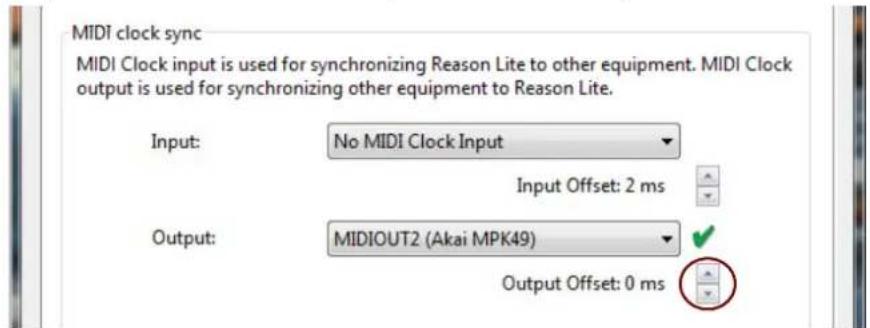
→ If the external MIDI equipment lags, set the Output Offset to a negative value.
A negative Output Offset means that the MIDI Clock signal is sent out from Reason Lite earlier to compensate for the lag.
→ If the external MIDI equipment plays ahead of the Reason Lite sequencer, set the Output Offset to a positive value.
There are also some additional options regarding the MIDI Clock signal that can be selected at the bottom of the MIDI clock sync section:
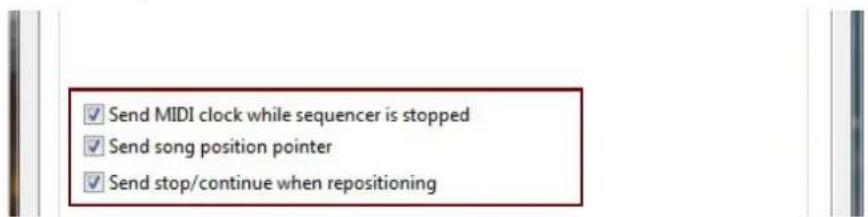
- Send MIDI clock while sequencer is stopped.
When this box is checked, Reason Lite continues to send out MIDI clock signal also when the sequencer is stopped.
- Send song position pointer.
When this box is checked, Reason Lite sends out MIDI Song Position Pointer information to the device. If the synced device doesn't support Song Position Pointer, turning this setting off can improve synchronization. This is also useful if the synced device is playing a looped pattern and should disregard all positioning.
- Send stop/continue when repositioning.
When this box is checked Reason Lite sends out Stop/Song Position Pointer/Continue messages to the synced device, if the song position locator in the sequencer is moved (either manually or when in Loop mode) when the sequencer is running.
If unchecked, only Song Position Pointer messages are sent out if the song position locator is moved (or in Loop mode) while the sequencer is running.
Syncing Reason Lite to an external MIDI application or instrument
This example assumes that you have an external device, such as a drum machine, hardware sequencer, another computer, tape recorder etc., that transmits MIDI Clock signals to which you want to synchronize Reason Lite.
- Connect the device via USB/MIDI to the computer running Reason Lite.
- Set up the host so that it transmits MIDI Clock signals to the MIDI Out you just connected to the computer running Reason Lite.
- In Reason Lite, pull down the Edit menu (under macOS, the Reason Lite menu) and open the Preferences dialog. Click the Sync tab.
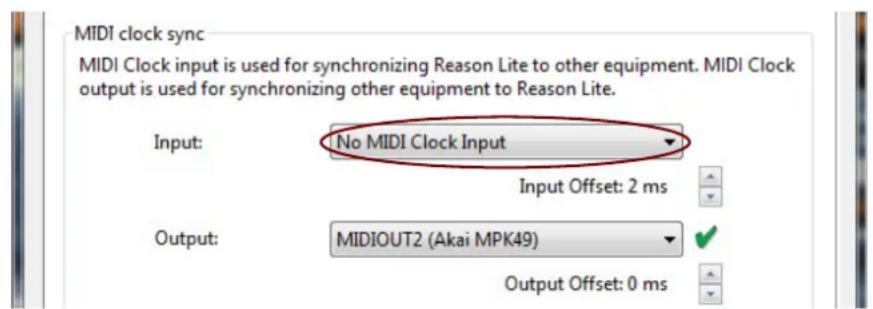
- Pull down the MIDI Clock Input pop-up and select the MIDI Input to which you connected the host.
- Close the dialog.
- Activate MIDI Clock Sync from the Options menu - "Sync" submenu in Reason Lite.
- Activate playback on the host.
Reason Lite will start playing in sync with it.
→ If the Reason Lite sequencer lags or plays ahead of the host, adjust the Input Offset on the Sync page in Preferences, see “Adjusting for Latency”.
Syncing Reason Lite to another program on the same computer
This section describes how to use MIDI Clock to synchronize Reason Lite to another application running on the same computer.
! Note that synchronization via MIDI Clock makes the two programs play at the same time, that is, they both "run" when you "hit play". It does not mean they can both play audio at the same time.
Proceed as follows:
- Set up the host, so that it transmits MIDI Clock to Reason Lite:
Under Windows this is done by selecting one of the MIDI routing utility ports.
- In Reason Lite, open the Preferences - Sync page.
- Pull down the MIDI Clock Input pop-up and select the corresponding MIDI port.
-
Close the dialog.
-
Activate MIDI Clock Sync from the Options menu - "Sync" submenu in Reason Lite.
-
Activate playback on the host.
Reason Lite will start playing in sync with it.
→ If the Reason Lite sequencer lags or plays ahead of the host adjust the Input Offset on the Sync page in Preferences, see "Adjusting for Latency".
External synchronization considerations
Adjusting for Latency
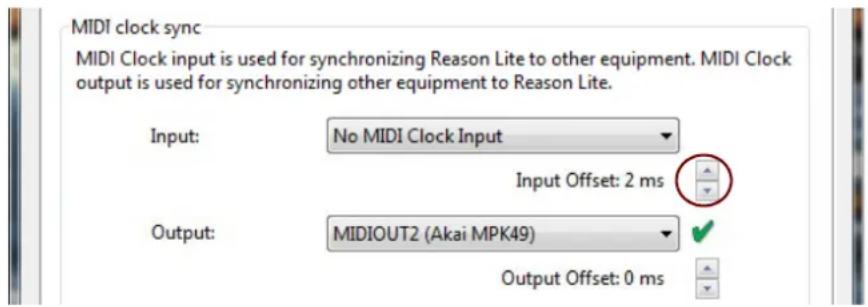
Because of the MIDI latency problem, you might need to adjust Reason Lite's playback in relation to the sync host, so that they are in perfect time. The tempo will not differ between the two, but Reason Lite might play ahead or behind the other application. You might need to adjust this. However, this is something you only need to do once. The setting is stored with your other preferences, so you don't need to adjust it again.
Proceed as follows:
- Set up the other application so that it generates a solid click, on for example quarter or eighth notes, preferably with a special sound on the downbeat.
This click can either come from an internal metronome or from a MIDI source. If you use a MIDI source, make sure you pick one that has solid MIDI timing. - Set up Reason Lite so that it plays a similar rhythm as the other application.
You might for example use the sequencer Click or a Redrum drum computer for this. - Start the two applications in sync.
- Make sure you hear both applications at approximately equal level.
- Open the Preferences dialog in Reason Lite and click the Sync tab.
- Trim the "Input Offset" setting until the "clicks" from the both sources sound at exactly the same time.
- Close the Preferences dialog in Reason Lite.
If Latency Compensation isn't enough
There might be situations where you can't compensate enough in Reason Lite to make two software applications run in sync. This might especially be true if the other application is an audio sequencer, that is if it can record and playback both audio and MIDI.
This problem is an indication of the fact that the other application has not been set up properly and that its audio play-back is not in sync with its own MIDI playback.
! This is not something that you can or should compensate for in Reason Lite. Instead, follow the instruction included with the other application to make sure its MIDI playback and audio playback are correctly locked to each other.
About the beginning of the Song
Due to the latency phenomenon, described in "About latency", Reason Lite needs some time to correct its playback speed when it first receives the Start command. This can be noted as a small glitch in the audio playback, when the program starts. If this is a problem, you need to insert a couple of empty measures at the beginning of the Song. Proceed as follows:
- Set the Left Locator to "1. 1. 1.0" and the right Locator to "3. 1. 1.0".
- Click somewhere in the main sequencer area to move the menu focus to the sequencer.
- Select "Insert Bars Between Locators" from the Edit menu.
- Set up the other device/application, so that it also plays two empty bars at the beginning.
About MIDI Song Position Pointers
MIDI Clock actually consists of five type of messages: The actual clock (the metronome that establishes the tempo), Start, Stop and Continue commands and Song Position Pointers. This last type of message contains information about positions, so that a program for example “knows” where in a Song to start playback from.
Normally, this ensures that you can locate to any position and activate playback from there. In older devices, Song Position Pointers might not be implemented. This means that you will be able to synchronize properly only if you start both devices from the absolute beginning of the song.
About Tempo and Tempo Changes
Again, due to the latency phenomenon, Reason Lite needs a bit of time to adjust to changes in tempo. If there are abrupt changes in the MIDI Clock, due to drastic tempo changes in the master, you will note that Reason Lite will require up to one measure to adjust itself to the change. How long this actually takes also depends on the precision of the incoming MIDI Clock. The more precise it is, the faster Reason Lite can adjust to it.
If this adjustment is a problem, try to use gradual tempo changes rather than immediate ones.
! When Reason Lite is synchronized to external MIDI Clock, there is no Tempo readout.
! Note that high-quality stretching of audio tracks is automatically disabled when syncing from external MIDI Clock.
Input Focus and Play Focus
If you activate (external) MIDI Clock sync on the Options|Sync menu, the Transport Panel controls will be disabled, and Reason Lite will not run unless MIDI Sync data is provided from an external device.
The Input Focus (MIDI + Audio) and Play Focus (MIDI Sync) buttons (located on the Reason Lite Hardware Interface) relate to how incoming MIDI and MIDI sync should be handled if there are several open Song documents. If you have two or more Songs opened, and no MIDI sync is used, the currently selected Song (the document "on top") always has Input focus.
If (external) MIDI Clock sync is enabled (which is global for all currently open Song documents), this functionality changes in the following way:
- If both “Play Focus” and “Input Focus” are activated for a Song, incoming MIDI data, MIDI sync (and Audio) will be sent to this Song, regardless of whether another Song is currently in focus.
- If only "Input Focus" is activated for Song, and another Song has "Play Focus", incoming MIDI (and Audio) will be sent to the former and MIDI sync to the latter (i.e this Song will play back), regardless of which Song is currently in focus.
Synchronization using Ableton Link
About Ableton Link
Link by Ableton is a technology that keeps sequencing/playback devices and applications in sync over a wireless network. By connecting to the same network as other Ableton Link users you will be able to jam in perfect sync with other Ableton Link-enabled applications. Other users may be using apps on iOS devices or similar, but that's perfectly fine, Link works across platforms!
Any of the Ableton Link users can then start and stop their part while others keep playing. Any user in the network can also adjust the tempo in real-time and the rest of the "linked" applications/devices will follow.
Synchronizing Reason Lite's sequencer with Ableton Link
- Connect your computer to the wireless network where the other Ableton Link devices/applications are connected.
This is done where you configure your network in your computer OS.
- Select "Ableton Link" from the Sync Mode selector in the Transport panel - or from the Sync sub-menu in the Options menu.

In the Sync Mode section a green progress bar constantly indicates the tempo and the current “position” (phase) within one single Bar.
The number to the right of the progress bar shows how many other Link users you are connected to (4 in the example above).
- Hit Play in the sequencer.
The Reason Lite sequencer will start when the green progress bar reaches the current play head position (phase) within the current Bar. This means that the start of the sequencer will always be correct within the Bar and thus in perfect phase-sync with the rest of the Link devices/applications.
→ If you change the Tempo in the sequencer, the tempo in all other Link applications will follow accordingly. Similarly, if the tempo is changed in any of the other Link applications in the network, Reason Lite's sequencer tempo will change. The tempo is constantly updated and displayed in real-time in the Tempo display on the Transport panel.
→ If you switch back to Internal sync from Ableton Link sync, the Tempo in the Reason Lite sequencer will remain at the tempo it had when you switched back.
If your song has tempo automation, please have a look at "About Tempo Automation when using Ableton Link" for some additional information.
! Note that high-quality stretching of audio tracks is automatically disabled when using Ableton Link sync.
About recording in the sequencer when using Ableton Link
It's also possible to record in the sequencer while synchronized to Ableton Link. A couple of important things, tough:
! We strongly recommend using "External Monitoring" when recording audio in Ableton Link sync mode.
This is to enable the Recording Latency Compensation function, see "Recording Latency Compensation".
! Pre-count in the sequencer is automatically disabled when synchronized with Ableton Link!
About using different time signatures with Ableton Link
Using a different time signature than the other devices/applications in the Ableton Link network works just fine. The sync progress bar on the Transport panel always shows the sync phase of one single Bar, regardless of selected time signature. Using different time signatures may of course generate interesting rhythmical results, though.
About synchronizing external MIDI instruments while using Ableton Link
It's also possible to synchronize external MIDI instruments from Reason Lite via MIDI Clock, while you are using Ableton Link. This is very useful if you, for example, are using external hardware MIDI instruments and want them to follow the Ableton Link synchronization tempo.
- Set up Reason Lite to send MIDI Clock, as described in "Using Reason Lite as MIDI Clock Host".
- Select "Ableton Link" from the Sync Mode selector and then click the Send Clock button in the Transport panel:
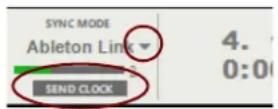
- Hit Play in the Reason Lite sequencer.
The Reason Lite sequencer will start when the green progress bar reaches the current play head position (phase) within the current Bar. As the sequencer starts, any external MIDI instruments will also be started and synced to Reason Lite's MIDI Clock signal. The MIDI Clock tempo will then automatically follow the Ableton Link tempo.
About Tempo Automation when using Ableton Link
If you use Ableton Link synchronization in a Reason Lite song which has Tempo Automation, the Tempo Automation lane will be automatically muted in the sequencer:

The song will then automatically follow the Ableton Link tempo instead and disregard any tempo automation.
! As long as Ableton Link synchronization is active it's not possible to manually unmute the Tempo Automation lane!
→ If you switch back to Internal sync from Ableton Link sync, the Tempo in the Reason Lite sequencer will remain at the tempo it had when you switched back.
The Tempo Automation lane is also automatically unmuted.
The Automation Override indicator on the Transport panel is also lit:
→ Click the Automation Override indicator - or press stop in the Reason Lite sequencer - to set the tempo according to the Tempo Automation clip.
Advanced MIDI - The External Control Bus inputs
About the External Control Bus inputs
The External Control Bus inputs allow you to receive MIDI from external equipment/applications directly to individual Reason Lite devices.
! MIDI control keyboards/surfaces should NOT be set up using the External Control Bus! Instead, set them up on the Control Surfaces tab, see "Preferences - Control Surfaces".
• These MIDI inputs are for controlling Reason Lite devices from an external sequencer.
This could be an external hardware sequencer or a sequencer application running on another computer.
! Do NOT use the External Control Bus if you are only going to use Reason Lite's internal sequencer for recording and playback!
You set up the External Control Bus inputs on the Sync tab in the Preferences dialog:
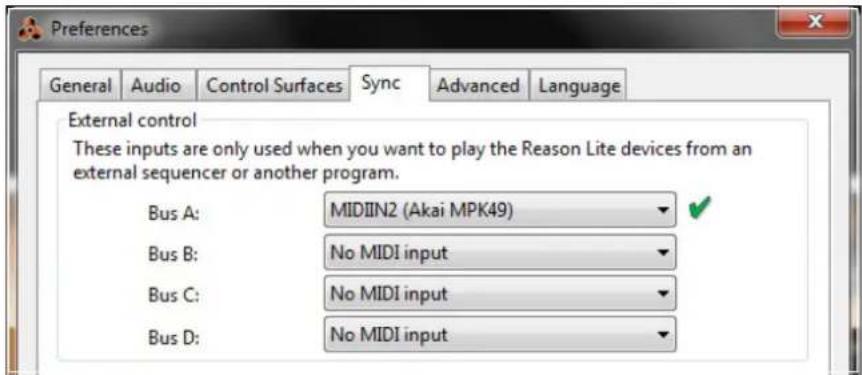
→Select a separate MIDI port for each bus you plan to use.
Each bus provides 16 MIDI channels, for a total of up to 64 MIDI input channels. For example, if you have an external sequencer with two MIDI outputs, you connect these to two MIDI inputs on your MIDI interface and select these two inputs for the first two busses on the Advanced MIDI page. You will then be able to send MIDI on up to 32 channels from the external sequencer to Reason Lite.
→ Make sure you don't select a MIDI port that is already selected on the Control surfaces tab (or in the MIDI Clock Sync section).
- To control external MIDI equipment from Reason Lite, you use the MIDI Out Device. Refer to "MIDI Out Device" for more details.
Routing MIDI to devices
Each External Control Bus can control up to 16 different Reason Lite devices, one for each MIDI channel. To route a MIDI channel directly to a Reason Lite device, proceed as follows:
- Locate the Reason Lite Hardware Interface at the top of the rack and click the ADVANCED MIDI button.

The Advanced MIDI Device panel is unfolded.
- On the Advanced MIDI Device panel, click the Bus Select button for the External Control Bus you want to use (A, B, C or D).

- Below the Bus Select buttons there are fields for the 16 MIDI channels. Click the arrow button for the desired MIDI channel and select a Reason Lite device from the menu that appears.
Incoming MIDI data on that bus and channel will now be sent directly to the selected device. In other words, the master keyboard routing in the sequencer is bypassed.
Receiving Controller data via MIDI
It is possible to send controller data from an external sequencer to control Reason Lite parameters. Just set up your external device to transmit the correct MIDI controller messages on the right MIDI port.
To find out which MIDI Controller number corresponds to which control on each device, please see the "MIDI Implementation Charts.pdf" document.
Once you have located the controller numbers and set everything up, you can record and edit the controller data in the external sequencer as you normally do, and the Reason Lite parameters will react correspondingly.
- Do not confuse this with Remote control. Remote does not require any mapping of controller numbers for supported control surfaces! See "About Remote".
About recording Pattern Changes
As specified in the MIDI Implementation, MIDI Controller #3 can be used to switch patterns in a device. However, pattern changes activated this way occur immediately (not at the end of the bar), which may or may not be what you prefer.
Please, see "Recording pattern automation", "Editing pattern automation" and "Drawing pattern automation" for information on recording and editing pattern changes.
Chapter 25
Optimizing
Performance
Introduction
Reason Lite is a program of infinite possibilities. You can create extremely complex songs, with a vast number of rack devices. While this is one of the most exciting properties of the program, it does have a drawback – it means that you must be careful with how you manage your computer processing power.
Each audio track and device you add in your song uses up a bit of computer processing power – the more audio tracks and devices, the faster the computer has to be. However, you can set up your devices to require more or less processing power. For example, a sound on the Subtractor synthesizer that only uses one oscillator and one filter requires less processing power than one using both dual oscillators and dual filters.
Samples used in your songs also require RAM (memory) to load properly. The use of RAM can also be managed, as described at the end of this chapter.
When collaborating on songs with other Reason Lite owners, you should do what you can to reduce the requirements for playing back a certain song, both in terms of processing power and in terms of RAM requirements. Other users may not have as powerful a computer as you do!
Checking Processing Power
To the right on the Transport Panel you will find a meter labeled DSP. This indicates how much processing power is used at any given moment.
The DSP meter on the Transport Panel
The higher this meter goes, the higher the strain on your computer processor. You will note when your processor is heavily loaded that graphics will update slower. Finally, when there's too little power left to generate audio properly, the sound will start to break up.
Optimization and latency reduction
As described in “About latency” in the Audio Basics chapter, you generally want the lowest possible latency, to get the best response when you record and play in Reason Lite in real time. However, selecting too low a latency is likely to result in playback problems (clicks, pops, dropouts, etc.). There are several technical reasons for this, the main one being that with smaller buffers (lower latency), the average strain on the CPU will be higher. This also means that the more CPU-intensive your Reason Lite song (i.e. the more devices and tracks you use), the higher the minimum latency required for avoiding playback difficulties.
Therefore, you may need to adjust the latency. This is done differently depending on which audio cards, drivers and operating system you are using.
Making Buffer Size adjustments in the ASIO Control Panel (Windows)
If you are using an ASIO driver (Windows only) specifically written for the audio hardware, you can in most cases make settings for the hardware in its ASIO Control Panel. This panel (opened by clicking the ASIO Control Panel button in the Preferences-Audio dialog) may or may not contain parameters for adjusting the latency. Usually this is done by changing the number and/or size of the audio buffers - the fewer and smaller the audio buffers, the lower the latency. Please consult the documentation of your audio hardware and its ASIO drivers for details.
! Raising the buffer size to eliminate audio artefacts on playback is mainly effective if you are currently using very small buffers, 64 to 256 samples. If the buffers are already big (1024 or 2048 samples) you will not notice much difference.
Making Buffer size adjustments in the Reason Lite Preferences dialog
If you are running Reason Lite under Windows and are using an ASIO driver, or under macOS and are using a Core Audio driver, you can adjust the input and output latencies in the Preferences – Audio dialog.
→This is done by dragging the Buffer Size slider.
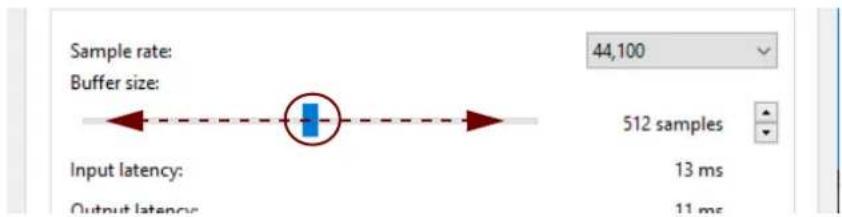
General procedure for reducing latency
The basic procedure for optimizing the latency is the following:
- Open a song and start playback.
You want to choose a song that is reasonably demanding, i.e. with more than just a few tracks and devices.
- Open the Preferences dialog.
Under macOS, this is found on the Reason Lite menu; under Windows it's found on the Edit menu.
- Click the Audio tab and locate the Buffer size slider.
! If you are making adjustments in the ASIO Control Panel for hardware with an ASIO driver (Windows only), you should make a note of the current buffer settings before changing them.
4. While the song is playing, listen closely for pops and clicks and try lowering the latency (Buffer size).
5. When you get pops and clicks, raise the Buffer size value a bit.
6. Close the Preferences dialog (and ASIO Control Panel, if open).
About Latency Compensation
Below the Input Latency and Output Latency rows in the Preferences-Audio dialog, you will find an item called Recording Latency Compensation. This value is used internally in Reason Lite to compensate for latencies when recording audio using external monitoring.
Recording Latency Compensation
! Adjusting the Recording Latency Compensation parameter is never necessary when you have selected "Automatic" in the Monitoring section on the Audio page in Preferences - see "Monitoring".
Recording Latency Compensation is when the program adjusts the position of the recorded audio according to the current latency. Here's how it works:
If you're recording audio and are not monitoring through Reason Lite (e.g. monitoring directly through the audio card or via an external mixer), the audio you record will reach the program slightly late. This is because you play along with background tracks or the metronome - and you hear these delayed by the output latency. Also, the sound you record is sent to the program via the buffers in the audio hardware - it is delayed by the input latency.
Reason Lite compensates for this by moving the recorded audio earlier by the sum of the input+output latencies. This compensation is also done in "Manual Monitoring" mode, if Monitor was Off for the recorded track (when you started recording).
If Monitor is On, there is no Recording Latency Compensation. This is because the monitored sound will also be delayed, and numerous tests have shown that the performer will actually play slightly ahead to compensate for this. In other words, when monitoring through Reason Lite, the performer is expected to do the Recording Latency Compensation himself/herself.
If you are monitoring via an external mixer, and have selected "External" in the Monitoring section on the Audio tab in Preferences, there might be situations where you experience that the recorded audio is generally played back too early - or too late - in the song. This could be because your audio card doesn't actually have the latency values it reported to Reason Lite.
If you should experience that your audio recordings are played back too early or too late compared to the instrument tracks in your song, you can adjust this by editing the Recording Latency Compensation parameter:
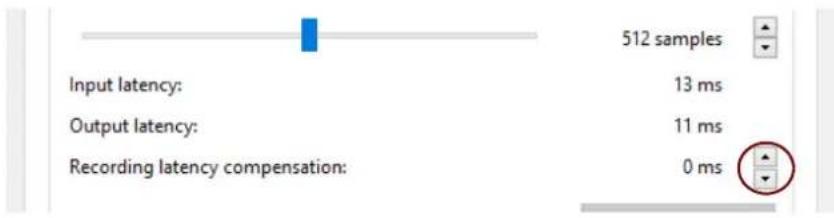
→ Click the Recording Latency Compensation spin controls to compensate for early or late playback of audio track recordings
If the audio appears too early during playback, adjust to a negative (-) value.
If the audio appears too late during playback, adjust to a positive value.
Optimizing your computer system
In this manual we do not have the possibility to give you detailed procedures for optimizing your computer for maximum power. This is a subject that we could write complete books on. However, there are a couple of very useful things to check and adjust.
About Multi-core processors
When you're using a multi-core processor, such as a dual-core or quad-core processor, Reason Lite will take full advantage of this in a very sophisticated way. Similarly, if your computer has several multi-core processors, Reason Lite will use the full capacity of these to enhance the performance.
If your computer has one or several multi-core processors, Reason Lite automatically detects this and automatically enables the "Use multi-core audio rendering" function on the Audio page in Preferences:
Performance

Use multi-core audio rendering

Use hyper-threading audio rendering

Render audio using audio card buffer size setting
(Improves plug-in performance)
If you are working with a song document which has one single, very long and processor-heavy serial audio chain - and only a few devices that process the audio in parallel - you could try and deactivate the multi-core audio rendering option. This might enhance the performance in these special situations. However, under normal circumstances multi-core audio rendering is always the best option performance-wise.
About hyper-threading audio rendering
Hyper-threading audio rendering could improve the performance even further. Note that this depends on your computer's CPU and other hardware, so there is no guarantee the performance will improve. If you are experiencing performance problems, try activating or deactivating this to see if the performance improves.
About audio rendering using the audio card buffer size setting
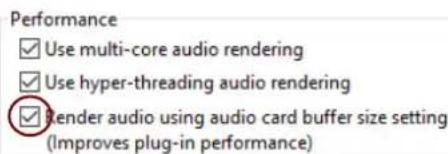
The "Render audio using audio card buffer size setting" function should be selected (checked) for best plugin performance. When selected, the audio batches are rendered internally according to the set Buffer size (see "Making Buffer size adjustments in the Reason Lite Preferences dialog" above). For example, if you have a Buffer size of 512 Samples, each audio batch will be 512 samples internally. Raising the Buffer size will let Reason Lite process larger audio batches in one go, which is often more efficient. Many plugins are also more efficient when doing larger audio batches. if you are using DSP-heavy VSTs (mastering effects, for example), these will run a lot smoother with this function selected.
! Note that old songs might sound different with this function selected, if the songs uses feedback routings and CV connections.
If unchecked (off), all audio batches are rendered internally at a fixed size of 64 samples - regardless of the Buffer size setting. This might be desirable if you are using feedback signal routings and CV connections in your songs, and want the internal latency of those connections to be fixed at a short value all the time. This might result in performance problems for DSP-heavy VSTs, though.
Unchecked will give the same performance as in previous Reason Lite 10 versions.
About hard drives
Most state-of-the-art hard drives, including SSD drives, will work perfectly together with Reason Lite. Generally, the faster hard drive(s) you use, the better. Most mechanical hard drives of today runs at 5.400 rpm or faster, which is sufficient for use with Reason Lite. A large hard drive is also highly recommended when working with DAWs like Reason Lite. A single song with a lot of recordings in it could easily reach around 1 GB in final size. During recording and editing, the song file size could be a lot bigger than that, so a hard drive space of at least 20 GB is definitely recommended.
General optimization tips
Finally, we'd like to share a couple of other general optimization tips:
- Quit other programs that are running at the same time as Reason Lite.
- Remove background tasks on your computer.
This might be any background utilities you have installed as well as networking, background Internet activities etc.
• Under Windows, make sure you use the latest and most efficient ASIO driver for your audio card.
- Only work on one Reason Lite Song document at a time.
Songs that are open in the background do consume some processing power, even though they're not playing.
- Lower the sample rate setting on the Audio tab in the Preferences dialog.
This is a very quick and convenient way to try to play a song that your computer otherwise can't handle.
- Raise the Buffer size on the Audio tab in the Preferences dialog.
See "Making Buffer size adjustments in the Reason Lite Preferences dialog".
Optimizing Songs
Below follows things you can check and change to make sure your song uses as little computer processing power and memory as possible:
Global
- To reduce the Song file size, delete unused recordings on Audio Tracks.
This won't affect the processing power but will reduce the Song file size, which might be desirable in many situations. See "Delete Unused Recordings".
- Use the "Save and Optimize" function when you're finished editing your song.
As a final step, after you have recorded and edited your song, use the "Save and Optimize" function on the File menu. This will remove any "empty" disk areas in the song file, making the file as small as possible - see "Saving and optimizing a Song".
• Bounce Mixer Channels.
If you're using a lot of devices in an instrument track, you could bounce the instrument track to an Audio Track. Doing so makes it possible to delete the instrument track afterwards and thus reduce the processing power. See "Bouncing Mixer Channels".
- Delete unused devices.
If a device isn't actually doing anything, delete it from the rack.
- Use fewer devices.
For example, instead of using several similar reverbs as separate insert effects, replace them all with one, set up as a send effect on a Send FX bus in the Main Mixer. By the same token, try to use one sampler playing several different samples instead of numerous samplers playing one sample each.
- Don't use stereo unless it is required.
For example, if a sampler or Dr. Octo Rex loop player is playing mono material, only connect the Left output and leave the Right output unconnected.
Main Mixer
- Make sure you deactivate any channel strip parameters or sections you don't use in your song.
This could, for example, be Input Gain and INV, EQ, Filters, Dynamics and Insert FX.
- Delete any Mix Channel devices and/or Audio Track devices you don't use in your song.
Sample Players - Redrum
- Only activate High Quality Interpolation when it is required.
Listen to the sound in a context and determine whether you think this setting makes any difference.
- If you are playing back a sample at a much higher pitch than it was recorded at, consider sample rate converting the actual sample file to a lower sample rate.
This will require an external sample editor with good sample rate conversion facilities.
- Try to refrain from using stereo samples.
Filters - Subtractor
- Deactivate filters that are not used.
Observe that if the Cutoff is all the way up or the envelope is set to open the filter fully, then the filter doesn't affect the sound. Conserve processing power by disabling the filter altogether.
- Where applicable, use the 12dB lowpass filter instead of the 24dB lowpass filter.
See if you can get the same sonic result by using the 12dB filter, since it uses up less processing power.
Polyphonic Devices - Subtractor and Redrum
- Try making the device play fewer voices.
This can be done for example by lowering the release and setting the Polyphony setting to exactly the maximum number of notes played simultaneously by this device.
! Note that just lowering the polyphony setting has no effect. Unused voices do not consume processing power.
- Where applicable, try the Low Bandwidth (Low BW) setting.
This will remove some high frequency content from the sound of this particular device, but often this is not noticeable (this is especially true for bass sounds).
Subtractor
- Try avoiding using Oscillator 2 altogether.
If you can create the sound you need with only one oscillator, this saves considerable amounts of processing power.
- Do not use the oscillator Phase mode if you don't need it.
In other words, set the Oscillator Mode switches to "o", not "-" or "-"
- Do not activate Noise unless required.
- Do not activate Filter 2 unless required.
- Do not use FM unless required.
In other words, set the oscillator FM knob to "0" and make sure no modulation source is routed to FM.
Redrum
- Do not use the Tone feature available on channels 1, 2 and 9.
Make sure the Tone controls and their accompanying Vel knobs are set to "0" ("twelve o' clock" position).
Mixer devices
- Avoid using stereo inputs when not required.
Send Effects
- When you are using mono effects as send effects, you can connect the effect returns in mono as well (disconnect the cable to Aux Return Right on the Main Mixer).
This is true for the following effects:
- Scream 4 Distortion
- DDL-1 Delay (provided the Pan parameter is set to center position).
- MClass effects; Equalizer, Compressor, Maximizer.
RAM requirements
Songs not only use up system resources in terms of processing power and hard disk space, they also require RAM (memory) to load at all. The amount of RAM required for loading a song, is directly proportional to the amount of samples used in the song. For example, a song which uses only Subtractors and effects requires very little RAM.
If you are running out of RAM try the following:
- Close other Song documents.
All open songs compete for RAM.
- Terminate other applications.
All running applications compete for the RAM available in the computer.
- Use mono samples instead of stereo ones.
Mono samples require half the amount of RAM.
- Try sample rate converting sample files to a lower sample rate.
Note that this could affect sound quality negatively. Also note that it will require an external sample editor with good sample rate conversion facilities.
Chapter 26
Hardware Interface
Introduction

The Hardware Interface device is where you connect Reason Lite to the "outside world". This is where MIDI is received, and where audio signals are routed from physical inputs and to physical outputs of your audio hardware. The Hardware Interface is always present at the top of the rack, and cannot be deleted. This chapter is meant to serve as a panel reference, describing the various sections of the device. How to set up your audio hardware is described in the "Audio Basics" chapter.
The Hardware Interface is normally unfolded, showing a panel with 2 Sampling Inputs, 16 Audio Inputs and 16 Audio Outputs and a couple of buttons.
- On the right hand side at the top of the panel are the Input Focus and Play Focus buttons - these are described in "Input Focus and Play Focus".
- The Sampling Input, Audio Input and Audio Output sections feature a LED meter for each input and output channel.
! Remember that the Hardware Interface is where any possible audio clipping will occur in Reason Lite. Keep an eye on the clipping indicator on the Transport Panel, and also on the individual meters on the Hardware Interface panel. If a channel pushes the meter into the red, the level should be reduced at the source - see "About audio levels" in the "Audio Basics" chapter. - The multi-color LEDs below each channel indicate the following:
Green LED: Available and used channel (cable connected to the channel jack on the rear panel).
Yellow LED: Available but unused channel (no cable connected to the channel jack on the rear panel).
Red LED: Unavailable channel but with a connected cable on the rear panel. No audio will be present on channels with red LEDs.
Unlit LED: Unavailable and unconnected channel (no cable connected to the channel jack on the rear panel).
- By clicking the "ADVANCED MIDI" button at the top on the panel, the Advanced MIDI Device panel is shown:

Refer to "Advanced MIDI Device" for more information.
- By clicking the "MORE AUDIO" button at the top on the panel, an additional Audio In and Out panel is shown for a total of 64 inputs and outputs.
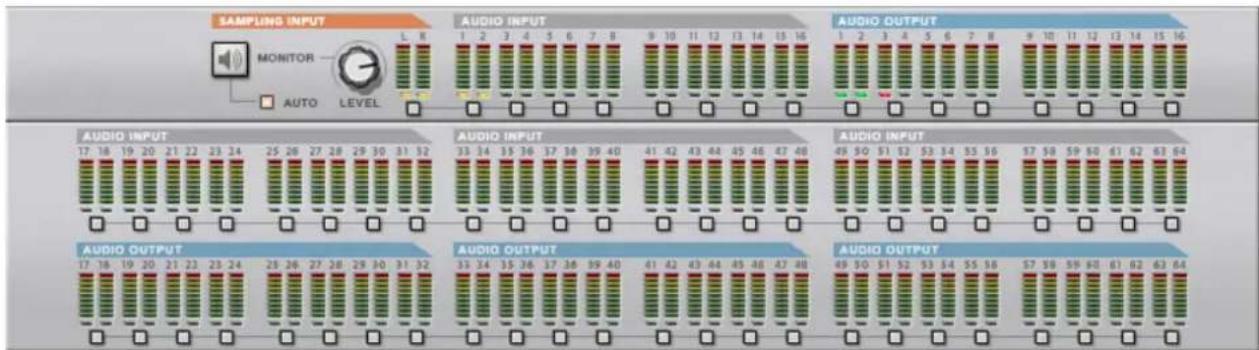
Refer to "More Audio" for more information.
- By clicking the "BIG METER" button at the top on the panel, a panel with bigger audio level meters is shown:

Refer to "The Big Meter" for more information.
Sampling Input section
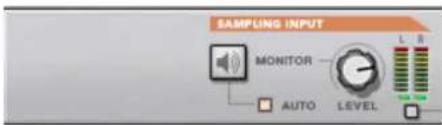
The Sampling section features two audio inputs (L & R) to which you should route the audio signals you want to sample. There is also a Level knob and two Monitor buttons. See "Setting up for sampling" for details on how to sample.
Advanced MIDI Device
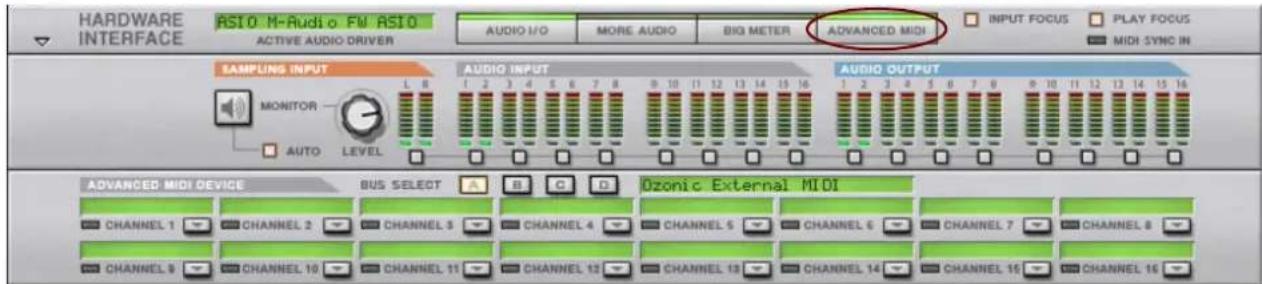
! Do NOT use the Advanced MIDI Device if you are only going to use Reason Lite's internal sequencer for recording and playback!
This is opened by clicking the "ADVANCED MIDI" button on the Hardware Interface panel. The Advanced MIDI device is only used if you are controlling Reason Lite from an external sequencer, using the External Control Bus inputs. Normally, you send MIDI to a track via the sequencer, by selecting the sequencer track.
You can select MIDI ports for up to four External Control Busses (on the Sync page in Preferences). Each bus can host 16 MIDI channels, for a total of up to 64 MIDI input channels. The Advanced MIDI Device is where you can route each MIDI channel to a specific device in the Reason Lite rack:
- Select one of the External Control Busses by clicking the corresponding Bus Select button at the top of the Advanced MIDI device.
- Pull down the device pop-up menu for a MIDI channel and select a device.
The menu lists all devices in the current song.
Now, incoming MIDI data on the selected bus and MIDI channel is sent directly to the selected device, bypassing the Reason Lite sequencer. The name of the device is shown in the name field for that MIDI particular channel.
- Try sending MIDI notes from the external sequencer, on the selected bus and MIDI channel.
The indicator below the channel's name field should light up.
See also "Advanced MIDI - The External Control Bus inputs" in the Advanced MIDI and Synchronization chapter.
More Audio
Reason Lite supports up to 64 audio input and 64 audio output channels. The additional 48 inputs and 48 outputs can be found on the "More Audio" panel.
→ To view inputs 17-64 and outputs 17-64, click the "More Audio" button.
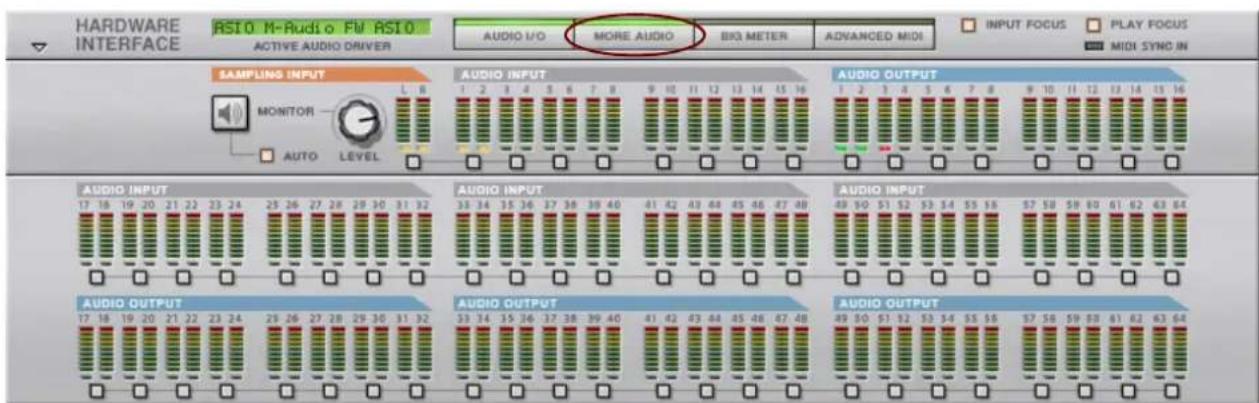
Each additional input and output features a meter and a multi-color LED indicator which will be lit in different colors depending on current state - see "Introduction".
The Big Meter
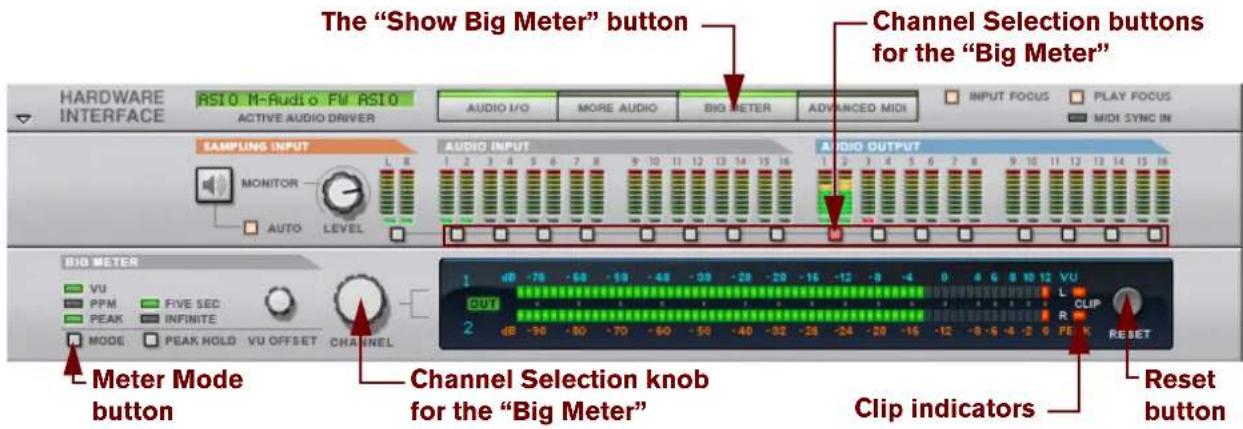
To get a better overview of the levels of a particular channel pair you can bring up the Big Meter on the Hardware Interface.
- Click the "Big METER" button on the front panel.
The "Big Meter" panel shows up.
- Select the Input or Output pairs to view in the Big Meter by clicking on the corresponding Channel Selection button below each Input or Output pairs.
Alternatively, select channel by turning the Channel Selection knob.
→ It's also possible to select various Meter Modes, or combinations of Meter Modes, by clicking the Meter Mode button to the far left.
The available Meter Modes are:
• yu
The VU Mode simulates the behavior of analog meters and shows the RMS (Root Mean Square) value of the signal. Since the RMS value is an "average" of the signal level over time it's not suited for detecting fast transients in the sound. Rather, VU meters are useful for monitoring the overall loudness of the signal.
In VU Mode, the meter response is 300 ms/20 dB for both attack and release. There is no peak segment in the meter.
→ The VU Offset can be set in 2 dB steps between -20 and 0 dB, by turning the VU Offset knob.
This setting determines how the VU dB scale relates to the Peak dB scale. If you have no specific preference in this matter, you don't need to change the VU Offset.
! The VU Offset setting will affect the readout of all Meters on the Main Mixer channel strips and on their corresponding Rack devices.
- PPM
In PPM (Peak Program Meter) Mode, the meter response is 0 ms rise and 2.8 s/24 dB fall. The PPM Mode is perfect for detecting transients in the sound. There is no peak segment in the meter.
- PEAK
In PEAK Mode, the meter response is 0 ms for both rise and fall, which means that this mode provides the most accurate representation of the signal level over time. Since the fall time is 0 ms, it could be quite distracting to the eyes to watch the meters in PEAK mode. If so, the PPM Mode might be more convenient since it's equally fast at responding to transients, but falls more slowly.
The peak segment (the rightmost LED segment, indicating the highest level) has a fall time according to the Peak Hold parameter setting (5 seconds or infinite). This allows you to more easily spot very brief level peaks.
• VU+PEAK
In VU+PEAK Mode, the meter response is according to the VU Mode, plus a peak segment.
- PPM+PEAK
In PPM+PEAK Mode, the meter response is according to the PPM Mode, plus a peak segment.
If the audio level for the selected is, or have been, too high, the Clip indicators on the Big Meter will stay lit until you click the "Reset" button, or select new audio channels for the Big Meter. See "About audio levels" for more information on how to use and work with the Big Meter.
Chapter 27
Redrum Drum
Computer
Introduction
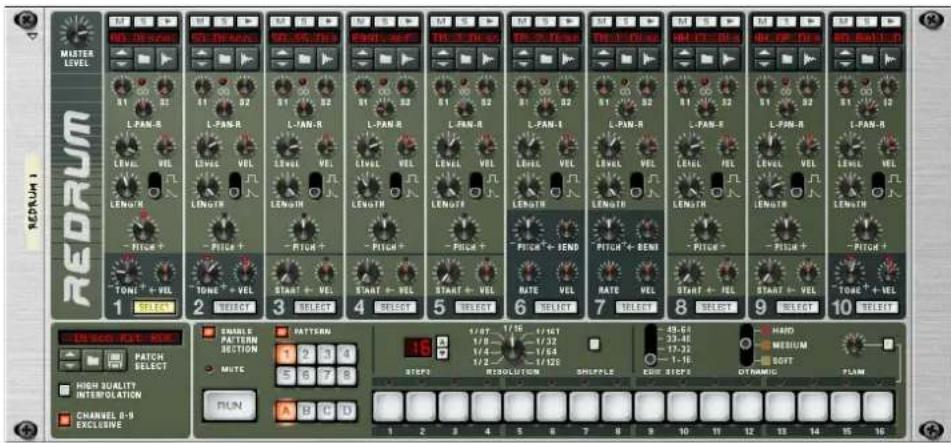
At first glance, Redrum looks styled after pattern-based drum machines, like the legendary Roland 808/909 units. Indeed, it does have a row of 16 step buttons that are used for step programming patterns, just like the aforementioned classics. There are significant differences, however. Redrum features ten drum "channels" that can each be loaded with an audio file, allowing for completely open-ended sound possibilities. Don't like the snare - just change it. Complete drum kits can be saved as Redrum Patches, allowing you to mix and match drum sounds and make up custom kits with ease.
In addition, Redrum also has sampling capability. This means that you can sample your own sounds straight into each of the ten drum channels with just a click of a button!
Sampling in Redrum
The sampling procedure is generic for all devices that can sample. The sampling and sample editing procedures are described in detail in the "Sampling" chapter.
To sample your own sound and automatically load it into a drum channel in the Redrum device, click the Sample button for the desired drum channel.
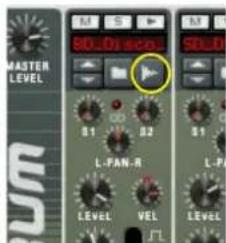
Refer to the "Sampling" chapter for details on how to set up and use the sampling feature.
About file formats
Redrum reads two basic types of files:
Redrum Patches
A Redrum patch (Windows extension ".drp") contains all settings for all ten drum sound channels, including file references to the used drum samples (but not the actual drum samples themselves). Switching patches is the same as selecting a new drum kit.
Drum Samples
The audio file format support differs depending on which computer OS you are using.
Redrum can read audio files in the following formats:
- In Windows : .wav, .aif, .mp3, .aac, .m4a and .wma.
- In macOS: .wav, .aiff, .3g2, .3gp, .mp1, .mp2, .mp3, .mpeg, .mpa, .snd, .au, .sd2, .ac3, .aac, .adts, .amr, .caf, .m4a, .m4r and .mp4.
- SoundFonts (.sf2) SoundFonts are an open standard for wavetable synthesized audio, developed by E-mu systems and Creative Technologies.
- REX file slices (.rx2, .rex, .rcy) REX files are music loops created in the ReCycle program or when editing audio clips inline in Reason Lite (see "Bounce Clip to REX Loop"). Redrum lets you load separate slices from REX files as individual samples.
- Any sample rate and practically any bit depth.
Using patches
When you create a new Redrum device it is loaded with a default kit. If you like you can program a pattern and play back using the default kit - or you can load another Redrum patch (or create one from scratch, by loading individual drum samples). A Redrum patch contains settings for the ten drum sound channels, complete with file references to the drum samples used.
! Redrum patterns are not part of the patch! If you want to save Redrum patches complete with patterns, create a Combinator containing the Redrum and save the Combi patch.
Loading a patch
To load a patch, use one of the following methods:
→ Use the Browser to locate and load the desired patch.
To open the browser and set browse focus to the Redrum device, select "Browse Redrum Patches" from the Edit menu or device context menu, or click the folder button in the patch section on the device panel.
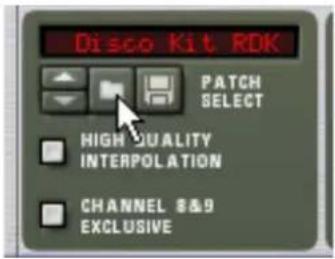
Once you have selected a patch, you can step between all the patches in the same folder by using the arrow buttons next to the patch name display.
→ If you click on the patch name display on the device panel, a pop-up menu will appear, listing all patches in the current folder.
This allows you to quickly select another patch in the same folder, without having to step through each one in turn.
→Drag a Redrum (.drp) patch from the Browser and drop on the device panel.
The panel is dimmed in orange and a Patch Replace symbol appears in the center.
Checking the sounds in a patch
There are two ways you can listen to the sounds in a patch without programming a pattern:
→ By clicking the Trigger (arrow) button at the top of each drum sound channel.
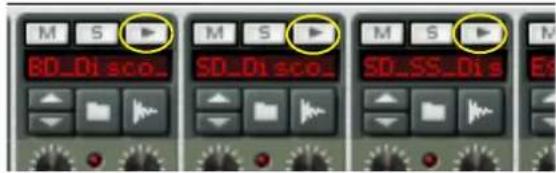
→By playing the keys C1 to A1 on your MIDI keyboard.
C1 plays drum sound channel 1 and so on. See also "Using Redrum as a sound module".
Both these methods play back the drum sample for the corresponding drum sound channel, with all settings for the sound applied.
Creating a new patch
To create a patch of your own (or modify an existing patch), you use the following basic steps:
- Click the folder button for a drum sound channel.
The Redrum sample browser opens.
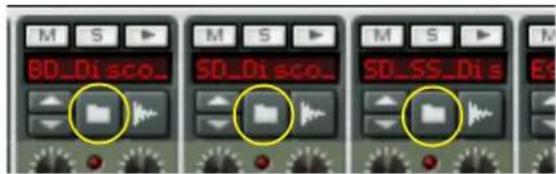
- Locate and load a drum sample.
You will find a large number of drum samples in the Factory Sound Bank (in the folder Redrum Drum Kits/xclusive drums-sorted). You can also load other samples in any supported format.
→ Alternatively, drag a sample file from the Browser and drop on the desired sound channel section.
The sound channel is dimmed in blue and a Sample Replace symbol appears in the center.
- Make the desired settings for the drum sound channel.
The parameters are described in "Redrum parameters".
-
Repeat steps 1 and 3 for the other drum sound channels.
-
When you're satisfied with the drum kit, you can save the patch by clicking the Floppy Disk button in the patch section on the device panel.
Note however, that you don't necessarily need to save the patch - all settings are included when you save the song.
Loading REX file slices
Loading slices from within a REX file is done much in the same way as loading "regular" samples:
-
Open the Browser as described above.
-
Browse to a REX file.
Possible extensions are ".rx2", ".rex" and ".rcy".
- Unfold the REX file.
The browser will now display a list of all the separate slices within the REX file.
- Select the desired slice and click the Load button in the Browser.
The slice is loaded into the Redrum.
→ Alternatively, drag a REX slice file from the Browser and drop on the desired sound channel section.
The sound channel is dimmed in blue and a Sample Replace symbol appears in the center.
Creating an empty patch
To "initialize" the settings in the Redrum, select "Reset Device" from the Edit menu or the device context menu. This removes all samples for all drum sound channels, and sets all parameters to their default values.
Programming patterns
Pattern basics
Redrum contains a built-in pattern sequencer. Unlike the main sequencer in Reason Lite, the Redrum sequencer repeatedly plays back a pattern of a specified length. The typical analogy in the "real world" is a drum machine which plays drum patterns, usually one or two bars in length.
Having the same pattern repeat throughout a whole song may be fine in some cases, but most often you want some variations. The solution is to create several different patterns and program pattern changes (automatic switching from one pattern to another) at the desired positions in the song.
How the Redrum pattern sequencer integrates with the main sequencer
The built-in pattern sequencer in the Redrum interacts with the main Reason Lite sequencer in the following ways:
→ The tempo set on the transport panel is used for all playback.
If the Tempo track (see "Recording tempo automation") is used, Redrum will follow this.
→ If you start playback for the main sequencer (on the transport panel), the Redrum will automatically start as well (provided the pattern sequencer hasn't been disabled - see below).
→You can mute and solo Redrum tracks in the sequencer.
If the Redrum has a track in the sequencer and you mute this track, Redrum will automatically be muted as well. This is indicated by a Mute indicator on the device panel. If there are several note lanes on the Redrum track, their respective mute status will not be indicated on the device panel.
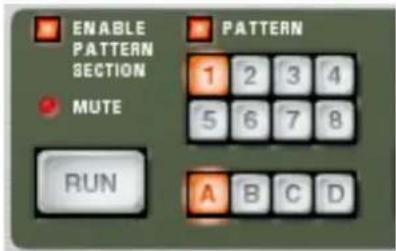
This Redrum device is muted.
→ You can also run Redrum separately (without starting the main sequencer) by clicking the Run button on the device panel.
This starts the built-in pattern sequencer in the device. To stop playback, click the Run button again or click the Stop button on the Transport panel.
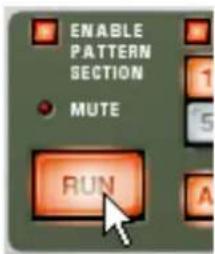
The Run button on the Redrum.
→ If you are running Redrum separately and start playback of the main sequencer, the pattern device will automatically restart in sync with the sequencer.
→Pattern changes can be controlled by pattern change events in the main sequencer.
In other words, you can record or create pattern changes in the main sequencer, and have them occur at the correct position on playback.
→ The sound sources can also be played by the main sequencer, or via MIDI.
You can combine the built-in pattern playback with playback from the main sequencer or via MIDI. For example, this allows you to add variations or fills to a basic pattern.
It is also possible to disable the pattern sequencer totally, converting the device to a pure sound module. This is done by deactivating the Enable Pattern Section switch.
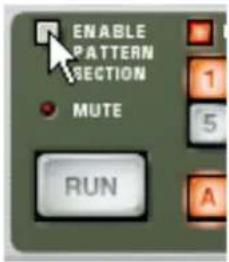
Selecting patterns
The Redrum has 32 pattern memories, divided into four banks (A, B, C, D).
The Bank and Pattern buttons for the Redrum pattern sequencer.
→ To select a pattern in the current bank, click on the desired Pattern button (1-8).
If you like, you can assign computer key commands and/or MIDI messages to pattern selection.
→ To select a pattern in another bank, first click the desired Bank button (A, B, C, D) and then click the Pattern button.
Nothing happens until you click the Pattern button.
→ If you select a new pattern during playback, the change will take effect on the next downbeat (according to the time signature set in the transport panel).
If you automate pattern changes in the main sequencer, you can make them happen at any position - see "Recording pattern automation".
→ Note that you cannot load or save patterns - they are only stored as part of a song.
However, you can move patterns from one location to another (even between songs) by using the Cut, Copy and Paste Pattern commands.
Pattern tutorial
If you are unfamiliar with step programming patterns, the basic principle is very intuitive and easy to learn. Proceed as follows:
-
Load a Redrum patch, if one isn't already loaded.
-
Make sure an empty pattern is selected.
If you like, use the Clear Pattern command on the Edit menu or device context menu to make sure.
- Make sure that the "Enable Pattern Section" and the "Pattern" buttons are activated (lit).
- Press the "Run" button.
There will be no sound, as no pattern steps have been recorded yet. But as you can see, the LEDs over the Step button light up consecutively, moving from left to right, and then starts over. Each Step button represents one "step" in the Pattern.
- Select a Redrum channel, by clicking the "Select" button at the bottom of the channel.
The button lights up, indicating that this channel and the drum sound it contains is selected.
- While in Run mode, press Step button 1, so that it lights up.
The selected sound will now play every time Step 1 is "passed over".
- Clicking other Step buttons so they light up will play back the selected sound as the sequencer passes those steps.
Clicking on a selected (lit) step button a second time removes the sound from that step and the button goes dark again. You can click and drag to add or remove steps quickly.
- Select another Redrum channel to program steps for that sound.
Selecting a new sound or channel also removes the visual indications (static lit buttons) of step entries for the previously selected sound. The step buttons always show step entries for the currently selected sound.
- Continue switching between sounds, and programming steps to build your pattern.
Note that you can erase or add step entries even if Run mode isn't activated.
Setting pattern length
You may want to make settings for Pattern length, i.e the number of steps the pattern should play before repeating:

→ Use the "Steps" spin controls to set the number of steps you wish the pattern to play.
The range is 1 to 64. You can always extend the number of steps at a later stage, as this will merely add empty steps at the end of the original pattern. You could also make it shorter, but that would (obviously) mean that the steps "outside" the new length won't be heard. These steps aren't erased though; if you raise the Steps value again, the steps will be played back again.
About the "Edit Steps" Switch
If you set the pattern length to more than 16 steps, the pattern steps following after the 16th won't be visible, although they will play back. To view and be able to edit the next 16 steps, you have to set the Edit Steps switch to 17-32. To see and edit steps beyond 32 you set the switch to 33-48, and so on.
Setting pattern resolution
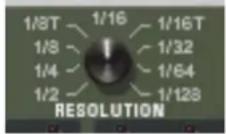
Redrum always follows the tempo setting on the transport panel, but you can also make Redrum play in different "resolutions" in relation to the tempo setting. Changing the Resolution setting changes the length of each step, and thereby the "speed" of the pattern.
Step dynamics
When you enter step notes for a drum sound, you can set the velocity value for each step to one of three values: Hard, Medium or Soft. This is done by setting the Dynamic switch before entering the note.
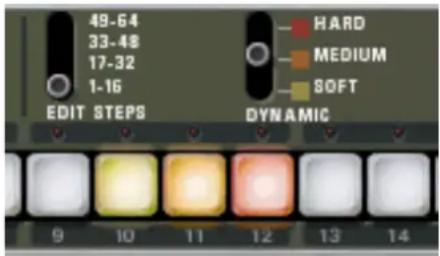
The color of the step buttons reflect the dynamics for each step. Soft notes are light yellow, Medium notes are orange and Hard are red.
→ When the Medium value is selected, you can enter Hard notes by holding down [Shift] and clicking.
In the same way, you can enter Soft notes by holding down [Option] (Mac) or [Alt] (Windows) and clicking. Note that this doesn't change the Dynamic setting on the device panel - it only affects the notes you enter.
→ When you use different dynamics, the resulting difference in the sound (loudness, pitch, etc.), is governed by the "VEL" knob settings for each drum channel (see "Redrum parameters").
If no velocity amount is set for a drum channel, it will play back the same, regardless of the Dynamic setting.
To change the dynamics for an already programmed step, set the switch to the dynamic value you wish to change it to and click on the step.
! Note that if you are triggering Redrum via MIDI or from the main sequencer, the sounds will react to velocity like any other audio device. The Dynamic values are there to offer velocity control when using the built-in pattern sequencer.
Pattern Shuffle
Shuffle is a rhythmic feature, that gives the music a more or less pronounced swing feel. It works by delaying all sixteenth notes that fall in between the eighth notes. You can activate or deactivate shuffle individually for each Redrum pattern by clicking the Shuffle button on the device panel.
The amount of shuffle is set globally with the Global Shuffle control in the ReGroove Mixer - see "The ReGroove Mixer".
Flam
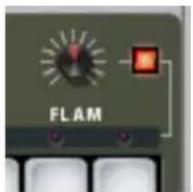
A flam is when you double-strike a drum, to create a rhythmic or dynamic effect. Applying flam to a step entry will add a second "hit" to a drum sound. The flam amount knob determines the delay between the two hits.
To add a flam drum note, proceed as follows:
-
Activate flam by clicking the Flam button.
-
Click on a step to add a note (taking the Dynamic setting into account as usual).
A red LED is lit above the step to indicate that flam will be applied to that step.
- Use the Flam knob to set the desired amount of flam.
The flam amount is global for all patterns in the device.
To add or remove flam to or from an existing step note, click directly on the corresponding flam LED. You can also click and drag on the LEDs to add or remove several flam steps quickly.
→ Applying flam to several consecutive step entries is a quick way to produce drum rolls. By adjusting the Flam knob you can create 1/32 notes even if the step resolution is 1/16, for example.
The Pattern Enable switch
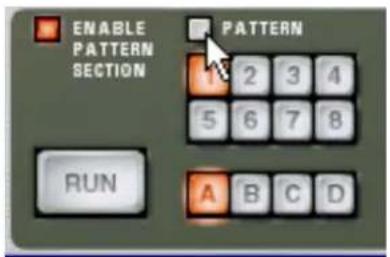
If you deactivate the "Pattern" button the pattern playback will be muted, starting at the next downbeat (exactly as if you had selected an empty (silent) pattern). For example, this can be used for bringing different pattern devices in and out of the mix during playback.
- You can also mute Redrum devices in the sequencer using the Mute button for the track connected to the Redrum. If you do so, this will mute the Redrum output instantly, and the Mute indicator on the Redrum panel lights up. Note that all tracks connected to this Redrum device must be muted for this to work.
The Mute indicator
The Enable Pattern Section switch
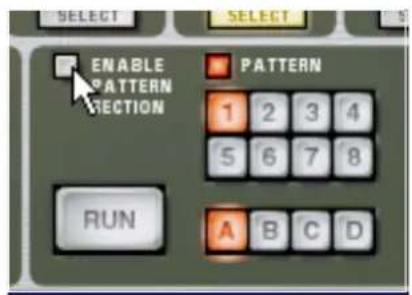
If this is off, Redrum will function as a pure "sound module", i.e. the internal Pattern sequencer is disengaged. Use this mode if you wish to control Redrum exclusively from the main sequencer or via MIDI (see "Using Redrum as a sound module").
Pattern functions
When a Redrum device is selected, you will find some specific pattern functions on the Edit menu (and on the device context menu):
| Function | Description |
| Shift Pattern Left/Right | These functions move all notes in the pattern one step to the left or right. |
| Shift Drum Left/Right | The Shift Drum functions move all notes for the selected drum channel (the channel for which the Select button is lit) one step to the left or right. |
| Randomize Pattern Creates a random pattern. Random patterns can be great starting points and help you get new ideas. | |
| Randomize Drum Creates a random pattern for the selected drum sound only - the notes for the other drum sound channels are unaffected. | |
| Alter Pattern | The Alter Pattern function modifies the selected pattern by “shuffling” the current pattern notes and redistributing them among the drum sounds at random. This creates a less chaotic pattern than the “Randomize Pattern” function.Note that there must be something in the pattern for the function to work on - using an Alter function on an empty pattern will not do anything. |
| Alter Drum | Works like the “Alter Pattern” function, but affects the selected drum sound only. |
Chaining patterns
When you have created several patterns that belong together, you most probably want to make these play back in a certain order. This is done by recording or inserting pattern changes into the main sequencer. See "Recording pattern automation".
Converting Pattern data to notes in the main sequencer
You can convert Redrum Patterns to notes in the main sequencer. This allows you to edit the notes freely, create variations or use Groove quantizing.
The "Copy Pattern to Track" function
This function useful when you have created a single pattern in the Redrum device and want to render individual note events on the sequencer track. You could also use this if you e.g. have created a drum pattern and want to have the pattern play back some other type of device.
Proceed as follows:
-
Set the Left and Right Locators to encompass the section you want to "fill" with the notes in the pattern. You may want to make sure that the space between the locators is a multiple of the pattern length, to avoid "cutting off" the pattern.
-
Select the device in the rack and select "Copy Pattern to Track" from the Edit menu or the device context menu. The pattern is converted to a single note clip on the track (see the notes below). If the space between the locators is greater than the pattern length, the pattern will be repeated in the clip to fill up the space.

An internal Redrum drum pattern converted to note events on the track
When you use the "Copy Pattern to Track" function with the Redrum, you should note the following:
- The notes will have the pitch of the corresponding drum sound (see "Using Redrum as a sound module") and the velocity depending on the "Dynamic" parameter value in the device.
"Soft" notes get velocity 30, "Medium" notes get velocity 80 and "Hard" notes get velocity 127.
- You probably want to turn off the "Enable Pattern Section" switch on the Redrum device panel.
Otherwise, the drum sounds will be double-triggered during playback (by the pattern section itself, and by the rendered notes on the sequencer track).
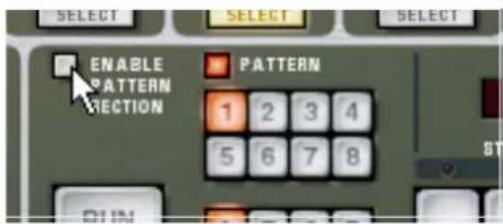
The "Convert Pattern Automation to Notes" function
If you have recorded or drawn pattern changes on a Redrum track, you can have the whole track converted to notes, in the following way:
-
Select the track with the pattern automation.
-
Select "Convert Pattern Automation to Notes" from the Edit menu or the context menu for the track.
For each pattern clip, the corresponding pattern is converted to note clips on the track (following the same rules as for the "Copy Pattern to Track" function). The track will play back just the same as when you played the pattern device with the pattern changes.
→ After the operation, the Pattern Select lane is switched off.
The "Enable Pattern Section" button on the device is automatically turned off.
Redrum parameters
Drum sound settings
Redrum features ten drum sound channels that can each be loaded with a Wave or AIFF sample or a sample from a SoundFont bank. Although they are basically similar, there are three "types" of drum sound channels, with slightly different features. This makes some channels more suitable for certain types of drum sounds, but you are of course free to configure your drum kits as you like.
On the following pages, all parameters will be listed. If a parameter is available for certain drum sound channels only, this will be stated.
Mute & Solo
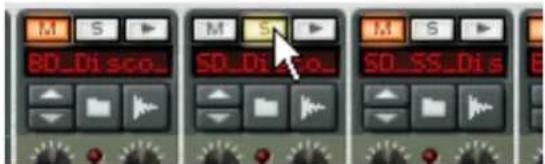
At the top of each drum sound channel, you will find a Mute (M) and a Solo (S) button. Muting a channel silences its output, while Soloing a channel mutes all other channels. Several channels can be muted or soloed at the same time.
You can also use keys on your MIDI keyboard to mute or solo individual drum sounds in real time.
→ The keys C2 to E3 (white keys only) will mute individual drum channels starting with channel 1. The sounds are muted for as long as you hold the key(s) down.
→ The keys C4 to E5 (white keys only) will solo individual drum channel, starting with channel 1. The sounds are soloed for as long as you hold the key(s) down.
C2 C3 C4 C5
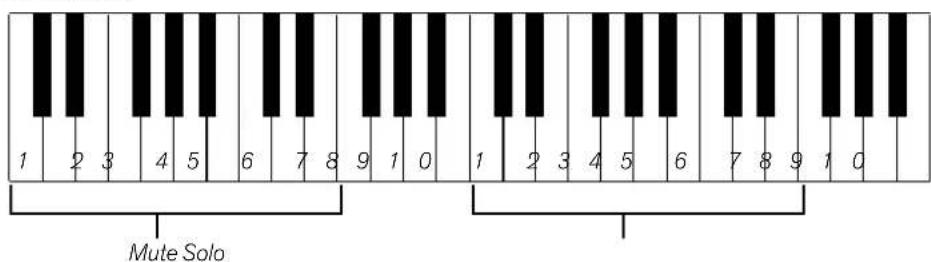
This is a great way to bring drum sounds in and out of the mix when playing Reason Lite live. You can also record the drum channel Mutes in the main sequencer, just like any other controller (see "Recording parameter automation").
The Effect Sends (S1 & S2)
On the back panel of Redrum you will note two audio connections labeled "Send Out" 1 and 2. When you create a Redrum device, these will by default be auto-routed to the first two "Chaining Aux" inputs on the Mixer device (provided that these inputs aren't already in use).
This feature allows you to add effects to independent drum sounds in the Redrum.
→ Raising the S1 knob for a drum sound channel will send the sound to the first send effect connected to the mixer.
Similarly, the S2 knob governs the send level to the second send effect in the mixer.
→ Note that there must be send effects connected to the AUX Sends and Returns in the mixer for this to work.
→ Also note that if Redrum is soloed in the Mixer the effect sends will be muted.
→ Another way to add independent effects to drum sounds is to use the independent drum outputs.
See "Connections".
Pan
Sets the Pan (stereo position) for the channel.
→If the LED above the Pan control is lit, the sound uses a stereo sample.
In that case, the Pan control serves as a stereo balance control.
Level and Velocity
The Level knob sets the volume for the channel. However, the volume can also be affected by velocity (as set with the Dynamic value, or as played via MIDI). How much the volume should be affected by velocity is set with the "Vel" knob.
→ If the Vel knob is set to a positive value, the volume will become louder with increasing velocity values.
The higher the Vel value, the larger the difference in volume between low and high velocity values.
→ A negative value inverts this relationship, so that the volume decreases with higher velocity values.
→ If the Vel knob is set to zero (middle position), the sound will play at a constant volume, regardless of the velocity.
When Vel is set to zero, the LED above the knob goes dark.
Length and the Decay/Gate switch
The Length knob determines the length of the drum sound, but the result depends on the setting of the Decay/Gate switch:
→ In Decay mode (switch down), the sound will decay (gradually fade out) after being triggered. The decay time is determined by the Length setting.
In this mode, it doesn't matter for how long a drum note is held (if played back from the main sequencer or via MIDI) - the sound will play the same length for short notes as for long notes. This is the traditional "drum machine" mode.


→ In Gate mode (switch up), the sound will play for the set Length, and then be cut off.
Furthermore, if a sound set to Gate mode is played from the main sequencer, from a CV/Gate device or via MIDI, the sound will be cut off when the note ends or after the set Length, depending on which comes first. Or in other words, the sound plays for as long as you hold the note, but the Length setting serves as the maximum length for the sound.
There are several uses for the Gate mode:
- For "gated" drum sounds, when the tail of the sound is abruptly cut off as an effect.
- For when you want to use very short sounds, and don't want them to "lose power" by being faded out.
- For when you play the Redrum from the sequencer or via MIDI, with sounds for which the length is important (e.g. when using the Redrum as a sound effects module).
! Audio samples sometimes contain a "loop", which is set by editing the audio in a sample editor. This loop repeats a part of the sample to produce sustain as long as you hold down a note. Drum samples usually don't contain loops, but who is to say that Redrum should only play drum samples?
Note that if a sample contains a loop, and Length is set to maximum, the sound will have infinite sustain, in other words it will never become silent, even if you stop playback. Decreasing the Length setting solves this problem.
Pitch
Sets the pitch of the sound. The range is +/- 1 octave.
- When the pitch is set to any other value than 0, the LED above the knob lights up to indicate that the sample isn't played back at its original pitch.
Pitch Bend
By setting the Bend knob to a positive or negative value, you specify the start pitch of the sound (relative to the Pitch setting). The pitch of the sound will then be bent to the main Pitch value. Thus, selecting a positive Bend value will cause the pitch to start higher and bend down to the original Pitch, and vice versa.
→ The Rate knob determines the bend time - the higher the value, the slower the bend.
→ The Vel knob determines how the Bend amount should be affected by velocity.
With a positive Vel value, higher velocity results in wider pitch bends.
→ The Bend and Vel knobs have LEDs that light up when the functions are activated (i.e. when a value other than zero is selected).
! Pitch bend is available for drum sound channels 6 and 7 only.
Tone
The Tone knob determines the brightness of the drum sound. Raising this parameter results in a brighter sound. The Vel knob determines whether the sound should become brighter (positive Vel value) or darker (negative Vel value) with higher velocity.
→ The Tone and Vel knobs have LEDs that light up when the functions are activated (i.e. when a value other than zero is selected).
! The Tone controls are available for drum sound channels 1, 2 and 10 only.
Sample Start
The Start parameter allows you to adjust the start point of the sample. The higher the Start value, the further the start point is moved "into" the sample. If you set the Start Velocity knob to a positive amount, the sample start point is moved forward with higher velocities. A negative Start Velocity amount inverts this relationship.
→ When Start Velocity is set to any other value than zero, the LED above the knob lights up.
A negative Start Velocity amount is only useful if you have set the Start parameter to a value higher than 0. By raising the Start value a bit and setting Start Velocity to a negative value, you can create rather realistic velocity control over some drum sounds. This is because the very first transients in the drum sound will only be heard when you play hard notes.
! The Sample Start settings are available for drum sound channels 3-5, 8 and 9.
Global settings
Channel 8 & 9 Exclusive
If this button is activated, the sounds loaded into drum channels 8 and 9 will be exclusive. In other words, if a sound is played in channel 8 it will be silenced the moment a sound is triggered in channel 9, and vice versa.
The most obvious application for this feature is to "cut off" an open hi-hat with a closed hi-hat, just like a real one does.
High Quality Interpolation
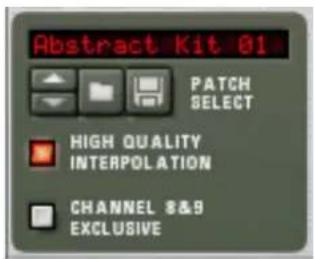
When this is activated, the sample playback is calculated using a more advanced interpolation algorithm. This results in better audio quality, especially for drum samples with a lot of high frequency content.
→ High Quality Interpolation uses more computer power - if you don't need it, it's a good idea to turn it off! Listen to the drum sounds in a context and determine whether you think this setting makes any difference.
Master Level
The Master Level knob in the top left corner of the device panel governs the overall volume from Redrum.
Using Redrum as a sound module
The drum sounds in Redrum can be played via MIDI notes. Each drum sound is triggered by a specific note number, starting at C1 (MIDI note number 36):
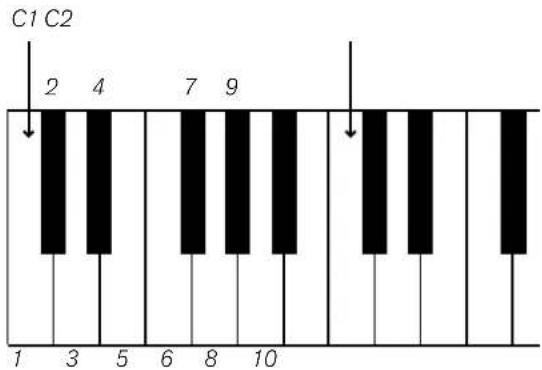
This allows you to play Redrum live from a MIDI keyboard or a MIDI percussion controller, or to record or draw drum notes in the main sequencer. If you like, you can combine pattern playback with additional drum notes, such as fills and variations. However:
! If you want to use Redrum purely as a sound module (i.e. without pattern playback) you should make sure that the "Enable Pattern Section" button is deactivated (see "The Enable Pattern Section switch"), otherwise the Redrum pattern sequencer will start as soon as you start the main sequencer.
Connections
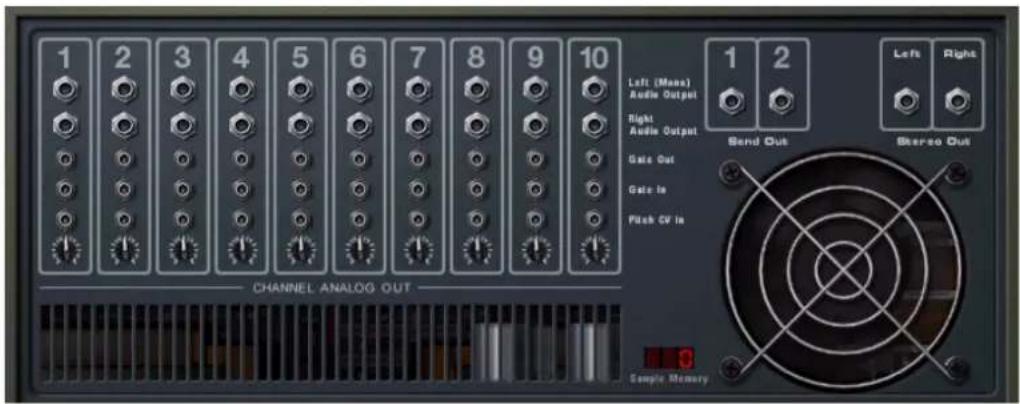
On the back of the Redrum you will find the following connections:
For each drum sound channel:
| Connection | Description |
| Audio Outputs | There are individual audio outputs for each drum sound channel, allowing you to route a drum sound to a separate channel in the mixer, possibly via insert effects, etc.For mono sounds, use the “Left (Mono)” output (and pan the sound using the Pan control in the mixer).When you use an individual output for a sound, the sound is automatically excluded from the master stereo output. |
| Gate Out This sends out a gate signal when the drum sound is played (from a pattern, via MIDI or by using the Trigger button on the device panel). This lets you use the Redrum as a "trig sequencer", controlling other devices.The length of the gate signal depends on the Decay/Gate setting for the sound: In Decay mode, a short “trig pulse” is sent out, while in Gate mode, the gate signal will have the same length as the drum note. | |
| Gate In Allows you to trigger the sound from another CV/Gate device. All settings apply, just as when playing the drum sound conventionally. | |
| Pitch CV In Lets you control the pitch of the drum sound from another CV device. | |
Other
| Connection | Description |
| Send Out 1-2 Outputs for the send signals controlled with the S1 and S2 knobs. | |
| Stereo Out This is the master stereo output, outputting a mix of all drum sounds (except those for which you use individual outputs). | |

Chapter 28
Subtractor Synthesizer
Introduction
Subtractor is an analog-type polyphonic synthesizer based on subtractive synthesis, the method used in analog synthesizers. This chapter will go through all parameters of each section of Subtractor. In addition to the parameter descriptions, the chapter also includes a few tips and tricks to help you get the most out of the Subtractor synthesizer.
! It is recommended that you start with default settings (an "Init Patch") if you intend to follow the examples in this chapter, unless otherwise is stated. An Init Patch is created by selecting "Reset Device" from the device's context menu, or from the Edit menu. If you wish to keep the current settings, save them before initializing.
The Subtractor has the following basic features:
→Up to 99 Voice Polyphony.
You can set the number of voices for each Patch.
→Dual Filters.
A combination of a multimode filter and a second, linkable, lowpass filter allows for complex filtering effects. See "The Filter Section".
→Two Oscillators, each with 32 waveforms.
See "The Oscillator Section".
→Frequency Modulation (FM).
See "Frequency Modulation (FM)".
→Oscillator Phase Offset Modulation.
This is an unique Subtractor feature that generates waveform variations. See "Phase Offset Modulation".
→Two Low Frequency Oscillators (LFO's)
See "LFO Section".
→Three Envelope Generators.
See "Envelopes - General".
→Extensive Velocity Control.
See "Velocity Control".
→Extensive CV/Gate Modulation possibilities.
See "Connections".
Loading and Saving Patches
Loading and saving patches is done in the same way as with any other Reason Lite device - see "Loading patches" and "Saving patches".
The Oscillator Section
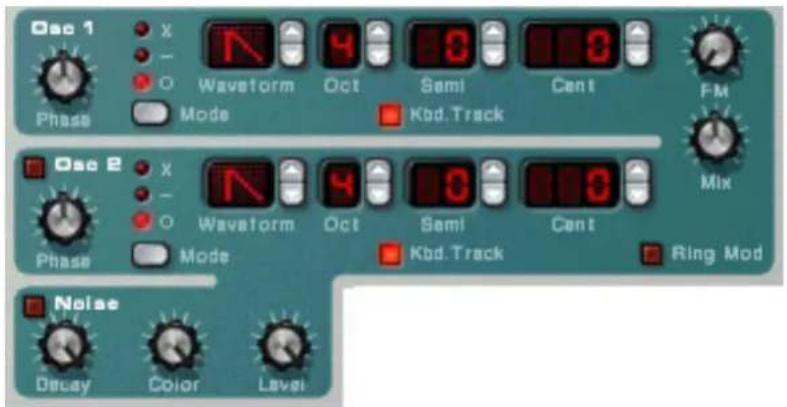
Subtractor provides two oscillators. Oscillators are the main sound generators in Subtractor, the other features are used to shape the sound of the oscillators. Oscillators generate two basic properties, waveform and pitch (frequency). The type of waveform the oscillator produces determines the harmonic content of the sound, which in turn affects the resultant sound quality (timbre). Selecting a oscillator waveform is usually the starting point when creating a new Subtractor Patch from scratch.
Oscillator 1 Waveform
Oscillator 1 provides 32 waveforms. The first four are standard waveforms, and the rest are "special" waveforms, some of which are suitable for emulating various musical instrument sounds.
It is worth noting here that all waveforms can be radically transformed using Phase offset modulation (see "Phase Offset Modulation").
To select a waveform, click the spin controls to the right of the "Waveform" LED display. The first 4 basic waveforms are shown as standard symbols, and the special waveforms are numbered 5 - 32.
Here follows a brief description of the Subtractor waveforms:
! Please note that the descriptions of the waveforms sound or timbre is merely meant to provide a basic guideline, and shouldn't be taken too literally. Given the myriad ways you can modulate and distort a waveform in Subtractor, you can produce extremely different results from any given waveform.
| Waveform | Description |
| Sawtooth | This waveform contains all harmonics and produces a bright and rich sound. The Sawtooth is perhaps the most "general purpose" of all the available waveforms. |
 | |
| Square A square wave only contains odd number harmonics, which produces a distinct, hollow sound. | |
 | |
| Triangle | The Triangle waveform generates only a few harmonics, spaced at odd harmonic numbers. This produces a flute-like sound, with a slightly hollow character. |
 | |
| Sine The sine wave is the simplest possible waveform, with no harmonics (overtones). The sine wave produces a neutral, soft timbre. | |
 | |
| 5 | This waveform emphasizes the higher harmonics, a bit like a sawtooth wave, only slightly less bright-sounding. |
| 6 | This waveform features a rich, complex harmonic structure, suitable for emulating the sound of an acoustic piano. |
| 7 | This waveform generates a glassy, smooth timbre. Good for electric piano-type sounds. |
| 8 | This waveform is suitable for keyboard-type sounds such as harpsichord or clavinet. |
| 9 | This waveform is suitable for electric bass-type sounds. |
| 10 | This is a good waveform for deep, sub-bass sounds. |
| 11 | This produces a waveform with strong formants, suitable for voice-like sounds. |
| 12 | This waveform produces a metallic timbre, suitable for a variety of sounds. |
| 13 | This produces a waveform suitable for organ-type sounds. |
| 14 | This waveform is also good for organ-type sounds. Has a brighter sound compared to waveform 13. |
| 15 | This waveform is suitable for bowed string sounds, like violin or cello. |
| 16 | Similar to 15, but with a slightly different character. |
| 17 | Another waveform suitable for string-type sounds. |
| 18 | This waveform is rich in harmonics and suitable for steel string guitar-type sounds. |
| 19 | This waveform is suitable for brass-type sounds. |
| 20 | This waveform is suitable for muted brass-type sounds. |
| 21 | This waveform is suitable for saxophone-like sounds. |
| 22 | A waveform suitable for brass and trumpet-type sounds. |
| 23 | This waveform is good for emulating mallet instruments such as marimba. |
| 24 | Similar to 23, but with a slightly different character. |
| 25 | This waveform is suitable for guitar-type sounds. |
| 26 | This is a good waveform for plucked string sounds, like harp. |
| 27 | Another waveform suitable for mallet-type sounds (see 23-24), but has a brighter quality, good for vibraphone-type sounds. |
| 28 Similar to 27, but with a slightly different character. | |
| 29 | This waveform has complex, enharmonic overtones, suitable for metallic bell-type sounds. |
| 30 | Similar to 29, but with a slightly different character. By using FM and setting the Osc Mix to Osc 1, this and the following two waveforms can produce noise. |
| 31 Similar to 30, but with a slightly different character. | |
| 32 Similar to 30, but with a slightly different character. | |
Setting Oscillator 1 Frequency - Octave/Semitone/Cent
By clicking the corresponding up/down buttons you can tune, i.e. change the frequency of Oscillator 1 in three ways:
→In Octave steps
The range is 0 - 9. The default setting is 4 (where "A" above middle "C" on your keyboard generates 440 Hz).
→In Semitone steps
Allows you to raise the frequency in 12 semitone steps (1 octave).
→In Cent steps (100th of a semitone)
The range is -50 to 50 (down or up half a semitone).
Oscillator Keyboard Tracking
Oscillator 1 has a button named "Kbd. Track". If this is switched off, the oscillator pitch will remain constant, regardless of any incoming note pitch messages, although the oscillator still reacts to note on/off messages. This can be useful for certain applications:
→ When Frequency Modulation (FM - see "Frequency Modulation (FM)") or Ring Modulation (see "Ring Modulation") is used.
This produces enharmonic sounds with very varying timbre across the keyboard.
→ For special effects and non-pitched sounds (like drums or percussion) that should sound the same across the keyboard.
Using Oscillator 2
You activate Osc 2 by clicking the button next to the text "Osc 2". Setting oscillator frequency and keyboard tracking is identical to Oscillator 1.
Adding a second oscillator enables many new modulation possibilities which can produce richer timbres. A basic example is to slightly detune (+/- a few cents) one of the oscillators. This slight frequency offset causes the oscillators to "beat" against each other, producing a wider and richer sound. Also, by combining two different waveforms, and adding frequency or ring modulation, many new timbres can be created.
Oscillator Mix
The Osc Mix knob determines the output balance between Osc 1 and Osc 2. To be able to clearly hear both oscillators, the "Osc Mix" knob should be set somewhere around the center position. If you turn the Mix knob fully to the left, only Osc 1 will be heard, and vice versa. [Command]/[Ctrl]-clicking the knob sets the Mix parameter to center position.
Oscillator 2 Waveform
The waveform alternatives for Oscillator 2 are identical to those of Oscillator 1.
However, the Noise Generator provides a third sound generating source (in addition to the two oscillators) in Subtractor, and could be regarded as an "extra" waveform for Oscillator 2, as it is internally routed to the Oscillator 2 output. See below for a description of the Noise Generator.
Noise Generator
The Noise Generator could be viewed as an oscillator that produces noise instead of a pitched waveform. Noise can be used to produce a variety of sounds, the classic example being "wind" or "rolling wave" sounds, where noise is passed through a filter while modulating the filter frequency. Other common applications include non-pitched sounds like drums and percussion, or simulating breath noises for wind instruments. To use the Noise Generator, select an Init Patch and proceed as follows:
1. Turn Osc 2 off.
2. Click the button (in the Noise Generator section) to activate the Noise Generator.
If you play a few notes on your MIDI instrument you should now hear Osc1 mixed with the sound of the Noise Generator.
3. Turn the Mix knob fully to the right, and play a few more notes.
Now just the Noise Generator will be heard.
→ Thus, the output of the Noise Generator is internally routed to Osc 2.
If you switch Osc 2 on, the noise will be mixed with the Osc 2 waveform.
There are three Noise Generator parameters. These are as follows:
| Parameter | Description |
| Noise Decay This controls how long it takes for the noise to fade out when you play a note. Note that this is independent from the Amp Envelope Decay parameter, allowing you to mix a short "burst" of noise at the very beginning of a sound, i.e. a pitched sound that uses oscillators together with noise. | |
| Noise Color | This parameter allows you to vary the character of the noise. If the knob is turned fully clockwise, pure or "white" noise (where all frequencies are represented with equal energy) is generated. Turning the knob anti-clockwise produces a gradually less bright sounding noise. Fully anti-clockwise the noise produced is an earthquake-like low frequency rumble. |
| Level Controls the level of the Noise Generator. | |
Phase Offset Modulation
A unique feature of the Subtractor oscillators is the ability to create an extra waveform within one oscillator, to offset the phase of that extra waveform, and to modulate this phase offset. By subtracting or multiplying a waveform with a phase offset copy of itself, very complex waveforms can be created. Sounds complicated? Well, the theory behind it might be, but from a user perspective it is just a method of generating new waveforms from existing waveforms.
A seasoned synth programmer using Subtractor for the first time may wonder why the Subtractor oscillators (seemingly) cannot provide the commonly used pulse waveform and the associated pulse width modulation (PWM). Or oscillator sync, another common feature in analog synthesizers. The simple answer is that Subtractor can easily create pulse waveforms (with PWM) and oscillator sync-sounds, and a lot more besides, partly by the use of phase offset modulation.
Each oscillator has it's own Phase knob and a selector button. The Phase knob is used to set the amount of phase offset, and the selector switches between three modes:
• Waveform multiplication (x)
- Waveform subtraction (-)
- No phase offset modulation (o).
When phase offset modulation is activated, the oscillator creates a second waveform of the same shape and offsets it by the amount set with the Phase knob. Depending on the selected mode, Subtractor then either subtracts or multiplies the two waveforms with each other. The resulting waveforms can be seen in the illustration below.
- The two offset waveforms:
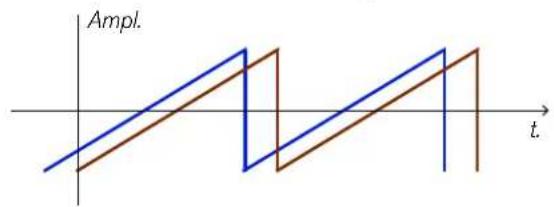
line
| t | Ampl. | | ---- | ----- | | 0 | 0 | | 0.5 | 1 | | 1 | 0 | | 1.5 | 1 | | 2 | 0 | | 2.5 | 1 |- The result of subtraction:
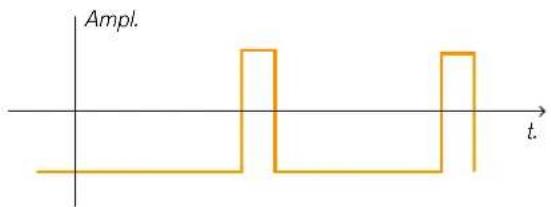
line
| t | Ampl. | | ---- | ----- | | 0 | Low | | 1 | High | | 2 | Low | | 3 | High | | 4 | Low | | 5 | High | | 6 | Low |- The result of multiplication:
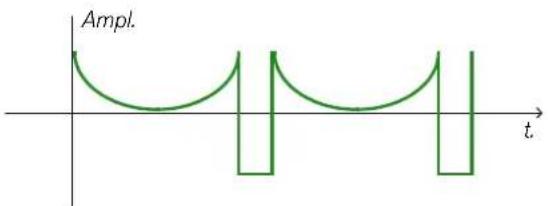
line
| t | Ampl. | | ---- | ----- | | 0 | High | | 1 | Low | | 2 | High | | 3 | Low | | 4 | High | | 5 | Low | | 6 | High | | 7 | Low | | 8 | High | | 9 | Low | | 10 | High | | 11 | Low | | 12 | High | | 13 | Low | | 14 | High | | 15 | Low | | 16 | High | | 17 | Low | | 18 | High | | 19 | Low | | 20 | High | | 21 | Low | | 22 | High | | 23 | Low | | 24 | High | | 25 | Low | | 26 | High | | 27 | Low | | 28 | High | | 29 | Low | | 30 | High | | 31 | Low | | 32 | High | | 33 | Low | | 34 | High | | 35 | Low | | 36 | High | | 37 | Low | | 38 | High | | 39 | Low | | 40 | High | | 41 | Low | | 42 | High | | 43 | Low | | 44 | High | | 45 | Low | | 46 | High | | 47 | Low | | 48 | High | | 49 | Low | | 50 | High | | 51 | Low | | 52 | High | | 53 | Low | | 54 | High | | 55 | Low | | 56 | High | | 57 | Low | | 58 | High | | 59 | Low | | 60 | High | | 61 | Low | | 62 | High | | 63 | Low | | 64 | High | | 65 | Low | | 66 | High | | 67 | Low | | 68 | High | | 69 | Low | | 70 | High | | 71 | Low | | 72 | High | | 73 | Low | | 74 | High | | 75 | Low | | 76 | High | | 77 | Low | | 78 | High | | 79 | Low | | 80 | High | | 81 | Low | | 82 | High | | 83 | Low | | 84 | High | | 85 | Low | | 86 | High | | 87 | Low | | 88 | High | | 89 | Low | | 90 | High | | 91 | Low | | 92 | High | | 93 | Low | | 94 | High | | 95 | Low | | 96 | High | | 97 | Low | | 98 | High | | 99 | Low | | 100 | High |- In example 1, we see two sawtooth waves with a slight offset.
- Example 2 shows that subtracting one slightly offset sawtooth wave from the other, produces a pulse wave. If you modulate the Phase offset parameter (with for example an LFO), the result will be pulse width modulation (PWM).
• Example 3 shows the resulting waveform when multiplying the offset waves with each other. As you can see (and hear if you try it), multiplying waveforms can produce very dramatic and sometimes unexpected results.
Using phase offset modulation can create very rich and varied timbres, especially when used along with LFO or Envelopes to modulate the phase offset.
To get a "feel" for this concept, you could study Patches that use phase offset modulation, and maybe tweak some of the Phase Offset parameters to find out what happens. Try "SyncedUp" in the Polysynth category in the Factory Soundbank for an example of osc sync or "Sweeping Strings" (in the Pads category) for an example of PWM.
! Note that if you activate waveform subtraction with a Phase offset set to "0" for an oscillator, the second waveform will cancel out the original waveform completely, and the oscillator output will be silent. If you set the Phase Offset knob to any other value than zero, the sound returns.
Frequency Modulation (FM)
In synthesizer-speak, Frequency Modulation, or FM, is when the frequency of one oscillator (called the "carrier") is modulated by the frequency of another oscillator (called the "modulator"). Using FM can produce a wide range of harmonic and non harmonic sounds. In Subtractor, Osc 1 is the carrier and Osc 2 the modulator. To try out some of the effects FM can produce, proceed as follows:
- Select an Init Patch by selecting "Initialize Patch" from the Edit menu.
- Activate Osc 2.
As you need both a carrier and a modulator to produce FM, turning the FM knob will not produce any effect unless you first activate Osc 2. For classic FM sounds, use sine wave on oscillator 1 and triangle wave on oscillator 2.
- Use the FM knob to set the FM amount to a value of about 50.
As you can hear, the timbre changes, but the effect isn't very pronounced yet.
- Turn the Osc Mix knob fully to the left, so that only the sound of Osc 1 is heard.
The modulator (Osc 2) still affects Osc 1, even though the Osc 2 output is muted.
- Now, hold down a note on your MIDI keyboard and tune Osc 2 a fifth up from the original pitch by setting the Osc 2 frequency "Semi" parameter to a value of 7.
As you can hear, for each semitone step you vary the Osc 2 frequency, the timbre changes dramatically. Setting Osc 2 frequency to certain musical intervals (i.e. fourth, fifth or octave semitone steps) produces harmonic, rich timbres, almost like tube distortion. Setting Osc 2 to non-musical intervals usually results in complex, enharmonic timbres.
- Experiment with different oscillator parameters such as phase offset modulation, changing the waveforms etc. and listen to how they affect the sound of frequency modulation.
Using the Noise Generator as the Modulator source
As explained earlier, the Noise Generator is internally routed to the Osc 2 output. Hence, if you deactivate Osc 2, and activate the Noise Generator while using FM, the noise will be used to frequency modulate Osc 1.
- With the Noise Generators default settings, this will sound much like colored noise. But by changing (lowering) the Noise Generator Decay parameter, so that the noise modulates only the attack portion of the sound can produce more interesting results. You could also use a combination of noise and Osc 2.
Ring Modulation
Ring Modulators basically multiply two audio signals together. The ring modulated output contains added frequencies generated by the sum of, and the difference between, the frequencies of the two signals. In the Subtractor Ring Modulator, Osc 1 is multiplied with Osc 2 to produce sum and difference frequencies. Ring modulation can be used to create complex and enharmonic, bell-like sounds.
- Select an Init Patch by selecting "Initialize Patch" from the Edit menu.
Save any current settings you wish to keep before initializing.
-
Activate Ring Modulation with the button in the lower right corner of the oscillator section.
-
Activate Osc 2.
You need to activate Osc 2 before any ring modulation can happen.
- Turn the Osc Mix knob fully to the right, so that only the sound of Osc 2 is heard.
Osc 2 provides the ring modulated output.
- If you play a few notes while varying the frequency of either oscillator, by using the Semitone spin controls, you can hear that the timbre changes dramatically.
If the oscillators are tuned to the same frequency, and no modulation is applied to either the Osc 1 or 2 frequency, the Ring Modulator won't do much. It is when the frequencies of Osc 1 and Osc 2 differ, that you get the "true" sound of ring modulation.
The Filter Section
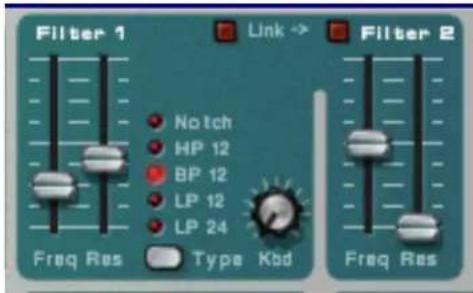
In subtractive synthesis, a filter is the most important tool for shaping the overall timbre of the sound. The filter section in Subtractor contains two filters, the first being a multimode filter with five filter types, and the second being a low-pass filter. The combination of a multimode filter and a lowpass filter can be used to create very complex filter effects.
Filter 1 Type
With this multi-selector you can set Filter 1 to operate as one of five different types of filter. The five types are illustrated and explained on the following pages:
• 24 dB Lowpass (LP 24)
Lowpass filters lets low frequencies pass and cuts out the high frequencies. This filter type has a fairly steep roll-off curve (24dB/Octave). Many classic synthesizers (Minimoog/Prophet 5 etc.) use this filter type.
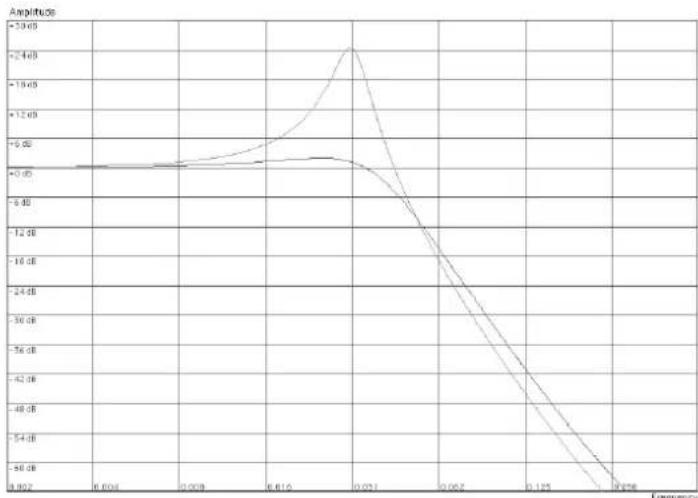
line
| Frequency | Amplitude | | --------- | --------- | | 0.002 | -6.0 dB | | 0.004 | -6.0 dB | | 0.008 | -6.0 dB | | 0.010 | -6.0 dB | | 0.021 | +30 dB | | 0.002 | -12 dB | | 0.125 | -42 dB | | 0.275 | -60 dB |The darker curve illustrates the roll-off curve of the 24dB Lowpass Filter. The lighter curve in the middle represents the filter characteristic when the Resonance parameter is raised.
• 12 dB Lowpass (LP 12)
This type of lowpass filter is also widely used in analog synthesizers (Oberheim, early Korg synths etc.). It has a gentler slope (12 dB/Octave), leaving more of the harmonics in the filtered sound compared to the LP 24 filter.
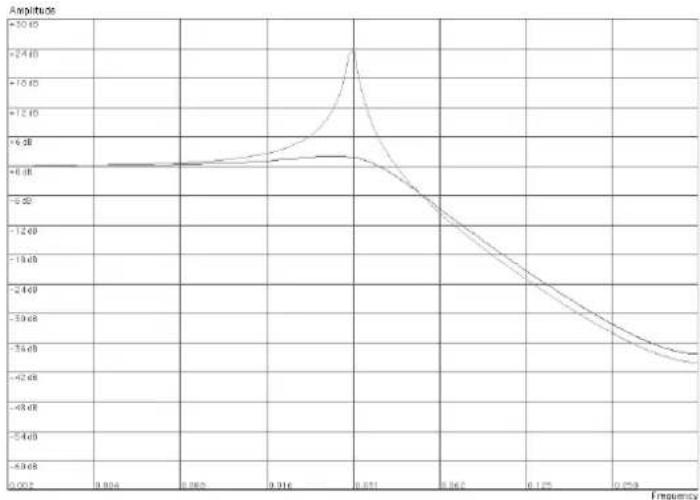
line
| Frequency | Amplitude | | --------- | --------- | | 0.002 | -8.0 dB | | 0.004 | -8.0 dB | | 0.006 | -8.0 dB | | 0.016 | -8.0 dB | | 0.031 | +24 dB | | 0.051 | +8 dB | | 0.062 | -8 dB | | 0.125 | -12 dB | | 0.259 | -18 dB | | 0.519 | -24 dB |The darker curve illustrates the roll-off curve of the 12dB Lowpass Filter. The lighter curve in the middle represents the filter characteristic when the Resonance parameter is raised.
- Bandpass (BP 12)
A bandpass filter cuts both high and low frequencies, while midrange frequencies are not affected. Each slope in this filter type has a 12 dB/Octave roll-off.
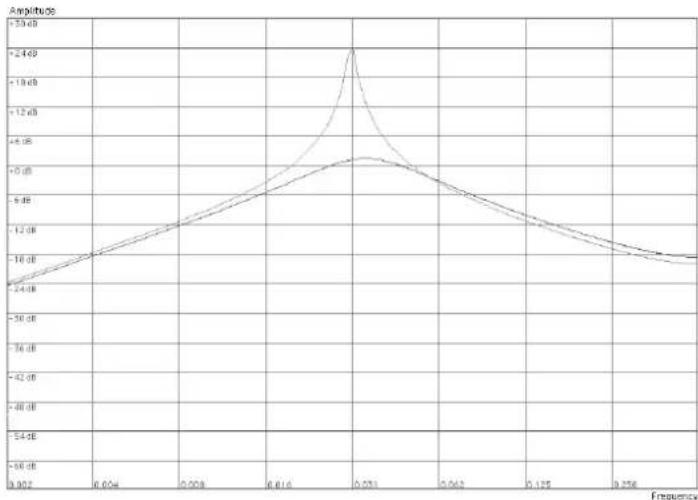
line
| Frequency | Amplitude | | --------- | --------- | | 0.002 | -10 dB | | 0.004 | -8 dB | | 0.008 | -6 dB | | 0.016 | -4 dB | | 0.031 | +50 dB | | 0.062 | -4 dB | | 0.125 | -6 dB | | 0.256 | -8 dB |The darker curve illustrates the roll-off curve of the Bandpass Filter. The lighter curve in the middle represents the filter characteristic when the Resonance parameter is raised.
• Highpass (HP12)
A highpass filter is the opposite of a lowpass filter, cutting out lower frequencies and letting high frequencies pass. The HP filter slope has a 12 dB/Octave roll-off.
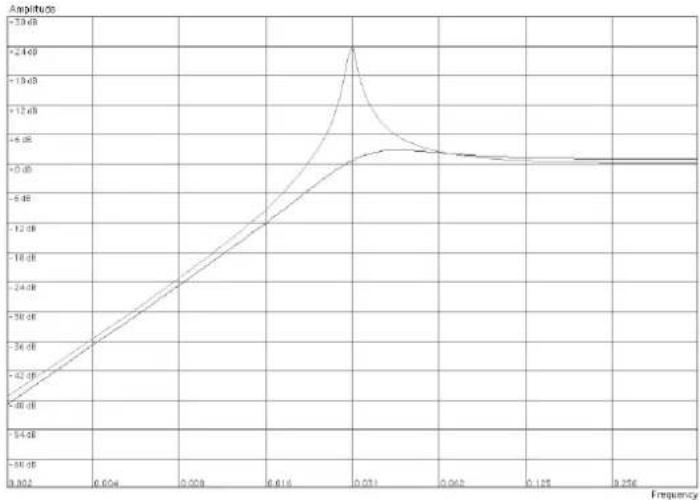
line
| Frequency | Amplitude | | --------- | --------- | | 0.002 | -50 dB | | 0.004 | -42 dB | | 0.009 | -34 dB | | 0.014 | -24 dB | | 0.021 | -12 dB | | 0.047 | -6 dB | | 0.125 | -3 dB | | 0.256 | -1 dB |The darker curve illustrates the roll-off curve of the Highpass Filter. The lighter curve in the middle represents the filter characteristic when the Resonance parameter is raised.
- Notch
A notch filter (or band reject filter) could be described as the opposite of a bandpass filter. It cuts off frequencies in a narrow midrange band, letting the frequencies below and above through. On its own, a notch filter doesn't really alter the timbre in any dramatic way, simply because most frequencies are let through. However, by combining a notch filter with a lowpass filter (using Filter 2 - see "Filter 2"), more musically useful filter characteristics can be created. Such a filter combination can produce soft timbres that still sound "clear". The effect is especially noticeable with low resonance (see "Resonance") settings.
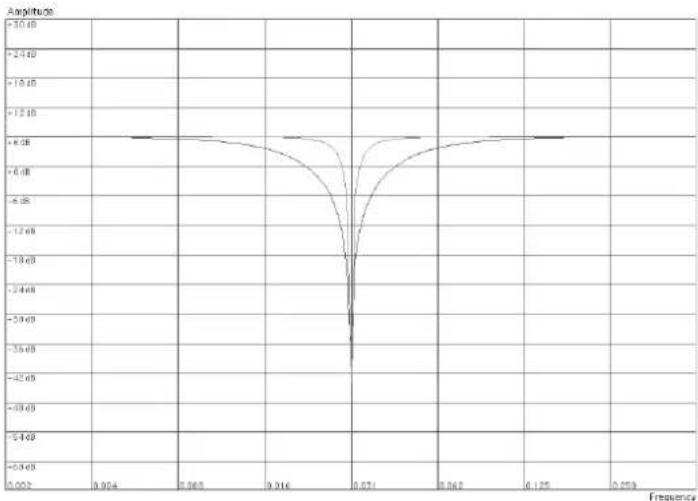
line
| Frequency | Amplitude | | --------- | --------- | | 0.002 | -0.468 | | 0.004 | -0.468 | | 0.006 | -0.468 | | 0.016 | -0.468 | | 0.071 | -5.468 | | 0.062 | -5.468 | | 0.125 | -5.468 | | 0.259 | -5.468 |The darker curve illustrates the roll-off curve of the Notch Filter. The lighter curve in the middle represents the filter characteristic when the Resonance parameter is raised.
Filter 1 Frequency
The Filter Frequency parameter (often referred to as "cutoff") determines which area of the frequency spectrum the filter will operate in. For a lowpass filter, the frequency parameter could be described as governing the "opening" and "closing" of the filter. If the Filter Freq is set to zero, none or only the very lowest frequencies are heard, if set to maximum, all frequencies in the waveform are heard. Gradually changing the Filter Frequency produces the classic synthesizer filter "sweep" sound.
! Note that the Filter Frequency parameter is usually controlled by the Filter Envelope (see "Filter Envelope") as well. Changing the Filter Frequency with the Freq slider may therefore not produce the expected result.
Resonance
The filter resonance parameter is used to set the Filter characteristic, or quality. For lowpass filters, raising the filter Res value will emphasize the frequencies around the set filter frequency. This produces a generally thinner sound, but with a sharper, more pronounced filter frequency “sweep”. The higher the filter Res value, the more resonant the sound becomes until it produces a whistling or ringing sound. If you set a high value for the Res parameter and then vary the filter frequency, this will produce a very distinct sweep, with the ringing sound being very evident at certain frequencies.
- For the highpass filter, the Res parameter operates just like for the lowpass filters.
- When you use the Bandpass or Notch filter, the Resonance setting adjusts the width of the band. When you raise the Resonance, the band where frequencies are let through (Bandpass), or cut (Notch) will become narrower. Generally, the Notch filter produces more musical results using low resonance settings.
Filter Keyboard Track (Kbd)
If Filter Keyboard Track is activated, the filter frequency will increase the further up on the keyboard you play. If a low-pass filter frequency is constant (a Kbd setting of "O") this can introduce a certain loss of "sparkle" in a sound the higher up the keyboard you play, because the harmonics in the sound are progressively being cut. By using a degree of Filter Keyboard Tracking, this can be compensated for.
Filter 2
A very useful and unusual feature of the Subtractor Synthesizer is the presence of an additional 12dB/Oct lowpass filter. Using two filters together can produce many interesting filter characteristics, that would be impossible to create using a single filter, for example formant effects.
The parameters are identical to Filter 1, except in that the filter type is fixed, and it does not have filter keyboard tracking.
→ To activate Filter 2, click the button at the top of the Filter 2 section.
Filter 1 and Filter 2 are connected in series. This means that the output of Filter 1 is routed to Filter 2, but both filters function independently. For example, if Filter 1 was filtering out most of the frequencies, this would leave Filter 2 very little to "work with". Similarly, if Filter 2 had a filter frequency setting of "0", all frequencies would be filtered out regardless of the settings of Filter 1.
- Try the "Singing Synth" patch (in the Monosynth category of the Factory Sound Bank) for an example of how dual filters can be used.
Filter Link
When Link (and Filter 2) is activated, the Filter 1 frequency controls the frequency offset of Filter 2. That is, if you have set different filter frequency values for Filter 1 and 2, changing the Filter 1 frequency will also change the frequency for Filter 2, but keeping the relative offset.
- Try the "Fozzy Fonk" patch (in the Polysynth category of the Factory Sound Bank) for an example how linked filters can be used.
! Caution! If no filter modulation is used, and the filters are linked, pulling down the frequency of Filter 2 to zero will cause both filters to be set to the same frequency. If combined with high Res settings, this can produce very loud volume levels that cause distortion!
Envelopes - General
Envelope generators are used to control several important sound parameters in analog synthesizers, such as pitch, volume, filter frequency etc. Envelopes govern how these parameters should respond over time - from the moment a note is struck to the moment it is released.
Standard synthesizer envelope generators have four parameters; Attack, Decay, Sustain and Release (ADSR).
There are three envelope generators in the Subtractor, one for volume, one for the Filter 1 frequency, and one modulation envelope which has selectable modulation destinations.
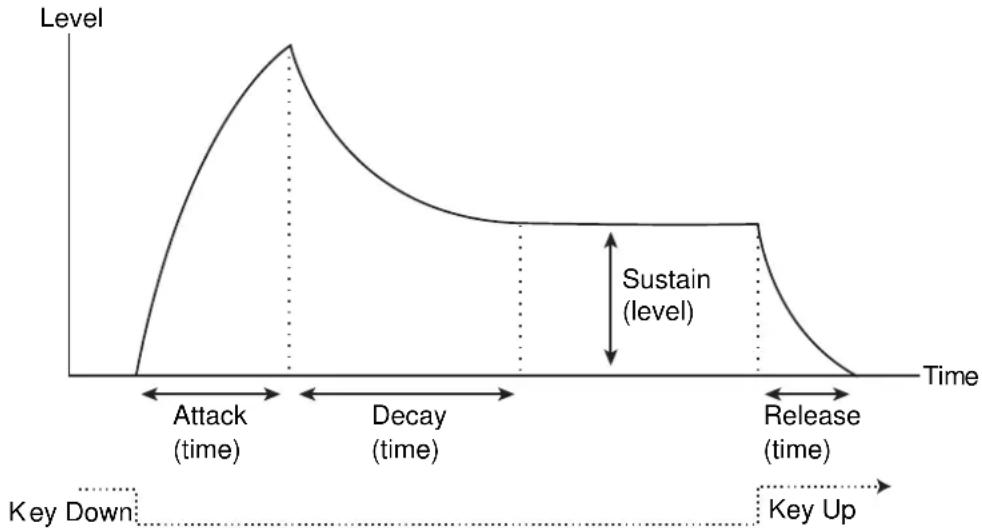
line
| Time Phase | Level | | ---------------- | ----- | | Attack (time) | Peak | | Decay (time) | Low | | Sustain (level) | Sustain level | | Release (time) | Sustain level | | Key Down | Key Down | | Key Up | Key Up |The ADSR envelope parameters.
Attack
When you play a note on your keyboard, the envelope is triggered. This means it starts rising from zero to the maximum value. How long this should take, depends on the Attack setting. If the Attack is set to "O", the maximum value is reached instantly. If this value is raised, it will take time before the maximum value is reached.
For example, if the Attack value is raised and the envelope is controlling the filter frequency, the filter frequency will gradually rise up to a point each time a key is pressed, like an "auto-wha" effect.
Decay
After the maximum value has been reached, the value starts to drop. How long this should take is governed by the Decay parameter.
If you wanted to emulate the volume envelope of a note played on a piano for example, the Attack should be set to "0" and the Decay parameter should be set to a medium value, so that the volume gradually decreases down to silence, even if you keep holding the key down. Should you want the decay to drop to some other value than zero, you use the Sustain parameter.
Sustain
The Sustain parameter determines the level the envelope should rest at, after the Decay. If you set Sustain to full level, the Decay setting is of no importance since the volume of the sound is never lowered.
If you wanted to emulate the volume envelope of an organ, you theoretically only really need to use the Sustain parameter set to full level, as a basic organ volume envelope instantly goes to the maximum level (Attack "O") and stays there (Decay "O"), until the key is released and the sound instantly stops (Release "O").
But often a combination of Decay and Sustain is used to generate envelopes that rise up to the maximum value, then gradually decreases to finally land to rest on a level somewhere in-between zero and maximum. Note that Sustain represents a /level, whereas the other envelope parameters represent times.
Release
Finally, we have the Release parameter. This works just like the Decay parameter, except it determines the time it takes for the value to fall back to zero after releasing the key.
Amplitude Envelope
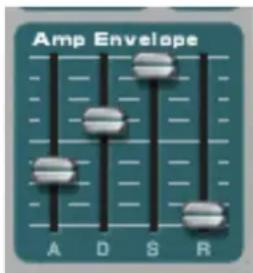
The Amplitude Envelope is used to adjust how the volume of the sound should change from the time you press a key until the key is released. By setting up a volume envelope you sculpt the sound's basic shape with the four Amplitude Envelope parameters, Attack, Decay, Sustain and Release. This determines the basic character of the sound (soft, long, short etc.).
Filter Envelope
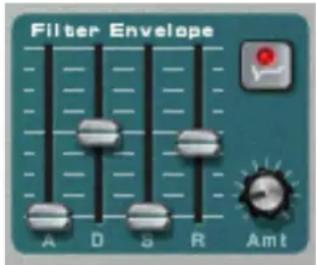
The Filter Envelope affects the Filter 1 Frequency parameter. By setting up a filter envelope you control the how the filter frequency should change over time with the four Filter Envelope parameters, Attack, Decay, Sustain and Re-lease.
Filter Envelope Amount
This parameter determines to what degree the filter will be affected by the Filter Envelope. Raising this knob's value creates more drastic results. The Envelope Amount parameter and the set Filter Frequency are related. If the Filter Freq slider is set to around the middle, this means that the moment you press a key the filter is already halfway open. The set Filter Envelope will then open the filter further from this point. The Filter Envelope Amount setting affects how much further the filter will open.
Filter Envelope Invert
If this button is activated, the envelope will be inverted. For example, normally the Decay parameter lowers the filter frequency, but after activating Invert it will instead raise it, by the same amount.
Mod Envelope
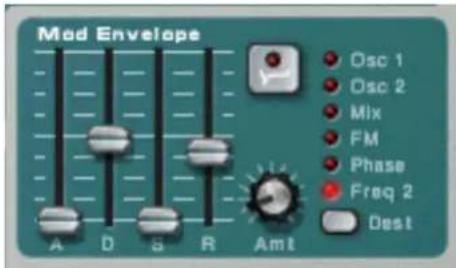
The Mod Envelope allows you to select one of a number of parameters, or Destinations, to control with the envelope. By setting up a modulation envelope you control the how the selected Destination parameter should change over time with the four Mod Envelope parameters, Attack, Decay, Sustain and Release.
The available Mod Envelope Destinations are as follows:
| Destination | Description |
| Osc 1 Selecting this makes the Mod Envelope control the pitch (frequency) of Osc 1. | |
| Osc 2 Same as above, but for Osc 2. | |
| Osc Mix | Selecting this makes the Mod Envelope control the oscillator Mix parameter. Both oscillators must be activated for this to have any effect. |
| FM | Selecting this makes the Mod Envelope control the FM Amount parameter. Both oscillators must be activated for this to have any effect. |
| Phase Selecting this makes the Mod Envelope control the Phase Offset parameter for both Osc 1 and 2. Note that Phase Offset Modulation (Subtraction or Multiplication) must be activated for this to have any effect. | |
| Freq 2 | Selecting this makes the Mod Envelope control the Frequency parameter for Filter 2. |
LFO Section
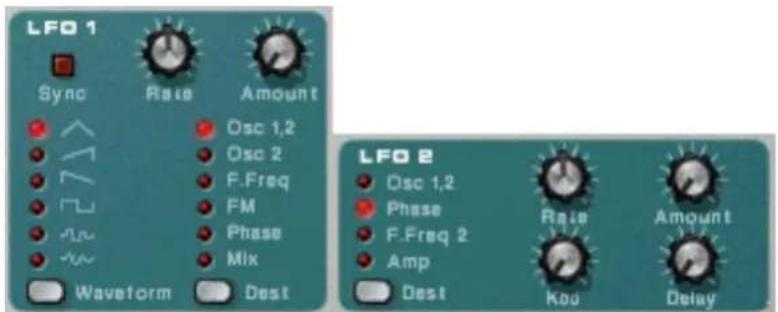
LFO stands for Low Frequency Oscillator. LFO's are oscillators, just like Osc 1 & 2, in that they also generate a waveform and a frequency. However, there are two significant differences:
• LFOs only generate waveforms with low frequencies.
- The output of the two LFO's are never actually heard. Instead they are used for modulating various parameters.
The most typical application of an LFO is to modulate the pitch of a (sound generating) oscillator, to produce vibrato. Subtractor is equipped with two LFO's. The parameters and the possible modulation destinations vary somewhat between LFO 1 and LFO 2.
LFO 1 Parameters
Waveform
LFO 1 allows you to select different waveforms for modulating parameters. These are (from top to bottom):
| Waveform | Description |
| Triangle This is a smooth waveform, suitable for normal vibrato. | |
| Inverted Sawtooth | This produces a "ramp up" cycle. If applied to an oscillator's frequency, the pitch would sweep up to a set point (governed by the Amount setting), after which the cycle immediately starts over. |
| Sawtooth This produces a "ramp down" cycle, the same as above but inverted. | |
| Square | This produces cycles that abruptly changes between two values, usable for trills etc. |
| Random | Produces random stepped modulation to the destination. On some vintage synths, this is called "sample & hold". |
| Soft Random The same as above, but with smooth modulation. | |
Destination
The available LFO 1 Destinations are as follows:
| Destination | Description |
| Osc 1&2 Selecting this makes LFO 1 control the pitch (frequency) of Osc 1 and Osc 2. | |
| Osc 2 Same as above, but for Osc 2. | |
| Filter Freq | Selecting this makes the LFO 1 control the filter frequency for Filter 1 (and Filter 2 if linked). |
| FM | Selecting this makes the LFO 1 control the FM Amount parameter. Both oscillators must be activated for this to have any effect. |
| Phase | Selecting this makes the LFO 1 control the Phase Offset parameter for both Osc 1 and 2. Note that Phase Offset Modulation (Subtraction or Multiplication) must be activated for this to have any effect. |
| Osc Mix Selecting this makes the LFO 1 control the oscillator Mix parameter. | |
Sync
By clicking this button you activate/deactivate LFO sync. The frequency of the LFO will then be synchronized to the song tempo, in one of 16 possible time divisions. When sync is activated, the Rate knob (see below) is used for setting the desired time division.
Turn the knob and check the tooltip for an indication of the time division.
Rate
The Rate knob controls the LFO's frequency. Turn clockwise for a faster modulation rate.
Amount
This parameter determines to what degree the selected parameter destination will be affected by LFO 1. Raising this knob's value creates more drastic results.
LFO 2 Parameters
LFO 2 is polyphonic. This means that for every note you play, an independent LFO cycle is generated, whereas LFO 1 always modulates the destination parameter using the same "cycle". This can be used to produce subtle cross-modulation effects, with several LFO cycles that "beat" against each other. This also enables LFO 2 to produce modulation rates that vary across the keyboard (see the "Keyboard Tracking" parameter below).
Destination
The available LFO 2 Destinations are as follows:
| Destination | Description |
| Osc 1&2 Selecting this makes LFO 2 modulate the pitch (frequency) of Osc 1 and Osc 2. | |
| Phase Selecting this makes the LFO 2 modulate the Phase Offset parameter for both Osc 1 and 2. Note that Phase Offset Modulation (Subtraction or Multiplication) must be activated for this to have any effect. | |
| Filter Freq 2 Selecting this makes the LFO 2 modulate the filter frequency for Filter 2. | |
| Amp | Selecting this makes the LFO 2 modulate the overall volume, to create tremolo-effects. |
LFO 2 Delay
This parameter is used to set a delay between when a note is played and when the LFO modulation "kicks in". For example, if Osc 1 & 2 is selected as the destination parameter and Delay was set to a moderate value, the sound would start out unmodulated, with the vibrato only setting in if you hold the note(s) long enough. Delayed LFO modulation can be very useful, especially if you are playing musical instrument-like sounds like violin or flute. Naturally it could also be used to control more extreme modulation effects and still retain the "playability" of the sound.
LFO 2 Keyboard Tracking
If LFO keyboard tracking is activated, the LFO rate will progressively increase the higher up on the keyboard you play. Raising this value creates more drastic results.
- If the LFO is set to modulate the phase offset, LFO keyboard tracking can produce good results. For example, synth string pads and other sounds that use PWM (see "Phase Offset Modulation") can benefit from this.
Rate
The Rate knob controls the LFO's frequency. Turn clockwise for a faster modulation rate.
Amount
This parameter determines to what degree the selected parameter destination will be affected by LFO 2. Raising this knob's value creates more drastic results.
Play Parameters
This section deals with two things: Parameters that are affected by how you play, and modulation that can be applied manually with standard MIDI keyboard controls.
These are:
- Velocity Control
- Pitch Bend and Modulation Wheel
• Legato
• Portamento
• Polyphony
Velocity Control
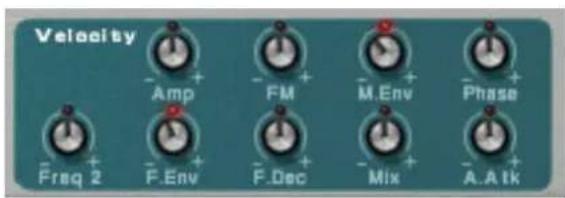
Velocity is used to control various parameters according to how hard or soft you play notes on your keyboard. A common application of velocity is to make sounds brighter and louder if you strike the key harder. Subtractor features very comprehensive velocity modulation capabilities. By using the knobs in this section, you can control how much the various parameters will be affected by velocity. The velocity sensitivity amount can be set to either positive or negative values, with the center position representing no velocity control.
The following parameters can be velocity controlled:
| Destination | Description |
| Amp | This let's you velocity control the overall volume of the sound. If a positive value is set, the volume will increase the harder you strike a key. A negative value inverts this relationship, so that the volume decreases if you play harder, and increases if you play softer. If set to zero, the sound will play at a constant volume, regardless of how hard or soft you play. |
| FM This sets velocity control for the FM Amount parameter. A positive value will increase the FM amount the harder you play. Negative values invert this relationship. | |
| M. Env | This sets velocity control for the Mod Envelope Amount parameter. A positive value will increase the envelope amount the harder you play. Negative values invert this relationship. |
| Phase | This sets velocity control for the Phase Offset parameter. This applies to both Osc 1 & 2, but the relative offset values are retained. A positive value will increase the phase offset the harder you play. Negative values invert this relationship. |
| Freq 2 | This sets velocity control for the Filter 2 Frequency parameter. A positive value will increase the filter frequency the harder you play. Negative values invert this relationship. |
| F. Env | This sets velocity control for the Filter Envelope Amount parameter. A positive value will increase the envelope amount the harder you play. Negative values invert this relationship. |
| F. Dec This sets velocity control for the Filter Envelope Decay parameter. A positive value will increase the Decay time the harder you play. Negative values invert this relationship. | |
| Osc Mix | This sets velocity control for the Osc Mix parameter. A positive value will increase the Osc 2 Mix amount the harder you play. Negative values invert this relationship. |
| A. Attack | This sets velocity control for the Amp Envelope Attack parameter. A positive value will increase the Attack time the harder you play. Negative values invert this relationship. |
Pitch Bend and Modulation Wheels
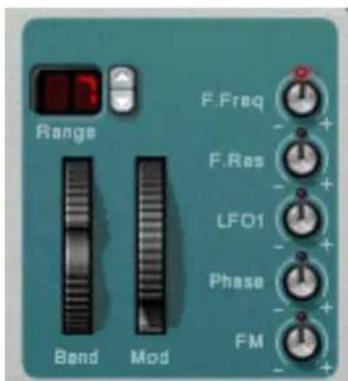
The Pitch Bend wheel is used for "bending" notes, like bending the strings on a guitar. The Modulation wheel can be used to apply various modulation while you are playing. Virtually all MIDI keyboards have Pitch Bend and Modulation controls. Subtractor features not only the settings for how incoming MIDI Pitch Bend and Modulation wheel messages should affect the sound. Subtractor also has two functional wheels that could be used to apply real time modulation and pitch bend should you not have these controllers on your keyboard, or if you aren't using a keyboard at all. The Subtractor wheels mirror the movements of the MIDI keyboard controllers.
Pitch Bend Range
The Range parameter sets the amount of pitch bend when the wheel is turned fully up or down. The maximum range is "24" (=up/down 2 Octaves).
Modulation Wheel
The Modulation wheel can be set to simultaneously control a number of parameters. You can set positive or negative values, just like in the Velocity Control section. The following parameters can be affected by the modulation wheel:
| Parameter | Description |
| F. Freq | This sets modulation wheel control of the Filter 1 Frequency parameter. A positive value will increase the frequency if the wheel is pushed forward. Negative values invert this relationship. |
| F. Res | This sets modulation wheel control of the Filter 1 Resonance parameter. A positive value will increase the resonance if the wheel is pushed forward. Negative values invert this relationship. |
| LFO 1 This sets modulation wheel control of the LFO 1 Amount parameter. A positive value will increase the Amount if the wheel is pushed forward. Negative values invert this relationship. | |
| Phase This sets modulation wheel control of the Phase Offset parameter for both Osc 1 and 2. Note that Phase Offset Modulation (Subtraction or Multiplication) must be activated for this to have any effect. | |
| FM | This sets modulation wheel control of the FM Amount parameter. A positive value will increase the FM amount if the wheel is pushed forward. Negative values invert this relationship. Both oscillators must be activated for this to have any effect. |
Legato
Legato works best with monophonic sounds. Set Polyphony (see below) to 1 and try the following:
→Hold down a key and press another key without releasing the previous.
Notice that the pitch changes, but the envelopes do not start over. That is, there will be no new "attack".
→ If polyphony is set to more voices than 1, Legato will only be applied when all the assigned voices are “used up”.
For example, if you had a polyphony setting of "4" and you held down a 4 note chord, the next note you played would be Legato. Note, however, that this Legato voice will "steal" one of the voices in the 4 note chord, since all the assigned voices were already used up!
Retrig
This is the "normal" setting for playing polyphonic patches. That is, when you press a key without releasing the previous, the envelopes are retriggered, like when you release all keys and then press a new one. In monophonic mode, Retrig has an additional function; if you press a key, hold it, press a new key and then release that, the first note is also retriggered.
Portamento (Time)
Portamento is when the pitch "glides" between the notes you play, instead of instantly changing the pitch. The Portamento knob is used to set how long it takes for the pitch to glide from one pitch to the next. If you don't want any Portamento at all, set this knob to zero.
Setting Number of Voices - Polyphony
This determines the polyphony, i.e. the number of voices a Subtractor Patch can play simultaneously. This can be used to make a patch monophonic (=a setting of "1"), or to extend the number of voices available for a patch. The maximum number of voices you can set a Subtractor Patch to use is 99. In the (unlikely) event you should need more voices, you can always create another Subtractor!
! Note that the Polyphony setting does not "hog" voices. For example, if you have a patch that has a polyphony setting of ten voices, but the part the patch plays only uses four voices, this won't mean that you are "wasting" six voices. In other words, the polyphony setting is not something you need to consider much if you want to conserve CPU power - it is the number of voices actually used that counts.
About the Low Bandwidth button
This can be used to conserve CPU power. When activated, this function will remove some high frequency content from the sound of this particular device, but often this is not noticeable (this is especially true for bass sounds).
External Modulation
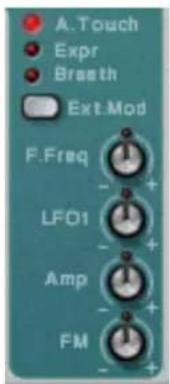
Subtractor can receive common MIDI controller messages, and route these to various parameters. The following MIDI messages can be received:
• Aftertouch (Channel Pressure)
• Expression Pedal
- Breath Control
If your MIDI keyboard is capable of sending Aftertouch messages, or if you have access to an Expression Pedal or a Breath controller, you can use these to modulate parameters. The "Ext. Mod" selector switch sets which of these message-types should be received.
These messages can then be assigned to control the following parameters:
| Destination | Description |
| F. Freq | This sets External modulation control of the Filter 1 Frequency parameter. A positive value will increase the frequency with higher external modulation values. Negative values invert this relationship. |
| LFO 1 This sets External modulation control of the LFO 1 Amount parameter. A positive value will increase the LFO 1 amount with higher external modulation values. Negative values invert this relationship. | |
| Amp | This let's you control the overall volume of the sound with external modulation. If a positive value is set, the volume will increase with higher external modulation values. A negative value inverts this relationship. |
| FM This sets External modulation control of the FM Amount parameter. If a positive value is set, the FM amount will increase with higher external modulation values. A negative value inverts this relationship. Both oscillators must be activated for this to have any effect. | |
Connections
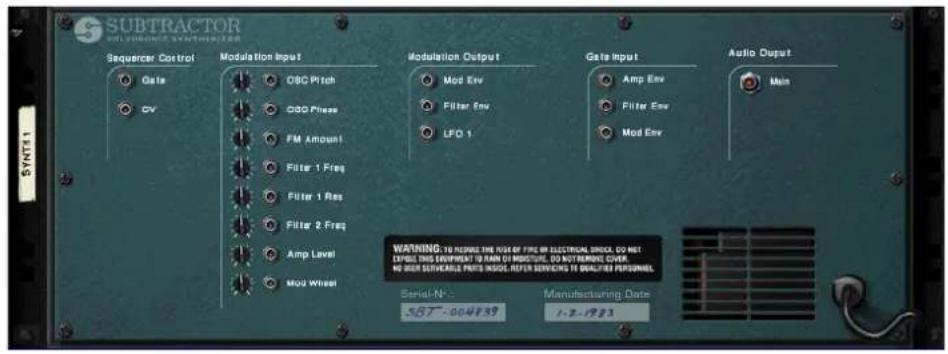
Flipping the Subtractor around reveals a plethora of connection possibilities, most of which are CV/Gate related. Using CV/Gate is described in the chapter "Routing Audio and CV".
Audio Output
This is Subtractor's main audio output. When you create a new Subtractor device, this is auto-routed to the first available channel on the audio mixer.
Sequencer Control
The Sequencer Control CV and Gate inputs allow you to play the Subtractor from another CV/Gate device (typically a Matrix or a Redrum). The signal to the CV input controls the note pitch, while the signal to the Gate input delivers note on/off along with velocity.
! For best results, you should use the Sequencer Control inputs with monophonic sounds.
Modulation Inputs
! Remember that CV connections will not be stored in the Subtractor patch, even if the connections are to/from the same Subtractor device!
These control voltage (CV) inputs (with associated voltage trim pots), can modulate various Subtractor parameters from other devices, or from the modulation outputs of the same Subtractor device. These inputs can control the following parameters:
- Oscillator Pitch (both Osc 1 & 2).
- Oscillator Phase Offset (both Osc 1 & 2).
• F M A m o u n t
- Filter 1 Cutoff
- Filter 1 Res
- Filter 2 Cutoff
- Amp Level
- Mod Wheel
Modulation Outputs
The Modulation outputs can be used to voltage control other devices, or other parameters in the same Subtractor device. The Modulation Outputs are:
- Mod Envelope
- Filter Envelope
• L F O 1
Gate Inputs
These inputs can receive a CV signal to trigger the following envelopes. Note that connecting to these inputs will override the normal triggering of the envelopes. For example, if you connected an LFO output to the Gate Amp input, you would not trigger the amp envelope by playing notes, as this is now controlled by the LFO. In addition you would only hear the LFO triggering the envelope for the notes that you hold down. The following Gate Inputs can be selected:
• A m p E n v e l o p e
- Filter Envelope
- Mod Envelope
Chapter 29
Monotone
Bass Synthesizer
Introduction
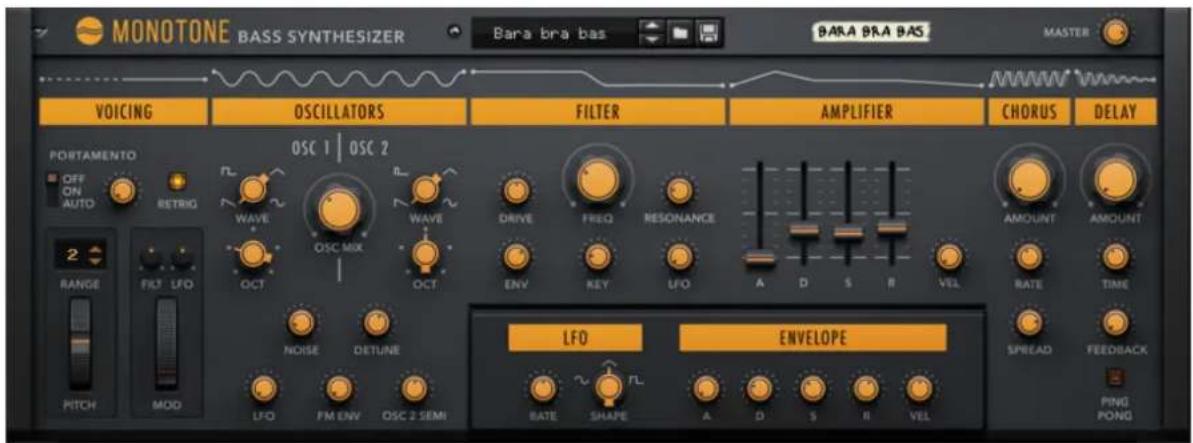
The Monotone Bass Synthesizer is a great little monophonic bass synthesizer, designed for seamless integration of Reason Compact projects. Despite its fairly small size, it's very versatile can produce really fat and punchy bass synth sounds.
Monotone features two oscillators, a 24 dB lowpass ladder filter, amp envelope and chorus and delay effects. It also has an LFO and an additional envelope for modulation purposes.
Panel overview
The Monotone front panel contains the following sections:
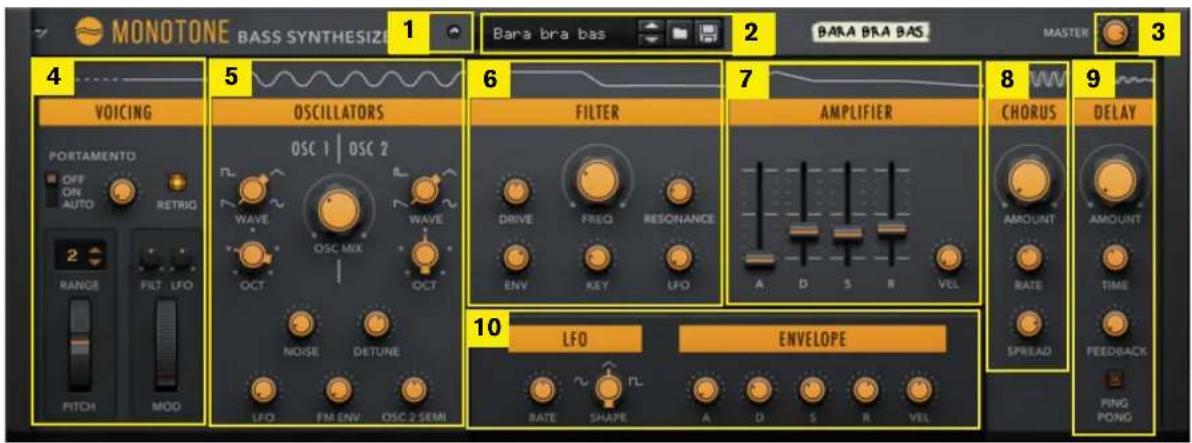
The Monotone front panel sections.
• 1. MIDI Note On LED.
- 2. Patch Selector (for browsing, loading and saving patches).
• 3. Master Volume.
• 4. Voicing section and global controls.
• 5. Oscillator section.
• 6. Filter section.
• 7. Amplitude Envelope.
• 8. Chorus section.
• 9. Delay section.
• 10. Modulation section.
Signal flow
The picture below shows the basic signal flow in Monotone:
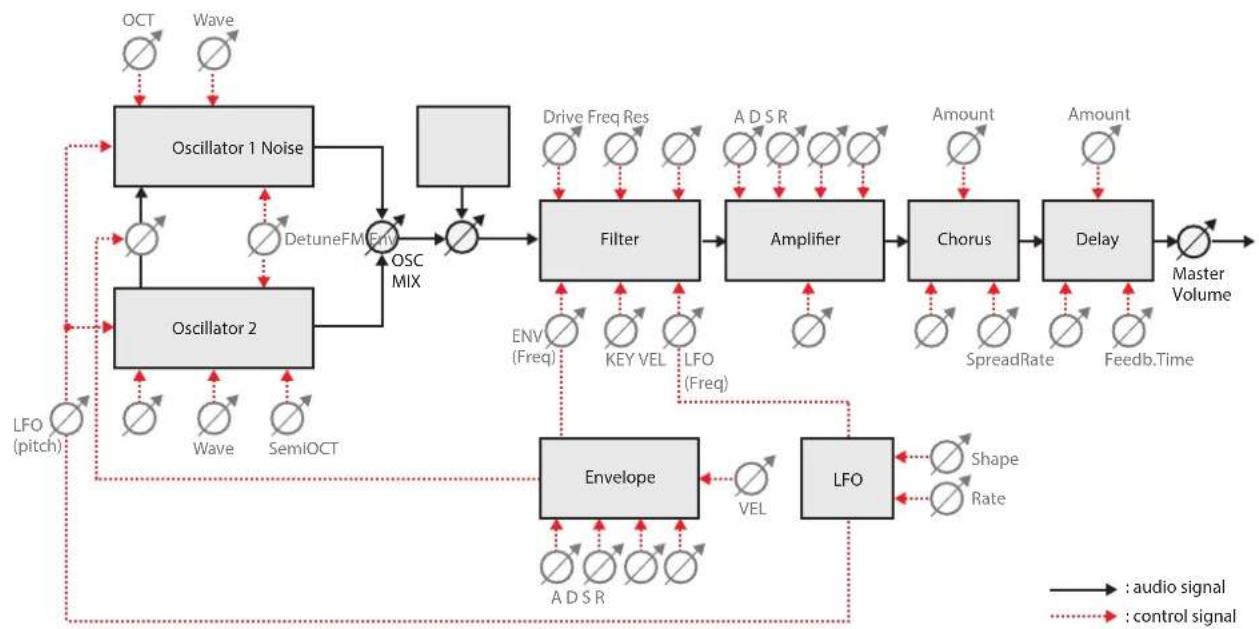
flowchart
graph TD
    OCT["OCT"] --> Oscillator1["Oscillator 1 Noise"]
    Wave["Wave"] --> Oscillator1
    Oscillator1 --> DetuneFMEnv["DetuneFMEnv"]
    Oscillator2["Oscillator 2"] --> Oscillator2
    Oscillator2 --> OSCMix["OSC MIX"]
    OSCMix --> Filter["Filter"]
    Filter --> Amplifier["Amplifier"]
    Amplifier --> Chorus["Chorus"]
    Chorus --> Delay["Delay"]
    Delay --> MasterVolume["Master Volume"]
    MasterVolume --> LFO["LFO"]
    LFO --> Envelope["Envelope"]
    Envelope --> LFO
    LFO --> Envolve["Envolve"]
    Envolve --> Filter
    Filter --> DriveFreqRes["Drive Freq Res"]
    DriveFreqRes --> Oscillator1
    DriveFreqRes --> Oscillator2
    DriveFreqRes --> Oscillator2
    DriveFreqRes --> Oscillator2
    DriveFreqRes --> Oscillator2
    DriveFreqRes --> Oscillator2
    DriveFreqRes --> Oscillator2
    DriveFreqRes --> Oscillator2
    DriveFreqRes --> Oscillator2
    DriveFreqRes --> Oscillator2
    DriveFreqRes --> Oscillator2
    DriveFreqRes --> Oscillator2
    DriveFreqRes --> Oscillator2

    subgraph Oscillator1_Noise
        Oct["Oct"] --> Oscillator1_Noise
        Wave["Wave"] --> Oscillator1_Noise
        SemiOCT["SemiOCT"] --> Oscillator1_Noise
    end

    subgraph Oscillator2_Noise
        Oct1["Oct"] --> Oscillator1_Noise
        Wave1["Wave"] --> Oscillator1_Noise
        SemiOCT2["SemiOCT"] --> Oscillator1_Noise
    end

    subgraph Oscillator2_Environment
        Oct2["Oct"] --> Oscillator1_Noise
        Wave2["Wave"] --> Oscillator1_Noise
        SemiOCT3["SemiOCT"] --> Oscillator1_Noise
    end

    subgraph Oscillator2_Environment Environment
        Oct3["Oct"] --> Oscillator1_Noise
        Wave3["Wave"] --> Oscillator1_Noise
        SemiOCT4["SemiOCT"] --> Oscillator1_Noise
    end

    subgraph Encoders
        Envolve1["Envolve (Freq)"] --> Filter1["Filter"]
        Envolve2["Envolve (Freq)"] --> Filter2["Filter"]
        Envolve3["Envolve (Freq)"] --> Filter3["Filter"]
        Envolve4["Envolve (Freq)"] --> Filter4["Filter"]
        Envolve5["Envolve (Freq)"] --> Filter5["Filter"]
        Envolve6["Envolve (Freq)"] --> Filter6["Filter"]
        Envolve7["Envolve (Freq)"] --> Filter7["Filter"]
        Envolve8["Envolve (Freq)"] --> Filter8["Filter"]
        Envolve9["Envolve (Freq)"] --> Filter9["Filter"]
        Envolve10["Envolve (Freq)"] --> Filter10["Filter"]
        Envolve11["Envolve (Freq)"] --> Filter11["Filter"]
        Envolve12["Envolve (Freq)"] --> Filter12["Filter"]
        Envolve13["Envolve (Freq)"] --> Filter13["Filter"]
        Envolve14["Envolve (Freq)"] --> Filter14["Filter"]
        Envolve15["Envolve (Freq)"] --> Filter15["Filter"]
        Envolve16["Envolve (Freq)"] --> Filter16["Filter"]
        Envolve17["Envolve (Freq)"] --> Filter17["Filter"]
        Envolve18["Envolve (Freq)"] --> Filter18["Filter"]
        Envolve19["Envolve (Freq)"] --> Filter19["Filter"]
        Envolve20["Envolve (Freq)"] --> Filter20["Filter"]
        Envolve21["Envolve (Freq)"] --> Filter21["Filter"]
        Envolve22["Envolve (Freq)"] --> Filter22["Filter"]
        Envolve23["Envolve (Freq)"] --> Filter23["Filter"]
        Envolve24["Envolve (Freq)"] --> Filter24["Filter"]
        Envolve25["Envolve (Freq)"] --> Filter25["Filter"]
        Envolve26["Envolve (Freq)"] --> Filter26["Filter"]
        Envolve27["Envolve (Freq)"] --> Filter27["Filter"]
        Envolve28["Envolve (Freq)"] --> Filter28["Filter"]
        Envolve29["Envolve (Freq)"] --> Filter29["Filter"]
        Envolve30["Envolve (Freq)"] --> Filter30["Filter"]
        Envolve31["Envolve (Freq)"] --> Filter31["Filter"]
        Envolve32["Envolve (Freq)"] --> Filter32["Filter"]
        Envolve33["Envolve (Freq)"] --> Filter33["Filter"]
        Envolve34["Envolve (Freq)"] --> Filter34["Filter"]
        Envolve35["Envolve (Freq)"] --> Filter35["Filter"]
        Envolve36["Envolve (Freq)"] --> Filter36["Filter"]
        Envolve37["Envolve (Freq)"] --> Filter37["Filter"]
        Envolve38["Envolve (Freq)"] --> Filter38["Filter"]
        Envolve39["Envolve (Freq)"] --> Filter39["Filter"]
        Envolve40["Envolve (Freq)"] --> Filter40["Filter"]
    end

    subgraph ControlSignal
        PowerOutput["LFO Pitch"] --> LFO_t pitch
    end

    subgraph AudioSignal
        PowerOutput_OCT
        PowerOutput_Wave
    end

    subgraph ControlSignal
        PowerOutput_ADSR
        PowerOutput_ADSR
    end

    style Oscillator1_Noise fill:#f9f,stroke:#333
    style Oscillator2_Noise fill:#ccf,stroke:#333
    style Oscillator2 Environment fill:#cfc,stroke:#333
    style Encoders fill:#fcc,stroke:#333
Monotone signal flowchart.
- The "heart" of Monotone is the Oscillator section, which generates the basic audio signal.
There are two oscillators in Monotone, that can produce a number of traditional "analog" waveforms - plus a Noise generator, which produces white noise. The two oscillators can be detuned, to create a fatter sound. Oscillator 2 can also frequency modulate Oscillator 1, for metallic/bell type sounds.
- The signal from the Oscillator section is routed to the Filter.
The Filter in Monotone is a classic 24 dB/octave lowpass ladder filter, with overdrive control.
• The signal from the Filter is routed to the Amplifier.
The Amplifier is controlled by a standard ADSR (Attack-Decay-Sustain-Release) envelope.
- The signal from the Amplifier is then routed to the Chorus module.
This module generates a chorus effects, to make the sound fat and wide.
• The signal from the Chorus is then routed to the Delay module.
Here you can add audio delay effects.
- The remaining section in Monotone (Envelopes and LFO) can be used for modulating some Oscillator and Filter parameters.
Playing and using Monotone
Loading and saving patches

Loading and saving patches is done in the same way as with any other internal Reason device, see "Loading patches" and "Saving patches" for details.
Global output controls
Master Volume
This is the main stereo output volume control.
Global performance and "play" controls
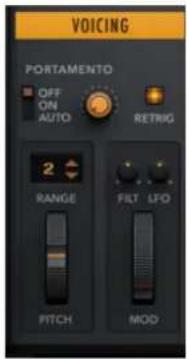
Portamento
Portamento makes the note pitch glide from the previous note to the new one, at the time set with the Portamento knob.
- When On, the pitch will always glide between consecutive notes.
- In Auto mode, the pitch will glide between consecutive notes only when you play legato.
If you release the previous key before hitting the new key, there will be no portamento effect.
Retrig
→ Click the Retrig button if you want to play Monotone and always retrigger the envelopes as soon as you play a new note.
When Off, the envelopes will retrigger only if you have released the previous note before playing the new note.
Range
→ Set the desired Pitch Bend range for the "Pitch" wheel with the up/down buttons, or by click-holding on the display and dragging up/down. Range: +/-24 semitones (+/-2 octaves) in steps of +/-1 semitone.
Pitch
The Pitch bend wheel can be used for bending note pitches up and down. Monotone also responds to Pitch Bend MIDI data from a connected MIDI master keyboard. You set the desired Pitch bend Range with the "Range" control above the Pitch bend wheel.
Mod
The Mod wheel can be used for controlling the Filter Frequency and LFO intensity in Monotone.
→ Raise the FILT knob above the Mod wheel to set the Filter Frequency modulation amount.
→ Raise the LFO knob above the Mod wheel to set the LFO intensity modulation amount.
Note that for the LFO modulation to work you need to already have some LFO modulation set in the Oscillator (see "LFO") and/or Filter (see "LFO") sections.
Panel reference
The Oscillator section
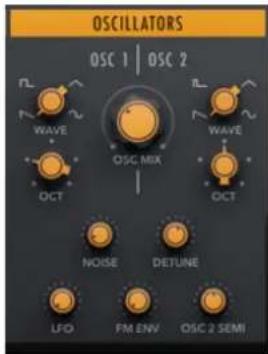
Here is where you choose oscillator waveforms and set the pitches for the two oscillators. You can also add noise and frequency modulate Oscillator 1 from Oscillator 2.
Waveform selector
→Turn the Wave knob to select one of four wave shapes.
The wave shapes are:
- Ramp
Also known as sawtooth. Generates a rich tone with both even and odd harmonics (overtones).
• Square (Pulse in Oscillator 2)
The square wave has a symmetric square shape and contains only even harmonics. The Pulse wave is basically a square wave with non-symmetrical shape, i.e. a duty cycle that is not 50%. The Pulse wave generally sounds a little thinner than a perfect square wave.
• Triangle
The Triangle wave only contains odd harmonics, and at lower intensities than the square wave overtones. This makes it sound a little “rounder” and with less bite than the square wave.
• S i n e
The Sine wave doesn't contain any overtones - only the fundamental. This makes it sound dull and makes it perfect as a sub bass an octave or two below another waveform in the other oscillator.
Oct
→Set the pitch in octave steps.
Range: 5 octaves.
Osc Mix
→Set the mix of the Oscillator 1 and 2 signals.
Noise
→ Turn up the Noise knob to introduce white noise to the oscillator signal mix.
Detune
→ Change the pitch in steps of 1 cent (in opposite directions for the two oscillators).
Range: +/- 50 cents (down or up half a semitone).
LFO
→ Turn the LFO knob to introduce pitch modulation to both oscillators from the current setting of the LFO section (see “The LFO section”).
FM Env
→ Turn the knob to have the oscillator 2 signal frequency modulate the oscillator 1 signal according to the current Envelope settings (see "The Envelope section").
Range: 0% (no tracking (constant pitch)) to 100% (1 semitone per note).
Osc 2 Semi
→Set the pitch of Oscillator 2 in semitone steps.
Range: +/-12 semitones (two octaves).
The Filter section
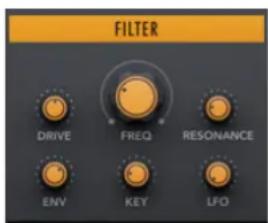
The Filter in Monotone is a classic 24 dB/octave lowpass ladder filter. If you raise the Resonance high enough, the filter will start to self-oscillate.
The picture below shows the lowpass filter's basic characteristics at four different resonance levels:
Amplitude
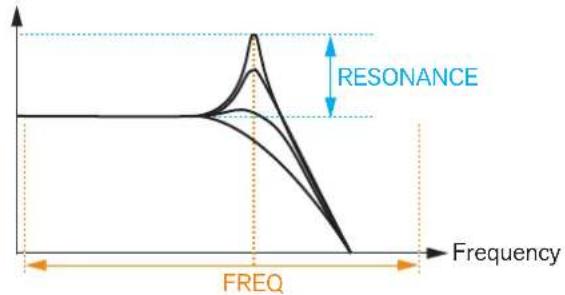
line
| Frequency | Resonance | | --------- | --------- | | Low | 0 | | Peak | High | | High | 0 |Drive
→ Turn the Drive knob to amplify and introduce an overdrive type of distortion to the signal fed into the filter.
Freq
→Set the cutoff frequency for the filter.
The cutoff frequency is where the filter starts to cut out/dampen the higher frequencies of the signal.
Resonance
This controls the resonance peak level at the currently set cutoff frequency (see "Freq" above).
The picture below shows a ramp oscillator signal lowpass-filtered at three different Resonance levels:
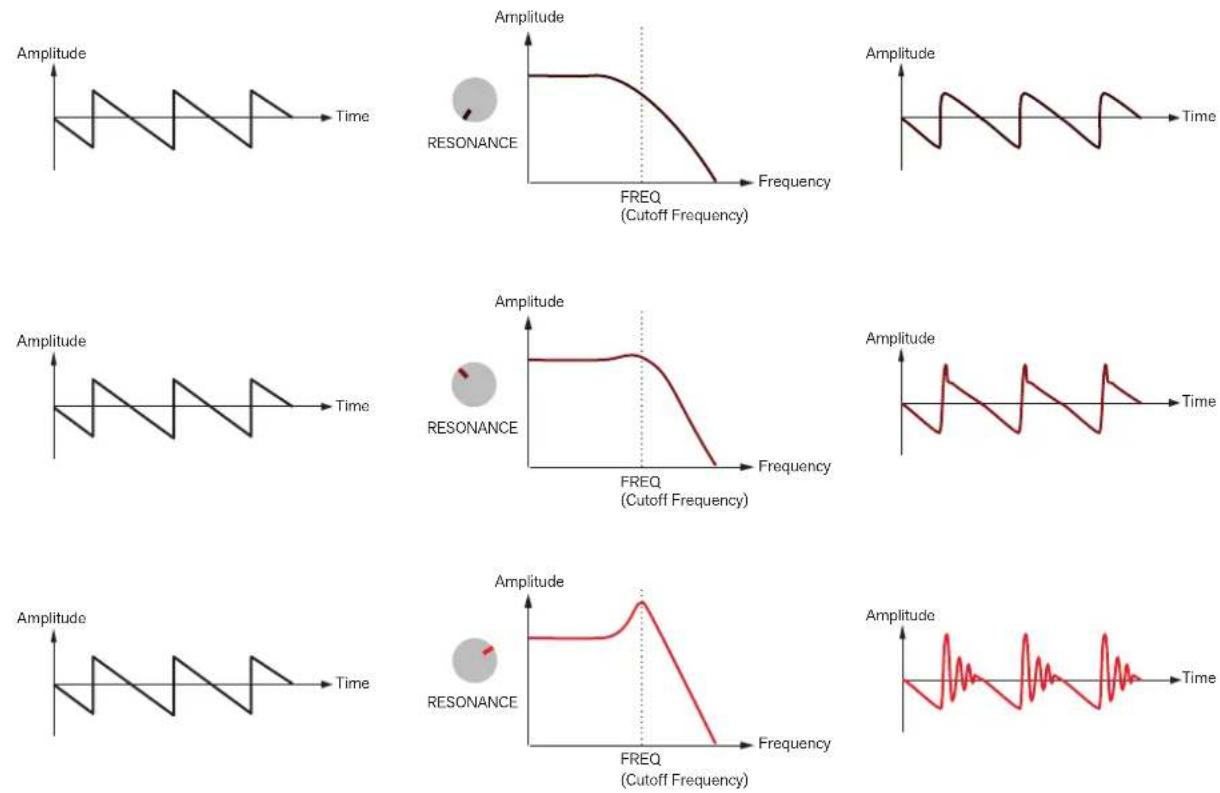
! Be careful when using high Resonance values as this could generate quite loud audio levels!
Env
→ Turn the Env knob to set the frequency modulation amount from the current settings of the Envelope (see "The Envelope section").
Key
→Turn the Kbd knob to set the keyboard tracking amount.
At 0% the filter cutoff frequency is static and doesn't track the keyboard at all.
At 100% the filter cutoff frequency tracks the keyboard 1 semitone per note.
LFO
→ Turn the LFO knob to set the frequency modulation amount from the current settings of the LFO (see "The LFO section").
The Amplifier section
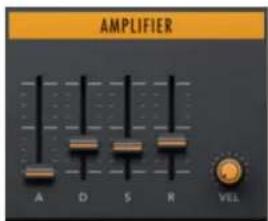
The Amplifier section contains a standard ADSR envelope, which controls the amplitude of the audio signal. The picture below shows the various stages of the ADSR envelope:
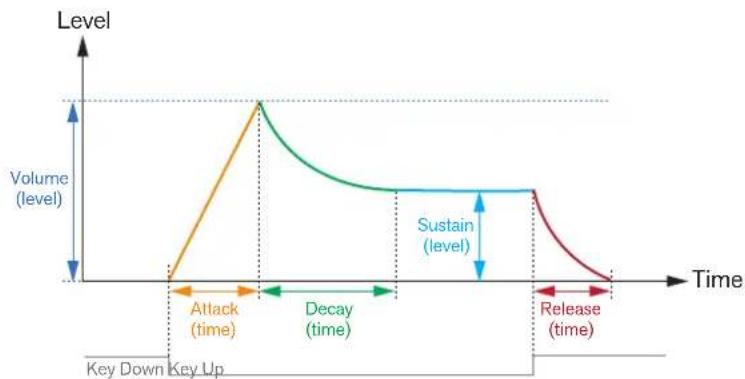
line
| Time Phase | Level | | ---------------- | ----- | | Attack (time) | 0 | | Decay (time) | Peak | | Sustain (level) | 0 | | Release (time) | 0 |The ADSR envelope stages.
A(ttack)
When you play a note on your keyboard, the envelope is triggered. This means it starts rising from zero to max level. How long this should take, depends on the Attack setting. If the Attack is set to "O", maximum level is reached instantly. If the Attack value is raised, it will take longer time before the maximum level is reached.
D(ecay)
After maximum level has been reached, the level starts to drop. How long this should take is governed by the Decay parameter.
If you want to emulate the volume envelope of a note played on a piano for example, the Attack should be set to "0", the Decay parameter should be set to a medium value and the Sustain level should be set to "0", so that the volume gradually decreases down to silence, even if you keep holding the key down. Should you want the decay to drop to some other value than zero, you raise the Sustain parameter.
S(ustain)
The Sustain parameter determines the level the envelope should rest at, after the Decay stage. If you set Sustain to full level, the Decay setting is of no importance since the volume of the sound is never lowered.
If you want to emulate the volume envelope of an organ, you theoretically only really need to use the Sustain parameter set to full level, as a basic organ volume envelope instantly goes to the maximum level (Attack "O") and stays there (Decay "O"), until the key is released and the sound instantly stops (Release "O").
But often a combination of Decay and Sustain is used to generate envelopes that rise up to max level, then gradually decreases to finally land to rest on a level somewhere in-between zero and maximum level. Note that Sustain represents a level, whereas the other envelope parameters represent times.
R(elease)
The Release parameter works just like the Decay parameter, except it determines the time it takes for the volume to drop back to zero after you release the key.
Vel
→ Turn up the Vel knob if you want the maximum level to be controlled from Keyboard Velocity.
The harder you play, the louder the maximum volume.
Chorus
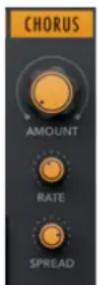
This is a stereo Chorus effect, which can be used for generating a fatter and wider sound.
Amount
→Set the Dry/Wet amount of the chorus effect.
Set to 0% for a completely dry (unprocessed) signal.
Rate
→Set the rate/speed of the chorus modulation.
Spread
→Set the stereo width of the chorus effect.
Set to 0% for a if you want the signal to be in mono.
Delay
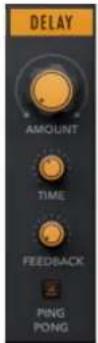
This is a stereo delay, which generates delayed copies of the original signal.
Amount
- Use this parameter to adjust the send level to the Delay effect. Set to 0% for a completely dry (unprocessed) signal.
Time
The delay time is synced to the main sequencer tempo.
→ Set the sync division to the main sequencer tempo with the Time knob. Range: 1/16, 1/8T, 1/8, 2/8T, 3/16, 1/4, 5/16, 4/8T, 7/16 and 2/4.
Feedback
→Set the number of delay repeats.
Ping Pong
→ Activate Ping Pong to have the delay repeats alternate between left and right in the stereo panorama.
The LFO section
An LFO (Low Frequency Oscillator) is used for generating cyclic modulation. A typical example is to have an LFO modulate the pitch of a signal to produce vibrato, but there are also other applications for LFOs. The LFO section features an LFO which can be set to control Oscillator pitch (see "LFO") and/or Filter frequency (see "LFO").
Rate
→Set the LFO rate/speed. Range: 0.06-94.0 Hz
Shape
→Turn the Shape knob to select one of three LFO wave shapes. The wave shapes are: Sine, Triangle and Square.


The Envelope section
The Envelope section features a standard ADSR envelope, which can be used for controlling Oscillator Frequency Modulation (see "FM Env") and/or Filter Frequency (see "Env").
The various envelope stages work exactly like those of the Amplifier, see "The Amplifier section".
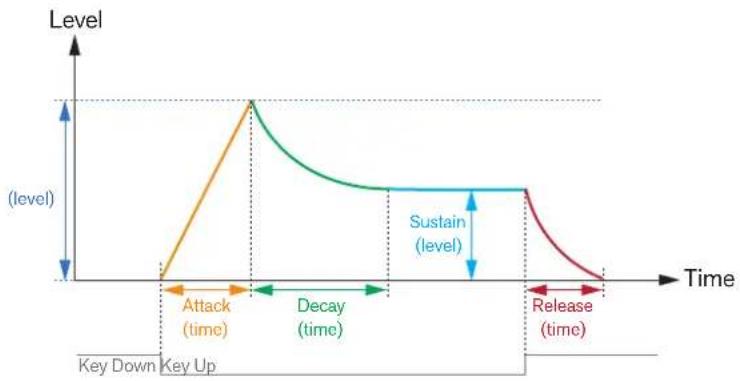
The ADSR envelope stages.
A(ttack)
→ Set the time it should take to reach from zero to maximum level.
D(ecay)
→ Set the time it should take to go from maximum level to the Sustain level (see below).
S(ustain)
→ Set the level the envelope should rest at, after the Decay stage (see above).
R(elease)
→ Set the time it should take to go from the Sustain level back to zero, after you have released the note.
Vel
→ Turn up the Vel knob if you want the maximum level to be controlled from Keyboard Velocity.
The harder you play, the higher the maximum level.
Connections
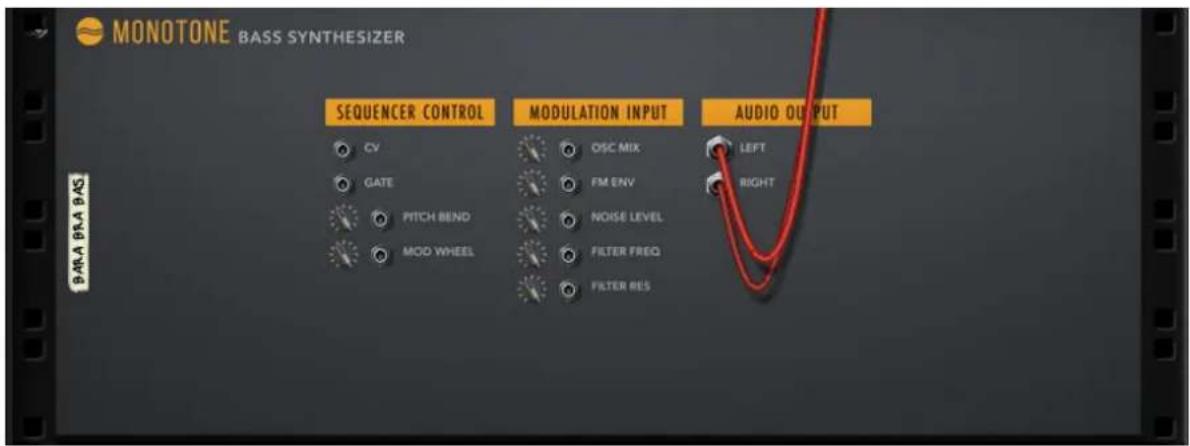
! Remember that CV connections are NOT stored in the Monotone patches! If you want to store CV connections between devices, put them in a Combinator device and save the Combi patch.
Sequencer Control inputs
The Sequencer Control CV and Gate inputs allow you to play Monotone from another CV/Gate device (typically a Matrix or an RPG-8). The signal to the CV input controls the note pitch, while the signal to the Gate input delivers note on/off along with velocity. There are also inputs for modulating the Pitch Bend and Mod Wheel parameters.
Modulation inputs
These control voltage (CV) inputs and can be used for modulating the corresponding parameters from external modulations sources.
Audio Output
These are the main audio outputs. When you create a new Monotone device, these outputs are auto-routed to the first available Mix Channel in the main mixer. If there is no Mix Channel available, a new one will be automatically created.

Chapter 30
ID8 Instrument Device
Introduction

The ID8 Instrument device is a synth module packed with great sounds - ideal for quickly creating nice complete arrangements. The sounds have been extracted from various Reason devices and ReFills to guarantee supreme audio quality.
The Sounds
The ID8 contains 36 presets divided into nine categories, with four sounds in each category. The categories are these:
- Piano
The Piano category features a grand piano, an upright piano, a dance oriented piano sound and vibes.
• Electric Piano
The Electric Piano category holds two classic electric piano sounds plus a digital FM type piano and a Clav.
• Organ
The Organ category contains two classic tone-wheel organ sounds, one transistor organ sound and a pump organ.
• Guitar
The Guitar category sports an acoustic steel string guitar, a clean electric guitar, a half-acoustic jazz guitar and a dulcimer.
- Bass
The Bass category features one fingered and one picked electric bass, an acoustic upright bass and a synth bass.
- Strings
The Strings category holds orchestral strings, arco strings, a small string section and a choir sound.
- Brass-Wind
The Brass-Wind category features Fat Brass, Brass Section, French Horns and Flute.
- Synth
The Synth category contains two classic monophonic synth lead sounds and two characteristic polyphonic pad sounds, one with fast attack and one with slow.
- D r u m s
The Drums category sports four extensive combinations of drums and percussion instruments aimed at different musical styles. Each "drum kit" contains between 53 and 65 different instruments, so there is plenty to choose from!
See "Velocity mapping" for information about the velocity mapping of some of the sounds.
The ID8 and Standard MIDI Files
The ID8 device is used by default when you're loading a Standard MIDI File into the Reason Lite sequencer. For every MIDI track in the imported file, you will get an ID8 device loaded with a sound that resembles the original sound. This serves as a starting point to be able to play back the imported MIDI file. However, you could of course change sound, or replace the ID8 with another instrument device afterwards.
Using the ID8
Selecting Sounds
→ Select Category by clicking the Up/Down buttons to the left of the Display.
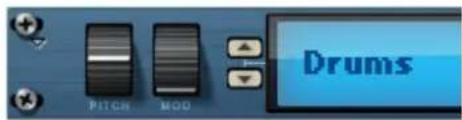
→ Select Sound in the selected Category by clicking on any of the A-D buttons, or by clicking on the Sound name in the Display.
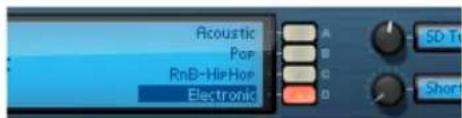
→ Click on the Category name in the ID8 Display to bring up a pop-up where you can select Category or replace the ID8 device with another device.
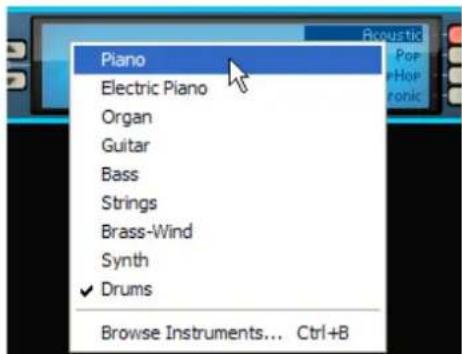
At the bottom of the pop-up, you can also choose "Browse Instruments...". Selecting this allows you to replace the ID8 device with another instrument device and load a new sound in that device.
Controlling Sounds
Parameter knobs
Each of the Sounds in the ID8 have two preset parameters assigned to the Parameter 1 and 2 knobs. The parameter names are shown in the small displays to the right of the corresponding knobs, and are different depending on the selected Sound.
Pitch Bend and Mod Wheel
To the left on the ID8 front panel are the standard Pitch Bend and Mod Wheel. The Pitch Bend range is +/- 2 semitones and is the same for all sounds. The Mod Wheel is assigned a little differently depending on the selected Sound, but usually controls vibrato. In the Drums Category, however, the Mod Wheel has no effect, except on the Electronic Drums where it controls the cutoff frequency of a lowpass filter.
Performance Controllers
The sounds in the ID8 also respond to the standard Performance controllers "Sustain Pedal", "Aftertouch", "Expression" and "Breath Control". The parameter assignments can be a little different depending on selected sound. However, "Sustain Pedal" always controls sustain and "Expression" always controls volume.
Velocity mapping
A lot of the sounds in the ID8 are multi-sampled. They also have several velocity layers to faithfully reproduce the original instruments. Some of the sounds also use different types of samples for the highest velocity layer. This means that instead of just sounding louder, they will also sound different. For example, the Jazz Semi Guitar as well as the Finger, Pick and Upright basses have glissando or sliding notes in the highest velocity layer. The Arco Strings have pizzicato (picked) notes in the top velocity layer.
About saving edited Sounds
Since the ID8 is designed as a "preset" sound module, there is no dedicated function for saving edited Sounds. However, any edits you have made of the parameters in a Sound are automatically stored with the song (document) when you save the song.
- You could also include one or several ID8 Instrument devices in a Combinator device and save the Combinator patch. Doing so will automatically store the settings of the ID8 Parameters in the Combinator patch. See "The Combinator" for more details.
Chapter 31
MIDI Out Device
Introduction

The MIDI Out Device is designed for controlling external MIDI instruments, i.e. instruments that live outside of Reason Lite. These could be other software synths or external hardware instruments that are hooked up to a MIDI interface on your computer.
The MIDI Out Device is treated like any other instrument device in the Reason Lite sequencer, including Note Lanes and automatable controls. One exception, though, is that the MIDI Out Device does not produce any sound of its own; it has to be routed via MIDI Out to an external MIDI instrument.
Using the MIDI Out Device
Setting up for controlling an external MIDI instrument
! To be able to control external MIDI instruments from Reason Lite it is required that you have installed a MIDI interface on your computer. Refer to the documentation of your specific MIDI interface for installation instructions.
1. Connect your external MIDI instrument to the MIDI interface on your computer: MIDI Interface MIDI Out to MIDI instrument's MIDI In.
If you want to play and/or record MIDI from your MIDI instrument to Reason Lite, connect your instrument's MIDI Out to your computer's MIDI In as well, see "Recording MIDI Controller automation from the controlled MIDI instrument".
! If you are using the same MIDI instrument also as MIDI Master Keyboard for Reason Lite, you will need to set it to "MIDI Local Off". Otherwise you will get doubled notes when you play your MIDI instrument.
To be able to hear your external MIDI instrument in Reason Lite, connect your instrument's audio output(s) to the desired audio input(s) of your audio interface. Then, create an Audio Track, select the appropriate audio inputs and make sure the Monitor button on the Audio Track in the sequencer is on.
- Create a MIDI Out Device from the "Instruments >" sub-menu in the Create menu or from the Instruments palette in the Browser.
The device is created in the rack and a track is automatically created in the sequencer.
! Make sure that the MIDI instrument controlled by the MIDI Out Device device does NOT transmit the MIDI data back to Reason Lite (e.g. via "MIDI soft through" or "MIDI throughput"). This could cause MIDI feedback loops that could result in MIDI overflow in Reason Lite.
Refer to the user manuals for your MIDI instruments for information on how to set the instruments to MIDI Local Off and how to prevent MIDI feedback loops.
- Select the desired MIDI Port from the drop-down list to the right of the display.
All MIDI Ports that are currently available for Reason Lite on your computer are displayed in the list.
- Click the up/down MIDI Channel arrow buttons to select the MIDI Channel your external MIDI instrument is set to receive on.
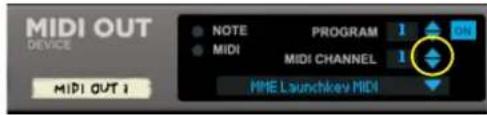
The selected MIDI Channel number is shown in the display.
- Select the MIDI Out Device track in the sequencer.
Now, you should be able to play your external MIDI instrument from your Master Keyboard.
! If you get problems with "hanging" notes, press [!] to send out an "All Notes Off" command on the MIDI port.
The "MIDI: Send All Notes OFF" command can also be found in the Options menu.
Controlling the sound of your external MIDI instrument
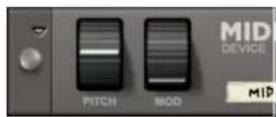
Besides the keyboard note control, you can also control the sound of your external MIDI instrument by using the Pitch (bend) and Mod (wheel) controls, as well as Keyboard Velocity and Aftertouch.
How your sound responds to these controls is totally dependent on how the sound was programmed in your external instrument. For example, Pitch Bend range, Mod Wheel modulation destination, Velocity and Aftertouch modulation need to be defined on your external MIDI instrument.
Using MIDI Program Change
The Program Change MIDI message is used for selecting the desired sound/program/preset on MIDI instruments that have memory locations for stored sounds. The MIDI Out Device has a dedicated control for this, the Program control.
- Click the On button to activate the MIDI Program Change function.
- Click the up/down arrow buttons to select the Program number that corresponds to the sound you want to recall on your external MIDI instrument.
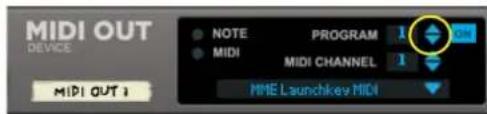
As soon as you load your Reason Lite song, the MIDI Out Device will automatically send out the selected MIDI Program Change message on the set MIDI Port. This ensures that your connected instrument will play the correct sound/program/preset.
Automating MIDI Program Change
If you like, you can automate the Program parameter to change sound/program/preset of your external instrument during playback of your Reason Lite song.
- Right-click the Program up/down buttons, or the display, and select "Edit Automation".
This creates a separate Program Change automation lane in the sequencer track.
- Now, you can edit the Program Change lane in the sequencer and insert Program Change automation points wherever you like in your song.
! It's recommended to place the Program Change automation points slightly before the positions where you want the new sound/program/preset to appear in your song. This is to allow for the time it takes to load the new sound in your external instrument.
A note about MIDI Bank Select
The MIDI Bank Select message is used for selecting specific banks of sounds/programs/presets in MIDI instruments that feature several sound banks.
There is no specific panel control for MIDI Bank Select in the MIDI Out Device. However, you can use the regular MIDI Controller automation described below for inserting Bank Select automation points. MIDI Bank Select normally uses MIDI CC #0 and/or #32. Refer to the MIDI documentation of your specific instrument for details.
! Note that MIDI instruments that have several banks of sounds usually expect a Bank Select message to be immediately followed by a Program Change message in order to change the bank and program/preset. In these situations, sending only a Bank Select message - without a subsequent Program Change message - will not change anything.
! Note that Reason Lite only sends out MIDI CC data when they actually change. This means that you might have to send a different “temporary” MIDI CC value just before you send the actual MIDI CC value. For example, if you want to resend the value “1” for MIDI CC#32, first send another value (e.g. “0” or “2”) and then send the value “1” immediately afterwards. You can do this by adding and/or moving automation points in the automation clip for MIDI CC#32 in the sequencer, see “Editing parameter automation”.
Recording MIDI Controller automation
Besides automation of the panel controls, the MIDI Out Device allows you to record automation of MIDI Controllers 0-119. Each recorded MIDI CC# shows up on separate automation lanes in the sequencer and can be edited in the same fashion as regular “internal” parameter automation.
Recording MIDI Controller automation from the MIDI Out Device
To record MIDI CC# automation from the MIDI Out Device, proceed as follows:
- Select the desired MIDI CC# by dragging up/down in the CC display.
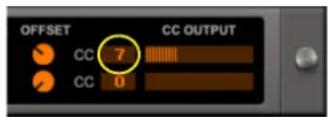
- Click Record in the sequencer and record the automation by turning the Offset knob.
An automation lane, named according to the selected MIDI CC#, is created on the sequencer track and automation points are inserted as you turn the Offset knob. When you stop the sequencer, the Offset knob displays a green automation frame.
- To record automation of another MIDI CC# parameter, select the desired MIDI CC# by dragging up/down in the CC display (the same display as in Step 1 - or the display below it).
The green automation frame around the Offset knob disappears as soon as you select a non-automated MIDI CC#. If you drag back to the automated MIDI CC#, the automation frame appears again around the Offset knob.
- Repeat steps 1-2 for every new MIDI CC# you want to record.
A new parameter automation lane is added on the sequencer track for every new MIDI CC# you record.
- You could also draw parameter automation points in parameter automation clips the same way as with internal Instrument devices in Reason Lite, see “Automation editing”.
Recording MIDI Controller automation from a Remote control surface
If you have a MIDI keyboard or control surface with knobs or sliders, you can use these to control parameters on your MIDI instrument and record automation. This is done using Remote Override Mapping:
-
Select the first MIDI CC# you want to control by dragging up/down in the CC display.
-
Right-click the Offset knob and select Edit Remote Override Mapping...
3. Move a knob or slider on your controller.
Reason Lite automatically detects which knob/slider you move and assigns this to the selected MIDI CC#:
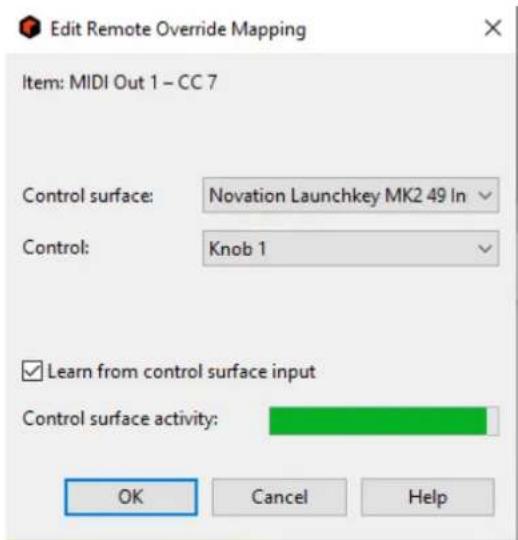
Knob 1 on the control surface assigned to MIDI CC#7.
4. Click OK.
You have now mapped that knob or slider to the MIDI CC# you selected in step 2.
5. Repeat the procedure from Steps 1-4 to assign more MIDI CC# to other knobs/sliders of your keyboard controller.
This way you can map all the controls on your keyboard or control surface to different MIDI CC# if you like.
! Note that dragging in the same display to select a new MIDI CC# will not erase the previous assignment(s) - only add an additional MIDI CC#:
When you're done mapping, you can record parameter automation by clicking Record in the sequencer and moving the assigned knobs and sliders on your MIDI keyboard/control surface.
Recording MIDI Controller automation from the controlled MIDI instrument
If your MIDI instrument has a panel with knobs/buttons/sliders etc. that can send MIDI Controller data, you might want to record the MIDI CC# automation from that panel instead of from Reason Lite or from your control surface. To be able to do this, you have to add your MIDI instrument as a MIDI Control Keyboard in Reason Lite. This can be done as follows:
- If you haven't already, connect a MIDI cable from your MIDI instrument's MIDI Out to a MIDI In jack on your computer's MIDI interface.
- Make sure you have set your MIDI instrument to "MIDI Local Off" as well as disabled any MIDI "soft thru" so that you don't get any MIDI feedback loop.
Refer to the documentation of your MIDI instrument on how to do this. - Open the Preferences dialog and click the Control Surfaces tab.
- Click the Add Manually button.
5. Select from the Manufacturer drop-down list:
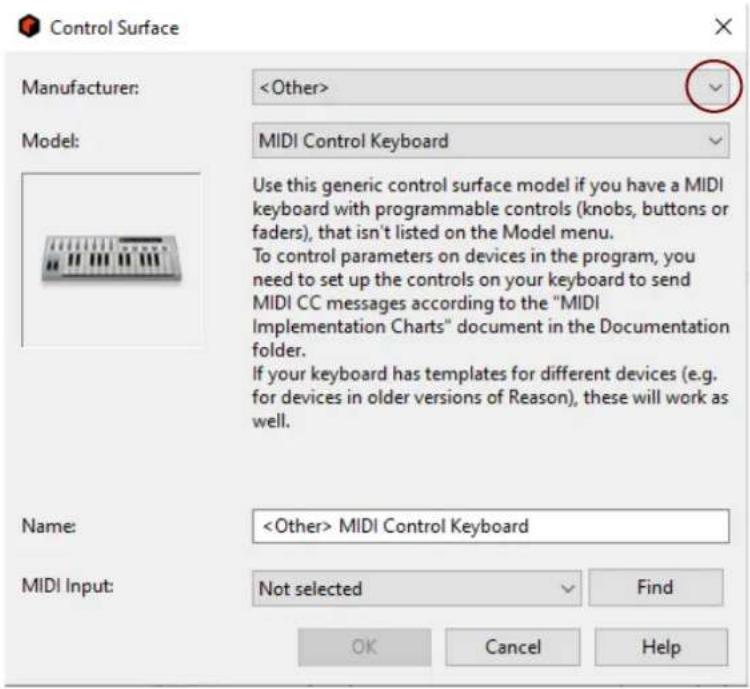
Selecting "
→ If your MIDI instrument has a keyboard, select "MIDI Control Keyboard" from the Model: drop-down list. This way, you will be able to play MIDI Notes from your instrument as well as sending MIDI Controller data.
→ If your MIDI instrument is a rack instrument (without a keyboard), select "MIDI Control Surface" instead.
6. Select the appropriate MIDI Input from the "MIDI Input" drop-down list.
Alternatively, click the "Find" button and turn a knob on your MIDI instrument. Reason Lite will then auto-detect the correct MIDI In port and automatically select it.
7. Click OK.
Now, your MIDI instrument is shown in the "Remote keyboards and control surfaces:" list along with your other assigned control surfaces (if any).
! Make sure the "Use with Reason Lite" check box is selected and that the green check mark is present.
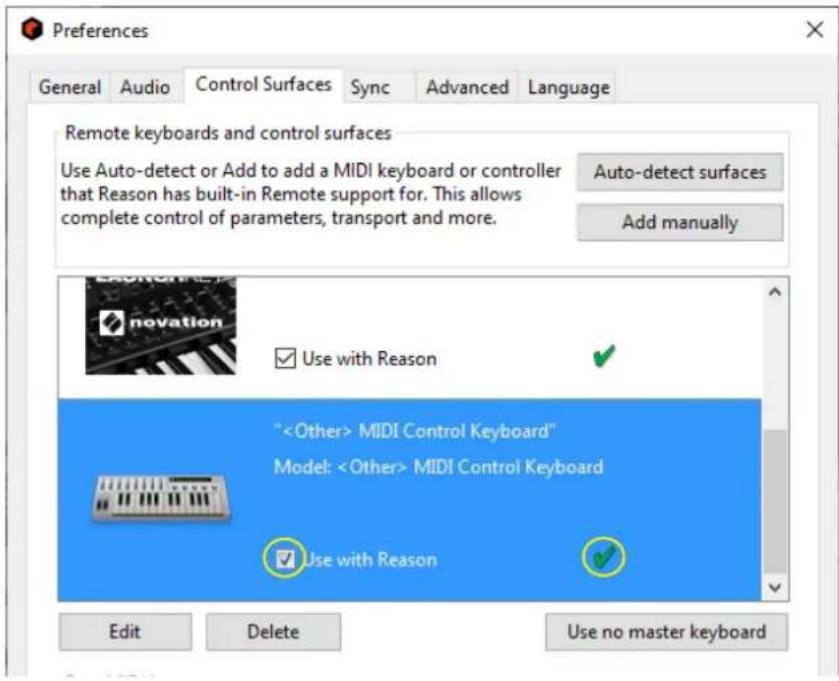
- Now, select the MIDI Out Device track in the sequencer and click the Record button on the Transport Panel.
If you turn or press a panel control (knob, slider, button, etc.) on your MIDI instrument during recording, each parameter will automatically create a new automation lane and record the corresponding MIDI CC data in a parameter automation clip, just like when you record parameter automation from an internal instrument device:
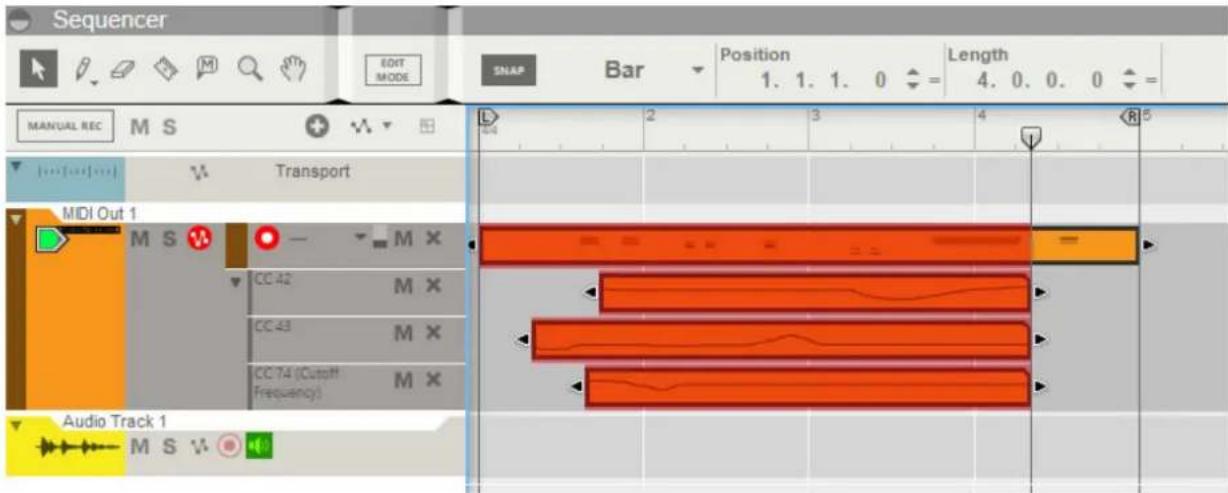
Parameter automation recording from three knobs on the MIDI Out Device panel.
! You might have to edit the parameter automation clips afterwards and set appropriate Static Values etc., see "Editing parameter automation in Edit Mode".
Modulating MIDI Controllers from CV signals
The MIDI Out Device features eight CV inputs for routing modulation signals from the rack to MIDI CC# of your choice.
- Flip the rack around and connect some modulation sources to the desired CV inputs:

- Flip the rack back to the front and click the On button to activate the CV IN section:

CV signals routed to any of the four CV IN pairs are indicated by lit LEDs:

- Click to select which CV IN pair to edit:

- Drag up/down to select the desired MIDI CC# to route the CV modulation signals to:

- Turn the Scale knobs to change the modulation range, from static (0-0) to full (0-127):

- Turn the Offset knobs to change the modulation offset (0-127):

The modulation level(s) are shown in the CC Output displays:

-
Repeat steps 3-6 to assign and set up the other CV IN pairs.
-
CV can be bipolar (have negative or positive values) but MIDI CC values are always positive. Any negative CV values will be truncated to zero when converted to MIDI CC. To preserve the shape of e.g. a modulation LFO, you can use the Scale and Offset controls to convert the bipolar CV (going between -127 and +127) to a MIDI CC going between 0 and 127. In that case, set both Scale and Offset halfway up.
- You can also use the Offset knobs for manually setting MIDI CC values without anything connected to the CV inputs.
- The CV Input ON button enables CV inputs. Turn this off if you want to make manual settings, select MIDI CCs etc, without the values being modulated by CV.
Connections

Sequencer Control
The Sequencer Control CV In and Gate In inputs allow you to play the MIDI Out Device from another CV/Gate device (typically a Matrix or an RPG-8). The signal to the CV In controls the note pitch, while the signal to the Gate In delivers note on/off along with velocity. There are also inputs for modulating the Pitch Bend and ModWheel parameters.
CV In to MIDI CC Out
These eight CV inputs can be used for modulating the desired MIDI CC#. The affected MIDI CC#s are defined on the front panel, see "Modulating MIDI Controllers from CV signals".
Tips & Tricks
Audio recording of MIDI controlled external instruments
At some point you will probably want to record the audio from your MIDI controlled instrument onto an audio track in the Reason Lite sequencer. The example below assumes that you have already recorded the note clips that control your MIDI instrument on an MIDI Out Device track in the sequencer.
! Depending on how you are monitoring the audio when you are recording, there will be different audio latency times, see "Recording Latency Compensation".
1. If you haven't already, connect your MIDI instrument's audio output(s) to the desired audio input(s) on the audio interface you are using with Reason Lite.
2. Create an Audio Track in the sequencer.
3. Select the appropriate audio interface input(s) in the "Select Audio Input" drop-down list in the sequencer track list:
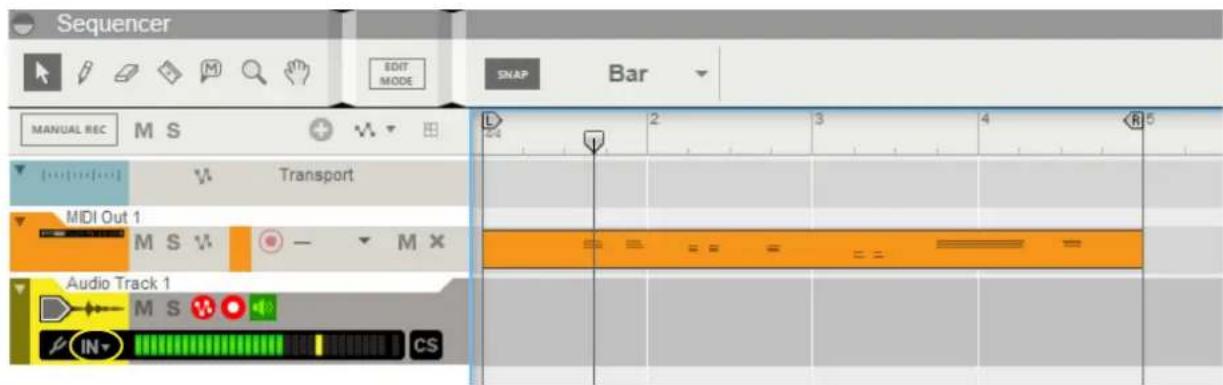
- Play back the song and adjust the audio level on your external MIDI instrument and/or the audio interface gain.
To be on the safe side, leave around 12dB of headroom below the clipping level (first yellow LED lit on the Input Level Meter on the Audio Track):
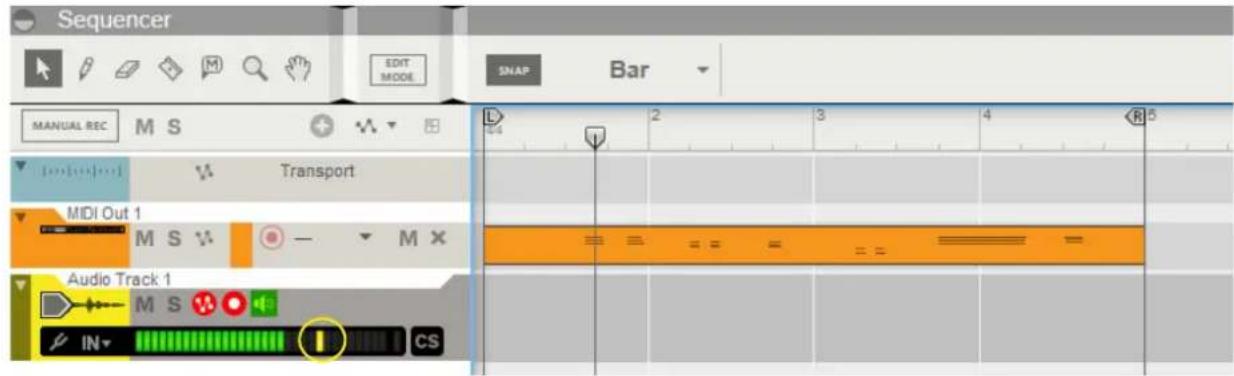
- You might also have to move (or nudge) the MIDI clips on the MIDI Out Device track back slightly to compensate for any MIDI latency. Alternatively, you could slide all the notes in the clip back using the ReGroove Mixer, see "Using the ReGroove Mixer for MIDI latency compensation".
-
If you don't want to adjust the MIDI notes beforehand to compensate for MIDI latency, you could move all Slice Markers in the audio clip after recording (see the tip below) or try quantizing the audio clips. MIDI latency mainly occurs in the MIDI interface and in the connected MIDI instruments and is nothing Reason Lite can automatically compensate for. Refer to "Moving clips" for more information.
-
Make sure the Audio Track is enabled for recording and then click Record in the sequencer to start recording the audio from your MIDI instrument.
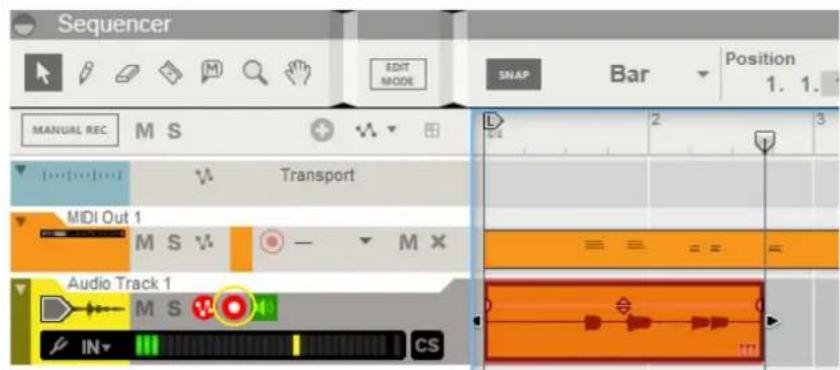
- When you are finished with the audio recording, click Play to play back the recorded audio.
! If you are monitoring your external instrument externally, you will want to mute the MIDI Out Device track so that you don't get double notes or phasing problems during playback.
If you are monitoring your external instrument only internally in Reason Lite, there is no need to mute the MIDI Out Device track. During playback, the monitor function on the audio track is automatically disabled, and only the recorded audio on the audio track is output.
- If you are experiencing problems with MIDI latency, i.e. the audio is recorded a little late in the audio clips, a good thing to try is to quantize the audio clips after recording, see "Quantizing audio".
- If quantizing the audio clip isn't applicable (e.g. due to playing style or type of sound), open the clip inline, select all Slice Markers and move them slightly to the left in the clip (with Snap off) so that the first note/beat aligns with the clip start. See the last example in "Selecting Slices and Slice Markers" for info about selecting and moving Slice Markers.
Using the ReGroove Mixer for MIDI latency compensation
If you are experiencing MIDI latency when playing back recorded MIDI notes to your external instrument, you can compensate for this by using the Slide function in the ReGroove Mixer. This way you won't have to move or nudge the note clip(s) back before recording your external instrument onto an audio track in Reason Lite.
- Set up your external instrument according to the descriptions in steps 1-4 in "Audio recording of MIDI controlled external instruments".
- Make sure the Monitor button on the audio track is on.
- Assign a ReGroove channel to the MIDI Out Device track.
In this example we use ReGroove channel A1.

- Make sure Click is on in the sequencer.
- Play back the song and turn the Slide knob in channel A1 of the ReGroove Mixer counter-clockwise until your external instrument plays back in sync with the sequencer click.
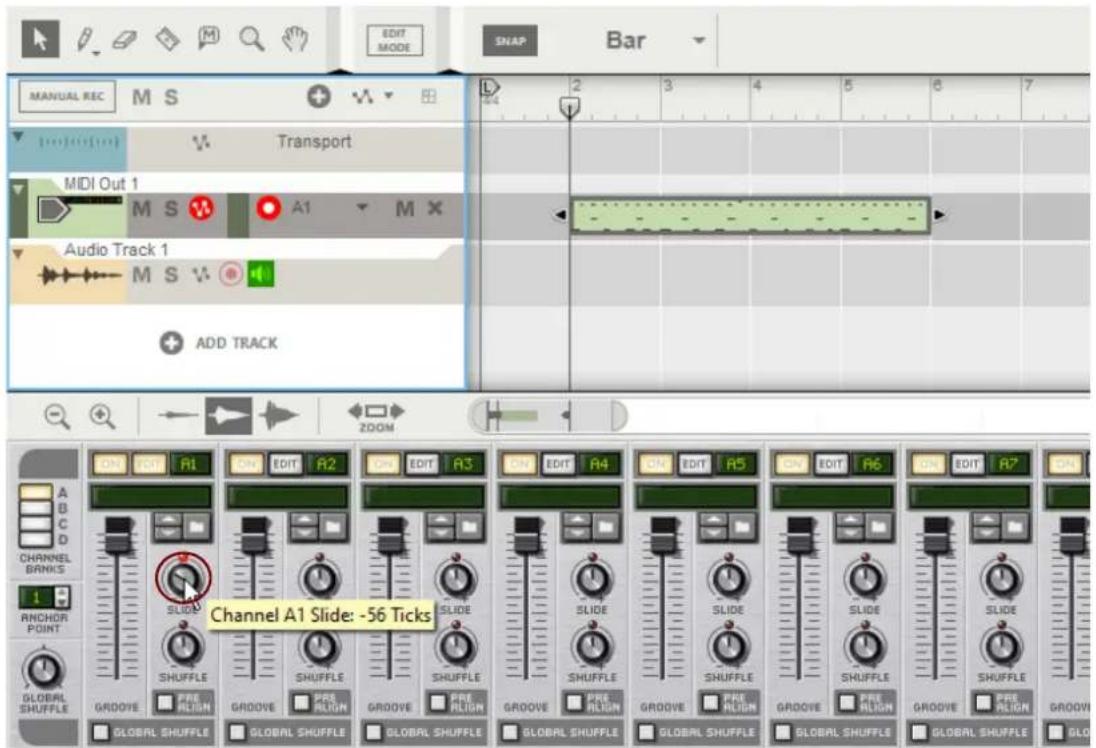
! Note that the Ticks value you set with the Slide knob is tempo dependent. This means that if you raise the Tempo in the sequencer you will have to set the Slide knob to a lower (more negative) value to maintain the sync - and vice versa.
- Before you begin recording onto the audio track there is one important thing to keep in mind:
! If there are MIDI notes present exactly on the note clip start position you have to begin the audio recording before the note clip's start position.
Since all notes in the note clip have been (invisibly) slid back by the ReGroove Mixer, it means that the first notes could be located before (outside) the note clip. To be able to record also these first notes, the audio recording have to begin before the note clip's start position. If your MIDI Out Device note clip is placed at the very beginning of the song you will have to move all clips forward in the sequencer, so that the audio recording can begin earlier.
- Record your instrument onto the audio track.
After recording, the audio should be on the track with perfect timing.
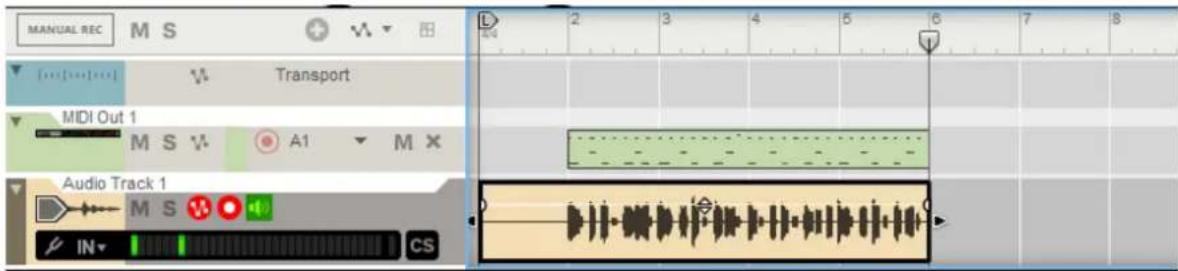
Chapter 32
Scream 4 Sound
Destruction Unit
Scream 4 Sound Destruction Unit

Scream 4 is a very versatile stereo in/out sound destruction device, capable of warping any sound literally beyond recognition, but also capable of producing more subtle musical effects. Scream 4 features a wide range of algorithms for distortion and sound mangling which can be combined with an EQ and a resonant "Body" section to provide everything you need to add an edge to your sounds. This effect is most often used as an insert effect.
About the Patch format
Unlike most of the other effect devices, Scream 4 features programmable effect presets. Included are a number of factory Patches which can be used as they are or provide you with a good starting point for further tweaking.
Patches use the Windows file extension "*.SM4". Loading and saving Patches is done in the same way as for instrument devices.
Parameters
Scream 4 contains three main sections; Damage (distortion and other types of sound destruction), Cut (EQ) and Body (places the sound in a resonant environment - can serve as anything from a cabinet emulator to a wah-wah to completely new special effects) which can be switched on or off independently. The parameters in each section are as follows:
Common effect device parameters
While the specific parameters for the Scream 4 effect device are described below, some features and procedures are common to all effect devices. Please, refer to "Common effect device features" for information about the Input meter, the Bypass/On/Off switch and Signal Flow Graphs on the effect device.
Damage section controls
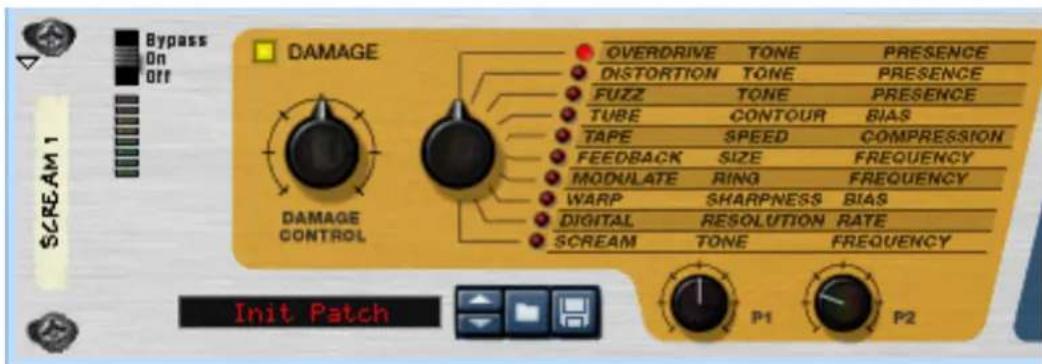
The "Damage" section is where you specify the basic sound mangling algorithm and make settings to inflict the desired amount of damage to the sound. There are ten basic algorithms to chose from, ranging from classic distortion effects to digital-sounding warping and modulation effects.
There are five controls in this section, with the following functions:
| Parameter | Description |
| Damage button This switches the Damage section on or off. | |
| Damage Control knob This controls the input gain which in turn determines the amount of damage inflicted. The higher the value, the more destruction!When raising the Damage Control you may need to lower the Master level to maintain the same output level (and vice versa). | |
| Damage Type knob This selects the type of effect - see the table below for a description of the available damage methods. | |
| P1/P2 knobs The functionality of these knobs vary according to the selected Damage Type - see the table below for a description. | |
Description of the various Damage Type algorithms
Here follows a basic description of the ten Damage Types available, and what parameters the P1/P2 knobs control for each type:
| Type | Description |
| Overdrive | This produces an analog-type overdrive effect. Overdrive is quite responsive to varying dynamics. Use lower Damage Control settings for more subtle “crunch” effects.- The P1 knob controls the basic tone of the effect. Turn clockwise for a brighter sound.- The P2 knob controls Presence. Presence boosts frequencies in the high midrange before the distortion stage which in turn affects the character of the distortion. Turn clockwise for more Presence boost. |
| Distortion | Similar to Overdrive, but produces denser, thicker distortion. The distortion is also more “even” across the Damage Control range compared to Overdrive.- The P1/P2 knobs control Tone and Presence, respectively - see Overdrive for a description. |
| Fuzz Fuzz produces a bright and distorted sound even at low Damage Control settings.- The P1/P2 knobs control Tone and Presence, respectively - see Overdrive for a description. | |
| Tube This emulates tube distortion.- The P1 knob controls Contour, which is somewhat like a high pass filter, changing the tone and character of the distortion.- The P2 knob controls Bias, which changes the “symmetry” of the tube distortion. Setting this to the minimum or maximum value will produce asymmetrical distortion (typical of a real-life tube amplifier), while a 12 o’clock setting will produce symmetrical distortion (odd harmonics only). | |
| Tape | This emulates the soft clipping distortion produced by magnetic tape saturation and also adds compression which adds “punch” to the sound.- The P1 knob controls Speed, which simulates tape running at different speeds. The higher the Speed setting the more of the original high frequency material in the signal. Turn clockwise for a brighter sound.- The P2 knob controls the amount of Compression. Turning the knob clockwise increases the compression ratio. |
| Feedback This effect combines distortion in a feedback loop which can produce many interesting and sometimes unpredictable results. Feedback is basically when a sound source is fed back to itself. An open microphone picking up sound from a nearby loudspeaker that is also being used to amplify sound from the microphone will produce a feedback loop with the associated typical howling. For this effect the Damage Control knob controls the gain of the feedback loop.- The P1 knob controls Size, which could be described as the “length” (i.e. the distance between the microphone and the loudspeaker in the above example) of the feedback loop.- The P2 knob controls Frequency, which for this effect determines which overtones will “howl”. | |
| Modulate | Modulate first multiplies the signal with a filtered and compressed version of itself, and then adds distortion. This can produce resonant, ringing distortion effects.- The P1 knob controls Ring, which is the resonance of the filter. Turn clockwise for more pronounced ringing effects.- The P2 knob controls Frequency, which is the filter frequency. Turn clockwise to raise the filter frequency which generally produces a sharper, more piercing effect. |
| Warp Warp distorts and multiplies the incoming signal with itself.- The P1 knob controls Sharpness. Lower values will produce a soft, compressed distortion, while higher values produces more harmonics and a sharper sound.- An effect of multiplying a signal with itself is that the fundamental pitch is removed from the signal, leaving overtones only. The P2 knob controls Bias - raise this to reintroduce the fundamental pitch in the sound. | |
| Digital | Lo-fi anyone? This reduces the bit resolution and sample rate for raw and dirty sounds or for emulating vintage digital gear.- The P1 knob controls (bit) Resolution. If the knob is turned fully to the right there is no bit reduction, fully the left the resolution is 1-bit.- The P2 knob controls the sample rate. If the knob is turned fully to the right the sample rate is not reduced; turning it to the left gradually reduces the sample rate. |
| Scream Similar to Fuzz, but with a bandpass filter with high resonance and gain settings placed before the distortion stage.- The P1 knob controls the basic tone of the effect. Turn clockwise for a brighter sound.- The P2 knob controls the filter frequency. The high resonance setting of the filter makes it suitable for wah-wah effects. | |
Cut section (EQ)
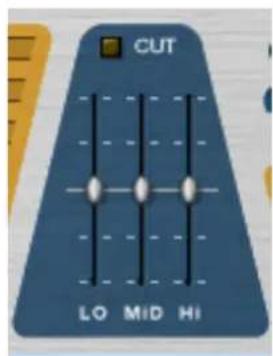
The sliders in the Cut section are tone controls, allowing you to cut or boost the level by up to 18dB in the low, mid and high frequency areas. The Cut section is activated with the Cut button above the sliders.
Move the slider from the middle upwards to boost the level, and from the middle downwards to cut the level of the corresponding frequency area.
Body section
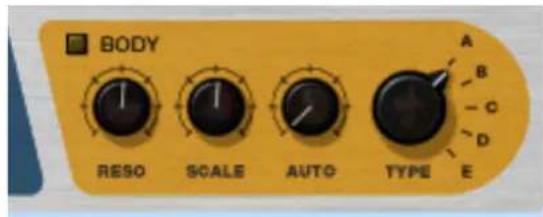
The Body section is just what it says - it places the sound in a resonant "body". Depending on the settings, the result can be similar to a speaker cabinet simulator, an auto-wah effect, or effects with no real-world counterpart. The section is based on 5 basic body types, which simulate how a sound is affected by different physical enclosures. The size and resonance of the Body types can be changed, and the section also features an envelope follower.
The Body parameters are as follows:
| Parameter | Description |
| Body button This switches the Body section on or off. | |
| Body Type knob This is used to select one of the five available Body types (A-E). | |
| Body Reso knob | This simulates the resonance of the selected Body. Turning the knob clockwise gives a more resonant effect. |
| Body Scale The Body Scale parameter could be said to control the "size" of the Body. Note that this is "in-verted" - turning the knob clockwise reduces the emulated size. | |
| Auto knob Determines the amount of envelope follower effect on the Scale parameter - see below. | |
About the envelope follower
The Body section features an envelope follower for dynamic control of the Scale parameter. The envelope follower analyzes the amplitude of the incoming signal and changes the Scale setting accordingly - the louder the incoming signal the higher the value of the Scale parameter. The operating frequency (or size) range is set with the Scale parameter, and the envelope follower amount is set with the Auto parameter. A typical use for this is auto-wah effects - try Body Type "B" for a pronounced wah effect.
- On the back of the Scream 4 you will find an Auto CV output - this delivers the CV signal from the envelope follower, allowing you to dynamically control parameters in other devices.
About the Master level control
The Master level control should be used when you need to increase or decrease the output level, while retaining the basic character of the effect. It can also be used to balance the level between the distorted sound and the "clean" (unprocessed) sound if the effect is to be switched in and out in the mix.
If the output level is too high, turning down the Damage Control setting would lower the output, but it would also change the character of the distortion, as would changing eq or presence settings.
Simply lowering the mixer channel level (for the channel that Scream 4 is connected to) would also work of course, but this would also mean that the level difference between the unprocessed and processed sound would increase.
So if the clip indicator lights up on the Transport, or if the distorted sound is too loud compared to the normal sound, the solution is to lower the Master output level.
As pointed out elsewhere in the manual, audio out clipping (indicated by the red clip indicator lighting up on the Transport Panel) can only happen in the Reason Lite Hardware Interface. In other words, you never have to worry about levels passed internally from device to device. However, bear in mind that if you use high Master output settings (or a lot of boost in the Cut section) Scream 4 can quite easily cause audio out clipping - and that is most likely not a distortion effect you want!
CV inputs and outputs
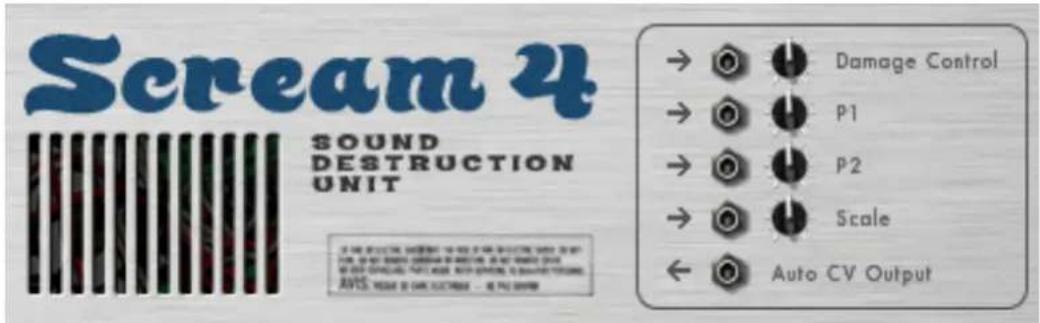
On the back of the Scream 4 you will find CV inputs for controlling the following four parameters:
→Damage Control
Use this for dynamically changing the amount of damage effect.
→P1
The use for this depends on the selected Damage Type. For example, if the Feedback effect is selected, this will control the Size parameter - connect it to the CV Out on a Matrix or synth LFO for strange, flanger-like sweeps.
→P2
The use for this depends on the selected Damage Type. For example, if the Scream effect is selected, this will control the Frequency parameter, producing a distorted wah wah sound.
→Scale
Lets you control the Scale parameter in the Body section from another CV source, for wah wah-like effects, etc.
In addition, you find a CV output from the "Auto" (envelope follower) function in the Body section. By connecting this to a CV input for a parameter in another device, the level of the signal going into the Scream 4 will affect that parameter. See below for an example on how to use this.
Screamy tips and tricks
Don't restrict yourself to using Scream 4 as a basic distortion stompbox, but try it in as many ways as possible - you may be surprised to find how often Scream 4 can add power, warmth and color to your sounds. Here are some examples:
Creating a heavy drum sound
Scream 4 is ideal for processing drums. Try connecting it as an insert effect to a Redrum device and experiment with the Damage Types and settings.
- For classic distorted drums, try the Tube, Tape or Distortion algorithms.
- The Scream algorithm is excellent for a really raw body or industrial drum sound.
- For more weird, synth-like effects, try the Modulation or Warp effects.
Remember that you don't have to route the whole drum kit through the Scream device - sometimes it may be better to route the individual outputs from the bass drum, snare and/or toms to a Spider Audio Merger (see "Spider Audio Merger & Splitter"), connect the merged output of the Spider to the Scream 4 and route this to a separate channel in the Mixer. That way, hi-hats, cymbals and similar are unprocessed.
Warming up a mix with the Tape effect
If you find your mixes a bit sterile, the Tape algorithm is excellent for providing some warmth and gentle distortion:
- Create a Scream 4 device and connect it between the main outputs of the Mixer and the Audio Hardware device.
- Set the Damage Type to Tape.
Make sure the Cut and Body sections are turned off.
- Start with a low Damage Control setting and P1 (Speed) and P2 (Compression) at 12 o'clock.
- Play back your mix and adjust the settings.
Raise the Damage Control for more tape saturation distortion, adjust P1 to get the desired brightness and raise P2 if you want a more controlled, compressed sound. If you like, you could also activate the Cut section and use the three-band EQ to further adjust the sound.
Using the Body section as a sound enhancer/phaser/wah
Nothing stops you from using the Body section on its own, without Damage. Try this:
- Create a sampler device (e.g. an NN-19) and select an electric piano patch.
- Select the sampler and create a Scream 4.
It is added as an insert effect.
- Turn off the Damage section and instead activate the Body section.
You will find that this adds a resonant character to the sound, which will make it more "alive" and help it stand out in a mix. You should experiment with the Body settings to find the character that suits you best. You could also activate the Cut section- if you e.g. find the sound too bassy, just lower the "Lo" slider a bit.
- Now flip the rack around and connect the CV out from the sampler's LFO to the Scale CV input on the Scream 4.
As you can hear, the Scale is modulated by the LFO.
- Adjust the amount of Scale modulation with the pot next to the CV input on the back of the Scream 4, and the speed (and waveform) of the modulation in the LFO section on the sampler device.
With this type of modulation setup, it's easy to get lush, dreamy phaser effects. For a more wah wah-like sound, select Body type B and raise the Reso and Scale settings.
Emulating vintage digital gear
The first generations of digital instruments (drum machines, synths and samplers) used 8 or 12 bit sampling and processing, at low sample rates. This "lo-fi" sound is still in high demand, e.g. in hip-hop and R'n'B. Try this:
- Connect a Scream 4 as an insert for a Redrum, with a suitable kit selected.
- Set Damage Type to Digital and turn P1 and P2 fully right.
- Play back and lower P1 (bit depth) and P2 (sample rate) to get the sound you want.
You may also want to use the Cut section to emphasize or cut frequencies in the sound.
Chapter 33
RV7000 Mk II
Advanced Reverb
Overview
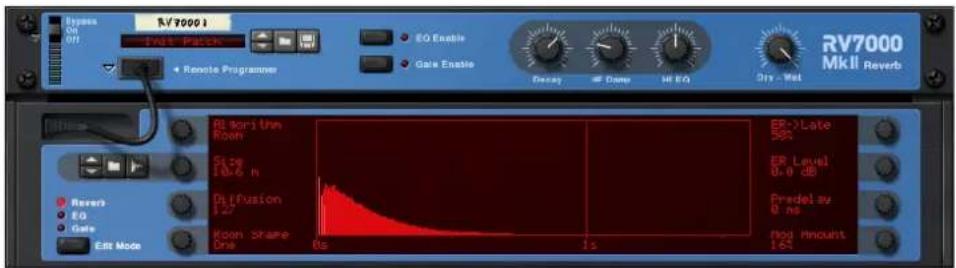
The RV7000 Mk II is a high quality reverb processor. It features ten different reverb and echo algorithms, ranging from rooms and halls to special effects. The Mk II version also incorporates a high-quality zero-latency convolution algorithm, which makes it possible to load sampled impulse responses - and even sample and use your own impulse responses!
Since the RV7000 Mk II comes with a number of useful reverb presets, you could simply select one and tweak the most important parameters on the main panel - or you could use the Remote Programmer panel to fine-tune the reverb in great detail.
The RV7000 Mk II also contains an equalizer and a gate section. Both of these are for processing the actual reverb sound, making it possible to get virtually any kind of reverb character, including gated reverb.
About the Patch format
The RV7000 Mk II features programmable effect presets. In the Factory Sound Bank you will find a number of preset Patches which can be used as they are or provide you with a good starting point for further tweaking.
Patches use the Windows file extension "*.RV7". Loading and saving Patches is done in the same way as for instrument devices.
! Convolution patches that use samples only contain references to the samples - not the sample itself. This is the way all sampler devices in Reason Lite work.
Connections
Typically you connect the RV7000 Mk II as a send effect, as this allows you to use it for processing several different mixer channels. However, it's also possible to use it as an insert effect - use the Dry/Wet control on the main panel to adjust the balance between the dry, unprocessed sound and the reverb. Note:
→ The RV7000 Mk II is a true stereo reverb (except in Convolution mode), which means that it will use the stereo input information when processing both channels (without summing the input channels).
It's also possible to use it as a mono in - stereo out effect. Which type of connection to use (mono or stereo in) depends on the material. If the audio sources are in mono (or in stereo but with no important difference between the left and right channel) using a mono input is sufficient.
If you want to use RV7000 Mk II's Reverse reverb effect, you should consider connecting it as an insert effect or using a Send on the Mixer, with Pre-fader mode selected (and the channel fader lowered).
This is because you typically don't want to hear the dry sound when using the Reverse effect. See "The Gate section".
The main panel

The RV7000 Mk II main panel.
When you create an RV7000 Mk II, only the main panel will be shown. This contains a section for handling patches, on/off buttons for the EQ and Gate sections, the most important reverb parameters and a dry/wet mix control. To select a reverb patch and make coarse adjustments, this is all you need.
The Remote Programmer
Clicking the arrow button next to the "cable slot" on the main panel brings up the remote programmer panel.
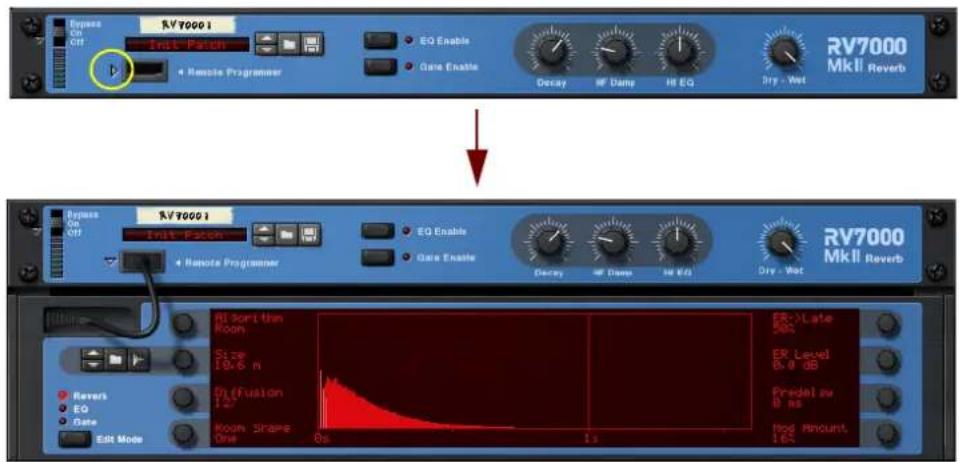
This is where you make detailed settings for the reverb. Note:
- The Edit Mode button to the left determines which section to make settings for, Reverb, EQ or Gate.
- Settings are made with the eight dials around the graphic display. The functions of the dials differ depending on the selected Edit Mode and the selected reverb algorithm. Next to each dial, the display shows the name and value of the corresponding parameter.
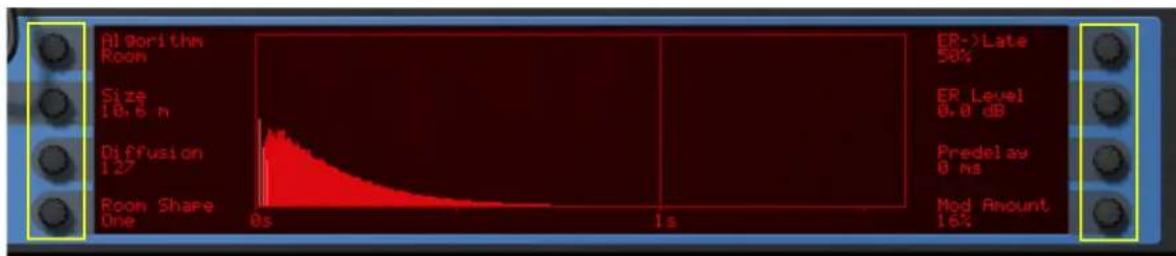
area
| Parameter | Value | | ----------------- | ----- | | ER->Late | 50% | | ER Level | 0.0 dB | | Predel av | 0 ms | | Mod Amount | 16% |- Not all modes and algorithms use all eight dials. If a dial isn't used in the selected mode, nothing will be shown next to it in the display.
- You cannot make settings in the graphic display itself - this is for showing a graphic representation of the selected reverb.
Reverb algorithms and parameters
Common effect device parameters
While the specific parameters for the RV7000 Mk II effect device are described below, some features and procedures are common to all effect devices. Please, refer to "Common effect device features" for information about the Input meter, the Bypass/On/Off switch and Signal Flow Graphs on the effect device.
About the main panel parameters
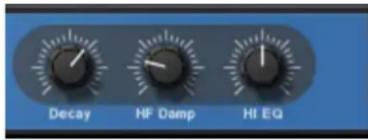
On the main panel you find three parameters that are available for all algorithms:
| Parameter | Description |
| Decay This governs the length of the reverb or the feedback if an echo algorithm is selected. | |
| HF Damp | Controls how quickly the high frequencies should decay in the reverb. Raise it to gradually remove high frequencies, making the reverb sound warmer and less bright. |
| HI EQ | This is a high-shelving EQ that works much like a typical treble control on a mixer or amplifier. Lower the setting for a softer reverb sound or raise it to get more high frequencies. |
Selecting an algorithm
You select a reverb algorithm in the remote programmer panel:
- Click the remote programmer arrow button on the main panel to display the remote programmer panel.
- Make sure the Edit Mode button is set to Reverb.
- Use the top left dial to select a reverb algorithm.
The selected algorithm is shown in the display next to the dial.
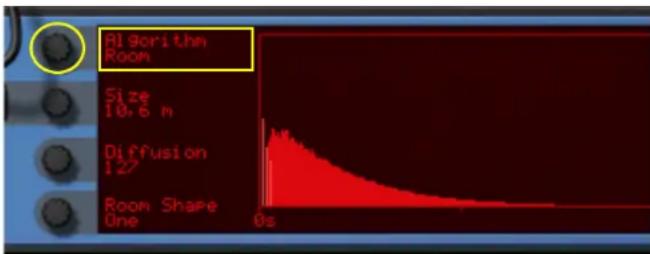
Here's a quick overview of the ten algorithms - for details and parameter descriptions, see below.
| Algorithm | Description |
| Small Space Emulates a small enclosed space (a small room or a resonant body). | |
| Room Emulates a room with adjustable shape and wall character. | |
| Hall Emulates a hall. | |
| Arena Emulates a large arena, with separate pre-delay for the left, right and center reverbs. | |
| Plate Emulates a classic plate reverb. | |
| Spring Emulates a spring reverb, as used in e.g. guitar amplifiers. | |
| Echo | An echo effect with gradually diffusing echo repeats. Can be synced to Reason Lite's tempo. |
| Multi Tap A multi-tap delay with four different delay lines and tempo sync. | |
| Reverse | A reverse reverb that "pushes" the dry sound to appear after the reverb. The result is a backwards reverb leading up to the direct sound. |
| Convolution | The zero-latency Convolution algorithm uses impulse response samples. The samples are used for generating the desired reverb effect (or actually any type of effect - depending on what sample you use). |
Small Space
This algorithm places the sound in a small enclosed space, ranging from a tiny resonant body to a room. The parameters are:
| Parameter | Description |
| Size The size of the emulated space. | |
| Mod Rate | The reverb can be randomly modulated for a more even sound (or for special effects). This parameter sets the rate of modulation (the amount is set with Mod Amount). |
| Room Shape Select from four different room shapes, affecting the character of the reverb. | |
| LF Damp | Controls how quickly the low frequencies should decay in the reverb. Raise it to gradually remove low frequencies, making the reverb sound "thinner" and less boomy. |
| Wall Irreg | Adjusts the positioning of the emulated walls in the small space. The lowest setting emulates two directly opposed walls while higher settings emulate more walls and angles, for a more complex resonance. |
| Predelay Sets the predelay time, i.e. the delay between the source signal and the start of the reverb. | |
| Mod Amount | Sets how much the reverb will be modulated. Use fairly low settings when emulating real rooms and resonant bodies, and higher settings for special effects. |
Room
Emulates a medium-sized room, with the following parameters:
| Parameter | Description |
| Size The size of the emulated room. | |
| Diffusion | At low Diffusion settings, you will hear the individual reverb “bounces” more clearly, while higher settings produce a more “smeared”, dense and even reverb. |
| Room Shape Select from four different room shapes, affecting the character of the reverb. | |
| ER->Late | The first “answers” in the reverb are called early reflections (ER) and are typically more pronounced than the actual reverb tail. This parameter sets the time between the early reflections and the reverb tail. This is set as a percentage - the actual delay time depends on the Size setting. |
| ER Level | Adjusts the level of the early reflections. “O” is normal level. |
| Predelay | Sets the predelay time, i.e. the delay between the source signal and the start of the early reflections and reverb. |
| Mod Amount Sets how much the reverb will be modulated. Moderate modulation gives a natural, less static sound. | |
Hall
Emulates a hall. The parameters are the same as for the Room algorithm above (but the Hall algorithm offers larger Size settings).
Arena
Emulates the ambience in an arena or concert hall, with long pre-delay times (separate for left, right and center):
| Parameter | Description |
| Size The size of the emulated arena or hall. | |
| Diffusion | At low Diffusion settings, you will hear the individual reverb "bounces" more clearly, while higher settings produce a more "smeared", dense and even reverb. |
| Left Delay The predelay time for the left side of the reverb. | |
| Right Delay The predelay time for the right side of the reverb. | |
| Stereo Level Adjusts the level of the left and right sides of the reverb. "0" is normal level. | |
| Mono Delay The predelay time for the mono (center) reverb signal. | |
| Mono Level Adjusts the level of the mono (center) reverb signal. "0" is normal level. | |
Plate
A classic plate reverb, excellent for vocals for example. The parameters are:
| Parameter | Description |
| LF Damp | Controls how quickly the low frequencies should decay in the reverb. Raise it to gradually remove low frequencies, making the reverb sound “thinner” and less boomy. |
| Predelay | Sets the predelay time, i.e. the delay between the source signal and the start of the reverb. |
Spring
An emulation of a spring reverb as can be found in guitar amplifiers, organs, etc. The spring reverb has the following parameters:
| Parameter | Description |
| Length Sets the length of the simulated spring. | |
| Diffusion | At low Diffusion settings, you will hear the individual reverb “bounces” more clearly, while higher settings produce a more “smeared”, dense and even reverb. |
| Disp Freq | When sending a signal to a real-life spring reverb, the initial transient will produce a quick, characteristic sweeping tonal noise. This is because different frequencies in the sound are delayed by different amounts (a phenomenon called dispersion). This parameter controls the frequency of that sound. |
| LF Damp | Controls how quickly the low frequencies should decay in the reverb. Raise it to gradually remove low frequencies, making the reverb sound “thinner” and less boomy. |
| Stereo (on/off) Determines whether the output of the spring reverb should be in mono or stereo. | |
| Predelay | Sets the predelay time, i.e. the delay between the source signal and the start of the early reflections and reverb. |
| Disp Amount Sets the amount of dispersion effect (see Disp Freq above). | |
Echo
This is an advanced echo effect, with diffusion controls and tempo sync. When Echo is selected, the Decay control on the main panel controls the echo feedback (the number of echo repeats). The parameters are:
| Parameter | Description |
| Echo Time Sets the time between each echo. | |
| When Tempo Sync (see below) is off, the echo time is set in milliseconds (10 - 2000 ms); when Tempo Sync is on you set the echo time as a number of 1/16 notes or 1/8 triplet notes, in relation to the current song tempo. | |
| Diffusion | When this is set to 0, the echo will sound as a standard delay with clear, precise repeats. Raising the Diffusion setting will introduce additional echoes very close to the "main" echo repeats, causing a "smeared" echo sound. This will also expand the echo stereo image. |
| Tempo Sync | Determines whether the echo time should be freely set ("off") or synchronized to Reason Lite's tempo ("on"). |
| LF Damp | Controls how quickly the low frequencies should decay in the echoes. Raise it to gradually remove low frequencies. |
| Spread | Adjusts the spacing of the additional echoes added by the Diffusion parameter. For a very smeared echo (sound more like a reverb), set both Diffusion and Spread to their maximum values. |
| Predelay Sets an additional delay time before the first echo repeat. | |
Multi Tap
The Multi Tap delay produces up to four different delays with separate delay times, panning and level. The whole set of four delay taps can then be repeated at a given rate. Again, the Decay control on the main panel controls the feedback (the number of repeats for the whole multi tap set). All delay times can be tempo synced.
Note: this algorithm is handled a bit differently since you make separate settings for each delay tap:
- The parameters to the left of the display are common for all taps.
- You use the Edit Select parameter in the top right corner to select which tap to make settings for - the three parameters below affect the currently selected tap.
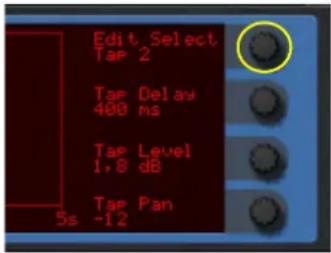
Tap 2 selected for editing.
- You can also set Edit Select to "Repeat Tap" - this is where you specify the repeat time for the whole multi tap "package".
With short Repeat times, the first tap may be repeated before the last tap has sounded. This can be used to create very complex multiple delay effects.
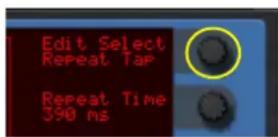
The common parameters (to the left) are:
| Parameter | Description |
| Tempo Sync | Determines whether the delay times and repeat times should be freely set ("off") or synchronized to Reason Lite's tempo ("on"). |
| Diffusion | Raising the Diffusion setting will introduce additional echoes very close to the “main” repeats, causing a “smeared” delay sound. |
| LF Damp | Controls how quickly the low frequencies should decay in the echoes. Raise it to gradually remove low frequencies. |
When Tap 1 - 4 is selected with the Edit Select parameter, you can make the following settings for the selected delay tap:
| Parameter | Description |
| Tap delay Sets the delay - the time from the source signal to the tap.When Tempo Sync is off, the delay time is set in milliseconds (10 - 2000 ms); when Tempo Sync is on you set the delay as a number of 1/16 notes or 1/8 triplet notes, in relation to the current song tempo. | |
| Tap level Adjusts the level of the selected tap. | |
| Tap pan Adjusts the pan of the selected tap. | |
When Repeat Tap is selected with the Edit Select parameter, there is only one parameter to the right in the display:
| Parameter | Description |
| Repeat Time | Sets the time between each repeat of the whole multi tap set. The number of repeats is set with the Decay control on the main panel.When Tempo Sync is off, the repeat time is set in milliseconds (10 - 2000 ms); when Tempo Sync is on you set the repeat time as a number of 1/16 notes or 1/8 triplet notes, in relation to the current song tempo. |
Reverse
The Reverse reverb algorithm in RV7000 Mk II is special in that it actually "moves" the source audio as well. Sounds fed into the Reverse reverb are "sampled", a reverse reverb is created and played back and finally the "sampled" original sound is played back. For example, if you feed a snare drum hit into the Reverse reverb, you will hear a rising "backwards" reverb, followed by the snare drum hit.
Therefore, you probably don't want to hear the first, original (dry) sound. There are two ways to set this up:
→ Connect the RV7000 Mk II as an insert effect and make sure the Dry/Wet control on the main panel is set fully to "Wet".
→ Connect the RV7000 Mk II as a send effect using one of the Sends on the Mixer, activate the Prefader (PRE) switch for the send and lower the mixer fader completely for the source signal.
That way, the signal will be sent to the reverb but the dry sound from the Mixer channel isn't heard. Again, the Dry/Wet control should be set to "Wet".
Note that with this algorithm, raising the Decay setting on the main panel will make the reverse reverb start earlier and build up under a longer time. Similarly, the HF Damp parameter affects how fast the high frequencies are built up in the reverse reverb. In the remote panel, the Reverse algorithm has the following parameters:
| Parameter | Description |
| Length | This sets the time from when the source signal is fed into the reverb until it is played back again. It is during this time you will hear the reverse reverb, as shown in the display.The time can be set in milliseconds or as note values, depending on whether Tempo Sync is off or on.Note: As stated above, the Decay setting determines the length of the actual reverse reverb - in essence how soon it starts after the source signal. But of course, the reverse reverb cannot start before the original source signal! If you set Decay to a longer time than the Length setting, the reverse reverb will start abruptly, immediately when the source signal is fed into the reverb. If this sounds complicated, just take a look at the RV7000 Mk II display and try the settings - you will soon see how it works.Note also that very high Length settings demand a lot of processor power. This can be reduced by adjusting the Density parameter, see below. |
| Density | Density governs the “thickness” of the Reverse effect. If this parameter is turned down to zero, the effect produces individual delays rather than a dense “wash”, which can be used as a special effect. Worth noting is that if Density is set to around 50%, this can considerably reduce the CPU load without altering the sound of the effect too much. Exactly how much the Density parameter can be reduced without altering the sound depends on the source material. |
| Rev Dry/Wet | Sets the balance between the “moved” source signal (“dry”, low values) and the reverse reverb (“wet”, high values). |
| Tempo Sync | Determines whether the Length setting should be freely set (“off”) or synchronized to Reason Lite’s tempo (“on”). |
Convolution
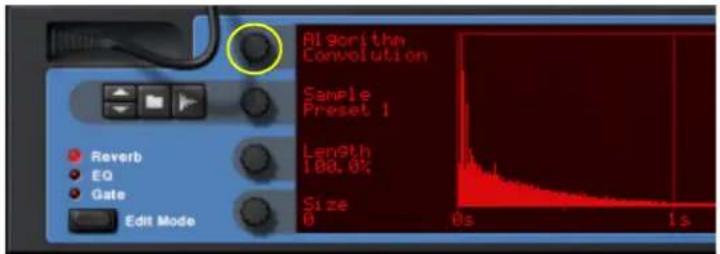
The zero-latency Convolution algorithm uses impulse response samples to generate effects. Basically, "convolution effects" are the results of multiplying the frequency spectra of the input signals with the frequency spectra of impulse response samples, and thus generating a signal with the "character" of the impulse response sample. If the impulse response sample is a recording of the reflections of a large room, for example, the resulting effect will be "the input audio signal played back in a large room".
RV7000 Mk II comes with three built-in preset impulse response samples. You can also use any other samples for the convolution algorithm, to generate all kinds of reverbs and special effects. You can even sample your own impulse responses and use in the convolution algorithm in RV7000 Mk II.
Reason Studios have gathered a large number of impulse responses and collected them in a free ReFill, along with lots of patches for the RV7000 Mk II and the Combinator. The ReFill is called "RV7000 mkII patches" download it for free from reasonstudios.com!
Note that in the Convolution algorithm the input signals for the effect are first summed to mono (except in Parallel Stereo Mode (see "Stereo Mode")) and then processed with the impulse response sample. The figures below show the signal routings in the Convolution algorithm:
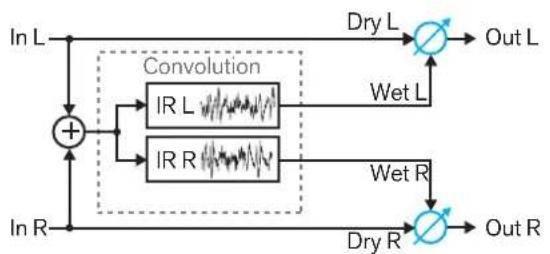
flowchart
graph TD
    A["In L"] --> B["+"]
    C["In R"] --> B
    B --> D["IR L"]
    B --> E["IR R"]
    D --> F["Convolution"]
    E --> F
    F --> G["Dry L"]
    F --> H["Wet L"]
    G --> I["Out L"]
    H --> J["Wet R"]
    J --> K["Out R"]
    K --> L["Dry R"]
(All Stereo and Mono modes) (Parallel mode)
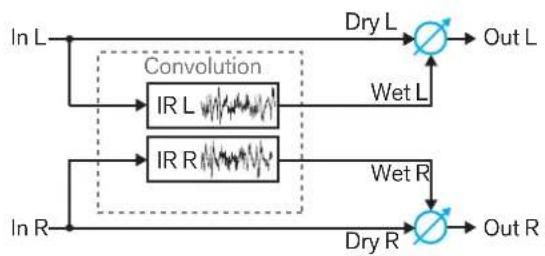
flowchart
graph TD
    A["In L"] --> B["Convolution"]
    B --> C["IR L"]
    B --> D["IR R"]
    C --> E["Dry L"]
    D --> F["Dry R"]
    E --> G["Out L"]
    F --> H["Out R"]
    I["In R"] --> J["Wet L"]
    K["Wet R"] --> L["Wet R"]
In the remote panel, the Convolution algorithm has the following parameters:
| Parameter | Description |
| Sample Preset | Here you select one of the preset impulse response samples - plus your own sample (if you use that, see "Loading impulse response samples"). |
| Length Sets the length (end point) of the currently used impulse response sample. | |
| Size | Simulates the "size" of the impulse response sample, in practice its pitch, in semitone steps. -12 means pitching up the impulse response sample 1 octave and 12 means pitching it down 1 octave. |
| LF Damp | Controls how quickly the low frequencies should decay. Raise it to gradually remove low frequencies, making the effect sound "thinner" and less boomy. |
| Stereo Mode | Determines how the output signal should be presented. Note that the stereo effect is derived from the impulse response sample itself. So, the wider the stereo effect in the impulse response sample, the wider the stereo effect in the output.Note that if you use a mono impulse response sample, all effects below will be in mono!Stereo: The input signals are summed and then a stereo effect with a spread of 100% is applied.Stereo75%: The input signals are summed and then a stereo effect with a spread of 75% is applied.Stereo50%: The input signals are summed and then a stereo effect with a spread of 50% is applied.Stereo25%: The input signals are summed and then a stereo effect with a spread of 25% is applied.Mono: The input signals are summed and then the effect is panned to a centered mono signal (0% spread).M->S Slow: From Mono slowly panned out to full Stereo.M->S Fast: From Mono quickly panned out to full Stereo.S->M Slow: From full Stereo slowly narrowed down to Mono.S->M Fast: From full Stereo quickly narrowed down to Mono.Parallel: Individual processing of the two L and R stereo input signals (dual mono). |
| Predelay | Sets the predelay time, i.e. the delay between the source signal and the start of the convolution effect. A negative predelay masks the start of the sample, so if the sample has unwanted initial transients or silence, these can be "removed". |
| Gain Sets the amplification or attenuation of the effect signal. | |
Below are some things to keep in mind when you are working with the Convolution algorithm:
- If you want the impulse response sample to play back exactly like the original, make sure the Decay knob is at max, the LF Damp knob at zero and the Hi EQ knob at its 12 o'clock position. Also, make sure the Length parameter is at 100% and the Size parameter at 0.
- The Length value of the impulse response sample is also affected by the Decay knob setting. If the impulse response sample is quiet at the end, reduce the Length value to cut it off a little earlier. The Decay parameter introduces a smoother "cutoff" at the end, which might be desirable in many situations.
- Changing some convolution parameters re-calculates the impulse response in real time. Therefore, modulating these parameters might give unexpected results. Specifically:
Using CV to modulate the RV7000 Mk II in Convolution mode is not recommended.
If you're using the Gate function (see "The Gate section") in combination with Convolution, we recommend setting the Decay Mod parameter to 0 (see "Decay Mod").
Loading impulse response samples
Besides the preset impulse response samples, you can load any other samples into the RV7000 Mk II and use as impulse responses. Loading a sample automatically switches the Algorithm to Convolution.
→ Drag and drop a sample onto the RV7000 Mk II panel to automatically load it in the Convolution Algorithm.
Or, do as follows:
- Click the Browse Samples button on the Programmer panel to set browse focus to the RV7000 Mk II.
- Select the desired sample in the Browser and load it.
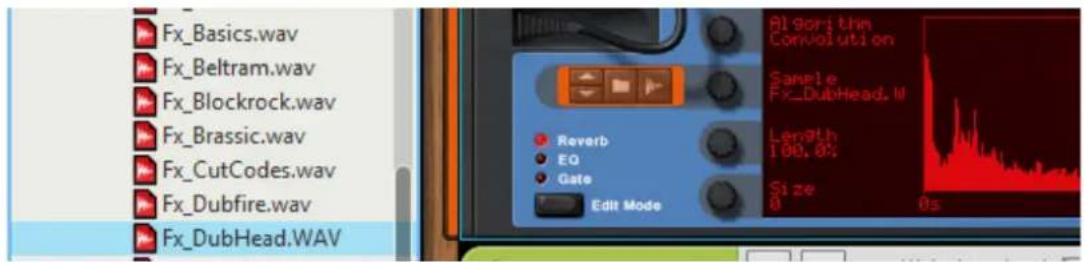
Here we have selected and loaded the "Fx_DubHead.WAV" sample to use as impulse response. You can see that the sample name is now displayed to the right of the Preset knob.
! Note that the maximum length of a sample used as an impulse response is approximately 12 seconds. Longer samples are automatically truncated to 12 seconds (non-destructive).
! Note that any embedded loop data in the samples are disregarded when loaded into the RV7000 Mk II!
! Note that the Programmer display only shows the first 4 seconds of longer samples.
To achieve stereo effects in the Stereo Mode alternatives (see "Stereo Mode") you have to use stereo samples.
- Edit the Convolution parameters on the RV7000 Mk II panel until you are satisfied.
→ If you want to save your RV7000 Mk II patch with your impulse response sample, click the Save Patch button on the upper panel:

! Note that the impulse response sample is NOT saved in the patch itself - only a reference to the sample! If you have loaded an external sample (that is not in the Factory Soundbank), you may want to save the patch with the sample in your song. See "About Self-Contained Songs".
Sampling your own impulse response samples
You can also sample your own impulse response samples and use with the Convolution algorithm. The sampling procedure is the same as for any other sampler device in Reason Lite:
→ Click the "Start sampling" button on the Programmer panel to record your own sample:
! Note that the maximum length of a sample used as an impulse response is approximately 12 seconds. Longer samples are automatically truncated to 12 seconds (non-destructive).
! Note that any embedded loop data in the samples are disregarded in the RV7000 Mk II!
! Note that the Programmer display only shows the first 4 seconds of longer samples.
- To achieve stereo effects in the Stereo Mode alternatives (see "Stereo Mode") you have to sample in stereo.
Please refer to the "Sampling" chapter for details on how to set up and sample in Reason Lite.
The EQ section
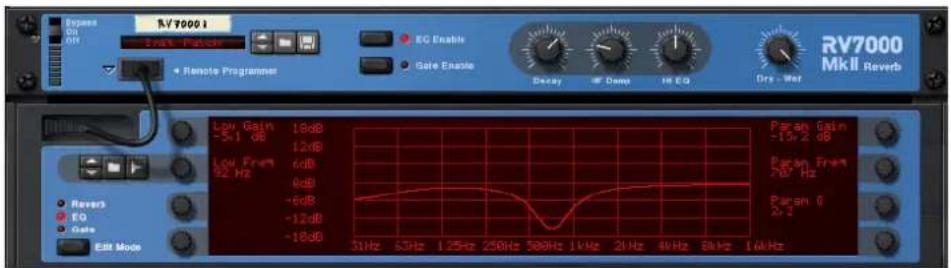
The equalizer in RV7000 Mk II affects the wet reverb sound only and is used for shaping the character of the reverb. There are two EQ bands, one for low frequencies (shelving) and one full-range parametric EQ.
→ To activate the EQ, click the EQ Enable button on the main panel so that the indicator lights up.
To make EQ settings, select "EQ" with the Edit Mode button to the left in the remote programmer panel.
→ In this mode, the remote programmer display shows a frequency curve, indicating the settings you make with the EQ parameters.
The parameters are:
| Parameter | Description |
| Low Gain The amount of cut or boost of the low-shelving filter. | |
| Low Freq The frequency below which the Low Gain cut or boost is applied. | |
| Param Gain The amount of cut or boost for the parametric EQ. | |
| Param Freq | The center frequency of the parametric EQ, e.g. at which frequency the level should be decreased or increased. |
| Param Q | This governs the width of the affected area around the set center frequency. The higher the value, the narrower the affected frequency range. |
→ Remember that you have a third EQ band at your disposal - the HI EQ parameter on the main panel.
The reason why this is on the main panel and not in the EQ section is simply that it's a setting you may want to adjust often, without having to open the remote programmer panel.
The Gate section
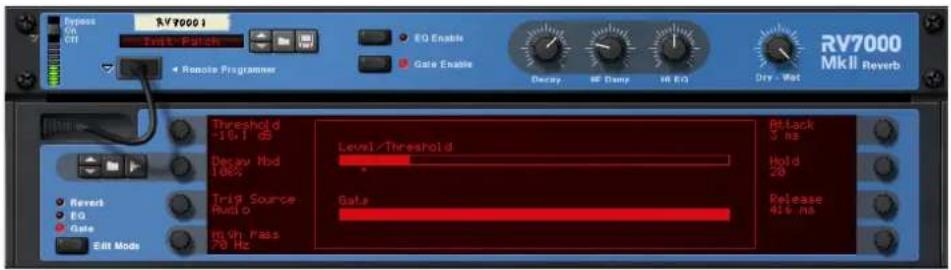
The Gate section allows you to create gated reverb effects with a lot of options and possibilities. You can either trigger the gate from the source audio signal or via MIDI or CV.
When triggering the gate from the source audio signal, it works like this:
- The gate "listens" to the source (dry) signal and opens whenever the signal reaches a certain threshold level.
- The reverb sound is sent through the gate - when the gate is closed you won't hear the reverb.
- When the source signal level drops below the threshold level, the gate closes after a time that depends on the Hold parameter and the level of the source signal (see the parameter table).
→ If you need the gate to be open for an exact duration (time), you should trigger it via MIDI or CV. In audio trigger mode, the actual gate time will vary depending on the source signal.
When triggering the gate via MIDI or CV, it works like this:
- The reverb sound is sent through the gate - when the gate is closed you won't hear the reverb.
- Whenever the gate receives any MIDI note (sent to the RV7000 Mk II) or a gate signal (connected to the Gate Trig CV input on the back of the RV7000 Mk II), the gate opens for the duration of the note or gate signal.
Note:
→ To activate the Gate, click the Gate Enable button on the main panel so that the indicator lights up.
→ To make Gate settings, select "Gate" with the Edit Mode button to the left in the remote programmer panel.
→ In this mode, the remote programmer display shows two meters - one showing the signal level (with an indication of the threshold level) and one showing the status of the gate.
This is useful for checking what happens, how the gate triggers, etc.
The parameters for the Gate section are:
| Parameter | Description |
| Threshold | When Trig Source is set to "Audio", this determines the audio signal level at which the gate opens. If you raise this setting, only very loud sounds will open the gate. |
| Decay Mod | This modulates the reverb Decay parameter so that the decay time is lowered when the gate closes. When this is set to zero, no decay modulation happens - this means that if the gate is closed and then opened again, you may hear "previous" reverb tails that are still ringing. If you raise the Decay Mod setting, the decay will automatically be lowered when the gate is closed, eliminating this effect. |
| Trig Source | Determines whether the gate should be triggered by audio or MIDI/CV, as described above. |
| High Pass | A high-pass filter that affects the audio that triggers the gate (only active when Trig Source is set to "Audio"). If you raise this setting, sounds with low frequencies only will not open the gate. Note that this setting doesn't affect the sound of the reverb, only the triggering mechanism. |
| Attack | Determines how long it takes for the gate to open after a triggering signal has been received. |
| Hold | This parameter is only active when Trig Source is set to "Audio". Hold affects how quickly the gate closes, in the following way:Internally, the gate is controlled by an envelope follower that analyzes the source signal level and generates a "level CV signal" accordingly. This signal is compared to the Threshold level to determine whether the gate should be opened or closed. The Hold parameter affects how quickly the envelope follower responds when the source signal level drops - you could say that this is the decay control for the envelope follower. The higher the Hold setting, the longer it will take for the envelope follower signal to drop below the threshold level and close the gate. But the resulting time also depends on the source signal level - with a loud signal, it will take longer time for the envelope follower to drop to the threshold level. Therefore, the actual gate time depends both on the Hold setting and on the character of the source audio. |
| Release | Determines how long it takes for the gate to close after the Hold time. |
CV Inputs
On the back of the RV7000 Mk II you find three CV inputs. These are:
| Parameter | Description |
| Decay Controls the reverb decay or echo/delay feedback via CV. | |
| HF Damp Controls the HF Damp parameter on the main panel. | |
| Gate Trig | Used for triggering the Gate section with a gate signal. The length of the gate signal determines the length of the gated reverb. |
! Using the CV inputs to modulate the RV7000 Mk II in Convolution mode is not recommended.
Chapter 34
The MClass Effects
The MClass effects
The MClass effects package consists of four effect devices, which are available as separate devices from the Create menu and from the Devices tab in the Tool Window. There are also a number of Mastering Combi patches available in the Effects folder in the Factory Sound Bank. These mastering patches consist of all four MClass device types, patched together and organized as Combinator patches. The Mastering Combis are perfect to use as Master Insert FX in the Main Mixer to process the final mix. The individual MClass effects are as follows:
- The MClass Equalizer - this has low and high shelving bands, two fully parametric bands and a low cut “anti-rumble” switch. See “The MClass Equalizer”.
- The MClass Stereo Imager - this can be used to control the stereo width for the high and low frequency ranges separately. See “The MClass Stereo Imager”.
- The MClass Compressor - this single band compressor features sidechain input and program-adaptive release. See “The MClass Compressor”.
- The MClass Maximizer is a special limiter tailored for loudness maximizing without risk of clipping. See “The MClass Maximizer”.
Common effect device parameters
While the specific parameters for the MClass effect devices are described below, some features and procedures are common to all effect devices. Please, refer to "Common effect device features" for information about the Input meter, the Bypass/On/Off switch and Signal Flow Graphs on the effect devices.
The MClass Equalizer

The MClass Equalizer consists of two independent, fully parametric bands plus high and low shelving bands and a lo cut switch.
This is most often used as an insert effect, in mono or stereo.
Activating the separate EQ bands
The separate bands are organized as vertical strips on the panel, in the following order (from left to right): Lo Cut/Lo Shelf/Parametric 1/Parametric 2/Hi Shelf.
You activate the separate bands by clicking the button at the top of each strip (none of the bands are activated by default).
Lo Cut
The Lo Cut switch will simply cut frequencies below 30 Hz (by 12 dB/Octave). This is useful for removing low frequency "rumble".
- When you are using the MClass Equalizer with a compressor or Maximizer, activating the Lo Cut switch prevents subsonic sound from "topping" the compressor/limiter, and allows them to operate as efficiently as possible.
Parametric 1-2 parameters
A parametric equalizer will boost or cut frequencies around the selected frequency. The following parameters are available for both the parametric bands:
| Parameter | Description |
| Frequency This determines the center frequency of the EQ, i.e. at which frequency the level should be decreased or increased. The range is 39 Hz to 20 kHz. | |
| Gain Specifies how much the level of the selected frequency range should be boosted or cut. The gain range is ±18 dB. | |
| Q This governs the width of the affected area around the set center frequency. The higher the value, the narrower the affected frequency range. | |
Lo/Hi Shelf parameters
A shelving equalizer will boost or cut frequencies below or above the selected frequency.
The following parameters are available for the Lo/Hi Shelf bands:
| Parameter | Description |
| Frequency | Frequencies below (Lo Shelf) or above (Hi Shelf) the selected frequency will be boosted or cut.The Lo Shelf range is 30 Hz to 600 Hz.The Hi Shelf range is 3 kHz to 12 kHz. |
| Gain Specifies how much the level should be boosted or cut. The gain range is ±18 dB. | |
| Q | This governs the slope of the shelving curve. The higher the value, the steeper the curve slope. High Q settings will also produce a "bump" in the opposite cut/boost direction at the set frequency. |
About the graphic display
The graphic display to the left in the device panel shows the frequency response curve as set by the EQ parameters. This gives a visual feedback and helps you tailor the EQ settings.
The MClass Stereo Imager

The MClass Stereo Imager splits the signal into two frequency bands; "Hi" and "Lo" and allows you to widen or narrow the stereo image of each band. A typical application of the Stereo Imager is to widen the higher frequencies and narrow the lower frequencies. This will make the bass end "tight" whilst "opening up" the higher frequencies.
This is most often used as an insert effect in stereo.
! The MClass Stereo Imager does not create stereo from mono input! For the device to work properly it must connected with stereo in/out, and the input signal must contain a stereo audio signal.
Parameters
The following parameters are available:
| Parameter | Description |
| X-Over Frequency | This determines the crossover frequency between the Hi and Lo band. Range is 100 Hz - 6 kHz. Frequencies below this will be affected by the Lo Width setting; frequencies above will be affected by the Hi Width setting. |
| Lo Width | This adjusts the stereo width for the Lo band. Turn anti-clockwise to narrow the stereo width (i.e. to make it more “mono”), and clockwise to widen the stereo image. Center position means no change from original signal. The “Active” LED indicates whether Low Width is activated or not. Note that for the Lo band, it is more common to narrow the stereo image, as the low frequency content in a mix is usually mixed center and can become less defined if widened. |
| Hi Width | This adjusts the stereo width for the Hi band. Turn anti-clockwise to narrow the stereo width (i.e. to make it more “mono”), and clockwise to widen the stereo image. Center position means no change from original signal. The “Active” LED indicates whether Hi Width is activated or not. |
| Solo switch | This allows you to listen to the Lo and Hi bands separately, for reference purposes. “Normal” is the standard operating mode. |
Connections
Apart from standard L/R inputs and outputs, there are also "Separate" L/R outputs on the back panel. The Separate outputs can either carry the Lo or Hi band output, which is set by the switch beside the outputs. These outputs can be used to apply processing separately to either the Lo or Hi band.
- If you set the Solo switch to "Lo" and the Separate output switch to "Hi", the device will operate as a basic crossover filter, delivering the Lo band signal from the main output and the Hi band signal from the Separate out.
The MClass Compressor

This is a single-band compressor capable of everything from subtle compression to aggressive pumping effects. Like all dynamics processors it is best used as an insert effect.
The features include "soft-knee" compression for more musical and unobtrusive compression, program-adaptive release time and a sidechain input for de-essing and other dynamics processing. Additionally, you have a CV output, allowing you to have the amount of gain reduction control other Reason Lite parameters.
Parameters:
| Parameter | Description |
| Input Gain | The Input Gain controls the "drive" of the compression. This determines how much compression the signal will have in conjunction with the Threshold. Range: ±12 dB. |
| Threshold | This sets the level at which onset of compression occurs. When the input level is below the Threshold setting the signal is unaffected. When the input level exceeds the threshold, compression kicks in.In practice, this means that the lower the Threshold setting (and the higher the Input Gain), the more compression will be applied. Range: -36 dB to 0 dB |
| Soft Knee | Normally signals above the threshold will be compressed immediately at whatever ratio is set. This can be very noticeable, especially when using high compression ratios. When Soft Knee is activated, the onset of compression will be more gradual, producing a less drastic result. |
| Ratio | This lets you specify the amount of gain reduction applied to the signals above the set threshold. The Ratio can be set from 1:1 (no reduction) to ∞:1 (Infinite). |
| Gain meter This shows the amount of gain reduction (in dB). | |
| Solo Sidechain This allows you to monitor the signal connected to the sidechain input (see below). | |
| Attack | This governs how quickly the compressor will apply its effect when signals rise above the set threshold. If you raise this value, the response will be slower, allowing more of the signal to pass through the compressor unaffected. Typically, this is used for preserving the attacks of the sounds. Range: 1ms to 100ms. |
| Release | When the signal level drops below the set threshold, this determines how long it takes before the compressor lets the sound through unaffected. Set this to short values for intense, "pumping" compressor effects, or to longer values for a smoother change of the dynamics. Range: 50ms to 600ms. |
| Adapt Release | When this is used, set Release to the time you want for short peaks - when longer peaks occur, the Release time is automatically increased. |
| Output Gain | This controls the output gain and can be used to compensate for the gain reduction caused by compression. Range: ±12 dB. |
About the Sidechain inputs
→ When a signal is connected to the Sidechain inputs, it is this signal that will trigger the compression.
This signal is not passed to the compressor output, and will thus not be heard (unless Sidechain Solo is activated).
→ The signal connected to the normal L/R inputs is the signal that will be processed by the compressor (as usual).
Here follows two examples of how you can use sidechain processing:
Example 1 - using the Sidechain inputs to create ducking effects
"Ducking" is when the level of one signal is reduced by the presence of another signal. A typical application is to automatically lower the level of a musical bed when a voice-over starts, and to automatically bring the level up when the voice-over stops. To set this up, we can name the musical bed in the example "Device A", and the voice-over "Device B". Proceed as follows:
- Connect Device A and Device B to separate channels on a mixer device.
In this example the signal produced by Device A should be continuous, and the signal produced by Device B should be intermittent, i.e. it should contain both silent passages and signal passages.
- Select Device A and then select an MClass compressor from the Create menu.
The effect will be auto-routed as an insert effect to Device A.
- Connect a Send on the mixer device to the Sidechain inputs on the MClass compressor.
As soon as anything is connected to the Sidechain inputs, the "Active" indicator lights up on the device panel. The compressor will no longer react to the signal produced by Device A.
- Turn up the corresponding AUX Send level for Device B on the mixer.
This means that the Device B signal now feeds both the mixer's input, and the sidechain input on the compressor, which in turn triggers the gain reduction.
- If you now start playback of both devices, the level of Device A will be lowered whenever Device B sounds, and be raised again when Device B stops.
The amount of gain reduction, how quickly it lowers the level, and the time it take for the level to return to normal again is determined by the corresponding Gain/Threshold/Ratio and Attack/Release parameters.
Example 2 - using the Sidechain inputs to create frequency sensitive compression
By inserting an equalized signal to the sidechain inputs you can make the compression more or less sensitive to a certain frequency range. A typical application of this is "de-essing" - where harsh "S"-sounds in vocal material is reduced or eliminated.
Frequency sensitive compression is set up as follows:
-
Hold down [Shift] and create an instrument device.
Pressing [Shift] means no auto-routing connections to/from the device are made. -
Hold down [Shift] and create a MClass Equalizer.
-
Hold down [Shift] and create a MClass Compressor.
-
Create a Spider Audio Merger and Splitter device.
-
Connect the outputs of the instrument device to the A and B inputs on the Spider.
-
Route one pair of the split outputs of the Spider to the MClass Equalizer inputs.
-
Route the Equalizer outputs to the Sidechain inputs on the MClass Compressor.
-
Route another pair of the split outputs of the Spider to the MClass Compressor.
Now, the compressors normal audio inputs are fed the unprocessed signal, and the sidechain inputs are fed the equalized signal.
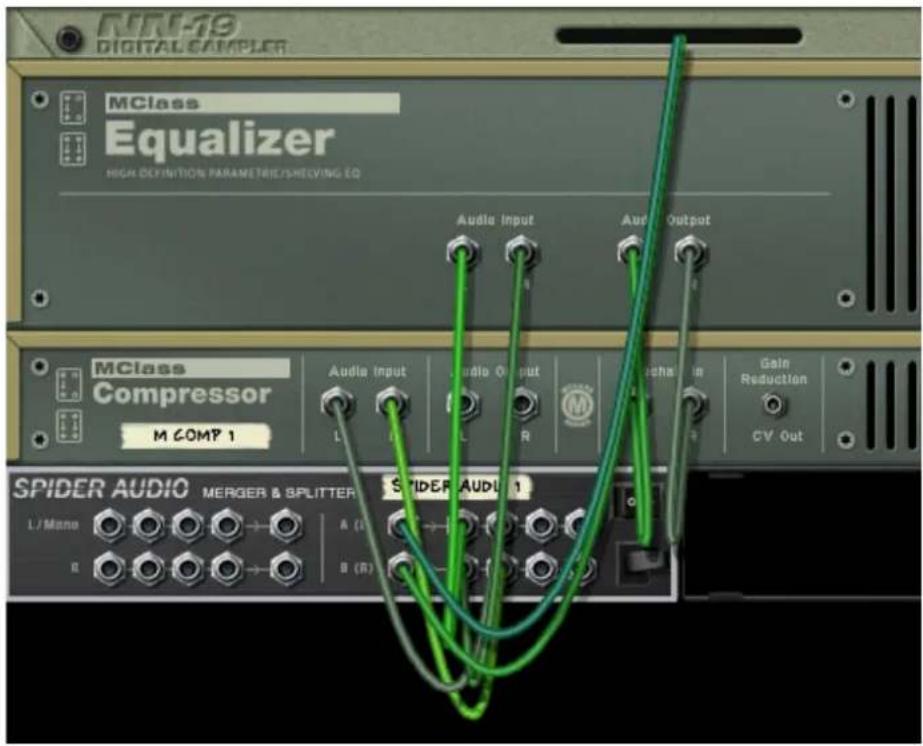
-
Next, route the outputs of the Compressor to inputs on a mixer device.
-
Activate the Solo Sidechain button on the compressor's front panel.
You will now only hear the equalized signal.
- Now use the parameters on the MClass Equalizer to boost the frequencies you wish should trigger the gain reduction and cut the frequencies you wish to avoid triggering the gain reduction.
You can use rather extreme eq settings - the signal will not be heard when Solo Sidechain is deactivated anyway. E.g. for de-essing you should separate and boost the offending "S" frequencies as much as possible.
- Deactivate Solo Sidechain when you have finished tweaking the equalizer.
Now, the compressor will be more sensitive to the frequency area you tuned in with the equalizer, and thus react more to these frequencies. Note, however, that the whole signal will still be compressed - not just the boosted frequencies - so in case of de-essing you should usually use fast Attack and Release settings so that the gain reduction does not affect the rest of the program too much.
CV Outs
On the back of the MClass Compressor you can find a "Gain Reduction" CV out connector. This can be used to modulate other parameters with the amount of gain reduction applied by the compressor. This means that the compressor works as an envelope follower. You could for example have the audio signal level control pan in a mixer or a synth parameter.
The MClass Maximizer

This is a loudness maximizer, a special type of limiter which can significantly raise the perceived loudness of a mix without risk of hard clipping distortion. Features include a 4 ms look ahead function for "brick wall" limiting and a Soft Clip function.
The MClass Maximizer should be used as an insert effect, and is designed to be placed at the end of the signal chain between the mixed final output and the Hardware Interface.
Parameters
| Parameter | Description |
| Input Gain The Input Gain sets the basic volume of a mix. If this is set very high, you should use LookAhead mode or the Soft Clip function to eliminate the risk of hard clipping distortion. Range: ±12 dB. | |
| Limiter On/Off This turns the Limiter section on or off. | |
| Look Ahead On/Off If activated, this will introduce a very short delay (4 ms) to the signal. This delay is used to detect peaks in the signal before they actually occur. If high peaks are detected the limiter is "ready for them" and gain reduction is applied to transparently control the peaks. | |
| Attack(Fast/Mid/Slow) | This governs how quickly the Limiter will apply its effect. If set to Fast with Look Ahead activated (and the Output Gain is set to 0 dB) you will get "brick wall" limiting - no signal peaks over 0 dB will pass. |
| Release(Fast/Slow/Auto) | This determines how long it takes before the Limiter lets the sound through unaffected. If Auto is activated, the Release time will automatically adapt to the program material. |
| Output Gain This controls the output gain and should normally be set to 0 dB. | |
| Soft Clip On/Off | If this is activated, it also acts a 0 dB brick wall limiter but in a slightly different way. The signal will be "soft-clipped" which adds a pleasant, warm sounding distortion to the signal. It can be used simply to get this effect, or as a safeguard against hard clipping distortion if Look Ahead with Mid or Slow attack settings are used (or if Look Ahead is deactivated). |
| Soft Clip Amount | This controls the amount of soft-clipping distortion. Note that if Soft Clip is on but the Amount is set to zero, the distortion will be like hard clipping, and thus less pleasing to the ear. |
| Output level meter(Peak/VU) | This is a more detailed meter than found on the mixer. You can switch the meter characteristics between Peak (faster response to peaks) and VU mode (average levels). |
Chapter 35
Half-Rack Effects
Common effect device features
While the specific parameters for each effect device are described below, some features and procedures are common to all effect devices:
The Input meter
This shows the level of the incoming audio signal, giving you an indication of which devices are active, connected and playing. However, you don't need to worry about clipping in effect devices, even if the meter goes into the red.
The Power/Bypass switch
This is located in the upper left corner of each effect device. The switch has three modes, according to the following figure:
| Mode | Description |
| Bypass | In this mode, the input signal is passed directly to the audio output, without being affected by the effect device. This is useful when the effect device is connected as an insert effect, and you want to compare the effect sound with the dry sound. |
| On This is the default mode, in which the device processes the incoming signal. | |
| Off | In this mode, the effect device is turned off and neither dry nor effect sound is sent out. This is useful when the device is connected as a send effect and you want to turn it off temporarily. |
About making settings
You adjust effect parameters using the regular editing techniques.
- A quick way to reset the parameters to their default values is to hold down Ctrl or Cmd and click the corresponding knob.
About Connections
- All effect devices have stereo inputs and outputs, and can be connected as send effects or as insert effects. However, some effects are best used as one of these only. This is stated for each effect on the following pages. See also the section about the signal flow graphs below.
- Most of the effect devices have one or several CV inputs on the back panel. These allow you to control various effect parameters in real-time, from another device in the rack. See "Routing CV and Gate signals" for details about routing CV.
The Signal Flow graphs
On the back of each effect device, you will find two or three small "graphs". These indicate how the effect device handles mono and stereo signals, depending on the connections. The selection of graphs for a device tells you how it should be used, according to the following rules:
| Graph | Description |
 | Can be connected as a mono-in, mono-out device.(Of course, all effect devices can be connected in mono. However, if this graph isn't shown for a device, this means that a mono-in, mono-out connection may not give the proper results). |
 | Can be connected as a mono-in, stereo-out device. This means that the device creates some sort of stereo effect (e.g. a reverb) or a mono effect that can be panned. |
 | If you connect both inputs and outputs in stereo, the two sides will be processed independently (dual mono processing). |
 | If you connect both inputs and outputs in stereo, the two sides are summed before the effect processing. However, the actual effect is in stereo (and the dry signal will remain in stereo, if it is passed through the effect). |
 | "True stereo" processing, or "stereo in - stereo out" processing. When you connect the inputs in stereo, each channel in the effect uses the signal information from both inputs. However, the inputs are not summed - the two channels are processed differently.This mode is available on the RV7000 Mk II Advanced Reverb - see "RV7000 Mk II Advanced Reverb". |
DDL-1 Digital Delay Line
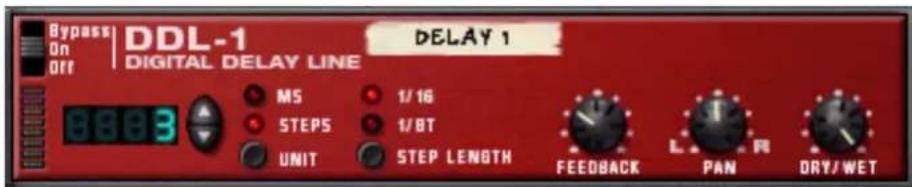
This is a mono delay (where the output can be panned in stereo) that can be synchronized to the song tempo. The delay can be used as a send effect or an insert effect.
Parameters
| Parameter | Description |
| Delay time | The display to the left on the device panel shows the delay time, either as note value steps (based on the sequencer tempo and the Step Length parameter) or in milliseconds, depending on the setting of the Unit switch.The maximum delay time is two seconds (2000 ms) while the maximum number of steps is 16.Note that if the tempo is low, you may reach the maximum delay time at a lower number of steps than 16 (in which case raising the steps value will not make any difference). |
| Unit | This is where you select whether you want a tempo-based delay ("Steps" mode) or a free time delay ("MS" mode).In the Steps mode, you specify the delay time in note value-based steps. This means that if you change the tempo in the transport panel, the delay will maintain its rhythmic relation to the music (provided that the resulting delay time doesn't reach the maximum value). This mode is useful for creating rhythmic patterns.If you change the tempo when using the delay in MS mode, the delay time will remain the same.See also the note about switching Unit modes below. |
| Step length | Governs whether each step in Steps mode should be a sixteenth note (1/16) or an eighth triplet note (1/8T). |
| Feedback Determines the number of delay repeats. | |
| Pan Pans the delay effect to the left or to the right. | |
| Wet/Dry | If you are using the delay as an insert effect, you use this parameter to adjust the balance between the unprocessed audio signal (dry) and the delay effect (wet).If the delay is used as a send effect, this should be set all the way to wet only, since you can control the balance by using the AUX send controls in the Mixer. |
CV Inputs
The following CV inputs are available on the back panel of the device:
→Pan CV.
This allows you to control the panning of the delay signal. Connect an LFO to this for moving delay effects, or use a Matrix pattern to simulate random delay panning.
→Feedback CV.
This allows you to control the amount of feedback (the number of delay repeats) from another device. Useful for dub-type echoes on certain beats or notes only.
Switching between Unit modes
When you switch between the two Unit modes (Steps and MS), the following rules apply:
→ If you switch from Steps mode to MS mode, the delay will be set to the same actual delay time as was used in the Steps mode.
This means that you can set up an exact rhythmic delay in Steps mode, and then switch to MS mode to adjust it slightly.
→ If you switch from MS mode to Steps mode, the delay is reset to the previously used Steps value.
CF-101 Chorus/Flanger
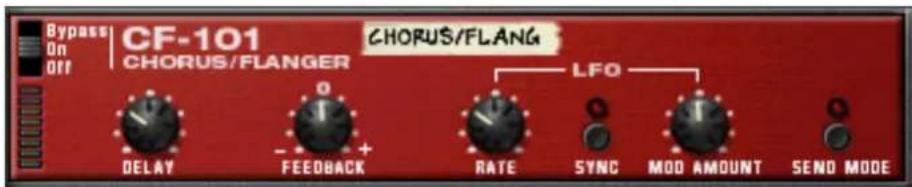
The CF-101 is a combined chorus and flanger effect. It adds depth and movement to the sound by adding a short modulated delay to the audio signal. The delayed signal is then mixed with the original (either in the effect device or manually by you - see below). The CF-101 can be used as an insert or send effect.
Parameters
| Parameter | Description |
| Delay | This is a manual control for the delay time used to create the chorus/flanger effect. Usually, flanger-type effects use fairly short delay times while chorus-type effects use medium long delays. |
| Feedback | This governs the amount of effect signal fed back to the input, which in turn affects the intensity and character of the effect. Turning this to the extreme left (negative feedback) or right (positive feedback) produces different flanger effects with a pronounced resonance "tone", while keeping it in between produces a more gentle chorus effect. |
| LFO Rate | This is the frequency of the LFO modulating the delay time. The higher the value, the faster the sound will oscillate. |
| LFO Sync | This button lets you activate/deactivate LFO sync. When it is activated, the frequency of the LFO is synchronized to the song tempo, in one of 16 possible time divisions. The LFO Rate knob is then used for setting the desired time division. Turn the knob and check the tooltip for an indication of the time division. |
| LFO Mod Amount | This determines the depth of the LFO modulation, i.e. by how much the delay time should be modulated. If you set this to 0, the effect will be "frozen" (most effective if you add some feedback). |
| Send Mode | This determines whether the delayed signal and the dry signal should be mixed in the effect device or not. If you use CF-101 as an insert effect, you should turn this off - the device will then output a mix of the dry signal and the modulated delay signal.If you use the device as a send effect, you should activate Send mode. Then, the device will only output the modulated delay signal, allowing you to mix it with the dry signal using the AUX send controls in the mixer. See also the note below about using the CF-101 as a vibrato effect! |
CV Inputs
The following CV inputs are available on the back panel of the device:
→Delay CV.
Allows you to control the delay time from another device. This may give best results if you turn off the LFO modulation in the device (turn LFO Mod Amount to zero). For example, by controlling the delay parameter from a Matrix, you can create "stepped flanger" effects, in sync with the tempo.
- If you use the Delay CV input for "playing" the feedback tone, note that a higher delay value gives a lower pitch.
→Rate CV.
Lets you control the rate of the modulating LFO from another device.
About Stereo and Mono connections
The CF-101 can be connected using mono or stereo inputs, as shown by the graphs on the back panel. Note the following:
→ A "moving" stereo effect is only obtained when you use a mono input and stereo outputs.
With a stereo input, the two sides are processed in parallel, maintaining the stereo image of the original sound.
→ When you are using a mono input and stereo outputs, there will only be a stereo effect if the internal LFO is used.
If you turn LFO Mod Amount to zero, both stereo outputs will carry the same signal (mono). This is because the "fake stereo" effect is produced by inverting the modulation for one of the output channels.
Tip: Using the CF-101 as a vibrato effect
The Send mode is intended for when using the CF-101 as a send effect. In this mode, the device will only output the modulated delay signal - you get the actual "chorusing" by mixing this signal with the dry, unprocessed signal in the Mixer.
However, if you activate Send mode while using the device as an insert effect, the result will be a pitch modulated version of the original sound - in short, a vibrato effect. Along with a little feedback, this can be used for special effects.
Spider Audio Merger & Splitter

The Spider Audio Merger & Splitter is not an effect device, but a utility. It has two basic functions:
→ To merge up to four audio input signals into one output.
→To split one audio input signal into four outputs.
There are no controls on the front panel of this device, only signal indicators.
Merging audio
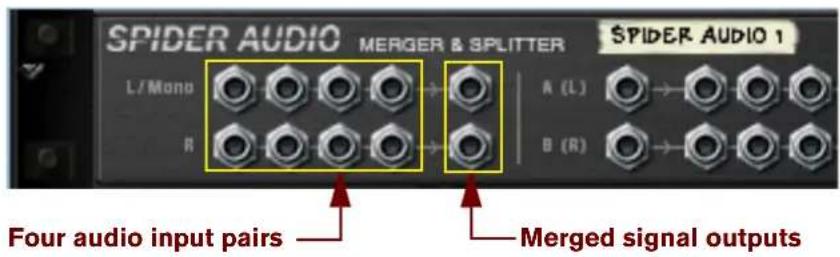
On the back panel of the Spider are several audio connectors. The left half of the panel contains four stereo audio input connectors, and to the right of these, one merged stereo output.
→ The principle is simple; all audio signals connected to any of the four inputs will be merged and output via the output connectors.
If you connect a mono signal (to a L/Mono input, with nothing connected to the corresponding R input) it will be output on both merged outputs. This way you can merge stereo and mono signals freely.
If you connect a signal to the R input only (with nothing connected to the corresponding L/Mono input) it will be output on the R output only.
Practical uses of merging audio
There are many practical uses of merging audio signals together, for example:
→ Process several audio signals with the same insert effect(s).
Perhaps you want to process certain channels in a mix with the same compressor. You can also set up a chain of insert effects and process the merged signals.
→Sub-grouping signals.
It may be practical to control several audio signals using one channel strip in the Mixer.
Splitting audio
The right half of the back panel contains two signal splitters, labeled "A (L)" and "B (R)". The two splitters work independently, in the following way:
→ The signal fed to the input connector will be simultaneously output by all four outputs.
For splitting stereo signals you simply use both splitters with "A" for the left channel and "B" for the right channel.
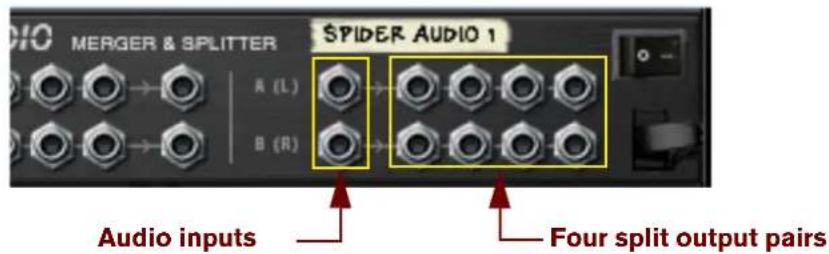
Practical uses of splitting audio
There are many practical uses of splitting audio signals - here a few examples:
→Create "pseudo" stereo effects from mono signals.
For example, you could route the mono output of a Subtractor to the Spider and then send two split outputs (from the same row) to different effects and on to different Mixer channels panned left and right.
→ It provides a way to instantly switch between (or mix) different variations of the same signal.
This is a neat way of applying “spot effects” in a mix. An instrument output is split and sent to three different combinations of insert effect processing. The outputs from the three effects are routed to separate channels in the Mixer, which could in turn have different send effects, eq, etc. You then have three different variations of the same signal that can be easily switched in and out of the mix for drastic sonic changes - or combined for huge layered sounds.
Spider CV Merger & Splitter

The Spider CV Merger & Splitter is not an effect device, but a utility. It has two basic functions:
→To provide one merged CV output from up to four CV input sources.
→To split CV or Gate inputs into several outputs.
Two inputs, A and B, are provided, each with four outputs, where one of the outputs will invert the polarity of the control signal. One reason for having two splittable inputs is to make it possible to split Gate and Note CV, to control several instrument devices with one Matrix for example.
There are no controls on the front panel of this device, only CV signal indicators. The four horizontal indicators light up to indicate signals connected to the corresponding merge input. The two indicators to the right indicate signals connected to the corresponding split inputs.
Merging CV
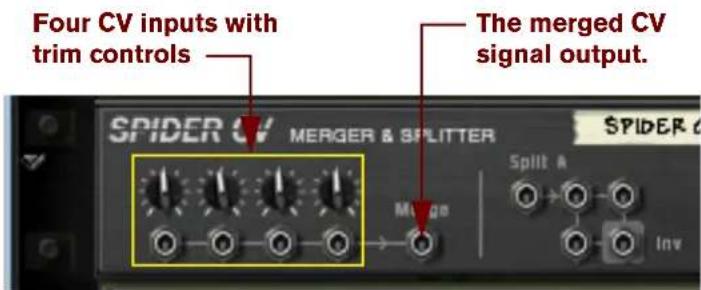
On the back panel of the Spider there are several CV connectors. The left half of the panel contains four CV/Gate input connectors with associated trimpots, and to the right of these, one merged CV output.
- The merged CV output will produce a CV signal that represents the "sum" of all connected CV inputs.
A few things to note:
• Gate CV signals typically trigger notes or envelope cycles and are normally routed to a Gate input. - CV signals typically control note pitch or for modulating parameters and are typically routed to CV Note or Modulation inputs.
There are no strict rules involved, but the facts mentioned above means that it is generally better to stick to using either Gate CV signals or CV signals but not a mixture when merging, simply because the CV/Gate signals usually go to different input destinations.
For instance, merging Note CV and Gate CV from a Matrix does not make much sense if you want to use Matrix to play melodic patterns via the Sequencer Control inputs of an instrument device. There would only be one merged output whereas the instrument device would need a separate Gate and Note CV signal to work properly.
Practical uses of merging CV
The practical applications of merging CV are perhaps less obvious compared to splitting CV. But there are numerous applications for a merged CV control output, a few of which are listed below:
→ You can create interesting modulation effects by merging several Modulation outputs from LFO's and other CV modulation sources.
For example, merging the Modulation outputs from several LFO's would produce a "mixed modulation" output. This merged output signal could be likened to a "super LFO" capable of generating several modulation cycles simultaneously, each with a different waveform and modulation rate! In addition to this, by using the trim control for each CV input, you have full control over the amount of modulation applied by each LFO.
The above example could of course also include Curve CV outputs from a Matrix etc., in short any CV Modulation output.
→ Create an “arpeggiator” using two Matrix devices and the Spider CV Merger & Splitter.
By merging the Note CV output from one Matrix with a Curve CV output of another Matrix, you can transpose the Matrix pattern in real-time, a bit like an arpeggiator.
- Create a Subtractor and a Matrix device.
Connect the Matrix Note and Gate CV outputs to the Subtractor Sequencer CV and Gate inputs, respectively.
- Program a pattern for the Matrix.
In the following text this is referred to as "Matrix 1".
- Now create a Spider CV and a second Matrix device and connect them as in the picture below.
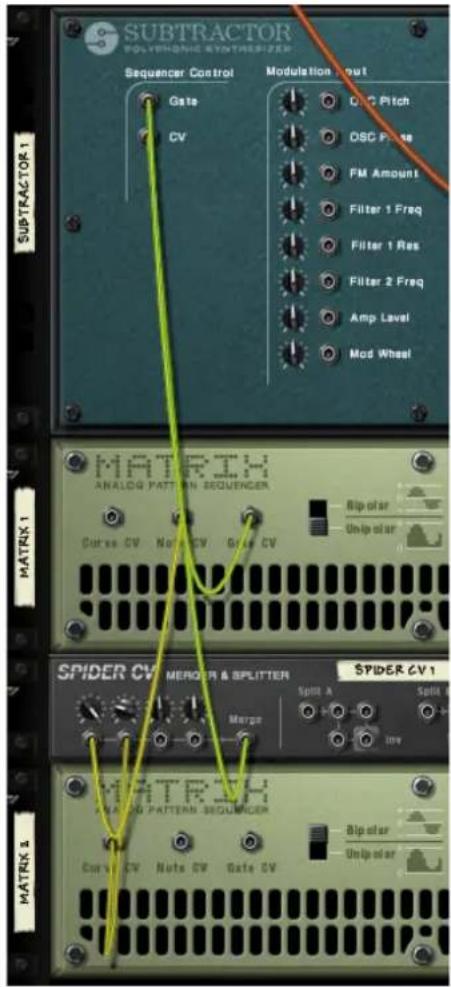
Note that the Note CV output from Matrix 1, and the Curve CV output of Matrix 2 should be connected to the Spider. The merged output is connected to the Sequencer Control Note CV input on the Subtractor.
-
On the Spider CV, turn the trimpot for the input connected to the Note CV output fully to the right. This setting will retain the correct pitch relationship for the notes played by the pattern.
-
On the Spider CV, turn the trimpot for the input connected to the Curve CV output to "32". This will produce a Curve CV output that corresponds to semitone steps.
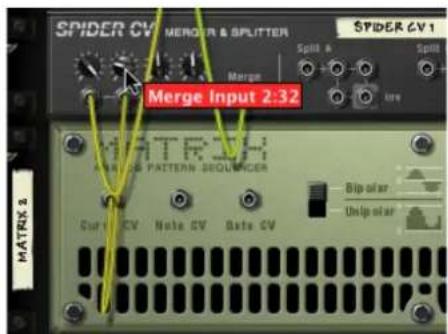
-
Set the Curve type switch to "Bipolar" on the back of the second Matrix (Matrix 2).
-
Flip the rack around so that the front panels are showing, and make the following settings for the "Matrix 2":
- Set the number of steps to "1".
- Set the Curve/Keys switch to "Curve".
- Adjust the Matrix 2 curve for step 1 (the only step used) so that it is in the middle of the bipolar curve as the picture shows.
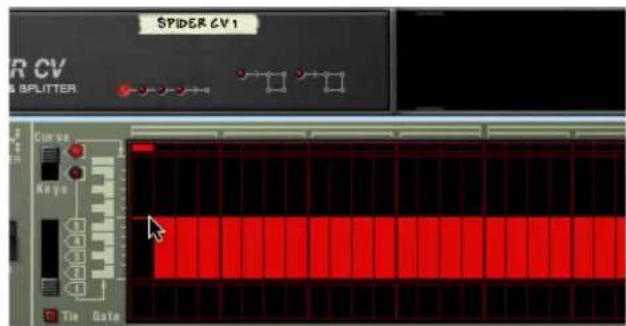
- If you now activate Play from the transport, the pattern you programmed for Matrix 1 is played back. By carefully adjusting the Matrix 2 Curve step 1 up or down the Matrix 1 pattern is transposed in semitone steps.
By programming different values for the "pattern" played by Matrix 2 and saving them in different pattern locations, you can use the Pattern selectors to transpose the Matrix 1 pattern to different keys!
Splitting CV
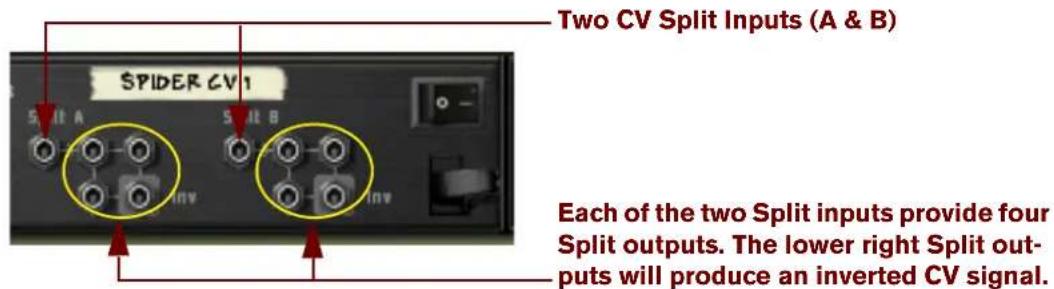
On the right half of the back panel you will find two split inputs "A" and "B", each with four output connectors. The signal connected to a Split input will be output by all four corresponding outputs, where one is inverted.
Practical uses of splitting CV
There are many practical uses of splitting CV signals - here are a few examples:
→ Connecting the CV Note and CV Gate outputs from a Matrix to Split Input A and B, allows you to connect the Matrix to several instrument devices.
Simply route the CV and Gate outputs to the corresponding Sequencer Control CV/Gate inputs on the instrument devices. Although this could also be done by copying the Matrix Pattern data to several sequencer tracks and routing the outputs to the desired devices, the advantage by using Split is if you are editing Matrix pattern data this will be immediately be reflected in all the connected devices, without any copy/paste operations.
Splitting modulation outputs from LFO's, Curve CV data etc. allows you to apply modulation from one source to several parameters.
By using the inverted output, you can create interesting modulation crossfades, where one parameter value rises and another parameter value is lowered for example.
Chapter 36
The Combinator
Introduction
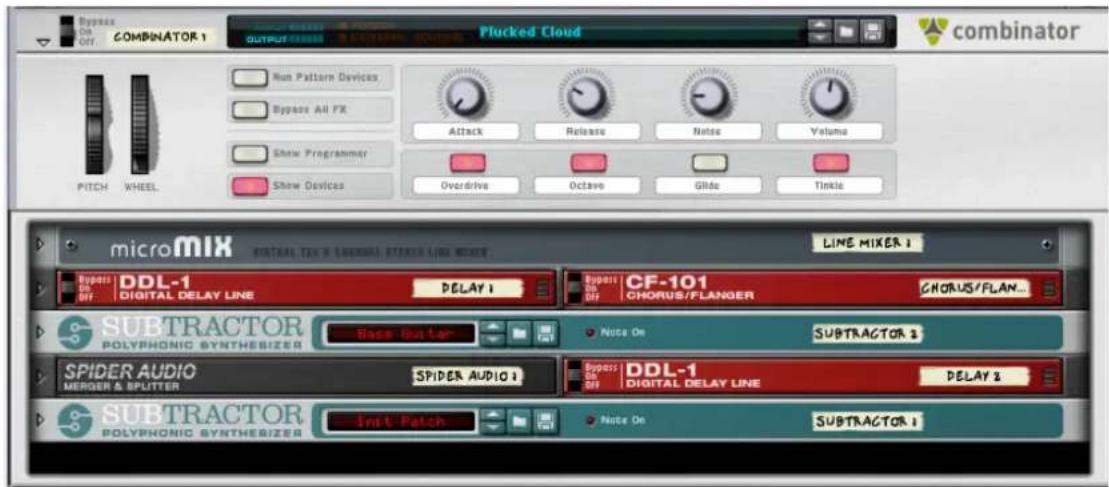
The Combinator is a special device that allows you to save and recall any combination of Reason Lite/Rack Extension/VST devices (instruments, effects, mixers etc.) and their internal connections. A saved Combinator setup can be loaded as a patch, called a "Combi". The Combinator device itself acts as a container for the devices in a Combi.
The basic idea behind the Combinator device is simple, but very powerful. Being able to save multiple devices as a Combi enables you to instantly recall any type of setup, however complex, as simply as loading a patch!
Some typical applications of the Combinator:
→Create split or layered multi-instruments.
Add any number of instrument devices and play them as a single layered instrument. Instrument devices in a Combi can also be assigned to specific keyboard/velocity zones.
→Save instrument/effect combinations.
Save an instrument together with your favorite effect(s).
→Create multi-effect devices.
You can create and save complex effect chains as Combis.
About the Combi patch format
The Combinator saves files in the Combi (.cmb) patch format. When you load a ready-made Combi patch, all devices included in the Combi, their corresponding parameter settings and audio and CV connections are instantly recalled.
The Factory Soundbank includes many preset Combinator patches, divided into various categories.
There are two basic types of Combi patches; instrument and effect combis.
- Instrument Combis contain instrument devices and generate sound.
- Effect Combis contain effect devices and are used to process sound.
These Effect Combis can e.g. be loaded as insert effects in the Main Mixer channel strips and Master Section. They can also be created as send effects in the Main Mixer Master Section using the "Create Effects..." command on the Create menu.
Creating Combinator devices
Creating an empty Combinator device
→ Add a Combinator device from the Utilities palette in the Browser.
Either double click the device or drag and drop from the device palette to the rack.
→Select "Combinator" from the Create menu.
This will create an empty Combinator. Empty Combinator devices can be used as a starting point when creating new Combi patches. It also allows you to browse for existing Combi patches.
Creating a Combinator by combining devices
You can create a Combinator device by combining existing devices:
- Select two or more devices in the rack by [Ctrl]-clicking (Win) or [Shift]-clicking (Mac).
The devices do not have to be adjacent in the rack.
! Note that you should never select any Mix Channel or Audio Track devices, since this will disable the "Combine" function described below.
- Select "Combine" from the Edit menu or context menu.
This creates a Combinator device containing the devices that were selected according to the following rules:
→ A sequencer track is created for the Combinator, just as when creating instrument or pattern devices.
→ The new Combinator device appears at the position below the selected device that is farthest down in the rack.
→ The selected devices are moved to be contained within the Combinator's "holder".
Their internal order is not changed. Reason Lite attempts to autoroute the first "input device" and first "output device" to the Combi To/From Devices connectors - see "About internal and external connections". Other connections are unchanged.
→ Devices outside the Combi remain in the same order as before.
! Please see "Adding devices to a Combi" for details about auto-routing.
Creating a Combinator by browsing patches
You can use "Create Instrument" or "Create Effect" to create a Combinator device (just as you can any device). If you select a .cmb patch a Combinator will be created containing all devices and settings saved in the Combi.
Combinator elements
In the picture below an unfolded Combinator device is shown.
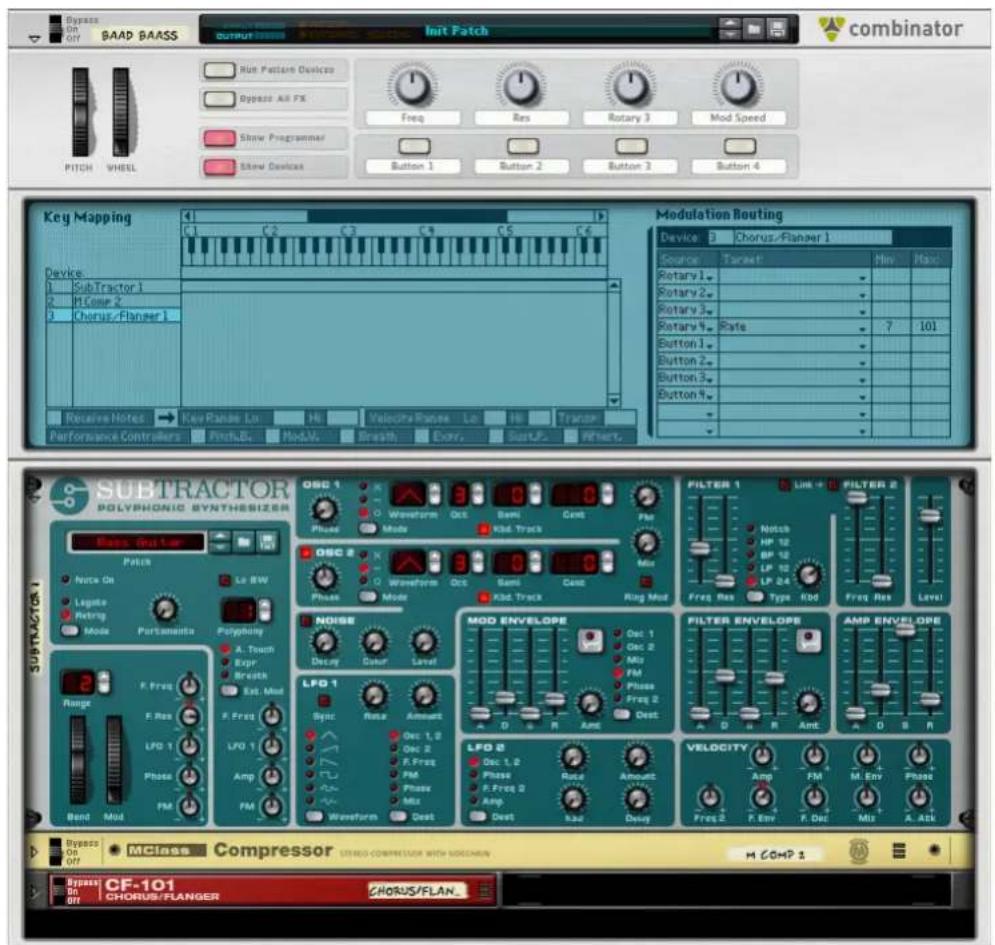
The front of the Combinator consists of the following elements (from the top down):
→ The narrow panel at the top is always shown, even when the whole Combinator is folded.
It contains a display which (amongst other things) shows the name of the currently loaded Combi, and standard Select/Browse/Save patch buttons.
→ Next is the Controller panel, which is always shown if the Combinator is unfolded. See "The Controller panel".
→ The Programmer panel contains settings for Key and Velocity Zone mapping as well as Modulation Routing settings.
The Programmer can be shown/hidden by clicking the "Show Programmer" button on the Controller panel. See "Using the Programmer".
→ At the bottom are the devices included in the Combi.
Devices can be shown or hidden by clicking the "Show Devices" button on the Controller panel. The empty space at the bottom is used for adding more devices to a Combi by drag and drop. Clicking the empty space so that the red Insertion line appears also makes the Combi the target container for new created devices (from the Create menu). See "About the Insertion line".
About internal and external connections
Unlike other devices, the Combinator contains both external and internal audio connections.
→ External connections are used to connect a Combinator to devices outside the Combi.
→ Internal connections are how devices within the Combi are connected.
External connections

→ The "Combi Output L/R" connectors carry the audio output of the Combinator.
This output connects with a device outside the Combi, normally a mixer. Internally, this output is connected to the "From Devices" connectors. When you create a new Combinator this output will be auto-routed to the first available mixer input channel.
→ The "Combi Input L/R" connectors is the input to the Combinator (used for effect Combis only).
Internally, this input is connected to the "To Devices" connectors.
Internal Connections

→ The "From Devices L/R" inputs is where the outputs from devices in the Combi are connected.
→ The "To Devices L/R" outputs connect to an input on a device in the effect Combi.
About External Routing
If an individual device in the Combi is directly connected to a device outside the Combinator, this is known as an "External Routing" connection, which should generally be avoided. The reason for this is that such connections are not saved with the Combi patch.
Therefore, all connections to/from a Combi should pass via the To/From Device connectors on the Combinator device if you wish to make the Combi self-contained.
If a Combi contains external routing connections, this is indicated both on the front and back panels of the Combinator; On the front panel "External Routing" is displayed in the Patch name display, and on the back panel a LED indicator is lit.
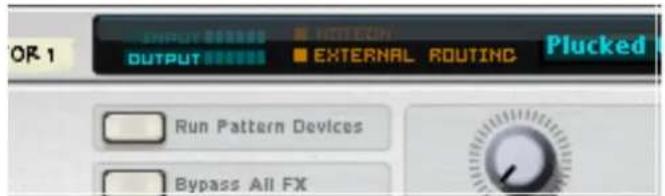
It is still possible to use a Combi with External Routing connections within the context of a song (where all routings are saved with the song). Just keep in mind that the external routing connections will not be part of the patch!
How to avoid external routing connections
As explained previously, all connections to/from a Combinator device should pass via the To/From Device connectors in order to make the Combi self-contained. Therefore you need to include a mixer device for Combis with more than 2 device outputs.
Say you were to combine three instrument devices (each with stereo outputs connected to a mixer) in order to create a layered or split instrument Combi.
If you simply selected these three instrument devices (but not the mixer) and then selected "Combine", only one of the devices would be auto-routed to the "From Devices" connectors, while the other two devices would have the same connections they had before combining.
Therefore:
→ When combining several instrument devices, connect them to a mixer device and include this mixer in the Combi.
This way, all the instrument device outputs in the Combi can be connected to separate input channels in the mixer. The mixer device output can then be routed via the "From Devices" connectors and thus the Combi will be self-contained.
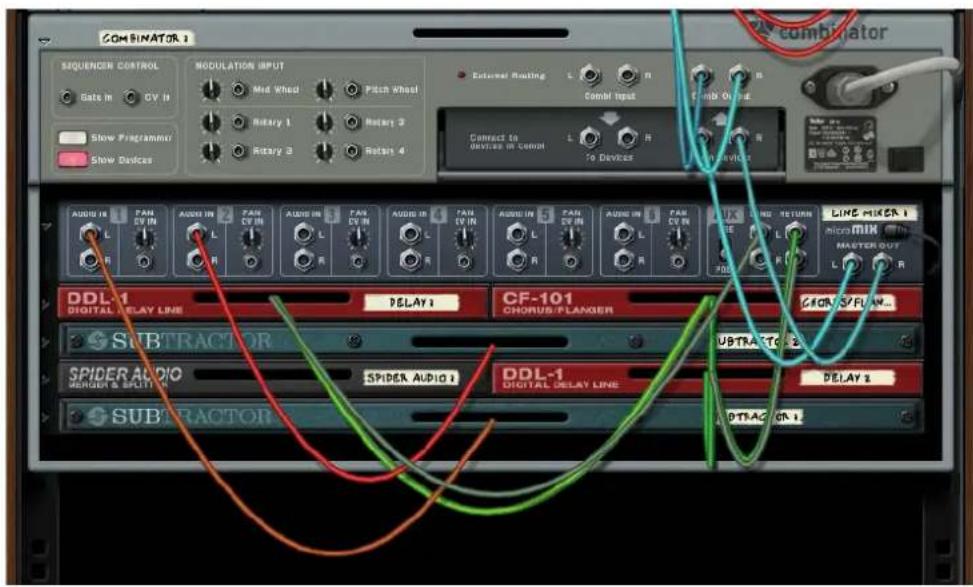
Instrument devices and effects connected to a Line Mixer 6:2 within the Combi.
The Line Mixer 6:2 is ideally suited for mixing device outputs in Combis (see "The Line Mixer 6:2").
Adding devices to a Combi
About the Insertion line
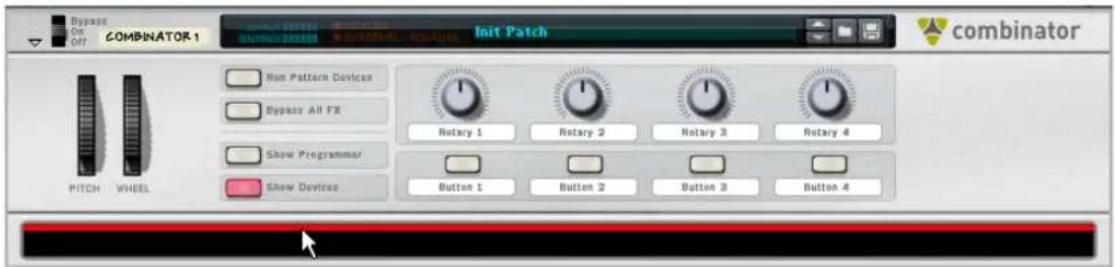
When the Insertion line is shown, new created devices will be added to the Combinator device.
To be able to select the Insertion line you have make sure that the "Show Devices" button is lit on the Combinator Controller panel.
→ The Insertion line is shown in the empty space at the bottom of the Combinator holder (below any devices currently in the Combi).
If the Combi doesn't contain any devices, the empty space is located just below the Controller panel.
Showing the Insertion line
Any of the following methods will select/show the Insertion line:
- By clicking in the empty space at the bottom of the Combinator holder.
- When creating a new Combi, the Insertion line is automatically selected.
- By using the arrow keys you can step through and select each device currently in the Combi. By selecting the empty space, the Insertion line appears.
- Selecting "Initialize Patch" for a Combinator will clear all devices and the Insertion line appears.
→ Note that showing the Insertion line automatically selects the Combinator device. However, selecting the Combinator will not automatically show the Insertion line.
The Insertion line remains selected until you select another device (either in the Combi or in the rack), or hide the devices.
Creating new devices in a Combi
To make a Combinator the target device for created devices you have to use one of the following methods:
→ Showing the Insertion line (see "Showing the Insertion line").
If you create a device with the Insertion line showing, the new device will appear below the Insertion line, at the bottom of the Combi holder.
→ Selecting a device in the Combi (but not the Combi itself).
When you select a device from the Create menu it will appear below the selected device (just like in the rack).
→ No sequencer tracks will be automatically created for devices added to a Combi.
About auto-routing
The auto-routing of devices in a Combi is similar to devices in the rack:
- If a device in a Combi is selected, the new created device will appear below the selected device according to standard rules.
- If an effect is selected and you create a new effect device, these will be connected serially.
- If an instrument device is selected and you create an effect it will be connected as an insert effect to the instrument device.
- If a mixer is selected and you create an effect it will be connected as a mixer send effect.
- If an instrument device is selected and you create another instrument device it will be added below the selected device and connected to the first available mixer input channel.
- If you hold down [Shift] and create a new device, no auto-routing will take place.
- If you hold down [Option] (Mac) or [Alt] (Windows) and create a new device, a sequencer track will be created for the device.
→ If you add a device to an empty Combi, its output will be auto-routed to the "From Devices" connectors. For effect devices, the input will also auto-route to the "To Devices" connectors.
Adding devices using drag and drop
You can move devices in the rack that are currently outside the Combi into the Combinator holder. This works as follows:
-
If you want to add more than one device at the same time, [Ctrl]-select (Win) or [Shift]-select (Mac) the devices.
-
Click on the panel area of a device.
You can click anywhere outside the actual parameters and displays.
- Drag the device(s) into the Combinator.
A thick red vertical line indicates where the device(s) will be positioned. Note that the red line can be to the left of a device (indicating that the moved device will be inserted before the other device) or to the right of a device (indicating that the moved device will be inserted after the other device). You can also add devices to the empty space at the bottom of the Combi holder.
- No auto-routing will take place.
The existing connections to the rack will be kept, so there may be external routing connections (see "About External Routing"). If there are, "External Routing" will be shown the Combinator name display (and on the back of the Combinator a LED indicator will be lit).
- If you drag devices into the Combi with [Shift] pressed, the devices will be disconnected from the rack and auto-routed according to the insert position.
The routing between dragged devices will be kept. If it isn't possible to auto-route a dragged device (e.g. if there's no free mixer inputs in the Combi), the device will become unconnected.
- If you drag devices into the Combi with Alt or Option pressed, the devices will be copied. No auto-routing takes place.
Using [Shift] at the same time will attempt to auto-route according to the same rules as described above.
Adding devices using copy/paste
You can copy devices and paste them into a Combi.
- Select the devices you wish to copy as usual.
- Select "Copy Device" from the Edit (or context) menu.
- Select a device in the Combi or click the empty space to show the insertion line.
- Select "Paste Device" from the Edit (or context) menu.
- When pasting, the devices will be added below the currently selected device or the Insertion line in the Combi. No auto-routing takes place.
→ Pressing [Shift] when pasting will attempt to auto-route according to standard rules.
Adding a Combi to a Combi
Nested Combis (i.e. a Combi within a Combi) is not supported. If you open the Create menu when the Insertion line or a device in a Combi is selected, the Combinator item will be grayed out.
You can, however, use drag and drop or copy/paste to add a Combi to another Combi. The following then applies:
The devices in the dragged (or pasted) Combi will be “uncombined” (i.e. the Combinator device itself will be removed) and the devices will be added below the insert position in the target Combi.
Existing routing will be unchanged.
→ If you press [Shift] when dragging (or pasting) the uncombined devices will be auto-routed as if it was a single device.
The "From Devices" Output (and "To Devices" input if applicable) used in the uncombined Combi will be autorouted to the target Combi, according to standard rules.
Combining two Combis
→ The lower Combi will be uncombined and the devices added to the upper Combi in the rack when combining. Existing routing will be unchanged.
Combining devices in a Combi with devices in the rack
If you combine some devices in a Combi with devices in the rack, the combined devices are removed from their original locations and added to a new Combi (below the "original Combi").
Combi handling
Moving the entire Combi
This works much the same as for other devices in the rack.
→ Select the Combinator by clicking on the holder and drag to a new position.
An outline of the Combinator is shown when you drag, and a red line shows the insert position. All connections are kept.
→ If you press [Shift] when dragging the Combinator will attempt to auto-route to the insert position in the rack according to standard rules.
The auto-routing will take into account whether it is an effect Combi or an instrument Combi.
→ If you press Alt or Option while dragging, a copy of the Combi is created.
No Auto-routing takes place. If you press Alt or Option + [Shift] the copied Combi will be auto-routed according to standard rules.
Moving devices within a Combi
Just as for devices in the rack, an outline of the devices is shown when you drag, and a red line shows the insert position. All connections are kept.
→ If you press [Shift] when dragging, the device(s) will attempt to auto-route to the insert position according to standard rules.
Moving devices out of a Combi
If you move devices out of a Combi the following applies:
→ The routing is unchanged, and the External Routing indicator is likely to light up.
If you press [Shift] when dragging, the device(s) will attempt to auto-route to the rack according to standard rules.
Deleting devices in a Combi
This works exactly as for devices in the rack. Select the device and then either select "Delete Devices and Tracks" from the Edit menu or context menu, or press [Backspace].
Uncombining devices
You can uncombine a whole Combi or selected devices within a Combi in the following way:
→ If you select a Combinator and then select "Uncombine" from the Edit menu, the Combinator device will be removed, and all devices contained in the Combi will be connected as a single device to the rack.
The devices previously connected to the To/From Devices connectors will now be connected to the rack in the same way the Combinator device was (via the Combinator output and input).
→ If you uncombine a few selected devices in a Combi these will be removed from the Combi and added to the rack below the Combi.
Connections are unchanged, so external routing is likely to happen.
Sequencer tracks and playing Combis
When you create a Combinator device, a sequencer track is automatically created. This track is also given Master Keyboard Input just like standard instrument devices.
→ When the Combinator track receives incoming MIDI data, this will be routed to all instrument devices in an instrument Combi. This means that the devices will be layered when you play (taking default velocity and key ranges into account).
→ You can turn off Receive Note or selected Performance controller data for individual instrument devices in the Programmer panel.
See "Using the Programmer" for details.
The Controller panel

This is the main Combinator panel. Like standard instrument devices it features Pitch and Mod wheels and various controls.
About the virtual controls
The four Rotary knobs and buttons in the middle of the Controller panel are "virtual" controls that can be assigned to parameters and functions in devices contained in the Combi.
These controls are by default not assigned to any parameters in new Combis.
- You assign parameters in the Modulation Routing section of the Programmer panel (see "Using Modulation Routing").
- Movements of the virtual controls can be recorded as automation.
• Each control can be assigned to any number of parameters.
- Clicking on the label for a Rotary or Button lets you type in an appropriate name for it.
The Pitch Bend and Modulation wheels
The Pitch and Mod wheels on the Controller panel will mirror the corresponding actions on your master keyboard, just like for standard instrument devices.
→ When a Combinator device has Master Keyboard input and the Combi contains several instrument devices these will all receive pitch bend and modulation data.
The settings in the instrument devices determines what happens when applying pitch bend or modulation.
- For example, moving the Mod wheel could apply vibrato for one device and change the filter cutoff frequency for another device.
- Pitch Bend will also be applied according to individual settings in the Range field for all instrument devices in a Combi.
Run Pattern Devices button
This can be used to start/stop all (Reason) pattern devices included in the Combi. This works exactly as pressing the Run button on the pattern device panel. The on/off status of this button is not saved with the Combi patch. Pressing play on the transport panel will automatically activate "Run Pattern Devices".
- In the Reason Factory Sound Bank, Combi patches containing pattern devices have “(run)” at the end of their patch names.
Bypass All FX
This button allows you bypass all effect devices in a Combi. It works as follows:
- All insert effect devices in the Combi are switched to Bypass mode.
- All effects connected as send effects to a mixer device are switched off.
- Clicking this button will not affect effect devices that were bypassed or turned off already.
Select backdrop...

This function allows you to change the "skin" of the Controller panel. You can design your own labels for the assignable controls, and change the color and look of the whole panel.
→ Select the Combinator and choose "Select Backdrop..." from the Edit menu.
The Image browser opens, allowing you to select image file in the JPEG (.jpg) format.
→The dimensions of the image file should be 754 x 138 pixels.
→The knobs, buttons, patch name display and patch buttons cannot be redesigned.
→ If you wish to design your own text labels for the virtual controls, you should first remove the original text labels.
Click on a label, remove the current text and press [Enter].
→To remove a Backdrop, select "Remove Backdrop" from the context menu.
The original look of the Combinator panel is restored.
About template backdrops
As with the Kong device, it is possible to customize the Combinator front panel graphics with a user-designed skin. In the Reason Download section at the Reason Studios website is the "Combi and Kong Backdrop Templates" zip file, which contains PhotoShop (.psd') files which can be used as starting point for designing your own Combinator panel graphics. See the "Read Me.txt" file in the Backdrops folder for more details.
Two templates are available, one in the JPEG format and the other in the Adobe Photoshop format (.psd).
→ The .psd (Photoshop) template contains multiple layers, which are useful when customizing backdrops. You have to save any backdrops created in Photoshop as JPEG files before you can use them in Reason Lite.
Using the Programmer
The Programmer is used for key mapping and setting velocity ranges for instrument devices, and for Modulation Routing; assigning device parameters to the knobs and buttons on the Controller panel.
→ To show the Programmer panel, click the "Show Programmer" button on the Controller panel.
The Programmer appears below the Controller panel.
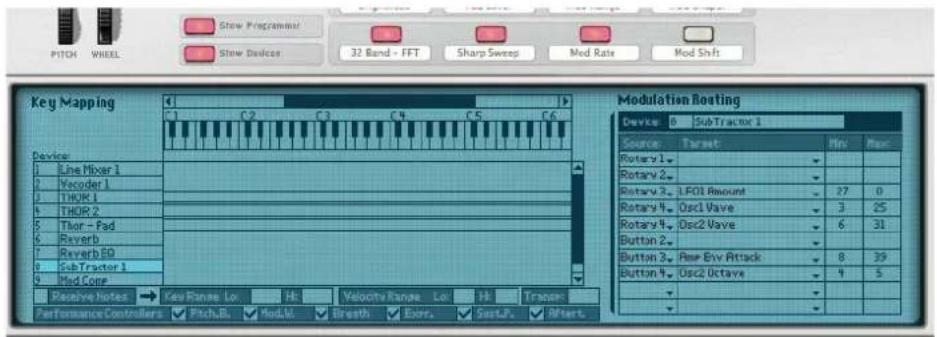
To the left on the Programmer panel the devices in the current Combi are listed in the same order they appear in the Combinator holder.
Clicking on a device in the list selects it for editing.
→ The middle Key Mapping section features a keyboard with a horizontal scroll bar at the top. In the area below it the key range for each instrument device is shown.
To the right is the Modulation Routing section where you can assign parameters to the controls on the Controller panel.
See "Using Modulation Routing".
Key Mapping instrument devices
Each instrument device can have its own separate key range, the lowest and the highest key that will trigger the device. This allows you to create splits and layers for instrument devices in a Combi.
-
Make sure the Combinator track has Master Keyboard Input.
-
Select an instrument device in the Device list to the left (non-instrument devices, e.g. effects and mixers do not have key ranges).
The currently selected device key range is highlighted and shown as a horizontal bar under the keyboard display, and as note numbers in the Key Range Hi and Lo fields at the bottom of the Programmer panel. By default, the entire range is selected (C -2 to G 8). Only one device at a time can be selected.
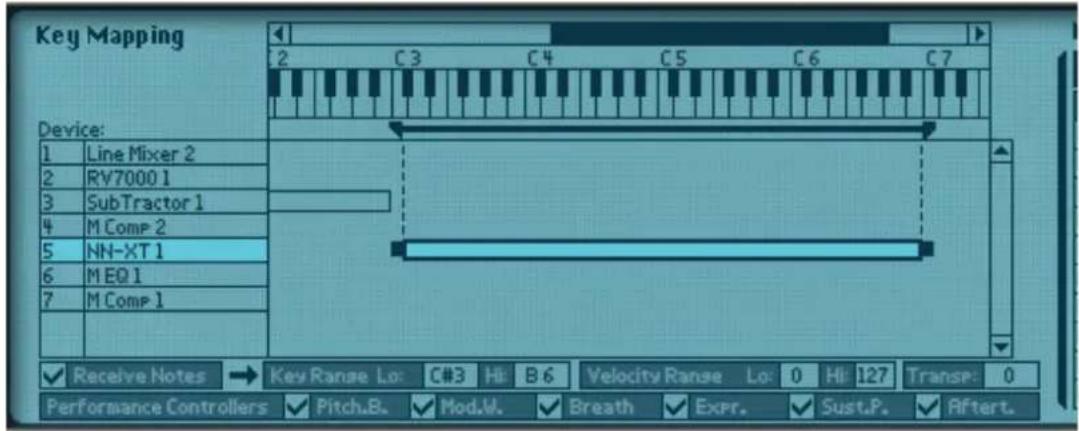
There are several ways you can change the current key range:
→ By clicking in the Key Range Lo and Hi value fields and moving the mouse up or down.
→By moving the handles of the horizontal bar in the middle display.
You may have to use the scrollbar at the top to "see" the handles.
→ By dragging the horizontal bar itself you can also move entire key zones horizontally, thereby changing their key ranges.
3. Using either method, set the desired key range for the selected device.
When done, the device will only play back notes in the set key range.
→ By setting up key ranges for devices in a Combi, you can create split instruments.
For example playing notes below C 2 could trigger a device playing a bass sound, whereas playing notes above C 2 could trigger a device playing a pad sound.
→ Instrument devices in a Combi that share the same key range will be layered - i.e. play at the same time.
This given that no velocity ranges have been set up - see below.
→ You can of course set up overlapping ranges where notes within a set key range will layer two (or more) devices, but notes above and below the set range will play separate devices.
About the Transpose function
The Transpose field in the right bottom corner allows you to transpose the currently selected instrument device. It will not shift the key mapping, just the pitch of the selected device. Range is +/- 3 octaves, in semitone steps.
About the keyboard
You can use the keyboard to audition selected instrument devices by pressing [Option] (Mac) or [Alt] (Windows) and clicking on the keys.
About the Receive Notes/MIDI Performance Controller checkboxes
In the lower left corner of the Programmer there is a Receive Notes field with a corresponding checkbox, and below there are checkboxes for all standard MIDI Performance controllers (Pitch Bend/Mod Wheel/Breath/Expression/Sustain Pedal/Aftertouch).
→ These checkboxes allow you to control whether Note/MIDI Performance controller data is to be received for each instrument device in a Combi.
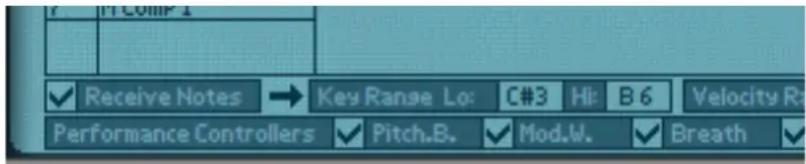
→ If you deactivate the "Receive Notes" checkbox the selected device will not respond to incoming MIDI note messages.
If a non-instrument device is selected this checkbox is always deactivated.
→ If you deactivate any of the Performance Controllers, the corresponding controller(s) will not be received by the selected instrument device.
All are on by default.
Setting Velocity Ranges for instrument devices
When instrument devices are set up so that their key ranges overlap – completely or partially – you can use velocity switching to determine which devices should be played back depending on how hard or soft you play on your MIDI keyboard.
This is done by setting up velocity ranges.
Each time you press a key on your MIDI keyboard, a velocity value between 1-127 is sent to Reason Lite. If you press the key softly, a low velocity value is sent and if you press it hard, a high velocity value is sent.
This velocity value determines which devices will be played and which will not.
- Select an instrument device in the Device list to the left (non-instrument devices, e.g. effects and mixers do not have velocity ranges).
By default, the entire range is selected (0 - 127).
-
Click in the Velocity Range Lo and Hi value fields and move the mouse up or down to set a low and high velocity range, respectively.
-
When you have set a range, the device will only be triggered by notes within this velocity range.
About overlapping Velocity Ranges
You can set overlapping velocity ranges. Here's an example of how this can work:
→Device 1 has a velocity range from 1-60.
→Device 2 has a velocity range of 41-100.
→Device 3 has a velocity range of 81-127.
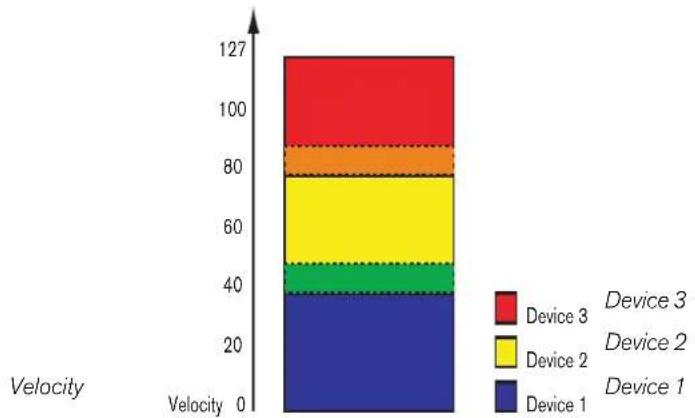
bar_stacked
| Device | Value | |---|---| | Device 1 | 37 | | Device 2 | 40 | | Device 3 | 35 | | Device 4 | 8 |Now, velocity values between 41 and 60 will trigger notes from both Device 1 and Device 2. Likewise, velocity values between 81 and 100 will trigger sounds from Device 2 and Device 3.
About full and partial velocity ranges
You can see which devices have modified velocity ranges in the key map display:
• Devices with a full velocity range (0 - 127) are only shown with an outline.
• Devices with any other velocity range are shown as striped.

The device has a partial velocity range, which is indicated by stripes.
Using Modulation Routing
The Modulation Routing section allows you to assign any parameter or function in devices included in a Combi to any of the virtual Rotary and Button controls on the Controller panel. You can also control Combi Programmer parameters by connecting external CV modulation sources to any of the four Programmer CV Inputs on the back of the unfolded Programmer panel.
About Rotary and Button controls
The virtual Rotary and controls operate much like the equivalent controls on the real devices:
A Rotary control can either smoothly change parameter values (e.g. a level control), or step through fixed values (like the Oscillator waveform spin controls on a Subtractor).
→A Button control will switch between two set values like an on/off switch.
Worth noting is that there are buttons on several Reason devices that will step through a series of values, for example LFO Waveform buttons. If LFO Waveform is assigned to one of the virtual Buttons you will only be able to switch between two of the six LFO waveforms (which waveforms is determined by the Min/Max range).
→ The available range for each selected parameter is shown in the Modulation Routing Min/Max fields.
Most sliders and rotary knobs on the actual devices have the standard 0-127 or -64 to 63 range. Selectors and spin controls can have any value range.
About the Programmer CV Inputs
On the back of the Programmer panel are four CV Modulation Inputs for connecting external sources to modulate any of the parameters that are accessible in the Target section in the Programmer, see "Programmer CV Inputs".
Assigning parameters to a control
This is done as follows:
- Select the device you wish to assign parameters for in the device list to the left.
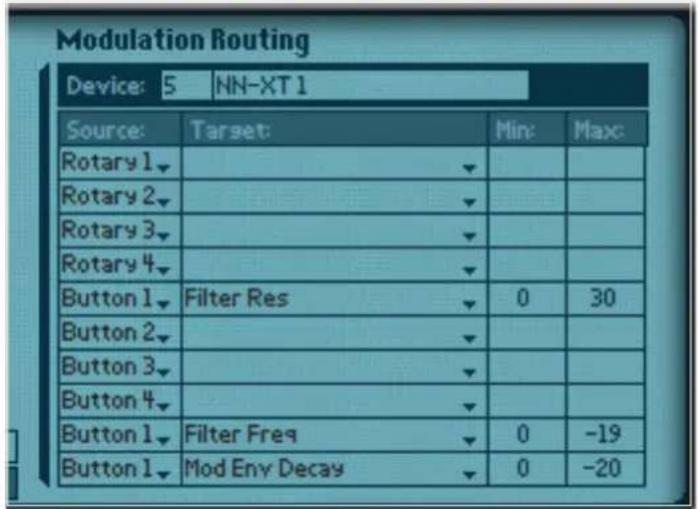
The name of the selected device is now shown in the Modulation Routing Device field. The Modulation Routing section contains four columns:
In the Source column, the four Rotary and Button controls are by default listed but each field can be changed to any Rotary/Button/CV Input or Performance controller by clicking the arrow and selecting from the pop-up. The last two fields are unassigned by default.
→ The pop-ups in the Target column contain all parameters for the selected device.
→ Lastly in each Target pop-up list is the option to receive note data or not.
→ The Min/Max columns allow you to specify a value range for the virtual control.
- Click in the Target column for the Rotary or Button control you wish to assign a parameter.
On the pop-up that appears, all the available parameters for the device are listed.
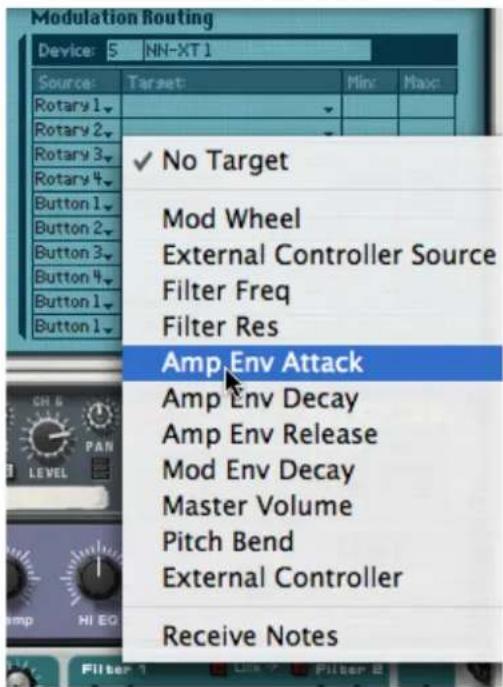
- Select the parameter you wish to assign to the control.
The parameter is now assigned, and the name of the parameter is shown in the Target column for the corresponding control.
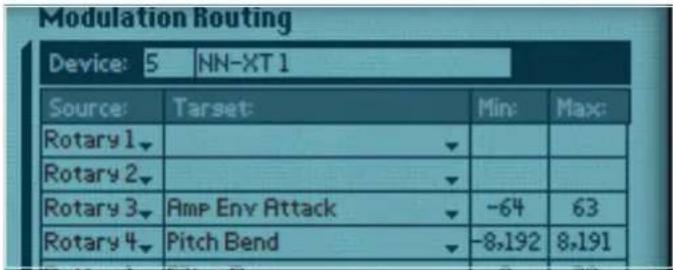
-
If you wish the selected device to receive notes this option should be checked.
-
If you move or press the assigned Rotary or Button it will now control the parameter you assigned to it.
-
You can specify a range for the parameter by clicking in the Min and Max columns and moving the mouse up or down.
By default the maximum available range is set.
- If you select another device in the Device list to the left, you can assign another parameter to the same Rotary or Button control using the same basic method.
This means that you can create multi-function controls that operate simultaneously on several parameters. E.g. if you have two Subtractors and an Europa in a Combi you could create a "master" filter cutoff knob, that controls this parameter for all three devices.
Naming a control
When you make modulation routing assignments, you should give the associated control a descriptive name that reflects what it does, for example Vibrato On/Off or the name of the parameter that it controls.
This is done by clicking the label on the Controller panel and typing in new name.
CV Connections
CV connections between devices in the Combi are saved with the Combi patches. This is also true for CV connections between devices in Combi and the Combi itself - e.g. if you have connected a Matrix in the Combi to one of the CV inputs on the back of the Combi panel.
The following CV connectors can be found at the back of the Combinator:
Sequencer Control Inputs
The Sequencer Control CV and Gate inputs allow you to play the Combinator from another CV/Gate device (typically a Matrix or a RPG-8). The signal to the CV input controls the note pitch, while the signal to the Gate input delivers note on/off along with velocity.
Modulation Inputs
In this section you will find standard CV Mod Wheel and Pitch Bend modulation inputs, as well as modulation inputs for the four Rotary controls.
! Parameter(s) that are assigned to a Rotary control can thus be modulated by CV, which allows you to use CV control for almost any Reason Lite parameter!
Programmer CV Inputs
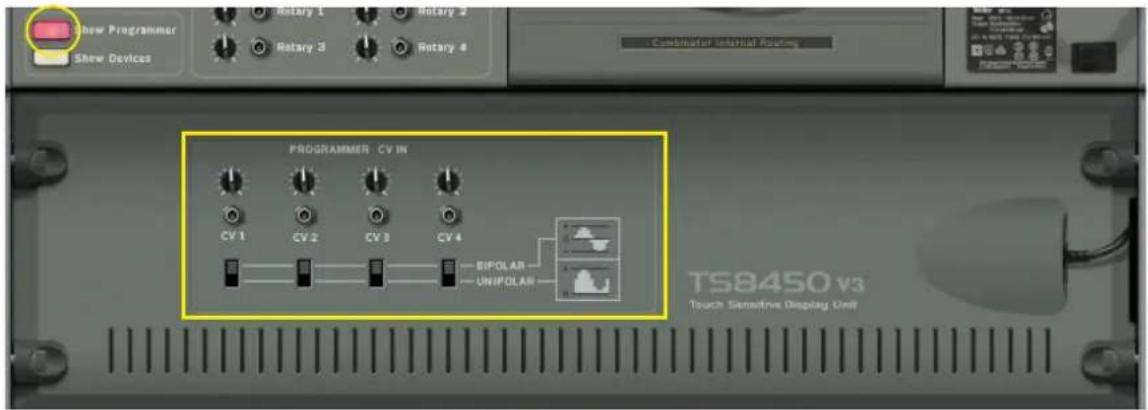
Here you can connect external CV modulation sources for modulating any of the Target parameters in the Programmer (see "Using Modulation Routing"). Next to each CV Input are one sensitivity knob and one polarity switch that work as follows:
- The sensitivity knobs can be used for attenuating the CV Input signal.
- The polarity switches should be used for defining the polarity of the CV Input signal.
For example, if you have connected a CV signal from an envelope generator, the switch should be set to Unipolar. If you are modulating from a standard LFO, the polarity switch should be set to Bipolar.
Chapter 37
Matrix Pattern
Sequencer
Introduction

The Matrix is a pattern-based device. Matrix doesn't generate sound on its own, but has to be connected to another instrument device. It basically works by sending pattern data in the form of Note CV (pitch) and Gate CV (note on/off plus velocity) or Curve CV (for general CV parameter control) signals to a device or device parameter. The patterns can be up to 32 steps, and there are 32 memory locations for storing pattern data. The Matrix is monophonic and can control one voice in an instrument device.
Unlike most other devices in Reason Lite, the user interface of the Matrix is not modeled on any existing hardware equivalent. The hardware devices that could be said to have similar functionality are analog step sequencers, which usually had rows of knobs that controlled the note pitch and gate values for each step.
About the three Output types
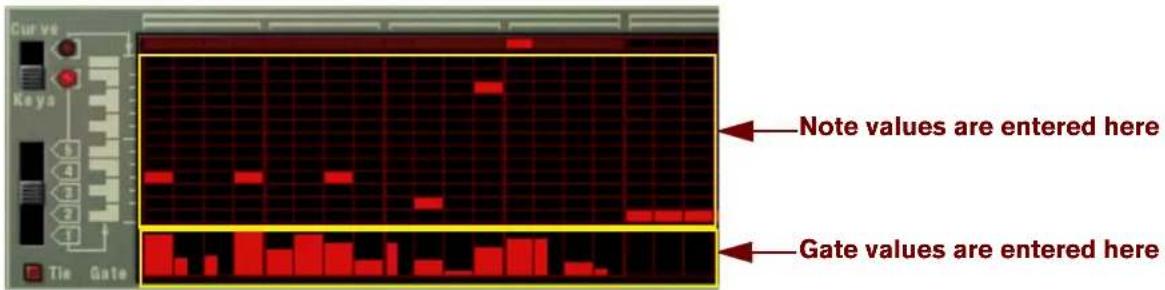
Note and Gate CV values.
The Matrix can produce three types of output: Curve CV, Note (Key) CV and Gate CV.
- Note CV normally controls note pitch.
When connected to an instrument device Sequencer Control input, the values correspond to semitone steps. - Gate CV represents a note-on/off value, plus a level value (that could be likened to velocity).
Both of these two outputs are typically connected to the Sequencer Control Gate and CV inputs on a compatible instrument device. For example, if you create a Matrix with either a synthesizer (Subtractor, Thor, Europa) or a sampler (NN-19, NN-XT) selected, they will be auto-routed in this way, and will control one voice in the device.
- Curve CV is a separate pattern, programmed separately from the Note/Key and Gate CV.
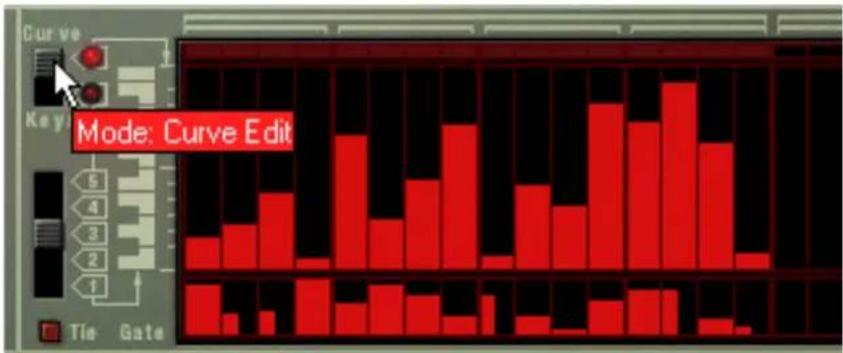
Curve CV values (upper window).
This is useful for programming CV curves that control other parameters other than note pitch (although you could do this too). This way you could control the note pitch and triggering from the Key and Gate outputs for a device, then add a second independent pattern using the Curve CV output that could control filter cutoff for example.
It should be stressed that all three outputs can be used in any number of ways. For example, you could use the Gate CV to trigger a drum in Redrum, or let the Curve CV control the feedback parameter of a delay, etc.
Programming patterns
Pattern basics
Matrix contains a built-in pattern sequencer. Unlike the main sequencer in Reason Lite, the Matrix sequencer repeatedly plays back a pattern of a specified length. The typical example in the "real world" (as well as in Reason Lite) is a drum machine which plays drum patterns, usually one or two bars in length.
Having the same pattern repeat throughout a whole song may be fine in some cases, but most often you want some variations. The solution is to create several different patterns and program pattern changes (automatic switching from one pattern to another) at the desired positions in the song.
How the Matrix pattern sequencer integrates with the main Sequencer
The built-in pattern sequencer in the Matrix interacts with the main Reason Lite sequencer in the following ways:
- The tempo set on the transport panel is used for all playback.
If the Tempo track (see "Recording tempo automation") is used, Matrix will follow this. - If you start playback for the main sequencer (on the transport panel), the Matrix will automatically start as well (provided the pattern sequencer hasn't been disabled - see below).
- You can mute and solo Matrix tracks in the sequencer.
If the Matrix has a track in the sequencer and you mute this track, Matrix will automatically be muted as well. This is indicated by a Mute indicator on the device panel. If there are several note lanes on the Matrix track, their respective mute status will not be indicated on the device panel.
→ You can also run Matrix separately (without starting the main sequencer) by clicking the Run button on the device panel.
This starts the built-in pattern sequencer in the device. To stop playback, click the Run button again or click the Stop button on the Transport panel. - If you are running Matrix separately and start playback of the main sequencer, the pattern device will automatically restart in sync with the sequencer.
- Pattern changes can be controlled by a pattern lane in the main sequencer.
In other words, you can record or create pattern changes in the main sequencer, and have them occur at the correct position on playback.
Selecting Patterns
The Matrix has 32 pattern memories, divided into four banks (A, B, C, D).
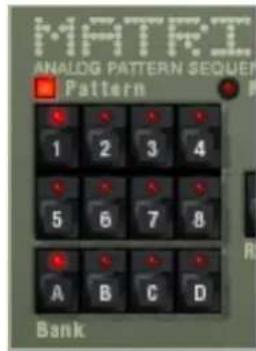
The Bank and Pattern buttons for the Matrix pattern sequencer.
→ To select a pattern in the current bank, click on the desired Pattern button (1-8).
To select a pattern in another bank, first click the desired Bank button (A, B, C, D) and then click the Pattern button.
Nothing happens until you click the Pattern button.
The pattern change takes effect on the next downbeat according to the time signature set in the transport panel or on the transport track.
The Pattern Enable switch
The Pattern Enable switch.
Next to the Bank and Pattern buttons you will find an additional switch, which is normally activated. If you click this to turn it off, the pattern playback will be disabled, starting at the next downbeat - exactly as if you had selected an empty (silent) pattern. For example, this can be used for bringing Matrix patterns in and out of the mix during play-back.
Steps
Matrix patterns consist of a number of discrete steps. For each step, you can enter a note, a CV value and a Curve value. When you run the pattern, each step will be played back in turn and will play a sound or send out the information programmed for this step. If you have ever used a drum machine, this will be obvious to you.
Clearing a Pattern
To clear (empty) a pattern, select it and use the Clear Pattern command on the Edit menu or device context menu.
! Note that clearing a pattern doesn't affect the pattern length, resolution or shuffle settings!
Using Cut, Copy and Paste
By using the Cut, Copy and Paste Pattern commands on the Edit menu or device context menu, you can move or duplicate patterns. The following rules apply:
→ Copy Pattern makes a copy of the currently selected pattern and places the copy on the clipboard.
→ Cut Pattern moves the currently selected pattern to the clipboard.
This is the same as first performing Copy Pattern and then Clear Pattern.
→ Paste Pattern copies the pattern on the clipboard to the selected pattern location in the selected device.
This overwrites the selected pattern with the one on the clipboard.
Transferring patterns between Reason Lite songs
If you want to copy patterns between different Reason Lite songs, you use copy and paste:
- Open both songs.
- Select the pattern you want to copy.
- Select Copy Pattern from the Edit menu or the device context menu.
You can also hold Ctrl or Cmd and press [C] to copy.
- Make the other song active.
This is done by clicking in the song window or by selecting the song from the Windows menu.
- Select the bank and pattern location to which you want to copy the pattern.
Note that any pattern already stored in that location will be overwritten!
- Select Paste Pattern from the Edit menu or the device context menu.
You can also hold Ctrl or Cmd and press [V] to copy.
Tutorial
The programming procedure of the Matrix is to input note and gate values into the upper and lower fields of the pattern window respectively. You can input values by clicking or dragging in the pattern window. Proceed as follows:
1. Create a Subtractor synth.
You don't have to use the Subtractor device to use the Matrix, in fact you don't have to use an instrument device at all, but for this basic tutorial we will use a "standard" setup.
2. With the Subtractor selected, create a Matrix Pattern Sequencer.
The Matrix Note and Gate CV outputs will now be auto-routed to Subtractors Sequencer Control Gate and CV inputs, as you can see if you flip the rack around.
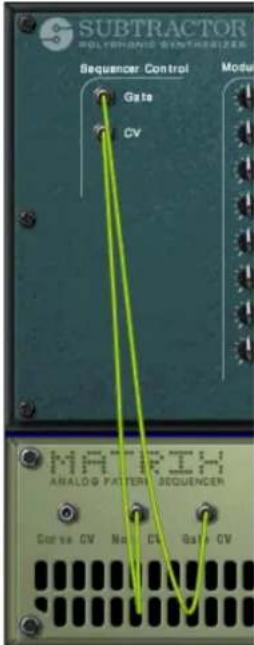
3. Make sure that the switch to the left of the pattern window is set to "Keys" position.
As you can see, there are two rows of red rectangles. The one with horizontal rectangles at the bottom of the upper field in the pattern window represent note pitch, for each step in a pattern. At the moment they are all set to the same note pitch. The row of vertical rectangles in the lower field represent Gate velocity values - currently these are all set to a velocity value of 100 for all steps.
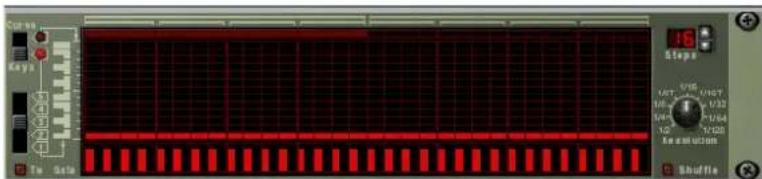
4. Click inside the upper grid section of the Matrix pattern window.
An orientation line is displayed in the grid to make it easier for you to find the desired note, and the red rectangles are placed according to where you click. You can drag to input continuous note values.
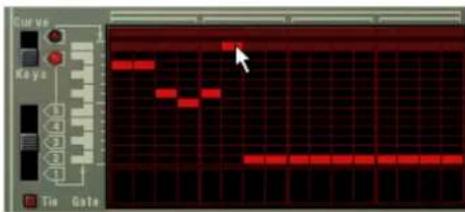
5. Click and drag in the lower area of the pattern window.
You can create vertical Gate velocity strips of varying heights. The higher the strip, the higher the velocity value.
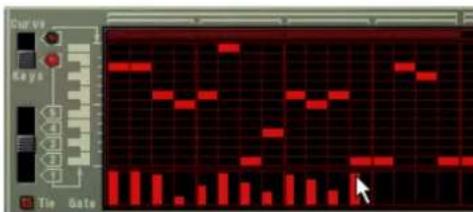
6. Press the Play button on the Matrix.
The pattern you "programmed" in the previous steps is now repeated. At the top of the pattern window, a red rectangle indicates every step of the pattern.
→ If you now click or drag in the upper grid section with the pattern playing, you can hear how the note pitches change.
The note pitch corresponds to the keyboard printed to the left of the pattern window, in a one octave range, and as previously mentioned, an orientation line is visible when clicking or dragging, making it easy to find the note pitch on the keyboard.
→ If you now click or drag in the lower gate section while the pattern is playing, you can hear how the timbre and volume changes.
→ If you drag some of the vertical rectangles down so that they disappear from view, the corresponding steps of the pattern are completely silenced.
→ By using the 5-way switch below the "Keys/Curve" switch you can input notes in other octave ranges (over five octaves).
Note that there can only be one note for each step in the pattern.
- By using a combination of the methods described in the above steps, you can program suitable note values for each step, decide which steps should be played and set their velocity with the gate values.
Using Curve Patterns
Curve patterns are independent patterns that can be applied separately to the note pattern programmed in "Keys" mode. If you switch the Keys/Curve switch to "Curve", the note, but not the gate steps, disappear from view, and leaves the upper area of the pattern window empty. You can now start programming a curve pattern. Proceed as follows:
- Draw a curve, using the same method as for notes or gates.
As you can see, the Curve pattern looks like large vertical gate steps.
- If you play the pattern, nothing has changed, i.e. the pattern sounds exactly like it did before the Curve pattern was drawn.
This is because the Curve CV output hasn't been connected to any parameter yet.
-
Flip the rack around so you can see the back panel of the Matrix.
-
Connect the Curve CV output to the Filter Cutoff Modulation Input on the Subtractor.
Now the curve pattern controls the filter frequency of the Subtractor.
- If the effect isn't very noticeable, try raising the filter Q parameter, and lowering the filter frequency.
→The Curve CV output can be connected to any device CV or Modulation input.
Actually, Curve CV signals can also produce Gate triggers (used for triggering samples or envelopes for example).
→ A Gate trigger is produced for each curve pattern step that follows a value of "0".
If you look at the picture below, steps 2,4 and 6 will produce a trigger, because steps 1, 3 and 5 are set to zero, but the rest of the pattern would not.
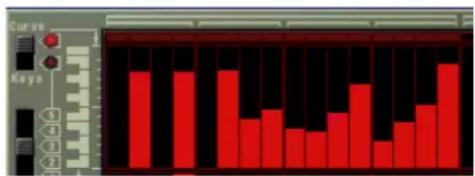
About Unipolar and Bipolar Curves
On the back panel of the Matrix you will find a switch, allowing you to select between "Unipolar" or "Bipolar" Curves. The difference is as follows:
→A unipolar curve has values starting from "0" and up.
"0" is the value produced by all steps when they are "empty" (not visible). Unipolar is the default setting of this switch when a new Matrix is created.
Unipolar curve


→ A bipolar curve is divided in the “middle”, with the middle representing a value of “0”.
The curve reflects this. If no curve has been drawn and you switch to bipolar mode, all steps go from the bottom up to the middle of the scale printed to the left of the pattern window. Thus, all steps are at "O", and the curve can be drawn both up and down from the middle.
Bipolar curve
Bipolar curves are essential in some instances. If you want to use the Matrix to CV control the Pan parameter for a mixer channel for example, a unipolar curve would start at zero - which for Pan equals center position. This means that you would only be able to use the curve to pan in one direction from this center position. A bipolar curve however, will have the zero value in the middle, allowing you to draw pan curves in both directions. Bipolar curves can also be used for controlling parameters with positive and negative values.
Setting Pattern Length
You may want to make settings for Pattern length, i.e. the number of steps the pattern should play before repeating:
→ The “Steps” spin controls are used to set the number of steps you wish the pattern to play.
The range is 1 to 32. You can always extend the number of steps at a later stage, as this will merely add empty steps at the end of the original pattern. You could also make it shorter, but that would (obviously) mean that the steps you remove won't play back. The steps you remove aren't erased though, if you set the step number back again, anything recorded in the previously removed step locations will be played back.
Using Tied Notes
If you activate "Tie" to the left of the Gate pattern window, you can create longer notes (eighth notes, quarter notes etc.). A quick way to draw tied gates is to hold down [Shift] when you input the gate values.
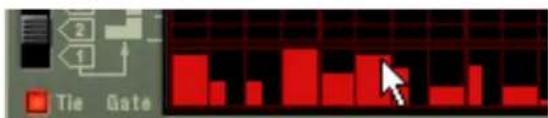
Entering tied gate values.
→ Each step that has one tied gate value will be twice the length compared to a normal step.
Tied gate steps are indicated by being twice as wide in the pattern window.
→ If two or more notes of the same pitch are tied together, the result will be even longer notes.
Tied notes are also essential if you want to create typical TB-303 "Acid"-type lead lines - see "Programming "Acid Style" lead lines".
Setting Pattern Resolution
Matrix always follows the tempo setting on the transport panel, but you can also make Matrix play in different tempo "resolutions" in relation to the tempo setting.
Pattern Shuffle
Shuffle is a rhythmic feature, that gives the music a more or less pronounced swing feel. It works by delaying all sixteenth notes that fall in between the eighth notes.

natural_image
Abstract pattern of alternating red and orange squares on a grid background (no text or symbols)Straight sixteenth note pattern (viewed in the sequencer).

natural_image
Abstract pattern of orange squares on a grid background, no text or symbols presentThe same sixteenth note pattern with shuffle applied.
In Reason Lite, you can activate or deactivate shuffle individually for each pattern in a pattern device. However, the amount of shuffle is set globally with the Global Shuffle control in the ReGroove Mixer. The ReGroove Mixer is described in "The ReGroove Mixer".
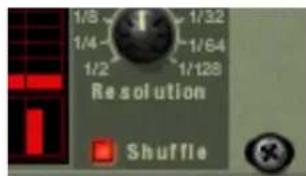
The Shuffle on/off switch in Matrix and the Pattern Shuffle control on the transport panel.
Pattern Mute
If you deactivate the "Pattern" button above the Pattern select buttons, the pattern playback will be muted, starting at the next downbeat (exactly as if you had selected an empty (silent) pattern). For example, this can be used for bringing different pattern devices in and out of the mix during playback.
If you mute the Matrix track in the sequencer, it is muted instantly and the Mute indicator lights up on the panel. Note that all tracks connected to the Matrix must be muted for this to work.
Pattern Functions
When a pattern device is selected, you will find some specific pattern functions on the Edit menu (and on the device context menu).
Shift Pattern Left/Right
The Shift Pattern functions move the notes and corresponding gate values in a pattern one step to the left or right.
Shift Pattern Up/Down
! This function does not alter the Curve CV. This is because the values produced by the Curve CV do not necessarily correspond to semitone note steps at all.
The Shift Pattern functions will transpose all the notes in a pattern one semitone up or down.
Randomize Pattern
The Randomize Pattern function create random patterns. These can often be great starting points and help you get new ideas. Both Note, Gate and Curve CV values will be created.
Alter Pattern
The Alter Pattern function modifies existing patterns. Note that there must be something in the pattern for the function to work on - using an Alter function on an empty pattern will not do anything.
! Note that Randomize and Alter affects both the Gate, Note and Curve CV!
Chaining Patterns
When you have created several patterns that belong together, you will most probably want to make these play back in a certain order.
→ Simply activate record for the track with the Matrix as the destination in the sequencer and use the Pattern and Bank buttons to determine the playback order as the Song is playing.
The Patterns play to the end before changing, so you won't have worry too much over the "timing" of the pattern changes you input manually. When you are done, the sequencer track will contain pattern change data, and the patterns will automatically switch according to the order set while recording. More on recording pattern changes on "Recording pattern automation".
→ An alternative way to do this is editing directly in the Pattern Edit lane in the sequencer.
Editing in the Pattern lane is described in the Sequencer chapter.
Converting Pattern data to notes in the main sequencer
You can convert Matrix Patterns to notes in the main sequencer. This allows you to edit the notes freely, create variations or use Groove quantizing.
The "Copy Pattern to Track" function
This function is useful when you have created a single pattern in the Matrix device and want to render individual note events on a sequencer track.
! Curve patterns cannot be converted to sequencer data! Only the note pattern and the gate values will be converted.
Proceed as follows:
- Set the Left and Right Locators to encompass the section you want to "fill" with the notes in the pattern.
You may want to make sure that the space between the locators is a multiple of the pattern length, to avoid “cutting off” the pattern.
- Select the track you wish to copy the rendered notes to.
You should not copy the notes to the Matrix track, but to the track for the device controlled by the Matrix (since the Matrix doesn't produce any sound in itself). You can also copy the notes to any other instrument track if you like.
- Select the Matrix device in the rack and select "Copy Pattern to Track" from the Edit menu or the device context menu.
The pattern is converted to a single note clip on the track, with Note and Gate (Velocity) values. If the space between the locators is greater than the pattern length, the pattern will be repeated in the clip to fill up the space.
When you use the "Copy Pattern to Track" function with the Matrix, you should note the following:
- A note will be created for each pattern step which has a Gate value greater than zero.
The notes will have the pitch according to the key CV value for the step, and the velocity according to the Gate value.
! The Curve CV is not copied.
- You may want to disconnect or even remove the Matrix device after performing this function.
This is because you probably don't want both the Matrix and the sequencer notes to play the device at the same time and thus cause "note doubling".
The procedure above copies a single pattern to notes in the sequencer. If you have automated pattern changes, you can copy a complete pattern track to notes, taking all pattern changes into account.
The "Convert Pattern Automation to Notes" function
If you have recorded or drawn pattern automation on a Matrix track, you can have the whole track converted to notes, in the following way:
-
Select the track with the pattern automation.
-
Select "Convert Pattern Automation to Notes" from the Edit menu or the context menu for the track.
For each pattern clip, the corresponding pattern is converted to note clips on the track (following the same rules as for the "Copy Pattern to Track" function). The track will play back just the same as when you played the pattern device with the pattern changes.
→ After the operation, the Pattern Select lane is switched off.
The Pattern (Enable) button on the device is automatically turned off.
→ When you use this with a Matrix, you need to move the note clips to the track of an instrument device (typically the device to which the Matrix is connected).
This is because the Matrix doesn't make any sound itself.
Example usage
As mentioned previously, the Matrix is a very flexible device. Here follows a few examples of how you can use the Matrix Pattern Sequencer.
Using the Matrix for modulation
You can effectively use the Matrix as a modulation source, much like an LFO. Just like the LFOs in Reason's instrument devices, the Matrix can generate modulation that is synchronized to tempo, which has many advantages. Proceed as follows:
- Create a Synthesizer (e.g. a Subtractor, Thor or Europa).
- Create a Matrix Pattern Sequencer, or if one already exists, set it to an empty pattern.
- Flip the rack around and disconnect the Gate and Note CV outputs.
Gate/Note CV is not used in this example
- Flip the rack around and connect the Curve CV output on the Matrix back panel to the "Amp Level" Modulation input on the synthesizer.
This parameter is used for modulating the output level (volume) of the synthesizer. Volume modulation is often referred to as Tremolo. You can use a unipolar curve (see "About Unipolar and Bipolar Curves") for this example.
- Flip the rack back again, and switch the Matrix to display the Curve pattern window.
- Draw a curve like the one shown in the illustration below.
If you use fewer or more steps than 16 (as shown in the picture), just draw the curve so that it roughly matches the shape in the picture.
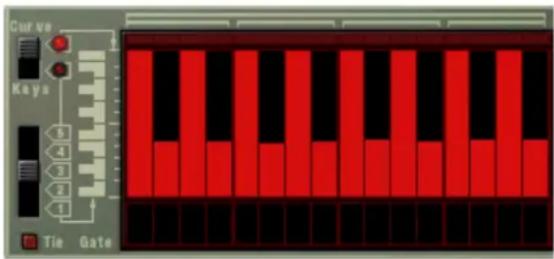
- Activate Click on the Transport Panel.
- Select the track that is routed to the synthesizer, so that you can play it from your MIDI keyboard.
- Activate Play on the transport panel, and hold a chord down on your keyboard.
You should now hear the volume being modulated by the Curve pattern.
- While still in play mode, you can use the Resolution knob to change the modulation "rate" in relation to the tempo.
For each clockwise resolution step the modulation speed is doubled and vice versa, but it will always stay in sync with the tempo.
Programming "Acid Style" lead lines
By “acid style” lead lines we mean patterns that use a combination of Legato and slide (or portamento) effects to produce the widely used hypnotic “wavy” sound produced by the original Roland TB-303, and recreated in the Propellerhead Software product ReBirth. To approximate this typical sound using Reason Lite, proceed as follows:
- Create a Synthesizer (Subtractor, Thor or Europa).
- Create a Matrix Pattern Sequencer, or if one already exists, set it to an empty pattern.
- Make sure that the Note and Gate CV outputs are connected to the synthesizers Sequencer Control CV and Gate inputs, respectively.
- For Subtractor, select either a Init Patch, or use the "TB Synth" patch in the Monosynth category of the Reason Factory Sound Bank.
→ If you use an Init patch, it is important that you make the following settings:
- Set Polyphony to "1".
- Switch Trigger Mode to "Legato".
- Set Portamento to a value around "50".
- Create a pattern in Matrix, and keep it playing back.
→ If “Tie” (see “Using Tied Notes”) now is activated for a step, the note will be tied to the next and the pitch will continuously “glide” to the pitch of the following step.
Please note that Tie should be activated on the note you wish to slide from, and not the note you slide to.
→ If you have several tied notes, one after the other, they will play as one long legato phrase. This can be used to create “wavy” lead lines with pitch bend effects.
- Experiment with different Note, Tie and Gate values.
If you have ever used a TB-303 or ReBirth, you should now begin to get the hang of how you can create patterns in that particular style by using the Matrix together with a synthesizer.
- Adding a DDL-1 (delay), and a Scream 4 (distortion) effect device will make it sound even more “ReBirth”-like, but of course you are also able to get a much wider range of timbres by utilizing Reason’s other sound and modulation capabilities.
Triggering samples
The Gate CV output can be used to trigger samples, either in Redrum or in the NN-19 or NN-XT Sampler.
→ Connect the Matrix Gate CV out to the Gate (Sequencer Control) in on the NN-19/NN-XT or to one of the individual Gate Channel inputs of Redrum.
Gate values will now trigger the sample on each step with Gate values above "0".
Chapter 38
The Line Mixer 6:2
Introduction

The Line Mixer 6:2 allows you to control the level, stereo placement (Pan) and effect mix (AUX Send) of each connected audio device.
The Line Mixer is configured with 6 (stereo) input channels, which are combined and routed to the Left and Right Master outputs.
Channel parameters
The channels are identical and contain an Auxiliary Send, Mute and Solo buttons, a Pan control, and a Level control:
| Item | Description |
| Level control | This controls the output level of each corresponding channel, allowing you to set the desired mix (balance) between different devices connected to the Line Mixer. |
| Channel label | Each channel in the mixer that has a device connected to it, displays a read-only label with the name of the device. |
| Channel meter | The meter is a graphical representation of the channel output level. If the signal level pushes the meter into the range of the red area, try lowering either the output level of the device connected to the channel, or the Level control itself, to avoid distortion. |
| Pan control | Use this control to set the left/right position of the channel in the stereo field. [Ctrl]-click (Win) or the Pan knob to set Pan to the default “0” (center position). |
| Mute (M) and Solo (S) Buttons | Clicking a channel’s Mute button silences the output of that channel. Click the button again to unmute the channel.Clicking a channel’s Solo button silences all other mixer channels, so that you only hear the soloed channel. Several channels can be soloed at the same time. If this is the case, note that soloed channels can’t be muted with the Mute button. To mute one of several channels in solo mode you simply “unsolo” it. |
| Auxiliary (AUX) Effect Send | The AUX Send controls the amount of channel signal that is to be sent to other devices - typically effect processors. The effect output is then normally returned to the Mixer via the AUX Return input where it is mixed with the dry (non-processed) signal. If you create an effect device when the Mixer is selected, the effect is auto-routed to the Send/Return connectors. You can then control the amount of effect that is to be applied to any device connected to a Line Mixer channel via the AUX Send knob. The Send can be taken pre or post channel level - see “Auxiliary (AUX) Send”. |
The Auxiliary Return section
The AUX Return channels provide inputs for a connected send effect device. The Aux Return channels have a single level control on the front panel.
Master level
The Master L/R fader controls the summed output level of all channels in the Mixer. Use this to change the relative level of all channels, to make fade-outs etc.
Connections
All input and output connectors are as usual located on the back panel of the Line Mixer.
Mixer Channel Connections
→ Each mixer channel features stereo left/right inputs for connecting audio devices.
Use the left input when manually connecting a mono signal source.
→ In addition, there is a Control Voltage (CV) input, for voltage controlling channel Pan from other devices.
Auxiliary (AUX) Send
→ The Send connectors are used to connect to the inputs of effect devices.
To connect the send to a mono-input device, use the Left (Mono) output.
When a Send is connected to an effects device, the corresponding AUX Send knob determines the level of the signal sent to the effect device for each channel.
The Send Output can be taken Pre or Post channel level by using the switch to the left of the Send connectors.
Auxiliary (AUX) Return
These are normally connected to the left and right outputs of effect devices.
Master Left/Right Outputs
- The Master outputs are auto-routed to the input pair of the first available Mix Channel device in the rack. If no Mix Channel device is available, one will be automatically created when you create a Line Mixer device. If used in a Combi, the Master Outs are normally connected to the "From Devices" connectors on the Combinator.

Chapter 39
Menu and Dialog
Reference
Reason Lite menu (macOS)
About Reason Lite...
This menu item opens up a dialog that informs you about the version of the program and the people behind it.
Preferences...
This menu item opens up the Preferences dialog. See "Preferences – General", "Preferences – Audio", "Preferences – Control Surfaces", "Preferences - Sync" and "Preferences – Advanced" for detailed descriptions about the functions and settings in this dialog.
Your Products...
This menu item launches your default web browser and brings you to your products page at Reason Studios, where you can view your list of owned products, including download ReFills and Rack Extensions.
Check for Updates...
This checks for recent Reason Lite updates on the Reason Studios server.
Services
The Reason Lite menu contains the standard macOS Services item. Please consult the Macintosh Help for descriptions about these.
Show/Hide
These are the standard macOS Hide/Show options which lets you choose what to view.
Quit Reason Lite
This allows you to quit the program. If there are any documents open with unsaved changes you will be asked whether you want to save those changes before quitting.
File menu
New
When you select this, a new song appears. The exact contents of this song is determined by your Preferences settings (see "Default Song").
New from Template
On the sub-menu you can create a new song based on the selected Template Song. The selected Template Song will appear in a new document window.
- On Windows platforms, the document will be named "Document n" where "n" is an incremental number.
- On macOS platforms, the document will be named "untitled n" where "n" is an incremental number.
You can then save your song with a new name. See "Creating a new Song from a template" for more details.
Last in the sub-menu you can choose to open and show the Template folder in Explorer (Win) or Finder (Mac). This makes it easy to place other songs in the Template folder, if you like.
Open...
! The "Open..." item is only available if you run Reason Lite in Authorized Mode (see "Registering Reason Lite").
To open a Song, proceed as follows:
- Pull down the File menu and select Open.
The Reason Lite Browser appears (if hidden).
- Navigate to the desired folder on disk or within a ReFill.
- When you have located the song file, select it and click Open in the Browser (or double click the file).
The song appears in its own document window.
- You can have several songs open at the same time if you like. This allows you to copy and paste audio, note and automation clips, tracks, devices, mixer channels and patches between songs. However, all open songs consume some memory and performance, so you may want to close songs you don't need.
See "Opening a Reason Lite Song" for more details.
Open Demo Song
! The “Open Demo Song” item replaces the “Open...” item if you run Reason Lite in Demo Mode (see “Running Reason Lite in Demo Mode”).
→ Choose the Demo Song to open by selecting it from the sub-menu that appears.
The song appears in its own document window.
See "Opening a Reason Lite Demo Song" for more information.
Close
→Select "Close" to close the active window.
If the window is a song document window and has unsaved changes, you will be asked whether you want to save those changes.
Closing the last open song document window will quit Reason Lite (Windows only).
Save
This saves the active song document to disk.
- If the song document hasn't yet been saved, the "Save As" dialog appears, requesting you to enter a file name and specify a location for the file on disk (see "Save As...").
- If the document has already been saved at least once, the document will simply be saved without any questions.
Save As...
This saves the active song document to disc. A standard Save As dialog appears requesting you to enter a file name and specify a location for the file on disk. The "Save As" command will also automatically optimize the song file size when applicable (see "Save and Optimize").
- You can set things up so that any samples used in the song are included in the song file itself by specifying self-contained settings (see "About Self-Contained Songs").
Save and Optimize
When you record audio in the sequencer, the recordings are stored in your song document. If you remove recordings in your song, there might be "empty" areas left in the document, similar to a fragmented hard disk. To "defragment" the song document, and thus reduce the file size, you can use the "Save and Optimize" command.
See "Saving and optimizing a Song" for more details.
Song Information...
This brings up a dialog that allows you to add contact information and comments etc. about your song.
See "Including Song Information" for information.
Song Self-contain Settings...
If you want to open your song on another computer, or send it to another Reason Lite user, you would also have to bring all samples and REX files used by the Reason devices in the Song. To make this easier, Reason Lite allows you to create "self-contained" songs. A self-contained song contains not only the references to the used samples and REX files, but also the files themselves. By selecting the "Song Self-Contain Settings", you can choose what files to include in your song.
See "About Self-Contained Songs" for more information.
Import Audio File...
Selecting "Import Audio File..." opens the Browser (if hidden), which displays compatible audio files. Select audio files to import to audio tracks in Reason Lite.
See "Importing audio to the sequencer" for more information.
Import MIDI File...
Reason Lite can import standard MIDI files (SMF). This allows you to import MIDI data to Reason Lite from other applications. Selecting "Import MIDI Files..." opens the Browser (if hidden), which displays compatible MIDI files. Select MIDI files to import to ID8 tracks in Reason Lite.
See "Importing Standard MIDI Files" for more information.
Export MIDI File...
Reason Lite can export standard MIDI files (SMF). Selecting "Export MIDI Files..." brings up the Export MIDI File dialog from which you can export all instrument tracks and automation tracks from the Reason Lite sequencer as a Standard MIDI File (SMF).
See "Exporting Standard MIDI Files" for more information.
Export Insert FX Patch...
This item is available for a selected Audio Track device, Mix Channel device or their corresponding channel strips in the Main Mixer. Selecting "Export Insert FX Patch" brings up the Save Insert FX Patch dialog from which you can save the Insert FX patch used in the selected Audio Track/Mix Channel device as a Combinator (*.cmb) Patch File.
Save Device Patch As...
This item is available for a selected device that can save patches. The menu item name reflects the type of device selected (for example "Save Combinator Patch As...").
Even though the device settings are stored in the song, you may want to save any settings you have made for a device as a separate patch file. This allows you to use the patch in other songs, and lets you try out other patches in your song without risking to lose your original sound.
- The different types of patch files have different file extensions.
These are:
".cmb" (Combinator patch files)
".zyp" (Subtractor patch files)
".drp" (Redrum patch files)
".rv7" (RV7000 patch files)
".sm4" (Scream 4 patch files)
".repatch" (Rack Extension patch files)
- If you have selected a patch, modified it and want to save it with the modifications, you could either save a separate, modified version of the patch (with a new name) or simply overwrite the old patch file on disk.
As usual, you will be asked whether you really want to replace the existing patch file.
- You can also save a patch by clicking the floppy disk button on the device panel.
- You can save a patch under the same name and location (without having the save dialog appear) by holding down Alt or Option and clicking the floppy disk button on the device panel. Note that this overwrites the original patch!
Export Song/Loop as Audio File...
When you have created a complete song, you will want to mix it down to a WAV or AIFF audio file to make it playable for other people (who don't use Reason Lite). You can either export the whole song, or only the loop (the region between the left and right locator in the sequencer).
See "Exporting Songs or parts of Songs" for more information.
Bounce Mixer Channels...
Bouncing Mixer Channels basically means "recording" the audio outputs from individual Audio Track Channels and/or Mix Channels to audio files. The audio files can then be saved to disk or placed on new Audio Tracks in your song.
See "Bouncing Mixer Channels" for information on how to bounce mixer channels.
Export Device Remote Info...
This command exports a text file containing the removable items for the currently selected device (native, Rack Extension or VST) in the rack. This is useful if you're creating or editing Remote map files.
Recent Songs list
Here is a list of the eight most recently opened Reason Lite Songs. Select any of these songs to open them in new, separate document windows.
Exit (Windows)
This allows you to quit and exit the program. If there are any song documents open with unsaved changes you will be asked whether you want to save those changes before quitting.
Edit menu
Undo
Virtually any actions in Reason Lite can be undone. This includes creation, deletion and reordering of devices in the rack, parameter value adjustments, recording and editing in the sequencer and tempo/time signature adjustments. You can undo hundreds of actions.
! Sequencer Transport commands are not "undoable".
To undo the latest action, select "Undo" from the Edit menu or hold Ctrl or Cmd and press [Z]. The action to be undone is indicated next to the Undo command on the Edit menu. For example, if your latest action was to delete some device(s) from the rack, the Edit menu will say "Undo Delete Devices".
See "Undo and Redo" for more detailed information.
Redo
To redo an undone action (“undo the undo operation”), select “Redo” from the Edit menu or hold Ctrl or Cmd or and press [Y]. The action to be redone is indicated next to the Redo command on the Edit menu. You can undo/redo hundreds of actions.
See "Undo and Redo" for more detailed information.
Cut/Cut Tracks and Devices/Cut Channels and Tracks
This command takes the selected item(s), removes them and places them on the clipboard (an invisible storage location) from where they can later be pasted in.
Cutting applies to devices/channels and their sequencer tracks, sequencer clips, notes and automation points.
! If “Auto-group Devices and Tracks” is selected in the Options menu, all devices in the Device Group will be cut - see “About Device Groups”.
Copy/Copy Tracks and Devices/Copy Channels and Tracks/Copy Patch
This command takes the selected item(s), copies them and places the copies on the clipboard (an invisible storage location) from where they can later be pasted in.
Copying applies to devices/channels and their sequencer tracks, sequencer clips, notes, automation points and device patches.
! If “Auto-group Devices and Tracks” is selected in the Options menu, all devices in the Device Group will be copied - see “About Device Groups”
Paste/Paste Tracks and Devices/Paste Channels and Tracks/Paste Patch
This command takes the items that you have cut or copied to the clipboard and pastes them back into the document.
- When you paste a sequencer track, its device will be pasted at the same time (and vice versa, if the device has a track).
Pasted tracks and devices are inserted below the currently selected track in the track list and below the selected device in the rack, respectively.
! If “Auto-group Devices and Tracks” is selected in the Options menu, all devices in the Device Group will be pasted - see “About Device Groups”.
If nothing is selected, the pasted items will appear at the bottom of the track list/rack.
- If you copy and paste several devices, the connections between these are preserved.
→ If you hold down [Shift] when you paste a device, Reason Lite will attempt to auto-route it.
For example, [Shift]-pasting an instrument device typically connects it to the first free Mix Channel device input(s) above it in the rack.
→ You can also paste the device(s), channel(s) and track(s) into another song, including all sequencer data and device settings. - When you paste sequencer clips, they appear at the song position, on their original track(s).
If you have deleted the original tracks, or if you paste into another Reason Lite song document, the clip will be pasted at the song position on the selected track (if the track type is the same as the original). Otherwise new tracks will be created. If the clip is a note clip, a new ID8 instrument track will be created. - Notes or automation points will be pasted at the song position on the selected track (if the track types are compatible).
- Individual Kong Drum patches can be copied and pasted from one selected pad to another.
Delete/Delete Tracks and Devices/Delete Channels and Tracks
This menu item is used for deleting selected items. If you delete a sequencer track with this menu item (then called "Delete Tracks and Devices"), its device is also deleted.
! If "Auto-group Devices and Tracks" is selected in the Options menu, an alert appears asking you if you want to delete only the selected device or the entire Device Group - see "About Device Groups".
Delete Tracks
This deletes the currently selected sequencer track(s) without removing the corresponding rack device(s) or mixer channels.
Duplicate Tracks and Devices/Duplicate Channels and Tracks
This creates a duplicate of the selected device and track, or channel and track, complete with all parameters and recordings/events. The duplicated items will appear below the selected device and track, respectively.
! If "Auto-group Devices and Tracks" is selected in the Options menu, all devices in the Device Group will be duplicated - see "About Device Groups".
Select All/Select All Devices/Select All Tracks/Select All Channels
This selects all devices in the rack, all tracks in the track list, all channels in the Main Mixer, or all clips or all notes or automation points in an open clip. The result depends on which area (rack, track list, Main Mixer etc.) has focus. This is indicated by a thin frame around an area in the document window.
→To set focus to the desired area, click somewhere in it.
You can use this menu item to quickly apply a command to all items you are working on, for example deleting all devices in the rack (select Select All Devices and then press [Delete]) or for Quantizing all notes in an open clip (select Select All and then click the Quantize button in the Tool window).
Select All in Device Group
This will select all devices within the selected device's Device Group. See “About selecting all devices in a Device Group”.
Sort Selected Device Groups
This function should be used if you want to rearrange devices, channel strips or sequencer tracks according to the order of the current selection. For example, if you want to rearrange the rack devices according to the current sequencer track order, you can select all sequencer tracks and then choose "Sort Selected Device Groups" to rearrange the rack devices. See "About the "Sort Selected Device Groups" function" for more examples.
Auto-route Device
Auto-routing is when devices' audio and CV/gate connections are automatically routed according to default rules. Auto-routing is normally performed when:
• A new device is created.
- Moving, duplicating or pasting devices with [Shift] pressed.
However, if a device is already in the rack, you can "force" it to be auto-routed by selecting it and then select this menu item.
For more information about auto-routing rules, see "Automatic routing".
Disconnect Device
This disconnects all audio and CV/gate connections from the selected device(s).
Combine/Uncombine
→ By selecting several devices in the rack and selecting "Combine", a Combinator device will be created containing the selected devices.
→ By selecting the Combinator (or one or several devices contained in a Combinator) and then selecting "Uncombine" will remove the devices from the Combinator and into the rack.
In case the whole Combinator is selected, this will be removed and the devices it contains will be moved into the rack.
See "The Combinator" for more details.
Copy/Paste Channel Settings (Main Mixer channel strips)
This function allows you to copy and paste the parameters of different sections of a Main Mixer channel strip and paste into another channel strip. The available parameter groups are:
• Dynamics
- Filters and EQ
• In s e r t F X
This will copy the entire Effect Combi patch (with all Combinator devices included)
• FX Sends
This will only copy the FX Send parameters in the channel strip - not any FX devices or patches.
• All
This will copy all channel strip parameters, including any Insert FX devices.
Route to (Main Mixer channel strips)
This allows you to create, and automatically route, one or several selected Main Mixer channel strips to a new or existing Output Bus for sub-mixing purposes. See "Creating an Output Bus".
Create Parallel Channel (Main Mixer channel strips)
This allows you to create a parallel mixer channel for parallel processing purposes. See "Creating Parallel Channels".
Clear Insert FX
This disconnects and removes all Insert FX devices of a selected Mix Channel or Audio Track device in the rack, or of a selected channel in the Main Mixer. See "Deleting Insert effects" for more details.
Reset All Channel Settings (Main Mixer channel strips)
This will reset all channel strip parameters to their default values. Any Insert FX Combinator patches will be removed.
Reset Device
Sometimes it is useful to start with a "clean slate" when creating a sound or effect. This is done by selecting Reset Device from the device context menu or Edit menu. This sets all parameters to their default values. Resetting NN-19, NN-XT, Dr. Octo Rex, Redrum or Kong devices also removes samples from the device, allowing you to start from scratch.
Cut Pattern
Moves the current pattern in the selected Redrum or Matrix to the clipboard. The pattern is then cleared.
Copy Pattern
Copies the current pattern in the selected Redrum or Matrix to the clipboard.
Paste Pattern
Copies the pattern on the clipboard to the current pattern location in the selected Redrum or Matrix device. This overwrites the current pattern with the one on the clipboard. Note that this can be used to transfer patterns between different Reason Lite songs.
Clear Pattern
This menu item clears (empties) the current pattern on the selected pattern device (Redrum or Matrix).
Browse Patches.../Browse Insert FX Patches...
This menu item allows you to select a new Patch for a device or an Insert FX Patch for a selected channel strip. The menu item reflects which device is selected - in other words, you must select the device for the corresponding Browse Patches item to appear on the Edit menu.
When you select the menu item, the Browser appears (if hidden), allowing you to locate and select the patch, on disk or within a ReFill.
When you load a patch, the device's parameters will be set according to the values stored in the patch, and the name of the patch will be shown in the patch name display. As with any change you make, this operation can be undone.
! Any parameter adjustments you make on the device panel after selecting a patch will not affect the actual patch file (for this you need to re-save the patch).
• If referenced samples are missing
Patches for the Redrum and Combinator (if any sampler devices are part of the Combi) contain references to samples. Just like patches, samples can be independent files on the hard disk or elements within a ReFill or a Sound-Font. However, if sample files have been moved or renamed after a patch was saved, the sample file references in the patch will not be accurate.
If this is the case when you select a patch, the program will tell you so. You can then choose to either manually locate the missing files, to have the program search for them in all stored locations and ReFills or to proceed without the missing sounds.
Browse Samples...
This menu item lets you load samples into the devices that use them; the Redrum. The following sample formats can be loaded:
- In Windows : .wav, .aif, .mp3, .aac, .m4a and .wma.
- In macos : . wav, .aiff, .3g2, .3gp, .mp1, .mp2, .mp3, .mpeg, .mpa, .snd, .au, .sd2, .ac3, .aac, .adts, .amr, .caf, .m4a ,m4r and .mp4.
- SoundFonts (.sf2) SoundFonts are an open standard for wavetable synthesized audio, developed by E-mu systems and Creative Technologies.
- REX file slices (.rx2, .rex, .rcy) REX files are music loops created in the ReCycle program or when editing audio clips inline in Reason Lite (see "Bounce Clip to REX Loop").
- Any sample rate and practically any bit depth.
Redrum:
To use this menu item to load a new drum sound into Redrum, proceed as follows:
- Select a channel in the drum machine, by clicking its Select button.
- Select Browse Samples.
The Redrum channel gets Browser focus and displays compatible files.
- Navigate to a location containing any of the sample formats listed above, select one and click Load.
Delete Sample/Remove Sample
Redrum:
To remove a sample from a Redrum drum machine, select its drum sound channel and then select "Delete Sample" from the Edit menu.
The sample is removed from the drum sound channel and from sample memory.
Copy Pattern to Track
This menu item is used for the Redrum drum machine and Matrix pattern sequencer. It converts the selected pattern to notes on a sequencer track. Proceed as follows:
1. Select a sequencer track.
When working with a Redrum, you want to select the track for the Redrum device. For the Matrix, you would typically select the track for the Matrix' target device (the instrument device to which the Matrix is connected). This is because the Matrix itself produces no sound, so the notes won't do any good on the Matrix track.
- Set the locators to the desired range or length.
If the range set is longer than the pattern(s), the data will be repeated to fit the range.
-
Select the pattern device.
-
Pull down the Edit menu and select "Copy Pattern to Track".
Note clips will be created between the left and right locators, according to the selected pattern.
! When copying Matrix patterns, only the Gate and Keys values will be included!
→ If you copied a Redrum pattern, you may want to turn off the “Enable Pattern Section” before playing back the new track data.
Otherwise, both the main sequencer and the pattern sequencer will play the drum sounds, simultaneously.
→ If you copied a Matrix pattern, you may want to disconnect the Matrix (or even remove it), to avoid having both the Matrix and the sequencer notes playing at the same time.
→ If you have automated pattern changes for your pattern device, you can render all patterns to notes in one go, using the “Convert Pattern Track to Notes” menu item instead.
See "Convert Pattern Automation to Notes".
Shift Pattern Left/Right
These menu items are used for Redrum, Matrix, Thor (called "Shift Sequencer Pattern Left/Right") and the RPG-8 Arpeggiator (when the Pattern editor is activated).
The Shift Pattern functions move the notes in a pattern one step to the left or right.
Shift Drum Left/Right
These menu items are used for Redrum.
The Shift Drum functions move the notes for the selected instrument one step to the left or right.
Shift Pattern Up/Down
These menu items are used for the Matrix.
The Shift Pattern functions will transpose all the notes in a pattern one semitone up or down.
! This function does not alter the Curve CV.
Random Sequencer Pattern
This menu item is used for the Thor synthesizer. It will assign random values to the pattern sequencer steps, but only for the property selected with the Edit knob. For example, if "Note" is the edited property, only the note pitches will be randomized; leaving velocity values, lengths, durations and curves intact.
→ Randomized note pitches will be kept within the range set with the Octave switch.
→ The “Steps” setting (pattern length) will not be changed by randomizing.
→Steps outside the current pattern length will not be affected.
Randomize Pattern
This menu item is used for the Redrum, Matrix and RPG-8 Arpeggiator (when the Pattern editor is activated).
The Randomize Pattern function create random patterns. These can often be great starting points and help you get new ideas.
! Note that for the Matrix, Randomize affects both the Gate, Note and Curve CV!
Randomize Drum
The Randomize Drum functions creates random patterns for the selected drum sound channel in the Redrum drum machine.
Alter Pattern
This menu item is used for the Redrum and Matrix.
The Alter Pattern function modifies existing patterns. Note that there must be something in the pattern for the function to work on - using an Alter function on an empty pattern will not do anything.
! Note that for the Matrix, Alter affects both the Gate, Note and Curve CV!
Alter Drum
This function modifies existing patterns for the selected drum sound in Redrum. Note that there must be something in the pattern for that channel for the function to work - using an Alter function on an empty pattern will not do anything.
Invert Pattern
This menu item is used for the RPG-8 Arpeggiator device, when the Pattern editor is activated. This inverts the pattern, so that active steps become rests and vice versa.
Create Track for.../Delete Track for...
A rack device can have one sequencer track or no sequencer track. Instrument devices are by default created together with a sequencer track, while effect devices, mixers etc. are created without tracks.
→ If a device without sequencer track is selected, this menu item is called "Create Track for [device name]". Select it to create an empty sequencer track for the device.
→ If the selected device has a sequencer track already, this menu item is called “Delete Track for [device name]”. It will remove the sequencer track and all its contents, but leave the device.
Go To Track for
→ With a device selected in the rack, select "Go To Track for [device name]" to bring the corresponding sequencer track for the device into view.
Insert Bars Between Locators
! The sequencer must have edit focus for this item to become available.
This function inserts an empty area between the locators in the main sequencer. All events after the left locator are moved to the right to "make room" for the inserted area. See "Inserting bars" for more information.
Remove Bars Between Locators
! The sequencer must have edit focus for this item to become available.
This function removes all material between the locators in the main sequencer. All events after the right locator are moved to the left to "fill out" the gap after the removed section. See "Removing bars" for more information.
Edit
This opens the selected clip(s) in Edit mode in the sequencer. If multiple note clips are selected, they are opened for editing in Multi Lanes mode, see "Multi Lanes editing".
Bounce in Place
The Bounce in Place function lets you bounce the sound generated from playing back note or audio clips, with any insert effects and channel strip coloration - but without Send FX and Master Section settings - to a new audio clip on a new audio track. See "Bounce in Place".
Bounce Clips to New Samples (Audio Clips)
It's possible to bounce Audio Clips to new Song Samples. You could then edit the samples in the Edit Sample window and then load into a sampler device for playback. See "Bounce Clip(s) to New Sample(s)".
Bounce Clip to Disk... (Audio Clips)
This function allows you to export a selected audio clip as a WAV or AIFF file to disk. See "The "Bounce Clip to Disk" function".
Bounce Clips to New Recordings (Audio Clips)
This function allows you to export the recording of a selected audio clip to an additional Comp Row. See "Bounce Clip(s) to New Recording(s)".
Bounce Clip to REX Loop (Single Take Audio Clips)
This lets you bounce an open Single Take audio clip to a Rex file. The Rex file ends up on the Song Samples tab in the Tool Window. See "Bounce Clip to REX Loop".
Bounce Audio Clips to MIDI
It's possible to convert Single Take audio clips to note clips. This is especially useful for monophonic audio that can be opened in Pitch Edit mode. See "Bouncing audio to MIDI notes".
Stretch and Transpose Type
This function allows you to choose which Stretch and Transpose Type to use for a selected Audio Clip. See "Opening audio clips for editing" for more information.
Correct Pitch (Audio in Pitch Edit Mode)
This lets you correct pitches of selected notes, or of all notes in an audio clip in Pitch Edit mode. See "Correcting pitches".
Reset Pitch (Audio in Pitch Edit Mode)
This lets you reset the pitches of selected notes, or of all notes in an audio clip in Pitch Edit mode. See "Resetting pitches".
Split At Slices (Single Take Audio Clips)
This lets you split an open Single Take audio clip at the selected Slice Markers, and thus create several separate audio clips out of a bigger one. See "Split at Slices".
Split At Notes (Single Take Audio Clips)
This lets you split an open audio clip in Pitch Edit mode at the selected notes, and thus create several separate audio clips out of a bigger one. See "Splitting the clip at notes".
Revert Slices (Single Take Audio Clips)
This lets you undo all Slice Marker edits you made in an open Single Take audio clip and revert to the clip the way it was before you edited it. See "Revert All Slices".
Revert Notes (Notes in Single Take Audio Clips in Pitch Edit Mode)
This lets you "undo" all edits you have made in Pitch Edit mode (similar to the "Revert Slices" function in Slice Edit mode). See "Reverting all notes".
Enable/Disable Stretch (Audio Clips)
This function lets you decide if a selected audio clip should stretch and follow tempo changes in the song. When disabled, the audio clip doesn't follow the song tempo. When enabled, the audio clip is stretched and follows the song tempo of the sequencer. See "About tempo changes and tempo automation of audio tracks".
Delete Unused Recordings (Audio Clips)
This function deletes all recordings that are not used in the selected clip - or anywhere else in the song. By using this function, the file size of the song can be reduced. See "Delete Unused Recordings".
Heal Clip Safe Clips (Audio Clips)
This function heals all selected audio clips that are affected by the Clip Safe function in the Propellerhead Balance audio interface. See "Recording using the Clip Safe function in Propellerhead Balance".
! This function is only available when recording audio using the Propellerhead Balance audio interface!
Delete Clip Safe Audio (Audio Clips)
This function deletes the Clip Safe signal from selected audio clips. The clips revert to being ordinary clips (no clipped waveform indication, and no healing button). See "Recording using the Clip Safe function in Propellerhead Balance".
! This function is only available when recording audio using the Propellerhead Balance audio interface!
Normalize Clips (Audio Clips)
This function increases the overall audio level of selected Audio Clip(s) so that the loudest peak touches 0 dB. See "Normalizing audio clips".
Reverse
This function reverses selected Clip(s) and plays them back backwards, from the end to the start. See "Reverse" for information about reversing note and automation clips and "Reversing audio clips" for information about audio clips.
Stretch Type for New Recordings
Here you can set what Stretch and Transpose Type your following recordings on the selected Audio Track should use by default. (You can always change the Stretch and Transpose Type for your recordings afterwards, if you like.)
Convert Pattern Automation to Notes
If you have recorded or drawn pattern changes on a Redrum or Matrix track, you can have the whole track converted to notes, in the following way:
- Select the track with the pattern changes.
- Select "Convert Pattern Automation to Notes" from the Edit menu or the context menu for the track.
For each pattern clip, the corresponding pattern is converted to note clips on the track (following the same rules as for the "Copy Pattern to Track" function). The track will play back just the same as when you played the pattern device with the pattern changes.
→ After the operation, the Pattern Select lane is switched off.
"Enable Pattern Section" (Redrum) and the Pattern Enable switch (Matrix) are automatically turned off.
→ When you use this with a Matrix, you need to move the note clips to the track of an instrument device (typically the device to which the Matrix is connected).
This is because the Matrix doesn't make any sound itself.
Convert Block Track to Song Clips
This item is available only when the Blocks Track is on. Selecting this item will convert all Block Automation Clips on the Block Track to regular clips on the respective tracks and lanes in the song.
Commit to Groove
This function is available if the track list has focus and one or several note lanes on the selected track have ReGroove Mixer channels assigned.
Commit to Groove will move all notes (on all note lanes on the selected track) to their grooved positions and then reset the groove settings to "No Channel" for the note lanes. In other words, this makes the groove "permanent" - the track will play back exactly as before, but you can now view and edit the grooved notes.
New Note Lane
Adds a new note lane to the selected track(s). This is the same as clicking the "+ Lanes" button above the track list.
Merge Note Lanes on Tracks
If there is more than one note lane on the selected track, this menu item will merge all note clips on all lanes into a single lane.
→ If there are several clips containing the same performance controllers (e.g. mod wheel) on the same positions in the song, only the performance controller data from the topmost lane will be kept.
This is the same rule as during playback - performance control data in the topmost lane has priority.
Get Groove From Clip
This requires that a single note clip is selected. The function will look at the notes in the clip and extract a groove from these. You can apply this groove to other note lanes or save it as a groove patch for later use.
- Create or record a rhythmic note "pattern" of some kind.
You may for example record a drum pattern, or use the notes playing the slices in a REX loop.
For the groove to be useful in most common music styles, it's recommended that the note clip is an exact number of bars in length - preferably 1, 2, 4 or maybe 8 bars.
- Open the ReGroove Mixer from the transport panel and select a channel for editing (by clicking its Edit button).
This is where your custom groove will end up - choose an unused channel if you don't specifically want to replace a groove.
- With the note clip selected, select "Get Groove From Clip" from the Edit menu or sequencer context menu.
The groove is assigned to the ReGroove Mixer channel as "User". By selecting that ReGroove Mixer channel for other note lanes, you can make the music fit with your custom groove.
- Select the Groove tab in the Tool window.
Here you can adjust how the groove should affect note timing, velocity and length and also save the groove as a ReGroove Patch (including the settings of the sliders in the window).
Read more in "The ReGroove Mixer".
Join Clips
This requires that more than one clip is selected on the same lane. Join Clips will join the selected clips together.
! If note or automation clips contain masked-out events in the range between the clips, these events will be deleted. Also, if note or automation clips overlap, any hidden events are deleted - see "Joining clips".
- If joined audio clips contain masked recordings, these will not be deleted but moved and masked on a new Comp Row - see "About joining audio clips".
Mute Clips/Unmute Clips
If there are one or several unmuted clips selected, this menu item is called "Mute Clips". Muted clips (shown with angled stripes and dimmed borders) will not play back but can be edited and arranged as usual.
If only muted clips are selected, the menu item is called "Unmute Clips". The keyboard shortcut for Mute/Unmute Clips is [M].
Crop Events to Clips
Notes or automation events can be positioned outside the start or end of a clip. For example, this would happen if you have resized a clip after recording. Notes outside the clip become masked and won't be heard on playback, but you can view and edit them if you open the clip.
Selecting "Crop Events To Clips" removes all such outside events from the selected clip(s). If tracks are selected in the track list, this function is performed on all clips on the selected track(s). See "About masked recordings and events" for more details.
Add Labels to Clips/Remove Labels from Clips
This allows you to name the selected clips.
→ Clips with name labels (and their lanes) are shown slightly taller, to make room for the labels.
→ If you select “Add Labels to Clips” with a single clip selected, this adds an “untitled” label and opens a text box for editing the label.
If you have several clips selected, the "untitled" label will be added to all selected clips. To edit the names of the clips, you need to double click each label.
→ If all selected clips have labels already, the menu item is called "Remove Labels from Clips".
See "Naming clips" for more information.
Clip Color
Allows you to select a color for the selected clip(s). See "Coloring clips" for more details.
Channel Color/Track Color
Allows you to select a color for the selected channel(s) and track(s). The selected color is shown in the track list and will be assigned to all new clips you create on the track. However, clips that are already on the track will not be affected - to change color of existing clips, select the clips and use the "Clip Color" setting.
- If "Auto-color New Sequencer Tracks" is activated on the Options menu, tracks will get colors assigned automatically when they are created.
See "Coloring tracks".
Set Loop to Selection
This command sets the Left and Right Loop Locators to encompass all selected clips in the arrangement.
Set Loop to Selection and Start Playback
This command sets the Left and Right Loop Locators to encompass all selected clips in the arrangement. Then, sequencer playback is automatically started in Loop Mode. This function also has a keyboard shortcut: press [P].
Adjust Alien Clips to Lane
If an automation clip has been moved to a lane for a parameter with a different range (for example if you cross-browse to another device type), it will be shown as alien and won't play back. Depending on the data, you may be able to fix this by selecting the clip and selecting "Adjust Alien Clips to Lane". This scales the automation data in the clip to fit the range of the current lane.
! If it's not possible to scale the data, an alert will appear to tell you this.
See "About alien clips" for more information.
Select Notes of Same Pitch
If you have selected one or several notes in an open note clip, this function automatically selects all other notes of the same pitches in that clip.
Move/Duplicate Selected Notes to New Lane
If you have selected one or several notes in an open note clip, this function automatically moves/duplicates the notes to a new clip on a new note lane.
Quantize
This lets you quantize note clips and Single Take audio clips, as well as selected notes in note clips, selected Slices in Single Take audio clips and selected notes in audio clips in Pitch Edit mode. See "Quantizing audio" and "Quantize".
Crossfade
This lets you crossfade two partly overlapping audio clips. See "Crossfading audio clips" for more details.
Edit Sample
This command is available when a sample is selected in the Song Samples location. Selecting Edit Sample opens the sample in the Edit Sample window. See "Editing samples" for more information.
Duplicate Sample(s)
This command is available when one or several samples are selected in the Song Samples location. Select this to create a duplicate of the selected sample. The duplicated sample is placed in the All Self-contained Samples and Unassigned Samples folders. Several selected samples can be duplicated in one go. See "Duplicating samples" for more details.
Export Sample(s)
This command is available when one or several samples are selected in the Song Samples location. Select this to export the selected sample to disk. A dialog appears where you can select file format. Several selected samples can be exported in one go. See "Exporting samples" for more details.
Delete Sample(s)
This command is available when one or several samples are selected in the Song Samples location. Select this to permanently delete the selected sample(s) from the song. Note that samples from the Factory Soundbank and from ReFills will not be deleted from their original locations - only from the song document. Several selected samples can be deleted in one go. See "Deleting samples from a song" for more details.
Edit Keyboard Control Mapping...
This menu command is available when Keyboard Control Edit Mode is selected. It will open a dialog where you can assign a Keyboard Control for a selected parameter. See "Editing Keyboard Control" for more information.
Clear Keyboard Control Mapping
This menu command is available when Keyboard Control Edit Mode is selected. It will remove the Keyboard Control mapping for a selected assigned parameter. See "Editing Keyboard Control" for more information.
Clear All Keyboard Control Mappings for Device
This menu command is available when Keyboard Control Edit Mode is selected. It removes all keyboard mapping you have set up for the selected device. See "Editing Keyboard Control" for more information.
Edit Remote Override Mapping...
This menu command is available when Remote Override Edit Mode has been activated on the Options menu. It opens a dialog where you can assign a Remote Override for the selected parameter. See "Remote Override mapping".
Clear Remote Override Mapping
This menu command is available when Remote Override Edit Mode has been activated on the Options menu. It will remove the Remote Override mapping for a selected assigned parameter. See "Remote Override mapping".
Clear All Remote Override Mappings for Device
This menu command is available when Remote Override Edit Mode has been activated on the Options menu. It removes all Remote Override mapping you have set up for the selected device. See "Remote Override mapping".
Copy/Paste Remote Override Mappings
These menu commands are available when Remote Override Edit Mode has been activated on the Options menu. You can use them to copy override mappings from one device and paste them into a device of the same type. If the device you paste into is in the same song as the device you copied from, the operation will replace the existing overrides. See "Remote Override mapping".
Go to Product Page...
With a Rack Extension device selected in the rack, selecting this item will start up your default web browser, which will take you to the product page for the R.E. at the Reason Studios web site.
Preferences - General
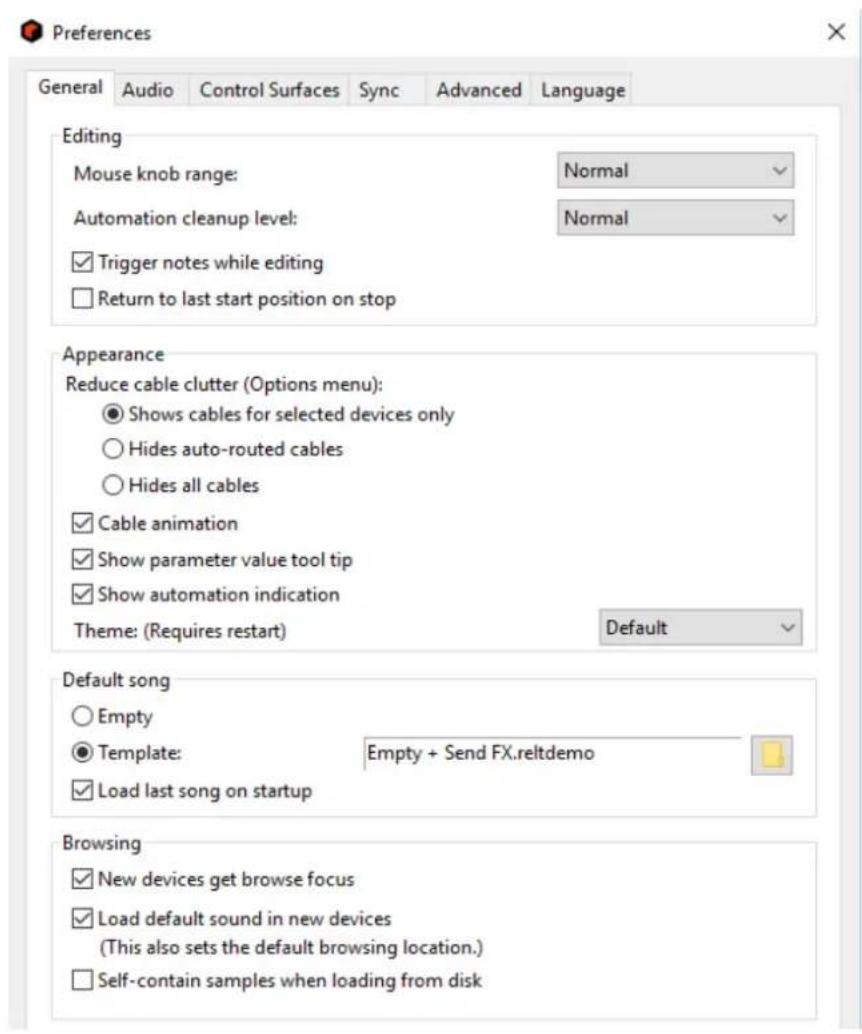
Mouse Knob Range
This lets you adjust the response sensitivity of the various knobs in Reason Lite when manipulating them with the mouse. A higher sensitivity gives a higher degree of precision. You can choose between Normal, Precise and Very Precise.
Automation Cleanup Level
The Automation Cleanup setting reduces the number of automation points when you record or draw automation. Adjust this setting if you find that recording or drawing results in too many or too few automation points.
- This can also be done manually from the Tool window (Sequencer Tools tab) - see "The "Automation Cleanup" function in the Tool Window".
Trigger Notes while Editing
When this is selected, transposing notes, by manually moving them with the Selection Tool, will make the notes trigger - and sound. This is useful since you will hear when the notes reach the correct pitches.
Return to last start position on stop
When active, clicking Stop in the sequencer will make the Song Position Pointer automatically return to the last start position. If not active (default), the Sequencer will simply stop at its current position.
Reduce Cable Clutter Setting
The selected alternative determines how cables on the back of the rack should be displayed when "Reduce Cable Clutter" is selected on the Options menu:
→ Select "Show For Selected Devices Only" to only display the cables for selected devices.
All other (non-selected) devices will have "transparent" cables to make it easier to distinguish the cables of selected devices.
→ Select "Hide Auto-Routed Cables" to only display manually routed cables.
All devices with auto-routed cables will have "transparent" cables to make it easier to distinguish the manually routed cables.
→Select "Hide All Cables" to hide all auto-routed and manually routed cables.
All cable connections on devices will be indicated with colored dots in the jacks, and no cables will be displayed.
See "Cable appearance" for more details.
Cable Animation
Cables in Reason Lite are animated in a lifelike fashion when flipping the Rack and making connections. Should you so wish, you can choose to disable the cable movement animation by deactivating this checkbox.
Show Parameter Value Tool Tip
Normally, if you hold the mouse pointer over a parameter on a device panel for a moment, a Tool Tip appears displaying the name and the current value of the parameter. If you uncheck this option, Tool Tips will not be displayed.
Show Automation Indication
If a parameter is automated in the sequencer, this is by default indicated by a green frame around the parameter on the device panel. If you uncheck this option, automation will not be indicated.
Theme
Here you can choose from a couple of different visual themes, i.e. how the user interface should be visually presented. The selected theme/color affects the Sequencer, Browser and Transport Panel areas. See “About different Themes”.
! Note that you have to restart Reason Lite for the new Theme to take effect.
Default Song
It's possible to specify a certain song document which will automatically open as a "template" each time you select "New" from the File menu. The Default Song could be an empty document, a song you have created earlier, or a factory made Template song. See "Setting up a Default Song" for information on how to select Default Song.
Load Last Song On Startup
Checking this automatically opens the last saved song each time you launch Reason Lite.
→ Tick the checkbox to open the last saved song the next time you launch Reason Lite.
New devices get browse focus
When this is active, Browse focus is automatically set to new devices as soon as they have been created. This means that you can immediately start to browse for, and load, compatible patches for the devices you just created. Browse focus is indicated by orange sidebars and an orange patch section on the devices. The top section of the Browser also gets an orange label with the device's current patch name printed on it.
Load default sound in new devices
When this is activated and you create a new device (of a device type that supports patches), a default patch will be loaded. This way you can be sure that a new device generates sound right away. The default sound will also determine the default location in the Factory Sound Bank when you browse for patches for the new device.
If you turn this off, new devices will be initialized - parameters are reset to their default values and no samples are loaded in sample-based devices.
! Note that "Sound" also implies patches for effect devices such as the RV7000 and Scream 4.
Self-contain samples when loading from disk
When this is activated, any samples you load into a sampler device from disk will automatically become self-contained and saved together with the rest of the song data when you save your Song.
Preferences - Audio
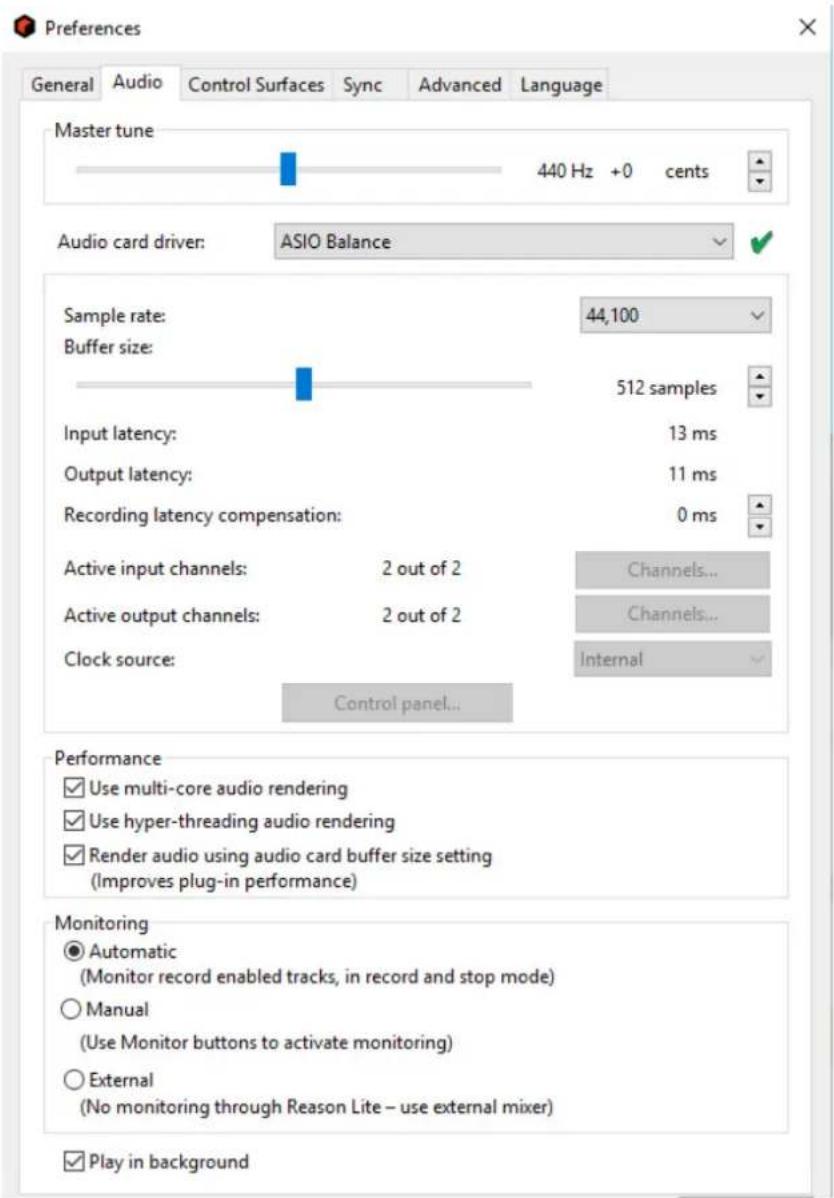
Master tune
This lets you adjust the global tuning in Reason Lite. Standard tuning is "middle A" at 440 Hz. You can adjust this by +/- 100 cents. The Master Tune setting affects the tuning of all sound sources in Reason Lite, including the Tuner function on the Audio Tracks. It also affects the tuning of the Redrum and Dr. Octo Rex loop player.
! Note that the Master Tune setting does NOT affect the pitch of the audio on audio tracks!
! Note that the Master Tune setting does NOT affect the pitch of any VST plugins used in the song!
Audio card driver - Windows
This menu lists all the available Audio Card Drivers on your system, and lets you select which one Reason Lite should use. Which option to select depends on the audio hardware:
- If you are using audio hardware for which there is a specific ASIO driver, you should select this.
With an ASIO driver written specifically for the audio hardware you will get lower latency (see below), support for higher sampling frequencies (up to 192 kHz in 24 bit/32 bit float resolution), and possibly better support for additional hardware features such as multiple outputs. - If there is no specific ASIO driver, you could select a generic ASIO driver for the audio hardware.
! Reason Lite requires that the audio card uses an ASIO driver on Windows systems, if you want to use both audio in and audio out. Direct X and MME drivers only support audio out.
Audio device - macOS
This menu lists all the available Audio Devices on your system, and lets you select which one Reason Lite should use. Which option to select depends on the audio hardware:
- If you are using audio hardware for which there is a specific Core Audio driver, you should select this.
With a Core Audio driver written specifically for the audio hardware you will get lower latency (see below), support for higher sampling frequencies (up to 192 kHz in 24 bit/32 bit float resolution), and possibly better support for additional hardware features such as multiple outputs.
Sample rate
Reason Lite handles all internal audio processing in 32-bit floating point resolution, with 64-bit summing in the mix bus in the Main Mixer Master Section. However, the resolution of the input and output audio is determined by the hardware audio interface. That is, if you have a 24-bit audio card, Reason Lite will record and output audio in 24-bit resolution, and if you have a 20-bit audio card, audio will be recorded and played back in 20-bit resolution.
The Sample Rate can be specified on the Audio tab in the Preferences dialog. See "Sample Rate settings for recording and playback" for more details.
Buffer size
The Buffer Size determines the Input and Output Latency of the audio. Generally, the smaller the Buffer Size, the lower the latency. However, too low a Buffer Size setting could result in clicks, pops, dropouts, etc. in the audio. Therefore, the Buffer Size should be set to an "optimal" value rather than to the lowest value. See "Buffer Size settings" for more information.
Input and Output latency
The Input latency is the delay between when the audio is "sent" from a connected microphone or instrument and when it's detected by Reason Lite. Output latency is the delay between when audio is "sent" from Reason Lite and when you actually hear it. The latencies in an audio system depends on the audio hardware, its drivers and their settings.
When you select a driver, its latency values are automatically reported by the audio card and displayed in the Preferences-Audio dialog. Depending on the audio hardware and the driver, you may be able to adjust these values:
- If you are using an ASIO driver specifically written for the audio hardware under Windows, you can in most cases make settings for the hardware by clicking the Control Panel button.
This opens the hardware's ASIO Device Control Panel, which may or may not contain parameters for adjusting the latency. Usually this is done by changing the number and/or size of the audio buffers - the smaller the audio buffers, the lower the latency. Please consult the documentation of your audio hardware and its ASIO drivers for details!
OK, so why not just set the latency to the lowest possible value? The problem is that selecting too low a latency is likely to result in playback problems (clicks, pops, dropouts, etc.). There are several technical reasons for this, the main one being that with smaller buffers (lower latency), the average strain on the CPU will be higher. This also means that the more CPU-intensive your Reason Lite song (i.e. the more tracks and devices you use), the higher the minimum latency required for avoiding playback difficulties.
See "About latency" for more information.
Recording latency compensation
If you are monitoring via an external mixer, and have selected "External" in the "Monitoring" section on the "Audio" page in Preferences (see "Monitoring"), there might be situations where you experience that the recorded audio is generally played back too early - or too late - in the song. This could be because the latency values reported to Reason Lite by the audio card were not completely accurate.
If you should experience that your audio recordings are played back too early or too late compared to the instrument tracks in your song, you can adjust this by editing the Recording Latency Compensation parameter.
See "Recording Latency Compensation" for information.
Active input and output channels
This displays the number of audio input and output channels the currently selected audio hardware supports. If your audio card has multiple inputs and/or outputs, and an audio driver that supports this is selected, the "Channels..." button will be enabled. Clicking this will bring up a window with check boxes for all available inputs and outputs. By ticking these boxes, you are able to select which input and/or output channels should be active.
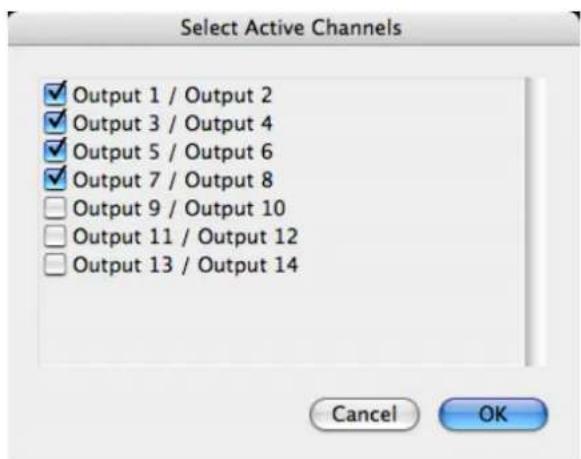
Active inputs and outputs will be also indicated with yellow and green LEDs in the Reason Lite Hardware Interface - see "How Reason Lite communicates with your audio hardware".
Clock source (ASIO Only)
If you are using an ASIO driver for your audio hardware, you have the possibility of selecting a Clock Source. This is used for determining the source to which audio playback should synchronize its sample rate. If you have an audio card and a driver that supports it, you can choose to synchronize to external sources.
Control panel
If you have selected an ASIO or Core Audio driver, this button brings up a control panel window specifically for that audio hardware. This may contain buffer settings, routing options, synchronization alternatives etc.
Use multi-core audio rendering
Reason Lite fully supports MultiCore Audio Rendering. This means that if your computer has multiple CPU cores (quad-core, for example), or multiple CPUs, Reason Lite takes advantage of this to significantly enhance the performance. If your computer has a multi-core CPU, or multiple CPUs, MultiCore Audio Rendering is active by default.
See "Audio Basics" for more information on how Reason Lite handles audio.
Use hyper-threading audio rendering
Reason Lite supports hyper-threading also for the audio processing. This could be worth enabling if you are using a multi-core CPU and should experience performance problems. Note, though, that enabling hyper-threading doesn't necessarily solve all types of performance problems.
Render audio using audio card buffer size setting
The "Render audio using audio card buffer size setting" function should be selected (checked) for best plugin performance. When selected, the audio batches are rendered internally according to the set Buffer size (see "Buffer size" above). For example, if you have a Buffer size of 512 Samples, each audio batch will be 512 samples internally. Raising the Buffer size will let Reason Lite process larger audio batches in one go, which is often more efficient. Many plugins are also more efficient when doing larger audio batches. If you are using DSP-heavy VSTs (mastering effects, for example), these will run a lot smoother with this function selected.
! Note that old songs might sound different with this function selected, if the songs uses feedback routings and CV connections.
If unchecked (off), all audio batches are rendered internally at a fixed size of 64 samples - regardless of the Buffer size setting. This might be desirable if you are using feedback signal routings and CV connections in your songs, and want the internal latency of those connections to be fixed at a short value all the time. This might result in performance problems for DSP-heavy VSTs, though.
Unchecked will give the same performance as in previous Reason Lite 10 versions.
Monitoring
In the Monitoring section you can choose how you want monitoring of the input signals to work on audio tracks.
→ Select "Automatic" to automatically monitor the input signals on all record enabled audio tracks when recording and when the sequencer is stopped.
Record enabling of audio tracks is done by clicking the Record Enable button on the track in the track list - see "Record enabling".
! Note that if you have selected "Standard" in the "Master Keyboard Input" section on the "Keyboards and Control Surfaces" page in Preferences (see "The Master Keyboard Input setting"), selecting an audio track also automatically record enables it - and consequently enables monitoring in "Automatic" mode.
→ Select "Manual" to manually activate monitoring by clicking the Monitor button on the track in the track list.
→ Select "External" if you are monitoring directly through your audio interface outputs (and not via the Reason Lite application) - or via an external mixer.
In "External" mode it's not possible to monitor in Reason Lite.
Play in background
When this is activated, Reason Lite will not "release its grip" on the audio hardware when another application is active.
- The advantage is that Reason Lite will keep playing while you work in the other application.
- The disadvantage is that other audio applications may not be able to play any audio, depending on the type of driver used.
Preferences - Control Surfaces
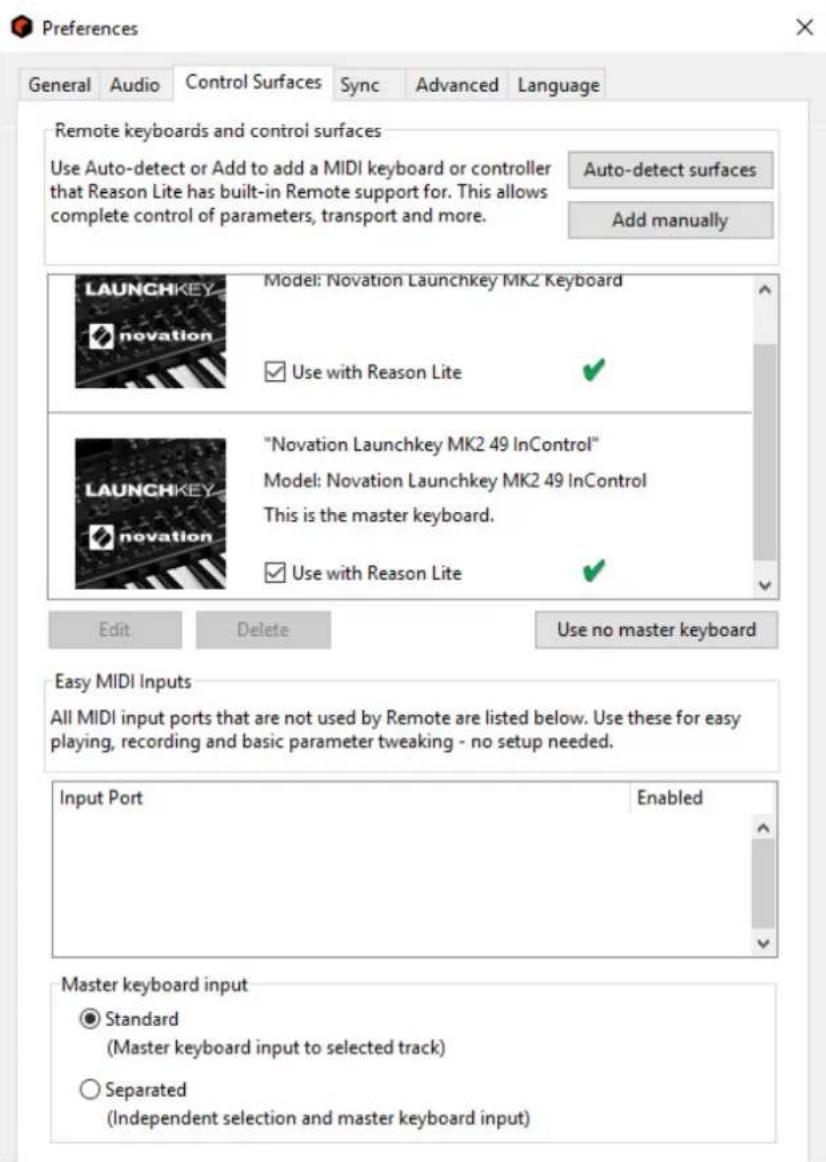
This is where you set up your MIDI hardware; keyboards and control surfaces.
→ The "Attached surfaces" list in the middle shows the currently added surfaces/MIDI keyboards.
Selecting a surface in the list allows you to edit its settings or delete it from the list, by clicking the corresponding "Edit" or "Delete" button.
→ Clicking the "Auto-detect surfaces" button will scan for connected control surfaces.
This requires a USB connection or a two-way MIDI connection. Note that not all control surfaces support auto-detection - but you can always add control surfaces manually.
→ If you have surfaces added in the "Attached surfaces" list that you do not wish to use with Reason Lite, you can uncheck the "Use with Reason Lite" checkbox.
→ The "Use no master keyboard" button allows you to disable MIDI note input in the sequencer.
The surface designated as Master Keyboard cannot be locked to a specific device - it always follows the sequencer Master Keyboard Input. By selecting the Master Keyboard surface in the Attached Surfaces list and clicking this button allows you use Surface locking, although you will not be able to play the device. See "Locking a surface" in the Remote chapter for details.
Adding or editing a control surface
To add a control surface, click the "Add" button to open the Control surfaces dialog. If you want to edit the settings for an existing control surface, click the "Edit" button. Then proceed as follows:
- Select the manufacturer of your control surface from the Manufacturer pop-up menu.
If you can't find it on the menu, see below.
- Select the model of your control surface from the Model pop-up menu.
If you can't find it on the menu, see below.
- An image of the selected control surface model is shown, often along with some information text - read this carefully.
For some control surfaces, you need to select a specific preset to use the surface with Reason Lite - this is noted here.
- Use the MIDI Input pop-up to select the input port to which you have connected the surface.
If in doubt, you can click the "Find" button and then tweak a control or play a key on the control surface to have Reason Lite find the correct input port for you.
- Some control surfaces may have more than one MIDI Input pop-up menu.
You need to select ports on all MIDI Input pop-up menus.
- Some control surfaces will have a MIDI Output pop-up menu.
In some cases this is labeled "Optional" - then you don't have to make a selection. In other cases, a MIDI Output is required. This is the case if the control surface uses MIDI feedback - motor fader, displays, etc.
-
If you like, you can rename your control surface in the Name field.
-
Click OK to add the surface.
→ Depending on the surface model, alerts may appear, reminding you to select a specific preset etc.
In some cases, Reason Lite can restore a preset in the control surface to factory settings for you. If so, you will be informed about this.
Finally you return to the Control Surfaces Preferences page, where your added surface is now listed.
If your control surface model isn't listed
If you can't find your control surface listed on the Manufacturer or Model pop-up menus when you try to add it, this means that there's no native support for that model. However, the program supports generic keyboards and controllers. Here's what to do:
→ Select "Other" on the Manufacturer pop-up menu and then select one of the three options on the Model pop-up menu.
or, if the Manufacturer is listed but not your specific model:
→ Select one of the three "Other" options on the Model pop-up menu:
In both cases, the options are:
• MIDI Control keyboard
Select this is you have a MIDI keyboard with programmable knobs, buttons or faders. You need to set up your control surface so that the controllers send the correct MIDI CC messages, depending on which Reason Lite device you want to control.
• MIDI Control Surface
Select this if you have a MIDI controller with programmable knobs, buttons or faders (but without keyboard).
Again, you need to set your controllers to send the right MIDI CCs.
• MIDI Keyboard (No Controls)
Select this is you have a MIDI keyboard without programmable knobs, buttons or faders. This is used for playing only (including performance controllers such as pitch bend, mod wheel, etc.) - you cannot adjust Reason Lite device parameters with this type of control surface.
Under the "Other" Manufacturer, there are also two options called "MIDI Multichannel Control Keyboard" and "MIDI Multichannel Control Surface". Use these if the controls on your keyboard/control surface send the same MIDI message but on different MIDI channels. Read more in "Adding a specific control surface or keyboard" in the Remote chapter.
After selecting a model, proceed with selecting MIDI input as described above.
About the Master Keyboard
One of the control surfaces can be the Master Keyboard. This is like any other control surface, but it must have a keyboard and it cannot be locked to a specific Reason Lite device (in other words, it always follows the MIDI input to the sequencer). This is the surface you use to play the instrument devices in Reason Lite.
→ The first surface with a keyboard that is added (or found by auto-detect) is automatically selected to be the Master Keyboard.
This is shown in the Attached Surfaces list on the Preferences page.
→ If you want to use another surface as Master Keyboard, select it in the list and click the "Make Master Keyboard" button.
There can only be one Master Keyboard.
→ If you don't want to use any Master Keyboard at all, select the current Master Keyboard surface and click the same button (which is now labeled "Use No Master Keyboard").
Easy MIDI Inputs
By default Reason Lite automatically scans and detects any unused MIDI In port(s) on your computer. If you have a MIDI keyboard or MIDI control surface connected to your computer, Reason Lite automatically connects and lets you use it for controlling Reason Lite. This way you don't have to do any manual set-up but can start controlling Reason Lite right away.
See "Automatic set-up using the Easy MIDI Inputs function" for more details.
The Master Keyboard Input setting
This determines how you set Master Keyboard Input in the sequencer: to which track and device the Master Keyboard should be directed (which track to play from your keyboard):
- In "Standard" mode, the selected track automatically gets Master Keyboard Input.
This way you can just click anywhere on a track in the track list to select it for playing (or use the arrow keys to step up and down in the track list).
- In "Separated" mode, you need to click directly on the device icon to the left in the track list to set Master Keyboard Input.
This is useful if you're working with multiple selections in the track list, or if you want to select different tracks for editing without changing which device you play from your keyboard. - Master Keyboard Input is indicated by a red border around the device icon in the track list.
On instrument tracks, a small keyboard is also shown below the device icon. On other track types, a small control surface is shown below the device icon.
Preferences - Sync
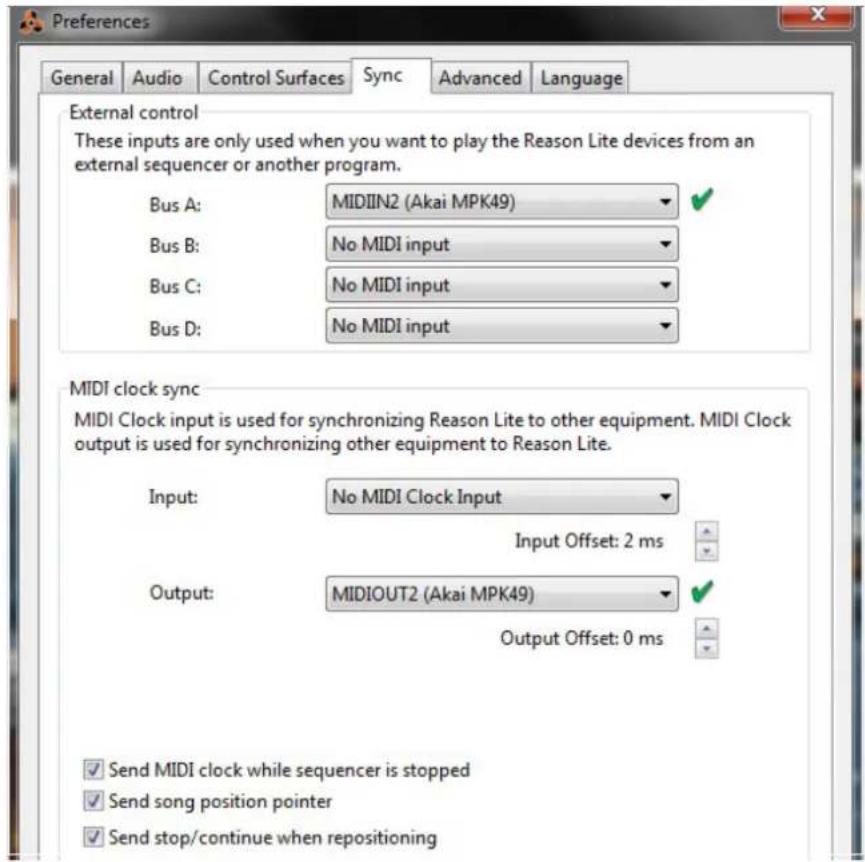
External control
The External Control inputs provide up to 64 MIDI input channels divided into four buses, each with 16 channels.
• These MIDI inputs are for individual control of Reason Lite Devices from an external sequencer.
This could be an external hardware sequencer or sequencer software that is installed on the same computer as Reason Lite. See the chapter "Synchronization and Advanced MIDI" for more details.
MIDI clock sync
Using the MIDI Clock Input, you can synchronize Reason Lite to external devices (tape recorders, drum machines, stand alone sequencers, workstations etc.) and other computer programs running on the same or another computer.
By using the MIDI Clock Output, Reason Lite can act as MIDI Clock Sync host for external equipment and applications.
As part of the MIDI Clock standard there are also options for sending out Start, Stop, Continue and Song Position Pointers, see "Using Reason Lite as MIDI Clock Host".
- By first selecting the appropriate MIDI input and/or Output using the MIDI Clock Input/Output pop-ups and then selecting "MIDI Clock Sync" on the Options menu, Reason Lite is ready to receive or send MIDI Clock sync.
See the "Synchronization and Advanced MIDI" chapter for more information.
- There are also controls for adjusting the Input and Output Offsets.
See "Adjusting for Latency" for more information.
Preferences - Advanced

Preferences

General Audio Control Surfaces Sync Advanced Language
On-screen piano keys
Here you can choose which keys on your computer's keyboard will be used for the on-screen piano keys.
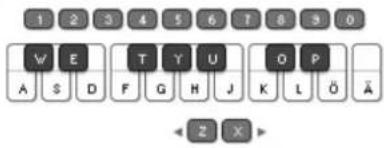
Reset to defaults

Send error reports and statistics
Reason Intro can send error reports and usage statistics to Propellerhead Software. This helps us improve the application for you.
VST Plugin Folders
C:\Program Files\VSTplugins\
C:\Program Files\Steinberg\VSTplugins\
C:\Program Files\Common Files\Steinberg\VST2\
Add
Remove
These are the folders that Reason Lite scans for VST Plugins at launch. If you have your plugins in custom folders, add them to this list and Reason Lite will find them.
Scratch disk folder
Default
Change...
Reset
The scratch disk is where Reason Lite stores analysis data and new, unsaved songs. Normally, such data is saved in the system temp folder in your home directory – change this if you have an additional hard drive that you prefer to use for audio recording.
Help
On-screen piano keys
In this section you can specify what computer keyboard keys should be used for the On-Screen Piano Keys function.
→ To change key assignment, click on a key in the window and then press another available key on the computer keyboard to assign it.
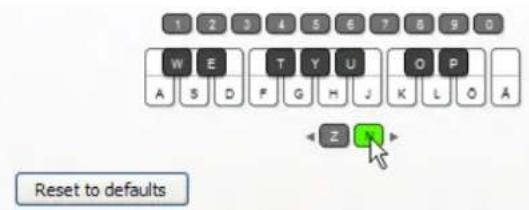
- Since many keyboard keys are already "locked" to other functions and commands in Reason Lite, it's not really applicable to reassign all the actual "play" keys. It's more useful to reassign the Octave and Velocity (numeric) keys.
→ Click the Reset to Defaults button to revert to the preset keyboard keys assignment.
See the "On-screen Piano Keys" chapter for information on how to use the On-screen Piano Keys.
Send error reports and statistics
With this checkbox ticked you allow Reason Lite to send error reports and usage statistics to Reason Studios to help us improve the program. These reports can also be extremely valuable, should we need to help you out with any support cases.
! This function requires that your computer has access to the Internet.
! The data sent does NOT contain any musical contents that you have recorded or created.
! This function does NOT affect the Reason Lite performance negatively at all.
VST Plugin Folders
Here you can select the folders you want Reason Lite to scan for VST plugins during each launch. See "Defining custom VST folders" for more information.
Scratch disk folder
Here you can select where you want to locate the Scratch Disk Folder. The Scratch Disk Folder is a temporary storage for recorded audio files before they have been manually saved in a song document file. By default, Reason Lite places the Scratch Disk folder in the system temp folder in your home directory. You can manually change the Scratch Disk folder location if you like. See "Changing Scratch Disk folder location" for more information.
Preferences - Language (Windows only)
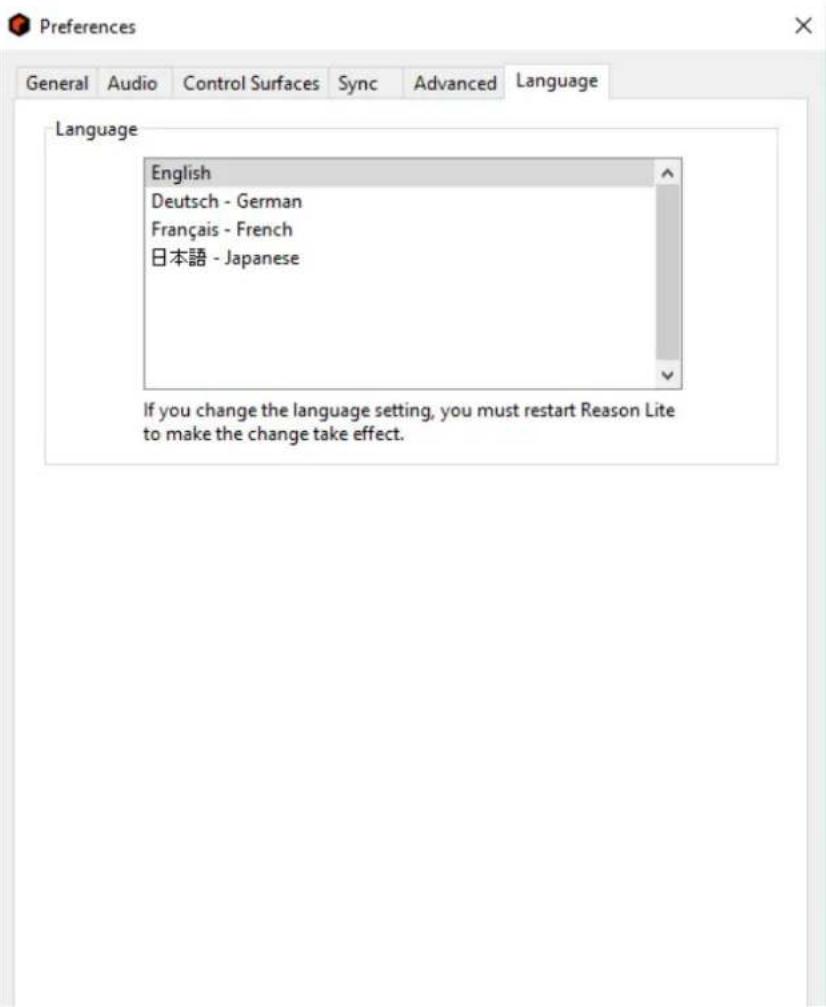
Language (Windows only)
Reason Lite is localized to several different languages. The language setting affects menus, dialogs, tool tips and some display texts, but generally not the texts on the device panels. If you run Reason Lite under Windows, you can select preferred language on this page.
! Note that you need to restart Reason Lite for a language change to take effect.
! Under macOS, Reason Lite will use the language selected in the operating system.
Create menu
Create Audio Track
Select this to create a new audio track in the sequencer, its associated Audio Track Device in the rack with its corresponding channel strip in the Main Mixer. The audio track, device and channel strip will be automatically named "Audio Track n", where "n" is an incremental number.
You could then rename the track, device and channel strip afterwards if you like - see "Naming tracks".
Create Mix Channel
Select this to create a new Mix Channel device in the rack with its corresponding channel strip in the Main Mixer. This function is handy if you, for example, want to route separate audio outputs from a device to several separate Mix Channels.
Create Instrument.../Create Effect...
Selecting this will open the corresponding device palette in the Browser, where you can add new devices to the rack. Depending on which menu item you selected, the browser will be set to show instrument or effect devices only.
Create Send FX
Selecting this will open the Effect device palette in the Browser. If you create an effect device now, this will be automatically routed as a Send Effect to the first available FX Send and FX Return connector pair on the main mixer Master Section device.
Instruments/Effects/Utilities/Players
→To create a new device, select the desired item from one of the sub-menus.
Depending on what type of device you create, the result can be different. See "Creating devices" for a complete description of what happens when you create different device types.
Rack Extension devices are sorted below the Reason Lite devices, in alphabetical order per manufacturer. However, Reason Studios Rack Extension devices are always shown at the top of the Rack Extension section.
Options menu
Internal/MIDI Clock/Ableton Link/Send MIDI Clock
These four options are used to specify which type of tempo synchronization you want to use:
- Internal
When this is activated, the program is not synchronized to any external source. It plays in the tempo set on the Transport Panel.
• MIDI Clock
When this is activated, the program is synchronized to external MIDI Clock, as set up in the Preferences|Advanced dialog. The tempo setting on the Transport Panel is of no relevance; Reason Lite plays in the tempo of the incoming MIDI Clock signals. See "Synchronization and Advanced MIDI" for more details.
- Ableton Link
When this is activated, the program can be synchronized to other Ableton Link-enabled devices on the same wireless network. See "Synchronization using Ableton Link" for more details.
- Send MIDIClock
When this is activated, the program is MIDI Clock Sync host and can control external applications/equipment. See "Synchronization and Advanced MIDI" for more details.
Enable Keyboard Control
When this is activated, the computer's keyboard keys can be used to control devices, as set up with the Keyboard Control Edit feature. See "Editing Keyboard Control" for more information.
Keyboard Control Edit Mode
To get an overview of which parameters are keyboard controllable select "Keyboard Control Edit Mode" from the Options menu.
Each device you select will show a yellow arrow symbol next to every parameter that can be assigned.
→ If you click on an assignable parameter to select it, you can then select "Edit Keyboard Control Mapping" from the Edit menu.
This opens a dialog allowing you to select a key command for that parameter.
You may use any key or a combination of [Shift] + any key.
→ Simply press the key (or key combination) you wish to use to remote control the parameter.
The "Key Received" field momentarily indicates that it is "learning" the keystroke(s), and then the dialog displays the name of the key you have pressed. If [Shift] was used, the box beside the word Shift in the dialog is ticked.
You can also double-click on the arrow for an assignable parameter to set up keyboard control:
→ A rotating yellow rectangle appears, indicating Learn mode. Press the key (or key combination) you wish to use to remote control the parameter.
The rotating stops and the rectangle will now display the key or key combination you used.
! Note that the transport panel uses the numeric keypad for various commands. If you assign a parameter to a single numeric key, the corresponding transport functionality will be overridden!
Another way to assign keyboard control commands is to have "Keyboard Control Edit Mode" deselected on the Options menu, and to right-click (Win) or [Ctrl]-click (Mac) the parameter you wish to keyboard control.
This opens a pop-up menu, where one of the options will be "Edit Keyboard Control Mapping". Selecting this opens the Keyboard Control dialog. Thus, you do not have to enable/disable Edit mode from the Options menu if you know that a parameter is assignable.
! If you try to assign a key control that is already in use, you will get an alert asking if you wish to change the current assignment.
See "Editing Keyboard Control" for more information.
Remote Override Edit Mode
All supported control surface devices have "standard remote mappings" for each Reason Lite device. If you wish to override this standard mapping, you can do so in the following way:
- To get an overview of which parameters can be assigned remote overrides, select "Remote Override Edit Mode" from the Options menu.
Each device you select will show a blue arrow symbol beside every parameter that can be assigned a remote override. Standard mappings are marked with yellow knob symbols (only shown when the device has MIDI input). Assigned overrides are marked with a lightning bolt symbol.
- If you click on an assignable parameter to select it (selected parameters are orange in color), you can then select "Edit Remote Override Mapping..." from the Edit menu.
This opens a dialog where you can assign override mappings.
-
Make sure that the "Learn from Control Surface Input" box is ticked.
-
Simply turn the knob (or slider etc.) that you wish to use to assign Remote Override for the parameter.
The "MIDI Received" field momentarily flickers as you turn the knob, and then the dialog shows the control surface device and the control you used.
You can also make override mappings manually:
→ Select a device from the Control Surface pop-up in the dialog, and then select a control from the Control pop-up.
On the Control pop-up, all the controls on the selected control surface are listed.
- Click "OK" to exit the dialog.
The selected parameter is now tagged with a lightning bolt symbol, indicating Remote Override mapping.
- To exit Remote Override Edit mode, deselect it from the Options menu.
You do not always have to use this method - see below.
If Remote Override Edit Mode is enabled on the Options menu, mapped parameters are "tagged", and the arrow indicators show the assignable parameters. In this mode, however, you cannot operate Reason Lite normally. Remote Override Edit mode is primarily for overview of available parameters and the current assignments.
→ Another way to assign keyboard remote commands is to have "Remote Override Edit Mode" deselected on the Options menu, and to simply right-click (Win) or [Ctrl]-click (Mac) the parameter you wish to control.
This opens a pop-up menu, where one of the options will be "Edit MIDI Remote Override Mapping". Selecting this opens the "Edit Remote Override Mapping" dialog. Thus, you do not have to select Edit mode from the Options menu if you already know that a parameter is assignable.
See "Remote Override mapping" for more information.
Additional Remote Overrides...
Selecting this opens a dialog with remote functions that cannot be assigned using Remote Override Edit mode, such as switching target tracks, Undo/Redo etc.
See "Additional Remote Overrides..." for details.
Surface Locking...
This opens a dialog where you can lock a control surface to a specific device. This means that the locked device is always "tweakable", regardless of which track has MIDI input in the sequencer. This enables you to play and record notes for one device and at the same time control parameters for another device from a control surface.
For example, you could lock a control surface to control the main mixer, so you can always control overall levels while playing/tweaking other devices.
→The Master Keyboard device cannot be locked!
If you select the Master Keyboard in the Preferences, you can click the "Use No Master Keyboard" button. You can then lock this control surface to a device and use its controllers to tweak parameters, but you will not be able to play the device.
→ Each control surface can be locked to one device at a time (but you can lock several control surfaces to the same device).
This locked device will always be controlled by the selected control surface, until you unlock the device or lock the surface to another device. You can lock as many devices you wish, as long as you have enough control surfaces.
→ Locked devices can use remote overrides, just like unlocked devices.
In other words, even if a device is locked to a control surface, some parameters could be overridden so they are controlled by another control surface, or some controls on the locked surface could be override-mapped to another device.
See the "Locking a surface" for more details.
Toggle Rack Front/Rear
This switches the rack view between the front and rear panels. A quicker way to do this is to press [Tab].
Reduce Cable Clutter
If there are many connections in Reason Lite, the cables can sometimes obscure the view, making it difficult to read the text printed on the back panels of the devices. Cables can be displayed in "normal" mode and in "Reduced Cable Clutter" mode.
→ Select "Reduce Cable Clutter" on the Options menu to "hide" the cables according to the setting you have made in the "Appearance" section on the "General" page in Preferences.
See "Cable appearance" for information on how to use this function.
Auto-group Devices and Tracks
A Device Group is a series of interconnected devices that “belong together”. A Device Group could, for example, be an instrument device connected via an effect device to a Mix Channel device. With the “Auto-group Devices and Tracks” option selected, moving/cutting/copying/duplicating and pasting a device in a device group will perform the operation on all devices in the device group. See “About Device Groups” for more details.
Delay Compensation
Select "Delay Compensation" to activate the built-in delay compensation, see "Activating the Delay Compensation".
Show Navigators
Selecting "Show Navigators" will show the Channel Strip Navigator in the Main Mixer and the Rack Navigator in the rack. Deselecting the "Show Navigators" option will hide the Channel Strip Navigator in the Main Mixer and the Rack Navigator in the rack.
Always Show Tutorial Area
When this is activated, the Tutorial area to the right in the song window is always shown - unfolded or folded, depending on if the area is open or minimized, see "The Tutorial area".
→ To completely hide the Tutorial area (and its divider), deselect the Always Show Tutorial Area option.
Follow Song
When this is activated, the sequencer Arrangement and Edit Panes will automatically scroll along with the song position pointer on playback. When this item is deactivated, the Arrangement and Edit Panes will remain stationary.
Show Block Clip Content in Song View
When this is activated, the content of the Block Automatic Clip is displayed in a "ghosted" fashion on the arrangement pane. When deactivated, only the Block Automation Clip is displayed on the Blocks Track.
Keep Events in Clip while Editing
This function determines how note and automation events behave if they are drawn, moved or pasted outside the boundaries of the open clip in Edit mode in the sequencer.
- With "Keep Events in Clip while Editing" selected, events drawn, moved or pasted outside the boundaries of the open clip will still belong to the original clip - but will be masked.
- With the “Keep Events in Clip while Editing” deselected, the open clip will expand to contain the drawn, moved or pasted events - or, if this is not possible, the events will be placed in an existing, or new, clip.
See “About drawing notes outside an open clip”, “About moving notes outside or between clips” and “Pasting events outside an open clip” for detailed examples.
Auto-color Tracks and Channels
When this option is activated, a color will automatically be assigned to a new sequencer track or mixer channel when you create it. Any new clips created on a track will get the same color as the track.
Record Automation into Note Clip
With this option activated, any device parameter automation will be automatically recorded into the note clips as "Performance Controllers" instead of on separate Parameter Automation Lanes.
Number of Precount Bars
Here you select the number of pre-count bars to use when the "Pre" button on the Transport Panel is on. When you record in the sequencer with the "Pre" button active, the recording will begin after the set number of precount bars.
→Select "One", "Two", "Three" or "Four" bars from the sub-menu that appears.
MIDI: Send All Notes Off
This sends an All Notes Off MIDI command on the MIDI Out ports used by Reason Lite. This function can be used if you are experiencing hanging notes when you are controlling external MIDI instruments from Reason Lite. See "MIDI Out Device" for more information about MIDI controlling external equipment.
Enter/Exit Edit Mode
This allows you to toggle the sequencer between Song/Blocks View and Edit Mode.
Enable Blocks
This enables the Blocks function in the Sequencer. See "Working with Blocks in the Sequencer".
Switch to Block View/Song View
This allows you to toggle the sequencer Arrangement between Blocks View and Song View.
Window menu (Windows version)
Stay on top
When this is activated, the Reason Lite window will always stay on top of other program's windows.
View Main Mixer
Selecting this, or pressing [F5], will maximize the Main Mixer area and bring it into view.
View Racks
Selecting this, or pressing [F6], will maximize the Rack area and bring it into view.
View Sequencer
Selecting this, or pressing [F7], will maximize the Sequencer area and bring it into view.
Detach/Attach Main Mixer
Selecting this, or pressing [Ctrl]+[F5] , will detach the Main Mixer from the Song document window, and open it in a separate window. When the Main Mixer is detached, the menu item text changes from Detach to Attach. Selecting this will then reattach the Main Mixer to the Song document window again.
Detach/Attach Rack Window
Selecting this, or pressing [Ctrl]+[F6] , will detach the Rack from the Song document window, and open it in a separate window. When the Rack is detached, the menu item text changes from Detach to Attach. Selecting this will then reattach the Rack to the Song document window.
View All
Selecting this, or pressing [Ctrl]+[F7], will reattach any separate windows to the Song document window and show all areas equally sized.
Rack Extensions
Selecting this starts up the Authorizer application, which displays the currently installed Rack Extension devices on your computer. Here you can also delete Rack Extension devices from your computer.
Manage Plugins
Selecting this brings up the Manage Plugins window, where you can manage your VST plugins. See "Managing VST plugins".
Show/Hide Browser
Selecting this, or pressing [F3], will show or hide the Browser area.
Show/Hide Tutorial
Selecting this will show or hide the Tutorial area.
Show/Hide Transport
Selecting this will show or hide the Transport Panel.
Show/Hide ReGroove Mixer
Selecting this will show or hide the ReGroove Mixer.
Show/Hide Tool Window
Selecting this, or pressing [F8], will show or hide the floating Tool window. This window contains the Sequencer Tools tab (for editing sequencer data) and the Groove Settings tab (for fine-tuning and saving ReGroove patches).
Show/Hide On-screen Piano Keys
Selecting this, or pressing [F4], will show or hide the floating On-screen Piano Keys window. See "On-screen Piano Keys" for information on how to use the On-screen Piano Keys window.
Show Spectrum EQ Window
Selecting this, or pressing [F2], will show or hide the Spectrum EQ Window. See "The Spectrum EQ Window" for more information.
Show/Hide Recording Meter
Selecting this, or pressing [Ctrl]+[F3], will show or hide the floating Recording Meter Window. See "The Recording Meter Window" for more information.
Show Missing Sounds window
Selecting this brings up the Missing Sounds window. See "Handling Missing Sounds" for more information.
Open Song Windows list
This lists all open song document windows. Selecting one makes it the active window. If songs have detached areas in separate windows, these will be included as separate items in the Open Documents list. The currently active window is indicated with a tick to the left of the window name:
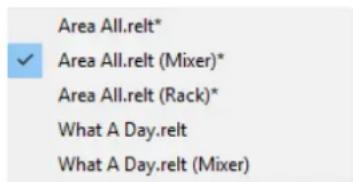
In the picture above, the "Area All.relt (Mixer)" window is the currently active window, and consequently the "Area All.relt" song is the currently active song. The Mixer and Rack areas of this song are currently detached in separate windows. The asterisks (*) to the right of some of the windows show that the song currently contains unsaved edits.
Window menu (macOS version)
Minimize
This minimizes the selected song document window.
Zoom
This toggles the selected window between the default and the user defined size and position, according to the Apple guidelines. For detached Mixer and rack windows, the default state equals maximized across the screen.
Bring All to Front
This will bring all open Reason Lite windows in front of any other open application's window(s).
View Main Mixer
Selecting this, or pressing [F5], will maximize the Main Mixer area and bring it into view.
View Racks
Selecting this, or pressing [F6], will maximize the Rack area and bring it into view.
View Sequencer
Selecting this, or pressing [F7], will maximize the Sequencer area and bring it into view.
Detach/Attach Main Mixer
Selecting this, or pressing [Cmd]+[F5] , will detach the Main Mixer from the Song document window, and open it in a separate window. When the Main Mixer is detached, the menu item text changes from Detach to Attach. Selecting this will then reattach the Main Mixer to the Song document window again.
Detach/Attach Rack Window
Selecting this, or pressing [Cmd]+[F6] , will detach the Rack from the Song document window, and open it in a separate window. When the Rack is detached, the menu item text changes from Detach to Attach. Selecting this will then reattach the Rack to the Song document window.
View All
Selecting this, or pressing [Cmd]+[F7] , will reattach any separate windows to the Song document window and show all areas equally sized.
Rack Extensions
Selecting this starts up the Authorizer application, which displays the currently installed Rack Extension devices on your computer. Here you can also delete Rack Extension devices from your computer.
Manage Plugins
Selecting this brings up the Manage Plugins window, where you can manage your VST plugins. See "Managing VST plugins".
Show/Hide Browser
Selecting this, or pressing [F3], will show or hide the Browser area.
Show/Hide Tutorial
Selecting this will show or hide the Tutorial area.
Show/Hide Transport
Selecting this will show or hide the Transport Panel.
Show/Hide ReGroove Mixer
Selecting this will show or hide the ReGroove Mixer.
Show/Hide Tool Window
Selecting this, or pressing [F8], will show or hide the floating Tool window. This window contains the Sequencer Tools tab (for editing sequencer data) and the Groove Settings tab (for fine-tuning and saving ReGroove patches).
Show/Hide On-screen Piano Keys
Selecting this, or pressing [F4] will show or hide the floating On-screen Piano Keys window. See "On-screen Piano Keys" for information on how to use the On-screen Piano Keys window.
Show Spectrum EQ Window
Selecting this, or pressing [F2], will show or hide the Spectrum EQ Window. See "The Spectrum EQ Window" for more information.
Show/Hide Recording Meter
Selecting this, or pressing [Cmdl]+[F3], will show or hide the floating Recording Meter Window. See "The Recording Meter Window" for more information.
Show Missing Sounds window
Selecting this brings up the Missing Sounds window. See "Handling Missing Sounds" for more information.
Open Song Windows list
This lists all open song document windows. Selecting one makes it the active window. If songs have detached areas in separate windows, these will be included as separate items in the Open Documents list. The currently active window is indicated with a tick to the left of the window name:
- AudioTests.relt
• AudioTests.relt (Rack)
√ untitled 3
◆ untitled 3 (Mixer)
◆ untitled 3 (Rack)
In the picture above, the "untitled 3" sequencer window is the currently active window, and consequently also the currently active song. The Mixer and Rack areas of this song are currently detached in separate windows and Minimized, as indicated by the symbols to the left. The round dots to the left of some of the windows show that the song currently contains unsaved edits.
Help menu
Reason Lite Help...
This menu item opens up the on-line Help system in your default web browser. The Reason Lite Help contains detailed information about all functions in Reason Lite. You can choose to browse for information, either from the Table of Contents (TOC), Index or Search tabs in the Help system.
Documentation in pdf format...
This takes you to the support section at Reason Studios, where you can download manuals in pdf format.
Tutorials on the Reason Studios Website...
Selecting this item will open up your default web browser and direct you the Reason Lite Video Tutorials page on the Reason Studios web site.
Download more Demo Songs...
This takes you to our archives of song files that you can download and use.
Download more Template Songs...
This takes you to our archives of song files that you can download and use.
Go to the Reason Studios Website...
This takes you to the main entrance on the Reason Studios web site.
Check for Updates...
This checks for recent Reason Lite updates on the Reason Studios server.
Your Products... (Windows only)
This menu item launches your default web browser and brings you to your products page on Reason Studios, where you can view your list of owned products, including download ReFills and Rack Extensions.
Get more Instruments, Sounds & Effects
This item starts up your default web browser and takes you to the Reason Studios Shop, where you can get more Rack Extension devices for your Reason Lite rack and also purchase additional ReFills.
Go to Product Page...
With a Rack Extension device selected in the rack, selecting this item will start up your default web browser, which will take you to the product page for the R.E. at the Reason Studios web site.
About Reason Lite (Windows only)
This menu item opens up a dialog that informs you about the version of the program and the people behind it.

Chapter 40
Key Commands
About the Key Commands chapter
This chapter contains compiled lists of all keyboard shortcuts and modifier keys available in Reason Lite - and in all Reason Lite devices. Keyboard shortcuts are keys or combinations of keys that can be pressed to execute various functions. Modifier keys are keys that can be used in combination with the mouse, to execute additional functions.
! In most cases, which key(s) to use is different on macOS and Windows. The keys to use are listed in the right column of the tables below, with the Mac key(s) to the left and the Windows key(s) to the right of the slash, i.e. [Mac key(s)]/[Windows key(s)].
General keyboard shortcuts
| Function Key(s) | |
| Maximize/restore Main Mixer [F5] | |
| Maximize/restore Rack [F6] | |
| Maximize/restore Sequencer [F7] | |
| Maximize Main Mixer and Rack in one window [F5]+[F6] | |
| Maximize Main Mixer and Sequencer in one window [F5]+[F7] | |
| Maximize Rack and Sequencer in one window [F6]+[F7] | |
| Detach/Attach Main Mixer [Command]/[Ctrl]+[F5] | |
| Detach/Attach Rack [Command]/[Ctrl]+[F6] | |
| View All in one window [Command]/[Ctrl]+[F7] or [F5]+[F6]+[F7] | |
| Show/hide Spectrum EQ Window [F2] | |
| Show/hide Browser [F3] | |
| Show/Hide Recording Meter [Command]/[Ctrl]+[F3] | |
| Show/hide On-screen Piano Keys window | [F4] |
| Show/hide Tool window | [F8] |
| Toggle Rack front/rear [Tab] | |
| Create new Song | [Command]/[Ctrl]+[N] |
| Open Song | [Command]/[Ctrl]+[O] |
| Save Song | [Command]/[Ctrl]+[S] |
| Save Song As | [Shift]+[Command]/[Shift]+[Ctrl]+[S] |
| Close active detached Rack or Mixer window | [Command]/[Ctrl]+[W] |
| Close Song (if the window containing the Sequencer is active) | [Command]/[Ctrl]+[W] |
| Import Audio File | [Command]+[Option]/[Shift]+[Ctrl]+[I] |
| Quit (macOS only) | [Command]+[O] |
| Exit (Windows only) | [Alt]+[F4] |
| Undo | [Command]/[Ctrl]+[Z] |
| Redo | [Command]/[Ctrl]+[Y] |
| Delete Devices and Tracks | [Del] or [Backspace] |
| Delete Devices and Tracks (without warning). | [Command]/[Ctrl]+[Del] or [Command]/[Ctrl]+[Backspace] |
| Duplicate Devices and tracks, or selected clip(s), or selected comp row(s) in open audio clips, or selected note(s) in note clips, or selected automation point(s) in automation clips. | [Command]/[Ctrl]+[D] |
| Select All | [Command]/[Ctrl]+[A] |
| Route to > New Output Bus | [Command]/[Ctrl]+[G] |
| Create Audio Track | [Command]/[Ctrl]+[T] |
| Function | Key(s) |
| Create Instrument [Command]/[Ctrl]+[I] | |
| Create Instrument (Windows only) [Insert] | |
| Create Effect [Command]/[Ctrl]+[F] | |
| Create Mix Channel [Command]+[Shift]/[Ctrl]+[Shift]+[M] | |
| Browse Patches for selected device. [Command]/[Ctrl]+[B] | |
| Toggle the "Reduce Cable Clutter" option [K] | |
| Toggle the "Auto-group Devices and Tracks" option [Command]+[Shift]/[Ctrl]+[Shift]+[G] | |
| Toggle the "Follow Song" option [F] | |
| Toggle the "Keep Events in Clip While Editing" option [Shift]+[Command]/[Shift]+[Ctrl]+[K] | |
| Toggle the Show Block/Song View option (when Blocks are on) [B] | |
| Hide Reason Lite (macOS only) [Command]+[H] | |
| Minimize Reason Lite (macOS only) [Command]+[M] | |
| Open Preferences (macOS only) [Command]+,] | |
| Cut Track & Device (track selected in Track List), Cut Clip or Event (depending on current selection). | [Command]/[Ctrl]+[X] |
| Copy Track & Device (track selected in Track List), Copy Clip or Event (depending on current selection). | [Command]/[Ctrl]+[C] |
| Paste Track & Device, Paste Clip or Event. | [Command]/[Ctrl]+[V] |
| Open Help | [Command]+[?]/[F1] |
| Switch to one of the 10 corresponding global Remote variations (or "keyboard shortcut variations"). | [Command]+[Option]/[Ctrl]+[Alt]+[1]...[0] |
General modifier keys
| Function | Key/Action |
| Duplicate (copy) the selected item and its corresponding components. | [Option]/[Ctrl]+drag and drop device/track/mixer channel |
| Disable auto-routing of device. | [Shift]+Create device |
| Fold/unfold all devices. | [Option]/[Alt]+Fold/unfold device |
| Fold/unfold all tracks. | [Option]/[Alt]+Fold/unfold track |
| Select multiple devices/tracks/channels | [Command]/[Ctrl]+Select |
| Select range of multiple devices/tracks/channels | [Shift]+Select |
| Select multiple clips/events in the Sequencer | [Shift]/[Ctrl]+Select (Windows only: [Shift]+Select to select a range of clips/events in the Sequencer) |
| Increase precision when making settings. | [Shift]+Move fader/knob |
| Reset parameter to default value. | [Command]/[Ctrl]+Click fader/knob |
| Prevent creation of Sequencer-track for devices that normally will get a track. Create Sequencer-track for devices that normally will not get a track. | [Option]/[Alt]+Create device |
| Create a parameter automation lane for the parameter. | [Option]/[Alt]+Click device fader/knob/button |
Transport keyboard shortcuts
| Function | Key(s) |
| Play | Numeric keypad [Enter] |
| Stop, Go to start position, Go to start of Song. | [Shift]+[Return] or numeric keypad [0] |
| Go to start of SongToggle Stop/Play [Spacebar] | [,]/[.] on numeric keypad |
| Record [Command]/[Ctrl]+[Return] or numeric keypad [*] | |
| Rewind Numeric keypad [4] | |
| Fast Forward Numeric keypad [5] | |
| Go to Loop Start [Option]/[Alt] and left arrow key. | Numeric keypad [1] |
| Go to Loop End [Option]/[Alt] and right arrow key. | Numeric keypad [2] |
| Move forward one Bar Numeric keypad [8] | |
| Go back one Bar Numeric keypad [7] | |
| Tempo Up Numeric keypad [+] | |
| Tempo Down Numeric keypad [-] |
Sequencer keyboard shortcuts
| Function Key(s) | |
| Toggle Arrange/Edit Mode. [Shift]+[Tab] | or [Command]/[Ctrl]+[E] |
| Toggle Song/Blocks view. [B] | |
| Select Arrow tool. [Q] | |
| Select Pencil tool. | [W] |
| Select Eraser tool. | [E] |
| Select Razor tool. | [R] |
| Select Mute tool | [T] |
| Select Magnifying Glass tool. | [Y] |
| Select Hand tool. [U] | |
| Open selected clip for editing | [Return] |
| Close open clip | [Esc] |
| Quantize | [Command]/[Ctrl]+[K] |
| Duplicate Track & Device (device or track selected). | [Command]/[Ctrl]+[D] |
| Join selected Clips on the same lane. | [Command]/[Ctrl]+[J] |
| Merge Note Lanes on Tracks. | [Command]/[Ctrl]+[R] |
| Mute/Unmute selected Clips or selected Notes in an open Note Clip. | [M] |
| Snap on/off. | [S] |
| Toggle Metronome click on/off | [C] or numeric keypad [9] |
| Toggle Metronome Pre-count on/off | [Command]/[Ctrl] and [P] |
| New Dub | [.] or numeric keypad [3] |
| New Alt | [.] or numeric keypad [6] |
| Loop on/off | [L] or numeric keypad [/] |
| Set Loop Locators to encompass all selected clips | [Command]/[Ctrl]+[L] |
| Set the Left and Right Loop Locators to encompass selected clips and start play-back in Loop Mode. | [P] |
| Crossfade selected (partly) overlapping audio clips | [X] |
| Transpose selected notes up/down in octave steps | [Shift]+[Command]/[Shift]+[Ctrl] and up/down arrow keys |
| Move Loop range one bar to the left | [Option]/[Alt]+[Shift] and up arrow key |
| Move Loop range one bar to the right [Option]/[Alt]+[Shift] and down arrow key | |
| Move current Loop range one loop length to the left. [Option]/[Alt] and arrow up key. | |
| Move current Loop range one loop length to the right. [Option]/[Alt] and arrow down key. | |
| Horizontal zoom in [H] or [Command]/[Ctrl]+[+] | |
| Horizontal zoom out [G] or [Command]/[Ctrl]+[-] | |
| Vertical zoom in [Command]+[Option]/[Ctrl]+[Alt]+[+] | |
| Vertical zoom out [Command]+[Option]/[Ctrl]+[Alt]+[-] | |
| Zoom To Selection/Show All (e.g. selected clips) | [Z] (horizontal only), [Shift]+[Z] (horizontal and vertical) |
| Follow Song on/off (auto-scrolling Arrange/Edit pane) [F] |
Sequencer keyboard shortcuts in Audio Edit Mode
| Function Key/Action | |
| Select Speaker tool [I] | |
| Change Comp Row assignment in the segment with focus in Comp Mode | [Command]+[Option]+[Shift]/[Ctrl]+[Alt]+[Shift] and up/down arrow keys |
| Change segment focus in Comp Mode. [Command]+[Option]+[Shift]/[Ctrl]+[Alt] | +Shift] and left/right arrow keys |
| Exit Slice Edit mode for Single Take audio clips | [Esc] or [Return] |
| Correct note pitch(es) in Pitch Edit Mode. | [Shift]+[Cmd]/[Shift]+[Ctrl]+[C] |
Sequencer modifier keys
| Function Key/Action | |
| Select alternate tool in Toolbar | [Command]/[Alt] |
| Toggle Pencil/Line tool (velocity edit lane only). | [Option]/[Ctrl] |
| Edit velocity of selected notes only | [Shift]+click/draw with Pencil tool on Velocity lane |
| Create automation lane for parameter. If device has no track, a track will also be created. | [Option]/[Alt]+Click knob/fader/button |
| Add automation event exactly on the automation line | [Shift]+click with Pencil tool in the open automation clip. |
| Restrict movement direction to either horizontal or vertical. | [Shift]+Move events/clips |
| Zoom in/out horizontally on the Edit/Arrange pane. | [Shift]+Drag any of the Song Navigator handles sideways |
| Zoom in/out horizontally on the Edit/Arrange pane. (Drag sideways to scroll horizontally at the same time) | [Shift]+Drag up/down in Song Navigator frame |
| Copy data instead of moving it. | [Option]/[Ctrl]+Move data |
| Set Left Localor in ruler. | [Option]/[Ctrl]+Click |
| Set Right Locator in ruler. | [Command]/[Alt]+Click |
| Set End Marker in ruler. | [Shift]+Click |
| Switch to zoom out with the Magnifying Glass tool instead of zoom in (with either the Magnifying Glass- or the Hand tool selected). | [Option]/[Ctrl]+Click |
| Limit movement to one direction only. Horizontal or vertical. | [Shift]+Drag with Hand tool or Eraser tool |
| Disable vertical zooming. Horizontal zoom only. | [Shift]+Zoom with Magnifying Glass tool |
Sequencer modifier keys with mouse wheel
| Function Key/Action | |
| Scroll horizontally. [Shift]+Mouse wheel | |
| Zoom in/out vertically. [Command]/[Ctrl]+Mouse wheel | |
| Zoom in/out horizontally. [Shift]+[Command]/[Shift]+[Ctrl]+Mouse wheel |
Sequencer modifier keys in Audio Edit Mode
| Function Key/Action | |
| Switch from Arrow tool to Cut (Razor) tool on the comp rows in an open audio clip | [Command]/[Alt] |
| Switch from Arrow tool to Speaker tool on the comp rows in an open audio clip | [Command]+[Shift]/[Alt]+[Shift] |
| Duplicate the Comp Row and create a new Cut or Segment in the duplicated Comp Row. | [Command]+[Option]/[Ctrl]+[Alt] and click or swipe on Comp Row |
| Fine-tune notes in Pitch Edit mode. | [Shift]+[Command]/[Shift]+[Alt]-drag notes up/down on the note pane. |
Arrow keys
| Function Key/Action | |
| Select next device up or down (rack selected), select next track up or down (track list selected), select clip on next/previous lane (Arrange view selected). | Arrow up/down keys |
| Select next/previous clip on lane (Arrange view selected), select next/previous value field (Position displays). | Arrow left/right keys |
| Nudge selection one Snap unit back/forward in the sequencer. | [Command]/[Ctrl]+Arrow left/right keys |
| Nudge selection one Beat back/forward in the sequencer. | [Shift]+[Command]/[Shift]+[Ctrl]+Arrow left/right keys |
| Nudge selection one Tick back/forward in the sequencer. | [Option]+[Command]/[Alt]+[Ctrl]+Arrow left/right keys |
| Transpose selected notes in Edit mode [Command]/[Ctrl]+ up/down arrow keys |
Save dialog keyboard shortcuts
These key commands can be used in the save dialog that appears if you close a song document that contains un-saved changes:
| Function Key(s) | |
| Cancel | [Command]+[.]/[Esc] |
| Yes (save song) | [Return]/[Y] |
| No (do not save song) | [Command]+[D]/[N] |
On-screen Piano Keys keyboard shortcuts
These keyboard shortcuts are valid only when the On-screen Piano Keys window is open and set to "Computer Keys" mode.
| Function Key(s) | |
| Sustain | [Shift] |
| Octave Down | [Z] |
| Octave Up | [X] |
| Velocity value = 1 | [1] |
| Velocity value = 14 | [2] |
| Function | Key(s) |
| Velocity value = 28 [3] | |
| Velocity value = 42 [4] | |
| Velocity value = 56 [5] | |
| Velocity value = 70 [6] | |
| Velocity value = 84 [7] | |
| Velocity value = 98 [8] | |
| Velocity value = 112 [9] | |
| Velocity value = 127 [0] |
Redrum keyboard shortcuts
| Function Key(s) | |
| Cut Pattern. [Command]/[Ctrl]+[X] | |
| Copy Pattern. [Command]/[Ctrl]+[C] | |
| Paste pattern. [Command]/[Ctrl]+[V] | |
| Shift Pattern Left. [Command]/[Ctrl]+[J] | |
| Shift Pattern Right. [Command]/[Ctrl]+[K] | |
| Randomize Pattern. [Command]/[Ctrl]+[R] | |
| Alter Pattern. [Shift]+[Command]/[Shift]+[Ctrl]+[P] |
Redrum modifier keys
| Function Key/Action | |
| Enter "Hard" note when programming Pattern. [Shift]+Click Pattern Step buttonEnter "Soft" note when programming Pattern. [Option]/[Alt]+Click Pattern Step buttonEdit selected sample [Option]/[Alt]+Click a Sample button |
Matrix keyboard shortcuts
| Function | Key(s) |
| Cut Pattern. | [Command]/[Ctrl]+[X] |
| Copy Pattern. | [Command]/[Ctrl]+[C] |
| Paste Pattern. | [Command]/[Ctrl]+[V] |
| Shift Pattern Left. | [Command]/[Ctrl]+[J] |
| Shift Pattern Right. | [Command]/[Ctrl]+[K] |
| Shift Pattern Up. | [Shift]+[Command]/[Shift]+[Ctrl]+[U] |
| Shift Pattern Down. | [Shift]+[Command]/[Shift]+[Ctrl]+[D] |
| Randomize Pattern. [Command]/[Ctrl]+[R] | |
| Alter Pattern. | [Shift]+[Command]/[Shift]+[Ctrl]+[P] |
Matrix modifier keys
| Function Key/Action | |
| Allows you to draw lines and ramps. | [Shift]+Draw Key/Curve values |
| Temporarily toggle Tie mode on/off. | [Shift]+Draw Gate |
MIDI Out Device keyboard shortcuts
| Function Key/Action | |
| MIDI: Send All Notes Off [I] |
Index
A
Ableton Link 571
Active Input Channels (in Preferences) 771
Active Output Channels (in Preferences) 771
Add Labels To Clips 173, 763
Additional Remote Overrides... 561 Assigning 562
Adjust Alien Clips to Lane 171, 764
ADSR 624
Advanced MIDI (Hardware Interface) 573
Advanced MIDI Device (Hardware Interface) 586
Alien Clips 171
All Notes Off (MIDI) 655
Allround (Stretch and Transpose Type) 189
Alt
On Audio Tracks 136
On Instrument Tracks 147
Alt Button (Transport Panel) 115
Alter
Pattern (Redrum) 600
Alter Notes (Tool Window function) 260
Alter Pattern (Matrix) 739
Alternate Tools 109
Always Show Tutorial Area 785
Analyzer 416
Anchor Point (ReGroove Mixer) 530
Appearance (Cables) 391
ASIO Control Panel 577
Assigned Samples 519
Attach Main Mixer
macOS Version 789
Windows Version 787
Attach Rack Window
macOS Version 789
Windows Version 787
Audio
Formats 490
Importing to Sequencer Track 491
Quantizing 196
Audio Clipping 64
Audio Clips
Adding Crossfades 220
Adding Cuts 219
Adding Segments 220
Bounce Clip to REX Loop 197
Bounce Clip(s) to New Recording(s) 223
Bounce Clip(s) to New Sample 228
Changing Comp Row Assignments 222
Comping 224
Deleting Cuts 221
Editing Fades 161, 163
Editing Levels 161, 163
Importing Audio to... 493
Joining 177
Matching to Tempo 235
Moving Cuts 221
Normalising 230
Opening 190
Quantizing 196
Reversing 231
Scale to Tempo 232
Transpose Display (Inspector) 161
Transposing 233
Transposing in Tool Window 266
Audio Hardware 60
Audio In (to Application) 60
Audio Input List (Audio Tracks) 98
Audio Levels 64
Audio Out (from Reason) 60
Audio Quality 61
Audio Settings 62
Audio To MIDI Conversion 228
Audio Track Channel Strip 401
Audio Track Device 401
Audio Tracks
Creating 88
Monitoring 130
Mono or Stereo 88, 128
Record Enabling 121
Recording 133
From Mix Channels 138
In Loop Mode 135
Mixdown 140
Over Existing Clips 137
Recovering 486
Selecting Audio Inputs 128
Setting Input Levels 129
Setting Up 128
Auditioning
Samples (in the Browser) 381
Auto-color Tracks and Channels 785
Auto-group Devices and Tracks 315, 317, 320
Automation
Creating Curves 281
Deleting Events 282
Drawing Events 280
Editing 277
Editing in Edit Mode 279
Editing in the Song/Block View 277
Matching 294
Showing in Device Panels 767
Tempo 288
Time Signature 290
Deleting Clips 291
Moving, Resizing and Duplicating Clips 291
Automation As Perf Ctrl 150
Automation Cleanup
About 284
In Preferences 284
Tool Window function 284
Automation Cleanup Level 767
Automation Clips
Opening 242
Automation Override Reset 153
Auto-route Device 395
Auto-routing 393
Audio Input Signals 393
CV/Gate Signals 395
Effect Devices 394
Instrument Devices 394
B
Back Panel (Rack) 396
Bank Select (MIDI Out Device) 656
Bars
Inserting (in the Sequencer) 184
Removing (in the Sequencer) 184, 185
Beginner Tutorial 30
BELL mode (EQ in the Main Mixer) 416
Big Waveform Zoom Mode 40
Bipolar Curves (Matrix) 736
Block Automation Clips
Combining with Song Clips 307
Converting to Song Clips 305
Creating 300
Muting Lanes in... 303
Resizing 302
Blocks
Coloring 299
Defining Length of... 299
Overview 297
Renaming 299
Selecting for Editing 298
Bounce
Audio Clips 498
Mixer Channels 496
Bounce Audio Clips To MIDI 228
Bounce Clip to Disk 498
Bounce Clip to REX Loop 197
Bounce Clip(s) to New Recording(s) (Audio Clips) 223
Bounce Clip(s) to New Sample (Audio Clips) 228
Bounce in Place 179
Bring All to Front (macOS) 789
Browse Focus
Clearing 366
Setting 364, 366
Browse Patches 756
Browse Samples 757
Browser 29, 314
About 370
Favorites Lists 378
Locations and Favorites 378
Open and Close 370
Search 384
Buffer Size
Settings 63
Slider 577
Bypass/On/Off Switch (on Effect Devices) 698
C
Cables
Appearance 391
Automatic Routing 393
Checking Connections 392
Color 393
Connecting by Dragging 397
Connecting using Pop-up Menus 397
Deactivating Animation 767
Disconnecting 398
Hiding and Showing 391
Manual Routing 396
Scroll to Connected Device 392
Calc (Audio Stretching) 194
Calc Indicator 289, 490, 495
CC Assign (MIDI Out Device) 656
CF-101 Chorus/Flanger 701
Channel 8 & 9 Exclusive 605
Channel Color 410, 764
Channel Strips
Sort Selected Device Groups 322
Chorus 701
Clear All Keyboard Remote 765
Clear Insert FX 433
Clear Keyboard Control Mapping 765
Click
Button 114
Level 114, 125
Click and Pre-count 124
Clip Color 173, 763
Clip Level Handle (Audio Clips) 208
Clip Overview
Audio Clips 199, 207
Note Clips 244
Clip Safe (with Propellerhead Balance Interface) 129
Clipping (Audio) 64
Clips
About Overlapping... 172
Adjust Alien Clips to Lane 171
Alien 171
Coloring 173
Creating 160, 248
Cropping 763
Cut, Copy and Paste 172
Deleting 164
Duplicating 172
Duplicating Parts of Clips 175
Joining 176, 763
Length Display 161
Level and Fades in Audio Clips 163
Masking Recordings or Events in... 166
Match Values 182
Moving 170
Muting 178, 763
Naming 173, 763
Nudging 170
Position Display 161
Remove Label from... 173
Renaming 173
Repeating 173
Resizing 165
Scaling Tempo 168
Selecting 160
Multiple 161
Selecting with the Arrow Keys 162
Splitting 174
Clock Source (Preferences - Audio) 771
Close (Songs) 479, 749
Close Button (In Comp Editor) 208
Close Button (In Pitch Editor) 199
Combi Patches 710
Combinator
Adding Devices 715
Bypass All FX 719
Combining Devices 711
Creating 711
Creating by Browsing Patches 711
Creating New Devices 715
External Routing 713
Insertion Line 715
Internal CV Connections 727
Key Mapping 722
Receive Notes 723
Run Pattern Devices 719
Select Backdrop 720
Setting Velocity Ranges for Devices 723
Uncombining Devices 718
Using Modulation Routing 724
Using the Programmer 721
Commit to Groove 541, 762
Comp Clips in the Comp Editor (Audio Clips) 209
Comp Row 208, 210
Adjusting Level 217
Adjusting Recording Offset 218
Cut, Copy and Paste 217
Deleting 216
Duplicating 216
Level Matching 238
Moving 216
Selecting in a Single Take clip 214
Selecting in Comp Mode 215
Transpose Matching 238
Comp Row Handle (Audio Clips) 208
Comp Row Level Fader (Audio Clips) 208
Comp Rows
Transpose 234
Comping Audio 224
Context Menus 47
For Channels Strips 49
For Devices 48
For Parameters 47
For the Main Mixer 50
For the Rack 50
For the Sequencer 50
Control Panel (Preferences - Audio) 772
Control Surfaces
Adding and setting up 773
Convert Pattern Automation to Notes 288
Matrix 740
Redrum 601
Convolution Algorithm (RV7000 Mk II) 683
Copy Channel Settings 409
Copy Devices and Tracks 324
Copy Original Channel Settings 498
Copy Patch 368
Copy Pattern 733
Copy Pattern to Track 757
Matrix 740
Redrum 601
CPU Usage Limit 767
Create Audio Track 88
Create Audio Track (Create Menu Item) 781
Create Button (in Browser) 198
Create Effect 383
Create Effect... (Create Menu Item) 781
Create Instrument 383
Create Instrument... (Create Menu Item) 781
Create Menu 781
Create Mix Channel (Create Menu Item) 781
Create Send FX 435
Create Send FX (Create Menu Item) 781
Create Track for... 759
Crop (Edit Sample Window) 514
Crop Events to Clips 168, 763
Cross-browsing
Patches 382
Crossfade Loop 518
Crossfades (Audio Clips) 227
Adding 220
Matching 238
CS 129
Curve (Matrix) 736
About 730
Curved Automation 281
Cut Crossfade Zones (Audio Clips) 209
Cut Devices and Tracks 324
Cut Handles (Audio Clips) 210
Cut Lines (Audio Clips) 210
Cut Pattern 733
Cut Row (Audio Clips) 209
Cut Tool (Audio Clips) 107, 213
Cuts
Adding (Audio Clips) 219
Deleting (Audio Clips) 221
Moving (Audio Clips) 221
CV
About 390
Merging 705
Routing 398
Splitting 708
Trim Knobs 398
vs. Gate 736
D
DDL-1 Delay Line 700
Decay/Gate Switch 603
Default Song 480, 768
Delay 700
Delay Compensation 462
Using 466
Delete Track for... 759
Delete Unused Recordings (Audio Clips) 228
Demo Mode 23
Demo Songs
Opening 479
Detach Main Mixer
macOS Version 789
Windows Version 787
Detach Rack Window
macOS Version 789
Windows Version 787
Device Groups
About 314
Cut, Copy and Paste 324
Duplicating 324
Sort Selected Device Groups 322
Devices
Creating 316
Cut, Copy and Paste 324
Deleting 320
Deleting with their Tracks 93
Device Groups 314
Disconnecting 398
Duplicating 324
Duplicating and Copying with their Tracks 93
Folding/Unfolding 43, 326
Moving to a New Rack Column 322
Naming 325
Re-ordering in the Rack 320
Replacing 323
Re-routing in the Rack 322
Routing 393
Routing Master Keyboard Input to 319
Selecting 318
Sort Selected Device Groups 322
Direct Out (on Mix Channel and Audio Track Devices)
456
Disable Stretch (Audio Clips) 289
Disconnect
Cables 398
Device 395, 398
Distortion
Scream 4 668
Dither (Audio Export) 494, 499
Drift (Pitch Edit Mode) 206
Drum Edit Mode (Note Clips) 246
Dub
On Instrument Tracks 146
Dub Button (Transport Panel) 115
Duplicate Devices and Tracks 324, 754
Dynamics 597
E
E button (EQ in the TTM Mixer) 415
Easy MIDI Inputs 547
Edit Focus 423
Edit Menu 753
Edit Mode
For Automation Clips 240
For Note Clips 240
Edit Remote Override Mapping 558
Editing
Buttons 42
Buttons (Multi Mode) 43
Display Values 44, 45
Faders and Sliders 42
Knobs 41
Effect Combi Patches 432
Effects 316
Creating 383
Recording with... 457
Empty (Default Song) 768
Enable Blocks 786
Enable Keyboard Control (Remote) 563
Enable Pattern Section 601
Enable Pattern Section (Redrum) 599
Enter Edit Mode 785
Envelopes 624
EQ
Main Mixer 415
RV7000 Mk II Advanced Reverb 686
Eraser Tool 106
Exit (Windows) 752
Exit Edit Mode 785
Explode 269
Export Device Remote Info 752
Export Insert FX patch 751
Export Loop as Audio File 494
Export MIDI File 487, 751
Export Song as Audio File 494
Ext Mod (Subtractor) 632
External Sync Offset 569
F
Factory Sounds 369
Fade Handles (Audio Clips) 208
Fade In/Out (Edit Sample Window) 515
Fade In/Out Displays (Audio Clips) 161
Fade In/Out Handles (Audio Clips) 163
Fast Forward Button (Transport Panel) 114
Favorite Lists (Browser) 378
Favorites Lists 378
File Formats 388
Filter
Subtractor 619
Filters To Dynamics Sidechain (Main Mixer) 413
Fine-Tune (Pitch Edit Mode) 206
Flam (Redrum) 598
Flanger 701
FM 617
Folding/Unfolding Device Panels 43
Follow Selection (in Spectrum EQ) 417
Follow Song 785
Formant (Pitch Edit Mode) 206
G
Gain Knob (Main Mixer) 411
Gain Reduction CV Out 414
Gate
About 390
Programming in Matrix 735
Routing 398
vs. CV 736
Gate (Matrix) 730
Gate (RV7000 Mk II Advanced Reverb) 687
Gate mode (Redrum) 603
Get Groove From Clip 762
Global Shuffle 530
Go To Left/Right Locator (Transport Panel) 115
Go to Product Page... 766, 791
Go To Track for... 759
Groove
Assigning to Note Lanes 538
Committing to 762
Creating from Clips 542
Extracting 762
Factory Patches 544
Making Permanent 541
Mixer Parameters 529
Settings in Tool Window 535
Groove Button (Transport Panel) 112
H
Hand Tool 108
Hardware Device 60
Hardware Interface 584
Help Menu 791
Hide All Cables 392
Hide Auto-Routed Cables 392
Hide Browser
macOS Version 790
Windows Version 787
Hide On-screen Piano Keys
macOS Version 790
Windows Version 788
Hide Recording Meter
macOS Version 790
Windows Version 788
Hide ReGroove Mixer
macOS Version 790
Windows Version 788
Hide Tool Window
macOS Version 790
Windows Version 788
Hide Transport Panel
macOS Version 790
Windows Version 788
Hide Tutorial
macOS Version 790
Windows Version 787
High Quality Interpolation
Redrum 606
Hyper-threading 772
|
ID8 Instrument Device 650
Controlling Sounds 651
Selecting Sounds 651
Import Audio File... 491
Import MIDI File 486
Impulse Response Samples
Loading 684
Sampling Your Own 685
Init patch
Redrum 593
Subtractor 610
Input Focus Button (Hardware Interface) 570
Input Level
Setting for Audio Track 129
Input Meter (Audio Tracks) 98
Input Meter (Effect Devices) 698
Insert Bars Between Locators 184, 759
Insert FX
Adding 431
Copying Between Mixer Channels 434
Deleting 433
Editing and Saving 432
Inspector
Audio Editing in the... 236
Automation Editing in the... 292
Note Editing in the... 292
Instrument Tracks
Creating 89
Record Enabling 122, 123
Setting Up 144
Instruments
Creating 383
J
Join Clips 176, 763
K
Keep Events in Clip While Editing 253, 259, 260, 262
Key Commands
Syntax in Manual 20
Key Edit Mode (Note Clips) 246
Keyboard Control (Remote) 563
Editing 563
Keyboard Control Edit Mode (Remote) 563, 782
Keyboard Shortcuts
Transport Panel 116
Keyboards (MIDI) 773
Keys (Matrix) 730
Keys Button (Transport Panel) 112
Knobs 41
L
Lanes
Adding/Creating 101
Deleting 103
Muting 105
Latency 69
Compensation 577
Optimization and Reduction 576
Legato Adjustments (Tool Window function) 255
Length Display (Clips) 161
Level Display (Audio Clips) 161
Level Handle (Audio Clips) 163
Level/Pan CV (on Channel Strip) 421
Levels (Audio) 64
LFO Sync
Subtractor 628
Line Mixer 6-2
About 744
AUX Send and Return 745
Channel Parameters 744
Connections 745
Line Tool (Velocity Editing) 271
Load Button (in Browser) 375
Load Default Sound in New Devices 768
Load Last Song On Startup 479
Locations and Favorites (Browser) 378
Locator Displays (Transport Panel) 116
Loop Locators 112
Loop Mode 126
Recording Audio Track in... 135
Recording Instrument Track in... 144
Recording Parameter Automation in... 152
Loop Mode (Edit Sample Window) 516
Loop On/Off Button (Transport Panel) 115
Loops
In Drum Samples 604
M
Magnifying Glass Tool 107
Main Mixer
Channel Strip Sections 411
Coloring Channel Strips 410
Compressor Sidechaining 455
Control Room Out (in Master Section) 429
Copy Channel Settings 409
Copying and Duplicating Channel Strips 408
Dynamics Section 412
Edit Focus 423
EQ Section 415
Fader Section (in Master Section) 429
Fader Section (on channel strip) 421
FX Return Section (in Master Section) 428
Input Section 411
Insert FX Section (in Master Section) 427
Insert FX Section (on Channel Strip) 419
Level/Pan CV 421
Linking Fader Section Parameters on Mutliple
Channels (on channel strip) 422
Master Compressor 425
Master Section 424
Moving Channel Strips 408
Naming Channel Strips 409
Navigating in the... 404
Overview 400
Remote Controlling 450
Reset Channel Strip Settings 409
Selecting Channels 407
Send FX Section (in Master Section) 426
Send FX Section (on Channel Strip) 420
Showing/Hiding Channel Strip Sections 405
Signal Path Section 411
Main Mixer Area 30
Manage Plugins
macOS Version 789
Windows Version 787
Manage Plugins Window (VST) 358
Manual Rec 123
Mapping Variations (Remote) 552
Master Compressor (Main Mixer) 425
Master Keyboard Input 84, 319, 775
Bypassing 574
Master Section Device 403
Master Section Mixer Strip 403
Master Tune 64, 769
Matching Audio to Tempo 235
Matrix
About 730
Application Examples 741
Programming 731
MClass Compressor 693
MClass Effects
About 690
MClass Equalizer 691
MClass Maximizer 696
MClass Stereo Imager 692
Melody (Stretch and Transpose Type) 189
Merge Note Lanes on Tracks 179, 762
Metronome (Click) 124
MIDI
Send All Notes Off 655
MIDI CC Automation (MIDI Out Device) 656
MIDI Clock 566
MIDI Controller Recording
from Control Surface 657
from MIDI Out Device 656, 658
MIDI Files
Exporting 487, 751
Importing 486
MIDI Focus Button (Hardware Interface) 570
MIDI Out Device 654
Setting up 654
Minimize (macOS) 789
Missing Device (Rack Extensions) 342
Missing Plugin (VST) 358
Missing Sounds 386
Window 478
Mix Bus 438
Creating 438
Deleting 440
Rerouting 440
Mix Channel Device 402
Mix Channel Strip 402
Mixdown
Recording in the Sequencer 140
Monitor Button (Audio Tracks) 97
Monitoring Audio Tracks 130
Mono
Considerations 580
Mono or Stereo on Audio Track 88, 128
Monotone Bass Synthesizer 635
More Audio (Hardware Device) 586
Mouse Knob Range 41, 766
Mouse Mode (On-screen Piano Keys) 55
Multi Lanes 275
MultiCore Audio Rendering 63
Mute
Mixer 744
Redrum 602
Mute (M) Buttons 95
Mute Clips 178, 763
Mute Notes 256
Mute Tool 107
N
Navigating in the Song Window 33
New (Song) 479, 749
New Devices get Browse Focus 768
New Dub
On Audio Tracks 136
New from Template (Songs) 480, 749
Non-Standard Routing Detected (Delay Compensation) 472
Normal Waveform Zoom Mode 40
Normalize (Edit Sample Window) 514
Note Clips
Merging Note Lanes on Tracks 179
Opening for Editing 241
Reversing 273
Note Edit Lane (Note Clips) 244
Note Edit Mode Selector (Note Clips) 244
Note Edit Modes 245
Note Lanes
Adding/Creating 101
Deleting 103
Duplicating/Copying 104
Moving 104
Muting 105
Note Lengths (Tool Window function) 255
Note Velocity (Tool Window function) 272
Notes
Altering 260
Cut, Copy and Paste 262
Deleting 254
Drawing 251
Outside a Closed Clip 253
Outside an Open Clip 253
Duplicating 261
Editing Velocity 271
Extracting to Lanes 267
Matching 293
Moving 258
Outside or Between Clips 259
Muting 256
Nudging 260
Outside an Open Clip 260
Pasting Outside an Open Clip 262
Quantizing 263
Random 265
To Shuffle 265
Recording in the Sequencer 144
In Loop Mode 144
Over Existing Clips 145
Resizing 254
Selecting 250
Splitting 257
Transposing 259, 266
Transposing in Octave Steps 259
Nudging
Note Positions 260
Recordings (Audio) 218
Nudging Slices 196
0
On-screen Piano Keys Window 55
Opening 54
Resizing 54
Open (Songs) 478, 749
Open Demo Song 479, 749
Open Song Windows List
macOS Version 790
Windows Version 788
Optimizing RAM Usage 582
Optimizing Songs 580
Optimizing Your Computer 578
Options Menu 782
Orphan Audio Streams 486
Output Bus 438
Creating 438
Deleting 440
Rerouting 440
Overdubbing Audio in the Sequencer 136
P
Parallel Channels (Parallel Processing) 442
Parallel Output Bus 443
Parameter Automation
Record Enabling 124
Recording in the Sequencer 151
In Loop Mode 152
On Multiple Tracks 154
Over Existing Clips 153
Parameter Automation Lanes 244
Adding/Creating 102
Deleting 103
Folding/Unfolding 99
Muting 105
Parameter Automation Track
Creating 90
Paste Devices and Tracks 324
Paste Patch 368
Paste Pattern 733
Patch Cables 393, 396
Patches
About 362
Browsing 756
Copy and Paste 368
Cross-browsing 382
Exporting 751
File Formats 388
Initializing 368, 756
Loading 363, 384
Missing Sounds 365, 757
Redrum 592
RV7000 Mk II 676
Saving 367
Scream 4 668
Subtractor 610
Pattern Automation
Deleting Clips 287
Drawing 286
Editing 285
Moving, Resizing and Duplicating Clips 287
Record Enabling 124
Recording in the Sequencer 155
Pattern Automation Lanes
Creating 102
Deleting 104
Pattern Changes
Converting Patterns to Notes 288
Pattern Shuffle 598
Patterns
Cut, Copy and Paste 733
Muting in Matrix 732
Muting in Redrum 599
Redrum 594
Running 594
Selecting in Matrix 732
Selecting in Redrum 595
PEAK (Big Meter) 587
Pencil Tool 106
Drawing Notes 251
Performance Controller Automation
Creating New Lanes 283
Deleting Lanes 283
Editing 282
Recording in the Sequencer 149
Over Existing Clips 150
Performance Controller Automation Selector 244
Performance Controller Edit Lanes (Note Clips) 244
Phase Controls (Subtractor) 615
Pitch (in Tool Window) 266
Pitch Edit Mode (Audio Clips) 199
Pitch-Correcting Audio (In Pitch Edit Mode) 201
P-LAN signals 391
Play Button (Transport Panel) 114
Play in Background (Preferences - Audio) 773
Players 328
Plugin Delay Compensation 462
Using 466
Plugin Window (VST) 349
Polyphony
Subtractor 632
Position Display (Clips) 161
PPM (Big Meter) 587
Pre-Align (ReGroove Mixer) 533
Preferences
Advanced Control 778
Audio 769
General 766
Keyboards and Control Surfaces 773
Language 780
Preserve (Pitch Edit Mode) 206
Program Change (MIDI Out Device) 655
Programmer CV In (Combinator) 725, 727
Q
Q Rec button 266
Q Record Button (Transport Panel) 113
Quantize 764
Audio 196
Random 265
To Shuffle 265
Quantize (Tool Window) 263
Quantize Button (Transport Panel) 113
Quantize Notes During Recording 266
Quantize Value (Transport Panel) 113
Quit (macOS) 748
R
Rack
Creating New Rack Columns 322
Detaching 313
Device Groups 314
Flipping Around 396
Navigating 312
Resizing 313
Scrolling in the... 312
Rack Area 31
Rack Extensions 338
Deleting 339, 787, 789
Installing 339
Managing 339
Missing Device 342
Trying and Buying 338
Using 340
Rack Extensions (Window Menu)
macOS Version 789
Windows Version 787
RAM 582
Random Sequencer Pattern 758
Random Timing (ReGroove Mixer) 537
Randomize
Pattern (Redrum) 600
Randomize Notes (in Tool Window) 267
Randomize Pattern (Matrix) 739
Razor Tool 107
Reason Lite Menu (macOS) 748
Record Automation as Performance Controllers 785
Record Automation into Note Clip 150, 785
Record Button (Transport Panel) 115
Record Enable Button (Audio Tracks) 97
Record Enabling
Audio Track 121
Instrument Track 122, 123
Parameter Automation 124
Pattern Automation 124
Sequencer Tracks 120
Recording in the Sequencer
Audio 133
From Mix Channels 138
In Loop Mode 135
Over Existing Clips 137
General Procedure 127
Mixdown 140
Notes 144
In Loop Mode 144
Over Existing Clips 145
Parameter Automation 151
In Loop Mode 152
On Multiple Tracks 154
Over Existing Clips 153
Pattern Automation 155
Performance Controller Automation 149
Over Existing Clips 150
Tempo Automation 156
Undoing 128
Recording Latency Compensation 577
Recording Meter Window 132
Recording Offset (Audio Clips) 218
Recording Offsets
Matching 237
Recording with Effects 457
Recordings
Nudging 218
Redo 51, 753
Multiple 51
Redrum
Individual Outputs 607
MIDI Notes for 606
Parameters 602
Patches 592
Programming Patterns 594
Reduce Cable Clutter 391
ReFills
About 369
Registering Reason 22
ReGroove Mixer
Assigning to Note Lanes 538
Creating ReGroove Patches 542
Factory Patches 544
Making Grooves Permanent 541
Parameters 529
Settings in Tool Window 535
Remote
About 546
Adding a Control Surface/Keyboard 548
Basics 552
Example Setups 551
Locking a Control Surface 554
Mapping Variations 552
Standard vs Remote Override Mapping 552
Surface Locking 554
Surface Locking Dialog 554
Unlocking a Control Surface 556
Remote Base Channel
Setting 450
Remote Override
Additional 561
Assigning 562
Edit Mode 557, 783
Mapping 558
Remove Bars Between Locators 184, 185, 759
Remove Labels From Clips 173
Render Audio Using Audio Card Buffer Size Setting 63, 579, 772
Replacing Devices 323
Reset (Automation) 153
Reset Device 368, 756
Resetting Pitches (In Pitch Edit Mode) 201
Resizing Areas in Song Window 37
Resolution (Redrum Pattern) 597
Reverb
RV7000 Mk II 676
Reverse (Audio Clips) 231
Reverse (Edit Sample Window) 514
Reverse (Note and Authomation Clips) 273
Revert 365
Revert All Notes (In Pitch Edit Mode) 201
Revert All Slices (In Slice Edit Mode) 198
Rewind Button 114
REX Edit Mode (Note Clips) 247
REX Files
Loading 384
REX files
Loading in Redrum 593
Ring Modulation (Subtractor) 618
Routing (Cables)
Automatic 393
Manual 396
Ruler 112
Run button 596
Run Button (Redrum) 594
Run with Internet Verification 22
RV7000 Mk II Advanced Reverb 676
S
S1/S2 controls (Redrum) 602
Sample Rate
For Playback 579
Settings 62
Samples
Auditioning (in the Browser) 381
Browsing 757
Cropping 514
Crossfading 518
Deleting 520
Duplicating 522
Editing 510
Exporting 523
Extracting from Self-contained Songs 484
Fading In/Out 515
File Formats 388
Im porting 384
Including in Self-contained Songs 483
Looping 516
Missing 386
Normalizing 514
Redrum 591
Renaming 518
Reversing 514
Saving 518
Sampling 505
About 502
Setting up 503
Save (Songs) 481, 750
Save Device Patch As... 751
Scale Tempo
Audio Clips 232
Scale Tempo (Tool Window function) 270
Scales & Chords (Player) 332
Scratch Disk Folder 485
Scream 4 668
Scroll to Connected Device 392
Scrolling and Zooming with Wheel Mouse 40
Scrolling in the Song Window 38
Search (in Browser) 384
Segment Focus Indicator (Audio Clips) 209
Segments (Audio Clips) 209
Adding 220
Select All in Device Group 320
Selection Tool 106
Self-contain Samples When Loading From Disk 768
Self-contained Songs 483
Send FX
Chaining from Devices to Main Mixer 453
Creating 435
Deleting 437
Editing and Saving 437
Muting 437
Send Out (Redrum) 602
Sends
Redrum 602
Sequencer
Adjust Alien Clips to Lane 171
Bypassing Master Keyboard Input 574
Inspector 236, 292
Sequencer Area 32
Sequencer Tools (Tool Window) 249
Set Loop (Edit Sample Window) 517
Set Loop to Selection 764
Set Loop to Selection and Start Playback 764
Set Sample Start/End (Edit Sample Window) 513
Shift
Pattern (Matrix) 739
Pattern (Redrum) 600
Show Browser
macOS Version 790
Windows Version 787
Show For Selected Devices Only (Cables) 392
Show Navigators 33, 784
Show On-screen Piano Keys
macOS Version 790
Windows Version 788
Show Parameter Value Tool Tip 767
Show Recording Meter
macOS Version 790
Windows Version 788
Show ReGroove Mixer
macOS Version 790
Windows Version 788
Show Tool Window
macOS Version 790
Windows Version 788
Show Transport Panel
macOS Version 790
Windows Version 788
Show Tutorial
macOS Version 790
Windows Version 787
Shuffle
Global 530
ReGroove Mixer 532
Setting for Pattern Devices 530
Shuffle (Redrum) 598
Sidechaining (Main Mixer Compressor) 455
Signal Flow Graphs (on Effect Devices) 699
Signal Paths
Audio Track 67
Instrument Track 68
Signature Display (Transport Panel) 114
Silence
Inserting in Audio Clips 219, 225
Silence Row (Audio Clips) 210
Single Take Clips in the Comp Editor (Audio Clips) 207
Slice Markers
Moving Several 195
Moving Single 195
Slices
Nudging 196
Reposition Slice Markers 194
Selecting 192
Stretching 194
Slide (ReGroove Mixer) 532
Small Waveform Zoom Mode 40
SMF (Standard MIDI Files) 486
Snap 109
Snap Sample Start/End To Transients (Edit Sample
Window) 513
Solo
Mixer 744
Redrum 602
Solo (S) Button (in Sequencer) 96
Song End Marker 112
Song Information 750
Including 482
Song Position Display (Transport Panel) 113
Song Position Pointer 112
Song Samples Location (in Browser) 508
Song Window 28
Navigating in the... 33
Resizing Areas 37
Scrolling in the... 38
Songs
Closing 479, 749
Creating 479, 749
Creating New from Template 480, 749
Default... 480
Exporting as Audio Files 494
File Formats 388
Opening 384, 478, 749
Optimizing 580
Saving 481
Self-contained... 483
Setting up the Default Song 768
Splash Picture 482
Sort Selected Device Groups 322
Soundfont files 388
Sounds
Missing 386
Source Device (In Device Group) 314
Speaker Tool 108
Speaker Tool (Audio Clips in Comp Editor) 213
Speaker Tool (Audio Clips Inline) 192
Spectrum Analyzer 416
Spectrum EQ Window 416
Spider
Audio Merger and Splitter 703
CV Merger and Splitter 705
Splash Picture 482
Split at Notes (In Pitch Edit Mode) 201
Split at Slices 197
Split Clips 174
Split Notes 257
Startup Song 479
Static Value (For Automated Parameter) 277, 279
Static Value Handles 244
Stay on Top 787
Stems
Recording in the Sequencer 140
Stereo
Considerations 580
Stereo or Mono on Audio Track 88, 128
Stop Button (Transport Panel) 114
Stretch and Transpose Type 188, 289
Stretch Type for New Recordings (Audio Tracks) 761
Stretching Audio 194
Sub-Mix
Recording in the Sequencer 140
Sub-mixer 438
Subticks
In the Inspector 117
In the Position Display (Transport Panel) 113
Subtractor
About 610
External Modulation 632
Filter 619
Oscillators 611
Waveforms 612
Surface Locking (Remote) 554, 784
Swiping (Audio Clips) 220
Switch to Block View 786
Switch to Song View 786
Sync
About 566
Internal/MIDI Clock/Ableton Link/Send MIDI Clock 782
Latency 569
Setting Up as a Client Device 568
Setting Up as Host 566
Sync Mode (Transport Panel) 113
T
Tap Tempo Button (Transport Panel) 114
Template (Default Song) 768
Template Songs 480
Creating Your Own 484
Tempo
Scaling 270
Tempo Automation
Drawing Events 288
Editing 288
Recording in the Sequencer 156
Tempo Data
In Exported Audio Files 495
In Imported Audio Files 490
Tempo Display (Transport Panel) 114
Tie Switch (Matrix) 737
Time Position Display (Transport Panel) 113
Time Signature Automation 290
Deleting Clips 291
Moving, Resizing and Duplicating Clips 291
Toggle Rack Front/Rear 396, 784
Tool Tips 46, 767
Tool Window 35
Tool Window Sequencer Tools 249
Toolbar Tools 106
Alternate 109
Keyboard Shortcuts 111
Track Color 764
Tracks
Coloring 94
Creating 87
Deleting 93
Duplicating and Copying 93
Folding/Unfolding 95
Moving 92
Muting 95
Naming 95
Record Enabling 120
Resizing 92
Routing Master Keyboard Input to 84
Selecting 91
Soloing 96
Sort Selected Device Groups 322
Types 85
Transition (Pitch Edit Mode) 206
Transport Panel
Keyboard Shortcuts 116
Transpose
Audio Clips 233
Audio Clips (in Tool Window) 266
Comp Rows 234
Notes 266
Transpose (Semitones) (in Tool Window) 267
Transpose Display (Audio Clips) 161
Transposing Audio (In Pitch Edit Mode) 201
Trigger Buttons (Redrum) 592
Trigger Notes while Editing 767
Trim Knobs 398
Tuner
Using on Audio Track 131
Tuner Button (Audio Tracks) 97
Tuning 64
Tutorial 30
U
Unassigned Samples 519
Undo 51,753
Multiple 51
Unipolar Curves (Matrix) 736
Unmute Clips 763
Use Hyper-Threading Audio Rendering (Preferences) 578
Use MultiCore Audio Rendering 63
Use MultiCore Audio Rendering (Preferences) 578
Utilities 316
V
Velocity
Editing 271
Velocity Edit Lane (Note Clips) 244
Velocity Lane 271
View All
macOS Version 789
Windows Version 787
View Main Mixer
macOS Version 789
Windows Version 787
View Racks
macOS Version 789
Windows Version 787
View Sequencer
macOS Version 789
Windows Version 787
Vocal (Stretch and Transpose Type) 189
VST
About 344
Adding to the Rack 346
Automating Parameters 351
CV Modulation 352
Enabling 344
Installing 344
Keep Open 350
Missing Plugin 358
Plugin Folders (Defining in Preferences) 360
Plugin Rack Device 347
Plugin Window 349
Remote Controlling 355
Selecting Programs 357
Taking Screenshots 351
VU (Big Meter) 587
VU Offset (Big Meter) 587
W
Warping Audio 194
Waveform Zoom Mode 40
Wheel Mouse
Scrolling and Zooming with... 40
Window Menu
macOS Version 789
Windows Version 787
Y
Your Products
macOS 748
Windows 791
Z
Zoom (macOS) 789
Zoom To Selection 40
Zooming in the Sequencer 39