NS7520 - NAS Digi - Free user manual and instructions
Find the device manual for free NS7520 Digi in PDF.


User questions about NS7520 Digi
0 question about this device. Answer the ones you know or ask your own.
Ask a new question about this device
Download the instructions for your NAS in PDF format for free! Find your manual NS7520 - Digi and take your electronic device back in hand. On this page are published all the documents necessary for the use of your device. NS7520 by Digi.
USER MANUAL NS7520 Digi
The Digi NS7520 is a high-performance, highly integrated, 32-bit system-on-a chip ASIC designed for use in intelligent networked devices and Internet appliances. The NS7520 is based on the standard architecture in the NET+ARM™ family of devices.

The NS7520 can support most any networking scenario, and includes a 10/100 BaseT Ethernet MAC and two independent serial ports (each of which can run in UART or SPI mode).
The CPU is an ARM7TDMI 32-bit RISC processor core with a rich complement of support peripherals and memory controllers for various types of memory (including Flash, SDRAM, EEPROM, and others), programmable timers, a 13-channel DMA controller, an external bus expansion module, and 16 general-purpose input/output (GPIO) pins.
NET+ARM is the hardware foundation for the
NET+Works™ family of integrated hardware and software solutions for device networking. These comprehensive platforms include drivers, popular operating systems, networking software, development tools, APIs, and complete development boards.
Contents
NS7520 Overview.... 1
Key Features.... 2
Operating frequency 3
Packaging and pinout 4
Pinout detail tables 6
System Bus interface.... 6
Chip select controller.... 10
Ethernet interface MAC.... 11
"No connect" pins 13
General Purpose I/O 13
System clock and reset 15
System mode (test support) 16
JTAG test 16
Power supply 17
NS7520 modules.... 18
CPU module 18
GEN module 18
System (SYS) module.... 18
BBus module....19
Memory module (MEM).... 19
DMA controller 19
Ethernet controller....19
Serial controller 21
NS7520 bootstrap initialization 22
JTAG....22
ARM Debug.... 22
DC characteristics and other operating specifications.... 23
Absolute maximum ratings.... 24
Pad pullup and pulldown characteristics ....24
AC characteristics 25
AC electrical specifications 25
Oscillator Characteristics....27
Timing Diagrams 28
Timing_Specifications.... 28
Reset_timing 29
SRAM timing 30
SDRAM timing 40
FP DRAM timing 46
Ethernet timing 53
JTAG timing 55
External DMA timing 57
Serial internal/external timing.... 59
GPIO timing....61
NS7520 Overview
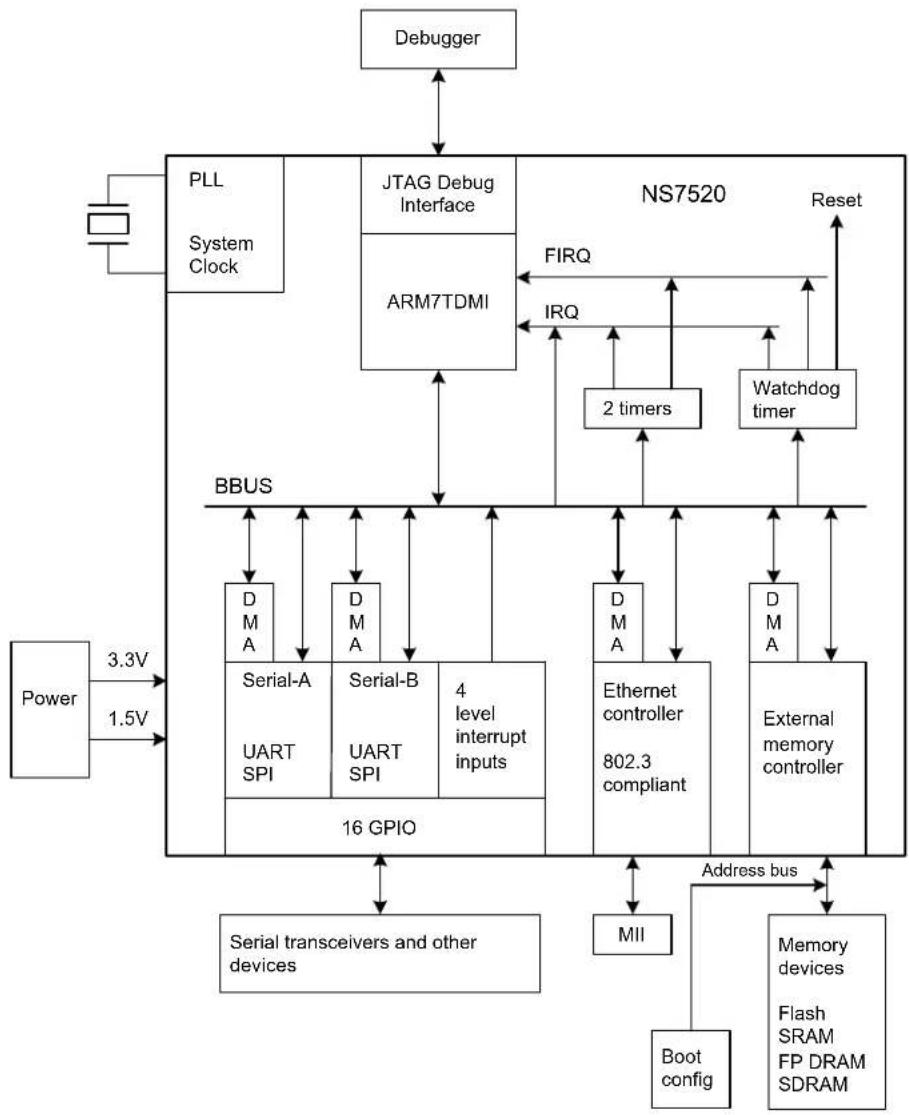
Figure 1 shows the NS7520 modules. Dashed lines indicate shared pins.
flowchart
graph TD
    A["Debugger"] --> B["JTAG Debug Interface"]
    B --> C["ARM7TDMI"]
    C --> D["2 timers"]
    C --> E["Watchdog timer"]
    D --> F["External memory controller"]
    E --> F
    G["Power"] --> H["16 GPIO"]
    H --> I["Serial transceivers and other devices"]
    H --> J["MII"]
    H --> K["Memory devices"]
    H --> L["Boot config"]
    H --> M["Flash SRAM FP DRAM SDRAM"]
    N["BBUS"] --> O["Serial-A UART SPI"]
    N --> P["Serial-B UART SPI"]
    N --> Q["4 level interrupt inputs"]
    R["FIRQ"] --> C
    S["IRQ"] --> C
    T["Reset"] --> U["2 timers"]
    V["3.3V"] --> W["1.5V"]
    X["PLL System Clock"] --> B
Figure 1: NS7520 module overview
Key Features
This table lists the key features of the NS7520.
CPU core Integrated 10/100 Ethernet MAC
■ ARM7TDMI 32-bit RISC processor
■ 32-bit internal bus
■ 32-bit ARM and 16-bit Thumb mode
■ 15 general purpose 32-bit registers
■ 32-bit program counter (PC) and status register
■ Five supervisor modes, one user mode
■ 10/100 Mbps MII-based PHY interface
■ 10 Mbps ENDEC interface
■ TP-PMD and fiber-PMD device support
■ Full-duplex and half-duplex modes
■ Optional 4B/5B coding
■ Station, broadcast, and multicast address detection
■ 512-byte transmit FIFO, 2 Kbyte receive FIFO
■ Intelligent receive-side buffer selection
13-Channel DMA controller Programmable
■ Two channels dedicated to Ethernet transmit and receive
- Four channels dedicated to two serial modules' transmit and receive
■ Four channels for external peripherals. Only two channels — either 3 and 5 or 4 and 6 — can be configured at one time.
■ Three channels available for memory-to-memory transfers
■ Flexible buffer management
ers
■ Two independent timers (2μs–20.7 hours)
■ Watchdog timer (interrupt or reset on expiration)
■ Programmable bus monitor or timer
General purpose I/O pins Operating frequen
■ 16 programmable GPIO interface pins
■ 4 pins programmable with level-sensitive interrupt
■ 36, 46, or 55 MHz internal clock operation from 18.432 MHz crystal
■ = 36, 46, or 55 (grade–dependent)
■ System clock source by external quartz crystal or crystal oscillator, or clock signal
■ Programmable PLL, which allows a range of operating frequencies from 10 to f_MAX
■ Maximum operating frequency from external clock or using PLL multiplication f_MAX
Serial ports Bus interface
■ Two fully independent serial ports (UART, SPI)
■ Digital phase lock loop (DPLL) for receive clock extractions
■ 32-byte transmit/receive FIFOs
■ Internal programmable bit-rate generators
■ Bit rates 75–230400 in 16X mode
■ Bit rates 1200 bps—4 Mbps in 1X mode
■ Flexible baud rate generator, external clock for synchronous operation
■ Receive-side character and buffer gap timers
■ Four receive-side data match detectors
■ Five independent programmable chip selects with 256 Mb addressing per chip select
■ Chip select support for SRAM, FP/EDO DRAM, SDRAM, Flash, and EEPROM without external glue
■ 8-, 16-, and 32-bit peripheral support
■ External address decoding and cycle termination
■ Dynamic bus sizing
■ Internal DRAM/SDRAM controller with address multiplexer and programmable refresh frequency
■ Internal refresh controller (CAS before RAS)
■ Burst-mode support
■ 0–63 wait states per chip select
■ Address pins that configurem chip operating modes (see "NS7520 bootstrap initialization" on page 22)
Power and Operating Voltages
■ 500 mW maximum at 55 MHz (all outputs switching)
■ 418 mW maximum at 46 MHz (all outputs switching)
■ 291 mW maximum at 36 MHz (all outputs switching)
■ 3.3 V — I/O
■ 1.5 V — Core
Operating frequency
The NS7520 is available in grades operating at three maximum operating frequencies: 36 MHz, 46 MHz, and 55 MHz. The operating frequency is set during bootstrap initialization, using pins A[8:0]. These address pins load the PLL Settings register on powerup reset. A[8:7] determines IS (charge pump current); A[6:5] determines FS (output divider), and A[4:0] defines ND (PLL multiplier). Each bit in A[8:0] can be set individually. See the discussion of the PLL Settings register in the NS7520 Hardware Reference for more information.
Packaging and pinout
Table 1 provides the NS7520 packaging dimensions. Figure 2 shows the NS7520 pinout and dimensions.
| Symbol Min Nom Max | |||
| A | — | — | 1 |
| A1 0.35 0.40 0.45 | |||
| A | 2 | — | — |
| b 0.45 0.50 0.55 | |||
| D 13.0 BSC | |||
| D1 11.2 BSC | |||
| E 13.0 BSC | |||
| E1 11.2 BSC | |||
| e 0.8 BSC | |||
| aaa | 0.1 | ||
| . | 4 | ||
| 0 | . | 9 | 5 |
Table 1: NS7520 packaging dimensions
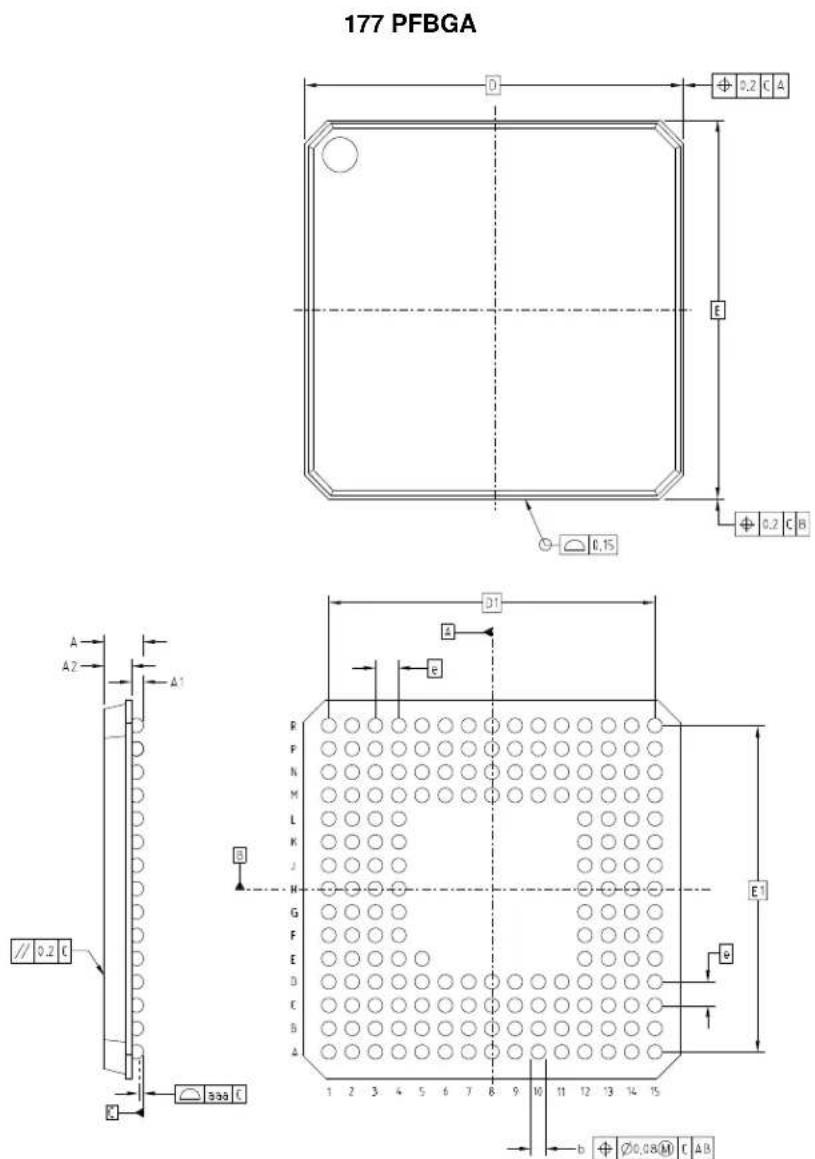
Figure 2: NS7520 pinout and dimensions
Pinout detail tables
Each pinout table applies to a specific interface and contains the following information:
| Signal | The pin name for each I/O signal. Some signals have multiple function modes and are identified accordingly.The mode is configured through firmware using one or more configuration registers. |
| Pin The pin number assignment for a specific I/O signal.■ U next to the pin number indicates that the pin is a pullup resistor.■ D next to the pin number indicates that the pin is a pulldown resistor.■ No valuc next to the pin indicates that the pin has neither a pullup nor pulldown resistor.See Figure 5, "Internal pullup characteristics," on page 24 and Figure 6, "Internal pulldown characteristics," on page 25 for an illustration of the characteristics of these pins. Use the figures to select the appropriate value of the complimentary resistor to drive the signal to the opposite logic state. For those pins with no pullup or pulldown resistor, you must select the appropriate value per your design requirements. | |
| _ | An underscore (bar) indicates that the pin isactive low. |
| I/O The type of signal — input, output, or input/output. | |
| OD | The output drive strength of an output buffer. The NS7520 uses one of three drivers:■ 2 mA■ 4 mA■ 8 mA |
Notes:
■ NO CONNECT as a pin description means do not connect to this pin.
■ The 177th pin (package ball) is for alignment of the package on the PCB.
System Bus interface
| Symbol | Pin | I/O | OD | Description | ||
| BCLK A6 0 8 Synchronous bus clock | ||||||
| External bus | Other | External bus | Other | |||
| ADDR27 | CS0OE_ | N10 U | I/O | 4 | Addr bit 27 | Logical AND of CS0_and OE_ |
| ADDR26 | CS0WE_ | P10 U | I/O | 4 | Addr bit 26 | Logical AND of CS_and WE_ |
| External bus | External bus | |||||
| ADDR25 | M10 U | I/O | 4 | Remainder of address bus (through ADDR0) | ||
| ADDR24 | R10 U | I/O | 4 | |||
| ADDR23 | N9 U | I/O | 4 | |||
| ADDR22 | R9 U | I/O | 4 | |||
| ADDR21 | M9 U | I/O | 4 | |||
| ADDR20 N8 U I/O 4 | ||||||
| ADDR19 P8 U I/O 4 | ||||||
| ADDR18 M7 U I/O 4 | ||||||
| ADDR17 R7 U I/O 4 | ||||||
| ADDR16 N7 U I/O 4 | ||||||
| ADDR15 R6 U I/O 4 | ||||||
| ADDR14 M6 U I/O 4 | ||||||
| ADDR13 P6 U I/O 4 | ||||||
| ADDR12 N6 U I/O 4 | ||||||
| ADDR11 M5 U I/O 4 | ||||||
| ADDR10 P5 U I/O 4 | ||||||
| ADDR9 N5 U I/O 4 | ||||||
| ADDR8 R4 U I/O 4 | ||||||
| ADDR7 R3 U I/O 4 | ||||||
| ADDR6 R2 U I/O 4 | ||||||
| ADDR5 M4 U I/O 4 | ||||||
| ADDR4 N4 U I/O 4 | ||||||
| ADDR3 R1 U I/O 4 | ||||||
| ADDR2 M3 U I/O 4 | ||||||
| ADDR1 N2 U I/O 4 | ||||||
| ADDR0 P1 U I/O 4 | ||||||
| DATA31 | N1 | I/O | 4 | Data bus | ||
| DATA30 M1 I/O 4 | ||||||
| DATA29 L3 I/O 4 | ||||||
| DATA28 L2 I/O 4 | ||||||
| DATA27 L4 I/O 4 | ||||||
| DATA26 L1 I/O 4 | ||||||
| DATA25 K3 I/O 4 | ||||||
| DATA24 K2 I/O 4 | ||||||
| DATA23 K1 I/O 4 | ||||||
| DATA22 J2 I/O 4 | ||||||
| DATA21 J3 I/O 4 | ||||||
| DATA20 J1 I/O 4 | ||||||
| DATA19 H3 I/O 4 | ||||||
| DATA18 H4 I/O 4 | ||||||
| DATA17 H1 I/O 4 | ||||||
| DATA16 H2 I/O 4 | ||||||
| DATA15 G4 I/O 4 | ||||||
| DATA14 G1 I/O 4 | ||||||
| DATA13 G3 I/O 4 | ||||||
| DATA12 G2 I/O 4 | ||||||
| DATA11 F4 I/O 4 | ||||||
| DATA10 F2 I/O 4 | ||||||
| DATA9 F3 I/O 4 | ||||||
| DATA8 E1 I/O 4 | ||||||
| DATA7 E2 I/O 4 | ||||||
| DATA6 E3 I/O 4 | ||||||
| DATA5 D1 I/O 4 | ||||||
| DATA4 C1 I/O 4 | ||||||
| DATA3 B1 I/O 4 | ||||||
| DATA2 D4 I/O 4 | ||||||
| DATA1 D3 I/O 4 | ||||||
| DATA0 C2 I/O 4 | ||||||
| BE3_ | D9 | I/O | 2 | Byte enable D31:D24 | ||
| BE2_A9 I/O 2 Byte enable D23:D16 | ||||||
| BE1_ | C9 | I/O | 2 | Byte enable D15:D08 | ||
| BE0_B9 I/O 2 Byte enable D07:D00 | ||||||
| TS_ | A8 | I/O | 4 | DO NOT USEAdd an external 820 ohm pullup to 3.3 V. | ||
| TA_D8 U I/O 4 Data transfer acknowledge | Add an external 820 ohm pullup to 3.3 V.TA_is bidirectional. It is used in input mode to terminate a memory cycle externally. It is used in output mode for reference purposes only. | |||||
| TEA_RW_D6 I/O 2 Transfer direction | C8 U | I/O | 4 | Data transfer error acknowledgeAdd an external 820 ohm pullup to 3.3 V.TEA_is bidirectional. It is used in input mode to terminate a memory cycle externally. It is used in output mode for reference purposes only. | ||
| BR_D7 NO CONNECT | ||||||
| BG_C7 NO | CONNECT | |||||
| BUSY_B7 NO CONNECT | ||||||
System bus interface signal descriptions
| Mnemonic Signal Description | ||
| BCLK | Bus clock | Provides the bus clock. All system bus interface signals are referenced to the BCLK signal. |
| ADDR[27:0] | Address bus | Identifies the address of the peripheral being addressed by the current bus master. The address bus is bi-directional. |
| DATA[31:0] | Data bus | Provides the data transfer path between the NS7520 and external peripheral devices. The data bus is bi-directional.Recommendation:Less than x32 (S)DRAM/SRAM memory configurations. Unconnected data bus pins will float during memory read cycles. Floating inputs can be a source of wasted power.For other than x32 DRAM/SRAM configurations, the unused data bus signals should be pulled up. |
| TS_ | Transfer start | NO CONNECT |
| BE_ | Byte enable | Identifies which 8-bit bytes of the 32-bit data bus are active during any given system bus memory cycle. The BE_ signals are active low and bi-directional. |
| TA_ | Transfer acknowledge | Indicates the end of the current system bus memory cycle. This signal is driven to 1 prior to tri-stating its driver.TA_ is bi-directional. |
| TEA_ | Transfer error acknowledge | Indicates an error termination or burst cycle termination:In conjunction with TA_ to signal the end of a burst cycle.Independently of TA_ to signal that an error occurred during the current bus cycle. TEA_ terminates the current burst cycle.This signal is driven to 1 prior to tri-stating its driver.TEA_ is bi-directional. The NS7520 or the external peripheral can drive this signal. |
| RW_ | Read/write indicator | Indicates the direction of the system bus memory cycle. RW_ high indicates a read operation; RW_ low indicates a write operation. The RW_ signal is bi-directional. |
| BR_ | Bus request | NO CONNECT |
| BG_ | Bus grant | NO CONNECT |
| BUSY_ | Bus busy | NO CONNECT |
Chip select controller
Chip select controller
The NS7520 supports five unique chip select configurations.
| Symbol Pin I/O OD | Description | |||
| CS4_B4 O 4 Chip select/DRAM RAS_ | ||||
| CS3_A4 O 4 Chip select/DRAM RAS_ | ||||
| CS2_C5 O 4 Chip select/DRAM RAS_ | ||||
| CS1_B5 O 4 Chip select/DRAM RAS_ | ||||
| CS0_D5 O 4 Chip select (boot select) | ||||
| CAS3_ | A1 | O | 4 | FP/EDO DRAM column strobe D31:D24/SDRAM RAS_ |
| CAS2_C4 O 4 FP/EDO DRAM column strobe D23:D16/SDRAM CAS_ | ||||
| CAS1_ | B3 | O | 4 | FP/EDO DRAM column strobe D15:D08/SDRAM WE_ |
| CAS0_A2 O 4 FP/EDO DRAM column strobe D07:D00/SDRAM A10(AP) | ||||
| WE_ | C6 | O | 4 | Write enable for NCC Ctrl'd cycles |
| OE_B6 O 4 Output enable for NCC Ctrl'd cycles | ||||
Chip select controller signal descriptions
| Mnemonic Signal Description | ||
| CS0_ | Chip select 0 | Unique chip select outputs supported by the NS7520. Each chip select can be configured to decode a portion of the available address space and can address a maximum of 256 Mbytes of address space. The chip selects are configured using registers in the memory module. |
| CS1_ | Chip select 1 | |
| CS2_ | Chip select 2 | |
| CS3_ | Chip select 3 | A chip select signal is driven low to indicate the end of the current memory cycle. |
| CS4_ | Chip select 4 | For FP/EDO DRAM, these signals provide the RAS signal. |
| CAS0_ | Column address strobe signals | Activated when an address is decoded by a chip select module configured for DRAM mode. The CAS_signals are active low and provide the column address strobe function for DRAM devices. |
| CAS1_ | ||
| CAS2_ | The CAS_signals also identify which 8-bit bytes of the 32-bit data bus are active during any given system bus memory cycle. | |
| CAS3_ | For SDRAM, CAS[3:1]_provides the SDRAM command field. CAS0_qrovides the auto-precharge signal. | |
| For non-DRAM settings, these signals are 1. | ||
| WE_ | Write enable | Active low signal that indicates that a memory write cycle is in progress. This signal is activated only during write cycles to peripherals controlled by one of the chip selects in the memory module. |
| OE_ | Output enable | Active low signal that indicates that a memory read cycle is in progress. This signal is activated only during read cycles from peripherals controlled by one of the chip selects in the memory module. |
Ethernet interface MAC
Note: ENDEC values for general-purpose output and TXD refer to bits in the Ethernet General Control register. ENDEC values for general-purpose input and RXD refer to bits in the Ethernet General Status register.
In this table, GP designates general-purpose.
| Symbol | Pin | I/O | OD | Description | ||
| MII ENDEC | MII ENDEC | |||||
| MDC | GP output | D10 | O | 2 | MII management clock | State of (LPBK bit XOR (Mode=SEEQ)) |
| MDIO GP output B10 U I/O | 2 MII data | State of U | TP_STP bit | |||
| TXCLK | C10 | I | TX clock | |||
| TXD3 | GP output | A12 | O | 2 | TX data 3 | State of AUI_TP[0] bit |
| TXD2 | GP output | B11 | O | 2 | TX data 2 | State of AUI_TP[1] bit |
| TXD1 | GP output | D11 | O | 2 | TX data 1 | Inverted state of PDN bit, open collector |
| TXD0 | TXD | A11 | O | 2 | TX data 0 | Transmit data |
| TXER | GP output A13 O 2 | TX code error | State of LNK_DIS_bit | |||
| TXEN | B12 | O | 2 | TX enable | ||
| TXCOL | A14 I | Collision | ||||
| RXCRS | D12 | I | Carrier sense | |||
| RXCLK | C12 | I | RX clock | |||
| RXD3 | GP input | D14 | I | RX data 3 | Read state in bit 12 | |
| RXD2 | GP input | B15 | I | RX data 2 | Read state in bit 15 | |
| RXD1 | GP input | A15 | I | RX data 1 | Read state in bit 13 | |
| RXD0 | RXD | B13 | I | RX data 0 | Receive data | |
| RXER | GP input | C15 | I | RX error | Read state in bit 11 | |
| RXDV | GP input | D15 | I | RX data valid | Read state in bit 10 | |
Ethernet interface MAC signal descriptions
The Ethernet MII (media independent interface) provides the connection between the Ethernet PHY and the MAC (media access controller).
| Mnemonic | Signal | Description |
| MDC | MII management clock | Provides the clock for the MDIO serial data channel. The MDC signal is an NS7520 output. The frequency is derived from the system operating frequency per the CLKS field setting (see the CLKS field in Table 69: "MII Management Configuration register bit definition" on page 191). |
| MDIO | Management data IO | A bi-directional signal that provides a serial data channel between the NS7520 and the external Ethernet PHY module. |
| TXCLK | Transmit clock | An input to the NS7520 from the external PHY module. TXCLK provides the synchronous data clock for transmit data. |
| TXD3 | Transmit data signals | Nibble bus used by the NS7520 to drive data to the external Ethernet PHY. All transmit data signals are synchronized to TXCLK. |
| TXD2 | ||
| TXD1 | In ENDEC mode, only TXD0 is used for transmit data. | |
| TXD0 | ||
| TXER | Transmit coding error | Output asserted by the NS7520 when an error has occurred in the transmit data stream. |
| TXEN | Transmit enable | Asserted when the NS7520 drives valid data on the TXD outputs. This signal is synchronized to TXCLK. |
| COL | Transmit collision | Input signal asserted by the external Ethernet PHY when a collision is detected. |
| CRS | Receive carrier sense | Asserted by the external Ethernet PHY whenever the receive medium is non-idle. |
| RXCLK | Receive clock | An input to the NS7520 from the external PHY module. The receive clock provides the synchronous data clock for receive data. |
| RXD3 | Receive data signals | Nibble bus used by the NS7520 to input receive data from the external Ethernet PHY. All receive data signals are synchronized to RXCLK. |
| RXD2 | ||
| RXD1 | In ENDEC mode, only RXD0 is used for receive data. | |
| RXD0 | ||
| RXER | Receive error | Input asserted by the external Ethernet PHY when the Ethernet PHY encounters invalid symbols from the network. |
| RXDV | Receive data valid | Input asserted by the external Ethernet PHY when the PHY drives valid data on the RXD inputs. |
"No connect" pins
| Pin Description | |
| R13 Add a 15K ohm pulldown to GND (15K ohm is the recommended value; 10–20K ohms is acceptable) | |
| P12 | Add a 15K ohm pulldown to GND (15K ohm is the recommended value; 10–20K ohms is acceptable) |
| N12 Tie to GND | |
| R15 XTALB2: NO CONNECT | |
| M11 NO CONNECT | |
| P11 NO CONNECT | |
| N11 NO CONNECT | |
| R12 NO CONNECT | |
| R14 NO CONNECT | |
| P13 NO CONNECT | |
Note: If your design implements 10-2-K ohm pullups instead of pulldowns on R13 and P12, and a pullup on N12 instead of GND, no action is required.
General Purpose I/O
| GPIO signal Serial signal | Other signal Pin I/O OD | Serial channel description | Other description | ||||
| PORTA7 TXDA | J14 U I/O 2 Channel 1 TXD | ||||||
| PORTA6 | DTRA_ | DREQ1_ | J13 U | I/O | 2 | Channel 1 DTR_ | DMA channel 3/5 Req |
| PORTA5 RTSA_ | J15 U | I/O 2 Channel 1 RTS_ | |||||
| PORTA4 RXCA/ | RIA / OUT1A_ | J12 U I/O | 2 Pgm'able Out/ | Channel 1 RXCLK/ Channel 1 ring signal/Channel 1 SPI clock (CLK) | |||
| PORTA3 | RXDA | DACK1_ | H15 U | I/O | 2 | Channel 1 RXD | DMA channel 3/5 ACK |
| PORTA2 | DSRA_ | AMUX | H12 U | I/O | 2 | Channel 1 DSR_ | DRAM addr mux |
| PORTA1 | CTSA_ | DONE1_(O) | H13 U | I/O | 2 | Channel 1 CTS_ | DMA channel 3/5 DONE_Out |
| PORTA0 | TXCA/ OUT2A_/ DCDA_ | DONE1_(I) | G12 U | I/O | 2 | Pgm'able Out/ Channel 1 DCD/ Channel 1 SPI enable (SEL_) Channel 1 TXCLK | DMA channel 3/5 DONE_In |
| GPIO signal | Serial signal | Other signal | Pin | I/O | OD | Serial channel description | Other description |
| PORTC7 TXDB | G13 U I/O 2 Channel 2 TXD GEN interrupt out | ||||||
| PORTC6 | DTRB_ | DREQ2_ | G14 U | I/O | 2 | Channel 2 DTR_ | DMA Channel 4/6 Req |
| PORTC5 RTSB | REJECT_F15 U | I/O 2 Channel 2 RTS_ | CAM reject | ||||
| PORTC4^1 | RXCB/RIB_OUT1B_ | RESET_ | F12 U | I/O | 2 | Pgm'able Out/ Channel 2 RXCLK/ Channel 2 ring signal/Channel 2 SPI clock (CLK) | RESET output |
| PORTC3^2 | RXDB | LIRQ3/DACK2_ | F13 U I/O 2 Channel 2 RXD Level sensitive IRQ / DMA channel 4/6 ACK | ||||
| PORTC2^2 | DSRB_ | LIRQ2/RPSF_ | E15 U | I/O | 2 | Channel 2 DSR_ | Level sensitive IRQ/CAM request |
| PORTC1^2 | CTSB_LIRQ1/ DONE2(O) | E12 U | I/O 2 Channel 2 CTS_ Level sensitive IRQ / DMA channel 4/6 DONE_Out | ||||
| PORTC0^2 | TXCB/ OUT2B-/ DCDB_ | LIRQ0/ DONE2(I) | E14 U | I/O | 2 | Pgm'able Out/ Channel 2 DCD/ Channel 2 SPI enable (SEL_) Channel 2 TXCLK | Level sensitive IRQ / DMA channel 4/6 DONE_In |
Notes:
1 RESET output indicates the reset state of the NS7520. PORTC4 persists beyond the negation of RESET_ for approximately 512 clock cycles if the PLL is disabled. When the PLL is enabled, PORTC4 persists beyond the negation of RESET_ to allow for PLL lock for 100 microseconds times the ratio of the VCO to XTALA.
This GPIO is left in output mode active following a hardware RESET.
2 PORTC[3:0] pins provide level-sensitive interrupts. The inputs do not need to be synchronous to any clock. The interrupt remains active until cleared by a change in the input signal level.
System clock and reset
| Symbol | Pin | I/O | OD | Description |
| XTALA1 K14 I ARM/system | oscillator circuit | |||
| XTALA2 K12 O | ||||
| PLLVDD (1.5V) L15 P PLL clean power | ||||
| PLLVSS L12 P PLL return | ||||
| RESET_A10 I System reset | ||||
Signal descriptions
The NS7520 has three clock domains:
■ System clock (SYSCLK)
■ Bit rate generation and programmable timer reference clock (XTALA1/2)
■ System bus clock (BCLK)
The SYS module provides the NS7520 with these clocks, as well as system reset and backup resources.
| Mnemonic Signal Description | ||
| XTALA1 | Oscillator input | A standard parallel quartz crystal or crystal oscillator can be attached to these pins to provide the main input clock to the NS7520. |
| XTALA2 | Oscillator output | |
| PLLVDD | Clean PLL power | Power and ground for PLL circuit. |
| PLLVSS | Connect directly to the GND plane | |
| RESET_System reset | Resets the NS7520 hardware. | |
Table 2: Clock generation and reset signal description
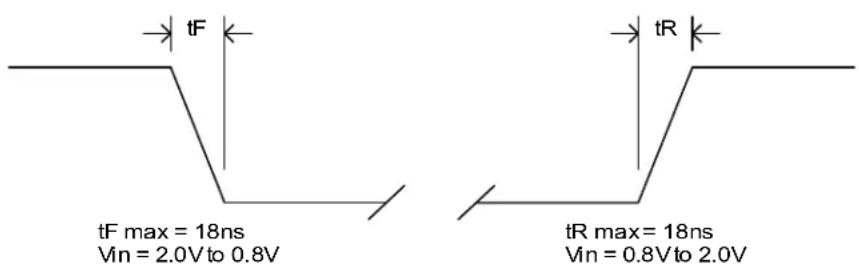
This figure shows the timing and specification for RESET_rise/fall times:
System mode (test support)
System mode (test support)
PLLTST_, BISTEN_, and SCANEN_ primary inputs control different test modes for both functional and manufacturing test operations (see Table 3: "NS7520 test modes" on page 22).
| Symbol | Pin | I/O | OD | Description |
| PLLTST_N15 I Encoded with BISTEN_ | and SCANEN_ | Add an external pullup to 3.3V or pulldown to GND. | ||
| BISTEN_ | M15 | 1 | Encoded with PLLTST_and SCANEN_Add an external pullup to 3.3V or pulldown to GND. | |
| SCANEN_L13 I Encoded with BISTEN_ | and PLLTST_ | Add an external pullup to 3.3V or pulldown to GND. | ||
JTAG test
JTAG boundary scan allows a tester to check the soldering of all signal pins and tri-state all outputs.
| Symbol | Pin | I/O | OD | Description |
| TDI N14 U I Test data in. | ||||
| TDO M13 O 2 Test data out. | ||||
| TMS M12 U 1 Test mode | select. | |||
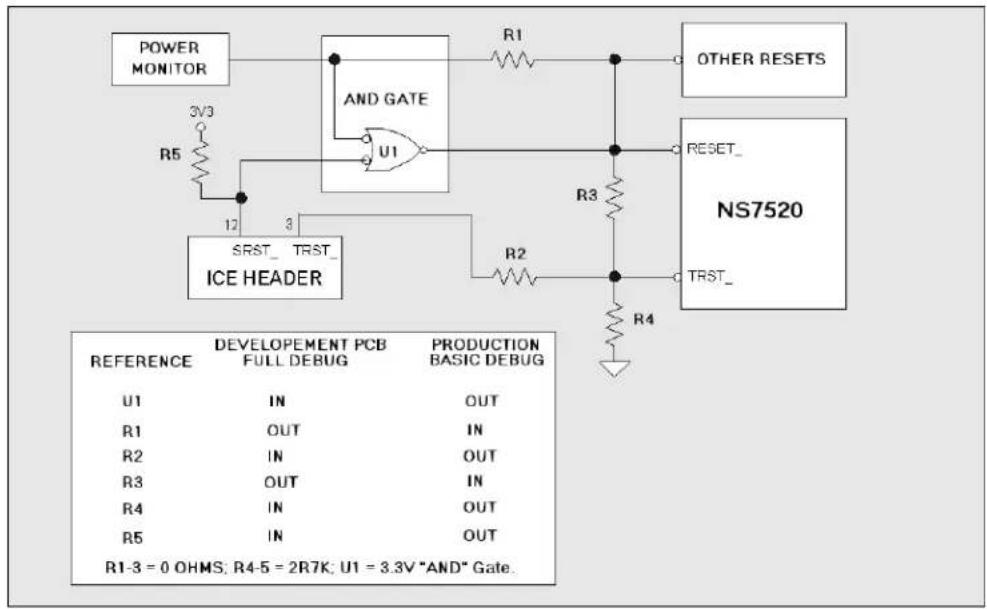
| TRST_ | M14 | I | Test mode reset.Requires external termination when not being used (see Figure 3, "TRST_ termination," on page 17 for an illustration of the termination circuit on the development PCB). | |
| TCK | P15 I Test | mode clock. | Add an external pullup to 3.3V. |
ARM debugger signal descriptions
| Mnemonic | Signal | Description |
| TDI | Test data in | TDI operates the JTAG standard. Consult the JTAG specifications for use in boundary-scan testing. These signals meet the requirements of the Raven and Jeeni debuggers. |
| TDO | Test data out | TDO operates the JTAG standard. Consult the JTAG specifications for use in boundary-scan testing. These signals meet the requirements of the Raven and Jeeni debuggers. |
| TMS | Test mode select | TMS operates the JTAG standard. Consult the JTAG specifications for use in boundary-scan testing. These signals meet the requirements of the Raven and Jeeni debuggers. |
| TRST_ | Test mode reset | TRST_operates the JTAG standard. Consult the JTAG specifications for use in boundary-scan testing. These signals meet the requirements of the Raven and Jeeni debuggers. |
Mnemonic Signal Description
| TCK | Test mode clock | TCK operates the JTAG standard. Consult the JTAG specifications for use in boundary-scan testing. These signals meet the requirements of the Raven and Jeeni debuggers. |
flowchart
graph TD
    A["POWER MONITOR"] --> B["AND GATE"]
    B --> C["R1"]
    C --> D["OTHER RESETS"]
    B --> E["U1"]
    E --> F["RSST_TRST_ICE HEADER"]
    F --> G["R2"]
    G --> H["RESET_NS7520"]
    H --> I["TRST"]
    I --> J["R3"]
    J --> K["R4"]
    K --> L["Ground"]
    style A fill:#f9f,stroke:#333
    style B fill:#ccf,stroke:#333
    style C fill:#cfc,stroke:#333
    style D fill:#fcc,stroke:#333
    style E fill:#ffc,stroke:#333
    style F fill:#cff,stroke:#333
    style G fill:#ffc,stroke:#333
    style H fill:#fcc,stroke:#333
    style I fill:#fcc,stroke:#333
    style J fill:#fcc,stroke:#333
    style K fill:#fcc,stroke:#333
    style L fill:#fcc,stroke:#333
Figure 3: TRST_ termination
Power supply
| Signal Pin Description | ||
| Oscillator VCC (3.3V) N13, | C3 Oscillator power supply | |
| Core VCC (1.5V) R8, L14, C | 14, C13 Core power supply | |
| I/O VCC (3.3V) E4, K4, M2, | N3, P3, R5, H14, F14, B8, A3 I/O power supply | |
| GND D2, F1, J4, P4, P7, M8, | P9, R11, K15, G15, E13, D13, B14,C11, A7, A5, B2, P2, P14, K13 | Ground |
NS7520 modules
CPU module
The CPU uses an ARM7TDMI core processor. The ARM architecture is based on Reduced Instruction Set Computer (RISC) principles, which result in high instruction throughput and impressive real-time interrupt response for a small, cost-effective circuit. For more information about ARM7TDMI, see the ARM7TDMI Data Sheet from ARM Ltd. (www.arm.com).
GEN module
The GEN module provides the NS7520 with its main system control functions, as well as these features:
■ Two programmable timers with interrupt
■ One programmable bus-error timer
■ One programmable watchdog timer
■ Two 8-bit programmable general-purpose I/O ports
System (SYS) module
The system module provides the system clock (SYS_CLK) and system reset (SYS_RESET) resources. The system control signals determine the basic operation of the chip:
| Signal mnemonic Signal name Description | ||
| {XTALA1, XTALA2} Clock source Operate in one of two ways:■ The signals are affixed with a 10-20 MHz parallel mode quartz crystal or crystal oscillator and the appropriate components per the component manufacturer.■ XTALA1 is driven with a clock signal and XTALA2 is left open. | ||
| {PLLVDD, PLLVSS} | PLL power | Provide an isolated power supply for the PLL. |
| RESET_Chip reset Active low signal asserted to initiate a hardware reset of the chip. | ||
| {TDI, TDO, TNS, TRST_, TCK} | JTAG interface | Provide a JTAG interface for the chip. This interface is used for both boundary scan and ICE control of the internal processor. |
| {PLLTEST_, BISTEN_, SCANEN_} | Chip mode | Encoded to determine the chip mode. |
The NS7520 clock module creates the BCLK and FXTAL signals. Both signals are used internally, but BCLK can also be accessed at ball A6 by setting the BCLKD field in the System Control register to 0.
■ BCLK functions as the system clock and provides the majority of the NS7520's timing.
■ FXTAL provides the timing for the DRAM refresh counter, can be selected instead of BCLK to provide timing for the watchdog timer, the two internal timers, and the Serial module.
BBus module
The BBus module provides the data path among NS7520 internal modules. This module provides the address and data multiplexing logic that supports the data flow through the NS7520. The BBus module is the central arbiter for all the NS7520 bus masters and, once mastership is granted, handles the decoding of each address to one (or none) of the NS7520 modules.
Memory module (MEM)
The MEM module provides a glueless interface to external memory devices such as Flash, DRAM, and EEPROM. The memory controller contains an integrated DRAM controller and supports five unique chip select configurations.
The MEM module monitors the BBus interface for access to the bus module; that is, any access not addressing internal resources. If the address to be used corresponds to a Base Address register in the MEM module, the MEM module provides the memory access signals and responds to the BBus with the necessary completion signal.
The MEM module can be configured to interface with FP, EDO, or SDRAM (synchronous DRAM), although the NS7520 cannot interface with more than one device type at a time.
DMA controller
The NS7520 contains one DMA controller, with 13 DMA channels. Each DMA channel moves blocks of data between memory and a memory peripheral.
The DMA controller supports both fly-by operations and memory-to-memory operations:
■ When configured for fly-by operation, the DMA controller transfers data between one of the NS7520 peripherals and a memory location.
■ When configured for memory-to-memory operations, the DMA controller uses a temporary holding register between read and write operations. Two memory cycles are executed.
Ethernet controller
The Ethernet controller provides the NS7520 with one IEEE 802.3u compatible Ethernet interface. The Ethernet interface includes the Ethernet front-end (EFE) and media access controller (MAC).
The Ethernet module supports both media independent interface (MII) and ENDEC modes.
The MAC module interfaces to an external physical layer (PHY) device using the MII standard defined by IEEE 802.3u. The MAC interface includes the MII clock and data signals.
Figure 4 shows a high-level block diagram of the EFE module, which provides the FIFO handling interface between the NS7520 BBus and the MAC modules.
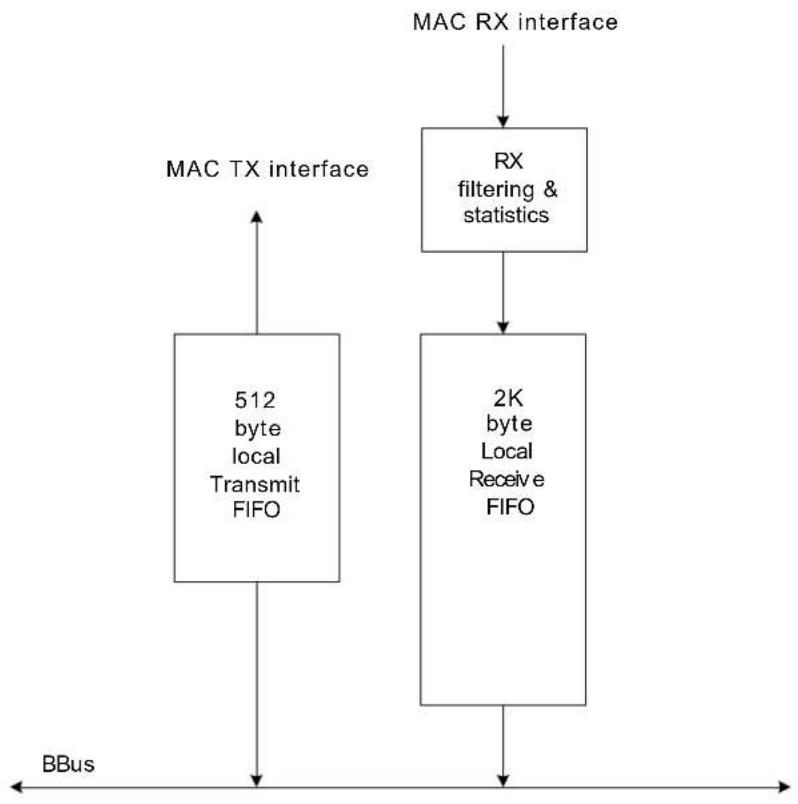
flowchart
graph TD
    A["512 byte local Transmit FIFO"] --> B["BBus"]
    C["RX filtering & statistics"] --> D["2K byte Local Receive FIFO"]
    E["MAC RX interface"] --> C
    style A fill:#f9f,stroke:#333
    style B fill:#ccf,stroke:#333
    style C fill:#cfc,stroke:#333
    style D fill:#fcc,stroke:#333
    style E fill:#cff,stroke:#333
Figure 4: EFE module block diagram
Serial controller
The NS7520 supports two independent universal asynchronous/synchronous receiver/transmitter channels. Each channel supports these features:
■ Independent programmable bit-rate generator
■ UART and SPI (master) modes
■ High-speed data transfer:
-x1 mode: 4Mbits/sec
- x16 mode: 230 Kbits/sec
■ 32-byte TX FIFO
■ 32-byte RX FIFO
■ Programmable data format: 5-8 data bits; odd, even, or no parity; 1, 2 stop bits
■ Programmable channel modes: normal, local loopback, remote loopback
■ Control signal support
■ Maskable interrupt conditions:
– Receive break detection
- Receive framing error
- Receive parity error
- Receive overrun error
- Receive FIFO ready
- Receive FIFO half-full
- Transmit FIFO ready
- Transmit FIFO half-empty
- CTS, DSR, DCD, RI state change detection
■ Clock/data encoding: NRZ, NRZB, NRZI, FM, Manchester
■ Multi-drop capable
NS7520 bootstrap initialization
Many internal NS7520 features are configured when the RESET pin is asserted. The address bus configures the appropriate control register bits at powerup. This table shows which bits control which functions:
Address bit Name Description
| ADDR[27] Endian configuration 0 Little Endian configuration | 1 Big Endian configuration | |
| ADDR[26] CPU bootstrap 0 CPU disabled; GEN_BUSER=1 | 1 CPU enabled; GEN_BUSER=0 | |
| ADDR[24:23] CS0/MMCR[19:18] setting 00 8-bit SRAM, 63 wait-states/b00 | 01 32-bit SRAM, 63 wait-states/ b0110 32-bit SRAM11 16-bit SRAM, 63 wait-states/b11 | |
| ADDR[19:9] | GEN_ID setting | GEN_ID=A[19:09],default='h3ff |
| ADDR[8:7] | PLL IS setting | IS=A[8:7], default='b10 |
| ADDR[6:5] | PLL FS setting | FS=A[6:5], default='b00 |
| ADDR[4:0] | PLL ND setting | ND=A[4:0], default='b01011 |
Table 3: NS7520 test modes
JTAG
The NS7520 provides full support for 1149.1 JTAG boundary scan testing. All NS7520 pins can be controlled using the JTAG interface port. The JTAG interface provides access to the ARM7TDMI debug module when the appropriate combination of PLLTST_, BISTEN_, and SCANEN_ is selected (as shown in Table 3: "NS7520 test modes").
ARM Debug
The ARM7TDMI core uses a JTAG TAP controller that shares the pins with the TAP controller used for 1149.1 JTAG boundary scan testing. To enable the ARM7TDMI TAP controller, {PLLTST_,BISTEN_,SCANEN_} must be set as shown in Table 3: "NS7520 test modes".
DC characteristics and other operating specifications
The NS7520 operates using an internal core V_DD supply voltage of 1.5V. A 3.3VC supply is required for the I/O cells, which drive/accept 3.3V levels.
Table 4 provides the DC characteristics for inputs; Table 5 provides the DC characteristics for outputs.
| Sym | Parameter | Conditions | Min | Typ | Max | Unit |
| V_IH | Input high voltage 2.0 3.6 V | |||||
| V_IL | Input low voltage V | SS-0.3 0.8 V | ||||
Table 4: DC characteristics — Inputs
| Sym | Parameter | Conditions | Min | Max | Unit |
| P | Power consumption | F_SYSCLK = 55 MHz | 508 | mW | |
| Core | 192 mW | ||||
| I/O | 316 mW | ||||
| F_SYSCLK = 46 MHz | 425 | mW | |||
| Core | 161 mW | ||||
| I/O | 264 mW | ||||
| F_SYSCLK = 36 MHz | 333 | mW | |||
| Core | 126 mW | ||||
| I/O | 207 mW | ||||
| V_OL | Output low voltage | Outputs & bi-directional | 0 | 0.4 | V |
| V_OH | Output high voltage | Outputs & bi-directional | 2.4 | V_DD | V |
Table 5: DC characteristics — Outputs
Table 6 defines the DC operating (thermal) conditions for the NS7520. Operating the NS7520 outside these conditions results in unpredictable behavior.
| Sym | Parameter | Conditions | Min | Typ | Max | Unit |
| V_DD | Core supply voltage | 1.4 | 1.5 | 1.6 | V | |
| V_CC | I/O supply voltage | 3.0 | 3.3 | 3.6 | V | |
| T_OP | Ambient temperature | -40 | 85 | °C | ||
| T_J | Junction temperature | 110 | °C | |||
| T_STG | Storage temperature | -40 | 125 | °C | ||
| _J | Pkg thermal resistance | 50 | °C/W | |||
| I_IH | Input threshold | No pullup | -10 | 10 | μA |
Table 6: Recommended operating temperatures
Absolute maximum ratings
| Sym | Parameter | Conditions | Min | Typ | Max | Unit |
| I_IL | Input current as “0” | No pullup | 10 | 10 | μA | |
| I_OZ | HighZ leakage current Any input -10 10 μA | |||||
| C_IO | Pin capacitance V | _O =0 7 pF | ||||
Table 6: Recommended operating temperatures
Absolute maximum ratings
This table defines the maximum values for the voltages that the NS7520 can withstand without being damaged.
| Sym Parameter Min Max | |||
| V_DD | Core supply voltage -0.3 3.15 | ||
| V_CC | I/O supply voltage | -0.3 3.9 | |
| V_IN | Input voltage | -0.3 3.9 | |
| V_OUT | Output voltage | -0.3 3.9 | |
Pad pullup and pulldown characteristics
Figure 5 illustrates characteristics for a pad with internal pullup; Figure 6 illustrates characteristics for a pad with internal pulldown. See "Pinout detail tables," beginning on page 6, for information about which pins use pullup and pulldown resistors.
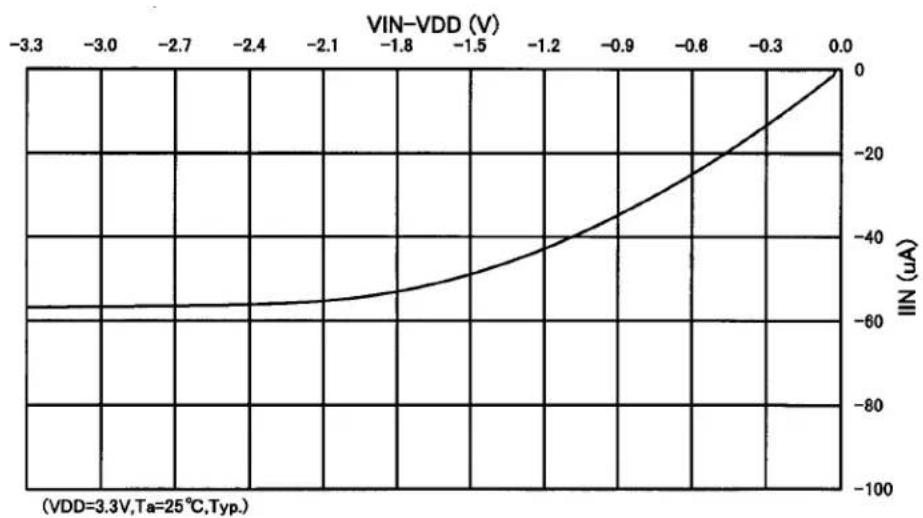
line
| VIN-VDD (V) | IIN (uA) | | ----------- | -------- | | -3.3 | -60 | | -3.0 | -60 | | -2.7 | -60 | | -2.4 | -60 | | -2.1 | -55 | | -1.8 | -50 | | -1.5 | -45 | | -1.2 | -40 | | -0.9 | -35 | | -0.6 | -30 | | -0.3 | -25 | | 0.0 | 0 |Figure 5: Internal pullup characteristics
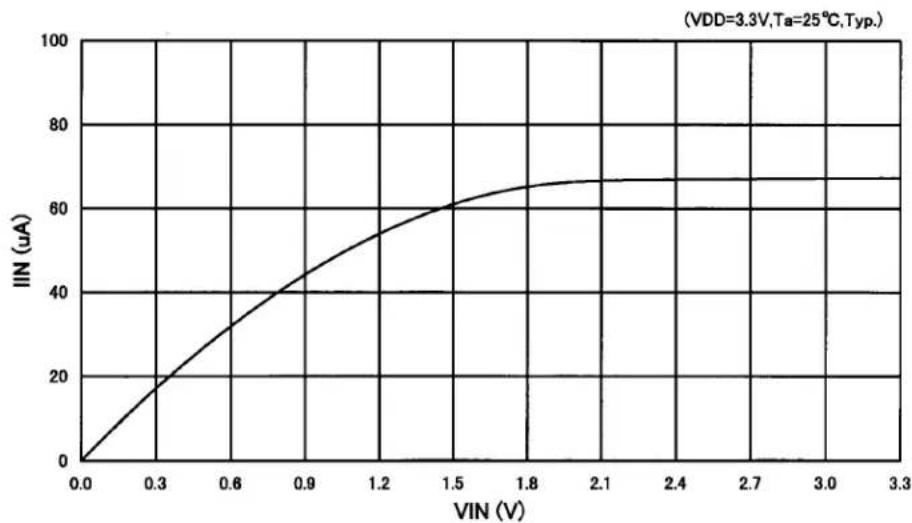
line
| VIN (V) | IIN (uA) | | ------- | -------- | | 0.0 | 0 | | 0.3 | 20 | | 0.6 | 40 | | 0.9 | 55 | | 1.2 | 60 | | 1.5 | 62 | | 1.8 | 65 | | 2.1 | 66 | | 2.4 | 67 | | 2.7 | 67 | | 3.0 | 67 | | 3.3 | 67 |Figure 6: Internal pulldown characteristics
AC characteristics
AC electrical specifications define the timing relationship between signals for interfaces and modes within a given interface.
AC electrical specifications
The AC electrical specifications are based on the system configuration shown in Figure 7, with a 5pF allowance for PCB capacitance and a 0.25 ns allowance for PCB delay. The timing of the buffers, SDRAM, and the like must be added to complete timing analysis. In systems where SDRAM is not used, two devices are expected to replace the SDRAMs shown in Figure 7; that is, they are tied directly to the chip. System loading information is shown in Table 7: "System loading details" on page 26.
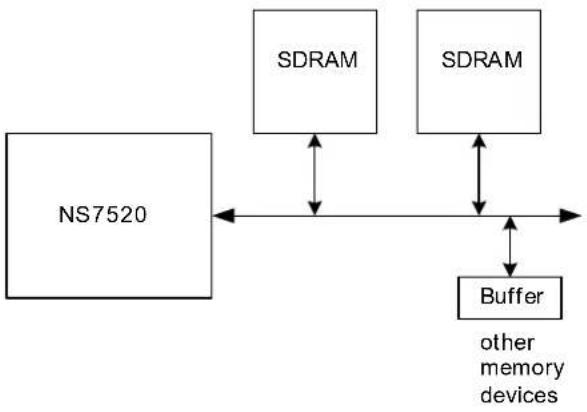
flowchart
graph TD
    A["NS7520"] --> B["SDRAM"]
    A --> C["SDRAM"]
    B <--> D["Buffer"]
    C <--> D
    D --> E["other memory devices"]
Figure 7: System configuration for specified timing
| Signal Estimated load (pF) Device loads | |
| BCLK 23 Two SDRAMs, 1 clock buffer/clock input to PLD | |
| A[27:0], CAS[3:0]_ 23 Two SDRAM An, 1 buffer/PLD | |
| CS[4:0]_ 13 Two SDRAM CSn, 1 buffer PLD | |
| DATA[31:0] 18 One SDRAM DQ, 1 buffer/PLD | |
| BE*_ 19 One SDRAM DQ, 1 buffer/PLD | |
| TS_, TA_, TEA_, BR_, BG_, BUSY_, WE_, OE_ | 15 1 buffer/PLD |
| PORTA3, PORTA1, PORTC3, PORTC1 (operating external DMA) | 15 1 buffer/PLD |
| Other PORTA[*] and PORTC[*], TDO 85 Tester load | |
| MDC, MDIO, TXEN, TXER, TXD[3:0] 20 One PHY | |
Table 7: System loading details
Exceeding the loading shown in Table 7 can result in additional signal delay. The delay can be approximated by derating the output buffer based on the expected load capacitance per the values shown in Table 8.
| Signal Derating (ns/pF) | |
| BCLK 0.069 | |
| A[27:0], TS_, TA_, TEA_, BR_, BG_, BUSY_, DATA[31:0] 0.150 | |
| BE[3:0] | 0.300 |
Table 8: Output buffer derating by load capacitance
Signal Derating (ns/pF)
CS[4:0]_, CAS[3:0], RW_, WE_, OE_0.137
MDC, TXD[3:0], TXER, TXEN, TDO 0.274
Table 8: Output buffer derating by load capacitance
Oscillator Characteristics
Figure 8 illustrates the recommended oscillator circuit details.
■ Rise/fall time. The max rise/fall time on the system clock input pin is 1.5ns when used with an external oscillator.
■ Duty cycle. The duty cycle is system-dependent with an external oscillator. It affects the setup and hold times of signals that change in the falling clock edges, such as WE_/OE_. Recommendation: Use a 3.3V, 50±10% duty cycle oscillator with a 100 ohm series resistor at the output. The PLLs can handle a 25% duty cycle clock (minimum high/low time 4.5nS).
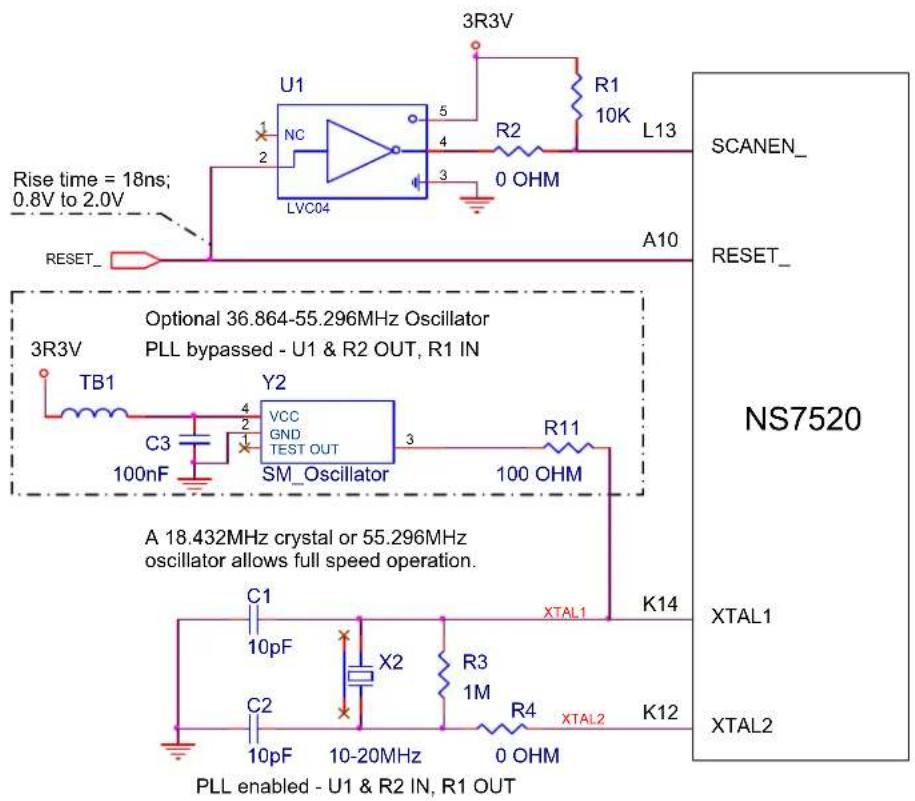
Figure 8: Oscillator circuit details
Timing Diagrams
Timing\_Specifications
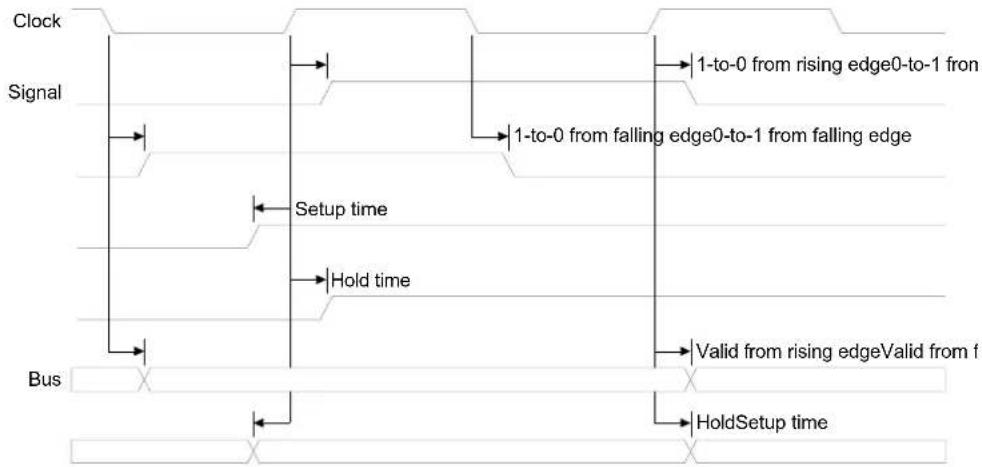
All timing specifications consist of the relationship between a reference clock and a signal:
■ There are bussed and non-bussed signals. Non-bussed signals separately illustrate 0-to-1 and 1-to-0 transitions.
■ Inputs have setup/hold times versus clock rising.
■ Outputs have switching time relative to either clock rising or clock falling.
Note: Timing relationships in this diagram are drawn without proportion to actual delay.
flowchart
graph TD
    A["Clock"] --> B["Signal"]
    B --> C["Setup time"]
    C --> D["Hold time"]
    D --> E["Bus"]
    E --> F["HoldSetup time"]
    B --> G["1-to-0 from falling edge0-to-1 from falling edge"]
    G --> H["1-to-0 from rising edge0-to-1 from rising edge"]
    H --> I["Valid from rising edgeValid from f"]
Reset\_timing
From a cold start, RESET_ must be asserted until all power supplies are above their specified thresholds. An additional 8 microseconds is required for oscillator settling time (allow 40ms for crystal startup).
Due to an internal three flip-flop delay on the external RESET_signal, after the oscillator is settled, RESET_must be asserted for three periods of the XTALA1 clock in these situations:
■ Before release of reset after application of power
■ While valid power is maintained to initiate hot reset (reset while power is at or above specified thresholds)
■ Before loss of valid power during power outage/power down
The PORTC4 output indicates the reset state of the chip. PORTC4 persists beyond the negation of RESET_ for approximately 512 system clock cycles if the PLL is disabled. When the PLL is enabled, PORTC4 persists beyond the negation of RESET_ to allow for PLL lock for 100 microseconds times the ratio of the VCO to XTALA.
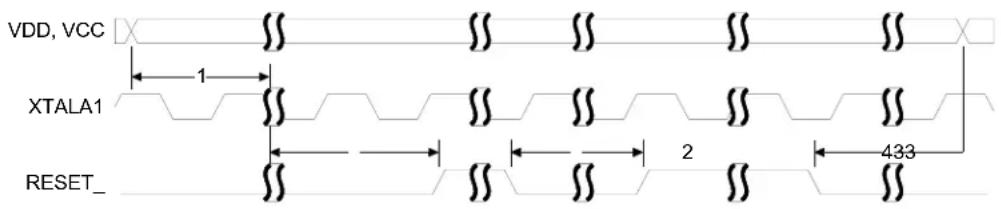
Reset timing parameters
| Num | Description | Min | Typ | Max | Units |
| 1 | Power valid before reset negated 40 ms | Note: RESET_ should remain low for at least 40ms after power reaches 3.0V. | |||
| 2 | Reset asserted after power valid 3 T | XTALA1 | |||
| 3 | Reset asserted while power valid 3 T | XTALA1 | |||
| 4 | Reset asserted before power invalid 3 T | XTALA1 |
SRAM timing
BCLK max frequency: 55.296 MHz
Operating conditions:
Temperature: -15.00 (min) 110.00 (max)
Voltage: 1.60 (min) 1.40 (max)
Output load: 25.0pf
Input drive: CMOS buffer
SRAM timing parameters
| Num Description Min Max Unit | ||
| 36 BCLK high to BE* valid 15.5 ns | ||
| 6 BCLK high to address valid 5 13.5 ns | ||
| 9 BCLK high to data out valid 14 ns | ||
| 13 BCLK high to data out high impedance 13 ns | ||
| 10 Data in valid to BCLK high (setup) | 5 | ns |
| 11 BCLK high to data in invalid (hold) | 3 | ns |
| 14 TA* valid to BCLK high (setup) | 5 | ns |
| 15 BCLK high to TA* invalid (hold) | 3 | ns |
| 27 BCLK high to CS* valid | 12.5 ns | |
| 28 BCLK low to OE* valid | 12.5 ns | |
| 29 BCLK low to WE* valid 13 ns | ||
| 30 BCLK high to TA* valid | 13.5 ns | |
| 31 BCLK high to TEA* valid | 16 ns | |
| 18 BCLK low to A27 (CS0OE*) valid | 13.5 ns | |
| 19 BCLK low A26 (CS0WE*) valid | 13.5 ns | |
| 12 BCLK high to RW* valid | 13.5 ns | |
SRAM read
CS* controlled read (wait = 2)
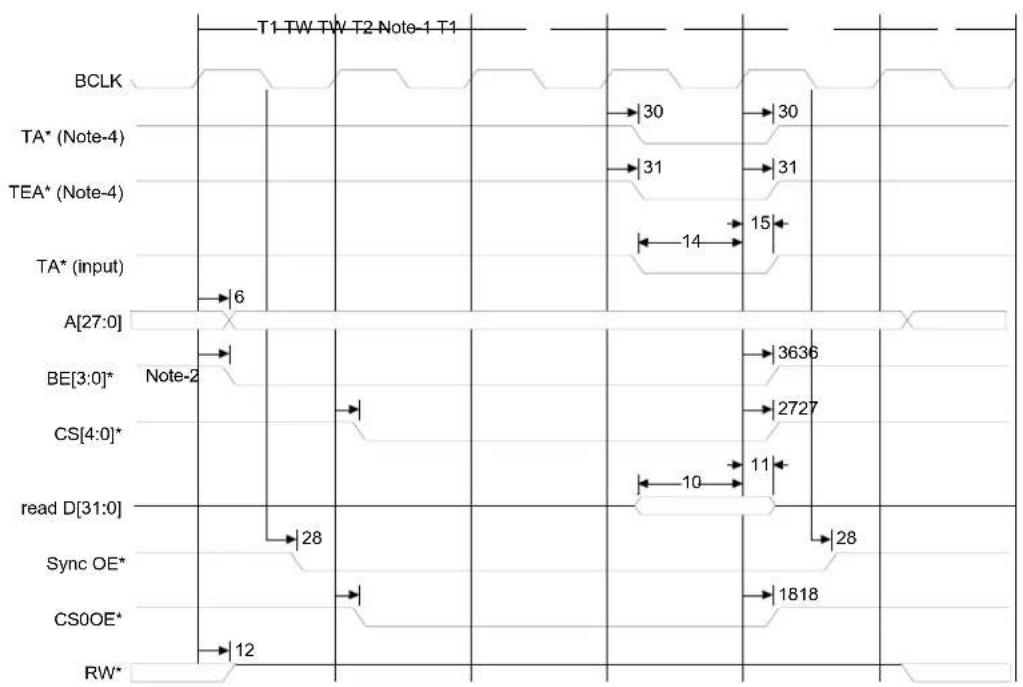
other
| Signal | Value | |-----------------|-------| | BCLK | 6 | | TA* (Note-4) | 30 | | TEA* (Note-4) | 31 | | TA* (input) | 14 | | A[27:0] | 3636 | | BE[3:0]* | 2727 | | CS[4:0]* | 11 | | read D[31:0] | 28 | | Sync OE* | 1818 | | CS0OE* | 12 |Notes:
1 If the next transfer is DMA, null periods between memory transfers can occur. Thirteen clock pulses are required for DMA context switching.
2 Port size determines which byte enable signals are active:
- 8-bit port = BE3*
- 16-bit port = BE[3:0]
- 32-bit port = BE[3:0]
3 The TW cycles are present when the WAIT field is set to 2 or more.
4 The TA* and TEA*/LAST signals are for reference only.
SRAM burst read
CS* controlled, four word (4-2-2-2), burst read (wait = 2, BCYC = 01)
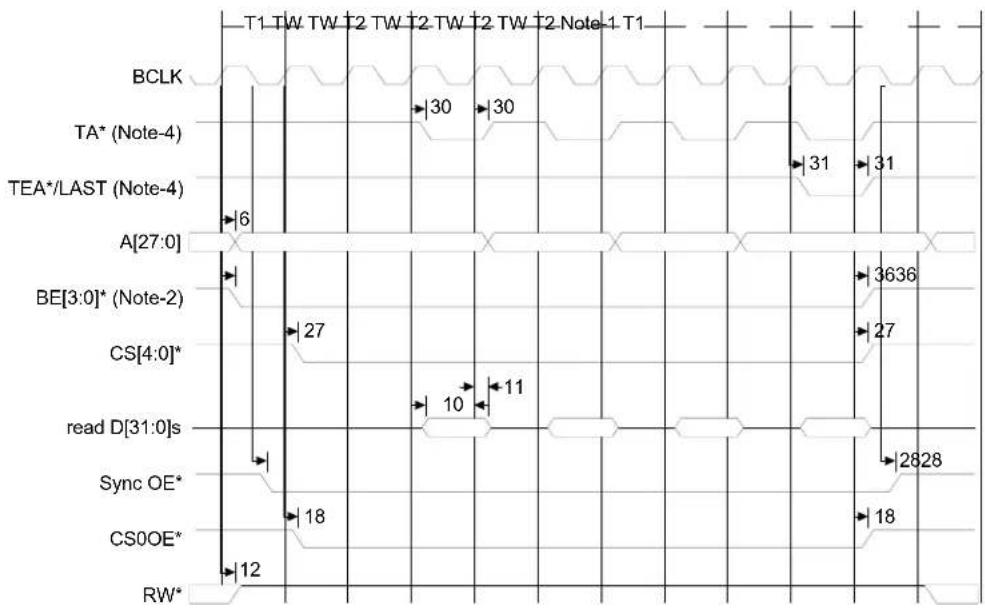
other
| Signal | Value | |-----------------|-------| | BCLK | 6 | | TA* (Note-4) | 30 | | TEA*/LAST (Note-4) | 31 | | A[27:0] | 31 | | BE[3:0]* (Note-2) | 3636 | | CS[4:0]* | 27 | | read D[31:0}s | 10 | | Sync OE* | 11 | | CS0OE* | 18 | | RW* | 12 |Notes:
1 If the next transfer is DMA, null periods between memory transfers can occur. Thirteen clock pulses are required for DMA context switching.
2 Port size determines which byte enable signals are active:
- 8-bit port = BE3*
- 16-bit port = BE[3:0]
- 32-bit port = BE[3:0]
3 The TW cycles are present when the WAIT field is set to 2 or more.
4 The TA* and TEA*/LAST signals are for reference only.
SRAM burst read (2111)
CS* controlled read (wait = 0, BCYC = 00)
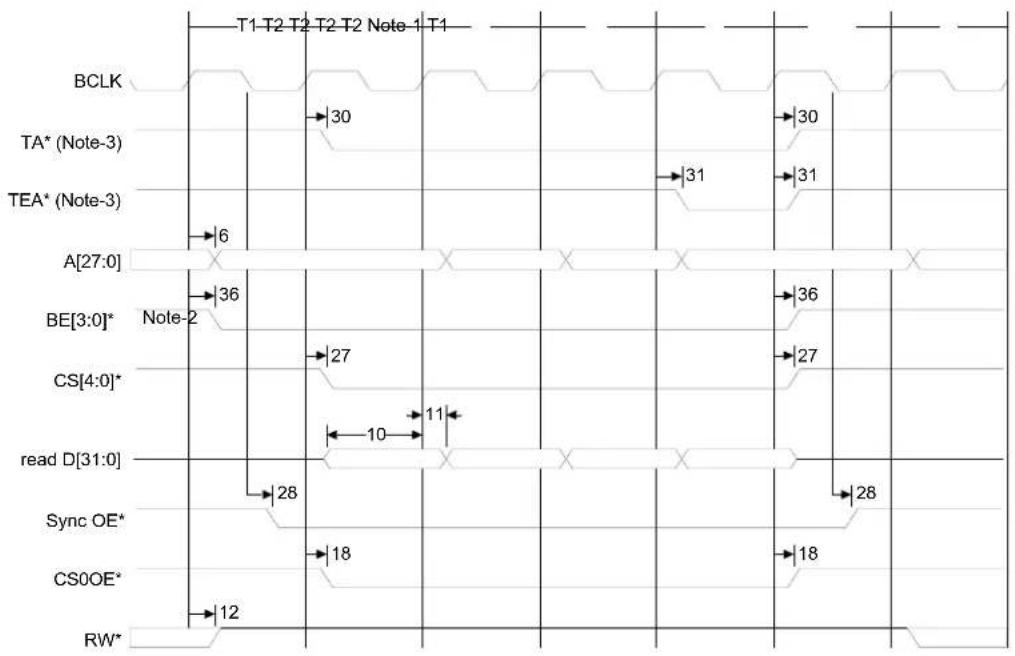
other
| Signal | Value | | ------------- | ----- | | BCLK | 30 | | TA* (Note-3) | 31 | | TEA* (Note-3) | 31 | | A[27:0] | 36 | | BE[3:0]* | 27 | | CS[4:0]* | 10 | | read D[31:0] | 28 | | Sync OE* | 18 | | CS0OE* | 18 | | RW* | 12 |Notes:
1 If the next transfer is DMA, null periods between memory transfers can occur. Thirteen clock pulses are required for DMA context switching.
2 Port size determines which byte enable signals are active:
$$ - 8 \text {-bit port} = B E 3 ^ {*} $$
$$ - 1 6 - \text { bit port } = \text { BE } [ 3: 0 ] $$
$$ - 3 2 \text {-bit port} = B E [ 3: 0 ] $$
3 The TA* and TEA*/LAST signals are for reference only.
SRAM write
CS controlled write (internal and external), (wait = 2)
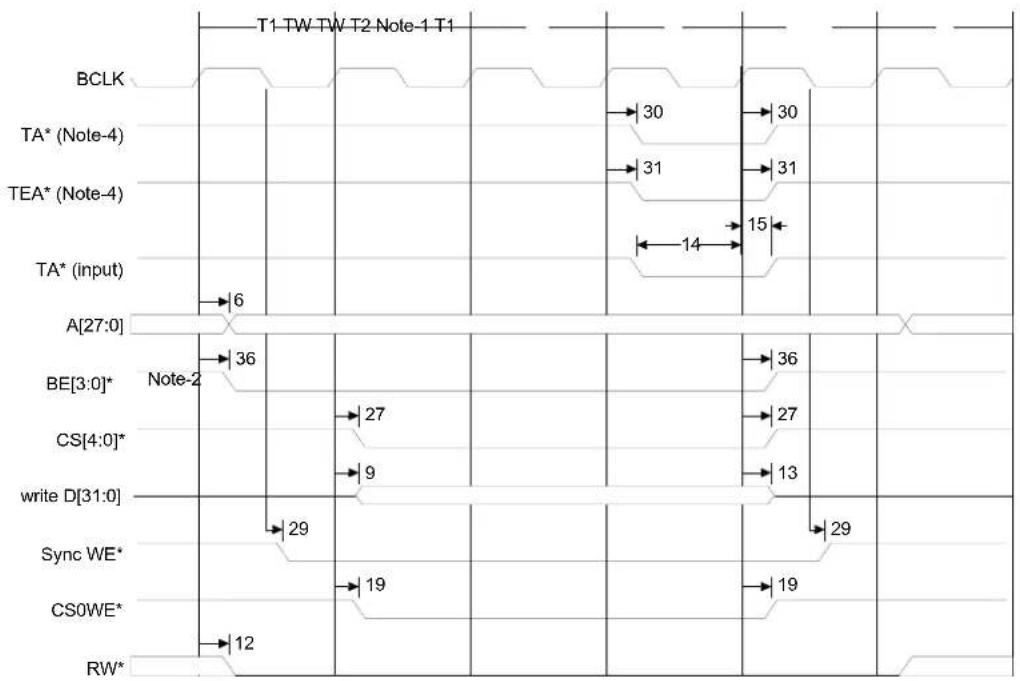
other
| Signal | Value | | ------------- | ----- | | BCLK | 6 | | TA* (Note-4) | 36 | | TEA* (Note-4) | 30 | | TA* (input) | 14 | | A[27:0] | 36 | | BE[3:0]* | 27 | | CS[4:0]* | 9 | | write D[31:0] | 29 | | Sync WE* | 19 | | CS0WE* | 12 | | RW* | 19 |Notes:
1 If the next transfer is DMA, null periods between memory transfers can occur. Thirteen clock pulses are required for DMA context switching.
2 Port size determines which byte enable signals are active:
- 8-bit port = BE3*
- 16-bit port = BE[3:0]
- 32-bit port = BE[3:0]
3 The TW cycles are present when the WAIT field is set to 2 or more.
4 The TA* and TEA*/LAST signals are for reference only.
SRAM burst write
CS controlled, four word (4-2-2-2), burst write (wait = 2, BCYC = 01)
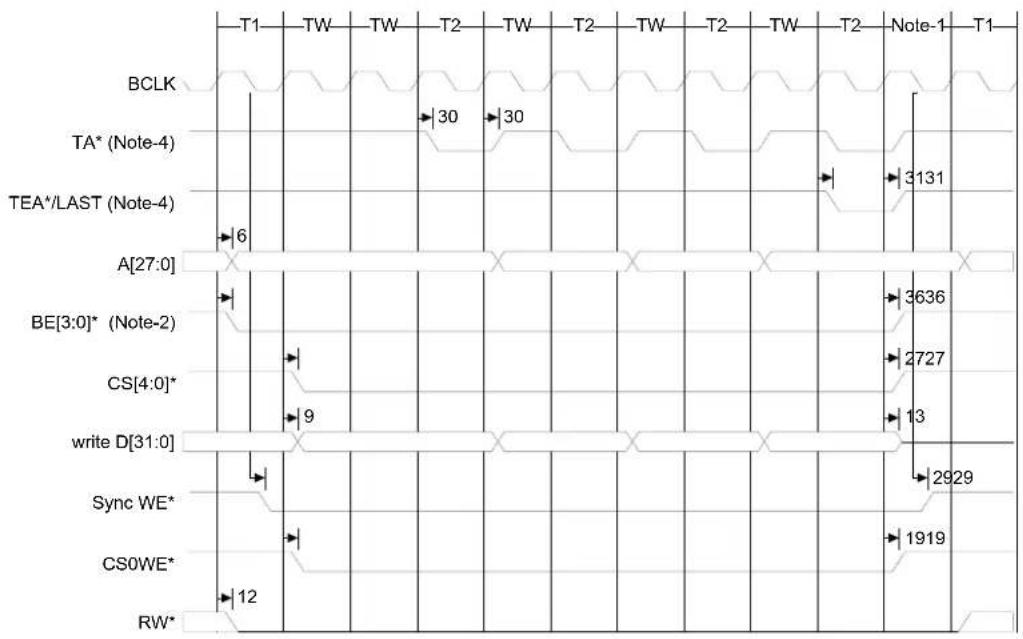
other
| Signal | Value | | ------------- | ----- | | BCLK | 6 | | TA* (Note-4) | 30 | | TEA*/LAST (Note-4) | 30 | | A[27:0] | 6 | | BE[3:0]* (Note-2) | 9 | | CS[4:0]* | 9 | | write D[31:0] | 12 | | Sync WE* | 12 | | CS0WE* | 12 | | RW* | 12 |Notes:
1 If the next transfer is DMA, null periods between memory transfers can occur. Thirteen clock pulses are required for DMA context switching.
2 Port size determines which byte enable signals are active:
- 8-bit port = BE3*
- 16-bit port = BE[3:0]
- 32-bit port = BE[3:0]
3 The TW cycles are present when the WAIT field is set to 2 or more.
4 The TA* and TEA*/LAST signals are for reference only.
SRAM OE read
OE* controlled read (wait = 2)
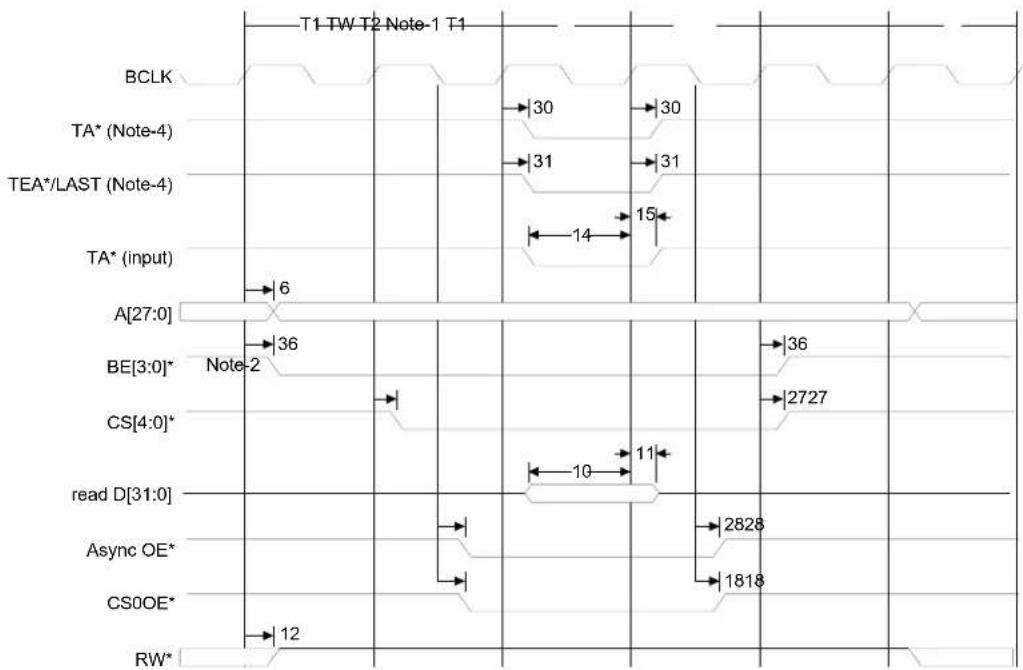
other
| Signal | Value | |-----------------|-------| | BCLK | 30 | | TA* (Note-4) | 31 | | TEA*/LAST (Note-4) | 15 | | TA* (input) | 6 | | A[27:0] | 36 | | BE[3:0]* | 2 | | CS[4:0]* | 2727 | | read D[31:0] | 10 | | Async OE* | 2828 | | CS0OE* | 1818 | | RW* | 12 |Notes:
1 At least one null period occurs between memory transfers. More null periods can occur if the next transfer is DMA. Thirteen clock pulses are required for DMA context switching.
2 Port size determines which byte enable signals are active:
$$ - 8 \text {-bit port} = B E 3 ^ {*} $$
$$ - 1 6 - \text { bit port } = \text { BE } [ 3: 0 ] $$
$$ - 3 2 \text {-bit port} = \mathrm{BE} [ 3: 0 ] $$
3 The TW cycles are present when the WAIT field is set to 2 or more.
4 The TA* and TEA*/LAST signals are for reference only.
SRAM OE burst read
OE* controlled, four word (3-2-2-2), burst read (wait = 2, BCYC = 01)
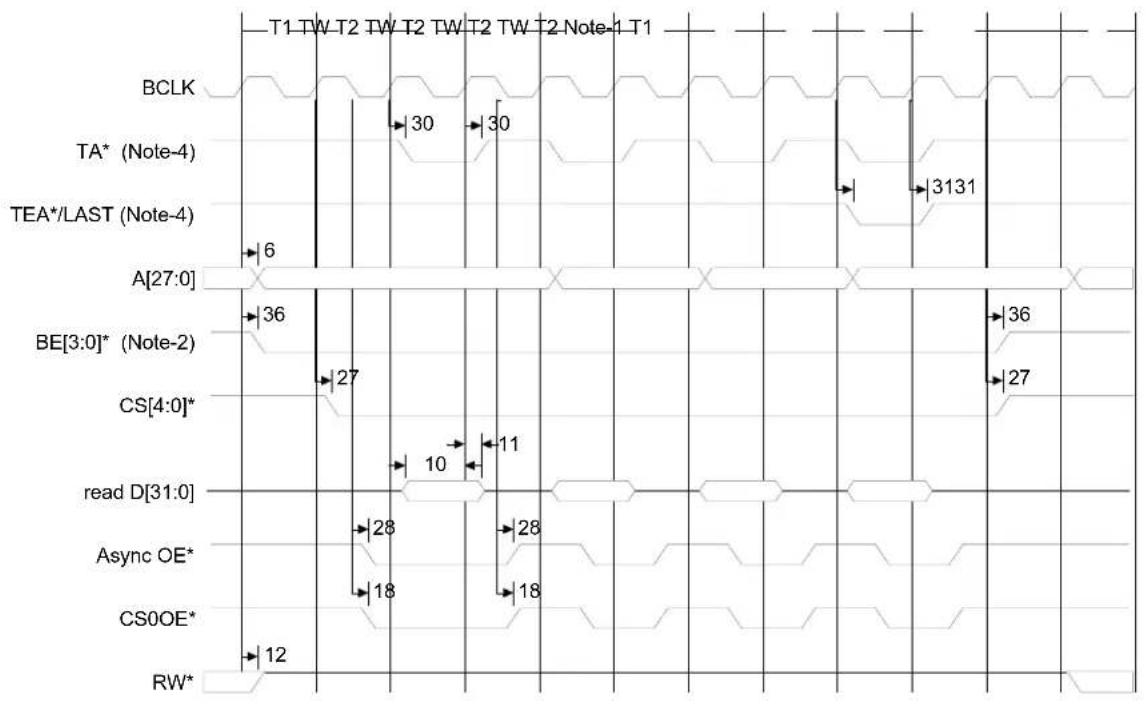
other
| Signal | Value | |-----------------|-------| | BCLK | 6 | | TA* (Note-4) | 30 | | TEA*/LAST (Note-4) | 30 | | A[27:0] | 3131 | | BE[3:0]* (Note-2) | 36 | | CS[4:0]* | 27 | | read D[31:0] | 10 | | Async OE* | 28 | | CS0OE* | 18 | | RW* | 12 |Notes:
1 At least one null period occurs between memory transfers. More null periods can occur if the next transfer is DMA. Thirteen clock pulses are required for DMA context switching.
2 Port size determines which byte enable signals are active:
- 8-bit port = BE3*
- 16-bit port = BE[3:0]
- 32-bit port = BE[3:0]
3 The TW cycles are present when the WAIT field is set to 2 or more.
4 The TA* and TEA*/LAST signals are for reference only.
SRAM WE write
WE* controlled write (wait = 2)
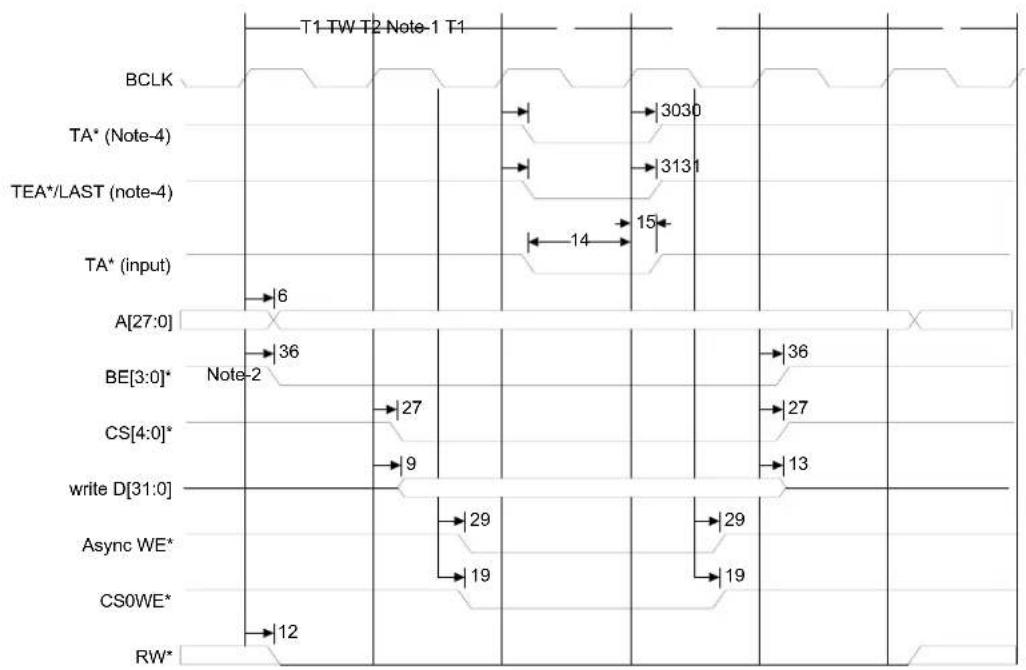
other
| Signal | Value | |-----------------|-------| | BCLK | 3030 | | TA* (Note-4) | 3131 | | TEA*/LAST (note-4) | 15 | | TA* (input) | 6 | | A[27:0] | 36 | | BE[3:0]* | 27 | | CS[4:0]* | 9 | | write D[31:0] | 29 | | Async WE* | 19 | | CS0WE* | 12 | | RW* | 19 |Notes:
1 At least one null period occurs between memory transfers. More null periods can occur if the next transfer is DMA. Thirteen clock pulses are required for DMA context switching.
2 Port size determines which byte enable signals are active:
- 8-bit port = BE3*
- 16-bit port = BE[3:0]
- 32-bit port = BE[3:0]
3 The TW cycles are present when the WAIT field is set to 2 or more.
4 The TA* and TEA*/LAST signals are for reference only.
SRAM WE burst write
WE* controlled, four word (3-2-2-2), burst write (wait = 2, BCYC = 01)
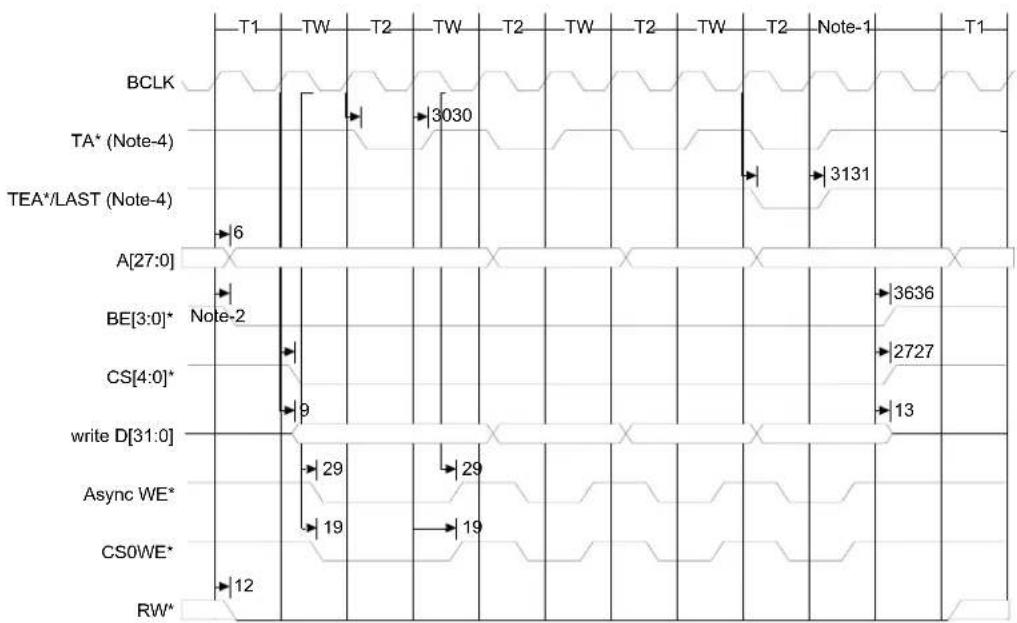
other
| Signal | Value | |-----------------|-------| | BCLK | 6 | | TA* (Note-4) | 3030 | | TEA*/LAST (Note-4) | 3131 | | A[27:0] | | | BE[3:0]* | Note-2 | | CS[4:0]* | 9 | | write D[31:0] | | | Async WE* | 29 | | CS0WE* | 19 | | RW* | 12 |Notes:
1 At least one null period occurs between memory transfers. More null periods can occur if the next transfer is DMA. Thirteen clock pulses are required for DMA context switching.
2 Port size determines which byte enable signals are active:
$$ \begin{array}{l} - 8 \text {-bit port} = B E 3 ^ {*} \ - 1 6 \text {-bit port} = \mathrm{BE} [ 3: 0 ] \ - 3 2 \text {-bit port} = \mathrm{BE} [ 3: 0 ] \ \end{array} $$
3 The TW cycles are present when the WAIT field is set to 2 or more.
4 The TA* and TEA*/LAST signals are for reference only.
SDRAM timing
BCLK max frequency: 55.296 MHz
Operating conditions:
Temperature: -15.00 (min) 110.00 (max)
Voltage: 1.60 (min) 1.40 (max)
Output load: 25.0pf
Input drive: CMOS buffer
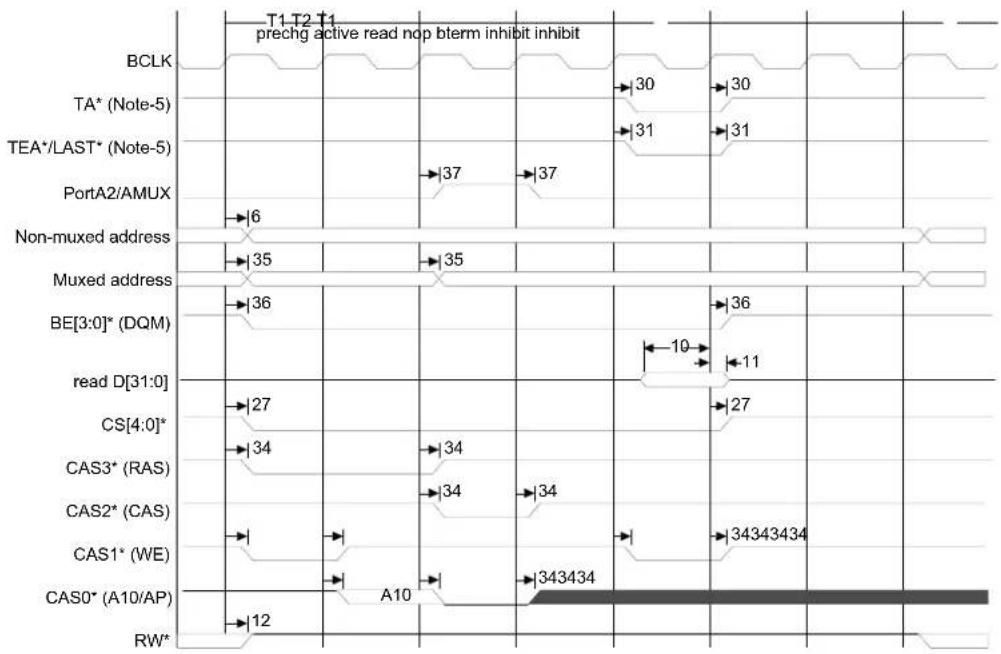
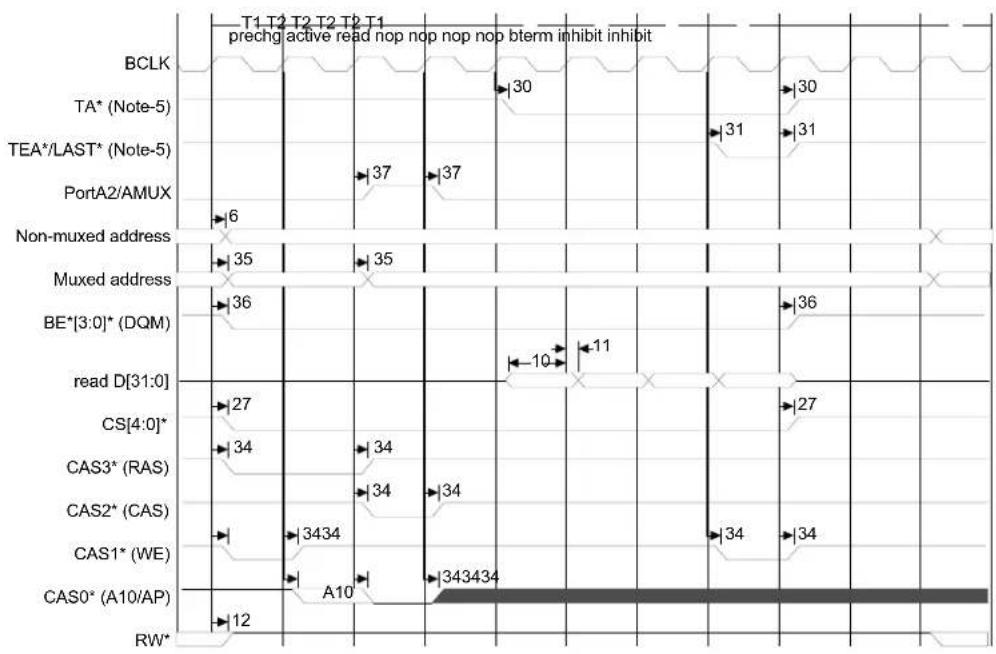
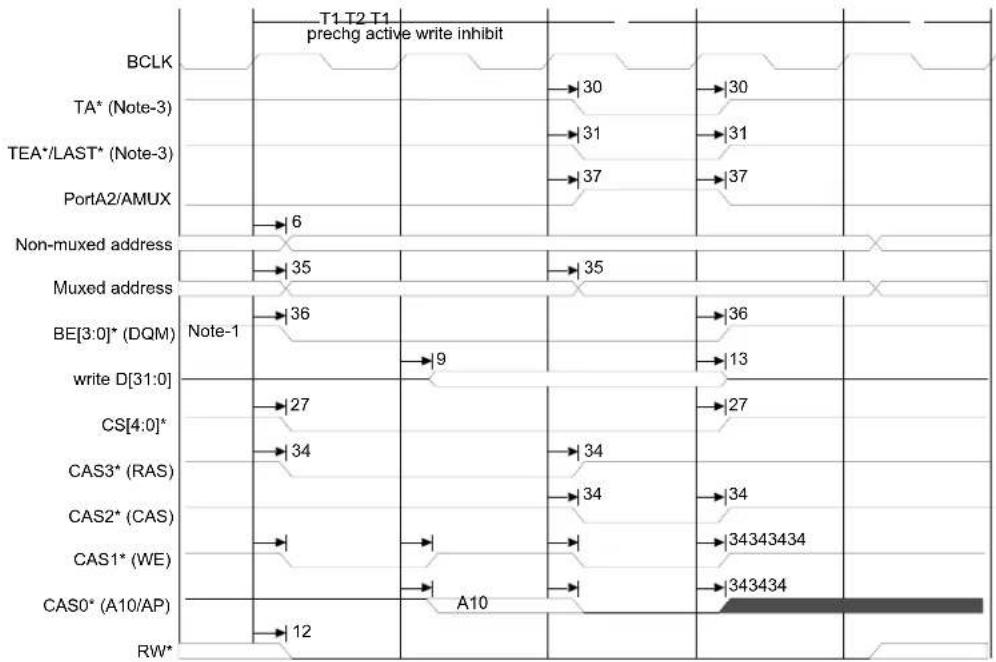
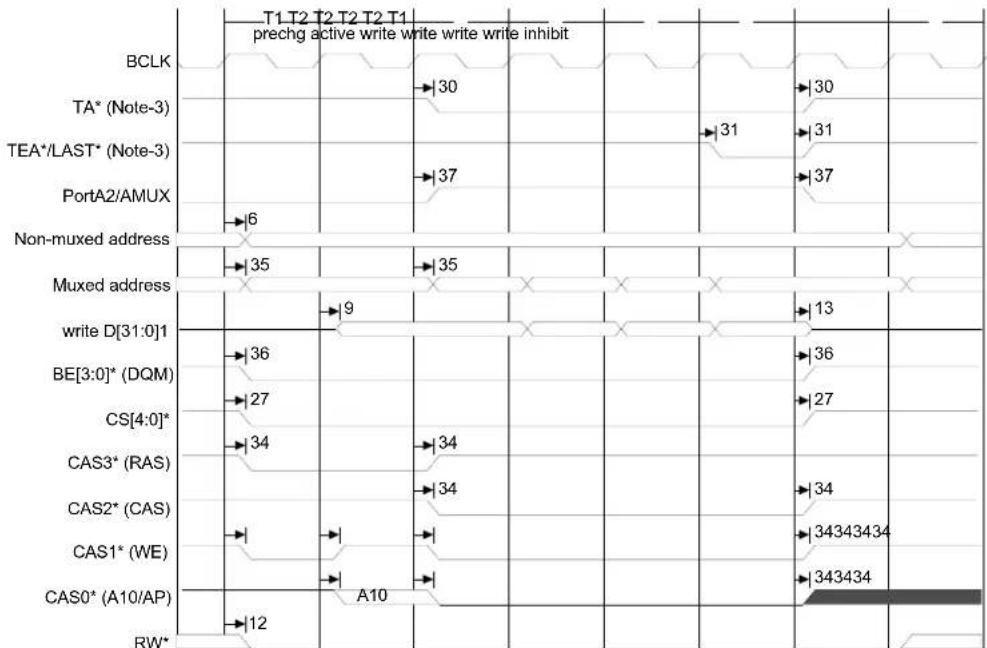
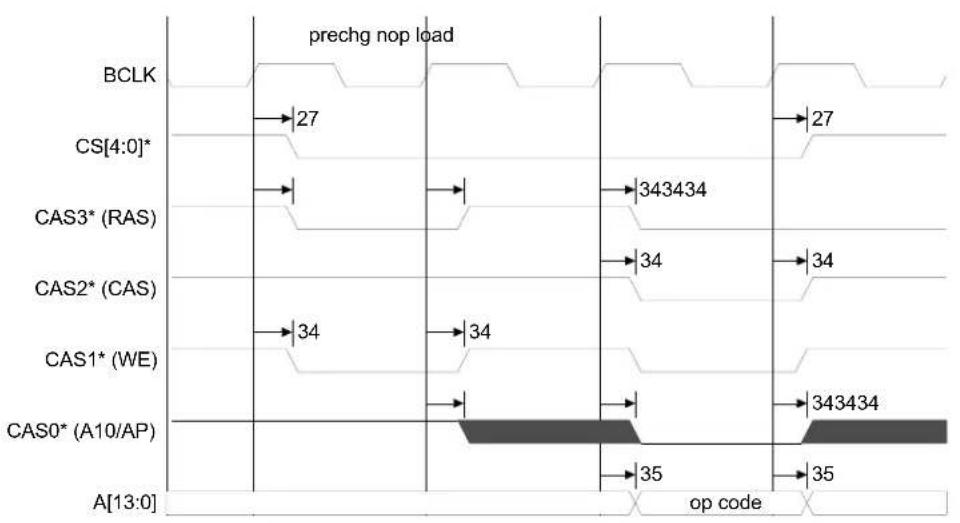
SDRAM timing parameters
| Num Description Min Max Unit | ||
| 36 BCLK high to BE*/DQM* valid 15.5 ns | ||
| 6 BCLK high to non-muxed address valid 5 13.5 ns | ||
| 9 BCLK high to data out valid 14 ns | ||
| 13 BCLK high to data out high impedance 13 ns | ||
| 10 Data in valid to BCLK high (setup) | 5 | ns |
| 11 BCLK high to data in invalid (hold) | 3 | ns |
| 27 BCLK high to CS* valid | 15.5 ns | |
| 30 BCLK high to TA* valid | 13.5 ns | |
| 31 BCLK high to TEA* valid | 16 ns | |
| 37 BCLK high to PORTA2/AMUX valid | 14 ns | |
| 35 BCLK high to muxed address valid | 6 14.5 ns | |
| 34 BCLK high to CAS* valid | 12 ns | |
| 12 BCLK high to RW* valid | 13.5 ns | |
SDRAM read
SDRAM read, CAS latency = 2
other
| Signal | Value | | ---------------- | ----- | | BCLK | 6 | | TA* (Note-5) | 30 | | TEA*/LAST* (Note-5) | 31 | | PortA2/AMUX | 37 | | Non-muxed address | 35 | | Muxed address | 36 | | BE[3:0]* (DQM) | 36 | | read D[31:0] | 27 | | CS[4:0]* | 34 | | CAS3* (RAS) | 34 | | CAS2* (CAS) | 34 | | CAS1* (WE) | 343434| | CAS0* (A10/AP) | 12 | | RW* | 12 |Notes:
1 Port size determines which byte enable signals are active:
$$ \begin{array}{l} - 8 \text {-bit port} = B E 3 ^ {*} \ - 1 6 - \text { bit port } = \text { BE } [ 3: 2 ] \ - 3 2 - \text { bit port } = \text { BE } [ 3: 0 ] \ \end{array} $$
2 The precharge and/or active commands are not always present. These commands depend on the address of the previous SDRAM access.
3 If CAS latency = 3, 2 NOPs occur between the read and burst terminate commands.
4 If CAS latency = 3, 3 inhibits occur after burst terminate.
5 The TA* and TEA*/LAST signals are for reference only.
SDRAM burst read
SDRAM read, CAS latency = 2
other
| Signal Type | Value | |-----------------------|-------| | prechg active read | 6 | | prechg active read | 35 | | prechg active read | 35 | | prechg active read | 36 | | prechg active read | 27 | | prechg active read | 34 | | prechg active read | 34 | | prechg active read | 34 | | prechg active read | 34 | | prechg active read | 34 | | prechg active read | 34 | | prechg active read | 34 | | prechg active read | 34 | | prechg active read | 34 | | Prechg active read | 12 | | Prechg active read | 12 | | Prechg active read | 12 | | Prechg active read | 12 | | Prechg active read | 12 | | Prechg active read | 12 | | Prechg active read | 12 | | Prechg active read | 12 | | Prechg active read | 12 | | T1 T2 T2 T2 T1 | | | TA* (Note-5) | | | TEA*/LAST* (Note-5) | | | PortA2/AMUX | | | Non-muxed address | | | Muxed address | | | BE*[3:0]* (DQM) | | | read D[31:0] | | | CS[4:0]* | | | CAS3* (RAS) | | | CAS2* (CAS) | | | CAS1* (WE) | | | CAS0* (A10/AP) | | | RW* | |Notes:
1 Port size determines which byte enable signals are active:
$$ \begin{array}{l} - 8 \text {-bit port} = B E 3 ^ {*} \ - 1 6 - \text { bit port } = \text { BE } [ 3: 2 ] \ - 3 2 - \text { bit port } = \text { BE } [ 3: 0 ] \ \end{array} $$
2 The precharge and/or active commands are not always present. These commands depend on the address of the previous SDRAM access.
3 If CAS latency = 3, 5 NOPs occur between the read and burst terminate commands.
4 If CAS latency = 3, 3 inhibits occur after burst terminate.
5 The TA* and TEA*/LAST signals are for reference only.
SDRAM write
SDRAM write
Notes:
1 Port size determines which byte enable signals are active:
$$ \begin{array}{l} - 8 - \text { bit port } = B E 3 ^ {*} \ - 1 6 \text {-bit port} = B E [ 3: 2 ] \ - 3 2 \text {-bit port} = \mathrm{BE} [ 3: 0 ] \ \end{array} $$
2 The precharge and/or active commands are not always present. These commands depend on the address of the previous SDRAM access.
3 The TA* and TEA*/LAST signals are for reference only.
SDRAM burst write
SDRAM burst write
other
| Address Type | Prechg Active Write Inhibit | Read Write Inhibit | | ---------------------- | --------------------------- | ------------------ | | BCLK | 30 | 30 | | TA* (Note-3) | 31 | 31 | | TEA*/LAST* (Note-3) | 37 | 37 | | PortA2/AMUX | 6 | 6 | | Non-muxed address | 35 | 35 | | Muxed address | 9 | 9 | | write D[31:0]1 | 36 | 36 | | BE[3:0]* (DQM) | 27 | 27 | | CS[4:0]* | 34 | 34 | | CAS3* (RAS) | 34 | 34 | | CAS2* (CAS) | 34 | 34 | | CAS1* (WE) | 34 | 34 | | CAS0* (A10/AP) | 12 | 12 |Notes:
1 Port size determines which byte enable signals are active:
$$ \begin{array}{l} - 8 \text {-bit port} = B E 3 ^ {*} \ - 1 6 - \text { bit port } = \text { BE } [ 3: 2 ] \ - 3 2 - \text { bit port } = \text { BE } [ 3: 0 ] \ \end{array} $$
2 The precharge and/or active commands are not always present. These commands depend on the address of the previous SDRAM access. When the active command is not present, parameter #35 is valid during the write (T2) cycle.
3 The TA* and TEA*/LAST signals are for reference only.
SDRAM load mode
other
| Signal | prechg nop load | op code | | ---------------- | --------------- | ------- | | BCLK | 27 | 27 | | CS[4:0]* | | | | CAS3* (RAS) | 343434 | | | CAS2* (CAS) | 34 | 34 | | CAS1* (WE) | | | | CAS0* (A10/AP) | 343434 | | | A[13:0] | | 35 |SDRAM refresh
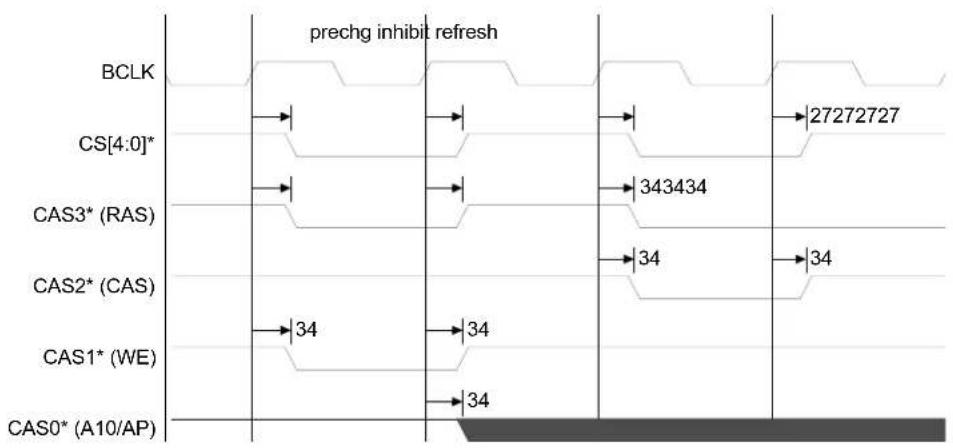
other
| Cell Line | Precheng Inhibit Refresh Event | | --------- | ----------------------------- | | BCLK | 27272727 | | CS[4:0]* | 343434 | | CAS3* (RAS)| 34 | | CAS2* (CAS)| 34 | | CAS1* (WE) | 34 | | CAS0* (A10/AP) | 34 |FP DRAM timing
BCLK max frequency: 55.296 MHz
Operating conditions:
Temperature: -15.00 (min) 110.00 (max)
Voltage: 1.60 (min) 1.40 (max)
Output load: 25.0pf
Input drive: CMOS buffer
FP DRAM timing parameters
| Num Description Min Max Unit | ||
| 36 BCLK high to BE* valid 15.5 ns | ||
| 6 BCLK high to address valid 5 13.5 ns | ||
| 9 BCLK high to data out valid 14 ns | ||
| 13 BCLK high to data out high impedance | 13 ns | |
| 10 Data in valid to BCLK high (setup) | 5 | ns |
| 11 BCLK high to data in invalid (hold) | 3 | ns |
| 14 TA* valid to BCLK high (setup) | 5 | ns |
| 15 BCLK high to TA* invalid (hold) | 3 | ns |
| 28 BCLK low to OE* valid | 12.5 ns | |
| 29 BCLK low to WE* valid 13 ns | ||
| 30 BCLK high to TA* valid | 13.5 ns | |
| 31 BCLK high to TEA* valid | 16 ns | |
| 37 BCLK high to PORTA2/AMUX valid | 14 ns | |
| 35 BCLK high to muxed address valid | 6 14.5 ns | |
| 43 BCLK low to CAS* valid | 13 ns | |
| 27 BCLK low to RAS* valid | 12 ns | |
| 12 BCLK high to RW* valid | 13.5 ns | |
FP DRAM read
Fast Page read
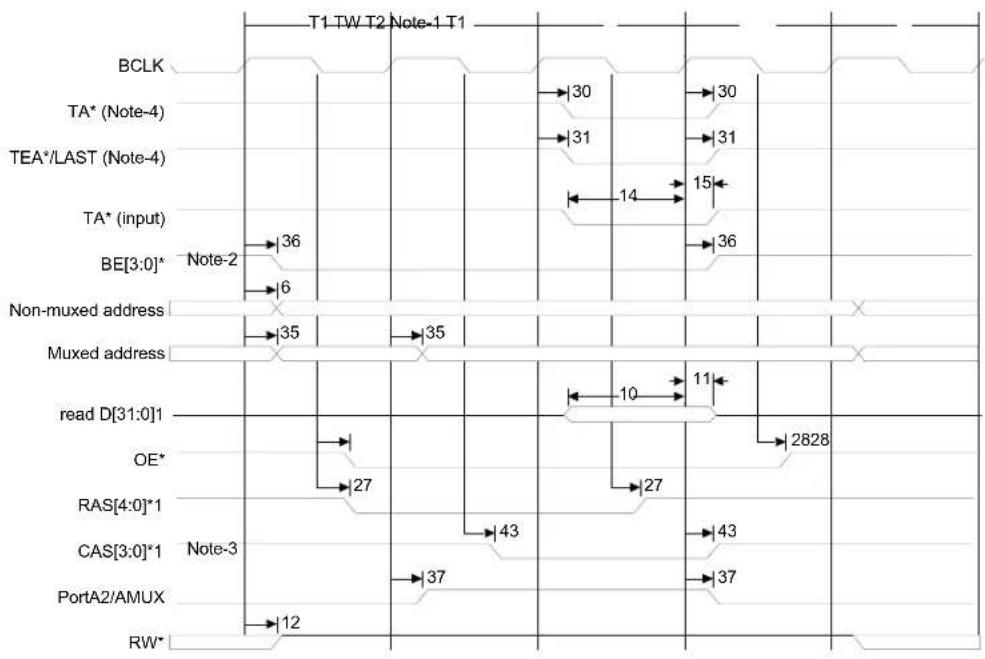
other
| Signal | Value | | ---------------- | ----- | | BCLK | 36 | | TA* (Note-4) | 6 | | TEA*/LAST (Note-4)| 31 | | TA* (input) | 14 | | BE[3:0]* | 36 | | Non-muxed address | 35 | | Muxed address | 35 | | read D[31:0]1 | 10 | | OE* | 27 | | RAS[4:0]*1 | 27 | | CAS[3:0]*1 | 43 | | PortA2/AMUX | 37 | | RW* | 12 |Notes:
1 If the next transfer is DMA, null periods between memory transfers can occur. Thirteen clock pulses are required for DMA context switching.
2 Port size determines which byte enable signals are active:
$$ \begin{array}{l} - 8 \text {-bit port} = B E 3 ^ {*} \ - 1 6 \text {-bit port} = \mathrm{BE} [ 3: 2 ] \ - 3 2 \text {-bit port} = \mathrm{BE} [ 3: 0 ] \ \end{array} $$
3 Port size determines which CAS signals are active:
$$ \begin{array}{l} - 8 \text {-bit port} = \mathrm{CAS3} ^ {*} \ - 1 6 - \text { bit port } = \text { CAS } [ 3: 2 ] \ - 3 2 \text {-bit port} = \text { CAS } [ 3: 0 ] \ \end{array} $$
4 The TA* and TEA*/LAST signals are for reference only.
FP DRAM burst read
Fast Page burst read
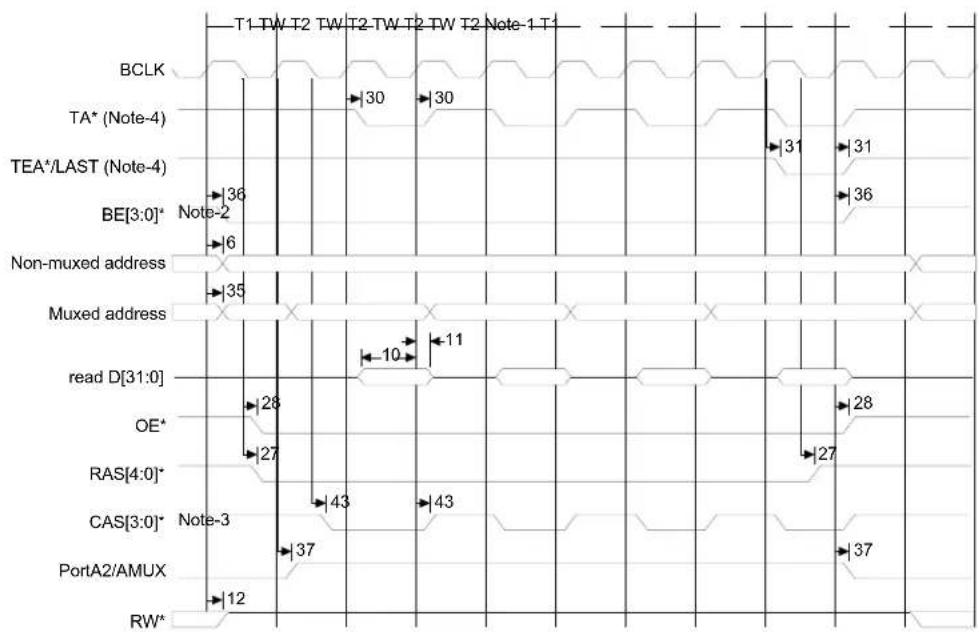
other
| Signal | Value | |-----------------|-------| | BCLK | 36 | | TA* (Note-4) | 30 | | TEA*/LAST (Note-4) | 30 | | BE[3:0]* | 6 | | Non-muxed address| 35 | | Muxed address | 10 | | read D[31:0] | 11 | | OE* | 28 | | RAS[4:0]* | 27 | | CAS[3:0]* | 43 | | PortA2/AMUX | 37 | | RW* | 12 |Notes:
1 If the next transfer is DMA, null periods between memory transfers can occur. Thirteen clock pulses are required for DMA context switching.
2 Port size determines which byte enable signals are active:
$$ \begin{array}{l} - 8 - \text { bit port } = B E 3 ^ {*} \ - 1 6 \text {-bit port} = B E [ 3: 2 ] \ - 3 2 - \text { bit port } = \text { BE } [ 3: 0 ] \ \end{array} $$
3 Port size determines which CAS signals are active:
$$ \begin{array}{l} - 8 - \text { bit port } = \text { CAS3 } ^ {*} \ - 1 6 \text {-bit port} = \text { CAS } [ 3: 2 ] \ - 3 2 - \text { bit port } = \text { CAS } [ 3: 0 ] \ \end{array} $$
4 The TA* and TEA*/LAST signals are for reference only.
FP DRAM write
Fast Page write
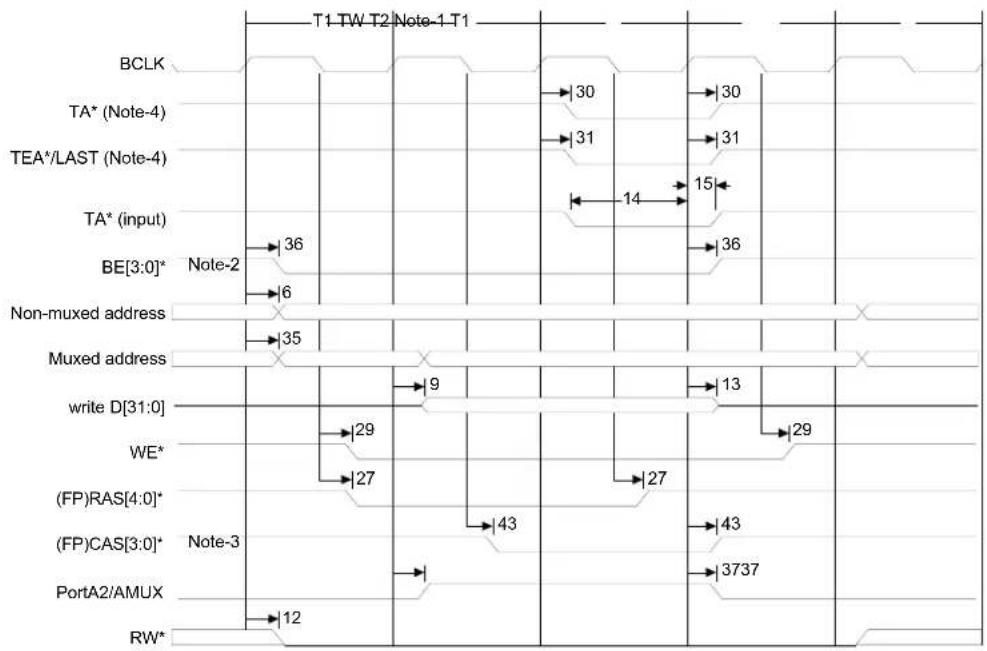
other
| Signal | Value | | ---------------- | ----- | | BCLK | 36 | | TA* (Note-4) | 30 | | TEA*/LAST (Note-4)| 31 | | TA* (input) | 14 | | BE[3:0]* | 36 | | Non-muxed address | 6 | | Muxed address | 35 | | write D[31:0] | 9 | | WE* | 29 | | (FP)RAS[4:0]* | 27 | | (FP)CAS[3:0]* | 43 | | PortA2/AMUX | 12 | | RW* | 3737 |Notes:
1 If the next transfer is DMA, null periods between memory transfers can occur. Thirteen clock pulses are required for DMA context switching.
2 Port size determines which byte enable signals are active:
- 8-bit port = BE3*
- 16-bit port = BE[3:2]
- 32-bit port = BE[3:0]
3 Port size determines which CAS signals are active:
- 8-bit port = CAS3*
- 16-bit port = CAS[3:2]
- 32-bit port = CAS[3:0]
4 The TA* and TEA*/LAST signals are for reference only.
FP DRAM burst write
Fast Page burst write
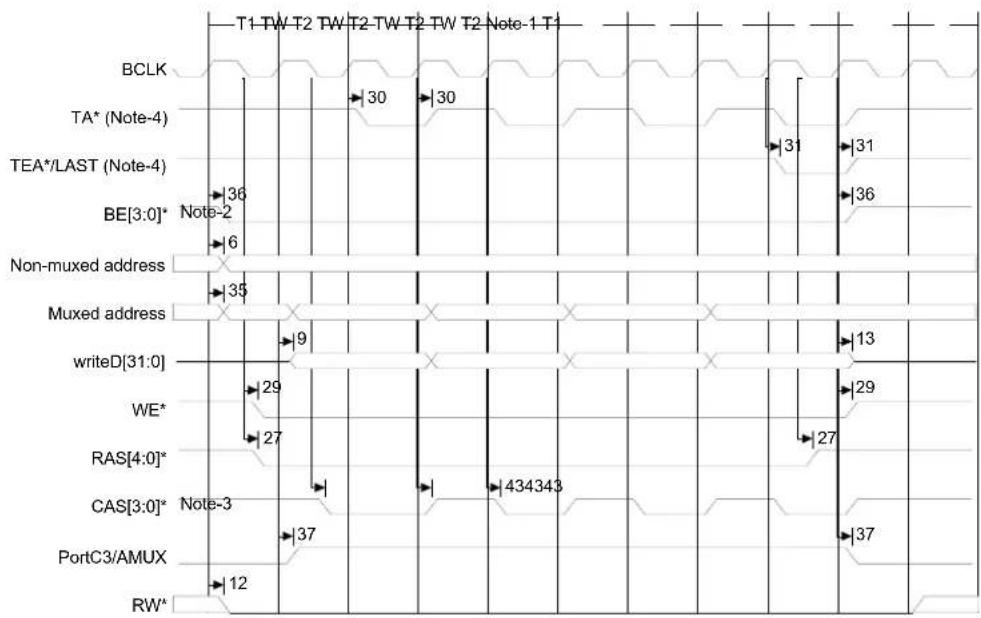
other
| Signal | Value | |-----------------|-------| | BCLK | 36 | | TA* (Note-4) | 30 | | TEA*/LAST (Note-4) | 30 | | BE[3:0]* | 6 | | Non-muxed address| 35 | | Muxed address | 9 | | writeD[31:0] | 29 | | WE* | 27 | | RAS[4:0]* | 434343| | CAS[3:0]* | 37 | | PortC3/AMUX | 12 | | RW* | 12 |Notes:
1 If the next transfer is DMA, null periods between memory transfers can occur. Thirteen clock pulses are required for DMA context switching.
2 Port size determines which byte enable signals are active:
$$ \begin{array}{l} - 8 - \text { bit port } = B E 3 ^ {*} \ - 1 6 - \text { bit port } = \text { BE } [ 3: 2 ] \ - 3 2 \text {-bit port} = \mathrm{BE} [ 3: 0 ] \ \end{array} $$
3 Port size determines which CAS signals are active:
$$ \begin{array}{l} - 8 - \text { bit port } = \text { CAS3* } \ - 1 6 \text {-bit port} = \text { CAS } [ 3: 2 ] \ - 3 2 - \text { bit port } = \text { CAS } [ 3: 0 ] \ \end{array} $$
4 The TA* and TEA*/LAST signals are for reference only.
5 The BCYC field should never be set to 00.
fp\_refresh\_cycles
Fast page refresh (RCYC = 00)
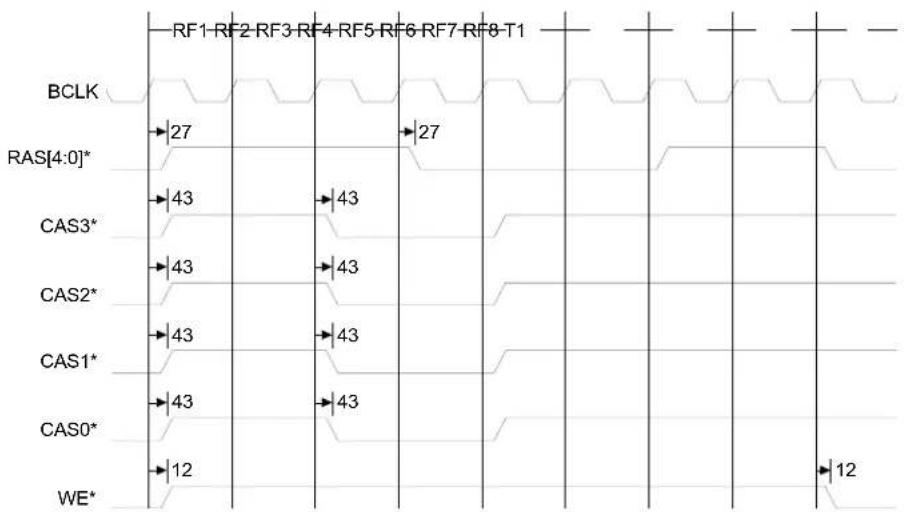
other
| Signal | Value | |------------|-------| | BCLK | 27 | | RAS[4:0]* | 43 | | CAS3* | 43 | | CAS2* | 43 | | CAS1* | 43 | | CAS0* | 12 | | WE* | 12 |Fast page refresh (RCYC = 01)
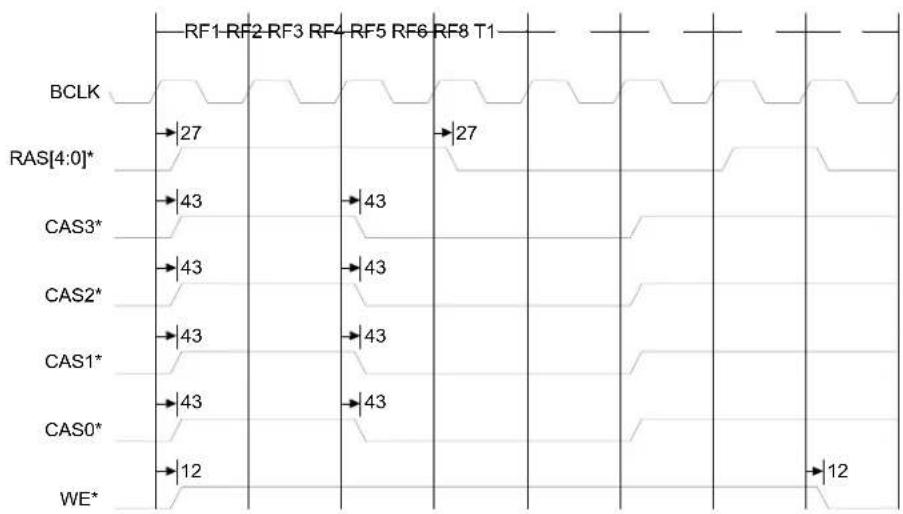
other
| Signal | Value | |------------|-------| | BCLK | 27 | | RAS[4:0]* | 43 | | CAS3* | 43 | | CAS2* | 43 | | CAS1* | 43 | | CAS0* | 43 | | WE* | 12 |Fast page refresh (RCYC = 10)
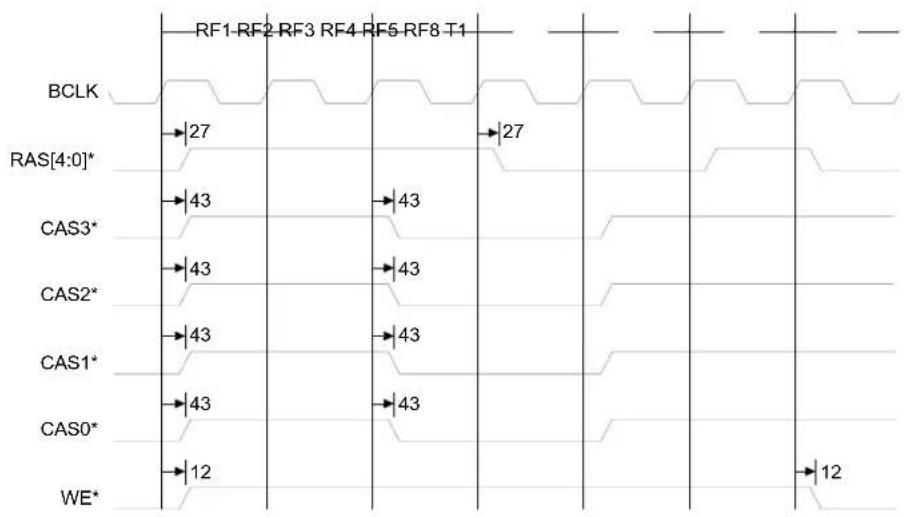
other
| Signal | Value | |------------|-------| | BCLK | 27 | | RAS[4:0]* | 43 | | CAS3* | 43 | | CAS2* | 43 | | CAS1* | 43 | | CAS0* | 43 | | WE* | 12 |Fast page refresh (RCYC = 11)
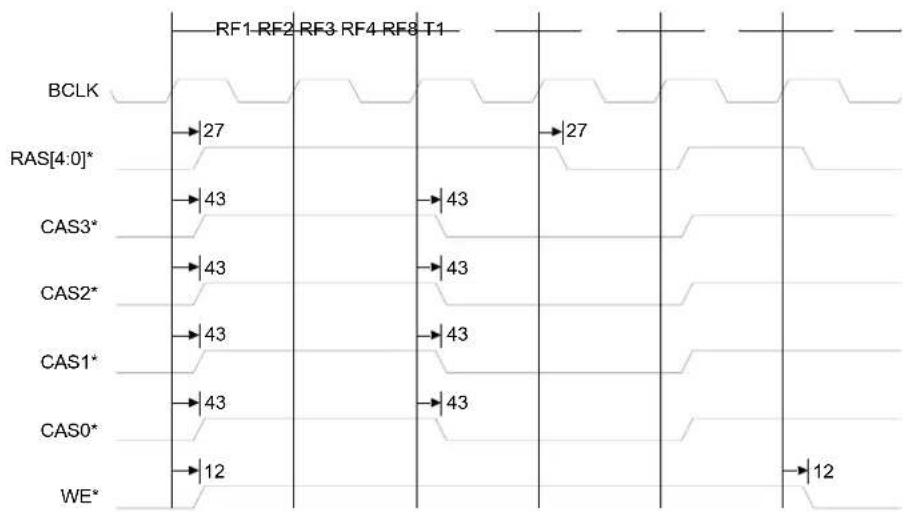
other
| Signal | Value | |--------|-------| | BCLK | 27 | | RAS[4:0]* | 43 | | CAS3* | 43 | | CAS2* | 43 | | CAS1* | 43 | | CAS0* | 43 | | WE* | 12 |Ethernet timing
Operating conditions:
Temperature: -15.00 (min) 110.00 (max)
Voltage: 1.60 (min) 1.40 (max)
Output load: 25.0pf
Input drive: CMOS buffer
Ethernet timing parameters
Num Description Min Max Unit
| 44 TXCLK high to TXD*, TXEN, TXER valid 11.5 ns | ||
| 45 RXD*, RXER, RXDV, TXCOL, RXCRS valid to RXCLK high (setup) 3 ns | ||
| 46 RXCLK high to RXD*, RXER, RXDV, TXCOL, RXCRS hold time | 2 ns | |
| 49 MDC high to MDIO valid | 50 ns | |
| 47 MDIO valid to MDC high (setup) | 3 ns | |
| 48 MDC high to MDIO hold time | 3 ns | |
| 50 RXCLK high to RSPF* valid | 15.5 ns | |
| 52 REJECT* valid to RXCLK high (setup) | 3 ns | |
| 53 REJECT* valid from RXCLK high (hold) | 1.5 | ns |
Ethernet PHY timing
![TXCLK TXD[3:0],TXEN,TXER RXCLK RXD[3:0],RXER,RXDV,CRS,COL MDIO (input) MDC MDIO (output)](/content/2026/06/1202744/images/9777b06c46fde040bd4ec85017bd6b34dd34e0ee41a61f4e3d1816a438027292.jpg)
Ethernet timing
Ethernet cam timing
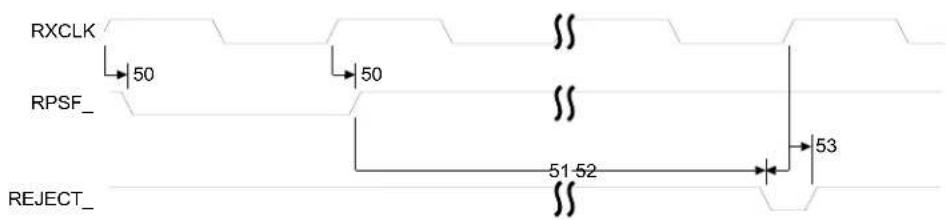
JTAG timing
Operating conditions:
Temperature: -15.00 (min) 110.00 (max)
Voltage: 1.60 (min) 1.40 (max)
Output load: 25.0pf
Input drive: CMOS buffer
jtag arm ice timing parameters
| Num Description Min Max Units | ||
| 54 TCK to TDO valid 21 ns | ||
| 55 TCK to TDO HighZ 21 ns | ||
| 56 TDI setup to TCK rising 1 ns | ||
| 57 TDI hold from TCK rising 3 ns | ||
| 58 TRST* width | 1 T | TCK |
| 60 TMS setup to TCK rising | 1 ns | |
| 61 TMS hold from TCK rising 3 ns | ||
jtag arm ice timing diagram
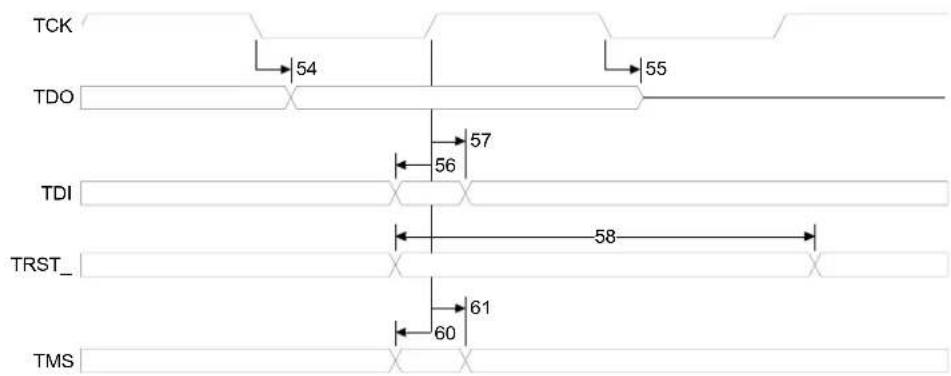
JTAG timing
jtag bscan timing parameters
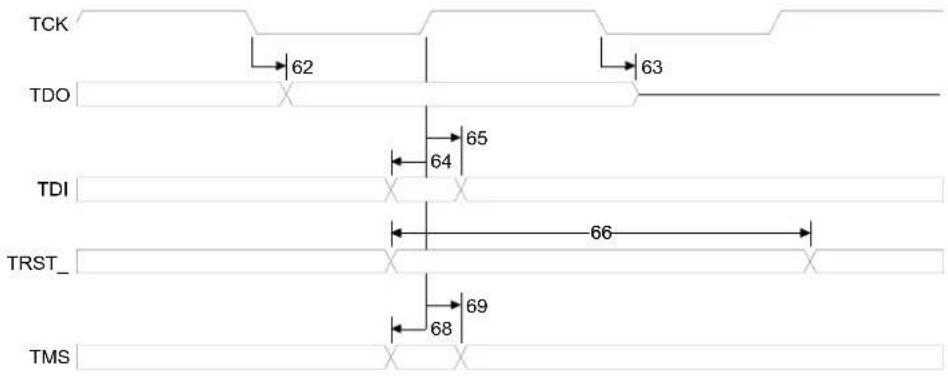
| Num Description Min Max Units | |
| 62 TCK to TDO valid 21 ns | |
| 63 TCK to TDO HighZ 21 ns | |
| 64 TDI setup to TCK rising 1 ns | |
| 65 TDI hold from TCK rising 3 ns | |
| 66 TRST* width 1 T | TCK |
| 68 TMS setup to TCK rising 1 ns | |
| 69 TMS hold to TCK rising 3 ns | |
jtag bscan timing diagram
External DMA timing
BCLK max frequency: 55.296 MHz
Operating conditions:
Temperature: -15.00 (min) 110.00 (max)
Voltage: 1.60 (min) 1.40 (max)
Output load: 25.0pf
Input drive: CMOS buffer
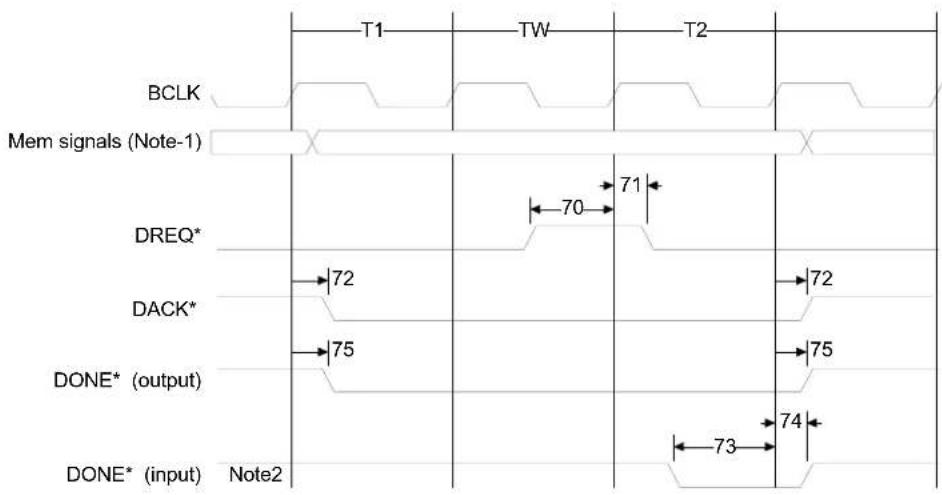
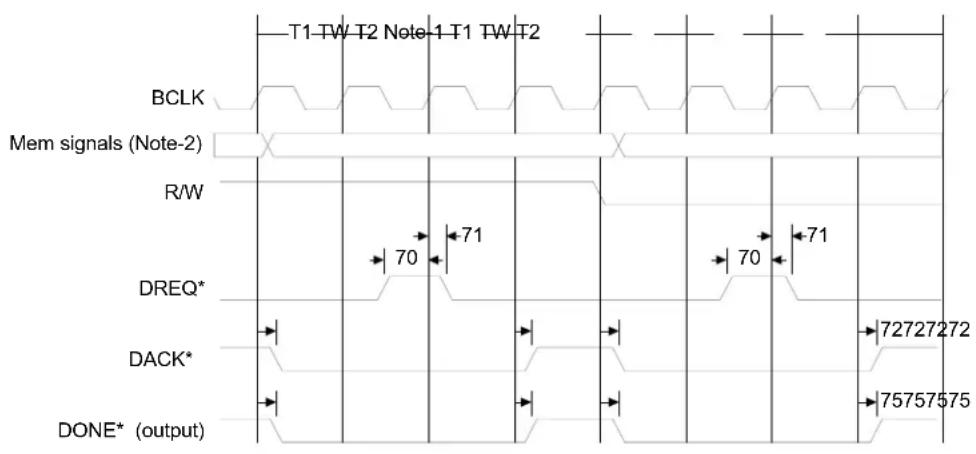
External DMA timing parameters
Num Description Min Max Unit
| 72 BCLK high to DACK* valid 14 ns | ||
| 75 BCLK high to DONE* (output) valid 15 ns | ||
| 70 DREQ* low to BCLK high (setup) | 5 | ns |
| 71 BCLK high to DREQ* valid (hold) | 0 | ns |
| 73 DONE* (input) valid BCLK high (setup) | 5 | ns |
| 74 BLCK high to DONE* (input) valid (hold) | 0 | ns |
Fly-by external DMA
other
| Signal Type | Value | |---------------------|-------| | BCLK | 70 | | Mem signals (Note-1)| 71 | | DREQ* | 72 | | DACK* | 75 | | DONE* (output) | 75 | | DONE* (input) | 74 |Notes:
1 The memory signals are data[31:0], addr[27:0], BE[3:0], CS/RAS[4:0], CAS[3:0], RW, OE*. WE*, and PORTC3/AMUX. The timing of these signals depends on how the memory is configured (Sync SRAM, Async SRAM, FP DRAM, or SDRAM).
2 The DONE* signal works as an input only when the DMA channel is configured as fly-by write.
Memory-to-memory external DMA
Notes:
1 A null period sometimes occurs between memory cycles.
2 The memory signals are data[31:0], addr[27:0], BE[3:0], CS/RAS[4:0], CAS[3:0], RW, OE*. WE*, and PORTA2/AMUX. The timing of these signals depends on how the memory is configured (Sync SRAM, Async SRAM, FP DRAM, or SDRAM).
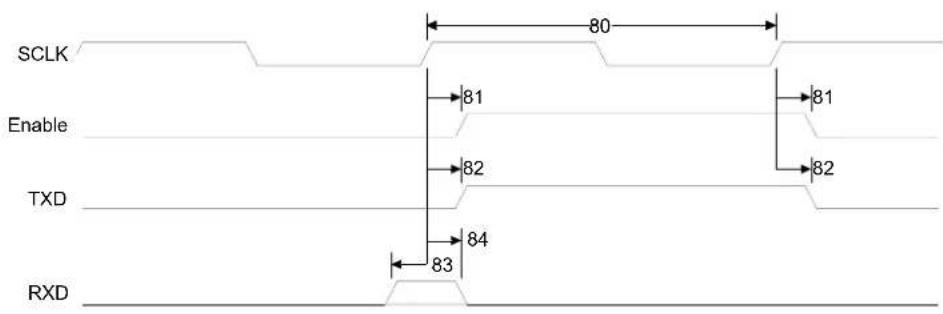
Serial internal/external timing
Operating conditions:
Temperature: -15.00 (min) 110.00 (max)
Voltage: 1.60 (min) 1.40 (max)
Output load: 25.0pf
Input drive: CMOS buffer
Note: SPI timing diagrams are in Chapter 10, "Serial Controller Module." See Figure 25, "SPI master mode 0 and 1 two-byte transfer," on page 219 and Figure 26, "SPI slave mode 0 and 1 two-byte transfer," on page 222. Only SPI modes 0 and 1 are supported.
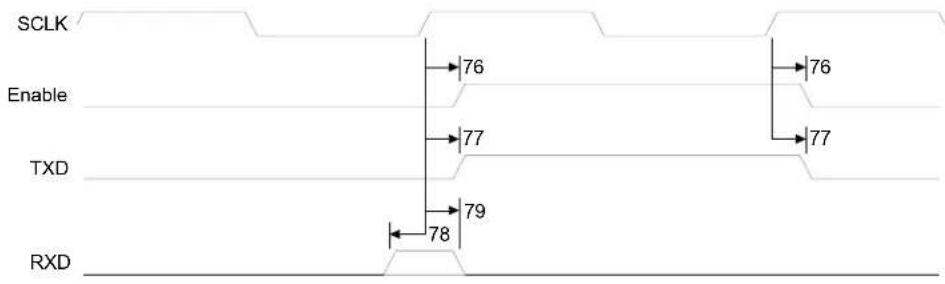
Serial internal timing characteristics
| Num Description Min Max Unit | |||
| 76 SCLK to ENABLE high 1 T | SCLK | ||
| 77 SCLK to TXD (PORTA7/C7) 1 T | SYS* | ns | |
| 78 RXD (PORTA3/C3) setup to SCLK | 1 ns | ||
| 79 RXD hold to SCLK | 1 ns | ||
* The T_SYS parameter represents one period of the internal system clock.
Serial external timing characteristics
| Num Description Min Max Unit | |||
| 80 SCLK frequency | 10 | MHz | |
| SCLK duty cycle | 45 55 | % | |
| 81 SCLK to ENABLE | 1 T | SCLK | |
| 82 SCLK to TXD (PORTA7/C7) 2T | SYS^* | ns | |
| 83 RXD (PORTA3/C3) setup to SCLK | 2 ns | ||
| 84 RXD hold to SCLK | 1.5 | ns | |
* The T_SYS parameter represents one period of the internal system clock.
synchronous serial internal clock
synchronous serial external clock
GPIO timing
Operating conditions:
Temperature: -15.00 (min) 110.00 (max)
Voltage: 1.60 (min) 1.40 (max)
Output load: 25.0pf
Input drive: CMOS buffer
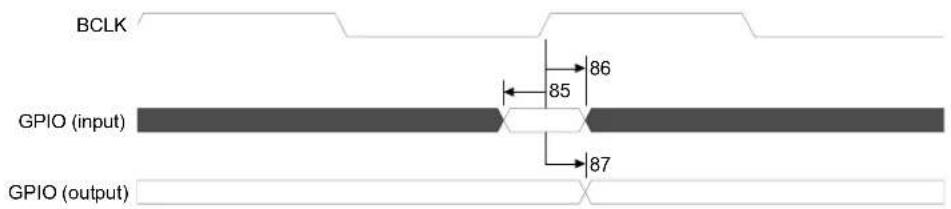
GPIO timing parameters
Num Description Min Max Unit
| 85 GPIO (setup) to BCLK rising 3 ns |
| 86 GPIO (hold) from BCLK rising 0 ns |
| 87 BCLK to GPIO (output) 17 ns |
GPIO timing diagram
P/N: 90000303_E
© Digi International Inc. 2005-2007 All rights reserved.
Digi, Digi International, the Digi logo, the Making Device Networking Easy logo, NetSilicon, a Digi International Company, NET+, NET+OS and NET+Works are trademarks or registered trademarks of Digi International, Inc. in the United States and other countries worldwide. All other trademarks are the property of their respective owners.
Information in this document is subject to change without notice and does not represent a commitment on the part of Digi International.
Digi provides this document “as is,” without warranty of any kind, either expressed or implied, including, but not limited to, the implied warranties of, fitness or merchantability for a particular purpose. Digi may make improvements and/or changes in this manual or in the product(s) and/or the program(s) described in this manual at any time.
This product could include technical inaccuracies or typographical errors. Changes are made periodically to the information herein; these changes may be incorporated in new editions of the publication.
Digi International
11001 Bren Road East
Minnetonka, MN 55343 U.S.A.
United States: +1 877 912-3444
Other locations: +1 952 912-3444
Fax: +1 952 912-4960