
PHILIPS MAGIC 5 PRIMO - Mobile Phone SAGEM - Free user manual and instructions
Find the device manual for free PHILIPS MAGIC 5 PRIMO SAGEM in PDF.


| Product Type | Multifunction fax (telephone, fax, copier) |
| Brand | SAGEM / PHILIPS |
| Model | PHILIPS MAGIC 5 PRIMO (PPF631/632) |
| Dimensions (W × H × D) | 313 × 129 × 197 mm |
| Weight | 1.9 kg |
| Power Supply | 220-240 V / 50-60 Hz |
| Power Consumption | Standby < 1.5 W, Transmission < 20 W |
| Screen Type | Backlit LCD display |
| Telephone Functions | Abbreviated dialing, phonebook (50 entries), call list, caller ID (CLIP) |
| Fax Functions | Group 3, speed 9600 bps, delayed transmission, multi-broadcast (25 recipients), secure fax, fax templates |
| Copier Functions | Up to 15 copies, zoom 50-200 %, resolutions Standard, Fine, Photo |
| Paper Tray Capacity | 50 sheets A4 (80 g/m²) |
| Document Feeder Capacity | 10 sheets (A5/A4, 60-100 g/m²) |
| Film Type | Ink film with Plug'n'Print cartridge (variable capacity) |
| Fun Features | Sudoku (4 levels, automatic daily printing) |
| Fax Switch Settings | Day/night modes, timer, configurable number of rings |
| Maintenance and Cleaning | Clean scanner and rollers with a soft cloth and 96% alcohol |
| Safety | Unplug before cleaning, avoid moisture, do not repair yourself |
| Spare Parts and Repairability | Use only original PHILIPS/SAGEM consumables; repairs by authorized center |
| Recommended Ambient Temperature | 18-28 °C |
| Relative Humidity | 20-80 % (non-condensing) |
Frequently Asked Questions - PHILIPS MAGIC 5 PRIMO SAGEM
User questions about PHILIPS MAGIC 5 PRIMO SAGEM
0 question about this device. Answer the ones you know or ask your own.
Ask a new question about this device
Download the instructions for your Mobile Phone in PDF format for free! Find your manual PHILIPS MAGIC 5 PRIMO - SAGEM and take your electronic device back in hand. On this page are published all the documents necessary for the use of your device. PHILIPS MAGIC 5 PRIMO by SAGEM.
USER MANUAL PHILIPS MAGIC 5 PRIMO SAGEM
In buying this device you have chosen a quality product made by PHILIPS. Your device fulfils the most varied requirements for private use or in your office and business everyday.
Your machine is sold with a free ink film inserted for a few test pages. You do not require a Plug'n'Print card for this ink film (= chip card with information on the ink film capacity).
In the telephone book of your machine, you can save entries with multiple numbers and collect multiple entries into groups. You can assign various ring tones to the entries.
You can assign short dial numbers to frequently dialled telephone numbers. You can load these numbers quickly with the short dial button and the number buttons.
You can send fax messages in various resolutions to one or more recipients or a group. You can also poll faxes and offer documents for polling.
Five fax templates, which you can use, are stored in your device. With these templates you can quickly create, for example, a short fax note or an invitation.
Select the resolution for text and photo in order to copy documents with your machine. You can also create multiple copies.
If you want, your device can print Sudoku puzzles in four different difficulty levels with solution.
We hope you enjoy your machine and its many functions!
About this User Manual
With the installation guide on the following pages, you can start using your machine quickly and easily. Detailed descriptions can be found in the following sections of this user manual.
Read the entire user manual carefully. Follow all safety instructions in order to ensure proper operation of your machine. The manufacturer accepts no liability if these instructions are not followed.
Symbols Used
A Warns about dangers for people, damage to the machine or other objects as well as possible loss of data. Injuries or damage can result from improper handling.
This symbol designates tips that will help you to use your machine more effectively and easily.
Installation Guide
Package Contents
Machine
Telephone handset
3 Spiral cable for telephone handset
Paper tray
Power cable with plug (country-specific)
3 Telephone cable with plug (country-specific)
User manual with installation guide (not depicted)
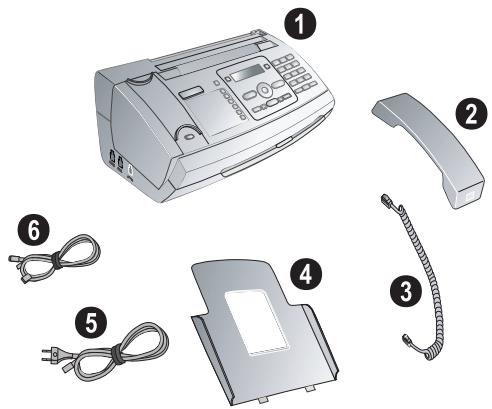

If one of the parts is missing or damaged, please contact your retailer or our customer service.
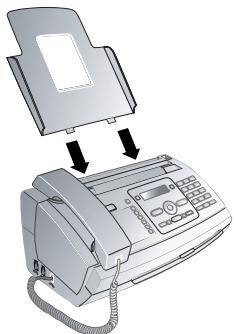
Attaching the Paper Tray
Insert the paper tray into the openings behind the paper feed mechanism.
Inserting Paper
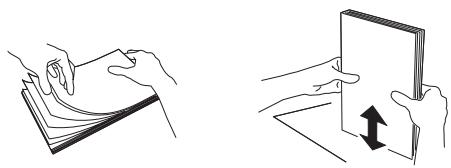
Before you can receive or copy documents, you must insert paper. Please use only suitable paper in the standard format A4 (210 × 297 millimetre · preferably 80 g/m²). Observe the information in the technical data.

Separate the paper sheets by fanning them out, then align them by tapping edge of the stack lightly against a flat surface. This will prevent several sheets of paper from being drawn in all at once.
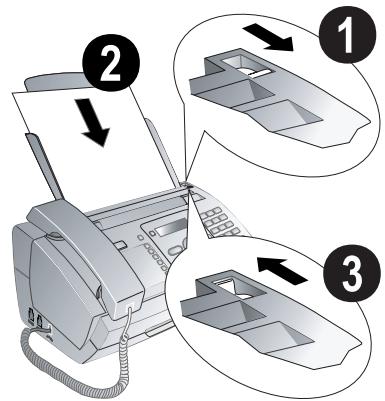
1 Fold open the lever on the right beside the paper feed towards front.
2 Insert paper in the paper feeder. You can insert maximum 50 sheets (A4 · 80 g/m2).
3 Fold open the lever on the right beside the paper feed backward in order to enclose the paper.
Connecting the Handset
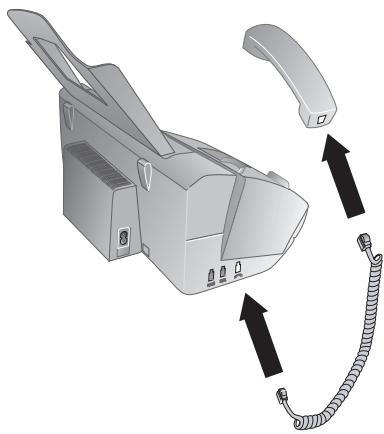
Plug one end of the spiral cable into the socket on the telephone handset. Insert the other end into the socket designated with the symbol.
Connecting the Telephone Cable
Connect the telephone cord to the device by inserting it in the socket designated with LINE (RJ-11-Connector). Insert the telephone plug into your telephone connection socket.
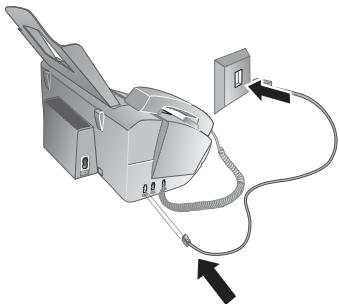

If you connect your device as extension to a telephone system, you must set it for working as an extension (also see Chapter "Telephone connections and additional devices, page 20).
Ireland
When connecting to the telephone line socket, use only a two-pin RJ-11-telephone cable (modular plug). The use of a four-pin cable may lead to the machine not functioning correctly.
Connecting the Power Cable

Check whether the power type of your machine (indicated on the type plate) matches the power type available at the setup location.
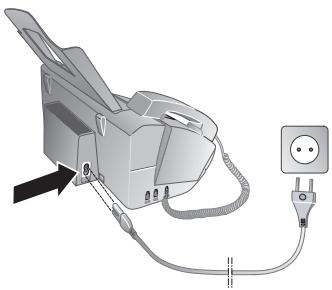
Insert the power cable into the connection located on the rear side of the machine. Connect the power cable to the electrical socket.
Initial Installation
After you connect your device to the mains, the initial installation commences. Press [1]. Your device prints a help page.
Selecting the Language
Use / to select the desired display language.
2 Confirm with OK.
Selecting the Country
Always set the country in which you are operating the machine. Otherwise, your machine is not adapted to the telephone network. If your country is not included in the list, you must select a different setting and use the correct telephone cable for the country. Consult your retailer.
Use / to select the country in which you are operating the machine.
2 Confirm with OK.
After this input, the machine prints another help page and checks the telephone line.
Entering Your Number
Your name and number are added together with date, time and page number at the top edge of each fax transmission (= header).
Enter your number. Using or you can enter a plus sign.
2 Confirm using OK.
Entering Your Name
Enter your name. Letters are entered with the number buttons (see labels). Enter special characters with 0. Press the respective button repeatedly until the desired letter or special character appears on the display.

You can move the cursor with / . You can delete individual characters with C.
2 Confirm with OK.
After the input, the machine prints an overview of the functions.
Entering the Time and Date
Enter the time, for example ①④ ⑩⑩ for 2 o'clock p.m.
2 Enter the date (two digits for each field), for example ① 8 ① 6 ① 7 for June 8th, 2007.
3 Confirm with OK.

You can restart the initial installation process any time. Press 1 and 2.
Overview
Overview of the Menu Functions
The following functions are available on your device. There are two ways in which you can call functions:
Navigating in the menu: Press OK or one of the two arrow keys to open the function menu. Page through menu entries. Use OK to select a function. Press C to return to the previous menu level. Press STOP to close the menu and return to the starting mode.
Calling functions directly: You can call a menu function directly using the function number. Press OK and enter the appropriate function number using the numeric keypad. Confirm using OK. You will find the function number in the following list.
Press 1 and 6 to print a list of all functions and settings of your device.
I Telephone Book
①① Looking up an entry... page 10
①② New entry.. page 10
①③ Creating groups... page 11
①④ Short dialling....page 11
①⑤ Modifying an entry... page 11
①⑥ 删除 entries ..... page 11
①⑦ Printing entries.. page 18
2 Calls
② 1 Received calls.. page 10
②② Outgoing calls.. page 10
②③ Printing entries.. page 18
3 Fax
③ 1 Polled reception.. page 14
③② Polling send.... page 14
③③ Transmission with delay.. page 14
③ 4 Sending to multiple recipients (= broadcast) page 13
③⑤ Fax journal.. page 19
③⑥ Transmission report.... page 19
③⑦ Print reduced in size ..... page 17
③⑧ Transmission speed.... page 17
4 Miscellaneous
④① Call log.... page 18
④③ Fax templates....page 14
④④ Contrast page 17
④⑤ Service code.. page 25
④⑥ Ink film stock... page 23
④ 7 Firmware version.. page 19
④ 8 Sutoko.. page 16
5 Fax Switch
⑤ 1 Day... page 18
⑤ 2 Night.. page 18
⑤③ Timer page 18
⑤ 4 Easylink.. page 21
⑤⑤ Ringer Tone.. page 18
9 Settings
⑨① Time/Date... page 17
⑨ ② Language selection. page 17
⑨ 3 Country selection.. page 17
94 Your Number. page 17
⑨⑤ Your name.. page 17
9 ⑥ Connection type page 20
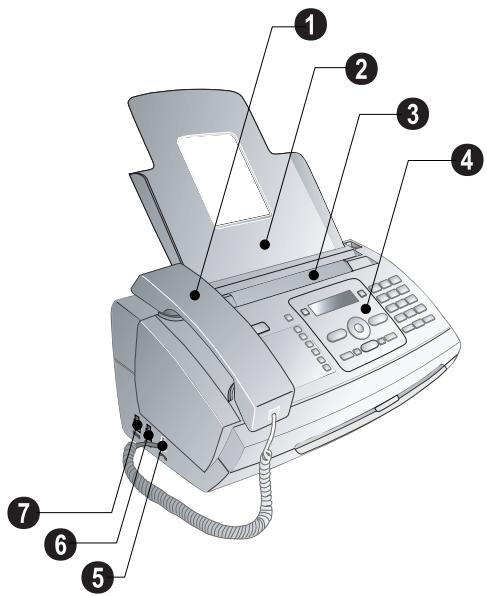
Machine Overview
1 Handset
2 Paper tray
3 Document feeder (printed part up)
Panel with display
Telephone handset socket - connection socket for the telephone handset
6EXT-Socket - connection socket for additional devices
LINE-Socket - connection socket for telephone cord
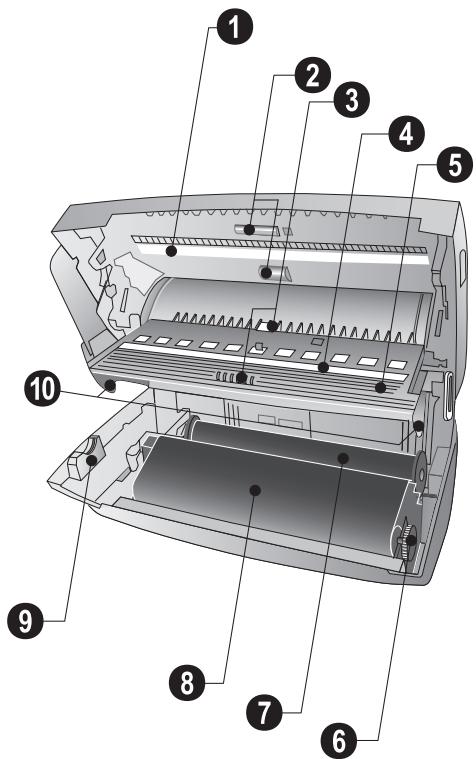
1 Scanner
Rollers of the automatic document feeder
Rests of the intake rollers
Document guide / scanner film
Cover for scanner and automatic document feeder
6 Toothed wheel for tightening the ink film
7 Ink film roll in the rear ink film compartment
3 Ink film roll in the front ink film compartment
Slot for the Plug'n'Print card
Locks for the cover of the scanner and automatic document feeder
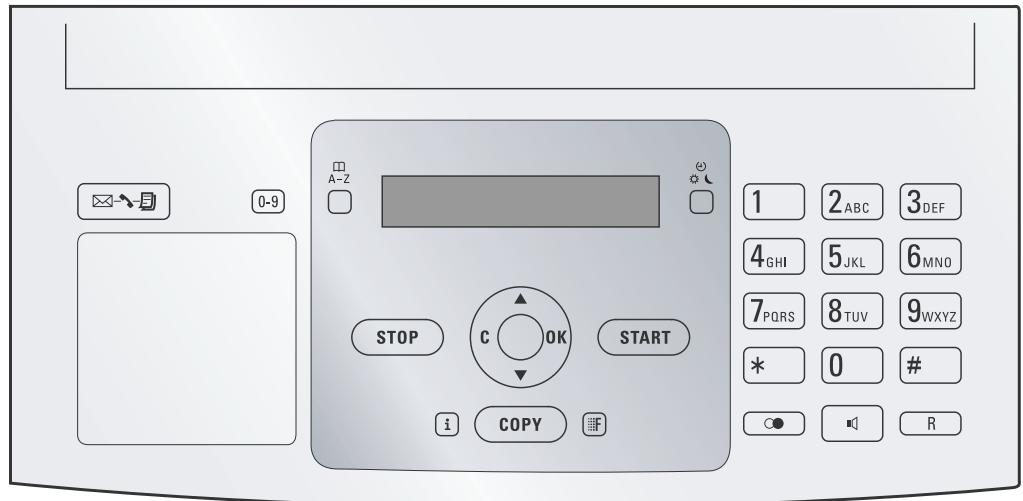
Panel
Lights up, if new messages are received / list of the new messages with submenus / blinks in the case of device error (for example no ink film)
0-9 Press briefly: Recalling short dial numbers. Selecting the entries with the / or numeric keys / press and hold:Assigning short dial entry
A-Z—Press briefly: Calling up the telephone book entries. Selecting the entries with the / / press and hold: saving new entries
/ 其 / 其 Setting the timer and the fax reception modes (=) fax switch). Modes set on the display (day), (night). Activated timer also with
STOP—Function abort / return to the output mode / documents eject
C—Return to the previous menu level / press briefly: deleting individual characters / press and hold: deleting complete input
/ -Calling the menu functions / navigation within the menu / selecting options / moving the cursor / adjusting the volume level
OK—Calling the menu functions/ confirming input
START—Press briefly: Starting transmission of messages / press and hold: Starting fax polling
Press briefly: Printing help pages and setting lists / press and hold: Starting initial installation process
COPY—Press briefly: creating a copy / press and hold: creating multiple copies
设置 higher resolution for faxes and copying (RESOL.: STANDARD, RESOL.: FINE, RESOL.: PHOTO)
Numeric keypad—Inputting digits, characters and special characters / press and hold: Recalling short dial numbers
Press briefly: List of the last ten numbers dialled (= redalling list) / press and hold: List of last ten callers ( caller list)
Dialling with the handset replaced
R—Switching between calls (= call hold) / inserting dialling pause / outside line access code
General Safety Information
Your machine has been tested in conformity with standards EN 60950-1 and IEC 60950-1 and should only be operated with telephone networks and power systems that meet these standards. The machine was built exclusively for use in the indicated sales region.
Do not make any changes or settings that are not described in this user manual.
Setting Up the Machine
The machine should rest securely on a stabile, flat surface. If the machine should fall, it can be damaged or cause injury to people, especially small children. The distance between the machine and other devices or objects must be at least 15 centimetres; this also applies to the use of additional cordless telephones. Do not place the machine in the vicinity of radios or televisions. Position all cables in such a way that no one will stumble on them, thus avoiding possible injuries to persons or damage to the machine itself.
Lock the cover of the machine completely into place when opening the machine. You could be injured if the cover falls while you are working on the machine.
Protect the machine against direct sunlight, heat, large temperature fluctuations and moisture. Do not place the machine in the vicinity of heaters or air conditioners. Observe the information on temperature and humidity in the technical data.
The machine must have sufficient ventilation and may not be covered. Do not put your machine in closed cabinets or boxes. Do not place the machine on soft surfaces such as tablecloths or carpets and do not cover the ventilation slits. Otherwise, the machine can overheat and catch on fire.
In the event that the machine becomes too hot, or if you see smoke coming from the device, you must immediately pull the power cable out of the power socket. Have your machine examined by trained professionals at a technical service location. To prevent the spread of fire, open flames should be kept away from the machine.
Do not plug in the machine in moist rooms. Never touch the power plug, power connection or the telephone socket with wet hands.
Do not allow liquids to enter into the machine. Disconnect the machine from the power socket if liquids or foreign objects have entered the machine and have your machine examined by trained professionals at a technical service location.
Do not allow children to handle the machine without supervision. The packing materials should be kept out of the hands of children.
Caution, metallic objects may be retained if placed near or on the handset receiver.
Power Supply
Check whether the power type of your machine (indicated on the type plate) matches the power type available at the setup location. Use only the power and telephones cables supplied.
Set up your machine so that the power socket is easily accessible. The machine does not have an on/off button. In an emergency, disconnect your machine from the power supply by pulling the power plug.
Never touch the power or telephone cable if the insulation is damaged.
Disconnect your machine from the power and telephone networks during an electrical storm. If this is not possible, do not use the machine during an electrical storm.
Before cleaning the surface of your machine, disconnect it from the power and telephone networks. Never use liquid, gaseous or easily flammable cleansers (sprays, abrasives, polishes, alcohol).
Only clean the display with a dry, soft cloth. If the display breaks, a mildly corrosive liquid may escape. Avoid all contact with your skin and eyes.
In the event of a power failure, your machine will not function; saved data is retained.
Repairs
Should disruptions occur, follow the instructions on the display and on the error report.
Do not make any repairs to the machine yourself. Improper maintenance can result in injuries or damage to the machine. Only have your device repaired by an authorised service centre.
Do not remove the type plate from your machine; this would void the warranty.
Consumable Materials
Use only original consumable materials. These are available from a specialised retailer or through our order service. Other consumable materials could damage the machine or shorten its service life.
Dispose of old consumable materials according to the waste regulations of your country.
Table of Contents
Dear Customer, 2
About this User Manual 2
Installation Guide 3
Package Contents 3
Attaching the Paper Tray 3
Inserting Paper 3
Connecting the Handset 3
Connecting the Telephone Cable 4
Connecting the Power Cable 4
Initial Installation 4
Overview 5
Overview of the Menu Functions 5
Machine Overview 6
Panel 7
General Safety Information. 8
Telephone Functions. 10
Making Telephone Calls on the Machine 10
Chain Dialling 10
Inserting a Dialling Pause 10
Telephone Book of the Machine 10
Groups 11
Short Dial 11
Caller Line Identification Presentation (CLIP) 12
Missed Calls 12
2 Fax. 13
Sending a Fax 13
Manually Sending a Fax 13
Broadcasting 13
Delayed Fax Transmission 14
Receiving Faxes 14
Polling Faxes 14
Using Fax Templates 14
3 Copier 15
Inserting Documents 15
Creating a Copy 15
Creating Multiple Copies 15
4 Fun and Games 16
Suduku 16
5 Settings 17
Entering the Time and Date 17
Selecting the Language 17
Selecting the Country 17
Entering Your Number 17
Entering Your Name 17
Setting the Contrast 17
Lowering the Transmission Speed 17
Switching Page Adjustment On and Off 17
Setting Ring Tones 18
Configuring the Fax Switch 18
Printing Lists and Help Pages 18
Starting the Initial Installation 19
Checking the Firmware Version 19
6 Telephone Lines and Additional
Devices 20
Configuring Telephone Lines and Services 20
Connecting Additional Devices 20
Using Additional Telephones (Easylink) 20
7 Service 22
Changing the ink film 22
Checking the Ink Film Reserve 23
Fixing a Paper Jam 23
Fixing a Document Jam 24
Cleaning 24
Using Service Codes 25
Power Cycling 25
8 Appendix 27
Technical Data 27
Guarantee 27
Declaration of Conformity (DoC) 28
Customer Information 32
Telephone Functions

Press 1 and ③ to print an overview of the telephone book functions.
How to connect additional telephones and what functions are available to you can be found in the section on telephone lines and additional devices, page 20.
Making Telephone Calls on the Machine
Dial the desired telephone number. There are multiple ways to do this. Then lift up the handset.

You can also lift up the receiver first, then dial a number. The dialling process starts immediately.
Manual dialling: Dial the desired telephone number with the number pad.
Telephone book:
Press A-Z

You can also load telephone book entries by pressing OK, ①① and OK.
2 Use / to select an entry. Enter the initial letters with the number buttons to navigate more quickly in the telephone book.

You can save an entry multiple times with the same name but in a different category. In the telephone book, the first letter of the category appears after the entry.
Short dial: Press 0-9. Select the desired entry with / or the number button.

You can also load short dial entries by holding the respective number button pressed (for at least two seconds).
Redial list: Press C. Use / to select an entry from the list of dialled numbers.

You can also load the radial list by pressing OK, ②② and OK.
Caller list: Hold pressed (for at least two seconds). Use the to select an entry from the list of callers.

You can also load the caller list by pressing OK, ②① and OK.

For this function to work, the caller line identification (CLIP) must be activated for your telephone connection (country and network dependent). The number and name will not be shown if the caller suppresses his number.
Chain Dialling
You can combine and edit manually entered digits and saved entries, before the dialling process starts. If you have saved, for example, the telephone number prefix of an inexpensive telephone service provider (call-by-call) as a telephone book entry, select this entry and manually enter the subsequent telephone number or select another saved entry.
Inserting a Dialling Pause
It can be necessary to insert a dialling pause into the telephone number, for instance for the outside line access code, for an extension or sub-address or in a long distance number. Press R. The second part of the number is only dialled once the connection with the main number has been established.
Telephone Book of the Machine
In the telephone book of your machine, you can save entries with multiple numbers and collect multiple entries into groups. You can assign various ring tones to the entries. Observe the information in the technical data.

You can move the cursor using / . Use C to delete individual digits. Press STOP to close the menu and to return to the starting mode.
Saving Entries

Press and hold A-Z (at least two seconds).
You can also load the function by pressing OK, ①② and OK.
2 Enter the name. You can enter characters using the numeric keys (see button labels) Press 0 to enter special characters. Press the respective key several times until the desired character or special character appears on the display.
3 Confirm using OK.
4 Using / , select the category for which you would like to enter a number: CATEGORY: HOME, CATEGORY: WORK, CATEGORY: MOBILE or CATEGORY: FAX.
5 Confirm using OK.
6 Enter the telephone number.
7 Confirm using OK.
8 You can assign a ring tone to the number. Using the numeric keys from ① to ⑨, select a ringer tone. Using ▲/you can set the volume.
9 Confirm using OK. The entry is saved.
Editing an Entry
Press OK, ①⑤ and OK.
2 Using select the entry which you would like to edit.
3 Confirm using OK
4 Edit the name.
5 Confirm using OK.
6 Using / select the number you would like to enter.
7 Confirm using OK.
8 Edit the number.
9 Confirm using OK.
10 You can assign a ring tone to the number. Using the numeric keys ① to ⑨ select a ring tone. Using ▲/▼, set the volume.
11 Confirm using OK
Deleting an Entry
Press OK, ①⑥ and OK.
2 Use / to select the entry you would like to delete.
3 Confirm with OK.
4 Confirm DELETE: YES with OK.
Groups
You can combine several telephone book entries into a group. A message is sent to all members of this group in succession.
Adding Group Entries
Press OK, ①③ and OK.
2 Use / to select the group you would like to create.
3 Confirm with OK. You can add entries to the group, display the members of the group, delete the group or send a fax to the group.
4 Use to select ADD MEMBER?
5 Use / to select the entry you would like to add to the group.
6 Confirm with OK.
7 Repeat steps 4 to 6 to add additional entries to the group.
8 Press STOP to end the input.
Displaying Group Entries
Press OK, ①③ and OK.
2 Use to select the group you would like to display.
3 Confirm with OK.
4 Use to select VIEW MEMBERS?
5 Confirm with OK.
6 Page through the entries of the group with
7 Press STOP twice to return to the starting mode.
Deleting Individual or All Group Entries
Deleting an Individual Entry
Press OK, ①③ and OK.
2 Using select the group from which you would like to delete entries.
3 Confirm with OK.
4 Select using DELETE MEMBER?
5 Confirm with OK.
6 Using select the entry which you would like to delete.
7 Confirm with OK.
8 Select using / DELETE: YES.
9 Confirm with OK. The entry is deleted.
Deleting a Group
Press OK, ①③ and OK.
2 Use / to select the group you would like to delete.
3 Confirm with OK.
4 Use to select DELETE MEMBER?
5 Confirm twice with OK.
6 Use / to select DELETE: ALL.
7 Confirm with OK. All entries in the group are deleted.
Short Dial
You can assign short dial numbers to frequently dialled telephone numbers. You can load these numbers quickly with the short dial button and the number buttons.
Assigning or Changing a Short Dial Entry
Hold 0 - 9 pressed (for at least two seconds).

You can also load the function by pressing OK, ①④ and OK.
2 Use / or the respective number button to select the short dial number you would like to assign or change.

If you select a short dial number that is already assigned, the entry is overwritten.
3 Confirm with OK.
4 Use / to select the telephone book entry you would like to assign as a short dial entry.
5 Confirm with OK.
Deleting a Short Dial Entry

This function not only deletes the short dial entry, it also deletes the entire entry from the telephone book. Overwrite the short dial entry if you would like to change the assignment.
Press 0-9.

You can also load the function by pressing OK, ①④ and OK.
2 Use / or the respective number button to select the entry you would like to delete.
3 Press C.
4 Confirm the deletion with OK.
Caller Line Identification Presentation (CLIP)
(country and network dependent)
The number of an incoming call appears on the display. For this function to work, the caller line identification (CLIP - Caller Line Identification Presentation) must be activated for your telephone connection. Enquire with your telephone company. Caller identification may be associated with a fee.

If the caller line identification does not work even though the function is activated for your telephone connection, check if you have set the correct country (also see Chapter "Settings", Page 17)
Missed Calls
If you received a call while away, the - button flashes.
Press
2 Using / , you can page through the list of missed calls.

If you have received additional messages, first select the missed calls using and confirm with OK.
3 To call back, pick up the handset.

Your machine displays the name with which you have saved the number in the telephone book. The number and name will not be shown if the caller suppresses his number.
2 Fax

Press 1 and 4 to print the instructions for sending faxes and for fax switch settings.

Do not insert any documents into the machine that ...
... are wet, have been edited with correction fluid, are soiled or have a coated surface.
... are written on with a soft pencil, with paint, chalk or charcoal.
... originate from newspapers or magazines (printing ink).
... are held together with office or notebook staples or with tape or glue.
... are pasted with note papers.
... are creased, crumpled or torn.
Use documents with sizes A5 or A4 with 60 to 100g / m^2 weight. You can insert up to 10 documents at a time.
Press STOP to eject the documents without sending them.
Sending a Fax
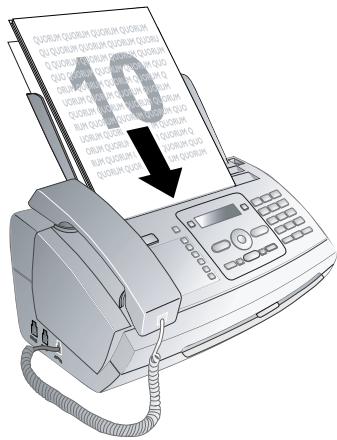
Insert the documents face up into the document feeder. The top most document will be fed in first.
2 Then configure the desired resolution. You can choose between RESOL.: STANDARD (for documents without special features), RESOL.: FINE (for texts with small print or drawings) and RESOL.: PHOTO (for photos). Press I . The configured resolution appears on the display. Press 工 again to change the resolution.

You can adjust the default contrast (see also section Settings, page 17).
3 Dial the desired telephone number. There are multiple ways to do this.
4 Press START.

If the subscriber is busy, the device dials the number again after some time. Press STOP, in order to cancel the transmission process. After the transmission, the machine prints out a transmission report depending on the settings.
Manual dialling: Dial the desired telephone number with the number pad.
Telephone book:
Press A-Z

You can also load telephone book entries by pressing OK, ①① and OK.
2 Use / to select an entry. Enter the initial letters with the number buttons to navigate more quickly in the telephone book.

You can save an entry multiple times with the same name but in a different category. In the telephone book, the first letter of the category appears after the entry.
Short dial: Press 0-9. Select the desired entry with or the number button.

You can also load short dial entries by holding the respective number button pressed (for at least two seconds).
Redial list: Press C. Use to select an entry from the list of dialled numbers.

You can also load the radial list by pressing OK, ②② and OK.
Caller list: Hold pressed (for at least two seconds). Use the to select an entry from the list of callers.

You can also load the caller list by pressing OK, ②① and OK.

For this function to work, the caller line identification (CLIP) must be activated for your telephone connection (country and network dependent). The number and name will not be shown if the caller suppresses his number.
Manually Sending a Fax
Insert the document.
2 Press.
3 Enter the desired telephone number with the number pad or select a saved entry.
4 Press START.
Broadcasting
You can send one fax to multiple recipients in succession.
Entering Recipients Individually
Insert the document.
2 Press OK, ③④ and OK. The document is scanned.
3 Enter the desired telephone number with the number pad or select a saved entry.
4 Confirm with OK.
5 Enter the additional telephone numbers.
6 Confirm with OK. You can enter up to 25 recipients.
7 Press START. The machine sends the fax message to all recipients in succession.
Sending a Fax to a Group
Insert the document.
2 Press OK, ①③ and OK.
3 Use / to select the group to which you would like to send a fax.
4 Confirm with OK.
5 Use to select SEND FAX?
6 Confirm with OK.

If your machine cannot reach a recipient, the fax message is sent to the other recipients. After the machine has called all recipients, it once again dials the numbers that previously could not be reached.
Delayed Fax Transmission
If you would like to make use of the lower telephone tariffs or if the recipient can be reached at some specific time only, you can send the fax at a later time - within 24 hours.
Insert the document.
2 Press OK, ③③ and OK.
3 Enter the time, at which the document should be transmitted, e.g. ①④ ⑩ ⑩ for 2 pm.
4 Confirm using OK.
5 Enter the desired telephone number with the number pad or select a saved entry.
6 Selecting a saved entry: Confirm the selected entry using OK.
7 Press START. The device goes into standby mode and transmits the fax at the entered time. You can continue to place calls and receive faxes.
Press STOP to eject the document. This interrupts the standby mode.
Receiving Faxes
If you have not changed the factory settings, received faxes will be printed out immediately. If no paper or no ink film is inserted, the machine saves the incoming faxes. The button blinks. Once paper or a new ink film is inserted, the saved faxes are printed out.

Check whether you have inserted and clamped in the paper correctly. The lever on the right next to the paper feed mechanism must be pushed back.
If the message memory is full, no additional messages can be received. A warning appears on the display. Observe the information in the technical data.

If there are problems with printing out saved fax messages, a service code is available (see also section Service, page 25).
Polling Faxes
With the fax polling function, you can retrieve faxes that lie ready in the dialled fax machine. You can also provide documents on your machine to be polled by others.
Polling Faxes Directly
Enter the desired telephone number with the number pad or select a saved entry.

If you would like to poll fax messages from an extension number or a sub-address, add this after the telephone number. After entry, press the number R then enter the extension number or sub-address. The second part of the number is only dialled once the connection with the main number has been established.
2 Hold START pressed (for at least two seconds).
Polling Secure Faxes
With this function, you can poll faxes that are protected with a code.
Press OK, ③① and OK.
2 Enter the code.
3 Confirm with OK.
4 Enter the desired telephone number with the number pad or select a saved entry.
5 Press START.
Sending Faxes via Polling

Protect your document against unauthorised access with a code.
A caller who knows the code can poll the fax from your machine. You can continue to make telephone calls and receive faxes.
Insert the document.
2 Press OK, ③② and OK.
3 Enter a code (max. 20 characters).
4 Confirm with OK.
Press STOP to eject the document. This interrupts the standby mode.
Using Fax Templates
Five fax templates, which you can use, are stored in your device. With these templates you can quickly create, for example, a short fax note or an invitation.
Press OK, ④③ and OK.
2 Using / select the template you would like to print.
3 Confirm using OK. The device prints the template.
4 Fill the template and send it to the desired recipient per fax.
3 Copier

Press 1 and 5 to print help for copying.
Use documents with sizes A5 or A4 with 60 to 100g / m^2 weight. You can insert up to 10 documents at a time.
Inserting Documents
Insert the documents face up into the document feeder. The top most document will be fed in first.
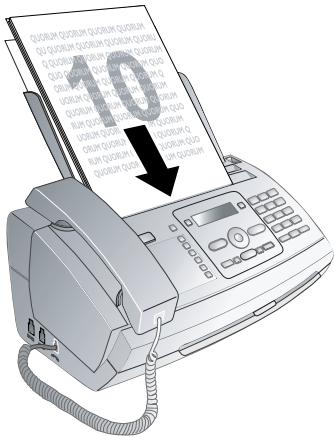
2 Then configure the desired resolution. You can choose between RESOL.: STANDARD (for documents without special features), RESOL.: FINE (for texts with small print or drawings) and RESOL.: PHOTO (for photos). Press. The configured resolution appears on the display. Press again to change the resolution.

You can adjust the default contrast (see also section Settings, page 17).
Creating a Copy
Press COPY briefly. The copy is created.
Creating Multiple Copies
Hold COPY pressed (for at least two seconds).
2 Enter the number of times you would like to copy the document (maximum of 15 copies).
3 Press COPY.
4 Use / to select whether the document should be magnified or reduced in size when copied. You can magnify up to 200 percent or reduce to as small as 50 percent of the original size.
5 Confirm with OK. The copy is created.
Press STOP to eject the documents without copying them.
4 Fun and Games

Press 1 and ⑦ to print the instructions for the Games and Fun functions of your device.
Sudoku
Sudoku is a Japanese number puzzle. The game has 3 × 3 squares divided into 3 × 3 fields. Depending on the difficulty level, lesser or more digits are already given at the beginning of the game. The aim of the game is to fill digits from 1 to 9 in the game field is such a way that each digit appears only once in a row, a column and each of the nine blocks. There is only one solution.

The solution of the last printed game is saved. The solutions of earlier games are no longer available.
Printing a Game
Press OK, ④⑧ and OK.
2 Dial using SUDOKU:NEW.
3 Confirm using OK.
4 Using / select the difficulty level.
5 Confirm using OK.
6 Enter, how many copies of the Selenium you would like to print (maximum 9 copies).
7 Confirm using OK.
8 Using / select if you would like to print the solution.
9 Confirm using OK.
Printing the Last Game Again
Press OK, ④⑧ and OK.
2 Dial using SUDOKU: LAST.
3 Confirm using OK.
4 Enter, how many copies of the Selenium you would like to print (maximum 9 copies).
5 Confirm using OK.
6 Using / select if you would like to print the solution.
7 Confirm using OK.
Printing the Solution
Press OK, ④⑧ and OK.
2 Dial using / SUDOKU: SOLUTION.
3 Confirm using OK.
Sudoku for Every Day
You can have a new Selenium automatically printed each day.
Press OK, ④⑧ and OK.
2 Dial using / SUDOKU: AUTO.
3 Confirm using OK.
4 Enter the time, e.g. ①④ ⑩⑩ for 2 pm.
5 Confirm using OK.
6 Using / select the difficulty level.
7 Confirm using OK.
8 Enter, how many copies of the Selenium you would like to print (maximum 9 copies).
9 Confirm using OK.
10 Using / select if you would like to print the solution.
11 Confirm using OK.
12 Using / indicate whether you would like to turn printing on or off.
13 Confirm using OK.
5 Settings

You can move the cursor using Use C to delete individual digits. Press STOP to close the menu and to return to the starting mode.
Entering the Time and Date
Press OK, ⑨① and OK.
2 Enter the time, for example ①④ ⑩⑩ for 2 o'clock p.m.
3 Enter the date (two digits for each field), for example ①⑧ ①⑥ ①⑦ for June 8th, 2007.
4 Confirm with OK.

You must check the time and date after a short power failure. Confirm using OK.
Selecting the Language
Press OK, ⑨② and OK.
2 Use to select the desired display language.
3 Confirm with OK.
Selecting the Country
Always set the country in which you are operating the machine. Otherwise, your machine is not adapted to the telephone network. If your country is not included in the list, you must select a different setting and use the correct telephone cable for the country. Consult your retailer.
When you select a new country, all settings are reset to the factory defaults for that country. Saved data is retained. Check the number entered for the header.
Press OK, ⑨③ and OK.
2 Use to select the country in which you are operating the machine.
3 Confirm with OK.
4 Use to select SURE: YES.
5 Confirm with OK.
Entering Your Number
Your number and name are printed in the top margin of every page (= header) together with the date, time and page number.
Press OK, ⑨④ and OK.
2 Enter your telephone number. You can enter a plus sign with # or * .
3 Confirm with OK.
Entering Your Name
Press OK, ⑨⑤ and OK.
2 Enter your name. You can enter characters using the numeric keys (see button labels) Enter special characters using ① .Press the respective key several times until the desired character or special character appears on the display.
3 Confirm using OK.
Setting the Contrast
For copying and printing of fax messages, you can select different contrast levels.
Press OK, ④④ and OK.
2 Using / , select the desired contrast.
CONTR.:LIGHT-For brighter copies and fax transmission
CONTR. NEUTRAL - For all types of originals (for example white text on black background or documents with coloured background)
CONTR.:OPTIMISED (Factory settings) - Optimized adaptation for text and photo printing
CONTR.:DARK-For darker copies and fax transmission (for example documents with faint printing)
3 Confirm using OK.

The changed settings are stored as new default settings. If you select a special function for a one-time process, take care to restore the default settings or factory settings after that.
Lowering the Transmission Speed
The machine adapts the transmission speed to the line quality. This may take some time, especially for overseas connections. Set a lower transmission speed if you are sending faxes into networks with poor line quality.
Press OK, ③⑧ and OK.
2 Use / to set whether you would like to use a lower transmission speed.
3 Confirm with OK.
Switching Page Adjustment On and Off
In order that no information is lost, received faxes are reduced in size when printed.
Press OK, ③⑦ and OK.
2 Use / to select whether you would like to switch size reduction on or off.
3 Confirm with OK.
Setting Ring Tones
Selecting the Ring Tone
You can select from among ten different ring tones.
Press OK, ⑤⑤ and OK.
2 Use the number buttons ① to ⑨ to select a ring tone. Use ▲/▼ to adjust the volume.
3 Confirm with OK.
Setting the Volume
You can adjust the volume of the ring tone when the device is ringing or when you set the ring tone. You can save different volumes for the ※ (day) and ¶ (night) modes, (also see Chapter Fax Switch).
Using you can set adjust the volume when the device is ringing.
Configuring the Fax Switch
The built-in fax switch of your machine distinguishes between fax messages and telephone calls. Faxes are automatically received, telephone calls can be received—even on additionally connected devices. While the machine is checking the call, it continues to ring.
You can set how often the machine should ring before picking up separately for the modes 水 day and (night). This makes it possible to receive faxes silently at night, so as not to disturb you.
Press 念 to switch between day and night mode. With the activated timer, the machine switches between the modes (day) and (night) at the configured times.
Configuring Day Mode
Press OK, ⑤① and OK.
2 Use / to select the total number of rings. After this number of rings, the machine stops playing rings and picks up a call or a silent fax transmission.
3 Confirm with OK.
4 Using / select the number of rings for the fax switch. After these many rings, the fax switch switches on and distinguishes between fax transmissions and telephone calls. While the device is checking the call, it continues to ring.
5 Confirm using OK.
6 Using / , set the volume.
7 Confirm using OK.
Configuring Night Mode
Press OK, ⑤② and OK.
2 Configure the same settings as for the day mode (see steps 2 to 7).
Setting the Timer
The timer switches between the modes (day) and C (night) at the configured times.
Press OK, ⑤③ and OK.
2 Enter the time at which the machine should switch to (day) mode, for example ①⑥ ①⑩ for 6 o'clock a.m.
3 Confirm with OK.
4 Enter the time at which the machine should switch to (night) mode, for example ②②①① for 10 o'clock p.m.
5 Confirm with OK.
Special Settings
Silent Fax Reception
If you would like to accept a fax without preceding rings, set the number of rings of the fax switch to 0.
Switching Off All Rings
If you don't want to be disturbed, e.g. in the night, by any incoming calls, you can set the number of rings to . The device switches immediately to silent fax reception.
Manually Receiving Faxes
Select manual reception under number of rings of the fax switch. The device will not receive faxes on its own. You can start fax reception manually, by pressing START. This setting is useful, when you want to receive faxes via a modem connected to a computer.
Printing Lists and Help Pages
Printing Numbers and Entries
The list of numbers and entries contains the last ten calls received and numbers dialled as well as the saved entries and groups.
Press OK, ②③ and OK. The list is printed.
Printing the Call List
The call list contains the last 50 numbers dialled.
Press OK, ④① and OK.
2 Use / to select whether you would like to switch the printing on or off.
3 Confirm with OK.
4 Switch on printing: Use / to select whether the call list should be printed immediately or after every 50 calls.
5 Confirm with OK.
Printing the Telephone Book
Press OK, ①⑦ and OK. The machine prints a list with the telephone book entries and saved assignments.
Printing the Fax Journal
The fax journal is a list of the last ten faxes sent and received.
Press OK, ③⑤ and OK.
2 Use / to select whether you would like to switch the printing on or off.
3 Confirm with OK.
4 Switch on printing: Use / to select whether the fax journal should be printed immediately or after every ten transmissions.
5 Confirm with OK.
Printing a Transmission Report
After every transmission, the machine prints out a transmission report. If a transmission error occurs, an error report is printed out. You can switch off printing of the transmission report.
Press OK, ③⑥ and OK.
2 Use / to select whether you would like to switch the printing on or off.
3 Confirm with OK.
Printing Help Pages
Help I·Overview
Press 1 and 1 to print an overview of the help pages.
Help 3 · Telephone Book
Press 1 and 3 to print an overview of the telephone book.
Help 4 · Fax Transmission
Press 1 and 4 to print instructions for sending fax messages and for configuring the fax switch.
Help 5 · Copier
Press 1 and 5 to print the help for copying.
Help 6 · Function List
Press 1 and 6 to print a list of all functions and settings of your machine.
Help 7 · Games and Fun
Press 1 and ⑦ to print the instructions for the Games and Fun functions of your device.
Starting the Initial Installation
Press 1 and ②.
2 The machine prints out a help page and starts the initial installation process.
Checking the Firmware Version
Press OK, ④⑦ and OK.
2 The model designation and the configured country appear on the display.
3 Confirm with OK.
4 The information on the firmware version of the machine is displayed.
5 Confirm with OK.
6 Telephone Lines and Additional Devices
Configuring Telephone Lines and Services
Private Branch Exchanges
Private branch exchanges (PABX) are typical in many offices and private households. You must dial an outside line access code in order to establish a connection with the public telephone network (PSTN) from an extension.

An additional telephone connected to the machine on a telephone socket is not considered an extension.
Press OK, ⑨⑥ and OK.
2 In many countries, you can set either pulse dialling or tone dialling (DTMF tones). Use / to select the desired dialling method.

Only use pulse dialling if tone dialling is not yet activated for your telephone line.
3 Confirm with OK.
4 Use / to set whether you operate your machine on an extension.
5 Confirm with OK.
6 Configuring an extension: Enter the outside line access code with which you reach the public telephone network. This is usually ①.
7 When finished, the machine tests the telephone line. Confirm with OK.
8 Your machine checks whether it can establish a connection with the public telephone network. If it cannot establish the connection, you are once again asked for input.

In rare cases, the outside line access code may be a different number or a two-digit number. For older telephone systems, the outside line access code can be R (= Flash). Press R to enter this outside line access code. Should a connection to the public telephone network not be possible, contact the provider of your telephone system.
DSL Connection
In the event that you use a DSL modem: Connect the machine after the modem. For additional information, please consult the operating manual of your DSL system.
ISDN Connection
Details for ISDN connections can be found in the instructions provided with the terminal adapter or the dial-up router.
Voice Mailbox
You cannot simultaneously use the answering machine facility of your telephone service provider (= voice-mail box) and receive faxes on your devices. Get the mail-box function for your telephone connection deactivated or set the number of rings for the fax switch to lower than 5 on your device (also see Chapter Setting the Fax Switch, Page 18). When the fax switch accepts the call, the mail-box of the service provider does not step in. Enquire with your telephone company.
Connecting Additional Devices
You can operate additional devices on a telephone line, such as cordless telephones, answering machines, modems or charge counters.
Connection to the Machine
You can connect additional devices directly to your machine. Plug the telephone cable of the additional device into the EXT socket (RJ-11 connection) of your machine.
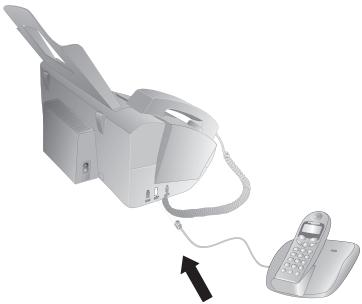

We recommend direct connection to the machine because this allows the fax switch to function optimally and to control the additional devices.
Connection to the Telephone Line
In order for the fax switch to function, the machine must be first in the series if multiple devices are connected to the same telephone socket. Follow the correct order.

If you have multiple telephone sockets for the same telephone line, the machine must be connected to the first telephone socket.
Using Additional Telephones (Easylink)
With the Easylink function, you can control your machine with additional telephones. To use this function, additional telephones must be set to tone dialling (DTMF tones); see here the user manual of your additional telephone.
Starting Fax Reception
If you pick up on an additional device and hear that you are receiving a fax message (whistle or silence), you can start the fax reception by pressing (串)5 on the additional telephone or the START button on the machine.
Taking Over the Line
If you pick up on an additional telephone and the machine continues to ring or attempts to receive a fax, you can disconnect the machine from the line. Press (串) on the additional telephone.
Changing Codes
Only change the codes if it is absolutely necessary. The codes must begin with 串 or # and must be different.
Press OK, ⑤④ and OK.
2 Enter the new code for starting fax reception.
3 Confirm with OK.
4 Enter the new code for taking over the line on an additional device.
5 Confirm with OK.
Using an External Answering Machine
For the best operation, the answering machine must be connected to the EXT socket of the device. The numbers of rings set for the external answering machine should be less than the one set under FAX RINGS by at least two.
Example of the setting:
Number of rings of the external answering machine ....1
FAX RINGS 3
TOTAL RINGS 5
(also see Chapter Setting the Fax Switch, Page 18)
The outgoing message should be shorter than ten seconds. Avoid music in the outgoing message.
If the external answering machine has a "conserving function" (i.e. a function that changes the number of rings as soon as new messages have been recorded), switch it off.
If the external answering machine records fax signals, but your device cannot receive faxes, inspect the connection of the external answering machine
7 Service

Should disruptions occur, follow the instructions on the display and on the error report.
Changing the ink film

Use only original consumable materials. These are available from a specialised retailer or through our order service. Other consumable materials can cause damage to the machine.

Follow the instructions on the packaging of the consumable materials.
For receiving or copying documents, an ink film must be inserted in your device. Your device is delivered with an already inserted free ink film for a few test pages. For this film, you do not require any Plug'n'Print card (= chip card with information regarding ink film capacity). For every next film that you insert, you must load the capacity memory with the included Plug'n'Print card.
1 Remove the paper from the paper feeder and take the paper tray out of the device.
2 Open the device by lifting the panel using grip in the centre and folding it down.
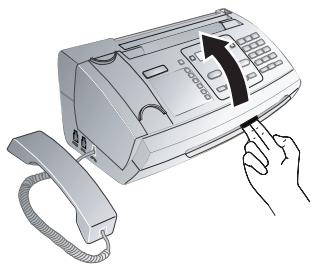

Lock the cover of the machine completely into place when opening the machine. You could be injured if the cover falls while you are working on the machine.
3 Grip the rear ink film roll at both the sides and place it next to the front ink film roll.
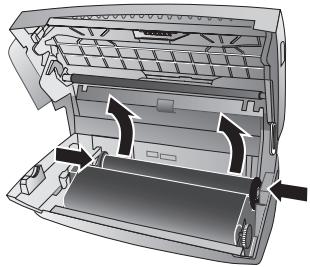
4 Remove both the rolls from the device. The used ink film cannot be reused.
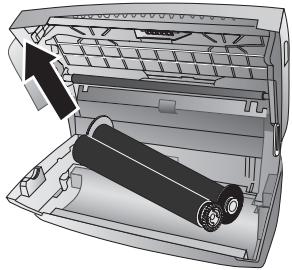
The messages and copies you have printed out can be read from used ink films. Consider data protection issues when disposing of used ink films.
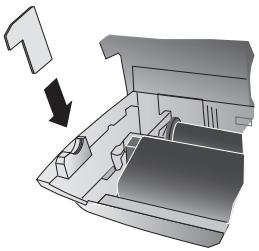
5 Pull the used Plug'n'Print card out of the plug socket on the left hand side next to the ink film tray. The Plug'n'Print card cannot be reused.
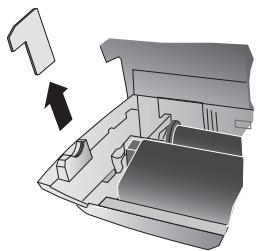
6 Carefully remove the rubber bands from the new ink film. Make sure that the film is not damaged!
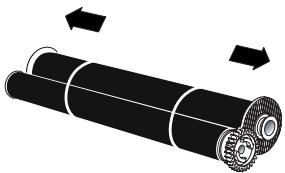
7 Place the larger roll with the ink film in the rear ink film tray. The blue gear wheel must be on the right hand side.
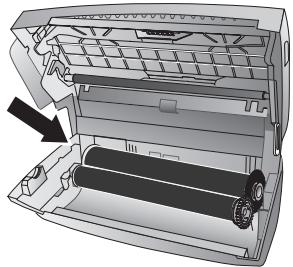
8 Place the smaller roll without film in the front tray. The blue gear wheel must be on the right hand side and the pin must be inserted in the depression on the left hand side.
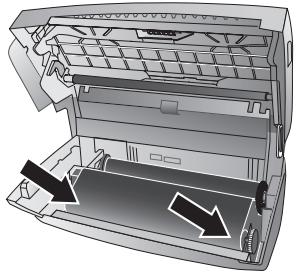
9 Break the chip card from the Plug'n'Print card. Insert the chip card in the plug socket on the left hand side next to the ink film tray.
10 Turn the blue gear wheel forward to tension the ink film. The ink film must not have any creases.
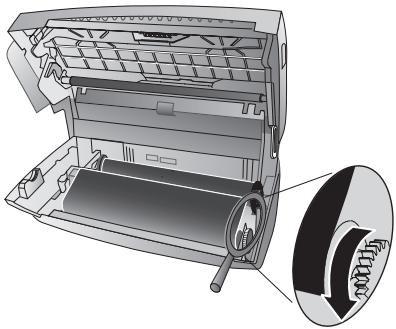
11 Close the device. Insert the paper tray in the opening provided for it behind the paper feeder. Insert paper again.
Checking the Ink Film Reserve
Press OK, ④⑥ and OK.
2 The number of pages that can still be printed with the ink film is shown on the display.
3 Press STOP to return to the starting mode.
If the ink film used up or if there is no ink film in the machine, a message appears on the display.
Fixing a Paper Jam
1 Remove the paper from the paper feeder and take the paper tray out of the device.
2 Open the device by lifting the panel using grip in the centre and folding it down.
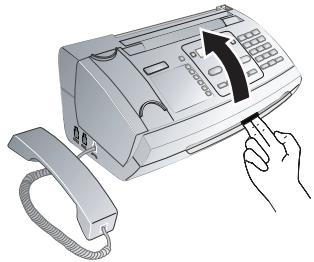
Lock the cover of the machine completely into place when opening the machine. You could be injured if the cover falls while you are working on the machine.
3 Carefully pull the paper out.
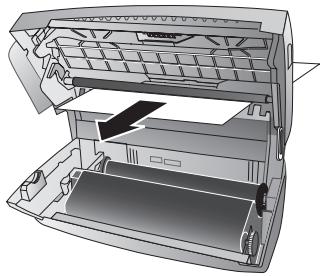
4 Turn the blue gear wheel forward to tension the ink film. The ink film must not have any creases.
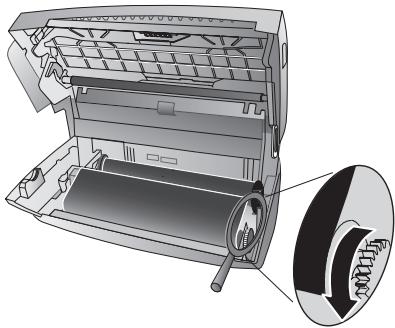
5 Close the device. Insert the paper tray in the opening provided for it behind the paper feeder. Insert paper again.
Fixing a Document Jam
1 Remove the paper from the paper feeder and take the paper tray out of the device.
2 Open the device by lifting the panel using grip in the centre and folding it down.

Lock the cover of the machine completely into place when opening the machine. You could be injured if the cover falls while you are working on the machine.
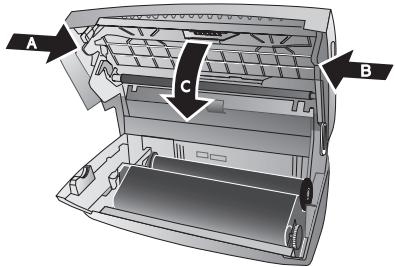
3 Open the scanner cover and the cover of the automatic document cover by first pushing the support (A) and then the support (B) inside. The cover (C) folds below.
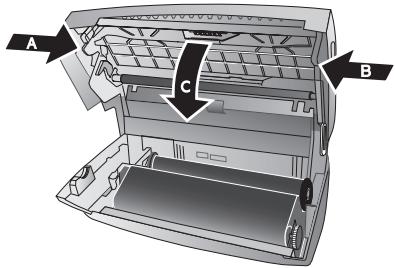
4 Carefully pull the document to the front or to the back out of the device.
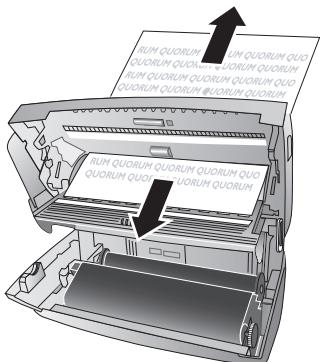
5 Close the scanner cover and the cover of the automatic document feeder. Both the supports must securely snap into place.
6 Turn the blue gear wheel forward to tension the ink film. The ink film must not have any creases.
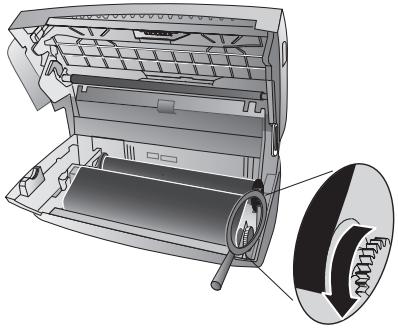
7 Close the device. Insert the paper tray in the opening provided for it behind the paper feeder. Insert paper again.
Cleaning
Unplug the machine from the power socket before cleaning it. Use a soft, lint-free cloth. Never use liquid or easily flammable cleansers (sprays, abrasives, polishes, alcohol, etc.). Do not allow any moisture to reach the interior of the machine.
Special fax cleaning sheets are available as accessories from our call centre. Insert a sheet into the document feeder. Press STOP; the page is ejected. Repeat this process at a few times.
1 Remove the paper from the paper feeder and take the paper tray out of the device.
2 Open the device by lifting the panel using grip in the centre and folding it down.
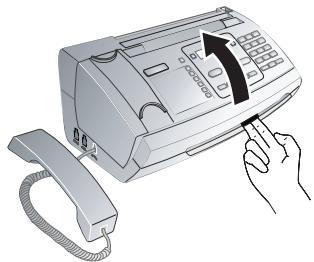
Lock the cover of the machine completely into place when opening the machine. You could be injured if the cover falls while you are working on the machine.
3 Open the scanner cover and the cover of the automatic document cover by first pushing the support (A) and then the support (B) inside. The cover (C) folds below.
4 Lightly wipe the upper side of the scanner glass (A) and the lower side of the document feeder/scanner film (= white plastic plate) (B) with a cloth.
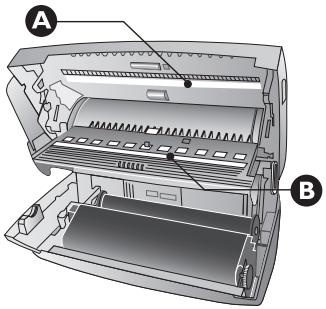
5 Clean the feed roller (A) and the underside of the support pad of the feeder roller (B) with a soft, lint-free cloth moistened with cleaning alcohol (96 percent). Rotate the feed roller; You must clean the entire roller.
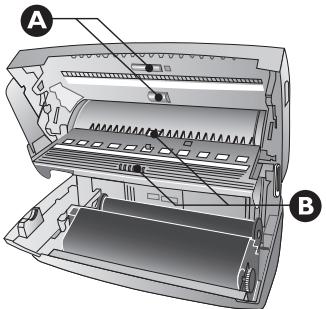
6 Close the scanner cover and the cover of the automatic document feeder. Both the supports must securely snap into place.
7 Turn the blue gear wheel forward to tension the ink film. The ink film must not have any creases.
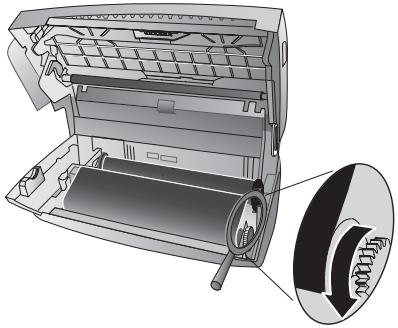
8 Close the device. Insert the paper tray in the opening provided for it behind the paper feeder. Insert paper again.
Using Service Codes
The service codes delete all the changed settings and your device is reset to factory settings. It may be possible that the device with the changed settings reacts differently than expected.
Only use the service code if this is absolutely necessary. Many service codes also delete saved messages and telephone book entries.
Press OK, ④⑤ and OK.
2 Enter a service code:
⑦①①⑦—Deletes all changed settings and saved data. The device is reset to factory settings and the initial installation process is started.
⑦①④⑩ -Deletes all changed settings. Saved data and telephone book entries remain intact.
⑦②②⑦ -Deletes saved faxes, when there are problems with printing.
3 Confirm using OK.
4 Dial using SURE: YES.
5 Confirm using OK.
If you have entered the incorrect code, you can cancel the entry with SURE: NO.
Power Cycling
If a problem occurs that cannot be corrected with the instructions in this user manual (see also the help below), follow the steps given here.
Pull out the power plug.
2 Wait at least ten seconds, then plug the power plug back into the socket.
3 If the error occurs again, please contact our technical customer service or your retailer. Follow the instructions on the display and on the error report.
| General information | |
| The time and date flash on the display. | You must check the time and date after a short power fail-ure. Confirm using OK. |
| Problems when faxing or printing | |
| Faxes sent are of poor quality. | Change the resolution from RESOL.: STANDARD to RESOL.: FINE or RESOL.: PHOTO. Change the contrast. Clean the scanner and the document feed slot. Test the device by making a copy of the document. If the device is in order, the fax machine of the recipient is defective. |
| The device produces black lines when sending or printing. | Clean the scanner and the document feed slot. |
| Copy is blank. | Insert the documents face up into the document feeder. |
| Printing is interrupted. | Paper or document jam, no paper or ink film. Follow the instructions on the display and in the error report. There could be a small pause after printing several pages. The device continues printing automatically. |
| No printing | Check if you have inserted clamped paper correctly. The lever on the right hand side next to the paper feeder must be folded backwards. |
| Documents are not properly fed. | Clean the scanner and the document feed slot. |
| Problems with the connection | |
| The device rings once, remains silent for a short while and starts ringing again. | This is absolutely normal. The fax switch checks the call after the first ring. If it is a voice call, the device continues to ring. |
| No dial tone | Check the installation of the device. Connect the telephone cable to the socket marked LINE. Insert the telephone plug into your telephone connection socket. |
| Fax transmissions are constantly interrupted. | Try to send the fax manually: Press ☑ and dial the number. If the recipient is using an answering machine, wait until you hear a whistling tone. Press START. It is possible that the recipient's machine is not ready to receive. |
| You hear a whistling tone or silence in the handset. | The call is a fax: Press START on the device In addition, press *⑤ on the telephone. Hang up. |
| No fax reception or a short fax audio signal as message on the answering machine | Using function 51, set the number of rings for the fax switch to 4 and the total number or the number of rings for the answering machine (model dependent) to 5 (see Page 18). You cannot simultaneously use the answering machine facility of your telephone service provider (= voice-mail box) and receive faxes on your devices (see page 20). |
8 Appendix
Technical Data
Dimensions (L× H× W) 313x129x197 mm
Weight 1,9kg
Power Supply 220-240V/50-60Hz
Power Consumption
Stand-by mode. < 1.5W
Transmission. < 20W
Recommended Ambient Temperature. 18-28°C
Relative humidity 20-80% (non-condensing)
Standards
Safety. EN60950-1
Emissions EN55022 Class B
Immunity to electrical noise . EN 55024
Scanner
Scan width. 212 mm
Horizontal resolution. 8 dots/mm
Vertical resolution Standard: 3,85 lines/mm
Fine: 7,70 lines/mm
Memory
Telephone book.. up to 50 entries
Fax messages.....up to 15 pages (standard test letter)
Telephone
Type of connection. .PSTN · PABX
Dialling mode. Tone / pulse dialling (country dependent)
Paper
Capacity 50 sheets
Size. A4 · 210× 297mm
Thickness .0,07-0,11 mm
Weight 60-90 g/m²
Document Feeder
Capacity 10 sheets
Breadth. 148-212 mm
Length. 100-600 mm
Thickness 0,06-0,15 mm
Fax
Type. Group 3
Compatibility. ITU-TT.30
Data compression. MH·MR
Modulation V.21 · V.27ter · V.29
Transmission speed. 9.600 bps
Technical specifications subject to change without notice.
Guarantee
(UK Terms and Conditions)
At the beginning of April 2002, SAGEM SA bought the PHILIPS fax business unit. SAGEM SA is now the European Number 1 in fax and offers a complete range of fax terminals with Internet access and SMS function, multifunctional terminals and servers covering the needs of all its customers—from home-users to multinational organisations.
In order to apply the guarantee, you should contact your dealer. Proof of purchase will be required. Should malfunctioning arise, the dealer will advise you what to do.
If you bought your equipment from SAGEM directly, the following shall apply:
A SAGEM undertakes to remedy by repair, free of charge for labour and replacement parts, any defects in the equipment during a period of twelve (12) months from the date of original delivery of the Equipment, where those defects are a result of faulty workmanship. During this twelve month guarantee period, the defective equipment will be repaired free of charge; the customer must however first contact the SAGEM After Sales Department, the phone number of which can be found on the delivery slip or in the user manual. Unless the customer has concluded with SAGEM a maintenance contract in respect of the equipment which specifically provides for repairs to be carried out at the customer's premises, the repairs will not be carried out on the equipment at the customer's premises. The following sentence applies to purchases of equipment for the customer's trade, business or profession. Except as otherwise expressly provided in this Document and to the extent permitted by law, SAGEM makes no representations or warranties, express or implied, statutory or otherwise, and to such extent, all terms and conditions implied by law are hereby excluded. This guarantee does not affect the Customer's statutory rights.
B Exclusions From Guarantee
SAGEM shall have no liability under the guarantee in respect of:
- damage, defects breakdown or malfunction due to:
- failure to properly follow the installation process and instructions for use; or
- an external cause to the equipment (including but not limited to, lightening, fire, shock or water damage of any nature); or
- modifications made without the written approval of SAGEM SA; or
- a failure or neglect to maintain the equipment or inappropriate maintenance; or
- unsuitable operating conditions, particularly of temperature and humidity; or
- repair or maintenance of the equipment by persons not authorised by SAGEM; or
- wear and tear from normal daily use of the equipment and its accessories
-
damage due to insufficient or bad packaging of equipment when returned to SAGEM
-
supply of new versions of software
- work on any equipment or software modified or added without the prior written consent of SAGEM
- malfunctions not resulting from the Equipment or from software installed in user workstations for the purpose of use of the equipment
-
communication problems related to an unsuitable environment, including:
-
problems related to access and/or connection to the Internet such as interruptions by access networks or malfunction of the line used by the subscriber or his correspondent
- transmission faults (for example poor geographical coverage by radio transmitters, interference or poor line quality)
- the local network fault (wiring, servers, workstations) or the failure of the transmission network
- the normal servicing (as defined in the user guide supplied with the equipment) as well as malfunctioning due to servicing not being carried out, servicing costs are in any event always borne by the customer.
C In the cases set forth in B as well as after expiry of the twelve month guarantee period, the customer must ask SAGEM for an estimate, and he/she must accept the estimate and agree to pay the charges mentioned in it before returning the equipment to SAGEM. The repair and delivery costs will be invoiced to the customer.
The foregoing shall apply unless otherwise agreed in writing with the customer and only for the UK. If any provision of this guarantee shall be held to be in whole or in part invalid or illegal due to an obligatory rule applicable to consumers pursuant to their national legislation, such invalidity or illegality shall not impair or affect the remaining provisions or parts of this guarantee.

The CE symbol confirms conformity with the EU directives that apply to the device.
Declaration of Conformity (DoC)
Hereby, Sagem Communication Austria GmbH declares that this PPF631, PPF632 is in compliance with the essential requirements and other relevant provisions of Directive 1999/5/EC.
You can find the complete Declaration of Conformity on our website www.sagem.com

As an Energy Star Program Participant, Sagem Communication Austria GmbH has determined that this product meets the Energy Star guidelines for energy efficiency.
Environment: Respect of environment is a key objective of Sagem. Sagem uses environmentally friendly processes to run its operations and has chosen to integrate strong environmental constraints in the full lifecycle of its products including manufacturing, product use and end of life.


Packaging: To facilitate packaging recycling, please conform to your local selective recycling rules.
Batteries: Old batteries have to be deposited in designated collection areas.

Product: The crossed out dustbin logo on your product signifies it is classified as Electrical and Electronic Equipment covered by special disposal regulations.
To enforce recycling, recovery of The Waste Electrical and Electronic Equipment (WEEE) and to protect the environment and human health, European regulations require that you selectively collect waste equipment using one of the following options:
- Your retailer will take your equipment back if you are buying a replacement product.
- Waste equipment can also be deposited in designated collection areas.
This user manual was printed on recycled paper bleached without chlorine. This satisfies the highest standards for low environmental impact. The cardboard packaging used and the packaging inserts of paper and cardboard can be disposed of as waste paper. The plastic foil may be submitted for recycling or disposed of with waste not intended for recycling, depending on the requirements in your country.
Trademarks: The references mentioned in this manual are trademarks of the respective companies. The lack of the symbols * and * does not justify the assumption that these dedicated terms are free trademarks. Other product names used herein are for identification purposes only and may be trademarks of their respective owners. Sagem disclaims any and all rights in those marks.
The reproduction of certain documents (e.g. by scanning, printing, copying) is prohibited in many countries. The list of such documents below is not intended to be complete, it only offers a general overview. In case of doubt, consult your legal advisor.
Passports (personal identification)
- Entrance and exit visa papers (immigration papers)
· Military service documents
Bank notes, travel checks, payment orders
- Postage stamps, tax stamps (stamped or unstamped)
- Loan papers, certificates of deposit, bonds
Documents protected by copyright
Follow the statutory regulations of your country with regard to the legal validity of fax transmissions - particularly in connection with the validity of signatures, meeting delivery deadlines or disadvantages resulting from the loss of quality in the transmission, etc.
Take care to maintain the statutory regulations of your country regarding telecommunications secrecy and data privacy.
This product is intended for use on an analogue public telecommunications network (PSTN) and in the country specified on the packaging. Use in other countries can result in faulty functioning.
For more information, please contact the technical service centre for your country. Should problems arise during use of your machine, please contact your retailer first.
Neither Sagem nor its affiliates shall be liable to the purchaser of this product or third parties for damages, losses, costs, or expenses incurred by the purchaser or third parties as a result of accident, misuse, or abuse of this product or unauthorized modifications, repairs, or alterations to this product, or failure to strictly comply with Sagem operating and maintenance instructions.
Sagem shall not be liable for any damages or problems arising from the use of any options or any consumable materials other than those designated as original Sagem products or Sagem approved products.
Sagem shall not be held liable for any damage resulting from electromagnetic interference that occurs from the use of any interface cables other than those designated as Sagem products.
All rights reserved. No part of this publication may be reproduced, stored in a retrieval system or transmitted in any form or by any means, electronic, mechanical, photocopying, recording, or otherwise, without the prior written permission of Sagem. The information contained herein is designed only for use with this product. Sagem is not responsible, if this information is applied to other devices.
This user manual is a document that does not represent a contract.
Errors, printing errors and changes are reserved.
Copyright © 2006 Sagem Communication Austria GmbH
Customer Information
We constantly strive to develop our products according to the highest quality standards and with the greatest possible user-friendliness.
In your user manual you will find all the information required to use your machine. If you nevertheless require assistance in addition to the user manual, our call centre is available. Our employees are trained experts who would be happy to answer your questions.
We can assist your more quickly if you do not call us from the machine, rather an external telephone. Keep a printout of the settings as well as the serial number of the machine handy. The serial number can be found on the type plate.
United Kingdom
Telephone: 08 71 - 075 07 11 (0,15 £/minute)
Fax: 0870-1240202
Use only PHILIPS accessories. The warranty does not cover damages to the machine resulting from the use of other consumable materials.
In United Kingdom, you can order PHILIPS accessories by telephone via our toll-free telephone number.
United Kingdom
Telephone: 08 00 - 358 08 07
E-mail: dti.faxinfoline@sagem.com
Internet: www.sagem.com
We hope that you will enjoy using your new product!
- About this User Manual
- Symbols Used
- Installation Guide
- Package Contents
- Attaching the Paper Tray
- Inserting Paper
- Connecting the Handset
- Connecting the Telephone Cable
- Ireland
- Connecting the Power Cable
- Initial Installation
- Selecting the Language
- Selecting the Country
- Entering Your Number
- Entering Your Name
- Entering the Time and Date
- Overview
- Overview of the Menu Functions
- I Telephone Book
- Calls
- Fax
- Miscellaneous
- Fax Switch
- Settings
- Machine Overview
- Panel
- General Safety Information
- Setting Up the Machine
- Power Supply
- Repairs
- Consumable Materials
- Table of Contents
- Installation Guide 3
- Overview 5
- General Safety Information. 8
- Telephone Functions. 10
- Fax. 13
- Copier 15
- Fun and Games 16
- Settings 17
- Telephone Lines and Additional
- Devices 20
- Service 22
- Appendix 27
- Telephone Functions
- Making Telephone Calls on the Machine
- Telephone book:
- Chain Dialling
- Inserting a Dialling Pause
- Telephone Book of the Machine
- Saving Entries
- Editing an Entry
- Deleting an Entry
- Groups
- Adding Group Entries
- Displaying Group Entries
- Deleting Individual or All Group Entries
- Deleting an Individual Entry
- Deleting a Group
- Short Dial
- Assigning or Changing a Short Dial Entry
- Deleting a Short Dial Entry
- Caller Line Identification Presentation (CLIP)
- (country and network dependent)
- Missed Calls
- Fax
- Sending a Fax
- Manually Sending a Fax
- Broadcasting
- Entering Recipients Individually
- Sending a Fax to a Group
- Delayed Fax Transmission
- Receiving Faxes
- Polling Faxes
- Polling Faxes Directly
- Polling Secure Faxes
- Sending Faxes via Polling
- Using Fax Templates
- Copier
- Inserting Documents
- Creating a Copy
- Creating Multiple Copies
- Fun and Games
- Sudoku
- Printing a Game
- Printing the Last Game Again
- Printing the Solution
- Sudoku for Every Day
- Settings
- Setting the Contrast
- Lowering the Transmission Speed
- Switching Page Adjustment On and Off
- Setting Ring Tones
- Selecting the Ring Tone
- Setting the Volume
- Configuring the Fax Switch
- Configuring Day Mode
- Configuring Night Mode
- Setting the Timer
- Special Settings
- Silent Fax Reception
- Switching Off All Rings
- Manually Receiving Faxes
- Printing Lists and Help Pages
- Printing Numbers and Entries
- Printing the Call List
- Printing the Telephone Book
- Printing the Fax Journal
- Printing a Transmission Report
- Printing Help Pages
- Help I·Overview
- Help 3 · Telephone Book
- Help 4 · Fax Transmission
- Help 5 · Copier
- Help 6 · Function List
- Help 7 · Games and Fun
- Starting the Initial Installation
- Checking the Firmware Version
- Telephone Lines and Additional Devices
- Configuring Telephone Lines and Services
- Private Branch Exchanges
- DSL Connection
- ISDN Connection
- Voice Mailbox
- Connecting Additional Devices
- Connection to the Machine
- Connection to the Telephone Line
- Using Additional Telephones (Easylink)
- Starting Fax Reception
- Taking Over the Line
- Changing Codes
- Using an External Answering Machine
- Service
- Changing the ink film
- Checking the Ink Film Reserve
- Fixing a Paper Jam
- Fixing a Document Jam
- Cleaning
- Using Service Codes
- Power Cycling
- Appendix
- Technical Data
- Standards
- Scanner
- Memory
- Telephone
- Paper
- Document Feeder
- Fax
- Technical specifications subject to change without notice.
- Guarantee
- (UK Terms and Conditions)
- B Exclusions From Guarantee
- Declaration of Conformity (DoC)
- Customer Information
- United Kingdom
Brand : SAGEM
Model : PHILIPS MAGIC 5 PRIMO
Category : Mobile Phone