
MF 4640 - Multifunction Printer SAGEM - Free user manual and instructions
Find the device manual for free MF 4640 SAGEM in PDF.


| Product type | Multifunction printer |
| Brand | SAGEM |
| Model | MF 4640 |
| Main functions | Printing, copying, scanning, faxing |
| Printing technology | Laser |
| Print resolution | Up to 1200 x 1200 dpi |
| Print speed | Up to 40 pages per minute |
| Supported paper sizes | A4, A5, A6, B5, Letter, Legal |
| Input tray capacity | 500 sheets |
| Duplex printing | Automatic |
| Color scanning | Yes |
| Connectivity | Ethernet, USB 2.0 |
| Dimensions (L x D x H) | 420 x 380 x 320 mm |
| Weight | 15 kg |
| Power supply | 230 V, 50/60 Hz |
| Power consumption (standby) | 10 W |
| Power consumption (printing) | 550 W |
| Noise level (printing) | 55 dB(A) |
| Maintenance and cleaning | Clean the drum and rollers with a soft, dry cloth. Use a recommended cleaning kit. |
| Safety | Child safety lock, automatic shutdown in case of overheating |
| Spare parts and repairability | Toner cartridges, drum, maintenance kit available. Repair by authorized technician. |
| General information | User manual available in French. SAGEM technical support. |
Frequently Asked Questions - MF 4640 SAGEM
User questions about MF 4640 SAGEM
0 question about this device. Answer the ones you know or ask your own.
Ask a new question about this device
Download the instructions for your Multifunction Printer in PDF format for free! Find your manual MF 4640 - SAGEM and take your electronic device back in hand. On this page are published all the documents necessary for the use of your device. MF 4640 by SAGEM.
USER MANUAL MF 4640 SAGEM
Congratulations for purchasing this SAGEM new generation communication terminal. Your Laser Fax Machine is the answer to all your most demanding professional needs.
This User's Manual presents the model in the range:
| Model | Equipment |
| FAX 4640 | 33.6 kbps fax. 16 ppm Black & White laser printer. |
It combines power, user-friendliness and simplicity thanks to its navigator, its multitask access and its direct access directory.
We recommend that you read this Manual carefully, in order to familiarise yourself with the various features and functions of your terminal.
List of accessories
The following additional accessories are proposed for the FAX 4640:
- Directory card.
- 500-page paper tray.
Consumables
To refer to the last page of this user manual for the references.
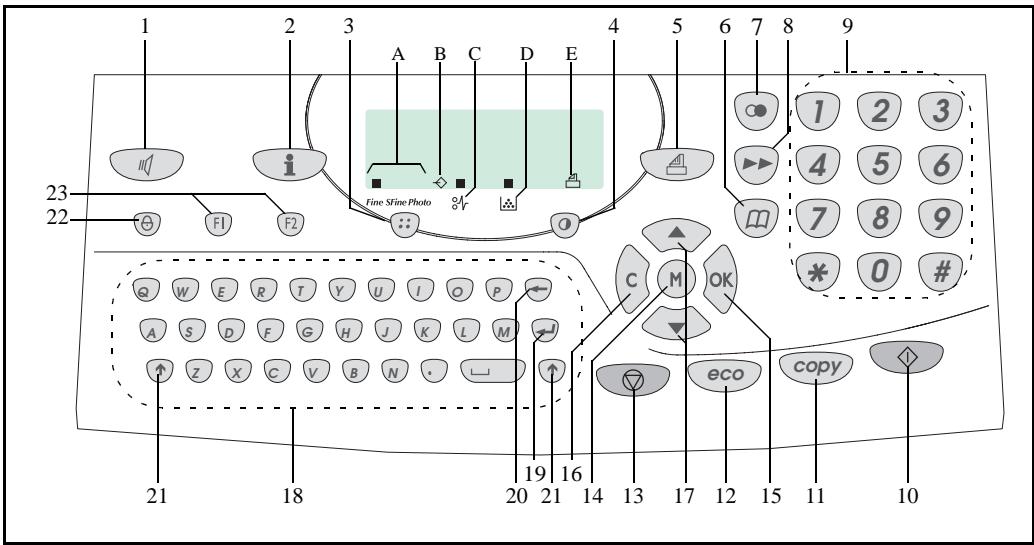
- key: manual line taking, tone monitoring during fax transmission.
- i key: print the functions list.
- key: scanning resolution during transmission or copy.
- key: contrast adjustment.
- key: printing a stored fax in the fax-TAD mode.
- key: access to directory and quick-dial numbers.
- key: access to the last dialled numbers.
- key: broadcast transmission (fax).
- Numerical keypad.
- key: fax transmission or black & white local copy.
11.copy key: local black-and-white copy.
12.eco key: selecting the eco mode. - key: stop current operation.
14.M key: access to the different functions (MENU). - OK key: confirm displayed selection.
16.C key: return to previous menu and correct data entry.
17. or keys: navigation keys.
18. Alphabetical keypad.
19. key: enter or go to next line.
20. key: erase character before cursor.
21. key: Shift key.
22. key: Caps lock key.
23.F1 and F2 keys: memorise a key combination.
A Scanning resolution during fax transmission (Fine, SFine, Photo).
B "Line" icon:
On: communication in progress,
Blinking: communication being established.
C 8r Printer Paper Jam indicator.
D "Toner"icon:
On: toner empty,
Blinking: toner near end, toner low.
E Fax reception icon:
- On: reception possible,
- Blinking: unprinted document(s) in memory or being received,
- Off: reception impossible.
CONTENTS
1 INSTALLATION 1-1
Installing your terminal 1-1
Installation requirements 1-1
Operational precautions 1-2
Unpacking the machine parts 1-4
Description 1-6
Installing the removable parts 1-7
Installing the printer paper tray 1-7
Installing the printer output stacker 1-8
Installing the document feeder for scanning 1-9
Installing the original document output stacker 1-9
Loading paper 1-10
Loading paper manually 1-11
Installing the second paper cassette unit (option) 1-12
Connections 1-14
Telephone connection 1-15
Power line connection and switch-on 1-15
2 GETTING STARTED 2-1
Navigation methods 2-1
Presentation 2-1
The navigator 2-1
The display screen 2-3
Access to functions 2-3
Menu-driven access 2-3
Direct access by number 2-4
Functions list 2-4
3 SETTING YOUR MACHINE 3-1
Main settings 3-1
Before transmission 3-1
Date/Time 3-1
Summer time / winter time setting 3-2
Your fax number/your name 3-2
Type of network 3-3
Geographical settings 3-3
Local prefix 3-4
Transmission report 3-4
Document feed type 3-5
Economy period 3-5
Before reception 3-5
Fax answering machine 3-5
Reception without paper 3-6
Number of copies 3-6
Relay broadcast 3-7
Technical parameters 3-7
4 Dlrcetory 4-1
Creating subscribers records 4-2
Adding a record 4-2
Creating subscribers lists 4-3
Adding a list 4-3
Adding or deleting a number from the list 4-4
Consulting a record or a list 4-4
Modifying a record or a list 4-5
Deleting a record or a list 4-5
Printing the directory 4-5
5 OPERATION 5-1
Sending 5-1
Document positioning 5-1
Scanner 5-1
Choosing the resolution/contrast 5-2
Resolution 5-2
Contrast 5-2
Dialling 5-2
From the directory 5-2
From the redial key 5-3
To multiple numbers 5-3
Transmission over the Public Switched Telephone Network (PSTN) 5-4
Immediate transmission 5-4
Sending in the eco mode 5-4
Delayed transmission 5-4
Transmission with auto radial 5-5
Rerouting 5-5
Txforwarding 5-6
Transmission waiting queue 5-7
Consult or modify the waiting queue 5-7
Immediately perform transmission from the waiting queue 5-7
Printing a document in waiting or in deposit 5-8
Print the waiting queue 5-8
Deleting a transmission on hold 5-8
Cancelling a transmission in progress 5-8
Reception 5-9
Reception over the Public Switched Telephone Network (PSTN) 5-9
Copying 5-9
Local copy 5-9
Standard copy 5-9
"Sophisticated" copy 5-9
Specificcopy settings 5-10
Scanner settings 5-10
Printer settings 5-12
Other functions 5-12
Logs 5-12
Printing the functions list 5-13
Printing the machine settings 5-13
Memorizing a sequence of keys 5-13
Counters 5-14
Deposit and polling 5-15
Locks 5-16
Entering the locking code 5-16
Locking the keyboard 5-16
Locking the numbers 5-17
Department code 5-17
Function management by the administrator 5-17
Activating the department code 5-17
Deactivating the department code 5-18
Setting the department codes 5-18
Creating a department code 5-19
Deleting a department code 5-19
Printing a department code 5-20
Printing the department report 5-20
Use of the department codes by a department 5-21
Charge code 5-22
Entering the charge code 5-22
Mail box (MBX FAX) 5-22
MBX management 5-23
Creating an MBX 5-23
Modifying the features of a MBX 5-23
Printing the contents of a MBX 5-24
Deleting a MBX 5-24
Printing the MBX list 5-24
MBX deposit in your fax 5-24
MBX deposit in a remote fax 5-24
MBX polling from a remote fax 5-25
6 MAINTENANCE 6-1
Maintenance 6-1
General 6-1
Replacing the consumables (toner and drum) 6-2
Replacing cartridges 6-2
Cleaning 6-15
Cleaning the printer 6-15
Servicing 6-17
Scanner calibration 6-17
Incidents 6-17
Communication errors 6-17
Transmission from the feeder 6-17
Transmission from memory 6-18
Communication error codes 6-18
Printer errors 6-20
Error messages 6-20
Printer paper jam 6-21
Paper jam at the feeders and trays 6-22
Scanner incidents 6-24
Scanner paper jam 6-24
Miscellaneous incidents 6-25
Machine packing and transportation 6-25
Characteristics 6-26
Unit characteristics 6-26
7 SAFETY AND ENVIRONMENT 7-1
Safety 7-1
Environment 7-2
The packaging 7-2
Batteries and rechargeable batteries 7-2
The product 7-2
Energy Star 7-2
The mark CE attests that the products comply with the essential requirements of Directive R&TTE 1999/5/EC.
For user safety, in accordance with Directives 73/23/EC.
For electromagnetic interference, in accordance with Directive 89/336/EC.
The manufacturer declares that the products are manufactured in accordance with ANNEX II of Directive R&TTE 1999/5/EC.
1 INSTALLATION

INSTALLING YOUR TERMINAL
INSTALLATION REQUIREMENTS
A proper location helps to ensure that your printer provides you with the long service life for which it is designed. Double-check to make sure that the location you select has the following characteristics:
-
Choose a location that is well ventilated.
-
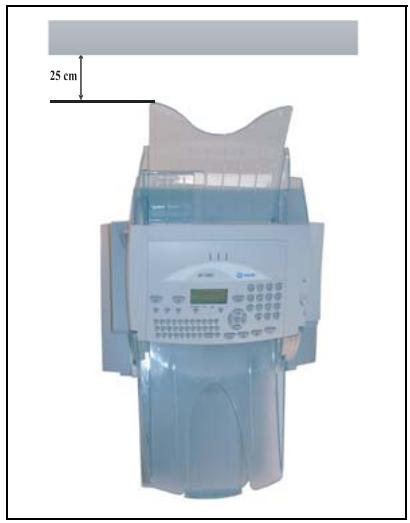
When installing the terminal close to a wall, make sure the distance between the wall and the upper edge of the stacker is at least 25 centimetres for easier opening of the upper cover.
- Make sure there is no chance of ammonia or other organic gasses being generated in the area.
- The grounded power outlet (refer to the safety instructions in the Safety and Environment Chapter) you plan to connect to for power should be nearby and not obstructed.
- Make sure that the printer is not exposed to direct sunlight.
- Avoid areas in the direct airflow of air conditioners, heaters, or ventilators and areas subject to temperature and humidity extremes.
- Choose a sturdy, level surface where the printer will not be exposed to strong vibration.
- Keep the printer away from any objects that might block its heat vents.
- Do not locate the printer near curtains or other combustible objects.
- Choose an area where there is no possibility of the printer being splashed with water or other liquids.
- Make sure that the surrounding area is clean, dry, and free of dust.
Operational precautions
Note the following important precautions whenever using the printer.
Operating environment
The following describes the operating environment required when using the printer:
- Temperature: 10^ to 35^ (50^ to 95^) with fluctuation of 10^ (18^) per hour.
- Humidity: 20% to 80% (no condensation) with fluctuation of 20% per hour.
Terminal
The following describes precautions for using the terminal:
- Never turn the terminal off or open any of its covers during a print operation.
- Never place flammable gasses, liquids or objects that generate magnetic forces near the terminal.
- When unplugging the power cord, always grasp the plug and never pull on the cord. A damaged cord creates the danger of fire or electrical shock.
- Never touch the power cord when your hands are wet. Doing so creates the danger of electrical shock.
- Always unplug the power cord before moving the terminal. Failure to do so can damage the power cord, creating the danger of fire or electrical shock.
- Always unplug the power cord if you do not plan to use the terminal for a long time.
- Never try to remove any secured panel or cover. The terminal contains high-voltage circuit which creates the danger of electrical shock when exposed.
- Never try to modify the terminal. Doing so creates the danger of fire or electrical shock.
- Never place any heavy objects on the power cord, pull on it or bend it. Doing so creates the danger of fire or electrical shock.
- Always make sure the terminal is not placed on the electrical cord or the communications cables of any other electrical equipment. Also make sure that cords and cables do not get into the terminal's mechanism. Any of these conditions create the danger of malfunction and fire.
- Always take care that paper clips, staples, or other small pieces of metal do not get into the terminal through its vents or other openings. Such objects create the danger of fire or electrical shock.
- Do not allow water or other liquids to spill on or near the terminal. Fire or electrical shock can occur should water or liquid come into contact with the terminal.
- Should liquid or any piece of metal accidentally get inside the printer, immediately turn it off, unplug the power cord, and contact your dealer. Failure to take this immediate action creates the danger of fire or electrical shock.
- Whenever the terminal emits unusually high amounts of heat, smoke, an unusual odor, or noise, immediately turn it off, unplug it, and contact your dealer. Failure to take this immediate action creates the danger of fire or electrical shock.
- Paper for printer: do not use paper previously printed by your terminal or any other printer; the ink or toner deposited on that paper might damage the printing system of your terminal.
Caution - Be sure to locate the terminal in a well-ventilated location. A minimal amount of ozone is generated during normal operation of this terminal. Because of this, an unpleasant odor may result when the printer is used for extensive printing in a poorly ventilated area. For a comfortable, healthy, and safe operation, be sure to locate the terminal in a well-ventilated area.
UNPACKING THE MACHINE PARTS
Remove the plastic bags and check for the parts depicted below.
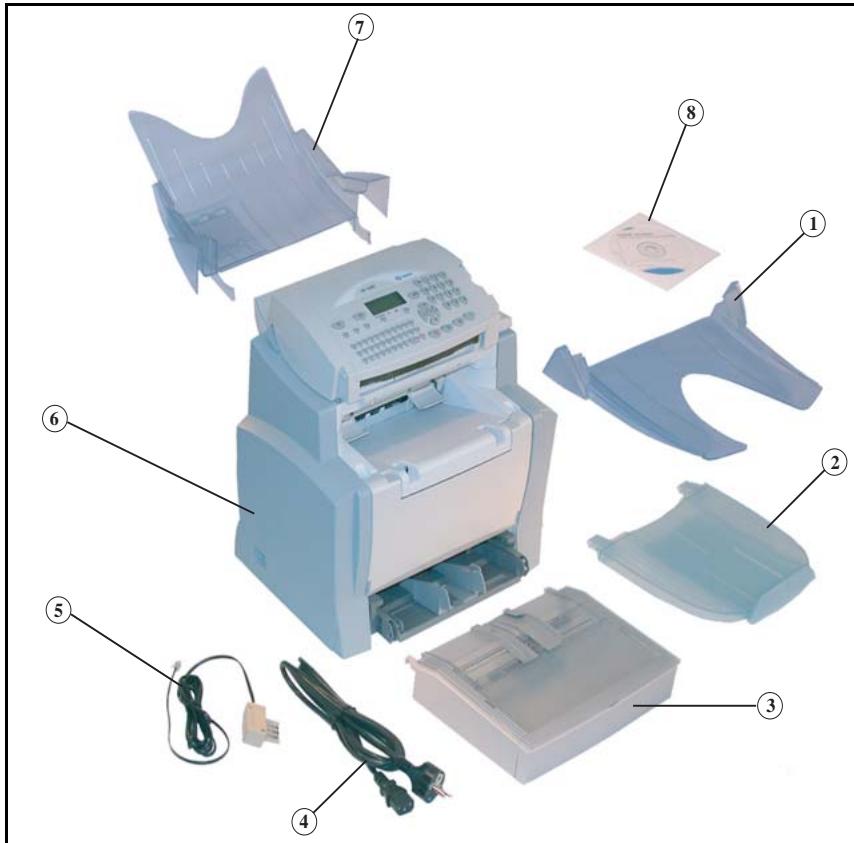
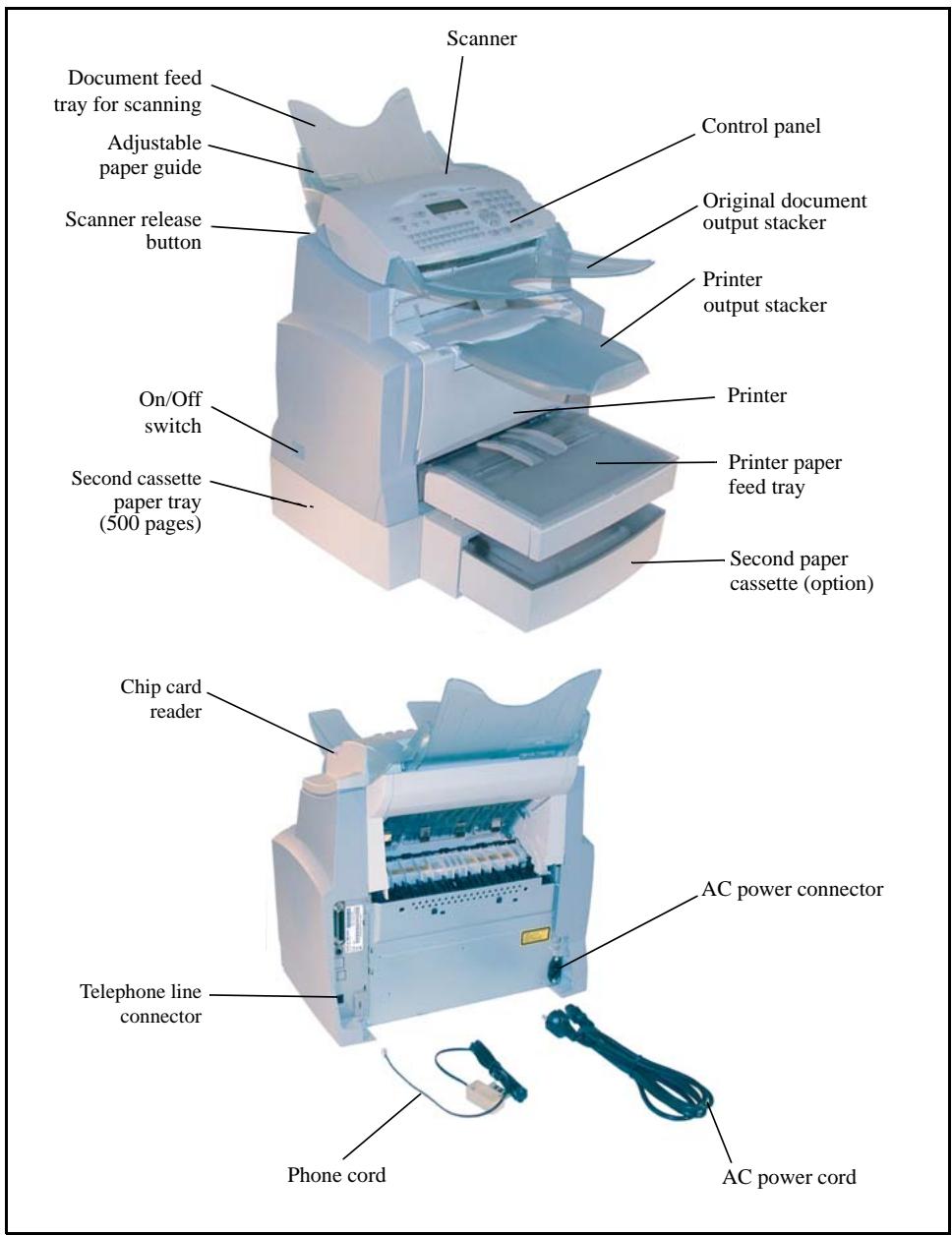
1: Scanner output stacker
2: Printer output stacker
3: Printer paper feed tray
4: AC power cord (model depending on country)
5: Telephone line cord (model depending on country)
6: Fax/printer terminal
7: Document feed tray for scanning
8: CD-ROM (User Manual)
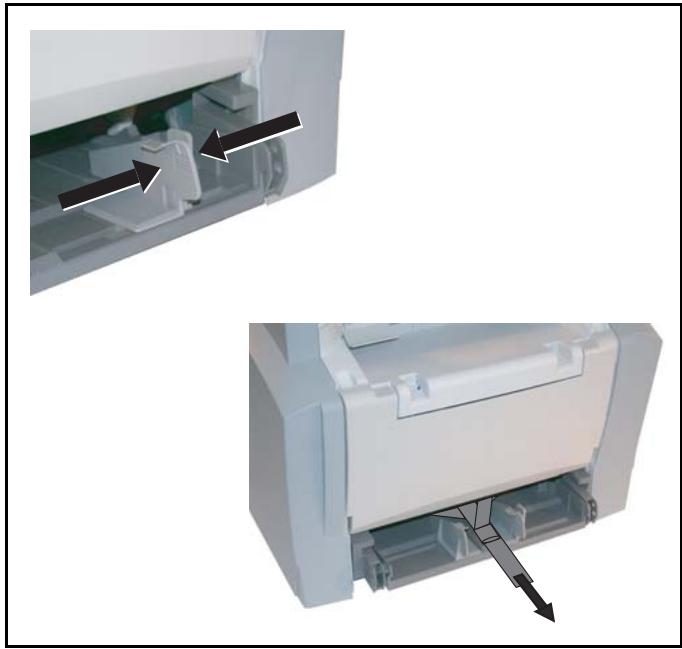
Pull out the two pads from the paper feed inlet.
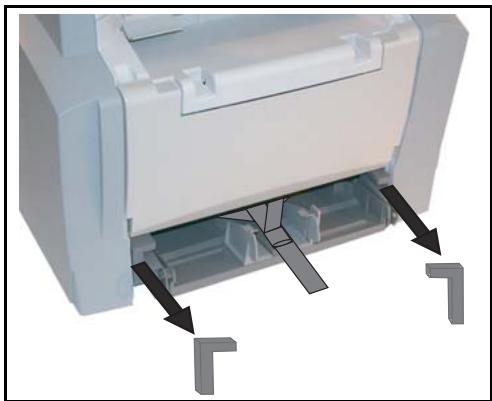
Press the paper size guide on the right, in order to push both paper size guides to the left or to the right. Pull out the plastic tab and the shipping tape from the paper feed inlet.
DESCRIPTION

INSTALLING THE REMOVABLE PARTS
This section details the installation of the terminal's removable parts.
INSTALLING THE PRINTER PAPER TRAY
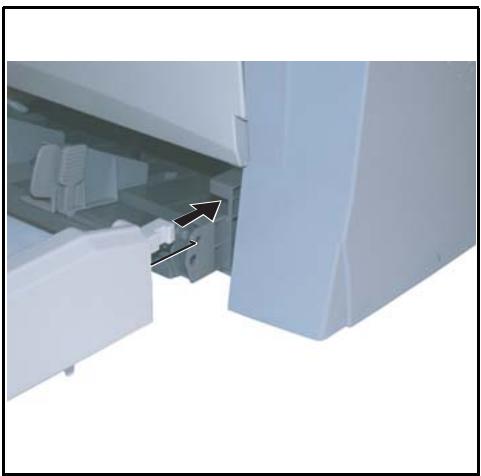
Using the printer's left and right notches, gently push the tray in until it stops (as illustrated below).
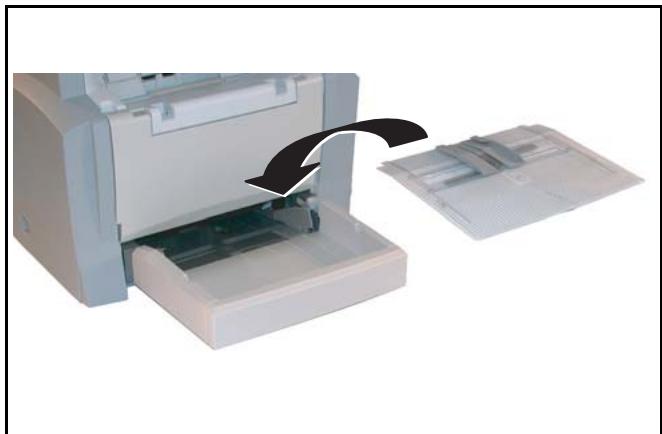
Fit the tray cover.
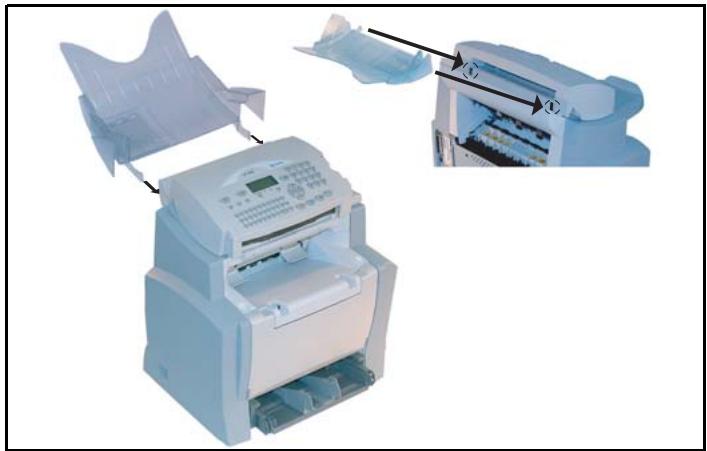
INSTALLING THE PRINTER OUTPUT STACKER
With both hands, slightly bend the centre part of the stacker upwards in order to insert its clips into the notches located on the upper part of the printer. Release the stacker so that it recovers its initial shape.
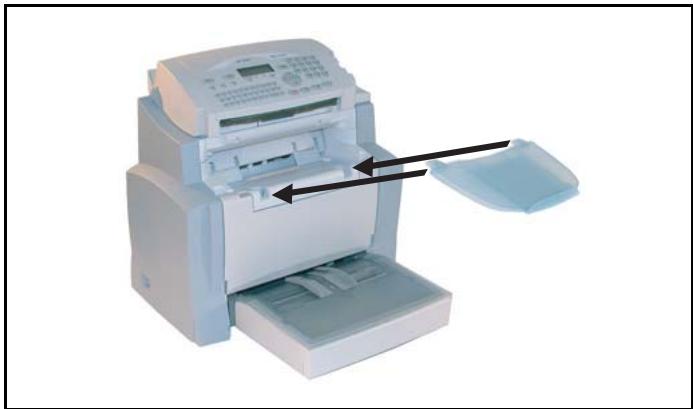
INSTALLING THE DOCUMENT FEEDER FOR SCANNING
Fit the stacker by inserting its two toes into the notches provided at the rear of the terminal.
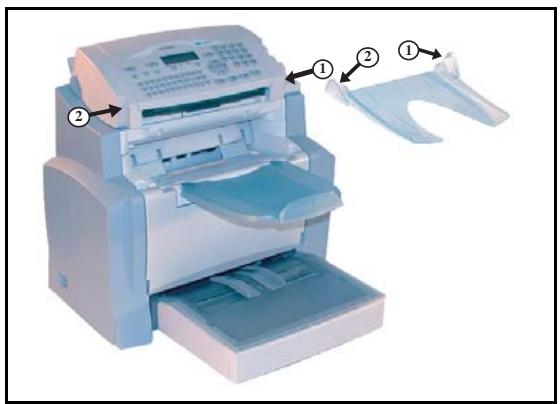
INSTALLING THE ORIGINAL DOCUMENT OUTPUT STACKER
Fit the output stacker on the upper front part of the terminal by inserting its two toes into the notches provided.
LOADING PAPER
Press the paper size guide on the right in order to push both paper size guides to the left or to the right.
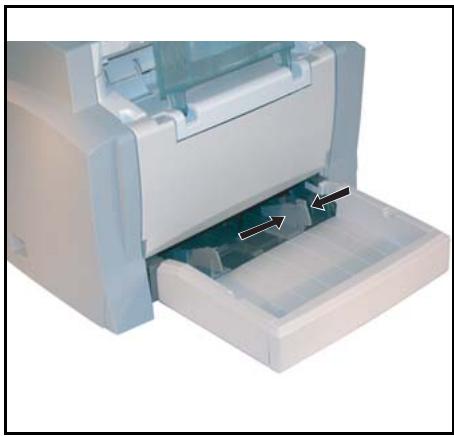
Place a stack of paper into the tray. In case of letterhead paper, be sure to place the paper printed side up.
Secure the stack of paper by pushing the paper size guides against the right and left edges of the stack.
Supported types of paper:
Auto-feed cassette
60 to 90g / m^2
Manual feed tray
60 to 160g / m^2
Fit the paper tray cover into place.
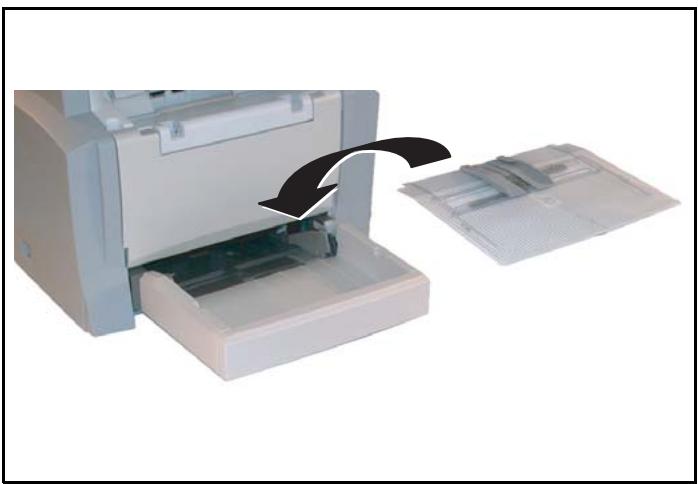
LOADING PAPER MANUALLY
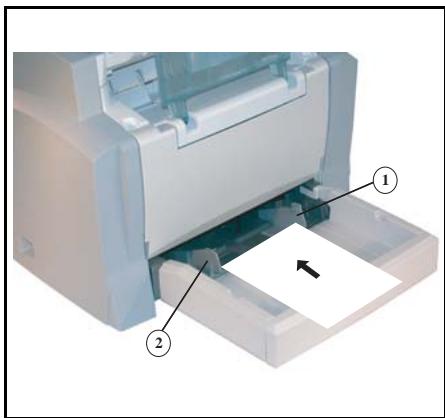
When printing on special paper, such as 60 to 160g / m^2 max. colour paper or transparent film (laser printer compatible), you should load the paper manually, one sheet after the other.
To do so:
Insert your sheet of paper or film between the two feed pawls 1 and 2 located on the paper tray cover until it stops in the printer.
Adjust the sheet or film width as appropriate by means of feed pawls 1 or 2.
INSTALLING THE SECOND PAPER CASSETTE UNIT (OPTION)
Remove the second paper cassette unit and tray 2 from their packaging, including the protective tape used to hold the various components in place.
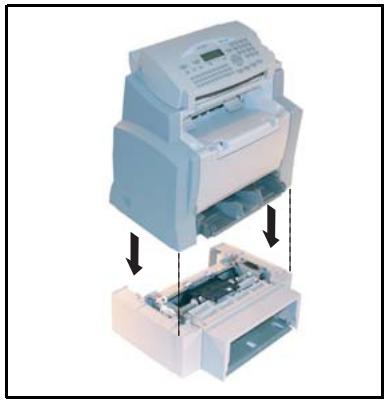
Place the printer on top of the base unit.
Make sure to align the coupling pins of the base unit with the holes located underneath the printer.
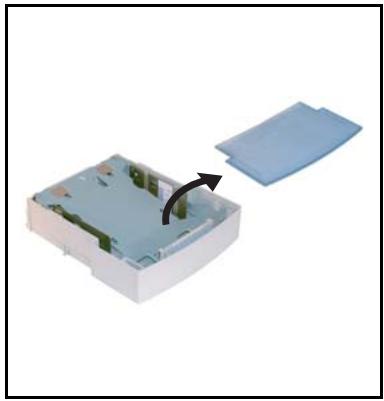
Remove the cover from tray 2.
Press down on the paper lifting plate located inside of tray 2 until it locks.
Place a stack of up to 500 sheets of paper into tray 2 so that the side that was facing up when the paper was unwrapped is still facing up.
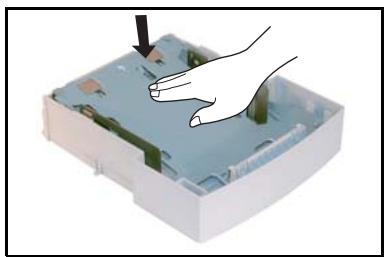
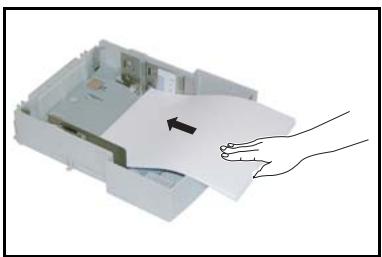
Replace the cassette cover and insert tray 2 into the second paper cassette unit.
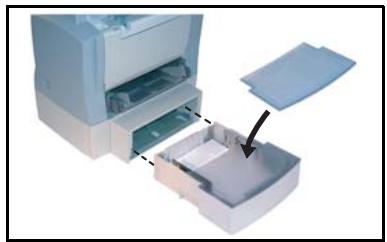
Remark: Be sure to use both hands whenever tray 2 is removed from or inserted into the second paper cassette unit.
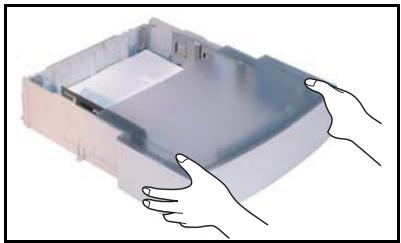
CONNECTIONS
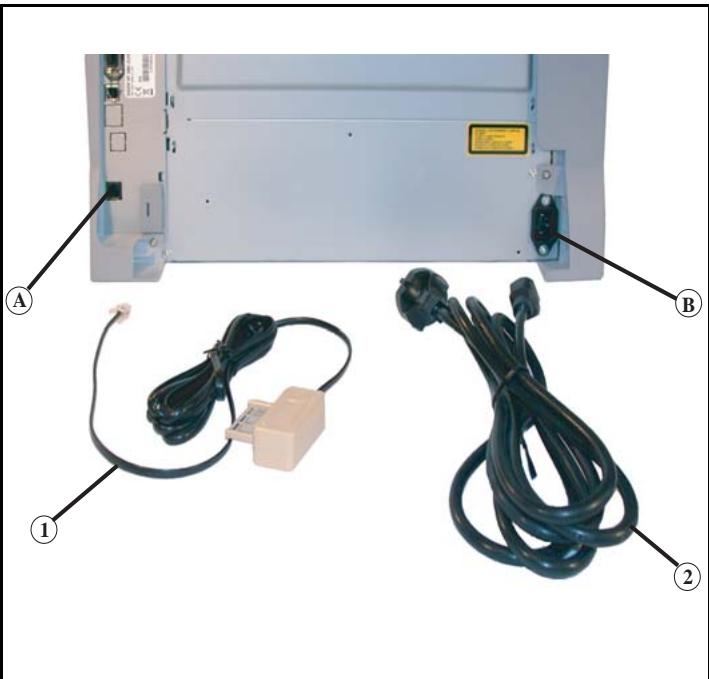
Key to the diagram:
A: Telephone line connector
B: AC power connector
1: Line cord (model depending on country)
2: AC power cord (model depending on country)
Make sure the On/Off switch is set to 0 (Off).
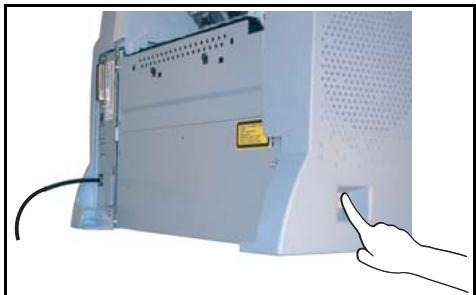
TELEPHONE CONNECTION
Plug end of the telephone line (1) into the connector (A) on the fax machine, and the other end into the wall telephone socket.
POWER LINE CONNECTION AND SWITCH-ON
Caution - Refer to safety procedures in the Safety and Environment Chapter.
Plug end of the main power cord (2) into the connector (B) on the fax machine, and the other end in the wall outlet.
Set the On/Off switch to position 1 (On).
After a few seconds, when the printer has warmed up, the date and time will appear.
2 GETTING STARTED
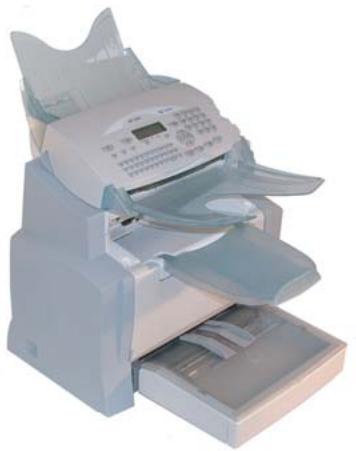
NAVIGATION METHODS
PRESENTATION
The navigator gives you access to the menus visible on screen.
The navigator
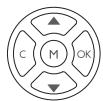
This navigator has 5 keys and allows you to move within the menus available on your machine.
Moving within the menus
Moving within a data entry field
| To | Use key | Symbol used |
| Enter the main menu. | M | M |
| Select the next line in a menu. | ▼ | |
| Select the previous line in a menu. | ▲ | |
| Confirm entry and go to the following menu. | OK | OK |
| Return to the previous menu. | C | C |
| Confirm and exit from the current menu. | ◇ | |
| Exit without confirming from the current menu. | ⊗ |
| To | Use key | Symbol used |
| Move to the right. | ▼ | |
| Move to the left. | ▲ | |
| Confirm your entry. | OK | OK |
| Delete a character by moving the cursor to the left. | C | C |
| Confirm your entry and return to the initial screen. | ◇ | ◇ |
The display screen
The screen has two lines of 16 characters.
The cursor shows the line you selected.
1▶DIRECTORY
2 SETUP
For menus with more than two choices, use the arrows or of the navigator to obtain the next (hidden) lines of the menu (3, 4, etc.).
ACCESS TO FUNCTIONS
Access to functions may be achieved in two ways.
- Menu-driven access.
- Direct function access.
Menu-driven access
You may print the functions list to know the number of a function.
Press the M key, the functions menu appears.
1▶DIRECTORY
2 SETUP
Use the or navigator arrows to move the cursor in front of the required function.
3 FAX
5 PRINT
Validate your choice by pressing OK.
When in the selected menu, use the or navigator arrows to move the cursor in front of the required sub-function.
51▶ FUNCTIONS LISTT
52 LOGS
Validate your choice by pressing OK.
Direct access by number
You may print the functions list (M 51 OK) to know the number of a function.
From the stand-by mode:
Press the M key, enter the number of the required function and validate your choice by pressing OK.
FUNCTIONS LIST
MAIN MENU 1: DIRECTION
| Functions | Function description | Page |
| M 11 OK - NEW CONTACT | Enter a name in the directory | p. 4-2 |
| M 12 OK - NEW LIST | Enter a relay broadcast list | p. 4-3 |
| M 13 OK - MODIFY | Modify a record or a list | p. 4-5 |
| M 14 OK - CANCEL | Delete a record or a list | p. 4-5 |
| M 15 OK - PRINT | Print the directory | p. 4-5 |
| M 16 OK - SAVE/LOAD | Store the directory on a chip card | |
| 161 OK SAVE | Save the directory to a chip card | p. 4-1 |
| 162 OK LOAD | Load the directory from a chip card | p. 4-1 |
MAIN MENU 2:SETUP
| Functions | Function description | Page | |
| M 21 OK - DATE/TIME | Enter the date and the time | p. 3-1 | |
| M 22 OK - NUMBER/NAME | Enter your name and your number | p. 3-2 | |
| M 23 OK - SEND | Transmission settings | ||
| 231 OK | SEND REPORT | Choose to print the communication report (voir M 381 OK) | p. 3-4 |
| 232 OK | MEMORY SEND. | Send from feeder or memory | p. 3-5 |
| 233 OK | ECO PER | Set the economy period (see M 32 OK) | p. 3-5 |
| M 24 OK - RECEPTION | Reception settings | ||
| 241 OK | REC. PAPER | Accept reception without paper | p. 3-6 |
| 242 OK | NBR OF COPIES | Number of copies of received documents | p. 3-6 |
| M 25 OK - NETWORK | Network settings | ||
| 251 OK | NETWORK TYPE | Select the type of network | p. 3-3 |
| M 29 OK - TECHNICALS | Technical parameters | p. 3-7 | |
MAIN MENU 2:SETUP
| Functions | Function description | Page | |
| M 20 OK | - GEOGRAPHICAL | Geographical settings | p. 3-3 |
| 201 OK | COUNTRY | The country you select will set the corresponding network, language and keyboard | p. 3-3 |
| 202 OK | NETWORK | Set the network individually | p. 3-3 |
| 203 OK | LANGUAGE | Set the language individually | p. 3-3 |
MAIN MENU 3: FAX
| Functions | Function description | Page | |
| M 31 OK - TRANSMISSION | Single- and multiple-address transmission | p. 5-4 | |
| M 32 OK - ECO TRANS. | Send a document during the economy period | p. 3-5 | |
| M 33 OK - POLLING RX | Polling request | p. 5-15 | |
| M 34 OK - POLLING TX | Deposit a document | p. 5-15 | |
| M 35 OK - MBX SENDING | Send to a mailbox | p. 5-24 | |
| M 36 OK - MBX POLLING | Poll a mailbox | p. 5-25 | |
| M 37 OK - BROADCAST | Broadcast transmission | p. 3-7 | |
| M 38 OK - FAX ANSW. | Control of fax answering machine | p. 3-5 | |
| 381 OK PRINT | Print fax messages stored in the memory | p. 3-6 | |
| 382 OK ACTIVATION | Activating or deactivating the answering machine | p. 3-6 | |
| 383 OK ANSWER CODE | Saving an access code | p. 3-6 | |
| M 39 OK - REROUTING | Rerouting of a document to a directory entry | p. 5-5 | |
| 3911 OK ACTIVATION | Gateway activation | p. 5-5 | |
| 3912 OK CALL NUMBER | Recipient selection | p. 5-6 | |
| 3913 OK COPY | Rerouted document local printing | p. 5-6 | |
| 392 OK - TX FORWARD. | TX forwarding function | ||
| 3921 OK ACTIVATION | TX forwarding activation | p. 5-6 | |
| 3922 OK CALL NUMBER | Recipient selection | p. 5-6 | |
MAIN MENU 5: PRINT
| Functions | Function description | Page |
| M 51 OK - FUNCTIONS LIST | Print the functions list | p. 5-13 |
| M 52 OK - LOGS | Print the communication logs | p. 5-12 |
| M 53 OK - DIRECTORY | Print the directory | p. 4-5 |
| M 54 OK - SETUP | Print the settings list | p. 5-13 |
| M 55 OK - COMMANDS | Print the commands list (see M 65 OK) | p. 5-8 |
| M 56 OK - MBX LIST | Print the MBX list (see M 75 OK) | p. 5-24 |
MAIN MENU 6: COMMANDS
| Functions | Function description | Page |
| M 61 OK - PERFORM | Execute a pending command | p. 5-7 |
| M 62 OK - MODIFY | Modify a pending command | p. 5-7 |
| M 63 OK - CANCEL | Cancel a pending command | p. 5-8 |
| M 64 OK - PRINT | Print a pending document | p. 5-8 |
| M 65 OK - PRINT LIST | Print the commands list | p. 5-8 |
| M 59 OK - DEPART. CODES | Print a department code list | p. 5-21 |
MAIN MENU 7: MAILBOXES
| Functions | Function description | Page |
| M 71 OK - CREATE MBX | Create and modify a MBX | p. 5-23 |
| M 72 OK - DEPOSIT MBX | Deposit a document into a MBX | p. 5-24 |
| M 73 OK - PRINT MBX | Print the contents of a MBX | p. 5-24 |
| M 74 OK - DELETE MBX | Delete an empty MBX | p. 5-24 |
| M 75 OK - PRT MBX LIST | Print the MBX list | p. 5-24 |
MAIN MENU 8: ADVANCED FCT
| Functions | Function description | Page | |
| M 80 OK | - CALIBRATION | Scanner calibration | p. 6-17 |
| M 81 OK | - LOCK | Activate an access limitation lock | p. 5-16 |
| 811 OK | LOCKING CODE | Locking code | p. 5-16 |
| 812 OK | LOCK KEYBD. | Activate keyboard lock | p. 5-16 |
| 813 OK | LOCK NUMBER | Activate dialling lock | p. 5-17 |
| M 82 OK | - COUNTERS | See the activity counters | p. 5-14 |
| 821 OK | PRINTED PG | Printed pages counter | p. 5-14 |
| 822 OK | SCANNED PAGE | Scanned pages counter | p. 5-14 |
| 823 OK | SENT PAGES | Sent pages counter | p. 5-14 |
| 824 OK | RECEIVED PG | Received pages counter | p. 5-14 |
| M 84 OK | - SCAN. & PRINT | Scanner and printer settings | p. 5-10 |
| 841 OK | SCANNER | Scanner settings | |
| 842 OK | PRINTER | Printer settings | |
| M 85 OK | - CONSUMABLES | Status of consumables | p. 6-2 |
| 88 OK | - DEPT. CODES | Setting the department codes | |
| 881 OK | ACTIVATION | Change the department code settings | p. 5-18 |
| 882 OK | NEW DEPT. | Create or modify a department code | p. 5-19 |
| 883 OK | DELETE | Delete a department code | p. 5-19 |
| 884 OK | Print a department code list | p. 5-20 | |
3 SETTING YOUR MACHINE
MAIN SETTINGS
At the first power on, set-up the date and time, the network type, the language and check the others parameters shown hereafter.
BEFORE TRANSMISSION
Date/Time
At any moment you may change the date and time on your fax machine.
To change the date and time:
M 21 OK - SETUP / DATE/TIME
Enter the numbers of the required time and date one after another, (for example November 8 2003 at 9h33, press 0 8 1 1 0 3 0 9 3 3) and press OK to confirm.
Summer time / winter time setting
A menu is available from which you can choose to change to summer / winter time automatically or not.
The 21>DATE/TIME menu includes 2 submenus:
Manual mode
211 OK - SETUP / DATE/TIME / MODIFY
Your fax machine will prompt you to change the date and time via the numeric pad.
Automatic mode
212 OK - SETUP / DATE/TIME / AUTO ADJUST
If you select NO and confirm with OK, the summer / winter time will not be changed automatically and a setting in the 211 MODIFY menu will be required from you for the machine to be set to the new time.
If you select YES and confirm with OK, you will not have to care about any change at the end of March and October. You will just be informed of this change by a message on the screen.
The default for this parameter is NO.
Warning message
On automatic changing to summer / winter time, a message will be displayed to inform you that the fax time has been changed.
FRI 25 MAR 02:01
CHECK TIME
or
SUN 30 OCT 02:01
CHECK TIME
You next action on the fax keypad will cause this message to be automatically erased.
Your fax number/your name
Your fax will print out your fax number on each document it transmits if you save this number and if the machine is set to SENDINGHEADER (refer to paragraph Technical parameters, page 3-7).
To save your fax number and your name:
M 22 OK - SETUP / NUMBER/NAME
Enter your fax number (20 digits max.) and press OK to confirm.
^ Enter your name (20 characters max) then press OK to confirm.
Type of network
You may connect your fax to either a PSTN or private network such as private automatic branch exchange (PABX). You must select the network which is the most convenient.
To select the type of network:
M 251 OK - SETUP / NETWORK / NETWORK TYPE

Select option PABX or PSTN then confirm your choice with OK.
Geographical settings
These settings will enable you to use your machine in different preset countries using different languages.
Country
By choosing a country, you initialise:
- the settings for the public telephone network,
the language by default.
To select the country:
M 201 OK - SETUP / GEOGRAPHICAL / COUNTRY
Select the required option and press the OK key to confirm.
Remark: If the required language does not appear, select the setting "Others".
Network
This setting enables you to individually set the type of public telephone network so that your machine can communicate over the public network of the country you have chosen in compliance with the applicable standards.
Remark: These settings are different from the NETWORK TYPE (p. 3-3), which allows you to choose between public and private network.
To select the network:
M 202 OK - SETUP / GEOGRAPHICAL / NETWORK
Select the required option and press the OK key to confirm.
Language
This setting enables you to choose a language other than that imposed by the COUNTRY setting.
To select the language:
M 203 OK - SETUP / GEOGRAPHICAL / LANGUAGE
Select the required option and press the OK key to confirm.
Local prefix
This function is used when your fax is installed with a private network, behind a company's PABX. It allows you to program an additional automatic local prefix (to be defined), enabling you to automatically exit the company's telephone network system, but only under certain conditions:
- the company's internal numbers, where a prefix is not required, must be short numbers less than the minimal size (to be defined, for example France has 10 digits),
- the outside numbers requiring a prefix, must be long numbers greater or equal to the minimal size (to be defined, for example France has 10 digits).
Programming your fax with the local prefix consists of two steps:
- defining the minimal size (or equal) of the company's outside numbers,
- defining the outgoing local prefix of the company's telephone network. This prefix will automatically be added as soon as an external number is dialled.
Caution - If you define a local prefix, do not add it to the numbers stored in the directory, it will be automatically dialled with each number.
Defining the minimal size and the local prefix
M 252 OK - SETUP / NETWORK / Prefix
You can change the default value for the minimal size of the company's outside numbers and validate with OK. The minimal size will range between 1 and 30.
Enter the outgoing local prefix of the company's telephone network (maximum 5 characters) and validate with OK.
Transmission report
You may print a transmission report for all communications over the telephone network (STN).
You may choose between more than one criteria for printing reports:
- WITH: a report is given when the transmission was properly performed or when it is completely abandoned (but there is only one report per request),
- WITHOUT: no transmission report, however, your fax will note all transmissions that took place in its log (refer to paragraph Logs, page 5-12),
- ALWAYS: a report is printed with each transmission,
- ON ERROR: a report is printed only if the transmission failed or is abandoned.
With each transmission report from memory, a reduced version of the first page is automatically reproduced.
To select the report type:
M 231 OK - SETUP / SEND / SEND REPORT
Select the required option WITH, WITHOUT, ALWAYS or ON ERROR and confirm your choice with OK.
Document feed type
You may choose the way you want to feed your documents:
- from memory, transmission will take place only after memory storage of the document and dialling. It allows you to get your originals back quickly to free up the machine.
- from the feeder of the sheet-feed scanner (refer to paragraph Document positioning, page 5-1), transmission will occur after dialling. It allows transmission of larger documents.
To select the way you want to feed your documents:
M 232 OK - SETUP / SEND / MEMORY SEND.
Select the option MEMORY or FEEDER and validate your choice with OK.
Remark: In feeder mode, the reduced image will not appear on the transmission report.
Economy period
This function allows you to defer a fax transmission to "off-peak hours" and thus reduce the cost of your communications.
The economy period, via the telephone network (at off-peak hours), is preset by default from 7.00pm to 7.30am . Nevertheless you may change this time slot.
Modifying the economy period:
M 233 OK - SETUP / SEND / ECO PER.
Enter the hours of the new economy period and confirm your selection with the OK key.
Using the economy period:
M 32 OK - FAX / ECO TRANS.
Enter the call number and confirm with OK.
or
Enter the call number and confirm with ECO.
BEFORE RECEPTION
Fax answering machine
The Fax answering machine allows you to keep confidential documents in storage and to avoid printing them as you receive them.
The "Fax Messages" indicator light lets you know the state of your Fax answering machine:
- Light on: the answering machine is on.
- Blinking: your fax has documents in storage or is in the process of receiving faxes.
- Light off: memory full, the fax cannot receive any more documents.
You can assure document confidentiality by using the 4 digit access code. Once saved, you will require this access code for:
- printing fax messages in memory,
- activate or deactivate the fax answering machine.
Saving an access code
M 383 OK - FAX / FAX ANSW. / ANSWER CODE
^ Enter the code (4 digits) and confirm with OK.
Activating or deactivating the answering machine
M 382 OK - FAX / FAX ANSW. / ACTIVATION
If you saved an access code for your fax answering machine, enter it and validate with OK.
Select the required option WITH or WITHOUT answering machine and confirm you choice with OK.
Print fax messages stored in the memory
M 381 OK - FAX / FAX ANSW. / PRINT
If you have defined an access code for your fax answering machine, enter it and press OK. Documents received and stored in the memory are printed.
Reception without paper
Your fax offers you the possibility to either accept or refuse document reception if your printer is unavailable (no paper...).
If your fax printer is unavailable, you may choose between two modes of reception:
- reception mode WITHOUT PAPER, your fax saves the incoming messages in the memory,
- reception mode WITH PAPER, your fax refuses all incoming subscribers.
To select the reception mode:
M 241 OK - SETUP / RECEPTION / REC. PAPER
Select the option WITH PAPER or WITHOUT PAPER and confirm your choice with OK.
Remark: Paper out is indicated by a beep and a message on the screen.
Received faxes are then stored in memory (icon "Fax messages" flashing) to be printed as soon as you add paper into the feeder.
Number of copies
You may print incoming documents more than once (1 to 99).
To set the number of each document received:
M 242 OK - SETUP / RECEPTION / NBR OF COPIES
^ Enter the wanted number of copies and confirm with OK.
At each document reception, your fax will print the number of copies requested.
Relay broadcast
Your fax machine (initiator) can relay a document, in other words, transmit a document to your subscribers via a remote fax and with a precise relay list.
To do this the initiator fax and the remote fax must both have the relay function.
To relay you need to supply the remote fax with the document and the relay list number. The remote fax will then transmit this document to all subscribers on the list.
Once the relay is activated by your fax and as soon as the document is received by the remote fax, the document is printed before relaying to all subscribers on the list.
To activate relay from your fax machine:
Insert the document to relay (refer to paragraph Document positioning, page 5-1).
Select M 37 OK - FAX / BROADCAST.
Enter the remote fax number where you will relay to or choose your dialling mode (refer to paragraph Dialling, page 5-2) and press OK.
Enter the relay list number used by the remote fax and press OK.
You may enter the time you wish to transmit the document next to the current time and press OK.
If you wish to modify the document feed type, select one of the options FEEDER or MEMORY, then press OK.
If you wish, you may enter the number of pages of your documents before transmitting.
Activate relay by pressing key.
The document in the feeder will be relayed either immediately or at a later time (according to your choice) to the remote fax which will relay the document.
TECHNICAL PARAMETERS
As delivered your fax is preset by default. However, you may adjust it to meet your requirements by resetting the technical parameters.
To set the technical parameters:
M 29 OK - SETUP / TECHNICALS
Select the desired parameter and confirm with OK.
With the keys or , modify the parameter settings by following the table below and press OK.
| Parameter | Setting | Signification |
| 1 - SCANNING MODE | 1 - NORMAL2 - FINE3 - SFINE4 - PHOTO | Default value of the scan mode resolution for the documents to be transmitted. |
| 2 - TX HEADER | 1 - WITH2 - WITHOUT | If this parameter is on, your header will appear on all documents sent to your subscribers with your name, number, date and number of pages.Caution - If you send a fax from the document loader, the transmission header will not appear on the document your correspondent receives. |
| 3 - TX SPEED | 1 - 336002 - 144003 - 120004 - 96005 - 72006 - 48007 - 2400 | Transmission speed for outgoing documents.For a quality telephone line (compatible, no echo), communications occur at maximum speed.However, it may be necessary to restrict the transmission speed for some calls. |
| 4 - ECHO PROTECT | 1 - WITH2 - WITHOUT | If this parameter is on, the on-line echo will be reduced during long distance calls. |
| 6 - EPT MODE | 1 - WITH2 - WITHOUT | For some long distance calls (satellite), the on-line echo may disturb the call. |
| 7 - COM. DISPLAY | 1 - SPEED2 - PAGE NUMBER | Choice between transmission speed displayed or number of the page in progress. |
| 8 - ECO ENERGY | 1 - WITHOUT2 - DELAY 5 MIN3 - DELAY 15 MIN4 - DELAY 30 MIN5 - STDBY PERIOD | Choosing the printer standby delay: the printer will switch to standby after a delay (in minutes) of NON-operation or during the period of time of your choice. |
| 10 - RX HEADER | 1 - WITH2 - WITHOUT | If this parameter is on, all documents received by your fax will include the subscriber's header with his name, number (if available) fax print date and the page number. |
| 11 - RX SPEED | 1 - 336002 - 144003 - 96004 - 48005 - 2400 | Transmission speed for incoming documents.For a quality telephone line (compatible, no echo), communications occur at maximum speed.However, it may be necessary to restrict the transmission speed for some calls. |
| 12 - RINGS | 2 TO 5 | Number of rings to automatically start your machine. |
| 20 - E.C.M. | 1 - WITH 2 - WITHOUT | This parameter helps correct the calls made on disturbed telephone lines. It is used when the lines are weak or too noisy. Transmission times may be longer. |
| 80 - TONER SAVE | 1 - WITH 2 - WITHOUT | Makes printing lighter to save toner cartridge ink. |
4 DIRECTORY
Your fax lets you create a directory by memorising subscriber records and subscriber lists.
- Your machine can store up to 250 subscriber records with names and phone numbers.
- You may also group several names to build a subscriber list with up to 24 subscriber lists. A subscriber list is made from the subscriber records already stored.
For all subscriber records or subscriber lists you may:
- create
- consult
- modify contents
- delete
- print the directory
You may save and if needed load your directory. This gives you access to functions 161 and 162 (refer to paragraph Functions list, page 2-4). To proceed, you need to contact your reseller and purchase the optional kit "Directory card".
For each subscriber record you are not required to fill in each line, only name, tel are required:
- NAME of your subscriber,
- TEL, and fax number of your subscriber,
- RECORD NO., this number is automatically assigned by the fax, it allows quick access to the answering machine,
- RATE for each subscriber you may choose your fax transmission speed. The available rates are 2400, 4800, 7200, 9600, 12000, 14400 and 33600 bits per second. With a good telephone connection, well adapted and without echo, the appropriate rate is the highest one.
ADDING A RECORD
M 11 OK - DIRECTORY / NEW CONTACT
Your fax has just created a new record, fill in it by first entering your subscriber's name then validate with OK.
Remark: You can stop the list creation at any time by pressing .
^ Enter the person's fax number and press OK to confirm.
Your subscriber's ID number will automatically appear on the screen, if you wish to modify this number you may do so by choosing another free number and validate with OK.
Select the option WITH assigned key if you want to assign a letter (shortcut key) to your subscriber. The first available letter appears by default. If you want to change it, scroll the letters by menas of the or keys, and press OK to confirm.
If need be, select the appropriate transmission speed to send your faxes, and confirm your choice by pressing the OK key.
CREATING SUBSCRIBERS Lists
A subscriber list is made from the subscriber records already stored.
For each list fill in the following lines:
- NAME of the list,
- NUMBER ASSIGNED to the list, this number is automatically assigned by the fax. It allows quick access to the answering machine,
- LIST COMPOSITION, its lists the ID numbers assigned to the subscribers records included in the list,
- LIST NUMBER, a number lets you identify the list filed under (L).
The same subscriber may be included in different lists.
Caution - It is impossible to add one subscriber list to another subscriber list.
ADDING A LIST
To add a list:
M 12 OK - DIRECTORY / NEW LIST
Your fax machine has just created a new list, fill it in by first entering the name of this list then confirm with OK.
Remark:
You can stop a list or record creation at any time by pressing . Also, you do not have to complete all the list characteristics as you create it; you can save the list as it is by pressing .
The empty field SUBSCRIBER 1 appears, you must fill in the ID numbers assigned to the subscriber records included in this list.
There are three ways detailed in the table below, to choose and add one or more subscribers to your list. Then confirm your choice by pressing OK.
| From ... | Procedure |
| subscriber's name | With the alphanumeric keypad enter the first letters of your subscriber's name and continue until the whole name is displayed on the screen. |
| subscriber's ID number | Enter directly the subscriber's ID number. |
| subscribers directory | Press key then select by means of the▼ or ▲ keys. |
For every subscriber included in the list repeat the above step then validate with OK.
Remark: You can stop record creation at any time by pressing .
The list ID number will automatically appear on the screen, if you wish to modify this number you may do so by choosing another free number and validate with OK.
Press to confirm your entry.
ADDING OR DELETING A NUMBER FROM THE LIST
M 13 OK - DIRECTORY / MODIFY
Select the subscriber list (L) by means of the or keys and validate your choice with OK.
Press OK to display the SUBSCRIBER 1 field, and add or delete the subscriber as shown in the table hereafter:
| To ... | Procedure |
| add | Enter the subscriber ID number you wish to add and confirm with OK. Repeat this step for each added subscriber you want to add. |
| delete | Place the keys▼ or▲, on the number you wish to delete. Press key C to delete the number assigned to the list. Repeat these 2 steps for each subscriber you wish to delete from the list. |
Confirm the new list by pressing key
CONSULTING A RECORD OR A LIST
Press key.
The directory appears in alphabetical order.
Select the subscriber record or subscriber list (L) you wish to consult.
MODIFYING A RECORD OR A LIST
M 13 OK -DIRECTORY /MODIFY
The directory appears in alphabetical order.
Use the or keys to select the subscriber list (L) you wish to modify and press OK to confirm.
Modify the line or lines in the subscriber record or subscriber list and confirm each modification with OK.
Remark: You may confirm your modification by pressing key, but you will exit the menu and may not be able to modify the following lines.
DELETING A RECORD OR A LIST
M 14 OK - DIRECTORY / CANCEL
The directory appears in alphabetical order.
Use the or keys to select the subscriber record or subscribers list (L) you wish to delete and confirm with OK.
Press again OK to confirm your deleting.
The record or list is deleted from the directory.
PRINTING THE DIRECTORY
You may print all the numbers stored in the directory, including all the existing subscriber records or subscriber lists.
To print the directory:
M 15 OK - DIRECTORY / PRINT
The directory is printed in alphabetical order.
5 OPERATION
SENDING
DOCUMENT POSITIONING
Scanner
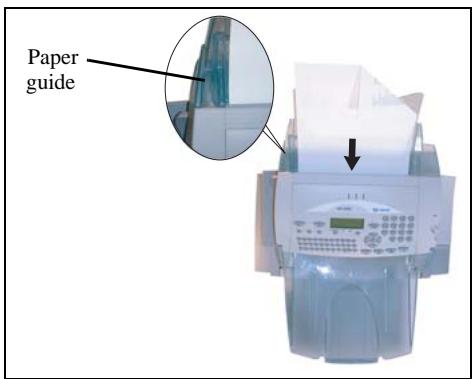
Place your original documents in the document feeder:
- face down,
- first page under the stack.
Set the paper guide to the document width.
Once the operation is over, take your original documents back from the document exit tray.
Caution - If you forget to position the document to be transmitted, the addressee will receive a blank page.
Remark: Since the addressee's number is generally on the document to be transmitted, you may also dial before positioning the document.
CHOOSING THE RESOLUTION/CONTRAST
Resolution
You have 4 modes for document transmission.
The mode choice depends on the type of document to be transmitted:
- Normal mode, symbolised by Std at the bottom of the display screen. To be used for good quality documents, without drawings or small details,
- Fine mode, symbolised by Fine at the bottom of the display screen. To be used for documents with drawings or small characters,
- Super Fine mode, symbolised by SFine at the bottom of the display screen. To be used for documents with very fine or small character drawings,
- Photo mode symbolised by Photo at the bottom of the display screen. To be used for photographic documents.
To select the resolution mode:
Press key as many times as necessary to select the required mode. A icon on the screen shows the current mode.
Contrast
You can set the contrast if your document is too light or too dark. If the document is light, you must raise the contrast and if it is dark, you must reduce it.
To set the contrast:
Press 1 as many times as necessary to choose the desired contrast, as shown by the position of a cursor.
DIALLING
From the directory
Dialling alphabetically
Enter the first letter of your subscriber's name with the alphanumeric keypad, then add the remaining letters until your subscriber's name is complete.
Assigned number dialling
Press key
Your fax lists the subscribers records and lists in the Directory in alphabetical order.
then
Use keys or of the navigator to scroll all subscribers for choice, and choose the required subscriber or subscriber list.
or
Press key
Then press the letter assigned to the subscriber (refer to paragraph 11 OK - Directory / New Contact, page 4-2).
The screen displays the corresponding name.
or
Enter the subscriber or subscriber list assigned number.
The screen displays the name of the subscriber or subscriber list assigned to this number.
From the radial key
You can radial one number among the last ten fax numbers you just dialled before.
For a fax number (Tel in the Directory)
Press key
The screen displays the last number called.
Use keys or of the navigator to select your desired number.
To multiple numbers
You may dial to send a document simultaneously to multiple call numbers.
Caution - This may be achieved only if the machine is parametered to send from the memory (refer to paragraph Document feed type, page 3-5).
^ Enter the fax or use the Directory or key (refer to above paragraphs).
Press key and enter the number of the second subscriber or second subscriber list.
Repeat this last step for all subscribers or subscriber lists (maximum 10 subscribers or subscriber lists).
Press OK or
TRANSMISSION OVER THE PUBLIC SWITCHED TELEPHONE NETWORK (PSTN)
Immediate transmission
Position the document (refer to paragraph Document positioning, page 5-1).
Enter the fax number or choose your dialling mode (refer to paragraph Dialling, page 5-2) then press
The "Line" icon flashes during the call phase, it stays lit when both faxes are in communication.
At the end of transmission the initial screen is displayed.
Sending in the eco mode
Position the document (refer to paragraph Document positioning, page 5-1).
Enter the call number and press the ECO key to confirm (refer to paragraph Economy period, page 3-5) then press .
The "Line" icon flashes during the call phase, it stays lit when both faxes are in communication.
At the end of transmission the initial screen is displayed.
Delayed transmission
This function allows you to transmit a document at a later time.
To program a postponed transmission you need to identify the subscriber number, transmission time, feeder type and number of pages.
To delay the transmission time of your document:
Position the document (refer to paragraph Document positioning, page 5-1).
Select M 31 OK - FAX / TRANSMISSION.
Enter the subscriber number you wish to program at a different time or choose your dialling mode (refer to paragraph Dialling, page 5-2) and confirm with OK.
Next to the current time, enter the new time and confirm with OK.
Adjust the contrast and confirm by pressing the OK key.
Select the feed type, FEEDER or MEMORY and confirm with OK (refer to paragraph Document feed type, page 3-5).
You may enter the number of pages before transmission and confirm with OK.
Confirm postponed transmission by pressing key
Your document is stored and will be sent at the new time.
Transmission with auto radial
This function allows you to monitor the dialling operation during a fax transmission. In this case, the maximum transmission rate will be 14400 bps.
This function allows for example:
- to hear if the subscriber's fax is engaged and if so, choose the moment when the line is clear to start the document transmission,
- to control the communication progress in case of uncertain numbers, etc.
To take the line manually:
Place the document in the fax feeder.
Press
If necessary, set the sound level with navigator or keys.
If not already done, enter the subscriber number (or refer to paragraph From the radial key, page 5-3 to call back the last subscriber).
As soon as you hear the remote fax tone, the line is clear and you can start the transmission.
Press to start the document transmission.
If your machine is set in order to print a transmission report (refer to paragraph Main settings, page 3-1), the reduced copy of the document first page will not be printed and it notifies you that the communication is manual.
Rerouting
This function is used to reroute faxes received to a directory contact. To use this function, you have to perform two operations: set the rerouting address of the fax and activate rerouting.
Activate rerouting
M 3911 OK - FAX / REROUTING / ACTIVATION
Using the keys or within the navigator, select option >>3911 WITH.
Confirm with the OK key.
Remark: If the function WITHOUT is selected the menus 392 and 393 will not be included in the functions overview, when it is printed out.
Set the re-direction contact
M 3912 OK - FAX / RERouting / CALL NUMBER
Using the keys and within the navigator select the subscriber from the directory (if the directory is empty the display will show Directory EMPTY). Enter the number of the subscriber manually or store the name and related number in the directory
M 3913 OK - FAX / REROUTING / COPY
Local printout of the information relayed to your system
Using the keys and within the navigator select the COPY option (local printout of the information relayed to your system) either WITH or WITHOUT.
^ Confirm with the OK key.
Tx forwarding
This function is used to configure the machine so that any document transmitted by fax is also sent to a third party. The recipient will be selected from the entries in your machine's directory. It may be a fax machine number.
M 3921 OK - FAX / TX FORWARD. / ACTIVATION
Using the keys or within the navigator select WITH ou WITHOUT and confirm with the OK key.
Remark: If you choose WITHOUT, the menu 3922 won't be displayed.
M 3922 OK - FAX / TX FORWARD. / CALL NUMBER
Select the recipient you want from the directory and confirm by pressing OK.
The function is active and from now on any documents transmitted will have a copy sent to the selected recipient.
The transmission mode to the copied recipient depends on the type of short numbers in the directory.
TRANSMISSION WAITING Queue
This function lets you obtain a recap of all documents queuing, for transmission, including those in deposit or in delayed transmission, etc.
It allows you to:
- consult or modify the waiting queue. In this waiting queue the documents are coded the following way:
Order number in the queue / document status / subscriber's telephone number.
Documents may have the following status:
- TX: transmission,
- REL: relay,
- DOC: in deposit,
- POL: polling,
- MBX: send to mailbox,
- PMB: mailbox polling,
-
TR: ongoing commands.
-
immediately perform a transmission from the waiting queue,
- print a document in storage, waiting to be transmitted or in deposit,
-
print the waiting queue, to get the status of each document in the queue, by either:
-
queue order number,
- document name or number,
- scheduled transmission time (fax),
- operation type regarding the document: transmission from memory, delayed transmission, deposit,
- number of pages of the document,
- document size (percentage of space stored in memory),
cancel a transmission request in the waiting queue.
Consult or modify the waiting queue
Immediately perform transmission from the waiting queue
M 61 OK - COMMANDS / PERFORM
Select the document in the waiting queue and confirm your choice with OK or to immediately perform the selected transmission.
M
M 62 OK - COMMANDS / MODIFY
In the waiting queue, select the required document and confirm your choice with OK.
You may now modify the parameters of the given document then confirm your modifications by pressing key .
Printing a document in waiting or in deposit
M 64 OK - COMMANDS / PRINT
In the waiting queue, select the desired document and confirm your choice with OK.
Print the waiting queue
M 65 OK - COMMANDS / PRINT LIST
A document called ** COMMAND LIST ** is printed.
Deleting a transmission on hold
M 63 OK - COMMANDS / CANCEL
In the waiting queue, select the desired document and confirm your choice with OK.
CANCELLING A TRANSMISSION IN PROGRESS
Cancelling a transmission in progress is possible whatever the type of transmission but varies depending on whether the transmission is a single call number or a multi-call number.
- For a single call number from the memory, the document is erased from the memory
- For a multi-call number, only the call number in progress at the time of the cancellation is erased from the transmission queue
To cancel transmission in progress:
Press key 念
A message will ask you to confirm cancellation by pressing the key a second time.
Press key to confirm cancellation in progress.
If your machine is set to print a transmission report (refer to paragraph Transmission report, page 3-4), it will print that the communication was cancelled by the user.
RECEPTION
Reception of all documents over the telephone network is done one at a time at fax reception.
RECEPTION OVER THE PUBLIC SWITCHED TELEPHONE NETWORK (PSTN)
Fax reception depends on the parameter settings of your machine:
COPYING
Your fax offers to print out one more copies of one or more pages.
LOCAL COPY
Standard copy
Position the document face down (refer to paragraph Document positioning, page 5-1).
Press key twice.
"Sophisticated" copy
Position the document face down (refer to paragraph Document positioning, page 5-1).
Press key
Enter the desired number of copies and press OK to confirm.
Choose FAST, QUALITY or PHOTO resolution with the keys or , then press OK to confirm.
Set the desired zoom value 25% TO 400% with keys or and the numerical keypad, then press OK to confirm.
Choose the copy output type between COPY ASSEMBLED or NOT ASSEMBLED and press OK to confirm.
Set the required origin values with keys or the numerical keypad and press OK to confirm.
Set the required contrast value with keys or and press OK to confirm.
Set the required brightness value with keys or and press OK to confirm.
Choose the type of paper, NORMAL, THICK with keys or and press OK to confirm.
Choose the paper tray, AUTOMATIC, UPPER or LOWER with keys or and press OK to confirm.
SPECIFIC COPY SETTINGS
When the copy quality is no longer satisfactory, you can perform a calibration. To do so, refer to paragraph Scanner calibration, page 6-17.
Moreover, a high number of controls let you improve the copy quality.
Scanner settings:
- RESOLUTION to set the photocopy resolution.
- ZOOM settings to reduce or magnify any portion of a document by choosing the origin and value of the zoom to apply to that portion.
- The assembly parameter to choose between ASSEMBLED or NOT ASSEMBLED copies.
- The ORIGIN parameter to choose the origin to be applied to the document.
- CONTRAST to choose the photocopy contrast.
- BRIGHTNESS is used to make your original document lighter or darker.
- L/R MARGINS to shift the margins or your original document to the left or to the right.
Printer settings:
- PAPER is used to tell your machine what type of paper you use by default.
- TRAY is used to tell your machine which paper tray should be used by default.
- L/R MARGINS to shift the margins of your document to the left or to the right.
Caution - All the settings performed through this menu will become the machine's default settings.
To access to the settings:
M 84 OK - ADVANCED FCT / SCAN. & PRINT
Select the SCANNER or the PRINTER to be set and press OK to confirm.
Use the keys or of the navigator to scroll the described hereafter settings you want to modify.
Scanner settings
Resolution
Set the desired resolution FAST, QUALITY or PHOTO with keys or .
Confirm your setting by pressing key OK.
Zoom
Your fax offers to reduce or magnify a specific part of a document from 25% to 400% .
Enter the desired zoom value with the numerical keypad (ZOOMING).
Confirm your setting by pressing key OK.
Assembly
Choose the copy type between ASSEMBLED or NOT ASSEMBLED.
Confirm your choice by pressing key OK.
Origin
If you wish, you can change the origin of the scanner.
By entering new values of X and Y given in mm (X < 210 and Y < 286) , you will move the scanning zone as shown on the figure below.
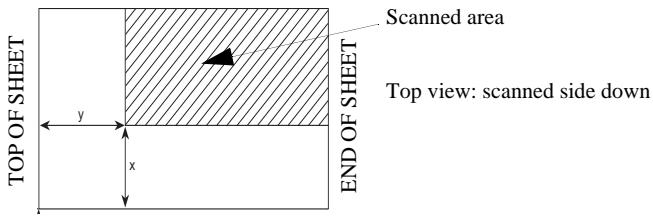
Select the X and Y coordinates with keys or .
Set the required coordinates with the numeric keypad or or .
^需 Confirm your setting by pressing key OK.
Contrast
Set the desired contrast with keys or .
Confirm your setting by pressing key OK.
Luminosity
Set the desired luminosity with keys or .
Confirm your setting by pressing key OK.
Margins
If you want to shift the side margins of your document to the left or to the right:
Adjust the left / right margins shift (in steps of 0.5mm ) with keys or .
Confirm your setting by pressing key OK.
Printer settings
Paper
Select the type of paper, NORMAL or THICK with keys or .
Confirm your setting by pressing key OK.
Remarks: 1) When the THICK type of paper is selected, the printing speed is slowed down..
2) Use the manual feeder for paper substances over 90g / m^2
Paper tray
Select the paper tray to be used (AUTOMATIC, LOWER or UPPER) using keys or .
Confirm your setting by pressing key OK.
Margins
If you want to shift the side margins of your document to the left or to the right:
Adjust the left / right margin shift (in steps of 0.5mm ) by means of the keys or .
Press OK to confirm.
OTHER FUNCTIONS
Logs
The incoming and outgoing logs list the last 30 transmissions (incoming and outgoing) made by your machine.
An automatic print out will take place after every 30 transmissions. However, you may request a print out at any time.
Each log (incoming or outgoing) contains a table with the following information:
- date and time of the incoming or outgoing document,
- transmission mode (Normal, Fine, SFine or Photo),
number of pages sent or received,
call duration, - incoming or outgoing results: noted CORRECT if properly transmitted, or
information codes for special calls (polling, manual subscribers, etc.),
- reason for call error (example: your subscriber does not answer).
To print the logs:
M 52 OK - PRINT / LOGS
The incoming and outgoing logs are printed on the same page.
PRINTING THE FUNCTIONS LIST
You may print the functions list of your fax machine at any time:
Press the i key.
or
To print the functions list:
M 51 OK - PRINT / FUNCTIONS LIST
PRINTING THE MACHINE SETTINGS
At any moment, you may print the list of your fax's parameter settings to control any changes possibly made to the default parameters.
Printing the machine settings:
M 54 OK - PRINT / SETUP
or by pressing the I key.
Your fax prints the list of stored parameters.
MEMORIZING A SEQUENCE OF KEYS
You may memorize a sequence of keys (for example, to send a fax directly to one or multiple subscribers, to call this subscriber or to get access to a specific menu, etc.).
This sequence is registered in one of the keys F1 or F2 (as you want).
Then, by pressing one of these keys, you will execute the registered sequence.
To register a sequence (for example, in key F1)
Press key M, then F1: you will enter the menu option.
From this moment, all the key pressings are memorized in the key F1.
Press key F1 to register the sequence if you are still in the menus. The sequence memorizing is automatic if you have already exited the menu.
Example: To memorize a fax sending to various subscribers in key F1:
Press keys M then F1.
Press keys 3, 1 then OK.
Enter the subscriber fax number.
Press key and enter the second subscriber fax number or subscribers list.
Repeat this last step for all subscribers or subscribers lists.
Press key F1: the sequence is memorized.
To send a fax directly to your subscriber (key F1 preset)
Press F1.
Position the document (refer to paragraph Document positioning, page 5-1).
Press the key
COUNTERS
At any time, you may consult the activity counters of your machine.
To get access to the counters of the machine:
M 82 OK - ADVANCED FCT / COUNTERS
These counters indicate the number of:
- printed pages,
M 821 OK - ADVANCED FCT / COUNTERS / PRINTED PG
- scanned pages,
M 822 OK - ADVANCED FCT / COUNTERS / SCANNED PAGE
transmitted pages,
M 823 OK - ADVANCED FCT / COUNTERS / SENT PAGES
received pages.
M 824 OK - ADVANCED FCT / COUNTERS / RECEIVED PG
DEPOSIT AND POLLING
You may Deposit a document in your fax and keep it available to one or more subscribers who can obtain a fax of this document by calling your fax with the Poll function.
Setting the machine for document deposits,
you must define the type:
- SIMPLE-it may be polled only once from the memory or feeder,
- MULTIPLE- it may be polled as many times as necessary from the memory.
Setting the machine for polled documents,
you must define the poll number, then depending on the type of poll you may:
- launch an immediate poll,
- program a delayed poll with a chosen time,
- launch a multi-poll, either immediately or later.
Placing a document in deposit
Insert the document to deposit in the feeder.
Select M 34 OK - FAX / POLLING TX and confirm with OK.
Choose the type, according to the table below:
| Menu | Procedure |
| SIMPLE | Select FEEDER or MEMORY. If necessary, adjust the contrast and confirm with OK. Enter the number of pages that you wish to deposit. |
| MULTIPLE | If necessary, adjust the contrast and confirm with OK. Enter the number of pages that you wish to deposit. |
Confirm deposit by pressing the OK key.
Polling a deposited document
M 33 OK - FAX / POLLING RX
Enter the number of the party whose document you want to poll or choose your dialing mode (refer to paragraph Dialling, page 5-2).
Remark: You can poll several documents using the key.
Depending on the type of poll you should:
| Choice | Procedure |
| Immediate poll | Press ◆. |
| Delayed poll | Press OK Next to the current time, enter the time you wish to poll the document and press ◆. |
Locks
There are restrictions to the use of your fax:
- To lock the printing of received documents (refer to paragraph Fax answering machine, page 3-5),
- locking the keyboard,
- locking the numbers.
Entering the locking code
The operator access parameters are confidential; they are protected by a four-digit interlock code that the authorised operators must know.
To access the locking code:
M 811 OK - ADVANCED FCT / LOCK / LOCKING CODE
Enter your four-digit interlock code on the keypad.
Confirm by pressing OK.
Confirm the interlock code by entering the code one more time.
Press OK to confirm.
Remark: When a code is already registered, the machine asks you to give the former code before allowing you to modify it.
Locking the keyboard
This function allows you to prevent access to non-authorised persons. An access code must be entered each time a person wants to use the machine.
To access the keypad unlocking menu:
M 812 OK - ADVANCED FCT / LOCK / LOCK KEYBD.
Enter the four-digit interlock code.
Press key OK to confirm.
With keys or of the navigator, select the option WITH.
Press key OK to confirm.
Remark: After each operation, the machine interlocks automatically.
Locking the numbers
This function locks dialling and the numerical keypad is disabled. Transmissions are only possible from numbers included in the directory.
You can still send mails by typing in the addressee's address (if this has no numbers in it).
To access the number interlocking option:
M 813 OK - ADVANCED FCT / LOCK / LOCK NUMBER
Enter the four-digit interlock code with the keypad.
Press key OK to confirm.
With keys or of the navigator, select the option DIRECT ONLY.
Press key OK to confirm.
DEPARTMENT CODE
Use of the machine can be limited to authorized personnel within each department by setting up a master department code and individual department codes. You can assign one master code and up to 98 department codes. The FAX 4640 can then monitor the usage for each department. The master department code is used to setup and modify the department code information.
During the setup procedure, you are prompted to enter a 4-digit master department code. This code is required to perform any modifications; it is used as a supervisory master key. The master code department number is preset to 00 by the FAX 4640.
The individual department codes are used to access and operate the FAX 4640. During the setup procedure, you can assign department numbers from 1-98. You are also prompted to enter a 4-digit department code for each department. As each department enters their assigned department code to access and operates the FAX 4640, the usage for each department is recorded on the department code report.
FUNCTION MANAGEMENT BY THE ADMINISTRATOR
By default, the "Department Code" function is deactivated when the machine is first put into service.
Activating the department code
M 881 OK - ADVANCED FCT / DEPT. CODES / ACTIVATION
Using the browser's or keys, select WITH.
Press OK to confirm; the function is activated.
Deactivating the department code
M 881 OK - ADVANCED FCT / DEPT. CODES / ACTIVATION
Using the browser's or keys, select WITHOUT.
Press OK to confirm; the function is deactivated.
Setting the department codes
The administrator must enter the department number to be created, between 01 and 98; the number 00 is reserved for the administrator to enter his or her own department code and department name before being able to record other codes for different users.
- Entering the master1 code.
M 882 OK - ADVANCED FCT / DEPT. CODES / NEW DEPT.
The screen displays:
NEW DEPT.. 00>FREE
Using the browser's key, select 00.
Confirm by pressing OK.
The screen displays:
8821>DEPT.CODE 8822 DEPT. NAME
Press OK to confirm the line 8821>DEPT.CODE.
The screen displays MASTERCODE and ***.
Using the key, go to the **** line and enter your 4-digit department code (remember this code).
Confirm the code by pressing OK.
Using the browser's key, select 8822 DEPT. NAME and press OK.
Using the alphabetical keypad, enter the name you want to give to your department (maximum 20 characters).
Confirm your department name by pressing OK.
Creating a department code
Only the administrator, using the Mastercode is able to attribute other department codes.
Enter your mastercode and confirm by OK.
M 882 OK - ADVANCED FCT / DEPT. CODES / NEW DEPT.
Enter a number between 01 and 98 or select a free number using the or keys, as shown on the machine's display.
Confirm your selection by pressing OK.
The screen displays:
8821>DEPT.CODE
8822 DEPT. NAME
Press OK; the screen displays:
DEPT.CODE
****
Enter a 4-digit code (remember it); if this code is already used by another service, the machine displays "CODE ALREADY USED". In this case, enter another code.
Confirm your selection by pressing OK.
The machine also asks you if you want to be able to modify the department name. Press OK then the key to return to the main menu.
Deleting a department code
The administrator can also delete a department code to prevent the department associated with it having any access to the machine functions.
Enter your administrator mastercode.
M 883 OK - ADVANCED FCT / DEPT. CODES / DELETE
Enter the number of the department code you want to delete or search for it using the or keys.
Confirm by pressing OK. A confirmation screen is displayed. Press OK again to confirm the deletion. Once confirmed, the department code number becomes free again and the counters also associated with this number will be erased.
Caution - If the administrator deletes his or her own department code all the other department codes will also be deleted.
Printing a department code
The administrator may print reports for each department entered. These reports show the department number (between 01 and 98), its name, the associated access code and the number of pages transmitted and copied by this department.
M 884 OK - ADVANCED FCT / DEPT. CODES / PRINT
Enter the number of the department you want to print and confirm by pressing OK.
The machine begins printing the report, as shown in the illustration below.
** DEPARTMENT CODES **
SID:Smith
Number: 0987654321
Date: 12-12-04 14:20
| Department | 01 |
| Departement Name | FAX LASER |
| Departement Code | 3178 |
| Pages sent | 1589 |
| Pages copied | 2890 |
Printing the department report
The administrator may print reports for all the departments created. To do so:
M 884 OK - ADVANCED FCT / DEPT. CODES / PRINT
Enter the administrator department number 00 and confirm by pressing OK. The machine prints the report, as shown in the illustration below.
** DEPARTMENT CODES **
SID: Smith
Number: 0885654321
Date: 12-12-04 14:20
| Dept. | Department name | Dept. Code | Pages sent | Pages copied |
| 00 | Master | 1234 | 1258 | 3698 |
| 001 | Office 44 | 6589 | 2596 | 1589 |
| 002 | Office 85 | 2574 | 3561 | 4587 |
| 003 | Office 47 | 1593 | 1897 | 5984 |
USE OF THE DEPARTMENT CODES BY A DEPARTMENT
To access the different machine functions, each department must enter its own access code as delivered by the administrator. When the "DEPARTMENT CODE" function is activated, the screen displays:
THU 20 FEB 10:15
ENTER DEPT.CODE
Press on the numerical keypad only (pressing any other keys will sound beeps).
The screen displays:
ENTER DEPT.CODE
****
Enter your department's access code (as provided by the administrator). If this code is correct, the machine will grant you access to all the functionalities available, except for menu 88 as this is reserved for the administrator. If the access code does not correspond to any services, the machine displays "WRONG CODE".
Printing a user department code
Each department may print the data of its own department code.
If the "Department Code" function is activated, enter your 4-digit numerical access code and confirm by pressing OK.
M 59 OK - PRINT / DEPT. CODE
The machine prints the data for your own department's department code.
Remark: If the mastercode is enter the machine prints the summary of the accounts.
CHARGE CODE
ENTERING THE CHARGE CODE
The charge code is a number that is sent on-line after your correspondent's fax machine number. To add a charge code after entering your correspondent's number you must press the key. This inserts the "+" symbol after the number and you may then type your charge code.
Example:
TO:
9738088444+***
The charge code will always be hidden.
The maximum length that can be entered is 30 characters. When dialing, only the digits are sent on the line. The "+" symbol inserted is not sent. In the example above, the number 97380884440123 is dialed.
If your equipment is connected to a private exchange (PABX), enter the prefix (number used by your PABX to access the telephone network, for example 0), followed by a "/" (or pause).
When a charge code is used, the transmission reports and the machine log printout contains the correspondent's number followed by the charge code's "+" symbol.
MAIL BOX (MBX FAX)
There are 32 mailboxes (MBX), enabling you to transmit documents in complete confidence using an access code (named code MBX), to all subscribers equipped with a fax compatible to yours.
MBX 00 is public. It is handled directly by the terminal to record the messages of the fax TAD as soon as this is put into service.
MBX's 01 to 31 are private. Each is password-protected. They can be used to receive documents confidentially.
The use and access to MBX 01 - 31 are conditioned by the initialisation, defined by a MBX code (if needed) and a mnenonic (its S.I.D.).
Later you may:
- modify the features of an MBX,
- print the contents of an MBX, only possible if the MBX contains one or more documents (with a star "* next to the MBX). When the contents of an MBX have been printed it becomes empty,
- delete an MBX, only if the MBX is initialised and empty,
- print the list of your fax machine's MBX's.
You may receive and send through an MBX in complete confidentiality.
The deposit a document into your MBX, the access code is not needed. All documents deposited in a MBX are added to the ones already present.
In polling, the MBX are only accessible with an MBX code.
You may perform MBX deposits or polls by:
- depositing a document in a fax MBX,
- transmit to deposit a document in a remote fax MBX,
- perform document poll from a remote fax.
MBX MANAGEMENT
Creating an MBX
M 71 OK - MAILBOXES / CREATE MBX
Select a free MBX out of the 31 MBX or directly enter the number of a free MBX and confirm with OK.
Select option MAILBOX CODE and press OK.
Value 0000 is always displayed.
Enter the code of your choice, if needed, and press OK.
Select option MAILBOX NAME and press OK.
Enter this MBX's S.I.D. (20 characters max.) and press OK.
The MBX is initialised. If you wish to initialise another, press C and repeat the same procedure.
To exit the MBX, press
Modifying the features of a MBX
M 71 OK - MAILBOXES / CREATE MBX
Select a free MBX out of the 31 MBX, or enter the number of a free MBX directly (1-31) and confirm with OK.
Enter the code of this MBX, if there is one, and confirm with OK.
Select the menu MAILBOX CODE or MAILBOX NAME, then confirm your choice with OK.
Perform data modification of the menu and confirm with OK.
If needed, repeat the last two steps for the other menu.
Printing the contents of a MBX
M 73 OK - MAILBOXES / PRINT MBX
Select a free MBX out of the 31 MBX, or enter the number of a free MBX directly (1-31) and confirm with OK.
Enter the code of the MBX, if there is one, and confirm with OK.
All documents found in the MBX are printed and the MBX is emptied.
Deleting a MBX
Before deleting an MBX, you need to make sure it is empty, by printing its content.
M 74 OK - MAILBOXES / DELETE MBX
Select a free MBX out of the 31 MBX, or enter the number of a free MBX directly (1-31) and confirm with OK.
Enter the code of the MBX, if there is one, and confirm with OK.
Press to confirm MBX deletion.
The MBX is deleted and will appear as a free MBX in the list.
Printing the MBX list
M 75 OK - MAILBOXES / PRT MBX LIST
The list gives the status of each MBX.
MBX deposit in your fax
Insert the document in the fax machine's feeder.
Select M 72 OK - MAILBOXES / DEPOSIT MBX and confirm with OK.
Select a free MBX out of the 31 MBX, or enter the number of a free MBX directly (1-31) and confirm with OK.
The document is placed in the feeder and saved in the selected MBX.
MBX deposit in a remote fax
Insert the document in the fax machine's feeder.
Select M 35 OK - FAX / MBX SENDING and confirm with OK.
Enter your subscriber's number for MBX deposit or choose your dialing mode (refer to paragraph Dialling, page 5-2) and validate with OK.
Enter the subscriber's MBX number and confirm with OK.
If you wish to delay transmission, enter the new transmission time next to the current time and press OK.
If you wish to modify the document feed type, select one of the options FEEDER or MEMORY, and press OK.
If you wish, you may enter the number of pages of your document before transmitting and confirm with OK.
^ Confirm the transmission request to a remote MBX fax by pressing key
In the case of an immediate transmission, the document is sent immediately.
If the document is set for a postponed transmission the document will be stored in the memory and sent at the requested time.
MBX polling from a remote fax
M 36 OK - FAX / MBX POLLING
Enter your subscriber's number for MBX deposit or choose your dialing mode (refer to paragraph Dialling, page 5-2) and validate with OK.
Enter the subscriber MBX number and press OK.
Enter this MBX access code and press OK.
If you wish to delay the poll time, enter the departure time next to the current time.
^ Confirm the MBX poll request by pressing key
As soon as the remote fax is subscribed, either immediately or later, the document(s) in the remote fax MBX are receiveid in your fax.
Remark: Please check for remote fax compatibility.
6 MAINTENANCE
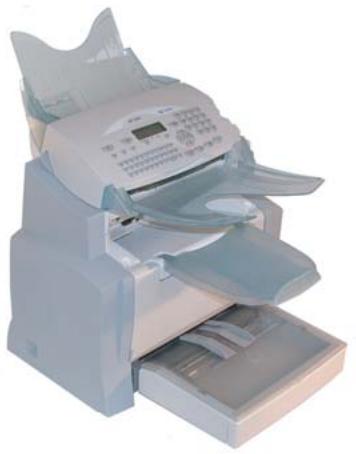
MAINTENANCE
GENERAL
To ensure the best operating conditions for your fax, it is recommended that you regularly clean the inside.
For normal usage, please respect the following rules:
- Never leave the cover open unless required.
- Do not attempt to oil the machine.
- Always gently close the cover and avoid vibrations.
- Do not open the cover while printing.
- Never try to dismantle the machine.
- Do not use paper that has stayed in the paper tray for a long time.
Look at the safety rules in the Safety and Environment chapter at the end of this booklet.
REPLACING THE CONSUMABLES (TONER AND DRUM)
To check the remaining capacities of the consumables:
M 85 OK - ADVANCED FCT / CONSUMABLES
The toner cartridge and the drum cartridge come with a chip card.
After replacing a consumable item in the printer, you need to inform the machine about its features.
Replacing cartridges
Replacing the toner cartridge
To replace the toner cartridge, proceed as shown below.
When the display shows:
CHANGE TONER
1-Open the printer cover.
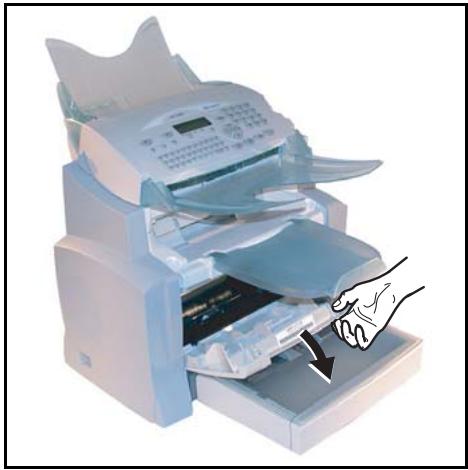
Caution - The fusing unit located inside the printer may become very hot during operation. To avoid injury - do not touch.
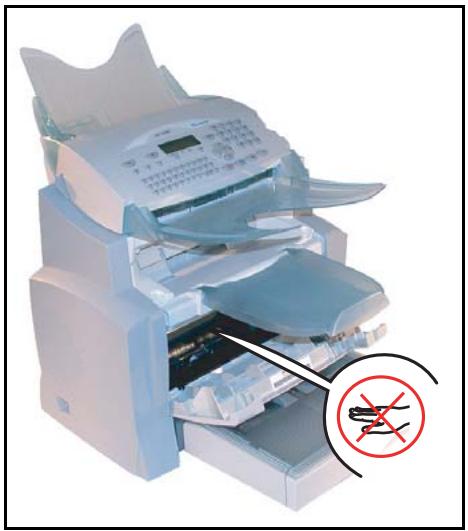
2 - Remove the drum/toner cartridge assembly. In order to protect the environment, do not throw away the used toner cartridge. Used cartridges should be disposed of in accordance with local regulations concerning waste materials.
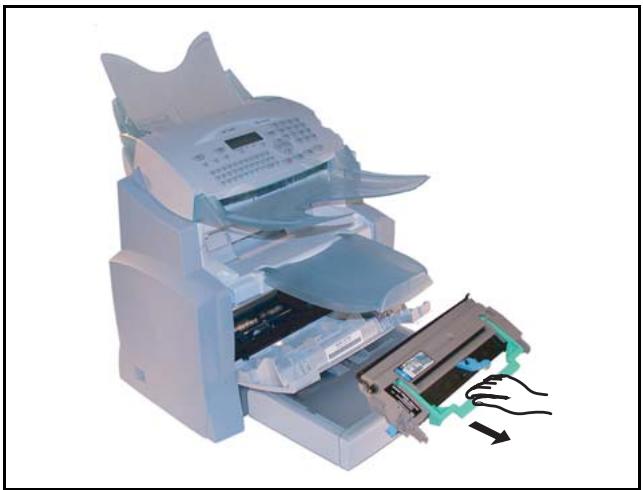
3 - Unlock the toner cartridge by turning the blue locking clip in the direction shown in the illustration below.
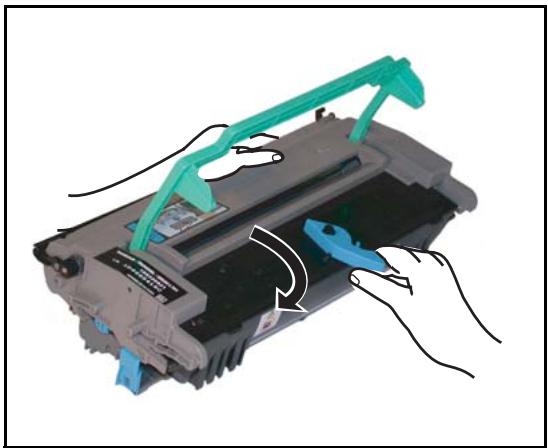
4-Separate thedrum cartridge from the toner cartridge.
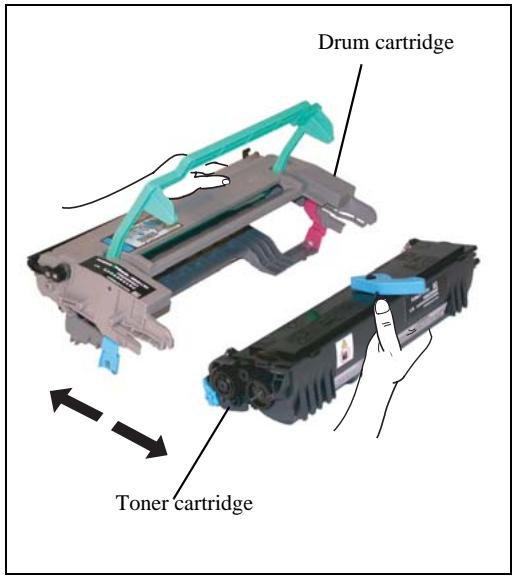
5 - Remove the new toner cartridge from its box, holding it firmly in both hands.
6 - Shake the toner cartridges alternately in the directions shown by the arrows in the illustration below.
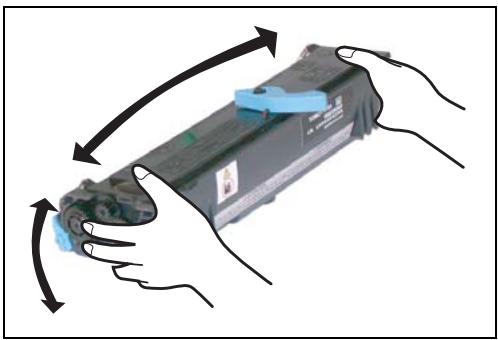
7-Remove the protective plastic strip from the cartridge.
8 - Insert the new toner cartridge in the drum cartridge until locked in place.
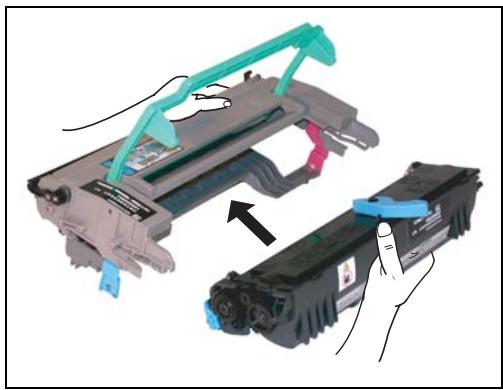
Caution - Make sure not to touch the green coloured drum roller located under the fold away flap of the drum cartridge, which could cause deterioration to the print quality of your faxes and your local photocopies.
Caution - Do not touch the metal parts located on the side of the toner/drum cartridge set as shown below, to prevent causing damage due to possible static electricity discharges.
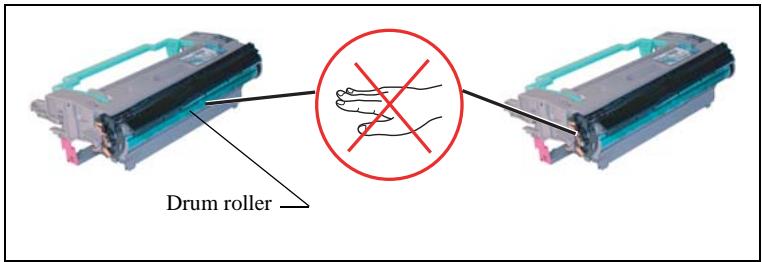
Caution - Make sure not to touch the black coloured development roller located in front of the toner cartridge, which would cause downgrading to the print quality of your faxes and your local photocopies.
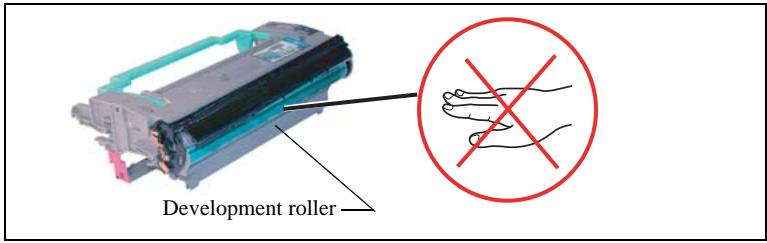
9 - Insert the toner/drum cartridge in the printer as shown below.
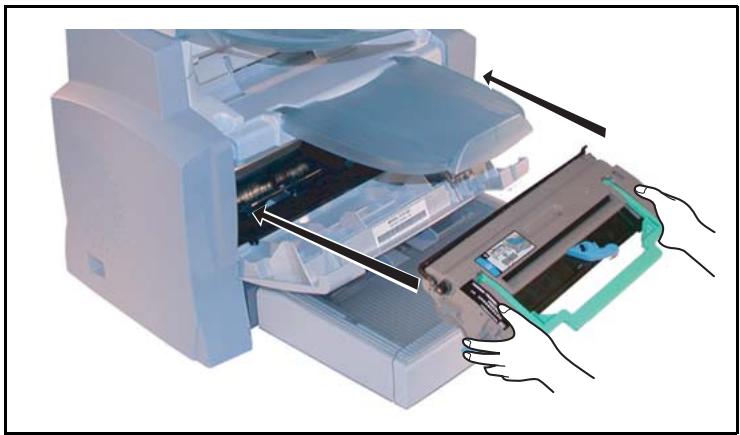
10 - Close the printer cover pressing it carefully but firmly until it clicks into position.
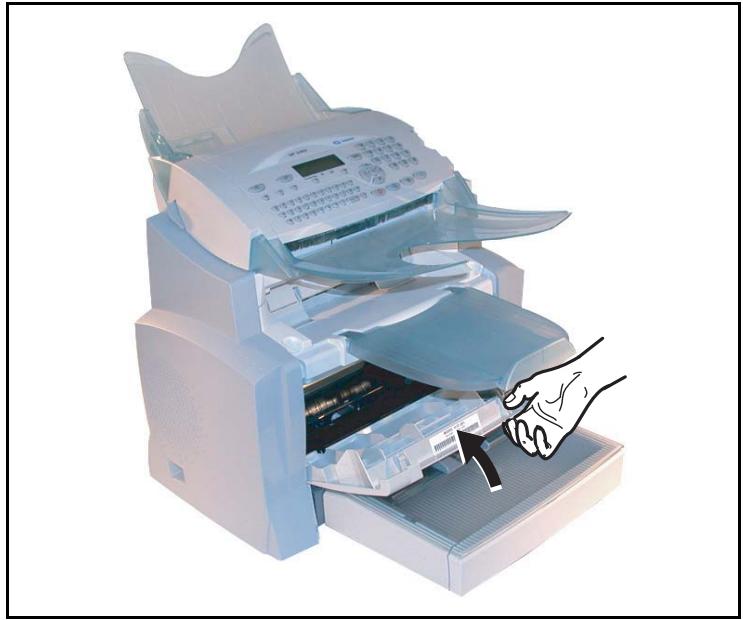
Press OK on the scanner control panel. The display shows:
TUE 02 APR 13:39
INSERT GAUGE CARD
Insert chip card (supplied with the toner cartridge) into the card reader ensuring that the chip is entered as shown in the illustration below.
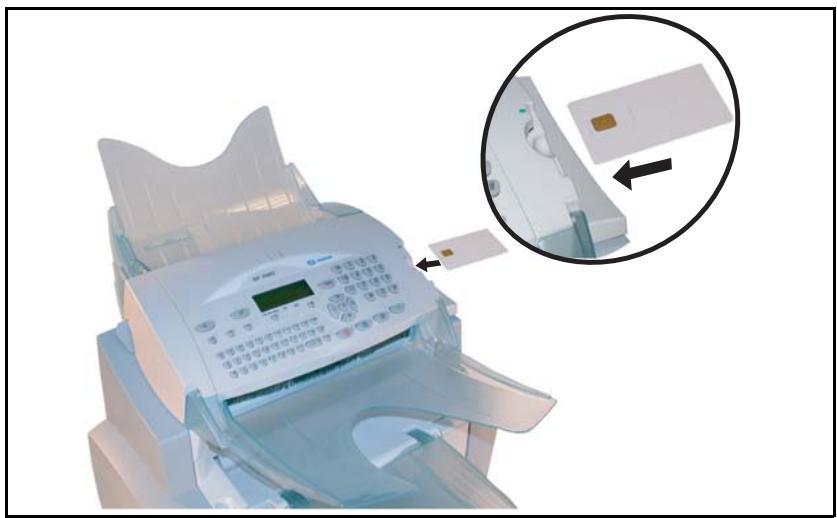
The following is displayed on the scanner control panel screen:
CHANGE TONER?
YES = OK - NO = C
Press OK.
Once the chip card has been read, the display shows:
TONER OK
REMOVE CARD
Remove the card.
Caution - If the following is displayed, check that you have inserted the chip card the right way up.
CANNOT READ CARD
REMOVE CARD
Replacing the drum cartridge
To replace the drum cartridge, proceed as shown below.
When the display shows:
CHANGE DRUM
1-Open the printer cover.
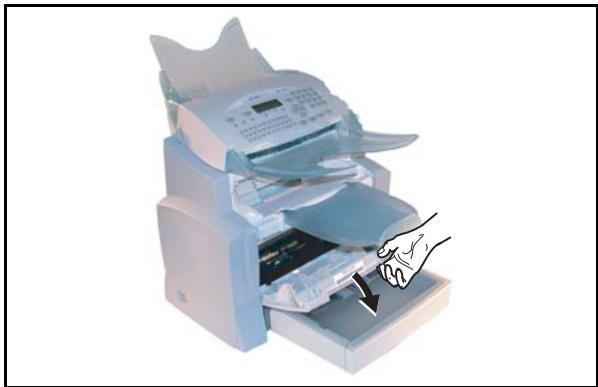
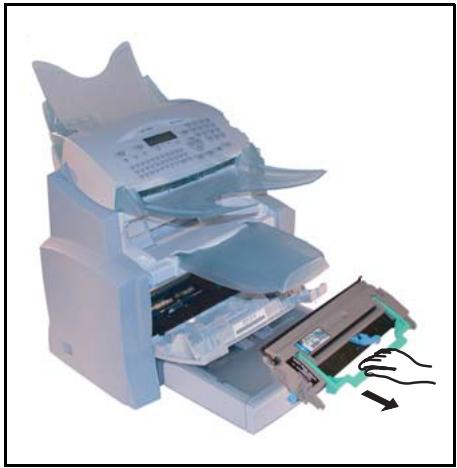
2 - Remove the drum/toner cartridge assembly. In order to protect the environment, do not throw away the used drum cartridge. Used cartridges should be disposed of in accordance with local regulations concerning waste materials.
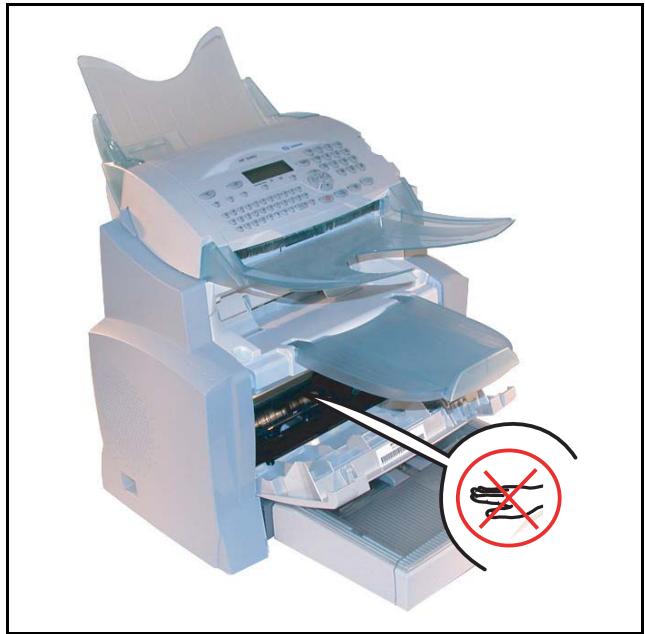
Caution - The fusing unit located inside and at the bottom of the printer may become very hot during operation. To avoid injury - do not touch.
3 - Unlock the toner cartridge by turning the blue locking clip in the direction shown in the illustration below.
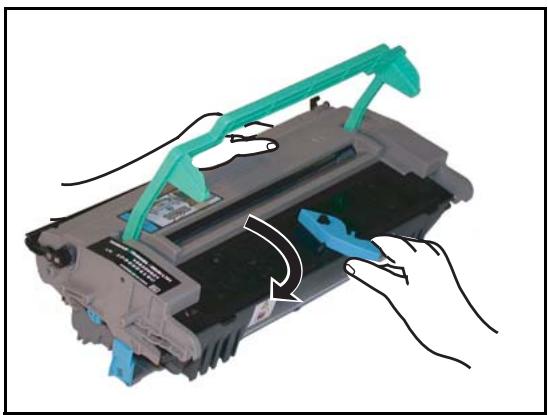
4 - Separate the drum cartridge from the toner cartridge.
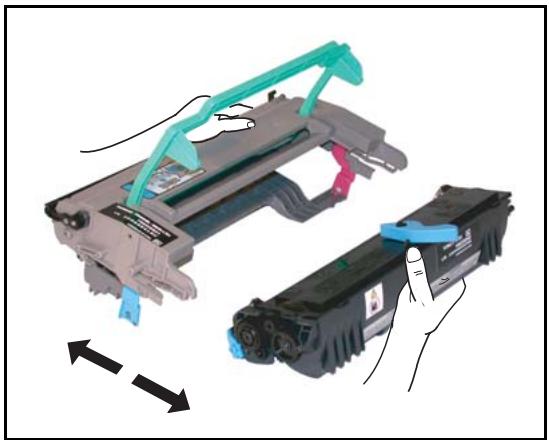
Caution - Make sure not to touch the green coloured drum roller located under the fold away flap of the drum cartridge, which could cause deterioration to the print quality of your faxes and your local photocopies.
Caution - Do not touch the metal parts located on the side of the toner/drum cartridge set as shown below, to prevent causing damage due to possible static electricity discharges.
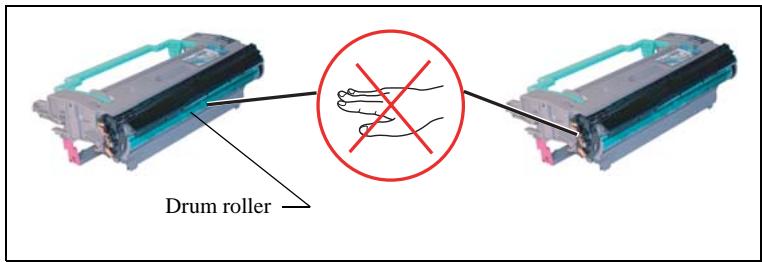
Caution - Make sure not to touch the black colored development roller located in front of the toner cartridge, which would cause downgrading to the print quality of your faxes and your local photocopies.
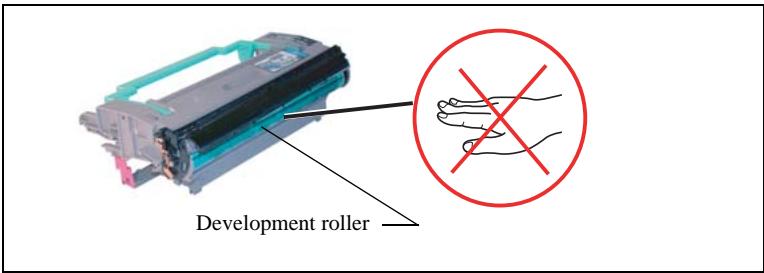
5 - Insert the new toner cartridge in the drum cartridge until locked in place.
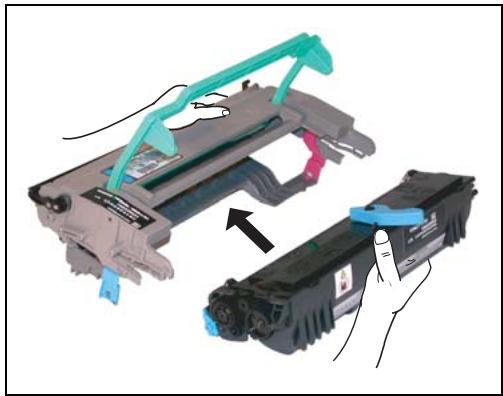
6 - Insert the toner/drum cartridge in the printer as shown below.
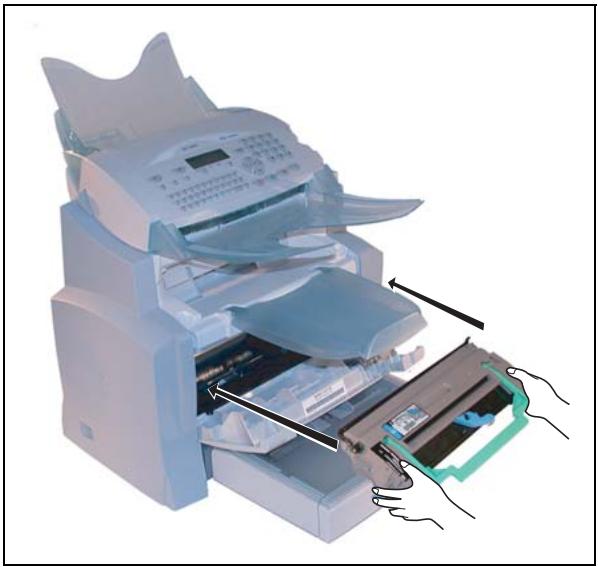
7 - Close the printer cover pressing it carefully but firmly until it clicks into position.
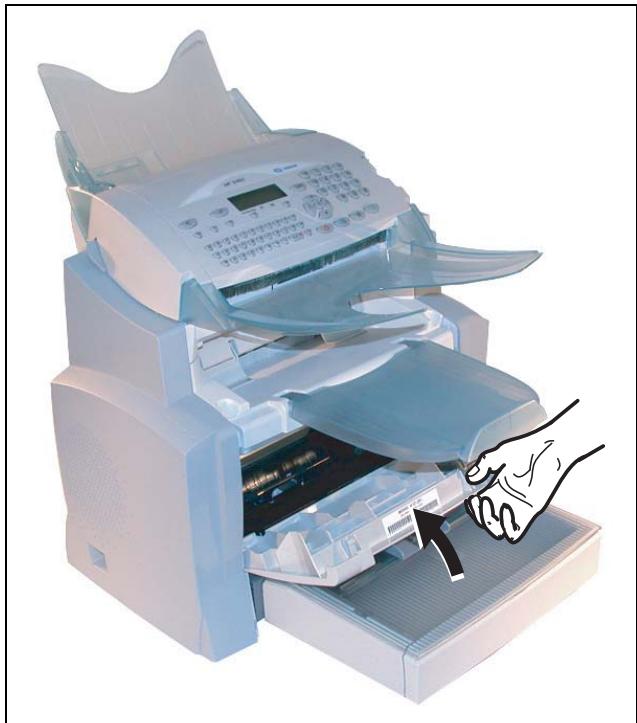
Press OK on the scanner control panel. The display shows:
TUE 02 APR 13:39
INSERT GAUGE CARD
Insert chip card (supplied with the drum cartridge) into the card reader ensuring that the chip is entered as shown in the illustration below.
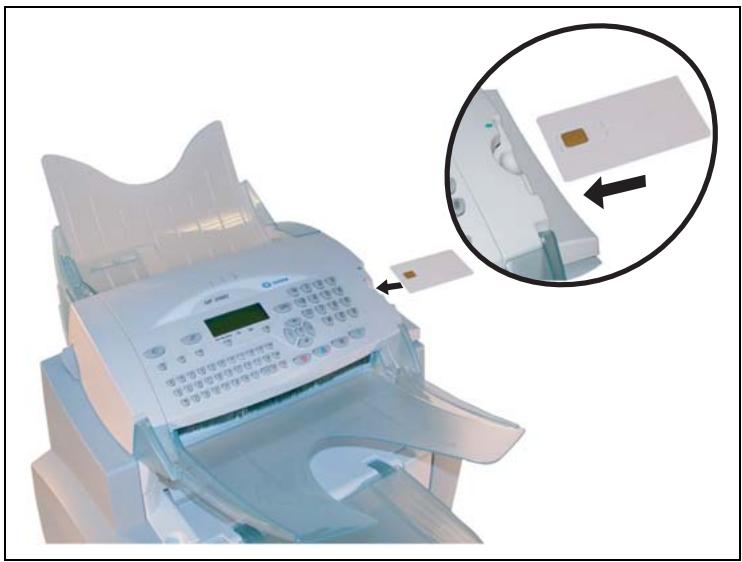
The following is displayed on the scanner control panel screen:
CHANGE DRUM?
YES = OK - NO = C
Press OK.
Once the chip card has been read, the display shows:
DRUM OK
REMOVE CARD
Remove the card.
Caution - If the following is displayed, check that you have inserted the chip card the right way up.
CANNOT READ CARD
REMOVE CARD
CLEANING
Cleaning the printer
Dust, dirt and paper debris on the outer surfaces and inside the printer can interfere with printer performance. Clean the printer regularly.
Caution - Use a soft cloth to clean the printer. Never use abrasive or corrosive detergents.
The fusing unit can become very hot during operation. To avoid injury - do not touch.
Wait for at least 10 minutes after the printer has been turned off and make sure that the fusing unit has cooled before cleaning the interior of the printer.
Cleaning the outside of the printer
Clean the outside of the printer with a smooth duster.
Cleaning the paper feed roller
1 - Turn off the printer and unplug the power cord.
2-Remove thedrum/toner cartridge set from the machine.
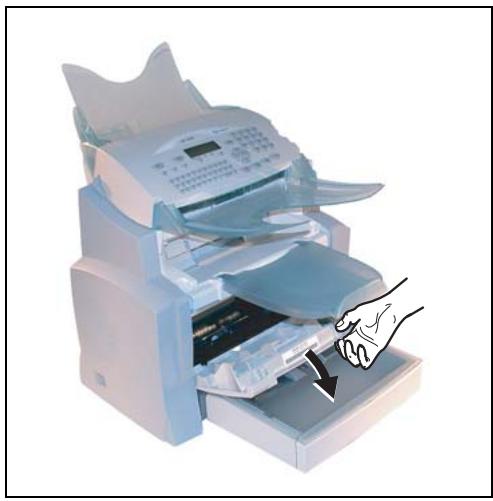
3 - Use a soft cloth to clean the paper feed roller located under the fusing unit.
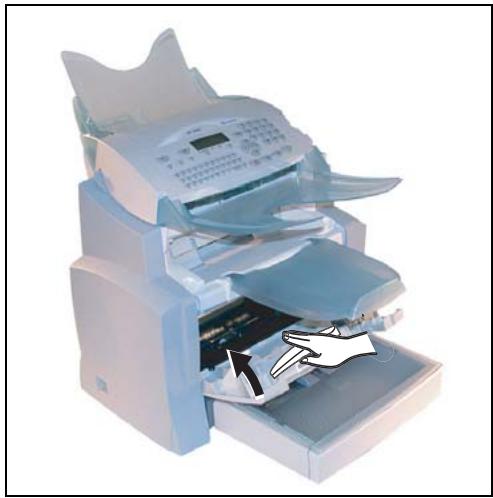
4 - Put the drum/toner cartridge set back in place (refer to paragraph Replacing cartridges, page 6-2).
5 - Close the printer cover, connect the power lead and power the machine using the switch located on the front left hand side.
Caution - The fusing unit located inside the printer above the paper supply roller may become burning hot during machine operation. Avoid touching it; you could hurt yourself.
SERVICING
For guaranteed performance of your terminal, some maintenance work (replacing the fusing unit and the transfer roll) has to be done on the printer approximately every 50,000 printed pages.
Please contact your supplier for this operation.
SCANNER CALIBRATION
You can perform this operation when the quality of photocopied documents is no longer satisfactory.
M 80 OK - ADVANCED FCT / CALIBRATION
Confirm your choice by pressing the OK key.
INCIDENTS
COMMUNICATION ERRORS
If the communication fails, the fax advises you of an automatic retry later.
Example of what is displayed:
Current time FRI 11 DEC 20:13
Time of next try 0142685014 20:18
Transmission from the feeder
You have the choice between:
- waiting until the transmission takes place at the given time,
- restarting the transmission immediately by pressing ,
- abandoning transmission by pressing . To eject the document, press again.
Transmission from memory
You have the choice between:
- waiting until the transmission takes place at the given time,
- restarting the transmission using the transmission queue (refer to paragraph Immediately perform transmission from the waiting queue, page 5-7). In this case, for a document composed of several pages, the transmission will take place from the page where the error occurred,
- abandoning the transmission by deleting the corresponding command in the transmission queue (refer to paragraph Deleting a transmission on hold, page 5-8).
The fax machine makes at most 5 automatic redials. The non-transmitted document is automatically deleted from the memory and a transmission report is then printed together with an error code and the cause for transmission failure (see the communication error codes).
Communication error codes
The communication error codes appear in the logs and transmission reports.
General codes
Code 01 - Busy or no fax answer
This code appears after 6 unsatisfactory attempts. Call later.
Code 03 - User break
A communication has been stopped by the user pressing the key.
Code 04 - Non programmed number
A number saved as a one-touch key or abbreviated number is not valid, check it (example: a delayed transmission was programmed with a one-touch key and this key has been deleted in the meantime).
Code 05 - Scanning default
An incident occurred with the scanner, for example, the sheet is jammed.
Code 06 - Printer default
An incident occurred in the printer: no paper, paper jam, opened cover... In the reception mode, this incident appears only if the reception parameter is switched to WITHOUT PAPER (refer to paragraph Reception without paper, page 3-6).
Code 07 - Disconnected
The link has been cut (bad line). Check the number and try again.
Code 08 - Quality
The document you sent was not well received. Contact your subscriber to see if you need to send again.
Code 0A - No document to be polled
You tried to poll a document from a subscriber who had not prepared his document (no deposit) or the password entered was incorrect.
Code 0B - Wrong number of pages
There is a difference between the number of pages indicated during preparation for the transmission and the number of pages sent, check the number of pages in the document.
Code 0C - Received document error
Ask the subscriber who called you to check the length of his document (it may be too long to be completely received).
Code 0D - Transmission failed
Ask the sender to resend the document.
Code 13 - Memory full
Your fax can no longer receive since its memory is full. There are too many received unprinted documents or too many documents in the transmission queue.
Print the received documents and delete or transmit immediately the documents in the transmission queue.
Code 14 - Memory full
Received document memory full.
Code 15 - Unknown mailbox number
You wish to deposit a document in a subscriber's mailbox. The mailbox number does not exist.
Code 16 - No Relay Bcst list Nr x
You requested a document relay from a remote fax but the fax has not programmed the list of subscribers requested.
Code 17 - Unknown mailbox number
You wish to recover a document from a subscriber's mailbox. The mailbox number does not exist.
Code 18 - Relay Bcst impossible
You have requested a document relay from a remote fax which does not have the relay broadcast function.
Code 19 - Subscriber has stopped
The communication has been stopped by your subscriber (example: a fax wanted to poll your fax but there is no document deposited).
Code 1A - Disconnected
The transmission has not started. The telephone line is busy.
Code 1B - Transmission failed
During transmission: start again.
During reception: ask your subscriber to resend the document.
PRINTER ERRORS
Error messages
If the printer has one of the problems described below, the corresponding message is displayed on the screen.
| Message | Action |
| CHANGE TONER <OK> TO CONFIRM | Replace the toner cartridge. Proceed as indicated in paragraph Replacing the toner cartridge, page 6-2. |
| CHANGE DRUM <OK> TO CONFIRM | Replace the drum cartridge. Proceed as indicated in paragraph Replacing the drum cartridge, page 6-9. |
| CLOSE COVER PRINTER | Close the front cover of the printer. |
| CLOSE UPPER COVER PRINTER | Close the rear upper cover of the printer. |
| DRUM NEAR END | The drum cartridge is nearly worn out (10% use left). |
| TONER NEAR END | The toner cartridge is nearly worn out (10% capacity left). |
| PAPER EMPTY | Install the paper tray. Fill the tray with paper in the required size. |
| PAPER JAM INSIDE | Open the tray. Remove the jammed sheet. |
| PAPER JAM EXTERNAL TRAY | Open the cover. Remove the jammed sheet from the print outlet. |
| PAPER JAM INTERNAL TRAY | Open the cover. Remove the jammed sheet from between the tray and the fusing unit. |
| PRINTER ERROR XX | Disconnect and reconnect the terminal. If the problem persists, contact your supplier. |
| PAPER SIZE ERROR | Check paper size (A4 / LETTER / ...) |
Printer paper jam
Inside the printer
Use the following procedure to remove any sheets of paper jammed inside the printer.
Caution - The fusing unit inside the printer can become very hot during operation. To avoid injury - do not touch.
Open the front cover of the printer.
Remove the toner/drum cartridge set from inside the printer.
Remove any jammed sheets.
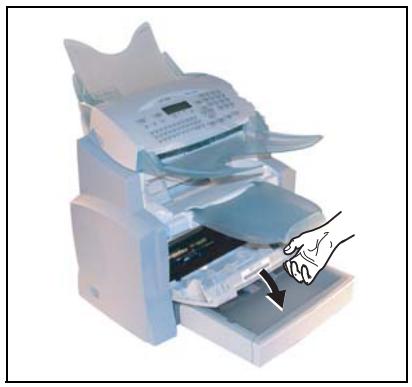
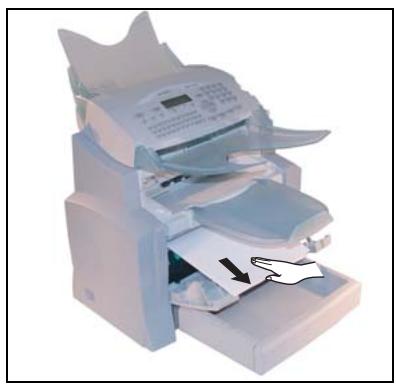
^ Open the rear cover of the printer.
Remove any jammed sheets.
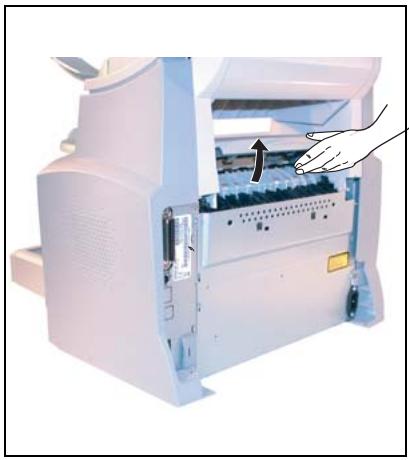
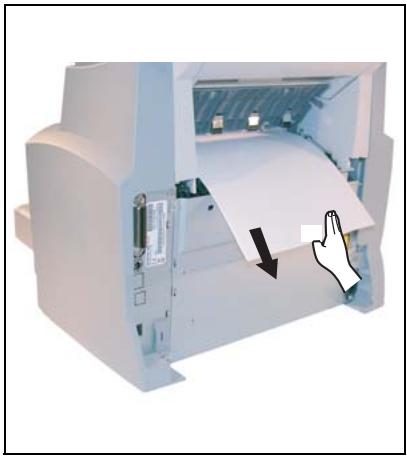
Reinstall the drum/toner cartridge set (refer to paragraph Replacing cartridges, page 6-2).
Correctly close the front and rear covers of the printer.
Paper jam at the feeders and trays
The figures below show different type of paper jam you might experience when using your machine.
Remove any stuck sheets as shown by the arrow depending on where the paper jam occurs
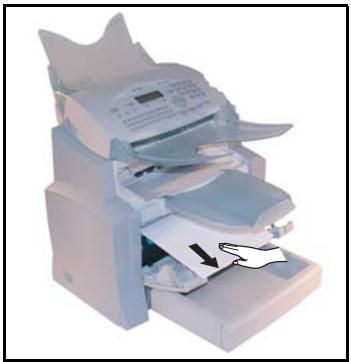
At the printer output stacker
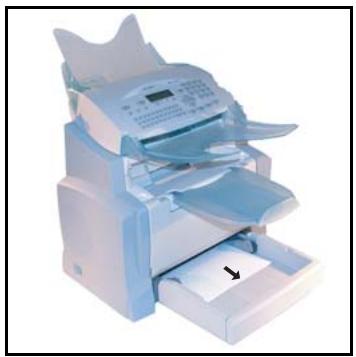
At the paper tray
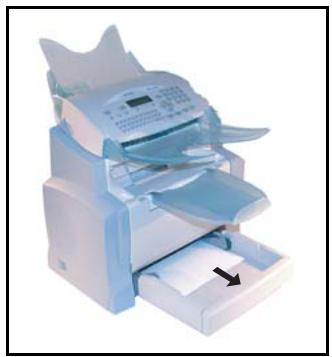
At the manual feed tray
Second cassette unit and paper tray (option)
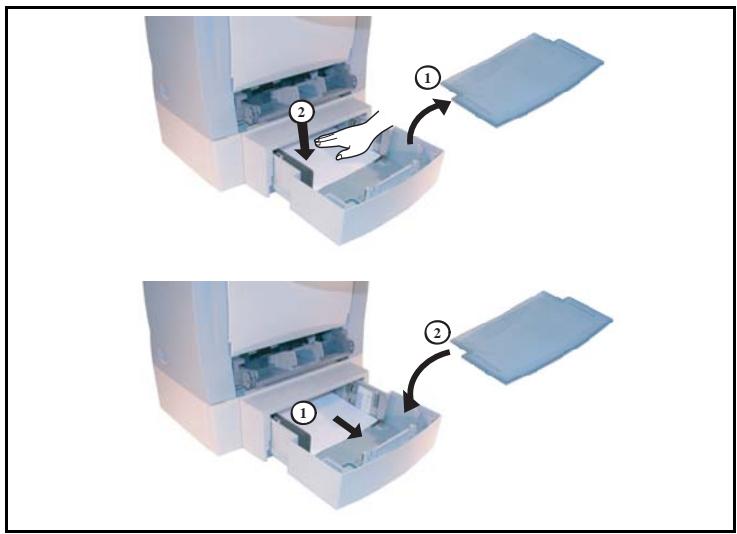
SCANNER INCIDENTS
Scanner paper jam
When a paper jam occurs, the message REMOVE DOCUMENT appears on the control panel screen. If jams often occur in a specific part of the unit, the latter needs to be checked, cleaned or repaired.
^ Open the scanner cover by pressing key (A).
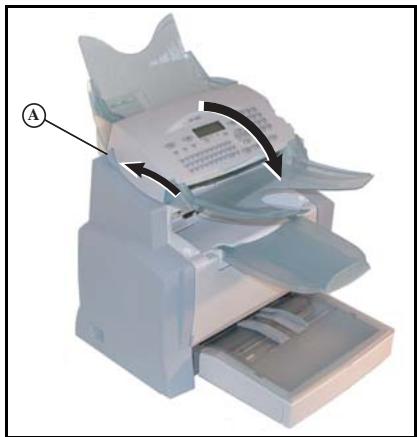
Remove the jammed paper (B) without tearing it.
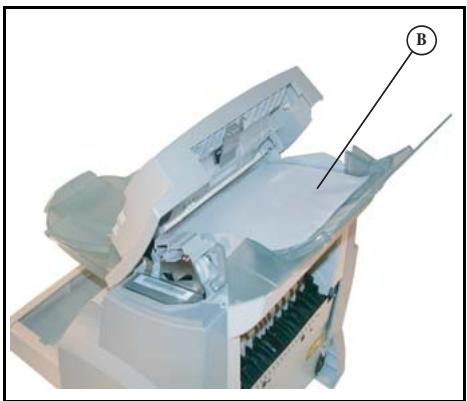
Then, close the scanner cover.
MISCELLANEOUS INCIDENTS
At switch-on nothing appears on screen
Check that the mains cable is plugged in, and check the mains plug if necessary.
The fax does not detect the presence of your inserted document. The message READY does not appear on the screen
At the start and during scanning, REMOVE DOCUMENT appears on the screen
Remove the document or press the key.
Check the thickness of the document (30 sheets of paper of 80g / m^2
Iron out the sheets if needed.
Help the sheets along.
The fax machine does not receive any faxes
Check that the telephone line cable is correctly plugged in and that there is a tone signal on the telephone line by means of the key.
You receive a blank page
Make a photocopy of a document; if it is correct then your fax is functioning normally. Call back the subscriber and have him resend the document. It was probably sent with the sheet inserted backwards.
You cannot send a fax
Check that the telephone line cable is correctly plugged in.
Check the tone by pressing the key.
Check the prefix is correctly programmed and used.
MACHINE PACKING AND TRANSPORTATION
Always use the original package when transporting the machine. Failure to do so could void the warranty.
1 - Disconnect the machine from the telephone network and the AC power socket.
2 - Open the front cover.
3- Close the front cover. Unplug the phone line cord and the AC power cord, the document holder and the document stacker. Put them in the original package.
4 - Put the machine in the plastic bag and then in the original package, with all the original packing material.
5 - Close the shipping box with adhesive tape.
CHARACTERISTICS
Device type: Office fax machine, fast, operation with all Group 3 devices according to ITU-T recommendations.
UNIT CHARACTERISTICS
| Dimensions: | Width: 430 mm Depth: 460 mm Height: 420 mm (not including stacker) |
| Weight: | 14 kg |
| Electric power supply: | 220-240 V - 50/60 Hz - 4 A |
| Power consumption (max. values): | - standby mode: less than 15 W - wait mode: less than 75 W - operation: 580 W during copy (850 W peak) |
| Operating temperature: | - operation: +10°C to 35°C (50 to 95°F) with a maximum difference of 10°C per hour - storage: 0°C to 40°C (32 to 104°F) with a maximum difference of 10°C per hour |
| Operating humidity: | Operation or storage: 20% to 80% RH (without condensation) with a maximum difference of 20% per hour |
| Original document size: | Width: 216 mm max. Height: 297 mm Thickness: 0.05 to 0.15 mm |
| Document feeder: | Max capacity: a normal capacity of 35 pages (80 g/m2) |
| Reception size (A4 size): | Width: 210 mm Length: 297 mm |
| Reception paper: | Plain paper (copier type (80 g/m2)) |
| Paper tray capacity: | 250 pages max. (80 g/m2) |
| Second paper tray (option): | Second paper tray: 500 pages (80 g/m2) |
| Transmission procedures: | In accordance with UIT-T recommendations for group 3 copiers |
| Possible phone line connections: | To all public switched telephone networks (or equivalent) |
| Scanned image resolution: | Scanner: 600 dpi |
| Reading system: | CIS optronics reading |
| Print type: | Laser printing process |
| Printer resolution: | 600 x 600 dpi |
| Communication rate: | For group 3: 33600/14400/12000/9600/7200/4800/2400 bps |
The effective transmission time for an A4 page ranges between a few seconds to approximately one minute (depending on line quality, modem bit rate, the amount of information on the original document and the resolution) (^*) .
(*) Not taking into account the exchange initialisation procedure.
Encoding type: MH (Modified Huffman) MR (Modified Read) MMR (Modified Modified Read)
| Internet (general specifications): | V90 modem (up to 56 kbps) |
| TCP/IP/PPP protocols | |
| SMTP/POP3/MIME protocols for E-mails | |
| File format: | - Image: TIFF-F for black/white documents and JPEG for color documents |
| - PDF: monochrome and color | |
| Specifications may change for improvement without prior notice. | |
7 SAFETY AND ENVIRONMENT
SAFETY

SAFETY WARNING
Before powering on your unit, make sure the mains outlet it is connected to meets the requirements printed on the warning label on your unit, or on the separate power supply (depending on the model). This unit must not be installed on the floor.
If your unit works with a separate Power Supply, use only the one delivered with your unit; never use another power supply.
If your unit works with a battery, replace it only with the same type of battery or an equivalent type recommended by the manufacturer.
Warning:
incorrect replacement of the battery may cause an explosion. Replace only with the same or equivalent type recommended by the manufacturer. Dispose of used batteries according to the manufacturer's instructions.
Used batteries must be disposed of following the manufacturer's instructions.
Depending on the model, the unit's mains plug may be the only way to disconnect the unit from the power network. Therefore you must respect the following:
- Your unit must be connected to a mains outlet located nearby.
The mains outlet must remain easily accessible.
Your unit is delivered with a power cord including a plug which, depending on the model, may be:
- without earth (the symbol on the warning label).
- with earth (no symbol on the warning label). It is imperative that a power plug with an earth be connected to a wall outlet with an earth.

APPEARIL A RAYONNECTION LASER DE CLASSES1 CLASS 1 LASER PRODUCT LASER KLASER2 CLASS 2 LASER
APPEARIL BIO LASER DI CLASSES 1 PRODUCTO LASER DE CLASSES 1 APARELHO LASER DE CLASSES 1
If the machine is powered when you remove the upper cover, be careful with the two following dangers:
- Laser beam interception by human eye can produce irremediable injuries.
Human contact with parts electrically powered can produce a very dangerous electric shock.
ENVIRONMENT
The preservation of the environment is of importance to the manufacturer. The manufacturer wishes to service the installations with respect to the environment and has chosen to integrate the environmental performance in the whole lifecycle of its products, throughout manufacturing, release use and disposal.
THE PACKAGING

The (green point) logo indicates that a contribution is given to an approved national organization to improve the packaging salvage and recycling infrastructures.
To make recycling easier, follow local rules and regulations concerning sorting and disposal of such waste.
BATTERIES AND RECHARGEABLE BATTERIES
If your product contains batteries or rechargeable batteries, these shall be disposed of at the designated collecting centers.
THE PRODUCT

The crossed bin symbol on the product indicates that it belongs to the electric and electronic equipment family. The crossed bin symbol on the product indicates that it belongs to the electric and electronic equipment family.
Therefore, according to European regulations you are requested to dispose of it at the selected collection areas:
- to distribution centers in case of equivalent equipment purchase,
- to the available local collecting centers (dump, selective collection, etc.).
Thus, you participate in the "Waste of Electric and Electronic Equipment reuse and development" which can have potential effects on the environment and human health.
ENERGY STAR

The purpose of the International ENERGY STAR® Program is to promote the development and popularization of energy-efficient office equipment. As an ENERGY STAR® Partner, Sagem Communication has determined that this product meets the ENERGY STAR® guidelines for energy efficiency.
The standard toner cartridge can produce up to 6,000 pages (when printing on A4 paper with a 5% max. black and white ratio) or 10,000 pages ITU No. 1 in normal mode.
The initial toner cartridge can produce up to 2,000 pages (when printing on A4 paper with a 5% max. black-and-white ratio).
The service life of the toner cartridge mainly depends on the type of printed document and the average number of pages per print operation).
Drum cartridge:
The standard drum cartridge can produce up to 20,000 pages.
The initial drum cartridge that comes with the printer can produce up to 4,000 pages.
Various factors may influence the effective service life of the drum cartridge, namely the environment (temperature, humidity), the average number of pages per print operation, the type of paper used, etc.
The declaration of compliance can be consulted on the site www.sagem.com category "Support", or can be requested at the following address:
SAGEM Communication - Customer relations department
Data subject to change without notice
Sagem Communication
- List of accessories
- Consumables
- CONTENTS
- INSTALLATION 1-1
- GETTING STARTED 2-1
- SETTING YOUR MACHINE 3-1
- Dlrcetory 4-1
- OPERATION 5-1
- SAFETY AND ENVIRONMENT 7-1
- INSTALLATION
- INSTALLING YOUR TERMINAL
- INSTALLATION REQUIREMENTS
- Operational precautions
- Operating environment
- Terminal
- UNPACKING THE MACHINE PARTS
- DESCRIPTION
- INSTALLING THE REMOVABLE PARTS
- INSTALLING THE PRINTER PAPER TRAY
- INSTALLING THE PRINTER OUTPUT STACKER
- INSTALLING THE DOCUMENT FEEDER FOR SCANNING
- INSTALLING THE ORIGINAL DOCUMENT OUTPUT STACKER
- LOADING PAPER
- Supported types of paper:
- LOADING PAPER MANUALLY
- INSTALLING THE SECOND PAPER CASSETTE UNIT (OPTION)
- CONNECTIONS
- Key to the diagram:
- TELEPHONE CONNECTION
- POWER LINE CONNECTION AND SWITCH-ON
- GETTING STARTED
- NAVIGATION METHODS
- PRESENTATION
- The display screen
- ACCESS TO FUNCTIONS
- Menu-driven access
- Direct access by number
- FUNCTIONS LIST
- SETTING YOUR MACHINE
- MAIN SETTINGS
- BEFORE TRANSMISSION
- Date/Time
- Summer time / winter time setting
- Manual mode
- Automatic mode
- Warning message
- Your fax number/your name
- Type of network
- Geographical settings
- Country
- Network
- Language
- Local prefix
- Defining the minimal size and the local prefix
- Transmission report
- Document feed type
- Economy period
- BEFORE RECEPTION
- Fax answering machine
- Saving an access code
- Activating or deactivating the answering machine
- Print fax messages stored in the memory
- Reception without paper
- To select the reception mode:
- Number of copies
- Relay broadcast
- To activate relay from your fax machine:
- TECHNICAL PARAMETERS
- To set the technical parameters:
- DIRECTORY
- ADDING A RECORD
- M 11 OK - DIRECTORY / NEW CONTACT
- CREATING SUBSCRIBERS Lists
- ADDING A LIST
- To add a list:
- M 12 OK - DIRECTORY / NEW LIST
- Remark:
- ADDING OR DELETING A NUMBER FROM THE LIST
- M 13 OK - DIRECTORY / MODIFY
- CONSULTING A RECORD OR A LIST
- MODIFYING A RECORD OR A LIST
- DELETING A RECORD OR A LIST
- PRINTING THE DIRECTORY
- OPERATION
- SENDING
- DOCUMENT POSITIONING
- Scanner
- CHOOSING THE RESOLUTION/CONTRAST
- Resolution
- To select the resolution mode:
- Contrast
- DIALLING
- From the directory
- Dialling alphabetically
- Assigned number dialling
- then
- or
- From the radial key
- For a fax number (Tel in the Directory)
- To multiple numbers
- TRANSMISSION OVER THE PUBLIC SWITCHED TELEPHONE NETWORK (PSTN)
- Immediate transmission
- Sending in the eco mode
- Delayed transmission
- Transmission with auto radial
- To take the line manually:
- Rerouting
- Activate rerouting
- Set the re-direction contact
- M 3912 OK - FAX / RERouting / CALL NUMBER
- Local printout of the information relayed to your system
- Tx forwarding
- M 3921 OK - FAX / TX FORWARD. / ACTIVATION
- M 3922 OK - FAX / TX FORWARD. / CALL NUMBER
- TRANSMISSION WAITING Queue
- Consult or modify the waiting queue
- Immediately perform transmission from the waiting queue
- Printing a document in waiting or in deposit
- Print the waiting queue
- Deleting a transmission on hold
- CANCELLING A TRANSMISSION IN PROGRESS
- To cancel transmission in progress:
- RECEPTION
- RECEPTION OVER THE PUBLIC SWITCHED TELEPHONE NETWORK (PSTN)
- COPYING
- LOCAL COPY
- Standard copy
- "Sophisticated" copy
- SPECIFIC COPY SETTINGS
- Scanner settings:
- Printer settings:
- To access to the settings:
- Scanner settings
- Zoom
- Assembly
- Origin
- Luminosity
- Margins
- Printer settings
- Paper
- Paper tray
- OTHER FUNCTIONS
- Logs
- To print the logs:
- PRINTING THE FUNCTIONS LIST
- PRINTING THE MACHINE SETTINGS
- MEMORIZING A SEQUENCE OF KEYS
- To register a sequence (for example, in key F1)
- To send a fax directly to your subscriber (key F1 preset)
- COUNTERS
- DEPOSIT AND POLLING
- Setting the machine for document deposits,
- Setting the machine for polled documents,
- Placing a document in deposit
- Polling a deposited document
- Locks
- Entering the locking code
- Locking the keyboard
- Locking the numbers
- M 813 OK - ADVANCED FCT / LOCK / LOCK NUMBER
- DEPARTMENT CODE
- FUNCTION MANAGEMENT BY THE ADMINISTRATOR
- Activating the department code
- M 881 OK - ADVANCED FCT / DEPT. CODES / ACTIVATION
- Deactivating the department code
- Setting the department codes
- Creating a department code
- Deleting a department code
- Printing a department code
- ** DEPARTMENT CODES **
- Printing the department report
- USE OF THE DEPARTMENT CODES BY A DEPARTMENT
- Printing a user department code
- CHARGE CODE
- ENTERING THE CHARGE CODE
- MAIL BOX (MBX FAX)
- MBX MANAGEMENT
- Creating an MBX
- M 71 OK - MAILBOXES / CREATE MBX
- Modifying the features of a MBX
- Printing the contents of a MBX
- M 73 OK - MAILBOXES / PRINT MBX
- Deleting a MBX
- M 74 OK - MAILBOXES / DELETE MBX
- Printing the MBX list
- M 75 OK - MAILBOXES / PRT MBX LIST
- MBX deposit in your fax
- MBX deposit in a remote fax
- MBX polling from a remote fax
- M 36 OK - FAX / MBX POLLING
- MAINTENANCE
- MAINTENANCE
- GENERAL
- REPLACING THE CONSUMABLES (TONER AND DRUM)
- Replacing cartridges
- Replacing the toner cartridge
- Replacing the drum cartridge
- CLEANING
- Cleaning the printer
- Cleaning the outside of the printer
- Cleaning the paper feed roller
- SERVICING
- SCANNER CALIBRATION
- INCIDENTS
- COMMUNICATION ERRORS
- Transmission from the feeder
- Transmission from memory
- Communication error codes
- General codes
- Code 0B - Wrong number of pages
- Code 0C - Received document error
- Code 0D - Transmission failed
- Code 13 - Memory full
- Code 14 - Memory full
- Code 15 - Unknown mailbox number
- Code 16 - No Relay Bcst list Nr x
- Code 17 - Unknown mailbox number
- Code 18 - Relay Bcst impossible
- Code 19 - Subscriber has stopped
- Code 1A - Disconnected
- Code 1B - Transmission failed
- PRINTER ERRORS
- Error messages
- Printer paper jam
- Inside the printer
- Paper jam at the feeders and trays
- SCANNER INCIDENTS
- Scanner paper jam
- MISCELLANEOUS INCIDENTS
- At switch-on nothing appears on screen
- The fax does not detect the presence of your inserted document. The message READY does not appear on the screen
- The fax machine does not receive any faxes
- You receive a blank page
- You cannot send a fax
- MACHINE PACKING AND TRANSPORTATION
- CHARACTERISTICS
- UNIT CHARACTERISTICS
- SAFETY AND ENVIRONMENT
- SAFETY
- SAFETY WARNING
- Warning:
- ENVIRONMENT
- THE PACKAGING
- BATTERIES AND RECHARGEABLE BATTERIES
- THE PRODUCT
- ENERGY STAR
- Drum cartridge:
- Sagem Communication
Brand : SAGEM
Model : MF 4640
Category : Multifunction Printer