
MF 5890DN/BDN - Multifunction Printer SAGEM - Free user manual and instructions
Find the device manual for free MF 5890DN/BDN SAGEM in PDF.


| Product type | Monochrome laser multifunction printer |
| Brand | SAGEM |
| Model | MF 5890DN/BDN |
| Main functions | Print, copy, scan, fax |
| Print technology | Monochrome laser |
| Maximum paper size | A4 |
| Dimensions (W × D × H) | Approx. 400 × 350 × 300 mm |
| Weight | Approx. 12 kg |
| Power supply | Mains 220-240 V, 50/60 Hz |
| Paper tray capacity | 250 sheets (standard tray) |
| Print speed | Up to 28 ppm (A4) |
| Print resolution | Up to 1200 × 1200 dpi |
| Copy function | Up to 99 copies, zoom 25%-400% |
| Scan function | Color scan, optical resolution up to 1200 × 1200 dpi |
| Fax function | Laser fax, 33.6 kbps modem, 500-page memory |
| Connectivity | USB 2.0, Ethernet 10/100 Base-TX |
| Display | Backlit LCD (2 lines) |
| Maintenance and cleaning | Clean the exterior with a soft dry cloth; replace the used toner cartridge; avoid contact with magnetic media when replacing toner |
| Safety | Keep magnetic media (floppy disks) away from the toner cartridge during replacement; use the emergency stop function if any issue occurs |
| Spare parts and repairability | Toner cartridge (compatible SAGEM reference), fuser unit, maintenance kit; consumables available via SAGEM or authorized resellers |
| General information | Manufactured by SAGEM, a public limited company with a capital of €300,272,000, 27 rue Leblanc, 75512 PARIS CEDEX 15, France. Manual available in PDF at notice-facile.com |
Frequently Asked Questions - MF 5890DN/BDN SAGEM
User questions about MF 5890DN/BDN SAGEM
0 question about this device. Answer the ones you know or ask your own.
Ask a new question about this device
Download the instructions for your Multifunction Printer in PDF format for free! Find your manual MF 5890DN/BDN - SAGEM and take your electronic device back in hand. On this page are published all the documents necessary for the use of your device. MF 5890DN/BDN by SAGEM.
USER MANUAL MF 5890DN/BDN SAGEM
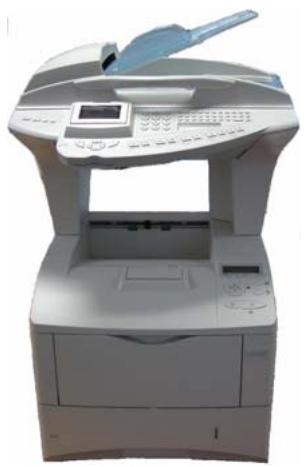
You have just acquired a new-generation communications terminal from SAGEM and we congratulate you on your choice. This multi-function terminal is capable of faxing, printing and scanning; it can also be used for communication on the Internet. Your terminal will meet all your professional requirements.
We highly recommend that you take the time to read this manual so that you can get the most out of the many features of your terminal.
For your comfort and your safety, we ask you to carefully read the paragraph Safety warning, on page 7-1 in the Safety chapter.
This user manual is applicable to the following model:
| Model | Equipment |
| 5890dn / 5890bdn1 | • Duplex unit scanner colour • 33.6 kbps fax modem (for colour and black&white fax) and 56 kbps data modem • Laser printer black&white 35 ppm network laser printer • Emission / reception of SMS • Duplex black&white and colour copier • 10/100 Base T LAN • Network PC kit • USB key reader |
It combines power, user-friendliness and simplicity thanks to its colour screen, its navigator, its multitask access and its direct access directory.
Through its Internet access, your terminal allows you to:
- send and receive faxes to E-mails thanks to the F@x to E-mail function,
- send and receive E-mails,
- send SMS's.
You can also print using the PCL 6 and KPDL/SGScript 3 (emulation of the level 3 Postscript language) formats, both in black&white.
List of accessories
The following additional accessories are proposed for the Fax Laser Pro range:
- Directory card.
- 500-page paper tray.
- Companion Suite Pro LH PC kit.
Consumables
To refer to the last page of this user manual for to know the characteristics of the consumable.
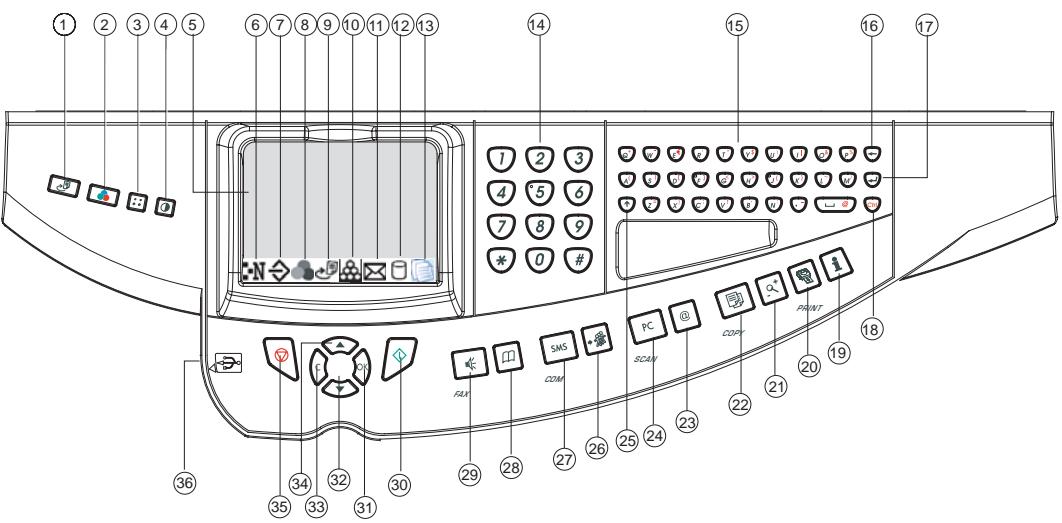
- key: duplex (double-sided) scan/copy.
- key: selection of colour mode.
- key: scan resolution.
- ① key: contrast setting.
- Graphical colour screen.
- Scan resolution indicator.
- "Line" icon:
On: communication in progress.
Flashing: communication setting up. - Colour mode icon:
On: colour mode active.
Off: colour mode not active. - Duplex printing indicator in copy mode: On: duplex mode activated. Out: duplex mode deactivated.
- Toner remaining indicator: On: end of toner, Flashing: near the end of toner.
- Message reception icon (SMS or attachment)
- Memory occupation indicator
- Indicator of documents to be printed
- Digital keyboard.
- Alphabetical keyboard.
- key: deletes the character to the left of the cursor.
- key: input or line feed.
- Ctrl key: access to special characters.
-
key: help with terminal use.
-
key: photo printing.
- key: reduce or enlarge.
- key: black and white copy.
- @ key: scan to e-mail (sending of Internet fax).
- PC key: scan to PC / scan to FTP / scan to disk.
- key: Shift.
- key: multiple contact sending (fax, e-mail or SMS).
- SMS key: sending of an SMS (Short Message Service).
- key: access to directory and quick dial numbers.
- key: line manual connection, listen for tone during fax sending.
- key: send fax.
- OK key: validates displayed selection.
- key: access to menu and browsing in menus downwards.
- C key: return to previous menu and correction of text.
- key: browsing in menus upwards.
- key: stops current operation.
- USB connector.
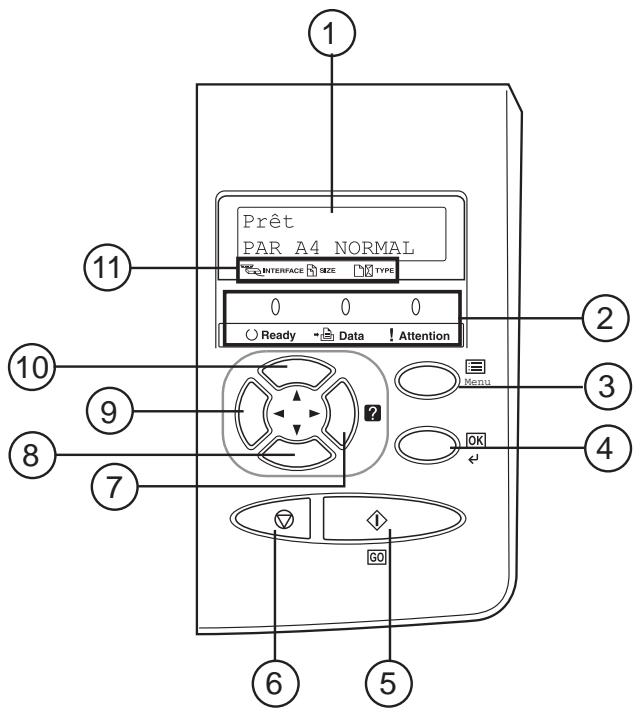
PRINTER CONTROL PANEL
- The console's LCD screen.
- Status of the indicators
ATTENTION Indicator:
On: A problem or error (e.g. a paper jam) has occurred.
Blinking: The printer requires maintenance or is warming up.
READY Indicator:
On: The printer is ready, or printing the received data.
Blinking: An error has occurred.
Off: Indicates that the printer is in standby mode.
Data will be received but will not be printed (see GO key).
DATA Indicator:
On: The data has been processed or stored on the memory card.
Blinking: Data transfer in progress.
- MENU Key: Used to access or exit the printer's menu.
-
OK Key: Confirms the numerical values and other selections.
-
GO Key: Used to switch the printer between Ready and Standby mode.
-
CANCEL Key: Used to cancel a print job.
-
Key: Used to navigate in the sub-menus, to adjust certain settings and to display help messages when certain errors occur.
- Key: Used to navigate the menus and to delve numerical values.
- Key: Used to navigate in the sub-menus and to adjust certain settings.
-
Key: Used to navigate the menus and to increase numerical values.
-
Indicator: Shows the type of paper being used in the tray.
SIZE
Indicator: Shows the paper size being used in the tray.
INTERFACE

Indicator: Shows the interface being used
(PAR, USB, RES or --).
CONTENTS
1 INSTALLATION 1-1
Installing your terminal 1-1
Installation requirements 1-1
Unpacking the components 1-4
Unpacking the additional paper tray (depending on option) 1-4
Unpacking the scanner and the equipped interface 1-5
Unpacking the printer 1-6
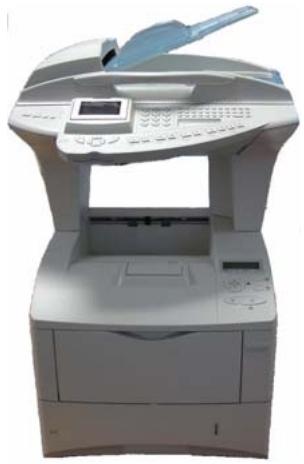
Description of the multifunction terminal 1-7
Installation of the terminal 1-8
Connections 1-11
Installation of consumables 1-12
Loading paper 1-15
Loading paper into the cassette 1-15
Loading paper into the multifunction tray 1-21
Adjusting the original document output tray 1-23
Wall connections 1-24
Telephone and Ian connections 1-24
Power line connection and switch on 1-24
Configuring the printer driver 1-25
2 GETTING STARTED 2-1
Navigation methods 2-1
Presentation 2-1
Access to functions 2-3
Guide to function list 2-5
Print console navigation basics 2-10
Navigating the menus 2-10
Access to functions 2-12
Guide to functions 2-12
3 SETTING YOUR MACHINE 3-1
Main settings 3-1
Before transmission 3-2
Before reception 3-5
Technical parameters 3-9
Local Area Network (LAN) settings 3-11
Local network settings 3-11
Print function settings 3-15
Remote configuration 3-16
Message service and the Internet 3-17
Initialisation parameters 3-17
Settings 3-20
Internet Connection 3-23
Deactivating the Internet function 3-23
The SMS service 3-24
SMS Parameters 3-24
Sending an SMS 3-25
Erase an SMS 3-26
SMS Reception 3-26
SMS Server 3-27
4 Dlrcetory 4-1
Creating subscribers record 4-2
Adding a record 4-2
Creating subscribers lists 4-4
Adding a list 4-4
Adding or deleting a number
from the list 4-5
Consulting a record or a list 4-6
Modifying a record or a list 4-6
4-6
Printing the directory 4-7
Importing a directory 4-7
The file structure 4-7
Procedure 4-9
Exporting a directory 4-9
LDAP server 4-10
Configuration 4-10
4-10
Adding a server contact
to the local directory 4-11
5 OPERATION 5-1
Sending 5-1
Document depositing 5-2
Selecting Resolution/Contrast 5-3
Dialling 5-3
Transmission over the
Public Switched Telephone Network (PSTN) 5-5
Transmission over the Internet and the network 5-7
Scan to email in black and white 5-7
Scan to email in colour 5-7
Text to mail 5-8
Scan to FTP 5-9
Scan to Disk 5-10
Scan to PC (depends on model) 5-11
Transmission waiting queue 5-11
Cancelling a transmission in progress 5-13
Reception 5-13
Reception over the
Public Switched Telephone Network (PSTN) 5-13
Reception over the Internet 5-13
Copying 5-14
Local copy 5-14
DESCRIPTION OF ID CARD MODE 5-16
Specificcopy settings 5-18
Using USB memory keys 5-21
Printing a photo from a USB memory key 5-22
Printing a document from a USB memory key 5-24
Recording a document in a USB memory key 5-25
Archiving a fax on a USB memory key 5-26
Analysis of the USB memory key 5-27
Other functions 5-28
Logs 5-28
Printing the functions list 5-28
Printing the machine settings 5-28
Counters 5-29
Deposit and polling 5-29
Lock 5-31
Department code 5-33
Function management by the administrator 5-33
Use of the department codes by a department 5-37
Charge code 5-37
Entering charge code 5-37
Mail box (MBX FAX) 5-38
MBX management 5-39
6 MAINTENANCE 6-1
Maintenance 6-1
General 6-1
Replacing the consumables (toner and drum) 6-1
Cleaning 6-11
Servicing 6-12
Scanner calibration 6-12
Incidents 6-12
Communication errors 6-12
Scanner incidents 6-16
Miscellaneous incidents 6-17
Troubleshooting 6-18
Storage 6-32
Packing and transporting the unit 6-32
Characteristics 6-34
7 SAFETY
7-1
Safety
7-1
Environment
7-2
Packaging
7-2
Batteries
7-2
The product
7-2
This unit has been designed in accordance with European harmonised standards, it is designed for connection to the Public Switched Telephone Network (PSTN). In case of any problems, first contact your Supplier.
The mark attests that the products comply with the essential requirements of Directive R&TTE 1999/05/EC.
For user safety, in accordance with Directives 73/23/EEC. For electromagnetic interference, in accordance with Directive 89/336/EEC.
The manufacturer declares that the products are manufactured in accordance with ANNEX II of Directive R&TTE 1999/5/EC.
The declaration of compliance can be consulted on the site www.sagem.com category "support", or can be requested at the following address:
Sagem Communication - Customer relations department 4 rue du Petit Albi - 95800 Cergy Saint-Christophe - France
1 INSTALLATION
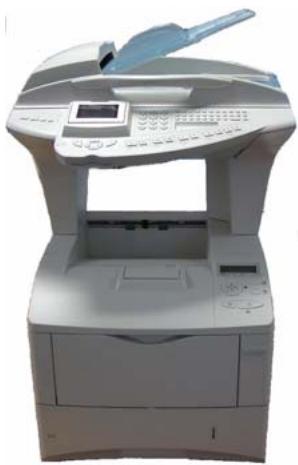
INSTALLING YOUR TERMINAL
INSTALLATION REQUIREMENTS
A proper location helps to ensure that your printer provides you with the long service life for which it is designed. Double-check to make sure that the location you select has the following characteristics:
- Choose a location that is well ventilated.
- Make sure you do not obstruct the ventilation grilles. If there is a wall nearby when you install the unit, make sure you install the terminal at the distances shown in the illustration below in order to make it easier to open the various covers.
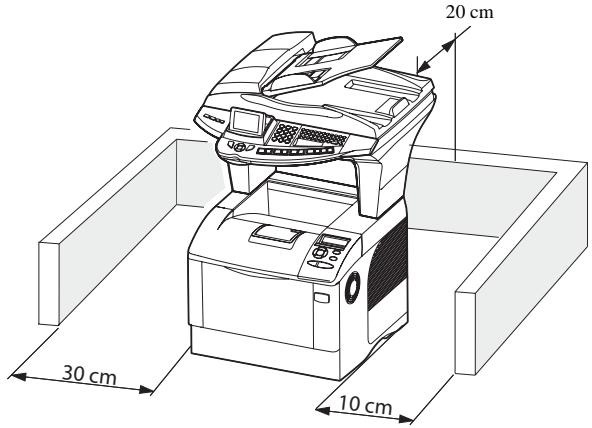
- Make sure there is no chance of ammonia or other organic gasses being generated in the area.
- The grounded power outlet (refer to the safety instructions in the Safety section) you plan to connect to for power should be nearby and not obstructed.
- The network cables (printers and scanner) must not be connected to cables going outside the building.
- Make sure that the printer is not exposed to direct sunlight.
- Avoid areas in the direct airflow of air conditioners, heaters, or ventilators and areas subject to temperature and humidity extremes.
- Choose a sturdy, level surface where the printer will not be exposed to strong vibration.
- Keep the printer away from any objects that might block its heat vents.
- Do not locate the printer near curtains or other combustible objects.
- Choose an area where there is no possibility of the printer being splashed with water or other liquids.
- Make sure that the surrounding area is clean, dry, and free of dust.
Operational precautions
Note the following important precautions whenever using the printer:
Operating Environment
The following describes the operating environment required when using the printer:
- Temperature:
10^ to 32.5^ (50^ to 95^) with fluctuation of 10^ (18^) per hour.
- Humidity:
20% to 80% (no condensation) with fluctuation of 20% per hour.
Terminal
The following describes precautions for using the terminal.
- Never switch the power to the terminal off and never open the covers while the unit is printing.
- Never place flammable gasses, liquids or objects that generate magnetic forces near the terminal.
- When unplugging the power cord, always grasp the plug and never pull on the cord. A damaged cord creates the danger of fire or electrical shock.
- Never touch the power cord when your hands are wet. Doing so creates the danger of electrical shock.
- Always unplug the power cord before moving the terminal. Failure to do so can damage the power cord, creating the danger of fire or electrical shock.
- Always unplug the power cord if you do not plan to use the terminal for a long time.
- Never place any heavy objects on the power cord, pull on it or bend it. Doing so creates the danger of fire or electrical shock.
-
Always make sure the terminal is not placed on the electrical cord or the communications cables of any other electrical equipment. Also make sure that cords and cables do not get into the terminal's mechanism. Any of these conditions create the danger of malfunction and fire.
-
Make sure that the power to the printer is switched off before connecting or disconnecting an interface lead to the printer (use a shielded interface lead).
- Never try to remove any secured panel or cover. The terminal contains high-voltage circuit which creates the danger of electrical shock when exposed.
- Never try to modify the terminal. Doing so creates the danger of fire or electrical shock.
- Always take care that paper clips, staples, or other small pieces of metal do not get into the terminal through its vents or other openings. Such objects create the danger of fire or electrical shock.
- Do not allow water or other liquids to spill on or near the terminal. Fire or electrical shock can occur should water or liquid come into contact with the terminal.
- Should liquid or any piece of metal accidentally get inside the printer, immediately turn it off, unplug the power cord, and contact your dealer. Failure to take this immediate action creates the danger of fire or electrical shock.
- Whenever the terminal emits unusually high amounts of heat, smoke, an unusual odor, or noise, immediately turn it off, unplug it, and contact your dealer. Failure to take this immediate action creates the danger of fire or electrical shock.
- Avoid using the terminal during an "electrical storm" as this may involve a risk of electric shock caused by the lightning.
- Paper for printer: do not use paper previously printed by your terminal or any other printer: the ink or toner deposited on that paper might damage the printing system of your terminal.
Caution - Be sure to locate the terminal in a well-ventilated location. A minimal amount of ozone is generated during normal operation of this terminal. Because of this, an unpleasant odor may result when the printer is used for extensive printing in a poorly ventilated area. For a comfortable, healthy, and safe operation, be sure to locate the terminal in a well-ventilated area.
UNPACKING THE COMPONENTS
UNPACKING THE ADDITIONAL PAPER TRAY (DEPENDING ON OPTION)
Take the additional tray out of its box.
Remove the protective side sections in the box.
Remove the plastic bag from the additional tray.
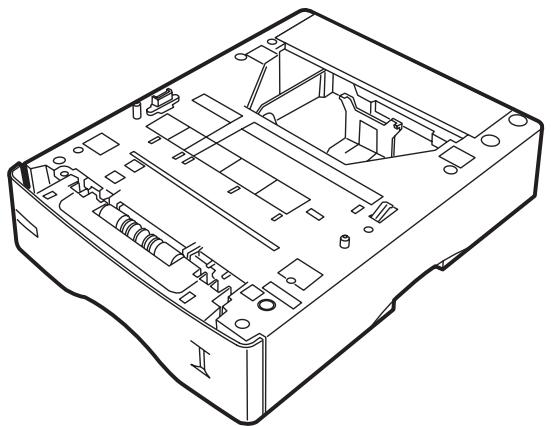
To install the additional tray, please see the paragraph Installation of the terminal, on page 1-8.
UNPACKING THE SCANNER AND THE EQUIPPED INTERFACE
Open the shipping box and take out the parts :
- the installation guide and the CD-Roms,
- the scanner,
- the document feeder,
- the leads and cables:
- telephone lead, mains lead, mains extension lead, Centronics cable.
- the equipped interface.
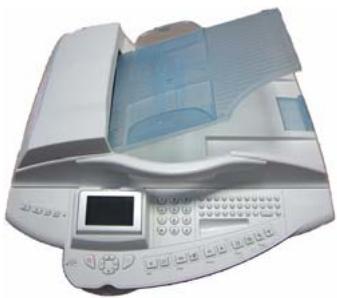
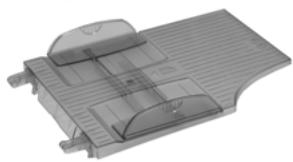

Take the parts out of their protective packing.
Remove the adhesive strips and film from the various parts.
UNPACKING THE PRINTER
Open the shipping box and take out the parts:
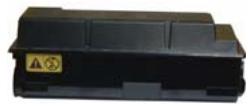
- the black toner cartridge,
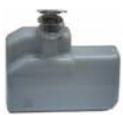
- the toner recovery box,
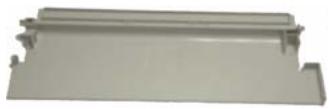
- protective shell for paper,
- the printer.
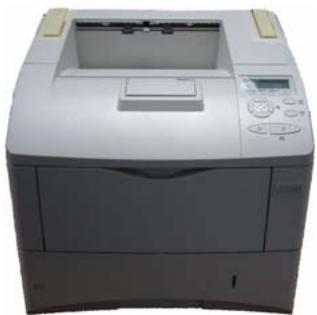
Take the printer out of its protective packing.
Remove the adhesive strips.
DESCRIPTION OF THE MULTIFUNCTION TERMINAL
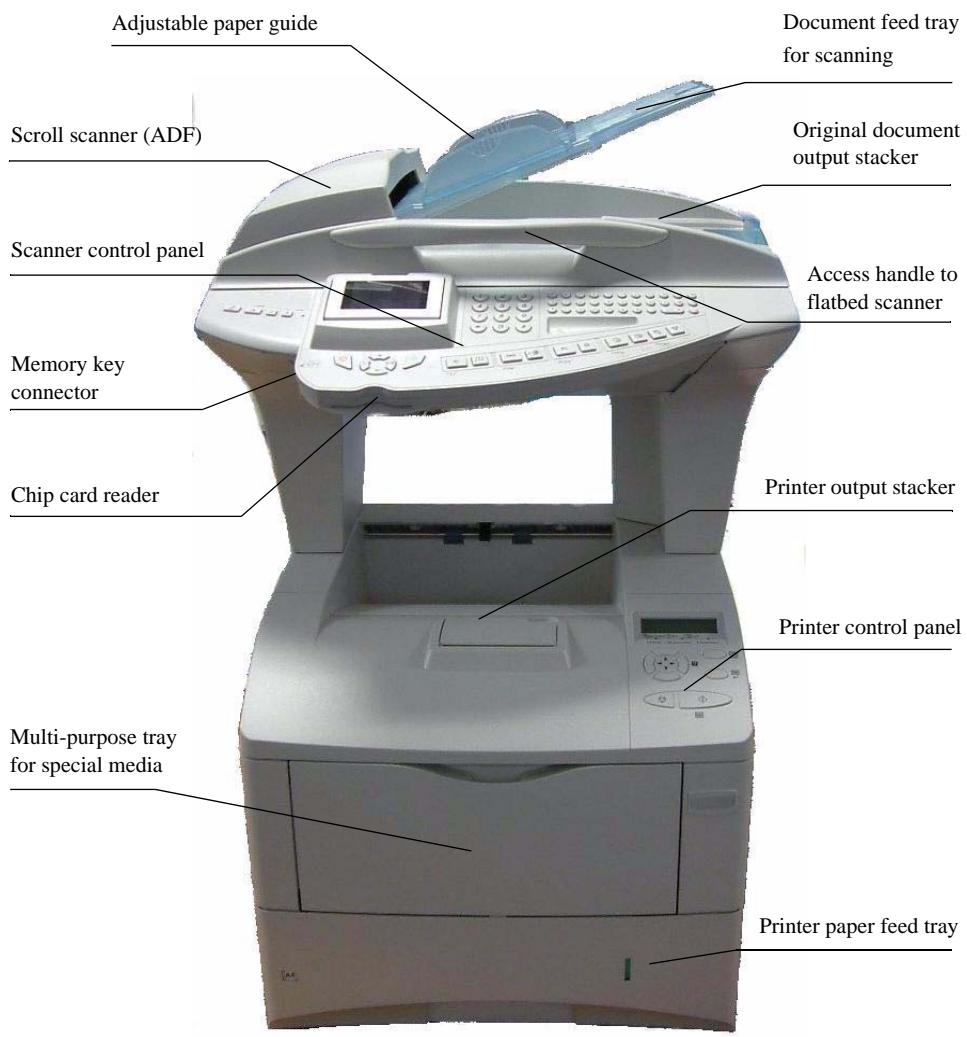
INSTALLATION OF THE TERMINAL
Installation of the equipped interface
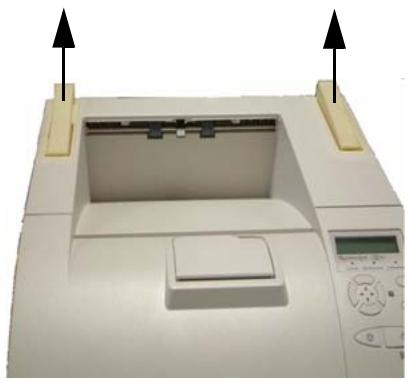
Unclip the cable covers located on the top of the printer from the rear and remove without forcing.
Put the cable covers to one side for later.
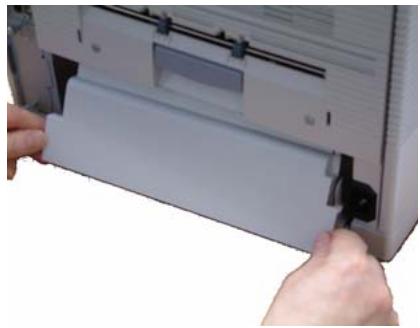
Place the paper protection shell at the rear of the printer.
Optional equipment: Place the additional paper tray under the printer, positioning it on its locating pins
You can install up to three additional paper trays.
Position the interface on the rear of the printer. Slide it into the slots provided on the printer until it clips into place.
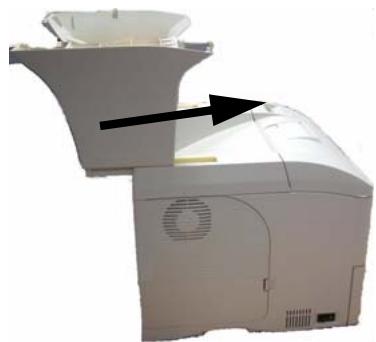
Position the scanner on the interface and check that it is properly clipped onto it.
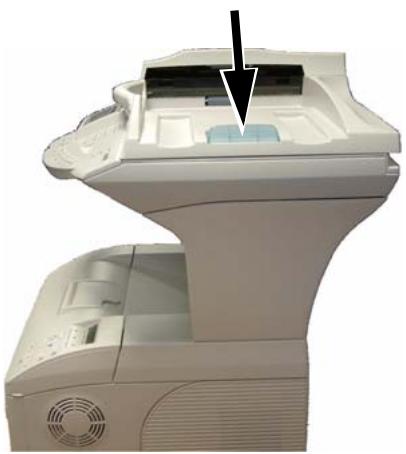
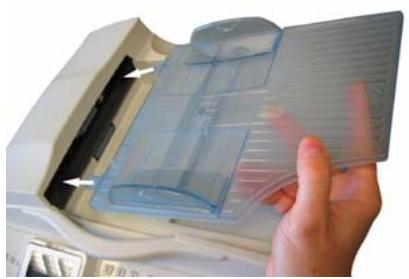
Put the document feeder in place by pushing its two locking pins into the corresponding openings on the scanner.
Terminal connections
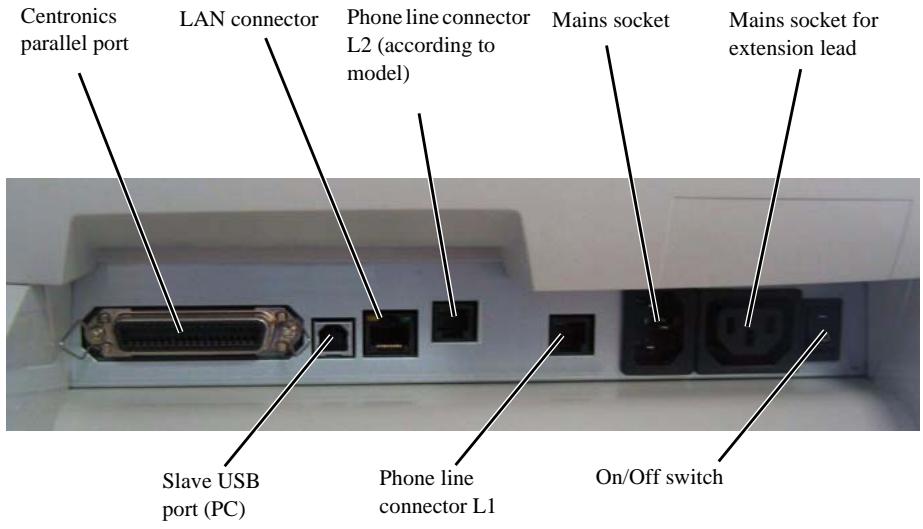
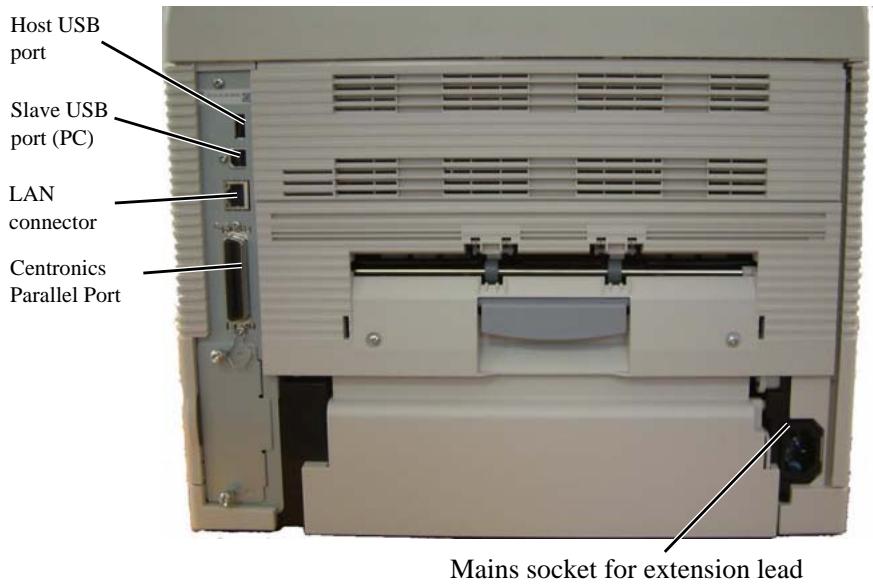
Looking at the back of the terminal, you will find the available connections as shown below.
CONNECTIONS
The leads and cables are connected separately to the scanner and the printer. We advise you start with connecting the leads and cables that arrive on the scanner unit.
Connecting the leads and cables to the scanner
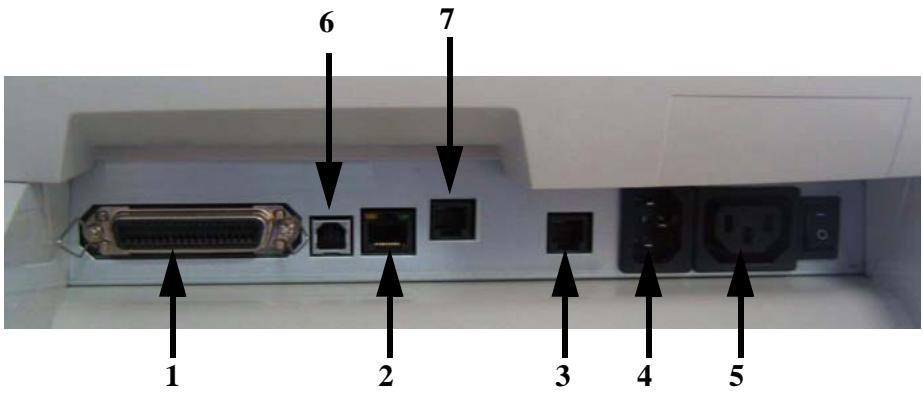
Make sure that the mains on/off switches of scanner and printer are set to "O".
1 - Connect the Centronics cable to the scanner, lock it with the two metal clips.
2- Plug the LAN cable (not supplied) into the LAN network connector of the scanner.
3 - Plug the telephone cable into the telephone connector of the scanner.
4-Connect the mains lead to the mains inlet of the scanner.
5 - Connect the 220/240V mains extension lead for the printer to the mains outlet of the scanner.
6 - Plug the USB cable (not supplied) into the slave USB connector, if applicable.
7 - Depending on the model, you can plug a second telephone cable into the other telephone connector of the scanner.
Connecting the leads and cables to the printer
1 - Connect the Centronics cable to the printer and lock it with the two metal clips.
2- Plug the LAN cable (not supplied) into the LAN network connector of the printer
3-Connect the mains extension lead to the mains socket of the printer.
Passing cables in the cable covers
As soon as the cables have been connected, they must be placed in the cable covers in accordance with the following rule: when viewed from the rear of the terminal, the mains leads and mains extension lead must pass on the right-hand side and the other cables on the left-hand side.
Take a cable cover, pass the cables inside then insert the two lugs of the cable cover in the holes of the interface.
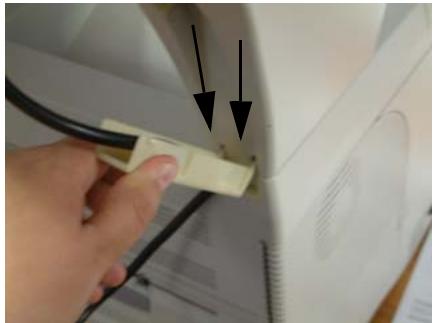
Clip the top part of the cable cover to the interface.
Repeat the operation for the other side.
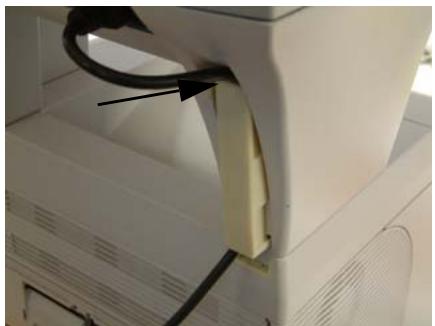
INSTALLATION OF CONSUMABLES
Open the top cover.
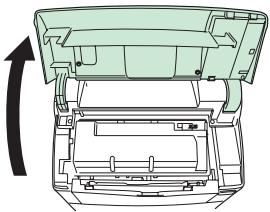
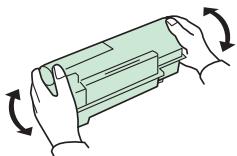
Shake the cartridge from side to side at least 10 times in order to distribute the toner evenly inside the cartridge, as shown in the illustration.
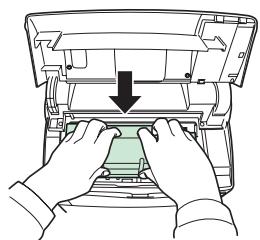
Set the new toner container in the printer and push down on the top of the toner container to install it firmly in place as shown in the figure below.
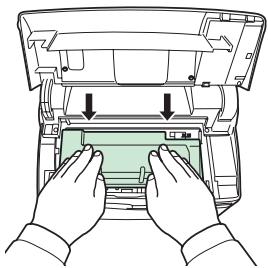
Push the toner cartridge in until it clicks into position.
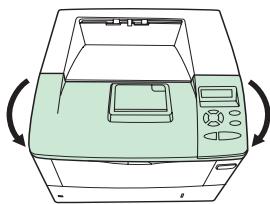
^ Close the top cover.
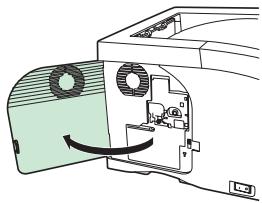
^ Open the left hand side cover.
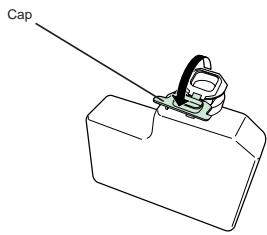
Open the cap of the new waste toner box.
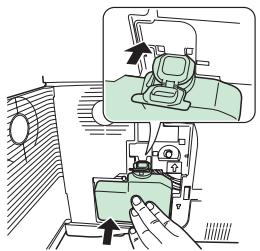
Place the waste toner box in the receptacle inside the printer, as shown in the illustration, then push it downwards until it clicks into position.
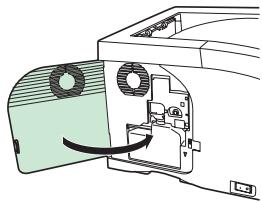
Make sure that the waste toner box is correctly inserted and close the left cover.
Connect the printer (refer to the Connections section).
LOADING PAPER
The following section describes the procedure for loading paper into the cassette and the multipurpose tray.
LOADING PAPER INTO THE CASSETTE
Removing the cassette from the printer.
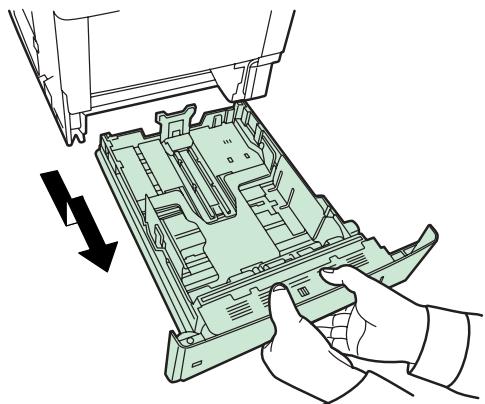
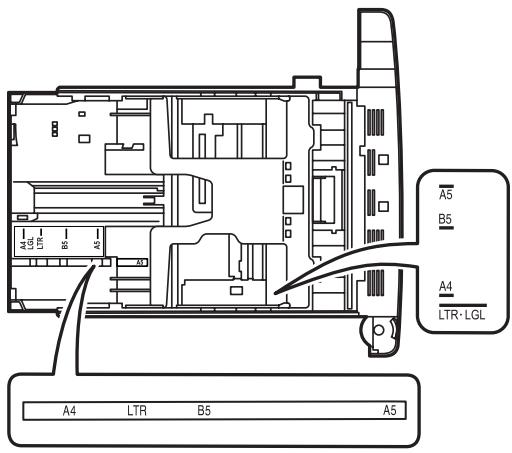
The standard paper formats are shown inside the cassette.
Turn the paper format thumbwheel until the format you intend to use is shown in the corresponding window.
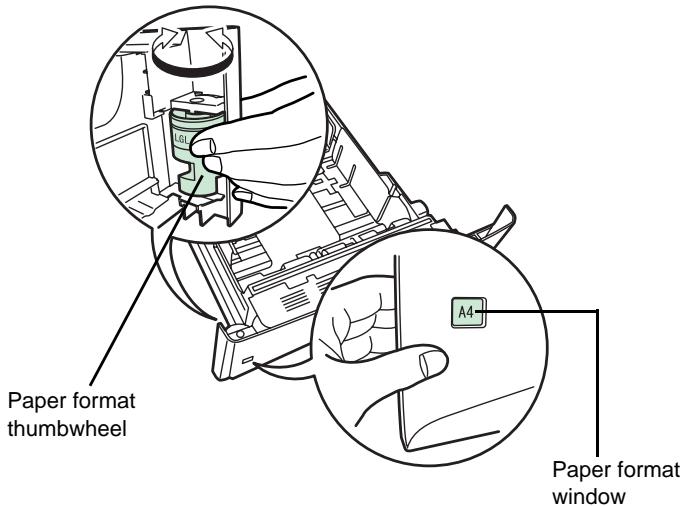
Note : When the paper format thumbwheel shows OTHER, the format must be configured from the printer control panel.
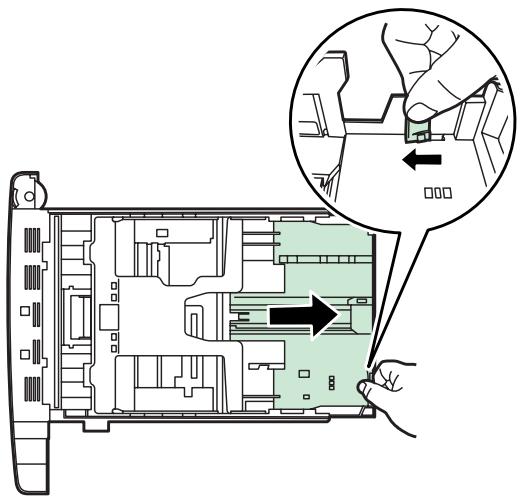
Pull the release lever of the left guide and slide it to the desired paper format.
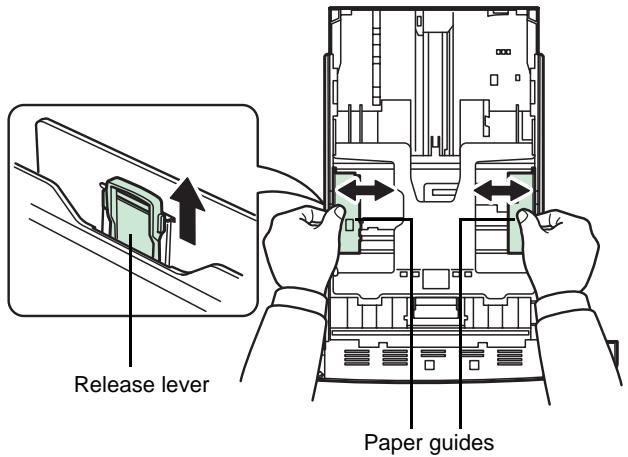
If you intend using a paper format longer than A4, open the paper trays by pushing the release levers one by one and setting them according to the format of the paper selected.
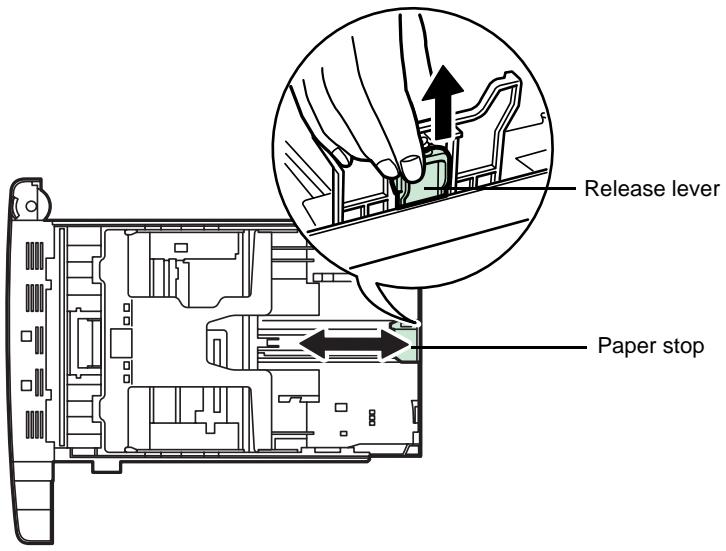
Pull the release lever and slide the paper stop to the desired paper format.
When using paper of a non-standard format, move the guides and the paper stop completely out of the way, insert the paper, then re-adjust the guides and the stop according to the paper format. They should be in contact with the paper, without compressing it.
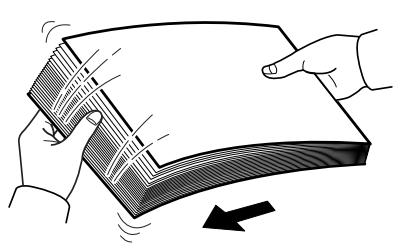
Flex the paper stack, then align it on a flat surface to prevent paper jams or slanted printing.
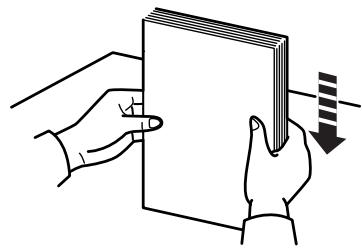
Put the paper into the cassette. Make sure that the side to be printed is facing downwards and that the paper is not folded, curled or damaged.
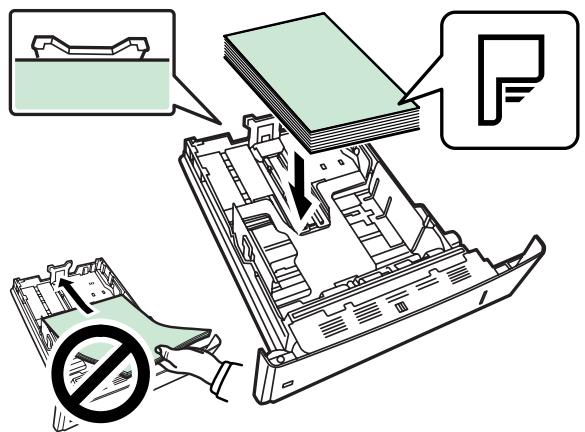
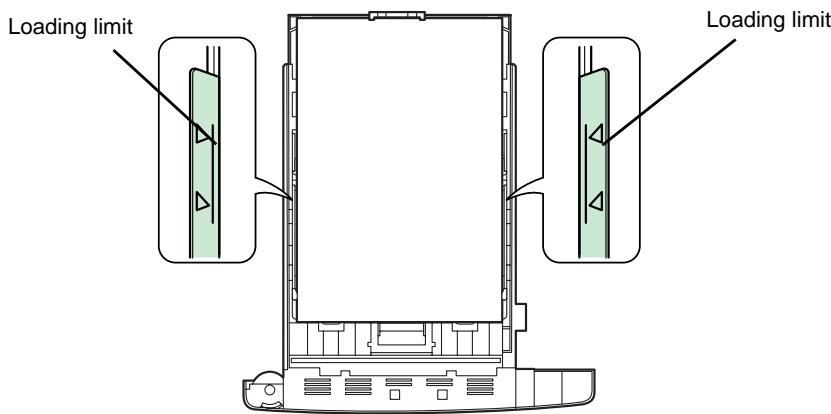
Note : Do not load paper above the maximum loading marks on the paper guides.
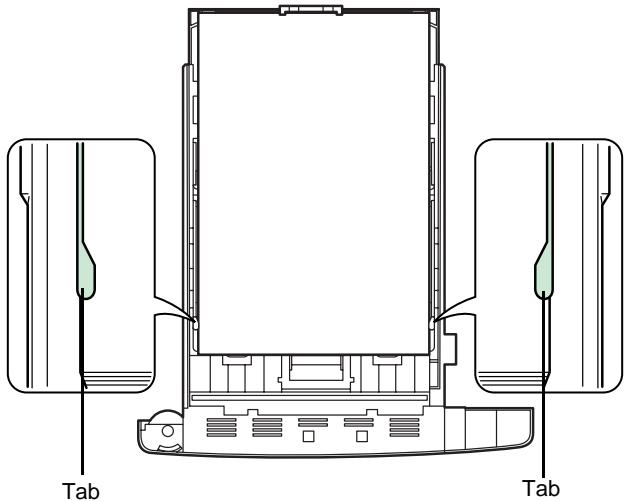
Place the stack of paper under the tabs, as shown below.
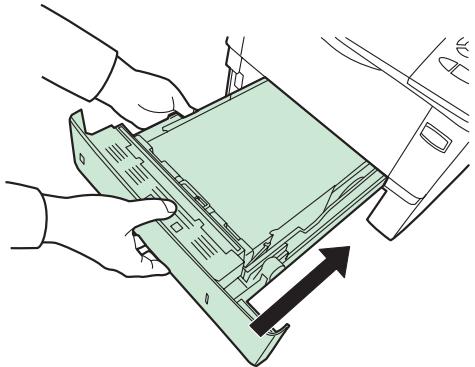
Put the paper tray back into the printer and push it completely home.
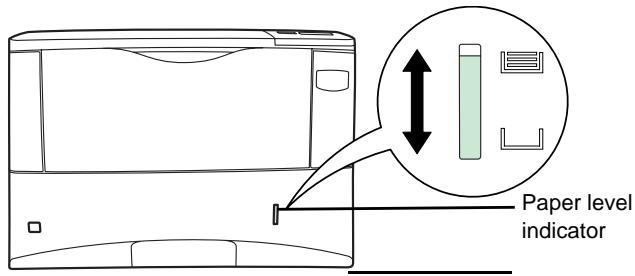
The front face of the cassette is equipped with a paper level indicator that lets you know the amount of paper remaining. When there is no more paper, the indicator displays the level (empty).
Types of paper accepted by the printer :
Printer paper tray
60 to 120g / m^2
Manual insertion
60 to 220g / m^2
Caution - Do not exceed the loading limits marked on the tray. The tray is designed for 500x 80g / m^2 sheets.
Caution - Do not add paper to the tray while the machine is printing.
If using special paper, such as 60 to 220g / m^2 maximum colour paper or transparent film (laser printer compatible), you must use the multifunction tray, which can take up to 100 sheets (A4 - 80~g / m^2)
LOADING PAPER INTO THE MULTIFUNCTION TRAY
The multifunction tray can contain different paper formats up to a maximum of about 100 sheets.
Flex the stack of paper or transparent film, then align it on a flat surface to prevent paper jams or slanted printing.
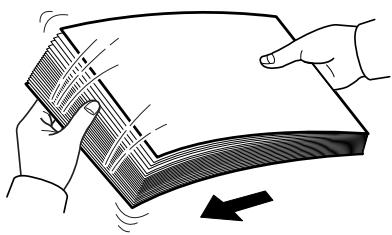
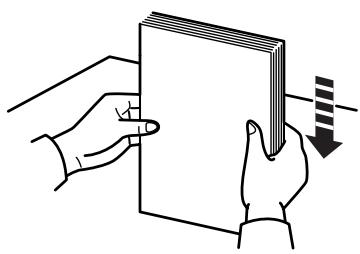
Pull the multifunction tray until it clicks into place.
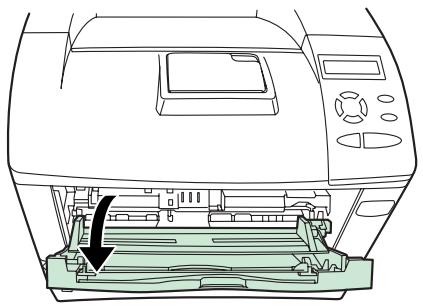
Pull out the lower tray.
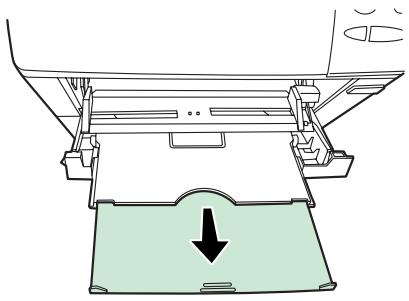
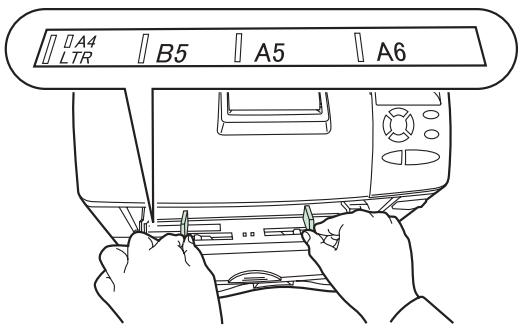
Adjust the position of the paper guides in the multifunction tray. Standard paper formats are marked on the multifunction tray. For standard formats, slide the guides to the corresponding position.
Align the paper with the paper guides and push it in as far as it will go.
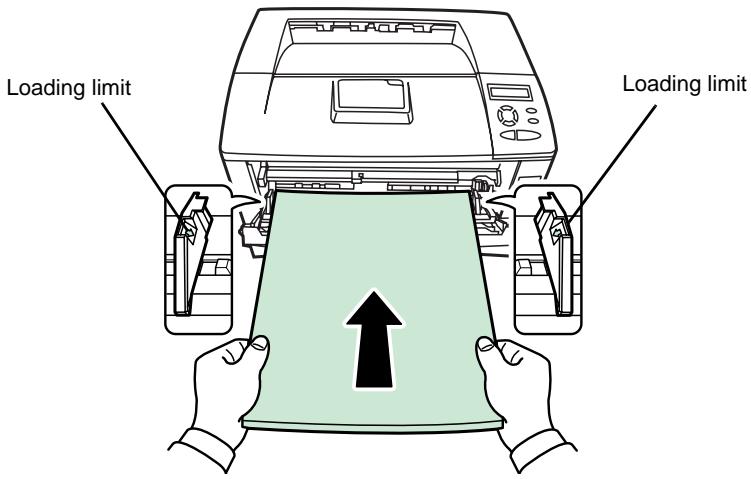
Note
: Do not load paper above the maximum loading marks indicated inside the multifunction tray.
If the paper is significantly curled in one direction, for example when the paper has already been printed on one side, try to bend the stack in the opposite direction to compensate for the curling. When they come out of the printer, the printed sheets will be flat.
Depending on the format of the document to be scanned - A4 or LGAL (LEGAL) adjust the paper stop.
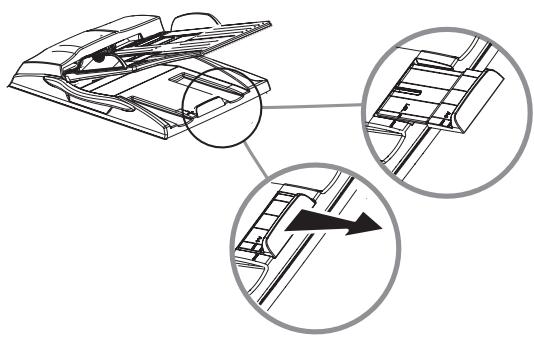
WALL CONNECTIONS
Caution - Make sure that the mains On/Off switch of the scanner is set to "O" (Off).
TELEPHONE AND LAN CONNECTIONS
Connect the end of the telephone lead to the telephone wall socket (please see the paragraph Terminal connections, on page 1-10), for the connections to the scanner.
Connect the end of the LAN cable (not supplied) to the local network connector that is allocated to your terminal (please see the paragraph Terminal connections, on page 1-10), for the connections to the scanner.
Note
: The printer and the scanner have separate LAN connections. If you dispose of only one connection, you will need a concentrator or a switch.
POWER LINE CONNECTION AND SWITCH ON
Caution - Refer to safety procedures in the chapter Safety.
Connect the end of the scanner mains lead of the terminal to the mains wall socket.
First set the printer On/Off switch to "I" (On), then set the scanner On/Off switch to "I" (On).
After a few seconds, when the printer has warmed up, the date and time will appear. To adjust the language and time of your terminal, please see the paragraph Setting your machine, on page 3-1.
CONFIGURING THE PRINTER DRIVER
If you install the additional paper tray or the front/back module when the printer driver is already installed, you will need to configure the printer driver on your PC.
Click on the START button, select CONTROL PANEL and then click on PRINTERS.
Right click on the HFF icon then choose "Properties".
Click on the peripheral's PROPERTIES tab.
Tick the boxes corresponding to the installed options.
2 GETTING STARTED
NAVIGATION METHODS
PRESENTATION
The navigator gives you access to the menus visible on screen.
The navigator
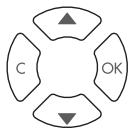
This navigator has 4 keys and allows you to move within the menus available on your machine.
Moving within the menus
| To | Use key | Symbol used |
| OK the main menu or select the next line in a menu. | ||
| OK the main menu or select the previous line in a menu. | ||
| Confirm entry and go to the following menu. | ||
| Return to the previous menu. | ||
| Confirm and exit from the current menu. | ||
| Exit without confirming from the current menu. |
Moving within a data entry field
| To | Use key | Symbol used |
| Move to the right. To move from a line to the next one while pressing the ↑ key of the alphanumeric keyboard at the same time. | ↓▼ | |
| Move to the left. To move from a line to the previous one while pressing the ↑ key of the alphanumeric keyboard at the same time. | ↑▲ | |
| Confirm your entry. | OK | OK |
| Delete a character by moving the cursor to the left. | c | C |
| Confirm your entry and return to the initial screen. | ◇ | ◇ |
The display screen
The screen comprises 3 or 6 lines of 20 characters. The currently selected line is highlighted in yellow.
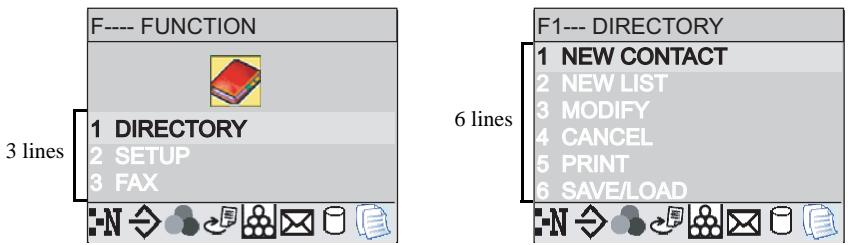
For those menus that have more than three choices in the main menu or 6 choices in the sub-menus, use the navigator arrow to display the lines that follow the first ones.
ACCESS TO FUNCTIONS
Access to functions may be achieved in two ways.
- Menu-driven access.
- Direct function access.
Menu-driven access
You can print out the guide, to find the number of a function, by moving through the menus as shown below.
Press the key, the functions menu appear
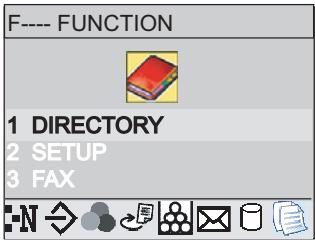
^ Select the desired function by means of the or navigator arrows.
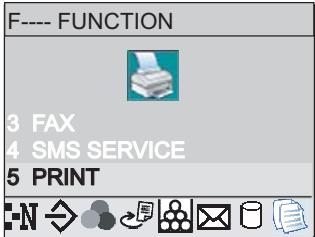
Validate your choice by pressing OK.
Select the desired sub-function by means of the or navigator arrows.
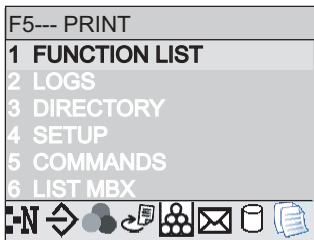
Validate your choice by pressing OK.
Caution - The Duplex version cannot be used to print the guide. Therefore it can only be printed on one side.
Direct access by number
You may print the functions list to find out the number of a function.
From the stand-by mode:
Press the key.
OK the number of the desired function on the numerical keyboard.
GUIDE TO FUNCTION LIST
MAIN MENU 1:DIRECTORY
| Functions | Function description | Page | |
| 11 OK | - NEW CONTACT | OK a new contact in the directory | p. 4-2 |
| 12 OK | - NEW LIST | OK a relay broadcast list | p. 4-4 |
| 13 OK | - MODIFY | Modify a record or a list | p. 4-5 |
| 14 OK | - CANCEL | Delete a record or a list | p. 4-6 |
| 15 OK | Print the directory | p. 4-7 | |
| 16 OK | - SAVE/LOAD | Store the directory on a chip card | p. 4-1 |
| 161 OK | SAVE | Save the directory to a chip card | p. 4-1 |
| 162 OK | LOAD | Load the directory from a chip card | p. 4-1 |
| 17 OK | - IMPORTATION | Enable directory importation by e-mailA | p. 4-9 |
| 18 OK | - EXPORTATION | Export the directory by e-mailA | p. 4-9 |
| 19 OK | - LDAP SERVER | Access to a directory server | p. 4-10 |
| 191 OK | ADDRESS | IP address or server name | p. 4-10 |
| 192 OK | IDENTIFIER | Connection identifier | p. 4-10 |
| 193 OK | password | Connection password | p. 4-10 |
| 194 OK | DN BASE | Search database | p. 4-10 |
| 195 OK | PORT | Connection port | p. 4-10 |
A.Inaccessible if Menu 91 SUPPLIER is on WITHOUT ACCESS
MAIN MENU 2:SETUP
| Functions | Function description | Page | |
| 21 OK | - DATE/TIME | Setting the date and time | p. 3-2 |
| 211 OK | MODIFY | Modifying the date and time | p. 3-2 |
| 212 OK | AUTO ADJUST | Automatic changeover between summer and winter time | p. 3-2 |
| 22 OK | - NUMBER/NAME | OK your name and your number | p. 3-2 |
| 23 OK | - SEND | Transmission settings | p. 3-4 |
| 231 OK | SEND REPORT | Choose to print the communication report | p. 3-4 |
| 232 OK | MEMORY SEND. | Send from feeder or memory | p. 3-5 |
| 233 OK | ECO PER | Set the economy period | p. 3-5 |
| 24 OK | - RECEPTION | Reception settings | P. 3-6 |
| 241 OK | REC. PAPER | Accept reception without paper | p. 3-6 |
| 242 OK | NBR OF COPIES | Number of copies of received documents | p. 3-6 |
| 243 OK | PC RECEPT. | Choice for PC reception | p. 3-7 |
| 244 OK | DUPLEX | Received fax printing in Recto/Verso mode | p. 3-8 |
| 245 OK | ADJUST PAGE | Adapt the print scaling | p. 3-8 |
| 246 OK | REDUCTION | Reduction of received fax | |
| 2461 OK | AUTOMATIC | Automatic reduction of the received faxes | |
| 2462 OK | FIXED | Reduction with a coefficient | |
| 247 OK | PC RECEPT | Selecting the receiver PC | p. 3-8 |
| 25 OK | - NETWORKS | Setting networks | p. 3-3 |
| 251 OK | TEL. NETWORK | Ajust tel. network settings | p. 3-3 |
| 2511 OK | NETWORK TYPE | Selection of network type | p. 3-3 |
| 252 OK | PREFIX | Activate the dialling prefix | p. 3-4 |
| 2521 OK | SIZE NUMBER | Minimum size number to be send with prefix | p. 3-4 |
MAIN MENU 2:SETUP
| Functions | Function description | Page | |
| 2522 OK | PREFIX SETTING | Setting dialling prefix | p. 3-4 |
| 253 OK | LOCAL NETWORK | LAN prameters settings | p. 3-12 |
| 2531 OK | CONFIGURATION | Select configuration mode | p. 3-12 |
| 2532 OK | IP ADRESSE | Fax IP address | p. 3-12 |
| 2533 OK | SUBNET MASK. | Subnet mask | p. 3-12 |
| 2534 OK | GATEWAY | Gateway #1 address | p. 3-12 |
| 2535 OK | IEEE ADDRESS | Fax IEEE address | p. 3-12 |
| 2536 OK | NETBIOS 1 | NetBIOS name 1 | p. 3-13 |
| 2537 OK | NETBIOS 2 | NetBIOS name 2 | p. 3-13 |
| 2538 OK | WINS 1 | Address of the NetBIOS name server 1 | p. 3-13 |
| 2539 OK | WINS 2 | Address of the NetBIOS name server 2 | p. 3-13 |
| 254 OK | DOM LOGIN | Domain login parameters for the Scan to Disk function | |
| 2541 OK | USER | User name for login on the local network | p. 3-13 |
| 2542 OK | PASSWORD | Password for login on the local network | p. 3-13 |
| 2543 OK | DOM. NAME | Domain name of the local network | p. 3-13 |
| 255 OK | SNTP SERVER | SNTP server configuration | p. 3-14 |
| 2551 OK | ADDRESS | SNTP server address | p. 3-14 |
| 2552 OK | PORT | SNTP server port | p. 3-14 |
| 2553 OK | STATE | SNTP server state | p. 3-14 |
| 2554 OK | TIME ZONE | Time zone | p. 3-14 |
| 2555 OK | SUMMER TIME | Adjusting the summer time offset | p. 3-14 |
| 256 OK | DE-REG. PC | Deleting PC registrations | p. 3-14 |
| 27 OK | - SCREEN | ||
| 271 OK | LCD CONTRAST | Adjusting the screen contrast | p. 3-8 |
| 29 OK | - TECHNICALS | Technicals parameters | p. 3-9 |
| 20 OK | - GEOGRAPHICAL | Geographical settings | p. 3-3 |
| 201 OK | COUNTRY | Choice of country and language | p. 3-3 |
| 202 OK | NETWORK | Choice of country | p. 3-3 |
| 203 OK | LANGUAGE | Choice of language | p. 3-3 |
MAIN MENU 3: FAX
| Functions | Function description | Page | |
| 31 OK | - TRANSMISSION | Single- and multiple-address transmission | p. 5-5 |
| 32 OK | - ECO TRANS. | Send a document during the economy period | p. 3-5 |
| 33 OK | - POLLING RX | Polling request | p. 5-30 |
| 34 OK | - POLLING TX | Deposit a document | p. 5-30 |
| 35 OK | - MBX SENDING | Send to a mailbox | p. 5-40 |
| 36 OK | - MBX POLLING | Poll a mailbox | p. 5-41 |
| 37 OK | - BROADCAST | Broadcast transmission | p. 3-7 |
| 38 OK | - FAX ANSW. | Control of fax answering machine | p. 3-5 |
| 39 OK | - REROUTING | Rerouting of received messages | p. 5-6 |
| 391 OK | ACTIVATION | Rerouting activation | p. 5-6 |
| 392 OK | DESTINATION | Choice your destination | p. 5-6 |
| 393 OK | COPY | Printing activation of rerouting fax | p. 5-7 |
MAIN MENU 4: SMS SERVICE
| Functions | Function description | Page | |
| 41 OK | - SEND SMS | Send SMS | p. 3-25 |
| 42 OK | - READ SMS | Read SMS received | p. 3-27 |
| 43 OK | - DELETE SMS | Delete SMS received | p. 3-27 |
| 431 OK | SELECTION | Select SMS to delete | p. 3-27 |
| 432 OK | SMS READ | Delete all SMS read | p. 3-27 |
| 433 OK | ALL | Delete all the SMS read in memory | p. 3-27 |
| 44 OK | - PRINT SMS | Printing SMS received | p. 3-27 |
| 45 OK | - PARAMETERS | SMS service / SMS parameters | p. 3-26 |
| 451 OK | AUTO PRINT | Automatically print SMS received | p. 3-24 |
| 452 OK | SMS BEEP | Beep on SMS reception mode | p. 3-24 |
| 453 OK | SENDER NAME | Choose to show/hide sender name | p. 3-24 |
| 454 OK | TERM. ADDR | Terminal address | p. 3-26 |
| 46 OK | - SERVER | SMS servers settings | p. 3-28 |
| 461 OK | SMS CENTRE 1 | Number of main SMS centre | p. 3-28 |
| 4611 OK | SEND NO | Transmission number | p. 3-28 |
| 4612 OK | RECEIVE NO | Reception number | p. 3-28 |
| 462 OK | SMS CENTRE 2 | Number of secondary SMS centre | p. 3-28 |
| 4621 OK | RECEIVE NO | Reception number | p. 3-28 |
MAIN MENU 5: PRINT
| Functions | Function description | Page | |
| 51 OK | - FUNCTIONS LIST | Function list printing | p. 5-28 |
| 52 OK | - LOGS | Print TX and RX logs | p. 5-28 |
| 53 OK | - DIRECTORY | Print the directory | p. 4-7 |
| 54 OK | - SETUP | User parameters printing | p. 5-28 |
| 55 OK | - COMMANDS | Commands list printing (see 65 OK) | |
| 56 OK | - MBX LIST | MBX list printing (see 75 OK) | |
| 59 OK | - DEPART.CODES | Print a department code | p. 5-37 |
MAIN MENU 6: COMMANDS
| Functions | Function description | Page |
| 61 OK - PERFORM | Perform a command | p. 5-12 |
| 62 OK - MODIFY | Update of command | p. 5-12 |
| 63 OK - CANCEL | Delete a command | p. 5-12 |
| 64 OK - PRINT | Printing of a document in wait queue | p. 5-12 |
| 65 OK - PRINT LIST | Printing of the command list | p. 5-12 |
MAIN MENU 7: MAILBOXES
| Functions | Function description | Page |
| 71 OK - CREATE MBX | Creating and modification of a Mailbox | p. 5-39 |
| 72 OK - DEPOSIT MBX | Storing a document in a Mailbox | p. 5-36 |
| 73 OK - PRINT MBX | Print content of a Mailbox | p. 5-35 |
| 74 OK - DELETE MBX | Delete an empty Mailbox | p. 5-35 |
| 75 OK - PRT MBX LIST | Print list of Mailbox | p. 5-35 |
MAIN MENU 8: ADVANCED FCT
| Functions | Function description | Page | |
| 80 OK | - CALIBRATION | Scanner calibration | p. 6-17 |
| 81 OK | - LOCK | Activate an access limitation lock | p. 5-31 |
| 811 OK | LOCKING CODE | Locking code | p. 5-31 |
| 812 OK | LOCK KEYBD. | Activate keyboard lock | p. 5-31 |
| 813 OK | LOCK NUMBER | Activate dialling lock | p. 5-32 |
| 814 OK | LOCK PARAMETERS | Activate Internet settings lock | p. 5-32 |
| 815 OK | LOCK SMS | Activate SMS lock | p. 5-32 |
| 816 OK | LOCK MEDIA | Activate media lock | p. 5-33 |
| 82 OK | - COUNTERS | See the activity counters | p. 5-29 |
| 821 OK | SENT PAGES | Printed pages counter | p. 5-29 |
| 822 OK | RECEIVED PG | Local copies counter | p. 5-29 |
| 823 OK | SCANNED PAGE | Sent pages counter | p. 5-29 |
| 824 OK | DUPLEX SCAN | Received pages counter | p. 5-29 |
| 825 OK | PRINTED PG | Printed pages counter | p. 5-29 |
| 84 OK | - COPY | CIS scanner settings | p. 5-17 |
| 841 OK | RESOLUTION | Black and white resolution setting | p. 5-17 |
| 842 OK | ZOOMING | Zoom setting | p. 5-17 |
| 843 OK | ASSEMBLED | Assembled or not copy choice | p. 5-17 |
| 844 OK | ORIGIN | Origin setting | p. 5-17 |
| 845 OK | CONTRAST | Contrast setting | p. 5-17 |
| 846 OK | LUMINOSITY | Luminosity setting | p. 5-18 |
| 847 OK | BINDING | Binding type choice | p. 5-18 |
| 85 OK | - SCAN. & PRINT | Réglages imprimante | p. 5-18 |
| 851 OK | PAPER | Type of paper choice | p. 5-18 |
| 852 OK | PAPER TRAY | Paper tray choice | p. 5-18 |
| 853 OK | PAPER SAVE | Paper save activation mode | p. 5-18 |
| 854 OK | S.F MARGINS | Set margins | p. 5-19 |
| 855 OK | FLATBED MARG | Sheet-feed scanner margins setting | p. 5-19 |
| 859 OK | PAPER FORMAT | Select paper tray | |
| 8591 OK | UPPER | Select paper tray printer | |
| 8592 OK | LOWER | Select paper tray additional | |
| 8593 OK | SCANNER | Determine format with scanner A4 or Letter | |
| 86 OK | - CONSUMABLES | Consumables status | p. 6-2 |
| 88 OK | - DEPT. CODE | Department code | p. 5-33 |
| 881 OK | ACTIVATION | Activating/Deactivating the department code | p. 5-33 |
| 882 OK | NEW DEPT. | Setting the department codes | p. 5-34 |
| 883 OK | DELETE | Deleting a department code | p. 5-35 |
| 884 OK | Printing a department code | p. 5-36 | |
MAIN MENU 9:INTERNET
| Functions | Function description | Page | |
| 91 OK | - SUPPLIER | Supplier choice | p. 3-18 |
| 92 OK | - INIT. PROVIDER | Initialisation of your ProviderA | p. 3-18 |
| 921 OK | CONNECTION | ISP parameters | p. 3-18 |
| 9211 OK | CALL NUMBER. | ISP call number | p. 3-18 |
| 9212 OK | IDENTIFIER | ISP identifier | p. 3-18 |
MAIN MENU 9:INTERNET
| Functions | Function description | Page | |
| 9213 OK | password | ISP password | p. 3-18 |
| 922 OK | MESS. SERV | Message service parameters | p. 3-18 |
| 9221 OK | IDENTIFIER | Message service identifier | p. 3-18 |
| 9222 OK | password | Message service password | p. 3-18 |
| 9233 OK | E-MAIL ADR | Message service e-mail address | p. 3-18 |
| 923 OK | SERVERS | SMTP, POP3 and DNS parameters | p. 3-18 |
| 9231 OK | SMTP | SMTP server | p. 3-18 |
| 9232 OK | POP3 | POP3 server | p. 3-18 |
| 9233 OK | DNS 1 | Primary DNS | p. 3-18 |
| 9234 OK | DNS 2 | Primary DNS | p. 3-18 |
| 924 OK | SMTP AUTHENT. | SMTP authentication access parameters | p. 3-18 |
| 9241 OK | ACTIVATION | SMTP authentication activation | |
| 93 OK | - IMMED ACCES | Immediat access to \( ISP^A \) | p. 3-23 |
| 94 OK | - SETTINGS | Internet\( settings^A \) | p. 3-20 |
| 941 OK | CONNEC. TYPE | Select connection type | p. 3-20 |
| 942 OK | SEND TYPE | Select transmission type | p. 3-20 |
| 943 OK | PERIOD | Select the period of connection | p. 3-21 |
| 944 OK | DEPOSIT NOTI | Select to print a deposit notice | p. 3-4 |
| 945 OK | E-MAIL ADDR | Choose the address to which an e-mail will be sent | p. 3-21 |
| 946 OK | Print Internet settings | p. 3-21 | |
| 95 OK | Send an \( E-Mail^A \) | p. 5-8 | |
| 96 OK | - MAILS SORT | Select the reception \( type^A \) | p. 3-22 |
A.These menus will appear only with valid ISPN setting
MAIN MENU 10:MEDIA
| Functions | Function description | Page | |
| 01 OK | - PRINT PHOTO | Printing previewed photos | p. 5-22 |
| 02 OK | - PRINT DOCUMENT | Printing documents | p. 5-24 |
| 021 OK | LIST | Printing the document list | |
| 022 OK | FILE | Printing files | |
| 0221 OK | ALL | Printing all printable files | |
| 0222 OK | SERIES | Printing a series of files | |
| 0223 OK | SELECTION | Printing a selection of files | |
| 04 OK | - SCAN TO | Transferring media content to memory | p. 5-25 |
| 05 OK | - ARCHIVING FAX | Store received fax | p. 5-26 |
| 051 OK | - ACTIVATION | Activating the archiving fax | p. 5-26 |
| 052 OK | Printing the rerouted fax | p. 5-27 | |
| 07 OK | - DELETE | Erasing media | p. 5-26 |
| 071 OK | MANUAL | Erasing selected files | p. 5-26 |
| 072 OK | AUTOMATIC | Erasing files automatically | p. 5-26 |
| 08 OK | - MEDIA ANALYSE | Analysing the memory card or USB key | p. 5-26 |
PRINT CONSOLE NAVIGATION BASICS
NAVIGATING THE MENUS
Control panel keys
The keys on the console are used to configure the printer. Some keys also have secondary functions.
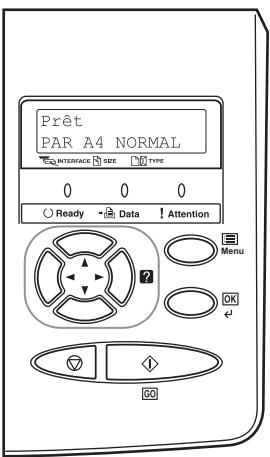
Note: Any settings made using these keys affect only the current interface.
| Key | Function |
| 回 | The GO key allows you to switch the printer between on-line and off-line mode. Use it to perform the following operations: • Activate the on-line or off-line modes of the printer. You can temporarily halt a print job by switching the printer to "off-line". • Print and eject a page when the printer displays Waiting. • Restart printing after certain errors. • Exit the Auto idle mode. |
| This key lets you perform the following operations: • Cancel a print job. • Turn off the audio alarm. • Reset numerical values or cancel a configuration procedure from the system menu. | |
| Menu | ·The MENU key lets you access the system menu in order to modify the configuration and the printing environment of the printer. ·When you press this key when selecting a menu, the latter is aban-doned and the printer returns to normal operation. |
| Used to access a section or to enter numerical values. The > and < keys are used to access or exit a subsection in some of the control procedures. | |
| Used to access a section or to enter numerical values. The > and < keys are used to access or exit a subsection in some of the control procedures. | |
| Used in the same way as the < key in the mode selection function. | |
| ·Used in the same way as the > key in the mode selection function. ·Displays on-line help messages on the screen when there is a paper jam: If you press this key when the printer is Ready: it displays explana-tions about the on-line help messages. If you press this key when the on-line help is displayed: the on-line help is cancelled. | |
| Menu | This key lets you perform the following operations: ·Finalise the setup of numerical values and other selections. ·Define the paper source when the message Tray Selection ? is displayed on the screen. |
ACCESS TO FUNCTIONS
This section explains how to use the menu selection system. The [MENU] key on the operator console allows you to use the menu to configure or adapt the printer environment, making settings such as the number of copies to be made, the emulation, etc. depending on your own specific needs. You can make these settings when the printer screen shows Ready.
Note: The printer applies the most recent settings sent from the application software or from the printer driver, and these always take priority over any settings made from the operator console.
To navigate vertically within the functions, use the and keys (access the menu shown by repeatedly pressing one of the keys).
To navigate horizontally within the functions, use the > and < keys. To change or confirm the configuration of a component, press the [OK] key.
Printing out the menu guide
The list of menus may vary according to which options you have installed.
You can print out the print menu guide by moving within the menus as shown below.
MENUST-PRINTMENUSTSTRUCTURE
Press [OK], a blinking "?" appears.
Press [OK] again to start printing.
GUIDE TO FUNCTIONS
(refer to the print functions manual)
| Functions | Description of the function |
| - PRINT MENU MAP | Print out the menu guide |
| - PRINT STATUS PAGE | Print out the printer configuration |
| - INTERFACE | |
| PARALLEL | Parallel interface configuration |
| USB | USB interface configuration |
| NETWORK | Network interface configuration |
| NETWARE | Turn this menu on if you are using the Netware protocol |
| TCP/IP | Turn this menu on if you are using the TCP/IP protocol |
| APPLE TALK | Turn this menu on if you are networking with a Macintosh |
| PRES STATUS PAGE | When this menu is turned on, the network configuration page is printed out at the same time as the printer status page |
| - EMULATION | Select emulation type |
| - FONT | |
| FONT SELECT | Select font |
| CODE SET | Select character encoding |
| LIST OF INTERNAL FONTS | List of available fonts |
| - PAGE SET | |
| COPIES | Set the number of copies to be made |
| ORIENTATION | Choose the paper orientation |
| LF ACTION | Action following a line break |
| CR ACTION | Action following a carriage return |
| WIDE A4 | Optimise the number of characters per line |
| - PRINT QUALITY | Sets the print quality |
| TONE | Selecting the print quality |
| - RAM DISK MODE | |
| - MEMORY CARD | |
| - PAPER HANDLING | |
| MP TRAY MODE | Multipurpose tray operating mode |
| MP TRAY SIZE | Choose the paper format in the multipurpose tray |
| MP TRAY TYPE | Choose the paper type in the multipurpose tray |
| CASSETTE 1 TYPE | Choose the paper type in tray 1 |
| CASSETTE 2 TYPE | Choose the paper type in tray 2 (depending on option) |
| FEED SELECT | Choose the source tray |
| DUPLEX MODE | Switch front/back mode on |
| STACK SELECT | |
| OVERRIDE A4/LT | Force the printing of letter documents in A4 format |
| TYPE ADJUST | |
| PAPER WEIGHT | Choose the paper weight |
| DUPLEX PATH | |
| RESET TYPE | |
| - LIFE COUNTERS | Number of pages printed counter |
| - OTHERS | |
| MSG LANGUAGE | Choose the language in which messages will be displayed |
| FORM FEED | Set the time before printing out an incomplete page |
| SLEEP TIMER | Set the time before OKing standby mode |
| SLEEP MODE | Switch the standby mode on |
| Reinitialise the settings to their default values | |
| PRINTER RESET | Save downloaded PCL6 parameters |
| RESOURCE PROT. | Turn the error alarm on or off |
| BUZZER | Continue printing after error |
| ERROR CORRECTION | Manage front/back errors |
| FINISHING | Re-aligning the colours |
| DUPLEX | |
| COLOUR REGISTRATION | |
| SERVICE | |
| Print out the status page or log | |
| PRINT TEST PAGE | Service menu |
| PAPERFEED | Service menu |
| DEV-CLN | Service menu |
3 SETTING YOUR MACHINE
MAIN SETTINGS
At machine powerup, the screen displays:
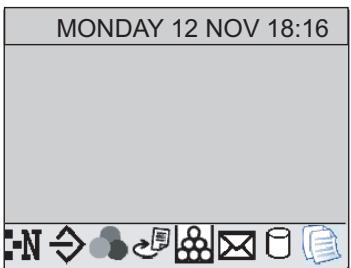
You have to set the date and time, telephone network, language parameter and verify the other parameters listed below.
BEFORE TRANSMISSION
Date/Time
You can, at any moment, modify the current date and time of your fax. You can also activate the automatic management of summer and winter time. The changeover is performed the last Sunday of March for the changeover to summer time and the last Sunday of October for the changeover to winter time.
To change the date and time:
21 OK - SETUP / DATE/TIME / MODIFY
Enter the numbers of the required time and date one after another,
(for example November 8 2005 at 9h33, press 0 8 1 1 0 5 0 9 3 3) and press OK to confirm.
To activate automatic changeover between summer and winter time:
212 OK - SETUP / DATE/TIME / AUTO ADJUST
Select the WITH option and validate your choice with the OK key.
Your fax number/your name
You must obligatorily allocate an identifier to your terminal. This identifier can be the name of the person or company using the terminal. It will be shown on each page of the documents transmitted by the terminal. If no identifier has been recorded, your terminal will display an error code when sending a document by fax.
Your fax will print out your fax number on each document it transmits if you save this number and if the machine is set to SENDINGHEADER (please see the paragraph Technical parameters, on page 3-9).
To save your fax number and your name:
22 OK - SETUP / NUMBER/NAME
Enter your fax number (20 digits max.) and press OK to confirm.
Enter your name (20 characters max.) then press OK to confirm.
Type of network
You may connect your fax to either a PSTN or private network such as private automatic branch exchange (PABX). You must select the network which is the most convenient.
To select the type of network:
251 OK - SETUP / NETWORKS / TEL. NETWORK
Select option PABX or PSTN then confirm your choice with OK.
Geographical settings
These settings will enable you to use your machine in different preset countries using different languages.
Country
By choosing a country, you initialise:
- the settings for the public telephone network,
the language by default.
To select the country:
201 OK - SETUP / GEOGRAPHICAL / COUNTRY
Select the required option and press the OK key to confirm.
Network
This setting enables you to individually set the type of public telephone network so that your machine can communicate over the public network of the country you have chosen in compliance with the applicable standards.
Note: these settings are different from the NETWORK TYPE (p. 3-2), which allows you to choose between public and private network.
To select the network:
202 OK - SETUP / GEOGRAPHICAL / NETWORK
Select the required option and press the OK key to confirm.
Language
This setting enables you to choose a language other than that imposed by the COUNTRY setting.
To select the language:
203 OK - SETUP / GEOGRAPHICAL / LANGUAGE
Select the required option and press the OK key to confirm.
Local prefix
This function is used when your fax is installed with a private network, behind a company's PABX. It allows you to program an additional automatic local prefix (to be defined), enabling you to automatically exit the company's telephone network system, but only under certain conditions:
- the company's internal numbers, where a prefix is not required, must be short numbers less than the minimal size (to be defined, for example France has 10 digits),
- the outside numbers requiring a prefix, must be long numbers greater or equal to the minimal size (to be defined, for example France has 10 digits).
Programming your fax with the local prefix consists of two steps:
- defining the minimal size (or equal) of the company's outside numbers,
- defining the outgoing local prefix of the company's telephone network. This prefix will automatically be added as soon as an external number is dialled.
Caution - If you define a local prefix, do not add it to the numbers stored in the directory, it will be automatically dialled with each number.
Prefix
252 OK - SETUP / NETWORKS / PrefixIX
Defining the minimal size
2521 OK - SETUP / NETWORKS / Prefix / SIZE NUMBER
You can change the default value for the minimal size of the company's outside numbers and validate with OK. The minimal size will range between 1 and 30.
Defining the local prefix
2522 OK - SETUP / NETWORKS / Prefix / Prefix SETTING
Enter the outgoing local prefix of the company's telephone network (maximum 5 characters) and validate with OK.
Transmission report
You may print a transmission report for all communications over the telephone network (STN).
You may choose between more than one criteria for printing reports:
- WITH: a report is given when the transmission was properly performed or when it is completely abandoned (but there is only one report per request),
- WITHOUT: no transmission report, however, your fax will note all transmissions that took place in its log (please see the paragraph Logs, on page 5-28),
- ALWAYS: a report is printed with each transmission,
- ON ERROR: a report is printed only if the transmission failed or is abandoned.
With each transmission report from memory, a reduced version of the first page is automatically reproduced.
To select the report type:
231 OK - SETUP / SEND / SEND REPORT
Select the required option WITH, WITHOUT, ALWAYS or ON ERROR and confirm your choice with OK.
Document feed type
You may choose the way you want to feed your documents:
-
from memory, transmission will take place only after memory storage of the document and dialling. It allows you to get your originals back quickly to free up the machine.
-
from the feeder of the sheet-feed scanner (please see the paragraph Document depositing, on page 5-2), transmission will occur after dialling. It allows transmission of larger documents.
To select the way you want to feed your documents:
232 OK - SETUP / SEND / MEMORY SEND.
Select the option MEMORY or FEEDER and validate your choice with OK.
Note: in feeder mode, the reduced image will not appear on the transmission report.
Economy period
This function allows you to defer a fax transmission to "off-peak hours" and thus reduce the cost of your communications.
The economy period, via the telephone network (at off-peak hours), is preset by default from 7.00pm to 7.30am . Nevertheless you may change this time slot.
Modifying the economy period:
233 OK - SETUP / SEND / ECO PER.
Enter the hours of the new economy period and confirm your selection with the OK key.
Using the economy period:
32 OK-FAX/ECOTRANS.
Enter the call number and confirm with OK.
BEFORE RECEPTION
Fax answering machine
The Fax answering machine allows you to keep confidential documents in storage and to avoid printing them as you receive them.
The "Fax Messages" indicator light lets you know the state of your Fax answering machine:
Light on: the answering machine is on.
- Blinking: your fax has documents in storage or is in the process of receiving faxes.
- Light off: memory full, the terminal cannot receive any more documents.
You can assure document confidentiality by using the 4 digit access code. Once saved, you will require this access code for:
- printing fax messages in memory,
- activate or deactivate the fax answering machine.
Saving an access code
383 OK - FAX / FAX ANSW. / ANSWER CODE
^ Enter the code (4 digits) and confirm with OK.
Activating or deactivating the answering machine
382 OK - FAX / FAX ANSW. / ACTIVATION
If you saved an access code for your fax answering machine, enter it and validate with OK.
Select the required option WITH or WITHOUT answering machine and confirm you choice with OK.
Print fax messages stored in the memory
381 OK - FAX / FAX ANSW. / PRINT
If you have defined an access code for your fax answering machine, enter it and press OK. Documents received and stored in the memory are printed.
Reception without paper
Your fax offers you the possibility to either accept or refuse document reception if your printer is unavailable (no paper...).
If your fax printer is unavailable, you may choose between two modes of reception:
- reception mode WITHOUT PAPER, your fax saves the incoming messages in the memory,
- reception mode WITH PAPER, your fax refuses all incoming subscribers.
To select the reception mode:
241 OK - SETUP / RECEPTION / REC. PAPER
Select the option WITH PAPER or WITHOUT PAPER and confirm your choice with OK.
Note: Paper out is indicated by a beep and a message on the screen.
Received faxes are then stored in memory (icon "Fax messages" flashing) to be printed as soon as you add paper into the feeder.
Number of copies
You may print incoming documents more than once (1 to 99).
To set the number of each document received:
242 OK - SETUP / RECEPTION / NBR OF COPIES
Enter the wanted number of copies and confirm with OK.
At each document reception, your fax will print the number of copies requested.
Relay broadcast
Your fax machine (initiator) can relay a document, in other words, transmit a document to your subscribers via a remote fax and with a precise relay list.
To do this the initiator fax and the remote fax must both have the relay function.
To relay you need to supply the remote fax with the document and the relay list number. The remote fax will then transmit this document to all subscribers on the list.
Once the relay is activated by your fax and as soon as the document is received by the remote fax, the document is printed before relaying to all subscribers on the list.
To activate relay from your fax machine:
Insert the document to relay (please see the paragraph Document depositing, on page 5-2).
Select 37 OK-FAX/BROADCAST.
Enter the remote fax number where you will relay to or choose your dialling mode (please see the paragraph Dialling, on page 5-3) and press OK.
Enter the relay list number used by the remote fax and press OK.
You may enter the time you wish to transmit the document next to the current time and press OK.
If you wish to modify the document feed type, select one of the options FEEDER or MEMORY, then press OK.
If you wish, you may enter the number of pages of your documents before transmitting.
Activate relay by pressing key.
The document in the feeder will be relayed either immediately or at a later time (according to your choice) to the remote fax which will relay the document.
Fax or PC reception
243 OK - SETUP / RECEPTION / PC RECEPT.
This menu, combined with a software program installed on your PC (supplied or on option depending on model) will enable you to select the machine you wish to receive the documents on:
fax.
PC.
- PC if available, fax otherwise.
For more details, please refer to the instruction manual provided with the software kit.
To select the PC that will receive the documents, please see the paragraph Selecting the reception PC, on page 3-8.
Duplex printing
This menu lets you define the default printing mode for received faxes. The two available modes are:
Note: All faxes received are printed according to the mode selected from the menu, no matter how the duplex key is set.
To select the fax reception mode:
244 OK - SETUP / RECEPTION / DUPLEX
Select the required option SINGLE SIDED or DOUBLE SIDED and validate your choice with the OK key.
Adjust to page
This option allows you to print out documents automatically adjusting them to the page format.
To turn adjust to page mode on:
245 OK - SETUP / RECEPTION / ADJUST PAGE
Select the WITH option and confirm your choice using the OK key.
Selecting the reception PC
This menu lets you select a PC to which all the documents received by the terminal will be re-routed.
247 OK - SETUP / RECEPTION / PC RECEPT.
By means of the or keys, select the PC that you want to designate as the receiver and validate by means of the OK key.
Adjusting the screen contrast
This adjustment only affects the screen contrast.
271 OK - SETUP / SCREEN / LCD CONTRAST
Adjust the contrast with the and keys then validate your selection with the OK key.
TECHNICAL PARAMETERS
As delivered your fax is preset by default. However, you may adjust it to meet your requirements by resetting the technical parameters.
To set the technical parameters:
29 OK - SETUP / TECHNICALS
Select the desired parameter and confirm with OK.
With the or keys, modify the parameter settings by following the table below and press OK.
| Parameter | Setting | Signification |
| 1 - SCANNING MODE | 1 - NORMAL | Default value of the scan mode resolution for the documents to be transmitted. |
| 2 - FINE | ||
| 3 - SFINE | ||
| 4 - PHOTO | ||
| 2 - TX HEADER | 1 - WITH | If this parameter is on, your header will appear on all documents sent to your subscribers with your name, number, date and number of pages. Warning: If you send a fax from the document loader, the transmission header will not appear on the document your correspondent receives. |
| 2 - WITHOUT | ||
| 3 - TX SPEED | 1 - 33600 | Transmission speed for outgoing documents. |
| 2 - 14400 | For a quality telephone line (compatible, no echo), communications occur at maximum speed. | |
| 3 - 12000 | ||
| 4 - 9600 | However, it may be necessary to restrict the transmission speed for some calls. | |
| 5 - 7200 | ||
| 6 - 4800 | ||
| 7 - 2400 | ||
| 4 - ECHO PROTECT | 1 - WITH | If this parameter is on, the on-line echo will be reduced during long distance calls. |
| 2 - WITHOUT | ||
| 6 - EPT MODE | 1 - WITH | For some long distance calls (satellite), the on-line echo may disturb the call. |
| 2 - WITHOUT | ||
| 7 - COM. DISPLAY | 1 - SPEED | Choice between transmission speed displayed or number of the page in progress. |
| 2 - PAGE NUMBER | ||
| 8 - ECO ENERGY | 1 - WITHOUT | Choosing the printer standby delay: the printer will switch to standby after a delay (in minutes) of NON-operation or during the period of time of your choice. |
| 2 - DELAY | ||
| 5 MIN | ||
| 3 - DELAY | ||
| 15 MIN | ||
| 4 - DELAY | ||
| 30 MIN | ||
| 5 - DELAY | ||
| 60 MIN | ||
| 10 - RX HEADER | 1 - WITH2 - WITHOUT | If this parameter is on, all documents received by your fax will include the subscriber's header with his name, number (if available) fax print date and the page number. |
| 11 - RX SPEED | 1 - 336002 - 144003 - 96004 - 48005 - 2400 | Transmission speed for incoming documents.For a quality telephone line (compatible, no echo), communications occur at maximum speed.However, it may be necessary to restrict the transmission speed for some calls. |
| 12 - RINGS | 2 TO 5 | Number of rings to automatically start your machine. |
| 20 - E.C.M.(ERRORCORRECTION) | 1 - WITH2 - WITHOUT | This parameter helps correct the calls made on disturbed telephone lines. It is used when the lines are weak or too noisy. Transmission times may be longer. |
| 72 - MODEM SPEED | 1 - 560002 - 336003 - 144004 - 120005 - 96006 - 72007 - 48008 - 24009 - 12000 - 600 | Choice of maximum Internet transmission speed.Fora quality telephone line (compatible, no echo), communications occur at the maximum speed.However, it may be necessary to restrict the transmission speed for some Internet calls (bad line or bad ISP settings). |
| 73 - IMPROVEREP @ | 1 - WITH2 - WITHOUT | This parameter lets you automatically register the Internet address of your subscribers fax during a call (if available). |
| 74 - ERASEMAILBOX | 1 - WITH2 - WITHOUT | When the fax machine receives an e-mail with an attachment and cannot open it, it erases the message from the ISP MBX, prints and transmits with a notice of uncomprehension to the message sender.When receiving an e-mail, the terminal does not delete the message from the mailbox, it prints an uncomprehension message asking you to recover this message by means of your computer equipment.This parameter only makes sense if you are using a computer. The memory space that your access provider puts at your disposal is limited. If you do not empty your mailbox, you risk saturating it in the long term, thereby blocking the reception of any new message. |
| 75 - TEXTATTACHMENT | 1 - WITH2 - WITHOUT | To allow adding an attachment. |
| 76 - ATTACHMENTFORMAT | 1 - IMAGE2 - PDF | Default format of document sent on the Internet:PDF: monochrome or colourIMAGE: monochrome (TIFF) or colour (JPEG) |
| 77 - LAN SPEED | AUTO 100 FULL 100 HALF 10 FULL 10 HALF | To define the communication speed of the peripheral units in relation to the implemented Local Area Network (LAN). |
| 78 - WINS - DNS REG. | 1 - WITH 2 - WITHOUT | Registration of the terminal in the WINS servers allows accessing the scanner through its NetBIOS name by PCs located on sub-networks other than the one that the terminal is connected to. |
| 80 - TONER SAVE | 1 - WITH 2 - WITHOUT | Makes printing lighter to save toner cartridge ink. |
LOCAL AREA NETWORK (LAN) SETTINGS
Your terminal is a new generation machine that will be part of your local network just like a PC. Its built-in local network access card will enable you to send documents through an SMTP/POP3 local message server (internally or externally, depending on the settings of your message server). To benefit from all the available network options, you should make the following settings, described in the sections below:
- local network settings, to introduce your fax machine into your local network.
- message service settings, for all your faxes and E-mails to be automatically managed by your message server.
Caution - Although rather simple, network settings sometimes require a sound knowledge of your own computer configuration. If that is administrated by anyone in your company, we recommend you ask that person for the settings described below.
We recommend that you carry out a manual configuration of your terminal. The automatic configuration of the local network settings may be considered, if your local network features a DHCP or BOOTP server that can dynamically assign addresses to the peripheral devices present on the LAN.
To automatically configure the local network settings:
2531 OK - SETUP / NETWORKS / LOCAL NETWORK / CONFIGURATION
Choose AUTOMATIC and press OK to confirm. The terminal scans the local network for a DHCP or BOOTP server that can assign it its settings dynamically (the message SELF-CONF is displayed).
Once the message SELF-CONF has disappeared, check for the IP Address, Sub-network mask and Gateway address. If these are missing, you should carry out a manual configuration (see below).
Manual configuration
To configure your terminal manually, you should obtain the usual information used to set a peripheral device (IP address, sub-network mask, network and gateway address).
To configure the local network setting manually:
2531 OK - SETUP / NETWORKS / LOCAL NETWORK / CONFIGURATION
Choose MANUAL and press OK to confirm.
IP address
2532 OK - SETUP / NETWORKS / LOCAL NETWORK / IP ADRESSE
^ Enter the IP address of your terminal and press OK to confirm.
Sub-network mask
2533 OK - SETUP / NETWORKS / LOCAL NETWORK / SUBNET MASK.
Enter the sub-network mask of your terminal and press OK to confirm.
Gateway address
2534 OK - SETUP / NETWORKS / LOCAL NETWORK / GATEWAY
Enter the IP address of the network gateway and press OK to confirm.
IEEE address (or Ethernet address) or MAC address
2535 OK - SETUP / NETWORKS / LOCAL NETWORK / IEEE ADDRESS
The Ethernet card of your terminal already has an unmodifiable, yet consultable, IEEE address.
NetBIOS
The NetBIOS name, which can be used with the network options, are used to identify your terminal machine from a PC connected to a local network (for instance with the name "IMP-NETWORK-1").
2536 OK - SETUP / NETWORKS / LOCAL NETWORK / NETBIOS 1
2537 OK - SETUP / NETWORKS / LOCAL NETWORK / NETBIOS 2
Enter the selected name (15 characters max) and press OK to confirm.
The WINS1 and WINS2 servers, used with the network options, allow access to terminals on other sub-networks by means of their NetBIOS name.
These two addresses must be filled in for the Scan To Disk function.
2538 OK - SETUP / NETWORKS / LOCAL NETWORK / WINS 1
2539 OK - SETUP / NETWORKS / LOCAL NETWORK / WINS 2
Enter the IP address of each server, then validate with OK.
Note:
If the terminal is set up in Automatic configuration mode (▶ 2531), these addresses can be filled in automatically by certain DHCP servers.
Case of connection to a domain (for instance with Windows NT, 2000 or XP)
The terminal can identify itself on the local network by using the parameters of a user account, before it can, among others, archive documents by means of the Scan to Disk function.
Once these parameters have been filled in, they will be used by default, if you do not declare a user name and password when using the function.
Login user name
2541 OK - SETUP / NETWORKS / DOM LOGIN / USER
Enter the user name for login on the local network, then validate with OK.
Login password
2542 OK - SETUP / NETWORKS / DOM-login / PASSWORD
Enter the password for login on the local network, then validate with OK.
Domain name
2543 OK - SETUP / NETWORKS / DOM LOGIN / DOM. NAME
^ Enter the domain name of the local network, then validate with OK.
SNTP server configuration
The terminal can automatically update its date and time when connecting to an SNMP server.
Server address
2551 OK - SETUP / NETWORKS / SNTP SERVER / ADDRESS
Enter the name of the SNMP server, then validate with OK.
This name can be in the form of an IP address, a DNS address or a NetBIOS name.
Server port
2552 OK - SETUP / NETWORKS / SNTP SERVER /PORT
Enter the server port number, then validate with OK.
The port by default is port 123.
Activating the server access
2553 OK - SETUP / NETWORKS / SNTP SERVER / ACTIVATION
To activate the SNMP server, select WITH in the drop-down menu then validate with OK.
Time zone
2554 OK - SETUP / NETWORKS / SNTP SERVER / TIME ZONE
Select the time zone where the terminal is located from the drop-down list then validate with OK. If you have activated the automatic summer time management (menu 212), the TIME ZONE setting is initialised automatically.
Summer time
2555 OK - SETUP / NETWORKS / SNTP SERVER / SUMMER TIME
Select the appropriate time setting in the drop-down list: winter time, summer time +1 or summer time +2, then validate with OK.
Note: This menu is not displayed if the menu 212 is activated.
PC de-registering
This menu lets you delete one or more PCs connected to the terminal via the LAN.
256 OK - SETUP / NETWORKS / DE-REG. PC
Select the PC that you want to delete from the list by means of the and arrows, then validate with OK.
PRINT FUNCTION SETTINGS
The printer can be connected to the local network as it has its own IP address.
Updating network settings
The print console allows you to:
- Turn TCP/IP, NetWare and EtherTalk on or off.
- Turn DHCP on or off.
- Enter the IP address, the subnet mask address and the default gateway address.
To check or change the network card settings:
Press the MENU key.
Repeatedly press the or keys until INTERFACE appears. One of the interface names below appears, showing that it is the current interface.
- PARALLEL (default setting)
- USB
- OPTIONAL (when the network card is installed)
Press OK, a blinking "?" appears.
Repeatedly press the keys or until OPTIONAL appears. Press OK.
Press the > key.
This example shows how to switch the TCP/IP protocol on to connect the terminal to the network. You can switch Netware or EtherTalk on in the same way. If TCP/IP is OFF, Press OK, a blinking "?" appears. Select ON using the or keys. Press OK again.
Automatically configuring IP settings
You can make these settings when the TCP/IP protocol is on. We recommend that you manually configure your terminal. However, local network settings can be automatically configured if you have a DHCP or BOOTP server on your local network which can dynamically distribute addresses to peripherals on the LAN.
To automatically configure network local settings:
$$ M E N U - \vee - I n t e r f A C E > - \vee - T C P / I P > D H C P $$
Press OK, a blinking "?" appears.
Select ON using the or , then press OK.
Press the MENU key.
Switch your terminal off and then back on again. You have now finished configuring the IP address.
Manually configuring IP settings
You can make these settings when the TCP/IP protocol is on.
To configure your terminal manually, you will need the usual information for setting up a peripheral (IP address, subnet mask and gateway address).
To manually configure network local settings:
MENU - √ - INTERFACE > - √ - TCP/IP > DHCP
Check that DHCP is set to OFF. If not press OK, then select OFF with the or keys. Press OK.
Press
Press OK to enter the IP address. A cursor (.) starts to flash in the right-hand segment (3 figures). Press the key to increment the value and the key to decrement it. Once you have set the value for the right-hand segment, press the < key to place the cursor in the next segment. Again, press the key to increment the value and the key to decrement it. Proceed in the same way for all of the segments. Press OK once all the segments have been set up.
Press
Enter the subnet mask address in the same way as for the IP address.
Press
^ Enter the gateway's IP address in the same way as for the IP address.
Press the MENU key.
Switch your terminal off and then back on again. You have now finished configuring the IP address.
Note:
Other print-related settings are described in the Print Functions chapter.
You can configure the same settings either remotely or locally.
System requirements
To remotely configure your machine you will need:
- a Web browser (preferably Internet Explorer version 4),
- to make the Local Network settings for your machine (IP address, subnet mask, etc.). You should ask your network administrator for these settings. Once you have this information, please see the paragraph Local network settings, on page 3-11 on how to fill out the necessary fields.
Accessing the Web Server
Open a Web browser from a PC registered on the network.
Enter the IP address of the terminal you want to configure in the ADDRESS field.
Confirm by pressing OK.
The welcome window is displayed, choose the interface language.
Change the settings of your choice on the screen then confirm.
MESSAGE SERVICE AND THE INTERNET
Your terminal lets you send and receive documents and E-mails from subscribers throughout the world over the Internet.
An E-mail is an electronic message sent over the Internet, to an E-mail address (which is a personal Internet mailbox).
Access to the Internet is possible thanks to an Internet service provider (ISP). The provider puts at your disposal a server, or computer system which allows you to connect to the Internet and your mailbox through your telephone line.
Before worldwide transmission, you must:
- take out an Internet subscription from an Internet Service Provider (ISP),
- check that all initialisation parameters correspond to those provided by your ISP,
- perform the proper settings, if needed, for the Internet connection.
You may then connect yourself to the Internet via your ISP to send and receive fax-Internet or E-mails. Both operations will be performed during an Internet connection.
INITIALISATION PARAMETERS
You must define or, at least check all parameters needed to identify yourself with the Internet. Your ISP will provide you with these parameters as soon as you are registered with them.
The parameters are divided in four categories:
- connection, allows you to identify the dial up number, the connection identifier and the connection password,
- message service, allows you to define the message service identifier, the message service password and the E-Mail address,
- servers, allows you to identify the name of the IP address of Internet SMTP providers (send) and POP3 (MBX reception) and the address of DNS 1 and DNS 2 servers. The server address is made up of 4 groups of 3 digits maximum, separated by dots.
- SMTP Authentication, used to activate the authentication protocol when the SMTP server used requests this to end e-mails.
Access to connection and message service parameters
91 OK - INTERNET / SUPPLIER
Select the Internet provider from the list NO ACCESS, PROVIDER_1, PROVIDER_2, PROVIDER_3, PROVIDER_4, PROVIDER_5, PROVIDER_6 or LOCAL NETWORK, and press OK.
Choosing NO ACCESS disables access to Internet functions.
92 OK - INTERNET / INIT. PROVIDER
921 OK - INTERNET / INIT. PROVIDER / CONNECTION
Enter the CALL NUMB., press OK.
Enter connection IDENTIFIER1, press OK.
Enter connection PASSWORD, press OK.
922 OK - INTERNET / INIT. PROVIDER /MESS. SERV
Enter Email IDENTIFIER, press OK.
Enter Email PASSWORD, press OK.
Enter E-MAIL ADR, press OK.
Access to servers parameters
923 OK - INTERNET / INIT. PROVIDER / SERVERS
Enter SMTP, press OK.
Enter POP3, press OK.
Enter DNS 1, press OK.
Access to the authentication SMTP parameters
924 OK - INTERNET / INIT. PROVIDER / SMTP AUTHENTIC.
In the ACTIVATION menu, select WITH to activate SMTP authentication then validate with OK key.
In the PARAMETERS menu, select ID.MESS.SERV to keep the same identification parameters as in the messaging service or AUTHENTICATE. SPEC. to define other identification parameters, then validate with Access to SMTP authentication parameters by pressing OK key. When you select AUTHENTICATE. SPEC, carry out the two following operations:
Enter the IDENTIFIER then validate with OK key.
Enter the PASSWORD then validate with OK key.
Sample Internet settings for the terminal (56 kbps modem)
Your access provider should give you the following information:
| CALL NUMBER: | 08 60 00 10 00 |
| CONNECTION IDENTIFIER: | sg048944@wn.net |
| CONNECTION PASSWORD: | ***** |
| MESSAGE SERVICE IDENTIFIER: | demo jt12 |
| MESSAGE SERVICE PASSWORD: | ***** |
| E-MAIL ADDRESS: | demo2@gofornet.com |
| SERVER: | |
| SMTP | mail.gofornet.com |
| POP | mail.gofornet.com |
| DNS 1 | 103.195.014.001 |
| DNS 2 | 103.195.014.002 |
Non-functional data given by way of example.
You should then complete the following MENUS on your fax machine:
| 91 | SUPPLIER | PROVIDER 1 |
CONNECTION
| 9211 | CALL NUMB. | 0860001000 |
| 9212 | IDENTIFIER | sg048944@wn.net |
| 9213 | password | ***** |
MESSAGE SERVICE
| 9221 | EMAIL ID | demo jt 12 |
| 9222 | EMAIL PASSWORD | ***** |
| 9223 | E-MAIL ADR | demo2@gofornet.com |
SERVERS
| 9231 | SMTP | mail.gofonet.com |
| 9232 | POP3 | mail.gofonet.com |
| 9233 | DNS 1 | 103.195.014.001 |
| 9234 | DNS 2 | 103.195.014.002 |
SMTP AUTHENTIC.
| 9241 | ACTIVATION | With or Without |
Your terminal is now configured.
SETTINGS
The settings are divided into several categories:
- the standard settings define the connection type and frequency to the Internet as well as the transmission type for your documents,
- the E-mail sorting defines treatment for all stored E-mail messages received.
Standard settings
Your machine has two types of settings that let you define:
- The type and frequency of the connection to your ISP.
| SET TIMES | an Internet connection is established every day at 9:00 am, 12:30 am and 5:00 pmA |
| PERIODIC | an Internet connection is established every 3 hours1. (default value) |
| ON DEMAND | an Internet connection is established at your request by IMMED. ACCESS (please see the paragraph Internet Connection, on page 3-23) |
A. To avoid Internet access saturation, the automatic connection will occur in reality 12 minutes, give or take, around the requested time.
- Type of transmission over the Internet.
| IMMEDIATE | document transmission will occur immediately at each transmission request |
| DURING CONNECTIONS | transmissions will only occur at programmed connectionsSET TIMES or PERIODIC TYPE |
At any moment you may print the settings of your machine to know their status.
Selecting the connection type
941 OK - INTERNET / SETTINGS / CONNEC. TYPE
Select one of the connection options among SET TIMES, PERIODIC or ON DEMAND and press OK to confirm.
Selecting the transmission type
942 OK - INTERNET / SETTINGS / SEND TYPE
Select one of the send options IMMEDIATE or DURING CNX then press OK to validate.
Changing the connection period (PERIODIC type)
943 OK - INTERNET / SETTINGS / PERIOD
With the PERIODIC mode, enter the new connection period by means of the numerical keypad (between 00:01 am and 11:59pm ) and press OK to confirm.
An Internet connection will be established every three hours (default value).
Modifying the connection time(s) (SET TIMES type)
943 OK - INTERNET / SETTINGS / TIME SETTINGS
After selecting the SET TIMES mode, use the and keys to place the cursor under the figure to be modified. Enter the new connection time(s) by means of the numeric keypad (value between 00:01 and 23:59) and validate with the OK key.
Selecting the print mode for the deposit notice
944 OK - INTERNET / SETTINGS / DEPOSIT NOTI
Select one of the deposit notice options WITH, WITHOUT, ALWAYS or ON ERROR and press OK to confirm.
Choosing the address to which an e-mail will be sent
945 OK - INTERNET / SETTINGS / E-MAIL ADR
Enter the e-mail address then confirm using the OK key.
Printing the Internet settings
946 OK - INTERNET / SETTINGS / PRINT
The Internet settings are printed.
These settings may also be printed together with all the other settings of your machine (please see the paragraph Printing the machine settings, on page 5-28).
Mail sorting
This function lets you choose the mode for all Internet documents stored in your mail box.
You have three choices:
F@X ONLY, lets you poll and print E-Mails in your machine.
- PC ONLY, lets you keep your E-Mails in your mailbox for later use with a computer (no E-Mail poll),
- SHARE PC lets you:
-
if your PC and fax have two different addresses, transfer all mails or only those with attachments to a PC,
-
if your PC and fax share the same address, use the fax as a printer for E-Mails for the PC.
96 OK - INTERNET / MAILS SORT
F@X Only mode
Select option F@X ONLY and press OK to confirm.
All E-Mails are polled and printed.
PC Only mode
Select option PC ONLY and press OK to confirm.
The E-mails are neither polled nor printed and they may be used with a computer.
At each connection, the number of E-mails in your mailbox is displayed on the screen.
Share PC mode
Select option SHARE PC and press OK to confirm.
You may choose to transfer your E-mails to a PC or use the fax as an E-mail printer.
To transfer the E-Mails to a PC:
Select option WITH PC TRANS. and press OK to confirm.
Enter the E-Mail address of the computer you wish to transfer your E-Mail and press OK to confirm.
Select your option from the table below and press OK to confirm.
| Menu | Description |
| SEND ALL MAILS | All E-Mails are sent to the PC. |
| UNUSABLE ATTAC | The fax machine polls and prints the usable E-mails and transfers to the PC mailbox all the E-mails containing attachments it cannot use. |
To use the fax as an E-Mail printer:
Select option W/O PC TRANS and press OK to confirm.
Select your option from the table below and validate with OK.
| Menu | Description |
| DELETE MAILS | The E-mails opened and read by the fax (w/o attachment) are erased after the fax has printed. |
| SAVE MAILS | The E-mails opened and read by the fax are not erased. |
At each connection, the number of E-mails still present in your mailbox are displayed on the screen.
INTERNET CONNECTION
An Internet connection is made with an ISP. It allows both document sending and reception while connected.
A connection takes place the following way:
- Send to one or more of your subscriber's Internet mailboxes, all fax-Internet documents waiting for transmission.
If you are sending to a computer, the transmitted fax will be received as an attachment to an E-Mail.
- Reception of all fax-Internet and E-Mails deposited in your personal Internet mailbox.
You may connect either immediately or automatically depending on the time periods defined.
The triggering of a programmed Internet connection depends on the standard settings of your machine.
Immediate connection to the Internet
There are two methods to immediately connect to the Internet:
Access through the menu:
93 OK - INTERNET / IMMED ACCES
Direct access:
Press the @ key twice.
Programmed connection
An automatic connection to the Internet depends on how your machine is programmed and more particularly on the standard settings (please see the paragraph Standard settings, on page 3-20).
DEACTIVATING THE INTERNET FUNCTION
If you do not wish to use the Internet functions:
91 OK - INTERNET / SUPPLIER
Select NO ACCESS in the ISP list and confirm with OK.
THE SMS SERVICE
Thanks to the SMS button you can send an SMS to subscribers all over the world. An SMS (Short Message Service) is a service which permits short written messages to be sent to mobile phones or other SMS-compatible devices.
The number of characters you can send per message is dependent upon the service provider and the country you are sending your SMS from (e.g. Germany 160 characters, Italy 640 characters).
The SMS service is dependent upon the country and the service provider.
Caution- There is a special scale of charges for the SMS service.
SMS PARAMETERS
This menu is used to set several options:
- automatic SMS print on reception,
beep activated during SMS reception, - send your details activated,
- the address of your terminal.
The address is only modified if several terminals are installed on your line. It is used to differentiate between two machines during SMS reception.
When you want a contact to send SMSs to the terminal you choose, you must send him your line number and the destination terminal address.
If your contact does not add the address of the terminal, the SMS will be received in the terminal with address 0.
45 OK - SMS SERVICE / PARAMETERS
Automatic print of SMS received
451 OK - SMS SERVICE / PARAMETERS / AUTO PRINT
Select the option WITH or WITHOUT automatic print, then validate with OK key.
Beep activated on SMS reception
452 OK - SMS SERVICE / PARAMETERS / SMS BEEP
Select the option WITH or WITHOUT beep on reception, then validate with OK key.
Presentation of SMS sender
453 OK-SMS SERVICE/PARAMETERS/SENDER NAME
Select the option WITH or WITHOUT presentation of the sender, then validate with OK key.
Terminal address
454 OK-SMS SERVICE/PARAMETERS/TERM. ADDR.
Enter the terminal number, then validate with OK key.
SENDING AN SMS
To send an SMS to any SMS-compatible devices:
Press the SMS key.
Write your SMS by means of the Qwerty keypad.
To do so, you have a true editor at your disposal:
- For the upper case letters, use the ,
- To move inside the data entry field, use the or keys,
- To move in the text from one word to another, press the CTRL key and one of the navigator keys,
- To go to the next line, use the key,
- To delete a character (by moving the cursor to the left), use the or C key.
Press the SMS key to confirm your entry.
Dial the number of the recipient (mobile phone or any other SMS-compatible device) in one of the following ways:
- Dial the number by means of the numerical keypad,
- Enter the first letters of the recipient name,
- Press the key until the required name appears (names are classified in alphabetical order).
- Press the key to send the SMS.
Your SMS may be sent to only one person or to several people. To send an SMS:
- To only one person, press the SMS key to confirm.
-
To several people:
-
Press the key and enter the next person's name,
-
Repeat the operations as many times as required (10 persons max.). Press the SMS key to confirm,SENDING SMS is displayed as the SMS is being sent.
-
If SMS appears, then the SMS has been put on hold and a further attempt will take place a couple of minutes later. To immediately execute or cancel transmission, please see the paragraph Transmission waiting queue, on page 5-11.
- To check the SMS has been sent properly, you may print the transmission/reception log ( 52 OK - PRINT/LOGS, p. 2-7).
ERASE AN SMS
Proceed as follows to erase an SMS:
- 43 OK - SMS SERVICE / DELETE SMS
Select the messages to erase.
▼431 OK - SMS SERVICE / DELETE SMS / SELECTION
Select SELECTION using keys and and validate with OK key.
Select a message using keys and and validate with OK key.
Erase messages already read
432 OK - SMS SERVICE / DELETE SMS / SMS READ
Select MESSAGES READ using keys and and validate with OK key.
Confirm with OK key.
Erase all messages from memory.
433 OK - SMS SERVICE / DELETE SMS / ALL
Select ALL using keys and and validate with OK key.
Confirm with OK key.
SMS RECEPTION
SMS messages received are automatically printed (you can modify this setting with 451 OK Auto print). If you disable automatic printing, the messages are automatically stored in the memory.
SMS read
Access by menus:
42 OK - SMS SERVICE / READ SMS
- Direct access
Press key SMS.
Select READ SMS using keys and and validate with OK key.
Select a message using keys and and validate with OK key.
Scroll messages using keys and .
Print an SMS
Access by menus:
44 OK - SMS SERVICE / PRINT SMS
- Direct access
Press key SMS.
Select PRINT SMS using keys and and validate with OK key.
Select SELECTION (to choose messages to print), NEW (to print all unread messages) or ALL (to print all messages in memory) using keys and and validate with OK key.
Confirm with OK key.
SMS SERVER
This menu is used to set the transmission and reception numbers of your SMS centers. They will be provided by your access provider. You can define two SMS centres, one main and one secondary. The secondary centre may only be used for SMS reception.
Access to server mode
46 OK - SMS SERVICE / SERVER
Define SMS centre numbers 1
461 OK - SMS SERVICE / SERVER / SMS CENTRE 1
Define send number
4611 OK - SMS SERVICE / SERVER / SMS CENTRE 1 / SEND NO
Enter the send number of your main SMS centre, then validate with OK key
Define reception number
4612 OK - SMS SERVICE / SERVER / SMS CENTRE 1 / RECEIVE NO
Enter the reception number of your main SMS centre, then validate with OK key.
Define SMS 2 Centre numbers
462 OK - SMS SERVICE / SERVER / SMS CENTRE 2
Define reception number
4621 OK - SMS SERVICE / SERVER / SMS CENTRE 2 / RECEIVE NO
^ Enter the reception number of your secondary SMS centre, then validate with OK key.
4 DIRECTORY
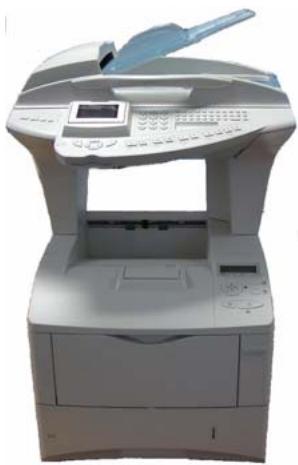
Your fax lets you create a directory by memorising subscriber records and subscriber lists.
- Your machine can store up to 500 subscriber records with names and phone numbers.
- You may also group several names to build a subscriber list with up to 32 subscriber lists. A subscriber list is made from the subscriber records already stored.
For all subscriber records or subscriber lists you may:
Create
- Consult
- Modify contents
- Delete
- Print the directory
You may save and if needed load your directory. This gives you access to functions 161 and 162 (please see the paragraph Guide to function list on page 2-5). To proceed, you need to contact your reseller and purchase the optional kit "Directory save card".
CREATING SUBSCRIBERS RECORD
For each contact record, complete the fields listed below. Only fields with the Name and Telephone number have to be completed:
- Contact NAME,
- TEL and fax number of contact,
- E-mail address, example: dupont@messengerie.com,
or
- FTP address, example: 134.1.22.9
or
- network sharing address: an IP address (for example 134.1.22.10) or NetBIOS name (for example PC1015687).
Note: If you have not entered an e-mail address, then you have the possibility of entering an FTP address (for archiving purposes).
If you have entered neither an E-MAIL address nor an FTP address, you can enter a network sharing address for archiving (address of the terminal on which the directory is shared).
- FORMAT: by default, the attachment is PDF or Image (.tiff or .jpeg)
- RECORD NUMBER: this number is automatically allocated by the fax (you can, none the less, modify it). It gives you quick access to the directory,
- RATE send fax you can choose for each contact the minimum send rate for faxes you send to him. Available rates are 2400, 4800, 7200, 9600, 12000, 14400 and 33600 bits per second. The maximum speed can be used if the telephone line is of good quality, meaning appropriate, without echo.
Note: If a contact has the two fields TEL and E-MAIL completed, the validation key (◇ or @) will define whether the document is sent by telephone network or via the internet.
ADDING A RECORD
11 OK - DIRECTION / NEW CONTACT
Your fax has just created a new record, fill in it by first entering your subscriber's name then validate with OK.
To associate an e-mail address:
Note: You can stop the list creation at any time by pressing .
Enter the person's fax number1 and press OK to confirm.
Enter the E-Mail address of your subscriber and press OK to confirm.
Define the format of the attachment (Image or PDF) and validate with OK.
^忍 Your subscriber's ID number will automatically appear on the screen, if you wish to modify this number you may do so by choosing another free number and validate with OK.
Select the option WITH assigned key if you want to assign a letter (shortcut key) to your subscriber. The first available letter appears by default. If you want to change it, scroll the letters by menas of the or keys, and press OK to confirm.
If need be, select the appropriate transmission speed to send your faxes, and confirm your choice by pressing the OK key.
Or to associate an FTP address:
Do not enter the e-mail address.
Enter the FTP address of the contact, then validate with OK key (for example: 134.1.22.9).
Enter the FTP user name (for example: Durand).
Enter the PASSWORD of the FTP user.
If necessary, enter the file destination directory (when this field is not completed, the files are stored directly under the root) of the FTP server (for example: server name / Durand).
Define the attachment format (Image or PDF) OK.
A number allocated to your contact will be automatically displayed on the screen. If you do not want to use this number, it can be modified by entering another number, then validating with OK key.
Select the option WITH the associated key if you want to associate a letter (shortcut key) with your contact. The first letter free is displayed by default. If you want to modify this, scroll through the alphabet by using or keys, then validate your choice with the OK key.
Select, if necessary, the appropriate send rate for a fax intended for your contact, then validate your choice with the OK key.
Or, to create a shortcut to a network sharing address:
Do not enter an e-mail address or an FTP address.
Enter the IP address or the NetBIOS name of the contact for the Scan to Disk function, then validate with the OK key (for instance: 134.1.22.10).
Enter the domain name followed by the user name for login on the network, and separated by \ (for instance : Domain\UserName).
Enter the password for login on the network.
Enter the file destination directory.
^ Define the format of the attachment (Image or PDF) and validate with OK.
A number is attributed to your contact and appears automatically on the screen. If this number does not suit you, you can modify it by entering another unused number and validating it with the OK key.
Select the option WITH shortcut key if you want to link a letter (shortcut key) to your contact. By default, the first available letter is shown. If you want to change it, scroll through the alphabet by means of the or key, then validate with the OK key.
If required, select the appropriate transmission rate for faxes to your contact, and validate your selection with the OK key.
CREATING SUBSCRIBERS Lists
A subscriber list is made from the subscriber records already stored.
For each list fill in the following lines:
NAME of the list
- NUMBER ASSIGNED to the list, this number is automatically assigned by the fax. It allows quick access to the answering machine
- LIST COMPOSITION, its lists the ID numbers assigned to the subscribers records included in the list
- LIST NUMBER, a number lets you identify the list filed under (L)
A list may include both fax and internet subscribers.
The same subscriber may be included in different lists.
Caution - It is impossible to add one subscriber list to another subscriber list.
ADDING A LIST
To add a list:
12 OK - DIRECTION / NEW LIST
Your fax machine has just created a new list, fill it in by first entering the name of this list then confirm with OK.
Note:
You can stop a list or record creation at any time by pressing . Also, you do not have to complete all the list characteristics as you create it; you can save the list as it is by pressing .
The empty field ENTER ABR. NUM. appears, you must fill in the ID numbers assigned to the subscriber records included in this list.
There are three ways detailed in the table below, to choose and add one or more subscribers to your list. Then confirm your choice by pressing OK.
| From ... | Procedure |
| subscriber's name | With the alphanumeric keypad enter the first letters of your subscriber's name and continue until the whole name is displayed on the screen. |
| subscriber's ID number | Enter directly the subscriber's ID number. |
| subscribers directory | Press key then select by means of the▼ or ▲ keys. |
Note:
For every subscriber included in the list repeat the above step then validate with OK.
you can stop record creation at any time by pressing
The list ID number will automatically appear on the screen. If you wish to modify this number you may do so by choosing another free number and validate with OK.
Press to confirm your entry.
ADDING OR DELETING A NUMBER FROM THE LIST
13 OK -DIRECTORY / MODIFY
Select the subscriber list (L) by means of the or keys and validate your choice with OK.
Press OK to display the ENTER ABR. NUM. field, and add or delete the subscriber as shown in the table hereafter:
| To ... | Procedure |
| add | Enter the subscriber ID number you wish to add and confirm with OK. Repeat this step for each added subscriber you want to add. |
| delete | Place the ↓ or ↑ keys on the number you wish to delete. Press C key to delete the number assigned to the list. Repeat these 2 steps for each subscriber you wish to delete from the list. |
Confirm the new list by pressing key.
CONSULTING A RECORD OR A LIST
Press key.
The directory appears in alphabetical order.
Select the subscriber record or subscriber list (L) you wish to consult.
MODIFYING A RECORD OR A LIST
13 OK -DIRECTORY / MODIFY
The directory appears in alphabetical order.
Use the or keys to select the subscriber list (L) you wish to modify and press OK to confirm.
Modify the line or lines in the subscriber record or subscriber list and confirm each modification with OK.
Note: You may confirm your modification by pressing key, but you will exit the menu and may not be able to modify the following lines.
DELETING A RECORD OR A LIST
14 OK -DIRECTORY / CANCEL
The directory appears in alphabetical order.
Use the or keys to select the subscriber record or subscribers list (L) you wish to delete and confirm with OK.
Press again OK to confirm your deleting.
The record or list is deleted from the directory.
PRINTING THE DIRECTORY
You may print all the numbers stored in the directory, including all the existing subscriber records or subscriber lists.
To print the directory:
15 OK -DIRECTORY / PRINT
The directory is printed in alphabetical order.
IMPORTING A DIRECTORY
You can import an existing directory of contacts into your fax machine as an electronic file. This file must be in a specific format and must not comprise more than 500 entries.
The process of importing a directory uses electronic mail as the transfer mechanism. The electronic file containing the directory is received and processed as an e-mail attachment.
Caution - Importing a new directory completely overwrites any existing directory entries.
THE FILE STRUCTURE
The electronic file containing the data in the directory must be structured into lines or records each comprising five fields separated from one another by a unique character (a tab stop, a comma or a semi-colon). The lines themselves are separated by a line break (carriage return).
| Fields | Contents |
| Name | A unique identifier in your directory, up to 20 characters long. This field is mandatory; the name should not include the field separator character. |
| Fax number | Your contacts' fax number, without spaces or dots, can be up to 30 characters long (including any * and # characters). This field may be left empty, for instance, in the case of contacts to whom you only send e-mails. |
| E-mail address | Your contacts' e-mail address. Can be up to 80 characters long, but must not comprise the field separator character. Any other characters may be used in this field, which can also be left blank. |
| Shortcut key | A capital letter (A to Z), unique to the directory, which is associated with a specific contact and enables quick selection. As with the two previous fields, this field can be left blank. |
| Speed | The fax transmit speed over the PSTN. If you do not specify a value, the default speed is the maximum speed. This field may be left blank if all your fax transmissions are handled by a fax server. |
Caution - You must enter a value for at least one of the Fax number or E-mail address fields. To enter a blank line, key in four field separator characters in a row.
For example:
Smith;0123456789;jsmith@isp.co.uk;J;8
Jones;01987654321;;8
O'Connor;0123469874;d.oconnor@hello.net;U;8
Note: @ alone is the indication that no associated key is assigned to the entry.
The rate is coded on a number, see the following board:
| Rate | Code number |
| 600 | 7 |
| 1200 | 6 |
| 2400 | 5 |
| 4800 | 4 |
| 7200 | 3 |
| 9600 | 2 |
| 12000 | 1 |
| 14400 | 0 |
| 33600 | 8 |
Caution - You must always enter the field separator character, even if one or more of the fields are left blank. In the example above, which uses a semi-colon as a separator, the entry for "Jones" lacks both E-mail address and shortcut key.
PROCEDURE
To import a directory:
17 OK - DIRECTION / IMPORTATION
Select WITH to authorise the importation of a directory.
Create your directory on a PC in a file whose structure corresponds to that set out above. In order to be recognised as a directory, the file name must include the word directory and must have a .csv extension. For example: smithdirectory01.csv, jonesdirectory.csv, or simply directory.csv.
Create an e-mail addressed to your fax E-mail address, attach the file to it, and send your message via your mail server.
Your fax will receive the e-mail containing the directory when it connects to the mail server, and will automatically import the attached file into its directory.
Repeat the procedure as many times as required, for instance to update all the LAN faxes on your network with the same directory.
Caution - Importing a new directory completely overwrites any existing directory entries on the fax machine. Once your fax machine has a complete directory, we advise you to disable importing in order to protect the data already on the fax.
To disable importing:
17 OK -DIRECTORY / IMPORTATION
Select WITHOUT to prevent users from importing a directory.
EXPORTING A DIRECTORY
You may also export a directory from a fax machine as a text file, and send it to any mail client (be it PC or fax based), in the form of an e-mail attachment entitled directoryxxx.csv.
To export the directory:
18 OK - DIRECTORY / EXPORTATION
Key in the e-mail address of the PC or other fax machine to which you want to export the directory. You may export a directory to several fax machines simultaneously (please see the paragraph Dialling on page 5-3).
Confirm by pressing OK.
Repeat the procedure as many times as required, for instance to update all your fax machines or send the same file to several PC users on your local network.
LDAPSERVER
The LDAP server allows you to access a directory server, for contacts or lists of contacts (maximum 500 recipients).
The LDAP function can be switched on only once there are at least 50 free entries in the unit's local directory. If this is not the case a message will ask you to delete the necessary number of entries.
CONFIGURATION
191 OK - DIRECTORY / LDAP SERVER / ADDRESS
Enter the IP address or the server name and press the OK key to confirm.
192 OK - DIRECTORY / LDAP SERVER / IDENTIFIER
^ Enter the identifier for connecting to the server and press the OK key to confirm.
193 OK - DIRECTORY / LDAP SERVER / PASSWORD
Enter the password for connecting to the server and press the OK key to confirm.
194 OK -DIRECTORY / LDAPSERVER / DN BASE
Enter the database name and press the OK key to confirm.
195 OK - DIRECTORY / LDAP SERVER / PORT
^ Enter the port number for connection to the server and press the OK key to confirm.
ACCESSING SERVER CONTACTS
When the LDAP function on your terminal is switched on, you can send documents or e-mails to contacts in the server's directory.
This is what happens when you search for a contact: when you enter the first letter of the recipient's name, all the entries in the server's directory which begin with this letter will be alphabetically added to the local ones.
If there are too many entries on the server, a message will ask you to enter more of the letters in the name to refine the search.
Note: If a list contains too many recipients, a message will inform you that the list cannot be used.
ADDING A SERVER CONTACT TO THE LOCAL DIRECTORY
On the Change menu:
13 OK -DIRECTORY /MODIFY
Use the or arrows to select the server contact to add to the local directory and press the OK key to confirm.
Change the desired field(s) in the contact's file and press the OK key to confirm each change.
When you reach the last setting: choose the Local option instead of Remote and press the OK key to confirm.
Note: You can confirm your changes by pressing the key, but in that case you exit the menu and you do not have access to the following fields.
5 OPERATION
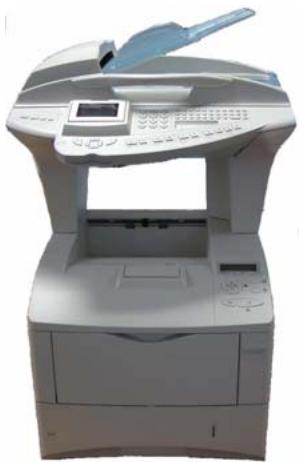
SENDING
Faxes sent over the telephone network are sent from the feeder or the memory.
Documents sent over the Internet are first memorised and sent at the time of Internet connection.
Over the telephone network, your faxes are transmitted in black and white or in colour.
Internet can be used to send black and white or colour documents (TIFF, PDF or secure PDF format).
If you choose "Secure PDF" you must type a password. This password will be required after words in order to allow the document to be displayed on your PC.
DOCUMENT DEPOSITING
Scanner
From the automatic feeder tray
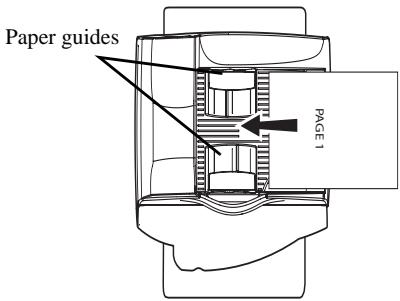
Place your original documents in the document feeder:
- face printed on the top,
- first page under the stack.
Set the paper guide to the document width.
Once the operation is over, take your original documents back from the document exit tray.
Caution - If you put the documents to send upside down, the contact will receive a blank page.
Remark: Since the addressee's number is generally on the document to be transmitted, you may also dial before positioning the document.
From the flat scanner
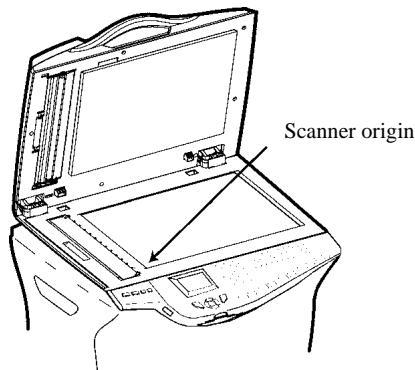
Using the handle, lift up the document feeder tray.
Put your document, with the printed face down on the scanner window. The scanner origin is located at your end, to the left, as shown opposite.
Once the operation is complete, lift the document feeder tray and recover your document.
SELECTING RESOLUTION/CONTRAST
Selecting black-and-white or colour
Black and white or colour mode is selected by pressing the key.
Resolution
You have several scan modes available to send your documents.
The choice of the mode depends on the document to be sent:
- Normal mode, N , is to be used for good-quality documents without drawings or small details,
- Fine mode, ::F, below the display screen, is to be used for documents that include drawings or small characters,
- Super Fine mode, ESF, is to be used for documents that include drawings (with very thin lines) or very small-size characters (on condition that the receiving fax can reproduce them),
- Photo mode, 1 , is to be used for photographic documents (except those in colour).
To select the resolution mode:
Press key as many times as necessary to select the required mode. An icon on the screen shows the current mode.
Contrast
You can set the contrast if your document is too light or too dark. If the document is light, you must raise the contrast and if it is dark, you must reduce it.
To set the contrast:
Press 1 as many times as necessary to choose the desired contrast, as shown by the position of a cursor.
DIALLING
From the directory
Dialling alphabetically
Enter the first letter of your subscriber's name with the alphanumeric keypad, then add the remaining letters until your subscriber's name is complete.
Assigned number dialling
Press key
Your fax displays the names of your correspondents and the lists of correspondents in the address book in increasing alphabetical order.
then
Use the or keys of the browser to scroll through the correspondents and lists of correspondents, and to select the correspondent or list of correspondents you require.
or
Press key
Then press the letter assigned to the subscriber (please see the paragraph Adding a record, on page 4-2).
The screen displays the corresponding name.
or
Enter the subscriber or subscriber list assigned number.
The screen displays the name of the subscriber or subscriber list assigned to this number.
Using the last number dialled key
You can radial one number among the ten last numbers you just dialled before.
For a fax number (Tel in the Directory)
Press the key.
The screen displays the last number used.
Use the or keys of the browser. The first time you press one of these keys, the last recorded number is displayed. If needed, you can also either enter a new fax number or select another number in the list.
The screen displays:
BIS??
TO:
Press the @ key.
The screen displays:
BIS??
ADDRESS
Use the or keys: the screen displays the last e-mail address used.by the browser, to select another e?mail address if required. Once you have made your choice, press the @ key to validate your selection
To multiple numbers
You may dial to send a document simultaneously to multiple call numbers.
Caution - This may be achieved only if the machine is parametered to send from the memory (please see the paragraph Document feed type, on page 3-4).
Enter the fax or E-mail address, or use the Directory (refer to above paragraphs).
Press key and enter the number of the second subscriber or second subscriber list
Repeat this last step for all subscribers or subscriber lists (maximum 10 subscribers or subscriber lists).
Press OK, , or @ to confirm the last addressee depending on the required operation.
TRANSMISSION OVER THE PUBLIC SWITCHED TELEPHONE NETWORK (PSTN)
Immediate transmission
Position the document (please see the paragraph Document depositing, on page 5-2).
Enter the fax number or choose your dialling mode (please see the paragraph Dialling, on page 5-3) then press .
The "Line" icon flashes during the call phase, it stays lit when both faxes are in communication.
At the end of transmission the initial screen is displayed.
Delayed transmission
This function allows you to transmit a document at a later time.
To program a postponed transmission you need to identify the subscriber number, transmission time, feeder type and number of pages.
To delay the transmission time of your document:
Position the document (please see the paragraph Document depositing, on page 5-2).
Select 31 OK-FAX/TRANSMISSION.
Enter the subscriber number you wish to program at a different time or choose your dialling mode (please see the paragraph Dialling, on page 5-3) and confirm with OK.
Next to the current time, enter the new time and confirm with OK.
Choose the required IMAGE or PDF format.
Choose SCAN B & W or COLOR SCAN.
Adjust the contrast and confirm by pressing the OK key.
Select the feed type, FEEDER or MEMORY and confirm with OK (please see the paragraph Document feed type, on page 3-4).
You may enter the number of pages before transmission and confirm with OK.
Confirm postponed transmission by pressing key.
Your document is stored and will be sent at the new time.
Remark: When sending in "Deferred Send" mode, make sure that the document in the feeder tray or on the scanner window is located in the right direction.
Transmission with auto redial
This function allows you to monitor the dialling operation during a fax transmission. In this case, the maximum transmission rate will be 14400 bps.
This function allows for example:
- To hear if the subscriber's fax is engaged and if so, choose the moment when the line is clear to start the document transmission.
- To control the communication progress in case of uncertain numbers, etc.
To take the line manually:
Place the document in the fax feeder.
Press
If necessary, set the sound level with navigator or keys.
If not already done, enter the subscriber number (or please see the paragraph Using the last number dialled key, on page 5-4 to call back the last subscriber).
As soon as you hear the remote fax tone, the line is clear and you can start the transmission.
Press to start the document transmission.
If your machine is set in order to print a transmission report (please see the paragraph Main settings, on page 3-1), the reduced copy of the document first page will not be printed and it notifies you that the communication is manual.
Rerouting
This function is used to reroute faxes received to a directory contact. To use this function, you have to perform two operations: set the rerouting address of the fax and activate rerouting.
Activate rerouting
391 OK - FAX / RERouting / ACTIVATION
Using the keys or within the navigator select option >>3911 WITH.
Confirm with the OK key.
Remark: If the function WITHOUT is selected the menus 392 and 393 will not be included in the functions overview, when it is printed out.
Set the re-direction contact
392 OK - FAX / REROUTING / DESTINATION
Using the keys or within the navigator select the subscriber from the directory (if the directory is empty the display will show Directory EMPTY). Enter the number of the subscriber manually or store the name and related number in the directory (please see the paragraph Creating subscribers record, on page 4-2).
Remark:
You may forward a fax to the e-mail address of the subscriber stored in your directory if the fax is not available. The Fax will then be sent as an attachment in the pre-defined file format (p. 3-10 for the configuration of the attachment files format).
393 OK - FAX / REROUTING / COPY
Using the keys or within the navigator select the COPY option (local printout of the information relayed to your system) either WITH or WITHOUT.
Confirm with the OK key.
Caution - E-mails can only be relayed to e-mail addresses. The configuration of landlines does not provide for relaying to fax machines.
TRANSMISSION OVER THE INTERNET AND THE NETWORK
Scan to email in black and white
Position the document (please see the paragraph Document depositing, on page 5-2).
Press the @ key and enter the recipient's E-mail address or choose your dialling mode (please see the paragraph Dialling, on page 5-3).
Adjust the contrast and the resolution if necessary (please see the paragraph Selecting Resolution/Contrast, on page 5-3).
Press the @ key.
The document is scanned and memorised, it will be sent at the time of Internet connection. If your contact has a PC, he will receive an E-mail to which your fax is attached in monochrome PDF, protected PDF or TIFF format, depending on the format choice you made.
If your subscriber has an Internet fax, he will receive a paper fax.
Scan to email in colour
Position the document (please see the paragraph Document depositing, on page 5-2).
Press the @ key and enter the addressee's E-mail address or choose your dialling mode (please see the paragraph Dialling, on page 5-3).
Adjust the contrast and the resolution if necessary (please see the paragraph Selecting Resolution/Contrast, on page 5-3).
Press the key.
The document is scanned and memorised, it will be sent at the time of Internet connection. If your contact has a PC, he will receive an E-mail to which your fax is attached in colour PDF, protected PDF or TIFF format, depending on the format choice you made.
If your subscriber has an Internet fax, he will receive a paper fax.
Text to mail
You can send a typed message to an E-mail mailbox. You can also add an attachment to this keypad message (the attachment is a scanned paper document).
Access through the menu:
95 OK - INTERNET / E-MAIL
Direct access:
Press @ key.
Then, to send to E-mail address:
Enter the addressee's E-mail address or choose your dialling mode (please see the paragraph Dialling, on page 5-3).
Enter the address of who you want to receive a copy of the document (CC:), and press OK to confirm.
Enter the object for mail (80 characters max.) and press OK.
Enter the text with the alphabetical keypad (100 lines of 80 characters) and confirm with OK.
To go to the next line, use key.
To move from one line to another, press the or .
Then, you can choose between two options:
Send the typed mail directly. Press OK, the mail is memorised and will be sent at the next Internet connection, validate by pressing the key. Your subscriber will receive an E-mail.
Add an attachment (scanned document) to your mail:
Select the scanner to use to scan your document. SCANNER ADF (scroll scanner) or FLAT SCANNER.
Validate with OK key.
Select B&W SCAN to send a black and white document or COLOR SCAN to send a color document, and validate with OK key (this setting can be changed at any time during the send procedure, using the colour key).
Enter the name of the attachment and validate with OK key.
If necessary, change the attachment format: PDF, Protected PDF or IMAGE and validate with OK key.
If you have started to scan with the flat scanner, the unit will scan the other pages. Put your second page to scan, select NEXT and validate with OK.
Press @ key.
Set contrast and resolution if necessary (please see the paragraph Selecting Resolution/ Contrast, on page 5-3).
Press @ key.
The document is scanned and the mail sent to memory. It will be sent during the next connection to the Internet. Your contact will receive an E-mail with an attachment.
Multi-contact transmission
Multi-contact transmission (transmission to several destinaries at the same time) is not possible by means of the key dedicated to this function.
To perform this kind of transmission, you first need to create a group that contains only the shared addresses.
Next, perform the same operations as for a transmission to a single address, but instead of selecting a single address, select a group of shared addresses in the directory.
Scan to FTP
The scan to FTP function enables you to put your TIFF, JPEG, Protected PDF and PDF files in an FTP server, for example, for archiving.
To connect to the FTP server, you must know the name of the FTP user and the PASSWORD.
When sending files, the machine connects to the FTP server using the defined connection parameters.
Simply put the file in an FTP server:
Put the document in one of the scanners (please see the paragraph Document depositing, on page 5-2).
Press PC key. A choice screen is displayed.
Select Scan to FTP with or keys then press OK key.
Enter the FTP address of the server or select it from the directory by pressing the key.
Enter the name of the FTP user (operation prohibited when the address is in the directory).
Enter the password of the FTP user (operation not necessary when the address is selected in the directory).
Select the scanner to use to scan the document, SCANNER ADF (scroll scanner) or FLAT SCANNER.
Validate with OK key.
Select B&W SCAN to send a document in black and white or COLOR SCAN to send a document in colour. Validate with OK key (this setting may be changed at any time during the send procedure with the colour key).
Enter the name of the attachment and validate with OK key.
Remark:
To avoid "name collisions", a suffix is automatically added to the name that was entered, and incremented as necessary. If you entered DOCUMENT as the file name, you will find the file archived as, for instance, DOCUMENT000016.pdf.
If necessary, change the attachment format: PDF, Protected PDF or IMAGE et validate with OK key.
If you have started to scan with the flat scanner, the unit will scan the other pages. Put your second page to scan, select NEXT and validate with OK.
Multi-contact sending
Multi-contact sending is not possible with the key dedicated to this function. To make this type of send, you have to create a group containing exclusively the FTP addresses.
Then carry out the same operations as for sending to one address, except that you select an FTP address group in the directory, and not a single address.
Scan to Disk
The Scan to Disk function allows you to place your TIFF, JPEG, Protected PDF and PDF files in a shared directory, on your PC for instance.
To access the shared folder you have to supply a user name and password for login on the network.
When files are to be sent, the machine connects itself to the terminal on which the directory is shared (for instance your PC) using the defined login parameters.
Basic recording of a file in the shared directory:
Place a document in one of the scanners (please see the paragraph Document depositing, on page 5-2).
Press the PC key. A selection screen is displayed.
Select SCAN TO DISK with the or key, then press the OK key.
Enter the network sharing address, i.e., the address of the terminal on which the directory is shared and the name of the shared directory (for instance 134.1.22.10\DirectoryName), or select an entry in the directory by pressing the key.
^ Enter the network login user name (this operation is inhibited if the address in the directory).
Enter the network login password (this operation is not necessary if the address is selected in the directory).
Select B&W SCAN to send a black-and-white document or COLOR SCAN to send a colour document, then validate with the OK key (this setting can be changed at any time during the send procedure with the colour key).
Enter the name of the attachment and validate with the OK key.
Remark:
To avoid "name collisions", a suffix is automatically added to the name that was entered, and incremented as necessary. If you entered DOCUMENT as the file name, you will find the file archived as, for instance, DOCUMENT000016.pdf.
If necessary, change the attachment format (PDF, Protected PDF or IMAGE) and validate with the OK key.
If you are using the flat-bed scanner, you can scan more than one page. Place the next page on the scanner, select NEXT and validate with OK.
Scan to PC (depends on model)
Remark:
your machine is provided with a Scan to PC key. This key activates, first of all, the SCAN -TO - PC, function, which associated with the Companion Suite Pro kit makes it possible to send an opening notice of a scan function of a PC connected to your machine. For more information, refer to the User Manual provided with your PC Kit (Companion Suite Pro LH).
TRANSMISSION WAITING Queue
This function lets you obtain a recap of all documents queuing, for transmission, including those in deposit or in delayed transmission, etc.
It allows you to:
- consult or modify the waiting queue. In this waiting queue the documents are coded the following way:
Order number in the queue / document status / subscriber's telephone number.
Documents may have the following status:
- TX: transmission
- REL: relay
- DOC: in deposit
- POL: polling
- MBX: send to mailbox
- PMB: mailbox polling
- TR: ongoing commands
- CNX: Internet connection
- NET: Internet transmission
-
SMS:SMS transmission
-
immediately perform a transmission from the waiting queue
- print a document in storage, waiting to be transmitted or in deposit
-
print the waiting queue, to get the status of each document in the queue, by either:
-
queue order number
- document name or number
-
scheduled transmission time (fax)
-
operation type regarding the document: transmission from memory, delayed transmission, deposit
- number of pages of the document
-
document size (percentage of space stored in memory)
-
cancel a transmission request in the waiting queue.
Immediately perform transmission from the waiting queue
61 OK - COMMANDS / PERFORM
Select the document in the waiting queue and confirm your choice with OK or to immediately perform the selected transmission.
Consult or modify the waiting queue
- 62 OK - COMMANDS / MODIFY
In the waiting queue select the required document and confirm your choice with OK.
You may now modify the parameters of the given document then confirm your modifications by pressing key.
Deleting a transmission on hold
63 OK - COMMANDS / CANCEL
In the waiting queue select the desired document and confirm your choice with OK.
Printing a document in waiting or in deposit
64 OK - COMMANDS / PRINT
In the waiting queue select the desired document and confirm your choice with OK.
Print the waiting queue
65 OK - COMMANDS / PRINT LIST
A document called ** COMMAND LIST ** is printed.
CANCELLING A TRANSMISSION IN PROGRESS
Cancelling a transmission in progress is possible whatever the type of transmission but varies depending on whether the transmission is a single call number or a multi-call number.
- For a single call number from the memory, the document is erased from the memory.
- For a multi-call number, only the call number in progress at the time of the cancellation is erased from the transmission queue.
To cancel transmission in progress:
Press key.
A message will ask you to confirm cancellation by pressing the key a second time.
Press key to confirm cancellation in progress.
If your machine is set to print a transmission report (please see the paragraph Transmission report, on page 3-4), it will print that the communication was cancelled by the user.
RECEPTION
- Reception of all documents over the telephone network is done one at a time at fax reception. Document reception over the Internet is automatic at each Internet connection.
RECEPTION OVER THE PUBLIC SWITCHED TELEPHONE NETWORK (PSTN)
Fax reception depends on the parameter settings of your machine.
RECEPTION OVER THE INTERNET
Whatever the document received, reception is automatic at each Internet connection.
Incoming documents other than fax files (Word process file, CAD, etc.) may not be opened by your fax. However, you may keep this (or these) document(s) in your Internet mailbox until it is automatically converted by the F@X to Fax service, if you have a subscription or until computer use or automatic transfer (please see the paragraph Mail sorting, on page 3-21).
COPYING
Your fax offers to print out one more copies of one or more pages.
You can also make copies in tiled or poster mode. The tiling function allows you to print a number of pages imported from the ADF scanner onto a page, at a reduced scale (there are 2 modes available: 2 scanned pages onto a sheet or 4 scanned pages onto a sheet).
The poster function allows you to do the opposite; in other words you can print a scanned page onto a number of pages (there are 2 modes available: 1 scanned page onto 4 pages or 1 scanned page onto 9 pages).
With your terminal you can make photocopies in front/back mode.
LOCAL COPY
Standard copy
Position the document (please see the paragraph Document depositing, on page 5-2).
Press the key twice to make a copy.
Duplex photocopies
Remark: This duplex unit only works with A4 (210 x 297 mm) format paper.
Press once, the key.
When the duplex mode is activated, a pictogram is shown on the screen.
Remark: The internal memories of your terminal can be printed one side only, except in PAPER SAVE mode.
The features available are described in the following table:
| ORIGINAL FORMAT | → | FINAL FORMAT |
| DUPLEX/DUPLEX | → | DUPLEX/DUPLEX |
| ONE SIDE | → | DUPLEX/DUPLEX |
| DUPLEX/DUPLEX | → | ONE SIDE |
| ONE SIDE | → | ONE SIDE |
"Sophisticated" copy
Position the document (please see the paragraph Document depositing, on page 5-2).
Press the key.
A screen that shows the default copy settings is displayed.
Modify the settings that you want to change, using the or keys to select the field then press the OK key.
Depending on the setting to be modified, you will have to enter a value, select an option with the or keys or make an adjustment with the or keys.
Once the setting has been made, press the OK key to validate.
The list of copy settings is described below.
Once all settings have been made, press the key.
List of copy settings:
- The NUMBER field allows you to enter the number of copies required.
- The TYPE field allows you to select the scan mode: R/V->R/V or RECTO->R/V or RECTO->RECTO.
- The RESOL field allows you to select the desired resolution.
In black and white mode the available choices are: ULT FAST 工 ,FAST 工 ,QUALITY SF and PHOTO
The FORMAT field allows you to select one of the options for printing in mosaic format (ADF scanner): 1 on 1, 2 on 1 or 4 on 1 or one of the poster print options: 1 to 1, 1 to 4 or 1 to 9 (flatbed scanner). See examples below.
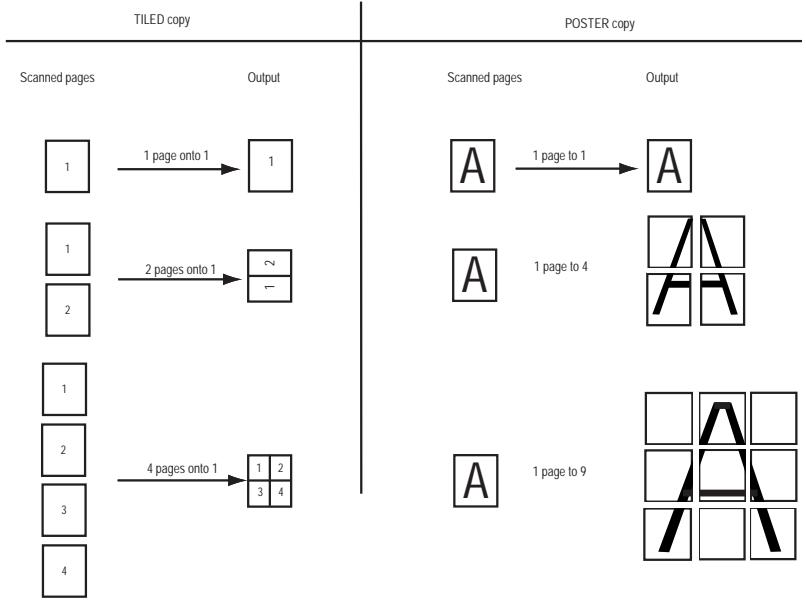
-
The CONTR field allows you to set the desired contrast by means of the or keys.
-
The BRIGHTNESS field allows you to set the desired brightness by means of the or keys.
-
The ZOOM field allows you to set the desired zoom value between 25% and 400% by means of the or keys or the numerical keyboard.
-
Select a 141% zoom to obtain A4 format output starting from an A5 original.
The scan width of 149mm corresponds to A5.
The maximum scan length of 210mm also corresponds to A5.
Reduction or enlargement depending on formats:
| Original format | Final format | Zoom setting in % |
| LETTER | A4 | 97 |
| A4 | LETTER | 94 |
| LEGAL | LETTER | 78 |
| A4 | A5 | 71 |
| A5 | A4 | 141 |
- The ASSEMBLED field allows you to select the way the output document is assembled: COPIES ASSEMBLED or COPIES NOT ASSEMBLED.
- The ORIGIN field allows you to adjust the desired origin values.
- The PAPER field allows you to select the paper type: NORMAL, HEAVY, TRANSPARENT, COLOUR or RECYCLED.
- The TRAY field allows you to select the paper tray: AUTOMATIC, UPPER or LOWER.
DESCRIPTION OF ID CARD MODE
The IDENT. CARD copy function is used for copying both sides of an identity card or driving license type document (size < A5 ) on an A4 format sheet.
This function will be available only from the flatbed scanner for local copy.
The LDC screen will display two messages: one to indicate where the original document should be placed and another to ask the document to be turned over. These messages require validation from the keyboard before the operation can be continued.
No zoom will be applicable for this function.
Selection of the IDENT. CARD copy mode will be possible in the local copy slip. This mode will be accessible only if no paper is detected in the scroll scanner feeder.
Press the 1 and OK keys.
The following will be displayed:
31 PAGE TO 94>>
4>> ID CARD
Press the OK key.
The following will be displayed:
1>> DUPLEX/DUPLEX
Press the OK key.
The following will be displayed:
2: RESOL.: FAST
3>> RESOL.: QUALITY
Press the OK key.
The following will be displayed:
CONTRAST
0-+
With keys and select contrast.
Press the OK key.
The following will be displayed:
LUMINOSITY
0+
With keys and select contrast.
Press the OK key.
The following will be displayed:
1 >>NORMAL PAPER
2 THICK PAPER
With keys and select paper.
Press the OK key.
The following will be displayed:
PUT ID. CARD THEN OK
Insert your identity card flatbed on the scanner's glass.
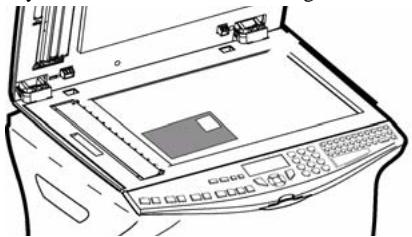
The following will be displayed:
COPY IN PROGRESS
Then, once the document has been scanned:
TURNSOVERDOC THENOK
Lift the flatbed scanner flap, turn over your card then close the flap.
The following will be displayed:
COPY IN PROGRESS
Your fax machine will then print your card.
SPECIFIC COPY SETTINGS
When the copy quality is no longer satisfactory, you can perform a calibration. To do so, please see the paragraph Scanner calibration, on page 6-12.
Moreover, a high number of controls let you improve the copy quality.
Scanner settings
▼841 OK - ADVANCED FCT / COPY / RESOLUTION
The B&W RESOLUTION setting to adjust the resolution for photocopying. Select the resolution: ULTRA FAST , FAST , QUALITY ESF or PHOTO by means of the or , keys, validate your choice by pressing the OK key.
842 OK - ADVANCED FCT / COPY / ZOOMING
The ZOOM setting is used to reduce or enlarge part of the document by choosing the original and the zoom value to apply to the document, 25 to 400% . Enter the zoom value required using the keys of the digital key pad. Validate the choice with the OK key.
843 OK - ADVANCED FCT / COPY / ASSEMBLED
The ASSEMBLED parameter is used to define the choice of your printer outputs; either assembled or not assembled. Validate the choice with the OK key.
844 OK - ADVANCED FCT / COPY / ORIGIN
If you wish, you can change the origin of the scanner.
By entering new values of X and Y given in mm ( X < 210 and Y < 286 ), you will move the scanning zone as shown on the figure below.
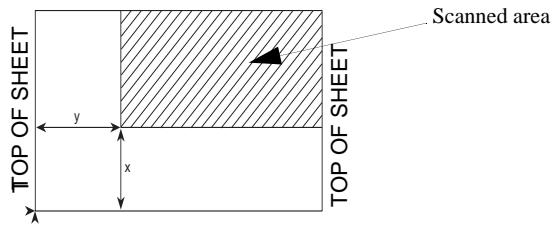
Select the X and Y coordinates with or keys.
Set the required coordinates with the numeric keypad or or . Confirm your setting by pressing key OK.
845 OK - ADVANCED FCT / COPY / CONTRAST
The CONTRAST parameter is used to select the photocopy contrast. Adjust the contrast using keys and , then validate the choice with the OK key.
You can also directly adjust the desired contrast using the key, press this ① key several times until the required adjustment is obtained without using · 846.
846 OK - ADVANCED FCT / COPY / LUMINOSITY
The LUMINOSITY parameter is used to make your original document lighter or darker. Adjust the brightness required using keys and , then validate the choice with the OK key.
847 OK - ADVANCED FCT / COPY / BINDING
The BINDING parameter is used to choose the long or short side according to the type of binding of your document. Make your choice using keys and , then validate the choice with the OK key.
Caution - All settings made using this menu become default settings of the machine.
85 OK - ADVANCED FCT / SCAN. & PRINT
Use keys or of the browser to scroll the setting described below that you want to modify.
Validate your setting by pressing the OK key.
851 OK - ADVANCED FCT / SCAN. & PRINT / PAPER
Select NORMAL or THICK paper using and keys.
Validate your setting by pressing the OK key.
Remark:
1) When THICK paper type is selected, the print speed is slowed down.
2) Use the manual feeder for paper with a weight greater than 90g / m^2
852 OK - ADVANCED FCT / SCAN. & PRINT / PAPER TRAY
Select the paper tray that you want to use; AUTOMATIC, LOWER or UPPER using and keys.
Validate by pressing the OK key.
853 OK - ADVANCED FCT / SCAN. & PRINT / PAPER SAVE
Remark:
This function prints all your documents duplex.
This function requires the prior installation on the rear of your machine of the duplex unit and the additional paper tray.
Select WITH or WITHOUT using and keys.
Validate by pressing the OK key.
854 OK - ADVANCED FCT / SCAN. & PRINT / S.F MARGINS
If you want to offset the side margins of your document to the left or to the right when scanning with your scroll scanner.
Adjust the offset of the left/right margins (in 0.5mm steps mm) using and keys.
Validate by pressing the OK key.
855 OK - ADVANCED FCT / SCAN. & PRINT / FLATBED MARG
If you want to offset the side margins of your document to the left or to the right when scanning with your flat scanner:
Adjust the offset of the left/right margins (in 0.5mm steps mm) using and keys.
Validate by pressing the OK key.
USING USB MEMORY KEYS
You can connect a USB memory key to your terminal.
Connector for USB memory key
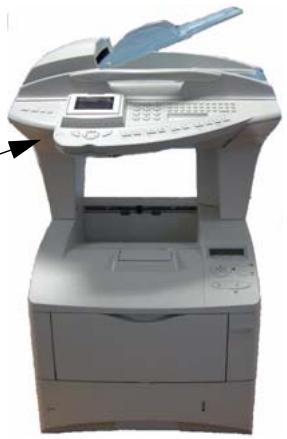
Displaying the content of a USB memory key
Remark:
If the memory support contains more than 999 files, only the 999 most recent ones are taken into account. You have several display modes available to view the photos and documents stored on the memory support.
- the Photos mode: only the photos stored on the memory support are displayed. The photos that do not have the minimum characteristics required as described in paragraph Supported image files, on page 5-22, are not displayed on the screen.
- the Documents mode: only the printable documents stored on the memory support are displayed. The documents must have the minimum characteristics described in paragraph Support document files, on page 5-24.
All printable files (photos and documents) are displayed in the form of a list, without taking any kind of directory structure into account. Use the file extensions to distinguish between the different file formats.
Compatible USB keys
The memory keys must be FAT16 or FAT32 formatted for the terminal to be able to read them. NTFS formatted memory keys are not compatible with the terminal.
Informations on the use of the photo USB memory key
- If your multifunction terminal cannot read the USB memory key that you are using, check that it is compatible and that you have inserted it correctly.
- Once in place, do not remove the device before the multifunction terminal has finished all the print commands.
- If the "MEDIA ERROR - WRITE ERROR" message is displayed during a recording or erasing operation on a memory support, this means that the latter is write-protected. Recording or erasing is possible only after this protection has been de-activated.
- A write-protected file (read-only) cannot be deleted from a memory support.
Remark:
The Analyse Media function allows you at all times to consult the contents of the inserted USB memory key, and this even if you have quit the media menu and the terminal is again in initial mode. Press /0K and 08.
PRINTING A PHOTO FROM A USB MEMORY KEY
Your multifunctional terminal is equipped with all the tools and connections needed to make it into an independent photo printer. You can print out digital photos in black and white from a USB memory key.
Supported image files
You can use photo files that meet the following requirements:
| Device format | Compatible DCF (Design Rule for Camera File System (Version 1.0)) |
| File format | JPG (JPEG) BASELINE Format |
| Image size | Maximum 6 Mb |
| Supported resolution | between 76800 and 12 million pixels |
| N° of files recognised | Up to 999 |
Printing a photo from a USB memory key
When you insert a USB memory key in your multifunction terminal, the support is immediately analysed. The number of files on the card is displayed (by increments of 5), and then the media menu opens.
Select PRINT PHOTO by means of the or keys, then validate with the OK key or type 1 on the numerical keyboard. You can directly access the photo print function by pressing the key
The screen you allows you to view the photos starting with the most recent one. Each photo is accompanied by the following informations:
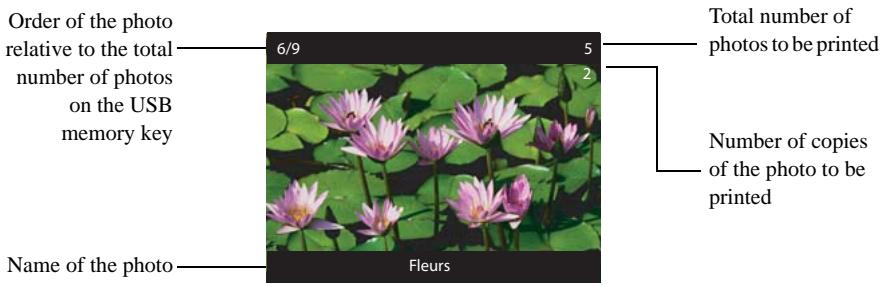
When viewing the photos on the screen, the OK key lets you switch the display to full screen and see the entire image. In full screen mode, only the number of copies of the photo to be printed is displayed on the screen.
Number of copies of the photo to be printed
To return to the normal display, press the OK key.
To select the photos to be printed, select the number of copies between 0 and 9 of the photo to be printed by means of the numerical keyboard. The desired number of copies of the photo is displayed in the top right corner of the photo. The total number of photos to be printed in the top right corner of the screen is automatically incremented.
To change the number of copies of the photo to be printed, select another number on the numerical keyboard.
Use the or keys to move from one photo to the next.
To validate the selection and switch to the next menu, press the Start or key.
To print the selected photos, select SELECTION by means of the or keys, then validate with the OK key or type 1 on the numerical keyboard.
To print all the photos, select ALL by means of the or keys, then validate with the OK key or type 2 on the numerical keyboard.
To print an index of the photos, select INDEX by means of the or keys, then validate with the OK key or type 3 on the numerical keyboard.
To print the current photo, select CURRENT PHOTO by means of the or keys, then validate with the OK key or by typing 4 on the numerical keyboard.
Remark: 24 photos can be printed in miniature on a index page. The photos are accompanied by their file name and their number on the USB memory key. They are printed in chronological order.
Select the paper size for the photo between A4 and 10X15 by means of the or keys and the OK key.
Select the NORMAL, HEAVY, PHOTO or TRANSPARENT paper to be used by means of the or key.
Validate by pressing the OK key to start printing.
Remark: To return to the previous menu, use the C key. To exit completely from the menus, use the Stop key.
PRINTING A DOCUMENT FROM A USB MEMORY KEY
Supported document files
You can use files that meet the following requirements:
| File format | PDF, Tiff, Txt and JPEG. |
| Image size | Up to 6 Mo |
| N° of files recognised | Up to 999 |
Insert the USB memory key in the multifunction terminal,
02 OK - MEDIA / PRINT DOCUMENT
In the media menu that is displayed, select PRINT DOC. by means of the or keys then validate with the OK key or type 2 on the numerical keyboard,
021 OK - MEDIA / PRINT DOCUMENT / LIST
The list of all the documents in the USB memory key will be printed.
The list of the documents on the USB memory key contains the following information in the form of a table:
- Index,
Name, - Date,
Size.
022 OK - MEDIA / PRINT DOCUMENT / FILE
Select FILE to print the contents of one or more documents on the USB memory key.
Select ALL to start printing the list of all documents on the USB memory key or start printing all documents on the USB memory key.
Select SERIES to select several documents with consecutive names. The screen then displays the alphabetical list of the documents on the USB memory key. At the FIRST FILE prompt select the first document of the series with the OK key, then at the LAST FILE prompt select the last document of the series with the OK key. Press the Start key to start printing.
Remark: To modify your file selection, move to the line that corresponds to the file to de-select and press the OK key again. After this, you will have to restart the selection of the file series.
Select SELECTION to select the documents one by one. Use the or keys to move through the list of documents, and use the OK key to select each document. The selected documents are marked with a star to the left of their name. Press the Start key to start printing.
Remark: To de-select a file, move to the corresponding line and press the OK key. The star to the left of the name of the document disappears.
RECORDING A DOCUMENT IN A USB MEMORY KEY
This function allows you to digitise a document and to record it in a USB memory key.
Put the document in place (please see the paragraph Document depositing, on page 5-2).
Insert the USB memory key in your multifunction terminal
04 OK-MEDIA/SCANTO
Remark: This function can also be accessed by pressing the PC key and then selecting SCAN-TO-MEDIA in the list.
In the media menu select SCAN TO by means of the or keys, then validate with the OK key, type 4 on the numerical keyboard or press the PC key.
Select between BLACK&WHITE and COLOUR by means of the or keys and the OK key.
By means of the alphanumeric keyboard, give the scan file a name (up to 20 characters) and validate with OK.
Select the scan format between IMAGE, PDF and PROTECTED PDF, and validate to start the scan and the recording of the document. IMAGE allows to obtain a file of the same nature as a simple photo. PDF is a format for the creation of computer documents.
Remark: In IMAGE format, if you have selected BLACK&WHITE the image will be recorded in TIFF format, if you have selected COLOUR the image will be recorded in JPEG format.
The Start key lets you start the scan immediately and send a file to the device with the parameters as defined in the scan format (please see Setting your machine, on page 3-1).
Setting up the USB memory key file deletion to record new scans
In the media menu, select DELETE by means of the or keys and the OK key or use the 7 key of the numerical keyboard,
07 OK-MEDIA/DELETE
Select AUTOMATIC,
Select SCAN MODE,
0721 OK - MEDIA / DELETE / AUTOMATIC / SCAN MODE
When you select WITH, the oldest documents in the USB memory key will be deleted in order to record a scanned document, if the scan occupies more memory than the free space remaining on the device;
OR
When you select WITHOUT, documents on the USB memory key will not be deleted. With the WITHOUT option, the scan will not be recorded on the USB memory key if the necessary memory space has not been made available beforehand.
ARCHIVING A FAX ON A USB MEMORY KEY
This function allows you to re-route faxes received to a USB memory key connected to your terminal. The USB memory key then becomes the receiving memory for the terminal.
Re-routed faxes are then recorded on the USB memory key in Tiff format, and are named as followed: "FAXYYMMDDHHMMSS" where YYMMDDHHMMSS corresponds to the date and time at which the fax was received.
You can also print the documents re-routed to your USB memory key automatically by activating the 052 PRINT menu.
Activating the re-routing
Connect the USB memory key before activating this function.
051 OK - MEDIA / ARCHIVING FAX / ACTIVATION
Select WITH using the or keys and confirm with the OK key.
Exit this menu by pressing the key.
Printing the re-routed documents
This menu is only displayed when the FAX ARCHIVING function is activated.
052 OK - MEDIA / ARCHIVING FAX / PRINT
To print out the re-routed documents automatically, select WITH using the or keys and confirm with the OK key.
Exit this menu by pressing the key.
ANALYSIS OF THE USB MEMORY KEY
08 OK - MEDIA / MEDIA ANALYSE
In the media menu, select MEDIA ANALYSE by means of the or keys and the OK key, or use the 8 key of the numerical keyboard. The USB memory key is analysed and the lists of images and files are updated. The total number of files on the card is displayed (by increments of 5).
At the end of the analysis of the device, the screen again displays the media menu.
Deleting a document from the device
07 OK-MEDIA/DELETE
In the media menu, select DELETE by means of the or keys and the OK key, or use the 7 key of the numerical keyboard,
Select MANUAL to select the files to be deleted from the USB memory key,
071 OK - MEDIA / DELETE / MANUAL
Select ALL to delete all the files from the USB memory key.
Select SERIES to select several files with consecutive names. The screen then displays the alphabetical list of all the files, i.e., photos and documents, on the USB memory key. At the FIRST FILE prompt, select the first file of the series with the OK key, then at the LAST FILE prompt select the last file of the series with the OK key. The selected files are marked with a star at the left of their name. Press the Start key to delete the files.
Select SELECTION to select the files to be deleted one by one. Use the or keys to move through the list of files, and use the OK key to select them. The selected documents are marked with a star at the left of their name. Press the Start key to delete the files.
Remark: To de-select a file, move to the corresponding line and press the OK key. The star to the left of the filename disappears.
Caution - As soon as you press the Start key the selected files are deleted, there is no request for confirmation.
Removing the USB memory key
Never disconnect your USB memory key from the multifunction terminal during the transfer of data or the printing of photos! Wait until all print commands have been finished.
OTHER FUNCTIONS
Logs
The incoming and outgoing logs list the last 30 transmissions (incoming and outgoing) made by your machine.
An automatic print out will take place after every 30 transmissions. However, you may request a print out at any time.
Each log (incoming or outgoing) contains a table with the following information:
- date and time of the incoming or outgoing document
- subscriber's number or E-mail address
- transmission mode (Norm, Fine, SFine or Photo)
number of pages sent or received - call duration
- incoming or outgoing results: noted CORRECT if properly transmitted or
information codes for special calls (polling, manual subscribers, etc.)
- reason for call error (example: your subscriber does not answer)
To print the logs:
52 OK - PRINT / LOGS
The incoming and outgoing logs are printed on the same page.
PRINTING THE FUNCTIONS LIST
You may print the functions list of your fax machine at any time.
To print the functions list:
51 OK-PRINT/FUNCTIONS LIST
PRINTING THE MACHINE SETTINGS
At any moment, you may print the list of your fax's parameter settings to control any changes possibly made to the default parameters.
Printing the machine settings:
54 OK - PRINT / SETUP
Your fax prints the list of stored parameters.
COUNTERS
At any time, you may consult the activity counters of your machine.
To get access to the counters of the machine:
82 OK - ADVANCED FCT / COUNTERS
These counters indicate the number of:
transmitted pages
821 OK - ADVANCED FCT / COUNTERS / SENT PAGES
received pages
822 OK - ADVANCED FCT / COUNTERS / RECEIVED PG
- scanned pages
823 OK - ADVANCED FCT / COUNTERS / SCANNED PAGE
- scanned sheets
824 OK - ADVANCED FCT / COUNTERS / DUPLEX SCAN
- printed pages
825 OK - ADVANCED FCT / COUNTERS / PRINTED PG
DEPOSIT AND POLLING
You may deposit a document in your fax and keep it available to one or more subscribers who can obtain a fax of this document by calling your fax with the POLL function.
Setting the machine for document deposits,
you must define the type:
- SIMPLE - it may be polled only once from the memory or feeder
- MULTIPLE - it may be polled as many times as necessary from the memory
Setting the machine for polled documents,
you must define the poll number, then depending on the type of poll you may:
- launch an immediate poll
- program a delayed poll with a chosen time
- launch a multi-poll, either immediately or later.
Placing a document in deposit
Insert the document to deposit in the feeder.
Select 34 OK-FAX/POLLING TX and confirm with OK.
Choose the type, according to the table below:
| Menu | Procedure |
| SIMPLE | Select FEEDER or MEMORYIf necessary, adjust the contrast and confirm with OKEnter the number of pages that you wish to deposit |
| MULTIPLE | If necessary, adjust the contrast and confirm with OKEnter the number of pages that you wish to deposit |
Confirm deposit by pressing the OK key.
Polling a deposited document
33 OK - FAX / POLLING RX
Enter the number of the party whose document you want to poll or choose your dialing mode (please see the paragraph Dialling, on page 5-3).
Remark: you can poll several documents using the _重^重 key.
Depending on the type of poll you should:
| Choice | Procedure |
| Immediate poll | Press ◆ |
| Delayed poll | Press OK Next to the current time, enter the time you wish to poll the document and press ◆ |
Lock
There are restrictions to the use of your fax:
- locking the printing of received documents (please see the paragraph Fax answering machine, on page 3-5)
- locking the keyboard
- locking the numbers
- locking the Internet settings
- locking the access to the SMS transmission function.
- locking access to the USB media.
Entering the locking code
The operator access parameters are confidential; they are protected by a four-digit interlock code that the authorised operators must know.
To access the locking code:
811 OK - ADVANCED FCT / LOCK / LOCKING CODE
Enter your four-digit interlock code on the keypad.
Confirm by pressing OK.
Confirm the interlock code by entering the code one more time.
Press OK to confirm.
Remark: when a code is already registered, the machine asks you to give the former code before allowing you to modify it.
Locking the keyboard
This function allows you to prevent access to non-authorised persons. An access code must be entered each time a person wants to use the machine.
To access the keypad unlocking menu:
812 OK - ADVANCED FCT / LOCK / LOCK KEYBD.
Enter the four-digit interlock code.
Press key OK to confirm.
With keys or of the navigator, select the option WITH.
Press key OK to confirm.
Remark: after each operation, the machine interlocks automatically.
Locking the numbers
This function locks dialling and the numerical keypad is disabled. Transmissions are only possible from numbers included in the directory.
You can still send mails by typing in the addressee's address (if this has no numbers in it).
To access the number interlocking option:
813 OK - ADVANCED FCT / LOCK / LOCK NUMBER
Enter the four-digit interlock code with the keypad.
Press key OK to confirm.
With keys or of the navigator, select the option DIRECT ONLY.
Press key OK to confirm.
Locking the Internet settings
This function prevents access to all the Internet settings of menu 9.
As a matter of fact, any untoward change to these settings might result in repeated connection failures. You can still send documents to an E-mail address (menu 95) and get connected (menu 93).
To access the Internet settings locking menu:
814 OK - ADVANCED FCT / LOCK / LOCK PARAMETERS
Enter the four-digit locking code with the numerical keypad.
Press OK key to confirm.
With or keys, select the option WITH.
Press OK key to confirm.
Locking the SMS service
This function prevents access to the SMS service.
To access the SMS service locking menu:
815 OK - ADVANCED FCT / LOCK / LOCK SMS
Enter the four-digit locking code on the numerical keypad.
Press key OK to confirm.
^ Confirm the lockout code by entering the code a second time.
Press OK key to confirm.
Remark: When a code is already saved, the unit first asks you for the old code before allowing you to change it.
Locking the Media
This function locks access to the Media (USB memory key)
To access the Media locking menu :
816 OK - ADVANCED FCT / LOCK / LOCK MEDIA
Enter your four-digit locking code on the keypad.
Confirm by pressing the OK key.
Confirm the locking code by typing it again.
Confirm by pressing the OK key.
Note: when a code has already been memorized, the terminal will require you to type in the old code before allowing you to change it.
DEPARTMENT CODE
Use of the machine can be limited to authorized personnel within each department by setting up a master department code and individual department codes. You can assign one master code and up to 98 department codes. The terminal can then monitor the usage for each department. The master department code is used to setup and modify the department code information.
During the setup procedure, you are prompted to enter a 4-digit master department code. This code is required to perform any modifications; it is used as a supervisory master key. The master code department number is preset to 00 by the terminal.
The individual department codes are used to access and operate the terminal. During the setup procedure, you can assign department numbers from 1-98. You are also prompted to enter a 4-digit department code for each department. As each department enters their assigned department code to access and operates the terminal, the usage for each department is recorded on the department code report.
FUNCTION MANAGEMENT BY THE ADMINISTRATOR
By default, the "Department Code" function is deactivated when the machine is first put into service.
Activating the department code
881 OK - ADVANCED FCT / DEPT. CODE / ACTIVATION
Using the browser's or keys, select WITH.
Press OK to confirm; the function is activated.
Deactivating the department code
881 OK - ADVANCED FCT / DEPT. CODE / ACTIVATION
Using the browser's or keys, select WITHOUT.
Press OK to confirm; the function is deactivated.
Setting the department codes
The administrator must enter the department number to be created, between 01 and 98; the number 00 is reserved for the administrator to enter his or her own department code and department name before being able to record other codes for different users.
- Entering the master1 code
882 OK - ADVANCED FCT / DEPT. CODE / NEW DEPT.
The screen displays:
NEW DEPT.. 00>FREE
Using the browser's key, select 00.
Confirm by pressing OK.
The screen displays:
8821>DEPT.CODE 8822 DEPT. NAME
Press OK to confirm the line 8821>DEPT.CODE.
The screen displays MASTERCODE and ***.
Using the key, go to the **** line and enter your 4-digit department code (remember this code).
Confirm the code by pressing OK.
Using the browser's key, select 8822 DEPT. NAME and press OK.
Using the alphabetical keypad, enter the name you want to give to your department (maximum20characters).
Confirm your department name by pressing OK.
Creating a department code
Only the administrator, using the Mastercode is able to attribute other department codes.
Enter your mastercode and confirm by OK.
882 OK - ADVANCED FCT / DEPT. CODE / NEW DEPT.
Enter a number between 01 and 98 or select a free number using the or keys, as shown on the machine's display.
Confirm your selection by pressing OK.
The screen displays:
8821>DEPT.CODE 8822 DEPT. NAME.
Press OK; the screen displays:
DEPT.CODE ***
Enter a 4-digit code (remember it); if this code is already used by another service, the machine displays "CODE ALREADY USED". In this case, enter another code
Confirm your selection by pressing OK.
The machine also asks you if you want to be able to modify the department name. Press OK then the key to return to the main menu.
Deleting a department code
The administrator can also delete a department code to prevent the department associated with it having any access to the machine functions.
Enter your administrator mastercode.
883 OK - ADVANCED FCT / DEPT. CODE / DELETE
^ Enter the number of the department code you want to delete or search for it using the or key.
Confirm by pressing OK. A confirmation screen is displayed. Press OK again to confirm thedeletion. Once confirmed, the department code number becomes free again and the counters alsoassociated with this number will be erased.
Caution - If the administrator deletes his or her own department code all the other departmentcodes will also be deleted.
Printing a department code
The administrator may print reports for each department entered. These reports show the department number (between 01 and 98), its name, the associated access code and the number of pages transmitted and copied by this department.
884 OK - ADVANCED FCT / DEPT. CODE / PRINT
Enter the number of the department you want to print and confirm by pressing OK.
The machine begins printing the report, as shown in the illustration below.
Nom: Durand
Numéro : 0987654321
Date: 12-12-04 14:20
** CODES DEPARTEMENT **
Printing the department report
The administrator may print reports for all the departments created. To do so:
884 OK - ADVANCED FCT / DEPT. CODE / PRINT
Enter the administrator department number 00 and confirm by pressing OK. The machineprints the report, as shown in the illustration below.
Nom: Durand
Numero : 0885654321
Date: 12-12-06 14:20
** CODES DEPARTEMENT **
USE OF THE DEPARTMENT CODES BY A DEPARTMENT
To access the different machine functions, each department must enter its own access code as delivered by the administrator. When the "DEPARTMENT CODE" function is activated, the screen displays:
THU 20 FEB 10:15 ENTER DEPT.CODE
Press on the numerical keypad only (pressing any other keys will sound beeps).
The screen displays:
ENTER DEPT.CODE
****
Enter your department's access code (as proved by the administrator). If this code is correct, the machine will grant you access to all the functionalities available, except for menu 88 as this is reserved for the administrator. If the access code does not correspond to any services, the machine displays "WRONG CODE".
Printing a user department code
Each department may print the data of its own department code.
If the "Department Code" function is activated, enter your 4-digit numerical access code and confirm by pressing OK.
59 OK - PRINT / DEPART. CODES
The machine prints the data for your own department's department code.
Remark: If the mastercode is enter the machine prints the summary of the accounts.
CHARGE CODE
ENTERING CHARGE CODE
The charge code is a number that is sent on-line after your correspondent's fax machine number. To add a charge code after entering your correspondent's number you must press the key. This inserts the "+" symbol after the number and you may then type your charge code.
Example:
TO:
9738088444+***
The charge code will always be hidden.
The maximum length that can be entered is 30 characters. When dialing, only the digits are sent on the line. The "+" symbol inserted is not sent. In the example above, the number 97380884440123 is dialed.
If your equipment is connected to a private exchange (PABX), enter the prefix (number used by your PABX to access the telephone network, for example 0), followed by a "/" (or pause).
When a charge code is used, the transmission reports and the machine log printout contains the correspondent's number followed by the charge code's "+" symbol.
MAIL BOX (MBX FAX)
There are 32 mailboxes (MBX), enabling you to transmit documents in complete confidence using an access code (named code MBX), to all subscribers equipped with a fax compatible to yours.
MBX 00 is public. It is handled directly by the terminal to record the messages of the fax TAD as soon as this is put into service.
MBX's 01 to 31 are private. Each is password-protected. They can be used to receive documents confidentially.
The use and access to MBX 01 - 31 are conditioned by the initialisation, defined by a MBX code (if needed) and a mnenonic (its S.I.D.).
Later you may:
- modify the features of an MBX
- print the contents of an MBX, only possible if the MBX contains one or more documents (with a star next to the MBX). When the contents of an MBX have been printed it becomes empty
- delete an MBX, only if the MBX is initialised and empty
- print the list of your fax machine's MBX's
You may receive and send through an MBX in complete confidentiality.
The deposit a document into your MBX, the access code is not needed. All documents deposited in a MBX are added to the ones already present.
In polling, the MBX are only accessible with an MBX code.
You may perform MBX deposits or polls by:
- depositing a document in a fax MBX
- transmit to deposit a document in a remote fax MBX
- perform document poll from a remote fax.
MBX MANAGEMENT
Creating an MBX
71 OK - MAILBOXES / CREATE MBX
Select a free MBX out of the 31 MBX or directly enter the number of a free MBX and confirm with OK.
Select option MAILBOX CODE and press OK.
Value 0000 is always displayed.
Enter the code of your choice, if needed, and press OK.
Select option MAILBOX NAME and press OK.
Enter this MBX's S.I.D. (20 characters max.) and press OK.
The MBX is initialised. If you wish to initialise another, press C and repeat the same procedure.
To exit the MBX, press key.
Modifying the features of a MBX
71 OK - MAILBOXES / CREATE MBX
Select a free MBX out of the 31 MBX, or enter the number of a free MBX directly (1-31) then confirm your choice with OK.
Enter the code of this MBX, if there is one, and confirm with OK.
Select the menu MAILBOX CODE or MAILBOX NAME, then confirm your choice with OK.
Perform data modification of the menu and confirm with OK.
If needed, repeat the last two steps for the other menu.
Printing the contents of a MBX
73 OK - MAILBOXES / PRINT MBX
Select a free MBX out of the 31 MBX, or enter the number of a free MBX directly (1-31) then confirm your choice with OK.
Enter the code of the MBX, if there is one, and confirm with OK.
All documents found in the MBX are printed and the MBX is emptied.
Deleting a MBX
Before deleting an MBX, you need to make sure it is empty, by printing its content.
74 OK - MAILBOXES / DELETE MBX
Select a free MBX out of the 31 MBX, or enter the number of a free MBX directly (1-31) then confirm your choice with OK.
Enter the code of the MBX, if there is one, and confirm with OK.
Confirm MBX deletion, by pressing OK key.
The MBX is deleted and will appear as a free MBX in the list.
Printing the MBX list
75 OK - MAILBOXES / PRT MBX LIST
The list gives the status of each MBX.
MBX deposit in your fax
Insert the document in the fax machine's feeder.
Select 72 OK-MAILBOXES/DEPOSIT MBX and confirm with OK.
Select a free MBX out of the 31 MBX, or enter the number of a free MBX directly (1-31) then confirm your choice with OK.
The document is placed in the feeder and saved in the selected MBX.
MBX deposit in a remote fax
Insert the document in the fax machine's feeder.
Select 35 OK-FAX/MBXSENDING and confirm with OK.
Enter your subscriber's number for MBX deposit or choose your dialling mode (please see the paragraph Dialling, on page 5-3) and validate with OK.
Enter the subscriber's MBX number and confirm with OK.
If you wish to delay transmission, enter the new transmission time next to the current time and press OK.
If you wish to modify the document feed type, select one of the options FEEDER or MEMORY, and press OK.
If you wish, you may enter the number of pages of your document before transmitting then confirm your choice with OK.
Confirm the transmission request to a remote MBX fax by pressing key
In the case of an immediate transmission, the document is sent immediately.
If the document is set for a postponed transmission the document will be stored in the memory and sent at the requested time.
MBX polling from a remote fax
36 OK - FAX / MBX POLLING
Enter your subscriber's number for MBX deposit or choose your dialling mode (please see the paragraph Dialling, on page 5-3) and validate OK.
Enter the subscriber MBX number and press OK.
Enter this MBX access code and press OK.
If you wish to delay the poll time, enter the departure time next to the current time then validate with OK.
^ Confirm the MBX poll request by pressing key.
As soon as the remote fax is subscribed, either immediately or later, the document(s) in the remote fax MBX are receiveeid in your fax.
Remark: please check for remote fax compatibility.
6 MAINTENANCE
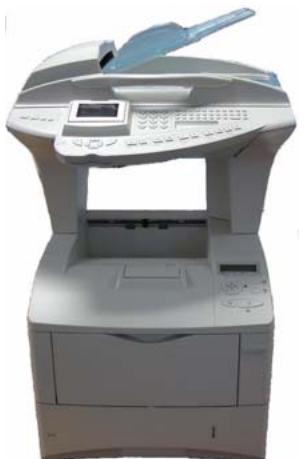
MAINTENANCE
GENERAL
To ensure the best operating conditions for your fax, it is recommended that you regularly clean the inside.
For normal usage, please respect the following rules:
- Never leave the cover open unless required.
- Do not attempt to oil the machine.
- Always gently close the cover and avoid vibrations.
- Do not open the cover while printing.
- Never try to dismantle the machine.
- Do not use paper that has stayed in the paper tray for a long time.
Look at the safety rules in the Safety chapter at the end of this user manual.
REPLACING THE CONSUMABLES (TONER AND DRUM)
To access to the consumables:
Lift the printer cover and fix it under the scanner for easier access to the toner cartridge.
To check the remaining capacities of the consumables:
86 OK - ADVANCED FCT / CONSUMABLES
The toner cartridge and the drum cartridge come with a chip card.
After replacing a consumable item in the printer, you need to inform the machine about its features.
For this purpose, the chip card supplied with each toner cartridge must be read by the machine each time a new consumable item is installed.
General Information
This chapter describes basic maintenance tasks you can perform on the printer. You can replace the following component according to the printer's display:
- Toner Kits
- Waste Toner Box
The paper transfer unit must also be cleaned regularly.
Replacing the Toner Container
Understanding Messages Requesting Toner Container Replacement
The printer displays messages at two stages of toner usage. This message is automatically alternated with the other printer message (such as Ready):
- When the printer becomes low on toner, the printer displays the message Toner low as the first caution. Note the replacement is not always necessary at this stage.
- If you ignore the above message and continue printing, the printer displays the message Replace toner — just before the toner is used up. The toner container must be replaced immediately. Clean the separate charger wires, etc. After the cleaning is finished, however, the message does not automatically change to Ready. To restart printing, you must press [GO] and make the printer ready.
In both cases, replace the toner cartridge by following the procedure below.
Replacing the Toner Container
This section explains how to replace the toner container. When replacing the toner container, always replace the waste toner box at the same time. If this box is full, the printer may be damaged or contaminated by the waste toner that may spill over the box.
Note: You do not have to turn printer power off before starting the replacement. Any data that may be under printing process in the printer will be deleted if you turn printer power off.
^ Open the top cover.
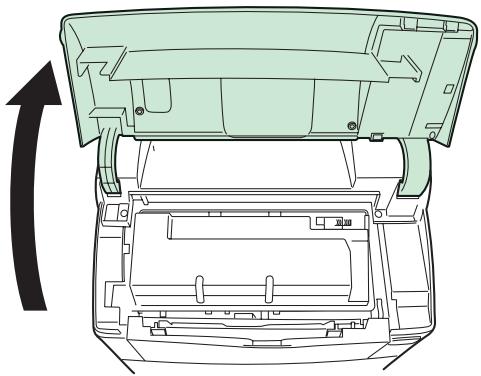
Push lock lever to the right and pull out the toner container.
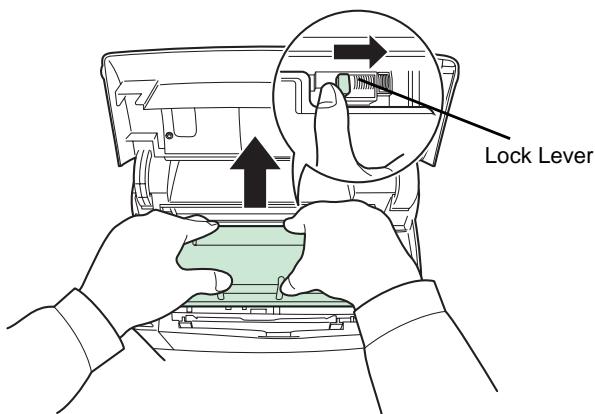
Put the old toner container in the plastic bag (contained in the toner kit) and discard it later according to the local code or regulations for waste disposal.
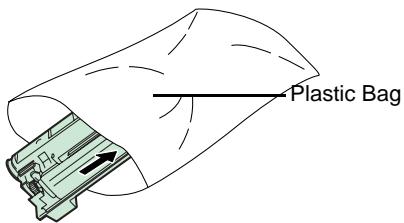
Take the new toner container out of the toner kit.
Shake the new toner container at least 10 times as shown in the figure in order to distribute the toner evenly inside the container.
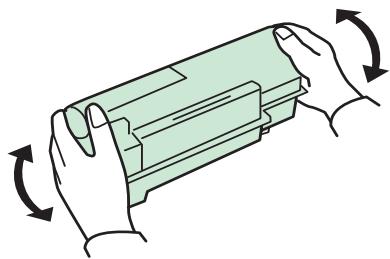
Set the new toner container in the printer and push down on the top of the toner container to install it firmly in place as shown in the figure below.
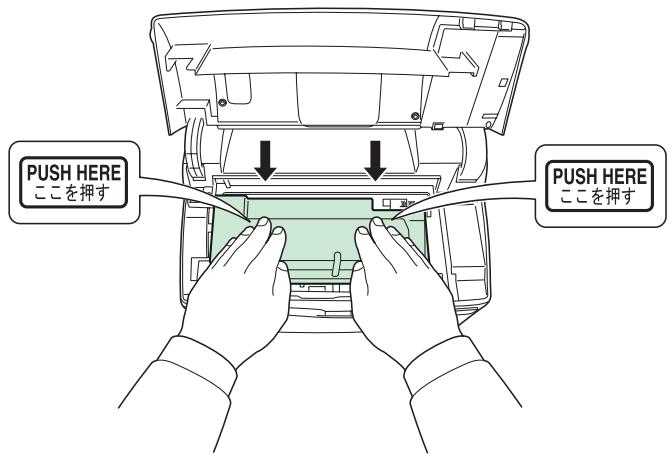
Close the top cover.
Replacing the Waste Toner Box
Replace the waste toner box when the "Check Waste Toner Box" message is displayed. A new waste toner box is included in the toner kit. The printer will not work if you don't replace the waste toner box.
Open the left cover. While holding the waste toner box, press the lock lever and then gently remove the waste toner box.
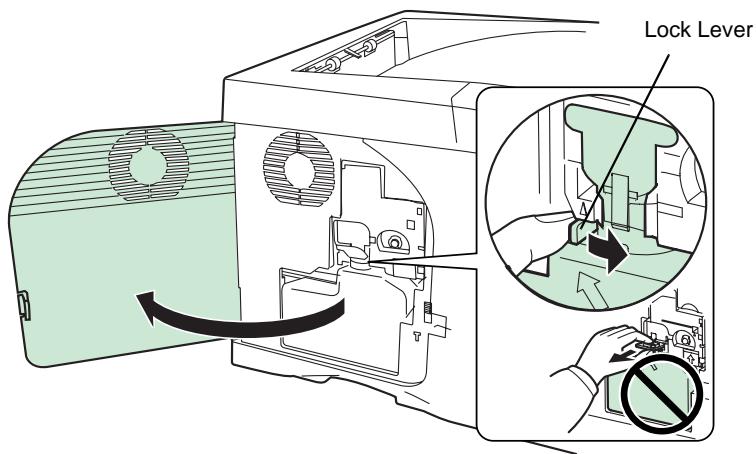
Note:
Remove the waste toner box as gently as possible so as not to scatter the toner inside. Do not let the opening of the waste toner box face downward.
Close the cap to the old waste toner box after removing the box from the printer.
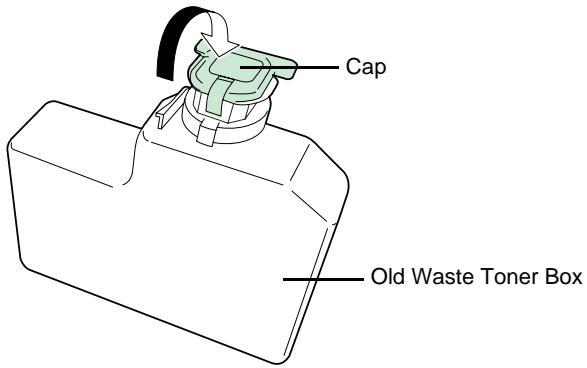
To prevent toner from spilling, put the old waste toner box in the plastic bag (contained in the toner kit) and discard it later according to the local code or regulations for waste disposal.
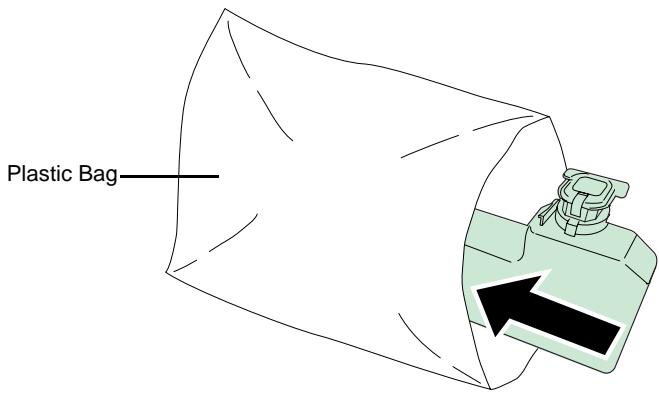
^ Close the waste toner box (I) after removing it from the printer. To avoid spilling toner, put the closed waste toner box into the plastic bag (J) provided.
Put the old toner cartridge (H) into the plastic bag provided. Put the old cartridge and waste toner box into the box the new cartridge came in, then send them back for recycling, see instructions included.
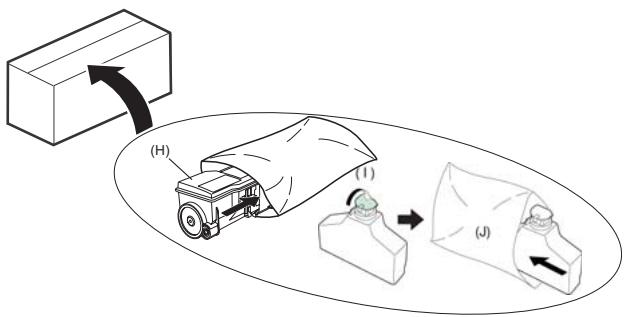
^三 Open the cap of the new waste toner box.
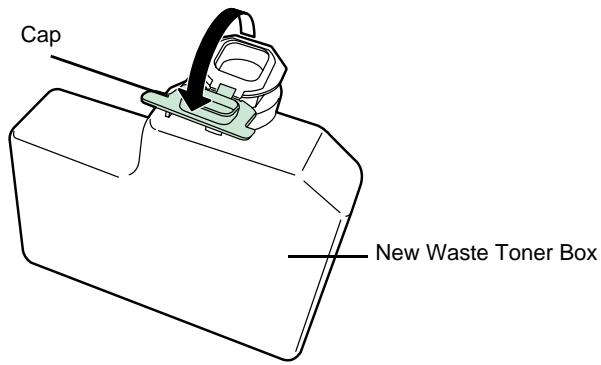
Insert the new waste toner box as shown in the figure below. When the box is set correctly, it will snap into place.
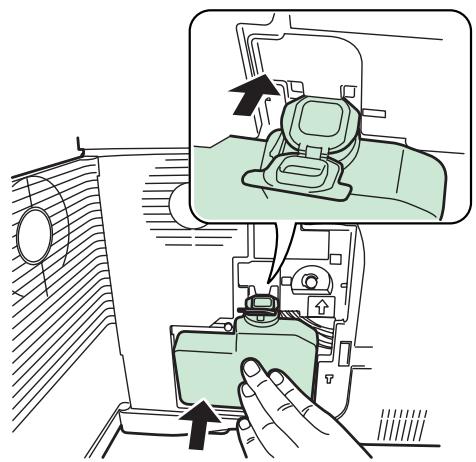
Make sure that the waste toner box is correctly inserted and close the left cover.
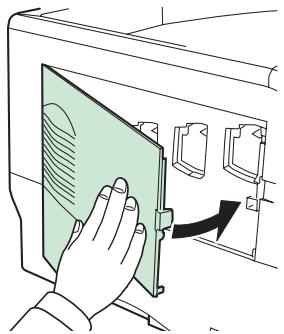
After replacing the toner cartridges and the waste toner box, clean the main charger units and the paper transfer unit. For instructions, please see the paragraph Cleaning the printer, on page 6-11.
Cleaning the transfer unit
To avoid print quality problems, the interior of the printer must be cleaned.
Open the top cover and MP tray.
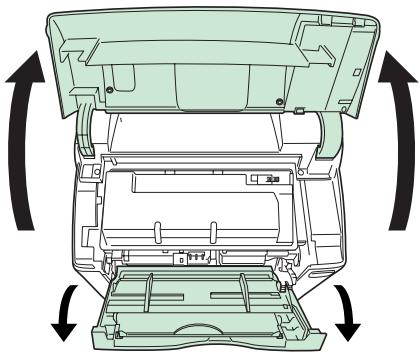
Lift the developer unit together with the toner container out of the printer.
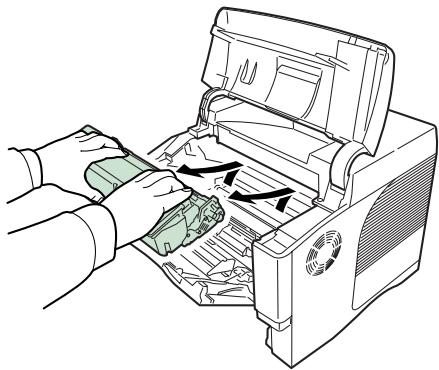
Use a lint free cloth to clean dust and dirt away from the registration roller (metal).
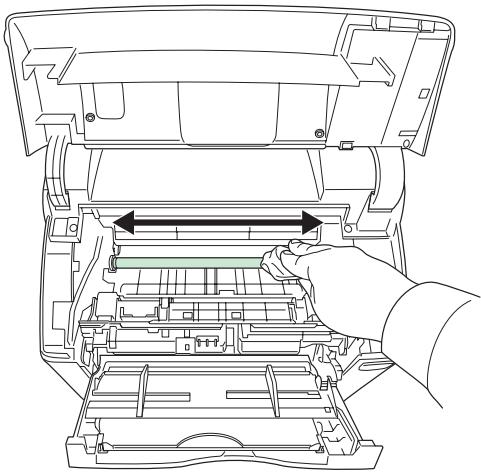
Insert the developer unit together with the toner container, back into the machine.
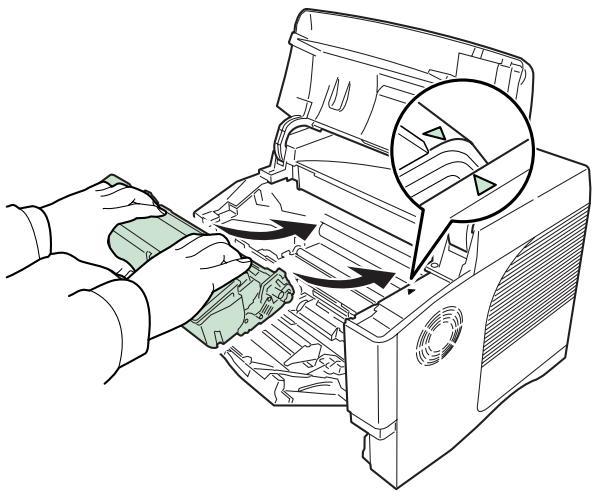
Close the top cover and MP tray.
Press the OK key on the scanner control panel. The following message is displayed on the screen: INSERT THE TONER CHIP CARD
Insert the chip card (supplied with the toner cartridge) into the reader, making sure that the card is oriented as shown in the illustration.
The following message is displayed on the screen: CHANGE TONER? YES = OK - NO = C
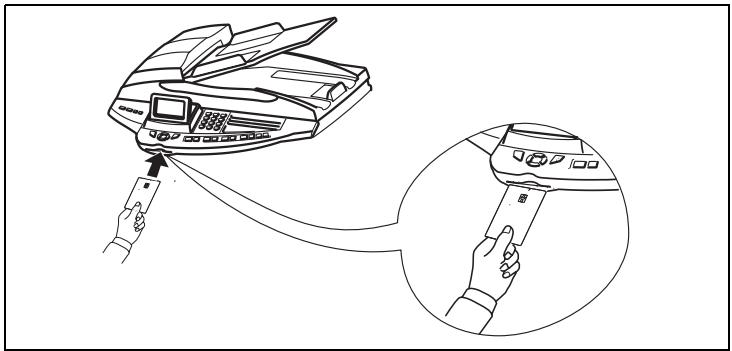
Press OK when the chip card has been read
The following message is displayed on the screen: NEW TONER - REMOVE THE CAR
CLEANING
Cleaning the scanner's reading devices
When one or more vertical lines appear on transmitted copies or faxes, follow these steps:
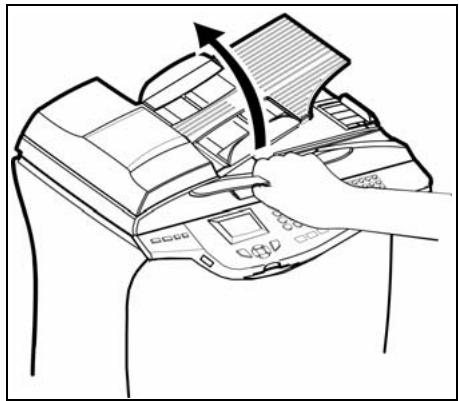
Open the scanner cover by pushing it backwards until held vertically in position
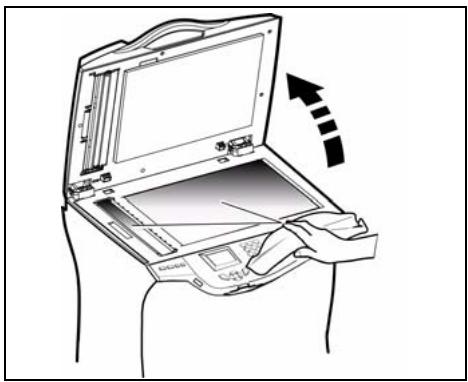
Clean the two transparent scanning windows with a soft, lint-free cloth, dampened with alcohol.
^ Close the scanner cover.
Make a copy to check that the symptoms have been cleared.
Cleaning the printer
Clean the outside of the printer by means of a soft cloth dampened with neutral household detergent.
Dust, dirt and paper debris on the outer surfaces and inside the printer can interfere with printer performance. Clean the printer regularly.
Note: If the message "Clean Printer Press GO" appears after replacing the toner cartridge. Carry out the printer cleaning procedures (corona, grille, etc.) described in the paragraph General Information, on page 6-2 then press the GO button. The message will disappear and the printer will be ready to print.
Caution - Use a soft cloth to clean the printer. Never use abrasive or corrosive detergents.
The fusing unit can become very hot during operation. To avoid injury - do not touch.
Wait for at least 10 minutes after the printer has been turned off and make sure that the fusing unit has cooled before cleaning the interior of the printer.
SERVICING
For guaranteed performance of your terminal, some maintenance work (replacing the fusing unit and the transfer roll) has to be done on the printer approximately every 200,000 printed pages. Please contact your supplier for this operation.
SCANNER CALIBRATION
You can perform this operation when the quality of photocopied documents is no longer satisfactory.
80 OK - ADVANCED FCT / CALIBRATION
Confirm your choice by pressing the OK key.
INCIDENTS
COMMUNICATION ERRORS
If the communication fails, the fax advises you of an automatic retry later.
Example of what is displayed:
Current time- FRI 11 SEP 20:13
Time of next try 0142685014 20:18
Transmission from the feeder
You have the choice between:
- waiting until the transmission takes place at the given time
- restarting the transmission immediately by pressing
- abandoning transmission by pressing . To eject the document, press again.
Transmission from memory
You have the choice between:
- waiting until the transmission takes place at the given time
- restarting the transmission using the transmission queue (please see the paragraph Immediately perform transmission from the waiting queue, on page 5-12). In this case, for a document composed of several pages, the transmission will take place from the page where the error occurred
- abandoning the transmission by deleting the corresponding command in the transmission line (please see the paragraph Deleting a transmission on hold, on page 5-12).
The terminal makes at most 5 automatic redials. The non-transmitted document is automatically deleted from the memory and a transmission report is then printed together with an error code and the cause for transmission failure (see the communication error codes).
Communication error codes
The communication error codes appear in the logs and transmission reports.
General codes
Code 01 - Busy or no fax answer
This code appears after 6 unsatisfactory attempts. Call later.
Code 03 - User break
A communication has been stopped by the user pressing the key.
Code 04 - Non programmed number
A number saved as a one-touch key or abbreviated number is not valid-check it. (Example: a delayed transmission was programmed with a one-touch key and this key has been deleted in the meantime).
Code 05 - Scanning default
An incident occurred with the scanner, for example, the sheet is jammed.
Code 06 - Printer default
An incident occurred in the printer: no paper, paper jam, opened cover... In the reception mode, this incident appears only if the reception parameter is switched to WITHOUT PAPER (please see the paragraph Reception without paper, on page 3-6).
Code 07 - Disconnected
The link has been cut (bad line). Check the number and try again.
Code 08 - Quality
The document you sent was not well received. Contact your subscriber to see if you need to send again.
Code 0A - No document to be polled
You tried to poll a document from a subscriber who had not prepared his document (no deposit) or the password entered was incorrect.
Code 0B - Wrong number of pages
There is a difference between the number of pages indicated during preparation for the transmission and the number of pages sent- check the number of pages in the document.
Code 0C - Received document error
Ask the subscriber who called you to check the length of his document (it may be too long to be completely received).
Code 0D - Transmission failed
Ask the sender to resend the document.
Code 13 - Memory full
Your fax can no longer receive since its memory is full. There are too many received unprinted documents or too many documents in the transmission line.
Print the received documents and delete or transmit immediately the documents in the transmission line.
Code 14 - Memory full
Received document memory full.
Code 15 - Unknown mailbox number
You wish to deposit a document in a subscriber's mailbox. The mailbox number does not exist.
Code 16 - No Relay Bcst list Nrx
You requested a document relay from a remote fax but the fax has not programmed the list of subscribers requested.
Code 17 - Unknown mailbox number
You wish to recover a document from a subscriber's mailbox. The mailbox number does not exist.
Code 18 - Relay Bcst impossible
You requested a document relay from a remote fax which does not have the relay broadcast function.
Code 19 - Subscriber has stopped
The communication has been stopped by your subscriber. (Example: a fax wanted to poll your fax but there is no document deposited).
Code 1A - Disconnected
The transmission has not started. The telephone line is busy.
Code 1B - Transmission failed
During transmission: start again.
During reception: ask your subscriber to resend the document.
Internet codes
Codes 40 and 41 - No reply from supplier
The modem cannot connect to the Internet service provider. If this error always occurs, check the supplier's dial-up number.
Code 42 - Cannot access supplier
The service provider refuses the connection, the service is temporarily unavailable. If this error always occurs, check the Internet connection parameters.
Code 43 - Xmission server unavailable
Cannot connect to the SMTP server for sending mail, the service is temporarily unavailable. If the error always occurs, check the Internet e-mail and server parameters.
Code 44 - Reception server unavailable
Cannot connect to the POP3 server for mail reception, the service is temporarily unavailable. If the error always occurs, check the Internet e-mail and server parameters.
Code 45 - Supplier disconnected
The service is temporarily unavailable; try again later.
Code 46 - Xmission server disconnect
The SMTP server for sending mail is disconnected. The service is temporarily unavailable- try again later.
Code 47 - Reception server disconnect
The POP3 server for mail reception is disconnected. The service is temporarily unavailable- try again later.
Code 48 - Disconnection from Internet
The service is temporarily unavailable- try again later.
Code 49 - Cannot connect to Internet
Check the call number and eventually the associated prefix of the machine.
To check the Internet parameters, print them by pressing in turn the keys ,9,4,5 and OK.
Network codes:
Code 50: Protected disk or file already found
The file could not be archived, either because the file folder is write-protected, or because a file with the same name already exists in the directory.
Code 51: Wrong authentication
The "user name" and/or "password" parameters are incorrect.
Code 52: Authentication method not supported.
Check that the authentication proposed by the server is indeed HTML.
Code 53: Password unavailable or directory not found.
SCANNER INCIDENTS
Scanner paper jam
When a paper jam occurs, the following message appears on the control panel screen
REMOVE DOCUMENT.
If jams often occur in a specific part of the unit, the latter needs to be checked, cleaned or repaired.
^ Open the scanner cover.
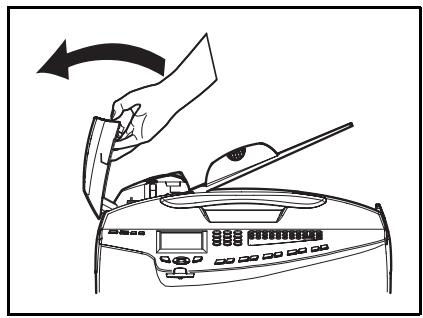
Remove the jammed paper (A) without tearing it.
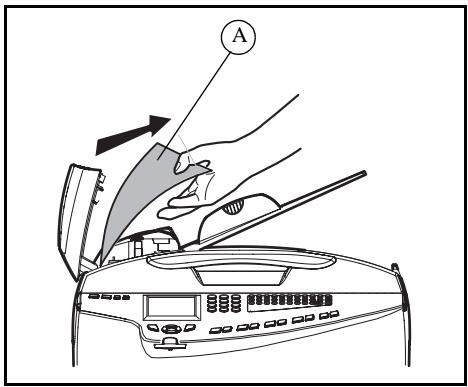
Then, close the scanner cover.
MISCELLANEOUS INCIDENTS
At switch-on nothing appears on screen
Check that the mains cable is plugged in, and check the mains plug if necessary.
The fax does not detect the presence of your inserted document. The message READY does not appear on the screen.
At the start and during scanning, REMOVE DOCUMENT appears on the screen.
Remove the document or press key.
Check the thickness of the document (50 sheets of paper of 80g / m^2
Iron out the sheets if needed.
Help the sheets along.
The fax machine does not receive any faxes
Check that the telephone line cable is correctly plugged in and that there is a tone signal on the telephone line by means of the key.
You receive a blank page
Make a photocopy of a document ; if it is correct then your fax is functioning normally. Call back the subscriber and have him resend the document. It was probably sent with the sheet inserted backwards.
You cannot send a fax
Check that the telephone line cable is correctly plugged in.
Check the tone by pressing the key.
Check the prefix is correctly programmed and used.
You do not succeed to save a scan on a memory support, the "USB MEDIA MEMORY FULL" message is displayed.
Check that there is still enough free memory space in the device.
Check that the device is not write-protected.
You do not succeed to delete a file or a memory support, the "MEDIA ERROR WRITTING PROBLEM" message is displayed.
Check on a computer that it is not write-protected or protected against erasure.
TROUBLESHOOTING
General Guidelines
The table below provides basic solutions for problems you may encounter with the printer. We suggest you consult this table to troubleshoot the problems before calling for service..
| Symptom | Check Items | Corrective Action |
| Print quality is not good. | See Print Quality Problems on p. 6-19. | |
| Paper is jammed. | See Clearing Paper Jams on p. 6-26. | |
| Nothing lights on the operator panel even when power is turned on and the fan makes no noise. | Check that the power cord is properly plugged into the power outlet. | Turn off the printer's power, plug in the power cord securely, and try turning on the printer's power again. |
| Check that the power switch is in the On (I) position. | Set the power switch to the On (I) position. | |
| The printer prints a status page, but does not print jobs from the computer. | Check the printer cable or the interface cable. | Connect both ends of the printer cable securely. Try replacing the printer cable or the interface cable. |
| Check program files and application software. | Try printing another file or using another print command. If the problem occurs only with a specific file or application, check the printer driver settings for that application. | |
Tips
Printer problems may be solved easily by following the tips below. When you have encountered a problem that following the above guidelines will not solve, try the following:
- Turn the printer power off and wait for several seconds. Then, turn on the printer..
- Reboot the computer which sends the print jobs to the printer.
- Make sure that the procedures for printing are correctly followed in the application software. Consult the documentation supplied with the application software.
- If the printer prints garbage characters or stalls when the computer is turned on, particularly when the printer is connected to the computer under Windows 98 via the parallel port, rename device driver fileDRVppqrt.vxd. This file may be located in Windows\System\Iosubsys or Arcada\System folder. For technical details, visit Microsoft web site for the device driver.
Print Quality Problems
The tables and diagrams in the following sections define print quality problems and the corrective action you can conduct to solve the problems. Some solutions may require cleaning or replacing parts of the printer.
If the suggested corrective action will not solve the problem, call for service.
| - PRINTED RESULTS | - CORRECTIVE ACTION | |
| Completely blank printout | Check the toner container. Open the top cover and check that the toner container is correctly installed in the printer. For more information on installing the toner container, refer to Toner Container Replacement p. 6-2. | |
| Check that the application software is correctly operated. | ||
| Black or white vertical streaks | Check the operation panel for toner. If the Toner low message is displayed, install a new toner kit. To replace the toner container, refer to Toner Container Replacement on page p. 6-2. | |
| ABC 123 | ABC 123 | |
| Faint or blurred printing | Check the EcoPrint setting. When this setting is On, switch it to off on the operation panel. | |
| ABC 123 | ABC 123 | Make sure the paper type setting is correct the paper being used. |
| ABC 123 | Check the operation panel. If the Toner low message is displayed, install a new toner kit. To replace toner, refer to Toner Container Replacement p. 6-2. | |
| Grey background | Check the operation panel. If the Toner low message is displayed and the Attention indicator is flashing, install a new toner kit. Refer to Toner Container Replacement p. 6-2. | |
| Check the print density. Display the print density menu from the operation panel and select a lighter density setting. | ||
| - PRINTED RESULTS | - CORRECTIVE ACTION |
| Dirt on the top edge or back of the paperABC123 | Clean the parts in the paper paths—such as the paper cassette, etc. |
| Printing incomplete or out of positionABC123 | Check that the application software is correctly operated.Refer to Tips p. 6-18. |
Error Messages
The following table lists errors and maintenance messages that you can be dealt with by yourself. If Call service appears, turn off the printer, disconnect the power cord, and contact your service technician.
Some errors cause the alarm to sound. To stop the alarm, press [Cancel].
| Message | Corrective Action |
| Add paper MPTray | The paper has run out in the paper source displayed. Supply paper according to the paper source displayed (paper cassettes, MP tray, optional paper feeders, or optional envelope feeder [FS-3900DN/ FS-4000DN only]). This message is displayed alternately with messages indicating the printer status, such as, Ready, Please wait, Processing, Waiting, and FormFeed Time Out. |
| Call service F#### | F##### represents a controller error (#=0, 1, 2, ...). Call for service. The printer does not operate when this message is displayed. |
| Call service ####:0123456 | ##### represents a mechanical error (#=0, 1, 2, ...). Call for service. The printer does not operate when this message is displayed. The total number of pages printed is also indicated, e.g. 0123456. |
| Cassette # not loaded | The corresponding paper cassette is not installed. Install the cassette. The cassette number can be 1 (topmost) to 4 (bottom) [FS-2000D: 1 and 2]. |
| Check wastetoner box | This message warns following two cases.Install the new waste toner box.The waste toner box is not installed. The waste toner box is full. |
| Clean printerPress GO | Please clean the inside of the printer. Refer to Cleaning thePrinter, p. 6-8.This message will be displayed when replacing the toner containerafter the message Replace toner is displayed. After cleaning theinside of the printer, press [GO] and the printer will be ready forprinting. |
| Close left cover | The left cover of the printer is open. Close the left cover. |
| Close rear unit | The rear unit of the printer is open. Close the printer rear unit. |
| Close top cover | The top cover of the printer is open. Close the printer top cover. |
| Duplex disabledPress GO | You attempted to print with a paper size and paper type that cannotbe used for duplex printing. Press [GO] to print onto one-side of thepaper only. |
| e-MPS not storedPress GO | The e-MPS job cannot be stored because RAM disk is disabled, RAMdisk size is insufficient, Microdrive is not installed, or Microdrive is full.Press [GO] to print error report. |
| Error.Power offF#### | Turn the power switch off and then back on again. If this message stillremains, turn the power switch off, and contact your servicerepresentative or authorized service center. |
| File not foundPress GO | You have attempted to print a job that is not contained in the specifiedvirtual mailbox, or the specified virtual mailbox is not found.If Auto Error Clear is set to On, printing will be automatically resumedafter a preset period of time. |
| Format errorHard disk | The Microdrive installed in the printer is not formatted, and thereforecannot be read or written. |
| Format errorMemory card | The CompactFlash card inserted in the printer is not formatted, andtherefore cannot be read or written. |
| Hard disk err ## Press GO | A Microdrive error has occurred. Look at the error code given in place of ## and refer to Storage Error Codes p. 6-25. To ignore the Microdrive error, press [GO]. |
| I/F occupied | This message is displayed when you attempt to use the printer's operation panel to change the environmental settings on the interface from which data are presently being received. |
| ID error | The user ID entered for a private job, or a stored job is not correct. Check the user ID that you specified on the printer driver. |
| Install MK | Replace Maintenance Kit which is displayed on the message display. Replacement of the maintenance kit is necessary at every 300,000 pages of printing and requires professional servicing. Contact your service technician. |
| KPDL error ## Press GO | Current print processing cannot continue because of occurrence of KPDL error which is categorized by ##. To print out an error report, display > Print KPDL err(s) from the menu system, and select On. Press [GO] to resume printing. You can abandon printing by pressing [Cancel]. If Auto Error Clear is set to On, printing will be automatically resumed after a preset period of time. |
| Load Cassette # (A4) / (PLAIN) | The paper cassette matching the paper size and paper type of the print job is empty. Load paper into the paper cassette as displayed in place of#. Press [GO] to resume printing. If you want to print from a different paper source, press ? or @ to display Use alternative and you can change the source for paper feeding. After selecting a paper source and pressing [Menu], Paper Handling > appears. By pressing the ?, the paper type settings menu appears. After setting the correct paper type, press [OK] and printing starts. |
| Load MP Tray (A4) / (PLAIN) | There is no paper cassette installed in the printer that matches the paper size and paper type of the print job. Set paper in the MP tray. Press [GO] to resume printing. (Note that feeding the paper having a paper size which does not match the current paper size from the MP tray can cause paper jam.) If you want to print from a different paper source, press ? or @ to display Use alternative and you can change the source for paper feeding. After selecting a paper source and pressing [Menu], Paper Handling > appears. By pressing the B, the paper type settings menu appears. After setting the correct paper type, press [OK] and printing starts. |
| Memory overflowPress GO | The total amount of data received by the printer exceeds the printer's internal memory. Try adding more memory. Press [GO] to resume printing. You can abandon printing by pressing [Cancel].If Auto Error Clear is set to On, printing will be automatically resumed after a preset period of time. |
| MemoryCard err##Press GO | A CompactFlash card error has occurred. Look at the error code given in place of ## and refer to Storage Error Codes p. 6-25. To ignore the CompactFlash card error, press [GO]. |
| MemoryCard err20 | The CompactFlash card is accidentally removed from the printer's slot during reading. Turn the power switch off and then back on again. |
| Missingdeveloper unit | The developer unit is either not installed or incorrectly inserted. Insert the developer unit securely. |
| No multi copiesPress GO | Multi copies cannot be printed because RAM disk is disabled or the Microdrive is not installed. There is no available RAM disk or Microdrive space. Delete unnecessary files. Press [GO] to print error report. |
| Paper jam##### ### | A paper jam has occurred. The location of the paper jam is indicated in place of the #’s. For details, refer to Clearing Paper Jams p. 6-26. |
| Paper path error | There is no paper cassette in the feeder, or the cassette is not inserted properly. After reinserting the paper cassette, you should be able to print. When two or more optional feeders are installed and the lowest one is selected, the same message will appear if any of the upper paper feeder and the printer cassette is improperly installed. |
| Print overrunPress GO | The print job transferred to the printer was too complex to print on a page. Press [GO] to resume printing. (A page break may be automatically inserted in some places.).You can abandon printing by pressing [Cancel].If Auto Error Clear is set to On, printing will be automatically resumed after a preset period of time. |
| RAM disk error##Press GO | A RAM disk error has occurred. Look at the error code given in place of ## and refer to Storage Error Codes p. 6-25. To ignore the RAM disk error, press [GO]. |
| Replace tonerClean printer | Toner has run out in the toner container. Replace the toner container using a new toner kit. The printer does not operate when this message is displayed. |
| Set paperPress GO | The MP tray is out of paper. Load paper and press [GO]. (Note that feeding the paper having a paper size which does not match the current paper size from the MP tray can cause paper jam.) |
| Toner low | Toner is running low. Replace the toner container using a new toner kit. |
| Top traypaper full | The top tray has become full. You must remove all printed pages from the top tray. When the printer detects that the top tray is empty again, the printer will continue printing into the top tray. |
| Unknown TonerInstalled | The toner container is not original. Only genuine Sagem toner cartridges must be used. |
| USB memory err##PPress GO | An USB flash memory error has occurred. Look at the error code given in place of ## and refer to Storage Error Codes p. 6-25. To ignore the USB memory error, press [GO]. |
| USB mem. removedPress GO | The USB flash memory is accidentally removed from the printer. To ignore the USB memory error, press [GO]. The message display returns to Ready. |
| Virtual mailboxfull | The storage area in the Microdrive for the virtual mailboxes is full. Print out accumulated jobs in the virtual mailboxes. |
| Warning imageadapt | Printing job cannot be done in current resolution because there is not enough internal memory. Try adding more memory or changing resolution. |
| Warninglow memory | The printer's internal memory is running low due to too many numbers of fonts and macros downloaded. Try deleting unnecessary fonts and macros. |
Storage Error Codes
Hard disk errors
| - CODE | - MEANING |
| 01 | Hard disk formatting error. If this error persists after the printer has been switched off and then switched back on, format the hard disk again. |
| 02 | The disk system is not installed. Recheck the requirements for using the system and the devices. |
| 04 | Insufficient space on the hard disk. Delete unnecessary files, etc. in order to free up space. |
| 05 | The specified file does not exist on the hard disk. |
| 06 | No memory available on the hard disk. Increase the memory available. |
| 10 | Formatting is not possible because host data is being spooled on the hard disk. Wait until the disk is ready, then format it again. |
| 85 | VMB: Alias error. The alias setting was lost, or the virtual tray corresponding to the alias does not exist. Set the alias again. |
| 97 | The number of permanent code jobs that can be stored reached the limit value, and no more can be saved. Either delete some unnecessary jobs, etc., or increase the limit. |
| 98 | An unreadable page was found in a job (The job is damaged.). |
| 99 | The print job with the specified ID does not exist on the hard disk. |
Memory card errors
| - CODE | - MEANING |
| 01 | The printer does not support the memory card inserted. |
| 02 | The memory card is not installed. |
| 04 | The memory card is full and cannot hold any more data. Delete unnecessary files or use a new memory card. |
| 05 | The specified file is not on the memory card. |
| 06 | Insufficient printer memory to support the memory card. Expand the printer memory. |
RAM Disk Errors (also called virtual disk)
| - CODE | - SIGNIFICATION |
| 01 | Format error. Try turning the power off and on again. |
| 02 | RAM disk mode is off. Turn RAM disk mode On from the operation panel. |
| 04 | No disk space. Purge unnecessary files. |
| 05 | Specified file is not on disk. |
| 06 | Insufficient printer memory to support the RAM disk system. Expand printer memory. |
Clearing Paper Jams
If the paper jammed in the paper transport system, or no paper sheets were fed at all, the Paper jam message appears and the location of the paper jam (the component where the paper jam has occurred) is also indicated. The printer automatically goes off-line when this message is displayed. Remove jammed paper. After removing jammed paper, the printer will re-start printing.
Possible Paper Jam Locations
The figure below explains the printer's paper paths including the options. The locations where paper jams might occur are also shown here, with each location explained in the table below. Paper jams can occur in more than one component on the paper paths.
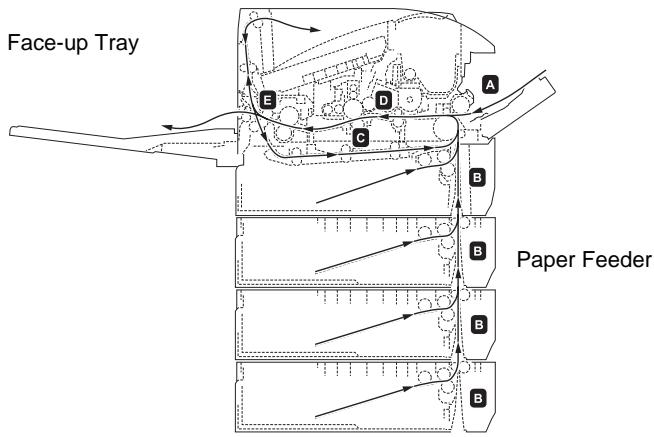
| Paper jam message | Paper jam location | Description | Reference page |
| Paper jam MP Tray | A | Paper is jammed at the MP tray or optional envelope feeder or bulk paper feeder (if installed [FS-3900DN and FS-4000DN only]). | page 6-28 |
| Paper jam EF | page 6-32 | ||
| Paper jam Bulk Feeder | page 6-32 | ||
| Paper jam Cassette 1 (to 4) | B | Paper is jammed at the paper cassette. The cassette number can be 1 (topmost) to 4 (bottom) [FS-2000D: 1 and 2]. | page 6-28 |
| Paper jam Duplexer | C | Paper is jammed inside the duplex section. | page 6-29 |
| Paper jam Printer | D | Paper is jammed inside the printer. | page 6-30 |
| Paper jam Rear Unit | E | Paper is jammed inside the rear unit. | page 6-31 |
General considerations for clearing jams
Bear in mind the following considerations when attempting jam removal:
- If paper jams occur frequently, try using a different type of paper, replace the paper with paper from another ream, flip the paper stack over, or rotate the paper stack 180 degrees. The printer may have problems if paper jams recur after the paper was replaced.
- Whether or not the jammed pages are reproduced normally after printing is resumed depends on the location of the paper jam.
Caution - When pulling the paper, pull it gently so as not to tear it. Torn pieces of paper are difficult to remove and may be easily overlooked, deterring the jam recovery.
Utilizing Online Help Messages
Online help messages are available in the printer's message display to provide simple instructions for clearing jams.
Press (?) when the paper jam message has appeared. Then a help message will appear to facilitate jam clearing in the location.
MP Tray
Paper is jammed at the MP tray. Remove the jammed paper using the procedure given below.
Remove the paper jammed at the MP tray.
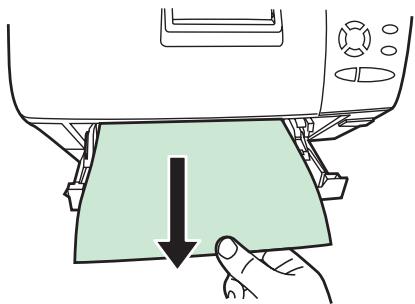
Open and close the top cover to clear the error.
Paper Cassette
Pull out the paper cassette.
Remove any partially fed paper.
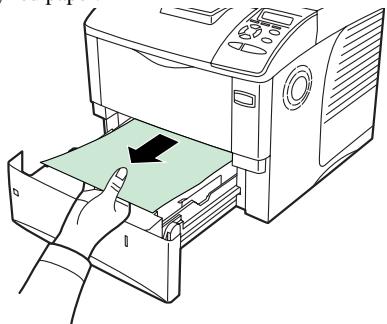
Check to see if paper is loaded correctly. If not, reload the paper.
Push the paper cassette back in firmly. The printer warms up and resumes printing.
Duplexer
Paper is jammed in the duplex section. Remove the jammed paper using the procedure given below.
Caution - Do not touch parts in this area, because it may result in burn injury.
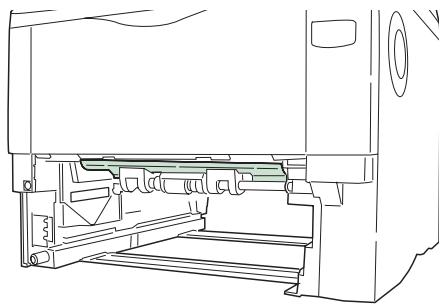
Pull the paper cassette all the way out of the printer.
Open the duplexer's cover and remove any jammed paper.
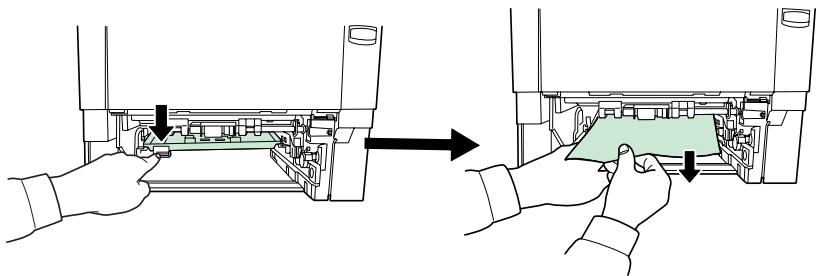
Insert the paper cassette into the slot in the printer. The printer warms up and resumes printing.
The Inside of Printer
^ Open the top cover and MP tray.
Lift the developer unit together with the toner container out of the printer.
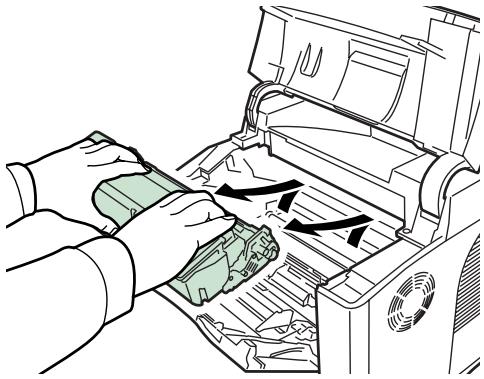
Open the feed cover.
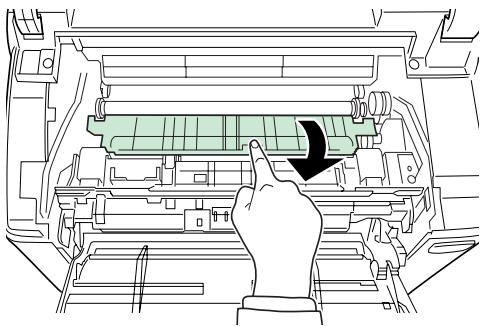
Remove the paper from the printer.
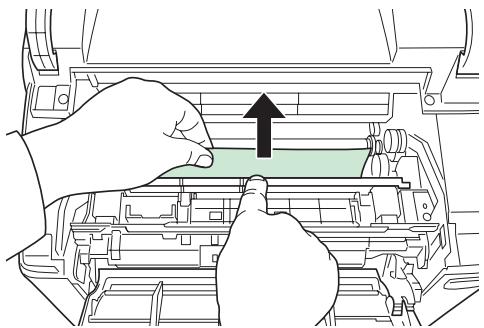
Note
: If the jammed paper appears to be pinched by rollers, pull it along the normal running direction of the paper
Insert the developer unit together with the toner container, back into the machine.
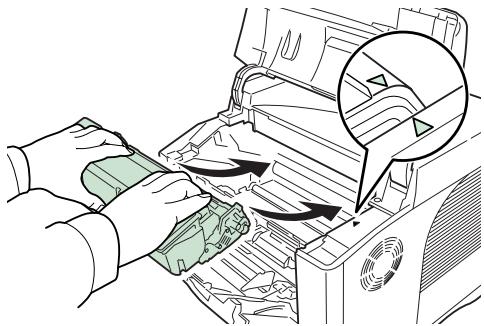
^ Close the top cover and MP tray. The printer warms up and resumes printing.
Rear Unit
If paper is not completely ejected into the output tray, open the rear unit.
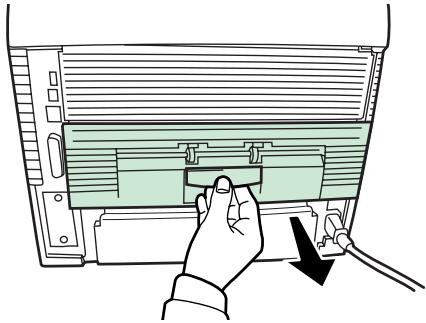
Open the fuser cover and remove the jammed paper by pulling it out. If you cannot find a paper jam, try checking inside the rear of the printer.
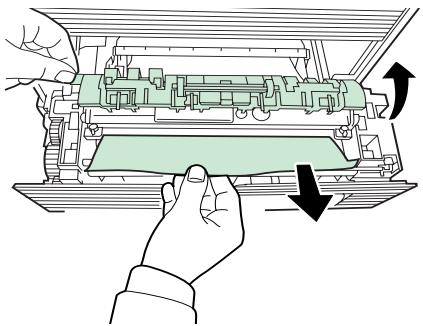
Caution - The fuser unit inside the printer is hot. Do not touch it with your hands as it may result in burn injury.
^ Close the rear unit. The printer warms up and resumes printing.out.
Paper Feeder
Paper is jammed at optional paper cassette 2 (to 4). Refer to the Installation Guide for the optional paper feeder and remove the jammed paper.
Envelope Feeder
Paper is jammed at the optional envelope feeder. Remove the jammed paper using the same procedure as for a jam at the MP Tray. Then, open and close the paper transfer unit. For details, refer to the User's Manual for the envelope feeder.
Bulk Paper Feeder
Paper is jammed at the optional bulk paper feeder. Detach the bulk paper feeder from the printer by sliding with the rail away from the printer, holding the bulk paper feeder by both hands. If paper is partially fed out from the feeder's output slot, pull the paper out by hand.
STORAGE
If you plan not to use the printer during a long period, remove the power lead from the wall socket. We recommend that you consult your dealer about any precautions to be taken in order to avoid any damage when using the printer again.
PACKING AND TRANSPORTING THE UNIT
When you wish to transport the unit, always use the original packaging materials. If you do not pack the equipment correctly, you may void the warranty.
Scanner unit
Set the machine's main switch to OFF.
Disconnect the power lead from the wall socket, then disconnect all the cables connected to the machine.
Remove all the receptacles form the machine, the printer, the additional paper trays are all to be packed separately in their respective packaging.
Put the receptacles in their original plastic packaging and cardboard boxes, put the machine's original plastic packaging back on and put it in its original box together with the components (receptacles, documentation, etc.).
Put all the documentation (manual and printed documents) in the box and close it with adhesive tape.
Printer unit
Make sure your terminal is properly switched off (switch set to 0). Disconnect the equipment from the network and the mains socket.
Pack the printer in the following way:
- Remove the toner cartridge and the waste toner box from the printer. Put the toner cartridge in the plastic bag provided to avoid spilling any toner. Close the waste toner box properly.
Put the printer in the box. - Put the protective packing piece in position, then place the toner cartridge and the waste toner box in the box.
Pack the other components in their original box with all the original protective packing pieces.
Put all the documentation (printed documents and CD ROM (depending on model)) in the boxes.
Properly close the boxes with adhesive tape.
CHARACTERISTICS
Type of equipment: fast professional terminal, for use with all group 3 equipment according to the UIT-T recommendations.
| Dimensions (excluding options): | Width : 457 mm Depth : 560 mm Height : 698 mm (excluding collector and 500 -sheet tray) |
| Weight: | 25 kg |
| Power supply: | 220-240 V - 50/60 Hz - 4.7A |
| Power consumption (maximum values): | - standby mode : 20 W - wait mode : less than 80 W - in operation : 700 W when copying (1000 W peak) |
| Admissible ambient temperature : | - in operation : + 10 °C to 32.5 °C (50 to 90 °F) with a maximum temperature difference of 10 °C per hour. - storage : 0 °C to 40 °C (32 to 104 °F) with a maximum temperature difference of 10 °C per hour. |
| Admissible relative humidity: | In operation or storage : 20 % to 80 % RH (without condensation) with a maximum difference of 20 % per hour |
| Scanner / communication | |
| Original document format: | A4 format Legal 60 to 90 g/m² paper |
| Document feeder : | Max. capacity : normal capacity 50 pages (80g/m²) |
| Collector format (format A4) and Legal : | Width : 210 / 216 mm Length : 297 / 355 mm |
| Scanned image resolution : | Scanner : 600 dpi |
| Reading system : | CIS opto-electronic reading |
| Communication speed : | In group 3 : 33600/14400/12000/9600/7200/4800/2400 bps |
| The effective transmission time for an A4 page varies from a few seconds to about one minute (depending on the line quality, modem speed, the amount of data in the original and the resolution)(*). (*) Does not take into account the exchange initialisation procedure | |
| Internet: general characteristics | TCP/IP/PPP Protocols SMTP/POP3/MIME protocols for electronic mail V90 modem (up to 56 kbps/s) |
| SDRAM memory | 64 MB |
| Processor | ARM 9 to 92 MHz |
| Connectivity | USB Ethernet 10/100 Base Tx |
| File format: | - Image: TIFF-F for black and white documents and JPEG for colour documents - PDF and secure PDF: monochrome and colour |
| Specifications may be altered without prior notice in order to make improvements. | |
| Printing | |
| Printing speed | 35 pages/minute (A4) when printing multiple copies of the same page (B&W). |
| Resolution | 600 dpi |
| First impression | Approx. 11 seconds or less (A4), depending on input data |
| Warm-up time | Approx. 15 seconds or less (from standby mode) Approx. 15 seconds or less (from switching on) at 23 °C, 230 V |
| Memory | 64 MB, can be expanded to 512 MB |
| Processor | PowerPC 750 CXr (400 MHz) |
| Connectivity | USB: High-Speed 2.0, Ethernet 10/100 Base Tx |
| Paper | Ordinary paper (60 to 90 g/m²) / thick paper (90 to 120 g/m²) |
| Paper trays | Cassette: - A5 to A4/Legal 148 to 216 mm × 210 to 315 mm. - Capacity 500 sheets (80 g/m2) Multipurpose tray: - 70 to 216 mm × 148 to 297 mm - Capacity 100 sheets (80 g/m2) |
| Output tray capacities | Upper tray — 500 sheets (80 g/m2) |
| Emulation | - PCL® 6 (B&W) - KPDL / SG Script (PostScript® level 2 language emulation and PostScript® level 3 language emulation with configuration file) (B&W) |
Specifications may be altered without prior notice in order to make improvements.
Recommended maximum monthly volume: 6000 pages (5 years) with overhaul every 300000 pages.
Registered trade marks
PREScribe is a registered trade mark of the Kyocera Corporation. KPDL is a commercial trade mark of the Kyocera Corporation.
Hewlett-Packard, PCL and PJL are registered trade marks of the Hewlett-Packard Company. Centronics is a commercial trade mark of Centronics Data Computer Inc. PostScript is a registered trade mark of Adobe Systems Incorporated. Macintosh is a registered trade mark of Apple Computer, Inc. Microsoft, Windows and Windows NT are registered trade marks of the Microsoft Corporation. PowerPC is a registered trade mark of the International Business Machines Corporation. Microdrive is a registered trademark of Hitachi Global Storage Technologies Netherlands B.V. in the United States of America and in other countries. CompactFlash is a commercial trade mark of the SanDisk Corporation. All the other trademarks and product names are the commercial or registered trademarks of their respective owners.
This product uses the PeerlessPrintXL process to provide an emulation compatible with the PCL 6 language used by HP LaserJet printers. PeerlessPrintXL is a trademark of the Peerless Systems Corporation, 2381 Rosecrans Ave. El Segundo, CA 90245, U.S.A.
This product was developed using the Tornado™ real-time operating system and utilities from Wind River Systems.
This product incorporates the UFST™ and MicroType® fonts of Monotype Imaging Inc.
IBM Program License Agreement
The following instructions are purposely provided in English.
THE DEVICE YOU HAVE PURCHASED CONTAINS ONE OR MORE SOFTWARE PROGRAMS ("PROGRAMS") WHICH BELONG TO INTERNATIONAL BUSINESS MACHINES CORPORATION ("IBM"). THIS DOCUMENT DEFINES THE TERMS AND CONDITIONS UNDER WHICH THE SOFTWARE IS BEING LICENSED TO YOU BY IBM. IF YOU DO NOT AGREE WITH THE TERMS AND CONDITIONS OF THIS LICENSE, THEN WITHIN 14 DAYS AFTER YOUR ACQUISITION OF THE DEVICE YOU MAY RETURN THE DEVICE FOR A FULL REFUND. IF YOU DO NOT SO RETURN THE DEVICE WITHIN THE 14 DAYS, THEN YOU WILL BE ASSUMED TO HAVE AGREED TO THESE TERMS AND CONDITIONS.
The Programs are licensed not sold. IBM, or the applicable IBM country organization, grants you a license for the Programs only in the country where you acquired the Programs. You obtain no rights other than those granted you under this license.
The term "Programs" means the original and all whole or partial copies of it, including modified copies or portions merged into other programs. IBM retains title to the Programs. IBM owns, or has licensed from the owner, copyrights in the Programs.
1. License
Under this license, you may use the Programs only with the device on which they are installed and transfer possession of the Programs and the device to another party.
If you transfer the Programs, you must transfer a copy of this license and any other documentation to the other party. Your license is then terminated. The other party agrees to these terms and conditions by its first use of the Program.
You may not:
1 use, copy, modify, merge, or transfer copies of the Program except as provided in this license;
2 reverse assemble or reverse compile the Program; or
3 subsidLicense, rent, lease, or assign the Program.
2. Limited Warranty
The Programs are provided "AS IS."
THERE ARE NO OTHER WARRANTYES COVERING THE PROGRAMS (OR CONDITIONS), EXPRESS OR IMPLIED, INCLUDING, BUT NOT LIMITED TO, THE IMPLIED WARRANTYES OF MERCHANTABILITY AND FITNESS FOR A PARTICULAR PURPOSE.
Some jurisdictions do not allow the exclusion of implied warranties, so the above exclusion may not apply to you.
3. Limitation of Remedies
IBM's entire liability under this license is the following;
For any claim (including fundamental breach), in any form, related in any way to this license, IBM's liability will be for actual damages only and will be limited to the greater of:
1 the equivalent of U.S.$25,000 in your local currency; or
2 IBM's then generally available license fee for the Program
This limitation will not apply to claims for bodily injury or damages to real or tangible personal property for which IBM is legally liable.
IBM will not be liable for any lost profits, lost savings, or any incidental damages or other economic consequential damages, even if IBM, or its authorized supplier, has been advised of the possibility of such damages. IBM will not be liable for any damages claimed by you based on any third party claim. This limitation of remedies also applies to any developer of Programs supplied to IBM. IBM's and the developer's limitations of remedies are not cumulative. Such developer is an intended beneficiary of this Section. Some jurisdictions do not allow these limitations or exclusions, so they may not apply to you.
4. General
You may terminate your license at any time. IBM may terminate your license if you fail to comply with the terms and conditions of this license. In either event, you must destroy all your copies of the Program. You are responsible for payment of any taxes, including personal property taxes, resulting from this license. Neither party may bring an action, regardless of form, more than two years after the cause of action arose. If you acquired the Program in the United States, this license is governed by the laws of the State of New York. If you acquired the Program in Canada, this license is governed by the laws of the Province of Ontario. Otherwise, this license is governed by the laws of the country in which you acquired the Program.
Typeface trademark acknowledgement
All the resident fonts in this printer are supplied under license from Monotype Imaging Inc.
Helvetica, Palatino and Times are registered trademarks of the Linotype-Hell AG. ITC Avant Garde Gothic, ITC Bookman, ITC ZapfChancery and ITC Zapf Dingbats are registered trademarks of the International Typeface Corporation.
Monotype Imaging License Agreement
The following instructions are purposely provided in English.
1 "Software" shall mean the digitally encoded, machine readable, scalable outline data as encoded in a special format as well as the UFST Software.
2 You agree to accept a non-exclusive license to use the Software to reproduce and display weights, styles and versions of letters, numerals, characters and symbols ("Typefaces") solely for your own customary business or personal purposes at the address stated on the registration card you return to Agfa Japan. Under the terms of this License Agreement, you have the right to use the Fonts on up to three printers. If you need to have access to the fonts on more than three printers, you need to acquire a multi-user license agreement which can be obtained from Monotype Imaging KK. Monotype Imaging KK retains all rights, title and interest to the Software and Typefaces and no rights are granted to you other than a License to use the Software on the terms expressly set forth in this Agreement.
3 To protect proprietary rights of Monotype Imaging KK, you agree to maintain the Software and other proprietary information concerning the Typefaces in strict confidence and to establish reasonable procedures regulating access to and use of the Software and Typefaces.
4 You agree not to duplicate or copy the Software or Typefaces, except that you may make one backup copy. You agree that any such copy shall contain the same proprietary notices as those appearing on the original.
5 This License shall continue until the last use of the Software and Typefaces, unless sooner terminated. This License may be terminated by Monotype Imaging KK if you fail to comply with the terms of this License and such failure is not remedied within thirty (30) days after notice from Monotype Imaging KK. When this License expires or is terminated, you shall either return to Monotype Imaging KK or destroy all copies of the Software and Typefaces and documentation as requested.
6 You agree that you will not modify, alter, disassemble, decrypt, reverse engineer or decompile the Software.
7 Monotype Imaging KK warrants that for ninety (90) days after delivery, the Software will perform in accordance with Monotype Imaging KK-published specifications, and the diskette will be free from defects in material and workmanship. Monotype Imaging KK does not warrant that the Software is free from all bugs, errors and omissions.
8 THE PARTIES AGREE THAT ALL OTHER WARRANTYES, EXPRESSED OR IMPLIED, INCLUDING WARRANTYES OF FITNESS FOR A PARTICULAR PURPOSE AND MERCHANTABILITY, ARE EXCLUDING.
9 Your exclusive remedy and the sole liability of Monotype Imaging KK in connection with the Software and Typefaces is repair or replacement of defective parts, upon their return to Monotype Imaging KK.
10 IN NO EVENT WILL MONOTYPE IMAGING KK BE LIABLE FOR LOST PROFITS, LOST DATA, OR ANY OTHER INCIDENTAL OR CONSEQUENTIAL DAMAGES, OR ANY DAMAGES CAUSED BY ABUSE OR MISAPPLICATION OF THE SOFTWARE AND TYPEFACES.
11 Massachusetts U.S.A. law governs this Agreement.
12 You shall not sublicense, sell, lease, or otherwise transfer the Software and/or Typefaces without the prior written consent of Monotype Imaging KK.
13 Use, duplication or disclosure by the Government is subject to restrictions as set forth in the Rights in Technical Data and Computer Software clause at FAR 252-227-7013, subdivision (b)(3)(ii) or subparagraph (c)(1)(ii), as appropriate. Further use, duplication or disclosure is subject to restrictions applicable to restricted rights software as set forth in FAR 52.227-19 (c)(2).
14 YOU ACKNOWLEDGE THAT YOU HAVE READ THIS AGREEMENT, UNDERSTAND IT, AND AGREE TO BE BOUND BY ITS TERMS AND CONDITIONS. NEITHER PARTY SHALL BE BOUND BY ANY STATEMENT OR REPRESENTATION NOT CONTAINED IN THIS AGREEMENT. NO CHANGE IN THIS AGREEMENT IS EFFECTIVE UNLESS WRITTEN AND SIGNED BY PROPERLY AUTHORIZED REPRESENTATIVES OF EACH PARTY. BY OPENING THIS DISKETTE PACKAGE, YOU AGREE TO ACCEPT THE TERMS AND CONDITIONS OF THIS AGREEMENT.
SAFETY

SAFETY WARNING
Before powering on your unit, make sure the mains outlet it is connected to meets the requirements printed on the warning label on your unit, or on the separate power supply (depending on the model).
This unit must not be installed on the floor.
If your unit works with a battery, replace it only with the same type of battery or an equivalent type recommended by the manufacturer.
Warning:incorrect replacement of the battery may cause an explosion.
The disposable and rechargeable batteries, the packing material and the electrical and electronic equipment (EEE) must be disposed of in conformity with the instructions in the Environment chapter of the User Manual.
Depending on the model, the unit's mains plug may be the only way to disconnect the unit from the power network. Therefore you must respect the following:
- Your unit must be connected to a mains outlet located nearby.
The mains outlet must remain easily accessible.
Your unit is supplied with a mains lead fitted with an earthed plug.
An earthed mains plug must be connected to a wall socket with an earth connected to the building's protective earthing system.
Warning: disposing of toner cartridges
- Do not incinerate the toner or toner cartridges. The sparks could cause burns.
- Never open the cartridge or throw away the toner bin.
- Do not inhale the toner, do not rub your eyes or touch your mouth if your hands have any toner on them. Make sure that the toner does not come into contact with your skin.
- To dispose of used toner cartridges or bins, consult your dealer; or dispose of the toner and toner cartridges in places designated by national or local authorities.
- Keep toner cartridges and bins away from children.

APPAREIL A RAYONNEMENT LASER
DE CLASSE 1
CLASS 1 LASER PRODUCT
LASER KIASSE 1
APPARECCHIO LASER DI CLASSE 1
PRODUCTO LASER DE CLASE 1
APARELHO ALASER DE CLASSE 1
Repairs-maintenance: Have any repair and maintenance work carried out by a qualified technician. Contains no user-reparable parts. To avoid any danger of electrocution, you should not attempt to carry out these operations yourself because opening or removing the covers exposes you to danger in two ways:
- Laser beam interception by human eye can produce irremediable injuries.
- Human contact with parts electrically powered can produce a very dangerous electric shock.
ENVIRONMENT
Preservation of the environment is an essential concern for the manufacturer. The desire of the manufacturer is to operate installations that respect the environment and hence it has decided to integrate environmental performance in the complete life cycle of its products, from the manufacturing phase to the commissioning, use and elimination.
PACKAGING

The presence of the logo (green dot) means that a contribution is paid to an approved national organisation, to improve packaging recovery and recycling infrastructures.
To facilitate recycling, please respect the sorting rules set up locally for this type of waste
BATTERIES
If your product contains disposable or rechargeable batteries, these must be disposed of at the appropriate collecting points.
THE PRODUCT

The crossed-out waste bin marking stuck on the product or on its accessories means that they belong to the family of electrical and electronic equipment.
In this respect, the European regulations ask you to dispose of it selectively:
- At sales points in the event of the purchase of similar equipment.
- At the collection points made available to you locally (drop-off centre, selective collection, etc.).
In this way, you participate in the re-use and re-valorisation of Electrical and Electronic Equipment Waste which can have potential effects on the environment and human health.
CONSUMABLE CHARACTERISTICS
Toner cartridge:
The standard toner cartridges can produce up to 15 000 pages (when printing on A4 paper with a black-to-white ratio of 5% maximum).
The toner cartridges initially supplied with the printer can produce up to 7500 pages (when printing on A4 paper with a black-to-white ratio of 5% maximum).
The service life of the toner cartridge mainly depends on the type of printed document and the average number of pages per print operation.
The declaration of compliance can be consulted on the site www.sagem.com category "support", or can be requested at the following address:
SAGEM Communication - Customer relations department 4 rue du Petit Albi - 95800 Cergy Saint-Christophe - FRANCE
Data subject to change without notice
Sagem Communication
- This user manual is applicable to the following model:
- List of accessories
- Consumables
- PRINTER CONTROL PANEL
- CONTENTS
- INSTALLATION 1-1
- GETTING STARTED 2-1
- SETTING YOUR MACHINE 3-1
- Dlrcetory 4-1
- OPERATION 5-1
- SAFETY
- INSTALLATION
- INSTALLING YOUR TERMINAL
- INSTALLATION REQUIREMENTS
- Operational precautions
- Operating Environment
- Terminal
- UNPACKING THE COMPONENTS
- UNPACKING THE ADDITIONAL PAPER TRAY (DEPENDING ON OPTION)
- UNPACKING THE SCANNER AND THE EQUIPPED INTERFACE
- UNPACKING THE PRINTER
- DESCRIPTION OF THE MULTIFUNCTION TERMINAL
- INSTALLATION OF THE TERMINAL
- Installation of the equipped interface
- Terminal connections
- CONNECTIONS
- Connecting the leads and cables to the scanner
- Connecting the leads and cables to the printer
- Passing cables in the cable covers
- INSTALLATION OF CONSUMABLES
- LOADING PAPER
- LOADING PAPER INTO THE CASSETTE
- LOADING PAPER INTO THE MULTIFUNCTION TRAY
- WALL CONNECTIONS
- TELEPHONE AND LAN CONNECTIONS
- POWER LINE CONNECTION AND SWITCH ON
- CONFIGURING THE PRINTER DRIVER
- GETTING STARTED
- NAVIGATION METHODS
- PRESENTATION
- Moving within the menus
- Moving within a data entry field
- The display screen
- ACCESS TO FUNCTIONS
- Menu-driven access
- Direct access by number
- GUIDE TO FUNCTION LIST
- PRINT CONSOLE NAVIGATION BASICS
- NAVIGATING THE MENUS
- Control panel keys
- Printing out the menu guide
- GUIDE TO FUNCTIONS
- SETTING YOUR MACHINE
- MAIN SETTINGS
- BEFORE TRANSMISSION
- Date/Time
- Your fax number/your name
- Type of network
- Geographical settings
- Country
- Network
- Language
- Local prefix
- Prefix
- Defining the minimal size
- Defining the local prefix
- Transmission report
- Document feed type
- Economy period
- BEFORE RECEPTION
- Fax answering machine
- Saving an access code
- Activating or deactivating the answering machine
- Print fax messages stored in the memory
- Reception without paper
- Number of copies
- Relay broadcast
- To activate relay from your fax machine:
- Fax or PC reception
- OK - SETUP / RECEPTION / PC RECEPT.
- Duplex printing
- Adjust to page
- Selecting the reception PC
- Adjusting the screen contrast
- TECHNICAL PARAMETERS
- LOCAL AREA NETWORK (LAN) SETTINGS
- Manual configuration
- NetBIOS
- Note:
- Case of connection to a domain (for instance with Windows NT, 2000 or XP)
- Login user name
- Login password
- Domain name
- SNTP server configuration
- Server address
- Server port
- Activating the server access
- Time zone
- Summer time
- PC de-registering
- PRINT FUNCTION SETTINGS
- Updating network settings
- Automatically configuring IP settings
- Manually configuring IP settings
- System requirements
- Accessing the Web Server
- MESSAGE SERVICE AND THE INTERNET
- INITIALISATION PARAMETERS
- Access to connection and message service parameters
- Access to servers parameters
- Access to the authentication SMTP parameters
- Sample Internet settings for the terminal (56 kbps modem)
- SMTP AUTHENTIC.
- SETTINGS
- Standard settings
- Selecting the connection type
- Mail sorting
- F@X Only mode
- PC Only mode
- Share PC mode
- To transfer the E-Mails to a PC:
- To use the fax as an E-Mail printer:
- INTERNET CONNECTION
- Immediate connection to the Internet
- Programmed connection
- DEACTIVATING THE INTERNET FUNCTION
- THE SMS SERVICE
- SMS PARAMETERS
- SENDING AN SMS
- To send an SMS to any SMS-compatible devices:
- ERASE AN SMS
- SMS RECEPTION
- SMS read
- Print an SMS
- SMS SERVER
- DIRECTORY
- CREATING SUBSCRIBERS RECORD
- or
- ADDING A RECORD
- To associate an e-mail address:
- Or to associate an FTP address:
- Or, to create a shortcut to a network sharing address:
- CREATING SUBSCRIBERS Lists
- ADDING A LIST
- To add a list:
- ADDING OR DELETING A NUMBER FROM THE LIST
- CONSULTING A RECORD OR A LIST
- MODIFYING A RECORD OR A LIST
- DELETING A RECORD OR A LIST
- PRINTING THE DIRECTORY
- IMPORTING A DIRECTORY
- THE FILE STRUCTURE
- PROCEDURE
- To import a directory:
- OK - DIRECTION / IMPORTATION
- To disable importing:
- OK -DIRECTORY / IMPORTATION
- EXPORTING A DIRECTORY
- To export the directory:
- OK - DIRECTORY / EXPORTATION
- LDAPSERVER
- CONFIGURATION
- ACCESSING SERVER CONTACTS
- ADDING A SERVER CONTACT TO THE LOCAL DIRECTORY
- On the Change menu:
- OPERATION
- SENDING
- DOCUMENT DEPOSITING
- Scanner
- From the automatic feeder tray
- From the flat scanner
- SELECTING RESOLUTION/CONTRAST
- Selecting black-and-white or colour
- Resolution
- To select the resolution mode:
- Contrast
- DIALLING
- From the directory
- Dialling alphabetically
- Assigned number dialling
- Using the last number dialled key
- For a fax number (Tel in the Directory)
- To multiple numbers
- TRANSMISSION OVER THE PUBLIC SWITCHED TELEPHONE NETWORK (PSTN)
- Immediate transmission
- Delayed transmission
- Transmission with auto redial
- To take the line manually:
- Rerouting
- Activate rerouting
- OK - FAX / REROUTING / DESTINATION
- Remark:
- TRANSMISSION OVER THE INTERNET AND THE NETWORK
- Scan to email in black and white
- Scan to email in colour
- Text to mail
- Access through the menu:
- Direct access:
- Then, to send to E-mail address:
- Multi-contact transmission
- Scan to FTP
- Simply put the file in an FTP server:
- Multi-contact sending
- Scan to Disk
- Basic recording of a file in the shared directory:
- Scan to PC (depends on model)
- TRANSMISSION WAITING Queue
- Immediately perform transmission from the waiting queue
- Consult or modify the waiting queue
- Deleting a transmission on hold
- Printing a document in waiting or in deposit
- Print the waiting queue
- CANCELLING A TRANSMISSION IN PROGRESS
- To cancel transmission in progress:
- RECEPTION
- RECEPTION OVER THE PUBLIC SWITCHED TELEPHONE NETWORK (PSTN)
- RECEPTION OVER THE INTERNET
- COPYING
- LOCAL COPY
- Standard copy
- Duplex photocopies
- "Sophisticated" copy
- List of copy settings:
- DESCRIPTION OF ID CARD MODE
- LUMINOSITY
- >>NORMAL PAPER
- THICK PAPER
- PUT ID. CARD THEN OK
- COPY IN PROGRESS
- TURNSOVERDOC THENOK
- SPECIFIC COPY SETTINGS
- Scanner settings
- OK - ADVANCED FCT / SCAN. & PRINT / PAPER TRAY
- OK - ADVANCED FCT / SCAN. & PRINT / PAPER SAVE
- OK - ADVANCED FCT / SCAN. & PRINT / S.F MARGINS
- OK - ADVANCED FCT / SCAN. & PRINT / FLATBED MARG
- USING USB MEMORY KEYS
- Displaying the content of a USB memory key
- Compatible USB keys
- Informations on the use of the photo USB memory key
- PRINTING A PHOTO FROM A USB MEMORY KEY
- Supported image files
- PRINTING A DOCUMENT FROM A USB MEMORY KEY
- Supported document files
- RECORDING A DOCUMENT IN A USB MEMORY KEY
- Setting up the USB memory key file deletion to record new scans
- ARCHIVING A FAX ON A USB MEMORY KEY
- Activating the re-routing
- Printing the re-routed documents
- ANALYSIS OF THE USB MEMORY KEY
- Deleting a document from the device
- Removing the USB memory key
- OTHER FUNCTIONS
- Logs
- To print the logs:
- PRINTING THE FUNCTIONS LIST
- PRINTING THE MACHINE SETTINGS
- COUNTERS
- DEPOSIT AND POLLING
- Setting the machine for polled documents,
- Placing a document in deposit
- Polling a deposited document
- Lock
- Entering the locking code
- Locking the keyboard
- Locking the numbers
- Locking the Internet settings
- Locking the SMS service
- Locking the Media
- DEPARTMENT CODE
- FUNCTION MANAGEMENT BY THE ADMINISTRATOR
- Activating the department code
- Deactivating the department code
- Setting the department codes
- Creating a department code
- Deleting a department code
- Printing a department code
- Printing the department report
- USE OF THE DEPARTMENT CODES BY A DEPARTMENT
- ENTER DEPT.CODE
- Printing a user department code
- CHARGE CODE
- ENTERING CHARGE CODE
- MAIL BOX (MBX FAX)
- MBX MANAGEMENT
- Creating an MBX
- OK - MAILBOXES / CREATE MBX
- Modifying the features of a MBX
- Printing the contents of a MBX
- OK - MAILBOXES / PRINT MBX
- Deleting a MBX
- Printing the MBX list
- MBX deposit in your fax
- MBX deposit in a remote fax
- MBX polling from a remote fax
- MAINTENANCE
- MAINTENANCE
- GENERAL
- REPLACING THE CONSUMABLES (TONER AND DRUM)
- General Information
- Replacing the Toner Container
- Understanding Messages Requesting Toner Container Replacement
- Replacing the Waste Toner Box
- Cleaning the transfer unit
- CLEANING
- Cleaning the scanner's reading devices
- Cleaning the printer
- SERVICING
- SCANNER CALIBRATION
- INCIDENTS
- COMMUNICATION ERRORS
- Transmission from the feeder
- Transmission from memory
- Communication error codes
- General codes
- Code 0B - Wrong number of pages
- Code 0C - Received document error
- Code 0D - Transmission failed
- Code 13 - Memory full
- Code 14 - Memory full
- Code 15 - Unknown mailbox number
- Code 16 - No Relay Bcst list Nrx
- Code 17 - Unknown mailbox number
- Code 18 - Relay Bcst impossible
- Code 19 - Subscriber has stopped
- Code 1A - Disconnected
- Code 1B - Transmission failed
- Internet codes
- Network codes:
- SCANNER INCIDENTS
- Scanner paper jam
- MISCELLANEOUS INCIDENTS
- TROUBLESHOOTING
- General Guidelines
- Tips
- Print Quality Problems
- Error Messages
- Storage Error Codes
- Hard disk errors
- Memory card errors
- Clearing Paper Jams
- Possible Paper Jam Locations
- General considerations for clearing jams
- Utilizing Online Help Messages
- MP Tray
- Paper Cassette
- Duplexer
- The Inside of Printer
- Rear Unit
- Paper Feeder
- Envelope Feeder
- Bulk Paper Feeder
- STORAGE
- PACKING AND TRANSPORTING THE UNIT
- Scanner unit
- Printer unit
- CHARACTERISTICS
- Registered trade marks
- IBM Program License Agreement
- License
- You may not:
- Limited Warranty
- Limitation of Remedies
- General
- Typeface trademark acknowledgement
- Monotype Imaging License Agreement
- SAFETY
- SAFETY WARNING
- This unit must not be installed on the floor.
- Warning: disposing of toner cartridges
- ENVIRONMENT
- PACKAGING
- BATTERIES
- THE PRODUCT
- CONSUMABLE CHARACTERISTICS
- Toner cartridge:
- Sagem Communication
Brand : SAGEM
Model : MF 5890DN/BDN
Category : Multifunction Printer