FE 6163 PN - Oven ROSIERES - Free user manual and instructions
Find the device manual for free FE 6163 PN ROSIERES in PDF.


User questions about FE 6163 PN ROSIERES
0 question about this device. Answer the ones you know or ask your own.
Ask a new question about this device
Download the instructions for your Oven in PDF format for free! Find your manual FE 6163 PN - ROSIERES and take your electronic device back in hand. On this page are published all the documents necessary for the use of your device. FE 6163 PN by ROSIERES.
USER MANUAL FE 6163 PN ROSIERES
SAFETY INFORMATION 27
RECOMMENDATIONS 27
INSTALLATION PART
1 • INSTALLATION OF THE OVEN
Fitting the oven 28/29
Electrical connection of the oven 30/31
Data sheet 32
USE PART
2 • THE OVEN
The controls 33
Oven equipment 34
Various cooking methods 35/36
3 • USING THE OVEN
Before the first use
. First cleaning 37
. What you should know 37
. Time setting 37
Using the oven
1 - Instant cooking 38
2 - Programming the oven Programming with immediate start 39/40
Programming with delayed start 41
The timer 42
4 • COOKING NOTES
Fish 43
Meat 44/45
Vegetables - others 46
Baking 47
5 • CLEANING THE OVEN
General oven cleaning 48/49
Oven enamel 49
SAFETY INFORMATION
- Read the instructions carefully to make the most of your oven. We recommend you keep the instructions for installation and use for later reference, and before installing the oven, note its serial number below in case you need to get help from the after-sales service.
. Identification plate (located on the side of the oven)
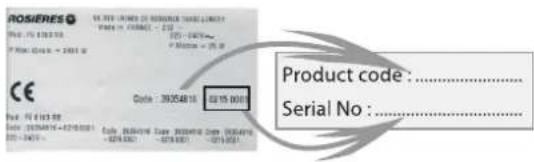
The company shall not be liable if the instructions provided in this document are not complied with.
- You should entrust the installation of your appliance and its electrical connection to an approved fitter or technician with similar qualifications.
- The oven you have just acquired has the described technical characteristics and you must not make any modifications to it.
- Your oven is fitted with a door including several glasses to prevent any risk of burns in operation. Nevertheless we recommend you keep young children well away.
- Never use a steam or high-pressure spray to clean the oven.
- If your oven shows any defect whatever, do not connect it or disconnect it from the power supply and immediately contact an approved ROSIERES service agent.
- Do not store flammable products in the oven; they can catch fire if the oven comes on accidentally.
- Do not press on and do not let children sit on the oven door.
- Use kitchen oven gloves, when putting into or removing a dish from the oven.
RECOMMENDATIONSRECOMMENDA
• After each use of the oven, a minimum of cleaning will help keep the oven perfectly clean.
- Do not line the oven walls with aluminium foil or single-use protection available from stores. Aluminium foil or any other protection, in direct contact with the hot enamel, risks melting and deteriorating the enamel of the insides.
- In order to prevent excessive dirtying of your oven and the resulting strong smoky smells, we recommend not using the oven at too high a temperature. It is better to extend the cooking time and lower the temperature a little.
- In addition to the accessories supplied with the oven, we advise you only use dishes and baking moulds resistant to very high temperatures.
1 - INSTALLATION OF THE OVEN
THE OVEN SHOULD BE INSTALLED BY AN APPROVED CONTRACTOR OR TECHNICIAN WITH SIMILAR QUALIFICATIONS.
The kitchen unit in which the oven is to be fitted must be made of material resistant to temperatures of at least 70^ C.
The oven can be located high in a column or under a worktop. The oven can be located high in a column or under a work
Before fixing Before fixing sure good ventilation in the oven space to allow proper circulation of the fresh air required for cooling and protecting the internal parts. Make the openings specified on page 28 or 29 according to the type of fitting.
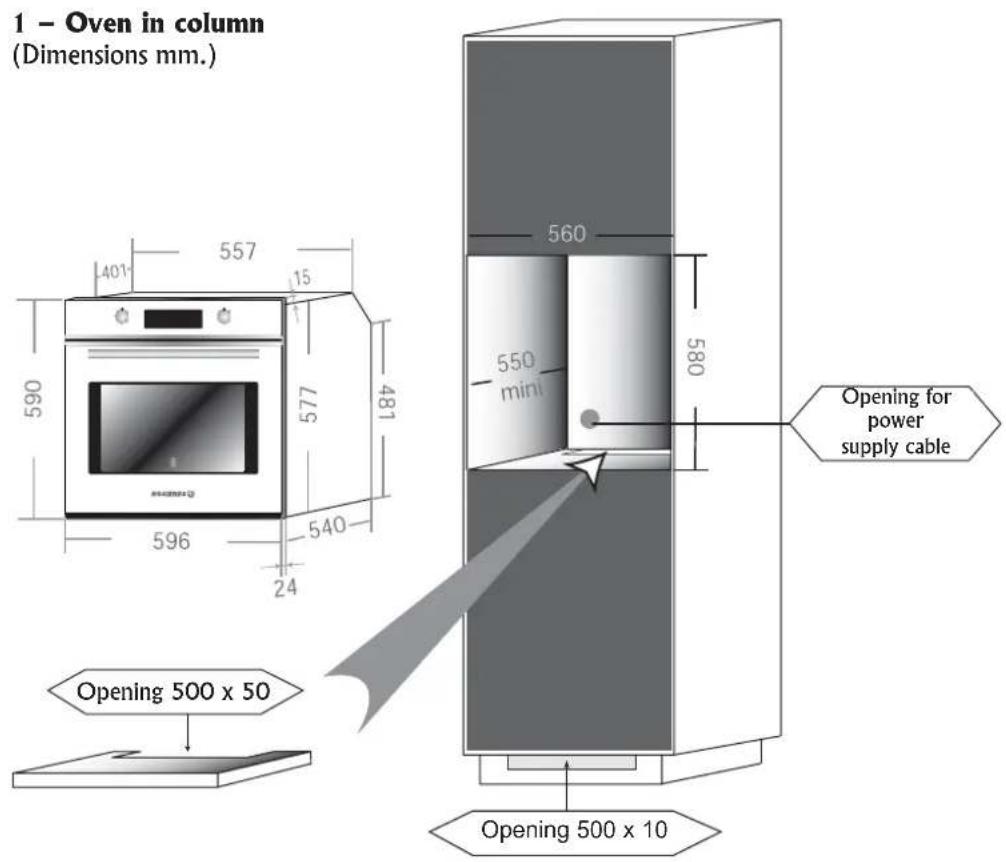
1 - INSTALLATION OF THE OVEN
2 - Oven fitted under worktop
(dimensions mm.)
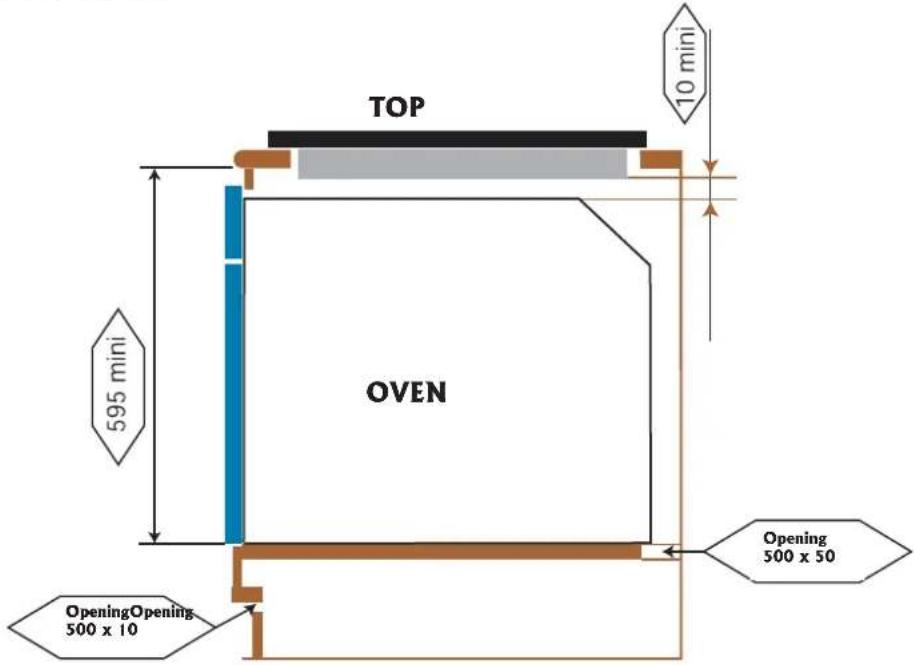
3 - Fixing in the locationFixing in the location
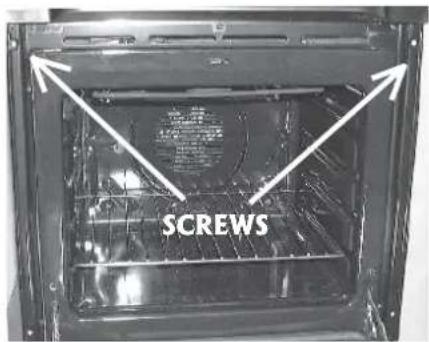
Inside the oven is a bag with four fixing screws.
Fixing:
when the oven door is open, two holes are accessible, they are located on each side of the side uprights.
Use the screws provided to fix the oven.
1 - ELECTRICAL CONNECTION
THE ELECTRICAL CONNECTION SHOULD BE CARRIED OUT BY AN APPROVED CONTRACTOR OR TECHNICIAN WITH SIMILAR QUALIFICATIONS.
The installation receiving the appliance must comply with the standard in force in the installation country.
ROSIERES does not accept any responsibility if this provision is not complied with.
Connection to the network must be by earthed socket outlet, or by means of a multipole circuit-breaker having a distance between contacts of at least 3 mm.
The installation must be protected by suitable fuses, and have wires with a large enough cross-section to supply the oven normally.
CONNECTION: CONNECTION:
The oven is fitted with a power lead for connecting exclusively to a voltage of 230 V AC across the phases or across phase and neutral.
Connection must be carried out in compliance with the diagram on the next page, having first checked:
. the supply voltage indicated on the meter,
. the circuit-breaker setting.
The lead protection wire (green/yellow) connected to the earth terminal of the oven must be connected to the earth terminal of the installation.
Caution:
. Have the earth continuity of the installation checked by an electrician before making the connection.
. The manufacturer will not be liable for any incident, or the possible consequences that may arise from the use of the oven not earthed, or connected to an earth with defective continuity.
NB:NB:not forget that the oven may require after-sales service.
Also, locate the socket outlet so that the oven can be connected once it is removed from its space.
Power supply cable: Power supply capable has to be changed, please have this done by the after-sales service or by someone with similar qualifications.
1 - ELECTRICAL CONNECTION
INSTALLATION WITH SOCKET OUTLET
230-V AC meter across Phases or across Phase and Neutral
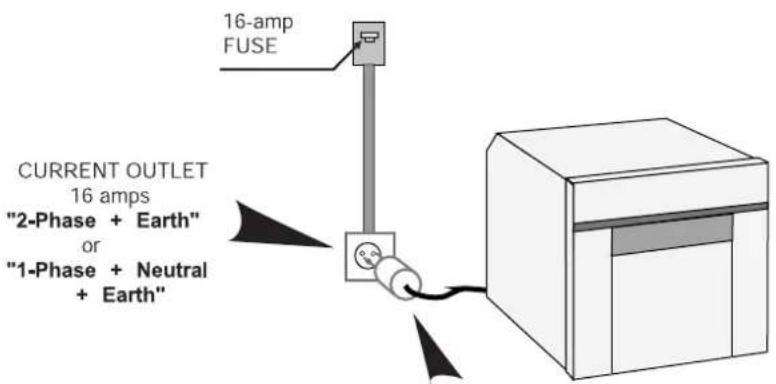
CABLE H05VV-F type cross-section 3G1.5)
1 - DATA SHEET
All data is given for information only. In order to improve the quality of its products, ROSIERES may modify its appliances with technological developments which adhere to the conditions set out in the Consumer Code.

Appliances comply with Directives 89/336/EEC, 73/23/EEC and 89/109/EEC.
FE 6163
Oven dimensions Oven Wintenslbght x Depth
59.6 X 59 X 56.4 cm
Internal oven dimensions (cm) Internal oven dimensions (cm)
Height x Width x Depth 30x43x39
Volume in litres 50
Conventional cooking 2430
Fan cooking 2460
Fan + Lower element 1600
Defrost 70
Grill 2150
Fan assisted grill 2180
Rotisserie 2150
Consumption in conventional cooking (kWh) Consumption in conventional cooking (kWh)
. rise to 200°C 0.50
. holding for 1 hour at 200°C 0.60
Electrical connection
Fuse
Single-phase 230 V AC + Earth
16 A
2 - INTRODUCTION to the «Controls»
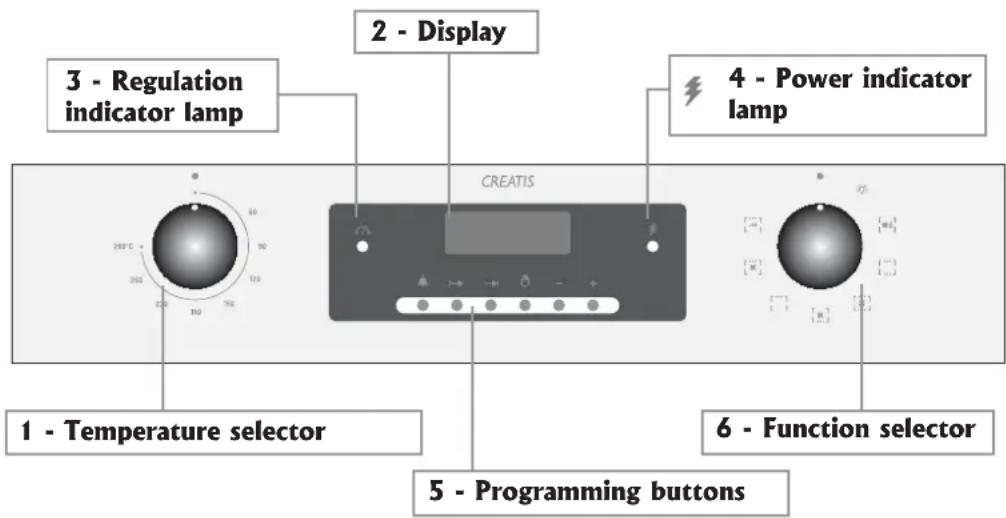
- Temperature selector for choosing a temperature in a range between 60°C and 280°C.
- Display: shows current time.
- Regulation indicator lamp showing operation of the oven thermostat. It comes on and goes off regularly throughout the cooking period.
- Power indicator lamp comes on as soon as the oven is operated and stays on throughout the cooking period.
- Programming buttons
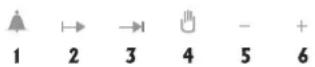
- Timer: audible timer independent of the oven
- Duration: display of cooking or pyrolysis duration
- End: display of cooking or pyrolysis (self-cleaning) ending time
- Auto/Manual: Auto "on": the programmer is in charge of the oven's operation
Auto "off": the oven operates in manual position
5/6. "-" and "+" programming adjustment buttons
- Function selector for choosing a cooking method.
The simple shell take moulds and dishes.
The tray Folderayhalfholder specshelf good for grilling things. Use it with the drip tray.
The special profile of the shelves means they stay horizontal even when pulled right out. There is no risk of a dish sliding or spilling.
The dThe tay chopray the juices from grilled foods. It can be put on a shelf, or slid under the rails. It is only used with the Grill, Rotisserie, or Fan Assisted Grill; remove it from the oven for other cooking methods. Never use the drip tray as a roasting tray as this creates smoke and fat will spatter your oven making it dirty.
When the oven is in use, any unused accessories should be removed from the oven.
The turnsplit The turnsplit skewer, two forks and a spit holder.
. Take all the accessories out of the oven.
. Place the deep tray at the bottom.
. Put the food on the skewer, well centred between the two forks.
. Put the skewer onto the holder.
. Slide the holder and skewer into the second shelf position from the bottom.
. The end of the turnspit should be opposite the opening of the drive device.
. Engage the turnspit in the drive device.
Fitting the turnspit crosswise:
1
2
Boss to back
3
4
Drive device
2 - THE COOKING METHODS2 - THE COO
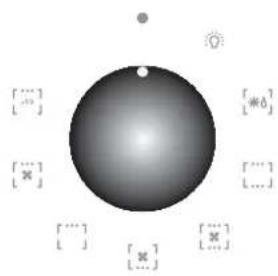
Function selector
natural_image
Gray sphere with scattered symbols and a small circle above it, no text or labels present.| Defrost[∗] | 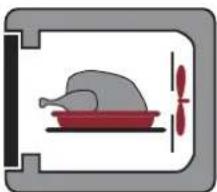 | Conventional cooking[⋯][⋯] | 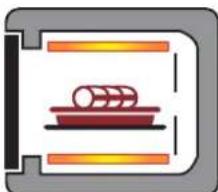 |
| Fan cooking[⋯][⋯] | 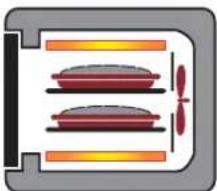 | Fan + Lower element[⋯] | 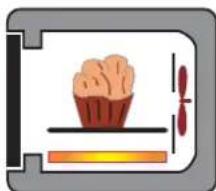 |
| Grill[⋯][⋯] | 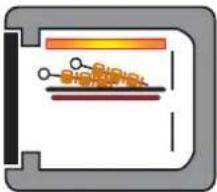 | Fan assisted Grill[⋯][⋯] | 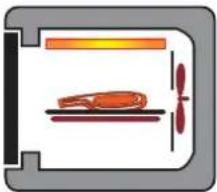 |
| Rotisserie[⋯][⋯] | 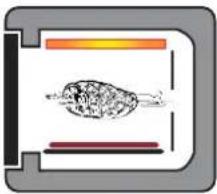 | ||
2 - THE COOKING METHODS2 - THE CO
[★δ] DEFROST The cooking fan runs to circulate the air inside the oven. Ideal for defrosting before cooking.
CONVENTIONAL COOKING Both top and bottom heating elements are used. Preheat the oven for about ten minutes. This method is ideal for all traditional roasting and baking. For seizing red meats, roast beef, leg of lamb, game, bread, foil-wrapped food (papillotes), flaky pastry. Place the food and its dish on a shelf in mid position.
FAN COOKING Both top and bottom heating elements are used with the fan circulating the air inside the oven. We recommend you use this method for poultry, pastries, fish and vegetables. Heat penetrates into the food better and both the cooking and preheating times are reduced. You can cook different foods at the same time with or without the same preparation in one or more positions. This cooking method gives even heat distribution and the smells are not mixed. Allow about ten minutes extra when cooking foods at the same time.
[FAN + LOWER ELEMENTFAN hot LOWER ELEMENT is used with the fan circulating the air inside the oven. This method is ideal for juicy fruit flans, tarts, quiches and pâté. It prevents food from drying and encourages rising in cakes, bread dough and other bottom-cooked food. Place the shelf in the bottom position.]
[...] GRILL:GBL the grill with the door closed. Use the grilling the door closed. alone and you can adjust the temperature. Five minutes preheating is required to get the elements red-hot. Success is guaranteed for grills, kebabs and au gratin dishes. White meats should be put at a distance from the grill; the cooking time is longer, but the meat will be tastier. You can put red meats and fish fillets on the shelf with the drip tray slid underneath.
FAN ASSISTED GRILL: FAN/ASSISTED GRILL door closed. The top heating element is used with the fan circulating the air inside the oven. Preheating is necessary for red meats but not for white meats. Ideal for cooking thick food items, whole pieces such as roast pork, poultry, etc. Place the food to be grilled directly on the shelf centrally, at the middle level. Slide the drip tray under the shelf to collect the juices. Make sure that the food is not too close to the grill. Turn the food over halfway through cooking.
[...] ROTISSERIE: use the turnspit with the door closed. The hepturping wide moutdoor closed. is used with the turnspit rotating the food to be cooked. The heating temperature can be adjusted as required. The turnspit is best used for medium-sized items. Cook larger pieces in the oven in the "turbo-grill" position, and they'll cook better. Ideal for rediscovering the taste of traditional roast. No preheating is required for turnspit cooking.
3 - BEFORE THE FIRST USE3 - BEFORE

INITIAL CLEANING
. Clean the oven once before putting it to use:
Wipe over the external surfaces of the oven with a damp soft cloth.
Wash the accessories and the inside of the oven using a sponge and a little washing up liquid.
Heat the empty oven at maximum temperature for about an hour to get rid of the new smell. Make sure the room is well ventilated when you do this.

POINTS TO REMEMBER
This is for cooking with air circulation inside the oven.
Cooking fan
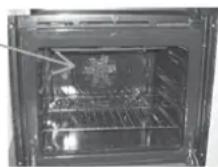
This fan cools the front of the oven and its electronic components.
It is linked to the operation of the function selector.
- Oven lighting: comeslighting cooking mode or by positioning the function selector to the symbol "☐".

TIME SETTING
When the oven is powered up, the programmer shows:
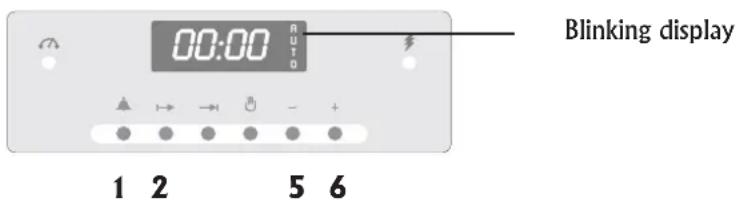
① Press buttons "1" & "2" at the same time, then release.
② Use the “-” or “+” setting buttons to display the right time.
3 - USING THE OVEN3 - USING THE
0 HOW TO COOK DIRECTLY?
√ The oven must be in Manual position (Auto symbol off): if not, press the button " 🔊".
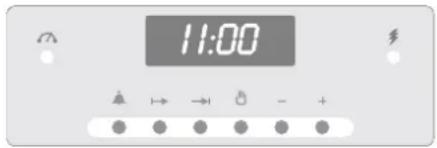
√ Turn the function selector to the cooking position you want. The oven comes on. The voltage presence indicator lamp comes on.
√ Set the thermostat to the required temperature following the information given below:
COOKING METHOD RECOMMENDED TEMPERATURES
[*6] Defrost Temperature selector to stop position
Conventional cooking 60 - 280°C
Fan cooking 60 - 230°C
[...] Fan + Lower element 60 - 240°C
[...] Grill 220 - 275°C
Turbo grill 180 - 230°C
Rotisserie 220 - 275°C
The regulation lamp comes on and goes off regularly during cooking.
√ The oven starts to cook.
√ When you think it necessary, stop the oven by setting the temperature and function selectors to the stop position.
The lighting in the oven and the indicator lamps go off.
3 - USING THE OVEN3 - USING THE
② PROGRAMMING
Programming the oven for a period and immediate start.
√ The oven must be in Manual position (Auto symbol off): if not, press the button " 🔊".
√ Select a cooking method and the appropriate temperature. The indicator lamps come on.
√ Program a cooking period:
. Press the button "2". The symbol "☐" is displayed.
. Set a period using the "+" and "-" buttons (maximum 24 hours).
. The programmer records the period and automatically calculates the end-of-cooking time. The oven is in Auto mode (Automatic). The current time is displayed.
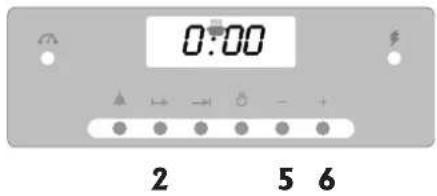
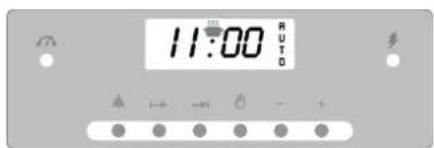
During the cooking period, you can view or change:
. The programmed period: press the button "2".
. The end time: press the button "3".
√ The oven stops automatically once the time has elapsed. The symbol " 🔊" disappears. The lighting in the oven and the indicator lamps go off. An audible beep sounds as a warning. To interrupt it, press one of the buttons «1», «2», «3» or «4». The "Auto" symbol blinks; to stop it, reset to Manual position by pressing button " 🔊".
√ Return the two selectors to the stop position.
3 - USING THE OVEN3 - USING THE
② PROGRAMMING
Programming the oven for an end time and immediate start.
√ The oven must be in Manual position (Auto symbol off): if not, press the button "☐".
√ Select a cooking method and the appropriate temperature. The indicator lamps come on.
√ Program a cooking end time:
. Press button "3". The symbol 📋 is displayed.
. Press the button “+”: the programmer displays the current time and the Auto symbol.
. Set an end-of-cooking time using the buttons “-” and “+” (current time + maximum 24 hours).
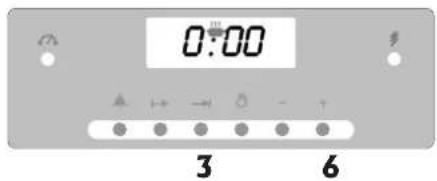
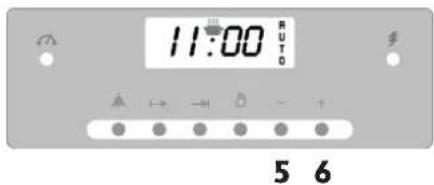
. The programmer records the end-of-cooking time and automatically calculates the cooking period. It is in Auto mode (Automatic). The current time is displayed.
√ During the cooking period, you can view or change: . The programmed period: press the button "2". . The end time: press the button "3".
√ The oven stops automatically once the end-of-cooking time is reached. The symbol disappears. The lighting in the oven and the indicator lamps go off. An audible beep sounds as a warning. To interrupt it, press one of the buttons «1», «2», «3» or «4». The "Auto" symbol blinks; to stop it, reset to Manual position by pressing the button " 🔊".
√ Return the two selectors to the stop position.
② PROGRAMMING
Programming the oven for a delayed start.
√ The oven must be in Manual position (Auto symbol off): if not, press the button " 🔊".
√ Select a cooking method and the appropriate temperature. The indicator lamps come on.
√ Program a cooking period:
. Press the button "2", then set a period with the buttons "-" and "+".
√ Program an end-of-cooking time:
. Press the button “3” then the button “+”: the programmer displays the current time and the Auto symbol.
. Set an end-of-cooking time using the buttons “-” and “+” (current time + maximum 24 hours).
The Auto symbol is steady. The symbol " 🔊" disappears. The current time is displayed.
√ The programmer calculates the cooking start time. It automatically starts the cooking and then displays the symbol " 🔊".
√ At any time, you can view or change the programmed period (press the button "2"), or the end time (press the button "3").
√ The oven stops automatically once the end-of-cooking time is reached.
The symbol " 🔊 " disappears. The lighting in the oven and the indicator lamps go off. An audible beep sounds as a warning. To interrupt it, press one of the buttons "1", "2", "3" or "4".
The "Auto" symbol blinks; to stop it, reset to Manual position by pressing the button " 🔊 ".
√ Return the two selectors to the stop position.
3 - USING THE OVEN3 - USING THE
② PROGRAMMING

THE TIMER
Timer operation is independent and does not affect oven operation. It is just an audible reminder. However, you can use it when cooking.
Press the button "1" and then release. The symbol "▲" is displayed and the clock shows:
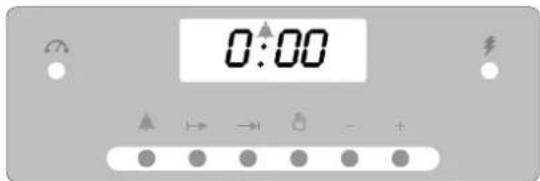
√ Display the time required using the "+" and "-" buttons (maximum 24 hours).
√ The display again shows the time of day with the Timer symbol 🔊".
When the set time has elapsed, an audible beep sounds for 60 seconds. To interrupt the beep, press one of the buttons "1", "2", "3" or "4".
The display " 🔊 " disappears.
Whenever you want to check or change the programmed time, press again on the button "1".
4 - COOKING TIPS4 - COOKING TIP
Temperatures and cooking times are given for information only to facilitate using the oven. Personal experience should then let you adapt these settings to your taste and habits.
Remember that cooking at higher temperatures causes more spattering, and the oven can become dirty and smoky. It is better to slightly reduce the cooking temperature, even if it means increasing the cooking time.
natural_image
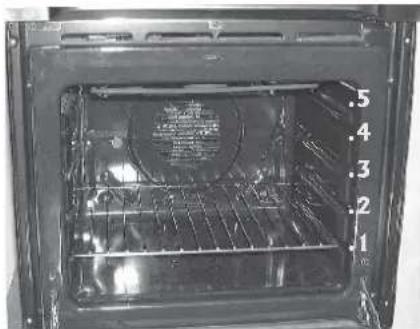
Interior view of an oven with visible grating and ventilation slots (no text or symbols)The sides of the oven are equipped with different positions numbered from the bottom.
FISH
| Recipes | Cooking method | Quantity Cooking °C | Cooking time from bottom | Shelf position |
| Tilefish or bream | Conv cooking | 1kg whole 220°C | 30 min 1 | |
| Monk fish or Salmon | Conv cooking | 1kg braised 220°C | 30 min 1 | |
| Salmon steak | Fan cooking | 6 pieces 140-160°C | 10-15 min 1 | |
| Fillet of sole | Fan cooking | 6 pieces 160°C | 15-20 min 1 | |
| Grilled fish | Grill | 6 fillets 275°C | 2 X 5 min 4 |
4 - COOKING TIPSCOOKING TIPS
MEATMEAT
It is better not to salt meats until after cooking as salt encourages the meat to spatter fat. This will dirty the oven and make a lot of smoke.
Joints of white meat, pork, veal, lamb and fish can be put into the oven cold. The cooking time is longer than in a preheated oven, but it cooks through to the centre better as the heat has more time to penetrate the joint.
Correct preheating is the basis of successful red meat cookery.
GRILLSGRILLS
• Before loading the grill:
Remove the meat from the refrigerator a few hours before grilling. Lay it on several layers of kitchen paper: this improves seizing, making it tastier and avoids it staying cold at the centre.
Add pepper and spices to the meat before grilling, but add any salt after cooking. This way it will seize better and stay juicy. Baste all the food to be cooked with a little oil. This is best done with a wide flat basting brush. Then sprinkle with more pepper and herbs (thyme, etc.).
Load the grill.
- During cooking:
Never pierce the food during cooking even when you turn it. This lets the juice out and it becomes dry.
MEAT
| Recipes | Cooking method | Quantity Cooking Cooking Tips °C time |
| Beef with carrots | Conv cooking | for 6 200-220°C about hours |
| Duck | Conv cooking | 1,5 kg 200-220°C 1 12 hours |
| Turkey | Conv cooking | 5/6 kg 160-180°C 2 12 – 3 hours |
| Goose | Conv cooking | 3/4 kg 160-180°C 2 – 2 12 hours |
| Leg of lamb | Conv cooking | 200-220°C 15 min/pound |
| Roast chicken | Conv cooking | 1/1,5 kg 220°C about 1 hour |
| Roast beef | Conv cooking | 240°C 15 min/pound |
| Roast rabbit | Fan cooking | 800-1 kg 200-220°C 50-60 mins |
| Roasted white meat | Fan cooking | 200-220°C 40-50 mins/kg |
| Veal / poultry | Rotisserie | 1kg 200 275°C 60-70mins/kg No preheat. |
| Veal / poultry | Rotisserie | 1 kg 275°C 45-50 min No preheat. |
| Beef | Rotisserie | 1 kg 275°C 15-20 min No preheat. |
| Lamb / Mutton | Rotisserie | 1 kg 275°C 20-25 min No preheat. |
| Pork | Rotisserie | 1 kg 275°C 45-50 min No preheat. |
| Kebabs | Grill | 6 pieces 275°C 2 X 8 min Turn over in mid cooking |
| Pork chop | Grill | 6 pieces 275°C 2 X 8 min Turn over in mid cooking |
All cooking was done at shelf position "1".
VEGETABLES - OTHERS
| Recipes | Cooking method | Quantity Cooking °C | Cooking Tips time |
| Braised cabbage | Conv cooking | for 6 200-220°C 1 hour | |
| Pâté en croûte | Conv cooking | 200-220°C 1 hour/kg | |
| Chicory with gruyere | Fan cooking | for 6 180-200°C 25-30 min | |
| Potatoes in their jackets | Fan cooking | for 6 200-220° about 1 hour | |
| Soufflé savoury/sweet | Fan cooking | for 6 180-200°C 50-60 min ∅ 22 | |
| Stuffed tomatoes | Fan cooking | 6-8 pieces 200-220°C 40-45 min | |
| Leek flan | Fan + lower element | for 6 220°C 35-40 min | |
| Quiche Lorraine | Fan + lower element | for 6 220°C 45-50 min | |
| Toast with crottin* | Turbo grill | 6 pieces 210°C 3 min to toast Flat steak one side + pan 4 min/crottin | |
| Dauphiné cheese- Oval topped dish | Turbo grill | 6 portions 200°C 45 min | earthenware |
| Toulouse 2 x 10 min sausages* | Turbo grill | 4 pieces 210°C turn over in mid cooking | Flat steak pan |
All the cooking was done at shelf position "1" except cooking marked thus "*", which requires cooking at a middle position.
BAKING
Avoid using shiny tins, they reflect the heat and can spoil your cakes. If your cakes brown too quickly, cover them with grease-proof paper or aluminium foil. Caution: the correct way to use foil is with the shiny side in towards the cake. If not the heat is reflected by the shiny surface and does not penetrate the food. Avoid opening the door during the first 20 to 25 minutes of cooking: soufflés, brioches, sponge cakes, etc. will tend to fall. You can check if cakes are done by pricking the centre with a knife blade or metal knitting needle. If the blade comes out nice and dry, your cake is ready and you can stop cooking. If the blade comes out moist or with bits of cake attached, continue baking but slightly lower the thermostat so that it is finished off without burning.
| Recipe | Cooking method | Quantity Cooking Cooking Shelf Tips °C time level | |
| Cake | Conv cooking | 1,5 kg 180-200°C 50-60 min 1 | |
| Fruit tart in batter | Conv cooking | for 6 200-220°C 40-50 min 1 ∅ 27 | |
| Pound cake | Conv cooking | 1,5 kg 200-220°C 45-50 min 1 | |
| Filled pie | Conv cooking | for 6 200-220°C 40-45 min 1 ∅ 27 | |
| Brioche | Fan cooking | 800 grs 200°C 40-45 min 1 | |
| Sponge cake | Fan cooking | 180-200°C 35-40 min 1 mould ∅27 | |
| Genoese cake | Fan cooking | 180-200°C 30-35 min 1 mould ∅27 | |
| Choux pastry | Fan cooking | 40 pieces 190°C 35 min 1/3 | 2 trays |
| Pastry base | Fan cooking | for 6 180-200°C 20-30 min 1 ∅ 27 | |
| Puff pastry | Fan cooking | 6 pieces 200°C 15-20 min 1 e.g. | |
| Meringues | Fan + Lower element* | 1 tray 80-85°C 4 12 hours | Bouchée |
| Fruit tart | Fan + Lower element* | for 6 220°C 35-40 min 1 | |
| St Honoré | Fan + Lower element* | 6 pieces 190°C 30-35 min 1 | |
* with fan and lower element, we recommend preheating with fan cooking to save time.
5 - CLEANING THE OVEN5 - CLEANING
. Wait for the oven to cool down before doing any cleaning by hand.
. Never clean your oven with abrasive cleaners, wire wool or sharp objects, or the enamel may be damaged beyond repair.the enamel may be damaged beyond repair.
. Only use soapy water or bleach (ammonia) cleaners.. Only use soapy water or bleach (ammonia) cle
GLASS PARTSGLASS PARTS
We recommend you wipe clean the glass door with absorbent kitchen paper every time you use the oven. If the spattering is heavy, then you can clean with a well squeezed sponge and detergent, and rinse. Never use abrasive cleaners or sharp objects.
OVEN DOOR
The oven door can be cleaned directly in place or by removing it.
Remove, as follows:
. fully open the door,
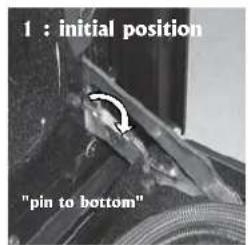
. hinges as in photo 1,
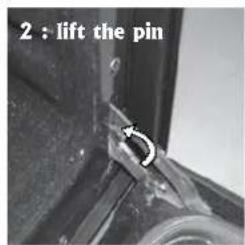
. remove the hinge pins (photo 2)
. pull the door upwards, just closing it partially until it comes off.
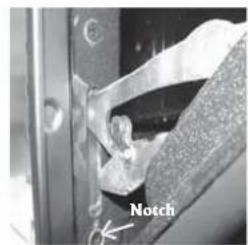
Installation, make sure you reposition the hinges carefully; a notch located below them (photo 3) lets you fit the hinges correctly.
After the door is put on its supports, fit the hinge pins in their initial position as in photo 4.
natural_image
Close-up of a hand using a tool to cut a piece of material, labeled 'Notch' (no other text or symbols visible)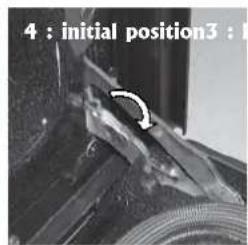

flowchart
graph LR
    A["Removal Installation"] --> B["Blank"]
If this gets dirty, clean the oven seal with a slightly damp sponge.
ACCESSORIESACCESSORIES
Clean them with a sponge soaked in soapy water. Rinse with clean water and dry off. Avoid abrasive cleaners.
5 - ENTRETIEN DU FOURS - ENTRETIEN
DRIP TRAYDRIP TRAY
After grilling, remove the drip tray from the oven. Take care to pour the warm grease into a container. Wash and rinse the drip tray in hot water with a sponge soaked in washing up liquid.
If residues remain attached, soak them off in water and detergent.
It can also go in a dish washer or be cleaned with a commercial oven cleaner.
Never placer a soiled drip tray in the oven.
Never leave the drip tray in during pyrolysis.
Disconnect the power supply from the oven before cleaning or replacing the lamp.
The bulb and its cover are made of material resistant to high temperatures.
natural_image
Three-step sequence showing hand positioning of a small object with rotational arrows, no text or symbols present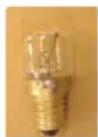
Bulb characteristics:
230 V AC - 25 W - E 14 base -
Temperature 300°C
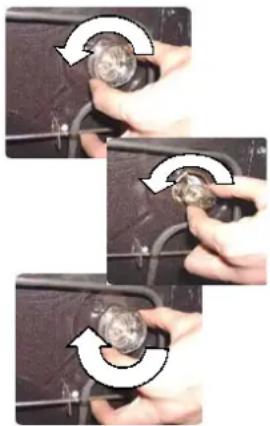
To change a defective bulb, just
. unscrew the glass cover,
. unscrew the bulb,
. replace it with the same type: see characteristics above,
. after replacing the defective bulb, screw back the protective glass cover.
OVEN ENAMEL
Whatever the cooking method, we recommend you don't let fatty residues accumulate inside the oven. Clean it regularly.
. Never clean your oven with abrasive cleaners, wire wool or sharp objects, or the enamel may be damaged beyond repair.
. Only use soapy water or bleach (ammonia) cleaners.
. Never line the oven sides with aluminium foil; this concentrates the heat causing the oven to deteriorate.
Regular cleaning:
Clean inside the oven with a sponge soaked in washing up liquid and very hot water to remove hard grease marks.
For heavy spattering use commercially available oven cleaners.