SVEC4RC - Hot plate SVAN - Free user manual and instructions
Find the device manual for free SVEC4RC SVAN in PDF.


| Product Type | Built-in gas hob (cooktop) |
| Model | SVEC4RC |
| Brand | SVAN |
| Burner Configuration | 4 burners: 1 wok burner (3.5 kW), 1 large burner, 1 medium burner, 1 small auxiliary burner |
| Hotplate | Electric hotplate built-in (sizes: 80mm, 145mm, 180mm; power up to 2000W) |
| Gas Types | Natural gas (G20, G25) and LPG (G30, G31); convertible via injector change |
| Ignition | Automatic electric ignition |
| Safety Features | Flame failure device (FFD) on gas burners; automatic gas shut-off if flame extinguished |
| Electrical Supply | 220-240V, 50/60 Hz |
| Installation | Built-in; countertop cutout required; distances from walls ≥50 mm; ventilation requirements per room size |
| Control Type | Front control knobs with push-turn safety lock |
| Pot Diameter Recommendation | Small burner: 12-18 cm; Medium: 18-22 cm; Large: 22-26 cm; Wok: 24-32 cm; minimum pot diameter 120 mm |
| Cleaning | Avoid abrasive cleaners; clean with soapy water; do not use steam cleaners; clean glass surfaces with special glass cleaner |
| Accessories Included | Cast or enamel grills, coffee pot adaptor, wok burner adaptor |
| Compliance | WEEE Directive 2012/19/EU; CE marked |
| Manual Languages | English, Spanish, and others available on request |
Frequently Asked Questions - SVEC4RC SVAN
User questions about SVEC4RC SVAN
0 question about this device. Answer the ones you know or ask your own.
Ask a new question about this device
Download the instructions for your Hot plate in PDF format for free! Find your manual SVEC4RC - SVAN and take your electronic device back in hand. On this page are published all the documents necessary for the use of your device. SVEC4RC by SVAN.
USER MANUAL SVEC4RC SVAN
natural_image
Isometric line drawing of a four-cylindrical electrical heating element with small cylindrical components on the base (no text or symbols)USER MANUAL GB MANUAL DEL USUARIO ES
Dear User,
Our objective is to make this product provide you with the best output which is manufactured in our modern facilities in a careful working environment, in compliance with total quality concept.
Therefore, we suggest you to read the user manual carefully before using the product and, keep it permanently at your disposal.
Note: This user manual is prepared for more than one model. Some of the features specified in the Manual may not be available in your appliance.
All our appliances are only for domestic use, not for commercial use.
"Conforms with the WEEE Regulations."
CONTENTS
Important Warnings 4
Introduction Of The Appliance 6
Control Panel 7
Electrical Connection Scheme 7
Important Warnings 8
If Built-In Oven Is Placed Under Cooktop 10
Installation Of Cookstop 10
Counter Cutting Sizes And Installation Of Your Cooktop 12
Correct Place For Installation....13
Ventilation Of Room 13
Transformation From Natural Gas To Lpg And
From Lpg To Natural Gas 14
Gas Breaking Safety Appliance (FFD) 14
Usage Of Your Cooktop 15
Pot Diameter 16
Wok Burner 17
Usage Of Hotplate 17
Maintenance And Cleaning 18
Troubles And Solution Proposals 19
Setting Gas Cooktops As Per Gas Type 19
Injector, Gas Flow And Power Table 20
Environmentally-Friendly Disposal And
Package Information 21
IMPORTANT WARNINGS
- WARNING: Before touching the connection terminals, all supply circuit should be disconnected.
- WARNING: Any inadvertent cooking made with fats and oils can be dangerous and cause fire.
- WARNING: Risk of fire; do not store the food materials on the cooking surface.
- WARNING: During usage the reachable sections can be hot. Keep the small children away.
- WARNING: The appliance and its reachable sections become hot during usage.
- The setting conditions of this appliance is indicated on the label. (Or data tag)
- This appliance is not connected to a combustion product discharge system. This appliance shall be connected and installed as per the applicable installation legislation. Consider the requirements related with ventilation.
- Using a gas hob will release humidity and combustion products in the room where it resides. Especially during when the appliance in use, ensure that the kitchen is well ventilated and retain the natural ventilation holes or install a mechanical ventilation system. (Hood on top of the oven) Sustained usage of the appliance may require additional ventilation. For example opening a window or if available, increasing the ventilation level of a mechanical ventilation system.
- WARNING: The appliance is intended for cooking only. It must not be used for other purposes like room heating.
GB
-
This appliance should be installed as per regulations and in well-ventilated location only. Read the instructions before installing or operating the appliance."
-
Before placing the appliance check the local conditions (gas type and gas pressure) and ensure that the settings of the appliance is appropriate.
-
These instructions are applicable for countries of which symbols are indicated on the appliance. If the country symbol is not available on the appliance, in order to adapt the appliance to the conditions of such country, the technical instructions should be read.”
-
Do not operate the system for more that 15 seconds. If the burner does not ignite at the end of 15 seconds stop the operation of the system and open the section door and/or wait for at least 1 minute before igniting the burner.
-
Do not use steam cleaners to clean the appliance.
-
NEVER try to extinguish a fire with water, first disconnect the mains supply and then using, for example a lid or blanket, cover the fire.
-
Unless continuous supervision is provided, the children of age 8 or below should be kept away.
-
Pay attention for not to touch the heating elements.
-
This appliance can be used by children aged from 8 years and above and persons with reduced physical, sensory or mental capabilities or lack of experience and knowledge if they have been given supervision or instruction concerning use of the appliance in a safe way and understand the hazards involved.
INTRODUCTION OF THE APPLIANCE
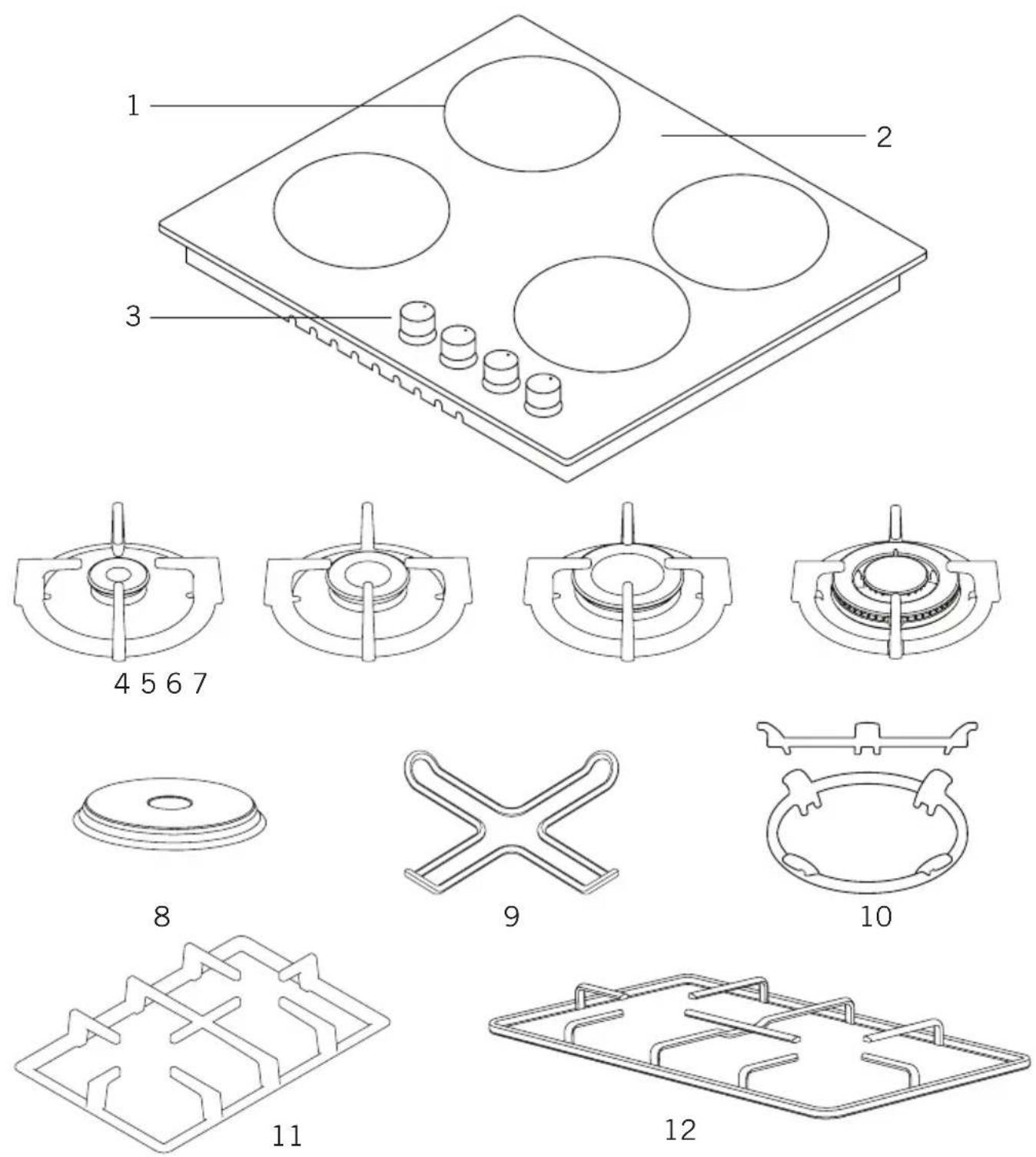
1- Burner positions
2- Glass or Metal Surface
3- Control Buttons
4- Small Burner
5- Medium Burner
6- Large Burner
7 WOK Burner
8- Hotplate
9- Coffee Adaptor
10- Wok Burner Adaptor
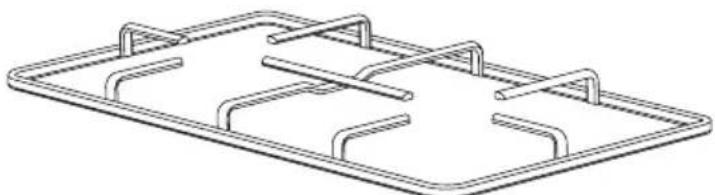
11- Cast Grill
12- Enamel Grill
CONTROL PANEL
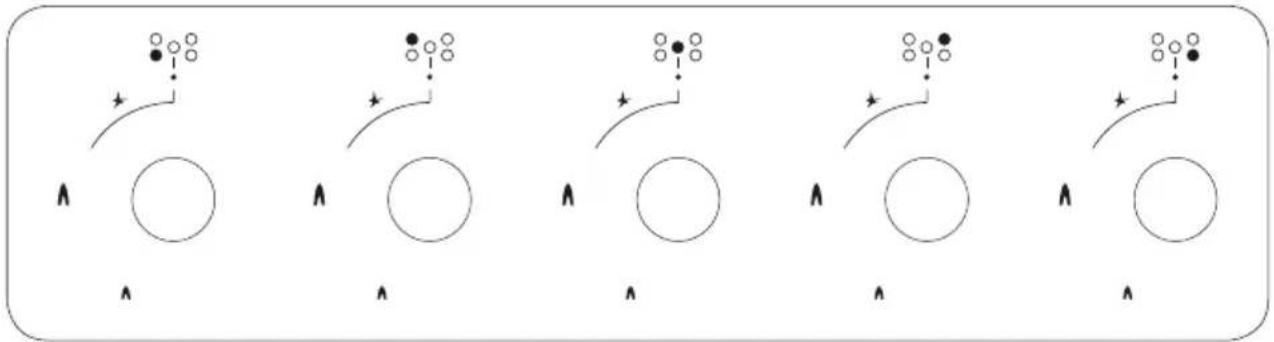
flowchart
graph TD
    A["Start"] --> B{Condition}
    B -->|Yes| C["Process Step 1"]
    B -->|No| D["Process Step 2"]
    C --> E["End"]
    D --> F["End"]
Cooktop Panel Visual of 70-90 cm and 100 cm
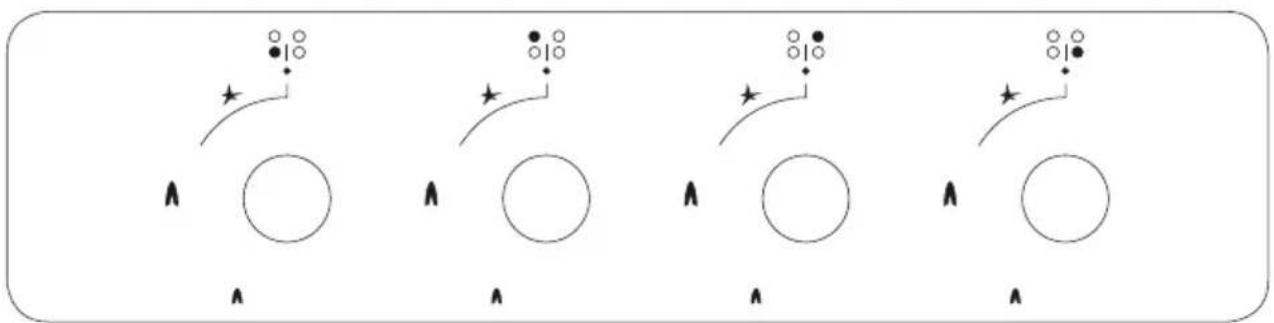
natural_image
Four identical diagrams showing circles with star symbols and curved lines, no text or labels present.Cooktop Panel Visual of 60 cm
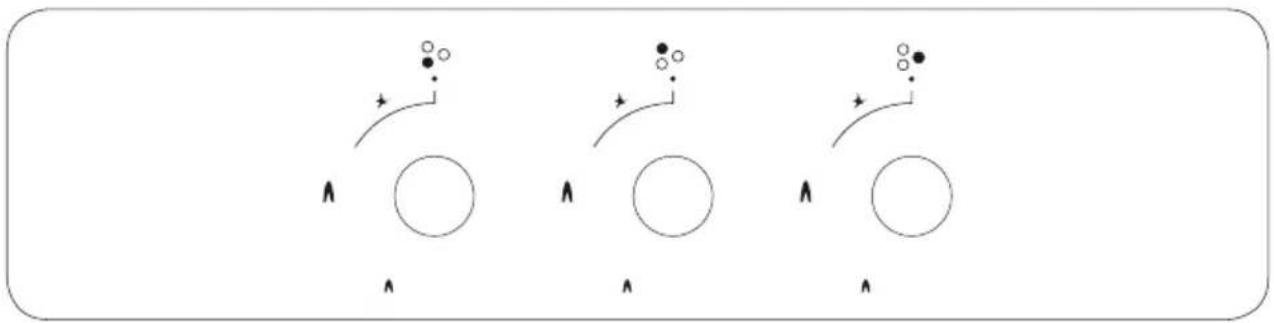
natural_image
Three identical diagrams showing circles with arrows and dots, no text or symbols presentCooktop Panel Visual of 45 cm
ELECTRICAL CONNECTION SCHEME
Get electrical connection of your appliance done to authorized person in line with the following scheme.
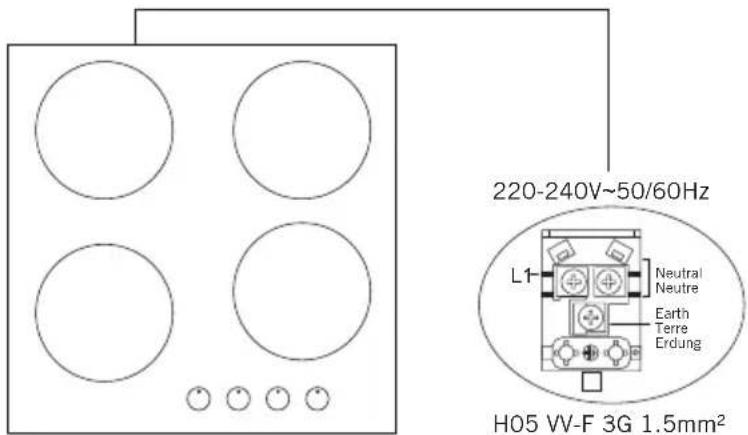
IMPORTANT WARNINGS
Electrical Connection and Safety
-
Setting conditions of this appliance is indicated in tag or data plate.
-
This appliance is not connected to any discharging apparatus of burning products. It should be connected and installed according to applicable assembly regulation.
-
Great attention should be paid on ventilation related conditions.
-
Your appliance should be connected to an appropriate fuse according to electric power. If necessary, it is recommended that connection is made by authorized service.
-
Your appliance is configured in accordance with electrical supply of 220-240V, 50/60Hz.
-
If main electrical network is different from these values, contact with your authorized service.
-
Electrical connections of your appliance should only be made to the fuses having suitably wired grounding (grounded) system. If no convenient fuse is available in the place where your appliance is to be installed, contact with authorized service immediately. Manufacturing firm is not responsible definitely for the damages that fuses whose grounding is not made and connected to the appliance can cause.
-
Plug of the appliance should be close to be accessed easily to the fuse whose grounding is made without use of extension cord.
-
Do not allow contacting the power cable of your appliance with hot regions. Similarly, keep away it from sharp edges and corners.
-
If feeder cord is damaged, this cord should be replaced either by manufacturer or its service agency or same degree qualified personnel in order to hinder a dangerous situation.
-
Wrong electrical connection may give damage to the appliance. In this case, your appliance will remain out of guarantee scope. Electrical connection of your appliance should be done by authorized service.
-
During operation of cooktop, some parts may be hot. When you also bring switches closed position, it may remain hot for a while. Children should be kept away every time and not be left without observation. Do not touch surface of cooktop while warning lights flashes. When you bring your appliance closed position, hot parts being still dangerous are stated with warning lights. (Vitroceran models)
Gas Connection and Safety
- For LPG (cylinder) connection, affix metal clamp on the hose coming from LPG cylinder. Affix an edge of the hose on hose inlet connector behind the appliance by pushing to end through heating the hose in boiled water. Afterward, bring the clamp towards end section of the hose and tighten it with screwdriver. The gasket and hose inlet connector required for connection is as the picture shown below.

NOTE: The regulator to be affixed on LPG cylinder should have 300 mmSS feature.
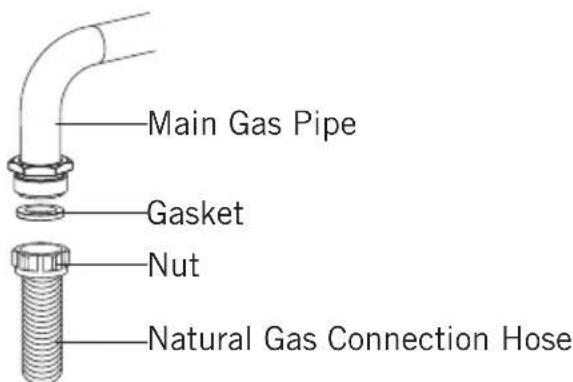
- Natural gas connection should be done by authorized service. For natural gas connection, place gasket in the nut at the edge of natural gas connection hose. To install the hose on main gas pipe, turn the nut. Complete the connection by making gas leakage control.

Gas hose and electric connection of the appliance should not pass next to hot areas such as back of the appliance. Gas hose should be connected by making wide angle turns against breaking possibility. Movement of appliance whose gas connection is made may cause gas leakage.
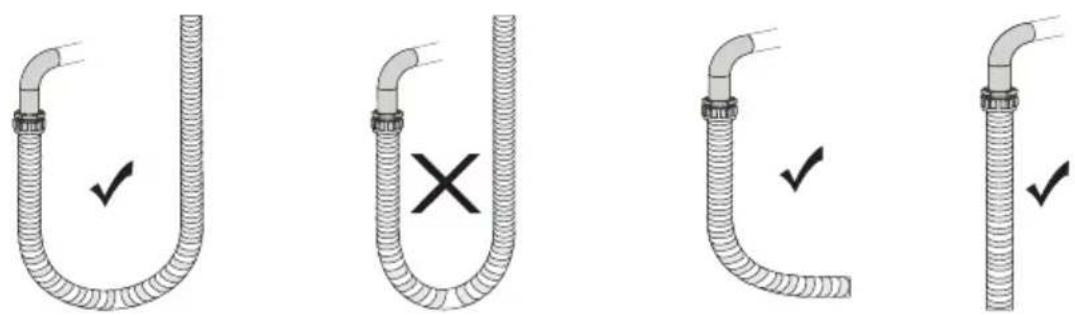
True False True True
GB
- Connect your appliance to gas cock from the shortest way and in a manner to prevent any leakage. For safety, the hose used should be maximum 125 cm and minimum 40 cm.
- While making gas leakage control; never use lighter, match, glowing cigarette or similar inflammable matter.
- Apply soap bubble on connection point. If any leak/leakage exists, foaming will occur on soaped region.
- If the cooktop is to be mounted on a cabinet or openable drawer, a heat protection panel having 15 mm minimum opening should be mounted under the cooktop.
IF BUILT-IN OVEN IS PLACED UNDER COOKTOP;

Figure 1
Gas pipe should be affixed in a way not to touch the oven below, sharp edges and corners, not to be pulled in a manner to be twisted and strained. Make gas connection from right part of the cooktop, fasten the hose by use of clamp.
INSTALLATION OF COOKSTOP
- Detach the burners, burner hoods and grills from the product.
- Turn the cooktop down and place on smooth ground.
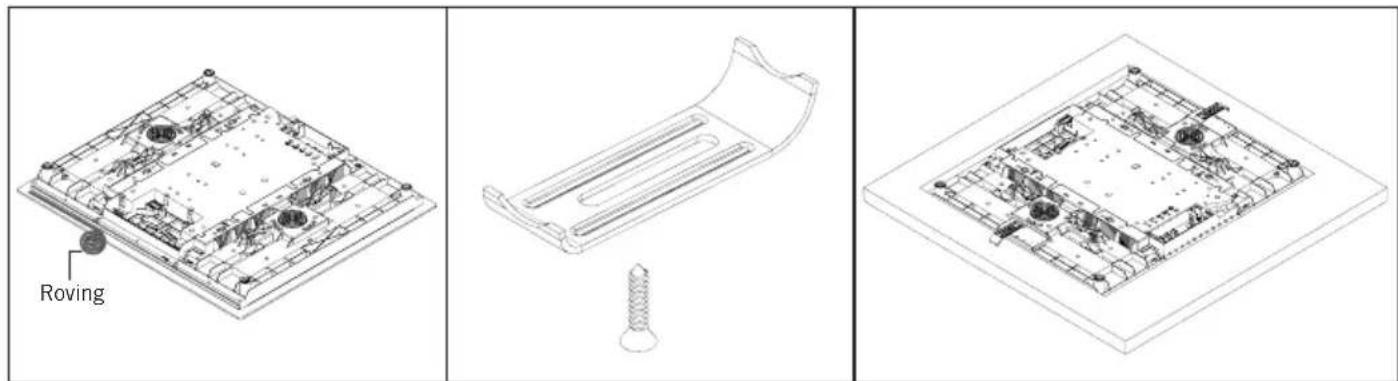
- In order to prevent entrance of foreign substances and liquids between cooktop and counter, apply the paste given in package to the sides of lower guard of counter. For corners, curl paste and increase curls till filling corner gaps.
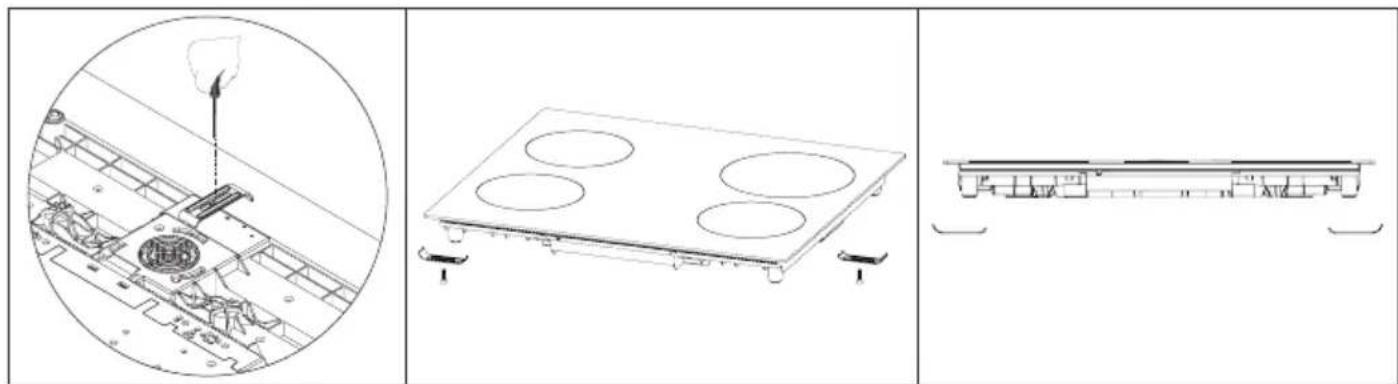
- Turn cooktop again and align with and place on counter.
- Fasten up your cooktop on counter by using the clamp and screws supplied.
On the assembly chart given in next page, it is shown how to assemble your cooktop.
natural_image
Technical line drawings of a portable stove with internal components and mounting base (no text or symbols)
natural_image
Pure diagram of a horizontal beam with two supports at both ends, no text or symbols presentFigure 2
- When product is mounted on a drawer, if it is possible to touch lower side of product, this section should be separated with a wooden shelf.

- While mounting cooktop on a closet, as shown in the figure above, in order to separate between closet and cooktop, a shelf should be mounted. If it is mounted on a built-in oven, there is no need to do that.
- If your cooktop will be mounted next to right or left wall, the minimum distance between wall and cooktop should be 50 mm.
GB
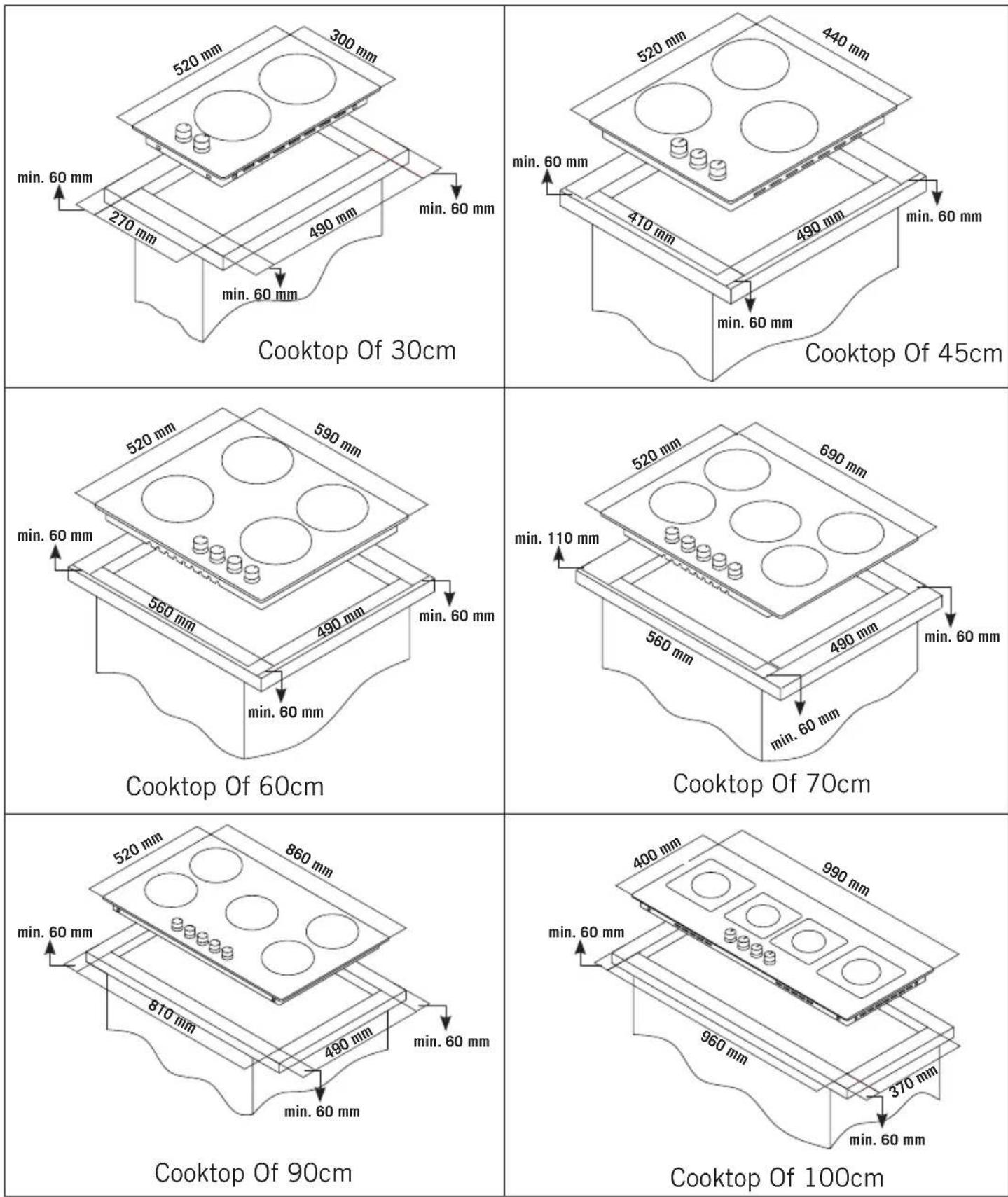
COUNTER CUTTING SIZES AND INSTALLATION OF YOUR COOKTOP
Pay attention to the drawings and dimensions given below while making cooktop installation and adjusting counter cutting sizes.
CORRECT PLACE FOR INSTALLATION
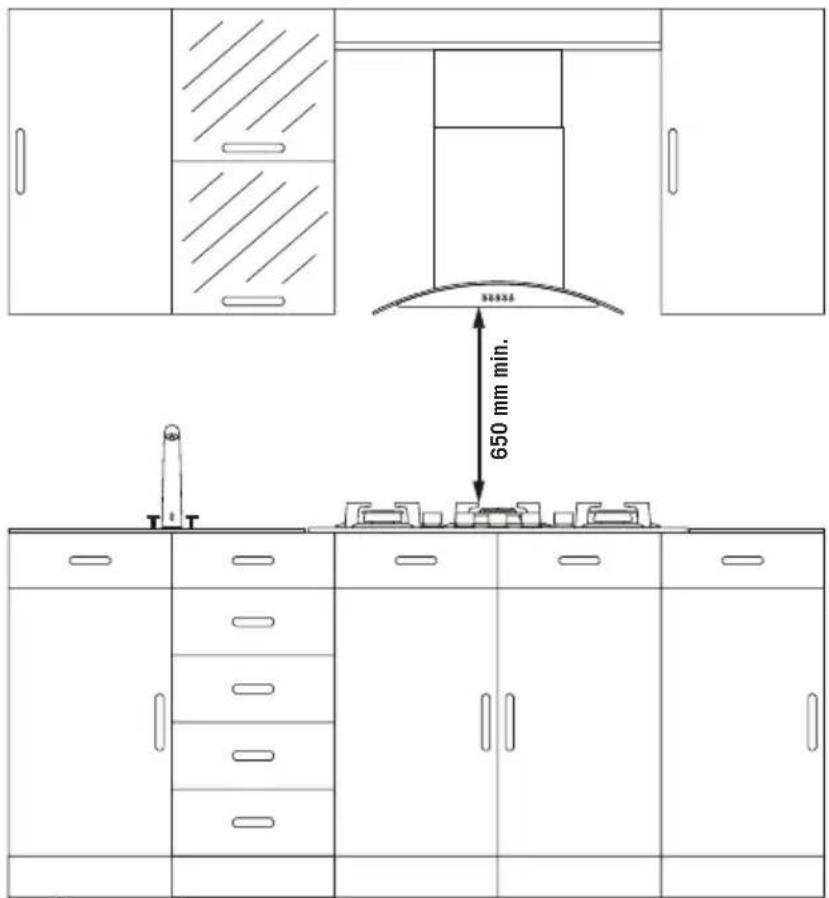
Product is de
accordance with the kitchen counters supplied from market. A safe distance should be left between the product and kitchen walls and furniture.
If hood/aspirator will be installed over your appliance, obey to the recommendation of hood/aspirator manufacturer for assembly height.
(min. 65 cm)
The gap that cooktop is to be placed on the counter should be cut in line with cooktop installation
dimensions.
For installation of the product, the rules specified in local standards related to electricity should be complied.
VENTILATION OF ROOM
The air needed for burning is received from room air and the gases emitted are given directly in room. For safe operation of your product, good room ventilation is a precondition. If no window or room to be utilized for room ventilation is available, additional ventilation should be installed. However, room has a door opening outside, it is no needed to vent holes.
| Room Size Ventilating Opening | |
| Smaller than 5m3 min. 100 cm2 | |
| Between 5 m3- 10 m3 min. 50 cm2 | |
| Bigger than 10m3 no need | |
| In basement or cellar min. 65 cm2 | |
TRANSFORMATION FROM NATURAL GAS TO LPG AND FROM LPG TO NATURAL GAS
- Turn off gas and electricity of the cooktop. If your cooktop is hot, wait for cooling down.
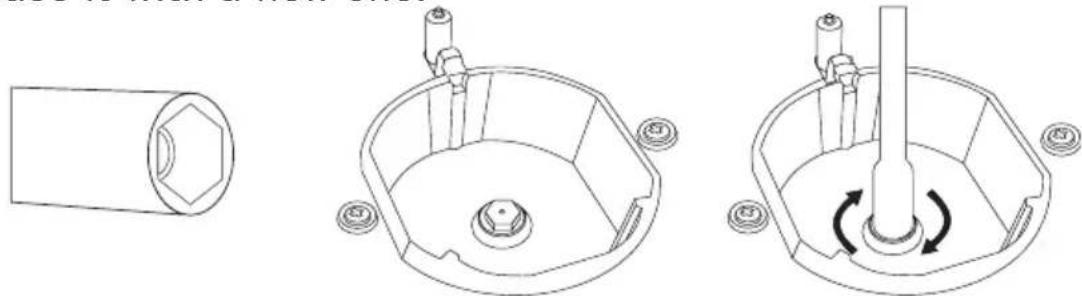
- For injector change, use a screwdriver whose edge is as the Figure 4.
- As seen in Figure 5, demount burner lid and burner of the cooktop and ensure visibility of injector.
- Remove injector by turning as shown in Figure 6 with screwdriver and replace it with a new one.
natural_image
Technical line drawings of a mechanical component with three views: top view, front view, and side view (no text or symbols)Figure 4 Figure 5 Figure 6
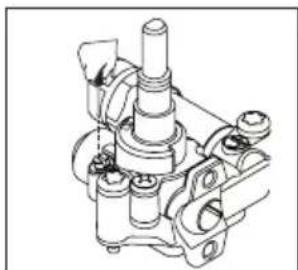
- After that, detach control switches of the cooktop. Make setting by turning the screw in the middle of gas cocks with a small screwdriver in the manner shown in the following picture. To adjust flow rate screw, use a screwdriver having suitable dimension. For LPG, turn the screw clockwise. For natural gas, turn the screw one time counter clockwise. At low position, length of normal flame should be 6-7 mm. For the last control, check out whether flame is open or closed.
Setting of your appliance may differ according to the type of gas cock used.

natural_image
Technical line drawings of mechanical components, one showing a circular component with three cylindrical parts and a handle, the other showing a multi-cylinder assembly with no visible text or symbols.Figure 7 Figure 8
GAS BREAKING SAFETY APPLIANCE (FFD)
Against putting out to be taken place as a result of liquid overflow at upper burners, safety appliance steps in and cut gas immediately.

Figure 9
USAGE OF YOUR COOKTOP Usage of Gas Cooktop
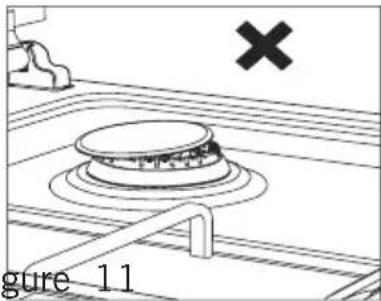
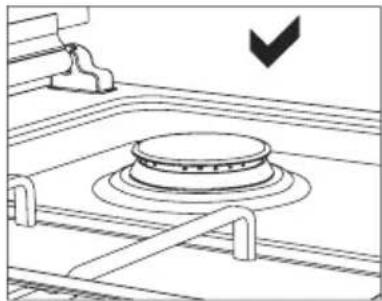
- Before starting to use your cooktop, be sure burner hoods are at correct position. Correct placement of burner hoods are shown in the following figure.
natural_image
Diagram of a kitchen sink with a circular component and a cross symbol, labeled 'gure 11' (no readable text or symbols beyond label)Figure 10 Figure 11
natural_image
Line drawing of a gas stove with a circular vent and a checkmark indicating a drop (no text or symbols)- Gas cocks have a special locking mechanism. Therefore, to operate cooktop zone, press button by pushing ahead and while opening or closing the cock, hold down the button.
- Closed
Fully open
Half open
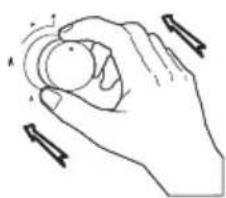
- For automatic igniting models, igniting is realized via electricity. Therefore, before operating appliance, be sure that appliance has electric connection. Igniting for these models is as follows.
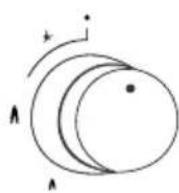
Cooktop cock is at closed position.
natural_image
Line drawing of a hand holding a circular object with directional arrows indicating motion (no text or symbols)To ignite cook- top, firstly press the button towards ahead.
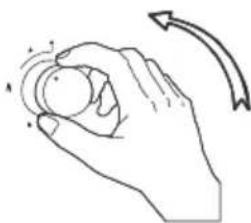
natural_image
Hand holding a circular object with motion arrows indicating rotation (no text or symbols)While holding down the button, lighter steps in and starts to ignition.
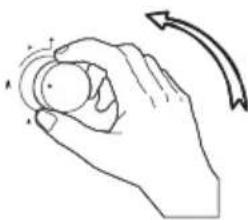
natural_image
Hand holding a circular object with motion arrows indicating rotation (no text or symbols)By turning the button left while holding down, you can provide ignition at flame length you want.
- Pay attention that cooktop grills are placed on cooktop table completely. In case of failure about this matter can cause pouring of the materials to be put on that.
- For the models having gas putting out safety, following realizing ignition procedure according to the guidelines above, wait for 5-10 seconds by pushing button ahead without keeping your hands off.
GB
Safety mechanism will step in this duration and ensures operation of the cooktop. With regard to gas putting out appliance, gas cock cuts the gas going to cooktop zone in case of putting out of cooktop flame due to any reason.
- While using coffee pot apparatus supplied along with the cooktop, be sure that foots of apparatus are placed on cooktop grill exactly and remain on cooktop zone in centred way. Use the apparatus only on small burner.
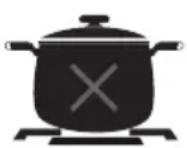
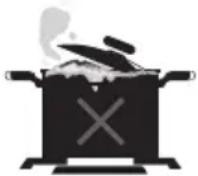
- While utilizing gas cooktops, use saucepan, placed on cooktop surface as far as possible. Thanks to that, you can save energy. In the following table, cooking pot diameters recommended to be used as per burners are given. Characteristic of Wok cooktop zone is to cook quickly.
POT DIAMETER
| GLASS HOBS | ||||||
| Domino | 45cm. Hobs | 60cm. Hand Control | 60cm. Control Front | 70cm. Control Front | 90cm. Control Front | |
| Small Burner 1 | 2-18cm 12- | 18cm 12-18 | 8cm 12-18 | m 12-18cm | 12-18cm | |
| Middle Burner | --- 18-20cm | 18-20cm 1 | 8-20cm 18 | 20cm 18-2 | 2cm | |
| Big Burner 18 | 24cm 22-24 | cm 22-24cm | 22-24cm | 22-24cm 2 | 2-26cm | |
| Wok Burner 24 | 26cm --- 2 | 4-26cm 24 | 26cm 24-26 | 6cm 26-30 | cm | |
| METAL HOBS | ||||||
| Domino | 45cm. Hobs | 60cm. Hand Control | 60cm. Control Front | 70cm. Control Front | 90cm. Control Front | |
| Small Burner 1 | 2-18cm 12- | 18cm 12-1 | 8cm 12-18cm | 12-18cm | 12-18cm | |
| Middle Burner | --- 18-20cm | 18-20cm 1 | 8-20cm 18- | 20cm 18-2 | 2cm | |
| Big Burner 18- | 22cm 22-24 | cm 22-26cm | 22-24cm | 22-24cm 2 | 2-26cm | |
| Wok Burner 24 | -26cm 24-2 | 6cm 24-26cm | 24-26cm | 24-26cm | 26-32cm | |


False TrueFalseFalse
Cooking pot to be used with products should have minimum 120 mm. diameter.
WOK BURNER
natural_image
Technical line drawing of a mechanical component with concentric rings and mounting brackets (no text or symbols)Figure 12
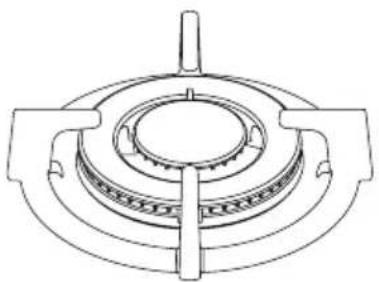
As it possesses double ring flame system, it gives homogenous heat distribution at the bottom of cooking pot at high temperature. It is ideal for short term and high temperature cooking. When you want to use regular cooking pot on wok burner, it is necessary that you remove wok cooking pot carrier from cooktop.
USAGE OF HOTPLATE
You can operate electric cooktops by turning the button on control panel you want to use to the level you desire. Cooktop powers as per levels are given in the following table.
| LEVEL 1 LEVEL 2 LEVEL 3 LEVEL 4 LEVEL 5 LEVEL 6 | ||||||
| ∅80mm 200W 2 | 50W 450W | --- --- --- | ||||
| ∅145mm 250W | 750W 1000W | --- --- --- | ||||
| ∅180mm 500W | 750W 1500W | --- --- --- | ||||
| ∅145mm Rapid | 500W 1000W | 1500W | --- --- --- | |||
| ∅180mm Rapid | 850W 1150W | 2000W | --- --- --- | |||
| ∅145mm 95W 1 | 55W 250W | 400W 750W | 1000W | |||
| ∅180mm 115W | 175W 250W | 600W 850W | 1500W | |||
| ∅145mm Rapid | 135W 165W | 250W 500W | 750W | 1500W | ||
| ∅180mm Rapid | 175W 220W | 300W 850W | 1150W | 2000W | ||
MAINTENANCE AND CLEANING
Before starting to maintenance or cleaning, firstly unplug the plug supplying electricity to cooktop and turn off gas valve. If cooktop is hot, wait for cooling down.
- For the purpose that your cooktop has long and economic life, regular cleaning and maintenance should be performed on your cooktop.
- Do not clean your cooktop with scratching tools such as bristle brush, wire wool or knife. Do not use abrasive, scratching, acid materials or detergent.
- Following mopping parts of your cooktop with soapy cloth, rinse it, later rinse well with a soft cloth.
- Clean glass surfaces with special glass cleaning substances. As scratching of glass surfaces leads to breaking, while cleaning glass surfaces, do not use abrasive cleaners or sharp metal scrapers.
- Do not clean your cooktop with steamy cleaners.
- Clean channels and lids of cooktop zones with soapy water and clean gas channels with a brush.
- In the course of cleaning your cooktop, never use flammable materials such as acid, thinner and gas.
- Do not wash plastic and aluminium parts of your cooktop in dishwasher.
- Clean vinegar, lemon, salt, coke and similar acid and alkaline containing substances poured on your cooktop immediately.
- In time, cooktop buttons turns hard or never turn any more, in such circumstances, it may be necessary that buttons are changed. The change should only be done by authorized service.
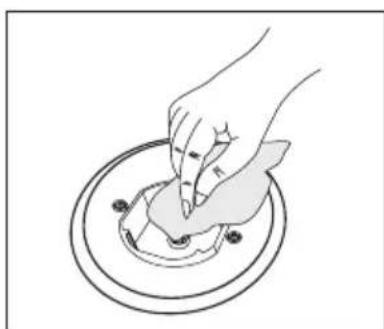
natural_image
Illustration of a hand pressing down on a circular component with a small object inside (no text or symbols)Figure 13 Figure 14

natural_image
Simple line drawing of a mechanical component with a central hub and circular base (no text or symbols)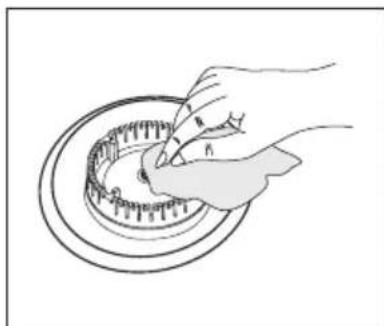
natural_image
Hand turning a circular mechanical component with teeth, no text or symbols visibleFigure 15
TROUBLES AND SOLUTION PROPOSALS
You can solve the troubles you can encounter at your product by checking the following points before calling technical service.
If cooktop does not operate;
- Check if power cable of cooktop is plugged in
- Examine with safe ways if electric exists on network
- Audit fuses.
• Control whether damage is available on power cable. - Check if main gas valve in your network is open
- Go through existence of breaking or twisting on gas pipe
- Be sure that gasp pipe is connected to cooktop in appropriate way.
• See over if suitable gas valve is used for your cooktop
(Get periodical maintenance done)
If starter does not operate;
- Be sure that electric power cable of product is plugged in
- Clean the edge and body sections of ignition spark plugs found on burners with a wet and dirt remover materials thoroughly. Be sure that the channels present on burners are open and clean.
Gas type (LPG or natural gas) that your appliance is manufactured foris stated in the label found behind the product and that show technical features. If gas setting of your appliance is not the same as gas setting of your network, it should be adjusted by making change by an expert person. In the following table, injector, gas flow and power values of appliance is given according to gas type.
GB
| INJECTOR, GAS FLOW And POWER TABLE | |||||||
| BURNERSPECIFICATIONS | G20,20 mbarG25,25 mbar | G20,25 mbar G20,13 mbar | |||||
| Gas Natural Gas Natural | Gas Natural | ||||||
| WokBurner (3,5) | Injector 1 | 40 mm 1,2 | 8 mm 1,60 | mm | |||
| Gas Flow 0 | 333 m^3/h | 333 m^3/h | 333 m^3/h | ||||
| Power 3, | 50 kW 3,50 | kW 3,50 kW | |||||
| WokBurner (2,5) | Injector 1 | 15 mm 1,0 | 6 mm 1,35 | mm | |||
| Gas Flow 0 | 243 m^3/h | 243 m^3/h | 243 m^3/h | ||||
| Power 2, | 50 kW 2,50 | kW 2,50 kW | |||||
| RapidBurner | Injector 1 | 15 mm 1,1 | 0 mm 1,45 | mm | |||
| Gas Flow 0 | 276 m^3/h | 276 m^3/h | 276 m^3/h | ||||
| Power 2, | 90 kW 2,90 | kW 2,90 kW | |||||
| Semi-RapidBurner | Injector 0 | 97 mm 0,9 | 2 mm 1,10 | mm | |||
| Gas Flow 0 | 162 m^3/h | 162 m^3/h | 162 m^3/h | ||||
| Power 1, | 70 kW 1,70 | kW 1,70 kW | |||||
| AuxiliaryBurner | Injector 0 | 72 mm 0,7 | 0 mm 0,85 | mm | |||
| Gas Flow 0 | 96 m^3/h | 96 m^3/h | 96 m^3/h | ||||
| Power 0, | 95 kW 0,95 | kW 0,95 kW | |||||
| INJECTOR, GAS FLOW And POWER TABLE | |||||||
| BURNERSPECIFICATIONS | G30,28-30 mbarG31,37 mbar | G30,50 mbar G30,37 mbar | |||||
| LPG LPG LPG | |||||||
| WokBurner (3,5) | Injector 0 | 96 mm 0,7 | 6 mm 0,96 | mm | |||
| Gas Flow | 254 | g/h | 254 | g/h | 254 | g/h | |
| Power 3,50 kW 3,50 | kW 3,50 kW | ||||||
| WokBurner (2,5) | Injector 0 | 82 mm 0,7 | 3 mm 0,78 | mm | |||
| Gas Flow | 182 | g/h | 182 | g/h | 182 | g/h | |
| Power 2,50 kW 2,50 | kW 2,50 kW | ||||||
| RapidBurner | Injector 0 | 85 mm 0,7 | 5 mm 0,85 | mm | |||
| Gas Flow | 211 | g/h | 211 | g/h | 211 | g/h | |
| Power 2,90 kW 2,90 | kW 2,90 kW | ||||||
| Semi-RapidBurner | Injector 0 | 65 mm 0,6 | 0 mm 0,65 | mm | |||
| Gas Flow | 124 | g/h | 124 | g/h | 124 | g/h | |
| Power 1,70 kW 1,70 | kW 1,70 kW | ||||||
| AuxiliaryBurner | Injector 0 | 50 mm 0,4 | 3 mm 0,50 | mm | |||
| Gas Flow | 69 | g/h | 69 | g/h | 69 | g/h | |
| Power 0,95 kW 0,95 | kW 0,95 kW | ||||||
ENVIRONMENTALLY-FRIENDLY DISPOSAL

natural_image
Symbol of a trash bin crossed with diagonal lines, no text or labels present- Dispose of packaging in an environmentally-friendly manner.
- This appliance is labelled in accordance with European Directive 2012/19/EU concerning used electrical and electronic appliances (waste electrical and electronic equipment - WEEE). The guideline determines the framework for the return and recycling of used appliances as applicable throughout to the EU.
PACKAGE INFORMATION
Packaging materials of the product are manufactured from recyclable materials in accordance with our National Environment Regulations. Do not dispose of the packaging materials together with the domestic or other wastes. Take them to the packaging material collection points designated by the local authorities.
natural_image
Isometric line drawing of a mechanical or architectural component with symmetrical slots and protrusions (no text or symbols)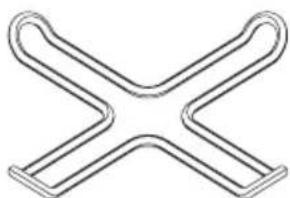
natural_image
Pure geometric X-shaped line drawing without any text, numbers, or symbols9

natural_image
Pure decorative line drawing of a circular frame with symmetrical cutouts and a horizontal bar above (no text or symbols)10
natural_image
Pure technical line drawing of a rectangular frame with internal slots and connectors (no text or symbols)12
flowchart
graph TD
    A["Start"] --> B{Condition}
    B --> C["Step 1: Circle with arrow pointing to top node"]
    B --> D["Step 2: Circle with arrow pointing to top node"]
    B --> E["Step 3: Circle with arrow pointing to top node"]
    B --> F["Step 4: Circle with arrow pointing to top node"]
    B --> G["Step 5: Circle with arrow pointing to top node"]
natural_image
Four identical diagrams showing circular shapes with arrows and dots, no text or symbols presentnatural_image
Three identical diagrams showing circles with arrows and dots, no text or symbols presentnatural_image
Technical line drawings of electrical heating equipment components, including a circuit board, four circular burners, and a battery pack (no text or labels)
natural_image
Pure diagram of a horizontal beam with two supports at both ends, no text or symbols presentFigura 12
natural_image
Technical line drawings of a mechanical component with three views: top view, side view showing internal components, and bottom view with rotation arrows (no text or symbols)Figura 4 Figura 5 Figura 6
natural_image
Simple line drawing of a mechanical component with a cylindrical shaft and a base, no text or symbols present.Figura 7
natural_image
Technical line drawing of a mechanical assembly (no text or symbols visible)Figura 8
SEGURIDAD DE RUPTURA DEL APARATO DE GAS (FFD)
natural_image
Diagram of a kitchen sink with a circular component and a handle, no text or symbols presentFigura 10 Figura 11

natural_image
Line drawing of a gas stove with a circular vent and a downward arrow indicating airflow (no text or symbols)natural_image
Line drawing of a hand holding a circular object with motion arrows indicating movement (no text or symbols)natural_image
Hand holding a circular object with motion arrows indicating rotation (no text or symbols)natural_image
Hand holding a circular object with motion arrows indicating rotation (no text or symbols)natural_image
Technical line drawing of a mechanical component with concentric rings and mounting brackets (no text or symbols)Figura 12
| NIVEL 1 NIVEL 2 NIVEL 3 NIVEL 4 NIVEL 5 NIVEL 6 | ||||||
| ∅80mm 200W 25 | 0W 450W | --- --- --- | ||||
| ∅145mm 250W 7 | 50W 1000W | --- --- --- | ||||
| ∅180mm 500W | 750W 1500W | --- --- --- | ||||
| ∅145mm Rápido | 500W 1000W | 1500W --- --- --- | ||||
| ∅180mm Rápido | 850W 1150W | 2000W --- --- --- | ||||
| ∅145mm 95W | 155W 2 | 50W 400W | 750W 1000W | |||
| ∅180mm 115W 1 | 75W 250W | 600W | 850W 1500W | |||
| ∅145mm Rápido | 135W 165W | 250W 500W | 750W 1500W | |||
| ∅180mm Rápido | 175W 220W | 300W 850W | 1150W | 2000W | ||
MANTENIMIENTO Y LIMPIEZA
natural_image
Illustration of a hand pressing down on a circular object with a handle, no text or symbols presentFigura 13 Figura 14

natural_image
Technical line drawing of a mechanical component with concentric rings and a central hub (no text or symbols)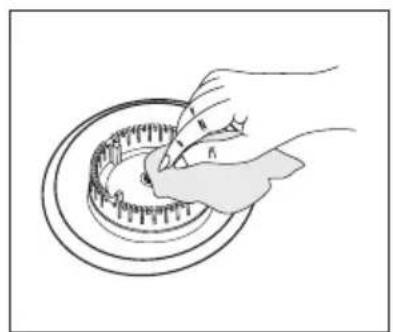
natural_image
Illustration of a hand using a tool to clean or inspect a circular mechanical component (no text or symbols visible)Figura 15
ES
PROBLEMAS Y SOLUCIONES PROPUESTAS
natural_image
Symbol of a trash bin with crossed diagonal lines indicating no waste or restriction (no text or labels)


- USER MANUAL GB MANUAL DEL USUARIO ES
- Dear User,
- CONTENTS
- IMPORTANT WARNINGS
- GB
- CONTROL PANEL
- ELECTRICAL CONNECTION SCHEME
- Electrical Connection and Safety
- Gas Connection and Safety
- IF BUILT-IN OVEN IS PLACED UNDER COOKTOP;
- INSTALLATION OF COOKSTOP
- COUNTER CUTTING SIZES AND INSTALLATION OF YOUR COOKTOP
- CORRECT PLACE FOR INSTALLATION
- VENTILATION OF ROOM
- TRANSFORMATION FROM NATURAL GAS TO LPG AND FROM LPG TO NATURAL GAS
- GAS BREAKING SAFETY APPLIANCE (FFD)
- USAGE OF YOUR COOKTOP Usage of Gas Cooktop
- WOK BURNER
- USAGE OF HOTPLATE
- MAINTENANCE AND CLEANING
- TROUBLES AND SOLUTION PROPOSALS
- If cooktop does not operate;
- If starter does not operate;
- ENVIRONMENTALLY-FRIENDLY DISPOSAL
- PACKAGE INFORMATION
- SEGURIDAD DE RUPTURA DEL APARATO DE GAS (FFD)
- MANTENIMIENTO Y LIMPIEZA
- ES
- PROBLEMAS Y SOLUCIONES PROPUESTAS
Brand : SVAN
Model : SVEC4RC
Category : Hot plate