Exite Write AT10PE - Tablet TOSHIBA - Free user manual and instructions
Find the device manual for free Exite Write AT10PE TOSHIBA in PDF.


User questions about Exite Write AT10PE TOSHIBA
0 question about this device. Answer the ones you know or ask your own.
Ask a new question about this device
Download the instructions for your Tablet in PDF format for free! Find your manual Exite Write AT10PE - TOSHIBA and take your electronic device back in hand. On this page are published all the documents necessary for the use of your device. Exite Write AT10PE by TOSHIBA.
USER MANUAL Exite Write AT10PE TOSHIBA
Leading Innovation >>>
excite®
User's Guides
excite® Write User's Guide
excite® Pro User's Guide
If you need assistance:
Toshiba's Support Web site
tabletsupport.toshiba.com
For more information, see "If Something Goes Wrong" on page 118 in this guide.
GMAD00367010
07/13
TOSHIBA
Leading Innovation >>>
excite ^® Write
User's Guide
If you need assistance:
Toshiba's Support Web site
tabletsupport.toshiba.com
For more information, see "If Something Goes Wrong" on page 118 in this guide.
WARNING
Handling the cord on this product will expose you to lead, a chemical known to the State of California to cause birth defects or other reproductive harm.
Wash hands after handling.

For the state of California only.
Model: AT10PE - A Series
Regulatory Information
Protection of Stored Data
For your important data, please make periodic back-up copies of all the data stored on the hard disk or other storage devices as a precaution against possible failures, alteration, or loss of the data. IF YOUR DATA IS ALTERED OR LOST DUE TO ANY TROUBLE, FAILURE OR MALFUNCTION OF THE HARD DISK DRIVE OR OTHER STORAGE DEVICES AND THE DATA CANNOT BE RECOVERED, TOSHIBA SHALL NOT BE LIABLE FOR ANY DAMAGE OR LOSS OF DATA, OR ANY OTHER DAMAGE RESULTING THEREFROM. WHEN COPYING OR TRANSFERRING YOUR DATA, PLEASE BE SURE TO CONFIRM WHETHER THE DATA HAS BEEN SUCCESSFULLY COPIED OR TRANSFERRED. TOSHIBA DISCLAIMS ANY LIABILITY FOR THE FAILURE TO COPY OR TRANSFER THE DATA CORRECTLY.
Critical Applications
The device you have purchased is not designed for any “critical applications.” “Critical applications” means life support systems, medical applications, connections to implanted medical devices, commercial transportation, nuclear facilities or systems or any other applications where product failure could lead to injury to persons or loss of life or catastrophic property damage. ACCORDINGLY, TOSHIBA, ITS AFFILIATES AND SUPPLIERS DISCLAIM ANY AND ALL LIABILITY ARISING OUT OF THE USE OF THE DEVICE PRODUCTS IN ANY CRITICAL APPLICATIONS. IF YOU USE THE DEVICE PRODUCTS IN A CRITICAL APPLICATION, YOU, AND NOT TOSHIBA, ASSUME FULL RESPONSIBILITY FOR SUCH USE.
Radio Frequency (RF) Energy Exposure
When the transmitter and receiver on your device is powered ON, RF energy is received and transmitted. The power level your device transmits at is controlled by your network access while in communication.
Your device is approved to the radio standard by the country/region listed in the approved countries table for the module installed in your device.
FCC Notice "Declaration of Conformity Information"
This equipment has been tested and found to comply with the limits for a Class B digital device, pursuant to Part 15 of the FCC rules. These limits are designed to provide reasonable protection against harmful interference in a residential installation.
This equipment generates, uses and can radiate radio frequency energy and, if not installed and used in accordance with the instructions, it may cause harmful interference to radio communications. However, there is no guarantee that interference will not occur in a particular installation. If this equipment does cause harmful interference to radio or television reception, which can be determined by turning the equipment off and on, the user is encouraged to try to correct the interference by one or more of the following measures:
◆ Reorient or relocate the receiving antenna.
◆ Increase the separation between the equipment and receiver.
Connect the equipment to an outlet on a circuit different from that to which the receiver is connected.
- Consult the dealer or an experienced radio/TV technician for help.
NOTE
Only Peripherals complying with the FCC Class B limits may be attached to this equipment. Operation with noncompliant peripherals or peripherals not recommended by Toshiba is likely to result in interference to radio and TV reception. Shielded cables must be used between the external devices and the device's ports. Changes or modifications made to this equipment not expressly approved by Toshiba or parties authorized by Toshiba could void the user's authority to operate the equipment.
4
This device complies with Part 15 of the FCC Rules. Operation is subject to the following two conditions:
This device may not cause harmful interference.
This device must accept any interference received, including interference that may cause undesired operation.
Contact Toshiba's Support Web site at tabletsupport.toshiba.com.
Wireless Interoperability
The Toshiba Wireless LAN Card products are designed to be interoperable with any wireless LAN product that is based on Direct Sequence Spread Spectrum (DSSS) radio technology, and is compliant to:
The IEEE 802.11 Standard on Wireless LANs (Revision A/B/G), as defined and approved by the Institute of Electrical and Electronics Engineers.
The Wireless Fidelity (Wi-Fi ^® ) certification as defined by the Wi-Fi Alliance. The “Wi-Fi CERTIFIED” logo is a certification mark of the Wi-Fi Alliance.
CAUTION
Bluetooth ^® and Wireless LAN devices operate within the same radio frequency range and may interfere with one another. If you use Bluetooth ^® and Wireless LAN devices simultaneously, you may occasionally experience a less than optimal network performance or even lose your network connection.
If you should experience any such problem, immediately turn off your Bluetooth ^® or Wireless LAN device.
Please contact Toshiba product support on Web site http://www.toshiba-europe.com/computers/tnt/bluetooth.htm in Europe or tabletsupport.toshiba.com in the United States for more information.
Wireless LAN and Your Health
Wireless LAN products, like other radio devices, emit radio frequency electromagnetic energy. The level of energy emitted by Wireless LAN devices however is far much less than the electromagnetic energy emitted by wireless devices like for example mobile phones.
Because Wireless LAN products operate within the guidelines found in radio frequency safety standards and recommendations, Toshiba believes Wireless LAN is safe for use by consumers. These standards and recommendations reflect the consensus of the scientific community and result from deliberations of panels and committees of scientists who continually review and interpret the extensive research literature.
In some situations or environments, the use of Wireless LAN may be restricted by the proprietor of the building or responsible representatives of the organization. These situations may for example include:
◆ Using the Wireless LAN equipment on board airplanes, or
In any other environment where the risk of interference to other devices or services is perceived or identified as harmful.
If you are uncertain of the policy that applies on the use of wireless devices in a specific organization or environment (e.g. airports), you are encouraged to ask for authorization to use the Wireless LAN device prior to turning on the equipment.
CAUTION
Exposure to Radio Frequency Radiation
The radiated output power of the Toshiba Wireless LAN Card is far below the FCC radio frequency exposure limits. Nevertheless, the Toshiba Wireless LAN Card shall be used in such a manner that the potential for human contact during normal operation is minimized. The antenna(s) used for this transmitter must not be co-located or operating in conjunction with any other antenna or transmitter.
Specific Absorption Rate (IEEE)
Your device is designed to be in compliance with Radio Waves exposure regulations and does not exceed the limits for exposure to radio waves (radio frequency electromagnetic fields) in accordance with the Federal Communications Commission (FCC) and Industry Canada (IC). A substantial safety margin is set to assure the safety of all persons, regardless of health.
A unit of measurement known as the Specific Absorption rate, or SAR is utilized for the radio wave exposure guidelines. The SAR measurement for devices does not exceed 1.6W/kg.
The actual SAR values for your device, while in use, are normally well below the stated values. The operating power of your device is automatically decreased when full power is not needed for the wireless connection to increase system efficiency and to minimize interference on the network. The lower the power output of the device the lower its SAR value.
As stated by the World Health Organization, present scientific information indicates no special precautions are needed for the use of this device. To further reduce any exposure, limit your usage.
WARNING
Tum Wi-Fi ^® , Bluetooth ^® , and Wireless WAN Functionalities off for Cardiac Pacemakers
✿Turn Wi-Fi ^® , Bluetooth ^® , and Wireless WAN functionality off when you are near a person who may have a cardiac pacemaker implant or other medical electric device. Radio waves may affect pacemaker or medical device operation, possibly resulting in serious injury. Follow the instructions of your medical device when using any Wi-Fi ^® or Bluetooth ^® or Wireless WAN functionally.
Regulatory Information
This device complies with the following radio frequency and safety standards.
Canada—Industry Canada (IC)
This Class B digital apparatus complies with Canadian ICES-003.
This device complies with RSS 210 of Industry Canada.
CAUTION
The installer of this radio equipment must ensure that the antenna is located or pointed such that it does not emit RF field in excess of Health Canada limits for the general population; consult Safety Code 6, obtainable from Health Canada's Web site www.hc-sc.gc.ca/rpb. The RF device shall not be co-located with any other transmitter that has not been tested with this device.
Operation is subject to the following two conditions: (1) this device may not cause interference, and (2) this device must accept any interference, including interference that may cause undesired operation of this device.
The term "IC" before the equipment certification number only signifies that the Industry Canada technical specifications were met.
To prevent radio interference to the licensed service, this device is intended to be operated indoors and away from windows to provide maximum shielding. Equipment (or its transmit antenna) that is installed outdoors is subject to licensing.
Europe—Restrictions for use of 2.4 GHz Frequencies in European Community Countries
| België/ Belgique: | For private usage outside buildings across public grounds over less than 300m no special registration with IBPT/BIPT is required. Registration to IBPT/BIPT is required for private usage outside buildings across public grounds over more than 300m. For registration and license please contact IBPT/BIPT. |
| Voor privé-gebruik buiten gebouw over publieke groud over afstand kleiner dan 300m geen registratie bij BIPT/IBPT nodig; voor gebruik over afstand groter dan 300m is wel registratie bij BIPT/IBPT nodig. Voor registratie of licentie kunt u contact opnemen met BIPT. | |
| Dans le cas d'une utilisation privée, à l'extérieur d'un bâtiment, au-dessus d'un espace public, aucun enregistrement n'est nécessaire pour une distance de moins de 300m. Pour une distance supérieure à 300m un enregistrement auprès de l'IBPT est requise. Pour les enregistrements et licences, veuillez contacter l'IBPT. | |
| Deutschland: License required for outdoor installations. Check with reseller for procedure to follow. | |
| Anmeldung im Outdoor-Bereich notwendig, aber nicht genehmigungspflichtig. Bitte mit Händler die Vorgehensweise abstimmen. | |
| France: Restricted frequency band: only channels 1 to 7 (2400 MHz and 2454 MHz respectively) may be used outdoors in France. Please contact A.R.T. (http://www.art-telecom.fr) for applicable procedures to follow. | |
| Bande de fréquence restreinte: seuls les canaux 1- 7 (2400 et 2454 MHz respectivement) doivent être utilisés endroits extérieur en France. Vous pouvez contacter l'Autorité de Régulation des Télécommunications (http://www.art-telecom.fr) pour la procédure à suivre. | |
| Italia: | License required for indoor use. Use with outdoor installations not allowed. |
| È necessaria la concessione ministeriale anche per l'uso interno. Verificare con i rivenditori la procedura da seguire. | |
| Nederland: License required for outdoor installations. Check with reseller for procedure to follow. | |
| Licentie verplicht voor gebruik met buitenantennes. Neem contact op met verkoper voor juiste procedure. | |
Bluetooth® Wireless Technology Interoperability
Bluetooth ^® modules are designed to be interoperable with any product with Bluetooth ^® wireless technology that is based on Frequency Hopping Spread Spectrum (FHSS) radio technology, and is compliant to:
Bluetooth® Specification as defined and approved by The Bluetooth® Special Interest Group.
◆Logo certification with Bluetooth® wireless technology as defined by The Bluetooth® Special Interest Group.
CAUTION
Bluetooth® modules enable wireless networks over two or more (up to a total of seven) Toshiba portable devices. Please contact Toshiba product support on Web site http://www.toshiba-europe.com/computers/tnt/bluetooth.htm in Europe or tabletsupport.toshiba.com in the United States for more information.
When you use a Bluetooth ^® module close to 2.4 GHz Wireless LAN devices, Bluetooth ^® transmissions might slow down or cause errors. If you detect certain interference while you use a Bluetooth ^® device, always change the frequency, move your device to the area outside of the interference range of 2.4 GHz Wireless LAN devices (40 meters/43.74 yards or more) or stop transmitting from your device. Please contact Toshiba product support on Web site http://www.toshiba-europe.com/computers/tnt/bluetooth.htm in Europe or tabletsupport.toshiba.com in the United States for more information.
Bluetooth ^® and Wireless LAN devices operate within the same radio frequency range and may interfere with one another. If you use Bluetooth ^® and Wireless LAN devices simultaneously, you may occasionally experience a less than optimal network performance or even lose your network connection. If you should experience any such problem, immediately turn off either one of your Bluetooth ^® or Wireless LAN. Please contact Toshiba product support on Web site http://www.toshiba-europe.com/computers/tnt/bluetooth.htm in Europe or tabletsupport.toshiba.com in the United States for more information.
Bluetooth® Wireless Technology and Your Health
The products with Bluetooth ^® wireless technology, like other radio devices, emit radio frequency electromagnetic energy. The level of energy emitted by devices with Bluetooth ^® wireless technology however is much less than the electromagnetic energy emitted by wireless devices such as mobile phones.
Because products with Bluetooth ^® wireless technology operate within the guidelines found in radio frequency safety standards and recommendations, Toshiba believes Bluetooth ^® wireless technology is safe for use by consumers. These standards and recommendations reflect the consensus of the scientific community and result from deliberations of panels and committees of scientists who continually review and interpret the extensive research literature.
In some situations or environments, the use of Bluetooth ^® wireless technology may be restricted by the proprietor of the building or responsible representatives of the organization. These situations may for example include:
◆ Using the equipment with board airplanes, or
Bluetooth ^® wireless technology on
In any other environment where the risk of interference to other devices or services is perceived or identified as harmful.
If you are uncertain of the policy that applies on the use of wireless devices in a specific organization or environment (e.g. airports), you are encouraged to ask for authorization to use the device with Bluetooth® wireless technology prior to turning on the equipment.
CAUTION
Exposure to Radio Frequency Radiation
The radiated output power of the Bluetooth ^® module is far below the FCC radio frequency exposure limits. Nevertheless, the Bluetooth ^® module shall be used in such a manner that the potential for human contact during normal operation is minimized.
Copyright
This guide is copyrighted by Toshiba America Information Systems, Inc. with all rights reserved. Under the copyright laws, this guide cannot be reproduced in any form without the prior written permission of Toshiba. No patent liability is assumed, however, with respect to the use of the information contained herein.
©2013 by Toshiba America Information Systems, Inc. All rights reserved.
Export Administration Regulation
This product and/or document contains technical data that may be controlled under the U.S. Export Administration Regulations, and may be subject to the approval of the U.S. Department of Commerce prior to export. Any export, directly or indirectly, in contravention of the U.S. Export Administration Regulations is prohibited.
Notice
While Toshiba has made every effort at the time of publication to ensure the accuracy of the information provided herein, product specifications, configurations, prices, system/component/options availability are all subject to change without notice. For the most up-to-date product information about your device, or to stay current with the various product software or hardware options, visit Toshiba's Web site at tabletsupport.toshiba.com. Toshiba assumes no liability for any damages incurred directly or indirectly from any errors or omissions contained herein. In no event shall Toshiba be liable for any incidental, consequential, special, or exemplary damages, whether based on tort, contract or otherwise, arising out of or in connection with this information or any other information contained herein or the use thereof.
Trademarks
App Place, Excite, PixelPure, TruNote, and TruPen are either trademarks or registered trademarks of Toshiba America Information Systems, Inc. and/or Toshiba Corporation.
Bluetooth word mark and logos are owned by the Bluetooth SIG, Inc. and any use of such marks by Toshiba is under license. Other trademarks and trade names are those of their respective owners.
U.S. patents apply to this product. See http://patents.dts.com. Manufactured under license from DTS Licensing Limited. DTS, the Symbol, & DTS and the Symbol together are registered trademarks and DTS Premium Voice Pro is a trademark of DTS, Inc. ©DTS, Inc. All Rights Reserved.
Google, the Google logo, Android, Android Market, Google Maps, Google Play, Google eBooks, Gmail, and YouTube are trademarks of Google, Inc. The terms HDMI and HDMI High-Definition Multimedia Interface, and the HDMI logo are trademarks or registered trademarks of HDMI Licensing LLC in the United States and other countries.
Microsoft is a registered trademark of Microsoft Corporation in the United States and/or other countries.
Secure Digital, SD, and microSD are trademarks or registered trademarks of SD-3C, LLC in the United States, other countries or both.
Wi-Fi is a registered trademark of the Wi-Fi Alliance.
All other brand and product names are trademarks or registered trademarks of their respective companies.
Device Recycling Information
As part of a commitment to people and the future, Toshiba promotes the efficient use of resources by working to achieve our zero-waste-to-landfill goal at all our production sites. In addition to our existing waste reduction and recycling policies, Toshiba is strongly committed to reducing electronic waste. In order to ensure efficient use of resources and appropriate treatment of hazardous substances, in accordance with recycling regulations in each state, country, and territory, Toshiba wants to make it easy for customers to recycle products at the end of the life cycle. To learn more about Toshiba's sustainability commitment, visit us.toshiba.com/green.
Licenses
This Product is licensed under the AVC, the VC-1 and the MPEG-4 Part 2 Visual patent portfolio licenses for the personal and non-commercial use of a consumer to (i) encode video in compliance with the above standards ("Video Standards") and/or (ii) decode AVC, VC-1 and MPEG-4 Part 2 Visual that was encoded by a consumer engaged in personal and non-commercial activity or was obtained from a video provider licensed to provide such video. None of the licenses extend to any other product regardless of whether such product is included with this product in a single article. No license is granted or shall be implied for any other use. Additional information may be obtained from MPEG LA, LLC.
See www.mpegla.com.
Contents
Introduction....18
This guide 19
Safety icons 19
Other icons used.... 20
Your device's features and specifications ..... 20
Other documentation.... 20
Service options 21
Precautions 21
File management tips.... 22
Toshiba's online resources 22
Chapter 1: Getting Started....23
Features and components.... 23
Front.... 24
Back.... 24
Left side 25
Right side 25
Top.... 26
Bottom 26
Connecting to a power source 26
Battery Notice 27
Charging the battery 28
Taking care of your battery.... 29
Safety precautions 29
Optimizing battery life 29
Maintaining your battery 30
Disposing of your device 30
Using the device for the first time.... 31
Turning on the power 31
Setting up your device 32
Setting up your Wi-Fi® connection.... 33
Got Google™? 33
Make it Google™ 34
Google™ & Location.... 35
Setting the date and time.... 38
Waking the tablet 40
Setting up Wi-Fi ^® and Bluetooth ^® connections 41
Registering your Toshiba device 42
Backing up your data.... 42
Backing up data using TOSHIBA File Manager 42
Backing up data using your Google™ Account.... 42
Restoring your data using your Google™ Account.... 43
Navigation and features.... 44
Home screen.... 45
Touch screen navigation...... 46
Navigating the Home screen.... 47
System bar.... 47
Securing your tablet.... 50
Customizing your Home screens.... 53
Adding an item to a Home screen 53
Moving an item from the Home screen...... 53
Removing an item from a Home screen ..... 53
Creating, naming, and removing folders...... 54
Changing the wallpaper 55
Turning off the device 56
Options for turning off the device 56
Using Shut down mode 57
Using Sleep mode.... 58
Managing your accounts 58
Add an account.... 59
Remove an account 59
Navigation, Maps, and Local 61
Managing downloads.... 61
Factory data reset.... 62
Caring for your device.... 63
Cleaning the device 63
Chapter 2: Settings....64
Customizing your device's settings.... 64
Apps and Settings menus.... 64
Wireless and networks settings 69
Sound settings.... 70
Display settings.... 71
Location access settings 72
Security settings 73
Apps settings 74
Users....75
Accounts settings 77
Backup & reset settings.... 78
Storage settings.... 80
Language & input settings 80
Accessibility settings.... 81
Date & time settings.... 82
About tablet 83
Chapter 3: Working with Apps....86
Downloading Toshiba Apps.... 86
TOSHIBA Media Player.... 86
Apps....87
Downloading from Google Play™ Store...... 87
Preinstalled Apps on your tablet.... 88
Uninstalling Apps on your tablet.... 88
Chapter 4: Exploring the Features on your Device .... 89
Using your TruPen™ with your Excite® Write tablet .... 89 Included TruPen™ and accessories .... 89 Getting to know your TruPen™ .... 90 Navigating apps and settings .... 90 Configuring the TruPen™ side button settings.... 91
TruNote™ application....92 Desktop....93 TruNote™ Desktop menu....94 Drawer....95 Note/Page Preview....95 Note/Page Menu....96
TruNote™ Pen Settings .... 97 Changing pen strokes and colors.... 97 TruNote™ Memo Gallery .... 99 Edit/Mark-up a TruNote™ Memo Gallery Screen Capture .... 100
Using the onscreen keyboard.... 101 Type to enter text.... 101 Speak to enter text.... 103
Using the built-in speakers .... 104 Using external speakers or headphones .... 104 Recording sounds.... 105
Using the camera.... 105 Using a microSD™ Card .... 105 Inserting memory media .... 105 Removing memory media.... 106
Adding optional external devices.... 107 Using an external keyboard.... 107 Using an external mouse.... 107 Using external devices.... 108
Chapter 5: Utilities....109 TOSHIBA Service Station....110 Check for application updates....112 Downloading updates....112 Installing updates....112
Downloading and installing System
updates 113
TOSHIBA File Manager Utility.... 113
File browsing screen.... 115
Operation of files/folders.... 115
Chapter 6: If Something Goes Wrong......118
Problems when you turn on the device 118
The operating system is not working.... 119
Internet problems.... 119
Power and the batteries.... 120
Display problems 120
Sound system problems.... 121
Wireless networking problems.... 121
If you need further assistance.... 122
Before you contact Toshiba.... 122
Contacting Toshiba.... 123
Other Toshiba Internet Web sites 123
Toshiba's worldwide offices 123
Appendix A: Power Cord/Cable Connectors.....125
Glossary....126
Index 137
Introduction
Welcome to the world of powerful, portable, multimedia.
With your Toshiba tablet device, you can watch movies, listen to your favorite music, read books, play games and do much more.
NOTE
The product specifications and configuration information are designed for a product Series. Your particular model may not have all the features and specifications listed or illustrated. For more detailed information about the features and specifications on your particular model, please visit Toshiba's Web site at tabletsupport.toshiba.com.
While Toshiba has made every effort at the time of publication to ensure the accuracy of the information provided herein, product specifications, configurations, prices, system/component/options availability are all subject to change without notice. For the most up-to-date product information about your device, or to stay current with the various device software or hardware options, visit Toshiba's Web site at tabletsupport.toshiba.com.
This guide
This guide introduces the features on your device as well as some basic procedures needed to perform tasks on your tablet, which are powered by the Android™ 4.2, Jelly Bean. This product brings new features and performance enhancements to your device.
You can:
Read the entire guide from beginning to end.
◆Skim through and stop when a topic interests you.
Use the table of contents and the index to find specific information.
Safety icons
All of the Safety instructions contained in this manual must be read carefully and be fully understood before you attempt to use this device, in order to avoid potential hazards that could cause bodily injury, property damage, or damage to the device.
The Safety Instructions contained in this Manual have been categorized according to the seriousness of the potential hazards, through the use of the following signal words.
DANGER
Indicates an imminently hazardous situation which, if not avoided, will result in death or serious injury.
▲WARNING
Indicates a potentially hazardous situation which, if not avoided, could result in death or serious injury.
▲ CAUTION
Indicates a potentially hazardous situation which, if not avoided, may result in minor or moderate injury.
CAUTION
Indicates a potentially hazardous situation which, if not avoided, may result in property damage.
NOTE
Provides important information.
Other icons used
Additional icons highlight other helpful or educational information:

TECHNICAL NOTE: This icon indicates technical information about the device.

HINT: This icon indicates helpful hints and tips.

DEFINITION: This icon indicates the definition of a term used in the text.
Your device's features and specifications
Certain chassis are designed to accommodate all possible configurations for an entire product Series. Your select model may not have all the features and specifications corresponding to all of the icons or switches shown on the chassis, unless you have selected all those features.
This information applies to all the features and icons described in this guide.
Below are examples of some of the many possible icons used on your device:


(Sample Illustration) System icons
Other documentation
Your device comes with the following documentation:
◆A Legal/Safety/Regulatory document
A Quick Start document
A Standard Limited Warranty
It may also contain guides for other programs that may come with your system.
For accessory information, visit Toshiba's Web site at accessories.toshiba.com.
Service options
Toshiba's standard limited warranty, extended warranty, and service upgrade terms and conditions are available at warranty.toshiba.com.
To stay current on the most recent applications, application updates, and hardware options for your device, as well as other product information, be sure to regularly check the Toshiba Web site at tabletsupport.toshiba.com.
If you have a problem or need to contact Toshiba, see "If Something Goes Wrong" on page 118.
Precautions
Your device is designed to provide optimum safety and ease of use, and to withstand the rigors of travel. You should observe certain precautions to further reduce the risk of personal injury or damage to the device.
▲WARNING
Keep this device away from small children. This device is not a toy and may be hazardous to small children, for example, small detachable parts may be a choking hazard. Improper use of device could result in loud volume emitting from the device possibly causing hearing damage, and improper use and handling of batteries could result in possible injury.
CAUTION
Never place a heavy object on the device and be careful not to drop a heavy object onto the device. It could damage the device or cause system failure.
Turning off the device while it is reading from or writing to flash media may damage the flash media.
- Keep the device and disks away from objects that generate strong magnetic fields, such as large stereo speakers.
◆Scan all new files for viruses.
This precaution is especially important for files you receive via email or download from the Internet. Occasionally, even new programs you buy from a supplier may contain a virus. You need a special program to check for viruses.
File management tips
◆ Back up your files to external media on a regular basis. Label the backup copies clearly and store them in a safe place.
As you work with data it exists in the device's memory. This memory is called “volatile memory” because it is only active while the device is turned on. When you turn off the device, all the data remaining in volatile memory is lost. To help avoid data loss, save your work to Internal Storage or network storage. Your work (data) will remain in internal storage to be called up when you need it. As long as the internal storage remains healthy, your data is relatively safe. However on occasion, hardware failures do happen. If you experience a hardware failure, your data could be lost. As an extra step to help avoid data loss, back up your data. See “Backing up your data” on page 42 for more information.
◆Scan all new files for viruses.
This precaution is especially important for files you receive via external media, email, or download from the Internet.
Toshiba's online resources
Toshiba maintains a number of online sites to which you can connect. These sites provide information about Toshiba products, give help with technical questions and keep you up to date with future upgrades. For more information, see "Contacting Toshiba" on page 123.
Chapter 1
Getting Started
This chapter provides tips for using your device effectively, summarizes how to connect components, and explains what to do the first time you use your device.
Please read and adhere to all safety information carefully and make sure you fully understand the instructions before you attempt to use your device in order to avoid potential hazards that could cause bodily injury, property damage, or damage the device.
Features and components
For further details on each of the items listed in the following section, be sure to follow the provided references to sections later in this document.
Front
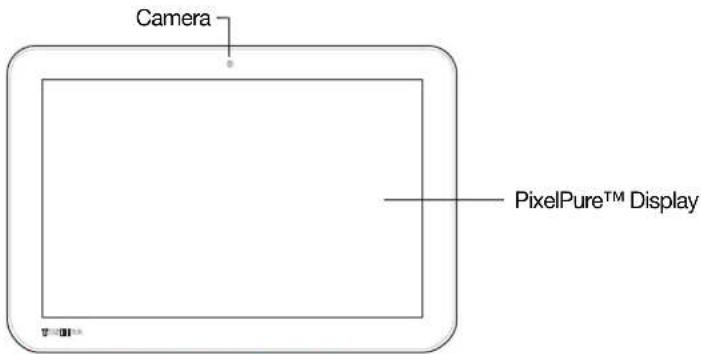
(Sample Illustration) Front view
Camera—Allows you to take still photos (includes flash settings) or record videos. For more information, see "Using the camera" on page 105.
Back
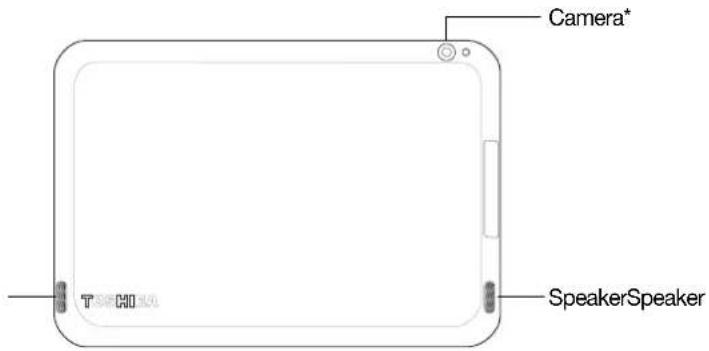
*Available on certain models
(Sample Illustration) Back view
Camera—Allows you to take still photos (includes flash settings) or record videos. For more information, see "Using the camera" on page 105.
Speakers—Allow you to listen to sounds on your device. For more information, see “Using the built-in speakers” on page 104.
Left side
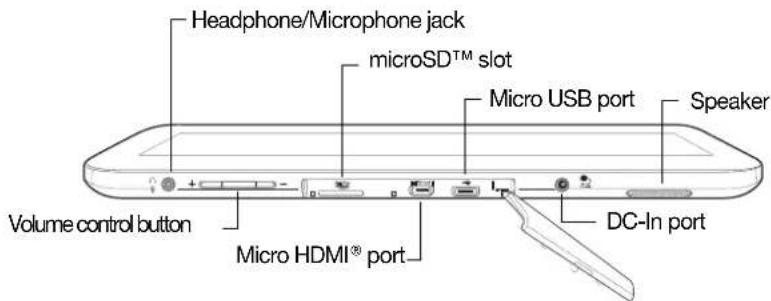
(Sample Illustration) Left side view
Headphone/Microphone—Allows you to listen to or record sounds onto your device. For more information, see "Using external speakers or headphones" on page 104.
Volume control button—Allows you to increase/decrease the volume.
microSD™ slot—Supports the use of Micro Secure Digital™ (SD™) media. For more information, see "Using a microSD™ Card" on page 105.
Micro HDMI® port—Allows connection to an HDMI®-compatible television or external display device.
Micro USB port—Allows the transfer of data.
DC-In port—Allows to connect AC power to the device.
Speaker—Allows you to listen to sounds on your device.
Right side

(Sample Illustration) Right side view
✿Speaker—Allows you to listen to sounds on your device.
Top
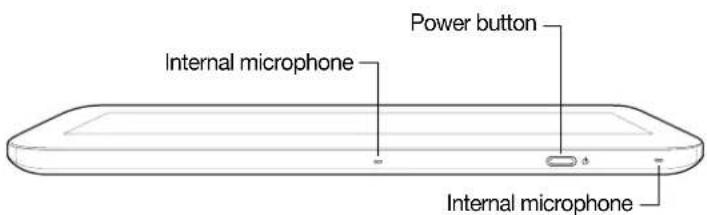
(Sample Illustration) Top view
Internal microphones—Allows you to record sounds using the computer's internal microphones or an optional external microphone. You can listen to audio files using the built-in speakers, headphones, or external speakers.
Power button—Turns the device on and off. Press and hold the button for several seconds to turn the device ON/OFF. Press the button quickly to wake the device from Sleep mode or to place it into Sleep mode. For more information, see "Options for turning off the device" on page 56.
Bottom

natural_image
Simple line drawing of a rectangular object with rounded ends and a flat top (no text or symbols)(Sample Illustration) Bottom view
Connecting to a power source
Your device requires power to operate. Use the Power cable/AC adaptor to connect the device to a live electrical outlet, or to charge the device's battery.
▲WARNING
Always confirm that the power plug (and extension cable plug if used) has been fully inserted into the socket, to ensure a secure electrical connection. Failure to do so may result in a fire or electric shock, possibly resulting in serious injury.
Be careful if you use a multiple connector. An overload on one socket could cause a fire or electric shock, possibly resulting in serious injury.
WARNING
Always use the TOSHIBA AC adaptor that was provided with your device, or use AC adaptors specified by TOSHIBA to avoid any risk of fire or other damage to the device. Use of an incompatible AC adaptor could cause fire or damage to the device possibly resulting in serious injury. TOSHIBA assumes no liability for any damage caused by use of an incompatible adaptor.
To connect AC power to the device:
▲WARNING
Handling the cord on this product will expose you to lead, a chemical known to the State of California to cause birth defects or other reproductive harm. Wash hands after handling.
- C +
1 Plug the power cable into the DC-IN on the device.
NOTE
Do not force the plug into the device.
2 Connect the AC adaptor to a live electrical outlet.
▲WARNING
Never attempt to connect or disconnect a power plug with wet hands. Failure to follow this instruction could result in an electric shock, possibly resulting in serious injury.
Battery Notice
Actual battery life may vary depending on settings, application usage, features or tasks selected, network configuration, operating temperature and many other factors.
The battery life cited in the product specifications is only achieved on the select models and configurations tested by Toshiba under the specific test settings at the time of publication and is not an estimate of a system's battery life under any conditions other than the specific test settings.
Recharge time varies depending on usage. The battery may not charge while the device is consuming full power. After a period of time, the battery will lose its ability to perform at maximum capacity and will need to be replaced. This is normal for all batteries.
Charging the battery
WARNING
If the device is leaking or its case is cracked, put on protective gloves to handle it.
Your device contains a rechargeable battery that may need to be charged prior to use.
To use external power or to charge the battery you must attach the AC adaptor. See "Connecting to a power source" on page 26.
To charge the device plug it into a power source.
NOTE
Battery life and charge time may vary depending on the external conditions, or the applications and features used.
NOTE
Please handle your device carefully to avoid scratching or damaging the surface.
Wall Outlet—The fastest way to charge your tablet is with the included AC adaptor plugged into a wall outlet.
Taking care of your battery
The following sections offer tips on how to take care of your battery and prolong its life.
Safety precautions
▲WARNING
Device warning indicators
◆Always immediately turn the power off and disconnect the power cable/ cord plug from the plug socket and stop using the battery pack if you observe any of the following conditions:
◆Offensive or unusual odor
Excessive heat
Discoloration
◆Deformation, cracks, or leaks
Smoke
- Other unusual event during use, such as abnormal sound
Do not turn on the device's power again until an authorized Toshiba service provider has checked it for safety. Continued use could cause a fire or rupture possibly resulting in serious injury or device failure including but not limited to the loss of data.
Optimizing battery life
You can extend your battery's life between charges by
turning off features you don't need. You can also change and monitor the way apps and system resources consume battery power.
Below are some of the things you can do:
To turn off Wi-Fi
^® or Bluetooth ^® when you are not using them, touch the Settings (用) con under Wireless & networks. Turn Wi-Fi ^® and/or Bluetooth ^® ON/OFF. For more information, see “Wireless and networks settings” on page 69 and “Location access settings” on page 72.
◆Turn down the screen brightness and set a shorter screen time-out. For more information, see "Display settings" on page 71.
If you do not need them, turn off automatic syncing for Gmail™, Calendar, Contact, etc. For more information, see “Accounts settings” on page 77.
If you know you will not be near a Wi-Fi ^® network for some time, switch to Airplane mode. For more information, see “Wireless and networks settings” on page 69.
To check the battery charge level:
1 Touch the Settings (icon.
The "Settings" menu appears.
2 Touch the About tablet (icon.
The "About tablet" menu appears.
3 Touch Status.
The battery status (charging or not charging) and level (as a percentage of fully charged) are displayed.
NOTE
For more details on your battery use, touch Battery.
Maintaining your battery
Fully discharging your battery periodically will allow better accuracy of the battery meter.
To fully discharge your battery, periodically disconnect the device from a power source and operate it on battery power until the battery fully discharges.
Disposing of your device
Discard this device in accordance with applicable laws and regulations.
Disposal of this product may be regulated due to environmental considerations. For disposal, reuse or recycling information, please contact your local government.
In addition, Toshiba's recycling initiatives include recycling programs, events, and consumer promotions. For details, please visit us.toshiba.com/green.
Notice regarding CR coin cell batteries, applicable to California, U.S.A. only:
Perchlorate Material - special handling may apply. See http://www.dtsc.ca.gov/hazardouswaste/perchlorate/
Using the device for the first time
The device is now ready for you to turn it on and begin using it.
Turning on the power
To turn on the device:
1 Make sure any external devices (such as the AC adaptor, if you plan to use AC power rather than battery power) are properly connected and ready.
2 Check to ensure that all slots are empty.
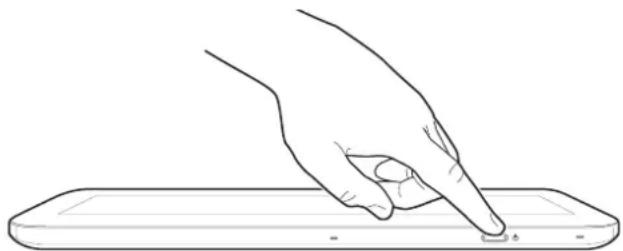
3 Press and hold the Power button for several seconds.

natural_image
Line drawing of a hand pointing at a small object on a tablet device (no text or symbols)(Sample Illustration) Turning on the power
Small bright dots may appear on your screen display when you turn on your device. Your display contains an extremely large number of thin-film transistors (TFT) and is manufactured using high-precision technology. Any small bright dots that may appear on your display are an intrinsic characteristic of the TFT manufacturing technology. Over a period of time, and depending on the usage of the device, the brightness of the screen will deteriorate. This is also an intrinsic characteristic of the screen technology.
Setting up your device
NOTE
Toshiba recommends that you have access to a Wi-Fi® network and a Google™ Account before setting up your device to take full advantage of your device's features.
1 Connect to a power source using the provided AC adaptor.
2 To turn on your device, press and hold the button for several seconds.
Power (∅)
Your setup process begins.
The first time you power on your tablet the "Welcome" screen appears and you will be asked to choose a language.
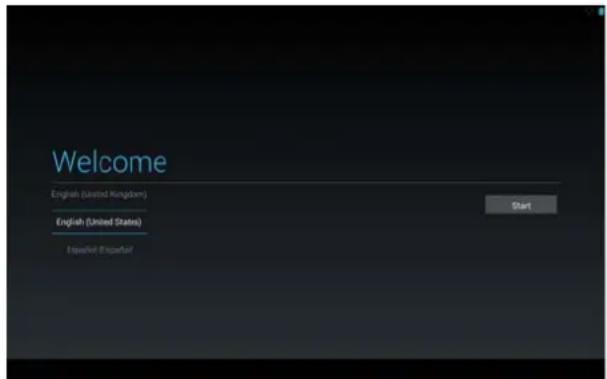
(Sample Image) Welcome screen
3 Select the language you want, and then touch Start to continue.
Your tablet begins the activation process.
Setting up your Wi-Fi® connection
After choosing your language, the "Select Wi-Fi" screen appears, displaying all available Wi-Fi® networks.
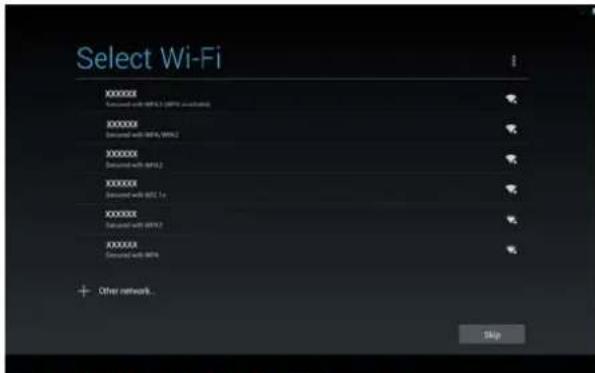
(Sample Image) Select Wi-Fi screen
1 Touch the Wi-Fi ^® network you want to use and enter the key or password.
2 Touch Connect.
Got Google™?
A Google Account is required to access many of the powered by Android ^™ features, including Gmail ^™ , backing up your data, etc.
The "Got Google?" screen appears displaying two options, Yes or No.
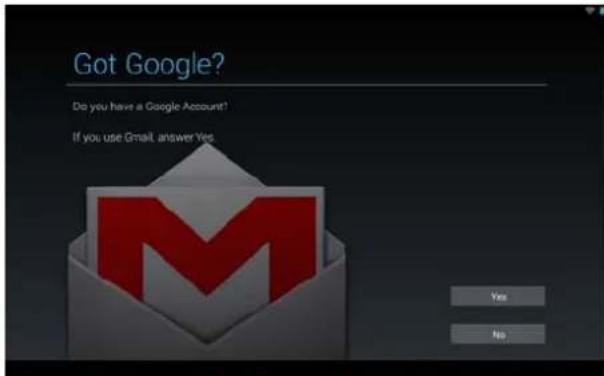
(Sample Image) Got Google? screen
- Yes—Sign in with an existing Google account and then follow the on screen instructions.
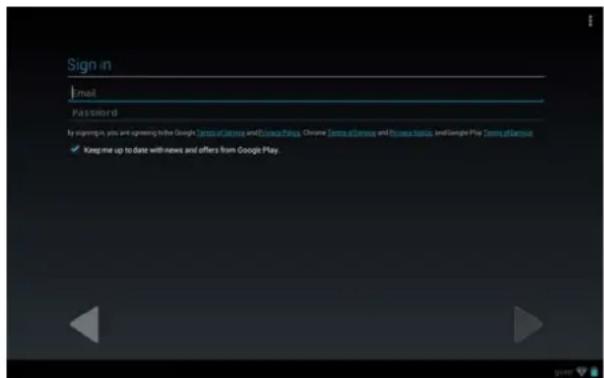
(Sample Image) Sign in with your Google Account screen
No—Select if you do not have an existing Google account.
Make it Google™
If you touched No, the "Make it Google" screen appears with two options:
- Get an Account—Touch if you do not already have a Google account and would like to create a new account. Follow the onscreen instructions.
Not Now—Touch to skip the account setup for now. You can sign into a Google Account later in Settings, under Accounts.
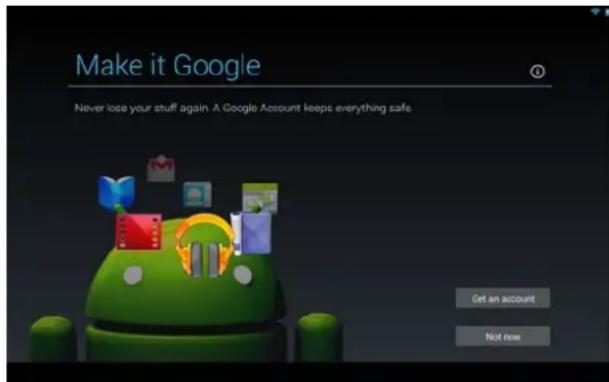
(Sample Image) Make it Google screen
NOTE
Sign in to your Google Account now to restore settings that have been previously backed up (if applicable). If you wait until after setup, you will not be able to restore your settings. For more information, see “Backing up your data” on page 42.
Google™ & Location
The “Use Google location” screen appears displaying two options:
Use Wi-Fi location
◆Let Google apps access your location
Select/deselect the check boxes to activate/deactivate the options.
NOTE
You can change these at a later time via the Settings menu.
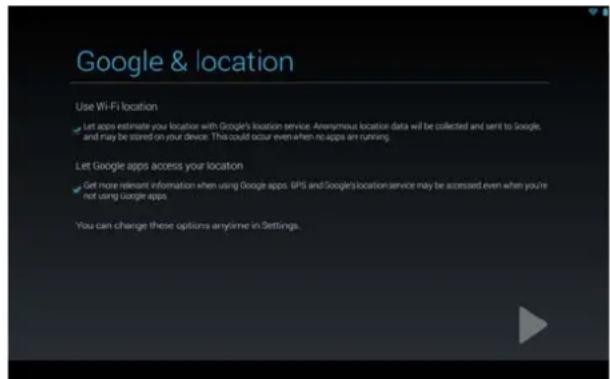
(Sample Image) Google & Location screen
1 Touch the right Arrow key to continue.
The “This tablet belongs to...” screen appears.
◆Enter your first and last names, or
Just touch the right Arrow key to continue
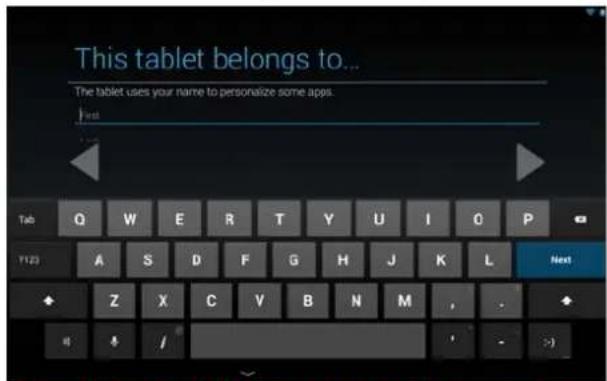
(Sample Image) This tablet belongs to... screen
2 The Google services screen appears.
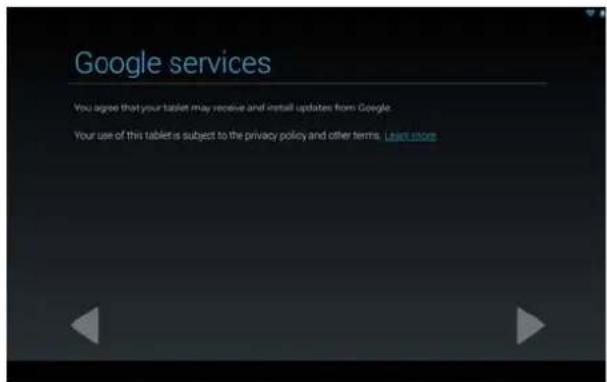
(Sample Image) Google services screen
3 Touch the right Arrow key to continue.
The "Setup complete" screen appears.
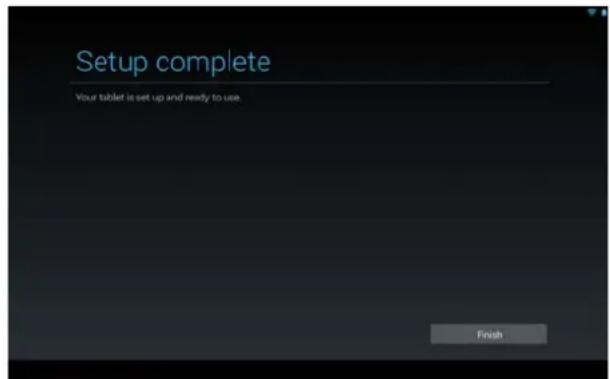
(Sample Image) Setup complete screen
4 Touch Finish to complete the setup process.
NOTE
This may take several minutes. If your screen times-out and goes blank/dark, press the Power button to turn on the screen again.
If the screen times-out:
1 Press the Power button.
The lock screen appears, unless you have previously disabled it.
2 Touch and hold the Lock icon and drag it to the edge of the large circle surrounding it.
The last screen viewed appears.
Setting the date and time
The "Date & time" screen appears.
NOTE
If you have not set up an Internet connection, this screen appears.
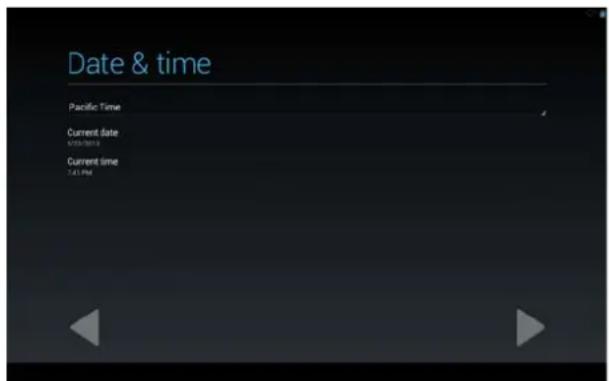
(Sample Image) Date & time screen
1 Select a preferred time zone, or set the current date and time.
2 Touch the right Arrow key to continue.
NOTE
This may take several minutes. If your screen times-out and goes blank/dark, press the Power button to turn on the screen again.
The "This tablet belongs to..." screen appears.
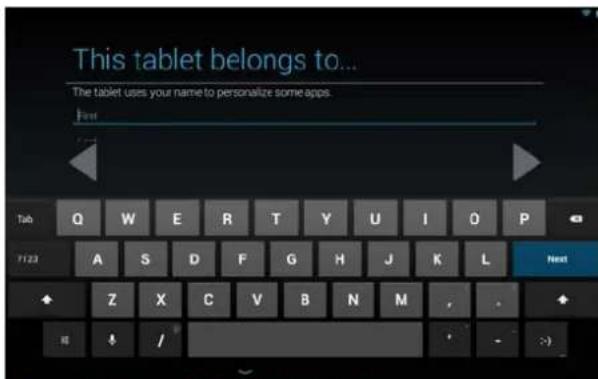
(Sample Image) This tablet belongs to... screen
There are two options in the "This tablet belongs to..." screen:
Enter your information into the First and Last name fields, and then touch the right Arrow key.
◆Touch the right Arrow key to continue (without entering the information).
The "Google Services" screen appears.
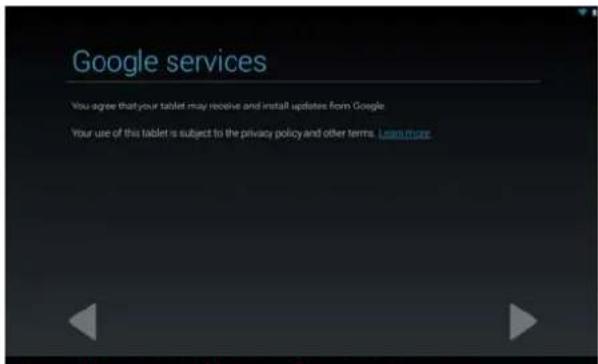
(Sample Image) Google Services screen
Read the information carefully, and then touch the right Arrow key to continue.
The "Setup complete" screen appears. Touch Finish to continue to the main Home screen.
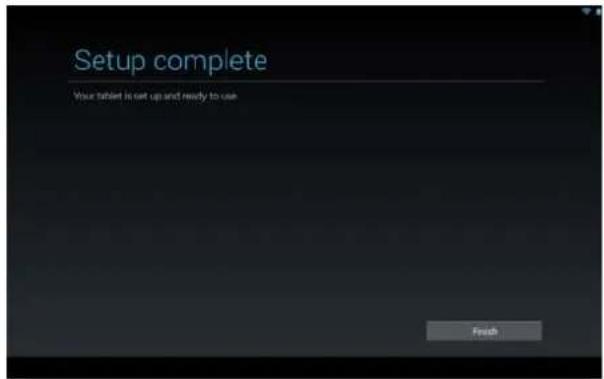
(Sample Image) Setup complete screen
NOTE
The setup may take several minutes to complete. If your screen times out and goes blank/dark, press the Power button to turn on the screen again.
Waking the tablet
If the screen times-out:
1 Press the Power button.
The lock screen appears, unless you have previously disabled it.
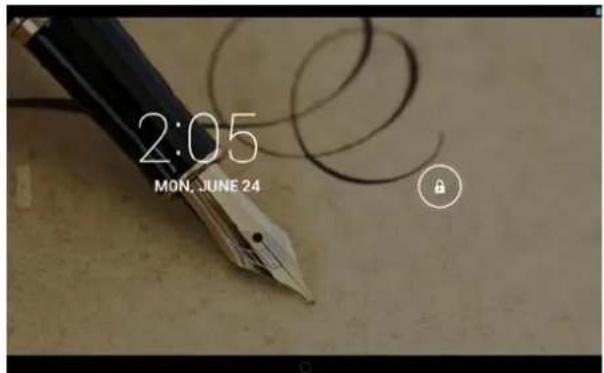
(Sample Image) Lock screen
2 Touch and hold the Lock (☐) icon and drag it to the edge of the large circle surrounding it.
The last screen viewed appears.
Setting up Wi-Fi ^® and Bluetooth ^® connections
Wi-Fi®:
1 Touch the Settings (☑) icon and then select the Wi-Fi (☑) icon, if not previously turned on.
The device scans for and displays all available Wi-Fi ^® networks.
2 Touch the Wi-Fi ^® network you want to connect to.
If the network is open, you will be asked to confirm the connection.
3 Touch Connect to confirm.
The Wi-Fi (icon appears in the System bar.
4 Touch the Back (icon to try a different network.
To connect to secure/locked networks, you will be prompted to enter the appropriate credentials.
NOTE
Wi-Fi ^® may be enabled by default and the device saves this information so that you can connect automatically the next time you come within range of this network.
If you use third-party applications on this device, any information those applications collect (including location-based information) may be sent to third parties and merged with other customer information subject to their respective privacy policies.
Bluetooth®:
1 Touch the Settings (图标) icon and then Bluetooth (switch to ON to enable it).
2 Touch the name of the device to pair with and then touch Pair.
Registering your Toshiba device
NOTE
To register online, you must be connected to the Internet.
Product registration is strongly recommended, and allows Toshiba to send you periodic updates, announcements, and special offers applicable to your product. Product registration can be completed by either visiting the Toshiba Web site at register.toshiba.com or by touching the Register icon. Failure to complete Product Registration will not diminish your rights under the Toshiba Standard Limited Warranty.
Backing up your data
Back up the data you create in case something happens to your device. You can back up your data to a microSD™ Card (see "Using a microSD™ Card" on page 105), or to a network (see "Backing up data using your Google™ Account" on page 42), if available.
You can also back up your settings as well as your data using your Google™ Account. Your data is backed up automatically using this option. For more information, see "Backup & reset settings" on page 78. If you need to replace your device, your data can be restored to your new one.
Backing up data using TOSHIBA File Manager
Using the TOSHIBA File Manager, you can back up your data to a microSD™ Card. For more information, see "TOSHIBA File Manager Utility" on page 113.
Backing up data using your Google™ Account
You can also back up your settings as well as your data using your Google Account. Your data is backed up automatically using this option. For more information, see "Make it Google™" on page 34.
Restoring your data using your Google™ Account
If your data was previously backed up using this service you can sign in to your Google Account and choose to restore your settings from your Google Account to your device.
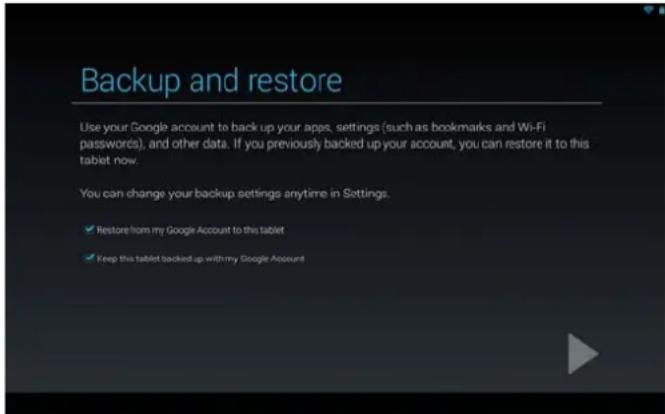
(Sample Image) Backup and Restore screen
Touch the right Arrow key to continue.
The data that is backed up may include the following:
- Your Wi-Fi ^ networks and passwords, user data, and tablet settings
Many Google application settings, such as your Browser bookmarks
The apps you download from Google Play™ Store
Navigation and features
Your device exemplifies the innovative blending of touch-
screen technology and intuitive application design making the most of your tablet device.
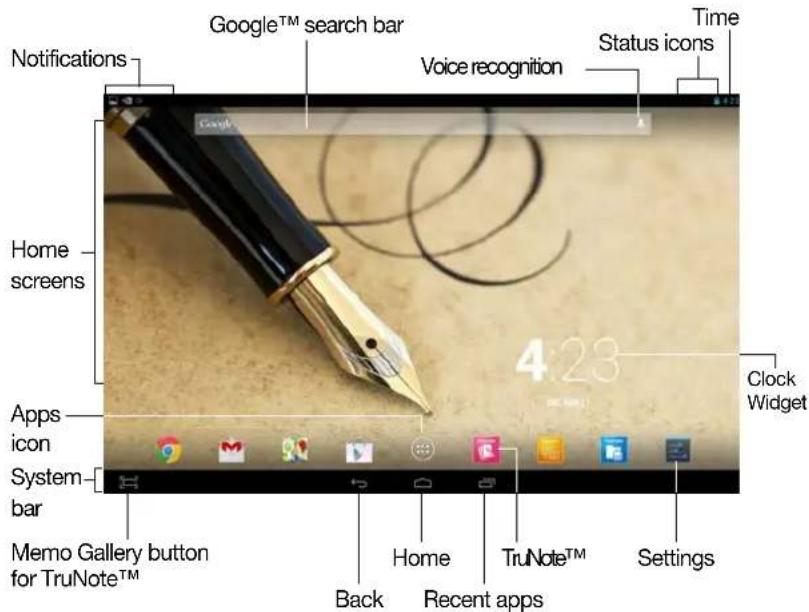
(Sample Image) Home screen
Icons and buttons you may find on your display screen.
IconNameDescription

Apps icon Touch to display the system apps.

TruNote™ icon
Touch to launch the TruNote™ application.

Settings icon Touch to open the Settings menu.

Back button Touch to return to the previously viewed screen.
IconNameDescription
 | Home button Touch to return to the Home screen. | |
 | Recent Apps button | Touch to view the most recently view apps. |
 | Time display Located in the System bar to the left of the Status icons. | |
| [awd] | Battery status icon | Located in the System bar. Displays the status of the battery charge. |
| [awd] | Voice recognition button | Touch to perform a voice-enabled search. |
 | GoogleTM search bar | Touch to perform a search using the keyboard. |
 | Memo Gallery button | Touch to create a TruNoteTM Memo Gallery screen capture. |
Home screen
The total number of available Home screens is five. Move between screens by swiping your finger to the left or right.
Your device's five home screens have several standard features, including icons and a customizable background pattern (wallpaper). The wallpaper image spans the width of all five Home screens.
The middle screen is your Central Home screen and the starting point after your device has been set up. However, your device will return to the last home screen viewed each time you wake up your device from Sleep mode. Touch the Home button to return to the central Home screen.
Icons
An icon represents a shortcut of either a widget, application, bookmark, or game that can be quickly launched by touching the icon on a Home screen.
Each Home screen may display icons for any of the following:
Widgets
Applications
Bookmarks
Games
Thumbnails
Your Home screen will contain other icons depending on how you have customized it. See “Customizing your Home screens” on page 53.

Gmail™ icon—An example of an icon located on a Home screen is the Gmail icon. This shortcut, when touched, launches your Gmail webmail account.
Touch screen navigation
Use your finger to manipulate the onscreen icons, buttons, menu items, onscreen keyboard, and other items on the touchscreen. You can also change the screen's orientation.
▲ CAUTION
The screen is made of glass so avoid contact with sharp, rough, or abrasive objects or substances as screen may break or scratch if not handled properly. If you see a crack in the glass, discontinue use of the device to avoid injury.
Touch—Touch to activate items displayed on the screen, such as app and setting icons or onscreen buttons. Touch to type using the onscreen keyboard.
Touch & hold—Touch and hold an item on the screen by touching and holding the item in place until an action occurs.
Drag—Touch and hold an item for a moment and then, without lifting your finger, move the item until you reach the target position. For example, drag items on the Home screen to reposition them, see “Customizing your Home screens” on page 53.
Swipe or slide—To swipe or slide, quickly move your finger across the surface of the screen without pausing. For example, slide the Home screen left or right to view another Home screen.
Double-tap—Tap quickly twice to zoom in. For example, double-tap a section of a Web page to zoom in on that section. Double-tap again to zoom out.
Pinch—In some apps (such as Maps and Gallery), you can zoom in and out by placing two fingers on the screen at once and pinching them together (to zoom out) or spreading them apart (to zoom in).
Rotate the screen—In most apps, the orientation of the screen rotates with the tablet as you turn it. You can turn this feature on and off, using the Auto-rotate screen option through the Quick Settings menu, see “Accessing the Notifications menu” on page 84. This allows you to lock the screen to the currently viewed screen orientation.
Navigating the Home screen
When the setup process is complete, the Home screen appears. This is your starting point for all features used on your tablet. You can add shortcuts for apps, widgets, and other features to all five of your Home screens. You can also change your wallpaper to more customize the look of your device. For more information, see “Customizing your Home screens” on page 53.
System bar
The System bar displays icons of tasks or programs that run continuously in the background and displays notifications, such as incoming email and the status of your wireless connection. Touch an icon to learn more about its task.
Navigation buttons
Using the navigation buttons in the System bar is an easy way to quickly switch between apps.
The System bar displays the Back (Button, Home () button, Recent Apps (Button, and the Notification icons. Also displayed in the far upper-right of the screen are the time, and Status icons.
Touch the Home button at any time to return to the Home screen. Swipe your finger right or left to view another Home screen.
In some media apps, the System bar controls are replaced by dim dots while a movie, slide show, etc. is displayed. This increases the viewing space on the screen. Touch the dot that corresponds with the desired control, or touch a blank area of the System bar to restore the full view.
At the top of the screen you will find the Google™ Search bar (), and next to that is the search by voice () button.
At the far upper-left you will find the Screen capture icon.
Also available at the bottom of the screen is the Apps (☐) and Settings (☐) button.
Status icons
Status icons are located on the far upper-right of the screen. Status icons display current system status information, such as power usage and network connectivity status.
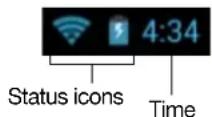
(Sample Image) Status icons
Touch the Time display to view the Status Details panel. For more information, see "Securing your tablet" on page 50.
After your Google™ Account is set up, the Network Status icons are blue when connected to Google services. This indicates that the tablet is ready to sync your Gmail™, Calendar, and contacts, and to back up your settings. When your tablet is not connected to a Google Account or the wireless connection is disabled, the icons are gray.
Managing Notifications
Notifications report the arrival of new messages, calendar events, and alarms, and they report the status of your Wi-Fi® connection.
Notification icons appear in the center of the System bar, along with a summary that appears briefly.
Depending on your settings you may also hear a notification sound.
Typical notifications are currently running programs and available updates. To activate a specific task, click the appropriate Notification bar icon.
Most apps that send notifications, such as Gmail ^™ and the calendar, have their own settings. These settings can be configured to send notifications in different ways, with a sound or vibration, etc. See the documentation for those apps for details. You can open the Notifications list to view all of your current notifications.
Opening a notification
1 Touch and swipe down the System bar on the upper-left of your Home screen.
The Notification summary panel opens.
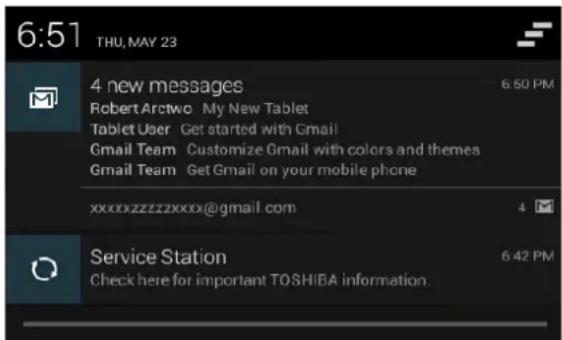
(Sample Image) Notification summary panel screen
2 Touch a notification summary to view it or to respond to it.
Touch the notification's Close button to remove it from the Notifications list. Touching a blank area of the screen closes the list without removing the notification.
Responding to notifications
When the Notification summary panel is open you can respond to a notification by touching the associated icon.
Notification panels contain a variety of information and controls, including:
A message summary, with the date and picture of the sender
Media controls to play/pause music or to skip to the next or previous track
◆Progress bars that indicate the progress of currently downloading apps:
1 Touch a notification icon in the System bar.
The notification's summary panel opens.
2 Touch a notification in the Notification summary panel to open it in its application.
It will then be cleared from the Notification summary panel.
3 To remove the notification without viewing it, touch its Close button.
Securing your tablet
CAUTION
If you choose to set a password (with or without encryption), Toshiba strongly recommends that you write down your password and keep it in a safe location where you can later access it should you not remember it.
Toshiba is not responsible for any losses that may occur, as a result of the inability to access your device.
When you initially turn on or wake the tablet, the lock screen requires you to drag the Lock icon to unlock the screen, see "Waking the tablet" on page 40. Alternatively, you can secure the lock screen by requiring a pattern or entry of a numeric PIN or password, so only you can access your data. You may also be required to secure the lock screen by a policy set by an email account or other account you add to your tablet. For more information, see "Location access settings" on page 72.
You can also encrypt the data on your tablet, so you must enter a numeric PIN or a password to decrypt it each time you power it on.
1 Touch the Time (4:34) splay in the System bar, touch the time in the Status Details panel, and then touch the Settings (5:10) con at the bottom of the Quick Settings screen.
You can also open Settings by touching the Settings icon in the Apps screen or on a Home screen.
2 Touch the Security (icon.
3 TouchScreen Lock.
4 Touch Slide, Pattern, PIN, or Password.
Slide is the default screen lock option. If you touch Slide, you will be taken back to the Security screen. The next time you wake up your device from sleep, you will be taken to the Lock screen. At the Lock screen, you can either slide to left or to the right to unlock the system.
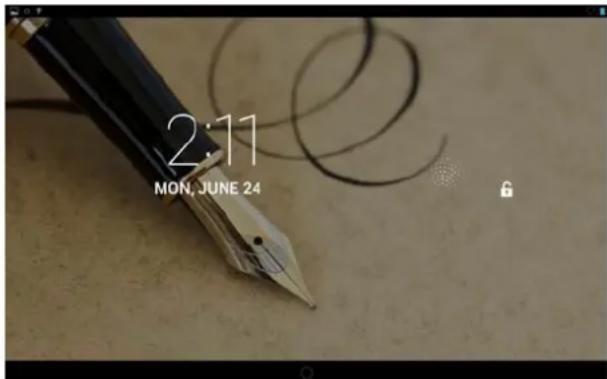
(Sample Image) Unlocked screen
If you touch Pattern, you're guided to create a pattern you must draw to unlock the screen. The first time you do this, a short tutorial about creating an unlock pattern appears. Then you are prompted to draw and redraw your own pattern.
If you touch PIN or Password, you are prompted to set a numeric PIN or a password you must enter to unlock your screen.
The next time you turn on your tablet or wake up the screen, you must draw your unlock pattern or enter your PIN or password to unlock it.
You can encrypt all the data on your tablet: Google™
Accounts, application data, music and other media, downloaded information, etc. If you do, you must enter a numeric PIN or password each time you power on your tablet.
CAUTION
Encryption is irreversible. The only way to revert to an unencrypted device is to perform a factory data reset, which will erase all your data.
You must not interrupt the encryption process or you will lose some or all of your data. (See “Backup & reset settings” on page 78 and “If Something Goes Wrong” on page 118).
1 Before starting the encryption process on your tablet, you must:
◆Set a lock screen PIN or password (see “Securing your tablet” on page 50).
◆Charge your tablet's battery.
◆Plug your tablet to the AC adaptor.
◆ Schedule an hour or more for the encryption process.
2 Touch the Settings (图标) icon, Security (图标) icon, and then Encrypt tablet.
Read the information on the Encrypt Tablet screen carefully.
If you change your mind touch the Back (←button to exit the encryption process.
3 Touch the Encrypt tablet button.
4 Enter your lock screen PIN or password and touch Continue.
5 Touch the Encrypt tablet button again, to confirm you want to continue.
The encryption process begins and displays the progress.
Encryption can take an hour or more, during which time your tablet may restart several times.
When encryption is complete, you are prompted to enter your PIN or password. Subsequently, you must enter your PIN or password each time you power on your tablet, to decrypt it.
Customizing your Home screens
You can add Apps icons, Widgets, Bookmark shortcuts, and other items to any available free space on any Home screen. You can also change the Wallpaper.
For more information on the Home screens, see “Navigation and features” on page 44.
Adding an item to a Home screen
1 Open the Home screen you want to add the item to. For more information on using the Home screens, see "Navigation and features" on page 44.
2 Swipe your finger left or right to find the item you want to add.
3 Touch & hold the item, and then drag it to the location you wish to place it on the Home screen.
Moving an item from the Home screen
To move an item to a new location on the current Home screen or to move it to another Home screen, touch & hold the icon, and then drag and drop it to the new location.
Removing an item from a Home screen
1 Touch and hold the item you want to remove.
The Remove button appears in the top center of the display.
2 Drag the item to the Remove button.
3 Lift your finger when the icon turns red.
NOTE
The item has been removed from the Home screen, but not deleted from the system. To add the item back to your Home screen, see “Adding an item to a Home screen” on page 53.
Creating, naming, and removing folders
Creating a folder
Complete the following steps to create folders on your Home screen.
1 Locate the desired first app (on a Home screen) that you want to include in a folder.
2 Locate the second app (on the Home screen or in the app list).
3 Touch, hold, and drag the second app to the first app.
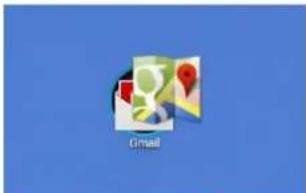
(Sample Image) Dragging an app to create a folder
4 Release the second app, and its icon appears in the circle, behind the icon of the first app.
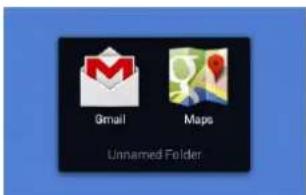
(Sample Image) Unnamed folder
The folder is now created with an automatic generic name (such as "Unnamed folder").
Name/rename a created folder
1 Touch and hold the folder you want to name/rename.
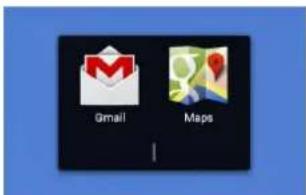
(Sample Image) Naming a folder
The name of the folder turns into a field you can type into.
2 Type the desired name. The folder is now renamed.
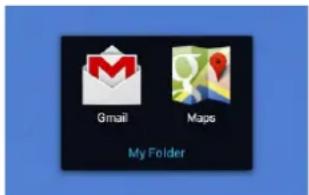
(Sample Image) Named folder
Removing a folder
To remove folders from your Home screen:
1 Locate and open the folder (on a Home screen) that you want to remove.
2 Touch, hold, and drag all apps from the folder (on the Home screen or in the app list) to the Home screen.
3 Release the apps on the Home screen. When the last app is removed, its folder is automatically removed.
Changing the wallpaper
1 Touch and hold any of the five Home screens.
2 Touch Gallery, Live wallpapers, or Wallpapers.
Gallery—Opens a thumbnail page, displaying the images you have taken with the tablet's camera. Pictures can be cropped before setting them as a wallpaper.
Live wallpapers—Opens a thumbnail page, displaying the sample live wallpapers that came preinstalled on your tablet. Touch a thumbnail image to preview it on the screen.
- Wallpapers—Opens a thumbnail page, displaying the sample wallpaper images that came preinstalled on your tablet. Touch a thumbnail image to preview it on the screen.
Additional wallpapers can be downloaded from Google Play ^™ Store.
3 Touch the wallpaper you want. The selected wallpaper is set as the background image on your display screen.
Turning off the device
It is a good idea to turn off your device when you are not using it for a while.
If you are using the device for the first time, leave the device plugged into a power source (even though the device is off) to fully charge the battery.
Options for turning off the device
You have two options available for turning off the device: Shut down and Sleep mode. Each option has its advantages.
Use Shut down if you will not be using the device for several days or if you must turn off your device.

TECHNICAL NOTE: Before using the Shut down option to turn off your device, backup your data.
If you change your mind and decide to continue working after all, wait a few seconds before turning the device on again.
NOTE
If you do not intend to use your device for a long period of time, turn off the device, disconnect the power plug from the plug socket, and store your device in a dry dust-free location.
Letting the screen time-out or enter into Sleep mode allows the device to conserve power. When turning on the device again, the system automatically returns to the last screen viewed.
To change the screen time-out setting, see "Display settings" on page 71.
Using Shut down mode
The Shut down mode completely shuts down the device without saving your data or the current state of the device. Shut down mode closes all open apps, shuts down the operating system, and then turns off your tablet.
CAUTION
Always back up your data and settings before shutting down your tablet.
To turn off your device using Shut down mode:
1 Press and hold the Power button.
A pop-up screen appears, displaying three selections.
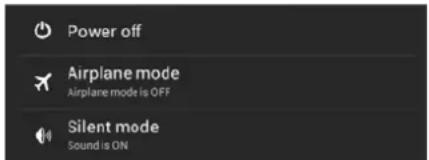
(Sample Image) Shut down pop-up screen
2 In the pop-up window, touch Power off.
A pop-up screen appears, asking you to confirm the shut down.
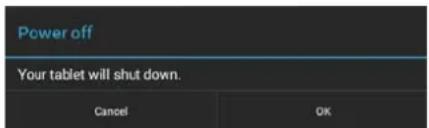
(Sample Image) Shut down pop-up confirmation screen
3 In the pop-up window, touch OK to completely shut down the tablet.
The operating system shuts down and the tablet turns off.
4 Touch Cancel to abort the shut down process.
Using Sleep mode
Your device will automatically time-out after a couple minutes of non-operation, placing it into Sleep mode. The screen dims and then darkens to conserve battery power. For more information on waking the tablet from Sleep mode, see "Waking the tablet" on page 40. To change the amount of time it takes for the display to darken, touch the Settings (⊕) icon, and then the Display (∅) icon.
NOTE
Increase battery life between charges by using the shortest available time-out setting. See “Display settings” on page 71.
You can also place your tablet into Sleep mode by pressing the Power button quickly.
Factors to consider when choosing Sleep mode:
◆While in Sleep mode, the device uses some battery power.
Because the state of the system is stored in memory, you will lose data if the battery discharges completely while the device is in Sleep mode.
Waking your device from Sleep mode takes less time and consumes less battery power than restarting after shutting down the device.
When starting up again, the device returns to the screen last viewed.
CAUTION
If you place the device in Sleep mode and the battery discharges fully, your unsaved data will be lost. Be sure to backup your data first.
Managing your accounts
Using the Accounts settings, you can configure the ways in which your account interacts with the applications on your tablet, and you can sync contacts, email, calendar events, etc. from your multiple Google™ Accounts.
Add an account
Add multiple Google™ Accounts and Microsoft® Exchange ActiveSync accounts to have all your accounts available on your tablet device. For more information, see “Accounts settings” on page 77.
1 Touch the Settings (建con.
The "Settings" menu appears.
2 Scroll down to the Accounts setting.
The “Accounts” menu appears displaying a list of the current accounts.
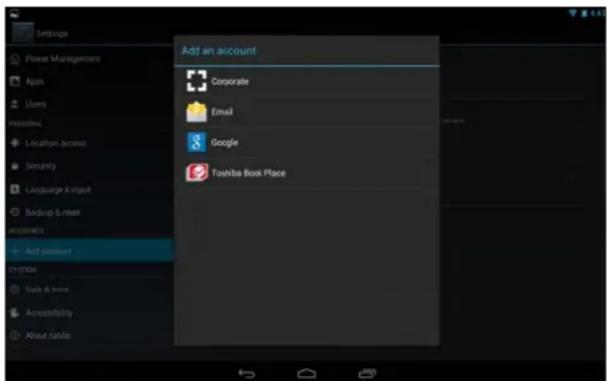
(Sample Image) Accounts screen
3 Touch the Add account () icon
4 Follow the onscreen instructions to enter the required account information.
5 Configure the account settings. For more information, see "Accounts settings" on page 77.
The account is added to the list in the Accounts settings.
Remove an account
To remove an account and all the associated information, including email, contacts, settings, etc.:
1 Touch the Settings (icon.
The "Settings" menu appears.
2 Scroll down to the Accounts setting.
The "Accounts" menu, appears, displaying a list of the current accounts.
3 Touch the account you wish to delete.
4 Touch the Menu (icon in the upper-right corner.
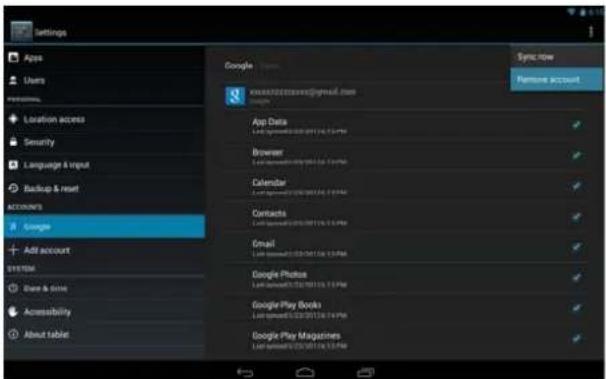
(Sample Image) Removing an account
5 Touch Remove account from the dialog box to continue.
The "Remove account?" confirmation screen appears.
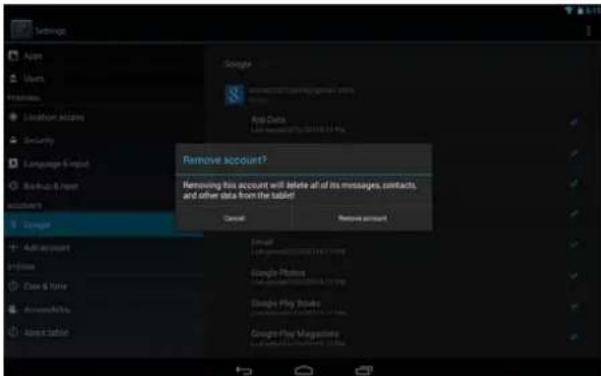
(Sample Image) Removing an account confirmation
6 Touch Remove account to continue.
The account and the associated information is removed from the Accounts settings.
Navigation, Maps, and Local
To access Navigation, Maps, and Local:
1 Touch the Apps (icon.
The "Apps" menu appears.
2 Touch the Navigation (A) icon, Maps (P) icon, or the Local (C) icon.
▲WARNING
Do not use this device while driving.

Navigation: Access turn-by-turn, spoken driving instructions with the free Google™ Navigation application (Beta).

Maps: Finds your current location to access real-time traffic conditions, and obtain detailed directions by foot, public transportation, or car, using the free Google Maps application.

Local: Quickly find local establishments, such as restaurants, banks, or gas stations, using the free Google Places application.
To learn more, visit the Google Help Center.
Managing downloads
Files, apps, and items downloaded from a Web Browser, Gmail™, etc., are stored on your tablet's internal storage. Use the Downloads app to view, open, or delete downloaded items.
To access downloads:
1 Touch the Apps icon.
2 Touch Downloads.
The "Downloads" menu appears.
3 Touch an item to open it.
Items can be uninstalled from your tablet or sorted by file size or file name for easier viewing.
To sort the items, touch the top right of the screen
Sort by size menu option on the
To uninstall items:
1 Select the item(s) you wish to delete.
2 Touch the Delete (icon.
To share items:
1 Select the item(s) you wish to share.
2 Touch the Share (icon.
Factory data reset
This restores the device to the out of box state. All data on the device is erased, including system/application settings, user downloaded/installed applications and data such as photos, music, videos, contacts, etc.
CAUTION
The recovery process deletes all data, restoring the tablet to its out-of-box state. Be sure to save your data to external media before executing the recovery), see "Backing up your data" on page 42.)
Before restoring the device to the out of box state, back up all data to external media. You can use your Google™ account to back up all data and apps settings.
To perform this process:
1 Touch the Settings (icon.
The "Settings" menu appears.
2 Touch the Backup & reset (con.
The "Backup & reset" menu appears.
3 Touch Factory data reset.
4 Touch Reset tablet.
5 Touch Erase everything.
The Factory data reset process begins.
NOTE
This process could take several minutes. For more information, see “Setting up your device” on page 32.
Caring for your device
This section gives tips on cleaning and moving your device. For information about taking care of your device's battery, see “Taking care of your battery” on page 29.
▲ CAUTION
The screen is made of glass so avoid contact with sharp, rough, or abrasive objects or substances as screen may break or scratch if not handled properly. If you see a crack in the glass, discontinue use of the device to avoid injury.
Cleaning the device
CAUTION
Keep liquids, including cleaning fluid, out of the device's ports, speakers and other openings. Never spray cleaner directly onto the device. Never use harsh or caustic chemical products to clean the device.
To keep your device clean, gently wipe it with a lightly dampened soft cloth.
Chapter 2
Settings
Customizing your device's settings
You can customize the settings for the various functions on your Toshiba tablet, such as screen orientation, or sound settings.
Apps and Settings menus
This menu contains most of the tools you will need to customize and configure your tablet.
Accessing the Apps and Settings menus
To access the Apps menu:
◆ Touch the Apps () icon.
The "Apps" menu appears.
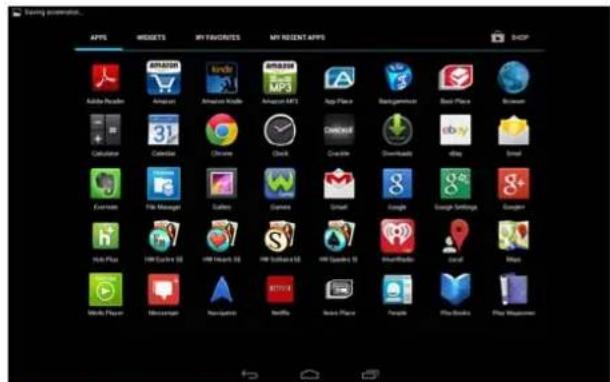
(Sample Image) Apps menu screen
The following are some of the icons you may find in the Apps menu.
IconNameDescription
 | Settings Touch to open the Settings menu. |
 | Browser Touch to open and view Web sites. |
 | Chrome Touch to open and view GoogleTMChrome Web browser. |
 | GmailTM Touch to access your Gmail email account. |
 | Maps Touch to open the Maps app, see “Navigation, Maps, and Local” on page 61. |
 | Play Store Touch to open Google PlayTM Store to view and download available apps for your tablet. |
IconNameDescription
 | Navigation Touch to open the Navigation app, see “Navigation, Maps, and Local” on page 61. |
 | Gallery Touch to view the photos/videos you have recorded, using the camera, or images preinstalled on your tablet, see “Using the camera” on page 105. |
 | Calendar Touch to view your Calendar. |
 | People Touch to view your Contacts. |
 | Calculator Touch to open the Calculator application. |
 | Downloads Touch to view the Downloads application, see “Managing downloads” on page 61. |
 | Media Player Touch to open the multimedia player, see “TOSHIBA Media Player” on page 86. |
 | Play Books Touch to view the books that have been downloaded to your tablet. |
To access the Settings menu:

Settings (icon.
The "Settings" menu appears.
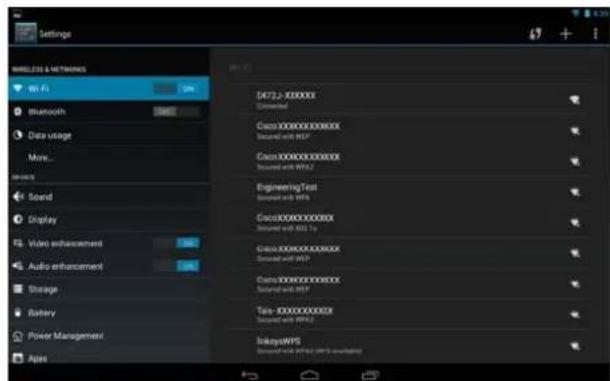
(Sample Image) Settings menu screen
The following are some of the icons you may find in the Settings menu.
IconNameDescription
 | Wi-Fi® | Configure and manage connections to networks and devices via Wi-Fi®, see “Wireless and networks settings” on page 69. |
 | Sound Configure the Sound settings to set the audio for media playback, notifications, and alarms with the your desired volume level and notification sounds, see “Sound settings” on page 70. | |
 | Display Configure the screen orientation or use energy saving settings, see “Display settings” on page 71. | |
 | Storage Monitor the used and available space on your tablet’s internal storage and other storage media installed on your tablet, see “Storage settings” on page 80. | |
| IconNameDescription | ||
 | Battery Displays battery status, see “Battery Notice” on page 27. | |
 | Apps Touch to view and manage the installed applications, see “Apps settings” on page 74. | |
 | Accounts Add, remove, and manage all of your accounts, and sync accounts to work together, see “Accounts settings” on page 77. | |
 | Location access | Touch to change the settings for location services, see “Location access settings” on page 72. |
 | Security Configure how you want the tablet to determine your location, see “Location access settings” on page 72. | |
 | Language & input | Configure the various input methods available on your tablet, see “Language & input settings” on page 80. |
 | Backup & reset | Back up your settings and data to GoogleTM servers, using your Google Account, or perform a factory data reset, see “Backup & reset settings” on page 78. |
 | Date & time Configure your preferences for the way in which dates are displayed, see “Date & time settings” on page 82. | |
 | Accessibility Touch to change the settings for accessibility features to activate an accessibility application, see “Accessibility settings” on page 81. | |
 | About tablet Displays information regarding your operating system software and hardware, see “About tablet” on page 83. | |
Wireless and networks settings
Use the Wireless & networks settings to configure and manage connections to networks and devices via Wi-Fi ^ , or Bluetooth ^ . For more information, see “Setting up Wi-Fi ^ and Bluetooth ^ connections” on page 41. The Wireless & Networks settings can also be used to configure connections between your tablet and virtual private networks (VPNs), and to turn off the device’s radios while in-flight.
To change the Wireless & networks settings:
1 Touch the Settings (图标).
The Settings menu appears.
2 Touch the item you wish to change in the Wireless & networks menu.
Below are some of the categories to choose from:
- Wi-Fi®—Select to turn on Wi-Fi® so you can connect to Wi-Fi® networks. For more information, see “Setting up Wi-Fi® and Bluetooth® connections” on page 41.
In addition to the information described in this section, you can access the Advanced settings. Touch the Menu button in this screen's Application bar, and then Advanced to view the settings in the "Advanced Wi-Fi" screen.
Some of the options available are:
Network notification—If this is selected, you will receive a notification in the System bar when an open Wi-Fi® network becomes available.
Keep Wi-Fi on during Sleep—Choose from the following selections to set conditions for automatically turning off the Wi-Fi® connection:
Always (uses more battery power)
Only when plugged in
Never
Bluetooth®—Select to turn on Bluetooth® so you can connect to Bluetooth® devices, such as an external keyboard. For more information, see “Setting up Wi-Fi® and Bluetooth® connections” on page 41.
Some of the options available are:
Rename tablet—Touch to open a dialog box to rename your tablet a name that is visible on some Bluetooth ^® devices. The current name is displayed.
- Visibility timeout—Select to make your tablet discoverable by other Bluetooth ^ devices for a brief period of time.
Show received files—Displays a list of files received via Bluetooth®.

Sound settings
The Sound settings can be configured to set the audio for media playback, notifications, and alarms with the desired volume level and notification sounds. You can also set audible feedback when touching or locking and unlocking the screen.
To change the Sound settings:
1 Touch the Settings (icon.
The "Settings" menu appears.
2 Touch the Sound (icon.
The "Sound" menu appears.
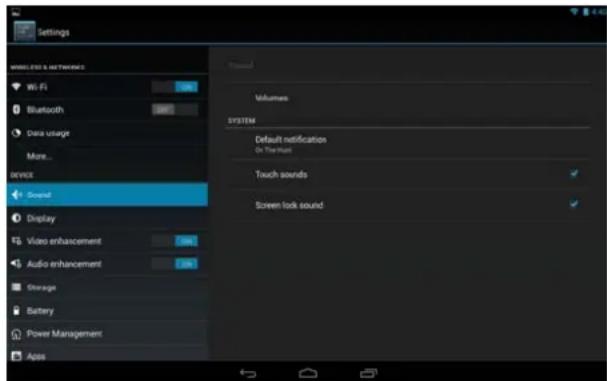
(Sample Image) Sound Settings menu screen
3 Touch the item you wish to change in the Sound menu.
Below are some of the categories you can choose from:
Volumes—Select to open a screen containing three sliders, used to adjust media volume, notification sounds, and alarm sounds.
Default notification—Select to open a screen containing a list of notification sounds. Touch a notification sound to listen to a sample of it.
◆ Touch sounds—Select to hear a sound while touching the buttons, icons, and other onscreen items.
Screen lock sound—Select to hear a sound when locking or unlocking the screen.

Display settings
You can change the Display settings for various things, such as orientation of the display or brightness level for energy conservation.
To change the Display settings:
1 Touch the Settings (并con.
The "Settings" menu appears.
2 Touch the Display (icon.
The "Display" menu appears.
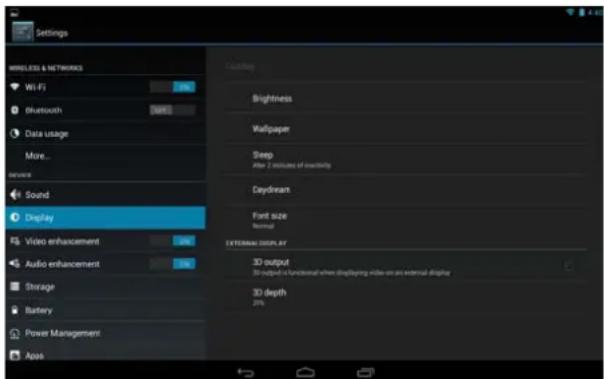
(Sample Image) Display menu screen
3 Touch the item you wish to change in the Display menu.
Below are some of the categories you can choose from:
NOTE
The Automatic Brightness selection must be deselected to access the Brightness control screen. Under certain operating conditions, e.g., very high ambient temperatures, your tablet might automatically dim the LCD brightness in order to maintain a reasonable system temperature. This is a normal protective feature and you might not be able to manually adjust the LCD brightness during the auto dimming period.
◆ Brightness—Displays the Brightness control bar screen. To change the brightness level, deselect the Automatic brightness option. Then touch and slide the bar left or right to decrease or increase the screen brightness.
- Wallpaper—Select to change the wallpaper.
Sleep—Displays a list of time interval settings that indicate the amount of time it takes for the screen to time-out. Using the shortest time-out period extends the battery life between charges.

Location access settings
Use the Location access settings to configure how you want the tablet to determine your location (this affects accuracy), and the way in which you want to share your location with Google™ and others. Security settings can also be configured to help secure your tablet and its data.
WARNING
Do not use this device while driving.
To change the Location access settings:
1 Touch the Settings (icon.
The "Settings" menu appears.
2 Touch the Location access icon.
The "Location access" menu appears.
3 Touch the item you wish to change in the Location access menu.
Below are some of the categories you may choose from:
GPS satellites—Selecting this option allows your tablet's global positioning system (GPS) receiver to pinpoint your location to within as close as several meters (street level). Actual GPS accuracy depends on weather conditions, as well as other factors.
Wi-Fi & mobile network location—Selecting this option allows your tablet to use information from Wi-Fi® and networks to determine your approximate location. This is important for use in Maps and other geographically aware applications, etc. Allows Google's Location access to collect anonymous location data. Some data may be stored on your device. Collection may occur even when no apps are running.
Security settings
Use the Security settings to configure our tablet to help secure your tablet and its data.
To change the Security settings:
1 Touch the Settings (图标).
The "Settings" menu appears.
2 Touch the Security icon.
The "Security" menu appears.
3 Touch the item you want to change in the Security menu.
Below are some of the categories you may choose from:
Screen lock—Under Screen security, touch this option to configure your lock screen with a required pattern, PIN, or password to unlock the screen. For more information, see “Securing your tablet” on page 50.
Owner info—Touching this option displays a screen that allows you to display information about yourself (such as your contact information) on the lock screen. You will be prompted to enter the text you want to display.
Encrypt tablet—Under Encryption, touch this option to encrypt the contents of your tablet in the event that it is powered off. Configure a required numeric PIN or password to decrypt your tablet each time you power it on, see “Securing your tablet” on page 50.
CAUTION
If you choose to set a password (with or without encryption), Toshiba strongly recommends that you write down your password and keep it in a safe location where you can later access it should you not remember it.
Toshiba is not responsible for any losses that may occur, as a result of the inability to access your device.
Make passwords visible—Select this option to briefly display each character of your passwords as you enter them into the keyboard.
Device administrators—Under Device administration, touch open a screen with a list of the applications you have authorized to be administrators for your tablet. This is typically an email, calendar, or other enterprise application that you granted this authority to, when you added an account hosted by an enterprise service that requires the ability to implement security policies on any devices that connect to it. Touch an application in this list to disable its authority to be a device administrator; if you do, the account you added will typically lose some functionality in its applications, such as the ability to sync new email or calendar events, until you restore the application's authority as a device administrator. Applications whose device administration authority you disable in this way, but that have accounts that require them to be device administrators, typically notify you how to restore their authority when you try to use them, unless you delete those accounts.
Install from storage—Under Credential storage, select to install a secure certificate from your tablet's storage.
- Clear credentials—Under Credential storage, select to delete all secure certificates and related credentials. You will be prompted to also confirm deletion of the credential storage password.

Apps settings
You use the Apps settings to view details about the applications installed on your tablet, to manage their data, to force them to stop if needed, and to set whether you want to permit installation of applications that you obtain from Web sites and email.
To change the Apps settings:
1 Touch the Settings (icon.
The "Settings" menu appears.
2 Touch the Apps (图标) icon.
The "Apps" menu appears.
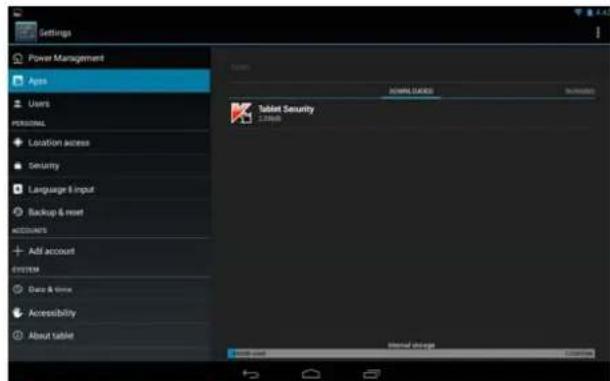
(Sample Image) Apps menu screen
3 Touch item you want to change in the Apps menu.
Below are some of the categories you can choose from:
Downloaded—Displays a list of the applications and other software downloaded on your tablet.
Running—Displays a list of applications, processes, and services currently running.
All—Displays all applications and software currently installed on your tablet.
Users
You can share this device by adding additional users, allowing the ability to create unique personal settings for each. Each user has their own space and can customize it with their own apps, wallpaper, etc.
To add a new user:
1 Touch the Settings (icon.
The "Settings" menu appears.
2 Touch the Users (a) icon.
The "Users" menu appears.
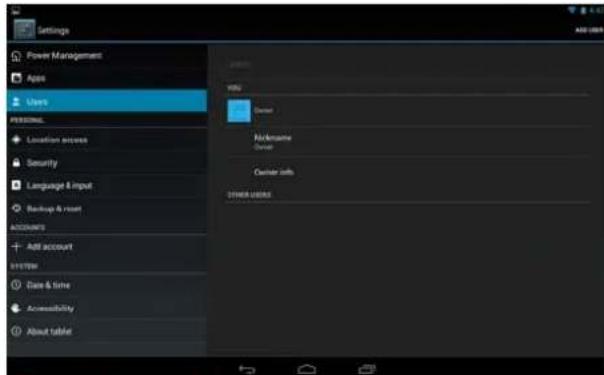
(Sample Image) Users menu screen
3 TouchAdd user.
The "Add new user" dialog box appears.
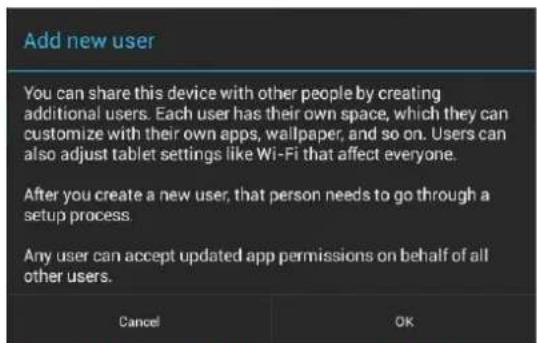
(Sample Image) Add new user dialog box
4 Touch OK.
The "Set up user now?" dialog box appears.
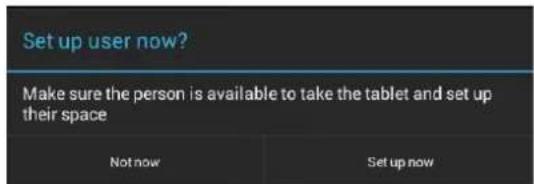
(Sample Image) Set up user now dialog box
5 TouchSet up now to continue.
6 Follow the on-screen instructions.
After the new user has been added, he/she will need to go through a setup process. See "Setting up your device" on page 32.
NOTE
Any user can accept updated app permissions on behalf of all other users.
Accounts settings
You can add, remove, and manage your Google™ Accounts
and other accounts, using the Accounts settings. For more information, see "Managing your accounts" on page 58. Use these settings to also control the ways in which applications send, receive, and sync data on their own schedules, or how applications synchronize user data automatically.
Gmail™, Calendar, and other applications may have their own setting options. For details, refer to the application's documentation.
To change the Accounts settings:
1 Touch the Settings (icon.
The "Settings" menu appears.
2 Scroll down to the Accounts setting.
The "Accounts" menu appears.
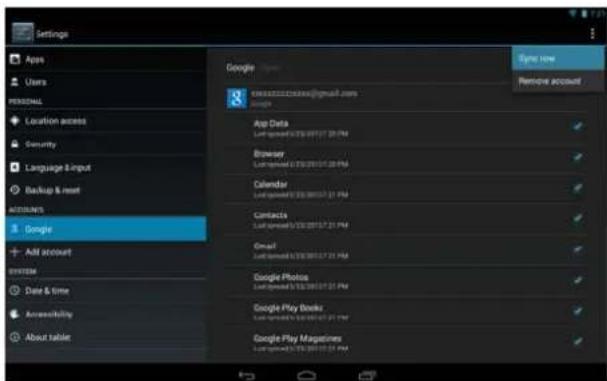
(Sample Image) Accounts menu screen
3 Touch the item you want to change in the Accounts menu.
Below are some of the categories you can choose from:
◆ Calendar—Touch to sync your calendar with your device.
- Contacts—Touch to sync your contacts with your device.
Gmail—Touch to sync your Gmail with your device.
While an account is selected, you can touch the Menu (☐) button to:
Remove account—Touch to remove the account and all of its data.
Sync Now—Touch to synchronize your data now.

Backup & reset settings
You can use the Backup & reset settings to back up your settings and data to Google™ servers, using your Google Account. You can also perform a factory data reset to erase all data on your tablet. For more information, see “Backing up your data” on page 42.
To change the Backup & reset settings:
1 Touch the Settings (con.
The "Settings" menu appears.
2 Touch the Backup & reset icon.
The "Backup & reset" menu appears.
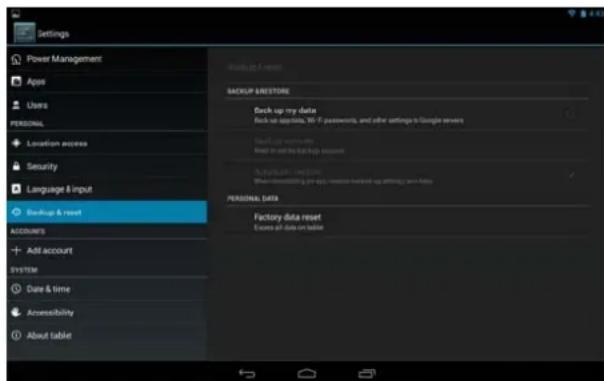
(Sample Image) Backup & reset menu screen
3 Touch the item you wish to change in the Backup & reset menu.
Below are some of the categories you can choose from:
- Back up my data—Select to back up your personal data (Wi-Fi® passwords, bookmarks, etc.) to Google servers, with your Google Account. Your data can be restored to a new tablet the first time you sign in with your Google Account. Some third-party applications may also take advantage of this feature, allowing you to restore the associated data of a reinstalled application.
NOTE
If you disable this option, data will no longer be backed up to your Google Account. All existing backed up data is deleted from Google servers.
Backup account—Displays the Google Account used to back up your settings and data. Sign in to this account to restore your settings and data to a new tablet or other device.
Automatic restore—Select this option to restore the associated settings and data when reinstalling an application.
Factory data reset—Restores your device to it's out-of-box state, see "Factory data reset" on page 62.
CAUTION
The recovery process deletes all data, restoring the tablet to its out-of-box state. Be sure to save your data to external media before executing the recovery), see "Backing up your data" on page 42.)
NOTE
Any system updates already installed are retained on your device.

Storage settings
The Storage settings can be used to monitor the used and available space in your tablet's internal storage or on a microSD™ Card inserted in your tablet.
To change the Storage settings:
1 Touch the Settings (con.
The "Settings" menu appears.
2 Touch the Storage icon.
The "Storage" menu appears.
3 Touch the item you wish to change in the Storage menu.
You can also view and manage the amount of storage used by your applications.

Language & input settings
You can select the language and configure various input methods, such as the Google™ text-to-speech engine for applications that support it.
To change the Language & input settings:
1 Touch the Settings (icon.
The "Settings" menu appears.
2 Touch the Language & input (A) con.
The "Language & input" menu appears.
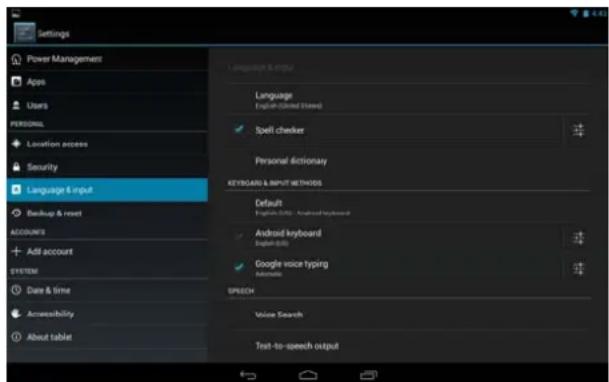
(Sample Image) Language & input menu screen
3 Touch the item you wish to change in the Language & input menu.
Below are some of the categories you can choose from:
Language—Select to open the Language screen, and then select your preferred language for use on your tablet.
◆ Spell checker—Select to enable/disable the autospelling correction.
Personal dictionary—Select to open a list of the words you have added to the dictionary. Touch a word to edit it, or touch the red X next to a word to delete it. Touch the Plus button at the top right of the Application bar to add a word.
Default—Under Keyboard and Input Methods, select this to change and configure between available keyboards.
Voice Search—Under Speech, select this to configure the Voice search options.
One of the available options is:
Block offensive words—Select to have your Google voice recognition replace offensive words with hash symbols (#).

Accessibility settings
Use the Accessibility settings to configure any plug-ins that are installed on the tablet.
To change the Accessibility settings:
1 Touch the Settings (icon.
The "Settings" menu appears.
2 Touch the Accessibility (icon.
The “Accessibility” menu appears.
3 Touch the item you wish to change in the Accessibility menu.
Below are some of the categories you can choose from:
- TalkBack—Select to allow the tablet’s installed speech synthesizer to announce the labels of the buttons, icons, etc. while navigating the tablet.
Large text—Select to make the font size bigger.
Auto-rotate screen—Select to enable/disable the auto-rotate feature.
- Touch & hold delay—Select to set the hold delay time between when you touch the item and when the item responds.

Date & time settings
Use the Date & time settings to configure your preferences for the way in which dates are displayed.
To change the Date & time settings:
1 Touch the Settings (icon.
The "Settings" menu appears.
2 Touch the Date & time (icon.
The "Date & time" menu appears.
3 Touch the item you wish to change in the Date & time menu.
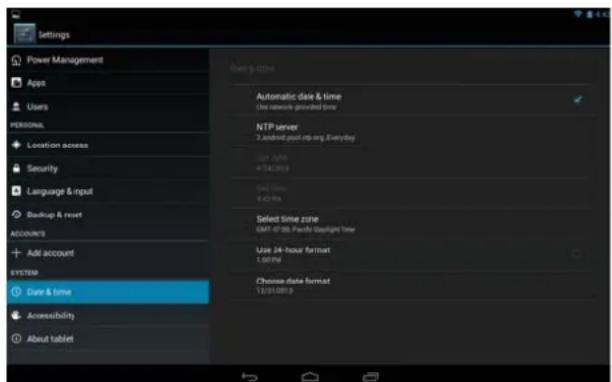
(Sample Image) Date & time menu screen
Below are some of the categories you can choose from:
Automatic date & time—Clear the selection to set the date and time manually.
- Automatic date & time settings—Clear the selection to set the time zone manually.
Set date—If Automatic date & time is cleared, a screen opens to set the date manually.
Set time—If Automatic date & time is cleared, a screen opens to set the time manually.
Select time zone—Select to set the time zone manually.
Use 24-hour format—Select to display the time using a 24-hour time format (i.e. 13:00, rather than 1:00).
Choose date format—Select to open a screen to select the displayed date's format.

About tablet
The About tablet menu displays information regarding your operating system software and hardware.
To view the About tablet information:
1 Touch the Settings (icon.
The "Settings" menu appears.
2 Touch the About tablet (icon.
The "About tablet" menu appears.
3 Touch the item you wish to view in the About tablet menu.
Below are some of the categories you can choose from:
System updates—Select to open the Toshiba Service Station that lists the availability of operating system software updates.
Status—Select to open a screen that displays information about your battery, network connections, etc.
System information—Select to open a screen that displays information about the Manufacturer, Product name, Product version, Serial number, UUID, and OEM strings for your tablet.
- Legal information—Select to open a screen that displays legal information about the system software included with your tablet.
Accessing the Notifications menu
You can open the Notifications menu to view pending activity on your tablet.
1 Touch and swipe down from the upper-left corner of the screen in the System bar.
The "Notifications" menu displays.
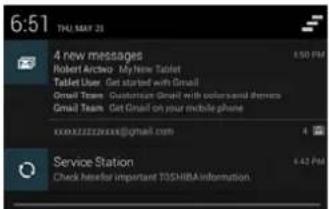
(Sample Image) Notifications menu screen
2 Touch any open area of the display screen to close the Notifications menu.
Accessing the Quick Settings menu
You can open the Quick Settings menu to view and control the tablet settings you most often use, as well as access the Settings menu.
1 Touch and swipe down from the upper-right corner of the screen in the System bar.
The "Quick Settings" menu displays.
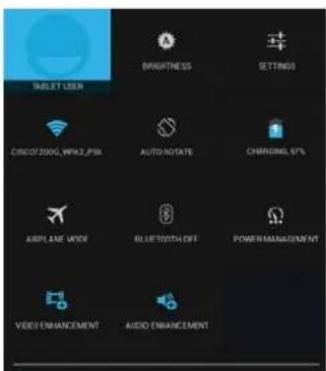
(Sample Image) Quick Settings menu screen
2 Touch the icon that corresponds to the setting you wish to change, and then select the setting you wish to change it to.
3 Touch any open area of the display screen to close the Quick Settings menu.
The following are some of the icons you may find in the Quick Settings menu.
IconNameDescription
 | Airplane mode | Touch to turn ON/OFF Airplane mode. |
 | Wi-Fi® | Touch to view the current Wi-Fi® connections, see “Wireless and networks settings” on page 69. |
 | Auto-rotate Touch to lock/unlock auto rotation. When unlocked, the screen automatically changes orientation to match the orientation of the device. | |
 | Brightness Touch to adjust the screen brightness, see “Display settings” on page 71. | |
 | Settings Touch to select the tablet setting you wish to change, see “Apps and Settings menus” on page 64. | |
Chapter 3
Working with Apps
Downloading Toshiba Apps
You can download Toshiba apps from the Toshiba App
Place™ by touching the App Place icon.
NOTE
To download apps, you must be connected to the Internet.
TOSHIBA Media Player

The TOSHIBA Media Player is a multimedia player that allows users to experience outstanding multimedia viewing enjoyment.
The TOSHIBA Media Player supports a number of multimedia content formats. For detailed information regarding supported file formats, see the detailed specifications for your device at tabletsupport.toshiba.com.
NOTE
Toshiba does not guarantee that all audio/video files will play correctly.
On the Media Player's main screen, touch the Menu button.
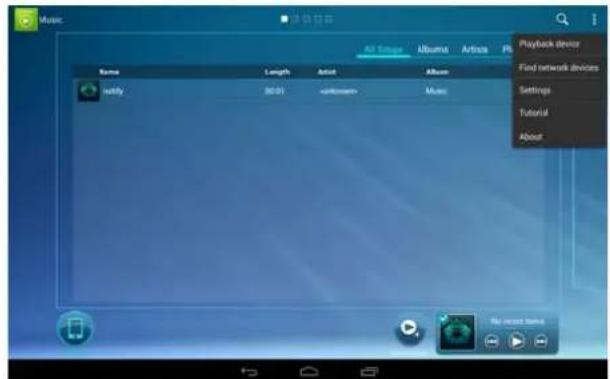
(Sample Image) Toshiba Media Player Settings menu screen
The menu may display the following options:
- Playback device—Opens the list of available playback devices
Find network devices—Displays available network devices.
Settings—Opens media player settings. - Tutorial—Opens the media player tutorial.
About—Displays version information, etc.
Apps
In Google Play™ Store you will have direct access to more than 100,000 apps. Search for your favorite games, apps, wallpapers, and more to customize your tablet.
To learn more, visit the Google Help Center.
Downloading from Google Play™ Store
On the Home Screen, touch the Play Store (Ticon. This opens Google Play™ Store, allowing you to choose music, books, and movies.
Preinstalled Apps on your tablet
Google Play™ Store, Gmail™, Maps, and YouTube™ apps are preinstalled on your tablet and the shortcuts for them may appear on your Home screen. You can move the icons for these applications to other Home screens to customize the look of your tablet, see “Moving an item from the Home screen” on page 53.
You can install many more apps, widgets, games, etc. by visiting the Toshiba App Place™ or Google Play™ Store.
Uninstalling Apps on your tablet
To uninstall applications from your tablet.
1 Touch the Apps (con.
2 Touch&hold the icon that represents the application you want to delete, and then drag it to Uninstall.
3 Confirm the deletion.
NOTE
Applications that came preinstalled on your tablet cannot be deleted from the device.
Chapter 4
Exploring the Features on your Device
Using your TruPen™ with your Excite® Write tablet
The TruPen ^™ allows you to control your device as you would with gestures and allows you to write text or draw on the display, as you would with pen on paper.
Included TruPen™ and accessories
Your TruPen™ comes with additional accessories. It comes with one tip removal tool and three (3) additional tips, located inside the box with your Excite® Write tablet.

(Sample Image) TruPen ^TM tip removal tool (Do not discard.)
Getting to know your TruPen™
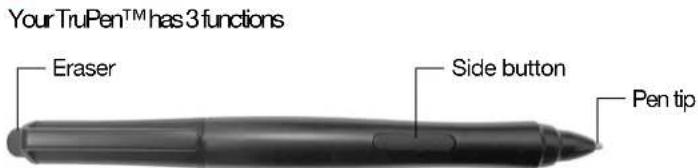
(Sample Image) TruPen™
Pen tip is used to write on your Excite® Write tablet digitizer screen.
Side button is used to change pen type/color in the TruNote™ application. This feature may need to be enabled in the TruNote™ settings. The TruPen™ must be very close to the screen for this feature to function.
Eraser in TruNote™ (may be supported in 3rd party apps).
Navigating apps and settings
When using the TruPen™ to navigate your settings and apps, your TruPen™ can be used similarly to gesture controls. The following information describes how the TruPen™ works in conjunction with tapping, pressing, and swiping.
By default you can use your TruPen™ to swipe left, right, or up and down by dragging the tip across your display. You can tap the screen to make selections.
NOTE
You can also use the eraser of the pen to perform the same function previously mentioned.
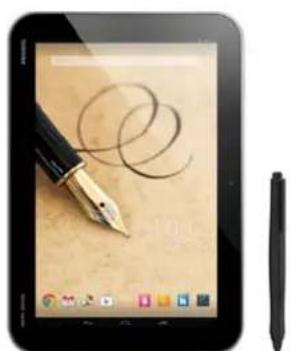
natural_image
Tablet with a fountain pen drawing curved lines on a wooden surface, alongside a stylus (no text or symbols visible)(Sample Image) TruPen™ and Excite® Write tablet
Tap—Firmly tap the pen on the display without pressing the function button on the pen; a pen tap equals a finger tap.
Tap and drag—Tap and drag the pen on the display; equals a finger tap and drag.
Swipe Left, right, up and down, or drag—Drag the tip across your display.
Configuring the TruPen™ side button settings
1 Tap the TruNote™ (☐) icon to launch the application.
2 Tapthe Desktop Menu (icon.
3 Tap the Settings (icon.
4 Tap Stylus buttons settings. A
5 Enable or disable the Eraser B and Side button C by selecting ON or OFF.
6 Tap the X button to close the Settings window.
NOTE The settings are automatically saved after a change is made.
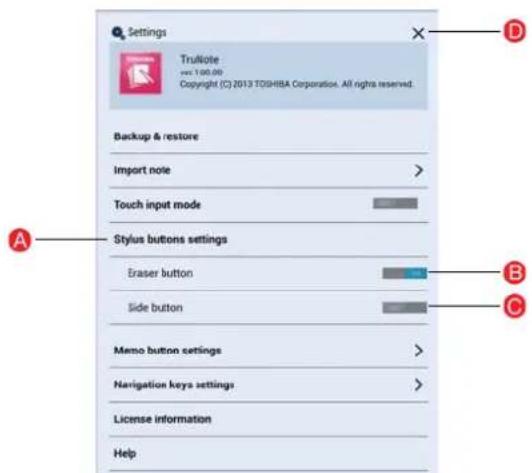
(Sample Image) TruNote™ Settings menu
TruNote™ application
TruNote™ is a note taking application that allows you to create handwritten notes as well as write direct notations on web pages, photos, etc. These notes/pages can then be exported and used in other applications.
Tap the TruNote™ () icon to launch the application.
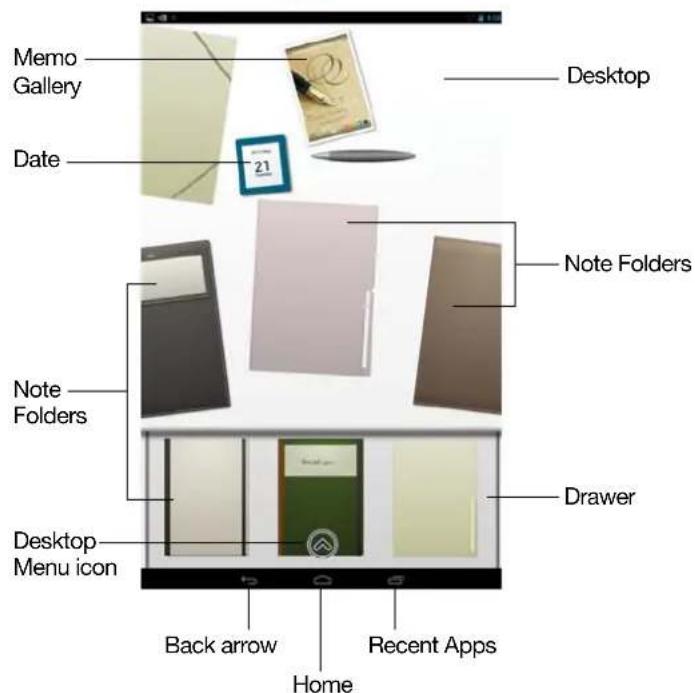
(Sample Image) TruNote™ Desktop/Drawer
Desktop
The Desktop is the main screen for the TruNote™ application. You can manage all of your note folders, notes/pages, and Memo Gallery items in this view.
TruNote™ navigation
| Tap | To select, open, or close items and menus. |
| Tap & hold & drag | To select the item so that you can move it around on the Desktop or to the Drawer. |
| Swipe | To view all folders/notes/pages. |
| Back arrow | ( ) T o g o t o |
| Memo Gallery | To view all images captured with the Memo Gallery button ( ) for TruNoteTM. |
NOTE
Be sure that the target desktop/drawer area is empty before moving a note/folder to its new location.
natural_image
Illustration of various office furniture or office supplies arranged in a grid (no text or symbols visible)
natural_image
Abstract illustration of two overlapping geometric shapes with no text or symbols
natural_image
Blank beige paper with a small blue object on top (no text or symbols)Note Folder Memo Gallery Note/Page (Sample Image) TruNote™ Desktop
1 Tap to open (Note Folder, Memo Gallery, or Note/Page).
2 Once opened, tap in the active note/page to begin editing.
3 Swipe to advance through multiple notes/pages.
NOTE
Writing can only be done in portrait mode.
TruNote™ Desktop menu ()

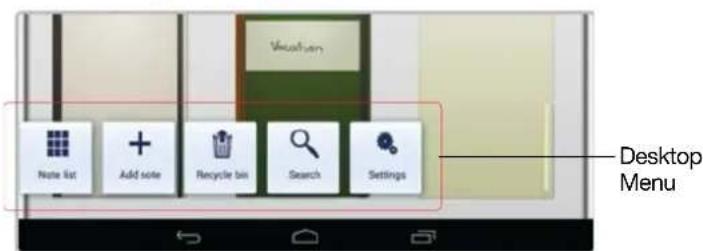
(Sample Image) Desktop menu screen
Tap the Desktop menu (▲) icon to open the Desktop menu.
◆Tap anywhere in the Desktop to close the Desktop menu.
Tap the Back arrow (→) close the TruNote™ application.
The following are some of menu items that may be available while in the Desktop menu:

Note List—Opens a Drawer to show notes/folders in a list view

Add Note Folder—Creates a new note/folder

Recycle bin—Opens the recycle bin

Search—Opens a search window
NOTE
If searching from the Desktop, all note folders, notes/pages, and Memo Gallery screen captures are included in the search.

Settings—Opens the settings menu
Backup note
Restore note
◆Back & restore
Import Note
Touch input mode
Stylus buttons settings
Memo button settings
◆Navigation keys settings
License information
Help
Drawer
You can manage/store note folders and notes/pages you do not frequently use in the Drawer area.
Note/Page Preview
While in the Note/Page preview mode, you may be able to add/remove notes/pages, edit labels, and access other options.
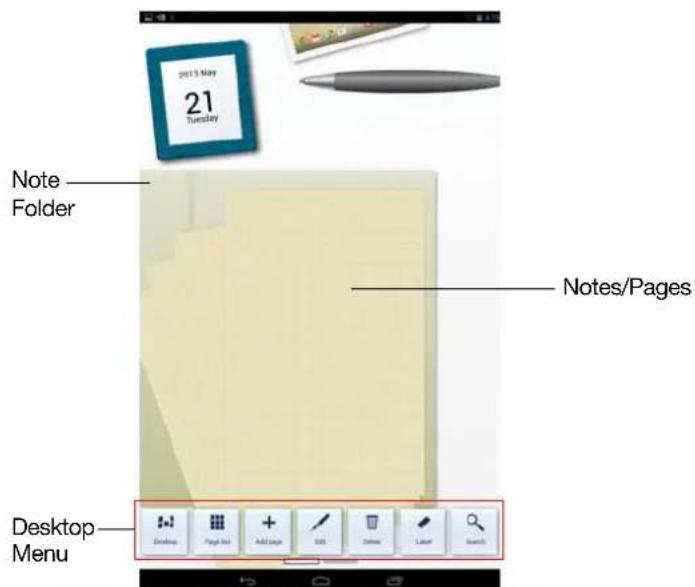
(Sample Image) Note/Page preview menu
NOTE Swipe the menu left or right for more options.
The following are some of the menu items that may be available while in the Note/Page preview menu:
H
Desktop—Closes current Note Folder and returns to the main Desktop screen
■
Page list—Displays notes/pages in Page list view

Add note/page—Adds a new note/page

Edit—Edits the current note/page

Delete—Deletes the current note/page

Label—Displays the label window to add labels to your notes/pages

Search—Opens a search window

Properties—Opens the note/page properties window
Note/Page Menu
The following are some of the menu items that may be available while in the Note/Page menu:

Note Preview—Returns to the note/page preview screen

Add Page—Adds a new note/page

Delete Page—Deletes the currently selected note/page

Paste—Pastes content that was just copied

Search— Searches through typed text or written text, as well as drawn shapes. Type, write, or draw to search.

Pencil case—Accesses pen options, such as color, tip style, thickness, or transparency.

Export—Opens the Export submenu

Presentation—Exports page as a presentation file (PPTX file) that automatically opens in Microsoft® PowerPoint

Document—Exports page as a document file (DOCX file) that automatically opens in Microsoft® Word

PDF—Exports note/page as a pdf document

Image—Exports note/page as an image file (PNG file)

Share—Exports note/page as an image file and shares it to other apps

Text—Exports note/page as text

Import—Opens the Import submenu

Memo Gallery—Imports captured data from the TruNote™ Memo Gallery

Gallery—Imports an image from the device's Gallery

Mail—Opens the default email app and converts the note/page to text in the email message
NOTE
Swipe menu to the left or right for more options.
TruNote™ Pen Settings
Changing pen strokes and colors
Enable the Side button, see "Configuring the TruPen™ side button settings" on page 91 on your TruPen™ in the TruNote™ application to instantly and seamlessly change pen stroke and color. To change the pen stroke and color, perform the following steps:
1 Tap the TruNote™ () icon to launch the TruNote™ application.
2 Open an existing note folder or create a new note folder.
3 Open an existing note/page or create a new note/page.
4 While in the active note/page screen, tap the Note/Page Menu (icon at the bottom-center of the screen.
5 Tap the Pencil Case ( ) icon.
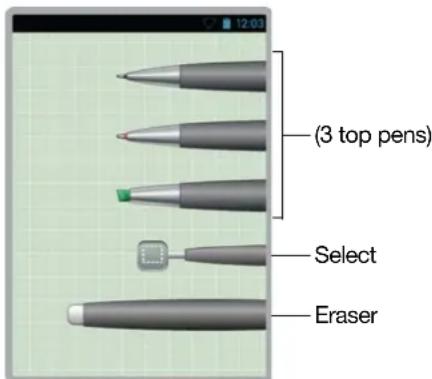
(Sample Image) Quick pen options
6 Select the pen type you would like to use or customize and tap again to access the pen settings. The active pen will already be selected.
NOTE
You can also change the pen types for select options and erase pens.
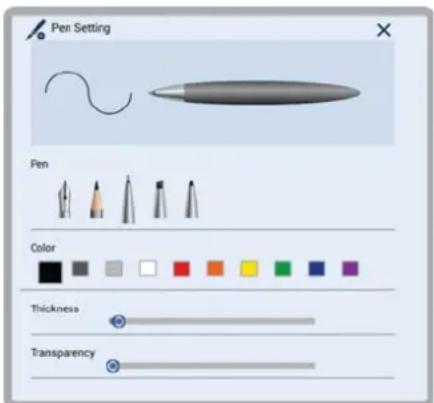
(Sample Image) Pen edit options
7 Select the color, thickness, and transparency values you want to use.
NOTE
The settings are automatically saved after a change is made.
8 Tapthe X button to close the Settings window.
While in edit view you have the ability to change Pen modes within an active note. In the upper portion of the Note/Page screen are some of the Quick select options that you can choose from.
Preset-pen1 (Black)—Changes the ink color to black
Preset-pen2 (Red)—Changes the ink color to red
Preset-pen3 (Green)—Changes the ink color to green

Eraser—Accesses Eraser options

Undo—Undoes the last action

Redo—Redoes the last action

Select—Double-tap the Select icon to display the following available options:

Selects the entire page

Selects by rectangle

Selects by free hand
TruNote™ Memo Gallery
NOTE
The Memo Gallery button for TruNote™ may not be available in all applications.
The Memo Gallery button for TruNote™ allows you to save a current screen capture or mark-up to the MeSmo Gallery in TruNote™.
You can mark-up TruNote™ screen captures with your TruPen™ and save them to the Memo Gallery in TruNote™.
To create a TruNote™ Memo Gallery screen capture, touch the Memo Gallery button for TruNote™ (ICON on the System Bar. The image will be saved in the TruNote™ Memo Gallery. TruNote™ Memo Gallery screen captures can only be accessed through the TruNote™ application.
The following are some of the menu items that may be available while in the TruNote™ Memo Gallery menu:

Memo Gallery—Saves the screen capture and opens the Memo Gallery

Delete—Deletes the selected TruNote™ screen capture

Edit—Opens the selected TruNote™ screen capture, so that you can mark it up
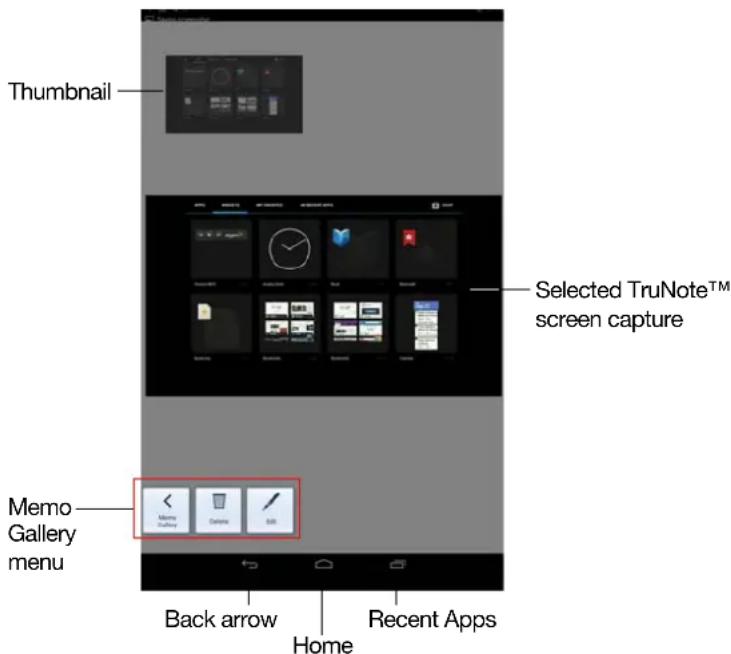
(Sample Image) Memo Gallery
Edit/Mark-up a TruNote™ Memo Gallery Screen Capture
To edit/mark-up a TruNote™ screen capture image captured with the Memo Gallery button for TruNote™:
1 From the Desktop tap Memo Gallery.
2 Tap the TruNote™ screen capture you want to edit.
3 Tap the Memo Gallery menu (icon.
4 Tap the Edit () icon.
You can now can mark-up the image.
5 Tap the Memo Gallery ( ) icon to automatically save and exit from the current image.
6 Tap the Back arrow (k) to return to the Desktop/Drawer area.
Using the onscreen keyboard
Your tablet comes with an onscreen keyboard.
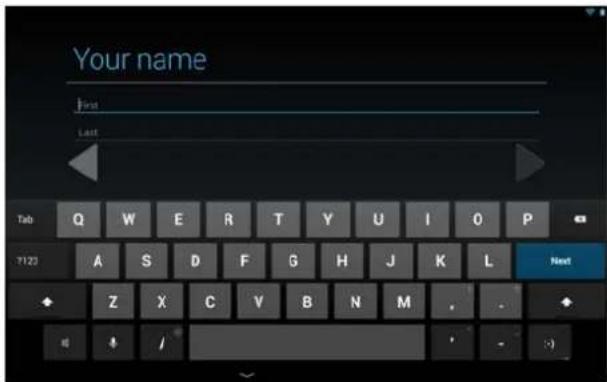
(Sample Image) Onscreen keyboard
Enter text using the onscreen keyboard. Some applications open a text field that when touched, opens the onscreen keyboard allowing you to enter text. Some apps open the keyboard automatically.
The onscreen keyboard has a number of settings. For more information, see "Language & input settings" on page 80.
Type to enter text
To begin typing, touch the text field in the application you are using to open the onscreen keyboard.
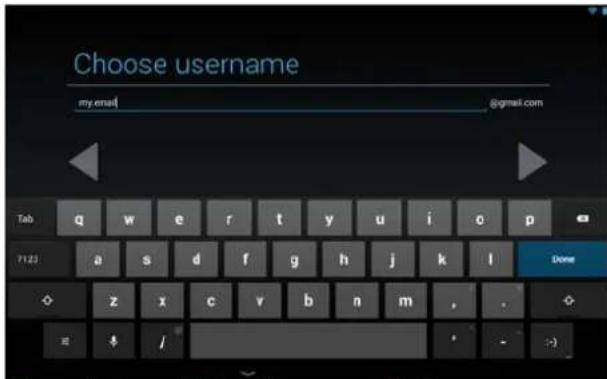
(Sample Image) Touching a text field to type
An insertion point tab (↑) appears where you touch the text field. If text has been previously entered you can drag the insertion point by its tab to move it to the location in the text line you wish to begin typing from.
You may also select one or more words to copy, cut, and paste.
NOTE
Not all applications support this function.
1 Select the text you want to cut or copy.
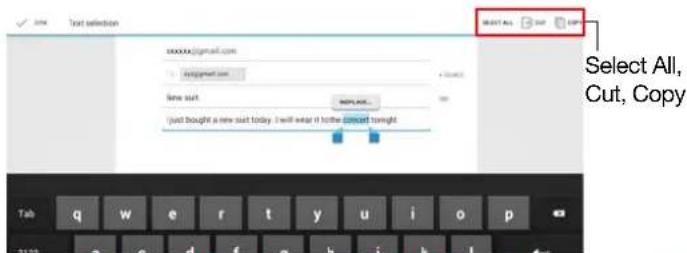
(Sample Image) Touching a text field to cut, copy, or replace text
2 Touch Cut (☒) or Copy (☐) in the Application bar.
Touching Cut removes the selected text from the text field, but it can be pasted into another text field.
3 Place the cursor in the text field where you want to place the text.
4 Touch and hold until the the screen.
Paste () option appears on
5 Touch the Paste ( ) icon.
The text is inserted into the new text field.
NOTE
Text can be copied and pasted from one app to another.
◆ Touch the space bar or a punctuation mark to auto complete a word you are typing.
◆ Touch the Shift (key one time to capitalize the next letter typed.
Double-tap the Shift (✗) key to capitalize all of the letters you type. Touch the Shift (✗) key again to type in lower case.
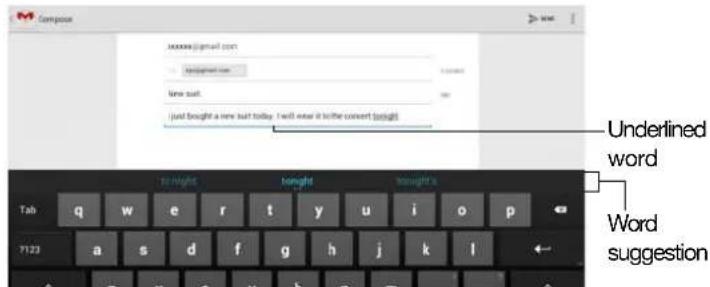
(Sample Image) Word suggestion
While typing, spelling suggestions and similar word suggestions appear just above the keyboard. Touch a word suggestion to use it in place of the underlined word in the text field. To change the input settings, see "Language & input settings" on page 80.
◆ Touch the Delete (key to erase characters to the left of the cursor.
◆ Touch the Number and Symbols (key to type numbers, symbols, and other special characters.
◆ Touch the Close Keyboard 📋 button when you are finished.
You can change the language you want to use by touching the Input Method (button, or by going to the Settings menu, see "Language & input settings" on page 80.
Speak to enter text
You can use the speech-recognition feature to input text to the onscreen keyboard.
1 Touch the text field.
2 Touch the Microphone () key on the keyboard.
3 Speak your text when you are prompted to "Speak now."
The speech-recognition types the words you say.
4 To enter punctuation, say "comma," "period," "exclamation mark," etc.
The text you enter by speech is underlined.
5 Touch the Delete (✗) key to erase the underlined text, or the Send (▶ button to accept the text.
You can change the language you want to use by touching the Input Method (button, or by going to the Settings menu, see "Language & input settings" on page 80.
Using the built-in speakers
Your tablet is equipped with internal speakers. To increase or decrease the volume, use the volume control buttons on the side of your tablet.
You can silence your tablet, so that your notifications are announced with a vibration instead of a tone. To place your tablet into Silent mode, use the volume decrease button to turn the volume down completely, and then press it once again to place your tablet into Silent mode.
Using external speakers or headphones
Instead of using the internal speakers, you can connect headphones or a pair of external stereo speakers.
▲ CAUTION
Do not set the volume too high on this device or when using headphones. Continuous exposure to loud sound can harm your hearing. Discontinue use and consult a physician if you experience any hearing discomfort.

TECHNICAL NOTE: When using amplified speakers, use speakers that require an external power source. Other types of speakers will be inadequate to produce sound from the device.
To play back sound files through external speakers or headphones:
1 Locate the headphone/microphone jack on the device.
2 Using any necessary adapters, plug the cable from the headphones or external speakers into the headphone/microphone jack.
The headphone/microphone jack requires a 16-ohm stereo mini connector.

To adjust the volume:
For external speakers, use the volume controls on each speaker.
For headphones, use the device's volume control.
Recording sounds
You may record sounds using the internal microphones on the device or by connecting a headset.
Using the camera
Your device comes with a built-in camera on the front of the tablet. With the camera you can do the following:
Take pictures and record videos with your device
◆Chat with others and have them see you while using instant messaging (IM) programs
Have video conference calls
NOTE
To email, instant message or video conference, you must be connected to the Internet.
Using a microSD™ Card
For detailed information regarding supported media, see the detailed specifications for your device at tabletsupport.toshiba.com.
The microSD ^™ Card slot supports the use of Micro Secure Digital ^™ (SD ^™ ) media. This media can be used with a variety of digital products: digital music players, cellular phones, PDAs, digital cameras, digital video camcorders, etc.
Inserting memory media
CAUTION
When inserting memory media, do not touch the metal contacts. You could expose the storage area to static electricity, which can destroy data.
To insert a microSD™ Card:
1 Open the port cover.
2 Turn the media so that the contacts (metal areas) are face down.
3 Push the media into the adapter until it locks in place.
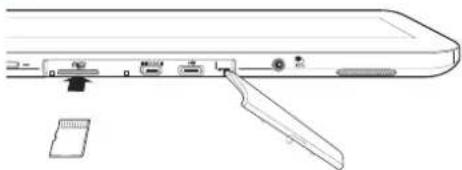
natural_image
Line drawing of a device with ports and a handle, showing no text or symbols(Sample Illustration) Inserting memory media
Removing memory media
CAUTION
Do not remove media while data is being written or read, or your data could be destroyed.
To prepare the card for removal:
1 Touch the
Settings

The Settings menu appears.
2 Touch the
Storage

The Storage menu appears.
3 Touch
Unmount SD card.
4 Open the port cover.
5 Gently press the card inward to release it.
The card pops out slightly.
6 Grasp the card and pull it straight out.
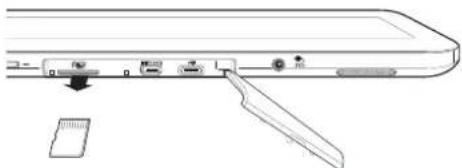
natural_image
Line drawing of a device handle with ports and a paper clip, no text or symbols present(Sample Illustration) Removing memory media
Adding optional external devices
NOTE
Not all devices are compatible. Check with the manufacturer of each device for compatibility.
After starting your device for the first time you may want to:
Connect an external keyboard via the available Bluetooth® settings (see "Using an external keyboard" on page 107 or "Setting up Wi-Fi® and Bluetooth® connections" on page 41)
Connect an external mouse via the available Bluetooth® settings (see "Using an external mouse" on page 107 or "Setting up Wi-Fi® and Bluetooth® connections" on page 41)
Using an external keyboard
If you prefer to use an external keyboard, you can attach one to your device by pairing a Bluetooth® enabled keyboard using the available Bluetooth® connectivity on your device. For more information, see “Setting up Wi-Fi® and Bluetooth® connections” on page 41 and “Using external devices” on page 108.
NOTE
Some keyboard functionality may not be supported.
Using an external mouse
You may want to use an e.xternal mouse instead of the device's touch screen. You can attach one to your device by pairing a Bluetooth ^ enabled mouse using the available Bluetooth ^ connectivity on you device. For more information, see “Setting up Wi-Fi ^ and Bluetooth ^ connections” on page 41 and “Using external devices” on page 108.
NOTE
Some mouse functionality may not be supported.
Using external devices
You can connect external devices to your device using the following available port:
A Micro USB port—Supports data transfer.
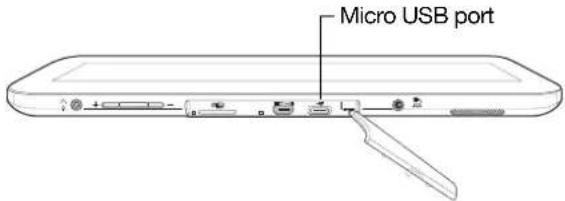
(Sample Illustration) External device port on the left of the tablet
NOTE
Not all USB devices are compatible. Check with the manufacturer of the USB device for compatibility.
Chapter 5
Utilities
Your device includes several utilities designed to help you reconfigure your system to best meet your individual needs. Together, these allow you to ascertain certain system details, set additional options, or change default options. These utilities are described in this chapter.
NOTE
The utilities described in this chapter, and the icons shown in the sample images are applicable only if the related utility is available on your system.
TOSHIBA Service Station
TOSHIBA File Manager Utility
TOSHIBA Service Station
The TOSHIBA Service Station app provides you with updates for both application and system software. It notifies you when new versions of your system software are available, and then prompts you to download and install them.
To open TOSHIBA Service Station:
1 Touch the Apps (con.
2 Touch the Service Station ( ) icon.
The TOSHIBA Service Station screen appears.
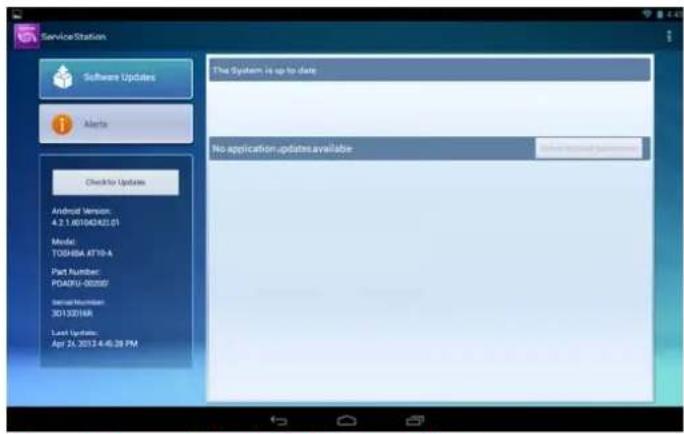
(Sample Image) TOSHIBA Service Station screen
The first time TOSHIBA Service Station is run, you will be prompted to accept the access agreement. This agreement authorizes the app to collect certain basic information about your device and send it to the Toshiba servers as part of the process of obtaining updates.
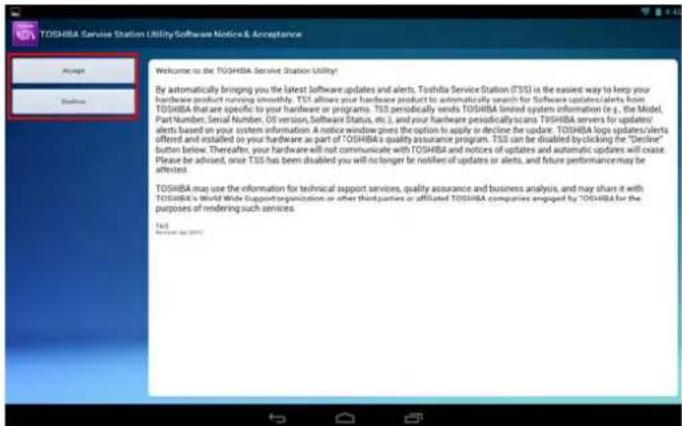
(Sample Image) TOSHIBA Service Station Acceptance screen
Touch the Accept button (recommended) to accept the agreement or touch the Decline button to decline.
NOTE
The TOSHIBA Service Station app will not be able to notify you of new software and application updates if you choose to decline the agreement.
The main screen of this application includes the following areas:
Header—This section runs along the top of the screen and contains basic information about your system, such as the version of the OS, the device part number, and serial number.
Buttons—Buttons are displayed on the screen. Depending on the actions you have available, the buttons will vary.
Information—The main part of the screen displays information, such as the list of available updates, or more detailed information about each specific update.
Check for application updates
During normal operations, the TOSHIBA Service Station will periodically check for updates to your system. This is done automatically. You will be notified with the TOSHIBA Service Station icon in the Status bar when new updates become available.
You can also check for updates manually. Touch the Check for Updates button. The application will refresh the list of available updates.
NOTE
Connect the AC adaptor before updating.
Downloading updates
NOTE
Toshiba strongly recommends that you back up your data and settings before downloading updates.
Touch the TOSHIBA Service Station (icon in the Status bar when an update becomes available to display additional information about that item. To download the update, touch the Download button. The update begins to download and displays a progress indicator in the Notification bar.
NOTE
Touch the Home (☐) button to allow the download to continue while you use your tablet. A notification of download completion appears in the Status bar.
To discontinue the download process, touch the arrow
Back
Installing updates
Once an update has been successfully downloaded, it can be installed.
1 Touch the bar. Download completion notice on the Status
2 Touch the Install button.
The application installer launches.
3 Confirm the installation to continue.
Downloading and installing System updates
TOSHIBA Service Station downloads both application and system updates. System updates require the device to be rebooted during the update process.
Installing a system update is similar to an application update, however you will be reminded that the device will automatically reboot during the update process. Make sure to close any applications and save all data prior to installing a system update.
CAUTION
Do not interrupt or turn off your tablet during a system update once it has begun. Data loss may occur.
TOSHIBA File Manager Utility
Using the TOSHIBA File Manager, you can back up your data to a microSD™ Card.
1 Insert a microSD™ Card into the microSD™ Card slot on your tablet. For more information, see "Using a microSD™ Card" on page 105.
2 Touch the Apps (icon.
3 Touch the File Manager () icon.
The TOSHIBA File Manager screen appears.
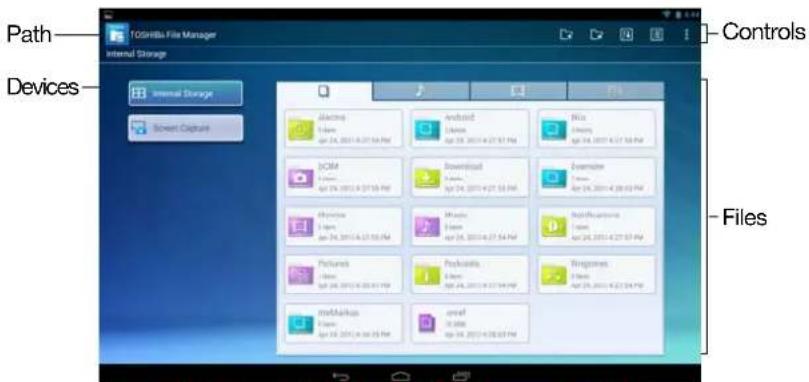
(Sample Image) TOSHIBA File Manager screen
4 Make sure Internal Storage () option is selected at the top left of the screen.
5 Touch and hold a file or folder to enter selecting mode.
Then touch the files/folders you wish to back up, or touch Select All from the selected items count drop-down menu located at the top left corner of the screen.
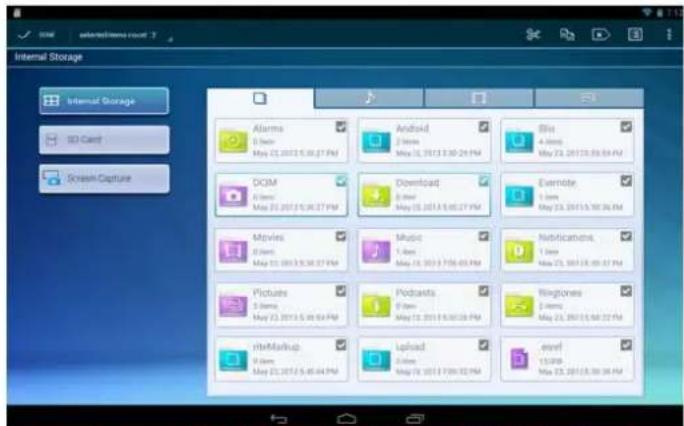
(Sample Image) TOSHIBA File Manager Select items
The specific file or folder you have selected will highlight with a checkbox in the upper right hand corner to signify that it has been selected for manipulation. All the other files and folders on the screen will also now have a checkmark in the upper right hand corner however they will remain grayed-out until specifically selected.

(Sample Image) TOSHIBA File Manager - files checked
At this time you can touch individual files and folders with the grayed-out checkmarks to select them.
6 Touch the Copy (button in the action bar located at the top right corner of the screen.
7 Touch the SD Card () icon from the device icons on the left of the screen to select the microSD™ card.
Touching the SD Card () icon displays the file/folder content on the microSD™ Card.
8 Select the folder you want to copy the files/folders to, and then touch the Paste (Icon) in the action bar located at the top right corner of the screen.
The files are copied to the microSD™ Card.
File browsing screen
The available options in the File browsing screen are:
Device—Internal storage and microSD™ Card are displayed.
Path—The device name is displayed on the left side of the screen, and the relative path is displayed on the right.
File—Files/folders are listed in multi-columns with thumbnails showing the file information, such as name, modified date/time, etc. The selected files/folders are tagged in red.
Action bar—You can create folders, change views and manipulate files from this menu bar.
Operation of files/folders
Touch and hold a file or folder to select it. This will change the action bar at the top of the screen to provide the options you can use for file or folder manipulation.
The available options are:
IconNameDescription

Cut Touch and hold the file or folder to select
it. Touch the Cut icon the copy the file to the "virtual clipboard" and remove it from its current location.

Copy Touch and hold the file or folder to select
it. Touch the Copy icon to copy the item to the "virtual clipboard". Later you can use the "Paste" option to paste the item to the destination location of your choosing.
IconNameDescription
 | Delete Touch and hold the file or folder to selectit. Touch the Delete icon to permanently delete the item from the location it is currently in. The system will prompt you to make sure this is what you want to do. |
 | Change View This option allows the user to change the view from one in which items are shown in three columns and as many rows as needed to a single column list view. |
| [57mw] | Menu This option provides additional menuoptions based upon where you are in the process. As an example if have not yet selected any items the options are;Device Information, About and Help. If you have selected items the options become; Rename, Add to shortcut,Information and Help. |
Rename files/folders
To rename a file/folder:
1 Touch and hold a file or folder to enter selecting mode.
2 Touch the Menu icon.
3 Select Rename from the drop-down menu.
4 Type in the new name for the folder and touch OK.
Create folders
To create a new folder:
1 Choose the desired top directory in the File browsing screen.
2 Touch the Create Folder (icon.
A pop-up window appears.
3 Create a new folder name.
4 Touch OK to continue.
Storage structure
The following describes the function of each of the icons on the TOSHIBA File Manager screen:
IconNameDescription
 | Internal storage | Displays the file content of the device's internal storage, (excluding system files). |
 | microSDTM Card | Displays the file content of the microSDTM Card that is inserted into the microSDTM Card slot. |
 | Screen Capture | Displays the file content of the screen captured images. |
NOTE
To perform a screen capture, press the Power and Volume down button simultaneously for a few seconds.
Chapter 6
If Something Goes Wrong
Some problems you may encounter when using your tablet are relatively easy to identify and solve.
This chapter aims to help you solve many problems by yourself. It covers the problems you are most likely to encounter.
If all else fails, contact Toshiba. You will find information on Toshiba's support services at the end of this chapter.
Problems when you turn on the device
These problems may occur when you turn on the power.
The device will not start.
Make sure you attached the AC adaptor properly.
If you are using the AC adaptor, check that the wall outlet is working by plugging in another device, such as a lamp.
Verify that the device is on by looking at the ON/OFF indicator. If the indicator is glowing, the device is on. Also, try turning the device off and then on.
The device starts but when you touch an icon nothing happens.
Your device may have an application or resource conflict. Try shutting down and restarting.
The operating system is not working
Once you are familiar with the Home screens and used to the way the operating system responds, you can easily detect if the it is not working correctly. For example:
The operating system responds differently from the normal routine
◆Screens and apps take a long time to load
◆The screen does not look right
Unless a hardware device has failed, problems usually occur when you change the system in some way such as installing a new app or adding an external device.
Most issues are solved by “recycling the system’ turning it off then back on. If this does not resolve the issue, try uninstalling the most recently installed application or disconnecting the most recently installed accessory. If this still does not resolve the issue, use the About tablet setting to check for available system updates. For more information, see “About tablet”“About tablet” on page 83.
Internet problems
My Internet connection is very slow.
Many factors contribute to the speed with which you can surf the Internet. They include: network speed, network conditions, time of day (when everyone else is surfing, your access can be slow) and popularity of the sites you are trying to access. If accessing a particular site is very slow, try later.
My browser cannot find the URL address I typed in.
Check the spelling of each name and the syntax of the address carefully. A single incorrect letter or missed character will make it impossible for your browser to locate the site.
My browser cannot find a site I bookmarked.
The World Wide Web is constantly changing. A site you bookmarked yesterday may not be available today or its server may be down for temporary repair. Try again later.
Power and the batteries
Your device receives its power through the AC adaptor or from the system battery. Power problems are interrelated. For example, a faulty AC adaptor will neither power the device nor recharge the batteries.
Here are some typical problems and how to solve them:
The AC adaptor works correctly, but the battery will not charge.
The battery does not charge while the device is consuming full power. Try turning off the device.
The battery may be too hot or too cold to charge properly. If you think this is the probable cause, let the battery reach room temperature and try again.
The device does not power on.
Let the battery discharge completely, then try charging it again.
Check the power options. For more information, see "Optimizing battery life" on page 29. Is your software using the internal storage drive more? Is the display power set to turn off automatically? Was the battery fully charged to begin with? All these conditions affect how long the charge lasts.
If the device still does not power on, contact your service provider immediately.
After a period of time, the battery will lose its ability to perform at maximum capacity and will need to be replaced. This is normal for all batteries.
For more information on maintaining battery power, see "Charging the battery" on page 28.
Display problems
Here are some typical display problems and their solutions:
The screen does not look correct.
You can change the display settings by touching the Settings (icon on the Home screen. For more information, see "Display settings" on page 71.
Small bright dots appear on your screen when you turn on your device.
Small bright dots may appear on your screen display when you turn on your device. Your display contains an extremely large number of thin-film transistors (TFT) and is manufactured using high-precision technology. Any small bright dots that may appear on your display are an intrinsic characteristic of the TFT manufacturing technology.
The screen does not appear as bright as it used to be
Over a period of time, and depending on the usage of the device, the brightness of the screen will deteriorate. This is also an intrinsic characteristic of the screen technology. When the device is operated on battery power, the screen will dim and you may not be able to increase the brightness of the screen while on battery power.
Sound system problems
The sound settings can be configured to your desired user preferences. For more information, see “Sound settings” on page 70.
No sound is coming from the device's speakers.
Adjust the volume control.
If you are using external headphones, speakers, or a headset, check that they are securely connected to your device.
Wireless networking problems
NOTE
This section provides general troubleshooting tips for networking problems, specifically wireless (Wi-Fi®) networking.
The terms and concepts used assume a basic understanding of networks, and may be for more advanced users. If you need assistance or if you are not familiar with the terminology, please contact Toshiba.
Your device is equipped with an internal Wi-Fi
® adapter.
Verify that your Wireless connection is enabled. For more information, see “Setting up Wi-Fi ^® and Bluetooth ^® connections” on page 41.
- Verify that your device can detect access points or routers. If it can detect a Wi-Fi ^ access point or router then it may be a configuration issue.
◆Verify that the signal strength is good.
If another device is on the same network, verify that it has network access, and can connect to the Internet. If, for example, the other device cannot browse to a public Web site, the ISP's (Internet Service Provider) service may be disrupted. - Verify that the Service Set Identifier (SSID), or network name, is correct - i.e., that it matches the SSID assigned to the access point you are attempting to connect through. SSIDs are case-sensitive.
If you have enabled any security provisions (closed system, MAC address filtering, Wired Equivalent Privacy [WEP], etc.), check the access point vendor's Web site for recent firmware upgrades. Problems with WEP keys, in particular, are frequently addressed in new firmware releases.
If you need further assistance
If you have followed the recommendations in this chapter and are still having problems, you may need additional technical assistance. This section contains the steps to take to ask for help.
Before you contact Toshiba
Since some problems may be related to the operating system or the program you are using, it is important to investigate other sources of assistance first.
Try the following before you contact Toshiba:
◆ Review the troubleshooting information.
If the problem occurs while you are running a program, consult the program's documentation for troubleshooting suggestions. Contact the software company's technical support group for their assistance.
- Consult the dealer from whom you purchased your device and/or program. Your dealer is your best source for current information.
For the detailed specifications for your device, visit tabletsupport.toshiba.com.
Contacting Toshiba
Toshiba's Technical Support Web site
For technical support, or to stay current on the most recent software and hardware options for your device, and for other product information, be sure to regularly check the Toshiba Web site at tabletsupport.toshiba.com.
Other Toshiba Internet Web sites
| toshiba.com | Worldwide Toshiba corporate site |
| us.toshiba.com | Marketing and product information in the USA |
| accessories.toshiba.com | Accessories information in the USA |
| www.toshiba.ca | Canada |
| www.toshiba-Europe.com | Europe |
| www.toshiba.co.jp/index.htm | Japan |
| latin.toshiba.com | Mexico and all of Latin America |
| acclaim.toshiba.com | Toshiba USA Self-Service support web site |
| laptopforums.toshiba.com | Community discussion forums for Toshiba laptop users |
Toshiba's worldwide offices
Australia
Toshiba (Australia) Pty. Limited
84-92 Talavera Road
North Ryde NSW 2113
Sydney
Australia
Canada
Toshiba Canada Ltd.
191 McNabb Street
Markham, Ontario
L3R - 8H2
Canada
France
Toshiba Corporation, PCO-IO
1-1, Shibaura 1-Chome
Minato-Ku, Tokyo, 105-8001
Japan
Latin America and Caribbean
Toshiba America Information
Systems, Inc.
9740 Irvine Boulevard
Irvine, California 92618
United States
Mexico
Col. Lomas de Chapultepec.
CP 11000 Mexico, DF.
Spain
Toshiba Information Systems
(España) S.A.
Parque Empresarial San
Fernando
Edificio Europa, 1a Planta
Escalera A
28831 (Madrid) San Fernando de
Henares
Spain
United Kingdom
Toshiba Information Systems
(U.K) Ltd.
Toshiba Court
Weybridge Business Park
Addlestone Road
Weybridge, Surrey KT15 2UL
United Kingdom
United States
Toshiba America Information
Systems, Inc.
9740 Irvine Boulevard
Irvine, California 92618
United States
The Rest of Europe
For more information on additional Toshiba worldwide locations, please visit: www.toshiba.co.jp/index.htm.
Appendix A
Power Cord/Cable Connectors
Your device ships with the correct power supply for the
country of purchase. This appendix shows the shapes of the typical AC power cord/cable connectors for various parts of the world.
USA

UL approved
Canada
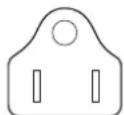
CSA approved
United Kingdom
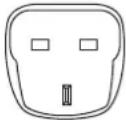
BS approved
Europe
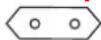
VDA approved
NEMKO approved
Australia
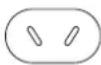
AS approved
Glossary

TECHNICAL NOTE: Some features defined in this glossary may not be available on your device.
Acronyms
The following acronyms may appear in this User's Guide.
AC Alternating Current
Apps Applications
bps bits per second
CPU Central Processing Unit
DC Direct Current
DPI Dots Per Inch
EPROM Erasable Programmable Read-Only Memory
FCC Federal Communications Commission
GB gigabyte
GPS Global Positioning System
HDD Hard Disk Drive
HDMI High-Definition Multimedia Interface
HTML Hypertext Markup Language
IEEE Institute of Electrical and Electronics Engineers
I/O Input/Output
IRQ interrupt request
ISP Internet Service Provider
KB kilobyte
LCD Liquid Crystal Display
LED Light Emitting Diode
MB megabyte
RAM Random Access Memory
RFI Radio Frequency Interference
ROM Read-Only Memory
RTC Real-Time Clock
SD Secure Digital
TFT Thin Film Transistor
USB Universal Serial Bus
URL Uniform Resource Locator
WAN Wide Area Network
www World Wide Web
WLAN Wireless Local Area Network
Terms
The following terms may appear in this User's Guide.
A
active-matrix display—A liquid crystal display (LCD) made from an array of liquid crystal cells using active-matrix technology. Also known as a “TFT display,” in its simplest form there is one thin film transistor (TFT) for each cell. This type of display works well with tablet devices because of its shallow depth and high-quality color. Active-matrix displays are viewable from wider angles than most passive-matrix displays.
adapter—A device that provides a compatible connection between two units. For example, the tablet's internal display adapter receives information from the software and translates it into images on the screen. An adapter can take a number of forms, from a microprocessor to a simple connector. An intelligent adapter (one that is capable of doing some processing) may also be called a controller.
Alternating Current (AC)—The type of power usually supplied to residential and commercial wall outlets. AC reverses its direction at regular intervals. Compare Direct Current (DC).
application—A set of instructions that can be executed by a tablet.
App shortcut—An application icon that can be placed on a Home screen. Touching one opens the app without having to first open the Apps screen. See also icon.
B
backup—A copy of a file, usually on a removable disk, kept in case the original file is lost or damaged.
baud rate—The speed at which a communication device, such as a printer or modem, transmits information. Baud rate is the number of signal changes per second (not necessarily the same as bits per second). See also bits per second.
bits per second (bps)—A way of measuring the speed at which information is passed between two devices. This is the basic unit of measure used in modem communications, and is similar, but not identical, to the baud rate. See also baud rate.
Bluetooth®—A proprietary open wireless technology standard that uses short wavelength radio transmissions to exchange data over short distances. Bluetooth can transmit from fixed and mobile devices, and provides a high level of security.
Bookmark—A Shortcut can be created and placed on a Home screen from a selected browser bookmark. Touching the icon opens the Web browser to the chosen bookmarked page. See also icon.
boot—To start the tablet. The term “boot” originates from bootstrap program (as in “pulling itself up by its bootstraps”), a program that loads and initializes the operating system. See also reboot.
bus—An electrical circuit that connects the central processing unit (CPU) with other parts of the tablet, such as the video adapter, disk drives, and ports. It is the pathway through which data flows from one device to another. See also bus speed, frontside bus.
bus speed—The speed at which the central processing unit (CPU) communicates with the other parts of the tablet.
C
cache—A section of very fast memory in which frequently used information is duplicated for quick access. Accessing data from cache is faster than accessing it from the tablet's main memory. See also CPU cache.
Central Processing Unit (CPU)—The chip that functions as the “brain” of the tablet. It takes information from outside sources, such as memory or keyboard input, processes the information, and sends the results to another device that uses the information.
character—Any letter, number, or symbol you can use on the tablet. Some characters are non-printing characters, such as a paragraph break in a word-processing program. A character occupies one byte of tablet device storage.
chip—A small piece of silicon containing tablet device logic and circuits for processing, memory, input/output, and/or control functions. Chips are mounted on printed circuit boards.
compatibility—The extent to which tablets, programs, or devices can work together harmoniously, using the same commands, formats, or language as another.
configuration—(1) The collection of components that make up a single tablet operating system. (2) How parts of the system are set up (that is, configured).
controller—A device that controls the transfer of data from a tablet device to a peripheral device and vice versa. For example, disk drives, monitors, keyboards, and printers all require controllers.
CPU—See Central Processing Unit (CPU).
CPU cache—A section of very fast memory residing between the CPU and the tablet's main memory that temporarily stores data and instructions the CPU will need to execute commands and programs. See also cache.
cursor—An onscreen symbol (usually a flashing vertical line) that indicates the position where characters will appear when you enter data.
D default—The setting selected by a program when the user does not specify an alternative setting.
device—A component attached to the tablet. Devices may be external (outside the tablet's case) or internal (inside the tablet's case). Printers, disk drives, and modems are examples of devices.
device driver—A program (called a “driver”) that permits the tablet to communicate with a device.
Direct Current (DC)—The type of power usually supplied by batteries. DC flows in one direction. Compare Alternating Current (AC).
disable—To turn the option off. See also enable.
disk drive—The device that reads and writes information and programs on external media or hard disk. It rotates the disk at high speed past one or more read/write heads.
document—Any file created with an application and, if saved to disk, given a name by which it can be retrieved. See also file.
download—(1) In communications, to receive a file from another source through a network. (2) To send font data from the tablet to a printer. See also upload.
drag—To touch and hold an item for a moment and then, without lifting your finger, move the item until you reach the target position.
driver—See device driver.
E emulation—A technique in which a device or program imitates another device or program.
enable—To turn on an option. See also disable.
executable file—A program that is ready to run. Application programs and batch files are examples of executable files. Names of executable files usually end with a .bat, .exe, or .apk extension.
expansion device—A device that connects to a tablet to expand its capabilities. Other names for an expansion device are port expander, port replicator, docking station, or network adapter.
extension—See file extension.
external device—See device.
F
file—A collection of related information, saved on disk with a unique name. A file may be a program, information used by a program, or a document. See also document.
file name—A set of characters that uniquely identifies a file within a particular folder. It consists of two parts: the actual name and the file name extension. See also file extension.
file extension—The three characters following the period (pronounced "dot") at the end of a file name. The extension indicates the type of file. Examples are .apk for application files and .pdf for documentation files. See also file name.
folder—A container for organizing files saved to a disk. A folder is symbolized on screen by a graphical image (icon) of a file folder. A folder can contain files and other folders.
G
ground—A conductor to which all components of an electric circuit are connected. It has a potential of zero (0) volts, is connected to the earth, and is the point of reference for voltages in the circuit.
H
hard disk—A storage device composed of a rigid platter or platters that can be magnetically coded with data. Hard disks hold much more information than some other external media and are used for long-term storage of programs and data. The primary (or only) hard disk in a tablet device is usually fixed.
hardware—The physical components of a tablet system. Compare software.
HDMI (High-Definition Multimedia Interface)—An interface used to transmit high quality audio and video signal via a single cable in digital format, providing better picture quality than analog signal.
hot swapping—The ability to add or remove devices from the tablet while it is running and have the operating system automatically recognize the change.
icon—A small image displayed on the screen that represents a function, file, or program.
interlaced—A method of refreshing the display screen, in which only every other line of pixels is refreshed. Interlaced screens take two passes to create a complete screen image. Compare non-interlaced.
internal device—See device.
Internet—The decentralized, world-wide network of computers that provides electronic mail, the World Wide Web, and other services. See also World Wide Web.
L LED (Light Emitting Diode)—A solid state lamp (SSL) that uses light-emitting diodes (LEDs) as the source of light, which offers long life and high efficiency output. Multiple diodes are used together, since the light created by individual light-emitting diodes is small compared to incandescent and compact fluorescent lamps.
LCD (Liquid Crystal Display)—A type of display that uses a liquid substance between two transparent electrode panels. When an electric current passes through the electrodes, the molecules in the liquid form a crystalline pattern that polarizes the light passing through it. A filter over the electrodes permits only non-polarized light to pass to the surface of the display, creating light and dark pixels.
M memory—Typically refers to the tablet's main memory, where programs are run and data is temporarily stored and processed. Memory can be volatile and hold data temporarily, such as RAM, or it can be nonvolatile and hold data permanently, such as ROM. A tablet's main memory is RAM. See also RAM, ROM.
microprocessor—See Central Processing Unit (CPU).
motherboard—The computer's main circuit board that contains the processor, memory, and other primary components.
mount—To initialize the external storage device for transferring and storing files.
multimedia—A combination of two or more media, such as sound, animation, and video in an application or presentation.
N
network—A collection of computers and associated devices that are connected by communications facilities. A network allows you to share data and peripheral devices, such as printers, with other users and to exchange electronic mail.
non-interlaced—A method of refreshing the tablet screen, in which each pixel of every line is refreshed as the electron beam scans across and down the screen. Compare interlaced.
O
online—Available through a computer. Online may refer to information being read from your own computer's internal storage drive, such as online documentation or online Help, or to information coming from another company on a company network or the Internet.
operating system—A set of programs that controls how the tablet device works.
P
password—A unique string of characters entered by a user to verify his or her identity to a computer or the network.
peripheral—Any device, such as a mouse or keyboard, that is attached to the tablet and controlled by the tablet's CPU.
pixel—Short for "picture element." The smallest dot that can be produced on a screen or printer.
Plug and Play—Generally, refers to the tablet's ability to automatically configure itself to work with peripheral devices. When capitalized, refers to a standard that, when followed by a device manufacturer, allows the tablet to configure itself automatically to work with the device.
port—A socket on the tablet where you plug in a cable for connection to a peripheral device.
processor—See Central Processing Unit (CPU).
properties—The attributes of an object or device. For example, the properties of a file include the file's type, size, and creation date.
R
RAM (Random Access Memory) — Volatile memory that can be written to as well as read. Volatile here means that information in RAM is lost when you turn off your tablet. This type of memory is used for your tablet's main memory. See also memory. Compare ROM.
Random Access Memory—See RAM.
Read-Only Memory—See ROM.
reboot—See boot, restart.
removable disk—A disk that can be removed from a disk drive. A Flash drive is one example of a removable disk.
resolution—A measure of the sharpness of the images that can be produced by a printer or displayed on a screen. For a printer, resolution is expressed in dots per inch (dpi). For a screen, it is expressed as the number of pixels available horizontally and vertically.
restart—Synonymous with reboot. To reset the tablet by reloading the operating system without turning the tablet off. See also boot.
ROM (Read-Only Memory)—Non-volatile memory that can be read but not written to. Non-volatile here means that information in ROM remains whether or not the tablet is receiving power. This type of memory is used to store your tablet's BIOS, which is essential instructions the tablet reads when you start it up. See also BIOS, memory. Compare RAM.
S
Secure Digital (SD)—A small, portable, non-volatile memory card used to store and transfer data between digital products, providing encryption capability for content security.
select—To highlight or otherwise specify text, data, or graphics with the intent to perform some operation on it.
shortcut—See Application shortcut.
Sleep—A feature of some operating systems that allows you to turn off the tablet without exiting your open applications and to continue from where you left off when you turn the tablet on again.
software—See application. Compare hardware.
Swipe—To move your finger quickly across the surface of the screen without pausing.
Sync—To synchronize files and data or accounts so that the same information is shared in multiple places.
T TFT display—Thin Film Transistor display. See active-matrix display.
Touch—To activate items displayed on the screen, such as apps, setting icons, and onscreen buttons by touching them with your finger.
Transfer—To move files or data from one location to another.
U unmount—To prepare the external storage media for removal from the device.
upload—To send a file to another computer through a modem or network. See also download.
utility—A computer program designed to perform a narrowly focused operation or solve a specific problem. Utilities are often related to computer system management.
W Wallpaper—is a background image downloaded from the Web or chosen from the Gallery (pictures taken with the camera, or still images included with the system). A live wallpaper is an animated scene or maybe a map that centers on the current location.
Web—See World Wide Web.
Widget—A miniature app that can be placed on a Home screen. Touching the icon opens the application. Many of these include a clock, a music player, and the Google™ Search bar. See also icon
Wi-Fi®—A registered trademark term of the Wi-Fi Alliance that stands for Wireless Fidelity, and is another term for the communication protocol to permit an Ethernet connection using wireless communication components.
World Wide Web (www)—The worldwide network of Web sites linked together over the Internet. A user of the Web can jump from site to site regardless of the location of the tablet hosting the site. See also Internet.
Index
A
about tablet
legal information 83
settings 83
status 83
System information 83
system updates 83
AC adaptor 26
Accessibility
settings 81
Accessibility settings
Auto-rotate screen 81
Large text 81
TakBack 81
Touch & hold delay 82
accounts
add an account 59
managing 58
remove an account 59
Accounts settings 77
adding
optional external devices 107
Apps 87
apps
Local 61
Maps 61
Navigation 61
preinstalled 88
settings 74
uninstalling 88
apps and settings menus 64
apps menu
apps 64
automatic
date & time settings 82
automatic date & time
date & time settings 82
Auto-rotate screen
Accessibility settings 81
B
backing up data 22, 42
Google™ Account 42
TOSHIBA File Manager 42
Backup & reset settings 78
automatic restore 79
back up my data 79
backup account 79
factory data reset 79
battery
care 29, 30
charging 28
maintaining 30
optimizing battery life 29
safety precautions 29
taking care of 29
Bluetooth®
wireless & networks 69
built-in speakers
using 104
button
Back 44
Home 45
Memo Gallery 45
power 31
Recent Apps 45
buttons
power button 26
C
camera
front camera 24
using 105
caring for your device 63
charging the battery 28
cleaning the device 63
Clear credentials
security 74
connecting
AC adaptor 26
power source 27
Creating
Folders 54
customize
device settings 64
D
data
backing up 22
restoring 43
date & time
settings 82
date & time settings
automatic 82
automatic date & time 82
Select date format 83
select time zone 82
set date 82
set time 82
Use 24-hour format 83
date and time
setting up 38
DC-In port 25
Default
language & input settings 81
Default notification
sound settings 70
device
caring for 63
cleaning 63
disposal 30
turning off 56
turning off options 56
device administrators
security 74
device will not start
troubleshooting 118
devices
external 108
disposal information 12
disposing of the device 30
downloads
managing 61
E
encrypt tablet
security 73
external device
Micro USB port 108
external devices
keyboard 107
mouse 107
ports 108
external headphones
using 104
external speakers
using 104
F
factory data reset 62
features 20
features and components 23
other documentation 20
this guide 19
features and components
back view 24
bottom view 26
front view 24
left side view 25
top view 26
files/folders
operation 115
first time use 31
Folder
Creating, naming, and
removing 54
folders
creating, naming, removing 54
G
Gmail icon 46
Google Play™ Store
downloading from 87
Google search bar 45
GPS
location access 72
H
headphone jack 25
Home screen
adding items 53
icons 45
moving items 53
removing items 53
Home screens
customizing 53
|
icon
Apps 44
Battery status 45
Browser 65
Calculator app 66
Calendar app 66
Chrome 65
Downloads app 66
Gallery app 66
Gmail 46
Gmail™ 65
Maps app 65
Media Player app 66
Navigation app 66
People app 66
Play Books app 66
Play Store app 65
Safety 19
Settings 44
Settings menu 65
Time display 45
TruNote™ 44
Voice recognition 45
Install from storage
security 74
internal microphones 26
Internet problems
troubleshooting 119
K
keyboard
external 107
L
language & input
settings 80
language & input settings
Default 81
Personal dictionary 81
select language 81
Spell checker 81
Voice Search 81
Large text
Accessibility settings 81
legal information
about tablet 83
Licenses 12
location access
GPS 72
settings 72
Wi-Fi & mobile network location 72
M
maintaining your battery 30
Make passwords visible security 73
managing
accounts 58
downloads 61
Micro USB port 25
microphone jack 25
microSD™ Card
using 105
microSD™ slot 25
mouse
external 107
N
Naming
Folders 54
Navigating the Home screen 47
Navigation and features 44
navigation buttons 47
notification
About tablet 68
Accessibility 68
Accounts 68
Apps 68
Backup & reset 68
Battery 68
Date & time 68
Display 67
Language & Input 68
Security 68
Sound 67
Storage 67
Wi-Fi® 67
notifications
notification bar 48
viewing new 49
Notifications menu 84
O
online resources
Toshiba 22
onscreen keyboard
speak to text 103
typing 101
using 101
operating system
troubleshooting 119
optimizing battery life 29
optional external devices
adding 107
other documentation 20
P
Personal dictionary
language & input settings 81
ports
DC-In 25
external devices 108
headphone 25
internal microphones 26
Micro USB 25
Micro USB port 108
microphone 25
microSD™ slot 25
power
cord/cable connectors 125
turning on 31
power button 26, 31
precautions
safety 21
preinstalled apps 88
Q
Quick Settings icon
Airplane mode 85
Auto-rotate 85
Brightness 85
Settings 85
Wi-Fi® 85
Quick Settings menu 84
R
recording sounds 105
recovery
factory data reset 62
registering your Toshiba device 42
Removing
Folders 54
restoring your data 43
S
Safety
icons 19
safety
disposing of the device 30
precautions 21
safety precautions
battery 29
screen
settings 71
screen brightness
screen settings 72
Screen lock
security 73
Screen lock sound
sound settings 71
screen settings
screen brightness 72
Sleep 72
wallpaper 72
SD™ Card slot
inserting memory media 105
removing memory media 106
securing your tablet
Screen Lock 50
Security
settings 73
security
Clear credentials 74
device administrators 74
encrypt tablet 73
Install from storage 74
Make passwords visible 73
owner info 73
Screen lock 73
settings 73
Select date format
date & time settings 83
select language
language & input settings 81
select time zone
date & time settings 82
service options
standard limited warranty 21
set date
date & time settings 82
set time
date & time settings 82
setting up
AC adaptor 26
settings
about tablet 83
Accessibility 81
apps 74
customize device settings 64
date & time 82
language & input 80
location access 72
screen 71
Security 73
sound 70
storage 80
wireless & networks 69
settings menu
settings 64
setup
Bluetooth® 41
date and time 38
device 32
Google™ & Location 35
Got Google™?, sign in 33
Make it Google™, sign in 34
Wi-Fi® 41
Wi-Fi® connection 33
Shut down mode
using 57
Sleep
screen settings 72
Sleep mode 58
using 58
waking the tablet 40
sound
settings 70
sound settings
Default notification 70
Screen lock sound 71
Touch sounds 71
volume 70
sound system
troubleshooting 121
sounds
recording 105
speakers 24, 25
Spell checker
language & input settings 81
status
about tablet 83
storage
settings 80
System bar 47
navigation buttons 47
notifications, managing 48
notifications, opening 49
notifications, responding 49
Status icons 48
System information
about tablet 83
system updates
about tablet 83
T
taking care of battery 29
TakBack
Accessibility settings 81
this guide
features 19
Tips
file management tips 22
Toshiba
online resources 22
worldwide offices 123
Toshiba App Place™
downloading apps 86
Toshiba Apps Place
Media Player 86
TOSHIBA File Manager Utility
create folders 116
file browsing 115
files/folders 115
rename files/folders 116
storage structure 117
TOSHIBA Service Station
Application updates 112
downloading updates 112
installing updates 112
tablet system updates 113
Touch & hold delay
Accessibility settings 82
touch screen navigation
onscreen 46
Touch sounds
sound settings 71
troubleshooting 120
bookmarked site not found119
contacting Toshiba 122
device will not start 118
display problems
screen is blank 120
Internet problems 119
operating system not working
119
power and batteries 120
screen does not look correct/
flickers 120
screen does not look correct/flickers/brightness 121
slow Internet connection 119
sound system 121
touch screen will not respond 118
URL address not found 119
wireless networking 121
TruNote™
application 92
Desktop 93
Desktop menu 94
Drawer 95
Memo Gallery 99
Memo Gallery screen capture 100
navigation 93
Note/Page Menu 96
Note/Page Preview 95
TruNote™ Desktop menu
add note folder 94
note list 94
recycle bin 94
search 94
settings 94
TruNote™ Memo Gallery
delete 99
edit 100
Memo Gallery 99
TruNote™ navigation
Back arrow 93
Memo Gallery 93
swipe 93
tap 93
tap & hold & drag 93
TruNote™ Note/Page Menu
add page 96
delete page 96
export 96
import 97
mail 97
note preview 96
paste 96
pencil case 96
search 96
TruNote™ Note/Page Preview
add note/page 96
delete 96
Desktop 95
edit 96
label 96
page list 95
properties 96
search 96
TruNote™pensettings 97
black 98
eraser 99
green 98
red 98
redo 99
select 99
undo 99
TruPen™
accessories 89
configuring side button 91
eraser 90
features 90
navigating apps 90
navigating settings 90
pen tips 90
side button 90
using 89
TruPen™ navigation
swipe 91
tap 91
tap and drag 91
turning off
device 56
options 56
turning on
power 31
U
uninstalling apps 88
Use 24-hour format
date & time settings 83
Users 75
Utilities 109
TOSHIBA File Manager Utility 113
TOSHIBA Service Station 110
V
Voice Search
language & input settings 81
volume
sound settings 70
W
waking the tablet 40
wallpaper
customize background 55
screen settings 72
warranty
standard limited warranty 21
Wi-Fi & mobile network location
location access 72
Wi-Fi® connection
setting up 33
wireless & networks
Bluetooth® 69
settings 69
wireless networking
troubleshooting 121
TOSHIBA
Leading Innovation >>>
excite ^ PRO
User's Guide
If you need assistance:
Toshiba's Support Web site tabletsupport.toshiba.com
For more information, see "If Something Goes Wrong" on page 118 in this guide.
WARNING
Handling the cord on this product will expose you to lead, a chemical known to the State of California to cause birth defects or other reproductive harm.
Wash hands after handling.

For the state of California only.
Model: AT10LE - A Series
Regulatory Information
Protection of Stored Data
For your important data, please make periodic back-up copies of all the data stored on the hard disk or other storage devices as a precaution against possible failures, alteration, or loss of the data. IF YOUR DATA IS ALTERED OR LOST DUE TO ANY TROUBLE, FAILURE OR MALFUNCTION OF THE HARD DISK DRIVE OR OTHER STORAGE DEVICES AND THE DATA CANNOT BE RECOVERED, TOSHIBA SHALL NOT BE LIABLE FOR ANY DAMAGE OR LOSS OF DATA, OR ANY OTHER DAMAGE RESULTING THEREFROM. WHEN COPYING OR TRANSFERRING YOUR DATA, PLEASE BE SURE TO CONFIRM WHETHER THE DATA HAS BEEN SUCCESSFULLY COPIED OR TRANSFERRED. TOSHIBA DISCLAIMS ANY LIABILITY FOR THE FAILURE TO COPY OR TRANSFER THE DATA CORRECTLY.
Critical Applications
The device you have purchased is not designed for any “critical applications.” “Critical applications” means life support systems, medical applications, connections to implanted medical devices, commercial transportation, nuclear facilities or systems or any other applications where product failure could lead to injury to persons or loss of life or catastrophic property damage. ACCORDINGLY, TOSHIBA, ITS AFFILIATES AND SUPPLIERS DISCLAIM ANY AND ALL LIABILITY ARISING OUT OF THE USE OF THE DEVICE PRODUCTS IN ANY CRITICAL APPLICATIONS. IF YOU USE THE DEVICE PRODUCTS IN A CRITICAL APPLICATION, YOU, AND NOT TOSHIBA, ASSUME FULL RESPONSIBILITY FOR SUCH USE.
Radio Frequency (RF) Energy Exposure
When the transmitter and receiver on your device is powered ON, RF energy is received and transmitted. The power level your device transmits at is controlled by your network access while in communication.
Your device is approved to the radio standard by the country/region listed in the approved countries table for the module installed in your device.
FCC Notice "Declaration of Conformity Information"
This equipment has been tested and found to comply with the limits for a Class B digital device, pursuant to Part 15 of the FCC rules. These limits are designed to provide reasonable protection against harmful interference in a residential installation.
This equipment generates, uses and can radiate radio frequency energy and, if not installed and used in accordance with the instructions, it may cause harmful interference to radio communications. However, there is no guarantee that interference will not occur in a particular installation. If this equipment does cause harmful interference to radio or television reception, which can be determined by turning the equipment off and on, the user is encouraged to try to correct the interference by one or more of the following measures:
◆ Reorient or relocate the receiving antenna.
◆ Increase the separation between the equipment and receiver.
Connect the equipment to an outlet on a circuit different from that to which the receiver is connected.
- Consult the dealer or an experienced radio/TV technician for help.
NOTE
Only Peripherals complying with the FCC Class B limits may be attached to this equipment. Operation with noncompliant peripherals or peripherals not recommended by Toshiba is likely to result in interference to radio and TV reception. Shielded cables must be used between the external devices and the device's ports. Changes or modifications made to this equipment not expressly approved by Toshiba or parties authorized by Toshiba could void the user's authority to operate the equipment.
4
This device complies with Part 15 of the FCC Rules. Operation is subject to the following two conditions:
This device may not cause harmful interference.
This device must accept any interference received, including interference that may cause undesired operation.
Contact Toshiba's Support Web site at tabletsupport.toshiba.com.
Wireless Interoperability
The Toshiba Wireless LAN Card products are designed to be interoperable with any wireless LAN product that is based on Direct Sequence Spread Spectrum (DSSS) radio technology, and is compliant to:
The IEEE 802.11 Standard on Wireless LANs (Revision A/B/G), as defined and approved by the Institute of Electrical and Electronics Engineers.
The Wireless Fidelity (Wi-Fi ^® ) certification as defined by the Wi-Fi Alliance. The “Wi-Fi CERTIFIED” logo is a certification mark of the Wi-Fi Alliance.
CAUTION
Bluetooth ^® and Wireless LAN devices operate within the same radio frequency range and may interfere with one another. If you use Bluetooth ^® and Wireless LAN devices simultaneously, you may occasionally experience a less than optimal network performance or even lose your network connection.
If you should experience any such problem, immediately turn off your Bluetooth ^® or Wireless LAN device.
Please contact Toshiba product support on Web site http://www.toshiba-europe.com/computers/tnt/bluetooth.htm in Europe or tabletsupport.toshiba.com in the United States for more information.
Wireless LAN and Your Health
Wireless LAN products, like other radio devices, emit radio frequency electromagnetic energy. The level of energy emitted by Wireless LAN devices however is far much less than the electromagnetic energy emitted by wireless devices like for example mobile phones.
Because Wireless LAN products operate within the guidelines found in radio frequency safety standards and recommendations, Toshiba believes Wireless LAN is safe for use by consumers. These standards and recommendations reflect the consensus of the scientific community and result from deliberations of panels and committees of scientists who continually review and interpret the extensive research literature.
In some situations or environments, the use of Wireless LAN may be restricted by the proprietor of the building or responsible representatives of the organization. These situations may for example include:
◆ Using the Wireless LAN equipment on board airplanes, or
In any other environment where the risk of interference to other devices or services is perceived or identified as harmful.
If you are uncertain of the policy that applies on the use of wireless devices in a specific organization or environment (e.g. airports), you are encouraged to ask for authorization to use the Wireless LAN device prior to turning on the equipment.
CAUTION
Exposure to Radio Frequency Radiation
The radiated output power of the Toshiba Wireless LAN Card is far below the FCC radio frequency exposure limits. Nevertheless, the Toshiba Wireless LAN Card shall be used in such a manner that the potential for human contact during normal operation is minimized. The antenna(s) used for this transmitter must not be co-located or operating in conjunction with any other antenna or transmitter.
Specific Absorption Rate (IEEE)
Your device is designed to be in compliance with Radio Waves exposure regulations and does not exceed the limits for exposure to radio waves (radio frequency electromagnetic fields) in accordance with the Federal Communications Commission (FCC) and Industry Canada (IC). A substantial safety margin is set to assure the safety of all persons, regardless of health.
A unit of measurement known as the Specific Absorption rate, or SAR is utilized for the radio wave exposure guidelines. The SAR measurement for devices does not exceed 1.6W/kg.
The actual SAR values for your device, while in use, are normally well below the stated values. The operating power of your device is automatically decreased when full power is not needed for the wireless connection to increase system efficiency and to minimize interference on the network. The lower the power output of the device the lower its SAR value.
As stated by the World Health Organization, present scientific information indicates no special precautions are needed for the use of this device. To further reduce any exposure, limit your usage.
WARNING
Tum Wi-Fi ^® , Bluetooth ^® , and Wireless WAN Functionalities off for Cardiac Pacemakers
✿Turn Wi-Fi ^® , Bluetooth ^® , and Wireless WAN functionality off when you are near a person who may have a cardiac pacemaker implant or other medical electric device. Radio waves may affect pacemaker or medical device operation, possibly resulting in serious injury. Follow the instructions of your medical device when using any Wi-Fi ^® or Bluetooth ^® or Wireless WAN functionally.
Regulatory Information
This device complies with the following radio frequency and safety standards.
Canada—Industry Canada (IC)
This Class B digital apparatus complies with Canadian ICES-003.
This device complies with RSS 210 of Industry Canada.
CAUTION
The installer of this radio equipment must ensure that the antenna is located or pointed such that it does not emit RF field in excess of Health Canada limits for the general population; consult Safety Code 6, obtainable from Health Canada's Web site www.hc-sc.gc.ca/rpb. The RF device shall not be co-located with any other transmitter that has not been tested with this device.
Operation is subject to the following two conditions: (1) this device may not cause interference, and (2) this device must accept any interference, including interference that may cause undesired operation of this device.
The term "IC" before the equipment certification number only signifies that the Industry Canada technical specifications were met.
To prevent radio interference to the licensed service, this device is intended to be operated indoors and away from windows to provide maximum shielding. Equipment (or its transmit antenna) that is installed outdoors is subject to licensing.
Europe—Restrictions for use of 2.4 GHz Frequencies in European Community Countries
| België/ Belgique: | For private usage outside buildings across public grounds over less than 300m no special registration with IBPT/BIPT is required. Registration to IBPT/BIPT is required for private usage outside buildings across public grounds over more than 300m. For registration and license please contact IBPT/BIPT. |
| Voor privé-gebruik buiten gebouw over publieke groud over afstand kleiner dan 300m geen registratie bij BIPT/IBPT nodig; voor gebruik over afstand groter dan 300m is wel registratie bij BIPT/IBPT nodig. Voor registratie of licentie kunt u contact opnemen met BIPT. | |
| Dans le cas d'une utilisation privée, à l'extérieur d'un bâtiment, au-dessus d'un espace public, aucun enregistrement n'est nécessaire pour une distance de moins de 300m. Pour une distance supérieure à 300m un enregistrement auprès de l'IBPT est requise. Pour les enregistrements et licences, veuillez contacter l'IBPT. | |
| Deutschland: License required for outdoor installations. Check with reseller for procedure to follow. | |
| Anmeldung im Outdoor-Bereich notwendig, aber nicht genehmigungspflichtig. Bitte mit Händler die Vorgehensweise abstimmen. | |
| France: Restricted frequency band: only channels 1 to 7 (2400 MHz and 2454 MHz respectively) may be used outdoors in France. Please contact A.R.T. (http://www.art-telecom.fr) for applicable procedures to follow. | |
| Bande de fréquence restreinte: seuls les canaux 1- 7 (2400 et 2454 MHz respectivement) doivent être utilisés endroits extérieur en France. Vous pouvez contacter l'Autorité de Régulation des Télécommunications (http://www.art-telecom.fr) pour la procédure à suivre. | |
| Italia: | License required for indoor use. Use with outdoor installations not allowed. |
| È necessaria la concessione ministeriale anche per l'uso interno. Verificare con i rivenditori la procedura da seguire. | |
| Nederland: License required for outdoor installations. Check with reseller for procedure to follow. | |
| Licentie verplicht voor gebruik met buitenantennes. Neem contact op met verkoper voor juiste procedure. | |
Bluetooth® Wireless Technology Interoperability
Bluetooth ^® modules are designed to be interoperable with any product with Bluetooth ^® wireless technology that is based on Frequency Hopping Spread Spectrum (FHSS) radio technology, and is compliant to:
Bluetooth® Specification as defined and approved by The Bluetooth® Special Interest Group.
◆Logo certification with Bluetooth® wireless technology as defined by The Bluetooth® Special Interest Group.
CAUTION
Bluetooth® modules enable wireless networks over two or more (up to a total of seven) Toshiba portable devices. Please contact Toshiba product support on Web site http://www.toshiba-europe.com/computers/tnt/bluetooth.htm in Europe or tabletsupport.toshiba.com in the United States for more information.
When you use a Bluetooth ^® module close to 2.4 GHz Wireless LAN devices, Bluetooth ^® transmissions might slow down or cause errors. If you detect certain interference while you use a Bluetooth ^® device, always change the frequency, move your device to the area outside of the interference range of 2.4 GHz Wireless LAN devices (40 meters/43.74 yards or more) or stop transmitting from your device. Please contact Toshiba product support on Web site http://www.toshiba-europe.com/computers/tnt/bluetooth.htm in Europe or tabletsupport.toshiba.com in the United States for more information.
Bluetooth ^® and Wireless LAN devices operate within the same radio frequency range and may interfere with one another. If you use Bluetooth ^® and Wireless LAN devices simultaneously, you may occasionally experience a less than optimal network performance or even lose your network connection. If you should experience any such problem, immediately turn off either one of your Bluetooth ^® or Wireless LAN. Please contact Toshiba product support on Web site http://www.toshiba-europe.com/computers/tnt/bluetooth.htm in Europe or tabletsupport.toshiba.com in the United States for more information.
Bluetooth® Wireless Technology and Your Health
The products with Bluetooth ^® wireless technology, like other radio devices, emit radio frequency electromagnetic energy. The level of energy emitted by devices with Bluetooth ^® wireless technology however is much less than the electromagnetic energy emitted by wireless devices such as mobile phones.
Because products with Bluetooth ^® wireless technology operate within the guidelines found in radio frequency safety standards and recommendations, Toshiba believes Bluetooth ^® wireless technology is safe for use by consumers. These standards and recommendations reflect the consensus of the scientific community and result from deliberations of panels and committees of scientists who continually review and interpret the extensive research literature.
In some situations or environments, the use of Bluetooth ^® wireless technology may be restricted by the proprietor of the building or responsible representatives of the organization. These situations may for example include:
◆ Using the equipment with board airplanes, or
Bluetooth ^® wireless technology on
In any other environment where the risk of interference to other devices or services is perceived or identified as harmful.
If you are uncertain of the policy that applies on the use of wireless devices in a specific organization or environment (e.g. airports), you are encouraged to ask for authorization to use the device with Bluetooth® wireless technology prior to turning on the equipment.
CAUTION
Exposure to Radio Frequency Radiation
The radiated output power of the Bluetooth ^® module is far below the FCC radio frequency exposure limits. Nevertheless, the Bluetooth ^® module shall be used in such a manner that the potential for human contact during normal operation is minimized.
Copyright
This guide is copyrighted by Toshiba America Information Systems, Inc. with all rights reserved. Under the copyright laws, this guide cannot be reproduced in any form without the prior written permission of Toshiba. No patent liability is assumed, however, with respect to the use of the information contained herein.
©2013 by Toshiba America Information Systems, Inc. All rights reserved.
Export Administration Regulation
This product and/or document contains technical data that may be controlled under the U.S. Export Administration Regulations, and may be subject to the approval of the U.S. Department of Commerce prior to export. Any export, directly or indirectly, in contravention of the U.S. Export Administration Regulations is prohibited.
Notice
While Toshiba has made every effort at the time of publication to ensure the accuracy of the information provided herein, product specifications, configurations, prices, system/component/options availability are all subject to change without notice. For the most up-to-date product information about your device, or to stay current with the various product software or hardware options, visit Toshiba's Web site at tabletsupport.toshiba.com. Toshiba assumes no liability for any damages incurred directly or indirectly from any errors or omissions contained herein. In no event shall Toshiba be liable for any incidental, consequential, special, or exemplary damages, whether based on tort, contract or otherwise, arising out of or in connection with this information or any other information contained herein or the use thereof.
Trademarks
App Place and Excite are either trademarks or registered trademarks of Toshiba America Information Systems, Inc. and/or Toshiba Corporation. Bluetooth word mark and logos are owned by the Bluetooth SIG, Inc. and any use of such marks by Toshiba is under license. Other trademarks and trade names are those of their respective owners.
U.S. patents apply to this product. See http://patents.dts.com. Manufactured under license from DTS Licensing Limited. DTS, the Symbol, & DTS and the Symbol together are registered trademarks and DTS Premium Voice Pro is a trademark of DTS, Inc. ©DTS, Inc. All Rights Reserved.
Google, the Google logo, Android, Android Market, Google Maps, Google eBooks, Gmail, and YouTube are trademarks of Google, Inc.
The terms HDMI and HDMI High-Definition Multimedia Interface, and the HDMI logo are trademarks or registered trademarks of HDMI Licensing LLC in the United States and other countries.
Microsoft is a registered trademark of Microsoft Corporation in the United States and/or other countries.
Secure Digital, SD, and microSD are trademarks or registered trademarks of SD-3C, LLC in the United States, other countries or both.
Wi-Fi is a registered trademark of the Wi-Fi Alliance.
All other brand and product names are trademarks or registered trademarks of their respective companies.
Device Recycling Information
As part of a commitment to people and the future, Toshiba promotes the efficient use of resources by working to achieve our zero-waste-to-landfill goal at all our production sites. In addition to our existing waste reduction and recycling policies, Toshiba is strongly committed to reducing electronic waste. In order to ensure efficient use of resources and appropriate treatment of hazardous substances, in accordance with recycling regulations in each state, country, and territory, Toshiba wants to make it easy for customers to recycle products at the end of the life cycle. To learn more about Toshiba's sustainability commitment, visit us.toshiba.com/green.
Licenses
This Product is licensed under the AVC, the VC-1 and the MPEG-4 Part 2 Visual patent portfolio licenses for the personal and non-commercial use of a consumer to (i) encode video in compliance with the above standards ("Video Standards") and/or (ii) decode AVC, VC-1 and MPEG-4 Part 2 Visual that was encoded by a consumer engaged in personal and non-commercial activity or was obtained from a video provider licensed to provide such video. None of the licenses extend to any other product regardless of whether such product is included with this product in a single article. No license is granted or shall be implied for any other use. Additional information may be obtained from MPEG LA, LLC.
See www.mpegla.com.
Contents
Introduction....18
This guide 19
Safety icons 19
Other icons used.... 20
Your device's features and specifications ..... 20
Other documentation.... 20
Service options 21
Precautions 21
File management tips.... 22
Toshiba's online resources 22
Chapter 1: Getting Started....23
Features and components.... 23
Front.... 24
Back.... 24
Left side 25
Right side 25
Top.... 26
Bottom 26
Connecting to a power source 26
Battery Notice 27
Charging the battery 28
Taking care of your battery.... 29
Safety precautions 29
Optimizing battery life 29
Maintaining your battery 30
Disposing of your device 30
Using the device for the first time.... 31
Turning on the power 31
Setting up your device 32
Setting up your Wi-Fi® connection.... 33
Got Google™? 33
Make it Google™ 34
Google™ & Location.... 35
Setting the date and time.... 38
Waking the tablet 40
Setting up Wi-Fi ^® and Bluetooth ^® connections 41
Registering your Toshiba device 42
Backing up your data.... 42
Backing up data using TOSHIBA File Manager 42
Backing up data using your Google™ Account.... 42
Restoring your data using your Google™ Account.... 43
Navigation and features.... 44
Home screen.... 45
Touch screen navigation...... 46
Navigating the Home screen.... 47
System bar.... 47
Securing your tablet.... 50
Customizing your Home screens.... 53
Adding an item to a Home screen 53
Moving an item from the Home screen...... 53
Removing an item from a Home screen ..... 53
Creating, naming, and removing folders...... 54
Changing the wallpaper 55
Turning off the device 56
Options for turning off the device 56
Using Shut down mode 57
Using Sleep mode.... 58
Managing your accounts 58
Add an account.... 59
Remove an account 59
Navigation, Maps, and Local 61
Managing downloads.... 61
Factory data reset.... 62
Caring for your device.... 63
Cleaning the device 63
Chapter 2: Settings....64
Customizing your device's settings.... 64
Apps and Settings menus.... 64
Wireless and networks settings 69
Sound settings.... 70
Display settings.... 71
Location access settings 72
Security settings 73
Apps settings 74
Users....75
Accounts settings 77
Backup & reset settings.... 78
Storage settings.... 80
Language & input settings 80
Accessibility settings.... 81
Date & time settings.... 82
About tablet 83
Chapter 3: Working with Apps....86
Downloading Toshiba Apps.... 86
TOSHIBA Media Player.... 86
Apps....87
Downloading from Google Play™ Store...... 87
Preinstalled Apps on your tablet.... 88
Uninstalling Apps on your tablet.... 88
Chapter 4: Exploring the Features on your Device .... 89
Using the onscreen keyboard.... 89
Type to enter text.... 90
Speak to enter text 92
Using the built-in speakers 92
Using external speakers or headphones 93
Recording sounds.... 93
Using the camera.... 93
Using a microSD™ Card 94
Inserting memory media 94
Removing memory media.... 95
Adding optional external devices.... 95
Using an external keyboard 96
Using an external mouse 96
Using external devices.... 96
Chapter 5: Utilities....97
TOSHIBA Service Station 98
Check for application updates.... 100
Downloading updates.... 100
Installing updates.... 100
Downloading and installing System updates .... 101
TOSHIBA File Manager Utility.... 101
File browsing screen.... 103
Operation of files/folders.... 103
Chapter 6: If Something Goes Wrong ..... 106
Problems when you turn on the device 106
The operating system is not working.... 107
Internet problems.... 107
Power and the batteries.... 108
Display problems 108
Sound system problems.... 109
Wireless networking problems.... 109
If you need further assistance.... 110
Before you contact Toshiba.... 110
Contacting Toshiba.... 111
Other Toshiba Internet Web sites 111
Toshiba's worldwide offices 111
Appendix A: Power Cord/Cable Connectors.....113
Glossary....114
Index 125
Introduction
Welcome to the world of powerful, portable, multimedia.
With your Toshiba tablet device, you can watch movies, listen to your favorite music, read books, play games and do much more.
NOTE
The product specifications and configuration information are designed for a product Series. Your particular model may not have all the features and specifications listed or illustrated. For more detailed information about the features and specifications on your particular model, please visit Toshiba's Web site at tabletsupport.toshiba.com.
While Toshiba has made every effort at the time of publication to ensure the accuracy of the information provided herein, product specifications, configurations, prices, system/component/options availability are all subject to change without notice. For the most up-to-date product information about your device, or to stay current with the various device software or hardware options, visit Toshiba's Web site at tabletsupport.toshiba.com.
This guide
This guide introduces the features on your device as well as some basic procedures needed to perform tasks on your tablet, which are powered by the Android™ 4.2, Jelly Bean. This product brings new features and performance enhancements to your device.
You can:
Read the entire guide from beginning to end.
◆Skim through and stop when a topic interests you.
Use the table of contents and the index to find specific information.
Safety icons
All of the Safety instructions contained in this manual must be read carefully and be fully understood before you attempt to use this device, in order to avoid potential hazards that could cause bodily injury, property damage, or damage to the device.
The Safety Instructions contained in this Manual have been categorized according to the seriousness of the potential hazards, through the use of the following signal words.
DANGER
Indicates an imminently hazardous situation which, if not avoided, will result in death or serious injury.
▲WARNING
Indicates a potentially hazardous situation which, if not avoided, could result in death or serious injury.
▲ CAUTION
Indicates a potentially hazardous situation which, if not avoided, may result in minor or moderate injury.
CAUTION
Indicates a potentially hazardous situation which, if not avoided, may result in property damage.
NOTE
Provides important information.
Other icons used
Additional icons highlight other helpful or educational information:

TECHNICAL NOTE: This icon indicates technical information about the device.

HINT: This icon indicates helpful hints and tips.

DEFINITION: This icon indicates the definition of a term used in the text.
Your device's features and specifications
Certain chassis are designed to accommodate all possible configurations for an entire product Series. Your select model may not have all the features and specifications corresponding to all of the icons or switches shown on the chassis, unless you have selected all those features.
This information applies to all the features and icons described in this guide.
Below are examples of some of the many possible icons used on your device:


(Sample Illustration) System icons
Other documentation
Your device comes with the following documentation:
◆A Legal/Safety/Regulatory document
A Quick Start document
A Standard Limited Warranty
It may also contain guides for other programs that may come with your system.
For accessory information, visit Toshiba's Web site at accessories.toshiba.com.
Service options
Toshiba's standard limited warranty, extended warranty, and service upgrade terms and conditions are available at warranty.toshiba.com.
To stay current on the most recent applications, application updates, and hardware options for your device, as well as other product information, be sure to regularly check the Toshiba Web site at tabletsupport.toshiba.com.
If you have a problem or need to contact Toshiba, see "If Something Goes Wrong" on page 106.
Precautions
Your device is designed to provide optimum safety and ease of use, and to withstand the rigors of travel. You should observe certain precautions to further reduce the risk of personal injury or damage to the device.
▲WARNING
Keep this device away from small children. This device is not a toy and may be hazardous to small children, for example, small detachable parts may be a choking hazard. Improper use of device could result in loud volume emitting from the device possibly causing hearing damage, and improper use and handling of batteries could result in possible injury.
CAUTION
Never place a heavy object on the device and be careful not to drop a heavy object onto the device. It could damage the device or cause system failure.
Turning off the device while it is reading from or writing to flash media may damage the flash media.
- Keep the device and disks away from objects that generate strong magnetic fields, such as large stereo speakers.
◆Scan all new files for viruses.
This precaution is especially important for files you receive via email or download from the Internet. Occasionally, even new programs you buy from a supplier may contain a virus. You need a special program to check for viruses.
File management tips
◆ Back up your files to external media on a regular basis. Label the backup copies clearly and store them in a safe place.
As you work with data it exists in the device's memory. This memory is called “volatile memory” because it is only active while the device is turned on. When you turn off the device, all the data remaining in volatile memory is lost. To help avoid data loss, save your work to Internal Storage or network storage. Your work (data) will remain in internal storage to be called up when you need it. As long as the internal storage remains healthy, your data is relatively safe. However on occasion, hardware failures do happen. If you experience a hardware failure, your data could be lost. As an extra step to help avoid data loss, back up your data. See “Backing up your data” on page 42 for more information.
◆Scan all new files for viruses.
This precaution is especially important for files you receive via external media, email, or download from the Internet.
Toshiba's online resources
Toshiba maintains a number of online sites to which you can connect. These sites provide information about Toshiba products, give help with technical questions and keep you up to date with future upgrades. For more information, see "Contacting Toshiba" on page 111.
Chapter 1
Getting Started
This chapter provides tips for using your device effectively, summarizes how to connect components, and explains what to do the first time you use your device.
Please read and adhere to all safety information carefully and make sure you fully understand the instructions before you attempt to use your device in order to avoid potential hazards that could cause bodily injury, property damage, or damage the device.
Features and components
For further details on each of the items listed in the following section, be sure to follow the provided references to sections later in this document.
Front
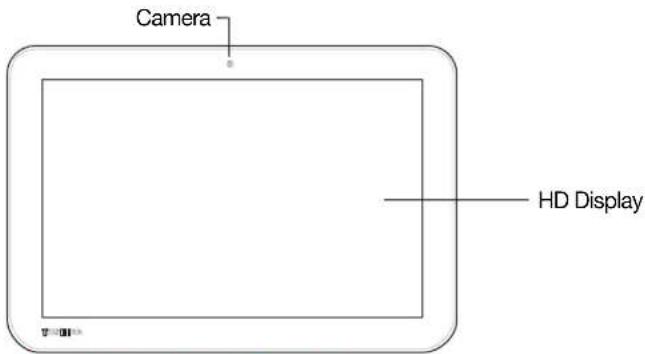
(Sample Illustration) Front view
Camera—Allows you to take still photos (includes flash settings) or record videos. For more information, see "Using the camera" on page 93.
Back
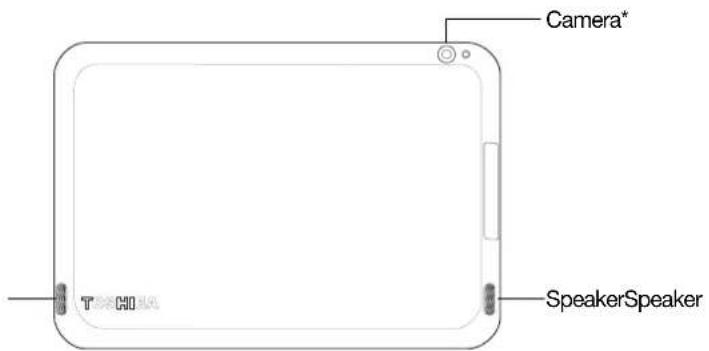
*Available on certain models
(Sample Illustration) Back view
Camera—Allows you to take still photos (includes flash settings) or record videos. For more information, see "Using the camera" on page 93.
Speakers—Allow you to listen to sounds on your device. For more information, see “Using the built-in speakers” on page 92.
Left side
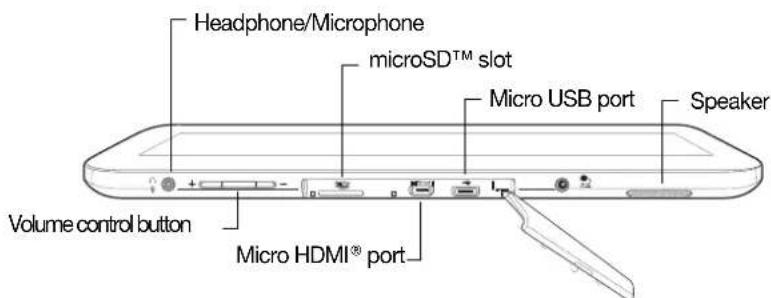
(Sample Illustration) Left side view
Headphone/Microphone—Allows you to listen to or record sounds onto your device. For more information, see "Using external speakers or headphones" on page 93.
Volume control button—Allows you to increase/decrease the volume.
microSD™ slot—Supports the use of Micro Secure Digital™ (SD™) media. For more information, see "Using a microSD™ Card" on page 94.
Micro HDMI® port—Allows connection to an HDMI®-compatible television or external display device.
Micro USB port—Allows the transfer of data.
Speaker—Allows you to listen to sounds on your device.
Right side

(Sample Illustration) Right side view
Speaker—Allows you to listen to sounds on your device.
Top
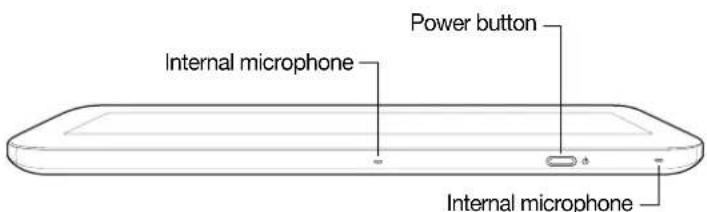
(Sample Illustration) Top view
Internal microphones—Allows you to record sounds using the computer's internal microphone or an optional external microphone. You can listen to audio files using the built-in speakers, headphones, or external speakers.
Power button—Turns the device on and off. Press and hold the button for several seconds to turn the device ON/OFF. Press the button quickly to wake the device from Sleep mode or to place it into Sleep mode. For more information, see “Options for turning off the device” on page 56.
Bottom

natural_image
Simple line drawing of a rounded rectangular shape with no text or symbols(Sample Illustration) Bottom view
Connecting to a power source
Your device requires power to operate. Use the Power cable/AC adaptor to connect the device to a live electrical outlet, or to charge the device's battery.
▲WARNING
Always confirm that the power plug (and extension cable plug if used) has been fully inserted into the socket, to ensure a secure electrical connection. Failure to do so may result in a fire or electric shock, possibly resulting in serious injury.
Be careful if you use a multiple connector. An overload on one socket could cause a fire or electric shock, possibly resulting in serious injury.
WARNING
Always use the TOSHIBA AC adaptor that was provided with your device, or use AC adaptors specified by TOSHIBA to avoid any risk of fire or other damage to the device. Use of an incompatible AC adaptor could cause fire or damage to the device possibly resulting in serious injury. TOSHIBA assumes no liability for any damage caused by use of an incompatible adaptor.
To connect AC power to the device:
▲WARNING
Handling the cord on this product will expose you to lead, a chemical known to the State of California to cause birth defects or other reproductive harm. Wash hands after handling.
- C +
1 Plug the power cable into the DC-IN on the device.
NOTE
Do not force the plug into the device.
2 Connect the AC adaptor to a live electrical outlet.
▲WARNING
Never attempt to connect or disconnect a power plug with wet hands. Failure to follow this instruction could result in an electric shock, possibly resulting in serious injury.
Battery Notice
Actual battery life may vary depending on settings, application usage, features or tasks selected, network configuration, operating temperature and many other factors.
The battery life cited in the product specifications is only achieved on the select models and configurations tested by Toshiba under the specific test settings at the time of publication and is not an estimate of a system's battery life under any conditions other than the specific test settings.
Recharge time varies depending on usage. The battery may not charge while the device is consuming full power. After a period of time, the battery will lose its ability to perform at maximum capacity and will need to be replaced. This is normal for all batteries.
Charging the battery
WARNING
If the device is leaking or its case is cracked, put on protective gloves to handle it.
Your device contains a rechargeable battery that may need to be charged prior to use.
To use external power or to charge the battery you must attach the AC adaptor. See "Connecting to a power source" on page 26.
To charge the device plug it into a power source.
NOTE
Battery life and charge time may vary depending on the external conditions, or the applications and features used.
NOTE
Please handle your device carefully to avoid scratching or damaging the surface.
Wall Outlet—The fastest way to charge your tablet is with the included AC adaptor plugged into a wall outlet.
Taking care of your battery
The following sections offer tips on how to take care of your battery and prolong its life.
Safety precautions
▲WARNING
Device warning indicators
◆Always immediately turn the power off and disconnect the power cable/ cord plug from the plug socket and stop using the battery pack if you observe any of the following conditions:
◆Offensive or unusual odor
Excessive heat
Discoloration
◆Deformation, cracks, or leaks
Smoke
- Other unusual event during use, such as abnormal sound
Do not turn on the device's power again until an authorized Toshiba service provider has checked it for safety. Continued use could cause a fire or rupture possibly resulting in serious injury or device failure including but not limited to the loss of data.
Optimizing battery life
You can extend your battery's life between charges by
turning off features you don't need. You can also change and monitor the way apps and system resources consume battery power.
Below are some of the things you can do:
To turn off Wi-Fi
^® or Bluetooth ^® when you are not using them, touch the Settings (用) con under Wireless & networks. Turn Wi-Fi ^® and/or Bluetooth ^® ON/OFF. For more information, see “Wireless and networks settings” on page 69 and “Location access settings” on page 72.
◆Turn down the screen brightness and set a shorter screen time-out. For more information, see "Display settings" on page 71.
If you do not need them, turn off automatic syncing for Gmail™, Calendar, Contact, etc. For more information, see “Accounts settings” on page 77.
If you know you will not be near a Wi-Fi ^® network for some time, switch to Airplane mode. For more information, see “Wireless and networks settings” on page 69.
To check the battery charge level:
1 Touch the Settings (icon.
The "Settings" menu appears.
2 Touch the About tablet (icon.
The "About tablet" menu appears.
3 Touch Status.
The battery status (charging or not charging) and level (as a percentage of fully charged) are displayed.
NOTE
For more details on your battery use, touch Battery.
Maintaining your battery
Fully discharging your battery periodically will allow better accuracy of the battery meter.
To fully discharge your battery, periodically disconnect the device from a power source and operate it on battery power until the battery fully discharges.
Disposing of your device
Discard this device in accordance with applicable laws and regulations.
Disposal of this product may be regulated due to environmental considerations. For disposal, reuse or recycling information, please contact your local government.
In addition, Toshiba's recycling initiatives include recycling programs, events, and consumer promotions. For details, please visit us.toshiba.com/green.
Notice regarding CR coin cell batteries, applicable to California, U.S.A. only:
Perchlorate Material - special handling may apply. See http://www.dtsc.ca.gov/hazardouswaste/perchlorate/
Using the device for the first time
The device is now ready for you to turn it on and begin using it.
Turning on the power
To turn on the device:
1 Make sure any external devices (such as the AC adaptor, if you plan to use AC power rather than battery power) are properly connected and ready.
2 Check to ensure that all slots are empty.
3 Press and hold the Power button for several seconds.

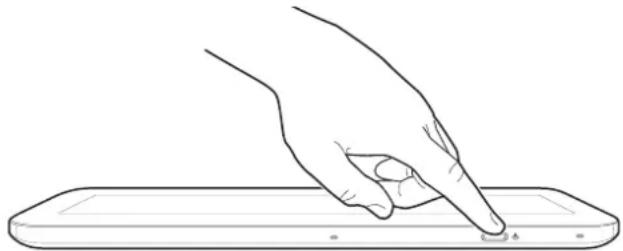
natural_image
Line drawing of a hand pointing at a screen (no text or symbols)(Sample Illustration) Turning on the power
Small bright dots may appear on your screen display when you turn on your device. Your display contains an extremely large number of thin-film transistors (TFT) and is manufactured using high-precision technology. Any small bright dots that may appear on your display are an intrinsic characteristic of the TFT manufacturing technology. Over a period of time, and depending on the usage of the device, the brightness of the screen will deteriorate. This is also an intrinsic characteristic of the screen technology.
Setting up your device
NOTE
Toshiba recommends that you have access to a Wi-Fi® network and a Google™ Account before setting up your device to take full advantage of your device's features.
1 Connect to a power source using the provided AC adaptor.
2 To turn on your device, press and hold the button for several seconds.
Power (∅)
Your setup process begins.
The first time you power on your tablet the "Welcome" screen appears and you will be asked to choose a language.
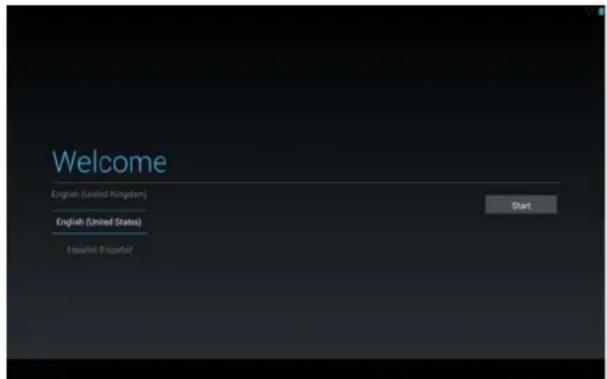
(Sample Image) Welcome screen
3 Select the language you want, and then touch Start to continue.
Your tablet begins the activation process.
Setting up your Wi-Fi® connection
After choosing your language, the "Select Wi-Fi" screen appears, displaying all available Wi-Fi® networks.
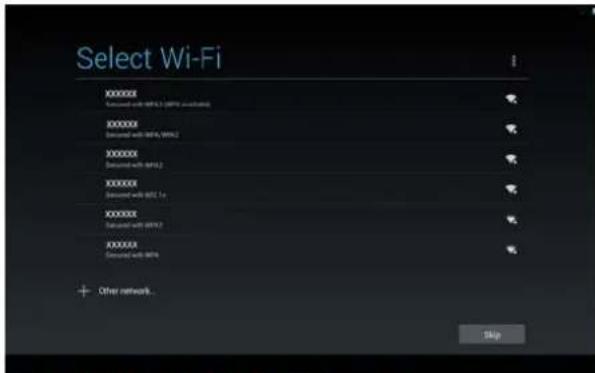
(Sample Image) Select Wi-Fi screen
1 Touch the Wi-Fi ^® network you want to use and enter the key or password.
2 Touch Connect.
Got Google™?
A Google Account is required to access many of the powered by Android ^™ features, including Gmail ^™ , backing up your data, etc.
The "Got Google?" screen appears displaying two options, Yes or No.
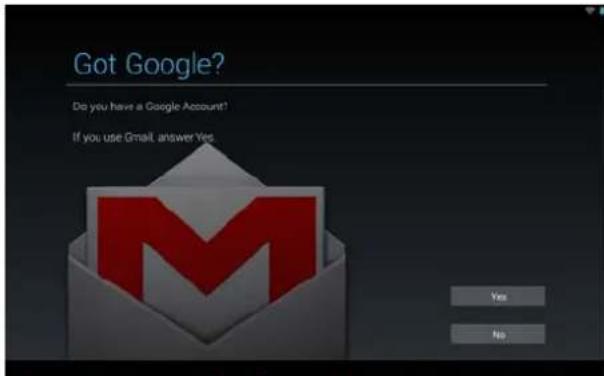
(Sample Image) Got Google? screen
- Yes—Sign in with an existing Google account and then follow the on screen instructions.
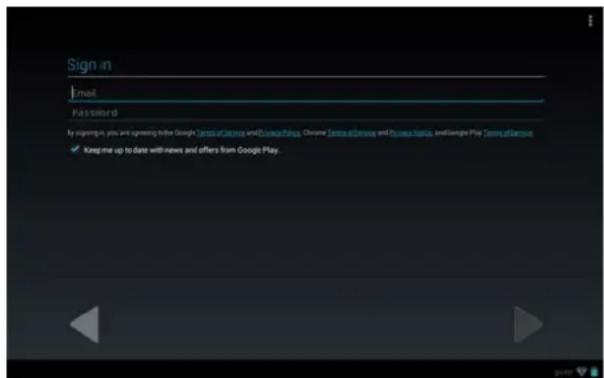
(Sample Image) Sign in with your Google Account screen
No—Select if you do not have an existing Google account.
Make it Google™
If you touched No, the "Make it Google" screen appears with two options:
- Get an Account—Touch if you do not already have a Google account and would like to create a new account. Follow the onscreen instructions.
Not Now—Touch to skip the account setup for now. You can sign into a Google Account later in Settings, under Accounts.
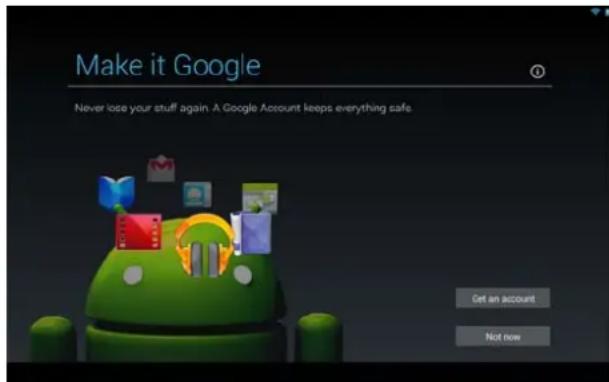
(Sample Image) Make it Google screen
NOTE
Sign in to your Google Account now to restore settings that have been previously backed up (if applicable). If you wait until after setup, you will not be able to restore your settings. For more information, see “Backing up your data” on page 42.
Google™ & Location
The “Use Google location” screen appears displaying two options:
Use Wi-Fi location
◆Let Google apps access your location
Select/deselect the check boxes to activate/deactivate the options.
NOTE
You can change these at a later time via the Settings menu.
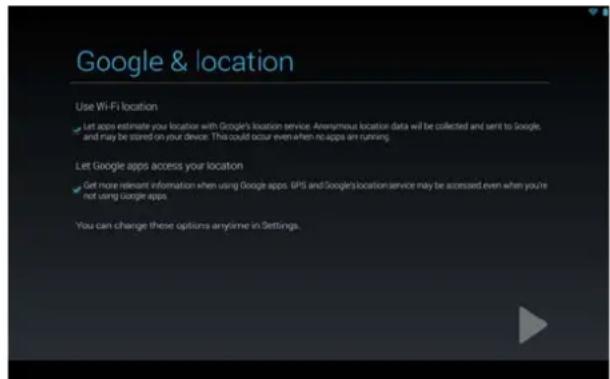
(Sample Image) Google & Location screen
1 Touch the right Arrow key to continue.
The “This tablet belongs to...” screen appears.
◆Enter your first and last names, or
Just touch the right Arrow key to continue
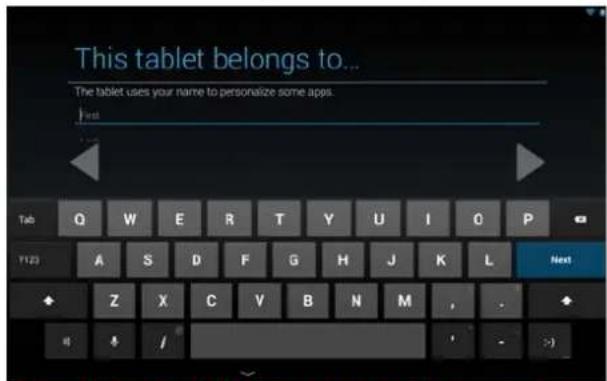
(Sample Image) This tablet belongs to... screen
2 The Google services screen appears.
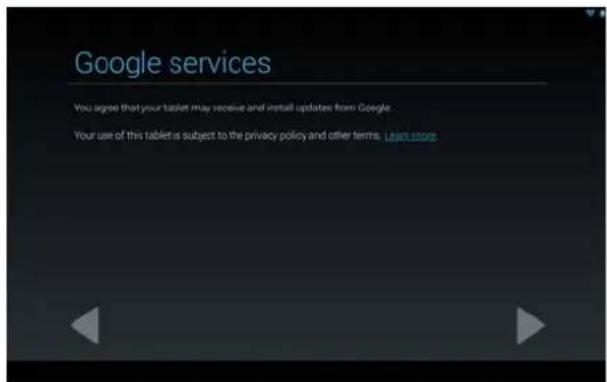
(Sample Image) Google services screen
3 Touch the right Arrow key to continue.
The "Setup complete" screen appears.
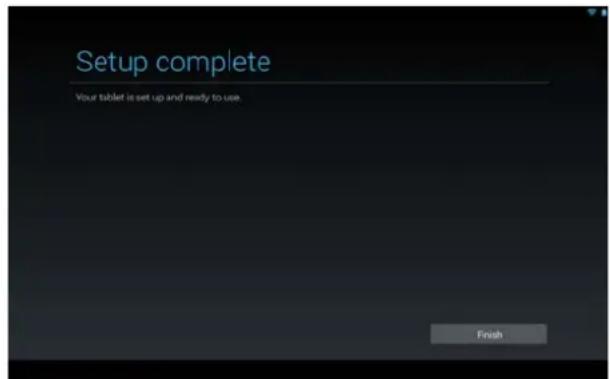
(Sample Image) Setup complete screen
4 Touch Finish to complete the setup process.
NOTE
This may take several minutes. If your screen times-out and goes blank/dark, press the Power button to turn on the screen again.
If the screen times-out:
1 Press the Power button.
The lock screen appears, unless you have previously disabled it.
2 Touch and hold the Lock icon and drag it to the edge of the large circle surrounding it.
The last screen viewed appears.
Setting the date and time
The "Date & time" screen appears.
NOTE
If you have not set up an Internet connection, this screen appears.
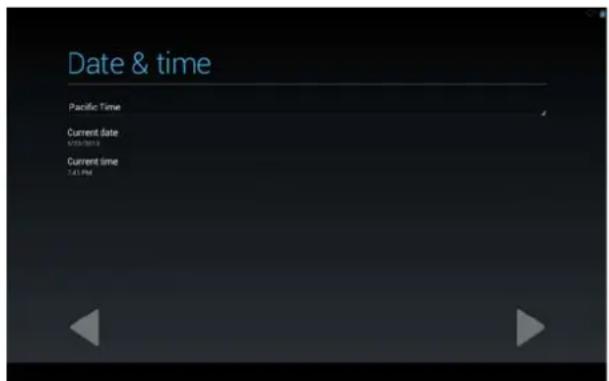
(Sample Image) Date & time screen
1 Select a preferred time zone, or set the current date and time.
2 Touch the right Arrow key to continue.
NOTE
This may take several minutes. If your screen times-out and goes blank/dark, press the Power button to turn on the screen again.
The "This tablet belongs to..." screen appears.
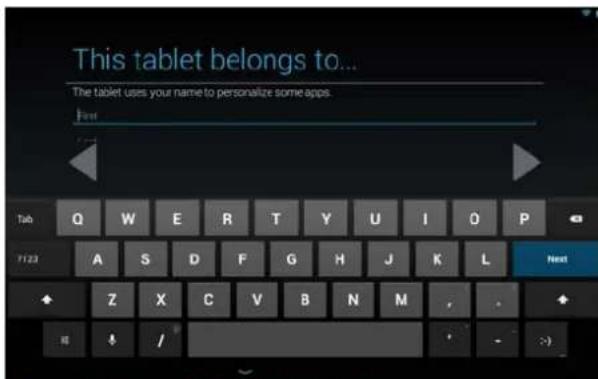
(Sample Image) This tablet belongs to... screen
There are two options in the "This tablet belongs to..." screen:
Enter your information into the First and Last name fields, and then touch the right Arrow key.
◆Touch the right Arrow key to continue (without entering the information).
The "Google Services" screen appears.
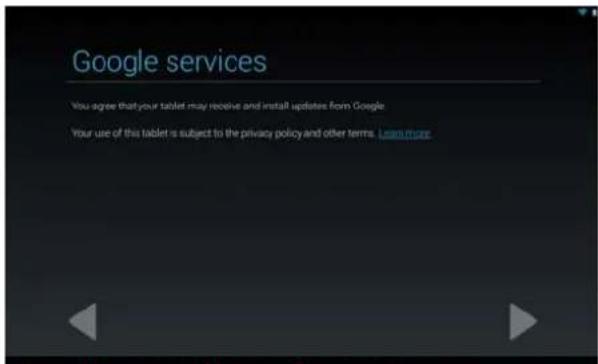
(Sample Image) Google Services screen
Read the information carefully, and then touch the right Arrow key to continue.
The "Setup complete" screen appears. Touch Finish to continue to the main Home screen.
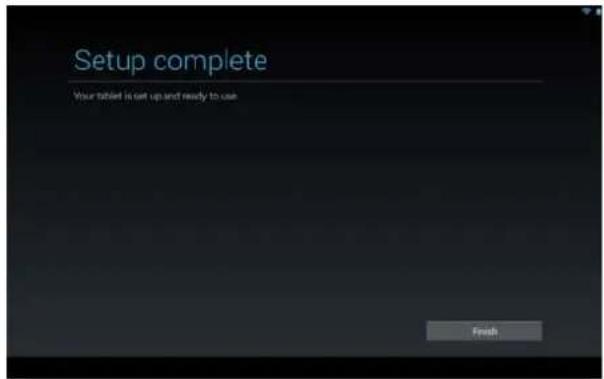
(Sample Image) Setup complete screen
NOTE
The setup may take several minutes to complete. If your screen times out and goes blank/dark, press the Power button to turn on the screen again.
Waking the tablet
If the screen times-out:
1 Press the Power button.
The lock screen appears, unless you have previously disabled it.
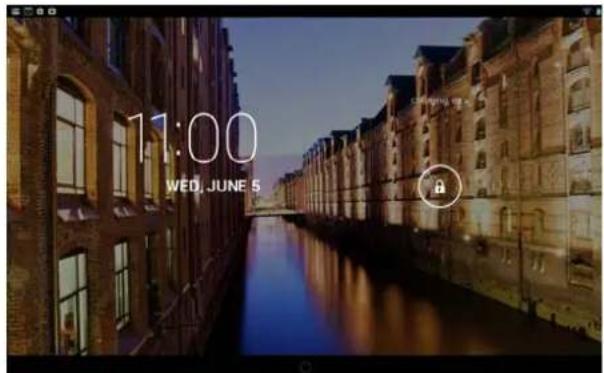
(Sample Image) Lock screen
2 Touch and hold the Lock (☐) icon and drag it to the edge of the large circle surrounding it.
The last screen viewed appears.
Setting up Wi-Fi ^® and Bluetooth ^® connections
Wi-Fi®:
1 Touch the Settings (☑) icon and then select the Wi-Fi (☑) icon, if not previously turned on.
The device scans for and displays all available Wi-Fi ^® networks.
2 Touch the Wi-Fi ^® network you want to connect to.
If the network is open, you will be asked to confirm the connection.
3 Touch Connect to confirm.
The Wi-Fi (icon appears in the System bar.
4 Touch the Back (icon to try a different network.
To connect to secure/locked networks, you will be prompted to enter the appropriate credentials.
NOTE
Wi-Fi ^® may be enabled by default and the device saves this information so that you can connect automatically the next time you come within range of this network.
If you use third-party applications on this device, any information those applications collect (including location-based information) may be sent to third parties and merged with other customer information subject to their respective privacy policies.
Bluetooth®:
1 Touch the Settings (图标) icon and then Bluetooth (switch to ON to enable it).
2 Touch the name of the device to pair with and then touch Pair.
Registering your Toshiba device
NOTE
To register online, you must be connected to the Internet.
Product registration is strongly recommended, and allows Toshiba to send you periodic updates, announcements, and special offers applicable to your product. Product registration can be completed by either visiting the Toshiba Web site at register.toshiba.com or by touching the Register icon. Failure to complete Product Registration will not diminish your rights under the Toshiba Standard Limited Warranty.
Backing up your data
Back up the data you create in case something happens to your device. You can back up your data to a microSD™ Card (see "Using a microSD™ Card" on page 94), or to a network (see "Backing up data using your Google™ Account" on page 42), if available.
You can also back up your settings as well as your data using your Google™ Account. Your data is backed up automatically using this option. For more information, see "Backup & reset settings" on page 78. If you need to replace your device, your data can be restored to your new one.
Backing up data using TOSHIBA File Manager
Using the TOSHIBA File Manager, you can back up your data to a microSD™ Card. For more information, see "TOSHIBA File Manager Utility" on page 101.
Backing up data using your Google™ Account
You can also back up your settings as well as your data using your Google Account. Your data is backed up automatically using this option. For more information, see "Make it Google™" on page 34.
Restoring your data using your Google™ Account
If your data was previously backed up using this service you can sign in to your Google Account and choose to restore your settings from your Google Account to your device.
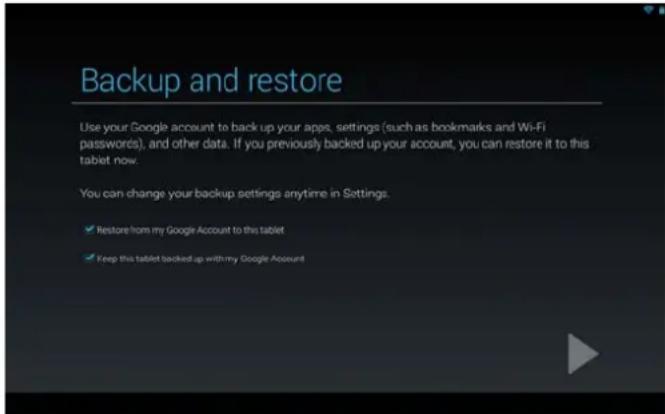
(Sample Image) Backup and Restore screen
Touch the right Arrow key to continue.
The data that is backed up may include the following:
- Your Wi-Fi ^ networks and passwords, user data, and tablet settings
Many Google application settings, such as your Browser bookmarks
The apps you download from Google Play™ Store
Navigation and features
Your device exemplifies the innovative blending of touch-
screen technology and intuitive application design making the most of your tablet device.
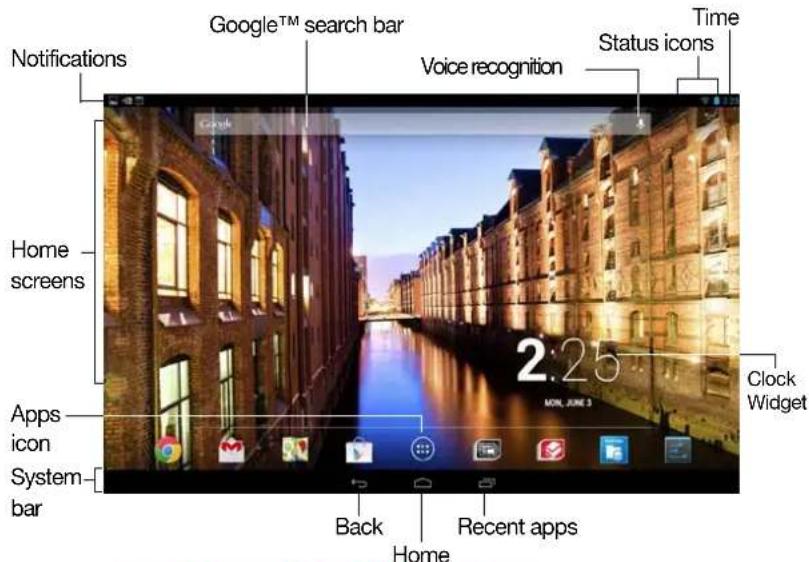
(Sample Image) Central Home screen
Icons and buttons you may find on your display screen.
IconNameDescription
 | Apps icon Touch to display the system apps. |
 | Settings icon Touch to open the Settings menu. |
 | Back button Touch to return to the previously viewed screen. |
 | Home button Touch to return to the Home screen. |
IconNameDescription
 | Recent Apps button | Touch to view the most recently view apps. |
 | Time display Located in the System bar to the left of the Status icons. | |
 | Battery status icon | Located in the System bar. Displays the status of the battery charge. |
| [026W] | Voice recognition button | Touch to perform a voice-enabled search. |
 | GoogleTM search bar | Touch to perform a search using the keyboard. |
 | Screen capture icon | Touch to take a screen capture of the current view. |
Home screen
The total number of available Home screens is five. Move between screens by swiping your finger to the left or right.
Your device's five home screens have several standard features, including icons and a customizable background pattern (wallpaper). The wallpaper image spans the width of all five Home screens.
The middle screen is your Central Home screen and the starting point after your device has been set up. However, your device will return to the last home screen viewed each time you wake up your device from Sleep mode. Touch the Home button to return to the central Home screen.
Icons
An icon represents a shortcut of either a widget, application, bookmark, or game that can be quickly launched by touching the icon on a Home screen.
Each Home screen may display icons for any of the following:
Widgets
Applications
Bookmarks
Games
Thumbnails
Your Home screen will contain other icons depending on how you have customized it. See “Customizing your Home screens” on page 53.

Gmail™ icon—An example of an icon located on a Home screen is the Gmail icon. This shortcut, when touched, launches your Gmail webmail account.
Touch screen navigation
Use your finger to manipulate the onscreen icons, buttons, menu items, onscreen keyboard, and other items on the touchscreen. You can also change the screen's orientation.
▲ CAUTION
The screen is made of glass so avoid contact with sharp, rough, or abrasive objects or substances as screen may break or scratch if not handled properly. If you see a crack in the glass, discontinue use of the device to avoid injury.
Touch—Touch to activate items displayed on the screen, such as app and setting icons or onscreen buttons. Touch to type using the onscreen keyboard.
Touch & hold—Touch and hold an item on the screen by touching and holding the item in place until an action occurs.
Drag—Touch and hold an item for a moment and then, without lifting your finger, move the item until you reach the target position. For example, drag items on the Home screen to reposition them, see “Customizing your Home screens” on page 53.
Swipe or slide—To swipe or slide, quickly move your finger across the surface of the screen without pausing. For example, slide the Home screen left or right to view another Home screen.
Double-tap—Tap quickly twice to zoom in. For example, double-tap a section of a Web page to zoom in on that section. Double-tap again to zoom out.
Pinch—In some apps (such as Maps and Gallery), you can zoom in and out by placing two fingers on the screen at once and pinching them together (to zoom out) or spreading them apart (to zoom in).
Rotate the screen—In most apps, the orientation of the screen rotates with the tablet as you turn it. You can turn this feature on and off, using the Auto-rotate screen option through the Quick Settings menu, see “Accessing the Notifications menu” on page 84. This allows you to lock the screen to the currently viewed screen orientation.
Navigating the Home screen
When the setup process is complete, the Home screen appears. This is your starting point for all features used on your tablet. You can add shortcuts for apps, widgets, and other features to all five of your Home screens. You can also change your wallpaper to more customize the look of your device. For more information, see “Customizing your Home screens” on page 53.
System bar
The System bar displays icons of tasks or programs that run continuously in the background and displays notifications, such as incoming email and the status of your wireless connection. Touch an icon to learn more about its task.
Navigation buttons
Using the navigation buttons in the System bar is an easy way to quickly switch between apps.
The System bar displays the Back (Button, Home () button, Recent Apps (Button, and the Notification icons. Also displayed in the far upper-right of the screen are the time, and Status icons.
Touch the Home button at any time to return to the Home screen. Swipe your finger right or left to view another Home screen.
In some media apps, the System bar controls are replaced by dim dots while a movie, slide show, etc. is displayed. This increases the viewing space on the screen. Touch the dot that corresponds with the desired control, or touch a blank area of the System bar to restore the full view.
At the top of the screen you will find the Google™ Search bar (), and next to that is the search by voice () button.
At the far upper-left you will find the Screen capture icon.
Also available at the bottom of the screen is the Apps (☐) and Settings (☐) button.
Status icons
Status icons are located on the far upper-right of the screen. Status icons display current system status information, such as power usage and network connectivity status.
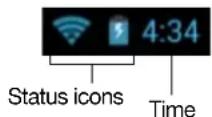
(Sample Image) Status icons
Touch the Time display to view the Status Details panel. For more information, see "Securing your tablet" on page 50.
After your Google™ Account is set up, the Network Status icons are blue when connected to Google services. This indicates that the tablet is ready to sync your Gmail™, Calendar, and contacts, and to back up your settings. When your tablet is not connected to a Google Account or the wireless connection is disabled, the icons are gray.
Managing Notifications
Notifications report the arrival of new messages, calendar events, and alarms, and they report the status of your Wi-Fi® connection.
Notification icons appear in the center of the System bar, along with a summary that appears briefly.
Depending on your settings you may also hear a notification sound.
Typical notifications are currently running programs and available updates. To activate a specific task, click the appropriate Notification bar icon.
Most apps that send notifications, such as Gmail ^™ and the calendar, have their own settings. These settings can be configured to send notifications in different ways, with a sound or vibration, etc. See the documentation for those apps for details. You can open the Notifications list to view all of your current notifications.
Opening a notification
1 Touch and swipe down the System bar on the upper-left of your Home screen.
The Notification summary panel opens.
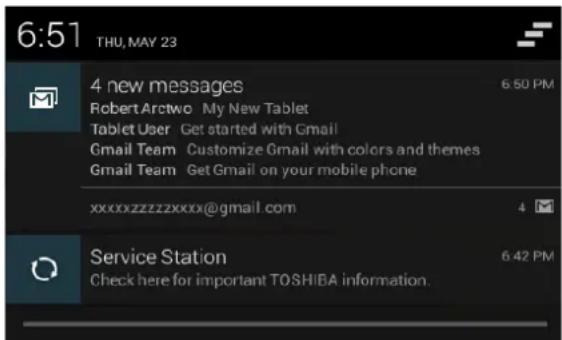
(Sample Image) Notification summary panel screen
2 Touch a notification summary to view it or to respond to it.
Touch the notification's Close button to remove it from the Notifications list. Touching a blank area of the screen closes the list without removing the notification.
Responding to notifications
When the Notification summary panel is open you can respond to a notification by touching the associated icon.
Notification panels contain a variety of information and controls, including:
A message summary, with the date and picture of the sender
Media controls to play/pause music or to skip to the next or previous track
◆Progress bars that indicate the progress of currently downloading apps:
1 Touch a notification icon in the System bar.
The notification's summary panel opens.
2 Touch a notification in the Notification summary panel to open it in its application.
It will then be cleared from the Notification summary panel.
3 To remove the notification without viewing it, touch its Close button.
Securing your tablet
CAUTION
If you choose to set a password (with or without encryption), Toshiba strongly recommends that you write down your password and keep it in a safe location where you can later access it should you not remember it.
Toshiba is not responsible for any losses that may occur, as a result of the inability to access your device.
When you initially turn on or wake the tablet, the lock screen requires you to drag the Lock icon to unlock the screen, see "Waking the tablet" on page 40. Alternatively, you can secure the lock screen by requiring a pattern or entry of a numeric PIN or password, so only you can access your data. You may also be required to secure the lock screen by a policy set by an email account or other account you add to your tablet. For more information, see "Location access settings" on page 72.
You can also encrypt the data on your tablet, so you must enter a numeric PIN or a password to decrypt it each time you power it on.
1 Touch the Time (4:34) display in the System bar, touch the time in the Status Details panel, and then touch the Settings (图标) at the bottom of the Quick Settings screen.
You can also open Settings by touching the Settings icon in the Apps screen or on a Home screen.
2 Touch the Security (icon.
3 Touch Screen Lock.
4 Touch Slide, Pattern, PIN, or Password.
Slide is the default screen lock option. If you touch Slide, you will be taken back to the Security screen. The next time you wake up your device from sleep, you will be taken to the Lock screen. At the Lock screen, you can either slide to left or to the right to unlock the system.
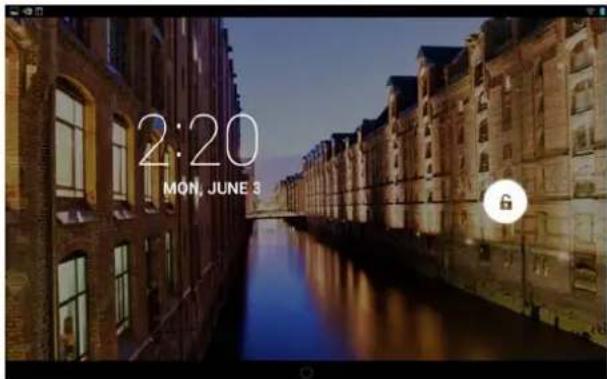
(Sample Image) Unlocked screen
If you touch Pattern, you're guided to create a pattern you must draw to unlock the screen. The first time you do this, a short tutorial about creating an unlock pattern appears. Then you are prompted to draw and redraw your own pattern.
If you touch PIN or Password, you are prompted to set a numeric PIN or a password you must enter to unlock your screen.
The next time you turn on your tablet or wake up the screen, you must draw your unlock pattern or enter your PIN or password to unlock it.
You can encrypt all the data on your tablet: Google™
Accounts, application data, music and other media, downloaded information, etc. If you do, you must enter a numeric PIN or password each time you power on your tablet.
CAUTION
Encryption is irreversible. The only way to revert to an unencrypted device is to perform a factory data reset, which will erase all your data.
You must not interrupt the encryption process or you will lose some or all of your data. (See “Backup & reset settings” on page 78 and “If Something Goes Wrong” on page 106).
1 Before starting the encryption process on your tablet, you must:
◆Set a lock screen PIN or password (see “Securing your tablet” on page 50).
◆Charge your tablet's battery.
◆Plug your tablet to the AC adaptor.
◆ Schedule an hour or more for the encryption process.
2 Touch the Settings (图标) icon, Security (图标) icon, and then Encrypt tablet.
Read the information on the Encrypt Tablet screen carefully.
If you change your mind touch the Back (←button to exit the encryption process.
3 Touch the Encrypt tablet button.
4 Enter your lock screen PIN or password and touch Continue.
5 Touch the Encrypt tablet button again, to confirm you want to continue.
The encryption process begins and displays the progress.
Encryption can take an hour or more, during which time your tablet may restart several times.
When encryption is complete, you are prompted to enter your PIN or password. Subsequently, you must enter your PIN or password each time you power on your tablet, to decrypt it.
Customizing your Home screens
You can add App sicons, Widgets, Bookmark shortcuts, and other items to any available free space on any Home screen. You can also change the Wallpaper.
For more information on the Home screens, see “Navigation and features” on page 44.
Adding an item to a Home screen
1 Open the Home screen you want to add the item to. For more information on using the Home screens, see "Navigation and features" on page 44.
2 Swipe your finger left or right to find the item you want to add.
3 Touch & hold the item, and then drag it to the location you wish to place it on the Home screen.
Moving an item from the Home screen
To move an item to a new location on the current Home screen or to move it to another Home screen, touch & hold the icon, and then drag and drop it to the new location.
Removing an item from a Home screen
1 Touch and hold the item you want to remove.
The Remove button appears in the top center of the display.
2 Drag the item to the Remove button.
3 Lift your finger when the icon turns red.
NOTE
The item has been removed from the Home screen, but not deleted from the system. To add the item back to your Home screen, see “Adding an item to a Home screen” on page 53.
Creating, naming, and removing folders
Creating a folder
Complete the following steps to create folders on your Home screen.
1 Locate the desired first app (on a Home screen) that you want to include in a folder.
2 Locate the second app (on the Home screen or in the app list).
3 Touch, hold, and drag the second app to the first app.
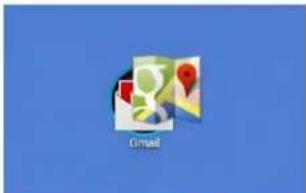
(Sample Image) Dragging an app to create a folder
4 Release the second app, and its icon appears in the circle, behind the icon of the first app.
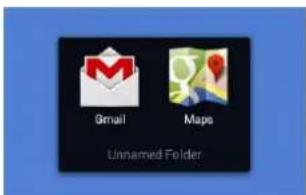
(Sample Image) Unnamed folder
The folder is now created with an automatic generic name (such as "Unnamed folder").
Name/rename a created folder
1 Touch and hold the folder you want to name/rename.
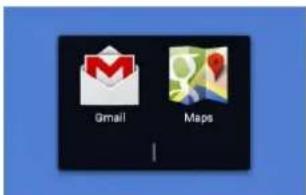
(Sample Image) Naming a folder
The name of the folder turns into a field you can type into.
2 Type the desired name. The folder is now renamed.
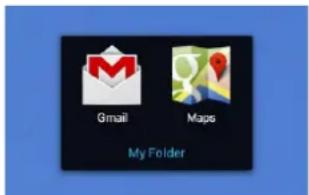
(Sample Image) Named folder
Removing a folder
To remove folders from your Home screen:
1 Locate and open the folder (on a Home screen) that you want to remove.
2 Touch, hold, and drag all apps from the folder (on the Home screen or in the app list) to the Home screen.
3 Release the apps on the Home screen. When the last app is removed, its folder is automatically removed.
Changing the wallpaper
1 Touch and hold any of the five Home screens.
2 Touch Gallery, Live wallpapers, or Wallpapers.
Gallery—Opens a thumbnail page, displaying the images you have taken with the tablet's camera. Pictures can be cropped before setting them as a wallpaper.
Live wallpapers—Opens a thumbnail page, displaying the sample live wallpapers that came preinstalled on your tablet. Touch a thumbnail image to preview it on the screen.
- Wallpapers—Opens a thumbnail page, displaying the sample wallpaper images that came preinstalled on your tablet. Touch a thumbnail image to preview it on the screen.
Additional wallpapers can be downloaded from Google Play ^™ Store.
3 Touch the wallpaper you want. The selected wallpaper is set as the background image on your display screen.
Turning off the device
It is a good idea to turn off your device when you are not using it for a while.
If you are using the device for the first time, leave the device plugged into a power source (even though the device is off) to fully charge the battery.
Options for turning off the device
You have two options available for turning off the device: Shut down and Sleep mode. Each option has its advantages.
Use Shut down if you will not be using the device for several days or if you must turn off your device.

TECHNICAL NOTE: Before using the Shut down option to turn off your device, backup your data.
If you change your mind and decide to continue working after all, wait a few seconds before turning the device on again.
NOTE
If you do not intend to use your device for a long period of time, turn off the device, disconnect the power plug from the plug socket, and store your device in a dry dust-free location.
Letting the screen time-out or enter into Sleep mode allows the device to conserve power. When turning on the device again, the system automatically returns to the last screen viewed.
To change the screen time-out setting, see "Display settings" on page 71.
Using Shut down mode
The Shut down mode completely shuts down the device without saving your data or the current state of the device. Shut down mode closes all open apps, shuts down the operating system, and then turns off your tablet.
CAUTION
Always back up your data and settings before shutting down your tablet.
To turn off your device using Shut down mode:
1 Press and hold the Power button.
A pop-up screen appears, displaying three selections.
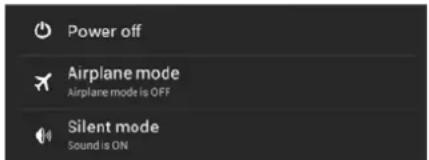
(Sample Image) Shut down pop-up screen
2 In the pop-up window, touch Power off.
A pop-up screen appears, asking you to confirm the shut down.
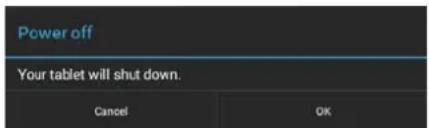
(Sample Image) Shut down pop-up confirmation screen
3 In the pop-up window, touch OK to completely shut down the tablet.
The operating system shuts down and the tablet turns off.
4 Touch Cancel to abort the shut down process.
Using Sleep mode
Your device will automatically time-out after a couple minutes of non-operation, placing it into Sleep mode. The screen dims and then darkens to conserve battery power. For more information on waking the tablet from Sleep mode, see "Waking the tablet" on page 40. To change the amount of time it takes for the display to darken, touch the Settings (⊕) icon, and then the Display (∅) icon.
NOTE
Increase battery life between charges by using the shortest available time-out setting. See “Display settings” on page 71.
You can also place your tablet into Sleep mode by pressing the Power button quickly.
Factors to consider when choosing Sleep mode:
◆While in Sleep mode, the device uses some battery power.
Because the state of the system is stored in memory, you will lose data if the battery discharges completely while the device is in Sleep mode.
Waking your device from Sleep mode takes less time and consumes less battery power than restarting after shutting down the device.
When starting up again, the device returns to the screen last viewed.
CAUTION
If you place the device in Sleep mode and the battery discharges fully, your unsaved data will be lost. Be sure to backup your data first.
Managing your accounts
Using the Accounts settings, you can configure the ways in which your account interacts with the applications on your tablet, and you can sync contacts, email, calendar events, etc. from your multiple Google™ Accounts.
Add an account
Add multiple Google™ Accounts and Microsoft® Exchange ActiveSync accounts to have all your accounts available on your tablet device. For more information, see “Accounts settings” on page 77.
1 Touch the Settings (建con.
The "Settings" menu appears.
2 Scroll down to the Accounts setting.
The “Accounts” menu appears displaying a list of the current accounts.
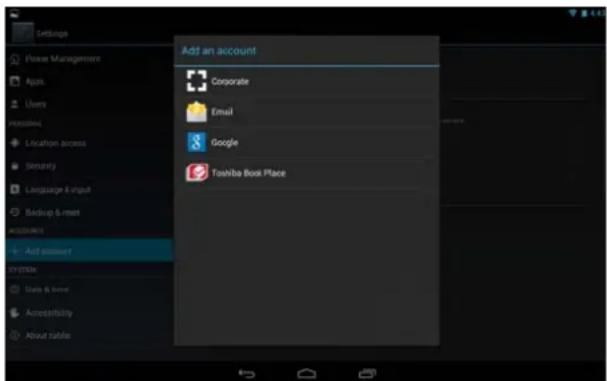
(Sample Image) Accounts screen
3 Touch the Add account () icon
4 Follow the onscreen instructions to enter the required account information.
5 Configure the account settings. For more information, see "Accounts settings" on page 77.
The account is added to the list in the Accounts settings.
Remove an account
To remove an account and all the associated information, including email, contacts, settings, etc.:
1 Touch the Settings (icon.
The "Settings" menu appears.
2 Scroll down to the Accounts setting.
The "Accounts" menu, appears, displaying a list of the current accounts.
3 Touch the account you wish to delete.
4 Touch the Menu (icon in the upper-right corner.
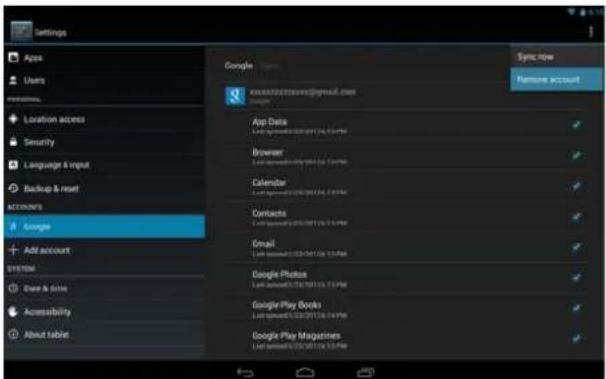
(Sample Image) Removing an account
5 Touch Remove account from the dialog box to continue.
The "Remove account?" confirmation screen appears.
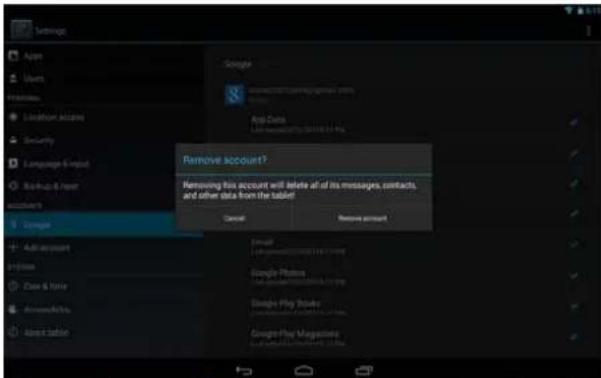
(Sample Image) Removing an account confirmation
6 Touch Remove account to continue.
The account and the associated information is removed from the Accounts settings.
Navigation, Maps, and Local
To access Navigation, Maps, and Local:
1 Touch the Apps (icon.
The "Apps" menu appears.
2 Touch the Navigation (A) icon, Maps (B) icon, or the Local (C) icon.
▲WARNING
Do not use this device while driving.

Navigation: Access turn-by-turn, spoken driving instructions with the free Google™ Navigation application (Beta).

Maps: Finds your current location to access real-time traffic conditions, and obtain detailed directions by foot, public transportation, or car, using the free Google Maps application.

Local: Quickly find local establishments, such as restaurants, banks, or gas stations, using the free Google Places application.
To learn more, visit the Google Help Center.
Managing downloads
Files, apps, and items downloaded from a Web Browser, Gmail™, etc., are stored on your tablet's internal storage. Use the Downloads app to view, open, or delete downloaded items.
To access downloads:
1 Touch the Apps icon.
2 Touch Downloads.
The "Downloads" menu appears.
3 Touch an item to open it.
Items can be uninstalled from your tablet or sorted by file size or file name for easier viewing.
To sort the items, touch the top right of the screen
Sort by size menu option on the
To uninstall items:
1 Select the item(s) you wish to delete.
2 Touch the Delete (icon.
To share items:
1 Select the item(s) you wish to share.
2 Touch the Share (icon.
Factory data reset
This restores the device to the out of box state. All data on the device is erased, including system/application settings, user downloaded/installed applications and data such as photos, music, videos, contacts, etc.
CAUTION
The recovery process deletes all data, restoring the tablet to its out-of-box state. Be sure to save your data to external media before executing the recovery), see "Backing up your data" on page 42.)
Before restoring the device to the out of box state, back up all data to external media. You can use your Google™ account to back up all data and apps settings.
To perform this process:
1 Touch the Settings (icon.
The "Settings" menu appears.
2 Touch the Backup & reset (con.
The "Backup & reset" menu appears.
3 Touch Factory data reset.
4 Touch Reset tablet.
5 Touch Erase everything.
The Factory data reset process begins.
NOTE
This process could take several minutes. For more information, see “Setting up your device” on page 32.
Caring for your device
This section gives tips on cleaning and moving your device. For information about taking care of your device's battery, see “Taking care of your battery” on page 29.
▲ CAUTION
The screen is made of glass so avoid contact with sharp, rough, or abrasive objects or substances as screen may break or scratch if not handled properly. If you see a crack in the glass, discontinue use of the device to avoid injury.
Cleaning the device
CAUTION
Keep liquids, including cleaning fluid, out of the device's ports, speakers and other openings. Never spray cleaner directly onto the device. Never use harsh or caustic chemical products to clean the device.
To keep your device clean, gently wipe it with a lightly dampened soft cloth.
Chapter 2
Settings
Customizing your device's settings
You can customize the settings for the various functions on your Toshiba tablet, such as screen orientation, or sound settings.
Apps and Settings menus
This menu contains most of the tools you will need to customize and configure your tablet.
Accessing the Apps and Settings menus
To access the Apps menu:
◆ Touch the Apps () icon.
The "Apps" menu appears.
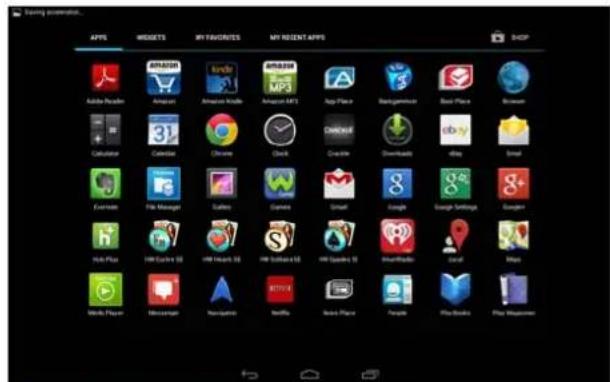
(Sample Image) Apps menu screen
The following are some of the icons you may find in the Apps menu.
IconNameDescription
| Settings Touch to open the Settings menu. |
| Browser Touch to open and view Web sites. |
| Chrome Touch to open and view GoogleTMChrome Web browser. |
| GmailTM Touch to access your Gmail email account. |
| Maps Touch to open the Maps app, see “Navigation, Maps, and Local” on page 61. |
| Play Store Touch to open Google PlayTM Store to view and download available apps for your tablet. |
IconNameDescription
| Navigation Touch to open the Navigation app, see “Navigation, Maps, and Local” on page 61. |
| Gallery Touch to view the photos/videos you have recorded, using the camera, or images preinstalled on your tablet, see “Using the camera” on page 93. |
| Calendar Touch to view your Calendar. |
| People Touch to view your Contacts. |
| Calculator Touch to open the Calculator application. |
| Downloads Touch to view the Downloads application, see “Managing downloads” on page 61. |
| Media Player Touch to open the multimedia player, see “TOSHIBA Media Player” on page 86. |
| Play Books Touch to view the books that have been downloaded to your tablet. |
To access the Settings menu:

Settings (icon.
The "Settings" menu appears.
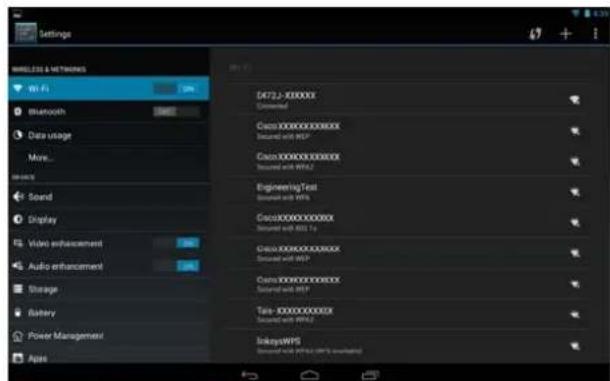
(Sample Image) Settings menu screen
The following are some of the icons you may find in the Settings menu.
Icon Name Description
 | Wi-Fi® | Configure and manage connections to networks and devices via Wi-Fi®, see “Wireless and networks settings” on page 69. |
 | Sound Configure the Sound settings to set the audio for media playback, notifications, and alarms with the your desired volume level and notification sounds, see “Sound settings” on page 70. | |
 | Display Configure the screen orientation or use energy saving settings, see “Display settings” on page 71. | |
 | Storage Monitor the used and available space on your tablet’s internal storage and other storage media installed on your tablet, see “Storage settings” on page 80. | |
| Icon Name Description | |
| Battery Displays battery status, see “Battery Notice” on page 27. | |
| Apps Touch to view and manage the installed applications, see “Apps settings” on page 74. | |
| Accounts Add, remove, and manage all of your accounts, and sync accounts to work together, see “Accounts settings” on page 77. | |
| Location access Touch to change the settings for location services, see “Location access settings” on page 72. | |
| Security Configure how you want the tablet to determine your location, see “Location access settings” on page 72. | |
| Language & input Configure the various input methods available on your tablet, see “Language & input settings” on page 80. | |
| Backup & reset Back up your settings and data to GoogleTM servers, using your Google Account, or perform a factory data reset, see “Backup & reset settings” on page 78. | |
| Date & time Configure your preferences for the way in which dates are displayed, see “Date & time settings” on page 82. | |
| Accessibility Touch to change the settings for accessibility features to activate an accessibility application, see “Accessibility settings” on page 81. | |
| About tablet Displays information regarding your operating system software and hardware, see “About tablet” on page 83. | |
Wireless and networks settings
Use the Wireless & networks settings to configure and manage connections to networks and devices via Wi-Fi ^ , or Bluetooth ^ . For more information, see “Setting up Wi-Fi ^ and Bluetooth ^ connections” on page 41. The Wireless & Networks settings can also be used to configure connections between your tablet and virtual private networks (VPNs), and to turn off the device’s radios while in-flight.
To change the Wireless & networks settings:
1 Touch the Settings (图标).
The Settings menu appears.
2 Touch the item you wish to change in the Wireless & networks menu.
Below are some of the categories to choose from:
- Wi-Fi®—Select to turn on Wi-Fi® so you can connect to Wi-Fi® networks. For more information, see “Setting up Wi-Fi® and Bluetooth® connections” on page 41.
In addition to the information described in this section, you can access the Advanced settings. Touch the Menu button in this screen's Application bar, and then Advanced to view the settings in the "Advanced Wi-Fi" screen.
Some of the options available are:
Network notification—If this is selected, you will receive a notification in the System bar when an open Wi-Fi® network becomes available.
Keep Wi-Fi on during Sleep—Choose from the following selections to set conditions for automatically turning off the Wi-Fi® connection:
Always (uses more battery power)
Only when plugged in
Never
Bluetooth®—Select to turn on Bluetooth® so you can connect to Bluetooth® devices, such as an external keyboard. For more information, see “Setting up Wi-Fi® and Bluetooth® connections” on page 41.
Some of the options available are:
Rename tablet—Touch to open a dialog box to rename your tablet a name that is visible on some Bluetooth ^® devices. The current name is displayed.
- Visibility timeout—Select to make your tablet discoverable by other Bluetooth ^ devices for a brief period of time.
Show received files—Displays a list of files received via Bluetooth®.

Sound settings
The Sound settings can be configured to set the audio for media playback, notifications, and alarms with the desired volume level and notification sounds. You can also set audible feedback when touching or locking and unlocking the screen.
To change the Sound settings:
1 Touch the Settings (icon.
The "Settings" menu appears.
2 Touch the Sound (icon.
The "Sound" menu appears.
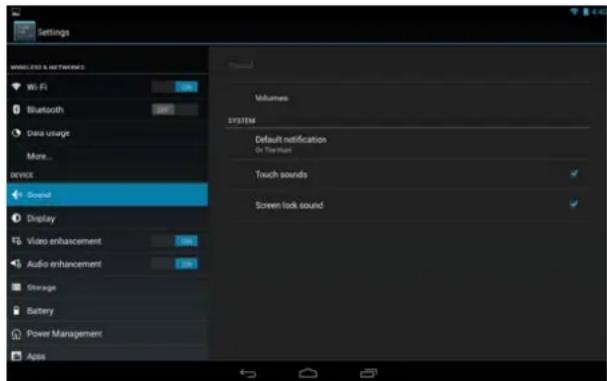
(Sample Image) Sound Settings menu screen
3 Touch the item you wish to change in the Sound menu.
Below are some of the categories you can choose from:
Volumes—Select to open a screen containing three sliders, used to adjust media volume, notification sounds, and alarm sounds.
Default notification—Select to open a screen containing a list of notification sounds. Touch a notification sound to listen to a sample of it.
◆ Touch sounds—Select to hear a sound while touching the buttons, icons, and other onscreen items.
Screen lock sound—Select to hear a sound when locking or unlocking the screen.

Display settings
You can change the Display settings for various things, such as orientation of the display or brightness level for energy conservation.
To change the Display settings:
1 Touch the Settings (并con.
The "Settings" menu appears.
2 Touch the Display (icon.
The "Display" menu appears.
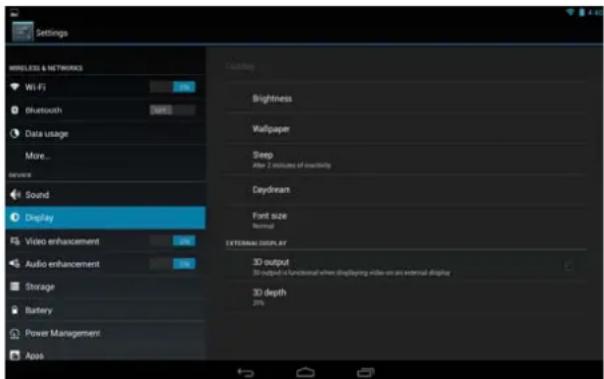
(Sample Image) Display menu screen
3 Touch the item you wish to change in the Display menu.
Below are some of the categories you can choose from:
NOTE
The Automatic Brightness selection must be deselected to access the Brightness control screen. Under certain operating conditions, e.g., very high ambient temperatures, your tablet might automatically dim the LCD brightness in order to maintain a reasonable system temperature. This is a normal protective feature and you might not be able to manually adjust the LCD brightness during the auto dimming period.
◆ Brightness—Displays the Brightness control bar screen. To change the brightness level, deselect the Automatic brightness option. Then touch and slide the bar left or right to decrease or increase the screen brightness.
- Wallpaper—Select to change the wallpaper.
Sleep—Displays a list of time interval settings that indicate the amount of time it takes for the screen to time-out. Using the shortest time-out period extends the battery life between charges.

Location access settings
Use the Location access settings to configure how you want the tablet to determine your location (this affects accuracy), and the way in which you want to share your location with Google™ and others. Security settings can also be configured to help secure your tablet and its data.
WARNING
Do not use this device while driving.
To change the Location access settings:
1 Touch the Settings (icon.
The "Settings" menu appears.
2 Touch the Location access icon.
The "Location access" menu appears.
3 Touch the item you wish to change in the Location access menu.
Below are some of the categories you may choose from:
GPS satellites—Selecting this option allows your tablet's global positioning system (GPS) receiver to pinpoint your location to within as close as several meters (street level). Actual GPS accuracy depends on weather conditions, as well as other factors.
Wi-Fi & mobile network location—Selecting this option allows your tablet to use information from Wi-Fi® and networks to determine your approximate location. This is important for use in Maps and other geographically aware applications, etc. Allows Google's Location access to collect anonymous location data. Some data may be stored on your device. Collection may occur even when no apps are running.
Security settings
Use the Security settings to configure our tablet to help secure your tablet and its data.
To change the Security settings:
1 Touch the Settings (图标).
The "Settings" menu appears.
2 Touch the Security icon.
The "Security" menu appears.
3 Touch the item you want to change in the Security menu.
Below are some of the categories you may choose from:
Screen lock—Under Screen security, touch this option to configure your lock screen with a required pattern, PIN, or password to unlock the screen. For more information, see “Securing your tablet” on page 50.
Owner info—Touching this option displays a screen that allows you to display information about yourself (such as your contact information) on the lock screen. You will be prompted to enter the text you want to display.
Encrypt tablet—Under Encryption, touch this option to encrypt the contents of your tablet in the event that it is powered off. Configure a required numeric PIN or password to decrypt your tablet each time you power it on, see “Securing your tablet” on page 50.
CAUTION
If you choose to set a password (with or without encryption), Toshiba strongly recommends that you write down your password and keep it in a safe location where you can later access it should you not remember it.
Toshiba is not responsible for any losses that may occur, as a result of the inability to access your device.
Make passwords visible—Select this option to briefly display each character of your passwords as you enter them into the keyboard.
Device administrators—Under Device administration, touch open a screen with a list of the applications you have authorized to be administrators for your tablet. This is typically an email, calendar, or other enterprise application that you granted this authority to, when you added an account hosted by an enterprise service that requires the ability to implement security policies on any devices that connect to it. Touch an application in this list to disable its authority to be a device administrator; if you do, the account you added will typically lose some functionality in its applications, such as the ability to sync new email or calendar events, until you restore the application's authority as a device administrator. Applications whose device administration authority you disable in this way, but that have accounts that require them to be device administrators, typically notify you how to restore their authority when you try to use them, unless you delete those accounts.
- Install from storage—Under Credential storage, select to install a secure certificate from your tablet's storage.
- Clear credentials—Under Credential storage, select to delete all secure certificates and related credentials. You will be prompted to also confirm deletion of the credential storage password.

Apps settings
You use the Apps settings to view details about the applications installed on your tablet, to manage their data, to force them to stop if needed, and to set whether you want to permit installation of applications that you obtain from Web sites and email.
To change the Apps settings:
1 Touch the Settings (icon.
The "Settings" menu appears.
2 Touch the Apps (图标) icon.
The "Apps" menu appears.
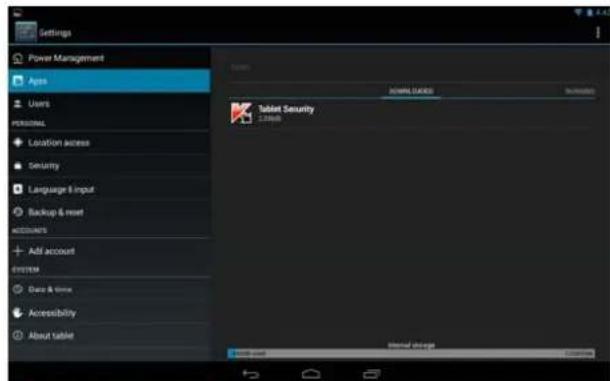
(Sample Image) Apps menu screen
3 Touch item you want to change in the Apps menu.
Below are some of the categories you can choose from:
Downloaded—Displays a list of the applications and other software downloaded on your tablet.
Running—Displays a list of applications, processes, and services currently running.
All—Displays all applications and software currently installed on your tablet.
Users
You can share this device by adding additional users, allowing the ability to create unique personal settings for each. Each user has their own space and can customize it with their own apps, wallpaper, etc.
To add a new user:
1 Touch the Settings (icon.
The "Settings" menu appears.
2 Touch the Users (a) icon.
The "Users" menu appears.
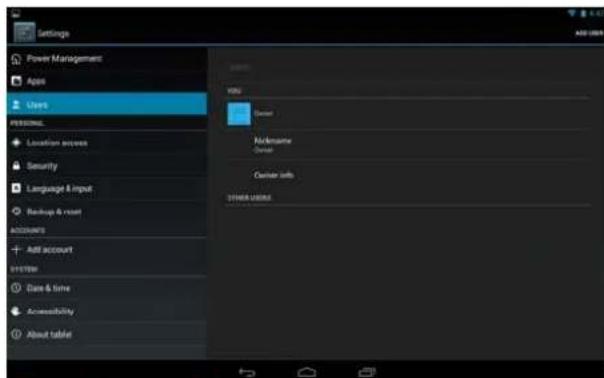
(Sample Image) Users menu screen
3 TouchAdd user.
The "Add new user" dialog box appears.
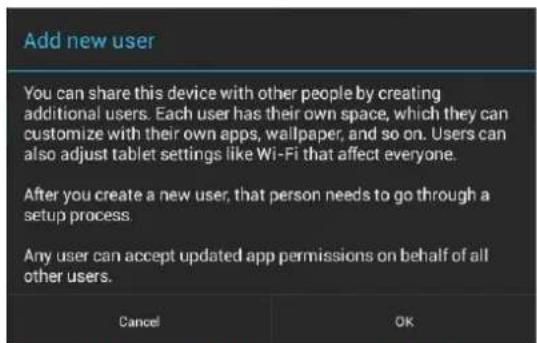
(Sample Image) Add new user dialog box
4 Touch OK.
The "Set up user now?" dialog box appears.
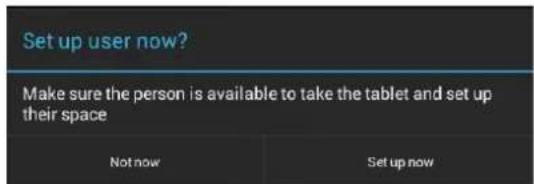
(Sample Image) Set up user now dialog box
5 TouchSet up now to continue.
6 Follow the on-screen instructions.
After the new user has been added, he/she will need to go through a setup process. See "Setting up your device" on page 32.
NOTE
Any user can accept updated app permissions on behalf of all other users.
Accounts settings
You can add, remove, and manage your Google™ Accounts
and other accounts, using the Accounts settings. For more information, see "Managing your accounts" on page 58. Use these settings to also control the ways in which applications send, receive, and sync data on their own schedules, or how applications synchronize user data automatically.
Gmail™, Calendar, and other applications may have their own setting options. For details, refer to the application's documentation.
To change the Accounts settings:
1 Touch the Settings (icon.
The "Settings" menu appears.
2 Scroll down to the Accounts setting.
The "Accounts" menu appears.
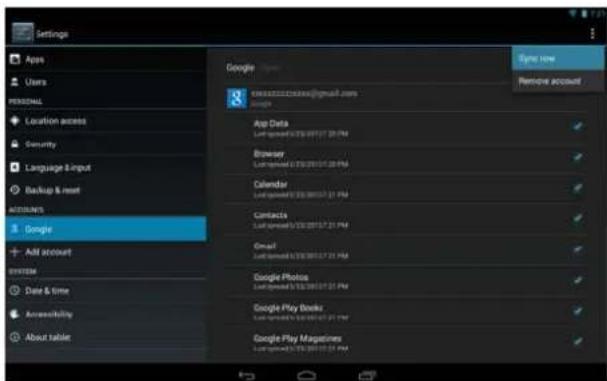
(Sample Image) Accounts menu screen
3 Touch the item you want to change in the Accounts menu.
Below are some of the categories you can choose from:
◆ Calendar—Touch to sync your calendar with your device.
- Contacts—Touch to sync your contacts with your device.
Gmail—Touch to sync your Gmail with your device.
While an account is selected, you can touch the Menu (☐) button to:
Remove account—Touch to remove the account and all of its data.
Sync Now—Touch to synchronize your data now.

Backup & reset settings
You can use the Backup & reset settings to back up your settings and data to Google™ servers, using your Google Account. You can also perform a factory data reset to erase all data on your tablet. For more information, see “Backing up your data” on page 42.
To change the Backup & reset settings:
1 Touch the Settings (con.
The "Settings" menu appears.
2 Touch the Backup & reset icon.
The "Backup & reset" menu appears.
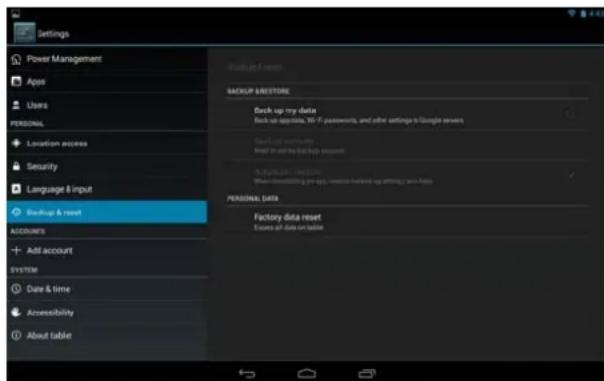
(Sample Image) Backup & reset menu screen
3 Touch the item you wish to change in the Backup & reset menu.
Below are some of the categories you can choose from:
- Back up my data—Select to back up your personal data (Wi-Fi® passwords, bookmarks, etc.) to Google servers, with your Google Account. Your data can be restored to a new tablet the first time you sign in with your Google Account. Some third-party applications may also take advantage of this feature, allowing you to restore the associated data of a reinstalled application.
NOTE
If you disable this option, data will no longer be backed up to your Google Account. All existing backed up data is deleted from Google servers.
Backup account—Displays the Google Account used to back up your settings and data. Sign in to this account to restore your settings and data to a new tablet or other device.
Automatic restore—Select this option to restore the associated settings and data when reinstalling an application.
Factory data reset—Restores your device to it's out-of-box state, see "Factory data reset" on page 62.
CAUTION
The recovery process deletes all data, restoring the tablet to its out-of-box state. Be sure to save your data to external media before executing the recovery), see "Backing up your data" on page 42.)
NOTE
Any system updates already installed are retained on your device.

Storage settings
The Storage settings can be used to monitor the used and available space in your tablet's internal storage or on a microSD™ Card inserted in your tablet.
To change the Storage settings:
1 Touch the Settings (icon.
The "Settings" menu appears.
2 Touch the Storage icon.
The "Storage" menu appears.
3 Touch the item you wish to change in the Storage menu.
You can also view and manage the amount of storage used by your applications.

Language & input settings
You can select the language and configure various input methods, such as the Google™ text-to-speech engine for applications that support it.
To change the Language & input settings:
1 Touch the Settings (con.
The "Settings" menu appears.
2 Touch the Language & input (A) con.
The "Language & input" menu appears.
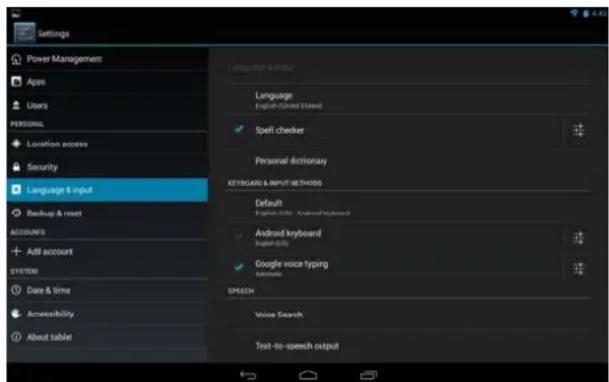
(Sample Image) Language & input menu screen
3 Touch the item you wish to change in the Language & input menu.
Below are some of the categories you can choose from:
Language—Select to open the Language screen, and then select your preferred language for use on your tablet.
◆ Spell checker—Select to enable/disable the autospelling correction.
Personal dictionary—Select to open a list of the words you have added to the dictionary. Touch a word to edit it, or touch the red X next to a word to delete it. Touch the Plus button at the top right of the Application bar to add a word.
Default—Under Keyboard and Input Methods, select this to change and configure between available keyboards.
Voice Search—Under Speech, select this to configure the Voice search options.
One of the available options is:
Block offensive words—Select to have your Google voice recognition replace offensive words with hash symbols (#).

Accessibility settings
Use the Accessibility settings to configure any plug-ins that are installed on the tablet.
To change the Accessibility settings:
1 Touch the Settings (icon.
The "Settings" menu appears.
2 Touch the Accessibility (con.
The “Accessibility” menu appears.
3 Touch the item you wish to change in the Accessibility menu.
Below are some of the categories you can choose from:
- TalkBack—Select to allow the tablet’s installed speech synthesizer to announce the labels of the buttons, icons, etc. while navigating the tablet.
Large text—Select to make the font size bigger.
Auto-rotate screen—Select to enable/disable the auto-rotate feature.
- Touch & hold delay—Select to set the hold delay time between when you touch the item and when the item responds.

Date & time settings
Use the Date & time settings to configure your preferences for the way in which dates are displayed.
To change the Date & time settings:
1 Touch the Settings (icon.
The "Settings" menu appears.
2 Touch the Date & time (icon.
The "Date & time" menu appears.
3 Touch the item you wish to change in the Date & time menu.
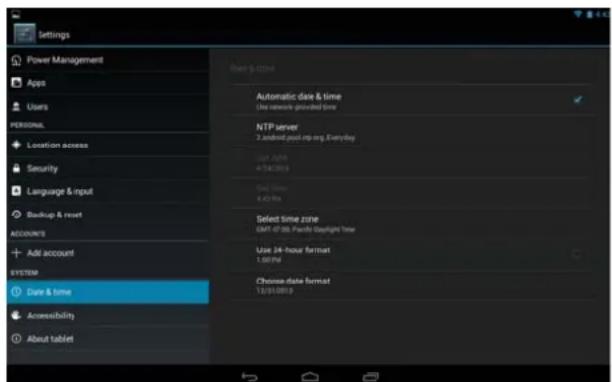
(Sample Image) Date & time menu screen
Below are some of the categories you can choose from:
Automatic date & time—Clear the selection to set the date and time manually.
- Automatic date & time settings—Clear the selection to set the time zone manually.
Set date—If Automatic date & time is cleared, a screen opens to set the date manually.
Set time—If Automatic date & time is cleared, a screen opens to set the time manually.
Select time zone—Select to set the time zone manually.
Use 24-hour format—Select to display the time using a 24-hour time format (i.e. 13:00, rather than 1:00).
Choose date format—Select to open a screen to select the displayed date's format.

About tablet
The About tablet menu displays information regarding your operating system software and hardware.
To view the About tablet information:
1 Touch the Settings (icon.
The "Settings" menu appears.
2 Touch the About tablet (icon.
The "About tablet" menu appears.
3 Touch the item you wish to view in the About tablet menu.
Below are some of the categories you can choose from:
System updates—Select to open the Toshiba Service Station that lists the availability of operating system software updates.
Status—Select to open a screen that displays information about your battery, network connections, etc.
System information—Select to open a screen that displays information about the Manufacturer, Product name, Product version, Serial number, UUID, and OEM strings for your tablet.
- Legal information—Select to open a screen that displays legal information about the system software included with your tablet.
Accessing the Notifications menu
You can open the Notifications menu to view pending activity on your tablet.
1 Touch and swipe down from the upper-left corner of the screen in the System bar.
The "Notifications" menu displays.
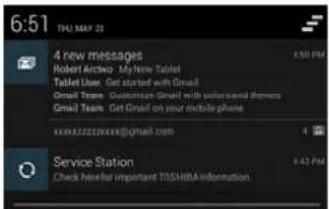
(Sample Image) Notifications menu screen
2 Touch any open area of the display screen to close the Notifications menu.
Accessing the Quick Settings menu
You can open the Quick Settings menu to view and control the tablet settings you most often use, as well as access the Settings menu.
1 Touch and swipe down from the upper-right corner of the screen in the System bar.
The "Quick Settings" menu displays.
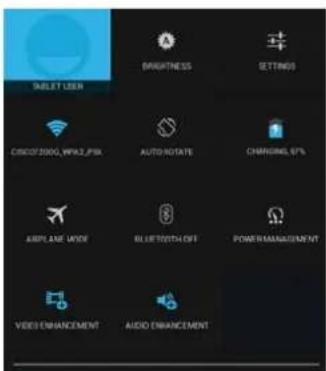
(Sample Image) Quick Settings menu screen
2 Touch the icon that corresponds to the setting you wish to change, and then select the setting you wish to change it to.
3 Touch any open area of the display screen to close the Quick Settings menu.
The following are some of the icons you may find in the Quick Settings menu.
Icon Name Description
| Airplane mode | Touch to turn ON/OFF Airplane mode. |
| Wi-Fi® | Touch to view the current Wi-Fi® connections, see “Wireless and networks settings” on page 69. |
| Auto-rotate Touch to lock/unlock auto rotation. When unlocked, the screen automatically changes orientation to match the orientation of the device. | |
| Brightness Touch to adjust the screen brightness, see “Display settings” on page 71. | |
| Settings Touch to select the tablet setting you wish to change, see “Apps and Settings menus” on page 64. | |
Chapter 3
Working with Apps
Downloading Toshiba Apps
You can download Toshiba apps from the Toshiba App
Place™ by touching the App Place icon.
NOTE
To download apps, you must be connected to the Internet.
TOSHIBA Media Player

The TOSHIBA Media Player is a multimedia player that allows users to experience outstanding multimedia viewing enjoyment.
The TOSHIBA Media Player supports a number of multimedia content formats. For detailed information regarding supported file formats, see the detailed specifications for your device at tabletsupport.toshiba.com.
NOTE
Toshiba does not guarantee that all audio/video files will play correctly.
On the Media Player's main screen, touch the Menu button.
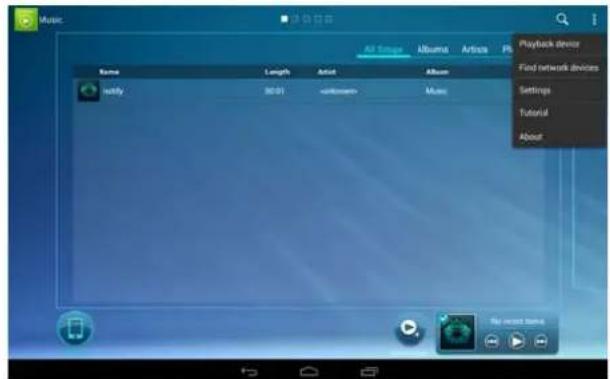
(Sample Image) Toshiba Media Player Settings menu screen
The menu may display the following options:
- Playback device—Opens the list of available playback devices
Find network devices—Displays available network devices.
Settings—Opens media player settings. - Tutorial—Opens the media player tutorial.
About—Displays version information, etc.
Apps
In Google Play™ Store you will have direct access to more than 100,000 apps. Search for your favorite games, apps, wallpapers, and more to customize your tablet.
To learn more, visit the Google Help Center.
Downloading from Google Play™ Store
On the Home Screen, touch the Play Store (Ticon. This opens Google Play™ Store, allowing you to choose music, books, and movies.
Preinstalled Apps on your tablet
Google Play™ Store, Gmail™, Maps, and YouTube™ apps are preinstalled on your tablet and the shortcuts for them may appear on your Home screen. You can move the icons for these applications to other Home screens to customize the look of your tablet, see “Moving an item from the Home screen” on page 53.
You can install many more apps, widgets, games, etc. by visiting the Toshiba App Place™ or Google Play™ Store.
Uninstalling Apps on your tablet
To uninstall applications from your tablet.
1 Touch the Apps (con.
2 Touch&hold the icon that represents the application you want to delete, and then drag it to Uninstall.
3 Confirm the deletion.
NOTE
Applications that came preinstalled on your tablet cannot be deleted from the device.
Chapter 4
Exploring the Features on your Device
Using the onscreen keyboard
Your tablet comes with an onscreen keyboard.
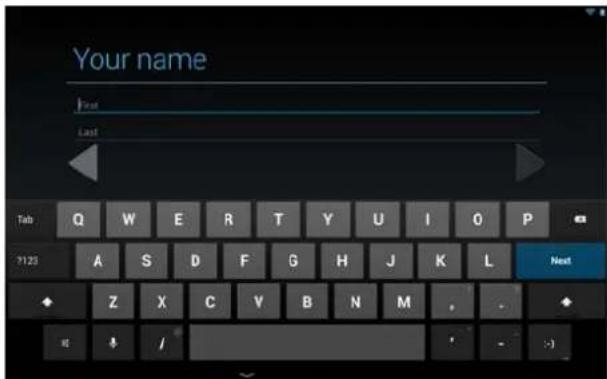
(Sample Image) Onscreen keyboard
Enter text using the onscreen keyboard. Some applications open a text field that when touched, opens the onscreen keyboard allowing you to enter text. Some apps open the keyboard automatically.
The onscreen keyboard has a number of settings. For more information, see "Language & input settings" on page 80.
Type to enter text
To begin typing, touch the text field in the application you are using to open the onscreen keyboard.
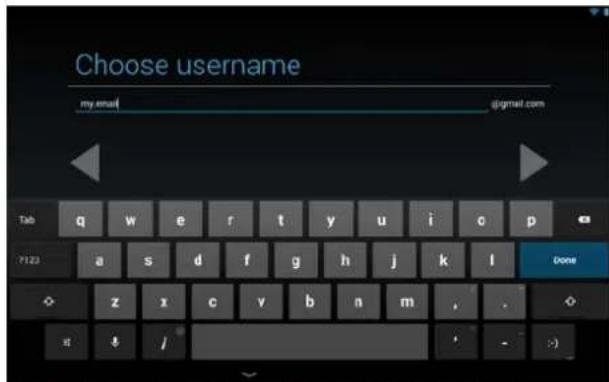
(Sample Image) Touching a text field to type
An insertion point tab ( ) appears where you touch the text field. If text has been previously entered you can drag the insertion point by its tab to move it to the location in the text line you wish to begin typing from.
You may also select one or more words to copy, cut, and paste.
NOTE
Not all applications support this function.
1 Select the text you want to cut or copy.
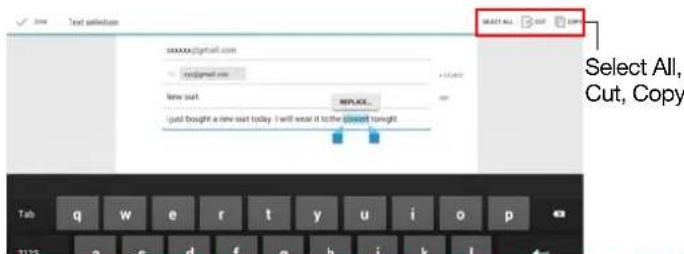
(Sample Image) Touching a text field to cut, copy, or replace text
2 Touch Cut (✗) or Copy (☐) in the Application bar.
Touching Cut removes the selected text from the text field, but it can be pasted into another text field.
3 Place the cursor in the text field where you want to place the text.
4 Touch and hold until the the screen. Paste ( ) option appears on
5 Touch the Paste (icon. The text is inserted into the new text field.
NOTE Text can be copied and pasted from one app to another.
◆ Touch the space bar or a punctuation mark to auto complete a word you are typing.
◆ Touch the Shift (key one time to capitalize the next letter typed.
Double-tap the Shift (★key to capitalize all of the letters you type. Touch the Shift (★key again to type in lower case.
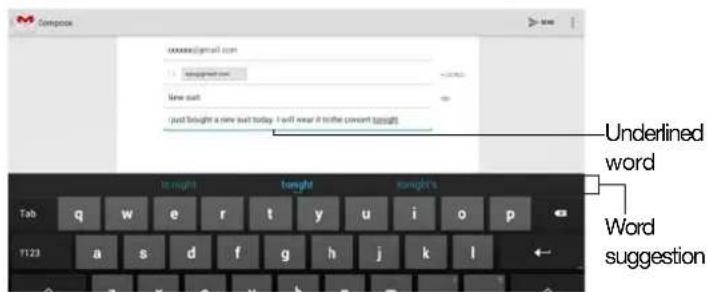
(Sample Image) Word suggestion
While typing, spelling suggestions and similar word suggestions appear just above the keyboard. Touch a word suggestion to use it in place of the underlined word in the text field. To change the input settings, see "Language & input settings" on page 80.
◆ Touch the Delete (key to erase characters to the left of the cursor.
◆Touch the Number and Symbols (in key to type numbers, symbols, and other special characters.
◆ Touch the finished. Close Keyboard 📋 button when you are
You can change the language you want to use by touching the Input Method (button, or by going to the Settings menu, see "Language & input settings" on page 80.
Speak to enter text
You can use the speech-recognition feature to input text to the onscreen keyboard.
1 Touch the text field.
2 Touch the Microphone () key on the keyboard.
3 Speak your text when you are prompted to "Speak now."
The speech-recognition types the words you say.
4 To enter punctuation, say "comma," "period," "exclamation mark," etc.
The text you enter by speech is underlined.
5 Touch the Delete (▶key to erase the underlined text, or the Send (▶button to accept the text.
You can change the language you want to use by touching the Input Method (button, or by going to the Settings menu, see "Language & input settings" on page 80.
Using the built-in speakers
Your tablet is equipped with internal speakers. To increase or decrease the volume, use the volume control buttons on the side of your tablet.
You can silence your tablet, so that your notifications are announced with a vibration instead of a tone. To place your tablet into Silent mode, use the volume decrease button to turn the volume down completely, and then press it once again to place your tablet into Silent mode.
Using external speakers or headphones
Instead of using the internal speakers, you can connect headphones or a pair of external stereo speakers.
▲ CAUTION
Do not set the volume too high on this device or when using headphones. Continuous exposure to loud sound can harm your hearing. Discontinue use and consult a physician if you experience any hearing discomfort.

TECHNICAL NOTE: When using amplified speakers, use speakers that require an external power source. Other types of speakers will be inadequate to produce sound from the device.

To play back sound files through external speakers or headphones:
1 Locate the headphone/microphone jack on the device.
2 Using any necessary adapters, plug the cable from the headphones or external speakers into the headphone/microphone jack.
The headphone/microphone jack requires a 16-ohm stereo mini connector.
To adjust the volume:
For external speakers, use the volume controls on each speaker.
For headphones, use the device's volume control.
Recording sounds
You may record sounds using the internal microphone on the device or by connecting a headset.
Using the camera
Your device comes with a built-in camera on the front of the tablet. With the camera you can do the following:
Take pictures and record videos with your device
◆ Chat with others and have them see you while using instant messaging (IM) programs
◆Have video conference calls
NOTE
To email, instant message or video conference, you must be connected to the Internet.
Using a microSD™ Card
For detailed information regarding supported media, see the detailed specifications for your device at tabletsupport.toshiba.com.
The microSD™ Card slot supports the use of Micro Secure Digital™ (SD™) media. This media can be used with a variety of digital products: digital music players, cellular phones, PDAs, digital cameras, digital video camcorders, etc.
Inserting memory media
CAUTION
When inserting memory media, do not touch the metal contacts. You could expose the storage area to static electricity, which can destroy data.
To insert a microSD™ Card:
1 Open the port cover.
2 Turn the media so that the contacts (metal areas) are face down.
3 Push the media into the adapter until it locks in place.
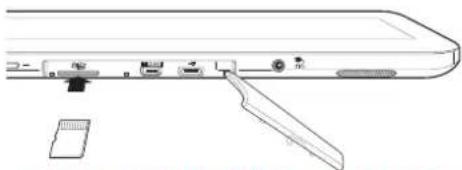
natural_image
Technical line drawing of a device handle with ports and a clip, no text or symbols present(Sample Illustration) Inserting memory media
Removing memory media
CAUTION
Do not remove media while data is being written or read, or your data could be destroyed.
To prepare the card for removal:
1 Touch the Settings (图标).
The Settings menu appears.
2 Touch the Storage icon.
The Storage menu appears.
3 Touch Unmount SD card.
4 Open the port cover.
5 Gently press the card inward to release it.
The card pops out slightly.
6 Grasp the card and pull it straight out.
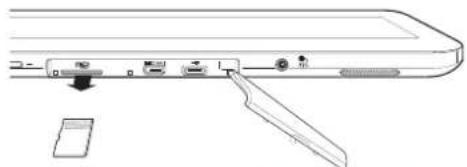
natural_image
Diagram of a device with ports and a paper clip, no text or symbols present(Sample Illustration) Removing memory media
Adding optional external devices
NOTE
Not all devices are compatible. Check with the manufacturer of each device for compatibility.
After starting your device for the first time you may want to:
Connect an external keyboard via the available Bluetooth® settings (see "Using an external keyboard" on page 96 or "Setting up Wi-Fi® and Bluetooth® connections" on page 41)
Connect an external mouse via the available Bluetooth® settings (see "Using an external mouse" on page 96 or "Setting up Wi-Fi® and Bluetooth® connections" on page 41)
Using an external keyboard
If you prefer to use an external keyboard, you can attach one to your device by pairing a Bluetooth ^® enabled keyboard using the available Bluetooth ^® connectivity on your device. For more information, see “Setting up Wi-Fi ^® and Bluetooth ^® connections” on page 41 and “Using external devices” on page 96.
NOTE
Some keyboard functionality may not be supported.
Using an external mouse
You may want to use an e.xternal mouse instead of the device's touch screen. You can attach one to your device by pairing a Bluetooth® enabled mouse using the available Bluetooth® connectivity on you device. For more information, see "Setting up Wi-Fi® and Bluetooth® connections" on page 41 and "Using external devices" on page 96.
NOTE
Some mouse functionality may not be supported.
Using external devices
You can connect external devices to your device using the following available port:
A Micro USB port—Supports data transfer.
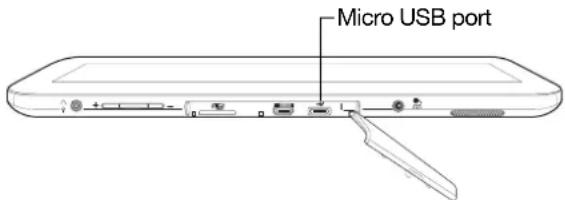
(Sample Illustration) External device port on the left of the tablet
NOTE
Not all USB devices are compatible. Check with the manufacturer of the USB device for compatibility.
Chapter 5
Utilities
Your device includes several utilities designed to help you reconfigure your system to best meet your individual needs. Together, these allow you to ascertain certain system details, set additional options, or change default options. These utilities are described in this chapter.
NOTE
The utilities described in this chapter, and the icons shown in the sample images are applicable only if the related utility is available on your system.
TOSHIBA Service Station
TOSHIBA File Manager Utility
TOSHIBA Service Station
The TOSHIBA Service Station app provides you with updates for both application and system software. It notifies you when new versions of your system software are available, and then prompts you to download and install them.
To open TOSHIBA Service Station:
1 Touch the Apps (con.
2 Touch the Service Station ( ) Icon.
The TOSHIBA Service Station screen appears.
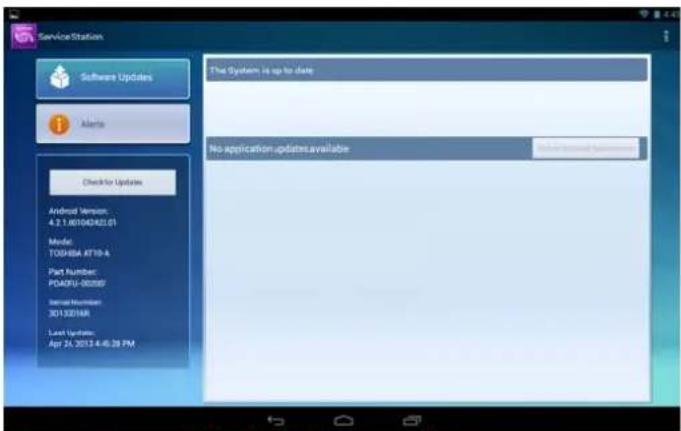
(Sample Image) TOSHIBA Service Station screen
The first time TOSHIBA Service Station is run, you will be prompted to accept the access agreement. This agreement authorizes the app to collect certain basic information about your device and send it to the Toshiba servers as part of the process of obtaining updates.
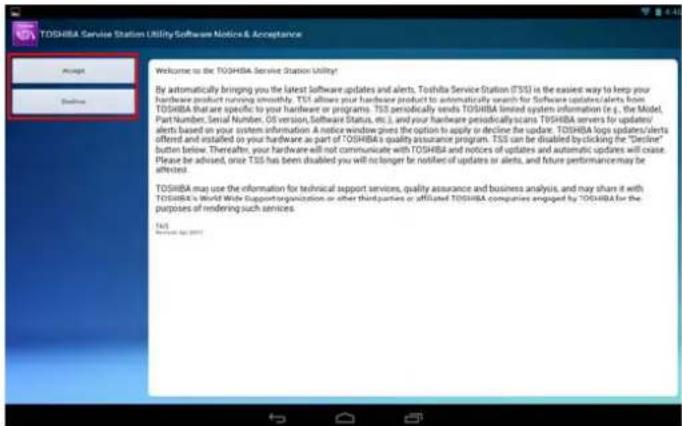
(Sample Image) TOSHIBA Service Station Acceptance screen
Touch the Accept button (recommended) to accept the agreement or touch the Decline button to decline.
NOTE
The TOSHIBA Service Station app will not be able to notify you of new software and application updates if you choose to decline the agreement.
The main screen of this application includes the following areas:
Header—This section runs along the top of the screen and contains basic information about your system, such as the version of the OS, the device part number, and serial number.
Buttons—Buttons are displayed on the screen. Depending on the actions you have available, the buttons will vary.
Information—The main part of the screen displays information, such as the list of available updates, or more detailed information about each specific update.
Check for application updates
During normal operations, the TOSHIBA Service Station will periodically check for updates to your system. This is done automatically. You will be notified with the TOSHIBA Service Station icon in the Status bar when new updates become available.
You can also check for updates manually. Touch the Check for Updates button. The application will refresh the list of available updates.
NOTE
Connect the AC adaptor before updating.
Downloading updates
NOTE
Toshiba strongly recommends that you back up your data and settings before downloading updates.
Touch the TOSHIBA Service Station (icon in the Status bar when an update becomes available to display additional information about that item. To download the update, touch the Download button. The update begins to download and displays a progress indicator in the Notification bar.
NOTE
Touch the Home (☐) button to allow the download to continue while you use your tablet. A notification of download completion appears in the Status bar.
To discontinue the download process, touch the button.
Back

Installing updates
Once an update has been successfully downloaded, it can be installed.
1 Touch the Bar. Download completion notice on the Status
2 Touch the Install button.
The application installer launches.
3 Confirm the installation to continue.
Downloading and installing System updates
TOSHIBA Service Station downloads both application and system updates. System updates require the device to be rebooted during the update process.
Installing a system update is similar to an application update, however you will be reminded that the device will automatically reboot during the update process. Make sure to close any applications and save all data prior to installing a system update.
CAUTION
Do not interrupt or turn off your tablet during a system update once it has begun. Data loss may occur.
TOSHIBA File Manager Utility
Using the TOSHIBA File Manager, you can back up your data to a microSD™ Card.
1 Insert a microSD™ Card into the microSD™ Card slot on your tablet. For more information, see "Using a microSD™ Card" on page 94.
2 Touch the Apps (icon.
3 Touch the File Manager () icon.
The TOSHIBA File Manager screen appears.
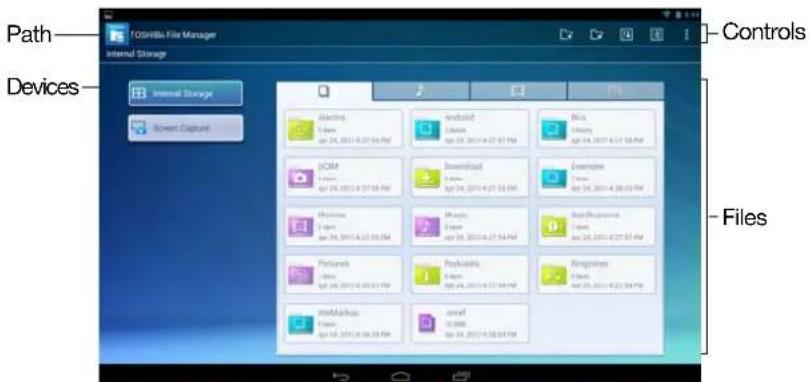
(Sample Image) TOSHIBA File Manager screen
4 Make sure Internal Storage () option is selected at the top left of the screen.
5 Touch and hold a file or folder to enter selecting mode.
Then touch the files/folders you wish to back up, or touch Select All from the selected items count drop-down menu located at the top left corner of the screen.
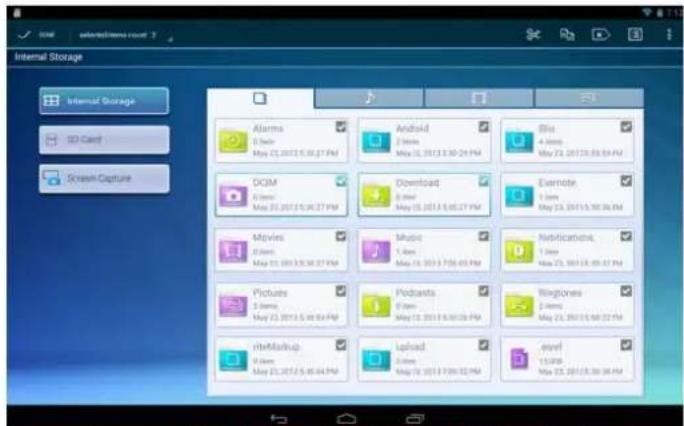
(Sample Image) TOSHIBA File Manager Select items
The specific file or folder you have selected will highlight with a checkbox in the upper right hand corner to signify that it has been selected for manipulation. All the other files and folders on the screen will also now have a checkmark in the upper right hand corner however they will remain grayed-out until specifically selected.

(Sample Image) TOSHIBA File Manager - files checked
At this time you can touch individual files and folders with the grayed-out checkmarks to select them.
6 Touch the Copy (button in the action bar located at the top right corner of the screen.
7 Touch the SD Card () icon from the device icons on the left of the screen to select the microSD™ card.
Touching the SD Card () icon displays the file/folder content on the microSD™ Card.
8 Select the folder you want to copy the files/folders to, and then touch the Paste (Icon) in the action bar located at the top right corner of the screen.
The files are copied to the microSD™ Card.
File browsing screen
The available options in the File browsing screen are:
Device—Internal storage and microSD™ Card are displayed.
Path—The device name is displayed on the left side of the screen, and the relative path is displayed on the right.
File—Files/folders are listed in multi-columns with thumbnails showing the file information, such as name, modified date/time, etc. The selected files/folders are tagged in red.
Action bar—You can create folders, change views and manipulate files from this menu bar.
Operation of files/folders
Touch and hold a file or folder to select it. This will change the action bar at the top of the screen to provide the options you can use for file or folder manipulation.
The available options are:
IconNameDescription

Cut Touch and hold the file or folder to select
it. Touch the Cut icon the copy the file to the "virtual clipboard" and remove it from its current location.

Copy Touch and hold the file or folder to select
it. Touch the Copy icon to copy the item to the "virtual clipboard". Later you can use the "Paste" option to paste the item to the destination location of your choosing.
IconNameDescription
| Delete Touch and hold the file or folder to select it. Touch the Delete icon to permanently delete the item from the location it is currently in. The system will prompt you to make sure this is what you want to do. |
| Change View This option allows the user to change the view from one in which items are shown in three columns and as many rows as needed to a single column list view. |
| (toward) | Menu This option provides additional menu options based upon where you are in the process. As an example if have not yet selected any items the options are; Device Information, About and Help. If you have selected items the options become; Rename, Add to shortcut, Information and Help. |
Rename files/folders
To rename a file/folder:
1 Touch and hold a file or folder to enter selecting mode.
2 Touch the Menu icon.
3 Select Rename from the drop-down menu.
4 Type in the new name for the folder and touch OK.
Create folders
To create a new folder:
1 Choose the desired top directory in the File browsing screen.
2 Touch the Create Folder (icon.
A pop-up window appears.
3 Create a new folder name.
4 Touch OK to continue.
Storage structure
The following describes the function of each of the icons on the TOSHIBA File Manager screen:
IconNameDescription
| Internal storage | Displays the file content of the device's internal storage, (excluding system files). |
| microSDTM Card | Displays the file content of the microSDTM Card that is inserted into the microSDTM Card slot. |
| Screen Capture | Displays the file content of the screen captured images. |
NOTE
To perform a screen capture, press the Power and Volume down button simultaneously for a few seconds.
Chapter 6
If Something Goes Wrong
Some problems you may encounter when using your tablet are relatively easy to identify and solve.
This chapter aims to help you solve many problems by yourself. It covers the problems you are most likely to encounter.
If all else fails, contact Toshiba. You will find information on Toshiba's support services at the end of this chapter.
Problems when you turn on the device
These problems may occur when you turn on the power.
The device will not start.
Make sure you attached the AC adaptor properly.
If you are using the AC adaptor, check that the wall outlet is working by plugging in another device, such as a lamp.
Verify that the device is on by looking at the ON/OFF indicator. If the indicator is glowing, the device is on. Also, try turning the device off and then on.
The device starts but when you touch an icon nothing happens.
Your device may have an application or resource conflict. Try shutting down and restarting.
The operating system is not working
Once you are familiar with the Home screens and used to the way the operating system responds, you can easily detect if the it is not working correctly. For example:
The operating system responds differently from the normal routine
◆Screens and apps take a long time to load
◆The screen does not look right
Unless a hardware device has failed, problems usually occur when you change the system in some way such as installing a new app or adding an external device.
Most issues are solved by “recycling the system’ turning it off then back on. If this does not resolve the issue, try uninstalling the most recently installed application or disconnecting the most recently installed accessory. If this still does not resolve the issue, use the About tablet setting to check for available system updates. For more information, see “About tablet”“About tablet” on page 83.
Internet problems
My Internet connection is very slow.
Many factors contribute to the speed with which you can surf the Internet. They include: network speed, network conditions, time of day (when everyone else is surfing, your access can be slow) and popularity of the sites you are trying to access. If accessing a particular site is very slow, try later.
My browser cannot find the URL address I typed in.
Check the spelling of each name and the syntax of the address carefully. A single incorrect letter or missed character will make it impossible for your browser to locate the site.
My browser cannot find a site I bookmarked.
The World Wide Web is constantly changing. A site you bookmarked yesterday may not be available today or its server may be down for temporary repair. Try again later.
Power and the batteries
Your device receives its power through the AC adaptor or from the system battery. Power problems are interrelated. For example, a faulty AC adaptor will neither power the device nor recharge the batteries.
Here are some typical problems and how to solve them:
The AC adaptor works correctly, but the battery will not charge.
The battery does not charge while the device is consuming full power. Try turning off the device.
The battery may be too hot or too cold to charge properly. If you think this is the probable cause, let the battery reach room temperature and try again.
The device does not power on.
Let the battery discharge completely, then try charging it again.
Check the power options. For more information, see "Optimizing battery life" on page 29. Is your software using the internal storage drive more? Is the display power set to turn off automatically? Was the battery fully charged to begin with? All these conditions affect how long the charge lasts.
If the device still does not power on, contact your service provider immediately.
After a period of time, the battery will lose its ability to perform at maximum capacity and will need to be replaced. This is normal for all batteries.
For more information on maintaining battery power, see "Charging the battery" on page 28.
Display problems
Here are some typical display problems and their solutions:
The screen does not look correct.
You can change the display settings by touching the Settings (icon on the Home screen. For more information, see "Display settings" on page 71.
Small bright dots appear on your screen when you turn on your device.
Small bright dots may appear on your screen display when you turn on your device. Your display contains an extremely large number of thin-film transistors (TFT) and is manufactured using high-precision technology. Any small bright dots that may appear on your display are an intrinsic characteristic of the TFT manufacturing technology.
The screen does not appear as bright as it used to be
Over a period of time, and depending on the usage of the device, the brightness of the screen will deteriorate. This is also an intrinsic characteristic of the screen technology. When the device is operated on battery power, the screen will dim and you may not be able to increase the brightness of the screen while on battery power.
Sound system problems
The sound settings can be configured to your desired user preferences. For more information, see “Sound settings” on page 70.
No sound is coming from the device's speakers.
Adjust the volume control.
If you are using external headphones, speakers, or a headset, check that they are securely connected to your device.
Wireless networking problems
NOTE
This section provides general troubleshooting tips for networking problems, specifically wireless (Wi-Fi®) networking.
The terms and concepts used assume a basic understanding of networks, and may be for more advanced users. If you need assistance or if you are not familiar with the terminology, please contact Toshiba.
Your device is equipped with an internal Wi-Fi
® adapter.
Verify that your Wireless connection is enabled. For more information, see “Setting up Wi-Fi ^® and Bluetooth ^® connections” on page 41.
◆Verify that your device can detect access points or routers. If it can detect a Wi-Fi ^ access point or router then it may be a configuration issue.
◆Verify that the signal strength is good.
If another device is on the same network, verify that it has network access, and can connect to the Internet. If, for example, the other device cannot browse to a public Web site, the ISP's (Internet Service Provider) service may be disrupted.
- Verify that the Service Set Identifier (SSID), or network name, is correct - i.e., that it matches the SSID assigned to the access point you are attempting to connect through. SSIDs are case-sensitive.
If you have enabled any security provisions (closed system, MAC address filtering, Wired Equivalent Privacy [WEP], etc.), check the access point vendor's Web site for recent firmware upgrades. Problems with WEP keys, in particular, are frequently addressed in new firmware releases.
If you need further assistance
If you have followed the recommendations in this chapter and are still having problems, you may need additional technical assistance. This section contains the steps to take to ask for help.
Before you contact Toshiba
Since some problems may be related to the operating system or the program you are using, it is important to investigate other sources of assistance first.
Try the following before you contact Toshiba:
◆ Review the troubleshooting information.
If the problem occurs while you are running a program, consult the program's documentation for troubleshooting suggestions. Contact the software company's technical support group for their assistance.
- Consult the dealer from whom you purchased your device and/or program. Your dealer is your best source for current information.
For the detailed specifications for your device, visit tabletsupport.toshiba.com.
Contacting Toshiba
Toshiba's Technical Support Web site
For technical support, or to stay current on the most recent software and hardware options for your device, and for other product information, be sure to regularly check the Toshiba Web site at tabletsupport.toshiba.com.
Other Toshiba Internet Web sites
| toshiba.com | Worldwide Toshiba corporate site |
| us.toshiba.com | Marketing and product information in the USA |
| accessories.toshiba.com | Accessories information in the USA |
| www.toshiba.ca | Canada |
| www.toshiba-Europe.com | Europe |
| www.toshiba.co.jp/index.htm | Japan |
| latin.toshiba.com | Mexico and all of Latin America |
| acclaim.toshiba.com | Toshiba USA Self-Service support web site |
| laptopforums.toshiba.com | Community discussion forums for Toshiba laptop users |
Toshiba's worldwide offices
Australia
Toshiba (Australia) Pty. Limited
84-92 Talavera Road
North Ryde NSW 2113
Sydney
Australia
Canada
Toshiba Canada Ltd.
191 McNabb Street
Markham, Ontario
L3R - 8H2
Canada
France
Toshiba Corporation, PCO-IO
1-1, Shibaura 1-Chome
Minato-Ku, Tokyo, 105-8001
Japan
Latin America and Caribbean
Toshiba America Information
Systems, Inc.
9740 Irvine Boulevard
Irvine, California 92618
United States
Mexico
Col. Lomas de Chapultepec.
CP 11000 Mexico, DF.
Spain
Toshiba Information Systems
(España) S.A.
Parque Empresarial San
Fernando
Edificio Europa, 1a Planta
Escalera A
28831 (Madrid) San Fernando de
Henares
Spain
United Kingdom
Toshiba Information Systems
(U.K) Ltd.
Toshiba Court
Weybridge Business Park
Addlestone Road
Weybridge, Surrey KT15 2UL
United Kingdom
United States
Toshiba America Information
Systems, Inc.
9740 Irvine Boulevard
Irvine, California 92618
United States
The Rest of Europe
For more information on additional Toshiba worldwide locations, please visit: www.toshiba.co.jp/index.htm.
Appendix A
Power Cord/Cable Connectors
Your device ships with the correct power supply for the
country of purchase. This appendix shows the shapes of the typical AC power cord/cable connectors for various parts of the world.
USA

UL approved
Canada
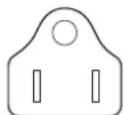
CSA approved
United Kingdom
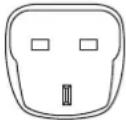
BS approved
Europe
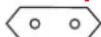
VDA approved
NEMKO approved
Australia
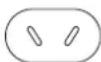
AS approved
Glossary

TECHNICAL NOTE: Some features defined in this glossary may not be available on your device.
Acronyms
The following acronyms may appear in this User's Guide.
AC Alternating Current
Apps Applications
bps bits per second
CPU Central Processing Unit
DC Direct Current
DPI Dots Per Inch
EPROM Erasable Programmable Read-Only Memory
FCC Federal Communications Commission
GB gigabyte
GPS Global Positioning System
HDD Hard Disk Drive
HDMI High-Definition Multimedia Interface
HTML Hypertext Markup Language
IEEE Institute of Electrical and Electronics Engineers
I/O Input/Output
IRQ interrupt request
ISP Internet Service Provider
KB kilobyte
LCD Liquid Crystal Display
LED Light Emitting Diode
MB megabyte
RAM Random Access Memory
RFI Radio Frequency Interference
ROM Read-Only Memory
RTC Real-Time Clock
SD Secure Digital
TFT Thin Film Transistor
USB Universal Serial Bus
URL Uniform Resource Locator
WAN Wide Area Network
www World Wide Web
WLAN Wireless Local Area Network
Terms
The following terms may appear in this User's Guide.
A
active-matrix display—A liquid crystal display (LCD) made from an array of liquid crystal cells using active-matrix technology. Also known as a “TFT display,” in its simplest form there is one thin film transistor (TFT) for each cell. This type of display works well with tablet devices because of its shallow depth and high-quality color. Active-matrix displays are viewable from wider angles than most passive-matrix displays.
adapter—A device that provides a compatible connection between two units. For example, the tablet's internal display adapter receives information from the software and translates it into images on the screen. An adapter can take a number of forms, from a microprocessor to a simple connector. An intelligent adapter (one that is capable of doing some processing) may also be called a controller.
Alternating Current (AC)—The type of power usually supplied to residential and commercial wall outlets. AC reverses its direction at regular intervals. Compare Direct Current (DC).
application—A set of instructions that can be executed by a tablet.
App shortcut—An application icon that can be placed on a Home screen. Touching one opens the app without having to first open the Apps screen. See also icon.
B
backup—A copy of a file, usually on a removable disk, kept in case the original file is lost or damaged.
baud rate—The speed at which a communication device, such as a printer or modem, transmits information. Baud rate is the number of signal changes per second (not necessarily the same as bits per second). See also bits per second.
bits per second (bps)—A way of measuring the speed at which information is passed between two devices. This is the basic unit of measure used in modem communications, and is similar, but not identical, to the baud rate. See also baud rate.
Bluetooth®—A proprietary open wireless technology standard that uses short wavelength radio transmissions to exchange data over short distances. Bluetooth can transmit from fixed and mobile devices, and provides a high level of security.
Bookmark—A Shortcut can be created and placed on a Home screen from a selected browser bookmark. Touching the icon opens the Web browser to the chosen bookmarked page. See also icon.
boot—To start the tablet. The term “boot” originates from bootstrap program (as in “pulling itself up by its bootstraps”), a program that loads and initializes the operating system. See also reboot.
bus—An electrical circuit that connects the central processing unit (CPU) with other parts of the tablet, such as the video adapter, disk drives, and ports. It is the pathway through which data flows from one device to another. See also bus speed, frontside bus.
bus speed—The speed at which the central processing unit (CPU) communicates with the other parts of the tablet.
C
cache—A section of very fast memory in which frequently used information is duplicated for quick access. Accessing data from cache is faster than accessing it from the tablet's main memory. See also CPU cache.
Central Processing Unit (CPU)—The chip that functions as the “brain” of the tablet. It takes information from outside sources, such as memory or keyboard input, processes the information, and sends the results to another device that uses the information.
character—Any letter, number, or symbol you can use on the tablet. Some characters are non-printing characters, such as a paragraph break in a word-processing program. A character occupies one byte of tablet device storage.
chip—A small piece of silicon containing tablet device logic and circuits for processing, memory, input/output, and/or control functions. Chips are mounted on printed circuit boards.
compatibility—The extent to which tablets, programs, or devices can work together harmoniously, using the same commands, formats, or language as another.
configuration—(1) The collection of components that make up a single tablet operating system. (2) How parts of the system are set up (that is, configured).
controller—A device that controls the transfer of data from a tablet device to a peripheral device and vice versa. For example, disk drives, monitors, keyboards, and printers all require controllers.
CPU—See Central Processing Unit (CPU).
CPU cache—A section of very fast memory residing between the CPU and the tablet's main memory that temporarily stores data and instructions the CPU will need to execute commands and programs. See also cache.
cursor—An onscreen symbol (usually a flashing vertical line) that indicates the position where characters will appear when you enter data.
D default—The setting selected by a program when the user does not specify an alternative setting.
device—A component attached to the tablet. Devices may be external (outside the tablet's case) or internal (inside the tablet's case). Printers, disk drives, and modems are examples of devices.
device driver—A program (called a “driver”) that permits the tablet to communicate with a device.
Direct Current (DC)—The type of power usually supplied by batteries. DC flows in one direction. Compare Alternating Current (AC).
disable—To turn the option off. See also enable.
disk drive—The device that reads and writes information and programs on external media or hard disk. It rotates the disk at high speed past one or more read/write heads.
document—Any file created with an application and, if saved to disk, given a name by which it can be retrieved. See also file.
download—(1) In communications, to receive a file from another source through a network. (2) To send font data from the tablet to a printer. See also upload.
drag—To touch and hold an item for a moment and then, without lifting your finger, move the item until you reach the target position.
driver—See device driver.
E emulation—A technique in which a device or program imitates another device or program.
enable—To turn on an option. See also disable.
executable file—A program that is ready to run. Application programs and batch files are examples of executable files. Names of executable files usually end with a .bat, .exe, or .apk extension.
expansion device—A device that connects to a tablet to expand its capabilities. Other names for an expansion device are port expander, port replicator, docking station, or network adapter.
extension—See file extension.
external device—See device.
F
file—A collection of related information, saved on disk with a unique name. A file may be a program, information used by a program, or a document. See also document.
file name—A set of characters that uniquely identifies a file within a particular folder. It consists of two parts: the actual name and the file name extension. See also file extension.
file extension—The three characters following the period (pronounced "dot") at the end of a file name. The extension indicates the type of file. Examples are .apk for application files and .pdf for documentation files. See also file name.
folder—A container for organizing files saved to a disk. A folder is symbolized on screen by a graphical image (icon) of a file folder. A folder can contain files and other folders.
G
ground—A conductor to which all components of an electric circuit are connected. It has a potential of zero (0) volts, is connected to the earth, and is the point of reference for voltages in the circuit.
H
hard disk—A storage device composed of a rigid platter or platters that can be magnetically coded with data. Hard disks hold much more information than some other external media and are used for long-term storage of programs and data. The primary (or only) hard disk in a tablet device is usually fixed.
hardware—The physical components of a tablet system. Compare software.
HDMI (High-Definition Multimedia Interface)—An interface used to transmit high quality audio and video signal via a single cable in digital format, providing better picture quality than analog signal.
hot swapping—The ability to add or remove devices from the tablet while it is running and have the operating system automatically recognize the change.
icon—A small image displayed on the screen that represents a function, file, or program.
interlaced—A method of refreshing the display screen, in which only every other line of pixels is refreshed. Interlaced screens take two passes to create a complete screen image. Compare non-interlaced.
internal device—See device.
Internet—The decentralized, world-wide network of computers that provides electronic mail, the World Wide Web, and other services. See also World Wide Web.
L LED (Light Emitting Diode)—A solid state lamp (SSL) that uses light-emitting diodes (LEDs) as the source of light, which offers long life and high efficiency output. Multiple diodes are used together, since the light created by individual light-emitting diodes is small compared to incandescent and compact fluorescent lamps.
LCD (Liquid Crystal Display)—A type of display that uses a liquid substance between two transparent electrode panels. When an electric current passes through the electrodes, the molecules in the liquid form a crystalline pattern that polarizes the light passing through it. A filter over the electrodes permits only non-polarized light to pass to the surface of the display, creating light and dark pixels.
M memory—Typically refers to the tablet's main memory, where programs are run and data is temporarily stored and processed. Memory can be volatile and hold data temporarily, such as RAM, or it can be nonvolatile and hold data permanently, such as ROM. A tablet's main memory is RAM. See also RAM, ROM.
microprocessor—See Central Processing Unit (CPU).
motherboard—The computer's main circuit board that contains the processor, memory, and other primary components.
mount—To initialize the external storage device for transferring and storing files.
multimedia—A combination of two or more media, such as sound, animation, and video in an application or presentation.
N
network—A collection of computers and associated devices that are connected by communications facilities. A network allows you to share data and peripheral devices, such as printers, with other users and to exchange electronic mail.
non-interlaced—A method of refreshing the tablet screen, in which each pixel of every line is refreshed as the electron beam scans across and down the screen. Compare interlaced.
O
online—Available through a computer. Online may refer to information being read from your own computer's internal storage drive, such as online documentation or online Help, or to information coming from another company on a company network or the Internet.
operating system—A set of programs that controls how the tablet device works.
P
password—A unique string of characters entered by a user to verify his or her identity to a computer or the network.
peripheral—Any device, such as a mouse or keyboard, that is attached to the tablet and controlled by the tablet's CPU.
pixel—Short for "picture element." The smallest dot that can be produced on a screen or printer.
Plug and Play—Generally, refers to the tablet's ability to automatically configure itself to work with peripheral devices. When capitalized, refers to a standard that, when followed by a device manufacturer, allows the tablet to configure itself automatically to work with the device.
port—A socket on the tablet where you plug in a cable for connection to a peripheral device.
processor—See Central Processing Unit (CPU).
properties—The attributes of an object or device. For example, the properties of a file include the file's type, size, and creation date.
R
RAM (Random Access Memory) — Volatile memory that can be written to as well as read. Volatile here means that information in RAM is lost when you turn off your tablet. This type of memory is used for your tablet's main memory. See also memory. Compare ROM.
Random Access Memory—See RAM.
Read-Only Memory—See ROM.
reboot—See boot, restart.
removable disk—A disk that can be removed from a disk drive. A Flash drive is one example of a removable disk.
resolution—A measure of the sharpness of the images that can be produced by a printer or displayed on a screen. For a printer, resolution is expressed in dots per inch (dpi). For a screen, it is expressed as the number of pixels available horizontally and vertically.
restart—Synonymous with reboot. To reset the tablet by reloading the operating system without turning the tablet off. See also boot.
ROM (Read-Only Memory)—Non-volatile memory that can be read but not written to. Non-volatile here means that information in ROM remains whether or not the tablet is receiving power. This type of memory is used to store your tablet's BIOS, which is essential instructions the tablet reads when you start it up. See also BIOS, memory. Compare RAM.
S
Secure Digital (SD)—A small, portable, non-volatile memory card used to store and transfer data between digital products, providing encryption capability for content security.
select—To highlight or otherwise specify text, data, or graphics with the intent to perform some operation on it.
shortcut—See Application shortcut.
Sleep—A feature of some operating systems that allows you to turn off the tablet without exiting your open applications and to continue from where you left off when you turn the tablet on again.
software—See application. Compare hardware.
Swipe—To move your finger quickly across the surface of the screen without pausing.
Sync—To synchronize files and data or accounts so that the same information is shared in multiple places.
T TFT display—Thin Film Transistor display. See active-matrix display.
Touch—To activate items displayed on the screen, such as apps, setting icons, and onscreen buttons by touching them with your finger.
Transfer—To move files or data from one location to another.
U unmount—To prepare the external storage media for removal from the device.
upload—To send a file to another computer through a modem or network. See also download.
utility—A computer program designed to perform a narrowly focused operation or solve a specific problem. Utilities are often related to computer system management.
W Wallpaper—is a background image downloaded from the Web or chosen from the Gallery (pictures taken with the camera, or still images included with the system). A live wallpaper is an animated scene or maybe a map that centers on the current location.
Web—See World Wide Web.
Widget—A miniature app that can be placed on a Home screen. Touching the icon opens the application. Many of these include a clock, a music player, and the Google™ Search bar. See also icon
Wi-Fi®—A registered trademark term of the Wi-Fi Alliance that stands for Wireless Fidelity, and is another term for the communication protocol to permit an Ethernet connection using wireless communication components.
World Wide Web (www)—The worldwide network of Web sites linked together over the Internet. A user of the Web can jump from site to site regardless of the location of the tablet hosting the site. See also Internet.
Index
A
about tablet
legal information 83
settings 83
status 83
System information 83
system updates 83
AC adaptor 26
Accessibility
settings 81
Accessibility settings
Auto-rotate screen 81
Large text 81
TakBack 81
Touch & hold delay 82
accounts
add an account 59
managing 58
remove an account 59
Accounts settings 77
adding
optional external devices 95
Apps 87
apps
Local 61
Maps 61
Navigation 61
preinstalled 88
settings 74
uninstalling 88
apps and settings menus 64
apps menu
apps 64
automatic
date & time settings 82
automatic date & time
date & time settings 82
Auto-rotate screen
Accessibility settings 81
B
backing up data 22, 42
Google™ Account 42
TOSHIBA File Manager 42
Backup & reset settings 78
automatic restore 79
back up my data 79
backup account 79
factory data reset 79
battery
care 29, 30
charging 28
maintaining 30
optimizing battery life 29
safety precautions 29
taking care of 29
Bluetooth®
wireless & networks 69
built-in speakers
using 92
button
Apps 44
Back 44
Home 44
power 31
Recent Apps 45
Time display 45
Voice recognition 45
buttons
power button 26
C
camera
front camera 24
using 93
caring for your device 63
charging the battery 28
cleaning the device 63
Clear credentials
security 74
connecting
AC adaptor 26
power source 27
Creating
Folders 54
customize
device settings 64
D
data
backing up 22
restoring 43
date & time
settings 82
date & time settings
automatic 82
automatic date & time 82
Select date format 83
select time zone 82
set date 82
set time 82
Use 24-hour format 83
date and time
setting up 38
Default
language & input settings 81
Default notification
sound settings 70
device
caring for 63
cleaning 63
disposal 30
turning off 56
turning off options 56
device administrators
security 74
device will not start
troubleshooting 106
devices
external 96
disposal information 12
disposing of the device 30
downloads
managing 61
E
encrypt tablet
security 73
external device
Micro USB port 96
external devices
keyboard 96
mouse 96
ports 96
external headphones
using 93
external speakers
using 93
F
factory data reset 62
features 20
features and components 23
other documentation 20
this guide 19
features and components
back view 24
bottom view 26
front view 24
left side view 25
top view 26
files/folders
operation 103
first time use 31
Folder
Creating, naming, and
removing 54
folders
creating, naming, removing 54
G
Gmail icon 46
Google Play™ Store
downloading from 87
Google search bar 45
GPS
location access 72
H
headphone jack 25
Home screen
adding items 53
icons 45
moving items 53
removing items 53
Home screens
customizing 53
|
icon
Battery status 45
Browser 65
Calculator app 66
Calendar app 66
Chrome 65
Downloads app 66
Gallery app 66
Gmail 46
Gmail™ 65
Maps app 65
Media Player app 66
Navigation app 66
People app 66
Play Books app 66
Play Store app 65
Safety 19
Screen capture 45
Settings 44
Settings menu 65
Install from storage
security 74
internal microphones 26
Internet problems
troubleshooting 107
K
keyboard
external 96
L
language & input
settings 80
language & input settings
Default 81
Personal dictionary 81
select language 81
Spell checker 81
Voice Search 81
Large text
Accessibility settings 81
legal information
about tablet 83
Licenses 12
location access
GPS 72
settings 72
Wi-Fi & mobile network location 72
M
maintaining your battery 30
Make passwords visible security 73
managing
accounts 58
downloads 61
Micro USB port 25
microphone jack 25
microSD™ Card
using 94
microSD™ slot 25
mouse
external 96
N
Naming
Folders 54
Navigating the Home screen 47
Navigation and features 44
navigation buttons 47
notification
About tablet 68
Accessibility 68
Accounts 68
Apps 68
Backup & reset 68
Battery 68
Date & time 68
Display 67
Language & Input 68
Security 68
Sound 67
Storage 67
Wi-Fi® 67
notifications
notification bar 48
viewing new 49
Notifications menu 84
O
online resources
Toshiba 22
onscreen keyboard
speak to text 92
typing 90
using 89
operating system
troubleshooting 107
optimizing battery life 29
optional external devices
adding 95
other documentation 20
P
Personal dictionary
language & input settings 81
ports
external devices 96
headphone 25
internal microphones 26
Micro USB 25
Micro USB port 96
microphone 25
microSD™ slot 25
power
cord/cable connectors 113
turning on 31
power button 26, 31
precautions
safety 21
preinstalled apps 88
Q
Quick Settings icon
Airplane mode 85
Auto-rotate 85
Brightness 85
Settings 85
Wi-Fi® 85
Quick Settings menu 84
R
recording sounds 93
recovery
factory data reset 62
registering your Toshiba device 42
Removing
Folders 54
restoring your data 43
S
Safety
icons 19
safety
disposing of the device 30
precautions 21
safety precautions
battery 29
screen
settings 71
screen brightness
screen settings 72
Screen lock
security 73
Screen lock sound
sound settings 71
screen settings
screen brightness 72
Sleep 72
wallpaper 72
SD ^TM Card slot
inserting memory media 94
removing memory media 95
securing your tablet
Screen Lock 50
Security
settings 73
security
Clear credentials 74
device administrators 74
encrypt tablet 73
Install from storage 74
Make passwords visible 73
owner info 73
Screen lock 73
settings 73
Select date format
date & time settings 83
select language
language & input settings 81
select time zone
date & time settings 82
service options
standard limited warranty 21
set date
date & time settings 82
set time
date & time settings 82
setting up
AC adaptor 26
settings
about tablet 83
Accessibility 81
apps 74
customize device settings 64
date & time 82
language & input 80
location access 72
screen 71
Security 73
sound 70
storage 80
wireless & networks 69
settings menu
settings 64
setup
Bluetooth® 41
date and time 38
device 32
Google™ & Location 35
Got Google™?, sign in 33
Make it Google™, sign in 34
Wi-Fi® 41
Wi-Fi® connection 33
Shut down mode using 57
Sleep screen settings 72
Sleep mode 58 using 58 waking the tablet 40
sound settings 70
sound settings Default notification 70 Screen lock sound 71 Touch sounds 71 volume 70
sound system troubleshooting 109
sounds recording 93
speakers 24, 25
Spell checker language & input settings 81
status about tablet 83
storage settings 80
System bar 47 navigation buttons 47 notifications, managing 48 notifications, opening 49 notifications, responding 49 Status icons 48
System information about tablet 83
system updates about tablet 83
T
taking care of battery 29
TakBack Accessibility settings 81
this guide
features 19
Tips file management tips 22
Toshiba online resources 22 worldwide offices 111
Toshiba App Place™ downloading apps 86
Toshiba Apps Place Media Player 86
TOSHIBA File Manager Utility create folders 104 file browsing 103 files/folders 103 rename files/folders 104 storage structure 105
TOSHIBA Service Station Application updates 100 downloading updates 10 installing updates 100 tablet system updates 1
Touch & hold delay Accessibility settings 82
touch screen navigation onscreen 46
Touch sounds sound settings 71
troubleshooting 108 bookmarked site not found 107 contacting Toshiba 110 device will not start 106 display problems screen is blank 108 Internet problems 107 operating system not working 107
power and batteries 108
screen does not look correct/flickers 108
screen does not look correct/ flickers/brightness 109
slow Internet connection 107
sound system 109
touch screen will not respond 106
URL address not found 107
wireless networking 109
turning off
device 56
options 56
turning on
power 31
U
uninstalling apps 88
Use 24-hour format
date & time settings 83
Users 75
Utilities 97
TOSHIBA File Manager Utility 101
TOSHIBA Service Station 98
V
Voice Search
language & input settings 81
volume
sound settings 70
W
waking the tablet 40
wallpaper
customize background 55
screen settings 72
warranty
standard limited warranty 21
Wi-Fi & mobile network location
location access 72
Wi-Fi® connection
setting up 33
wireless & networks
Bluetooth® 69
settings 69
wireless networking
troubleshooting 109