KX-FLB851E - Fax PANASONIC - Free user manual and instructions
Find the device manual for free KX-FLB851E PANASONIC in PDF.


User questions about KX-FLB851E PANASONIC
0 question about this device. Answer the ones you know or ask your own.
Ask a new question about this device
Download the instructions for your Fax in PDF format for free! Find your manual KX-FLB851E - PANASONIC and take your electronic device back in hand. On this page are published all the documents necessary for the use of your device. KX-FLB851E by PANASONIC.
USER MANUAL KX-FLB851E PANASONIC
natural_image
Illustration of a printer with paper feed and control panel (no text or symbols)Panasonic
All in One Flatbed Laser Fax with Multi-Action Sorter
Operating Instructions
Model No. KX-FLB851E

natural_image
Black-and-white still life of two apples resting on a striped curtain with sheer curtains (no text or symbols)Please read these operating instructions before using the unit and save for future reference.
This unit is compatible with Caller ID. To use this feature, you must subscribe to the appropriate service of your service provider.
Be sure to use the telephone line cord included in this unit.
This model is designed to be used only in the United Kingdom and Ireland.
How to use the operating instructions
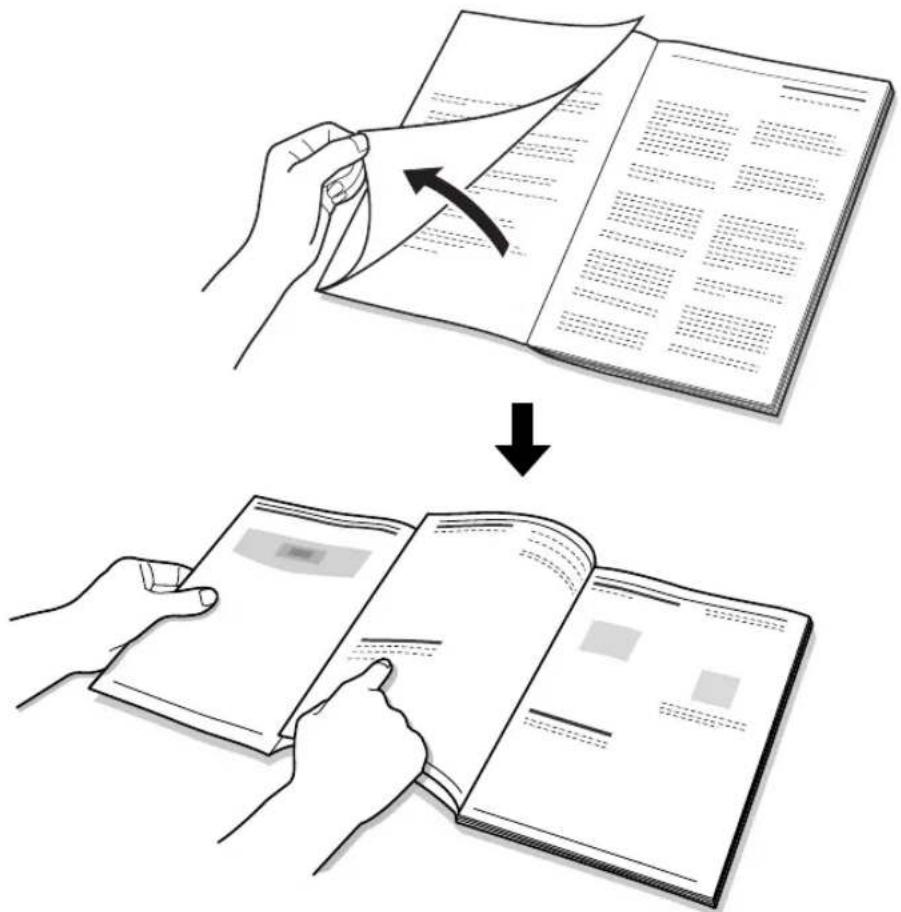
When following operating instructions, always keep the front cover page (next page) open for easy reference to the buttons.
OPEN

natural_image
Black curved arrow pointing left, no text or symbols presentLocation of controls
Please keep this page open when following operating instructions.
For a description of each button, see page 13.
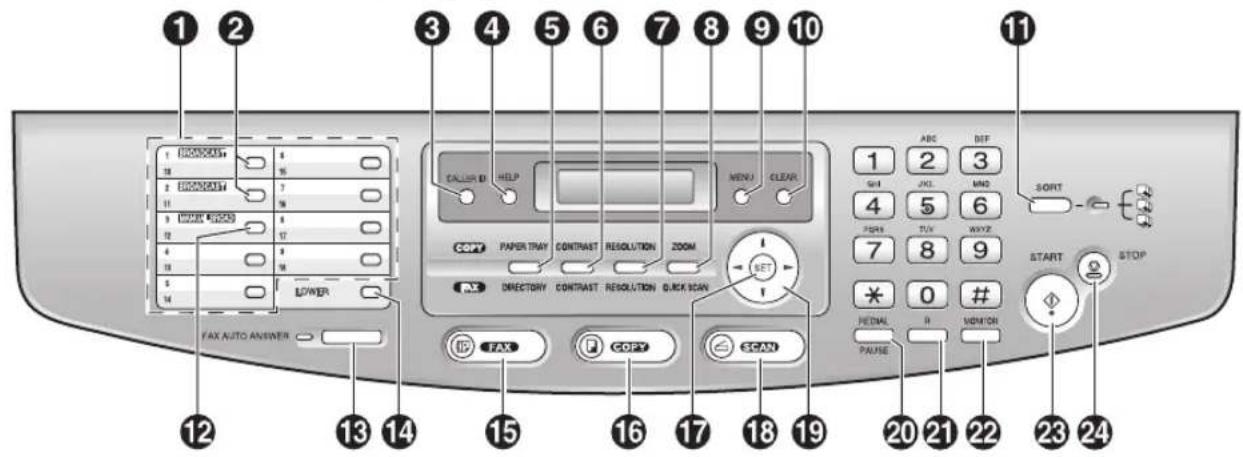
Buttons (Listed in alphabetical order)
| BROADCAST 2 | LOWER 14 | REDIAL 20 |
| CALLER ID 3 | MANUAL BROAD 12 | RESOLUTION 7 |
| CLEAR 10 | MENU 9 | SCAN 18 |
| CONTRAST 6 | MONITOR 22 | SET 17 |
| COPY 16 | Navigator key 19 | SORT 11 |
| DIRECTORY 5 | PAPER TRAY 5 | START 23 |
| FAX 15 | PAUSE 20 | Station keys 1 |
| FAX AUTO ANSWER 13 | QUICK SCAN 8 | STOP 24 |
| HELP 4 | R 21 | ZOOM 8 |
Thank you for purchasing a Panasonic fax machine.
Attach your sales receipt here.
For your future reference
Date of purchase
Serial number (found on the rear of the unit)
Dealer's name and address
Dealer's telephone number
Caution:
- Do not rub or use an eraser on the printed side of recording paper, as the print may smear.
- In the event of problems, you should contact your equipment supplier in the first instance.
- This equipment is designed for use on the UK and Republic of Ireland analogue telephone network.
Declaration of Conformity:
- Panasonic Communications Co., Ltd. declares that this equipment is in compliance with the essential requirements and other relevant provisions of Radio & Telecommunications Terminal Equipment (R&TTE) Directive 1999/5/EC.
Declarations of Conformity for the relevant Panasonic products described in this manual are available for download by visiting:
http://www.doc.panasonic.de
Contact:
Panasonic Services Europe
a Division of Panasonic Marketing Europe GmbH
Panasonic Testing Centre
Winsbergring 15, 22525 Hamburg, Germany
Trademarks:
- Microsoft, Windows and PowerPoint are either registered trademarks or trademarks of Microsoft Corporation in the United States and/or other countries.
- Pentium is a registered trademark or trademark of Intel Corporation in the United States and/or other countries.
- Screen shots reprinted with permission from Microsoft Corporation.
- 3M is a trademark or registered trademark of Minnesota Mining and Manufacturing Company.
- Avery is a registered trademark of Avery Dennison Corporation.
●XEROX is a registered trademark of Xerox Corporation. - All other trademarks identified herein are the property of their respective owners.
Copyright:
- This material is copyrighted by Panasonic Communications Co., Ltd., and may be reproduced for internal use only. All other reproduction, in whole or in part, is prohibited without the written consent of Panasonic Communications Co., Ltd.
© 2005 Panasonic Communications Co., Ltd. All Rights Reserved.
Important safety instructions
When using this unit, basic safety precautions should always be followed to reduce the risk of fire, electric shock, or personal injury.
-
Read and understand all instructions.
-
Follow all warnings and instructions marked on this unit.
-
Turn the power switch OFF before cleaning. Do not use liquid or aerosol cleaners.
-
Do not use this unit near water, for example near a bathtub, wash bowl, kitchen sink, etc.
-
Place the unit securely on a stable surface. Serious damage and/or injury may result if the unit falls.
-
Do not cover slots and openings on the unit. They are provided for ventilation and protection against overheating. Never place the unit near radiators, or in a place where proper ventilation is not provided.
-
Use only the power source marked on the unit. If you are not sure of the type of power supplied to your home, consult your dealer or local power company.
-
For safety purposes this unit is equipped with a grounded plug. If you do not have this type of outlet, please have one installed. Do not defeat this safety feature by tampering with the plug.
-
Do not place objects on the mains lead. Install the unit where no one can step or trip on the mains lead.
-
Do not overload power outlets and extension cords. This can result in the risk of fire or electric shock.
-
Never push any objects through slots in this unit. This may result in the risk of fire or electric shock. Never spill any liquid on the unit.
-
To reduce the risk of electric shock, do not disassemble this unit. Take the unit to an authorised service centre when service is required. Opening or removing covers may expose you to dangerous voltage or other risks. Incorrect reassembly can cause electric shock when the unit is subsequently used.
-
Unplug this unit from power outlets and refer servicing to an authorised service centre when the following conditions occur:
A. If the mains lead is damaged or frayed.
B. If liquid has been spilled into the unit.
C. If the unit has been exposed to rain or water.
D. If the unit does not work normally by following the operating instructions. Adjust only controls covered by the operating instructions. Improper adjustment may require extensive work by an authorised service centre.
E. If the unit has been dropped or physically damaged.
F. If the unit exhibits a distinct change in performance.
-
During thunderstorms, avoid using telephones except cordless types. There may be a remote risk of an electric shock from lightning.
-
Do not use this unit to report a gas leak, when in the vicinity of the leak.
SAVE THESE INSTRUCTIONS
CAUTION:
Installation
● After moving the unit from cold areas to warmer areas, let the unit adjust to the warmer temperature and do not connect the unit for about 30 minutes. If the unit is connected too soon after a sudden climate change, condensation may form inside the unit causing malfunction.
- Never install telephone wiring during a lightning storm.
- Never install telephone sockets in wet locations unless the socket is specifically designed for wet locations.
- Never touch uninsulated telephone wires or terminals unless the telephone line has been disconnected at the network interface.
- Use caution when installing or modifying telephone lines.
- Do not touch the plug with wet hands.
Laser radiation
● The printer of this unit utilises a laser. Use of controls or adjustments or performance of procedures other than those specified herein may result in hazardous radiation exposure.
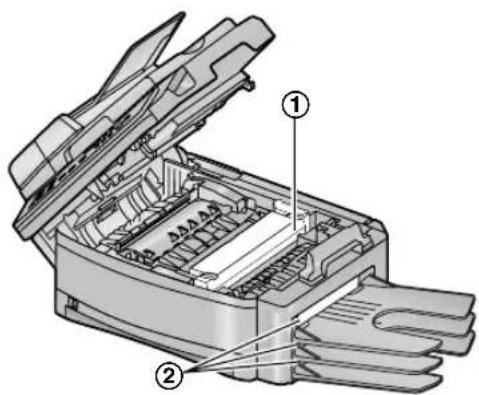
Fuser unit
- The fuser unit (①) gets hot. Do not touch it.

- During or immediately after printing, the area near the recording paper exit (②) also gets warm. This is normal.
Toner cartridge
- Be careful of the following when you handle the toner cartridge:
- Do not leave the toner cartridge out of the protection bag for a long time. It will decrease the toner life.
- If you ingest any toner, drink several glasses of water to dilute your stomach contents, and seek immediate medical treatment.
- If any toner comes into contact with your eyes, flush them thoroughly with water, and seek medical treatment.
- If any toner comes into contact with your skin, wash the area thoroughly with soap and water.
- If you inhale any toner, move to an area with fresh air and consult local medical personnel.
Drum unit
- Read the instructions on page 15 before you begin installation of the drum unit. After you have read them, open the drum unit protection bag. The drum unit contains a photosensitive drum. Exposing it to light may damage the drum. Once you have opened the protection bag:
- Do not expose the drum unit to light for more than 5 minutes.
- Do not touch or scratch the black drum surface.
- Do not place the drum unit near dust or dirt, or in a high humidity area.
- Do not expose the drum unit to direct sunlight.
WARNING:
- To prevent the risk of fire or electrical shock, do not expose this product to rain or any type of moisture.
- Unplug this unit from power outlets if it emits smoke, an abnormal smell or makes unusual noise. These conditions can cause fire or electric shock. Confirm that smoke has stopped and contact an authorised service centre.
- Make sure that the unit is installed in a well ventilated room so as not to increase density of ozone in the air. Since ozone is heavier than air, it is recommended that air at floor level be ventilated.
Illegal copies
- It is unlawful to make copies of certain documents.
Copying certain documents may be illegal in your country. Penalties of fines and/or imprisonment may be imposed on those found guilty. The following are examples of items that may be illegal to copy in your country.
- Currency
– Bank notes and checks
– Bank and government bonds and securities
– Passports and identification cards
– Copyright material or trademarks without the consent of the owner
– Postage stamps and other negotiable instruments
This list is not inclusive and no liability is assumed for either its completeness or accuracy. In case of doubt, contact your legal counsel.
Notice:
● Install your machine near a supervised area to prevent illegal copies from being made.
Information on Disposal for Users of Waste Electrical & Electronic Equipment (private households)


This symbol on the products and/or accompanying documents means that used electrical and electronic products should not be mixed with general household waste.
For proper treatment, recovery and recycling, please take these products to designated collection points, where they will be accepted on a free of charge basis. Alternatively, in some countries you may be able to return your products to your local retailer upon the purchase of an equivalent new product.
Disposing of this product correctly will help to save valuable resources and prevent any potential negative effects on human health and the environment which could otherwise arise from inappropriate waste handling. Please contact your local authority for further details of your nearest designated collection point. Penalties may be applicable for incorrect disposal of this waste, in accordance with national legislation.
For business users in the European Union
If you wish to discard electrical and electronic equipment, please contact your dealer or supplier for further information.
Information on Disposal in other Countries outside the European Union
This symbol is only valid in the European Union. If you wish to discard this product, please contact your local authorities or dealer and ask for the correct method of disposal.
For best performance
Toner cartridge and drum unit
- For optimal performance, genuine Panasonic toner cartridges and drum units are recommended. We cannot be responsible for problems that may be caused by a non-Panasonic toner cartridge or drum unit:
– Damage to the unit
– Poor print quality
- Improper operation
- In the printing process, heat is used to fuse toner onto the page. As a result, it is normal for the machine to produce an odour during and shortly after printing. Be sure to use this unit in an area with proper ventilation.
- To extend the life of the drum unit, the unit should never be turned the power switch OFF immediately after printing. Leave the power switch turned ON for a minimum of 30 minutes after printing.
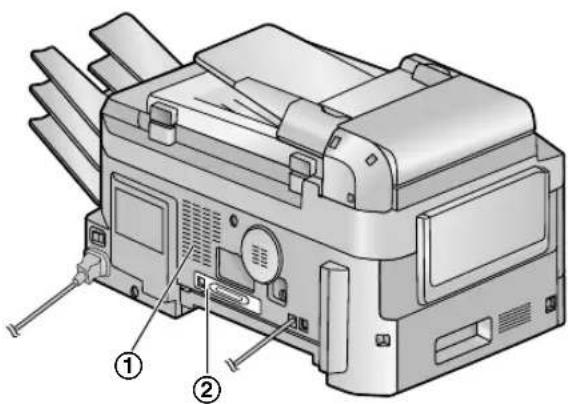
- Do not cover slots or openings on the unit. Inspect the air circulation vents regularly and remove any dust build-up with a vacuum cleaner (①).
- When replacing the toner cartridge or drum unit, do not allow dust, water, or liquids to come in contact with the drum. This may affect print quality.
Static electricity
- To prevent static electricity damage to the interface connectors or other electrical components inside the unit, touch a grounded metal surface, such as the metal part (②) before touching the components.
Environment
- Keep the unit away from electrical noise generating devices, such as fluorescent lamps and motors.
●The unit should be kept free from dust, high temperature and vibration.
●The unit should not be exposed to direct sunlight.
- Do not place heavy objects on top of the unit.
- When you leave the unit unused for a long period of time, unplug this unit from the power outlet.
●The unit should be kept away from heat sources such as heaters, kitchen stoves, etc. It should not be placed in rooms where the temperature is less than 10 °C or greater than 32.5 °C. Damp basements should also be avoided.
Recording paper
- Store unused paper in the original packaging, in a cool and dry place. Not doing so may affect print quality.
Routine care
- Wipe the outer surface of the unit with a soft cloth. Do not use benzine, thinner, or any abrasive powder.
Moving the unit
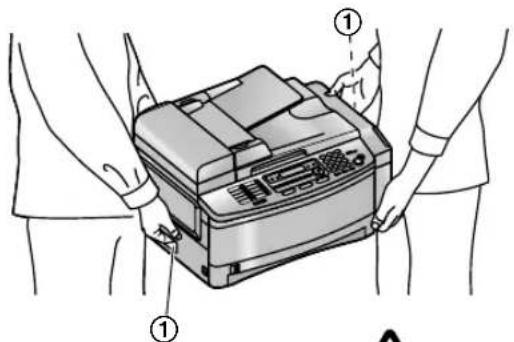
●The unit weights approximately 18 kg. It is highly recommended that two people handle this unit.
- When moving the unit, hold the both side grips (①).

Important Information
The connection to the telecommunication systems must not be hard wired and must be unplugged before the earth is disconnected.
Method of connection
This apparatus is connected to the exchange line or PABX/PMBX extension by the new standard British Telecom plug and socket. Arrangements for provision of this type of termination can be made through the nearest British Telecom Sales Office.
This apparatus may be connected to the following types of installation.
a) For connection to the public switched telephone network (PSTN) and compatible PBX (Private Branch Exchange), which use DTMF signalling. (Please consult your supplier for an up to date list of compatible PBX's.)
b) The apparatus can be used on extension sockets connected to a direct exchange line (D.E.L.).
c) This apparatus is suitable for connection to the telecommunication system directly or via compatible private branch exchange as an extension. The supplier of the apparatus should be consulted for an up to date list of PBX's with which the apparatus is compatible.
It cannot be guaranteed that the apparatus will operate under all possible conditions of connection to compatible PBX's.
- This apparatus is suitable for connection to a PBX with or without initial proceed indication.
- This apparatus is suitable for connection to a PBX with or without secondary proceed indication.
Any cases of difficulty should be referred in the first instance to the supplier of the apparatus.
d) The apparatus must not be connected in the following manner:
- As an extension to a pay phone
- As a party line with shared service
NOTES:
- If you experience any problems with the normal use of your apparatus, you should unplug it from the telephone outlet and connect a known working telephone in its place. If the known working telephone still gives problems, then please contact the customer service department of your PSTN operator (e.g. BT etc.). If it operates properly, then the problems are likely to be a fault in your apparatus. In this case, consult your supplier for advice.
- Your PSTN operator may charge you if they attend a service call that is not due to apparatus supplied by them.
For your safety
This appliance is supplied with a moulded three pin mains plug for your safety and convenience.
A 13 amp fuse is fitted in this plug.
Should the fuse need to be replaced please ensure that the replacement fuse has a rating of 13 amps and that it is approved by ASTA or BSI to BS1362.
Check for ASTA mark ASA or the BSI
mark 🏠 on the body of the fuse.
If the plug contains a removable fuse cover you must ensure that it is refitted when the fuse is replaced.
If you lose the fuse cover the plug must not be used until a replacement cover is obtained.
A replacement fuse cover can be purchased from your local Panasonic dealer.
IF THE FITTED MOULDED PLUG IS UNSUITABLE FOR THE SOCKET OUTLET IN YOUR HOME THEN THE FUSE SHOULD BE REMOVED AND THE PLUG CUT OFF AND DISPOSED OF SAFELY. THERE IS A DANGER OF SEVERE ELECTRICAL SHOCK IF THE CUT OFF PLUG IS INSERTED INTO ANY 13 AMP SOCKET.
If a new plug is to be fitted please observe the wiring code as shown below.
If in any doubt please consult a qualified electrician.
WARNING: THIS APPLIANCE MUST BE EARTHED.
IMPORTANT:
The wires in this mains lead are coloured in accordance with the following code:
Green-and-Yellow: Earth
Blue: Neutral
Brown: Live
As the colours of the wire in the mains lead of this appliance may not correspond with the coloured markings identifying the terminals in your plug, proceed as follows.
The wire which is coloured GREEN-AND-YELLOW must be connected to the terminal in the plug which is marked with the letter E or by the Earth symbol 12 or coloured GREEN or GREEN-AND-YELLOW.
The wire which is coloured BLUE must be connected to the terminal in the plug which is marked with the letter N or coloured BLACK.
The wire which is coloured BROWN must be connected to the terminal in the plug which is marked with letter L or coloured RED.
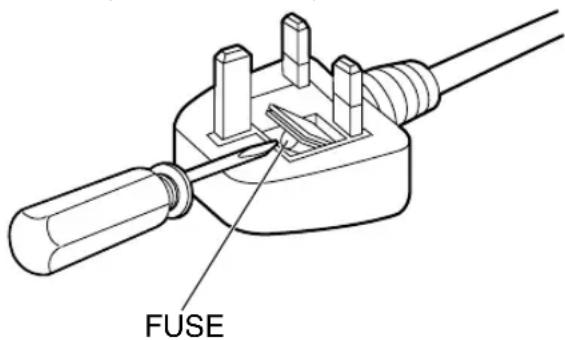
How to replace the fuse: Open the fuse compartment with a screwdriver and replace the fuse (and fuse cover).
1. Introduction and Installation
Accessories
1.1 Included accessories....11
1.2 Accessory information .....12
1.3 Extension telephone adaptor for UK.12
Finding the Controls
1.4 Description of buttons....13
1.5 Overview ......14
Installation
1.6 Toner cartridge and drum unit .....15
1.7 Document tray .....17
1.8 Output tray....17
1.9 Recording paper....18
2. Preparation
Connections and Setup
2.1 Connections .....22
2.2 Turning the power switch ON.....23
2.3 Selecting the operation mode (Fax/ Copy/Scan)....23
Help Button
2.4 Help function .....24
Volume
2.5 Adjusting volume ......24
Initial Programming
2.6 Date and time .....25
2.7 Your logo....26
2.8 Your fax number 28
3. Fax
Sending Faxes
3.1 Using the unit as a fax machine ..... 29
3.2 Sending a fax manually .....29
3.3 Document requirements .....31
3.4 Storing names and telephone numbers for the one-touch dial feature and navigator directory....32
3.5 Sending a fax using one-touch dial feature and navigator directory...... 34
3.6 Broadcast transmission ....35
Receiving Faxes
3.7 Receiving a fax automatically – Auto answer ON....37
3.8 Receiving a fax manually – Auto answer OFF 37
3.9 Using the unit with an answering machine....39
3.10 Receive polling (retrieving a fax placed on another fax machine).... 40
3.11 Junk fax prohibitor (preventing fax reception from undesired callers) .....40
4. Caller ID
Caller ID
4.1 Caller ID service ....42
4.2 Viewing and calling back using caller information....43
4.3 Storing caller information into the one-touch dial feature and navigator directory ....44
5. Copy
Copying
5.1 Using the unit as a copy machine..... 45
5.2 Making a copy ....45
5.3 More copying features ....47
6. Multi-Function Station software
Setup
6.1 Connecting to a computer .....49
6.2 Installing Multi-Function Station .....49
6.3 Starting Multi-Function Station .....51
Printing
6.4 Using the unit as a printer .....51
Scanning
6.5 Using the unit as a scanner....54
Remote Control
6.6 Operating the unit from your computer ....55
PC Fax
6.7 Fax sending/receiving using Multi-Function Station ....56
6.8 Confirming the status of the unit.....57
6.9 Other information.... 57
7. Programmable Features
Features Summary
7.1 Programming....59
7.2 Direct command chart .....60
7.3 Basic features....63
7.4 Fax features....65
7.5 Copy features 69
7.6 Scan features .....70
7.7 LAN features....70
8. Help
Error Messages
8.1 Error messages – Reports .....71
8.2 Error messages – Display .....72
Troubleshooting
8.3 When a function does not work, check here ....75
Replacement
8.4 Replacing the toner cartridge and the drum unit ....81
Jams
8.5 Recording paper jam .....84
8.6 Document jams (Auto document feeder) 87
Cleaning
8.7 Cleaning the white plate and glasses 88
8.8 Cleaning the document feeder rollers....92
9. General Information
Printed Reports
9.1 Reference lists and reports .....93
Specifications
9.2 Specifications .....94
Guarantee
9.3 Condition of guarantee .....97
Copyrights
9.4 Information of copyrights and licenses 98
10.Index
10.1 Index.... 104
1.1 Included accessories
| No. | Item Part number | *1 | Quantity Notes | |
| 1 | Mains lead PFJA03A008Y 1 ---- | |||
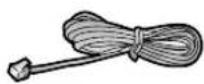
| 2 | Telephone line cord | PFJA04B012Y | 1 | ---- |
| 3 | Output tray PFKS1126Z 3 ---- | |||
| 4 | Document tray PFKS1117Y1 1 ---- | |||
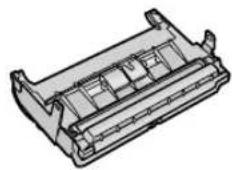
| 5 | Drum unit | KX-FA86X | 1 | See page 96. |
| 6 | Toner cartridge(starter toner cartridge) | ---- | 1 | prints about 800 A4-sized pages with a 5% image area (page 95). |
| 7 | Operating instructions | PFQX2329Z | 1 | ---- |
| 8 | Quick installation guide | PFQW2397Z | 1 | ---- |
| 9 | CD-ROM | PFJKFLB851Z | 1 | See page 49. |
| 10 | Tray label sheet | ---- | 1 | Attach to the output tray(page 17). |
*1 Part numbers are subject to change without notice.
①
②
③
④
⑤



natural_image
Technical line drawing of a mechanical component with internal channels (no text or symbols)⑥
⑦
⑧
⑨
10
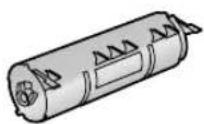
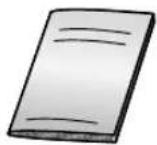

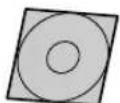
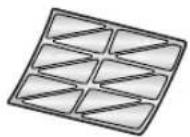
Note:
- If any items are missing or damaged, contact the place of purchase.
- Save the original carton and packing materials for future shipping and transportation of the unit.
1.2 Accessory information
1.2.1 Sales and Support Information
Customer Care Centre
●For customers within the UK: 08701 580560
●For customers within the Republic of Ireland: 01 289 8333
- Visit our website for product information
• E-mail: customer.care@panasonic.co.uk
Direct Sales at Panasonic UK
- Order accessory and consumable items for your product with ease and confidence by phoning our Customer Care Centre Monday - Thursday 9:00am - 5:30pm, Friday 9:30am - 5:30pm (Excluding public holidays).
- Or go on line through our Internet Accessory ordering application at www.panasonic.co.uk.
- Most major credit and debit cards accepted.
- All enquires transactions and distribution facilities are provided directly by Panasonic UK Ltd.
- It couldn't be simpler!
- Also available through our Internet is direct shopping for a wide range of finished products, take a browse on our website for further details.
Additional/replacement accessories
| Model No. | Item Usage Notes | ||
| KX-FA85X | Toner cartridge For replacement, | see page 81. See page 95. | |
| KX-FA86X | Drum unit For replacement, see | page 81. See page 96. | |
| KX-FA101X | Lower input tray To load recording | paper, seepage 20. | ---- |
| KX-FA102X | LAN board To connect to a computer, seepage 49. | ---- | |
| KX-FA103X | Handset unit | To make/answer phone calls. | See page 22. |
1.3 Extension telephone adaptor for UK
When using the unit with an external answering machine (page 39), please purchase an extension telephone adaptor (e.g., PQJA10058Z) by contacting one of the following:
- www.panasonic.co.uk
– Panasonic Customer Care Centre on Telephone number 08701 580560
– local Panasonic authorised dealer
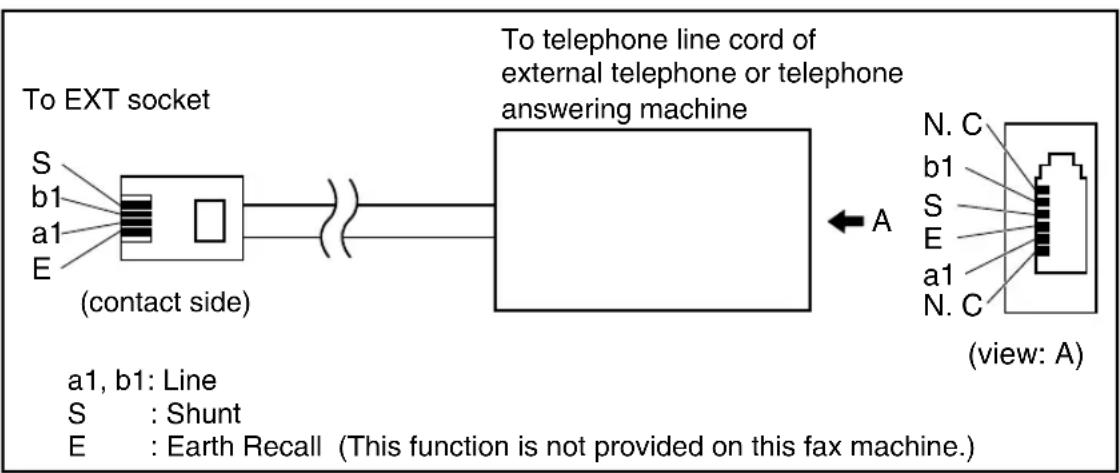
flowchart
graph LR
    A["To EXT socket"] --> B["(contact side)"]
    B --> C["To telephone line cord of external telephone or telephone answering machine"]
    C --> D["View: A"]
    style A fill:#f9f,stroke:#333
    style B fill:#ccf,stroke:#333
    style C fill:#cfc,stroke:#333
    style D fill:#fcc,stroke:#333
1.4 Description of buttons
- Keep the front cover page open for button locations.
①Station keys
- To use the one-touch dial feature (page 32, 34).
②[BROADCAST]
- To send a document to multiple parties (page 35, 36).
③[CALLER ID]
●To use Caller ID service (page 43, 44).
● To change the display of the caller information (page 43).
④[HELP]
- To print helpful information for quick reference (page 24).
⑤ [PAPER TRAY][DIRECTORY]
- To select an input tray and a paper size for copying (page 46).
- To initiate the navigator directory (page 33, 35).
⑥[CONTRAST]
- To select a contrast (page 29, 45).
⑦[RESOLUTION]
● To select a resolution (page 29, 45).
⑧ [ZOOM][QUICK SCAN]
- To enlarge or reduce a document when copying (page 47).
- To store a scanned document into memory, and then send it (page 30).
⑨[MENU]
- To initiate or exit programming.
⑩[CLEAR]
- To delete a character from names and telephone numbers (page 27).
- To return to a previous step during operation.
⑪[SORT]
- To sort multiple copies (page 47).
⑫[MANUAL BROAD]
- To send a document to multiple parties manually (page 35, 36).
13[FAX AUTO ANSWER]
- To turn the auto answer setting ON/OFF (page 37).
14[LOWER]
- To select stations 10–18 for the one-touch dial feature (page 32, 34).
15[FAX]
- To switch to a fax mode (page 23, 29).
16[COPY]
●To switch to a copy mode (page 23, 45).
17[SET]
- To store a setting during programming.
18[SCAN]
- To switch to a scan mode (page 23, 55).
19 Navigator key
● To adjust volume (page 24).
- To search for a stored item (page 34).
● To select features or feature settings during programming (page 59).
20 [REDIAL] (PAUSE)
- To redial the last number dialled. If the line is busy when you make a phone call using the [MONITOR] button, the unit will automatically redial the number up to 5 times.
- To insert a pause during dialling.
21[R]
● To access special telephone services such as call waiting or to transfer extension calls.
22【MONITOR】
- To initiate dialling. When you press [MONITOR] during receiving a call, you will be able to hear the other party, but the other party will not be able to hear you.
23[START]
- To start sending or receiving a fax.
●To copy a document (page 45).
● To scan a document (page 55).
24[STOP]
- To stop an operation or programming session.
R button (to use the recall feature)
【R】is used to access optional telephone services such as call waiting. Contact your telephone company business office for details.
Call waiting (optional handset user only)
When a call waiting tone is heard during a conversation, place the existing call on hold and answer the second call by pressing [R].
- Each time you press [R], you can switch between the first and second call.
- Incoming calls cannot be dropped by the person who has received the call.
Note:
- If your unit is connected to a PBX, pressing [R] allows you to access some features of your host PBX such as transferring an extension call.
1.5 Overview
1.5.1 Front view
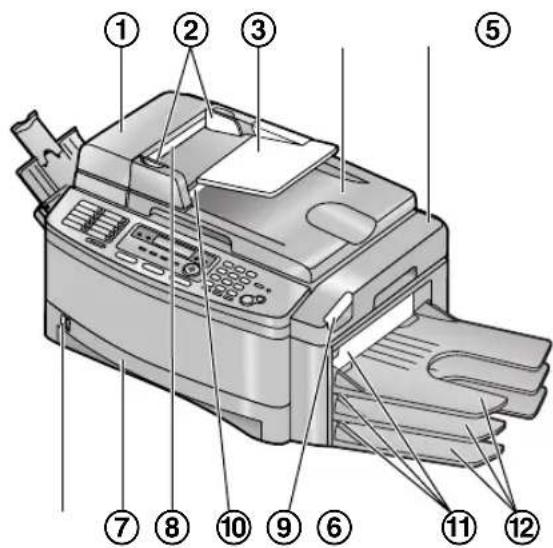
① ADF (Auto Document Feeder) cover
② Document guides
③ Document tray
④ Document cover
⑤ Top cover
⑥ Paper level indicator
⑦ Paper input tray
⑧ Document entrance
⑨ Document exit
⑩ Cover release lever
⑪ Recording paper exit
⑫ Output tray
1.5.2 Rear view
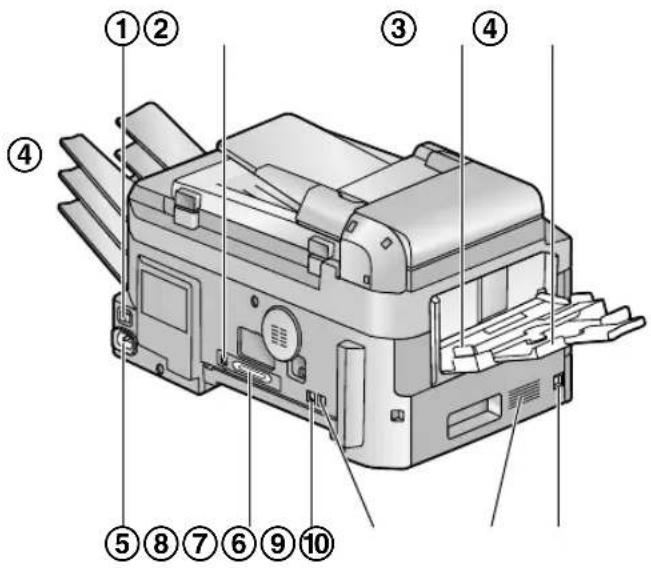
①Power switch
②USB interface connector
③Recording paper guides
④Multi-purpose input tray
⑤Power inlet
⑥LAN board (Optional) connector
⑦Telephone line socket
⑧External telephone socket
⑨Speaker
⑩Handset unit (Optional) connection socket
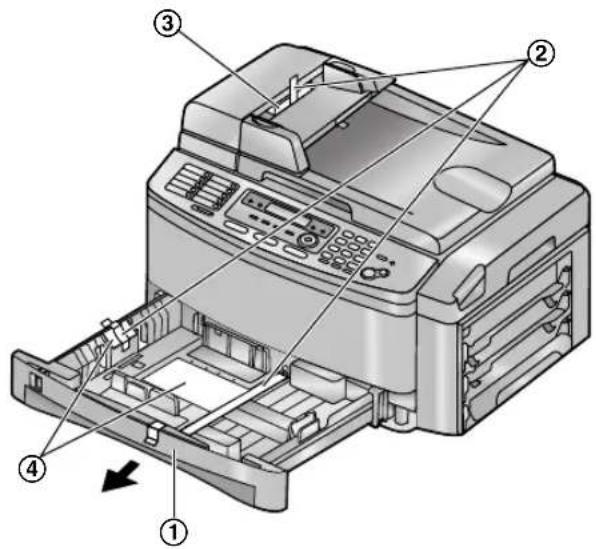
Removing the shipping tape
Pull open the paper input tray (①), then remove the shipping tape (②), pad (③) and paper (④).
1.6 Toner cartridge and drum unit
The included toner cartridge is a starter toner cartridge. It will print about 800 A4-sized pages with a 5 % image area (page 95).
- To replace the toner cartridge and the drum unit, see page 81.
Caution:
- Read the following instructions before you begin installation. After you have read them, open the drum unit protection bag. The drum unit contains a photosensitive drum. Exposing it to light may damage the drum. Once you have opened the protection bag:
- Do not expose the drum unit to light for more than 5 minutes.
- Do not touch or scratch the black drum surface.
- Do not place the drum unit near dust or dirt, or in a high humidity area.
- Do not expose the drum unit to direct sunlight.
- Do not leave the toner cartridge out of the protection bag for a long time. It will decrease the toner life.
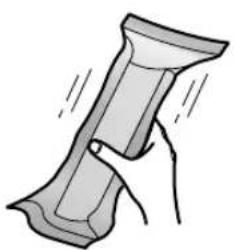
1 Before opening the protection bag of the new toner cartridge, shake it vertically more than 5 times.
natural_image
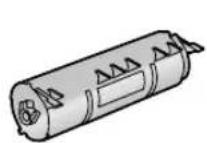
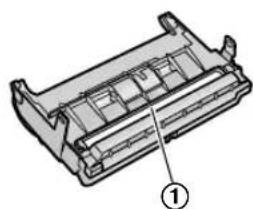
Illustration of a hand gripping a mechanical object with motion lines indicating movement (no text or symbols)2 Remove the toner cartridge and drum unit from the protection bags.
natural_image
Technical illustration of a mechanical component with labeled part (1), showing internal structure without any text or symbols.- Do not touch or scratch the black drum surface (①).
3 Place the toner cartridge (①) into the drum unit (②).
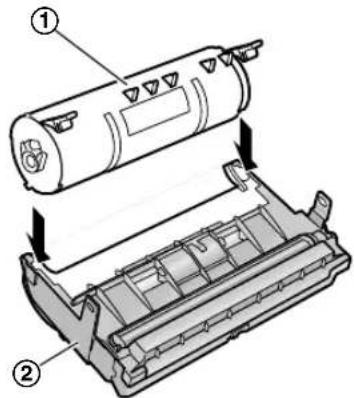
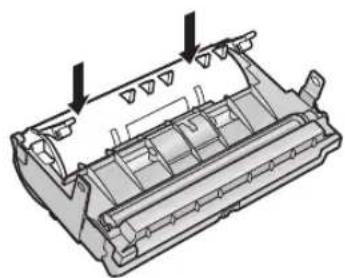
4 Firmly press down the toner cartridge to snap into position.
natural_image
Technical illustration of a mechanical component with internal compartments and mounting holes (no text or symbols)5 Turn the two green levers (①) on the toner cartridge firmly.
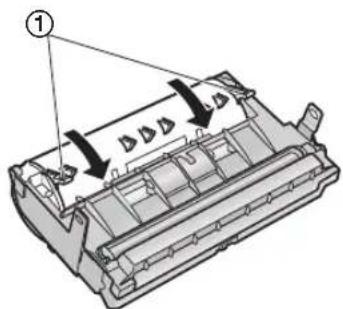
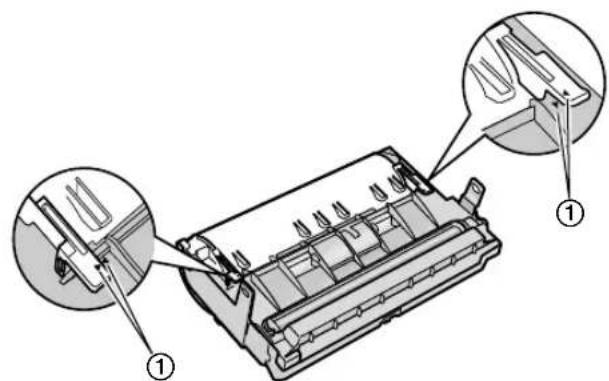
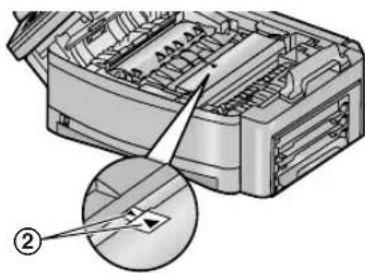
6 Make sure that the triangles (①) match to install the toner cartridge correctly.
1. Introduction and Installation
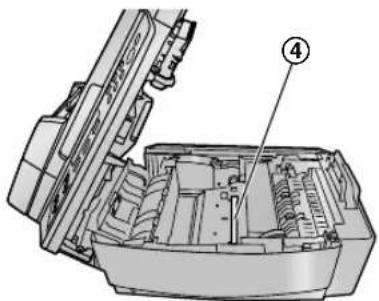
7 Lift the cover release lever (①) and open the top cover (②).
Important:
- Close the multi-purpose input tray (③) before opening the top cover.
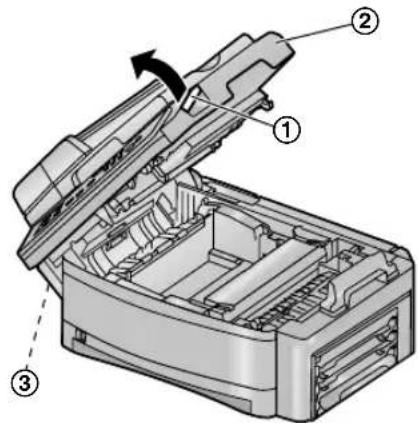
- If the lower glass (④) is dirty, clean it with a soft and dry cloth.
natural_image
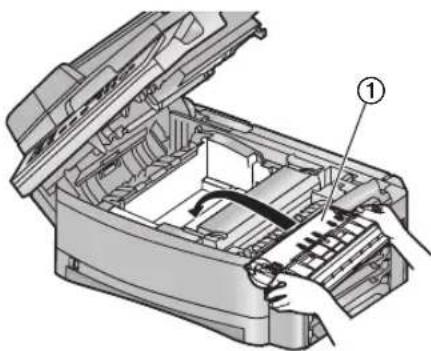
Technical diagram of a mechanical device with an open lid and internal compartments, labeled with number 4 (no text or symbols beyond label)8 Install the drum and toner unit (①) by holding the tabs.
natural_image
Technical illustration of a printer internal structure with hands operating it (no text or symbols visible)- Make sure that the triangles (②) match to install the drum and toner unit correctly.
natural_image
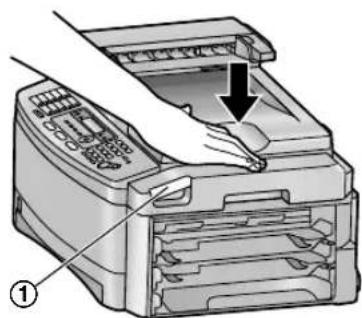
Diagram of a printer internal structure with an inset showing a magnified view of the printer's internal components (no text or symbols present)9 Close the top cover, holding the cover release lever (①). Then push down the right centre edge, until locked.
natural_image
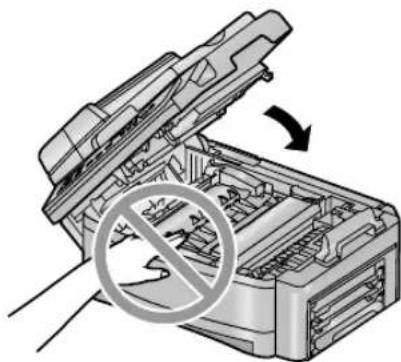
Illustration of a printer with a hand inserting a paper into the cover (no text or symbols visible)Caution:
●To prevent injuries, be careful not to put your hands under the top cover.
natural_image
Diagram of an open industrial machine with a circular symbol indicating no prohibition (no text or labels present)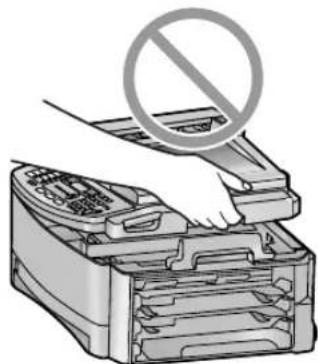
natural_image
Illustration of a printer with a hand using a paper filter to press or print (no text or symbols visible)Toner save feature
If you want to reduce toner consumption, set the toner save setting to ON (feature #482 on page 64). The toner cartridge will last approximately 40 % longer. This feature may lower the print quality.
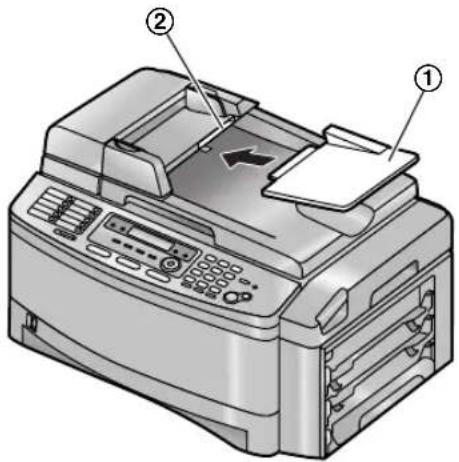
1.7 Document tray
Insert the document tray (①) into the slot (②) on the unit.
1.8 Output tray
This unit has 3 pieces of output tray. As a default setting, printed paper is stacked on the output tray as follows.
- Upper output tray (“#1”): Printed document by using the computer and copied document. - Lower output tray (“#3”): Received fax document.
- You can change the output tray setting for faxing (feature #441 on page 68) and for copying (feature #466 on page 69). You can also select the middle output tray (“#2”). To change the output tray from the computer, set the printer properties. See page 52, 58 for details.
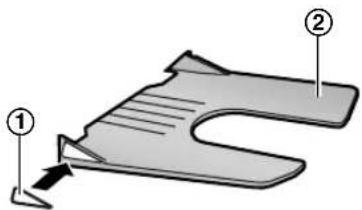
1.8.1 Attaching the tray label
Attach the tray label (①) to the output tray (②).
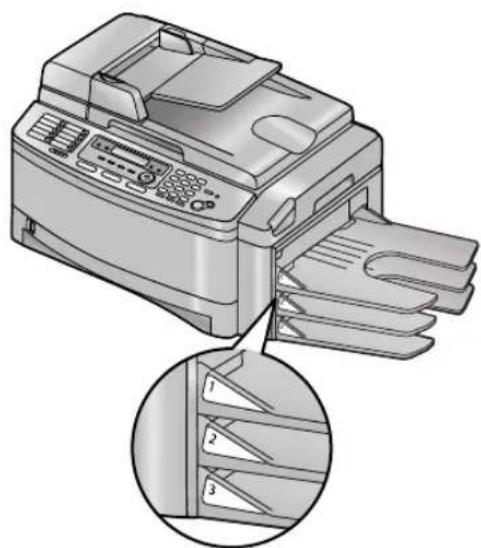
- Label 1 to the upper output tray ("#1")
- Label 2 to the middle output tray ("#2")
- Label 3 to the lower output tray ("#3")
Note:
- Instead of the label 1, 2, 3, you can also attach other labels for print, copy or fax according to the usage. For a blank label, this is convenient if the optional LAN board is installed. You can write the user name on the blank label and attached it to the selected output tray.
1.8.2 Installing the output tray
Insert the output tray (①) into the slots (②), then push the tray down until it latches into place.
- Repeat this step to install other output trays.
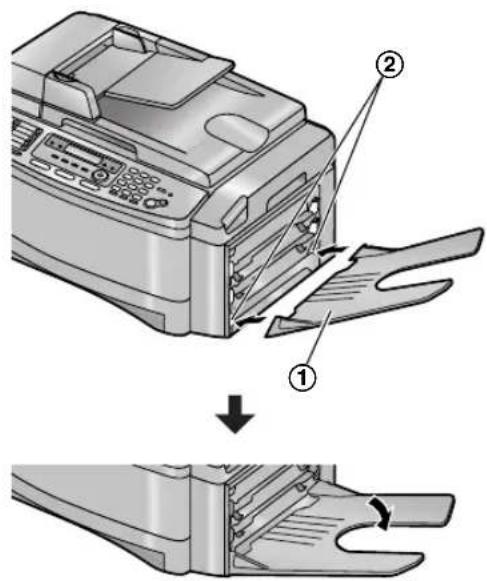
● Make sure that the number on the label and the tray position match.
natural_image
Illustration of a printer with internal components and a close-up view of its internal structure (no text or symbols)Note:
- Do not place the unit in an area where the output tray may be easily bumped into.
●The upper output tray can hold up to approximately 100 sheets of printed paper. The other output trays can hold up to approximately 50 sheets of printed paper. Remove the printed paper before the output tray becomes full.
1.9 Recording paper
1.9.1 Using the paper input tray
A4 or letter size recording paper can be used. The paper input tray unit can hold:
- Up to 250 sheets of 60g / m^2 to 75g / m^2 paper.
- Up to 230 sheets of 80g / m^2 paper.
- Up to 200 sheets of 90g / m^2 paper.
- Please refer to page 95 for information on recording paper.
- The unit is set for A4 size paper by default. If you want to use letter size paper, change the setting:
- by using [PAPER TRAY] in the copy mode (page 46).
- in feature #380 (page 64).
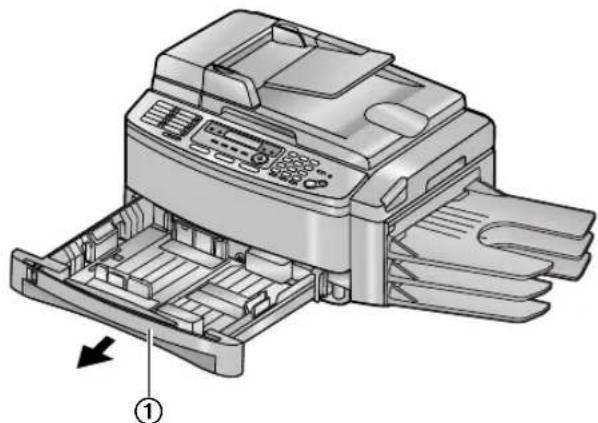
1 Pull open the paper input tray (①).
natural_image
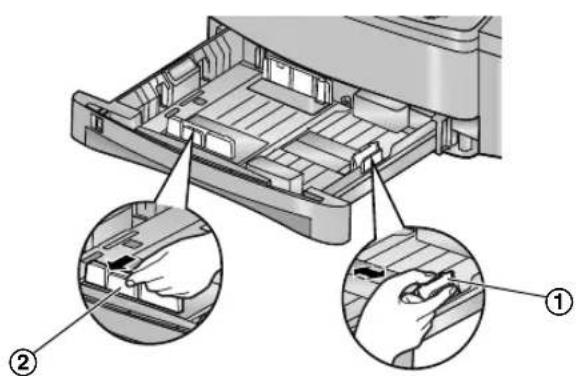
Illustration of a printer with internal compartments and a paper feed, showing no text or symbols.2 Pinch the right side of the recording paper guide (①), then slide it to match the paper size mark.
Pinch the front side of the recording paper guide (②), then slide it open to its full width.
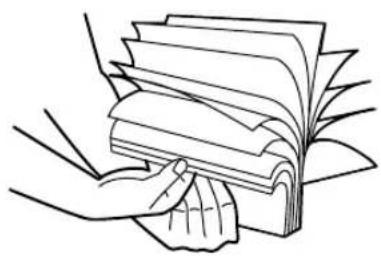
3 Before loading a stack of paper, fan the paper to prevent paper jams.
natural_image
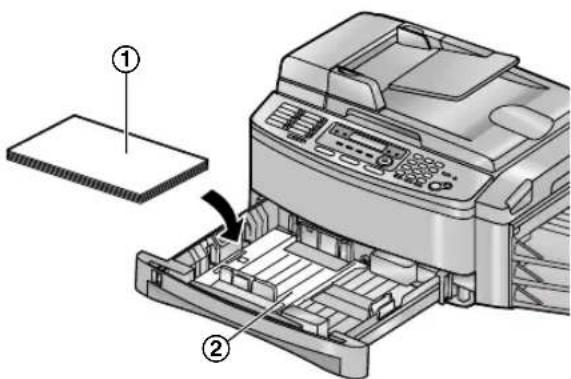
Line drawing of a hand holding a stack of books (no text or symbols visible)4 Load the paper, print-side up (①).
Important:
- Push and lock the plate (②) in the paper input tray, if it is lifted.
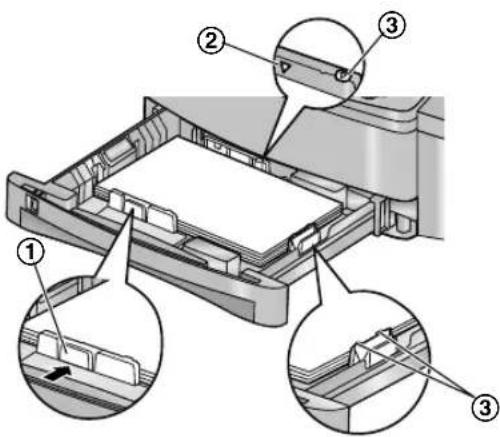
5 Adjust the width to the size of the recording paper by sliding the front side of the guide (①).
- Make sure that the recording paper is under the paper limit mark (②), and the paper should not be over the snubbers (③).
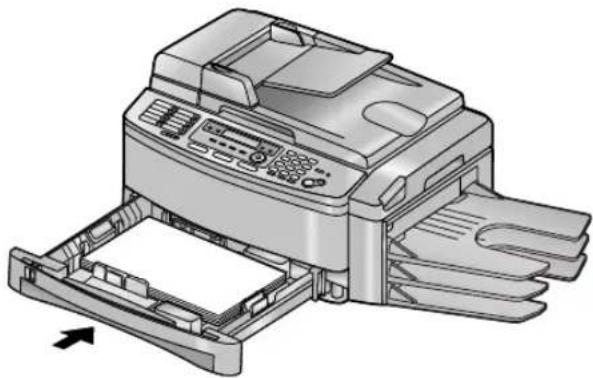
6 Close the paper input tray.
natural_image
Illustration of a printer with paper feed and paper tray, showing internal components (no text or symbols)Note:
- If the paper is not loaded correctly, re-adjust the paper guides, or the paper may jam.
- If the paper input tray does not close, the plate in the paper input tray may be lifted. Push the paper and check that the paper is flat in the paper input tray.
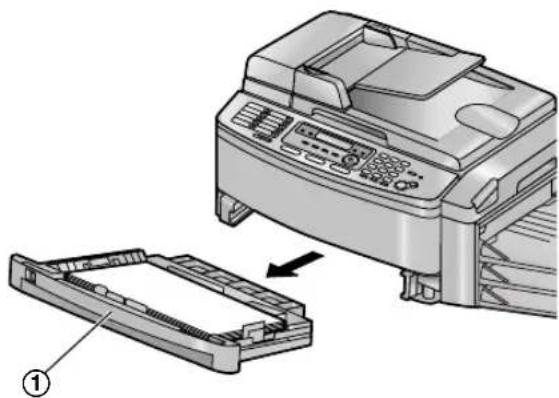
To pull the paper input tray completely out
Pull the paper input tray (①) until it clicks into place, then pull it completely out, lifting the front part of the tray.
natural_image
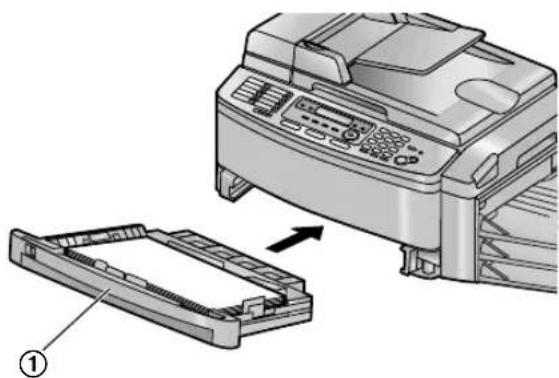
Illustration of a printer with a separate plastic case, showing the process from being placed into a closed holder (no text or symbols present)●To insert the paper input tray
Insert the paper input tray (①) to the unit, lifting the front part of the tray. Then push it completely into the unit.
natural_image
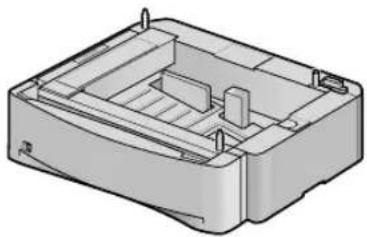
Diagram of a printer with an open lid and internal components, showing no text or symbolsUsing the optional input tray
You can add the optional input tray (Model No.
KX-FA101X). See page 12 for accessory information.
natural_image
3D technical illustration of a mechanical housing or enclosure with internal compartments and mounting points (no text or symbols)A4, letter or legal size recording paper can be used.
The optional input tray can hold:
- Up to 500 sheets of 60g / m^2 to 75g / m^2 paper.
- Up to 460 sheets of 80g / m^2 paper.
- Up to 400 sheets of 90g / m^2 paper.
- The unit is set for A4 size paper by default. If you want to use letter or legal size paper, change the setting:
- by using [PAPER TRAY] in the copy mode (page 46).
- in feature #382 (page 64).
Important:
- Before starting installation of the optional input tray, be sure to turn the power switch OFF. For more details about the installation, please refer to the installation guide for the optional input tray.
- After installation, you can select the optional input tray for faxing or copying.
- input tray setting for faxing (feature #440 on page 67)
- input tray setting for copying (feature #460 on page 69)
- To use the optional input tray with your computer, you need to change the printer properties. See page 57 for details.
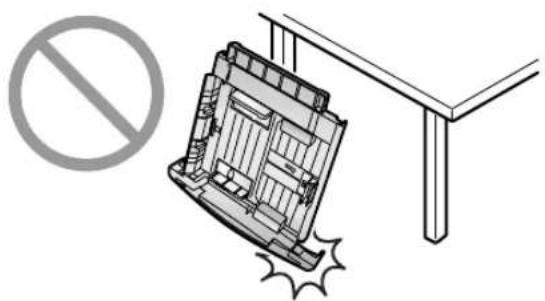
Caution for the paper input tray / the optional input tray
- Do not drop the input tray.
natural_image
Illustration showing a building interior with a 'no' symbol and a broken structure, no text or labels present.1.9.2 Using the multi-purpose input tray
A4, letter or legal size recording paper can be used.
The multi-purpose input tray can hold:
- Up to 30 sheets of 60g / m^2 to 75g / m^2 paper.
- Up to 30 sheets of 80g / m^2 paper.
- Up to 25 sheets of 90g / m^2 paper.
- Please refer to page 95 for information on recording paper.
- The unit is set for A4 size paper by d eafault. If you want to use letter or legal size paper, change the setting:
- by using [PAPER TRAY] in the copy mode (page 46).
- in feature #381 (page 64).
- You can also print on transparencies, labels and envelopes (page 51).
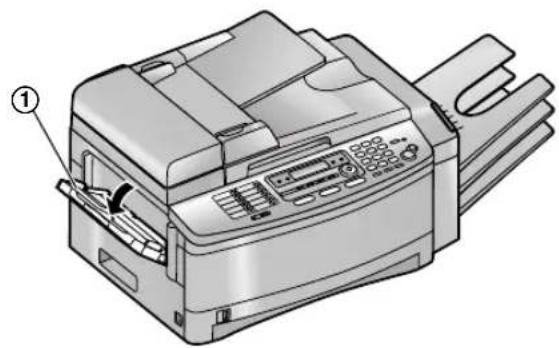
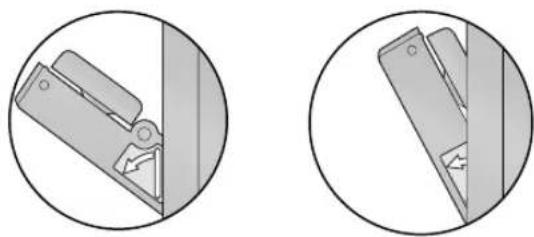
1 Pull open the multi-purpose input tray (①) to the left, then pull the extender (②) gently until it clicks into place.
- Make sure that the line on the label and the edge of the unit match.
natural_image
Illustration of a printer with internal components and a numbered label (1), no text or symbols present.Correct Incorrect
natural_image
Two circular diagrams showing mechanical components or tools, one with a triangular handle and arrow, the other with a rectangular frame (no text or symbols)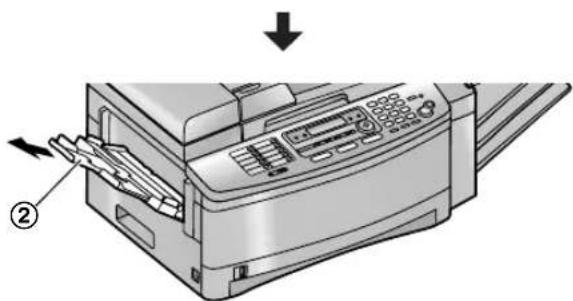
natural_image
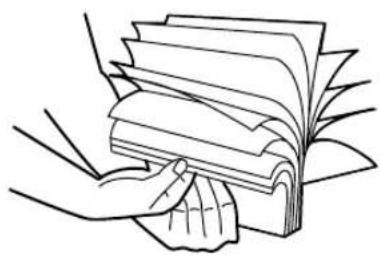
Illustration of a printer with a paper feed and directional arrows indicating process (no text or symbols)2 Before inserting a stack of paper, fan the paper to prevent paper jams.
natural_image
Line drawing of a hand holding a stack of papers (no text or symbols)3 Insert the paper, print-side down (①).
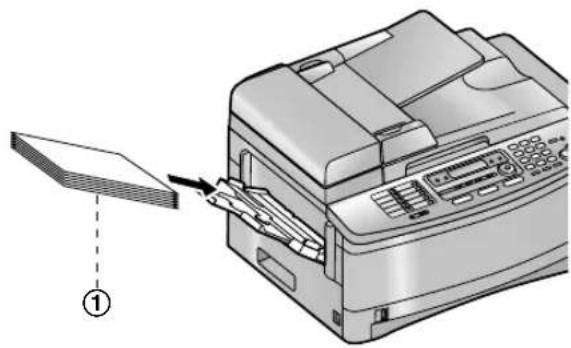
natural_image
Illustration of a printer with a paper strip being inserted, showing internal components and a dashed line indicating the paper's edge (no text or symbols present)4 Adjust the width of the guides (①) to the size of the recording paper.
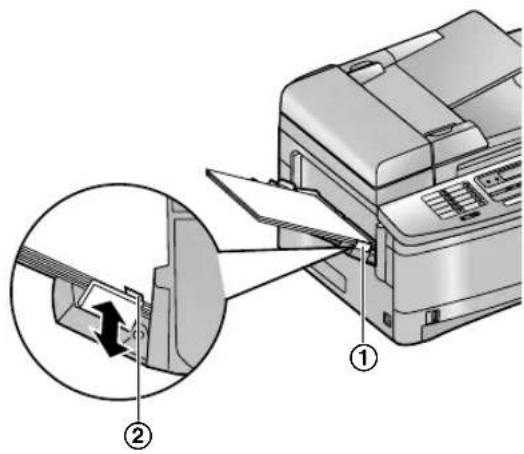
- The paper should not be over the tabs (②).
- If the paper is not inserted correctly, re-adjust the paper, or the paper may jam.
1.9.3 Checking the amount of remaining recording paper
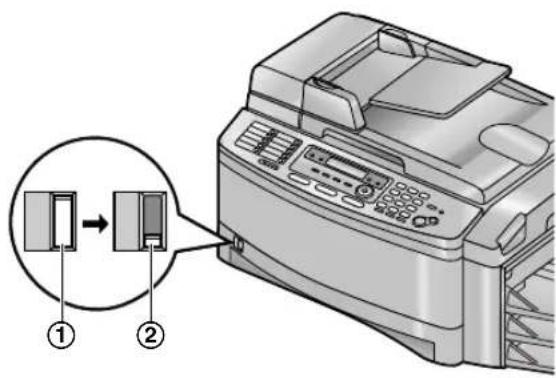
The paper level indicator (green) will allow you to check the amount of remaining paper.
- The paper is full (①).
●The paper is empty (②).
2.1 Connections
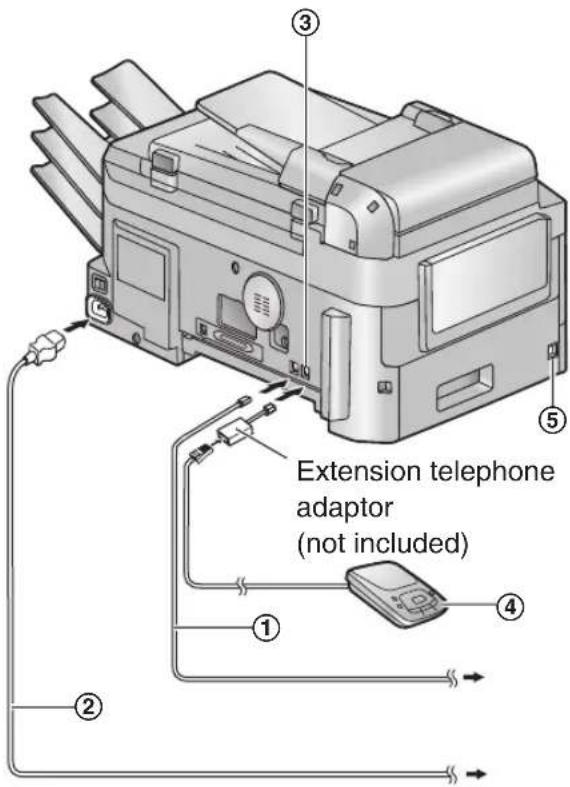
Plug in the mains lead and the telephone line cord. (Switch on AC mains outlet.)
Caution:
●The mains lead must remain connected at all times.
- Never install telephone wiring during a lightning storm.
- When you operate this product, the power outlet should be near the product and easily accessible.
- Be sure to use the telephone line cord included in this unit.
- Do not extend the telephone line cord.
①Telephone line cord
- Connect to telephone network.
②Mains lead
- Connect to Household Mains Supply (220 – 240 V, 50 Hz).
③[EXT] socket
- You can connect an answering machine or an extension telephone. Remove the stopper if attached.
④Answering machine (not included)
⑤Handset unit (Optional) connection socket
- You can connect the optional handset unit. Remove the seal if attached.
Note:
- To avoid malfunction, do not position the unit near appliances such as TVs or speakers which generate an intense magnetic field.
- If any other device is connected to the same telephone line, this unit may disturb the network condition of the device.
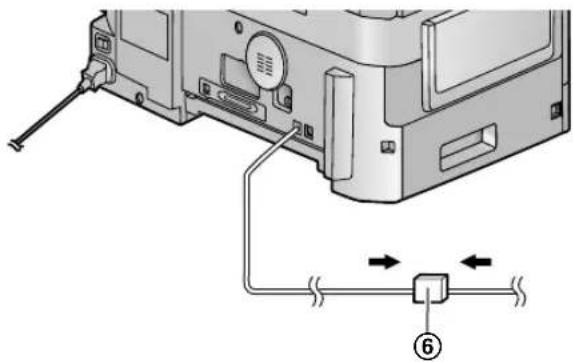
- If you use the unit with a computer and your internet provider instructs you to install a filter (6), please connect it as follows.
natural_image
Diagram of a computer monitor with cable and connector, showing internal components and wiring (no text or symbols)Using the optional handset unit
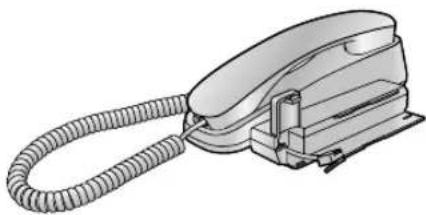
You can add the optional handset unit (Model No. KX-FA103X). See page 12 for accessory information.
natural_image
Line drawing of a classic office telephone with coiled cord (no text or symbols)- Connect to the handset unit connection socket (⑤) before use. For more details, please refer to the installation guide for the optional handset unit.
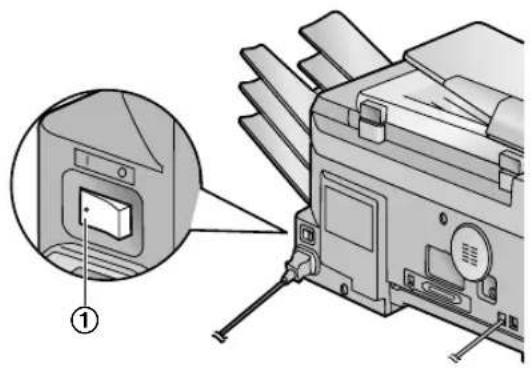
2.2 Turning the power switch ON
Turn the power switch to the ON position (①).
natural_image
Technical diagram of a printer internal structure with an inset showing a close-up view of the device (no text or symbols present)Note:
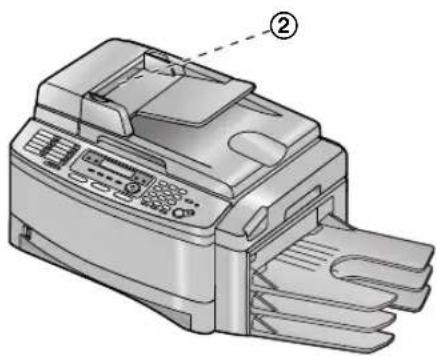
- When you operate the unit right after turning the power switch ON or after leaving the unit unused for a long period of time, the scanner lamp (②) will flash for a short while. The scanner will also move instantaneously. This is normal for the unit. After that, the scanner lamp will remain ON (the default is for approx. 15 minutes, feature #403 on page 64).
natural_image
Illustration of a printer with paper feed and control panel (no text or symbols)2.3 Selecting the operation mode (Fax/Copy/Scan)
This unit has three operation modes. You can select the desired mode by pressing the one of the following buttons.
- 【COPY】: Select this mode when using the unit as a copy machine (page 45).
- 【FAX】: Select this mode when using the unit as a fax machine (page 29).
- 【SCAN】: Select this mode when using the unit as a scanner for the computer (page 55).
Note:
- The default operation mode is the copy mode. You can change the default operation mode (feature #463 on page 64) and the timer before returning to the default operation mode (feature #464 on page 64).
2.4 Help function
The unit contains helpful information which can be printed for quick reference.
- "BASIC SETTINGS":
How to set the date, time, your logo and fax number.
- "FEATURE LIST":
How to program the features.
- "DIRECTORY":
How to store names and numbers in the directory and how to dial them.
- "FAX RECEIVING":
Help with problems to receive faxes.
- "COPIER":
How to use the copier function.
- "REPORTS":
List of available reports.
- "CALLER ID":
How to use the Caller ID features.
![[HELP] [SET] [◀][▶]](/content/2026/06/1190729/images/b61de7f2db26e394727585a3577086e9da8a38f8e2604679f0ef1713853cbcf2.jpg)
1 Press [HELP].
2 Press [◀] or [▶] repeatedly to display the desired item.
3 Press [SET].
●The selected item will be printed.
2.5 Adjusting volume
Before adjusting volume, set the operation mode to the fax mode (page 29) or the copy mode (page 45).
![[SET][▼][▲]](/content/2026/06/1190729/images/725139db94f62862040458ebeaa46ee7b303b52798fab7bcabf2e84b008d2be7.jpg)
Ringer volume
While the unit is idle, press [▼] or [▲].
- If any documents are in the document entrance, you cannot adjust the volume. Confirm that there are no documents in the entrance.
To turn the ringer OFF
- Press [▼] repeatedly to display "RINGER OFF= OK?".
- Press [SET].
- When a call is received, the unit will not ring and will display "INCOMING CALL".
- To turn the ringer back ON, press [▲].
Ringer pattern
- You can select one of three ringer patterns (feature #161 on page 63).
Monitor volume
While using the monitor, press [▼] or [▲].
2.6 Date and time
You must set the date and time.
![[MENU] [1 2 3 4 5 6 7 8 9 + 0 0 [FAX] [SET] [◀][▶]](/content/2026/06/1190729/images/62c45542bd47d3e69bc64378bfaaca72a8bdfc2e4e537a20849045303908a8e9.jpg)
1 Press [MENU].
SYSTEM SETUP PRESS [◀▶]
SET DATE & TIME PRESS SET
3 Press [SET].
- The cursor (☐) will appear on the display.
D: 01/M:01/Y:05
TIME: 12:00AM
4 Enter the current month/date/year by selecting 2 digits for each.
Example: 10 August, 2005
Press 1[0] [0][8] [0][5].
D:10/M:08/Y:05
TIME: 12:00AM
5 Enter the current hour/minute by selecting 2 digits for each. Press 【*】 to select “AM” or “PM”.
Example: 3:15PM (12 hour clock entry only)
D: 10/M:08/Y:05
TIME: 03:15AM
- Press【*】repeatedly to display "PM".
D: 10/M:08/Y:05
TIME: 03:15PM
6 Press [SET].
SETUP ITEM [ ]
7 Press [MENU] to exit.
Note:
- The other party's fax machine will print the date and time on the top of each page you
send according to your unit's date and time setting.
● The accuracy of the clock is approximately ±60 seconds a month.
- After setting the date and time, if the unit is in the copy mode, change to the fax mode by pressing [FAX]. You can check your unit's date and time setting on the display.
To correct a mistake
Press [◀] or [▶] to move the cursor to the incorrect number, and make the correction.
If you have subscribed to a Caller ID service
The date and time will be automatically set according to the received caller information.
- If the time has not previously been set, Caller ID will not adjust the clock.
2.7 Your logo
The logo can be your name or the name of your company.
![[ZOOM]/[QUICK SCAN] [CLEAR] [MENU] [1 2 3 4 5 6 7 8 9 + 0 # [SET] [R] [-][▶][▼][▲]](/content/2026/06/1190729/images/3ce38e4e2e2284543b13cc2d04d1d8a6c046caa9eae25f2feffcb6a3c85b1aba.jpg)
1 Press [MENU].
SYSTEM SETUP PRESS [◀▶]
YOUR LOGO PRESS SET
3 Press [SET].
- The cursor (☐) will appear on the display.
LOGO=
4 Enter your logo, up to 30 characters. See the following character table for details.
5 Press [SET].
SETUP ITEM [ ]
6 Press [MENU] to exit.
Note:
- Your logo will be printed on the top of each page sent from your unit.
To select characters with the dial keypad
| Keypad Characters | |
| [1] | 1 [ ] { } + - / = , . _ : ; ? | |
| [2]A B C | a b c 2 |
| [3]D E F | d e f 3 |
| [4] | G H I g h i 4 |
| [5] | J K L j k l 5 |
| Keypad Characters | |
| [6]M N O | m n o 6 |
| [7]P Q R | S p q r s 7 |
| [8] | T U V t u v 8 |
| [9]W X Y | Z w x y z 9 |
| [0] | 0 ( ) < > ! " # $% & ¥ * @ ^ ' → |
| [#] | To change uppercase orlowercase letter. |
| [R] | Hyphen |
| [ZOOM]/[QUICKSCAN] | To insert a space. |
| [CLEAR] | To delete a digit. |
Note:
- To enter another character that is located on the same dial key, press [▶] to move the cursor to the next space.
To enter your logo
Example: "BILL"
- Press 2 2 times.
LOGO=B
- Press 4 3 times.
LOGO=B I
- Press [5] 3 times.
LOGO=BIL
- Press [▶] to move the cursor to the next space and press [5] 3 times.
LOGO=BIL L
To change uppercase or lowercase letters Pressing the [#] key will change to uppercase or lowercase alternately.
- Press 2 2 times.
LOGO=B
- Press 4 3 times.
LOGO=B I
- Press [#].
LOGO=B i
- Press [5] 3 times.
LOGO=Bi1
To correct a mistake
Press [◀] or [▶] to move the cursor to the incorrect character, and make the correction.
To delete a character
Press [◀] or [▶] to move the cursor to the character you want to delete and press [CLEAR].
- To erase all characters, press and hold [CLEAR].
To insert a character
- Press [◀] or [▶] to move the cursor to the position to the right of where you want to insert the character.
- Press [ZOOM] to insert a space and enter the character.
To select characters using [▼] or [▲]
Instead of pressing the dial keys, you can select characters using [▼] or [▲].
- Press [▼] repeatedly to display the desired character. Characters will be displayed in the following order:
① Uppercase letters
② Number
③ Symbol
④ Lowercase letters
- If you press [▲], the order will be reversed.
-
Press [▶] to insert the character.
-
Return to step 1 to enter the next character.
2.8 Your fax number
![[MENU] [CLEAR] [1 2 3 4 5 6 7 8 9 * 0 #] [SET] [ R] [◀][▶]](/content/2026/06/1190729/images/87e1d1eee01d6e9834d94b46e9a6205b91b8c4aa10af25d50f46d1d522836ecb.jpg)
1 Press [MENU].
SYSTEM SETUP PRESS [◀▶]
YOUR FAX NO.
PRESS SET
3 Press [SET].
- The cursor (☐) will appear on the display.
NO.=
4 Enter your fax number, up to 20 digits.
Example: NO.=1234567
- To enter a “+”, press [※].
- To enter a space, press [#].
• To enter a hyphen, press [R].
5 Press [SET].
SETUP ITEM [ ]
6 Press [MENU] to exit.
Note:
- Your fax number will be printed on the top of each page sent from your unit.
To correct a mistake
Press [◀] or [▶] to move the cursor to the incorrect number, and make the correction.
To delete a number
Press [◀] or [▶] to move the cursor to the number you want to delete and press [CLEAR].
- To erase all numbers, press and hold [CLEAR].
3.1 Using the unit as a fax machine
3.1.1 Entering the fax mode
Before sending a fax, set the operation mode to the fax mode.
![[FAX]](/content/2026/06/1190729/images/b9cde32233f55b88e748d4546132f06d2c9dbb075b0c00aaaa4d0ef9f7e550ad.jpg)
Press [FAX] to turn the [FAX] light ON.
Note:
- You can change the default operation mode (feature #463 on page 64) and the timer before returning to the default operation mode (feature #464 on page 64).
- Received documents will be stacked on the lower output tray. You can change the output tray for faxing (feature #441 on page 68).
3.2 Sending a fax manually
3.2.1 Using the auto document feeder
- Confirm that there are no documents on the scanner glass.
![[CONTRAST] [RESOLUTION] [FAX] [QUICK SCAN] [SET][▼][▲] [REDIAL] [STOP] [START] [MONITOR]](/content/2026/06/1190729/images/bb6ef6ce6dde5f409ade6a191fbff0c649619397337fe3f87f3a001e499dc45a.jpg)
1 If the [FAX] light is OFF, turn it ON by pressing [FAX].
2 Adjust the width of the document guides (①) to fit the actual size of the document.
3 Insert the document (up to 50 pages) FACE UP into the feeder until a single beep is heard.
- If the document guides are not adjusted to fit the document, re-adjust them.
4 If necessary, change the following settings according to the type of document.
- To select the resolution, see page 29.
- To select the contrast, see page 29.
5 Press [MONITOR].
6 Dial the fax number.
7 Press [START].
Note:
- Any document which can be sent as a fax can also be copied and scanned (page 31).
- Do not open the document cover when sending a fax with the auto document feeder.
To stop sending
Press [STOP].
To select the resolution
- Press [RESOLUTION].
-
Press [▼] or [▲] repeatedly to select the desired resolution.
-
"STANDARD": For printed or typewritten documents with normal-sized characters.
- “FINE”: For documents with small print.
- "SUPER FINE": For documents with very small print. This setting is effective only when the other party has a compatible fax machines.
- “PHOTO”: For documents containing photographs, shaded drawings, etc.
- Using the "FINE", "SUPER FINE" and "PHOTO" settings will increase transmission time.
- If the resolution setting is changed during feeding, it will be effective from the next page.
To select the contrast
You can adjust this setting depending on the lightness or darkness of the document. 5 levels (light to dark) are available.
- Press [CONTRAST].
- Press [▼] or [▲] repeatedly to select the desired contrast.
3. Fax
- To make lighter, press [▼].
- To make darker, press [▲].
Note:
- You can save the previous contrast setting in feature #462 (page 64).
To redial the last number
- Press [REDIAL].
-
Press [START].
-
If the line is busy, the unit will automatically redial the number up to 5 times.
- To cancel redialling, press [STOP], then press [SET].
To predial a fax number
You can dial the fax number first before inserting the document. This is convenient if you need to refer to the document for the other party's fax number.
- Enter the fax number.
- Insert the document.
- Press [START].
Sending from memory (Quick scan feature)
You can scan the document into memory before sending.
- Insert the document.
- Enter the fax number.
- Press [QUICK SCAN].
Reserving the fax transmission (Dual Access)
You can reserve the fax transmission even when the unit is just receiving a fax or sending a fax from memory.
- Up to 3 reservations when sending
-
Up to 4 reservations when receiving
-
Insert the document during fax reception or fax memory transmission.
-
Enter the fax number using the dial keypad, one-touch dial or navigator directory.
-
Press [START].
- The document will be fed into the unit and scanned into memory. The unit will then send the data. If the document exceeds the memory capacity, transmission will be cancelled. You must send the entire document manually.
Printing a sending report
A sending report provides you with a printed record of transmission results. To print sending reports, make sure feature #401 is activated (page 65). For an explanation of error messages, see page 71.
Printing a journal report
A journal report provides you with a printed record of the 30 most recent faxes. To print manually, see page 93. To print automatically after every 30 new fax transmissions and receptions, make sure feature #402 is activated (page 65). For an explanation of error messages, see page 71.
3.2.2 Using the scanner glass
By using the scanner glass, you can send a page from booklets or small sized paper that cannot be sent with the auto document feeder.
- Confirm that there are no documents in the auto document feeder.
![[FAX] [QUICK SCAN] [START] [STOP] [SET]](/content/2026/06/1190729/images/ad7bb024e0b67090e095796bc10f658eed314bf098c2cb6c5f9a6f14d43570d5.jpg)
1 If the [FAX] light is OFF, turn it ON by pressing [FAX].
2 Open the document cover (①).
3 Place the document FACE DOWN on the scanner glass, matching the top edge of the document to the ↗ mark on the unit.
4 Close the document cover.
- If the original is a thick book, do not close the document cover.
5 If necessary, change the following settings according to the type of document.
- To select the resolution, see page 29.
● To select the contrast, see page 29.
6 Dial the fax number.
- To send a single page, skip to step 10.
- To send multiple pages, go to the next step.
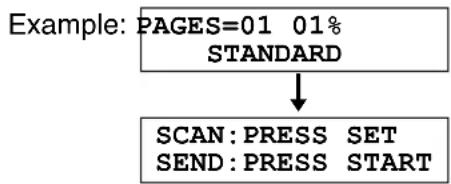
7 Press [QUICK SCAN] to scan the document into memory.
flowchart
graph TD
    A["Example: PAGES=01 01% STANDARD"] --> B["SCAN: PRESS SET\nSEND: PRESS START"]
8 Place the next page on the scanner glass.
9 Press [SET].
- To send more pages, repeat steps 8 and 9.
10 Press [START].
To stop sending
Press [STOP].
3.3 Document requirements
3.3.1 Using the auto document feeder
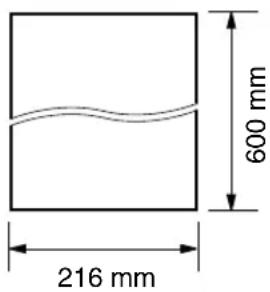
Minimum document size
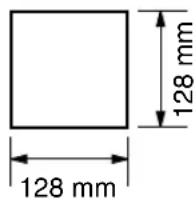
Maximum document size
Effective scanning area
- Shaded area will be scanned.
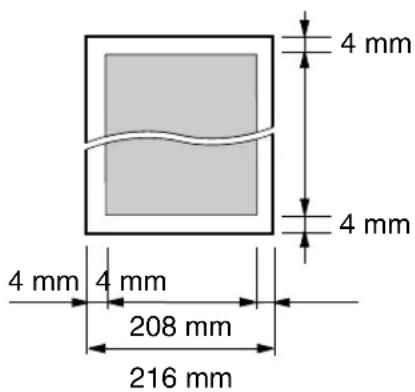
Document weight
- Single sheet: 45 ~g / m^2 to 90 ~g / m^2
● Multiple sheets: 60 g/m ^2 to 80 g/m ^2
3.3.2 Using the scanner glass
Effective scanning area
- Shaded area will be scanned.
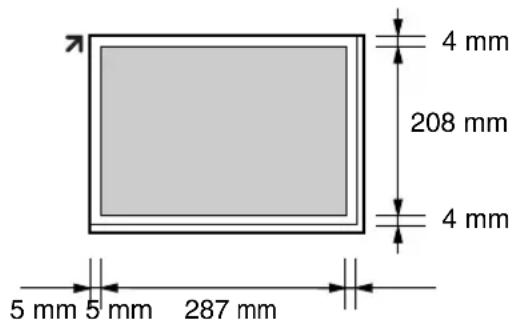
3.3.3 Note for the auto document feeder and the scanner glass
- Check that ink, paste or correction fluid has dried completely.
- To set a document with a width of less than 210 mm, we recommend using the scanner glass to copy the original document onto A4 or letter-sized paper, then setting the copied document.
- Do not set documents that do not satisfy the requirements of size and weight when using the auto document feeder. Make a copy of the document using the scanner glass and set the copy.
- Remove clips, staples or other fasteners when using the auto document feeder.
- Do not set the following types of documents when using the auto document feeder: (Make
a copy of the document using the scanner glass and set the copy instead.)
- Chemically treated paper such as carbon or carbonless duplicating paper
– Electrostatically charged paper
– Badly curled, creased or torn paper
– Paper with a coated surface
– Paper with printing on the opposite side that can be seen through the other side, such as newsprint
3.4 Storing names and telephone numbers for the one-touch dial feature and navigator directory
For rapid access to frequently dialled numbers, the unit provides the one-touch dial feature (18 items) and navigator directory (300 items).
- Station 1 to 3 can be used alternatively as broadcast keys (page 35).
- Make sure that the [FAX] light is ON.
![Station keys [DIRECTORY] [MENU] [CLEAR] [1 2 3 4 5 6 7 8 9 + 0 5 [SET][LOWER] [STOP] [◀][▶][▼][▲]](/content/2026/06/1190729/images/37e777a94eaf4b380ebc362c3f90efdf9daf310e1a1ef5de6d07b6b283e0f34a.jpg)
3.4.1 Storing one-touch dial item
1 Press [MENU] repeatedly to display "DIRECTORY SET".
2 Select the desired station key.
For stations 1–3:
- Press one of the station keys.
Example: STATION 1 DIAL MODE [▼▲]
- Press [SET].
For stations 4–9:
Press one of the station keys.
For stations 10–18:
Press [LOWER], then press one of the station keys.
3 Enter the name, up to 16 characters (see page 26 for instructions).
4 Press [SET].
5 Enter the telephone number, up to 32 digits.
6 Press [SET].
● To program other items, repeat steps 2 to 6.
7 Press [STOP] to exit.
Helpful hints:
- You can confirm the stored items by printing the telephone number list (page 93).
Note:
● A hyphen or a space entered in a telephone number counts as 2 digits.
To correct a mistake
Press [◀] or [▶] to move the cursor to the incorrect character/number, and then make the correction.
To delete a character/number
Press [◀] or [▶] to move the cursor to the character/number you want to delete, and press [CLEAR].
- To erase all characters/numbers, press and hold [CLEAR].
3.4.2 Storing navigator directory items
1 Press [MENU] repeatedly to display "DIRECTORY SET".
2 Press [▶].
- The display shows the number of items in the navigator directory briefly.
3 Enter the name, up to 16 characters (see page 26 for instructions).
4 Press [SET].
5 Enter the telephone number, up to 32 digits.
6 Press [SET].
- To program other items, repeat steps 3 to 6.
7 Press [MENU] to exit.
Helpful hints:
- You can confirm the stored items by printing the telephone number list (page 93).
Note:
● A hyphen or a space entered in a telephone number counts as 2 digits.
To correct a mistake
Press [◀] or [▶] to move the cursor to the incorrect character/number, and then make the correction.
To delete a character/number
Press [◀] or [▶] to move the cursor to the character/number you want to delete, and press [CLEAR].
- To erase all characters/numbers, press and hold [CLEAR].
3.4.3 Editing a stored item
1 Press [DIRECTORY].
2 Press [▼] or [▲] repeatedly to display the desired item.
3 Press [MENU].
4 Press [※].
- If you do not need to edit the name, skip to step 6.
5 Edit the name. For further details, see the storing procedure on page 32.
6 Press [SET].
- If you do not need to edit the telephone number, skip to step 8.
7 Edit the telephone number. For further details, see the storing procedure on page 32.
8 Press [SET].
3.4.4 Erasing a stored item
1 Press [DIRECTORY].
2 Press [▼] or [▲] repeatedly to display the desired item.
3 Press [MENU].
4 Press [#].
- To cancel erasing, press [STOP].
5 Press [SET].
3.5 Sending a fax using one-touch dial feature and navigator directory
Before using this feature, store the desired names and telephone numbers into one-touch dial feature and navigator directory (page 32).
- Keep the front cover page open for button locations.
- Make sure that the [FAX] light is ON.
1 Adjust the width of the document guides to fit the actual size of the document.
2 Insert the document (up to 50 pages) FACE UP into the feeder until a single beep is heard.
- Confirm that there are no documents on the scanner glass.
- If the document guides are not adjusted to fit the document, re-adjust them.
3 If necessary, change to the desired resolution (page 29) and the desired contrast (page 29).
4 Enter the fax number.
Using stations 1–9:
Press the desired station key.
Using stations 10–18:
Press [LOWER], then press the desired station key.
Using navigator directory:
Press [DIRECTORY], then press [▼] or [▲] repeatedly to display the desired item.
5 Press [START].
Note:
- Do not open the document cover when sending a fax with the auto document feeder.
To send a fax using the scanner glass
- Confirm that there are no documents in the auto document feeder.
- Open the document cover.
- Place the document FACE DOWN, then close the document cover.
- Enter the fax number using one-touch dial or navigator directory.
- To send a single page, skip to step 7.
- To send multiple pages, go to the next step.
- To send a single page, skip to step 7.
-
To send multiple pages, go to the next step.
-
Press [QUICK SCAN] to scan the document into memory.
- Place the next page.
- Press [SET].
- To send more pages, repeat steps 5 and 6.
- Press [START].
To search for a name by initial Example: "LISA"
- Press [DIRECTORY].
- Press [▼] or [▲] to initiate the navigator directory.
- Press [5] repeatedly to display any name with the initial “L” (see the character table, page 26).
-
To search for symbols, press [★].
-
Press [▼] or [▲] repeatedly to display "LISA".
- To stop the search, press [STOP].
- To send a fax using the auto document feeder, see page 29.
Fax auto redial
If the line is busy or if there is no answer, the unit will automatically redial the number up to 5 times.
- To cancel redialling, press [STOP], then press [SET].
If your unit does not send a fax
- Confirm that you have entered the number correctly, and that the number is a fax number.
- Confirm that the other party's fax machine is answering by turning ON the connecting tone feature (feature #416 on page 66).
3.6 Broadcast transmission
By storing one-touch dial and navigator directory items (page 32) into the broadcast memory, you can send the same document to multiple parties (up to 20). Your programmed items will remain in the broadcast memory, allowing frequent re-use.
●The broadcast function utilises stations 1–3.
The one-touch dial function will be cancelled.
- Keep the front cover page open for button locations.
- Make sure that the [FAX] light is ON.
3.6.1 Programming items into the broadcast memory
1 Press [MENU] repeatedly to display "DIRECTORY SET".
2 Select the desired broadcast key.
For BROADCAST 1-2:
-
Press the desired [BROADCAST] key.
-
Press [▼] or [▲] repeatedly to select "BROADCAST".
For MANUAL BROADCAST:
- Press [MANUAL BROAD].
- Press [▼] or [▲] repeatedly to select "MANUAL BROAD".
3 Press [SET].
4 Program items.
Using stations 1–9:
Press the desired station key.
Using stations 10–18:
Press [LOWER], then press the desired station key.
Using navigator directory:
Press [▼] or [▲] repeatedly to display the desired item, and press [SET].
Using the dial keypad (only for MANUAL BROAD):
Enter the fax number and press [SET].
- To program other items, repeat this step (up to 20 items).
- If you program the wrong item, press [CLEAR] to erase the item.
5 Press [SET] after programming all of the desired items.
- To program another broadcast key, repeat steps 2 to 5.
6 Press [STOP] to exit.
Note:
- Confirm the stored items by printing a broadcast programming list (page 93).
3.6.2 Adding a new item into the broadcast memory
After initial programming, you can add new items (up to a combined total of 20).
1 Press [DIRECTORY].
2 Press [▼] or [▲] repeatedly to display the desired broadcast memory
("
3 Press [MENU].
4 Press [※].
5 Press [▼] or [▲] repeatedly to display the desired item you want to add.
6 Press [SET].
- To add other items, repeat steps 5 and 6 (up to 20 items).
7 Press [STOP] to exit.
Note:
- When adding new items to the MANUAL BROADCAST memory, you can only select stored items.
3.6.3 Erasing a stored item from the broadcast memory
1 Press [DIRECTORY].
2 Press [▼] or [▲] repeatedly to display the desired broadcast memory (“
3 Press [MENU].
4 Press [#].
5 Press [▼] or [▲] repeatedly to display the desired item you want to erase.
- To cancel erasing, press [STOP].
6 Press [SET].
7 Press [SET].
- To erase other items, repeat steps 5 to 7.
8 Press [STOP] to exit.
3.6.4 Sending the same document to pre-programmed parties
- Make sure that the [FAX] light is ON.
1 Insert the document FACE UP into the feeder.
- Confirm that there are no documents on the scanner glass.
2 If necessary, change to the desired resolution (page 29) and the desired contrast (page 29).
3 Press the desired [BROADCAST] (1-2) or [MANUAL BROAD].
- The document will be fed into the unit and scanned into memory. The unit will then send the data to each party, calling each number sequentially.
● After transmission, the stored document will be erased from memory automatically, and the unit will automatically print a report (broadcast sending report).
Note:
- Do not open the document cover when sending a fax with the auto document feeder.
- If you select "FINE", "SUPER FINE" or "PHOTO" resolution, the number of pages that the unit can send will decrease.
- If the document exceeds the memory capacity, sending will be cancelled.
- If a party is busy or does not answer, it will be skipped and redialled later up to 5 times.
To send the same document using the scanner glass
- Confirm that there are no documents in the auto document feeder.
-
Open the document cover.
-
Place the document FACE DOWN, then close the document cover.
-
Press the desired [BROADCAST] (1-2) or [MANUAL BROAD].
- To send a single page, skip to step 6.
- To send multiple pages, go to the next step.
-
Place the next page.
-
Press [SET].
- To send more pages, repeat steps 4 and 5.
- Press [START].
To cancel broadcast transmission
- Press [STOP] while "BROADCASTING" is displayed.
- The display will show "SEND CANCELLED?".
- Press [SET].
3.7 Receiving a fax automatically – Auto answer ON
3.7.1 Activating FAX ONLY mode
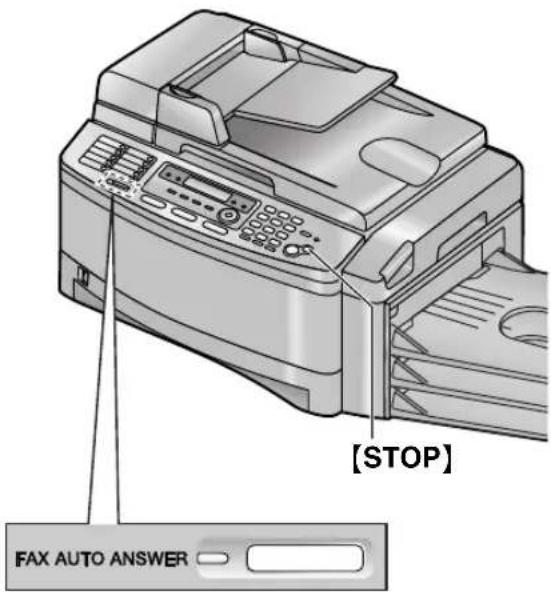
Press [FAX AUTO ANSWER] repeatedly to display the following.
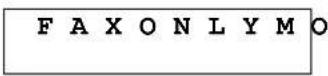
- The [FAX AUTO ANSWER] indicator is ON.
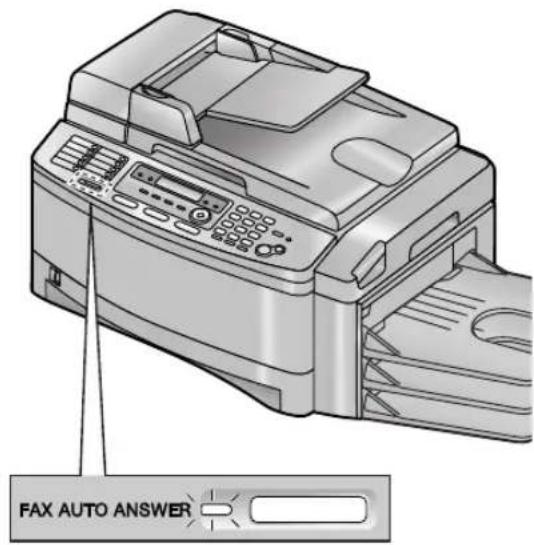
How faxes are received
When receiving calls, the unit will automatically answer all calls and only receive fax documents.
3.8 Receiving a fax manually – Auto answer OFF
Use these modes with an extension telephone or the optional handset unit.
3.8.1 Activating TEL mode
E1 Make sure feature #404 is set to "TEL" beforehand (page 65).
2 Press [FAX AUTO ANSWER] repeatedly to display the following.
TEL MODE
- The [FAX AUTO ANSWER] indicator is OFF.
![[STOP] [START] FAX AUTO ANSWER](/content/2026/06/1190729/images/f86ee0d453ca872b7e698153384f707d9a8e40f0d3833874c68ea20ee83ea3dc.jpg)
How to receive faxes with an extension telephone
If you have another telephone connected to the [EXT] socket or the same line (extension telephone), you can use the extension telephone to receive faxes.
- When the extension telephone rings, lift the handset of the extension telephone.
- When:
– document reception is required,
- a fax calling tone (slow beep) is heard, or
- no sound is heard,
press [★] [‡] [9] (default fax activation code) firmly.
●The unit will start reception.
- Replace the handset.
3. Fax
Note:
- To receive fax documents using the extension telephone, make sure remote fax activation is turned ON (feature #434 on page 66) beforehand. The default setting is ON.
How to receive faxes with the optional handset unit
-
Lift the handset to answer the call.
-
When:
– document reception is required,
- a fax calling tone (slow beep) is heard, or
- no sound is heard,
press [START].
●The unit will start fax reception.
To stop receiving
Press [STOP].
3.8.2 Activating TEL/FAX mode
1 Make sure feature #404 is set to "TEL/FAX" beforehand (page 65).
2 Press [FAX AUTO ANSWER] repeatedly to display the following.
TEL/FAX MODE
- The [FAX AUTO ANSWER] indicator is OFF.
3 The ringer volume setting should be ON (page 24).
How phone calls and faxes are received
- "INCOMING CALL" will be displayed but the unit will not ring.
-
The unit will wait for the duration of 2 rings before answering the call.
-
The number of rings is determined by the "TEL/FAX delayed ring setting" (feature #212 on page 65).
-
During this time, an extension telephone (if connected to the same line) will ring.
-
The unit will answer the call and try to detect a fax calling tone.
When a fax calling tone is detected
The unit receives the fax automatically without ringing.
When a fax calling tone is not detected
① The unit will ring 3 times. You may answer the call.
- The number of rings is determined by the "Silent fax recognition ring setting" (feature #436 on page 67).
- Callers will hear a ring back tone different from the one generated by the telephone company.
- An extension telephone (if connected to the same line) will not ring at this time. To answer the call with the extension telephone, lift the handset and press [★][0] (default auto disconnection code) while the fax machine is ringing.
② If you do not answer the call, the unit will activate the fax function.
- Some fax machines do not generate fax calling tones when sending faxes, therefore the unit will try to receive a fax even if no fax calling tone is detected.
Note:
- The auto disconnection code can be changed in feature #435 on page 67.
- Even when you answer a call with the extension telephone and press the auto disconnection code, the fax machine may activate the fax function depending on the type of an extension telephone. Press
【STOP】on the fax machine to talk with the calling party.
3.9 Using the unit with an answering machine
3.9.1 Setting up the unit and an answering machine
1 Connect the answering machine (①).
- Answering machine is not included.
- Please purchase an extension telephone adaptor (page 12).
- Remove the stopper (②).
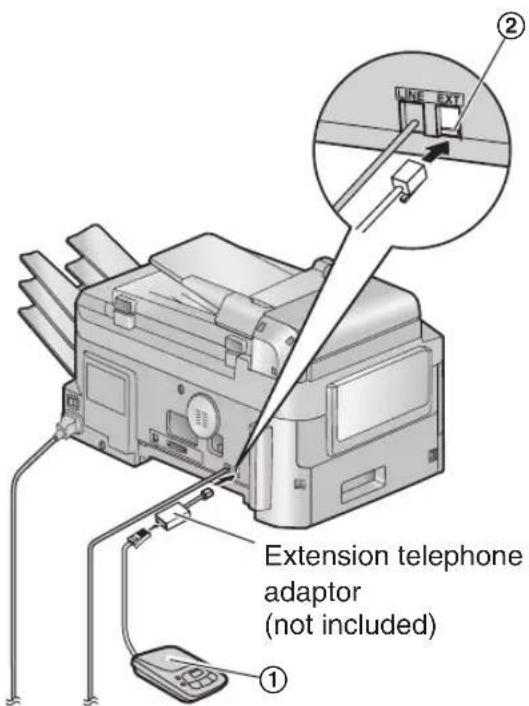
2 Set the number of rings on the answering machine to less than 4.
● This will allow the answering machine to answer the call first.
3 Record a greeting message on the answering machine.
- We recommend you record a message up to 10 seconds long, and not to pause for more than 4 seconds during the message. Otherwise, both machines will not function correctly.
4 Activate the answering machine.
5 Set the unit to the desired receiving mode (page 37).
- If you set to FAX ONLY mode, change the ring setting in FAX ONLY mode to more than 4 (feature #210 on page 63).
6 Check all or part of the following are not the same:
– the remote access code of the answering machine
– the fax activation code (feature #434 on page 66)
Receiving a voice message and fax document in one call
The caller can leave a voice message and send a fax document during the same call. Inform the caller of the following procedure beforehand.
- The caller calls your unit.
●The answering device will answer the call. - The caller can leave a message after the greeting message.
- The caller presses [∗][□][9] (pre-selected fax activation code).
●The unit will activate the fax function. - The caller presses the start button to send a document.
Note:
- The fax activation code can be changed in feature #434 (page 66).
- If there is no room left in memory of your answering machine, the unit may not be able to receive documents. See the operating instructions of the answering machine and erase unnecessary messages.
3.10 Receive polling (retrieving a fax placed on another fax machine)
This feature allows you to retrieve a document from another compatible machine. Therefore you pay for the call.
Make sure that no documents are fed into your unit and that the other party's machine is ready for your call.
- Keep the front cover page open for button locations.
1 Press [MENU] repeatedly to display "POLLING".
2 Press [SET].
3 Dial the fax number.
4 Press [START].
● The unit will start reception.
3.11 Junk fax prohibitor (preventing fax reception from undesired callers)
If you subscribe to Caller ID service, this feature prevents fax reception from calls that do not show caller information.
Additionally, the unit will not accept faxes originating from numbers that match a programmable junk fax prohibitor list.
- Keep the front cover page open for button locations.
Important:
- This feature does not work when manual reception is performed.
3.11.1 Activating the junk fax prohibitor
1 Press [MENU] repeatedly to display "JUNK FAX PROH.".
2 Press [▶].
3 Press [▼] or [▲] repeatedly to select "ON".
4 Press [SET].
5 Press [MENU] to exit.
- While the junk fax prohibitor is activated, "JUNK FAX ON" is displayed.
3.11.2 Storing undesired callers
You can register up to 10 undesired numbers from the Caller ID list (page 42) if you do not wish to receive faxes from them.
1 Press [MENU] repeatedly to display "JUNK FAX PROH.".
2 Press [▶] repeatedly to display “JUNK LIST SET”.
3 Press [SET].
4 Press [▼] or [▲] repeatedly to display the party you wish to prevent fax reception from.
5 Press [SET].
- To program other parties, repeat steps 4 to 5.
6 Press [STOP] to exit.
Note:
- If there is no space to store new items, "LIST FULL" is displayed in step 3 or step 5. Erase unnecessary items.
To display the junk fax prohibitor list
- Press [MENU] repeatedly to display "JUNK FAX PROH.".
- Press [▶] repeatedly to display "JUNK LIST DISP.".
- Press [SET].
- Press [▼] or [▲] to display the items on the list.
- Press [MENU] to exit the program.
To print the junk fax prohibitor list
- Press [MENU] repeatedly to display "JUNK FAX PROH.".
- Press [▶] repeatedly to display "JUNK LIST PRINT".
- Press [SET].
- Press [MENU] to exit the list.
To erase an item from the junk fax prohibitor list
- Press [MENU] repeatedly to display "JUNK FAX PROH.".
- Press [▶] repeatedly to display "JUNK LIST DISP.".
- Press [SET].
- Press [▼] or [▲] repeatedly to display the desired item.
- Press [◀].
- To cancel erasing, press [STOP], then press [MENU].
- Press [SET].
- The item is erased.
- To erase other items, repeat steps 4 to 6.
- Press [MENU] to exit the list.
4.1 Caller ID service
This unit is compatible with the Caller ID service offered by your local telephone company. To use this unit's Caller ID features, you must subscribe to Caller ID service.
Important:
- This unit is designed in accordance with the “FSK based subscriber line protocol” under the ETS (European Telecommunication Standard) and only supports the basic CLIP (Calling Line Identification Presentation) features.
- This unit will only display the caller's telephone number and name.
- This unit will not support future additional telephone services.
- This unit cannot support services based on the “DTMF based subscriber line protocol”.
- Depending on the service of the local telephone company, the date/time of the call or the caller's name may not be displayed.
Make sure the following ring setting is set to 2 or more rings beforehand.
- FAX ring setting (feature #210 on page 63)
- TEL/FAX ring setting (feature #212 on page 65)
4.1.1 How Caller ID is displayed
The calling party's name or telephone number will be displayed after the 1st ring. You then have the option of whether or not to answer the call. The unit will automatically store caller information (name, telephone number and the time of the call) of the 30 most recent calls. Caller information is stored by the most recent to the oldest call. When the 31st call is received, the oldest call is deleted.
Caller information can be viewed on the display one item at a time (page 43) or confirmed by printing the Caller ID list (page 93).
- When caller information is received and it matches a telephone number stored in the fax machine's one-touch dial or navigator directory, the stored name will be displayed.
- If the unit is connected to a PBX (Private Branch Exchange) system, caller information may not be received properly. Consult your PBX supplier.
-
If the unit cannot receive caller information, the following will be displayed:
-
“OUT OF AREA”: The caller dialled from an area which does not provide Caller ID service.
- “PRIVATE CALLER” or “WITHHELD”: The caller requested not to send caller information.
- “LONG DISTANCE”: The caller made a long distance call.
To confirm caller information by printing the Caller ID list
– To print manually, see page 93.
- To print automatically after every 30 new calls, activate feature #216 (page 63).
4.2 Viewing and calling back using caller information
You can easily view caller information and call back. When calling back, we recommend you use the optional handset unit.
Important:
- Calling back will not be possible in the following cases:
- The telephone number includes data other than numbers (i.e., or # ).
- The caller information does not include a telephone number.
- If the area code of the received telephone number is the same as yours, the area code may need to be deleted before calling back. This may only apply to some areas. To edit the number, see page 43.
![[MENU][CALLER ID] [1 2 3 4 5 6 7 8 9 × 0 2 [SET] [STOP] [START] [MONITOR] [◀][▼][▲]](/content/2026/06/1190729/images/736477861a22577f90c665643ac4c43c121d50263aebc43ef186f9c4b74bbe46.jpg)
1 Press [CALLER ID].
2 Press [▼] to search from the recently received caller information.
- If you press [▲], the display order will be reversed.
3 Press [MONITOR] to return the call.
- The unit will start dialling automatically.
- To send a fax using the auto document feeder, see page 29.
To change the way caller information is displayed
Press [CALLER ID] repeatedly after step 2.
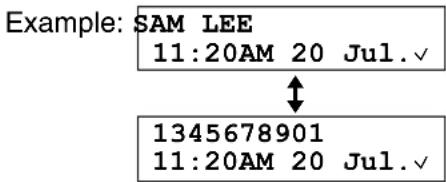
- Check mark (√) on the display means the call has already been viewed or answered.
Display while viewing
- When the unit could not receive a name, the display will show "NO NAME RCVD".
- When no calls have been received, the display will show "NO CALLER DATA".
To stop viewing
Press [STOP] after step 2.
4.2.1 Editing a caller's telephone number before calling back
1 Press [CALLER ID].
2 Press [▼] or [▲] repeatedly to display the desired entry.
3 Press [CALLER ID] to display the telephone number.
4 Press dial key (0 to 9) or 【*】 to enter the editing mode and edit the telephone number.
5 Press [MONITOR] to call back the edited number.
●The unit will start dialling automatically.
- To send a fax, insert the document FACE DOWN and press [START].
Note:
- The edited telephone number will not be saved in the caller information. To save in the directory, see page 44.
To correct a mistake
- Press [◀] or [▶] to move the cursor to the incorrect number.
- Press [CLEAR] to delete the number.
- Enter the correct number.
To delete a number
Press [◀] or [▶] to move the cursor to the number you want to delete and press [CLEAR].
To insert a number
- Press [◀] or [▶] to move the cursor to the position to the right of where you want to insert the number.
- Enter the number.
4.2.2 Erasing all caller information
1 Press [MENU] repeatedly to display "CALLER SETUP".
2 Press [SET].
- “CALL LIST ERASE” will be displayed.
3 Press [SET].
- To cancel erasing, press [STOP], then [MENU].
4 Press [SET].
5 Press [STOP] to exit.
4.2.3 Erasing specific caller information
1 Press [CALLER ID].
2 Press [▼] or [▲] repeatedly to display the desired item.
3 Press [◀].
- To cancel erasing, press [STOP].
4 Press [SET].
● To erase other items, repeat steps 2 to 4.
5 Press [STOP] to exit.
4.3 Storing caller information into the one-touch dial feature and navigator directory
- Keep the front cover page open for button locations.
Important:
●This feature is not available in the following cases.
- The telephone number includes data other than numbers (i.e., or # ).
- The caller information does not include a telephone number.
1 Press [CALLER ID].
2 Press [▼] or [▲] repeatedly to display the desired item.
3 Press [MENU].
4 Select the station key or navigator directory.
For stations 1–3:
-
Press the desired station key.
-
Press [SET].
- Press [SET].
For stations 4–9:
- Press the desired station key.
- Press [SET].
For stations 10–18:
- Press [LOWER], then press the desired station key.
- Press [SET].
For navigator directory:
- Press [◀] or [▶].
- Press [SET].
5 Press [SET].
Note:
- You can confirm the stored items by printing the telephone number list (page 93).
- The unit can only store a name of up to 16 characters long.
- To edit a name or number, see page 33.
- If caller information does not include the caller's name, enter the name manually. See the instructions on page 32.
- If you assign an item to a station key which already contains an item, the previous item will be replaced.
- If you use stations 1–3 as broadcast keys, you cannot store caller information for stations 1–3 (page 35).
5.1 Using the unit as a copy machine
5.1.1 Entering the copy mode
Before copying, set the operation mode to the copy mode.
![[COPY]](/content/2026/06/1190729/images/a938db3e01b6c1a5f4a757768a54913b673a5631f1261ded536ac62c178c7b3c.jpg)
Press [COPY] to turn the [COPY] light ON.
Note:
- You can change the default operation mode (feature #463 on page 64) and the timer before returning to the default operation mode (feature #464 on page 64).
- Copied documents will be stacked on the upper output tray. You can change the output tray for copying (feature #466 on page 69).
- If the [FAX AUTO ANSWER] indicator is ON, the unit can receive faxes automatically even in the copy mode.
5.2 Making a copy
5.2.1 Using the auto document feeder
- Confirm that there are no documents on the scanner glass.
![[CONTRAST] ① [COPY] [PAPER TRAY] [RESOLUTION] [◀][▶][▼][▲] [STOP] [START]](/content/2026/06/1190729/images/94da3221e9bab99c1c5cda012d866d768323e5116991288f23be14415e282443.jpg)
1 If the [COPY] light is OFF, turn it ON by pressing [COPY].
2 Set the original.
-
Adjust the width of the document guides (①) to fit the actual size of the document.
-
Insert the document (up to 50 pages) FACE UP into the feeder until a single beep is heard.
3 If necessary, change the following settings according to the type of document.
- To select the resolution, see page 45.
● To select the contrast, see page 45. - To select the input tray and paper size, see page 46.
4 If necessary, enter the number of copies (up to 99).
5 Press [START].
●The unit will start copying.
6 After you finish copying, press [STOP] to reset the settings you set in step 3.
Note:
- Any document which can be sent as a fax can also be copied and scanned (page 31). The effective scanning area is changed depending on the setting of the paper size.
- Do not open the document cover when making a copy with the auto document feeder.
To stop copying
Press [STOP].
To select the resolution
- Press [RESOLUTION].
- Press [▼] or [▲] repeatedly to select the desired resolution.
- “TEXT/PHOTO”: For documents containing both text and photographs.
- “TEXT”: For documents containing only text.
- “PHOTO”: For documents containing photographs, shaded drawings, etc.
Note:
- You can change the default resolution in feature #461 (page 69).
To select the contrast
You can adjust this setting depending on the lightness or darkness of the document. 5 levels (light to dark) are available.
-
Press [CONTRAST].
-
Press [▼] or [▲] repeatedly to select the desired contrast.
-
To make lighter, press [▼].
• To make darker, press [▲].
Note:
- You can save the previous contrast setting in feature #462 (page 64).
To select the input tray and paper size
- Press [PAPER TRAY].
-
Press [▼] or [▲] repeatedly to select the desired input tray.
-
"IN TRAY #1": Paper input tray
- "IN TRAY #2": Multi-purpose input tray
- When the optional input tray is installed, the following will be added to the settings.
- “IN TRAY #3”: Optional input tray
-
“IN TRAY #1#3”: Paper input tray and optional input tray
-
Press [◀] or [▶] repeatedly to select the desired paper size.
-
“LETTER”: Letter size paper
- "A4": A4 size paper
- “LEGAL”: Legal size paper
- When the input tray is set to "IN TRAY #1" or "IN TRAY #1#3", you cannot select "LEGAL".
Note:
- You can also set the input tray setting in feature #460 (page 69).
- You can also set the paper size in feature #380 (page 64), #381 (page 64) or #382 (page 64). If the selected paper size of #380 and #382 are not same, "IN TRAY #1#3" will not be displayed in this setting.
5.2.2 Using the scanner glass
- Confirm that there are no documents in the auto document feeder.
![[COPY] [START] [STOP]](/content/2026/06/1190729/images/d8f762e9e607a9fbe6a596b6faf6315a378dae02a882c41c8126ddfba4b8fd0d.jpg)
1 If the [COPY] light is OFF, turn it ON by pressing [COPY].
2 Set the original.
- Open the document cover (①).
- Place the document FACE DOWN on the scanner glass, matching the top edge of the document to the mark on the unit.
- Close the document cover.
- If the original is a thick book, do not close the document cover.
3 If necessary, change the following settings according to the type of document.
- To select the resolution, see page 45.
●To select the contrast, see page 45. - To select the input tray and paper size, see page 46.
4 If necessary, enter the number of copies (up to 99).
5 Press [START].
●The unit will start copying.
6 After you finish copying, press [STOP] to reset the settings you set in step 3.
To stop copying
Press [STOP].
5.3 More copying features
- Keep the front cover page open for button locations.
- Make sure that the [COPY] light is ON.
5.3.1 To sort multiple copies (Auto document feeder only)
The unit can sort multiple copies in the same order as the original document pages.
1 Set the original.
2 Press [SORT] repeatedly to turn the [SORT] indicator ON.
3 Enter the number of copies (up to 99).
4 Press [START].
5 After you finish copying, press [STOP] to reset this feature.
Example: Making 2 copies of a 4-page original document
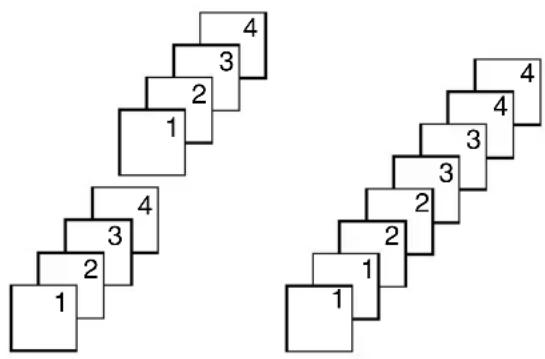
Sorted pages Non-sorted pages
Note:
- The unit will store the documents into memory while sorting the copies. The number of documents that can be stored depends upon the contents of pages, resolution and contrast. If the unit has no documents in memory, approximately 50 pages of the ITU-T No.1 Test Chart can be stored at a time in “TEXT/PHOTO” mode. See page 94 of the specifications for details.
- If memory becomes full while storing, the unit will only print out the stored pages.
- When you make more than 4 sets of multiple copies, the copied documents will be stacked on the output trays sequentially. If you set the sort copy hold setting to ON (feature #465 on
page 69), after every 3 sets of copies the unit will display the following and stop copying.
TO CONTINUE COPY PRESS START
Remove the stacked paper, then press 【START】 to restart copying.
5.3.2 To enlarge a document
1 Set the original.
2 Press [ZOOM].
3 Press [▲] repeatedly to select from “105%” to “200%” by changing the enlargement rate 5% at a time.
4 Press [START].
5 After you finish copying, press [STOP] to reset this feature.
- When using the auto document feeder, the unit will only enlarge the centre of the upper part of the document. To make an enlarged copy of the bottom of the document, turn the document around, and then make a copy.
- When using the scanner glass, the unit will only enlarge the right top corner of the document starting from the ↗ mark on the unit.
Example: 150% enlarged copy
Using the auto document feeder:
Original document Enlarged copy
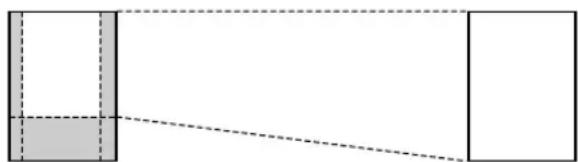
natural_image
Pure geometric diagram showing two rectangles with dashed lines and a shaded interior (no text or symbols)Using the scanner glass (①):
Original document Enlarged copy
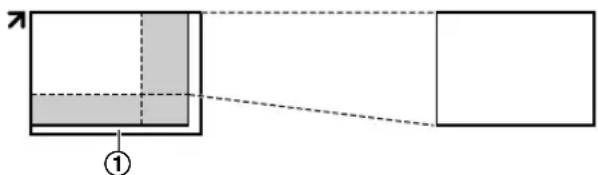
5.3.3 To reduce a document
1 Set the original.
2 Press [ZOOM].
3 Press [▼] repeatedly to select from “95%” to “50%” by changing the reduction rate 5% at a time.
4 Press [START].
5 After you finish copying, press [STOP] to reset this feature.
Example: 70% reduced copy
Using the auto document feeder:
Original document Reduced copy
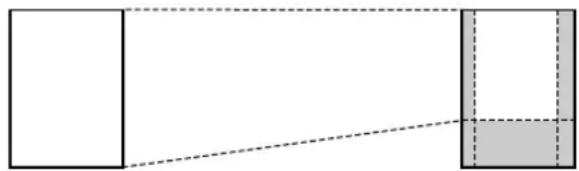
natural_image
Pure geometric diagram showing two rectangles with dashed lines indicating hidden edges (no text or symbols)Using the scanner glass (①):
Original document Reduced copy
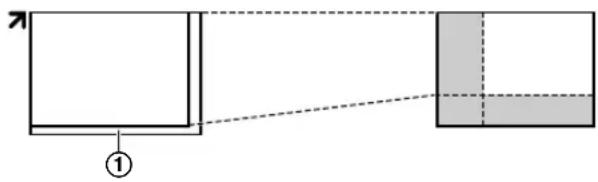
6.1 Connecting to a computer
Panasonic Multi-Function Station software enables the unit to carry out the following functions:
- Printing on plain paper, transparencies, labels and envelopes
- Scanning documents and converting an image into text with Readiris OCR software
- Scanning from other applications for Microsoft® Windows® that support TWAIN scanning
- Storing, editing or erasing items in directories using your computer
- Programming the features using your computer
– Sending, receiving fax documents using your computer
To use Multi-Function Station on your computer, the following are required:
Operating System:
Works with Windows 98/Me/2000/XP ^*1
CPU:
Windows 98: Pentium® 90 MHz or faster
Windows Me: Pentium 150 MHz or faster
Windows 2000: Pentium 166 MHz or faster
Windows XP*1: Pentium 300 MHz or faster
RAM:
Windows 98: 24 MB (32 MB or more recommended)
Windows Me: 32 MB (64 MB or more recommended)
Windows 2000: 64 MB or more
Windows XP ^*1 : 128 MB or more
Other Hardware:
CD-ROM drive
Hard disk drive with at least 100 MB of available space
USB interface (USB 1.1 and USB 2.0)
LAN interface for optional LAN board (10BASE-T/100BASE-TX)
*1 Multi-Function Station software does not work with Windows XP Professional x64 Edition (64bit), a new version of Windows XP Professional that was released in and after April, 2005.
Important notice for the connection
- Do not connect the USB cable before installing Multi-Function Station. Be sure to connect the USB cable in step 6 on page 50.
①USB cable
- USB cable is not included. Please purchase a shielded Type-A male/Type-B male USB cable maximum length 2 metres.
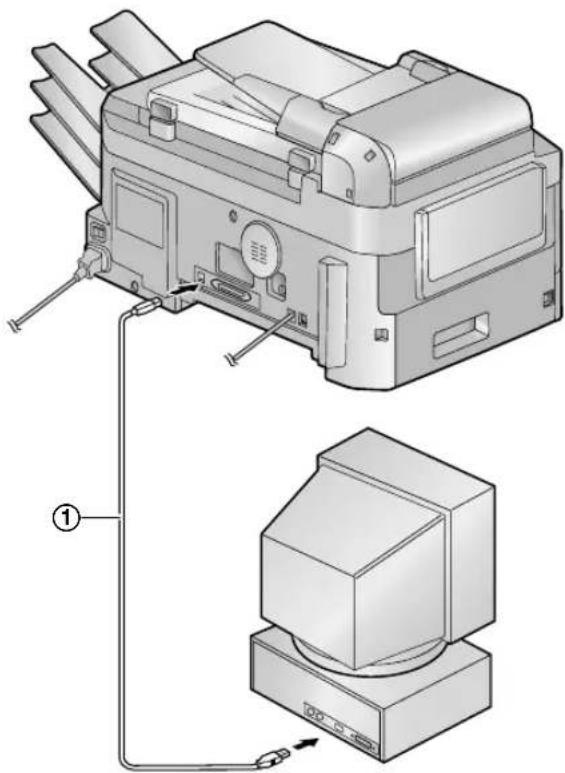
natural_image
Technical line drawing of a computer printer with attached cable and drive unit (no text or symbols)Note:
- Be sure to use a Hi-Speed USB 2.0 certified cable if your computer is equipped with the Hi-Speed USB 2.0 interface.
Warning:
- To assure continued emission limit compliance, use only shielded USB cable (2 m or less in length).
6.2 Installing Multi-Function Station
- The screenshots shown in these instructions are for Windows XP and are included for reference only.
- The screenshots shown in these instructions may differ slightly from those of the actual product.
- Software features and appearance are subject to change without notice.
● These instructions are for the USB connection. For the LAN connection using the optional LAN board, see the network
installation guide by clicking on the link in the Multi-Function help file.
1 Start Windows and exit all other applications.
- For Windows XP and Windows 2000 users, you must be logged in as an administrator in order to install Multi-Function Station.
- Install Multi-Function Station before connecting the unit to a computer. If the unit is connected to a computer before installing Multi-Function Station, the [Found New Hardware Wizard] dialogue box will appear. Click [Cancel] to close it.
2 Insert the included CD-ROM into your CD-ROM drive.
- The [Choose Setup Language] dialogue box will appear. Select the desired language that you want to use with this software from the drop-down list. Click [OK]. The installation will automatically start.
- If the [Choose Setup Language] dialogue box does not appear: The installation will automatically start.
- If the installation does not start automatically: Click [Start]. Choose [Run...]. Type "D:\setup" (where "D:" is the drive letter of your CD-ROM drive). Click [OK]. (If you are not sure what the drive letter is for your CD-ROM drive, use Windows Explorer and look for the CD-ROM drive.)
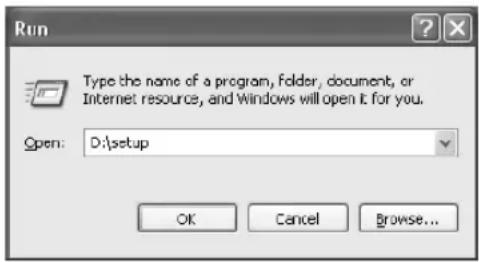
The installation will start.
3 When the setup program starts, follow the on-screen instructions.
4 When the [Setup Type] dialogue box appears, select [Standard], then click [Next].
- Readiris OCR software (page 55) and Device Monitor (page 57) will also be installed.
5 When the [Connect Type] dialogue box appears, select [Connect directly with a USB cable.], then click [Next].
- The [Connect Device] dialogue box will appear.
6 Connect the unit with the USB cable (page 49), then click [Next].
- If the unit is connected to your computer, the model name will be automatically detected.
- You can change the names for the printer, PC fax, and scanner if necessary.
7 Click [Install], then follow the on-screen instructions.
● The files will be copied to your computer.
Important notice for Windows XP users
- If you use Windows XP, the following message may appear after step 6: "The software you are installing for this hardware has not passed Windows Logo testing to verify its compatibility with Windows XP" This is normal and the software will not cause any difficulties with your operating system. You can continue the installation with no problem.
Note:
- If the screen prompts to insert the CD-ROM for operating system when installing Multi-Function Station, insert it into your CD-ROM drive.
To use the other unit with the computer
You need to add the printer driver for each unit, as follows.
Click [Start], then select [All Programs] or [Programs] → [Panasonic] → [KX-FLB800_FLM650 Series] → [Add Printer
Driver]. Then follow the on-screen instructions from step 5.
Note:
- You cannot connect more than one unit to the same computer at the same time.
To modify the software
You can select the components to install anytime after the installation.
For Windows XP and Windows 2000 users, you must be logged in as an administrator in order to modify Multi-Function Station.
- Click [Start], then select [All Programs] or [Programs] → [Panasonic] → [KX-FLB800_FLM650 Series] → [Uninstall or Modify].
- Select [Modify] and click [Next], then follow the on-screen instructions.
To uninstall the software
For Windows XP and Windows 2000 users, you must be logged in as an administrator in order to uninstall Multi-Function Station.
- Click [Start], then select [All Programs] or [Programs] → [Panasonic] → [KX-FLB800_FLM650 Series] → [Uninstall or Modify].
- Select [Uninstall] and click [Next], then follow the on-screen instructions.
Note:
- If you want to uninstall each component, select [Modify] and click [Next] in step 2, then follow the on-screen instructions.
6.3 Starting Multi-Function Station
Click [Start], then select [All Programs] or [Programs] → [Panasonic] → [KX-FLB800_FLM650 Series] → [Multi-Function Station].
●Multi-Function Station will appear.
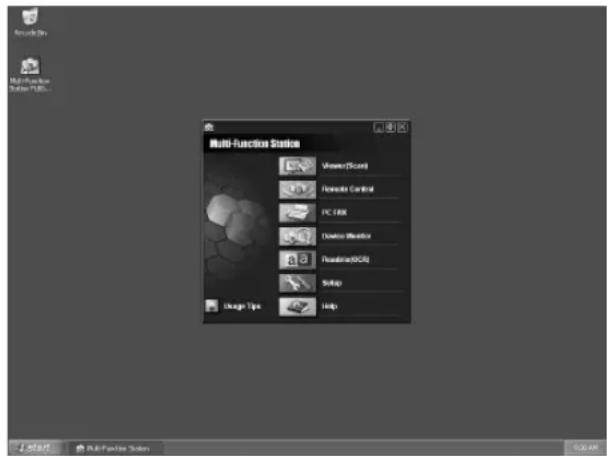
Viewer(Scan) (page 54)
- To display the images which support TIFF, JPEG, PCX, DCX and BMP formats.
- To create an image file by scanning the document set in the unit (TIFF, JPEG, PCX, DCX, BMP and PDF formats).
Remote Control (page 55)
- To store, edit or erase items in directories.
- To program the features.
- To view items in the journal report or Caller ID list.
- To store caller information into directories.
PC FAX (page 56)
- To send a document created on the computer.
- To display a document received on the computer.
Device Monitor (page 57)
- To display the current status of the unit.
● To change the setting for OCR.
Help
- For detailed instructions on Multi-Function Station.
Usage Tips
- To display usage tips.
Note:
- You can confirm if the unit is connected to your computer on Device Monitor.
- Computer features (printing, scanning, PC Fax, etc.) may not function properly in the following situations:
- When the unit is connected to a computer that was custom-built by the user.
- When the unit is connected to the computer via a PCI card or other expansion card.
- When the unit is connected to another piece of hardware (such as a USB hub or interface adapter) and not connected directly to the computer.
6.4 Using the unit as a printer
You can print not only on plain paper but also on special media (transparencies / labels / envelopes).
6.4.1 Printing from Windows applications
You can print a file created in a Windows application. For example, to print from WordPad, proceed as follows.
1 Open the document you want to print.
2 Select [Print...] from the [File] menu.
- The [Print] dialogue box will appear.
For details about the [Print] dialogue box, click [?], then click the desired item.
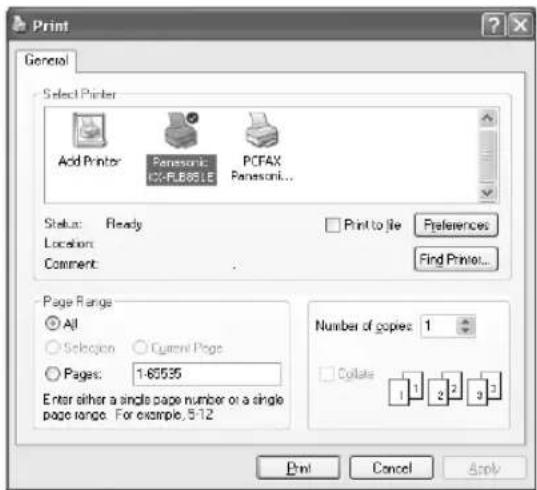
Note:
- For Microsoft PowerPoint ^® , select [Color] or remove the check next to [Grayscale] in the print dialogue so that coloured text will be printed in grayscale.
3 Select [Panasonic KX-FLB851E] as the active printer.
- If you have changed the name of the unit when installing, select that name from the list. - To change the printer settings, proceed as follows.
For Windows 98/Windows Me:
Click [Properties], then click the desired tab. Change the printer settings, then click [OK].
For Windows 2000:
Click the desired tab and change the printer settings.
For Windows XP:
Click [Preferences], then click the desired tab. Change the printer settings, then click [OK].
4 Click [Print] or [OK].
●The unit will start printing.
Note:
●To load paper, see page 18.
- For details about the paper specifications, see page 52, 95.
Setting the printer properties
You can change the printer setting in step 3. We recommend that you test paper (especially special sizes and types of paper) on the unit before purchasing large quantities.
You can change the settings on following tabs.
Paper: Paper size, paper type, paper source, etc.
Output: Pages per sheet, output tray, etc.
Quality: Graphics mode, resolution, toner save feature, etc.
Note:
- To select [Envelope] for paper type on the [Paper] tab, you need to select [Envelope #10] or [Envelope DL] for paper size.
- You can select the output tray for each printing on the [Output] tab. To change the default output tray, see page 58.
- When printing from a computer, the toner save feature on the [Quality] tab overrides the unit's toner save setting (feature #482 on page 64).
6.4.2 Transparencies
Use transparencies designed for laser printing. We recommend the following:
3M ^® CG3300/CG5000
- Use the multi-purpose input tray to print transparencies.
- Load transparency sheets one page at a time for printing, print-side down.
- Printed transparency will be stacked on the upper output tray.
- Remove each transparency after printing and place it on a flat surface to cool and to prevent it from curling.
- Do not re-use transparencies that have already been fed through the unit. This includes transparencies that have been fed through and ejected without being printed on.
- Some types of transparencies have instructions recommending which side to print on. If the print quality is poor, try printing on the other side.
6.4.3 Labels
Use labels designed for laser printing. We recommend the following:
Avery®
- Use the multi-purpose input tray to print labels.
- Load label sheets one page at a time for printing, print-side down.
- Printed label will be stacked on the upper output tray.
- Remove each label after printing.
- Do not use the following types of labels:
- Labels that are wrinkled, damaged or separated from the backing sheet.
– Any sheet of labels that has spaces in it where some of the labels have been removed.
- Labels that do not completely cover the backing sheet as follows.
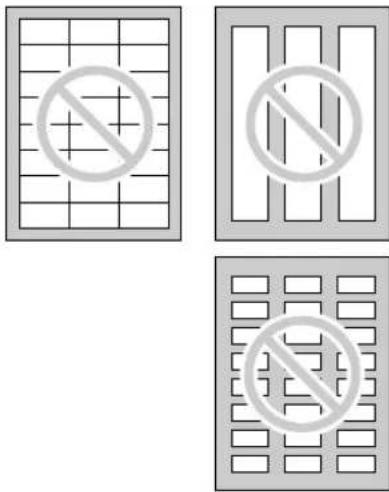
6.4.4 Envelopes
Use envelopes designed for laser printing. We recommend the following:
– High quality envelopes of 90 g/m ^2 paper,
- Envelopes that have thin, sharply creased leading edges,
- Envelopes that have diagonal seams, and
- Envelopes with a moisture content of 4% to 6% by weight.
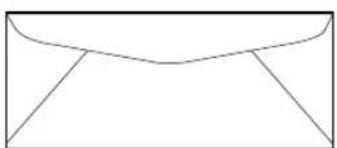
natural_image
Simple line drawing of a closed envelope (no text or symbols)- Use the multi-purpose input tray to print envelopes.
- You can load up to 5 envelopes of 90 ~g / m^2 paper at a time for printing, print-side down.
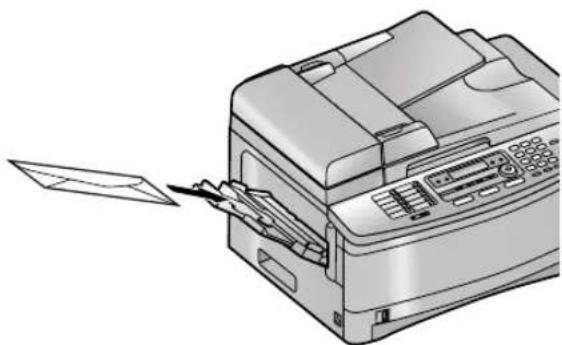
natural_image
Illustration of a printer with a paper airplane being inserted (no text or symbols)- Printed envelope will be stacked on the upper output tray.
- Remove each envelope after printing.
Note:
- Wrinkles and waving may occur in some cases, even if high quality envelopes are used.
- Avoid printing in high humidity. High humidity may cause the envelope to curl or seal the envelope.
- Store envelopes away from moisture and humidity, where they can lay flat and their edges will not be bent or damaged.
Do not use envelopes with any of the following characteristics (using these may result in paper jams):
- Irregularly shaped envelopes
● Envelopes with curls, wrinkles, nicks, twists, dog-ears or other damage
● Envelopes with side seam construction
● Highly textured envelopes, or envelopes with extremely shiny surfaces
● Envelopes that seal by removing a peel-off strip
● Envelopes with more than one flap to be sealed
● Self-adhesive envelopes
● Envelopes that are baggy or not sharply creased
- Embossed envelopes
- Envelopes that have previously been printed on
● Envelopes that include cotton and/or fibre material
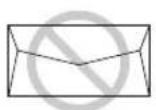
Side seam construction

Peel-off strip Multiple flaps
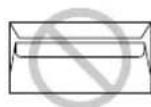



Twisted Curled Bent-edged



Waved Dog-eared Self adhesive
Do not attempt to print on any of the following types of envelopes (these may cause damage to the unit):
- Envelopes with clasps, snaps or tie strings
● Envelopes with transparent windows
● Envelopes that use encapsulated types of adhesive that do not require moistening but rely on pressure to seal them

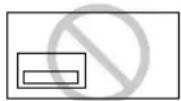
Clasp Transparent window
6.5 Using the unit as a scanner
- Keep the front cover page open for button locations.
6.5.1 Using Multi-Function Viewer
1 Set the original.
Using the auto document feeder Insert the document (up to 50 pages) FACE UP into the feeder until a single beep is heard.
- Confirm that there are no documents on the scanner glass.
Using the scanner glass
Place the document FACE DOWN on the scanner glass, matching the top edge of the document to the mark on the unit.
- Confirm that there are no documents in the auto document feeder.
2 Start Multi-Function Station.
3 Select [Viewer(Scan)].
• [Multi-Function Viewer] will appear.
4 Click the [Scan] icon in the [Multi-Function Viewer] window.
- The [Panasonic KX-FLB851E] (default name) dialogue box will appear.
5 If necessary, change the scanning settings on your computer.
- To preview the scanned image, click [Preview]. Only first page will be displayed. You can drag the frame to specify the scanned area. If you change the scan mode, brightness, or contrast setting, click [Preview] to refresh the scanned image. If you use the auto document feeder, set the document again before refreshing the scanned image.
- If you select [B/W Graphic] for scan mode, the resolution range will be from 150 to 600 dpi.
6 Click [Scan].
- If you preview the scanned image using the auto document feeder in step 5, set the document again and click [Scan].
- The scanned image will be displayed in the [Multi-Function Viewer] window after scanning.
- To save the scanned image, select [Save As...] from the [File] menu.
- To cancel scanning while the document is being scanned, click [Cancel].
Note:
- You can display the images which support TIFF, JPEG, PCX, DCX and BMP formats.
- You can save the images in TIFF, JPEG, PCX, DCX, BMP or PDF formats.
- You can move, copy and delete a file or page.
- You cannot change the scanning settings on the unit.
- Any document which can be sent as a fax can also be scanned (page 31).
- Do not open the document cover when scanning documents with the auto document feeder.
- When scanning a document, we recommend using the scanner glass rather than the auto document feeder for better results.
To scan documents quickly
- Set the original.
- Press [SCAN] on the unit.
- The previous settings will be displayed on your computer. You can change them if necessary.
-
Press [START] on the unit.
-
The scanned image will be displayed in the [Multi-Function Viewer] window after scanning.
- To cancel scanning while the document is being scanned, click [Cancel].
Note:
- For details, see the help file by selecting [Usage Tips] from Multi-Function Station.
Readiris OCR software
With OCR software, you can convert an image into text data that can be edited with word processor software. Readiris OCR software can be installed when installing Multi-Function Station.
To use this software, click the [OCR] icon in the [Multi-Function Viewer] window or select [Readiris (OCR)] from Multi-Function Station. For detailed instructions about OCR, select [Help].
6.5.2 Using other applications
Multi-Function Station includes a TWAIN compliant scanner driver. You can also scan using other applications that support TWAIN scanning. For example, proceed as follows.
1 Set the original.
Using the auto document feeder
Insert the document (up to 50 pages) FACE UP into the feeder until a single beep is heard.
- Confirm that there are no documents on the scanner glass.
Using the scanner glass
Place the document FACE DOWN on the scanner glass, matching the top edge of the document to the mark on the unit.
- Confirm that there are no documents in the auto document feeder.
2 Start an application that supports TWAIN scanning.
3 Select [Select Device...] from the [File] menu, then select the [Panasonic KX-FLB851E] (default name) in the dialogue box.
4 Select [Acquire Image...] from the [File] menu.
- The [Panasonic KX-FLB851E] (default name) dialogue box will appear.
5 If necessary, change the scanning settings on your computer.
- If you select [B/W Graphic] for scan type, the resolution range will be from 150 to 600 dpi.
6 Click [Scan].
● The scanned image will be displayed in the application window after scanning.
- To cancel scanning while the document is being scanned, click [Cancel].
Note:
- Depending on the application used, the appearance may differ slightly.
6.6 Operating the unit from your computer
You can easily operate the following functions from your computer.
- Storing, editing or erasing items in directories (page 32, 35)
- Programming the features (page 63 to page 70)
– Viewing items in the journal report (page 30)
– Storing the journal report as the computer file
– Viewing items in the Caller ID list (page 42) - Storing caller information into directories (page 44)
- Storing the Caller ID list as the computer file
1 Start Multi-Function Station.
2 Select [Remote Control].
- The [Multi-Function Remote Control] window will appear.
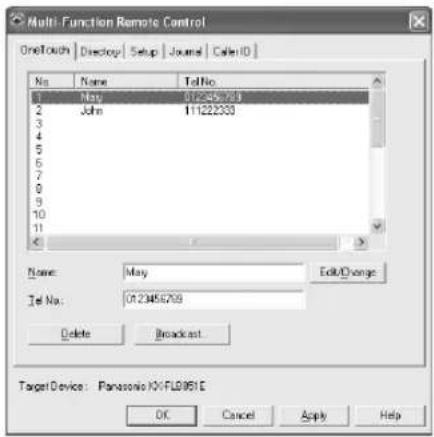
3 Select the desired tab.
●The latest data in the unit will be displayed.
4 Perform the desired operation.
- For details about each function, click [Help].
- To stop the operation, click [Cancel].
5 Click [OK].
● The new data will be transferred to the unit and the window will close.
- You can also click [Apply] to continue the next operation without closing the window.
Note:
- Some of the features cannot be programmed from your computer.
- For details, see the help file by selecting [Usage Tips] from Multi-Function Station.
6.7 Fax sending/receiving using Multi-Function Station
- Keep the front cover page open for button locations.
6.7.1 Sending a computer document as a fax message from your computer
You can access the fax function from a Windows application using Multi-Function Station.
For example, to send a document created from WordPad, proceed as follows.
1 Open the document you want to send.
2 Select [Print...] from the [File] menu.
- The [Print] dialogue box will appear.
3 Select [PCFAX Panasonic KX-FLB851E] (default name) as the active printer.
4 Click [Print].
- The [Send a Fax] dialogue box will appear.
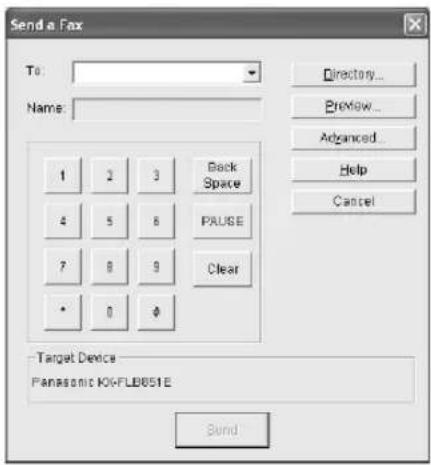
5 Enter the fax number using the keypad display or the directory.
- To stop the operation, click [Cancel].
6 Click [Send].
●The document will be sent through the unit from your computer.
Note:
- To stop sending, press [STOP] on the unit while sending the document.
- If the document exceeds the memory capacity of the unit, sending will be cancelled.
- Check the journal from Remote Control after sending or receiving faxes.
- For details, see the help file by selecting [Usage Tips] from Multi-Function Station.
6.7.2 Receiving a fax into your computer
You can receive a fax document on your computer. The received fax document is saved as an image file (TIFF-G4 format).
To receive a fax document using your computer, make sure the following features are set beforehand.
- PC fax reception (feature #442 on page 68)
1 Press [FAX AUTO ANSWER] repeatedly to turn the auto answer setting ON (page 37).
2 Start Multi-Function Station.
3 Select [PC FAX].
![Multi-Function PCFAR - Communication Log File Edit Print Help Communication Log Send Log Received Log Outlet For Help press [F1] 0 0](/content/2026/06/1190729/images/1b535603492184f26dfe08ab4bc7333e9bc81b4cd18217f10b07bca48005cc33.jpg)
4 When a fax call is received, your computer will receive a document through the unit.
Note:
- You can view, print or transfer the received document using your computer.
Viewing a received document
- Select [PC FAX] from Multi-Function Station.
- Select [Received Log] in [Communication Log].
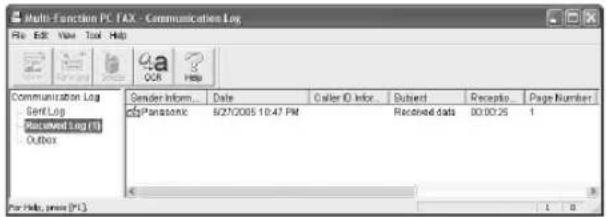
- Click the item you want to view.
- Click [File] in the menu bar, then select [View], or click [View] icon in the toolbar.
●The received fax will be displayed.
If the unit's memory stores a received fax document
You can load the document into your computer.
-
Select [PC FAX] from Multi-Function Station.
-
Select [Received Log] in [Communication Log].
- Click [File] in the menu bar, then click [Receive a Fax].
- If feature #442 is activated, the received fax document will be automatically transferred to the computer.
6.8 Confirming the status of the unit
You can confirm the setting information and current status of the unit from your computer.
1 Start Multi-Function Station.
2 Select [Device Monitor].
- If the [Device Select] dialogue box appears, select the unit from the list, then click [OK].
- The [Device Monitor] window will appear.
3 Select the desired tab.
You can confirm the status of the unit on the following tabs.
Status: Current status of the unit
Device: Information of the unit
- To display the [Device] tab, click [Advanced Information].
Note:
● The status of the unit will be updated automatically.
- If the printing error occurs, Device Monitor will be started automatically and display the error information.
- For details, see the help file by selecting [Usage Tips] from Multi-Function Station.
6.9 Other information
6.9.1 Setting the optional input tray
To use the optional input tray with your computer, proceed as follows.
1 Click [Start].
2 Open the printer window.
For Windows 98/Windows Me/Windows 2000:
Select [Settings], then click [Printers].
For Windows XP Professional:
Click [Printers and Faxes].
For Windows XP Home:
Click [Control Panel], [Printers and Other Hardware], then click [Printers and Faxes].
3 Select [Panasonic KX-FLB851E] (default name).
4 Select [Properties] from the [File] menu.
●The printer properties window will appear.
5 Click [Auto Configuration] on the [Device Options] tab.
● The optional input tray will be automatically detected and incorporated in the settings.
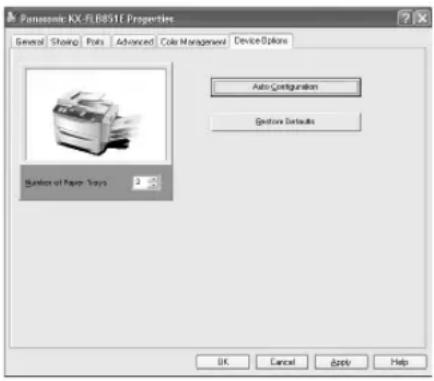
6 Click [OK].
Note:
- If the optional input tray is not detected automatically in step 5, specify the number of the paper tray, then click [OK].
6.9.2 Changing the default output tray
To change the default output tray when printing, proceed as follows.
1 Click [Start].
2 Open the printer window.
For Windows 98/Windows Me/Windows 2000:
Select [Settings], then click [Printers].
For Windows XP Professional:
Click [Printers and Faxes].
For Windows XP Home:
Click [Control Panel], [Printers and Other Hardware], then click [Printers and Faxes].
3 Select [Panasonic KX-FLB851E] (default name).
4 Select [Properties] from the [File] menu.
- For Windows XP and Windows 2000 users, click [Printing Preferences...] on the [General] tab.
● The printer properties window will appear.
5 Select the desired output tray on the [Output] tab.
- The selected output tray will be set as default.
- For details, see the help file by selecting [Usage Tips] from Multi-Function Station.
7.1 Programming
![[MENU] [SET] [◀][▶][▼][▲] [STOP]](/content/2026/06/1190729/images/41ec3b9413640ef4d1398100147a58d3545e21576e4fad9ced09ee092f0681df.jpg)
1 Press [MENU].
2 Press【#】and the 3-digit code (page 63 to page 70).
3 Press the desired selection to display the desired setting.
●This step may be slightly different depending on the feature.
4 Press [SET].
5 Press [MENU] to exit.
To cancel programming
Press [STOP].
To select features by using the navigator key
You can select a feature by using the navigator key instead of directly entering the program code (# and a 3-digit number).
- Press [MENU].
- Select the feature's category you wish to program.
Press [◀] or [▶] repeatedly to display the desired feature's category.
- "BASIC FEATURE"
- "FAX FEATURE"
- "COPY FEATURE"
- "SCAN FEATURE"
- "LAN FEATURE"
- "SCAN FEATURE" and "LAN FEATURE" will be displayed only when the optional LAN board is installed.
- Press [SET].
- Select the feature you wish to program. Press [◀] or [▶] repeatedly to display the desired feature.
●The current setting of the feature will be displayed.
- Press [▼] or [▲] repeatedly to display the desired setting.
● This step may be slightly different depending on the feature.
6. Press [SET].
●The setting you selected is set, and the next feature will be displayed.
7. Press [MENU] to exit.
7.2 Direct command chart
For more details on the features, see page 63 to page 70.
Note:
- The following feature will be displayed only when the optional input tray is installed. Feature code: #8
- The following features will be displayed only when the optional LAN board is installed. Feature code: #4 / #[9][0] / #9 / #9 / [#][5][0][0] / [#][5]0 / [#][5]0 / [#][5]0 / [#][5][0][7]
| Feature Feature code Selection Page | |||
| Date and time | [#][1][0][1] | ---- | page 25 |
| Your logo | [#][1][0][2] | ---- | page 26 |
| Your fax number | [#][1][0][3] | ---- | page 28 |
| Recall time | [#][1][2][1] | [0]: “900ms” [1]: “700ms”[2]: “600ms” [3]: “400ms”[4]: “300ms” [5]: “250ms”[6]: “200ms” [7]: “160ms”[8]: “110ms” [9]: “100ms” (default)[*]: “90ms” [#]: “80ms” | page 63 |
| LCD display contrast | [#][1][4][5] | [1]: “NORMAL” (default)[2]: “DARKER” | page 63 |
| Ringer pattern | [#][1][6][1] | [1]: “A” (default) [2]: “B” [3]: “C” | page 63 |
| Fax ring count | [#][2][1][0] | [1]: “1” [2]: “2” (default) [3]: “3”[4]: “4” [5]: “5” [6]: “6” [7]: “7”[8]: “8” [9]: “9” | page 63 |
| TEL/FAX ring count | [#][2][1][2] | [1]: “1” [2]: “2” (default) [3]: “3”[4]: “4” [5]: “5” [6]: “6” [7]: “7”[8]: “8” [9]: “9” | page 65 |
| Automatic Caller ID list | [#][2][1][6] | [0]: “OFF” (default) [1]: “ON” | page 63 |
| Remote TAM activation | [#][3][2][2] | [0]: “OFF” (default) [1]: “ON” | page 63 |
| Paper size in the paper input tray | [#][3][8][0] | [1]: “LETTER” [2]: “A4” (default) | page 64 |
| Paper size in the multi-purpose input tray | [#][3][8][1] | [1]: “LETTER” [2]: “A4” (default)[3]: “LEGAL” | page 64 |
| Paper size in the optional input tray | [#][3][8][2] | [1]: “LETTER” [2]: “A4” (default)[3]: “LEGAL” | page 64 |
| Sending report | [#][4][0][1] | [0]: “OFF” [1]: “ON”[2]: “ERROR” (default) | page 65 |
| Automatic journal report | [#][4][0][2] | [0]: “OFF” [1]: “ON” (default) | page 65 |
| Power save | [#][4][0][3] | [1]: “5min”[2]: “15min” (default)[3]: “30min” [4]: “1h” | page 64 |
| Manual answer mode | [#][4][0][4] | [1]: “TEL” (default) [2]: “TEL/FAX” | page 65 |
| Feature | Feature code | Selection | Page |
| Overseas mode | [#][4][1][1] | [0]: “OFF” [1]: “NEXT FAX”[2]: “ERROR” (default) | page 66 |
| Delayed send | [#][4][1][2] | [0]: “OFF” (default) [1]: “ON” | page 66 |
| ECM selection | [#][4][1][3] | [0]: “OFF” [1]: “ON” (default) | page 66 |
| Connecting tone | [#][4][1][6] | [0]: “OFF” [1]: “ON” (default) | page 66 |
| Auto reduction | [#][4][3][2] | [0]: “OFF” [1]: “ON” (default) | page 66 |
| Fax activation code | [#][4][3][4] | [0]: “OFF” [1]: “ON” (default) | page 66 |
| Auto disconnection | [#][4][3][5] | [0]: “OFF” [1]: “ON” (default) | page 67 |
| Silent fax ring count | [#][4][3][6] | [3]: “3” (default) [4]: “4” [5]: “5”[6]: “6” [7]: “7” [8]: “8” [9]: “9” | page 67 |
| Memory reception alert | [#][4][3][7] | [0]: “OFF” [1]: “ON” (default) | page 67 |
| Friendly reception | [#][4][3][8] | [0]: “OFF” [1]: “ON” (default) | page 67 |
| Input tray setting for faxing | [#][4][4][0] | [1]: “#1” (default) [2]: “#2”●When the optional input tray is installed, the following will be displayed.[1]: “#1” [2]: “#2”[3]: “#3” [4]: “#1+#3” (default) | page 67 |
| Output tray setting for faxing | [#][4][4][1] | [1]: “#1” [2]: “#2”[3]: “#3” (default) | page 68 |
| PC fax reception setting | [#][4][4][2] | [0]: “OFF” [1]: “ALWAYS”[2]: “CONNECTED” (default) | page 68 |
| Computer setting for PC fax reception and remote control | [#][4][4][3] | ---- | page 70 |
| Set fax features to default | [#][4][5][9] | [0]: “NO” (default) [1]: “YES” | page 68 |
| Input tray setting for copying | [#][4][6][0] | [1]: “#1” (default) [2]: “#2”●When the optional input tray is installed, the following will be displayed.[1]: “#1” [2]: “#2”[3]: “#3” [4]: “#1+#3” (default) | page 69 |
| Default copy resolution | [#][4][6][1] | [1]: “TEXT/PHOTO” (default)[2]: “TEXT” [3]: “PHOTO” | page 69 |
| Contrast save | [#][4][6][2] | [0]: “OFF” (default) [1]: “ON” | page 64 |
| Default operation mode | [#][4][6][3] | [1]: “COPY” (default) [2]: “FAX” | page 64 |
| Mode timer | [#][4][6][4] | [0]: “OFF” [1]: “30s”[2]: “1min” (default) [3]: “2min”[4]: “5min” | page 64 |
| Sort copy hold | [#][4][6][5] | [0]: “OFF” (default) [1]: “ON” | page 69 |
- Programmable Features
| Feature | Feature code | Selection | Page |
| Output tray setting for copying | [#][4][6][6] | [1]: “#1” (default)[2]: “#2” [3]: “#3” | page 69 |
| Toner save | [#][4][8][2] | [0]: “OFF” (default) [1]: “ON” | page 64 |
| Default scan type | [#][4][9][0] | [1]: “B/W TEXT” (default)[2]: “B/W GRAPHIC”[3]: “B/W PHOTO”[4]: “COLOUR” | page 70 |
| Default scan resolution | [#][4][9][1] | [1]: “200dpi”[2]: “300dpi” (default)[3]: “600dpi” | page 70 |
| Default scan size | [#][4][9][2] | [1]: “LETTER” [2]: “A4” (default)[3]: “LEGAL” | page 70 |
| DHCP mode setting | [#][5][0][0] | [0]: “DISABLED”[1]: “ENABLED” (default) | page 70 |
| IP address setting | [#][5][0][1] | ---- | page 70 |
| Subnet mask setting | [#][5][0][2] | ---- | page 70 |
| Default gateway setting | [#][5][0][3] | ---- | page 70 |
| Machine name setting | [#][5][0][7] | ---- | page 70 |
7.3 Basic features
SET DATE & TIME PRESS SET
Enter the date and time using the dial keypad. See page 25 for details.
【#】【1】【0】【2】 Setting your logo
YOUR LOGO PRESS SET
Enter your logo using the dial keypad. See page 26 for details.
YOUR FAX NO. PRESS SET
Enter your fax number using the dial keypad. See page 28 for details.
SET RECALL TIME =100ms [▼▲]
The recall time depends on your telephone exchange or host PBX.
[0] "900ms"
1 "700ms"
2 "600ms"
3 "400ms"
4 "300ms"
[5] "250ms"
[6] "200ms"
[7] "160ms"
[8] "110ms"
[9] "100ms" (default)
【※】“90ms”
【#】“80ms”
Note:
- If the unit is connected via a PBX, PBX functions (transferring a call, etc.) might not work correctly. Consult your PBX supplier for the correct setting.
‡4[5] Changing the LCD display contrast
LCD CONTRAST =NORMAL [▼▲]
【1】“NORMAL” (default): For normal contrast.
2 "DARKER": Used when the display contrast is too light.
RINGER PATTERN =A [▼▲]
☐1[0] Changing the ring setting in FAX ONLY mode
FAX RING COUNT RINGS=2 [▼▲]
To change the number of rings before the unit answers a call in FAX ONLY mode.
1 “1”
2 "2" (default)
3 "3"
4 “4”
[5] "5"
[6] "6"
[7] "7"
[8] “8”
[9] "9"
Note:
- If you are using the unit with an answering machine, set to more than 4 (page 39).
#1[6] Setting the Caller ID list to print automatically
AUTO CALL. LIST MODE=OFF [▼▲]
[0] "OFF" (default): The unit will not print the Caller ID list, but will keep records of the information for the last 30 callers. 1 "ON": The unit will print the Caller ID list automatically after every 30 new calls (page 42).
#2 Enabling remote operation for a telephone answering machine
REMOTE TAM ACT. MODE=OFF [▼▲]
If you are using the unit with an answering machine, activate this feature, and program the remote activation ID to retrieve recorded voice messages.
Important:
- The remote activation ID must be the same as the code that you programmed on the answering machine for remote operation. Also, it must be different from the fax activation code (feature #434 on page 66).
[0] "OFF" (default)
1 "ON"
- Press [MENU].
- Press [#], then 32.
- Press 1 to select "ON".
- Press [SET].
- Enter your ID from 1 to 5 digits, using 0–9, 【*】 and 【☐】.
- The default ID is "11".
- Press [SET].
- Press [MENU].
#[8][0] Setting the recording paper size in the paper input tray
PAPER SIZE #1 =A4 [▼▲]
【1】“LETTER”: Letter size paper
2 "A4" (default): A4 size paper
Note:
- If you change the paper size by using [PAPER TRAY] in the copy mode (page 46), the paper size set by this feature will be changed.
‡8 Setting the recording paper size in the multi-purpose input tray
PAPER SIZE #2 =A4 [▼▲]
【1】“LETTER”: Letter size paper
2 "A4" (default): A4 size paper
【3】“LEGAL”: Legal size paper
Note:
- If you change the paper size by using [PAPER TRAY] in the copy mode (page 46), the paper size set by this feature will be changed.
‡8 Setting the recording paper size in the optional input tray
- This feature will be displayed only when the optional input tray is installed.
PAPER SIZE #3 =A4 [▼▲]
【1】“LETTER”: Letter size paper
2 "A4" (default): A4 size paper
【3】“LEGAL”: Legal size paper
Note:
- If you change the paper size by using [PAPER T RAY] in the copy mode (page 46), the paper size set by this feature will be changed.
POWER SAVE =15min [▼▲]
To set the length of time before the unit enters the power save mode.
1 "5min": 5 minutes
2 "15min" (default): 15 minutes
3 "30min": 30 minutes
4 "1h": 1 hour
Note:
- During the power save mode, the scanner lamp remains OFF.
☐6 Saving the previous contrast setting
CONTRAST SAVE MODE=OFF [▼▲]
【0】“OFF” (default): Deactivates this feature.
【1】“ON”: The unit will save the previous contrast setting.
#6 Setting the default operation mode
DEFAULT MODE =COPY [▼▲]
To select the default operation mode when the selected time of the mode timer (feature #464) passes.
【1】“COPY” (default): Copy mode is selected as default.
2 "FAX": Fax mode is selected as default.
Note:
- You cannot select the scan mode using this feature.
#6 Setting the default operation mode timer
MODE TIMER =1min [▼▲]
To set the timer before returning to the default operation mode (feature #463).
[0] "OFF": Deactivates this feature.
1 "30s": 30 seconds
2 "1min" (default): 1 minute
3 "2min": 2 minutes
4 "5min": 5 minutes
TONER SAVE MODE=OFF [▼▲]
[0] "OFF" (default): Deactivates this feature.
【1】“ON”: The toner cartridge will last longer.
Note:
- This feature may lower the print quality by reducing toner consumption.
7.4 Fax features
#1 Changing the TEL/FAX delayed ring setting
TEL/FAX RING
RINGS=2 [▼▲]
If you use an extension telephone in TEL/FAX mode, select the desired number of times the extension telephone rings before the unit answers the call.
1 “1”
2 "2" (default)
3 “3”
4 "4"
[5] “5”
[6] “6”
[7] “7”
[8] "8"
[9] "9"
Note:
- See page 38 for details.
SENDING REPORT
=ERROR [▼▲]
To print a sending report for fax transmission results (page 30).
【0】“OFF”: Sending reports will not be printed.
【1】“ON”: A sending report will be printed after every transmission.
【2】“ERROR” (default): A sending report will be printed only when fax transmission fails.
☐0 Setting the journal report to print automatically
AUTO JOURNAL
MODE=ON [▼▲]
[0] "OFF": The unit will not print a journal report, but will keep a record of the last 30 fax transmissions and receptions.
【1】“ON” (default): The unit will print a journal report automatically after every 30 new fax transmissions and receptions (page 30).
#0 Changing the receiving mode in the manual answer setting
MANUAL ANSWER
=TEL [▼▲]
【1】“TEL” (default): Telephone mode (page 37)
2 "TEL/FAX": Telephone/Fax mode (page 38)
[#][4][1][1] Sending documents overseas
OVERSEAS MODE =ERROR [▼▲]
If you cannot send a fax overseas even if the number is correct and the line is connected, activate this feature before sending the fax. This feature improves the reliability by reducing the transmission speed.
[0] "OFF": Deactivates this feature.
【1】“NEXT FAX”: This setting is effective only for the next attempted fax transmission. After transmission, the unit will return to the previous setting.
【2】“ERROR” (default): When the previous fax transmission fails and you wish to re-send the document.
Note:
● This feature is not available for broadcast transmission.
- Calling charges may be higher than usual.
[#][4][1][2] Sending a fax at a specific time
DELAYED SEND MODE=OFF [▼▲]
This feature allows you to take advantage of low-cost calling hours offered by your telephone company. This feature can be set up to 24 hours in advance of the desired time.
[0] "OFF" (default)
1 "ON"
To send a document:
- Insert the document into the auto document feeder.
- If necessary, change to the desired resolution (page 29) and the desired contrast (page 29).
- Press [MENU].
- Press [#], then 42.
- Press 1 to select "ON".
- Press [SET].
- Enter the fax number.
- To enter an item using one-touch dial feature and navigator directory, see step 4 on page 34. (When using navigator directory, you do not have to press [DIRECTORY] before pressing [▼] or [▲].)
- Press [SET].
- Enter the transmission start time.
- Press [★] repeatedly to select “AM” or “PM”.
- Press [SET].
- The document will be fed into the unit and scanned into memory. The unit will then send the data at the specified time.
Note:
- To cancel after programming, press [STOP] then [SET].
- You can also send a document using the scanner glass. Press [SET] in step 10, then press [START].
[1][4][1][3] Setting the Error Correction Mode (ECM)
ECM SELECTION MODE=ON [▼▲]
This feature is available when the sending / receiving fax machines are ECM compatible.
[0] "OFF": Deactivates this feature.
【1】“ON” (default): If there is an error during fax transmission / reception, the unit will support the communication.
[♯][4][1][6] Setting the connecting tone
CONNECTING TONE MODE=ON [▼▲]
If you often have trouble when sending faxes, this feature allows you to hear connecting tones: fax tone, ring back tone and busy tone. You can use these tones to confirm the status of the other party's machine.
[0] "OFF": Deactivates this feature.
【1】“ON” (default): You will hear connecting tones.
Note:
- If the ring back tone continues, the other party's machine may not be a fax machine or may have run out of paper. Check with the other party.
- The connecting tone volume cannot be adjusted.
[#][4][3][2] Receiving other size documents
AUTO REDUCTION MODE=ON [▼▲]
To receive a fax document that is longer than your recording paper.
【0】“OFF”: The unit will print the original size.
【1】“ON” (default): The unit will fit received documents onto your recording paper.
[#][4][3][4] Changing the fax activation code
FAX ACTIVATION MODE=ON [▼▲]
If you wish to use an extension telephone to receive faxes, activate this feature and program the activation code.
[0] "OFF"
1 "ON" (default)
- Press [MENU].
- Press [‡], then 44.
- Press 1 to select "ON".
- Press [SET].
- Enter your code from 2 to 4 digits, using 0–9, 【※】 and 【#】.
- The default code is “*#9”.
- Do not enter "0000".
- Press [SET].
- Press [MENU].
[#][4][3][5] Setting the auto disconnection
AUTO DISCONNECT MODE=ON [▼▲]
To answer a call with an extension telephone in TEL/FAX mode (page 38), activate this feature and program the code.
[0] "OFF"
【1】“ON” (default)
- Press [MENU].
- Press [‡], then 4[5].
- Press 1 to select "ON".
- Press [SET].
- Enter your code from 2 to 4 digits, using 0–9 and 【*】.
- The default code is “*0”.
- Press [SET].
- Press [MENU].
[‡][4][3][6] Changing the silent fax recognition ring setting
SILENT FAX RING RINGS=3 [▼▲]
To change the number of times the unit rings while in TEL/FAX mode.
【3】“3” (default)
【4】“4”
[5] “5”
[6] “6”
[7] "7"
[8] “8”
[9] "9"
Note:
- See page 38 for details.
[#][4][3][7] Setting the memory reception alert
RECEIVE ALERT MODE=ON [▼▲]
To alert you with a beeping sound when a received fax document is stored into memory due to some existing problem.
The slow beeps will continue until you clear the printing problem and make sure the unit is supplied with enough paper to print the stored document.
[0] "OFF": Deactivates this feature.
【1】“ON” (default): You will be alerted to a reception problem by a beeping sound.
[#][4][3][8] Setting friendly reception
FRIENDLY RCV MODE=ON [▼▲]
To receive a fax automatically when you answer a call and hear a fax calling tone (slow beep).
【0】“OFF”: You have to press [START] for fax reception.
【1】“ON” (default): You do not have to press
【START】 for fax reception.
[☐][4][4][0] Setting the input tray to use for faxing
FAX INPUT TRAY =#1 [▼▲]
You can select the input tray that will be used for printing received faxes.
【1】“#1” (default): Paper input tray
【2】“#2”: Multi-purpose input tray
- When the optional input tray is installed, the following will be displayed.
Note:
- Lists or reports printed by pressing [HELP] (page 24) or [MENU] (page 93) will be fed from the paper input tray.
- When the input tray setting is set to “#1+#3”, the paper size in the paper input tray (feature #380 on page 64) and the optional input tray (feature #382 on page 64) should be the same. If either of the paper size is changed, the input tray setting will be changed to “#1” automatically.
[☐][4][4][1] Setting the output tray to use for faxing
FAX OUTPUT TRAY =#3 [▼▲]
You can select the output tray that will be used for printing received faxes.
【1】“#1”: Upper output tray (Up to approx. 100 sheets).
【2】“#2”: Middle output tray (Up to approx. 50 sheets).
【3】“#3” (default): Lower output tray (Up to approx. 50 sheets).
Note:
- Lists or reports printed by pressing [HELP] (page 24) or [MENU] (page 93) will be stacked on the upper output tray.
[#][4][4][2] Receiving a fax into the computer assigned as the ADMIN PC
PCFAX SETTING = CONNECTED [▼▲]
If you wish to receive a fax into the computer assigned as the ADMIN PC, activate this feature and select [PC FAX] from Multi-Function Station.
[0] "OFF": Deactivates this feature.
【1】“ALWAYS”: If the unit recognizes the connection to the computer assigned as the ADMIN PC, it will transfer a received document to the computer. If the unit cannot recognize the connection, it will store a received document in the memory once, then transfer the data after recognition of the connection.
【2】“CONNECTED” (default): If the unit recognizes the connection to the computer assigned as the ADMIN PC, it will transfer a received document to the computer. If the unit cannot recognize the connection, it will print out the data.
[☐][4][5][9] Resetting fax features to their default settings
SET FAX DEFAULT RESET=NO [▼▲]
[0] "NO" (default)
1 "YES"
To reset the fax features:
6. Press [MENU].
7.5 Copy features
#[6][0] Setting the input tray to use for copying
$$ \begin{array}{l} \text { COPY INPUT TRAY } \ = # 1 [ \nabla \blacktriangle ] \end{array} $$
You can select the input tray that will be used for copying.
【1】“#1” (default): Paper input tray
2 “#2”: Multi-purpose input tray
- When the optional input tray is installed, the following will be displayed.
【4】: “#1+#3” (default)
Note:
- When the input tray setting is set to “#1+#3”, the paper size in the paper input tray (feature #380 on page 64) and the optional input tray (feature #382 on page 64) should be the same. If either of the paper size is changed, the input tray setting will be changed to “#1” automatically.
‡6 Changing the default copy resolution
$$ \begin{array}{l} \text { COPY RESOLUTION } \ = \text { TEXT / PHOTO } [ \nabla \blacktriangle ] \end{array} $$
To change the default resolution setting for copying.
【1】“TEXT/PHOTO” (default): For documents containing both text and photographs.
2 "TEXT": For documents containing only text.
【3】“PHOTO”: For documents containing photographs, shaded drawings, etc.
#[6][5] Setting the sort copy hold
$$ \begin{array}{l} \text {SORT COPY HOLD} \ \text {MODE = OFF [▼▲]} \end{array} $$
[0] "OFF" (default): Deactivates this feature.
【1】“ON”: When making more than 4 sets of multiple copies, the unit will add a pause every 3 sets of copies.
Note:
- If you select "ON", the unit will display the following and stop copying after every 3 sets of copies.
TO CONTINUE COPY PRESS START
Remove the stacked paper, then press [START] to restart copying.
#[6][6] Setting the output tray to use for copying
$$ \begin{array}{l} \text { COPY OUTPUT TRAY } \ = # 1 [ \nabla \blacktriangle ] \end{array} $$
You can select the output tray that will be used for copying.
【1】“#1” (default): Upper output tray (Up to approx. 100 sheets).
【2】“#2”: Middle output tray (Up to approx. 50 sheets).
【3】“#3”: Lower output tray (Up to approx. 50 sheets).
Note:
- Documents printed from the computer will be stacked on the upper output tray (“#1”). If you use the computer frequently, we recommend changing the output tray for copying to the middle output tray (“#2”).
7.6 Scan features
The following features will be displayed only when the optional LAN board is installed.
For more details, see the network installation guide by clicking on the link in the Multi-Function help file.
☐[9][0] Setting the default scan type for LAN push scan
SCAN TYPE
=B/W TEXT [▼▲]
【1】“B/W TEXT” (default): For containing Black and White text document
2 "B/W GRAPHIC": For containing Black and White graphic image
【3】“B/W PHOTO”: For containing Black and White photo image
【4】“COLOUR”: For containing colour image
19 Changing the default scan resolution for LAN push scan
SCAN RESOLUTION =300dpi [▼▲]
1 "200dpi"
2 "300dpi" (default)
3 "600dpi"
#9 Setting the default scan size for LAN push scan
SCAN SIZE =A4 [▼▲]
【1】“LETTER”: Letter size paper
2 "A4" (default): A4 size paper
3 "LEGAL": Legal size paper
7.7 LAN features
The following features will be displayed only when the optional LAN board is installed.
For more details, see the network installation guide by clicking on the link in the Multi-Function help file.
#4 Setting the computer for PC fax reception and remote control
ADMIN PC
PRESS SET
To select the computer that will be used for receiving a fax or remote control settings for the administrator.
You can select the name of computer on the LAN or "USB HOST" (default).
Note:
- If the optional LAN board is not installed, the computer connected to the unit by USB is assigned as the ADMIN PC.
[#][5][0][0] LAN setting with a DHCP server
DHCP
=ENABLED [▼▲]
【0】“DISABLED”: Deactivates this feature.
【1】“ENABLED”(default): The following will be allocated automatically using a DHCP (Dynamic Host Configuration Protocol) server.
- IP address
- Subnet mask
- Default gateway
[#][5]0 Setting the IP address for the LAN connection
IP ADDRESS
PRESS SET
This feature is available when feature #500 is deactivated. Enter the IP address of the unit on the LAN using the dial keypad.
[#][5]0 Setting the Subnet mask for the LAN connection
SUBNET MASK
PRESS SET
This feature is available when feature #500 is deactivated. Enter the subnet mask of the network on the LAN using the dial keypad.
[#][5]0 Setting the Default gateway for the LAN connection
DEFAULT GATEWAY
PRESS SET
This feature is available when feature #500 is deactivated. Enter the default gateway of the network on the LAN using the dial keypad.
[#][5][0][7] Setting the machine name
MACHINE NAME PRESS SET
Enter the name of the unit to recognize on the LAN. If you change the name, assign the unique name to avoid overlapping.
- In order to recognize the unit on the LAN, the default name of the unit is assigned automatically based on the ID of the optional LAN board.
8.1 Error messages – Reports
If a problem occurs during fax transmission or reception, one of the following messages will be printed on the sending and journal reports (page 30).
| Message Code Cause & Solution | ||
| COMMUNICATION ERROR 40-42 | 46-72FF | ●A transmission or reception error occurred.Try again or check with the other party. |
| 4344 | ●A line problem occurred. Connect the telephone line cord to a different socket and try again.●An overseas transmission error occurred. Try using the overseas mode (feature #411 on page 66). | |
| DOCUMENT JAMMED | ---- | ●The document is jammed. Remove the jammed document (page 87). |
| ERROR-NOT YOUR UNIT 53 | 545970 | ●A transmission or reception error occurred because of a problem with the other party's fax machine. Check with the other party. |
| JUNK FAX PROH. REJECT | ---- | ●The junk fax prohibitor feature of this unit rejected fax reception. |
| MEMORY FULL | ---- | ●The memory is full of received documents due to a lack of recording paper or a recording paper jam. Install paper (page 18) or clear the jammed paper (page 84).●If you select the computer that will be used for receiving a fax in feature #443 (page 70), and feature #442 is set to “ALWAYS” (page 68), check the connection between the computer and the unit. |
| NO DOCUMENT / FAILED PICKUP | ---- | ●The document was not fed into the unit properly. Re-insert it and try again. |
| OTHER FAX NOT RESPONDING | ---- | ●The other party's fax machine is busy or has run out of recording paper. Try again.●The other party's fax machine rings too many times. Send the fax manually (page 29).●The other party's machine is not a fax machine. Check with the other party.●The number you dialled is not in service. |
| PRESSED THE STOP KEY | ---- | ●[STOP]was pressed and fax communication was cancelled. |
| THE COVER WAS OPENED | ---- | ●The top cover was opened. Close it and try again. |
| OK | ---- | ●Fax transmission or reception was successful. |
8.2 Error messages – Display
If the unit detects a problem, one or more of the following messages will appear on the display.
| Display Cause & Solution | |
| “CALL SERVICE” | There is something wrong with the unit. Contact our service personnel. |
| “CARRIAGE ERROR” | There is something wrong with the carriage sensor. Contact our service personnel. |
| “CHANGE DRUM”“CHANGE SUPPLIES” | There is something wrong with the drum unit. Replace the drum unit and the toner cartridge (page 81). |
| “CHECK DOCUMENT” | The document was not fed into the unit properly. Re-insert the document. If misfeeding occurs frequently, clean the document feeder rollers (page 92) and try again. |
| “CHECK DRUM” | The drum unit is not inserted properly. Re-insert it correctly (page 15). |
| “CHECK INSTALL INPUT TRAY #1” | The input tray is not inserted correctly. Pull the input tray out, then re-insert it.Note:“#1”: Paper input tray“#3”: Optional input tray |
| “CHECK MEMORY” | The memory (telephone numbers, parameters, etc.) has been erased. Re-program. |
| “CHECK PICK UP INPUT TRAY #1” | Recording paper was not fed into the unit properly. Re-insert the recording paper (page 86, 87).The cover at the left side of the optional input tray is open. Close it.Note:“#1”: Paper input tray“#2”: Multi-purpose input tray“#3”: Optional input tray |
| “CLOSE ADF COVER” | The ADF cover is open. Close it. |
| “DIRECTORY FULL” | There is no space to store new items in navigator directory. Erase unnecessary items (page 33). |
| “DRUM LIFE LOW REPLACE SOON” | The drum life is near to an end. Replace the drum unit as soon as possible (page 81). |
| “FAX IN MEMORY” | The unit has a document in memory. See the other displayed message instructions to print out the document. For fax memory capacity, see page 94.If you select the computer that will be used for receiving a fax in feature #443 (page 70), and feature #442 is set to “ALWAYS” (page 68), check the connection between the computer and the unit. |
| “KEEP COPYING” | Copying has stopped due to a lack of recording paper or paper being fully stacked on the output tray. See the other displayed message instructions to continue copying. |
| “LOW TEMP.” | The inside of the unit is extremely cold and cannot be operated. Use the unit in a warmer area. While the unit cannot be operated, the received documents are temporarily stored into the memory, and will be printed out automatically when the unit warms up. |
| “MAINTENANCE REQUIRED” “PRINT INFO PRESS START” | Your unit requires a scheduled maintenance. Maintenance is highly recommended for optimal performance of your unit. Please contact our service personnel. |
| “MEMORY FULL” | When performing memory transmission, the document being stored exceeded the memory capacity of the unit. Send the entire document manually.When making a copy, the document being stored exceeded the memory capacity of the unit. Press [STOP] to clear the message. Divide the document into sections. |
| “MODEM ERROR” | There is something wrong with the unit's modem. Contact our service personnel. |
| “NO FAX REPLY” | The other party's fax machine is busy or has run out of recording paper. Try again. |
| “OUT OF PAPER INPUT TRAY #1” | Recording paper is not installed or the input tray has run out of paper. Install paper (page 18).Recording paper is not fed into the unit properly. Reinstall paper (page 18).Note:“#1”: Paper input tray“#2”: Multi-purpose input tray“#3”: Optional input tray“#1+#3”: Paper input tray and optional input tray |
| “OUT TRAY #1 FULL” | Paper has been fully stacked on the output tray. Remove the stacked paper.Note:“#1”: Upper output tray“#2”: Middle output tray“#3”: Lower output tray |
| “PAPER JAMMED” “OPEN LOWER LEFT SIDE TRAY COVER” | A recording paper jam occurred inside of the optional input tray. Clear the jammed paper (page 86). |
| “PAPER JAMMED” “OPEN TOP COVER” | A recording paper jam occurred inside of the unit. Clear the jammed paper (page 84). |
| “PC FAIL OR BUSY” | The cable or the computer mains lead is not connected correctly. Check the connections (page 49).The software is not running on the computer. Restart the software and try again. |
| “PLEASE WAIT” | The unit is warming up. Wait for a while. |
| “POLLING ERROR” | The other party's fax machine does not offer the polling function. Check with the other party. |
| “REDIAL TIME OUT” | The other party's fax machine is busy or has run out of recording paper. Try again. |
| “REMOVE DOCUMENT” | The document is jammed. Remove the jammed document (page 87).Attempted to send a document longer than 600 mm. Press【STOP】to remove the document. Divide the document into two or more sheets and try again. |
| “REPLACE DRUM”“CHANGE SUPPLIES” | The drum life is complete. Replace the drum unit immediately (page 81). |
| “RX MEMORY FULL” | The memory is full of received documents due to a lack of recording paper or a recording paper jam. Install paper (page 18) or clear the jammed paper (page 84).If you select the computer that will be used for receiving a fax in feature #443 (page 70), and feature #442 is set to “ALWAYS” (page 68), check the connection between the computer and the unit. |
| “TONER EMPTY”“CHANGE SUPPLIES” | The toner life is complete. Replace the toner cartridge immediately (page 81). |
| “TONER LOW”“CHANGE SUPPLIES” | The toner life is near to an end. Replace the toner cartridge as soon as possible (page 81). |
| “TOP COVER OPEN” | The top cover is open. Close it. |
| “TRANSMIT ERROR” | A transmission error occurred. Try again. |
| “WARMING UP” | The inside of the unit is cold. Let the unit warm up. Wait for a while.The unit is warming up before operation starts. Wait for a while. |
| “WRONG PAPER” | The fax message was printed on paper which is shorter than A4 size paper. Use the appropriate size paper (page 95). |
8.3 When a function does not work, check here
8.3.1 Initial settings
| Problem Cause & Solution | |
| I cannot hear a dial tone. | The telephone line cord is connected to the [EXT] socket on the unit. Connect to the [LINE] socket (page 22).If you use a splitter/coupler to connect the unit, remove the splitter/coupler and connect the unit to the wall socket directly. If the unit operates properly, check the splitter/coupler.Disconnect the unit from the telephone line and connect a known working telephone. If the working telephone operates properly, contact our service personnel to have the unit repaired. If the working telephone does not operate properly, contact your telephone company.The mains lead or telephone line cord is not connected. Check the connections.If you connected the unit through a computer modem, connect the unit directly to a telephone line socket. |
| The unit does not ring. | The ringer volume is turned OFF. Adjust it (page 24). |
8.3.2 General
| Problem Cause & Solution | |
| The other party complains they only hear a fax tone and cannot talk. | ●FAX ONLY mode is set. Tell the other party the number is only used for faxes. |
| The [PAUSE] button does not function properly. | ●If this button is pressed during dialling, a pause will be inserted. If pressed immediately after a dial tone is obtained, the last number dialled will be redialled. |
| During programming, I cannot enter the code or ID number. | ●All or part of the number is the same. Change the number: feature #322 (page 63), #434 (page 66) and #435 (page 67). |
| The unit beeps. | ●The memory reception alert of feature #437 is ON (page 67), and the unit has a document in memory. Press [STOP] to stop the beeps, then see the displayed message instructions to solve the problem. |
| The output tray becomes full quickly or the recording paper does not stack properly on the output tray. | ●High humidity may cause the recording paper to curl. Try turning the paper over and re-inserting it. If the curl on the paper is heavy, please remove it from the output tray. If you still have this problem, contact our service personnel. |
| I cannot operate the help function, adjust volumes or program the features. | ●The unit is set to the scan mode. Press [COPY] or [FAX] to switch to the copy mode or fax mode. If you still have this problem, contact our service personnel. |
8.3.3 Fax – sending
| Problem Cause & Solution | |
| I cannot send documents. | The telephone line cord is connected to the [EXT] socket on the unit. Connect to the [LINE] socket (page 22).The other party's fax machine is busy or has run out of recording paper. Try again.The other party's machine is not a fax machine. Check with the other party.The other party's fax machine failed to answer the fax automatically. Send the fax manually (page 29). |
| I cannot send a fax overseas. | Use the overseas transmission mode (feature #411 on page 66).Add two pauses at the end of the telephone number or dial manually. |
| The other party complains that letters on their received document are distorted. | If your line has special telephone services such as call waiting, the service may have been activated during fax transmission. Connect the unit to a line that does not have these services.Another telephone on the same line is off the hook. Hang up the extension telephone and try again. |
| The other party complains that letters on their received document are not clear. | Try copying the document. If the copied image is clear, there may be something wrong with the other party's machine.The original document is too dark or too light. Change the contrast setting by pressing [CONTRAST], then [▼] or [▲], and try again. |
| The other party complains that black lines, white lines or smudges appear on their received document. | The glass or rollers are dirty with correction fluid, etc. Clean them (page 88, 92). Please do not insert a document before correction fluid has dried completely. |
8.3.4 Fax – receiving
| Problem Cause & Solution | |
| I cannot receive documents. | The telephone line cord is connected to the [EXT] socket on the unit. Connect to the [LINE] socket (page 22). |
| I cannot receive documents automatically. | The receiving mode is set to TEL mode. Set to FAX ONLY mode (page 37) or TEL/FAX mode (page 38).The time taken to answer the call is too long. Decrease the number of rings before the unit answers a call (feature #210 on page 63 and feature #212 on page 65). |
| The display shows “CONNECTING...”, but faxes are not received. | The incoming call is not a fax. Change the receiving mode to TEL mode (page 37) or TEL/FAX mode (page 38). |
| A blank sheet is ejected. | The other party placed the document in their fax machine the wrong way. Check with the other party. |
| The printing quality is poor. | ●If documents can be copied properly, the unit is working normally. The other party may have sent a faint document or there may be something wrong with the other party's machine. Ask them to send a clearer copy of the document or to check their fax machine.●Some paper has instructions recommending which side to print on. Try turning the paper over.●You may have used paper with a cotton and/or fibre content that is over 20%, such as letterhead or resume paper.●The remaining toner is low. Replace the toner cartridge (page 81).●To check the drum life and quality, please print the printer test list (page 93). If printing quality is still poor, replace the toner cartridge and drum unit.●The toner save mode is ON (feature #482 on page 64).●The glass or rollers are dirty with correction fluid, etc. Clean them (page 88, 92). Please do not insert a document before correction fluid has dried completely. |
| The other party complains that they cannot send a document. | ●The memory is full of received documents due to a lack of recording paper or a recording paper jam. Install paper (page 18) or clear the jammed paper (page 84).●If you select the computer that will be used for receiving a fax in feature #443 (page 70), and feature #442 is set to “ALWAYS” (page 68), check the connection between the computer and the unit.●The unit is not in FAX ONLY mode. Press [FAX AUTO ANSWER] repeatedly to turn ON the [FAX AUTO ANSWER] indicator. |
| I cannot select the desired receiving mode. | ●If you want to set FAX ONLY mode:– press [FAX AUTO ANSWER] repeatedly to turn ON the [FAX AUTO ANSWER] indicator.●If you want to set TEL mode or TEL/FAX mode:– select the desired mode using feature #404 (page 65), and press [FAX AUTO ANSWER] repeatedly to turn OFF the [FAX AUTO ANSWER] indicator. |
| I cannot receive documents even though paper is installed. | ●Feature #442 is activated and the received fax documents are automatically transferred to the computer. View the received documents using the computer (page 57). |
| When an extension telephone is connected, I cannot receive documents by pressing [*][‡][9]. | ●You must set remote fax activation to ON (feature #434 on page 66) beforehand.●Press [*][‡][9] firmly.●You may have changed the remote fax activation code from [*][‡][9] (default setting). Verify the remote fax activation code (feature #434 on page 66).●The memory is full of received documents due to a lack of recording paper or a recording paper jam. Install paper (page 18) or clear the jammed paper (page 84).●If you select the computer that will be used for receiving a fax in feature #443 (page 70), and feature #442 is set to “ALWAYS” (page 68), check the connection between the computer and the unit. |
8.3.5 Copying
| Problem Cause & Solution | |
| The unit will not make a copy. | You cannot make a copy during programming. Make the copy after programming.The document was not fed into the unit properly. Re-insert the document.Recording paper is not installed or the unit has run out of paper. Install paper (page 18). |
| A black line, a white line or smudge appears on the copied document. | The glass or rollers are dirty with correction fluid, etc. Clean them (page 88, 92). Please do not insert a document before correction fluid has dried completely. |
| The printing quality is poor. | Original Copy  Some paper has instructions recommending which side to print on. Try turning the paper over.You may have used paper with a cotton and/or fibre content that is over 20%, such as letterhead or resume paper.The remaining toner is low. Replace the toner cartridge (page 81).To check the drum life and quality, please print the printer test list (page 93). If printing quality is still poor, replace the toner cartridge and drum unit.The toner save mode of feature #482 is ON (page 64). Some paper has instructions recommending which side to print on. Try turning the paper over.You may have used paper with a cotton and/or fibre content that is over 20%, such as letterhead or resume paper.The remaining toner is low. Replace the toner cartridge (page 81).To check the drum life and quality, please print the printer test list (page 93). If printing quality is still poor, replace the toner cartridge and drum unit.The toner save mode of feature #482 is ON (page 64). |
8.3.6 Using an answering machine
| Problem Cause & Solution | |
| I cannot receive documents automatically. | ●Your greeting message on the answering machine is too long.Shorten the message. Record a message up to 10 seconds long.●The answering machine rings too many times. Set to 1 or 2 rings. |
| I cannot receive voice messages. | ●Check if the answering machine is turned ON and connected to the unit properly (page 39).●Set the number of rings on the answering machine to 1 or 2. |
| I cannot retrieve recorded voice messages on the answering machine from a remote location. | ●You did not program your remote access code into your unit correctly. Program the same code that is programmed on the answering machine on the unit with feature #322 (page 63). |
| I pressed the remote access code to access the answering machine remotely, but the line was disconnected. | ●The code may include “#” which is used for certain features provided by telephone companies. Change the code on the answering machine to another number which does not include “#”. Also change the code of the unit with feature #322 (page 63). |
| Callers complain that they cannot send a document. | ●There is no room left in memory of your answering machine to record voice messages. See the operating instructions of the answering machine and erase unnecessary messages.●You set the answering machine to only give a greeting message. |
8.3.7 Multi-Function Station
| Problem Cause & Solution | |
| I cannot recognize the last part of an item in the list of the [One Touch], [Directory], [Journal] or [Caller ID] when using Remote Control. | ●Put the cursor on the line between the buttons. The cursor changes shape and you can expand the area by dragging or double-clicking. |
| I cannot scan. | ●When scanning at a high resolution, a large amount of available memory is required. If your computer warns of insufficient memory, close other applications and try again.●The unit is in use. Try again later.●There is not enough space on the hard disk. Delete unnecessary files and try again.●Restart the computer, and try again.●Check the connection between the computer and the unit (page 49).●You attempted to scan a document longer than the paper size which you set. Change the setting or divide the document into the appropriate paper size, and try again.●If you use the Fast User Switching feature in Windows XP, make sure no other users are logged in to your computer. |
| The document is not fed into the unit. | ●Remove the document in the auto document feeder and re-insert it. |
| Even after clicking [Cancel], scanning continues. | ●Please wait. It may take a while for the cancel request to be accepted. |
| I cannot find the unit as the target device from the list when using PC FAX and Remote Control. | ●The unit will be displayed after the printer driver has been installed. |
| A printing error occurred while using PC FAX and Remote Control. | ●The printer driver is used for PC FAX and Remote Control. The transmission error will be displayed as the printing error. |
| Multi-Function Station does not work properly. | ●If you connect the USB cable to USB hub, connect it to the USB port of your computer directly.●Make sure you have installed the latest Service Pack available for the version of Windows installed on your computer. See the Microsoft web site for details.●Confirm the BIOS setting of your computer, and select USB port mode. Please refer to your computer's operating instructions or consult the manufacturer.●If you have any other multifunction softwares installed on your computer, uninstall them.●If you use the Fast User Switching feature in Windows XP, make sure no other users are logged in to your computer.●Check that your computer has enough memory and hard disk space. If your computer warns of insufficient memory, close other applications. If there is not enough space on the hard disk, delete unnecessary files. |
| The fax sending from the computer has been completed, but the other party cannot receive the document. | ●The transmission error may be occurred in the unit. Check the sending report in the journal from Remote Control. |
| Coloured text is printed in black instead of greyscale when printing from Microsoft PowerPoint or other applications. | ●Select [Color] or remove the check next to [Grayscale] in the print dialogue so that coloured text will be printed in greyscale. |
| I cannot install or uninstall Multi-Function Station. | ●Some of the files needed to install or uninstall Multi-Function Station may be corrupted. Use the MfsCleaner utility (found on the included CD-ROM) to solve the problem.1. Insert the included CD-ROM into your CD-ROM drive.●The setup program will start automatically.2. Click [Cancel], then click [Yes] to quit the setup.3. Open the folder “D:\Tools\Uninstall” (Where “D:” is the drive letter of your CD-ROM drive).4. Double-click the [MfsCleaner] icon.●The [MfsCleaner for KX-FLB800/FLM650 Series] window will appear.5. Click [Clean], then click [Yes] to restart the computer.Note:●To install Multi-Function Station again, see page 49. |
8.3.8 If a power failure occurs
●The unit will not function.
- The unit is not designed for making emergency telephone calls when the power fails. Alternative arrangements should be made for access to emergency services.
● Fax transmission and reception will be interrupted.
- Any sending documents stored in the memory or any documents during reception will be lost. When power is restored, a power down report will be printed out stating which contents in the memory have been erased.
8.4 Replacing the toner cartridge and the drum unit
When the display shows the following, replace the toner cartridge.
TONER LOW
TONER EMPTY
To check the drum life and quality, please print the printer test list (page 93) and refer to page 96 for information on the drum life. If printing quality is still poor or "REPLACE DRUM" appears on the display, replace the toner cartridge and drum unit. To ensure that the unit operates properly, we recommend the use of Panasonic toner cartridge (Model No. KX-FA85X) and drum unit (Model No. KX-FA86X). See page 12 for accessory information.
To maintain print quality and machine life, we recommend you to clean slots and openings (page 5) and the inside of the unit (page 88, 92) when replacing the toner cartridge and/or drum unit.
Caution:
- We cannot be responsible for any damage to the unit or degradation of print quality which may occur from the use of a non-Panasonic toner cartridge and drum unit.
- The drum unit contains a photosensitive drum. Exposing it to light may damage the drum.
Once you have opened the protection bag:
- Do not expose the drum unit to light for more than 5 minutes.
- Do not touch or scratch the black drum surface.
- Do not place the drum unit near dust or dirt, or in a high humidity area.
-
Do not expose the drum unit to direct sunlight.
-
Do not turn the power switch OFF. Loss of fax documents in memory may occur.
- Do not leave the toner cartridge out of the protection bag for a long time. It will decrease the toner life.
- Do not add toner to the toner cartridge.
1 Before opening the protection bag of the new toner cartridge, shake it vertically more than 5 times.
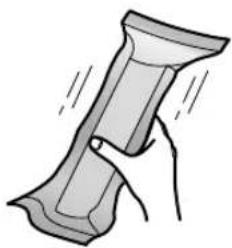
natural_image
Illustration of a hand gripping a mechanical tool or device (no text or symbols visible)2 Remove the new toner cartridge from the protection bag.
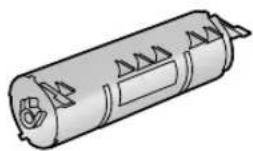
3 Lift the cover release lever (①) and open the top cover (②).
Important:
- Close the multi-purpose input tray (③) before opening the top cover.
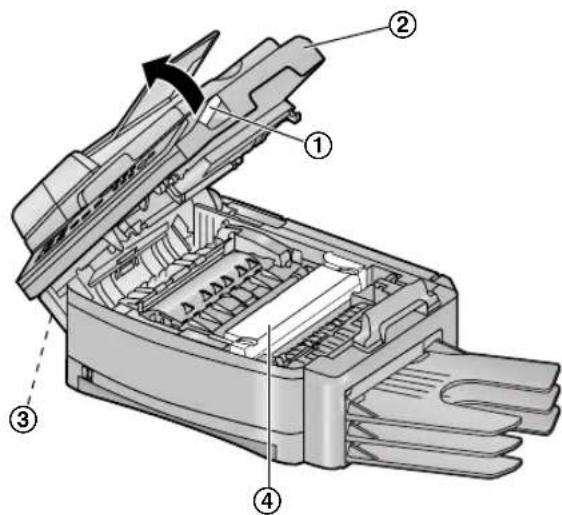

Caution:
The fuser unit (④) gets hot. Do not touch it.
8. Help
4 Tap on the used toner cartridge several times to allow the remaining toner to fall into the drum unit. Remove the drum and toner unit (①) by holding the tabs.
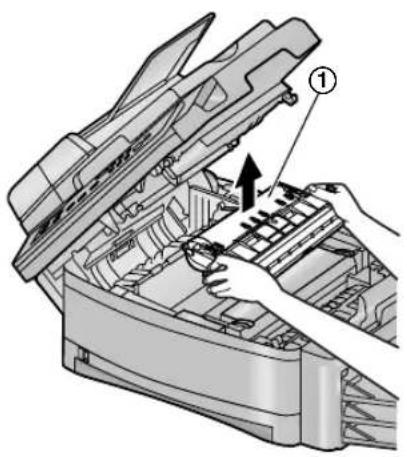
- If you replace the toner cartridge and the drum unit at the same time, skip to step 7.
5 Turn the two green levers (①) on the used toner cartridge firmly.
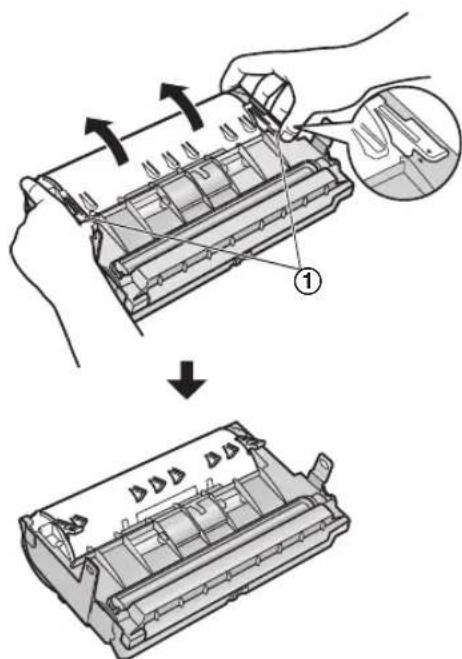
6 Remove the used cartridge (①) from the drum unit (②).
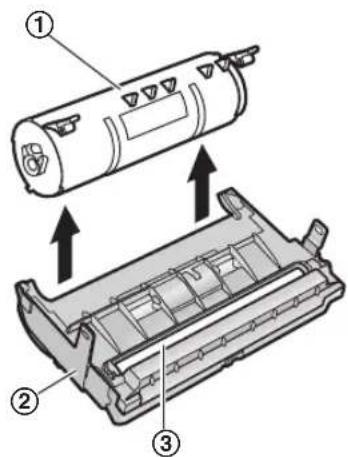
●The toner may stick to the cartridge and the drum unit. Be careful when handling. See page 4 for details.
- Do not drop the toner on the black drum surface (③).
- Put the used toner cartridge into the protection bag.
7 If you replace the drum unit at the same time, remove the new drum unit from the protection bag.
Place the new toner cartridge (①) into the drum unit (②).
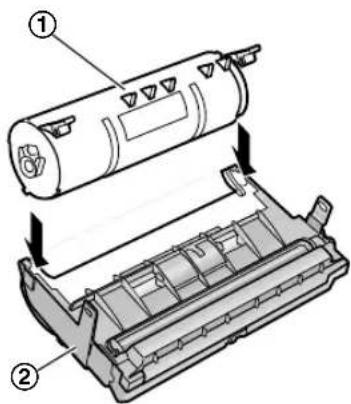
8 Firmly press down the toner cartridge to snap into position.
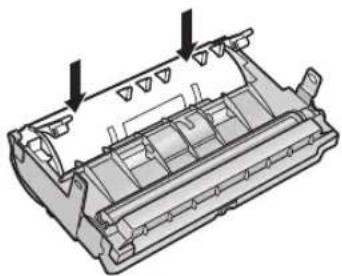
natural_image
3D technical illustration of a mechanical component with internal cavities and mounting holes (no text or symbols)9 Turn the two green levers (①) on the toner cartridge firmly.
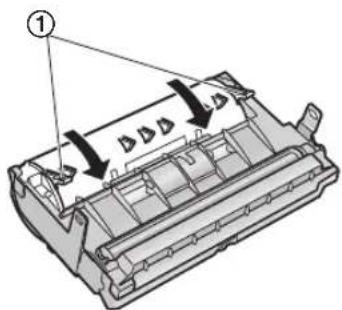
10 Make sure that the triangles (①) match to install the toner cartridge correctly.
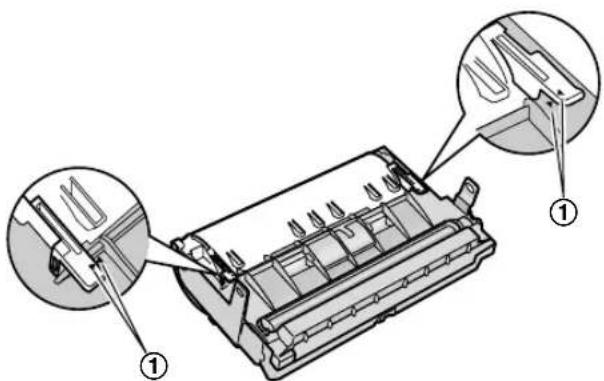
- If the lower glass (②) is dirty, clean it with a soft and dry cloth.
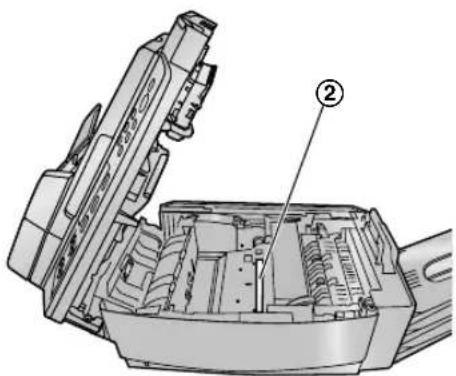
natural_image
Technical diagram of an open mechanical device with internal components and a numbered annotation (no text or symbols present)11 Install the drum and toner unit (①) by holding the tabs.
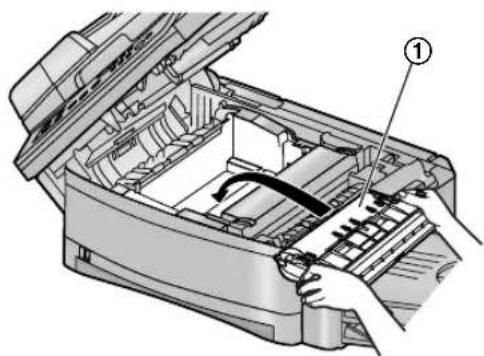
natural_image
Technical illustration of a printer internal structure with hands operating it (no text or symbols visible)- Make sure that the triangles (②) match to install the drum and toner unit correctly.
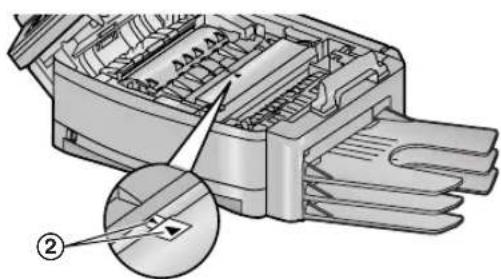
natural_image
Diagram of a printer internal structure showing internal components and a magnified view of the internal structure (no text or symbols present)12 Close the top cover, holding the cover release lever (①). Then push down the right centre edge, until locked.
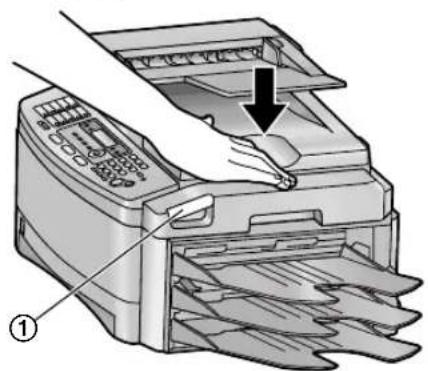
natural_image
Illustration of a printer with paper feed being inserted, showing internal structure and page layout (no text or symbols)Caution:
• To prevent injuries, be careful not to put your hands under the top cover.
Note:
- While the unit displays "PLEASE WAIT", do not open the top cover, or turn the power switch OFF.
Waste disposal method
Waste material should be disposed of under conditions which meet all national and local environmental regulations.
8.5 Recording paper jam
8.5.1 When the recording paper has jammed inside of the unit
The display will show the following.
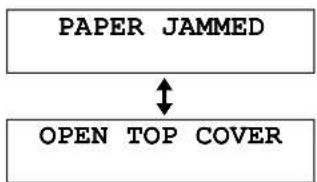
flowchart
graph TD
    A["PAPER JAMMED"] <--> B["OPEN TOP COVER"]
Caution:
- Do not pull out the jammed paper forcibly before opening the top cover.
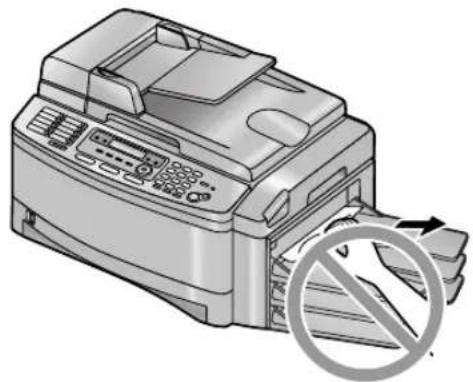
natural_image
Illustration of a printer with a prohibition symbol overlay (no text or symbols on the printer itself)- To prevent injuries, be careful not to put your hands under the top cover.
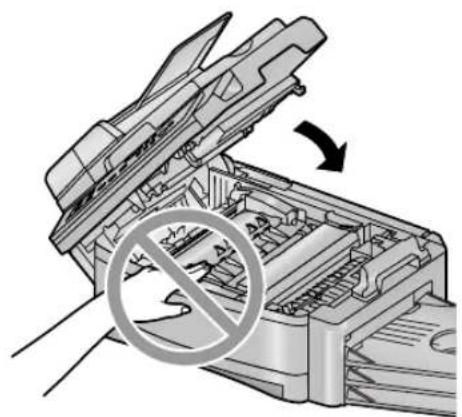
natural_image
Diagram of a printer with an open lid and a prohibition symbol overlay (no text or symbols present)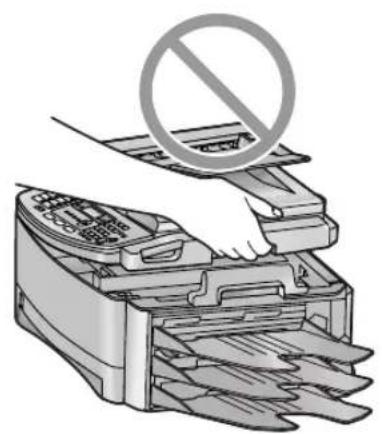
natural_image
Illustration of a hand using a printer to generate leaflets, with no visible text or symbols.1 Lift the cover release lever (①) and open the top cover (②).
Important:
- Close the multi-purpose input tray (③) before opening the top cover.
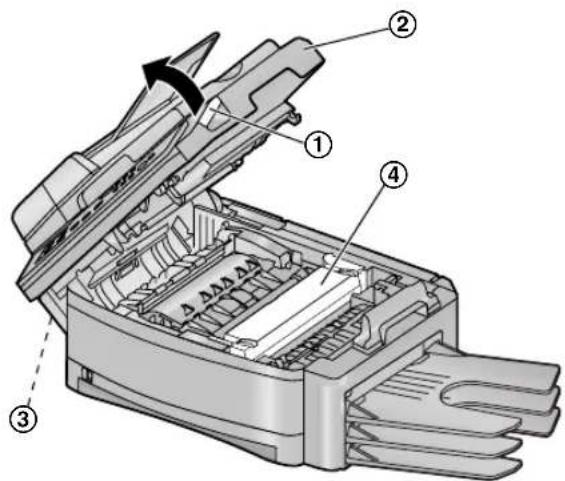

Caution:
The fuser unit (④) gets hot. Do not touch it.
2 Remove the jammed paper.
Case 1:
When the recording paper has jammed near the drum and toner unit:
Remove the jammed paper (①) carefully by pulling it upwards.
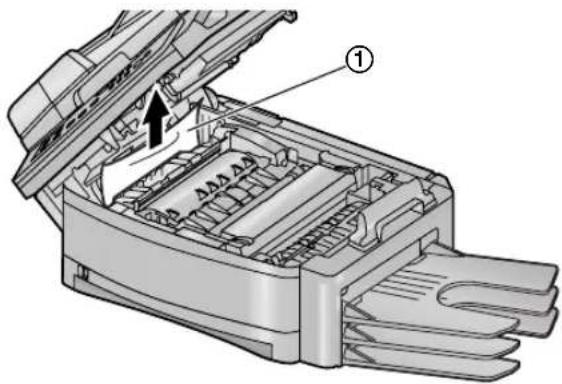
Remove the jammed paper (①) carefully by pulling it to the right.
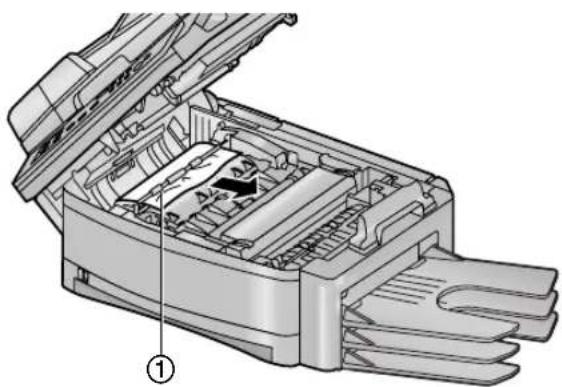
natural_image
Technical illustration of a printer internal structure showing open lid, internal compartments, and paper feed (no text or symbols)Case 2: When the recording paper has jammed near the fuser unit:
- Lift both green levers (①) until they stop.
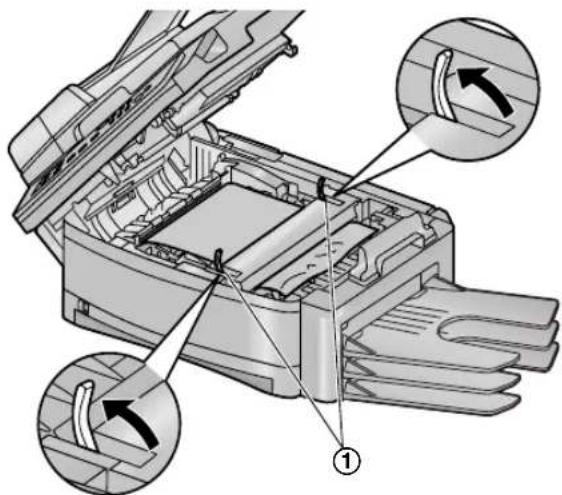
- Remove the jammed paper (①) carefully by pulling it upwards.
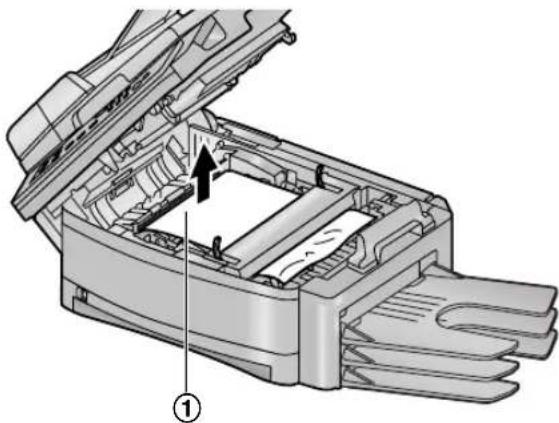
natural_image
Technical illustration of a printer internal structure showing open lid and internal compartments (no text or symbols)- Push back the green levers (①) to the original position.
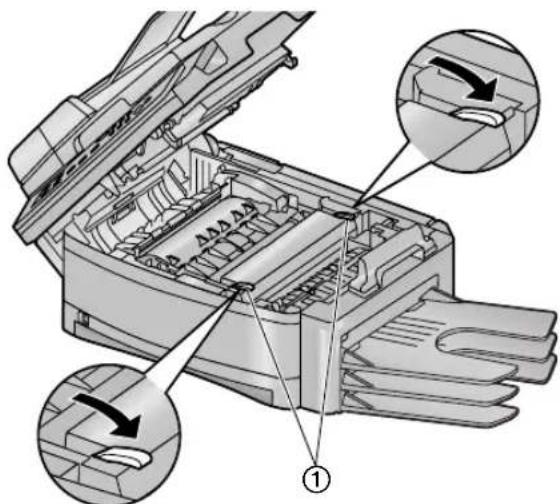
Case 3: When the recording paper has jammed near the output tray:
- Pull and hold the green lever (①) to release the jammed paper.
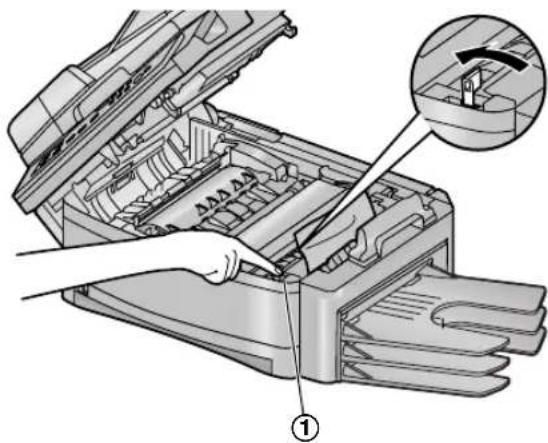
natural_image
Illustration of a printer's internal structure showing the open lid, internal compartments, and a hand inserting a component (no text or symbols present)- Remove the jammed paper (①) carefully by pulling it upwards.
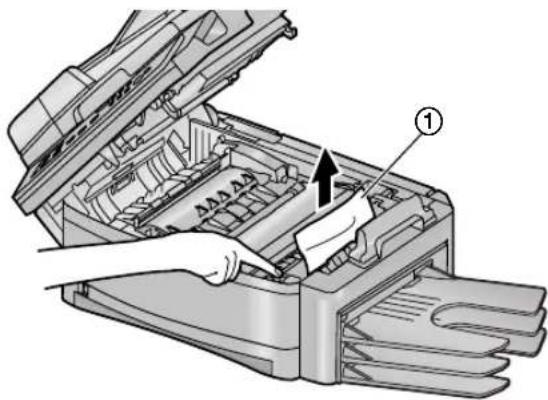
natural_image
Illustration of a printer's open lid and paper holder with a hand inserting a paper into the cover (no text or symbols visible)3 Close the top cover, holding the cover release lever (①). Then push down the right centre edge, until locked.
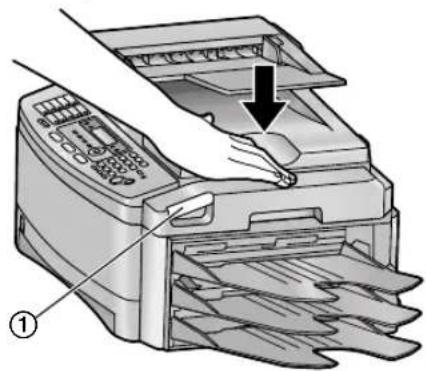
natural_image
Illustration of a printer with a hand inserting a paper into the cover, showing internal structure and page number (no text or symbols)8.5.2 When paper jam occurs near the optional input tray
The display will show the following.
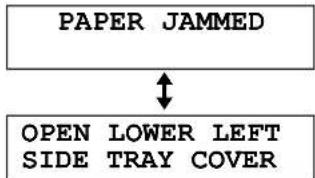
flowchart
graph TD
    A["PAPER JAMMED"] --> B["OPEN LOWER LEFT SIDE TRAY COVER"]
    B --> C["↓"]
    C --> A
1 Open the cover (①) at the left side of the optional input tray.
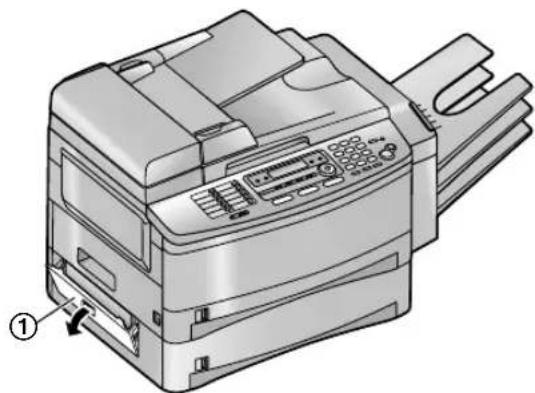
natural_image
Illustration of a printer with control panel and paper feed, labeled with number ① (no text or symbols on the device itself)2 Remove the jammed paper (①).
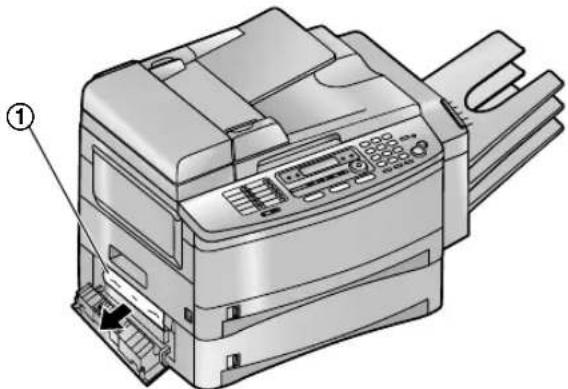
natural_image
Illustration of a printer with internal components and a labeled pin (no text or symbols present)3 Close the cover at the left side of the optional input tray.
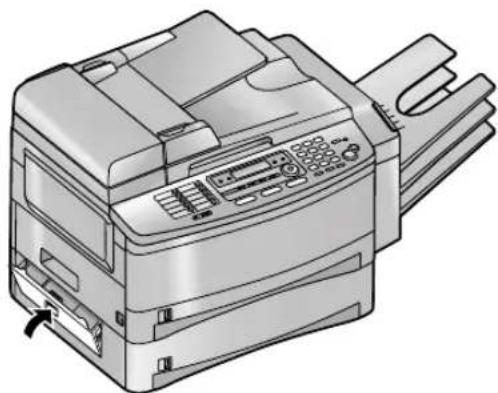
natural_image
Line drawing of a printer with control panel and paper feed (no text or symbols)8.5.3 When the recording paper in the paper input tray / the optional input tray is not fed into the unit properly
The display will show the following.
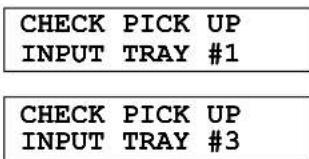
- “#1”: Paper input tray - “#3”: Optional input tray
1 Pull open the input tray, then remove the recording paper and straighten.
2 Re-load the recording paper. Paper input tray:
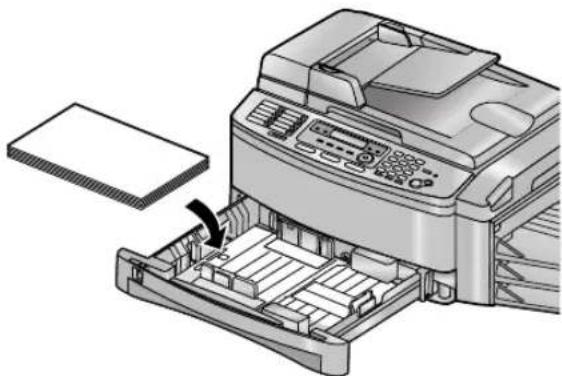
natural_image
Illustration of a printer's internal structure with a paper sheet being inserted (no text or symbols visible)Optional input tray:
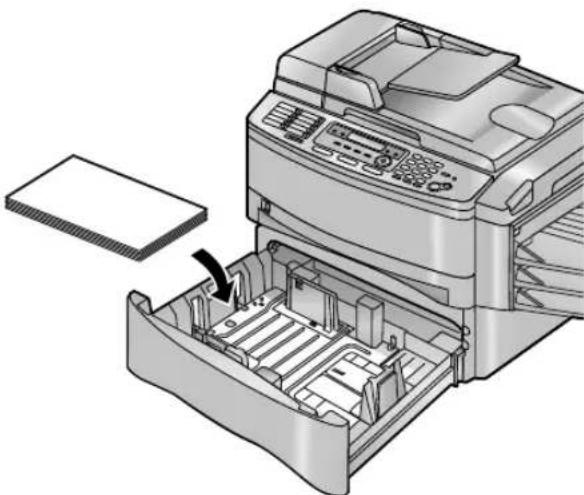
natural_image
Illustration of a printer's internal structure showing paper feeding into a tray (no text or symbols visible)3 Close the input tray.
Note:
- If the error message is still displayed, check the recording paper specifications and re-install recording paper. See page 18 and page 20 for details.
8.5.4 When the recording paper in the multi-purpose input tray is not fed into the unit properly
The display will show the following.
CHECK PICK UP INPUT TRAY #2
1 Remove the recording paper and straighten.
2 Re-insert the recording paper.
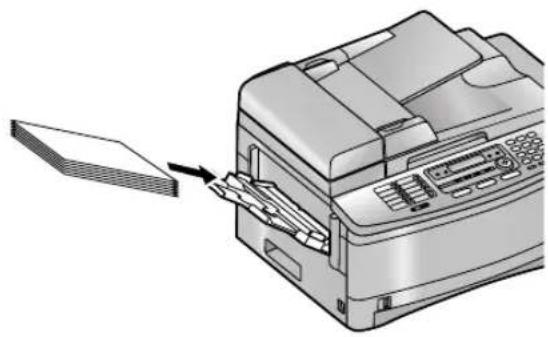
natural_image
Illustration of a printer with a paper clip inserted into the base (no text or symbols visible)Note:
- If the error message is still displayed, check the recording paper specifications and re-install recording paper. See page 20 for details.
8.6 Document jams (Auto document feeder)
Caution:
- Do not pull out the jammed document forcibly before lifting the ADF cover.
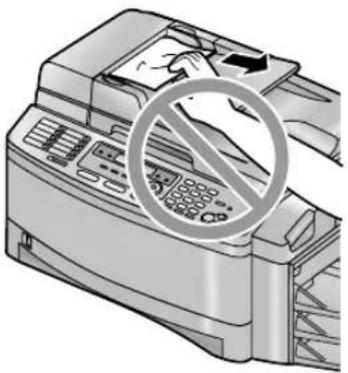
natural_image
Illustration of a printer with a circular overlay showing a prohibition symbol (no text or symbols present)1 Hold the ADF cover (①) firmly and lift it to open the upper part (②) of the ADF cover, then open the whole of the ADF cover.
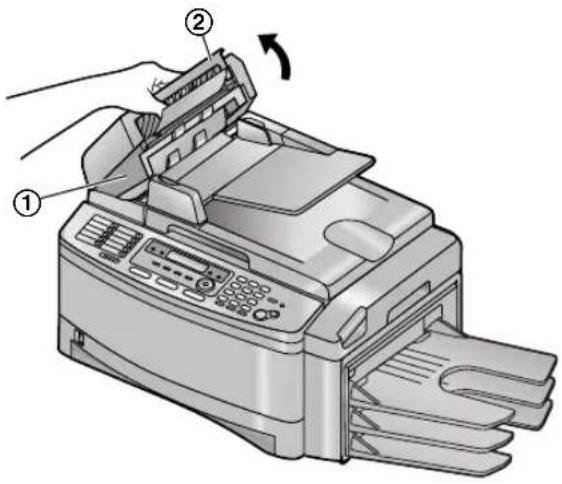
8. Help
2 Remove the jammed document (①) carefully.
When the document has jammed near the document entrance:
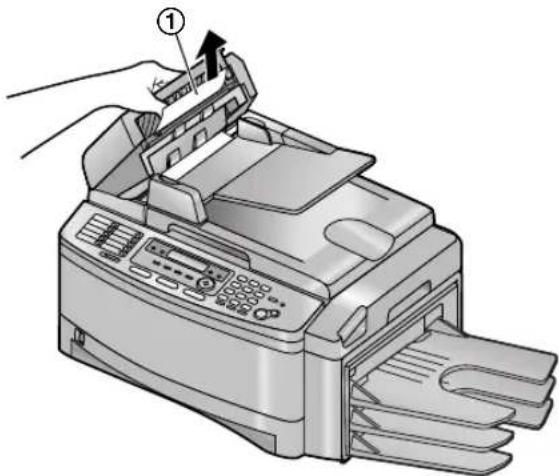
natural_image
Illustration of a printer with a hand inserting a paper into the top panel (no text or symbols visible)When the document has jammed near the document exit:
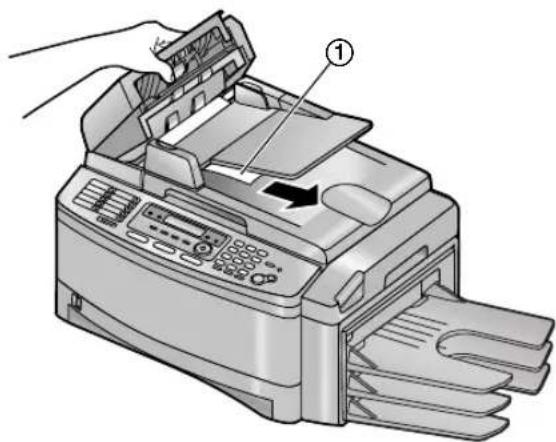
natural_image
Illustration of a printer with a hand inserting a paper into the cover (no text or symbols visible)3 Close the ADF cover.
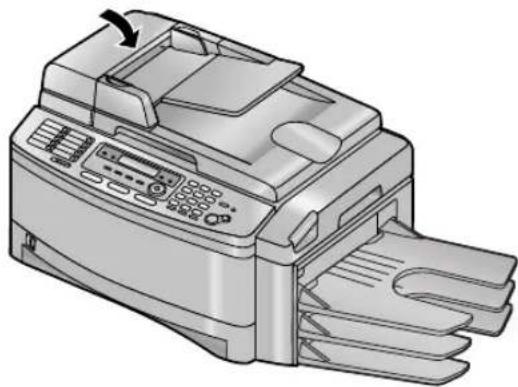
natural_image
Illustration of a printer with paper sheets and control panel (no text or symbols)8.7 Cleaning the white plate and glasses
Clean the white plate and glasses when a black line, a white line or a dirty pattern appears on:
– your recording paper,
– the original document,
– the data scanned by the computer, or
– the fax document received by the other party.
Caution:
- Be careful when handling the drum and toner unit. See the caution for the drum unit on page 81 for details.
- Do not use paper products, such as paper towels or tissues, to clean the inside of the unit.
8.7.1 White plate and scanner glasses
1 Turn the power switch OFF.
2 Hold the ADF cover (①) firmly and lift it to open the upper part (②) of the ADF cover, then open the whole of the ADF cover.
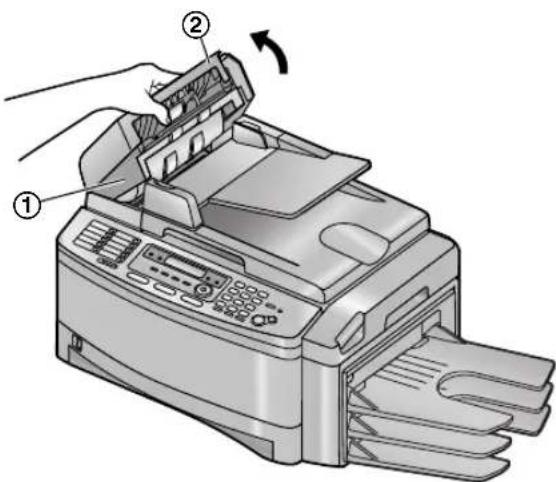
3 Clean the scanner glass (①) and the white cover sheet (②) and its circumference (③) with a soft and dry cloth.
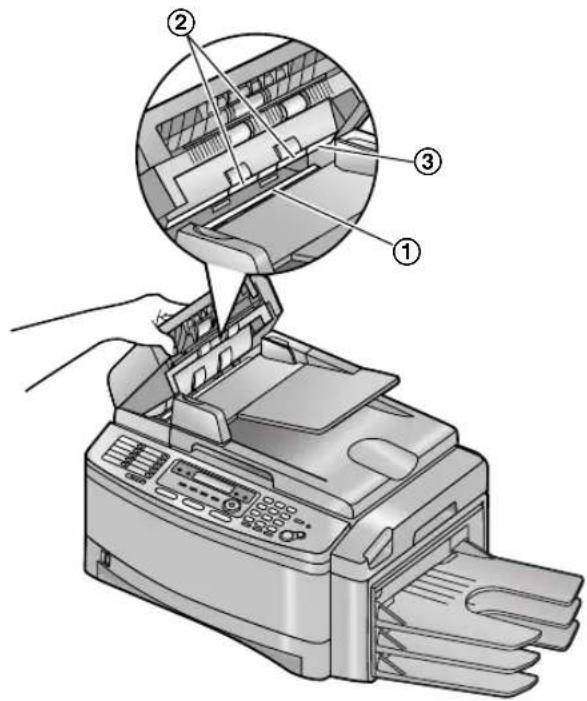
4 Close the ADF cover (①), then hold the document cover (②) while cleaning the white plate (③) and the scanner glass (④).
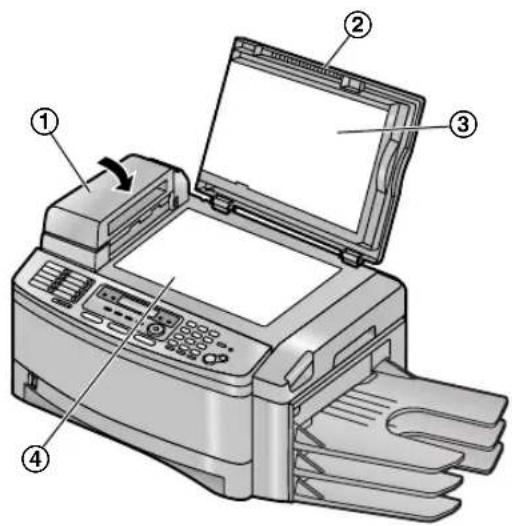
5 Close the document cover (①).
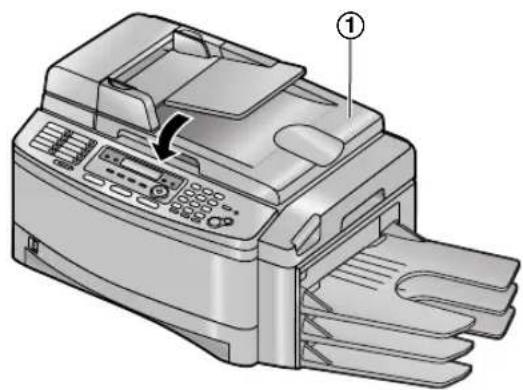
natural_image
Illustration of a printer with paper feed and control panel, showing internal components (no text or symbols)6 Turn the power switch ON.
If the document cover comes off from the unit
- Attach the hinges (①) to the document cover (②).
● Make sure that the inserted direction is correct. Otherwise, the hinges cannot be inserted into the slots in step 3.
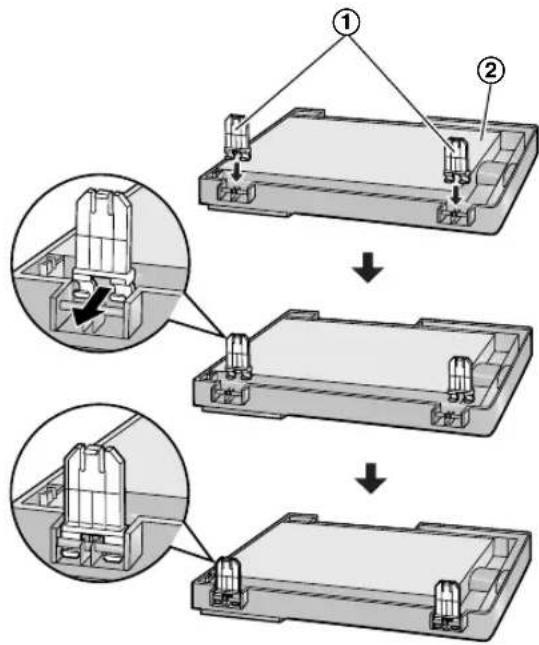
- Lay down the hinges (①).
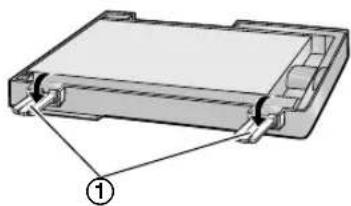
natural_image
Technical diagram of a rectangular electronic component with labeled parts (no text or symbols present)8. Help
- Insert the hinges (①) into the slots (②) on the unit.
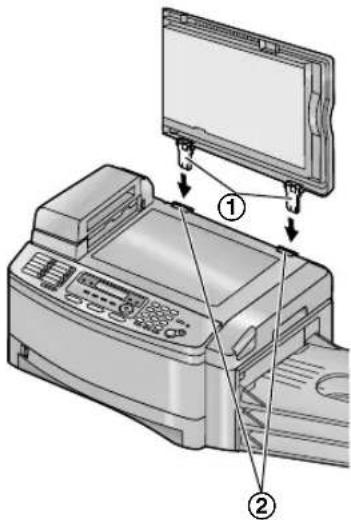
- Close the document cover.
8.7.2 Lower glass
1 Turn the power switch OFF.
2 Lift the cover release lever (①) and open the top cover (②).
Important:
- Close the multi-purpose input tray (③) before opening the top cover.
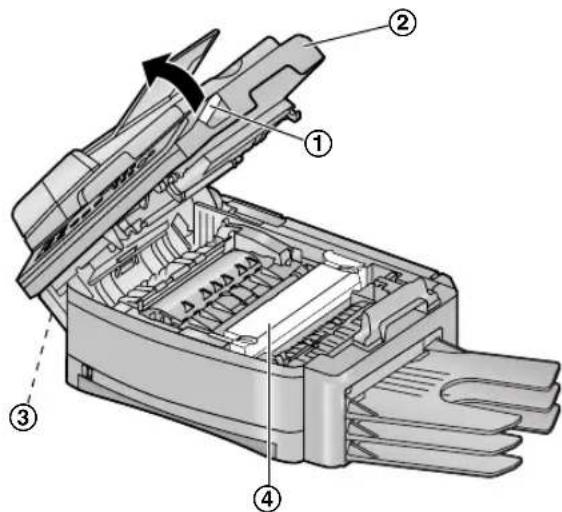

Caution:
The fuser unit (④) gets hot. Do not touch it.
3 Remove the drum and toner unit (①) by holding the tabs.
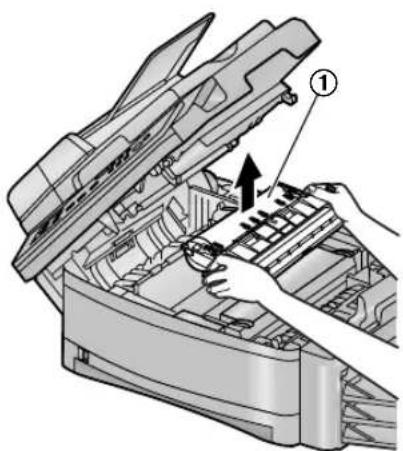
natural_image
Illustration of a printer's open lid with hands operating the tray (no text or symbols visible)4 Clean the lower glass (①) with a soft and dry cloth.
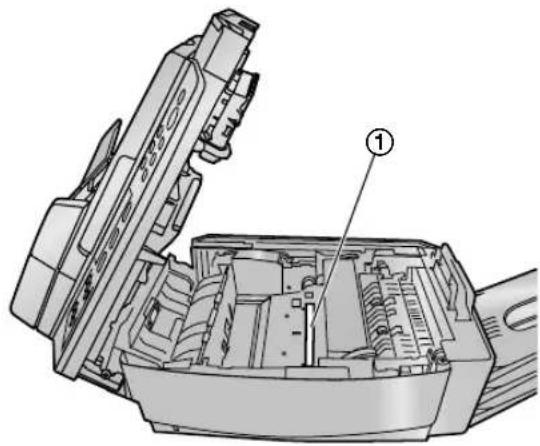
natural_image
Technical diagram of a mechanical device showing internal components and a labeled part (1), no readable text or symbols present.5 Reinstall the drum and toner unit (①) by holding the tabs.
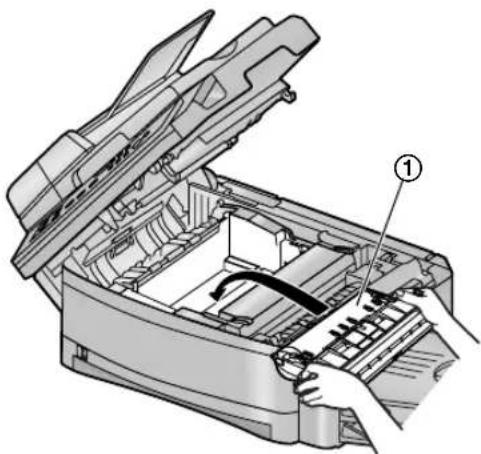
natural_image
Technical illustration of a printer internal structure with hands operating it (no text or symbols visible)- Make sure that the triangles (②) match to install the drum and toner unit correctly.
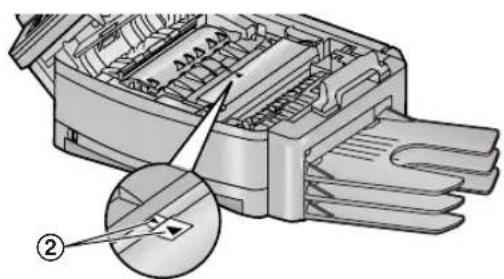
natural_image
Diagram of a printer internal structure showing internal components and a magnified view of the base (no text or symbols present)6 Close the top cover, holding the cover release lever (①). Then push down the right centre edge, until locked.
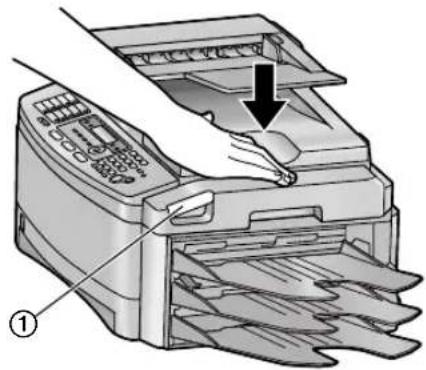
natural_image
Illustration of a printer with paper feed being inserted, showing paper roll and printer casing (no text or symbols)Caution:
- To prevent injuries, be careful not to put your hands under the top cover.
7 Turn the power switch ON.
8.8 Cleaning the document feeder rollers
Clean the rollers when the document or recording paper frequently misfeeds.
1 Turn the power switch OFF.
2 Hold the ADF cover (①) firmly and lift it to open the upper part (②) of the ADF cover, then open the whole of the ADF cover.
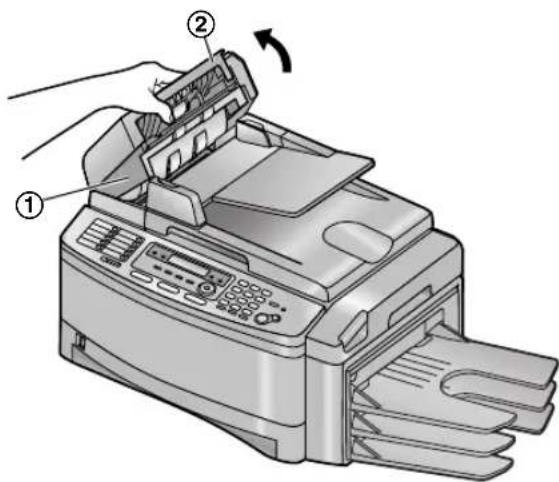
3 Clean the document feeder rollers (①) with a cloth moistened with isopropyl rubbing alcohol, and let all parts dry thoroughly.
- Clean the rollers in the direction of the arrow to avoid the discharge brush (②) from being pulled.
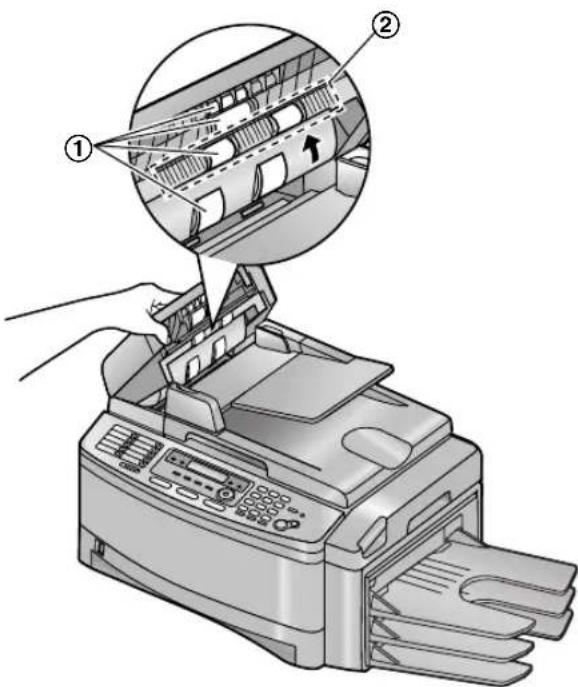
4 Close the ADF cover.
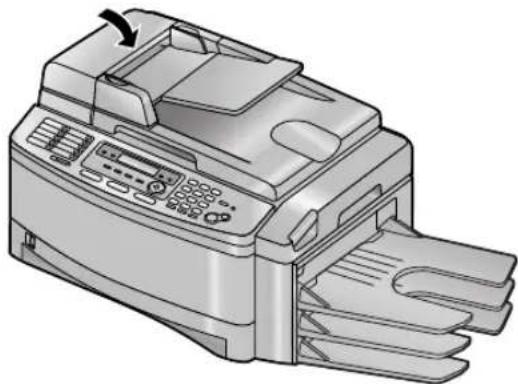
natural_image
Illustration of a printer with paper feed and control panel (no text or symbols)5 Turn the power switch ON.
9.1 Reference lists and reports
You can print out the following lists and reports for your reference.
- "SETUP LIST":
Provides you with the current settings of the programming features (page 63 to page 70).
- "TEL NO. LIST":
Provides you with names and numbers which are stored in the one-touch dial feature and navigator directory.
- "JOURNAL REPORT":
Keeps records of fax transmission and reception. This report can be printed automatically after every 30 fax communications (feature #402 on page 65).
- "BROADCAST LIST":
Provides you with names and numbers which are stored in the broadcast memory (page 35).
- "PRINTER TEST":
Allows you to check the print quality of your unit. If the test print has a dirty pattern, or blurred points or lines, clean the inside of the unit (page 88, 92). If printing quality is still poor, replace the toner cartridge and drum unit.
- "CALLER ID LIST":
Keeps a record of the last 30 different callers after subscribing to a Caller ID service. To print automatically after every 30 new calls, activate feature #216 (page 63).
![[MENU] [SET] [◀][▶]](/content/2026/06/1190729/images/e9b6ff8d27cd22aade849bf8e9c485ef250cae9df9b6e09aa6a2c66dadbb105e.jpg)
1 Press [MENU] repeatedly to display "PRINT REPORT".
2 Press [◀] or [▶] repeatedly to display the desired item.
3 Press [SET] to start printing.
4 Press [MENU].
9.2 Specifications
■ Applicable lines:
Public Switched Telephone Network
■ Document size:
Max. 216 mm in width, Max. 600 mm in length
■ Effective scanning width:
208 mm
■ Effective printing width:
A4: 202 mm
Letter/Legal: 208 mm
■ Transmission time ^*1 :
Approx. 4 s/page (ECM-MMR Memory transmission) ^2
■ Scanning density:
Fax resolution:
Horizontal: 8 pels/mm
Vertical: 3.85 lines/mm-in standard resolution,
7.7 lines/mm-in fine/photo resolution,
15.4 lines/mm-in super fine resolution
Copy resolution:
Up to 600 × 600 dpi
Scanning resolution:
Up to 600 × 1,200 dpi (Optical)
Up to 9,600 × 9,600 dpi (Interpolated)
■ Photo resolution:
64-level
Scanner type:
Charge Coupled Device (CCD)
■ Printer type:
Laser Printer
■ Data compression system:
Modified Huffman (MH), Modified READ (MR), Modified Modified READ (MMR)
■ Modem speed:
33,600 / 31,200 / 28,800 / 26,400 / 24,000 /
21,600 / 19,200 / 16,800 / 14,400 / 12,000 /
9,600 / 7,200 / 4,800 / 2,400 bps; Automatic
Fallback
■ Operating environment:
10 °C – 32.5 °C, 20 % – 80 % RH (Relative Humidity)
■ Dimensions:
Approx. height 312 mm × width 773 mm × depth 444 mm
■ Mass (Weight):
Approx. 18 kg
■ Power consumption:
Standby: Approx. 11 W
Transmission: Approx. 28 W
Reception: Approx. 400 W
Copy: Approx. 430 W
Maximum: Approx. 900 W (When the fuser lamp turns on)
■ Power supply:
220 - 240 V AC, 50 Hz
■ Fax memory capacity:
10 MB in total
Approx. 630 pages of memory reception with back-up
(Max. 255 pages per one reception)
Approx. 150 pages of memory transmission
(Based on the ITU-T No. 1 Test Chart in standard resolution.)
■ Laser diode properties:
Laser output: Max. 5 mW
Wave length: 760 nm – 800 nm
Emission duration: Continuous
■ Print speed:
Approx. 18 ppm (pages per minute)
■ Printing resolution:
600 × 600 dpi
*1 Transmission speed depends upon the contents of the pages, resolution, telephone line conditions and capability of the other party's machine.
*2 Transmission speed is based upon the ITU-T No. 1 Test Chart. If the capability of the other party's machine is inferior to your unit, the transmission time may be longer.
ITU-T No.1 Test Chart
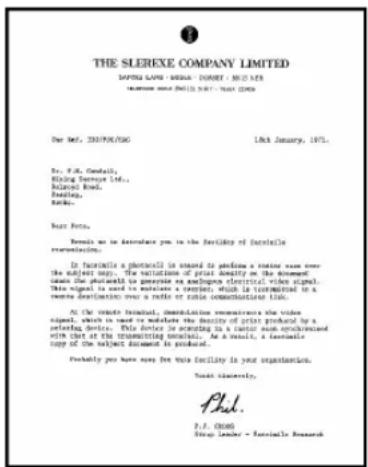
Note:
- Design and specifications are subject to change without notice.
- The pictures and illustrations in these instructions may vary slightly from the actual product.
Recording paper specifications
Recording paper / Transparency / Label size:
A4: 210 mm × 297 mm
Letter: 216 mm × 279 mm
Legal: 216mm × 356 mm
Envelope size:
10: 105 mm × 241 mm
DL: 110 mm × 220 mm
Recording paper weight:
60 g/m² to 90 g/m²
Note for recording paper:
- We recommend that you test paper (especially special sizes and types of paper) on the unit before purchasing large quantities.
-
Do not use the following types of paper:
-
Paper with a cotton and/or fibre content that is over 20% , such as letterhead paper or paper used for resumes
- Extremely smooth or shiny paper, or paper that is highly textured
– Coated, damaged or wrinkled paper
– Paper with foreign objects attached, such as tabs or staples
– Paper which has dust, lint or oil stains - Paper that will melt, vaporize, discolour, scorch or emit dangerous fumes near 200^ , such as vellum paper. These materials may transfer onto the fusing roller and cause damage.
- Moist paper
- Inkjet paper
- Some paper only accepts print on one side. Try using the other side of the paper if you are not happy with the print quality or if misfeeding occurs.
- For proper paper feeding and best print quality, we recommend using long-grained paper.
- Do not use paper of different types or thickness at the same time. This may cause a paper jam.
- Avoid double-sided printing.
- Do not use paper printed from this unit for double-sided printing with other copiers or printers. This may cause a paper jam.
● To avoid curling, do not open paper packs until you are ready to use the paper. Store unused paper in the original packaging, in a cool and dry location.
Toner life
Toner life depends on the amount of content in a received, copied or printed document. The following is the approximate relationship between image area and toner life for replacement toner cartridge (Model No. KX-FA85X). Toner life varies in actual usage.
5 % image area
Approx. 5,000 sheets of A4 size paper can be printed.
10 % image area
Approx. 2,500 sheets of A4 size paper can be printed.
15 % image area
Approx. 1,600 sheets of A4 size paper can be printed.
Note:
●The image area changes with the depth, thickness and size of the characters.
- If you turn on the toner save feature, the toner cartridge will last approx. 40% longer.
Drum life
The drum unit is a consumable item and needs to be replaced regularly. There are various factors that determine the actual drum life, such as temperature, humidity, type of paper and how much toner you use for the number of sheets per print job. The estimated drum life is approx. 10,000 sheets. The actual number of sheets your drum will print may be significantly less than these estimates. Because many of the factors that determine the actual drum life cannot be controlled, we cannot guarantee a minimum number of sheets that will be printed by your drum.
9.3 Condition of guarantee
- This machine is supplied with a one year swap out warranty. Please retain your Proof of Purchase and Packaging in the unlikely event that your machine should require attention. For further information please contact us on 08701 580560 for UK or 01 6130082 for the Republic of Ireland, in addition you can visit our web site at www.panasonic.co.uk
- This warranty is in addition to and does not in any way affect any statutory or other right of consumer purchasers. This warranty relates only to product used within Mainland Great Britain, please refer to your dealer warranty information relating to use elsewhere within the United Kingdom and Ireland.
- This product is designed for use only on the United Kingdom and Ireland's Public Switched Telephone Network and should be used only for normal purposes and in accordance with standard operating instructions.
- You should complete the registration form overleaf and fax it to us with 7 days of purchase; failure to do so may result in delays in providing warranty service.
- This warranty covers breakdowns due to design or manufacturing faults; it does not apply to damage, however caused, wear or tear, neglect, incorrect adjustment or repair, or to any items of limited natural life.
- This warranty does not cover consumables, i.e. ink films, film refills, ink cartridges, toner cartridges, drum units, paper and paper loads or any optional accessories which may have been purchased either at the same time as, or subsequent to, the main unit. Such accessories should be returned to the point of purchase if found to be faulty.
- In the event of a failure, please take the following action;
a) Refer to the "Help" section of your instruction manual in order to identify and possibly correct the problem:
b) If the problem is not resolved after referring to the user guide, please contact our customer helpline on 08701 580560 for UK or 01 6130082 for the Republic of Ireland - In the event the helpline cannot resolve the problem, a like for like exchange fax will be despatched. The helpline operator will give you specific instructions on how the exchange will be executed. Failure to comply with these instructions may result in delay and cost to you.
- The exchange fax will be delivered in a customised case by courier. It is the customer's responsibility to promptly remove the exchange fax and insert the faulty fax in the case provided for collection, to enable the courier to return it to Panasonic.
- The exchange fax is to be regarded as a like for like exchange under warranty and the balance of the warranty period will transfer to the exchange unit. The purchaser's sole and exclusive remedy under this guarantee against Panasonic is for the repair or replacement of the appliance or any defective parts and no other remedy, including, but not limited to; incidental or consequential damage or loss of whatsoever nature shall be available to the purchaser.
- Where the original fax is found to be faulty as a result of unauthorised repairs or modifications or damage either by accident, misuse or improper installation then Panasonic reserves the right to charge the customer a contribution towards repair costs.
- If at any time during the guarantee period any parts of the appliance are replaced with parts not supplied or approved by us or of an objective quality, safe and suitable for the appliance, or has been dismantled or repaired by any person not authorised by us, we shall have the right to terminate this guarantee in whole or in part immediately without further notice.
- This warranty applies to the original purchaser only and is not transferable.
- The warranty period applicable to this product shall be 12 months from the date of purchase.
Please keep these Operating Instructions with your receipt.
Panasonic Business Systems U.K.
| Receipt No. ____ | Date of Purchase ____ |
| Model No. KX-FLB851E____ | Serial No. ____ |
9.4 Information of copyrights and licenses
●This product uses a part of NetBSD kernel.
The use of a part of NetBSD kernel is based on the typical BSD style license below.
Copyright (c)
The Regents of the University of California. All rights reserved.
Redistribution and use in source and binary forms, with or without modification, are permitted provided that the following conditions are met:
- Redistributions of source code must retain the above copyright notice, this list of conditions and the following disclaimer.
- Redistributions in binary form must reproduce the above copyright notice, this list of conditions and the following disclaimer in the documentation and/or other materials provided with the distribution.
- All advertising materials mentioning features or use of this software must display the following acknowledgement:
This product includes software developed by the University of California, Berkeley and its contributors. - Neither the name of the University nor the names of its contributors may be used to endorse or promote products derived from this software without specific prior written permission.
THIS SOFTWARE IS PROVIDED BY THE REGENTS AND CONTRIBUTORS ``AS IS'' AND ANY EXPRESS OR IMPLIED WARRANTIES, INCLUDING, BUT NOT LIMITED TO, THE IMPLIED WARRANTIES OF MERCHANTABILITY AND FITNESS FOR A PARTICULAR PURPOSE ARE DISCLAIMED. IN NO EVENT SHALL THE REGENTS OR CONTRIBUTORS BE LIABLE FOR ANY DIRECT, INDIRECT, INCIDENTAL, SPECIAL, EXEMPLARY, OR CONSEQUENTIAL DAMAGES (INCLUDING, BUT NOT LIMITED TO, PROCUREMENT OF SUBSTITUTE GOODS OR SERVICES; LOSS OF USE, DATA, OR PROFITS; OR BUSINESS INTERRUPTION) HOWEVER CAUSED AND ON ANY THEORY OF LIABILITY, WHETHER IN CONTRACT, STRICT LIABILITY, OR TORT (INCLUDING NEGLIGENCE OR OTHERWISE) ARISING IN ANY WAY OUT OF THE USE OF THIS SOFTWARE, EVEN IF ADVISED OF THE POSSIBILITY OF SUCH DAMAGE.
However, parts of the NetBSD Kernel are provided with the following copyright notices.
Copyright (c) 1980, 1983, 1988, 1993 The Regents of the University of California. All rights reserved.
Copyright (c) 1980, 1986, 1989, 1993 The Regents of the University of California. All rights reserved.
Copyright (c) 1980, 1986, 1991, 1993 The Regents of the University of California. All rights reserved.
Copyright (c) 1980, 1986, 1993 The Regents of the University of California. All rights reserved.
Copyright (c) 1982, 1985, 1986, 1988, 1993, 1994 The Regents of the University of California. All rights reserved.
Copyright (c) 1982, 1986, 1988, 1990, 1993 The Regents of the University of California. All rights reserved.
Copyright (c) 1982, 1986, 1988, 1990, 1993, 1994, 1995 The Regents of the University of California. All rights reserved.
Copyright (c) 1982, 1986, 1988, 1990, 1993, 1995 The Regents of the University of California. All rights reserved.
Copyright (c) 1982, 1986, 1988, 1991, 1993 The Regents of the University of California. All rights reserved.
Copyright (c) 1982, 1986, 1988, 1993 The Regents of the University of California. All rights reserved.
Copyright (c) 1982, 1986, 1988, 1993, 1995 The Regents of the University of California. All rights reserved.
Copyright (c) 1982, 1986, 1989, 1991, 1993 The Regents of the University of California. All rights reserved.
Copyright (c) 1982, 1986, 1989, 1993 The Regents of the University of California. All rights reserved.
Copyright (c) 1982, 1986, 1990, 1991, 1993 The Regents of the University of California. All rights reserved.
Copyright (c) 1982, 1986, 1990, 1993 The Regents of the University of California. All rights reserved.
Copyright (c) 1982, 1986, 1990, 1993, 1994 The Regents of the University of California. All rights reserved.
Copyright (c) 1982, 1986, 1991, 1993 The Regents of the University of California. All rights reserved.
Copyright (c) 1982, 1986, 1991, 1993, 1994 The Regents of the University of California. All rights reserved.
Copyright (c) 1982, 1986, 1991, 1993, 1995 The Regents of the University of California. All rights reserved.
Copyright (c) 1982, 1986, 1993 The Regents of the University of California. All rights reserved.
Copyright (c) 1982, 1986, 1993, 1994 The Regents of the University of California. All rights reserved.
Copyright (c) 1982, 1986, 1993, 1994, 1995 The Regents of the University of California. All rights reserved.
Copyright (c) 1982, 1986, 1993, 1995 The Regents of the University of California. All rights reserved.
Copyright (c) 1982, 1988, 1991, 1993 The Regents of the University of California. All rights reserved.
Copyright (c) 1983, 1990, 1993 The Regents of the University of California. All rights reserved.
Copyright (c) 1983, 1993 The Regents of the University of California. All rights reserved.
Copyright (c) 1985, 1986, 1993 The Regents of the University of California. All rights reserved.
Copyright (c) 1985, 1986, 1993 The Regents of the University of California. All rights reserved.
Copyright (c) 1986, 1989, 1991, 1993 The Regents of the University of California. All rights reserved.
Copyright (c) 1986, 1993 The Regents of the University of California. All rights reserved.
Copyright (c) 1987, 1991, 1993 The Regents of the University of California. All rights reserved.
Copyright (c) 1987, 1993 The Regents of the University of California. All rights reserved.
Copyright (c) 1987, 1993 The Regents of the University of California. All rights reserved.
Copyright (c) 1988 Regents of the University of California. All rights reserved
Copyright (c) 1988 Stephen Deering.
Copyright (c) 1988 University of Utah.
Copyright (c) 1988, 1989, 1993 The Regents of the University of California. All rights reserved.
Copyright (c) 1988, 1991, 1993 The Regents of the University of California. All rights reserved.
Copyright (c) 1988, 1992, 1993 The Regents of the University of California. All rights reserved.
Copyright (c) 1988, 1993 The Regents of the University of California. All rights reserved.
Copyright (c) 1989 The Regents of the University of California. All rights reserved.
Copyright (c) 1989, 1991, 1993 The Regents of the University of California. All rights reserved.
Copyright (c) 1989, 1993 The Regents of the University of California. All rights reserved.
Copyright (c) 1989, 1993, 1994 The Regents of the University of California. All rights reserved.
Copyright (c) 1990, 1991, 1993 The Regents of the University of California. All rights reserved.
Copyright (c) 1990, 1993 The Regents of the University of California. All rights reserved.
Copyright (c) 1991, 1993 The Regents of the University of California. All rights reserved.
Copyright (c) 1991, 1993, 1994 The Regents of the University of California. All rights reserved.
Copyright (c) 1992 Regents of the University of California. All rights reserved.
Copyright (c) 1992, 1993 The Regents of the University of California. All rights reserved.
Copyright (c) 1993 The Regents of the University of California. All rights reserved.
Copyright (c) 1993 Adam Glass
Copyright (C) 1993 by Sun Microsystems, Inc. All rights reserved.
Copyright (c) 1994 Gordon W. Ross
Copyright (c) 1994 Winning Strategies, Inc. All rights reserved.
Copyright (c) 1995 The Regents of the University of California. All rights reserved.
Copyright (C) 1995, 1996, 1997, and 1998 WIDE Project. All rights reserved.
Copyright (c) 1996 The Regents of the University of California. All rights reserved.
Copyright (c) 1996 John S. Dyson All rights reserved.
Copyright (c) 1996 Matt Thomas. All rights reserved.
Copyright (c) 1996 Matthew R. Green. All rights reserved.
Copyright (c) 1996 Paul Kranenburg
Copyright (c) 1996, 1997, 1999, 2001 The NetBSD Foundation, Inc. All rights reserved.
Copyright (c) 1996, 2000 Christopher G. Demetriou. All rights reserved.
Copyright (c) 1996,1999 by Internet Software Consortium.
Copyright (c) 1996-1999 by Internet Software Consortium.
Copyright (c) 1997 Jonathan Stone and Jason R. Thorpe. All rights reserved.
Copyright (c) 1997 Christos Zoulas. All rights reserved.
Copyright (c) 1997 Manuel Bouyer. All rights reserved.
Copyright (c) 1997, 1998 The NetBSD Foundation, Inc. All rights reserved.
Copyright (c) 1997, 1998, 1999, 2000 The NetBSD Foundation, Inc. All rights reserved.
Copyright (c) 1997, 1998, 1999, 2001 The NetBSD Foundation, Inc. All rights reserved.
Copyright (c) 1997, 1998, 1999, 2002 The NetBSD Foundation, Inc. All rights reserved.
Copyright (c) 1997, 1998, 2000, 2001 The NetBSD Foundation, Inc. All rights reserved.
Copyright (c) 1997, 1998, 2001 The NetBSD Foundation, Inc. All rights reserved.
Copyright (c) 1997,98 The NetBSD Foundation, Inc. All rights reserved.
Copyright (C) 1997-2000 Sony Computer Science Laboratories Inc. All rights reserved.
Copyright (c) 1997-2002 The NetBSD Foundation, Inc. All rights reserved.
Copyright (c) 1998 The NetBSD Foundation, Inc. All rights reserved.
Copyright (c) 1998 Todd C. Miller Todd.Miller@courtesan.com All rights reserved.
Copyright (c) 1998, 1999 The NetBSD Foundation, Inc. All rights reserved.
Copyright (c) 1998, 1999, 2000 The NetBSD Foundation, Inc. All rights reserved.
Copyright (c) 1998, 1999, 2000, 2001 The NetBSD Foundation, Inc. All rights reserved.
Copyright (c) 1998, 2000 The NetBSD Foundation, Inc. All rights reserved.
Copyright (c) 1998, 2000, 2001 The NetBSD Foundation, Inc. All rights reserved.
Copyright (c) 1999 The NetBSD Foundation, Inc. All rights reserved.
Copyright (C) 1999 WIDE Project. All rights reserved.
Copyright (c) 1999, 2000 Jason L. Wright (jason@thought.net) All rights reserved.
Copyright (c) 1999, 2000 The NetBSD Foundation, Inc. All rights reserved.
Copyright (c) 1999, 2000, 2001 The NetBSD Foundation, Inc. All rights reserved.
Copyright (c) 1999, 2001 The NetBSD Foundation, Inc. All rights reserved.
Copyright (c) 2000 The NetBSD Foundation, Inc. All rights reserved.
Copyright (c) 2000, 2001 The NetBSD Foundation, Inc. All rights reserved.
Copyright (c) 2000, 2001, 2002 The NetBSD Foundation, Inc. All rights reserved.
Copyright (c) 2001 The NetBSD Foundation, Inc. All rights reserved.
Copyright (c) 2002 The NetBSD Foundation, Inc. All rights reserved.
Copyright 1998 Massachusetts Institute of Technology. All rights reserved.
Copyright 2001 Wasabi Systems, Inc. All rights reserved.
Portions Copyright (c) 1993 by Digital Equipment Corporation.
Portions Copyright (c) 1995 by International Business Machines, Inc.
Copyright (c) 1983, 1989 The Regents of the University of California. All rights reserved.
Copyright (c) 1996 by Internet Software Consortium. All rights reserved.
Copyright (c) 1980, 1986, 1989 Regents of the University of California. All rights reserved.
Copyright (c) 1988 The Regents of the University of California. All rights reserved.
Copyright (c) 1992, 1993 The Regents of the University of California. All rights reserved.
Copyright (c) 1994 Christopher G. Demetriou. All rights reserved.
Copyright (c) 1997 The NetBSD Foundation, Inc. All rights reserved.
Copyright (c) 1999 The NetBSD Foundation, Inc. All rights reserved.
Copyright (c) 2001 The NetBSD Foundation, Inc. All rights reserved.
Copyright (c) 1996 Gardner Buchanan gbuchanan@shl.com All rights reserved.
Parts of the NetBSD Kernel are provided with the licenses that are slightly different from the above Berkeley-formed license. Please refer the source code of the NetBSD Kernel about the details.
The source code of the NetBSD Kernel is provided by the NetBSD CVS Repositories (http://cvsweb.netbsd.org/bsdweb.cgi/), and this product includes parts of the source code in the following directories.
http://cvsweb.netbsd.org/bsdweb.cgi/src/sys/kern/
http://cvsweb.netbsd.org/bsdweb.cgi/src/sys/net/
http://cvsweb.netbsd.org/bsdweb.cgi/src/sys/netinet/
- This product contains Net-SNMP software and is using it based on the following license conditions.
---- Part 1: CMU/UCD copyright notice: (BSD like) ----
Copyright 1989, 1991, 1992 by Carnegie Mellon University
Derivative Work - 1996, 1998-2000
Copyright 1996, 1998-2000 The Regents of the University of California
All Rights Reserved
Permission to use, copy, modify and distribute this software and its documentation for any purpose and without fee is hereby granted, provided that the above copyright notice appears in all copies and that both that copyright notice and this permission notice appear in supporting documentation, and that the name of CMU and The Regents of the University of California not be used in advertising or publicity pertaining to distribution of the software without specific written permission.
CMU AND THE REGENTS OF THE UNIVERSITY OF CALIFORNIA DISCLAIM ALL WARRANTIES WITH REGARD TO THIS SOFTWARE, INCLUDING ALL IMPLIED WARRANTIES OF MERCHANTABILITY AND FITNESS. IN NO EVENT SHALL CMU OR THE REGENTS OF THE UNIVERSITY OF CALIFORNIA BE LIABLE FOR ANY SPECIAL, INDIRECT OR CONSEQUENTIAL DAMAGES OR ANY DAMAGES WHATSOEVER RESULTING FROM THE LOSS OF USE, DATA OR PROFITS, WHETHER IN AN ACTION OF CONTRACT, NEGLIGENCE OR OTHER TORTIOUS ACTION, ARISING OUT OF OR IN CONNECTION WITH THE USE OR PERFORMANCE OF THIS SOFTWARE.
---- Part 2: Networks Associates Technology, Inc copyright notice (BSD) ----
Copyright (c) 2001-2003, Networks Associates Technology, Inc All rights reserved.
Redistribution and use in source and binary forms, with or without modification, are permitted provided that the following conditions are met:
* Redistributions of source code must retain the above copyright notice, this list of conditions and the following disclaimer.
* Redistributions in binary form must reproduce the above copyright notice, this list of conditions and the following disclaimer in the documentation and/or other materials provided with the distribution.
* Neither the name of the Networks Associates Technology, Inc nor the names of its contributors may be used to endorse or promote products derived from this software without specific prior written permission.
THIS SOFTWARE IS PROVIDED BY THE COPYRIGHT HOLDERS AND CONTRIBUTORS ``AS IS'' AND ANY EXPRESS OR IMPLIED WARRANTIES, INCLUDING, BUT NOT LIMITED TO, THE IMPLIED WARRANTIES OF MERCHANTABILITY AND FITNESS FOR A PARTICULAR PURPOSE ARE DISCLAIMED. IN NO EVENT SHALL THE COPYRIGHT HOLDERS OR CONTRIBUTORS BE LIABLE FOR ANY DIRECT, INDIRECT, INCIDENTAL, SPECIAL, EXEMPLARY, OR CONSEQUENTIAL DAMAGES (INCLUDING, BUT NOT LIMITED TO, PROCUREMENT OF SUBSTITUTE GOODS OR SERVICES; LOSS OF USE, DATA, OR PROFITS; OR BUSINESS INTERRUPTION) HOWEVER CAUSED AND ON ANY THEORY OF LIABILITY, WHETHER IN CONTRACT, STRICT LIABILITY, OR TORT (INCLUDING NEGLIGENCE OR OTHERWISE) ARISING IN ANY WAY OUT OF THE USE OF THIS SOFTWARE, EVEN IF ADVISED OF THE POSSIBILITY OF SUCH DAMAGE.
---- Part 3: Cambridge Broadband Ltd. copyright notice (BSD) ----
Portions of this code are copyright (c) 2001-2003, Cambridge Broadband Ltd. All rights reserved.
Redistribution and use in source and binary forms, with or without modification, are permitted provided that the following conditions are met:
* Redistributions of source code must retain the above copyright notice, this list of conditions and the following disclaimer.
* Redistributions in binary form must reproduce the above copyright notice, this list of conditions and the following disclaimer in the documentation and/or other materials provided with the distribution.
* The name of Cambridge Broadband Ltd. may not be used to endorse or promote products derived from this software without specific prior written permission.
THIS SOFTWARE IS PROVIDED BY THE COPYRIGHT HOLDER ``AS IS'' AND ANY EXPRESS OR IMPLIED WARRANTIES, INCLUDING, BUT NOT LIMITED TO, THE IMPLIED WARRANTIES OF MERCHANTABILITY AND FITNESS FOR A PARTICULAR PURPOSE ARE DISCLAIMED. IN NO EVENT SHALL THE COPYRIGHT HOLDER BE LIABLE FOR ANY DIRECT, INDIRECT, INCIDENTAL, SPECIAL, EXEMPLARY, OR CONSEQUENTIAL DAMAGES (INCLUDING, BUT NOT LIMITED TO, PROCUREMENT OF SUBSTITUTE GOODS OR SERVICES; LOSS OF USE, DATA, OR PROFITS; OR BUSINESS INTERRUPTION) HOWEVER CAUSED AND ON ANY THEORY OF LIABILITY, WHETHER IN CONTRACT, STRICT LIABILITY, OR TORT (INCLUDING NEGLIGENCE OR OTHERWISE) ARISING IN ANY WAY OUT OF THE USE OF THIS SOFTWARE, EVEN IF ADVISED OF THE POSSIBILITY OF SUCH DAMAGE.
---- Part 4: Sun Microsystems, Inc. copyright notice (BSD) ----
Copyright c 2003 Sun Microsystems, Inc., 4150 Network Circle, Santa Clara, California 95054, U.S.A. All rights reserved.
Use is subject to license terms below.
This distribution may include materials developed by third parties.
Sun, Sun Microsystems, the Sun logo and Solaris are trademarks or registered trademarks of Sun Microsystems, Inc. in the U.S. and other countries.
Redistribution and use in source and binary forms, with or without modification, are permitted provided that the following conditions are met:
* Redistributions of source code must retain the above copyright notice, this list of conditions and the following disclaimer.
* Redistributions in binary form must reproduce the above copyright notice, this list of conditions and the following disclaimer in the documentation and/or other materials provided with the distribution.
* Neither the name of the Sun Microsystems, Inc. nor the names of its contributors may be used to endorse or promote products derived from this software without specific prior written permission.
THIS SOFTWARE IS PROVIDED BY THE COPYRIGHT HOLDERS AND CONTRIBUTORS ``AS IS'' AND ANY EXPRESS OR IMPLIED WARRANTIES, INCLUDING, BUT NOT LIMITED TO, THE IMPLIED WARRANTIES OF MERCHANTABILITY AND FITNESS FOR A PARTICULAR PURPOSE ARE DISCLAIMED. IN NO EVENT SHALL THE COPYRIGHT HOLDERS OR CONTRIBUTORS BE LIABLE FOR ANY DIRECT, INDIRECT, INCIDENTAL, SPECIAL, EXEMPLARY, OR CONSEQUENTIAL
DAMAGES (INCLUDING, BUT NOT LIMITED TO, PROCUREMENT OF SUBSTITUTE GOODS OR SERVICES; LOSS OF USE, DATA, OR PROFITS; OR BUSINESS INTERRUPTION) HOWEVER CAUSED AND ON ANY THEORY OF LIABILITY, WHETHER IN CONTRACT, STRICT LIABILITY, OR TORT (INCLUDING NEGLIGENCE OR OTHERWISE) ARISING IN ANY WAY OUT OF THE USE OF THIS SOFTWARE, EVEN IF ADVISED OF THE POSSIBILITY OF SUCH DAMAGE.
Also this product contains software which includes following notices and licenses.
Copyright 1988, 1989 by Carnegie Mellon University
Copyright 1989 TGV, Incorporated
All Rights Reserved
Permission to use, copy, modify, and distribute this software and its documentation for any purpose and without fee is hereby granted, provided that the above copyright notice appear in all copies and that both that copyright notice and this permission notice appear in supporting documentation, and that the name of CMU and TGV not be used in advertising or publicity pertaining to distribution of the software without specific, written prior permission.
CMU AND TGV DISCLAIMS ALL WARRANTIES WITH REGARD TO THIS SOFTWARE, INCLUDING ALL IMPLIED WARRANTIES OF MERCHANTABILITY AND FITNESS, IN NO EVENT SHALL CMU OR TGV BE LIABLE FOR ANY SPECIAL, INDIRECT OR CONSEQUENTIAL DAMAGES OR ANY DAMAGES WHATSOEVER RESULTING FROM LOSS OF USE, DATA OR PROFITS, WHETHER IN AN ACTION OF CONTRACT, NEGLIGENCE OR OTHER TORTIOUS ACTION, ARISING OUT OF OR IN CONNECTION WITH THE USE OR PERFORMANCE OF THIS SOFTWARE.
Copyright 1988, 1989, 1990 by Carnegie Mellon University
Copyright 1989 TGV, Incorporated
All Rights Reserved
Permission to use, copy, modify, and distribute this software and its documentation for any purpose and without fee is hereby granted, provided that the above copyright notice appear in all copies and that both that copyright notice and this permission notice appear in supporting documentation, and that the name of CMU and TGV not be used in advertising or publicity pertaining to distribution of the software without specific, written prior permission.
CMU AND TGV DISCLAIMS ALL WARRANTIES WITH REGARD TO THIS SOFTWARE, INCLUDING ALL IMPLIED WARRANTIES OF MERCHANTABILITY AND FITNESS, IN NO EVENT SHALL CMU OR TGV BE LIABLE FOR ANY SPECIAL, INDIRECT OR CONSEQUENTIAL DAMAGES OR ANY DAMAGES WHATSOEVER RESULTING FROM LOSS OF USE, DATA OR PROFITS, WHETHER IN AN ACTION OF CONTRACT, NEGLIGENCE OR OTHER TORTIOUS ACTION, ARISING OUT OF OR IN CONNECTION WITH THE USE OR PERFORMANCE OF THIS SOFTWARE.
- This product includes parts of KASAGO Option Protocol™ made by ELMIC SYSTEMS, INC.
10.1 Index
# #101 Date and time: 25
102 Your logo: 26
103 Your fax number: 28
121 Recall time: 63
145 LCD display contrast: 63
161 Ringer pattern: 63
210 FAX ring count: 63
212 TEL/FAX ring count: 65
216 Automatic Caller ID list: 63
322 Remote TAM activation: 63
380 Paper size in the paper input tray: 64
381 Paper size in the multi-purpose input tray: 64
382 Paper size in the optional input tray: 64
401 Sending report: 30, 65
402 Automatic journal report: 30, 65
403 Power save: 64
404 Manual answer mode: 65
411 Overseas mode: 66
412 Delayed send: 66
413 ECM selection: 66
416 Connecting tone: 66
432 Auto reduction: 66
434 Fax activation code: 66
435 Auto disconnection: 67
436 Silent fax ring count: 67
437 Memory reception alert: 67
438 Friendly reception: 67
440 Input tray setting for faxing: 67
441 Output tray setting for faxing: 68
442 PC fax reception setting: 68
443 PC setting for PC fax reception and remote control: 70
459 Set fax features to default: 68
460 Input tray setting for copying: 69
461 Default copy resolution: 69
462 Contrast save: 64
463 Default operation mode: 64
464 Mode timer: 64
465 Sort copy hold: 69
466 Output tray setting for copying: 69
482 Toner save: 64
490 Default scan type: 70
491 Default scan resolution: 70
492 Default scan size: 70
500 DHCP mode setting: 70
501 IP address setting: 70
502 Subnet mask setting: 70
503 Default gateway setting: 70
507 Machine name setting: 70
A Accessories
Document tray: 17
Output tray: 17
Answering machine: 39
Auto disconnection (Feature #435): 67
Auto document feeder: 29, 45
Auto reduction (Feature #432): 66
B Basic features: 63
Broadcast transmission: 35
C Caller ID
Calling back: 43
Storing: 44
Caller ID list (Feature #216): 42, 63, 93
Character table: 26
Cleaning: 88, 92
Connecting tone (Feature #416): 66
Connections: 22
Contrast save (Feature #462): 64
Copy: 45
Enlarge: 47
Reduce: 48
Sorting: 47
Copy features: 69
D Date and time (Feature #101): 25
Default copy resolution (Feature #461): 69
Default gateway setting (Feature #503): 70
Default operation mode (Feature #463): 64
Default scan resolution (Feature #491): 70
Default scan size for LAN push type (Feature #492): 70
Default scan type (Feature #490): 70
Delayed transmission (Feature #412): 66
DHCP mode setting (Feature #500): 70
Directory: 32
Display
Contrast (Feature #145): 63
Error messages: 72
Document size: 31
Drum life: 96
Drum unit: 15, 81
E ECM selection (Feature #413): 66
Envelope: 53
Error messages: 71, 72
Extension telephone: 37
F Fax activation code (Feature #434): 66
Fax features: 65
Fax number (Feature #103): 28
FAX ONLY mode: 37
Friendly reception (Feature #438): 67
H Help: 24
I Input tray setting
Copy (Feature #460): 69
Fax (Feature #440): 67
IP address setting (Feature #501): 70
J Jams
Document: 87
Recording paper: 84
Journal report (Feature #402): 30, 65
Junk fax prohibitor: 40
L Label: 52
LAN features: 70
Logo (Feature #102): 26
M Machine name setting (Feature #507): 70
Manual answer mode (Feature #404): 65
Memory reception alert (Feature #437): 67
Mode timer (Feature #464): 64
Multi-Function Station software
Activating: 51
Installing: 49
N Navigator directory
Sending faxes: 34
Storing: 33
OCR software: 55
One-touch dial
Sending faxes: 34
Storing: 32
Optional handset unit: 12, 22
Optional input tray: 12, 20
Optional LAN board: 12
Output tray setting
Copy (Feature #466): 69
Fax (Feature #441): 68
Overseas mode (Feature #411): 66
P Paper size
Multi-purpose input tray (Feature #381): 64
Optional input tray (Feature #382): 64
Paper input tray (Feature #380): 64
PC fax reception setting (Feature #442): 68
PC setting (Feature #443): 70
Polling: 40
Power failure: 80
Power save (Feature #403): 64
Power switch: 23
Programming: 59
Q Quick scan: 30
R Recall time (Feature #121): 63
Receiving faxes
Automatically: 37
Manually: 37
Recording paper: 18
Recording paper size: 95
Redialling: 30, 34
Remote TAM activation (Feature #322): 63
Reports
Broadcast programming: 93
Broadcast sending: 36
Caller ID: 63, 93
Journal: 30, 93
Power down: 80
Printer test: 93
Sending: 30, 65
Setup: 93
Telephone number: 93
Reset fax features (Feature #459): 68
Resolution: 29, 45
Ring count
FAX ONLY (Feature #210): 63
Silent fax (Feature #436): 67
TEL/FAX (Feature #212): 65
Ringer pattern (Feature #161): 24, 63
S Scan features: 70
Scanner glass: 30, 46
Sending faxes
Broadcast: 36
From memory: 30
Manually: 29
Navigator directory: 34
One-touch dial: 34
Sending report (Feature #401): 30, 65
Set fax default (Feature #459): 68
Sort copy hold (Feature #465): 69
Storing
Broadcast: 35
Navigator directory: 33
One-touch dial: 32
Subnet mask setting (Feature #502): 70
T TEL mode: 37
Toner cartridge
Installing: 15
Replacing: 81
Toner life: 95
Toner save (Feature #482): 16, 64
Transparency: 52
U USB cable: 49
V Volume: 24
Notes
Notes
CE 0682
Sales Department:
Panasonic Business Systems U.K.
Panasonic House, Willoughby Road, Bracknell, Berkshire, RG12 8FP
Manufacturer:
Panasonic Communications (Malaysia) Sdn. Bhd.
PLO No.1, Kawasan Perindustrian Senai, KB No. 104, 81400 Senai, Negeri Johor Darul Tazim, Malaysia
Global web site: