Linear 1 - Loudspeaker Acoustic Energy - Free user manual and instructions
Find the device manual for free Linear 1 Acoustic Energy in PDF.


| Product Type | Two-way, reflex loaded, time aligned bookshelf speaker |
| Brand | Acoustic Energy |
| Model | Linear 1 |
| Dimensions (H x W x D) | 363 x 192 x 260 mm |
| Weight (single, unpacked) | 7 kg |
| Power Handling | 120W peak programme |
| Amplifier Compatibility | 25 - 120 Watts per channel into 8 Ohms |
| Sensitivity | 89 dB for 1 Watt at 1 metre |
| Nominal Impedance | 8 Ohms |
| Frequency Response | 50 Hz to 28 kHz ±3 dB |
| Frequency Range | 30 Hz to 28 kHz @ -6 dB |
| Bass/Mid Driver | 130 mm pressed alloy cone with 32 mm voice coil, shielded |
| HF Driver | Pre-coated textile dome with ferro-fluid cooling, neodymium magnet |
| Filter Network | Symmetrical 3rd order at 3.5 kHz |
| Cabinet Material | 15 mm MDF with composite layer front panel, driver de-coupling |
| Connection Type | Bi-wirable binding posts (accepts bare wire, spades, 4 mm plugs) |
| Magnetic Shielding | Yes, suitable for CRT screen proximity |
| Recommended Stand Height | 0.50 - 0.65 m (top panel below head height when seated) |
| Warranty | 3 years against defects in materials and workmanship (UK) |
| Cleaning Instructions | Soft cloth, slightly damp if needed; avoid polishes and solvents |
| Handling Precautions | Do not touch drivers; retain packaging for future use |
| Spare Parts & Repairability | Contact Acoustic Energy or authorized distributor for parts and service |
Frequently Asked Questions - Linear 1 Acoustic Energy
User questions about Linear 1 Acoustic Energy
0 question about this device. Answer the ones you know or ask your own.
Ask a new question about this device
Download the instructions for your Loudspeaker in PDF format for free! Find your manual Linear 1 - Acoustic Energy and take your electronic device back in hand. On this page are published all the documents necessary for the use of your device. Linear 1 by Acoustic Energy.
USER MANUAL Linear 1 Acoustic Energy
natural_image
Close-up of a speaker emitting sound waves, no text or symbols visibleContents
Page Section
1 1 Introduction
1 2 Handling
1 3 Installation
2 4 Positioning
3 5 Connecting
4 6 Amplifiers
4 7 Listening
4 8 Specification
5 9 The Linear Range
5 10 Warranty
5 11 Contact Acoustic Energy
1. Introduction
Welcome to the Linear One. Perhaps more than any other hi-fi product, speakers are sensitive to installation so please take a little time to read this manual and to follow, as far as practical, the installation guidelines it contains. Careful installation will help ensure that your Linear Ones perform optimally. Should you have any questions not covered here we are happy to try and answer them either by telephone or email. Contact information can be found in Section 11.
Following this introduction, the Manual is divided into sections covering handling, installation, positioning, amplifier compatibility, connection, listening, matching products, specifications, warranty and contact information. We recommend that you read at least the first five of these sections carefully before installing and using your Linear Ones.

natural_image
Close-up of a speaker emitting sound waves, no text or symbols visible2. Handling
The Linear One is a relatively delicate precision engineered product that can be damaged by inappropriate handling. Please take care when unpacking or moving the speakers not to touch either of the drivers. Damage to a driver will at best degrade a Linear One's performance and at worst result in its complete failure.
The enclosure surfaces should also be handled sympathetically. Any cleaning should only require a soft cloth, slightly dampened if necessary. Be wary of using any polishes or solvent based cleaning agents.
The packaging should be retained for future use.
3. Installation
The Linear One is intended to be used mounted on speaker floor-stands relatively clear of room boundaries. Alternative mounting arrangements such as wall brackets are possible although these may result in reduced performance. If wall brackets are to be used they should be as rigid as possible and firmly attached to brick-built walls.
The construction style, rigidity and dimensions of the floor-stands are of critical significance to the performance of the Linear One. Stands should broadly follow the specification below. Your retailer or distributor will be able to offer advice.
Recommended Floor-stand Specification.
Construction Style: Direct coupled multi-pillar.
Mass Loading: Preferred.
Overall height: 0.50 - 0.65 m (Linear One Top panel to be just below head height when seated).
Top plate Dimensions
Minimum width: 140 mm
Maximum width: 190 mm
Minimum depth: 190 mm
Maximum depth: 250 mm
Top plate interface: Direct coupled tri-point or damped-compliance.
Floor interface: Floor spikes (M6 minimum).
4. Positioning
The position of speakers within the listening room is likely to have more influence over their performance than any other aspect of their installation. It is worth spending some time experimenting both with the finer points of speaker positioning, as well as the larger scale issues of room layout.
If you are already familiar with the acoustic characteristics of your listening room, and the way speakers perform in it, you may already have a good feel for where to position your Linear Ones. However, installing any new hi-fi component provides a good opportunity to review an existing set-up and perhaps make improvements.
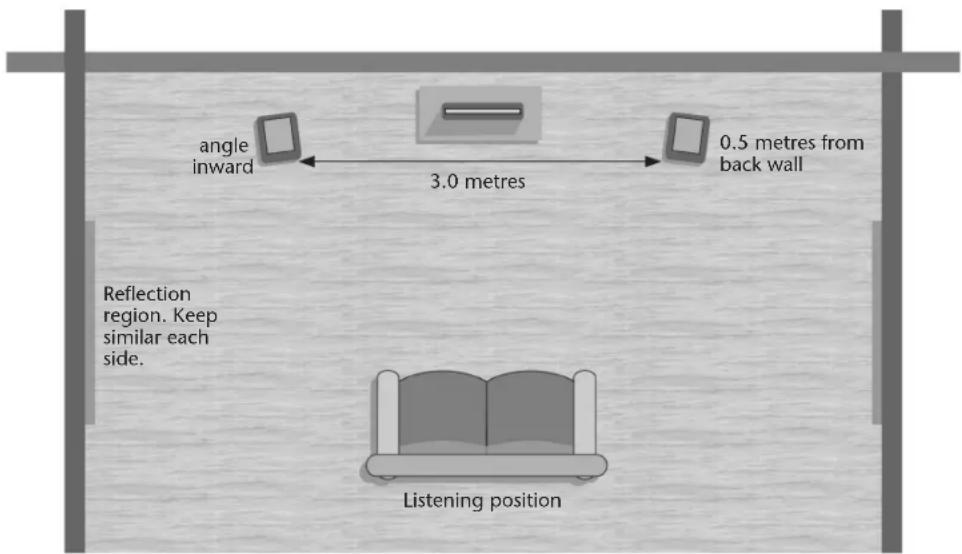
The position requirements for a pair of Linear Ones installed in an average sized and furnished listening room (say 4m x 5m) are as follows:
• Between 0.3 and 1.0 metres from the rear wall.
• 1.0 metres from side walls.
• Between 2.5 and 3.5 metres apart.
- Clear of corners.
• Angled inward towards the listening position.
Don't worry if, thanks to the architecture or layout of your room, it is not practical to follow each requirement. The most important thing is to experiment with the different options that are practical and find the one that works best.
While it is often the first instinct to position a pair of speakers against the shorter wall of a rectangular room, it is often the case that a position against the longer wall will produce better results. This is because the long wall position tends to result in less prominent reflections from the side walls of the room. However, whether used against the long or short wall, it is important
that each speaker of the pair is located in a similar acoustic environment (different environments would be, say, a curtained area and a solid wall).
The acoustic character of the side walls of the room in the area where the main reflection between speakers and listening position will occur should also be similar. Diagram One illustrates a typical layout.
Once your Linear Ones are connected (see Section 5) and working, and you begin to become familiar with their performance, it is likely to be worthwhile experimenting a little more with their positioning.
Reducing the distance between the speakers and the rear wall will increase the level of bass and low midrange making the speakers sound warmer. The warmth however is likely to be gained at the expense of some mid-range clarity and stereo image focus and depth. Increasing the toe-in angle of the speakers may regain some image focus but again this is likely to be at a cost of image width and openness. Learning through experimentation how Linear Ones behave in your room will help you find the optimum solution.
The Linear One is magnetically shielded and can be used in relatively close proximity to CRT screens.
Diagram One
Page 2
5. Connecting
Connecting your Linear Ones to an amplifier is fundamentally a simple process, however, there are some choices to be made and issues to consider concerning connection mode, connectors and cable type.
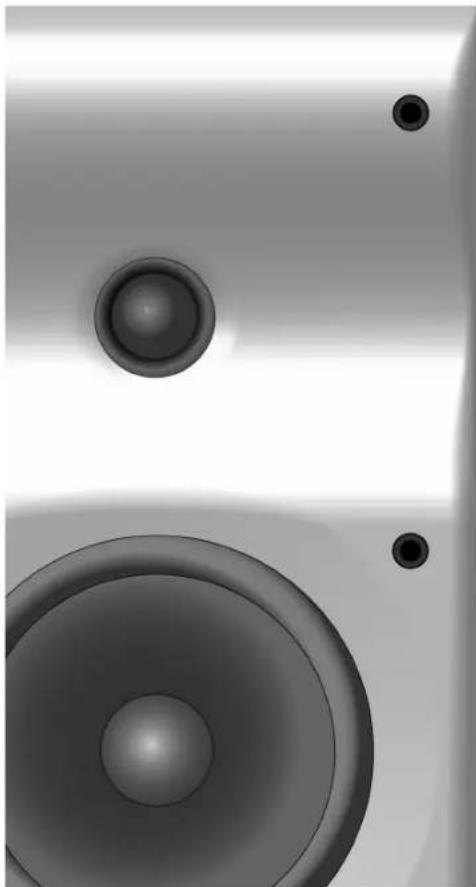
Each Linear One is fitted with two pairs of binding-post terminals - one pair each for the low frequency and high frequency drivers. Two pairs of terminals enables Linear Ones to be connected conventionally (single wire), bi-wired or bi-amplified. As supplied, the high and low frequency terminals are connected together by metal shorting links ready for conventional connection.
The terminals can accept either stripped wires, spade connectors, or 4mm plugs. Each of these termination methods is potentially equally effective and the choice is likely to be influenced by type of speaker cable used. Your dealer, distributor or cable manufacturer will be able to offer advice.
natural_image
Close-up of a speaker emitting sound waves, no text or symbols visibleConventional [single wire] connection
Conventional connection requires that the shorting links remain in place between the high and low frequency terminals. Simply connect the speaker cable to either pair of terminals ensuring correct connection polarity as described below.
Bi-Wire Connection
Bi-wiring separates the low and high frequency connections and can provide enhanced sound quality. A second set of cables (or alternatively, a multi-way bi-wire cable) is required. The shorting links should be removed and stored for any subsequent single wire use.
The two cables for each speaker should be connected in parallel to the amplifier terminals. At the speaker, one cable should connect to the high frequency terminals and one to the low frequency terminals. Ensure correct connection polarity as described below.
Bi-Amplifier Connection
Bi-amplifier connection adds a second power amplifier to the system so that high and low frequency sections have dedicated amplifiers. Significantly enhanced sound quality is possible. One stereo amplifier should be connected to the high frequency terminals of each speaker and a second stereo amplifier connected to the low frequency terminals. The shorting links should be removed and stored for any subsequent single wire use. Ensure correct connection polarity as described below. Follow the amplifier manufacturer's guidance on connecting the amplifier input signals.
The shorting links must be removed for bi-amplifier connection. Failure to do so will likely result in damage to the amplifiers.
Connection Polarity
It is important when connecting speakers to ensure that each terminal is connected with the correct polarity. Positive speaker terminals should always be connected back to amplifier positive terminals, and negative speaker terminals connected back to amplifier negative terminals. Performance will be seriously degraded if connections are made with incorrect polarity.
Take care when connecting cables not to touch the negative and positive terminals together and "short-circuit" the amplifier. Make connections with the amplifier switched off.
Choice of cable type will be influenced by the characteristics of other components in your hi-fi system and your dealer or distributor will be able to advise. Even so, there are some simple guidelines to consider:
- Cable runs to each speaker should be kept as short as possible consistent with each being of equal length.
- Short cable runs are especially important if the cable is of relatively small cross-sectional-area.
- If the cable is advertised as "directional" care should be taken to ensure that its orientation is as recommended.
6. Amplifiers
The Linear One is a relatively high sensitivity speaker that does not require a generously rated power amplifier for adequate volume levels to be achieved in an average listening room. A minimum of 25 and maximum of 120 Watts into 8 Ohms per channel is recommended. Linear Ones offer a relatively easy load to the amplifier and do not make unusually heavy demands on its power delivery.
No overload protection systems are fitted to the Linear One so it is possible to cause damage through over-driving. Such damage can occur whatever the power rating of the amplifier and is not covered by any warranty. If ever the sound at high volumes becomes distorted your Linear Ones are at risk of damage. In such circumstances the volume must be reduced.
7. Listening
It is wise before listening to your Linear Ones to make one final check of the cables and connections. If all appears well begin listening at a relatively low level to confirm that the system is operating as expected. Only increase the volume if you are happy that the sound at low levels is fundamentally as expected. If you are unhappy, turn the system off and re-check all the cables and connections.
Linear Ones may take a little time to "run-in", and similarly the system will also perhaps take some time to reach normal operating temperatures. It is unwise therefore to make rapid judgements about the performance of the speakers. Your ears too will take some time to adjust to the new sound, so revisiting the system set-up, speaker positioning especially, is best left for a few days.
8. Specification
Type: Two-way, reflex loaded, time aligned speaker.
Bass/Mid Driver: 130mm pressed alloy cone with 32mm thermally bonded voice coil. Shielded high-power long-throw magnet system.
HF Driver: Pre-coated textile dome with ferro-fluid cooled neodymium magnet system.
Filter Network: Symmetrical 3rd order at 3.5kHz.
Cabinet: 15mm MDF carcass with composite layer front panel and driver de-coupling.
Frequency Response: 50Hz to 28kHz ±3dB
Frequency Range: 30Hz to 28kHz @ -6dB
Power Handling: 120W peak programme
Amplifier Compatibility: 25 - 120 Watts into 8 Ohms
Nominal Impedance: 8 Ohms
Sensitivity: 89dB for 1 Watt at 1 metre
Dimensions (H x W x D): 363 x 192 x 260mm
Weight: 7 kg (single, unpacked)
Acoustic Energy reserves the right to modify product specifications.
9. The Linear Range
The Linear One is part of a range that includes the Linear Three floor-stand speaker, the Linear Centre centre channel speaker and the Linear Sub active sub-woofer.
Linear One, Linear Three and Linear Centre incorporate time-aligned drivers to improve image quality, depth and focus.
Linear Three
Linear Three is a true three-way floor stand speaker that builds on the performance of the Linear One with wider bandwidth, higher power handling and enhanced detail resolution.
Linear Centre
Linear Centre is a centre channel speaker designed to combine with the Linear One or Three for perfectly matched audio-visual systems.
Linear Sub
Linear Sub is an active sub-woofer perfect for enhancing Linear One bass performance or handling the low frequency effects channel in Linear audio-visual systems.

natural_image
Close-up of a speaker emitting sound waves, no text or symbols visible10. Warranty
Your Acoustic Energy speakers are guaranteed against original defects in materials, manufacture and workmanship for 3 years from the date of purchase.
Under this warranty Acoustic Energy agrees to repair any defect or, at the company's discretion, replace the faulty component(s) without charge for parts or labour. This warranty does not imply any acceptance by Acoustic Energy or its agents for consequential loss or damage and specifically excludes fair wear and tear, accident, misuse or unauthorised modification.
This warranty is applicable in the United Kingdom only and does not in any way limit the customer's legal rights. Claims and enquiries under the warranty for Acoustic Energy products purchased outside the UK should be addressed to the local importers or distributors. If you have reason to claim under the warranty please contact your dealer in the first instance.
Please retain all original packaging materials for possible future use. We suggest that you complete details of purchase now and keep this information in a safe place for future reference.
Name:
Address:
Dealer:
Purchase Date:
Serial Numbers:
11. Contact
Acoustic Energy Limited
16 Bridge Road
Cirencester
Gloucestershire GL7 1NJ
UK
Tel: +44 (0)1285 654432 (Sales)
+44 (0)1285 656890 (Technical)
Fax: +44 (0)1285 654430
Email: info@acoustic-energy.co.uk
Web: www.acoustic-energy.co.uk

Acoustic Energy Limited, 16 Bridge Road, Cirencester, Gloucestershire GL7 1NJ. Tel: +44 (0)1285 654432 (Sales), +44 (0)1285 656890 (Technical). Fax: +44 (0)1285 654430
Email: info@acoustic-energy.co.uk
Web: www.acoustic-energy.co.uk
Manual Part No. MA1101

- Contents
- Page Section
- Introduction
- Handling
- Installation
- Top plate Dimensions
- Positioning
- Diagram One
- Connecting
- Conventional [single wire] connection
- Bi-Wire Connection
- Bi-Amplifier Connection
- Connection Polarity
- Amplifiers
- Listening
- Specification
- The Linear Range
- Linear Three
- Linear Centre
- Linear Sub
- Warranty
- Contact
Brand : Acoustic Energy
Model : Linear 1
Category : Loudspeaker