
EB-SA7 - Cellphone PANASONIC - Free user manual and instructions
Find the device manual for free EB-SA7 PANASONIC in PDF.


| Product Type | Mobile Phone |
| Brand | Panasonic |
| Model | EB-SA7 (SA7) |
| Dimensions (HxWxD) | 102 x 53 x 26 mm |
| Weight | 140 g (including battery) |
| Battery Type | Li-ion, 1660 mAh |
| Talk Time | 4-16 hours (depending on network conditions) |
| Standby Time | 300-860 hours |
| Charging Time | Up to 290 minutes |
| Main Display | QVGA 240x320 pixels TFT LCD, approx. 16 million colors |
| Front Display | 96x64 pixels STN LCD, 4k colors |
| Camera | 2 Megapixel CMOS |
| Connectivity | Bluetooth v1.2, Infrared (SIR), USB v2.0 |
| Network | GSM 900 / 1800 / 1900 |
| Data (GPRS) | Yes |
| Memory | 30 MB user data (excluding MMS), 2 MB for MMS |
| SIM Card | 1.8V/3V SIM |
| Key Features | Camera, MMS, SMS, Browser, Games, Bluetooth, Infrared, Calendar, Alarms, Sound Recorder, T9 Text Input, Illumination Messages, Java |
| Charger | Travel Charger EB-CA001xx (region-specific) |
| Accessories | Personal Handsfree, In-Car Charger, Car Holder, USB Cable, Branch Cable, Bluetooth Headset |
Frequently Asked Questions - EB-SA7 PANASONIC
User questions about EB-SA7 PANASONIC
0 question about this device. Answer the ones you know or ask your own.
Ask a new question about this device
Download the instructions for your Cellphone in PDF format for free! Find your manual EB-SA7 - PANASONIC and take your electronic device back in hand. On this page are published all the documents necessary for the use of your device. EB-SA7 by PANASONIC.
USER MANUAL EB-SA7 PANASONIC
Operating Instructions
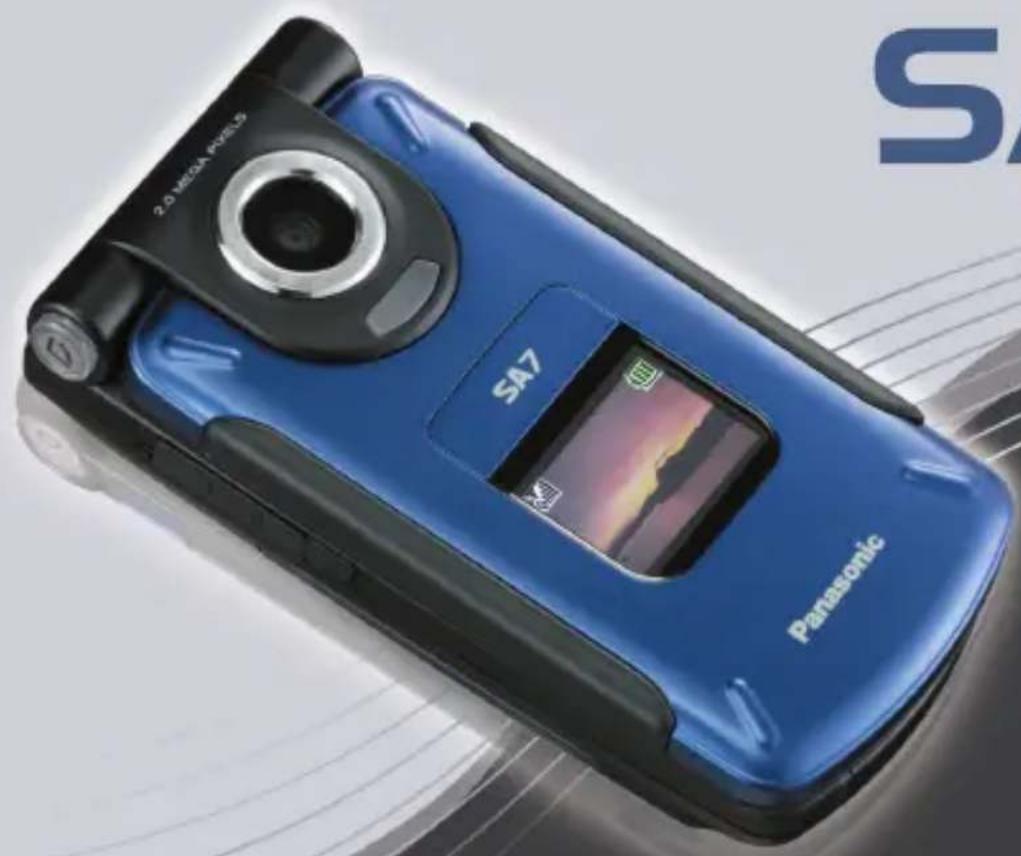
SA7
EB-SA7 Mobile Phone

Before operating this handset, please read these instructions completely. Charge battery before operation.
SA7 Operating Instructions
Contents
Introduction ...... 1
Safety considerations...... 1
Care and maintenance...... 5
About this manual 7
About Your Phone...... 10
Phone overview...... 10
Key functions.... 12
Display 15
DRM.... 17
Indicator/Illumination Light ... 18
Getting Started ...... 19
Installing the SIM card and the battery 19
Charging the battery...... 21
Opening/closing the phone .. 23
Switching the phone on/off... 23
Menu Navigation...... 24
Main menu structure ...... 24
Displaying the menu...... 25
Navigating the applications .. 26
Basic Operations...... 27
Making calls 27
Answering calls 29
Silent mode 31
Voicemail.... 31
In-call operations.... 32
Multiple calls operation...... 34
Text entry 36
Contacts......41
Contacts menu structure.....41
Viewing the Contacts list.....42
Making a call from Contacts....43
Adding contacts 44
Editing a Contacts card......46
Call log....47
Speed dial....48
Groups......49
Advanced....49
Service numbers......52
Messages ....53
Messages menu structure ....53
Creating a new message .....54
Receiving messages......59
Inbox....60
Archive....64
Web mail....65
Chat 66
Voicemail 66
Messages settings......67
Memory status ......69
Camera 70
Camera menu structure......70
Picture....71
Video....77
Contents
Browser 81
Browser menu structure .....81
Setting up your Browser .....81
Viewing the contents .....82
Phone settings....90
Display settings .....96
Sounds & alerts ......99
Calls....101
Connectivity......105
Security......117
Tools...... 120
Tools menu structure......120
SIM Tool Kit ......121
Alarms 121
Sound recorder......123
Calculator 124
Calendar 125
Browsing Calendar .....125
Creating Calendar events...127
Managing Calendar events..129
My Media 131
My Media menu structure ...131
Pictures....132
Sounds ...... 136
Videos......139
Games....140
Text templates....141
Memory status ....142
Games.... 143
Games menu structure..... 143
Games.... 144
Download games 146
Settings 147
Information 147
Appendix 148
Accessories.... 148
CD-ROM 152
Troubleshooting 153
Glossary of terms ...... 156
Specifications 157
Licensing.... 159
Index 163
Thank you for purchasing this Panasonic digital cellular phone. This phone is designed to operate on GSM networks – GSM900, GSM1800 and GSM1900. It also supports GPRS for packet data connections. Please ensure the battery is fully charged before use. We, Panasonic Mobile Communications Development of Europe Ltd., declare that the EB-SA7 conforms with the essential and other relevant requirements of the directive 1999/5/EC. A declaration of conformity to this effect can be found at
http://panasonic.co.jp/pmc/products/en/support/index.html
Safety considerations
The following information should be read and understood as it provides details, which will enable you to operate your phone in a manner which is both safe to you and your environment, and conforms to legal requirements regarding the use of cellular phones.
Power

This equipment should only be charged with approved charging equipment to ensure optimum performance and avoid damage to your phone. Other usage will invalidate any approval given to this apparatus and may be dangerous. Ensure the voltage rating of the Travel charger is compatible with the area of use when travelling abroad. A Travel charger (EB-CA001xx*) is supplied with the Main Kit.
Note* xx identifies the charger region, e.g. CN, EU, UK, AU, US.
Battery

Use of another battery pack than that recommended by the manufacturer may result in a safety hazard.
If you use a feature which keeps the key backlight on continuously for a long time, such as a game or browser, battery life will become extremely short. To maintain longer battery life, set the Key backlight to off. (See “Key backlight” on page 93.)
Do not use this phone without the battery cover attached.
Disposing of the Battery

Do not incinerate or dispose of the battery as ordinary rubbish. The battery must be disposed of in accordance with local regulations and may be recycled.
Aircraft

Switch off your cellular phone when in an aircraft. Ensure that the settings of the alarm functions will not contravene regulations whereby it may automatically power on when in an aircraft or medical facility etc. The use of cellular phones in an aircraft may be dangerous to the operation of the aircraft, disrupt the cellular network and may be illegal. Failure to observe this instruction may lead to the suspension or denial of cellular phone services to the offender, or legal action or both.
Do Not Use

It is advised not to use the equipment at a refuelling point. Users are reminded to observe restrictions on the use of radio equipment in fuel depots, chemical plants or where
blasting operations are in progress. Never expose the battery to extreme temperatures (in excess of 60^ C).
Driving

It is imperative that the driver exercises proper control of the vehicle at all times. Do not hold a phone while you are driving; find a safe place to stop first. Do not speak into a handsfree microphone if it will take your mind off the road. Always acquaint yourself thoroughly with restrictions concerning the use of cellular phones within the area where you are driving and observe them at all times.
Electronic Devices

Care must be taken when using the phone in close proximity to personal medical devices, such as pacemakers and hearing aids.
Heating Equipment

When your handset, the accompanying battery or charging accessories are wet, do not put those in any type of heating equipment, such as a microwave oven, a high pressure container, or a drier or similar. It may cause the battery, handset and/or charging equipment to leak, heat up, expand, explode and/or catch fire. Moreover, the product or accessories may emit smoke and their electrical circuits may become damaged and cause the products to malfunction. Panasonic is not responsible for any and all damages, whether direct or indirect, howsoever caused by any misuse.
Backup Copies & Security

It is recommended that you create a copy or backup, as appropriate, of any important information and data which you store in your phone's memory. In order to avoid accidental loss of data, please follow all instructions relating to the care and maintenance of your phone and its battery.
Your phone has the capability of storing and communicating personal information. It is recommended that you take care to ensure that any personal or financial information is stored separately from your phone. You should use security features, such as the SIM lock to protect information held in your phone. Panasonic accepts no liability for any and all losses howsoever arising from any loss of data, including but not limited to direct and indirect losses (to include, but not limited to consequential loss, anticipated savings, loss of revenue).
Downloading

Your phone has the capability of downloading and storing information and data from external sources. It is your responsibility to ensure that in doing this you are not
infringing any copyright laws or other applicable legislation.
Panasonic accepts no liability for any and all losses howsoever arising from any loss of data or any such infringement of copyright or intellectual property rights, including but not limited to direct and
indirect losses (to include, but not limited to consequential loss, anticipated savings, loss or revenues).
Efficient Use

For most efficient use, hold the phone as you would any normal phone. To avoid deterioration of signal quality or antenna performance, do not touch or “cup” the antenna area while the phone is switched on. Unauthorised modifications or attachments may damage the phone and violate applicable regulations. The use of an unapproved modification or attachment may result in the invalidation of your guarantee – this does not affect your statutory rights.
Camera

You are advised to take appropriate care over the use of the internal camera. It is your responsibility to ensure that you have permission to take photographs of people and objects and that you do not infringe any personal or third party rights when using the camera. You must comply with any applicable international or national law or other special restrictions governing camera use in specific applications and environments. This includes not using the camera in places where the use of photographic and video equipment may be prohibited. Panasonic accepts no liability for any and all losses howsoever arising from any infringement of copyright or intellectual property rights, including but not limited to direct and indirect losses. Do not leave the camera facing direct sunlight, as this may impair its performance.
Other important information
The colour liquid crystal display (LCD) uses high-precision production technology, and in certain circumstances pixels may appear brighter or darker. This is due to characteristics of the LCD and is not a manufacturing defect.
This phone is designed, manufactured and tested to ensure that it complies with the specifications covering RF exposure guidelines applicable at the time of manufacture, in accordance with EU, USA FCC and Australian ACA regulations.
This phone should only be used with Panasonic approved accessories to ensure optimum performance and avoid damage to your phone. Panasonic is not responsible for damage caused by using non-Panasonic approved accessories.
This phone must be used in compliance with any applicable international or national law or any special restrictions governing its use in specified applications and environments. This includes but is not limited to use in hospitals, aircraft, whilst driving and any other restricted uses.
Some of the contents described in this manual are subject to change without notice.
Care and maintenance

Pressing any of the keys may produce a loud tone. Avoid holding the phone close to the ear while pressing the keys.

Extreme temperatures may have a temporary effect on the operation of your phone. This is normal and does not indicate a fault. The display quality may deteriorate if the phone is used in environments over 40^ C for a long time.

Do not modify or disassemble the equipment. There are no user serviceable parts inside.

Do not subject the equipment to excessive vibration or shocks. Do not drop the battery.

Avoid contact with liquids or moisture. If the equipment becomes wet, immediately remove the battery and charger. Keep the phone dry.
Introduction

Do not leave the equipment in direct sunlight or a humid, dusty or hot area. Never throw a battery into a fire. It may explode.

Keep metallic items that may accidentally touch the terminals away from the equipment/battery. Batteries can cause property damage, injury, or burns if terminals are touched with a conductive material (i.e. metal jewellery, keys, etc.).
Always charge the battery in a well ventilated area, not in direct sunlight, between +5°C and +35°C. It is not possible to recharge the battery if it is outside this temperature range.
When connecting the phone to an external source, read the operating instructions of the equipment for the correct connection and safety precautions. Ensure the phone is compatible with the product it is being connected to.

When disposing of any packing materials or old equipment, check with your local authorities for information on recycling.
About this manual
Symbols used in this manual
The following symbols are used in this manual to represent the limited availability of the function or service.

= Depending on your SIM card.

= Depending on network availability.

= Depending on your network operator. The service may only be available on a subscription basis.
Graphics
The graphic elements in this manual are for illustrative purposes and may differ from the actual phone and/or graphic elements displayed on the phone. Panasonic reserves the right to change the information in this manual without prior notice.
Keys
Keys in this manual may differ from the actual keys on your phone. Refer to page 12 for the icons that represent the keys in this manual.
How to read this manual
This function is SIM card dependent. For other symbols, refer to page 7.
Fixed dial

When Fixed dial is enabled, only the phone numbers stored in SIM Contacts can be dialled. Any manually dialled phone numbers must match the phone numbers in SIM Contacts.
To store, edit or delete phone numbers in SIM Contacts, you need to enter your PIN2 code.

Main menu > Settings > Security > Fixed dial
- Select Enable or Disable
- Enter the PIN2 code (4-8 digits) → [●]/[□] (Ok)

Menu navigation
Before following the steps, you need to enter Main menu, then move through the sub menus, described next to the ➕ icon. “>” means “scroll through the menu and select”.
In the example:
From Main menu, press Navigation key (up/down/left/right) to scroll to Settings and press Navigation key (centre). Press Navigation key (up/down) to scroll to Security and press Navigation key (centre) or Left Soft key (Select) ^1 . Press Navigation key (up/down) to scroll to Fixed dial and press Navigation key (centre) or Left Soft key (Select) ^1 . You can also select Fixed dial by pressing [3].
Now you can continue onto the step 1:
-
Press Navigation key (up/down) to scroll to Enable or Disable, then press Navigation key (centre) or Left Soft key (Select) ^*1
-
Enter the PIN2 code (4-8 digits), then press Navigation key (centre) or Left Soft key (Ok) ^*1
*1 The word is shown in the lower left hand corner of the display, indicating a command that the key gives to the phone when you press it.
Note: There are several ways to select items from menu lists. See “Menu selection method” on page 26.
About Your Phone
Phone overview
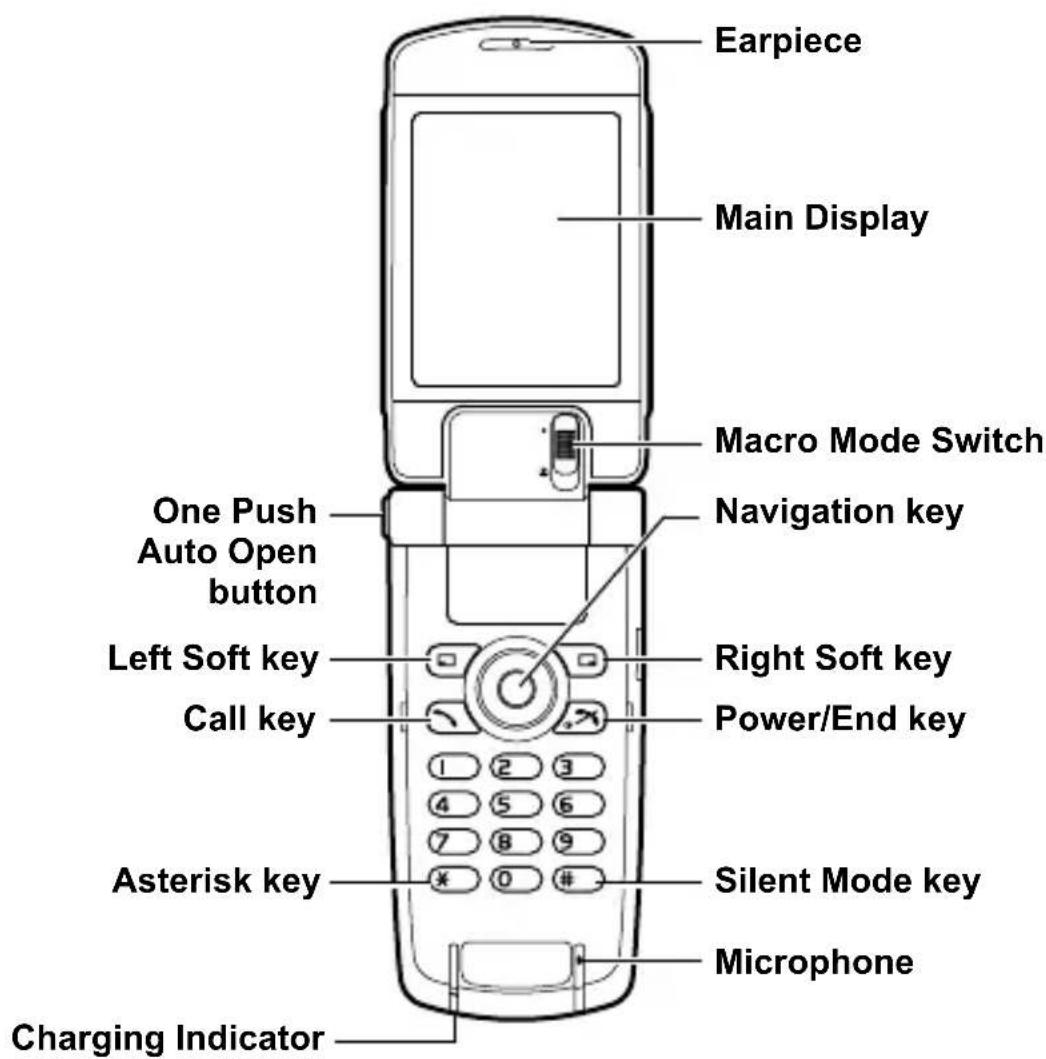

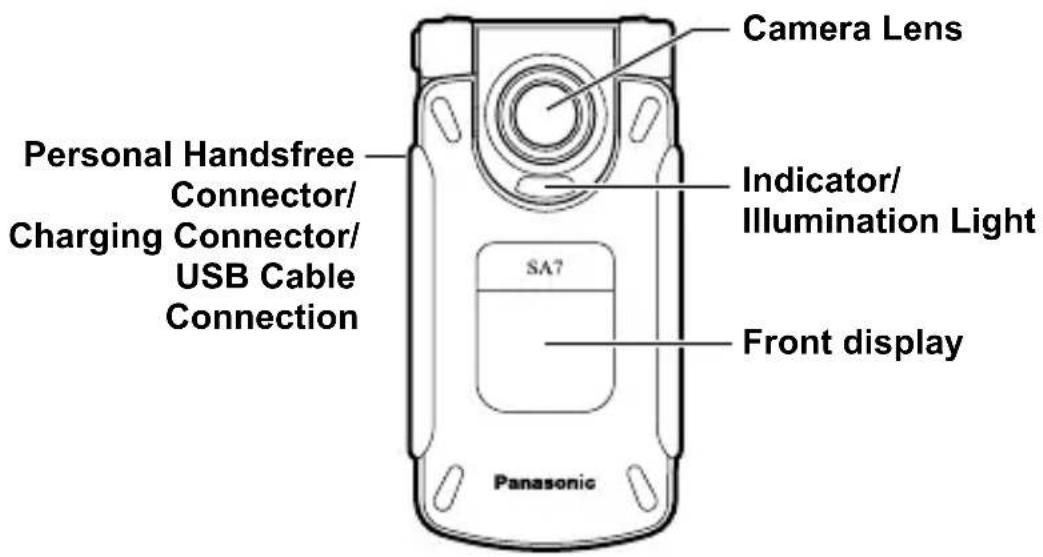
Key functions
| Key name Function | Key icon*1 | |
| Navigation key | Press outside edges to scroll up [▲], down [▼], left [◀] or right [▶] to move through menus and text. Press centre [◎] to select option, perform Alert mute, or take a picture or record a video clip in Camera mode. |  |
| Left Soft key | Perform the functions indicated by the text shown in the lower left-hand corner of the display. |  |
| Right Soft key | Perform the functions indicated by the text shown in the lower right-hand corner of the display. |  |
| Call key | Make or answer a call. |  |
| Power/End key | Press and hold to switch the phone on/off. End or reject a call. Return to standby mode. |  |
| Numeric keys | Enter numbers and characters. Press and hold [2]-[9] for Speed dialling. Press and hold [0] to enter the international prefix (+). |  |
| Asterisk key | Enter “✗”. In text entry mode, press to change the letter case, or press and hold to change the input method. |  |
| Silent Mode key | Enter “#”. Press and hold to switch the Silent mode on/off. While entering a phone number, press and hold to enter a pause (p). |  |
| Side-up key*2 | Scroll page up. Increase volume or zoom level. Perform Alert mute. |  |
| Side-down key*2 | Scroll page down. Decrease volume or zoom level. Perform Alert mute. |  |
| Key name Function | Key icon*1 |
| Multi Function key*2 | Take a picture or record a video clip in Camera mode. Perform Alert mute. |
*1 The key icons given in the table represent the actual keys on the phone.
*2 Located on the right side of the phone.
Quick keys
You can easily access features instead of navigating through the menus.
| Key Function | ||
| In standby mode | ||
| Short press | [◎] Open | Main menu/Keyguard off |
| [□] Open | Messages menu | |
| [□] Open | Browser | |
| [▲]/[▼]/[◀]/[▶] | Open the shortcut menu | |
| [↘] Open | Call log | |
| [□]/[▽] | Increase/decrease the volume | |
| Long press | [◎] Keyguard on | |
| [1] Dial your voice mailbox | ||
| [2]-[9] | Speed dial | |
| [#] Silent mode on/off | ||
| [□] Switch to Picture mode | ||
About Your Phone
| Key Function | ||
| During a call | ||
| Short press | [▲]/[▶]/[▲] | Increase the volume |
| [▼]/[◀]/[▼] | Decrease the volume | |
| [□] Start/stop sound recording | ||
| [↘] | Switch between hold and unhold on one call or switch between one active and one held call | |
| In Menu list | ||
| Short press | [1]-[9] | Select Menu 1-9 |
| [※] Select | Menu ✱ | |
| [0] Select | Menu 0 | |
| [#] Select | Menu # | |
Display
Main display (in standby mode)
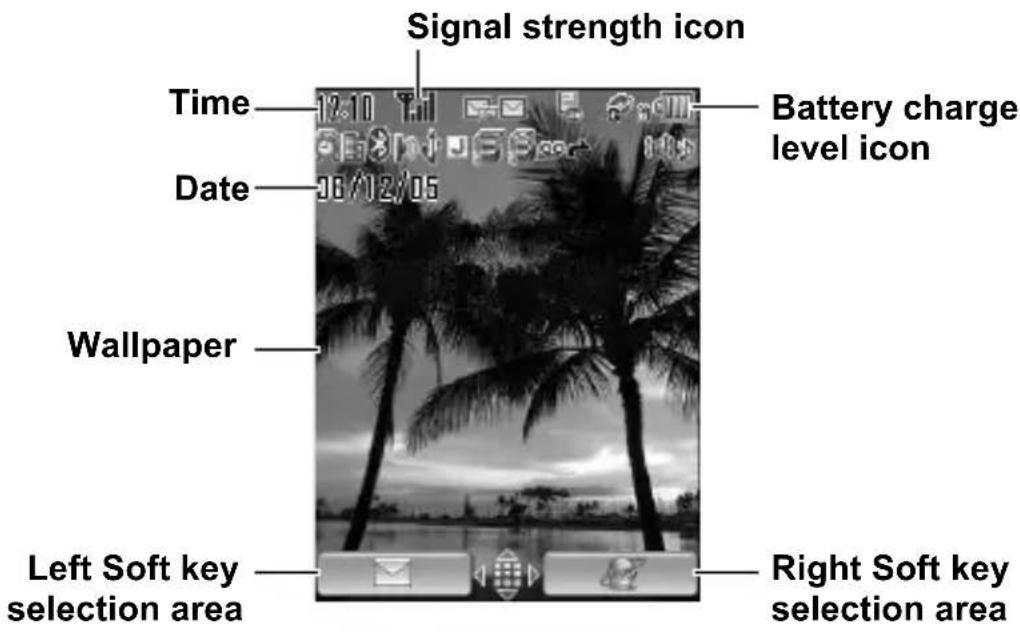
Note: The current operator name is shown on standby display. You can change the position of the operator name. See "Operator name" on page 96.
Front display (in standby mode)
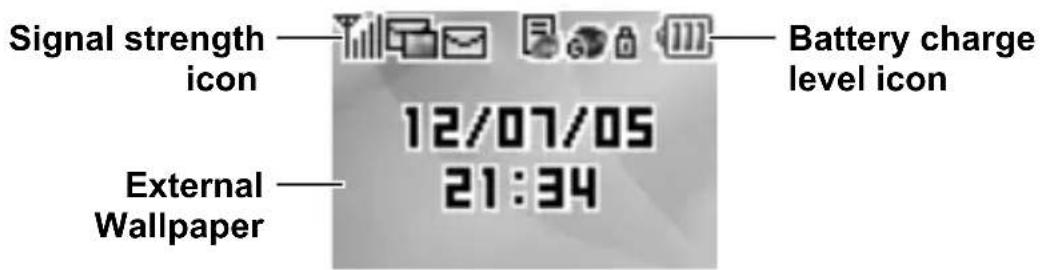
Status icons
The status icons are displayed or animated according to the currently activated functions.
| Icon Meaning | ||
 | Signal strength; the more bars visible, the stronger the signal | |
| [DH2W] | In roaming area | |
 | Battery charge level | |
   | Battery is charging | |
 | GPRS is available | |
| [DC2K] | Silent profile is active | |
 | Meeting profile is active | |
| [K227] | Outdoor profile is active | |
| [KX24] | Car profile is active | |
| [6HZV] | SMS message storage area is full | |
 | MMS message storage area is full | |
| [TTHH] | Java^TM application is suspended | |
 | Unread SMS message | |
| [3B36] | Unread MMS message | |
| [2YAX] | Unread WAP Push message | |
 | Call diverts is on | |
| [H2ST] | Infrared is active | |
| [K5SS] | Bluetooth is active | |
| Bluetooth headset or handsfree is connected | ||
| USB connection is available | ||
| New voicemail received | ||
| All tones are off | ||
| Vibration alert is on | ||
| Alarm is set | ||
| Non-secure CSD connection | ||
| Secure CSD connection | ||
| Non-secure GPRS connection | ||
| Secure GPRS connection | ||
| Keyguard is on | ||
DRM
Your phone has DRM (Digital Right Management) that is used to control actions such as sending downloaded ringtones, graphics and sound clips to other people. Files downloaded and indicated by the icon () can be used with restriction enforced by suppliers. The restriction includes use of such files for a limited period of time only or specified number of times.
To check the status of your rights, e.g. expiration date or number of times it can be used, see Details setting on page 133, 137 and 144. For further information, contact your service provider.
Indicator/Illumination Light
The Indicator/Illumination Light flashes or beams when the events in the table below occur.
To specify the illumination colours for the events, see “Illuminations” on page 92.
| Events Description | |
| When you are receiving a call/ missed calls | Flash or beam in the selected colour.To set a different illumination colour for respective contacts, see “Storing a contact in your phone” on page 44. |
| When you receive an SMS/MMS message | |
| When you receive a WAP Push message | Flash or beam in the selected colour.When you are having a conversation |
| When the flip is closed | |
| When the battery is charging | Flash in the specified colour. |
| When data is being transferred | |
| Schedule notification Beam in the specified colour. See “Creating Calendar events” on page 127 or “Setting the alarm” on page 121. | |
| Alarm | |
Note: If the Indicator/Illumination Light is set to on for battery charging and the phone is switched on, the Indicator/Illumination Light illuminates during charging. If the phone is switched off, the Indicator/Illumination Light will not illuminate.
Getting Started
Installing the SIM card and the battery
The SIM (Subscriber Identity Module) card and the battery must be installed before using your phone.
Before handling the SIM card and the battery, ensure that the phone is switched off and the charger is disconnected from the phone.
Inserting/removing the SIM card
See "Inserting/removing the battery" on page 20 to remove the battery cover and the battery.
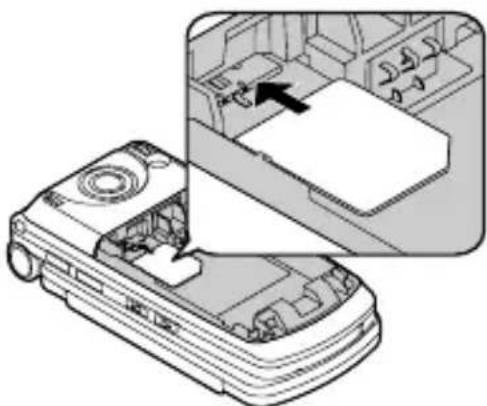
Inserting the SIM card
Position the SIM card as shown, with gold contacts facing down and the notched corner turned to the right. Carefully slide the SIM card into the SIM card pocket until the card is all the way seated.
natural_image
Technical illustration of a car interior showing internal components and a close-up view of the engine compartment (no text or symbols present)Removing the SIM card
Place a finger on the bottom edge of the SIM card and gently slide it out.
natural_image
Illustration of a hand inserting a component into a mobile phone casing (no text or symbols visible)Inserting/removing the battery
Inserting the battery
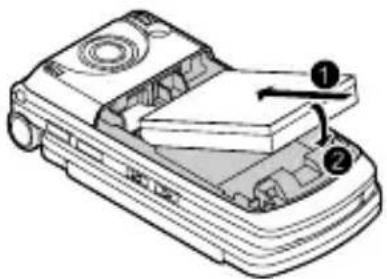
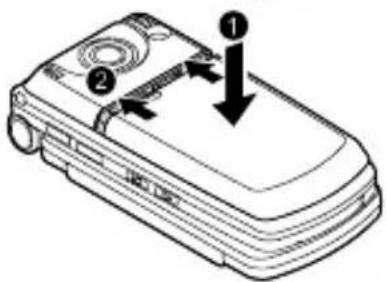
- Insert the small tabs at the top of the battery into the notch at the top of the battery compartment. Ensure the 3 gold contacts align with the 3 gold pins in the phone.
- Replace the cover on the phone. Make sure the cover clicks into place.
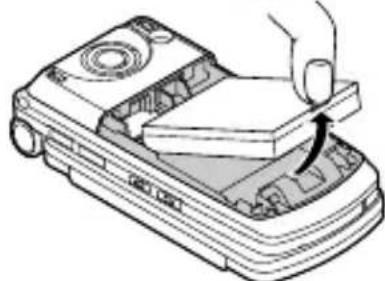
Removing the battery
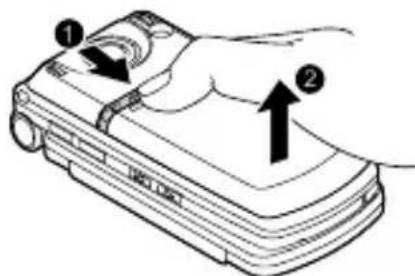
- Place your finger on the small bar at the top of the cover. Slide the cover slightly toward the bottom of the phone, then lift the cover off the phone.
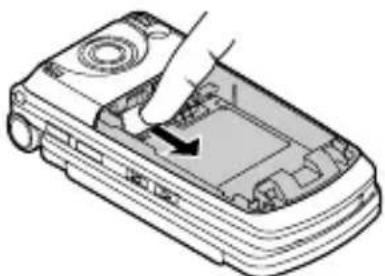
- Place your finger on the tab at the base of the battery. Lift the battery off the compartment.
natural_image
Illustration of a hand pressing down on a device component (no text or symbols visible)Charging the battery
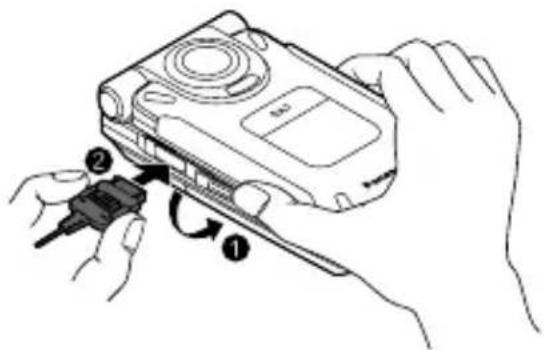
Your phone can be charged either when it is switched on or off. You can use your phone even while it is charging.
Ensure that the battery is inserted into the phone before charging.
- Open and hold the connector cover.
Connect the charger to Charging Connector, then connect the charger to the mains power supply.
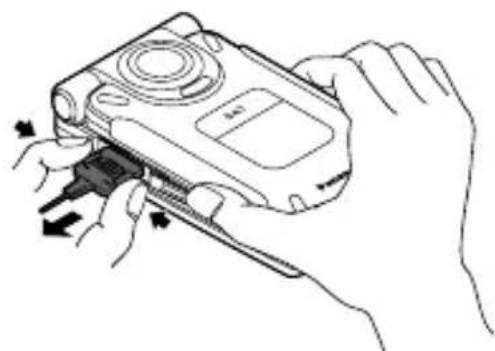
- When charging is complete, disconnect the charger from the outlet before removing the plug from the phone. Then hold the connector cover and press and hold the release buttons on both sides of the connector's end and pull gently to disconnect the charger from the phone.
natural_image
Illustration of hands using a handheld device to adjust or install a device (no text or symbols visible)After you have removed the Charging Connector, replace the connector cover over the socket.
Note: DO NOT force the connector as this may damage the phone and/or the charger.
If the battery has been deeply discharged, it may take several minutes before the Battery charge level indicator is displayed.
Battery charge level indicator
| While charging Charging | complete | |||
 |  |  |  |  |
Charging Indicator goes out when charging is completed.
Low battery warning
When the battery power is low, a “Battery low” message is displayed and a warning tone sounds. The phone automatically switches off after the tone. Fully recharge the battery. If you receive the low battery warning during a conversation, charge your phone to continue with the conversation.
Opening/closing the phone
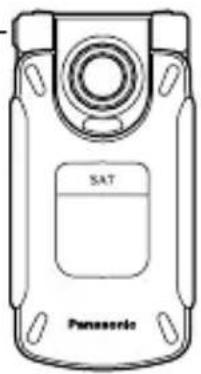
You can open your phone by pressing One Push Auto Open button.
One Push Auto Open button
natural_image
Line drawing of a Panasonic mobile phone casing with no visible text or symbols on the bodyFlip setting
When Active flip setting is set to On (see page 103), you can answer a call by opening the phone and end a call by closing the phone.
When One push SMS setting is set to On (see page 67), new SMS messages can be displayed by opening the flip.
Switching the phone on/off
- Press and hold [ ×] for several seconds to switch the phone on
A greeting may be displayed and the phone enters standby mode.
- Press and hold [_0] for several seconds to switch the phone off
Note: If your SIM card is PIN protected, your PIN code will be requested. Enter the PIN code and [●]/[□] (Ok). See "Security" on page 117.
DO NOT switch off the phone while resetting/downloading/deleting a file or running/terminating a Java ^TM application.
Menu Navigation
Main menu structure

Games
Games 144
Download ^*1 146
Settings .....147
Information .....147
My Media
Pictures ...... 132
Sounds 136
Videos...... 139
Games...... 140
Text templates ..... 141
Memory status..... 142

Calendar .....125

Camera
Picture.... 71
Video....77

Messages
Create new 54
Inbox.... 60
Archive 64
Web mail ^*1 65
Chat ^*1 66
Voicemail 66
Messages settings... 67
Memory status ...... 69

Browser
PANASONIC BOX ...81

Tools
SIM tool kit ^*2 .....121
Alarms....121
Sound recorder .....123
Calculator......124

Contacts
Contacts list...... 42
Add contact...... 44
Call log 47
Speed Dial list...... 48
View groups...... 49
Advanced 49
Service numbers*1*2 52

Settings
Phone settings ..... 90
Display settings..... 96
Sounds & alerts...... 99
Calls.... 101
Connectivity .....105
Security...... 117
*1

*2

Displaying the menu
The menu system allows you to access functions which do not have their own dedicated buttons on the keypad.
In standby mode:
- [○]
Main menu appears with 9 menu options. (See "Main menu structure" on page 24.)
- [▲/▼/◄/►] to scroll to the required menu → [◎]/[□] (Select)
To go back to Main menu:
- [☐] (Back) repeatedly until Main menu screen appears
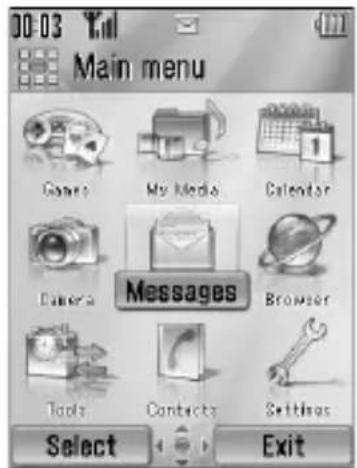
Shortcut: To jump to and open one of the 9 application items, simply press the Numeric key corresponding to the required item's location. The numbering system is:
| 1 | 2 | 3 |
| 4 | 5 | 6 |
| 7 | 8 | 9 |
Navigating the applications
Current settings
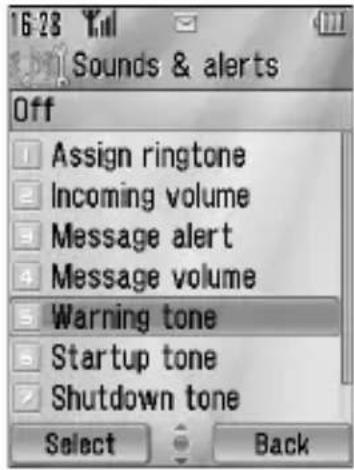
When you highlight an item in the menu list, the current setting of the item is displayed in the bar just above the menu list.
In the case shown to the right, the current setting of Warning tone is "Off".
Menu selection method
There are several ways to select items: by using center Navigation key or Left Soft key, or by entering the required number, ✕ or # given to the item.
To select Warning tone in the display shown above:
• [▲/▼] to scroll to Warning tone → [◎]
• [▲/▼] to scroll to Warning tone → [□] (Select)
- Press the menu number [5]
Keys corresponding to the menu numbers
• [1]-[9]: Menu 1-9
• [ *]: Menu *
• [ 0]: Menu 0
• [ #]: Menu #
Note: Direct access keys to the menus with no menu numbers/symbols are not available.
Note: There are several ways to select items from menu lists. See “Menu selection method” on page 26.
Making calls
To make a call, your phone must be within the range of a network with adequate signal strength.
Standard dialling
In standby mode:
- Enter the area code and phone number → [↘]/[◎]
- When the other party answers, talk into Microphone
- [☐] / [☐] (End) to hang up
The duration of the call is displayed.
Note: To erase a digit: [☐] (Clear)
To increase the earpiece volume: [▲]/[▶]/[□]
To decrease the earpiece volume: [▼]/[◀]/[□]
If Active flip is set to On (see page 103), you can answer a call by opening the phone and end a call by closing the phone.
Auto redial
Your phone will automatically redial the number up to 10 times under certain conditions, such as no answer, destination number is busy, network busy, or some connection errors.
When your call is rejected:
- “Auto redial?” → [☐] (Yes) to start Auto redial
- To stop Auto redial while redialling, [_×]/[] (Cancel)
Contacts dialling
You can make calls using the numbers in Contacts.

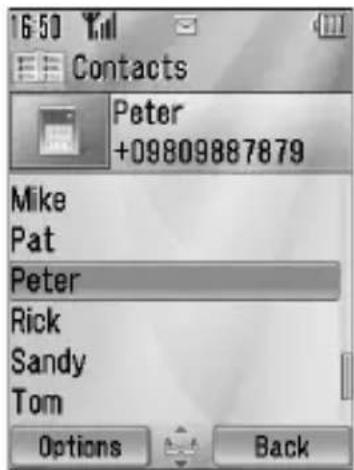
Main menu > Contacts > Contacts list
- [▲/▼] to scroll to the required contact OR Enter letters to find a contact beginning with the specific letters
- [↘]
- If the card has several phone numbers stored, [▲/▼] to scroll to the required number → [●]/[□] (Call)
Recent call dialling
You can make calls using the numbers in Call log.
In standby mode:
- [ ↘ ]
- [◀/▶] to switch to Dialled numbers, Answered calls or Missed calls screen
- [▲/▼] to scroll to the required number → [↘]
International dialling
The international prefix (+) and the destination country/region code should be entered, followed by the area code and phone number.
- Press and hold 0 until “+” is displayed
- Enter the country/region code
- Enter the area code and phone number → [ ]
Note: Many countries/regions include an initial "0" in the area code. This should, in most cases, be omitted when dialling international numbers. For further help, contact your service provider.
Emergency call
To make an emergency call, your phone must be within the range of a network.
When SIM card is inserted:
- Enter the local emergency number → [↘]/[◎]
Note: Most countries support the international emergency number 112. If you find the number does not work on your phone, contact your service provider.
When SIM card is not inserted:

- [☐] (Options) → Select SOS
Answering calls
When there is an incoming call, the phone rings and/or vibrates (depending on your phone setting). (See “Sounds & alerts” on page 99.)
When the phone is ringing and/or vibrating:
- [↘]/[□] (Accept)
Note: If Any key answer is set to On (see page 102), you can answer a call by pressing any key except [☐], [●], [☐] (Cancel), [☐], [▲] and [▼].
If Active flip is set to On (see page 103), you can answer a call by opening the phone and end a call by closing the phone.
Rejecting calls
When the phone is ringing and/or vibrating:
- [①] / [□] (Cancel)
Missed call notification
If you cannot answer a call, Missed call notification appears on the standby screen.
To view the Missed call list:
- [●]/[□] (View)
- To call back, [/] to scroll to the required log [↘]
Alert mute
You can turn the ringing tone and/or vibration off before answering a call.
When the phone is ringing and/or vibrating:
- When the phone is closed: [☐]/[▲]/[▼] When the phone is open: [●]
- [↘] to answer the call
Answering a second call
When on an active call, you may receive another call.
To enable this service, Call waiting must be active. (See “Call waiting” on page 102.)
If you hear an alert tone during a call:
- [↘]/[□] (Accept)
The first call is placed on hold.
- [↘] to switch between the two calls if required
To reject another call:
- [☐] (End)
To end the active call and answer the incoming call:
- [_0 ×] to end the active call
- [↘] to answer the call
Auto answer
When you use the optional Personal Handsfree earpiece, you can answer a call automatically. To enable this service, Auto answer must be on. (See “Auto answer” on page 103.)
Silent mode
To use your phone in a quiet situation, you can activate the Silent mode. You can personalise the Silent mode setting. (See “Profiles” on page 90.)
In standby mode:
- Press and hold [#] to activate/deactivate the Silent mode
Voicemail
Voicemail is a network service which allows callers, who could not reach you, to leave voice messages. You may need to subscribe to this service through your service provider. For further details, see "Voicemail" on page 66.
Retrieving stored voice messages
When a new voice message is stored, an alert sounds and ( ) appears on the display and you receive an SMS notification.
-
Press and hold [1] to call your voice mailbox
If the number is not valid, contact your service provider. -
Follow the recorded instructions
-
[①] when finished
In-call operations
In-call options (while connected to an active call)
When on a call, the following options are available.
- [☐] (Options) → Select the required option
| Hold call/Resume Put or resume a call on hold. | |
| From contacts Access the Contacts list. | |
| Create SMS Create a new SMS message. | |
| Inbox (SMS) Access Inbox (SMS). | |
| Calendar Access Calendar. | |
| Speaker mode/ Handheld mode/ Bluetooth mode | Switch to Speaker, Handheld or Bluetooth talking mode. |
| Record | Record the conversation. The sound clip is saved to My Media. |
Hold
You can put a call on hold.
During a call:
- [↘] to switch between Hold call and Resume OR
[☐] (Options) → Select Hold call or Resume
Handsfree talking
You can have a conversation without holding the phone to your ear.
Swapping between Speaker and Handheld mode
- [☐] (Options) → Select Speaker mode or Handheld mode
Volume control
You can adjust the volume of the phone earpiece, speaker, headset or Bluetooth audio device if attached.
To increase the volume:
- [▲]/[▶]/[□]
To decrease the volume:
- [▼]/[◀]/[▽]
DTMF
DTMF (Dual Tone Multi Frequency) can be sent during a conversation. These are often used to access voicemail, paging and computerised home banking. For example, you may need to enter a number to remotely access voicemail messages. A phone number may be stored in the Contacts card together with a DTMF sequence, allowing the number to be dialled upon recall and the DTMF sequence to be sent automatically.
To send DTMF during a call:
- Enter digits 0-[9], [✗] or [#]
Pause dial
Using pauses allows you to send DTMF automatically.
- Enter the phone number
- Press and hold [#] until a "p" is displayed
-
Enter the DTMF digits after the pause, e.g. enter the number to access voicemail messages
-
[↘]/[◎]
When the call is connected, the DTMF sequence is sent after 3 seconds.
Making a second call

You can make another call while on a call.
During a call:
-
Enter the second phone number or select a phone number from the Contacts list
To access Contacts list, see "In-call operations" on page 32. -
[ ]
The first call is put on hold.
- [↘] to switch between the two calls if required
Multiple calls operation
In-call options (while on multiple calls)
When on more than one call, the following options are available.
- [☐] (Options) → Select the required option
| Swap Switch between one active and one held call. | |
| Merge | Enable multi-party conversation when two calls are connected (one active, one on hold). See “Conference” on page 35. |
| From contacts Access the Contacts list. | |
| Create SMS Create a new SMS message. | |
| Inbox (SMS) Access Inbox (SMS). | |
| Calendar Access Calendar. | |
| Speaker mode/ Handheld mode/ Bluetooth mode | Switch to Speaker, Handheld or Bluetooth talking mode. |
| Record | Record the conversation. The sound clip is saved to My Media. |
Conference

You can have a conversation with up to 5 different parties at the same time.
During a call (one active call and one call on hold):
- [☐] (Options) → Select Merge
The 2 calls are joined into a Conference call.
To add new participants:
-
Call the next person or answer an incoming call
-
[☐] (Options) → Select Merge
To end the Conference call:
- [①]
To split the caller from the Conference call and talk privately:
During a Conference call:
-
[☐] (Options) → Select Conference call
-
[▲/▼] to scroll to the required caller you wish to talk to
-
[☐] (Options) → Select Split
The remaining callers can continue with the Conference call.
- To end the private call and rejoin the Conference call, [☐] (Options) → Select Merge
Text entry
Input method
Your phone provides three text input methods to enter characters.
| T9® | A predictive text entry system. You can enter a word with fewer key presses. |
| Multi-tap | A traditional way to type in a letter. Press a key several times until the required letter appears. |
| Numeric | You can enter numbers (0-9), ✕, # and +. |
An icon on the upper left of the screen shows the current input method and letter case.
| Input method Icon Letter case | ||
| T9® | T9↑Automatic | |
| T9↑Upper case | ||
| T9 Lower case | ||
| Multi-tap | Abc Automatic | |
| ABC Upper case | ||
| abc Lower case | ||
| Numeric 123 - | ||
Changing the input method
Press and hold [✗] to cycle through the input methods as follows.
T9 (T9↑) → Multi-tap (Abc) → Numeric (123)
Changing the letter case
Press [✗] repeatedly until the icon for the required letter case mode appears.
Auto capital change
When the letter case is set to Automatic (T9↑ and Abc), the first character is entered as upper case and subsequent letters as lower case.
When one of the following characters [. (Period) ! ? ] is entered, the next character is entered as upper case.
T9 ^® text input method
The T9 ^® text input method enables you to enter text faster and easier. You only need to press a key once for any letter you require on that key. The program searches its built-in dictionary to predict the word that most closely matches your key presses.
- In text entry screen, press a key once for any letter you require on that key
- Continue pressing other keys until the end of a word is reached
- Select the required word
OR
If the required word is not in the dictionary, “?” is displayed after the word.
[□] (Spell) → Enter the correct word → [●]/[□] (Add)
The word is added to the internal dictionary automatically.
For example, to enter "Hello!", press keys as follows.
| Key | [4] | [3] | [5] | [5] | [6] | [1] | [▼] × 4 |
| Display I He Gel Hell Hello Hello. Hello! | |||||||
My dictionary
Words that you enter in My dictionary are added to the internal dictionary so that they are suggested next time.
To add words to My dictionary:
- In text entry screen, [☐] (Options) → Select My dictionary
- Enter a word → [◎]/[□] (Add)
Editing text
Inserting/deleting text
Move the cursor by pressing [▲/▼/◄/►] to the position you want to insert or delete a letter. Press [☐] (Clear) to delete a character. Press and hold [☐] (Clear) to delete all the characters.
Copying/cutting/pasting text
- [☐] (Options) → Select Copy or Cut
- [▲/▼/◄/►] to move to the text you wish to copy or cut
- [◎]/[□] (Start) → [▲/▼/◀/▶] to highlight the text → [◎]/[□] (Stop)
- [▲/▼/◄/►] to move to a new required location
- [☐] (Options) → Select Paste
Options
When entering text, the following options may be available by pressing [☐] (Options).
| Use contacts*1 | Access Contacts menu to use Contacts data. |
| Copy/Cut/Paste See “Copying/cutting/pasting text” on page 39. | |
| Add symbol | Show the Symbol list from which you can select any symbol available on your phone. |
| Input method Select the input method. | |
| T9 on/off*1 | Turn On or Off the predictive dictionary. |
| Input language*1 | Select a language you wish to write in. |
| My dictionary*2 | Add words to the internal dictionary. |
| Exit Exit the text edit mode. | |
*1 Depends on each application.
*2 Not available in Chinese T9 mode.
The following table shows characters available on your phone.
The characters vary depending on the Input language setting (see page 39).
| Key | Input method (Input language: English) | ||
| T9®(T9↑, T9↑ or T9) | Multi-tap (Abc, ABC or abc) | Numeric (123) | |
| [0] Space | 0 | ||
| (Press and hold) + | |||
| [1] .,-?!' @ : ;/ 1 | . , ? 1 !" - :; @ / * ( ) # + _ = [ ] { } ' i ¿ & % \ ^ ~ | < > € ¢ £ ¥ ☉ § ` (Space) ← (Linefeed) | 1 | |
| [2] A B C 2 (a b c 2) | A B C 2 Γ Ά Ά Ά Ά Ά Ά Ε ζ (a b c 2 α β γ á ä ä æ à â ã) | 2 | |
| [3] D E F 3 (d e f 3) | D E F 3 Δ Ε Έ (d e f 3 δ ε ζ é è ê) | 3 | |
| [4] G H I 4 (g h i 4) | G H I 4 Θ Í (g h i 4 η θ ι i i) | 4 | |
| [5] J K L 5 (j k l 5) | J K L 5 Λ (j k l 5 κ λ μ) | 5 | |
| [6] M N O 6 (m n o 6) | M N O 6 Ξ Μ Μ Μ Μ Μ Μ Μ (m n o 6 v ξ ó ó ñ ð ø ò õ) | 6 | |
| [7] P Q R S 7 (p q r s 7) | P Q R S 7 Π Σ (p q r s 7 π ρ σ σ β) | 7 | |
| [8] T U V 8 (t u v 8) | T U V 8 Φ Μ Μ Μ (t u v 8 τ υ φ ú û ü ù) | 8 | |
| [9] W X Y Z 9 (w x y z 9) | W X Y Z 9 Ψ Ω (w x y z 9 χ ψ ω) | 9 | |
| [*] | Letter case change ✳ | ||
| (Press and hold) Input method change | |||
| [#] | . , ?!" - :; @ / * ( ) # + _ = [ ] ' i ¿ & % ^ ~ | < > € ¢ £ ¥ ☉ § ` (Space) ← (Linefeed) | # | |
| (Press and hold) Linefeed | |||
Shortcut: To enter numbers while in T9 or Multi-tap method, press and hold the required numeric key 0-[9].
Contacts menu structure
Contacts list 42
Add contact 44
Phone.... 44
SIM.... 46
Call log...... 47
Dialled numbers 47
Answered calls 47
Missed calls.... 47
Speed Dial list 48
View groups 49
Advanced 49
Synchronisation ....49
My number....50
Display by 51
Memory status ....51
Copy all from SIM ....51
Copy all to SIM 51
Delete all....52
Service numbers*1......52
*1

Note: There are several ways to select items from menu lists. See “Menu selection method” on page 26.
Viewing the Contacts list
You can search for a phone number in the Contacts list. All the numbers stored in the phone and SIM card are displayed.
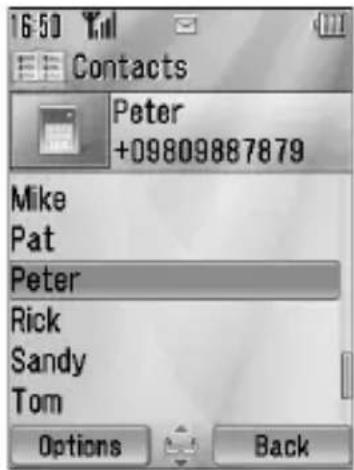
Searching for a contact

Main menu > Contacts > Contacts list
-
[▲/▼] to scroll to the required contact OR Enter letters to find a contact beginning with the specific letters
-
To view the Contacts card, [◎]
Options
In the Contacts list, the following options are available by pressing [☐] (Options).
| View View the selected | Contacts card. |
| Call Call the selected contact. | |
| Create message | Create an SMS or MMS, and send it to the selected contact. See “Creating a new message” on page 54. |
| Edit | Edit the selected contact. See “Editing a Contacts card” on page 46. |
| Search Search a contact by entering characters. | |
| Add contact | Add a new contact. See “Adding contacts” on page 44. |
| Delete Delete the selected contact. | |
| Speed dial | Assign the selected contact to a Speed dial. See “Assigning speed dial keys” on page 48. |
| Copy to phone/SIM | Copy the selected contact to the phone or the SIM card. |
| Send via | Send the selected contact to another device via infrared or Bluetooth. See “Infrared” on page 105 or “Bluetooth® wireless technology” on page 107. |
Making a call from Contacts
Main menu > Contacts > Contacts list
- [▲/▼] to scroll to the required contact OR
Enter letters to find a contact beginning with the specific letters
-
[ ]
-
If the card has several phone numbers stored, [▲/▼] to scroll to the required number → [●]/[□] (Call)
Adding contacts
Storing a contact in your phone
In the phone, you can store detailed information for each contact. The entries are retained even if you damage your SIM card.

Main menu > Contacts > Add contact > Phone
- [▲/▼] to scroll to the required field → [◎]
- Enter information → [●] To enter characters, see "Text entry" on page 36.
- When entries are completed, [☐] (Save)
 | First name*1 | Enter the first name. |
 | Last name*1 | Enter the last name. |
| Mobile number*1 | Enter the phone numbers. | |
| Home number*1 | ||
| Work number*1 | ||
| Mobile email*1 | Enter the e-mail addresses. | |
| Personal email*1 | ||
| Work email*1 | ||
| Birthday Enter the contact's birthday. | ||
| Postal address | Enter Additional info, No./street, Postal code, City, State and Country. | |
| Note Enter notes. | ||
 | Ringtone | Select the required ringtone fromor My Media. To download a ringtone, select Download^*2 . |
 | Message alert | Select the required Message alert fromor My Media. To download a Message alert, select Download^*2 . |
 | Illuminations | Selector the required illumination colour. |
 | Picture Select therequired picture. | |
 | Group Select therequired group. | |
*1 The contact entry can be saved when at least one of the items is filled.
*2

Note: When you attach a picture from My Media to a Contacts card, it will appear on the screens when the contact calls you. If the picture used is oversized for the Contacts card you will be prompted to save a resized copy in My Media.
For downloading contents, visit http://box.panasonic.com/

Contacts
Storing a contact in your SIM card
You can store some information for each contact in your SIM card.

Main menu > Contacts > Add contact > SIM
- [▲/▼] to scroll to the required field → [◎]
- Enter information → [◎]

Name Enter the name.

Tel number Enter the phone number.


(Save)
Note: The length of name and number, and the total amount of data are SIM dependent.
Storing a contact from Call log
See "Saving a phone number from Call log" on page 47.
Editing a Contacts card

Main menu > Contacts > Contacts list
- Highlight the required Contacts card (See "Searching for a contact" on page 42.)
- [☐] (Options) → Select Edit
- Edit the required entry → [☐] (Save)
Call log
Recently dialled phone numbers, answered calls and missed calls are stored in Call log. The numbers in the Call log list can be used to call, send a message or add to Contacts.
Viewing/Dialling from Call log
Main menu > Contacts > Call log
- [◀/▶] to move to Dialled numbers, Answered calls or Missed calls
- [▲/▼] to scroll to the required log → [◎]
- [◎] to call
Shortcut: You can directly view the Dialled numbers list by pressing [ ] in standby mode.
Saving a phone number from Call log
Main menu > Contacts > Call log
- [◀/▶] to move to Dialled numbers, Answered calls or Missed calls
- [▲/▼] to scroll to the required phone number
- [☐] (Options) → Select Add to contacts
- Select New or Add
- If New is selected: Enter other information If Add is selected: Highlight the required contact → [☐] (Select) → If there is no empty field, “Would you like to replace?” → [☐]/[☐] (Yes) → Select the number you want to replace in Phone Contacts
- [☐] (Save)
Options
In each Call log list, the following options are available by pressing [☐] (Options).
| Call Call the selected number. | |
| Create message | Create an SMS or MMS message to the selected number. |
| Add to contacts | Store the selected number to Contacts. See “Saving a phone number from Call log” on page 47. |
| Delete Delete the selected number. | |
| Delete all Delete all the logs in the list. | |
Speed dial
You can quickly dial phone numbers by pressing keys 2-9.
Assigning speed dial keys
Main menu > Contacts > Speed Dial list
- [▲/▼] to scroll to the required key → [◎]
- Enter phone number → [◎]
To assign a speed dial key to a contact:
Main menu > Contacts > Speed Dial list
- [▲/▼] to scroll to the required key → [□] (LookUp)
- Highlight the required contact → [☐] (Select)
- If the card has several phone numbers stored, [▲/▼] to scroll to the required number → [●]/[□] (Select)
Using the speed dial keys
In standby mode:
- Press and hold a speed dial key ([2]-[9]) → [☐] (Call)
Groups
You can categorise the Contacts list stored in your phone into 20 groups.
Viewing group members
Main menu > Contacts > View groups
- Select the required group
The contacts in the selected group are displayed.
Renaming a group
Main menu > Contacts > View groups
-
[▲/▼] to scroll to the required group → [□] (Rename)
-
Enter a new group name → [◎]
Advanced
Synchronisation
You can synchronise your Contacts list with your network server. You can just send changes or send all your records to the network server. For further details, see “Synchronisation” on page 112.
To send only changes to the network server:
Main menu > Contacts > Advanced > Synchronisation > Modified contacts
The phone confirms completion.
To send all your records to the network server:
Main menu > Contacts > Advanced > Synchronisation > All contacts
The phone confirms completion.
My number
You can store your own numbers in the phone and SIM card.
Storing numbers in Mobile profile
Main menu > Contacts > Advanced > My number > Mobile profile
-
[●]/[□] (Create)
-
Repeat steps 1-3 in "Storing a contact in your phone" on page 44
Storing numbers in SIM profile
Main menu > Contacts > Advanced > My number > SIM profile
-
When the profile is empty: [●]/[□] (Create) When the profile has the stored number(s): [□] (Options) → Select Create
-
Repeat steps 1-3 in "Storing a contact in your SIM card" on page 46
Options
When viewing My number, the following options are available by pressing [☐] (Options).
| Edit Edit the profile. | |
| Create*1 | Create a new profile. |
| Delete Delete the profile. | |
| Send via | Send the profile via infrared or Bluetooth. See “Infrared” on page 105 or “Bluetooth® wireless technology” on page 107. |
*1 Available only for SIM profile.
Displaying the Contacts list sorted by last name/first name
You can choose to sort the Contacts list by contact's last name or first name.
Main menu > Contacts > Advanced > Display by
1. Select First name or Last name
Memory status
You can see the amount of memory available in the Contacts list.
Main menu > Contacts > Advanced > Memory status
Note: The amount of memory for SIM storage depends on your SIM card. To decrease the amount of phone memory used, delete unwanted data or store data on your PC (see "CD-ROM" on page 152).
Copying contacts
You can copy all the contacts from SIM card to phone, or from phone to SIM card.
Copying all the contacts from SIM card to phone
Main menu > Contacts > Advanced > Copy all from SIM
- "Copy?" → [◎]/[□] (Yes)
Copying all the contacts from phone to SIM card
Main menu > Contacts > Advanced > Copy all to SIM
- “Only Name and Number fields can be copied. Continue?” → [◎]/[□] (Yes)
Deleting Phone Contacts
You can delete all the contacts stored in your phone.

Main menu > Contacts > Advanced > Delete all
- "Delete all contacts in phone?" → [☐] (Yes)
- "Are you Sure?" → [☐] (Yes)
Service numbers

If your SIM card includes SDN (Service Dialling Number), you can call a service number by selecting from the list.
SDN enables you to access special services provided by your network operator, such as customer support, emergency services, etc.

Main menu > Contacts > Service numbers
- [▲/▼] to scroll to the required item → [◎]/[□] (Call)
Messages menu structure
Create new.... 54
SMS message.... 55
MMS message 58
Inbox 60
SMS 61
MMS....62
Archive...... 64
SMS 64
MMS....64
Web mail ^*1 65
Chat ^*1 66
Voicemail......66
Call Voicemail 66
Set mailbox number......66
Messages settings ......67
SMS....67
MMS 68
Memory status ......69
SMS....69
MMS 69

Note: There are several ways to select items from menu lists. See "Menu selection method" on page 26.
Creating a new message
Messaging types
| SMS | Short Message Service allows you to send and receive short text messages on any network that has roaming agreement. (Dependent on the recipient's phone parameters.) With the Illumination feature, you can express special feelings in a message. |
| MMS | Multimedia Messaging Service allows you to send messages containing text, pictures, sound and video clips from your phone to other MMS-enabled phones or e-mail addresses. The recipient can play it as a slide show. |
Note: The message centre number for SMS should be preprogrammed on the SIM card. Changing this number (see Message centre setting on page 67) may cause failure of a text message.
Your phone may have already been set with an MMS profile when purchased. To change the settings of the profile, see Advanced setting on page 68.
Sending or editing of a forward locked picture/sound clip/video clip indicated by the icon ( ) is restricted.
Creating an SMS message
Main menu > Messages > Create new > SMS message
- Create text message → [◎]
See "Text entry" on page 36 for entering text.
- To enter recipient's phone number directly: Enter number
To select recipient's phone number from Contacts: [●] →
Highlight the required contact → [☐] (Select) → If the card has several phone numbers stored, [▲/▼] to scroll to the required number → [●]/[☐] (Select)
- [●] to send the message
Creating an Illumination message with emoticons
With the Illumination feature, you can express special feelings in a message. The Indicator/Illumination Light responds to the pictographs in an Illumination message and light in combinations of colours and light patterns when you receive and view an Illumination message.
Main menu > Messages > Create new > SMS message
-
Create text message
-
[☐] (Options) → Select Templates
-
Select Illumination templates
-
Select the required emoticon
See "Emoticon list" on page 56.
To preview the Illumination of the messages you create:
[☐] (Options) → Select Preview illumination
Note: Only recipients who have an Illumination message capable phone can view messages with Illumination.
Emoticon list
| Emoticon | Indicator Colour | Light Pattern |
| :-) | Colour 3 | A |
| :-D (^_^) | ||
| >:-< | B | |
| :* | Colour 6 | |
| :-P C ( | ||
| :'( | Colour 1 | B (;_;;) |
| :-( | A | |
| :-/ | Colour 5 | |
| :-S | B | |
| :-[ | C | |
| :-> | Colour 2 | A |
| 8-) | B | |
| =::-) | Colour 4 | |
| :-0 | ||
| :() | C | |
| :-I | Colour 7 | |
| I-( | A | |
| ;-) | Colour 8 |
- Pattern A: [Firefly] flickers slowly for about 4 seconds.
- Pattern B: [Flash] flickers fast for about 3 seconds.
- Pattern C: [Beam] lights for about 3 seconds.
Options
When creating a text message, the following options are available by pressing [☐] (Options).
| Send Send the text as an SMS message. | |
| Send to many Send the text to more than one recipients. | |
| Preview illumination Preview illumination message. | |
| Templates | Select Illumination templates to create an illumination message or User templates to use the stored text templates. |
| Count message | The long message may be divided into several messages. You can check the concatenated message number. |
| Save Save the message in Unsent folder. | |
| Use contacts Use data saved within your Contacts cards. | |
| Copy/Cut/Paste Copy, cut or paste the text. | |
| Add symbol | Show the Symbol list from which you can select any symbol available on your phone. |
| Input method Select the input method. | |
| T9 on/off | Turn the predictive dictionary On or Off. |
| Input language Select a language you wish to write in. | |
| My dictionary Add words to the internal dictionary. | |
| Exit Exit the text edit mode. | |
Creating an MMS message
Main menu > Messages > Create new > MMS message
- Select Add picture, Add text, Add sound or Add video
- If Add text is selected: Create text message → [◎]
See "Text entry" on page 36 for entering text.
If Add picture/Add sound/Add video is selected: Select the required item stored to My Media → [☐] (Select)
You can also download new files, take new pictures, record new sound or video clips for the MMS message.
- To add more than one picture, text, sound or video clip, [▲/▼] to scroll to Slides → [◎] → [◎]/[□] (Yes)
- Repeat steps 1-3 if required
To send the message:
- [☐] (Options) → Select Send
- [▲/▼] to scroll to Add subject → [◎]
- Enter subject → [◎]
- [▲/▼] to scroll to Add recipient → [◎]
- Select From contacts, Enter number or Enter email address
- If From contacts is selected: Highlight the required contact → [☐] (Select) → If the card has several numbers stored, [▲/▼] to scroll to the required number → [●]/[☐] (Select)
If Enter number/Enter email address is selected: Enter number/email address → [●]
- [▲/▼] to scroll to Send → [◎]
Note: When you select Add video and record a new video clip in step 2, the recording time is fixed to For MMS sending.
You cannot attach a video clip together with a picture file or sound clip to one slide.
For downloading contents, visit http://box.panasonic.com/
Slide options
When Slides is highlighted, the following options are available by pressing [☐] (Options).
| Add new Add a new slide. | |
| Send | Send the MMS message after entering subject and recipient number or address. |
| Slide duration Specify | duration of the slide. |
| Remove slide Remove | the slide from the MMS message. |
| Preview slide Preview | the MMS message as a slide. |
Receiving messages
Receiving SMS messages
When you receive a new SMS message, the message icon ( ) is displayed along with a tone, illumination, and/or vibration. The SMS notification also appears on the standby screen. When One push SMS setting is set to On (see page 67), new SMS messages can be displayed by opening the flip. You can also check received SMS messages on the Front display.
Reading SMS messages
When an SMS notification is displayed on the standby screen:
- [●]/[□] (View)
If there is more than one notification, [▲/▼] to scroll to New SMS before step 1.
If there is one SMS message, the message is automatically displayed.
-
If there is more than one SMS message, [▲/▼] to scroll to the required message header in SMS Inbox → [◎]
-
When the message is displayed, [●] to show the message details (sender's number, date, message centre's number) if required
Receiving MMS messages
When you receive a new MMS message, the message icon ( ) is displayed along with a tone, illumination, and/or vibration. The received MMS messages are stored in Inbox.
Reading MMS messages
To read the received MMS messages, see "MMS Inbox" on page 62.
Note: If you do not want to receive MMS messages automatically, select Never in Auto download setting (see page 68). In this case, you will receive a message notification first, and then you will need to receive messages manually.
Inbox
Inbox stores received SMS and MMS messages.
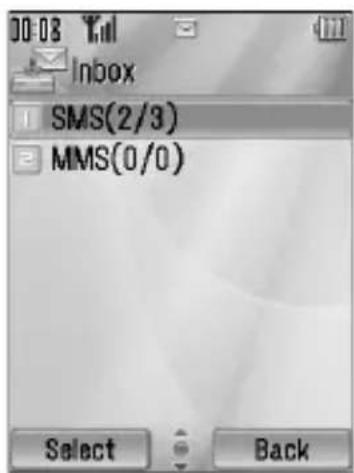
Main menu > Messages > Inbox
Numbers in brackets show the number of unread messages and the total number of messages in each inbox.
SMS Inbox
SMS message icons

Unread message Read message
Reading SMS messages
Main menu > Messages > Inbox > SMS
- [▲/▼] to scroll to the required message header → [◎]
- [●] to show the message details (sender's number, date, message centre's number) if required
Options
When viewing the list of messages or the selected message, the following options are available by pressing [☐] (Options).
| Reply | Create reply message in SMS or MMS. |
| Forward Forward the selected message. | |
| Call Call the sender's number. | |
| Add to contacts Store the sender's number to Contacts. | |
| Use detail*1 | Use phone number, e-mail or web address in the selected message to call, create message, add to Contacts, etc. |
| Delete Delete the selected message. | |
| Delete all*2 | Delete all the SMS messages. |
| View illumination*1 | Check the illumination of the message. |
*1 Available only when viewing the selected message.
*2 Available only when viewing the list of messages.
MMS Inbox
MMS message icons


Unread message MMS notification
Read message
Reading MMS messages
Main menu > Messages > Inbox > MMS
- [▲/▼] to scroll to the required message header → [◎]
Options in the message list
When viewing the list of messages, the following options are available by pressing [☐] (Options).
| Reply | Create reply message by SMS or MMS. |
| Reply to all Create reply message to all recipients. | |
| Forward Forward the selected message. | |
| Call Call the sender's number. | |
| Add to contacts | Store the sender's number or e-mail address to Contacts. |
| Delete Delete the selected message. | |
| Delete all Delete all the MMS messages and notifications. | |
| Protect/Unprotect Protect or unprotect the selected message. | |
| Details Show details for the selected message. | |
Note: Sending or editing of a forward locked file indicated by the icon ( ) is restricted.
Options while viewing messages
When viewing the message, the following options are available by pressing [☐] (Options).
| Reply | Create a reply message by SMS or MMS. |
| Reply to all Create a reply message to all the recipients. | |
| Play again Play the selected message. | |
| Message font size*1 | Select the required font size. |
| Save picture Save the attached picture to My Media. | |
| Save sound Save the attached sound clip to My Media. | |
| Save video Save the attached video clip to My Media. | |
| Use detail | Use the phone number, e-mail or web address in the selected message to call, create message, add to Contacts, etc. |
| Attached files Show the attached files. | |
*1

Options for notification
When the notification is highlighted, the following options are available by pressing [☐] (Options).
| Receive Receive new messages. | |
| Forward Forward the message. | |
| Reject | Delete the notification from the message list and the message from the server. |
| Call Call the sender's number. | |
| Delete all Delete all the | MMS messages and notifications. |
| Protect/Unprotect Protect or unprotect the message. | |
| Details Show details for the selected message. | |
Archive
Archive stores SMS and MMS messages that are sent or waiting to be sent.
| SMS | Sent Store sent SMS messages. | |
| Unsent | Store undelivered and unfinished SMS messages. | |
| MMS | Sent Store sent MMS messages. | |
| Outbox Store undelivered MMS messages. | ||
| Drafts Store unfinished MMS messages. | ||
Viewing messages
Main menu > Messages > Archive > SMS or MMS
- Select the required folder
- [▲/▼] to scroll to the required message → [◎]
Options for SMS
In Sent and Unsent folders, the following options are available by pressing [☐] (Options).
| Send Send the selected message. | |
| Call Call the sender's number. | |
| Use detail*1 | Use phone number, e-mail or web address in the selected message to call, create message, add to Contacts, etc. |
| Delete Delete the selected message. | |
| Delete all*2 | Delete all the SMS messages in the folder. |
| View illumination*1 | Check the illumination of the message. |
*1 Available only when viewing the selected message.
*2 Available only when viewing the list of messages.
Options for MMS
In Sent, Outbox and Drafts folders, the following options are available by pressing [☐] (Options).
| Edit Edit the selected message. | |
| Forward*1 | Forward the selected message. |
| Send*2 | Send the selected message. |
| Delete Delete the selected message. | |
| Delete all Delete all the messages in the folder. | |
| Protect/Unprotect Protect or unprotect the selected message. | |
| Details Show details for the selected message. | |
*1 Available only in Sent folder.
*2 Available only in Outbox and Drafts folder.
Web mail

Web mail is an innovative service that lets you stay up-to-date with all of your messages. You need to subscribe to this service. For further information, contact your service provider.
Connecting to internet mail
Main menu > Messages > Web mail
Your phone is connected to the Internet via a WAP connection to retrieve e-mail messages.
- Follow the screen contents
Chat

Chat lets you enjoy the fun of instant messaging wherever you are. It's the fun way to chat on-line. For further information, contact your service provider.

Main menu > Messages > Chat
- Follow the screen contents
Voicemail
Voicemail is a network service which allows callers, who could not reach you, to leave voice messages. You may need to subscribe to this service. For further information, contact your service provider.
Retrieving stored voice messages
When a new voice message is stored, an alert sounds and ( ) appears on the display, and you receive an SMS notification.
When an SMS notification is displayed on standby screen:
- [●]/[□] (Call)
- Follow the recorded instructions
OR

Main menu > Messages > Voicemail > Call Voicemail
- Follow the recorded instructions
Shortcut: You can also press and hold [1] in standby mode to call your voice mailbox.
Changing the voice mailbox number

Main menu > Messages > Voicemail > Set mailbox number
- Enter new voice mailbox number → [●]/[□] (Ok)
Messages settings
SMS settings
Main menu > Messages > Messages settings > SMS
1. Select the required setting
| Message lights | Decide whether or not you want the Indicator/ Illumination Light to illuminate when receiving an illumination message. |
| Message lights view | Decide whether or not you want the Indicator/ Illumination Light to illuminate when viewing an illumination message. |
| Message centre Edit the | message centre number. |
| Message type Select the | required message type. |
| Validity period | Set a time period for the message centre to attempt message delivery. Select 1 hour, 12 hours, 1 day, 1 week, 1 month, 3 months or Maximum. |
| Delivery report | Select On to receive delivery reports. |
| Store sent SMS | Select On to store sent messages to the Sent folder. |
| Message font size*1 | Select the required font size. |
| Bearer type Select the | data bearer type. |
| One push SMS | Select On to display new SMS messages by opening the flip. |
MMS settings
Main menu > Messages > Messages settings > MMS
1. Select the required setting
| Reports | Select Request read (check if the other party has read the message), Send read (inform the other party that you have read the message when asked), Request delivery (check if the other party has received the message) or Send delivery (inform the other party that you have received the message when asked). |
| Priority | Select Low, Normal or High for the message priority level. |
| Validity period | Set a time period for the message centre to attempt message delivery. Select 1 day, 7 days or Maximum. |
| Auto download | Select Always on (messages are retrieved automatically after receiving message notifications), On when home (messages are retrieved automatically in your service area) or Never (messages are retrieved manually). |
| Player mode | Select Auto (display MMS slides, or playback video/sound clips automatically) or Manual (display MMS slides, or playback video/sound clips manually). |
| Message font size*1 | Select the required font size. |
| Advanced | If required, edit the information on Message server, WAP profiles, Fetch on server*1 and Anonymous reject*1. Select Information to view MMS software information. |
Memory status
You can see the amount of memory available for storing messages.
Main menu > Messages > Memory status > SMS or MMS
Note: To decrease the amount of phone memory used, delete unwanted data or store data on your PC (see “CD-ROM” on page 152).
Camera menu structure
Picture....71
Video 77
Note: There are several ways to select items from menu lists. See “Menu selection method” on page 26.
Picture
You can take a picture with the built-in camera, and send them via MMS, Infrared or Bluetooth, or use them as wallpaper. You can also attach a picture to a contact stored in your phone.
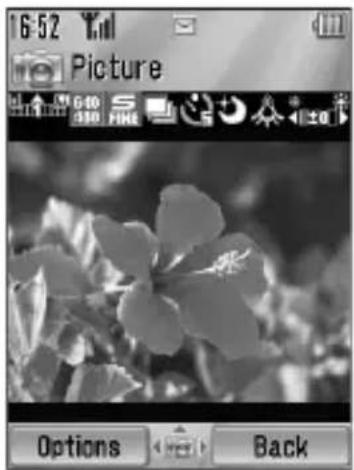
Picture preview screen
natural_image
Black-and-white photo of a flower with blurred background, no visible text or symbolsIcons on picture preview screen
 | Zoom level (1-25) | |||||
| 1600 1280 1200 960 |  |  |  |  |  | Picture size (Ultra large/Extra large/Large/Medium/Small/Main display/Front display) |
 |  | Image quality (Super fine/Fine/Normal) | ||||
 | Multi shot mode | |||||
 | Self timer (5 or 10 seconds delay) | |||||
 | Night mode | |||||
 | Photo light | |||||
| [3ZSH] | Brightness level (-2, -1, ±0, +1, +2) | |||||
Taking a picture

Main menu > Camera > Picture
-
The display acts as a viewfinder. Move the phone around to frame your subject
-
[●]/[□] to capture the image
Operations after taking a picture
To save the image to My Media: [☐] (Save)/[☐]
You can save the image by pressing [☐] whether the flip is open or closed.
To return to the preview screen without storing the image: [☐] (Delete)
To send the captured image via MMS: [●] → See “Creating an MMS message” on page 58
Taking a self-portrait
You can take your self-portrait using Front display.

Main menu > Camera > Picture
-
Close the flip. Look at yourself in Front display
-
[☐] on the side of the phone
-
The image appears on both the Main display and the Front display. For further operation, see "Operations after taking a picture" on page 72
Shortcut: To directly open the picture preview screen, press and hold [☐] in standby mode.
Caution: To avoid impairing camera performance, DO NOT leave the phone with the camera facing direct sunlight.
Note: To send a picture via infrared or Bluetooth, or use as wallpaper, save the image once, and then go to My Media. (See "Pictures" on page 132.)
If the camera is left in certain conditions including the preview screen and capture screen for 3 minutes, the phone automatically exits Picture mode. If left in the preview screen, but with the options menu displayed, the phone remains in this state.
If certain situations such as receiving calls occur during camera operation, the phone exits Camera mode. If a captured image is on the screen, it is saved to My Media.
Zoom
[▲]/[□] to zoom in one level
[▼]/[▼] to zoom out one level
You can also press and hold the keys to quickly reach the required zoom level.
Note: Zoom function may not be available when the picture size is set to Ultra large 1600x1200.
Adjusting the brightness level
The picture brightness indicator shows the current brightness level.
[▶] to increase the brightness level
[◀] to decrease the brightness level
Taking close-up pictures
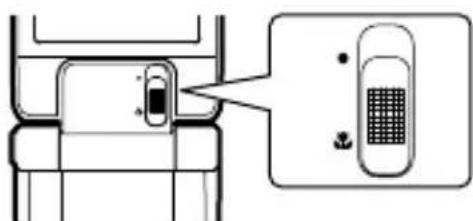
You can take sharp pictures from a close distance by using Macro Mode. (Macro focus range: 10 cm)
Slide the Macro Mode Switch to (before taking close-up pictures.
natural_image
Diagram of a mobile phone interface with a close-up of the screen and a separate panel (no text or symbols visible)Viewing pictures
Pictures taken with the built-in camera are saved to My Media. To view the saved pictures, see “Viewing pictures” on page 132.
Picture settings
In the preview screen, the following options are available by pressing [☐] (Options).
| Picture size | Select the required size from Ultra large 1600x1200, Extra large 1280x960, Large 640x480, Medium 320x240, Small 160x120, Main display 240x320 or Front display 96x64. |
| Image quality | Select the required quality from Super fine, Fine or Normal. |
| Photo light | Select On to light up your subject before snapping a picture. |
| Night mode | Select On to take a picture in low light conditions. |
| Multi shot mode | 15 continuous shots is available. See “Continuous shooting” on page 76. |
| Effect | Select the required colour from Normal, Sepia, Monochrome or Negative. |
| Self timer | Select the amount of time delay you require for shooting from Off, 5 seconds or 10 seconds. |
| Shutter sound | Select the required sound from Pattern 1-5. |
| Switch to video Switch | from Picture mode to Video mode. |
| Available space | Show the number of files which can be saved in the current picture size and image quality. You can see the number of files which can be saved in other image qualities by pressing [☐] (Quality), and in other picture sizes by pressing [▲/▼]. |
| Set to default Reset the current picture settings to default. | |
| Help Show direct key operation in the preview screen. | |
Direct key operation
You can change the picture settings by pressing one of the numeric keys which correspond to the functions as follows. Some functions are depicted by the icon. See “Icons on picture preview screen” on page 71.
[1]: Switch to video
[2]: Picture size
[3]: Image quality
[4]: Multi shot mode
[5]: Self timer
[6]: Night mode
[#]: Photo light
Adding a picture to Contacts card
If a picture is attached to a Contact card, it appears on the screen when the contact calls you.
To attach a picture to a contact, save the image once, and then go to Contacts. See “Adding contacts” on page 44.
Continuous shooting
In Multi shot mode, you can capture a succession of 15 images with just one press. When you set Multi shot mode on, the picture size is fixed to Medium 320x240 and Night mode off.
Main menu > Camera > Picture
- [☐] (Options) → Select Multi shot mode
- Select On
- [●]/[□] to shoot
The captured images are displayed as thumbnails.
Note: You cannot take pictures in Multi shot mode when the phone is closed. Once you close the phone, Multi shot mode is switched off.
To view the captured images:
[▲/▼/◄/►] to scroll to the required thumbnail → [◎]
You can view the next image by pressing [▶] or [▼], and the previous image by pressing [◀] or [▲].
To save a captured image:
- When the required thumbnail is highlighted or the required image is displayed on the screen, [☐] (Options) → Select Save this one only
The picture is stored to My Media.
To save all the captured images:
- In thumbnail screen or when one of the images is displayed on the screen, [☐] (Options) → Select Save all pictures OR
When one of the images is displayed on the screen, [●]
All the pictures are stored to My Media.
Note: All the captured images are also saved by pressing [☐] on thumbnail screen or when one of the images is displayed on the screen.
Video
You can record video clips with the built-in camera, and send them via MMS, infrared or Bluetooth.
Video preview screen
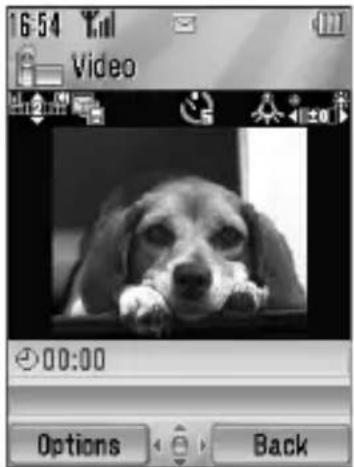
Icons on video preview screen
 | Zoom level (1-25) |
 | Recording time(Extended video/For MMS sending) |
 | Self timer (5 or 10 seconds delay) |
 | Photo light |
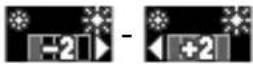 | Brightness level (-2, -1, ±0, +1, +2) |
Recording a video clip

Main menu > Camera > Video
- Main display acts as a viewfinder. Move the phone around to frame your subject
- [●]/[□] to start recording
- Video recorder records until reaching the clip size limit or until you press [●]/[□]/[□] (Stop)
- Select the required action
| Playback Playback the | recorded video clip. |
| Save to My Media Save | the recorded video clip to My Media. |
| Send as MMS | Attach the recorded video clip to an MMS message. See “Creating an MMS message” on page 58. |
Caution: To avoid impairing camera performance, DO NOT leave the phone with the camera facing direct sunlight.
Note: To send a video clip via infrared or Bluetooth, save the video clip once, and then go to My Media. (See "Videos" on page 139.)
If the video is left in the preview screen or a recorded video clip is displayed for 3 minutes, the phone automatically exits Video mode. If left in preview screen, but with the options menu displayed, the phone remains in this state.
If certain situations such as receiving calls occur during camera operation, the phone exits Camera mode. The recording ends automatically, and the already recorded video clip is saved to My Media.
Zoom
[▲]/[□] to zoom in one level
[▼]/[▼] to zoom out one level
You can also press and hold the keys to quickly reach the required zoom level.
Note: You cannot change the zoom level while recording.
Adjusting the brightness level
The video clip brightness indicator shows the current brightness level.
[▶] to increase the brightness level
[◀] to decrease the brightness level
Note: You cannot change the brightness level while recording.
Playing video clips
Recorded video clips are saved to My Media. To play the saved video clips, see "Playing video clips" on page 139.
Video settings
In the preview screen, the following options are available by pressing [☐] (Options).
| Recording time | Select the video recording time from Extended video or For MMS sending. |
| Photo light | Select On to light up your subject before recording a video clip. |
| Effect | Select the required colour from Normal, Sepia, Monochrome or Negative. |
| Self timer | Select the amount of time delay you require for recording from Off, 5 seconds or 10 seconds. |
| Switch to picture Switch | from Video mode to Picture mode. |
| Available space | Show the number of files which can be saved in the current recording time. You can see the number of files which can be saved in other recording time by pressing [☐] (RecTime). |
| Help Show direct key operation in the preview screen. | |
Direct key operation
You can change the video settings by pressing one of the numeric keys which correspond to the functions as follows. Some functions are depicted by the icon. See “Icons on video preview screen” on page 77.
[1]: Switch to picture
[2]: Recording time
[5]: Self timer
[#]: Photo light
Browser menu structure
PANASONIC BOX
Note: There are several ways to select items from menu lists. See “Menu selection method” on page 26.
Setting up your Browser
Your phone's WAP (Wireless Application Protocol) browser allows you to access services supported by the network such as news, weather reports, sports, etc.
Before Internet services can be accessed, you need to subscribe to your service provider to enable the relevant configuration information. (Your service provider may have already completed the connection settings. To configure the WAP profile settings, see "WAP profiles" on page 87.)
Note: Modifying the preinstalled settings without accurate knowledge may cause a failure in connection.
Viewing the contents
Opening Browser
Main menu > Browser
The off-line menu is displayed. You will not be connected until you choose a menu.
- [▲/▼] to scroll to the required menu → [◎]
The phone is connected to the web site.
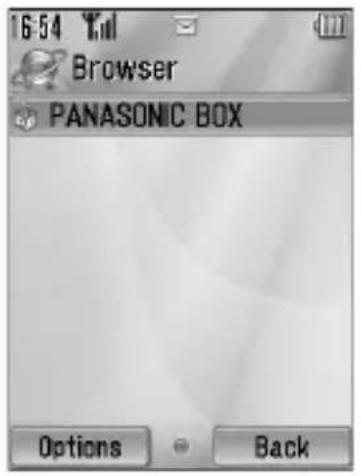
Shortcut: You can directly access Browser by pressing [☐] (💡) in standby mode.
Online status icons


Non-secure CSD connection
Secure CSD connection


Non-secure GPRS connection
Secure GPRS connection
Closing Browser
- [☐] (Options) → Select Exit browser
Browser options
While Browser is on-line or off-line, the following options are available.
Main menu > Browser [Off-line]
OR
Main menu > Browser > Required menu [On-line]
- [☐] (Options) → Select the required option
| Select Select the required item. | |
| Bookmarks Go to the bookmark list. | |
| Enter address Go to URL entry. | |
| Save media*1*2 | The image in contents is saved to My Media. |
| Set as bookmark*1 | The displayed URL is saved to the bookmark list. |
| Service Inbox Open Service Inbox. | |
| Reload page*1 | Reload this page. |
| Advanced | Go to homepage, clear the cache, view or send the current URL, or view the current WAP information. |
| Settings | Edit WAP profiles/Push access settings or view the security information. |
| Exit browser*1 | Terminate the browser. |
*1 Available only when the web page is displayed.
*2 Available only when the web page has the image, melody or video contents.
Bookmarks
Once you bookmark your favourite page or a frequently accessed page, you can jump to the page quickly. You can also categorise the bookmarked pages into 10 folders and rename each folder.
While off-line or on-line:
- [☐] (Options) → Select Bookmarks
- [▲/▼] to scroll to the required bookmark folder → [◎]
- [▲/▼] to scroll to the required bookmark
- To load the URL: [◎]
To select the required option: [☐] (Options)
| Go to page Jump to the web page. | |
| Add bookmark Add to the bookmark list. | |
| Edit Edit the selected bookmark name and URL. | |
| Move to Move the selected bookmark to another folder. | |
| Delete Delete the selected bookmark. | |
| Send bookmark | Send the bookmarked URL via SMS or MMS. |
| Delete all in folder Delete all the bookmarks in the folder. | |
Renaming a bookmark folder
[▲/▼] to scroll to the required bookmark folder → [☐] (Options) → Select Rename → Enter a new folder name → [◎]
Deleting all bookmarks
In the bookmark list:
[☐] (Options) → Select Delete all → [☐] (Yes)
All the saved bookmarks are deleted, and the folder names return to the default.
Enter address
You can directly go to the required web page by entering the URL.
While off-line or on-line:
-
[☐] (Options) → Select Enter address
-
Enter URL → [◎]
Save media
Images, melodies or videos on the web page can be saved to My Media.
When the web page is displayed:
- [☐] (Options) → Select Save media
- [●]/[□] (Select) to save
Note: Panasonic is not responsible for the performance of downloaded contents or possible corruption of phone software.
Set as bookmark
You can save the URLs of your favourite pages in Bookmarks.
When the web page is displayed:
- [☐] (Options) → Select Set as bookmark
- Enter title → [◎]
- [▲/▼] to scroll to the required folder → [◎]/[□] (Save)
Service Inbox
View WAP Push message and go to URL.
While off-line or on-line:
- [☐] (Options) → Select Service Inbox
- To load the URL: [●]
To select the required option: [☐] (Options)
| Go to page Jump to the web page. | |
| View message*1 | View the message. |
| Delete Delete the message. | |
*1 Available only when text and URL are delivered from your service provider.
Reload page
Current page can be reloaded.
When the web page is displayed:
- [☐] (Options) → Select Reload page
Advanced
While off-line or on-line:
-
[☐] (Options) → Select Advanced
-
Select the required option
| Home Jump to the set-up | homepage. |
| Clear cache Delete the | contents stored in the cache. |
| View current URL*1 | View the URL of the current page. |
| Send current URL*1 | Send the URL of the current page via SMS or MMS. |
| WAP information View | WAP browser information. |
*1 Available only when the web page is displayed.
Settings
WAP profiles
If no settings are present, contact your service provider.
You can check or edit the current WAP profile settings, or add new WAP profile settings.
Main menu > Browser [Off-line]
- [☐] (Options) → Select Settings
- Select WAP profiles
- [▲/▼] to scroll to the required profile
- [☐] (Options) → Select Activate, Edit or Delete
- If Edit is selected, you can edit the following information: Profile name, Homepage, Proxy IP, Proxy port, Use proxy and Data connections
Note: You need to configure GPRS or CSD before configuring the WAP profile settings. See "Data connections" on page 116.
Push access
Set up Push access to receive WAP messages.
While off-line or on-line:
- [☐] (Options) → Select Settings
- Select Push access
- Select Service indication, Service loading or Other messages
- Select On or Off
Security
View security information.
While off-line or on-line:
-
[☐] (Options) → Select Settings
-
Select Security
-
Select the required item
| Certificates | Select Certificate 1-20. |
| Current certificate*1 | View the current certificate. |
| Session info*1 | View session information. |
*1 Available only while secure connection.
Settings menu structure
Phone settings 90
Profiles 90
Language 91
Time and date 91
Illuminations 92
Key settings.... 93
Master reset 95
Display settings ...... 96
Main display 96
Front display.... 97
Main menu icons 98
Themes 99
Backlight time.... 99
Sounds & alerts ...... 99
Assign ringtone 99
Incoming volume 100
Message alert.... 99
Message volume 100
Warning tone 100
Startup tone.... 100
Shutdown tone 100
Vibration alert 100
Calls....101
Call diverts.... 101
Call waiting 102
Any key answer 102
Active flip 103
Auto answer.... 103
Send my number 103
Call duration 103
Service charge*1*2....104
Connectivity......105
Infrared 105
Bluetooth 107
Data connections.... 116
Security 117
PIN entry.... 117
Change PIN2.... 118
Fixed dial 118
Call barring 118
*1

*2

Note: There are several ways to select items from menu lists. See “Menu selection method” on page 26.
Phone settings
Profiles
You can switch among different profiles in your phone, each with a distinct combination of alert method, ringtone, etc. Profiles are set up for use in the following environments:
| Normal For everyday settings. |
| Silent For formal occasions. |
| Meeting For meetings. |
| Outdoor For noisy environments. |
| Car For driving occasions. |
Activating a profile
Main menu > Settings > Phone settings > Profiles
- [▲/▼] to scroll to the required profile
- [○]
OR
[□] (Options) → Select Activate
Setting a profile
You can personalise the individual settings within a profile. For further details about the individual settings, see “Sounds & alerts” on page 99.
Main menu > Settings > Phone settings > Profiles
- [▲/▼] to scroll to the required profile
- [☐] (Options) → Select Edit
- Select the required item
- Select the required setting
Language
You can change the language used for display messages and/or text entry. Automatic uses the language dictated by the country/region code of the SIM card.
Main menu > Settings > Phone settings > Language > Display language or Input language
- Select Automatic or the required language
Time and date
You can set your Home clock and Away clock.
Home clock
You can set the current time and date on your phone.
Main menu > Settings > Phone settings > Time and date > Home clock
- Select the required setting
| Set date & time | Enter the time → [▼] → Enter the date |
| Home area Select your | home area. |
| Summer time | Select On to activate the summer time mode. |
Away clock
You can set Away clock to display the time in the area you choose.
Main menu > Settings > Phone settings > Time and date > Away clock
- Select the required setting
| Set time zone Select the required area. | |
| Summer time | Select On to activate the summer time mode. |
Choosing clock
You can choose either Home clock or Away clock to be displayed on your phone.
Main menu > Settings > Phone settings > Time and date > Select clock > Home clock or Away clock
Display format
You can select the required display format for the date and time.
Main menu > Settings > Phone settings > Time and date > Display format > Time or Date
- To set Time format: Select 24 hour or 12 hour
To set Date format: Select the required format (DD=date, MM=month, YY=year)
Illuminations
The Indicator/Illumination Light flashes or beams when you receive calls/messages, have a conversation, the flip is closed, the battery is charging or data is transferred.
Main menu > Settings > Phone settings > Illuminations
- Select the required event
| Incoming | Select the required colour or Off. |
| Message | |
| In conversation | |
| Flip close | |
| Charging | Select On or Off. |
| Data transfer |
Note: You can check the Flip close illumination by pressing [▲ / ▼] while the phone is in standby mode with the flip closed.
Key settings
Key tone
You can change the key tone.
Main menu > Settings > Phone settings > Key settings > Key tone
- Select the required tone
Key volume
You can change the key tone volume.
Main menu > Settings > Phone settings > Key settings > Key volume
- [▲/▼/◄/►] to scroll to the required volume → [◎]/[□] (Select)
Key backlight
If you set the key backlight to off, you can maintain longer battery life.
Main menu > Settings > Phone settings > Key settings > Key backlight
- Select On or Off
Keyguard
Keyguard prevents any keys from being accidentally pressed e.g. when the phone is being carried. When Keyguard is enabled, the Keyguard icon ( ) appears on the display. When a call is received, Keyguard is temporarily disabled and you can answer the call.
To enable Keyguard:
Main menu > Settings > Phone settings > Key settings > Keyguard
- “Would you like to lock keypad?” → [●]/[□] (Yes) OR
In standby mode:
-
Press and hold [●]
-
"Would you like to lock keypad?" → [◎]/[□] (Yes)
Note: Emergency calls can still be made with the Keyguard enabled but there is no indication that you are dialling the number.
To disable Keyguard:
When ( ) appears on the display:
- [●] → "Would you like to unlock?" → [●]/[□] (Yes)
Shortcut keys
Navigation key [▲/▼/◄/►] can be used as a Shortcut key. It is possible to assign a specific menu to Navigation key so that you can access the menu directly from standby mode.
Main menu > Settings > Phone settings > Key settings > Shortcut keys
-
Select Navigation up, Navigation right, Navigation down or Navigation left
-
Select the required menu
Master reset
You can reset your phone to the factory settings, except for the settings for Language, Time and date, and Calendar. User data such as contacts, messages, call logs and data stored in My Media remains on the phone.
Password is required for master reset. The factory set password is 0000.
Resetting
Main menu > Settings > Phone settings > Master reset > Reset settings
- "Would you like to reset all phone settings?" → [◎]/[□] (Yes)
- Enter the password → [◎]/[□] (Ok)
Changing the password
Main menu > Settings > Phone settings > Master reset > Password setting
- Enter the current password → [●]/[□] (Ok)
- Enter a new password → [●]/[□] (Ok)
- Enter the new password again → [●]/[□] (Ok)
Display settings
Main display
You can change the wallpaper, brightness and position of the operator name on the Main display.
Wallpaper
You can change the wallpaper on the standby screen.
Main menu > Settings > Display settings > Main display > Wallpaper
- Select My Media or Download*1
- [▲/▼/◄/►] to scroll to the required wallpaper
- To set: [☐] (Select)
To view and set: [◎] → [◎]/[□] (Select)
Brightness
You can adjust the brightness of the display.
Main menu > Settings > Display settings > Main display > Brightness
- [▲/▼] to adjust the brightness level → [●]/[□] (Select)
Operator name
You can change the position of your operator name on the standby screen.
Main menu > Settings > Display settings > Main display > Operator name
- Select Default, Upper left or Lower left
*1

Front display
You can change the wallpaper, contrast and clock display on the Front display.
External wallpaper
You can change the wallpaper on the Front display.
Main menu > Settings > Display settings > Front display > External wallpaper
- Follow the procedures of Wallpaper in Main display on page 96.
Contrast
You can adjust the contrast of the Front display.
Main menu > Settings > Display settings > Front display > Contrast
- [▲/▼] to adjust the contrast → [◎]/[□] (Select)
Clock display
You can change the clock display style.
Main menu > Settings > Display settings > Front display > Clock display
- Select Clock and Date or Digital
Main menu icons
You can change menu icons or the background on Main menu screen.
Changing icons
To change menu icons:
Main menu > Settings > Display settings > Main menu icons
- [▲/▼/◄/►] to scroll to the required menu icon → [◎]
- Select My Media or Download*1
- [▲/▼/◄/►] to scroll to the required image
- To set: [☐] (Select)
To view and set: [◎] → [◎]/[□] (Select)
To change the background:
Main menu > Settings > Display settings > Main menu icons
- [☐] (Options) → Select Attach full image
- Repeat steps 2-4 in "To change menu icons:" on page 98
*1

Note: For downloading contents, visit http://box.panasonic.com/
Setting back to default
Main menu > Settings > Display settings > Main menu icons
- [☐] (Options) → Select Set to default
- "Would you like to set default?" → [●]/[□] (Yes)
Themes
You can change the colour theme of the display.
Main menu > Settings > Display settings > Themes
- Select the required colour theme
Backlight time
You can set the length of time the display is illuminated by the backlight.
Main menu > Settings > Display settings > Backlight time
- Select 10 seconds, 30 seconds or 60 seconds
Sounds & alerts
Ringtone/Message alert
You can change the tone and/or the volume of the ringtone for incoming calls and the Message alert for incoming messages.
Changing the ringtone/Message alert
Main menu > Settings > Sounds & alerts > Assign ringtone or Message alert
- Select My Media or Download*1
- [▲/▼] to scroll to the required tone
- [●] to listen to the tone → [□] (Cancel) to stop the tone and return to the previous screen
- [☐] (Select)
*1

Note: For downloading contents, visit http://box.panasonic.com/
Changing the ringtone/Message alert volume
Main menu > Settings > Sounds & alerts > Incoming volume or Message volume
- [▲/▼/◄/►] to adjust the volume (Volume 0-4, Step tone) → [◎]/[□] (Select)
Warning tone
The Warning tone informs you of low battery.
Main menu > Settings > Sounds & alerts > Warning tone
- Select On or Off
Startup tone/Shutdown tone
The Startup tone sounds after switching on the phone, while the Shutdown tone sounds after switching off the phone.
Main menu > Settings > Sounds & alerts > Startup tone or Shutdown tone
- Select On or Off
Vibration alert
The phone does not ring but vibrates to inform you of incoming calls and messages if you switch on vibration alert.
Main menu > Settings > Sounds & alerts > Vibration alert
- Select On or Off
Calls
Call diverts

Voice, fax and data calls can be diverted to different numbers in different situations. For example, you can divert calls to your voice mailbox when you are out of reach.
Voice calls can be diverted in the following situations:
| All calls Divert all incoming voice calls. | |
| When busy | Divert incoming voice calls when a call is in progress. |
| When no reply Divert incoming voice calls if call is not answered. | |
| When unreachable | Divert incoming voice calls when phone is not in a coverage area. |
Main menu > Settings > Calls > Call diverts
- Select Divert voice, Divert all fax or Divert all data (If Divert all fax or Divert all data is selected, go to step 3.)
- Select the divert situation
- Select Direct input or From contacts
- If Direct input is selected: Enter the phone number to divert to → [●]
If From contacts is selected: Highlight the required contact → [☐] (Select) → If the card has several phone numbers stored, [▲/▼] to scroll to the required number → [◎]/[☐] (Select)
When the setting is enabled, the divert icon ( ↗ ) is displayed on the standby screen.
To cancel each setting/check each status:
Main menu > Settings > Calls > Call diverts
- Select Divert voice → [▲/▼] to scroll to the required divert situation
OR
[▲/▼] to scroll to Divert all fax or Divert all data
- [☐] (Options) → Select Off or Status
To cancel all the settings/check all the statuses:
Main menu > Settings > Calls > Call diverts
- Select Cancel all or Status all
Call waiting
If Call waiting is switched on, another call can be received while on a call and multiple calls can be made.
Main menu > Settings > Calls > Call waiting
The current status is displayed.
To accept the current status:
- [○]
To change the setting:
- [☐] (Options) → Select Activate or Deactivate
The current status is displayed.
- [●] to accept the current status
Any key answer
Calls can be answered by pressing any key except [○×], [●], [□□] (Cancel), [□□], [▲□] and [▼□].
When Any key answer is off, calls can only be answered by pressing [ ] or [□] (Accept).
Main menu > Settings > Calls > Any key answer
- Select On or Off
Active flip
You can answer a call by opening the phone and end a call by closing the phone.
When Active flip is off, you need to press the appropriate key to answer or end the call. When you are using a headset, you can continue your conversation even while the phone is closed.
Main menu > Settings > Calls > Active flip
- Select On or Off
Auto answer
When you use the optional Personal Handsfree earpiece, you can answer a call automatically.
Main menu > Settings > Calls > Auto answer
- Select On or Off
Send my number

You can choose whether or not to show your name and/or number to another phone. You can comply with your network's own setting if you select Network set.
Main menu > Settings > Calls > Send my number
- Select Network set, On or Off
Call duration
You can check the duration of incoming or outgoing calls.
Main menu > Settings > Calls > Call duration
- Select Incoming or Outgoing
- To reset the counter, [◎]/[□] (Reset)
- "Reset?" → [◎]/[□] (Yes)
Service charge

Cost left
You can check the remaining call units available if Max cost is set.
Main menu > Settings > Calls > Service charge > Cost left
Call meter
You can check the total costs of calls made.
Main menu > Settings > Calls > Service charge > Call meter
To reset the counter:
-
[●]/[□] (Reset) → "Reset total cost?" → [●]/[□] (Yes)
-
Enter the PIN2 code → [◎]/[□] (Ok)
Price/unit
You can set your personal rate of the cost that the service provider charges for one unit of call time.
Main menu > Settings > Calls > Service charge > Price/unit
-
[●]/[□] (Edit) → Enter the PIN2 code → [●]/[□] (Ok)
-
Enter the currency → [◎]
-
Enter the value → [◎]/[□] (Ok)
To enter a decimal point: [#]
Max cost
You can set the maximum cost of calls allowed.
Main menu > Settings > Calls > Service charge > Max cost
-
[◎] → Enter the PIN2 code → [◎]/[□] (Ok)
-
Enter the credit limit → [◎]/[□] (Ok)
To disable the Max cost:
In step 1, [☐] (Options) → Select Disable → [◎]/[☐] (Yes) → Enter the PIN 2 code → [◎]/[☐] (Ok)
Connectivity
Infrared
You can transfer data between your phone and other infrared enabled devices using an infrared wavelength connection.
You can send Contacts card, calendar events, and pictures/sound clips/video clips stored in My Media.
Note: Some downloaded files may be protected under copyright laws. These files should not be sent.
Preparing for infrared connection
Place your phone and the other device within the effective range of 20 cm.
- Verify there are no obstructions between the two devices. Nearby activated infrared devices may cause interference.
- Ensure that the infrared ports of the devices point at each other.
- On the receiving device, activate the Infrared port.
- If the other device is a computer, you need to set up infrared connection on the computer. (Example: For Windows XP, Start > Control Panel > Printers and Other Hardware > Wireless Link > Infrared tab > All others to send files to your computer using infrared communications)
Infrared Port
Caution: Though invisible to the eye, do not point the infrared beam at anyone's eyes.
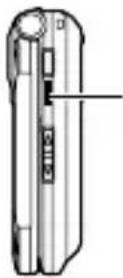
Sending data via infrared
Prepare for infrared connection as described in “Preparing for infrared connection” on page 105.
- Select the item you wish to send
- [☐] (Options) → Select Send via
- Select Infrared
The phone automatically begins infrared connection. A confirmation message is displayed when complete.
Receiving data via infrared
Prepare for infrared connection as described in "Preparing for infrared connection" on page 105.
To activate infrared:
You need to activate the infrared function before receiving data. When infrared is set to on, the infrared icon ( ) appears on the display. If infrared is unused for 10 minutes or the phone is once switched off, it is automatically set to off and ( ) disappears.
Main menu > Settings > Connectivity > Infrared
- Select On
To receive data via infrared:
When ( is displayed, sender can begin transfer of data.
- When transfer is started, "Would you like to receive data?" → [●]/[□] (Yes) to receive the data
- When transfer is complete, "Data received" → Return to standby screen → Received file name is displayed → [●]/[□] (Save) to save the data
The received data is stored in respective menus or files.
Bluetooth® wireless technology
You can send and receive pictures, video and sound clips, etc. between Bluetooth devices such as mobile phones and computers. Use a Bluetooth headset or handsfree to talk wirelessly on your phone whilst the phone is in your pocket or purse.
Note: Although Bluetooth devices can connect within a 10 metre range, walls or other nearby barriers may cause interference.
Check with local authorities before using Bluetooth wireless technology as some countries may restrict the use of Bluetooth devices.
Keeping Bluetooth setting "On" consumes battery power more rapidly. To conserve battery power, select Off in Bluetooth setting when not in use (see page 107).
Setting up Bluetooth
You must first set up Bluetooth connections before using it for the first time. Thereafter, go to Settings to switch Bluetooth setting on and change your phone's visibility to other Bluetooth devices.
Main menu > Settings > Connectivity > Bluetooth > Settings 1. Select the required setting
| Bluetooth on/off | Select On or Off. |
| Phone name | Use the default name or enter a name for your phone that other devices will see when they search for your phone. |
| Visibility*1 | Choose Show phone to allow other Bluetooth devices to find your phone when searching, or select Hide phone to keep other Bluetooth devices from finding it during a search. |
*1 To conserve battery life and avoid unwanted connections, "Show phone" in Visibility is of 5 minutes duration.
Pairing with other devices
Before you can transfer information between two Bluetooth devices, they need to find each other and set up a connection. This is referred to as “pairing”.
Ensure that the device in which you want to pair is switched on, and its Bluetooth setting is activated.
Main menu > Settings > Connectivity > Bluetooth > Paired devices
- "No paired device add new device?" → [☐] (Ok)
The phone begins searching for devices and notifies you when it finds the other device
-
[▲/▼] to scroll to the required device
-
[☐] (Options) → Select Pair device
-
Enter the Pass key, if requested → [☐] (Ok)
You may need to enter Pass keys on the both sides of connecting devices
- "Make device trusted?" → [☐] (Yes)
Note: The Pass key may be between 1 and 16 digits except where stated in the connecting device (normally headset) instructions when a 4 digit Pass key is specified.
Making the device “trusted” on step 5 can cause future connections to occur without notice. This may enable trusted devices to access your Contacts list and data folders without prompting. You are advised to “trust” only your own devices to avoid being prompted each time a call is received.
Setting up the Bluetooth headset (Optional Accessory)
The Bluetooth headset gives you wireless, handsfree operation. Before you can use the headset you need to pair the headset and the phone.
After switching Bluetooth on, the Bluetooth icon ( ) will appear in the Main display screen. You now need to set up the headset.
- Switch on the headset
See the headset instructions.
- Make the headset discoverable
See the headset instructions.
-
On the phone, follow the instructions "Pairing with other devices" on page 108
-
To receive calls on a Bluetooth headset: Highlight the device name → [☐] (Options) → Select Connect OR
Press the button on the headset
( ) appears on the screen when the headset is connected.
See the headset instructions.
Once the headset and phone are connected, you can answer calls using the headset. If the headset is on when you receive a call, the headset rings. For information on how to answer a call with the headset, see the headset instructions. To make a call with the headset, also see the headset instructions.
Sending/receiving data via Bluetooth
You can send and receive Contacts cards as business cards, Calendar events, pictures, video and sound clips via Bluetooth.
Note: The phone may not allow you to copy, modify, transfer or forward some copyrighted images, ringtones or other contents.
To send data via Bluetooth:
- Ensure that the receiving device is made visible
- Highlight the item you wish to send
- [☐] (Options) → Select Send via
- Select Bluetooth
If the phone has already searched for devices, it shows the list of discovered devices.
If the phone has not yet searched, the phone automatically searches for Bluetooth devices nearby, and displays the list of discovered devices. [☐] (Cancel) to stop search.
- [▲/▼] to scroll to the intended device in the list → [☐] (Options)
- Select Select
Connecting message appears, then when other device accepts, a confirmation message displays when transfer is complete.
If the other device cannot receive data, an error message appears.
To receive data via Bluetooth:
- Ensure that your phone's Bluetooth is on and made visible
- When transfer starts, "Would you like to receive data?" → [◎]/[□] (Yes) to receive the data
- When transfer is complete, "Data received" → [●]/[□] (Save) to save the data
The received data is stored in respective menus or files.
Note: Confirmation is required first if the paired device is not set as authorised.
Managing paired devices
Main menu > Settings > Connectivity > Bluetooth > Paired devices
- [▲/▼] to scroll to the required device → [□] (Options)
- Select the required option
| Add new device | View the list of discovered devices. To search for other devices, press [☐] (Options) → select Search while viewing the Discovered devices list. |
| Make trust/ Make untrust | Make the required device a trusted/untrusted device. |
| Connect/ Disconnect | Connect/disconnect to the phone, headset or handsfree. |
| Rename | Change name of paired device to an easily recognised name. |
| Delete Delete the paired device from your list. | |
Icons of paired devices


audio phone
computer miscellaneous


Synchronisation

You can synchronise your Contacts list with your network server. You may need to do this if you store your Contacts list on the network server, and you want them all to be the same. You can just send changes or send all your records to the network server. This function uses SyncML/OMA Standard technology.
Before you can synchronise your Contacts list, you need to set up a server profile and select a WAP profile.
Creating/editing a server profile
You can create up to 2 server profiles.
Main menu > Settings > Connectivity > Synchronisation
- [☐] (Options) → Select Sync. settings
- [▲/▼] to scroll to the required profile
- [☐] (Options) → Select Edit
- Select the required setting → [◎]
- Enter information → [◎]
- [☐] (Save)
| Profile name Enter the | profile name. |
| Server name Enter the | web address of the server. |
| Server database Enter | the database name of the server. |
| Server user ID Enter your user name for the server. | |
| Server password Enter | the password. |
Selecting a server profile
Main menu > Settings > Connectivity > Synchronisation
- Repeat steps 1 and 2 in “Creating/editing a server profile” on page 112
- [☐] (Options) → Select Set
Selecting a WAP profile
Main menu > Settings > Connectivity > Synchronisation
-
[☐] (Options) → Select WAP profiles
-
Select the required profile
Synchronising
To send only changes to the network server:
Main menu > Settings > Connectivity > Synchronisation > Modified contacts
The phone confirms completion.
To send all your records to the network server:
Main menu > Settings > Connectivity > Synchronisation > All contacts
The phone confirms completion.
Note: If you are synchronising your Contacts list for the first time, or you need to make a large number of changes, then the synchronisation may take several minutes or more.
You cannot synchronise the following fields: Birthday, Postal address, Ringtone, Message alert, Illumination, Picture and Group. There may be other fields that cannot be synchronised depending on the server.
Server or database authentication
While synchronising, you may be asked for server or database authentication. Enter the correct information and retry the synchronisation connection.
In authentication screen:
-
[▲/▼] to scroll to the required setting → [◎]
-
Enter the correct information → [◎]
-
To retry the synchronisation connection, [☐] (Options) → Select Ok
Cell Broadcast
You can receive messages on specified topics, such as weather information and traffic news, regularly from your service provider. You can specify the “topic(s)” of information and the language in which you wish to receive the information.
Activating Cell Broadcast
Main menu > Settings > Connectivity > Cell Broadcast > On/Off
- Select On or Off
Reading a received message
Main menu > Settings > Connectivity > Cell Broadcast > Read messages
- [▲/▼] to scroll to the required message → [◎]
Topics and languages
You can add, edit and delete topics and languages.
Main menu > Settings > Connectivity > Cell Broadcast > Options > Topic or Language
- [▲/▼] to scroll to the required topic or language
- [☐] (Options) → Select Add, Edit or Delete
GSM network
Selecting a network manually
You can manually select a network that is available in your current location.
Main menu > Settings > Connectivity > GSM network > New search
- Select the required network
Network list
The network list is used when the Search mode is set to Automatic. The order in the list indicates the search priority. You can edit the list as required.
Main menu > Settings > Connectivity > GSM network > Select network
- [▲/▼] to scroll to the required network
- [☐] (Options) → Select Add, Insert, Edit or Delete
Add stores a new network at the end of the list, while Insert stores a new network above the selected network.
Search mode
You can set your phone to automatically or manually search for the other networks when roaming. When Automatic is selected, the phone automatically selects a new network in order to maintain optimum network availability. When Manual is selected, available networks are shown on the standby screen.
Main menu > Settings > Connectivity > GSM network > Search mode
- Select Automatic or Manual
Note: National regulations may not permit roaming in your home region.
Data connections
GPRS settings and CSD settings are stored in the Data connections menu.
Data can be sent/received using GPRS or CSD technology.
Editing GPRS/CSD settings
Main menu > Settings > Connectivity > Data connections
-
[▲/▼] to scroll to the required setting you want to edit or
to add new setting → [◎] -
If
is selected, select GPRS or CSD -
Edit the required field → [☐] (Save)
Deleting GPRS/CSD settings
Main menu > Settings > Connectivity > Data connections
-
[▲/▼] to scroll to the required setting you want to delete
-
[☐] (Options) → Select Delete
-
[◎]/[□] (Yes)
Note: If your service provider has protected some of your settings, you may not be able to modify them.
USB
You can backup data stored on your phone to a PC using USB Cable. Install the Handset Manager software from the CD-ROM before using USB Cable. (See “CD-ROM” on page 152.)
Security
PIN code
The PIN protects your SIM card against unauthorised use. If you enable the PIN, you will be prompted to enter the PIN code every time the phone is switched on.
The PIN2 controls security for certain service provider services such as Fixed dial and Service charge.
Note: If PIN is entered incorrectly 3 times the phone will be locked, and you will need to enter the PUK code. If PIN2 is entered incorrectly 3 times SIM card will be locked, and you will need to enter PUK2 code. If the PUK code is entered incorrectly 10 times, the phone will cease to operate permanently. All information stored in the SIM card will be lost and the SIM card will need to be replaced. Contact your service provider for further information.
Enabling/Disabling PIN entry
Main menu > Settings > Security > PIN entry > Enable/disable
-
Select Enable or Disable
-
Enter the PIN code (4-8 digits) → [●]/[□] (Ok)
Changing PIN
You can change the PIN when PIN entry is set to Enable.
Main menu > Settings > Security > PIN entry > Change PIN
- Enter the current code → [●]/[□] (Ok)
- Enter the new code → [◎]/[□] (Ok)
- Enter the new code again → [●]/[□] (Ok)
Changing PIN2

Main menu > Settings > Security > Change PIN2
- Enter the current code → [●]/[□] (Ok)
- Enter the new code → [◎]/[□] (Ok)
- Enter the new code again → [●]/[□] (Ok)
Fixed dial

When Fixed dial is enabled, only the phone numbers stored in SIM Contacts can be dialled. Any manually dialled phone numbers must match the phone numbers in SIM Contacts.
To store, edit or delete phone numbers in SIM Contacts, you need to enter your PIN2 code.
Main menu > Settings > Security > Fixed dial
- Select Enable or Disable
- Enter the PIN2 code (4-8 digits) → [●]/[□] (Ok)
Call barring
Call barring restricts certain calls, using a password supplied by your service provider.
The following Call bar settings are available:
| Bar outgoing calls All outgoing calls are barred. | |
| Bar foreign calls International outgoing calls are barred. | |
| Bar foreign calls except Home | International outgoing calls except to your home country are barred. |
| Bar incoming calls All incoming calls are barred. | |
| Bar incoming if abroad | Roaming is barred if abroad. |
Call barring setting
Main menu > Settings > Security > Call barring
- Select the required setting
- Enter the password → [◎]/[□] (Ok)
To cancel setting/check status:
Main menu > Settings > Security > Call barring
- [▲/▼] to scroll to the required setting
- [☐] (Options) → Select Off or Status
- If Off is selected, enter the password → [●]/[□] (Ok)
To cancel all the settings/check all the statuses:
Main menu > Settings > Security > Call barring
- Select Cancel all or Status all
- If Cancel all is selected, enter the password → [●]/[□] (Ok)
Changing the password
Main menu > Settings > Security > Call barring > Password
- Enter the current password → [●]/[□] (Ok)
- Enter a new password → [◎]/[□] (Ok)
- Enter the new password again → [●]/[□] (Ok)
Tools menu structure
SIM Tool Kit ^*1 121
Alarms.... 121
Sound recorder .... 123
Calculator 124
*1

Note: There are several ways to select items from menu lists. See "Menu selection method" on page 26.
SIM Tool Kit

The SIM Tool Kit allows the applications existing on the SIM card to interact and operate with your phone. These applications, stored in the SIM memory, are Value Added Services. Your service provider can configure your SIM card with the applications that can be seen on your phone as additional menu items.
For further information, contact your service provider.
Alarms
You can set up to 5 different alarms.
Setting the alarm
Main menu > Tools > Alarms
- [▲/▼] to scroll to the required setting → [◎]
- [▲/▼] to scroll to the required field → [◎]
- Enter information → [◎]
- [☐] (Save) to store the entry
The alarm icon ( 🔥 ) appears on the standby screen.
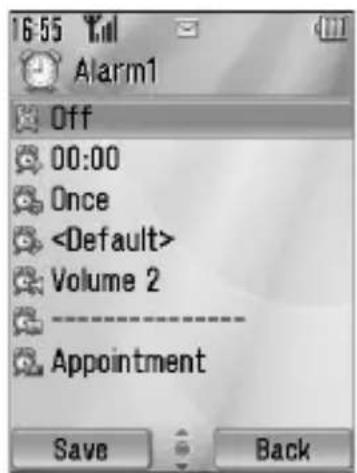
 | Turn on/off | Select On or Off. |
 | Time Enter the time. | |
 | Repeat type | Select Once, Everyday or Weekly for alarm repeat type. |
 | Alarm tone | Select alarm tone fromor My Media. To download an alarm tone, select Download*1. |
 | Alarm volume | Adjust alarm volume (Volume 0-4 or Step tone). |
 | Stored pictures | Select the required picture. The picture appears on the screen when the alarm sounds. |
 | Illumination | Select the required illumination pattern or Off. |
*1

Note: The alarm sounds at the time you set even if the phone is off.
Turning the alarm on/off

Main menu > Tools > Alarms
- [▲/▼] to scroll to the required setting
- [☐] (Options) → Select Turn on or Turn off
Stopping the alarm
When the alarm sounds, you can activate the snooze function to repeat the alarm 5 times at 5 minute intervals.
- Press any key except [∅] → "Stop snooze?"
- To stop the snooze function: [●]/[□] (Turn off)
To activate the snooze function: [☐] (Snooze)
Shortcut: Stopping the alarm by pressing [☐] activates the snooze function and returns to standby mode.
Sound recorder
You can record sounds, your voice or phone conversation. The recorded sound clips (except for the phone conversation) can be attached to MMS messages.
Recording new sound clips
Main menu > Tools > Sound recorder
- [●]/[□] (Start) to start recording
The max. recording time is 3 minutes.
-
[●]/[□] (Stop) to stop recording
-
[●] to play back if required
[▲/▼] to adjust the volume
- [☐] (Options) → Select Save
The sound clip is saved to My Media.
If you select Send as MMS, you can access MMS menu.
Note: When you save the recorded sound clip and receive storage full message, press [●]/[□] (Yes) to save the recorded sound clip by deleting unwanted files in My Media.
Calculator
You can use the 4-function calculator (addition, subtraction, multiplication and division) to make simple arithmetic operations.
Main menu > Tools > Calculator
- Enter a number
To enter a decimal point: [☐]
To enter a negative sign: [#]
To erase digits: [☐] (Clear)
-
[▲/▼/◄/►] to select the arithmetic operation ([▲] to multiply, [►] to add, [▼] to divide, [◄] to subtract)
-
Enter a number
-
[◎] (=) to calculate
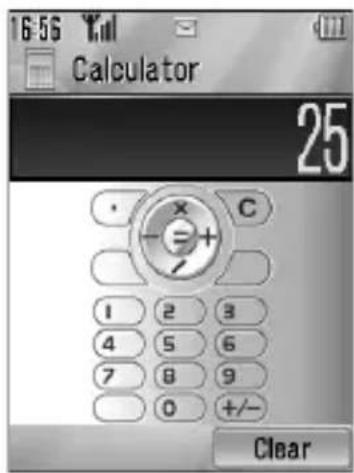
Note: There are several ways to select items from menu lists. See “Menu selection method” on page 26.
Browsing Calendar
You can view the calendar by month, by week or by day.
Browsing operation
Main menu > Calendar
To move around the calendar: [▲/▼/◄/►]
To change the view format (Monthly view/Weekly view): see View format in "Options"
To view the details of the selected day (Daily view): [●]
Options
From Monthly view or Weekly view, the following options are available by pressing [☐] (Options).
| New entry See “Creating Calendar events” on page 127. | |
| View format | Change calendar view format, Monthly or Weekly. |
| Go to date Go to specified date. | |
| Send via | Send calendar events via infrared or Bluetooth. See “Infrared” on page 105 or “Bluetooth® wireless technology” on page 107. |
| Delete See “Deleting multiple events” on page 129. | |
| Lunar calendar detail*1 | Check Chinese Lunar calendar dates and festivals when viewing the western calendar. |
| Memory status Show used memory for calendar. | |
| Settings See “Calendar settings” on page 130. | |
*1 Available only when Display language setting is set to Chinese language. (See “Language” on page 91.)
Calendar view
To change the calendar view format, see “Browsing operation” on page 125.
Monthly view
| Current date Red frame | |
| Selected date | Coloured - Also displayed in the upper left of the calendar |
| Week number of selected date | Displayed in the upper right of the calendar |
| Scheduled note | Coloured - Also displayed in the schedule list with category icon, start time and note (up to 3 events) |
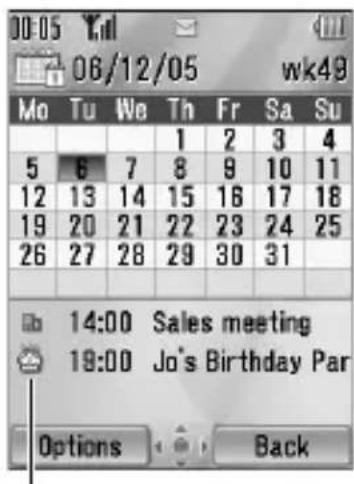
Schedule list
Weekly view
| Current date Red line under week | |
| Current week number | Displayed in the upper right of the calendar |
| Selected date | The day of the week is coloured- Also displayed in the upper left of the calendar |
| Scheduled note | The scheduled time zone is coloured |
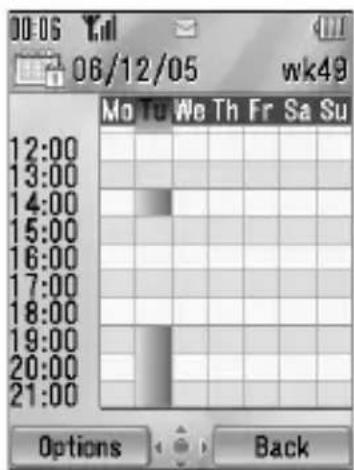
Daily view
| Current date Displayed in the upper left | |
| Current week number | Displayed in the upper right |
| Scheduled note | Displayed with category icon, start time and note |
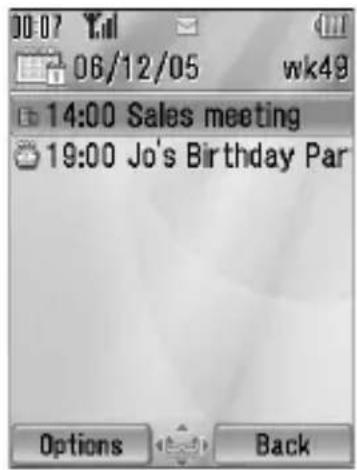
Creating Calendar events
Main menu > Calendar
- Select the day of the event you wish to store
- [☐] (Options) → Select New entry
- [▲/▼] to scroll to the required field → [◎]
- Enter information → [●] To enter characters, see "Text entry" on page 36.
- [☐] (Save) to store the event
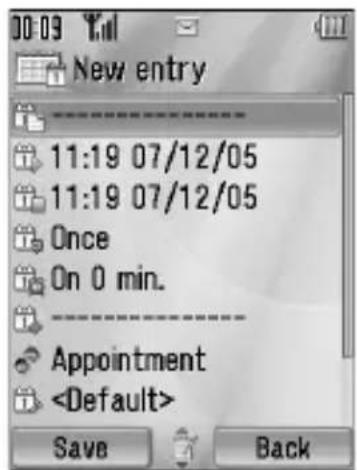
 | Note Enter note (subject). | |
 | Start date/time | Enter the start time → [▼] → Enter the start date (Present time/date is already entered.) |
 | End date/time | Enter the end time → [▼] → Enter the end date (Present time/date is already entered.) |

Calendar
 | Repeat type Select an event repeat cycle. | |
 | Reminder | Set the reminder to sound at the start time (0 min.) or certain minutes ahead of the start time.Select Off, 0 min., or 5, 10, 15, 30, 60, 90 min. ahead.When the reminder tone sounds, press [☐](View) to check the schedule or press [☐](Stop) to return to standby mode. |
 | Location Enter location. | |
 | Category Select category. | |
 | Calendar tone | Select a reminder tone fromorMy Media. To download a tone, select Download*1. |
 | Calendar volume | Adjust the reminder volume (Volume 0-4 or Step tone). |
 | Illumination | Select a reminder illumination pattern or Off. |
*1

Note: The reminder sounds at the scheduled time even if the phone is off.
The calendar highlights only the start days of scheduled events if the events are scheduled for over days.
For downloading contents, visit http://box.panasonic.com/
Managing Calendar events
Editing events
Main menu > Calendar
- From Daily view, [▲/▼] to scroll to the required event
- [☐] (Options) → Select Edit
- Edit the required field → [☐] (Save) to overwrite
Deleting events
Deleting an event
Main menu > Calendar
- From Daily view, [▲/▼] to scroll to the required event
- [☐] (Options) → Select Delete
- [◎]/[□] (Yes)
Deleting multiple events
To delete the events of the selected day or the past events:
Main menu > Calendar
- From Monthly view or Weekly view, [▲/▼/◄/►] to scroll to the required date
- [☐] (Options) → Select Delete
- Select Day or Past
- [◎]/[□] (Yes)
To delete all events:
Main menu > Calendar
- From Monthly view or Weekly view, [☐] (Options) → Select Delete
- Select All
- [☐] (Yes)
Calendar settings
Selecting the starting day of the week
Main menu > Calendar
- [☐] (Options) → Select Settings
- Select Week starts on
- Select the required day of the week
Setting holidays
You can set holidays to be indicated in red.
Main menu > Calendar
- [☐] (Options) → Select Settings
- Select Holiday set
- [▲/▼] to scroll to the required day of the week → [◎]
Repeat this step to select other days of the week.
- [☐] (Ok)
Chinese Lunar calendar
You can check Chinese Lunar calendar dates and festivals when still viewing western calendar. To display Chinese Lunar calendar, you need to select Chinese language in Display language setting (see page 91).
Switching on/off Chinese Lunar calendar
Main menu > Calendar
- [☐] (Options) → Select Settings
- Select Lunar calendar
- Select On or Off
Viewing Chinese Lunar calendar detail
Main menu > Calendar
- [▲/▼/◄/►] to scroll to the day you wish to view the detail
- [☐] (Options) → Select Lunar calendar detail
My Media menu structure
Pictures.... 132
Stored pictures 132
Download ^*1 136
Take new picture 136
Sounds...... 136
Stored sounds 136
Download ^*1 138
Record new sound 138
Videos 139
Stored videos 139
Download ^*1 140
Record new video 140
Games ....140
Stored applications .....140
Download ^*1 141
Text templates .....141
Memory status ......142
*1

Note: There are several ways to select items from menu lists. See "Menu selection method" on page 26.
Pictures
Pictures taken by Camera, images downloaded from a WAP site and received via infrared or Bluetooth are stored in the Pictures folder.
Note: To use a file downloaded or indicated by the icon (☐), you may need to purchase the rights. For further information, contact your service provider.
Viewing pictures
Main menu > My Media > Pictures > Stored pictures
-
[▲/▼/◄/►] to scroll to the required thumbnail → [◎] You can view the actual size of the selected picture by pressing [◎] if the picture is larger than the display. To continue onto step 2, press [□] (Back).
-
[▶]/[▼] to view the next picture or [◀]/[▲] to view the previous picture
Note: The file size of highlighted picture is displayed under the picture title, together with the date and time the image was stored. A picture of less than 1 kB is displayed as 1 kB.
Managing files
To make a new folder:
- In the Stored pictures folder, [☐] (Options) → Select Manage files
- Select New folder
- Enter folder name → [◎]
To move the selected picture to another folder:
- When the required thumbnail is highlighted, [☐] (Options) → Select Manage files
- Select Move to folder
- Select the required folder
Options
When viewing the picture list, the following options are available by pressing [☐] (Options).
| Send as MMS | Attach the selected picture to an MMS message. See “Creating an MMS message” on page 58. |
| Use as | Use the selected picture as Wallpaper, External wallpaper or Contacts picture. See “Using pictures” on page 134. |
| Delete Delete the selected picture or folder. | |
| Delete all | Delete all the pictures in the folder or all the folders. |
| Activate Purchase your rights to view the selected picture. | |
| Rename Rename the selected picture or folder. | |
| Send via | Send the selected picture via infrared or Bluetooth. See “Infrared” on page 105 or “Bluetooth® wireless technology” on page 107. |
| Resize Resize the selected picture. | |
| Edit | Edit the selected picture. See “Editing pictures” on page 134. |
| Change view | Change the picture list to List view or Grid view. |
| Manage files | Make a new folder or move the selected picture to another folder. See “Managing files” on page 132. |
| Details Show details of the selected picture. | |
Note: Sending or editing of a forward locked picture indicated by the icon (→) is restricted.
Using pictures
You can use the stored pictures as wallpapers, external wallpapers or Contacts pictures.
Main menu > My Media > Pictures > Stored pictures
- [▲/▼/◄/►] to scroll to the required picture
- [☐] (Options) → Select Use as
- Select Wallpaper, External wallpaper or Contacts picture (If Contacts picture is selected, go to the next step.)
- Highlight the required contact → [☐] (Select)
- [☐] (Save)
Editing pictures
Adding frame
You can add a frame to your picture.
Main menu > My Media > Pictures > Stored pictures
- When the required thumbnail is highlighted or the required picture is displayed on the screen, [☐] (Options) → Select Edit
- Select Add frame
- Select the required frame The picture with the selected frame is displayed. You can change the frame by pressing [◀/▶].
- [◎]/[□] (Save)
- Enter the file name → [◎]
Note: Adding a frame is available only when the size of the picture to be edited is Medium 320x240, Small 160x120 or Main display 240x320.
Trimming
You can trim your pictures.
Main menu > My Media > Pictures > Stored pictures
-
When the required thumbnail is highlighted or the required picture is displayed on the screen, [☐] (Options) → Select Edit
-
Select Trimming
-
Select the required trimming size
-
If Free size is selected: [▲/▼/◀/▶] to determine the starting point → [◎]/[□] (Start) → [▲/▼/◀/▶] to determine the ending point → [◎]/[□] (Ok) If a size other than Free size is selected: [▲/▼/◀/▶] to move the trimming box → [◎]/[□] (Start)
-
[◎]/[□] (Save)
-
Enter the file name → [◎]
Clearing shadow
You can make dark pictures clearer.
Main menu > My Media > Pictures > Stored pictures
-
When the required thumbnail is highlighted or the required picture is displayed on the screen, [☐] (Options) → Select Edit
-
Select Clear shadow
-
[◎]/[□] (Save)
-
Enter the file name → [◎]
Downloading picture files

Main menu > My Media > Pictures > Download The download site is displayed.
Note: Panasonic is not responsible for the performance of downloaded contents or possible corruption of phone software. For downloading contents, visit http://box.panasonic.com/
Taking a new picture
Main menu > My Media > Pictures > Take new picture The phone switches to Picture mode. See “Taking a picture” on page 72.
Sounds
Sound clips recorded by Sound recorder, downloaded from a WAP site and received via infrared or Bluetooth are stored in the Sounds folder.
Note: To use a file downloaded or indicated by the icon ( 🔍 ), you may need to purchase the rights. For further information, contact your service provider.
Playing sound clips
Main menu > My Media > Sounds > Stored sounds
-
[▲/▼] to scroll to the required sound file → [◎] [▲/▼] to adjust the volume.
-
To stop: [●] To restart: [□] (Restart)
Note: The SA7 supports the ISO standard for MP3, nonconforming MP3 formats may not play properly.
Managing files
You can make new folders or move the selected sound files to another folder. See “Managing files” on page 132.
Options
In the sound list, the following options are available by pressing [☐] (Options).
| Send as MMS | Attach the selected sound clip to an MMS message. See “Creating an MMS message” on page 58. |
| Use as | Use the selected sound clip as Ringtone,Message alert or Contacts ringtone. See “Using sound clips” on page 138. |
| Play in sequence | Select Looped or Random to play all the sound clips in the selected folder in a loop or at random. |
| Delete Delete the selected sound file or folder. | |
| Delete all | Delete all the sound files in the folder or all the folders. |
| Activate | Purchase your rights to play the selected sound file. |
| Rename Rename the selected sound file or folder. | |
| Send via | Send the selected sound file via infrared or Bluetooth. See “Infrared” on page 105 or “Bluetooth® wireless technology” on page 107. |
| Manage files | Make a new folder or move the selected sound file to another folder. See “Managing files” on page 132. |
| Details Show details of the selected sound file. | |
Note: The file size of highlighted sound is displayed at the top of the list, together with the date and time the sound file was stored. A sound file of less than 1 kB is displayed as 1 kB.
Sending or editing of a forward locked sound indicated by the icon ( ) is restricted.
Using sound clips
You can use the stored sound clips as ringtones, Message alerts or Contacts ringtones.
Main menu > My Media > Sounds > Stored sounds
- [▲/▼] to scroll to the required sound clip
- [☐] (Options) → Select Use as
- Select Ringtone, Message alert or Contacts ringtone (If Contacts ringtone is selected, go to the next step.)
- Highlight the required contact → [☐] (Select)
- Select Ringtone () or Message alert ()
- [☐] (Save)
Downloading sound clips
Main menu > My Media > Sounds > Download
The download site is displayed.
Note: Panasonic is not responsible for the performance of downloaded contents or possible corruption of phone software.
For downloading contents, visit http://box.panasonic.com/
Recording new sound clips
Main menu > My Media > Sounds > Record new sound
The phone switches to the Sound recorder mode. See "Sound recorder" on page 123.
Videos
Video clips recorded by Video recorder, downloaded from a WAP site and received via infrared or Bluetooth are stored in the Videos folder.
Note: To use a file downloaded or indicated by the icon ( ) you may need to purchase the rights. For further information, contact your service provider.
Playing video clips
Main menu > My Media > Videos > Stored videos
-
[▲/▼] to scroll to the required video file → [◎] [▲/▼] to adjust the volume.
-
To stop: [●] To restart: [□] (Restart)
Note: The file size of highlighted video is displayed at the top of the list, together with the date and time the video file was stored. A video file of less than 1 kB is displayed as 1 kB.
Managing files
You can make new folders or move the selected video files to another folder. See “Managing files” on page 132.
Options
In the video list, the same options in the Stored sounds folder are available. See “Options” on page 137. Note that Use as option is not available for video files.
Downloading video clips

Main menu > My Media > Videos > Download The download site is displayed.
Note: Panasonic is not responsible for the performance of downloaded contents or possible corruption of phone software. For downloading contents, visit http://box.panasonic.com/
Recording a new video
Main menu > My Media > Videos > Record new video
The phone switches to Video mode. See "Recording a video clip" on page 78.
Games
Preloaded games and downloaded games are stored in the Games folder.
Note: To use a file downloaded or indicated by the icon (≡), you may need to purchase the rights. For further information, contact your service provider.
Playing games
Main menu > My Media > Games > Stored applications
- [▲/▼] to scroll to the required game → [◎] For further details, see “Games” on page 144.
Downloading games

Main menu > My Media > Games > Download
For further details, see "Download games" on page 146.
Note: Panasonic is not responsible for the performance of downloaded contents or possible corruption of phone software.
For downloading contents, visit http://box.panasonic.com/
Text templates
You can use templates stored in the phone when creating a text message. You can also save frequently used text as templates.
Editing Text templates
Main menu > My Media > Text templates
-
[▲/▼] to scroll to the required template → [◎]
-
Edit the template → [◎]
Options
In the text templates list, the following options are available by pressing [☐] (Options).
| New Create a new template. | |
| Create message | Create an SMS or MMS message using the selected template. |
| Edit Edit the selected template. | |
| Delete Delete the selected template. | |
| Delete all Delete all the templates. | |
| Details Show details of the selected template file. | |
Memory status
You can see how much data is stored in the individual folders in My Media.
Main menu > My Media > Memory status
Note: To decrease the amount of phone memory used, delete unwanted data or store data on your PC (see "CD-ROM" on page 152).
Games menu structure
Games.... 144
Download*1 146
Settings...... 147
Sound volume 147
Backlight.... 147
Vibration 147
Reset.... 147
WAP profiles.... 147
Information 147
*1

Note: There are several ways to select items from menu lists. See "Menu selection method" on page 26.
Games
Selecting games
Your phone has preinstalled Java ^TM applications. The downloaded Java ^TM applications are also listed here.
Main menu > Games > Games
- [▲/▼] to scroll to the required application
- [☐] (Options) → Select the required option
| Run | Run the selected Java^TM application. |
| Permission | Select Network access, Messaging or Auto invocation, then select Always allowed, Ask first time, Ask every time or Not allowed. |
| Details | Show the application name, version, vendor, storage size, etc. |
| Delete | Delete the selected Java^TM application (except for the preinstalled applications). |
| Activate | Purchase your rights to run the selected Java^TM application. |
Note: Your phone supports J2ME ^TM Java ^TM applications. Other types of Java ^TM applications cannot be installed.
Bluetooth headset cannot be used for listening for sounds during the games.
SONIC THE HEDGEHOG
This is a mobile version of the high speed action classic, “SONIC THE HEDGEHOG”, which originally debuted in 1991 on the Mega Drive (SEGA Genesis).
Save the animals from the evil scientific genius, Dr. Eggman, and stop him from taking over the world!
Your objective is to get Sonic to the end of the game in one piece!
The game has 6 Zones, and each Zone is divided into 3 Acts. In Act 3, Dr. Eggman will arrive in his contraption. Beat him to clear the Zone.
Main menu > Games > Games > SONIC THE HEDGEHOG
Key operation:
| Move/Dash right | Press [▶] or press [6] key. |
| Move/Dash left | Press [◀] or press [4] key. |
| Jump | Press [▲] or press [2] key. |
| Look Up | Press [◎] or press [5] key. |
| Crouch | Press [▼] or press [8] key. |
| Spin | Press [▼] or press [8] key (during dash). |
Soccer
This game is a 3D soccer game. Play and win exhibition game with selected country.
Main menu > Games > Games > Soccer
Key operation:
| Move/Dribble Press Navigation key. | |
| Shoot Press [#] key. | |
| Pass | Press [◎] or press [5] key with a ball. |
| Slide tackle | Press [◎] or press [5] key without a ball. |
Suspending/Terminating the game
- [①]
- Select Suspend or Terminate
When you select Suspend, Java ^TM icon (J) appears on the standby screen.
To resume the game:

Main menu > Games > Games
- Select Resume
The Java ^TM application starts running.
Note: You can also suspend the Java ^TM application by closing the flip.
Download games

You can download games to your phone from WAP sites. For customer support of downloaded contents, visit the respective supplier's web sites.

Main menu > Games > Download
- Select the required Java ^TM application
When the downloading is over, "Would you like to run application?" appears.
- To run the Java ^TM application: [●]/[□] (Ok)
To exit: [☐] / [☐] (Cancel)
Note: Panasonic is not responsible for the performance of downloaded contents or possible corruption of phone software.
For downloading contents, visit http://box.panasonic.com/
Settings
Main menu > Games > Settings
- Select the required setting
| Sound volume | Adjust the sound volume of Java^TM applications. |
| Backlight | Switch the backlight on inApplication preferenceorSystem preference, or switchOff. |
| Vibration | Switch the vibration function for Java^TM applicationsOn or Off. |
| Reset | Delete all the downloaded Java^TM applications, reset records of preloaded Java^TM application and initialise Java^TM settings. |
| WAP profiles Select the required profile setting. | |
Information
You can view copyright information about the software used on the phone.
Main menu > Games > Information
Accessories
The following accessories are available for your Panasonic phone.
Note: Availability depends on your country/region.
Battery (EB-BS002)
Double your talk time by having a spare battery.

Travel Charger
Carry this wherever you go, so you can always recharge your battery.
(EB-CA001 AU) (EB-CA001 EU)
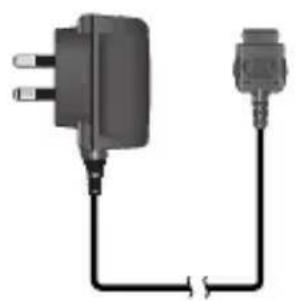
natural_image
Pure electrical circuit lines without any symbols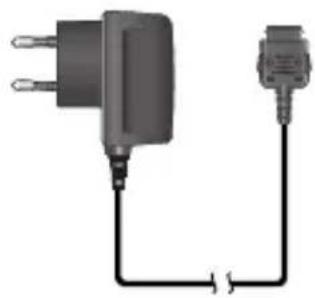
natural_image
Pure electrical circuit lines without any symbols(EB-CA001 UK) (EB-CA001 US)
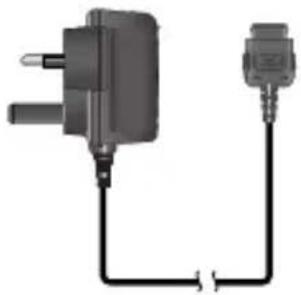
natural_image
Pure electrical circuit lines without any symbols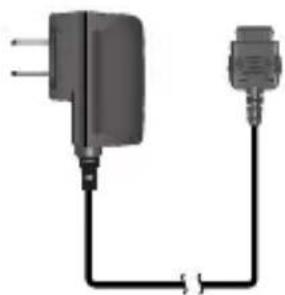
natural_image
Pure electrical circuit lines without any symbolsPersonal Handsfree (Mono) (EB-EMX800)
Plug into your phone and talk without holding the phone to your ear.

natural_image
Pure electrical circuit lines without any symbolsPersonal Handsfree (Stereo) (EB-EM001)
Talk/listen to the music and move while keeping your hands free, by using a Personal Handsfree. Put the ear pieces in your ears and the adaptor in the side of the phone.
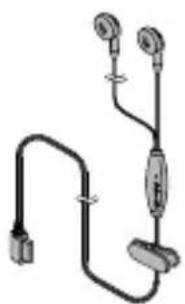
natural_image
Pure electrical circuit lines without any symbolsIn-Car Charger (EB-CD001)
Recharge the battery using your vehicle's cigarette lighter socket.
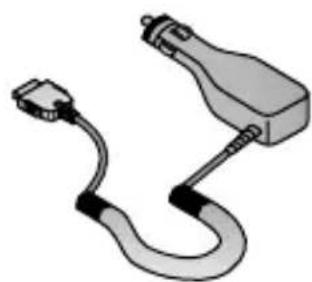
natural_image
Illustration of a USB cable connector with a terminal connector (no text or symbols)Car Holder (EB-KA001)
This can be mounted in your vehicle to store your phone.
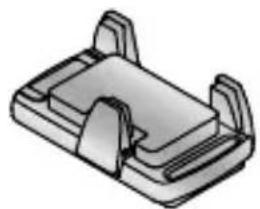
natural_image
3D illustration of a mechanical component with clamped ends and a central rectangular block (no text or symbols)USB Cable (EB-USX800)
Use this to connect your phone to a PC to transfer data between them. Use in conjunction with the software provided on the CD-ROM.
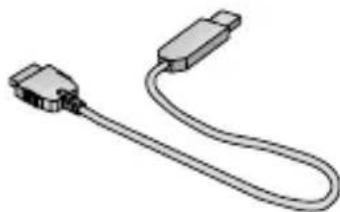
natural_image
Illustration of a USB cable with two connectors (no text or symbols)Branch Cable (EB-CBX800)
This cable branches the connection to a USB Cable, Personal Handsfree and Travel Charger so that you can transfer data OR talk on handsfree while charging.

natural_image
Illustration of a mechanical connector or connector with a curved cable or rod extending from its tip (no text or symbols visible)Bluetooth® headset (EB-BHX70)
Talk handsfree and without wires. Place the headset on your ear and the phone in your pocket, with no wires connecting the two.

natural_image
Illustration of a handheld device with a curved handle and circular top (no text or symbols)Contact
| (ASIA-PACIFIC) | ||
| AUSTRALIA Panasonic Australia 132-600 | ||
| HONG KONG Shun Hing Technology Co., Ltd. 2313-0888 | ||
| INDIA Panasonic India Pvt. Ltd. (0120)-256-7045 | ||
| INDONESIA PT. MET GOBEL (021)-8015666 | ||
| MALAYSIA Panasonic Malaysia Sdn, Bhd. (03)-55422288 | ||
| NEW ZEALAND | Panasonic New Zealand Ltd. (09)-272-0100 | |
| PHILIPPINES Panasonic Philippines (02)-899-4595 to 98 | ||
| SINGAPORE Panasonic Singapore 6282-6868 | ||
| TAIWAN | Panasonic Systems Sales Taiwan Co., Ltd. | (02)-2227-6111 |
| THAILAND | Panasonic Siew Sales (Thailand) Co., Ltd. | (02)-731-8888 ex. 2310 |
| VIETNAM | Matsushita Electric Industrial Co., Ltd. Ho Chi Minh Office | (08)-8219160 |
| (LATIN AMERICA) | ||
| BRASIL | Panasonic do Brasil Ltda. | (0800)-704-2019 |
| COLOMBIA | Panasonic de Colombia S.A. | (1)-623-3383 |
| MEXICO | Panasonic de Mexico, S.A. de C.V. | (55)-5-488-1000 |
| PANAMA | Panasonic Latin America, S.A. | (229)-2955 |
| PERU | Panasonic Peruana S.A. | (1)-614-0000 |
| VENEZUELA Panasonic de Venezuela, C.A. (212)-945-3022 | ||
CD-ROM
Note: Availability depends on your country/region.
PC Software
The CD-ROM supplied with your SA7 phone contains a software application which allows you to manage the information in your phone from a Personal Computer (PC). This application includes:
Handset Manager
With Handset Manager you can easily manage your phone information on a PC and synchronise it back to the phone. This information includes contacts, calendar, messages and the image, video and sound data held in your SA7 phone. For further information please refer to the documentation on the CD-ROM, or to the Panasonic website
http://panasonic.co.jp/pmc/products/en/support/index.html
Installing the Software
The software is compatible with PCs and laptops running Microsoft Windows ^TM 98 SE, Windows Me, Windows 2000 and Windows XP. On most PCs the software should auto-install when the CD-ROM is inserted into the CD drive. If not, then autoplay must be manually selected in Windows Explorer. Follow the instructions that appear on the PC screen to install the software.
Troubleshooting
Problems
Should any problem persist, contact your dealer.
| Problem Cause Remedy | ||
| Phone will not switch on. | Check that the battery is fully charged and correctly connected to the phone. | |
| Extremely short battery life for a new battery. | The network you are using and the condition of the battery can affect battery life. | |
| Short battery life for an old battery. | The battery has worn out. | Replace with a new fully charged battery. |
| The battery charge level indicator does not appear and the phone cannot be switched on when charging. | The battery is not attached to the phone or the battery has been deeply discharged. | Leave the phone charging the battery for a few minutes before the battery charge level indicator appears and attempt to switch the phone on. |
| Battery fails to charge. | The battery is not attached to the phone. | Ensure the battery is fitted to the phone prior to commencing charging. |
| The battery was connected to the phone after the charger was connected. |
Appendix
| Problem Cause Remedy | ||
| Battery fails to charge. | The battery temperature exceeds the charging temperature range (too hot or too cold). | Use the battery at room temperature. |
| Display looks faded. | The Brightness level is low. | Check the Brightness setting (see page 96). |
| Calls cannot be made. | Keyguard is on. Disable keyguard. | |
| Outgoing calls are barred. | Disable outgoing call barring or barred dialling. | |
| Fixed dialling is switched on so that only the numbers stored in Contacts can be dialled. | Switch off the Fixed dialling. | |
| The phone is not registered with a network. | Move to a coverage area and operate your phone after it has registered with a network. | |
| Calls cannot be received. | The phone is not switched on. | Switch the phone on. |
| Incoming calls are barred. | Disable incoming call barring. | |
| The phone is not registered with a network. | Move to a coverage area and operate your phone after it has registered with a network. | |
| Emergency calls cannot be made. | You are not in a GSM coverage area. | Check that the antenna symbol (T) is displayed - move to a coverage area and operate your phone when the antenna symbol is displayed. |
Error messages
These are some of the most important error messages which may be displayed:
| Location area not allowed! | Roaming in the selected area is not allowed. |
| Network not allowed! | Roaming with the selected network is not allowed. |
| Security failure! | The network has detected an authentication failure because your SIM card is not registered with that network - contact your service provider. |
| SIM blocked | The SIM card is blocked because the PIN unblocking key (PUK) has been entered incorrectly 10 times - contact your service provider. |
| Restarting SIM.Please wait | The phone has detected a problem with the SIM card - switch the phone off and then back on; if the message is still displayed - contact your service provider. |
| Invalid SIM | The SIM card has failed one or more of the SIM personalisation checks - contact your service provider. |
| Function unavailable | The selected feature is either not supported by the SIM card or is not available with the current subscription - contact your service provider. |
| PIN2 invalidated | The PIN2 is blocked permanently because the wrong PUK2 has been entered 10 times, services controlled by PIN2 cannot be used - contact your service provider. |
| Message rejected.Storage full orMessage rejected.SIM full | A message has been received but the message store is full - to receive messages, delete some of the currently stored messages. |
Appendix
| Memory low!Message may not be stored | The message area is full. Your messages cannot be stored until some of the currently stored messages are deleted. |
| Verification failure | On changing the PIN/PIN2, verification of the new code is incorrect - retry changing the PIN/PIN2 with correct verification. |
Glossary of terms
| CSD | Circuit Switched Data. A communication method used to transmit data over telephone connections. |
| DTMF | Dual Tone Multi-Frequency allows you to communicate with computerised phone systems, voice mailboxes, etc. |
| GPRS | General Packet Radio Service. A GSM transmission technique that transmits and receives data in packets rather than setting up a continuous channel. |
| GSM | Global System for Mobile communications. The name given to the advanced digital technology that your phone uses. |
| Infrared | A type of wireless connection that allows data to be transmitted directly to another device. |
| Java^TM | A programming language developed by Sun Microsystems. Programs written in Java do not rely on an operating system. |
| Network Operator | The organisation responsible for operating a GSM network. |
| PIN / PIN2 | Personal Identification Number. PIN is used for SIM card security. PIN2 is used for the control of Fixed dialling and Call charges metering. Supplied by your service provider. If the PIN or PIN2 is entered incorrectly several times (basically 3 times), the PIN or PIN2 will be blocked. |
| PUK / PUK2 | PIN or PIN2 Unblocking Key. Used to unblock the PIN or PIN2 code. Supplied by your service provider. If the PUK or PUK2 is entered incorrectly 10 times, the PUK or PUK2 will be blocked. |
| Roaming | The ability to use your phone on networks other than your home network. |
| Service provider | The organisation responsible for providing access to the GSM/GPRS network. |
| SIM | Subscriber Identity Module. A small smart-card which stores unique subscriber and user entered information such as Contacts entries and short messages. Supplied by your service provider. |
| URL | Uniform Resource Locator. The URL is an alphanumeric address that points to homepages and other Internet locations. |
| WAP | Wireless Application Protocol. The communication standard which enables you to download resources from the Internet to your phone. |
Specifications
| Bands supported | GSM 900 Class 4GSM 1800 Class 1GSM 1900 Class 1 |
| Standby time*1 | 300-860 hours |
| Talk time*1 | 4-16 hours |
| Charging time*2 | Up to 290 minutes |
| Temperature range | Charging: +5°C - +35°CStorage: -20°C - +60°C |
| Weight 140 g (including battery) |
Appendix
| Dimensions(excluding protrusions) | Height: 102 mmWidth: 53 mmDepth: 26 mm |
| Volume 116 cc | |
| Battery 1660 mAh Li-ion | |
| Antenna Internal | |
| SIM type 1.8 V/3 V | |
| Memory storage | MMS: 2 MBUser data (excluding MMS) and preinstalled applications: 30 MB |
| Display | Main display: QVGA 240 x 320 pixels TFT LCD; Approx. 16 million colours (JPEG and camera/video image*3);Approx. 300 cd/m2 brightnessSub display: 96 x 64 pixels STN LCD; 4 k colours |
| Camera 2 M pixels CMOS | |
| Connectivity | Infrared: SIR (slow infrared)USB: v2.0Bluetooth: v1.2 (Object Push, Headset and Handsfree profiles) |
*1 Talk and Standby times will be dependant upon network conditions, SIM card, backlight usage, battery condition/charging management and the use of applications such as camera and games where available.
*2 Charging time depends on usage and battery condition.
*3 65 k colours for other image formats
© 2005 Panasonic Mobile Communications Co., Ltd. All rights reserved.
Information in this document is subject to change without notice. No part of these instructions may be reproduced or transmitted in any form or by any means without obtaining written permission from Panasonic Mobile Communications Co., Ltd.
CP8 Patent
C€0168



Panasonic SA7 with Bluetooth ^® Technology
The Bluetooth word mark and logos are owned by the Bluetooth SIG, Inc. and any use of such marks by Panasonic Mobile Communications Co., Ltd. is under license. Other trademarks and trade names are those of their respective owners.

Java and all Java-based trademarks and logos are trademarks or registered trademarks of Sun Microsystems, Inc. in the U.S. and other countries.

T9 ^® Text Input is licensed under one or more of the following: U.S. Pat. Nos. 5,187,480, 5,818,437, 5,945,928, 5,953,541, 6,011,554, 6,286,064, 6,307,548, 6,307,549, and 6,636,162, 6,646,573; Australian Pat. Nos. 727539, 746674, and
747901; Canadian Pat. Nos. 1,331,057, 2,302,595, and 2,227,904; Japan Pat. No. 3532780, 3492981; United Kingdom Pat. No. 2238414B; Hong Kong Standard Pat. No. HK1010924; Republic of Singapore Pat. No. 51383, 66959, and 71979; European Pat. Nos. 0 842 463 (96927260.8), 1 010 057 (98903671.0), 1 018 069 (98950708.2); Republic of Korea Pat. Nos. KR201211B1 and KR226206B1. People's Republic of China Pat. Application Nos. 98802801.8, 98809472.X and 96196739.0; Mexico Pat. No. 208141; Russian Federation Pat. No. 2206118; and additional patents are pending worldwide.
Copyright © 2003 by Bitstream, Inc. All Rights Reserved. Bitstream Vera is a trademark of Bitstream, Inc. For further information, please refer to: http://www.w3.org/2003/08/sera/COPYRIGHT.TXT
Powered by Mascot Capsule ^® /Micro3D Edition ^TM Mascot Capsule ^® is a registered trademark of HI Corporation© 2005 HI Corporation. All Rights Reserved.

JBlend™
Aplix, microJBlend and JBlend, and all Aplx-or JBlend-related trademarks and logos are trademarks or registered trademarks of Aplx Corporation in the U.S., Japan and other countries.
This product is licensed under the MPEG-4 patent portfolio license for the personal and non-commercial use of a consumer to (i) encode video in compliance with the MPEG-4 Visual Standard (“MPEG-4 Video”) and/or (ii) decode MPEG-4 Video that was encoded by a consumer engaged in a personal and non-commercial activity and/or was obtained from a licensed video provider. No license is granted or implied for any other use. Additional information may be obtained from MPEG LA,LLC.
MPEG Layer-3 audio coding technology licensed from Fraunhofer IIS and Thomson.
SONIC THE HEDGEHOG™ © SEGA Corporation MUSIC COMPOSED BY MASATO NAKAMURA
Two music (Sonic Zone1.mmf / Sonic Invisible.mmf) © SEGA Corporation MUSIC COMPOSED BY MASATO NAKAMURA
SEGA, the SEGA logo and SONIC THE HEDGEHOG are either registered trademarks or trademarks of SEGA Corporation.
END-USER SOFTWARE LICENSE AGREEMENT
By use of this Panasonic cellular phone, including any embedded software features or programs ("Embedded Software"), you agree to the terms and conditions of this End-User Software License Agreement ("EULA").
- END-USER RIGHTS: You are granted a limited end-user right to use the Embedded Software only as part of and together with this Panasonic cellular phone. You agree to use the Embedded Software in a manner that complies with all applicable laws, including laws related to copyright and other intellectual property rights. All other uses are prohibited.
- LIMITATIONS ON END-USER RIGHTS:
(a) You may not reproduce, copy, or transfer the Embedded Software to any other device;
(b) You may not create derivative works of any type based on the Embedded Software (unless and except as expressly permitted as part of a feature application);
(c) You may not reverse engineer, reverse compile, disassemble, or otherwise attempt to discover the source code of the Embedded Software;
(d) You may not transfer this Panasonic cellular phone other than to a transferee end-user who undertakes to observe the same obligations as those set out in this EULA;
(e) You may not remove any proprietary notices, such as copyright, trademark, or otherwise, from the Embedded Software.
-
INTELLECTUAL PROPERTY RIGHTS: The Embedded Software is protected by copyright, trademark, patent and/or other intellectual property rights and is owned by Panasonic Mobile Communications Co., Ltd. ("PMC") and/or is under license from PMC's licensors.
-
TERMINATION: Your right to use the Embedded Software may be terminated for failure to comply with any of the terms of this EULA.
-
LIMITATION OF LIABILITY/DISCLAIMER OF WARRANTIES: TO THE MAXIMUM EXTENT PERMITTED BY APPLICABLE LAW, IN NO EVENT SHALL PMC, ITS AFFILIATES, AND THEIR LICENSORS BE LIABLE FOR INCIDENTAL, INDIRECT, SPECIAL OR CONSEQUENTIAL DAMAGES OR ANY DAMAGES WHATSOEVER RESULTING FROM LOSS OF USE, DATA OR PROFITS, ARISING OUT OF OR IN CONNECTION WITH THE USE OR PERFORMANCE OF THE EMBEDDED SOFTWARE. EXCEPT AS EXPRESSLY STATED IN THE RELEVANT WARRANTY CARD, PMC, ITS AFFILIATES, AND THEIR LICENSORS DISCLAIM ALL WARRANTIES, EXPRESS AND IMPLIED, INCLUDING, WITHOUT LIMITATION, THE IMPLIED WARRANTIES OF MERCHANTABILITY AND FITNESS FOR A PARTICULAR PURPOSE. THE REMEDIES PROVIDED TO THE END-USER IN THE RELEVANT WARRANTY CARD ARE EXCLUSIVE.
-
ADDITIONAL THIRD PARTY TERMS: The Embedded Software may contain third party software subject to separate third party license terms and conditions set forth in the user manual or associated product documentation and/or displayed on the LCD of this Panasonic cellular phone. You acknowledge and agree that such third party software is governed by the third party license terms, as applicable, and that such terms are solely between you and the applicable licensor.
-
EXPORT REGULATIONS/RESTRICTED RIGHTS: The Embedded Software is subject to U.S. export control laws, including the U.S. Export Administration Act and its associated regulations, and may be subject to export or import regulations in other countries. You agree to comply strictly with all such regulations. You confirm that with respect to the Embedded Software, you will not export or re-export it, directly or indirectly, to any countries that are subject to U.S. export restrictions. Use, duplication or disclosure by the U.S. government is subject to the restrictions as set forth in the Rights in Technical Data and Computer Software Clauses in DFARS 252.227-7013(c)(1)(ii) and FAR 52.227-19(c)(2) as applicable.
Index
A
Active flip 103
Alarms 121
Alert mute 30
Answering calls 29
Any key answer 102
Archive 64
Auto answer 103
Auto redial 27
B
Backlight time 99
Battery
Charging 21
Inserting 20
Removing 20
Bluetooth 107
Bookmarks 84
Brightness 96
Browser 81
Browser options
Advanced 87
Bookmarks 84
Enter address 85
Reload page 86
Save media 85
Service Inbox 86
Set as bookmark 85
Settings 87
C
Calculator 124
Calendar 125
Call
Answering 29
Duration 103
Hold 32
Making 27
Call barring 118
Call diverts 101
Call log 47
Call waiting 102
Calls 101
Camera 70
Cell Broadcast 114
Chat 66
Clock 91
Conference 35
Connectivity settings 105
Contacts 41
Continuous shooting 76
Creating a message
MMS 58
SMS 55
D
Display
Front display 15
Main display 15
Settings 96
Download
Games 141, 146
Picture files 136
Sound clips 138
Video clips 140
Drafts folder 64
DTMF 33
E
Emergency call 29
Emoticon list 56
Error messages 155
F
Fixed dial 118
G
Games 144
Games folder 140
GSM network 115
Index
H
Handsfree talking 33
Hold 32
How to read this manual 8
|
Icons 16
Main menu icons 98
Status icons 16
Illumination message 55
Illuminations 92
Inbox 60
In-call operations ...... 32
Indicator/Illumination Light 18
Infrared 105
Input method 36
International dialling 28
K
Key
Backlight 93
Functions 12
Keyguard 94
Quick keys 13
Settings 93
Shortcut 94
Tone 93
Volume 93
L
Language
Cell Broadcast 114
Display 91
Input 57, 91
M
Main menu
icons 98
Structure 24
Making calls 27
Master reset 95
Memory status
Contacts 51
My Media 142
SMS/MMS 69
Menu
Displaying the menu 25
Menu selection method ......26
Message alert 99
Messages settings 67
Missed call notification 30
MMS 54
Multi shot mode 76
Multiple calls operation 34
My dictionary 38
My number 50
O
Operator name 96
Outbox folder 64
P
Phone
Opening/closing 23
Overview 10
Settings 90
Switching on/off 23
Picture 71
Pictures folder 132
PIN/PIN2 code 117
Problems 153
Profiles 90
Q
Quick keys 13
R
Recent call dialling 28
Recording a video clip 78
Ringtone 99
s
Security settings 117
Self-portrait 72
Send my number 103
Sent folder 64
Service charge 104
Service numbers 52
Shortcut keys 94
Shutdown tone 100
Silent mode 31
SIM card
Inserting 19
Removing 19
SIM Tool Kit 121
SMS 54
Sound recorder 123
Sounds & alerts settings 99
Sounds folder 136
Speed dial 48
Standby display 15
Startup tone 100
Status icons 16
Symbols used in this manual ..... 7
Synchronisation 49, 112
T
T9 ^® 38
Taking a picture 72
Text entry 36
Text templates 141
Themes 99
Time and date 91
U
Unsent folder 64
USB 116
V
Vibration alert 100
Video, record 78
Videos folder 139
Voicemail 66
Volume control 33
W
Wallpaper 96
Warning tone 100
Web mail 65
- SA7 Operating Instructions
- Contents
- Introduction ...... 1
- About Your Phone...... 10
- Getting Started ...... 19
- Menu Navigation...... 24
- Basic Operations...... 27
- Contacts......41
- Messages ....53
- Camera 70
- Browser 81
- Tools...... 120
- Calendar 125
- My Media 131
- Games.... 143
- Appendix 148
- Licensing.... 159
- Index 163
- Safety considerations
- Power
- Battery
- Disposing of the Battery
- Aircraft
- Do Not Use
- Driving
- Electronic Devices
- Heating Equipment
- Backup Copies & Security
- Downloading
- Efficient Use
- Camera
- Other important information
- Care and maintenance
- Introduction
- About this manual
- Symbols used in this manual
- Graphics
- Keys
- How to read this manual
- Fixed dial
- Menu navigation
- In the example:
- About Your Phone
- Phone overview
- Quick keys
- Display
- Status icons
- DRM
- Indicator/Illumination Light
- Getting Started
- Installing the SIM card and the battery
- Inserting/removing the SIM card
- Inserting the SIM card
- Removing the SIM card
- Inserting/removing the battery
- Inserting the battery
- Removing the battery
- Charging the battery
- Battery charge level indicator
- Low battery warning
- Opening/closing the phone
- Flip setting
- Switching the phone on/off
- Main menu structure
- Games
- My Media
- Calendar .....125
- Messages
- Browser
- PANASONIC BOX ...81
- Tools
- Contacts
- Settings
- Displaying the menu
- To go back to Main menu:
- Navigating the applications
- Current settings
- Menu selection method
- Keys corresponding to the menu numbers
- Making calls
- Standard dialling
- Auto redial
- Contacts dialling
- Main menu > Contacts > Contacts list
- Recent call dialling
- International dialling
- Emergency call
- Answering calls
- Rejecting calls
- Missed call notification
- To view the Missed call list:
- Alert mute
- Answering a second call
- To reject another call:
- Auto answer
- Silent mode
- Voicemail
- Retrieving stored voice messages
- In-call operations
- In-call options (while connected to an active call)
- Hold
- Handsfree talking
- Swapping between Speaker and Handheld mode
- Volume control
- To increase the volume:
- To decrease the volume:
- DTMF
- To send DTMF during a call:
- Pause dial
- Making a second call
- Multiple calls operation
- In-call options (while on multiple calls)
- Conference
- To add new participants:
- To end the Conference call:
- To split the caller from the Conference call and talk privately:
- Text entry
- Input method
- Changing the input method
- Changing the letter case
- Auto capital change
- T9 ® text input method
- My dictionary
- To add words to My dictionary:
- Editing text
- Inserting/deleting text
- Copying/cutting/pasting text
- Options
- Contacts menu structure
- Viewing the Contacts list
- Searching for a contact
- Making a call from Contacts
- Adding contacts
- Storing a contact in your phone
- Main menu > Contacts > Add contact > Phone
- Storing a contact in your SIM card
- Storing a contact from Call log
- Editing a Contacts card
- Call log
- Viewing/Dialling from Call log
- Saving a phone number from Call log
- Speed dial
- Assigning speed dial keys
- Using the speed dial keys
- Groups
- Viewing group members
- Renaming a group
- Advanced
- Synchronisation
- My number
- Storing numbers in Mobile profile
- Storing numbers in SIM profile
- Displaying the Contacts list sorted by last name/first name
- Memory status
- Copying contacts
- Deleting Phone Contacts
- Service numbers
- Messages menu structure
- Creating a new message
- Creating an SMS message
- Main menu > Messages > Create new > SMS message
- Creating an Illumination message with emoticons
- To preview the Illumination of the messages you create:
- [☐] (Options) → Select Preview illumination
- Creating an MMS message
- Main menu > Messages > Create new > MMS message
- To send the message:
- Slide options
- Receiving messages
- Receiving SMS messages
- Reading SMS messages
- Receiving MMS messages
- Reading MMS messages
- Inbox
- Main menu > Messages > Inbox
- SMS Inbox
- SMS message icons
- Main menu > Messages > Inbox > SMS
- MMS Inbox
- MMS message icons
- Options in the message list
- Options while viewing messages
- Options for notification
- Archive
- Viewing messages
- Options for SMS
- Options for MMS
- Web mail
- Connecting to internet mail
- Chat
- Changing the voice mailbox number
- Messages settings
- SMS settings
- Main menu > Messages > Messages settings > SMS
- Select the required setting
- MMS settings
- Main menu > Messages > Messages settings > MMS
- Camera menu structure
- Picture
- Picture preview screen
- Icons on picture preview screen
- Taking a picture
- Operations after taking a picture
- Taking a self-portrait
- Zoom
- Adjusting the brightness level
- Taking close-up pictures
- Viewing pictures
- Picture settings
- Direct key operation
- Adding a picture to Contacts card
- Continuous shooting
- Main menu > Camera > Picture
- To view the captured images:
- To save a captured image:
- To save all the captured images:
- Video
- Video preview screen
- Icons on video preview screen
- Recording a video clip
- Main menu > Camera > Video
- Playing video clips
- Video settings
- Browser menu structure
- Setting up your Browser
- Viewing the contents
- Opening Browser
- Main menu > Browser
- Online status icons
- Closing Browser
- Browser options
- Bookmarks
- Renaming a bookmark folder
- Deleting all bookmarks
- Enter address
- Save media
- Set as bookmark
- Service Inbox
- Reload page
- WAP profiles
- Push access
- Security
- Settings menu structure
- Phone settings 90
- Display settings ...... 96
- Sounds & alerts ...... 99
- Calls....101
- Connectivity......105
- Security 117
- Phone settings
- Profiles
- Activating a profile
- Setting a profile
- Language
- Time and date
- Home clock
- Away clock
- Choosing clock
- Display format
- Illuminations
- Key settings
- Key tone
- Key volume
- Key backlight
- Keyguard
- To enable Keyguard:
- To disable Keyguard:
- Shortcut keys
- Master reset
- Resetting
- Changing the password
- Display settings
- Main display
- Wallpaper
- Brightness
- Operator name
- Front display
- External wallpaper
- Contrast
- Clock display
- Main menu icons
- Changing icons
- To change menu icons:
- To change the background:
- Setting back to default
- Themes
- Backlight time
- Sounds & alerts
- Ringtone/Message alert
- Changing the ringtone/Message alert
- Changing the ringtone/Message alert volume
- Warning tone
- Startup tone/Shutdown tone
- Vibration alert
- Calls
- Call diverts
- Main menu > Settings > Calls > Call diverts
- To cancel each setting/check each status:
- To cancel all the settings/check all the statuses:
- Call waiting
- Main menu > Settings > Calls > Call waiting
- To accept the current status:
- To change the setting:
- Any key answer
- Main menu > Settings > Calls > Any key answer
- Active flip
- Send my number
- Call duration
- Service charge
- Cost left
- Call meter
- To reset the counter:
- Price/unit
- Max cost
- To disable the Max cost:
- Connectivity
- Infrared
- Preparing for infrared connection
- Sending data via infrared
- Receiving data via infrared
- To activate infrared:
- To receive data via infrared:
- Bluetooth® wireless technology
- Setting up Bluetooth
- Pairing with other devices
- Setting up the Bluetooth headset (Optional Accessory)
- Sending/receiving data via Bluetooth
- To send data via Bluetooth:
- To receive data via Bluetooth:
- Managing paired devices
- Main menu > Settings > Connectivity > Bluetooth > Paired devices
- Icons of paired devices
- Creating/editing a server profile
- Selecting a server profile
- Selecting a WAP profile
- Synchronising
- Server or database authentication
- Cell Broadcast
- Activating Cell Broadcast
- Reading a received message
- Topics and languages
- GSM network
- Selecting a network manually
- Network list
- Search mode
- Data connections
- Editing GPRS/CSD settings
- Main menu > Settings > Connectivity > Data connections
- Deleting GPRS/CSD settings
- USB
- PIN code
- Enabling/Disabling PIN entry
- Changing PIN
- Changing PIN2
- Main menu > Settings > Security > Change PIN2
- Main menu > Settings > Security > Fixed dial
- Call barring
- Call barring setting
- Tools menu structure
- SIM Tool Kit
- Alarms
- Setting the alarm
- Main menu > Tools > Alarms
- Turning the alarm on/off
- Stopping the alarm
- Sound recorder
- Recording new sound clips
- Main menu > Tools > Sound recorder
- Calculator
- Main menu > Tools > Calculator
- Browsing Calendar
- Browsing operation
- Calendar view
- Daily view
- Creating Calendar events
- Main menu > Calendar
- Calendar
- Managing Calendar events
- Editing events
- Deleting events
- Deleting an event
- Deleting multiple events
- Calendar settings
- Selecting the starting day of the week
- Setting holidays
- Chinese Lunar calendar
- Switching on/off Chinese Lunar calendar
- Viewing Chinese Lunar calendar detail
- My Media menu structure
- Pictures.... 132
- Sounds...... 136
- Videos 139
- Games ....140
- Text templates .....141
- Memory status ......142
- Pictures
- Main menu > My Media > Pictures > Stored pictures
- Managing files
- To make a new folder:
- To move the selected picture to another folder:
- Using pictures
- Editing pictures
- Adding frame
- Trimming
- Clearing shadow
- Downloading picture files
- Taking a new picture
- Sounds
- Playing sound clips
- Using sound clips
- Downloading sound clips
- Videos
- Downloading video clips
- Recording a new video
- Playing games
- Downloading games
- Text templates
- Editing Text templates
- Games menu structure
- Selecting games
- Main menu > Games > Games
- SONIC THE HEDGEHOG
- Key operation:
- Soccer
- Suspending/Terminating the game
- To resume the game:
- Download games
- Main menu > Games > Settings
- Information
- Accessories
- Battery (EB-BS002)
- Travel Charger
- Personal Handsfree (Mono) (EB-EMX800)
- Personal Handsfree (Stereo) (EB-EM001)
- In-Car Charger (EB-CD001)
- Car Holder (EB-KA001)
- USB Cable (EB-USX800)
- Branch Cable (EB-CBX800)
- Bluetooth® headset (EB-BHX70)
- CD-ROM
- PC Software
- Handset Manager
- Installing the Software
- Troubleshooting
- Problems
- Error messages
- Appendix
- END-USER SOFTWARE LICENSE AGREEMENT
- Index
- A
- B
- C
- D
- E
- F
- G
- H
- |
- K
- L
- M
- O
- P
- Q
- R
- s
- T
- U
- V
- W
Brand : PANASONIC
Model : EB-SA7
Category : Cellphone