
PDR-L77 - Audio recorder PIONEER - Free user manual and instructions
Find the device manual for free PDR-L77 PIONEER in PDF.


| Product Type | CD Audio Recorder |
| Brand | PIONEER |
| Model | PDR-L77 |
| Compatible Discs | Audio CD, CD-R, CD-RW (consumer use) |
| Dimensions (W × H × D) | 220 × 75 × 316 mm |
| Weight | 3.0 kg |
| Power Supply | AC 120 V, 60 Hz (Canada) / 230 V, 50/60 Hz (United Kingdom) |
| Power Consumption | 18 W operation, 0.8 W standby |
| Audio Inputs | Digital optical (TOSLINK), analog (RCA) via adapter |
| Audio Outputs | Digital optical (TOSLINK), analog (RCA) |
| Playback Functions | Normal, programmed, random, repeat (track/disc), fade in/out, time display |
| Recording Functions | Digital synchro (1 track or all), manual, analog, digital level adjustment, fade in/out |
| Track Numbering | Automatic or manual, up to 99 tracks per disc |
| Finalization | Yes (for CD-R and CD-RW), approx. 4 minutes |
| Erase (CD-RW) | Individual track, all tracks, TOC or complete reset |
| Track Skip | Skip ID (max 21) to skip tracks |
| Remote Control | Included (AA/R6P batteries supplied) |
| Supplied Accessories | Stereo audio cord, optical cord, mini-jack control cord, analog recording adapter, power cord, instruction manual, warranty card |
| Maintenance | Clean with a soft dry cloth; mild diluted detergent for stubborn dirt; do not use benzene or thinner |
| Safety | Do not use during a lightning storm; unplug before moving; avoid condensation; do not block ventilation slots; hold power cord by the plug |
| Repairability | Contact an authorized Pioneer service center for any repairs; lens cleaning not recommended |
| General Information | Energy-saving design; compatible with XC-L77/L7/L5 systems; flat cables for system connection |
Frequently Asked Questions - PDR-L77 PIONEER
User questions about PDR-L77 PIONEER
0 question about this device. Answer the ones you know or ask your own.
Ask a new question about this device
Download the instructions for your Audio recorder in PDF format for free! Find your manual PDR-L77 - PIONEER and take your electronic device back in hand. On this page are published all the documents necessary for the use of your device. PDR-L77 by PIONEER.
USER MANUAL PDR-L77 PIONEER
The lightning flash with arrowhead symbol, within an equilateral triangle, is intended to alert the user to the presence of uninsulated "dangerous voltage" within the product's enclosure that may be of sufficient magnitude to constitute a risk of electric shock to persons.
CAUTION
RISK OF ELECTRIC SHOCK DO NOT OPEN
CAUTION:
TO PREVENT THE RISK OF ELECTRIC SHOCK, DO NOT REMOVE COVER (OR BACK). NO USER-SERVICEABLE PARTS INSIDE. REFER SERVICING TO QUALIFIED SERVICE PERSONNEL.

The exclamation point within an equilateral triangle is intended to alert the user to the presence of important operating and maintenance (servicing) instructions in the literature accompanying the appliance.
IMPORTANT SAFETY INSTRUCTIONS
READ INSTRUCTIONS - All the safety and operating instructions should be read before the product is operated.
REtain INSTRUCTIONS The safety and operating instructions should be retained for future reference.
HEED WARNINGS — All warnings on the product and in the operating instructions should be adhered to.
FOLLOW INSTRUCTIONS - All operating and use instructions should be followed.
CLEANING — Unplug this product from the wall outlet before cleaning. The product should be cleaned only with a polishing cloth or a soft dry cloth. Never clean with furniture wax, benzine, insecticides or other volatile liquids since they may corrode the cabinet.
ATTACHMENTS — Do not use attachments not recommended by the product manufacturer as they may cause hazards.
WATER AND MOISTURE - Do not use this product near water - for example, near a bathtub, wash bowl, kitchen sink, or laundry tub; in a wet basement; or near a swimming pool; and the like.
ACCESSORIES — Do not place this product on an unstable cart, stand, tripod, bracket, or table. The product may fall, causing serious injury to a child or adult, and serious damage to the product. Use only with a cart, stand, tripod, bracket, or table recommended by the manufacturer, or sold with the product. Any mounting of the product should follow the manufacturer's instructions, and should use a mounting accessory recommended by the manufacturer.
CART — A product and cart combination should be moved with care. Quick stops, excessive force, and uneven surfaces may cause the product and cart combination to overturn.
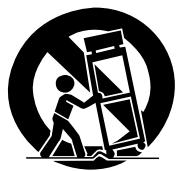
VENTILATION—Slots and openings in the cabinet are provided for ventilation and to ensure reliable operation of the product and to protect it from overheating, and these openings must not be blocked or covered. The openings should never be blocked by placing the product on a bed, sofa, rug, or other similar surface. This product should not be placed in a built-in installation such as a bookcase or rack unless proper ventilation is provided or the manufacturer's instructions have been adhered to.
POWER SOURCES - This product should be operated only from the type of power source indicated on the marking label. If you are not sure of the type of power supply to your home, consult your product dealer or local power company.
LOCATION - The appliance should be installed in a stable location.
NONUSE PERIODS - The power cord of the appliance should be unplugged from the outlet when left unused for a long period of time.
GROUNDING OR POLARIZATION
-
If this product is equipped with a polarized alternating current line plug (a plug having one blade wider than the other), it will fit into the outlet only one way. This is a safety feature. If you are unable to insert the plug fully into the outlet, try reversing the plug. If the plug should still fail to fit, contact your electrician to replace your obsolete outlet. Do not defeat the safety purpose of the polarized plug.
-
If this product is equipped with a three-wire grounding type plug, a plug having a third (grounding) pin, it will only fit into a grounding type power outlet. This is a safety feature. If you are unable to insert the plug into the outlet, contact your electrician to replace your obsolete outlet. Do not defeat the safety purpose of the grounding type plug.
POWER-CORD PROTECTION — Power-supply cords should be routed so that they are not likely to be walked on or pinched by items placed upon or against them, paying particular attention to cords at plugs, convenience receptacles, and the point where they exit from the product.
OUTDOOR ANTENNA GROUNDING — If an outside antenna or cable system is connected to the product, be sure the antenna or cable system is grounded so as to provide some protection against voltage surges and built-up static charges. Article 810 of the National Electrical Code, ANSI/NFPA 70, provides information with regard to proper grounding of the mast and supporting structure, grounding of the lead-in wire to an antenna discharge unit, size of grounding conductors, location of antenna-discharge unit, connection to grounding electrodes, and requirements for the grounding electrode. See Figure A.
LIGHTNING — For added protection for this product during a lightning storm, or when it is left unattended and unused for long periods of time, unplug it from the wall outlet and disconnect the antenna or cable system. This will prevent damage to the product due to lightning and power-line surges.
POWER LINES — An outside antenna system should not be located in the vicinity of overhead power lines or other electric light or power circuits, or where it can fall into such power lines or circuits. When installing an outside antenna system, extreme care should be taken to keep from touching such power lines or circuits as contact with them might be fatal.
OVERLOADING - Do not overload wall outlets, extension cords, or integral convenience receptacles as this can result in a risk of fire or electric shock.
OBJECT AND LIQUID ENTRY—Never push objects of any kind into this product through openings as they may touch dangerous voltage points or short-out parts that could result in a fire or electric shock. Never spill liquid of any kind on the product.
SERVICING - Do not attempt to service this product yourself as opening or removing covers may expose you to dangerous voltage or other hazards. Refer all servicing to qualified service personnel.
DAMAGE REQUIRING SERVICE—Unplug this product from the wall outlet and refer servicing to qualified service personnel under the following conditions:
- When the power-supply cord or plug is damaged.
If liquid has been spilled, or objects have fallen into the product.
If the product has been exposed to rain or water. - If the product does not operate normally by following the operating instructions. Adjust only those controls that are covered by the operating instructions as an improper adjustment of other controls may result in damage and will often require extensive work by a qualified technician to restore the product to its normal operation.
- If the product has been dropped or damaged in any way.
- When the product exhibits a distinct change in performance — this indicates a need for service.
REPLACEMENT PARTS - When replacement parts are required, be sure the service technician has used replacement parts specified by the manufacturer or have the same characteristics as the original part. Unauthorized substitutions may result in fire, electric shock, or other hazards.
SAFETY CHECK - Upon completion of any service or repairs to this product, ask the service technician to perform safety checks to determine that the product is in proper operating condition.
WALL OR CEILING MOUNTING — The product should not be mounted to a wall or ceiling.
HEAT The product should be situated away from heat sources such as radiators, heat registers, stoves, or other products (including amplifiers) that produce heat.
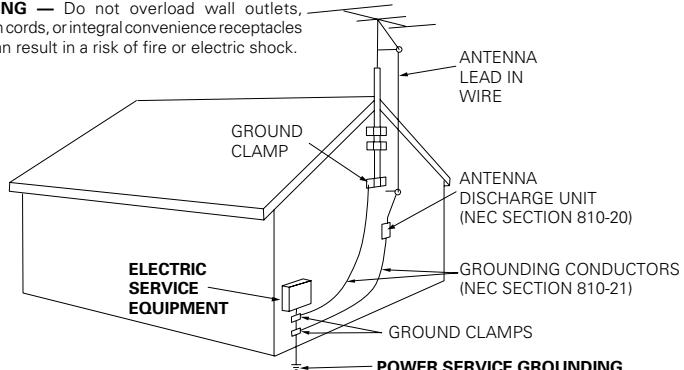
Fig. A
POWER SERVICE GROUNDING
ELECTRODE SYSTEM
(NEC ART 250, PART H)
WARNING: TO PREVENT FIRE OR SHOCK HAZARD, DO NOT EXPOSE THIS APPLIANCE TO RAIN OR MOISTURE.
IMPORTANT NOTICE [For U.S. and Canadian models]
The serial number for this equipment is located on the base. Please write this serial number on your enclosed warranty card and keep it in a secure area. This is for your security.
[For Canadian model]
CAUTION: TO PREVENT ELECTRIC SHOCK DO NOT USE THIS (POLARIZED) PLUG WITH AN EXTENSION CORD, RECEPTACLE OR OTHER OUTLET UNLESS THE BLADES CAN BE FULLY INSERTED TO PREVENT BLADE EXPOSURE
ATTENTION: AFIN DE PREVENIR TOUS RISQUES DE CHOC ELECTRIQUE OU D'INCENDIE, NE PAS EXPOSER CET APPAREIL A L'HUMIDITE OU A LA PLUIE.
REMARQUE IMPORTANTE
[For Canadian model]
This Class B digital apparatus complies with Canadian ICES-003.
This caution can be found on the rear panel of the unit.
CAUTION:
- Use of controls or adjustments or performance of procedures other than those specified herein hazardous radiation exposure.
- The use of optical instruments with this product will increase eye hazard.
This equipment has been tested and found to comply with the limits for a Class B digital device, pursuant to Part 15 of the FCC Rules. These limits are designed to provide reasonable protection against harmful interference in a residential installation. This equipment generates, uses, and can radiate radio frequency energy and, if not installed and used in accordance with the instructions, may cause harmful interference to radio communications. However, there is no guarantee that interference will not occur in a particular installation. If this equipment does cause harmful interference to radio or television reception, which can be determined by turning the equipment off and on, the user is encouraged to try to correct the interference by one or more of the following measures:
- Reorient or relocate the receiving antenna.
- Increase the separation between the equipment and receiver.
- Connect the equipment into an outlet on a circuit different from that to which the receiver is connected.
- Consult the dealer or an experienced radio/TV technician for help.
CAUTION:
This product satisfies FCC regulations when shielded cables and connectors are used to connect the unit to other equipment. To prevent electromagnetic interference with electric appliances such as radios and televisions, use shielded cables and connectors for connections.
"NOTE: THE NO USER-SERVICEABLE PARTS COMPARTMENT WARNING IS LOCATED ON THE APPLIANCE BOTTOM" or equivalent.


REMARQUE: L'AVERTISSEMENT "AUCUNE PIECE REPARABLE PAR L'UTILISATEUR DANS LE COFFRET"
CAUTION
RISK OF ELECTRIC SHOCK DO NOT OPEN
ATTENTION
DANGER D' ELECTROCUTION NE PAS OUVRIR
This product complies with the Low Voltage Directive (73/23/EEC), EMC Directives (89/336/EEC, 92/31/EEC) and CE Marking Directive (93/68/EEC).
Information to User
Alteration or modifications carried out without appropriate authorization may invalidate the user's right to operate the equipment.
INFRINGEMENT OF COPYRIGHT [For U.K. model]
Recording and playback of copyrighted material may require consent. See the Copyright Design and Patent Act 1988.
[For U.K. model]
[For Stereo CD Recorder PDR-L77] CAUTION
This product contains a laser diode of higher class than 1. To ensure continued safety, do not remove any covers or attempt to gain access to the inside of the product.
Refer all servicing to qualified personnel.
The following caution label appears on the unit.
Location: Bottom of the unit.
![PIONEER PDR-L77 - [For U.K. model] - 1](/content/2025/01/118680/images/ce3589cd29bdfc4f7e12d72d1e8fb9137f4ed59c41ea5600da39a5d06eeaf8cc.jpg)
IMPORTANT
FOR USE IN THE UNITED KINGDOM
The wires in this mains lead are coloured in accordance with the following code:
Blue: Neutral
Brown:Live
If the plug provided is unsuitable for your socket outlets, the plug must be cut off and a suitable plug fitted.
The cutoff plug should be disposed of and must not be inserted into any 13 amp socket as this can result in
electric shock. The plug or adaptor of the distribution panel should be provided with a 5 amp fuse. As the colours of the wires in the mains lead of this appliance may not correspond with coloured markings identifying the terminals in your plug, proceed as follows:
The wire which is coloured blue must be connected to the terminal which is marked with the letter N or coloured black.
The wire which is coloured brown must be connected to the terminal which is marked with the letter L or coloured red.
Do not connect either wire to the earth terminal of a three-pin plug. NOTE
After replacing or changing a fuse, the fuse cover in the plug must be replaced with a fuse cover which corresponds to the colour of the insert in the base of the plug or the word that is embossed on the base of the plug, and the appliance must not be used without a fuse cover. If lost, replacement fuse covers can be obtained from your dealer.
Only 5 A fuses approved by B.S.I. or A.S.T.A. to B.S. 1362 should be used.
The standby/on switch is secondary connected and therefore does not separate the unit from the mains power in standby position.
Energy-saving design
This unit has been designed to reduce energy consumption when the power is set to off (standby) mode. Power consumption in this mode is 0.8W .
Contents
1 Before You Start
Checking what's in the box 7
Putting the batteries in the remote 7
Hints on installation 8
Maintaining your CD recorder 9
About CD, CD-R and CD-RW Discs 10
2 Connecting Up
Connecting to the Rest of Your System 14
3 Controls and Displays
Front Panel 18
Remote Control 19
Display 21
4 Getting Started
Switching On, Playing a Disc 22
Selecting Tracks Directly 25
Programming a Playlist 25
Using the Repeat Modes 27
Using the Random Mode 28
Showing Disc Information 28
Fading In and Fading Out 30
Recording CDs 31
Recording One Track from a Digital Source 34
Recording All Tracks from a Digital Source 36
Automatically Recording and Finalizing a Disc ... 38
Manually Recording a Digital Source 40
Setting the Digital Recording Level 42
Recording an Analog Source 43
Using the Thru Input Mode 45
5 More Recording Features
Numbering Tracks 46
Recording Fade Ins and Fade Outs 47
Checking What's at the End of a Disc 48
Recording Blank Sections 49
Skipping Unwanted Tracks 50
Playing a Disc with Skip IDs 52
6 Finalizing and Erasing
Finalizing a Disc 53
Erasing a CD-RW Disc 54
7 Additional Information
Understanding Display Messages 57
Troubleshooting 59
Specifications 63
Checking what's in the box
Thank you for buying this Pioneer product. Before starting to set up your new CD recorder, please check that you have received the following supplied accessories:
- Stereo audio cord
Control cord (mini-plug cord)
AC power cord
Optical cord
Size AA/R6P dry cell batteries
Remote control unit - Analog Recording Adapter
Warranty card - Operating instructions
Using this manual
This manual is for the PDR-L77 CD recorder. It is split into two sections; the first covers setting up, and the second, using the recorder. Set up, which starts here, shows you how to install and connect up the recorder to the rest of your system.
In the second section of the manual, starting on page 18, you'll learn how to use every feature of the recorder, from basic playback to finalizing a recordable CD. The final part of the manual provides a list of display messages, a troubleshooting page, and technical specifications.
Putting the batteries in the remote
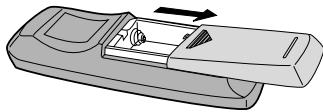
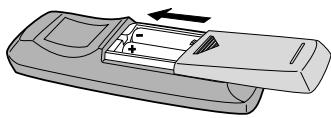
1 Turn over the remote control, then press and slide the battery compartment cover off.
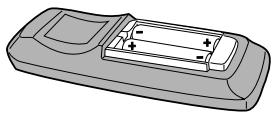
2 Put in the batteries supplied, taking care to match the plus and minus ends of each battery with the markings inside the compartment.
3 Slide the cover back on, and your remote is ready for use.
Caution!
Incorrect use of batteries can result in hazards such as leakage and bursting. Please observe the following:
- Don't mix new and old batteries together
- Don't use different kinds of battery together—although they may look similar, different batteries may have different voltages.
- Make sure that the plus and minus ends of each battery match the indications in the battery compartment.
- Remove batteries from equipment that isn't going to be used for a month or more.
Hints on installation
We want you to enjoy using this unit for years to come, so please bear in mind the following points when choosing a suitable location for it:
DO...
Use in a well-ventilated room.
Place on a solid, flat, level surface, such as a table, shelf or stereo rack.
Leave at least 10~cm either side, 25~cm overhead and 15~cm at the back of this unit. If using with the XC-L77, see Hints on installation in that manual for more information in this.
DON'T...
±bx Use in a place exposed to high temperatures or humidity, including near radiators and other heat-generating appliances.
±bx Place on a window sill or other place where the player will be exposed to direct sunlight.
X Use in an excessively dusty or damp environment.
±bx Place directly on top of an amplifier, or other component in your stereo system that becomes hot in use.
X Use near a television or monitor as you may experience interference—especially if the television uses an indoor antenna.
× Use in a kitchen or other room where the player may be exposed to smoke or steam.
±bx Use on a thick rug or carpet, or cover with cloth—this may prevent proper cooling of the unit.
±bx Place on an unstable surface, or one that is not large enough to support all four of the unit's feet.
Avoiding condensation problems
Condensation may form inside the player if it is brought into a warm room from outside, or if the temperature of the room rises quickly. Although the condensation won't damage the player, it may temporarily impair its performance. For this reason you should leave it to adjust to the warmer temperature for about an hour before switching on and using.
Maintaining your CD recorder
To clean the compact disc recorder, wipe with a soft, dry cloth. For stubborn dirt, wet a soft cloth with a mild detergent solution made by diluting one part detergent to 5 or 6 parts water, wring well, then wipe off the dirt. Use a dry cloth to wipe the surface dry. Do not use volatile liquids such as benzene and thinner which may damage the surfaces.
Moving the unit
If you need to move the unit, first switch it off and unplug from the wall outlet. Never lift or move the unit during playback or recording—the disc rotates at a high speed and may be damaged.
CD lens cleaner
The compact disc recorder's pickup lens should not become dirty in normal use, but if for some reason it should malfunction due to dirt or dust, consult your nearest Pioneer authorized service center. Although lens cleaners for compact disc recorders are commercially available, we do not recommend using them since some may damage the lens.
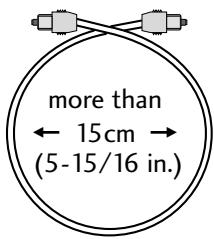
Storing optical cable
When storing optical cable, coil loosely as shown below. The cable may be damaged if bent sharply around corners.
Power cord caution
Handle the power cord by the plug part. Do not pull out the plug by tugging the cord, and never touch the power cord when your hands are wet, as this could cause a short circuit or electric shock. Do not place the unit, a piece of furniture, or other object on the power cord or pinch the cord in any other way. Never make a knot in the cord or tie it with other cords. The power cords should be routed so that they are not likely to be stepped on. A damaged power cord can cause a fire or give you an electric shock. Check the power cord once in a while. If you find it damaged, ask your nearest Pioneer authorized service center or your dealer for a replacement.
This unit is compatible with three different types of compact disc:
Playback-only CDs
This unit will playback any ordinary audio CDs carrying the Compact Disc Digital Audio mark shown right.

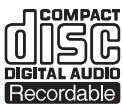
CD-Recordable discs
Recordable CDS, or CD-R, carry the mark shown right, and are 'write once'. This means that once something is recorded on the disc it is permanent—it can't be re-recorded or erased.
CD-Rewritable discs
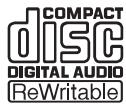
Rewritable CDs, or CD-RW, carry the mark shown right. As the name indicates, you can erase and re-record material on these discs so that they can be used over and over again.
Consumer-use discs
This recorder is only compatible with special consumer-use CD-R and CD-RW discs. These are clearly marked For Music Use Only, For Consumer, or For Consumer Use. Other types of CD-R or CD-RW discs, such as those available for computer-based CD recorders, will not work with this recorder.
Recording copyright material
The price of a consumer-use disc includes a copyright fee that has been paid to the copyright owner (in countries where the copyright fee collection system has been established based on their respective copyright laws). This means that you can use these discs to record music and other material for your personal use. If you want to use a disc for anything other than personal use, you must get permission from the copyright owner (note that copyright laws vary from country to country; check the copyright-related laws in your particular country for more information).
Broadcast programs, CDs, other recorded media (cassettes, vinyl records, etc.) and musical performances are all protected by copyright laws. You must get permission from the copyright owner if you sell, transfer, distribute or lease a disc recorded from the above mentioned sources, or if you use it as part of a business (such as for background music in a store).
Recording and finalizing discs
Unlike other recording media, recordable CDs have a number of distinct states, and what you can do with a disc depends on the current state of the disc. The figure below shows the three states—blank, partially recorded, and finalized—and summarizes what's possible (✔) and impossible (×) in each.
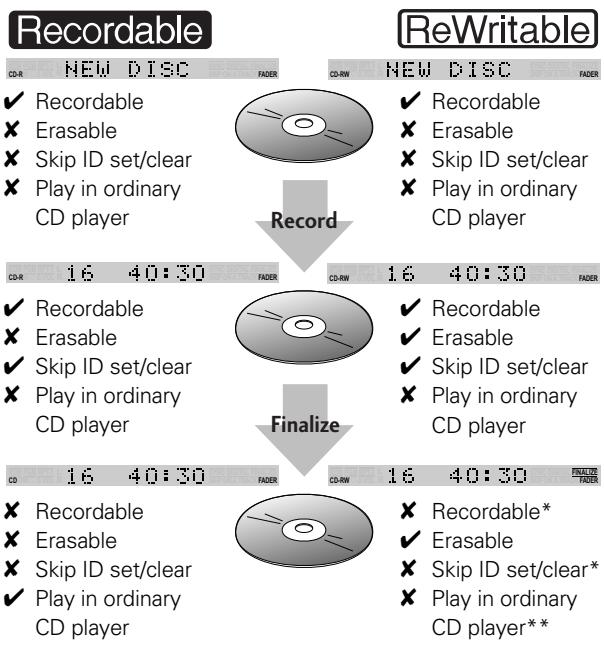
- Once the CD-RW has been erased, it becomes recordable again and skip IDs can be set and cleared.
** In general, current CD players cannot play CD-RW discs. However, this situation may change.
The process of finalization fixes the contents of a CD-R in place for good by creating a Table of Contents (TOC, for short) at the beginning of the disc. This tells a CD player exactly what's on the disc and where to find it. Once a CD-R is finalized, further recording and other changes become impossible. The CD recorder and other CD players treat a finalized disc as an ordinary playback-only CD. (See page 51 for more information on finalizing CD-Rs.) CD-rewritable discs can be finalized in the same way as CD-R discs, but even after finalization, the disc can still be erased and used over again. Remember that CD-RW discs can only be played on players that are specifically designed to play CD-RW discs: most home CD players will not play these discs, even after the disc has been finalized. (See page 51 for more information on finalizing CD-RWs.)
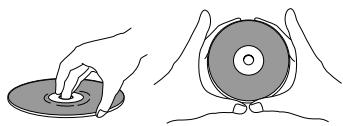
When holding CDs of any type, take care not to leave fingerprints, dirt or scratches on the disc surface. Hold the disc by its edge or by the center hole and edge. Damaged or dirty discs can affect playback and/or recording performance. Take care also not to scratch the label side of the disc. Although not as fragile as the recording side, scratches can still result in a disc becoming unusable.
Should a disc become marked with fingerprints, dust, etc., clean using a soft, dry cloth, wiping the disc lightly from the center to the outside edge as shown in the diagram below. If necessary, use a cloth soaked in alcohol, or a commercially available CD cleaning kit to clean a disc more thoroughly. Never use benzine, thinner or other cleaning agents, including products designed for cleaning vinyl records.
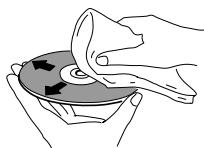
Wipe lightly from the center of the disc using straight strokes.
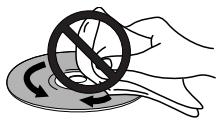
Don't wipe the disc surface using circular strokes.
Storing discs
Although CD, CD-R and CD-RW discs are more durable than vinyl records, you should still take care to handle and store discs correctly. When you're not using a disc, return it to its case and store upright. Avoid leaving discs in excessively cold, humid, or hot environments (including under direct sunlight).
When labeling discs, use a felt-tip pen sold for marking CDs. Don't glue paper or put stickers onto the disc, or use a pencil, ball-point pen or other sharp-tipped writing instrument. These could all damage the disc.
For more detailed care information see the instructions that come with discs.
CDs spin at high speed inside the recorder during playback and recording. If you can see that a disc is cracked, chipped, warped, or otherwise damaged, don't risk using it in your CD recorder--you could end up damaging the unit.
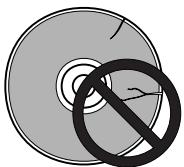
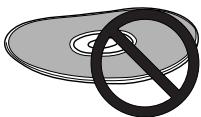
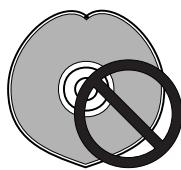
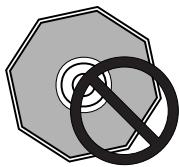
This recorder is designed for use with conventional, fully circular CD's only. Use of shaped CD's is not recommended for this product. Pioneer disclaims all liability arising in connection with the use of shaped CD's.
Connecting to the Rest of Your System
This section explains connecting up to an XC-L77/L7/L5 system. If you're connecting to a different system, see Connecting to other systems on page 17.
2 Raccordements
IMPORTANT: Never connect or disconnect the system ribbon cables while the power plug is connected to the wall outlet. Doing so may damage the unit.
To insert, hold the connector and push firmly into the socket until you hear it click home.
To remove, hold the connector securely on either side with thumb and forefinger and pull out from the socket.
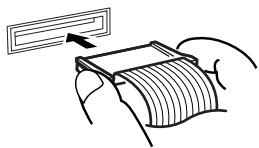
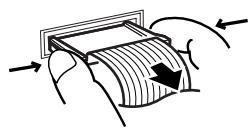
Important: Before making or changing any rear panel connections, make sure that all the components are switched off and unplugged from the power supply.
The diagram on the preceding page shows the PDR-L77 CD recorder connected to the XC-L77 CD receiver and the CT-L77 cassette deck. If you also have the MJ-L77 MD recorder, skip this page and follow the instructions on pages 16-17.
When setting up, be sure to also refer to chapter 2 of the XC-L77 manual for full installation and connection details.
1 (If you don't have the CT-L77 cassette deck, skip this step.) Connect the tape deck's ribbon cable to the top of the Analog Rec Adapter box (see Ribbon Cables on the previous page for more on connecting and disconnecting ribbon cables).
2 Plug the Analog Rec Adapter in to the LINE IN jacks on the CD recorder (see Analog Rec Adapter below). Plug the other end (the ribbon cable) into the CD receiver.
3 Connect the supplied control cord from the CD receiver (jack marked FROM MODEL PDR-L77) to the CD recorder (jack marked TO XC-L77).
4 Connect the supplied stereo cord between the AUX/CD-R IN on the CD receiver, and the LINE OUT jacks on the CD recorder.
5 Connect the supplied optical cord from the CD receiver's DIGITAL OUT (OPT) to the CD recorder's DIGITAL IN (OPT).
Analog Rec Adapter
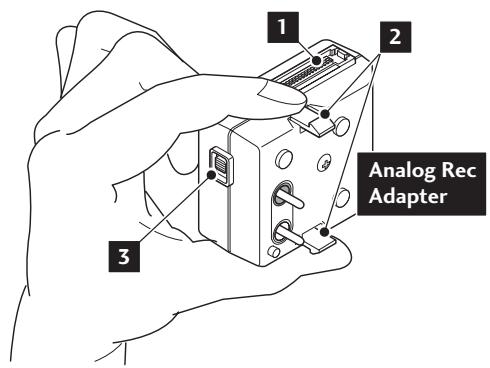
1 Ribbon cable connector
2 Locating lugs (top and bottom). When plugging the Analog Rec Adapter into the CD recorder, pinch these together slightly between thumb and forefinger and line up with the holes on the rear panel. Remove in the same way.
3 System switch. If using with the XC-L77 CD receiver, leave in the upper position; for the XC-L7 or XC-L5, slide to the lower position.
2 Raccordements
Important: Before making or changing any rear panel connections, make sure that all the components are switched off and unplugged from the power supply.
The diagram above shows the PDR-L77 CD recorder connected to the XC-L77 CD receiver, the MJ-L77 MD recorder and the CT-L77 cassette deck. If you are connecting up this recorder to a different stereo system, see Connecting to other systems on page 17.
When setting up, be sure to also refer to chapter 2 of both the XC-L77 and MJ-L77 manuals for full installation and connection details.
1 Connect the MD recorder's ribbon cable to the top of the Analog Rec Adapter box (see Ribbon cables on page 15 for more on connecting and disconnecting ribbon cables).
2 Plug the Analog Rec Adapter in to the LINE IN jacks on the CD recorder (see Analog Rec Adapter on page 15 for information on setting the switch and plugging into the rear panel). Plug the other end (the ribbon cable) into the CD receiver.
3 If you have the optional CT-L77 tape deck, plug the ribbon cable into the MJ-L77 MD recorder.
4 Connect the supplied mini-plug control cord from the CD receiver (jack marked FROM MODEL PDR-L77) to the CD recorder (jack marked TO XC-L77).
5 Connect the supplied stereo cord between the AUX/CD-R IN on the CD receiver, and the LINE OUT jacks on the CD recorder.
6 Connect the supplied optical cord from the CD receiver's DIGITAL OUT (OPT) to the CD recorder's DIGITAL IN (OPT).
7 Connect the optical cord supplied with the MD recorder from the CD recorder's DIGITAL OUT (OPT) to the MD recorder's DIGITAL IN (OPT).
Note: You can still record digitally from the CD receiver to the MD recorder: in stop and record modes, the CD recorder passes the signal arriving at the DIGITAL IN to the DIGITAL OUT.
Connecting to other systems
If you're not using this recorder as part of the XC-L77 mini stereo system, connect the analog jacks of this unit with a set of input and output jacks on your amplifier/receiver:
1 Use a standard stereo cord (one is supplied with this recorder) to connect the LINE OUT jacks of this recorder with the TAPE/MD/CD-R IN jacks on your amplifier/receiver.
2 Use another standard stereo cord to connect the LINE IN jacks of this recorder with the TAPE/MD/CD-R OUT jacks on your amplifier/receiver.
3 For digital recording, connect the DIGITAL IN (OPT) of the PDR-L77 with the optical out jack of your source component (or amplifier/receiver with optical digital output) using the supplied optical cord.
- Note: Different amplifiers may have differently labeled jacks. If you're unsure which to use, look in your amplifier's manual under connecting a tape deck.
2 Raccordements
3 Controls and Displays
Front Panel
1 CD tray
2 Power light - Lights when the unit is switched on.
3 / 回 button - Press to play a disc, or pause a disc that's already playing (press again to restart playback).
4 button - Press to open or close the disc tray.
5 Play light - Lights when playing or recording a CD; blinks when a CD is paused.
6 Standby/On button - Press to switch the unit between standby and on modes.
Note: This unit consumes a small amount of electricity in standby mode (0.8 W).
7 Remote control sensor
8 DISPLAY ON/OFF - Press to switch the fluorescent display on/off and adjust the brightness. See page 30.
9 Fluorescent display - See page 21.
10 TRACK NO. - Press during recording to start a new track. See page 46.
11 DIGITAL REC LEVEL - Use to adjust the recording level when recording from digital sources. See page 42.
3 Controls and Displays
Remote Control
1 STANDBY/ON - Switch the unit between standby and on modes. Note: This unit consumes a small amount of electricity in standby mode (0.8W).
2 FADER - Fade in or out during playback (p.30), or recording (p.47).
3 FINALIZE - Start finalizing a disc (to make a recordable disc playable in ordinary CD players). (p.53).
4 - Record a blank section (for space between tracks, etc.). (p.49)
5 OREC-Put the recorder into record-pause mode. (pp.40-41)
6 DIGITAL SYNCHRO - Start recording on detection of a digital input signal. (pp.34-39).
7 ERASE-(CD-RW discs only) Start erasing tracks or re-initialize a disc. (pp.54-56)
8 AUTO/MANUAL - Switch between automatic and manual track numbering when recording. (p.46)
9 TRACK NO. WRITE - Press during recording to start a new track (when in manual track numbering mode). (p.46)
10 - Stop playback or recording.
11 - Pause playback or recording.
12 - Start or resume playback, or start recording from record-pause mode. (p.22, 23)
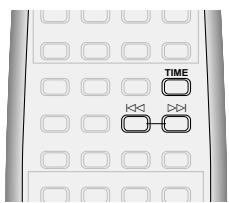
13 TIME-Switch the display mode. (pp.28-30)
14 - Press and hold for fast reverse/forward playback. (p.22,23)
15 - Skip back/forward tracks. (p.22,23)
16 INPUT SELECTOR - Switch the input between analog and digital (and thru). (p.34-45)
17 SKIP PLAY - Switch skip play on/off. (p.52)
18 SKIP ID SET - Record a track skip ID marker for the current track. (p.50)
19 SKIP ID CLEAR - Remove a skip ID on the current track. (p.51)
20 Number buttons - Use to select track numbers. (p.25)
21 10/0 - Use to input 10 or 0. (p.25)
3 Controls and Displays
22 >10 - Use to enter track numbers greater than 10. (p.25)
23 REPEAT - Set the repeat mode. (p.27)
24 PROGRAM - Program the playback track order. (p.25,26)
25 CHECK - Step through the programmed tracks in the playlist. (p.27)
26 CLEAR - Clear the last programmed track in program play mode. (p.26)
27 RANDOM - Start random track playback. (p.28)
Keep in mind the following when using the remote control unit:
- Make sure that there are no obstacles between the remote and the remote sensor on the unit.
- Use within the operating range and angle, as shown in the diagram below.
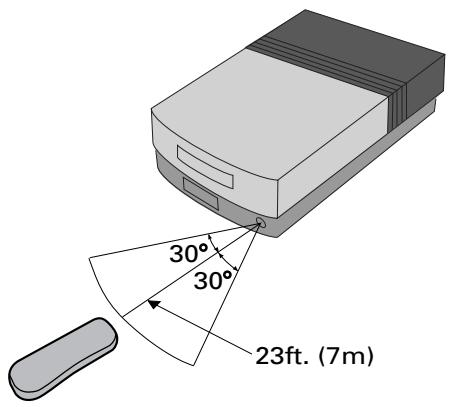
- Remote operation may become unreliable if strong sunlight or fluorescent light is shining on the unit's remote sensor.
- Remote controllers for different devices can interfere with each other. Avoid using remotes for other equipment located close to this unit.
- Replace the batteries when you notice a fall off in the operating range of the remote.
3 Controls and Displays
Display
1 RDM-Lights in random-play mode.
2 PGM-Lights in program-play mode.
3 RPT/RPT-1-Lights when disc repeat / track repeat mode is on.
4 L R - Left / Right channel indicators (light in level meter display mode).
5 Level meter message/time display
6 SYNC - Lights when the recorder is in automatic synchro recording mode.
7 DIGITAL - Lights when the optical digital input is selected.
8 FINALIZE - Lights if the CD-RW currently loaded has been finalized.
9 CD / CD-R / CD-RW - Indicates the type of disc currently loaded.
10 - Lights to indicate recording or record-pause mode. Blinking display indicates record muting.
11 D.VOL - Lights when the digital volume is set to something other than 0dB.
12 SKIP ON - Lights to indicate that a disc contains skip IDs. Blinks when setting or clearing skip IDs.
13 A. TRACK - Lights when automatic track numbering is on during recording.
14 FADER - Blinks during fade in or fade out.
Switching On, Playing a Disc
This section takes you through switching on, playing discs and basic recording. Before proceeding, you should at least have connected your recorder to the XC-L77 CD receiver, or other amplifier. If you haven't, turn back to page 14.
4 Getting Started
1 Press STANDBY/ON to switch on.
If this unit is connected to the XC-L77, the power comes on automatically when you switch on the XC-L77 CD receiver. If you're using it with a different amplifier/receiver, use the front panel button or the remote control to switch on.
The power light comes on and the display shows a welcome message:
Hello!
2 Press (front panel only) to eject the disc tray.
OPEN
Place a CD, with the label face up, on to the disc tray, making sure that it is seated properly in the disc guide.
Note: Do not use an adapter when playing 8cm CD-singles.
The disc tray has guides for both 12cm and 8cm discs.
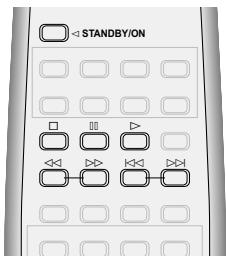
First, the recorder determines the kind of disc you've loaded (CD, CD-R or CD-RW).
If the disc isn't blank, the number of tracks and total disc playing time is displayed briefly, then playback starts.

The play light on the front panel lights during playback.
Note: closes the disc tray without starting playback.
4 To pause playback, press (D/Ⅲ on the front panel).
To resume playback, press again.
The play light on the front panel blinks in pause mode.
5 To fast-reverse or fast-forward, press and hold or .
Release to resume normal playback.
If you reach the end of the disc while pressing , the display shows DISC END and the recorder goes into play- pause mode.
6 To skip back or forward to another track, press or .
Pressing once skips to the start of the next track on the disc. Further presses take you to subsequent tracks.
Pressing | | once takes you to the beginning of the current track. Further presses skip to the start of previous tracks.
You can use the track skip buttons while the disc is paused or stopped, too. The track number changes while the disc remains paused/stopped.
7 To stop playback, press .
If the disc was paused, then the pause mode is canceled. The display shows the number of tracks on the disc and the total playing time:

Remove the disc from the recorder before switching off.
4 Getting Started
Using together with the XC-L77
When connected to the XC-L77 CD receiver, this unit behaves as an integral part of the system.
- Power to the CD recorder is switched on and off with the CD receiver—it is not possible to switch on/off the CD recorder independently.
- Pressing or / 回 on the CD recorder automatically changes the CD receiver's function. The separate system display unit will show the input function as CD-R (not AUX).
- If you change the input function of the CD receiver while the CD recorder is playing, the CD recorder automatically stops.
- While the CD recorder is recording, you cannot change the input function of the CD receiver.
- In play mode, the digital output is always from the disc playing. However, in record and stop modes, the signal output from the digital out is whatever is coming into the recorder at the digital input. This means that if you connected the MJ-L77 MD recorder, you can still record on to MD a CD playing in the CD receiver.
4 Getting Started
Selecting Tracks Directly
If you want to start playback from a track other than the first, enter the track number from the remote control. If the disc is already playing (or paused), the recorder jumps straight to that track.
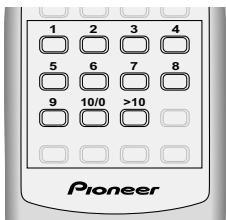
1 Use the number buttons to enter a track number.
For track numbers 1 to 10, use the corresponding number button.
For track numbers over 10, press the >10 button:

Next, enter the track number. For example, to select track 20 press 2:

Then 10/0:

Playback starts after entering the track number.
Programming a Playlist
Programming a playlist means telling the player precisely which tracks, and in what order, you want played. You can program a sequence of up to 24 tracks, playing tracks more than once if you like.
The sequence you program applies only to the disc in the player at the time: as soon as you eject that disc the playlist is lost.
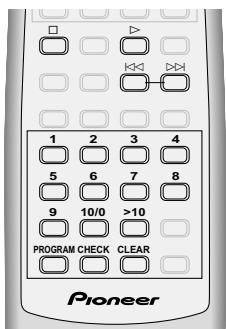
4 Getting Started
The PGM indicator lights and the display prompts you to enter the first track in the program:

2 Enter the track numbers in the order you want them played.
Use the number buttons to select tracks:
- For track numbers 1 to 10, use the corresponding number button.
- For track numbers over 10, press the >10 button, then enter the track number. For example, to select track 20 press >10, 2 , then 10/0 .
- You can also use the | | < | | and | > > | buttons to select tracks,pressing PROGRAM after each to enter it into the playlist.
After adding a track to the playlist, the display shows the next step and the total playing time of the playlist:

Note: the display will not show the total playing time of playlists that exceed 100 minutes.
3 Press (D/Ⅲ on the front panel) to start playback.
Clearing the playlist
Clear the playlist by either:
- ejecting the disc (press ).
- pressing while the disc is stopped.
Clearing a track from the playlist
Delete the last (most recently) programmed track by pressing CLEAR.
Press repeatedly to clear several steps (if the program is playing while you're doing this, you can't clear steps beyond the one that is currently playing).
4 Getting Started
Checking what's in the playlist
In stop mode you can check the contents of the playlist using the CHECK button. Each press steps through the playlist, showing the step number and the corresponding track number:

Changing a track in the playlist
While checking the playlist (see above), you can change the track number for the step you're on using either the | | | | and | | | | buttons or the number buttons.
Using the Repeat Modes
Use the repeat function to repeat either the current track or the entire disc over and over. You can set the repeat mode in normal, random or program play modes.
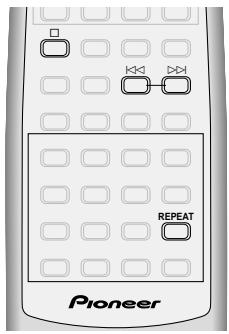
To repeat the track currently playing, press REPEAT once.

The RPT-1 indicator lights and the current track repeats until you press REPEAT twice. Either way, repeat mode is canceled.
To start a new track repeating, select the track using the and buttons.
To repeat the whole disc, press REPEAT twice.

The RPT indicator lights and the disc repeats until you press REPEAT again (in which case, the disc continues playing until the end, then stops).
4 Getting Started
Using the Random Mode
To have the recorder play tracks in a different order each time you play a disc, use the random play mode. Each track will play just once, but the order will be random. When all the tracks have been played, the disc stops.
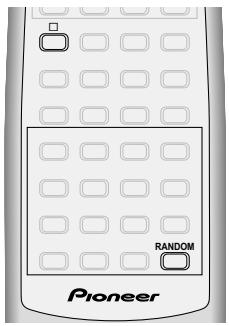
Press RANDOM to start random playback.
The RDM indicator lights and a track is chosen at random:

To select a new random track at any time, press RANDOM.
Press to cancel random play.
Showing Disc Information
The recorder can display various kinds of disc and track information in both playback and recording modes. The TIME button switches between the different display modes. Additionally, in stop mode, individual track information is available using the | | | and | | | buttons. Finally, there's the option to dim or switch off the display completely.
4 Getting Started
During playback or play-pause, press TIME to switch the display mode.
There are five different displays. Press TIME repeatedly to switch between them:
- Track number / time elapsed

- Track number / time remaining

- Level meter

Total number of tracks / playing time

After 5 seconds, the display reverts to Track number/time elapsed.
During recording or record-pause, press TIME to switch the display mode.
There are three different displays. Press TIME repeatedly to switch between them:
- Track number / elapsed recording time

- Recording level meter

- Recording time available

Note: Although compatible with 80 minute discs, the remaining recording time display will not accurately show 80 minutes for blank discs.
4 Getting Started
Each press moves back or forward one track on the disc and shows the length of that track.
When a CD-R or CD-RW is loaded, pressing TIME switches between total disc playing time and recording time remaining:
Total number of tracks / recorded time

- Recording time available (non-finalized CD-R/CD-RW only)

Use the DISPLAY ON/OFF (front panel only) button to adjust the brightness of the fluorescent display.
There are five levels of brightness, plus an off setting.
- You can't switch the display off during recording, or during record-pause mode.
Fading In and Fading Out
Use the FADER button to fade the volume down over several seconds and pause playback. You can also have the player fade in the volume gradually when you resume playback.
Note: you can only hear the fades through the analog outputs.
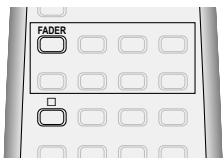
Press FADER during playback to pause the disc.
The FADER indicator in the display blinks and the volume fades to silence over about five seconds. The unit then pauses playback.
Press FADER to resume playback of a paused disc.
The FADER indicator in the display blinks and the volume starts to fade in.
4 Getting Started
This recorder is designed to let you make extremely high quality digital recordings onto recordable compact discs. For flexibility, you can use either rewritable discs (CD-RW) or write-once discs (CD-R). For more general information on the discs you can and can't use with this recorder, see About CD, CD-R and CD-RW Discs on page 10. The overview on these pages gives you an idea of what's possible, and also provides guidance on what to avoid and things to be careful of when recording. We strongly recommend that you read these pages fully before proceeding to the more detailed instructions starting on page 31.
Digital and analog sources
This recorder has an optical digital input and a pair of analog inputs. Use the digital input when:
- recording from a CD/MD/DAT/DCC player or digital satellite with an optical digital output.
Use the analog inputs when:
- recording from a digital component that does not have an optical digital output.
- recording from an incompatible digital source (such as a high sampling-rate DAT tape).
- recording a digital copy-protected source (see below).
- recording from any analog source (radio broadcasts, vinyl records, cassette tapes, etc.).
Digital recording restrictions
This unit has been designed exclusively for recording and playback of audio discs—you can't record other CD formats, such as computer CD-ROMs or Dolby Digital (AC-3). If you record from a disc format such as CD+Graphics, Video CD, or other format that includes both digital audio and video or text, you will only be able to record the audio part of the disc.
In addition to standard audio CDs, this recorder will record DTS encoded audio CDs and HDCD format CDs, however.
Almost all commercial digital source material is protected by copyright laws. For this reason, this recorder uses special consumer-use blank CD-R and CD-RW discs on which a copyright fee has already been paid. A further restriction is SCMS (Serial Copy Management System). This generally allows just one generation of digital recording. In other words, you can make a digital recording
4 Getting Started
from an original source (such as a commercial CD), but you can't then make further digital recordings from that copy. Most digital recording equipment uses the SCMS system, including CD-R and MD recorders, and DAT decks. You may also find that you can't record certain DVD discs as the digital output of the DVD player can be disabled by the disc.
If you do encounter SCMS or other digital-copy restrictions, you can always record through the analog inputs.
Digital recording from DAT
If you're recording a DAT tape that was recorded using the DAT machine's auto ID function, the IDs on the tape are slightly after the beginning of the actual recording. This can cause problems for the CD recorder:
- The start of the track may not be recorded.
- The track number will be recorded on the disc after the start of the track
- The beginning of the next track on the DAT is unintentionally recorded
To avoid these problems, we recommend recording start IDs on the DAT manually, if possible. Refer to the instructions for your DAT recorder for more information.
You might also encounter problems if you try to synchro-record all tracks from a DAT that is set to program play. If you want to record a DAT in program play mode, use the 1-track synchro recording mode—see pages 34-35 for how to do this.
Digital signal interruptions
Sources of signal interruption include power or source component failure, accidental disconnection of the interconnect cord, and interruption of digital satellite broadcasts. In all these cases, if the signal resumes within about five seconds, the result will just be a blank section on the disc. If the interruption is longer than five seconds, the recorder displays the error message: Can't REC and recording is paused.
4 Getting Started
Never switch off this recorder while it's recording, or while the display shows PMA REC (Program Memory Area Recording). If there's a power failure, or you accidentally disconnect the power from the wall outlet while recording is in process, you'll lose at least part of the recording. When power is restored, the recorder will show the message RESUME until it's finished recording the PMA.
After recording, always remove the disc from the recorder before switching the power off. Failure to do this could result in you losing some of the recorded material on the disc.
Miscellaneous information
- The minimum recordable time is four seconds. Even if you try and record something shorter than this, the track that the recorder creates will be four seconds.
- Usually, track numbers are recorded onto the disc automatically when recording. If you decide to switch off this feature (for example, when you're recording from a satellite broadcast), be sure to input track markers as recording is taking place—you can't add them after recording is complete. See page 30 for more on manual and automatic track numbering.
- The maximum number of tracks on a disc is 99.
4 Getting Started
Recording One Track from a Digital Source
Use this mode when you want to record just a single track, or a few selected tracks, from a CD, MD, DCC or DAT. The recorder starts and stops automatically, and there's no need to worry about recording levels—you'll get a perfect digital copy of the original (if you want to change the digital recording level, see pages 42-43).
- To record all the tracks on the source, see Recording All Tracks from a Digital Source on pages 36-37.
- To record all the tracks on the source then finalize the disc, see Automatically Recording and Finalizing a Disc on pages 38-39.
- To record from some other digital source, turn to manually Recording a Digital Source on pages 40-41.
- To record from any source through the analog inputs, see Recording an Analog Source on pages 43-44.
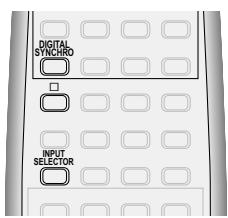
1 Load a CD-R or CD-RW disc.
If it's a blank disc, the display indicates this:
| CD-R | NEW DISC | FADER |
If the disc isn't blank, use the TIME button to check that there's enough space on it for what you want to record.
2 Press INPUT SELECTOR to choose the digital input.
Pressing INPUT SELECTOR repeatedly switches the active input:
ANA (analog) - DIG (digital) [-THR (thru)]*
The recorder's display indicates the current input:
| CD-R | INPUT | DIG | DIGITAL |
- This option only appears when the CD recorder is not connected to the XC-L77 CD receiver. See page 45 for more on using the thru input mode.
4 Getting Started
3 Make sure that the source is not playing, then press DIGITAL SYNCHRO.

Digital synchro recording will not work if the source is already playing!
The SYNC indicator and play light will start to blink when the recorder is ready.
To cancel recording here, press
4 Play the source.
The recorder starts recording automatically.

Use the TIME button to switch displays during recording.
5 The recorder enters record-pause mode after recording one track.

After a few seconds, the display reverts, showing the recorder is in record-pause mode.
- If you're recording a CD or MD, recording stops automatically when the track changes or there is more than five seconds of silence on the source.
- If you're recording from DCC or DAT tape, recording stops when the recorder encounters a new start ID or there is more than five seconds of silence on the source. (See also Digital recording from DAT on page 32.)
6 If you're done, press
To record further tracks, simply repeat steps 3 to 5.
- After pressing , the recorder writes the track information to the disc:

Note: If you find that synchro recording does not seem to work, see Digital syncro recording troubleshooting on page 60 for possible remedies.
4 Getting Started
Recording All Tracks from a Digital Source
If you want to copy all the tracks from a CD, MD, DCC or DAT, use this mode. Like the 1-track synchro recording mode, the recorder starts and stops automatically. When recording from MD or CD, you can play the source in either normal play mode, or program play if you'd like the recorded tracks in a different order to the original. We do not recommend recording from DAT in program play mode; use the 1-track synchro recording mode if you want to record the tracks in a different order.
- To record one track from a source, see Recording One Track from a Digital Source on pages 34-35.
- To record all the tracks on the source then finalize the disc, see Automatically Recording and Finalizing a Disc on pages 38-39.
- To record from some other digital source, turn to manually Recording a Digital Source on pages 40-41.
- To record from any source through the analog inputs, see Recording an Analog Source on pages 43-44.
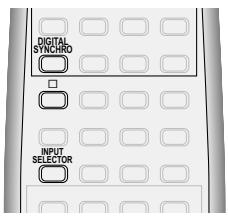
1 Load a CD-R or CD-RW disc.
If it's a blank disc, the display indicates this:

If the disc isn't blank, use the TIME button to check that there's enough space on it for what you want to record.
2 Press INPUT SELECTOR to choose the digital input.
Pressing INPUT SELECTOR repeatedly switches the active input:
ANA (analog) - DIG (digital) [-THR (thru)]*
The recorder's display indicates the current input:

- This option only appears when the CD recorder is not connected to the XC-L77 CD receiver. See page 45 for more on using the thru input mode.
4 Getting Started
3 Make sure that the source is not playing, then press DIGITAL SYNCHRO twice.

Digital synchro recording won't work if the source is already playing!
The recorder goes into all-sync record pause mode and the SYNC indicator and PLAY light start to blink.
To cancel recording here, press
4 Play the source.
The recorder starts recording automatically.

Use the TIME button to switch displays during recording.
5 After recording all tracks from the source, the recorder goes into all-sync record-pause mode.

After the recorder encounters about five seconds of continuous silence, it assumes the end of the source has been reached and goes into record-pause mode and the display shows the SYNC-A message again.
Be careful: if the recorder detects another signal (from a CD or MD), or a start ID (from DAT or DCC), it will start recording again!
- The recorder will enter record-pause mode if the digital signal is interrupted for more than 5 seconds, or changes format—see Digital signal interruptions on page 32.
6 Press to finish recording.
- After pressing , the recorder writes the track information to the disc:

Note: If you find that synchro recording does not seem to work, see Digital syncro recording troubleshooting on page 60 for possible remedies.
4 Getting Started
Automatically Recording and Finalizing a Disc
This is a variation on all-track synchro recording on pages 36-37. After all the tracks on the source material have been recorded, the recorder automatically finalizes the disc. If you're recording onto a CD-R, this means that the disc will be playable in an ordinary CD player, but you won't be able to record any further tracks onto the disc.
Like the other synchro modes, you can only use this mode when recording from CD, MD, DCC or DAT.
- To record one track from a source, see Recording One Track from a Digital Source on pages 34-35.
- To record all the tracks on the source, see Recording All Tracks from a Digital Source on pages 36-37.
- To record from some other digital source, turn to manually Recording a Digital Source on pages 40-41.
- To record from any source through the analog inputs, see Recording an Analog Source on pages 43-44.
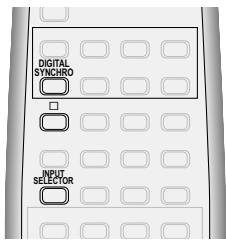
1 Load a CD-R or CD-RW disc.
If it's a blank disc, the display indicates this:

If the disc isn't blank, use the TIME button to check that there's enough space on it for what you want to record.
2 Press INPUT SELECTOR to choose the digital input.
Pressing input selector repeatedly switches the active input:
ANA (analog) - DIG (digital) [ - THR (thru)]*
The recorder's display indicates the current input:

- This option only appears when the CD recorder is not connected to the XC-L77 CD receiver. See page 45 for more on using the thru input mode.
4 Getting Started
3 Make sure that the source is not playing, then press DIGITAL SYNCHRO three times.

Digital synchro recording won't work if the source is already playing!
The recorder goes into all-sync record pause mode and the SYNC indicator, FINALIZE indicator and PLAY light start to blink.
To cancel recording here, press
4 Play the source.
The recorder starts recording automatically.

Use the TIME button to switch displays during recording.
5 After recording all tracks from the source, the recorder goes into all-sync record-pause mode.

The Play light on the recorder also blinks.
After the recorder encounters about five seconds of continuous silence, it assumes the end of the source has been reached and goes into record-pause mode and the display shows the SYNC-A message again.
If the recorder detects no signal for one minute, finalization starts.
Be careful: if the recorder detects another signal (from a CD or MD), or a start ID (from DAT or DCC), it will start recording again!
Finalization takes about four minutes, during which time, none of the buttons are operative. Never turn the power off during finalization!
- The recorder will enter record-pause mode and will not finalize the disc if the digital signal is interrupted for more than 5 seconds, or changes format—see Digital signal interruptions on page 32.
- If the recorder reaches the end of the disc, or if there are more than 99 tracks, the recorder stops recording without finalizing the disc.
Note: If you find that synchro recording does not seem to work, see Digital synchro recording troubleshooting on page 60 for possible remedies.
4 Getting Started
Manually Recording a Digital Source
If you are recording from a digital source other than CD, MD, DCC or DAT—digital satellite, for example—synchro recording is not possible since there are no track numbers or start IDs to signal the start and end points of the recording. For these sources, use the manual recording method described here.
- To record one track from a CD, MD, DAT or DCC, see Recording One Track from a Digital Source on pages 34-35.
- To record all tracks from a CD, MD, DAT or DCC, turn to Recording All Tracks from a Digital Source on pages 36-37.
- To record all the tracks on the source then finalize the disc, see Automatically Recording and Finalizing a Disc on pages 38-39.
- To record from any source through the analog inputs, see Recording an Analog Source on pages 43-44.
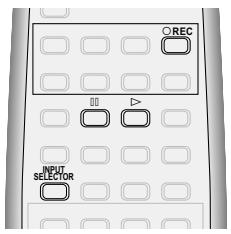
1 Load a CD-R or CD-RW disc.
If it's a blank disc, the display indicates this:
CD-R NEW DISC FADER
If the disc isn't blank, use the TIME button to check that there's enough space on it for what you want to record.
2 Press INPUT SELECTOR to choose the digital input.
Pressing input selector repeatedly switches the active input:
ANA (analog) - DIG (digital) [− THR (thru)]*
The recorder's display indicates the current input:
INPUT DIG DIGITAL FADER
- This option only appears when the CD recorder is not connected to the XC-L77 CD receiver. See page 45 for more on using the thru input mode.
4 Getting Started
The recorder goes into record-pause mode.

The Play light on the recorder also blinks.
The A.TRACK indicator lights if auto track numbering is on. For more on this, see page 46.
4 Start playing the source to check that it's recordable.
If the recorder does not recognize the digital format, or the source is copy-protected, the message Can't REC or Can't COPY appears. In either case, you won't be able to record digitally—use the analog inputs instead (see Recording an Analog Source on pages 43-44).
If necessary, set the recording level (see pages 42-43). If the signal appears OK, stop the source.
5 Check that the time display reads 0:00, then press or to start recording.

6 Restart playback of the source material.
If the auto track indicator is lit in the display then the recorder will start a new track each time it detects two seconds of continuous silence. (To switch off auto track numbering see page 46.)
Use the TIME button to switch displays during recording.
7 When you're done, press
- After pressing , the display shows PMA REC while it records the track information to the disc.

4 Getting Started
Setting the Digital Recording Level
One of the advantages of digital-to-digital recording is that you don't have to set recording levels—and risk distortion by overloading the disc. If you're recording commercial material from CDs or MDs, the digital level has already been optimized and you don't need to change it. If you're making a digital copy of a CD, DAT or MD that was not commercially produced and that was consistently under-recorded, you can boost the overall level by up to +12dB . Remember though, that any peaks in the original recording run the risk of distorting the copy.
If you record digital satellite broadcasts, you may also have cause to boost the digital recording volume since the digital volume of some broadcasts is relatively low. Again, remember that if there are any peaks in the broadcast, you run the risk of momentary distortion.
It's also possible to reduce the digital recording volume so that you end up with a recording that is quieter than the original. In most cases, this is not desirable since the recording quality will suffer very slightly. However, if you're putting together a mix CD (various tracks compiled from different sources), and there is a track which stands out as generally louder than the others (peak volumes are usually similar, but the average level of some recordings might be higher than others so they sound louder), then you might want to reduce the level of that track.
Note that this feature will not get rid of distortion on the source material.
You can adjust the digital recording volume while the unit is in record-pause mode or while it is actually recording. Once changed, the new digital recording level remains until you change it again, or reset it.
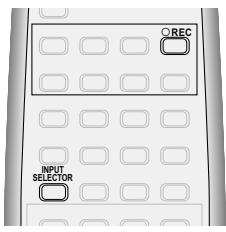
Note: When recording HDCD or DTS CDs, make sure that the digital volume is set to 0 dB.
4 Getting Started
Pressing INPUT SELECTOR repeatedly switches the active input:
ANA (analog) - DIG (digital) [-THR (thru)]*
The recorder's display indicates the current input:

- This option only appears when the CD recorder is not connected to the XC-L77 CD receiver. See page 45 for more on using the thru input mode.
2 If the recorder is not already in a record mode, press REC.
If there is nothing connected to the selected digital input, the message Can't REC appears in the display.
3 Use the DIGITAL REC LEVEL + and - buttons (front panel) to adjust the recording level up or down.

- The maximum adjustment possible is between -48 dB and +12 dB.
From +12 dB down to -25dB adjustment is in steps of 1dB. Below this, there are four preset levels: -30dB -36dB -42 dB and -48dB - If you set the level at anything other than 0 dB, the D.VOL indicator in the display lights to remind you of the fact.
Recording an Analog Source
Use the analog inputs when recording any analog source (vinyl, cassette tape, etc.), or when recording from a digital source that is copy protected or in an incompatible format. The recorder sets the recording level automatically; it is not possible to adjust it manually.
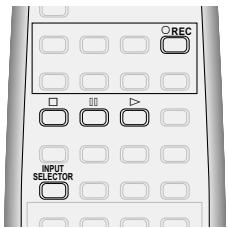
4 Getting Started
If the disc isn't blank, use the TIME button to check that there's enough space on it for what you want to record.
2 Press INPUT SELECTOR to choose analog input.
Pressing INPUT SELECTOR repeatedly switches the active input:
ANA (analog) - DIG (digital) [− THR (through)]*
The recorder's display indicates the current input:

- This option only appears when the CD recorder is not
connected to the XC-L77 CD receiver. See the following page for more on using the thru input mode.
3 Make sure the disc is stopped, then press REC.
The recorder goes into record-pause mode.

4 Check that the time display reads 0:00, then press or to start recording.

5 Start playback of the source material.
If the A.TRACK indicator is lit in the display then the recorder will start a new track each time it detects a signal after at least two seconds of continuous silence. (To switch off auto track numbering see page 46.)
6 When you're done, press
- After pressing , the display shows PMA REC while it records the track information to the disc.

4 Getting Started
When this unit is not connected to the XC-L77, there are three input modes available from the input selector button: digital, analog and thru. Selecting thru passes any signal coming into the digital input to the digital output. This is useful when daisy-anchaining two digital recorders from a single digital source: connect the digital source to this unit's input, then the output from this unit to the second digital recorder. You can then record the source simultaneously on both recorders, or either one separately.
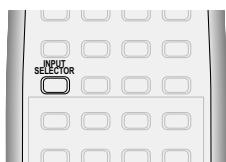
1 Press INPUT SELECTOR to choose the thru input mode.
Pressing INPUT SELECTOR repeatedly switches the active input:
ANA (analog) - DIG (digital) - THR (thru)
The recorder's display indicates the current input:

In stop and record modes, the digital input signal is passed through to the digital output.
4 Getting Started
5 More Recording Features
Numbering Tracks
If you're recording from CD, MD, DCC or DAT, you can usually let the recorder number the tracks as they change on the source material. Although automatic track numbering is the default mode of the recorder, you can number tracks manually as recording is taking place. In some cases—such as recording from digital satellite or Laserdisc, or from an analog source—auto track numbering may not work reliably (in these cases, a new track is started after the recorder detects two seconds of silence). Here's how to use manual track numbering.
Remember: it is not possible to edit track numbers after recording.
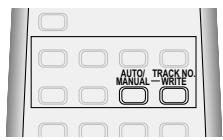
1 Press AUTO/MANUAL to switch from automatic to manual numbering.
The A.TRACK indicator disappears when auto track numbering is switched off.
- Press AUTO/MANUAL again to switch back to automatic numbering. The A.TRACK indicator lights in the display.
- You can switch between auto and manual track numbering either before starting to record, or during recording itself.
2 Start recording.
- You can use manual numbering in any record mode, but it is best suited to manual digital-input or analog-input recording (see pages 40-44 for more on these recording modes).

3 Press TRACK NO. WRITE (TRACK NO. on the front panel) at any point you want a new track to start.

- CD tracks must be at least four seconds long—the recorder won't let you start a new track less than four seconds into the current track.
5 More Recording Features
Recording Fade Ins and Fade Outs
Sometimes, for example if you're recording just an excerpt from something, it may be better to fade in the recording, then fade out again at the end, rather than start and end abruptly. Note that you can't record a fade in when in synchro recording mode (although you can record a fade out).
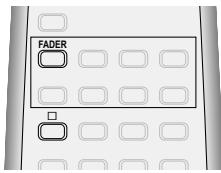
Recording a fade in
With the source playing, press FADER during record-pause mode to fade in.
The FADER indicator blinks as the recording starts with a gradual fade in.

Recording a fade out
Press FADER during recording to fade out.

After recording about five second fade out, the recorder goes into record-pause mode. This happens in either normal or synchro record mode.
- You can also just press if you don't need a fade out. If you record a fade out during all-track sync mode, the synchro mode is canceled after the fade out (see pages 34-39 for more on synchro recording).
Note: If the recorder runs out of recording space on the disc before the source has finished, it will automatically record a fade out and stop recording.
5 More Recording Features
Checking What's at the End of a Disc
Note: This feature is only available when this unit is not connected to the XC-L77 receiver.
You don't have to record a whole disc at once. Until you finalize the disc, further recording is possible from the end of the last track you recorded (assuming there are fewer than 99 tracks already on the disc). Here's how to check what's on the last recorded section of the disc before recording new material:
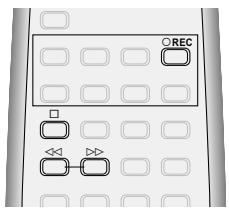
1 Press REC.
The recorder goes into record-pause mode.
You'll hear the last recorded track in reverse. Release the button and the track plays normally to the end.
| CD-R | ○ | PREV-0:31 | DIGITAL A/TRACK FADER | |
- While the track is playing you can use the and buttons.
- If you press O REC again while the track's playing, the recorder jumps to the end of the track and goes into record-pause mode again.
When the track has played out, the recorder automatically enters record-pause mode again.
3 Once the player is back in record- pause mode you can go ahead and record normally.
If you decide you don't want to record, just press.
5 More Recording Features
Recording Blank Sections
This feature is useful when you want to put some space at the end of a recording session so that the next recording doesn't start after the last too closely, but use it wherever you need some blank space recorded on the disc. Note that you can't start a recording with a muted section; only after the recording has started, or at the end of a recording.
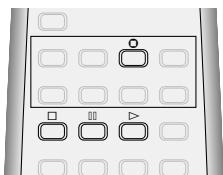
1 While recording, or during record- pause mode, press O.
The recording indicator starts blinking and a blank space of about four seconds is recorded. The recorder then goes into record-pause mode (if you pressed during recording, the track number increases by one).
- If you press and hold , you can record a blank for as long as you hold down the button.
- Pressing , (without holding) in record-pause mode records four seconds of silence from the current position. Use this to create spaces between tracks when recording in 1-track synchro mode, for example.
2 Press to finish the recording session.
- To restart recording, press either or .
5 More Recording Features
Skipping Unwanted Tracks
After recording a CD-R disc, you may decide that one or more of the tracks are unwanted. This may be due to a simple mistake or because a track didn't record successfully. Although you can't erase those tracks, you can set what are called 'skip IDs'. These tell a CD player (though not all recognize skip IDs) not to play a particular track, but to skip to the next one on the disc.
You can also set skip IDs on CD-RWs, although it's probably a less useful feature since you can always erase the last track.
Once a skip ID is set, you can clear it, but be careful: you can set up to 21 skip IDs per disc, but repeatedly setting and clearing skip IDs in different recording sessions will reduce this number.
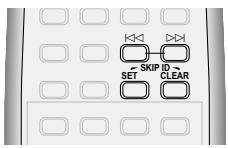
Setting skip IDs:
1 Press SKIP ID SET during playback (or while in play-pause mode) of the track you want to skip.
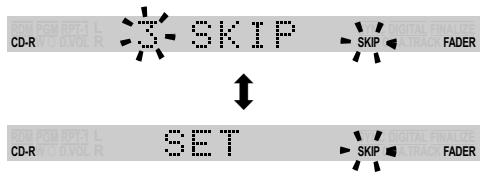
- Use the | | < | | and | > > > | buttons to skip to other tracks that don't have skip IDs set. When you press SKIP ID SET , it will be for the track that is currently playing.
- If there's no room left on the disc to record another skip ID, the display will show the message SKIP FULL.
2 Press SKIP ID SET again to confirm.

After displaying SET, the recorder reverts to the regular playback display.
The SKIP indicator lights in the display once a skip ID has been set.
To cancel, press either SKIP ID CLEAR or
3 Set further skip IDs by repeating steps 1 and 2.
5 More Recording Features
4 When you're finished, stop the disc and press (front panel).
Until you eject the disc, the recorder stores the skip ID information in its memory. On pressing , the recorder writes the skip ID information onto the disc.
Clearing skip IDs:
1 Press SKIP PLAY to switch off skip play mode.
The SKIP ON indicator in the display disappears.
- If the SKIP ON indicator did not light when you loaded the disc then there are no skip IDs present on that disc.
2 Press SKIP ID CLEAR during playback (or while in play-pause mode) of the track you no longer need a skip ID for.
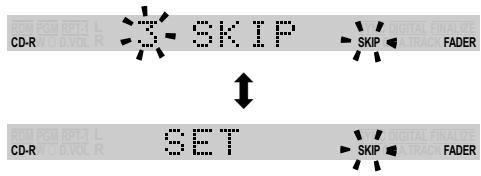
- If this track doesn't have a skip ID, the player jumps to the next track that does and starts playback of that track.
3 Press SKIP ID CLEAR again to confirm.

After displaying CLEAR, the recorder reverts to the regular playback display.
To cancel, press either SKIP ID SET or
- Use the | < > | and | > > | buttons to move between tracks that have skip IDs set. When you press SKIP ID CLEAR, it will be for the track that is currently playing.
4 Clear further skip IDs by repeating steps 2 and 3.
5 When you're finished, stop the disc and press (front panel).
Until you eject the disc, the recorder stores the changes in skip ID information in its memory. On pressing , the recorder writes the new skip ID information onto the disc.
5 More Recording Features
Playing a Disc with Skip IDs
If you're not sure whether a disc has skip IDs programmed, look for the SKIP ON indicator in the display when you load a disc—it will light automatically if one or more are present.
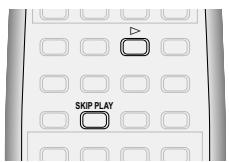
1 Load a disc.
The SKIP ON indicator lights if there are any skip IDs on the disc, and the player is in skip play mode (in other words, it won't play those tracks that are marked by skip IDs).

2 Press SKIP PLAY to switch skip play on/off, then press

When you turn off skip play mode the player ignores the skip IDs and plays all tracks on the disc.
- If there were no skip IDs on the disc in the first place, the SKIP PLAY button has no effect.
6 Finalizing and Erasing
Finalizing a Disc
Before you can play a CD-R on an ordinary CD player, the disc must go through a process called finalization. Once finalized, a CD-R disc is no longer recordable, nor will you be able to set or clear skip IDs. Finalization is not reversible for CD-Rs so be absolutely sure that everything on the disc is the way you want it before you start. CD-RW discs can also be finalized, although you can still erase the disc afterward and reuse it, so it's not anything like as final as it is with a CD-R disc. A finalized CD-RW disc can only be played on a CD player that is compatible with CD-RW discs (at present, there are very few of these).
Caution!
Finalization takes a few minutes. During this time never switch off the power to the unit—the disc may become unusable as a result. If there's a power failure or you do accidentally disconnect the power during finalization, the recorder will try and complete finalization once power is restored. The display will show RESUME until it's finished trying to recover the disc. Unfortunately, it may not be possible to complete the process successfully, and the disc may be damaged as a result.
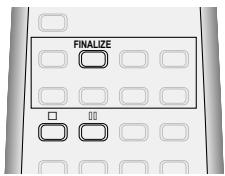
1 Load the CD-R or CD-RW you want to finalize.
- Check that the disc is free from dust, dirt and scratches—if necessary, clean the disc, following the guidelines on pages 12–13.
2 Press FINALIZE.
The recorder goes into record-pause mode, then the display changes to:

- Press here to cancel finalization.
6 Finalizing and Erasing
3 Press ( / on the front panel) to start finalization.
Finalization takes about four minutes; you'll see how long there is still to go in the display.

After finalization is complete:
If a CD-R is loaded, the CD-R indicator changes to CD.
If a CD-RW is loaded, the FINALIZE indicator lights in the display.
- None of the controls on the player or the remote have any effect during finalization. If, however, the recorder hasn't managed to finalize the disc within 10 minutes, you can abort the operation by pressing . If you do this, the disc won't be playable on an ordinary CD player.
Erasing a CD-RW Disc
Although more expensive than CD-R discs, the great advantage of CD-RW is that the discs can be erased and reused. Various erase options are available depending on whether the disc has been finalized.
A third, special option, erases (re-initializes) the whole disc. This process takes quite a long time to complete and should be used for recovering damaged discs, not for erasing tracks from a healthy disc.
Caution!
Never switch off the power during CD-RW erasing—your disc may become unusable. If there's a power failure or you do accidentally disconnect the power, the recorder will try and re-initialize the disc once power is restored. Unfortunately, it may not be possible to complete the process successfully, and the disc may be damaged as a result.
If the message CHECK DISC appears any time during any erase process, hit eject, take out the disc, clean it, then try the erase command again.
Be sure to remove the disc from the recorder before switching off the power, otherwise the erase operation will not be completed.
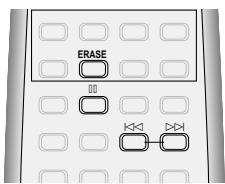
6 Finalizing and Erasing
When a non-finalized disc is loaded:
1 Press ERASE.

The Play light on the recorder also blinks.
2 Press (or ) to change the erase option.
Switch between:
- Erase just the last track

- Erase multiple tracks (erase from track ... to track ...)

Keep pressing (or ) to change the 'erase from' track—the 'erase to' track is always the last track.

- Erase all tracks

- Press to cancel.
3 Press ( / on the front panel) to start erasing.

The process takes just a few seconds.
When a finalized disc is loaded:
1 Press ERASE.

The Play light on the recorder also blinks.
2 Press or to change the erase option.
Switch between:
- Erase all tracks

- Erase the TOC ('de-finalize' the disc so that further recording is possible)

- Press to cancel erase here.
6 Finalizing and Erasing
3 Press (D/II on the front panel) to start erasing.
The display shows the time remaining to completion.
| CD-RW | ERS | 2:47 | SYNC DIGITAL | FINALIZE |
| FADER |
- You can halt this erase process by holding down the button for 10 seconds. However, because the erase operation has not been fully completed, the information on the disc cannot be guaranteed. The next time you use the disc be sure to completely erase the disc.
Re-initializing a disc
1 Press and hold ERASE for about four seconds.
The display indicates disc erase mode:
| CD-RW | ERASE | FADER |
| CD-RW | DISC | FINALIZE |
After a short time, the unit goes into erase standby mode:
| CD-RW | ERS | 78 | 00 | FINALIZE FADE |
The Play light on the recorder also blinks.
- Press to cancel all disc erase here.
2 Press ( / on the front panel) to start erasing.
The process takes about five minutes plus the entire length of the disc. The display shows the time left to completion.
- You can halt this erase process by holding down the button for 10 seconds. However, because the erase operation has not been fully completed, the information on the disc cannot be guaranteed. The next time you use the disc be sure to completely erase the disc.
7 Additional Information
Understanding Display Messages
Below is a list of messages you'll see during normal operation with a brief explanation of what they mean. If you need more information, turn to the page indicated.
| Message | Description | Page |
| OPEN | The disc tray is open. | Page 22 |
| CLOSE | The disc tray is closing. | |
| SET UP | The unit is setting up for recording. Wait for the message to disappear. | |
| TOC READ | The recorder is reading the disc's TOC (Table of Contents). Wait for the message to disappear. | |
| SYNC-1 | The unit is in 1-track automatic digital recording mode. Recording starts when the recorder detects the digital source input signal. | Page 34-35 |
| SYNC-A | The unit is in all-track automatic digital recording mode. Recording starts when the recorder detects the digital source input signal. | Page 36-37 |
| MONITOR | The recorder is monitoring the input selected with the INPUT SELECTOR button. | Page 45 |
| CD (MD, DAT, DCC) | The recorder displays the source it is monitoring (CD, MD, DAT, or DCC) during record setup. | |
| PMA REC | The recorder is writing TOC data to the disc's PMA (Program Memory Area). Never turn off the power while this display is showing. | Pages 34-44 |
| SET | Confirm that you want to set a skip ID by pressing the SKIP ID SET button. | Page 50 |
| CLEAR | Confirm that you want to set a skip ID by pressing the SKIP ID CLEAR button. | Page 51 |
| TOC ? | Confirm that you want to erase the TOC of a finalized CD-RW disc to return it to a non-finalized state. After doing this, you can record more material on the disc. | Page 55 |
| ALL ? | Confirm that you want to erase all tracks recorded on a CD-RW disc by pressing [Pause]. | Page 55 |
| DISC | Confirm that you want to re-initialize the CD-RW disc by pressing [pause]. | Page 56 |
| LAST ? | Confirm that you want to delete the last track on a CD-RW disc by pressing [pause]. | Page 55 |
| INPUT DIG (ANA, THR) | The recorder shows the current input mode-digital, analog or thru. Switch using the INPUT SELECTOR. | Page 45 |
| DIMMER | Press DISPLAY ON/OFF button when you see this display, to change the dimmer setting. | Page 30 |
| DEMO OFF | To switch the demo mode off, press and hold DISPLAY ON/OFF button until the display changes. | Back cover |
| Pioneer CD RECORDER | Demo mode display. The demo display ceases if you press any button. When the demo mode is on, the demo display will resume if the recorder is idle for about 3 minutes. To switch on demo mode, press and hold DISPLAY ON/OFF button until you see the display appear. | Back cover |
7 Additional Information
Troubleshooting
Below is a list of error messages you may see during playback or recording, with possible causes and remedies. If you need more information, turn to the page indicated.
| Message | Cause | Remedy | Page |
| CHECK DISC | The disc is damaged or dirty. | Take out the disc and check for dust, dirt, scratches, etc. Clean as necessary. | Page 12-13 |
| The disc is loaded upside down. | Take out the disc and reload it label-side up. If the same message is displayed again after the disc is reloaded, unplug the power cord and plug it in again. If the message is still displayed, please contact a Pioneer authorized service center. | ||
| CHECK (blinking display) | A system error occurred, perhaps due to noise or static electricity. | Unplug the power cord and plug it in again. If the same message is displayed again, please contact a Pioneer authorized service center. |
Display messages relating to playback
| Message | Cause | Remedy | Page |
| NEW DISC | A blank disc is loaded. | Only recording is possible on blank CD-R and CD-RW discs. Playback is not possible. | Page 34 |
| NO DISC | An attempt is made to start playback without a disc loaded. | Open the disc tray and load a disc. | Page 22 |
Display messages relating to recording
| Message | Cause | Remedy | Page |
| Can’t COPY | The input signal is digital-copy protected with SCMS. | Record the source through the analog inputs. | Page 43-45 |
| Can’t REC | The digital source was interrupted. The source is not audio, or is an incompatible format (e.g. a CD-ROM). | Check that the digital input cable is connected properly and that the power of the source player is on. Check that the source is a regular music source. | Page 15 Page 31 |
| Can’t SYNC | The DIGITAL SYNCHRO button was pressed when the INPUT SELECTOR is set to analog. The digital source is not recognized as CD, MD, DAT, or DCC. | Set the INPUT SELECTOR to the digital input. If recording from a source other than CD, MD, DAT or DCC, use the manual digital recording mode. | Page 34 Page 40-43 |
7 Additional Information
| CHECK INPUT (CD) ? | The source player was already playing when the DIGITAL SYNCHRO button was pressed. | Stop the source player. After a short time, SYNC-1 or SYNC-A is displayed, and the recorder goes into synchro-record-pause mode. | Page 34-37 |
| SET UP | The unit is preparing to record. | Wait until the message disappears. | |
| REPAIR | The recorder was switched off/unplugged after recording without ejecting the disc. The recorder could not write essential recording information onto the disc. | While REPAIR is displayed, the recorder automatically examines the recorded area of the disc and updates the track numbers and recording time data. This process takes about 40 minutes for a fully recorded disc. Finalization or further recording is possible once the REPAIR message disappears. | |
| RESUME | The unit is resuming an operation. If the power supply is cut off (either by mistake or due to a power failure) during recording, the unit enters resume mode once power is restored so that additional recording is possible | Wait until the message disappears. | |
| REC FULL | No more recording is possible because the available recording time of the disc has been used up, or 99 tracks have already been recorded on the disc. | Use another disc, or erase the CD-RW disc. | Page 54-56 |
| Pro DISC | The loaded disc is a CD-R or CD-RW disc for professional use without the Consumer Use disignation. | Load a CD-R or CD-RW disc that is designated as being for consumer use. | Page 10 |
Digital synchro recording troubleshooting
If digital synchro-recording fails to operate correctly, check the following:
- Pause playback of the source, then press the DIGITAL SYNCHRO button again.
- If you're recording from a portable CD player, etc., make sure that the shock-protection feature is switched off.
- Start playback of the source component once you see the SYNC indicator start to blink.
- If none of the above solves the problem, use manual digital recording to record.
Digital synchro-recording uses a digital sub-signal contained in the source player's digital output. Some CD/MD/DAT/DVD players are not compatible with synchro recording.
7 Additional Information
Specifications
1. General
Model Compact disc audio system
Applicable discs CDs, CD-Rs and CD-RWs
Power supply AC 120 V,60 Hz (U.S. model) AC 230V 50 / 60~Hz U.K.model)
Power consumption .18 W
Power consumption (standby mode) .0.8 W
Operating temperature +5^ to +35^ (+41^ to +95^) Weight (without package) .3.0 kg (6.6lb)
Max.dimensions .220Wx75Hx316Dmm 8.7Wx3Hx12.5Din.
2. Audio unit
Frequency characteristics. 2 Hz to 20 kHz
Playback S/N. 110 dB (EIAJ)
Playback dynamic range. 98 dB (EIAJ)
Playback total harmonic distortion. 0.002 % (EIAJ)
Playback channel separation. 98 dB
Recording total harmonic distortion. 0.005 %
Output voltage. 1.8 V
Wow-flutter. Less than measurement limit ((±0.001 % W.PEAK) (EIAJ))
Number of channels. 2 channels (stereo)
Digital optical output. -15 to -21 dBm (wavelength: 660 nm)
Frequency deflection: Level 2 (standard mode)
*Recording specification values are for the LINE input (analog)
3. Input jacks
Optical digital input jack Audio LINE input jacks Control IN jack
4. Output jacks
Optical digital output jack Audio LINE output jack
5. Accessories
Remote control unit 1
Analog Recording Adapter 1
Size AA/R6P dry cell batteries 2
Stereo audio cord 1
Optical cord 1
Control cord (mini-plug cord) 1
AC power cord 1
Operating instructions 1
Warranty card 1
NOTE:
The specifications and design of this product are subject to change without notice, due to improvements.
Published by Pioneer Corporation. Copyright © 1999 Pioneer Corporation. All rights reserved.
If the recorder is idle for about 3 minutes, the display shows 'Pioneer CD RECORD'. Press any button to revert normal operation.
To switch the demo mode off completely, press and hold DISPLAY ON/OFF button for around 4 seconds. The display shows DEMO OFF.
Mode démonstration
Selecting fine audio equipment such as the unit you've just purchased is only the start of your musical enjoyment. Now it's time to consider how you can maximize the fun and excitement your equipment offers. This manufacturer and the Electronic Industries Association's Consumer Electronics Group want you to get the most out of your equipment by playing it at a safe level. One that lets the sound come through loud and clear without annoying blaring or distortion-and, most importantly, without affecting your sensitive hearing.
Sound can be deceiving. Over time your hearing "comfort level" adapts to higher volumes of sound. So what sounds "normal" can actually be loud and harmful to your hearing. Guard against this by setting your equipment at a safe level BEFORE your hearing adapts.
To establish a safe level:
- Start your volume control at a low setting.
- Slowly increase the sound until you can hear it comfortably and clearly, and without distortion.
Once you have established a comfortable sound level:
- Set the dial and leave it there.
Taking a minute to do this now will help to prevent hearing damage or loss in the future. After all, we want you listening for a lifetime.
We Want You Listening For A Lifetime
Used wisely, your new sound equipment will provide a lifetime of fun and enjoyment. Since hearing damage from loud noise is often undetectable until it is too late, this manufacturer and the Electronic Industries Association's Consumer Electronics Group recommend you avoid prolonged exposure to excessive noise. This list of sound levels is included for your protection.
Decibel
Level Example
30 Quiet library,soft whispers
40 Living room, refrigerator, bedroom away from traffic
50 Light traffic, normal conversation, quiet office
60 Air conditioner at 20 feet, sewing machine
70 Vacuum cleaner, hair dryer, noisy restaurant
80 Average city traffic, garbage disposals, alarm clock at two feet.
THE FOLLOWING NOISES CAN BE DANGEROUS UNDER CONSTANT EXPOSURE
90 Subway, motorcycle, truck traffic, lawn mower
100 Garbage truck, chain saw, pneumatic drill
120 Rock band concert in front of speakers, thunderclap
140 Gunshot blast, jet plane
180 Rocket launching pad
Information courtesy of the Deafness Research Foundation.

Published by Pioneer Corporation. Copyright © 1999 Pioneer Corporation. All rights reserved.
- CAUTION
- RISK OF ELECTRIC SHOCK DO NOT OPEN
- IMPORTANT SAFETY INSTRUCTIONS
- GROUNDING OR POLARIZATION
- IMPORTANT NOTICE [For U.S. and Canadian models]
- [For Canadian model]
- REMARQUE IMPORTANTE
- CAUTION:
- ATTENTION
- DANGER D' ELECTROCUTION NE PAS OUVRIR
- Information to User
- INFRINGEMENT OF COPYRIGHT [For U.K. model]
- [For U.K. model]
- IMPORTANT
- FOR USE IN THE UNITED KINGDOM
- Energy-saving design
- Contents
- Before You Start
- Connecting Up
- Controls and Displays
- Getting Started
- More Recording Features
- Finalizing and Erasing
- Additional Information
- Checking what's in the box
- Using this manual
- Putting the batteries in the remote
- Caution!
- Hints on installation
- DO...
- DON'T...
- Avoiding condensation problems
- Maintaining your CD recorder
- Moving the unit
- CD lens cleaner
- Storing optical cable
- Power cord caution
- Playback-only CDs
- CD-Recordable discs
- CD-Rewritable discs
- Consumer-use discs
- Recording copyright material
- Recording and finalizing discs
- Storing discs
- Connecting to the Rest of Your System
- Raccordements
- Analog Rec Adapter
- Connecting to other systems
- Front Panel
- Remote Control
- Display
- Switching On, Playing a Disc
- Press STANDBY/ON to switch on.
- Press (front panel only) to eject the disc tray.
- To pause playback, press H (D/Ⅲ on the front panel).
- To fast-reverse or fast-forward, press and hold or .
- To skip back or forward to another track, press or .
- To stop playback, press .
- Using together with the XC-L77
- Selecting Tracks Directly
- Use the number buttons to enter a track number.
- Programming a Playlist
- Enter the track numbers in the order you want them played.
- Press (D/Ⅲ on the front panel) to start playback.
- Clearing the playlist
- Clearing a track from the playlist
- Checking what's in the playlist
- Changing a track in the playlist
- Using the Repeat Modes
- To repeat the track currently playing, press REPEAT once.
- To repeat the whole disc, press REPEAT twice.
- Using the Random Mode
- Press RANDOM to start random playback.
- Showing Disc Information
- During playback or play-pause, press TIME to switch the display mode.
- During recording or record-pause, press TIME to switch the display mode.
- Use the DISPLAY ON/OFF (front panel only) button to adjust the brightness of the fluorescent display.
- Fading In and Fading Out
- Press FADER during playback to pause the disc.
- Press FADER to resume playback of a paused disc.
- Digital and analog sources
- Digital recording restrictions
- Digital recording from DAT
- Digital signal interruptions
- Miscellaneous information
- Recording One Track from a Digital Source
- Load a CD-R or CD-RW disc.
- Press INPUT SELECTOR to choose the digital input.
- Make sure that the source is not playing, then press DIGITAL SYNCHRO.
- Play the source.
- The recorder enters record-pause mode after recording one track.
- If you're done, press
- Recording All Tracks from a Digital Source
- Make sure that the source is not playing, then press DIGITAL SYNCHRO twice.
- After recording all tracks from the source, the recorder goes into all-sync record-pause mode.
- Press to finish recording.
- Automatically Recording and Finalizing a Disc
- Make sure that the source is not playing, then press DIGITAL SYNCHRO three times.
- Manually Recording a Digital Source
- Start playing the source to check that it's recordable.
- Check that the time display reads 0:00, then press I or to start recording.
- Restart playback of the source material.
- When you're done, press
- Setting the Digital Recording Level
- If the recorder is not already in a record mode, press REC.
- Use the DIGITAL REC LEVEL + and - buttons (front panel) to adjust the recording level up or down.
- Recording an Analog Source
- Press INPUT SELECTOR to choose analog input.
- Make sure the disc is stopped, then press REC.
- Check that the time display reads 0:00, then press I or to start recording.
- Start playback of the source material.
- When you're done, press
- Press INPUT SELECTOR to choose the thru input mode.
- Numbering Tracks
- Press AUTO/MANUAL to switch from automatic to manual numbering.
- Start recording.
- Press TRACK NO. WRITE (TRACK NO. on the front panel) at any point you want a new track to start.
- Recording Fade Ins and Fade Outs
- With the source playing, press FADER during record-pause mode to fade in.
- Press FADER during recording to fade out.
- Checking What's at the End of a Disc
- Press REC.
- Once the player is back in record- pause mode you can go ahead and record normally.
- Recording Blank Sections
- While recording, or during record- pause mode, press O.
- Press to finish the recording session.
- Skipping Unwanted Tracks
- Press SKIP ID SET during playback (or while in play-pause mode) of the track you want to skip.
- Press SKIP ID SET again to confirm.
- Set further skip IDs by repeating steps 1 and 2.
- When you're finished, stop the disc and press (front panel).
- Press SKIP PLAY to switch off skip play mode.
- Press SKIP ID CLEAR during playback (or while in play-pause mode) of the track you no longer need a skip ID for.
- Press SKIP ID CLEAR again to confirm.
- Clear further skip IDs by repeating steps 2 and 3.
- When you're finished, stop the disc and press (front panel).
- Playing a Disc with Skip IDs
- Load a disc.
- Press SKIP PLAY to switch skip play on/off, then press
- Finalizing a Disc
- Load the CD-R or CD-RW you want to finalize.
- Press FINALIZE.
- Press H ( / H on the front panel) to start finalization.
- Erasing a CD-RW Disc
- Press ERASE.
- Press (or ) to change the erase option.
- Press I ( / I on the front panel) to start erasing.
- Press or to change the erase option.
- Press II (D/II on the front panel) to start erasing.
- Press and hold ERASE for about four seconds.
- Press H ( / H on the front panel) to start erasing.
- Understanding Display Messages
- Troubleshooting
- Digital synchro recording troubleshooting
- Specifications
- General
- Audio unit
- Input jacks
- Output jacks
- Accessories
- NOTE:
- Mode démonstration
- To establish a safe level:
- Once you have established a comfortable sound level:
- We Want You Listening For A Lifetime
- Decibel
- Level Example
- THE FOLLOWING NOISES CAN BE DANGEROUS UNDER CONSTANT EXPOSURE
Brand : PIONEER
Model : PDR-L77
Category : Audio recorder