
MAC PRO SERVER - Server APPLE - Free user manual and instructions
Find the device manual for free MAC PRO SERVER APPLE in PDF.


| Product type | Rackable server (Mac Pro Server) or compact tower |
| Brand | Apple |
| Model | Mac Pro Server |
| Dimensions (height x diameter) | 25,1 cm x 16,8 cm |
| Weight | Approximately 5 kg |
| Power supply | 450 W (integrated power supply) |
| Processor | Intel Xeon (up to 12 cores) |
| RAM | Up to 64 GB DDR3 ECC |
| Storage | PCIe SSD (up to 1 TB) |
| Operating system | macOS Server (pre-installed) |
| Network connectivity | Integrated Gigabit Ethernet |
| Connectors | USB 3.0, Thunderbolt 2, HDMI |
| Main functions | File server, mail server, web server, DHCP server |
| Cooling | Single fan (silent) |
| Operating temperature | 10°C to 35°C |
| Maintenance and cleaning | Gently dust with a lint-free cloth |
| Safety | Use indoors only, do not expose to moisture |
| Spare parts and repairability | Professional repair recommended, original Apple parts |
| General information | Compliant with CNR standards and directive 1999/5/EC |
Frequently Asked Questions - MAC PRO SERVER APPLE
User questions about MAC PRO SERVER APPLE
0 question about this device. Answer the ones you know or ask your own.
Ask a new question about this device
Download the instructions for your Server in PDF format for free! Find your manual MAC PRO SERVER - APPLE and take your electronic device back in hand. On this page are published all the documents necessary for the use of your device. MAC PRO SERVER by APPLE.
USER MANUAL MAC PRO SERVER APPLE
Congratulations on purchasing Mac Pro with Mac OS X Lion Server
Contents
Chapter 1: Ready, Set Up, Go
8 Working with Mac OS X Lion Server 9 Setting Up Your Mac Pro 16 Customize Your Desktop and Set Your Preferences 16 Need Help Setting Up? 17 Shutting Down Your Mac Pro
Chapter 2: Life with Your Mac Pro
20 Basic Features on the Front of Your Mac Pro 22 Ports and Connectors on the Back of Your Mac Pro 24 More Ports and Connectors on the Back 26 Internal Expansion Options 28 Getting Answers
Chapter 3: Making a Good Thing Better
33 Opening Your Mac Pro 37 Installing Memory 55 Installing Internal Storage Devices 68 Adding PCI Express Cards 73 Replacing the Internal Backup Battery
Chapter 4: Problem, Meet Solution
76 An Ounce of Prevention 77 Problems with Your Mac Pro 79 Problems with Software 80 Repairing, Restoring, or Reinstalling Mac OS X Software 85 Checking for a Hardware Problem 86 Problems with Wi-Fi Communication 87 Problems with a Display 89 Problems with Your Internet Connection 92 Maximizing Ethernet Performance 92 Keeping Your Software Up to Date 93 Learning More, Service, and Support 95 Locating Your Serial Number
Chapter 5: What's Under the Hood
98 Specifications
Chapter 6: Last, but Not Least
110 Important Safety Information 111 General Maintenance 113 Understanding Ergonomics 115 Apple and the Environment 117 Regulatory Compliance Information
Looking for Something?
Ready, Set Up, Go
Your Mac Pro features the latest computer technology, including advanced multicore processor technology, high-speed memory, PCI Express graphics and expansion slots, and internal storage, all in an anodized aluminum chassis with easy access to internal components.
WARNING: To avoid injury, read all the installation instructions (and the safety information starting on page 110) carefully before you first use your Mac Pro.
Make sure you look over the information in Chapter 2, "Life with Your Mac Pro," to find out about the new features of this Mac Pro.
Many answers to questions can be found on your Mac Pro in Help Center. For information about Help Center, see "Getting Answers" on page 28.
Working with Mac OS X Lion Server
As soon as you set up your Mac Pro, it's ready to host all of the services provided by Mac OS X Lion Server. You can use Server Assistant to set up your server and migrate information from another Mac server. For information about using your Mac server or using Lion Server, open the Server application and choose Server Help in the Help menu. To learn more about Mac OS X Lion Server software, see the Lion Server website at www.apple.com/macosx/server.
Setting Up Your Mac Pro
Your Mac Pro is designed so that you can set it up quickly and start using it right away. Follow the steps on the next few pages to get started.
Step 1: Position your Mac Pro.
Pick up your Mac Pro by both of its handles using correct lifting techniques. Position your Mac Pro so that:
It is on a sturdy, flat surface - The power cable connectors don't press against a wall or other object - The airflow in front of, behind, and below your Mac Pro is not obstructed - The computer's optical drive trays have space to open in front
The only way to shut off power completely to your Mac Pro is to disconnect the power plugs from the power source. Make sure the power cord for your Mac Pro is within easy reach so that you can unplug it.
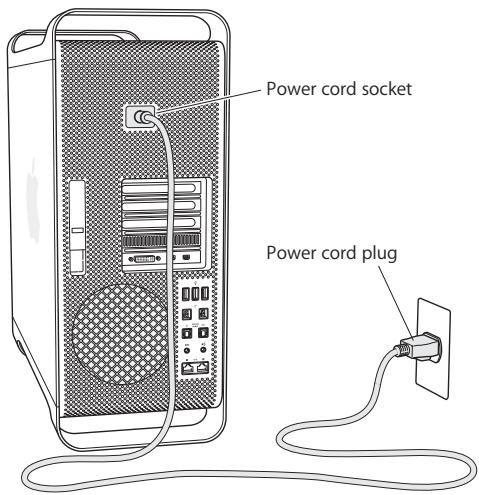
Step 2: Plug in the power cord.
Plug the power cord completely into the recessed power cord socket on the back of your Mac Pro and plug the other end into a grounded power outlet.
Step 3: Connect a display.
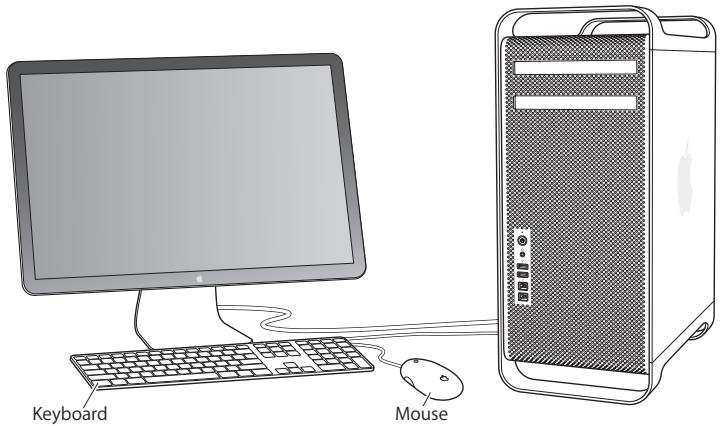
If you are connecting a display to your Mac Pro, connect it as shown below. Depending on the display, you may have one or more cables to connect. Check the instructions that came with the display for additional setup information.
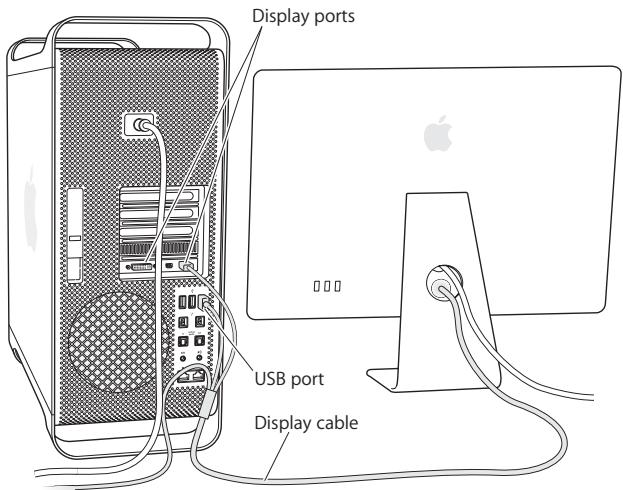
You can connect up to three displays with Mini DisplayPort or Digital Visual Interface (DVI) connectors to the display ports on the back of your Mac Pro. The DVI display port is a dual-link port, so you can connect a 30-inch Apple Cinema HD Display.
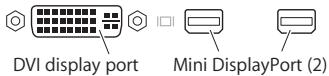
You can also connect displays that have an Apple Display Connector (ADC) or a video graphics array (VGA) connector using one of the following adapters:
- To connect a VGA display to the DVI display port or a Mini DisplayPort, use the Apple DVI to VGA Display Adapter or the Apple Mini DisplayPort to VGA Adapter (both available separately).
- To connect an ADC display to the DVI display port, use an Apple DVI to ADC Display Adapter (available separately).
The Mini DisplayPort outputs provide both video and audio output. You must use the Sound panel in System Preferences to select the connected device for audio output. For more information about connecting an HDMI device, search for "HDMI" on the Mac Pro Support page at www.apple.com/support/macpro.
Display adapters and other accessories for your Mac Pro are sold separately at www.apple.com/store.
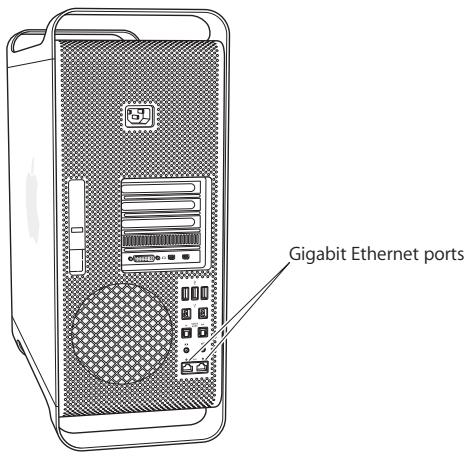
Step 4: Connect an Ethernet cable.
To access the Internet or a network using an Ethernet cable, connect one end of an Ethernet cable to either of the Gigabit Ethernet ports on the back of your Mac Pro. Connect the other end to a cable modem, DSL modem, or Ethernet network.
Step 5: Connect a keyboard and mouse.
If you are connecting a USB keyboard and mouse, connect the USB cables to the USB ports (‡) on your Mac Pro or on a display.
Note: You can set Mac OS X Lion Server up remotely from another computer. For information, open the Server application on the other computer and choose Server Help from the Help menu.
Step 6: Turn on your Mac Pro.
Press the power button (U) on the front of your Mac Pro to turn it on. If you have a display that must be turned on separately, turn it on by pressing its power button. If you connected a mouse, click your mouse to establish a connection with your Mac Pro.
Step 7: Configure your Mac Pro server with Server Assistant.
The first time you turn on your Mac Pro with Mac OS X Lion Server installed, Server Assistant asks for some basic information that Lion Server needs in order to start up and connect to the network. Be ready to provide the following information the first time you turn on your Mac Pro:
- An account name and password.
- An organizational name that's unique in your company.
- A host name, which can be for your local network only, for your local network and VPN access from the Internet, or an Internet host name you purchased from a domain name registrar.
- Detailed network settings, including IP address, subnet mask, and DNS servers. The network settings may be provided by your Internet router or a server on your network. If so, it should be configured to provide your server the same IP address all the time (static mapping or DHCP reservation).
For help with Server Assistant, click the Help button in any pane.
You can set up Mac OS X Lion Server remotely from another computer. For information, open the Server application on the other computer and choose Server Help from the Help menu.
To learn more about Mac OS X Lion Server software, see the Lion Server website at www.apple.com/macosx/server.
If you already have a Mac with Mac OS X Server version 10.5 or later, Server Assistant can help you automatically transfer system settings, service settings, user accounts, files, applications, and other information from your previous Mac server (any model) to your Mac Pro. Use an Ethernet, FireWire, or wireless connection to transfer information.
For information about working with the services in Mac OS X Lion Server, open the Server application and choose Server Help in the Help menu.
Customize Your Desktop and Set Your Preferences
You can easily make your desktop look the way you want using System Preferences. Choose Apple (•) > System Preferences from the menu bar or click the System Preferences icon in the Dock. System Preferences is your command center for most settings on your Mac Pro. For more information, open Help Center and search for "System Preferences" or for the specific preference you want to change.
Note: Throughout this manual, instructions are given that require a display to view commands and dialog boxes. If no display or keyboard are connected to your Mac Pro, you can set up Mac OS X Lion Server remotely from another computer. For information, open the Server application on the other computer and choose Server Help from the Help menu.
Need Help Setting Up?
If you think your Mac Pro didn't start up properly, check the following:
- Is your Mac Pro plugged into a power outlet? If it's plugged into a power strip, is the power strip turned on?
- Is the power cord securely plugged into the back of your Mac Pro?
- If you have connected a keyboard and display, are the keyboard and display cables connected correctly?
- If you have connected a display, are the brightness and contrast of the display adjusted correctly? If the display has brightness controls, adjust them. If the display has a power button, make sure the display is turned on.
- If you have connected a display and you don't see anything on your screen, restart your Mac Pro. Hold down the power button (U) on your Mac Pro for 5 or 6 seconds, until it turns off. Press the power button (U) again to restart.
- If you see a blinking question mark on the screen or a series of flashes from the status light, see Chapter 4, "Problem, Meet Solution" on page 75.
Shutting Down Your Mac Pro
If you won't be using your Mac Pro for an extended period, shut it down.
To turn off your Mac Pro, do one of the following:
- Choose Apple (●) > Shut Down.
- Press the Control and Eject keys, and then click Shut Down in the dialog that appears.
NOTICE: Do not turn off your Mac Pro by turning off the switch on a power strip or by unplugging your Mac Pro's power plug (unless you can't turn off your Mac Pro any other way). Your files or system software could be damaged if your Mac Pro is not shut down properly.
NOTICE: Shut down your Mac Pro before moving it. Moving your Mac Pro while the hard disk is spinning can damage the hard disk, causing loss of data or the inability to start up from the hard disk.
Putting Your Mac Pro to Sleep
Mac OS X Lion Server is normally set to prevent your Mac Pro from sleeping because users can't connect to services while the computer sleeps. However, if it suits the services your Mac Pro is providing, you can put your Mac Pro to sleep on demand, or according to a schedule.
To put your Mac Pro to sleep, do one of the following:
- Choose Apple (•) > Sleep from the menu bar.
- Choose Apple (•) > System Preferences, click Energy Saver, and set a sleep timer or set up a sleep/wake schedule.
To wake your Mac Pro:
- Press any key on the keyboard. When your Mac Pro wakes from sleep, your applications, documents, and computer settings are exactly as you left them.
Life with Your Mac Pro
Basic Features on the Front of Your Mac Pro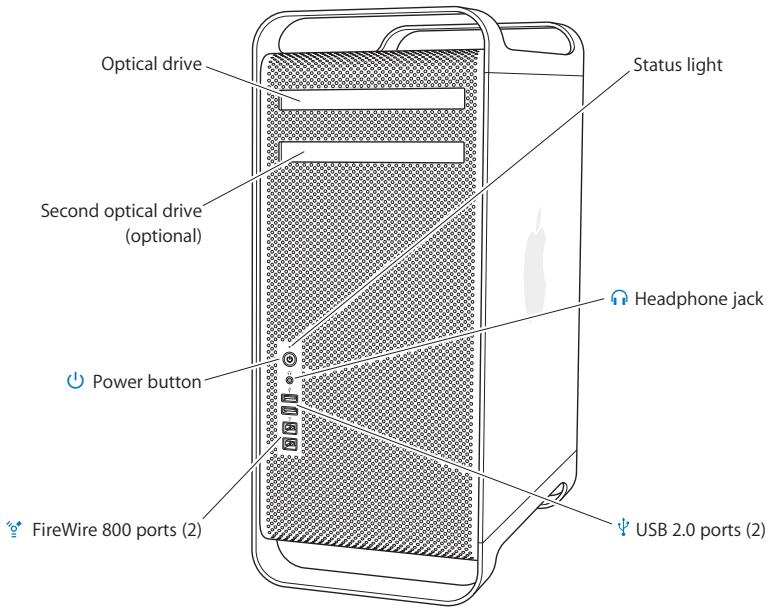
| Optical drive Your Mac Pro has a DVD±R DL/DVD±RW/CD-RW SuperDrive, which can read CD-ROM, photo CD, audio, and DVD discs. It can write music, documents, and other files to CD-R, CD-RW, DVD±R, DVD±RW, and DVD±R Double Layer (DL) discs. To open the drive, press the Media Eject key (▲) on your Apple Keyboard. If your Mac Pro has a second optical drive, press the Option key and Media Eject key (▲) to open it. | |
| Power button Press this button to turn on your Mac Pro. To restart, press and hold this button for 5 or 6 seconds until your Mac Pro turns off, and then press it again to turn it on. | |
| Two FireWire 800 ports Connect high-speed external devices, such as FireWire digital video (DV) cameras, scanners, and external hard disk drives. You can connect and disconnect FireWire devices without restarting. Each port supports data rates up to 800 Mbit/s. | |
| Two USB 2.0 ports Connect an iPod, iPhone, iPad, mouse, keyboard, printer, disk drive, digital camera, joystick, external USB modem, and more. You can also connect USB 1.1 devices. Your display may also have USB ports. | |
| Headphone jack Connect headphones or earphones with a standard 3.5 mm connector. | |
| Status light A white light indicates your Mac Pro is on; a pulsing light indicates it's in sleep. For information about a flashing status light, see "If the status light flashes and the computer doesn't start up" on page 79. | |
Ports and Connectors on the Back of Your Mac Pro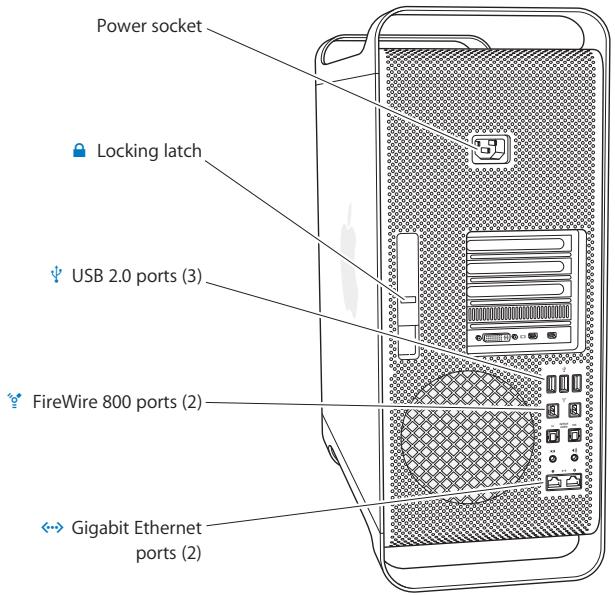
| Power socket Connect the power cord that came with your Mac Pro. Don't use an ordinary power cord or extension cord. | |
| Locking latch Lift the latch to open the side panel and access the internal components in your Mac Pro. If you're working inside your Mac Pro and the latch is down, the drives are locked in place. You can attach a security lock (available separately) to the latch to prevent access and secure the internal components. You can also attach a security cable to the latch or through the handles and feet to protect your Mac Pro. | |
| Three USB 2.0 ports Connect an iPod, iPhone, iPad, mouse, keyboard, printer, disk drive, digital camera, joystick, external USB modem, and more. You can also connect USB 1.1 devices. Your display may also have USB ports. | |
| Two FireWire 800 ports Connect high-speed external devices, such as FireWire digital video (DV) cameras, scanners, and external hard disk drives. You can connect and disconnect FireWire devices without restarting. Each port supports data rates up to 800 Mbit/s. | |
| ←→ | Two Gigabit Ethernet ports with jumbo frame support Connect to a high-speed Ethernet network, a DSL or cable modem, or another computer. The Ethernet port automatically detects Ethernet devices and doesn't require an Ethernet crossover cable. You can access the Internet or network resources such as printers and servers, and share information over the network using a CAT 5e cable. |
More Ports and Connectors on the Back
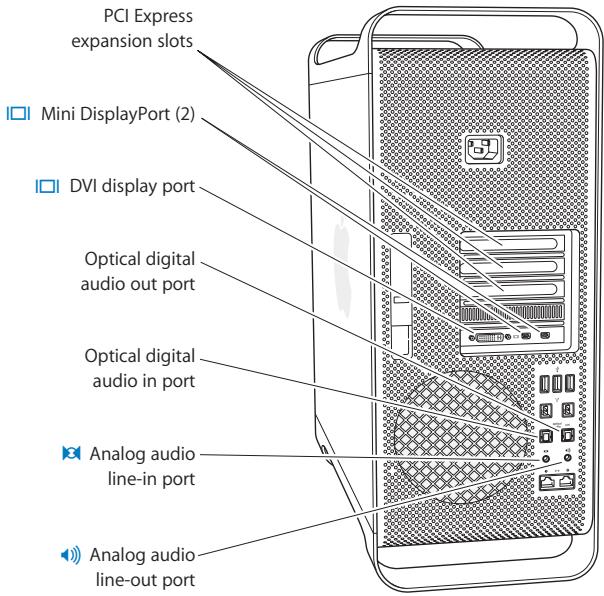
| PCI Express expansion slots (3)Expand your Mac Pro by installing up to three Peripheral Component Interconnect (PCI)Express cards in the covered slots labeled 2, 3, and 4. | |
| I□I | Mini DisplayPort outputsConnect one or two displays that use a Mini DisplayPort connector, such as the AppleLED Cinema Display. The Mini DisplayPort outputs support both video and audio output.You can use adapters to connect your computer via the Mini DisplayPort outputs todevices such as HDTV's and AV receivers for both sound and audio output. Display adaptersfor your Mac Pro are available from the online Apple Store at www.apple.com/store. |
| I□I | DVI display port (dual-link)Connect a display that uses a Digital Visual Interface (DVI) connector, such as the AppleLED Cinema Display, to the DVI display port. Display adapters for your Mac Pro are availablefrom the online Apple Store at www.apple.com/store. |
| Optical digital audio in and audio out portsConnect to decks, receivers, digital instruments, and surround-sound speaker systemsusing standard TOSLINK cables or fiber-optic cables with a 3.5 mm plastic or nylonoptical plug. You can transfer stereo or encoded audio using the S/PDIF (Sony/PhilipsDigital Interface) protocol and TOSLINK cables. | |
| I | Analog audio line-in portConnect self-powered microphones, MP3 and CD players, and other devices withanalog capability. |
| I | Analog audio line-out portConnect self-powered speakers and other devices with analog capability. |
Internal Expansion Options
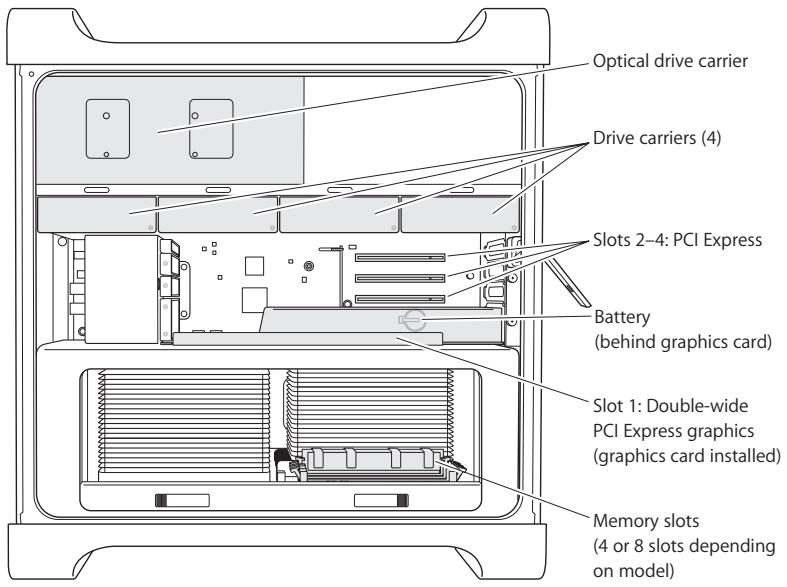
Optical drives
Your Mac Pro comes with one or two DVD±R DL/DVD±RW/CD-RW SuperDrives. To replace an optical drive, see "Replacing an Optical Drive" on page 62.
Hard disk drives or solid state drives
Your Mac Pro comes with up to four drives installed. To install or replace drives, see "Installing Internal Storage Devices" on page 55.
PCI Express slots
Your Mac Pro has three PCI Express expansion slots. To install PCI cards in slots 2 through 4, see "About PCI Express Cards" on page 68.
Battery
Your Mac Pro uses an internal backup battery. If your Mac Pro has trouble starting up, or if the system date and time are frequently incorrect, you may need to replace the battery. See "Replacing the Internal Backup Battery" on page 73.
Double-wide PCI Express graphics slot
Connect up to two displays to the graphics card in the PCI Express graphics slot (slot 1). You can replace the card in this slot and install additional graphics cards in PCI slots 2 through 4. See "About PCI Express Cards" on page 68.
Memory slots
Your Mac Pro has four or eight memory expansion slots, depending on the model. To add more memory, install PC3-10600E, 1333 MHz, DDR3 ECC SDRAM UDIMMs in the memory slots. For information about the type of memory used in your Mac Pro, see "Installing Memory" on page 37.
Getting Answers
Much more information about using your Mac Pro is available in Help Center and on the Internet at www.apple.com/support/macpro.
To open Help Center:
1. Click the Finder icon in the Dock (the bar of icons along the edge of the screen). 2. Click the Help menu in the menu bar and do one of the following:
- Type a question or term in the Search field, and choose a topic from the list of results or choose Show All Results to see all topics.
- Choose Help Center to open the Help Center window, where you can browse or search topics.
More Information
For more information about using your Mac Pro, see the following:
| To learn about | See |
| Installing drives, memory, expansion cards, or a battery | Chapter 3, “Making a Good Thing Better” on page 31. |
| Troubleshooting your Mac Pro if you have a problem | Chapter 4, “Problem, Meet Solution” on page 75. |
| Finding service and support for your Mac Pro | “Learning More, Service, and Support” on page 93. Or see the Mac Pro Support website at www.apple.com/support/macpro. |
| Using Mac OS X Lion Server | The Lion Server website at www.apple.com/macosx/server. Or open the Server application and then choose Server Help from the Help menu. |
| Moving from a PC to a Mac | "Why you'll love a Mac" at www.apple.com/getamac/whymac. |
| Changing System Preferences | System Preferences by choosing Apple (▲) > System Preferences. Or search for "system preferences" in Help Center. |
| Using a mouse or keyboard | System Preferences and choose Keyboard & Mouse. Or open Help Center and search for "mouse" or "keyboard." |
| Using AirPort Extreme wireless technology | The AirPort Support page at www.apple.com/support/airport. Or open Help Center and search for "AirPort." |
| Using Bluetooth® wireless technology | The Bluetooth Support page at www.apple.com/support/bluetooth. Or open Help Center and search for "Bluetooth." |
| Connecting a printer | Help Center and search for "printing." |
| FireWire and USB connections | Help Center and search for "FireWire" or "USB." |
| Connecting to the Internet | Help Center and search for "Internet." |
| Using a display | Help Center and search for "display port." |
| Burning a CD or DVD | Help Center and search for "burn disc." |
| Mac Pro specifications | Chapter 5, "What's Under the Hood" on page 97. Or see the Mac Pro specifications page at www.apple.com/macpro/specs.html. Or open System Information (in the Utilities folder in Launchpad), and then click More Info. |
| Apple news, free downloads, and online catalogs | The Apple website at www.apple.com. |
| Instructions, technical support, and product manuals | The Apple Support website at www.apple.com/support. |
3
Making a Good Thing Better
www.apple.com/store
Help Center RAM
Use the information in this chapter to customize and expand your Mac Pro to fit your needs. You can find information about important procedures in the following sections:
"Opening Your Mac Pro" on page 33 "Installing Memory" on page 37 "Installing Internal Storage Devices" on page 55 - "Adding PCI Express Cards" on page 68 - "Replacing the Internal Backup Battery" on page 73
WARNING: Apple recommends that you have an Apple-certified technician install memory, PCI Express cards, and internal storage devices. To contact an Apple Authorized Service Provider or Apple for service, see "Learning More, Service, and Support" on page 93. If you install these items yourself, you risk damaging your equipment, and such damage is not covered by the limited warranty on your computer. See an Apple Authorized Reseller or Apple Authorized Service Provider for additional information about this or any other warranty question.
Opening Your Mac Pro
1. Before you open your Mac Pro, shut it down by choosing Apple (•) > Shut Down.
NOTICE: Always shut down your Mac Pro before opening it to avoid damaging its internal components or the components you want to install. Do not open your Mac Pro or attempt to install items inside it while it is on.
2 Wait 5 to 10 minutes to allow the internal components of your Mac Pro to cool.
WARNING: Let your Mac Pro cool down before you touch the internal components, which may be very hot.
3 Touch the metal on the outside of your Mac Pro to discharge any static electricity.
NOTICE: Always discharge static before you touch parts or install components inside your Mac Pro. To avoid generating static, don't walk around the room until you finish installing the cards, memory, or internal storage device and replace the side panel.
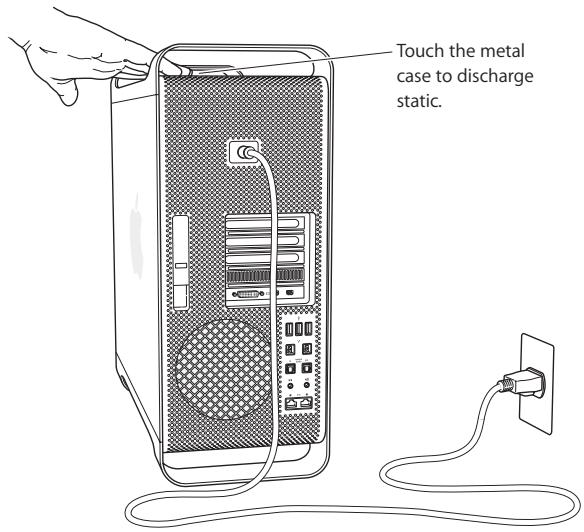
4 Unplug all the cables and the power cord from your Mac Pro.
WARNING: To avoid damaging internal components or the components you want to install, always unplug your Mac Pro. Don't attempt to install items while it's plugged in.
5 Hold the side panel and lift the latch on the back.
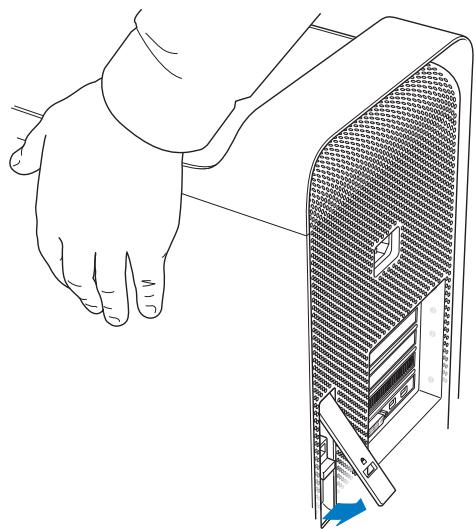
6 Remove the side panel by pulling the top away from your Mac Pro and lifting up.
Important: When you remove the side panel, hold it securely.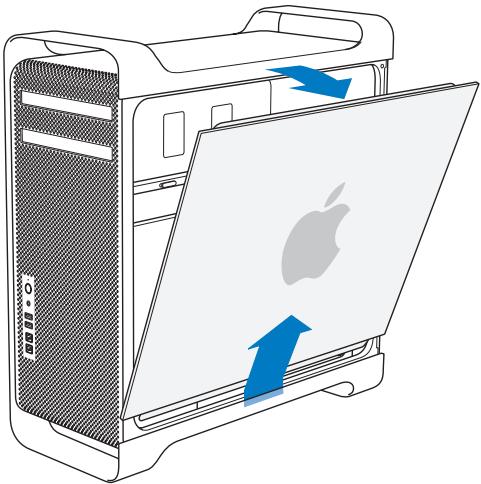
Installing Memory
Your Mac Pro comes with a minimum of 8 GB of memory in the single-processor model installed as 2 GB unbuffered ECC dual inline memory modules (UDIMMs).
All installed UDIMMs must meet these specifications:
PC3-10600E, 1333 MHz, DDR3 SDRAM UDIMMs - Error-correcting code (ECC) 72-bit wide, 240-pin ECC modules 36 ICs maximum per ECC UDIMM
NOTICE: Apple recommends that you use Apple-approved DIMMs. DIMMs from older Mac computers cannot be used in your Mac Pro. You can purchase Apple-branded memory online from the Apple Store at www.apple.com/store.
When purchasing DIMMs for use in Mac computers, make sure that the memory vendor conforms to the Joint Electron Device Engineering Council (JEDEC) specification. Check with your memory vendor to ensure that the DIMMs support the correct timing modes and that the Serial Presence Detect (SPD) feature has been programmed properly, as described in the JEDEC specification.
Note: Although the memory speed of the UDIMMs is 1333 MHz, they will operate at 1066 MHz or 1333 MHz, depending on the processor in the computer.
Before you install memory, determine whether you have a single- or dual-processor Mac Pro. Remove the side panel, following the instructions in "Opening Your Mac Pro" on page 33, and look inside:
- A quad-core or 6-core Mac Pro has one processor and four memory slots. You can install a total of up to 16 GB of memory. See "Installing Memory in a Quad-Core or 6-Core Mac Pro" on page 39.
- An 8-core or 12-core Mac Pro has two processors and eight memory slots. You can install a total of up to 32 GB of memory. See "Installing Memory in an 8-Core or 12-Core Mac Pro" on page 48.
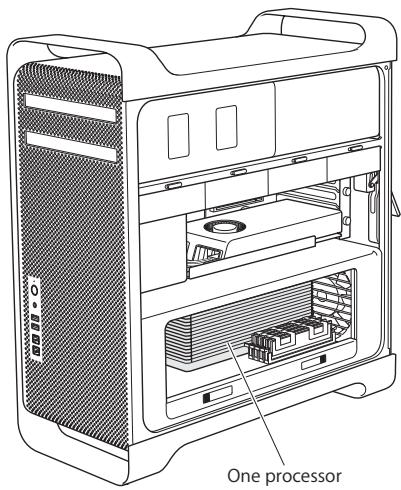
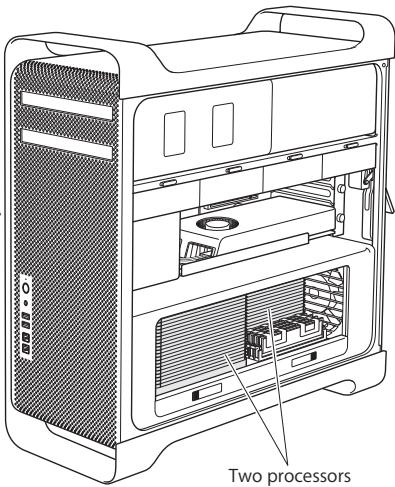
You can also determine which Mac Pro you have by choosing Apple (●) > About This Mac from the menu bar. Click More Info, choose Hardware from the Contents list, and then find Number Of Processors in Hardware Overview. The quad-core and 6-core Mac Pro have one processor and the 8-core and 12-core Mac Pro have two processors.
Installing Memory in a Quad-Core or 6-Core Mac Pro
The quad-core and 6-core Mac Pro have four memory slots, and come with at least four 2 GB DIMMs installed. You can replace or install additional 1 GB, 2 GB, or 4 GB DIMMs for a total of up to 16 GB of memory.
It's important that all DIMMs installed in your Mac Pro are of the correct specifications. Use the instructions that follow to install DIMMs in a quad-core or 6-core Mac Pro.
To install memory:
1. Shut down your Mac Pro, open it, and remove the side panel, following the instructions in "Opening Your Mac Pro" on page 33.
WARNING: Let your Mac Pro cool down for 5 to 10 minutes before you remove the processor tray or touch the internal components. The processor tray and components may be very hot.
2. Push the latches on the processor tray until they partially open.
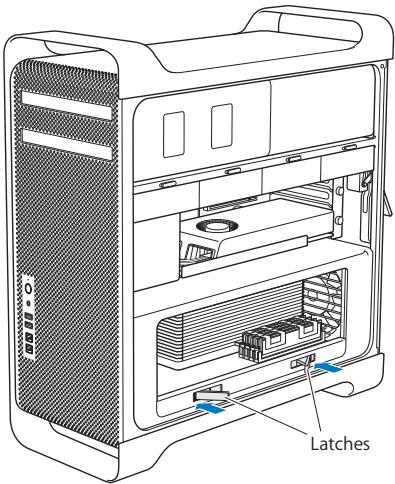
3. Pull the latches until they open all the way and release the processor tray.
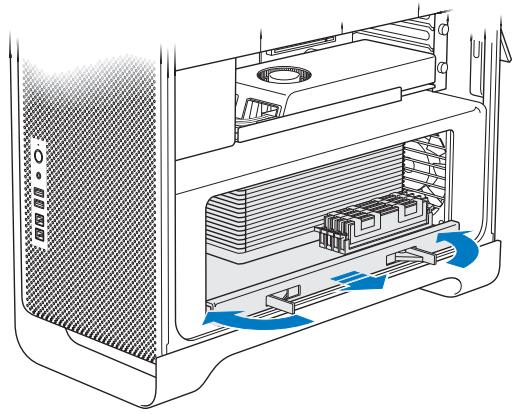
4. Remove the processor tray and lay it on a soft, clean cloth on the desk or work surface, to protect the tray and avoid scratching the work surface.
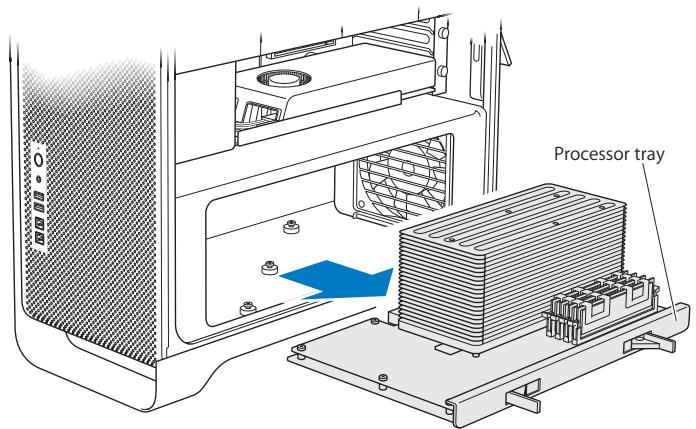
If you install equal-size DIMMs (for example, all 1 GB DIMMs or all 2 GB DIMMs) in your quad-core or 6-core Mac Pro, Apple recommends that you fill the slots in the order listed in the table.
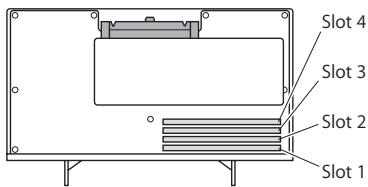
| If you have | Fill these slots |
| Two DIMMs | 1 and 2 |
| Three DIMMs | 1, 2, and 3 |
| Four DIMMs | 1, 2, 3, and 4 (all) |
Note: If you install different-size DIMMs in your Mac Pro, follow the order in the table. If the DIMM configuration you install doesn't provide optimized performance, the Memory Slot Utility appears onscreen and recommends an improved configuration.
To use the utility again, go to /System/Library/CoreServices/Memory Slot Utility.
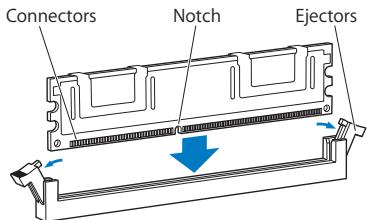
5 Open the ejectors on DIMM slots 1, 2, and 3 and push them out to the sides. Then remove the DIMMs from the slots. 6 Install the DIMMs by aligning them in the DIMM slots and pushing both ends of the DIMM down until the tabs are vertical and the ejectors snap into place.
NOTICE: To avoid damaging the DIMM, hold it by the corners and don't touch the gold connectors or other components.
7 Reinstall the processor tray, pushing it in until the latches are at a 90-degree angle.
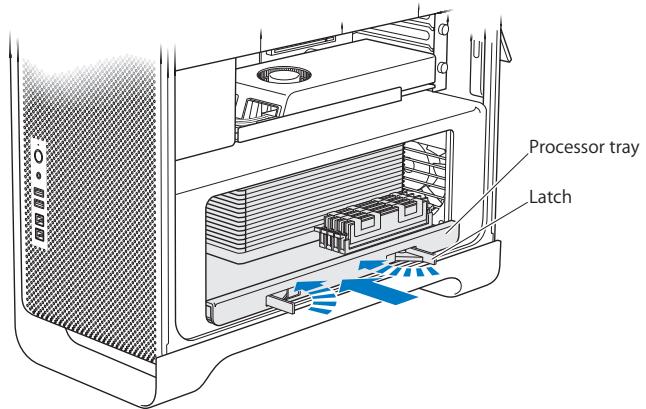
8 Push the latches all the way in to close them and seat the processor tray.
9 Replace the side panel.
When you replace the side panel, make sure the latch is up. Hold the side panel securely so it stays in place as you push the latch down.
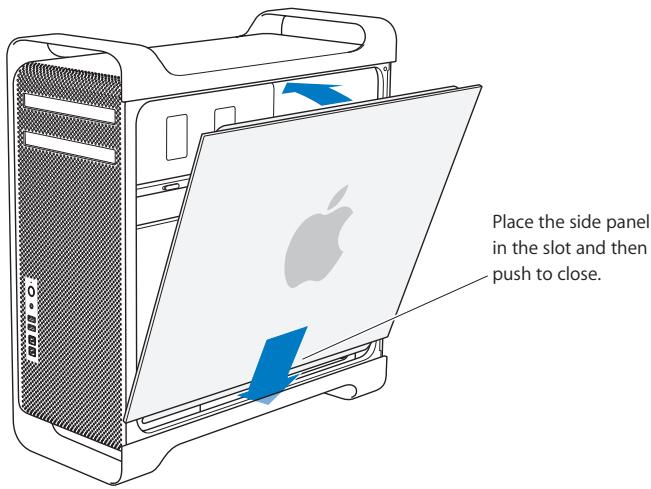
NOTICE: Always replace the side panel after installing components. Your Mac Pro doesn't operate properly without the side panel in place.
10 Hold the side panel against your Mac Pro and push the latch down to secure the side panel.
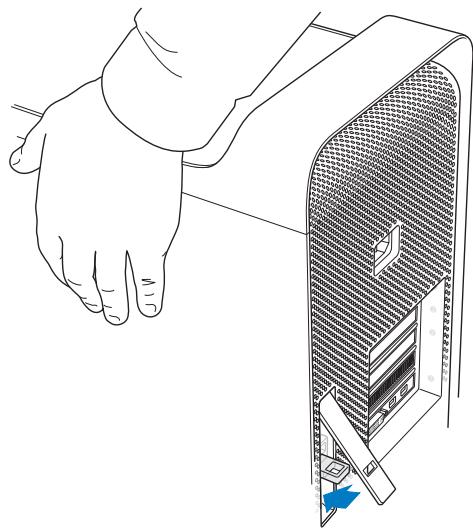
You can attach a lock or cable through a metal loop (under the latch) to secure your Mac Pro. Flip the metal loop down before you close the latch, then close the latch and attach your lock or cable through the extended loop.
Installing Memory in an 8-Core or 12-Core Mac Pro
The 8-core and 12-core Mac Pro have eight memory slots, and, in most configurations, come with at least four 2 GB DIMMs installed. You can install a total of up to 32 GB of memory.
It's important that all the DIMMs installed in your Mac Pro have the correct specifications. Use the instructions that follow to install DIMMs in an 8-core or 12-core Mac Pro.
To install memory in a dual-processor Mac Pro:
1. Shut down your Mac Pro, open it, and remove the side panel, following the instructions in "Opening Your Mac Pro" on page 33.
WARNING: Let your Mac Pro cool down for 5 to 10 minutes before you remove the processor tray or touch the internal components. The processor tray and components may be very hot.
2. Push the latches on the processor tray until they open slightly.
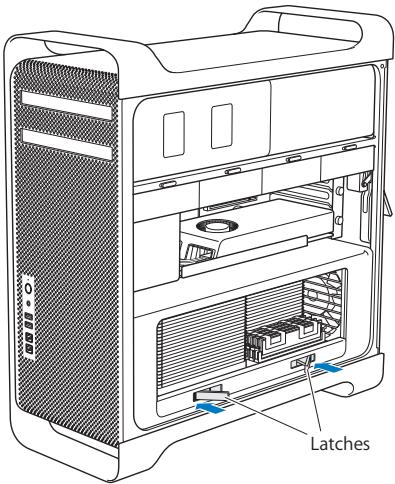
3. Pull the latches until they open all the way and release the processor tray.
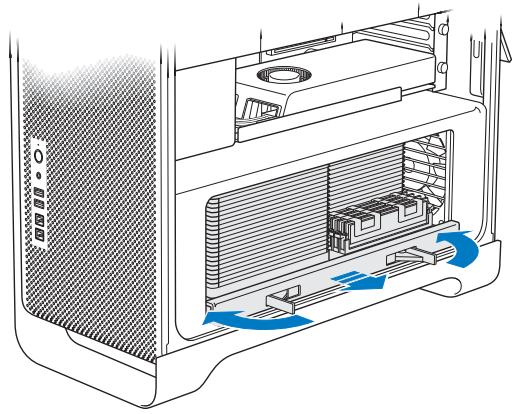
4. Remove the processor tray and lay it on a soft, clean cloth on the desk or work surface, to protect the tray and avoid scratching the work surface.
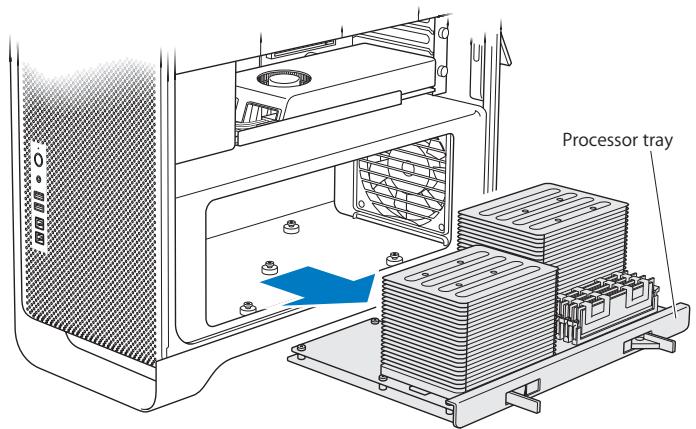
If you install equal-size DIMMs (for example, all 1 GB DIMMs or all 2 GB DIMMs) in your 8-core or 12-core Mac Pro, Apple recommends that you fill the slots in the order listed in the table.
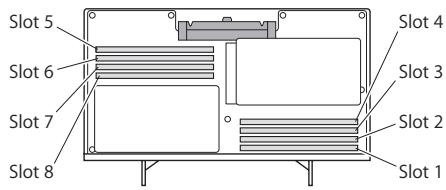
| If you have Fill these slots | |
| Two DIMMs | 1 and 2 |
| Three DIMMs | 1, 2, and 3 |
| Four DIMMs | 1, 2, and 5, 6 |
| Six DIMMs | 1, 2, 3, and 5, 6, 7 |
| Eight DIMMs | 1, 2, 3, 4, and 5, 6, 7, 8 (all) |
Note: If you install different-size DIMMs in your Mac Pro, follow the order in the table. If the DIMM configuration you install doesn't provide optimized performance, the Memory Slot Utility appears onscreen and recommends a better configuration.
To use the utility again, go to /System/Library/CoreServices/Memory Slot Utility.
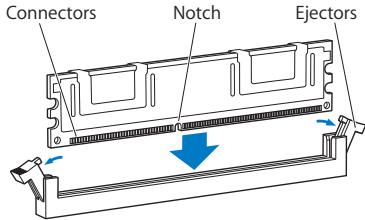
5. Install the DIMMs by aligning them in the DIMM slots and pushing both ends of the DIMM down until the tabs are vertical and the ejectors snap into place.
NOTICE: To avoid damaging the DIMM, hold it by the corners and don't touch the gold connectors or other components.
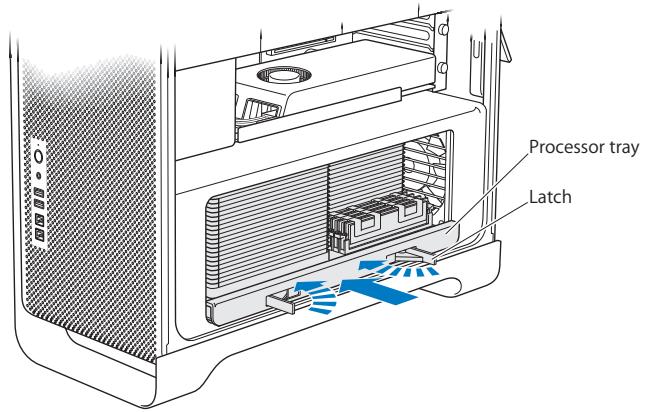
6. Reinstall the processor tray, pushing it in until the latches are at a 90-degree angle. 7. Push the latches all the way in to close them and seat the processor tray.
8. Replace the side panel, following the instructions starting on page 46.
NOTICE: Always replace the side panel after installing components. Your Mac Pro doesn't operate properly without the side panel in place.
Installing Internal Storage Devices
Your Mac Pro has room for six internal drives: two optical drives, and four hard disk or solid state drives. In most configurations, a single drive occupies the first drive bay and an optical drive is located in the upper optical drive bay.
You can add up to three 3.5-inch cable-free Serial ATA (SATA) hard disk drives to the empty drive bays. The drives must meet these specifications:
- Type: SATA 3 Gb/s
- Width: 3.9 inches (102 mm)
- Depth: 5.7 inches (147 mm)
- Height: 1.0 inch (25.4 mm)
You can add up to three 2.5-inch solid state disk drives (SSDs) to the empty drive bays. The drives must meet these specifications:
- Type: SATA 3 Gb/s
- Width: 2.5 inches (63.5 mm)
The solid state drives (SSD) come with adapters that fit the 3.5-inch drive bays.
For more information about requirements or supported devices, visit an Apple Authorized Reseller, the Apple Store at www.apple.com/store, or the Mac Pro Support website at www.apple.com/support/macpro.
Installing Serial ATA Hard Disk Drives
Your Mac Pro can accommodate up to four internal 1-inch-high SATA hard disk drives in the drive bays. If your Mac Pro comes with a single drive installed, it's in the first drive bay. You can install drives in the second, third, and fourth drive bays.
To install a hard disk drive:
1 Open your Mac Pro and remove the side panel following the instructions in "Opening Your Mac Pro" on page 33. 2 Lift the latch to unlock the drive carriers.
Note: When the latch is down, the carriers are locked in the drive bays and can't be removed.
3 Pull the carrier out of the drive bay.
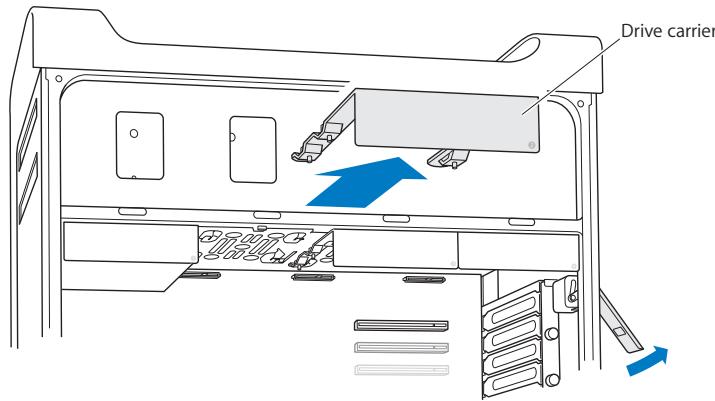
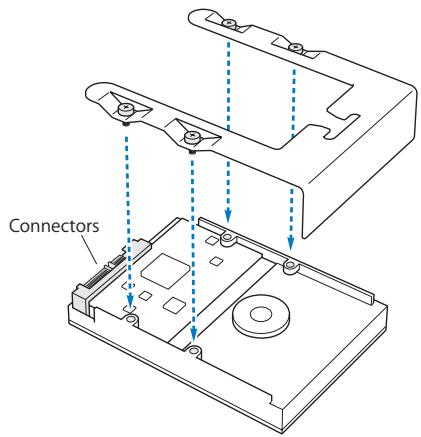
4 Position the carrier over the hard disk drive with the connectors at the back. 5 Use the four screws on the carrier to attach the hard disk drive to the carrier.
NOTICE: Hold the drive by its sides. To avoid damaging the drive, don't touch the printed circuit board.
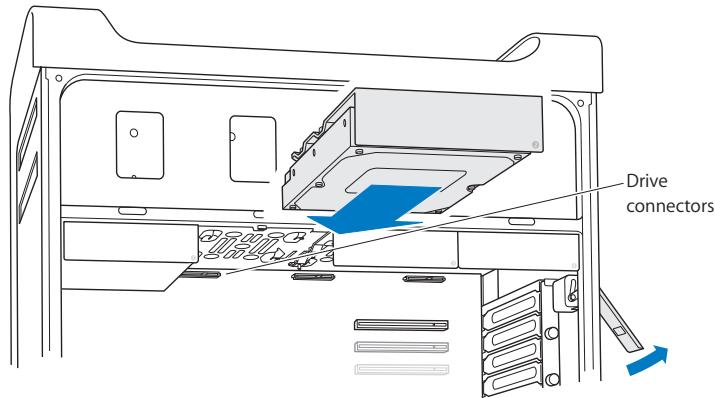
6 Lift the latch and slide the carrier over the guides and into the drive bay until it's touching the drive connectors and is seated in the bay.
7 Replace the side panel, following the instructions starting on page 46.
NOTICE: Always replace the side panel after installing components. Your Mac Pro doesn't operate properly without the side panel in place.
Installing a Solid State Drive
Your Mac Pro can accommodate up to four internal 2.5-inch solid state drives in the drive bays. If your Mac Pro comes with a single drive installed, it's in the first bay. You can install drives in the second, third, and fourth drive bays.
To install a solid state drive:
1 Open your Mac Pro and remove the side panel, following the instructions in "Opening Your Mac Pro" on page 33. 2 Lift the latch to unlock the drive carriers.
Note: When the latch is down, the carriers are locked in the drive bays and can't be removed.
3 Pull the carrier out of the drive bay.
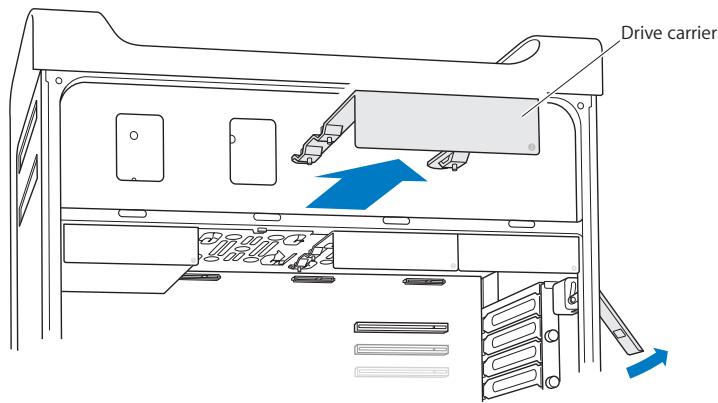
4 Remove the two screws from the drive carrier as shown. You'll attach the SSD adapter to the carrier using the two remaining screws. Put the two screws that you removed away for safekeeping.
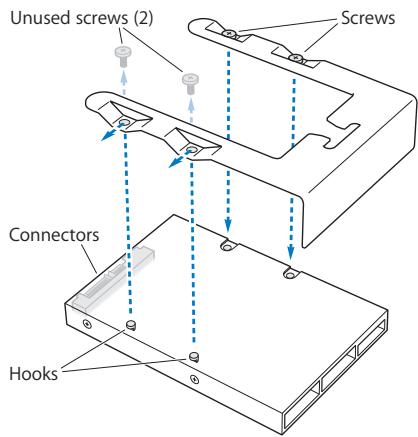
5 Position the drive carrier over the SSD adapter with the drive connectors at the back as shown. Insert the two hooks on the top of the adapter into the carrier's holes. Fasten the two screws on top of the carrier to attach the SSD enclosure to the carrier.
6 Lift the latch and slide the carrier over the guides and into the drive bay until it touches the drive connectors and is seated in the bay.
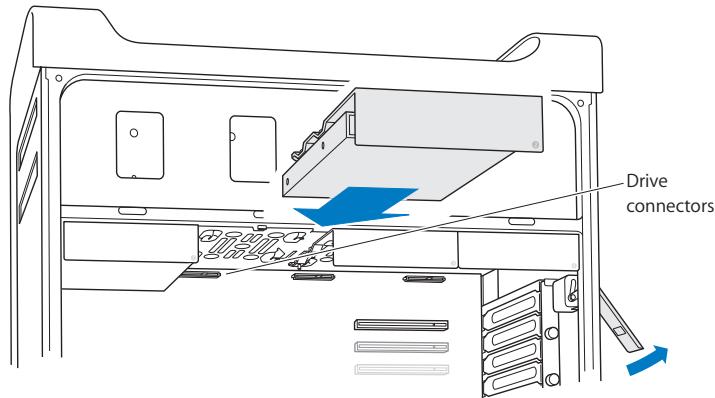
7 Replace the side panel, following the instructions starting on page 46.
NOTICE: Always replace the side panel after installing components. Your Mac Pro doesn't operate properly without the side panel in place.
Replacing an Optical Drive
Your Mac Pro comes with one or two SuperDrives installed in the optical drive bays. Follow these instructions to replace an optical drive.
Note: Contact your drive manufacturer or consult the manufacturer's website to determine if your drive is set to cable select mode. Before you install a drive, set the drive to cable select mode if the manufacturer hasn't already done so.
To replace the optical drive:
1 Open your Mac Pro and remove the side panel, following the instructions in "Opening Your Mac Pro" on page 33. 2 Lift the latch to unlock the optical drive carriers.
When the latch is down, the drives and carriers are locked in the optical drive bays and can't be removed.
3 Pull the carrier halfway out of the optical drive bay.
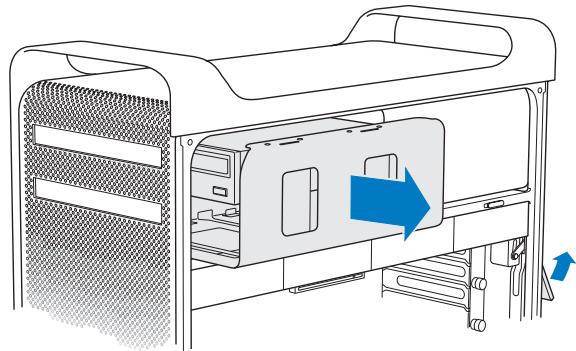
4 Disconnect the cable from the optical drive and remove the carrier from the optical drive bay.
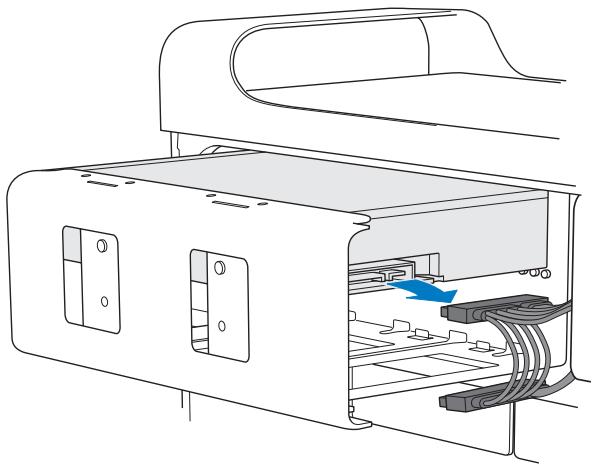
NOTICE: When you install or replace optical drives, use the original Apple cables that came with your Mac Pro.
5 Remove the optical drive from the carrier by unscrewing the four attachment screws. 6 Use the four screws from the original optical drive to attach the replacement drive to the carrier.
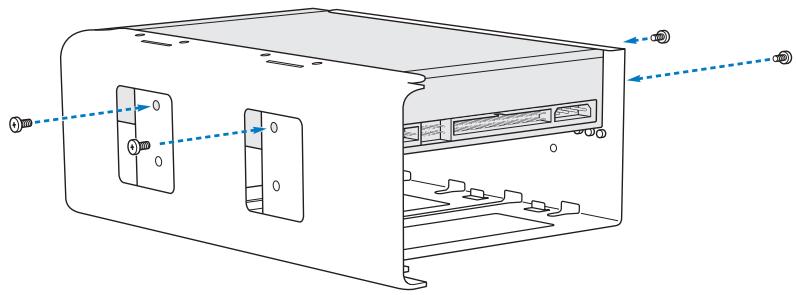
7 Slide the optical drive and carrier over the guides halfway into the optical drive bay. 8 Attach the cable to the back of the optical drive.
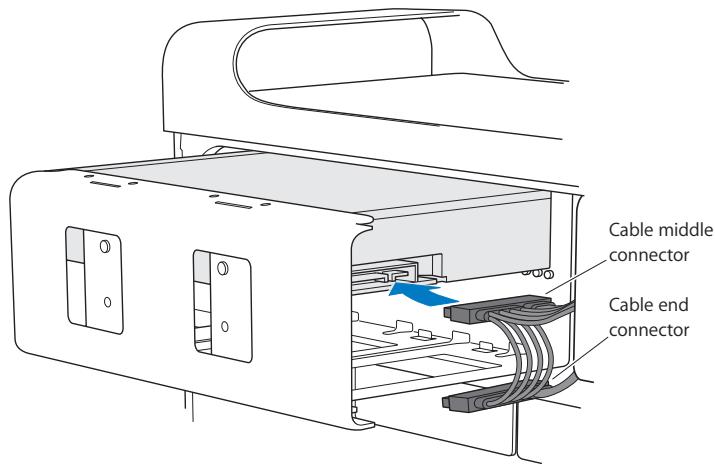
9 Lift the latch and then slide the carrier into the optical drive bay, pushing it into place.
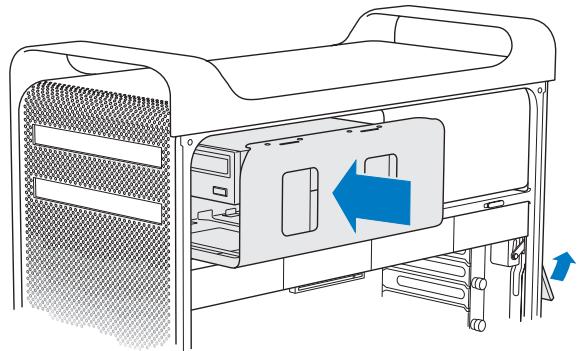
10 Replace the side panel, following the instructions starting on page 46.
NOTICE: Always replace the side panel after installing components. Your Mac Pro doesn't operate properly without the side panel in place.
Adding PCI Express Cards
You can expand the capabilities of your Mac Pro by installing cards in the Peripheral Component Interconnect (PCI) Express slots. Your Mac Pro has one double-wide PCI Express graphics slot and three PCI Express expansion slots, for a total of four slots. These slots accommodate PCI Express graphics cards and expansion cards.
About PCI Express Cards
Your Mac Pro comes with a high-performance PCI Express graphics card, which contains the graphics processing unit (GPU) and provides the computer's display ports. The graphics card is installed in slot 1.
You can install additional PCI Express graphics and expansion cards. Before installing a card, check its specifications to make sure it can operate in your Mac Pro:
- Slots 1 and 2 are x16, PCI Express 2.0 slots
- Slots 3 and 4 are x4, PCI Express 2.0 slots
All four slots support 16-lane cards.
NOTICE: Combined maximum power consumption for all four PCI Express slots must not exceed 300 watts (W).
To install a PCI Express card:
1 Open your Mac Pro and remove the side panel, following the instructions in "Opening Your Mac Pro" on page 33.
WARNING: To avoid damaging internal components or the components you want to install, always turn off and then unplug your Mac Pro. Do not attempt to install items while it is plugged in. Let your Mac Pro cool down for 5 to 10 minutes before you touch the internal components, which may be very hot.
2 Unscrew the captive screws in the PCI bracket and remove the bracket.
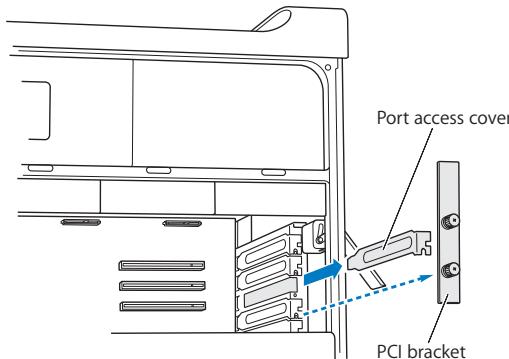
3 Remove the port access cover from the slot in which you plan to install the card.
4 Press the button on the PCI slider and move the slider to the left, which moves the retention bar.
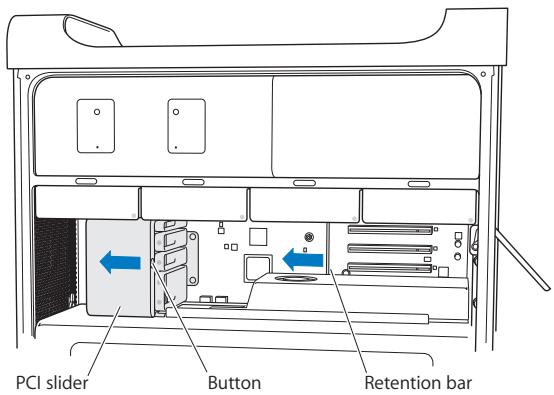
5 Remove your new card from its static-proof bag and hold it by its corners. Don't touch the gold connector or the components on the card.
If You're Installing a Full-Length PCI Card
It may be easier to install a PCI card if you remove the hard disk drives and carriers (see page 56), and remove adjacent cards. Make sure the end of the card goes in the appropriate card guide before aligning the card with the PCI slot and completing the installation.
6 Align the card's connector with the expansion slot and press the card into the slot.
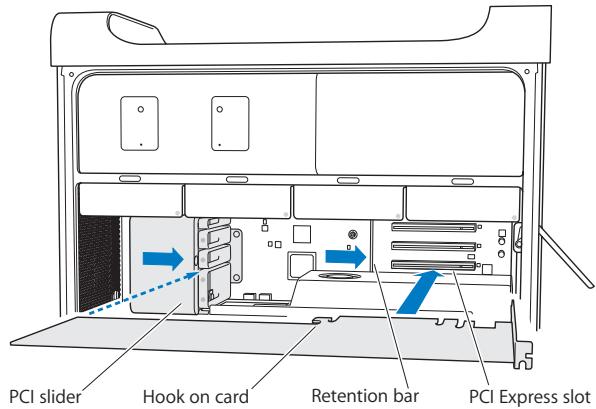
7 Press the card gently but firmly until the connector is fully inserted. Press only on the bare areas of the card to avoid damaging the components. Don't rock the card from side to side or force it. If you meet resistance, check the connector and slot for damage or obstructions, and then try inserting the card again. 8 Pull the card gently to make sure it's properly connected. If it stays in place and its gold connectors are barely visible, the card is connected. 9 Move the PCI slider to the right to secure the card.
10 Replace the PCI bracket under the brace and tighten the screws to secure the card.
NOTICE: If you remove a card and don't install a replacement, place a port access cover over the empty slot to keep foreign objects out of the enclosure. An uncovered slot affects the airflow that cools the internal components and may cause damage.
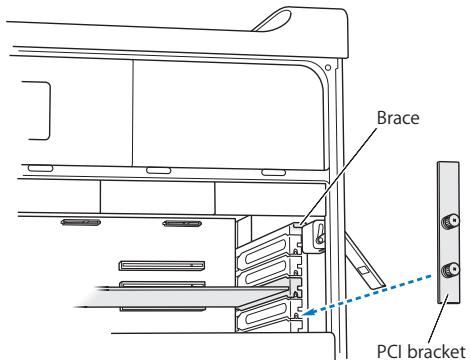
11 Replace the side panel, following the instructions starting on page 46.
NOTICE: Always replace the side panel after installing components. Your Mac Pro doesn't operate properly without the side panel in place.
Replacing the Internal Backup Battery
Your Mac Pro uses a BR 2032 lithium coin cell battery that preserves settings, such as the date and time, when your Mac Pro is off. If you notice intermittent problems when your Mac Pro starts up, or changes in the date and time settings, replace the battery.
Important: Dispose of the old battery according to your local environmental laws.
To replace the battery:
1 Open your Mac Pro and remove the side panel, following the instructions in "Opening Your Mac Pro" on page 33. 2 Remove any PCI Express cards that block access to the battery. See "Adding PCI Express Cards" on page 68 for instructions. 3 Remove the old battery from the holder.
WARNING: Installing the battery incorrectly may cause an explosion. Use only the same type of battery or an equivalent recommended by the manufacturer of the original.
4 Insert the new battery in the holder with the positive side (+) facing out.
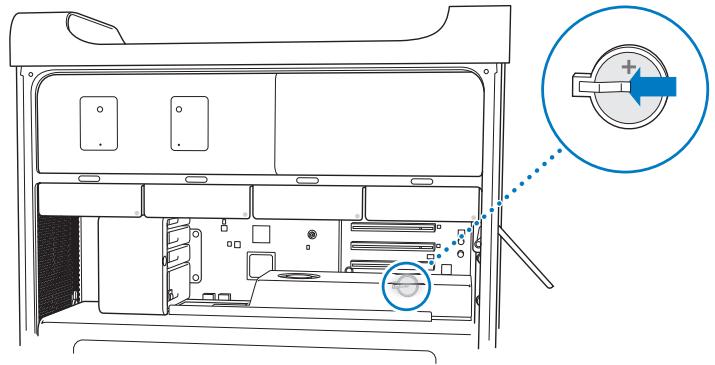
5 Replace the PCI Express cards that you removed (see "Adding PCI Express Cards" on page 68). 6 Replace the side panel and push the latch down to secure it.
Problem, Meet Solution
Occasionally you may have problems while working with your Mac Pro. Read on for troubleshooting tips to try when you have a problem. You can also find more troubleshooting information in Help Center or on the Mac Pro Support website at www.apple.com/support/macpro.
When you experience a problem with your Mac Pro, there's usually a simple and quick solution. Think about the conditions that led up to the problem. Making a note of things you did before the problem occurred will help you narrow down the possible causes of the problem and find the answers you need. Things to note include:
- Any software that you recently installed.
- Any new hardware (such as memory, graphics or PCI Express cards, hard disk drives) that you installed or peripherals that you connected.
An Ounce of Prevention
If you have a problem with your computer or software, having kept up-to-date Time Machine backups ensures that your data won't be lost. If you make regular Time Machine backups, you can restore your software and all your data to exactly the way it was at the time of the backup. Even serious issues are of less concern when you safeguard your information with Time Machine.
For important information about backing up your server data, see the Lion Server website at www.apple.com/macosx/server.
Problems with Your Mac Pro
If your Mac Pro doesn't respond or turn on, if you have trouble ejecting a disk, or if the status light is flashing, try the steps in this section.
If the computer doesn't respond or the pointer doesn't move
- Make sure the keyboard is connected by unplugging and then plugging in the connector, and make sure it is firmly seated.
- Press the Command key (X) and Q key at the same time to try to quit the current application.
- Press the Command key (H) and period key at the same time. If a dialog appears, click Cancel.
- Choose Apple (•) > Force Quit and select the application you want to quit. You can also force quit by pressing the Esc, Option, and Command (⌘) keys at the same time. Restart your Mac Pro by choosing Apple (•) > Restart to be sure the problem is entirely cleared up. You can also restart by pressing the power button (⏻) for about 5 or 6 seconds until your Mac Pro shuts down. Press the power button (⏻) again to start up your Mac Pro.
- If the problem occurs only when you use a particular program, check with the program's manufacturer to see if it is compatible with your computer.
- If the problem occurs frequently, choose Help > Help Center and search for "problems."
If the computer doesn't turn on or start up
- Make sure the power cord is connected to a working power source. The plug on the power cord must be completely inserted into the computer's power socket and firmly seated.
- Restart your computer while holding down the Command key (⌘) and R key, until the computer restarts. When the Mac OS X Utilities application appears, select an option to repair your disk, restore your software, or reinstall Mac OS X and Apple applications from the Mac OS X Utilities pane. For more information, see "Repairing, Restoring, or Reinstalling Mac OS X Software" on page 80.
- If your computer still does not start up, try resetting the parameter random access memory (PRAM). Turn on the computer and immediately hold down the Command (⌘), Option, P, and R keys until you hear the startup sound a second time. Release the keys. The PRAM is reset to the default values and your clock settings may need to be reset.
- If your computer does not start up after resetting the PRAM, restart your computer while holding down the Option key to select your startup disk.
- If this doesn't work, restart your computer while holding down the Shift key.
If you're unable to eject a disc
A file on the disc may be in use. Quit applications that are open, and then try again.
If that doesn't work, choose Apple () > Restart and hold down either the mouse button or the Media Eject key () on an Apple Keyboard.
If that doesn't work:
1. Shut down the computer and remove the side panel (see the instructions on page 33). 2. Pull the optical drive carrier out of the optical drive bay (see "Replacing an Optical Drive" on page 62). 3. Carefully insert the end of a straightened paper clip into the small hole on the front of the optical drive.
4. Push firmly until the tray opens, remove the disc, and push the tray to close it. 5. Put the optical drive carrier and the side panel back in place (see "Replacing an Optical Drive" on page 62).
If the status light flashes and the computer doesn't start up
- If you recently installed memory, a PCI expansion card, or another internal component, make sure that it is correctly installed and that it is compatible with your computer. See if removing it allows the computer to start up.
- If the status light still flashes, determine the number of flashes to identify the problem:
- One short flash followed by a longer off period: No valid memory.
- Three short flashes followed by a longer off period: Failed memory.
Problems with Software
When an application freezes or doesn't respond, Mac OS X provides a way to quit the application without restarting your computer.
To force an application to quit:
1 Press Command (⌘)-Option-Esc or choose Apple ( ) > Force Quit from the menu bar. 2 Select the name of the application you want to quit in the Force Quit Applications dialog. 3 Click Force Quit.
The application quits, leaving all other applications open.
If you have a problem with a software program
- Use Software Update to ensure that you have the latest drivers, bug fixes, and other updates.
- For problems with software from a manufacturer other than Apple, contact the manufacturer.
If you have a problem using your computer or working with Mac OS X Lion Server
- Look in Help Center (in the Help menu) for instructions and troubleshooting information.
- For the latest troubleshooting information and software updates, go to the Lion Server Support website at www.apple.com/support/server.
Repairing, Restoring, or Reinstalling Mac OS X Software
If you have a problem with your Mac software or hardware, Mac OS X provides repair and restore utilities that may eliminate problems and can even restore your software to its original factory settings. You can access these utilities from the Mac OS X Utilities application, even if your computer isn't starting up correctly.
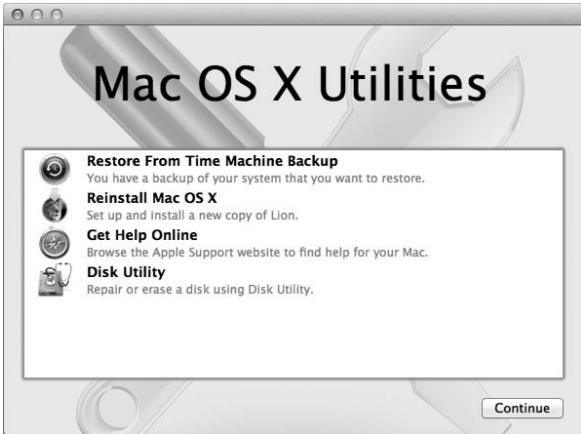
Use the Mac OS X Utilities application to:
Repair your computer's disk using Disk Utility. - Restore your software and data from a Time Machine backup. - Reinstall Mac OS X Lion, Lion Server, and Apple applications. - Restore your computer to its factory settings by erasing its disk and reinstalling Mac OS X Lion, Lion Server, and Apple applications.
If your computer detects a problem, it opens the Mac OS X Utilities application automatically. You can also open the pane manually by restarting your computer.
To open the Mac OS X Utilities application:
- Restart your computer while holding down the Command (⌘) and R keys.
Some utilities in the Mac OS X Utilities pane require access to the Internet and the Mac App Store. You may need to make sure your computer is connected to the Internet via your Ethernet or Wi-Fi network.
To connect via a Wi-Fi network:
1. Choose a network from the Wi-Fi status menu in the upper-right corner of the screen. 2. If necessary, type the network password.
To join a closed network, choose Join Other Network. Enter the network's name and password.
Repairing a Disk with Disk Utility
If you have a problem with your computer, or if you start your computer and see the Mac OS X Utilities pane, you may need to repair your computer's disk.
1. Select Disk Utility in the Mac OS X Utilities pane and click Continue. 2. Select the disk or partition in the list on the left, and then click the First Aid tab. 3. Click Repair Disk.
If Disk Utility can't repair the disk, back up as much of your information as possible, and then follow the instructions in "Reinstalling Mac OS X Lion Server and Apple Applications" on page 83.
For information about Disk Utility and its options, see Help Center, or open Disk Utility (in the Utilities folder in Launchpad) and choose Help > Disk Utility Help.
Restoring Information Using a Time Machine Backup
If you previously created a Time Machine backup, use the Restore utility to restore everything on your computer to its previous state.
Use your Time Machine backup only to restore information to the computer that was the source of the backup. If you want to transfer information to a new computer, use Migration Assistant.
1. If your backup is on a Time Capsule, make sure your Mac Pro is connected to the same Ethernet or Wi-Fi network. (To connect to a Wi-Fi network, follow the instructions on page 82.) 2. In the Mac OS X Utilities pane, select Restore From Time Machine Backup and click Continue. 3. Select the disk that contains the Time Machine backup, and then follow the onscreen instructions.
Reinstalling Mac OS X Lion Server and Apple Applications
Under some circumstances, you may need to reinstall Mac OS X Lion Server and Apple applications. You can reinstall while keeping your files and user settings intact.
Important: The Mac OS X Utilities application reinstalls and restores Mac OS X and Mac OS X Lion Server software.
1 Make sure your Mac Pro is connected to the Internet via an Ethernet or Wi-Fi network. (To connect to a Wi-Fi network, follow the instructions on page 82.) 2 In the Mac OS X Utilities pane, select Reinstall Mac OS X and click Continue. 3 When you're asked to select a disk, select your current Mac OS X disk (in most cases, it's the only one available).
4 To install optional software, click Customize. 5 Click Install.
You can install Mac OS X and Lion Server without erasing the disk, which saves your existing files and settings, or you can erase the disk first, which erases all your data and leaves the computer ready for you to reinstall Mac OS X, Lion Server, and Apple applications.
After reinstalling Mac OS X, you can then go to the Mac App Store and re-download the applications that came with your Mac and other apps that you purchased from the Mac App Store.
Important: Apple recommends that you back up the data on the disk before restoring software. Apple is not responsible for any lost data.
Restoring Your Computer to Its Factory Settings
When you restore your computer to its factory settings, everything on your computer (your user accounts, network settings, and all of your files and folders) is deleted. Before you restore, back up any files you want to keep by copying them to another disk.
Write down your network settings from Network preferences to make it easier to get connected again after reinstalling Mac OS X Lion Server.
1 Make sure your Mac Pro is connected to the Internet via an Ethernet or Wi-Fi network. (To connect to a Wi-Fi network, follow the instructions on page 82). 2 In the Mac OS X Utilities pane, select Disk Utility and click Continue. 3 Select the disk in the list on the left, and then click the Erase tab. 4 Choose Mac OS Extended (Journaled) from the Format pop-up menu, type a name for the disk, and then click Erase.
5 After the disk is erased, choose Disk Utility > Quit Disk Utility. 6 In the Mac OS X Utilities pane, select Reinstall Mac OS X and click Continue. 7 To reinstall Mac OS X and Apple applications, follow the instructions in the Mac OS X Installer.
After restoring Mac OS X Lion Server and Apple applications, you can selectively restore your other data and applications from a Time Machine backup.
Checking for a Hardware Problem
If you suspect a hardware problem, use the Apple Hardware Test application to help determine if there's a problem with one of the Mac Pro components.
To use Apple Hardware Test:
1. Disconnect all external devices from your Mac Pro, except the display, keyboard, and mouse. If you have an Ethernet cable connected, disconnect it. 2. Restart your Mac Pro while holding down the D key. 3. When the Apple Hardware Test chooser screen appears, select the language you want to use. 4. Press the Return key or click the right arrow button. 5. When the Apple Hardware Test main screen appears (after about 45 seconds), follow the onscreen instructions. 6. If Apple Hardware Test detects a problem, it displays an error code. Make a note of the error code before pursuing support options. If Apple Hardware Test doesn't detect a hardware failure, the problem may be software related.
Problems with Wi-Fi Communication
If you have a problem using Wi-Fi communication:
- Make sure you have properly configured the software according to the instructions that came with your base station.
- Make sure the computer or network you are trying to connect to is running and has a wireless access point.
- Make sure your Mac Pro is within antenna range of the other computer or the network access point. Nearby electronic devices or metal structures can interfere with wireless communication and reduce this range. Repositioning or rotating the computer may improve reception.
- Make sure the side panel is closed (follow the instructions starting on page 46) and the PCI port access covers are in place (see "Adding PCI Express Cards" on page 68). Antenna reception is reduced when your Mac Pro is not closed properly.
- Check the Wi-Fi signal level. You may have up to four bars in the Wi-Fi status icon (≡) in the menu bar.
- For more information about Wi-Fi, choose Help > Help Center, and then search for "Wi-Fi." Also see the instructions that came with the wireless device for more information.
Problems with a Display
NOTICE: If you have a problem with an Apple display and nothing in this manual solves it, contact an Apple Authorized Service Provider or Apple for assistance. If you attempt to repair the display yourself, any damage you may cause to the display will not be covered by the limited warranty on your display. Contact an Apple Authorized Reseller or Apple Authorized Service Provider for additional information about this or any other warranty question.
If no image appears on the screen
- Make sure the computer is turned on, and if the display has a power button, make sure it's turned on.
- Make sure the cables are connected properly to your computer and the display.
- If your graphics card has an internal power cable, make sure it's connected to the card and the logic board.
- Make sure your computer is not in sleep. Press the power button or any key to see if the computer wakes.
- Make sure the display brightness and contrast are set properly. Use the brightness keys on the Apple Keyboard. Some displays have brightness and contrast controls on or under their front edge or on the side.
- Reset the PRAM by restarting the computer while holding down the Command (R), Option, P, and R keys until you hear the startup sound a second time.
If the screen image appears dim or flickers
- Adjust the display brightness and contrast settings. Use the brightness keys on the Apple Keyboard. Some displays also have brightness and contrast controls on or under their front edge. Or you may be able to adjust brightness or contrast using the Displays pane of System Preferences.
- Calibrate the display by choosing Apple (•) > System Preferences. Click Displays, select Color, and click Calibrate. For more information about color and your display, see Help Center.
- The flickering may be caused by interference from a nearby power line, a fluorescent light, or an electrical device—for example, a radio, a microwave oven, or another computer. Try relocating nearby electrical devices or moving your computer and display.
If no colors appear on the screen or the colors don't look right
- Make sure the display is connected firmly to the computer.
- Calibrate the display, as described in "If the screen image appears dim or flickers" on page 88.
If desktop icons move when you change the screen resolution
Changing the screen resolution affects the display of information on your screen. The operating system may reposition icons when you change the screen resolution.
If the screen freezes
- Force the frozen application to quit. Hold down the Command key (⌘) and Option key and press Esc. Then select the application in the list and click Force Quit.
- If that doesn't work, force the computer to restart by holding down the power button (U) for 5 or 6 seconds until your Mac Pro shuts down. Press the power button (U) again to start up your Mac Pro.
If your display has a light on the front and it's flashing
On some Apple flat panel displays, the power light displays a series of short flashes when an error is detected.
- If you see a repeating sequence of three short flashes, the display is detecting input in the wrong video format. Make sure your display is compatible with your graphics card and that you've installed the correct display software, if your display came with installation software.
- If you see a sequence of two short flashes and a long flash, the display is detecting a problem with a backlighting lamp. Contact an Apple Authorized Reseller or Apple Authorized Service Provider.
Problems with Your Internet Connection
If you have trouble with your Internet connection, you can try the steps in this section starting with Network Diagnostics.
To use Network Diagnostics:
1 Choose Apple (•) > System Preferences. 2 Click Network and then click "Assist me" at the bottom of the page. 3 Click Diagnostics to open Network Diagnostics. 4 Follow the onscreen instructions.
If Network Diagnostics can't resolve the problem, there may be a problem with the Internet service provider (ISP) you are trying to connect to, with an external device you are using to connect to your ISP, or with the server you are trying to access. You can also try the steps in the following section.
Cable Modem, DSL, and LAN Internet Connections
Make sure all modem cables are fully plugged in, including the modem power cord, the cable from the modem to the computer, and the cable from the modem to the wall jack. Check the cables and power supplies for Ethernet hubs and routers.
Turn off your DSL or cable modem for a few minutes, and then turn it back on. Some ISPs recommend that you unplug the modem's power cord. If your modem has a reset button, you can press it either before or after you turn the power off and on.
PPPoE Connections
If you are unable to connect to your Internet service provider using PPPoE, make sure you have entered the correct information in Network preferences.
To enter PPPoE settings:
1 Choose Apple () > System Preferences. 2 Click Network. 3 Click Add (+) at the bottom of the network connection services list, and choose PPPoE from the Interface pop-up menu. 4 Choose an interface for the PPPoE service from the Ethernet pop-up menu.
Choose Ethernet if you are connecting to a wired network, or Wi-Fi if you are connecting to a wireless network.
5 Click Create. 6 Enter the information you received from your service provider, such as the account name, password, and PPPoE service name (if your service provider requires it). 7 Click Apply to make the settings active.
Network Connections
Make sure the Ethernet cable is plugged into your computer and into the network. Check the cables and power supplies to your Ethernet hubs and routers.
If you have two or more computers sharing an Internet connection, make sure your network is set up properly. You need to know if your ISP provides only one IP address or if it provides multiple IP addresses, one for each computer.
If only one IP address is used, then you must have a router capable of sharing the connection, also known as network address translation (NAT) or "IP masquerading." For setup information, check the documentation provided with your router or ask the person who set up your network. You can use an AirPort base station to share one IP address among multiple computers.
For information about using an AirPort base station, search for "AirPort" in the Help Center or see the AirPort support website at www.apple.com/support/airport.
If you cannot resolve the issue using these steps, contact your ISP or network administrator.
Maximizing Ethernet Performance
Your computer performs best when the Ethernet port to which it is connected is set to autonegotiate. Ask your network administrator to verify this setting.
Note: If you experience connection problems on your network, make sure your network switch is set to autonegotiate, if possible. If a switch's port is not autonegotiating, your computer detects the appropriate speed but defaults to half-duplex mode. If the switch's port at the other end of the link is configured for full-duplex mode, a large number of late events can occur on the link. If it isn't possible to set the switch to autonegotiate, then set the switch's port to half-duplex. For more information, see the documentation that came with the Ethernet switch.
Keeping Your Software Up to Date
You can connect to the Internet and automatically download and install the latest free software versions, drivers, and other enhancements from Apple.
When you are connected to the Internet, Software Update checks to see if any updates are available for your computer. You can set your Mac Pro to check for updates periodically, and then you can download and install updated software.
To check for updated software:
1 Choose Apple () > Software Update. 2 Follow the onscreen instructions.
- For more information, search for "Software Update" in Help Center.
- For the latest information about Mac OS X Lion Server, go to the Lion Server website at www.apple.com/macosx/server.
- For the latest information about Mac OS X, go to www.apple.com/macosx.
Learning More, Service, and Support
If your Mac Pro needs service, take it to an Apple Authorized Service Provider (AASP) or contact Apple for service. You can find more information about your Mac Pro through online resources, onscreen help, or System Information.
Online Resources
For online service and support information, go to www.apple.com/support. Choose your country from the pop-up menu. You can search the AppleCare Knowledge Base, check for software updates, or get help from Apple's discussion boards.
Onscreen Help
You can often find answers to your questions, as well as instructions and troubleshooting information, in Help Center. In the Finder, choose Help > Help Center.
System Information
To get information about your computer, use System Information. System Information shows you which hardware and software is installed, the serial number and operating system version, how much memory is installed, and more. Open System Information (in the Utilities folder in Launchpad). System information is also available by choosing About This Mac from the Apple menu.
AppleCare Service and Support
Your Mac Pro comes with 90 days of technical support and one year of hardware repair warranty coverage at an Apple Store or an Apple-authorized repair center, such as an Apple Authorized Service Provider. You can extend your coverage by purchasing the AppleCare Protection Plan. For information, visit www.apple.com/support/products or visit the website address for your country listed in the table.
If you need assistance, AppleCare telephone support representatives can help you with installing and opening applications, and basic troubleshooting. Call the support center number nearest you (the first 90 days are complimentary). Have the purchase date and your Mac Pro serial number ready when you call.
Note: Your 90 days of complimentary telephone support begins on the date of purchase. Telephone fees may apply.
Apple also offers expert support for Mac OS X Lion Server. Beyond the scope of the complimentary 90-day support, these products offer assistance with in-depth technical issues for one full year.
AppleCare OS Support delivers consultative telephone and email support for networking and workflow issues in Mac OS X Lion Server environments. AppleCare Help Desk Support provides graphical user interface-level assistance with Mac OS X Server network configuration and server administration. AppleCare OS Support plans also include support for command-line tools and mixed-platform integration. Choose from three levels of AppleCare OS Support—Select, Preferred, or Alliance. For more information, visit www.apple.com/support/products/enterprise or visit the website for your country listed in the table.
| Country | Phone | Website |
| United States | 1-800-275-2273 | www.apple.com/support |
| Australia | (61) 1-300-321-456 | www.apple.com/au/support |
| Canada (English) (French) | 1-800-263-3394 | www.apple.com/ca/support www.apple.com/ca/fr/support |
| Ireland | (353) 1850 946 191 | www.apple.com/ie/support |
| New Zealand | 00800-7666-7666 | www.apple.com.nz/support |
| United Kingdom | (44) 0844 209 0611 | www.apple.com/uk/support |
Telephone numbers are subject to change, and local and national telephone rates may apply. A complete list is available on the web:
www.apple.com/support/contact/phoneContacts.html
Locating Your Serial Number
Use any of these methods to find your Mac Pro serial number:
- Choose Apple ( ) from the menu bar and then choose About This Mac. Click the version number beneath the words "Mac OS X" to cycle through the Mac OS X version number, the build version, and the serial number.
- Open System Information (in the Utilities folder in Launchpad) and click Hardware.
- Look on the configuration label, which is located on the back of your Mac Pro near the video ports.
5
What's Under the Hood
The technical specifications of your Mac Pro are included in this section.
Specifications
Use System Information to find detailed information about your Mac Pro, including the amount of installed memory, hard disk size, connected devices, and product serial number. To open System Information, choose Apple (©) > About This Mac from the menu bar, and then click More Info.
Processor and Memory Specifications
Quad-core Mac Pro
One Quad-Core Intel Xeon series processor - 8 MB of shared L3 cache per processor 1066 MHz DDR3 ECC SDRAM
6-core Mac Pro
One 6-Core Intel Xeon series processor 12 MB of shared L3 cache per processor 1333 MHz DDR3 ECC SDRAM
8-core Mac Pro
- Two Quad-Core Intel Xeon series processors 12 MB of shared L3 cache per processor 1066 MHz DDR3 ECC SDRAM
12-core Mac Pro
- Two 6-Core Intel Xeon series processors
- 12 MB of shared L3 cache per processor 1333 MHz DDR3 ECC SDRAM
Random-access memory (RAM)
- Unbuffered dual inline memory modules (UDIMMs)
- PC3-10600E, 1333 MHz, DDR3 SDRAM UDIMMs (memory operates at 1066 MHz or 1333 MHz, depending on the processor) DIMM slots
- Four slots available in a single-processor Mac Pro; eight slots available in a dual-processor Mac Pro.
- Error-correcting code (ECC) 72-bit wide, 240-pin ECC modules; 36 ICs maximum per ECC UDIMM.
- Must conform to JEDEC specification (see "Installing Memory" on page 37). Nonparity.
Graphics Card
PCI Express 2.0 graphics card with a dual-link Digital Visual Interface (DVI) connector and two Mini DisplayPort connectors.
Mini DisplayPort audio output:
- Up to 8-channel (7.1), 24-bit audio at a maximum sample rate of 192.0 kHz.
Video Display Modes
For technical specifications for your display:
- Apple displays: Go to www.apple.com/displays
Storage
- 4 independent 3 Gb/s Serial ATA (SATA), cable-free, direct-attach 3.5-inch hard drive bays.
- Type: SATA 3 Gb/s
- Bay Width: 3.9 inches (102 mm)
- Bay Depth: 5.7 inches (147 mm)
- Bay Height: 1.0 inch (25.4 mm)
- Four internal drive carriers (optional 2.5-inch SSD solid state drives come with drive adapters designed to mount in the 3.5-inch drive carriers)
PCI Express Expansion
- Four full-length PCI Express expansion slots (slot 1 contains the graphics card)
- Slots 1 and 2 are x16, PCI Express 2.0 slots
- Slots 3 and 4 are x4, PCI Express 2.0 slots
- All four slots support 16-lane cards
- 300 W combined maximum for all PCI Express slots
SuperDrive (DVD±R DL/DVD±RW/CD-RW) Specifications
- Disc diameters supported: 12 cm and 8 cm Data formats:
CD-ROM CD-Audio CD-R CD-RW CD-1 CD-I Bridge CD Extended CD Mixed Mode Photo CD Video CD - Enhanced CD DVD-Video DVD±R DVD±RW DVD±R DL
USB Specifications
Support for Universal Serial Bus (USB) 2.0 and 1.1 - Seven external USB Type A ports
- Two USB 2.0 ports on the front
- Three USB 2.0 ports on the back
Each USB port (front and back) is on a separate 480 megabit-per-second (Mbit/s) USB channel - 500 milliamperes (mA) available for a total of 1.5 A on the back and 1.0 A on the front
FireWire Specifications
- Four external FireWire ports: Two FireWire 800 ports (9-pin) on the front and two on the back Data transfer speed: 100, 200, 400, and 800 Mbit/s
Power
Output voltage: Approximately 12 V. Output power: Up to a maximum of 28 W for all 4 ports, or 12 W for any one port.
Ethernet Specifications
- IEEE 802.3 compliant. Maximum cable length: 328 feet (100 meters).
- Connector: RJ-45 for 10Base-T, 100Base-TX, and 1000Base-T. Media, 10Base-T: Category (CAT) 3 or higher UTP on 2 pairs up to 100 m. Media, 100Base-TX: CAT 5e UTP on 2 pairs up to 100 m. Media, 1000Base-T: CAT 5e UTP on 4 pairs up to 100 m.
- Channel speeds: IEEE Autonegotiation of 10Base-T, 100Base-TX, and 1000Base-T.
Bluetooth 2.1+EDR Specifications
- Wireless data rate: Up to 3 Mbit/s.
- Range: Up to 33 feet or 10 meters (data rates may vary, depending on environmental conditions). Frequency band: 2.4 gigahertz (GHz).
AirPort Extreme Specifications
- Frequency band: 2.4 and 5 gigahertz (GHz).
- Radio output power: 20 dBm (nominal).
Compatibility
802.11a, b, g, and n.
Optical Digital Audio Specifications
- Data format: Sony/Phillips Digital Interface (S/PDIF) protocol (IEC60958-3).
- Connector type: TOSLINK optical (IEC60874-17)
- Bits per sample: 16-bit, 20-bit, or 24-bit
Optical digital audio out
Based on a typical situation with playback of a 1 kHz, 0 dBFS 24-bit sine wave, 44.1 kHz output sample rate, unless otherwise specified below.
Output sample rate: 44.1 kHz, 48 kHz, or 96 kHz - Signal-to-noise ratio: Greater than 130 dB - Total harmonic distortion + noise: Less than -130 dB (0.00003 percent)
Optical digital audio in
Based on a typical situation with playback of a 1 kHz, 0 dBFS 24-bit sine wave, unless otherwise specified below.
- Input sample rate: 44.1 kHz, 48 kHz, or 96 kHz
- Signal-to-noise ratio: Greater than 130 dB
- Total harmonic distortion + noise: Less than -130 dB (0.00003 percent)
Analog Audio Specifications
- Sample rate: 44.1 kHz, 48 kHz, or 96 kHz
- Jack type: 1/8 mini
- Bits per sample: 16-bit, 20-bit, or 24-bit Frequency response: 20 Hz to 20 kHz, +0.5 dB / -3 dB
Analog audio out using the headphone jack (typical values)
Based on a typical situation with playback of a 1 kHz, -3 dBFS 24-bit sine wave, 44.1 kHz output sample rate into 150 ohms, unless otherwise specified below.
Output voltage: 1.3 volts (root mean square) (Vrms) (+4.5 dBu) Output impedance: 55 ohms Output power: 53 milliwatts (mW) into 32 ohms - Signal-to-noise ratio: Greater than 90 dB - Total harmonic distortion + noise: Less than -70 dB (.03 percent) - Channel separation: Greater than 50 dB
Analog audio line in (typical values)
Based on a typical situation with playback of a 1 kHz, -3 dBFS 24-bit sine wave, 44.1 kHz output sample rate, unless otherwise specified below.
Maximum input voltage: 2 Vrms (+8.2 dBu) - Input impedance: Greater than 17 kilohms - Signal-to-noise ratio: Greater than 90 dB - Total harmonic distortion + noise: Less than -85 dB (.006 percent) - Channel separation: Greater than 85 dB
Analog audio line out (typical values)
Based on a typical situation with playback of a 1 kHz, -3 dBFS 24-bit sine wave, 44.1 kHz output sample rate into 100 kilohms, unless otherwise specified below.
Output voltage: 2 Vrms (+8.2 dBu) Output impedance: 33 ohms - Signal-to-noise ratio: Greater than 90 dB - Total harmonic distortion + noise: Less than -85 dB (.006 percent) - Channel separation: Greater than 85 dB
External microphone input using the headphone jack (typical values)
Based on a typical situation with playback of a 1 kHz, 28 mVrms sine wave, 44.1 kHz input sample rate, 24-bit sampling, unless otherwise specified below.
Maximum input voltage: 39 mVrms (-26 dBu) - Input impedance: Greater than 1 kilohm - Signal-to-noise ratio: Greater than 60 dB
- Total harmonic distortion + noise: Less than -60 dB (0.1 percent) Frequency response: 100 Hz to 8.2 kHz, +0.5 dB / -3 dB
Power Supply
AC line input
Voltage ranges: 100-240 V alternating current (AC) - Current: Maximum of 12 A (low voltage range) or 5 A (high voltage range) Frequency: 50-60 Hz single phase
Power Requirements for Expansion Cards and Peripherals
Expansion cards
Combined maximum power consumption for all four PCI Express slots should not exceed 300 watts (W).
USB devices
Each of the computer's built-in USB ports is allotted 500 mA.
FireWire devices
The computer can provide up to 28 W total to the FireWire ports.
System Clock and Battery
Your computer has CMOS custom circuitry with a long-life battery.
Battery
Use a 3-volt, BR 2032 lithium coin cell replacement battery (see "Replacing the Internal Backup Battery" on page 73).
Dimensions and Operating Environment
Dimensions
Weight: 39.9 lbs. (18.1 kg)
The weight depends on the configuration. The weight above is for a basic configuration and may be greater if optional devices are installed.
- Height: 20.1 inches (51.1 cm)
- Width: 8.1 inches (20.6 cm)
- Depth: 18.7 inches (47.5 cm)
Operating environment
- Operating temperature: 50° to 95°F (10° to 35°C). Storage temperature: -40° to 116°F (-40° to 47°C).
- Relative humidity: 5% to 95% (noncondensing). Maximum altitude: 10,000 feet (3048 meters).
Last, but Not Least
This chapter provides important information about safety procedures, routine maintenance, and ergonomic considerations for using your Mac Pro and display.
For your safety and that of your equipment, follow these rules for handling and cleaning your Mac Pro and for working more comfortably. Keep these instructions handy for reference by you and others.
NOTICE: Incorrect storage or use of your computer may void the manufacturer's warranty.
Important Safety Information
WARNING: Failure to follow these safety instructions could result in fire, electric shock, or other injury or damage.
The only way to disconnect power completely from your Mac Pro is to unplug the power cord from the main power supply. To disconnect a display completely, you must also unplug its power cable from the computer or power outlet. Make sure that at least one end of the device's power cord is within easy reach so that you can unplug the computer or display when necessary.
Always take the following precautions.
Disconnect the power plug (by pulling the plug, not the cord) from your computer or display, and disconnect the phone cord if any of the following conditions exist:
- The power cord or plug becomes frayed or otherwise damaged.
- You spill something into the case.
- Your computer is exposed to rain or any other excess moisture.
- Your computer has been dropped or the case has been otherwise damaged.
- You suspect that your computer needs service or repair.
- You want to clean the computer or the case.
If you plan to store your computer for an extended period of time, remove the battery.
For service or questions about your warranty, contact an Apple Authorized Service Provider or Apple. See "Learning More, Service, and Support" on page 93.
General Maintenance
If you need to clean the computer by doing more than wiping it down with a clean cloth, follow these instructions:
1. Turn off your computer and display, if a display is connected. 2. Disconnect the computer power cable from the electrical outlet or power strip. If your display is connected to an outlet, disconnect it as well. 3. Disconnect the display's cables from the computer. 4. Wipe the computer case surfaces lightly with a clean, soft cloth dampened with water.
NOTICE: Don't use alcohol, aerosol sprays, solvents, or abrasives that might damage the finish on the case.
Protecting Your Optical Drive
To keep your optical drive working properly:
- Position your computer so that the drive tray doesn't bump into anything when it opens.
- Close the drive when you're not using it.
- Do not put anything on the drive tray when it is open.
- Do not touch the optical drive lens with your fingers. Do not wipe the lens with a paper towel or other abrasive surface. If you need to clean the lens, see an Apple Authorized Service Provider for a lens cleaner.
- Keep your computer away from any source of moisture.
Laser Information for Optical Disc Drive
For your safety, have the optical drive serviced only by an Apple Authorized Service Provider.
WARNING: Making adjustments or performing procedures other than those specified in your equipment's manual may result in hazardous radiation exposure. The optical disc drive in your computer contains a laser that is safe in normal use but that may be harmful to your eyes if disassembled.
Understanding Ergonomics
Here are some tips for setting up a healthy work environment.
Keyboard
When you use the keyboard, your shoulders should be relaxed. Your upper arm and forearm should form an approximate right angle, with your wrist and hand in roughly a straight line.
Change hand positions often to avoid fatigue. Some computer users might develop discomfort in their hands, wrists, or arms after intensive work without breaks. If you begin to develop chronic pain or discomfort in your hands, wrists, or arms, consult a qualified health specialist.
Mouse
Position the mouse at the same height as the keyboard and within comfortable reach.
Chair
An adjustable chair that provides firm, comfortable support is best. Adjust the height of the chair so your thighs are horizontal and your feet are flat on the floor. The back of the chair should support your lower back (lumbar region). Follow the manufacturer's instructions for adjusting the backrest to fit your body properly.
You might have to raise your chair so that your forearms and hands are at the proper angle to the keyboard. If this makes it impossible to rest your feet flat on the floor, use a footrest with adjustable height and tilt to make up for any gap between the floor and your feet. Or you can lower the desktop to eliminate the need for a footrest. Another option is to use a desk with a keyboard tray that's lower than the regular work surface.
Display
Arrange the display so that the top of the screen is slightly below eye level when you're sitting at the keyboard. The best distance from your eyes to the screen is up to you, although most people seem to prefer 18 to 28 inches (45 to 70 cm).
Position the display to minimize glare and reflections on the screen from overhead lights and nearby windows. If possible, use a tiltable display stand. The stand lets you set the display at the best angle for viewing, helping to reduce or eliminate glare from lighting sources you can't move.
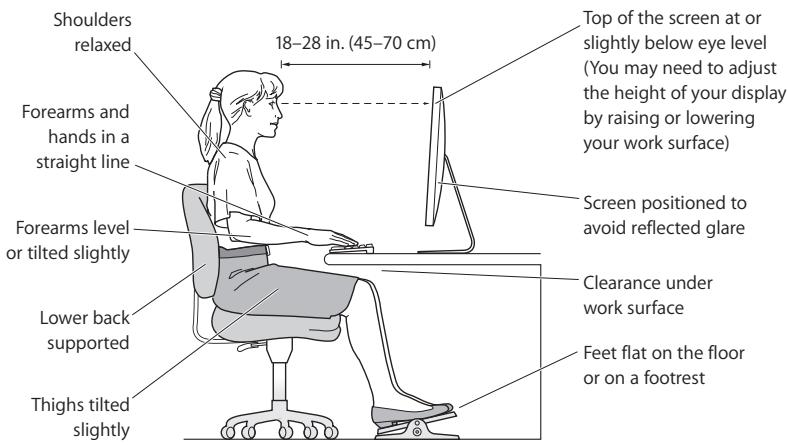
More information about ergonomics is available on the web:
www.apple.com/about/ergonomics
Avoid Hearing Damage
WARNING: Permanent hearing loss may occur if earbuds or headphones are used at high volume. You can adapt over time to a higher volume of sound that may sound normal but can be damaging to your hearing. If you experience ringing in your ears or muffled speech, then stop listening and have your hearing checked. The louder the volume, the less time required before your hearing can be affected. Hearing experts suggest that to protect your hearing:
- Limit the amount of time you use earbuds or headphones at high volume
- Avoid turning up the volume to block out noisy surroundings
- Turn the volume down if you can't hear people speaking to you
Apple and the Environment
Apple Inc. recognizes its responsibility to minimize the environmental impacts of its operations and products.
More information is available on the web:
www.apple.com/environment
Regulatory Compliance Information
FCC Compliance Statement
This device complies with part 15 of the FCC rules. Operation is subject to the following two conditions: (1) This device may not cause harmful interference, and (2) this device must accept any interference received, including interference that may cause undesired operation. See instructions if interference to radio or television reception is suspected.
Radio and Television Interference
This computer equipment generates, uses, and can radiate radiofrequency energy. If it is not installed and used properly—that is, in strict accordance with Apple's instructions—it may cause interference with radio and television reception.
This equipment has been tested and found to comply with the limits for a Class B digital device in accordance with the specifications in Part 15 of FCC rules. These specifications are designed to provide reasonable protection against such interference in a residential installation. However, there is no guarantee that interference will not occur in a particular installation.
You can determine whether your computer system is causing interference by turning it off. If the interference stops, it was probably caused by the computer or one of the peripheral devices.
If your computer system does cause interference to radio or television reception, try to correct the interference by using one or more of the following measures:
- Turn the television or radio antenna until the interference stops.
- Move the computer to one side or the other of the television or radio.
- Move the computer farther away from the television or radio.
- Plug the computer into an outlet that is on a different circuit from the television or radio. (That is, make certain the computer and the television or radio are on circuits controlled by different circuit breakers or fuses.)
If necessary, consult an Apple Authorized Service Provider or Apple. See the service and support information that came with your Apple product. Or, consult an experienced radio/television technician for additional suggestions.
Important: Changes or modifications to this product not authorized by Apple Inc. could void the EMC compliance and negate your authority to operate the product.
This product has demonstrated EMC compliance under conditions that included the use of compliant peripheral devices and shielded cables between system components. It is important that you use compliant peripheral devices and shielded cables (including Ethernet network cables) between system components to reduce the possibility of causing interference to radios, television sets, and other electronic devices.
Responsible party (contact for FCC matters only):
Apple Inc. Corporate Compliance
1 Infinite Loop, MS 26-A
Cupertino, CA 95014
Wireless Radio Use
This device is restricted to indoor use due to its operation in the 5.15 to 5.25 GHz frequency range to reduce the potential for harmful interference to co-channel Mobile Satellite systems.
Exposure to Radio Frequency Energy
The radiated output power of the AirPort Card in this device is below the FCC and EU radio frequency exposure limits for uncontrolled equipment. This device should be operated with a minimum distance of at least 20 cm between the AirPort Card antennas and a person's body and must not be co-located or operated with any other antenna or transmitter.
FCC Bluetooth Wireless Compliance
The antenna used with this transmitter must not be colocated or operated in conjunction with any other antenna or transmitter subject to the conditions of the FCC Grant.
Canadian Compliance Statement
This device complies with Industry Canada license-exempt RSS standard(s). Operation is subject to the following two conditions: (1) this device may not cause interference, and (2) this device must accept any interference, including interference that may cause undesired operation of the device.
Bluetooth Industry Canada Statement
This Class B device meets all requirements of the Canadian interference-causing equipment regulations.
Industry Canada Statement
Complies with the Canadian ICES-003 Class B specifications. Cet appareil numérique de la classe B est conforme à la norme NMB-003 du Canada. This device complies with RSS 210 of Industry Canada.
Bluetooth Europe—EU Declaration of Conformity
This wireless device complies with the R&TTE Directive.
Europe-EU Declaration of Conformity
See www.apple.com/euro/compliance.

Bulgarian Apple Inc. declares that this Mac Pro is in compliance with the essential requirements and other relevant provisions of Directive 1999/5/EC.
Czech Republic Apple Inc. hereby declares that this Mac Pro is in conformity with the essential requirements and other relevant provisions of Directive 1999/5/EC.
English: Hereby, Apple Inc. declares that this Mac Pro is in compliance with the essential requirements and other relevant provisions of Directive 1999/5/EC.
A copy of the EU Declaration of Conformity is available at: www.apple.com/euro/compliance
This equipment can be used in the following countries:
| AT | BG | BE | CY | CZ | DK | EE | FI | FR | DE | GR | HU |
| IE | IT | LV | LT | LU | MT | NL | PL | PT | RO | SK | SL |
| ES | SE | GB | IS | LI | NO | CH |
Korea Warning Statements
State of the upper part of the drive.
Open the seal.
The current period is from the date of acceptance to the date of self.
Lease table: lessee name, address, contact information
Singapore Wireless Certification
Complies with IDA Standards DB00063
Taiwan Wireless Statements
Warning statement for wireless equipment
Taiwan Class B Statement
Warning statement for Class B equipment
NIL
Warning
There is a risk of explosion if the battery is replaced with an incorrect type.
Dispose of used batteries according to the manufacturer's instructions.
Japan VCCI Class B Statement
Based on the Voluntary Control Council for Interference by Information Technology Equipment (VCCI) guidelines.
When connecting your Mac Pro to the phone line using an external USB modem, refer to the telecommunications agency information in the documentation that came with your modem.
Disposal and Recycling Information

This symbol indicates that your product must be disposed of properly according to local laws and regulations. When your product reaches its end of life, contact Apple or your local authorities to learn about recycling options.
For information about Apple's recycling program, go to www.apple.com/recycling.
European Union: Disposal Information

The symbol above means that according to local laws and regulations your product should be disposed of separately from household waste. When this product reaches its end of life, take it to a collection point designated by local authorities. Some collection points accept products for free. The separate collection and recycling of your product at the time of disposal will help conserve natural resources and ensure that it is recycled in a manner that protects human health and the environment.
Türkiye
Battery Disposal Information
Dispose of batteries according to your local environmental laws and guidelines.
Taiwan Battery Statement
Warning: Do not puncture or incinerate. This battery contains no mercury.
Chinese Battery Statement
Warning: Do not puncture or incinerate. This battery contains no mercury.
China
| 有毒或有害物质 | 零部件 | |
| 电路板 | 附件 | |
| 铅(Pb) | X | X |
| 汞(Hg) | O | O |
| 镉(Cd) | O | O |
| 六价铬(Cr,VI) | O | O |
| 多溴联苯(PBB) | O | O |
| 多溴二苯醚(PBDE) | O | O |
Looking for Something?
Index
A
adapter
Apple Mini DisplayPort to VGA Adapter 12
DVI to ADC 12
DVI to VGA 12
AirPort Extreme
about 29
specifications 103
analog audio
line in 25
line out 25
specifications 104
AppleCare Service and Support 93
Apple Hardware Test 85
applications
force quit 77, 79
problems 79
audio specifications 104
B
battery 27
internal backup battery 27
replacing 73
specifications 106
blinking question mark 17
Bluetooth
about 29
specifications 103
burning a CD or DVD 29
C
CD-RW 101
chair 113
changing
System Preferences 16, 29
the desktop 16
cleaning 111
computer 111
computer disposal 120
computer doesn't turn on 77
connecting
display 11
Ethernet cable 13
D
desktop, customizing 16
dimensions 107
DIMMs
installing 37
location 27,52
specifications 98, 99
discharging static 34
disconnecting the power 110
Disk Utility 82
display
modes 100
ports 24
precautions 110
disposal of
batteries 120
computer 120
Dock 28
double-wide PCI Express graphics slot 27
downloading software 92
DVD 101
DVI display port 25
E
environmental impact 115
ergonomics 113
Ethernet
maximizing performance 92
ports 23
specifications 102
expansion cards 106
external USB modem 21, 23
F
Finder 28
FireWire
connections 29
devices 106
ports 23
specifications 106
Force Quit 79, 88
frozen application 88
G
general maintenance 111
graphics card 99
H
hand position 113
hard disk drive 27
headphone jack 20, 21
specifications 105
Help Center 16, 76
1
installing
backup battery 73
DIMMs 37
equal-size DIMMs 43
full-length PCI cards 70
hard disk drives 56
internal drives 55
memory 39
PCI Express Cards 68
Internet connection 89
internet problems 89
J
JEDEC specification 37
K
keyboard
connecting 14
ergonomics 113
L
locking latch 23
M
Mac OS X Lion Server
information about 28
keeping up to date 92
Mac OS X Utilities
application 81
maintenance 111
maximizing Ethernet
performance 92
memory
installing 37
location 27
specifications 98
memory slots 27
Memory Slot Utility 43, 53
Mini DisplayPort 25
modem
cable 23
DSL 23
external USB 21, 23
mouse
connecting 14, 21
ergonomics 113
N
network
connections 91
diagnostics 89
no image on screen 87
0
online resources 93
opening your Mac Pro 33
operating environment 107
optical digital audio
ports 25
specifications 103
optical drive
about 21
installing 62
specifications 101
P
PCI Express cards 25, 27
installing 68
specifications 100
PCI Express Expansion
specifications 100
ports
analog audio in 25
analog audio out 25
display 25
DVI display 25
Ethernet 23
FireWire 21, 23
Mini DisplayPort 25
optical digital audio in 25
optical digital audio out 25
USB 21,23
power button 15
power cord 10
power requirements
cards 106
USB devices 106
power socket 23
power supply
specifications 106
problems. See troubleshooting
processor specification 98
Q
question mark, blinking 17
R
RAM
installing 37
location 27
specifications 99
reinstalling Mac OS X 83
repairing a disk 82
reset the PRAM 78
restoring information 83
restoring your computer 84
S
safety information 110
SATA hard disk 55, 100
screen freezes 88
Serial ATA hard disk drives
installing 55
specifications 100
serial number location 95
Server Assistant 8
service and support
information 93
setting up 9
shutting off power 9,21,35
software
updating 92
Software Update 92
solid state drive (SSD) 59
specifications
AirPort Extreme 103
analog audio 104
battery 106
Bluetooth 103
dimensions 107
Ethernet 102
external microphone 105
finding 98
FireWire 102
graphics card 99
headphone jack 104
memory 98
operating environment 107
optical digital audio 103
optical drive 101
PCI Express 100
power requirements 106
power supply 106
processor 98
RAM 99
storage 100
SuperDrive 101
USB 102
video display 100
SSD. See solid state drive
static, discharging 34
status light 21
flashes 79
stopping an application 79
SuperDrive
about 21, 27
replacing 62
specifications 101
system clock 106
System Information 29, 93
System Preferences 29
customizing the desktop 16
T
telephone support 94
troubleshooting
AppleCare 93
Apple Hardware Test 85
applications 79
connecting to the
Internet 89
DSL modem 90
Force Quit 77
internet connection 89
network connection 91
PPPoE connection 90
service and support information 93
status light flashes 79
unable to eject a disc 78
typing position 113
U
UDIMMs 37
unable to eject a disc 78
updating software 92
USB 2.0 ports 23
USB devices 102
W
wireless
AirPort technology 29
Bluetooth technology 29
Apple Inc.
© 2011 Apple Inc. All rights reserved.
Under the copyright laws, this manual may not be copied, in whole or in part, without the written consent of Apple.
Every effort has been made to ensure that the information in this manual is accurate. Apple is not responsible for printing or clerical errors.
The Apple logo is a trademark of Apple Inc., registered in the U.S. and other countries. Use of the "keyboard" Apple logo (Option-Shift-K) for commercial purposes without the prior written consent of Apple may constitute trademark infringement and unfair competition in violation of federal and state laws.
Apple
1 Infinite Loop
Cupertino, CA 95014
408-996-1010
www.apple.com
Apple, the Apple logo, Apple Cinema Display, AirPort, AirPort Extreme, Finder, FireWire, iPhone, iPod, Mac, Mac OS, SuperDrive, Time Capsule, and Time Machine are trademarks of Apple Inc., registered in the U.S. and other countries.
The FireWire logo and iPad are trademarks of Apple Inc.
AppleCare and Apple Store are service marks of Apple Inc., registered in the U.S. and other countries.
App Store is a service mark of Apple Inc.
Intel, Intel Core, and Xeon are trademarks of Intel Corp. in the U.S. and other countries.
The Bluetooth word mark and logos are registered trademarks owned by Bluetooth SIG, Inc. and any use of such marks by Apple Inc. is under license.
This product includes software developed by the University of California, Berkeley, FreeBSD, Inc., The NetBSD Foundation, Inc., and their respective contributors.
Other company and product names mentioned herein are trademarks of their respective companies. Mention of third-party products is for informational purposes only and constitutes neither an endorsement nor a recommendation. Apple assumes no responsibility with regard to the performance or use of these products.
Manufactured under license from Dolby Laboratories. "Dolby," "Pro Logic," and the double-D symbol are trademarks of Dolby Laboratories. Confidential Unpublished Works, © 1992-1997 Dolby Laboratories, Inc. All rights reserved.
Simultaneously published in the United States and Canada.

- CONGRATULATIONS ON PURCHASING MAC PRO WITH MAC OS X LION SERVER
- CONTENTS
- CHAPTER 1: READY, SET UP, GO
- CHAPTER 2: LIFE WITH YOUR MAC PRO
- CHAPTER 3: MAKING A GOOD THING BETTER
- CHAPTER 4: PROBLEM, MEET SOLUTION
- CHAPTER 5: WHAT'S UNDER THE HOOD
- CHAPTER 6: LAST, BUT NOT LEAST
- LOOKING FOR SOMETHING
- READY, SET UP, GO
- WORKING WITH MAC OS X LION SERVER
- SETTING UP YOUR MAC PRO
- STEP 1: POSITION YOUR MAC PRO
- STEP 2: PLUG IN THE POWER CORD
- STEP 3: CONNECT A DISPLAY
- STEP 4: CONNECT AN ETHERNET CABLE
- STEP 5: CONNECT A KEYBOARD AND MOUSE
- STEP 6: TURN ON YOUR MAC PRO
- STEP 7: CONFIGURE YOUR MAC PRO SERVER WITH SERVER ASSISTANT
- CUSTOMIZE YOUR DESKTOP AND SET YOUR PREFERENCES
- NEED HELP SETTING UP
- SHUTTING DOWN YOUR MAC PRO
- PUTTING YOUR MAC PRO TO SLEEP
- TO WAKE YOUR MAC PRO
- LIFE WITH YOUR MAC PRO
- MORE PORTS AND CONNECTORS ON THE BACK
- INTERNAL EXPANSION OPTIONS
- OPTICAL DRIVES
- HARD DISK DRIVES OR SOLID STATE DRIVES
- PCI EXPRESS SLOTS
- BATTERY
- DOUBLE-WIDE PCI EXPRESS GRAPHICS SLOT
- MEMORY SLOTS
- GETTING ANSWERS
- TO OPEN HELP CENTER
- MORE INFORMATION
- MAKING A GOOD THING BETTER
- OPENING YOUR MAC PRO
- INSTALLING MEMORY
- INSTALLING MEMORY IN A QUAD-CORE OR 6-CORE MAC PRO
- TO INSTALL MEMORY
- INSTALLING MEMORY IN AN 8-CORE OR 12-CORE MAC PRO
- TO INSTALL MEMORY IN A DUAL-PROCESSOR MAC PRO
- INSTALLING INTERNAL STORAGE DEVICES
- INSTALLING SERIAL ATA HARD DISK DRIVES
- TO INSTALL A HARD DISK DRIVE
- INSTALLING A SOLID STATE DRIVE
- TO INSTALL A SOLID STATE DRIVE
- REPLACING AN OPTICAL DRIVE
- TO REPLACE THE OPTICAL DRIVE
- ADDING PCI EXPRESS CARDS
- ABOUT PCI EXPRESS CARDS
- TO INSTALL A PCI EXPRESS CARD
- IF YOU'RE INSTALLING A FULL-LENGTH PCI CARD
- REPLACING THE INTERNAL BACKUP BATTERY
- PROBLEM, MEET SOLUTION
- AN OUNCE OF PREVENTION
- PROBLEMS WITH YOUR MAC PRO
- IF YOU'RE UNABLE TO EJECT A DISC
- IF THE STATUS LIGHT FLASHES AND THE COMPUTER DOESN'T START UP
- PROBLEMS WITH SOFTWARE
- TO FORCE AN APPLICATION TO QUIT
- TO OPEN THE MAC OS X UTILITIES APPLICATION
- TO CONNECT VIA A WI-FI NETWORK
- REPAIRING A DISK WITH DISK UTILITY
- RESTORING INFORMATION USING A TIME MACHINE BACKUP
- REINSTALLING MAC OS X LION SERVER AND APPLE APPLICATIONS
- RESTORING YOUR COMPUTER TO ITS FACTORY SETTINGS
- CHECKING FOR A HARDWARE PROBLEM
- TO USE APPLE HARDWARE TEST
- PROBLEMS WITH WI-FI COMMUNICATION
- PROBLEMS WITH A DISPLAY
- IF NO IMAGE APPEARS ON THE SCREEN
- IF THE SCREEN IMAGE APPEARS DIM OR FLICKERS
- IF NO COLORS APPEAR ON THE SCREEN OR THE COLORS DON'T LOOK RIGHT
- IF DESKTOP ICONS MOVE WHEN YOU CHANGE THE SCREEN RESOLUTION
- IF THE SCREEN FREEZES
- IF YOUR DISPLAY HAS A LIGHT ON THE FRONT AND IT'S FLASHING
- PROBLEMS WITH YOUR INTERNET CONNECTION
- TO USE NETWORK DIAGNOSTICS
- CABLE MODEM, DSL, AND LAN INTERNET CONNECTIONS
- PPPOE CONNECTIONS
- TO ENTER PPPOE SETTINGS
- NETWORK CONNECTIONS
- MAXIMIZING ETHERNET PERFORMANCE
- KEEPING YOUR SOFTWARE UP TO DATE
- TO CHECK FOR UPDATED SOFTWARE
- LEARNING MORE, SERVICE, AND SUPPORT
- ONLINE RESOURCES
- ONSCREEN HELP
- SYSTEM INFORMATION
- APPLECARE SERVICE AND SUPPORT
- LOCATING YOUR SERIAL NUMBER
- WHAT'S UNDER THE HOOD
- SPECIFICATIONS
- PROCESSOR AND MEMORY SPECIFICATIONS
- QUAD-CORE MAC PRO
- CORE MAC PRO
- RANDOM-ACCESS MEMORY (RAM)
- GRAPHICS CARD
- VIDEO DISPLAY MODES
- STORAGE
- PCI EXPRESS EXPANSION
- SUPERDRIVE (DVD±R DL/DVD±RW/CD-RW) SPECIFICATIONS
- USB SPECIFICATIONS
- FIREWIRE SPECIFICATIONS
- POWER
- ETHERNET SPECIFICATIONS
- BLUETOOTH 2.1+EDR SPECIFICATIONS
- AIRPORT EXTREME SPECIFICATIONS
- COMPATIBILITY
- OPTICAL DIGITAL AUDIO SPECIFICATIONS
- OPTICAL DIGITAL AUDIO OUT
- OPTICAL DIGITAL AUDIO IN
- ANALOG AUDIO SPECIFICATIONS
- ANALOG AUDIO OUT USING THE HEADPHONE JACK (TYPICAL VALUES)
- ANALOG AUDIO LINE IN (TYPICAL VALUES)
- ANALOG AUDIO LINE OUT (TYPICAL VALUES)
- EXTERNAL MICROPHONE INPUT USING THE HEADPHONE JACK (TYPICAL VALUES)
- POWER SUPPLY
- AC LINE INPUT
- POWER REQUIREMENTS FOR EXPANSION CARDS AND PERIPHERALS
- EXPANSION CARDS
- USB DEVICES
- FIREWIRE DEVICES
- SYSTEM CLOCK AND BATTERY
- DIMENSIONS AND OPERATING ENVIRONMENT
- DIMENSIONS
- OPERATING ENVIRONMENT
- LAST, BUT NOT LEAST
- IMPORTANT SAFETY INFORMATION
- ALWAYS TAKE THE FOLLOWING PRECAUTIONS
- GENERAL MAINTENANCE
- PROTECTING YOUR OPTICAL DRIVE
- LASER INFORMATION FOR OPTICAL DISC DRIVE
- UNDERSTANDING ERGONOMICS
- KEYBOARD
- MOUSE
- CHAIR
- DISPLAY
- AVOID HEARING DAMAGE
- APPLE AND THE ENVIRONMENT
- REGULATORY COMPLIANCE INFORMATION
- FCC COMPLIANCE STATEMENT
- RADIO AND TELEVISION INTERFERENCE
- WIRELESS RADIO USE
- EXPOSURE TO RADIO FREQUENCY ENERGY
- FCC BLUETOOTH WIRELESS COMPLIANCE
- CANADIAN COMPLIANCE STATEMENT
- BLUETOOTH INDUSTRY CANADA STATEMENT
- INDUSTRY CANADA STATEMENT
- BLUETOOTH EUROPE—EU DECLARATION OF CONFORMITY
- EUROPE-EU DECLARATION OF CONFORMITY
- KOREA WARNING STATEMENTS
- SINGAPORE WIRELESS CERTIFICATION
- TAIWAN WIRELESS STATEMENTS
- WARNING STATEMENT FOR WIRELESS EQUIPMENT
- TAIWAN CLASS B STATEMENT
- WARNING STATEMENT FOR CLASS B EQUIPMENT
- JAPAN VCCI CLASS B STATEMENT
- DISPOSAL AND RECYCLING INFORMATION
- EUROPEAN UNION: DISPOSAL INFORMATION
- TÜRKIYE
- BATTERY DISPOSAL INFORMATION
- TAIWAN BATTERY STATEMENT
- CHINESE BATTERY STATEMENT
- INDEX
- A
- B
- C
- D
- E
- F
- G
- H
- J
- K
- L
- M
- N
- P
- Q
- R
- S
- T
- U
- W
Brand : APPLE
Model : MAC PRO SERVER
Category : Server