30CPM - Chauffe-eau et bouilloire Morco - Free user manual and instructions
Find the device manual for free 30CPM Morco in PDF.


User questions about 30CPM Morco
0 question about this device. Answer the ones you know or ask your own.
Ask a new question about this device
Download the instructions for your Chauffe-eau et bouilloire in PDF format for free! Find your manual 30CPM - Morco and take your electronic device back in hand. On this page are published all the documents necessary for the use of your device. 30CPM by Morco.
USER MANUAL 30CPM Morco
Morco 24CPM and 30CPM
User Instructions and Installation Manual For Caravan Holiday Homes and Park Homes
natural_image
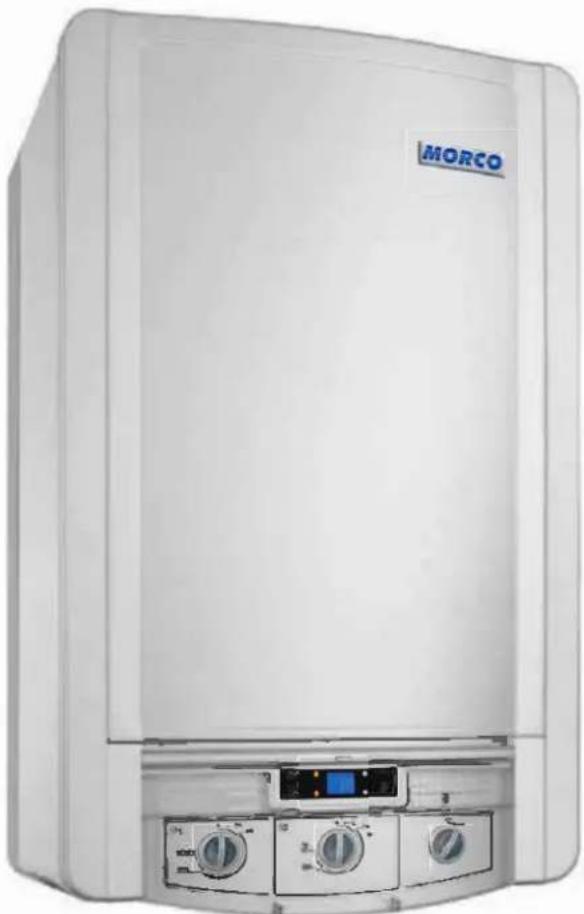
Exterior view of a white MORCO water heater unit with control knobs and a digital display (no visible text or symbols beyond branding)| Model | Gas Type | Domestic Hot water Output | Central Heating Output |
| Morco 24CPM | LPG | 26kW | 24kW |
| Morco 30CPM | LPG | 31kW | 30kW |
| Morco 24CPM | Nat Gas | 26kW | 24kW |
| Morco 30CPM | Nat Gas | 31kW | 30kW |
EC-TYPE EXAMINATION CERTIFICATE 177208
MORCO PRODUCTS LTD
Morco House, Riverview Road, Beverley, East Yorkshire, HU17 OLD
Tel: 01482 325456 Fax: 01482 212869
www.morcoproducts.co.uk

text_image
MORCO HEATING & HOT WATER
CONTENTS

USER INSTRUCTIONS

GENERAL SPECIFICATIONS

TECHNICAL DATA

GENERAL INSTALLATION REQUIREMENTS

INSTALLATION

COMMISSIONING

ROUTINE SERVICING

COMMON PROBLEMS AND FAULT CODES

WARRANTY CONDITIONS
1. USER INSTRUCTIONS
GAS SAFETY (INSTALLATION AND USE) REGULATIONS 1998 (AS AMENDED)
It is the law that all gas appliances are installed by a registered person, in accordance with the above regulations. Failure to install appliances correctly could lead to prosecution. It is in your own interest, and that of safety, to ensure that the law is complied with.
Read these instructions carefully before attempting to operate the appliance. Comply with all applicable warnings. Do not interfere with any sealed components, and use the appliance only in accordance with these instructions.
This manual should be left with the owner of the boiler.
1.1 Introduction
The Morco 24CPM and 30CPM condensing combination boilers are wall hung, room sealed, fan assisted, microprocessor controlled, fully modulating boilers capable of supplying both central heating (CH) and instantaneous hot water (DHW).
The boiler can be set to work in a number of ways:
- DHW supply only
- CH supply only
• Both CH and DHW supply
The temperature of the CH and DHW supply can be set by using the knobs on the control panel.
DHW Comfort Mode
The boiler has a “Comfort Mode” for hot water delivery only, that can be selected on the front panel. In this mode the boiler “learns” your hot water requirements and “preheats” water prior to use to ensure faster delivery. With this mode switched on the boiler will fire periodically even when no hot tap is opened – this is normal operation. With this mode switched off the boiler will only fire for hot water delivery when a tap is opened. This is called “economy mode”
LCD Display
Depending on the boiler status and user interaction with buttons and dials on the control panel the following can be displayed on the LCD panel:
• Temperature of DHW – target only
- Fault Codes – in the event of a problem
• Pressure in the CH circuit
• Temperatures of water in the CH circuit – both actual and target
1.2 CONTROL PANEL
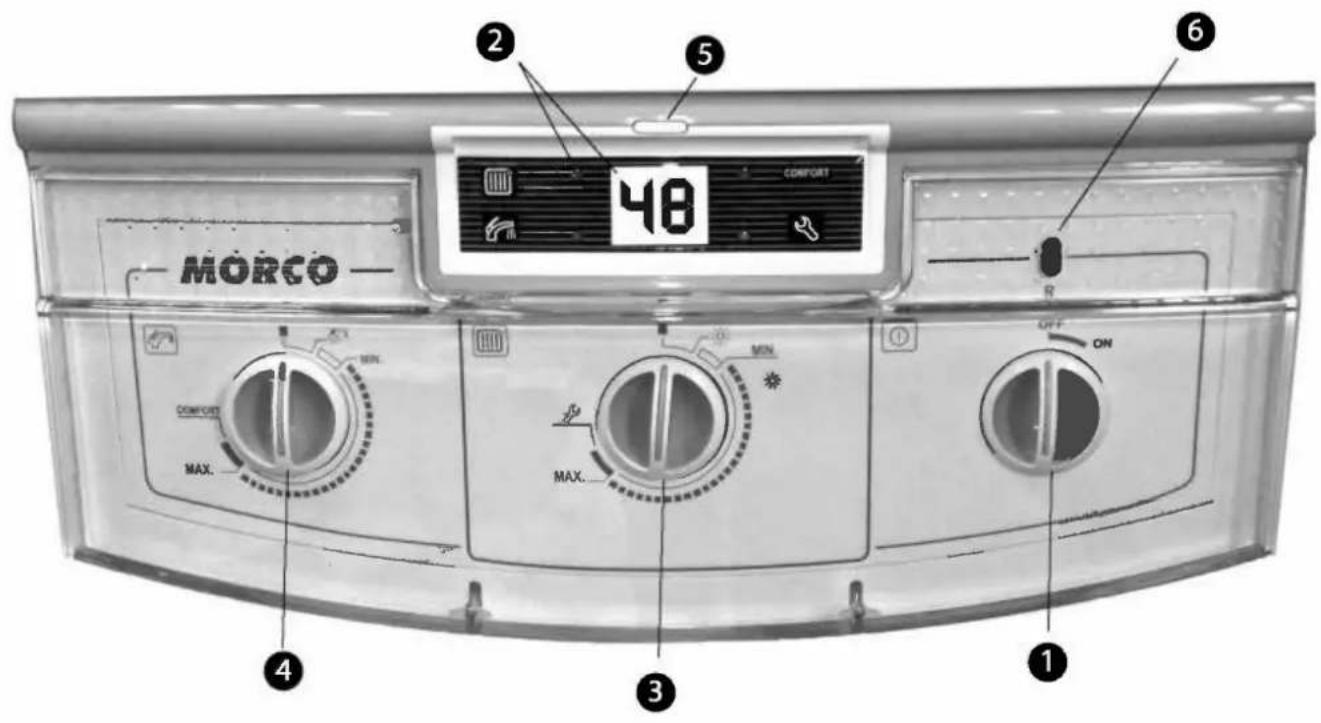
text_image
2 5 48 CONFORT MORCO MIN. COMP.CRT MAX. 3 ON OFF ON 1 3 4- On/off switch
- LCD display panel and yellow status LEDs
- Central heating temperature control knob
- Domestic hot water temperature control knob
- Central heating pressure test button
- Reset push button/burner LED
1. On/off switch
This knob is used to turn the boiler on and off – it will NOT reset the boiler after a fault code has been displayed
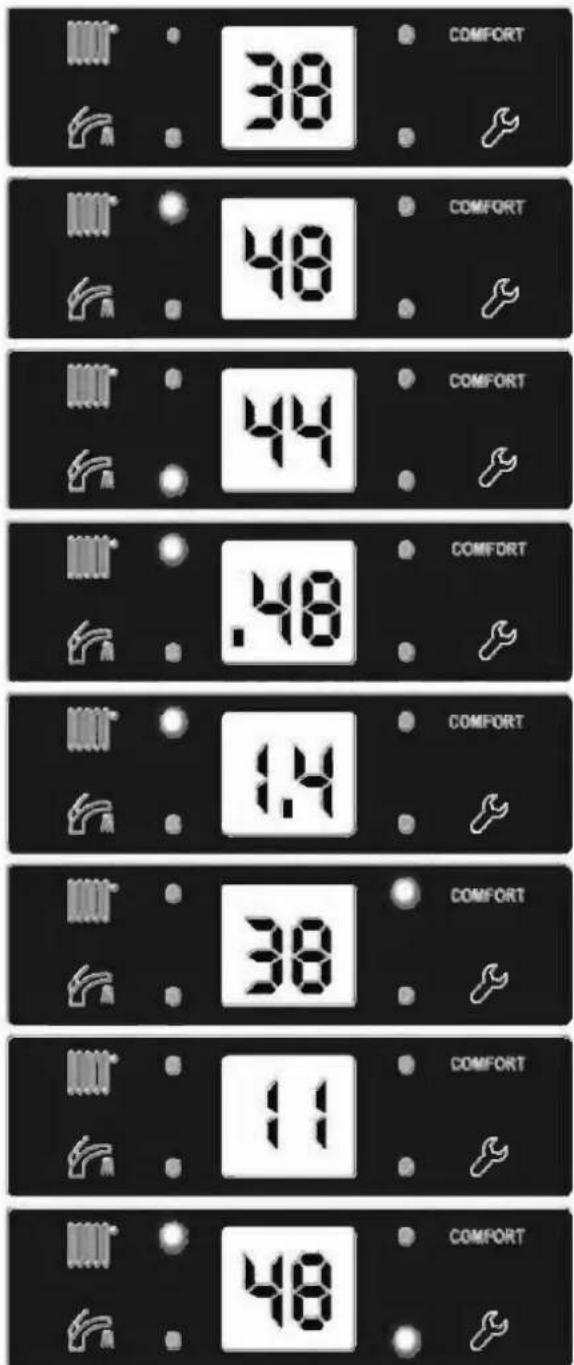
2. LCD display and yellow status LEDs
The table below shows the various combinations of displays and LED lights that give the boiler status at that point in time
| Stand-by Mode: When there is no heat demand for central heating (CH) or domestic hot water (DHW). LCD display shows actual CH flow temperature (default). |
| CH mode: LCD display shows actual CH flow temperature and status LED CH is ON. |
| DHW mode: While DHW mode is active, status LED DHW is ON. |
| Setpoint mode: LCD display shows target CH/DHW temperature when adjusting CH/DHW control knobs. Left dot is flashing. After 10 seconds, display shows actual CH Temperature. |
| Pressure mode: CH water pressure (bar) can be seen on the LCD display by pressing the pressure test - button. It remains active for 10 seconds. |
| Comfort mode: If comfort mode is active, status LED Comfort is ON. |
| Error mode: A fault code appears automatically on the LCD display. The fault code is flashed and Burner LED turns RED. |
| Service mode: If service mode is active, status LED Service is ON. |
text_image
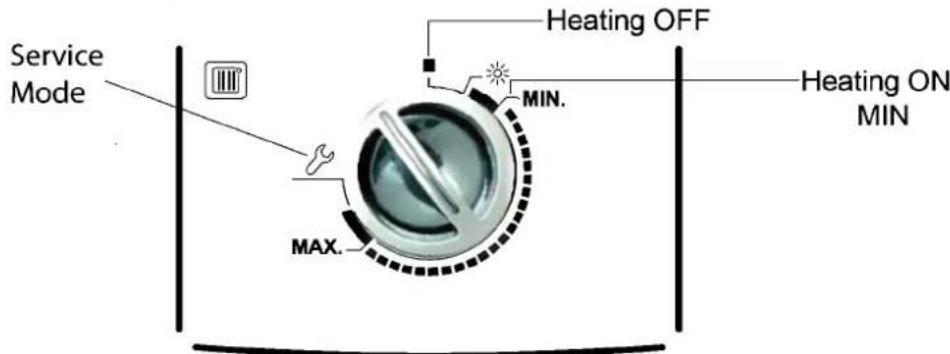
38 COMFORT 48 COMFORT 44 COMFORT 48 COMFORT 14 COMFORT 38 COMFORT 11 COMFORT 48 COMFORT3. CH temperature control knob
This has 3 functions:
- Set the CH target temperature between 30 deg C and 80 deg C
- Select heating mode ON or OFF
- The service mode is set by turning the knob fully clockwise – this is only for use by engineers
text_image
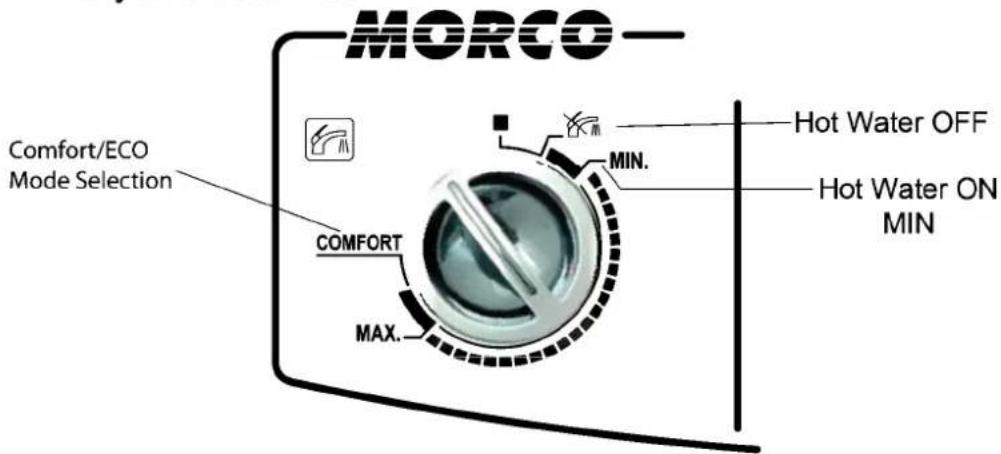
Service Mode Heating OFF MIN. MAX. Heating ON MINThis has 3 functions:
- Set the DHW target temperature between 35 deg C and 60 deg C
- Select comfort/economy mode – change between these modes by turning the knob fully clockwise and then back within 3 seconds.
- The DHW supply can be switched off by turning the knob fully anti-clockwise.
text_image
MORCO Comfort/ECO Mode Selection MIN. COMFORT MAX. Hot Water OFF Hot Water ON MIN.5. CH Pressure test button
This is used to see what pressure is held in the CH circuit - it should read between 1.0 - 1.4 bar. In order to see the pressure on the LCD display, push the button. The value will be displayed for approximately 10 seconds.
6. Reset push button/ burner LED
This is used to reset the boiler after any fault codes are displayed on the LCD panel. In addition the colour of the LED indicates the following:
- Red LED – the boiler is in fault mode and a code should be visible on the LCD panel
- Blue LED – the boiler is operating normally and the burner is ignited
1.3 GENERAL GUIDANCE ON HOT WATER DELIVERY
The temperature of the hot water is governed by both the ambient temperature of the cold water supply and its flow rate through the boiler. In the case of the 24CPM model at a flow rate of 10.6L/min there will be a maximum rise of 35°C above ambient. At a flow rate of 6.8L/min there will be a rise of 50°C above ambient, (the slower the flow rate, the greater the temperature rise).
The flow rate of the hot water is controlled by the hot outlet tap, until the max flow allowed by the boiler is achieved.
The temperature selector knob on the boiler is effective only when there is either a low water flow rate or a high ambient water temperature.
- The boiler can theoretically supply more than one outlet simultaneously. However in practice the tap which is nearest will receive the most hot water. If the shower is in use and a kitchen tap is opened virtually all the hot water will be diverted to the kitchen as it offers the least resistance.
- If an outlet is too restrictive it will slow down the flow rate and increase the temperature. For example, ensure the shower head is free from blockages caused by scale.
- If a tap or shower head is too restrictive due to a fault or blockage, the flow rate will be reduced to below the rate at which the boiler is able to operate, resulting in a wide swing in temperatures. Either fix the restriction or turn the temperature selector on the boiler down.

Caution: The boiler can produce water at over 70^ when in central ting mode. If you run a hot tap when the boiler has been heating the ators, the initial flow through the hot tap could be very hot. DO NOT ACE YOUR HANDS under the tap or use the shower until this initial flow passed.
- Allow time (30 seconds) for the temperature to stabilise after making an adjustment at the tap before making further adjustments.
1.4 GENERAL ADVICE
When central heating is not being used, but the boiler is in the summer setting (for domestic hot water only) the pump will automatically run for 30 seconds every 23 hours to prevent it seizing. If the appliance has been shut down with the electrical supply switched off for a period, this device will not work. The pump may be found to have jammed when the appliance is switched back on. If so, consult your installer or Gas Safe Registered Engineer.
NOTE: Seized pumps are not covered under warranty.
ROUTINE SERVICING
To ensure continued safe and efficient operation of the appliance it is recommended that it is checked and serviced as necessary at regular intervals. The frequency of servicing will depend upon the particular installation conditions and usage but in general once a year should be regarded as a minimum even if only occasional usage has occurred.
It is the law that any service work MUST be carried out by a competent Gas Safe Registered Engineer.
SAFETY
It is essential that these instructions are strictly followed for the safe and economical operation of this appliance. The appliance is a fan-assisted room sealed gas boiler and therefore the flue terminal MUST NOT BE OBSTRUCTED under any circumstances. If it is damaged, turn off the appliance and consult your installer, or service engineer. If it is known or suspected that a fault exists on the appliance it MUST NOT be used until the fault has been rectified by a competent Gas Safe Registered Engineer.
THERMOSTATS/TIMERS/PROGRAMMERS
This appliance may be fitted with one of the above devices to control the central heating function in the home. These devices may override the controls of the boiler. For example: the boiler will not fire in CH mode when a room thermostat senses its set point temperature has been reached or a time clock is outside of the time zone selected for CH to operate.
If the boiler is installed in a Caravan Holiday Home, refer to the user manual for the home, for the positions of all drain plugs.
Note: There are no drain plugs fitted to the actual boiler.
-Leave all taps and plugs open until the boiler is next needed for service. This will allow any residual water to continue to drain.
NOTES ON FROST PROTECTION
The heating circuit and radiators should contain the correct level of antifreeze to prevent damage during freezing conditions and should not be drained down.
Opening the hot and cold water drain cocks should be sufficient to drain all the water from the boiler.
However in some installations it may be necessary to blow through the system with air to ensure the water has drained. The filling loop valve below the boiler may also be used as an extra drain point.
ALL FROST DAMAGE IS OUTSIDE OF THE WARRANTY
2. GENERAL SPECIFICATION
The Morco 24-CPM and 30-CPM are a range of high efficiency condensing combination boilers that use premix technology and achieve a grade A rating in SAP 2009. They are designed to provide both Domestic Hot Water (DHW) and Central Heating (CH), although the CH does not operate while the DHW is being used. The boilers are designed to be wall hung and are room sealed, that is they obtain the air for combustion from outside the dwelling and a fan returns the products of combustion to the outside. The range is particularly suited to use in Caravan Holiday Homes and Park Homes. The boilers can be supplied ready to run on either LPG or Natural Gas.
Both horizontal and vertical flues can be used and various elbows can be used to accommodate a more complex route between the boiler and the outside of the dwelling.
The main printed circuit board provides all the functionality and safety features for the boiler.
The board operates the gas valve, fan, pump, 3-way valve and flame supervision.
The safety systems built into your appliance provide entire safety for you and your appliance. The safety systems are:
Flue Gas Over-heat Safety System (105 °C)
Flame Failure Supervision
Boiler Over-heat Safety thermostat 2 levels: 95^ and 105^)
DHW (Domestic Hot Water) Over-heat thermostat
CH Over Pressure Protection (3 bar)
CH Low Water Pressure Protection (0,8 bar)
High Voltage Protection System (260 VAC)
Low Voltage Protection System (160 VAC)
EMC (Electromagnetic Compatibility) Filter
Thermal Accumulation Protection (with by-pass circuit and "pump over-run")
Water Flow Supervision
Pump Run Protection (0,4 bar)
Pump Anti-sticking Function
3 Way Valve Anti-sticking Function
Automatic Air Vent
Expansion Vessel (7 litres)
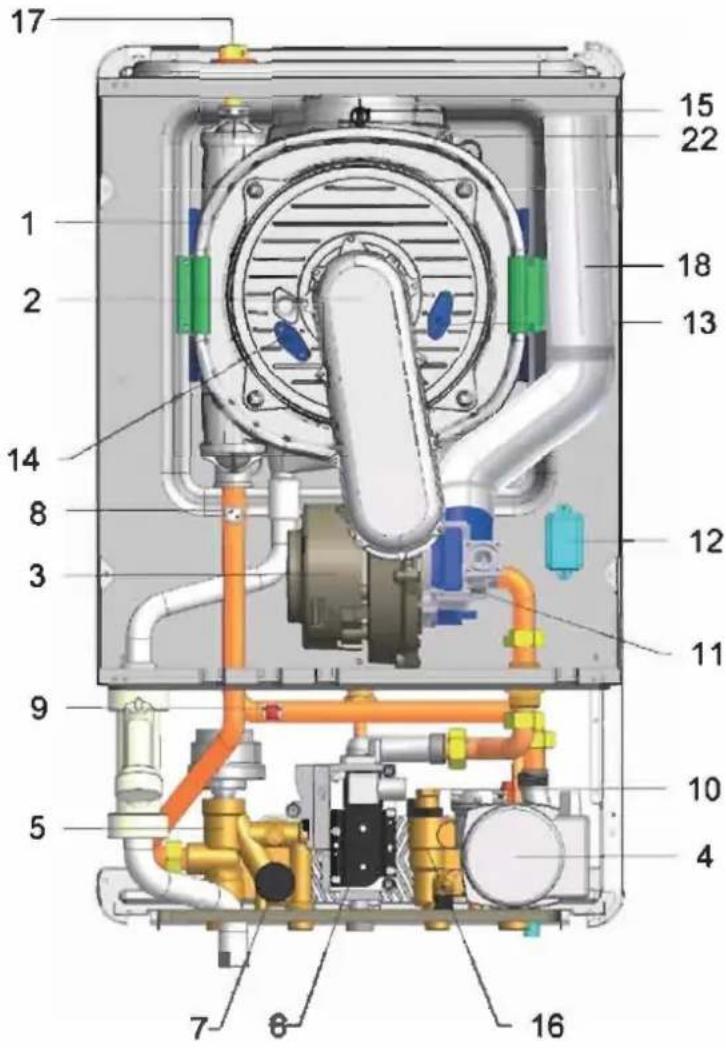
text_image
Technical diagram of a mechanical device with numbered components for identification1- Stainless steel heat exchanger
2- Air / gas manifold
3-Fan
4- Pump
5- Hydraulic circuit - flow manifold
6- Gas valve
7- Water pressure transducer
8- CH flow NTC sensor - immersion type
9- CH return NTC sensor - surface type
10- DHW flow turbine
11-Air/gas mixer box
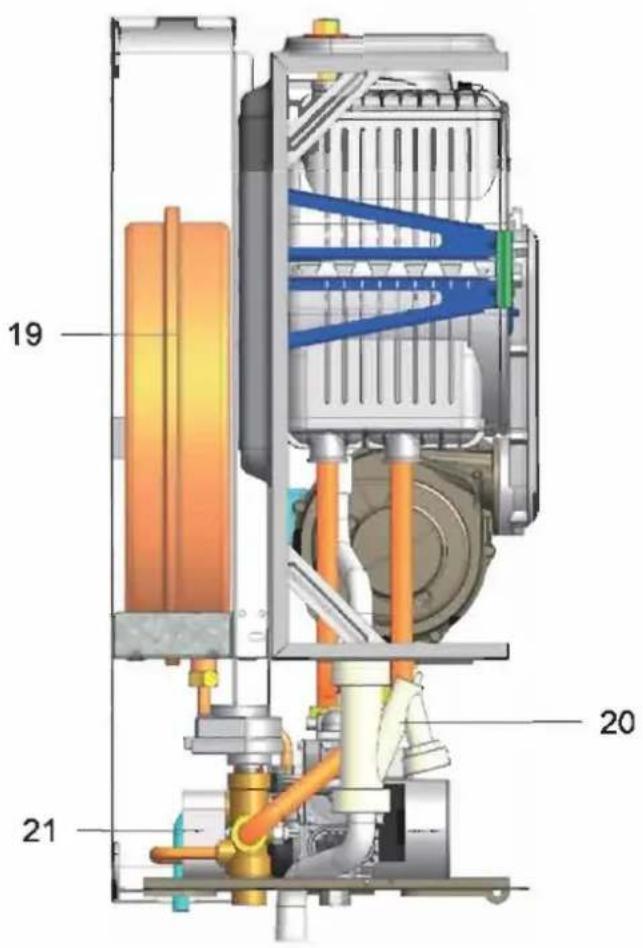
text_image
19 20 2112- Igniter
13- Ignition electrodes
14-Ionization electrode
15- Flue gas NTC sensor
16- Hydraulic circuit - return manifold
17- Automatic air vent
18- Air inlet pipe
19- Expansion vessel (7 litres)
20- Siphon(Condensate Trap)
21- Plate heat exchanger
22- Thermal cut-off 160 °C
3- TECHNICAL DATA
| 3- TECHNICAL DATA | 24CPM | 30CPM | Unit | ||
| Gas Category* | II _2H3P | II _2H3P | |||
| Boiler Type | C_13(x), C_33(x), C_45(x), C_53(x), C_63(x), C_83(x) | C_13(x), C_33(x), C_43(x), C_53(x), C_63(x), C_83(x) | |||
| Type of gas | G 20 | G 31 | G 20 | G31 | |
| Performances | |||||
| CH Min. Heat Output (80/60 °C) | 6,6 | 7,9 | 8,1 | 9,6 | kW |
| CH Max. Heat Output (80/60 °C) | 22,2 | 22,2 | 27,3 | 27,3 | kW |
| CH Min. Heat Output (50/30 °C) | 7,3 | 8,8 | 9 | 10,8 | kW |
| CH Max. Heat Output (50/30 °C) | 24 | 24 | 30 | 30 | kW |
| CH Min. Heat Input | 6,8 | 8,2 | 8,4 | 10 | kW |
| CH Max. Heat Input | 22,8 | 22,8 | 28 | 28 | kW |
| DHW Min. Heat Output | 6,7 | 8 | 8,2 | 9,7 | kW |
| DHW Max. Heat Output | 26 | 26 | 31 | 31 | kW |
| DHW Min. Heat Input | 6,8 | 8,2 | 8,4 | 10 | kW |
| DHW Max. Heat Input | 27 | 27 | 32 | 32 | kW |
| Gas Consumption** | |||||
| Natural Gas (Max. Load) | 2,38 | 2,92 | m^3/h | ||
| Natural Gas (Min. Load) | 0,71 | 0,88 | m^3/h | ||
| Propane (Max. Load) | 1,77 | 2,17 | kg/h | ||
| Propane (Min. Load) | 0,64 | 0,77 | kg/h | ||
| Gas Supply Pressure | |||||
| Natural Gas (G 20) | 20 | 20 | mbar | ||
| Propane (G 31) | 37 | 37 | mbar | ||
| Domestic Hot Water | |||||
| Min. Flow Rate For Activating | 3 | 3 | ltr/min | ||
| Max. Flow Rate | 12 ( t=31^ C ) | 14 ( t=32^ C ) | ltr/min | ||
| Flow rate at 35 °C temp. rise | 10,6 | 12,7 | ltr/min | ||
| Min. Operating Pressure | 0,2 | 0,2 | bar | ||
| Max. Operating Pressure | 7 | 7 | bar | ||
| Set Temperature Range | 35-60 | 35-60 | °C | ||
| Central Heating | |||||
| Min. Operating Pressure | 0,8 | 0,8 | bar | ||
| Max. Operating Pressure | 3 | 3 | bar | ||
| Set Temperature Range | 30-80 | 30-80 | °C | ||
| General | |||||
| Electrical Supply | 230V AC- 50Hz | 230V AC- 50Hz | VAC/Hz | ||
| Fuse Rating | 4A | 4A | A | ||
| Electrical Power Consumption | 115 | 115 | watt | ||
| Expansion Vessel | 7 | 7 | ltr | ||
| Dimensions (HxWxL) | 775x454x370 | 775x454x370 | mm | ||
| Weight (Net) | 40 | 40,5 | kg | ||
| Seasonal Efficiency (SEDBUK) | 90,0-NG / 91,3-LPG | 90,1-NG / 91,6-LPG | % | ||
| IP rating | IPX4D | IPX4D | |||
**For gas consumption – Calorific Value (Net) Natural gas: 34.52 MJ/m³ Propane: 78.5 MJ/m³
➢ C type boilers ( C_13(x) , C_33(x) , C_43(x) , C_53(x) , C_63(x) , C_83(x) ) are air independent gas appliances. Air required for combustion is provided from outside via air supply ducts with products of combustion, discharged by flue gas ducts. Only MORCO supplied flue options may be used.
MAIN BOARD PCB
Main board has different parameters such as fan speeds according to the boiler types (24 kW, 30 kW, Natural gas, Propane). A main board can be converted to another type by installing an appropriate (Boiler Control Card) to the main board.
Main Board - Technical and Functional Specifications
| General | |
| Power supply range (standard): | 195 - 253 VAC |
| Power supply frequency: | 50 Hz |
| Working temperature range: | 0 °C - 60 °C |
| Fusing: | 4A |
| Inputs | |
| Water pressure switch: | 0,5 - 2,5 Vdc (0,0 - 4,0 bar) |
| DHW flow turbine | Max. 14 l/min |
| CH flow NTC sensor: | 10 kOhm@25 °C |
| CH return NTC sensor: | 10 kOhm@25 °C |
| Flue gas NTC sensor: | 10 kOhm@25 °C |
| Thermal cut-off: | 160 °C |
| Room thermostat: | 24V DC |
| Ionization current: | min. 1μA |
| Outputs | |
| Gas valve: | 230 VAC |
| Igniter: | 230 VAC |
| Pump: | 230 VAC |
| Fan: | 230 VAC |
| 3 way electrical valve | 230 VAC |
Main Board - Technical and Functional Specifications
| Timing | |
| Pre purge time: | 1 sec |
| Safety time: | 5 sec |
| Post purge time: | 2 sec |
| Pre ignition time: | 0,1 sec |
| Flame stabilization time: | 3 sec |
| Ignition time: | 5 sec |
| Number of retrials: | 3 |
| Pump over-run time: | |
| -DHWmode | 3 sec |
| -CHmode | 1min |
| Pump anti-sticking run time: | 30 sec |
| CH delay (anti-cycling) time: | 3 MIN |
| Service mode run time: | 10 min |
| Softstart run time: | 90 sec (for 24 kW types)120 sec (for 30 kW types) |
| Other Specifications | |
| Number of electrodes: | 2 for flame ignition and one for detection |
| CH water SET temperature range: | 30°C - 80 °C |
| CH water OFF temperature: | CH water SET temperature + 8 °C |
| CH water ON temperature: | CH water SET temperature - 8 °C |
| DHW SET temperature range: | 35 °C - 60 °C |
| DHW ON Flow rate: | 3,0 l/min |
| DHW OFF Flow rate: | 2,5 l/min |
| Frost protection ON temperature: | 6°C (burner runs) |
| Frost protection OFF temperature: | 19°C (burner stops) |
| Thermal cut-off - Limit temperature: | 160°C |
| Flue gas NTC sensor - Limit temperature: | 105°C |
24CPM 30CPM
Wiring Diagrams
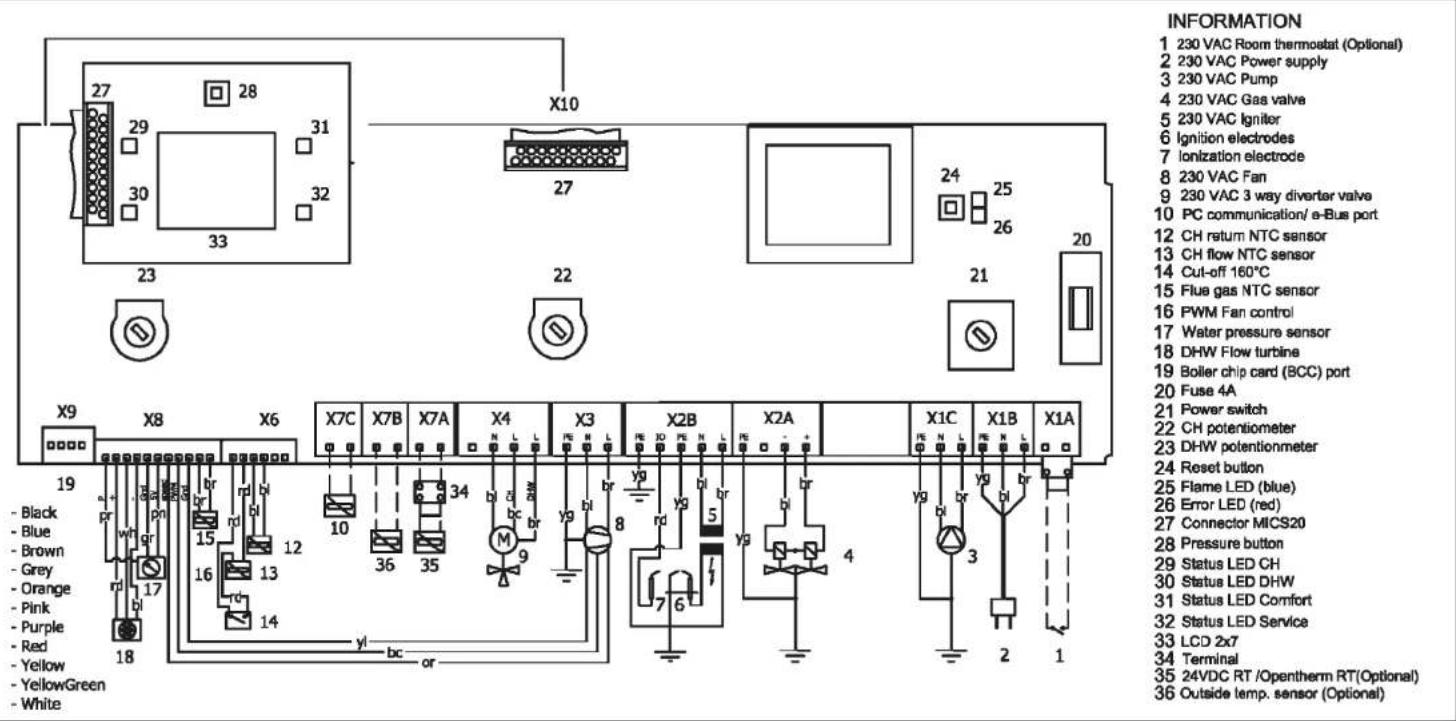
text_image
INFORMATION 1 230 VAC Room thermostat (Optional) 2 230 VAC Power supply 3 230 VAC Pump 4 230 VAC Gas valve 5 230 VAC Igniter 6 Ignition electrodes 7 Ionization electrode 8 230 VAC Fan 9 230 VAC 3 way diverter valve 10 PC communication/ e-Bus port 12 CH return NTC sensor 13 CH flow NTC sensor 14 Cut-off 160°C 15 Flua gas NTC sensor 16 PWM Fan control 17 Water pressure sensor 18 DHW Flow turbine 19 Boiler chip card (BCC) port 20 Fuse 4A 21 Power switch 22 CH potentiometer 23 DHW potentiometer 24 Reset button 25 Flame LED (blue) 26 Error LED (red) 27 Connector MICS20 28 Pressure button 29 Status LED CH 30 Status LED DHW 31 Status LED Comfort 32 Status LED Service 33 LCD 2x7 34 Terminal 35 24VDC RT /Opentherm RT(Optional) 36 Outside temp. sensor (Optional)4. GENERAL INSTALLATION
FOR THE USER
This appliance must be installed, adjusted or adapted for use with another type of gas, only by a qualified and competent person.
A correct installation will ensure that your boiler works properly.
GAS SAFETY (INSTALLATION AND USE) REGULATIONS 1998 (As amended).
It is the law that all gas appliances must be installed by a registered person, in accordance with the above regulations.
Failure to install appliances correctly may lead to prosecution.
It is in your own interest, and that of safety, to ensure that the law is complied with.
In addition to the above regulations, this appliance must be installed in accordance with the current:
• IEE Wiring regulations,
- Heath and Safety Document No 635 'The Electricity at Work Regulations.
It should also be in accordance with the relevant recommendations in the current editions of all relevant National Standards. Your particular attention is drawn to the following standards relevant to an installation in Caravan Holiday Homes:
• BS 5482 part 2 Installations in caravans and non permanent dwellings.
• BSEN721 Leisure accommodation vehicles ventilation requirements.
- BSEN 1949 Installation of LPG System for Habitational Purposes in Leisure Accommodation Vehicles.
For Park Home installation refer to:
• BS3632 Specifications for Residential Park Homes
• BS5440 Flueing and Ventilation
- BS3632 Specifications for Residential Park Homes - BS5440 Flueing and Ventilation
IMPORTANT: Manufactures instructions must NOT be taken in any way as over-riding statutory regulations.
4.1 BOILER LOCATION
In positioning the boiler, the following limitations MUST be observed:
• The position must allow for a suitable flue termination to be made.
- The combination boiler must be installed on a flat vertical wall capable of supporting its weight.
- If the boiler is in a room containing a bath or shower, the boiler controls and power supply must be so situated that they can not be touched by the person using the bath or shower. Attention is drawn to the current IEE Wiring Regulations, and in Scotland the electrical provisions of the Building Regulations applicable in Scotland. (See 4.8).
- A compartment used to enclose the appliance MUST be designed and constructed specifically for the purpose. An existing cupboard, or compartment, may be used provided it is modified accordingly.
- Minimum clearance as stated in the technical data must be observed (see 4.3)
4.2 FLUE TERMINAL POSITION
- The boiler MUST be installed so that the terminal is exposed to the external air.
- It is important that the position of the terminal allows free passage of air across it at all times.
- Where the terminal is fitted in a position to which children, the elderly, or disabled people have access (less than 1.5m above steps, decking or ground), a suitable terminal guard should be fitted.
• In certain weather conditions the terminal may emit a plume of steam.
- It is ESSENTIAL TO ENSURE, that products of combustion discharging from the terminal cannot re-enter the building, or vehicle, through ventilators, windows, or other sources of natural air infiltration, such as other flues etc, with the exception of doors, but not the opening windows thereof.
- The minimum acceptable dimensions from the terminal to obstructions and ventilation openings is as follows:
| Directly below an opening fixed vent, windows, etc. | 300mm |
| Adjacent to an opening fixed vent, windows, etc. | 300mm |
| Below gutters | 75mm |
| Below eaves | 200mm |
| From a vertical drain pipe or soil pipe | 75mm |
| From an internal or external corner | 300mm |
| Vertically from a terminal on the same wall | 1500mm |
| Horizontally from a terminal on the same wall | 300mm |
For domestic and Park Home applications please refer to BS5440.
4.3 MINIMUM CLEARANCES
- Minimum clearances of 25mm on each side and the front of the boiler must be observed. However full access from the front in the form of an opening door, must be given to allow access to the controls and for servicing.
- 200mm above the top of the boiler case is required for the flue assembly.
- 300mm is required below the boiler to allow easy access to the gas isolation cock and filling loop.
- If the boiler is to be installed into a small cupboard or compartment (i.e. at the minimum clearances) and overheating can be foreseen (i.e. close proximity to another heat source such as a cooker or fire) it is recommended that ventilation be installed in the cupboard for cooling. The following table gives the minimum effective areas of the vents:
| Position of air vents | Air from an internal source | Air from an external source |
| High Level | 13000 sq. Mm | 7500 sq.mm |
| Low level | 1300 sq. Mm | 7500 sq.mm |
4.4 ELECTRICITY SUPPLY
A 3 amp fused three pin plug for use with 230V-50Hz is supplied fitted to the appliance.
It should be used with a shuttered socket outlet complying with BS 1363
THIS APPLIANCE MUST BE EARTHED
4.5 GAS SUPPLY
• A Propane gas supply at 37mbar is required or a 20mbar for natural gas
- Ensure the regulator is of sufficient capacity to carry the maximum boiler input plus the demand for any other installed appliances.
- Ensure the connection between the supply/bottle and the caravan holiday home or park home is designed so that no pressure drop occurs.
- No more that 3 m of 15mm pipe should be used. Where the supply exceeds 3 m the pipe should be suitably sized only reducing to 15mm before the boiler
- A full bore isolation cock must be fitted in the supply close to the boiler or use Morco part number FW0391.
- If using bottled propane the bottle size must be taken account of.
- The complete installation must be tested for gas soundness.
4.6 CENTRAL HEATING SYSTEM
This appliance is designed for connection to sealed central heating water systems only.
Requirements for Sealed Water Systems
The heating system design should be based on the following information:
A heating by-pass should be fitted. If thermostatic radiator valves are to be installed, at least one radiator should be fitted with lock shield valves (usually the bathroom radiator or towel rail).
A sealed system must only be filled by a competent person using an approved filling loop connected between the mains water supply pipe and the central heating return pipe. Once filled the loop should be disconnected and left adjacent to the boiler.
Antifreeze/Inhibitor
The sealed CH circuit should, at all times be filled with the correct concentration of a suitable antifreeze/inhibitor. Morco recommend Fernox Alphi 11 at a concentration of at least 25% . This will provide protection on the CH CIRCUIT ONLY down to -11 deg Celsius and sufficient protection from corrosion.
Expansion Vessel
The following table gives the maximum system volume that the integral 7 litre expansion vessel can sustain.
| Vessel charge/initial system pressure (bar) | 0.5 | 1 | 1.5 |
| Total water content of CH system (litres) | 83 | 64 | 44 |
If the total water content exceeds that shown, an additional expansion vessel must be fitted and connected to the heating system primary return pipe as close as possible to the appliance. If an extra vessel is required, ensure that the total capacity of both vessels is adequate. If the pressure display on the boiler control panel indicates 2.2 bar or greater when the appliance is at maximum temperature with all radiators in circulation an extra expansion vessel is required.
Pressure Relief Valve
A pressure relief valve set 3 bar (43.5psi) is fitted and a discharge pipe is routed to the outside of the appliance. This discharge pipe should be extended to terminate safely away from the appliance to a point where a discharge would not cause damage to persons or property but would be detected. The pipe should be able to withstand boiling water, be a minimum of 15mm in diameter, and not include any upward pipe runs or horizontal runs prone to freezing.
4.7 DOMESTIC WATER SYSTEM
Check that mains supply pressure is within the prescribed range of 0.2 - 10bar. If it exceeds this limit, a pressure reducing valve should be fitted to the mains supply before the inlet connection.
The final 1000 mm of the mains supply pipe to the boiler and the hot water outlet must be in 15mm copper.
If the appliance is installed where the temporary hardness of the water is high, say over 150 ppm (as defined by BS 7593 1993 Table 2), the fitting of an in line scale inhibitor is required. This must be comply with the requirements of the local water company.
Devices capable of preventing the flow of expansion water: e.g. non return valves and/or loose - jumpered stop cocks should not be fitted u nless separate arrangements are made for expansion water.
If a non-return valve is fitted in the incoming water supply - e.g. in line with scale inhibitor then a D.H.W. expansion vessel MUST be obtained and fitted.
4.8 INSTALLATION IN A BATHROOM
The appliance is rated IPX4D
The boiler may be installed in any room or internal space, although particular attention is drawn to the requirements of the current IEE (BS.7671) Wiring Regulations and, in Scotland, the electrical provisions of the building regulations applicable in Scotland, with respect to the installation of the boiler in a room or internal space containing a bath or shower. For IE reference should be made to the current ETCI rules for electrical installations and I.S. 8 13:2002
If the appliance is to be installed in a room aiming a bath or shower then the appliance can be installed in Zones 1 & 2, as detailed in BS. 7671. Although consideration must also be given when fitting boilers within bathrooms to adhere to the current gas safety regulations.
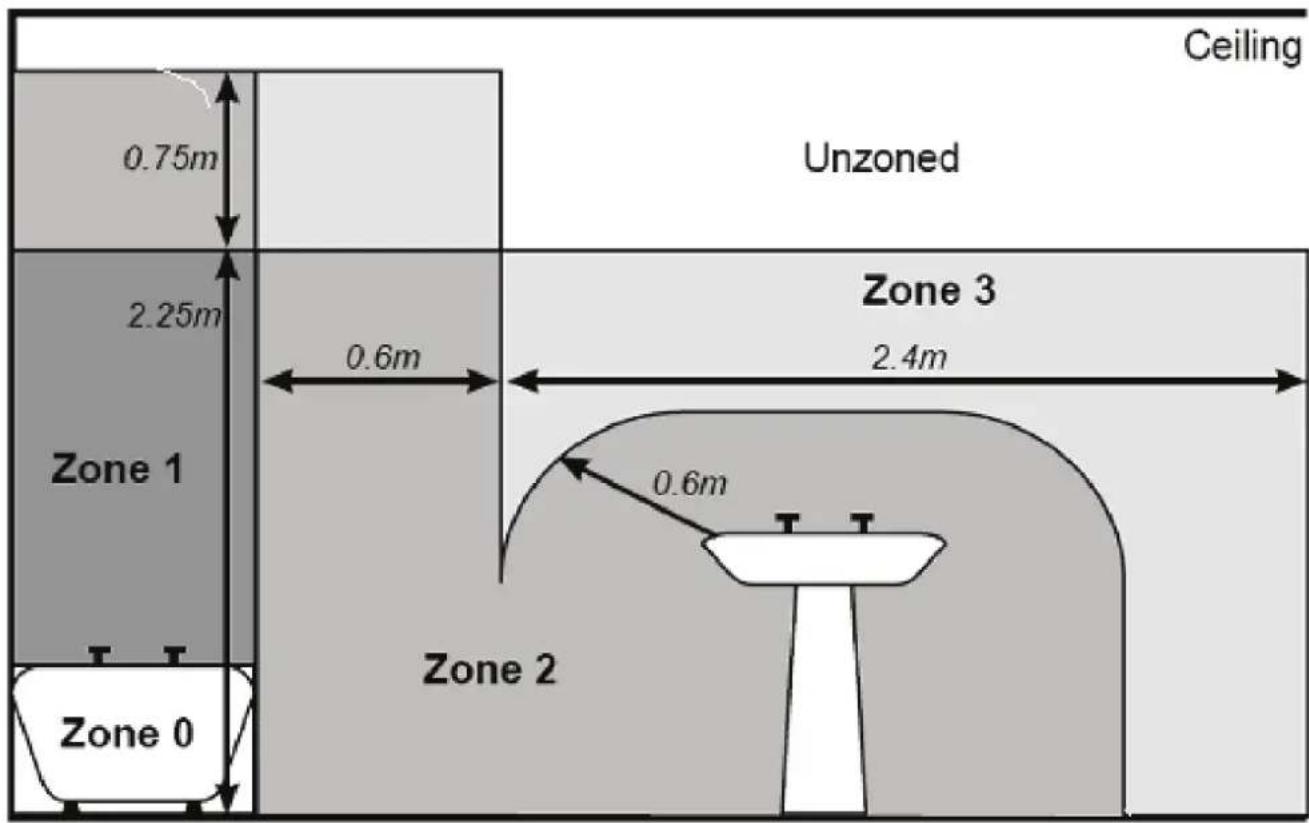
text_image
Ceiling 0.75m Unzoned 2.25m Zone 1 0.6m Zone 3 2.4m 0.6m Zone 2 Zone 05. INSTALLATION INSTRUCTIONS
5.1 FITTING THE BOILER
Decide where the boiler is to be fixed on the wall taking into acc unt the information given in the last chapter including the boiler clearances.
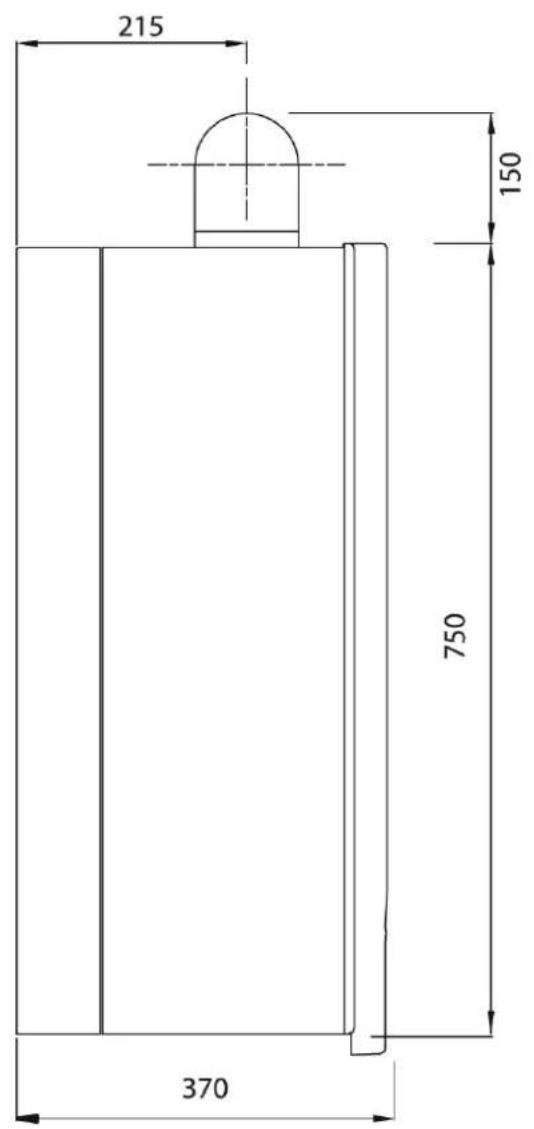
The centres for the hanging strap fixing are 65mm below the top of the boiler casing, see fig below. The flue pipe centre is 166mm above the hanging strap centres. NOTE: a fall of about 2° - 3° should be allowed to ensure that condense flows back along the flue and into the boiler.
A screw fixing should be made on the bottom rail of the boiler to secure it during transport.
text_image
215 150 750 370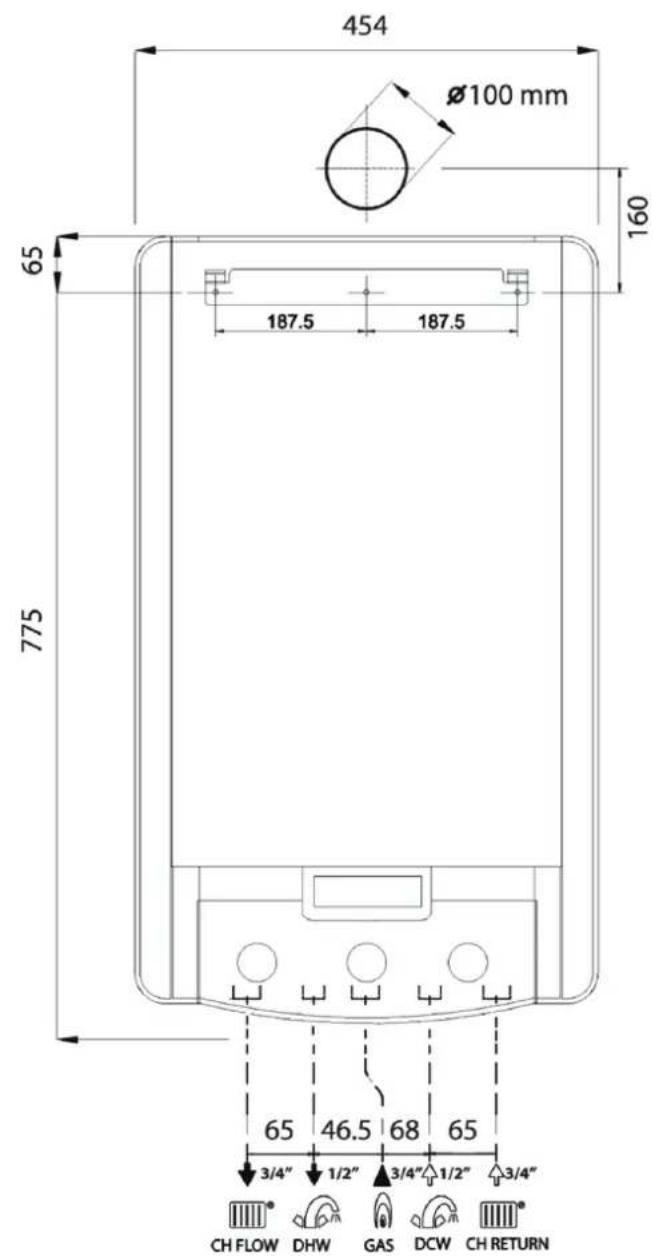
text_image
454 Ø100 mm 160 65 187.5 187.5 775 65 46.5 68 65 3/4" 1/2" 3/4" 1/2" 3/4" CH FLOW DHW GAS DCW CH RETURN5.2 GAS AND WATER CONNECTIONS
Connect the boiler up in such a way as to leave the connecting pipes self supporting and free from any stress. The Gas pipe must be supported by a clip to the bulkhead.
Check the gas pipe complies with the requirements in section 4.5.
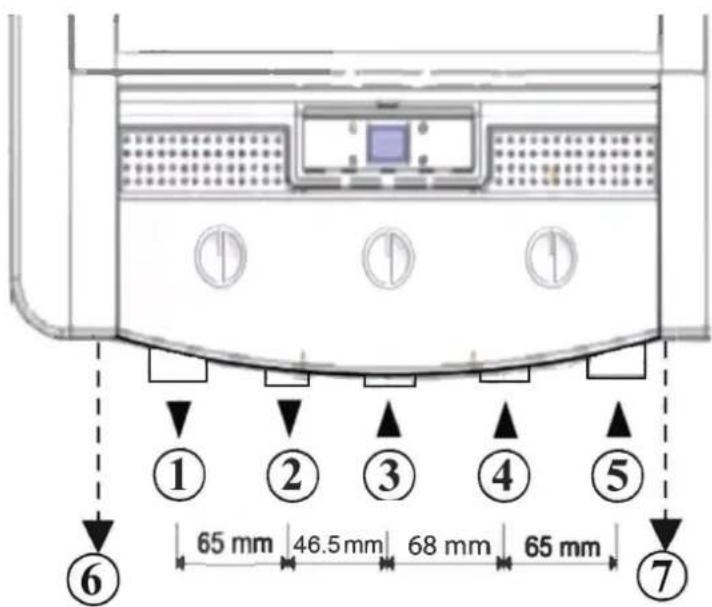
Gas and water connections are made to the boiler as in the diagram below:
text_image
① ② ③ ④ ⑤ 65 mm 46.5 mm 68 mm 65 mm ⑥ ⑦- CH Flow - 3/4'' BSP
- DHW Outlet - 1/2'' BSP
- Gas Inlet - 3 14 BSP
- DHW Inlet (mains) - 1/2" BSP
- CH Return - 3 14 BSP
- Condensate Drain
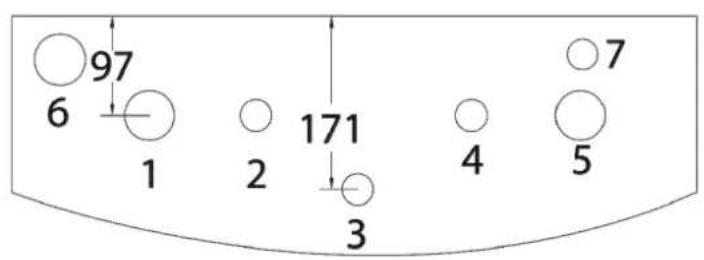
- Pressure Relief - 15mm copper stub pipe
bar
| Category | Value | |---|---| | 1 | 97 | | 2 | 171 | | 3 | | | 4 | | | 5 | 7 |5.3 WIRING INSTRUCTIONS
Warning: observe the usual precautions to ensure that the electricity supply is isolated before commencing any installation or service work.
The appliance is fitted with a 3 amp. fused 3 pin plug for use with 230 V\~50Hz. It should be fitted to a shuttered socket outlet complying with BS 1363. If the appliance needs to be wired to a fused spur (for example in a bathroom) then the 3 pin plug should be removed and fitted to a double pole type 3A fused spur.
WARNING: THIS APPLIANCE MUST BE EARTHED.
Room Thermostat/Time Clock/Programmer
This appliance may be used in conjunction with an external control device.
This device MUST HAVE a volt free contact used to switch the boiler on and off. If mains voltage enters the boiler via the control device terminals then BOILER DAMAGE WILL OCCUR. If in doubt contact a qualified electrician.
For the connection of a control device proceed as follows:
- Remove front casing
- Lower control box by removing the 2 side screws
- Undo the 2 screws securing the connection cover panel.
- Remove the link wire (coloured blue as below)
- Connect volt free heating control switch wire
If fitting a room thermostat, it must be installed on a wall which is free from any objects and free from sunlight or draughts.
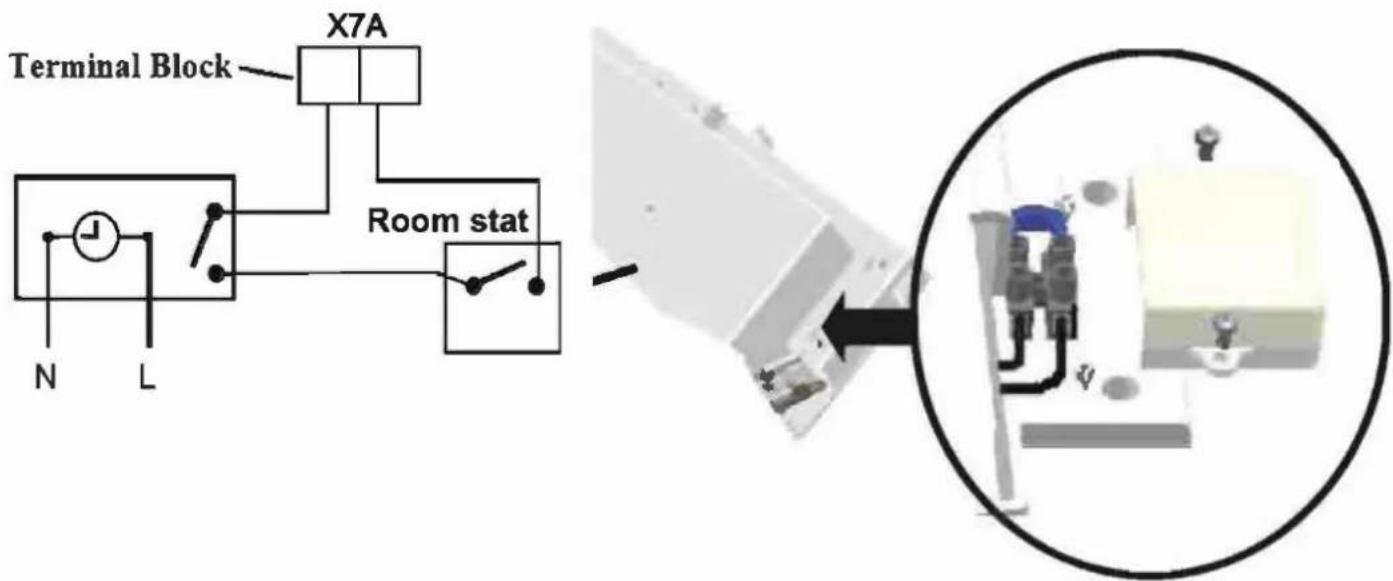
text_image
Terminal Block X7A Room stat N LIt is possible to fit a 230VAC Thermostat/Time Clock/Programmer – Please contact Morco for advice on how to install.
5.4 AIR/FLUE SYSTEM
The flue system is a part of the appliance and is approved as such. Use only flue systems supplied by Morco that are approved for use with this boiler. Both horizontal and vertical flues can be used with these boilers. The following maximum flue lengths apply. These are based on the use of one elbow for the horizontal flue and no elbows for the vertical flue.
| Flue Type | Model | Maximum Flue Length |
| Horizontal | 24CPM | 7m |
| Horizontal | 30CPM | 4m |
| Vertical | 24CPM | 8m |
| Vertical | 30CPM | 5m |
Each 90 degree elbow added to the flue decreases the maximum length available by 1m. Each 45 degree elbow added to the flue decreases the maximum length available by 0.5m. Please contact Morco for more details when designing flue kits.
The horizontal flue pipe may be cut down to the length required.
The flue must be fitted with a 2^ or 3^ downwards incline towards the boiler to ensure condense flows back into the boiler.
In cold or humid weather, water vapour in the flue gas may condense when leaving the flue terminal. Care must be taken when locating the boiler to avoid plumbing causing nuisance to the occupier of the adjacent property.
The installer must ensure that an adequate seal is formed between the inner and outer pipe and the corresponding part in any elbow or connector. The connection can be eased by the use of silicon based lubricant. Normal grease/oil or sealant are not allowed.
The black plastic terminal must be positioned with the rain shield to the top on the horizontal flue system.
The air/flue terminal must be exposed to the external air and allow free passage of air across it at all times.
The minimum acceptable dimension between the terminal and obstructions/openings are outlined in chapter 4.2. For domestic and Park homes refer to BS5440.
5.5 CONDENSATE TRAP
All condensing boilers generate condensate discharge. The amount of condensate water depends on the working conditions of your appliance. This can be up to 1.7 litres per hour.
A plastic discharge pipe should be fitted to the outlet pipe of the condensate trap using the black rubber connector provided and the pipe should run into the drain point. Only plastic materials are suitable.
If the pipe work is not terminated within the Caravan Holiday Home or Park Home any external pipes must be insulated against freezing and increased to a 32mm diameter. Pipe work runs should be kept to the minimum possible. All horizontal pipes must be connected at a slight 2 or 3 degree downwards incline to ensure a good flow.
Before connecting the flue the condensate trap must be filled with water. This is achieved by tipping 1 litre of water into the INNER flue terminal on top of the boiler as below. This prevents the risk of products of combustion escaping into the dwelling. Take care when filling the condensate trap if the drain pipe is not already connected.
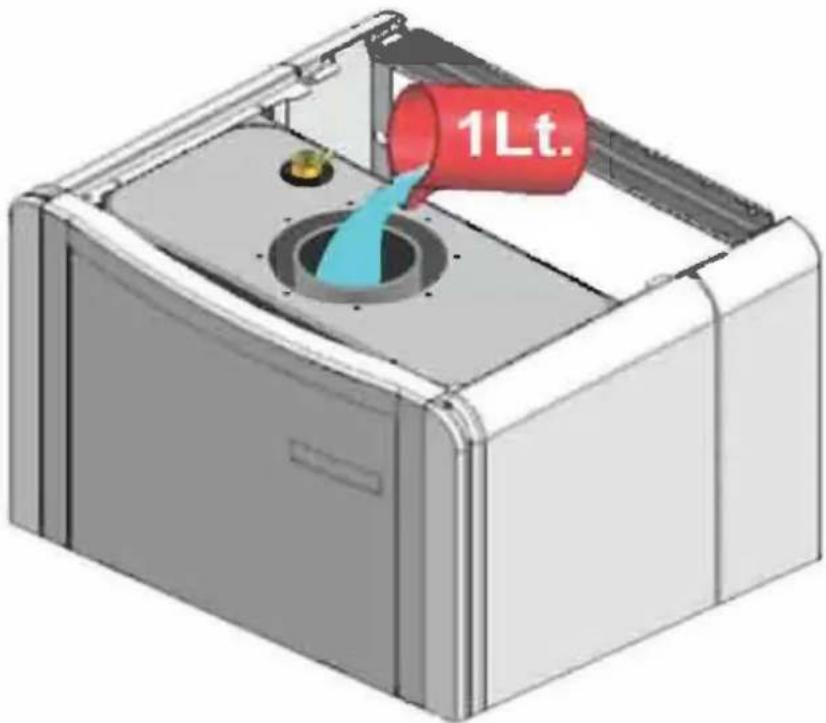
natural_image
3D rendering of a mechanical device with a red cylindrical component labeled '1Lt.' pouring liquid into a circular opening (no text or symbols beyond label)5.6 CONDENSATE DRAIN TERMINALS
National and local requirements for the connection of the condensate trap to drains should be taken account of. There are 2 suggested ways of draining the condensate for a Caravan Holiday or Park Home. One is to drain into the waste pipe under the home as below and the other is to drain into a soak away, details of which are on the following page.
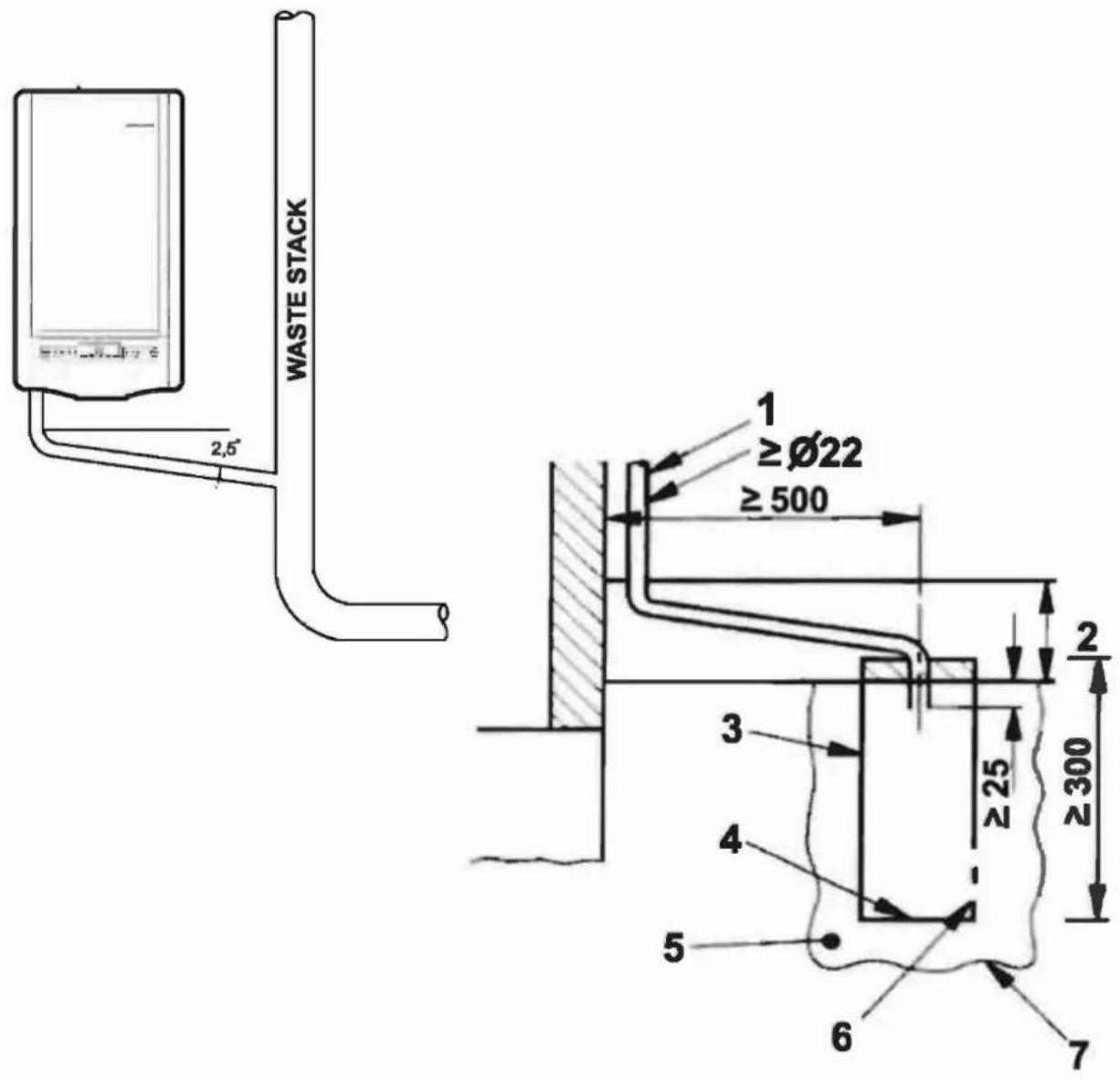
text_image
WASTE STACK 2,5" 1 ≥Ø22 ≥500 2 3 4 ≥25 ≥300 5 6 7Soak Away Key
- Condensate pipe
- Section of pipe above or below ground
- 100mm diameter pipe
- Bottom sealed
- Limestone chippings
- Two rows of 12mm holes at 25mm centres
- Minimum hole size 400mm deep x 300mm wide
6. COMMISSIONING
During commissioning the appliance, the following should be checked:
- Gas Supply
- Water Supply
- CH Circuit
- Condensate Trap
- Flue Connections
- Electrical Circuit
- Flue gas Analysis
IMPORTANT: Open all doors and windows, extinguish naked lights, and DO NOT SMOKE whilst purging the gas line.
Before commencing the commissioning procedure, ensure that the central heating system and the domestic hot and cold water system have been flushed. This will remove contamination which could block the filters fitted to the cold inlet and C.H. return connections resulting in incorrect functioning of the boiler.
6.1 GAS SUPPLY
The whole gas installation including the meter (if fitted) MUST be purged and tested for gas soundness. Check the supply inlet pressure to the boiler is correct for the type of gas used.
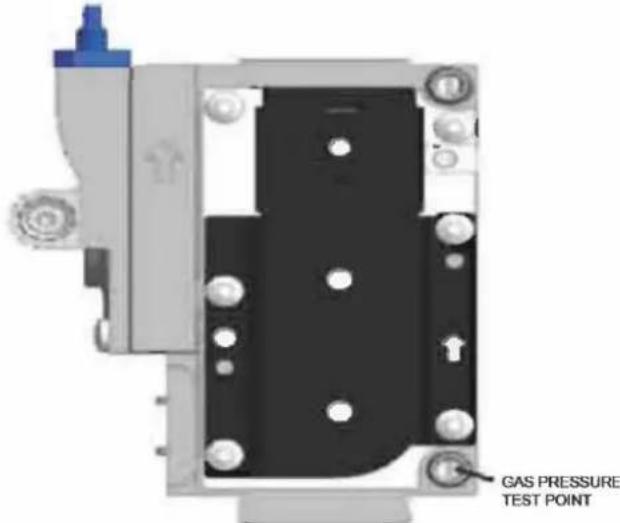
text_image
GAS PRESSURE TEST POINT6.2 DOMESTIC HOT WATER
• Turn on the mains cold water isolation valve.
- Fill and vent the installation by turning on hot and cold water taps.
• Make sure that there are no leaks in the installation.
6.3 CENTRAL HEATING CIRCUIT
In order for the boiler to function correctly, the pressure in the central heating circuit must be between 1.0 and 1.4 bar when cold. This can be seen by pressing the button on the control panel and reading the value on the LCD display. The pressure can be increased by the use of the filling loop – refer to 4.6. The central heating circuit should be filled with a mix of water and at least 25% antifreeze/inhibitor. In environments were temperatures drop below -11 deg Celsius this percentage should be higher, with a maximum concentration of 40%. The concentration of anti freeze / inhibitor should be checked using a refractometer.
Both the boiler and the central heating installation should have been purged of any air in the CH circuit which may cause noise/malfunctions/damage to the boiler. The boiler is fitted with two automatic air vents:
- One is located on the pump
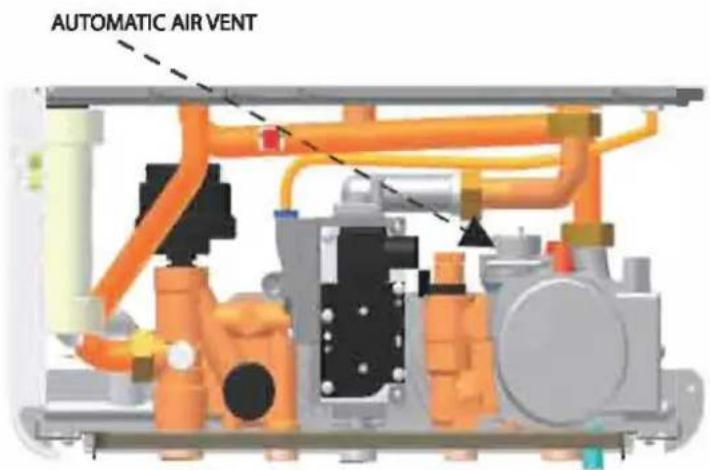
text_image
AUTOMATIC AIR VENT- The other is located externally on top of the boiler
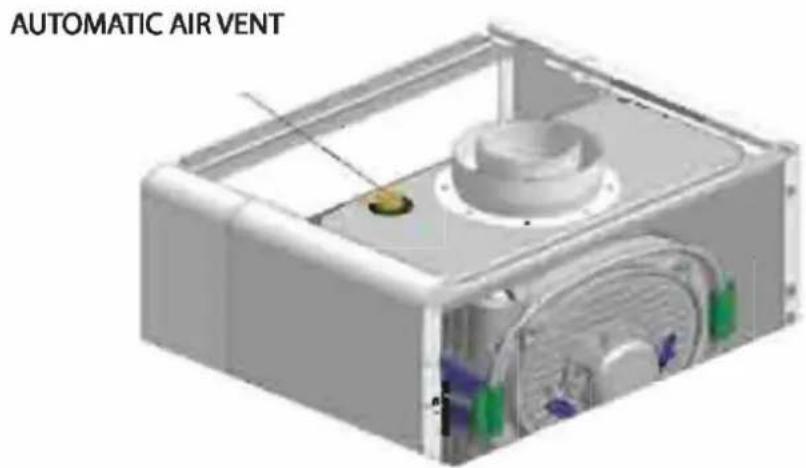
text_image
AUTOMATIC AIR VENTAlways ensure that both the caps on the automatic air vents are loose prior to commissioning.
6.4 CONDENSATE TRAP
Ensure the trap is full with 1 litre of water. (See 5.5.)
Ensure all connections are water tight and that the condensate discharge pipe is correctly installed (see 5.6.).
6.5 FLUE CONNECTIONS
Ensure that the flue has a fall of 2-3 degrees back towards the boiler.
Make sure that the air intake and the flue outlet are not blocked.
6.6 ELECTRICAL CONNECTIONS
Checks to ensure electrical safety should be carried out by a qualified person
ALWAYS carry out the preliminary electrical system checks, i.e. earth continuity, polarity, resistance to earth and short circuit using a suitable test meter.
If the boiler is on a metered gas supply carry out a gas rate test at the gas meter. The boiler needs to be in service mode which is achieved by turning the CH knob on the front panel fully clockwise and the service LED will now be on. Turn the knob counter clockwise and then fully clockwise again and the service LED will flash. The boiler is now set in “high-rate” service mode. Turn on the hot water tap and carry out a gas rate test at the gas meter. The gas consumption should be as below within a tolerance of 5%. If the reading is outside of this range then, with the use of a flue gas analyser, refer to gas valve adjustment in chapter 7.
| Gas Consumption | 24CPM | 30CPM | Unit |
| Natural Gas (max load) | 2.38 | 2.92 | m^3/hour |
| Natural Gas (min load) | 0.71 | 0.88 | m^3/hour |
| Propane (max load) | 1.77 | 2.17 | kg/hour |
| Propane (min load) | 0.64 | 0.77 | kg/hour |
If no meter is available or the boiler is on bottled gas then, with the use of a flue gas analyser, refer to gas valve adjustment in the chapter 7.
To turn on the boiler follow the user instructions at the front of this manual.
Whenever a hot tap is opened the boiler automatically fires up to deliver hot water. The temperature selector control should be set at maximum. If the ambient water temperature is high (as in a hot climate) then the hot water temperature may be reduced by using this knob.
Central heating
Set the timer/thermostat/programmer so that the boiler will fire in CH mode. Refer to chapter 1 User Instructions to operate the CH circuit.
The central heating temperature control knob allows water temperature of between 30 and 80°C to be selected. The boiler will remain on until:
- The temperature selected on the thermostat/programmer is reached
- The temperature selected on the boiler CH control knob is reached
- The timer switches the boiler off.
6.9 FAULT CODE/LOCK OUT
If the boiler develops a fault the reset button will show red and a fault code will show on the LCD panel. See Fault codes in chapter 9 for further details.
To reset the boiler after a fault, press the reset button and it should change from red to either:
• Clear if the boiler is unlit or
• Blue if the boiler is lit.
6.10 FINAL CHECKS
• Re-light and test for gas soundness
- Set the C.H. and D.H.W. temperature selectors to the required settings.
- Ensure that the timer/thermostat/programmer are set to the required settings.
6.11 USER INSTRUCTIONS
Upon Commissioning of the boiler the engineer should:
- Give the 'users Instructions' to the owner and emphasise their responsibilities under the "Gas Safety (Installation and Use) Regulations 1998"
- Explain and demonstrate the lighting and shut down procedures.
- Advise the owner on the efficient use of the system, including the use and adjustment of all system controls for both D.H.W. and C.H.
- Advise the user of the precautions necessary to prevent damage to the system, and to the home, in the event of the system remaining inoperative during frost conditions.
- Explain the function of the boiler safety devices, fault codes and how to reset them. Emphasise that if fault codes and lock outs persist, the boiler should be turned off and a Gas Safe Engineer consulted.
- Stress the importance of an annual service by a competent Gas Safe Registered Engineer.
7. ROUTINE SERVICING
To ensure continued efficient operation of the appliance, it is recommended that it is checked and serviced as necessary at regular intervals. The frequency of servicing will depend upon the particular installation conditions and usage but in general once a year should be adequate.
It is the law that any service work must be carried out by a gas safe registered engineer.
7.1 Front Cover Removal
Remove 2 screws at the bottom of the front panel
Pull forward at the bottom to disengage catches then lift the cover off the pins at the top of the boiler.
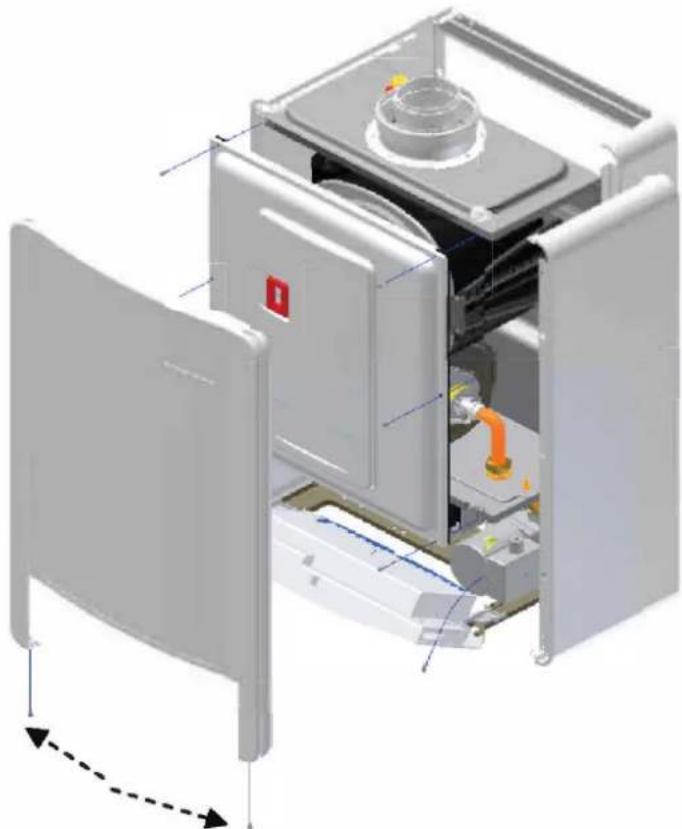
natural_image
3D cutaway view of a white industrial machine showing internal components and assembly (no text or symbols visible)7.2 Servicing Schedule
Before commencing any service operation, ISOLATE the mains electric supply, and TURN OFF the gas supply at the main service cock. Service the appliance by following the full procedure detailed below.
-
Run the boiler in DHW mode and CH mode and carry out a pre service check, noting any operational faults.
-
Check the combustion performance whilst running in DHW mode at maximum output, if suitable equipment for flue gas analysis is available. (Note: the flue sampling point can be found on the flue turret elbow. For correct boiler operation the CO/CO2 ratio should not be greater than 0.004). If this is not the case then refer to gas valve adjustment in section 7.3
-
Check that the DHW filter is not blocked.
-
Check that the flue terminal is unobstructed and that the flue system is sealed correctly.
-
Remove the fan and burner assembly. Inspect, and if necessary, clean the main burner using a soft brush or vacuum cleaner. Do not use a wire brush or any abrasive materials.
-
Remove ignition and ionization electrodes. Inspect and clean as necessary using a soft brush. If either of the electrodes show signs of damage or wear, replace the electrode and its gasket. Measure electrode separation as below:
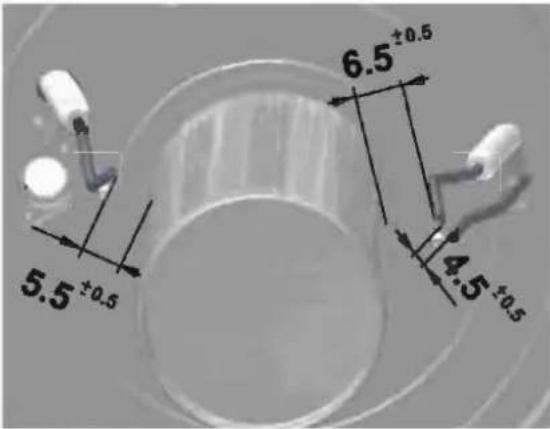
text_image
5.5 ±0.5 6.5 ±0.5 4.5 ±0.5-
Remove the fan and burner assembly. Inspect the inside of the combustion chamber and if necessary clean the inside of the tubes with a soft brush. Do not brush the insulation at the rear, check the combustion chamber insulation panels for damage and replace if necessary
-
Remove the burner injector/gas restrictor. Inspect the injector for blockage or damage and clean/replace as necessary.
-
Remove the condensate trap bottom cleaning nut. Drain/clean as necessary
Important Notes:
In order to carry out servicing or replacement of parts the boiler front panel and sealing panel must be removed, care must be taken to refit and seal correctly.
After completing the servicing or exchange of gas components, always test for gas soundness of any disturbed joints or test points by means of a tightness test or leak detection fluid as appropriate.
When work is complete the boiler front panel & sealing panel must be replaced, ensuring a good seal is made.
7.3 Gas Valve Adjustment
- Connect the flue gas analyser to the sampling point which is located on the turret of the air/flue system
- Operate the boiler at maximum load (see section 7.4 Service Mode).
- Be sure that boiler is running at maximum load (→ maximum fan speed).
- Wait approximately 4 minutes for the stabilisation of the values.
- Check the CO2 value against the Setting Values Table below
- If the CO2 value is not in the range (±0.2), gas valve adjustment is necessary.
- Turn the flow adjustment screw (see figure below) with 2.5 mm allen key counterclockwise (in direction +ve) to increase or clockwise (in direction -ve) to decrease gas flow (CO2 value) to the burner.
- Adjust the required CO2 value (±0.1) according to the setting values table.
- Wait for the stabilization of the values
- Operate the boiler at minimum load (see section 7.4, Service Mode).
- Be sure that boiler is running at minimum load (→ minimum fan speed).
- Wait approximately 4 minutes for the stabilization of the values.
- Check the CO2 value against the Setting Values Table below
- If the CO2 value is not in the range (±0.2) gas valve adjustment is necessary.
- Turn the offset adjustment screw with 2.5 mm allen key clockwise (in direction +ve) to increase or counter-clockwise (in direction -ve) to decrease minimum CO2 value.
- Wait for the stabilization of the values.
- Recheck the values at maximum load and minimum load because each adjustment changes the previous setting value (See the flow adjustment and offset adjustment graphs below.
Setting Values
| Boiler Model | Natural Gas | Propane | ||||
| Fan Speed (rpm) | CO2 (%) | O2 (%) | Fan Speed (rpm) | CO2 (%) | O2 (%) | |
| Morco 24CPM | 1620 | 8,7 ( ± 0,1) | 5,6 ( ± 0,2) | 1860 | 10,0 ( ± 0,1) | 5,7 ( ± 0,2) |
| 4680 | 9,3 ( ± 0,1) | 4,5 ( ± 0,2) | 4440 | 10,8 ( ± 0,1) | 4,4 ( ± 0,2) | |
| Morco 30CPM | 1620 | 8,5 ( ± 0,1) | 6,1 ( ± 0,2) | 1860 | 9,7 ( ± 0,1) | 6,2 ( ± 0,2) |
| 4800 | 9,0 ( ± 0,1) | 5,1 ( ± 0,2) | 4440 | 10,8 ( ± 0,1) | 4,4 ( ± 0,2) | |
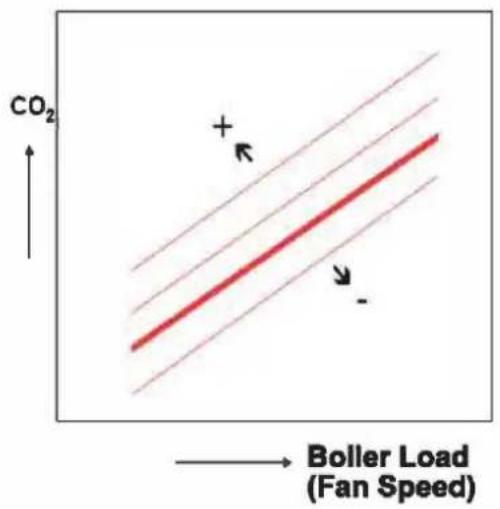
text_image
CO₂ + - Boller Load (Fan Speed)a) Flow Adjustment
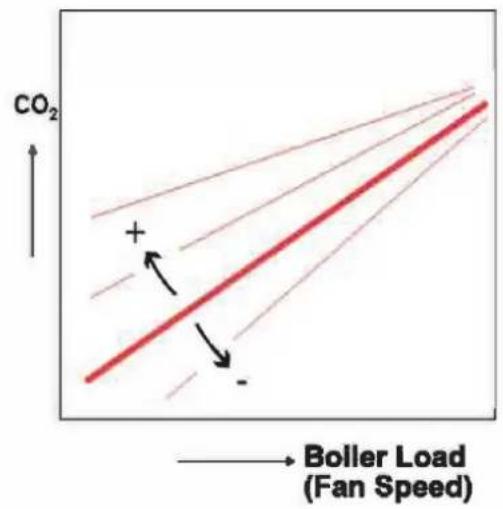
text_image
CO₂ + - Boller Load (Fan Speed)b) Offset Adjustment
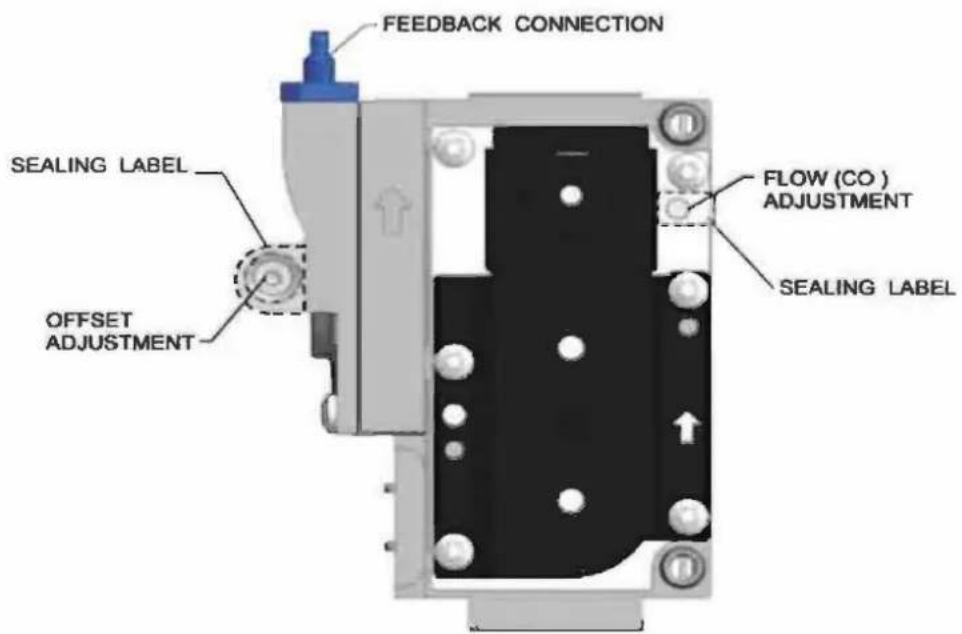
text_image
FEEDBACK CONNECTION SEALING LABEL OFFSET ADJUSTMENT FLOW (CO ) ADJUSTMENT SEALING LABEL7.4 Service Mode
- Turn the CH knob fully clockwise. Status LED Service will be ON
• After the soft start time ends, the boiler will run at the minimum load. - To operate the boiler at the maximum load, turn the CH knob to the off position and back again to the service mode position within 3 seconds. (If the CH knob stays in off position, the main board will cancel the service mode). The status LED Service will blink to indicate the maximum load.
• Service mode will be inactive after 10 minutes. - It is possible cancel the soft start function by turning the CH knob to the off position and back again to the service mode position within 3 seconds.
8. COMMON PROBLEMS AND FAULT CODES
8.1 Common problems
- Hot water temperature at the taps is reduced. This may be because the temperature of the mains cold water supply is colder during the winter period.
- The gas supply to the boiler has run out, or is about to run out. Near empty propane gas bottles will supply enough gas to run low power appliances such as cookers and gas fires, but will fail to supply high powered appliances such as the combination boiler.
- During busy periods, the mains cold water supply to the boiler may be subjected to variations in pressure, this will result in fluctuations in the hot water temperature at the hot water outlet.
- If the mains power supply to the boiler has been interrupted or turned off, then the time clock/programmer (if fitted) must be reset to the correct time, if the boiler is to be operated in the timed sequence in central heating mode.
8.2 Fault Codes
The Morco 24 CPM and 30 CPM Boilers have a self diagnostic system built into their printed circuit board. Should a fault for safety related or other reasons occur, then the boiler will failsafe by locking out, which is indicated by the red LED on the control panel. The fault can be identified by the code in the LCD display. The electronic failsafe is also backed by a mechanical means of protection, should the electronics fail to detect a fault.
These mechanical forms of protection will protect and ensure the safe shut down of the boiler. The software protection built into the P.C.B. will run a system check on components which are essential to the safe operation of the boiler. This occurs before any ignition sequence takes place, if any component is found to be faulty or out of a predetermined range, the boiler will lockout with the fault code displayed on the LCD screen. Each Fault will comprise a number. NOTE: The red LED stays on constantly until the reset button is pressed.
Fault conditions can be divided in 2 groups:
1. Lockout Conditions
- Lockout flue gas over heat
- Lockout boiler over heat
- No flame signal
- Flame loss
- Flame simulation
• Failure flow-return supervision
• Failure gas valve circuit V1/V2 - Failure fan speed
These fault codes can only be cleared by pressing the reset push-button, then display panel will be in stand-by mode. While in lockout conditions, Burner LED will turn RED.
2. Blocking Conditions
- Boiler over heat
• Failure CH flow sensor (NTC)
• Failure flue gas sensor (NTC)
• Failure CH return sensor (NTC) - Failure power supply
- Failure water pressure
These fault codes will reset as soon as the cause of the problem disappears. For example, when CH water pressure is out of operating range, blocking condition will be generated and keep the system off until the pressure is within operating range again.
8.3 Lockout Conditions and Solutions
| Error code | Cause | Solution - Check list |
| NO LCD display | Lack of electricity. | Power supply connections. Check➢ On / off switch is ON➢ 3 amp fuse in fuse spur or 4amp fuse PCB |
| 07 | Lockout fluc gas overheatThe fluc gas sensor sensed (over 105 °C.) | Lack of circulation, Check➢ Flow & Return isolation valves are open.➢ Full TRV system have a by-pass➢ By-pass settings➢ Pump failure or set to maximum 3 setting➢ Faulty Flue gas NTC or wire detached |
| 07 | Lockout boiler overheatCH flow temp. has exceeded 105 °C or CH return temp. exceeds 90 °C | - Lack of circulation, Check➢ Flow & Return isolation valves are open.➢ Full TRV systems have a by-pass➢ By-pass settings➢ Pump failure or set to maximum3 setting➢ Faulty Flow / return NTC or wire detached |
| 06 | Boiler overheatCH flow temp has exceeded 95 °C or return temp. exceeds 90°C, | ➢ Boiler will remain in this error mode until flow temperature drops into operating range. |
| 12 | Heat exchanger overheat statThermal cut-off 160 °C may have operated. | ➢ Check Thermal cut out in heat exchanger for continuity. |
| 13 | Flue gas NTC Open circuit | If boiler is cold -➢ Check wiring has not become disconnected or Sensor has been damaged.➢ Replace NTC |
| Error code | Cause | Solution |
| 15 | Outside sensor fault (if fitted) | ➢ Check wiring and sensor. Replace X7B link on PCB to check |
| 16 | Failure CH return sensor (NTC) | ➢ Check wiring has not become disconnected or Sensor has been damaged. |
| 04 | No flame detection after 3 ignition attempts | Press the reset push-button & Check➢ Gas supply to boiler.➢ Condensate drain is not blocked➢ Wires to Gas Valve, Ignition / detection probes➢ Look for flame through sight glass - if present check detection probes, replace PCB |
| 05 | Flame loss during operation | Press the reset push-button & Check➢ Inlet gas pressure➢ Detection probes / lead |
| 11 | Flame SimulationFlame signal is seen without the gas valve being open. | Press the reset push-button➢ Check ignition & detection leads connected➢ Gas valve may be passing gas- turn off supply and test |
| 32 | Failure power supplyLow Mains voltage (under 160 Vac) | ➢ System stays in blocking condition until Mains voltage is back to nominal value. |
| 40 | System pressure is less than 0,4 bar or Water pressure sensor is damaged or not connected. | ➢ Re-pressurise system to 1 bar cold, Check circuits for leaks.➢ Check water pressure switch |
| 42 | Flow-return supervisionInsufficient or no water flow (dry run protection).The pump is not operating correctly.CH flow or CH return NTC may be damaged | Check.➢ CH Flow and return valves are open.➢ Pump is operating & set to speed 3➢ Flow / return NTC wiring is connected |
| 20 | Failure gas valve circuit V1/V2 | ➢ Check wiring to gas valves, replace valve |
| 24 | Failure fan speedThe fan speed is out of operating range. | ➢ Check wiring to fan➢ Fan or PCB failure |
| 41 | Reverse temperature supervisionReturn temperature exceeded flow by 12 °C for more than 5 seconds.Will not reset until return temperature falls below flow temp.by 6 °C. | ➢ Flow & return pipework crossed➢ Flow or return NTC disconnected |
| 99 | System errorDefective electronic board. | ➢ Replace PCB |
9 .WARRANTY CONDITIONS
The boiler is guaranteed against manufacturing defects for a period of one year from the date of first commissioning. However the guarantee is subject to proof of commissioning in accordance with the gas safety (Installation and Use) act. 1998.
The guarantee does NOT cover the following issues:
- Frost damage to any part of the boiler containing water during freezing conditions.
- The removal of sludge or hard water scale due to lack of antifreeze/inhibitor or water quality.
• Damage to electronics caused by a defective electrical supply. - Damage or failure caused by insect contamination or blocked water filters.
- Loss off pressure within the heating system not caused directly by the boiler.
- Incorrect operation of the boiler caused by defective outlets such as thermostatic mixers or mono block mixer taps.
- Damage caused by unauthaurised modifications to the boiler from original specifications.
For more detailed servicing information, workshop manuals, technical advice, spare parts, product training, please contact us at the address below.
MORCO PRODUCTS LTD Morco House, Riverview Road, Beverley, East Yorkshire HU17 0LD TEL: 01482 325456 FAX: 01482 212869 EMAIL: sales@morcoproducts.co.uk www.morcoproducts.co.uk