MUF987S - Freezer MATSUI - Free user manual and instructions
Find the device manual for free MUF987S MATSUI in PDF.


User questions about MUF987S MATSUI
0 question about this device. Answer the ones you know or ask your own.
Ask a new question about this device
Download the instructions for your Freezer in PDF format for free! Find your manual MUF987S - MATSUI and take your electronic device back in hand. On this page are published all the documents necessary for the use of your device. MUF987S by MATSUI.
USER MANUAL MUF987S MATSUI
Model MUF987W/MUF987S
natural_image
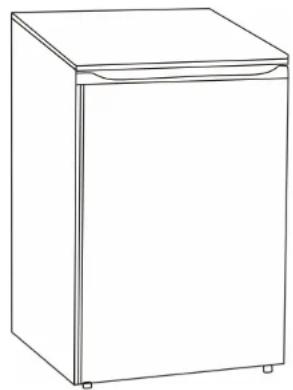
Line drawing of a simple refrigerator with lid and frontrest (no text or symbols)Instruction Book
Introducing Your New Freezer Install Your New Freezer
Before use
Please read these instructions carefully before using your new Matsui Freezer.
The Freezer is for indoor, domestic use only.
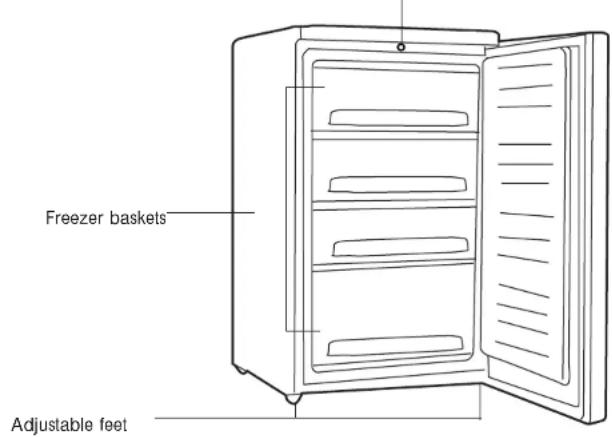
Thermostat control dial
text_image
Freezer baskets Adjustable feetLocation
When selecting a position for your Freezer you should make sure the floor is flat and firm, and the room is well ventilated with an average room temperature of between 16°C and 32°C. Avoid locating your Freezer near a heat source, eg. cooker, boiler or radiator. Also avoid direct sunlight in lean-to's or sun lounges. If you are placing your Freezer in an outbuilding such as a garage or annex ensure that the Freezer is placed above the damp course, otherwise condensation will occur on the Freezer cabinet. Never place the Freezer in a wall recess or into fitted cabinets or furniture.
hot or alternatively the sides may become hot (hidden condenser models)
Moving the Freezer
Your Freezer has two wheels at the rear. The easiest way to move the Freezer is to tip it backwards just far enough to lift the front feet off the ground and roll it into position.
Levelling the Freezer
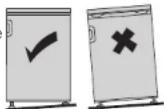
Unscrew the packaging support from the base of the Freezer and replace with the 2 Levelling Feet. Make sure the Freezer is level. Use the Levelling Feet at the front. If the Freezer is not level, the doors and magnetic seal alignments will be affected.
Cleaning before use
Wipe the inside of the Freezer with a weak solution of bicarbonate soda. Then rinse with warm water using a 'wrung-out' sponge or cloth. Wash the baskets and shelves in warm soapy water and dry completely before replacing in the Freezer. The external parts of the Freezer can be cleaned with wax polish. If you require more information refer to Cleaning on page 6.
Before plugging in YOU MUST
Check that you have a socket which is compatible with the plug supplied with the Freezer. If not, please consult a qualified person to correct.
Before switching on!
DO NOT SWITCH ON UNTIL TWO HOURS AFTER MOVING THE FREEZER. The coolant fluid needs time to settle.
Getting Started
Switching on your Freezer
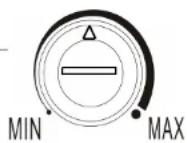
1 Before connecting the Freezer to the mains supply make sure that the thermostat control dial is set at position in the MIN of MAX and MIN which is Off.
2 Turn the thermostat knob clockwise to set it to the desired position, bear in mind that the higher the number position, the colder the temperature.
3 To ensure that the Freezer is cool enough to sufficiently freeze your food wait 24 hours before filling with food.
Adjusting the temperature
The internal temperature of your appliance is controlled by a n or fo thermostat. Max Position makes the appliance colder and is used for fast freezing (see fast freezing section). The recommended position is between Min and Max but should be adjusted according to its environment. The appliance may not operate correctly if it is in a particularly hot or cold room or if the door is opened often or for prolonged periods.
Thermostat
control dial
Fast Freezing
Fresh food should be frozen as quickly as possible. Setting MAX makes your Freezer operate continually and get colder (approx minus 28°C). It will therefore freeze quicker and retain more of the goodness in food. Freezing will be complete after 24 hours. Turn the thermostat control dial back to position 2-3, to allow the freezer to return to its normal temperature (-18°C). Never freeze large quantities of fresh food at one time.
Noises inside the Freezer!
If you have not owned a fridge or freezer before, you may notice that it makes some rather unusual noises.
Most of these are perfectly normal, but you should be aware of them! prolonged periods.
GURGLING, WHOOSHING
These noises are caused by the circulation of the refrigerant liquid in the cooling system. It has become more pronounced since the introduction of CFC free gases. This is not a fault and will not affect the performance of your Freezer.
HUMMING, PURRING OR PULSATING
This is the compressor motor working, as it pumps the refrigerant around the system.
Is the Freezer cold enough?
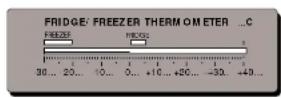
If you are at all concerned that you Freezer is not being kept cold enough, or you occasionally wish to check the temperature, you can purchase a Fridge/ Freezer thermometer. These are available from most supermarkets and hardware shops. Place the thermometer in the Freezer where it can be easily read. Leave overnight, the correct temperature should be between -18°C or lower. See 'Adjusting the temperature'.
Shopping for frozen foods
Your Freezer is 4 star ★★★★
When you are buying frozen food, look at the Storage Guidelines on the packaging. You will be able to store each item of frozen food for the period shown against the 4 star rating. This is usually the period stated as 'Best Before', on the front of the packaging. The maximum freezing capacity of this appliance is 5kg in 24 hours. Please do not place fresh food into the freezer compartment exceeding this weight.
Check the freezer temperature
Check the temperature of the frozen food cabinet in the shop where you buy your frozen foods. It should show a temperature lower than -18°C.
Choose packs carefully
Take a quick look at the frozen food package and make sure it is in perfect condition.
Purchase frozen food last
Always buy frozen products last on your shopping trip or visit to the supermarket. Try to keep frozen food together whilst shopping and on the journey home as this will help to keep the food cooler.
Store food straight away
Don't buy frozen food unless you can freeze it straight away. Special insulated bags can be bought from most supermarkets and hardware shops. These keep frozen food cold for longer.
In Use
Tips for keeping food perfect in the Freezer
Shut the door!
To prevent cold air escaping, try to limit the number of times you open the door. When returning from shopping, sort foods to be kept in your Freezer while the door is closed and only open it to put food in or take food out.
Freezing fresh foods
Useful tips
Use quality food and handle it as little as possible. Freeze food in small quantities, it freezes faster, takes less time to thaw and enables you to eat it in the quantity you need.
What not to freeze
Fruit, Fresh Vegetables, Bottled Liquids, carbonated liquids" to be checked.
NOTE: DO NOT STORE INFLAMMABLE GASES OR LIQUIDS.
Preparations for freezing
- Leave cooked food to cool completely.
- Chill food in a Fridge before freezing
- Consider how you will want to cook the food before freezing it.
- Don't freeze food in metal containers if you may want to microwave it straight from the Freezer.
- Use special freezer bags available from supermarkets, freezer film, polythene bags, plastic containers, aluminium foil (heavy grade only, if in doubt, double wrap). Don't use aluminium foil for acidic foods (such as citrus fruits). Don't use thin cling film or glass. Don't use used food containers (unless cleaned thoroughly first).
- Exclude as much air from the container as possible. You could buy a special vacuum pump which sucks excessive air out of the packaging.
- Leave a small amount of 'air space' when freezing liquids, to allow for expansion.
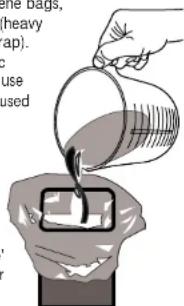
- You can use the space in the freezer most efficiently if you freeze liquids (or solids with liquids, such as stew) in square blocks. This is known as 'preforming'. Pour the liquid into a polythene bag which is inside a square sided container. Freeze it like this, then remove it from the container and seal the bag.
text_image
the bags, heavy ap). use usedLabel everything
- Many foods look the same when frozen, so careful labelling will help avoid forgetting what an item is. Storage times being exceeded could cause food poisoning.
- You can buy special freezer tape for use in low temperatures. This tape is available in white, why not use it to write the items contents on. You can buy special freezer labels and pens. Labels come in different colours which can help you use your Freezer effectively. For instance you could colour code meat red and vegetables green. Using a different colour label for each quarter of the year will help you rotate your frozen food more efficiently.
- Write the contents and date. If you are really organised add the weight and notes on cooking such as 'thaw first', or 'cook from frozen' and keep a separate 'log-book' of what is in each drawer. This will save opening the door and searching around unnecessarily, ensuring the Freezer stays cold enough.
In Use
Recommended storage periods
For recommended food storage times, refer to your food packaging.
Thawing frozen food
For some foods, thawing before cooking is unnecessary. Vegetables and pasta can be added directly to boiling water or steam cooked. Frozen sauces and soups can be put into a saucepan and healed gently until thawed.
To Thaw frozen foods
1 Cover food loosely.
2 Thaw at room temperature. Don't forget that thawing in a warm area encourages the growth of bacteria.
3 Always make sure there are no ice crystals in the food before cooking, particularly with meat. These crystals indicate that the food is not fully thawed. They result in lower temperatures when cooking. Lower cooking temperatures may not destroy dangerous bacteria.
4 Cook food as soon as possible after thawing.
5 Drain off and throw away any liquid lost during thawing.
Oven Thawing frozen foods
Many microwaves and ovens have thaw settings.
To avoid bacterial build up, only use these if you intend to cook the food immediately afterwards.
Safety Tips
- Never re-freeze anything that has thawed out unless you cook it again, to kill off harmful bacteria.
- Never re-freeze thawed shellfish.
Useful Tips
- Re-seal packs properly after removing items. This prevents drying or 'freezer burn' and a build up of frost on any remaining food
Reverse the door swing
- Ensure the Freezer is unplugged and empty.
- Adjust the two levelling feet to their highest position.
• We recommend you have someone to assist you.
Tools required
• Phillips style screwdriver
- Flat bladed screwdriver
Note: to take the door off it is necessary to tilt the Freezer backward. You should rest the Freezer on something solid and place something under the rollers so that it will not slip during the door change process.
DO NOT lay the Freezer completely flat as this may damage the coolant system.
natural_image
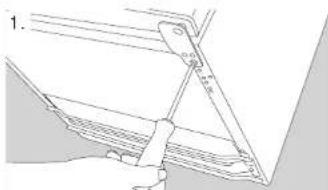
Line drawing of a hand holding a ruler above a surface with horizontal bands (no text or symbols)Undo the screws and remove the hinge bracket from the base. A spanner may be required to loosen the bolts firs
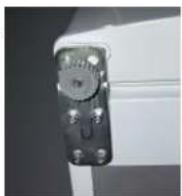
Remove the screws and bracket from the opposite side and fit back to where the hinge bracket was located.
natural_image
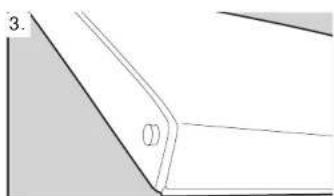
Pure geometric lines forming a corner shape without any text, numbers, or symbolsSlide the door down and off the top hinge pin and lift away from the appliance.
natural_image
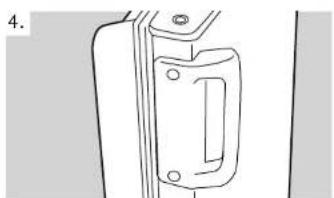
Line drawing of a door handle assembly (no text or symbols)Remove the blanking plates covering the handle screws using a flat bladed screw driver, remove the screws and then remove the handle.
natural_image
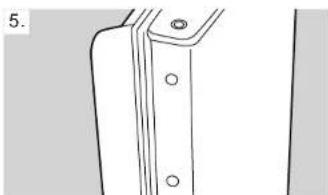
Technical line drawing of a mechanical bracket or panel with mounting holes (no text or symbols)Remove the blanking plates from the opposite side of the door and screw the handle into place. Replace all the blanking plates.
natural_image
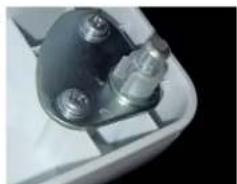
Close-up of a mechanical component with bolts and a metallic housing (no visible text or symbols)Remove screws and hinge bracket and refit on opposite side
natural_image
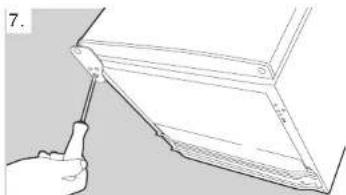
Illustration of a hand using a screwdriver to lift a wooden plank (no text or symbols visible)Slide the Freezer door back on to the top hinge, making sure it's the right way up. Screw the bottom hinge into place on the new side.
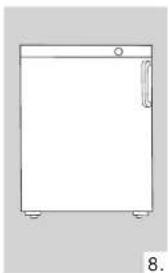
Check that door is aligned horizontally and vertically and that the seals are closed on all sides before finally tightening the bottom hinge. Re-adjust the levelling feet.
natural_image
Simple line drawing of a refrigerator with a handle and wheels (no text or symbols)Cleaning Maintenance
Defrosting
After a period of time frost will build up in the Freezer. As a temporary measure, this frost should be scraped away using a plastic scraper or other plastic kitchen implement.
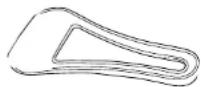
NOTE Don't use a metal or sharp instrument and do not use any electrical appliances to aid defrosting.
Complete defrosting will however become necessary approximately once per year, or if the frost layer exceeds 5cm (2") to maintain the efficiency of the Freezer. This should be carried out if the frost build up cannot be scraped away, or if it begins to interfere with the food storage. Choose a time when the stock of frozen food is low and proceed as follows:
1 Take out the frozen food, turn the Freezer off at the mains supply and leave the door open. Ideally the frozen food should be put into another freezer or refrigerator. If this is not possible wrap the food, firstly in several sheets of newspaper or large towels and then a thick rug or blanket and keep it in a cool place.
2 Place a shallow bowl or pan below the Freezer. Scrape away as much frost build up as possible using the plastic scraper. Thawing of the remainder can be speeded up by placing bowls of hot water inside the freezer cabinet and closing the door. As the solid frost loosens, prize it away with the plastic scraper and remove.
3 When defrosting is completed, clean your Freezer as described in 'CLEANING'.
Cleaning inside the Freezer
You should clean the Freezer internally with a weak solution of bicarbonate of soda. Then rinse with warm water using a 'wrung-out' sponge or cloth. Wipe the Freezer dry before replacing the baskets. Plug in and switch on the mains supply.
Cleaning the outside of the Freezer
Use standard furniture polish to clean the Freezer exterior. Make sure that the door is closed, to prevent polish getting on the magnetic door seal or inside the cabinet. The grille of the condenser at the back of the Freezer and the adjacent components can be vacuumed using a soft brush attachment.
Cleaning tips
• Defrost when food stocks are low.
NOTE Do not use harsh cleaners, scouring pads or solvents to clean any part of the Larder Fridge.
Moving your Freezer
Care when handling
Hold the Freezer around its sides or base when moving it. Under no circumstance should it be lifted by holding the edges of the top surface.
Location
Do not place your Freezer near a heat source, eg. cooker, boiler or radiator. Also avoid direct sunlight in lean-to's or sun lounges.
Levelling the Freezer
Make sure the Freezer is level. Use the rotating levelling feet at the front. If the Freezer is not level, the doors and magnetic seal alignments will be affected.
Do Not Turn on the Freezer for 2 hours
After the Freezer is in place it needs to be left for 2 hours. The coolant fluid needs time to settle.
Installation
Warning - do not cover or block vents or grilles of your appliance.
Servicing
Repairs and maintenance of the appliance should only be performed by an authorised, qualified technician.
Troubleshooting Safety
Power cut
If you have a Freezer thermometer, place it in the Freezer where you can get easy access to it to read when the power returns. If the internal temperature is -9^ or less when the power returns, your food is safe. The food in your Freezer will remain frozen for approx 16 hours with the door closed. If you know the power is going to be cut, 24 hours before, turn the Thermostat Control Dial to SUPER, this will make the Freezer colder than normal. If there is no warning, turn the Thermostat Control Dial to SUPER after the power cut. Don't open the door more than necessary.
The Freezer is particularly cold
You may have accidentally left the Thermostat Control Dial on MAX.
The Freezer is particularly warm
The compressor may not be working. Turn the Thermostat Control Dial to MAX. If there is no humming noise, it is not working. Contact the local store where you purchased your freezer.
The Freezer is not working
Check it is plugged in and switched on. Check that the fuse in the plug has not blown. Plug in another appliance, such as a lamp, to see if the socket is working.
Condensation appears on the outside of the
Freezer
This may be due to a change in the room temperature. Wipe off any residue of moisture. If the problem continues contact the local store where you purchased your freezer.
Noises
You may hear some unusual noises from time to time. See 'Noises inside the Freezer' on page 4.
If you are not able to identify and eliminate the faults according to the above recommendations, contact your Authorised Service Agent, advising of model number of the appliance which is shown on the back of the rating plate.
Do not attempt to repair your Freezer yourself as it might endanger you and others.
WARNING!
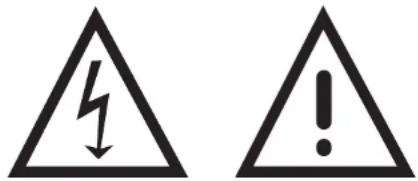
It is hazardous for anyone other than authorised service personnel to carry out servicing or repairs which involves the removal of covers.
To avoid the risk of an electric shock do not attempt to repair this appliance yourself.
Safety tips
Do not use electrical appliances such as a hair dryer or heaters to defrost your Freezer.
Do not store inflammable gases or liquids inside your Freezer.
Disposal
Old appliances still have some residual value. An environmentally friendly method of disposal will ensure that valuable raw materials can be recovered and used again. The refrigerant used in your appliance and insulation materials require special disposal procedures. Ensure that none of the pipes on the back of the appliance are damaged prior to disposal. Up to date information concerning options for disposing of your old appliance and packaging from the new one can be obtained from your local council office.
Locks
If your Freezer is fitted with a lock, to prevent children being entrapped keep the key out of reach and not in the vicinity of the appliance.
If disposing of an old Freezer break off any old locks or latches as a safeguard.
TECHNICAL SPECIFICATIONS
Model
MUF987W/MUF987S
Rated Voltage 230
(V)
Rated Frequency 50
(Hz)
Input Current 0.37
(A)
Input power 60
(W)
Freezer Volume
98
Weight and Dimensions are approximate. Because we continually strive to improve our products we may change specifications and
designs without prior notice.

Visit Partmaster.co.uk today for the easiest way to buy electrical spares and accessories. With over 50,000 products in stock we can deliver direct to your door the very next day.
Visit www.partmaster.co.uk or call
0870 6001 338
(UK customers only)
Calls charged at National Rate.
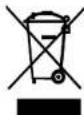
This symbol on the product or in the instructions means that your electrical and electronic equipment should be disposed at the end of its life separately from your household waste. There are separate collection systems for recycling in the EU.
For more information, please contact the local authority or your retailer where you purchased the product.
CE