HME 43-3 - Headphones SENNHEISER - Free user manual and instructions
Find the device manual for free HME 43-3 SENNHEISER in PDF.


| Product Type | Headsets (Binaural/Monaural) |
| Brand | Sennheiser |
| Model | HME 43-3 |
| Ear Coupling | Supra-aural (on-ear) |
| Impedance | 50 Ω |
| Frequency Response | 50 Hz - 18 kHz |
| Sensitivity | 108 dB SPL at 1 kHz |
| Microphone Type | Dynamic, noise-canceling |
| Microphone Frequency Response | 100 Hz - 10 kHz |
| Cable Length | 2.5 m (straight, single-sided) |
| Connector | 3.5 mm (⅛") stereo, gold-plated |
| Weight | 200 g (including cable) |
| Power Supply | Passive (no battery required) |
| Main Functions | Voice communication, intercom, monitoring |
| Adjustable Headband | Yes, self-adjusting |
| Earpads Material | Artificial leather, replaceable |
| Noise Attenuation | Passive noise reduction (approx. 20 dB) |
| Compliance | CE, FCC |
| Operating Temperature | -10°C to +55°C |
| Storage Temperature | -20°C to +70°C |
| Maintenance | Clean with soft, dry cloth; avoid liquids |
| Spare Parts | Earpads, cable, headband pads (available) |
| Repairability | Modular design; spare parts replaceable by user |
Frequently Asked Questions - HME 43-3 SENNHEISER
User questions about HME 43-3 SENNHEISER
0 question about this device. Answer the ones you know or ask your own.
Ask a new question about this device
Download the instructions for your Headphones in PDF format for free! Find your manual HME 43-3 - SENNHEISER and take your electronic device back in hand. On this page are published all the documents necessary for the use of your device. HME 43-3 by SENNHEISER.
USER MANUAL HME 43-3 SENNHEISER
natural_image
Two Sennheiser headsets with earbuds and microphone, shown from different angles (no text or symbols visible)Instruction manual
Safety instructions
- Please read this instruction manual carefully and completely before using the headset.
- Make this instruction manual easily accessible to all users at all times.
- Always include this instruction manual when passing the headset on to third parties.
- The headset is capable of producing sound pressure levels exceeding 85 dB(A). In many countries 85 dB(A) is the maximum legally permissible level for continuous noise exposure during the working day. Exposure to sounds of higher volume levels or for longer durations can permanently damage your hearing!
- Never repair or attempt to repair a defective headset yourself. Contact your Sennheiser agent or the Sennheiser Service Department.
- Only replace those parts of the headset whose replacement is described in this manual. All other parts of the headset must be replaced by your Sennheiser agent.
- Protect the headset from wetness. Use only a slightly damp cloth to clean the headset. For information on how to clean the headset, contact your Sennheiser agent.
Intended use of the headset
Intended use includes:
- having read this instruction manual especially the chapter "Safety instructions".
- using the headset within the operating conditions as described in this instruction manual.
Improper use means using the headset other than as described in this instruction manual, or under operating conditions which differ from those described herein.
The HME 43-3/HME 43-3S headset
The HME 43-3/HME 46-3S headset features dynamic headphones. The noise-compensating microphone ensures excellent speech transmission even in noisy environments. Designed for air traffic control and other communication purposes.
Features:
- Extremely lightweight
- Extremely comfortable to wear due to the patented two-piece automatic headband and soft earpads
- ActiveGard™ safeguards you from the effects of an acoustic burst
- Flexible microphone boom, can be worn on either left or right-hand side
- Noise-compensating microphone ensures excellent speech transmission
Delivery includes
1 HME 43-3/HME 43-3S headset
1 cable clip
1 carry bag
2 foam earpads HME 43-3
1 foam earpad HME 43-3S
1 wind and pop screen
1 instruction manual
Operation
Wearing the headset
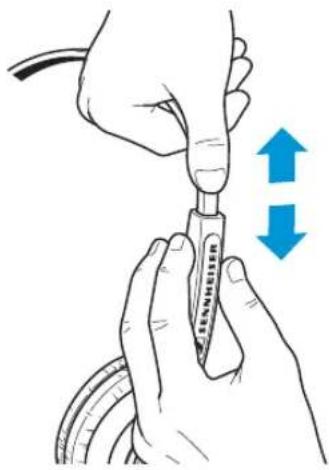
Adjust the length of the headband to fit your head size or shape.
natural_image
Illustration of hands holding a tool with a blue double-headed arrow indicating direction (no text or symbols)Note:
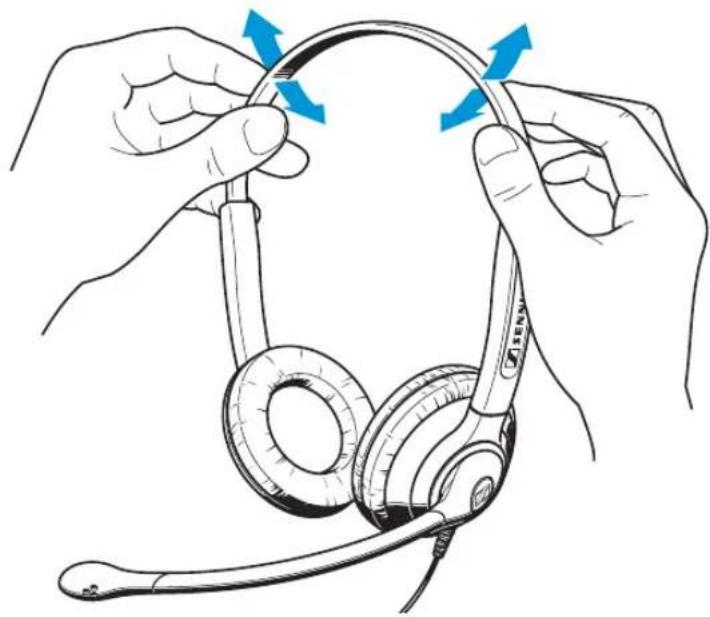
The earpads should exert a slight pressure on the ears.
▶ Holding the headset with two hands, carefully bend the headband to adjust it to a snug but comfortable fit.
natural_image
Illustration of hands holding a headband with blue arrows indicating fold changes (no text or symbols)Turning the microphone boom
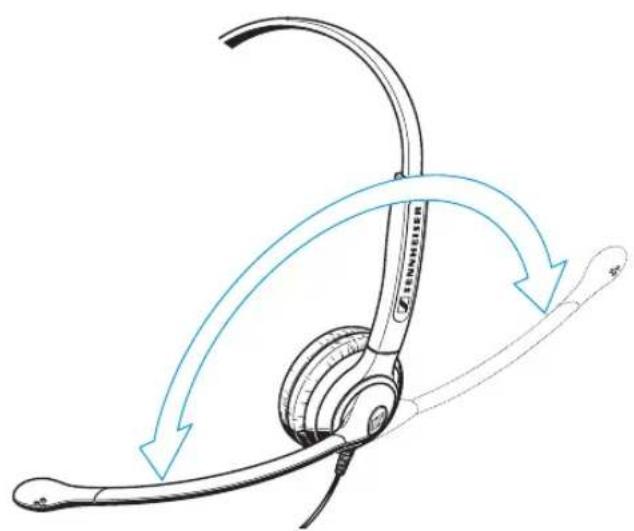
The microphone boom can be rotated. This allows the headset to be worn with the microphone boom positioned on either the left or right-hand side of the head.
natural_image
Diagram of a ZSNNHISER headset with curved arrows indicating motion or force direction (no text or symbols)Positioning the microphone
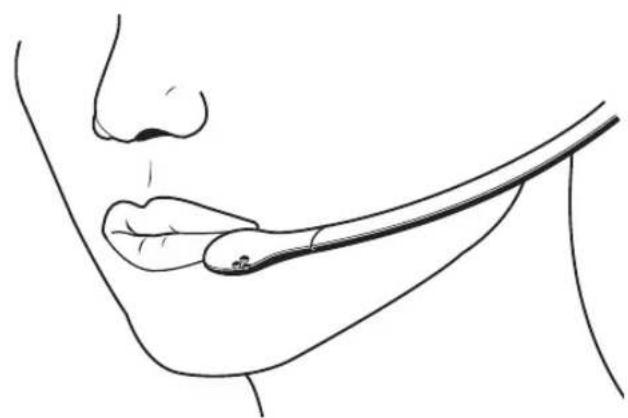
Bend the flexible microphone boom so that the microphone is placed at the corner of the mouth.
Note:
Maintain a distance of approx. 2 cm between microphone and mouth.
natural_image
Line drawing of a human neck and mouth with a finger pointing to the lower lip area (no text or symbols)Replacing the wind screen
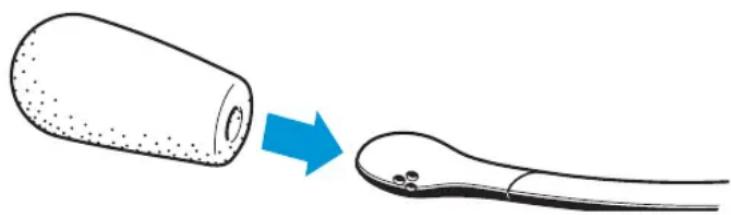
If the wind screen shows signs of wear such as tears or holes, replace the wind screen.
▶ Pull the wind screen from the microphone.
Gently slide-on the new wind screen.
natural_image
Diagram showing a tool interacting with a textured object, with a blue arrow indicating transformation (no text or symbols present)Notes:
- In order to avoid pop noise, always use the microphone with the supplied wind and pop screen!
- Ensure that the wind screen fits securely over the microphone.
Adjusting the volume directly on the audio system
Connect the headset to the corresponding sockets of your audio system. Adjust the volume directly on the audio system.
CAUTION! Hearing damage due to high volumes!

This headset is capable of producing high sound pressure levels. Higher volumes or longer durations can damage your hearing!
▶ Set the volume to a medium level. Make sure that you can hear critical sounds such as warning alarms.
Adjusting the microphone sensitivity
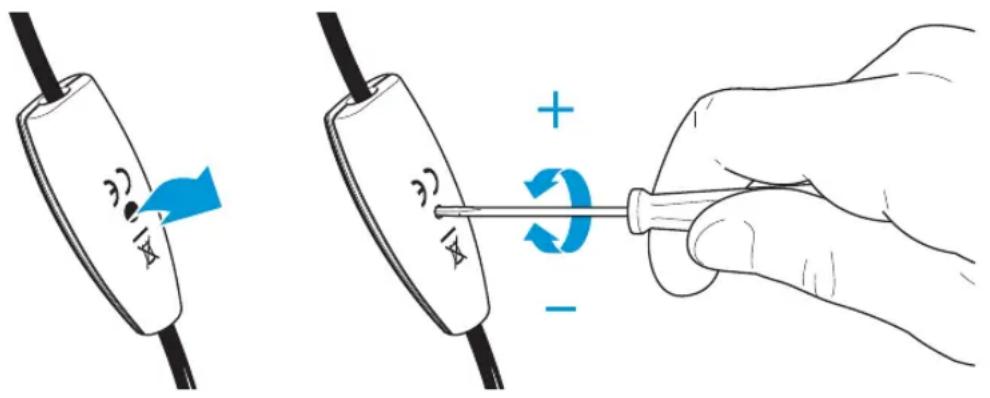
The microphone sensitivity has been factory pre-set to 300 mV/Pa.
Remove the sticker as shown in the diagram.
Change the microphone sensitivity by turning a screwdriver in the direction of the arrow.
text_image
Diagram illustrating the process of a switch or power plug with a blue arrow indicating rotation and positive/negative polarity.Storage and transportation
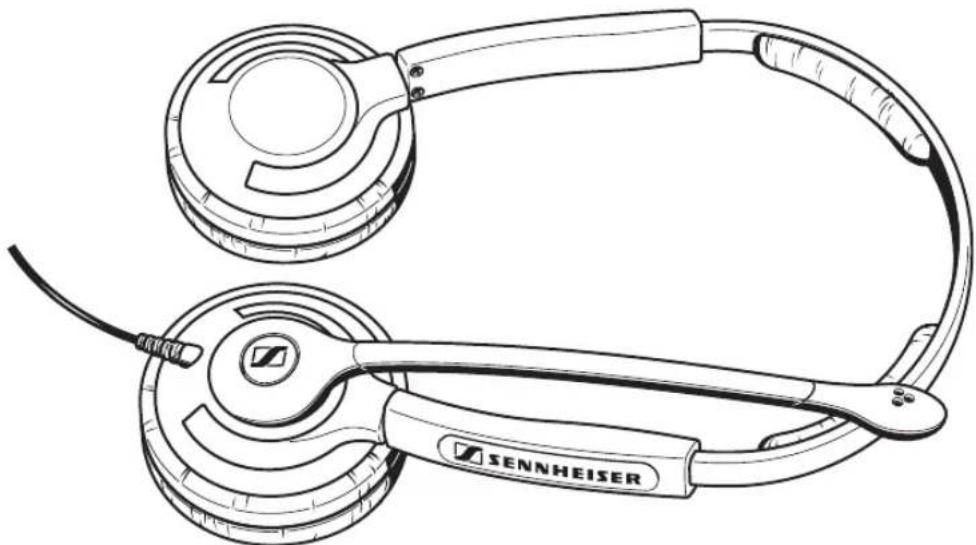
▶Turn the microphone into the position shown in the diagram. Rotate the earcups by 90^ .
natural_image
Line drawing of two Sennheiser headphones with earbuds and cable (no text or symbols)▶ Use the supplied carrying bag for storage and transportation.
Care and maintenance
Cleaning the headset
Use a soft, slightly damp cloth to clean the headset from time to time. If the headset is very dirty, use a cloth dampened with mild, soapy water.
CAUTION! Danger of short-circuit due to the ingress of water!

Water entering the housing of the headset can cause a short-circuit and damage the electronics.
▶ Use only a slightly damp cloth to clean the headset. Do not use any solvents or cleansing agents.
Replacing the earpads
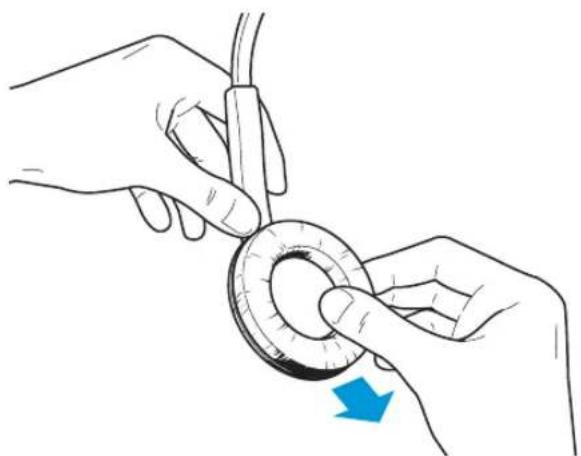
For reasons of hygiene, the earpads should be replaced from time to time.
CAUTION! If you pull too sharply, or jerk them, you may damage the new earpads.
Grasp the edge of the foam earpad behind the earcup as shown and peel it up and away from the earcup. Slide the new earpad onto the earcup. Repeat for the other earcup.
natural_image
Illustration of hands performing a circular mechanical operation with a blue arrow indicating direction (no text or symbols)Cable assignment
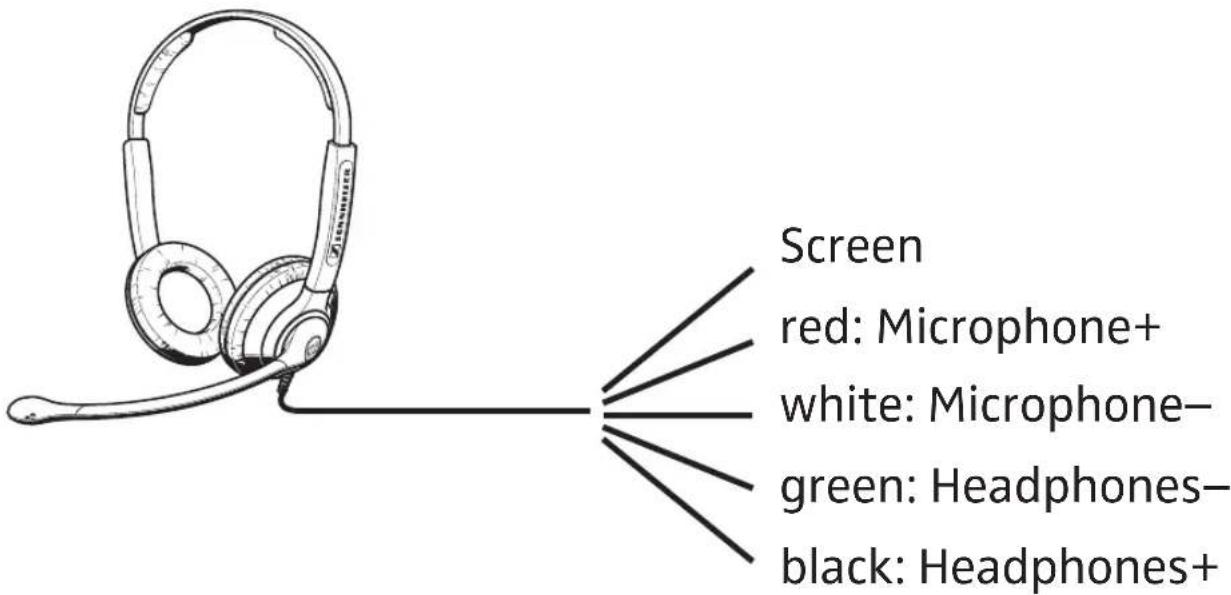
Headset connector
text_image
Screen red: Microphone+ white: Microphone- green: Headphones- black: Headphones+Product variants
| Variant (Cat. No.) | Description Single-sided round cable |
| HME 43-3502148 | Headset with condenser mic with open ends, length 1.90 m |
| HME 43-3S502593 | Single-sided headset with condenser mic with open ends, length 1.90 m |
Accessories
| Cable clip Cat. No. 091551 | |
| Leatherette earpads Cat. No. 091532 | |
| Foam earpads Cat. No. 091529 | |
| Wind screen Cat. No. 091540 | |
| Carry bag Cat. No. 517619 | |
| Headband padding (1 pair) Cat. No. 529726 | |
| Temple support(HME 43-3S only) | Cat. No. 532729 |
Specifications
General data
| Model HME 43-3 HME 43-3S | |
| Connection cable single-sided round cable, length 1.90 m | |
| Weight without cable approx. 95 g | |
| Operating temperature -5 °C to +45 °C | |
| Storage temperature -55 °C to +70 °C | |
Headphones
| Transducer principle dynamic | ||
| Frequency response 100 Hz to 6,000 Hz | ||
| Sound pressure levelat 1 kHz/1 mW 94 dB SPL 103 dB SPLat 1 kHz/1 V 102 dB SPL 107 dB SPL | ||
| Max. SPL(ActiveGardTM)at 1 kHz 116 dB SPL 110 dB SPL | ||
| Ear coupling supra-aural, closed | ||
| THDat 1 kHz < 1% at | 105 dB SPL | < 1% at102 dB SPL |
| Contact pressure approx. 1.5 N | ||
| Nominal impedance | 150 Ω mono | 300 Ω mono |
| Size of earcups | ∅ 51 mm | |
Microphone
| Model | BKE 43 |
| Transducer principle pre-polarized condenser, noise compensating | |
| Frequency response 400 Hz to 4,500 Hz | |
| Output voltage 300 mV/Pa at a distance of approx. 2 cm (1") between microphone and mouth (factory pre-set); adjustable from 40 to 500 mV/Pa | |
| Supply voltage 8 to 16 V DC | |
| Terminating impedance | 150 to 2,200 Ω |

SENNHEISER
Sennheiser electronic GmbH & Co. KG Printed in China Am Labor 1, 30900 Wedemark, Germany Publ. 11/09 www.sennheiser.com 528263/A03