
NUVIS 300 - Compact camera NIKON - Free user manual and instructions
Find the device manual for free NUVIS 300 NIKON in PDF.


User questions about NUVIS 300 NIKON
0 question about this device. Answer the ones you know or ask your own.
Ask a new question about this device
Download the instructions for your Compact camera in PDF format for free! Find your manual NUVIS 300 - NIKON and take your electronic device back in hand. On this page are published all the documents necessary for the use of your device. NUVIS 300 by NIKON.
USER MANUAL NUVIS 300 NIKON
Thank you for purchasing the Nikon Nuvis 300 camera.
Your new Nikon camera employs the Advanced Photo System (IX240 system).
The symbol ^* appears on all Advanced Photo System (APS) format cameras.
Be sure to read this instruction manual thoroughly before use, and keep it close at hand.
*The Advanced Photo System symbol is a trademark of all IX240 products.
Take some trial shots.
Before taking important pictures, be sure to take a few trial shots first to familiarize yourself with the camera and all of its features.
Accessories
Check that you have the item shown below before using your camera.
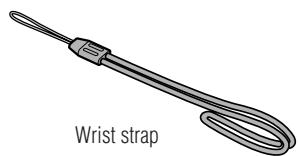
Optional accessories
- Camera case CS-L22
Attaching the wrist strap
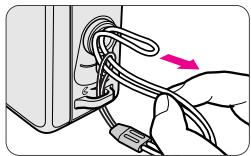
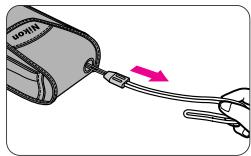
Attach the wrist strap by inserting it through the slot as shown.
Your Nikon camera features:
Choice of three print types (C, H, P), which can be mixed on the same roll.
P.14

C-type (classic) Aspect ratio = 2:3
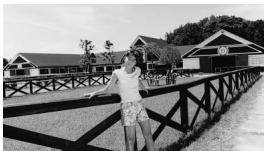
H-type (wide-vision) Aspect ratio = 9:16
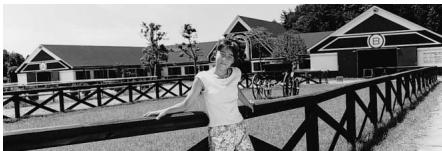
P-type (panorama) Aspect ratio = 1:3
The 3x power zoom lens covers the range of focal lengths from 28mm to 80mm. P.15
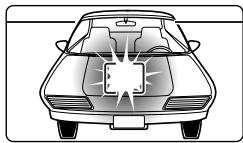
When the available light is low, the camera automatically fires the flash. P. 21
Photographng subjects as close as 0.7m (2.3 ft.) (at 28mm wideangle setting) is possible. PP.14,16
The lens cover automatically closes when the camera is turned off to protect the lens from dust and scratches.
Contents
Foreword 2
Accessories 3
Your Nikon camera features 4
Camera parts 6-7
LCD panel indications 6
Tips on using the Nuvis 300 8
Getting started
Installing the battery/Checking battery power 9
Loading the film 10-11
IX240 film cartridge 11
Data recording function 12
Basic operation
Holding the camera properly 13
Shutter release operation 13
Viewfinder indications 14
Selecting a print type 14
Adjusting diopter 15
Zooming 15
Focusing and shooting 16-17
Difficult-to-focus subjects 17
Removing the film 18
Take the exposed film cartridge to a photo lab. 19
To rewind the film in mid-roll 19
Advanced operation
How to use focus lock 20
Selecting the flash mode 21
Auto flash photography 21
Anytime flash mode 22
Slow sync flash mode 22-23
Flash cancel mode 23
Red-eye reduction mode 24
Self-timer operation 25
Infinity focus 25
Title recording function 26-27
List of user imprinted titles 27
Setting the date and time 28-29
Other information
Troubleshooting 30-31
Specifications 32-33
For safe handling of the camera (WARNING/CAUTION) 34-35
E
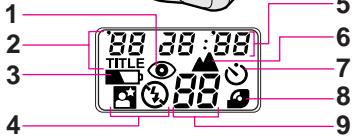
LCD panel
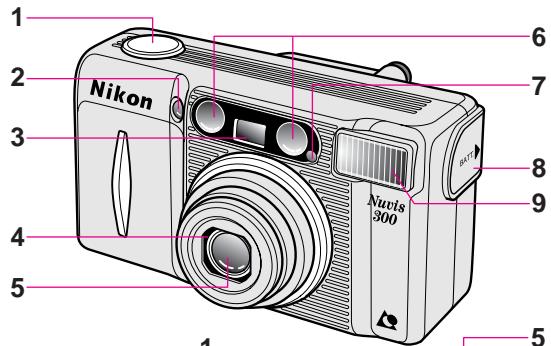
1 Shutter release button (P. 13)
2 Auto exposure metering window
3 Viewfinder window (P.14)
4 Lens cover (P.9)
5 Lens
6 Autofocus windows
7 Red-eye reduction (P. 24)/ Self-timer lamp (P. 25)
8 Battery chamber lid (P.9)
9 Flash (P.21)
LCD panel indications
1 Red-eye reduction indicator (P.24)
2 Title recording indicator (P. 26)
3 Low battery power indicator (P.9)
4 Flash mode indicator (PP.21-24)
5 Date and time (P. 12)/Film speed indicator (P. 11)
6 Infinity focus indicator (P.25)
7 Self-timer indicator (P.25)
8 Cartridge indicator (P.11)
9 Frame counter (P.11)
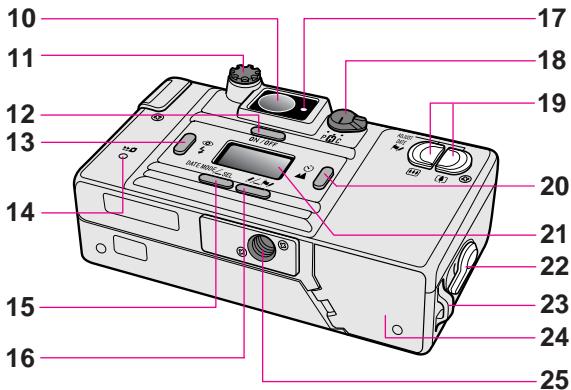
10 Viewfinder eyepiece (P. 14)
11 Diopter adjustment dial (P. 15)
12 Power button (P.9)
13 (red-eye reduction/flash mode) button (PP. 21-24)
14 ± 0 (mid-roll rewind) button (P.19)
15 DATE MODE(date setting) button (PP.12, 28-29)/SEL (select) button (P.28)
16 (title) button / (title/language setting) button (PP. 26-27)
17 Green LED (in-focus indicator) (P. 14)
18 CHP selector (P. 14)
19 Zoom buttons (P. 15)/ADJUST DATE button (PP. 28-29)/ button (PP. 26-27)
20 (self-timer) button (P. 25)/ (infinity focus mode) button (P. 25)
21 LCD panel
22 Cartridge lock release lever (P. 10)
23 Wrist strap slot (P. 3)
24 Cartridge chamber cover (P.10)
25 Tripod socket (PP. 22-25)
Tips on using the Nuvis 300
E
Camera care tips
- Turn the camera off when not in use. This prevents accidental release of the shutter and resulting battery drain.
- The Nuvis 300 is not a waterproof and therefore should not be exposed to rain or saltwater. If water gets on the camera, wipe it off with a dry cloth immediately.
- Do not subject the camera to high temperatures such as those encountered near a heater or stove or the interior of a car during summer.
- Store the camera in a cool, dry, clean place. Do not expose it to chemicals such as camphor or naphthalene. Using a desiccant during storage is recommended.
- Firing the flash repeatedly makes the battery and camera hot. Allow enough time for them to cool off before taking pictures again.
- Do not drop the camera or hit it against a hard surface.
-
Use a dry, soft cotton cloth or commercially available blower brush or lens cleaner to remove dirt and smudges.
-
When storing the camera for a long time, remove the battery. Also once a month, insert a battery and fire the flash several times to reform its capacitor.
Notes on battery
- Be sure to check battery power when taking important pictures. Carry spare batteries when traveling abroad.
- Battery power becomes less when the temperature drops below 0^ ( 32^ ). When taking pictures at low temperatures, keep the battery warm. Battery power will recover when the temperature goes back to normal.
Notes on IX240 film cartridge
- Carrying spare IX240 film cartridges is recommended when traveling abroad where the IX240 film cartridges may not be available.
Nikon cannot be held responsible for malfunctions caused by using the Nuvis 300 in ways not specified in this manual.
Getting started
Installing the battery/Checking battery power
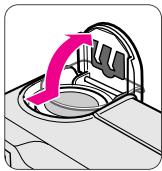
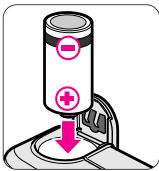
1 Install the battery.
Slide the battery chamber lid in the direction of the arrow to open.
Install one 3V lithium battery CR2 inside the battery chamber.
Close the battery chamber lid.
- Reset the date and time, when the battery is replaced and the current data returns to the initial setting. (PP. 28-29)
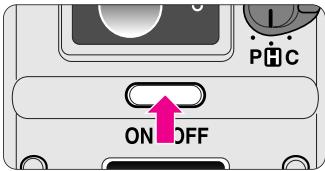
2 Press the power button to turn the camera on.
- The lens covers automatically opens and the lens moves out to the W (wide-angle) position. When film is loaded, the ISO film speed and the original number of frames appear for approx. 2 sec. on the LCD panel.
- When the camera is not used for approx. 3 minutes, the camera turns off automatically.
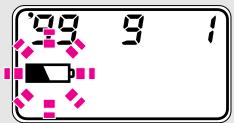
3 Check battery power.
Battery power
appears: Battery is nearly exhausted. Have a fresh set ready.
blinks: Battery is exhausted. Replace the battery.
- If a low battery power indicator " " does not appear, battery power is full.
Loading the film
E
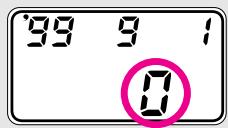
1 Check that “o” is visible on the LCD panel.
- If the number of frames appears on the LCD panel, a partially exposed cartridge is already loaded.
- If " " and the cartridge indicator " " blink on the LCD panel, a cartridge that is fully exposed is loaded and should be removed. (P. 18)
(2)
1
(1)
2 Push the cartridge lock release lever in the direction of the arrow to open the cartridge chamber cover.
The cartridge chamber cover locks automatically after loading. Do not try to open the cover until film rewinding is completed.
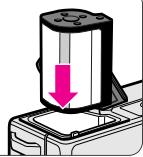
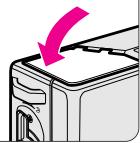
3 Insert a film cartridge in the cartridge chamber and close the cover.
- Use only IX240 film cartridge. (Regular 35mm film cannot be used.)
- Check that the VEI (Visual Exposure Indication) shows "O" (unexposed) before loading. (P.11)
- Close the cartridge chamber cover until it clicks shut.
IX240 film cartridge
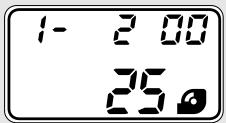
4 Check that the available number of frames, film speed, and “ ” appear on the LCD panel.
- When film is loaded, the film speed that is set appears for approx. 2 seconds on the LCD panel in place of the date display.
- If the number of frames does not appear, reload the film.
- "E" and "..." blink if a fully exposed film cartridge (the VEI shows "33"), a partially exposed film cartridge ("D"), or a processed film cartridge ("□") is inserted.
Data disk
Lightlock door
Processed film inside the cartridge
Unexposed film
D Partially exposed film
Fully exposed but unprocessed film
Irreversible Processed Indicator
*Visual Exposure Indication (VEI)
Available film cartridges: 40-exposure, 25-exposure, and 15-exposure films.
IX240 film cartridges do not have a film leader. The film is automatically pulled out and set inside the camera.
The VEI (Visual Exposure Indication) shows the four states of the film.
Notes on handling IX240 film cartridges
- Do not touch, disassemble or apply strong physical shock to the Data disk, Lightlock door or Cartridge spool.
- Do not break the Irreversible Processed Indicator. If broken, consult your nearest photo lab.
- Do not subject the film to direct sunlight, high temperatures near a heater or stove, dust and humidity, or a strong magnetic field.
Data recording function
E
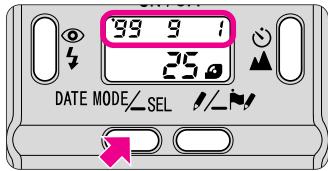
Set your preferred display mode.
Press the DATE MODE button.
- The "Year" section is displayed and printed in two digits and the "time" is in 24-hour cycle.
- "----" appears when "No recording" mode is selected.
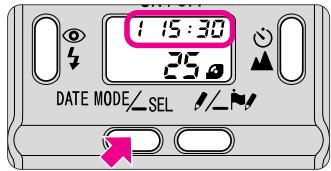
- Press the DATE MODE button to select one of five displays. Each time the button is pressed, the display changes in the order indicated:

- Ask your photo lab that displays an "Authorized Photo Lab Mark" sign for the location of the recorded data.
Basic operation
Holding the camera properly
Shutter release operation

- When holding the camera horizontally, keep your elbows against the body with both hands on the camera as shown.
- To avoid camera shake, hold the camera steady.
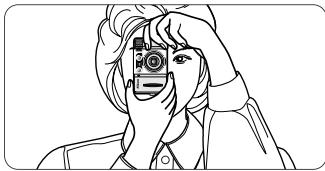
- When holding the camera vertically, make sure that the flash is on top as shown.
Do not block the lens, flash, or autofocus windows with your fingers or hair.
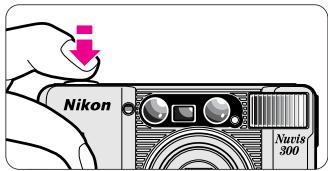
- Lightly press the shutter release button to achieve focus and exposure and the green LED will light up. While the shutter release button is depressed lightly, the focus is locked. (P. 20) Press the button all the way until you hear a click to release the shutter.
Viewfinder indications
E
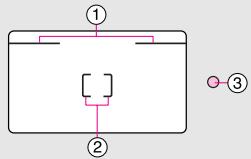
① Parallax compensation marks When the shooting distance is approx. 1.2m (3.9 ft.) (at 28mm wide-angle setting) or approx. 1.5m (4.9 ft.) (at 80mm telephoto setting), compose the scene within the parallax compensation marks.
② Autofocus frame mark
Center this mark on the subject.
③Green LED
If the LED lights up: Focusing is complete. If the LED blinks slowly: Slow shutter speeds are in use, because the subject is dark. In this case, attach the camera to a tripod to avoid camera shake. If the LED blinks quickly: The shutter is locked, because the camera is too close to the subject. Avoid shooting subjects closer than approx. 0.7m (2.3 ft.) (at 28mm) or 0.75m (2.5 ft.) (at 80mm).
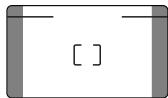
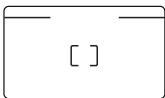
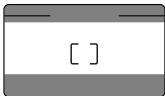
Available picture area
Areas cut off in the final print differ depending on the print type (C/H/P).
C-type
(classic) Aspect ratio = 2:3
H-type
(wide-vision) Aspect ratio = 9:16
P-type
(panorama) Aspect ratio = 1:3
Selecting a print type
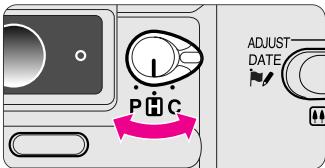
Use the CHP selector to select your desired print type before shooting.
- You can select any one of three print types (C, H or P) by switching the CHP selector at any time while film is loaded. (P. 4) Available picture area differs depending on the print type selected.
- You can also change the type of print when ordering extra prints at the photo lab.
CAUTION!
To prevent possible injury to your eye, hold the camera away from your face when you operate the CHP selector.
Adjusting diopter
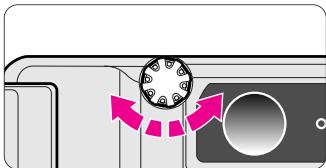
- Rotate the diopter adjustment dial until the autofocus frame mark appears sharp in the viewfinder.
CAUTION!
As you look into the viewfinder and operate the diopter adjustment dial, make sure not to injure your eye with your finger or fingernail during adjustment.
Zooming
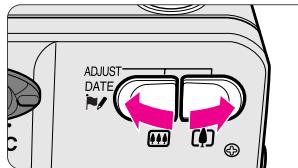
Look through the viewfinder and compose the picture by pressing the zoom buttons.
When the desired image size has been achieved, remove your finger from the zoom button.
- When the camera is not used for approx. 3 min., the lens automatically retracts into the body and the power turns off.
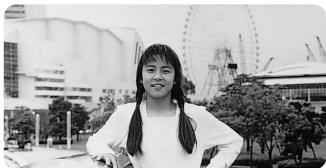
Press the zoom button to extend the lens to 80mm for taking telephoto pictures.
Press the zoom button to retract the lens to 28mm for taking wide-angle pictures.
Focusing and shooting
E
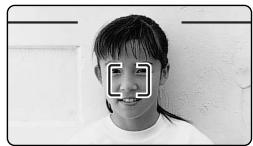
1 Compose the picture.
- Center the autofocus frame mark on the subject.
To ensure sharp pictures, make sure your subject is at least approx. 0.7m (2.3 ft.) at (28mm wide angle setting) or 0.75m (2.5 ft.) at (80mm telephoto setting) away from the camera.
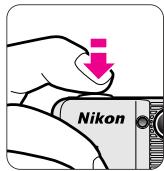
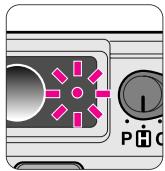
2 Focus on the subject.
Lightly press the shutter release button.
- The green LED lights up when focusing is complete.
- When the shooting distance is approx. 0.7 to 1.2m (2.3 to 3.9 ft.) at 28mm or approx. 0.75 to 1.5m (2.5 to 4.9 ft.) at 80mm , compose the scene below the parallax compensation marks.
(P. 14)
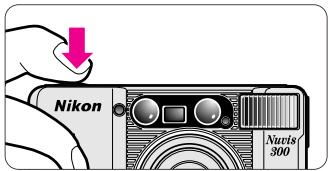
3 Gently depress the shutter release button all the way to take a picture.
- If there is not enough light, the flash fires automatically. (P. 21)
- After shooting, the number of available frames is reduced on the LCD panel one-by-one.
- Pressing the shutter release button with a jerky motion may cause camera shake.
Turn the camera off to save battery power.
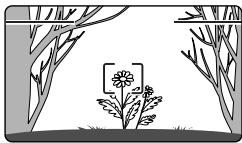
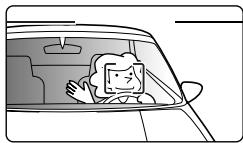
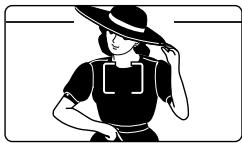
Difficult-to-focus subjects:
The following subjects may be too difficult to focus. In these cases, use focus lock (P. 20) by focusing on another subject equidistant from the camera.
- Subjects too small to fully cover the autofocus frame mark
- Subjects behind glass
- Dark subjects with no reflection
Glossy, light-reflecting surfaces, such as shiny cars or water - Subjects without solid content (i.e., candle flame, fireworks, etc.)
- Secondary subjects are closer to the camera than the main subject.
Removing the film
E
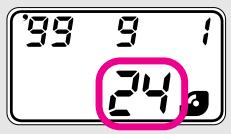
The film starts rewinding automatically.
- At the end of the film roll, the film rewrites automatically.
While the film is rewinding, the frame counter counts down one by one. - If you want to remove the film while the number of available frames still appears on the LCD panel, rewind the film midway through the roll. (P. 19)
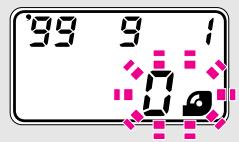
2 Make sure the blinking "0" is visible on the LCD panel.
- When the film is completely rewound, "O" blinks and the camera turns off. The cartridge chamber cover lock mechanism is released.
- If film rewind stops midway through the roll due to a dead battery, it resumes automatically as soon as the battery is replaced.
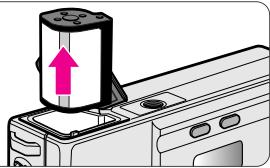
3 Open the cartridge chamber cover and remove the film.
Do not open the cartridge chamber cover until "O" starts blinking.
- You cannot turn the camera on unless the rewind film cartridge is removed.
- When opening the cartridge chamber cover, make sure that the camera bottom faces up, or the cartridge may fall out.
Take the exposed film cartridge to a photo lab.

- We recommend bringing your film cartridge to a photo lab that displays an "Authorized Photo Lab Mark" sign above for processing and printing.
- Your negatives are returned inside the cartridge for easy storage.
- Index prints (small images of each frame exposed on the roll of film) are supplied with the negatives.
For more information, consult your photo lab.
To rewind the film in mid-roll
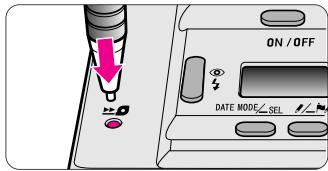
Press the button using the point of a ball-point pen or the like.
- Once rewinding starts, there is no need to continue pressing the mid-roll rewind button.
- When rewinding is complete, "1 3" starts blinking. Do not try to open the cover until "1 2" starts blinking.
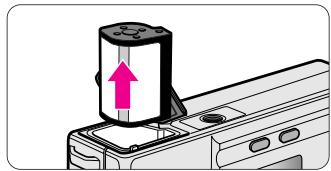
2 Remove the film.
Open the cartridge chamber cover.
Remove the film.
Once the film has been removed in mid-roll, it cannot be used again.
Advanced operation
How to use focus lock
E

1 Compose the picture.
- When the main subject is outside the autofocus frame mark “[ ]”, the area behind the subject will be in focus.
When your main subject is not in the center of the frame:
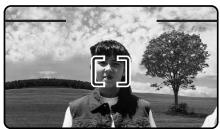

2 Center the autofocus frame mark on the main subject.
Lightly press the shutter release button.
- Make sure that the green LED lights up.
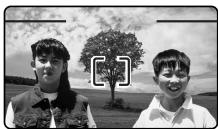

3 Recompose the picture and shoot.
While depressing the shutter release button lightly, recompose the picture.
Then depress the shutter release button all the way.
- As long as the shutter release button is pressed lightly, focus is locked.
- Do not change the camera-to-subject distance while lightly pressed the shutter release button.
Selecting the flash mode
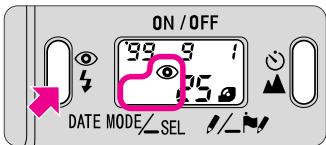
Press the button until the desired flash mode indicator appears.
- For details, see the reference page for each mode.
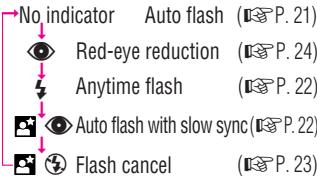
- When the camera power is turned off, the flash mode reverts to auto flash (excluding red-eye reduction mode).
Auto flash photography
The flash automatically fires when the available light is low.
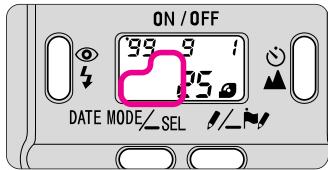
1 Turn the camera on.
- Auto flash mode is automatically activated. (No flash mode indicator appears on the LCD panel.)
- The camera senses when the available light is low and automatically fires the flash.
- If you see any flash mode indicator on the LCD panel, press the button until the indicator disappears.
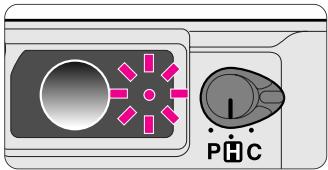
2 Check that the green LED comes on, then shoot.
Before shooting with flash, make sure the subject is within the flash shooting distance range. Refer to the following guide (ISO 200).
(28mm): approx. 0.7 to 6 m (2.3 to 19.7 ft.)
(80mm): approx. 0.75 to 2.2m (2.5 to 7.2 ft.)
- If " " blinks on the LCD panel, the flash is being charged and the shutter is locked. Wait for " " to disappear before shooting.
Anytime flash mode
Use this mode to fire the flash intentionally regardless of the available light.
E
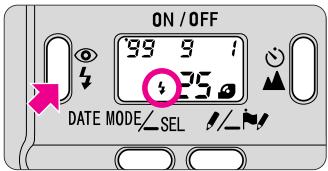
1 Press the button until " ^ appears on the LCD panel.
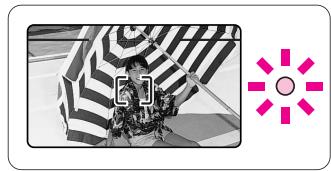
2 Compose the picture and shoot.
Lightly press the shutter release button.
Make sure the green LED lights up, then depress the shutter release button all the way to take the picture.
- If " " blinks on the LCD panel, wait for " " to disappear before shooting.
Slow sync flash mode
Use this mode to obtain the correct exposure in low-light situations or at night.
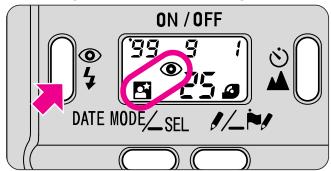
1 Press the button until " appears on the LCD panel.
- When the subject is bright, the flash does not fire.
for both the main subject and background
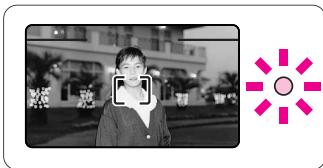
2 Compose the picture and shoot.
- If " " blinks on the LCD panel, wait for " " to disappear before shooting.
- The green LED blinks slowly when slow shutter speeds are selected. In this case, the use of a tripod is recommended to prevent camera shake.
Flash cancel mode
Use this mode where flash photography is prohibited or to achieve a natural lighting effect in night scenes.
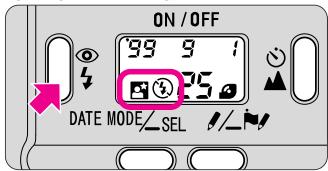
Press the button until " 一 _ 4 ^ 一 appears on the LCD panel.
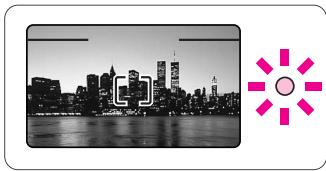
2 Compose the picture and shoot.
- The green LED blinks slowly when slow shutter speeds are selected. In this case, the use of a tripod is recommended to prevent camera shake.
Red-eye reduction mode
In flash photography, the subject's eyes may sometimes appear bright red. To reduce the "red-eye" effect, use this mode.
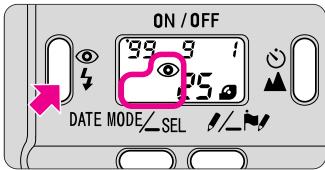
E
Press the button until "appears on the LCD panel.
- The red-eye reduction mode is not recommended when shooting fast-moving subjects.
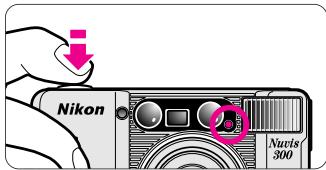
2 Compose the picture and lightly press the shutter release button.
- Because the red-eye reduction lamp lights up for a second before the flash fires, be careful not to move the camera or let the subject move until the flash fires.
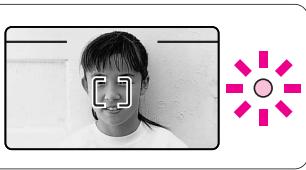
3 Check that the green LED lights up before shooting.
- If " " blinks on the LCD panel, wait for " " to disappear before shooting.
- To cancel the red-eye reduction mode, press the button until "..." disappears from the LCD panel.
- This operation cannot be canceled by turning the power off.
Self-timer operation
When you want to include yourself in the picture:
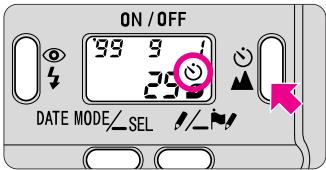
Press the button until "O" appears on the LCD panel.
Self-timer operation will be automatically canceled if not used for more than approx. 3 minutes or the camera is turned off.
- Placing the camera on a tripod is recommended.
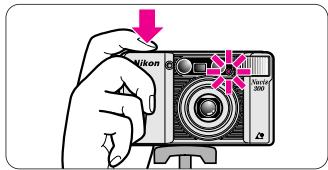
2 Compose the picture and depress the shutter release button all the way.
- The self-timer lamp blinks slowly for 7 sec., then quickly for 3 sec. before the shutter is released.
- Self-timer operation is canceled after shooting.
- To cancel self-timer operation, turn the camera off or press the button.
Infinity focus
Useful for shooting landscapes, or distant scenes through glass

Press the button until "..." appears on the LCD panel, then fully depress the shutter release button.
- Flash is automatically canceled in this mode.
- This mode can be canceled after shooting.
- Since slow shutter speeds are selected when taking dark subjects such as night scenes in this mode, use a tripod to prevent camera shake.
Title recording function
For imprinting a title on the back of pictures:
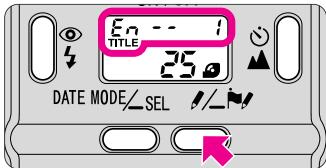
Press the button before shooting.
Turn the camera on and press the button until language and title codes appear on the LCD panel.
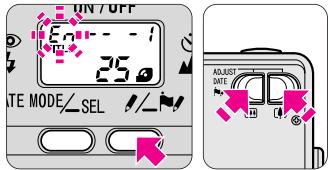
2 Set the language.
Press the button for more than 2 sec. The "language" code starts blinking.
Press the (zoom) button until the preferred language code appears on the LCD panel. Then press the button again.
- Five languages are provided.
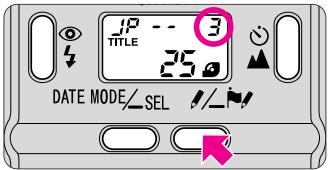
3 Set a title.
Press the button until the preferred title code appears on the LCD panel.
- To cancel the title recording function, press the DATE MODE button and make sure the language/title codes have disappeared, or turn the camera off.
List of user imprinted titles
| Language | Language/title code | Titles provided |
| English | En -- 1 | I LOVE YOU |
| En -- 2 | THANK YOU | |
| En -- 3 | SEASON'S GREETINGS | |
| En -- 4 | HAPPY BIRTHDAY | |
| En -- 5 | CONGRATULATIONS | |
| French | Fr -- 1 | JE T'AIME |
| Fr -- 2 | MERCI | |
| Fr -- 3 | MEILLEURS VOEUX | |
| Fr -- 4 | JOYEUX ANNIVERSAIRE | |
| Fr -- 5 | FÉLICITATIONS | |
| German | GE -- 1 | ICH LIEBE DICH |
| GE -- 2 | DANKESCHÖN | |
| GE -- 3 | HERZLiche GLUCKWÜNSCHE | |
| GE -- 4 | FRÖHLiche WEIHNACHTEN | |
| GE -- 5 | FROHES NEUES JAHR | |
Setting the date and time
E
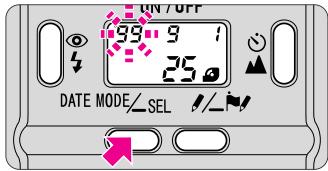
1 Entering the setting mode
Press the DATE MODE button for more than 2 seconds.
The year section starts blinking.
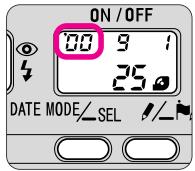
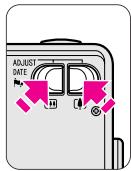
2 Setting the "year"
Press the ADJUST DATE (zoom) button to set the correct year.
Each time the button is pressed, the number increases by one, while the number decreases by one when the button is pressed.
- Pressing the ADJUST DATE (zoom) button continuously for more than 2 sec. changes the number quickly.
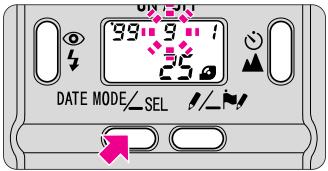
3 Setting the "month"
Press the SEL button. The "month" section starts blinking.
Press the ADJUST DATE button to set the correct month.
Press the SEL button.
- Repeat procedures 2 and 3 to set the day, hour and minute.
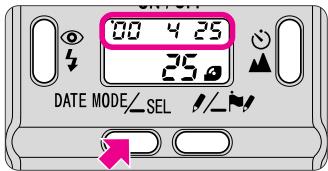
Getting out of the setting mode
Press the SEL button and the corrected date appears on the LCD panel.
- If another button is pressed while setting the date/time, all previously set data will remain unchanged.
The date appearing in the illustration above shows "2000, April, 25."
When the battery is replaced
Note that the current data may be reset when the battery is replaced.
- If the data is reset, repeat procedures from 1 to 4 to set the date and time.
- No data will be recorded if "----" appears on the LCD.
Troubleshooting
Check the cause of the trouble using the following chart. It may save you a trip to your nearest Nikon service center.
| Problem | Check this | Ref. page |
| The shutter cannot be released. | ·If “♀” blinks when the shutter release button is pressed lightly, the flash is recycling and the shutter is locked. Wait for “♂” to disappear before shooting. ·If the green LED blinks quickly, the camera is too close to the subject. Avoid shooting subjects that are less than approx. 0.7m (2.3 ft.) (at 28mm wide angle setting) or 0.75m (2.5 ft.) (at 80mm telephoto setting) from the camera. | 21 14 |
| The flash does not fire. | ·If “♀” blinks when the shutter release button is pressed lightly, the flash is recycling and the shutter is locked. Wait for “♂” to disappear before shooting. ·Check battery power. If the battery is exhausted, replace the battery with a fresh one. ·If the “♀” mark appears on the LCD panel, the flash will not fire. | 21 9 23 |
| The subject appears out of focus in the print. | ·Clean the autofocus windows if dirty. ·To avoid camera shake, gently depress the shutter release button. ·When photographing difficult-to-focus subjects, be sure to center the autofocus frame mark on the subject, or use focus lock. | 6, 13 13 17, 20 |
| The cartridge chamber cover does not open. | ·The film is not completely exposed. Take pictures up to the end of the roll, or rewind the film in mid-roll. | 10, 19 |
| No indicators appear on the LCD panel when the power button is pressed. | ·The battery was not properly loaded in the battery chamber. Make sure to orient the positive (+) and negative (-) poles correctly. ·The battery is exhausted or no battery is installed. Install a new battery. ·If no indicators appear after installing a new battery, the camera is broken. In this case, contact your nearest Nikon dealer or a camera shop for repair. | 9 9 - |
A characteristic of electronic camera
In rare cases, when strong static electricity or the like is applied to the camera, the camera may not work properly. If this happens, remove the battery. Please note that the date and time may be reset when the battery is replaced; in this case set the date and time. (P. 28)
Specifications
Type of camera
IX240 (Advanced Photo System) type autofocus AE lens-shutter camera with Nikon Zoom 28-80mm f/4.2-11 lens
Usable film
IX240 System (Advanced Photo System) film cartridge (16.7× 30.2mm)
Print aspect ratio
C, H and P-type available
Lens
28mm f/4.2-80mm f/11 (35mm-100mm converted to 35mm type); 8 elements in 7 groups
Shutter
Programmed electronic shutter; also serves as diaphragm blades; Shutterspeeds: 1/3 to 1/400 sec.
Viewfinder
Real-image zoom viewer; frame coverage approx. 85% for H-type printed image area; approx. 0.4x magnification at 28mm, approx. 0.92x at 80mm; Doppler adjustment: approx. -3 to +1 DP
Viewfinder information
C/H/P-type image size marks with parallax compensation marks; Autofocus frame; Green LED—Lights up: completion of focus operation, Blinks quickly (at 8 Hz); subject is too close to achieve correct focus, Blinks slowly (at 4 Hz): low ambient light warning
Focusing
Active-infrared autofocus system; Activated by lightly pressing shutter release button; Distance range from 0.7m (2.3 ft.) to infinity (at 28mm ), 0.75m (2.5 ft.) to infinity (at 80mm ); Infinity focus locks focus at infinity, Shutter locks when the subject is closer than 0.7m (2.3 ft.) at 28mm or 0.75m (2.5 ft.) at 80mm .
Focus lock
Focus is locked as long as shutter button is lightly pressed.
Exposure control
Electronically controlled program AE: Auto exposure range (ISO 200): EV 7-16.5 at 28mm EV 8.75-17.5 at 80mm Flash fires automatically if the available light is low.
Film speed setting
ISO 50, 100, 200, 400, 800, 1600 and 3200 film automatically set.
Film operation
Drop-in loading system; Wrong film loading prevention mechanism; Cartridge chamber cover lock mechanism
Frame counter
Shown in the LCD panel; Count-down type
Self-timer
Electronically controlled; Activated by depressing shutter release button; 10 sec. duration, blinking (1Hz/4Hz) in 2 steps
Film advance
Film is automatically thrust to the first frame after inserting cartridge; Film automatically advances by one frame after each shot; Auto rewind at the end of film roll; Mid-roll rewind function available
Built-in flash
Five flash modes available: Auto flash, Red-eye reduction, Anytime flash, Slow sync flash, and Flash cancel; Flash shooting range: approx. 0.7-6m (2.3-19.7 ft.) at 28mm, approx. 0.75-2.2m (2.5-7.2 ft.) at 80mm (ISO 200); Shutter release button is locked during flash charging; Recycling time approx. 6 sec.
Red-eye reduction mode
Red-eye reduction lamp lights up for approx. 1 sec. before flash fires
Battery life
Approx. 10 rolls of 25-exposure film when flash is used for half of exposures.
LCD panel (Power is on)
Frame counter, Flash mode, Red-eye reduction, Self-timer, Cartridge, Infinity focus, Low battery power, Title, Date/time and film speed
Power source
One 3V lithium battery CR2
Data recording function
Magnetic recording system; Date/title setting; Date displayed on LCD panel with five choices: Year/Month/Day, Month/Day/Year, Day/Month/Year, Day/Hour/Minute, or No recording; 24-hour cycle with no AM/PM; auto leap year adjustment until 2027; Built-in clock with timing accuracy within ± 90 sec. a month; Power source is same as camera body; Title recording function: selectable from 5 titles in 5 languages which can be printed on the back of pictures.
Dimensions (W× H× D)
Approx. 98.5 × 59.0 × 36.5 ~mm (3.9 × 2.3 × 1.4 in.)
Weight (without battery)
Approx. 155g (5.5 oz.)
For safe handling of the camera
E
WARNING
- Do not attempt to disassemble, repair, or modify the camera yourself, as it houses high-voltage circuitry which can cause an electric shock. Another reason is that these actions could cause the camera to malfunction.
- If the camera is dropped and damaged, do not touch any exposed interior metal parts, as it houses high-voltage circuitry which can cause an electric shock. Remove the battery and take the camera to your local Nikon dealer for repair.
- If you detect smoke coming from the camera, stop operation immediately and turn the camera off. Let the camera cool off before removing the battery. Then take the camera to your local Nikon dealer for repair.
- Do not submerge the camera in water or allow water to splash on it, as this may cause an electric shock or a fire.
-
Do not operate the camera in an environment containing a combustible gas, as this may cause a fire or explosion.
-
Do not look at the sun or a strong light source directly through the viewfinder, as this may damage your retina, resulting in permanent eye damage.
- Keep batteries out of the reach of children. If a battery is accidentally swallowed, call a doctor immediately.
- Never use thinner, benzene, or other active agents for cleaning the camera, as this may damage the camera, cause it to catch on fire, or harm your health.
CAUTION
- Do not operate the camera with wet hands, as this may cause an electric shock.
- Keep the camera out of reach of children. This will prevent them from swallowing batteries or small accessories.
- To prevent possible injury to your eye, hold the camera away from your face when you operate the CHP selector.
- Do not fire the flash close to a person's eyes, as this may cause temporary blindness.
- When the camera is not in use, turn the camera off and avoid placing it in direct sunlight. Strong sunlight entering the lens may cause the camera to catch on fire.
-
Do not carry the camera while it's mounted on a tripod, as you might bump into something and injure yourself or others.
-
Do not walk around while looking through the viewfinder, as you might lose your step, fall down, and injure yourself.
- Do not throw used batteries into a fire. Also do not short-circuit, disassemble, or heat the battery, as this may cause it to catch on fire or explode.
Always follow the warning instructions printed on batteries to prevent them from catching on fire or exploding. - Never use batteries not specified in this instruction manual, as this may cause them to generate heat or catch on fire.
Vorwort
No reproduction in any form of this manual, in whole or in part (except for brief quotation in critical articles or reviews), may be made without written authorization from NIKON CORPORATION.