
SLB200 - Electric bass YAMAHA - Free user manual and instructions
Find the device manual for free SLB200 YAMAHA in PDF.


| Product Type | Electric Double Bass (Silent Bass) |
| Brand | YAMAHA |
| Model | SLB200 |
| Dimensions (with frame and endpin) | 1692 x 456 x 330 mm |
| Dimensions (body only) | 1392 x 122 x 230 mm |
| Dimensions (folded frame) | 465 x 145 x 129 mm |
| Weight | Approx. 7.2 kg |
| Power Supply | 9V battery (6F22/6LR61) x 1 |
| Battery Life | Approx. 350 h (manganese), 500 h (alkaline) |
| Power On | By inserting jack plug |
| Neck Material | Maple |
| Top Material | Spruce + Mahogany |
| Fingerboard | Rosewood |
| Bridge | Maple (height adjustable) |
| Strings | Double bass ball-end |
| String Length | 1040 mm (41") |
| Pickup | Piezo pickup |
| Controls | Volume, Treble, Bass |
| Included Accessories | Frame, endpin, mute, Allen key, 9V battery, case |
| Optional Accessories | Stand BST1, knee rest BKS2, extension frame BEF2 |
| Care and Cleaning | Dry or slightly damp cloth; avoid alcohol and solvents |
| Usage Precautions | Do not expose to heat, humidity, shocks; disconnect before changing battery |
| Spare Parts and Repairability | Contact an authorized Yamaha dealer for repairs |
| General Information | Use with headphones or amplifier; may produce high sound levels |
Frequently Asked Questions - SLB200 YAMAHA
User questions about SLB200 YAMAHA
0 question about this device. Answer the ones you know or ask your own.
Ask a new question about this device
Download the instructions for your Electric bass in PDF format for free! Find your manual SLB200 - YAMAHA and take your electronic device back in hand. On this page are published all the documents necessary for the use of your device. SLB200 by YAMAHA.
USER MANUAL SLB200 YAMAHA
Thank you for purchasing the Yamaha Silent Bass. In order to obtain the maximum performance and enjoyment from your Silent Bass, we urge you to read this Owner's Manual thoroughly before using the instrument. Please keep this Owner's Manual in a safe place for later reference.
Contents
Precautions 3
Main Body/Accessories 4
Nomenclature 5
Setup 7
■ Tuning 7
■ Attaching the Frame Unit 9
About the End Pin 10
Putting the Bass into the Soft Case 10
Changing Strings 11
About the Mute 13
■ Attaching the Optional Accessories 13
Power Supply 14
Specifications 15
SPECIALMESSAGESECTION
This product utilizes batteries or an external power supply (adaptor). DO NOT connect this product to any power supply or adaptor other than one described in the manual, on the name plate, or specifically recommended by Yamaha.
This product should be used only with the components supplied or; a cart, rack, or stand that is recommended by Yamaha. If a cart, etc., is used, please observe all safety markings and instructions that accompany the accessory product.
SPECIFICATIONS SUBJECT TO CHANGE: The information contained in this manual is believed to be correct at the time of printing. However, Yamaha reserves the right to change or modify any of the specifications without notice or obligation to update existing units.
Do not attempt to service this product beyond that described in the user-maintenance instructions. All other servicing should be referred to qualified service personnel.
This product, either alone or in combination with an amplifier and headphones or speaker/s, may be capable of producing sound levels that could cause permanent hearing loss. DO NOT operate for long periods of time at a high volume level or at a level that is uncomfortable. If you experience any hearing loss or ringing in the ears, you should consult an audiologist.
IMPORTANT: The louder the sound, the shorter the time period before damage occurs.
NOTICE: Service charges incurred due to a lack of knowledge relating to how a function or effect works (when the unit is operating as designed) are not covered by the manufacturer's warranty, and are therefore the owner's responsibility. Please study this manual carefully and consult your dealer before requesting service.
ENVIRONMENTAL ISSUES: Yamaha strives to produce products that are both user safe and environmentally friendly. We sincerely believe that our products and the production methods used to produce them meet these goals. In keeping with both the letter and the spirit of the law, we want you to be aware of the following:
Battery Notice: This product MAY contain a small non-rechargeable battery which (if applicable) is soldered in place. The average life span of this type of battery is approximately five years. When replacement becomes necessary, contact a qualified service representative to perform the replacement.
This product may also use "household" type batteries. Some of these may be rechargeable. Make sure that the battery being charged is a rechargeable type and that the charger is intended for the battery being charged.
When installing batteries, do not mix old batteries with new, or with batteries of a different type. Batteries MUST be installed correctly. Mismatches or incorrect installation may result in overheating and battery case rupture.
Warning: Do not attempt to disassemble or incinerate any battery. Keep all batteries away from children. Dispose of used batteries promptly and as regulated by the laws in your area. Note: Check with any retailer of household type batteries in your area for battery disposal information.
Disposal Notice: Should this product become damaged beyond repair, or for some reason its useful life is considered to be at an end, please observe all local, state, and federal regulations that relate to the disposal of products that contain lead, batteries, plastics, etc. If your dealer is unable to assist you, please contact Yamaha directly.
NAMEPLATE LOCATION: The namespace is located on the bottom of the product. The model number, serial number, power requirements, etc., are located on this plate. You should record the model number, serial number, and the date of purchase in the spaces provided below and retain this manual as a permanent record of your purchase.
Model
Serial No.
Purchase Date
92-BP
PLEASE KEEP THIS MANUAL
Your Silent Bass will give you years of reliable service if you follow the simple rules given below:
■ Location
Do not expose it to the following conditions to avoid deformation, discoloration, or more serious damage.
- Direct sunlight (e.g. near a window).
- High temperatures (e.g. near a heat source, outside, or in a car during the daytime).
- Excessive humidity.
- Excessive dust.
Strong vibration.
Power Supply
- Turn the power switch OFF when not in use.
- If you use an AC power adaptor, unplug the adaptor from the AC outlet if not to be used for an extended period of time.
- Unplug the AC power adaptor during electric storms.
- Avoid plugging the AC power adaptor into the same AC outlet as appliances with high power consumption, such as electric heaters or ovens. Also avoid using multi-plug adaptors since these can result in reduced sound quality and possibly damage.
Turn Power OFF When Making Connections
- To avoid damage to the Silent Bass and other devices to which it is connected (a sound system, for example), turn the power switches of all related devices OFF prior to connecting or disconnecting audio cables.
■ Handling and Transport
- Never apply excessive force to the controls, connectors or other parts.
Always unplug cables by gripping the plug firmly, not by pulling on the cable. - Disconnect all cables before moving the unit.
- Physical shocks caused by dropping, bumping, or placing heavy objects on the unit can result in scratches and more serious damage.
Cleaning
- Clean the cabinet and panel with a dry soft cloth.
- A slightly damp cloth may be used to remove stubborn grime and dirt.
- Never use cleaners such as alcohol or thinner.
- Avoid placing vinyl objects on top of the unit (vinyl can stick to and discolor the surface).
Electrical Interference
- This unit contains electric circuitry and may cause interference if placed too close to radio or television receivers. If this occurs, move it further away from the affected equipment.
YAMAHA is not responsible for damage caused by improper handling or operation.
Information for Users on Collection and Disposal of Old Equipment and used Batteries

These symbols on the products, packaging, and/or accompanying documents mean that used electrical and electronic products and batteries should not be mixed with general household waste. For proper treatment, recovery and recycling of old products and used batteries, please take them to applicable collection points, in accordance with your national legislation and the Directives 2002/96/EC and 2006/66/EC.

By disposing of these products and batteries correctly, you will help to save valuable resources and prevent any potential negative effects on human health and the environment which could otherwise arise from inappropriate waste handling.

For more information about collection and recycling of old products and batteries, please contact your local municipality, your waste disposal service or the point of sale where you purchased the items.

[For business users in the European Union]
If you wish to discard electrical and electronic equipment, please contact your dealer or supplier for further information.
![YAMAHA SLB200 - [For business users in the European Union] - 1](/content/2025/01/114848/images/9a4a86942d56c2199a59848550f5513f321b309143d8f1e32fd039e90f373fa9.jpg)
[Information on Disposal in other Countries outside the European Union]
These symbols are only valid in the European Union. If you wish to discard these items, please contact your local authorities or dealer and ask for the correct method of disposal.
Note for the battery symbol (bottom two symbol examples):
This symbol might be used in combination with a chemical symbol. In this case it complies with the requirement set by the Directive for the chemical involved.
Main Body/Accessories
After opening the packaging, please check that all the parts listed below are included.
- Main Body

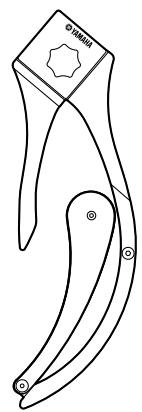
- Frame Unit
End Pin

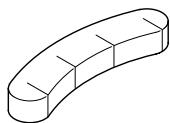
Mute
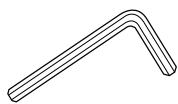
- Allen Wrench
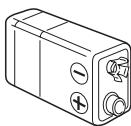
- 6F22 (S-006P) 9V battery x1
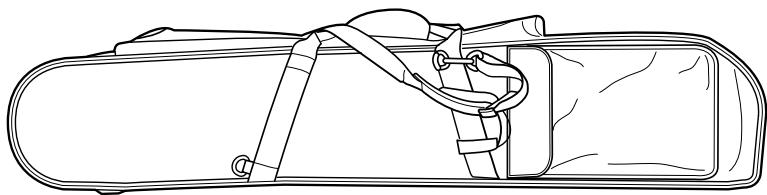
- Soft Case
Optional Accessories
- Stand for Silent Bass (BST1)
- Knee support for Silent Bass (BKS2)
- Extension frame for Silent Bass (BEF2)
To purchase these optional accessories, please inquire at your authorized Yamaha dealer.
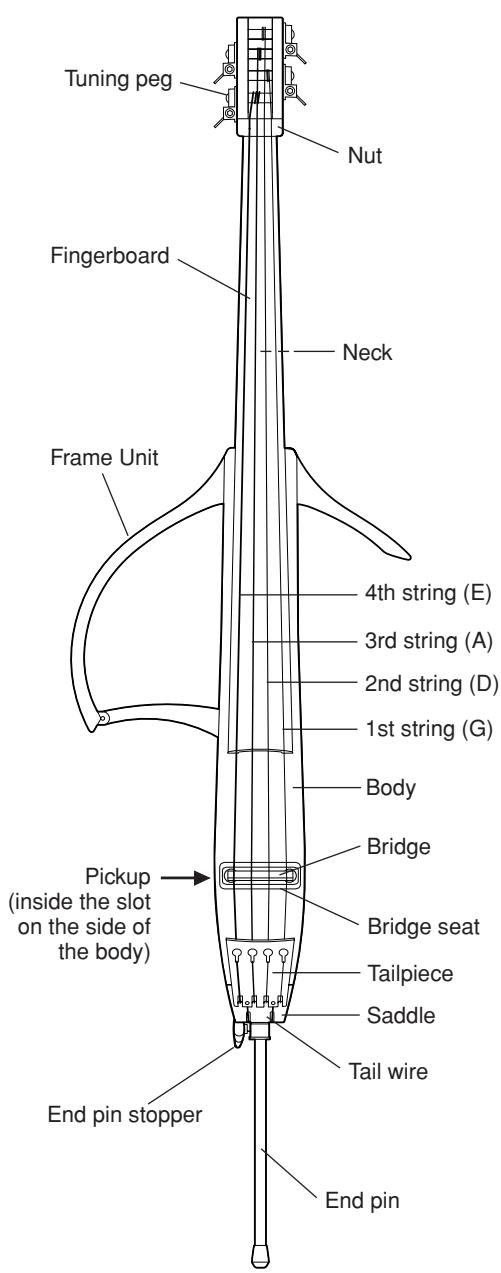
Front
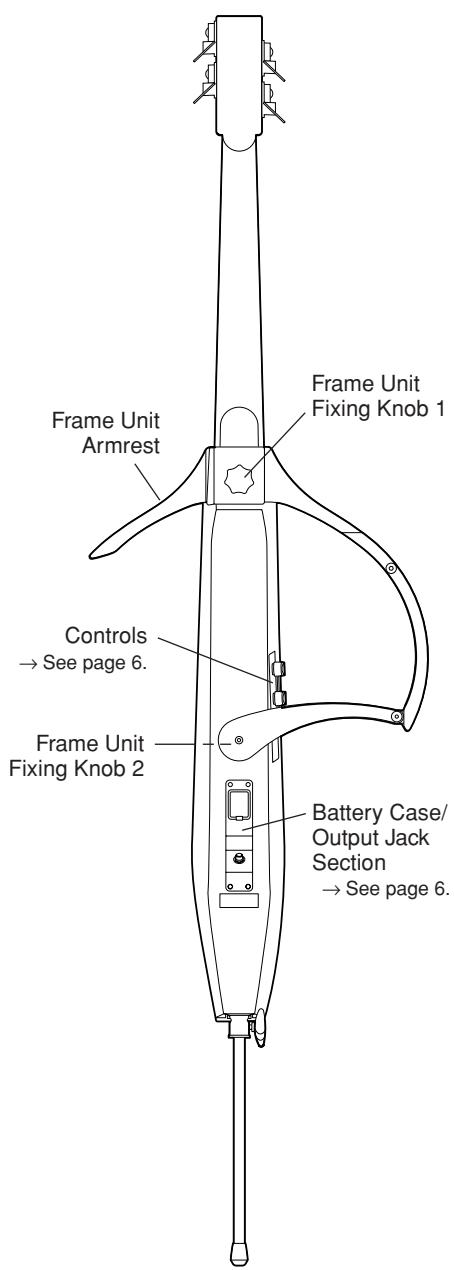
Rear
- Battery Case/Output Jack Section
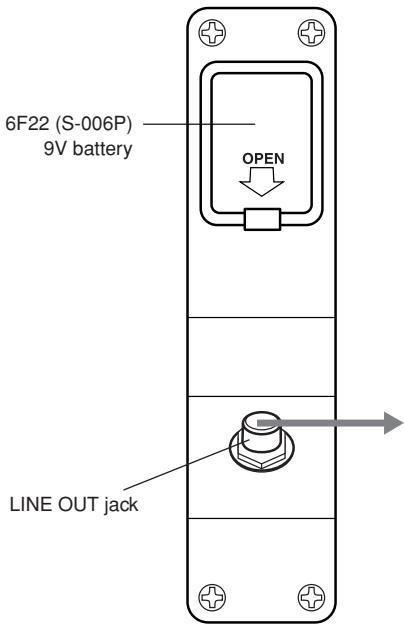
- The Silent Bass does not produce sound when headphones are plugged into the instrument's Output Jack.
- When making connections to the Output Jack, make sure that a standard monaural phone plug is used. The power is switched ON when a plug is inserted into the Output Jack, so using a cable with a stereo, balanced, or other type of plug that is divided into three sections can result in poor performance or damage to the instrument or other devices connected to it.
Mixer, Recorder, Bass Amplifier, Powered Speaker, Electric Tuner, etc.



Controls
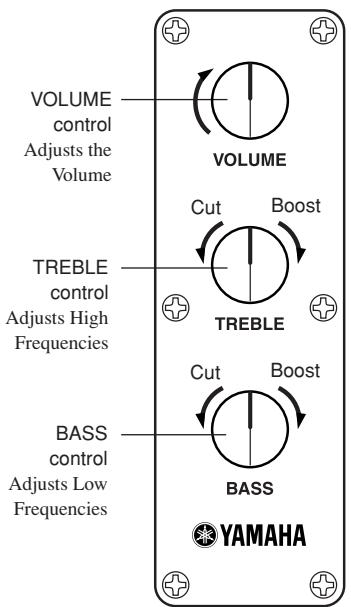
1 The power is switched ON when a standard phone plug is inserted into the Output Jack.
- To conserve battery power, the instrument is not equipped with a power indicator, such as a lamp, etc., to indicate that the power is ON.
- Before making any connections, make sure the volume is turned down on the amplifier, powered speaker, etc. or its power is switched OFF.
2 Rotate the VOLUME knob to adjust the volume to a suitable level.
- If the sound is distorted when playing strongly, try turning the volume knob slightly to the left.
3 Use the TREBLE knob to adjust (boost/cut) the tonal quality of the instrument's upper frequencies, and the BASS knob to adjust (boost/cut) the tonal quality of its lower frequencies.
- The sound may become distorted when boosting frequencies with the TREBLE or BASS knob. If so, slightly rotate the knob to the left to reduce the frequency boost level of the knob that is causing the distortion.
Setup
Tuning
The Silent Bass is shipped from the factory with the bridge in place and the strings slightly loosened. The bridge's height is set to an average height.
Since the position of the bridge will sometimes shift during transport, please properly adjust the position of the bridge before tuning the strings.
- The lower side of the bridge supports the 1^st string (G), the higher side supports the 4^th string (E). When looking at the bridge from the side, the surface that has a sharper curve should face the fingerboard. (Facing up when in the playing position). (Fig. 1)
-
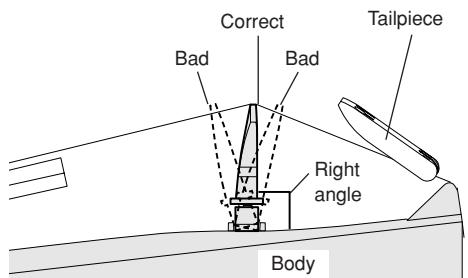
The bridge should be set so that the surface of the bridge facing the tailpiece is at a right angle to the top surface on which the bridge's feet rest (Fig. 2).
-
Make sure the bridge is positioned so that its legs do not come in contact with the escutcheon (the plastic part).
- The Silent Bass is fitted with an adjustable bridge for adjusting string height. Rotate the metal adjusters clockwise to lower the bridge's height, and counter-clockwise to raise it (Fig. 3).
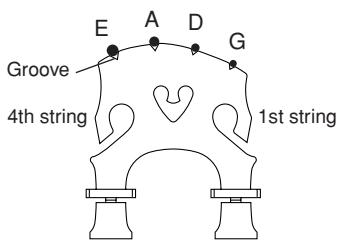
[Fig. 1: Looking from the tailpiece]
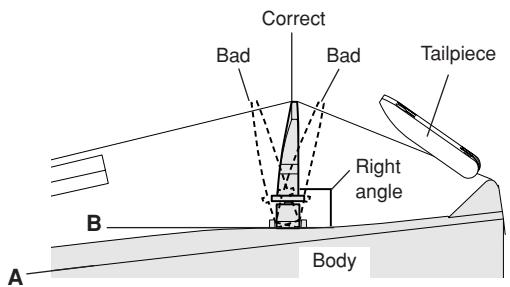
- The line where the instrument's top meets the body sides (line "A" in the figure above) and the top surface on which the bridge stands (line "B" in the figure above) are not parallel. When checking the bridge's vertical alignment, make sure it is compared to the top surface (line "B") on which the bridge stands.
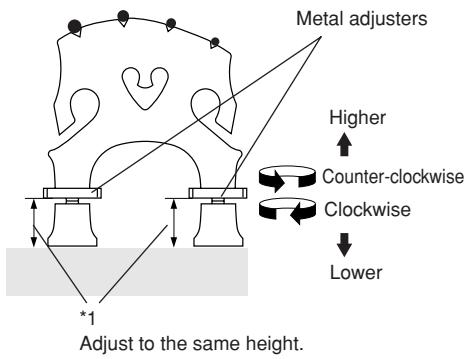
[Fig. 2: Bridge stands vertically]
[Fig. 3: Adjusting bridge height]
- Before adjusting bridge height, loosening the strings to relieve pressure on the adjusters will make it easier to rotate the adjusters. Rotating the adjusters with without reducing string tension can result in damage to the bridge or strings, etc.
-
When adjusting bridge height, make sure the height of both legs is kept the same. Increasing string tension on legs that are unequal in height can result poor surface contact of the bridge's feet, causing inferior sound quality, noise, damage to the bridge, etc (Fig. 3 *1).
-
The strings are tuned to the following pitches. The 1st string is tuned to G, the 2nd string to D, the 3rd string to A, and the 4th string to E.
Use a piano, tuning fork, tuner, etc., and adjust the pitch of each string using the tuning pegs.
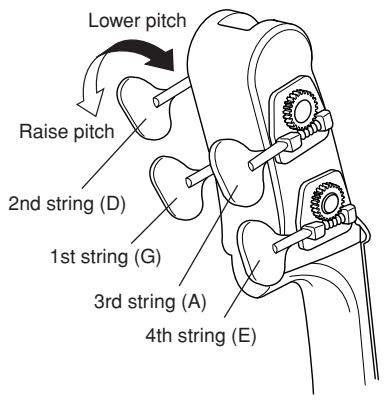
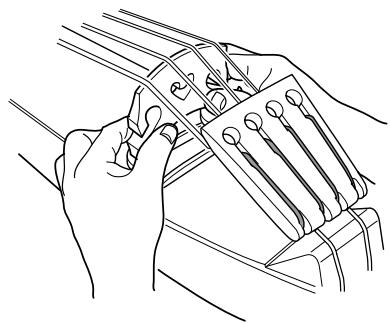
- After tuning is complete, make sure that the tailpiece side of the bridge is still properly aligned. If the bridge is leaning in either direction, slightly loosen the strings and carefully re-align the bridge using both hands.
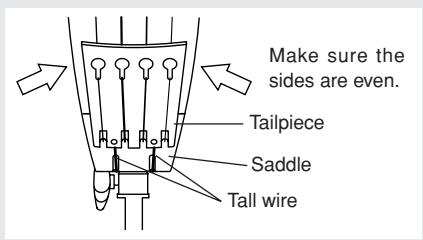
- If, after tuning, the tailpiece is leaning to one side, slightly loosen the strings and use both hands to adjust the tailpiece so its sides are straight and even. After the tailpiece is adjusted, increase string tension evenly and retune. (Refer to the illustration shown below.)
Caution
- Make sure that the tail wire is properly positioned in the grooves on the saddle.
Tuning machine tension adjustment
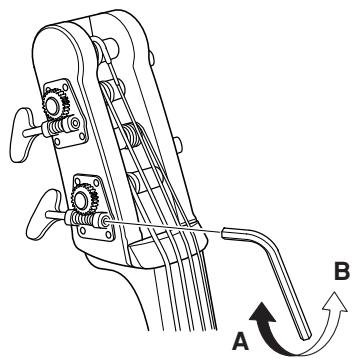
The tuning machine's tension that regulates the amount of pressure required to turn the tuners can be adjusted using the supplied Allen wrench.
- If the tuning machine turns with very slight pressure → Rotate the adjustment screw to the right (clockwise: A).
- If the tension is tight and the tuning machine is hard to turn Rotate the adjustment screw to the left (counter-clockwise: B).
Attaching the Frame Unit
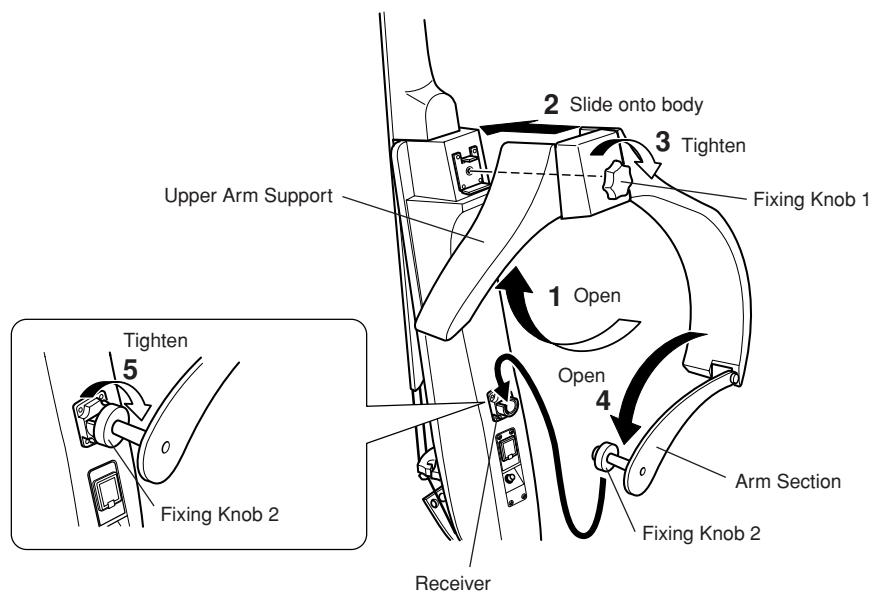
The Silent Bass is shipped from the factory with the Frame Unit removed from the main body. Please properly attach the Frame Unit using the following procedure.
1 Open the upper arm support on the frame unit, until it comes in contact with the stopper.
2 With the support's arm section (Fixing Knob 2) still closed, mount the frame unit onto the upper part of the main body and gently slide it into position.
3 Tighten Fixing Knob 1.
4 Rotate the support arm section counter-clockwise to open it up, and insert the support's lock (Fixing Knob 2) into its receiver on the back of the Silent Bass.
5 Firmly tighten Fixing Knob 2 to secure the frame unit to the instrument.

When moving the frame unit's parts, be careful not to pinch your fingers, hands, etc.
Frame attachment is complete.
To remove the frame unit, simply reverse the procedure described above.
- Securely tighten Fixing Knobs 1 and 2. Using the instrument with the attachments loose can result in parts rattling or making noise during performance.
- When transporting the instrument, always hold it by its neck or main body. Holding by the frame unit only may result in damage to the frame unit.
About the End Pin
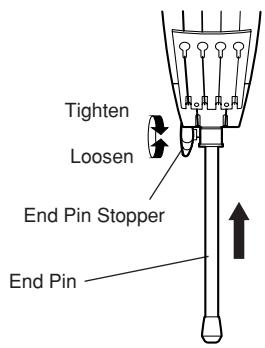
The Silent Bass is shipped from the factory with its end pin removed from the main body and stored separately in the soft case. Before using the instrument, loosen the end pin stopper and insert the end pin, then after determining a comfortable playing height, securely tighten the end pin stopper.
- Make sure the end pin stopper is secured firmly to prevent the instrument from falling while you play.
- For reasons of design and performance, the end pin is designed to fit into the instrument at an angle and can not be fully inserted into the instrument's body. Trying to force the end pin all the way into the instrument, or subjecting the end pin to strong impact can damage parts inside of the instrument. Always proceed slowly and carefully when inserting or removing the end pin.
Putting the Bass into the Soft Case
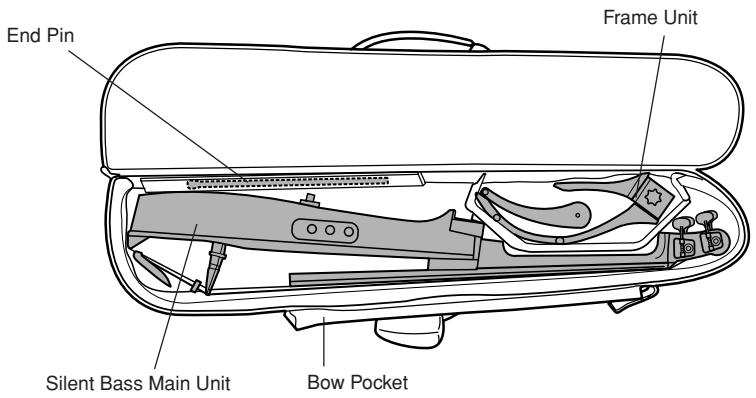
When storing the bass in the supplied soft case, remove the frame unit and end pin from the bass and store them in the case separately as shown in the illustration below.
- Use the Velcro cover to secure the end pin in place inside of the soft case.
- When putting the bow in the soft case, make sure that it is first put into the hard bow case, then place the hard case in the pocket and secure with a Velcro® fastener (1 location).
The soft case does not fully protect parts such as the bridge from damage.
The soft case is meant for storing and transportation of the instrument and protects it from dust, etc. Do not place the bridge so it is on the bottom of the case and do not cause damage to the instrument by placing objects on top of the case, hitting it, etc.
Changing Strings
As the strings get old, sound quality will gradually decrease, and it will become difficult to tune the instrument. Change the strings as soon as you think they are getting old.
Make sure you purchase Double Bass strings. The Silent Bass uses a string length of 1,040 mm (41 inch).
- All strings should not be removed at the same time. Make sure strings are changed one at a time.
- The end of the strings are sharp and can cut fingers. Use caution when changing strings.
- When changing or adjusting strings, do not put your face close to the instrument. The string may suddenly break resulting in eye or other unexpected injuries.
Winding the Strings
1 Hook the string's ball end into the string hole on the tailpiece. Make sure that the ball end is securely positioned in the end of the string hole slit.
- If the ball end is larger than the string hole, thread the opposite end of the string through the hole from the back side of the tailpiece.
2 Pull the string down toward the end pin and wrap the string around the end of the tailpiece making sure it fits into its corresponding groove at the bottom of the tailpiece. Pull the string up and over the bridge.

3 Insert the end of the string into the hole on the peg, turn the peg and make one or two wraps to one side of the hole as shown in the illustration below, then make the remaining wraps in the opposite direction. When looking at the front of the instrument, the first couple of wraps on the 1st (G) and 2nd (D) strings should be to the left of the hole, where as on the 3rd (A) and 4th (E) strings, the first wraps should be made to the right.
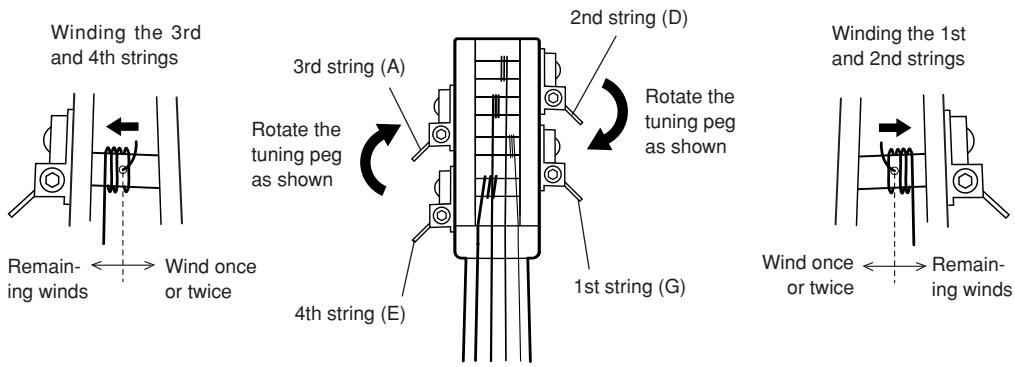
- Adjust string length so that the string does not rub up against the peg box wall. Tuning the string if it is in contact with the peg box wall can result in a broken string, etc.
Make sure the bridge is at a right angle.
Also, make sure each of the strings are positioned in their corresponding grooves.
- Make sure the side of the bridge facing the tailpiece is vertical when compared to the surface on which the bridge stands.
4 Use a piano, tuning fork, tuner, etc., and adjust the pitch of each string using the tuning pegs.
* Refer to the "Tuning" section (page 7).
- When the instrument is not being used for an extended period of time, loosen the strings.
- The instrument can be played after making sure that the bridge is standing vertically when compared to the surface on which the bridge stands. Playing the instrument with a leaning bridge can result in a shorter bridge life, or poor sound quality.
About the Mute
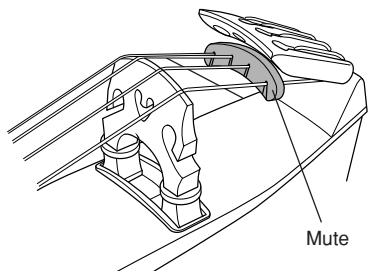
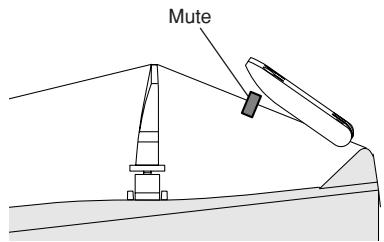
Since the Silent Bass is designed with a pickup system that picks up string vibration, the system can sometimes pick up string vibrations that occur between the bridge and tailpiece. If this is obvious, attach the supplied mute onto the strings as shown in the illustration below.
- The mute will have little effect if it is attached midway between the bridge and the tailpiece. Please take note.
- Attaching the Optional Accessories
- Knee Support for the Silent Bass (BKS2)
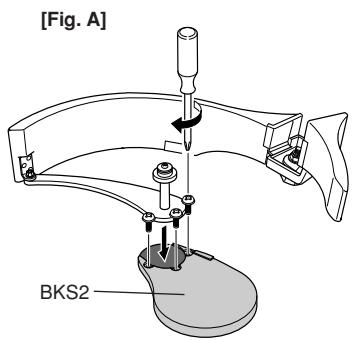
With the optional BKS2 Knee Support, the instrument can be leaned against the left knee when playing while sitting on a stool, etc.
As shown in Fig. A, align the end of the metal frame unit with the matching indentation on the knee support, and use the three screws to secure the support in place.
- Extension Frame for the Silent Bass (BEF2)
The optional BEF2 Extension Frame widens the frame unit to provide greater instrument support.
As shown in Fig. B, use the two screws to secure the support in place.
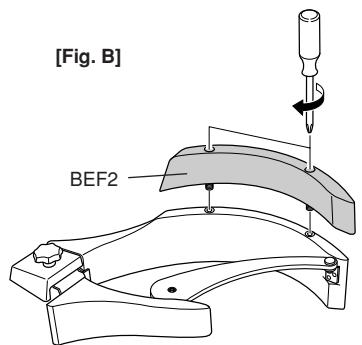
- Before attaching or removing optional parts, remove the frame unit from the instrument and place the frame on a stable surface.
- Before playing the instrument, make sure that the optional parts are not loosely attached.
Power Supply
The Silent Bass uses a battery as its power source.
Before installing or removing the battery, remove the cable from the output jack.
1 On the backside of the instrument, push down on the battery case's latch below the "OPEN" arrow to remove the battery case.
- Be careful when removing the battery case. Depending upon the angle of the instrument, the case can suddenly jump out.
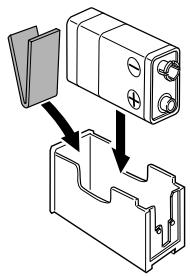
2 Insert the supplied battery (6F22(S-006P)9V battery) into the case. Referring to the illustration below, make sure that the battery is placed in the case with its poles (+/-) properly aligned.
3 Push the case into the slot until you hear the latch "click".
Caution! When Inserting the Battery
In some cases, batteries other than the supplied battery may be slightly short in length resulting in poor conductivity (loss of power). In this case, refer to the illustration on the left and use a spacer, such as some thick paper or a piece of cardboard, between the end of the battery and the battery case to hold the battery in place.
When the battery is low, the lamp will dim and the sound may become distorted or noisy.
When these symptoms occur, please take note of the following precautions and replace the battery.
- Always follow the + / - signs when inserting the battery. Improper insertion may result in fire.
- To prevent possible damage to the unit due to battery leakage and unnecessary power drain, remove the battery from the unit when it is not going to be used for an extended period of time.
Specifications
| Neck | Maple |
| Body | Spruce + Mahogany |
| Fingerboard | Rosewood |
| Bridge | Maple (height is adjustable) |
| Frame Unit | Beech + parts of Aluminum, etc. |
| Tuning Pegs | Custom Worm Gear Type |
| Tail Piece | Ebony (reverse type) |
| Strings | Contra Bass Strings (Ball-end type) |
| Sensor | Piezo Pickup |
| Controls | • Volume • Treble • Bass |
| Power | • Power switched ON/OFF with connection/disconnection of cable. • 6F22(S-006P)/6LR61 9V battery x 1 |
| Battery Life (Continuous Use) | Using Manganese battery: approximately 350 hours Using Alkaline battery: approximately 500 hours |
| String Length | 1,040 mm (41") |
| Dimensions (L x W x H) | Size including attachments (with the Frame Unit and End Pin at its shortest) 1,692 x 456 x 330 mm (66-5/8" x 17-15/16" x 13") Size of Main Body (without Frame Unit and End Pin) 1,392 122 x 230 mm (54-13/16" x 4-13/16" x 9") Size of Frame Unit (when folded) 465 x 145 x 129 mm (18-5/16" x 5-11/16" x 5-1/10") |
| Weight | approximately 7.2 kg (15 lbs. 14 oz.) |
- Design and specifications are subject to change without notice.