DT398B-MD - Tablet DT Research - Free user manual and instructions
Find the device manual for free DT398B-MD DT Research in PDF.


User questions about DT398B-MD DT Research
0 question about this device. Answer the ones you know or ask your own.
Ask a new question about this device
Download the instructions for your Tablet in PDF format for free! Find your manual DT398B-MD - DT Research and take your electronic device back in hand. On this page are published all the documents necessary for the use of your device. DT398B-MD by DT Research.
USER MANUAL DT398B-MD DT Research
DT398B/ DT398H/ DT398B-MD/ DT398B-MD-C
Federal Communication Commission Interference
This device has been tested and found to comply with the limits for a Class B digital device, pursuant to Part 15 of the FCC Rules. These limits are designed to provide reasonable protection against harmful interference in a residential installation. This equipment generates, uses and can radiated radio frequency energy and, if not installed and used in accordance with the instructions, may cause harmful interference to radio communications. However, there is no guarantee that interference will not occur in a particular installation if this equipment does cause harmful interference to radio or television reception, which can be determined by turning the equipment off and on, the user is encouraged to try to correct the interference by one or more of the following measures:
Reorient or relocate the receiving antenna.
- Increase the separation between the equipment and receiver.
- Connect the equipment into an outlet on a circuit different from that to which the receiver is connected.
- Consult the dealer or an experienced radio/TV technician for help.
Changes or modifications not expressly approved by the party responsible for compliance could void the user's authority to operate the equipment.
This device complies with part 15 of the FCC Rules.
Operation is subject to the following two conditions: (1) This device may not cause harmful interference, and (2) this device must accept any interference received, including interference that may cause undesired operation.
Operation on the 5.15-5.25GHz frequency band is restricted to indoor use only. The FCC requires indoor use for the 5.15-5.25GHz band to reduce the potential for harmful interference to co-channel Mobile Satellite Systems.

DT Research, Inc.
2000 Concourse Drive, San Jose, CA 95131 http://www.dtresearch.com
Copyright © 2015, DT Research, Inc. All Rights Reserved.
natural_image
Two foldable desktop tablets with Windows logo screens, shown from different angles (no visible text or symbols on devices)INTRODUCTION
Thank you for acquiring the latest addition to DT Research's line of mobile tablets—the DT398 Series. Featuring an IP65-rated, slim yet robust enclosure, the two-pound DT398 Tablet with 9.7" TFT display is powered by the Intel Celeron® or Core™ i dual core processor, offering optimal combinations of performance and power savings.
The DT398 Tablet is available with Windows® or Linux operating systems. Each software operating system features web browser, client/server computing software, media player, accessories, and applications support.
PACKAGE CONTENTS
- DT398 Tablet with internal battery pack, stylus, and bumpers AC-DC Power Adapter with Power Cord •
- Basic Operation Guide Handstrap•
Major options, depending on configuration:
Desktop Cradle with External Battery Pack Charger. Docking support with ports for • Power, USB, Display Port, COM port and Ethernet
- External Battery Pack and Battery Charger Kit Vehicle/ Wall Mount Cradle
* If your DT398 Tablet contains camera, 3G or scanner module, please refer to the Tablet Modules Basic Operation Guide for detailed operation.
DT398B/ DT398H/ DT398B-MD/ DT398B-MD-C
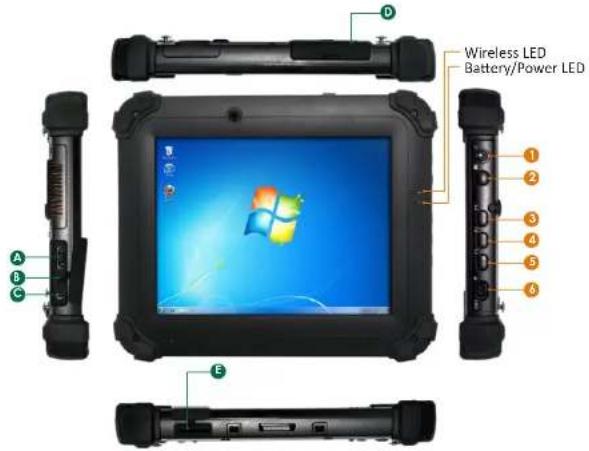
DT398 Tablet with Resistive Touch Screen
text_image
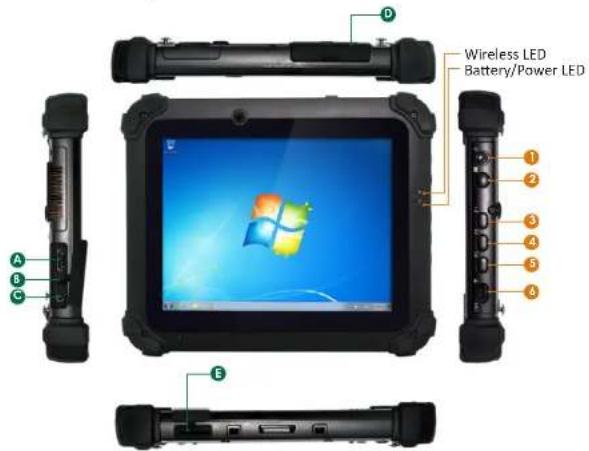
Wireless LED Battery/Power LED A B C D EDT398 Tablet with Capacitive Touch Screen
text_image
Wireless LED Battery/Power LED A B C D EInput/ Output Ports
| A | e-SATA USB Hybrid Port |
| B | Headphone Jack |
| C | DC Power Input |
| D | Full Slot Smart Card Reader |
| E | SD Slot |
Button Functions
| BUTTON ACTION | |
| 1 | Power on,Push/release typically enters Standby mode, or Push/release exits Standby mode or restarts (software dependent)Push and hold (over 4 seconds) invokes hardware shutdown |
| 2 | Programmable,As scanner trigger when equipped with the scanner module |
| 3 4 5 | Programmable |
| 6 | Wireless switch |
DT398B/ DT398H/ DT398B-MD/ DT398B-MD-C
Power/Battery LED Status:
• Blue indicates the battery is 25% to 100% charged
- Blinking blue indicates the battery is charging
• Orange indicates that the battery is between 11% to 25%
- Blinking orange indicates that the battery is below 10%
- Blinking blue and orange alternately indicates the battery is being warmed up. Do not unplug the AC/DC adapter.
Precautions
• Tablets exercise care when operating and handling the
- Do NOT apply excessive pressure to the display screen.
• We recommend using the Stylus provided to keep the screen clean.
- Avoid prolonged exposure of the display panel to any strong heat source. Wherever possible, the Tablet should face away from direct light to reduce glare.
- If the AC-DC power adapter is used to recharge or power the ablet, do NOT use any AC-DC adapter other than the one provided with the tablet or acquired from the manufacturer or its partners.
- In the unlikely event that smoke, abnormal noise, or strange odor is present, immediately power off the Tablet and disconnect all power sources. Report the problem to your device provider immediately.
- Tablet, attempt to disassemble the as this will void the warranty.
Basic Features
The Tablet wireless tablet integrates a bright and responsive touch display, 1 USB port, and embedded networking elements such as Wi-Fi or optional 3G. The Tablet is complemented by a suite of accessories, including battery expansion, docking cradles, and wall/ vehicle mount cradles, for a comprehensive user experience.
A Tablet typically integrates an 802.11 Wi-Fi adapter that may connect to other wireless devices or access points. If your Tablet does not come with such a network adapter, please consult your device provider to establish the desired network connectivity.
OPERATION
Internal Battery
Warning!
The Internal battery pack should only be replaced by an authorized DT Research service representative. Please contact your product and/or service provider for internal battery replacement service.
Powering ON and OFF
To activate the Tablet, push and quickly release the Power Button. The display will come on in a few seconds. To put the Tablet in Standby mode, push and quickly release the Power Button. To turn the Tablet off for extended storage, power off safely using any software function that "shuts down computer" provided in the software operating system.
NOTE: The battery packs shipped with your tablet may be low in power—please use the AC-DC adapter with the Tablet when setting up for the first time to fully charge the internal battery pack. You may charge the external battery pack with it attached to the Tablet, or with the optional external battery charger kit.
NOTE: When the battery pack(s) is (are) charging, the blue-colored Battery LED should blink slowly. If plugging in the AC-DC adapter does not trigger this blinking activity and the LED stays dark, the battery pack(s) may have been drained substantially. Try unplugging/replugging the AC-DC adapter to the Tablet a few times to activate the charging process.
NOTE: To conserve power, use (push and quick release) the Power Button to put in "Standby" mode while not in use. Pushing briefly on the same button will wake up the system within seconds.
NOTE: Avoid using the Power Button ("hold 4+ seconds" feature) to turn off the tablet—this form of hardware shutdown is intended to be a means of recovery from lockups, and not as normal operation.
Start Up
If the power up (from Standby or otherwise) is successful, the appropriate interface will be displayed after a launch sequence of several seconds. The wireless LAN connection may take 10-15 seconds to be established.
Configuring the DT398B/ DT398H/ DT398B-MD/ DT398B-MD-C
The tablet may be configured using the utilities and methods dictated by the software operating system. The Tablet should be configurable for various properties such as user profiles, network features, and several system elements.
DT398B/ DT398H/ DT398B-MD/ DT398B-MD-C
Calibration
The touch display for the Tablet is calibrated before shipping. In the event that the calibration has been modified or is unsatisfactory, the respective calibration routines (e.g., PenMount (PM) to calibrate the touch interface may be used. Such applications are typically executed through touch input via Stylus or through mouse click via a USB mouse.
Wireless Networking
Wi-Fi
The Tablet is often delivered with an embedded (user-inaccessible) 802.11a/b/g/n WI-Fi adapter equipped with a hidden custom antenna.
- through the support of typical Wi-Fi adapters, the Tablet should be able to detect all 802.11 access points in the vicinity for you to select the access point of your choice for connection.
- The SSID and WEP/WPA/WPA2 (if enabled) parameters on the Tablet and the access points have to match. The SSID is case-sensitive and it is recommended that you enable WEP/WPA/WPA2 encryption (or advanced alternatives) for secure access.
- Wen WEP/WPA/WPA2 is enabled, you may need to consult your network administrator or your networking equipment literature to properly configure associated settings such as Authentication mode, etc.
- Refer to the access point operating manuals for setting up the 802.11 access points.
Button Management
Where supported by software, many of the hard buttons on the Tablet are programmable to perform a function of the user's choice. To activate the button re-assignment application, invoke the Button Manager application.
Brightness Control
To control the screen brightness, launch the System Utility. The System screen will display a Brightness control section with up and down arrows that can be activated with the stylus.
Battery and Power Management
The Tablet is equipped with an Internal Li-Ion battery pack and an optional battery pack that clips (hot-pluggable) onto the back of the tablet. The period between battery recharges can be significantly lengthened by putting the tablet into Standby mode through the Power Button (see Buttons Function Table) whenever the tablet is not in use. Depending on the operating software, the DT398C/ DT398B/ DT398B-MD may also be configured to enter various power-saving modes via the Power Button or through timed entry.
Using the DT398B/ DT398H/ DT398B-MD/ DT398B-MD-C
Peripherals Support
Through its USB port, the Tablet supports a wide range of USB-based peripherals. These peripherals are applicable for software installation, applications storage, data storage, docking or software recovery and update.
The Tablet is complemented by an optional Desktop Cradle or Wall/ Vehicle Mount Cradle for support, pass-through charging, and connection to a range of USB peripherals, including keyboard and mouse. The Cradles offer the following interfaces: a DC-in port for the AC-DC adapter, an Ethernet port, video outputs and USB ports. Always seat the Tablet securely onto the cradle. The cradle must be powered by the AC-DC adapter for the Ethernet and USB ports to function. The battery packs on the Tablet may be recharged by connecting the AC-DC adapter directly to the DC-in port on the Tablet or through the DC-in port on the Cradle while the Tablet is docked.
Remote Management
Depending on software configuration, the Tablet can be centrally managed for asset monitoring and for software control. Please consult your device provider.
For More Support
Users can download the Tablet Modules Basic Operation Guides from the DT Research website.
If the Tablet comes with a WWAN module, please contact your product and/or service provider for the SIM Card installation procedures.
natural_image
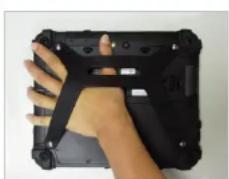
Hand holding a black electronic device with a strap, no visible text or symbolsTo Hold the Tablet
Left hand: grip the left back side of the tablet with your left hand four index fingers, with thumb resting on the top of the back side of the tablet and palm securely against the back.
Right hand: grip the right back side of the tablet with your right hand four index fingers, with thumb resting on the top of the back side of the tablet and palm securely against the back.