WN-360USB - Network card / adapter AIRLIVE - Free user manual and instructions
Find the device manual for free WN-360USB AIRLIVE in PDF.


| Product Type | Wireless USB Adapter / Network Card |
| Brand | AirLive |
| Model | WN-360USB |
| Wireless Standards | IEEE 802.11b/g/n |
| Maximum Data Rate | 150 Mbps |
| Frequency Band | 2.4 GHz |
| Interface | USB 2.0 |
| Security | WEP 64/128-bit, WPA, WPA2 |
| Antenna Type | Internal (built-in) |
| Dimensions (Approx.) | 90 x 30 x 15 mm |
| Weight (Approx.) | 30 g |
| Power Supply | Powered via USB (5V DC) |
| Operating Temperature | 0°C to 40°C |
| Operating Humidity | 10% to 90% (non-condensing) |
| Supported Operating Systems | Windows XP/Vista/7/8/10, Linux, Mac OS |
| Main Functions | High-speed wireless connectivity, supports ad-hoc and infrastructure modes, easy plug-and-play installation |
| Maintenance & Cleaning | Wipe with a soft, dry cloth. Do not use liquid cleaners. |
| Safety Precautions | Avoid exposure to moisture, high temperatures, or direct sunlight. Do not disassemble. |
| Spare Parts & Repairability | No user-serviceable parts. Contact manufacturer for repairs. |
| General Information | Desktop or laptop use; enables wireless network access with speeds up to 150 Mbps; backward compatible with 802.11b/g. |
Frequently Asked Questions - WN-360USB AIRLIVE
User questions about WN-360USB AIRLIVE
0 question about this device. Answer the ones you know or ask your own.
Ask a new question about this device
Download the instructions for your Network card / adapter in PDF format for free! Find your manual WN-360USB - AIRLIVE and take your electronic device back in hand. On this page are published all the documents necessary for the use of your device. WN-360USB by AIRLIVE.
USER MANUAL WN-360USB AIRLIVE
Wireless 11N USB Dongle
User's Manual
COPYRIGHT
Copyright ©2008/2009 by this company. All rights reserved. No part of this publication may be reproduced, transmitted, transcribed, stored in a retrieval system, or translated into any language or computer language, in any form or by any means, electronic, mechanical, magnetic, optical, chemical, manual or otherwise, without the prior written permission of this company.
This company makes no representations or warranties, either expressed or implied, with respect to the contents hereof and specifically disclaims any warranties, merchantability or fitness for any particular purpose. Any software described in this manual is sold or licensed "as is". Should the programs prove defective following their purchase, the buyer (and not this company, its distributor, or its dealer) assumes the entire cost of all necessary servicing, repair, and any incidental or consequential damages resulting from any defect in the software. Further, this company reserves the right to revise this publication and to make changes from time to time in the contents thereof without obligation to notify any person of such revision or changes.
Federal Communication Commission
Interference Statement
This equipment has been tested and found to comply with the limits for a Class B digital device, pursuant to Part 15 of FCC Rules. These limits are designed to provide reasonable protection against harmful interference in a residential installation. This equipment generates, uses, and can radiate radio frequency energy and, if not installed and used in accordance with the instructions, may cause harmful interference to radio communications. However, there is no guarantee that interference will not occur in a particular installation. If this equipment does cause harmful interference to radio or television reception, which can be determined by turning the equipment off and on, the user is encouraged to try to correct the interference by one or more of the following measures:
- Reorient or relocate the receiving antenna.
- Increase the separation between the equipment and receiver.
- Connect the equipment into an outlet on a circuit different from that to which the receiver is connected.
- Consult the dealer or an experienced radio technician for help.
FCC Caution: Any changes or modifications not expressly approved by the party responsible for compliance could void the user's authority to operate this equipment.
Country Code Statement
For product available in the USA/Canada market, only channel 1\~11 can be operated. Selection of other channels is not possible.
CAUTION:
Any changes or modifications not expressly approved by the grantee of this device could void the user's authority to operate the equipment.
This transmitter must not be co-located or operating in conjunction with any other antenna or transmitter.
Federal Communication Commission (FCC) Radiation Exposure Statement
This EUT is compliance with SAR for general population/uncontrolled exposure limits in ANSI/IEEE C95.1-1999 and had been tested in accordance with the measurement methods and procedures specified in OET Bulletin 65 Supplement C. This equipment should be installed and operated with minimum distance 5mm between the radiator & your body.
R&TTE Compliance Statement
This equipment complies with all the requirements of DIRECTIVE 1999/5/EC OF THE EUROPEAN PARLIAMENT AND THE COUNCIL of March 9, 1999 on radio equipment and telecommunication terminal Equipment and the mutual recognition of their conformity (R&TTE)
The R&TTE Directive repeals and replaces in the directive 98/13/EEC (Telecommunications Terminal Equipment and Satellite Earth Station Equipment) As of April 8, 2000.
Safety
This equipment is designed with the utmost care for the safety of those who install and use it. However, special attention must be paid to the dangers of electric shock and static electricity when working with electrical equipment. All guidelines of this and of the computer manufacture must therefore be allowed at all times to ensure the safe use of the equipment.
EU Countries Intended for Use
The ETSI version of this device is intended for home and office use in Austria, Belgium, Denmark, Finland, France, Germany, Greece, Ireland, Italy, Luxembourg, the Netherlands, Portugal, Spain, Sweden, and the United Kingdom.
The ETSI version of this device is also authorized for use in EFTA member states: Iceland, Liechtenstein, Norway, and Switzerland.
EU Countries Not intended for use
None.
CONTENTS
CHAPTER I: Product Information .... 1
1.1 Introduction and safety information.... 1
1.2 Safety Information....2
1.3 System Requirements.... 3
1.4 Package Contents....3
1.5 Familiar with your new wireless network card....4
CHAPTER II: Driver Installation and Configuration....5
2.1 Network Card Installation....5
2.2 Connect to Wireless Access Point 12
2.3 Profile Management .... 33
2.4 Advanced Settings 37
2.5 View Network Statistics....40
2.6 WMM Setting 41
2.7 WPS Configuration 43
2.8 Radio On/Off....49
2.9 About 50
2.10 On-line Help....51
CHAPTER III: Appendix 52
3.1 Specification....52
3.2 Troubleshooting....53
3.3 Glossary 55
CHAPTER I: Product Information
1.1 Introduction and safety information
Thank you for purchasing this high-speed wireless network card! Excepting common wireless standards 802.11b/g, this wireless network card is also able to access 802.11n wireless networks - data transfer rate is 150Mbps, and that's three times faster than 802.11g wireless network!
With easy-to-install USB 2.0 interface - a very common expansion port of computers - plug this wireless network card into any empty USB port of your computer, just that simple!
Other features of this wireless network card including:
■ High-efficiency antenna expands the scope of your wireless network.
■ High-speed data transfer rate - Up to 150Mbps.
■ QoS function: control the bandwidth required for different applications.
■ Work with 802.11b/g/Draft-N wireless networks.
■ Supports major encryption methods like WEP, WPA, and WPA2 encryption.
WPS configuration - You don't need an experienced computer technician to help you to get connected. Utilizing the software program of the card, you can get your computer connected by pushing a button or entering an 8-digit code.
USB 2.0 interface - you can get it installed on your computer in just few seconds!
1.2 Safety Information
In order to keep the safety of users and your properties, please follow the following safety instructions:
- This USB wireless network card is designed for indoor use only. DO NOT expose this network card to direct sun light, rain, or snow.
- DO NOT put this network card at or near hot or humid places, like kitchen or bathroom. Also, do not left this wireless network card in the car in summer.
- This network card is small enough to put in a child's mouth, and it could cause serious injury or could be fatal. If they throw the network card, the card will be damaged. PLEASE KEEP THIS NETWORK CARD OUT THE REACH OF CHILDREN!
- This network card will become hot when being used for long time (This is normal and is not a malfunction). DO NOT put the network card on a paper, cloth, or other flammable objects after the network card has been used for a long time.
- There's no user-serviceable part inside the network card. If you found that the network card is not working properly, please contact your dealer of purchase and ask for help. DO NOT disassemble the network card by your self, warranty will be void.
- If the network card falls into water, DO NOT USE IT AGAIN BEFORE YOU SEND THE CARD TO THE DEALER OF PURCHASE FOR INSPECTION.
- If you smell something strange or even see some smoke coming out from the network card, switch the computer off immediately, and call dealer of purchase for help.
1.3 System Requirements
An empty USB 2.0 port (May not be able work with USB 1.1 port, and performance will be greatly reduced)
■ Windows 2000, 2003, XP, or Vista operating system
■ CD-ROM drive
■ At least 100MB of available disk space
1.4 Package Contents
Before you starting to use this wireless network card, please check if there's anything missing in the package, and contact your dealer of purchase to claim for missing items:
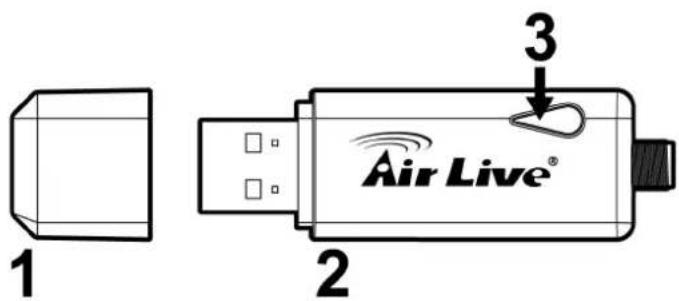
□ USB wireless network card (1 pcs) .... 1
□ Protection Cap (1 pcs) 2
□Quick installation guide (1pcs) ....3
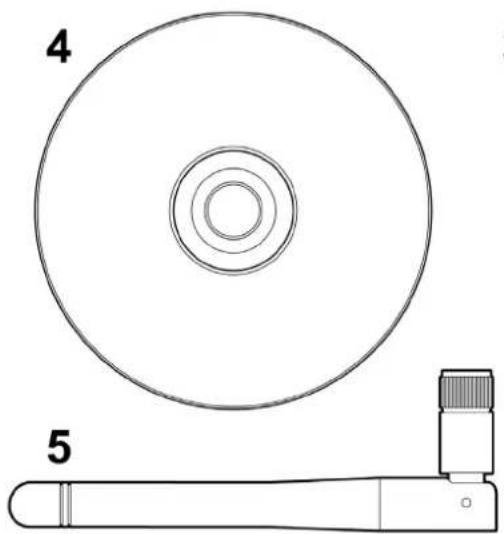
□ Driver/Utility/User manual CD-ROM (1 pcs) ....4
□ Antenna (1 pcs)....5
text_image
4 5
natural_image
Blank white image with a corner edge and faint curved lines, no text or symbols present.
text_image
2 1 Air Live®1.5 Familiar with your new wireless network card
- Connector Cap (To protect USB connector when not in use)
- USB Connector
- Link/Activity LED
text_image
1 2 3 Air Live®| LED Name Light | Status Description | |
| Link/Activity | Flash The network card has linked to a wireless access point and is receiving or transferring data. | |
| Off No wireless activity. | ||
CHAPTER II: Driver Installation and Configuration
2.1 Network Card Installation
Please follow the following instructions to install your new wireless network card:
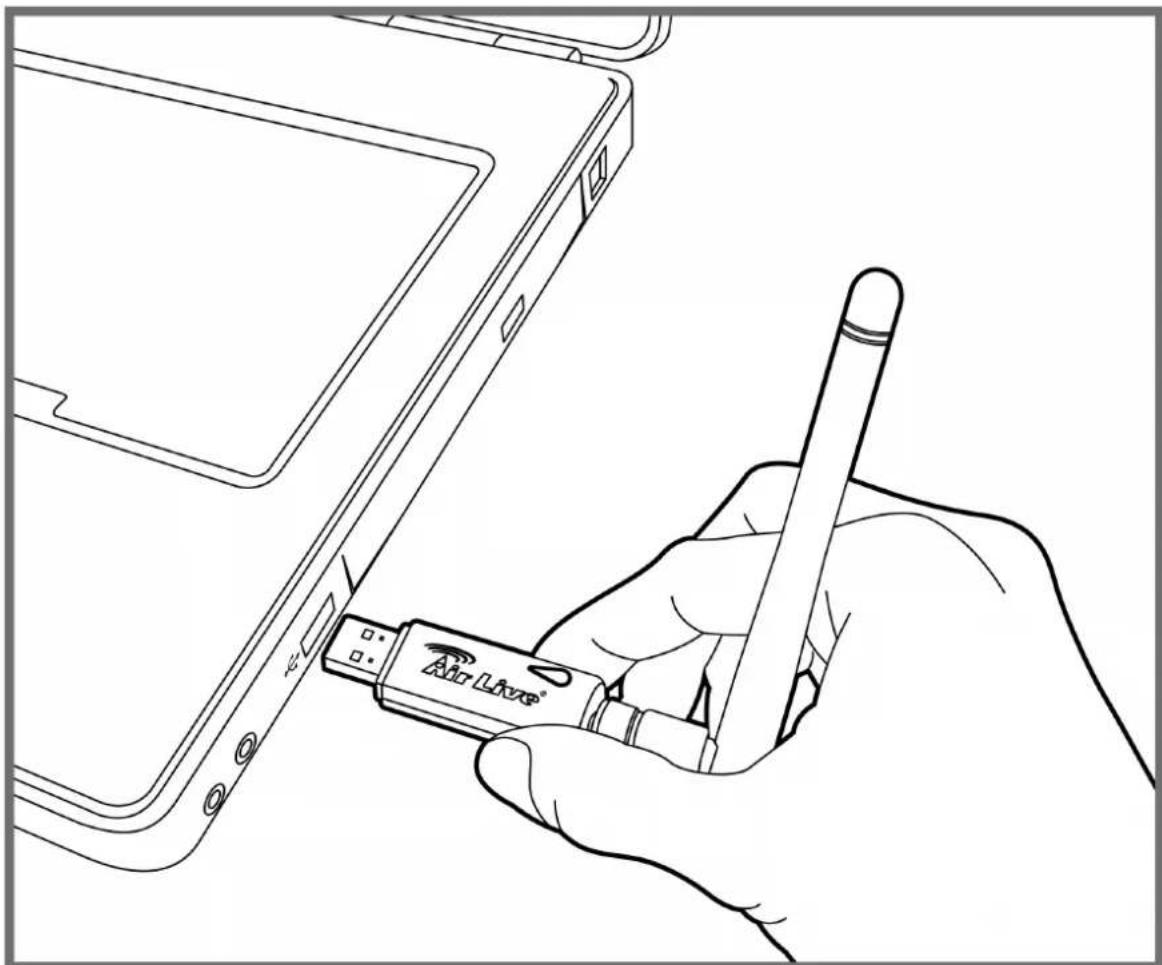
- Insert the USB wireless network card into an empty USB 2.0 port of your computer when computer is switched on. Never use force to insert the card, if you feel it's stuck, flip the card over and try again.
natural_image
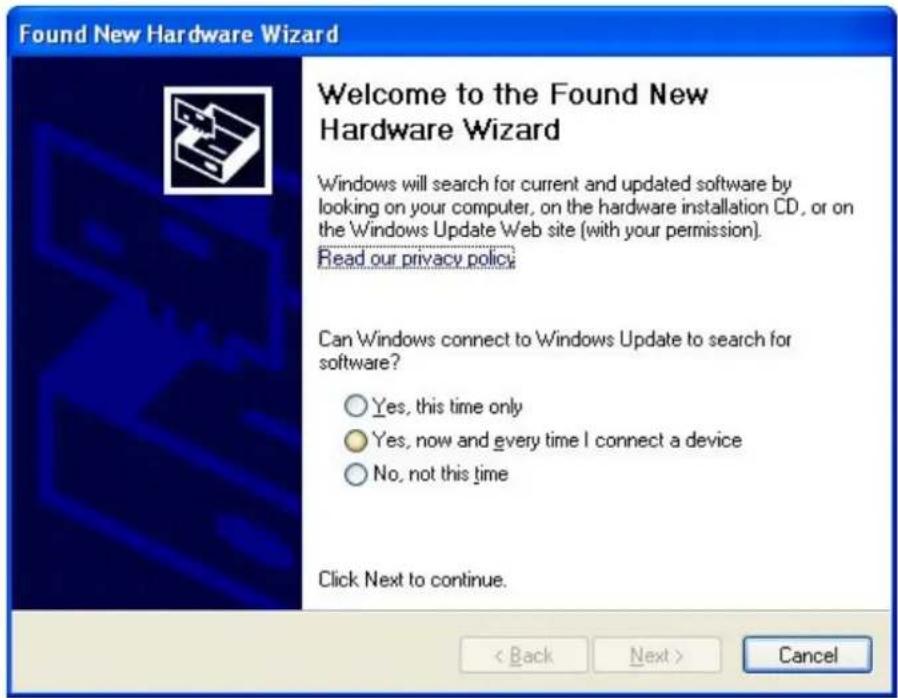
Line drawing of a hand inserting a device into a tablet device (no text or symbols)- The following message will appear on your computer, click 'cancel'.
text_image
Found New Hardware Wizard Welcome to the Found New Hardware Wizard Windows will search for current and updated software by looking on your computer, on the hardware installation CD, or on the Windows Update Web site (with your permission). Read our privacy policy. Can Windows connect to Windows Update to search for software? Yes, this time only Yes, now and every time I connect a device No, not this time Click Next to continue. < Back Next > Cancel- Insert device driver CDROM into the CD/DVD ROM drive of your computer, and execute
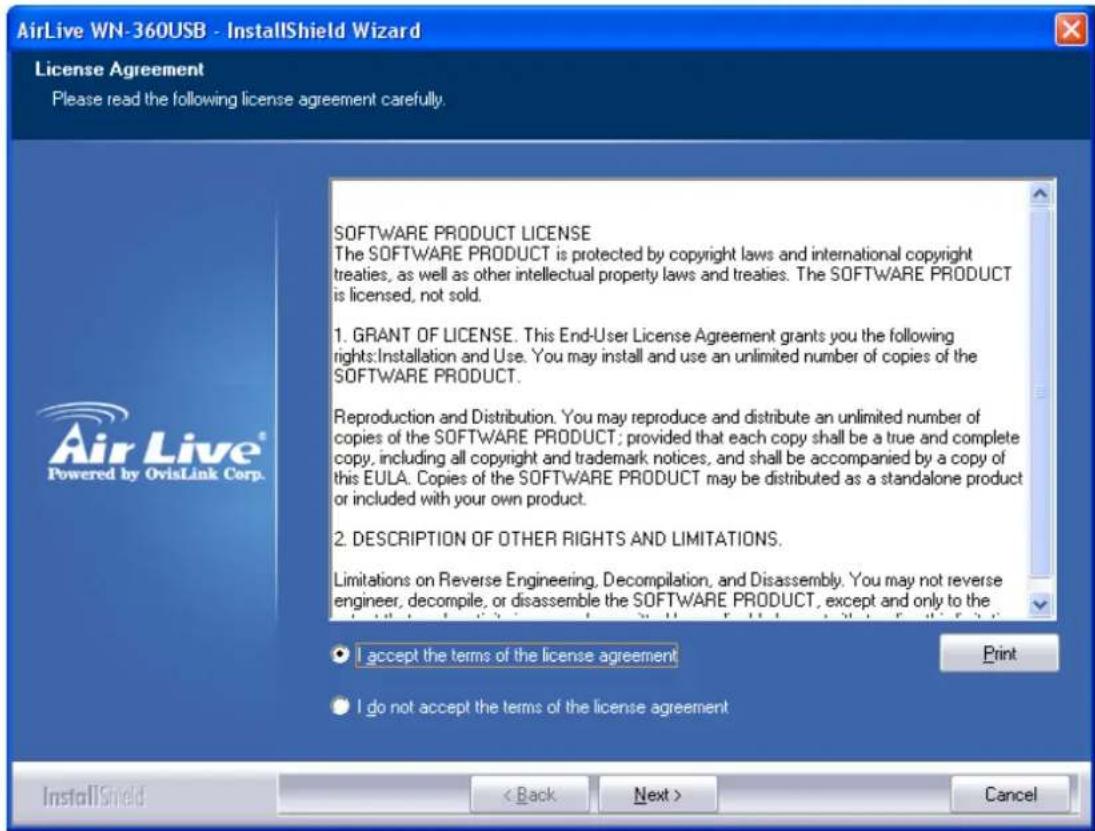
'Setup.exe' program. Please read the end user license agreement and click 'I accept the terms of the license agreement' then click 'Next' button, to accept license agreement.
text_image
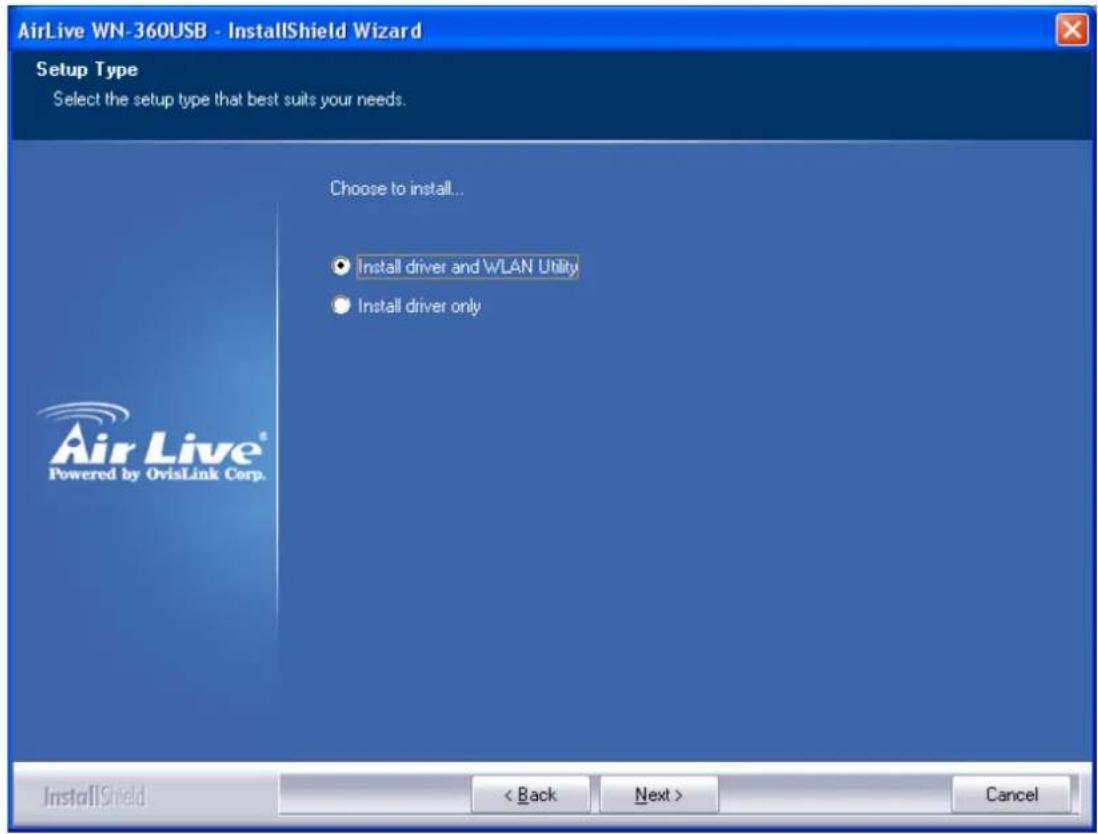
AirLive WN-360USB - InstallShield Wizard License Agreement Please read the following license agreement carefully. SOFTWARE PRODUCT LICENSE The SOFTWARE PRODUCT is protected by copyright laws and international copyright treaties, as well as other intellectual property laws and treaties. The SOFTWARE PRODUCT is licensed, not sold. 1. GRANT OF LICENSE. This End-User License Agreement grants you the following rights:Installation and Use. You may install and use an unlimited number of copies of the SOFTWARE PRODUCT. Reproduction and Distribution. You may reproduce and distribute an unlimited number of copies of the SOFTWARE PRODUCT; provided that each copy shall be a true and complete copy, including all copyright and trademark notices, and shall be accompanied by a copy of this EULA. Copies of the SOFTWARE PRODUCT may be distributed as a standalone product or included with your own product. 2. DESCRIPTION OF OTHER RIGHTS AND LIMITATIONS. Limitations on Reverse Engineering, Decompilation, and Disassembly. You may not reverse engineer, decompile, or disassemble the SOFTWARE PRODUCT, except and only to the • I accept the terms of the license agreement • I do not accept the terms of the license agreement InstallShield < Back Next > Cancel- It is recommend installing driver and utility if the network card is installing the first time. If you want to update the driver only, choose 'Install driver only'. Click 'Next' to continue.
text_image
AirLive WN-360USB - InstallShield Wizard Setup Type Select the setup type that best suits your needs. Choose to install... Install driver and WLAN Utility Install driver only Air Live® Powered by OvisLink Corp. InstallShield < Back Next > Cancel- You can choose the configuration tool used to configure the wireless network card here. It's recommended to select 'AirLive Configuration Tool', which provides fully access to all functions of this wireless network card. If you prefer to use the wireless configuration tool provided by Windows XP or Vista, please select 'Microsoft Zero Configuration Tool' then click 'Next'.

text_image
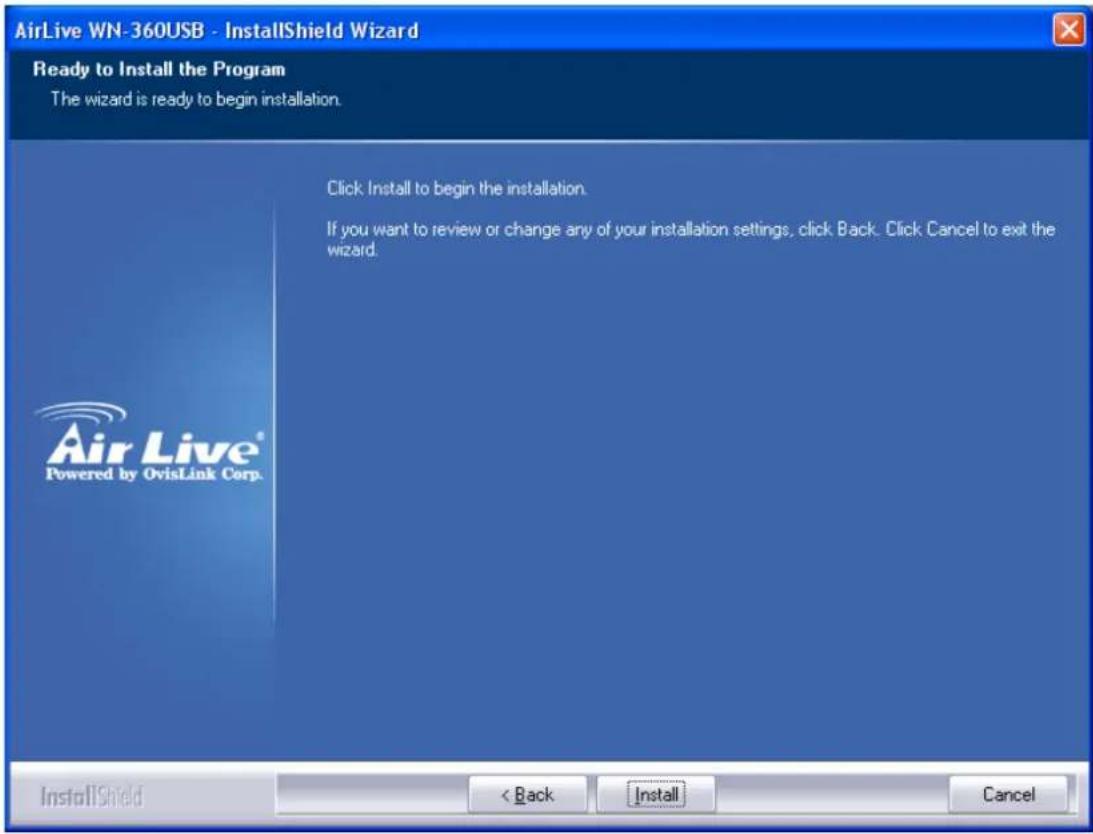
AirLive WN-360USB - InstallShield Wizard Setup Type Select the setup type that best suits your needs. Select Configuration Tool. ● Configuration Tool ● Microsoft Zero Configuration Tool Air Live® Powered by OvisLink Corp. InstallShield < Back Next > Cancel- Now you'll see the following message, please click 'Install' to start utility installation. If you see 'Found New Hardware' message again, please ignore it and wait.
text_image
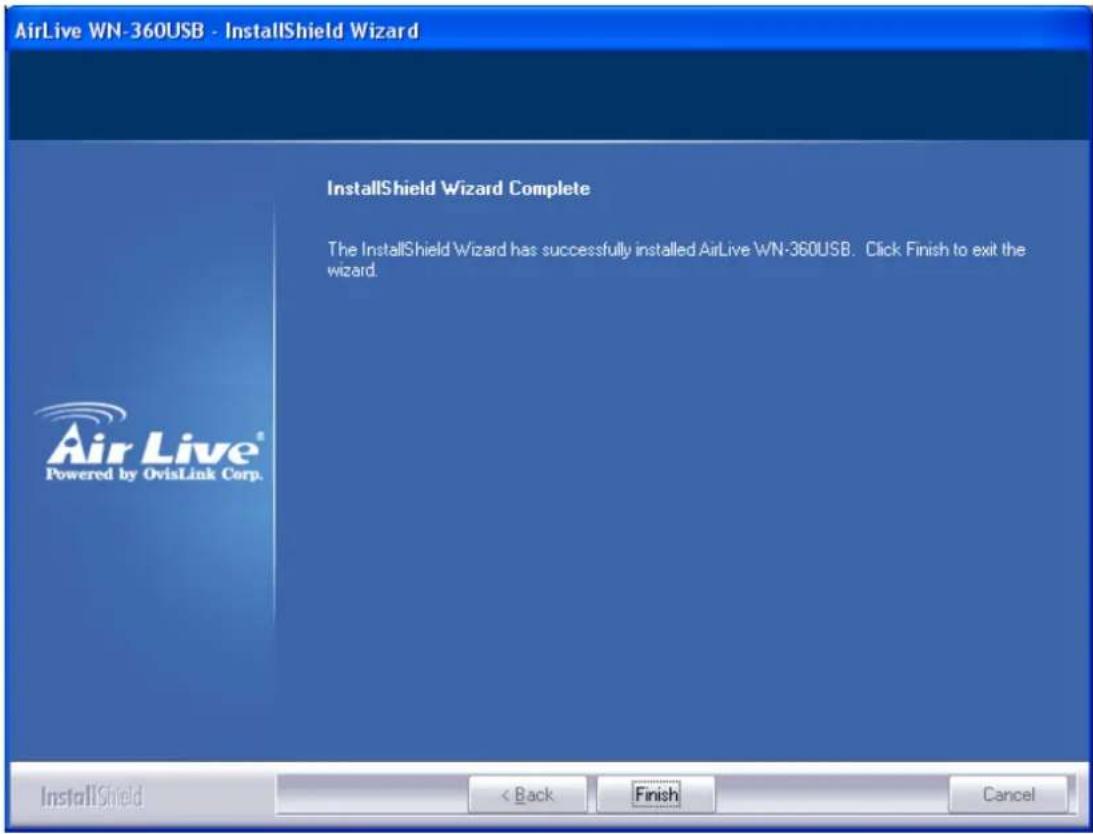
AirLive WN-360USB - InstallShield Wizard Ready to Install the Program The wizard is ready to begin installation. Click Install to begin the installation. If you want to review or change any of your installation settings, click Back. Click Cancel to exit the wizard. Air Live® Powered by OvisLink Corp. InstallShield < Back Install Cancel- Please wait while the install procedure is running. When you see this message, please click 'Finish' to complete the driver installation process.
text_image
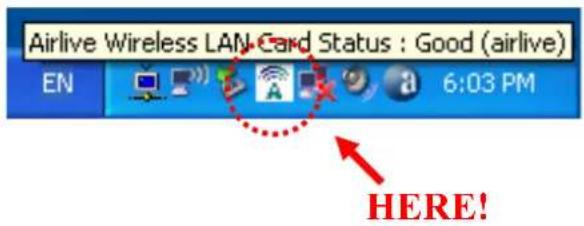
AirLive WN-360USB - InstallShield Wizard InstallShield Wizard Complete The InstallShield Wizard has successfully installed AirLive WN-360USB. Click Finish to exit the wizard. Air Live® Powered by OvisLink Corp. InstallShield < Back Finish Cancel- After installation is complete, wireless configuration utility will be shown in the desktop of your computer automatically. You will also see an icon at the lower-right corner of your windows system. If you put the mouse cursor on the icon, the status of wireless card will be displayed as a popup balloon.
text_image
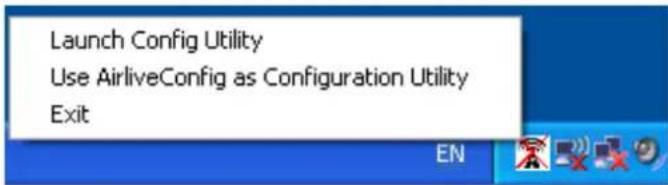
Airlive Wireless LAN Card Status : Good (airlive) EN 6:03 PM HERE!When you want to configure your wireless connection, please right click on this icon, and a popup menu will appear. You can click 'Launch Config Utility' to start configuration program.
If you want to close the configuration utility, please click 'Exit'.
text_image
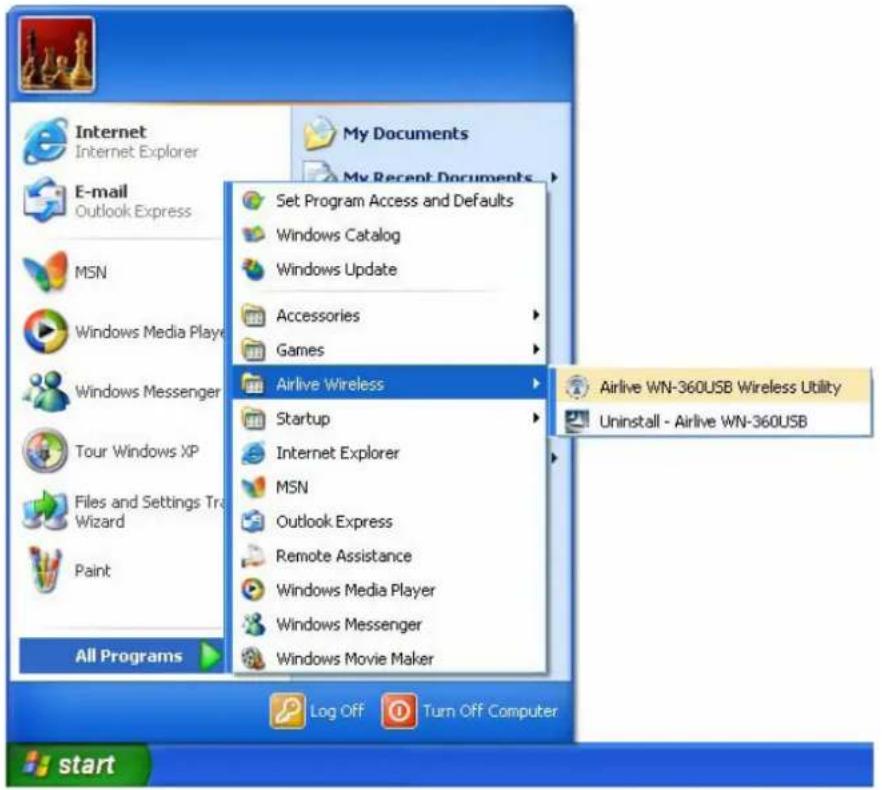
Launch Config Utility Use AirliveConfig as Configuration Utility ExitPlease note that if you stopped config utility by 'Exit' function, you'll not be able to maintain the wireless link to the access point you wish to use. In this case, you can start config utility again by clicking 'AirLive Wireless Utility' icon from 'Start' -> 'All Programs' -> 'AirLive Wireless', as shown below.
text_image
Internet Internet Explorer E-mail Outlook Express MSN Windows Media Player Windows Messenger Tour Windows XP Files and Settings Tr Wizard Paint All Programs My Documents My Recent Documents Set Program Access and Defaults Windows Catalog Windows Update Accessories Games Airlive Wireless Startup Internet Explorer MSN Outlook Express Remote Assistance Windows Media Player Windows Messenger Windows Movie Maker Log Off Turn Off Computer Airlive WN-360USB Wireless Utility Uninstall - Airlive WN-360USB start

Internet Internet Explorer

My Documents

E-mail Outlook Express

Set Program Access and Defaults

MSN

Windows Catalog

Windows Media Play

Windows Update

Windows Messenger

Accessories

Games

Tour Windows XP

Airlive Wireless

Startup

Internet Explorer

MSN

Files and Settings Tr Wizard

Outlook Express

Remote Assistance

Windows Media Player

Windows Messenger

Windows Movie Maker

start

Log Off

Turn Off Computer

Airlive WN-360USB Wireless Utility

Uninstall - Airlive WN-360USB


start


2.2 Connect to Wireless Access Point
After the driver is correctly installed, it will try to connect to any unencrypted wireless access point automatically. If you want to connect to a specific wireless access point, or the access point you wish to connect uses encryption, you have to configure the wireless network card and input required parameters, to get connected to the wireless access point you wish to connect.
The current status of wireless connection will be displayed by AirLive configuration utility icon:

Wireless connection is established, good signal reception.

Wireless connection is established, normal signal reception.

Wireless connection is established, weak signal reception.

Connection is not established yet.

Wireless network card is not detected.
There are two ways you can configure your wireless network card to connect to wireless access point: using the AirLive configuration utility and using built-in windows zero configuration utility.
2.2.1 Using AirLive Utility
Please follow the following instructions to use AirLive configuration utility to connect to wireless access point.
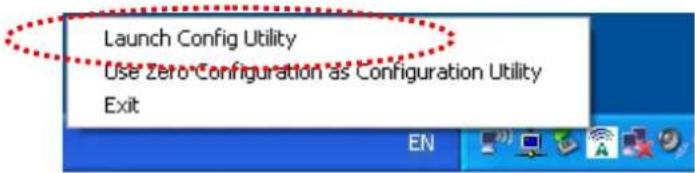
- Right-click the AirLive configuration utility icon located at lower-right corner of computer desktop and then clicks 'Launch Config Utility'.
text_image
Launch Config Utility Use Zero Configuration as Configuration Utility ExitAirLive setup utility will launch, and begin to scan for all wireless access points automatically.

bar
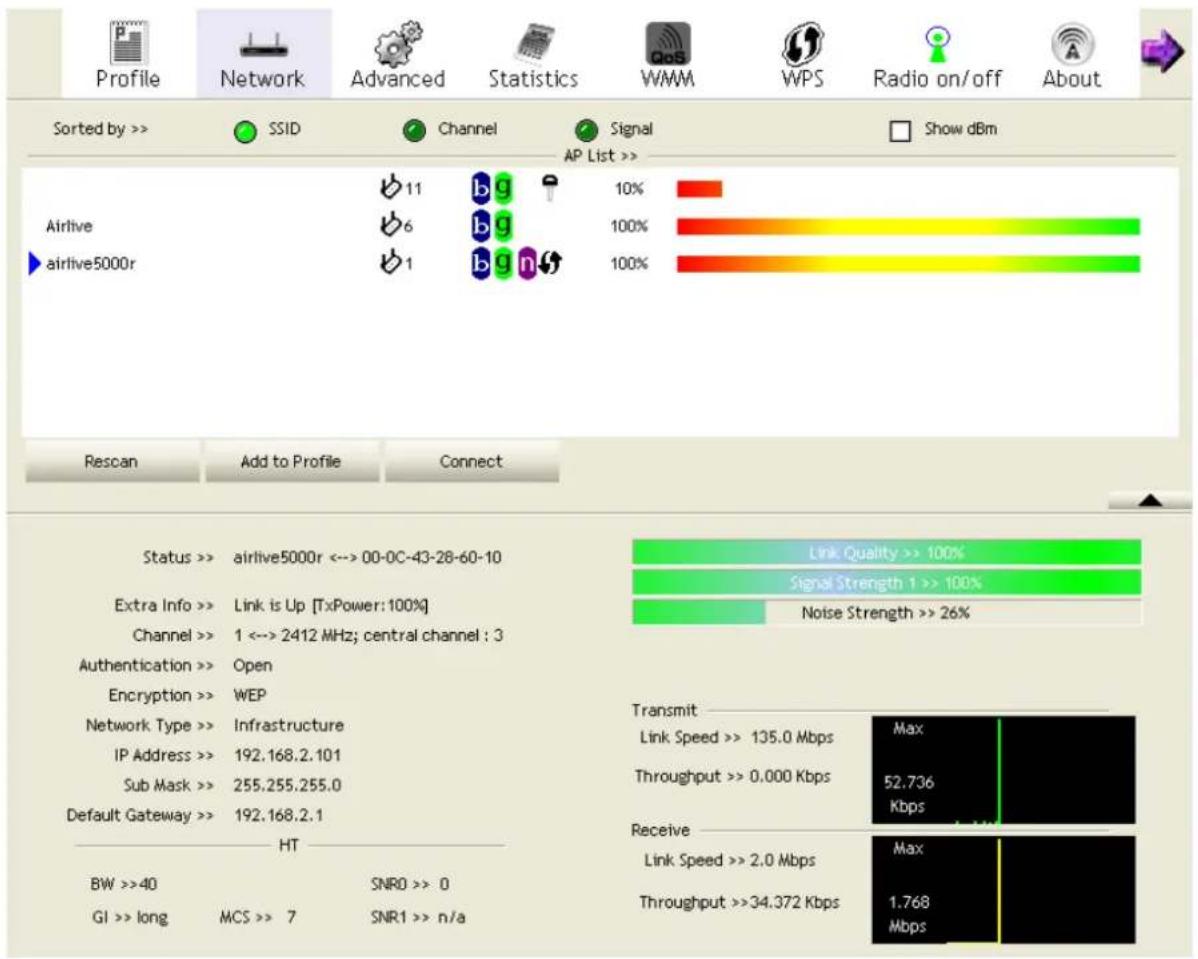
| Airline | Value 1 | Value 2 | Value 3 | Value 4 | | :--- | :--- | :--- | :--- | :--- | | airlive | 11 | bg | 10% | | | airlive5000r | 6 | bg | 100% | | | airlive5000r | 1 | bg | 100% | |AirLive consists two parts: Menu and setup area. You can select a setup function (Profile, Network, etc.) from menu, and corresponding setup items will be displayed at setup area.
Some function includes more information, and can not be fitted in setup area. In this case, you can click 'More / less' button to expand the setup utility window, to display more information:
bar
| Category | Value | | :--- | :--- | | Link Quality >> 100% | 100% | | Signal Strength 1 >> 100% | 100% | | Noise Strength >> 26% | 26% | | Transmit | Max | | Link Speed >> 135.0 Mbps | 52.736 Kbps | | Throughput >> 0.000 Kbps | 52.736 Kbps | | Receive | Max | | Link Speed >> 2.0 Mbps | 2.0 Mbps | | Throughput >> 34.372 Kbps | 34.372 Kbps | | BW >>40 | 40 | | GI >> long | 7 | | SNR0 >> 0 | 0 | | MCS >> 7 | 7 | | SNR1 >> n/a | n/a |- You can click 'More / Less' button again, and setup utility window will resume to its original size.
Tip: If a setup item requires more information to complete the setup procedure, the setup utility window will expand automatically.
2.2.1.1 Scan for Other Wireless Devices
There are two kinds of wireless connection mode: Infrastructure and Ad-Hoc. Infrastructure mode is used by wireless access points, which is able to establish wireless connection for you and other wireless / wired network clients.
Ad-Hoc mode is also known as 'point-to-point' mode, and in this mode, wireless devices such as computer or PDA will not be capable to establish wireless connection with more than one wireless device, and is suitable for establishing a one-to-one wireless connection between two wireless devices.
Before you can connect to any wireless access point or device by infrastructure or Ad-Hoc mode, there two things you must know:
a. Wireless device's 'SSID' (Service Set IDentifier, someone will call it 'access point's name').
You can scan for the SSID of other wireless devices nearby, but if the SSID of the wireless device you wish to connect is hidden, you must know exact SSID before you can establish connection with it.
b. If the wireless device you wish to connect uses encryption, you must know its encryption key.
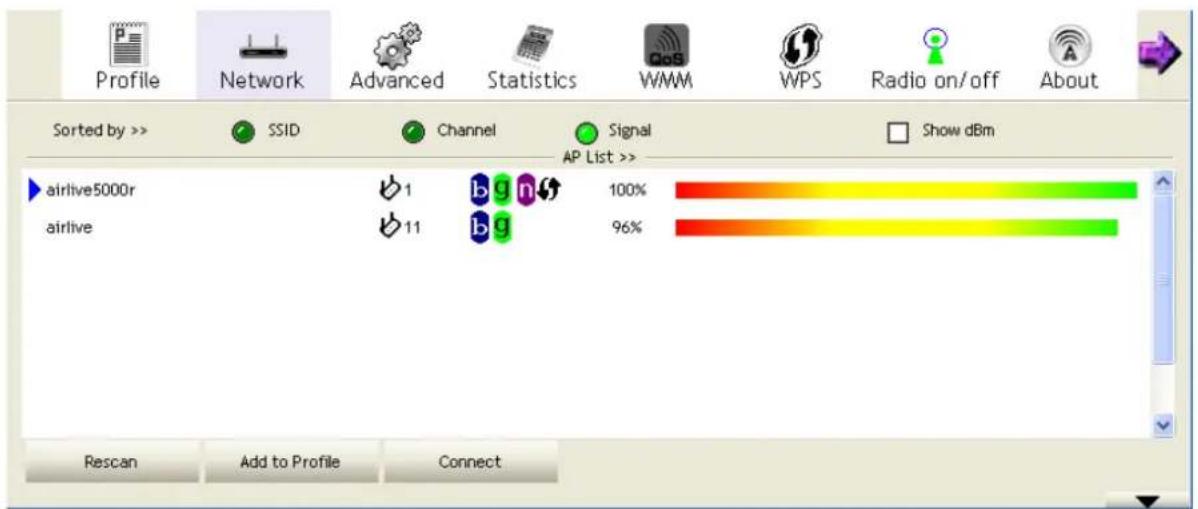
Please launch AirLive setup utility and it will scan for wireless access points near by:
text_image
Profile Network Advanced Statistics WMM WPS Radio on/off About Sorted by >> SSID Channel Signal Show dBm AP List >> airlive5000r 1 b g n 100% airlive 11 b g 96% Rescan Add to Profile ConnectScan results will be displayed here, please check if the wireless device (access point or another computer) with the SSID you wish to connect is shown here.
Scan result includes 6 types of information, they are:

bar
| Airline | Group | Value (%) | | :--- | :--- | :--- | | A | 11 | 10 | | A | 6 | 100 | | A | 1 | 100 | | B | b | 10 | | B | g | 100 | | B | n | 100 | | C | | 100 | | C | | 100 | | D | | 100 | | D | | 100 |A The SSID (Service Set Identifier) of wireless device. If nothing is displayed here, it means the SSID of this wireless device is hidden.
If a ▶ symbol appears in front of the name of wireless device, means you've established connected with that wireless device.
B The type of this wireless device and the channel number of this wireless device.

Means this wireless device is an access point

Means this wireless device is a computer (Ad-Hoc mode, point-to-point connection)
C The wireless standard supported by this access point is displayed here.
'n' for 802.11n n', 'g; for 802.11g , and 'b' for 802.11b . b
WPS icon 📋 will appear when the access point supports WPS. If the access point uses encryption, a key icon 📋 will appear.
Note: When the access point supports WPS and WPS icon 🔒 is appeared, you will not see the key icon where even through the access point uses encryption.
D Shows the signal strength of access point by percentage.
E Shows the bar graph of the signal strength.
If you can not see the access point you wish to connect here, please click 'Rescan' button to scan for access point again, until the one you preferred is displayed. You may have to click 'Rescan' for more than two times before you can see the access point you wish to use here.
If you still can not see the access point you wish to use after clicking 'Rescan' for more than five times, please move your computer closer to the location where the wireless access point is, or see instructions in Chapter 3-2 'Troubleshooting'.
If you wish to see detailed information for a specific access point, please double-click on it, and you'll be provided with its detailed information.

text_image
Profile Network Advanced Statistics WMM WPS Radio on/off About Sorted by >> SSID Channel Signal Show dBm AP List >> Airlive 11 bg 10% bg 55% airlive5000r bg 1 bg n 100% Rescan Add to Profile Connect General WPS CCX 802.11n SSID >> airlive5000r MAC Address >> 00-0C-43-28-60-10 Authentication Type >> Unknown Encryption Type >> WEP Channel >> 1 <--> 2412 MHz Network Type >> Infrastructure Beacon Interval >> 100 Signal Strength >> 100% Legacy Supported Rates (Mbps): 1, 2, 5.5, 6, 9, 11, 12, 18, 24, 36, 48, 54 802.11n Max. Supported Rates (Mbps): 300.0 CloseThere are 4 types of technical information:
General: Displays basic information about this access point, such as SSID, MAC Address, authentication / encryption type, channel etc.
WPS: If this access point supports WPS (Wi-Fi Protected Setup), related information will be displayed here.
CCX: If this access point supports CCX (Cisco Compatible eXtension), related information will be displayed here.
802.11n: If this access point complies with 802.11n draft, related information will be displayed here.
And here are descriptions of every setup item in setup area:
| Item Name Description | |
| Sorted by >> You can decide how to sort all listed access point by ‘SSID’, ‘Channel’, or ‘Signal’ (signal strength). | |
| Show dBm Check this box to show the signal strength of access point, instead of percentage. | |
| Rescan Click this button to rescan access points. You can click this button for several times, if the access point you wish to use does not show in the list. | |
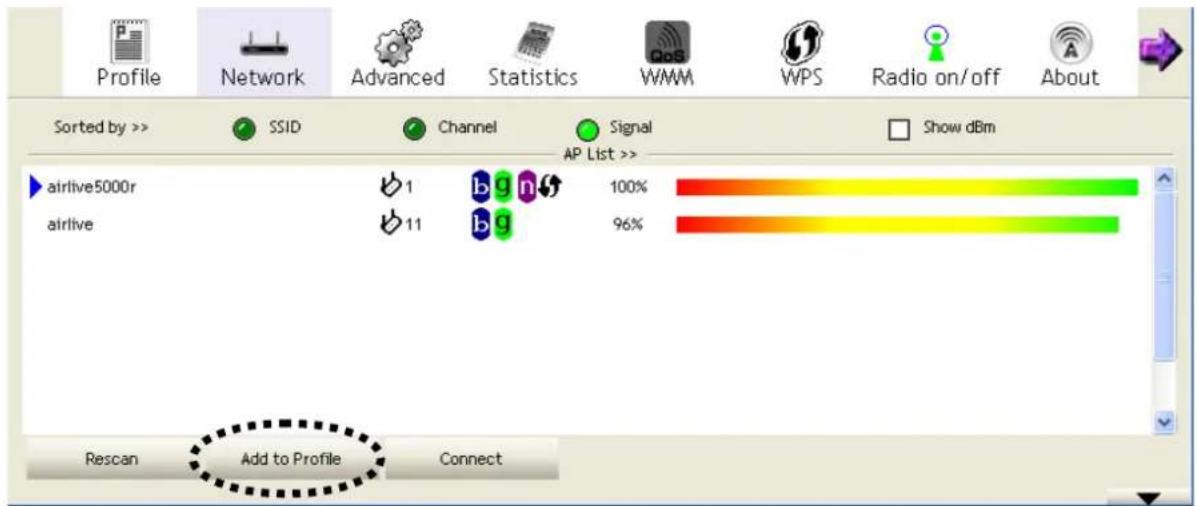
| Add to Profile You can store a specific access point to profile, so you can link to that access point directly next time, without inputting authentication key again.To add an access point to profile, you have to select an access point from the list first, then click ‘Add to Profile’ button. Detailed instructions will be given below. | |
| Connect Connect to a selected access point. You have to select an access point from the list first and then click ‘Connect’ to connect to the selected access point. | |
2.2.1.2 Connect to an Access Point
If the wireless access point you wish to connect is found, you can establish connection with it by clicking 'Connect' button. Instructions will be given as follow:
- Click the wireless access point or network device you wish to connect, it will be highlighted, then click 'Connect'.

text_image
Profile Network Advanced Statistics WMM WPS Radio on/off About Sorted by >> SSID Channel Signal Show dBm AP List >> airlive5000r 1 b g n 100% airlive 11 b g 96% Connect Rescan Add to Profile Add to Profile ConnectIf the access point you selected does not use encryption, you'll be connected to this wireless access point within one minute. If the access point you selected uses encryption, please proceed to step 3.
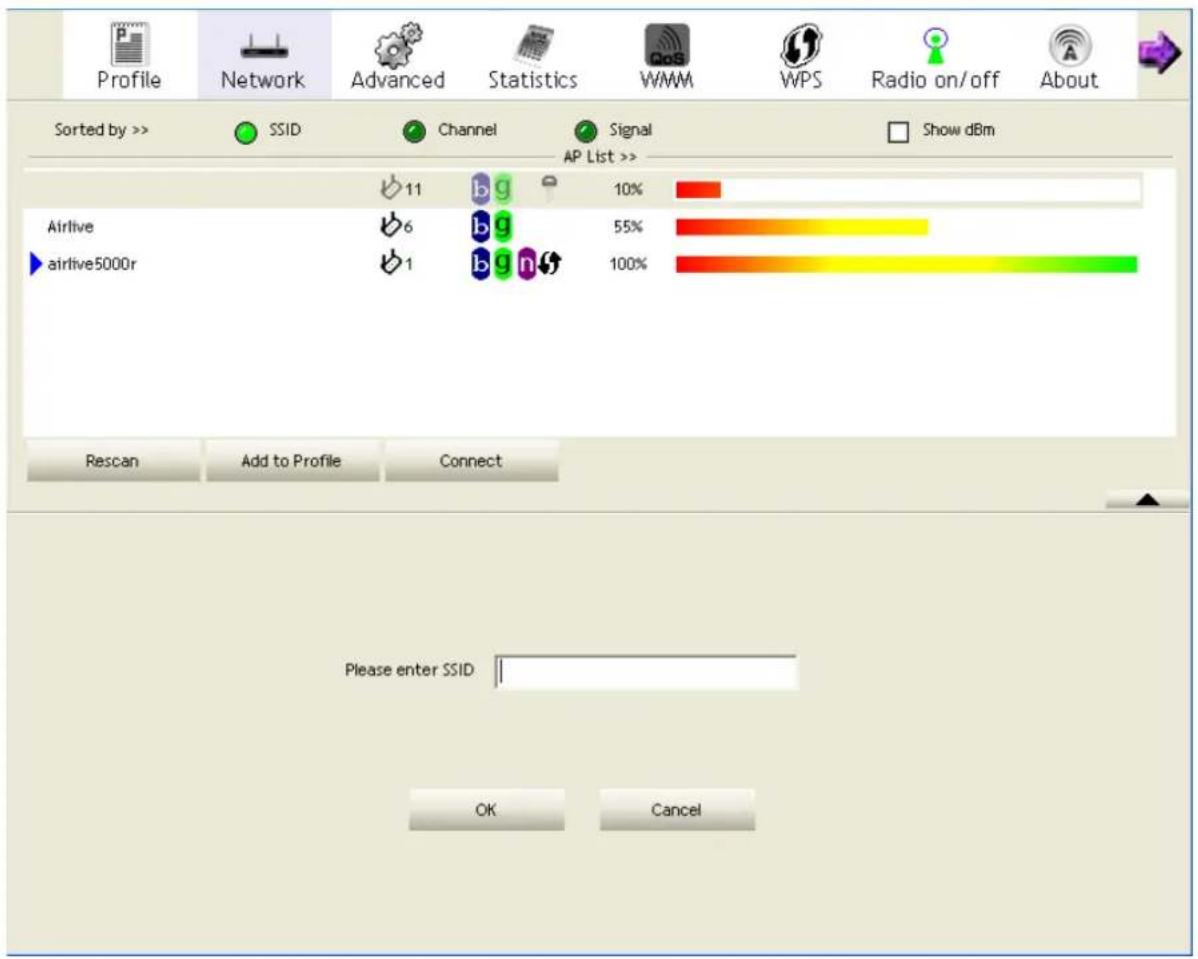
- If the wireless access point does not have SSID, you'll be prompted to input it now. Please ask the owner of wireless access point for the exact SSID and input it here, then click 'OK' when ready. If the SSID you provided here is wrong, you'll not be able to connect to this access point.
text_image
Profile Network Advanced Statistics WMM WPS Radio on/off About Sorted by >> SSID Channel Signal Show dBm AP List >> 11 bg 10% Airlive bg 55% airlive5000r bg 1 100% Rescan Add to Profile Connect Please enter SSID OK Cancel- If the wireless access point uses encryption, you will be prompted to input its WEP key or WPA preshared key.

text_image
Auth. \ Encry. 802.1c Authentication >> WPA2-PSK Encryption >> AES WPA Preshared Key >> Wep Key Key#1 Hex Key#2 Hex Key#3 Hex Key#4 Hex OK Cancel- Please ask the owner of the wireless access point you want to connect, and input the correct key here and then click 'OK'. By checking 'Show Password' box, the encryption key you inputted here will be displayed.
If the value you inputted here is wrong, you will not be able to connect to this wireless access point.
Authentication type will be selected by the authentication type of the access point automatically, please don't change it.
However, if you're connecting to an access point uses 802.1x authentication, you have to check '802.1x' box and input related information. Instructions for 802.1x authentication will be given later.
- If the wireless access point is successfully connected, you'll see a ▶ symbol appears in front of the name of wireless device.

text_image
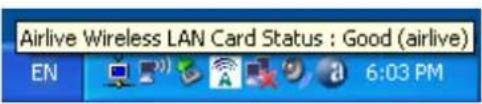
Profile Network Advanced Statistics WMM WPS Radio on/off About Sorted by >> SSID Channel Signal Show dBm AP List >> airlive5000r 1 bg n 100% airlive 11 bg 96% Rescan Add to Profile ConnectYou can put the mouse cursor over the AirLive configuration utility icon, and the brief information about link status and signal strength of current wireless connection will be shown as a popup balloon.
text_image
Airlive Wireless LAN Card Status : Good (airlive) EN 6:03 PMYou can also click More / Less button () to see detailed information of connected access point:

text_image
Status >> airlive5000r <-> 00-0C-43-28-60-10 Extra Info >> Link is Up [TxPower: 100%] Channel >> 1 <-> 2412 MHz; central channel : 3 Authentication >> Open Encryption >> WEP Network Type >> Infrastructure IP Address >> 192.168.0.53 Sub Mask >> 255.255.255.0 Default Gateway >> 192.168.0.254 HT BW >>40 SNR0 >> 25 GI >> long MCS >> 7 SNR1 >> n/a Link Quality >> 100% Signal Strength 1 >> 100% Noise Strength >> 26% Transmit Link Speed >> 135.0 Mbps Max Throughput >> 0.000 Kbps 28.016 Kbps Receive Link Speed >> 1.0 Mbps Max Throughput >>47.776 Kbps 145.292 Kbps2.2.1.3 Add an Access Point to Profile
If you will connect to some specific wireless access point frequently, you can add their information to the profile. Just like the telephone directory, the profile saves all information of access points, and you can recall them anytime you wish to establish connection.
You can add a found access point to profile, or input all information of an access point by yourself.
To add a found access point to profile, please select a found access point first (to make it highlighted), then click 'Add to Profile' button; to input the information of access point by yourself, please go to 'Profile' menu and click 'Add' button.
text_image
Profile Network Advanced Statistics WMM WPS Radio on/off About Sorted by >> SSID Channel Signal Show dBm AP List >> airlive5000r 1 b g n 100% airlive 11 b g 96% Rescan Add to Profile Connect
text_image
Profile Network Advanced Statistics WMM WPS Radio on/off About Profile List Profile Name >> SSID >> Network Type >> Authentication >> Encryption >> Use 802.1x >> Tx Power >> Channel >> Power Save Mode >> RTS Threshold >> Fragment Threshold >> Add Edit Delete ActivateThe setup utility will expand:
text_image
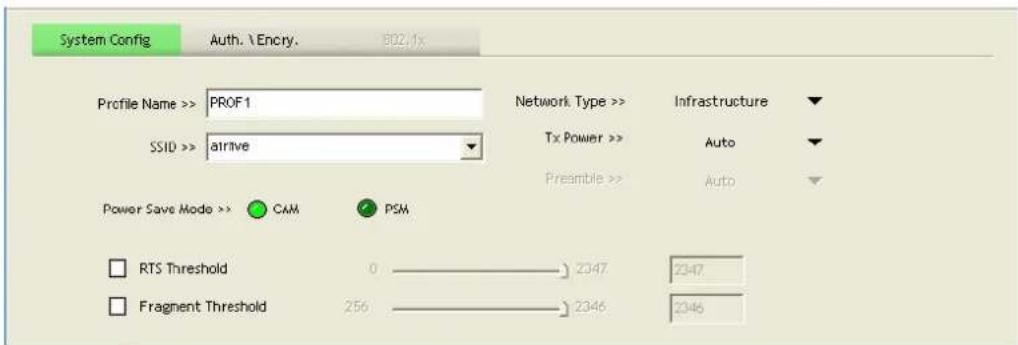
System Config Auth. \Encry. 802.1x Profile Name >> PROF1 Network Type >> Infrastructure SSID >> arrive Tx Power >> Auto Power Save Mode >> CAM PSM Preamble >> Auto RTS Threshold 0 2347 2347 Fragment Threshold 256 2346 2346Here are descriptions of every setup item:
| Item Name Description | |
| Profile Name You can give this profile a name. Every profile needs a unique name. | |
| SSID Please input the SSID of this access point. If you selected an access point from the list, and its SSID is not hidden, the SSID will be filled automatically; however, you can modify the SSID by yourself. | |
| Network Type Please select the network type: Ad hoc or Infrastructure. If you're connecting to an access point, please select 'Infrastructure'; for point-to-point wireless connection (i.e. connecting to another computer using Ad Hoc mode), please select Ad hoc here. | |
| Tx Power You can select | the wireless output power here. If you're not too far from access point (good signal reception), you can select a lower output power to save energy; for a distant access point, you can select a higher output power.It's suggested to select 'Auto' to let setup utility decide the best output power for you. |
| Preamble Select the preamble for Ad hoc mode here. Available options are 'Auto' and 'Long'.It's suggested to select 'Auto' to let setup utility decide the preamble for you. | |
| Channel You can select the radio channel number for AdHoc mode here. | |
| Power Save Mode Please | select CAM (constantly awake mode, keep wireless radio activity even when not transferring data), or PSM (Power saving mode, switches radio off when not transferring data).It's recommended to choose 'PSM' if you're using this network card with notebook computer to help the battery live longer. |
| RTS Threshold Check this box to set the RTS threshold by yourself. You can drag the slider to set the threshold value, or input the value in the box located at right.It's recommended to keep this value untouched unless you know the effect of changing this value. | |
| Fragment Threshold Check this box to set the packet fragment threshold by yourself. You can drag the slider to set the threshold value, or input the value in the box located at right.It's recommended to keep this value untouched unless you know the effect of changing this value. | |
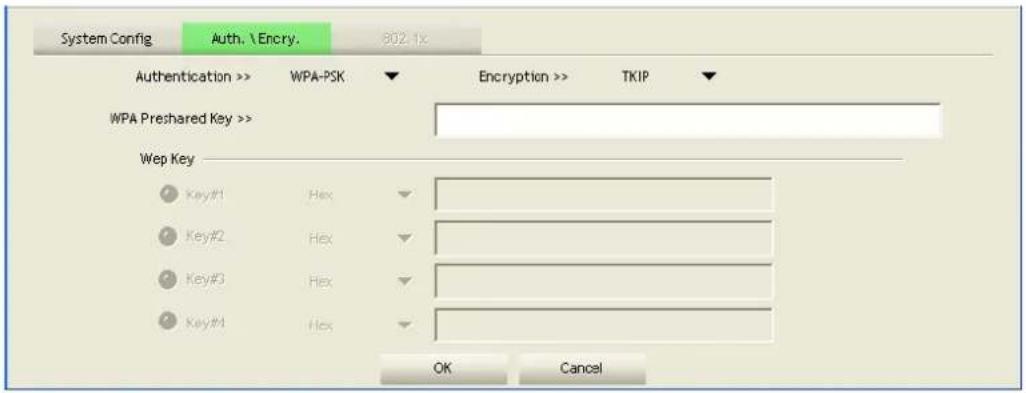
To set authentication / encryption information for the access point. Please click 'Auth. \ Encry.' tab:
text_image
System Config Auth. \ Encry. 802.1x Authentication >> WPA-PSK Encryption >> TKIP WPA Preshared Key >> Wep Key ● Key#1 Hex ● Key#2 Hex ● Key#3 Hex ● Key#4 Hex OK CancelHere are descriptions of every setup item:
| Item Name Description | |
| Authentication | Select the authentication type of the wireless access point or wireless device you wish to connect. When you're adding a profile from an existing access point or wireless device, authentication type will be selected automatically, and please do not change it.If you select 'LEAP', you'll be prompted to input LEAD specific settings: Please input LEAP identity, password, domain name, and select encryption type. You can check 'Show Password' box so the password you inputted will be displayed as you type, but not replace by asterisk. Please input LEAP identity, password, domain name, and select encryption type. You can check 'Show Password' box so the password you inputted will be displayed as you type, but not replace by asterisk. |
| Encryption Select the encryption type of the wireless access point or wireless device you wish to connect. When you're adding a profile from an existing access point or wireless device, the encryption type will be selected automatically, and please do not modify it. | |
| WPA Preshared Key | Input WPA preshared key here. If encryption is not enabled, or you select 'WEP' as encryption type, this field will be disabled and grayed out. |
| WEP Key You can select key type (Hexadecimal or ASCII) and input WEP key here. If | |
| encryption is not enabled, or you select ‘WPA’ as encryption type, this field will be disabled and grayed out. You can set up to 4 WEP keys here.There are two types of WEP key: Hexadecimal and ASCII. For Hexadecimal key, you can input number 0-9 and alphabet a-f; for example, ‘001122aabbcc’; For ASCII key, you can input number 0-9 and alphabet a-z; for example, mywepkey12345.The length of WEP key depends on the type of WEP key you selected. You can input 10 or 26 hexadecimal characters and 5 or 13 ASCII characters as WEP key. | |
| Show Password Check | check this box and all passphrases or security keys you inputted will be displayed as you type, but not replace your input with asterisk. |
| Use 802.1x If the access point you wish to connect requires 802.1x authentication, please click on ‘Use 802.1x’ box, then click ‘802.1X’ tab to set 802.1x parameters. | |
To set 802.1x authentication for the access point. Please click '802.1X' tab:

text_image
System Config Auth. \ Encry. 802.1x EAP Method >> PEAP ▼ Tunnel Authentication >> EAP-MSCHAP v2 ▼ Session Resumption ID \ PASSWORD Client Certificate Server Certificate Authentication ID / Password Identity >> Password >> Domain Name >> Tunnel ID / Password Tunnel ID >> Tunnel Password >> OK CancelHere are descriptions of every setup item:
| Item Name Description | |
| EAP Method Select | 802.1x EAP method from dropdown menu. Please ask the administrator of the access point you wish to connect to select a correct EAP method. |
| Tunnel Authentication | Select 802.1x tunnel authentication type from dropdown menu. Please ask the administrator of the access point you wish to connect to select a correct tunnel authentication method. This pull down menu is only available when authentication type you use is 'PEAP', 'TLS / Smart Card', or 'TTLS'. |
| When you use 'EAP-FAST' as authentication type, the protocol setting is always 'Generic Token Card' and can not be changed. You also need to select 'Soft Token' or 'Static Password' as password in 'ID \ Password' setting.'EAP Fast' authentication type also have a sub-menu to set EAP fast-specific parameters:Allow unauthenticated provision modeUse protected authentication credentialRemoveImportFile Path >>If you need to use protected authentication credential, check 'Use protected authentication credential' box, and click 'Import' to load .pac credential file; to remove a loaded credential file, click 'Remove'. | |
| Session Resumption | You can enable or disable session resumption here. If you don't know if you should enable session resumption or not, please ask your 802.1x authentication administrator. |
| ID \ Password tab | Input 802.1x username (ID) and password and other information if it is required here. Click 'Show Password' to show the password you typed. |
| Client Certification tab | Use this tab to select a local certificate from dropdown menu. If the access point you wish to connect required a specific client certificate, the certificate must be installed on your computer, and you can select the certificate here. |
| Server Certification tab | Use this tab to use server-based certification. Please select a CA (Certificate Authority) from dropdown menu. If intermediate certificates are allowed, please select 'Allow intermediate certificates'. Also, if you need to specify CA server's name, you can specify it in 'Server name' field. You can select 'Server name must match', so the CA server's name must be the same with the value you set in 'Server name' field; If only the domain name part of full server name must the same with the value you set in 'Server name' field, select 'Domain name must end in specified name'. |
Allow unauthenticated provision mode
Use protected authentication credential
File Path >>
After you complete all information related to the access point, click 'OK' to save the profile, or click 'cancel' to cancel adding a new profile.
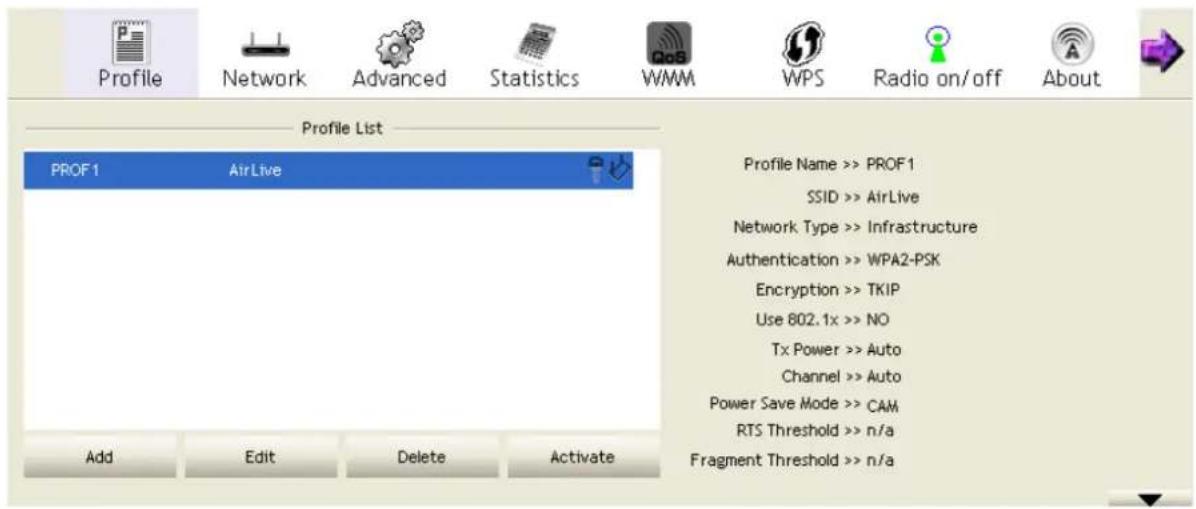
If the profile is created, you will see the information in the Profile List.
text_image
Profile Network Advanced Statistics WMM WPS Radio on/off About Profile List PROF 1 AirLive Profile Name >> PROF1 SSID >> AirLive Network Type >> Infrastructure Authentication >> WPA2-PSK Encryption >> TKIP Use 802.1x >> NO Tx Power >> Auto Channel >> Auto Power Save Mode >> CAM RTS Threshold >> n/a Fragment Threshold >> n/a Add Edit Delete Activate2.2.2 Using Windows Zero Configuration
Windows XP and Vista has a built-in wireless network configuration utility, called as 'Windows Zero Configuration' (WZC). You can also use WZC to configure your wireless network parameter:
- Right-click AirLive configuration utility icon and select 'Use Zero Configuration as Configuration utility'.

text_image
Launch Config Utility Use Zero Configuration as Configuration Utility Exit- Right click Windows Zero Configuration icon and select 'View Available Wireless Networks'. If you can not find the icon, please follow the procedures from step 3 to step 5.

text_image
Change Windows Firewall settings Open Network Connections Repair... View Available Wireless Networks- Click 'Start' button (should be located at the bottom-left corner of windows desktop), click 'Control Panel', then click 'Network and Internet Connections' in Control Panel.
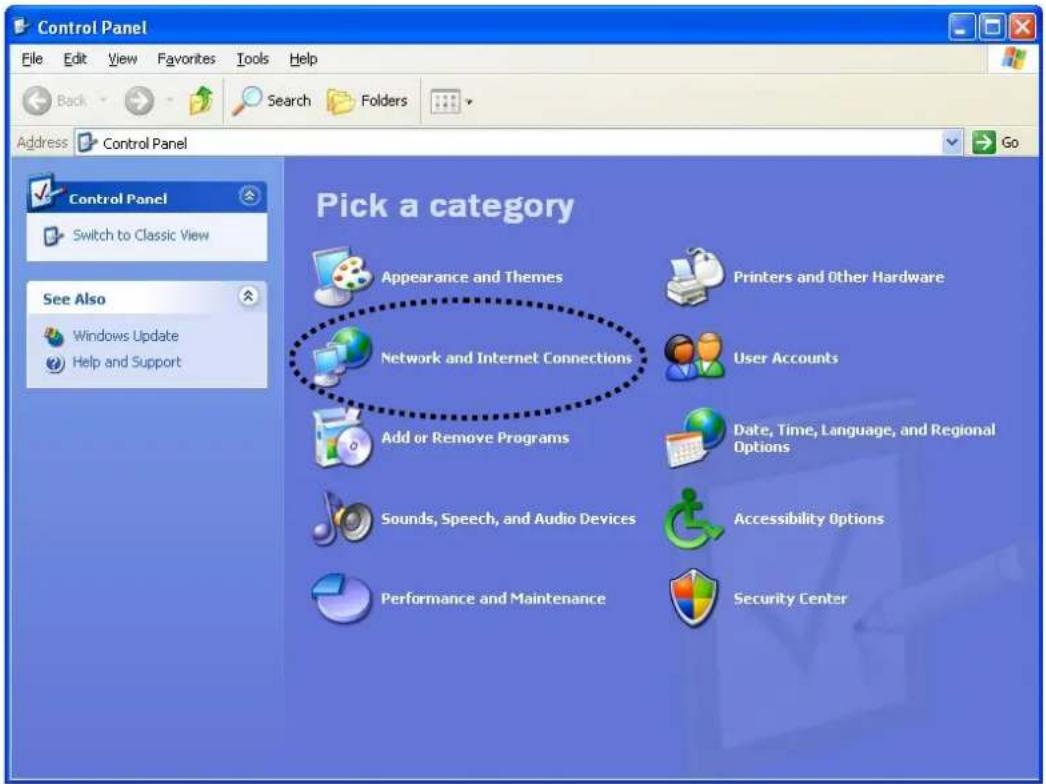
text_image
Control Panel File Edit View Favorites Tools Help Back Search Folders Address Control Panel Go Control Panel Switch to Classic View See Also Windows Update Help and Support Pick a category Appearance and Themes Printers and Other Hardware Network and Internet Connections User Accounts Add or Remove Programs Date, Time, Language, and Regional Options Sounds, Speech, and Audio Devices Accessibility Options Performance and Maintenance Security Center4. Click 'Network Connections'.
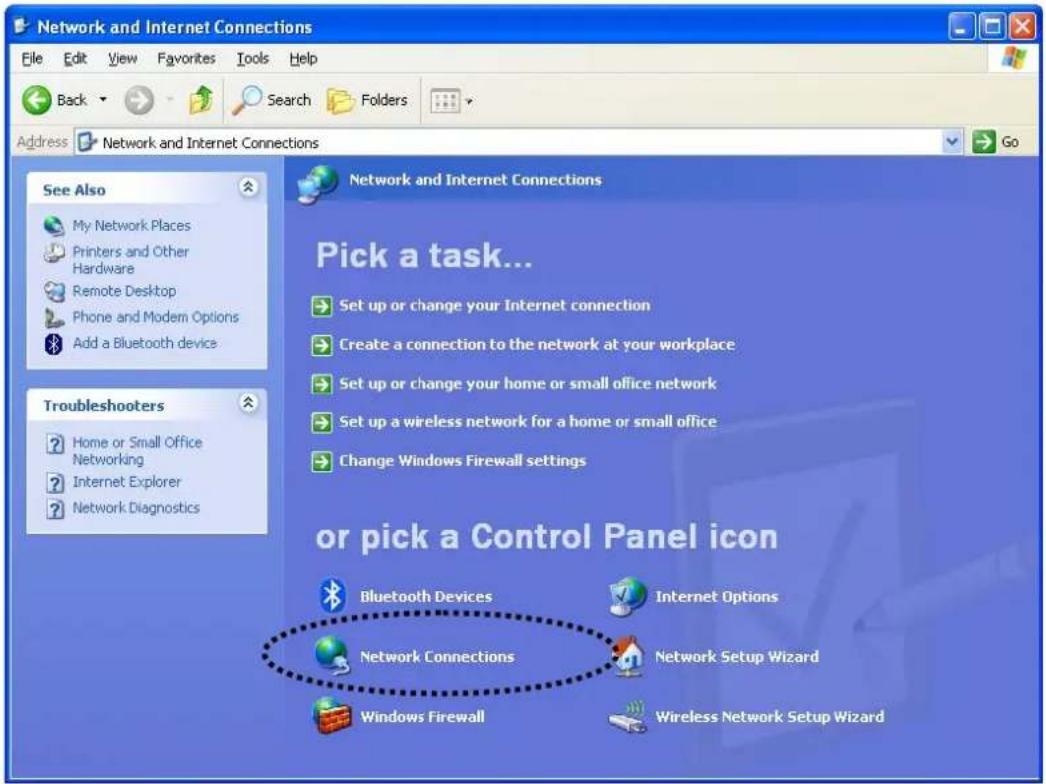
text_image
Network and Internet Connections File Edit View Favorites Tools Help Back Search Folders Address Network and Internet Connections Go See Also My Network Places Printers and Other Hardware Remote Desktop Phone and Modem Options Add a Bluetooth device Troubleshooters Home or Small Office Networking Internet Explorer Network Diagnostics Network and Internet Connections Pick a task... Set up or change your Internet connection Create a connection to the network at your workplace Set up or change your home or small office network Set up a wireless network for a home or small office Change Windows Firewall settings or pick a Control Panel icon Bluetooth Devices Internet Options Network Connections Network Setup Wizard Windows Firewall Wireless Network Setup Wizard- Right-click 'Wireless Network Connection' (it may have a number as suffix if you have more than one wireless network card, please make sure you right-click the 'AirLive 802.11n Wireless LAN Card), then select 'View Available Wireless Networks'.
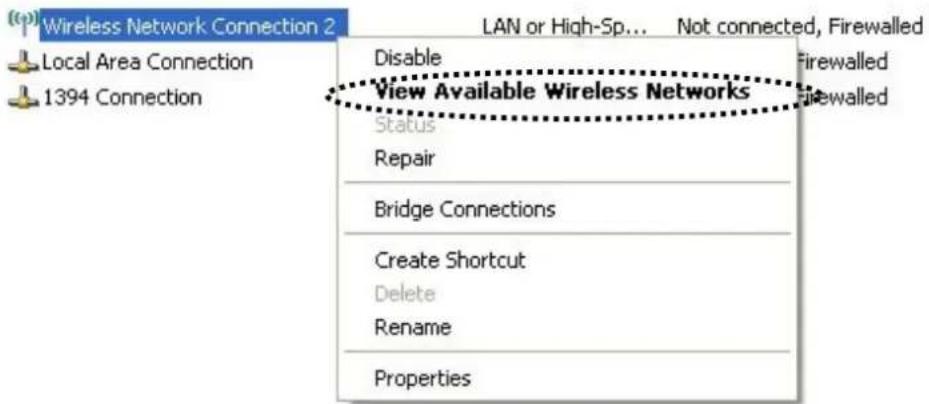
text_image
(p) Wireless Network Connection 2 Local Area Connection 1394 Connection LAN or High-Sp... Not connected, Firewalled Disable Firewalled View Available Wireless Networks Status Repair Bridge Connections Create Shortcut Delete Rename Properties- All wireless access points in proximity will be displayed here. If the access point you want to use is not displayed here, please try to move your computer closer to the access point, or you can click 'Refresh network list' to rescan access points. Click the access point you want to use if it's shown, then click 'Connect'.
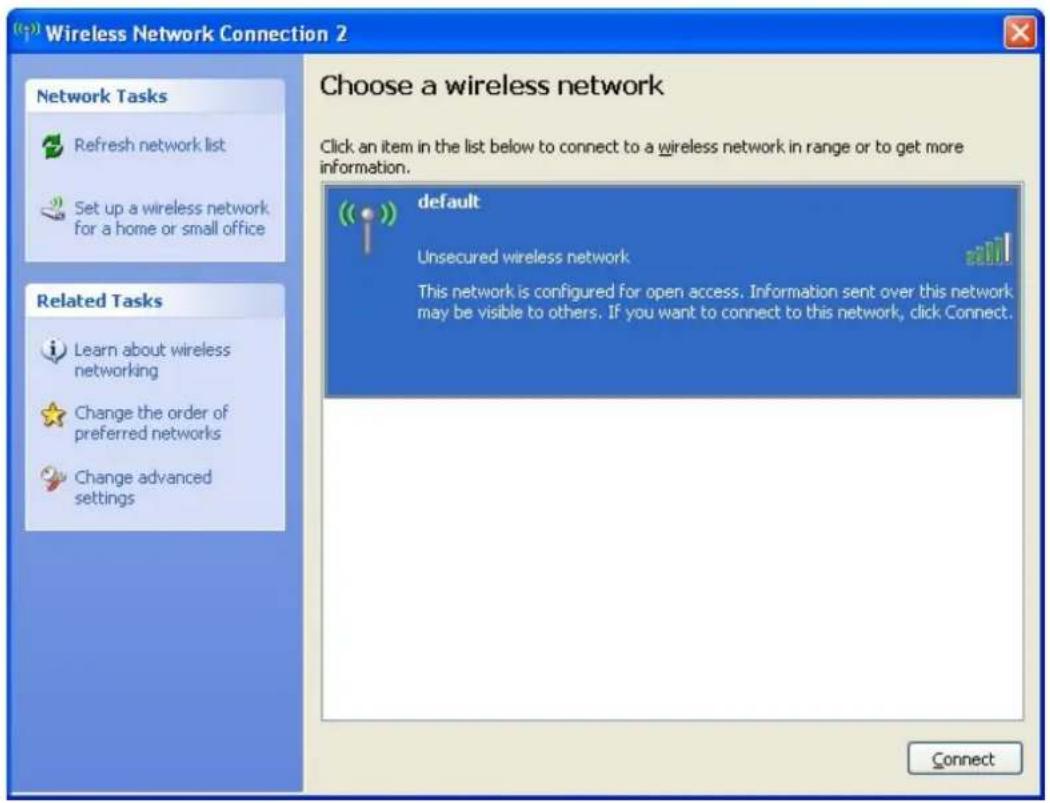
text_image
Wireless Network Connection 2 Choose a wireless network Click an item in the list below to connect to a wireless network in range or to get more information. default Unsecured wireless network This network is configured for open access. Information sent over this network may be visible to others. If you want to connect to this network, click Connect. Connect- If the access point is protected by encryption, you have to input its security key or passphrase here. It must match the encryption setting on the access point.
If the access point you selected does not use encryption, you'll not be prompted for security key or passphrase.

text_image
Wireless Network Connection The network 'default' requires a network key (also called a WEP key or WPA key). A network key helps prevent unknown intruders from connecting to this network. Type the key, and then click Connect. Network key: Confirm network key: Connect Cancel- If you can see 'Connected' message, the connection between your computer and wireless access point is successfully established.

text_image
Wireless Network Connection 2 Choose a wireless network Click an item in the list below to connect to a wireless network in range or to get more information. default Connected Security-enabled wireless network (WPA) This network requires a network key. You are currently connected to this network. To disconnect from this network, click Disconnect below. Related Tasks Learn about wireless networking Change the order of preferred networks Change advanced settings Disconnect2.3 Profile Management
If you need to connect to different wireless access points at different time, like of access point of your home, office, cybercafe, or public wireless service, you can store the connection parameters (encryption, passphrase, security etc, etc.) as a profile for every access point, so you don't have to input these parameters every time when you want to connect to a specific wireless access point. To manage profiles, right-click the AirLive configuration utility icon located at lower-right corner of computer desktop, then click 'Launch Config Utility'.

text_image
Launch Config Utility Use Zero Configuration as Configuration Utility ExitClick the 'Profile' menu. All profiles will be listed in 'Profile List', and you can select a profile from the list, all information about selected profile will be listed.

text_image
Profile Network Advanced Statistics WMM WPS Radio on/off About Profile List PROF1 AirLive Profile Name >> PROF1 SSID >> AirLive Network Type >> Infrastructure Authentication >> WPA2-PSK Encryption >> TKIP Use 802.1x >> NO Tx Power >> Auto Channel >> Auto Power Save Mode >> CAM RTS Threshold >> n/a Fragment Threshold >> n/a Add Edit Delete Activate2.3.1 Add a profile
If you want to click new profile, click 'Profile' menu, then click 'Add' button. You'll be prompted to input detailed information of access point, as described in Section 2.2.1.3.

text_image
Profile Network Advanced Statistics WMM WPS Radio on/off About Profile List PROF1 AirLive Add Edit Delete Activate Profile Name >> PROF1 SSID >> AirLive Network Type >> Infrastructure Authentication >> WPA2-PSK Encryption >> TKIP Use 802.1x >> NO Tx Power >> Auto Channel >> Auto Power Save Mode >> CAM RTS Threshold >> n/a Fragment Threshold >> n/a2.3.2 Edit an existing profile
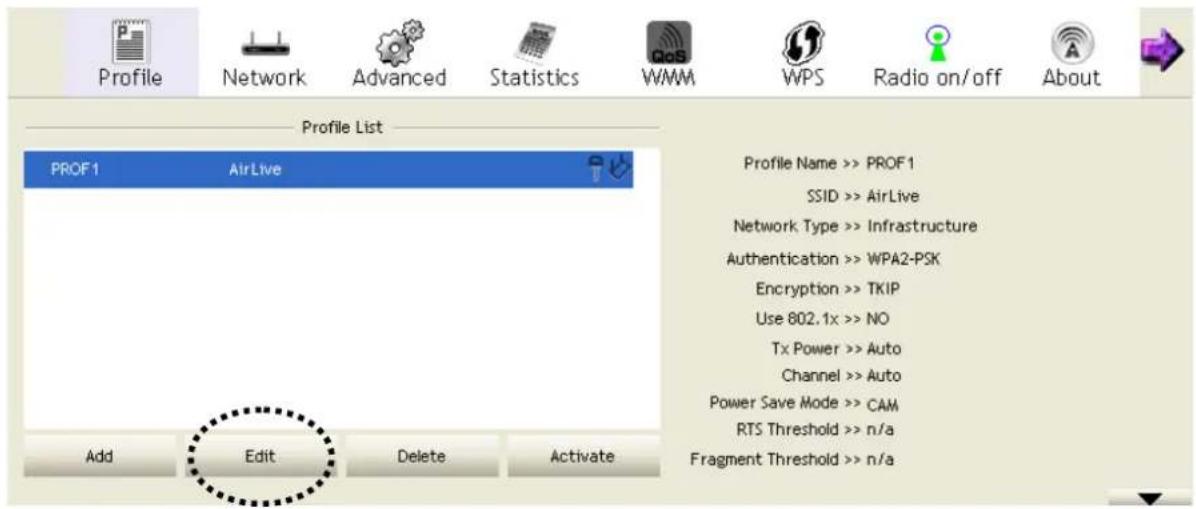
If you have added a profile before, and you wish to change the content of the profile, you can use this function. Please select a profile from the list first, then click 'Edit' button. You'll be provided with the contents of selected profile, and you can edit them. Click 'OK' to save changes, or click 'Cancel' to discard changes.
text_image
Profile Network Advanced Statistics WMM WPS Radio on/off About Profile List PROF1 AirLive Add Edit Delete Activate Profile Name >> PROF1 SSID >> AirLive Network Type >> Infrastructure Authentication >> WPA2-PSK Encryption >> TKIP Use 802.1x >> NO Tx Power >> Auto Channel >> Auto Power Save Mode >> CAM RTS Threshold >> n/a Fragment Threshold >> n/a2.3.3 Delete an existing profile
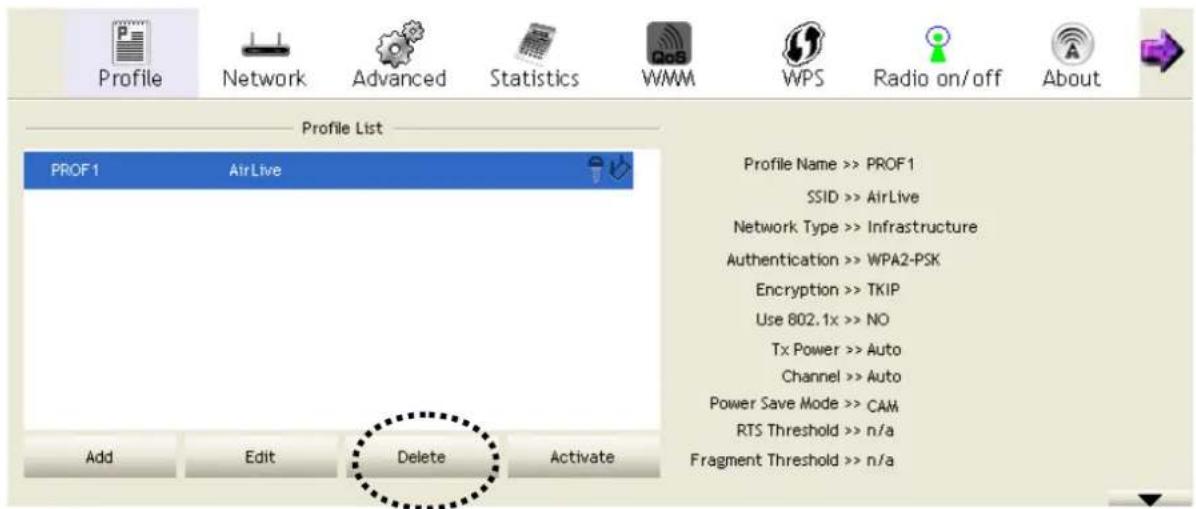
If you no longer need a profile, you can delete it. Select the profile you wish to delete from the list, and click 'Delete' button to delete it.
text_image
Profile Network Advanced Statistics WMM WPS Radio on/off About Profile List PROF1 AirLive Profile Name >> PROF1 SSID >> AirLive Network Type >> Infrastructure Authentication >> WPA2-PSK Encryption >> TKIP Use 802.1x >> NO Tx Power >> Auto Channel >> Auto Power Save Mode >> CAM RTS Threshold >> n/a Fragment Threshold >> n/a Add Edit Delete Activate2.3.4 Activate a profile
When you want to connect to a specific wireless device in the profile list, you can select it and click 'Activate' button, to establish connection with it.

text_image
Profile Network Advanced Statistics WMM WPS Radio on/off About Profile List PROF 1 AirLive Add Edit Delete Activate Profile Name >> PROF1 SSID >> AirLive Network Type >> Infrastructure Authentication >> WPA2-PSK Encryption >> TKIP Use 802.1x >> NO Tx Power >> Auto Channel >> Auto Power Save Mode >> CAM RTS Threshold >> n/a Fragment Threshold >> n/a- When you selected a profile and click 'Activate' button to activate the profile, a ▶ icon will be displayed in front of the profile to show that the connection is failed; When the connection is successfully established, a ▶ icon will be displayed.
2.4 Advanced Settings
This wireless network card provides several advanced settings for experienced wireless users. You can change these settings to increase data transfer performance, or change operation mode.
Please follow the following instructions to set advanced wireless settings:
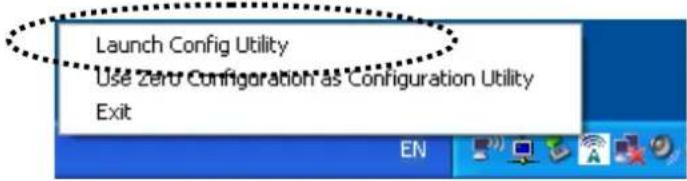
- Right-click the AirLive configuration utility icon located at lower-right corner of computer desktop and then click 'Launch Config Utility'.
text_image
Launch Config Utility Use Zero Configuration as Configuration Utility Exit- Click 'Advanced' menu, and the following settings will appear:

text_image
Profile Network Advanced Statistics WMM WPS Radio on/off About Wireless mode >> 2.4G Enable CCX (Cisco Compatible eXtensions) Turn on CCKM Enable Radio Measurements Non-Serving Channel Measurements Limit 250 ms(0-2000) Enable TX Burst Enable TCP Window Size Fast Roaming at +70 dBm Show Authentication Status Dialog Select Your Country Region Code 11B/G >> 1: CH1-13 ApplyHere are descriptions of every setup item:
| Item Name Description | |
| Wireless mode Display the wireless operation mode of the network card. | |
| Enable Tx Burst Check this box to accelerate the data transmit rate. It may not work with all wireless access point and wireless devices. | |
| Enable TCP Window Size | Check this box and the configuration utility will adjust TCP window size automatically to get better performance. It should be safe for most of wireless environments, but if you found some problem on data transfer, uncheck this box. |
| Fast Roaming Check this box and you can control the threshold that the wireless network card should switch to another wireless access point with better signal quality. Only adjust value when you understand what it means and you need to roam between multiple access points. | |
| Show Authentication Status Dialog | When your computer is being authenticated by wireless authentication server, a dialog window with the process of authentication will appear. This function is helpful to find out the problem when you can not be authenticated, and you can provide this information to authentication server's administrator for debugging purpose. |
| Enable CCX Enable Cisco Compatible eXtensions. CCX is a wireless feature developed by Cisco used to improve the wireless performance with CCX compatible wireless devices. Check this box if you need to connect to CCX-compatible wireless devices. When you enabled CCX, the following setup items will become available:Turn on CCKM: Check this box to enable CCKM (Cisco Centralized Key Management), which enables wireless clients to roam between CCKM-enabled access points in very short time.Enable Radio Measurements: When you're connecting to CCX-compatible access point, check this box to enable radio measurement function to improve wireless connectivity.Non-Serving Channel Measurements Limit: When you're connecting to CCX-compatible access point, check this box to enable measurement on unused radio channels to improve wireless connectivity. | |
After you finish the settings, click 'Apply' to apply new settings.
2.5 View Network Statistics
The configuration utility provides information about network statistics and link status. If you want to know how your wireless network card works, you can use these functions to get detailed information about the wireless connection you're using.
Please follow the following instructions to check network statistics:
- Right-click the AirLive configuration utility icon located at lower-right corner of computer desktop and then click 'Launch Config Utility'.

text_image
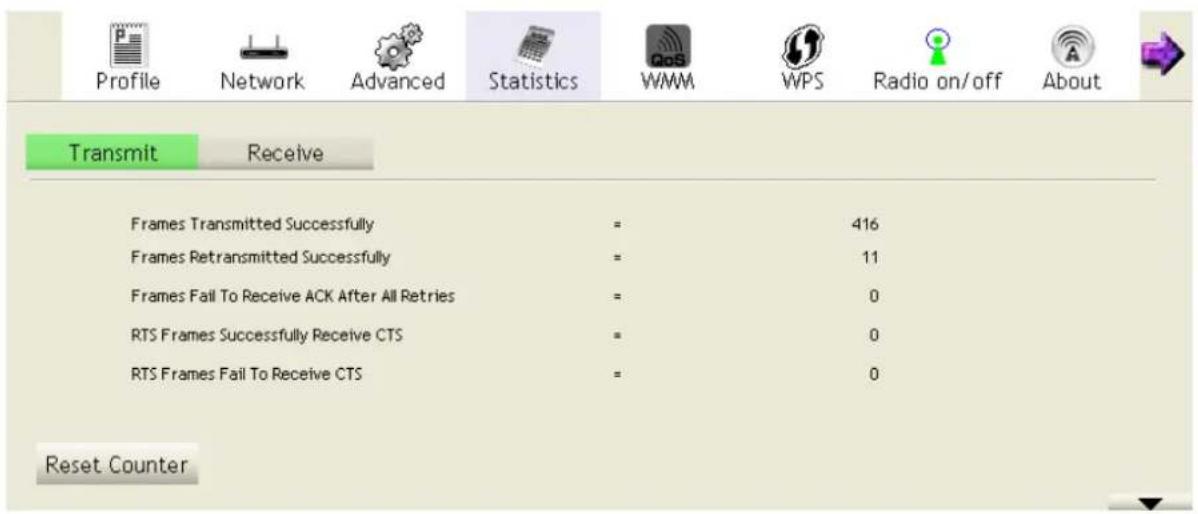
Launch Config Utility Use Zero Configuration as Configuration Utility Exit- Click 'Statistics' menu and the statistics of wireless connection will be displayed:
text_image
Profile Network Advanced Statistics WMM WPS Radio on/off About Transmit Receive Frames Transmitted Successfully = 416 Frames Retransmitted Successfully = 11 Frames Fail To Receive ACK After All Retries = 0 RTS Frames Successfully Receive CTS = 0 RTS Frames Fail To Receive CTS = 0 Reset CounterAll connection-related statistics is displayed here. You can click 'Transmit' or 'Receive' tab, to view the statistics of transmitted or received packets. You can also click 'Reset Counter' button, to reset the statistics of all items back to 0.
2.6 WMM Setting
This wireless network card provides WMM (Wi-Fi Multimedia) function, which can improve the performance of certain network applications, like audio/video streaming, network telephony (VoIP), and others. When you enable the WMM function of this network card, you can define the priority of different kinds of data, to give higher priority to applications which require instant responding.
Therefore you can improve the performance of such network applications.
Please follow the following instructions to set advanced wireless settings:
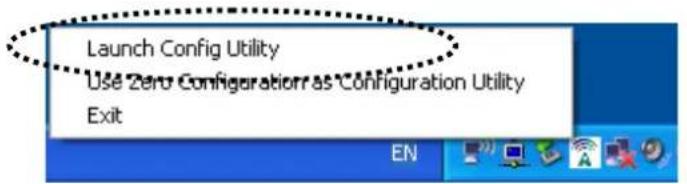
- Right-click the AirLive configuration utility icon located at lower-right corner of computer desktop and then click 'Launch Config Utility'.
text_image
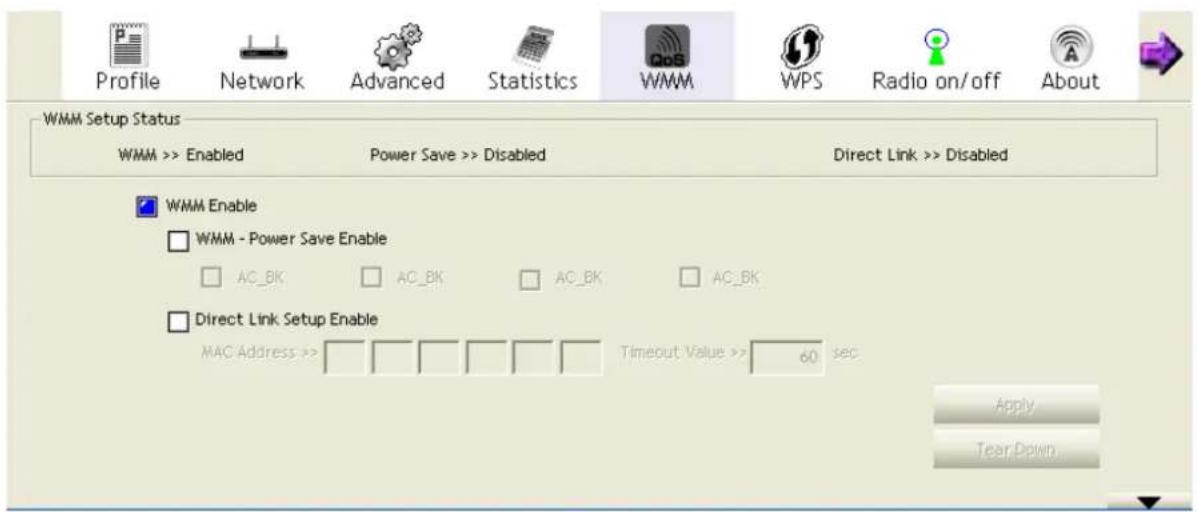
Launch Config Utility Use Zero Configuration as Configuration Utility Exit- Click 'WMM' menu, and the following settings will appear:
text_image
Profile Network Advanced Statistics WMM WPS Radio on/off About WMM Setup Status WMM >> Enabled Power Save >> Disabled Direct Link >> Disabled WMM Enable □ WMM - Power Save Enable □ AC_BK □ AC_BK □ AC_BK □ AC_BK □ Direct Link Setup Enable MAC Address >> Timeout Value >> 60 sec Apply Tear_DownIn 'WMM Setup Status' block, current WMM settings will be displayed. And here are descriptions of every setup item:
| Item Name Description | |
| WMM Enable Check this | box to enable WMM function. Please click ‘Apply’button on the right of this check box after you check or uncheck this box, so corresponding settings in this window will be activated or deactivated respectively. |
| WMM - Power Save Enable | Check this box to enable WMM power saving mode to save energy, and let your computer’s battery live longer.You also have to select WMM power save modes here:AC_BE: Best PerformanceAC_BK: Worst PerformanceAC_VI: Video data has priorityAC_VO: Voice data has priority |
| Direct Link Setup Enable If | you have another WMM-enabled wireless device, you can enter its MAC address here, then click ‘Apply’ button, and this network card will establish a direct link to the wireless device you specified here.You also have to specify the timeout value of this directly-linked wireless device. Valid values are from 1 to 65535 (seconds), and input ‘0’ for infinity.If you want to remove a specific wireless device from direct link table, select the device and click this button to remove it. |
2.7 WPS Configuration
Wi-Fi Protected Setup (WPS) is the latest wireless network technology which makes wireless network setup become very simple. If you have WPS-enabled wireless access point, and you want to establish a secure connection to it, you don't have to configure the wireless access point and setup data encryption by yourself. All you have to do is to go to the WPS setup page of this wireless card, click a button, and then press a specific button or enter a set of 8-digit code on the wireless access point you wish to establish a secure connection - just three simple steps!
For older wireless access points, it's possible to perform a firmware upgrade to become a WPS-enabled access point. Since they may not have a hardware button to press for WPS setup, you can use an alternative WPS setup method - input the pin code. Every WPS-compatible wireless network card support pin code configuration method; you can just input the code to wireless access point, and the wireless access point and wireless network card will do the rest for you.
This wireless network card is compatible with WPS. To use this function, the wireless access point you wish to connect to must support WPS function too. Now, please follow the following instructions to establish secure connection between WPS-enabled wireless access point and your wireless network card.
2.7.1 WPS Setup - PBC (Push-Button Configuration)
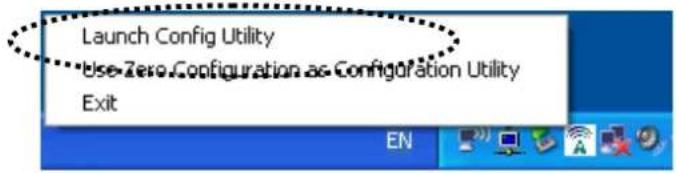
- Right-click the AirLive configuration utility icon located at lower-right corner of computer desktop and then click 'Launch Config Utility'.
text_image
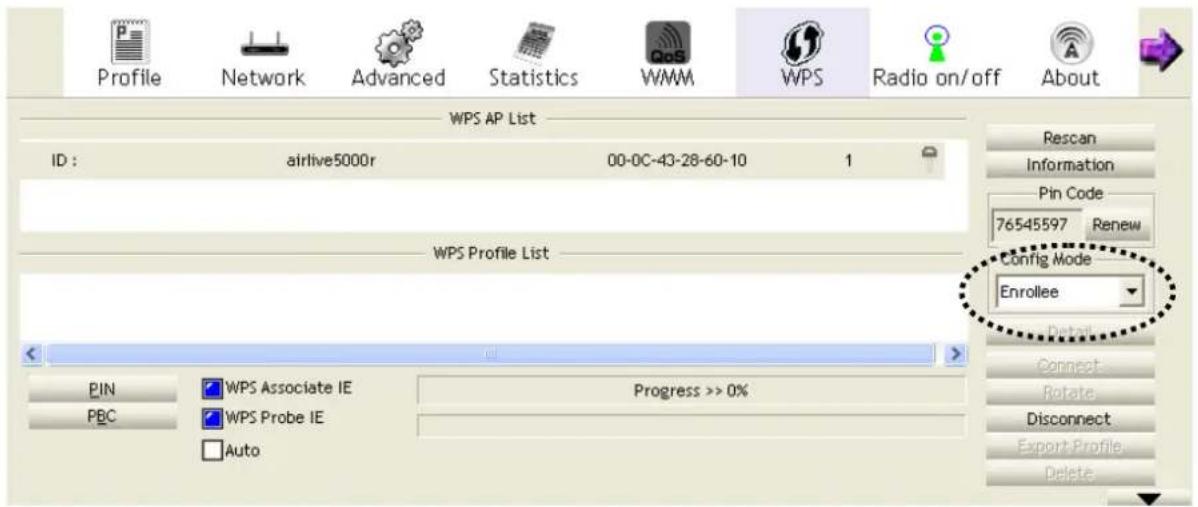
Launch Config Utility Use Zero Configuration as Configuration Utility Exit- Click 'WPS' menu, and the following settings will appear.
text_image
Profile Network Advanced Statistics WMM WPS Radio on/off About WPS AP List ID : airlive5000r 00-0C-43-28-60-10 1 WPS Profile List Rescan Information Pin Code 76545597 Renew Config Mode Enrollee PIN PBC WPS Associate IE Progress >> 0% Auto Connect Rotate Disconnect Export Profile Delete- Set 'Config Mode' to 'Enrollee', and then push the 'WPS' button on your wireless access point (the button used to activate WPS standby mode may have another name), or use other way to start WPS PBC standby mode as the instruction given by your wireless access point's user manual.
You can also set 'Config Mode' to 'Registrar'. In this mode, this wireless network card will wait for other WPS-enabled access points to send WPS pairing requests. Please refer to the instruction given by your wireless access point's user manual to understand how to send WPS requests.
- Before you start to establish the wireless connection by using WPS, you can click 'Rescan' button to search for WPS-enabled access points near you again, to make sure the WPS function of your access point is activated.

text_image
Profile Network Advanced Statistics WMM WPS Radio on/off About WPS AP List ID : airlive5000r 00-0C-43-28-60-10 1 WPS Profile List Rescan Pin Code 76545597 Renew Config Mode Enrollee PIN PBC WPS Associate IE Progress >> 0% AutoAll access points with WPS function enabled will be displayed here. Please make sure the access point you wish to connect is displayed. If not, please click 'Rescan' few more times. You can also click 'Information' button to see the detailed information about selected access point.
- Start PBC pairing procedure at access point side (please refer to the instruction given by your access point's manufacturer), then click 'PBC' button in wireless configuration utility to start to establish wireless connection by WPS. Please be patient (This may require several seconds to one minute to complete). When you see 'WPS status is connected successfully' message, means the connection between this wireless network card and access point is successfully established by WPS, and the information about access point you connected to will be displayed.
- You can click 'Detail' button to see detailed information of connected access point. If you wish to save this connection as a profile, you can click 'Export Profile' button, and this connection will be saved. You can find this connection in 'Profile' tab in a later time.
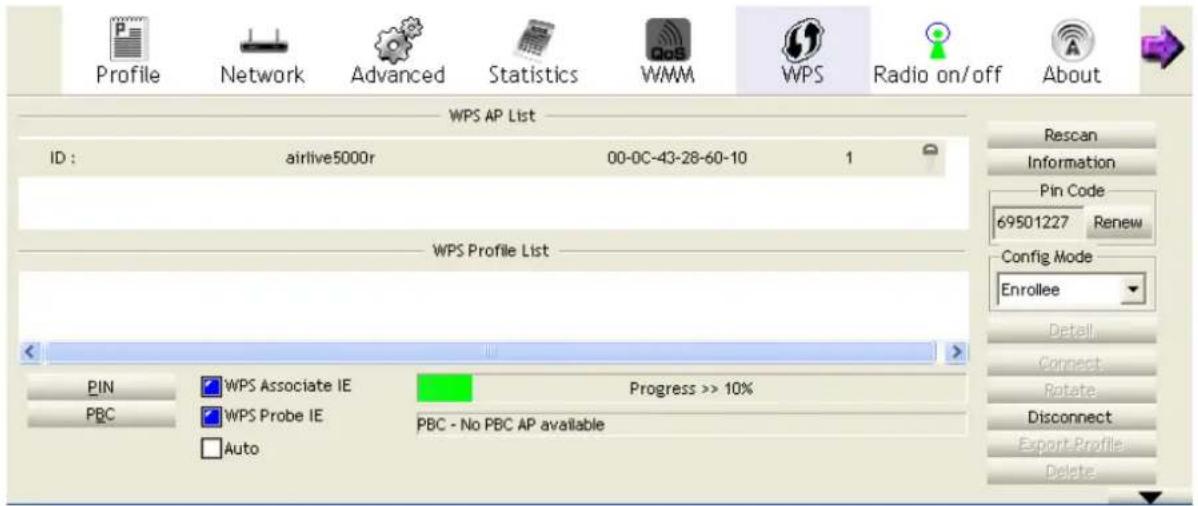
- Sometime WPS may fail (In the following picture, WPS pairing is failed because no WPS-enabled access point is found):
text_image
Profile Network Advanced Statistics WMM WPS Radio on/off About WPS AP List ID : airlive5000r 00-0C-43-28-60-10 1 WPS Profile List PIN PBC WPS Associate IE Progress >> 10% WPS Probe IE Auto PBC - No PBC AP available Rescan Information Pin Code 69501227 Renew Config Mode Enrollee Detell Connect Rotate Disconnect Export Profile DeleteYou can click 'PBC' button few more times to try again. When an access point is connected, you can click 'Disconnect' to disconnect your wireless network card from a connected access point, or select another WPS-enabled wireless access point, then click 'Connect' to establish connection to selected access point, if there are more than one WPS-enabled access point found. You can also click 'Rotate' button, and next access point on the list will be selected to establish connection.
If you want to delete a found access point from the list, select it and click 'Delete' button.
2.7.2 WPS Setup - PIN
If the wireless access point you wish to connect supports PIN, please follow the following instructions to establish connection to it:
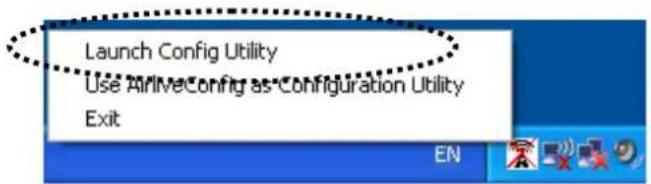
- Right-click the AirLive configuration utility icon located at lower-right corner of computer desktop and then click 'Launch Config Utility'.
text_image
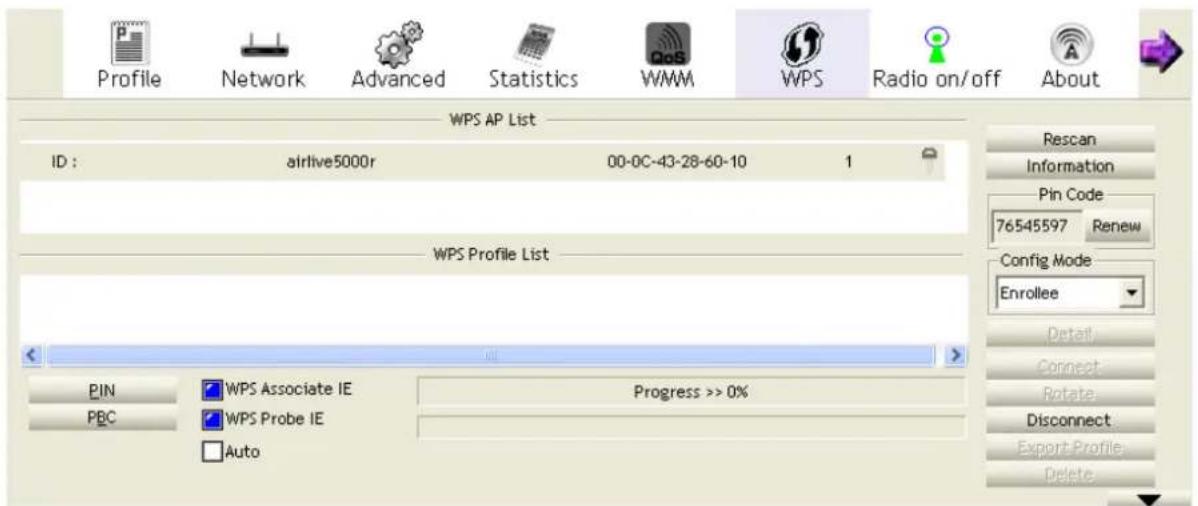
Launch Config Utility Use AirlineConfig as Configuration Utility Exit- Click 'WPS Configuration' menu, and the following settings will appear.
text_image
Profile Network Advanced Statistics WMM WPS Radio on/off About WPS AP List ID : airlive5000r 00-0C-43-28-60-10 1 WPS Profile List Rescan Information Pin Code 76545597 Renew Config Mode Enrollee Detail Connect Rotate Disconnect Export Profile Delete PIN PBC WPS Associate IE WPS Probe IE Progress >> 0% Auto- The PIN code of your wireless network card is an eight-digit number located at the upper-right position of configuration utility. Remember it, and input the number to your wireless access point as the WPS PIN code (Please refer to the user manual of your wireless access point for instructions about how to do this).
NOTE: If you experienced problem with the pin code provided here, you can click 'Renew' to get a new pin code.
-
Click 'PIN' button now, and wait for few seconds to one minute. If a wireless access point with correct PIN code is found, you'll be connected to that access point.
-
You may have to click 'PIN' for few more times to try again. If you still can not connect to access
point by this way, please make sure the PIN code you provided to access point is correct.
There are also some options available for WPS configuration:

text_image
Profile Network Advanced Statistics WMM WPS Radio on/off About WPS AP List ID : airlive5000r 00-0C-43-28-60-10 1 WPS Profile List PIN PBC WPS Associate IE Progress >> 0% WPS Probe IE Auto Rescan Information Pin Code 76545597 Renew Config Mode Enrollee Detail Connect Rotate Disconnect Export Profile DeleteWPS associate IE: Check this box to send the association request with WPS IE during WPS setup. This is optional and you can use default value if you don't know what will be affected.
WPS probe IE: Check this box to send the WPS probe request with WPS IE during WPS setup. This is optional and you can use default value if you don't know what will be affected.
Auto: When in PIN mode, wireless access point to be connected will be selected automatically if this box is checked.
2.8 Radio On/Off
You can switch the wireless radio transceiver on and off by the utility, so if you want to disable wireless network function, you don't have to remove the network card physically.
- Right-click the AirLive configuration utility icon located at lower-right corner of computer desktop and then click 'Launch Config Utility'.

text_image
Launch Config Utility Use AirlineConfig asConfiguration Utility Exit- To switch wireless radio on/off, please click 'Radio On/Off' button.

text_image
Profile Network Advanced Statistics WMM WPS Radio on/off About Profile List PROF1 AirLive Add Edit Delete Activate Profile Name >> PROF1 SSID >> AirLive Network Type >> Infrastructure Authentication >> WPA2-PSK Encryption >> TKIP Use 802.1x >> NO Tx Power >> Auto Channel >> Auto Power Save Mode >> CAM RTS Threshold >> n/a Fragment Threshold >> n/a
text_image
Radio On/Off Wireless radio is on (Green) Radio On/Off Wireless radio is off (Red)2.9 About
The 'About' tab provides you the information about version number of the configuration utility, driver, and other important information about your wireless network card.
Please follow the following instructions to see these information:
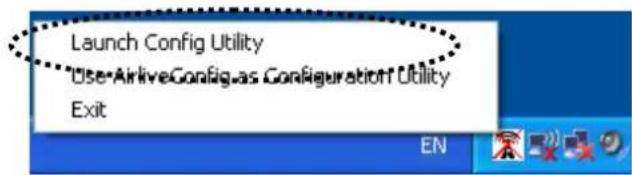
- Right-click the AirLive configuration utility icon located at lower-right corner of computer desktop and then click 'Launch Config Utility'.
text_image
Launch Config Utility Use AirliveConfig.as Configuration Utility Exit- Click 'About' tab, and the following information will appear.

text_image
(c) Copyright 2008, Ovislink Corp. All rights reserved. Utility Version >> 2.1.6.0 Date >> 08-26-2008 Driver Version >> 1.2.1.0 Date >> 07-30-2008 EEPROM Version >> 0.1 Firmware Version >> 0.12 Phy_Address >> 00-1F-1F-1F-6D-9B www.airlive.com2.10 On-line Help
If you need to know the directions of how to use specific function in the utility, please click 'Help' button. On-line help documents will be presented in Windows help format.

Help
Click this button to view on-line help documents.
CHAPTER III: Appendix
3.1 Specification
Standards: IEEE 802.11b/g
Interface: USB 2.0 (USB 1.1 Compatible)
Frequency Band: 2.4000 \~ 2.4835GHz (Industrial Scientific Medical Band)
Data Rate: 11b: 1/2/5.5/11Mbps
11g: 6/9/12/24/36/48/54Mbps
11n (20MHz): MCS0-7 (up to 72Mbps)
11n (40MHz): MCS0-7 (up to 150Mbps)
Securities: WEP 64/128, WPA, WPA2
Cisco CCX Support
Antenna: Internal Antenna
Drivers: Windows 2000/XP/2003/Vista
LED: Link/Activity
Temperature: 32\~104°F (0 \~ 40°C)
Humidity: 10-95% (NonCondensing)
Certification: FCC, CE
3.2 Troubleshooting
If you encounter any problem when you're using this wireless network card, don't panic! Before you call your dealer of purchase for help, please check this troubleshooting table, the solution of your problem could be very simple, and you can solve the problem by yourself!
| Scenario Solution | |
| I can’t find any wireless access point / wireless device in ‘Site Survey’ function. | 1. Click ‘Rescan’ for few more times and see if you can find any wireless access point or wireless device.2. Please move closer to any known wireless access point.3. ‘Ad hoc’ function must be enabled for the wireless device you wish to establish a direct wireless link.4. Please adjust the position of network card (you may have to move your computer if you’re using a notebook computer) and click ‘Rescan’ button for few more times. If you can find the wireless access point or wireless device you want to connect by doing this, try to move closer to the place where the wireless access point or wireless device is located. |
| Nothing happens when I click ‘Launch Config Utility’ | 1. Please make sure the wireless network card is inserted into your computer’s USB port. If the AirLive configuration utility’s icon is black, the network card is not detected by your computer.2. Reboot the computer and try again.3. Remove the card and insert it into another USB port.4. Remove the driver and re-install.5. Contact the dealer of purchase for help. |
| I can not establish connection with a certain wireless access point | 1. Click ‘Connect’ for few more times.2. If the SSID of access point you wish to connect is hidden (nothing displayed in ‘SSID’ field in ‘Site Survey’ function), you have to input correct SSID of the access point you wish to connect. Please contact the owner of access point to ask for correct SSID.3. You have to input correct security key to connect an access point with encryption. Please contact the owner of access point to ask for correct security key.4. The access point you wish to connect only allows network cards with specific MAC address to establish connection. Please go to ‘About’ tab and write the value of‘Phy_Addess’ down, then present this value to the owner of access point so he / she can add the MAC address of your network card to his / her access point’s list. |
| The network is slow / having problem when transferring large files | 1. Move closer to the place where access point is located.2. Disable ‘Tx Burst’ in ‘Advanced’ tab.3. Enable ‘WMM’ in ‘WMM’ tab if you need to use multimedia / telephony related applications.4. Disable ‘WMM – Power Save Enable’ in ‘WMM’ tab.5. There could be too much people using the same radio channel. Ask the owner of the access point to change the channel number.Please try one or more solutions listed above. |
3.3 Glossary
1. What is the IEEE 802.11g standard?
802.11g is the new IEEE standard for high-speed wireless LAN communications that provides for up to 54 Mbps data rate in the 2.4 GHz band. 802.11g is quickly becoming the next mainstream wireless LAN technology for the home, office and public networks.
802.11g defines the use of the same OFDM modulation technique specified in IEEE 802.11a for the 5 GHz frequency band and applies it in the same 2.4 GHz frequency band as IEEE 802.11b. The 802.11g standard requires backward compatibility with 802.11b.
The standard specifically calls for:
A. A new physical layer for the 802.11 Medium Access Control (MAC) in the 2.4 GHz frequency band, known as the extended rate PHY (ERP). The ERP adds OFDM as a mandatory new coding scheme for 6, 12 and 24 Mbps (mandatory speeds), and 18, 36, 48 and 54 Mbps (optional speeds). The ERP includes the modulation schemes found in 802.11b including CCK for 11 and 5.5 Mbps and Barker code modulation for 2 and 1 Mbps.
B. A protection mechanism called RTS/CTS that governs how 802.11g devices and 802.11b devices interoperate.
2. What is the IEEE 802.11b standard?
The IEEE 802.11b Wireless LAN standard subcommittee, which formulates the standard for the industry. The objective is to enable wireless LAN hardware from different manufactures to communicate.
3. What does IEEE 802.11 feature support?
The product supports the following IEEE 802.11 functions:
• CSMA/CA plus Acknowledge Protocol
- Multi-Channel Roaming
• Automatic Rate Selection
- RTS/CTS Feature
- Fragmentation
- Power Management
4. What is Ad-hoc?
An Ad-hoc integrated wireless LAN is a group of computers, each has a Wireless LAN card, Connected as an independent wireless LAN. Ad hoc wireless LAN is applicable at a departmental scale for a branch or SOHO operation.
5. What is Infrastructure?
An integrated wireless and wireless and wired LAN is called an Infrastructure configuration. Infrastructure is applicable to enterprise scale for wireless access to central database, or wireless application for mobile workers.
6. What is BSS ID?
A specific Ad hoc LAN is called a Basic Service Set (BSS). Computers in a BSS must be
configured with the same BSS ID.
7. What is WEP?
WEP is Wired Equivalent Privacy, a data privacy mechanism based on a 40 bit shared key algorithm, as described in the IEEE 802.11 standard.
8. What is TKIP?
TKIP is a quick-fix method to quickly overcome the inherent weaknesses in WEP security, especially the reuse of encryption keys. TKIP is involved in the IEEE 802.11i WLAN security standard, and the specification might be officially released by early 2003.
9. What is AES?
AES (Advanced Encryption Standard), a chip-based security, has been developed to ensure the highest degree of security and authenticity for digital information, wherever and however communicated or stored, while making more efficient use of hardware and/or software than previous encryption standards. It is also included in IEEE 802.11i standard. Compare with AES, TKIP is a temporary protocol for replacing WEP security until manufacturers implement AES at the hardware level.
10. Can Wireless products support printer sharing?
Wireless products perform the same function as LAN products. Therefore, Wireless products can work with Netware, Windows 2000, or other LAN operating systems to support printer or file sharing.
11. Would the information be intercepted while transmitting on air?
WLAN features two-fold protection in security. On the hardware side, as with Direct Sequence Spread Spectrum technology, it has the inherent security feature of scrambling. On the software side, WLAN series offer the encryption function (WEP) to enhance security and Access Control. Users can set it up depending upon their needs.
12. What is DSSS? What is FHSS? And what are their differences?
Frequency-hopping spread-spectrum (FHSS) uses a narrowband carrier that changes frequency in a pattern that is known to both transmitter and receiver. Properly synchronized, the net effect is to maintain a single logical channel. To an unintended receiver, FHSS appears to be short-duration impulse noise. Direct-sequence spread-spectrum (DSSS) generates a redundant bit pattern for each bit to be transmitted. This bit pattern is called a chip (or chipping code). The longer the chip is, the greater the probability that the original data can be recovered. Even if one or more bits in the chip are damaged during transmission, statistical techniques embedded in the radio can recover the original data without-the need for retransmission. To an unintended receiver, DSSS appears as low power wideband noise and is rejected (ignored) by most narrowband receivers.
13. What is Spread Spectrum?
Spread Spectrum technology is a wideband radio frequency technique developed by the military for use in reliable, secure, mission-critical communication systems. It is designed to trade off bandwidth efficiency for reliability, integrity, and security. In other words, more bandwidth is consumed than in the case of narrowband transmission, but the trade off
produces a signal that is, in effect, louder and thus easier to detect, provided that the receiver knows the parameters of the spread-spectrum signal being broadcast. If a receiver is not tuned to the right frequency, a spread –spectrum signal looks like background noise. There are two main alternatives, Direct Sequence Spread Spectrum (DSSS) and Frequency Hopping Spread Spectrum (FHSS).
14. What is WMM?
Wi-Fi Multimedia (WMM), a group of features for wireless networks that improve the user experience for audio, video and voice applications. WMM is based on a subset of the IEEE 802.11e WLAN QoS draft standard. WMM adds prioritized capabilities to Wi-Fi networks and optimizes their performance when multiple concurring applications, each with different latency and throughput requirements, compete for network resources. By using WMM, end-user satisfaction is maintained in a wider variety of environments and traffic conditions. WMM makes it possible for home network users and enterprise network managers to decide which data streams are most important and assign them a higher traffic priority.
15. What is WMM Power Save?
WMM Power Save is a set of features for Wi-Fi networks that increase the efficiency and flexibility of data transmission in order to conserve power. WMM Power Save has been optimized for mobile devices running latency-sensitive applications such as voice, audio, or video, but can benefit any Wi-Fi device. WMM Power Save uses mechanisms included in the IEEE 802.11e standard and is an enhancement of IEEE 802.11 legacy power save. With WMM Power Save, the same amount of data can be transmitted in a shorter time while allowing the Wi-Fi device to remain longer in a low-power “dozing” state.
16. What is GI?
GI stands for Guard Interval. It's a measure to protect wireless devices from cross-interference. If there are two wireless devices using the same or near channel, and they are close enough, radio interference will occur and reduce the radio resource usability.
17. What is STBC?
STBC stands for Space-Time Block Coding, which is a technique used to transfer multiple copies of data by multiple antenna, to improve data transfer performance. By using multiple antennas, not only data transfer rate is improved, but also the wireless stability.
18. What is WPS?
WPS stands for Wi-Fi Protected Setup. It provides a simple way to establish unencrypted or encrypted connections between wireless clients and access point automatically. User can press a software or hardware button to activate WPS function, and WPS-compatible wireless clients and access point will establish connection by themselves. There are two types of WPS: PBC (Push-Button Configuration) and PIN code.