PDG-DWT50KL - Video projector SANYO - Free user manual and instructions
Find the device manual for free PDG-DWT50KL SANYO in PDF.


User questions about PDG-DWT50KL SANYO
0 question about this device. Answer the ones you know or ask your own.
Ask a new question about this device
Download the instructions for your Video projector in PDF format for free! Find your manual PDG-DWT50KL - SANYO and take your electronic device back in hand. On this page are published all the documents necessary for the use of your device. PDG-DWT50KL by SANYO.
USER MANUAL PDG-DWT50KL SANYO
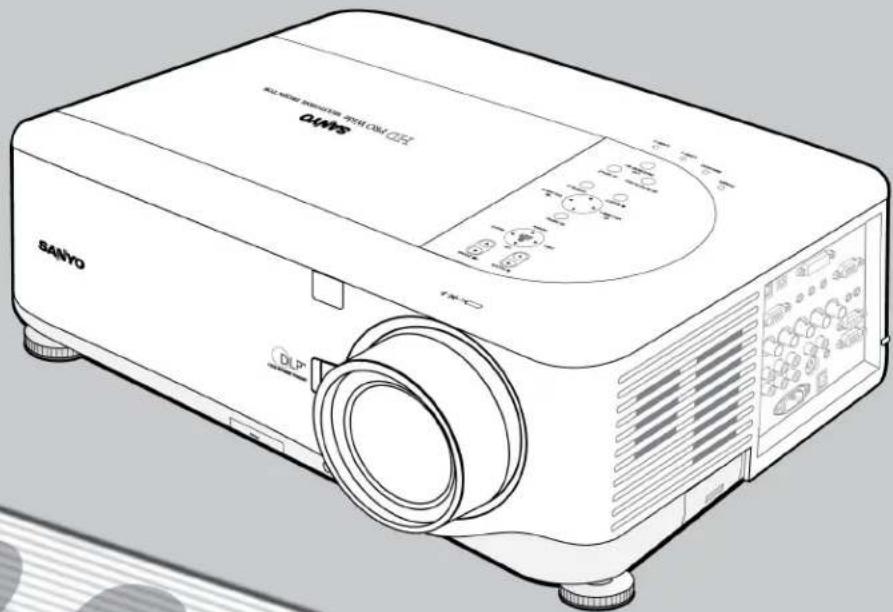
Multimedia Projector
MODEL PDG-DWT50L PDG-DWT50KL
text_image
SANYO DIPS 1:30 1:20 1:10 1:00 1:0 1:0 1:0 1:0 1:0 1:0 1:0 1:0 1:0 1:0 1:0 1:0 1:0 1:0 1:0 1:0 1:0 1:0 1:0 1:0 1:0 1:0 1:0 1:0 1:0 1.5x 2.5x 3.5x 4.5x 5.5x 6.5x 7.5x 8.5x 9.5x 10.5x 11.5x 12.5x 13.5x 14.5x 15.5x 16.5x 17.5x 18.5x 19.5x 20.5x 21.5x 22.5x 23.5x 24.5x 25.5x 26.5x 27.5x 28.5x 29.5x 30.5x 31.5x 32.5x 33.5x 34.5x 35.5x 36.5x 37.5x 38.5x 39.5x 40.5x 41.5x 42.5x 43.5x 44.5x 45.5x 46.5x 47.5x 48.5x 49.5x 50.5x 51.5x 52.5x 53.5x 54.5x 55.5x 56.5x 57.5x 58.5x 59.5x 60.5x 61.5x 62.5x 63.5x 64.5x 65.5x 66.5x 67.5x 68.5x 69.5x 70.5x 71.5x 72.5x 73.5x 74.5x 75.5x 76.5x 77.5x 78.5x 79.5x 80.5x 81.5x 82.5x 83.5x 84.5x 85.5x 86.5x 87.5x 88.5x 89.5x 90.5x 91.5x 92.5x 93.5x 94.5x 95.5x 96.5x 97.5x 98.5x 99.5x* Projection lens is optional.
User's Manual
PJLink™
- DLP is a registered trademark of Texas Instruments. BrilliantColor and DynamicBlack are trademarks of Texas Instruments.
• IBM is a trademark or registered trademark of International Business Machines Corporation.
• Macintosh, Mac OS X and PowerBook are trademarks of Apple, Inc., registered in the U.S. and other countries. - Windows, Windows 98, Windows Me, Windows XP or Windows 2000 are trademarks or registered trademarks of Microsoft Corporation.
- Trademark PJLink is a trademark applied for trademark rights in Japan, the United States of America and other countries and areas.
- Other product and company names mentioned in this user's manual may be the trademarks or registered trademarks of their respective holders.
Notes
(1) The contents of this user's manual may not be reprinted in part or whole without permission.
(2) The contents of this user's manual are subject to change without notice.
(3) The On-Screen Menu and figures in this manual may differ slightly from the product.
(4) Great care has been taken in the preparation of this user's manual; however, should you notice any questionable points, errors or omissions, please contact us.
(5) Notwithstanding article (3), SANYO will not be responsible for any claims on loss of profit or other matters deemed to result from using the Projector.
Before installing and operating the projector, read this manual thoroughly.
The projector provides many convenient features and functions. Operating the projector properly enables you to manage those features and maintains it in good condition for many years to come.
Improper operation may result in not only shortening the product life, but also malfunctions, fire hazard, or other accidents.
If your projector seems to operate improperly, read this manual again, check operations and cable connections and try the solutions in the “Troubleshooting” section in the back of this booklet. If the problem still persists, contact the dealer where you purchased the projector or the service center.

CAUTION
RISK OF ELECTRIC SHOCK DO NOT OPEN

CAUTION:
TO REDUCE THE RISK OF ELECTRIC SHOCK, DO NOT REMOVE COVER (OR BACK). NO USER-SERVICEABLE PARTS INSIDE EXCEPT LAMP REPLACEMENT. REFER SERVICING TO QUALIFIED SERVICE PERSONNEL.

THIS SYMBOL INDICATES THAT DANGEROUS VOLTAGE CONSTITUTING A RISK OF ELECTRIC SHOCK IS PRESENT WITHIN THIS UNIT.

THIS SYMBOL INDICATES THAT THERE ARE IMPORTANT OPERATING AND MAINTENANCE INSTRUCTIONS IN THE USER'S MANUAL WITH THIS UNIT.
NOTE: This symbol and recycle system are applied only to EU countries and not applied to the countries in the other area of the world.

Your SANYO product is designed and manufactured with high quality materials and components which can be recycled and reused.
This symbol means that electrical and electronic equipment, at their end-of-life, should be disposed of separately from your household waste.
Please dispose of this equipment at your local community waste collection/recycling center.
In the European Union there are separate collection systems for used electrical and electronic products.
Please help us to conserve the environment we live in!
READ AND KEEP THIS USER'S MANUAL FOR LATER USE.

Safety Precaution
WARNING:
TO REDUCE THE RISK OF FIRE OR ELECTRIC SHOCK, DO NOT EXPOSE THIS APPLIANCE TO RAIN OR MOISTURE.
- This projector produces intense light from the projection lens. Do not stare directly into the lens as much as possible, otherwise eye damage could result. Be especially careful that children do not stare directly into the beam.
- Install the projector in a proper position. Otherwise it may result in fire hazard.
- Allowing the proper amount of space on the top, sides, and rear of the projector cabinet is critical for proper air circulation and cooling of the unit. The dimension shown here indicates the minimum space required.
If the projector is to be built into a compartment or similarly enclosed, these minimum distances must be maintained.
- Do not cover the ventilation slot on the projector. Heat build-up can reduce the service life of your projector, and can also be dangerous.
SIDE and TOP REAR

text_image
0.7' (20 cm) 1.5' (50 cm) 1.5' (50 cm) 3' (1 m)- If the projector is unused for an extended time, unplug the projector from the power outlet.

CAUTION ON HANGING FROM THE CEILING
When hanging the projector from the ceiling, clean air intake vents, filters, or top of the projector periodically with a vacuum cleaner. If you leave the projector unclean for a long time, the cooling fans can be clogged with dust, and it may cause a breakdown.
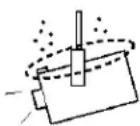
DO NOT SET THE PROJECTOR IN GREASY, WET, OR CONDITIONS SUCH AS IN A KITCHEN TO PREVENT A BREAKDOWN. IF THE PROJECTOR COMES IN CONTACT WITH OIL OR CHEMICALS, IT MAY BECOME DETERIORATED.
WARNING:
All the safety and operating instructions should be read before the product is operated.
Read all of the instructions given here and retain them for later use. Unplug this projector from AC power supply before cleaning. Do not use liquid or aerosol cleaners. Use a damp cloth for cleaning.
Follow all warnings and instructions marked on the projector.
For added protection to the projector during a lightning storm, or when it is left unattended and unused for long periods of time, unplug it from the wall outlet. This will prevent damage due to lightning and power line surges.
Do not expose this unit to rain or use near water... for example, in a wet basement, near a swimming pool, etc...
Do not use attachments not recommended by the manufacturer as they may cause hazards.
Do not place this projector on an unstable cart, stand, or table. The projector may fall, causing serious injury to a child or adult, and serious damage to the projector. Use only with a cart or stand recommended by the manufacturer, or sold with the projector. Wall or shelf mounting should follow the manufacturer's instructions, and should use a mounting kit approved by the manufacturers.
An appliance and cart combination should be moved with care. Quick stops, excessive force, and uneven surfaces may cause the appliance and cart combination to overturn.

Slots and openings in the back and bottom of the cabinet are provided for ventilation, to ensure reliable operation of the equipment and to protect it from overheating.
The openings should never be covered with cloth or other materials, and the bottom opening should not be blocked by placing the projector on a bed, sofa, rug, or other similar surface. This projector should never be placed near or over a radiator or heat register.
This projector should not be placed in a built-in installation such as a bookcase unless proper ventilation is provided.
Never push objects of any kind into this projector through cabinet slots as they may touch dangerous voltage points or short out parts that could result in a fire or electric shock. Never spill liquid of any kind on the projector.
Do not install the projector near the ventilation duct of air-conditioning equipment.
This projector should be operated only from the type of power source indicated on the marking label. If you are not sure of the type of power supplied, consult your authorized dealer or local power company.
Do not overload wall outlets and extension cords as this can result in fire or electric shock. Do not allow anything to rest on the power cord. Do not locate this projector where the cord may be damaged by persons walking on it.
Do not attempt to service this projector yourself as opening or removing covers may expose you to dangerous voltage or other hazards. Refer all servicing to qualified service personnel.
Unplug this projector from wall outlet and refer servicing to qualified service personnel under the following conditions:
a. When the power cord or plug is damaged or frayed.
b. If liquid has been spilled into the projector.
c. If the projector has been exposed to rain or water.
d. If the projector does not operate normally by following the operating instructions. Adjust only those controls that are covered by the operating instructions as improper adjustment of other controls may result in damage and will often require extensive work by a qualified technician to restore the projector to normal operation.
e. If the projector has been dropped or the cabinet has been damaged.
f. When the projector exhibits a distinct change in performance-this indicates a need for service.
When replacement parts are required, be sure the service technician has used replacement parts specified by the manufacturer that have the same characteristics as the original part. Unauthorized substitutions may result in fire, electric shock, or injury to persons.
Upon completion of any service or repairs to this projector, ask the service technician to perform routine safety checks to determine that the projector is in safe operating condition.

Openings in the cabinet are provided for ventilation. To ensure reliable operation of the product and to protect it from overheating, these openings must not be blocked or covered.

CAUTION
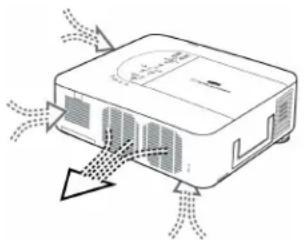
Hot air is from the exhaust vent. When using or installing the projector, the following precautions should be taken.
- Do not put any flammable objects or spray cans near the projector, hot air is exhausted from the air vents.
- Keep the exhaust vent at least 3 feet (1 m) away from any objects.
- Do not touch peripheral parts in the exhaust vents, especially screws and metallic parts. These areas will become hot while the projector is used.
- Do not put anything on the cabinet. Objects put on the cabinet will not only get damaged but may also cause a fire hazard.
Cooling fans are provided to cool down the projector. The fans' running speed is changed according to the temperature inside the projector.
natural_image
Diagram of a projector with airflow arrows indicating motion (no text or symbols)IMPORTANT!
Clean the Filter Regularly!!
The projector uses a lamp which generates significant heat. The cooling fans and air vents are provided to dissipate the heat by drawing air into the housing and the filter is located in the intake vents to prevent dust from getting inside of the projector.
In order to care for the projector appropriately, regular cleaning is required. Remove any dirt or dust that has accumulated on the projector and on or in the filter.
When the "Please clean filter" message is displayed, stop using the projector immediately and clean or replace the filter.
Blocking the air vents and leaving the projector uncleaned for a long time may not only damage the projector and may require costly repairs but may also cause accidents or fire.
For maintenance of the filter, refer to "Option" on page 83 and "Replacing the Filters" on pages 97 - 98.
Damages to the projector caused by using an un-cleaned filter or improper maintenance will void the warranty on the projector.
Installing the Projector in Proper Position
Install the projector properly. Improper installation may reduce the lamp lifetime and cause a fire hazard.
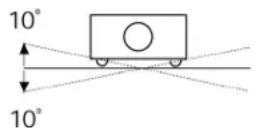
Do not tilt the projector more than 10 degrees above and below.

Do not point the projector up to project an image.
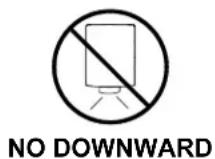
Do not point the projector down to project an image.
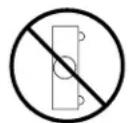
Do not put the projector on either side to project an image.
NO SIDEWAYS
Federal Communications Commission Notice
This equipment has been tested and found to comply with the limits for a Class B digital device, pursuant to Part 15 of the FCC Rules. These limits are designed to provide reasonable protection against harmful interference in a residential installation. This equipment generates, uses, and can radiate radio frequency energy and, if not installed and used in accordance with the instructions, may cause harmful interference to radio communications. However, there is no guarantee that interference will not occur in a particular installation. If this equipment does cause harmful interference to radio or television reception, which can be determined by turning the equipment off and on, the user is encouraged to try to correct the interference by one or more of the following measures:
– Reorient or relocate the receiving antenna. Increase the separation between the equipment and receiver.
- Connect the equipment into an outlet on a circuit different from that to which the receiver is connected.
- Consult the dealer or an experienced radio/TV technician for help.
Use of shielded cable is required to comply with class B limits in Subpart B of Part 15 of FCC Rules.
Do not make any changes or modifications to the equipment unless otherwise specified in the instructions. If such changes or modifications should be made, you could be required to stop operation of the equipment.
Model Number(s) : PDG-DWT50L
Trade Name : Sanyo
Responsible party : SANYO FISHER COMPANY
Address : 21605 Plummer Street, Chatsworth, California 91311 U.S.A.
Telephone No. : (818)998-7322
AC Power Cord Requirement
The AC Power Cord supplied with this projector meets the requirement for use in the country you purchased it.
AC Power Cord for the United States and Canada:
AC Power Cord used in the United States and Canada is listed by the Underwriters Laboratories (UL) and certified by the Canadian Standard Association (CSA).
AC Power Cord has a grounding-type AC line plug. This is a safety feature to be sure that the plug will fit into the power outlet. Do not try to defeat this safety feature. Should you be unable to insert the plug into the outlet, contact your electrician.
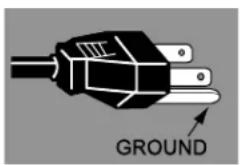
text_image
GROUNDAC Power Cord for the United Kingdom:
This cord is already fitted with a modulized plug incorporating a fuse, the value of which is indicated on the pin face of the plug. Should the fuse need to be replaced, an ASTA approved BS 1362 fuse must be used of the same rating, marked thus RSL . If the fuse cover is detachable, never use the plug with the cover omitted. If a replacement fuse cover is required, ensure it is of the same color as that visible on the pin face of the plug (i.e. red or orange). Fuse covers are available from the Parts Department indicated in your User Instructions. If the plug supplied is not suitable for your socket outlet, it should be cut off and destroyed. The end of the flexible cord should be suitably prepared and the correct plug fitted.
WARNING: A PLUG WITH BARED FLEXIBLE CORD IS HAZARDOUS IF ENGAGED IN A LIVE SOCKET OUTLET.
The Wires in this mains lead are colored in accordance with the following code:
Green-and-yellow Earth
Blue Neutral
Brown Live
As the colors of the wires in the mains lead of this apparatus may not correspond with the colored markings identifying the terminals in your plug proceed as follows:
The wire which is colored green-and-yellow must be connected to the terminal in the plug which is marked by the letter E or by the safety earth symbol of colored green or green-and-yellow.
The wire which is colored blue must be connected to the terminal which is marked with the letter N or colored black. The wire which is colored brown must be connected to the terminal which is marked with the letter L or colored red.
WARNING: THIS APPARATUS MUST BE EARTHED.
THE SOCKET-OUTLET SHOULD BE INSTALLED NEAR THE EQUIPMENT AND EASILY ACCESSIBLE.
Table of Contents
1. INTRODUCTION....1
WHAT'S IN THE BOX? 1
② INTRODUCTION TO THE PROJECTOR....2
Features you'll enjoy: 2
③ PART NAMES OF THE PROJECTOR .... 3
Front-right view....3
Top view 4
Bottom view 5
④ TOP FEATURES ....6
Lens Controls....6
OSD Controls and Status LEDs....7
5 TERMINAL PANEL FEATURES....9
⑥ PART NAMES OF THE REMOTE CONTROL ....11
Battery Installation 13
Operating Range for Wireless Remote Control....14
Remote Control Precautions 14
Remote Control Codes....14
Using the Remote Control in Wired Operation....15
Carrying the Projector 16
2. INSTALLATION AND CONNECTIONS ....17
- SETTING UP THE SCREEN AND THE PROJECTOR....17
② SELECTING A LOCATION....18
③ INSTALLING OR REMOVING THE OPTIONAL LENS ....19
Removing the Existing Lens From the Projector....19
Installing the New Lens....20
Installing the New Lens Using the anti-theft screw 21
④ THROW DISTANCE AND SCREEN SIZE 22
5 INSTALLING THE OPTIONAL COLOR WHEEL 24
⑥ MAKING CONNECTIONS....26
Connecting Your PC or Macintosh Computer....26
Connecting an External Monitor....28
Connecting Your DVD Player with Component Output....29
Connecting Your VCR or Laser Disc Player 30
7 CONNECTING THE SUPPLIED POWER CABLE 31
NOTE ON THE POWER CORD....31
3. PROJECTING AN IMAGE (BASIC OPERATION)....32
1 TURNING ON THE PROJECTOR....32
Note on Startup Screen (Menu Language Select screen)....33
② SELECTING AN INPUT SOURCE....34
③ ADJUSTING THE PICTURE POSITION AND PICTURE SIZE....35
Adjusting Picture Position Manually....35
Lens Shift Adjustable Range 36
From the Remote Control Unit 37
Adjusting the Projector Level....38
④ OPTIMIZING AN RGB IMAGE AUTOMATICALLY ....39
Adjusting the Image Using AUTO PC ADJ. 39
⑤ ADJUSTING VOLUME UP AND DOWN 40
⑥ TURNING OFF THE PROJECTOR....41
About Direct Power Off 42
After Use....42
4. CONVENIENT FEATURES....43
1 TURNING OFF THE IMAGE AND SOUND 43
② FREEZING A PICTURE....43
③ ADJUSTING THE FOCUS/ZOOM MANUALLY....44
Adjusting by Using the OSD Control Panel 44
④ CHANGING LAMP MODE 45
Changing Lamp Mode by Using the Projector's OSD Control Panel 45
Changing Lamp Mode by Using the Remote Control 46
⑤ GETTING INFORMATION......47
⑥ ADJUSTING POSITION/TOTAL DOTS/FINE SYNC 48
Adjusting Position/Total Dots/Fine Sync by using the OSD Control Panel 48
Correcting Keystone by Using the Remote Control 49
7 PREVENTING THE UNAUTHORIZED USE OF THE PROJECTOR....51
Locking the Projector....51
Unlocking the Projector....53
⑧ USING THE PHYSICAL LOCK....54
Using the Kensington Lock....54
Using the Security Chain Lock....54
5. USING ON-SCREEN DISPLAY....55
① USING THE MENUS....55
Navigating the OSD 55
② MENU TREE....57
③ MENU ELEMENTS 59
④ SOURCE MENU DESCRIPTIONS AND FUNCTIONS....60
⑤ ADJUST MENU DESCRIPTIONS AND FUNCTIONS....61
Image menu....61
Image options menu....62
Video menu....64
⑥ DETAIL SETTINGS MENU DESCRIPTIONS AND FUNCTIONS....67
Basic 67
White balance....69
Color correction....70
7 SETTING MENU DESCRIPTIONS AND FUNCTIONS....71
Basic 71
Installation....75
Network setting....82
Option 83
⑧ INFORMATION MENU DESCRIPTIONS AND FUNCTIONS....89
Usage time 89
Input 90
Network....91
Version....92
⑨ RESET MENU DESCRIPTIONS AND FUNCTIONS....93
6. MAINTENANCE 94
① CLEANING THE PROJECTOR 94
Cleaning the Cabinet....94
Cleaning the Lens....94
Cleaning the Filters....95
② REPLACING CONSUMABLE PARTS....97
Replacing the Filters....97
Replacing the Lamps....99
Resetting the Lamp Time Counter....101
Ordering a Replacement Lamp....101
7. APPENDIX 102
① TROUBLESHOOTING 102
Indicator Messages....102
Common Problems and Solutions....104
Tips for Troubleshooting....104
② IMAGE PROBLEMS....105
Table of Contents
Lamp Problems 105
Remote Control Problems 106
Audio Problems....106
③ HAVING THE PROJECTOR SERVICED....106
8. SPECIFICATIONS ....107
① PROJECTOR SPECIFICATIONS....107
Optical Specifications 107
Electrical Specifications 108
Mechanical Specifications 109
Environmental Considerations....109
Regulations....109
Optional Parts....110
② CABINET DIMENSIONS....111
③ PIN ASSIGNMENTS OF MINI D-SUB 15 PIN INPUT CONNECTOR....112
④ COMPATIBLE INPUT SIGNAL LIST 113
5 PC CONTROL CODES AND CABLE CONNECTIONS....115
Functional Execution Command Table....115
Status Read Command Table....116
⑥ SCREEN TRIGGER....117
⑦ OPERATION USING HTTP BROWSER....118
Overview....118
Preparation Before Use....118
Handling of the Address for Operation by Using a Browser....118
Configuring Network Settings....119
Structure of the HTTP Server....121
⑧ 15 PIN GPIO CONTROL ....123
9. TROUBLESHOOTING CHECK LIST ....124
1. Introduction
① What's in the Box?
Carefully unpack the projector and check that the following items are included:

natural_image
Line drawing of a projector with control panel and display screen (no text or symbols)PDG-DWT50L Projector Remote Control

text_image
SANYO(with Two AA alkaline batteries)

Power Cable
(3.6m/11.8 ft.)
→ For North
America,
Europe and the UK
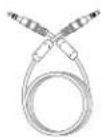
Remote Cable
(10m/33ft)

Quick Start Guide

VGA Cable

CD-ROM
(This User's manual)
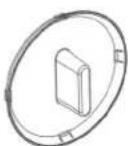
Lens Hole Cap
(Installed)


■ Anti-Theft Screw for lens x 1
■ Security Sticker
Contact your dealer immediately if any items are missing, appear damaged, or if the unit does not work.
CAUTION

Avoid using the projector in dusty environments.
② Introduction to the Projector
Features you'll enjoy:
DLP projector with high resolution
The combination of BrilliantColor ^™ and a six-segment color wheel (optional) offer a more true color reproduction.
Installation Flexibility
This projector has many useful functions such as powered lens shifting, ceiling and rear projection, variety of extensive optional powered lens with bayonet mount with release button, etc.
Multiple Interface Terminals
The projector has several interface terminals that can support various types of equipment and signals.
Dual Lamp Control System
The two-lamp control system offers high brightness, maintained lamp life and energy savings along with redundancy. The lamp control function offers brightness of the lamp can be selected. The power management function also reduces power consumption and maintains lamp life.
Simple Computer System Setting
The projector has the Multi-scan system to conform to almost all computer output signals quickly. Up to UXGA resolution can be accepted.
Security Function
The Security function helps you to ensure security of the projector. With the Key lock function, you can lock the operation on the top control. PIN code lock functions prevent unauthorized use of the projector.
Multilanguage Menu Display
Operation menu is available in 8 languages: English, German, French, Italian, Spanish, Swedish, Chinese, and Japanese.
Multi-use Remote Control
Use the remote control as wired or wireless. Eight remote control codes are available.
3W + 3W Stereo Speaker
Built in 3W x 2 speakers are provided.
Helpful Maintenance Functions
The lamp and filter maintenance functions provide for better and proper maintenance of the projector. Easy maintenance cover is provided for lamp and color wheel replacement.
Direct Power Off and On Start
The Direct Power Off function allows the projector to be turned off (even when projecting an image) using a power strip equipped with a switch and a breaker. The On Start function allows the projector to be turned on by supplied AC power.
Note:
Before using Direct Power Off, be sure to allow at least 20 minutes immediately after turning on the projector and starting to display an image. Also, the power cord can be removed immediately after turning off the projector. On Start manual may differ slightly from the product.
On Start eliminates the need to always use the POWER (ON/STANDBY) button on the remote control or projector cabinet.
③ Part Names of the Projector
Front-right view
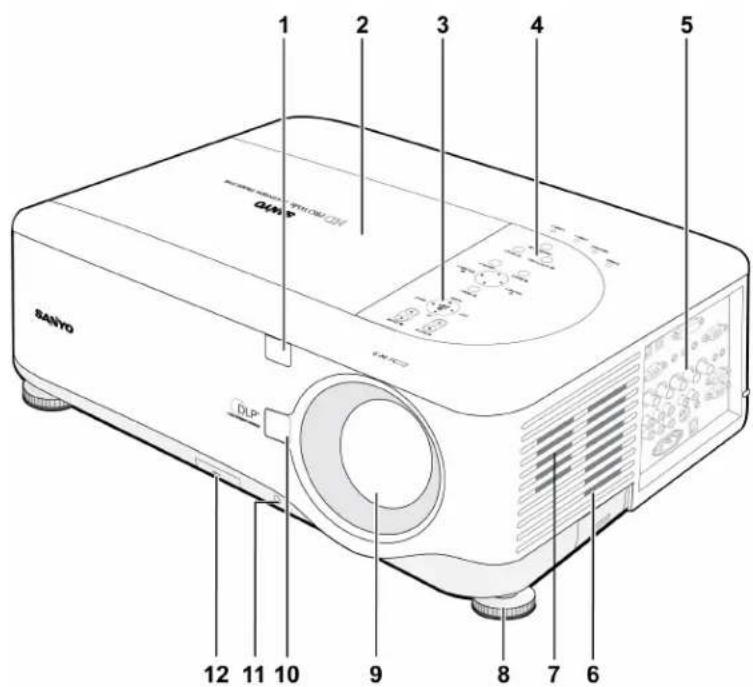
text_image
1 2 3 4 5 SANYO DLP 9 8 7 6 10 11 12| ITEM | LABEL | DESCRIPTION | SEE PAGE: |
| 1. | IR receiver Receiver for IR signal from remote control | 11 | |
| 2. | Lamp cover Remove cover to replace lamp or color wheel | 99 | |
| 3. | Lens control panel See Lens Controls | 6 | |
| 4. | OSD control panel See OSD Controls and Status LEDS | 7 | |
| 5. | I/O connector panel Connect various input devices | 9 | |
| 6. | Intake vent Lamp cooling vent – do not obstruct | — | |
| 7. | Speakers Built-in stereo speakers | — | |
| 8. | Height adjuster Adjusts level of projector | 5 | |
| 9. | Lens Remove lens cap before use | — | |
| 10. | Lens release button Press the release button before removing the lens | — | |
| 11. | Anti-Theft screw Prevent theft of the lens | — | |
| 12. | Intake vent and front filter | Keeps the front fan free of dust– clean regularly for optimum performance– do not obstruct | 95 |
Important:
Grill openings on the projector allow for good air circulation, which keeps the projector lamp cool. Do not obstruct any of the grill openings.
Top view

text_image
SANYO HD PRO Wide MULTIVERSE PROJECTOR| ITEM | LABEL | DESCRIPTION | SEE PAGE: |
| 1. | Lens control panel See Lens Controls | 6 | |
| 2. | Right-hand speaker Right-hand speaker | — | |
| 3. | Lamp cover Remove cover to replace lamp or color wheel | 99 | |
| 4. | Exhaust vent Exhaust vent – do not obstruct | — | |
| 5. | OSD control panel See OSD Controls and Status LEDS | 7 | |
| 6. | Rear intake vent Rear cooling intake – do not obstruct | — | |
| 7. | Left intake vent Left-hand cooling intake – do not obstruct | — | |
| 8. | Left-hand speaker Left-hand speaker | — |
Bottom view
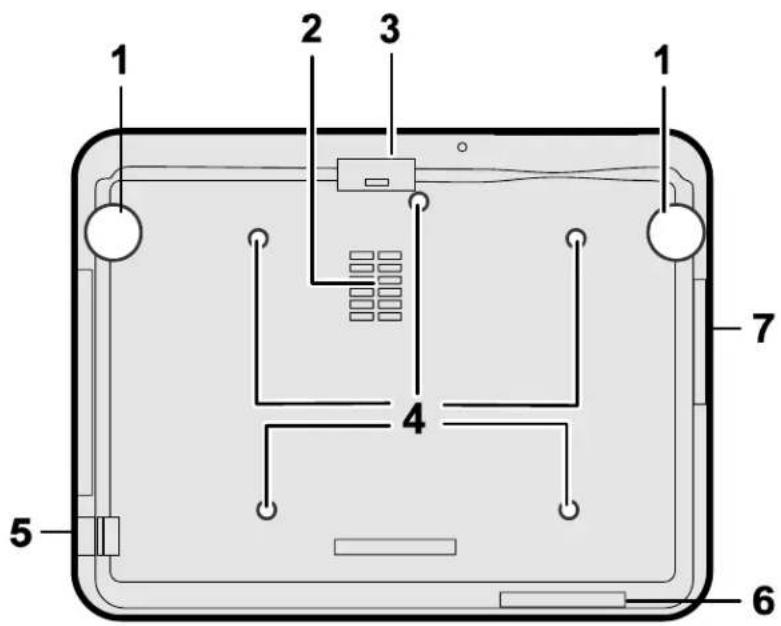
text_image
1 2 3 1 4 5 6 7| ITEM | LABEL | DESCRIPTION | SEE PAGES: |
| 1. | Height adjusters Adjust | projection height | 38 |
| 2. | Intake vent Color wheel | cooling vent – do not obstruct | — |
| 3. | Front filter | Keep the fan free of dust – clean regularly for optimum performance | 95 |
| 4. | Ceiling support holes | Contact your dealer for information on mounting the projector on a ceiling | — |
| 5. | Security chain opening | Attach anti-theft device – see 8 Using the Physical Lock | 54 |
| 6. | Rear filter | Keep the fans free of dust – clean regularly for optimum performance | 95 |
| 7. | Side filter |
CAUTION

With ceiling installation, use approved mounting hardware & M4 screws; maximum depth of screw: 12 mm; distance from ceiling/ wall: 20 cm (0.7 feet) for proper ventilation; distance from fluorescent lamps: at least 1 m (3 feet) front and back of the projector. For permanent installations, follow local codes.
④ Top Features
Lens Controls

text_image
6 —— Ⓞ FOCUS ZOOM —— 1 UP 2 LEFT LENS SHIFT RIGHT 3 4 DOWN| ITEM | LABEL | DESCRIPTION | SEE PAGE: |
| 1. | ZOOM Increase/decrease projected image size | 44 | |
| 2. | UP CURSOR | Move image left, right, up, or down | |
| 3. | RIGHT CURSOR | ||
| 4. | DOWN CURSOR | ||
| 5. | LEFT CURSOR | ||
| 6. | FOCUS Focus the projected image | 44 | |
OSD Controls and Status LEDs

text_image
MENU 1 2 VOLUME- 3 VOLUME+ 13 SELECT CANCEL 12 AUTO PC ADJ. INPUT 11 I/O ON/STAND-BY 5 6 POWER WARNING LAMP 1 LAMP 2 10 9 8 7| ITEM | LABEL | DESCRIPTION | SEE PAGE: |
| 1. | MENU Open / Close the OSD | 55 | |
| 2. | UP/ DOWN/ LEFT/ RIGHT BUTTONS | Navigate and change settings in the OSD | 55 |
| 3. | RIGHT CURSOR/ VOLUME INCREASE | Increase volume | 40 |
| 4. | CANCEL Exit the On- | Screen Display (OSD) | 55 |
| 5. | INPUT | Change or select the input device | 34 |
| 6. | ON/STAND-BY | Turn the projector on or off (main power switch must be turned on first).Press to place the projector in standby mode. | 32 |
| 7. | LAMP 2 (LED) See Indicator Messages | 102 | |
- Introduction
| ITEM | LABEL | DESCRIPTION | SEE PAGE: |
| 8. | LAMP 1 (LED) See Indicator Messages | 102 | |
| 9. | WARNING (LED) See Indicator Messages | 102 | |
| 10. | POWER (LED) See Indicator Messages | 102 | |
| 11. | AUTO PC ADJ. Optimize image size, position, and resolution | 39 | |
| 12. | SELECT Select or change settings in the OSD | 55 | |
| 13. | LEFT CURSOR/VOLUME DECREASE | Decrease volume | 40 |
⑤ Terminal Panel Features

text_image
21 20 COMPUTER 3 DIGITAL (DVI-D) 20 ANALOG AUDIO IN AUDIO OUT MONITOR OUT 19 18 17 COMPUTER 2 R/Cr G/Y B/Cb H V AUDIO IN R/C JACK 16 COMPONENT IV Pb/Cb Pr/Cr L-AUDIO IN-R SERIAL PORT IN 7 VIDEO (MONO) S-VIDEO SCREEN TRIGGER 8 REMOTE IN 15 14 13 (MONO) (MONO) KT3AL 14 13 12| ITEM | LABEL | DESCRIPTION | SEE PAGE: |
| 1. | COMPUTER 3 IN Connect the DVI-D cable (not supplied) from a computer | 26 | |
| 2. | AUDIO IN (COMPUTER 3) | Connect the audio cable (not supplied) from the input device | — |
| 3. | AUDIO OUT Audio loop-thru | — | |
| 4. | MONITOR OUT Connect to a monitor | — | |
| 5. | R/C JACK Connect the remote to the projector | 15 | |
| 6. | AUDIO IN (COMPUTER 2) | Connect the audio cable (not supplied) from the input device | — |
| 7. | AUDIO IN [L(MONO)/R] (COMPONENT) | Connect an RCA audio cables (not supplied) from the input device right and left channels | — |
| 8. | SERIAL PORT IN Installation control | 115 | |
| 9. | REMOTE IN For external control | 123 | |
| 10. | SCREEN TRIGGER | When connected to the screen through a commercially available cable, the screen deploys automatically on start up of the projector. The screen retracts when the projector is powered off (see notes below) | 117 |
| 11. | S-VIDEO | Connect a commercially available S-video cable from a video device | 30 |
| 12. | POWER SWITCH Turn on/off the projector | 32,41 | |
| 13. | AC IN Connect the supplied power cable | 31 | |
| 14. | AUDIO IN [L(MONO)/R] (VIDEO) | Connect RCA audio cables (not supplied) from the input device right and left channels. This audio jack is shared with S-Video input. | — |
| 15. | VIDEO IN | Connect a composite video cable (not supplied) from a video device to the yellow RCA jack | 30 |
| 16. | COMPONENT IN (Y, Cb/Pb, Cr/Pr) | Connect a component video enabled device | 29 |
| 17. | COMPUTER 2 IN (R/Cr, G/Y, B/Cb, H, V) | Connect RGBHV or Component signal from computer or component video enabled device | 26 |
| 18. | COMPUTER 1 IN Connect a VGA cable (supplied) from a computer | 26 | |
| 19. | AUDIO IN (COMPUTER 1) | Connect the audio cable (not supplied) from the input device | — |
| 20. | LAN Connect a LAN cable (not supplied) from a computer | — | |
| 21. | SERVICE | Connect the USB cable (not supplied) from a computer. For service personnel only. | — |
Note:
• To use this feature, you must turn on the Screen Trigger function on the OSD.
- Screen controllers are supplied and supported by screen manufacturers.
- Do not use this jack for anything other than intended use. Connecting the wired remote control to the Trigger mini jack causes damage to the remote control.
⑥ Part Names of the Remote Control
| ITEM | LABEL |
| 1. | ON |
| 2. | STAND-BY |
| 3. | LIGHTIlluminate the remote panel. |
| 4. | MENUOpen or close the on-Screen menu. |
| 5. | CANCEL |
| 6. | VOLUME - COMPUTER 1 |
| 7. | SELECTExecutes a selected menu item |
| 8. | VOLUME + COMPUTER 3 |
| 9. | LENS SHIFTShift the lens up, down, right and left. |
| 10. | FOCUS/ZOOMCorrect image distortion. |
| 11. | IMAGESelect image mode |
| 12. | SCREENSelect the screen size. |
| 13. | FREEZEFreeze the picture. |
| 14. | LAMP CONTROLSelect a lamp mode. |

text_image
1 2 3 4 5 6 7 8 9 10 11 20 12 16 21 13 17 22 14 18 23 15 24 19 25 SANYO CXWZ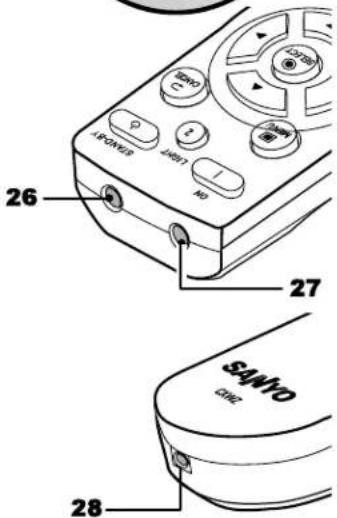
text_image
S4N10 26 27 28| LABEL | ITEM |
| NO SHOWTemporarily turns off screen image. | 15. |
| D. ZOOM -/+Zoom in/out function. | 16. |
| AUTO PCAutomatically adjust the computer image. | 17. |
| KEYSTONECorrect keystone distortion. | 18. |
| VOLUME | 19. |
| 20. | |
| COMPUTER 2 | 21. |
| 22. | |
| COMPONENTSelect the component input source. | 23. |
| S-VIDEOSelect the S-video input source. | 24. |
| VIDEOSelect the video input source. | 25. |
| IR TRANSMITTER | 26. |
| IR TRANSMITTER | 27. |
| REMOTE JACKConnect a wired remote control. | 28. |
Important:
Avoid using the projector with bright fluorescent lighting turned on. Certain high-frequency fluorescent lights can disrupt remote control operation.
- Be sure nothing obstructs the path between the remote control and the projector. If the path between remote and projector is obstructed, you can bounce the remote signal off certain reflective surfaces such as projector screens.
- The buttons and keys on the projector have the same functions as the corresponding buttons on the remote control. This user's manual describes the functions based on the remote control.
Note:
* To turn off the projector, press the STAND-BY button twice.
Battery Installation
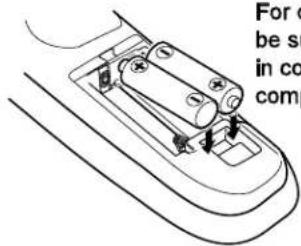
The Remote Control unit included with the projector does not contain batteries, though batteries are supplied as part of the complete package. To insert (or replace) the batteries, refer to the following guide.
- Remove the battery compartment cover by squeezing the locking catch and sliding the cover in the direction of the arrow.

text_image
Pull up the lid and remove it.- Insert the supplied batteries taking note of the polarity (+/-) as shown.
text_image
For c be se in co compTwo AA size batteries
For correct polarity (+ and -), be sure battery terminals are in contact with pins in the compartment.
- Replace the cover locator, and then click locking catch into place as shown.

natural_image
Line drawing of a car interior showing a hand valve and handle (no text or symbols)Operating Range for Wireless Remote Control
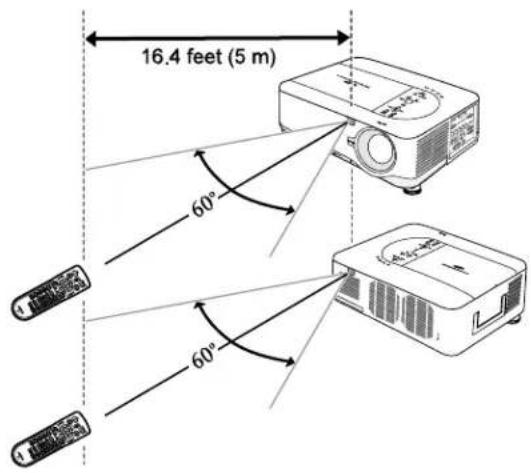
Point the remote control toward the projector (to Infrared Remote Receivers) when pressing the buttons. Maximum operating range for the remote control is about 16.4 feet (5 m) and 60 degrees in front and rear of the projector.
Infrared remote receivers are provided both in front and back of the projector. You can conveniently use both of the receivers.
Remote Control Precautions
The following precautions ensure that the remote operates correctly and safely.
- Use two (2) AA or LR6 type alkaline batteries.
• Always replace batteries in sets. - Do not use a new battery with a used one.
- Avoid contact with water or liquid.
- Do not expose the remote control to moisture or heat.
- Do not drop the remote control.
- If the battery has leaked on the remote control, carefully wipe the case clean and install new batteries.
- Risk of an explosion if battery is replaced by an incorrect type.
- Dispose of used batteries according to the instructions.
text_image
16.4 feet (5 m) 60° 60°Remote Control Codes
This projector provides eight different remote control codes (Code 1–Code 8); the factory-set, initial code (Code 1) and the other seven codes (Code 2 to Code 8). This switching function prevents remote control interference when operating several projectors or video equipment at the same time.
The same code should be set on both the projector and the remote control.
For example operating the projector in "Code 7", both the projector and the remote control must be switched to "Code 7".
To change the code for the projector;
Select a remote control code in the Menu.
To change the code for the remote control;
Check the Reset Switch to Use position in the compartment lid on back of the remote control.

text_image
Use position Reset position Reset switchWith holding down the MENU button, press the IMAGE button. By pressing the IMAGE button, the code switches in a sequential order.
To reset the code for the remote control;
Slide the Reset Switch to "Reset position" in the compartment lid on back of the remote control.
Using the Remote Control in Wired Operation
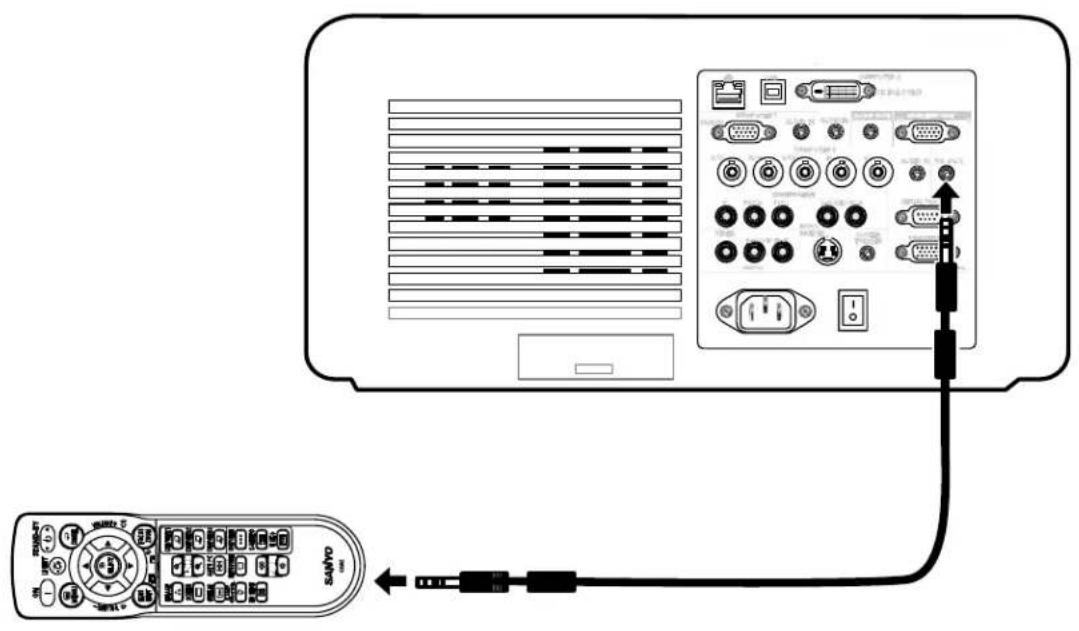
Connect the supplied remote cable to the R/C jack on the projector (see ⑤ Terminal Panel Features on page 9) and the other end to the remote jack on the remote control (see item 1, ⑥ Part Names of the Remote Control on page 11).
Note:
Connecting the remote cable to the R/C jack on the terminal panel will make the wireless operation unavailable.
text_image
Diagram showing connection between a remote control via USB cable, with labeled ports and connectorsCarrying the Projector
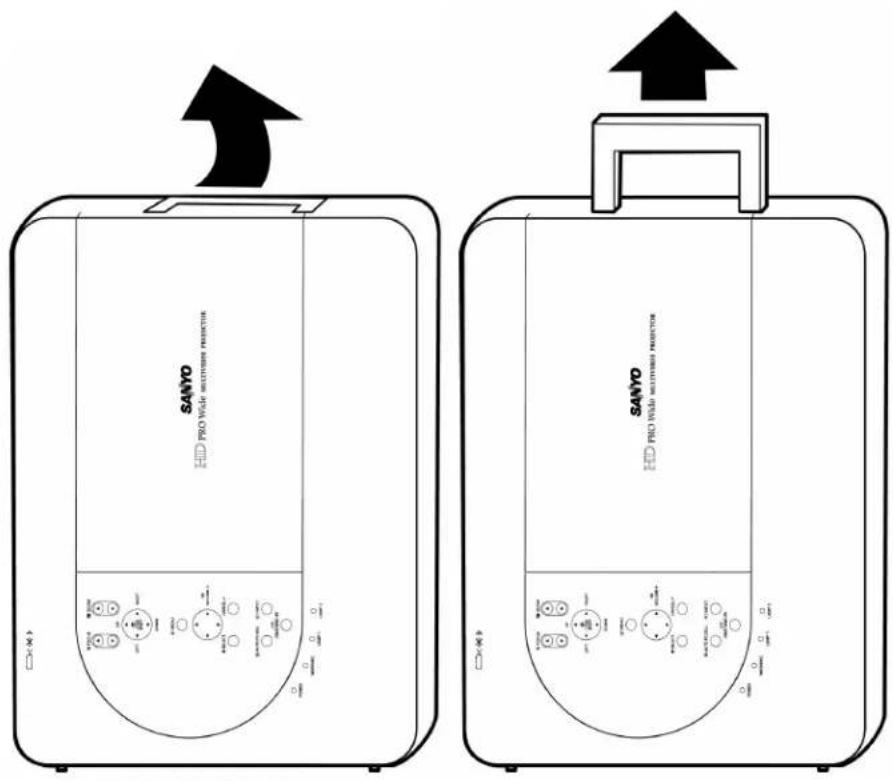
Always carry your projector by the handle.
Before moving or carrying the projector, disconnect the power cable and any other cables that may be attached to it.
When moving the projector or when the projector is not in use, cover the lens with the lens cap.
To extend the projector handle, refer to the following guide.
- Stand the projector on its end with the control panels at the bottom.
- Lift the handle in the direction shown until it is fully extended.
text_image
SANYO HD PRO Wide wireless router SANYO HD PRO Wide wireless routerNote:
Stand the projector on its end by lifting the cabinet. Do not use the handle to place the projector upright.
2. Installation and Connections
① Setting Up the Screen and the Projector
This section briefly describes how to set up your projector and how to connect video and audio sources.
Your projector is simple to set up and use. But before you get started, you must first:
- Set up a screen and the projector.
- Connect your computer or video equipment to the projector. See ⑥ Making Connections on page 26.
- Connect the supplied power cable. See ⑦ Connecting the Supplied Power Cable on page 31.

text_image
Illustration of a business meeting with two people at desks, a projector, and a screen displaying charts; includes a close-up of the projector screen.Note:
Ensure that the power cable and any other cables are disconnected before moving the projector. When moving the projector or when it is not in use, cover the lens with the lens cap.
② Selecting a Location
Locating the projector correctly ensures optimum performance and a longer parts life.
Take note of the following when setting up the projector:
- The projector table or stand should be level and sturdy.
- Position the projector so that it is perpendicular to the screen.
- Ensure cables do not cause a trip hazard.
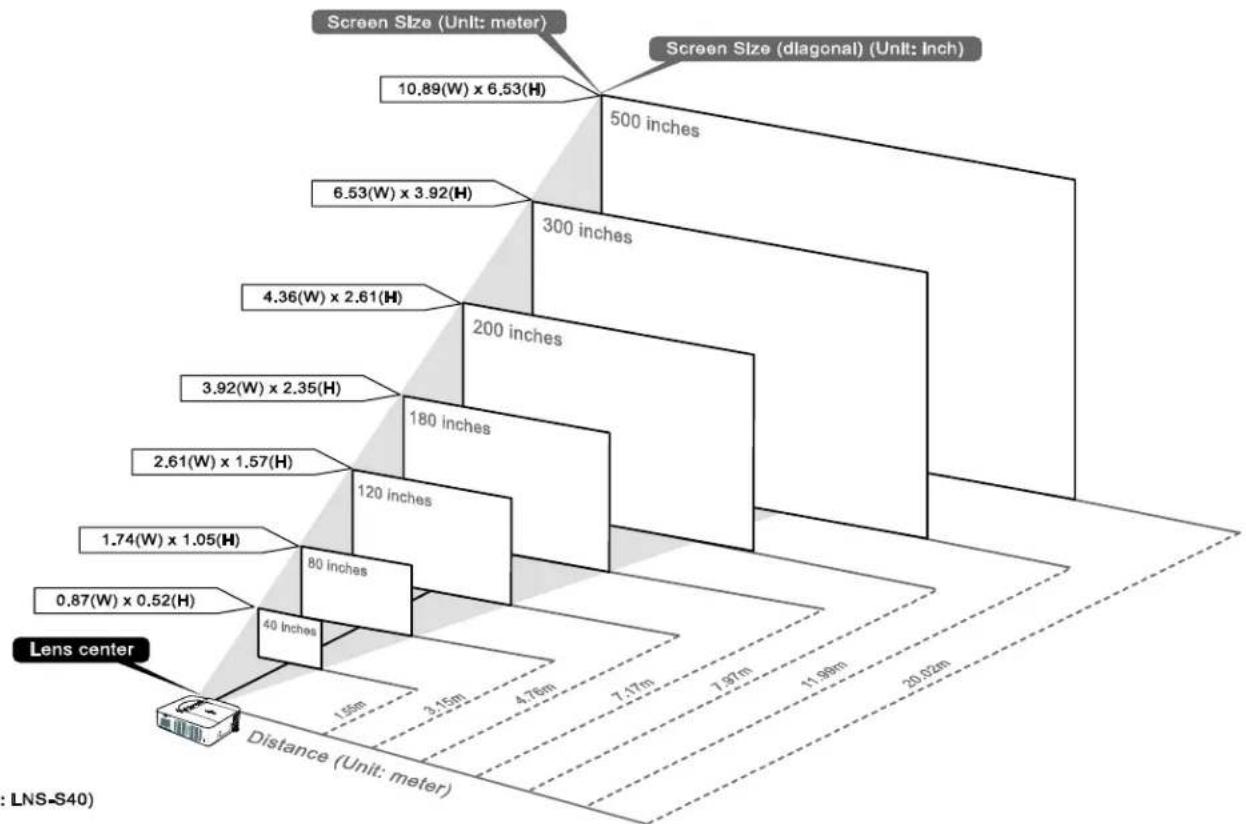
tree
| Dimension | Unit (inches) | | :--- | :--- | | Screen Size (Unit: meter) | 10.89(W) x 6.53(H) | | Screen Size (diagonal) (Unit: inch) | 500 inches | | Screen Size (diagonal) (Unit: inch) | 300 inches | | Screen Size (diagonal) (Unit: inch) | 200 inches | | Screen Size (diagonal) (Unit: inch) | 180 inches | | Screen Size (diagonal) (Unit: inch) | 120 inches | | Screen Size (diagonal) (Unit: inch) | 80 inches | | Screen Size (diagonal) (Unit: inch) | 40 inches | | Lens center | LNS-S40 | | Distance (Unit: meter) | 1.5m, 3.15m, 4.76m, 7.17m, 7.97m, 11.99m, 20.02m |(Reference: LNS-S40)
③ Installing or Removing the Optional Lens
CAUTION

- Do not shake or place excessive pressure on the projector or the lens components as the projector and lens components contain precision parts.
- When shipping the projector with the optional lens, remove the optional lens before shipping the projector. The lens and the lens shift mechanism may encounter damage caused by improper handling during transportation.
- Before removing or installing the lens, be sure to turn off the projector, wait until the cooling fans stop, and turn off the main power switch.
- Do not touch the lens surface when removing or installing the lens.
- Keep fingerprints, dust or oil off the lens surface. Do not scratch the lens surface.
• Work on a level surface with a soft cloth under it to avoid scratching. - If you remove and store the lens, attach the lens cap to the projector to keep off dust and dirt.
Removing the Existing Lens From the Projector
- Pull out the lens cap.

text_image
DAVPS DAVPS DAVPS DAVPS DAVPS DAVPS DAVPS DAVPS DAVPS DAVPS DAVPS DAVPS DAVPS DAVPS DAVPS DAVPS DAVPS DAVPS DAVPS DAVPS DAVPS DAVPS DAVPS DAVPS DAVPS DAVPS- Push the LENS RELEASE button all the way in and rotate the lens counterclockwise. The existing lens will be disengaged.
Note: If the lens cannot be removed even by using the LENS RELEASE button, the anti-theft screw for lens may be in use to secure the lens. If that is the case, remove the anti-theft screw first.

text_image
SANSO DARIS2. Installation and Connections
- Pull out the existing lens slowly.
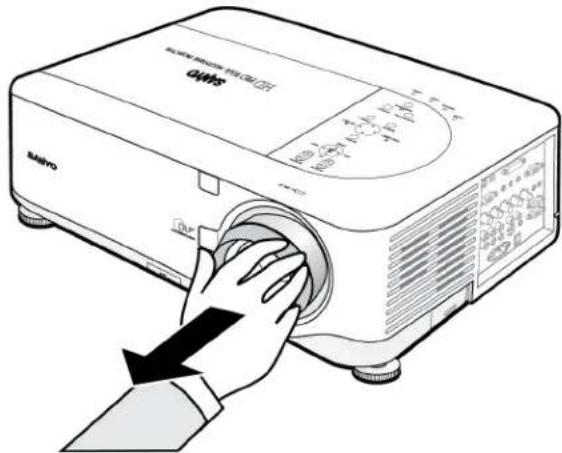
natural_image
Illustration of a projector with a hand inserting a button to its side (no text or symbols visible)CAUTION

When Installing the lens into the projector, be sure to remove the lens cap from the back of the optional lens before installing the optional lens into the projector. Failure to do so will cause damage to the projector.
Installing the New Lens
- Insert the lens label side up.
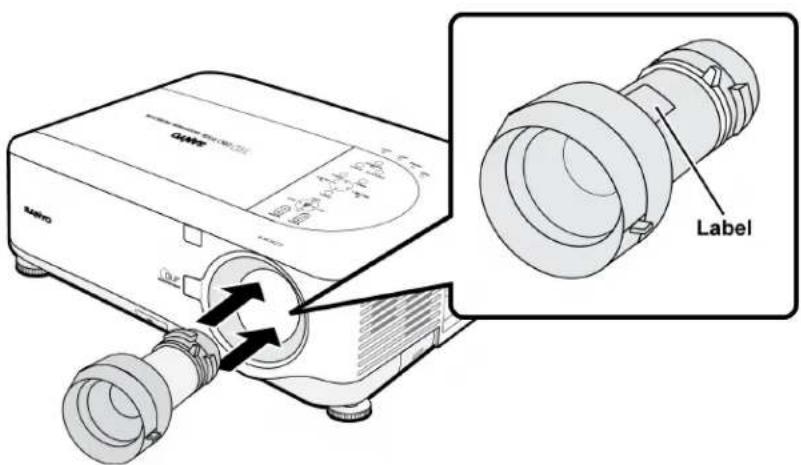
text_image
DAVID 150 V 1.2 V 1.3 V 1.4 V 1.5 V 1.6 V DAR Label- Rotate the lens clockwise until it clicks into place.

natural_image
Illustration of a projector with a hand operating the button, showing internal components and a circular arrow indicating rotation (no text or symbols present)Installing the New Lens Using the anti-theft screw
Using the anti-theft screw to prevent theft of the lens.
Tighten the supplied anti-theft screw on the front bottom.
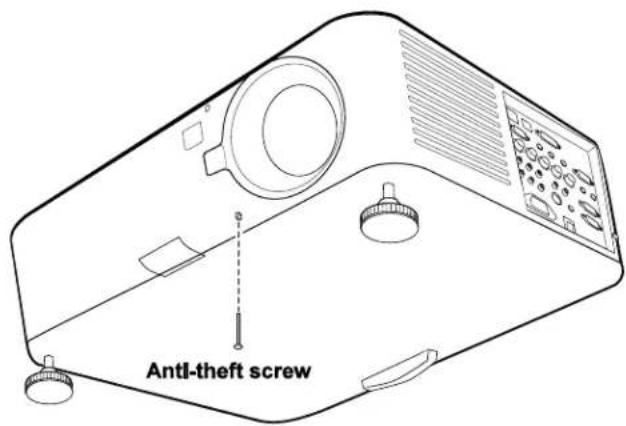
text_image
Anti-theft screw④ Throw Distance and Screen Size
Example of LNS-S40:
The further your projector is from the screen or wall, the larger the image. The minimum size the image can be is approximately 40 inches (1 m) measured diagonally when the projector is roughly 71 inches (1.8 m) from the wall or screen. The largest the image can be is 500 inches (12.7 m) when the projector is about 915 inches (23.2 m) from the wall or screen.
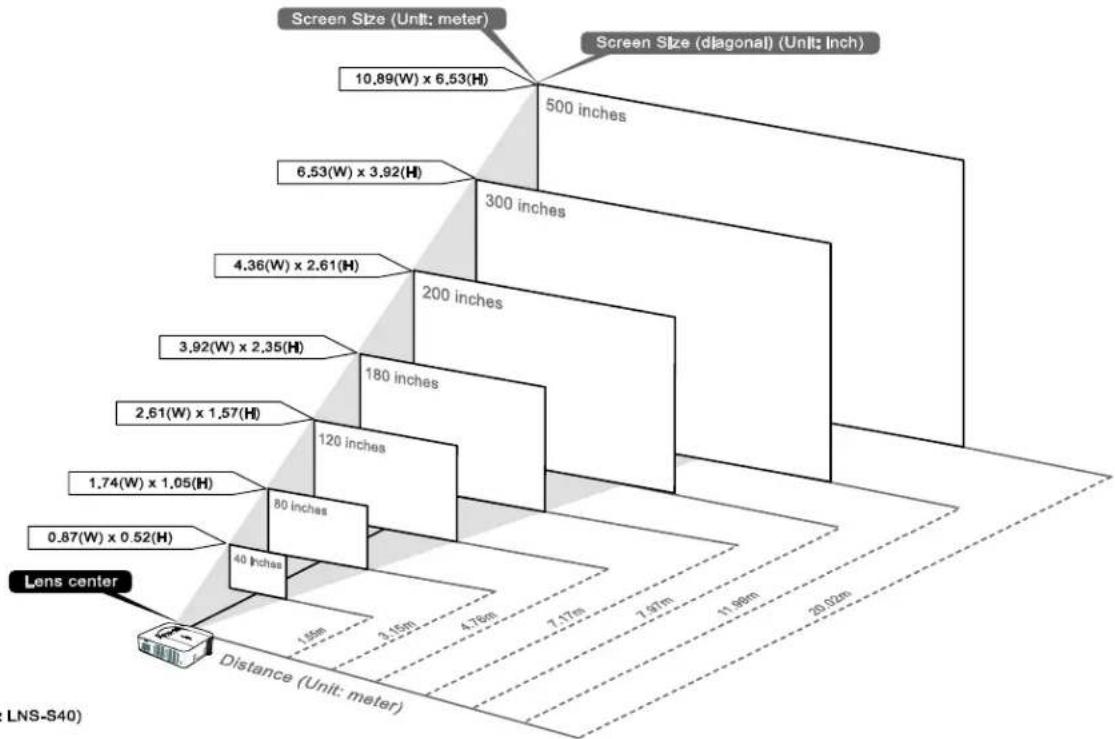
other
| Camera Center | Screen Size (Unit: meter) | Distance (Unit: meter) | | ------------- | ------------------------- | ---------------------- | | Lens center | 0.87(W) × 0.52(H) | 1.6m | | | 1.74(W) × 1.05(H) | 3.15m | | | 2.61(W) × 1.57(H) | 4.76m | | | 3.92(W) × 2.35(H) | 7.17m | | | 4.36(W) × 2.61(H) | 11.97m | | | 6.53(W) × 3.92(H) | 16.53m | | | 10.89(W) × 6.53(H) | 20.02m | | | Screen Size (diagonal) (Unit: inch) | 500 inches | | | Distance (Unit: meter) | Distance (Unit: meter) | | | Screen Size (diagonal) (Unit: inch) | Screen Size (diagonal) (Unit: inch) | | | Screen Size (diagonal) (Unit: inch) | Screen Size (diagonal) (Unit: inch) | | | Screen Size (diagonal) (Unit: inch) | Screen Size (diagonal) (Unit: inch) | | | Screen Size (diagonal) (Unit: inch) | Screen Size (diagonal) (Unit: inch) | | | Screen Size (diagonal) (Unit: inch) | Screen Type (diameter/width) | | | Screen Size (diagonal) (Unit: inch) | Screen Type (diameter/width) | | | Screen Size (diagonal) (Unit: inch) | Screen Type (diameter/width) | | | Screen Size (diagonal) (Unit: inch) | Screen Type (diameter/width) | | | Screen Size (diagonal) (Unit: inch) | Screen Type (diameter/width) | | LNS-S40 | - | - || Screen Size LNS-W41 LNS-W40 LNS-S40 | |||||||||||
| 0.77 1.33 - 1.79 1.78 - 2.35 | |||||||||||
| Diagonal Width Height | |||||||||||
| Distance | |||||||||||
| [inches] | [m] | [inches] | [m] | [inches] | [m] | [inches] | [m] | [inches] | [m] | [inches] | [m] |
| 40 | 1.02 | 34.3 | 0.87 | 20.5 | 0.52 | 45.4 - 61.8 | 1.15 - 1.57 | 60.9 - 81.0 | 1.55 - 2.06 | ||
| 50 | 1.27 | 42.9 | 1.09 | 25.6 | 0.65 | 33.5 | 0.85 | 57.2 - 77.7 | 1.45 - 1.97 | 76.7 - 101.9 | 1.95 - 2.59 |
| 60 | 1.52 | 51.6 | 1.31 | 30.7 | 0.78 | 40.5 | 1.03 | 69.0 - 93.6 | 1.75 - 2.38 | 92.5 - 122.8 | 2.35 - 3.12 |
| 67 | 1.70 | 57.6 | 1.47 | 34.3 | 0.87 | 45.4 | 1.15 | 77.3 - 104.7 | 1.96 - 2.66 | 103.6 - 137.4 | 2.63 - 3.49 |
| 72 | 1.83 | 61.9 | 1.58 | 36.8 | 0.94 | 48.9 | 1.24 | 83.2 - 112.7 | 2.11 - 2.86 | 111.5 - 147.9 | 2.83 - 3.76 |
| 80 | 2.03 | 68.5 | 1.74 | 41.3 | 1.05 | 54.5 | 1.38 | 92.7 - 125.4 | 2.35 - 3.19 | 124.2 - 164.6 | 3.15 - 4.18 |
| 84 | 2.13 | 71.9 | 1.83 | 43.4 | 1.10 | 57.3 | 1.46 | 97.4 - 131.8 | 2.47 - 3.35 | 130.5 - 172.9 | 3.31 - 4.39 |
| 90 | 2.29 | 77.1 | 1.96 | 46.5 | 1.18 | 61.5 | 1.56 | 104.5 - 141.3 | 2.65 - 3.59 | 140.0 - 185.4 | 3.56 - 4.71 |
| 100 | 2.54 | 85.8 | 2.18 | 51.6 | 1.31 | 68.5 | 1.74 | 116.3 - 157.2 | 2.95 - 3.99 | 155.8 - 206.3 | 3.96 - 5.24 |
| 120 | 3.05 | 102.8 | 2.61 | 61.8 | 1.57 | 82.5 | 2.10 | 140.0 - 189.0 | 3.56 - 4.80 | 187.4 - 248.1 | 4.76 - 6.30 |
| 150 | 3.81 | 128.7 | 3.27 | 77.2 | 1.96 | 103.5 | 2.63 | 175.5 - 236.7 | 4.46 - 6.01 | 234.9 - 310.7 | 5.97 - 7.89 |
| 180 | 4.57 | 154.3 | 3.92 | 92.5 | 2.35 | 124.5 | 3.16 | 211.0 - 284.4 | 5.36 - 7.22 | 282.3 - 373.3 | 7.17 - 9.48 |
| 200 | 5.08 | 171.7 | 4.36 | 102.8 | 2.61 | 138.5 | 3.52 | 234.6 - 316.2 | 5.96 - 8.03 | 313.9 - 415.1 | 7.97 - 10.54 |
| 210 | 5.33 | 180.3 | 4.57 | 107.9 | 2.74 | 246.4 - 332.1 | 6.26 - 8.44 | 329.7 - 436.0 | 8.38 - 11.07 | ||
| 240 | 6.10 | 206.0 | 5.24 | 123.4 | 3.13 | 281.9 - 379.8 | 7.16 - 9.65 | 377.2 - 498.6 | 9.58 - 12.66 | ||
| 261 | 6.63 | 224.1 | 5.69 | 134.2 | 3.41 | 306.8 - 413.2 | 7.79 - 10.50 | 410.4 - 542.4 | 10.42 - 13.78 | ||
| 270 | 6.86 | 231.8 | 5.89 | 138.8 | 3.52 | 317.4 - 427.5 | 8.06 - 10.86 | 424.6 - 561.2 | 10.79 - 14.25 | ||
| 300 | 7.62 | 257.1 | 6.53 | 154.3 | 3.92 | 352.9 - 475.2 | 8.96 - 12.07 | 472.1 - 623.8 | 11.99 - 15.85 | ||
| 350 | 8.89 | 300.0 | 7.62 | 180.0 | 4.57 | 412.0 - 554.8 | 10.47 - 14.09 | 551.2 - 728.2 | 14.00 - 18.50 | ||
| 400 | 10.16 | 342.9 | 8.71 | 205.9 | 5.23 | 471.2 - 634.3 | 11.97 - 16.11 | 630.2 - 832.6 | 16.01 - 21.15 | ||
| 450 | 11.43 | 385.8 | 9.80 | 231.6 | 5.88 | 530.3 - 713.8 | 13.47 - 18.13 | 709.3 - 937.0 | 18.02 - 23.80 | ||
| 500 | 12.70 | 428.7 | 10.89 | 257.1 | 6.53 | 589.5 - 793.3 | 14.97 - 20.15 | 788.4 - 1041.4 | 20.02 - 26.45 | ||
| Screen Size LNS-T40 LNS-T41 | ||||||||||
| 2.22 - 4.43 4.43 - 8.3 | ||||||||||
| Diagonal Width Height | ||||||||||
| Distance | ||||||||||
| [inches] | [m] | [inches] | [m] | [inches] | [m] | [inches] | [m] | [inches] | [m] | |
| 40 | 1.02 | 34.3 | 0.87 | 20.5 | 0.52 | 75.7 - 155.0 | 1.92 - 3.94 | 151.7 - 289.8 | 3.85 - 7.36 | |
| 50 | 1.27 | 42.9 | 1.09 | 25.6 | 0.65 | 95.7 - 194.7 | 2.43 - 4.95 | 190.9 - 363.5 | 4.85 - 9.23 | |
| 60 | 1.52 | 51.6 | 1.31 | 30.7 | 0.78 | 115.6 - 234.5 | 2.94 - 5.96 | 230.2 - 437.3 | 5.85 - 11.11 | |
| 67 | 1.70 | 57.6 | 1.47 | 34.3 | 0.87 | 129.6 - 262.4 | 3.29 - 6.66 | 257.7 - 488.9 | 6.55 - 12.42 | |
| 72 | 1.83 | 61.9 | 1.58 | 36.8 | 0.94 | 139.6 - 282.3 | 3.55 - 7.17 | 277.3 - 525.8 | 7.04 - 13.36 | |
| 80 | 2.03 | 68.5 | 1.74 | 41.3 | 1.05 | 155.6 - 314.1 | 3.95 - 7.98 | 308.8 - 584.9 | 7.84 - 14.86 | |
| 84 | 2.13 | 71.9 | 1.83 | 43.4 | 1.10 | 163.6 - 330.0 | 4.15 - 8.38 | 324.5 - 614.4 | 8.24 - 15.60 | |
| 90 | 2.29 | 77.1 | 1.96 | 46.5 | 1.18 | 175.5 - 353.9 | 4.46 - 8.99 | 348.0 - 658.6 | 8.84 - 16.73 | |
| 100 | 2.54 | 85.8 | 2.18 | 51.6 | 1.31 | 195.5 - 393.6 | 4.97 - 10.00 | 387.3 - 732.4 | 9.84 - 18.60 | |
| 120 | 3.05 | 102.8 | 2.61 | 61.8 | 1.57 | 235.4 - 473.2 | 5.98 - 12.02 | 465.9 - 880.0 | 11.83 - 22.35 | |
| 150 | 3.81 | 128.7 | 3.27 | 77.2 | 1.96 | 295.3 - 592.6 | 7.50 - 15.05 | 583.7 - 1101.3 | 14.83 - 27.97 | |
| 180 | 4.57 | 154.3 | 3.92 | 92.5 | 2.35 | 355.2 - 711.9 | 9.02 - 18.08 | 701.5 - 1322.6 | 17.82 - 33.59 | |
| 200 | 5.08 | 171.7 | 4.36 | 102.8 | 2.61 | 395.2 - 791.5 | 10.04 - 20.10 | 780.0 - 1470.2 | 19.81 - 37.34 | |
| 210 | 5.33 | 180.3 | 4.57 | 107.9 | 2.74 | 415.1 - 831.3 | 10.54 - 21.11 | 819.3 - 1543.9 | 20.81 - 39.22 | |
| 240 | 6.10 | 206.0 | 5.24 | 123.4 | 3.13 | 475.0 - 950.6 | 12.07 - 24.15 | 937.1 - 1765.3 | 23.80 - 44.84 | |
| 261 | 6.63 | 224.1 | 5.69 | 134.2 | 3.41 | 517.0 - 1034.1 | 13.13 - 26.27 | 1019.6 - 1920.2 | 25.90 - 48.77 | |
| 270 | 6.86 | 231.8 | 5.89 | 138.8 | 3.52 | 534.9 - 1069.9 | 13.59 - 27.18 | 1054.9 - 1986.6 | 26.80 - 50.46 | |
| 300 | 7.62 | 257.1 | 6.53 | 154.3 | 3.92 | 594.8 - 1189.3 | 15.11 - 30.21 | 1172.8 - 2207.9 | 29.79 - 56.08 | |
| 350 | 8.89 | 300.0 | 7.62 | 180.0 | 4.57 | 694.7 - 1388.2 | 17.64 - 35.26 | 1369.1 - 2576.8 | 34.78 - 65.45 | |
| 400 | 10.16 | 342.9 | 8.71 | 205.9 | 5.23 | 7941587.1 | 20.18 - 40.31 | 1565.5 - 2945.7 | 39.76 - 74.82 | |
| 450 | 11.43 | 385.8 | 9.80 | 231.6 | 5.88 | 8941786.0 | 22.72 - 45.37 | 1761.9 - 3314.6 | 44.75 - 84.19 | |
| 500 | 12.70 | 428.7 | 10.89 | 257.1 | 6.53 | 994.1 - 1984.9 | 25.25 - 50.42 | 1958.2 - 3683.4 | 49.74 - 93.56 | |
CAUTION

Ceiling installation must be done by a qualified professional. Contact your SANYO dealer for more information.
It is not recommended you install the projector yourself.
Only use the projector on a solid, level surface. Serious injury and damage can occur if the projector is dropped.
Do not use the projector in an environment where extreme temperature occurs. The projector must be used at temperatures between 41 degrees Fahrenheit (5 degrees Celsius) and 104 degrees Fahrenheit (40 degrees Celsius).
Screen damage will occur if the projector is exposed to moisture, dust or smoke.
Do not cover the vents on the projector. Proper ventilation is required to dissipate heat. Damage to the projector will occur if the vents are covered.
⑤ Installing the Optional Color Wheel
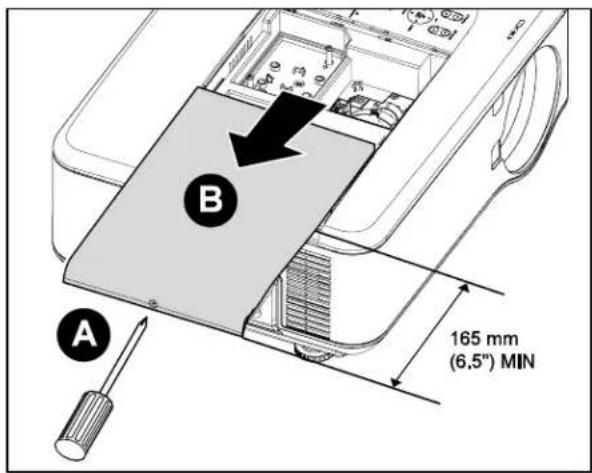
The PDG-DWT50L projector comes with a four-segment color wheel installed. An additional six-segment color wheel is optional. To replace the color wheel (located under the lamp cover adjacent to lamp 1) refer to the following guide.
Note:
Wait until the lamp house and the color wheel cool off.
- Loosen the captive screw (A) on the lamp cover.
text_image
A B 165 mm (6,5") MIN-
Remove the lamp cover by sliding it in the direction of the arrow (B).
-
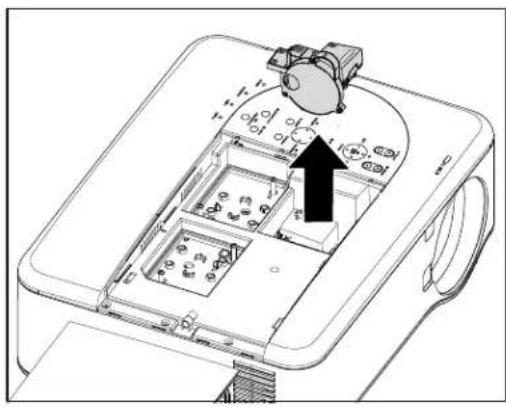
Unscrew the retaining screws (x 4) on the four-segment color wheel.

natural_image
Technical line drawing of a mechanical device interior with no visible text or symbols- Lift the color wheel in the direction shown.
natural_image
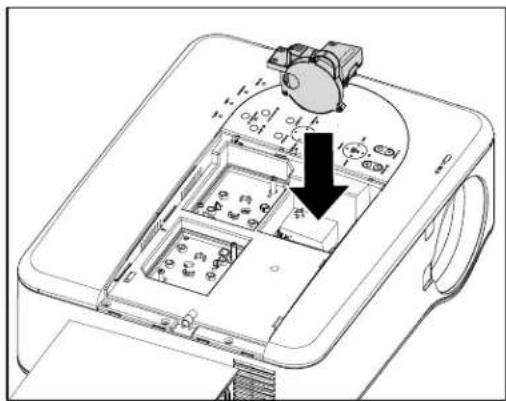
Technical line drawing of a mechanical device interior with no visible text or symbols- Insert the six-segment color wheel
natural_image
Technical diagram of a device interior with labeled components and an arrow indicating a specific component (no text or symbols present)- Secure the retaining screws as shown.
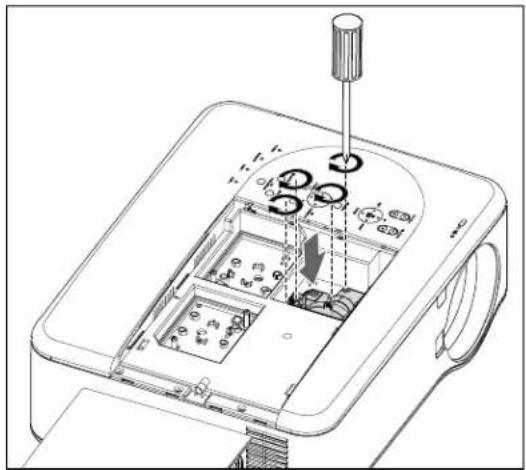
natural_image
Technical line drawing of a mechanical device with internal components and a screwdriver (no text or symbols)- Align the lamp cover (A) with the arrow mark on the cabinet and slide it into place.
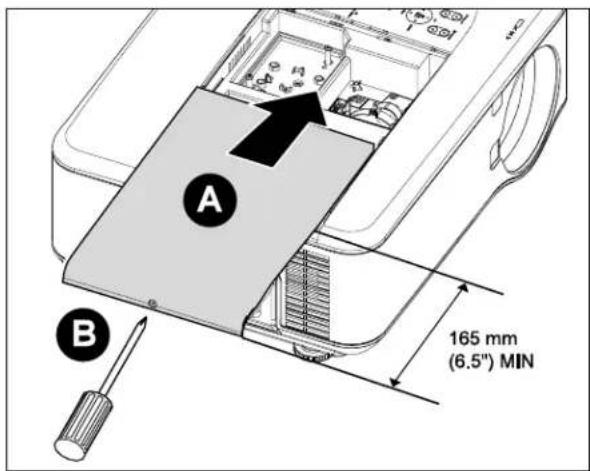
text_image
A 165 mm (6.5") MIN B- Secure the captive screw (B).
Storing Unused Color Wheel:
Keep the unused color wheel in the zipper bag in which the 6-segment color wheel (not supplied) was packaged.
This bag prevents dust from falling or collecting on the color wheel.
⑥ Making Connections
Connecting Your PC or Macintosh Computer
Enabling the computer's external display
Displaying an image on the notebook PC's screen does not necessarily mean it outputs a signal to the projector. When using a PC compatible laptop, a combination of function keys will enable/disable the external display. Usually, the combination of the Fn-key along with one of the 12 function keys activates the external display.
To connect a PC or Macintosh computer to the projector, refer to the following guide.
- Connect a computer to the projector through one of the three available input data connections before turning on the PC or the projector. The best signal order (from best to least suitable) is as follows:
- Computer 3 in (see item 1, ⑥ Terminal Panel Features on page 9) is a digital signal and offers the best connection to your computer.
Note: The DVI (DIGITAL) connector (COMPUTER 3) accepts VGA (640 x 480), 1152 x 864, XGA (1024 x 768), WXGA (1280 x 768), SXGA (1280 x 1024@up to 60Hz) and SXGA+(1400 x 1050 @ up to 60Hz).
- Computer 2 in (see item 17, 5 Terminal Panel Features on page 9) is an analog signal; use a DSUB-15 cable-to-5BNC connection.
- Computer 1 in as shown below (see item 18, ⑤ Terminal Panel Features on page 9) is an analog signal that uses a standard RGB computer cable.
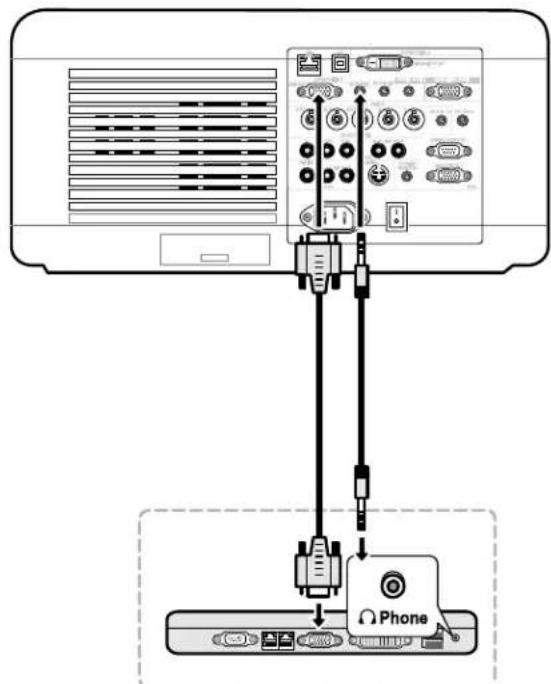
text_image
Diagram showing connection between a computer monitor and a device labeled 'Phone' with connected ports and cables.-
Turn on the projector and select the chosen method of connection from the source menu before turning on the PC (see ② Selecting an Input Source on page 34).
-
Turn on the PC.
Note:
Failure to follow the above steps may not activate the digital output of the graphics card resulting in no picture being displayed. Should this happen, restart your PC.
Connecting an External Monitor
Connect an external monitor to the projector through RGB out connections as shown below (see item 4, 5 Terminal Panel Features on page 9)

text_image
Diagram showing connection between a computer monitor and an audio device via USB cable, with labeled ports and connections.Connecting Your DVD Player with Component Output
To connect a DVD Player to the projector, refer to the following guide.
- Connect the DVD Player to the projector as shown below before turning on the Player or the projector.

flowchart
graph TD
    A["Device"] --> B["Component Y"]
    A --> C["Component Cb"]
    A --> D["Component Cr"]
    A --> E["Component L"]
    A --> F["Component R"]
    A --> G["Audio Out"]
    G --> H["Audio In L"]
    H --> I["Output"]
    B --> J["Resistors"]
    C --> K["Resistors"]
    D --> L["Resistors"]
    E --> M["Resistors"]
    F --> N["Resistors"]
    G --> O["Resistors"]
    H --> P["Resistors"]
    I --> Q["Output"]
-
Turn on the projector and select Component from the source menu before turning on the DVD Player (see ② Selecting an Input Source on page 34).
-
Turn on the DVD Player.
Note:
Refer to your DVD player's user's manual for more information about your DVD player's video output requirements.
Connecting Your VCR or Laser Disc Player
To connect your VCR or Laser Disc Player, refer to the following diagram.
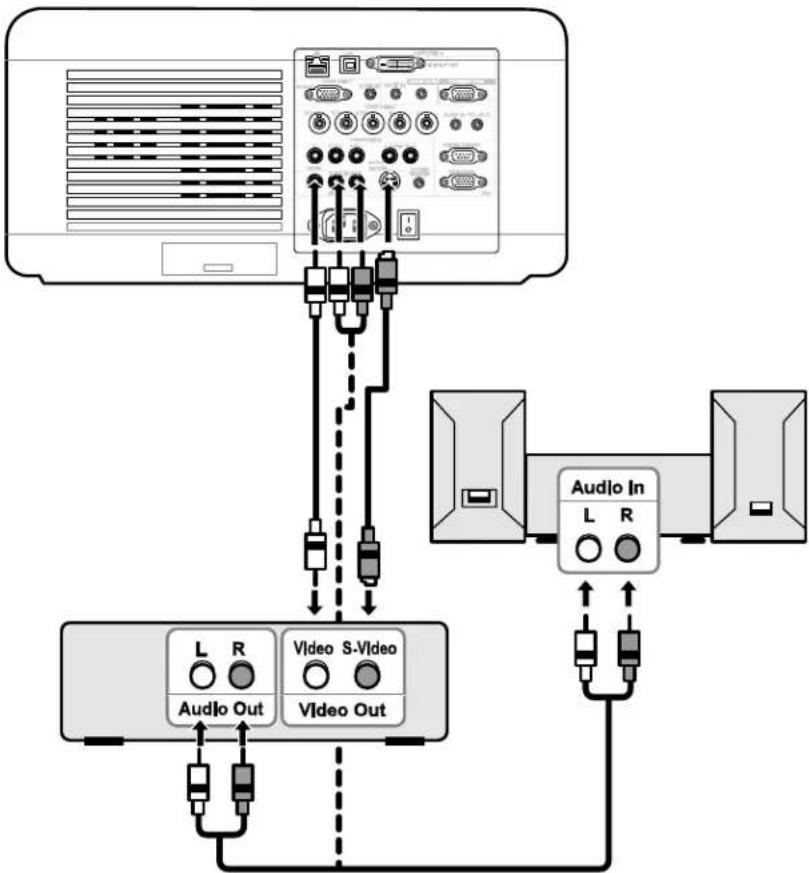
flowchart
graph TD
    A["User Interface"] --> B["Audio Out"]
    A --> C["Video Out"]
    A --> D["Audio In"]
    B --> E["Switch L/R"]
    C --> F["Switch L/R"]
    D --> G["Switch L/R"]
    style A fill:#f9f,stroke:#333
    style B fill:#ccf,stroke:#333
    style C fill:#ccf,stroke:#333
    style D fill:#ccf,stroke:#333
Note:
Refer to your VCR or laser disc player user's manual for more information about your device's requirements.
Images may not be displayed correctly when using an S-Video or Video connection to fast-forward or fast-rewind scanning.
The AUDIO IN RCA jack is shared between VIDEO IN and S-VIDEO IN.
⑦ Connecting the Supplied Power Cable
This projector uses nominal input voltages of 100–120V or 200–240V AC and it automatically selects the correct input voltage. It is designed to work with single-phase power systems having a grounded neutral conductor. To reduce the risk of electrical shock, do not plug into any other type of power system. If you are not sure of the type of power being supplied, consult your authorized dealer or service station. Connect the projector with all peripheral equipment before turning the projector on.
CAUTION

For safety, unplug the AC power cord when the projector is not in use. When the projector is connected to an outlet with the AC power cord, it is in stand-by mode and consumes a small amount of electrical power.
The AC power cord must meet the requirements of the country where you are utilizing the projector. Confirm the AC plug type with the chart below. The proper AC power cord must be used. If the supplied AC power cord does not match your AC outlet, contact your sales dealer.
| Projector side | AC outlet side | ||
 To power cordconnector on yourprojector. To power cordconnector on yourprojector. | For the U.S.A. and Canada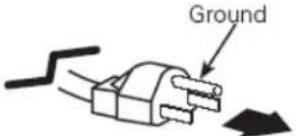 To the AC outlet.(120 V AC) To the AC outlet.(120 V AC) | For Continental Europe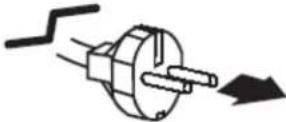 To the AC outlet.(200–240 V AC) To the AC outlet.(200–240 V AC) | For the U.K.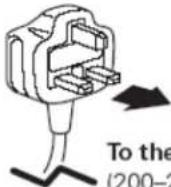 AC outlet.(240 V AC) AC outlet.(240 V AC) |
Note:
Make sure that the prongs are fully inserted into both the AC IN and the wall outlet.

natural_image
Pure electrical socket diagram without any text, numbers, or symbolsCAUTION

Ensure that the cables do not create a trip hazard.
3. Projecting an Image (Basic Operation)
① Turning on the Projector
Once the projector is correctly located and the power cable and other connections are in place, it is important that the projector is powered on correctly in order to avoid damage to components and unnecessary wear and tear. Refer to the following guide to power on the projector.
-
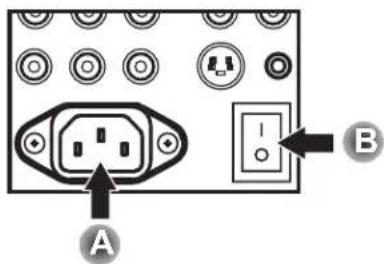
Connect the power cable (A). Press the main power switch to the on (1) position as shown (B). The power LED lights orange and warning LED lights green.
-
Press the On/Standby button once (see OSD Controls and Status LEDs on page 7). The power LED lights green and the internal cooling fan starts.
-
After approximately 10 seconds, the power LED flashes intermittently green.
-
The Lamp1 and Lamp2 LEDs light green and the Power LED flashes more rapidly.
-
Once the power LED is lit a solid green, the projector is ready for use.
text_image
Diagram of an electronic device panel with labeled ports and connectors, including port A and switch B.
flowchart
graph TD
    A["MENU"] --> B["VOLUME"]
    B --> C["SELECT"]
    C --> D["CANCEL"]
    D --> E["VOLUME +"]
    E --> F["Arrow Up Down"]
    style A fill:#f9f,stroke:#333
    style B fill:#ccf,stroke:#333
    style C fill:#cfc,stroke:#333
    style D fill:#fcc,stroke:#333
    style E fill:#ffc,stroke:#333
    style F fill:#cff,stroke:#333
text_image
AUTO PC ADJ. INPUT 1/0 ON/STAND-BYNote: If any of the LEDs remain flashing or blink there may be a problem with the startup. Please refer to the 1 Troubleshooting section on page 102.
Note on Startup Screen (Menu Language Select screen)
In the first instance of powering on the projector, the language menu is displayed to select the default language.
Please select a menu language.
| Please select a menu language. | English |
| Wählen Sie bitte die Menü Sprache aus. | Deutsch |
| S'il vous plaît choisir la langue de menu. | Français |
| Per favore scegliere la lingua del menu. | Italiano |
| Escoja por favor el idioma de menú. | Español |
| Välj menyn språken. | Svenska |
| メニュー言語を選択してください。 | 日本語 |
| 请选择菜单语言。 | 中文 |
Select "UP", "DOWN" & "SELECT"
Select the required default language using the ▲ or ▼ buttons on the OSD menu panel or the remote control unit and press Select.
Note:
The language select screen only appears on the first instance of power on. All subsequent operations assume the selected default language. To change the default see page 74.
② Selecting an Input Source
The Input Source can be selected from the projector's control panel or from the remote control unit. Refer to the following guide to select the Input Source.
- Press Menu on the OSD control panel or on the remote control unit to display the Main Menu. Scroll to the Input menu using ▲or▼ and press Select.
Note:
Return to the projected image by pressing Cancel twice.
Input
Adjust
Volume
Setting
Information
Reset
- Select the required source using ▲ or ▼ and press Select.
Computer1
If an XGA signal is not correctly recognized, set "WXGA Mode" to off (see page 63).
To check if the signal is recognized, go to "Input" under "Information" menu (see page 90).
③ Adjusting the Picture Position and Picture Size
The Picture Position and Picture Size can be adjusted manually from the lens control panel or from the remote control unit. Refer to the following guides to adjust Picture Position manually.
Adjusting Picture Position Manually
-
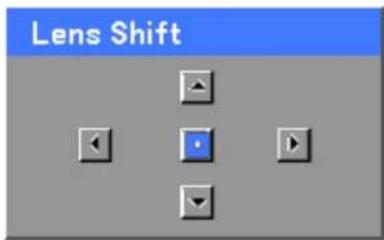
Press the Select keypad in any direction to bring up the Lens Shift window.
-
Press the directional key as required to shift the image. Releasing the directional arrow will re-center the cursor.
-
To alter the picture size, press Menu and select the Adjust menu using ▲ or ▼. Press Select to open the Adjust menu. Press ◀ or ▶ to select Image Options followed by ▲ or ▼ to select Screen. Press Select.
text_image
Lens Shift
text_image
Diagram showing an projector with an upward arrow pointing to a screen, indicating projection or presentation.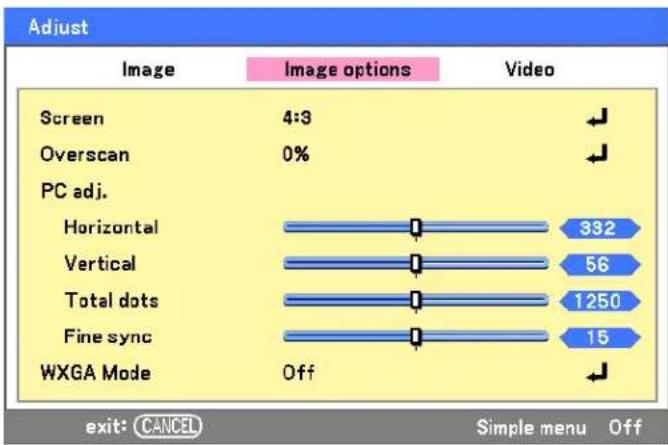
text_image
Adjust Image Image options Video Screen 4:3 Overscan 0% PC adj. Horizontal 332 Vertical 56 Total dots 1250 Fine sync 15 WXGA Mode Off exit: CANCEL Simple menu Off3. Projecting an Image (Basic Operation)
- The Screen window is displayed. Select the desired picture size using ▲ or ▼ and press Select.

text_image
Screen ● 4:3 ○ 16:9 ○ 15:9 ○ Letterbox ○ True ○ Normal- When finished, press Cancel to return to the projected image.
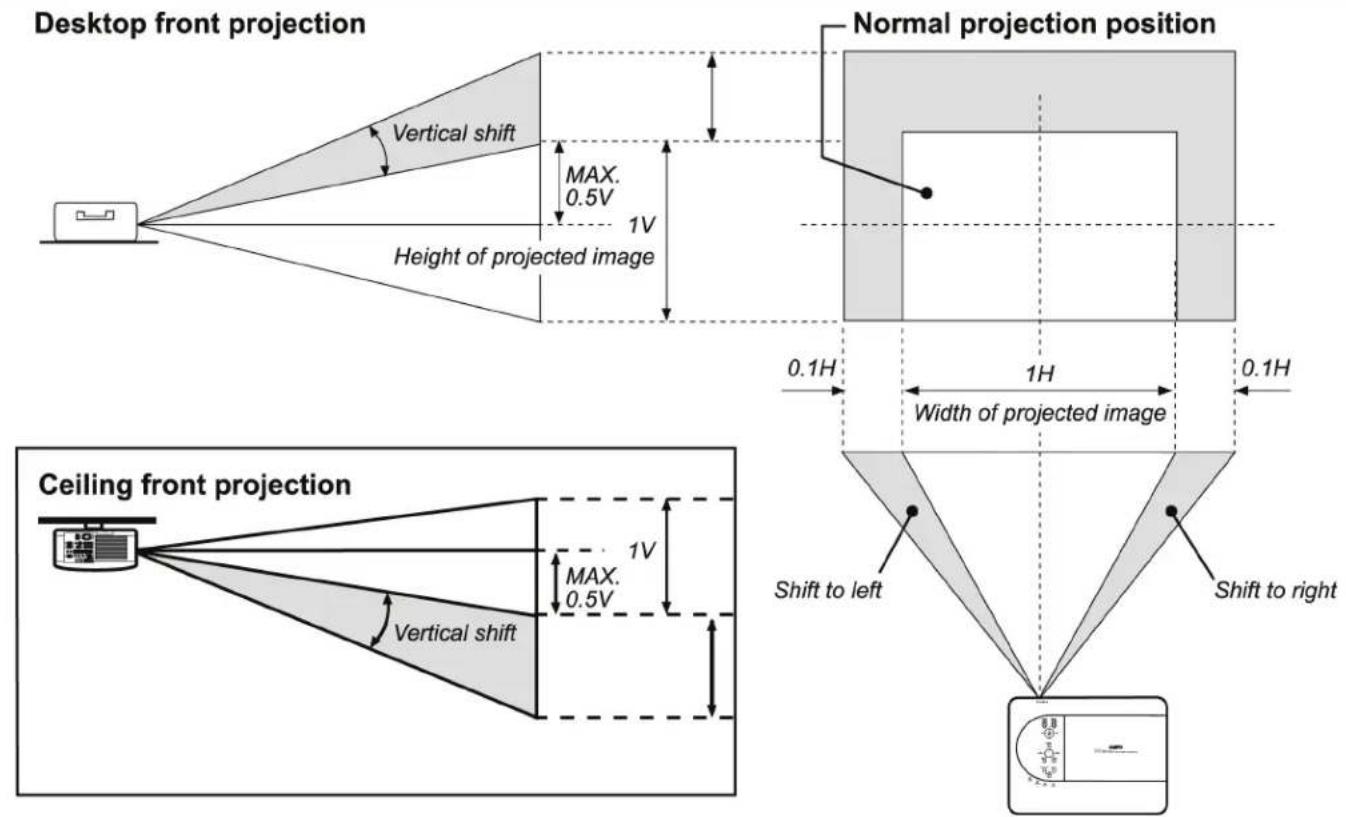
Lens Shift Adjustable Range
The adjustable range for lens shift is tabulated below and subject to the conditions listed.
Note:
The drawings below apply to the standard lens (LNS-S40) only.
text_image
Desktop front projection Vertical shift MAX. 0.5V 1V Height of projected image Normal projection position 0.1H 1H 0.1H Width of projected image Ceiling front projection Vertical shift MAX. 0.5V 1V Shift to left Shift to rightFrom the Remote Control Unit
- Press the Lens Shift button to bring up the Lens Shift window.
- Press the directional keys as required to shift the image. Releasing the directional arrow will re-center the cursor.
- To alter the picture size, press the Screen button to display the Screen window.
- Select the desired picture size using ▲ or ▼ and press Select.
- When finished, press Cancel to return to the projected image.

text_image
Lens Shift
text_image
Diagram showing a projector connected to a screen, with an upward arrow indicating direction or interaction.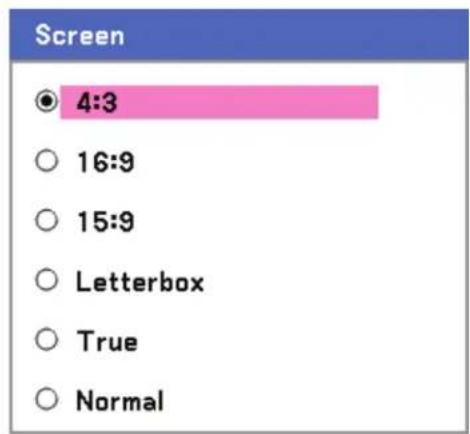
text_image
Screen ● 4:3 ○ 16:9 ○ 15:9 ○ Letterbox ○ True ○ Normal3. Projecting an Image (Basic Operation)
Adjusting the Projector Level
- To raise the level of the projector, twist the adjusters clockwise.
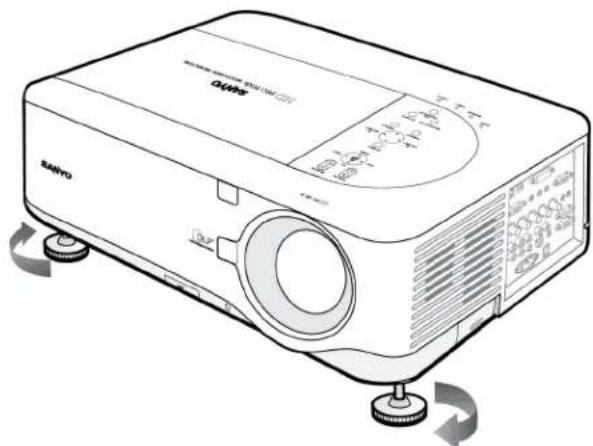
natural_image
Line drawing of a semi- projector with control buttons and display screen (no readable text or symbols)- To lower the level of the projector, lift the projector and twist the adjusters counter clockwise.
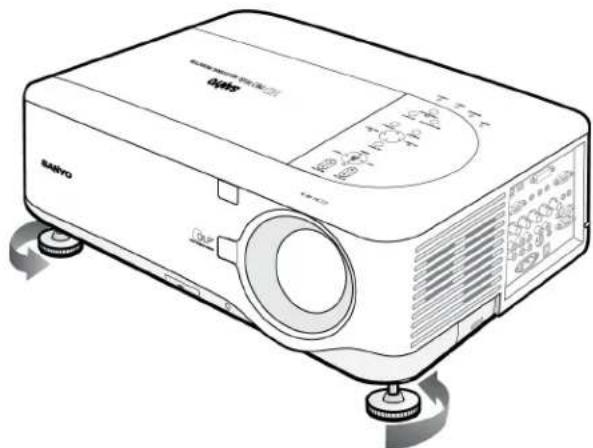
natural_image
Line drawing of a SAWTO projector with control panel and display (no text or symbols on body)④ Optimizing an RGB Image Automatically
Adjusting the Image Using AUTO PC ADJ.
To optimize an RGB image automatically refer to the following guide.
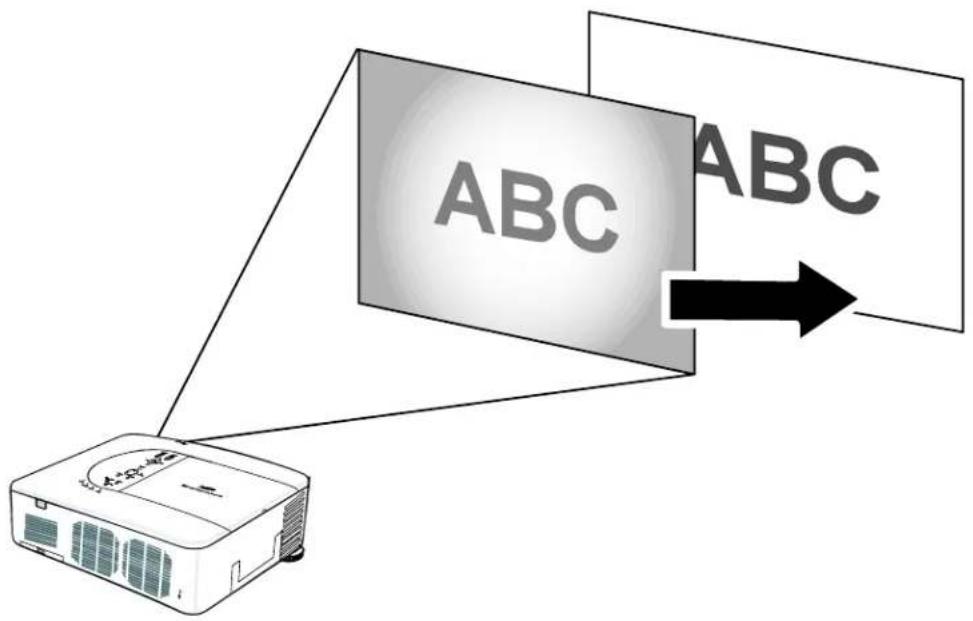
Press the AUTO PC button on the remote control (see item 17, ⑥ Part Names of the Remote Control on page 11) or the AUTO PC ADJ. button on the OSD control panel to optimize an RGB image automatically.
This adjustment may be necessary when you connect your computer for the first time.
flowchart
graph TD
    A[" projector"] --> B["Block ABC"]
    B --> C["Arrow pointing right"]
⑤ Adjusting Volume Up and Down
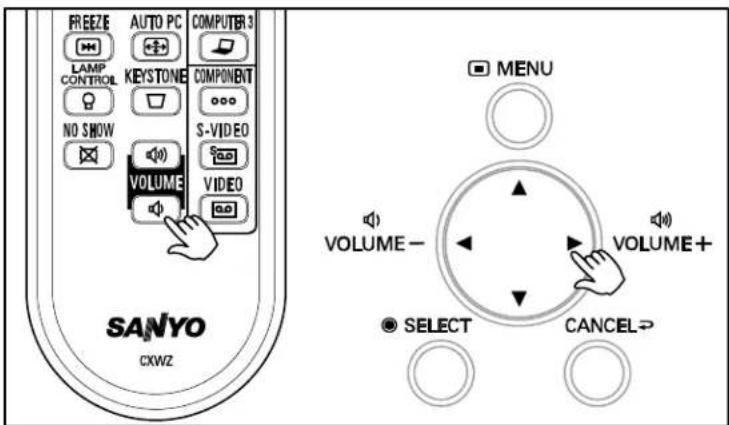
The volume can be adjusted from the OSD Control Panel or with the Remote Control unit. Refer to the following as a guide.
-
Press the Volume +/- buttons on the remote control or the ◀▶ buttons on the OSD control panel. The volume level is displayed on screen.
-
Use the Volume +/- buttons or the ◀▶ buttons on the OSD control panel to adjust the level.
text_image
FREEZE AUTO PC COMPUTER 3 LAMP CONTROL KEYSTONE COMPONENT NO SHOW S-VIDEO VOLUME VIDEO SANYO CXWZ MENU VOLUME- VOLUME+ SELECT CANCEL+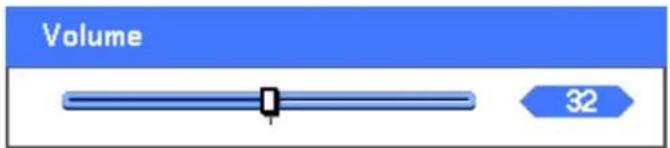
text_image
Volume 32⑥ Turning off the Projector
Once the projector is no longer required, it is important to shut it down correctly to avoid damage or unnecessary wear and tear to the projector.

- Do not unplug the power cable from the wall outlet or projector when the projector is powered on. Doing so can cause damage to the AC IN connector of the projector and (or) the prong plug of the power cable. To turn off the AC power supply when the projector is powered on, use a power strip equipped with a switch and a breaker.
- Do not turn off the AC power supply within 10 seconds of making adjustment or setting changes and closing the menu. Doing so can cause loss of adjustments and settings and return to default.
Refer to the following guide to shut down the projector.
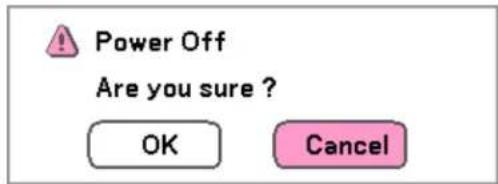
- Press the On/Standby button once. The Power Off window displays.
- Press the On/Standby button or Select again on the OSD control panel or remote control to verify power off. The cooling fans continue to operate (cooling-off time). The cooling fans stop operating when the projector turns off.
- The projector enters Standby mode and the power LED lights orange.
- Press the Main Power switch to the off position (O) to turn off the projector.
text_image
Power Off Are you sure ? OK Cancel
text_image
ON LIGHT STAND-BY MENU CANCEL VOLUME~ SELECT LENS SHIFT FOCUS ZOOM IMAGE COMPUTER 1 AUTO PC ADJ. INPUT I/O ON/STAND-BY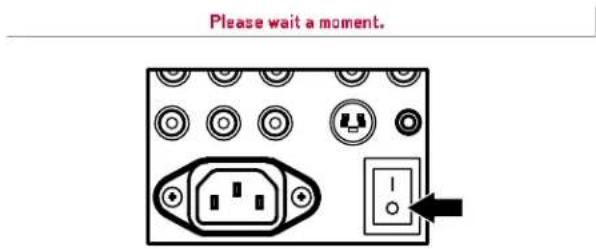
text_image
Please wait a moment.About Direct Power Off
The projector has a feature called "Direct Power Off". This feature allows the projector to be turned off (even when projecting an image) using a power strip equipped with a switch and a breaker.
Note:
Before using Direct Power Off, be sure to allow at least 20 minutes immediately after turning on the projector and starting to display an image.
After Use
Preparation: Make sure that the projector is turned off.
- Unplug the power cable.
- Disconnect any other cables.
- Return the height adjusters to their original, minimum position.
- Cover the lens with the lens cap.
4. Convenient Features
① Turning Off the Image and Sound
The projected image and sound can be turned off for short periods of time with the remote control. This feature is useful for breaking up presentations or for other brief interruptions in projections. To turn off the picture and image, refer to the following guide.
- Press the NO SHOW button on the remote control once (see ⑥ Part Names of the Remote Control on page 11).
- The image does not display.
- To resume projection, press the NO SHOW button once more.
Note:
For extended periods of time it is recommended that the projector be powered off.
② Freezing a Picture
The projected image can be frozen for short periods of time by using the remote control. This feature is useful for capturing still images from movies or freezing an animation at a particular point. To freeze the projected image, refer to the following guide.
- Press the FREEZE button on the remote control once (see ⑥ Part Names of the Remote Control on page 11).
- The screen freezes.
- To resume, press the FREEZE button once more.
Note:
For extended periods of time it is recommended that the projector be powered off.
③ Adjusting the Focus/Zoom Manually
The focus and zoom can be adjusted manually from the projector focus/zoom panel or from the remote control unit. Refer to the following guides to adjust the focus and zoom manually.
Adjusting by Using the OSD Control Panel
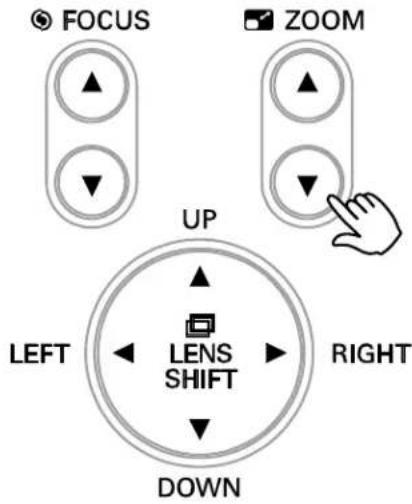
- Press the Focus or Zoom button on the projector panel to display the appropriate window.
text_image
FOCUS ZOOM UP LEFT LENS SHIFT RIGHT DOWN- Adjust the Focus/Zoom using the increase and decrease buttons as required.

text_image
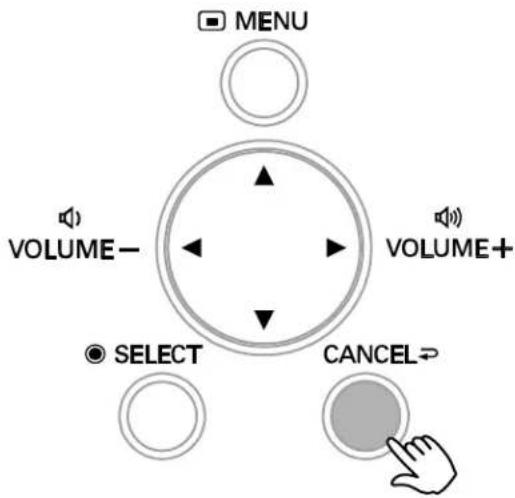
Focus Zoom- Press Cancel to return to the projected image.
flowchart
graph TD
    A["VOLUME"] --> B["SELECT"]
    B --> C["CANCEL"]
    D["VOLUME+"] --> E["MENU"]
    F["○"] --> G["○"]
    H["○"] --> I["○"]
④ Changing Lamp Mode
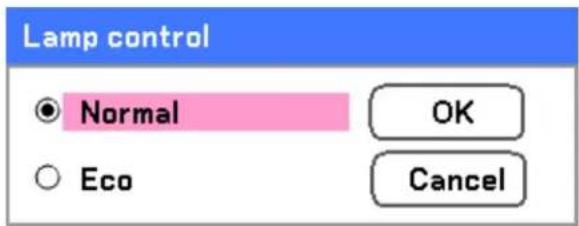
The projector has two lamp modes available, Normal and Eco. The Normal mode is used for everyday standard projection, whereas the Eco mode is used for saving power and lamp life. To change the Lamp Mode, refer to the following guides.
Changing Lamp Mode by Using the Projector's OSD Control Panel
- Press Menu on the projector's OSD control panel to display the Main Menu. Scroll to the Setting menu using ▲ or ▼ and press Select.
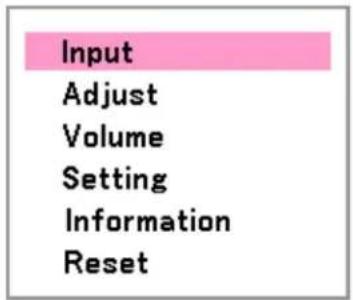
text_image
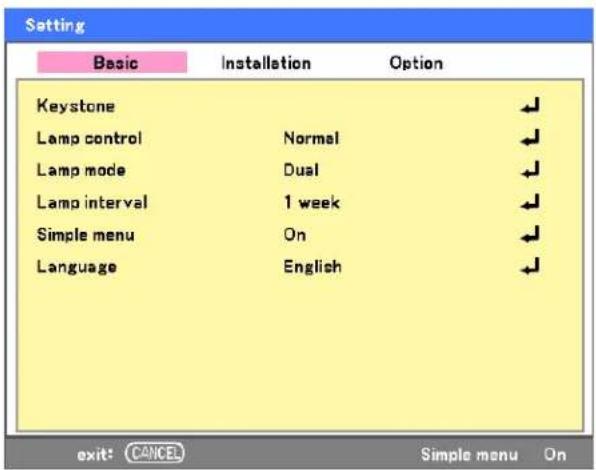
Input Adjust Volume Setting Information Reset- Select the Basic tab using ◀or▶ and select Lamp control using ▲or▼. Press Select.
text_image
Setting Basic Installation Option Keystone Lamp control Normal Lamp mode Dual Lamp interval 1 week Simple menu On Language English exit: CANCEL Simple menu On- From the Lamp control window, select Normal or Eco using ▲ or ▼. Select OK and press Select.
text_image
Lamp control Normal OK Eco CancelChanging Lamp Mode by Using the Remote Control
- Press the Lamp control button on the remote control to access the Lamp control menu.

text_image
Lamp control Normal OK Eco Cancel- From the Lamp control window, select Normal or Eco using ▲ or ▼. Move the cursor to OK and press Select.
Note:
When the projector is in Eco mode, brightness may be affected.
Normal Mode: 100% Brightness
Eco Mode: approx. 85% Brightness
⑤ Getting Information
The Information screen provides details on the life of consumable items within the projector as well as other information such as software version. To access the Information screen, refer to the following guide.
- Press Menu on the projector's OSD control panel or remote control to display the Main Menu. Scroll to the Information menu using ▲ or ▼ and press Select.
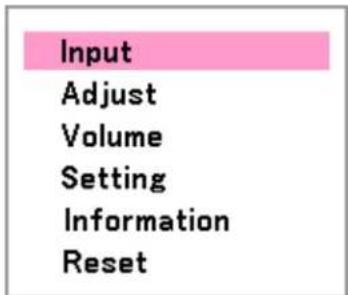
text_image
Input Adjust Volume Setting Information Reset- The Usage time menu is displayed as the default view. The menu items in this screen are for display and cannot be modified.

text_image
Information Usage time Input Network Version Lamp1 life remaining 50% Lamp2 life remaining 50% Lamp1 time 1000[H] Lamp2 time 1000[H] PJ time 1000[H] Filter time 1000[H] exit: CANCEL Simple menu Off- Press Cancel to return to the projected image.
⑥ Adjusting Position/Total Dots/Fine Sync
The Position/Total dots/Fine sync and Keystone Correction can be adjusted manually from the projector's control panel or from the remote control unit. Refer to the following guides to adjust the Keystone Distortion manually.
Adjusting Position/Total Dots/Fine Sync by using the OSD Control Panel
- Press the Menu button to display the Main menu. Select the Adjust menu using ▲ or ▼ and press Select to display the Adjust menu.

text_image
Input Adjust Volume Setting Information Reset- From the Adjust menu, press ◀or▶ to select Image Options and scroll using ▲or▼ to Horizontal, Vertical, Total dots, or Fine sync.
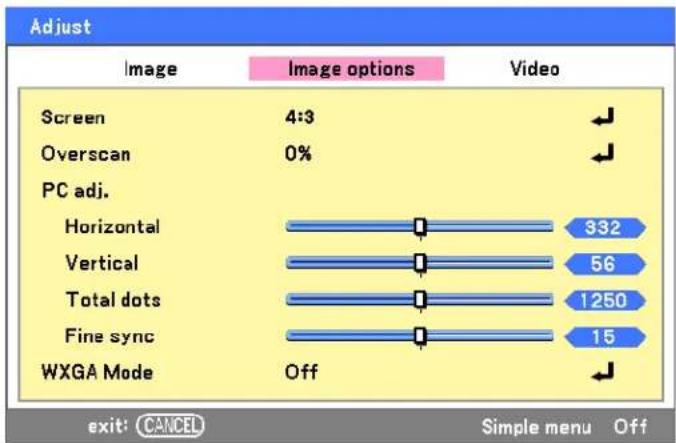
text_image
Adjust Image Image options Video Screen 4:3 Overscan 0% PC adj. Horizontal 332 Vertical 56 Total dots 1250 Fine sync 15 WXGA Mode Off exit: CANCEL Simple menu Off-
Adjust the Horizontal, Vertical, Total dots, or Fine sync sliding bars using the select ▲▼◀▶ buttons.
-
Press Cancel to return to the projected image.
Correcting Keystone by Using the Remote Control
- Press the Keystone button to display the Keystone window.

text_image
Keystone Horizontal 0 Vertical 0 Press KEYSTONE for 2 Secs to Reset.- Adjust the Horizontal and Vertical sliding bars using the select ▲▼◀▶ buttons.
- Adjust the slide bars until the screen trapezoid is a regular shape (see diagram).
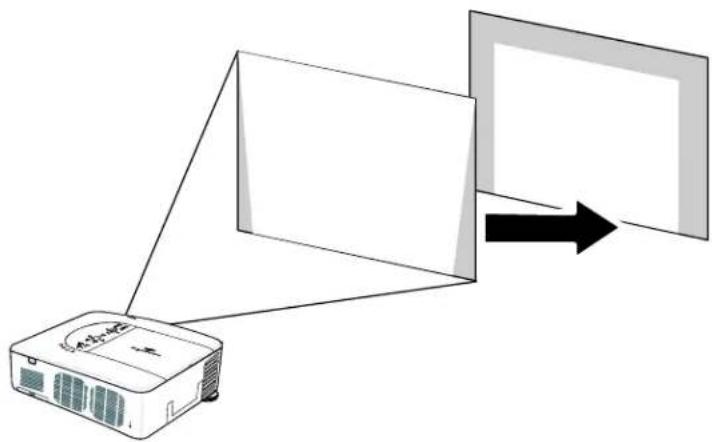
text_image
4.25V- Press Cancel to return to the projected image.
Note: Holding down the Keystone button for 2 seconds resets the default keystone values.
| ADJUSTMENT HORIZON | ONTAL VERTICAL | |
| Keystone Max. ± 35^ approx. | Max. ± 40^ approx. |
The following are conditions under which the maximum angle is achieved:
■ When the standard lens (LNS-S40) is used
- When the lens shift is set to H for center and V for 0.5 shift.
- When the lens shift is used and yet you do not get the above-mentioned condition (H for center and V for 0.5 shift), you cannot adjust the keystone correctly.
■ Image is projected in Wide mode
■ Resolution is WXGA
Note:
Higher resolution than WXGA narrows the adjustable range.
Menu items should be set as follows:
■ Aspect Ratio ..... 15:9
Horizontal and Vertical are adjusted separately.
A combination of both adjustments narrows the adjustable range.
⑦ Preventing the Unauthorized Use of the Projector
The projector has a built-in security feature to lock the OSD control panels and deny remote control operation. The security feature has no default keyword; in the first instance of enabling the security feature, the user must define a keyword.
Locking the Projector
To setup the security keyword, refer to the following guide.
-
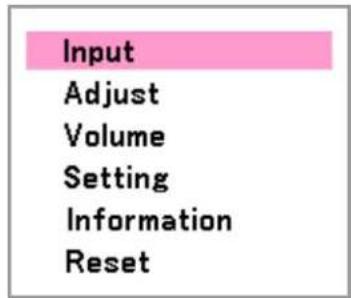
Press Menu on the OSD control panel on the projector or remote control to display the Main Menu. Scroll to the Setting menu using ▲ or ▼ and press Select.
-
The Setting menu is displayed. Select the Installation tab using ◀or▶.
-
Select PIN code lock using ▲ or ▼. Press Select. You are prompted to enable the PIN code lock function. Select On using ▲ or ▼. Select OK and press Select.
text_image
Input Adjust Volume Setting Information Reset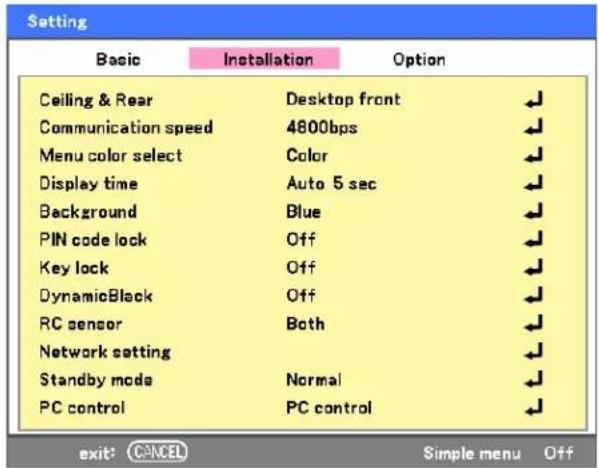
text_image
Setting Basic Installation Option Ceiling & Rear Desktop front Communication speed 4800bps Menu color select Color Display time Auto 5 sec Background Blue PIN code lock Off Key lock Off DynamicBlack Off RC sensor Both Network setting Standby mode Normal PC control PC control exit: CANCEL Simple menu Off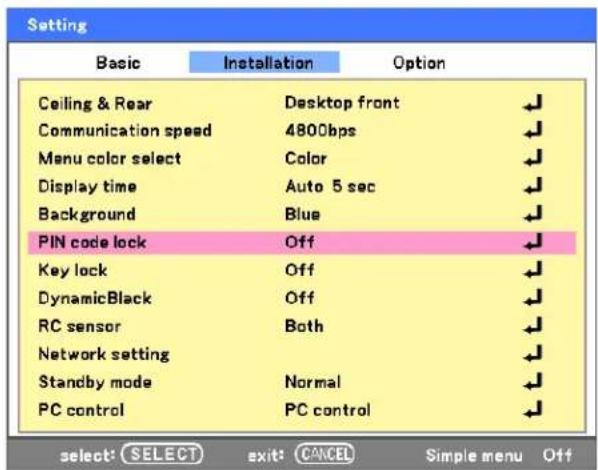
text_image
Setting Basic Installation Option Ceiling & Rear Desktop front Communication speed 4800bps Menu color select Color Display time Auto 5 sec Background Blue PIN code lock Off Key lock Off DynamicBlack Off RC sensor Both Network setting Standby mode Normal PC control PC control select: SELECT exit: CANCEL Simple menu Off-
The PIN code window is displayed. Enter a PIN code between 4 and 10 characters using ▲▼◀▶. The PIN code characters change to “*”. Press Select.
-
Once a successful PIN code is entered, a confirmation screen is displayed. Enter the same password as the previous step and write it down for later reference. Press Select. A security activation message is displayed. Select Cancel to return to the Setting menu or select OK to enable security.

text_image
PIN code lock PIN code --------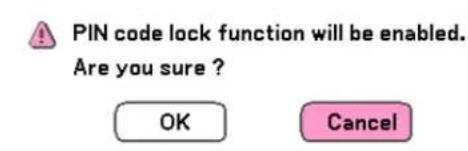
text_image
PIN code lock function will be enabled. Are you sure ? OK Cancel
When you have set or changed the PIN code, take a memo and keep it securely. If you forget your PIN code, the projector can no longer be started. Contact your dealer or the service center.
While the projector is locked with the PIN code...
Put on the label below (supplied) in a prominent place of the projector's body while it is locked with a PIN code.
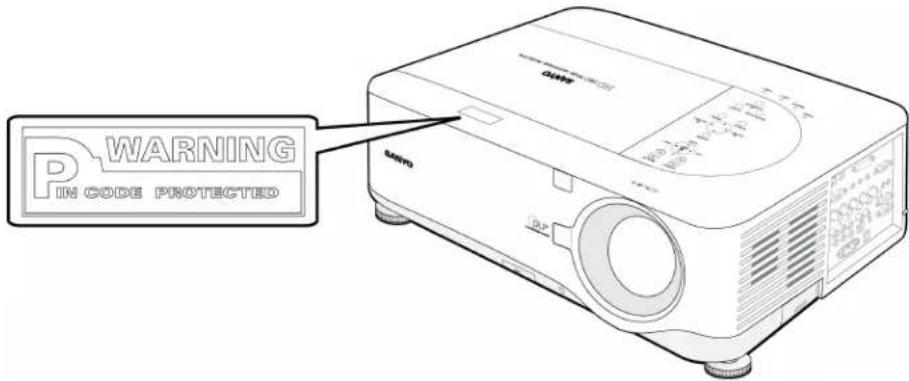
text_image
WARNING IN CODE PROTECTEDUnlocking the Projector
To unlock the projector, refer to the following guide.
- When the projector is locked, either by request during operation or at start up, the locked message is displayed.
- To unlock the projector, press Menu on the control panel or remote control. The PIN code window is displayed. Enter the previously defined PIN code to activate the projector.
Projector is locked! Enter your PIN code.

text_image
PIN code --------⑧ Using the Physical Lock
For security and authorized usage, the projector comes with two types of security features, the Kensington Lock and the Security Chain Lock.
Using the Kensington Lock
If you are concerned about security, attach the projector to a permanent object with the Kensington slot and a security cable.

text_image
Kensington lock Security chain lockUsing the Security Chain Lock
In addition to the password protection function and the Kensington lock, the security chain opening helps protect the projector from unauthorized use.
See the following illustration.

text_image
Kensington lock Security chain lock5. Using On-Screen Display
① Using the Menus
The projector has an On-Screen Display (OSD) that lets you make image adjustments and change various settings.
Navigating the OSD
You can use the remote control or the buttons on the top of the projector to navigate and make changes to the OSD. The following illustration shows the corresponding buttons on the remote control and on the projector.

text_image
MENU VOLUME- VOLUME+ SELECT CANCEL AUTO PC ADJ. INPUT I/O ON/STAND-BY- To open the OSD, press the Menu button on the OSD control panel or remote control. There are six initial menus. Press the cursor ▲or▼ buttons to move through the initial menus and Select to enter the desired menu.
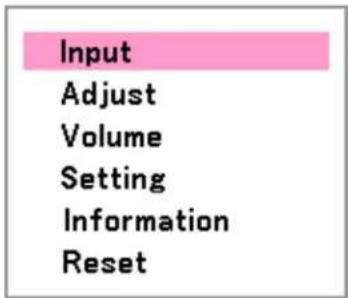
text_image
Input Adjust Volume Setting Information Reset- Press the cursor ◀ or ▶ button to move through secondary menus.
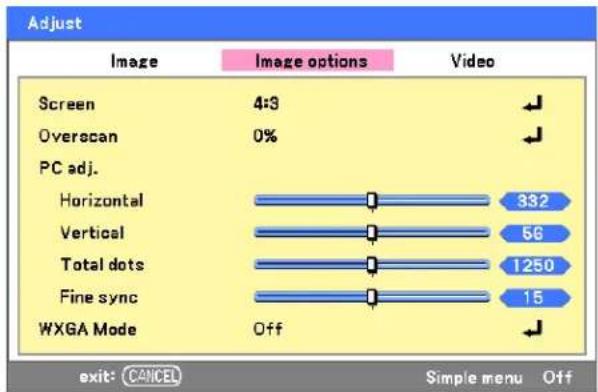
text_image
Adjust Image Image options Video Screen 4:3 Overscan 0% PC adj. Horizontal 332 Vertical 56 Total dots 1250 Fine sync 15 WXGA Mode Off exit: CANCEL Simple menu Off- Press ▲ or ▼ to select menu items and ◀ or ▶ to change values for settings. Press Select to confirm the new setting.
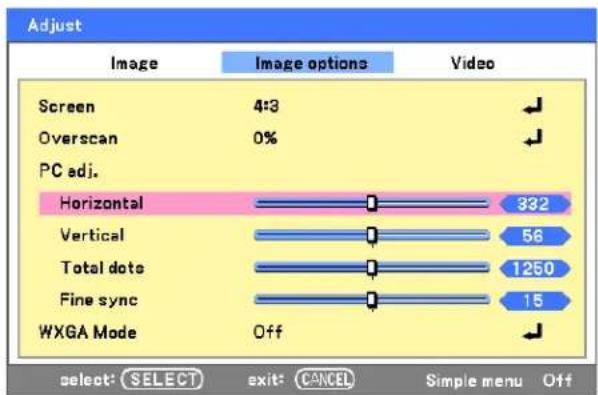
text_image
Adjust Image Image options Video Screen 4:3 Overscan 0% PC adj. Horizontal 332 Vertical 56 Total dots 1250 Fine sync 15 WXGA Mode Off select: SELECT exit: CANCEL Simple menu Off- Press Cancel to close the OSD or leave a submenu.
② Menu Tree
The gray shaded areas indicate factory default settings.
| MENU | ITEM | |||||
| Input Computer 1, Computer 2, Computer 3, Component, Video, S-Video | ||||||
| Test | CrossHatch, Raster(0%), Raster(25%), Raster(50%), Raster(100%), Raster Red, Raster pattern Green, Raster Blue, Raster Blue 60, Gray Raster 10, Gray Raster 30, Ramp H, Ramp V, Red Ramp H | |||||
| Adjust | Image | Image | select | High-bright/Presentation/Video/Movie/Graphic/sRGB | ||
| Detail | setting | Basic | Reference | High-Bright/Presentation/Video/Movie/Graphic/sRGB | ||
| Gamma | ||||||
| Color temp. | 5000K/6500K/7800K/8500K/9300K/10500K | |||||
| Brilliant color 1 to 3 | ||||||
| White balance Red | 1 to 100 | |||||
| Green | 1 to 100 | |||||
| Blue | 1 to 100 | |||||
| Contrast R | 1 to 100 | |||||
| Contrast | G | |||||
| Contrast B | 1 to 100 | |||||
| Color | Red, Green, Blue, Correction, Yellow, Magenta, Cyan | -60 to 60 | ||||
| Contrast 0 to 100 | ||||||
| Brightness | 0 to 100 | |||||
| Sharpness | 0 to 31 | |||||
| Color | 0 to 100 | |||||
| Tint | 0 to 100 | |||||
| Reset | ||||||
| Image options | Screen | 4:3/16:9/15:9/Letterbox/True/Normal | ||||
| Overscan | 0%/5%/10%/15% | |||||
| PC | Adj. | |||||
| Horizontal | ±50 | |||||
| Vertical | ±25 | |||||
| Total | dots | ±50 | ||||
| Fine sync | 0 to 63 | |||||
| WXGA | Mode | Off/On | ||||
| Video | Noise reduction | Off/Low/Mid/High | ||||
| 3D Y/C separation | Off/On | |||||
| Progressive | Off/Still/Normal/Movie | |||||
| Color | matrix | Auto/RGB/SDTV/HDTV | ||||
| Motion adaptive mode | Motion adaptor/Field Jam/Scaled Field/Mixed Mode | |||||
| Film | Off/2-2/2-3 Auto/2-2 On/2-3 On | |||||
| Volume | 0~61 | |||||
| Setting | Basic | Keystone | Horizontal Vertical | |||
| Lamp | control | Normal/Eco | ||||
| Lamp | mode | Dual/Lamp1/Lamp2 | ||||
| Lamp Interval | Off/1 week/4 week/2000H | |||||
| Simple menu | On/Off | |||||
| Language | English/Deutsch/Français/Italiano/Espanol/Svenska/日本語/中文 | |||||
| MENU | ITEM | ||
| Installation Ceiling & Rear Desktop Front/Ceiling Rear/Desktop Rear/Ceiling Front | |||
| Communication | speed | 4800bps/9600bps/19200bps/38400bps | |
| Menu color select Color/Monochrome | |||
| Display time | Manual/Auto 5sec/Auto 15sec/Auto 45sec | ||
| Background | Blue/Black/Logo | ||
| PIN code lock Off/On | |||
| Key lock | Off/On | ||
| Dynamic black | Off/On | ||
| RC sensor | Both, Front, Back | ||
| Network setting | DHCP Enable/Disable | ||
| IP address | |||
| Subnet | |||
| Gateway | |||
| DNS | |||
| Network PIN code (0000 to 9999) | |||
| Apply settings | |||
| Standby mode | Normal/Power-saving | ||
| PC control | PC control/Network | ||
| Option | On start | Off/On | |
| Power management | Off/00:05/00:10/00:20/00:30 | ||
| Screen trigger | Off/On | ||
| Fan control | Normal/Max | ||
| Default input select | Last/Auto/Computer1/Computer2/Computer3/Component/Video/S-Video | ||
| Color system | |||
| Video | Auto/NTSC/PAL/SECAM | ||
| S-Video | Auto/NTSC/PAL/SECAM | ||
| Remote control | Code1/Code2/Code3/Code4/Code5/Code6/Code7/Code8 | ||
| Message | Off/On | ||
| Filter warning | Off/100[H]/200[H]/500[H]/1000[H] | ||
| Search mode | Normal/Fine | ||
| Information Usage time Lamp1 life remaining, Lamp2 life remaining | |||
| Lamp1 time, Lamp2 time | |||
| PJ time | |||
| Filler time | |||
| Input | Input name | ||
| Signal | |||
| H-sync freq. | |||
| V-sync freq. | |||
| Video type | |||
| Sync type | |||
| Sync polarity | |||
| Scan type | |||
| Network IP address, Subnet, Gateway, MAC address | |||
| Version Model name, Serial number, Firmware, Data, Remote control | |||
Reset Current signal, All data, Clear lamp1 time, Clear lamp2 time, Clear filter time
③ Menu Elements
Some menus and windows contain large amounts of information in a small area. Refer to the following guide to navigate through options more easily.
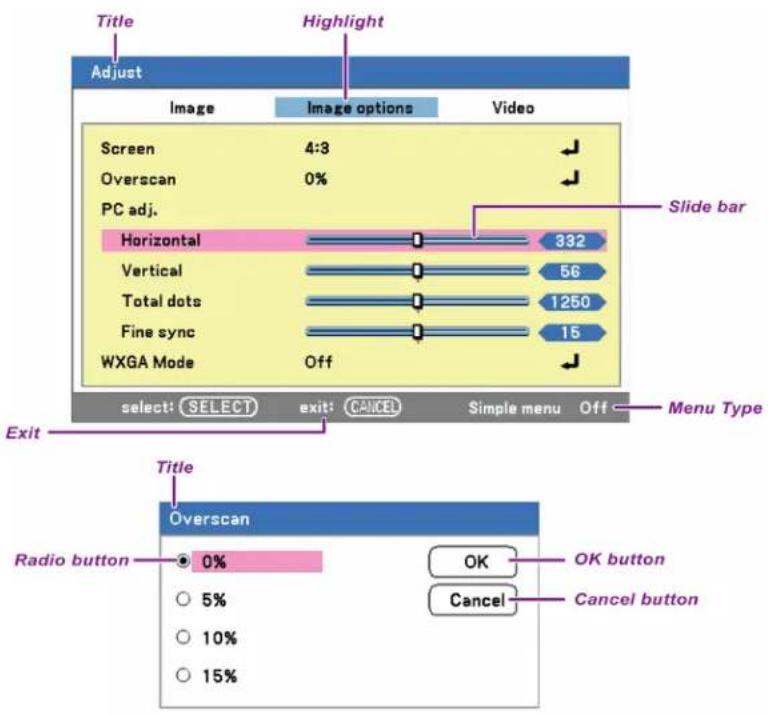
text_image
Title Highlight Adjust Image Image options Video Screen 4:3 Overscan 0% PC adj. Horizontal 332 Vertical 56 Total dots 1250 Fine sync 15 WXGA Mode Off Slide bar select: SELECT exit: CANCEL Simple menu Off Menu Type Exit Title Overscan Radio button 0% OK OK button Cancel Cancel buttonMenu windows or dialog windows typically contain the following elements:
| LABEL | TEM DESCRIPTION | N |
| 1 Title Indicates the menu title. | ||
| 2 Highlight Indicates the selected menu or item. | ||
| 3 Menu type Advanced Menu or Basic Menu. | ||
| 4 Radio button Click this round button to select an option in a dialog box. | ||
| 5 Slide bar Indicates a representation of adjustable values. | ||
| 6 Exit Return to the previous menu. | ||
| 7 OK Accepts changes. | ||
| 8 Cancel Reject changes and returns to previous menu. | ||
Note:
If an XGA signal is not correctly recognized, set "WXGA Mode" to off (see page 63).
To check if the signal is recognized, go to "Input" under "Information" menu (see page 90).
④ Source Menu Descriptions and Functions
The Source menu displays all supported image sources.
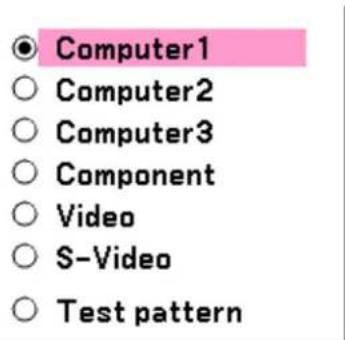
text_image
Computer1 Computer2 Computer3 Component Video S-Video Test patternSelect the required source from the menu using ▲ or ▼ and press Select to confirm.
| ITEM DES | RIPTION |
| Computer 1 | Select the source connected to the Computer 1 input(see Connecting Your PC or Macintosh Computer on page 26). |
| Computer 2 | Select the source connected to the Computer 2 input(see Connecting Your PC or Macintosh Computer on page 26). |
| Computer 3 | Select the source connected to the Computer 3 input(see Connecting Your PC or Macintosh Computer on page 26). |
| Component | Select the source connected to the Component input(see Connecting Your DVD Player with Component Output on page 29). |
| Video | Select the source connected to the Video input(see Connecting Your VCR or Laser Disc Player on page 30). |
| S-Video | Select the source connected to the S-Video input(see Connecting Your VCR or Laser Disc Player on page 30). |
| Test Pattern | Displays information about the type of test pattern (Range: CrossHatch, Raster (0%), Raster (25%), Raster (50%), Raster (100%), Raster Red, Raster Green, Raster Blue, Raster Blue 60, Gray Raster 10, Gray Raster 30, Ramp H, Ramp V, Red Ramp H). |
⑤ Adjust Menu Descriptions and Functions
The Adjust menu contains overall projector settings for image output such as sharpness, overscan and color matrix.
Three tabs are accessible through the Adjust menu, Picture, Image Options and Video.
Image menu
The image menu is used to alter picture settings and can be accessed from the Adjust menu.

text_image
Adjust Image selection 1: High-bright Detail setting Contrast Brightness Sharpness Color Tint Reset Video 50 50 12 50 50 exit: CANCEL Simple menu OffThe following table lists all functions with a description and the default setting.
| ITEM DESCR | PTION |
| Image select | Select a set of preset values using ◀ or ▶ from the list. Notice that the below values will change depending on the preset selection. |
| Detail Setting | See 6 Detail Settings Menu Descriptions and Functions on page 67. |
| Contrast | Adjust the Contrast value using ◀or▶ to highlight the differences between light and dark areas of the picture. |
| Brightness | Adjust the Brightness value using ◀or▶ to lighten or darken the picture. |
| Sharpness | Adjust the Sharpness value using ◀or▶ to sharpen or blur the borders between colors and objects. |
| Color | Adjust the Color value using ◀or▶ to increase or decrease color input to the picture. |
| Tint | Adjust the Tint value using ◀or▶ to increase or decrease the color Hue of the picture. |
| Reset The settings and adjustments are set to initial factory settings. | |
Image options menu
The Image Options menu is used to configure image options such as screen positioning and aspect ratio. Access the image options menu in the Adjust menu.
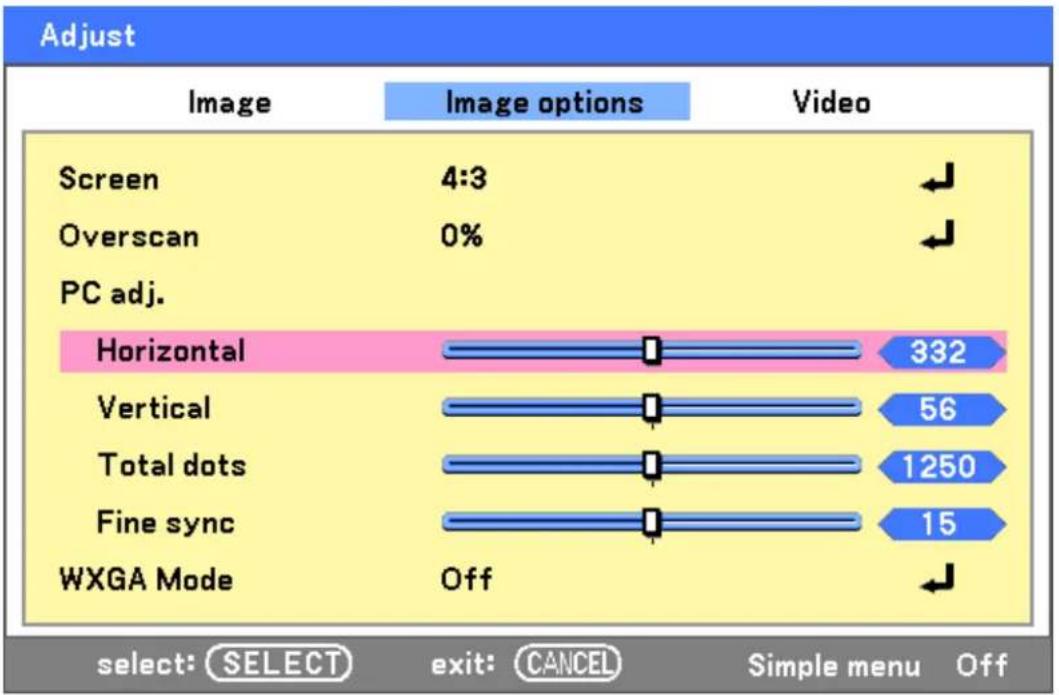
text_image
Adjust Image Image options Video Screen 4:3 Overscan 0% PC adj. Horizontal 332 Vertical 56 Total dots 1250 Fine sync 15 WXGA Mode Off select: SELECT exit: CANCEL Simple menu OffThe following table lists all functions with a description and the default setting.
| ITEM DESCRIPTION | |
| Screen | Select Screen using ◀or▶ from the list (see page 63). |
| Overscan | Set the Overscan value using ◀or▶ (see page 63). |
| PC adj. | Adjust the position values using the slides HVorizontal: Adjusts the image location horizontally using ◀or▶.Vertical: Adjusts the image location vertically using ◀or▶.Total dots: Fine tune a computer image or remove any vertical banding that might appear.Fine sync: Adjust the clock phase or reduce video noise, dot or cross talk.Note:Only use the Phase settings after the total dots settings have been modified. |
| WXGA Mode | Select WXGA Mode (see page 63). |
Screen
The screen option allows for the adjustment of the aspect ratio to alter the appearance or ratio of the projected image.

text_image
Screen ● 4:3 ○ 16:9 ○ 15:9 ○ Letterbox ○ True ○ Normal4:3 - Standard TV screen (4:3), proportionally four units wide for every three units high, no matter the size of the screen.
16:9 - A wide-screen aspect ratio for video.
15:9 – Uses the full display.
Letterbox – Reduce image to display the true aspect with black borders on top and bottom.
True - Displays the current image in its true resolution.
Normal – Displays the current image in its aspect ratio.
Overscan
Video images normally exceed the size of the display screen. The edge of the picture may or may not be displayed correctly. The border area that is cropped can be adjusted by using the Overscan menu.
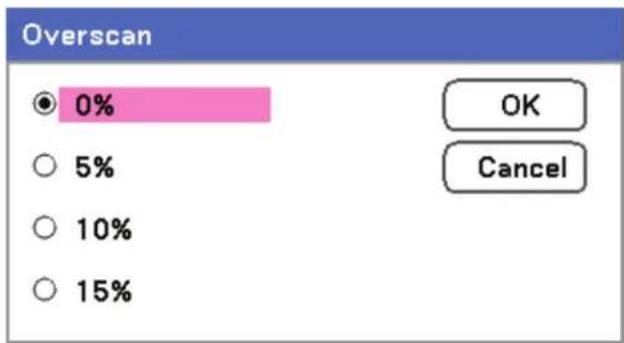
bar
Overscan | Category | Value (%) | |---|---| | 0% | 0 | | 5% | 0 | | 10% | 0 | | 15% | 0 | OK CancelSet the overscan percentage between 0 – 15% to compensate for different screen sizes.
WXGA Mode

text_image
WXGA Mode Off On OK CancelSelecting On gives priority to a WXGA (1280 x 768) signal when recognizing an input signal.
When WXGA Mode is set to On, an XGA (1024 x 768) signal may not be recognized. Set WXGA Mode to Off if this occurs.
To check if the signal is recognized, go to "Input" under "Information" menu (see page 90).
Video menu
The Video menu is used to configure image options such as film. Access the Video menu in the Adjust menu.
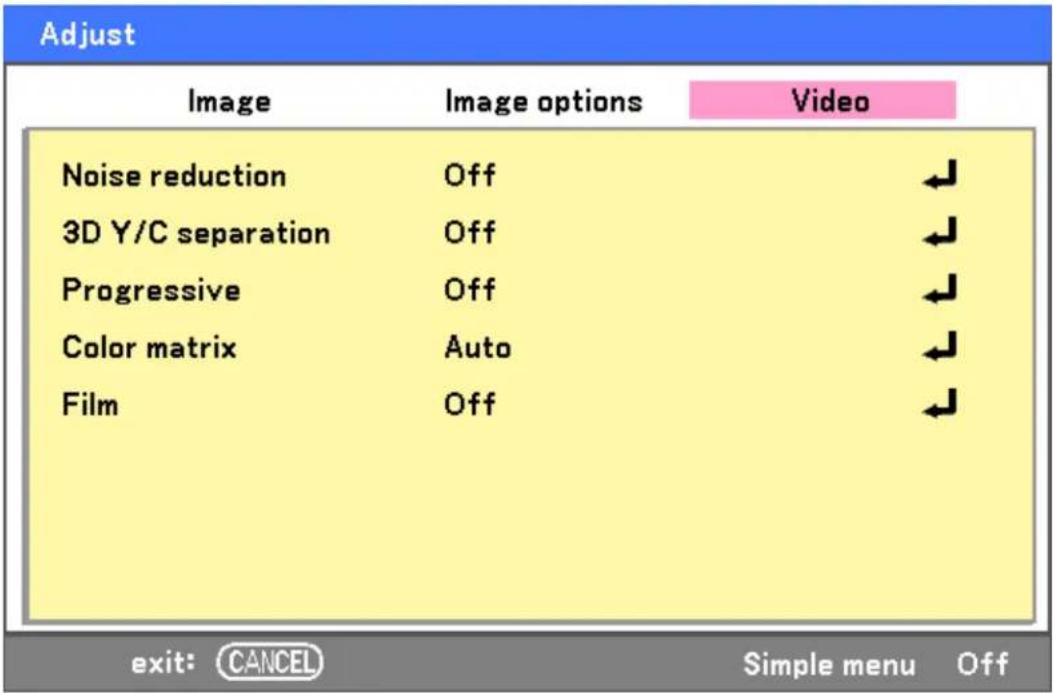
text_image
Adjust Image Image options Video Noise reduction Off 3D Y/C separation Off Progressive Off Color matrix Auto Film Off exit: CANCEL Simple menu OffThe following table lists all functions with a description and the default setting. A detailed description follows the table.
| ITEM DESC | PTION |
| Noise reduction | Select Noise reduction mode (see page 65). |
| 3D Y/C separation | Select 3D Y/C separation mode (see page 65). |
| Progressive | Select Progressive mode (see page 65). |
| Color matrix Select Color matrix mode (see page 65). | |
| Film Select Film mode (see on page 65). | |
Noise reduction
Select the level of noise reduction required.

text_image
Noise reduction Off OK Low Cancel Mid HighRange: Off, Low, Mid, High.
3D Y/C separation
3D Y/C Separation separates composite signal to Y (brightness) signal and C (color) signal, and can help to produce clearer and sharper images without overlapping colors (rainbow effect).
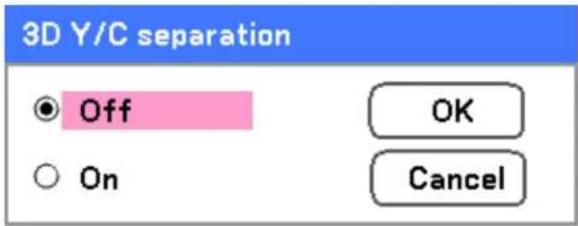
text_image
3D Y/C separation Off On OK CancelSet 3D Y/C Separation On or Off.
Progressive
Progressive converts an interlaced image to a progressive scan image.
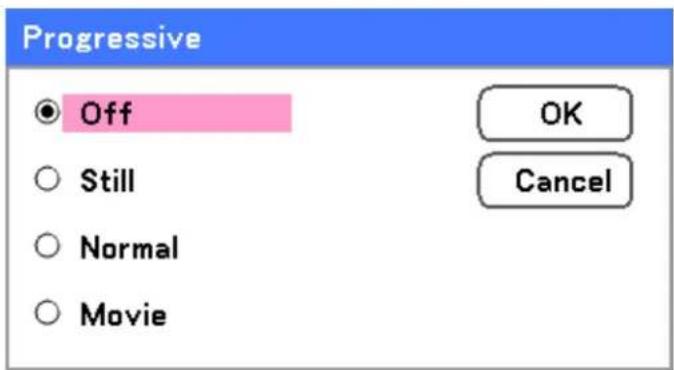
text_image
Progressive Off Still Normal Movie OK CancelSelect the form of Deinterlacing required from:
Still – Select for stills such as slide projections or screen shots.
Normal - Select Normal for non-specialized projection.
Movie – Select for movie projection.
Color matrix
Color Matrices define the amount of the three-color components R (red), G (green), and B (blue) in a single point in color space.

text_image
Color matrix ● Auto ○ RGB ○ SDTV ○ HDTV OK CancelSelect from the following:
Auto - Auto selects the color matrix.
RGB – Sets the color matrix to RGB, use for PC monitor or camera imaging.
SDTV – Sets the color matrix to SDTV, use for Standard Definition imaging.
HDTV – Sets the color matrix to HDTV, use for High Definition imaging.
Film
Film aids in converting motion picture film images into video. The process adds additional frames to the picture in order to increase the frame rate.
Note:
This feature is only available when Progressive is turned on and SDTV signal is selected.
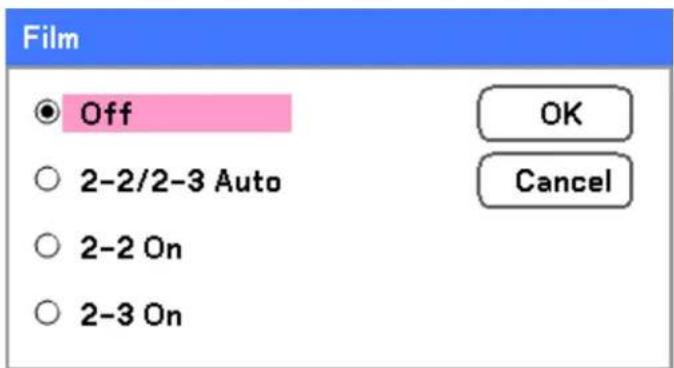
text_image
Film Off 2-2/2-3 Auto 2-2 On 2-3 On OK CancelSelect from the following:
Off – Film mode is turned off.
2-2/2-3 Auto - Detects pull-down correction method.
2-2 On – Uses 2-2 pull-down correction method.
2-3 On - Uses 2-3 pull-down correction method.
⑥ Detail Settings Menu Descriptions and Functions
The Detail settings menu contains basic and advanced color adjustment options such as gamma correction, color contrast and color correction.
Basic
The Basic tab contains general Detail Settings such as gamma correction and color temperature. Access to the General tab is through the Detail Settings menu.
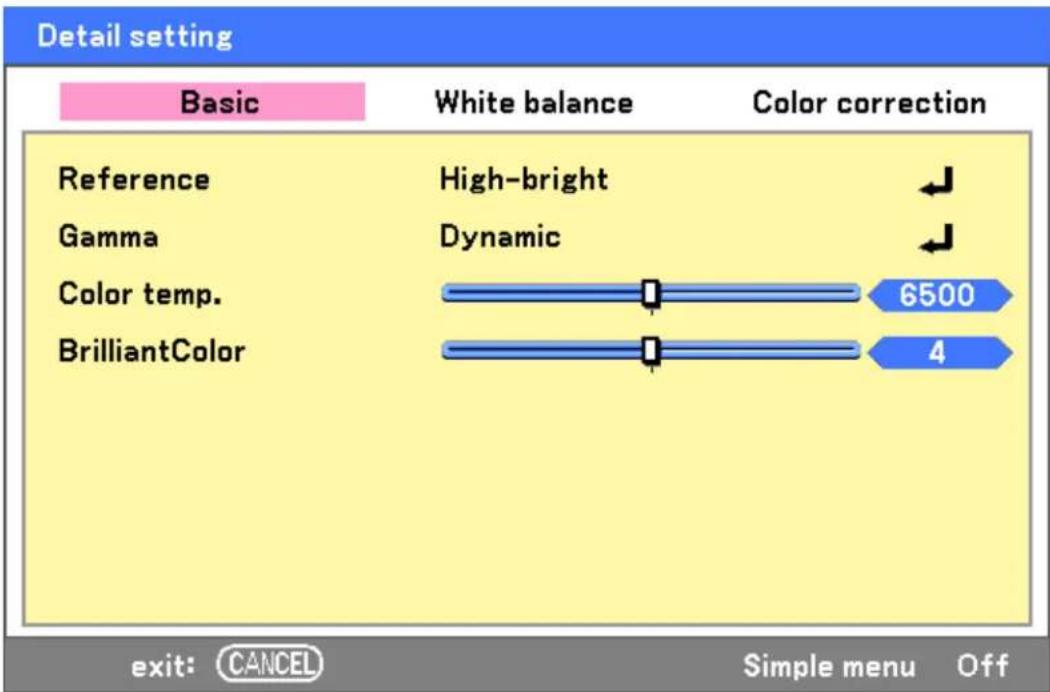
text_image
Detail setting Basic White balance Color correction Reference High-bright Gamma Dynamic Color temp. BrilliantColor 6500 4 exit: CANCEL Simple menu OffThe following table lists all functions with a brief description.
| ITEM DESCRIPTION | |
| Reference Set Reference mode (see page 68). | |
| Gamma Select Gamma | Correction mode (see page 68). |
| Color temp. | Move the slider bar left or right to set the color temperature value in Kelvin (K). Compensate for the amount of light available. Daylight is approximately 5500K. |
| BrilliantColor | Move the slider bar left or right to set the BrilliantColorTMvalue. BrilliantColor extends the exposure range and sharpens detail for grain free images. |
Reference
The Reference mode allows the projector to differentiate between source materials for example movies, PC images or video stills.
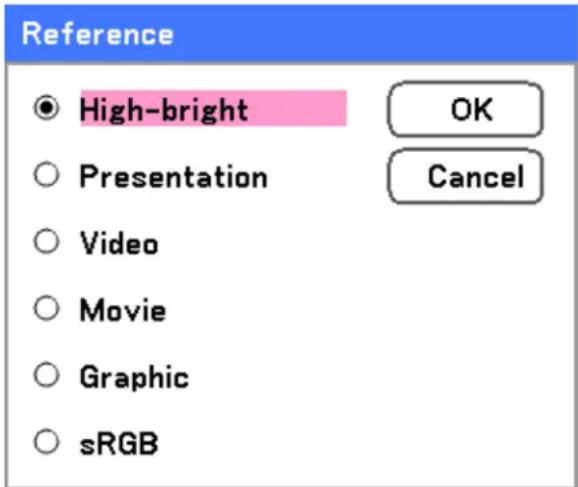
text_image
Reference ● High-bright ○ Presentation ○ Video ○ Movie ○ Graphic ○ sRGB OK CancelSelect from the following:
High-bright – Select for use in a brightly lit room.
Presentation - Select if the projector is to be used for presentation purposes.
Video – Select for video projection.
Movie – Select for Movie projection.
Graphic – Select Graphic for still images.
sRGB – Select for projecting PC or web page images.
Gamma
Gamma enables adjustment to the light intensity (brightness) of an image in order to match the source more closely.

text_image
Gamma Dynamic OK Natural Cancel Black detailSelect from the following:
Dynamic - Allows the projector to alter the gamma correction automatically.
Natural - Attempts to emulate the original source as closely as possible.
Black detail – Black detail highlights boundaries between light and dark areas of the image more clearly.
White balance
White Balance allows the projector to compensate for different colors of light being emitted by different light sources.

text_image
Detail setting Basic White balance Color correction Red 50 Green 50 Blue 50 Contrast R 50 Contrast G 50 Contrast B 50 exit: CANCEL Simple menu OffThe following table lists all functions with a brief description.
| ITEM DESCRIPTION | |
| Red Set the value to compensate for red light sources. | |
| Green Set the value to compensate for green light sources. | |
| Blue Set the value to compensate for blue light sources. | |
| Contrast R Set the Contrast R value to compensate for red light sources. | |
| Contrast G Set the Contrast G value to compensate for green light sources. | |
| Contrast B Set the Contrast B value to compensate for blue light sources. |
Color correction
The Color correction tab enables the adjustment of color values in an image to remove unwanted effects, improve color, characteristics or add more of a particular color.
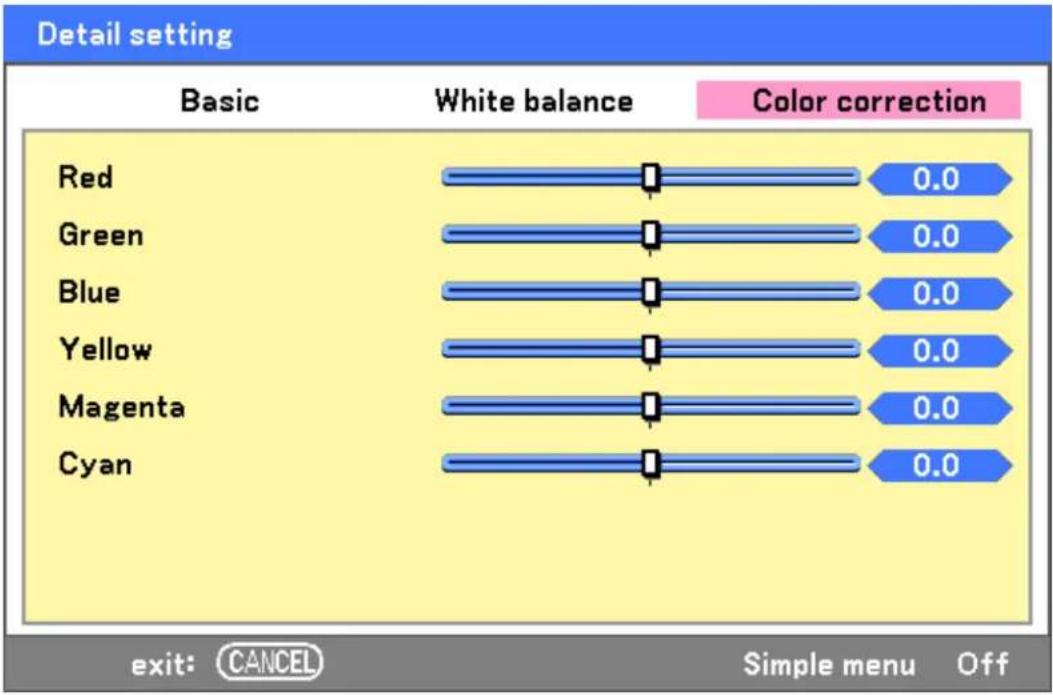
text_image
Detail setting Basic White balance Color correction Red 0.0 Green 0.0 Blue 0.0 Yellow 0.0 Magenta 0.0 Cyan 0.0 exit: CANCEL Simple menu OffThe following table lists all functions with a brief description.
| ITEM DESCRIPTION | |
| Red | Increase or decrease the amount of red in the projected output using ◀ and ▶. |
| Green | Increase or decrease the amount of green in the projected output using ◀ and ▶. |
| Blue | Increase or decrease the amount of blue in the projected output using ◀ and ▶. |
| Yellow | Increase or decrease the amount of yellow in the projected output using ◀ and ▶. |
| Magenta | Increase or decrease the amount of magenta in the projected output using ◀ and ▶. |
| Cyan | Increase or decrease the amount of cyan in the projected output using ◀ and ▶. |
⑦ Setting Menu Descriptions and Functions
The Setup menus contain the most often used settings during installation and options to customize the general output of the projector. Three tabs are accessible through the Setup menu, general, installation and option.
Basic
The Basic tab contains general setup options such as lamp mode and OSD language settings and can be accessed with the projector control panel or with the remote control unit.

text_image
Setting Basic Installation Option Keystone Lamp control Normal Lamp mode Dual Lamp interval 1 week Simple menu.On Language English exit: CANCEL Simple menu OnThe following table lists all functions with a brief description.
| ITEM DESCRIPTION | |
| Keystone | Adjust the Keystone trapezoid (see Keystone page 72). |
| Lamp control Select | Lamp control. Range: Normal or Eco. |
| Lamp mode | Select Lamp configuration. Range: Dual, Lamp1 or Lamp2. |
| Lamp interval Select | Lamp interval. Range: Off, 1 week, 4 weeks or 2000 hours. |
| Simple menu | Displays menus with minimum essential options. This setting is best suited to novices. |
| Language | Select the OSD language (see Language on page 74). |
Keystone
The keystone trapezoid can be adjusted by selecting this option.

text_image
Keystone Horizontal 0 Vertical 0 Press KEYSTONE for 2 Secs to Reset.Select Horizontal or Vertical using ▲or▼ then, use ◀or▶ to adjust the projected image appearance as required.
Lamp control
Select Normal or Eco from the lamp mode window. The lamp life can be extended by using the Eco mode and the fan noise can be reduced.
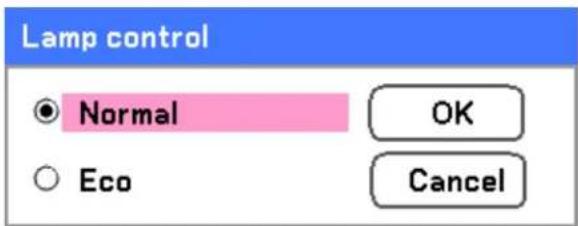
text_image
Lamp control Normal OK Eco CancelLamp mode
Select the lamps to be used for projection.
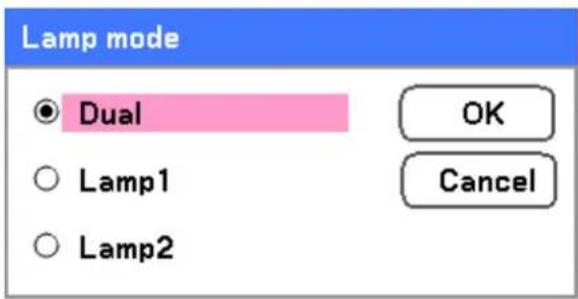
text_image
Lamp mode Dual OK Cancel Lamp1 Lamp2Select from the following:
Dual – Uses both lamps simultaneously.
Lamp1 – Uses Lamp1 only.
Lamp2 – Uses Lamp2 only.
Lamp interval
The period of time for regulating lamp usage when not in dual lamp mode.
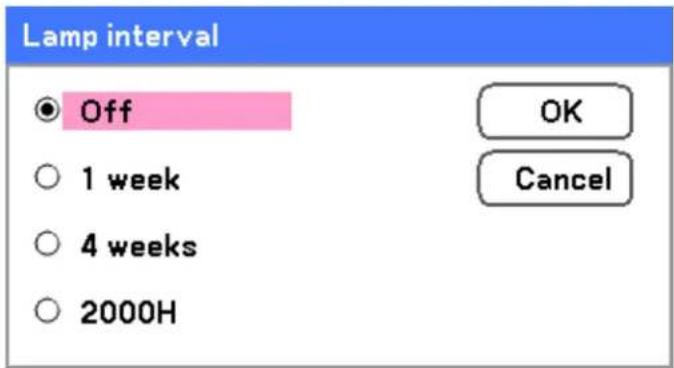
text_image
Lamp interval Off 1 week 4 weeks 2000H OK CancelSelect from the following:
Off, 1 week, 4 weeks and 2000H
Simple menu
Select the Simple menu to display.

text_image
Simple menu On Off OK CancelSet Simple menu On or Off.
Language
Select the OSD language to be used.
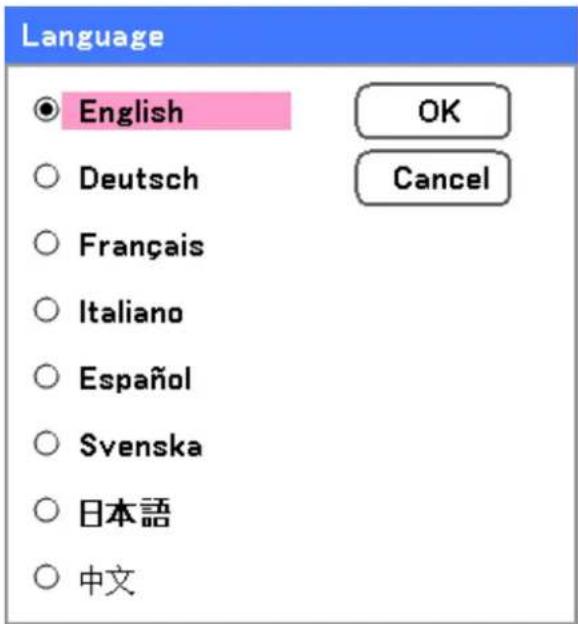
text_image
Language English Deutsch Français Italiano Español Svenska 日本語 中文 OK CancelSelect from the following:
English
German
French
Italian
Spanish
Swedish
Japanese
- Simplified Chinese
Installation
The Installation tab contains menu options for various setup conditions such as orientation and remote sensor mode and is accessed through the Setup menu.
| Setting | ||
| Basic | Installation | Option |
| Ceiling & Rear | Desktop front | |
| Communication speed | 4800bps | |
| Menu color select | Color | |
| Display time | Auto 5 sec | |
| Background | Blue | |
| PIN code lock | Off | |
| Key lock | Off | |
| DynamicBlack | Off | |
| RC sensor | Both | |
| Network setting | ||
| Standby mode | Normal | |
| PC control | PC control | |
The following table lists all functions with a brief description.
| ITEM DESCRIPTION | ON |
| Ceiling & Rear | Select from four projection methods depending on projection site (see Ceiling & Rear page 76). |
| Communication speed | Select Communication speed.Range: 4800bps, 9600bps, 19200bps, 38400bps |
| Menu color select | Select the menu color from the list.Range: color or monochrome. |
| Display time | Select Display time.Range: Manual, Auto 5s, Auto 15s, Auto 45s |
| Background | Select Background appearance when there is no signal.Range: blue, black or logo |
| PIN code lock | Set PIN code lock On/Off (see PIN Code Lock on page 79). |
5. Using On-Screen Display
| ITEM DESCRIPT | DN |
| Key lock | Set Control panel lock On/Off.Note:This Control Panel Lock does not affect the remote control functions.When the control panel is locked, pressing and holding the Cancel button on the projector cabinet for about 10 seconds. The setting will change to Off. |
| DynamicBlack | DynamicBlackTM improves the black level of the projector. Black level is the darkest part of a picture and varies between viewing devices and environments.Set DynamicBlack on/off. |
| RC sensor | Set RC sensor fields.Range: Both, Front, Back |
| Network setting | Opens Network preferences tab (see Network setting on page 82). |
| Standby mode | Select Standby mode.Range: Normal and Power-saving |
| PC control | Enables the path selection for PC control.Range: PC control or Network. |
Ceiling & Rear
Ceiling & Rear enables you to set how the projected image is displayed.
Select from the following:
Desktop Front – Standard forward facing projection (Default setting).
Desktop Rear – Standard rear projection. Enables the projector to produce the image from behind the screen by reversing the image.
Ceiling Front – Forward facing ceiling mounted projection. Enables ceiling mounted projection by inverting the image.
Ceiling Rear – Rear ceiling mounted projection. Enables ceiling mounted projection from behind the screen by inverting and reversing the image.
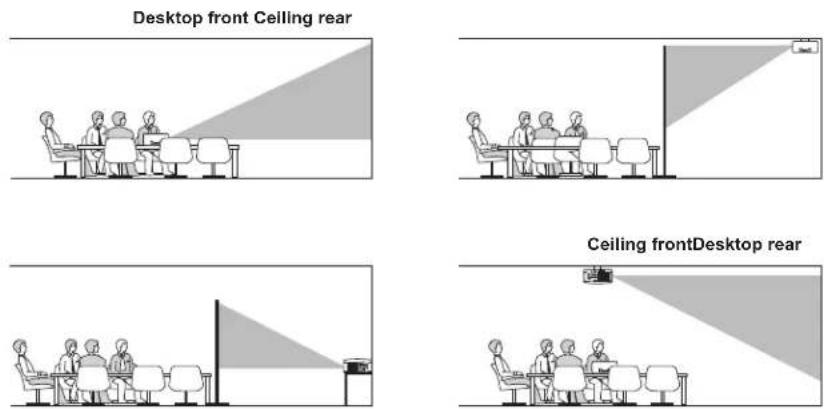
Communication speed
Select communication speed to set the baud rate of the connection.
Note:
Longer cable connections may require lower settings.
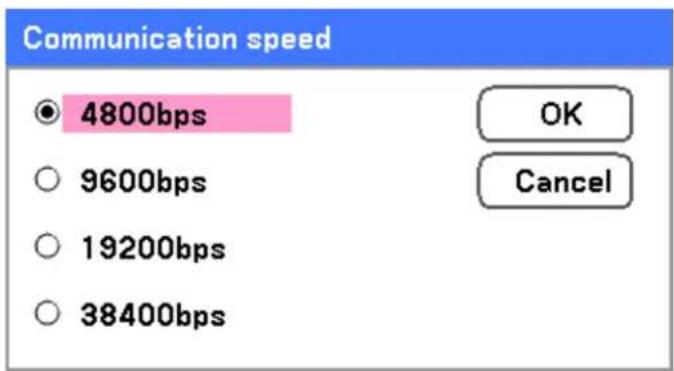
text_image
Communication speed 4800bps 9600bps 19200bps 38400bps OK CancelSelect from the following options:
4800bps
9600bps
19200bps
38400bps
Note:
In the Network mode, Communication Speed function is not available.
Menu color select Select color mode to set the menu color.

text_image
Menu color select Color Monochrome OK CancelSelect from the following options:
Color
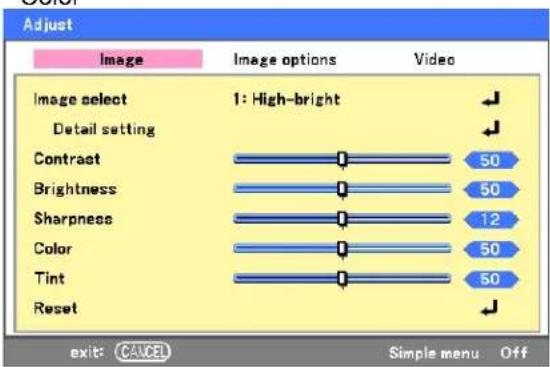
text_image
Adjust Image Image options Video Image select 1: High-bright Detail setting Contract 50 Brightness 50 Sharpness 12 Color 50 Tint 50 Reset exit: CANCEL Simple menu OffMonochrome
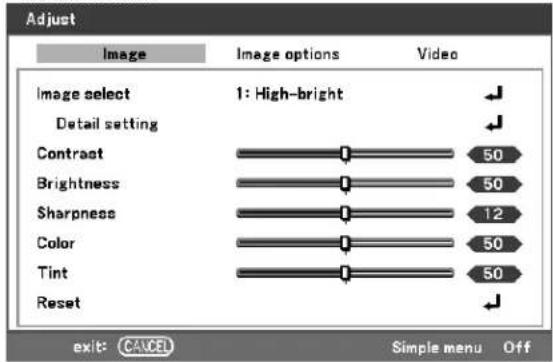
text_image
Adjust Image Image options Video Image select 1: High-bright Detail setting Contract 50 Brightness 50 Sharpness 12 Color 50 Tint 50 Reset exit: CAVEL Simple menu OffDisplay time
Sets the amount of time a menu is displayed.

text_image
Display time ● Manual ○ Auto 5 sec ○ Auto 15 sec ○ Auto 45 sec OK CancelSelect from the following:
Manual – Menus stay on screen until the Menu button is pressed again.
Auto 5 secs—Menu is displayed for 5 seconds.
Auto 15 secs – Menu is displayed for 15 seconds.
Auto 45 secs – Menu is displayed for 45 seconds.
Background
Background enables you to display a blue/black screen when there is no signal. The default background is blue.
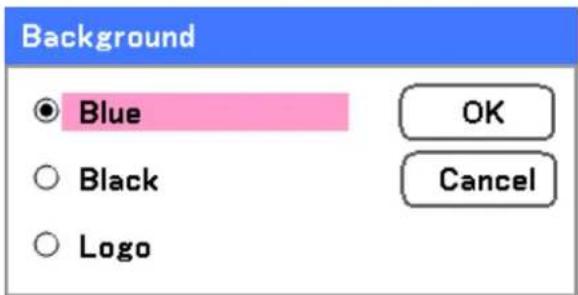
text_image
Background Blue Black Logo OK CancelSelect from the following:
Blue
Black
- Logo
PIN Code Lock
See ⑦ Preventing the Unauthorized Use of the Projector on page 51 – 53.

PIN code lock function will be enabled.
Are you sure?

Key lock
Turn On/Off the Key Lock function for cabinet buttons.
Note:
- This Control Panel Lock does not affect the remote control functions.
- When the control panel is locked, pressing and holding the Cancel button on the projector cabinet for about 10 seconds. The setting will change to Off.

text_image
Key lock Off On OK CancelDynamicBlack
DynamicBlack ^TM enables you to improve the black level of the projector.

text_image
DynamicBlack Off On OK CancelRC sensor
Set the operating range for the wireless remote control.
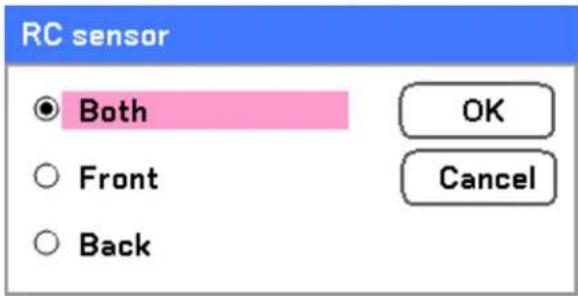
text_image
RC sensor ● Both ○ Front ○ Back OK CancelSelect from the following:
Both
Front
Back
Network Setting
See Network setting on page 82.
Standby mode
There are two standby modes available: Normal and Power-saving. Power-saving mode allows you to put the projector in the standby condition to consume less power than Normal.
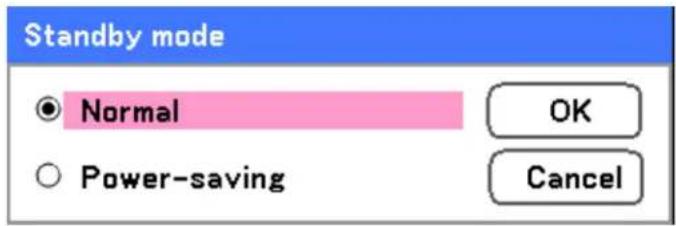
text_image
Standby mode Normal Power-saving OK CancelNote:
Be sure to connect the projector and computer while the projector is in standby mode and before turning on the computer.
Select from the following:
Normal
Power-saving
Note:
The HTTP server functions are not available during Power-saving mode.
The MONITOR OUT function is not available during Power-saving mode.
Control through the PC Control connector and Network mode is not available during Power-saving mode. For PC control and Network mode of the projector it is recommended to leave the projector in the Normal mode.
Normal mode: POWER indicator: Orange light
WARNING indicator: Green light
Power-saving mode: POWER indicator: Orange light
WARNING indicator: Off
PC control
This function enables you to select the path for PC control (see ⑤ PC Control Codes and Cable Connections on page 115).
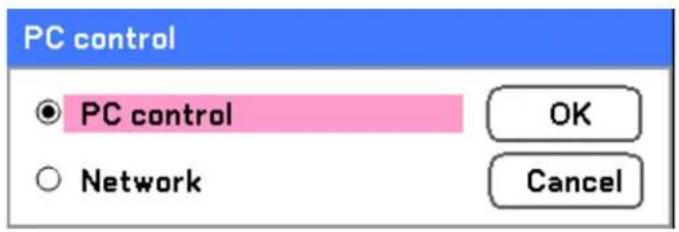
text_image
PC control PC control Network OK CancelNote:
In the Network mode, Communication Speed function is not available.
Select from the following:
PC control
Network
©
Option
The Option tab contains miscellaneous setup menu settings such as Power Management and Default Input Select and can be accessed by using the Setting Menu.
The following table lists all functions with a description and the default setting.
| On start | Set this item on to enable the projector to power up when AC plug in. Range: On or Off |
| Power management | Select the amount of time the projector remains idle before powering down. Range: Off, 0:05, 0:10, 0:20, 0:30 |
| Screen trigger | Set this item to On to enable the projector to automatically lower the projection screen when powering on. Range: On or Off |
| Fan control | Select Fan control. Range: Normal or Max (see Fan control page 85) |
| Default input select | Select the default input for projection. Range: Last, Auto, Computer1, Computer2, Computer3, Component, Video, S-Video |
5. Using On-Screen Display
| ITEM DESCR | PTION |
| Remote control | This option switches remote control codes.Range: Code 1, Code 2, Code 3, Code 4, Code 5, Code 6, Code 7, Code 8 |
| Message | This option turns on or off messages.Range: Off or On |
| Filter warning | Set this item to on to have the projector display a message when the air filter needs servicing.Range: Off, 100[H], 200[H], 500[H], 1000[H] |
| Search mode | This feature sets the Auto Adjust mode.Range: Normal, Fine |
On start
On start enables the projector to start automatically when the power cable is connected to an active power outlet and the main power switch is on. This eliminates the need to always use the POWER (On) button on the remote control or projector cabinet. To use the On start function, you must first press the main power switch to On before connecting the power cable.
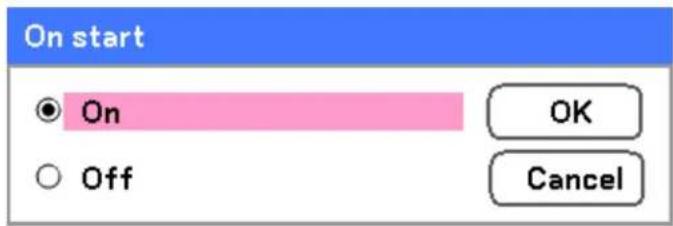
text_image
On start On Off OK CancelNote:
- When the projector is off by using the POWER button (or put in the standby mode) and the power cable is disconnected, On start will not activate after power (AC) is applied.
- When the projector is off by using the Direct Power Off function or after the power (AC) is removed (no standby mode). On start will be activated after power (AC) is applied.
- The Direct Power Off function means you can turn off the power (AC) to the projector by using a power strip equipped with a switch and a breaker.
Power management
Power management enables the projector to automatically turn off if there is no signal received by any input.
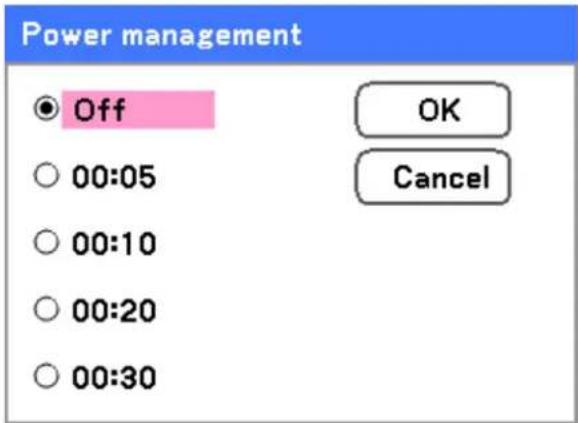
text_image
Power management Off OK 00:05 Cancel 00:10 00:20 00:30Select from the following:
Off
5 minutes
10 minutes
20 minutes
30 minutes
Screen trigger
Set Screen trigger to On to enable the projector to automatically lower the projection screen when powering on. When powering off, Screen trigger stops sending a low voltage trigger to the screen controller and the screen goes up.
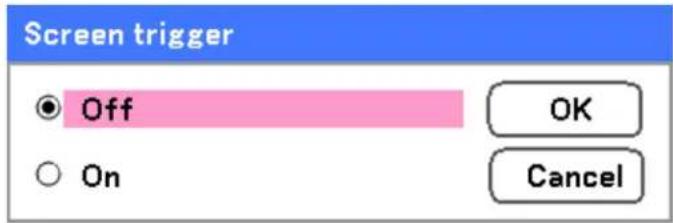
text_image
Screen trigger Off On OK CancelFan control
Fan control is used to set the speed of the internal cooling fan. Set Fan Speed to Max in altitudes over 1500 meters (5000 feet).

text_image
Fan control Normal OK Max CancelThe Fan control option default is Normal, which enables the projector to automatically detect fan requirements. For higher temperature locations or prolonged use, the Max option is available to provide greater cooling capacity.
Default input select
The Default input is the image source that the projector will search for automatically on startup.

text_image
Default input select Last OK Auto Cancel Computer1 Computer2 Computer3 Component Video S-VideoLast – Uses the most recently used image source.
Auto – Auto detects the default image source.
Computer1/2/3 – Uses Computer1, 2 or 3 as the default image source.
Component – Uses last component as the default image source.
Video – Uses last video input as default image source.
S-Video – Uses last S-video input as default image source.
Remote control
This projector has eight different remote control codes; the factory set normal mode (Code 1) and the other seven codes (Code 2 to Code 8). This switching function prevents remote control operation mixture (jam) when operating several projectors or video equipment together.
To change the code of Projector:
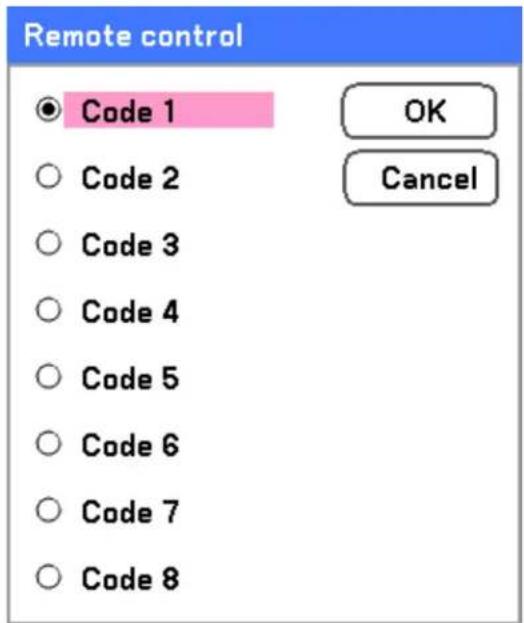
text_image
Remote control Code 1 OK Cancel Code 2 Code 3 Code 4 Code 5 Code 6 Code 7 Code 8To change the Remote control code of the projector used in ON SCREEN MENU is selectable from Code 1 to Code 8.
Message
This option turns on or off messages. Even though selecting [Off], the following message will appear. "Projector is locked" when the projector security is unlocked, the message will disappear.

text_image
Message Off On OK CancelFilter warning
Set Filter warning to have the projector display a message when the air filter needs servicing.

text_image
Filter warning Off 100[H] 200[H] 500[H] 1000[H] OK CancelThe message below shows when this function is activated.
Please clean filter.
Search mode
This feature sets the Auto Adjust mode so that the RGB image can be automatically or manually adjusted for noise and stability. You can automatically make adjustments in two ways: [Normal] and [Fine].

text_image
Search mode Normal Fine OK CancelNormal: The RGB image will be automatically adjusted. Normally select this option (Default).
Fine: Select this option if fine adjustment is needed. It takes more time to switch to the source than the Normal settings.
⑧ Information Menu Descriptions and Functions
The information menu provides only screens for the quick access of menus. The Information menu contains four distinct tabs.
Usage time
The Usage Time tab displays information about lamp usage and remaining lamp life.
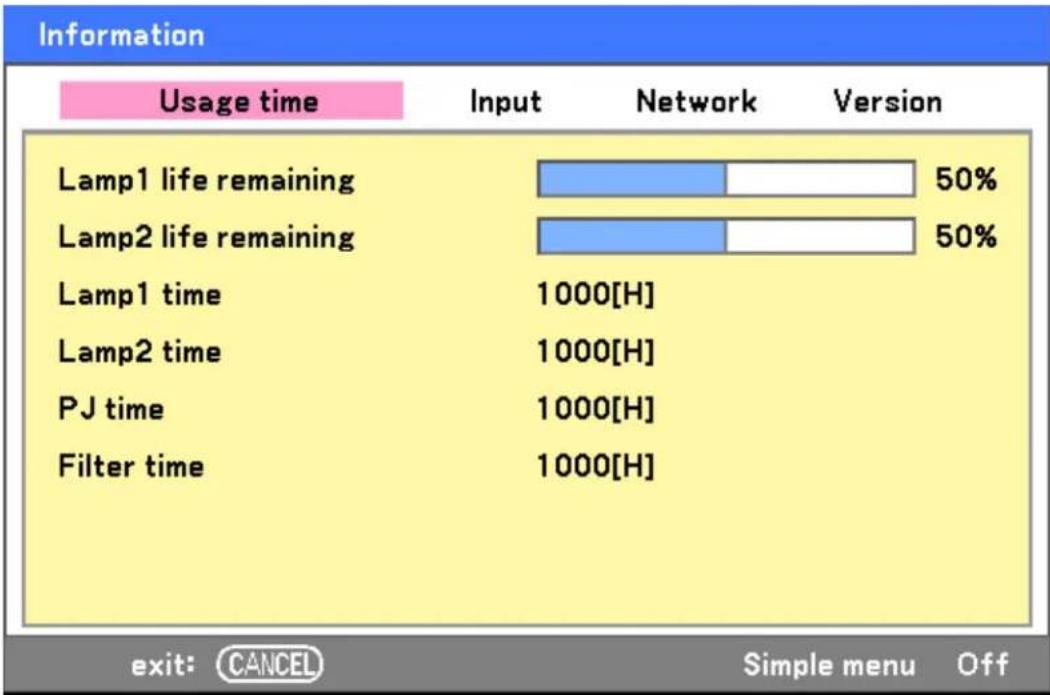
bar
Information | Usage time | Input | Network | Version | |---|---|---|---| | Lamp1 life remaining | 50% | 50% | 50% | | Lamp2 life remaining | 50% | 50% | 50% | | Lamp1 time | 1000[H] | 1000[H] | 1000[H] | | Lamp2 time | 1000[H] | 1000[H] | 1000[H] | | PJ time | 1000[H] | 1000[H] | 1000[H] | | Filter time | 1000[H] | 1000[H] | 1000[H] | exit: CANCEL Simple menu OffThe following table lists all items with a description.
| ITEM DESCRIPTION | |
| Lamp1 Life remaining Displays the Lamp1 life remaining as a percentage. | |
| Lamp2 Life remaining Displays the Lamp2 life remaining as a percentage. | |
| Lamp1 time | Displays the Lamp1 total usage in hours. |
| Lamp2 time | Displays the Lamp2 total usage in hours. |
| PJ time | Displays the projector total usage in hours. |
| Filter time | Displays how many hours the filter has been used. |
Input
The Input tab displays various source and frequency values at a glance.
| Usage time | Input | Network | Version |
| Input name | Computer2 | ||
| Signal | 1024x768 | ||
| H-sync. freq. | 48.36[kHz] | ||
| V-sync. freq. | 60.00[Hz] | ||
| Video type | --- | ||
| Sync type | Separate sync | ||
| Sync polarity | H:(-)V:(-) | ||
| Scan type | Non-Interlace | ||
The following table lists all items with a description.
| ITEM DESCRIPTION | |
| Input name | Displays the Input Terminal that is presently being used (see Default input select on page 86). |
| Signal | Displays the Source name of the signal presently being used (see Option on page 83). |
| H-sync. freq. | Displays Horizontal frequency in KHz. |
| V-sync. freq. | Displays Vertical frequency in Hz. |
| Video type | Displays Video type. |
| Sync type | Displays Sync type. |
| Sync polarity | Displays Sync polarity. |
| Scan type | Displays Scan type. |
Network
The Network tab displays LAN settings as previously defined (see Network setting on page 82).
| Information | |||
| Usage time | Input | Network | Version |
| IP address | 192.168.10.10 | ||
| Subnet | 255.255.255.0 | ||
| Gateway | 0.0.0.0 | ||
| MAC address | 00:30:13:04:9E:01 | ||
Version
The Version tab displays all the version and product details of the projector and associated software (for display only).
| Usage time | Input | Network | Version |
| Model name | DWT50 | ||
| Serial number | |||
| Firmware | 1.0.0 | ||
| Remote control | Code 1 | ||
| exit: CANCEL Simple menu Off | |||
The following table lists all items with a description.
| ITEM DESCRIPTION | |
| Model name Displays Product ID. | |
| Serial number Displays projector Serial number. | |
| Firmware | Displays Firmware version and Color Wheel currently installed (4-sec or 6-sec). |
| Remote control | Displays remote control code. |
⑨ Reset Menu Descriptions and Functions
Occasionally, circumstances may require that factory defaults be reset, for demonstration purposes for example, or when components are replaced.
The Reset menu contains options for returning settings to the factory default and is accessed by using the Main menu.
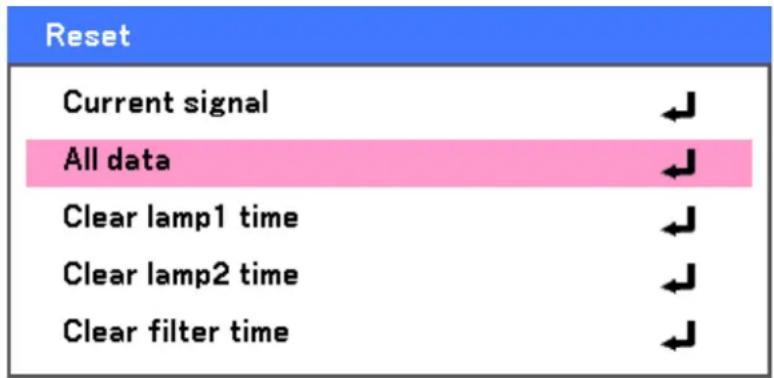
text_image
Reset Current signal All data Clear lamp1 time Clear lamp2 time Clear filter timeThe following table lists all items with a description.
| ITEM DESC | PTION | |
| Current signal | Reset the adjustments for current signal to factory preset levels. All items inAdjustcan be reset. | |
| All data | Resets all options to factory default regardless of when they were changed.Reset all the adjustments and settings for all the signals to the factory preset exceptLanguage, Background, Key lock, Security, Network Mode, Communication Speed, Lamp life remaining, Lamp time, and Filter time. | |
| Clear lamp1 time | Reset lamp1 time | These options should only be used when components are cleaned or replaced (see 6. Maintenance on page 94) |
| Clear lamp2 time | Reset lamp2 time | |
| Clear filter time | Reset filter hours | |
6. Maintenance
① Cleaning the projector
Cleaning the Cabinet
Refer to the following guide to clean the projector cabinet.
- Wipe off dust with a clean dampened cloth.
- Moisten the cloth with warm water and mild detergent and wipe the cabinet.
- Rinse all detergent from the cloth and wipe the projector again.
CAUTION

To prevent discoloration or fading of the case, do not use abrasive alcohol-based cleaners.
Cleaning the Lens
Refer to the following guide to clean the projector lens.
- Apply a little optic lens cleaner to a clean, lint free cloth (do not apply the cleaner directly to the lens).
- Lightly wipe the lens in a circular motion.
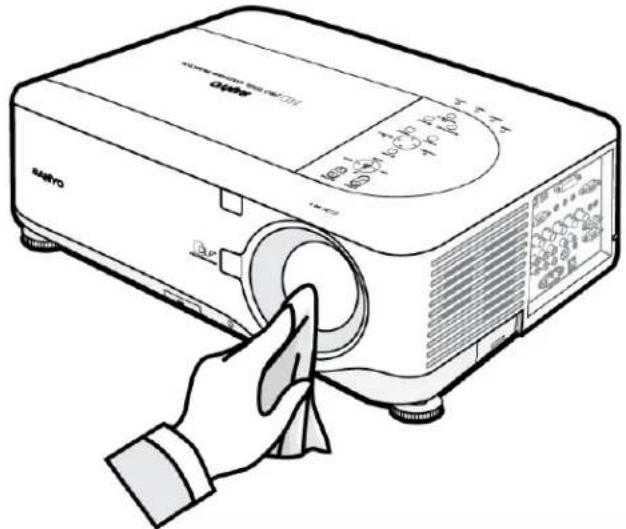
text_image
Line drawing of a projector with labeled ports and a hand holding the button, showing internal components and display screen.CAUTION

Do not use abrasive cleaners or solvents.
To prevent discoloration or fading, avoid getting cleaner on the projector case.
Cleaning the Filters
The projector uses three filters to keep the fans free of dust and other particles, and should be cleaned every 500 hours of operation. In dusty environments, it is recommended to clean the filters more frequently. If the filter is dirty or clogged, your projector may overheat. When the message below is displayed, the filters must be cleaned.
Please clean filter.
Note:
When the Please clean filter message is displayed, please clean or replace all three filters at the same time to synchronize the Filter time display.
The Filter Message item should be enabled in the Options menu. Refer to Option on page 83.
Refer to the following guide to clean the filters.
- Lift the projector to expose the underside to locate the first filter. See the drawing on the right.
Note: Only clean the outside of the exhaust vents with a vacuum cleaner.
- The left-side filter and intake grille (located in the rear) can be cleaned as demonstrated in the following images.

natural_image
Top-down view diagram of a device casing with internal components and mounting holes (no text or symbols)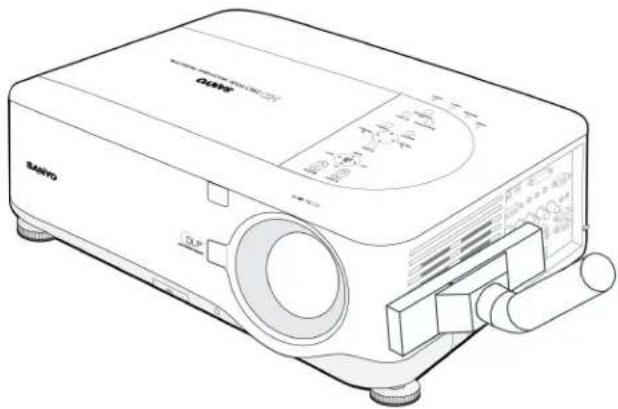
text_image
SANYO 10Ω 2.5Ω 3.5Ω 4.5Ω 5.5Ω 6.5Ω 7.5Ω 8.5Ω 9.5Ω 10.5Ω 11.5Ω 12.5Ω 13.5Ω 14.5Ω 15.5Ω 16.5Ω 17.5Ω 18.5Ω 19.5Ω 20.5Ω 21.5Ω 22.5Ω 23.5Ω 24.5Ω 25.5Ω 26.5Ω 27.5Ω 28.5Ω 29.5Ω 30.5Ω 31.5Ω 32.5Ω 33.5Ω 34.5Ω 35.5Ω 36.5Ω 37.5Ω 38.5Ω 39.5Ω 40.5Ω 41.5Ω 42.5Ω 43.5Ω 44.5Ω 45.5Ω 46.5Ω 47.5Ω 48.5Ω 49.5Ω 50.5Ω 51.5Ω 52.5Ω 53.5Ω 54.5Ω 55.5Ω 56.5Ω 57.5Ω 58.5Ω 59.5Ω 60.5Ω 61.5Ω 62.5Ω 63.5Ω 64.5Ω 65.5Ω 66.5Ω 67.5Ω 68.5Ω 69.5Ω 70.5Ω 71.5Ω 72.5Ω 73.5Ω 74.5Ω 75.5Ω 76.5Ω 77.5Ω 78.5Ω 79.5Ω 80.5Ω 81.5Ω 82.5Ω 83.5Ω 84.5Ω 85.5Ω 86.5Ω 87.5Ω 88.5Ω 89.5Ω 90.5Ω 91.5Ω 92.5Ω 93.5Ω 94.5Ω 95.5Ω 96.5Ω 97.5Ω 98.5Ω 99.5Ω- The rear filter can be accessed as shown.
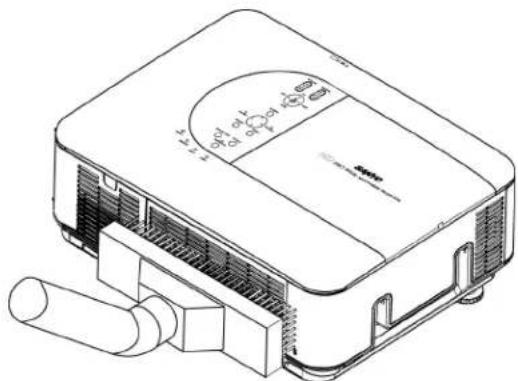
natural_image
Technical line drawing of a portable electronic device with ventilation slots and ports (no text or symbols)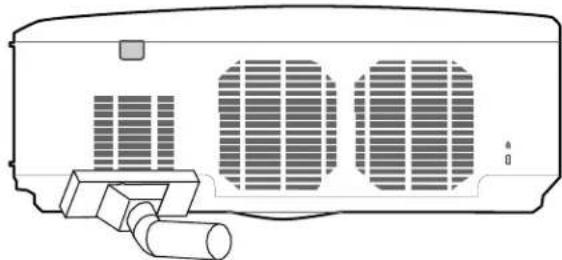
natural_image
Line drawing of a portable air conditioner unit with ventilation grilles and a cylindrical connector (no text or symbols)Once the filters are cleaned, please reset the filter hours by using the Clear filter time option in the ⑨ Reset Menu Descriptions and Functions on page 93.
Note:
Using the projector without the air filter fitted inside, dirt and dust are sucked into the projector, causing failure.
② Replacing Consumable Parts
During the course of normal usage, consumable parts become worn out resulting in reduced performance. The following guides detail how to replace the various consumable parts within the projector quickly and safely.
- Before replacing any of the parts, please take note of the following:
- Ensure that the projector is turned off and disconnected from the power supply.
- Ensure that the projector is in a clean, stable position before replacing parts.
- Allow at least one hour after shutdown for the projector to cool before attempting replacing any consumable parts.
- e.Do not interchange Lamp 1 and Lamp 2 after the projector has been used once. Doing so will not allow the projector to display the correct lamp usage hours.
- A minimum space is required for replacement. See page 24 and 98 for more details.
Replacing the Filters
When the lamps are replaced, the filters should also be replaced, not cleaned.
Refer to the following guide to replace the filters.

CAUTION
Do not drop the projector on your hand or fingers while lifting the projector to replace the filters. Doing so could injure your hand or fingers.
Note:
The filters on the side and the rear are located on the bottom.
- Gently slide the filter covers in the direction shown.

text_image
Bottom- Lift the foam from all three filters in the direction shown. Remove completely from the filter cover and discard.
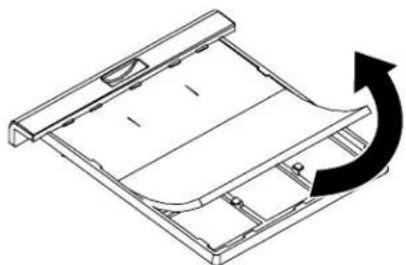
natural_image
Technical line drawing of a mechanical component with an arrow indicating rotational motion (no text or symbols)6. Maintenance
- Insert replacement foam and press down firmly.
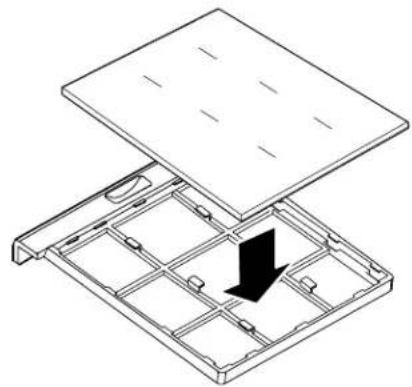
natural_image
Isometric diagram of a solar panel installation with a black arrow indicating the component (no text or symbols present)- Replace the filter covers by pushing gently in the direction shown.
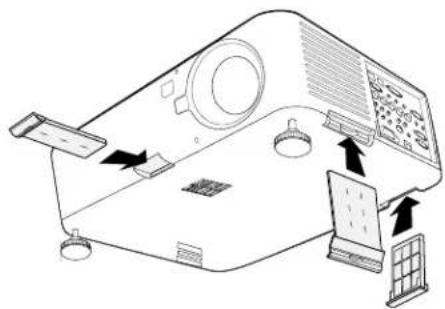
natural_image
Line drawing of a projector with labeled components and directional arrows indicating motion (no text or symbols)Once the filters are replaced, please reset the filter hours by using the Clear filter time option in the ⑨ Reset Menu Descriptions and Functions on page 93.
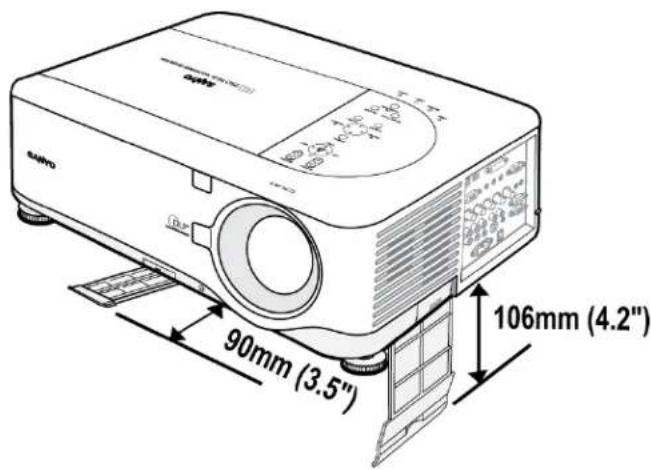
text_image
90mm (3.5") 106mm (4.2")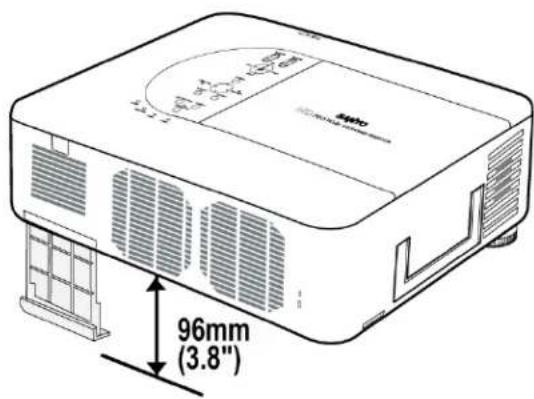
text_image
96mm (3.8")Replacing the Lamps
When a lamp reaches the end of it's usable life, the following message is displayed. Replace the lamp.
The lamp has reached the end of its usable life. Please replace the lamp.
The projection lamps should be replaced when they burn out. They should only be replaced with a certified replacement part, contact your local dealer if unsure.
Note:
- Lamps are positioned differently. Take care not to force the lamps when replacing.
- Installation of both lamp modules (Lamp 1 and Lamp 2) is required to operate the projector in dual or single lamp mode. If only a single lamp module is installed, the projector's lamp will not turn on and will appear as a lamp failure.
- Lamps last approximately 2000-2100 hours (2500-2600 hours in Eco mode) and the End of lamp life message is displayed during the lamps' final 100 hours of operational life. Please replace during 2000-2100 hour.
Important:
- The lamp contains a certain amount of mercury and should be disposed of according to local ordinance regulations.
- Avoid touching the glass surface of the new lamp: doing so may shorten its operation life.

Lamp Handling Precautions
This projector uses a high-pressure lamp which must be handled carefully and properly. Improper handling may result in accidents, injury, or create a fire hazard.
- Lamp life may differ from lamp to lamp and according to the environment of use. There is no guarantee of the same life for each lamp. Some lamps may fail or terminate their life in a shorter period of time than other similar lamps.
- If the projector indicates that the lamp should be replaced, i.e., if LAMP 1 and/or LAMP 2 light up, replace the lamp with a new one IMMEDIATELY after the projector has cooled down. (Follow carefully the instructions in the Lamp Replacement section of this manual.) Continuous use of the lamp with LAMP 1 and/or LAMP 2 lighted may increase the risk of lamp explosion.
- A Lamp may explode as a result of vibration, shock or degradation as a result of hours of use as its lifetime draws to an end. Risk of explosion may differ according to the environment or conditions in which the projector and lamp are being used.
If a lamps explodes, the following safety precautions should be taken:
Disconnect the projector's AC plug from the AC outlet immediately. Contact an authorized service station for a checkup of the unit and replacement of the lamp. Additionally, check carefully to ensure that there are no broken shards or pieces of glass around the projector or coming out from the cooling air circulation holes. Any broken shards found should be cleaned up carefully. No one should check the inside of the projector except those who are authorized trained technicians and who are familiar with projector service. Inappropriate attempts to service the unit by anyone, especially those who are not appropriately trained to do so, may result in an accident or injury caused by pieces of broken glass.

CAUTION
Allow a projector to cool for at least 60 minutes before you open the Lamp cover. The inside of the projector can become very hot.

CAUTION
For continued safety, replace with a lamp of the same type lamp. Do not drop the lamp or touch the glass bulb! The glass can shatter and may cause injury.
Check the lamp number to be replaced by using Information Menu.
Turn off the projector and disconnect the AC plug. Allow the projector to cool for at least 60 minutes.
- Loosen the screw on the lamp cover (A), and remove the lamp cover as shown (B).
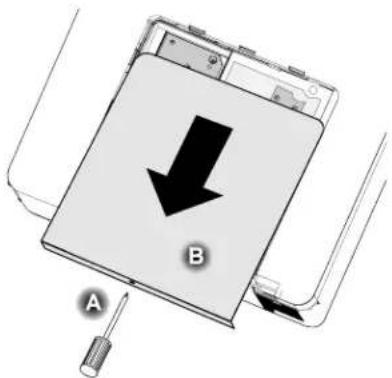
text_image
A B- Loosen the two captive screws on the lamp module (A). Lift the module handle up as shown (B).
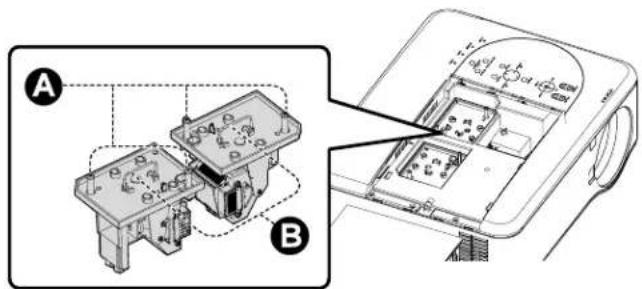
text_image
Technical diagram showing a device with labeled components A and B, including internal components and a close-up view of the interior panel.- Pull firmly on the module handle in the direction shown to remove the lamps.
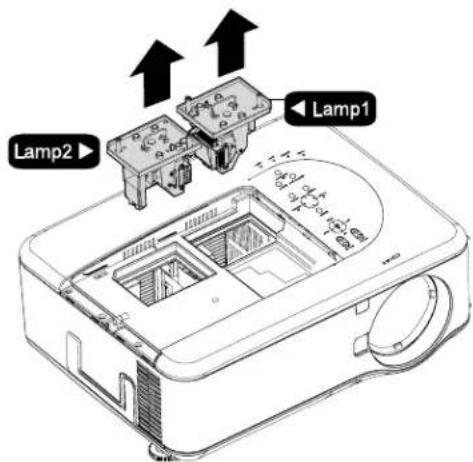
text_image
Lamp2 Lamp1- Reverse steps 1 to 3 to install the new lamp module and replace the lamp cover.
Resetting the Lamp Time Counter
After replacing the lamp(s), the lamp hour counter(s) should be reset to zero. Refer to the following guide:
- Press the Menu button on the OSD control panel or Remote Control to open the Main menu.
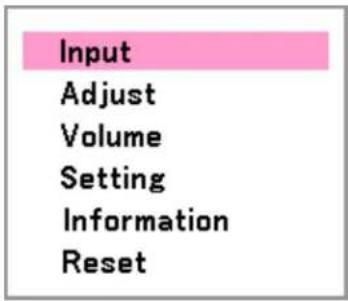
text_image
Input Adjust Volume Setting Information Reset-
Press the ▲ or ▼ button to move to the Reset menu and press Select.
-
The Reset menu is displayed. Select Clear lamp1 time or Clear lamp2 time as required using ▲ or ▼ and press Select.
-
A confirmation box is displayed. Select OK using ◀ or ▶ and press Select to reset the selected Lamp hours to zero.
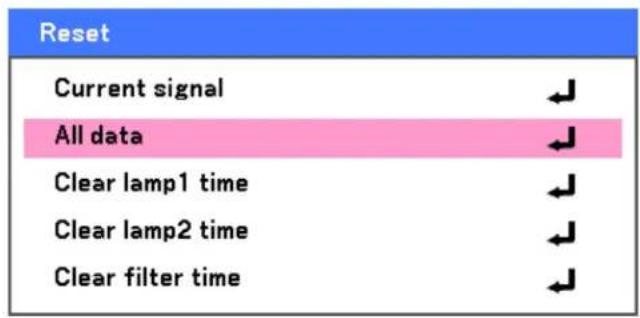
text_image
Reset Current signal All data Clear lamp1 time Clear lamp2 time Clear filter time
text_image
Are you sure ? OK CancelOrdering a Replacement Lamp
Replacement lamp can be ordered through your dealer. When ordering, give the following information to the dealer.
• Model No. of your projector: PDG-DWT50L, PDG-DWT50KL
- Replacement Lamp Type No: POA-LMP117
(Service Parts No. 610 335 8406)
7. Appendix
① Troubleshooting
Indicator Messages
Several indicator messages are used by the projector to alert users of problems with setup or internal parts. The LEDs on the top surface of the projector show the status of the WARNING and lamp 1/2 as well as the general working order of the projector through the WARNING LED (see OSD Controls and Status LEDs on page 7 for location). The following tables describe the various states of the 4 LEDs.
The POWER LED
| PROJECTOR STATUS | LED CONDITION | LED SEQUENCE | PROJECTOR CONDITION |
| AC off Off Off Off | |||
| Cooling | Orange | 0.5 secs on blink0.5 secs off | After power off |
| Power up sequence Green blink | 0.5 secs on 0.5 secs off | Start up | |
| Standby | Orange | on On | |
| Power on Green on On On | |||
The WARNING LED
| PROJECTOR STATUS | LED CONDITION | LED SEQUENCE | PROJECTOR CONDITION |
| Normal condition Off Off | Power on | ||
| Cover ERROR | Red 1 time blink (repeatedly) | 0.5 secs on2.5 secs off | ERROR |
| Temperature ERROR | Red 2 times blink (repeatedly) | (0.5 secs ON > 0.5 secs OFF) * 2 > 2.0 secs OFF | ERROR |
| Power ERROR | Red 3 times blink | (0.5 secs ON > 0.5 secs OFF) * 3 > 2.0 secs OFF | ERROR |
| Fan ERROR | Red 4 times blink (repeatedly) | (0.5 secs ON > 0.5 secs OFF) * 4 > 2.0 secs OFF | ERROR |
| Keylocked (when push key) | Orange light up | On | Keylocked function enabled |
| Standby (Power-saving) | Off | Off | Standby (Power-saving) |
| Standby (Normal) | Green light | On | Standby (Normal) |
The LAMP LEDs
| PROJECTOR STATUS | LED CONDITION | LED SEQUENCE | PROJECTOR CONDITION |
| Lamp off Off Off Lamp off | |||
| End of the lamp life Red blink | 0.5 secs on0.5 secs off | Replace lamp | |
| No lamp | Red 1 time blink (re-peatedly) | 0.5 secs on2.5 secs off | ERROR |
| Lamp ERROR | Red 6 times blink (re-peatedly) | (0.5 secs ON > 0.5 secs OFF) * 6 > 2.0 secs OFF | ERROR |
| Cooling lamp Orange blink | 0.5 secs ON > 0.5 secs OFF | Switching lamp1 and 2 | |
| Re-light up sequence Green blink | 0.5 secs ON > 0.5 secs OFF | Start up | |
| Lamp life over Red on On Replace lamp | |||
| Eco mode Orange on On Power on | |||
| Normal mode Green on On Power on |
Common Problems and Solutions
These guidelines provide tips to deal with problems you may encounter while using the projector. If the problem remains unsolved, contact your dealer for assistance.
Often the problem is something as simple as a loose connection. Check the following before proceeding to the problem-specific solutions.
- Use some other electrical device to confirm that the electrical outlet is working.
- Ensure the projector is turned on.
- Ensure all connections are securely attached.
- Ensure the attached device is turned on.
- Ensure a connected PC is not in suspend mode.
- Ensure a connected notebook computer is configured for an external display. (This is usually done by pressing an Fn-key combination on the notebook.)
Tips for Troubleshooting
In each problem-specific section, try the steps in the order suggested. This may help you to solve the problem more quickly.
Try to pinpoint the problem to avoid replacing non-defective parts.
For example, if you replace batteries and the problem remains, put the original batteries back and go to the next step.
Keep a record of the steps you take when troubleshooting: The information may be useful when calling for technical support or for passing on to service personnel.
② Image Problems
Problem: No image appears on the screen
- Verify the settings on your notebook or desktop PC.
- Turn off all equipment and power up again in the correct order.
Problem: The image is blurred
- Adjust the Focus on the projector.
- Press the AUTO PC ADJ. button on the remote control or projector.
- Ensure the projector-to-screen distance is within the specified range.
- Check that the projector lens is clean.
- Remove the lens cover.
Problem: The image is blurred and distorted
- Check the WXGA Mode is set to Off (see page 63).
- When WXGA Mode is set to On, an XGA (1024 x 768) signal may not be recognized. Set WXGA Mode to Off if this occurs. To check if the signal is recognized, go to "Input" under "Information" menu (see page 90).
Problem: The image is wider at the top or bottom (trapezoid effect)
- Position the projector so it is as perpendicular to the screen as possible.
- Use the Keystone button on the remote control to correct the problem.
Problem: The image is reversed or upside down
- Check the Ceiling & Rear setting on the Setting menu of the OSD.
Problem: The image is streaked
- Set the Total dots and Fine sync. settings on the Adjust menu of the OSD to the default settings.
- To ensure the problem is not caused by a connected PC's video card, connect to another computer.
Problem: The image is flat with no contrast
- Adjust the Contrast setting on the Adjust menu of the OSD.
- Adjust the Brightness setting on the Adjust menu of the OSD.
Problem: The color of the projected image does not match the source image.
- Adjust the Color temp. and Gamma settings on the Detail setting menu of the OSD.
Lamp Problems
Problem: There is no light from the projector
- Check that the power cable is securely connected.
- Ensure the power source is good by testing with another electrical device.
- Restart the projector in the correct order and check that the Power LED is green.
- If you have replaced the lamp recently, try resetting the lamp connections.
- Replace the lamp module.
- Remove the lens cap.
- Put the old lamp back in the projector and have the projector serviced.
Problem: The lamp goes off
- Power surges can cause the lamp to turn off. Press the power button twice to turn off the projector. When the Power LED is orange, press the power button.
- Replace the lamp module.
- Put the old lamp back in the projector and have the projector serviced.
Remote Control Problems
Problem: The projector does not respond to the remote control
- Direct the remote control towards remote sensor on the projector.
- Ensure the path between remote and sensor is not obstructed.
- Turn off any fluorescent lights in the room.
- Check the battery polarity.
- Replace the batteries.
- Turn off other Infrared-enabled devices in the vicinity.
- Have the remote control serviced.
- Ensure that the remote control code conforms to the projector's code.
- Ensure that the reset switch in the compartment lid on back of the remote control is set to use position.
Audio Problems
Problem: There is no sound
- Adjust the volume on the remote control.
- Adjust the volume of the audio source.
- Check the audio cable connection.
- Test the source audio output with other speakers.
- Have the projector serviced.
Problem: The sound is distorted
- Check the audio cable connection.
- Test the source audio output with other speakers.
- Have the projector serviced.
③ Having the Projector Serviced
If you are unable to solve the problem, you should have the projector serviced. Pack the projector in the original carton. Include a description of the problem and a checklist of the steps you took when trying to fix the problem. The information may be useful to the service personnel. Return the projector to the place you purchased it.
8. Specifications
① Projector Specifications
This section provides technical information about the projector's performance.
Optical Specifications
| ITEM DESCRIPTION | |
| Projection system Single DLP | ^ chip, 4 segment color wheel |
| Resolution 1280 x 768 pixels* (up to UXGA @ 60 Hz, up to SXGA+ @ 60 Hz on DVI-D) | |
| Lamp 260 W AC (230 W in Eco mode), Dual lamp system | |
| Image size (diagonal) | 50" - 200" / 1.27m - 5.08m (LNS-W41)40" - 500" / 1.02m – 12.7m (LNS-W40, LNS-S40, LNS-T40, LNS-T41) |
| Lens options | LNS-W41: Power focus, throw ratio 0.77:1, F2.0, f=11.4 mmLNS-W40: Power zoom and focus, throw ratio 1.33-1.79:1, F1.8-2.3, f=19.3-25.8 mmLNS-S40: Power zoom and focus, throw ratio 1.78-2.35:1, F1.7-1.9, f=26-34 mmLNS-T40: Power zoom and focus, throw ratio 2.22-4.43:1, F2.1-2.9, f=32-63 mmLNS-T41: Power zoom and focus, throw ratio 4.43-8.3:1, F2.2-3.1, f=63.5-117.4 mm |
| Lens shift Vertical + 0.5V, Horizontal +/- 0.1H (LNS-W40, LNS-S40, LNS-T40, LNS-T41) | |
*Effective pixels are more than 99.99%
Electrical Specifications
| ITEM DESCRIPTION | |
| Inputs | 1 Analog RGB (Mini D-Sub 15P), 1 Analog RGB R/Cr, G/Y, B/Cb, H, V (BNC x 5), 1 Digital RGB (DVI-D 24P), 1 Component Y, Cb/Pb, Cr/Pr (RCA x 3), 1 Component (Mini D-Sub 15P) shared with COMPUTER 1 IN, 1 S-Video (Mini DIN 4P), 1 Video, 3 Stereo Mini Audio, 2 (L/R) RCA Audio, 1 Remote Control (Stereo Mini) |
| Outputs | 1 RGB (Mini D-Sub 15P), 1 Stereo Mini Audio, 1 Screen Trigger |
| Control | 1 PC Control Port (D-Sub 9P), 1 GPIO (Mini D-sub 15P) |
| USB Port 1 B Type (for Service) | |
| LAN Port RJ-45 | |
| Video Compatibility | NTSC, NTSC4.43, PAL, PAL-60/N/M/B/G/H/I), SECAM, HDTV: 1080i, 720p, SDTV: 576p, 576i, 480p, 480i |
| Scan Rate | Horizontal: 15 kHz, 31 to 90 kHz (RGB: 31 kHz or over) Vertical: 50 Hz to 85 Hz |
| Video Bandwidth RGB: 100 MHz (-3dB) | |
| Color Reproduction 16.7 million colors simultaneously, Full color | |
| Horizontal Resolution NTSC / NTSC4.43 / PAL / PAL-M / PAL-N / PAL60: 540 TV linesSECAM: 300 TV linesRGB: 1280 dots (H) x 768 dots (V) | |
| External Control | RS232, IR, LAN, GPIO |
| Sync Compatibility | Separate Sync / Composite Sync / Sync on G |
| Built-in Speakers | 3W x 2 |
| Power Requirement 100 - 240V AC, 50/60Hz | |
| Input Current 7.7A | |
| ITEM | DESCRIPTION |
| Power Consumption | 655W in Dual Lamp Normal mode / 580W in Dual Lamp Eco mode350W in Single Lamp Normal mode / 315W in Single Lamp Eco mode< 30W in Standby mode Normal< 5W in Standby mode Power saving |
Mechanical Specifications
| ITEM | DESCRIPTION |
| Dimensions | 19.9" (W) x 7.6" (H) x 15.2" (D)505 mm (W) x 192 mm (H) x 385 mm (D)(not including protrusions) |
| Weight 36.3 lbs/16.5 kg |
Environmental Considerations
| ITEM | DESCRIPTION |
| Operational Temperatures | 41° to 104°F / 5° to 40°C, 10% to 90% humidity (non-condensing) |
| Storage Temperatures | 14° to 140°F (-10° to 60°C), 5% to 90% humidity (non-condensing) |
Regulations
UL/C-UL Approved (UL 60950-1, CSA 60950-1)
CB (IEC60950-1) Approved
Meets FCC Class B requirements
Meets DOC Canada Class B requirements
Meets AS/NZS CISPR.22 Class B
Meets EMC Directive (EN55022, EN55024, EN61000-3-2, EN61000-3-3)
Meets C-TICK (AS/NZS CISPR.22 Class B)
Meets Korea EK
Meets Low Voltage Directive (EN60950-1, TÜV GS Approved)
Optional Parts
The parts listed below are optionally available. When ordering those parts, specify the item name and Model No. to the sales dealer.
Wired Remote Cable (30m) : POA-CA-RC30
② Cabinet Dimensions
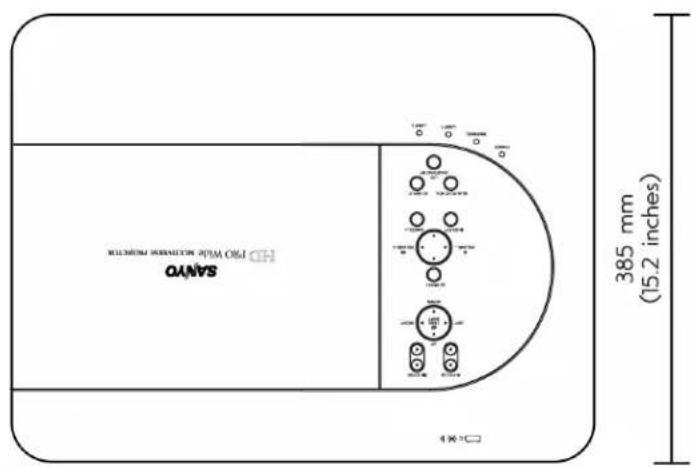
text_image
HID HID TWO WIDE MOUNTED ROOM SANDO 385 mm (15.2 inches)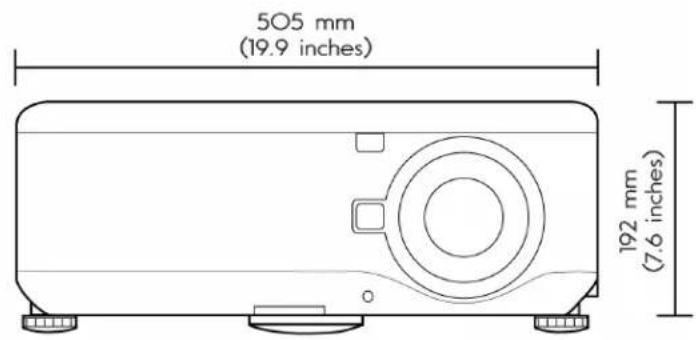
text_image
505 mm (19.9 inches) 192 mm (7.6 inches)
text_image
250 mm (9.84 inches) 18.5 mm (0.73 inches) 125 mm (4.92 inches) 30 mm (1.18 inches) 215 mm (8.46 inches) 240 mm 120 mm (4.72 inches) 240 mm (9.45 inches)Ceiling Mount: 5-M4 Depth: 12mm Max.
③ Pin Assignments of Mini D-Sub 15 Pin Input Connector

text_image
5 4 3 2 1 10 9 8 7 6 15 14 13 12 11Signal Levels
Video signal: 0.7Vp-p (Analog)
Sync signal: TTL level
| PIN NUMBER | RGB SIGNAL (ANALOG) | YCBCR SIGNAL |
| 1 | Red Cr | |
| 2 Green or Sync on Green Y | ||
| 3 Blue Cb | ||
| 4 | Ground | |
| 5 | Ground | |
| 6 Red Ground Cr Ground | ||
| 7 Green Ground Y Ground | ||
| 8 Blue Ground Cb Ground | ||
| 9 No Connection | ||
| 10 Sync Signal Ground | ||
| 11 No Connection | ||
| 12 Bi-directional DATA (SDA) | ||
| 13 Horizontal Sync or Composite Sync | ||
| 14 Vertical Sync | ||
| 15 Data Clock | ||
④ Compatible Input Signal List
The following table shows compatible signal types, their resolution and frequency refresh rates.
Horizontal: 15kHz, 31kHz to 90 kHz
Vertical: 50 Hz to 85 Hz
| Signal Resolution | H-Sync [KHz] | V-Sync [Hz] | Component | Video | RGB | DVI | |||
| VGA 640 x | 350 31.5 70.1 -- | -- | O | O | |||||
| VESA(DMT) 640 x | 350 37.9 85.1 -- | -- | O | O | |||||
| 720 x 350 | 31.5 70.0 -- | -- | O | O | |||||
| CGA84 640 x | 400 31.5 70.1 -- | -- | O | O | |||||
| VESA(DMT) 640 x | 400 37.9 85.1 -- | -- | O | O | |||||
| 720 x 400 | 31.5 70.0 -- | -- | O | O | |||||
| VESA(DMT) 720 x | 400 37.9 85.0 -- | -- | O | O | |||||
| SMT 720 x | 480 31.5 60.0 -- | -- | O | O | |||||
| SMT 640 x | 480 31.5 60.0 -- | -- | O | O | |||||
| VESA 640 x | 480 37.9 72.8 -- | -- | O | O | |||||
| VESA(DMT) 640 x | 480 37.5 75.0 -- | -- | O | O | |||||
| VESA(DMT) 640 x | 480 43.3 85.0 -- | -- | O | O | |||||
| VESA 800 x | 600 35.2 56.3 -- | -- | O | O | |||||
| VESA 800 x | 600 37.9 60.3 -- | -- | O | O | |||||
| VESA 800 x | 600 46.9 75.0 -- | -- | O | O | |||||
| VESA(DMT) 800 x | 600 48.1 72.2 -- | -- | O | O | |||||
| VESA(DMT) 800 x | 600 53.7 85.1 -- | -- | O | O | |||||
| 1024 x 768i | 35.5 43.0 -- | -- | O | O | |||||
| VESA 1024 x | 768 48.4 60.0 -- | -- | O | O | |||||
| VESA 1024 x | 768 56.5 70.1 -- | -- | O | O | |||||
| VESA(DMT) 1024 x | 768 60.0 75.0 -- | -- | O | O | |||||
| VESA(DMT) 1024 x | 768 68.7 85.0 -- | -- | O | O | |||||
| VESA(DMT) 1152 x | 864 67.5 75.0 -- | -- | O | O | |||||
| 1280 x 720 | 37.5 | 50 | -- | -- | O | O | |||
| 1280 x 720 | 45 | 60 | -- | -- | O | O | |||
| DMT | 1280 x 768 47.4 60.0 -- | -- | O | O | |||||
| DMT | 1280 x 768 47.8 60.0 -- | -- | O | O | |||||
| DMT | 1280 x 768 60.3 75.0 -- | -- | O | O | |||||
| DMT | 1280 x 768 68.6 85.0 -- | -- | O | O | |||||
| 1280 x 800 | 41.2 | 50 | -- | -- | O | O | |||
| DMT | 1280 x 800 | 49.7 | 60 | -- | -- | O | O | ||
| 1280 x 800 | 49.6 | 60.05 | -- | -- | O | O | |||
| DMT | 1280 x 800 | 62.8 | 75 | -- | -- | O | O | ||
| DMT | 1280 x 800 | 71.6 | 85 | -- | -- | O | O | ||
| VESA(DMT) 1280 x | 960 60.0 60.0 -- | -- | O | O | |||||
| VESA(DMT) 1280 x | 960 85.9 85.0 -- | -- | O | O | |||||
| VESA(DMT) | 1024 x | 64.0 | 60.0 | -- | -- | O | O | ||
| VESA(DMT) | 1024 x | 80.0 | 75.0 | -- | -- | O | O | ||
| VESA(DMT) | 1024 x | 91.1 | 85 | -- | -- | O | O | ||
| 1360 x 768 47.7 60.0 -- | -- | O | O | ||||||
- Specifications
| 1366 x 768 48.36 60 -- | O O | ||||||
| 1376 x 768 48.36 60 -- | O O | ||||||
| DMT 1400 x | 1050 64.7 60.0 -- | -- | O O | ||||
| DMT 1400 x | 1050 65.3 60.0 -- | -- | O O | ||||
| DMT 1400 x | 1050 82.3 75.0 -- | -- | O O | ||||
| CVT 1440 x | 900 55.9 60.0 -- | -- | O O | ||||
| CVT 1440 x | 900 70.6 75.0 -- | -- | O O | ||||
| CVT 1440 x | 900 80.4 85.0 -- | -- | O O | ||||
| VESA(DMT) 1600 x 1200 75.0 60.0 -- | -- | O O | |||||
| CVT 1680 x | 1050 65.3 60.0 -- | -- | O O | ||||
| 1035i | 1920x1035i | 33.75 | 60 | -- O O | -- | ||
| D-1080p/30 1920 x 1080 33.75 30 -- | -- | O O | |||||
| D-1080p/25 1920 x 1080 28.125 25 -- | -- | O O | |||||
| D-1080p/24 1920 x 1080 27 24 -- | -- | O O | |||||
| 1080P/50 | 1920 x 1080 56.25 | 50 -- | -- | O O | |||
| 1080P/60 | 1920 x 1080 | 67.5 | 60 | -- | -- | O O | |
| CVT 1920 x | 1200 74.0 60.0 -- | -- | O O | ||||
| Apple Macintosh | 640 x 480 | 35.0 66.7 -- | -- | O O | |||
| 832 x 624 | 49.7 74.5 -- | -- | O O | ||||
| 1024 x 768 60.2 74.9 -- | -- | O O | |||||
| 1152 x 870 68.7 75.1 -- | -- | O O | |||||
| NTSC/NTSC4.43 | Chroma Sub-carrier Frequency,3.58 MHz & 4.43 MHz | -- | O | -- | -- | ||
| PAL | CCIR, Chroma Sub-carrier Frequency, 4.43 MHz | -- | O | -- | -- | ||
| SECAM | CCIR Sub-carrier frequency, 4.25/4.4 MHz | -- | O | -- | -- | ||
| SDTV | 480i | 15.8 | 60.0 O | -- | -- | -- | |
| 576i | 15.6 | 50.0 O | -- | -- | -- | ||
| EDTV | 480p | 31.5 | 60.0 | O | -- | -- | -- |
| 576p | 31.3 | 50.0 | O | -- | -- | -- | |
| HDTV | 720p | 45.0 | 60.0 | O | -- | -- | -- |
| 720p | 37.5 | 50.0 | O | -- | -- | -- | |
| 1080i | 33.8 | 60.0 | O | -- | O O | ||
| 1080i | 28.1 | 50.0 | O | -- | O O | ||
O : Supported frequency
-- : Not Supported frequency
Note:
Character “i” that follows the number of displayed dots stands for interlace signal.
Flicker (line flicker) occurs in images if interlace signals are connected.
An image with higher or lower resolution than the projector's native resolution (1280 x 768) will be compressed.
Some Composite and Sync on Green signals may not be displayed correctly.
Signals other than those specified in the table above may not display correctly. If this should happen, change the refresh rate or resolution on your PC. Refer to the Display Properties help section of your PC for procedures.
⑤ PC Control Codes and Cable Connections
This projector provides a function to control and monitor the projector's operations by using the RS-232C serial port.
- Connect a RS-232C serial cross cable to SERIAL PORT IN on the projector and serial port on the PC.
- Launch a communication software provided with PC and setup the communication condition as follows:
Baud rate : 38400 bps Parity check : none Stop bit : 1 Flow control : none Data bit : 8
- Type the command for controlling the projector and then enter the "Enter" key.
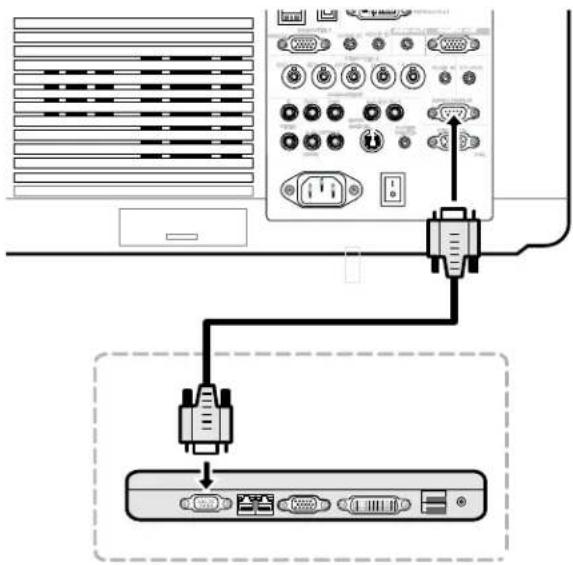
text_image
Diagram showing connection between a computer interface with an RJ48 connector and a separate USB port connected to a device.Example
When you want to change the input to Computer 2, Type "C" "0" "6" "Enter."
The below table shows the typical command lists for controlling the projector. Please consult your local dealer for further information of another commands.
Functional Execution Command Table
| COMMAND | FUNCTION |
| C00 Turn the projector ON | |
| C01 | Turn the projector OFF(immediately OFF) |
| C05 Selects Computer 1 | |
| C06 Selects Computer 2 | |
| C07 Selects Computer 3 | |
| C08 | Selects Component |
| C09 | Volume UP |
| C0A | Volume DOWN |
| C0B Audio mute ON | |
| C0C Audio mute OFF | |
| C0D Video mute ON | |
| C0E Video mute OFF | |
| C0F | Aspect 4:3 |
| C10 | Aspect 16:9 |
| C1C | Menu ON |
| C1D | Menu OFF |
| C33 | Selects Video |
| C34 | Selects S-video |
| COMMAND | UNCTION | |
| C3A | Pointer | RIGHT |
| C3B | Pointer | LEFT |
| C3C | Pointer | UP |
| C3D | Pointer | DOWN |
| C3F | Enter | |
| C46 | Zoom | DOWN |
| C47 | Zoom | UP |
| C4A | Focus | DOWN |
| C4B | Focus | UP |
| C5D Lens shift UP | ||
| C5E Lens shift DOWN | ||
| C5F | Lens shift LEFT | |
| C60 Lens shift RIGHT | ||
| C89 | Auto | PC Adj. |
| C8E | Keystone UP | |
| C8F | Keystone | DOWN |
| C90 | Keystone | RIGHT |
| C91 | Keystone | LEFT |
Status Read Command Table
| COMMAND | FUNCTION |
| CR0 | Status Read |
| CR6 | Temperature Read |
PC Control Connector (DIN-9P)

text_image
From TiD of PC To RxD of PC To GND of PC 1 2 3 4 5 6 7 8 9 To RTS of PC To CTS of PCNote:
- Pin 1, 4, 6 and 9 are not used.
- Jumper "Request to Send" and "Clear to Send" together on both ends of the cable to simplify the cable connection.
- For long cables, it is recommended to set communication speed within projector menus to 9600 bps.
⑥ Screen Trigger
When the projector is powered ON the screen trigger output sends a low voltage trigger to the screen controller and the screen will go down. When the projector is powered OFF the screen trigger stops sending a low voltage trigger to the screen controller and the screen will go up.
Note:
To use this feature, you must turn on the Screen Trigger function. See Screen Trigger on page 85 for more information.
Stereo mini cable (not supplied)

text_image
Tip (12V) Ring (0V) Sleave (ground. 0V)Note:
Screen controllers are supplied and supported by screen manufacturers.
Note:
Do not use this jack for anything other than intended use. Connecting the wired remote control to the SCREEN TRIGGER Mini Jack causes damage to the remote control.
⑦ Operation Using HTTP Browser
Overview
The use of HTTP server functions will allow control of the projector from a web browser without the installation of special software. Please be sure to use "Microsoft Internet Explorer 4.x" or a higher version for the web browser. (This device uses "JavaScript" and "Cookies" and the browser should be set to accept these functions. The setting method will vary depending on the version of browser. Please refer to the help files and the other information provided in your software).
Access is gained to the HTTP server functions by specifying the following address in the entry column of the URL:
http://
http://
Note:
The display or button responses can be slowed down or operation may not be accepted depending the settings of your network. Should this happen, consult your network administrator. The projector may not respond if its buttons are repeatedly pressed in rapid intervals. Should this happen, wait a moment and repeat. If you still can't get any response, turn off and back on the projector.
Preparation Before Use
Make network connections, set up the projector and confirm that it is complete before engaging in browser operations (see Network setting on page 80 for more information).
Operation with a browser that uses a proxy server may not be possible depending on the type of proxy server and the setting method. Although the type of proxy server will be a factor, it is possible that items that have actually been set will not be displayed depending on the effectiveness of the cache, and the contents set from the browser may not be reflected in operation. It is recommended that a proxy server not be used unless it is unavoidable.
Handling of the Address for Operation by Using a Browser
Regarding the actual address that is entered for the address or entered to the URL column when operation of the projector is via a browser, the host name can be used as it is when the host name corresponding to the IP address of the projector has been registered to the domain name server by a network administrator, or the host name corresponding to the IP address of the projector has been set in the "HOSTS" file of the computer being used.
Example 1:
When the IP address of the projector is 192.168.73.1, access is gained to the HTTP server functions by specifying http://192.168.73.1/index.html for the address or the entry column of the URL.
Configuring Network Settings
The Network Settings screen is displayed as follows:
http://

text_image
PROJECTOR Domain Host Name Domain Name Apply Mail Alert Mail Sender's Address SMTP Server Name Recipient's Address 1 Recipient's Address 2 Recipient's Address 3 Apply Test Mail Execute Text Mail Status PJLink PJLink Password Apply On OffDomain
Host Name: Type in a hostname. Up to 60 alphanumeric characters can be used.
Domain Name: Type in domain name of the network connected to the projector. Up to 60 alphanumeric characters can be used.
Apply: Click to reflect the entries.
Alert Mail: Click "Enable" to enable Alert Mail feature. This option notifies your computer of an error message via e-mail when using wired LAN. The error message will be notified when the projector lamp has reached the end of its usable life or an error occurs in the projector.
Sender's Address: Specify the sender's address. Up to 60 alphanumeric and symbols, characters can be used.
SMTP Server Name: Type in the SMTP server name to be connected to the projector. Up to 60 alphanumeric characters can be used.
Recipient's Address 1 to 3: Type in your recipient's address. Up to 60 alphanumeric and symbols characters can be used.
Apply: Click to apply the settings.
Test Mail
Send a test mail to check if your settings are correct. Click to "Execute" to enable this feature.
Test Mail Status Button: Click to display the test result.
Sample of a message sent from the projector:
Projector Name: X X X X
Lamp 1 or 2 Hours Used: xxxx [H]
The lamp is at the end of its usable life. Please replace the lamp.
Note:
If you entered an incorrect address in a test, you may not receive an Alert mail. Should this happen, check if the Recipient's Address is correctly set.
Unless any one of the [Sender's Address], [SMTP Server's Name] or [Recipient's Address 1-3] is selected, [Test Mail] is not available.
PJLink
This option allows you to set a password when you use the PJLink feature.
On/Off: Enable or disable the password.
Password: Enter a password (up to 32 characters)
Note:
PJLink is a standardization of protocol used for controlling projectors of different manufacturers. This standard protocol is established by Japan Business Machine and Information System Industries Association (JBMIA) in 2005.
The projector supports all the commands of PJLink Class 1.
| PROJECTOR INPUT | PJLINK INPUT | PARAMETER |
| Computer 1 RGB 1 11 | ||
| Computer 2 RGB 2 12 | ||
| Video | VIDEO | 1 |
| S-Video | VIDEO | 2 |
| Component | VIDEO | 323 |
| Computer 3 DIGITAL | 1 31 |
PJLink™
21
22
Structure of the HTTP Server
Once the projector is connected to a network and configured correctly, the following screen is displayed through the web browser.
http://
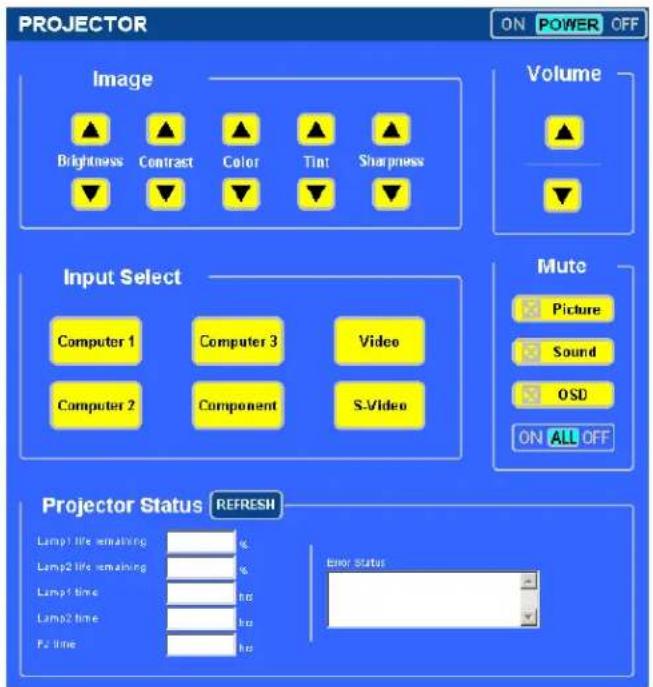
text_image
PROJECTOR ON POWER OFF Image Brightness Contrast Color Tint Sharpness Volume Input Select Computer 1 Computer 3 Video Computer 2 Component S-Video Mute Picture Sound OSD ON ALL OFF Projector Status REFRESH Lamp1 life remaining % Lamp2 life remaining % Lamp1 time %0 Lamp2 time %0 P2 time %0 Error Status| FUNCTION | SETTING DESCRIPTION | |
| Power Panel On | Off | This controls the power to the projector |
| Volume Panel | ▲ – Increases the volume adjustment value▼ – Decercases the volume adjustment value | This controls the volume of the projector |
| Mute Panel Picture On | - Mutes the videoPicture Off – Cancels the video mutingSound On – Mutes the audioSound Off – Cancels the audio mutingOSD On – Mutes the on-screen displayOSD Off – Cancels the muting of the on-screen displayAll On – Mutes each of the video, audio, and on-screen display functionsAll Off – Cancels the muting of each of the video, audio, and on-screen display functions | This controls the mute functions of the projector |
| Image Panel | Brightness ▲▼ – Increases or decreases the brightness adjustment valueContrast ▲▼ – Increases or decreases the contrast adjustment valueColor ▲▼ – Increases or decreases the color adjustment valueTint ▲▼ – Increases or decreases the hue adjustment valueSharpness ▲▼ – Increases or decreases the sharpness adjustment value | Controls the video adjustments of the projector |
8. Specifications
| FUNCTION | ETTING DESCRIPTION | |
| Input Select Panel Computer1 – Switches to the COMPUTER 1 IN connectorComputer2 – Switches to the COMPUTER 2 IN connectorComputer3 Switches to the COMPUTER 3 IN connectorComponent – Switches to the COMPONENT IN connectorsVideo – Switches to the VIDEO IN connectorS-Video – Switches to the S-VIDEO IN connector | This switches the input connector of the projector | |
| Projector Status Panel Refresh – Updates the panel with the latest information availableLamp1 life remaining – Displays the remaining life of Lamp 1 as a percentageLamp2 life remaining – Displays the remaining life of Lamp 2 as a percentageLamp1 time – Displays the number of hours Lamp 1 has been usedLamp2 time – Displays the number of hours Lamp 2 has been usedPJ time Displays the number of hours the project has been usedError Status – Displays the status of errors occurring within the projector | This displays the status of selected projector functions | |
Note:
The functions that can be controlled will vary depending on the signal being input to the projector (see 2 Selecting an Input Source on page 34 for more information).
⑧ 15 Pin GPIO Control
Type: 15Pin D-SUB black female type
| PIN NO. | SHORT/OPEN | FUNCTION | |||
| 14 | SIHORTOPEN | EXTERNAL CONTROL MODE ON EXTERNAL CONTROL MODE OFF | |||
| 5 | SHORTOPEN | POWER ON POWER OFF | |||
| 10 | SHORTOPEN | PICTURE MUTE ON PICTURE MUTE OFF | |||
| 3 | SHORTOPEN | SOUND MUTE ON SOUND MUTE OFF | |||
| 4, 8, 12, 11 11 | 12 8 4 | ||||
| OPEN | OPEN | OPEN | OPEN | COMPUTER1 | |
| OPEN | OPEN | OPEN | SHORT | VIDEO1 | |
| OPEN | OPEN | SHORT OPEN | |||
| OPEN | OPEN | SHORT SHORT | |||
| OPEN | SHORT | OPEN OPEN | |||
| OPEN | SHORT | OPEN SHORT | |||
| OPEN | SHORT | SHORT OPEN NOT AVAILABLE | |||
| OPEN | SHORT | SHORT SHORT NOT AVAILABLE | |||
| SHORT | OPEN | OPEN | OPEN | COMPUTER3 (DVI) | |
| SHORT | OPEN | OPEN SHORT NOT AVAILABLE | |||
| SHORT | OPEN | SHORT OPEN NOT AVAILABLE | |||
| SHORT | OPEN | SHORT SHORT NOT AVAILABLE | |||
| SHORT | SHORT | OPEN OPEN NOT AVAILABLE | |||
| SHORT | SHORT | OPEN SHORT NOT AVAILABLE | |||
| SHORT | SHORT | SHORT OPEN NOT AVAILABLE | |||
| SHORT | SHORT | SHORT SHORT NOT AVAILABLE | |||
Note:
The term "SHORT" is defined as having a connection to pin 15.
9. Troubleshooting Check List
Before contacting your dealer or service personnel, check the following list to be sure repairs are needed also by referring to the ① Troubleshooting section on page 102 of your user's manual. This checklist below will help us solve your problem more efficiently.
Frequency of Occurrence always sometimes (How often?____) other (____)
Power

text_image
No power (POWER indicator does not light green) See also "Status Indicator (WARNING)". Power cable's plug is fully inserted into the wall outlet. Main power switch is pressed to the ON position. Lamp cover is installed correctly. Lamp Time (lamp operation hours) was cleared after lamp replacement.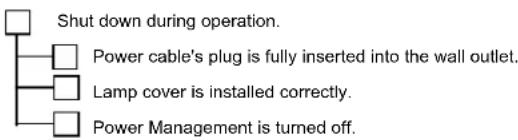
flowchart
graph TD
    A["Shut down during operation."] --> B["Power cable's plug is fully inserted into the wall outlet."]
    B --> C["Lamp cover is installed correctly."]
    C --> D["Power Management is turned off."]
Video and Audio
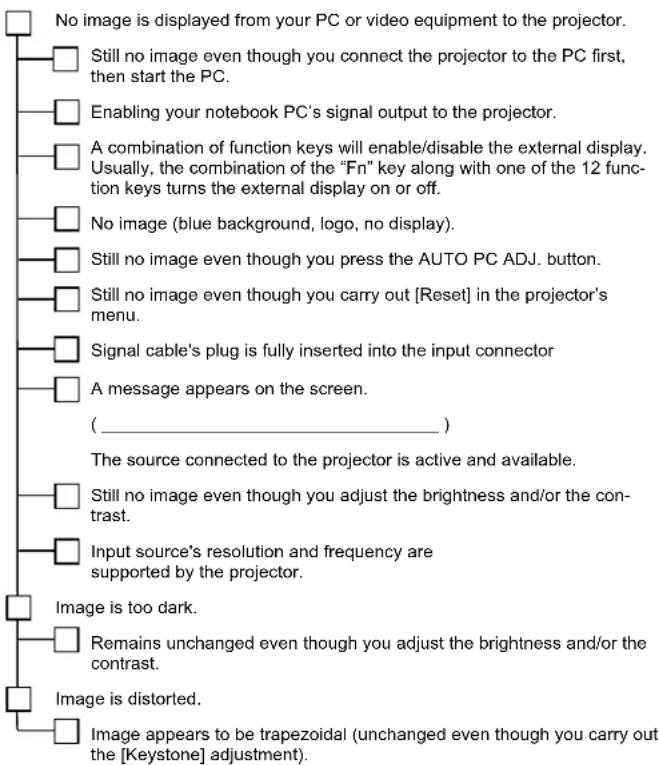
text_image
No image is displayed from your PC or video equipment to the projector. Still no image even though you connect the projector to the PC first, then start the PC. Enabling your notebook PC's signal output to the projector. A combination of function keys will enable/disable the external display. Usually, the combination of the "Fn" key along with one of the 12 function keys turns the external display on or off. No image (blue background, logo, no display). Still no image even though you press the AUTO PC ADJ. button. Still no image even though you carry out [Reset] in the projector's menu. Signal cable's plug is fully inserted into the input connector A message appears on the screen. ( _________ ) The source connected to the projector is active and available. Still no image even though you adjust the brightness and/or the contrast. Input source's resolution and frequency are supported by the projector. Image is too dark. Remains unchanged even though you adjust the brightness and/or the contrast. Image is distorted. Image appears to be trapezoidal (unchanged even though you carry out the [Keystone] adjustment).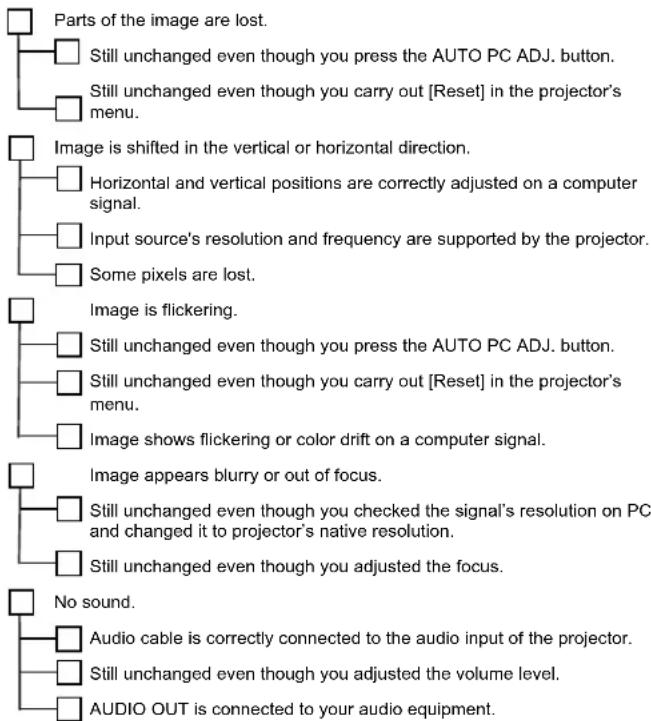
flowchart
graph TD
    A["Parts of the image are lost."] --> B["Still unchanged even though you press the AUTO PC ADJ. button."]
    B --> C["Still unchanged even though you carry out [Reset"] in the projector's menu.]
    D["Image is shifted in the vertical or horizontal direction."] --> E["Horizontal and vertical positions are correctly adjusted on a computer signal."]
    E --> F["Input source's resolution and frequency are supported by the projector."]
    F --> G["Some pixels are lost."]
    H["Image is flickering."] --> I["Still unchanged even though you press the AUTO PC ADJ. button."]
    I --> J["Still unchanged even though you carry out [Reset"] in the projector's menu.]
    J --> K["Image shows flickering or color drift on a computer signal."]
    L["Image appears blurry or out of focus."] --> M["Still unchanged even though you checked the signal's resolution on PC and changed it to projector's native resolution."]
    M --> N["Still unchanged even though you adjusted the focus."]
    O["No sound."] --> P["Audio cable is correctly connected to the audio input of the projector."]
    P --> Q["Still unchanged even though you adjusted the volume level."]
    Q --> R["AUDIO OUT is connected to your audio equipment."]
Other

flowchart
graph TD
    A["Remote control does not work."] --> B["No obstacles between the sensor of the projector and the remote control."]
    A --> C["Projector is placed near a fluorescent light that can disturb the infrared remote controls."]
    A --> D["Batteries are new and are not reversed in installation."]
    A --> E["The remote control code conforms to the projector's code."]

flowchart
graph TD
    A["Buttons on the projector cabinet do not work."] --> B["Control Panel Lock is not turned on or is disabled in the menu."]
    A --> C["Still unchanged even though you press and hold the CANCEL button for a minimum of 10 seconds."]
In the space below please describe your problem in detail.
Information on application and environment where your projector is used
Projector
Model number:
Serial No:
Date of purchase:
Lamp operating time (hours): Lamp Mode: □ Normal □ Eco
Information on input signal:
Horizontal synch frequency [ ] kHz
Vertical synch frequency [ ] Hz
Synch polarity H□(+)□(-)
V □ (+) □ (-)
Synch type □ Separate □ Composite
□ Sync on Green
WARNING Indicator:
Steady light □ Orange □ Green
Flashing light [ ] cycles
Remote control model number:
Installation environment
Screen size: inch
Screen type: □ White matte □ Beads □ Polarization
□Wide angle □High contrast
Throw distance: feet/inch/m
Orientation: □Ceiling mount □Desktop
Power outlet connection:
□ Connected directly to wall outlet
☐ Connected to power cord extender or other (the number of connected equipment ____ )
☐ Connected to a power cord reel or other (the number of connected equipment ____ )
Signal cable
SANYO standard or other manufacturer's cable?
Model number: Length: inch/m
Distribution amplifier
Model number:
Switcher
Model number:
Adapter
Model number:
Computer
Manufacturer:
Model number:
Notebook PC□/ Desktop □
Native resolution:
Refresh rate:
Video adapter:
Other:
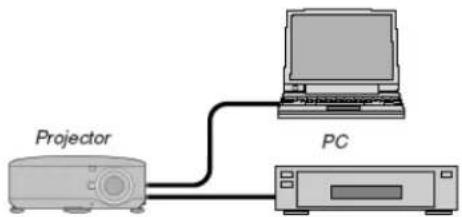
flowchart
graph TD
    A["Projector"] --> B["PC"]
    B --> A
DVD player
Video equipment
VCR, DVD player, Video camera, Video game or other
Manufacturer:
Model number: