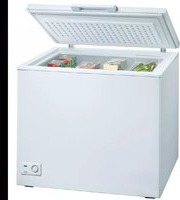
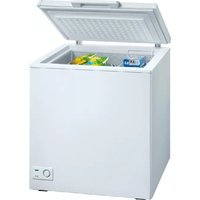
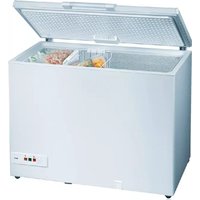
DF6023W2VV - Freezer Profilo - Free user manual and instructions
Find the device manual for free DF6023W2VV Profilo in PDF.


| Type de produit | Chest Freezer |
| Alimentation | 220-240 V, 50 Hz, 10-16 A fuse |
| Réfrigérant | R600a (inflammable, quantité sur plaque signalétique) |
| Classes climatiques | SN (10-32°C), N (16-32°C), ST (16-38°C), T (16-43°C) |
| Réglage de température | 7 positions (1 = plus chaud, 8 = plus froid) |
| Capacité de congélation | Max. capacité en 24h (voir plaque signalétique) |
| Volume utilisable | Voir plaque signalétique |
| Indicateur de fonctionnement | Voyant vert (allumé = sous tension) |
| Accessoires fournis | Panier amovible, cale d'espacement, bouchons d'évacuation |
| Dégivrage | Manuel; utiliser un racloir en plastique, pas d'objets tranchants |
| Nettoyage | Chiffon doux, eau tiède, détergent neutre; pas de nettoyeur vapeur |
| Sécurité enfants | Ne pas laisser jouer; garder la clé hors de portée si verrou existe |
| Installation | Horizontal, stable; distance minimale mur 70 mm; éviter sources de chaleur |
| Ventilation | Ne pas obstruer les ouvertures de ventilation |
| Bruit de fonctionnement | Ronronnement, gargouillis, cliquetis (normaux) |
| Service après-vente | Contacter le revendeur ou SAV; indiquer les numéros de produit (E no.) et de production (FD no.) |
| Consignes de sécurité | Ne pas utiliser d'appareils électriques à l'intérieur; ne pas endommager le circuit frigorifique |
| Élimination | Appareil usagé: débrancher, couper le câble, ne pas laisser les enfants jouer |
| Économie d'énergie | Installer dans un endroit frais, sec; ouvrir le couvercle brièvement; dégivrer régulièrement |
| Alimentation de secours | Ne pas utiliser de multiprise ou de bloc d'alimentation portable à l'arrière |
Frequently Asked Questions - DF6023W2VV Profilo
User questions about DF6023W2VV Profilo
0 question about this device. Answer the ones you know or ask your own.
Ask a new question about this device
Download the instructions for your Freezer in PDF format for free! Find your manual DF6023W2VV - Profilo and take your electronic device back in hand. On this page are published all the documents necessary for the use of your device. DF6023W2VV by Profilo.
USER MANUAL DF6023W2VV Profilo
en Operating and installation instructions

natural_image
Line drawing of a rectangular box with a lid and mounting feet (no text or symbols)DF6..
en Index
Safety and warning information 3.....
Directions for disposal 5.
Scope of delivery 5.
Installing the appliance 5.
Note the room temperature and ventilation 6.
Connecting the appliance 7.....
Getting to know the appliance 7.....
Control panel 7.
Putting the appliance into operation .
Utilisable volume
Freezer compartment ....
Max. freezing capacity
Freezing and storing 9
Freezing fresh food 9
Defrosting frozen food 10.....
Features of the appliance 10.....
Switching the appliance off and putting it out of operation ..... 10
Defrosting 11.....
Cleaning the appliance 12
Saving energy 12
8 Operating noises 13.....
- . . . . Rectifying minor faults yourself 13. . . .
8 After-sales service 14
- . . . . . . . . . .
Safety and warning information
Before you put the appliance into operation
Carefully read through the instructions for use and assembly instructions. They contain important information on setting up, using and maintaining the appliance.
The manufacturer is not liable for any damage caused by users ignoring the information and warnings contained in the instructions for use.
Retain all documents for later use or for subsequent owners.
Technical safety
The appliance contains a small quantity of the environmentally-friendly, though flammable, refrigerant R600a. Make sure that the pipes of the refrigerant circuit are not damaged during transport or installation. If refrigerant shoots out, it may ignite or cause eye injuries.
In the event of damage:
- Keep open flames or sources of ignition away from the appliance.
■Switch off the appliance and unplug it from the mains.
■Ventilate the room well for a few minutes.
■Inform the after-sales service.
The more refrigerant an appliance contains, the larger the room must be in which it stands. If there is a leak and the room is too small, a flammable gas-air mixture may form.
The room must be at least 1 m^3 in size for each 8 g of refrigerant. The volume of refrigerant in your appliance is listed on the rating plate inside the appliance. When positioning the appliance, ensure the supply cord is not trapped or damaged.
If the mains connection cable for this appliance is damaged, it must be replaced by the manufacturer, the after-sales department or a similarly qualified person. Incorrect installations and repairs may put the user at considerable risk.
Repairs must only be carried out by the manufacturer, after-sales service, or a similarly qualified person.
Only original parts from the manufacturer must be used. The manufacturer can only guarantee that the safety requirements are met if these parts are used.
Do not locate multiple portable socket-outlets or portable power supplies at the rear of the appliance.
A mains cable extension lead must only be procured from the after-sales service.
During use
■Never use electrical appliances inside the appliance (e.g. heaters, electric ice makers, etc.). Risk of explosion!
■Never defrost or clean the appliance with a steam-cleaning device. The steam may reach electrical parts and trigger a short circuit. Risk of electric shock!
■Do not use pointed or sharp objects to remove layers of ice and frost. You could damage the refrigerant pipes. If refrigerant shoots out, it may ignite or cause eye injuries.
■Do not store products with flammable propellant gases (e.g. spray cans) or explosive substances inside the appliance. Risk of explosion!
■Do not misuse the base, rails, doors, etc. as a step or support.
en
■For defrosting and cleaning, unplug the appliance from the mains or switch off the fuse. Pull on the mains plug, not on the connecting cable.
■Only store high-proof alcohol tightly sealed and in an upright position.
■Do not contaminate plastic parts or door seals with oil or grease. Plastic parts and door seals will otherwise become porous.
■Never cover or block ventilation openings for the appliance.
■Avoiding placing children and vulnerable people at risk:
At risk are children, people who have limited physical, mental or sensory abilities, as well as people who have inadequate knowledge concerning safe operation of the appliance.
Ensure that children and vulnerable people have understood the hazards. A person responsible for safety must supervise or instruct children and vulnerable people who are using the appliance.
Only children from 8 years and above may use the appliance.
Supervise children who are cleaning and maintaining the appliance.
Never allow children to play with the appliance.
■ Do not store liquids in bottles or tins in the freezer compartment (in particular carbonated drinks). Bottles and tins may burst.
■Never eat frozen foods immediately after they have been taken out of the freezer compartment. Risk of freezer burn!
■Avoid prolonged hand contact with frozen foods, ice, and the evaporator tubes, etc. Risk of freezer burn!
Children in the household
■Do not give packaging or packaging parts to children. Risk of suffocation from cardboard boxes and films!
■The appliance is not a toy.
■For appliances with a door lock: Keep the key out of the reach of children!
General requirements
The appliance is suitable for the following tasks:
■Freezing food
■Making ice cubes.
This appliance is intended for use up to a maximum height of 2000 metres above sea level.
This appliance is intended for domestic use in private households and for a domestic environment.
The appliance is fitted with interference suppression in accordance with EU Directive 2004/108/EC.
The refrigeration circuit has been checked for leak tightness.
This appliance corresponds to the relevant safety requirements for electrical appliances (EN 60335-2-24).
Directions for disposal
Disposing of packaging
The packaging protects your appliance from damage during transport. All the materials used are environmentally friendly and can be recycled. Please help by Disposing of the packaging in an environmentally-responsible manner.
You can obtain information about current disposal methods from your specialist dealer or local council.
Disposing of your old appliance
Old appliances are not worthless rubbish! Valuable raw materials can be reclaimed by recycling old appliances.
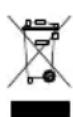
This appliance is labelled in accordance with European Directive 2012/19/EU concerning used electrical and electronic appliances (waste electrical and electronic equipment - WEEE). The guideline determines the framework for the return and recycling of used appliances as applicable throughout the EU.
Warning
Redundant appliances:
- Pull out the mains plug.
- Cut off the power cord and discard with the mains plug.
- Do not take out the trays and receptacles: children are therefore prevented from climbing in!
- Do not allow children to play with the appliance once it has spent its useful life. Danger of suffocation!
Refrigerators contain refrigerant and gases in the insulation. Refrigerant and gases must be disposed of professionally. Ensure that tubing of the refrigerant circuit is not damaged prior to proper disposal.
Scope of delivery
After unpacking the appliance, check all parts for transport damage.
If you wish to make a complaint, please contact the dealer from whom you purchased the appliance or our after-sales service.
The scope of delivery includes the following parts:
■Free-standing appliance
■Features (vary depending on the model)
■Instructions for use
■After-sales service booklet
■Guarantee slip
■Information on energy consumption and noises
■Bag of assembly materials.
Installing the appliance
Transport
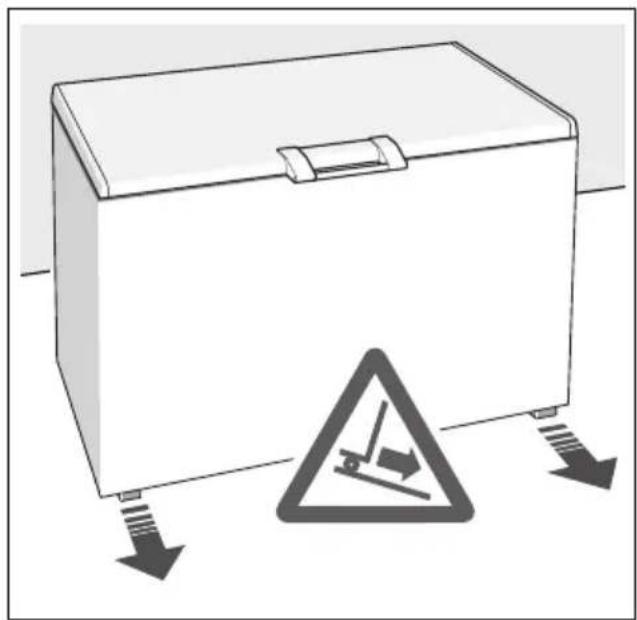
For transport, smooth-running rollers are attached to the appliance. Figure 5
Warning
If required, secure the appliance against rolling away.
en
Removing the transport locks
Figure 3
Remove the two transport locks that are attached between the chest lid and the appliance.
Fitting wall spacers
Figure 4
Place the enclosed wall spacers on the holders provided for them on the hinges at the rear of the appliance. This will maintain the minimum distance from the wall, meaning that the chest lid can be opened properly and that adequate ventilation is ensured.
Location
The ideal installation location is a dry, well-ventilated room. The installation location should not be subject to direct sunlight or be near a heat source such as a cooker, heating element, etc. If setting up the appliance next to a heat source is unavoidable, use a suitable insulating plate or observe the following minimum distances from the heat source:
■3 cm from an electric or gas cooker.
■30 cm from oil or solid fuel cookers.
If the appliance is placed against the wall, there must be a minimum distance of 70 mm to the back panel and to the side panels.
Floor surface
The floor at the installation location must not buckle and you may have to reinforce the floor.
Use a spirit level to align the appliance.
Level out any unevenness in the ground using support spacers.
Note the room temperature and ventilation
Ambient temperature
The appliance is designed for a certain climate class. Depending on the climate class, the appliance can be operated at the following ambient temperatures.
The climate class is specified on the rating plate. Figure 8
| Climate class | Permissible ambient temperature |
| SN | +10 °C to 32 °C |
| N | +16 °C to 32 °C |
| ST | +16 °C to 38 °C |
| T | +16 °C to 43 °C |
Note!
The appliance can function within the ambient temperature limits of the specified climate class.
If an appliance in the SN climate class is operated at lower ambient temperatures, damage to the appliance can be excluded up to a temperature of +5 °C.
Ventilation
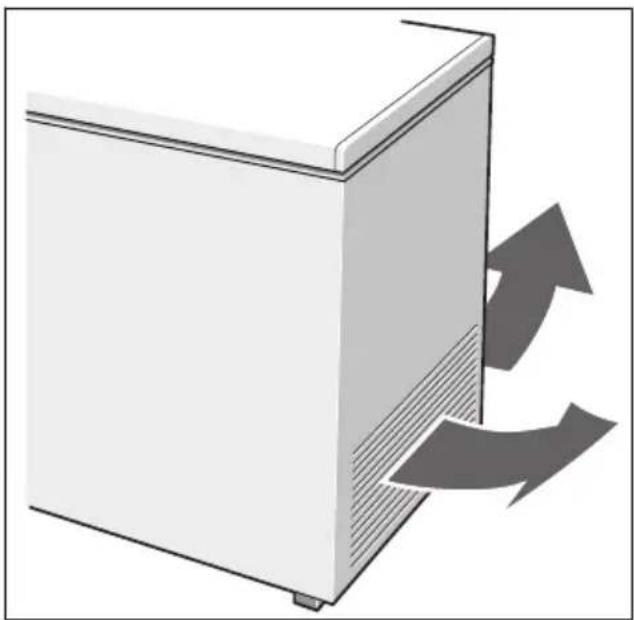
Figure 7
The air on the appliance's back panel and side panels heats up. The heated air must be able to escape unimpeded.
Otherwise, the refrigerating unit has to work harder, which increases the appliance's power consumption.
Therefore: You must never cover or block the ventilation openings!
Connecting the appliance
After setting up the appliance, wait for at least 1 hour before starting the appliance up. The oil contained in the compressor may have been displaced into the refrigeration system during transport.
Before starting the appliance up for the first time, clean its interior (see section "Cleaning the appliance").
Electrical connection
The socket must be near to the appliance and easily accessible after the appliance has been installed.
The appliance conforms to protection class I. Connect the appliance to a 220-240 V/50 Hz alternating current supply using a socket with protective earthing conductor which has been correctly installed. The socket must be protected by a fuse with a rating of 10 A to 16 A.
In the case of appliances operated outside of Europe, check whether the voltage and type of current specified conform to the values of your electricity grid. You will find this information on the rating plate, figure 8.
Warning
The appliance must never be connected up to an electronic energy-saving socket.
Sinusoidal-commutated and line-commutated inverters can be used with our appliances. Line-commutated inverters are used with photovoltaic systems that are connected directly to the national grid.
Sinusoidal-communicated inverters must be used with standalone applications (e.g. on ships or mountain huts) that do not have a direct connection to the national grid.
Getting to know the appliance

Fold out the last page that contains the figures. These instructions for use apply for several models.
Deviations between the figures are possible.
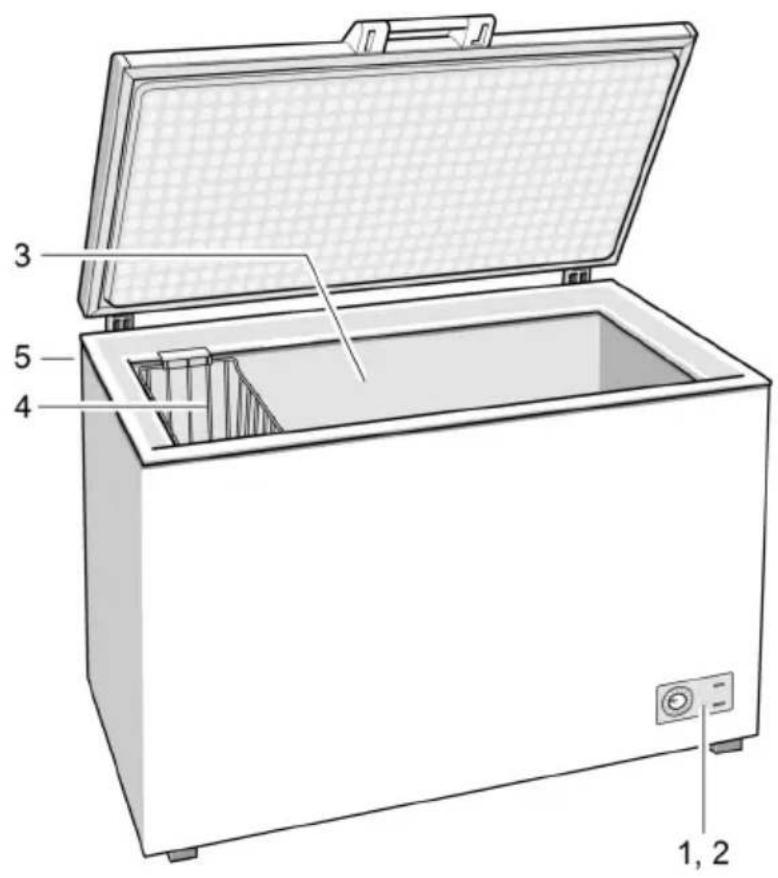
Figure 1
1-2 Control panel
3 Storage compartment
4 Basket
5 Rating plate
Control panel
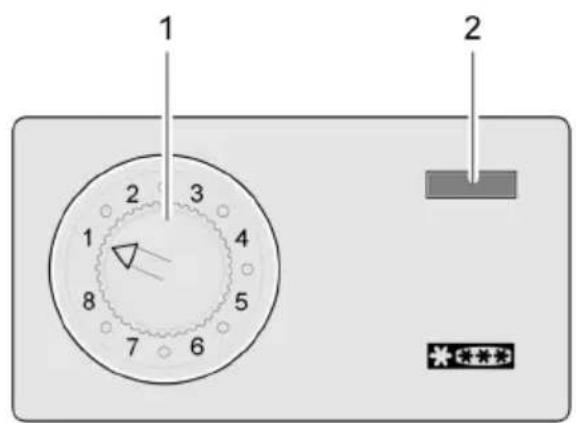
Figure 2
1 Temperature selector
To adjust the freezer compartment temperature.
Position 1: Highest temperature
Position 8: Lowest temperature
2 "power" indicator
The green indicator lights up if the appliance is switched on.
Putting the appliance into operation
Switching on the appliance
■Once it is connected, the appliance is switched on and the green indicator figure 2/2 lights up.
■The factory recommends a medium temperature setting.
Setting the temperature
To change the temperature, turn the temperature selector, figure 2/1.
Position 1: Highest temperature
Position 8: Lowest temperature
Important: Changes to the temperature take time to come into effect.
Notes on using the appliance
■After switching on the appliance, it may be several hours before the set temperature is reached.
■If you cannot open the lid immediately after closing the chest, please wait for two to three minutes until the resulting vacuum has been compensated for.
Utilisable volume
You will find information regarding the utilisable volume on the rating plate.
Figure 8
Using the entire freezing capacity
To store the maximum quantity of frozen foods, you can remove the basket from the appliance.
Freezer compartment
Use the freezer compartment for the following:
■Storing deep frozen food.
■To make ice cubes.
■To freeze food.
Note!
Ensure that the appliance is always closed. If the lid is open, the frozen food will thaw. The freezer compartment ices up heavily. In addition: Energy is lost due to the power consumption.
Max. freezing capacity
You will find information on the maximum freezing capacity in 24 hours on the rating plate. Figure 8
Freezing and storing
Purchasing frozen foods
■Packaging must not be damaged.
■Observe the best before date.
■The temperature in the commercial chest freezer must be -18 °C or colder.
■As far as possible, frozen food must be transported in an insulated container and quickly placed in the freezer compartment.
When arranging the food, note the following:
It is preferable to freeze larger quantities of food on the appliance floor because they will become frozen more quickly and gently there. Lay the food over a wide area on the floor of the appliance. Food that is already frozen must not come into contact with the food that is to be freshly frozen.
Freezing fresh food
Only use fresh, undamaged food for freezing.
In order to retain the nutritional value, aroma and colour of the food as much as possible, blanch vegetables before they are frozen. Blanching is not required for aubergines, peppers, courgettes and asparagus.
You can find literature about freezing and blanching in bookshops.
Note!
Do not allow food that is to be frozen to sit right next to food that has already been frozen.
■The following are suitable for freezing: Baked goods, fish and seafood, meat, game, poultry, vegetables, fruit, herbs, eggs without their shells, dairy products such as cheese, butter and curd cheese, prepared dishes and leftovers such as soups, stews, cooked meat and fish, potato dishes, baked casseroles and sweet foods.
■The following are not suitable for freezing:
Types of vegetables that are usually eaten raw - such as green salad or radishes, eggs in their shells, grapes, whole apples, pears and peaches, hard-boiled eggs, yoghurt, soured milk, sour cream, crème fraîche and mayonnaise.
en
Packaging frozen food
Pack food so that it is airtight to prevent it from losing its flavour or drying out.
- Store food in its packaging.
- Press out any air.
- Close the packaging tightly.
- Label packaging with its contents and date of freezing.
The following are suitable as packaging:
Plastic film, polyethylene hose film, aluminium foil, freezer bags.
You will find these products at your specialist dealer.
The following are not suitable as packaging:
Wrapping paper, greaseproof paper, cellophane, rubbish bags and used shopping bags.
The following are suitable for sealing packaging:
Rubber bands, plastic clips, pack-twines, cold-resistant scotch tape, or similar.
Polyethylene bags and hose film can be fused closed using a bag sealer.
Storage life of frozen foods
The storage life depends on the type of food.
At a temperature of -18^ :
■Fish, sausages, prepared dishes, baked goods:
Up to 6 months
■Cheese, poultry, meat:
Up to 8 months
■Vegetables, fruit:
Up to 12 months
Defrosting frozen food
You can decide between the following options, depending on the type of food and its intended use:
■At room temperature,
■in the refrigerator,
■in the electric oven, with/without hot-air ventilator,
■in the microwave oven.
Note!
Do not refreeze defrosted food. It can only be refrozen after it has been processed (cooked or roasted).
Do not continue to use the complete max. storage time for the frozen food.
Features of the appliance
Removable basket
Figure 1/4
For storing deep frozen food.
Switching the appliance off and putting it out of operation
Switch off the appliance
■Unplug the appliance from the mains or switch off the childproof lock.
Putting the appliance out of service
If you do not use the appliance for long periods:
- Remove all food from the appliance.
- Switch off the appliance.
- Defrost the appliance (see section "Defrosting").
- Clean the inside of the appliance (see section "Cleaning the appliance").
- To prevent odours from forming, leave the appliance lid open.
Defrosting
A layer of frost on the container panels impairs the cooling effect on the frozen food and increases the power consumption. You must regularly remove this layer of frost.
General tips
■When putting food in or taking food out, open the lid of the chest for as little time as possible.
■Do not install the chest freezer in a damp room. A high level of humidity aids the formation of frost.
■Package fresh food so that it is as air-tight as possible.

Attention
Do not scrape away the layer of ice using a knife or a sharp object. You could damage the refrigerant pipes. If refrigerant shoots out, it may ignite or cause eye injuries.
Defrosting the appliance
- Clear out the frozen food and store it in several layers of newspaper or wrap it in a blanket and store it in a cool place.
- Leave the lid open and unplug the mains plug.
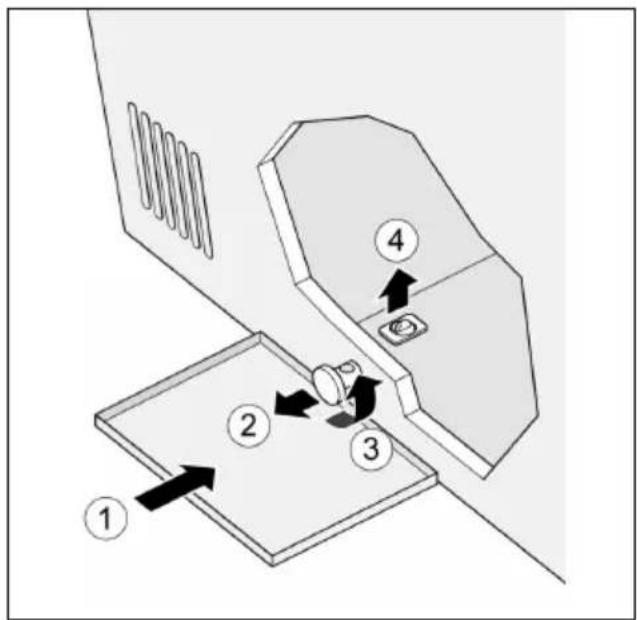
- Lay the flat drawer for collecting the condensation water under the drain hole for condensation water figure 6/1.
- Pull out the exterior drain plug, figure 6/2 and turn it until the arrow points downwards, figure 6/3.
- Pull out the interior drain plug, figure 6/4.
- After defrosting, clean the appliance and wipe the inside dry.
- Close the interior drain plug.
- Turn the exterior drain plug until the arrow points upwards and push it in.
- Plug in the appliance and put the frozen food back in.
Defrosting aids
To speed up the defrosting process, you can use a plastic scraper to remove the layer of ice

Warning
Never use electrical appliances, defrosting sprays or open flames to defrost the freezer, e.g. heaters, steam-cleaning appliances, candles, oil lamps, etc. Do not place any saucepans containing hot water in the appliance in order to speed up the defrosting.
Cleaning the appliance
You should clean the freezer compartment properly after each time it is defrosted.

Attention
■Never clean the appliance with a steam cleaning appliance.
■Do not use gritty, acidic or chlorine-based cleaning agents or solvents.
■Do not use any abrasive materials or materials that may scratch surfaces. This may lead to corrosion of the metallic surfaces.
■Never clean the equipment's accessories in the dishwasher. The parts may warp.
■The water used for rinsing must not get into the control panel.
Proceed as follows:
- Before cleaning the appliance, unplug the mains plug or disconnect the fuse.
- Take out the frozen food and store it in a cool place. Place an ice block (if you have one) on the food.
- Clean the appliance with a soft cloth, lukewarm water, and a little pH-neutral detergent.
- Only wipe the lid seal with clean water and then rub it until it is dry.
- After cleaning, reconnect the appliance to the mains and switch it on.
- Put the frozen food back in.
Saving energy
■Install the appliance in a cool, dry, well-ventilated room. The appliance must be installed out of direct sunlight and away from heat sources (e.g. heating elements, cooker). Use an insulating plate if necessary.
- Allow hot food to cool before placing it in the appliance.
■Place frozen food that is to be defrosted in your cooling compartment. Use the low temperature of the frozen food to cool down food.
■Open the appliance door for as little time as possible.
■A layer of frost in the freezer compartment impairs the cooling effect on the frozen food and increases the power consumption. If there is a layer of frost, you must defrost the appliance.
■Occasionally clean the rear of the appliance to prevent an increased power consumption.
Operating noises
Completely normal noises
Humming - The refrigeration unit is running.
Bubbling, whirring or gurgling noises - The refrigerant is flowing through the pipes.
Clicking - The motor is switching on or off.
Preventing noises
If the appliance is positioned unevenly
Use a spirit level to align the appliance so that it is level. Level out any unevenness in the ground using support spacers.
If the appliance is touching adjacent units or appliances
Move the appliance away from adjacent furniture or appliances.
Basket is wobbling or sticking
Check the removable parts and reinsert them if necessary.
Containers are touching
Move the containers apart slightly.
Rectifying minor faults yourself
Before you call the after-sales service:
Check whether you can rectify the fault yourself by using the notes below.
You must bear the costs for consultation with the after-sales services yourself - even during the warranty period.
| Problem | Possible cause Remedy | |
| The temperature deviates considerably from the setting. | In some cases, it is sufficient to switch off the appliance for 5 minutes.If the temperature is too high, wait a few hours and check whether the temperature has aligned with the setting.If the temperature is too low, wait until the next day and check the temperature again. | |
| The refrigerating unit switches on with increasing frequency and for longer periods. | The chest lid is being opened frequently.The ventilation openings are covered. Figure 7 | Do not open the chest lid unnecessarily.Remove any obstructions. |
en
| Problem | RemedyPossible cause | |
| It is too warm in the appliance. | The chest lid is being opened frequently. | Do not open the chest lid unnecessarily. |
| Lots of food has been placed in the freezer. | Turn the temperature selector to position 8 a long time before placing the frozen food inside.Figure2/1 | |
| The ventilation openings are covered. Figure7 | Remove any obstructions. | |
| The appliance is beside a heat source. | Maintain the minimum distance or use an insulating plate. | |
| The green control light (figure2/2) is not lit. | The appliance is switched off. | Connect the mains plug. |
| Power failure; the fuse protection has been switched off; the mains plug is not firmly inserted. | Check whether there is power, check the fuses. | |
| Increased formation of frost on the upper edge of the appliance. | The drain plugs are not in the correct position. | Insert the drain plugs correctly on the floor of the appliance and on the rear of the appliance (see chapter "Defrosting"). |
| The transport locks were not removed | Remove the transport locks, figure3 (see section "Installing the appliance"). | |
| The chest lid is being opened frequently. | Do not open the chest lid unnecessarily. |
After-sales service
You can find an after-sales service point near to you in the telephone directory or in the list of after-sales service points. When you call the after-sales service, quote your product number (E no.) and the production number (FD no.) of your appliance.
You will find this information on the rating plate. Figure 8
Please help us to avoid unnecessary journeys by quoting the appliance and production number. This will save you the additional associated costs.
1
2

natural_image
Diagram of an open storage cabinet with internal compartments and arrows indicating movement (no text or symbols)3

natural_image
Mechanical assembly diagram showing a bracket with a handle and arrow indicating direction (no text or symbols)4
natural_image
Illustration of a white rectangular device with a warning sign indicating hazard, and downward arrows indicating safety or hazard (no text or symbols present)5
6
natural_image
Diagram of a server unit with airflow arrows indicating movement or flow (no text or symbols)7

8

9

- en Index
- Safety and warning information
- Before you put the appliance into operation
- Technical safety
- During use
- en
- Children in the household
- General requirements
- Directions for disposal
- Disposing of packaging
- Disposing of your old appliance
- Warning
- Scope of delivery
- Installing the appliance
- Transport
- Removing the transport locks
- Fitting wall spacers
- Location
- Floor surface
- Note the room temperature and ventilation
- Ambient temperature
- Note!
- Ventilation
- Connecting the appliance
- Electrical connection
- Getting to know the appliance
- Figure 1
- Control panel
- Figure 2
- Putting the appliance into operation
- Switching on the appliance
- Setting the temperature
- Notes on using the appliance
- Utilisable volume
- Using the entire freezing capacity
- Freezer compartment
- Max. freezing capacity
- Freezing and storing
- Purchasing frozen foods
- When arranging the food, note the following:
- Freezing fresh food
- Packaging frozen food
- The following are suitable as packaging:
- The following are not suitable as packaging:
- The following are suitable for sealing packaging:
- Storage life of frozen foods
- Defrosting frozen food
- Features of the appliance
- Removable basket
- Switching the appliance off and putting it out of operation
- Switch off the appliance
- Putting the appliance out of service
- Defrosting
- General tips
- Attention
- Defrosting the appliance
- Defrosting aids
- Cleaning the appliance
- Proceed as follows:
- Saving energy
- Operating noises
- Completely normal noises
- Preventing noises
- If the appliance is positioned unevenly
- If the appliance is touching adjacent units or appliances
- Basket is wobbling or sticking
- Containers are touching
- Rectifying minor faults yourself
- Before you call the after-sales service:
- After-sales service
Brand : Profilo
Model : DF6023W2VV
Category : Freezer