EM-2260-LX - Network switch Moxa - Free user manual and instructions
Find the device manual for free EM-2260-LX Moxa in PDF.


User questions about EM-2260-LX Moxa
0 question about this device. Answer the ones you know or ask your own.
Ask a new question about this device
Download the instructions for your Network switch in PDF format for free! Find your manual EM-2260-LX - Moxa and take your electronic device back in hand. On this page are published all the documents necessary for the use of your device. EM-2260-LX by Moxa.
USER MANUAL EM-2260-LX Moxa
EM-2260-CE Development Kit User's Manual
Third Edition, April 2009
www.moxa.com/product
MOXA®
© 2009 Moxa Inc. All rights reserved. Reproduction without permission is prohibited.
EM-2260-CE Development Kit User's Manual
The software described in this manual is furnished under a license agreement and may be used only in accordance with the terms of that agreement.
Copyright Notice
Copyright © 2009 Moxa Inc.
All rights reserved.
Reproduction without permission is prohibited.
Trademarks
MOXA is a registered trademark of Moxa Inc.
All other trademarks or registered marks in this manual belong to their respective manufacturers.
Disclaimer
Information in this document is subject to change without notice and does not represent a commitment on the part of Moxa.
Moxa provides this document “as is,” without warranty of any kind, either expressed or implied, including, but not limited to, its particular purpose. Moxa reserves the right to make improvements and/or changes to this manual, or to the products and/or the programs described in this manual, at any time.
Information provided in this manual is intended to be accurate and reliable. However, Moxa assumes no responsibility for its use, or for any infringements on the rights of third parties that may result from its use.
This product might include unintentional technical or typographical errors. Changes are periodically made to the information herein to correct such errors, and these changes are incorporated into new editions of the publication.
Technical Support Contact Information
www.moxa.com/support
Moxa Americas:
Toll-free: 1-888-669-2872
Tel: +1-714-528-6777
Fax: +1-714-528-6778
Moxa China (Shanghai office):
Toll-free: 800-820-5036
Tel: +86-21-5258-9955
Fax: +86-10-6872-3958
Moxa Europe:
Tel: +49-89-3 70 03 99-0
Fax: +49-89-3 70 03 99-99
Moxa Asia-Pacific:
Chapter 1 Introduction....1-1
Overview....1-2
Appearance 1-2
EM-2260 Development Kit 1-3
EM-2260 Embedded Module 1-3
EM-2260-DK Carrier Board and Peripheral Extension Board 1-4
Package Checklist....1-4
Features....1-5
Specifications.... 1-5
Hive-Based Registry—Contrast to RAM-Based Registry 1-8
Dimensions 1-8
EM-2260 Embedded Module 1-8
EM-2260-DK Carrier Board.... 1-9
EM-2260 Peripheral Extension Board.... 1-9
Chapter 2 Software Configuration ......2-1
Software Specifications 2-2
Applications Development Environment 2-2
Networking and Communications Capabilities 2-2
Supporting Servers and Daemons 2-3
Memory and File Systems 2-3
System Manager Utility 2-4
System Information 2-4
Serial Port Configuration....2-5
Process (Thread) Monitoring/Control 2-5
Services Monitoring/Control 2-6
Display 2-7
User/Group Management 2-8
Auto Launch Configuration.... 2-9
Changing the Network Settings 2-9
Operating Your EM-2260 Computer via Telnet Client 2-10
User/Group Management....2-11
Adjusting Time Zone 2-12
Adjusting System Time.... 2-12
Starting and Stopping Services 2-12
Troubleshooting Network Connectivity.... 2-13
Simple Network Management Protocol (SNMP).... 2-14
SNMP Manager.... 2-14
Web Server Configuration 2-15
Chapter 3 Boot Loader and Console Port ....3-1
Console Ports 3-2
Operating EM-2260 Computer Via Serial Console 3-2
Go to Boot Loader Menu from Console 3-3
Firmware Upgrade Procedure 3-5
Appendix A Regulatory Approval Statement ...... A-1
Thank you for purchasing the MOXA EM-2260 RISC-based industrial ready-to-run embedded module.
This manual introduces the hardware installation, connector interfaces as well as software configurations of the EM-2260 Embedded Module and EM-2260 Development Kit.
The following topics are covered in this chapter:
Overview
□ Appearance
EM-2260 Development Kit
EM-2260 Embedded Module
EM-2260-DK Carrier Board and Peripheral Extension Board
□ Package Checklist
Features
Specifications
□ Software Specifications
□ Applications Development Environment
□ Networking and Communications Capabilities
□ Supporting Servers and Daemons
□ Memory and File Systems
☐ Hive-Based Registry—Contrast to RAM-Based Registry
Dimensions
EM-2260 Embedded ModuleEM-2260-DK Carrier Board
EM-2260 Peripheral Extension Board
Overview
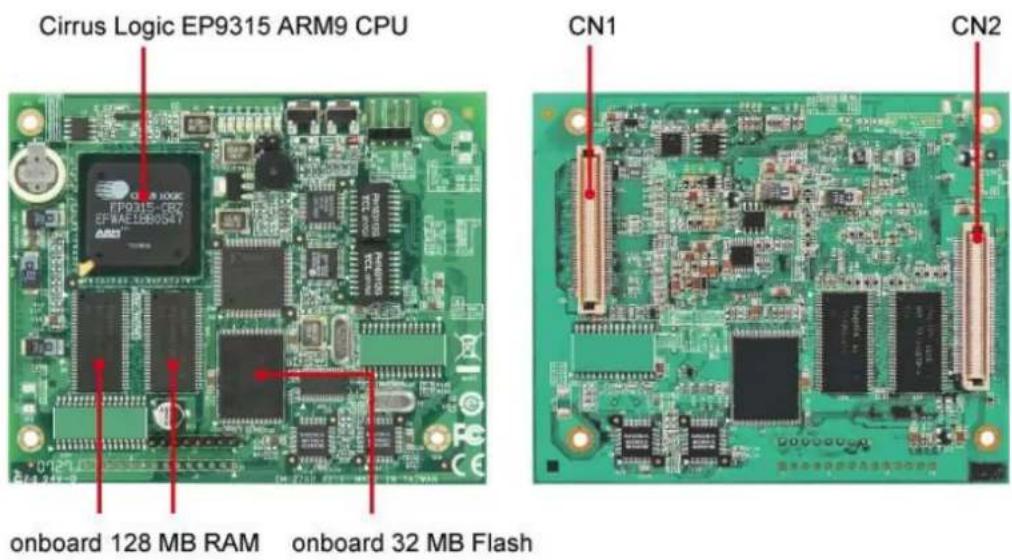
The MOXA EM-2260 Embedded Module features Cirrus Logic ARM9 CPU, 128 MB RAM, 32 MB Flash Disk, dual 10/100 Mbps Ethernet, eight digital inputs and eight digital outputs, four high speed serial ports, two USB 2.0 Hosts and an EIDE interface for external storage connection such as CompactFlash card. In addition, with built-in VGA interface, EM-2260 is suitable for SCADA system in industrial applications, that require VGA and HMI features.
The EM-2260 Embedded Module uses Cirrus Logic EP9315 ARM9, 32-bit, 200 MHz RISC CPU. This powerful computing engine supports several useful communication functions, without generating a lot of heat. This module has a compact design that is easily integrated with a variety of industrial applications, including gas stations, vending machines, and ticketing machines, and offers a powerful serial communication capability for better system integration.
The built-in 32 MB NOR Flash ROM and 128 MB SDRAM give you enough memory to run your application software directly on the EM-2260. Programmers will find the pre-installed, ready-to-run Windows CE 6.0 platform and full-function development kit a great benefit for developing software and building reliable communication applications.
The EM-2260 Embedded Module supports general Windows and .NET 2.0 computing environments. This means that programs developed for standard PC operating systems with tools such as Visual Studio 2005 can run on the EM-2260 with little or no porting effort.
In addition to the standard model, the EM-2260 Embedded Module also comes in wide temperature model that offers the operating temperature range from -40 to 75°C, and is appropriate for harsh industrial automation environments. The EM-2260 is also available with Linux, which makes it easier for programmers to develop software and build a reliable communication base for industrial automation applications.
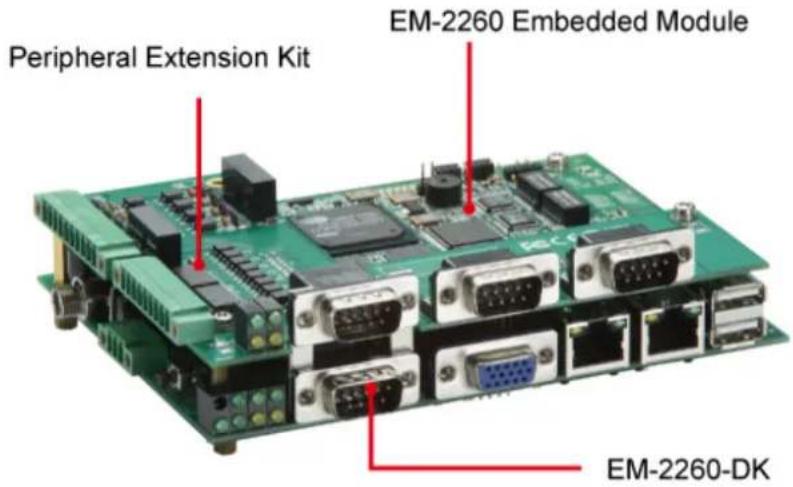
The EM-2260 Development Kit, which is designed for system and software development at the system evaluation stage, is also available. The kit combines the EM-2260 and carrier board EM-2260-DK. It is convenient for users to evaluate the functionality of EM-2260, develop and integrate the specific systems on it in advance, enabling EM-2260 embedded module to be completely compatible with the industrial systems and applications.
Appearance
The EM-2260 Development Kit contains EM-2260 embedded module, carrier board (EM-2260-DK) and Peripheral Extension Board.
EM-2260 Development Kit

ATTENTION
The EM-2260 package includes the EM-2260 embedded module only. The EM-2260 Development Kit is available for evaluation purposes.
EM-2260 Embedded Module
Front View Rear View
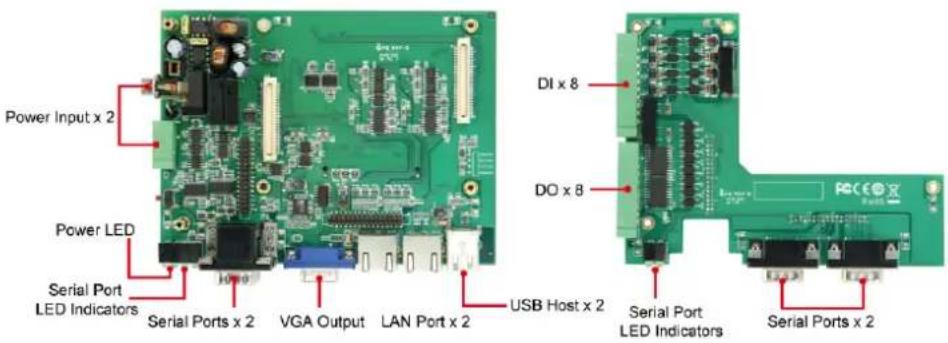
EM-2260-DK Carrier Board and Peripheral Extension Board
EM-2260-DK Peripheral Extension Board
Package Checklist
The EM-2260 Development Kit contains the following items:
• EM-2260 Embedded Module
• EM-2260-DK, the carrier board of the EM-2260 Development Kit
• Peripheral Extension Board
- Quick Installation Guide
• Document & Software CD
- Ethernet Cable: RJ45 to RJ45 cross-over cable, 100 cm
• Universal Power Adapter
• Product Warranty Paper

ATTENTION
Notify your sales representative if any of the above items are missing or damaged.
Features
The EM-2260 Embedded Module/EM-2260 Development Kit has the following features:
• Cirrus Logic EP9315 ARM9 CPU, 200 MHz
• 128 MB RAM on-board, 32 MB Flash Disk
• Graphical interface for external VGA output connection
• 4 high speed TTL serial ports
- Dual 10/100 Mbps Ethernet for network redundancy
- 8+8 DI/DO
• Support EIDE interface and USB 2.0 Host
• Ready-to-Run WinCE 6.0 or Linux platform
• Full-function development kit for quick evaluation and application development

ATTENTION
The dual Power Circuit, extra LAN controller and CF card socket are supported only by EM-2260 Development Kit. EM-2260 embedded module connects to all the input/output peripherals through signals of two 100-pin connectors.
Specifications
EM-2260 embedded module supports all the peripherals through signals of two 100-pin connectors, CN1 and CN2. Differences of EM-2260 embedded module and EM-2260 Development Kit will be specially specified.
System
CPU: Cirrus Logic EP9315 ARM9 CPU, 200 MHz
DRAM: 128 MB onboard
Flash: 32 MB Flash onboard
Storage Expansion:
EM-2260: EIDE Interface signals support up to 2 external devices connection
EM-2260 Development Kit: CompactFlash socket x 1 for storage expansion
USB:
EM-2260: Signals support USB 2.0 Host (OHCI) x3
EM-2260 Development Kit: USB 2.0 Host (OHCI) x 2, Type A connector
Console/Debugging Port: RS-232 x 1 (TxD, RxD, GND), 4-pin header output
LED
EM-2260 Development Kit: System: Power x 1, Ready x 1, Storage x 1 LAN: 10M/Link x 2 (on connector), 100M/Link x 2 (on
| connector) | |
| Serial: TxD x 4, RxD x 4 | |
| Others: | RTC, buzzer, Watchdog Timer, Reset button |
| Display | |
| Graphical Controller: | EP9315 internal graphics accelerator engine with TTL graphical signal support |
| Display Memory: | Dynamic video memory, share system memory |
| Graphical Resolution: | 1024 x 768 (8-bit), 800 x 600 (16-bit), 640 x 480 (24-bit) |
| Serial Communication | |
| Serial Port | |
| EM-2260: Signals support High speed TTL serial port x 4 | |
| (TxD, RxD, DTR, DSR, RTS, CTS, DCD, GND) | |
| EM-2260 Development Kit: | RS-232/422/485 D-Sub male 9-pin connector x 4, software-selectable. |
| RS-232 signals: TxD, RxD, DTR, DSR, RTS, CTS, DCD, GND | |
| RS-422 signals: TxD+, TxD-, RxD+, RxD-, GND | |
| 4-wire RS-485 signals: TxD+, TxD-, RxD+, RxD-, GND | |
| 2 -wire RS-485 signals: Data+, Data-, GND | |
| Protection | |
| EM-2260 Development Kit: | Built-in 15KV ESD protection for all signals, 2KV optical isolation protection |
| Data bits: | 5, 6, 7, 8 |
| Stop bits: | 1, 1.5, 2 |
| Parity: | None, Even, Odd, Space, Mark |
| Flow Control: | RTS/CTS, XON/XOFF, RS-485 ADDCTM |
| Speed: | 50 bps to 921.6 Kbps, supporting non-standard baudrates |
| Network Communication | |
| LAN: | Auto-sensing 10/100Mbps x 2, RJ45 |
| Protection: | Build-in 1.5KV magnetic isolation protection |
| Digital Input | |
| Input Channels | |
| EM-2260: Signals of 8 input channels | |
| EM-2260 Development Kit: | 8, source type |
| Digital Input Levels | |
| EM-2260: 3.3V, CMOS level | |
| EM-2260 Development Kit: | Dry contact: Logic level 0 -- Close to GND, Logic level 1 - Open. |
Wet contact: Logic level 0 -- +3V max, Logic level 1: +10V \~ +30V (COM to DI)
Protection
EM-2260 Development Kit: 3KV optical isolation protection
Connector Type
EM-2260 Development Kit: 10 Pin Screw Terminal Block (8 points / COM / GND)
Digital Output
Input Channels
EM-2260: Signals of 8 output channels
EM-2260 Development Kit: 8, sink type
Digital Output Levels
EM-2260: 3.3V, CMOS level
EM-2260 Development Kit: On-state Voltage -- 24V DC nominal, open collector to 30 V Output Current Rating -- Max. 200mA per channel
Protection
EM-2260 Development Kit: 3KV optical isolation protection
Connector Type
EM-2260 Development Kit: 9-pin Screw Terminal Block
Power Requirements
Power Input
EM-2260: +5V DC and +3.3V DC
EM-2260 Development Kit: Dual power input design
PWR1: 12 to 48V DC, power jack with thread
PWR2: 12 to 48V DC, 3-pin terminal block
Power Consumption
EM-2260: 5.4 W
EM-2260 Development Kit: 783 mA @ 12V DC without loading of USB ports 1.2A @ 12V DC with loading of USB ports
Mechanical
Dimensions
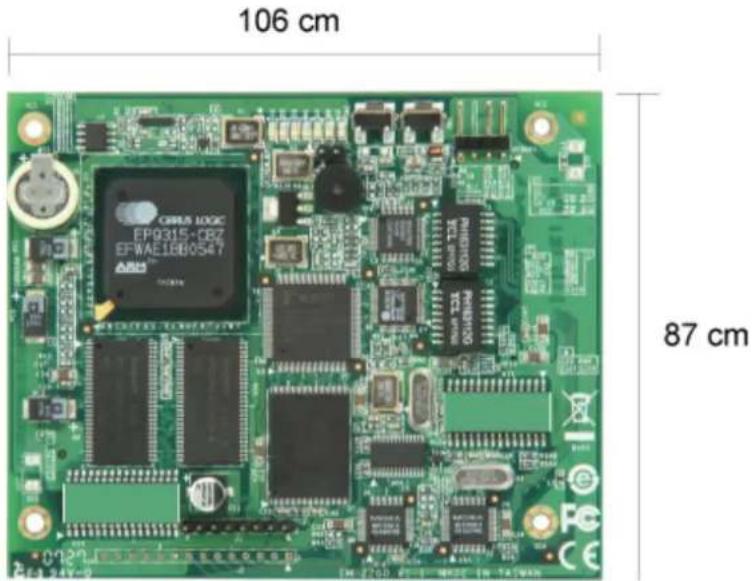
EM-2260: 87 x 106 mm
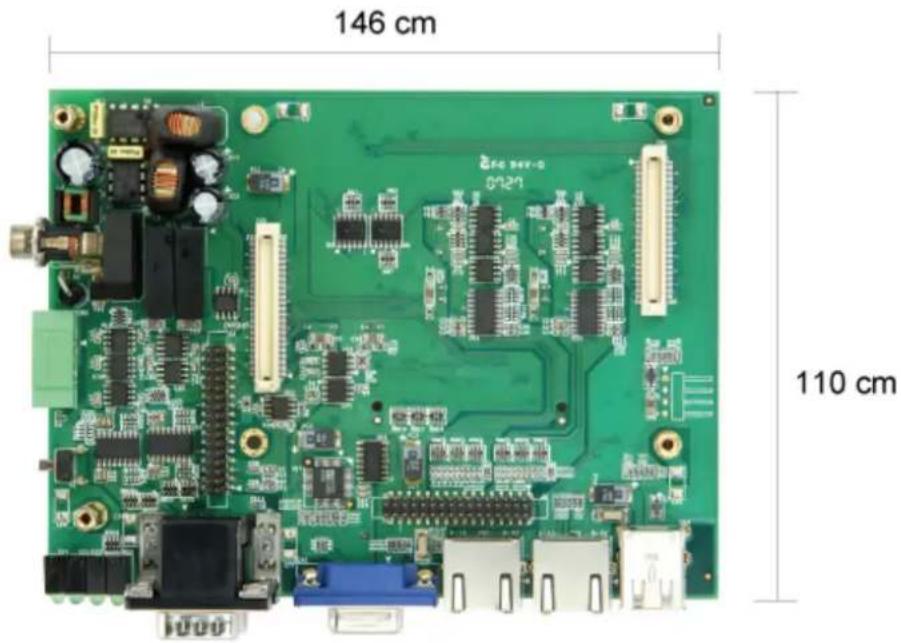
EM-2260 Development Kit: 110 x 146 mm
Environmental
Operating Temperature: -10 to 60°C (14 to 140°F)
Storage Temperature: -20 to 80°C (-4 to 176°F), 5 to 95% RH
Regulatory Approvals and Warranty
EMC: FCC, CE (Class A)
Others: RoHS, WEEE
Warranty: 5 years
Hive-Based Registry—Contrast to RAM-Based Registry
The registry for the EM-2260 is a hive-based registry in contrast to a RAM-based registry. The hive-based registry stores registry data inside files, or hives, which can be kept on any file system. This removes the need for performing backup and restore on power off.
Dimensions
EM-2260 Embedded Module
EM-2260-DK Carrier Board
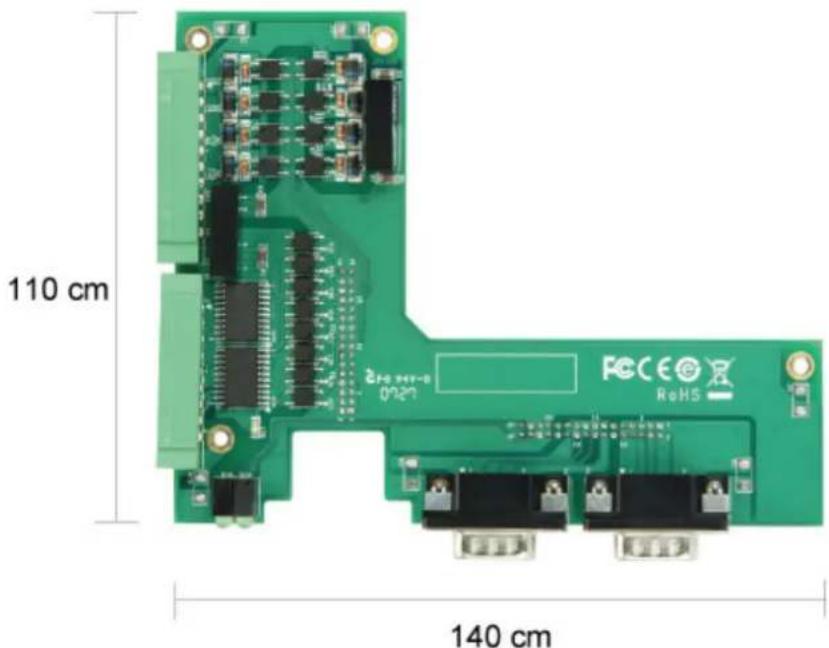
EM-2260 Peripheral Extension Board
This chapter describes basic system management utilities, such as system information, processes monitoring, serial port configuration, network and date/time setting. Some of these operations can be done via system utilities/commands after gaining access to the computer.
The following topics are covered in this chapter:
□ System Manager Utility
□ Changing the Network Settings
☐ Operating Your EM-2260 Computer via Telnet Client
□ User/Group Management
□ Adjusting Time Zone
□ Adjusting System Time
☐ Starting and Stopping Services
□ Troubleshooting Network Connectivity
☐ Simple Network Management Protocol (SNMP)
SNMP Manager
□ Web Server Configuration
Software Specifications
Applications Development Environment
To make EM-2260 an easy-to-use programming environment, its Windows CE 6.0 environment provides the following common, popular application development features that make programming convenient and easy as in a PC environment.
- C Libraries and Run-times - Compared to the C libraries and run-times used on a desktop PC running Windows, the C libraries and run-times on a EM-2260 is a subset of the WIN32 APIs. It supports full ANSI C run time, standard input/output library, standard input/output ASCII library and standard ASCII string functions. In addition, it supports compiler C++ exception handling equivalent and Run-Time Type Information (RTTI) equivalent to the desktop C++ compilers.
- Component Services (COM and DCOM) - The Common Object Model (COM) is an operating system-independent, object-oriented system for creating binary software components that can interact with other COM-based components in the same process space, in other processes, or on remote machines.
- SOAP Toolkit - SOAP is an XML - based protocol for object exchange and remote procedure calls. Microsoft Windows CE 6.0 provides functionality similar to the SOAP Toolkit version 2 on the desktop. It provides a layer that allows COM objects to use SOAP as the transport protocol for remote procedure calls and to interact with Web services.
- Microsoft .NET Compact Framework 2.0 with service pack 2 - It offers a choice of languages, initially Microsoft Visual Basic and Microsoft Visual C#, and eliminates the common problems faced with language interoperability.
- XML - Provides the Document Object Model (DOM) for base XML functionality, support for XML Query Language (XQL) and XPath, Extensible Style Sheet Language Transformations (XSLT) that enables you to transform one class of XML document to another, SAX2 support for event-based parsing of XML documents and includes MSXML Writer, and parsing based on Simple API for XML (SAX) for resource-constrained target devices.
- Winsock 2.2 - Provides enhanced capabilities over Winsock 1.1, including installable service providers for additional third-party protocols, as well as Media sense.
Networking and Communications Capabilities
For network centric embedded application usage, EM-2260, not only provides powerful communication hardware interfaces including dual Ethernet and 3-in-1 serial ports, but also supports the networking and communications capabilities that are built-in to Windows CE 6.0 OS. The features that are well supported are listed as below.
- Simple Network Management Protocol (SNMP) - Monitors remote connections to the network.
- Simple Network Time Protocol (SNTP) Client - Provides support for synchronizing the device's system time with a SNTP server, and supports Daylight Saving Time.
- Serial Communications - In addition to the 16550 UART driver bound to a debug port and the console port, it includes a special driver for 8 additional MOXA home-made serial ports.
- Network Utilities (IpConfig, Ping, Route) - Utilities for troubleshooting various network problems.
- TCP/IP - Includes IP, Address Resolution (ARP), Internet Control Message (ICMP), Internet Group Membership (IGMP), Transmission Control (TCP), User Datagram (UDP), name resolution and registration, and DHCP.
Supporting Servers and Daemons
In addition to the development and communication capability, EM-2260 embeds the services and daemons as stated next. These common and easy-to-use application servers help users to migrate the EM-2260 embedded computer to the industrial communication application very easily and conveniently.
- Telnet Server - A sample server that allows remote administration through a standard telnet client.
- FTP Server - A sample server used for transferring files to and from remote computer systems over a network using TCP/IP.
- File Server - The File Server functionality in Microsoft Windows CE enables clients to access files and other resources over the network.
- Web Server (HTTPD) - Includes ASP, ISAPI Secure Socket Layer support, SSL 2, SSL 3, and Transport Layer Security (TLS/SSL 3.1) public key-based protocols, and Web Administration ISAPI Extensions.
- Dial-up Networking - Consists of RAS client API and the Point to Point Protocol (PPP). RAS and PPP support Extensible Authentication Protocol (EAP) and RAS scripting.
- Watchdog Service – It's a CPU Hardware function for reset CPU in a user specified time interval. You must call the MOXA library function to trigger it.
Memory and File Systems
From the 128M bytes of SDRAM space, the main memory has a capacity of about 112M bytes in which the operating system and user applications run. The kernel image occupies the rest of the space.
The internal file system in the EM-2260 computer controls access to ROM and also provides file storage in the object store, which is in the RAM. The ROM file system provides persistent storage for applications and their related data even when the main power supply is lost. In the EM-2260 computer, a child directory named “NORFlash” under the root indicates the ROM storage of the flash memory of size 12M bytes.
The root directory is a RAM file system of size 50M bytes. You could adjust this size by using the "Control Panel\system". It can be used for storing temporary files for your applications.
However, do not place persistent files or applications in the root directory because they will be wiped out when the system is shutdown. Instead, place them under the directory "NORFlash".
The additional file systems on USB and CompactFlash storage devices are placed at the root of the internal file system. If you intend to use these devices to port data between your PC and the EM-2260 computer, please format them as the FAT file system on your PC.
System Manager Utility
To resolve management issues, a user friendly management system is installed into the EM-2260 computer. Before operating this utility, please make sure you have a display monitor connected to your EM-2260 embedded computer. Then, double-click the desktop icon [System Manager].
System Information
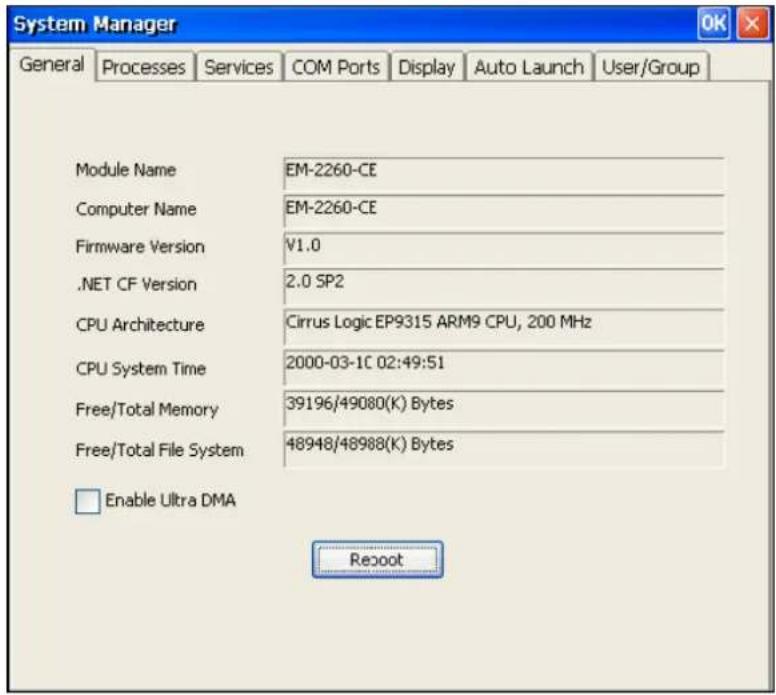
The first page displays the system information of the EM-2260 computer, including the firmware version of the computer, .Net CF version, the system time, and system resources including main memory and file system usage.
In this page user can click on the "Enable Ultra DMA" check box to enable or disable Ultra DMA for CF card. If system can not detect some CF cards please disable this setting.

ATTENTION
You must restart (reboot) the system to make the setting takes effect.
Serial Port Configuration
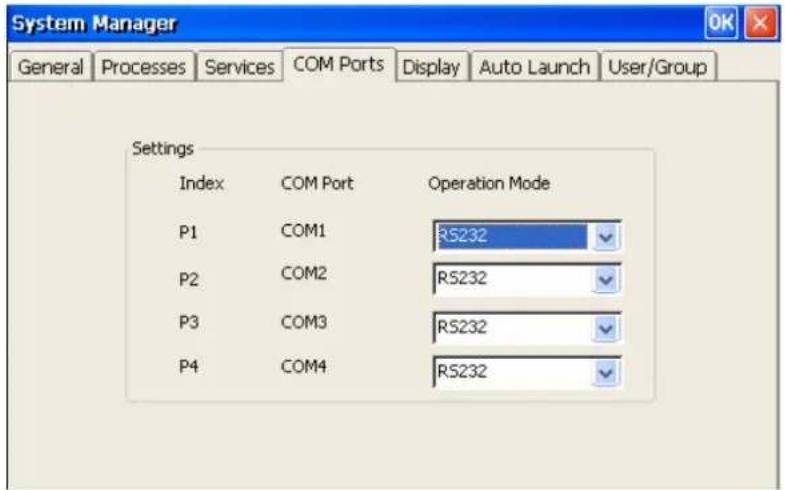
The EM-2260 contains 4 high-performance serial ports. When the system starts up you can specify the default operation mode (RS-232, 422 or 485). The factory default mode would be RS-232.
Process (Thread) Monitoring/Control
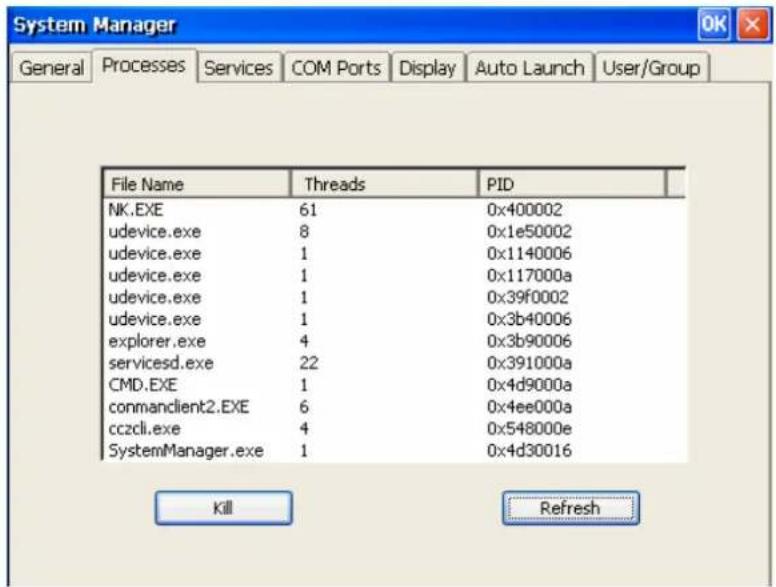
You can use the management system to monitor and control Processes or Threads. To view current processes, please click the "Processes" item on the tab bar. The running processes are then displayed. You can kill a process by clicking the "kill" button.
Services Monitoring/Control
Some services run on the background, such as FTP, Telnet and HTTP, you can click on a check box to toggle a start/stop operation for a service.
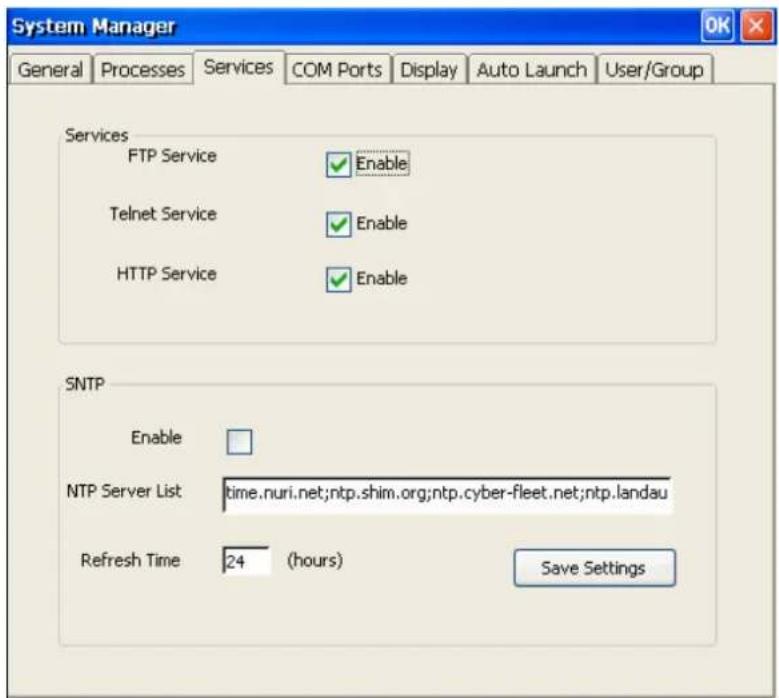
You can also adjust the time automatically by using SNTP. Click on the check box to enable the service and click the button to activate.
Some listed services cannot be stopped in order to maintain normal operation of the computer. Such services do not have a check box next to them.
Display
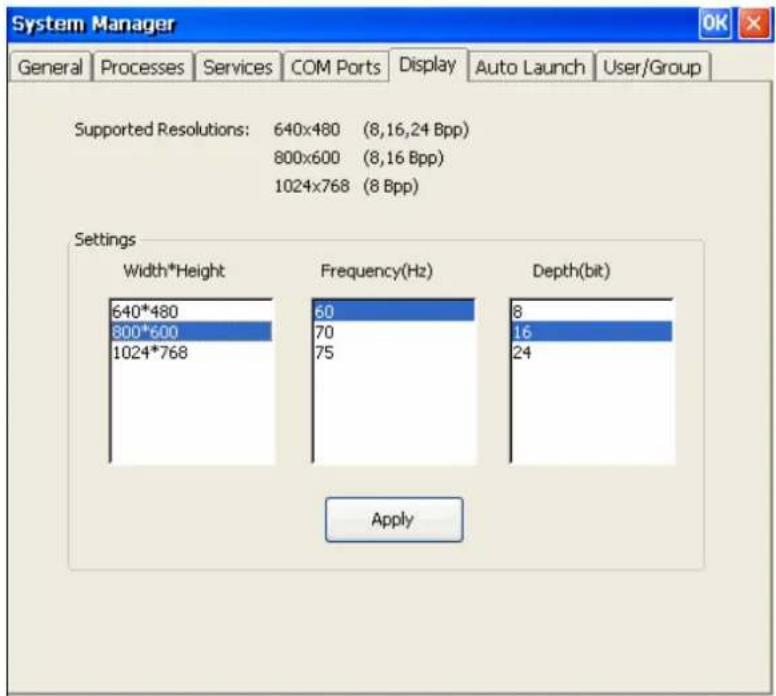
The EM-2260 VGA output works through DB15 Female connector to display the Windows CE desktop into a LCD monitor or a CRT monitor. The default setting is "800x600", 16 bit and 60Hz. You should tune the setting to match your monitor's specification. In the Display setting window you can adjust the setting and press "Apply" to save the setting.

ATTENTION
You must restart (reboot) the system to make the setting takes effect.
User/Group Management
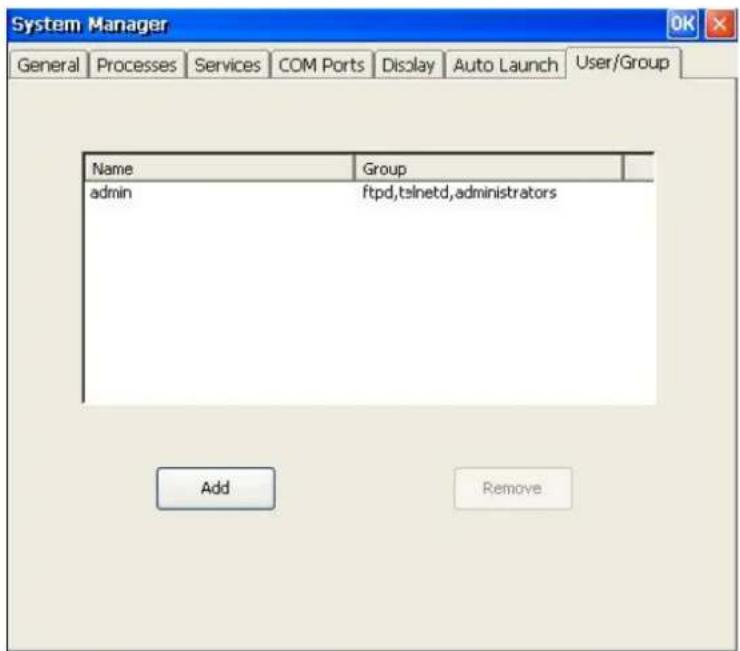
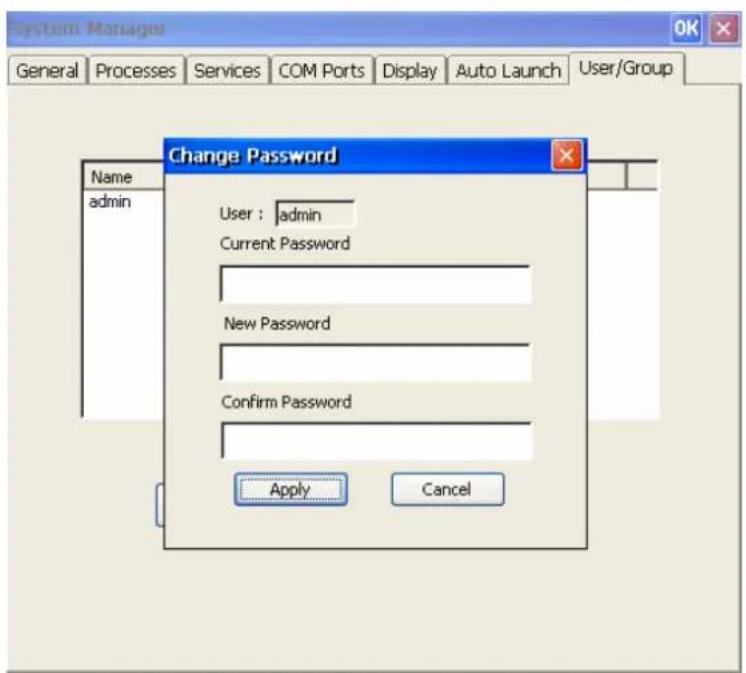
You can add users by click the "Add" button to assign specific services, such as ftp and telnet, to define user groups such that these services are accessible and remove users by click the "Remove" button.
User can change login Password by click expectative name twice.
Auto Launch Configuration
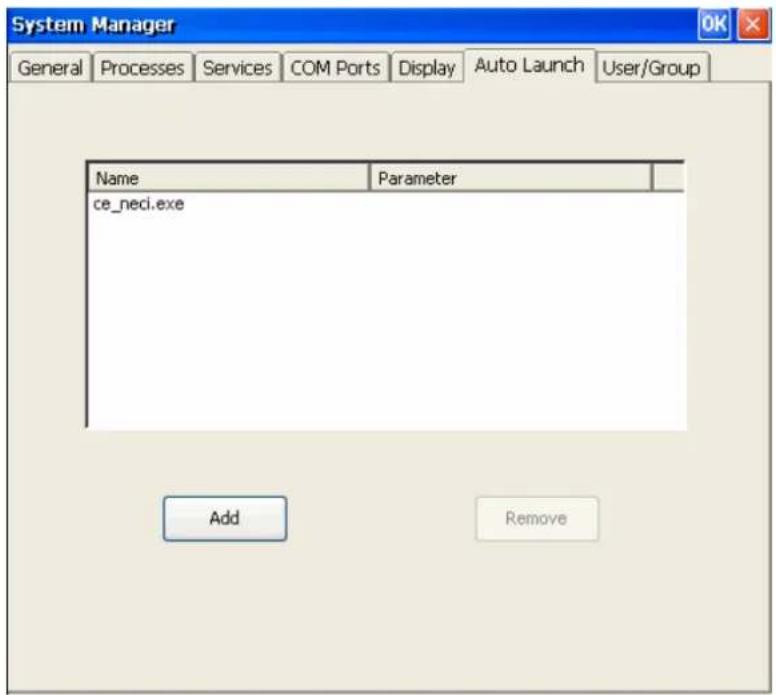
You can specify programs to execute automatically after booting up. Click "Add" button to add the program and restart EM-2260 to execute these programs.
Changing the Network Settings
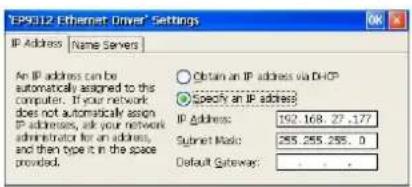
You can use Windows CE Network Control Panel to change Network Settings.
- Move you mouse, go to the [Start] → [Settings] → [Network and Dial-Up Connections].
- Right-Click the LAN icon and click the [property]


- Click "OK" button after configuration is done.


Operating Your EM-2260 Computer via Telnet Client
Before operating your EM-2260 computer using the Telnet client, we suggest that you change the network settings of the computer (see the earlier section) to have at least one of the two network ports situated in the same LAN as your development workstation.
Use a cross-over Ethernet cable to directly connect your development workstation to the target computer, or a straight-through Ethernet cable to connect the computer to a LAN hub or switch.
Next, use a telnet client in your development workstation to connect to the telnet console utility of the target computer. Upon a successful connection, type the login name and password as requested to logon to the computer.
After logging in via the console port or a telnet client, you have a list of busybox commands available to operate the computer. Use HELP to display all the commands, or type HELP [command name] to display extended help for the selected command. Some of these commands such as DATE and TIME are very useful to you to easily manage the system time of the computer. Other commands such as DIR and MKDIR are good utilities for file management. For example, to inspect the file structure of the root directory, type DIR
\> dir /b
NORFlash
My Documents
Program Files
Temp
Windows
User/Group Management
User Group: You should assign specific services, such as ftp and telnet, to defined user groups such that these services are accessible only by the users within the permissible user group. Three user groups, namely “ftpd”, “telnetd”, and “httpd”, are already created by default for your convenience.
Adding a Group: Use the command useradd -g
\> useradd -g yyyy
group yyyy has been added.
Deleting a Group: To remove a group, use the command userdel -g
\> userdel -g yyyy
group yyyy has been removed.
Adding a User: Use the command useradd
\> useradd xxxx
user xxxx has been added.
In addition, you can permit this user to access a particular service by typing -g followed by the user group name of the service, i.e., useradd -g
\> useradd -g telnetd xxxx
user xxxx is existent
group telnetd is existent
user xxxx has been added to group telnetd
Deleting a User: Use the command userdel
\> userdel xxxx
user xxxx has been deleted
You can also remove a user from a user group by using the command userdel -g
<groupName> <newUserID>. For example,
\> userdel -g telnetd xxxx
user xxxx has been removed from group telnetd
Changing the Password: Please use "System Manager" to change the Password.
Adjusting Time Zone
Windows CE 6.0 supports Time Zone. You can use [Control Panel]→[Date/Time] to adjust your current Time Zone. It also supports Daylight Date and Daylight Time.
Adjusting System Time
Setting the System Time Manually: Use the date, and time commands to query the current system date/time or to set a new system date/time.
\> date
The current date is: Tuesday, November 22, 2005
Enter the new date (mm-dd-[yy]yy): 12-23-05
\> date /T
Wednesday, November 23, 2005
\> time
The current time is: 5:27:17 PM
Enter the new time (hh:mm:ss): 16:02:00
\> time /T
4:02:04 PM
The Date/Time setting will be saved into EM-2260 RTC, which is powered by battery.
Starting and Stopping Services
After booting up, the EM-2260 computer runs several services continuously to serve requests from users or other programs. Notable services include telnet ("TEL0:"), console ("CON0:"), world wide web HTTP ("HTP0:"), file transfer FTP ("FTP0:") etc. You seldom need to care about these services. However, you still can start up or stop a service with its associated name by using the command "services". For example,
Start the FTP service by
\> services start FTP0:
Stop the FTP service by
\> services stop FTP0:
The default services in EM-2260 are listed as below:
TEL0: Telnet Service
FTP0: FTP Service
CON0: Console Service
Troubleshooting Network Connectivity
The ipconfig tool prints the TCP/IP-related configuration data of a host including the IP addresses, gateway and DNS servers.
\> ipconfig /all
Windows IP configuration
Ethernet adapter Local Area Connection:
IP Address: 192.168.3.127
Subnet Mask: 255.255.255.0
Adapter Name: AX887961
Description: AX887961
Adapter Index: 2
Address: 00 90 e8 00 00 40
DHCP Enabled: NO
Ethernet adapter Local Area Connection:
IP Address: 192.168.4.127
Subnet Mask: 255.255.255.0
Default Gateway: 192.168.15.254
Adapter Name: CS89501
Description: CS89501
Adapter Index: 3
Address: 00 90 e8 00 00 50
DHCP Enabled: NO
Host name: EM-2260
Domain Name:
NODETYPE: 8
Routing Enabled: NO
Proxy Enabled: NO
To troubleshoot network connectivity, reachability, and name resolution, use the ping command. This command verifies IP-level connectivity to another TCP/IP computer by sending Internet Control Message Protocol (ICMP) Echo Request messages. The corresponding return Echo Reply messages are displayed, along with round-trip times. For more information, type ping without parameters.
\> ping www.moxa.com
Pinging Host www.moxa.com [192.168.1.16]
Reply from 192.168.1.16: Echo size=32 time<1ms TTL=126
Reply from 192.168.1.16: Echo size=32 time<1ms TTL=126
Reply from 192.168.1.16: Echo size=32 time<1ms TTL=126
The route utility allows you to view or modify network routing tables. Type this command without parameters to view a list of functions.
\> route
To view current routing items in the tables,
\> route PRINT
To add a routing item on network interface 1, > route ADD 192.168.0.0 MASK 255.255.0.0 192.168.15.254 IF 2
To delete a routing item,
> route DELETE 192.168.0.0
Simple Network Management Protocol (SNMP)
SNMP is the Internet Standard protocol for network management and part of the TCP/IP protocol suite. SNMP was developed to monitor and manage networks. It uses a distributed architecture that consists of agents and managers:
SNMP Agent
The SNMP agent is an SNMP application that monitors network traffic and responds to queries from SNMP manager applications. The agent also notifies the manager, by sending a trap, when significant events occur.
SNMP Manager
An SNMP manager is an SNMP application that generates queries to SNMP agent applications and receives traps from SNMP agent applications.
The EM-2260 computer installs an SNMP agent to serve as an SNMP device. You should install the SNMP manager on the workstation computer (for example, a Linux system) that monitors the network. After installing the nodes, you need to configure the SNMP manager and agent.
To check SNMP agent capabilities in a target EM-2260 computer (e.g., network IP at 192.168.3.127), please log on the workstation computer that, for example, a Linux-based computer, the SNMP manager resides and type
> snmpwalk -v 2c -c public 192.168.3.127 system
SNMPv2-MIB::sysDescr.0 Microsoft Windows CE Version 6.0 (Build 1400)
SNMPv2-MIB::sysObjectID.0
SNMPv2-SMI::enterprises.8691.13.7420
SNMPv2-MIB::sysUpTime.0 1282929
SNMPv2-MIB::sysContact.0 Your System Contact Here
SNMPv2-MIB::sysName.0 WindowsCE
You will see a series of messages from the SNMP agent in the EM-2260 computer. From there, you can monitor and manage the computer.
Web Server Configuration
You need a Windows 2000 or Windows XP for Web administration. Try to open a "IE" and go to URL http://192.168.3.127/WebAdmin (e.g. the EM-2260 network IP address is 192.168.3.127).
After the logon information you could see the standard Web server Administration page.
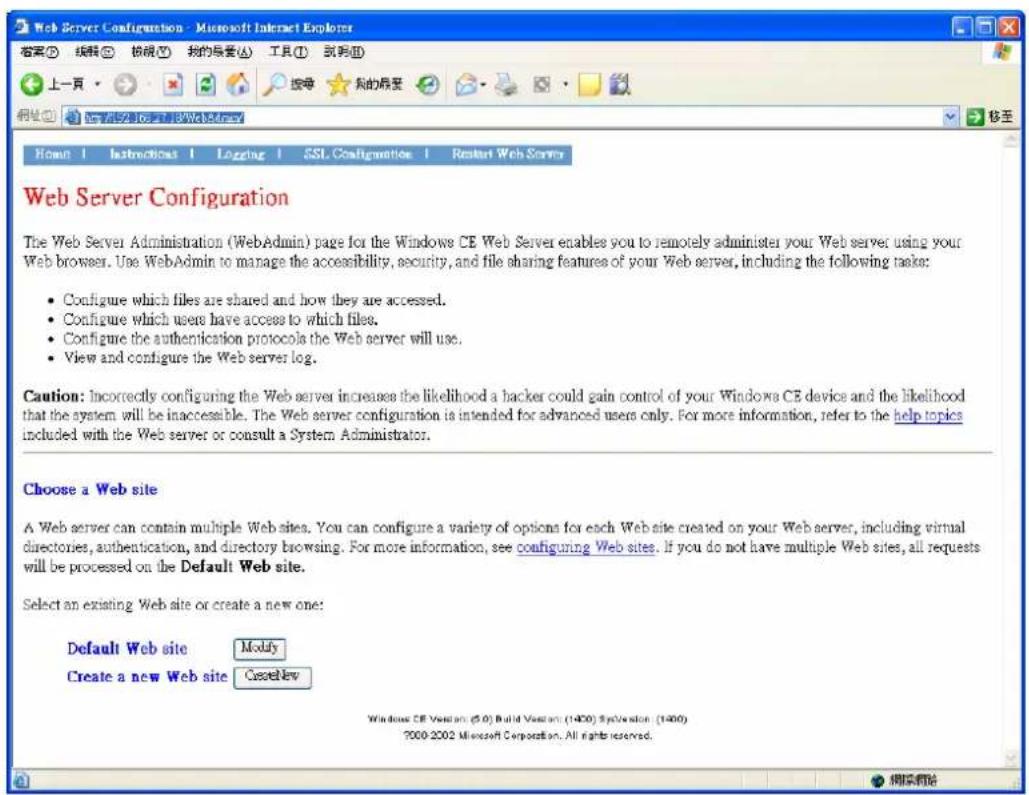
In this administration page, you can create a new web site or create a virtual web path for your web application.
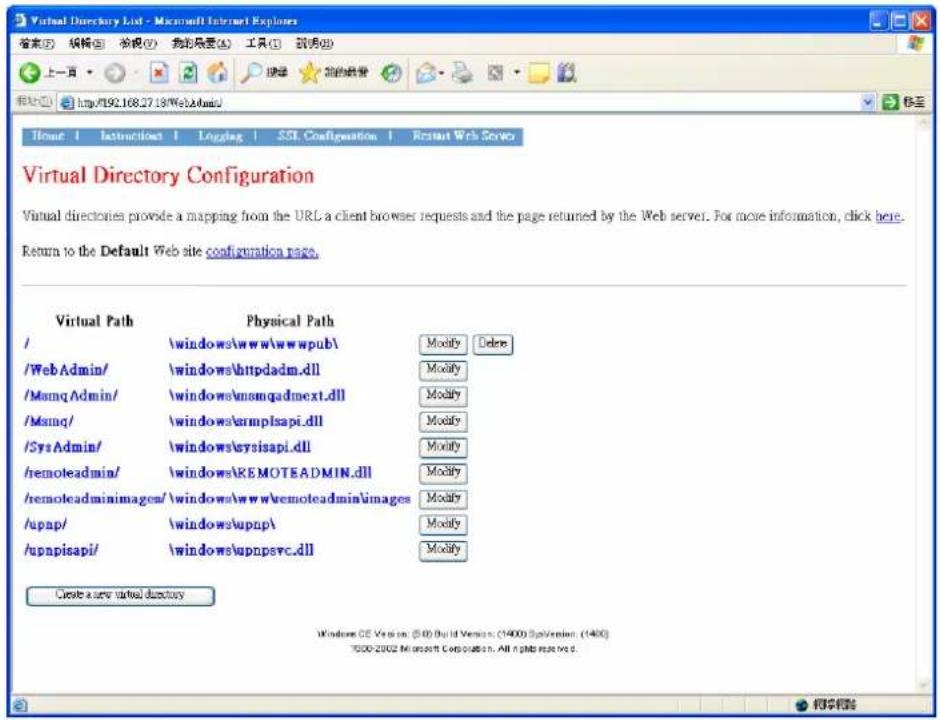
You can also change the authentication for each web virtual directory.
![Virtual Directory Configuration - Microsoft Internet Explorer 搜索(S) 编辑(E) 搜索(T) 我们喜爱(A) 工具(T) 到明(M) 上一页 地址(D) http://192.108.27.18/WebAdmin/ Virtual paths provide a mapping from the URL a client browser requests and the page returned by the Web server. For more information, click here. Return to the Default Web site configuration page. Return to the virtual directory listing page. Virtual path mapping When connecting to this resource, content should come from: Virtual Directory Physical Directory or Redirection URL /remoteadmin/ windows\REMOTEADMIN.dll User settings Who is allowed to access this account? The Level Required must be Users or Administration for the Allowed User setting to take effect. Level Required (Help) Allowed Users (Help) User Configure the allowed users Authentication and directory browsing If a value is set to default, the virtual directory will not be the default value for the Web site. Enabled Disabled Default Directory Browsing (Help) ○ ○ ○ Basic Authentication (Help) ○ ○ ○ NTLM Authentication (Help) ○ ○ ○ Permissions granted Check a user has access, what actions are they allowed to take on it? [Help] Read If checked, direct may download files from this resource Execute If checked, direct may download files from this resource](/content/2026/05/1142188/images/7452d695cbd792720de5fb4d44d2e7a7e481ac2e51e9a5ba4f5e600b75b1a9f0.jpg)
This chapter describes how to connect the EM-2260 to a PC for the debugging and testing purposes. For clarity, this PC is called a development workstation and the EM-2260 computer is called a target computer.
The following topics are covered in this chapter:
□ Console Ports
☐ Operating EM-2260 Computer Via Serial Console
☐ Go to Boot Loader Menu from Console
□ Firmware Upgrade Procedure
Console Ports
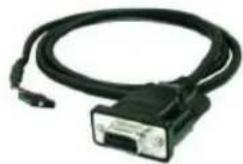
There is a 4-pin pin-header RS-232 console port designed for serial terminals, which gives users a convenient way of connecting the development workstation (The PC) to the console utility of the target computer (The EM-2260). This method is particularly useful when using the computer for the first time or for debugging while the system cannot boot up. A special Serial Console Cable (Optional) is needed for this function.
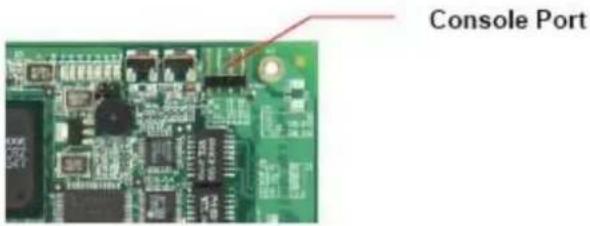
Serial Console Port & Pinouts Serial Console Cable
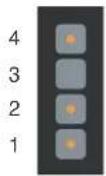
| Pin Signal | |
| 1 | TxD |
| 2 | RxD |
| 3 | NC |
| 4 | GND |
natural_image
Coiled black cable with a white connector, no visible text or symbols
ATTENTION
You do not need Console Port to operate this computer. Console Port and Serial Console Cable are only for debugging purpose.
Operating EM-2260 Computer Via Serial Console
Follow the following steps to operate EM-2260 computer via serial console port.
- Power off EM2260.
-
Connect the serial Console Cable.
-
Go back to the development workstation and start a terminal program (for example, HyperTerminal or PComm) by using the settings shown below for the COM port.
| Baud rate | 115200bps |
| Parity | None |
| Data bits | 8 |
| Stop bits | 1 |
| Flow Control | None |
| Terminal | ANSI |
-
Power on to cold reset EM-2260, it may takes 30 to 60 seconds for the operating system to boot up.
-
After a successful connection, type the login name and password as requested to logon the computer. The default values are both "admin".
Login: admin
Password: admin
![PComm Terminal Emulator - COM2,115200,None,8.1,ANSI Profile Edit Port Manager Window Help COM2,115200,None,8.1,ANSI Record 159 : RecAddr = 0xE11A2D8C, RecLen = 0x38C48, RecChk = 0x1BB1497 Record 160 : RecAddr = 0xE11DB9D4, RecLen = 0x56614, RecChk = 0x29EB4B1 Record 161 : RecAddr = 0xE1231FE8, RecLen = 0x47E84, RecChk = 0x2301D9C Record 162 : RecAddr = 0xE1279E6C, RecLen = 0x39504, RecChk = 0x1C024EB Record 163 : RecAddr = 0xE12B3370, RecLen = 0x33B64, RecChk = 0x193701B Record 164 : RecAddr = 0xE12E6ED4, RecLen = 0x67794, RecChk = 0x325F984 Record 165 : RecAddr = 0xE134E668, RecLen = 0x243F8, RecChk = 0x117BCO2 Record 166 : RecAddr = 0xE1372A60, RecLen = 0x54, RecChk = 0xF45 Record 167 : RecAddr = 0xE1372AB4, RecLen = 0x2524, RecChk = 0xD66D7 Record 168 : RecAddr = 0x0, RecLen = 0xE02C1006, RecChk = 0x0 Total Offset = 0x1058CE7, LaunchAddr = 0xE02C1006 Press ENTER to launch console... Welcome to the Console Window on EM-2260CE MOXA Firmware Version V1.1 Build 08011415 login: admin Password: Pocket CMD v 6.00 [EM-2260CE]](/content/2026/05/1142188/images/aeaffac3977038d13f2a91831dbd6ce5a1ee03819048afabcb0a00250b600a25.jpg)
Go to Boot Loader Menu from Console
If the computer is not working properly or the system cannot boot up successfully. You can use following steps to go to Boot Loader menu.
- Power off EM2260.
-
Connect the serial Console Cable.
-
Go back to the development workstation and start a terminal program (for example, HyperTerminal or PComm) by using the settings shown below for the COM port.
| Baud rate | 115200bps |
| Parity | None |
| Data bits | 8 |
| Stop bits | 1 |
| Flow Control | None |
| Terminal | ANSI |
-
Hold "DEL" key continuously.
-
Power on EM-2260. You should see below screen in few seconds.
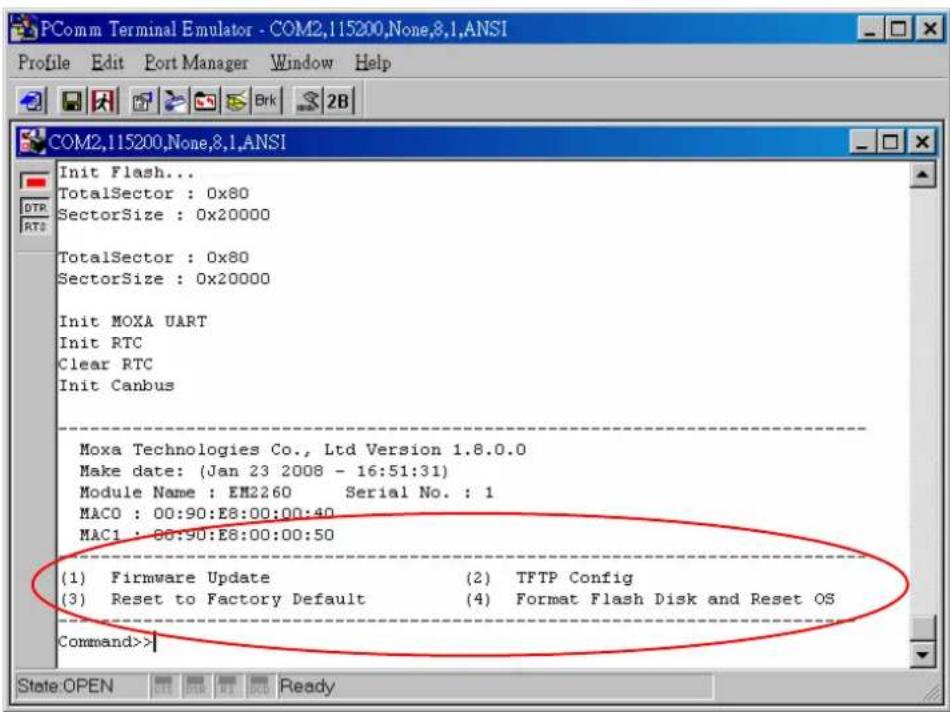
There are four functions:
Reset to Factory Default: You can turn on the flag to enforce the WinCE 6.0 to do the "reset to factory" default.
Format Flash Disk and Reset OS: The WinCE FAT file system has the possibility to be damaged by unstable power or improper application execution. If the FAT table is crashed you may not be able to boot the OS up. In such case, you can try to format the file system and reboot EM-2260.
At the EM-2260 startup, it will check the file system and re-partition it if the file system is empty.
Firmware Update: If you found a new firmware from MOXA web site, you can upgrade the firmware by this function.
TFTP Config: In conjunction with Firmware Update, this function is used to set IP address of both server PC and target system (EM-2260), and to transfer file from server PC to target system.

ATTENTION
There is a very small possibility that unstable power or improper application execution may damage not only FAT file system but also WinCE itself. In such case, you can try Firmware Upgrade (Re-program) and reboot EM-2260 again.
Firmware Upgrade Procedure
To upgrade the EM-2260 firmware, you must have the firmware upgrade installation file. This firmware installation file is included in the released software CD. You can also download it from MOXA Download Center if there is newly released, the URL is listed below.
http://web4.moxa.com/support/download_center.asp
-
Get the firmware upgrade installation file
(In this example, EM-2260-CE_V1.1_Build-08011415.hfm). -
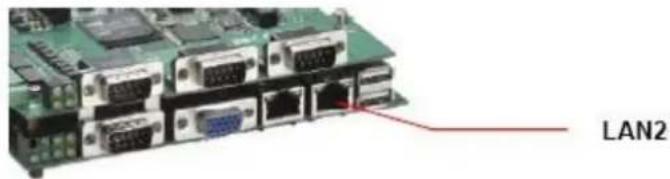
Connect target computer (The EM-2260) to development workstation (The PC) through Ethernet port LAN2.
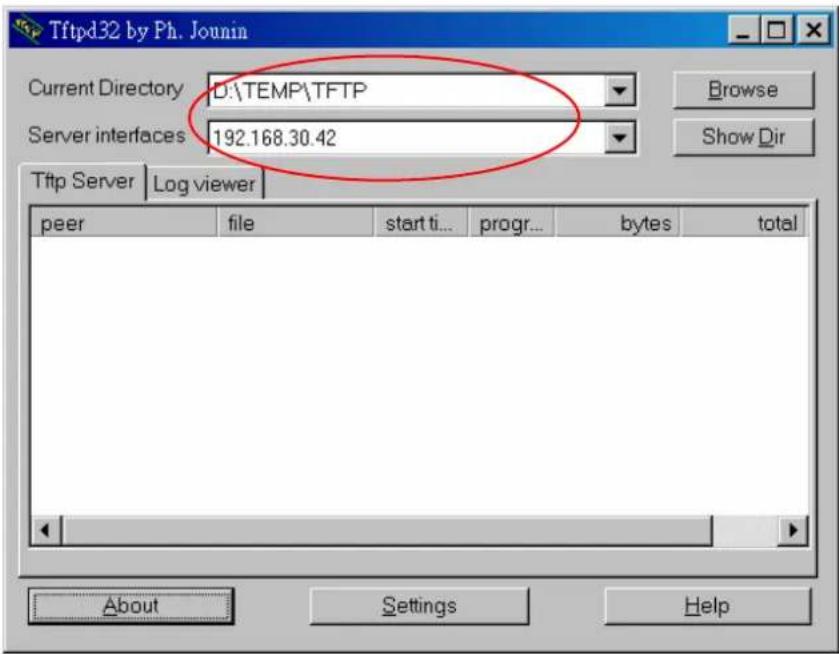
- Execute TFTP utility on the development workstation (The PC), and set correct server IP and file directory path. (In this example, 192.168.30.42).
- Go to the Boot Loader menu from Console. (See the earlier section.)
- Select "TFTP Config".
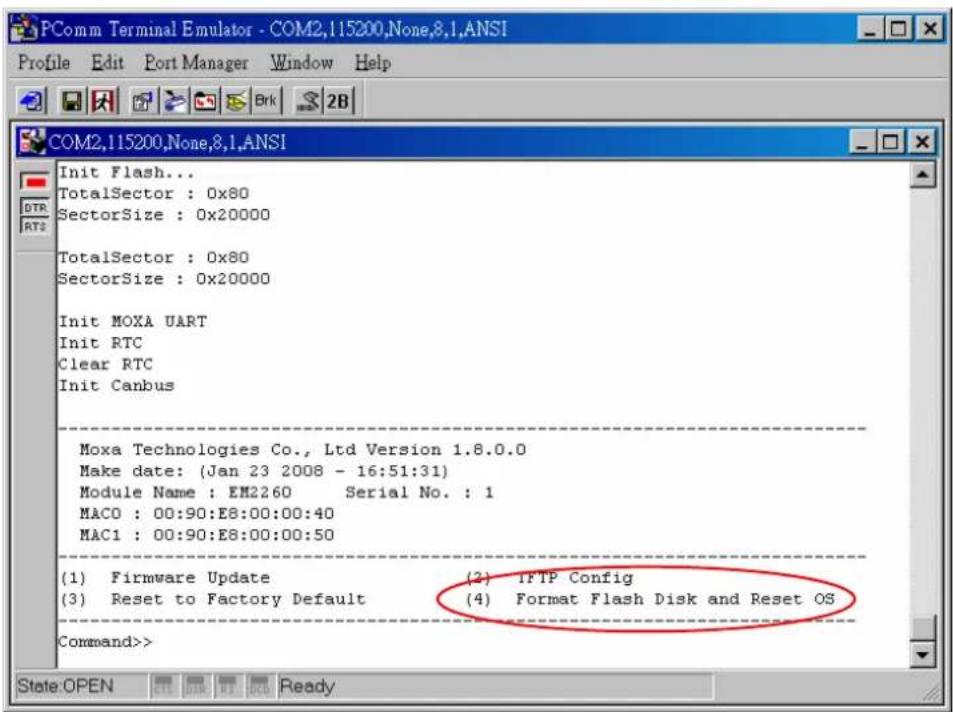
- Next, Select "User Configure".
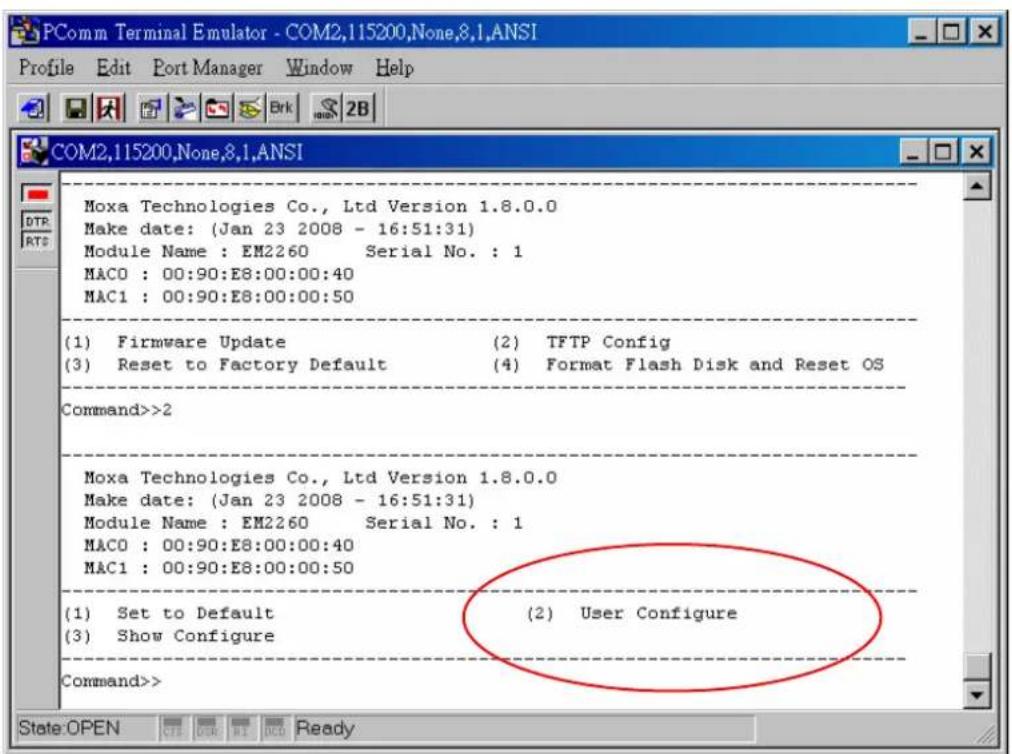
- Then, Input Local IP Address (EM-2260) and Server IP Address (TFTP host IP Address).
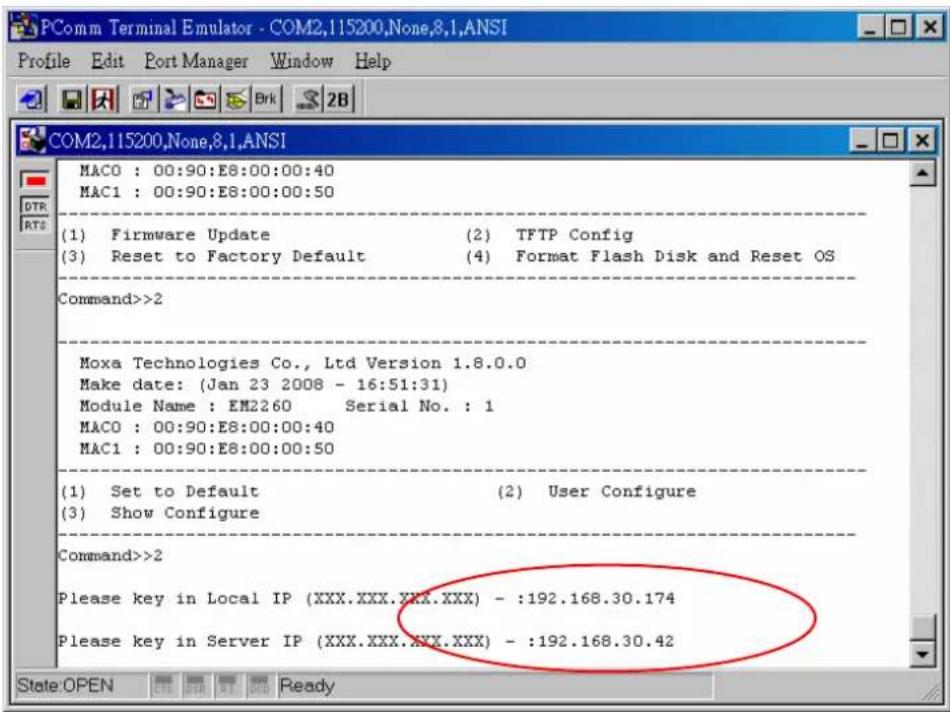
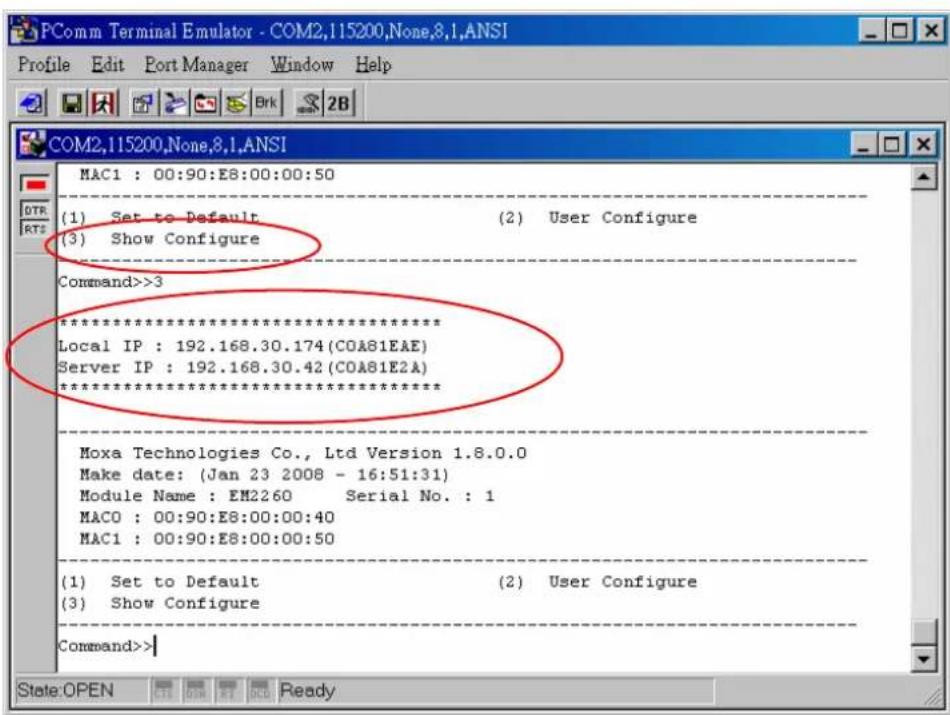
- Next, Select "Show Configure" to check configuration of local IP and server IP.
- After confirm the IP configuration, press [ESC] to go back main menu for next step.
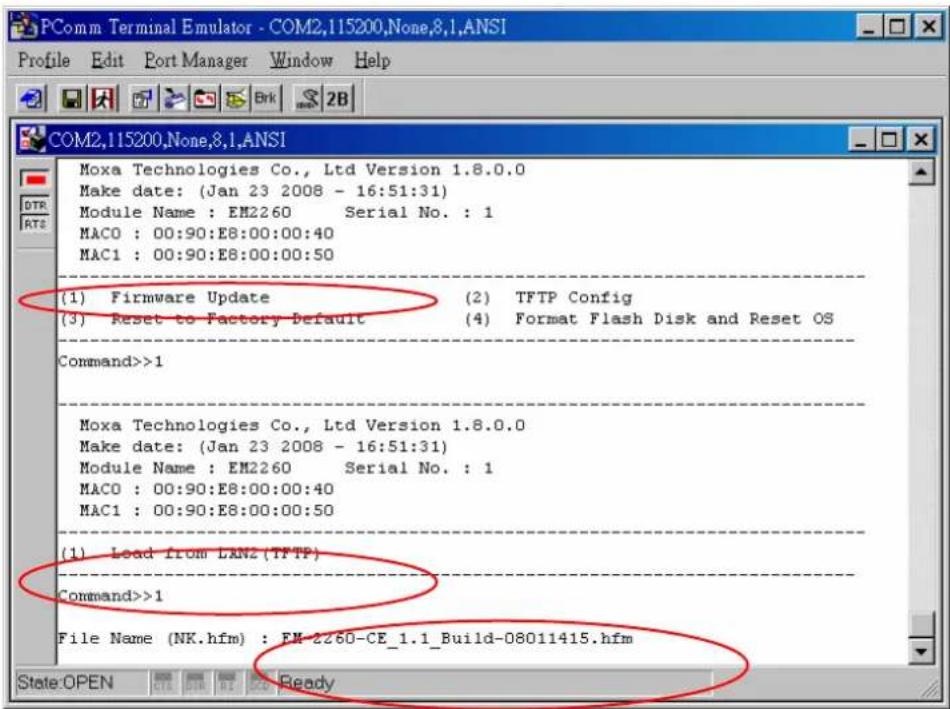
- Select "Firmware Update".
- Next, Select "Load from LAN2 (TFTP)".
- Input the firmware file name (e.g. EM-2260-CE_V1.1_Build-08011415.hfm) and the Press [Enter].
- The TFTP utility on the development workstation (The PC) and Boot Loader on the target computer will start to transfer firmware file. In the mean time, firmware will be updated automatically.
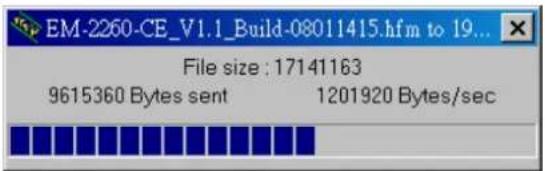
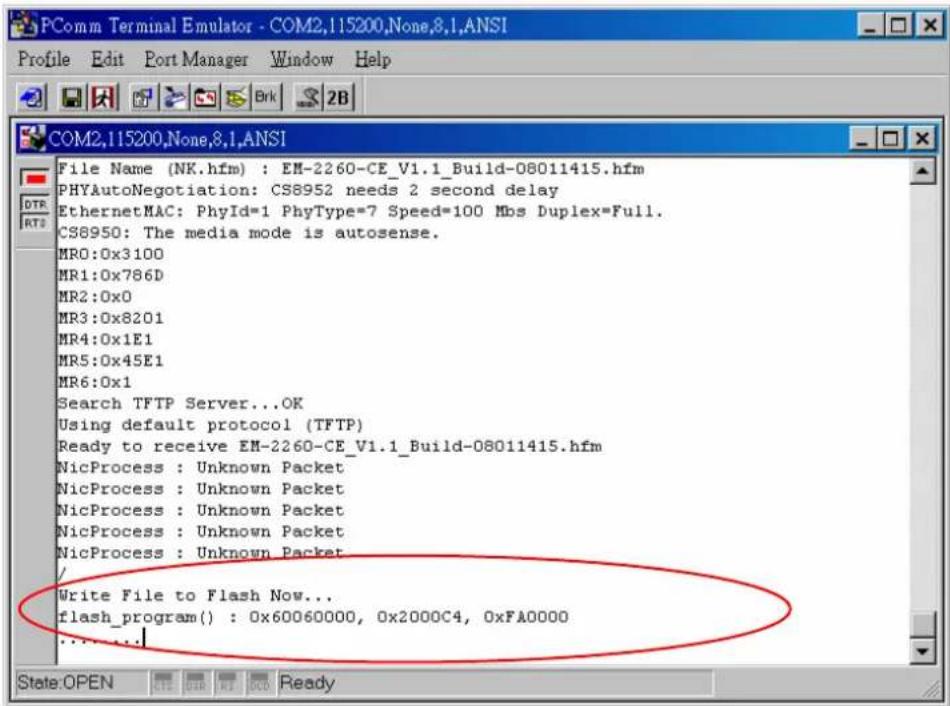
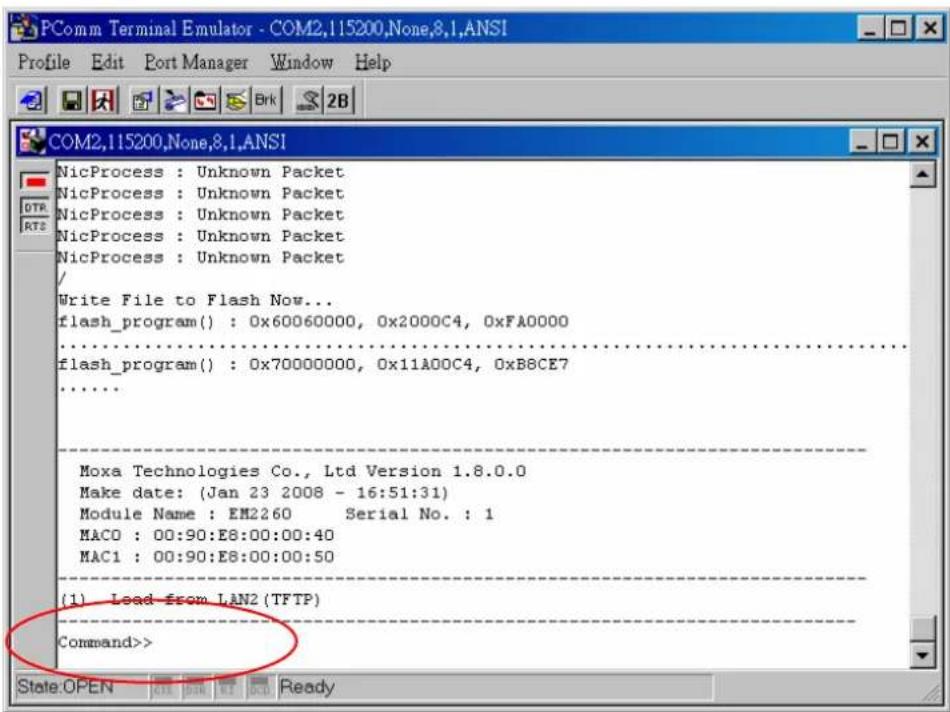
- Please wait until the "Command>>" prompt appears again and reboot the system.

ATTENTION
Do NOT switch off power supply during firmware update, otherwise the computer and Boot Loader may crash.

This device complies with part 15 of the FCC Rules. Operation is subject to the following two conditions: (1) This device may not cause harmful interference, and (2) this device must accept any interference received, including interference that may cause undesired operation.
Class A : FCC Warning!
This equipment has been tested and found to comply with the limits for a Class A digital device, pursuant to part 15 of the FCC Rules. These limits are designed to provide reasonable protection against harmful interference when the equipment is operated in a commercial environment. This equipment generates, uses, and can radiate radio frequency energy and, if not installed and used in accordance with the instruction manual, may cause harmful interference to radio communications. Operation of this equipment in a residential area is likely to cause harmful interference in which case the user will be required to correct the interference at his own expense.

European Community
Warning:
This is a class A product. In a domestic environment this product may cause radio interference in which case the user may be required to take adequate measures.