DM8316PRO - Dishwasher Cylinda - Free user manual and instructions
Find the device manual for free DM8316PRO Cylinda in PDF.


| Product Type | Dishwasher |
| Brand | Cylinda |
| Model | DM8316PRO |
| Installation Type | Built-in |
| Dimensions (H x W x D) | 85 x 60 x 60 cm |
| Weight | 45 kg |
| Capacity | 13 place settings |
| Energy Class | A+++ |
| Annual Energy Consumption | 237 kWh |
| Water Consumption per Cycle | 9.9 L |
| Noise Level | 44 dB |
| Number of Programs | 6 |
| Programs | Eco, Intensive, Normal, Quick, Soak, Glass |
| Functions | Delay start, Half load, Extra dry |
| Drying System | Condensation drying |
| Interior Tub Material | Stainless steel |
| Child Lock | Yes |
| Water Protection | Full leak protection |
| Power Supply | 220-240 V, 50 Hz, 10 A |
Frequently Asked Questions - DM8316PRO Cylinda
User questions about DM8316PRO Cylinda
0 question about this device. Answer the ones you know or ask your own.
Ask a new question about this device
Download the instructions for your Dishwasher in PDF format for free! Find your manual DM8316PRO - Cylinda and take your electronic device back in hand. On this page are published all the documents necessary for the use of your device. DM8316PRO by Cylinda.
USER MANUAL DM8316PRO Cylinda
natural_image
Simple line drawing of a kitchen appliance with oven, refrigerator, and washing machine (no text or symbols)DM 8316 PRO
Innehåll
Din diskmaskin 4
- bed & breakfast-hotell.
natural_image
Illustration of a multi-tiered kitchen appliance with plastic parts and coiled springs (no text or symbols)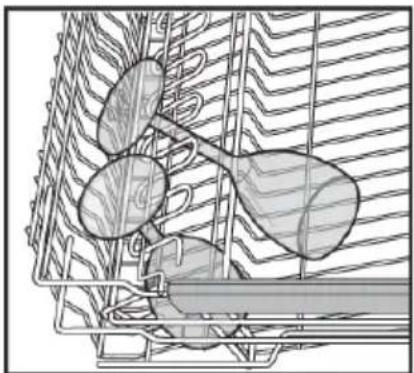
natural_image
Technical line drawing of a fan or fan assembly with no visible text or symbols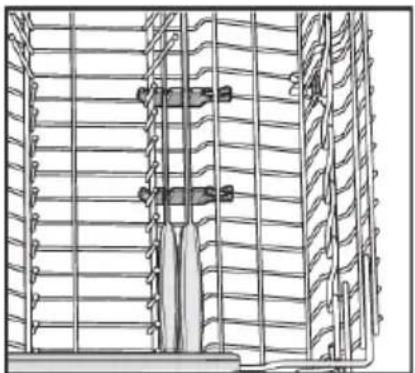
natural_image
Architectural line drawing of a building facade with vertical supports and horizontal beams (no text or symbols)Höjningavöverkorg
natural_image
Technical diagram of a mechanical assembly with a rotating component and wire mesh structure (no text or symbols)Underkorg
natural_image
Cross-sectional diagram of a multi-tiered industrial or mechanical assembly, showing layered components and structural elements (no text or labels)Vikpinnar
natural_image
Illustration of two workers climbing a metal structure with directional arrows indicating movement (no text or symbols)Diskastoratallrikar
text_image
Diagram illustrating a hand placing a component into a container, with two circular insets showing internal components and directional arrows.Användadiskmaskinen
Doseradiskmedel
natural_image
Technical diagram of a mechanical assembly with cross-sectional and top views (no text or labels)natural_image
Mechanical assembly diagram showing a lever with multiple circular components and directional arrows indicating motion (no text or symbols)natural_image
Technical diagram of a mechanical or electrical component with internal channels and a rotating arrow (no text or symbols)Undrespolarm
natural_image
Mechanical assembly diagram showing a lever mechanism with an upward arrow indicating motion (no text or symbols present)Rengördiskmaskinensin-ochutsida
Luckaochlucktätning
text_image
REMOVE REMOVEPlaceradiskmaskinen
natural_image
Illustration of a kitchen utensil with scissors cutting into a cabinet (no text or symbols)
OBS!
text_image
Diagram illustrating a device's internal structure and tool path, with an icon indicating a crossed-out component.natural_image
Technical line drawing of a kitchen sink with piping and fixtures (no text or symbols)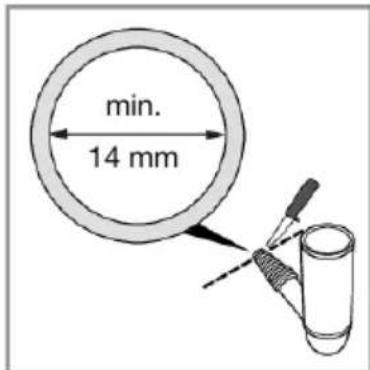
text_image
min. 14 mm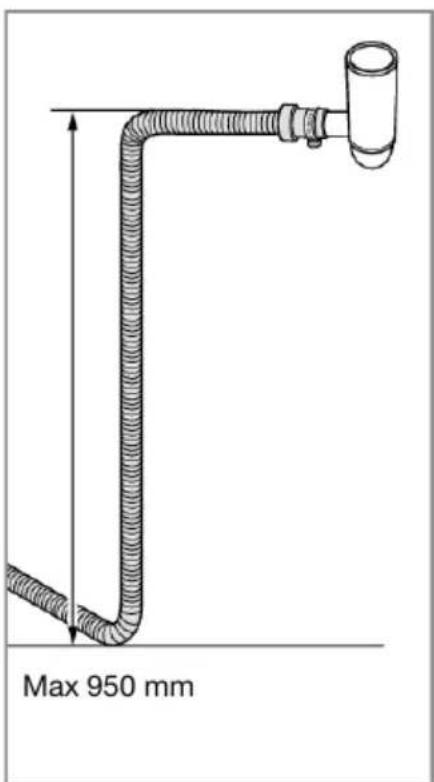
text_image
Max 950 mm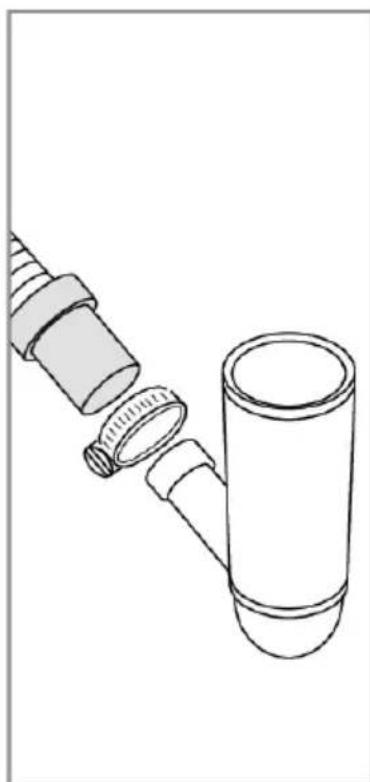
natural_image
Line drawing of a mechanical component with two cylindrical parts and a flanged handle (no text or symbols)natural_image
Technical illustration of a door assembly with a magnified inset showing a mechanical component (no text or symbols)text_image
KNOCK OUT 2xnatural_image
3D rendering of a rectangular metal tray or shelf with side notches (no text or symbols)Monteraljudisoleringen
(endast vissa modeller)
text_image
Technical diagram showing structural components with arrows indicating movement, including a magnified inset of a cutting tool and dimension labels 'x'.Monterasparkplåten

text_image
2xService
text_image
1 Type Seven 2Tekniskinformation
Tekniskdata
Safety instructions 51
Installation 52
Winter storage/Transport 52
Overflow guard function 52
Packaging 52
Disposal 53
Before washing for the first time 54
4 Water hardness 54
5 Basic settings 55
6 Automated dosage 57
Greener dishwashing 58
The dishwasher saves energy and water 58
Loading the dishwasher 59
Fragile dishes 59
Loading affects the results 59
The dishwasher's baskets 59
Upper basket 60
Lower basket 61
Cutlery basket 62
Using the dishwasher 63
Add detergent 63
The main power switch 65
Select program 65
Starting the dishwasher 66
Remaining time 66
Status indicator 66
Stopping or changing a program 67
If you want to load more dishes 67
If the dishwasher is turned off due to a power failure 67
Once the program has finished 67
How to get the best drying results 67
Unloading the dishwasher 67
Program chart 68
Settings 69
Open the dishwasher's Settings menu 69
Care and cleaning 73
Top up rinse aid 73
Top up salt 73
Cleaning the filters 74
Cleaning the spray arms 75
Clean the dishwasher inside and out 76
Remove blockages 76
Troubleshooting 78
Installation 83
Safety instructions 83
Transport protection for the door 84
Placing the dishwasher 84
Affix the protective film 85
Connection to automated dosage 85
Adjust the height and slide the dishwasher into place 87
Drainage connection 88
Connection to water supply 89
Electrical connection 90
Screwing the dishwasher into place 90
Dishwasher toe kick 91
Service 92
Technical information 93
Technical data 93
Yourdishwasher
text_image
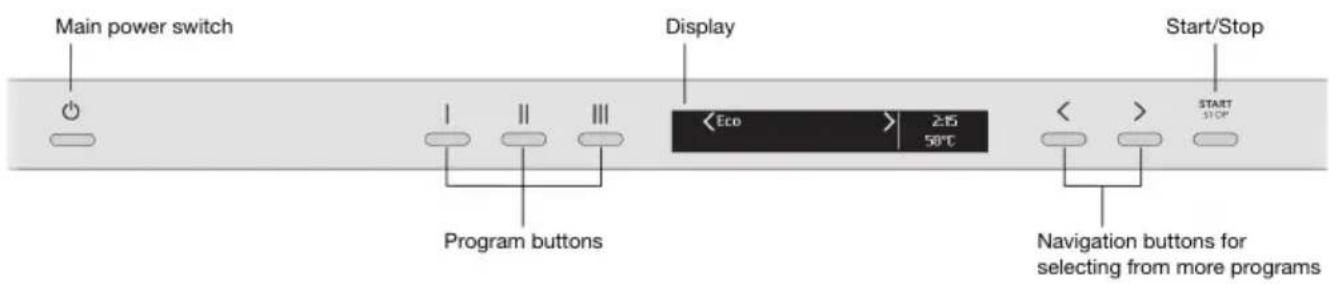
Main power switch Display Start/Stop Program buttons Eco 2:15 58°C Navigation buttons for selecting from more programsInstall the dishwasher, see the chapter Installation. Following this, open the door and press the main power switch to start using the machine.
"This is a first time set up." is shown on the display the first time the dishwasher is switched on. It is important that you choose the right settings to ensure good dishwashing results. See page 54.
The dishwasher can be connected to one or more systems for the automated dosage of commercial detergent and rinse aid, which simplifies everyday operation and reduces the risk of overdosing.
Safetyinstructions
- Read the operating instructions and keep them in a safe place!
- Never use the dishwasher for any purpose other than that specified in these operating instructions.
- Do not load the dishwasher door or dishwasher baskets with anything other than dishes.
- Never leave the dishwasher door open as someone may trip on it.
- Only use regular dishwasher detergent in the dishwasher's detergent compartment. (If a system for the automated dosage of commercial detergent has been connected, the dishwasher's detergent compartment is not to be used.)
- Use external containers for the automated dosage of commercial detergent and rinse aid. (Commercial detergent and rinse aid for automated dosage must not be used in the dishwasher's dispensing compartments for detergent and rinse aid.)
- This machine can be used by children aged 8 and upwards, and by people with reduced physical capacity, mental ability, memory loss or lacking experience and knowledge. These individuals must be supervised when using the machine or have instructions on how to use the machine and understand the risks that can occur. Cleaning of the machine must not be carried out by children without supervision.
- Damaged mains cables must only be replaced by a qualified electrician.
- This dishwasher is for household or similar use, such as:
- staff kitchens in shops, offices and other workplaces.
- farms.
- for guests at hotels, motels and other types of accommodation.
- bed & breakfast hotels.
- Never place dishes with solvent residues in the dishwasher due to the risk of explosion. Nor may dishes that contain ash, wax or lubricants be washed in the dishwasher.
- Children must be watched. Do not allow children to use or play with the dishwasher. Be especially vigilant when the door is open. Some detergent may remain inside! After adding detergent, always start the dishwasher immediately.
- For repairs and maintenance, original spare parts must be used.

WARNING!
Knives and other pointed items must be placed with the points down in the cutlery basket or horizontally in other baskets.

WARNING!
Children must be supervised – dishwasher detergent is corrosive!
Installation
See the chapter Installation.
Winterstorage/Transport
Store the dishwasher above freezing and avoid long transport distances in very cold weather. Transport the dishwasher upright or laying on its back.
Overflowguardfunction
The overflow protection starts pumping out the machine and turns off the water supply if the water level in the dishwasher exceeds the normal level. If the overflow protection is triggered, Overfilling water appears on the display. Turn off the water supply and contact your nearest service centre.
Packaging
The outer packaging protects the product during transport. The packaging material is recyclable. Separate the different packaging materials to help reduce raw material use and waste. Your dealer can take the packaging for recycling or direct you to the nearest recycling centre. The packaging is comprised of:
• Corrugated cardboard made from up to 100% recycled material.
- Expanded polystyrene (EPS) with no added chlorine or fluorine.
• Supports made from untreated wood.
• Protective plastic made from polyethylene (PE).
Disposal
The dishwasher is manufactured and labelled for recycling.
When the dishwasher has reached the end of its service life and is to be disposed of, it should immediately be made unusable. Pull out the power cable and cut it as short as possible.
Contact your local authority for information about where and how your dishwasher should be correctly recycled.
Beforewashingforthefirsttime
4Waterhardness
In order to achieve good dishwashing results, the dishwasher needs soft water (water with low mineral content). Hard water leaves a white coating on dishes and the dishwasher.
Checkingwaterhardness
Water hardness is specified using the German water hardness scale (°dH) or the French water hardness scale (°fH).
A water supply with a water hardness in excess of 4^ dH ( 6^ fH) must be softened. This is done automatically with the aid of the built-in water softener. In order for the water softener to function optimally, it must be adjusted to the hardness of the water supply. Once you have adjusted the water softener, use detergent and rinse aid doses suitable for soft water.
Contact the local waterworks to check the water hardness in your area.
Make a note of the water hardness: ____
| RecommendedsettingFrenchwaterhard | ||
| 00-5°fH0-3°dH | ||
| 16-9°fH4-5°dH | ||
| 210-14°fH6-8°dH | ||
| 315-20°fH9-11°dH | ||
| 421-25°fH12-14°dH | ||
| 526-34°fH15-19°dH | ||
| 635-43°fH20-24°dH | ||
| 744-52°fH25-29°dH | ||
| 853-70°fH30-39°dH | ||
| 971°fH40°dH |
If the water hardness exceeds 20^ dH ( 36^ fH), we recommend connecting an external water softener.
Increasedconsumptionduringregeneration
The dishwasher's built-in water softener is regularly regenerated to maintain its function. Regeneration extends the dishwashing program and increases energy and water consumption. Just how often the dishwasher's water softener is regenerated depends on the selected setting.
Example: If the Ecoprogram is run with a water hardness of 14 °dH ( 25 °fH ), the water softener is regenerated at regular intervals (after 6 dishwashing cycles), energy consumption increases by 0.015 kWh and water consumption increases by 2.3 litres while the program time is extended by 3 minutes. Regeneration occurs during the program's main wash.

WARNING!
Hard water leaves a white coating on dishes and inside the dishwasher. It is therefore important that you select the right setting for the water softener! See Water hardness.
Never run the dishwasher with an empty salt compartment if the water supply has a water hardness in excess of 4^ dH ( 6^ fH).
5Basicsettings
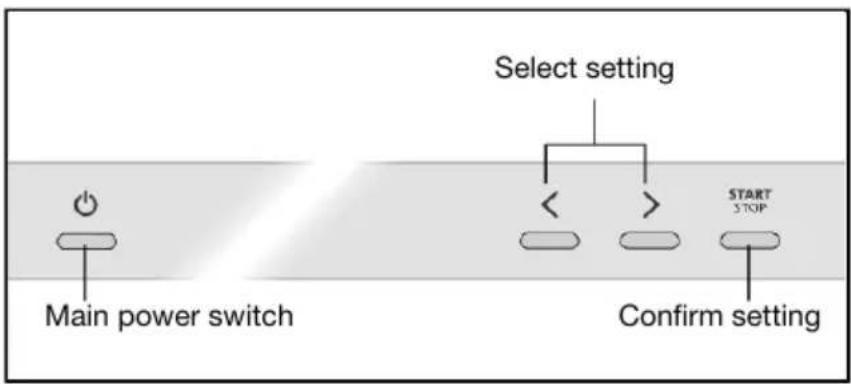
Open the door and press the main power switch.
"This is a first time set up." is shown on the display. It is important that you choose the right settings to ensure good dishwashing results.
flowchart
graph TD
    A["Main power switch"] --> B["Select setting"]
    B --> C["<"]
    B --> D[">"]
    B --> E["START STOP"]
    F["Confirm setting"]
| Settings | |
| Language4 | |
| Select the language to be shown on the display. | |
| Power10Amp/16Amp5 | |
| This dishwasher has been designed to be able to be connected to an electrical supply network with fuses for 10 Amp or 16 Amp.The water in the dishwasher will be heated more quickly, and the dishwashing program will run more quickly, if you select 16 Amp.Select 10 Amp or 16 Amp according to the electrical supply network in your property.Pre-selectedatfactory:16Amp | |
| 6 | Rinseaid0/1/2/3/4/5/TAB 1) |
| Drying is faster and a better result is achieved if you use rinse aid. You will also achieve a better dishwashing result with clear and spotless dishes.Select rinse aid dosage. The rinse aid dispenser can be adjusted between 0 (Off) and 5 (High dosage).When using an all-in-one detergent that contains rinse aid, you can activate the setting TAB. Read more about all-in-one detergent in the chapter Using the dishwasher.Pre-selectedatfactory:5 | |
1) Thesettingwillbedeactivatedfollowingtheactivationofautomateddosageofcommercialrinse aid.Rinseaidwillnotthenneedtoberefilled.
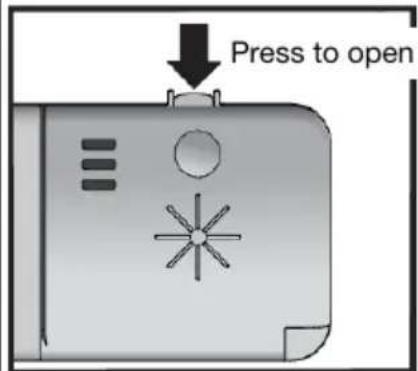
Topuprinseaid
text_image
Press to open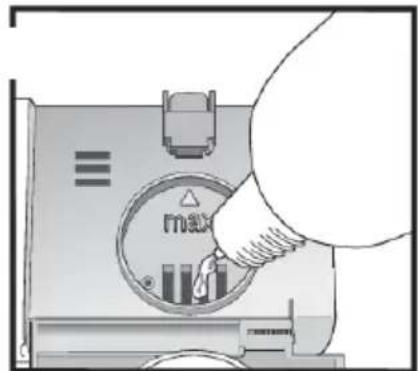
natural_image
Illustration of a hand inserting a device into a circular component labeled 'max', with no visible text or symbols beyond the label.Add rinse aid to the container for rinse aid (if the dishwasher has not been connected to a system for the automated dosage of rinse aid).
- Open the rinse aid compartment lid.
- Carefully top up with rinse aid to the level marked max.
- Wipe up any splashes of rinse aid around the compartment.
- Close the lid firmly.
Waterhardness0/1/2/3/4/5/6/7/8/97
Adjusting the water softener. Select a setting depending on the hardness of the water supply. It is important that this setting is correct!
Do not forget to put salt in the salt compartment after you have set the water softener to 1 - 9.
Forawatersupplywithahardnessunder4°dH(6°fH),select0. Thewatersoftenerisdeactivated andnosaltisneeded.
Pre-selectedatfactory:6
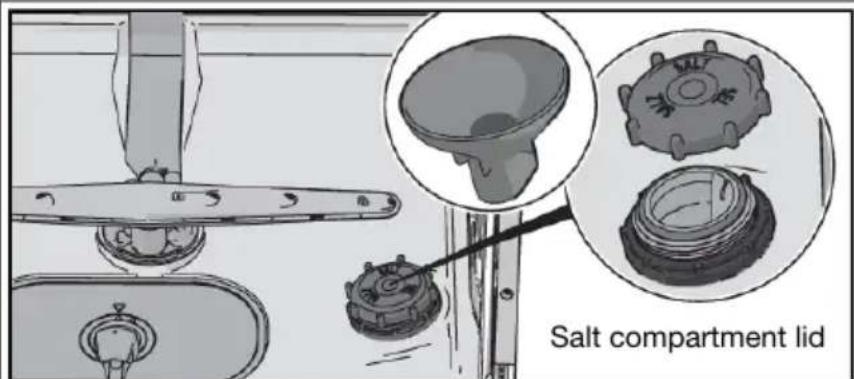
Topupsalt
text_image
Salt compartment lid- Unscrew the salt compartment lid.
- Place the funnel supplied with the dishwasher in the salt compartment top-up hole. First, pour in about 1 l of water.
- Then add salt, a maximum of 630 gram, until the compartment is full. Use large grain salt or special dishwasher salt.
- Wipe up any excess salt so that the lid can be screwed on firmly.
In order to avoid rust stains a dishwashing program must be started immediately after adding salt.
Tochangetheselectedsetting,seethechapterSettings.
6Automateddosage
The dishwasher can be connected to one or more systems for the automated dosage of commercial detergent and rinse aid, which simplifies everyday operation and reduces the risk of overdosing.
Stepbystep
- Connect the external cables for the automated dosage of commercial detergent and rinse aid. Also connect the hoses supplied. See the Installation chapter.
- Activate Auto dose system in the dishwasher's Settings menu. See the Settings chapter.
- Add the commercial detergent and rinse aid that is designed for automated dosage in the appropriate external containers. Select Vent the hose to dispense the detergent and rinse aid.

NOTE!
Add the commercial detergent and rinse aid in the appropriate external containers in advance, to prevent air from entering the system.

WARNING!
Note that there are risks involved in handling commercial detergent and rinse aid. Protective gloves and goggles must be used when handling these products.
Follow the supplier's safety regulations concerning the handling and storage of detergent and rinse aid.
Greenerdishwashing
Thedishwashersavesenergyandwater
When using a dishwasher in a residential setting, less energy and water are generally used compared to washing the dishes by hand.
Donotrinseunderrunningwater
Do not rinse the dishes under running water as this will lead to increased energy and water consumption.
Simply scrape off large food particles before loading the dishwasher.
Chooseagreendetergent
Read the environmental declaration on the packaging!
Too much detergent, rinse aid and salt can result in less effective dishwashing and also entail greater environmental impact.
Runafullyloadeddishwasher
Save energy and water by waiting until the dishwasher is full before running a program. Use the Rinse and hold program to rinse the dishes if there are any unpleasant odours.
Runprogramsatalowertemperature
If the dishes are only slightly dirty, you can select a program with a low temperature.
Selectdishwashingprogram-Eco
The dishwashing program is designed for an effective wash using as little energy and water as possible.
The program washes at a low temperature for a long time.
Selectthe-AutoOpensetting
Better drying results are achieved if you use the Auto Open option, which automatically opens the dishwasher door. Wait until the dishwasher indicates that the program has ended and the dishes have cooled before unloading the dishwasher. (If the dishwasher is built-in, the surrounding furnishings must be resistant to any condensation from the dishwasher.)
Connecttocoldwater
Connect the dishwasher to the cold water supply if the building is heated using oil, electricity or gas.
Connectiontohotwatersupply
Connect the dishwasher to the hot water supply (max. 70 °C) if the building is heated using an energy-efficient means such as district heating, solar power or geothermal power. Choosing a hot water connection cuts dishwashing times and reduces the dishwasher's energy consumption.

NOTE!
Do not exceed the permitted water supply temperature. Certain materials used in some cookware cannot withstand strong heat.
Loadingthedishwasher
Fragiledishes
Some cookware is not dishwasher safe. This can be for several reasons. Some materials cannot withstand strong heat, others can be damaged by dishwashing detergent.
Exercise caution with, for example, handmade items, fragile decoration, crystal/glassware, silver, copper, tin, aluminium, wood and plastic. Look for the "Dishwasher safe" marking.
Fragiledecoration
Porcelain with decoration on top of the glazing (the items feel rough) should not be washed in a dishwasher.
Crystal/Glass
Wash fragile items made of crystal/glass using the gentle dishwashing program Crystal glass. Remember to use a small amount of detergent and to place items so that they do not touch each other during the wash.
Drying is faster and a better result is achieved if you use rinse aid. You will also achieve a better dishwashing result with clear and spotless dishes.
Hand-paintedglassware, as well as antique and very fragile items, should not bewashed in adish washer.
Silver
Silver and stainless steel items should not come into contact, as the silver can become discoloured.
Aluminium
Aluminium can lose its shine if washed in a dishwasher. However, good quality aluminium pans can be washed in a dishwasher, even if some of the shine will be lost.
Cutlerywithgluedhandles
Some types of glue are not dishwasher safe. In such cases, the handles may loosen.
Loadingaffectstheresults
Load the dishes carefully to ensure the best washing and drying results with the lowest possible energy and water consumption. Give your dishwasher the best chance to reach and clean all surfaces, as well as to dry the dishes as thoroughly as possible.
- All dirty surfaces should face inwards and downwards!
- Dishes should not be placed in or on each other.
- Angle dishes with hollows, such as cups, so that the rinse water will run off. This is also important for plastic items.
• Make sure small items cannot fall through the dishwasher basket; place them in the cutlery basket.

NOTE!
Check that the spray arms can rotate freely.
Thedishwasher'sbaskets
The dishwasher is equipped with an upper basket and a lower basket with a cutlery basket.
Theappearanceofthebasketsmaydifferdependingonthedishwashersetup.
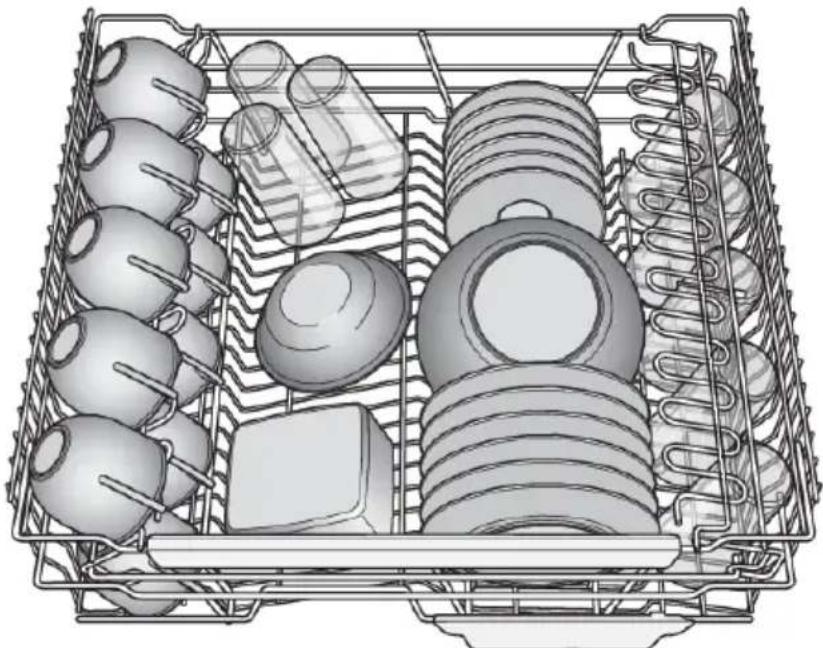
Upperbasket
Place glasses, cups, bowls, side plates and saucers in the upper basket. All dirty surfaces should face inwards and downwards! Wine glasses are placed on the wine glass shelf and knives are placed in the knife stand on the right.
natural_image
Illustration of a multi-tiered cleaning machine drawer with various mechanical parts (no text or symbols)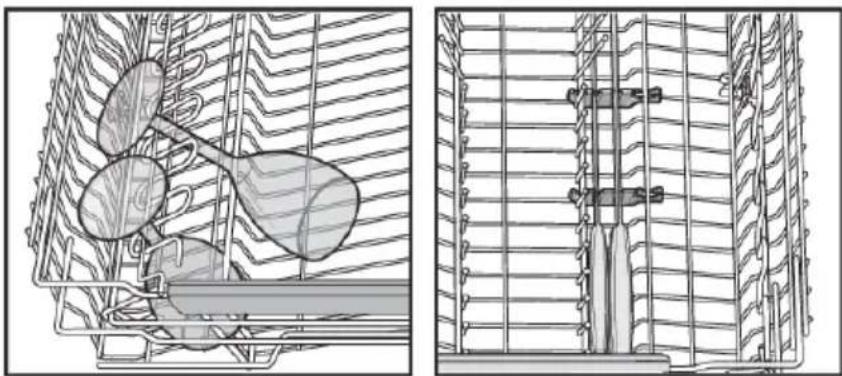
natural_image
Technical line drawing of a mechanical component inside a cage-like structure (no text or symbols)Raisingtheupperbasket
- Pull out the upper basket.
- Grab the sides of the upper basket with both hands and lift it up.
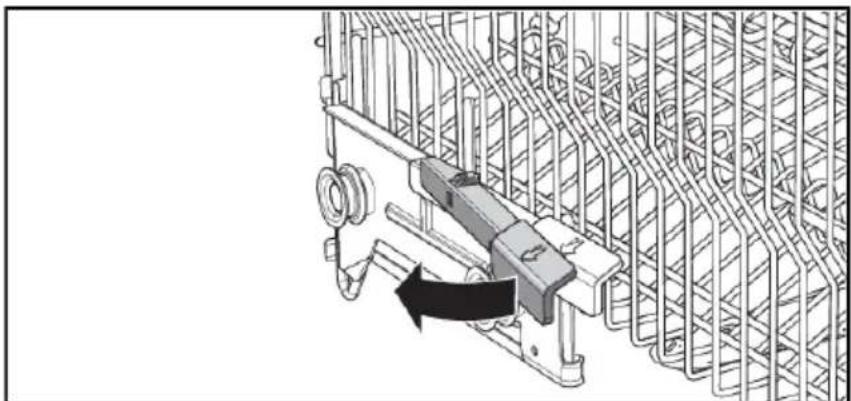
Loweringtheupperbasket
- Pull out the upper basket.
- Pull out the two locking handles on either side to lower the upper basket.
natural_image
Technical diagram of a mechanical assembly with a directional arrow indicating motion (no text or symbols present)Lowerbasket
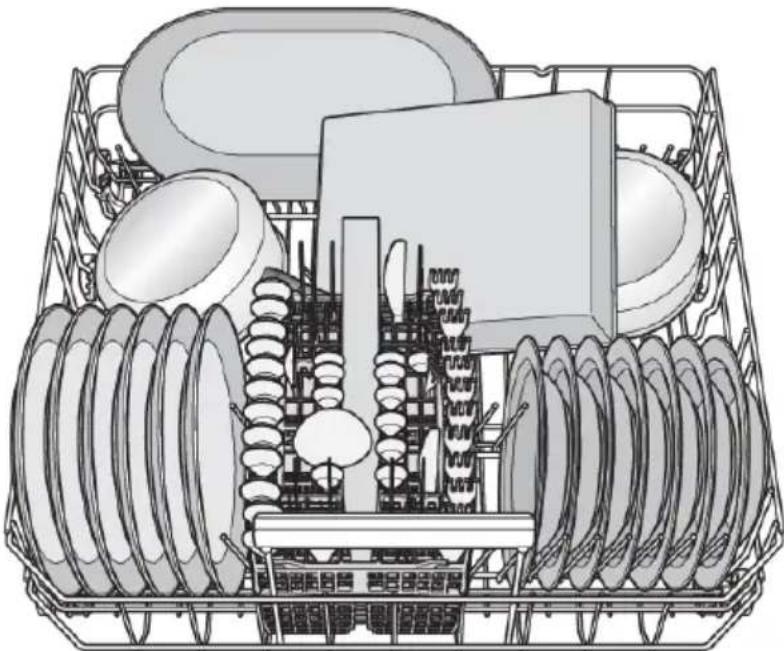
Place plates, side plates, serving dishes, pots and cutlery (in the cutlery basket) in the lower basket.
natural_image
Cross-sectional diagram of a mechanical assembly with rollers and components (no text or labels)Foldabletines
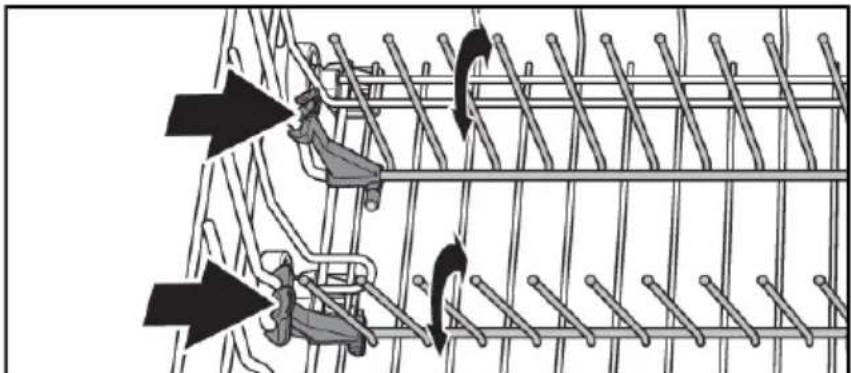
Lower the foldable tines (plate supports) when washing pots. Release the foldable tines by pressing the catch inwards before adjusting their position.
natural_image
Diagram showing two workers climbing a metal structure with directional arrows indicating motion (no text or symbols)Washinglargeplates
Move foldable tines and their mounts to widen the distance between the tine rows to adapt the lower basket to plates with a diameter greater than 25 cm.
Cutlerybasket
Place cutlery with the handles facing down, except for knives, and spread them out as much as possible. Ensure that spoons do not stack inside each other.
The cutlery basket is best placed in the middle at the front of the lower basket to best utilise dishwashing performance from the unique spray nozzle, which is intended for the cutlery basket.

WARNING!
Knives and other pointed items must be placed with the points down in the cutlery basket or horizontally in other baskets.
Fold-downsectionforsmallitems
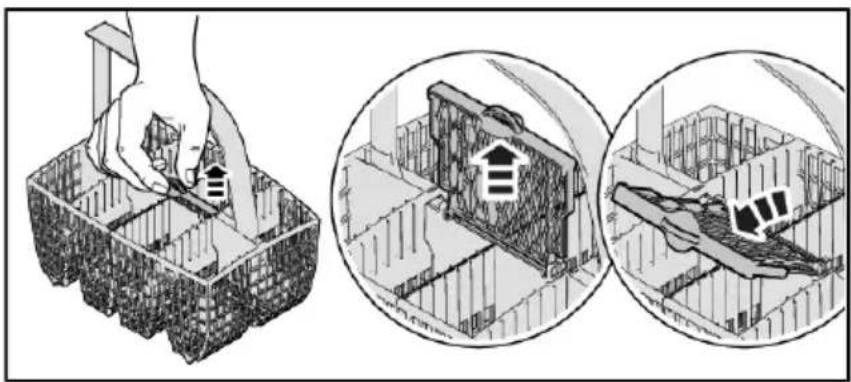
The cutlery basket has a fold-down section in the middle for small items, or small shafts, such as electric whisk attachments.
text_image
Diagram illustrating building interior construction with hand placing a component and two circular insets showing structural changes.Usingthedishwasher
Adddetergent
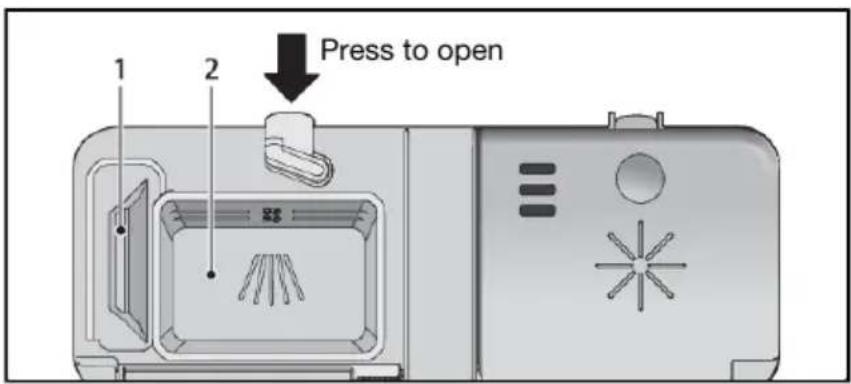
Add detergent to the detergent compartment (if the dishwasher has not been connected to a system for the automated dosage of commercial detergent).
text_image
Press to open 1 2- Prewash detergent compartment
- Main wash detergent compartment
Detergent is added according to water hardness.
Follow the instructions on the detergent packaging. This dishwasher is fitted with a water softener, so use detergent and rinse aid doses suitable for soft water.
Too much detergent can result in less effective dishwashing and also entails greater environmental impact.
The detergent compartment must be dry when adding detergent. There is one compartment for the prewash and one for the main wash. If powder or liquid dishwasher detergent is used, add a small amount of the detergent to the prewash compartment. Contact the detergent manufacturer if you have questions about the detergent.

NOTE!
Use only dishwasher detergent! Washing up liquid must not be used as the foam that forms prevents the dishwasher from operating effectively.
Dishwashertablets
Halve the tablet if it is difficult to close the dispenser lid. There is a risk that the detergent will not be released properly if the lid is tight and will not open correctly.

NOTE!
Dishwasher tablets are not recommended for short programs (less than 75 minutes). Use powder or liquid dishwasher detergent instead.
All-in-onedetergent
There are many types of all-in-one detergents on the market. Read through the directions for these products carefully.
When using an all-in-one detergent that contains rinse aid, you can activate the setting TAB. Note that the salt compartment must be filled with salt.

NOTE!
Optimal washing and drying results are achieved by using normal detergent together with separately dispensed rinse aid and salt.

text_image
Open the door and press the main power switch. Starting the dishwasher Select program 2:15 SDHC Select from more programs
Themainpowerswitch
Open the door and press the main power switch. Also turn on the water tap if it is turned off.
Selectprogram
To select a program, press one of the program buttons I, II or III. You can also select a program by pressing the navigation button
Select a program to suit the type of dishes and how dirty they are.
Eco
This program is intended for cleaning normally dirty dishes and is the most effective program in terms of combined energy and water consumption.
Crystalglass
This program is intended for washing fragile glasses that have just been used and so do not require a particularly powerful program. Porcelain can also be washed. See also Fragile dishes in the chapter Loading the dishwasher.
Intensive
A program with a high temperature to dissolve grease on very dirty dishes, such as pans, casserole dishes and oven dishes. If these dishes do not completely fill the dishwasher, you can add plates and the like.
Quick
This program is used for glasses and porcelain that is slightly dirty, such as coffee cups.
Rinseandhold
Used to rinse dishes while you wait for the dishwasher to become fully loaded.
| Universal ^1)
Powerful programme for daily use that can remove dried leftovers, but is not intended for burnt food, such as on oven dishes.
|| SANI ^1)
This program is ideal to use when hygiene demands are set high. The temperature of the main wash is 60 °C . The final rinse is 85 °C for 4 minutes.
1) Programbutton/1. The programspre-assigned to the program button scan be changed. See the chapter Settings.
III SANIQuick 1)
Select SANI Quick if you want a quicker program that still fulfils hygiene demands. The temperature of the main wash is 50 °C. The final rinse is 85 °C for 4 minutes.
Self-cleaning
Self-cleaning program for hygienic cleaning of the dishwasher tub, spray arms and spray pipes.
This program should be run (with no dishes in the machine) using normal dishwasher detergent or citric acid. Special dishwasher cleaners are also available on the market. For the removal of limescale deposits, see Dishwasher tub in the chapter Care and cleaning.
START STOP Startingthedishwasher
Press Start/Stop until the display shows "Program started, close door". This indicates that the dishwasher is ready to start. Close the door properly, otherwise the dishwasher will not start.
If the dishwasher is not started or the door is not closed within 2 minutes of the last button press, the machine switches off.
Remainingtime
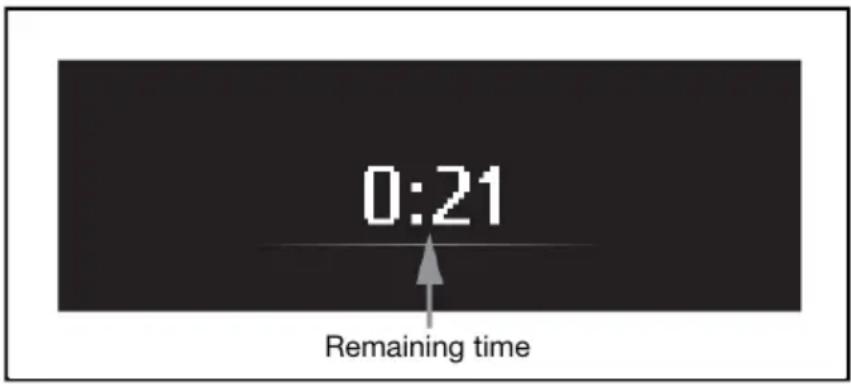
Once you have chosen a program, the time the programme took when last used is displayed.
Once you have started the dishwasher the display shows the remaining program time. The remaining time is updated after the water for the final rinse has been heated.
This may differ somewhat from time to time depending on the temperature of the water supply, the amount of dishes, the ambient temperature and other factors.
During the first run of each program, the remaining time displayed can be slightly misleading, as the dishwasher is estimating the time. When you run the program a second time, the dishwasher will calculate the remaining time based on the previous duration of the program.
text_image
0:21 Remaining timeStatusindicator
The status indicator on the front display provides information by means of different colours.
Blue-Loadmore
The program has started, but you can still load more dishes.
Red-Donotload
You should not load more dishes (risk of poorer dishwashing result).
Aflashinglight indicates that the door has been opened while a program is in progress. If it flashes when the door is closed, an error has occurred. Seethe chapter Troubleshooting.
Green-Unload
The dishwashing program is finished. The status light stays on for 15 minutes.
Stoppingorchangingaprogram
If you want to change program after starting the dishwasher, open the door then press and hold Start/Stop for three seconds. Add more detergent if the lid of the detergent dispenser has opened (this happens automatically if an automated dosage system has been connected). Then select a new program, press Start/Stop and close the door.
Ifyouwanttoloadmoredishes
Open the door. The dishwasher stops automatically. Add the dishes and close the door. After a while, the dishwasher continues the program.
Ifthedishwasheristurnedoffduetoapowerfailure
If the dishwashing program was not finished, the interrupted program continues when power is restored.

NOTE!
During drying, the program is interrupted if the power is cut or the door is open for more than 2 minutes.
Oncetheprogramhasfinished
Once the program has finished, "END" appears on the display.
At the end of the program one short signal will sound. Chapter Settings describes how to change this function.
The dishwasher switches off automatically after the program ends. Shut off the water tap after each use.
Howtogetthebestdryingresults
• Fully load the dishwasher.
- Angle dishes with hollows, such as cups, so that the rinse water will run off. This is also important for plastic items.
- Top up with rinse aid or increase the rinse aid dosage level.
• Activate the Auto Open setting.
- Allow the dishes to cool before unloading the dishwasher.
Unloadingthedishwasher
Hot porcelain is more fragile. Leave the dishes to cool in the dishwasher before unloading them.
Unload the lower basket first to avoid any water drops from the upper basket falling onto the dishes in the lower basket.
Programchart
| Program | washes | MainwashPre-rinses | FinalrinseNumberof Consumptionvalues 1) | ||||
| Coldwater 2) | Hotwater 3) | Water cons. (liter) | |||||
| Dishwashingtime (approx. hrs:min) | Energy (approx. kWh) | Dishwashingtime (approx. hrs:min) | Energy (approx. kWh) | ||||
| Eco 4) | 10.50.73:101.13:2560 | ||||||
| 9.00.31:200.71:3050 °C | |||||||
| 16.51.02:051.62:1570 | |||||||
| 9.50.50:200.60:20<60 | |||||||
| 3.50.010:070.010:07-- | |||||||
| 16.00.81:401.21:5065 | |||||||
| 13.01.21:001.71:1085 | |||||||
| 16.01.10:291.60:4585 | |||||||
| 9.01.40:551.61:0585 °C | |||||||
1) Consumption values vary depending on the temperature of the incoming water, room temperature, load size, selected additional functions and more.
2) Connectiontocoldwater, approx. 15°C.
3) Connectiontohotwater, approx. 60°C.
^4) This program is suitable for washing normally dirty dishes and is the most effective program in terms of combined energy and water consumption.
Settings
Openthedishwasher'sSettingsmenu
Open the door and press the main power switch until the display lights up.
To open the dishwasher's Settings menu, press the Navigation buttons: x 3, x 3
To exit the dishwasher's Settings menu, select Exit and confirm your selection with Start/Stop.
OptionsSettings
| Language1 | English/Svenska/Dansk/Norsk/Suomi/Nederlands/Français/Deutsch/Italiano/Pysckniñ/Espanol/Português/Sloven./Eesti/Latviešu/Lietuvių/Hrvatski/Polish/简体中文 / 繁體中文 /日本語 | You can choose the language used for the display. |
| Selectprograms2 | Eco | On/Off/// |
| Universal | Programs can be shown or hidden in the menu. Choose between On and Off. | |
| Crystal glass | ||
| Intensive | (Eco cannot be hidden in the menu.) | |
| Quick | Programs are pre-assigned to the program buttons; | |
| Rinse and hold | ||
| SANI | Universal | |
| SANI Quick | SANI | |
| Self-cleaning | SANI Quick |
On/OffChildlock3
To change the programs assigned to the buttons, select the desired program from the menu and then select , or . You can activate the child lock (button lock) to prevent children from starting the dishwasher.
To temporarily deactivate and activate the child lock, press and hold Program button I and the right Navigation button for three seconds.
Tablecontinuedfromlastpage
| OptionsSettings | |||
| Displaysettings4 | Contrast top display1/2/3/4 | For adjusting the contrast of the top display. | |
| Temp in last program On/Off | Temperature of the final rinse in the most-recently run program. This information is shown on the dishwasher's display when the machine is next switched on. | ||
| Info in front display1/2 | You can choose the information that is shown on the front display.1 Status indicator Time left ^2) Off2 Status indicator Time left+Status ^3) On | ||
| 0/1/2/3Feedbacksound5 | This sound is used to confirm each button press. | ||
| 0/1/2/3Buzzervolume6 | The buzzer indicates when a dishwashing program has ended. Errormessagesarealwaysindicatedbya loudbuzzer. | ||
| 7 | ^4) | 0/1/2/3/4/5/TABRinseaid | Setting for rinse aid dosage. The rinse aid dispenser can be adjusted between 0 (Off) and 5 (High dosage). Increase the rinse aid dosage:If the dishes have water marks.Decrease the rinse aid dosage:If the dishes have a sticky white/blue film.If the dishes are streaked.Build-up of foam. If you have very soft water, the rinse aid can be diluted 50:50 with water.When using an all-in-one detergent that contains rinse aid, you can activate the setting TAB. |
| °C/°FTemperatureunit8 | Temperatures can be displayed in °C (Celsius) or °F (Fahrenheit). | ||
2) SANI, SANIQuick: Timeleft+Status
3) SANI, SANIQuick: Timeleft+Status+Temperature
4) Thesettingwillbedeactivatedfollowingtheactivationofautomateddosageofcommercialrinse aid.Rinseaidwillnotthenneedtoberefilled.
Tablecontinuedfromlastpage
| OptionsSettings | |||||
| 0/1/2/3/4/5/6/7/8/9Waterhardness | Hardness the water softener. Select a setting depending on the hardness of the water supply. It is important that this setting is correct! | ||||
| German waterhardnessscale | Frenchwaterhardnessscale | Recommendedsetting | |||
| 00-5°fH0-3°dH | |||||
| 16-9°fH4-5°dH | |||||
| 210-14°fH6-8°d | |||||
| 315-20°fH9-11° | |||||
| 421-25°fH12-14 | |||||
| 526-34°fH15-19 | |||||
| 635-43°fH20-24 | |||||
| 744-52°fH25-29 | |||||
| 853-70°fH30-39 | |||||
| 971°fH40°dH | |||||
| Do not forget to put salt in the salt compartment after you have set the water softener to 1 - 9.Forawatersupplywithahardnessunder 4°dH(6°fH),select0.Thewatersofteneris deactivatedandnosaltisneeded. | |||||
| 10 | poweroff | On/OffInteriorlightat | Select whether the interior light is to be switched on when the dishwasher is turned off and the door is opened. (If the main power switch is turned on, the interior light is always switched on when the door is opened.) | ||
| Autodosesystem11 | Detergent:1-60/Off | Setting for the automated dosage of detergent. Select for how many seconds the detergent is to be added.Thedetergentwillbedispensedduringthe mainwash. | |||
| Rinse aid:1-60//Off | Setting for the automated dosage of rinse aid. Select for how many seconds the rinse aid is to be added.Therinseaidwillbedispensedduringthefinalrinse. | ||||
| DetergentVentthehose12 | The dishwasher dispenses the detergent for 30 seconds. | ||||
| Rinse aid | The dishwasher dispenses the rinse aid for 30 seconds. | ||||
Tablecontinuedfromlastpage
| OptionsSettings | |||
| 10 Amp/16 AmpPower13 | This dishwasher has been designed to be able to be connected to an electrical supply network with fuses for 10 Amp or 16 Amp. The water in the dishwasher will be heated more quickly, and the dishwashing program will run more quickly, if you select 16 Amp. Select 10 Amp or 16 Amp according to the electrical supply network in your property. | ||
| ### | On/OffAutoOpen14 | The dishwasher door opens automatically, which improves the drying results. Wait until the dishwasher indicates that the program has ended and the dishes have cooled before unloading the dishwasher. (If the dishwasher is built-in the surrounding furnishings must be resistant to any condensation from the dishwasher.) | |
| 15 | empty,topupbe-forerunningprogram | On/OffSaltchamberis | Setting to prevent a dishwashing program from starting when the salt compartment is empty.(This setting is not active if Water hardness is set to 0.) |
| Exit | To exit the dishwasher's Settings menu, select Exit and confirm your selection with Start/Stop. | ||
Careandcleaning
Topuprinseaid
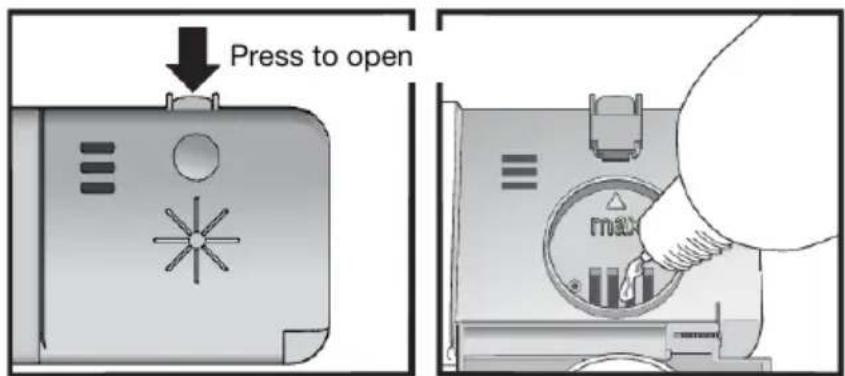
When the rinse aid needs topping up, the above symbol lights on the display.
text_image
Press to open max- Open the rinse aid compartment lid.
- Carefully top up with rinse aid to the level marked max.
- Wipe up any splashes of rinse aid around the compartment.
- Close the lid firmly.
After topping up, it may take a while before the symbol goes out.
★ Topupsalt
When the salt needs topping up, the above symbol lights on the display.
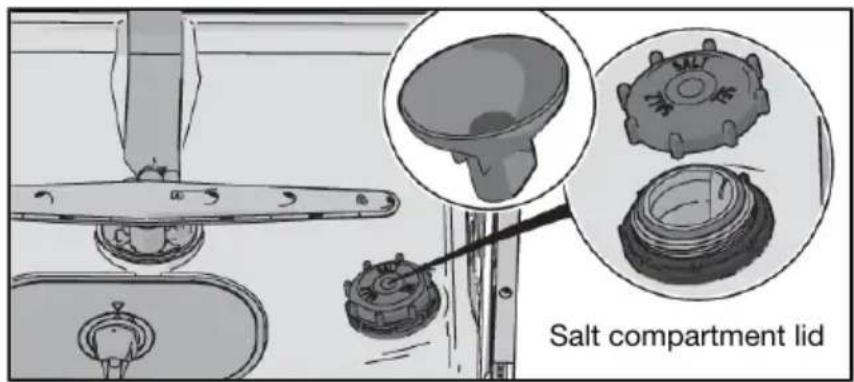
text_image
Salt compartment lid- Unscrew the salt compartment lid.
- Place the funnel supplied with the dishwasher in the salt compartment top-up hole. (Water is only needed the first time.)
- Then add salt, a maximum of 630 gram, until the compartment is full. Use large grain salt or special dishwasher salt.
- Wipe up any excess salt so that the lid can be screwed on firmly.
After topping up, it may take a while before the symbol goes out.
WARNING!
In order to avoid rust stains a dishwashing program must be started immediately after adding salt.
Never pour dishwasher detergent into the salt compartment. This destroys the water softener!
Cleaningthefilters
Coarsefilter
The coarse filter traps larger food particles, which cannot get past the drainage pump. Empty the coarse filter when necessary. It should be cleaned at regular intervals depending on how often the dishwasher is used.
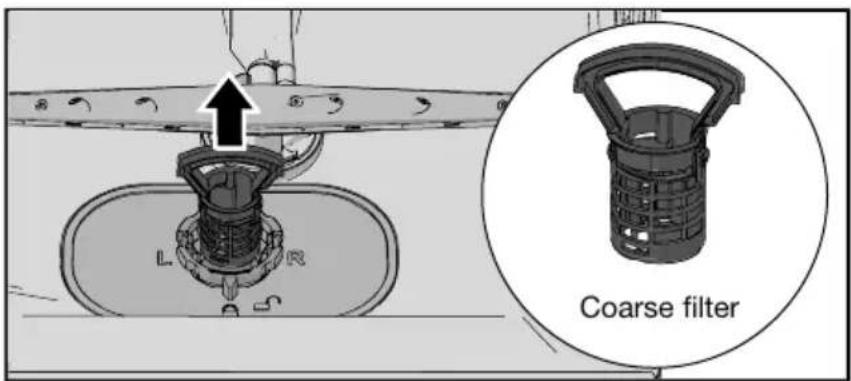
text_image
Coarse filter- Lift the coarse filter by the handle.
- Empty the coarse filter.
- Refit the coarse filter. Press it down until it clicks into place.
Finefilter
Debris that collects on the fine filter is automatically rinsed away during each wash. Clean the fine filter when necessary. It should be cleaned at regular intervals depending on how often the dishwasher is used.
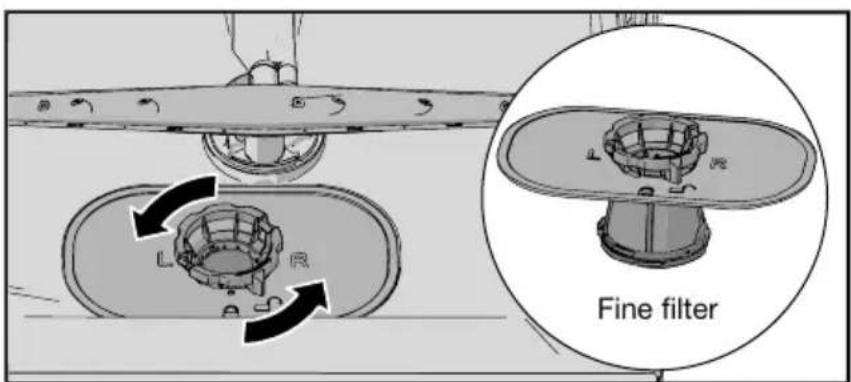
text_image
Fine filter- Turn the locking ring anticlockwise and lift the fine filter straight up.
- Clean the fine filter.
- Refit the fine filter and turn the locking ring clockwise to its stop position. Check that the edges seal properly.
Remember to refit the coarse filter!
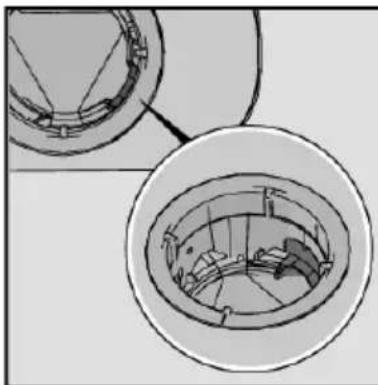
natural_image
Technical diagram of a mechanical component with cross-sectional view (no text or labels)Check that the coloured stop on the right in the bottom drain is in place.

NOTE!
Dishwashing results may be affected if the coarse and fine filters are incorrectly fitted. The dishwasher must not be used without the filters in place!
Cleaningthesprayarms
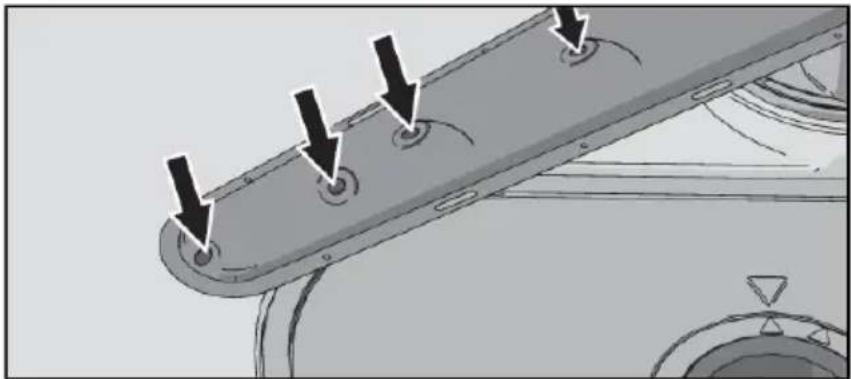
Holes and bearings can sometimes become blocked. Remove any debris using a pin or the like. The spray arms also have holes underneath.
natural_image
Mechanical assembly diagram showing a lever with four arrows pointing to specific components (no text or symbols present)To facilitate cleaning you can remove the spray arms. Remember to fit them firmly back into place afterwards.
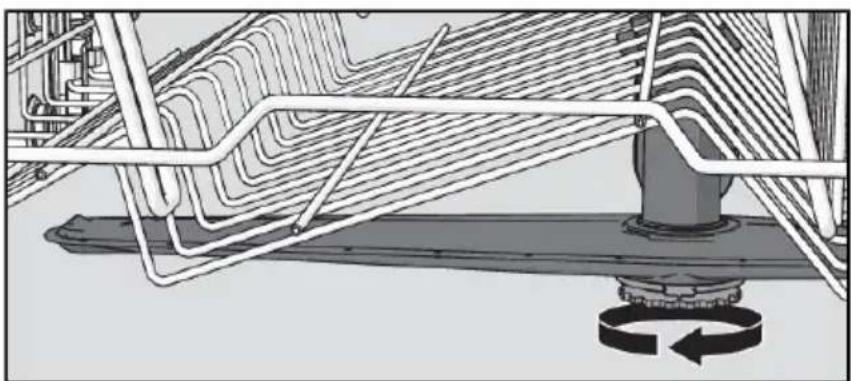
Uppersprayarm
- Pull out the upper basket.
- Unscrew the spray arm bearings counterclockwise to remove the spray arm from the upper basket.
natural_image
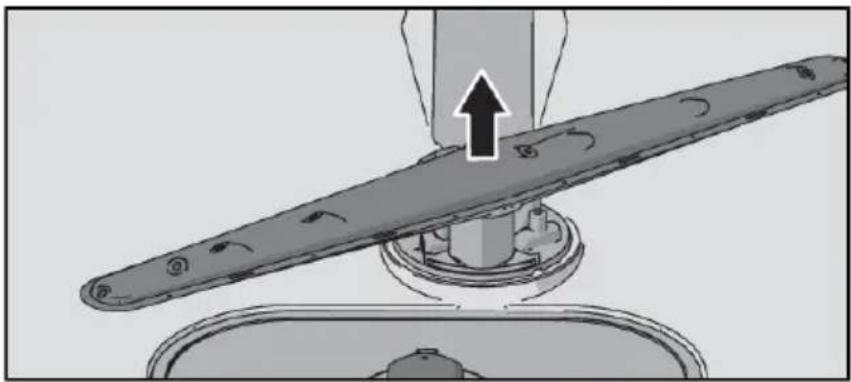
Technical diagram of a mechanical or electrical component with curved internal lines and a rotating base (no text or symbols)Lowersprayarm
• Pull the lower spray arm straight up to release it.
natural_image
Mechanical assembly diagram showing a lever mechanism with an upward arrow indicating motion (no text or symbols present)Cleanthedishwasherinsideandout
Dooranddoorseal
Open the door. Clean the sides of the door and the door seal regularly with a slightly damp cloth. Clean the door seal at the lower front edge of the dishwasher with a washing-up brush.
Displayandbuttons
Keep the display and the buttons clean. If necessary, wipe them with a dry or slightly damp cloth. Never use cleaning products – they may scratch the surface.
Use the main power switch to switch off the dishwasher when cleaning the buttons to avoid activating them inadvertently.

WARNING!
Do not clean the machine using a water jet, pressure washer or a steam cleaner.
Dishwashertub
The dishwasher tub is made of stainless steel and is kept clean through normal use (when used regularly).
If you have hard water, limescale deposits may build up in the dishwasher. If this happens, run the Self-cleaning program with two tablespoons of citric acid in the detergent compartment (with no dishes in the machine). Special dishwasher cleaners are also available on the market.
For the best results when using citric acid, deactivate the automated dosage of commercial detergent. See the Settings chapter.
Removeblockages
Unblockingthedrainagepump
If the dishwasher still contains water after the program has finished, something may be blocking the drainage pump. Such blockages are easily removed.
- Turn off the machine using the main power switch and unplug it from the wall socket.
- Remove the coarse filter and the fine filter.
- Scoop out the water from the dishwasher tub.
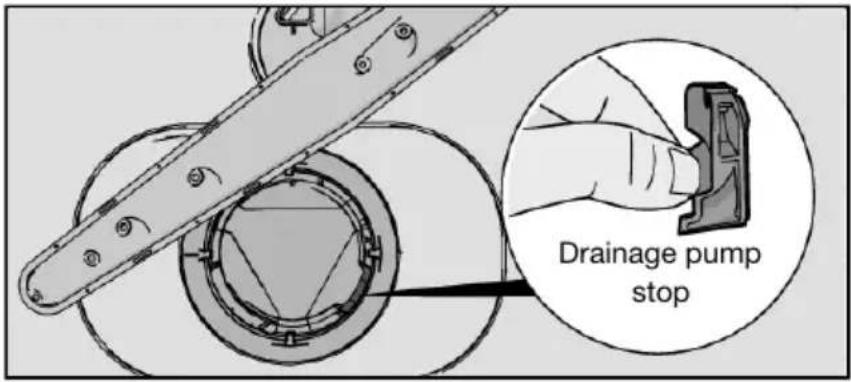
- In order to inspect the drainage pump, remove the coloured stop on the right in the bottom drain.
- Turn the pump wheel located behind the drainage pump stop by hand. Carefully remove any items.
-
Refit the drainage pump stop along with the fine and coarse filters.
-
Plug the machine in again.
If the dishwasher still does not start and a whirring sound is heard, the overflow protection has been activated.
- Shut off the water.
- Remove the plug from the wall socket.
- Call the service department.
text_image
Drainage pump stop
NOTE!
Do not forget to refit the drainage pump stop.
Troubleshooting
| ActionTypeoffaultonthedisplay | ||
| Overfilling water 1F10 | Clear the drainage pump. See the chapter Care and cleaning. If the problem persists, call the service department. | |
| Water outlet faultF11 | See “Water remains in the dishwasher” in the table “Problem” below. If the problem persists, call the service department. | |
| Water inlet faultF12 | Check that the water tap is on. If the problem persists, call the service department. | |
| F40 | Inlet valve leakage | Turn off the water tap and call the service department. |
| Heater faultF41 | Remove the plug from the wall socket and call the service depart-ment. | |
| F52 | Clean the filters (Water level fault) | Clean the coarse and fine filters. If the problem persists, call the service department. |
| F54 | Overfilling water 2 | Turn off the water tap and call the service department. |
| F56 | Circ. pump fault | Call the service department. |
| Water inlet faultF67 | Check that the water tap is on. If the problem persists, call the service department. | |
| F73 | Circ. pump fault | Call the service department. |
Press any button to clear the error message.
| ActionPossiblecausesProblem | ||
| The buttons do not react when pressed. | You have pressed the buttons too soon after opening the door. | Wait a moment then try again. |
| Child lock (button lock) activated. | See the chapter Settings. | |
| The door is closed. | Open the door. The buttons only react to use when the door is open. | |
| The buttons are dirty. | Clean with a dry or slightly damp cloth. | |
| Cannot close door. | The baskets are not correctly positioned. | Check that the baskets are correctly positioned horizontally. |
| Check that the dishes are not blocking the baskets from sliding properly into place. | ||
| The dishwasher does not start. | The Start/Stop start button has been pressed for too short a time. | Press and hold Start/Stop until the display shows "Program started, close door". |
| Check.The door is not properly c | ||
| Salt compartment empty. | Top up with salt. See the chapter Care and cleaning. |
Tablecontinuedfromlastpage
| ActionPossiblecausesProblem | ||
| You have opened the dishwasher to add more dishes while a program is in progress. | Close the door and wait. After a while, the dishwasher continues the program. | |
| tripped. | Check.A fuse/circuit breaker has been | |
| wall socket. | Check.The plug is not plugged into the | |
| The water tap is turned off. | Check. | |
| Check.Overflow/leaks. | ||
| A whirring sound (the drainage pump) is heard from the dishwasher and does not stop when the main power switch is turned off. | Turn off the water tap. Pull out the plug and call the service department. | |
| The dishes are not clean. | The spray arms do not rotate. | Check that the dishes are not blocking the spray arms. |
| Spray arm holes or bearings blocked. | Clean the spray arms. See the chapter Care and cleaning. | |
| Unsuitable dishwashing program. | Select a program with a high temperature to dissolve grease on very dirty dishes, such as Intensive. | |
| Incorrect detergent dosage. | Dose according to water hardness. Far too much or far too little detergent results in poorer dishwashing results. | |
| Old detergent. Detergent is a perishable product. | Avoid large packages. | |
| Dishes loaded incorrectly. | Do not cover porcelain with large bowls or the like. Avoid placing very tall glasses in the corners of the baskets. | |
| Glasses and cups have toppled over during the program. | Place dishes to sit steady. | |
| The filters are not fitted correctly. | Check that the filter handle is locked in the stop position. | |
| Drainage pump stop missing. | Check that the coloured stop on the right in the bottom drain is in place. See the chapter Care and cleaning. | |
| Spots on stainless steel or silver. | Some foodstuffs, such as mustard, mayonnaise, lemon, vinegar, salt and dressings, can cause spots on stainless steel if left for too long. | Rinse off these types of foodstuffs if not starting the dishwasher immediately. Use the Rinse and hold program. |
Tablecontinuedfromlastpage
| ActionPossiblecausesProblem | ||
| All stainless steel can cause spots on silver if they come into contact during dishwashing. Aluminium can also cause spots on dishes. | In order to avoid marks and tarnishing, separate dishes made from different metals, such as silver, stainless steel and aluminium. | |
| Spots or films on the dishes. | Incorrect rinse aid dosage setting. | See the chapter Settings. |
| The setting TAB is activated and all-in-one detergent with insufficient drying effect is being used. | Switch all-in-one detergents or deactivate the setting TAB and top up with salt and separate rinse aid. See Rinse aid in the chapter Settings. | |
| Incorrect water softener setting. | See Water hardness in the chapter Settings. | |
| The water softener is leaking salt. | Check that the salt compartment lid is properly tightened. Otherwise call the service department. | |
| Too high temperature and/or too much detergent can cause etching on crystal. Unfortunately, this cannot be repaired, only prevented. | Wash crystal at a low temperature and with a conservative amount of detergent. Contact the detergent manufacturer. | |
| The dishes have a sticky white/blue film. | Rinse aid dosage setting too high. | Reduce the dosage. See the chapter Settings. If you have very soft water, you may want to dilute the rinse aid 50:50 with water. |
| Spots left after washing. | Lipstick and tea can be difficult to wash off. | Use a detergent with a bleaching agent. |
| Detergent residue in the detergent compartment after dish-washing. | The detergent compartment was damp when adding detergent. | The detergent compartment must be dry when adding detergent. |
| The detergent compartment has been blocked. | Check that the dishes are not preventing the detergent compartment from opening. | |
| Rattling sound when dishwashing. | The dishes are not correctly placed or the spray arms are not rotating. | Check that the dishes are placed securely. Spin the spray arms to make sure they can rotate. |
| 1 minute appears in the display. | The program is taking longer than estimated. | No action. The program time is stored and next time the program is run the corrected time will be displayed. |
Tablecontinuedfromlastpage
| ActionPossiblecausesProblem | ||
| "Salt chamber is empty, top up before running program" is shown on the display. | Salt compartment empty. | Top up with salt. See the chapter Care and cleaning. (The setting to prevent a dish-washing program from starting when the salt compartment is empty can be deactivated. See the Settings chapter.) |
| Water remains in the dishwasher. | The filters are blocked. | Clean the coarse and fine filters. |
| The filters are not fitted correctly. | Check that the filter handle is locked in the stop position. | |
| Debris in the drainage pump. | Clean the drainage pump. See the chapter Care and cleaning. | |
| Drainage pump stop missing. | Check that the coloured stop on the right in the bottom drain is in place. See the chapter Care and cleaning. | |
| Kink in drainage hose. | Check that the hose is free from kinks and sharp bends. | |
| Blocked drainage hose. | Disconnect the drainage hose where it connects to the sink unit's water trap. Check that no debris has fastened and that the connection has an inner diameter of at least 14 mm. | |
| Bad odour in dishwasher. | Dirt around the seals and in corners. | Clean with washing-up brush and low foaming cleaner. |
| Low temperature programs have been selected for a prolonged period. | Run a program with a high temperature once or twice a month. Or run a self-cleaning program. See Self-cleaning in the chapter Using the dishwasher. | |
| Grease deposits in the dishwasher. | Low temperature programs have been selected for a prolonged period. | Or run a self-cleaning program once or twice a month. See Self-cleaning in the chapter Using the dishwasher. Select a program with a high temperature to dissolve grease on very dirty dishes, such as Intensive. Or run a self-cleaning program once or twice a month. See Self-cleaning in the chapter Using the dishwasher. |
| The dishes are not dry enough. | The Auto Open setting has not been activated. | Activate the Auto Open setting. |
| The dishwasher is not fully loaded. | Fully load the dishwasher. |
Tablecontinuedfromlastpage
| ActionPossiblecausesProblem | ||
| Rinse aid needs topping up or dosage is set too low. | Top up with rinse aid or increase the rinse aid dosage level. See the chapter Settings. | |
| The setting TAB is activated and all-in-one detergent with insufficient drying effect is being used. | Switch all-in-one detergents or deactivate the setting TAB and top up with salt and separate rinse aid. See Rinse aid in the chapter Settings. | |
| Open the door a little once the program has finished. |
Installation
text_image
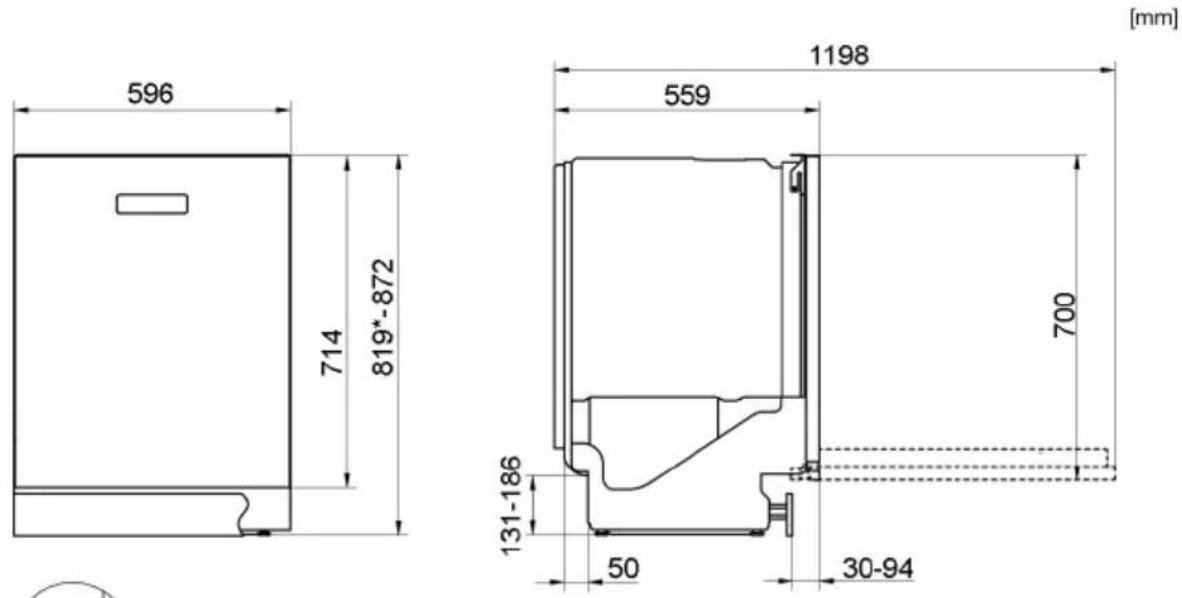
596 714 819*-872 1198 559 700 131-186 50 30-94 [mm]
*Remove the locking nuts when installing in a recess measuring 820-821 mm.
Nominal dimensions. Actual measurements may vary.
Safetyinstructions
- Connections to electricity, water and drainage must be performed by a qualified professional.
• Always follow applicable regulations for water, drainage and electricity.
• Take care during installation! Wear protective gloves! There must always be two people! - Place a drip tray on the floor beneath the dishwasher to prevent damage from any water leaks.
- Before screwing the dishwasher into place, test the dishwasher by running the Rinse and hold program. Check that the dishwasher fills with water and drains. Check also that none of the connections leak.

WARNING!
Turn off the water supply when installing the dishwasher!
During installation and the performance of any maintenance work, the plug must be removed from the wall socket, or the wall socket's power supply must be disconnected!
Transportprotectionforthedoor
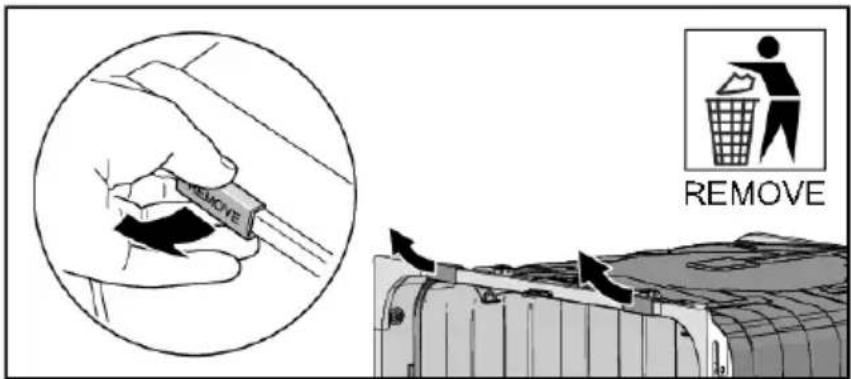
Do not forget to remove the transport protection for the door when unpacking the dishwasher.
text_image
REMOVE REMOVEPlacingthedishwasher
The dishwasher can be installed built-in, completely freestanding or partially built-in. Make sure the area on which the dishwasher is to be installed is firm.
A.Built-in
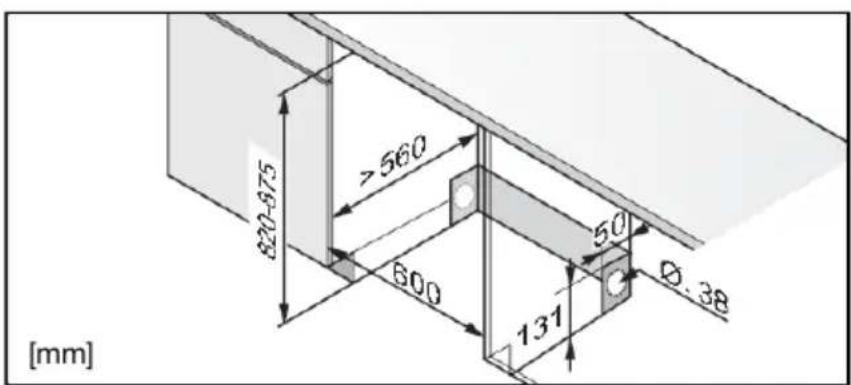
The dishwasher is intended to be built-in under a worktop. The installation dimensions are shown in the illustration. The cable and hose hole (for inlet and outlet hoses and for the power cable) does not need to be bigger than 38 mm in diameter. Ensure that the edges of the hole are smooth and cannot cause damage to the hoses or power cable. If the dishwasher is to be connected to automated dosage of commercial detergent and rinse aid, increase the diameter of the cable and hose hole to 50 mm.
text_image
820-875 >560 600 131 Ø.38 [mm]If the dishwasher is built-in the surrounding furnishings must be resistant to any condensation from the dishwasher.
B.Freestanding
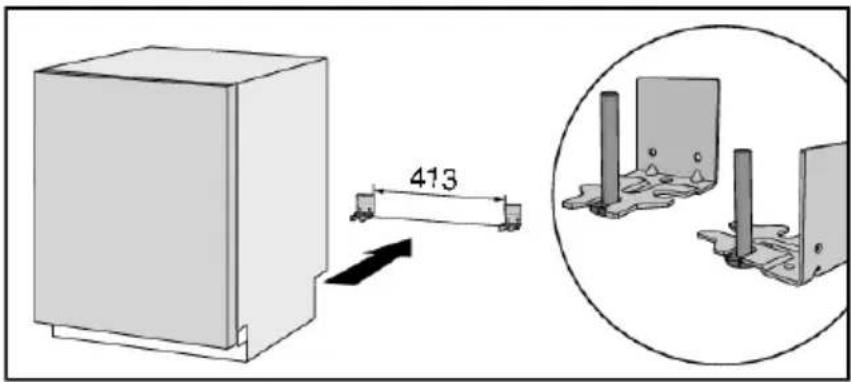
A freestanding dishwasher must be fitted with anti-tip brackets. This comprises two brackets, which are screwed into place as illustrated.
The dishwasher is then pushed in so that the brackets engage the rear feet. Now the dishwasher will not topple if pressure is put on the open door. If the dishwasher is installed completely on its own, side panels and a worktop must both be fitted. Accessories can be purchased where you bought the dishwasher.
text_image
413
WARNING!
A completely freestanding dishwasher must be fitted with anti-tip brackets.
C. Partiallybuilt-in
If the dishwasher is located so that one of its sides is visible, a side panel must be fitted. Accessories can be purchased where you bought the dishwasher.
Affixtheprotectivefilm
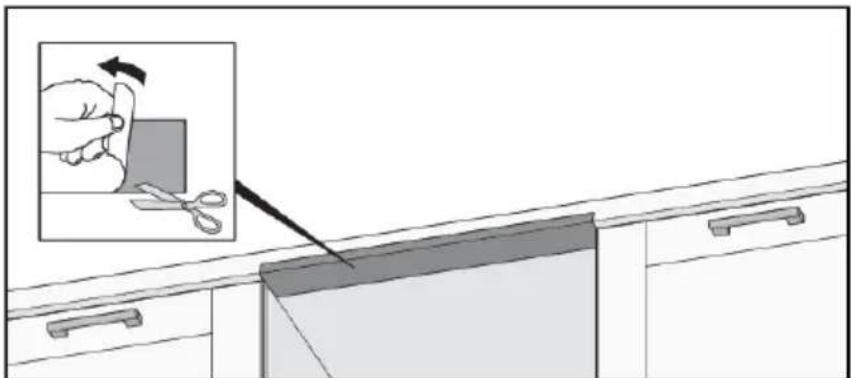
Affix the protective film (packed in the document bag). The protective film is to protect the worktop from moisture.
natural_image
Illustration of a kitchen utensil with scissors cutting into a cabinet (no text or symbols)
NOTE!
The surface to which the protective film is affixed must be clean and dry.
Connectiontoautomateddosage
The dishwasher can be connected to one or more systems for the automated dosage of commercial detergent and rinse aid, which simplifies everyday operation and reduces the risk of overdosing.
Connection to a system for automated dosage must be performed by the supplier of the system or by somebody with an equivalent professional qualification.
Connect the external cables for the automated dosage of commercial detergent and rinse aid. Also connect the hoses supplied.

WARNING!
Danger of contact with high voltage! Remove the plug from the wall socket.
Connectthecables
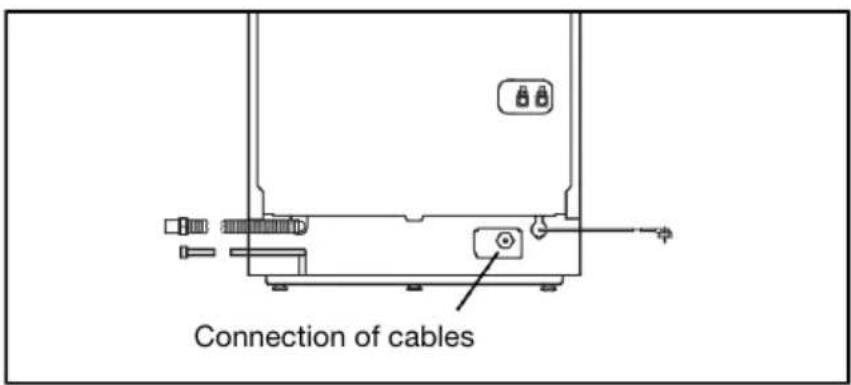
Connect the external cables for automated dosage to the back of the dishwasher.
text_image
Connection of cables- Loosen the screw to open the panel.
- Feed the external cables through the cable gland, and connect them together with the dishwasher's cables.
- Blackcables: Connectionforimpulseofdetergent(230V)
• Browncables: Connectionforimpulseofrinseaid(230V)
• Yellow/greencable: Earthconnection - Fasten the cables and the connection block to the inside of the panel using the adapted cable tie.
- Set the panel back in place.
- Tighten the strain relief on the cable gland.
The length of the external cables must not exceed 3.0 m.
Connectthehoses
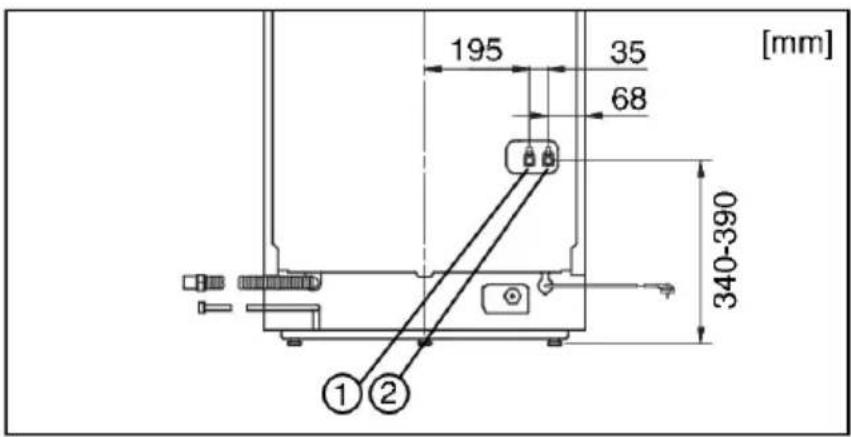
Connect the hoses supplied for automated dosage at the back of the dishwasher.
text_image
195 35 68 [mm] 340-390 ①②- Connectionfordetergent(hosediameter6mm).Removetheplugandconnectthehose.
- Connectionforrinseaid(hosediameter4mm).Removetheplugandconnectthehose.
Activate Auto dose system in the dishwasher's Settings menu. See the Settings chapter.
Dilutingdetergentandrinseaid
To correctly dilute detergent and rinse aid, calculate the dose based on the amount of water in the machine.
Amount of water in the machine:
• 3.5 liter for detergent dose
• 3.5 liter for rinse aid dose

WARNING!
Note that there are risks involved in handling commercial detergent and rinse aid. Protective gloves and goggles must be used when handling these products.
Follow the supplier's safety regulations concerning the handling and storage of detergent and rinse aid.

WARNING!
Always install protective caps and plugs when disconnecting a system for automated dosage.
Adjusttheheightandslidethedishwasherintoplace
- Start by measuring the height from the floor to the bottom edge of the worktop.
- Measure the height from the floor to the top edge of the dishwasher.
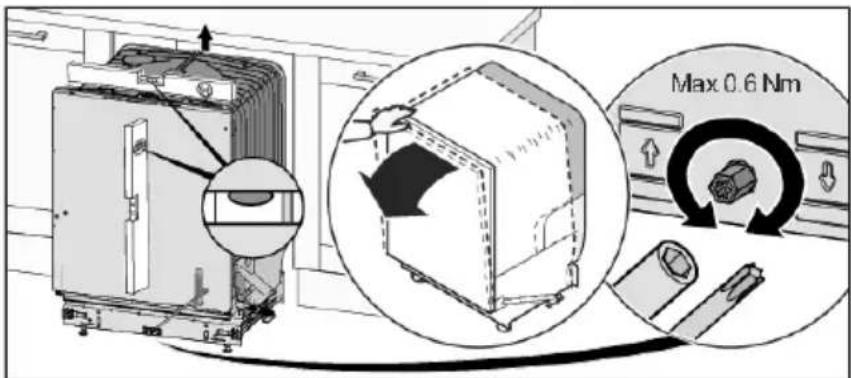
- Lean the dishwasher forwards a little and adjust the rear foot with the screw at the front of the dishwasher. Turn clockwise to lower or anticlockwise to raise.
text_image
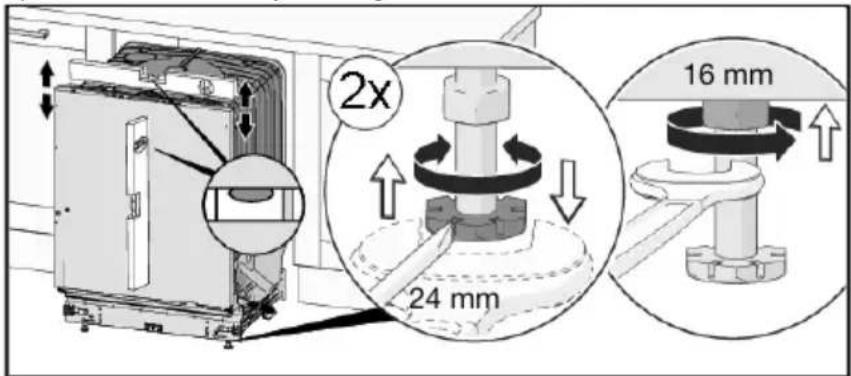
Max 0.6 Nm- Adjust the front feet by turning them clockwise to raise and anticlockwise to lower the dishwasher.
text_image
2x 24 mm 16 mm- Check that there is an air gap of at least 3 mm between the underside of the worktop and the top edge of the dishwasher.
-
Slide the dishwasher into place.
-
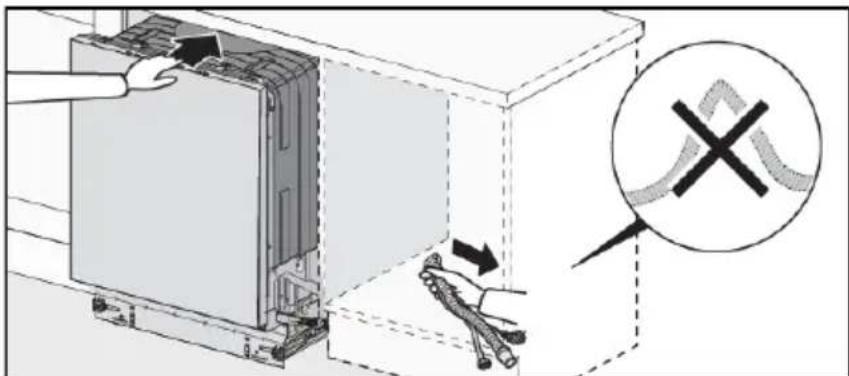
Pull in the inlet and outlet hoses and the power cable when the dishwasher is slid into place. If automated dosage has been installed, carefully pull in the hoses and external cables for that as well.
- Check that the hoses have no kinks or sharp bends, and check that there is nothing that can damage the hoses.
text_image
Diagram illustrating a device's internal structure and tool path, with an icon showing a crossed-out cable or switch.- Make any final adjustments to the feet (the dishwasher may lean no more than 5 mm) and tighten the lock nuts on the front feet.
Drainageconnection
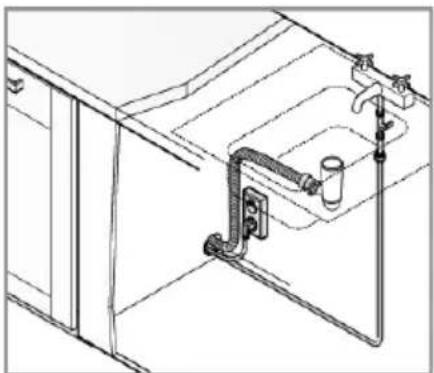
This dishwasher is suitable for installing in a raised recess (to attain an ergonomic working height). This means that the dishwasher can be placed so that the drainage hose runs to a lower level than the bottom of the dishwasher, such as by routing it directly to a floor drain. The dishwasher is fitted with an integrated anti-siphon device to prevent the machine from being emptied of water during the wash cycle.
natural_image
Technical line drawing of a kitchen sink with pipes and fixtures (no text or symbols)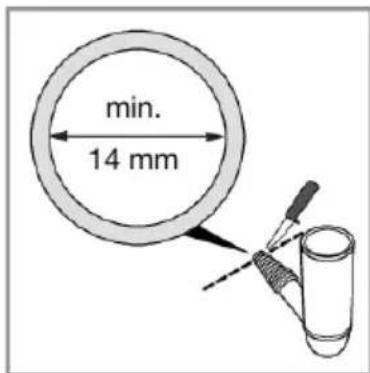
text_image
min. 14 mm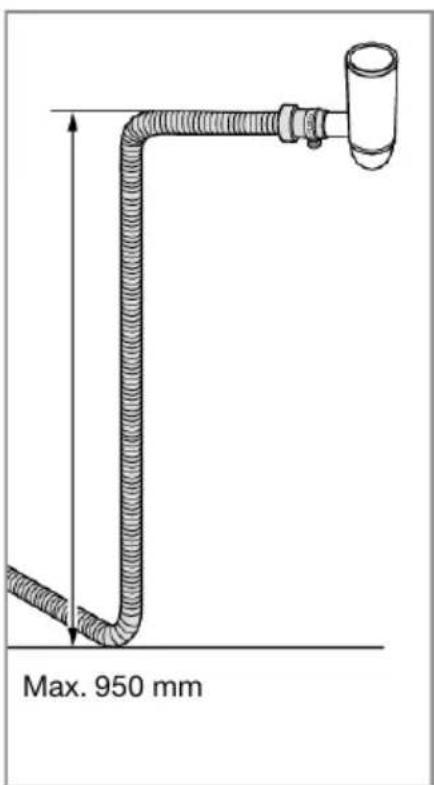
text_image
Max. 950 mm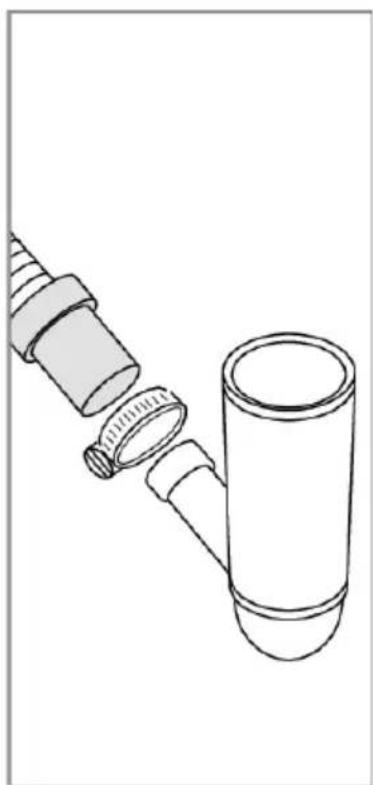
natural_image
Technical line drawing of a mechanical component with two cylindrical parts and a flanged end (no text or symbols)The drainage hose can also be connected to a connection nipple on the sink unit's water trap. The connection nipple must have an internal diameter of at least 14 mm.
The drainage hose may be extended by a maximum of 2.5 m (the total length of the drainage hose must not exceed 4.5 m). Any joins and connecting pipes must have an internal diameter of at least 14 mm. However, the drainage hose should ideally be replaced with a new hose without joins.
No part of the drainage hose may be more than 950 mm above the bottom of the dishwasher.
Attach the drainage hose with a hose clamp. Ensure that the drainage hose has no kinks.
Connectiontowatersupply
Use only the inlet hose supplied with the dishwasher. Do not re-use old or other spare hoses.
The supply pipe must be fitted with a water tap (stopcock). The water tap must be easily accessible, so that the water can be shut off if the dishwasher has to be moved.
Once the installation is complete, turn on the water tap and allow the pressure to settle for a while. Check that all connections are watertight.
Connectiontocoldwatersupply
Connect the dishwasher to the cold water supply if the building is heated using oil, electricity or gas.
Connectiontohotwatersupply
Connect the dishwasher to the hot water supply (max. 70 °C) if the building is heated using an energy-efficient means such as district heating, solar power or geothermal power. Choosing a hot water connection cuts dishwashing times and reduces the dishwasher's energy consumption.

NOTE!
Do not exceed the permitted water supply temperature. Certain materials used in some cookware cannot withstand strong heat. See Fragile dishes in the chapter Loading the dishwasher.
Electricalconnection
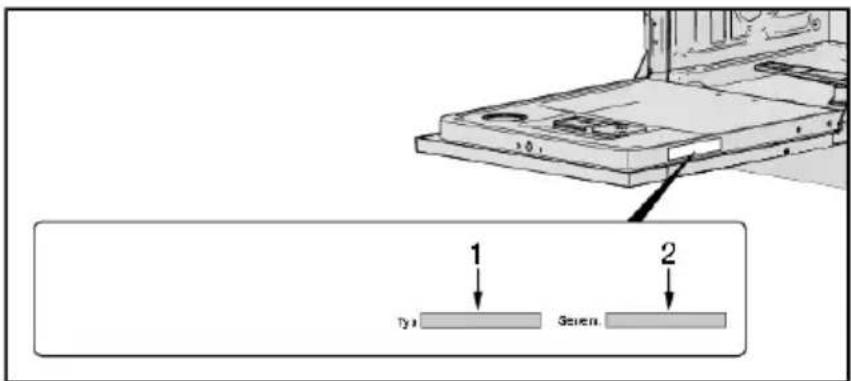
Information about the electrical connection can be found on the serial number plate. This specification must match the electricity supply.
The dishwasher must be connected to an earthed socket.
The electric wall socket must be placed outside of the installation area to be easily accessible after installing the dishwasher. Do not use an extension cord!
The dishwasher must be connected to residual current devices as per the relevant safety regulations.

NOTE!
Any repair and maintenance pertaining to safety or performance should be done by trained experts.
Screwingthedishwasherintoplace
(Applicable only to built-in dishwashers.)
natural_image
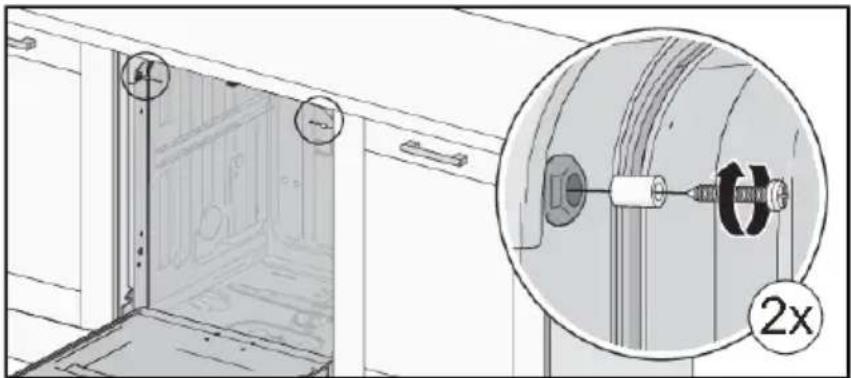
Interior view of a kitchen appliance with a close-up inset showing a mechanical component (no text or symbols)After fastening the machine, check that the front feet still touch the floor.
Screwthedishwasherintoplacewithtwoextrascrews
If there is an air gap of more than 3 mm between the underside of the worktop and the top edge of the dishwasher, the dishwasher ought to be screwed into place with two extra screws.
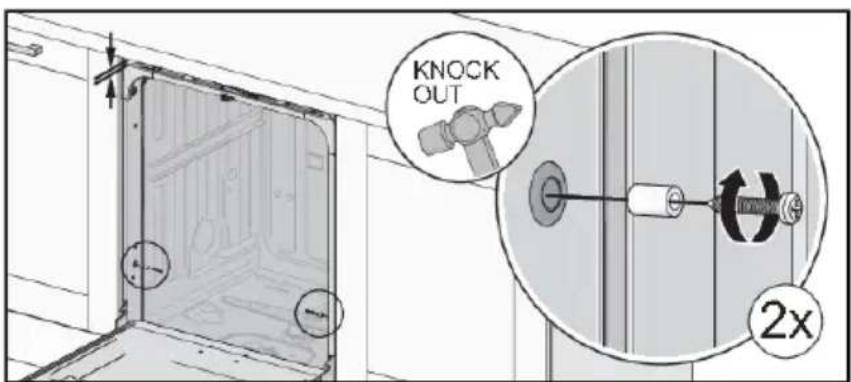
text_image
KNOCK OUT 2xDishwashertoekick
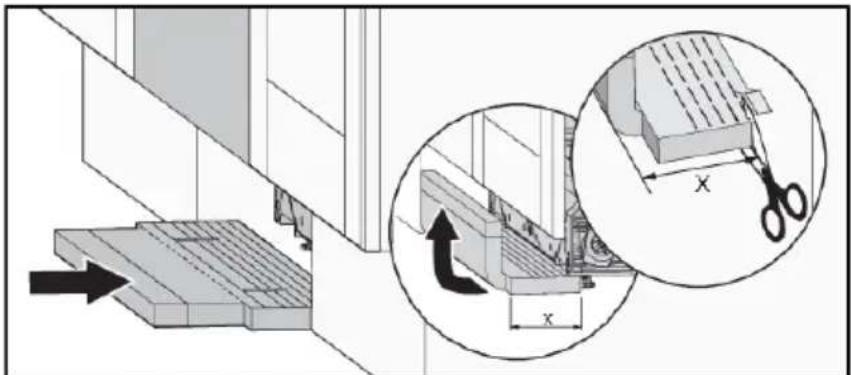
The dishwasher is supplied with a toe kick.
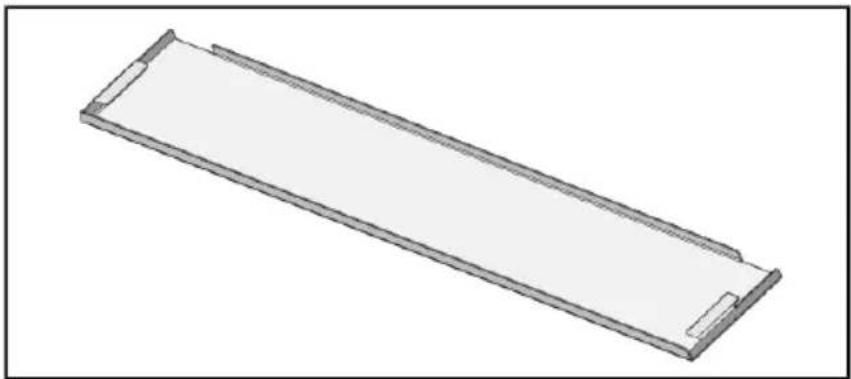
natural_image
3D rendering of a rectangular metal tray or shelf with side notches (no text or symbols)Fitthesoundinsulation
(only certain models)
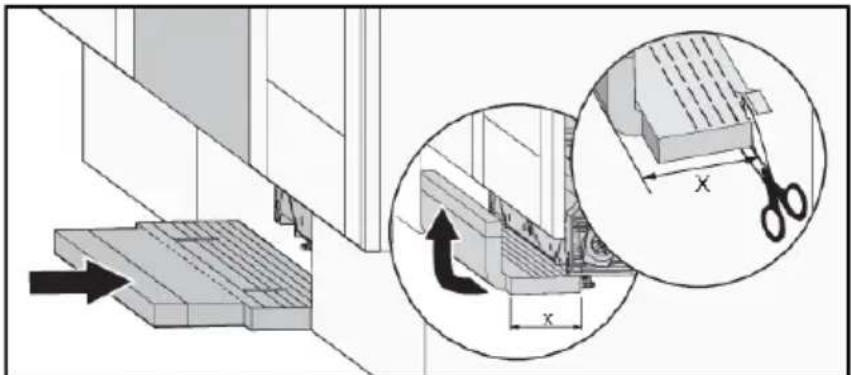
text_image
Technical diagram showing structural components with arrows and magnified detail of a component being cut by scissorsFitthetoekick
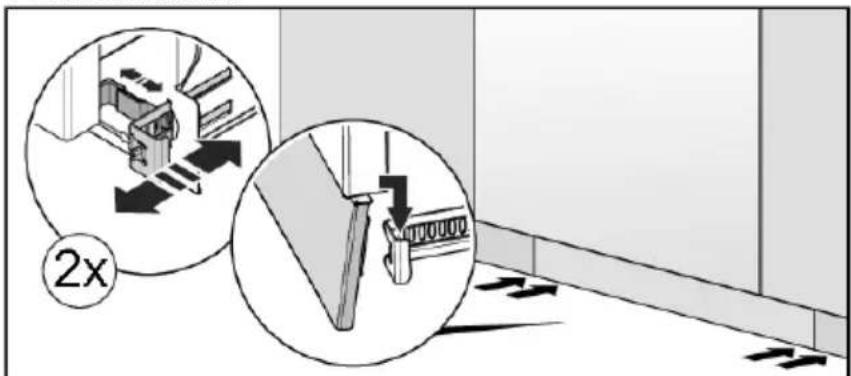
text_image
2xService
Read the chapter Troubleshooting before contacting the service centre. If you have encountered a problem that you cannot resolve, please contact your nearest service centre for professional help.
Read the chapter Troubleshooting before contacting the service department. Provide the details on the serial number plate in all contact. Include the type (1) and the serial number (2).
Cylinda service 0771-25 25 00.
Please note that non-professional repairs may risk user safety and affect the warranty.
text_image
1 Type Seven 2Technicalinformation
Technicaldata
| 819-872 mmHeight: | |
| 596 mmWidth: | |
| 559 mmDepth: | |
| Weight: | 50 kg^1) |
| 0.03–1.0 MPaWater pressure: | |
| Electrical connection: | See serial number plate |
| Rated power: | See serial number plate |
| Noise emissions: | 46 dB(A) re 1 pW |
1) Weightcanvaryduetodifferentspecifications.
Service
Vi har service i hela Sverige/ Nationwide service in Sweden
Besök www.cylinda.se / Visit www.cylinda.se
Ring 0771-25 25 00 (endast lokaltaxa) / Call 0771-25 25 00
Uppge / Declare
Maskintyp / Model code
Serienummer / Serial number
Inköpsdatum / Purchase date
Problembeskrivning / Problem description