
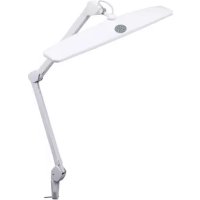
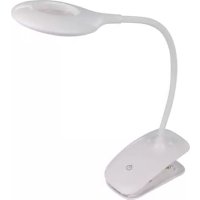
LS12M130CWN - Lamp VELLEMAN - Free user manual and instructions
Find the device manual for free LS12M130CWN VELLEMAN in PDF.


| Product Type | Lamp |
| Brand | Velleman |
| Model | LS12M130CWN |
| Power Source | AC 220-240V, 50/60Hz |
| Light Source | LED, 12W |
| Luminous Flux | 1200 lumens (approx.) |
| Color Temperature | 4000K (neutral white) |
| Expected Lifespan | 20,000 hours |
| Dimensions (H x W x D) | 200 x 100 x 100 mm (approx.) |
| Weight | 0.5 kg (approx.) |
| Protection Rating | IP20 |
| Mounting Type | Freestanding or screw mount |
| Adjustability | Fixed head (non-adjustable) |
| Dimmable | No |
| Material | Aluminum and plastic |
| Color | White and black |
| Included Accessories | User manual, power cord |
| Certifications | CE, RoHS |
Frequently Asked Questions - LS12M130CWN VELLEMAN
User questions about LS12M130CWN VELLEMAN
0 question about this device. Answer the ones you know or ask your own.
Ask a new question about this device
Download the instructions for your Lamp in PDF format for free! Find your manual LS12M130CWN - VELLEMAN and take your electronic device back in hand. On this page are published all the documents necessary for the use of your device. LS12M130CWN by VELLEMAN.
USER MANUAL LS12M130CWN VELLEMAN
LED strips are a new generation of innovative lighting products that allow for creating spectacular effects in an easy way. LED strips have other advantages: they have small dimensions, more efficient energy consumption, saturated colours and are easy to control. As you will see, the possibilities are too numerous to count.
Velleman nv offers a full range of LED strips and accessories. This overview will provide you with a good idea of the possibilities and the solutions that suit your needs.
LED strips can be divided in 2 groups: flexible and rigid strips.
This tutorial and selection guide will only focus on the flexible LED strips, as they offer the most applications.
Choosing Your LED Strip
- LED type
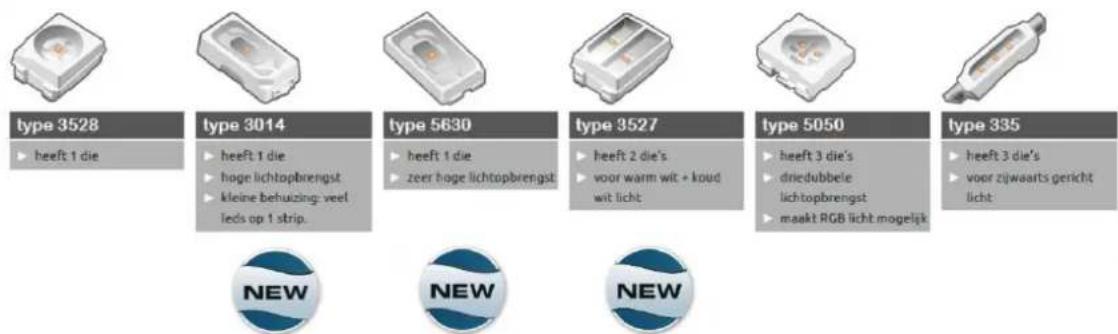
• The power voltage of the LED strip
- 12 V: considered as safety voltage and used frequently
- 24 V: has the advantage that, with an equal cable diameter, the distance between the power supply and LED strip can be larger
• The number of LEDs on the LED strip
- The more LEDs, the less light spots
- The more LEDs, the better the light dispersion
• The overall light intensity
- Colour
- RGB, RGBWW
o Warm, neutral and cold white, CW/WW
- Digital LED strip
- Protective coating
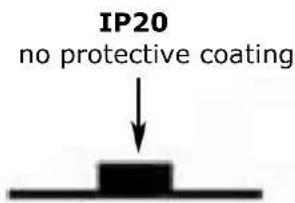
- IP20: no protective coating
- IP61: for kitchens and bathrooms
- IP68: waterproof
width: 8 mm height: 2,2 mm

width: 8 mm height: 2,5 mm

natural_image
Three-panel image showing LED array on a curved strip against dark background, no text or symbols visible
width: 10 mm height: 4 mm
• Quality level: we offer 3 quality levels
- LQ series: professional LED strips
The professional LED strips offer a high luminous efficacy. As the LEDs are carefully selected, we can therefore offer white LED strips in 5 different colour temperatures. The LED strip, with its larger copper tracks, is less prone to heat dissipation. The LED dies are of the highest quality and the current passing through the LED dies is set considerably below the maximum values. Their life span is therefore longer.
natural_image
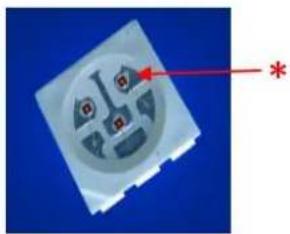
Close-up of a white plastic electrical socket with four buttons and a red arrow pointing to a star (no text or symbols)SMD 5050 * LED die
Their life span is therefore longer.

line
| Hours | B10 | B50 | | ------- | ---- | ---- | | 1,000 | 1.0 | 1.0 | | 10,000 | 1.0 | 1.0 | | 100,000 | 0.9 | 0.0 |Professional LED strips can easily be left switched on all day and night, as long as they have been installed according to all professional guidelines. In addition, the double-sided tape is of the highest quality.
- LS series: standard LED strips
Our standard LED strips have an average luminosity and can be ideally used as lighting for your living rooms. They are designed for occasional use and therefore not ideal for continuous use.
○ LB series: basic LED strips
Our basic LED strips are quality product at a sharp price. The LEDs have an average luminosity and can be ideally used as accent or ambient lighting for your living rooms. Designed for occasional use and therefore not ideal for continuous use.
The Velleman strips are packed in a vacuum metalized bag that protects the LED strip against external ESD (electrostatic discharge) and keeps the silicone or PU coating flexible and soft.
Once the LED strips are unpacked and unrolled, they are to be mounted in their final position. After installation, the coating will become less flexible. LED strips cannot be installed in another place afterwards, as the coating would break and damage the strip.
Always keep the LED strip temperature below the critical level (Tcrl, typically 50 °C, measured at the LED strip mounting surface, "Thermal guidelines").
Cutting the LED strip
Standard LED strips are 5 m long and contain a number of series and parallel connected LEDs. This design allows cutting the strip every number of LEDs. The place where the strip can be cut is clearly marked.
A strip can be cut in different lengths but the cut-off parts of the strips are not just wasted: you can solder new power supply wires to the LED strip.
Depending on the type, LED strips can be cut every 2.5 cm, 5 cm, 10 cm of 20 cm.
For IP20 LED strips:

natural_image
Diagram of a mechanical or electronic component with intersecting lines and labeled points (no readable text or symbols)For IP61 or IP68 LED strips:
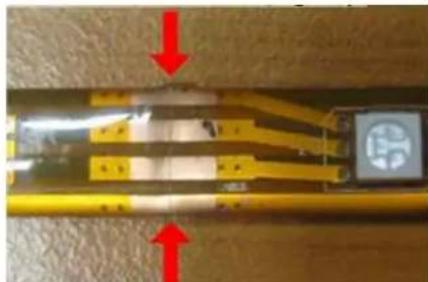
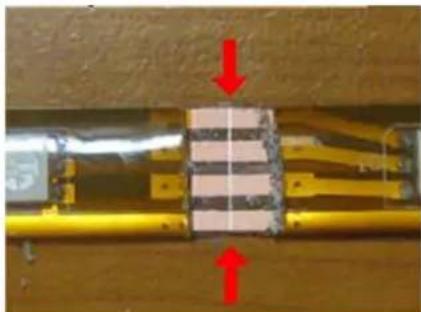
First, remove the resin with a sharp cutter and remove the insulation lacquer on the copper. A good connection between the power cable and the LED strip is very important to avoid spark erosion.
Segmentation instructions:
natural_image
Close-up of a yellow mechanical component with red arrows indicating direction, no visible text or symbolsSearch for the cutting location.
natural_image
Close-up of a yellow mechanical component with red arrows indicating force or movement, no visible text or symbolsRemove the protective layer with a knife.

natural_image
Close-up of a yellow electrical connector with labeled components A, B, C, D (no text or symbols beyond labels)Solder the connection cables.
Please make sure the power wires are properly soldered.
Serial connection of LED strips is not recommended. It is best to provide every LED strip with its own power cable. For full-length LED strips (5 m), it is even better to provide a power supply on both ends of the strip.
Power Supply
Always use a professional switching-mode power supply for powering your LED strips.
• Waterproof power supply by Mean Well
This power supply has an IP index of IP65 or IP67 and is usable in damp environments or even outdoors.

natural_image
Two electronic components: a white HLG-320H-24A power supply and a beige LPV-180-12 voltage regulator with AC input/output wires (no visible text or symbols on the devices themselves)• Power supply for mounting on a DIN rail by Mean Well
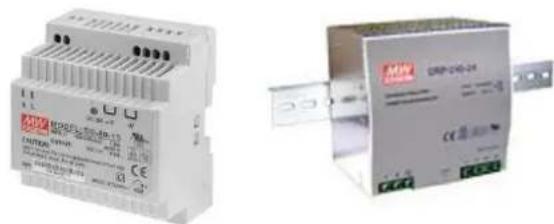
This power supply is installed in a fuse box with DIN rail mounting. The voltage can be set to ± 10% of the nominal output voltage.
natural_image
Two industrial electronic components: a white MDDU regulator and a gray DNP-240-24 voltage regulator, both without visible text or symbols.LED strips operate on an extra-low voltage of 12 VDC or 24 VDC.
Using low voltages is an advantage as it makes LED strips safer to use. On the other hand, larger operating currents are required. The latter implies that the section of the power leads must be enlarged accordingly.
Example: A 12 V LED strip with a power consumption of 24 W connected to a copper power wire of 20 m needs a wire section of 2.5 mm ^2 to have a voltage drop of less than 5 %.
Because of this, it is more interesting to use 24 V LED strips for long power cable runs.
Mounting
Velleman nv offers a complete range of LED profiles designed for LED strips with a maximum power from 20 W/m to 30 W/m. These profiles feature a diffuse cover with "LEDs DOT-FREE" design. Using such a cover with an LED strip of 120 or more LEDs/m will result in a uniform light.

natural_image
Metallic rectangular metal bracket with a triangular cutout at the end (no text or symbols)However, a LED profile with diffuse cover has a loss of light of 25 %. You will also find profiles with a transparent cover, used for installations needing a maximum amount of light. These profiles have a loss of light of only 3 %.

natural_image
Pure metallic bracket with a V-shaped cutout, no text or symbols visibleRemark: The life span of LEDs is inversely proportional to the current running through them. The lower the current, the longer their life span.

line
| Hours | B10 (Tj=115C) | B10 (Tj=125G) | B10 (Tj=135C) | B50 (Tj=115C) | B50 (Tj=125G) | B50 (Tj=135C) | | ------- | ------------- | ------------- | ------------- | ------------- | ------------- | ------------- | | 1,000 | 1.0 | 1.0 | 1.0 | 1.0 | 1.0 | 1.0 | | 10,000 | 1.0 | 1.0 | 1.0 | 1.0 | 1.0 | 1.0 | | 100,000 | 0.2 | 0.3 | 0.4 | 0.6 | 0.7 | 0.8 |Thermal Guidelines
Introduction
Although LEDs are known as cold light sources, they produce heat like every light source. High-power LED strips produce a lot of heat because many LEDs are positioned close to each other. Cooling is a very important and often forgotten issue when installing LED strips. Using LED strips at too high a temperature will considerably reduce their life span.
Reduce the heat production by following these thermal guidelines:
Reduce the current through the LED strip:
The heat in an LED strip is produced mainly by the amount of current running through the strip. The strip length also influences the amount of current. The current per unit of length can thus be reduced by connecting a power source to either side of the LED strip. This decreases the amount of current running through the strip by 50 %.
For this reason, Velleman power LED strips have wires on both sides:


Determine the heat transferring features of the mounting surface:
High-power LED strips always need to be installed on a surface with sufficient cooling capacity. The temperature of the LED strip must be kept below 50 °C during its entire operation. The cooling capacity of the mounting surface must allow easy evacuation of the excess heat with regards to the ambient environment (ambient temperature, natural air flow, relative humidity) and keep the LED strip temperature below its critical level. This is why LED strips are mostly mounted on aluminium strips or profiles, as aluminium has a good thermal conductivity (copper has an even better thermal conductivity, but is much more expensive).
Example: A 24 V LED strip producing 100 W/5 m – or 20 W/m – is mounted on different surfaces with different thermal resistances. The ambient temperature is 25 °C.
Temperature after one hour:
| mounting surface | temperature |
| not mounted (free air) | 60 °C |
| small aluminium LED strip profile (CHLAP1) | 40 °C |
| high-power heatsink (41/1000) | 30 °C |
This shows the importance of thermal resistance or heat transferring capacity of the mounting surface.
Choose an LED strip without protection:
Most LED strips have a silicone or PU coating for protection against dust and moisture.
As silicone or PU is an excellent thermal insulator, the excess heat will be drained mostly through the mounting surface. For this reason, Velleman nv also provides LED strips without coating. On these strips, a great amount of excess heat evacuates directly into the surrounding air.
These LED strips are more vulnerable and are preferably mounted inside aluminium LED profiles as these profiles take over the protection of the coating.
Reduce the operation voltage:
Reducing voltage will also reduce input current and power consumption. Reducing power consumption will in turn reduce heat production. With this solution, however, light output will also decrease considerably.
Example: A 12 V LED strip consumes 35 W at 12 V. When reducing the tension to 11 V, the consumed power drops to 25 W, but produces only 75 % of the normal light output.
If light output is important in your situation, reducing voltage is the least efficient solution.
Control
LED strips are only dimmable with a PWM dimmer. This type of dimmer is always placed between the power supply and the LED strip. The power voltage is switched at a frequency higher than the visible spectrum by means of pulse width modulation (PWM).
Remark: When filming in rooms with a PWM-dimmed LED strip, please use a dimmer with a PWM frequency which is high enough.
Single-coloured LED strips are dimmed with an LED PWM dimmer
RGB LED strips are dimmed with an RGB PWM controller
Different types:
Professional dimmers and controllers for DIN-rail mounting:
This type of dimmers can be installed in a fuse box with DIN-rail mounting and is controlled via a 0/1-10 V signal. Some models can be controlled through a PWM signal or push buttons.
These dimmers are easy to integrate into a new, classic or domotics installation.

DMX RGB controllers for DIN-rail mounting:
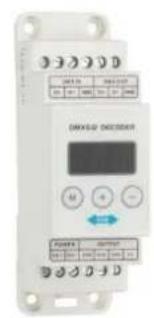
These dimmers can be installed in a fuse box with DIN-rail mounting. Connection is done through the DMX512 signal. This controller type is ideal for professional installations in bars or discos.
DMX RGB controllers for surface mounting:
Control through the DMX512 signal.

Mini dimmer and controller:
This dimmer and controller type can be integrated easily.

natural_image
Close-up of a red cable with white wires extending from its ends, no visible text or symbolsBuilt-in dimmer and controller:

natural_image
Two electronic devices: one with a small sensor and two connected cables (no visible text or symbols)Dimmer and controller with IR remote control:
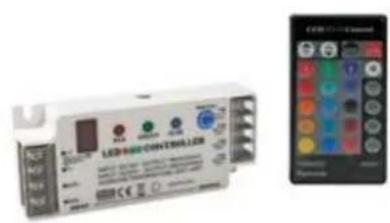
Colour and light intensity can be set quickly via the remote control. The remote control must be pointed towards the controller.
Dimmer and controller with RF remote control:
Colour and light intensity can be set quickly via the remote control. The remote control must not be pointed towards the controller. The operation range will also be larger than with an IR remote control.


- Choosing Your LED Strip
- Cutting the LED strip
- Power Supply
- Mounting
- Thermal Guidelines
- Introduction
- Reduce the heat production by following these thermal guidelines:
- Reduce the current through the LED strip:
- Determine the heat transferring features of the mounting surface:
- Choose an LED strip without protection:
- Reduce the operation voltage:
- Control
- Professional dimmers and controllers for DIN-rail mounting:
- DMX RGB controllers for DIN-rail mounting:
- DMX RGB controllers for surface mounting:
- Mini dimmer and controller:
- Built-in dimmer and controller:
- Dimmer and controller with IR remote control:
- Dimmer and controller with RF remote control:
Brand : VELLEMAN
Model : LS12M130CWN
Category : Lamp