
NI-707524 - Network card/adapter Icidu - Free user manual and instructions
Find the device manual for free NI-707524 Icidu in PDF.


| Product Type | Network Adapter |
| Model | NI-707524 |
| Brand | Icidu |
| Interface | USB 3.0 / PCI Express |
| Ethernet Ports | 1 x RJ45 |
| Maximum Speed | 1000 Mbps (Gigabit) |
| Compliance Standards | IEEE 802.3, IEEE 802.3u, IEEE 802.3ab |
| Operating Systems Supported | Windows, macOS, Linux |
| Power Source | Bus-powered (USB) or PCIe slot |
| Dimensions (L x W x H) | Approx. 6.0 x 2.5 x 1.0 cm (USB) or 10.0 x 5.0 x 1.5 cm (PCIe) |
| Weight | Approx. 30 g |
| LED Indicators | Link/Activity |
| Data Transfer Rate | 10/100/1000 Mbps |
| Connector Type | RJ45 |
| Maintenance | Keep dry and clean; avoid dust accumulation |
| Safety Precautions | Avoid static discharge; handle by edges |
| Spare Parts Availability | Not available; replace unit if faulty |
| Repairability | Not user-serviceable; no repair parts |
| General Information | Plug and play; driver may be required for some OS |
Frequently Asked Questions - NI-707524 Icidu
User questions about NI-707524 Icidu
0 question about this device. Answer the ones you know or ask your own.
Ask a new question about this device
Download the instructions for your Network card/adapter in PDF format for free! Find your manual NI-707524 - Icidu and take your electronic device back in hand. On this page are published all the documents necessary for the use of your device. NI-707524 by Icidu.
USER MANUAL NI-707524 Icidu
This equipment has been tested and found to comply with the limits for a Class B digital device, pursuant to part 15 of the FCC Rules. These limits are designed to pro-vide reasonable protection against harmful interference in a residential installation. This equipment generates, uses and can radiate radio frequency energy and, if not in-stalled and used in accordance with the instructions, may cause harmful interference to radio communications. However, there is no guarantee that interference will not occur in a particular installation. If this equipment does cause harmful interference to radio or television reception, which can be determined by turning the equipment off and on, the user is encouraged to try to correct the interference by one or more of the following measures:
- Reorient or relocate the receiving antenna.
- Increase the separation between the equipment and receiver.
- Connect the equipment into an outlet on a circuit different from that to which the receiver is connected.
- Consult the dealer or an experienced radio/ TV technician for help.
This device complies with part 15 of the FCC Rules. Operation is subject to the following two conditions:
1) This device may not cause harmful interference.
2) This device must accept any interference received, including interference that may cause undesired operation.
Any changes or modifications not expressly approved by the party responsible for compliance could void the user's authority to operate the equipment.
FCC RF Radiation Exposure Statement
This equipment complies with FCC RF radiation exposure limits set forth for an uncontrolled environment. This device and its antenna must not be co-located or operating in conjunction with any other antenna or transmitter.
"To comply with FCC RF exposure compliance requirements, this grant is applicable to only Mobile Configurations. The antennas used for this transmitter must be installed to provide a separation distance of at least 20 cm from all persons and must not be co-located or operating in conjunction with any other antenna or transmitter."
CE Mark Warning
CE!
This is a class B product. In a domestic environment, this product may cause radio interference, in which case the user may be required to take adequate measures.
National Restrictions
2400.0-2483.5 MHz
| Country | Restriction | Reason/remark |
| Bulgaria | General authorization required for outdoor use and public service | |
| France | Outdoor use limited to 10 mW e.i.r.p. within the band2454-2483.5 MHz | Military Radiolocation use. Refarming of the 2.4 GHz band has been ongoing in recent years to allow curren relaxed regulation. Full implementation planned 2012 |
| Italy | If used outside of own premises, general authorization required | |
| Luxembourg | None | General authorization required for network and serv supply(not for spectrum) |
| Norway | Implemented | This subsection does not apply for the geographical ar within a radius of 20 km from the centre of Ny-Ålesund |
| Russian Federation | Only for indoor applications |
Note: Please don't use the product outdoors in France.
CONTENTS
Package Contents 1
Chapter 1 Introduction ...... 2
1.1 Overview of the Product....2
1.2 Features 2
1.3 LED Status 3
Chapter 2 Installation Guide 4
2.1 Hardware Installation....4
2.2 Software Installation....4
2.2.1 Overview 4
2.2.2 Software Installation for Windows XP 4
Chapter 3 Configuration....11
3.1 Current Status 11
3.2 Profile Management 13
3.2.1 Add or Modify a Configuration Profile....13
3.2.2 Remove a profile 18
3.2.3 Switch another Profile 18
3.2.4 Export a Profile....19
3.2.5 Import a Profile....19
3.2.6 Scan Available Networks 20
3.2.7 Auto Profile Selection Management 20
3.3 Diagnostics....21
3.3.1 Check Driver Information 22
3.3.2 Check Receive and Transmit Statistical Information 22
Appendix A: Specifications 26
Appendix B: Glossary 27
Package Contents
The following items should be found in your package:
Wireless Cardbus adapter
CD With Drivers and Full Manual
Manual
Note:
Make sure that the package contains the above items. If any of the listed items are damaged or missing, please contact with your distributor.
Conventions:
The ‘Adapter’ mentioned in this user guide stands for NI-707524 300N Wireless Cardbus Adapter without any explanations.
Chapter 1 Introduction
Thank you for choosing the NI-707524 300N Wireless Cardbus Adapter!
1.1 Overview of the Product
The adapter is a 802.11n client device; it is designed to provide a high-speed and unrivaled wireless performance for your notebook. With a faster wireless connection, you can get a better Internet experience, such as downloading, gaming, video streaming and so on.
With the 802.11n technology, higher throughput improvements using MIMO (multiple input, multiple output antennas), the NI-707524's auto-sensing capability allows high packet transfer rate of up to 300Mbps for maximum throughput. It has good capability on anti-jamming, and it can also interoperate with other wireless (802.11b) products. The adapter supports WEP, WPA and WPA2 encryption to prevent outside intrusion and protect your personal information from being exposed.
The adapter is easy to install and manage. The Quick Setup Wizard guides you step-by-step through the installation process; the ICIDU Wireless N Client Utility helps you create a wireless connection immediately.
With unmatched wireless performance, reception, and security protection, the NI-707524 is the best choice for easily adding or upgrading wireless connectivity to your notebook computer.
1.2 Features
Complies with IEEE802.11n, IEEE802.11g, IEEE802.11b standards
Supports WPA/WPA2 data security, IEEE802.1x authentication, TKIP/AES encryption, 64/128/152-bit WEP encryption
Supports high rate of up to 300Mbps for maximum throughput, supports automatically adjust to lower speeds due to distance or other operating limitations
Provides 32-bit CardBus interface
Supports Ad-Hoc and Infrastructure modes
Good capability on anti-jamming
Supports roaming between access points when configured in Infrastructure mode
Ease to configure and provides monitoring information
Supports Windows 2000, XP ,Vista
Built-in two internal antennas which are listed in a format of 2x2 for two receivers and two transmitters.
1.3 LED Status
| LED Indications | Status | Working Status |
| Status Blue | Flashing Alternately | The adapter is trying to scan a networking connection. |
| Activity Blue | ||
| Status Blue | Intermittently | The adapter is already connected but is not transmitting or receiving data. |
| Activity Blue | ||
| Status Blue | Flashing | The adapter is transmitting or receiving data. |
| Activity Blue |
Chapter 2 Installation Guide
2.1 Hardware Installation
To install the adapter, follow these steps listed below:
- Locate an available CardBus slot on your laptop.
- With the connector pin end facing the CardBus slot and the label facing up, slide the Adapter into the CardBus slot until it locks in place.
Note:
Once the Adapter is firmly in place, the Found New Hardware Wizard screen will pop up.
2.2 Software Installation
2.2.1 Overview
The Adapter's Setup Wizard will guide you through the Installation procedure for Windows 2000, XP and Vista. The Setup Wizard will install the ICIDU Wireless N Client Utility (ICIDU 11NWCU) and drivers.
When you install the hardware prior to before installing the software, the system will prompt "Found New Hardware Wizard", click Cancel, and run the Setup Wizard program on the CD-ROM.
The Setup steps for Windows 2000, XP and Vista are very similar. The following setup steps are for Windows XP.
2.2.2 Software Installation for Windows XP
- Insert the Resource CD into your CD-ROM drive, and open the Drivers folder Then double-click Drivers\Setup.exe in the proper folder according to your operating system to start the installation. After that, Figure 2-1 will appear. You can click Cancel to end the installation in the screen below.
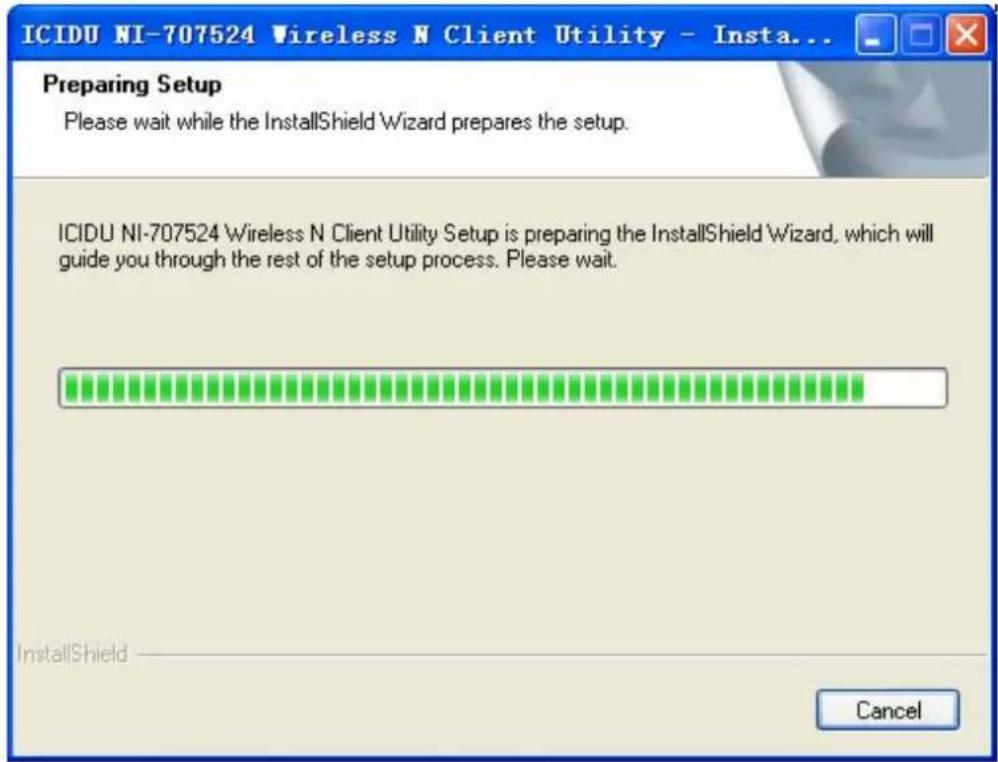
Figure 2-1
- Soon, Figure 2-2 will display after a moment. Click Next to continue.

Figure 2-2
- After that, you should choose a Setup type. It is recommended that you select Install Client Utilities and Driver. Select Install Driver Only to install driver only, select Make Driver Installation Diskette(s) to make the diskette(s) as the installation driver (shown in Figure 2-3). Click Next to continue.

Figure 2-3
- Click Browse to change the destination location for the software, then click Next in the screen below (shown in Figure 2-4).

Figure 2-4
- After that, select the program folder, you should create a new folder name or select one from the Existing Folders list. It is recommended that you keep the default setting. Click Next to continue the installation.

Figure 2-5
- Choose configuration tool, if you are not sure, please leave it default. Then click Next to continue.

Figure 2-6
- Click OK to continue the Installation on the screen below.

Figure 2-7
- Wait a while for the setup as shown in Figure 2-8.

Figure 2-8
Note:
1) For Windows XP, the Setup Wizard will notify you of how to proceed with the installation during these steps (shown in Figure 2-9). Our drivers have been tested thoroughly, and are able to work with the operating system. Click Continue Anyway to continue the Installation.

Figure 2-9
2) In Windows 2000, the warning screen is shown below (Figure 2-10), and please select Yes to continue installation.
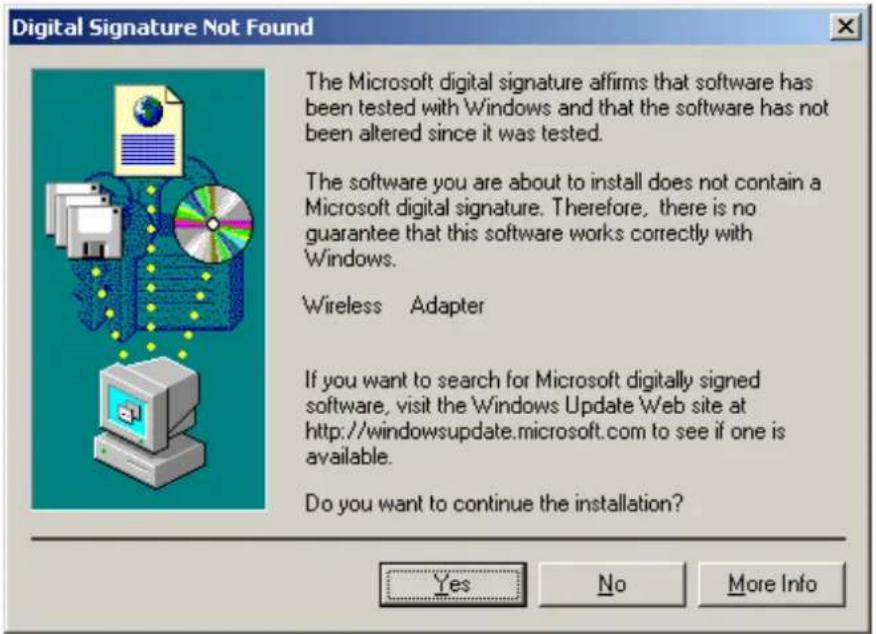
Figure 2-10
- After all the steps above, you will see the screen below, click Finish to complete the installation.
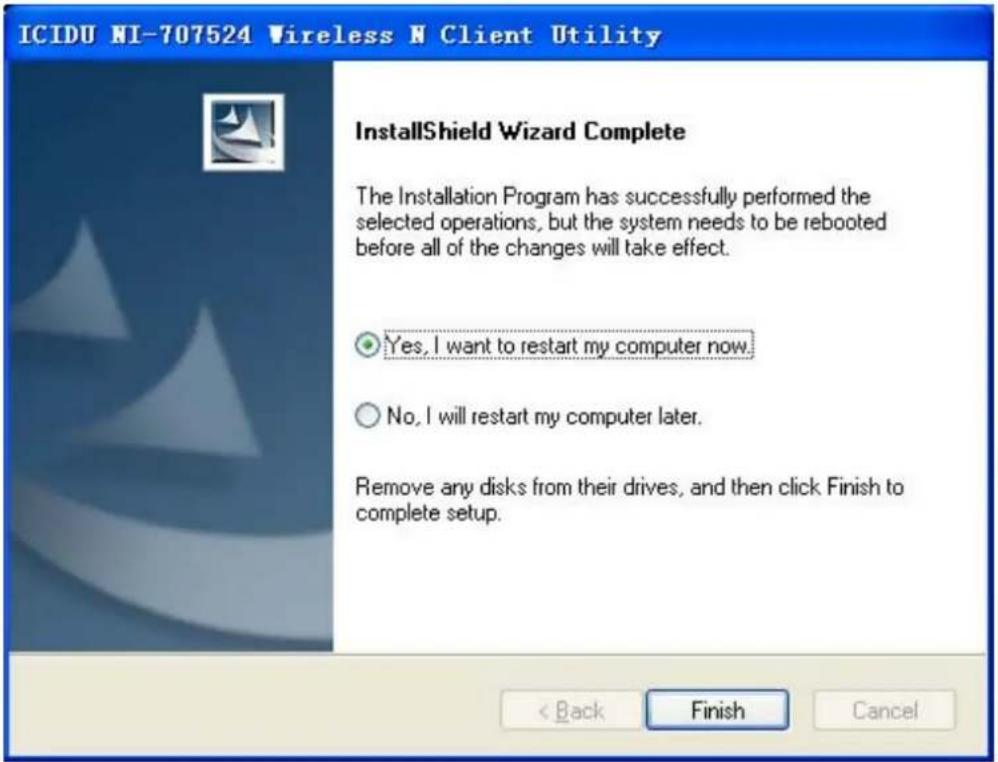
Figure 2-11
Chapter 3 Configuration
ICIDU NI-707524 can be configured by ICIDU Wireless N Client Utility (ICIDU 11NWCU). This chapter describes how to configure your Adapter for wireless connectivity on your Wireless Local Area Network (WLAN) and use the data security encryption features.
After Installing the Adapter, the Adapter's tray icon will appear in your system tray. It appears at the bottom of the screen, and shows the signal strength using color and the received signal strength indication (RSSI).
If the icon is gray, there is no connection.
If the icon is red, there is poor signal strength and the RSSI is less than 5dB.
If the icon is yellow, there is poor signal strength and the RSSI is between 5dB and 10dB.
If the icon is green, there is good signal strength and the RSSI is between 10dB and 20dB.
If the icon is green, there is excellent signal strength and the RSSI is more than 20dB.
Double-click the icon and the 11NWCU will run. You can also run the utility by clicking the Start →Program→Wireless→ ICIDU NI-707524 Wireless N Client Utility. The
11NWCU provides some integrated and easy tools to:
▶ Display current status information
- Edit and add configuration profiles
▶ Display current diagnostics information
The section below introduces these above capabilities.
3.1 Current Status
The Current Status tab contains general information about the program and its operations. The Current Status tab needn't any configurations.

Figure 3-1
The following table describes the items found on the Current Status screen.
Profile Name - This shows the name of current selected configuration profile. The configuration of Profile name will be described on the General tab of Profile Management.
Link Status - This shows whether the station is associated to the wireless network.
Wireless Mode - Here displays the wireless mode.
Network Type - The type of network and the station currently connected are shown here. The options include:
• Infrastructure (access point)
- Ad Hoc
Note:
You can configure the network type and wireless mode on the Advanced tab of Profile Management.
IP Address - This displays the computer's IP address.
Control Channel - This shows the currently connected channel.
Data Encryption - Here displays the encryption type the driver is using. You can configure it on the Security tab of Profile Management.
Server Based Authentication - This shows whether the server based authentication is used.
Signal Strength - This shows the strength of the signal.
Click Advanced on the screen above, you can see advanced information about the program and its operations.
3.2 Profile Management
Click the Profile Management tab of the ICIDU 11NWCU and the next screen will appear (shown in Figure 3-2). The Profile Management screen provides tools to:
Add a new profile
Modify a profile
Remove a profile
Activate a Profile
Import a Profile
Export a Profile
▶ Scan Available Networks
Order profiles
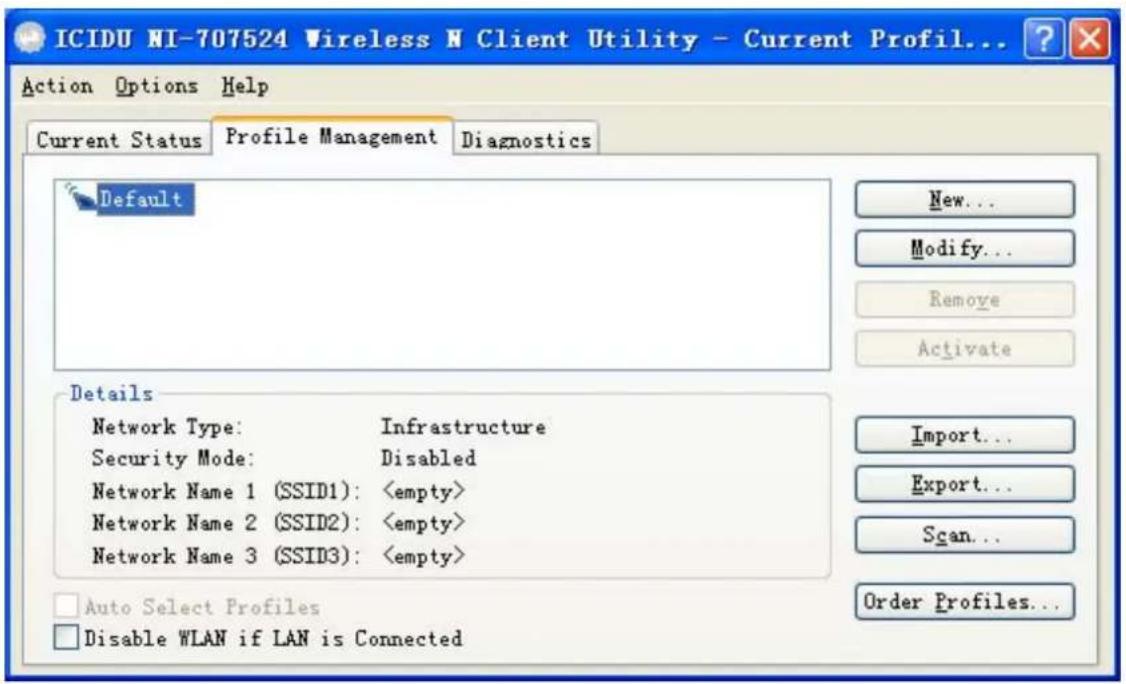
Figure 3-2
3.2.1 Add or Modify a Configuration Profile
To add a new configuration profile, click New on the Profile Management tab. To modify a configuration profile, select the configuration profile from the Profile list and click Modify. Then you will see the Management dialog box (shown in Figure 3-3).
1. Edit the General tab
Profile Name - Please enter the Profile name which identifies the configuration profile. This name must be unique. Note that the profile names are not case-sensitive.
- Client Name - Please enter the Profile name which identifies the client machine.
Network Names (SSIDs) - Please enter the IEEE 802.11 wireless network name. This field has a maximum limit of 32 characters.
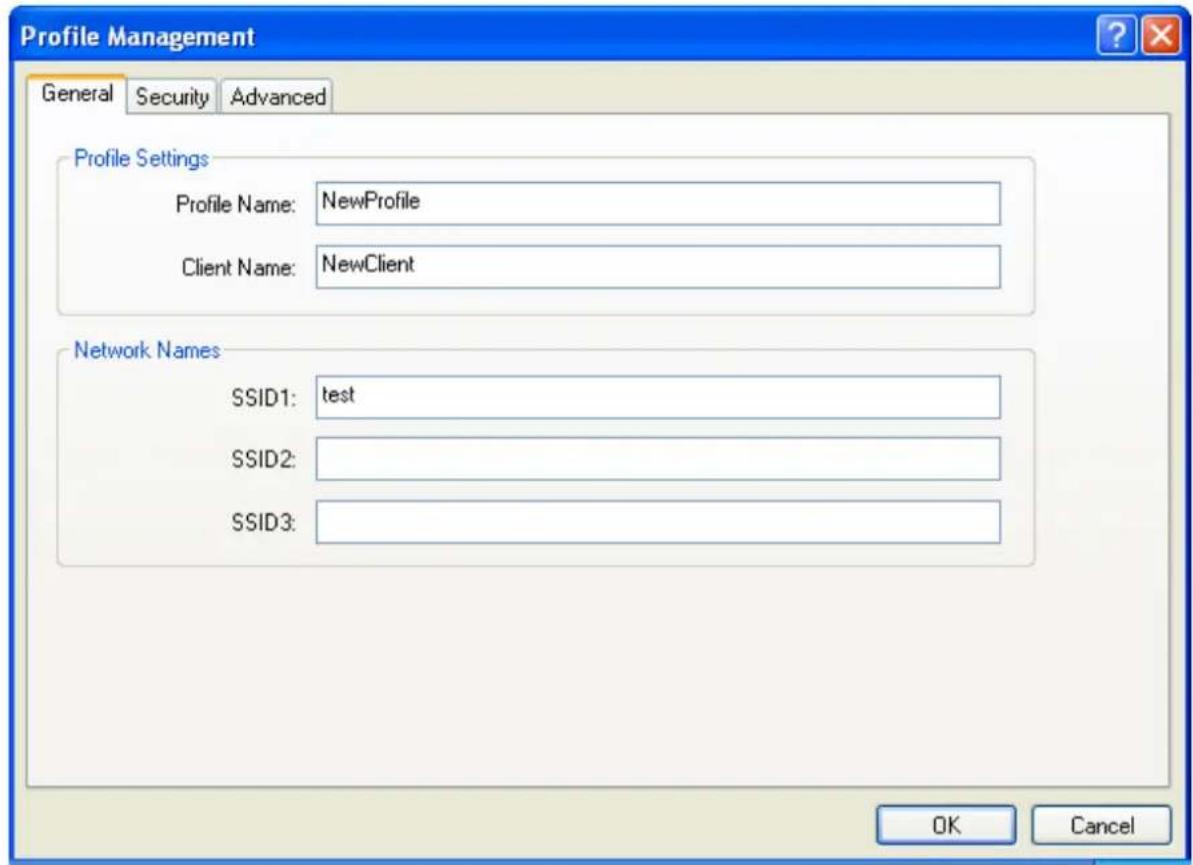
Figure 3-3
2. Edit the Security tab
Select the Security tab in the screen above, and then you can edit the fields to configure the profile. To define the security mode, select the radio button of the desired security mode as follows.
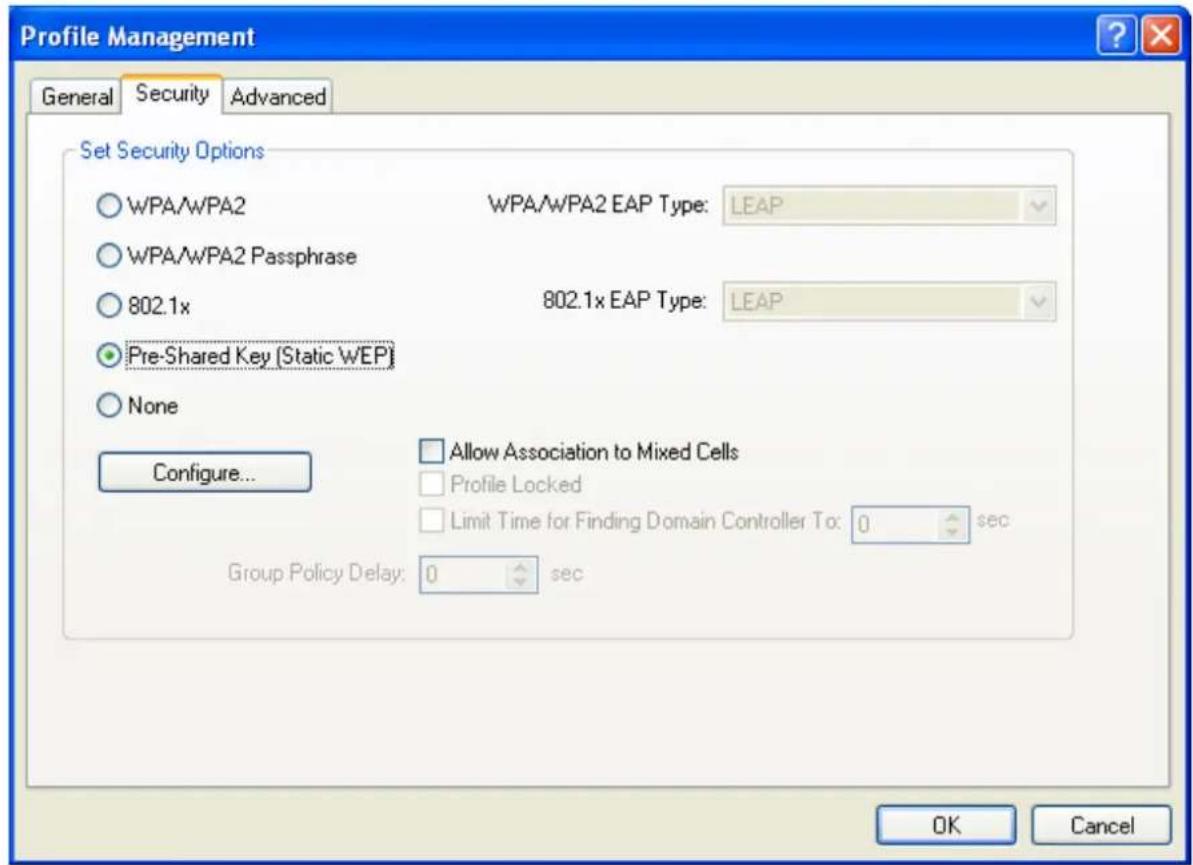
Figure 3-4
WPA/WPA2: Wi-Fi Protected Access.
WPA/WPA2 Passphrase: Wi-Fi Protected Access Passphrase.
802.1x: Enables 802.1x security.
Pre-Shared Key (Static WEP): Enables the use of shared keys that are defined on both the access point and the station. To define shared encryption keys, choose the Shared Key radio button and click Configure to fill in the Define Shared Keys window (shown in Figure 3-5).
Note:
The WEP security mode is not available for 802.11n.
None: No security (not recommended).
Note:
If the access point which the Adapter is associated has WEP set and the client has WEP enabled, make sure that Allow Association to Mixed Cells is checked on the Security tab to allow association. To complete WEP encryption configuration, you must select the 802.11 Authentication Mode as appropriate on the Advanced tab of this Profile Management dialog.
To configure the Encryption Keys under the Pre-Shared keys (Static WEP) Security mode:
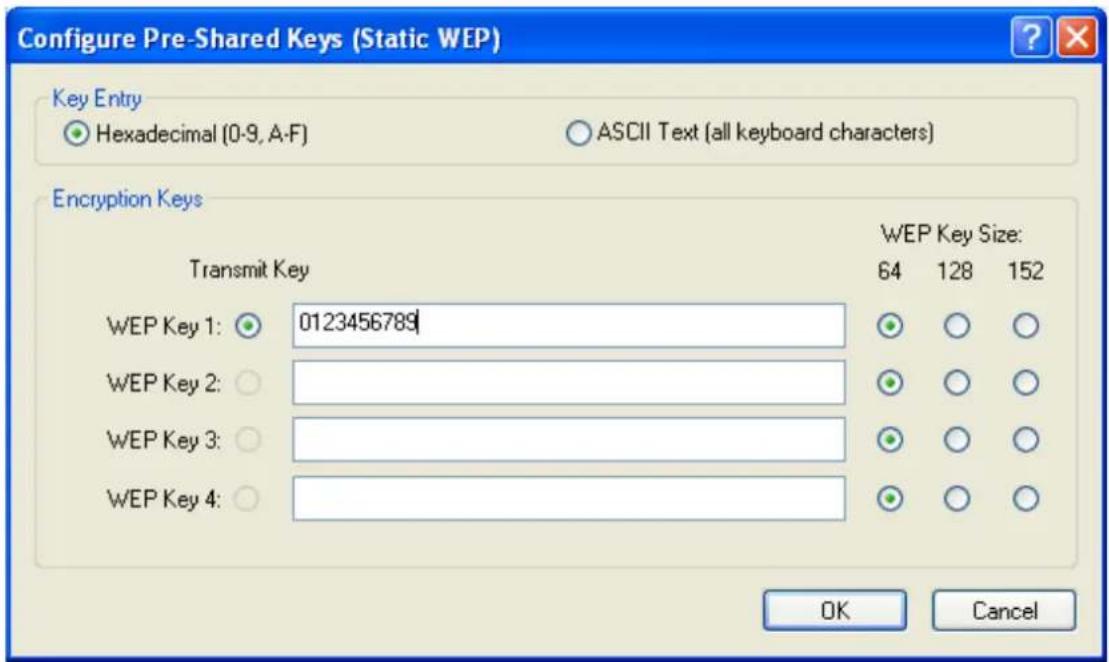
Figure 3-5

Note:
Select different Security Options the configurations are different; you can select the appropriate security option and configure the exact key as your need.
3. Edit the Advanced tab
This screen below allows you to make advanced configuration for the profile.
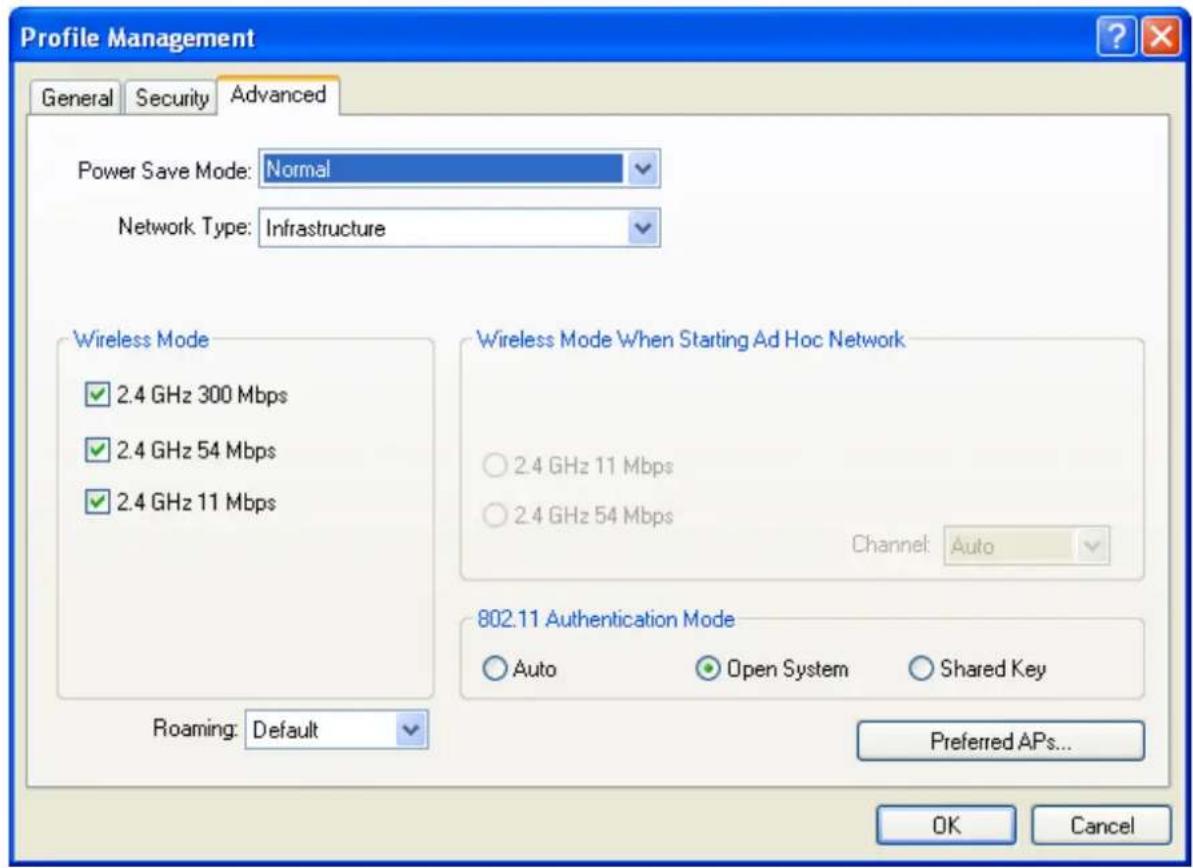
Figure 3-6
Power Save Mode - Please select the power save mode in the drop-down list.
- Maximum - Selects maximum mode to let the access point buffer incoming messages for the Adapter. The Adapter will detect the access point if any messages are waiting periodically.
- Normal - Normal mode uses maximum when retrieving a large number of packets, then switches back to power save mode after retrieving the packets.
- Off - Tums power saving off, thus powering up the Wireless CardBus Adapter continuously for a short message response time.
Network Type: There are basically two modes of networking:
• Infrastructure - All wireless clients will connect to an access point or wireless router.
- Ad-Hoc - Directly connecting to another computer, for peer-to-peer communication, using wireless network adapters on each computer, such as two or more NI-707524 wireless adapters.
Note:
1) An Infrastructure network contains an Access Point or wireless router. All the wireless devices or clients will connect to the wireless router or access point.
2) An Ad-Hoc network contains only clients, such as laptops with wireless desktop adapters. All the adapters must be in Ad-Hoc mode to communicate.
Wireless Mode: Specifies 2.4 GHz 300 Mbps, 2.4 GHz 54 Mbps or 2.4 GHz 11 Mbps operation in an access point network. The Wireless adapter must match the wireless mode of the access point with which it associates.
Wireless Mode when Starting an Ad Hoc Network: Specifies 2.4 GHz 300/54/11 Mbps to start an Ad Hoc network if no matching network name is found after scanning all available modes. This mode also allows the selection of the channel that the Wireless Adapter uses. The channels available depend on the regulatory domain. If the adapter finds no other ad hoc adapters, the channel that the adapter starts the ad hoc network with will be selected automatically. The Adapter must match the wireless mode and channel of the clients it associates.
802.11 Authentication Mode: Select which mode the Adapter uses to authenticate to an access point:
- Automatic causes the adapter to attempt authentication using shared, but switches it to open authentication if shared fails.
- Open System enables an adapter to attempt authentication regardless of its WEP settings. It will only associate with the access point if the WEP keys on both the adapter and the access point match.
- Shared-key only allows the adapter to associate with access points that have the same WEP key.
For infrastructure (access point) networks, click Preferred APs... to specify four access points at most to the client adapter that attempts to be associated to the access points. The four access points have different priorities; the frontal has the higher priority.

Figure 3-7
3.2.2 Remove a profile
- Go to the Profile Management tab (shown in Figure 3-2).
- Select the profile name in the Profiles List.
- Click Remove.
Note:
The profile being used can't be removed.
3.2.3 Switch another Profile
-
Go to the Profile Management screen (shown in Figure 3-2).
-
Select the profile name required in the Profiles List.
- Click Activate.
3.2.4 Export a Profile
- From the Profile Management screen (shown in Figure 3-2), highlight the profile to export.
- Click Export..., the Export Profile window will then appear below.
- Browse the directory to export the profile to.
- Click Save. The profile should then be exported to the specified location.

Figure 3-8
3.2.5 Import a Profile
- From the Profile Management screen (shown in Figure 3-2), click Import.... Then the Import Profile will appear below.
- Browse to the directory where the profile is located.
- Highlight the profile name.
- Click Open, the imported profile will then appear in the Profiles List.

Figure 3-9
3.2.6 Scan Available Networks
- Click Scan on the Profile Management screen (shown in Figure 3-2), the Available Infrastructure and Ad Hoc Networks window will appear below.
- Click Refresh to refresh the list at any time.
- Highlight a network name and click Activate to connect to an available network. If no configuration profile exists for that network, the Profile Management window will open the General tab screen. Fill in the Profile name and click OK to create the configuration profile for that network.
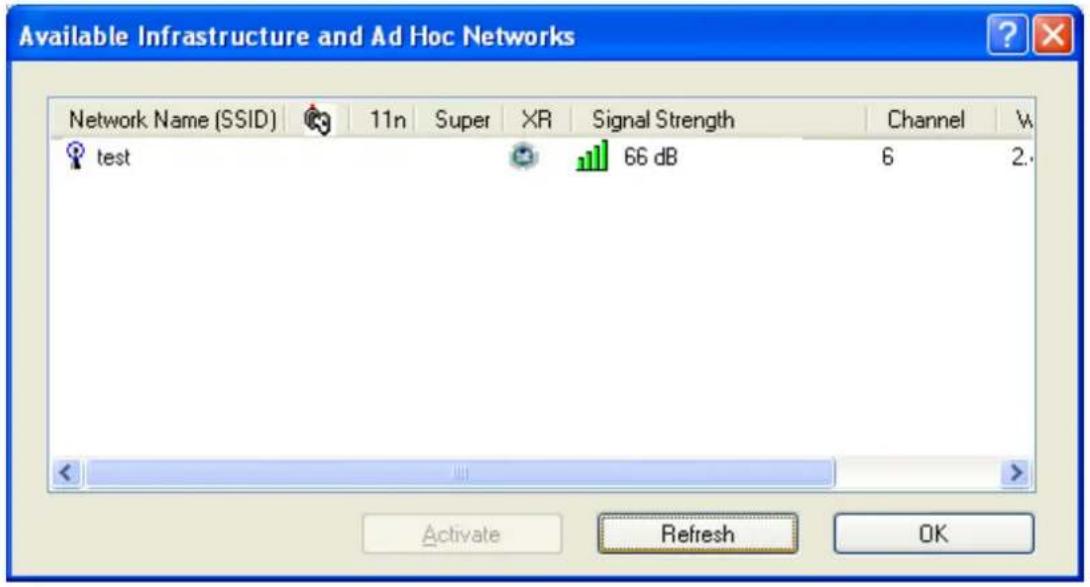
Figure 3-10
3.2.7 Auto Profile Selection Management
The auto selection feature allows the adapter to automatically select a profile from the list of profiles and use it to connect to the network. To add a new profile into the Auto Selected Profiles list, please follow these steps.
- On the Profile Management screen (shown in Figure 3-2), click Order Profiles....
- The Auto Profiles Selection management window will appear (shown in Figure 3-11) with a list of all created profiles in the Available Profiles.
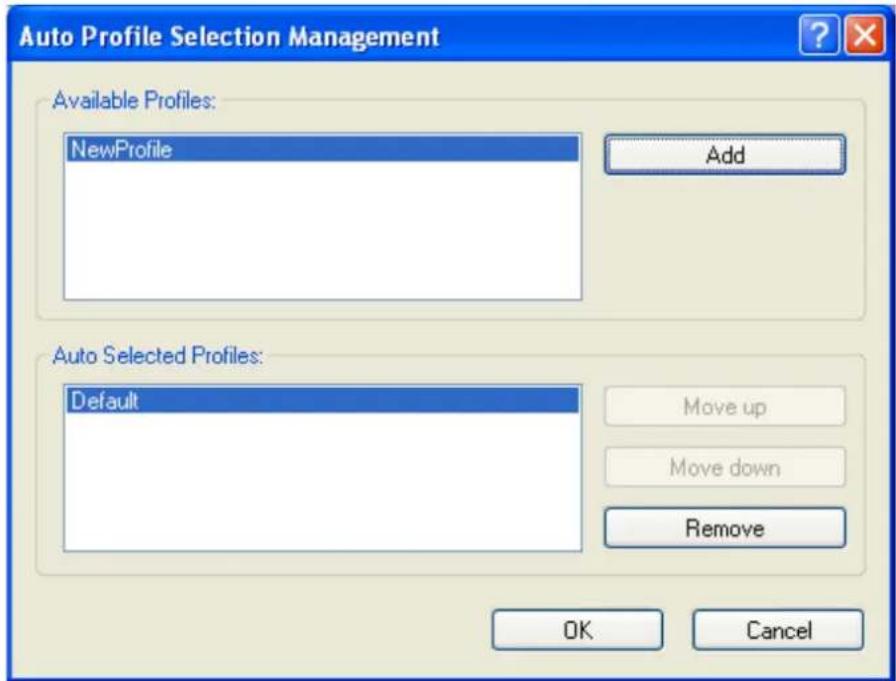
Figure 3-11
- Highlight the profiles to add to auto profile selection, and click Add. The profile will appear in the Auto Selected Profiles box.
- Highlight a profile in the Auto Selected Profiles box.
- Click Move Up or Move Down as appropriate.

Note:
The first profile in the Auto Selected Profiles box has highest priority, while the last profile has the lowest priority.
- Click OK.
- Check the Auto Select Profiles checkbox on the Profile Management tab (shown in Figure 3-2).

Note:
When auto profile selection is enabled by checking Auto Select Profiles on the Profile Management tab, the client adapter will scan for an available network. The profile with the highest priority and the same SSID as one of the found networks will be used to connect to the network. If the connection fails, the client adapter will try the next highest priority profile that matches the SSID until an available network is found.
3.3 Diagnostics
The Diagnostics tab of the ICIDU Wireless N Client Utility (ICIDU 11NWCU) provides buttons used to retrieve receiving and transmitting statistics. The Diagnostics tab does not require any configuration.
The Diagnostics tab lists the following receiving and transmitting diagnostics for frames received or transmitted by the wireless network adapter:
Multicast frames transmitted and received
▶ Broadcast frames transmitted and received
▶ Unicast frames transmitted and received
Total bytes transmitted and received
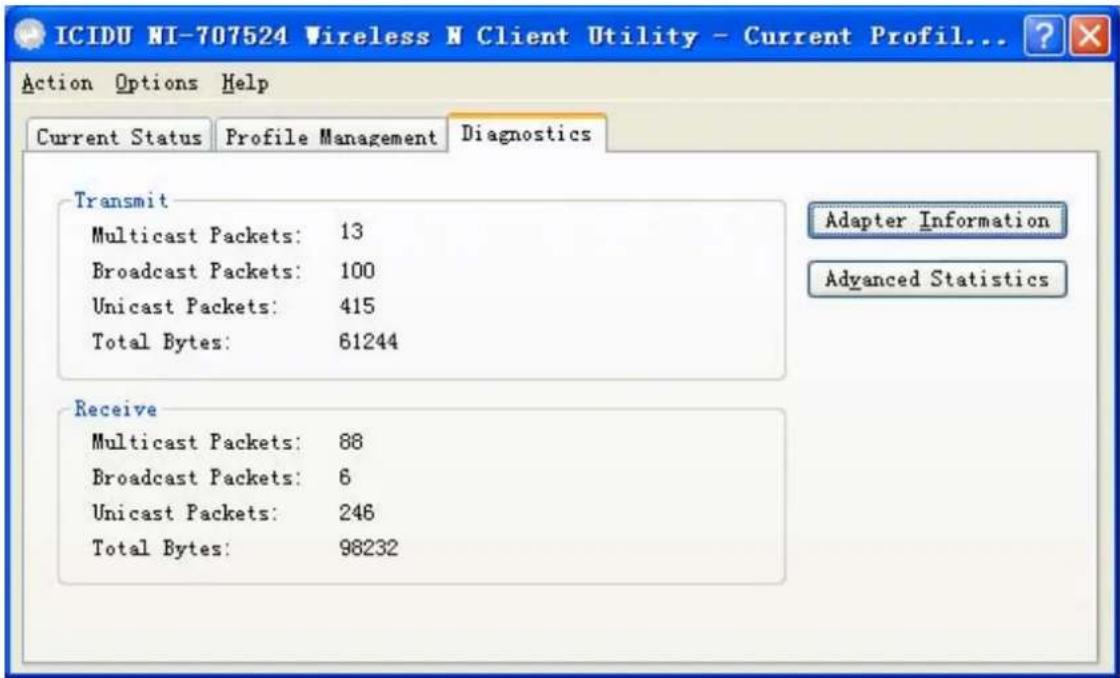
Figure 3-12
3.3.1 Check Driver Information
Click the Adapter Information button in the screen above, you will see the adapter information, including general information about the wireless network adapter and the Network Driver Interface Specification (NDIS) driver. Access the adapter information from the Diagnostics tab.
Card Name - The name of the wireless network adapter.
MAC Address - The MAC address of the wireless network adapter.
Driver - The driver name and path of the wireless network adapter driver.
Driver Version - The version of the wireless network adapter driver.
Driver Date - The creation date of the wireless network adapter driver.
Client Name - The name of the client computer.
3.3.2 Check Receive and Transmit Statistical Information
The Advanced Statistics show receiving and transmitting statistical information about the following receiving and transmitting diagnostics for frames received by or transmitted to the wireless network adapter.
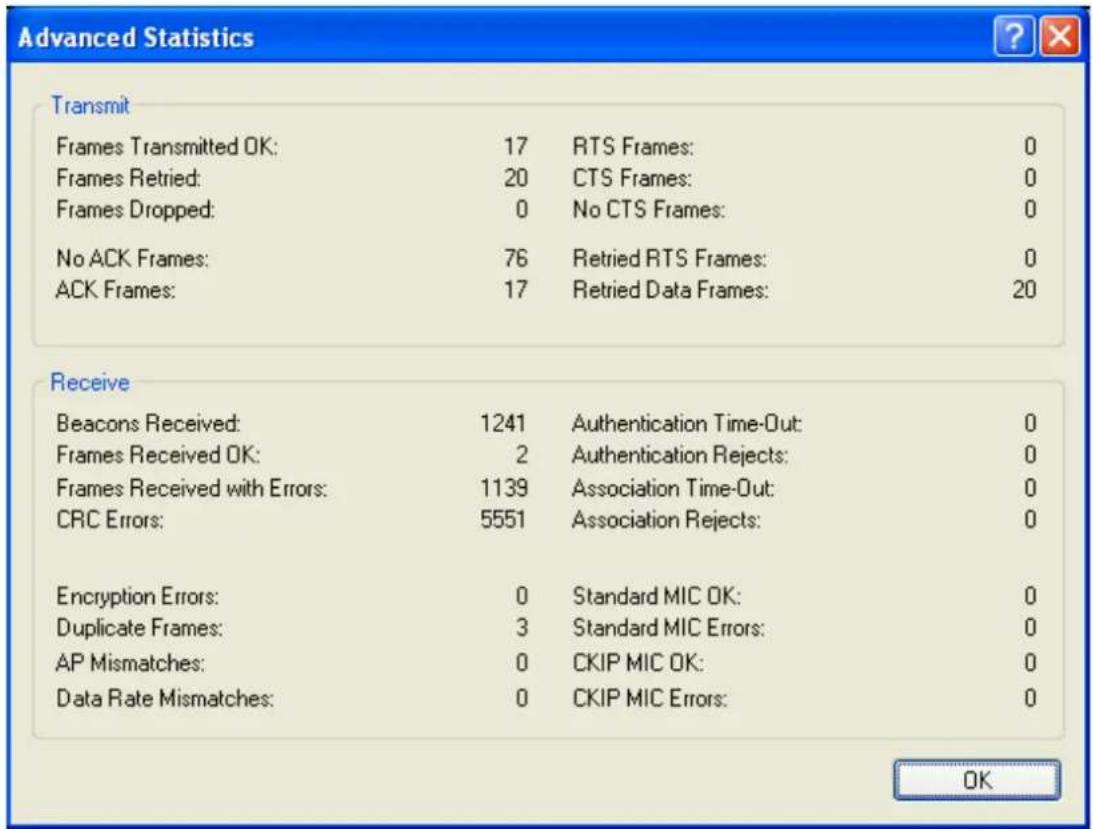
Figure 3-13
3.4 Configuration for Windows Vista
After the Adapter's driver has been installed, Windows Vista will display a wireless Network Connection message like this one.
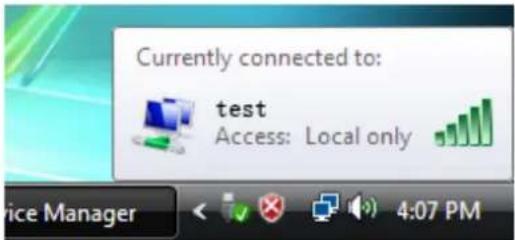
Figure 3-14
Icon means the connection has been established. Icon means there is no connection.
To establish a connection, please follow the steps below.
- Right-click the icon 📋 in your system tray, then click Connect to a network.
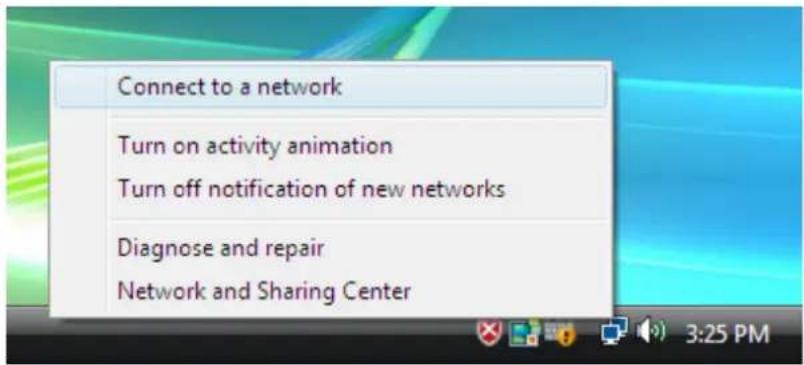
Figure 3-15
- The following screen will show you available wireless networks. Highlight the one you want to join, and then click Connect.
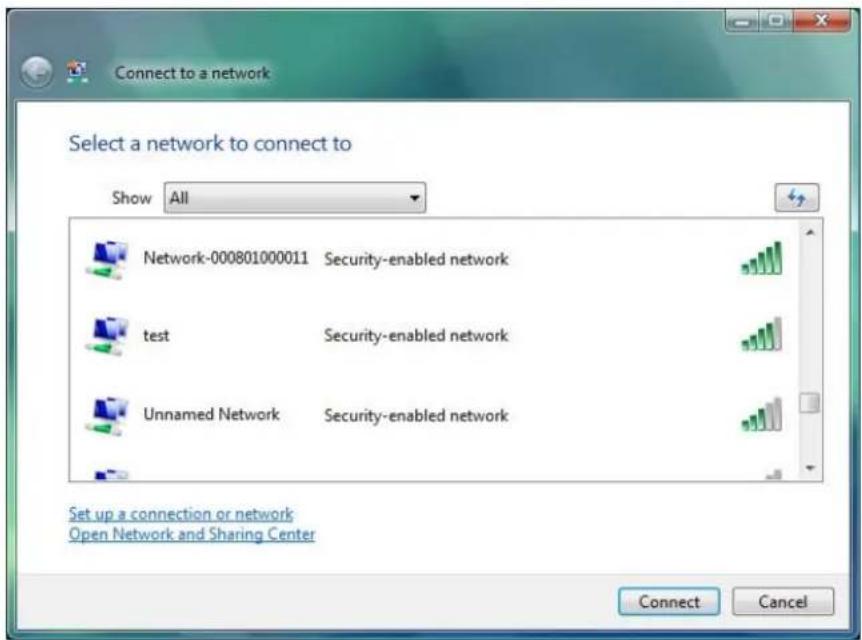
Figure 3-16
- To continue, click Connect Anyway. Click the Cancel button to end the connection.

Figure 3-17
- If the connection is successful established, the following screen will appear, click close to finish the connection.
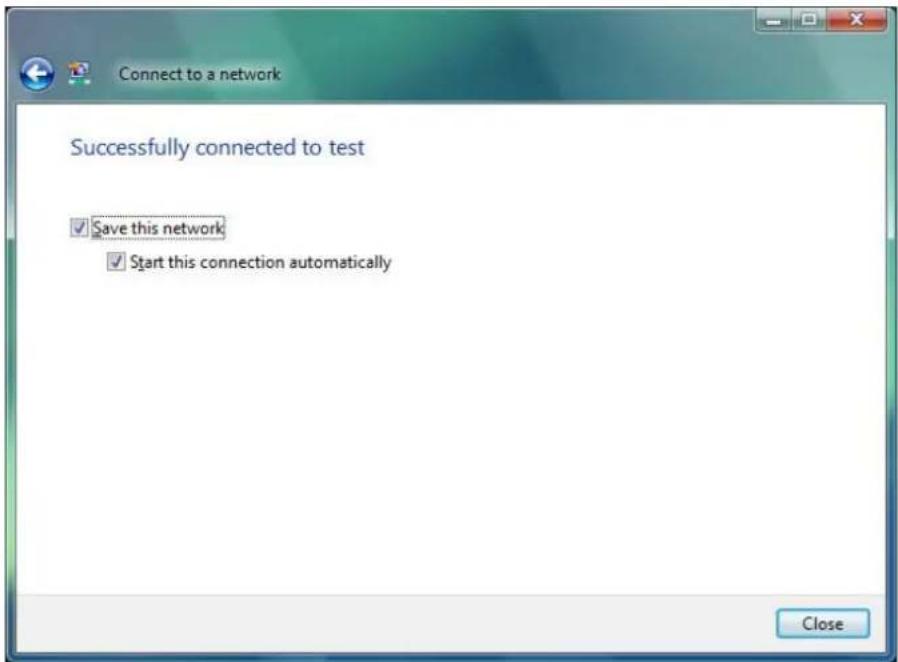
Figure 3-18
Appendix A: Specifications
| Normal | |
| Interface | 32 bit CardBus Interface |
| Standards | IEEE802.11n; IEEE802.11g; IEEE802.11b; |
| Operating System | Windows 2000, XP, Vista |
| Throughput | 300Mbps (Maximal) |
| Radio Data Rate | 27/54/81/108/162/216/243/270/300Mbps13.5/27/40.5/54/81/108/121.5/135Mbps13/26/39/52/78/104/117/130Mbps6.5/13/19.5/26/39/52/58.5/65Mbps1/2/5.5/11Mbps(Auto Rate Sensing) |
| Modulation | 11b:CCK,QPSK,BPSK;11g:OFDM;11n: QPSK,BPSK,16-QAM,64-QAM |
| Media Access Protocol | CSMA/CA with ACK |
| Data Security | WPA/WPA2; 64/128/152-bit WEP; TKIP/AES |
| Frequency | 2.4 ~ 2.4835GHz |
| Spread Spectrum | Direct Sequence Spread Spectrum (DSSS) |
| Safety & Emissions | FCC, CE |
| Environmental and Physical | |
| Operating Temp. | 0°C~40°C (32°F~104°F) |
| Storage Temp. | -40°C~70°C (-40°F~158°F) |
| Humidity | 10% - 95% RH, Non-condensing |
Appendix B: Glossary
802.11b - The 802.11b standard specifies a wireless product networking at 11 Mbps using direct-sequence spread-spectrum (DSSS) technology and operating in the unlicensed radio spectrum at 2.4GHz, and WEP encryption for security. 802.11b networks are also referred to as Wi-Fi networks.
802.11g - specification for wireless networking at 54 Mbps using direct-sequence spread-spectrum (DSSS) technology, using OFDM modulation and operating in the unlicensed radio spectrum at 2.4GHz, and backward compatibility with IEEE 802.11b devices, and WEP encryption for security.
802.11n - 802.11n builds upon previous 802.11 standards by adding MIMO (multiple-input multiple-output). MIMO uses multiple transmitter and receiver antennas to allow for increased data throughput via spatial multiplexing and increased range by exploiting the spatial diversity, perhaps through coding schemes like Alamouti coding. The Enhanced Wireless Consortium (EWC) ^[3] was formed to help accelerate the IEEE 802.11n development process and promote a technology specification for interoperability of next-generation wireless local area networking (WLAN) products.
Ad-hoc Network - An ad-hoc network is a group of computers, each with a Wireless Adapter, connected as an independent 802.11 wireless LAN. Ad-hoc wireless computers operate on a peer-to-peer basis, communicating directly with each other without the use of an access point. Ad-hoc mode is also referred to as an Independent Basic Service Set (IBSS) or as peer-to-peer mode, and is useful at a departmental scale or SOHO operation.
DSSS - (Direct-Sequence Spread Spectrum) - DSSS generates a redundant bit pattern for all data transmitted. This bit pattern is called a chip (or chipping code). Even if one or more bits in the chip are damaged during transmission, statistical techniques embedded in the receiver can recover the original data without the need of retransmission. To an unintended receiver, DSSS appears as low power wideband noise and is rejected (ignored) by most narrowband receivers. However, to an intended receiver (i.e. another wireless LAN endpoint), the DSSS signal is recognized as the only valid signal, and interference is inherently rejected (ignored).
FHSS - (Frequency Hopping Spread Spectrum) - FHSS continuously changes (hops) the carrier frequency of a conventional carrier several times per second according to a pseudo-random set of channels. Because a fixed frequency is not used, and only the transmitter and receiver know the hop patterns, interception of FHSS is extremely difficult.
Infrastructure Network - An infrastructure network is a group of computers or other devices, each with a Wireless Adapter, connected as an 802.11 wireless LAN. In infrastructure mode, the wireless devices communicate with each other and to a wired network by first going through an access point. An infrastructure wireless network connected to a wired network is referred to as a Basic Service Set (BSS). A set of two or more BSS in a single network is referred to as an Extended Service Set (ESS). Infrastructure mode is useful at a corporation scale, or when it is necessary to connect the wired and wireless networks.
Spread Spectrum - Spread Spectrum technology is a wideband radio frequency technique developed by the military for use in reliable, secure, mission-critical communications systems. It is designed to trade off bandwidth efficiency for reliability, integrity, and security. In other words, more bandwidth is consumed than in the case of narrowband transmission, but the trade off produces a signal that is, in effect, louder and thus easier to detect, provided that the receiver knows the parameters of the spread-spectrum signal being broadcast. If a receiver is not tuned to the right frequency, a spread-spectrum signal looks like background noise. There are two main alternatives, Direct Sequence Spread Spectrum (DSSS) and Frequency Hopping Spread Spectrum (FHSS).
SSID - A Service Set Identification is a thirty-two character (maximum) alphanumeric key identifying a wireless local area network. For the wireless devices in a network to communicate with each other, all devices must be configured with the same SSID. This is typically the configuration parameter for a wireless PC card. It corresponds to the ESSID in the wireless Access Point and to the wireless network name. See also Wireless Network Name and ESSID.
WEP - (Wired Equivalent Privacy) - A data privacy mechanism based on a 64-bit or 128-bit or 152-bit shared key algorithm, as described in the IEEE 802.11 standard. To gain access to a WEP network, you must know the key. The key is a string of characters that you create. When using WEP, you must determine the level of encryption. The type of encryption determines the key length. 128-bit encryption requires a longer key than 64-bit encryption. Keys are defined by entering in a string in HEX (hexadecimal - using characters 0-9, A-F) or ASCII (American Standard Code for Information Interchange – alphanumeric characters) format. ASCII format is provided so you can enter a string that is easier to remember. The ASCII string is converted to HEX for use over the network. Four keys can be defined so that you can change keys easily.
Wi-Fi - A trade name for the 802.11b wireless networking standard, given by the Wireless Ethernet Compatibility Alliance (WECA, see http://www.wi-fi.net), an industry standards group promoting interoperability among 802.11b devices.
WLAN - (Wireless Local Area Network) - A group of computers and associated devices communicate with each other wirelessly, which network serving users are limited in a local area.
WPA - (Wi-Fi Protected Access) - A wireless security protocol uses TKIP (Temporal Key Integrity Protocol) encryption, which can be used in conjunction with a RADIUS server.
ICIDU is a registered trademark. All other brand names and rights in connection with them are and remain the property of the rightful owner.
© Copyright 2010 ICIDU
All rights expressly reserved
- FCC RF Radiation Exposure Statement
- CE Mark Warning
- CE!
- National Restrictions
- CONTENTS
- Package Contents 1
- Chapter 1 Introduction ...... 2
- Chapter 2 Installation Guide 4
- Chapter 3 Configuration....11
- Appendix A: Specifications 26
- Appendix B: Glossary 27
- Package Contents
- Note:
- Conventions:
- Chapter 1 Introduction
- Overview of the Product
- Features
- Chapter 2 Installation Guide
- Hardware Installation
- Software Installation
- Overview
- Software Installation for Windows XP
- Chapter 3 Configuration
- Current Status
- Profile Management
- Add or Modify a Configuration Profile
- Edit the General tab
- Edit the Security tab
- Edit the Advanced tab
- Remove a profile
- Switch another Profile
- Export a Profile
- Import a Profile
- Scan Available Networks
- Auto Profile Selection Management
- Diagnostics
- Check Driver Information
- Check Receive and Transmit Statistical Information
- Configuration for Windows Vista
- Appendix B: Glossary
Brand : Icidu
Model : NI-707524
Category : Network card/adapter