
NA-127VB6WGB - Washing machine PANASONIC - Free user manual and instructions
Find the device manual for free NA-127VB6WGB PANASONIC in PDF.


| Product Type | Front-loading washing machine |
| Model Number | NA-127VB6WGB |
| Rated Capacity (Cotton) | 7 kg |
| Maximum Spin Speed | 1200 rpm (1186 rpm actual) |
| Energy Efficiency Class | A++ |
| Annual Energy Consumption | 162 kWh/year (Cotton+Eco) |
| Weighted Annual Water Consumption | 9240 L/year |
| Dimensions (Height x Width x Depth) | 845 x 597 x 542 mm |
| Product Weight | 73 kg |
| Rated Voltage / Frequency | 220-240 V / 50 Hz |
| Maximum Power Input | 2200 W |
| Heating Power Input | 2000 W |
| Water Pressure Range | 0.1 - 1.0 MPa |
| Programmes | Cotton, Cotton+Prewash, Colours, Easy-care, Hand Wash, Allergy-care, Rinse, Drain, Spin, Wool, Shirts, Mixed, Quick, Rapid 15, 20°C Wash |
| Optional Functions | Extra Rinse, Speed/Eco, Child Lock, Preset Timer, Easy Iron |
| Display Type | Digital with time bar, process indicators, lock indicator |
| Door Lock | Automatic locking during operation |
| Detergent Drawer | 3 compartments: main wash, softener, prewash |
| Noise Level (Wash/Spin) | 58 dB(A) / 74 dB(A) |
| Spare Parts Included | Anchor bolts, cover caps, water supply hose, elbow, liquid detergent level plate |
| Installation Requirements | Flat stable surface, avoid carpet, at least 2 mm clearance sides, 5 mm top/back |
| Maintenance Tips | Clean drain filter monthly, run 90°C Cotton monthly, clean detergent drawer regularly |
Frequently Asked Questions - NA-127VB6WGB PANASONIC
User questions about NA-127VB6WGB PANASONIC
0 question about this device. Answer the ones you know or ask your own.
Ask a new question about this device
Download the instructions for your Washing machine in PDF format for free! Find your manual NA-127VB6WGB - PANASONIC and take your electronic device back in hand. On this page are published all the documents necessary for the use of your device. NA-127VB6WGB by PANASONIC.
USER MANUAL NA-127VB6WGB PANASONIC
Operating Instructions & Installation Instructions
Washing Machine
(Domestic use)
Model No.
NA - 148VB6
NA - 128VB6
NA - 147VB6
NA - 127VB6
NA - 147VC6
NA - 127VC6
natural_image
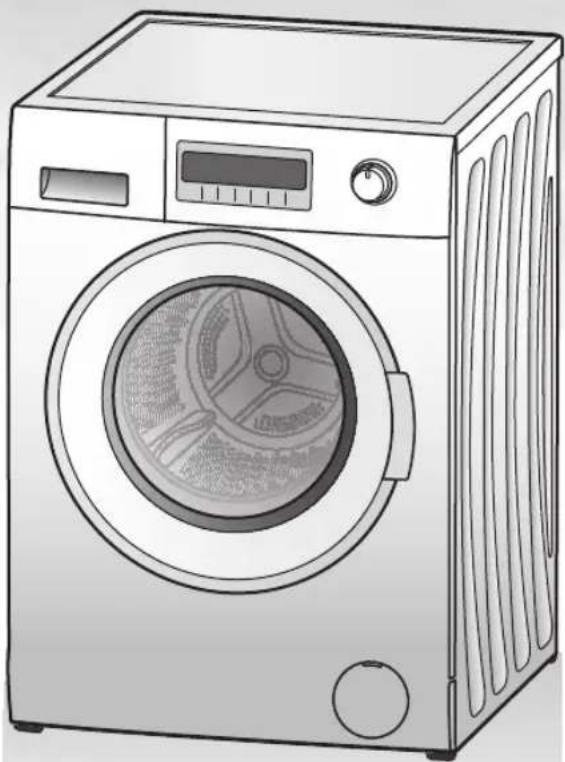
Line drawing of a front-loading washing machine with digital display and fan (no text or symbols)Read Before Using 02
SAFETY PRECAUTIONS 05
Washing Instructions 20
Optional Functions 30
Maintenance 31
Troubleshooting 35
Installation Instructions 39
Thank you for purchasing this appliance.
- For optimum performance and safety, please read these instructions carefully.
- Before connecting, operating or adjusting this appliance, please read the instructions completely. Please keep this manual for future reference.
Es
Electrical Connection (UK and Republic of Ireland only)
For your safety, read the following text carefully.
This appliance is supplied with a moulded 3-pin mains plug for your safety and convenience.
A 13-ampere fuse is fitted in this plug.
Should the fuse need to be replaced, ensure that the replacement fuse has a rating of 13 amperes and that it is approved by ASTA or BSI to BS1362.
Check for the ASTA mark 📋 or the BSI mark ♥ on the body of the fuse.
If the plug contains a removable fuse cover, ensure that it is refitted when the fuse is replaced.
If you lose the fuse cover, do not use the plug until a replacement fuse cover is purchased at your local dealer.
Warning
If the fitted moulded plug is unsuitable for the mains socket in your home then the fuse should be removed and the plug cut off and disposed of safely.
There is a danger of severe electrical shock if the cut off plug is inserted into any 13-ampere socket.
How to replace the fuse
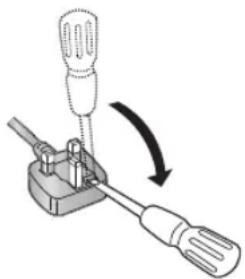
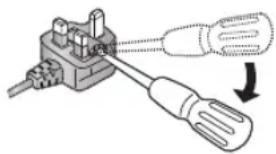
The location of the fuse differs depending on the type of AC mains plug (Figures A and B).
Confirm the AC mains plug is fitted and follow the instructions below. Illustrations may differ from the actual AC mains plug.
Open the fuse cover with a screwdriver and replace the fuse and close or attach the fuse cover.
Figure A -
natural_image
Diagram of a screwdriver tool interacting with a base, showing a curved arrow indicating rotation (no text or symbols present)Figure B -
natural_image
Diagram of a screwdriver connecting a plug into a socket (no text or symbols)2 - Read Before Using
Consider the Environment
Disposing of packaging
The packaging used to protect the washing machine from damage during transportation is all recyclable. For information on recycling, contact your local authority.
Disposal of Old Equipment Only for European Union and countries with recycling systems
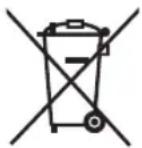

This symbol on the products, packaging, and/or accompanying documents means that used electrical and electronic products must not be mixed with general household waste.
For proper treatment, recovery and recycling of old products, please take them to applicable collection points in accordance with your national legislation.
By disposing of them correctly, you will help to save valuable resources and prevent any potential negative effects on human health and the environment. For more information about collection and recycling, please contact your local municipality.
Penalties may be applicable for incorrect disposal of this waste, in accordance with national legislation.
Information on disposal in other countries outside the European Union
This symbol is only valid in the European Union.
If you wish to discard this product, please contact your local authorities or dealer and ask for the correct method of disposal.
Recommended detergent in accordance with the Regulation (EU) No. 1015/2010
Select the appropriate detergent for better results.
Standard detergent - for heat-resistant white laundry (Cold - 90 °C)
Programme; "Cotton", "Quick", or "Allergy-care"
Detergent for colours without bleach - or optical brighteners for coloured laundry (Cold - 40 °C)
Programme; "Colours", or "Mixed"
Detergent for Delicates without optical brighteners for delicate, fine fabric (Cold - 40 °C)
Programme; "Hand Wash"
Detergent for woollens - fabrics (Cold - 40 °C)
Programme; "Wool".
● The available temperature range differs depending on the programme. (P.27)
When using a tumble dryer
To save energy, please select the correct spin speed according to the instruction of your tumble dryer.
Read Before Using - 3
Contents
Read Before Using
Electrical Connection (UK and
Republic of Ireland only) ..... 2
Consider the Environment.....3
SAFETY PRECAUTIONS ..... 5
Checking Your Washing Machine . 12
Your washing machine ..... 1 2
Accessories....12
Before Washing 13
Checking before use 13
Before initial use .....13
Preparing the laundry 13
Adding Detergent and Other
Chemicals 15
Detergent compartment ..... 1 5
Softener compartment. 17
Prewashing compartment ..... 1 7
Using the Buttons and Dials ..... 1 8
Buttons and dial 18
Display 19
Unlocking the door 19
Washing Instructions
Washing....20
Setting washing. 20
Required time 21
Setting the buzzer 21
Changing settings while washing ..... 2 1
Selecting the Programme ..... 2 2
Power and Water Consumption. . . 23
Details of Programmes ..... 2 6
Washing Delicates. 28
Wool and Hand Wash programmes . .28
Delicate laundry loads....28
Tips for washing delicates. 28
Washing Blankets and
Bedspreads 29
Programme for Bedding 29
Putting bedding into the drum ..... 2 9
Optional Functions....30
Extra Rinse ....30
Speed/Eco. 30
Child lock. 30
Preset timer....30
Easy Iron. 30
4 - Read Before Using
Maintenance
Maintenance 31
Cleaning the outside of the appliance. 31
Cleaning the door seal and window . .3 1
Cleaning the drain filter 31
Cleaning the drum. 32
Cleaning the detergent drawer ..... 3 2
Cleaning the water supply filter.....3 3
Preventing a frozen water supply hose 34
Troubleshooting
Fault Checklist. 35
Error Display 38
Installation Instructions
Choosing the Right Location ..... 39
Carrying the appliance 39
The right place for the appliance.....3 9
Set-in installation. 3 9
Moving and Installing. 40
Removing the anchor bolts ..... 4 0
Moving the appliance 40
Levelling the appliance .....41
Connecting Hoses and Power
Supply 42
Hoses and cable lengths....42
Water supply hose 42
Water drain hose. 43
Connecting to the power supply ..... 4 4
Checking after Installation ..... 45
Installation checklist 45
Specifications 46
Product fiche 47
Read and follow these safety precautions.

WARNING
This describes issues which could cause death or serious injury.
General Use
This appliance can be used by children - aged 8 years and above and persons with reduced physical, sensory or mental capabilities or lack of experience and knowledge if they have been given supervision or instruction concerning use of the appliance in a safe way and understand the hazards involved.
Children shall not play with the appliance. Cleaning and user maintenance shall not be done by children without supervision.
Children of less than 3 years should be kept - away unless continuously supervised.
Do NOT place a stand or a chair close to - the appliance.
Children may be able to reach the control panel or climb onto or into the appliance.
SAFETY PRECAUTIONS
Turn off the water supply to the appliance if it - is not going to be used for a prolonged period, such as during a holiday. This is especially important if there is no drainage around the appliance.
If the water supply is left on, the water pressure may increase and result in a leak.
Do NOT install the appliance in a damp location - or in a location exposed to the weather.
This may result in product malfunction or deterioration, electric shock or fire.
Do NOT spill water directly onto any part of the - appliance.
This may result in malfunction, electric shock, or fire.
Keep sources of ignition, such as candles or - cigarettes, away from the appliance.
They may cause a fire or damage to the appliance.
Keep flammable materials away from the - appliance, for example, gasoline, thinner, alcohol, or clothing soaked with these materials.
They may cause an explosion or a fire.
WARNING
Power source and cable
Unplug the mains lead when cleaning the - appliance.
Check the mains lead and mains plug for - damage.
If the mains lead is damaged, it must be replaced by the manufacturer, its service agent or similarly qualified persons to avoid a hazard.
Do NOT use a mains plug adaptor or - extension cable. There is a possibility of overheating which may cause a fire. Use an unused household mains socket, fully rated at AC 220 V to 240 V. If you are not sure, contact a qualified electrician.
ENSURE the mains plug is fully inserted - into the household mains socket. Otherwise, a loose connection may overheat and cause an electric shock or fire.
Do NOT touch the mains lead or mains plug - with wet hands.
Doing so may cause an electric shock.
SAFETY PRECAUTIONS
Do NOT pull the mains lead but hold the - mains plug to unplug the appliance. Otherwise, the mains lead may be damaged, which may lead to an electric shock or fire.
To Prevent Injury
The appliance should be installed by the manufacturer's dealer or service agent. If the installation, test run and inspection are not carried out following the installation method outlined in these instructions, the manufacturer will not be liable for any accident or damage caused.
Do NOT dismantle, repair or modify the - appliance. The appliance may malfunction, which may result in a fire or an injury. If repairs are needed, contact your local Customer Communications Centre.
Do NOT touch the laundry inside the drum - until it has completely stopped, as there is a possibility of injury. Keep children away from the rotating drum.
CAUTION
This describes issues which could cause injury or damage your belongings.
General Use
Prior to use, turn on the tap and check the - hose and connections for any leaks. Improper connection could cause leaks.
The new hose-sets supplied with the - appliance are to be used and that old hose-sets should not be reused.
This appliance is only suitable for textiles - labelled washing machine washable.
Do NOT connect to the hot water supply. - This appliance works ONLY with cold water.
Do NOT apply pesticide, hair spray or -deodorant to the appliance.
SAFETY PRECAUTIONS
Do NOT put any electrical equipment, for - example, TV, radio or battery charger, on or near the appliance.
Do NOT put excessive laundry or detergent - into the appliance. This may cause damage to the appliance.
REMOVE the anchor bolts using a spanner - or a similar tool before installing the appliance. The anchor bolts are used to transport the appliance. If the anchor bolts are not removed, the appliance will vibrate severely during use.
To Prevent Injury
Do NOT climb onto the appliance. - This may cause injury or damage to the appliance.
Keep fingers away from the door hinge - when opening and closing the door.
Do NOT slide your hand (or unprotected - foot) underneath the appliance when in use.
When washing at high temperature, be - careful not to burn yourself. Drain hose, drum, door glass, and laundry will be hot.
10 - Read Before Using
CAUTION
Check all of the laundry and remove all - objects such as nails, pins, coins, clips, metal wires, etc.
They may cause damage to the laundry or the appliance.
Do NOT use the appliance to wash - waterproof sheets or clothing. There is a possibility of excessive vibration or failure during the spin cycle, which may result in an injury, damage to the appliance or a water leak.
BE CAREFUL when draining hot water out - of the drum.
BE CAREFUL not to get laundry caught in - the door seal when the door is closed. This may result in a water leak or damage to the laundry during the wash cycle.
Checking Your Washing Machine
Your washing machine
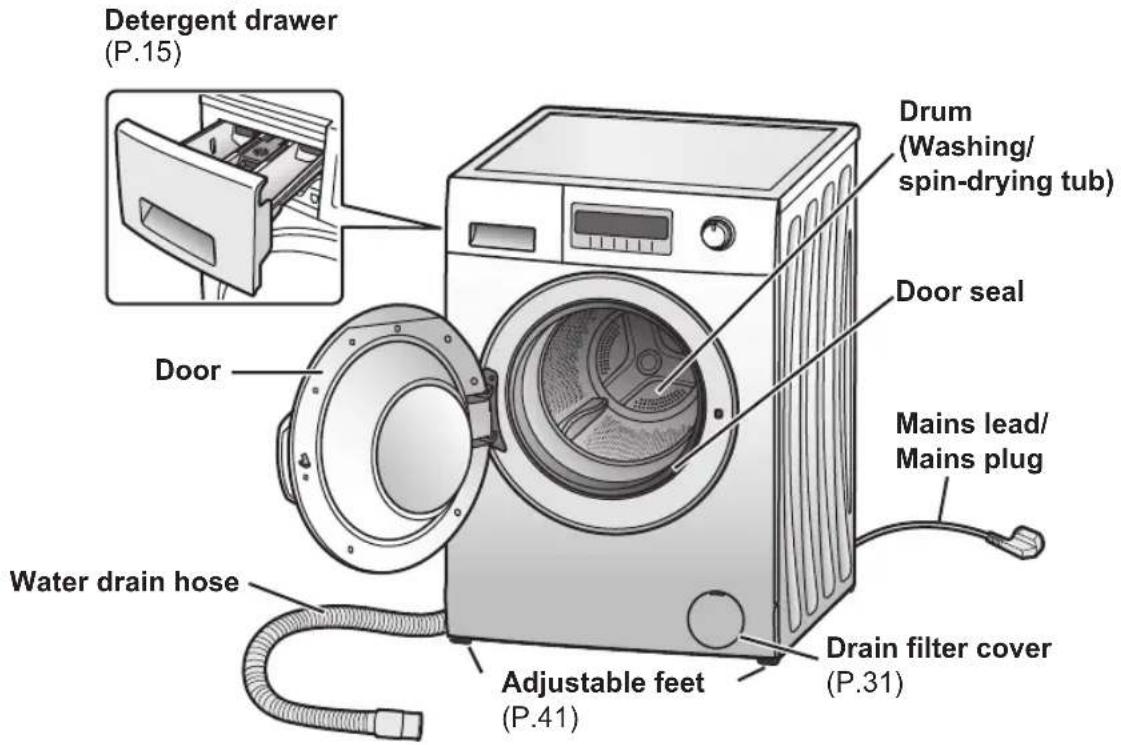
Caution
Do NOT bend the mains lead when the appliance is running.
Accessories
Make sure that all the accessories are supplied with the appliance.
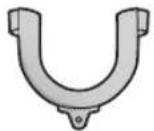
Elbow (P.43)
For fixing the water drain hose
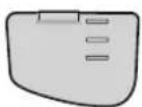
Liquid detergent level plate (P.16)
Cover cap (x4) (P.40-41)

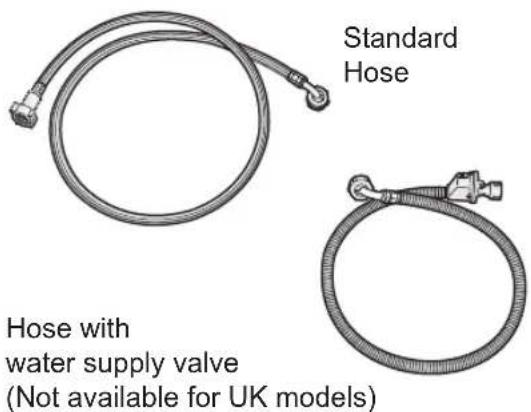
Water supply hose (P.42)
Either one of these hoses is supplied with the appliance.
12 - Read Before Using
Checking before use
For the appliance's initial operation or after a prolonged period of non-operation, perform the following procedures:
Secure the water supply hose.1.
Turn on the tap.2.
Connect the power supply.3.
Make sure that the water drain hose 4. is positioned towards a drain.
For more details, see page 43.
Before initial use
Before using the appliance for the first time, run the 40 °C Cotton programme WITHOUT any detergent or clothing to rinse out residue or moisture.
Note
There may be residual water in the appliance due to the factory inspection prior to shipment. This is not a malfunction.
Preparing the laundry
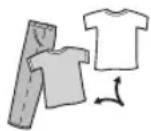
Sorting the laundry
Read clothing care labels to sort the - laundry into different loads.
Sort the laundry by colour, type of fabric - and how soiled it is. Doing so will help you choose the correct programme and temperature for each wash.
Clothes that are not colour fast should - be washed separately. Wash denim separately.
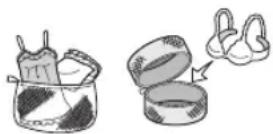
You should put bras with metal wires, - tights, lace clothing and small items into a laundry net to prevent them or the appliance from being damaged.
Caution
Do NOT wash water-repellent clothing.
There is a possibility of excessive vibration or failure during the spin-drying cycle that may result in an injury, damage to the appliance or a water leak.
Before Washing
Treating stains
Apply stain remover to stained portions. For dirt and solid stains, wash lightly by hand first.
Checking clothing
Check that the pockets on clothing - do not contain any objects that may damage the clothes or the appliance.
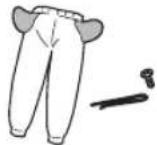
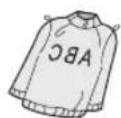
Tie up any loose strings on the clothing - and close zippers. Turn clothing with raised fabrics and zippers inside out. Otherwise, the clothes may be damaged.
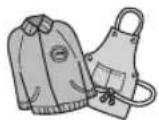
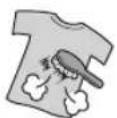
Remove any hair, animal fur, sand and - other materials with a brush before washing.
Note
Do not wash clothes heavily stained with large quantities of vegetable oil or cosmetic oil (aroma oil, etc.). Failure to observe this may result in the door seal swelling, causing the water to overflow and leading to malfunctions.
14 - Read Before Using
Adding Detergent and Other Chemicals
Pull out the detergent drawer and add detergent or softener to the correct compartment. Check the packages for the recommended amounts.
Caution
Do NOT use the appliance when the detergent drawer is removed.
This may result in a water leak.
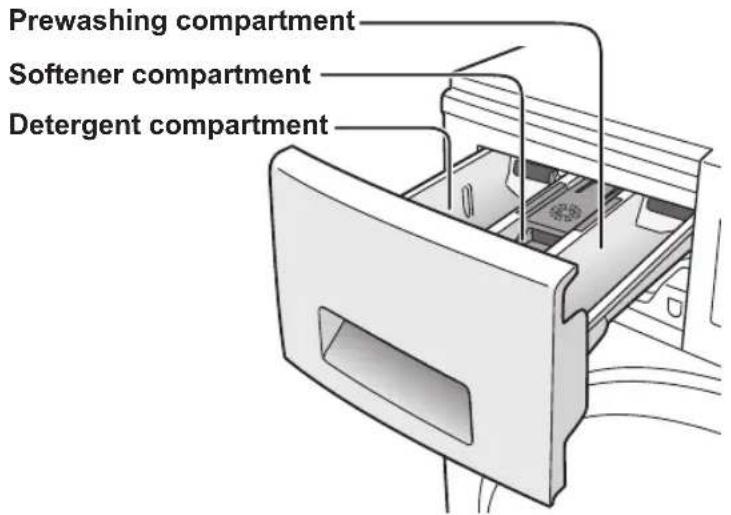
Detergent compartment
The following detergents and additives may be added to this compartment:
Detergent -
Water softening agent -
Stain remover -
Tub cleaning detergent or bleach -
If you use multiple chemicals in this compartment for washing, add them in the following order:
-
Detergent
-
Water softening agent
-
Stain remover
Detergent
Use only detergents that are recommended for fully-automated washing machines.
Please use low suds detergents.
When you use a detergent specifically for slightly lower temperature than 20 °C (as low as 15 °C), the 20 °C Wash programme is recommended.
Caution
If the instructions on the package indicate that detergent should be placed in the drum, do NOT put it into the detergent drawer.
These detergents may not flow well and remain in the detergent drawer.
Do not overfill with detergent. Failure to observe this may result in the detergent blocking the water supply, causing the water to overflow from the front of the detergent drawer and leading to malfunctions.
Read Before Using - 15
Adding Detergent and Other Chemicals
Liquid detergent1.
Note
Do NOT use liquid detergent with the Prewash function. It may flow away during the prewash.
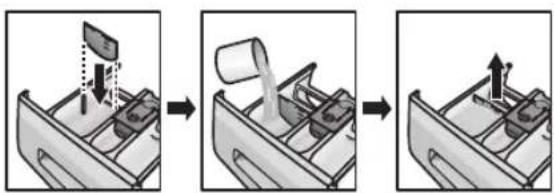
Add liquid detergent before you start washing.
flowchart
graph LR
    A["Device with monitor"] --> B["Process Step"]
    B --> C["Product with cup and bottle"]
Fit the liquid detergent level plate (included with the accessories) into the detergent compartment and use it as a mark to set the amount of liquid detergent. Make sure to detach the plate before running the programme.
Note
Leaving the liquid detergent level plate in the detergent drawer while the programme is running may result in water leakage, or diminished washing and spinning performance.
For the Wool programme, use mild liquid detergent.
Powdered detergent2.
Detergent reaches the drum only when water flushes through the detergent drawer. Thus, if you have forgotten to add detergent, run the Drain programme.
Then, add detergent and start washing again.
To prevent powdered detergent from remaining in the drawer, perform the following:
Dry the inside of the drawer with a cloth. - Make sure that the detergent is not - lumpy when you add it because this may cause a blockage over time.
16 - Read Before Using
Amount of Detergent
The amount of detergent you should use depends on the following factors:
How soiled the laundry is -
Amount of the laundry -
Water hardness -
The amount of foam varies according to the amount and type of detergent, how soiled the laundry is, and the hardness and temperature of the water.
Water softening agent
If you live in a hard water area, we recommend using a water softening agent. For more details on water hardness, contact your local water authority.
Use of a water softening agent can help reduce the amount of detergent required for each wash and help prevent the formation of limescale deposits, which may damage the appliance.
Adding Detergent and Other Chemicals
Softener compartment
The following additives may be added to this compartment:
Fabric softener -
Laundry starch -
Fabric Softener
To prevent static, add softener before you start washing. It will be automatically added in the final rinse cycle.
Dilute concentrated softeners before you add them. Add up to only 125 ml to the compartment to avoid overflowing.
Undiluted softener
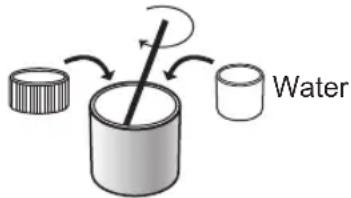
Rinse out the remaining softener with a splash of water or a damp cloth after washing. If it sticks to the compartment, pull out the drawer and clean it out. (P.32-33)
Note
Follow the directions on the softener packages for the appropriate amounts. If too much softener is added, it may remain in the detergent drawer.
Laundry starch
Simply add laundry starch to the softener compartment. It will be automatically added to the clothing in the final rinsing process. Make sure that you do not fill the compartment over the MAX level.
If it is hard to pour, dilute the starch slightly with water before adding it.
Note
After using starch, clean the detergent drawer, particularly the softener cover (P.32-33).
Then, run the Rapid 15 programme WITHOUT detergent to remove any excess starch in the drum.
Prewashing compartment
Detergent for prewashing
Whenever you use the Cotton (Prewash) programme (♀+⊥) always put detergent for the prewash in this compartment.
Read Before Using - 17
Using the Buttons and Dials
Model NA-148VB6
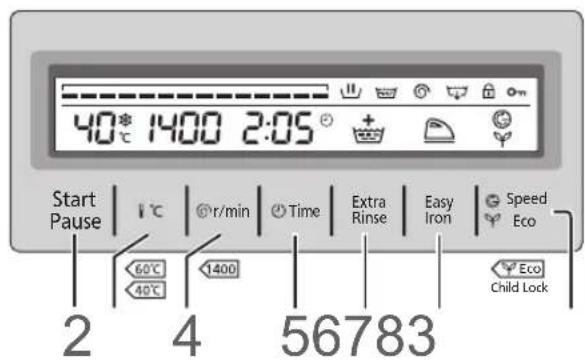
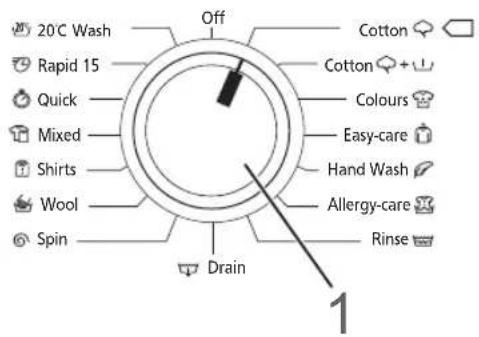
Buttons and dial
Programme selection dial1.
Use this dial to choose the best programme for the laundry. (P.22)
Start/Pause button2.
Press this button to start or pause the wash programme.
Temperature button1.
Press this button to choose water temperatures ranging from cold to 90 °C. (90 °C is available only with the Cotton and the Cotton (Prewash) programmes.) You can choose hotter temperatures for whites, cottons, or soiled laundry.
Spin speed button4
Press this button to choose the spin speed for the programme you have selected. The maximum spin speed of models are as follows.* 148VB6, 147VB6 and 147VC6: - 1400 r/min 128VB6, 127VB6 and 127VC6: - 1200 r/min
- Time button ⏻
Press this button to preset the time for when the programme starts. (P.30)
18 - Read Before Using
- Extra Rinse
Press this button to select the Extra Rinse function. (P.30)
- Easy Iron button
Press this button to select the Easy Iron function. (P.30)
Speed/Eco and Child Lock button8.
-Press this button to select the Speed/Eco function. (P.30) -Press and hold this button for 5 seconds to set the child lock. The controls will be locked. Perform the same operation to release the child lock. (P.30)
*Spin Speed
The maximum spin speeds are classified as below: 1400 class: Max 1300-1400 r/min 1200 class: Max 1100-1200 r/min Please refer to the product fiche.
Using the Buttons and Dials
Display
Model NA-148VB6
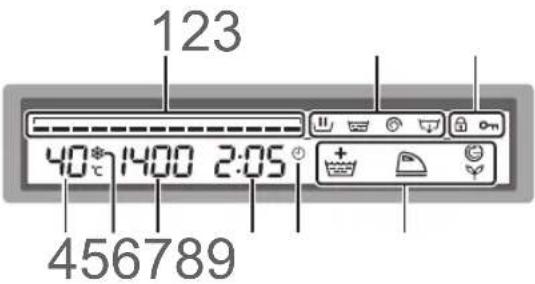
Time bar indicator1.
The number of displayed bars increases with time.
Process indicator2.
This indicator shows the current process - of the programme. The process consists of wash 🎨, rinse 🌐 and spin .
- is displayed only when in the Drain programme.
The light turns off when the programme - is finished.
Lock indicator3.
is displayed if the door is locked.
- On is displayed if the child lock is activated. (P.30)
4. Temperature indicator
5. Cold setting indicator
This indicator is displayed when you turn on the Cold setting.
6. Spin speed indicator
7. Remaining time indicator
This indicator shows the approximate time until the programme finishes. For example, '2:05' means 2 hours and 5 minutes.
Time indicator8.
This indicator is displayed if the time for when the programme is to start has been preset.
9. Optional functions indicator
These indicators are displayed when the corresponding functions have been programmed. The option functions that display here are the Extra Rinse 🌐, Easy Iron 📄, Eco 🚗 and Speed functions.
Unlocking the door
The door automatically locks while in use and the 🔒 symbol is shown in locked state. A click will be heard when the door locks or unlocks.
Note
If the appliance is switched off with the door locked, or if there is a power interruption, the door will unlock after 1 or 2 minutes.
Press the Start/Pause button to unlock the door during operation.
In the following cases, the door can't be unlocked even if operations are paused.
-During spin-drying
-When the water level is beyond a certain level
Note
To unlock the door, set the programme selection dial to Off, and then select a programme. (ex. Cotton)
Caution
If the door needs to be unlocked mid-programme, make sure that water from the drum does not overflow onto the floor.
Water and soap suds may come out of the door and the door opening. If so, use a towel to soak them up.
Read Before Using - 19
Washing
Setting washing
Model NA-148VB6
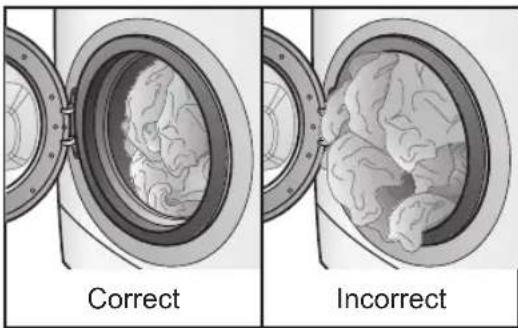
Open the door and put the laundry 1. into the drum.
For details about preparing and sorting the laundry, see pages 13 and 22.
Caution
Make sure to place the laundry - within the drum so that it does not get caught in the door.
Failure to observe this may result in damage to the door seal, leading to malfunctions.
Do NOT overload the drum. -
This may cause excessive vibration or damage to the appliance.
Note
When loading a large amount of laundry, make sure to evenly distribute the laundry throughout the drum.
Close the door.2.
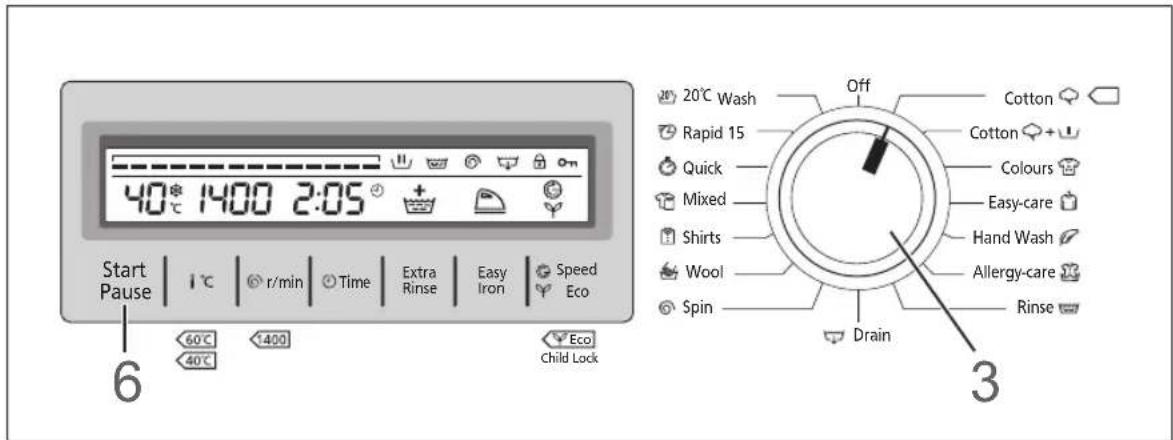
Turn the programme selection dial 3. in either direction to switch on the appliance and select the programme.
The programme time will be displayed.
For more details about each programme, see pages 26-27.
20°C Wash programme
By using the cold water of 20 °C, this programme achieves the same cleaning strength as that for 40 °C programme (except for greasy filth).
Spin programme
With the Spin programme, the operation starts from the drain process whether there is water in the drum or not. After the water drains out to a preset level, the spin process starts.
Select optional functions.4.
For more details about available functions and settings for each programme, see pages 26-27.
Add detergent to the detergent 5. drawer.
(P.15-17)
20 - Washing Instructions
Press the Start button.6.
The appliance starts supplying water after draining.
Note
Whenever you start washing, the - process display flashes to show which function is in progress.
Before any programme is started, the appliance first drains out any water.

The buzzer will sound and “END” will flash on the display when the programme has finished, and the door will unlock immediately.
Caution
After a high temperature wash, be careful to not burn yourself when handling the laundry or touching the inside of the drum.
Note
If the detergent is not completely - removed from the laundry by using the basic programme, use the Extra Rinse function.
If the load is big, the laundry may - stick to the inside of the drum. This is normal.
Leave the appliance door open - to allow the drum to dry out after removing the laundry.
Remove the laundry and rearrange - where necessary. Do not leave it in the drum too long after the programme ends to prevent colour transfer.
Required time
Required time depends on the programme and temperature setting.
Actual time may differ slightly from the - displayed time.
The displayed time includes the time - needed for the water to fill up and to drain out, thus they vary depending on water pressure, drainage and amount of laundry.
If the laundry in the drum needs to - be balanced, eg to facilitate smooth spinning, the time will be extended.
Setting the buzzer
To turn on or turn off the buzzer which sounds when the programme has finished, follow these instructions.
Simultaneously press and hold the Temperature and Time buttons for at least 3 seconds.
The buzzer setting will be turned off after a beep is heard.
The buzzer setting will be turned on after two beeps are heard.
Changing settings while washing
After washing has started, the programme, temperature, spin speed, preset time, Extra Rinse, Easy Iron and Speed/Eco function cannot be changed.
To change the programme, temperature, spin speed, preset time, Extra Rinse, Easy Iron and Speed/Eco function settings, turn the appliance off and then on again.
Selecting the Programme
| Programme Description | 148VB6128VB6Max load | 147VB6127VB6147VC6127VC6Max load | ||
 | Cotton | Daily wash for cotton, linen and cotton blends. | 8 kg7 kg | |
 | Cotton (Prewash) | Cotton programme with prewash process for heavily soiled laundry | 8 kg7 kg | |
 | Colours | Colour-fast wash for cotton and cotton blend items. | 4 kg3.5 kg | |
 | Easy-care | Gentle wash for cotton, linen and synthetic fibres. | 4 kg3.5 kg | |
 | Hand Wash | Gentle wash for hand wash clothes. | 2 kg | 2 kg |
 | Allergy-care | Cycle to remove allergens. | 4 kg | 3.5 kg |
 | Rinse | Rinses washed laundry. | 8 kg | 7 kg |
 | Drain Drains water from the drum. | — | — | |
 | Spin | Spin-dries washed laundry. | 8 kg | 7 kg |
 | Wool | Gentle wash for hand and machine washable wool and wool blend clothes preventing clothes shrinkage. | 2 kg2 kg | |
 | Shirts | Washing for collar and cuff grime of shirts and blouses, prevents creasing. | 2 kg2 kg | |
 | Mixed | Mixed load for washing various fabrics such as cotton, linen and synthetic fibres | 3.5 kg3.5 kg | |
 | Quick | Quick wash for lightly soiled cotton and linen blends. | 4 kg3.5 kg | |
 | Rapid 15 | 15 min. full rapid wash for a small amount of lightly soiled items. | 2 kg2 kg | |
 | 20°C Wash | Low energy, low temp. wash for lightly soiled cotton and linen blends. | 4 kg3.5 kg | |
22 - Washing Instructions
Power and Water Consumption
| Programme Temperature Load (kg) | Power consumption (kWh) ^2) | Water consumption (L) ^2) | Time ^2) | ||
| 148VB6128VB6 | 148VB6128VB6 | 148VB6128VB6 | |||
| Cotton | 40 °C 8 0.92 60 2:05 | ||||
| Cotton + Eco function | 40 °C ^1) | 4 0.71 | 41 2:50 | ||
| 60 °C ^1) | 8 0.95 | 51 3:20 | |||
| 4 0.77 | 41 2:55 | ||||
| + Cotton(Prewash) | 40 °C 8 0.98 70 2:23 | ||||
| Colours | 40 °C 4 0.91 52 1:45 | ||||
| Easy-care | 40 °C 4 0.60 55 1:25 | ||||
| Hand Wash | 30 °C 2 0.32 68 1:30 | ||||
| Allergy-care | 60 °C 4 3.08 87 3:20 | ||||
| Wool | 30 °C 2 0.10 50 0:40 | ||||
| Shirts | 40 °C 2 0.60 45 1:25 | ||||
| Mixed | 30 °C 3.5 0.46 55 1:25 | ||||
| Quick | 40 °C 4 0.48 38 1:08 | ||||
| Rapid 15 | 30 °C 2 0.10 30 0:15 | ||||
| 20°C Wash | 20 °C 4 0.31 42 1:40 | ||||
1) Results calculated based on the maximum spin speed comply with EN 60456.
2) The power, water consumption, and time indicated in the table may vary depending on variations in pressures, water hardness and temperatures, room temperatures, types and amounts of laundry, voltage fluctuations and functions to be used.
Washing Instructions
Power and Water Consumption
| Programme Temperature Load (kg) | Power consumption (kWh) ^2) | Water consumption (L) ^2) | Time ^2) | ||
| 147VB6127VB6 | 147VB6127VB6 | 147VB6127VB6 | |||
| Cotton | 40 °C 7 0.93 60 2:05 | ||||
| Cotton + Eco function | 40 °C ^1) | 3.5 0.64 | 39 2:40 | ||
| 60 °C ^1) | 7 0.83 | 47 3:20 | |||
| 3.5 0.68 | 39 2:50 | ||||
| + Cotton(Prewash) | 40 °C 7 0.98 69 2:23 | ||||
| Colours | 40 °C 3.5 | 1.00 52 1:45 | |||
| Easy-care | 40 °C 3.5 | 0.61 47 1:25 | |||
| Hand Wash | 30 °C 2 0.29 57 1:30 | ||||
| Allergy-care | 60 °C 3.5 | 2.96 82 3:15 | |||
| Wool | 30 °C 2 0.11 45 0:40 | ||||
| Shirts | 40 °C 2 0.60 44 1:25 | ||||
| Mixed | 30 °C 3.5 | 0.32 60 1:25 | |||
| Quick | 40 °C 3.5 | 0.48 38 1:08 | |||
| Rapid 15 | 30 °C 2 0.10 30 0:15 | ||||
| 20°C Wash | 20 °C 3.5 | 0.27 42 1:40 | |||
1) Results calculated based on the maximum spin speed comply with EN 60456.
2) The power, water consumption, and time indicated in the table may vary depending on variations in pressures, water hardness and temperatures, room temperatures, types and amounts of laundry, voltage fluctuations and functions to be used.
24 - Washing Instructions
Power and Water Consumption
| Programme Temperature Load (kg) | Power consumption (kWh) ^2) | Water consumption (L) ^2) | Time ^2) | ||
| 147VC6127VC6 | 147VC6127VC6 | 147VC6127VC6 | |||
| Cotton | 40 °C 7 0.82 62 2:05 | ||||
| Cotton + Eco function | 40 °C ^1) | 3.5 0.65 | 41 2:40 | ||
| 60 °C ^1) | 7 1.05 | 54 3:25 | |||
| 3.5 0.72 | 41 2:45 | ||||
| Cotton (Prewash) | 40 °C 7 0.97 72 2:23 | ||||
| Colours | 40 °C 3.5 | 0.96 56 1:45 | |||
| Easy-care | 40 °C 3.5 | 0.62 48 1:25 | |||
| Hand Wash | 30 °C 2 0.41 56 1:31 | ||||
| Allergy-care | 60 °C 3.5 | 2.72 85 3:15 | |||
| Wool | 30 °C 2 0.13 50 0:40 | ||||
| Shirts | 40 °C 2 0.64 44 1:25 | ||||
| Mixed | 30 °C 3.5 | 0.30 62 1:25 | |||
| Quick | 40 °C 3.5 | 0.42 36 1:08 | |||
| Rapid 15 | 30 °C 2 0.10 32 0:15 | ||||
| 20°C Wash | 20 °C 3.5 | 0.26 45 1:40 | |||
1) Results calculated based on the maximum spin speed comply with EN 60456.
2) The power, water consumption, and time indicated in the table may vary depending on variations in pressures, water hardness and temperatures, room temperatures, types and amounts of laundry, voltage fluctuations and functions to be used.
Details of Programmes
| Programme | Auto setting | |||||
| Temperature | Number of rinses | Spin speed | Approximate | |||
| 128VB6127VB6127VC6 | 148VB6147VB6147VC6 | 148VB6128VB6 | ||||
 | Cotton | 40 °C | 2 | 1200 | 1400 | 2:05 |
 | Cotton (Prewash) | 40 °C | 2 | 1200 | 1400 | 2:23 |
| [CZXK] | Colours | 40 °C | 2 | 1200 | 1400 | 1:45 |
 | Easy-care | 40 °C | 2 | 800 | 800 | 1:25 |
 | Hand Wash | 30 °C | 2 | 600 | 600 | 1:30 |
 | Allergy-care | 60 °C | 4 | 800 | 800 | 3:20 |
 | Rinse | Cold | 3 | 1200 | 1400 | 0:36 |
 | Drain | — | — | — | — | 0:03 |
| [GS47] | Spin | — | — | 1200 | 1400 | 0:15 |
 | Wool | 30 °C | 3 | 600 | 600 | 0:40 |
 | Shirts | 40 °C | 2 | 600 | 600 | 1:25 |
 | Mixed | 30 °C | 2 | 800 | 800 | 1:25 |
 | Quick | 40 °C | 2 | 1200 | 1400 | 1:08 |
 | Rapid 15 | 30 °C | 1 | 800 | 800 | 0:15 |
 | 20°C Wash | 20 °C | 2 | 1200 | 1400 | 1:40 |
26 - Washing Instructions
Details of Programmes
| Setting Option functions | ||||||||
| ie | Temperature | Spin speed 2) | Extra Rinse 1) | Easy Iron | Speed/Eco 1) | |||
| 147VB6127VB6 | 147VC6127VC6 | 128VB6127VB6127VC6 | 148VB6147VB6147VC6 | |||||
| 2:05 | 2:05 | Cold - 90 °C | 0 - 1200 | 0 - 1400 | ✓ | ✓ | ✓ | |
| 2:23 | 2:23 | Cold - 90 °C | 0 - 1200 | 0 - 1400 | ✓ | ✓ | ✓ | |
| 1:45 | 1:45 | Cold - 40 °C | 0 - 1200 | 0 - 1400 | ✓ | ✓ | ✓ | |
| 1:25 | 1:25 | Cold - 60 °C | 0 - 800 | 0 - 800 | ✓ | ✓ | ✓ | |
| 1:30 | 1:31 | Cold - 30 °C | 0 - 600 | 0 - 600 | ✓ | - | - | |
| 3:15 | 3:15 | Cold -60 °C | 0 - 800 | 0 - 800 | - | ✓ | - | |
| 0:36 | 0:36 | Cold | 0 - 1200 | 0 - 1400 | - | ✓ | - | |
| 0:03 | 0:03 | - | - | - | - | - | - | |
| 0:15 | 0:15 | - | 400 - 1200 | 400 - 1400 | - | ✓ | - | |
| 0:40 | 0:40 | Cold - 40 °C | 0 - 600 | 0 - 600 | ✓ | - | - | |
| 1:25 | 1:25 | Cold - 60 °C | 0 - 600 | 0 - 600 | ✓ | ✓ | ✓ | |
| 1:25 | 1:25 | Cold - 30 °C | 0 - 800 | 0 - 800 | ✓ | ✓ | - | |
| 1:08 | 1:08 | Cold - 60 °C | 0 - 1200 | 0 - 1400 | ✓ | ✓ | - | |
| 0:15 | 0:15 | Cold - 30 °C | 0 - 800 | 0 - 800 | - | ✓ | - | |
| 1:40 | 1:40 | Cold - 20 °C | 0 - 1200 | 0 - 1400 | ✓ | ✓ | - | |
1) You cannot simultaneously select the Extra Rinse and Speed/Eco functions.
2) Classified maximum spin speed per page 18.
Washing Instructions - 27
Washing Delicates
Wool and Hand Wash programmes
The drum spins gently in these programmes.
For details, see pages 20-21.
Delicate laundry loads
Wool programme: 2 kg or less
Hand Wash programme: 2.5kg or less
Approximate weights
Wool sweater: 400 - g
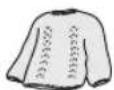
Silk blouse: 200 - g
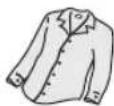
Trousers: 400 - g
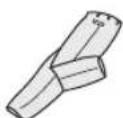
Tips for washing delicates
Putting laundry in the drum
Pile items one on top of each other.
Detergents
For wool items, use a mild liquid - detergent. Other detergents may damage the clothes.
With Wool and Hand Wash - programmes, you may need to use the Extra Rinse function to remove excess detergent from the laundry. (P.30)
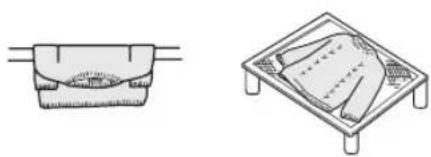
Hanging the laundry
Hang out white or light-coloured wool - and nylon items away from direct heat or sunlight.
After washing, lay out wool and nylon - clothes, and return them to their normal shape before hanging in the shade. This will help to reduce the ironing time.
Hang wool items with creases smoothed - out, or spread them out to dry.
natural_image
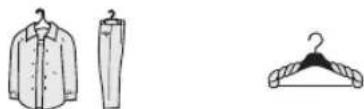
Two technical illustrations of fabric or meshing components, one showing a folded material and the other a tray-like structure (no text or symbols)Use hangers for shirts, blouses and - trousers.
Wrap a towel around the hanger to approximate the clothing's shoulder width so that it will retain its shape as it dries.
natural_image
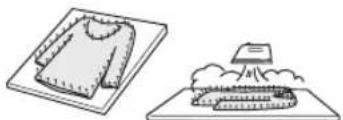
Illustration of three clothing items: a collared shirt, a pair of jeans, and a hanger (no text or symbols)If clothing shrinks in the wash
Spread the item out to its original size on an ironing board. Use dress pins to hold the size and shape. Then, use an iron to steam it and leave it to dry.
natural_image
Illustration of two food items: a sweater and a plate with a tray (no text or symbols)28 - Washing Instructions
Washing Blankets and Bedspreads
Programme for Bedding
When you wash the bedding, Mixed + Extra Rinse is recommended.
Make sure that the label of each item - to be washed shows either the wash or hand-wash symbol (☐, ☐).
Wash only one blanket at a time. -
Washable
100 % synthetic fibre blankets – up to -3 kg
100 % synthetic fibre futons and 100 % - cotton blankets – up to 1.5 kg (single bed size)
Sheets -
Bedspreads -
100 % synthetic fibre undersheets -
Non-washable
100 % wool blankets -
Long-piled blankets -
Electric blankets (including cover) -
Putting bedding into the drum
Fold down the blanket or bedspread 1. into a quarter of their original size.
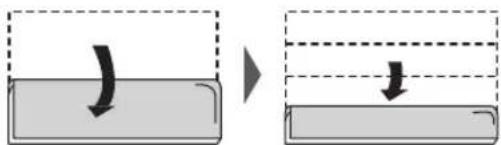
Put the blanket or bedspread into the 2. drum.
Fold it while putting it into the drum.
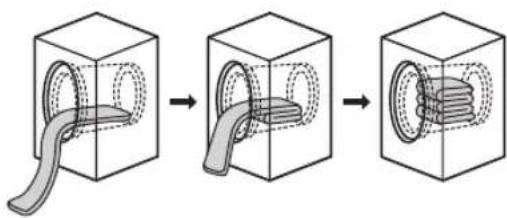
Both ends of the blanket should face the rear of the drum.
Caution
Do NOT roll the blanket or bedspread into balls, or haphazardly fold them.
This may cause excessive vibration and damage the laundry or the appliance.
Note
Avoid using blanket nets. They prevent the laundry from spinning properly.
Washing Instructions - 29
Optional Functions
Extra Rinse
You can rinse your laundry more thoroughly with an extra rinsing process.
Speed/Eco
You can shorten wash cycles or conserve energy.
| Function | Description |
| Normal Wash | Normal wash cycle |
Speed  | This function requires less time for washing and is suitable for lightly soiled laundry. |
Eco  | Washing consumes less energy. |
Child lock
When the child lock is activated, the controls are locked. This prevents children from changing the wash settings or playing with the appliance.
Activating/deactivating child lock
Switch on the appliance.1.
Press and hold the Speed/Eco button 2. for at least 5 seconds.
The O _π symbol light up to show that the child lock is activated.
To deactivate, hold down the Speed/3. Eco button again for 5 seconds (please ignore three beeps heard), and keep Speed/Eco button pressed until it unlocks.
Preset timer
Time function is available to preset the time for the programme to start.
Note
Do NOT use detergent which does not dissolve thoroughly with the preset function because the detergent may cake up before the wash starts and does not flow out.
Setting a preset time
Set a preset time after you have selected the programmed and optional functions. (P.20)
Continuously press the Time button 1. until the desired preset time is displayed.
Press the Temperature button or the 2. Extra Rinse button to set the preset time.
The countdown has not started.
To cancel the preset time - Press the Time button.
To change the preset time - Press the Time button, then redo the setting from step 1.
Press the Start/Pause button to 3. activate the countdown.
To cancel the preset time - Turn the programme selection dial to 'Off'. (All settings will be cancelled.) To change the preset time - Turn the programme selection dial to 'Off'. After reselecting the programme and optional functions, redo the setting from step 1.
Easy Iron
This function makes ironing easier by spin-drying your laundry more gently (at 1000 r/min or less).
After the programme has finished, the - laundry is rotated intermittently for up to 5 minutes or until the door is opened.
Reducing wrinkles helps to unravel - tangled laundry.
30 - Washing Instructions
Maintenance
Cleaning the outside of the appliance
Clean the outside of the appliance with a soft cloth and mild detergent, for example, kitchen detergent, and soapy water.
Warning
Do NOT splash water over the - appliance.
Do NOT use cream cleansers, - thinners, nor products containing alcohol or paraffin oil.
Cleaning the door seal and window
After each wash, perform the following:
Remove any objects from the door seal. -
Wipe the window and seal to remove lint - and stains.
If lint builds up, it can cause leaks.
Cleaning the drain filter
We recommend cleaning the drain filter once a month. The filter will have lint buildup, which may interrupt drainage water flow.
Switch off and unplug the appliance.1.
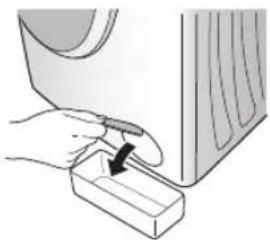
Remove the drain filter cover using 2. the supplied liquid detergent level plate.
Then, place a container underneath it to collect the drainage.
natural_image
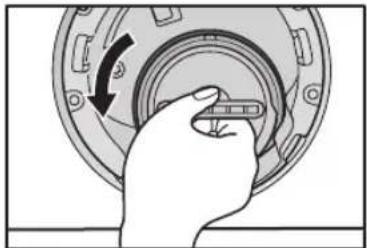
Illustration of a hand using a tool to add a small object into a container (no text or symbols visible)Carefully turn the drain filter 3. anticlockwise to unscrew it. More water may drain out.
This is normal.
natural_image
Hand pressing a button on a circular mechanical component with a curved arrow indicating rotation (no text or symbols)Then, remove the drain filter.4.
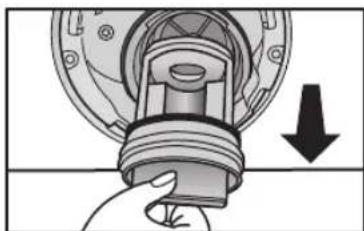
natural_image
Mechanical assembly diagram showing a hand pressing a component with a downward arrow indicating motion (no text or symbols)Remove any lint and debris.5.
Replace the drain filter and drain filter 6. cover.
Reinsert the drain filter. Then turn it clockwise until it touches the stopper.
Caution
Do not remove, the drain filter if there is water-inside the drum, such as during operation. If you do, a large volume of water (possibly scalding water) will pour out.
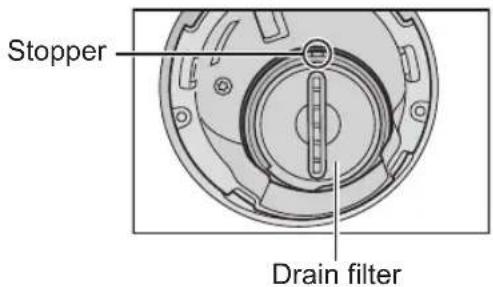
Maintenance - 31
Maintenance
Cleaning the drum
If you keep using cold water in the appliance, bacteria may build up inside the drum and emit an odour. You can avoid this by running the 90 °C Cotton programme once a month.
(When using a scale remover, follow the manufacturer's instructions.)
Caution
Viruses and bacteria are not killed in water temperature of 40 °C. Pathogens can spread via the mingling of clothes and thus transmit diseases.
Pathogens die at a temperature of at least 60 °C.
Note
Do NOT put laundry or laundry detergent into the appliance during cleaning.
If you use tub cleaning detergent or bleach, put it into the detergent drawer before starting the wash. The appropriate amount to be used is approximately 30 ml. (P.15)
Cleaning the detergent drawer
Detergent residue soon builds up if the detergent drawer is not cleaned regularly. Detergent buildup may develop mould.
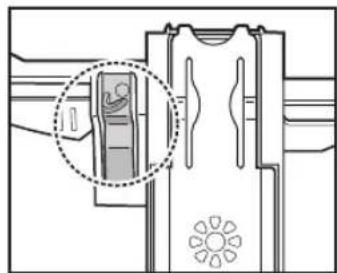
natural_image
Technical line drawing of a door handle assembly with a highlighted component (no text or symbols)Pull out the detergent drawer.1.
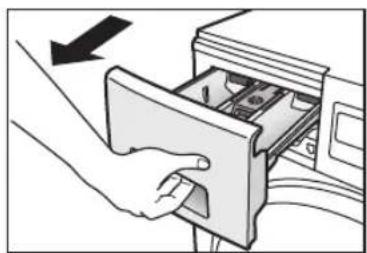
natural_image
Illustration of a hand inserting a drawer into a file into a drawer slot (no text or symbols visible)Remove the detergent drawer by 2. pulling it out while pressing down on the tab as shown in the figure below.
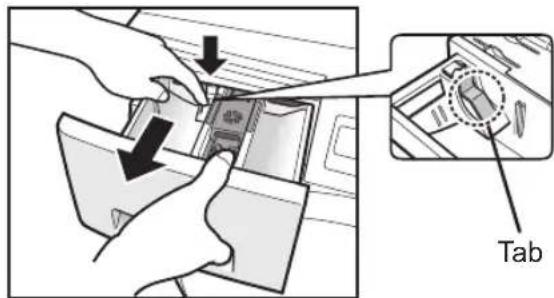
32 - Maintenance
Put your finger on the tab near the 3. front of the softener cover and pull it up to remove it from the detergent drawer.
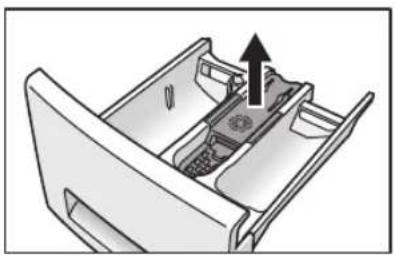
natural_image
Diagram of a mechanical device interior showing internal components and a directional arrow (no text or symbols)Wash out the detergent residue with 4. water.
Use a cloth to wipe the water from the appliance.
Replace the softener cover.5.
Reinsert the detergent drawer while 6. pressing down on the tab as shown in the figure below.
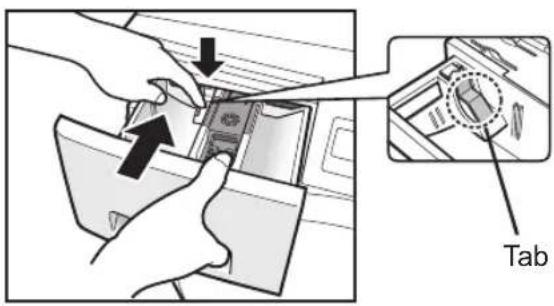
Cleaning the water supply filter
Clean the filter if water is not supplied properly.
Turn the tap off.1.
Switch on the appliance.2.
Select the Cotton programme, and 3. then press the Start button. Drainage begins when the appliance is started.
After 2 minutes, switch off the 4. appliance. Water has drained out of the water supply hose.
Disconnect the water supply hose 5. from the appliance.
Clean the filter, which is on the rear 6. of the appliance.
Use a small brush, for example, a toothbrush.
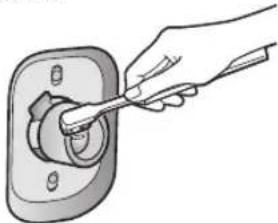
natural_image
Hand using a tool to adjust or install a button on a mechanical component (no text or symbols visible)If the unit is supplied with the hose 7. fitted with a water supply valve, turn off the tap supplying water to the appliance, disconnect the hose from the tap and then clean the filter on the hose in the same way.
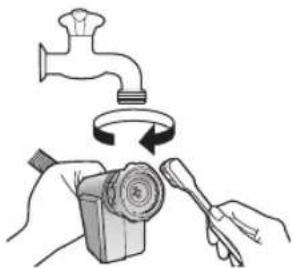
natural_image
Illustration of a hand using a tool to clean or adjust a water tap (no text or symbols present)Reconnect the water supply hose.8. Tighten the plastic joint firmly.
Turn on the tap and then check for 9. leaks.
Maintenance
Preventing a frozen water supply hose
If the appliance is delivered in freezing weather conditions, after setting up, leave it at room temperature for 24 hours before using. This will ensure that the water supply hose does not become clogged up with ice.
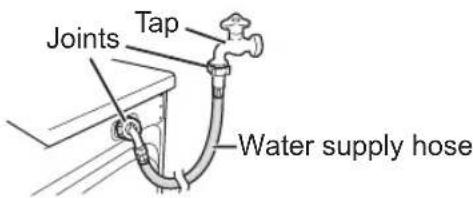
If your water supply hose freezes, perform the following procedures:
Wrap warm towels around the joints 1. of the water supply hose.
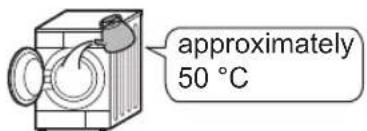
Add 2 to 3 litres of warm water to the 2. drum.
Run the Drain programme. 3. (P.20)
34 - Maintenance
| Problem Cause | ||
| Washing machine | Buttons do not work. | The programme, temperature, spin speed, preset time, -Extra Rinse, Easy Iron or Speed/Eco function settings cannot be changed while washing is in progress.Child lock may be activated. (P.30) - |
| Door does not open. | Door lock may be activated. (P.19) -The water temperature or level may be too high. -(P.19) | |
| Unusual odour Rubber | parts may give off a smell when you start using -the appliance, but the smell will go away over time.You can wash the drum by running the 90 °C programme.(P.32) | |
| Wash | No water going into the appliance. | The water tap may be turned off. -The water supply hose may be frozen. (P.34) -The water supply may be disrupted. -The water supply filter may be clogged. (P.33) |
| There is only a small amount of water. | If you have paused the washing and then restart it, the appliance may drain out some water.Do NOT pour water in through the door. | |
| Water builds up during the wash process. | This is normal; water is automatically supplied if the amount of water has decreased. For heavy loads, the water may fill up repeatedly. | |
| Rinse/Spin | No water flows into the appliance during the rinse process. | Before rinsing, the appliance spins to drain out remaining water. The water will fill up after that. |
| Rinsing begins before the spin process finishes. | After washing, excess foam may remain, so the water is drained out and refilled to wash it away. This feature is called foam detection. | |
| During spin-dry, the drum stops and rotates several times. | This is normal; the appliance has detected that the load is not balanced and is trying to re-distribute the clothes within the drum to correct it. | |
| Foam and water remain in the door or door seal. | Although some foam and water may remain depending upon the state of the laundry and the amount of detergent used, rinse performance is unaffected. | |
| The spin process repeatedly starts and stops. | This is normal; intermittent spinning of the tub helps the spin process to operate quietly.The laundry may be too light. If so, add one or two bath towels. | |
| The laundry is still wet after the spin process finishes. | The unit detected an out of balance load but was not able to correct it automatically.If the laundry is too light, add one or two bath towels.If the laundry gets tangled up, untangle it. | |
Troubleshooting - 35
Fault Checklist
| Problem Cause | ||
| Detergent and foam | There is no foam or hardly any foam. | The amount of foam varies, depending on the - temperature, level and softness of the water.You may have put powdered detergent directly into the - drum; you must put it in the detergent drawer.You may not be using enough detergent. -You may be using a reduced-foam type of detergent. -Heavily soiled laundry and larger loads of laundry may - reduce the amount of foam. |
| There is a lot of foam. | The amount of foam varies, depending on the - temperature, level and softness of the water.You may have used too much detergent. -The type of detergent you are using may cause excess - foam. | |
| Fabric softener overflows. | The softener may have exceeded the MAX level of the - detergent drawer. (P.17)You may have spilt the liquid when closing the detergent - drawer too strongly. | |
| After the wash has finished, powdered detergent residue remains. | You may have put powdered detergent directly into the - drum; you must put it in the detergent drawer. | |
Fault Checklist
| Problem Cause | ||
| Time | The displayed remaining time changes. | The remaining time is estimated and corrected continually. - Thus, the time displayed may change. |
| Noise | There is an unusual noise or vibration. | There may be metal items in the drum. - The anchor bolts may not have been removed. - (P.40) The appliance may be on a sloping or unstable surface. - If none of the above is the cause, contact your local Customer Communications Centre. |
| There is noise when the water drains out. | This is normal; it is noise generated by the operation of - the drain pump. | |
| Noise increases during high spin speed. | This is normal; Motor noise increases gradually with the - spin speed. | |
| There are noises during washing or rinsing. | This is normal; They are noises from the pump that - circulates washing or rinsing water. (148VB6, 128VB6, 147VB6 and 127VB6) | |
| Others | The electricity supply cuts out while the appliance is on. | The appliance stops operating. When power is restored, it resumes operation from the point that it had stopped. |
| A circuit breaker trips and the electricity supply is cut. | The appliance stops operating. When the breaker is reset, it resumes operation from the point that it had stopped. However, we recommend that the reason that caused the breaker to trip is found and steps taken to solve it. | |
| The water supply is disrupted. | When the water is supplied again, it may be impure at first. You have to disconnect the water supply hose and drain away the impure water through the tap. Make sure that the water supply hose has been reconnected before using the appliance. | |
| The display is not clear. | The appliance may be in a brightly lit or sunlit area. - | |
Error Display
| Error What to | do |
| E01Door is open | Make sure that the door is closed properly. |
| E02Unable to supply water | Check for any of the following problems.The tap is closed. -The water pipe or hose is frozen. -The water supply has been disrupted. -The water supply filter is clogged. (P.33) - |
| E03Unable to drain | Check the drain hose for any of the following problems.There is a clog in the hose. -The hose tip is immersed in water. -It extends with joints. -The water is frozen. -Clean the drain filter if it clogs up. (P.31) |
| E04Overflow | Check for any of following problems.The water supply valve has failed. -The water supply valve triac has failed. -Switch off and unplug the appliance. Shut off the tap and contact your local Customer Communications Centre. |
To restart operation after an error message appears, set the programme selection dial to Off, and then select a programme and start the operation.
Choosing the Right Location
Carrying the appliance
The appliance must be carried by 2 or more people.
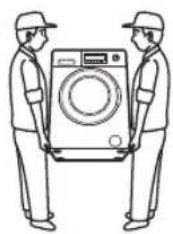
natural_image
Line drawing of two workers in hard hats holding a large washing machine (no text or symbols)Start by tilting the appliance backwards. The appliance should be carried by two people, one on each side holding it from the bottom.
The right place for the appliance
Make sure that there is enough space for the appliance and that openings on the base are not obstructed by a carpet.
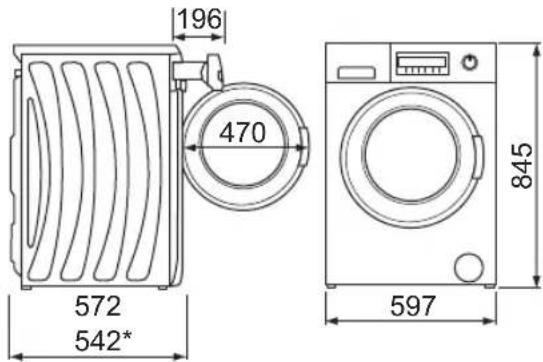
Dimension in millimetres
* for NA-147VB6, 127VB6, 147VC6 and 127VC6
Caution
Install the appliance on a flat, - stable surface to avoid excessive vibration and noise.
Do NOT install the appliance on a - carpet or similar type of flooring.
Do NOT install the appliance in - direct sunlight or in a place where temperatures reach freezing.
Do NOT let metallic portions of the appliance come into contact with metal sinks or other appliances.
Set-in installation
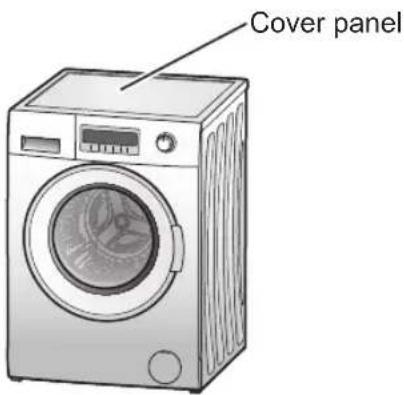
You need a space of at least 60 cm - wide. Provide at least 2 mm of clearance on both sides and at least 5 mm of clearance both on the top and the back of the appliance.
The counter above the appliance - must be firmly fixed to the adjoining cupboards.
Caution
Do NOT install the appliance set-in with the cover panel removed.
Moving and Installing
Removing the anchor bolts
Four anchor bolts keep the interior of the appliance in place while the appliance is being moved. Remove them before installation, using a spanner. Follow the instructions below.
Note
The anchor bolts must be removed before the appliance is operated. They may cause excessive vibration.
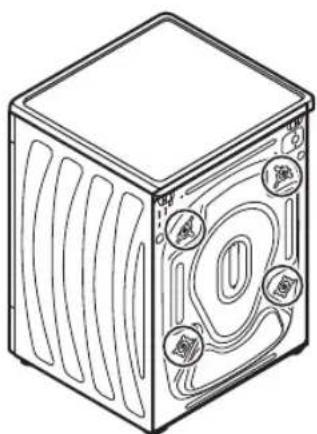
natural_image
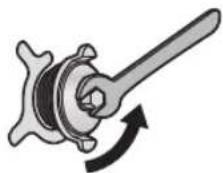
Isometric line drawing of a cube with internal geometric patterns and circular elements (no text or symbols)Use a spanner to loosen the four 1. bolts.
Rotate the bolts anti-clockwise.
Pull the bolts out horizontally.2.
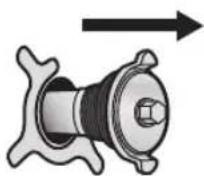
Attach each cover cap (included with 3. the accessories) over each bolt hole.
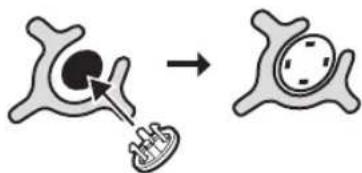
Note
Make sure that you store the anchor bolts because they are used when transporting the appliance. If the appliance is passed on to another person, make sure to give the anchor bolts to that person.
Make sure the cover caps are - attached. Failure to observe this may result in water entering the washing machine, leading to malfunctions.
Moving the appliance
Note
Make sure to install the anchor bolts in the appliance.
Before you move the appliance
Shut the tap and run the appliance to - drain the water. Drain remaining water from the drain filter. (P.31)
Depressurize and remove the water - supply hose.
Disconnect the power cable. -
Install the anchor bolts. (P.41) -
40 - Installation Instructions
Moving and Installing
Installing the anchor bolts
Remove each cover cap.1.
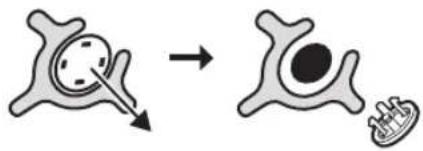
Insert each anchor bolt.2.
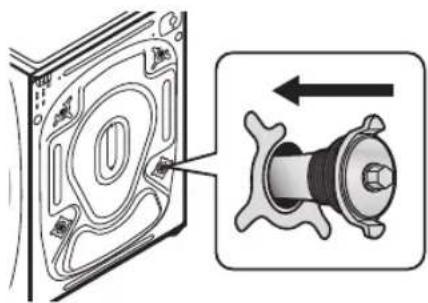
natural_image
Diagram of a mechanical component with a magnified inset showing a bolt and nut assembly (no text or symbols)Tighten each bolt with a spanner.3.
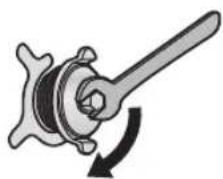
natural_image
Mechanical diagram showing a wrench turning a gear with a curved arrow indicating rotational motion (no text or symbols)Levelling the appliance
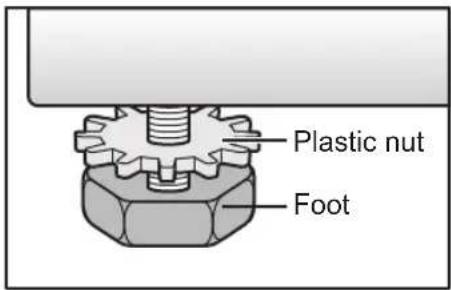
Loosen the plastic nut on each foot 1. by turning it clockwise.
Adjust each foot by turning it 2. clockwise or anticlockwise.
Use a spirit level to make sure that 3. the appliance is properly levelled.
Tighten each plastic nut by turning it 4. anticlockwise.
Caution
Make sure that all plastic nuts are tightened securely and the feet are still securely bolted to the appliance.
If they are unbolted, the appliance will move around.
Do NOT put cardboard, wood - or similar materials under the appliance to compensate for unevenness.
Be careful not to destabilize the - appliance when cleaning the floor.
Connecting Hoses and Power Supply
Follow the instructions in this section to prevent water leaks. If you are unsure, ask a service agent to connect the hoses.
Hoses and cable lengths
Left side connections
Right side connections
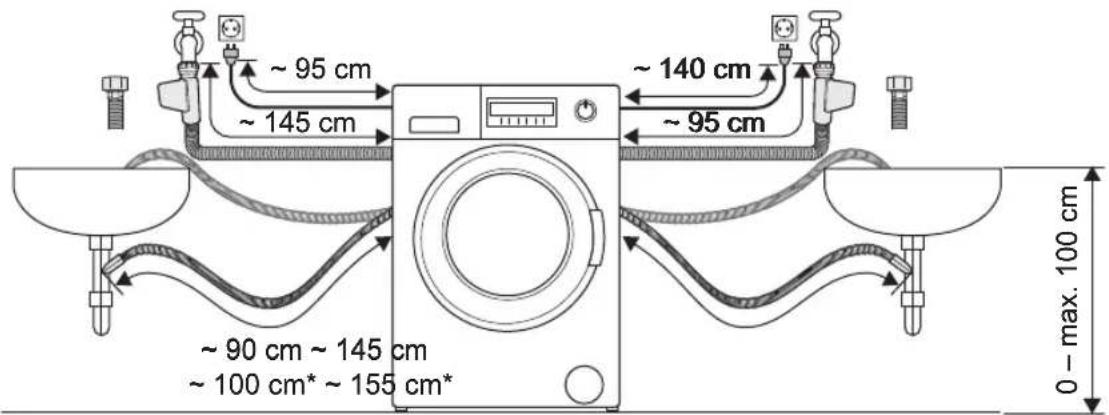
* for NA-147VB6, 127VB6, 147VC6 and 127VC6
Water supply hose
Caution
Do NOT connect the Water supply - hose to a combination tap.
Do NOT twist, squash, modify, or - cut the hose.
Optimum mains water pressure is 0.1 - - 1.0 MPa. If the water pressure exceeds this value, install a pressure reducing valve.
Waterflow from the tap should be more - than 5 L/min.
Connecting the Water supply hose
Attach one end of the hose to 1. the water inlet on the back of the appliance and tighten the joint by hand.
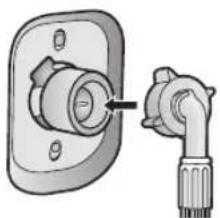
natural_image
Technical diagram of a mechanical connector with a shaft and mounting bracket (no text or symbols)42 - Installation Instructions
Attach the other end of the hose to 2. the tap and tighten it the same way.
Standard hose -
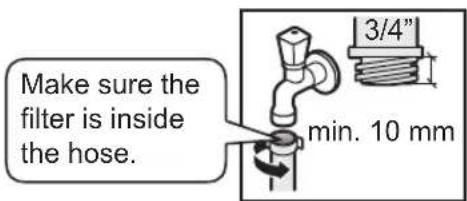
Hose with Water supply valve -
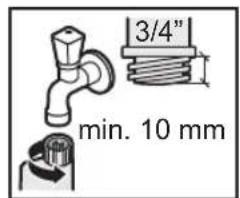
Open the tap slowly and make sure 3. that there are no leaks around the joints.
The joints are subject to water pressure.
Connecting Hoses and Power Supply
Leak-proof System
The appliance is installed with a system that is designed to prevent water leaks. The system includes the following components:
1) Aquastop system
If a water leak is detected in the water inlet hose, the system stops supplying water automatically. This system is only functions with hoses with water supply valves.
2) Overflow detection
If water in the appliance increases to a certain level, this function stops the water supply and activates the drain pump.
Water drain hose
Caution
Do NOT twist, pull out, or bend the drain hose.
Do NOT use joints to extend the - Water drain hose.
Draining to a sink or wash-basin
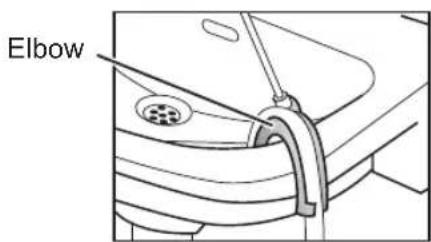
Caution
The water drain hose must be - removed from the hook on the rear side of the appliance before the appliance is operated.
If the water drain hose is close to the appliance, the hose may come in contact with the appliance and generate noise during the spin cycle because of vibrations.
Secure the water drain hose so - that it will not come out of the basin.
Do NOT block the drain outlet of - the basin. Make sure that drainage into the drain is sufficient.
Do NOT let the tip of the - Water drain hose dip into the drained water.
This can cause water to flow back into the appliance.
Draining to a drain hose
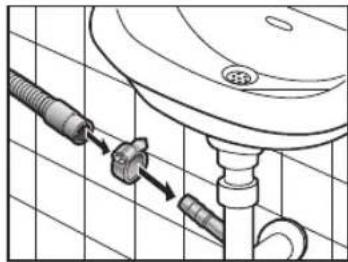
natural_image
Diagram of a pipe fitting with a valve and fittings, showing mechanical assembly (no text or symbols)Connecting Hoses and Power Supply
Connecting to the power supply
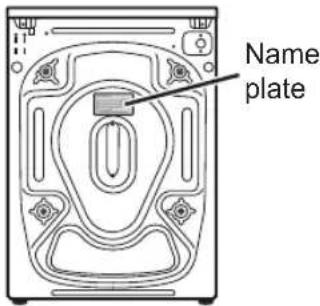
Caution
The name plate indicates the rated power that the appliance needs. Make sure that the power supply specifications in your residence match the information mentioned here. The information on the power supply specifications are also mentioned on page 46 of these instructions.
If the product is not correctly - grounded, the user will be liable for any damage incurred.
44 - Installation Instructions
Checking after Installation
Installation checklist
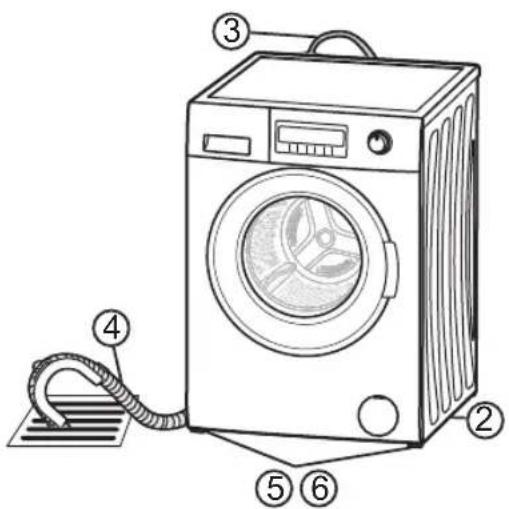
1) Anchor bolts Have you removed them and attached the cover caps properly?
2) Location Is the appliance on a flat, stable surface? Does it run without vibrating?
3) Water supply hose Is it free from leaks? Is the water supply normal?
4) Water drain hose Is it free from leaks? Does it drain normally?
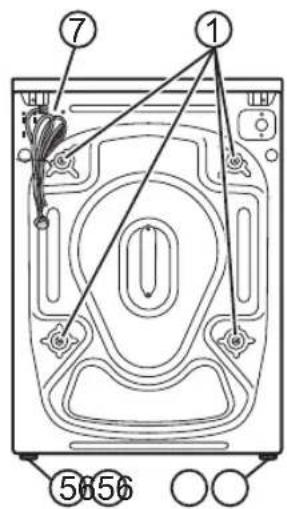
5) Adjustable feet Are they bolted securely to the appliance?
6) Feet cushions Are they standing flat? If the appliance is not level, there may be abnormal sounds when water is drained out.
7) Power supply Is the household dedicated mains socket fully rated at AC 220 V to 240 V?
Specifications
| NA-148VB6NA-128VB6 | NA-147VB6NA-127VB6 | NA-147VC6NA-127VC6 | ||
| Rated voltage 220 - 240 V | ||||
| Rated frequency 50 Hz | ||||
| Maximum energy rated power input 2200 W | W | |||
| Heating energy rated power input 2000 W | ||||
| Product weight | 77 kg | 73 kg | 72 kg | |
| Maximum mass of dry cloth | 8 kg | 7 kg | 7 kg | |
| Product dimensions | Height 845 mm | |||
| Width 597 mm | ||||
| Depth 572 mm 542 mm 542 mm | ||||
| Water consumption Refer to “Power and Water Consumption”. | ||||
| Pressure of tap water 0.1 - 1 MPa | ||||
Customer Communications Centre
| Fridge-Freezer and Washing MachinePlease note, we are unable to assist with calls regarding Audio Visual and other Home Appliance products on this line. | |
| Monday to Friday 9:00 - 17:00Excluding public holidays. | 0844 844 3899 |
| Monday to Friday 9:00 - 17:00Excluding public holidays.(For Republic of Ireland) | If calling from the Republic of Ireland, please call01 289 8333 |
(EU)No.1061/2010
| Supplier's name Panasonic | |||||
| Supplier's model identifier | NA-148VB6NA-128VB6 | NA-147VB6NA-127VB6 | NA-147VC6NA-127VC6 | ||
| Rated capacity of Cotton programme kg8 | 7 7 | ||||
| Energy efficiency class1)A+++ (most efficient) : EEI<46A++ : 46≤EEI<52 | A+++ A++ A++ | ||||
| Annual energy consumption2) | kWh/year | 194 162 195 | |||
| 1) The energy efficiency class of a household washing machine shall be determined on the basis of its Energy Efficiency Index (EEI).2) Energy consumption in kWh per year, based on 220 standard washing cycles for Cotton + Eco programmes at 60 °C and 40 °C at full and partial load, and the consumption of the low-power modes. The actual energy consumption will depend on how the appliance is used. | |||||
| Energy consumption(Cotton + Eco option programme) | 60 °C at full load kW | h 0.95 0.83 | 1.05 | ||
| 60 °C at partial load | kWh 0.7 | 7 0.68 0.72 | |||
| 40 °C at partial load | kWh 0.7 | 1 0.64 0.65 | |||
| Power consumption | Off-mode | W | <0.5 <0.5 | <0.5 | |
| Left on-mode W | <1.0 <1.0 | <1.0 | |||
| Weighted annual water consumption3) | L/year | 9900 | 9240 10346 | ||
| 3) Water consumption in litres per year, based on 220 standard washing cycles for Cotton + Eco programmes at 60 °C and 40 °C at full and partial load. The actual water consumption will depend on how the appliance is used. | |||||
| Spin-drying efficiency class on a scale from G (least efficient) to A (most efficient) | B | B | B | ||
| Maximum spin speed | r/min | NA-148VB6, 147VB6 and 147VC6: 1305NA-128VB6, 127VB6 and 127VC6: 1186 | |||
| Remaining moisture content | % | 53 | 53 53 | ||
| The standard 60 °C and 40 °C Cotton programme with Eco option are the standard washing programmes to which the information in the label and the fiche relates. These programmes are suitable to clean normally soiled cotton laundry and are the most efficient programmes in terms of combined energy and water consumption. | |||||
| Programme time4)(Cotton + Eco option programme) | 60 °C at full load | min 209 | 206 207 | ||
| 60 °C at partial load | min 177 | 176 175 | |||
| 40 °C at partial load | min 171 | 176 165 | |||
| Airborneaccoustical noise emissions | Wash | dB | 58 | 58 58 | |
| Spin | dB | NA-148VB6, 147VB6 and 147VC6: 76NA-128VB6, 127VB6 and 127VC6: 74 | |||
| 4) In minutes and rounded to the nearest minute | |||||
| Freestanding appliance | Yes | ||||
Installation Instructions - 47
Setting of the course for the energy consumption values
By the following procedures the energy consumption values for the standard programmes can be realised. These programmes “Cotton 60 °C” or “Cotton 40 °C” are the standard programmes in accordance with the EU Regulations 1061/2010 and 1015/2010. Those programmes are suitable to clean normally soiled cotton laundry and are the most efficient programmes in terms of combined energy and water consumptions for washing that type of cotton laundry.
- Set the dial to Cotton.
- Eco Choose Eco function. (P.30)
- 1400 or 1200 Choose maximum spin speed. (P.27)
- 60°C or 40°C Choose water temperature of 60 °C/40 °C.
- The actual water temperature may differ from the declared cycle temperature.
Panasonic Corporation
Web Site: http://panasonic.net
© Panasonic Corporation 2016
Printed in Turkey
June 2016
W9901-9HM10
- Operating Instructions & Installation Instructions
- Electrical Connection (UK and Republic of Ireland only)
- Warning
- How to replace the fuse
- - Read Before Using
- Consider the Environment
- Disposing of packaging
- Disposal of Old Equipment Only for European Union and countries with recycling systems
- Information on disposal in other countries outside the European Union
- Recommended detergent in accordance with the Regulation (EU) No. 1015/2010
- When using a tumble dryer
- Contents
- Read Before Using
- Washing Instructions
- Maintenance
- Troubleshooting
- Installation Instructions
- General Use
- SAFETY PRECAUTIONS
- Power source and cable
- To Prevent Injury
- CAUTION
- Checking Your Washing Machine
- Accessories
- Checking before use
- Before initial use
- Note
- Preparing the laundry
- Sorting the laundry
- Before Washing
- Treating stains
- Checking clothing
- - Read Before Using
- Adding Detergent and Other Chemicals
- Detergent compartment
- Detergent
- Liquid detergent1.
- Powdered detergent2.
- - Read Before Using
- Amount of Detergent
- Water softening agent
- Softener compartment
- Fabric Softener
- Laundry starch
- Prewashing compartment
- Detergent for prewashing
- Using the Buttons and Dials
- Buttons and dial
- Display
- Time bar indicator1.
- Process indicator2.
- Lock indicator3.
- Temperature indicator
- Cold setting indicator
- Spin speed indicator
- Remaining time indicator
- Time indicator8.
- Optional functions indicator
- Unlocking the door
- Press the Start/Pause button to unlock the door during operation.
- Washing
- 20°C Wash programme
- Spin programme
- Select optional functions.4.
- Press the Start button.6.
- Required time
- Setting the buzzer
- Simultaneously press and hold the Temperature and Time buttons for at least 3 seconds.
- Changing settings while washing
- - Washing Instructions
- Power and Water Consumption
- - Washing Instructions
- Washing Delicates
- Wool and Hand Wash programmes
- Delicate laundry loads
- Approximate weights
- Tips for washing delicates
- Putting laundry in the drum
- Detergents
- Hanging the laundry
- If clothing shrinks in the wash
- - Washing Instructions
- Washing Blankets and Bedspreads
- Programme for Bedding
- Washable
- Non-washable
- Putting bedding into the drum
- Optional Functions
- Extra Rinse
- Speed/Eco
- Child lock
- Activating/deactivating child lock
- Preset timer
- Setting a preset time
- Press the Start/Pause button to 3. activate the countdown.
- Easy Iron
- Cleaning the outside of the appliance
- Cleaning the door seal and window
- Cleaning the drain filter
- Cleaning the drum
- Cleaning the detergent drawer
- - Maintenance
- Cleaning the water supply filter
- Preventing a frozen water supply hose
- - Maintenance
- Fault Checklist
- Choosing the Right Location
- Carrying the appliance
- The right place for the appliance
- Set-in installation
- Moving and Installing
- Removing the anchor bolts
- Moving the appliance
- Before you move the appliance
- Levelling the appliance
- Connecting Hoses and Power Supply
- Hoses and cable lengths
- Water supply hose
- Connecting the Water supply hose
- - Installation Instructions
- Attach the other end of the hose to 2. the tap and tighten it the same way.
- Open the tap slowly and make sure 3. that there are no leaks around the joints.
- Leak-proof System
- Water drain hose
- Draining to a sink or wash-basin
- Draining to a drain hose
- Connecting to the power supply
- Checking after Installation
- Installation checklist
- Setting of the course for the energy consumption values
Brand : PANASONIC
Model : NA-127VB6WGB
Category : Washing machine