
Fisio 121 - Mobile Phone PHILIPS - Free user manual and instructions
Find the device manual for free Fisio 121 PHILIPS in PDF.


| Type | Mobile Phone |
| Brand | Philips |
| Model | Fisio 121 |
| Dimensions | 100 x 45 x 20 mm |
| Weight | 85 g |
| Display Type | Monochrome LCD |
| Display Resolution | 101 x 65 pixels |
| Battery Type | Li-ion 650 mAh |
| Standby Time | Up to 300 hours |
| Talk Time | Up to 3 hours |
| Ringtone | Polyphonic |
| Phonebook | Up to 300 contacts |
| SMS | Yes |
| Alarm | Yes |
| Calculator | Yes |
| Customization | Changeable covers |
| Network | GSM 900 / 1800 |
| Color Options | Silver, Ocean Blue |
| Manual Languages | English, French, etc. |
| Safety | Use approved charger only |
Frequently Asked Questions - Fisio 121 PHILIPS
User questions about Fisio 121 PHILIPS
0 question about this device. Answer the ones you know or ask your own.
Ask a new question about this device
Download the instructions for your Mobile Phone in PDF format for free! Find your manual Fisio 121 - PHILIPS and take your electronic device back in hand. On this page are published all the documents necessary for the use of your device. Fisio 121 by PHILIPS.
USER MANUAL Fisio 121 PHILIPS
Idle screen displays the time, date and network name.
"Pick up" key

Call context - Press to answer a call
Idle mode - Press to access the Call list or to dial a number or a name displayed on the screen, long press to launch Wap.
Alphanumeric keypad
Press keys to enter numbers and text. Make a long press on a key to activate a programmed hotkey function (see "Hotkeys" page 9).
Language
In idle mode, press and hold o to choose a language in which the telephone functions will be displayed.
Microphone

Navigation key
Idle mode - Press ◀ and ▶ to increase/decrease ringer volume.
Navigation mode - Press ◀◀◀ and ▶ to navigate in the menus.
Wap mode- Press ◀◀ to go to the previous page, long press ◀◀ to exit the Wap session.
OR▼ key
Idle mode - Press to enter the main menu.
Navigation mode - Use this key to validate information.
key cancel/back
Idle mode - Press to access the Names list, make a long press to lock/unlock the keypad*.
Navigation mode- Press to return to previous menu.
Edit mode- Press to delete a character, make a long press to delete all characters.
"Hang up" and "On/Off" key
Press to end a call and to switch your phone on, make a long press to switch your phone off.
Table of contents
Memory card......2
Getting started ....3
Inserting the SIM card ...... 3
Charging the battery...... 3
Customising your phone ..... 4
Switch on/off and PIN code .. 5
The carousel 6
Main features......6
Idle screen 6
Symbols 7
Make a call 7
Answer / end a call ...... 7
Emergency call 8
Lock / unlock the keypad..... 8
Hotkeys 8
Settings 9
Introduction 9
Sounds 9
Display.... 10
Security.... 10
Time and date...... 10
Register again.... 11
Call settings ...... 11
Names, calls and messages...... 12
Introduction 12
Text Entry...... 12
Names.... 14
Messages.... 14
Call list 16
Extras.... 16
Introduction 16
16
Euro converter 17
Calculator.... 17
Alarm clock.... 17
Call counters.... 17
Wap services......18
Launch 18
Favourites.... 19
Last page.... 19
Settings 19
Access.... 19
Other operator services...... 21
Touchtones (DTMF)...... 21
Make a second call ...... 21
Answer a second call...... 21
Autoredial.... 21
Precautions 22
Troubleshooting...... 26
Glossary...... 28
Philips authentic accessories......29
Memory card
| Switch on/off | Press 🔒 to switch On, make a long press 🔒 to switch Off. |
| Enter PIN | Enter your PIN code using the keypad and press OK or # to confirm. |
| Make a call | Enter phone number on keypad and press @ to dial |
| Answer a call | Press @ when your phone rings. |
| End a call | Press 📞. |
| Quickly access the Names list | In idle mode, pressâ. Browse the list by moving◄ or ► and press @ to call the selected name. |
| Quickly access the Call list | Press @ in idle mode. |
| Quickly access the Ringer Volume | Press ◀ or ► in idle mode to increase/decrease volume and press OK to confirm your choice. |
| Return to previous menu | Press ⬇. |
| Return to idle screen | Make a long press on ⬇. |
| Lock/Unlock the keypad | In idle mode, make a long press on . |
| Change the language used | Make a long press on ⭕, select the language and press OR . |
| Access the menus | Press OK to access the menus. Press ◀ or ► to select function, then press OR to enter the sub-menu.Repeat step 2 until you reach the desired function. |
Getting started
Read the safety instructions in the "Precautions" section before use.
Inserting the SIM card
I Remove the SIM card from its holder and insert in its slot, under the metal clip holder, push until it stops. Be careful that the clipped corner of the card is in the correct position as shown opposite.
2 Slide the battery pack into its slot until it stops (1) and push the clip downwards (2).
3 Place the phone's battery cover, by sliding it until the latch catches.
4 Remove the protective film from the screen before using the phone.
Charging the battery

natural_image
Line drawing of a mechanical component with an arrow indicating direction (no text or symbols)

natural_image
Illustration of a cylindrical object with a pointed tip and a triangular tip, resembling a tool or device (no text or symbols)Your phone is powered by a rechargeable battery.
- For a full recharging please allow the charger to be connected for about 10 to 14 hours (e.g., over night).
- To optimise battery capacity, allow it to fully discharge 3 times in a row. Then, to maintain its optimal capacity, do not wait until the indicator reaches low (i.e., when only 1 bar is displayed in the battery indicator).
- Disconnect the battery if you do not use the phone for several days.
- You can use the phone while it is on charge.
- If the battery is completely flat, the battery icon will only reappear after 2 or 3 mn of recharging. Meanwhile, you cannot make a call.
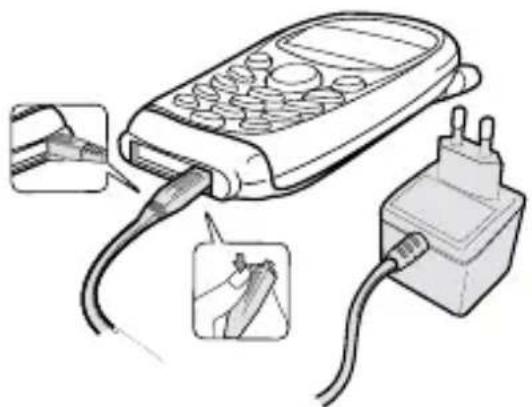
I Once the battery and the battery cover are connected to the phone, plug the connector into the right hand socket at the base of the phone.
2 Then plug the transformer unit into an easily accessible AC power socket.

Bars moving → battery is charging.
Bars steady → battery is fully charged.
natural_image
Illustration of a mobile phone with cable and plug, showing wiring details (no text or symbols)3 Depending on the network and condition of use, talk time goes from 1.40 to 4 hours and standby time from 8 to 15 days.
The only way to turn off the charger is to unplug it, so use an easily accessible AC power socket. Keeping the mobile plugged to the charger when the battery is fully charged does not damage the phone.
Customising your phone
You can customise your mobile phone by removing the front cover and the battery door, and replace them with different ones.
You must always remove the battery when customising your phone.
I Press on the top of the battery cover, then push the cover to remove it.

Make sure the phone is switched off before removing the cover.

natural_image
Line drawing of a handheld device with a handle and internal component (no text or symbols)2 Remove the battery by both lifting the bottom clip and the battery upwards (1), and pushing it downwards (2).

3 Take off the cover by lifting it from the side of the phone, as shown opposite.
4 Then twist it to remove it.
Make sure you handle the product with care when the front is removed, in order not to damage the keys which are then unprotected.
5 Remove the keypad from the front cover you removed, then place it in the new front cover.
6 Put the new front cover on your phone: hook the front housing onto the hinges on the top of the phone (1), then press the bottom down until the latches catch (2).
7 Slide the battery pack into its slots, until it stops (1). Then push the clip downwards (2).
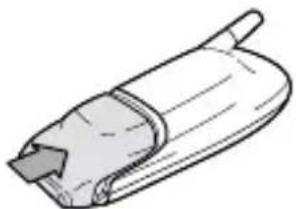
8 Replace the bottom part on your phone by sliding it until latch catches.
Switch on/off and PIN code
I To switch on the phone, press and hold the

natural_image
Line drawing of a hand holding a mobile phone with a screen and keypad (no text or symbols)
natural_image
Illustration of a hand using a tool to lift a mechanical component (no text or symbols visible)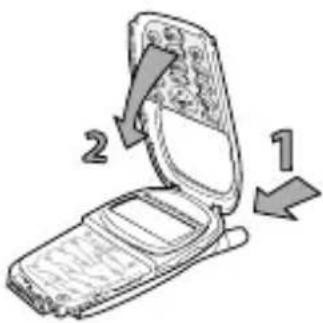

natural_image
Simple line drawing of a cylindrical object with a pointed tip and a handle, resembling a tool or device (no text or symbols)
key.

2 Depending on your subscription, you might then be prompted to enter the PIN code, which is the 4 to 8-digit secret code of your SIM card to protect it from abusive use. It can be preconfigured and communicated to you by your operator or retailer. To activate or personalise the PIN code, see “Change codes” page 10.
If you enter a wrong PIN code 3 times, your SIM card is blocked. To unblock it, you must request the PUK code from your operator.
3 Enter your PIN code. If you make a mistake, press ca. Then confirm by pressing OK or #.
The carousel
A carousel is a loop of icons displayed on the screen, each icon representing a feature or option used to operate your phone:

The first carousel available when you turn on your mobile phone is called the "main" carousel. You access it by pressing OK when in idle mode, and it features the icons shown above. To select the next or previous feature or option, press (left) or (right) and press OK when the menu of your choice appears on the screen. Another sub-carousel or a list will then appear.
Main features
Idle screen
After switching your phone on and entering the PIN code (see page 5), your phone displays the idle screen which means that it is ready to be used. In idle mode, several symbols can be displayed simultaneously.

If the Y symbol isn't displayed, the network is not available. You may be in a bad reception area (e.g. in a tunnel): if possible, move to a different location. When browsing lists and menus, the phone automatically returns to idle screen over a 2 mn period of inactivity.
Symbols
Alarm clock activated.
Silent - Your phone will not ring when receiving a call.
Vibra - Your phone will vibrate when receiving a call.
SMS message - You have received a new message.
SMS full - Memory for messages is full. Delete old messages to receive new ones.
Call Forward Unconditional to number- Incoming voice calls are forwarded to a number other than voice mail.
Call Forward Unconditional to voice mailbox incoming voice calls are forwarded to voice mail.
Make a call
Voice mail - You have received a new voice mail.
Keypad lock - Indicates that the keys are protected from being pressed accidentally.
Roaming - You are using a network other than your subscribed one.
Home zone - You are currently within the home zone. Subscription dependent function, please contact your operator.
Battery - The bars indicate the battery level (4 bars = full, no bars = recharging needed).
Network: your phone is connected to a network
Reception quality: the more bars are shown the better the reception is.
Before making your first call, ensure you have entered you PIN code as described page 5 and eventually set a code of your choice as explained page 10.
I In idle mode, enter the phone number using the keypad. To edit the number, scroll using ◀ or ▶ and press to delete an incorrect digit.
For an international call, you can enter the "+" key instead of the usual international prefix. To do this make a long press on * before dialling the country code.
2 P r@ to calls and press to hang up.
Answer / end a call
I When receiving a call, your phone can ring and/or vibrate. Depending on your subscription and if the caller has permitted this information to be transmitted, his number may be displayed. If the number is stored in your list, the corresponding name is displayed instead of the number.
2 To answer the call, press 📄 and press 🔒 to hang up.
3 To reject a call, press 🔒. The call is diverted to a number or voicemail if you have activated “Call forward” (see page 11), or if you haven’t activated this option, the caller hears a busy tone.
The phone will not ring if the ringer is deactivated (page 9) or set to Silence via a hotkey (page 8).
During a conversation, you can:
- Lower/raise earpiece volume pressing ◀ or ▶.
- Mute the microphone by pressing and selecting Mute.
- Enter a number you want to save by using the keypad. It reappears after the call. Press OK to store the number or send a SMS.
- Find a phone number by pressing OK and select Names, or to select name and OK to confirm. Press three times to return to the call screen.
Emergency call
This number depends on the country where you are. Contact your operator. Depending on the network operator, the emergency number can be dialled without the SIM card inserted. 112 is the standard emergency number for GSM networks (except for UK: 112 or 999). Enter 112 using the keypad then press to dial.
Lock / unlock the keypad
You can lock the keypad to protect the keys from being pressed accidentally. To lock the keypad, make a long press on ⬆ when in idle screen. The icon 📄 appears on the screen. To unlock the keypad, make a long press on ⬆ again.
Notes:
- The emergency number is available even when the keypad is locked and you can still receive calls.
- You must unlock your keypad before switching the phone off.
- It is possible to accept or reject a call even when the keypad is locked. The keypad is unlocked automatically when the phone receives a call, and then re-locks again once the call is finished.
Hotkeys
Instead of entering the various menus and browsing the lists, you can directly access a specific function thanks to a Hotkey. Making a long press on this key will automatically activate this function.
The following hotkeys are pre-defined:
| 0 | Choose the Language |  |  | Direct access to your Voice Mailbox |
2ABC  | Activates/deactivates the all calls forward to voice mailbox. | Convert to Euro | ||
| 5JRL | Send SMS | Direct access to Silence | ||
| 7PQRS | Convert from Euro | Read SMS |
Depending on your subscription and in addition to the keys listed above, keys 3 DEF and 9 VZ might also be predefined.
Settings
Introduction
The Settings menu of your mobile phone allows you to customise your phone by changing the settings related to each available option. In idle mode, press OR and select Settings, then press OR .
Press ◀◀ or ▶ to browse the available features, press ⬇R to enter an option and to change it. For each option, press ◀◀ or ▶ to make your choice, press ⬇R to confirm or ⬆ to cancel.
SETTINGS
Sounds
Display
Security
Time and Date
Register again
Call settings
Sounds

Ringer volume

Ringer
Ringer volume
To set the volume of your ringer from Silent to High. The Silent mode also applies to key tones.
Ringer
To select the ringer type of your phone. Scroll through the lis and wait for two seconds to hear the melody.
Downloadable melody
You can personalise your phone by downloading new ringers of your choice on your operator's web site (this service depends on your operator). From your personal computer, check on your operator's Internet site the availability, terms and condition of this service and follow its instructions to download the selected ringer tone via SMS. You can then store it as Own melody.

Key tones

New SMS tone
Display

Welcome screen

Contrast
Security

Public names

Call restriction

Change codes

PIN protection
Key tones
To activate/deactivate the key tones. Even if Key Tones are set Off, DTMF are played during calls (see page 21).
New SMS tone
To activate/deactivate an alert beep each time you receive a SMS.
Welcome screen
This function is subscription dependent.
To customise the welcome message and associated icon appearing at switch on.
Contrast
To choose from 5 levels of contrast.
Public names
To restrict calls to numbers entered in your Public Names list
- Public names
Press ◀◀ or ▶ to select
Subscription dependent. Please contact your operator for further details.
- Call restriction
To activate/deactivate the call restriction to the Public Names list. When activated, you can only access the names present in the Public names list, as opposed to the Names item of the main menu.
This function is subscription dependent and requires a PIN2 code.
Select Call restriction, then Public only to activate or No restriction to deactivate.
Change codes
To change your PIN or PIN2 code to protect access to your phone. Select Change PIN or Change PIN2, enter old PIN / PIN2, then enter new PIN / PIN2.
PIN protection
When the PIN code is activated you will be asked to enter your PIN code when switching your phone on: select PIN protection then select On/Off.
Time and date

Set date

Set time
Set date
Set the date by pressing the alphanumeric keys (you can also set the date by moving ◀ or ▶).
Set time
Set the time by pressing the appropriate numeric keys (moving◀◀ or ▶ increases or decreases the time minute by minute).
Register again

Register again
When travelling abroad, your phone will register to the network with the strongest reception (Automatic mode). If you wish, select Manual, then a network in the list, your phone will present a list of available networks in your area.
When selecting a network manually, it becomes the default selected network. If needed, select another network or switch back to automatic mode.
Call settings

Call forward
Call forward
To redirect all your incoming calls (If no reply, If not reachable or If busy) to a new location :
I P r OR and select Settings, Call settings, then Call forward.
2 Select Unconditional: all calls are forwarded, your phone will not ring; or select Conditional: the conditional option will divert all the incoming calls if you don't reply, if you are not reachable or if you are busy.
3 Then select the forwarding option: Cancel, To voice mail, To number.
To deactivate call forward options and receive calls on your phone as normal:
I P r and s select Settings, Call settings, Call forward, Unconditional.
2 P r OK ▼, selects Cansel, then press OK ▼ again.

Mailboxes
Mailboxes
Used to enter your voice mailbox numbers if not available on your SIM card.

Caller ID
Caller ID
Used to Show or Hide your identity to your correspondent. The status option will inform you if this function is activated or not.
This function is subscription and network dependent.
Names, calls and messages
Introduction
The SIM card of your mobile GSM phone features a phonebook called Names that allows you to enter the names and numbers of your correspondents. The number of names your phonebook can store depends on the card capacity.

The SIM card capacity depends on the type of card you have. Check with your operator for full information on this subject.
The content of your phonebook cannot be deleted at once: names must be deleted one at a time.
As for the Messages menu, it allows you to manage the messages in your voice mailbox, short messages (SMS) to be sent or read, the settings for all messages including broadcast messages. You can delete all messages at once via the Reset command.
Names
Enter name / Enter number
[Name selected]
Send SMS / Delete /
Change / Own Number /
Emergency
Messages
Send SMS / Read SMS / SMS
Settings / SMS Centre /
Signature / Reset / Broadcast SMS
District code / Reception /
Topics
Call list
Call list / Reset
Text Entry
When sending messages, text can be entered in editing screens in two different ways: by using T9® Text Input, or basic text input. Two other modes for numbers and punctuation marks are also available. Icons in the upper and lower right corners of the screen show the active text mode. You switch from one mode to the other by pressing the *+key, and from lower to upper case by pressing the #=key.
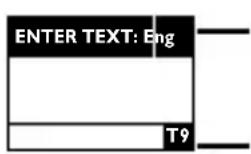
Language used: English
Editing mode used: T9®
Press the *+To key to switch to basic mode, to numeric mode, or to punctuation mode
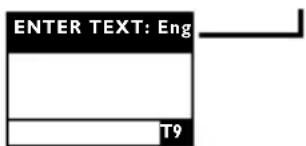


While in any text mode, press the Ⓥ key to switch from lower to upper case:



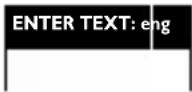

Tegic Euro. Pat. App. 0842463
T9 ® Text Input
T9® Text Input is an intelligent editing mode for SMS, including a comprehensive word database. It allows you to quickly enter text, e.g. to send a short message. Press only once on the key corresponding to each letter needed to spell a word: keystrokes input are analysed and the word suggested by T9® is displayed in the bottom of the screen. If several words are available according to the keys used, press Ⓞ to browse the list and choose from those proposed by the T9® built-in dictionary (see example below).
I P r * to enter T9 mode - unless T9 symbol is already displayed - and to switch between Basic Text Entry/T9 /digits/symbols.
2 P r e 2 ABCs to 9 WX (one press per letter indicated on the key) to spell the word you want to write.
3 P r@to scroll the words T9® proposes and select the one you want.
4 P r 1 to confirms. T9 ® inserts it in your message and adds a space.
Press ca to delete the previous digit/make a long press to return to idle screen, make a long press on ca to return to idle screen and press◀ or ▶ to move cursor left or right.
Example: to enter the word "home":
I P r 4GHI e 6MNOS 6MNOS 3DEF The screen displays the first word of a list: Good.

2 P r o to scroll and select Home.

3 P r1 to confirm Home.
Basic Text Entry
Each key allows you to obtain several characters. Quickly press the same key several times to reach the desired character. Example: to enter "my hat!"
| To obtain | myspacehat! | ||||||
| Press | 6mn0once | 9wXYZ3 timesquickly | 1Vz0once | 4GHItwicequickly | 2NBConce | 8TU0once | 0:9 timesquickly |
| Key | Characters | Key | Characters |
| space I @ _ # = < > () & £ $ ¥ | P Q R S 7 β Π Θ Σ | ||
| A B C 2 A Ä Å Æ Ç | T U V 8 Ü U | ||
| Key | Characters Key Characters | ||
 | DEF3ÉE ΔΦ | WXYZ9∅Ω ΕΨ | |
 | GHI4ΓI | .0,/:;"'!;?;*+-% | |
 | JKL5Λ | Switch between Basic Text Entry / T9®/digits / symbols | |
 | MNO6ÑOÖ | Switch between Upper/Lower/Auto Case |
Names
The Names menu is your directory. You can enter new names, write and send them messages and consult the list of records. Names are listed in alphabetical order. You scroll through the list pressing ◀ or ▶, or by entering the first letter of the name (e.g., press the 6 mno key once to reach names starting with "M", 3 times for names starting with "O").
Press 0R , select
Selected Name
In the names menu, select a name and press OR twice to: Send SMS your correspondent, Delete the selected name and number (press OR to confirm), or Change the selected name and all related information.
Own number
Depending on your subscription, selecting Own Num. displays your own mobile phone number. If your SIM card doesn't contain your phone number(s), an editing screen allows you to store it (or them). We advise you to enter your mobile number(s) as well as any other relevant information.

Although all its fields can be empty, the Own num. card cannot be deleted and is always present.
Emergency
Displays the emergency call number. Press @ to dial.
Messages
You can send text messages (SMS) to other GSM phones and receive messages on your phone: either a standard message or one you compose, to which you can attach an "emotion icon". The receiver must have a Philips mobile phone that supports this feature to see the icon, or it will be replaced by its equivalent translation code at the end of the message received.
To send messages, you must first enter a service centre number (see page 15). If this is not stored in your SIM card, ask your operator for it.
Send SMS or Reply
Press 0R and select Messages, Send SMS and press 0R . Select a name or select New to enter a new number. Press 0R and select New to enter and send a new message, Standard to send a predefined message, or Melody to send a melody together with your message (other than standard, 30 characters max.)
You can only send melodies that are out of copyright.
Once you selected or wrote your message, select Add icon to add an icon to your message, then select Save or Send now and press OK.
Read SMS
Consult the list of SMS you have saved and received. They have the following icons:

Received unread Saved Received read
Once you read a message, press to Reply, Forward to, or Delete this message.
Clear SMS
The whole SMS list can be cleared at once: press OK and select Messages, then Reset and press OK to empty the call list.
Deleting your SMS list is useful to free memory space in order to store new messages.
SMS settings
This menu allows you to customise your SMS via the options described below.
- SMS centre
To select your default SMS centre. If not available on your SIM card, you must enter your SMS centre number.
• S i g n a t u r e
To send a signature together with your SMS (i.e., characters showing your default account number and name). This signature is transmitted at the end of your message. The length of the message is consequently reduced. You can edit the signature, modify and save it.
Broadcast SMS\*
You can receive short messages from your network about specific topics of interest to you (eg. weather, news, sports).
*Subscription dependent. Please contact your operator for further details.



- Reception To activate/deactivate the reception of cell broadcast messages.
- Topics
To define the type of messages you want to receive. Select
- District codes
The District codes menu allows you to select the type of messages you would like to be permanently displayed on the idle screen. As a result, for this special handling of the message, you must enter the type in both the District code and the Topics menu. The corresponding type will then be recognised in the Topics list with a .
Call list


The Call list displays a chronological list of the last calls you have received, missed and dialled (your Call list stores a maximum of 10 numbers).
Call list
Press 0R then select Call list and press 0R twice to consult the date, time, number, call status of any selected call and to know if it was sent or received Press 0R for access to a carousel which allows you to Send a SMS to this number or Delete the selected call. You can also call this number or store it by entering the associated name (if not present in your phonebook).
You can directly access the Call list by pressing@ while in idle mode.
You can also select a record in the Call list and press @ to dial the corresponding number.

Reset
Press 0R then select Call list, press 0R and select Reset to delete the content of your call list. Press 0R to confirm.
Extras
Introduction
The Extras menu features easy-to-use items such as Call counters which will let you manage your call costs, a Euro converter, a Calculator and an Alarm clock.
EXTRAS
Euro converter / Calculator / Alarm clock / Call counters
Euro converter

-> Euro

<- Euro
The currency used for the conversion is determined by the country where you have subscribed. The Euro converter is available only in countries using the Euro.
The -> Euro menu enables you to convert a sum into Euros by entering the amount and pressing OK.
The <- Euro menu enables you to convert a sum from Euros by entering the amount and pressing OK.
These two options are preset as hotkeys (see "Hotkeys" page 8).
Calculator

Calculator
This menu provides the following functions:
Addition By pressing the

key.
Subtraction By pressing the

key twice.
Multiplication By pressing the

key 3 times.
Division By pressing the

key 4 times.
Equals By pressing the

key.
The figures are entered using the keypad. Calculator accuracy is to 2 decimal places and is rounded up to the higher decimal figure. Press ⬆ to correct the numbers. Make a long press on Ⓞ to get the dot.
Alarm clock

Alarm clock
This menu allows you to set the alarm clock: Once activates the alarm at a set hour on a set day, Every day activates the alarm at a set hour every day.
The alarm clock will ring even if you turned you phone off, but NOT if the Ringer volume is set to Off (see page 9). You cannot set the alarm clock volume independently of the ringer. Press any key to stop the alarm ringing.
Call counters

Call counters
This menu allows you to handle the cost and duration of your calls.

Accum. call timers
Accumulated call timer
To check the duration of incoming and outgoing calls and set counters to zero.

Call counters don't take WAP connections into account.

Accum. cost
Accumulated cost
To check the accumulated cost and set the counter to zero (subscription dependent).
Shows how much has been spent, having established the charge rate.

Show

Cancel cost limit
Cancels the cost limit. It may be protected by PIN or PIN2 codes (depending

Reset

Cost limit

Show balance

Charge rate

Last call info
on your subscription).
Resets the current Accumulated cost to 0; requires your PIN or PIN2 code.
Allows you enter the cost limit used in the Show balance menu.
Allows you to check the remaining credit (compared with previously set limit)
To set or change the rate per unit. Enter the currency used (three characters max.) then enter the cost per unit.
Last call information
To display the duration and/or cost of your last call (subscription dependent).
Wap services
Launch

Launch
Your mobile phone supports services based on the Wireless Application Protocol (WAP). The built-in WAP browser will allow you to access services supplied by your network, such as news, sports, weather, timetables, etc.
Your phone may have been pre-configured to directly access the services offered (if not, see “Settings” page 19). Selecting the Launch menu allows you to access the online services provided by your operator. There are 2 ways to access these services:
• From the idle screen, press and hold
- In idle mode, press OK ▼, select Oper. Services > WAP > Launch and press OK ▼.

An animation shows the phone is connecting to the homepage. Once the browser is launched, you are connected to your operator's homepage. The following commands enable you to navigate through the WAP pages:
• M o ca' oe OR to navigate up or down the online pages.
- P r 🔒 to select the right option box displayed on the screen.
- P r @ to select the left option box displayed on the screen.
- Pre to return to the previous page.
- Press a to end the online session.
During navigation, press *T9 to access a special menu with the following options (subscription dependent):
- Reload to reload the last card viewed.
-
Mark site to add the previous deck to the user's bookmark list (network dependent).
-
About Phone.com displays UP. browser version and copyrights information.
-
Advanced displays a menu containing advanced commands:
-
Show URL: to display the URL of the previous card,
- Goto URL: to fetch the content of the URL entered,
-
Restart UP. browser: to empty the contents of the cache memory and create a new session.
-
Exit: to quit the WAP application and return to idle mode.
- Long p 0 pops up the alert inbox,
- long press on 1 to 9 requests the page bookmarked by Mark site (subscription dependent).
Favourites

Favourites
Allows you to store direct links to your favourite WAP pages.
I Select Favourites and press OK , then move◀◀ or ▶ to select
2 Enter the name of the WAP page of your choice (e.g. "Philips"), press OK
3 Then enter the URL address of the homepage (e.g. http://wap.pcc.philips.com) and press OR to store it.
4 Entering this menu again allows you to Delete, Goto or Change this Favourite.
Last page

Last page
Settings

Settings

Images

Status icons

Empty cache
Allows you to access the last pages browsed without reconnecting to online services.
Allows you to customize the way the pages are displayed on your phone (gain space on the screen, speed up display, etc.).
Images
To activate/deactivate the downloading of images attached to WAP pages. Deactivate to speed up the global downloading time of the pages browsed.
Status icons
To activate/deactivate the header display. Deactivate to gain an extra line of text on your screen.
Empty cache
To empty an area of the memory where the pages browsed during an WAP session are stored.
Access

Access
Several WAP profiles are available, which allow you to personalize different WAP accesses. If your phone was pre-configured, it shouldn't be necessary for
you to change the connection access settings. Nevertheless, depending on your subscription, you may configure the parameters described further.
All options described below are operator and/or subscription dependent. With some operators, you may be sent a SMS which contains new WAP access parameters that will be stored automatically. Please contact your network operator for detailed information on this subject.

Show
Show
Allows you to visualize all parameters of the selected WAP profile (Gateway IP Address, Homepage address, phone number, etc.)

Activate
Activate
Allows you to activate one of the WAP profiles. It then becomes the default profile and is automatically used for connection when pressing the @ key.

Change
Change
Allows you to change the parameters of the WAP profiles as described below.
Some pre-configured profiles might be locked, preventing re-programming.

Gateway
• G a t e w a y
Allows you to enter the IP address for the gateway: select Gateway and press OR, then enter the IP Address and press OR.
- Port
Allows you to enter the Port number of the gateway (subscription dependent): 9203 for a secure connection; 9201 for a non-secure connection.

Homepage
• Home page
Allows you to enter the WAP address of the homepage, the first page displayed when accessing the WAP services. Select Homepage and press OK . Then enter the URL address of the homepage (e.g. www.philips.com) and press OK .

Phone number
- Phone Number
Allows you to enter the phone number needed to establish a connection with your WAP Service Provider (ISP). Select Phone numbers and press OK, then moving ◀ or ▶ to select:
- ISDN Nber to enter an ISDN ISP number, OR
- Analogic Nber to enter an analogic number, then press OK.
Enter the "+" sign, then the number provided by the operator, press.
Only enter one number in one of the two fields.

Inactivity time
- In a c t i v i t y t i m e
Allows you to enter an inactivity time period after which the phone automatically ends the WAP session (if a connection was is progress) and
returns to idle screen. Select Inactivity time and press OK , then enter a value (expressed in second) of over 30 s. and press OK .

Login
- L o g i n
Allows you to enter the login needed. Select Login and press 0R , then enter the appropriate login and press 0R .

Password
• P a s s w o r d
Allows you to enter the password needed. Select Password and press OR, then enter the appropriate password and press OR.
Other operator services
Touchtones (DTMF)
Your phone keys always transmit DTMF tones (Dual Tone Multiple Frequency) also known as "touchtones". These tones are used to operate services that you can reach with your phone, such as a pager or an answering machine.
E.g., commands to consult your answering machine:
| Dial your number | Make a long press on #= | Dial your password | Make a long press on #= | Dial the "New messages" code |
| e.g. 0123456789 | "Wait" signal e.g. | 9876 "Pause" signal | 3def | |
Your screen displays: 0123456789w9876p3. Press @ to dial.
Make a second call\*

To can make a second call during an active call or during a call on hold, dial the second number and press @. You can then also switch between calls.
- To switch between calls, press OR and select Switch calls.
- To end a call: press to hang up active line.
- To end the call on hold: select Switch calls, then press 🔒.
Answer a second call\*
You can receive another call while on a first call. Your phone will emit an alert beep during a second call and the screen will display "Call waiting". Pr@ to accept the second call, or press 📞 to reject the call.
Autoredial\*
When you dial a number and your correspondent is busy, your phone offers the function of automatically redialling. A beep will sound for each redial attempt and a special beep informs you when the connection has been made; then press
@ to accept the call. Press any key to end autoredial. Any action on your phone will terminate autoredial.
* Subscription dependent. Please contact y3our operator for further details.
Precautions

Your cellular mobile phone is your responsibility. To avoid damage to yourself, to others or to the phone itself, read and follow all the safety instructions and make them known to anyone borrowing your phone. Furthermore to prevent unauthorised use of your phone:
- Keep your phone in a safe place and keep it out of small children's reach.
- Avoid writing down your PIN code. Try to remember it instead.
- Switch off the phone and remove the battery if you are going to leave it unused for a long time.
- Use the Security menu to change the PIN code after purchasing the phone and to activate call restriction options.

The design of your phone complies with all applicable laws and regulations. However your phone may cause interference with other electronic devices. Consequently you should follow all local recommendations and regulations when using your cellular phone both at home and when away. Regulations on the use of cellular phones in vehicles and aircraft are particularly stringent.

Your cellular mobile phone is a low power radio transmitter and receiver. When it is operating, it sends and receives radio waves. The radio waves carry your voice or data signal to a base station that is connected to the telephone network. The network controls the power at which the phone transmits.
Public concern has been focused for some time on the possible health risks for users of cellular phones. The current research on radio wave technology, including the GSM technology, has been reviewed and safety standards have been drawn up to ensure protection from exposure to radio wave energy. Your cellular telephone complies with all applicable safety standards and the Radio Equipment and Telecommunications Terminal Equipment Directive 1999/5/EC.
Inadequately protected or sensitive electronic equipment may be affected by radio energy. This interference can lead to accidents.
Always switch off your phone

natural_image
Cartoon illustration of two anthropomorphic characters with large eyes and a number 11, no text or symbols present- Before boarding an aircraft and or when packing the phone in your luggage.
- In hospitals, clinics, other health care centres and anywhere else where you may be in the close vicinity of medical equipment.
-
If you are a user of a pacemaker or hearing aid, or expect to use your cellular phone in the immediate vicinity of someone who does, then take the precautionary steps described below.
-
Consult your physician and pacemaker or hearing aid manufacturer to learn whether your particular device is susceptible to cellular phone interference.
- Carry and hold your cellular phone at safe distance from the implanted pacemaker device and electrode (20 cm is generally accepted as a "safe distance", however it is advisable to check with your physician and pacemaker manufacturer).
Always switch off your phone and do not remove the battery

- In areas with a potentially explosive atmosphere(e.g. petrol stations and also areas where the air contains dust particles, such as metal powders).
- In a vehicle transporting flammable products (even if the vehicle is parked) or a vehicle powered by liquefied petroleum gas (LPG), check first that the vehicle complies with the applicable safety rules.
- In areas where you are requested to turn off radio transmitting devices, such as quarries or other areas where blasting operations are in progress.

Check with the vehicle manufacturer that electronic equipment used in your vehicle will not be affected by radio energy.
In order to improve the performance of your phone, reduce radio energy emission, reduce battery consumption and ensure safe operation adhere to the following guidelines:

- For the optimal and satisfactory operation of the phone you are recommended to use the phone in the normal operating position (when not using in hands-free mode or with a hands-free accessory): place the antenna up over your shoulder while holding the earpiece to your ear.
- For best performance, avoid touching the antenna while a call is in progress.
- Do not expose your phone to extreme temperatures.
- Treat the phone with care. Any misuse will void the International Guarantee.
- Do not immerse the phone in any liquid; if your phone is damp, switch it off, remove the battery and let them dry for 24hrs before using them again.
- To clean the phone, wipe it with a soft cloth.
- Placing and receiving calls consumes the same amount of battery energy. However, the mobile consumes less energy in idle screen when kept in the same place. When in idle screen and while you are moving, your phone consumes energy to transmit updated location information to the network. Setting the backlight for a shorter period of time as well as avoiding unnecessary navigating
in the menus will also help to save the battery's energy for longer phoning and stand-by performances.
Information displayed on the battery

- Your phone is powered by a rechargeable battery.
- Use specified charger only.
- Do not incinerate.
- Do not deform or open the battery.
- Do not allow metal objects (such as keys in your pocket) to short circuit the battery contacts.
- Avoid exposure to excessive heat ( >60°C or 140°F ), moisture or caustic environments.

You should only use Philips Authentic Accessories, as the use of any other accessories may damage your phone and will make all guarantees for your Philip phone null and void.
Do not use your phone with a damaged antenna. If you touch a damaged antenna, you may suffer a minor skin burn. Have a damaged antenna replaced immediately by a qualified technician. Make sure it is replaced with a genuine Philips replacement part.
Do not use your phone while driving

It lowers concentration, which can be dangerous. Adhere to the following guidelines:
- Give your full attention to driving. Pull off the road and park before using the phone.
- Respect the local regulations in countries where you drive and use your GSM phone.
- If you want to use your phone in a vehicle, install the hands-free car kit which is designed for that purpose, still ensuring you give full attention to driving.
- Ensure that your phone and car kit do not block any airbags or other security devices fitted in your car.
- The use of an alarm system to operate a vehicle's light or horn to indicate incoming phone calls is prohibited on public roads in some countries. Check local regulations.
EN 60950 Norm
In case of hot weather or after a prolonged exposure to the sun (e.g., behind a window or a windscreen), the temperature of your phone's casing might increase,
especially when featuring a metallic finish. Be very careful in this case when picking up your phone and also avoid using it with an ambient temperature over 40° C.
Environmental care

Remember to observe the local regulations regarding the disposal of your packaging materials, exhausted batteries and old phone and please promote their recycling.
Philips has marked the battery and packaging with standard symbols designed to promote the recycling and appropriate disposal of your eventual waste.
Battery: The  | crossed-out dustbin signifies that the battery should not be disposed of with general household waste. |
| Packaging: The mobius loop symbol signifies the labelled packaging material is recyclable. | |
 | The green point symbol signifies that a financial contribution has been made to the associated national packaging recovery and recycling system (e.g. EcoEmballage in France). |
 | The chasing arrows symbol on the plastic tray and plastic bag indicate that the materials are recyclable and also identifies the plastic material. |
Troubleshooting
| PROBLEM SOLUTION | |
| The phone does not switch on | Remove and reinstall the battery (see page 3). Then charge the phone until the battery icon has stopped flashing. Finally, unplug from the charger and try to switch the mobile on. |
| The display shows BLOCKED when you switch on | Somebody tried to use your phone but didn't know the PIN code nor the unblocking code (PUK). Contact your service provider. |
| The Y and all symbols are not displayed | The network connection is lost. Either you are in a radio shadow (in a tunnel or between tall buildings) or you are outside the network coverage area. Try from another place or contact your operator for assistance or information about the network. |
| The display doesn't respond (or responds slowly) to key pushes | The display responds more slowly at very low temperatures. This is normal and does not affect the operation of the phone. Take the phone to a warmer place and try again.In other cases please contact your phone supplier. |
| Your phone doesn't go to idle screen | Make a long press onca, or switch off the phone, check that both SIM card and battery are installed correctly, and switch it on again. |
| Your phone doesn't display the phone numbers of callers | This feature is network and subscription dependent. If the network doesn't send the caller's number; the phone will display Call I instead. Contact your operator for detailed information. |
| You can't send text messages | Some networks don't allow message exchanges with other networks. Contact your operator for detailed information. |
| When charging, the battery icon shows no bars, outline is flashing | Only charge the battery in an environment where the temperature does not go below 0°C (32°F) or above 50°C (113°F).In other cases please contact your phone supplier. |
| You are not sure that you are receiving calls properly | To receive all calls, make sure that none of the features "Conditional call forward" or "unconditional call forward" is activated (see page 11). This network and subscription dependent feature may display one of the following icons:call forward unconditional to numbercall forward unconditional to voice mailboxAlso note that backlight and vibra alerts will automatically be deactivated when the phone temperature reaches 60°C . Although you can still receive calls in this case, you might not be aware of incoming calls, e.g. if you set your volume to silent. |
| When attempting to use a feature in the menu, the mobile displays not allowed | Some features are network dependent. They are only available, therefore, if the network or your subscription supports them. Contact your operator for detailed information on this subject. |
| The display shows SIM failure | Check that the SIM card has been inserted in the right position (see page 3). If the problem remains, your SIM card may be damaged. Contact your operator. |
| The display shows IMSI failure | This problem is related to your subscription. Contact your operator. |
| The display shows Insert your SIM card | Check that the SIM card has been inserted in the right position (see page 3). If the problem remains, your SIM card might be damaged. Contact your operator. |
Glossary
| DTMF | Dual Tone Multi Frequency. The tones are transmitted by the phone to the network. Used to interrogate answering machines, transmit codes, etc. |
| GSM Network | Global System for Mobile communications. Type of network used by your phone. |
| Home network | The network to which you subscribe to. |
| Home Zone** | A particular area within your home network. If this feature is provided by your home network, the home zone symbol is displayed indicated that you are currently within the home zone. |
| Idle screen | This is the screen displayed after registering to your network, in idle mode. |
| Multi-call | Two calls are in progress, one active and one on hold. |
| PIN code* | Personal Identification Number. The secret code of the SIM card. |
| PIN2 code* | Secret code that allows you to access certain SIM card dependent features. |
| Public Names | Function that allows you to restrict dialling to selected numbers. |
| PUK /PUK2 code* | Secret code used to unblock your SIM card if a wrong PIN/PIN2 code is entered 3 times. |
| Roaming SIM card* | Using your phone in a network other than your home network. Subscriber Identification Module card. The card which allows you to make phone calls with your GSM phone and access the services of your network operator. |
| SMS** | Short Message Service. This service provided by the operator allows you to send and receive short written messages. |
| T9TM Text Input | Efficient method of text input that requires just one key press per letter (see page 13). |

* Provided by your service operator
** Subscription dependent. Please contact your operator for further details.
Philips authentic accessories
When performance counts... Philips Authentic Accessories are designed to maximise the performance of your Philips mobile phone.
Cigarette Lighter Adapter
- Charges the battery while you use your phone.
- Plugs into virtually any vehicle power outlet.
CKLR 12/P - 9911 240 34118

CKSK 20/P - 9911 240 34306

natural_image
Product photo of a black VR headset and two small buttons (no visible text or symbols)Compact car kit
- Designed to operate your Philips mobile phone hands-free, using the built-in speakerphone unit and the mobile's microphone.
- Simply plug the kit into the vehicle auxiliary outlet.
- Easy to use, this compact hands-free solution offers a high audio quality while also charging your mobile.
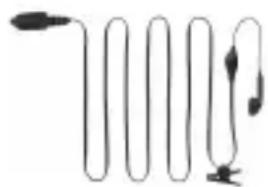
Deluxe and extra-deluxe hands-free headsets
- In-line answer button offers you a simplified alternative to searching for the phone keypad: you answer an incoming call just by pressing the button.
- Xtra Deluxe headset is a painted version featuring high quality metallic finish.
Deluxe headset HSLD 15/P - 9911 241 30024 Xtra Deluxe headset HSUX 38/P - 9911 241 31006
natural_image
Pure electrical circuit lines without any symbolsCarry Case with belt clip - PBFR 12/P - 9911 240 36049 (available depending on country)
- Protects the phone from nicks and scratches.
- The belt clip makes your phone easy to carry.
- Expandable to accommodate any battery size.
To maximise the performance of your Philips phone and to not void the warranty, always purchase Philips Authentic Accessories that are specially designed for use with your phone. Philips Consumer Communications cannot be held liable for any damage due to use with non authorised accessories. Ask for Philips Authentic Accessories where you purchased your Philips phone.
Declaration of conformity
We, Philips France
Mobile Telephony Business Creation Team
Route d'Angers
72081 Le Mans cedex 9
FRANCE
declare under our sole responsibility that the product
CT 1218
Cellular Mobile Radio GSM 900/GSM 1800
TAC: 449686
to which this declaration relates, is in conformity with the following Standards:
EN 60950 and ETS 300 / 342-1
CTR's 19/20 and CTR's 31/32
We hereby declare that all essential radio test suites have been carried out and that the above named product is in conformity to all the essential requirements of Directive 1999/5/EC.
The conformity assessment procedure referred to in Article 10(5) and detailed in Annex V of Directive 1999/5/EC has been followed related to articles 3.1 and 3.2 with the involvement of the following Notified Body:
BABT, Claremont House, 34 Molesey Road, Walton-on-Thames, KT12 4RQ, UK
Identification mark: 0168
The technical documentation relevant to the above equipment will be held at:
Philips France, Mobile Telephony Business Creation Team
Route d'Angers
72081 Le Mans cedex 9
FRANCE
Le Mans, 24 October, 2001
Jean-Omer Kifouani
Quality Manager


- "Pick up" key
- Alphanumeric keypad
- Language
- Microphone
- Navigation key
- OR▼ key
- key cancel/back
- "Hang up" and "On/Off" key
- Table of contents
- Memory card......2
- Getting started ....3
- Main features......6
- Settings 9
- Names, calls and messages...... 12
- Extras.... 16
- Wap services......18
- Other operator services...... 21
- Precautions 22
- Troubleshooting...... 26
- Glossary...... 28
- Philips authentic accessories......29
- Getting started
- Inserting the SIM card
- Charging the battery
- Customising your phone
- Switch on/off and PIN code
- The carousel
- Main features
- Idle screen
- Symbols
- Make a call
- Answer / end a call
- Emergency call
- Lock / unlock the keypad
- Notes:
- Hotkeys
- Settings
- Introduction
- Sounds
- Ringer volume
- Ringer
- Downloadable melody
- Display
- Security
- Key tones
- New SMS tone
- Welcome screen
- Contrast
- Public names
- - Public names
- - Call restriction
- Change codes
- PIN protection
- Time and date
- Set date
- Set time
- Register again
- Call settings
- Call forward
- Mailboxes
- Caller ID
- Names, calls and messages
- Text Entry
- T9 ® Text Input
- Example: to enter the word "home":
- Basic Text Entry
- Names
- Selected Name
- Own number
- Emergency
- Messages
- Send SMS or Reply
- Read SMS
- Clear SMS
- SMS settings
- - SMS centre
- Broadcast SMS\*
- - District codes
- Call list
- Reset
- Extras
- Euro converter
- Calculator
- Alarm clock
- Call counters
- Accumulated call timer
- Accumulated cost
- Last call information
- Wap services
- Launch
- Favourites
- Last page
- Images
- Status icons
- Empty cache
- Access
- Show
- Activate
- Change
- Other operator services
- Touchtones (DTMF)
- Make a second call\*
- Answer a second call\*
- Autoredial\*
- Precautions
- Always switch off your phone
- Always switch off your phone and do not remove the battery
- Information displayed on the battery
- Do not use your phone while driving
- EN 60950 Norm
- Environmental care
- Troubleshooting
- Glossary
- Philips authentic accessories
- Cigarette Lighter Adapter
- Compact car kit
- Deluxe and extra-deluxe hands-free headsets
- Declaration of conformity
- BABT, Claremont House, 34 Molesey Road, Walton-on-Thames, KT12 4RQ, UK
Brand : PHILIPS
Model : Fisio 121
Category : Mobile Phone