WK 310-1703A - Refrigerator White Knight - Free user manual and instructions
Find the device manual for free WK 310-1703A White Knight in PDF.


| Product Type | Refrigerator |
| Model | WK 310-1703A |
| Brand | White Knight |
| Dimensions (H x W x D) | 85 cm x 50 cm x 50 cm |
| Weight | 20 kg |
| Power Supply | 100-240 V, 50 Hz, 100 W |
| Energy Class | E |
| Climate Class | N-ST |
| Net Capacity | 100 L |
| Refrigerant | R600a |
| Temperature Control | Adjustable thermostat |
| Door Reversibility | Yes, reversible door |
| Lighting | Internal LED light |
| Defrost Type | Manual defrost |
| Shelves | 3 glass shelves |
| Crisper Drawer | 1 vegetable drawer |
| Door Bins | 3 door balconies |
| Ice Tray | Included |
| Cleaning and Maintenance | Use mild detergent and soft cloth; clean drip tray regularly |
| Safety Features | Grounding required; do not use extension cord |
| Spare Parts Availability | Contact White Knight support |
| User Manual Languages | English, French, Spanish (online) |
Frequently Asked Questions - WK 310-1703A White Knight
User questions about WK 310-1703A White Knight
0 question about this device. Answer the ones you know or ask your own.
Ask a new question about this device
Download the instructions for your Refrigerator in PDF format for free! Find your manual WK 310-1703A - White Knight and take your electronic device back in hand. On this page are published all the documents necessary for the use of your device. WK 310-1703A by White Knight.
USER MANUAL WK 310-1703A White Knight
natural_image
Abstract geometric logo with a stylized white sailboat on a black circular background (no text or symbols)White Knight
domestic appliances
WK 270-1703A
WK 310-1703A
FRIDGE/FREEZER Instruction manual
IMPORTANT NOTE REMOVAL OF TRANSIT PACKAGING

BEFORE USING FOR THE FIRST TIME,REMOVE BLANKING PLUG "",A TAKE OFF ALL PACKING PIECES "B", AND THEN REPLACE IN HOLE "C"
GENERAL INFORMATION
These fridge-freezer models are compressor based "double - door" appliances designed for short-term storage of chilled products in the refrigerating chambers well as for prolonged storage of frozen products and the production of ice in the freezing chamber.
These class "N" appliances are intended to be used under domestic conditions. At ambient temperature of +16 to +32 °C and air moisture not higher than 70% the manufacturer guarantees its trouble-free operation. These appliances meet all up-to-date requirements for household refrigeration products and electrical devices.
The appliances are environmentally friendly, they do not contain ozone layer depleting materials. The appliance uses refrigerant R600a.
All preventive maintenance operations and repairs should be carried out by an expert in this kind of equipment.
! CAREFULLY READ THE INSTRUCTION MANUAL. If instructions are not followed, there is a risk of injury, damage to the appliance, and loss of the right to free warranty service. We recommend to keep the Instruction manual the whole time you have the appl!.
NOMINAL TECHNICAL DATA
| Model | WK 270-1703A | WK 310-1703A |
| Name of appliance | Fridge/freezer | |
| Energy efficiency class in accordance with directive 94/2 EC | A | A |
| Energy consumption: kWh/24 h | 0,79 | 0,89 |
| kWh/per year | 288 | 324 |
| Actual consumption will depend on how the appliance is used and where it is located. | ||
| Total gross volume, L | 261 | 309 |
| Fresh food volume, L | 170 | 193 |
| Freezing chamber gross volume, L | 83 | 114 |
| Frozen food volume, L | 61 | 92 |
| Powercut safe, h | 17 | |
| Freezing capacity, kg/24h | 5 | 12 |
| Temperature in deep freezer compartment, °C | minus 18 | |
| Overall dimensions ,mm | 1450x600x600 | 1730x600x600 |
| Storage shelves area, dm2 | 105 | 140 |
| Weight, kg | 51 | 55 |
| Voltage used, V / Frequency, Hz | 220-240/50 | |
| Rated input, W | 140 | |
| Current, A | 1,0 | |
| Insulation foaming | C5H10 | |
SAFETY REQUIREMENTS
- Prior to connecting the fridge freezer to the mains, make sure that the power cord is not damaged.
- The plug of refrigerator should be connected to a properly fixed, stationary socket.
- The socket must have a reliable earth connection.
- This fridge freezer is supplied with a special supply cord. It should only be exchanged for an identical special supply cord and this replacement should only be carried out by the manufacturer or the manufacturer's appointed agent.
- Maintain your appliance carefully. Don't allow the hole in the gutter for water running out to block, because water inside the cabinet and on door seals may cause corrosion, seals pulling out and other defects.
- Clean parts located at the refrigerator rear wall from dust accumulated there with a dry brush or a vacuum-cleaner at least once a year.
- Protect plastic surfaces of the food storage compartment from any fat, oils, sauces because they can cause damage to the compartment. In case of unintended spill immediately clean the surface with dish washing liquid.
- Do not place vessels containing liquid on top of the fridge freezer as these could spill onto electrical components. Do not place heating appliances (electric stoves, irons, grills and others) on the top cover of the fridge freezer.
In case of scrapping the appliance national requirements must be considered with reference to the recycling of the refrigerant and insulation gas. Contact your local authority before scrapping.
WARNING!
- Keep ventilation openings in the appliance enclosure or in the built-in structure, clear of obstruction.
- Do not use mechanical devices or other means to accelerate the defrosting process.
- Do not damage the refrigerant circuit.
- Do not use electrical appliances inside the food storage compartments of the appliance.
- Do not leave running (connected to the mains) with opened (or incompletely closed) door longer than it is needed for taking out or putting in foodstuffs.
- AFTER SWITCHING THE APPLIANCE OFF (WHILE CLEANING, MOVING TO ANOTHER PLACE AND SO ON), IT CAN BE SWITCHED ON AGAIN ONLY AFTER 15 MINUTES.
- While defrosting or cleaning the fridge-freezer do not forget to disconnect it from the mains.
- Do not store glass bottles containing liquids capable of freezing and also carbonated bottled beverages in capped bottles or cans in the freezing chambers as they may explode.
- It is not advisable to use food stuffs in a cold state straight from the freezing chamber.
Information:
- leave the doors of refrigerator open if it is switched off for a long time;
-if selling or transferring this freezer inform the new user, that it contains insulation - cyclopentane and refrigerant R600a.
REFRIGERATOR DESIGN
! Before studying the text described below, pay attention to the figures.
WARNING! THE APPLIANCE ACCESSORIES LISTED BELOW MAY DIFFER FROM THE ACCESSORIES OF THE APPLIANCE YOU HAVE BOUGHT IN QUANTITY AND IN DESIGN. This description is adapted for entire group of two-compartment refrigerator-freezer combinations.

The refrigerator is fitted with two chambers - "freezing chamber A" and "fresh food storage chamber B".
The freezer chamber is fitted with "freezing" area that is
rked.
| 1-2 | Interior lighting lamp, interior lighting lamp cover | 13 | Fast-freeze section |
| 3 | Thermostat - temperature regulator | 14 | Frozen products section(s) |
| 4 | Thermostat position indicator | 15 | Thaw water channel |
| 5 | Electric supply indicator (green light) | 19 | Door trays |
| 6 | Adjustable height shelves | 20 | Egg tray |
| 9 | Thaw water channel cleaner (red colour) | 25 | Condenser |
| 10 | Shelf (glass) | 26 | Thaw water drip tray |
| 12 | Fruit and vegetable boxes | 27 | Compressor |
CHANGING THE OPENING DIRECTION OF THE DOORS
It is recommended that changing the opening direction of the doors should be done with a helper. You will need two spanners No. 8 and No. 10 and a Philips head screwdriver.
! When changing the opening direction of the doors, YOU CAN NOT lay the refrigerator horizontally. Do the actions below in the order they are listed:

WARNING! Turn off the appliance and pull the plug out of the electricity supply socket.
- remove the bottom cover 15;
- unscrew two screws 12 and remove the bottom bracket 13 together with the washers 11 on the axle and the spacer 10;
- remove the bottom door 9;
- unscrew the fixing screws 7 of the middle bracket 6;
- remove the middle bracket 6 together with washers on the axle and the spacer 5;
- remove the top door 4;
- unscrew the axle 2 together with the nut 1 and the washers 3 from the upper bracket and screw all this set on the left side of the door;
- displace the plug 21 the upper door and the plug 19 from the bottom door on the right side;
- take out the pins 20 from the cabinet in the zone of the cross element and displace the to the right side;
- hang the upper door on the axle 2;
- prior to screwing the middle bracket 6 with washers and spacers on the left side of the cabinet, insert the bracket axle into the upper door;
- hang the bottom door on the middle bracket axle;
- prior to unscrewing the bracket 16 and exchanging it with
the bottom bracket 13 (together with the set of washers and spacers), insert the bracket axle into the bottom door. The brackets 14 which are under the brackets 13 and 16 remain in their places;
- unscrew fixing screws 17 from doors, remove handles 18 and screw it on the eight side of the door therefore taken out plugs. Cover the holes in which the handle was screwed with taken out plugs. Put on the bottom cover 15.
PREPARATION FOR USE
The transportation board is made from expanded polystyrene. Remove the adhesive tapes from sides, lift the refrigerator up and take out the board.
When positioning the appliance in chosen location, it will move more easily into position if you lift the front a little and incline it backward, allowing it to roll on its casters.
Strip sticky tape off and open the doors. Remove the red transportation holders from the shelves.
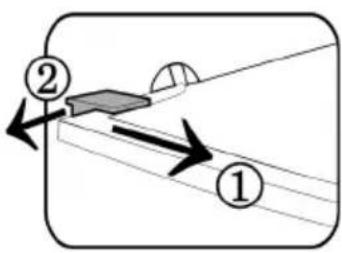
◀ If your appliance is supplied complete with glass shelves, pull a shelf in the direction 1 and remove each red transportation holder in the direction 2.
Take two supports 1 from the pack and insert them into the guides 2 in the back part of the table top.
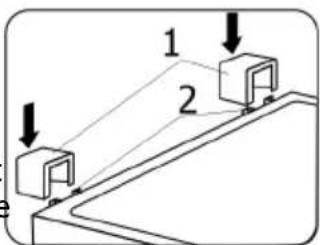
Adjusting the feet, mount the refrigerator with a slight backwards incline to provide a self closing door effect. It is very important that all the feet are uniformly touching the floor.
LOCATION
- The fridge freezer should be placed in a dry, well ventilated room.
- The fridge freezer must be kept from exposure to direct sun rays.
- It is not advisable to locate it near the heat sources (boilers, radiators and so on). If it is not possible to select another place, use an insulating panel.
- The appliance must not touch heating, gas or other pipes or heating devices.
Overall space required in use of the refrigerator.
If the appliance is placed in a corner, a gap of at least 1 cm must be left between the appliance body and the wall so that the freezer compartment door can opened enough to pull out the frozen product drawer.

VENTILATION

IMPORTANT! Keep ventilation openings in the appliance enclosure or in the built - in structure, clear of obstruction.
Do not cover the ventilation holes at the top of the appliances— it must be a good air circulation around the appliance. There should be a gap of at least 10 cm between the top of the appliance body and any furniture that may be above it. If this requirement is not followed, the appliance consumes more electrical energy and its compressor may overheat.
If doors of the appliance close badly, it is necessary to change the door gasket.
If the door does not close correctly, the temperature in the appliance rises and energy consumption increases.
CONTROLS AND WARNING LIGHTS (Fig. 1)
The fridge-freezer is switched on by connecting it to the mains. By disconnecting it, the appliance is switched off.
Important Note: After switching the thermostat off only the compressor is switched off.
The temperature in the refrigerating chamber is adjusted by the temperature control knob 3.
The temperature controller is switched off when the knob shows a "0" mark in the temperature control scale window. If the temperature control knob is turned clockwise, the temperature in the chamber reduces.
The temperature of the refrigerator chamber is set by turning the thermostat wheel 4 which is connected to a thermostat. Temperature is indicated in the thermostat window 3 of the top cover panel and on the wheel – below the top cover.
The thermostat is switched off when the thermostat knob and the wheel are turned to the position "O". Turning the thermostat wheel clockwise temperature of the refrigerator chamber decreases.
A green illuminating lamp 5 indicates that the refrigerator is connected to the mains.
CHANGING THE INTERIOR LIGHT BULB

When changing the interior light bulb, do the actions below in the order they are listed:
- disconnect the refrigerator from the mains;
- press the dome light cover clip to the right and pull it downwards to remove the cover;
- replace the lamp: lamp type - 15 W, lamp holder - E 14;
- reverse removal to replace the cover;
- reconnect the refrigerator to the mains.
FREEZING AND STORAGE OF THE FOOD STUFFS (Fig.1)
Temperature in the freezing and fresh food storage chambers depends on the ambient temperature, position of the temperature control knob and the number of fresh food products stored therein.
- DO NOT EXCEED THE INDICATED MAXIMUM AMOUNT OF FOOD FOR FREEZING:
FOR MODELS WK 270 IT IS 5 KG PER 24 HOURS,
FOR MODELS WK 310 IT IS 12 KG PER 24 HOURS.
Initially set the temperature controller knob to position "3". If this causes excessive cooling of the foods in the chamber – adjust the setting to between "1" & "3" and if the cooling is insufficient, adjust the setting to between "3" & "5".
! IF THE ROOM IS COOL, THE APPLIANCE COOLS LESS. THE TEMPERATURE IN THE APPLIANCE MAY THEREFORE RISE. Use the thermostat wheel to set a lower temperature.
Fresh foodstuffs prepared for freezing should be placed in one or two layers in the fast-freeze section (fig. 1). The thermostat knob should be set to 5. After 24 hours, the frozen food products should be replaces from the fast-freeze section to the storage section drawer(s). When the products are frozen, the thermostat wheel should be set at its earlier position.
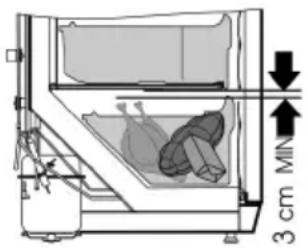
Leave a gap of not less than 3 cm between the foodstuffs being frozen and the upper partition.
- Do not place unwrapped foodstuffs in the freezer sections.
- Fresh food for freezing should not touch already frozen foodstuffs.
- Do not freeze foodstuffs that are warmer than the room temperature.
-
Do not freeze liquid foodstuffs in glass vessels or bottles. Do not freeze carbonated beverages.
-
Strictly observe the frozen food product validity dates indicated by the manufacturer on the product packaging.
- WE RECOMMEND THAT FROZEN FISH AND SAUSAGE SHOULD BE STORED IN THE FREEZER COMPARTMENT NOT LONGER THAN 6 MONTHS; CHEESE, POULTRY, PORK, LAMB – NOT MORE THAN 8 MONTHS; BEEF, FRUIT AND VEGETABLES – NOT LONGER THAN 12 MONTHS.
PRACTICAL TIPS AND OBSERVATIONS
- Do not keep bananas in the refrigerator – these fruits are sensitive to cold.
- Do not keep prepared food and ready-to-cook ("heat and eat") food in the same container.
- Store in an airtight container in the appliance any foodstuffs that have a strong odour (e.g. fresh fish, pâté de foie gras goose liver pâté, and cheese).
- Frozen foodstuffs should be thawed in the refrigerator compartment. Food that thaws slowly retains better flavour properties and spread cold will help to maintain the set temperature in the refrigeration compartment. Do not consume ice made in the freezer chamber straight away.
- Products will freeze more quickly if they are divided up and packed in small portions.
ICE MAKING
Ice-cubes are prepared in a tray 16 (fig .1) for making ice-cubes. Fill each space in the ice cube tray 34 full of drinking water. Place the ice-cube tray in the fast-freeze section. When you want to remove the ice-cubes from the ice-cube tray, leave it for 5 min at room temperature and then shake the cubes into the special dish for them.
REFRIGERATOR DEFROSTING
The freezer compartment should be thawed not less than twice a year or when a layer of ice thicker than 5 mm forms in it. Do the actions below in the order they are listed:
WARNING! Turn the appliance off and pull the plug out of the electrical socket.
- Remove foodstuffs from freezer compartment. The frozen foodstuffs will not warm up too much while you are thawing the freezer compartment if you cover them with a thick cloth and keep them in a cool place.

natural_image
Simple line drawing of a kitchen sink with a bowl and directional arrows indicating flow or movement (no text or symbols)◀ Remove bottom cover. Place a dish under the thaw water channels.
- Leave door of freezer compartment open.
- When the ice melts, clean and wipe dry the surfaces and fixtures of the freezer compartment.
- Close the freezer compartment door. Plug in and turn on the appliance
After defrosting, wash the refrigerator with hot water or with suds or soda solution, WIPE DRY AND AIR IT.
- Clean the channel gutter with the help of the cleaner 9 (Fig.1);
- Do not clean with liquids containing alcohol;
- Refrigerators produced from a stainless steel should be cleaned only with cleansers for those surfaces
Remarks on the appliance operating noise
As the appliance operates and goes through the freezing cycle, various noises will be emitted. This is normal and is not a sign of any malfunction.
- As the refrigerant circulates around the refrigeration system, it causes sounds like murmuring, bubbling, or rustling.
- Louder sounds like popping or clicking may be heard for a short time as the refrigerator's compressor switches on.
If problems occur use the troubleshooting chart below:
Note. If your fridge freezer is not working and it is no possible to repair it by means of these troubleshooting charts, switch it off, open the appliance doors and call a service agent.
FAILURE REMOVAL BY THE USER
| Trouble Way of remedy | |
| Fridge-freezer is connected but the green lamp does not light up. | No voltage in the mains or no contact between the plug and socket. Check plug fuse, try in an alternative socket. |
| An unusual noise arises during operation of the refrigerator. | Check if the appliance is placed correctly, as follows: Stands level on a smooth and firm base; doesn't touch any vibrating devices or furniture next to it. |
| While opening the door the gasket comes off. | Insert the gasket into position by pressing the inner part of the gasket. If the gasket has been contaminated with oily liquids, it is necessary to clean the gasket and the groove in the door with dish washing agent and wipe it dry before re-fitting. |
| Water at the bottom of the fresh food storage chamber. | Defrost water disposal system is clogged. Clean the channel in the gutter with the help of the cleaner 9. |
| High temperature in the appliance. | A lot of warm foodstuffs loaded; doors have been opened or a long time or too often. |
| Surface of the appliance dews. | High relative humidity (over 70 %). |
The refrigerator must only be carried in the upright position.
Secure the refrigerator during transit in order to avoid damage.
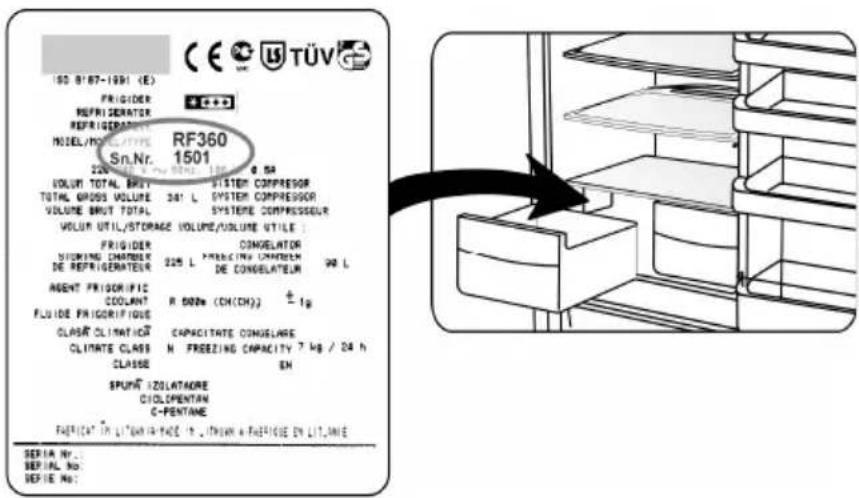
When requesting a repair to your appliance, always quote the information given on the label shown below.

The symbol ■ on the product or on its packaging indicates that this product may not be treated as household waste. Instead it shall be handed over to the applicable collection point for the recycling of electrical and electronic equipment. By ensuring this product is disposed of correctly, you will help prevent potential negative consequences for the environment and human health, which could otherwise be caused by inappropriate waste handling of this product. For more detailed information about recycling of this product, please contact your local authority office, your household waste disposal service or the shop where you purchased the product.

- White Knight
- IMPORTANT NOTE REMOVAL OF TRANSIT PACKAGING
- GENERAL INFORMATION
- SAFETY REQUIREMENTS
- WARNING!
- Information:
- REFRIGERATOR DESIGN
- CHANGING THE OPENING DIRECTION OF THE DOORS
- WARNING! Turn off the appliance and pull the plug out of the electricity supply socket.
- PREPARATION FOR USE
- LOCATION
- VENTILATION
- CONTROLS AND WARNING LIGHTS (Fig. 1)
- CHANGING THE INTERIOR LIGHT BULB
- FREEZING AND STORAGE OF THE FOOD STUFFS (Fig.1)
- PRACTICAL TIPS AND OBSERVATIONS
- ICE MAKING
- REFRIGERATOR DEFROSTING
- WARNING! Turn the appliance off and pull the plug out of the electrical socket.
- Remarks on the appliance operating noise
- FAILURE REMOVAL BY THE USER
Brand : White Knight
Model : WK 310-1703A
Category : Refrigerator