Vivace JC-1212 - High chair Joycare - Free user manual and instructions
Find the device manual for free Vivace JC-1212 Joycare in PDF.


| Product Type | Child Car Seat (High Chair) |
| Brand | Joycare |
| Model | Vivace JC-1212 |
| Weight Group | Group 1/2/3: 9 kg - 36 kg (approx. 9 months - 11 years) |
| Installation Orientation | Forward-facing only |
| Vehicle Belt Type | 3-point lap and diagonal belt |
| Harness System | Integrated 5-point harness for Group I (9-18 kg); removable for Groups II/III (15-36 kg) |
| Headrest Adjustment | Adjustable height with handle behind headrest |
| Booster Mode | Backrest removable for Group III (22-36 kg) |
| Approval Standard | ECE R44/04 (Universal) |
| Cover Cleaning | Hand wash with neutral detergent at 30°C; do not machine wash, tumble dry, or iron |
| Frame Material | Plastic and metal (assumed) |
| Replacement Parts | Use only manufacturer-recommended covers and parts |
| Safety Notes | Replace after a violent accident; never use in home or with 2-point belts |
| Dimensions (approx.) | Width: 44 cm, Depth: 54 cm, Height: 68 cm (with backrest) |
| Weight (approx.) | 5.2 kg |
Frequently Asked Questions - Vivace JC-1212 Joycare
User questions about Vivace JC-1212 Joycare
0 question about this device. Answer the ones you know or ask your own.
Ask a new question about this device
Download the instructions for your High chair in PDF format for free! Find your manual Vivace JC-1212 - Joycare and take your electronic device back in hand. On this page are published all the documents necessary for the use of your device. Vivace JC-1212 by Joycare.
USER MANUAL Vivace JC-1212 Joycare
JC-1210/JC-1211/JC-1212
User Manual
Child restraint device GROUP 1/2/3
Suitable for children weighing from 9 kg to 36 kg (from 9 months to 11 years)

Car seat belt: diagonal and lap belt

Car seat belt: lap belt
IMPORTANT: THE CHILD SEAT MUST BE INSTALLED USING THE CAR SEAT BELT IN BOTH THE LAP AND DIAGONAL SECTIONS.
JOYCARE®

LAP BELT GUIDE SLOT DIAGONAL BELT GUIDE SLOT
RED ARROW INDICATING CORRECT BELT ROUTING


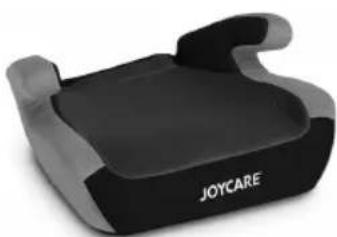
INSTALLATION OF CHILD SEAT WITHOUT BACKREST (BOOSTER) ONLY GROUP III 22 kg-36 kg

Fig.1

Fig.3
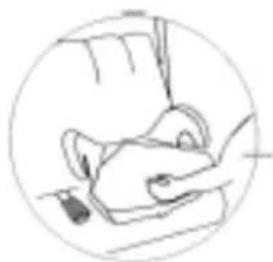
Fig.2

Fig.4

Transport device in the car for children
WARNINGS
Please read this user guide carefully before installing the child seat and for future reference. Many accidents can be easily avoided, are caused by negligence and misuse.
SAFETY INSTRUCTIONS
Please read this user guide carefully before installing the child seat and for future reference. Many accidents can be easily avoided, are caused by negligence and misuse.
• These instructions must be kept on the car seat for the entire period of use in case of incorporated retention devices.
- Do not use the seat in the house. It is not for domestic use and should only be used in cars.
- Before you travel, check that the car seat is properly secured.
- Do not modify the car seat in any way.
- Never leave a child unattended without supervision.
• In an emergency, it is important that the child is released quickly. This means that the buckle can be easily opened and teach the child not to play with it.
- Ensure that all parts are properly secured and that they not remain stuck in the doors or folding seats.
- Luggage or other objects that can cause injury in an accident must be properly locked and secured.
- The cover of the seat must be replaced with another cover recommended by the manufacturer.
- Periodically check the harness, paying particular attention to the locking points, seams and adjustable straps.
- Do not use the seat if it is damaged or loose as a result of an accident.
- The back of the seat should rest flat against the back of the car seat. If necessary, adjust the headrest of the seat.
• We recommend using the seat in the back seat of the car.
- The harness should remain taut and close to the body. If the child is wearing bulky items, you should take them off for more tension, thus ensuring the child's safety. To avoid any risk of falling, your child must always be fastened tightly to the seat.
- According to UN/ECE Regulation No. 16 or equivalent, you must fasten the child seat to the car seat with the car's seat belts. Only 3-point seatbelts must be used.
NOTICE
- This is a "Universal" child restraint device, approved as per ECE Regulation 44.04 for general use on vehicles and adapts to most car seats but not all of them.
- This restraint system for children has been classified as "Universal" as per strict approval criteria.
APPLICABILITY: The car seat is suitable for children from 9 to 36 kg in weight (Group 1/2/3), which means for children from 9 months to 11 years.
Group I: 9 kg-18 kg
Group II: 15 kg-25 kg
Group III: 22 kg-36 kg
This car seat can be used in conjunction with its own safety belt harness system for children of the first weight group. These must be attached by the belt buckle through 3 points within the vehicle. For children of weight groups II and III (15 kg - 36 kg), the harness must be removed and the vehicle's seat belt must be used to attach the child.
VEHICLE APPLICATION

Correct fitting/Suitable

Incorrect fitting/ Not suitable


Lap belt and diagonal belt

Lap belt
IMPORTANT
The seat must be installed using the car safety belt, which must be positioned absolutely over the abdomen and the diagonal band.
POSITIONING SEATS JC-1210, JC-1211, JC-1212 IN THE VEHICLE

| In the sense of traffic- forward | CORRECT |
| In the opposite sense of traffic - backwards | INCORRECT |
| Anchored car belt with 2 points | INCORRECT |
| Anchored car belt with 3 points | CORRECT |
| Car passenger front seat | INCORRECT |
| Car passenger rear seats | CORRECT |
| Central rear passenger seat with 2-point car belt | INCORRECT |
| Transversal passenger car seats | INCORRECT |
| Passenger car seats in the opposite direction of traffic | INCORRECT |
Group I: INSTALLATION OF CAR SEAT IN THE DIRECTION OF TRAFFIC (For children weighing from 9 kg to 18 kg)
Group II + III: INSTALLATION OF CAR SEAT IN THE DIRECTION OF TRAFFIC (For children weighing from 15 kg to 36 kg)
KEY TO COMPONENTS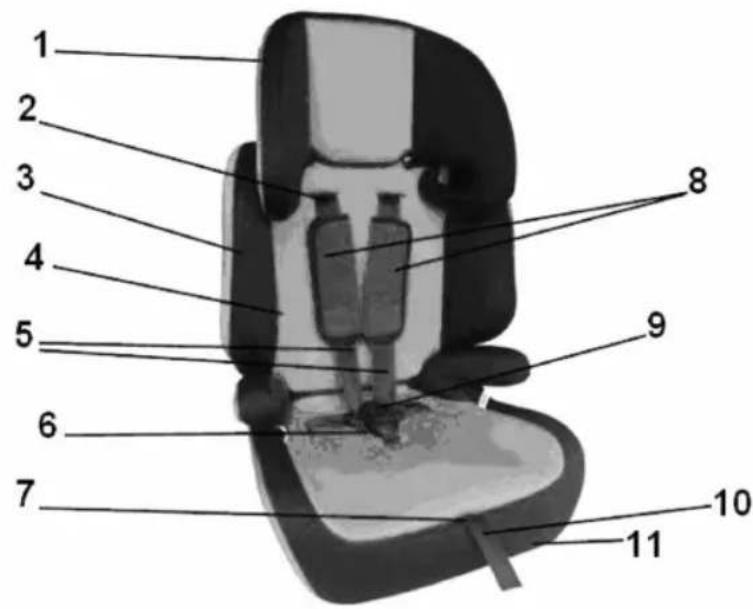
Check the height of the seat belts. They must be adjusted according to the height of the child in one of two positions in the back. If they do not fit properly, they should be adjusted according to the following guidelines.
![graph TD A["Step 1: Laparoscopic laparoscopic insertion"] --> B["Step 2: Insert a laparoscopic cable"] B --> C["Step 3: Insert surgical placement"] C --> D["Step 4: Insert surgical placement"] D --> E["Step 5: Insert surgical placement"] E --> F["Step 6: Surgical placement"]](/content/2026/05/1092516/images/2b9bdcc0df271fa7f0bff361bd8a46e78f8607bcf4b5df8e052c1df9b39bd824.jpg)
- Press the button to adjust the seat belt with one hand, and then pull the seat belts forward, including the covers, with the other hand in order to loosen them (Fig. 1).
- Remove the seat belt from the rear metal buckle lock, positioned on the rear backrest (Fig. 2).
- From the back of the backrest, pull the seat belt cover out from its slots and put it back in another one of the two available slots according to the child's height (Fig. 3/4).
- Replace the rear seat belt metal lock buckle, positioned on the rear backrest (Fig. 5).
- Pull the belt adjustment if necessary to correctly position the seat belt over the child's shoulders (Fig. 6).
NOTE: Make sure that the child is properly secured, that the buckle is not pressing on the child's stomach, that the harness is tight without causing discomfort and that the shoulder pads are at the right height for the shoulders.
SEAT INSTALLATION Group I (For children weighing from 9 kg to 18 kg)
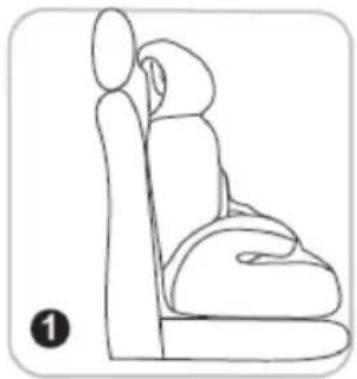
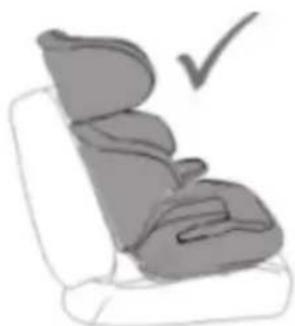
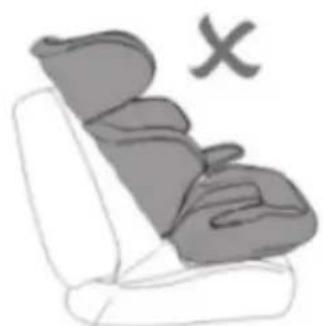
- Position the child car seat so that it is not tilted, making sure that the back of the seat adheres to the car seat as much as possible (Fig. 1).

NOTE: The backrest of the seat must adhere to the seat of the car, leaving as little space as possible.
- Pull the car belt to 3 points (lap and diagonal) by means of the buckle, through the appropriate slots / guides in the rear of the seat.
Make sure the car seat belts are not twisted and that they are flat.
Press the seat against the back of the car seat while you pull the car belt buckle diagonally and abdominally in order to eliminate flexibility, insert the buckle into the car's seat belt locking mechanism until you hear a distinct locking "click".
![graph TD A["Seatbelt Seatbelt"] --> B["Car Seatbelt"] B --> C["Car Seatbelt Switch"] C --> D["Car Seatbelt Seatbelt"] D --> E["Car Seatbelt Seatbelt"] E --> F["Car Seatbelt Seatbelt"]](/content/2026/05/1092516/images/23256eec79245a5faca432c9232f6af2e1ad80aa6944135211ba364b10b5c0a5.jpg)
- Press the button to adjust the seat belt with one hand, and then pull forward seat belts, including covers, with the other hand in order to loosen.
- Once the child seat is attached to the car seat, loosen the harness by pulling on the straps while pressing the harness adjuster button
To place the child in the seat, loosen the belts, releasing the buckle fastening mechanism, pressing the button intended for this and place the belts on the sides of the seat.
- Position the child correctly in the seat.
- Reconnect the harness to the buckle until it clicks into place.
- Adjust the perfect grip of the seat belt on the child by pulling the seat belt adjustment belt.
- Make sure that the child is properly secured, that the buckle is not pressing on the child's stomach, that the harness is tight without causing discomfort and that the shoulder pads are at the right height for the shoulders. The baby's body should not be placed in an unnatural position.
INSTALLATION WITH BACK SEAT Groups II and III
Group II: 15 kg-25 kg GROUP III: 22 kg-36 kg
REMOVING THE SEAT BELTS
For children of weight groups II and III (15 kg - 36 kg), the harness must be removed and the vehicle's seat belt must be used to attach the child.
This car seat can be used in conjunction with its own safety belt harness system for children of the first weight group. These must be attached by the belt buckle through 3 points within the vehicle.
- Remove the seat belt from the rear metal buckle lock, positioned on the rear backrest.
- From the rear seat backrest extract the seat belt covers from their slots.
- Disengage the belts from the coupling mechanism in order to extract them from the front part of the seat.
- Lift the coating at the base of the seat and remove the metal hook that fastens the part connected to the coupling mechanism.

- Remove the coupling mechanism from the seat base.
- Unhook the seat belt adjustment metal buckle from the rear lock on the back, located at the rear of the seat.
ADJUSTING THE HEIGHT OF THE HEADREST
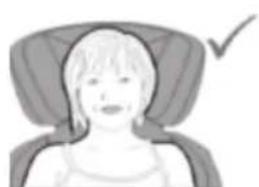
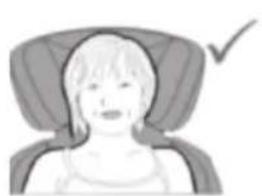
Regularly check if the headrest is at a suitable height for your child. The height of the headrest is correct and corresponds to the size of the baby when the child's head rests comfortably in the middle.
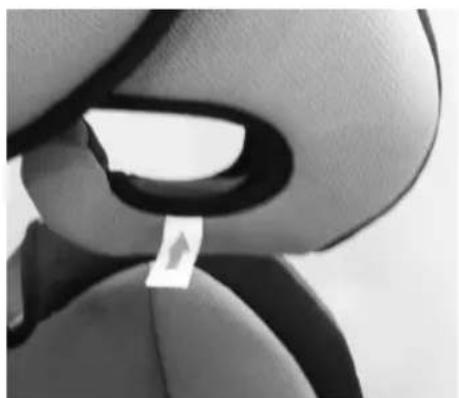
• To adjust the height, pull the handle behind the headrest.


Secure the car seat with the vehicle's seat belt
The 3-point belt system of the vehicle may only be used to fasten children of Groups II and III (15 kg - 36 kg).
Step 1: Place the child seat on the vehicle's seat, making sure it is firmly pressed against the backrest of the seat.
Step 2: Place your child on the seat.
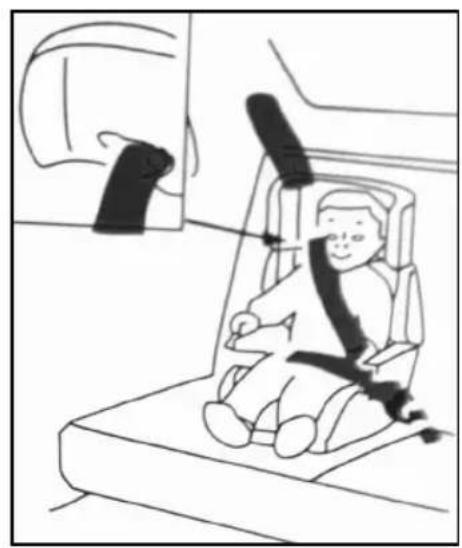
Step 3: Unroll the 3-point safety belt and place the lap belt on the opposite side of the buckle under the armrest (make sure that the diagonal belt and the lap belt on the side of the buckle are under the armrest). The lap belt should be worn low so that the hips are secured and the straps are not twisted. Insert it into the buckle until you hear a "click".
MAKE SURE THAT BOTH THE ABDOMINAL AND DIAGONAL BELT PASS THROUGH THE APPROPRIATE HOUSINGS INDICATED BY THE ARROW
HOUSING THROUGH WHICH THE ABDOMINAL BELT PASSES

HOUSING THROUGH WHICH THE DIAGONAL BELT PASSES
THE RED ARROW INDICATES THE BELT'S CORRECT POSITION

INSTALLATION CAR SEAT WITHOUT BACKREST ONLY GROUP III 22 kg-36 kg

Only the car's 3-point safety belts must be used to secure the baby seat.
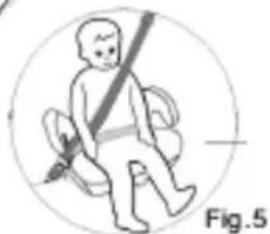
Step 1: Remove the backrest from the booster (Fig. 1)
Step 2: Place the booster in the passenger seat by securing it properly (Fig. 2).
Step 3: Place the child on the booster with his/her back against the backrest of the car (Fig. 3).
Step 4: Place the lap belt below the armrest of the car and secure your child with the lap belt (Fig. 4-5).
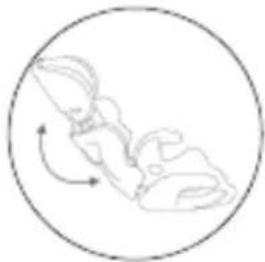
Fig.1
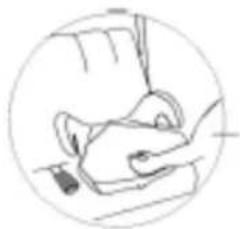
Fig.2


Fig.3
CLEANING AND MAINTENANCE
Cleaning of the cover: use only neutral detergent and wash with hot water. Do not machine wash. Spinning cycle and dryer are not recommended.

Wash cold water 30°

Suitable for dry cleaning in Tetrachloroethylene

Do not bleach

Do not tumble dry

Do not iron
WARNING IN CASE OF ACCIDENT: The car seat should be replaced if the vehicle has been subject to violent stress in an accident.
Specifications and designs are based on the latest information available at the time of printing and are subject to change without notice.
ES
JC-1210, JC-1211, JC-1212

FOR AUTOMOBILE JC-1210, JC-1211, JC-1212

NOTE:


PLACE FOR PASSING THE ABDOMINAL BELT
PLACE FOR PASSING THE DIAGONAL BELT
RED ARROW INDICATING THE CORRECT PASSAGE OF THE TWO SEAT BELTS.

INSTALLATION OF THE SAFETY SEAT WITHOUT THE BACKREST = SEAT/BOOSTER - ONLY FOR GROUP III (22 KGS. - 36 KGS.).
CLEANING AND MAINTENANCE
- JOYCARE®
- RED ARROW INDICATING CORRECT BELT ROUTING
- INSTALLATION OF CHILD SEAT WITHOUT BACKREST (BOOSTER) ONLY GROUP III 22 KG-36 KG
- WARNINGS
- SAFETY INSTRUCTIONS
- NOTICE
- VEHICLE APPLICATION
- IMPORTANT
- POSITIONING SEATS JC-1210, JC-1211, JC-1212 IN THE VEHICLE
- GROUP I: INSTALLATION OF CAR SEAT IN THE DIRECTION OF TRAFFIC (FOR CHILDREN WEIGHING FROM 9 KG TO 18 KG)
- SEAT INSTALLATION GROUP I (FOR CHILDREN WEIGHING FROM 9 KG TO 18 KG)
- INSTALLATION WITH BACK SEAT GROUPS II AND III
- REMOVING THE SEAT BELTS
- ADJUSTING THE HEIGHT OF THE HEADREST
- SECURE THE CAR SEAT WITH THE VEHICLE'S SEAT BELT
- INSTALLATION CAR SEAT WITHOUT BACKREST ONLY GROUP III 22 KG-36 KG
- CLEANING AND MAINTENANCE
- ES
- NOTE
- INSTALLATION OF THE SAFETY SEAT WITHOUT THE BACKREST = SEAT/BOOSTER - ONLY FOR GROUP III (22 KGS. - 36 KGS.)
Brand : Joycare
Model : Vivace JC-1212
Category : High chair