
RNV3810DWN - Freezer DAEWOO - Free user manual and instructions
Find the device manual for free RNV3810DWN DAEWOO in PDF.


| Product Type | Freezer |
| Brand | Daewoo |
| Model | RNV3810DWN |
| Total Net Capacity | 380 L |
| Energy Class | A+ |
| Annual Energy Consumption | 280 kWh/year |
| Climate Class | SN-T |
| Noise Level | 40 dBA |
| Defrost Type | Manual |
| Cooling System | Static |
| Refrigerant | R600a |
| Voltage / Frequency | 220-240 V / 50 Hz |
| Dimensions (H x W x D) | 1850 x 595 x 650 mm |
| Net Weight | 68 kg |
| Freezing Capacity | 12 kg/24h |
| Storage Time during Power Failure | 18 hours |
| Thermostat Control | Mechanical knob |
| Fast Freeze Function | Yes |
| Temperature Alarm | Yes |
| Door Reversible | Yes (user reversible) |
| Interior Light | No |
| Wheels / Castors | Yes (4 wheels) |
| Lock | Yes |
Frequently Asked Questions - RNV3810DWN DAEWOO
User questions about RNV3810DWN DAEWOO
0 question about this device. Answer the ones you know or ask your own.
Ask a new question about this device
Download the instructions for your Freezer in PDF format for free! Find your manual RNV3810DWN - DAEWOO and take your electronic device back in hand. On this page are published all the documents necessary for the use of your device. RNV3810DWN by DAEWOO.
USER MANUAL RNV3810DWN DAEWOO
natural_image
Simple line drawing of a refrigerator with two vertical bars on the front panel (no text or symbols)RNV3810DSN
RNV3810DWN
natural_image
Diagram of two coiled heat exchangers with cooling fans and heat sinks (no text or labels)natural_image
Line drawing of a cabinet or rack with a door and shelf, no text or symbols presentnatural_image
Illustration showing three hand gestures: using a keyboard, moving a grid, and removing a box (no text or symbols)natural_image
Technical line drawing of a refrigerated industrial machine with cooling panel and cooling unit (no text or symbols)Thank you for choosing this product.
This user manual contains important information on safety and instructions intended to assist you in the operation and maintenance of your appliance.
Please take the time to read this user manual before using your appliance and keep this book for future reference.
| Icon Type Meaning | ||
 | WARNING Serious injury or death risk | |
 | RISK OF ELECTRIC SHOCK Dangerous voltage risk | |
 | FIRE Warning; Risk of fire / flammable materials | |
 | CAUTION Injury or property damage risk | |
 | IMPORTANT Operating the system correctly | |
CONTENTS
1 SAFETY INSTRUCTIONS ...... 29
1.1 General Safety Warnings ......29
1.2 Installation warnings....33
1.3 During Usage....33
2 DESCRIPTION OF THE APPLIANCE 35
3 USING THE APPLIANCE 35
3.1 Information about New Generation Cooling Technology 35
3.2 Display and Control Panel....36
3.3 Operating your Fridge Freezer 36
3.3.1 Cooler Temperature Settings .... 36
3.3.2 Super Cool Mode .... 36
3.3.3 Economy Mode .... 36
3.4 Temperature Adjustment Warnings....36
3.5 Temperature indicator....37
3.6 Accessories 38
3.6.1 Ice Tray....38
3.6.2 The Freezer Box....38
3.6.3 The Fresh Dial (In some models)....38
4 FOOD STORAGE 39
4.1 Refrigerator Compartment....39
4.2 Freezer Compartment 39
5 CLEANING AND MAINTENANCE 42
5.1 Defrosting 43
6 SHIPMENT AND REPOSITIONING....43
6.1 Transportation and Changing Positioning ....43
6.2 Repositioning the Door....43
7 BEFORE CALLING AFTER-SALES SERVICE....44
8 TIPS FOR SAVING ENERGY 45
1 SAFETY INSTRUCTIONS
1.1 General Safety Warnings
Read this user manual carefully.
⚠ WARNING: Keep ventilation openings, in the appliance enclosure or in the built-in structure, clear of obstruction.
⚠ WARNING: Do not use mechanical devices or other means to accelerate the defrosting process, other than those recommended by the manufacturer.
WARNING: Do not use electrical appliances inside the food storage compartments of the appliance, unless they are of the type recommended by the manufacturer.
⚠ WARNING: Do not damage the refrigerant circuit.
⚠ WARNING: When positioning the appliance, ensure the supply cord is not trapped or damaged.
⚠ WARNING: Do not locate multiple portable socket-outlets or portable power supplies at the rear of the appliance.
⚠ WARNING: In order to avoid any hazards resulting from the instability of the appliance, it must be fixed in accordance with the instructions.
⚠️ If your appliance uses R600a as a refrigerant (this information will be provided on the label of the cooler) you should take care during transportation and installation to prevent the cooler elements from being damaged. R600a is an environmentally friendly and
natural gas, but it is explosive. In the event of a leak due to damage of the cooler elements, move your fridge away from open flames or heat sources and ventilate the room where the appliance is located for a few minutes.
- While carrying and positioning the fridge, do not damage the cooler gas circuit.
- Do not store explosive substances such as aerosol cans with a flammable propellant in this appliance.
- This appliance is intended to be used in household and domestic applications such as:
-staff kitchen areas in shops, offices and other working environments.
-farm houses and by clients in hotels, motels and other residential type environments.
-bed and breakfast type environments;
-catering and similar non-retail applications.
- If the socket does not match the refrigerator plug, it must be replaced by the manufacturer, a service agent or similarly qualified persons in order to avoid a hazard.
-
A specially grounded plug has been connected to the power cable of your refrigerator. This plug should be used with a specially grounded socket of 16 amperes. If there is no such socket in your house, please have one installed by an authorised electrician.
-
This appliance can be used by children aged from 8 years and above and persons with reduced physical, sensory or mental capabilities or lack of experience and knowledge if they have been given supervision or instruction concerning use of the appliance in a safe way and understand the hazards involved. Children shall not play with the appliance. Cleaning and user maintenance shall not be made by children without supervision.
- Children aged from 3 to 8 years are allowed to load and unload refrigerating appliances. Children are not expected to perform cleaning or user maintenance of the appliance, very young children (0-3 years old) are not expected to use appliances, young children (3-8 years old) are not expected to use appliances safely unless continuous supervision is given, older children (8-14 years old) and vulnerable people can use appliances safely after they have been given appropriate supervision or instruction concerning use of the appliance. Very vulnerable people are not expected to use appliances safely unless continuous supervision is given.
- If the supply cord is damaged, it must be replaced by the manufacturer, an authorised service agent or similar qualified persons, in order to avoid a hazard.
- This appliance is not intended for use at altitudes exceeding 2000 m.
To avoid contamination of food, please respect the following instructions:
- Opening the door for long periods can cause a significant increase of the temperature in the compartments of the appliance.
- Clean regularly surfaces that can come in contact with food and accessible drainage systems
- Store raw meat and fish in suitable containers in the refrigerator, so that it is not in contact with or drip onto other food.
- Two-star frozen-food compartments are suitable for storing pre-frozen food, storing or making ice cream and making ice cubes.
- One-, two- and three-star compartments are not suitable for the freezing of fresh food.
- If the refrigerating appliance is left empty for long periods, switch off, defrost, clean, dry, and leave the door open to prevent mould developing within the appliance.
1.2 Installation warnings
Before using your fridge freezer for the first time, please pay attention to the following points:
- The operating voltage for your fridge freezer is 220-240 V at 50Hz.
- The plug must be accessible after installation.
- Your fridge freezer may have an odour when it is operated for the first time. This is normal and the odour will fade when your fridge freezer starts to cool.
- Before connecting your fridge freezer, ensure that the information on the data plate (voltage and connected load) matches that of the mains electricity supply. If in doubt, consult a qualified electrician.
- Insert the plug into a socket with an efficient ground connection. If the socket has no ground contact or the plug does not match, we recommend you consult a qualified electrician for assistance.
- The appliance must be connected with a properly installed fused socket. The power supply (AC) and voltage at the operating point must match with the details on the name plate of the appliance (the name plate is located on the inside left of the appliance).
- We do not accept responsibility for any damages that occur due to ungrounded usage.
- Place your fridge freezer where it will not be exposed to direct sunlight.
- Your fridge freezer must never be used outdoors or exposed to rain.
- Your appliance must be at least 50 cm away from stoves, gas ovens and heater cores, and at least 5 cm away from electrical ovens.
-
If your fridge freezer is placed next to a deep freezer, there must be at least 2 cm between them to prevent humidity forming on the outer surface.
-
Do not cover the body or top of fridge freezer with lace. This will affect the performance of your fridge freezer.
- Clearance of at least 150 mm is required at the top of your appliance. Do not place anything on top of your appliance.
- Do not place heavy items on the appliance.
- Clean the appliance thoroughly before use (see Cleaning and Maintenance).
- Before using your fridge freezer, wipe all parts with a solution of warm water and a teaspoon of sodium bicarbonate. Then, rinse with clean water and dry. Return all parts to the fridge freezer after cleaning.
- Use the adjustable front legs to make sure your appliance is level and stable. You can adjust the legs by turning them in either direction. This must be done before placing food in the appliance.
• Install the two plastic distance guides (the
parts on the black vanes -condenser- at the rear) by turning it 90° (as shown in the figure) to prevent the condenser from touching the wall. - The distance between the appliance and back wall must be a maximum of 75 mm.

natural_image
Diagram of two coiled heat exchangers with heat transfer arrows (no text or labels)1.3 During Usage
- Do not connect your fridge freezer to the mains electricity supply using an extension lead.
- Do not use damaged, torn or old plugs.
- Do not pull, bend or damage the cord.
- Do not use plug adapter.
- This appliance is designed for use by adults. Do not allow children to play with the appliance or hang off the door.
- Never touch the power cord/plug with wet hands. This may cause a short circuit or electric shock.
-
Do not place glass bottles or cans in the ice-making compartment as they will burst when the contents freeze.
-
Do not place explosive or flammable material in your fridge. Place drinks with high alcohol content vertically in the fridge compartment and make sure their tops are tightly closed.
- When removing ice from the ice-making compartment, do not touch it. Ice may cause frost burns and/or cuts.
- Do not touch frozen goods with wet hands. Do not eat ice-cream or ice cubes immediately after they are removed from the ice-making compartment.
- Do not re-freeze thawed frozen food. This may cause health issues such as food poisoning.
Old and Out-of-order Fridges
- If your old fridge or freezer has a lock, break or remove the lock before discarding it, because children may get trapped inside it and may cause an accident.
- Old fridges and freezers contain isolation material and refrigerant with CFC. Therefore, take care not to harm environment when you are discarding your old fridges.
CE Declaration of conformity
We declare that our products meet the applicable European Directives, Decisions and Regulations and the requirements listed in the standards referenced.
Disposal of your old appliance
The symbol on the product or on its packaging indicates that this product may not be treated as household waste. Instead it shall be handed over to the applicable collection point for the recycling of electrical and electronic equipment. By ensuring this product is disposed of correctly, you will help prevent potential negative consequences for the environment and human health, which could otherwise be caused by inappropriate waste handling of this product. For more detailed information about recycling of this product, please contact your local city office, your household waste disposal service or the shop where you purchased the product.
Packaging and the Environment
Packaging materials protect your machine from damage that may occur during transportation. The packaging materials are environmentally friendly as they are recyclable. The use of recycled material reduces raw material consumption and therefore decreases waste production.
Notes:
- Please read the instruction manual carefully before installing and using your appliance. We are not responsible for the damage occurred due to misuse.
- Follow all instructions on your appliance and instruction manual, and keep this manual in a safe place to resolve the problems that may occur in the future.
- This appliance is produced to be used in homes and it can only be used in domestic environments and for the specified purposes. It is not suitable for commercial or common use. Such use will cause the guarantee of the appliance to be cancelled and our company will not be responsible for the losses to be occurred.
- This appliance is produced to be used in houses and it is only suitable for cooling / storing foods. It is not suitable for commercial or common use and/or for storing substances except for food. Our company is not responsible for the losses to be occurred in the contrary case.

2 DESCRIPTION OF THE APPLIANCE


This presentation is only for information about the parts of the
appliance. Parts may vary according to the appliance model.
A) Refrigerator compartment
B) Freezer compartment
1) Wine rack *
2) Refrigerator shelves
3) Thermostat box / Interior display
4) Chiller *
5) Crisper cover
6) Crisper
7) Freezer upper basket
8) Freezer middle basket
9) Freezer bottom basket
10) Levelling feet
11) Freezer glass shelves
12) Bottle shelf
13) Adjustable door shelf * / door shelf
14) Door shelf
15) Egg holder
16) Ice box tray
* In some models
3 USING THE APPLIANCE
3.1 Information about New Generation Cooling Technology
Fridges with new-generation cooling
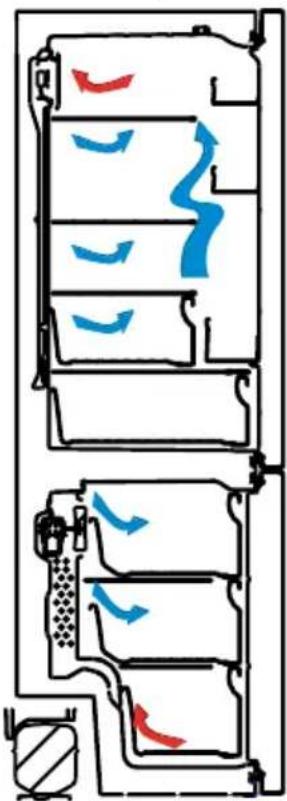
technology have a different operating system to static fridges. Other (static) fridges may experience a build up of ice in the freezer compartment due to door openings and humidity in the food. In such fridges, regular defrosting is required; the fridge must be switched off, the frozen food moved to a suitable container and the ice which has formed in the freezer compartment removed. In fridges with new-generation cooling technology, a fan
natural_image
Diagram of a vehicle interior showing airflow patterns with blue and red arrows indicating movement (no text or labels)blows dry cold air evenly throughout the fridge and freezer compartments. The cold air cools your food evenly and uniformly, preventing humidity and ice build-up.
In the refrigerator compartment, air blown by the fan, located at the top of the refrigerator compartment, is cooled while passing through the gap behind the air duct. At the same time, the air is blown out through the holes in the air duct, evenly spreading cool air throughout the refrigerator compartment.
There is no air passage between the freezer and refrigerator compartments, therefore preventing the mixing of odours.
As a result, your fridge, with new-generation cooling technology, provides you with ease of use as well as a huge volume and aesthetic appearance.
3.2 Display and Control Panel

3.3 Operating your Fridge Freezer
3.3.1 Cooler Temperature Settings
- Initial temperature value for cooler setting indicator is 6 °C.
- Press set button once, the set value will start to blink.
- If you keep pressing set button, lower temperatures will be selected. (8, 6, 5, 4, 2, super and eco)
- If no button is pressed for 1 second, your choice will be set, it will blink 3 times. Buzzer will sound.
- The temperature value selected before super cool mode or economy mode is activated will remain the same when the mode is over or cancelled. The appliance continues to operate with this temperature value.
3.3.2 Super Cool Mode
When Would It Be Used?
• To cooling huge quantities of food.
• To cooling fast food.
• To cooling food quickly.
• To store seasonal food for a long time.
How Would It Be Used?
Press set button until super cool symbol will be seen on the screen. Buzzer will sound. Mode will be set.
During This Mode:
• Economy mode can not be selected.
- Super cool mode can be cancelled by pressing set button again until the super cool symbol disappears.
3.3.3 Economy Mode
How Would It Be Used?
Press set button until eco symbol will be seen on the screen. Buzzer will sound. Mode will be set.
During This Mode:
- Super cool can be selected. Economy mode is automatically cancelled and the selected mode is activated.
- Eco mode can be cancelled by pressing set button again until the economy symbol disappears.
3.4 Temperature Adjustment Warnings
- It is not recommended that you operate your fridge in environments colder than 10°C in terms of its efficiency.
- Do not start another adjustment while you are already making an adjustment.
- Temperature adjustments should be made according to the frequency of door openings, the quantity of food kept inside the fridge and the ambient temperature in the location of your fridge.
- In order to allow your fridge to reach the operating temperature after being connected to mains, do not open the doors frequently or place large quantities of food in the fridge. Please note that, depending on the ambient temperature, it may take 24 hours for your fridge to reach the operating temperature.
- A 5 minute delay function is applied to prevent damage to the compressor of your fridge when connecting or disconnecting to mains, or when an energy breakdown occurs. Your fridge will begin to operate normally after 5 minutes.
- Your appliance is designed to operate in the ambient temperature (T/SN = 10°C - 43°C) intervals stated in the standards, according to the climate class displayed on the information label. We do not recommend operating your appliance out of the stated temperature limits in terms of cooling effectiveness.
| Climate Class | Ambient Temperature °C |
| T Between 16 and 43 (°C) | |
| ST Between 16 and 38 (°C) | |
| N Between 16 and 32 (°C) | |
| SN Between 10 and 32 (°C) | |
Important installation instructions
This appliance is designed to work in difficult climate conditions (up to 43 degrees C or 110 degrees F) and is powered with ‘Freezer Shield’ technology which ensures that the frozen food in the freezer will not defrost even if the ambient temperature falls as low as -15 °C. So you may then install your appliance in an unheated room without having to worry about frozen food in the freezer being spoilt. When the ambient temperature returns to normal, you may continue using the appliance as usual.
3.5 Temperature indicator
In order to help you better set your refrigerator, we have equipped it with a temperature indicator located in the coldest area.
To better store the food in your refrigerator, especially in the coldest area, make sure the message "OK" appears on the temperature indicator. If « OK » does not appear, this means temperature has not been set properly
It may be difficult to see the indicator, make sure it is properly lit. Each time the temperature setting device is changed, wait for the stabilisation of the temperature inside the appliance before proceeding, if necessary, with a new temperature

setting. Please change the position of the temperature setting device progressively and wait at least 12 hours before starting a new check and potential change.

NOTE: Following repeated openings (or prolonged opening) of the door or putting fresh food into the appliance, it is normal for the indication "OK" not to wear in the temperature setting indicator. There is an abnormal build up of ice crystals of ice crystals (bottom wall of the balance) on the refrigerator compartment, fororator (overloaded appliance, high in temperature, frequent door openings), the temperature setting device on a pair position until compressor off periods obtained again.
Store food in the coldest area of the refrigerator.

Your foods will be better stored if you put them in the most appropriate cooling area. The coldest area is just above the crisper.
The following symbol indicates the coldest area of your refrigerator.
To be sure to have a low temperature in this
area, make sure the shelf is located at the level of this symbol, as shown in the illustration.
The upper limit of the coldest area is indicated by the lower side of the

natural_image
Line drawing of a cabinet or rack with a handle and ladder, no text or symbols presentsticker (head of the arrow). The coldest area upper shelf must be at the same level with the arrow head. The coldest area is below this level.
As these shelves are removable, make sure they are always at the same level with these zone limits described on the stickers, in order to guarantee temperatures in this area.
3.6 Accessories
3.6.1 Ice Tray
- Fill the ice tray with water and place in the freezer compartment.
• After the water has completely frozen, you can twist the tray as shown below to remove the ice cubes.

natural_image
Illustration showing three hand gestures: a keyboard, a keyboard with rotation arrow, and a hand holding a cross (no text or symbols)3.6.2 The Freezer Box
The freezer box allows food to be accessed more easily.

Removing the freezer box:
• Pull the box out as far as possible
- Pull the front of the box up and out

Carry out the opposite of this operation when refitting the sliding compartment.

Always keep hold of the handle of the box while removing it.
3.6.3 The Fresh Dial (In some models)

If the crisper is full, the fresh dial located in front of the crisper should be opened. This allows the air in the crisper and the humidity rate to be controlled, to increase the life of food within.
The dial, located behind the shelf, must be opened if any condensation is seen on the glass shelf.
Visual and text descriptions in the accessories section may vary according to the model of your appliance.
4 FOOD STORAGE
4.1 Refrigerator Compartment
- To reduce humidity and avoid the consequent formation of frost, always store liquids in sealed containers in the refrigerator. Frost tends to concentrate in the coldest parts of the evaporating liquid and, in time, your appliance will require more frequent defrosting.
- Never place warm food in the refrigerator. Warm food should be allowed to cool at room temperature and should be arranged to ensure adequate air circulation in the refrigerator compartment.
- Make sure no items are in direct contact with the rear wall of the appliance as frost will develop and packaging will stick to it. Do not open the refrigerator door frequently.
- We recommend that meat and clean fish are loosely wrapped and stored on the glass shelf just above the vegetable bin where the air is cooler, as this provides the best storage conditions.
- Store loose fruit and vegetable items in the crisper containers.
- Store loose fruit and vegetables in the crisper.
- Storing fruit and vegetables separately helps prevent ethylene-sensitive vegetables (green leaves, broccoli, carrot, etc.) being affected by ethylene-releaser fruits (banana, peach, apricot, fig etc.).
- Do not put wet vegetables into the refrigerator.
- Storage time for all food products depends on the initial quality of the food and an uninterrupted refrigeration cycle before refrigerator storage.
- To avoid cross-contamination do not store meat products with fruit and vegetables. Water leaking from meat may contaminate other products in the refrigerator. You should package meat
products and clean any leakages on the shelves.
- Do not put food in front of the air flow passage.
- Consume packaged foods before the recommended expiry date.

NOTE: Potatoes, onions and garlic should not be stored in the refrigerator.
The table below is a quick guide to show you the most efficient way to store the major food groups in your refrigerator compartment.
| Food | Maximum storage time | How and where to store |
| Vegetables and fruits | 1 week Vegetable bin | |
| Meat and fish | 2 - 3 Days | Wrap in plastic foil, bags, or in a meat container and store on the glass shelf |
| Fresh cheese | 3 - 4 Days | On the designated door shelf |
| Butter and margarine | 1 week | On the designated door shelf |
| Bottled products e.g. milk and yoghurt | Until the expiry date recommended by the producer | On the designated door shelf |
| Eggs 1 month | On the designated egg shelf | |
| Cooked food | All shelves | |
4.2 Freezer Compartment
- The freezer is used for storing frozen food, freezing fresh food, and making ice cubes.
- For freezing fresh food; wrap and seal fresh food properly, that is the packaging should be air tight and shouldn't leak. Special freezer bags, aluminum foil polythene bags and plastic containers are ideal.
- Do not store fresh food next to frozen food as it can thaw the frozen food.
-
Before freezing fresh food, divide it into portions that can be consumed in one sitting.
-
Consume thawed frozen food within a short period of time after defrosting
- Never place warm food in the freezer compartment as it will thaw the frozen food.
- Always follow the manufacturer's instructions on food packaging when storing frozen food. If no information is provided food, should not be stored for more than 3 months from the date of purchase.
- When purchasing frozen food, make sure that it has been stored under appropriate conditions and that the packaging is not damaged.
- Frozen food should be transported in appropriate containers and placed in the freezer as soon as possible.
- Do not purchase frozen food if the packaging shows signs of humidity and abnormal swelling. It is probable that it has been stored at an unsuitable temperature and that the contents have deteriorated.
- The storage life of frozen food depends on the room temperature, the thermostat setting, how often the door is opened, the type of food, and the length of time required to transport the product from the shop to your home. Always follow the instructions printed on the packaging and never exceed the maximum storage life indicated.
- The maximum amount of fresh food (in kg) that can be frozen in 24 hours is indicated on the appliance label.
- For optimum appliance performance to reach maximum freezing capacity, set the refrigerator at 4 °C for 24 hours before placing fresh food into the freezer.
- After placing fresh food into the freezer, change the setting to 2 °C for 24 hours is generally sufficient. After 24 hours, you can reduce the setting if required.
- To use the maximum capacity of the freezer compartment, use the glass shelves for the upper and middle section, and use the lower basket for the bottom
section.
- Use the fast freezing shelf to freeze home cooking (and any other food which needs to be frozen quickly) more quickly because of the freezing shelf's greater freezing power. Fast freezing shelf is the bottom drawer of the freezer compartment.
NOTE: If you attempt to open the freezer door immediately after closing it, you will find that it will not open easily. This is normal. Once equilibrium has been reached, the door will open easily.
Important note:
- Never refreeze thawed frozen food.
- The taste of some spices found in cooked dishes (anise, basilica, watercress, vinegar, assorted spices, ginger, garlic, onion, mustard, thyme, marjoram, black pepper, etc.) changes and they assume a strong taste when they are stored for a long period of time. Therefore, add small amounts of spices to food to be frozen, or the desired spice should be added after the food has thawed.
- The storage time of food is dependent on the type of oil used. Suitable oils are margarine, calf fat, olive oil and butter. Unsuitable oils are peanut oil and pig fat.
- Food in liquid form should be frozen in plastic cups and other food should be frozen in plastic folios or bags.

The table below is a quick guide to show you the most efficient way to store the major food groups in your freezer compartment.
| Meat and fish Preparation | Maximum storage time (months) | |
| Steak Wrap in foil 6 - 8 | ||
| Lamb meat Wrap in foil 6 - 8 | ||
| Veal roast Wrap in foil 6 - 8 | ||
| Veal cubes In small pieces 6 - 8 | ||
| Lamb cubes In pieces 4 - 8 | ||
| Minced meat In packaging without using spices 1 - 3 | ||
| Giblets (pieces) In pieces 1 - 3 | ||
| Bologna sausage/salami Should be kept packaged even if it has a membrane | ||
| Chicken and turkey Wrap in foil 4 - 6 | ||
| Goose and duck | Wrap in foil 4 - 6 | |
| Deer, rabbit, wild boar | In 2.5 kg portions or as fillets | 6 - 8 |
| Freshwater fish (Salmon, Carp, Crane, Catfish) | After cleaning the bowels and scales of the fish, wash and dry it. If necessary, remove the tail and head. | 2 |
| Lean fish (Bass, Turbot, Flounder) | 4 | |
| Fatty fishes (Tuna, Mackerel, Bluefish, Anchovy) | 2 - 4 | |
| Shellfish | Clean and in a bag | 4 - 6 |
| Caviar | In its packaging, or in an aluminium or plastic container | 2 - 3 |
| Snails | In salty water, or in an aluminium or plastic container 3 | |
 NOTE: Thawed frozen meat should be cooked as fresh meat. If the meat is not cooked after defrosting, it must not be re-frozen. NOTE: Thawed frozen meat should be cooked as fresh meat. If the meat is not cooked after defrosting, it must not be re-frozen. | ||
| Vegetables and Fruits | Preparation | Maximum storage time (months) |
| String beans and beans | Wash, cut into small pieces and boil in water | 10 - 13 |
| Beans | Hull, wash and boil in water | 12 |
| Cabbage | Clean and boil in water | 6 - 8 |
| Carrot | Clean, cut into slices and boil in water | 12 |
| Pepper | Cut the stem, cut into two pieces, remove the core and boil in water | 8 - 10 |
| Spinach | Wash and boil in water | 6 - 9 |
| Cauliflower | Remove the leaves, cut the heart into pieces and leave it in water with a little lemon juice for a while | 10 - 12 |
| Eggplant | Cut into pieces of 2cm after washing | 10 - 12 |
| Corn | Clean and pack with its stem or as sweet corn 12 | |
| Apple and pear | Peel and slice | 8 - 10 |
| Apricot and Peach | Cut into two pieces and remove the stone | 4 - 6 |
| Vegetables and Fruits Preparation | Maximum storage time (months) | |
| Strawberry and Blackberry | Wash and hull 8 - 12 | |
| Vegetables and Fruits Preparation | Maximum storage time (months) |
| Cooked fruits Add 10 % of sugar to the container 12 | |
| Plum, cherry, sourberry Wash and hull the stems 8 - 12 |
| Maximum storage time (months) | Thawing time at room temperature (hours) | Thawing time in oven (minutes) | |
| Bread 4 - 6 2 - 3 4-5 (220-225 °C) | |||
| Biscuits 3 - 6 1 - 1,5 5-8 (190-200 °C) | |||
| Pastry 1 - 3 2 - 3 5-10 (200-225 °C) | |||
| Pie 1 - 1,5 3 - 4 5-8 (190-200 °C) | |||
| Phyllo dough 2 - 3 1 - 1,5 5-8 (190-200 °C) | |||
| Pizza 2 - 3 2 - 4 15-20 (200 °C) | |||
| Dairy products | Preparation | Maximum storage time (months) | Storage conditions |
| Packet (Homogenized) Milk | In its own packet | 2 - 3 Pure Milk – in its own | packet |
| Cheese - excluding white cheese | In slices | 6 - 8 | Original packaging may be used for short-term storage.Keep wrapped in foil for longer periods. |
| Butter, margarine | In its packaging | 6 |
5 CLEANING AND MAINTENANCE

Disconnect the unit from the power supply before cleaning.

Do not wash your appliance by pouring water on it.

Do not use abrasive products, detergents or soaps for cleaning the stance. After washing, rinse with clean or dry carefully. When you have cleaned cleaning, reconnect the plug to the supply with dry hands.
• Make sure that no water enters the lamp housing and other electrical components.
- The appliance should be cleaned regularly using a solution of bicarbonate of soda and lukewarm water.
- Clean the accessories separately by hand with soap and water. Do not wash
accessories in a dish washer.
- Clean the condenser with a brush at least twice a year. This will help you to save on energy costs and increase productivity.

The power supply must be disconnected during cleaning.
5.1 Defrosting
natural_image
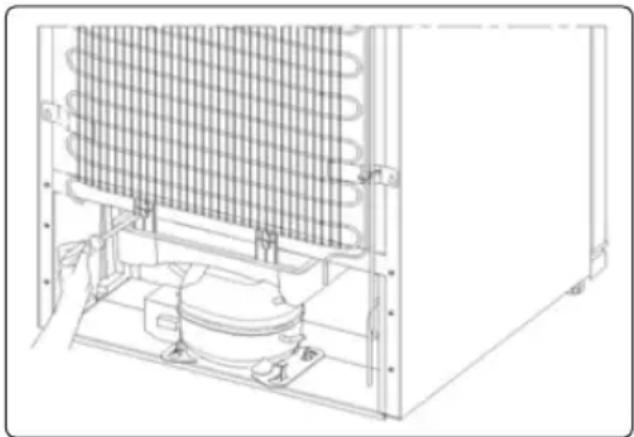
Technical line drawing of a refrigerated industrial machine with cooling panel and cooling unit (no text or symbols)- Your appliance performs automatic defrosting. The water formed as a result of defrosting passes through the water collection spout, flows into the vaporisation container behind your appliance and evaporates there.
- Make sure you have disconnected the plug of your appliance before cleaning the vaporisation container.
- Remove the vaporisation container from its position by removing the screws as indicated. Clean it with soapy water at specific time intervals. This will prevent odours from forming.
Replacing LED Lighting

If your appliance has LED lighting contact the help desk as this should
be changed by authorized personnel only.
6 SHIPMENT AND REPOSITIONING
6.1 Transportation and Changing Positioning
- The original packaging and foam may be kept for re-transportation (optional).
- Fasten your appliance with thick packaging, bands or strong cords and follow the instructions for transportation on the packaging.
- Remove all movable parts (shelves, accessories, vegetable bins, and so on) or fix them into the appliance against shocks using bands when re-positioning or transporting.

Always carry your appliance in the upright position.
6.2 Repositioning the Door
- It is not possible to change the opening direction of your appliance door if door handles are installed on the front surface of the appliance door.
- It is possible to change the opening direction of the door on models without handles.
- If the door-opening direction of your appliance can be changed, contact the nearest Authorised Service Centre to change the opening direction.
7 BEFORECALLINGAFTER- SALES SERVICE
Errors
Your fridge will warn you if the temperatures for the cooler and freezer are at improper levels or if a problem occurs with the appliance. In this case, LED around the button will blink and buzzer will sound beep.
| MEANING | "Warning" |
| WHY | There is/are some part(s) out of order or there is a failure in the cooling process. |
| WHAT TO DO | Call a service agent for assistance as soon as possible. |
If you are experiencing a problem with your refrigerator, please check the following before contacting the after-sales service.
Your refrigerator does not operate Check if:
- Your fridge is plugged in and switched on
- The fuse has blown
• Is the temperature adjustment right? - The socket is faulty. To check this, plug another working appliance into the same socket.
Your refrigerator is performing poorly Check if:
• The appliance is overloaded
• The doors are closed properly
• There is any dust on the condenser
- There is an adequate distance between the appliance and surrounding walls
Your refrigerator is operating noisily
The following noises can be heard during normal operation of the appliance.
Cracking (ice cracking) noise occurs:
• During automatic defrosting.
- When the appliance is cooled or warmed (due to expansion of appliance material).
Clicking noise occurs: When the thermostat switches the compressor on/off.
Motor noise: Indicates the compressor is operating normally. The compressor may cause more noise for a short time when it is first activated.
Bubbling noise and splashing occurs: Due to the flow of the refrigerant in the tubes of the system.
Water flowing noise occurs: Due to water flowing to the evaporation container. This noise is normal during defrosting.
Air blowing noise occurs: During normal operation of the system due to the circulation of air.
There is a build-up of humidity inside the fridge
Check if:
- All food is packed properly. Containers must be dry before being placed in the fridge.
- The fridge doors are opened frequently. Humidity of the room will enter the fridge each time the doors are opened. Humidity increases faster if the doors are opened frequently, especially if the humidity of the room is high.
- There is a build-up of water droplets on the rear wall. This is normal after automatic defrosting (in Static Models).
The doors are not opening or closing properly
Check if:
- There is food or packaging preventing the door from closing
- The door compartments, shelves and drawers are placed properly
• The door gaskets are broken or torn - Your fridge is level.
The edges of the fridge in contact with the door joint are warm
Especially during summer (warm weather), the surfaces in contact with the door joint may become warmer during operation of the compressor. This is normal.
Important Notes:
- In the case of a power failure, or if the appliance is unplugged and plugged in again, the gas in the cooling system of your refrigerator will destabilise, causing the compressor protective thermal element to open. Your refrigerator will start to operate normally after 5 minutes.
- If the appliance will not be used for a long period of time (such as during holidays), disconnect the plug. Defrost and clean the refrigerator, leaving the door open to prevent the formation of mildew and odour.
- If the problem persists after you have followed all the instructions above, please consult the nearest Authorised Service Centre.
- This appliance is designed for domestic use and for the stated purposes only. It is not suitable for commercial or common use. If the consumer uses the appliance in a way that does not comply with these instructions, we emphasise that the manufacturer and the dealer will not be responsible for any repair or failure within the guarantee period.
8 TIPS FOR SAVING ENERGY
- Install the appliance in a cool, well-ventilated room, but not in direct sunlight and not near a heat source (such as a radiator or oven) otherwise an insulating plate should be used.
- Allow warm food and drinks to cool before placing them inside the appliance.
- Place thawing food in the refrigerator compartment. The low temperature of the frozen food will help cool the refrigerator compartment while the food is thawing. This will save energy. Frozen food left to thaw outside of the appliance will result in a waste of energy.
- Drinks or other liquids should be covered when inside the appliance. If left uncovered, the humidity inside the appliance will increase, therefore the appliance uses more energy. Keeping drinks and other liquids covered helps preserve their smell and taste.
- Avoid keeping the doors open for long periods and opening the doors too frequently as warm air will enter the appliance and cause the compressor to switch on unnecessarily often.
- Keep the covers of the different temperature compartments (such as the crisper and chiller) closed.
- The door gasket must be clean and pliable. Replace gaskets if worn.
| Brand DAEWOO | |
| Model RNV3810DWN / RNV3810DSN | |
| Energy class A+ | |
| Annual energy consumption* 325 kWh | |
| Total gross volume 379 l | |
| Total net volume 360 l | |
| Refrigerator gross volume 275 l | |
| Refrigerator net volume 266 l | |
| Freezer gross volume 104 l | |
| Freezer net volume 94 l | |
| Refrigeration system NO FROST | |
| Temperature rise time (-18°C/-9°C) 18 Hours | |
| Freezing capacity 5 Kg / 24h | |
| Climate class ** T/SN (10°C - 43°C) | |
| Noise emission 42 dB(A) re 1pW | |
| Product Dimensions (H x W x D) mm 2010 x 595 x 650 | |
| Package dimensions (H x W x D) mm 2066 x 664 x 728 | |
| Weight (net/gross) (kg) | 72 kg / 78 kg |
| * Energy consumption of 325 kWh kWh per year, calculated on the basis of results obtained in 24 hours under normalised test conditions. Real energy consumption depends on the conditions in which the equipment is used as well as where it is placed. | |
| ** This appliance is designed for use at an ambient temperature within the 10°C - 43°C range. | |
- Thank you for choosing this product.
- CONTENTS
- SAFETY INSTRUCTIONS ...... 29
- DESCRIPTION OF THE APPLIANCE 35
- USING THE APPLIANCE 35
- FOOD STORAGE 39
- CLEANING AND MAINTENANCE 42
- SHIPMENT AND REPOSITIONING....43
- BEFORE CALLING AFTER-SALES SERVICE....44
- TIPS FOR SAVING ENERGY 45
- SAFETY INSTRUCTIONS
- General Safety Warnings
- Read this user manual carefully.
- To avoid contamination of food, please respect the following instructions:
- Installation warnings
- During Usage
- Old and Out-of-order Fridges
- CE Declaration of conformity
- Disposal of your old appliance
- Packaging and the Environment
- Notes:
- DESCRIPTION OF THE APPLIANCE
- USING THE APPLIANCE
- Information about New Generation Cooling Technology
- Display and Control Panel
- Operating your Fridge Freezer
- Cooler Temperature Settings
- Super Cool Mode
- When Would It Be Used?
- How Would It Be Used?
- During This Mode:
- Economy Mode
- Temperature Adjustment Warnings
- Important installation instructions
- Temperature indicator
- Store food in the coldest area of the refrigerator.
- Accessories
- Ice Tray
- The Freezer Box
- Removing the freezer box:
- The Fresh Dial (In some models)
- FOOD STORAGE
- Refrigerator Compartment
- Freezer Compartment
- Important note:
- CLEANING AND MAINTENANCE
- Defrosting
- Replacing LED Lighting
- SHIPMENT AND REPOSITIONING
- Transportation and Changing Positioning
- Repositioning the Door
- BEFORECALLINGAFTER- SALES SERVICE
- Errors
- Your refrigerator does not operate Check if:
- Your refrigerator is performing poorly Check if:
- Your refrigerator is operating noisily
- Cracking (ice cracking) noise occurs:
- Bubbling noise and splashing occurs: Due to the flow of the refrigerant in the tubes of the system.
- There is a build-up of humidity inside the fridge
- Check if:
- The doors are not opening or closing properly
- The edges of the fridge in contact with the door joint are warm
- Important Notes:
- TIPS FOR SAVING ENERGY
Brand : DAEWOO
Model : RNV3810DWN
Category : Freezer