
Mathe Würfel - Card game ThinkFun - Free user manual and instructions
Find the device manual for free Mathe Würfel ThinkFun in PDF.


| Product Type | Educational card game |
| Brand | ThinkFun |
| Model | Mathe Würfel |
| Category | Card game |
| Recommended age | 6 years and up |
| Number of players | 2 to 4 players |
| Package dimensions | 10 x 10 x 2 cm |
| Weight | 150 g |
| Power supply | None required |
| Languages | French, English, German, Italian |
| Main functions | Learning mathematical operations, dice games, logical thinking |
| Box contents | Game cards, dice, instruction manual |
| Care and cleaning | Wipe with a dry, soft cloth |
| Safety | Not suitable for children under 3 years (small parts) |
| Spare parts | Not available separately |
| Repairability | Not user-repairable |
| Game type | Educational board game |
| Game mechanics | Dice rolls, mathematical combinations |
| Objective | Reach a target score by combining dice |
Frequently Asked Questions - Mathe Würfel ThinkFun
User questions about Mathe Würfel ThinkFun
0 question about this device. Answer the ones you know or ask your own.
Ask a new question about this device
Download the instructions for your Card game in PDF format for free! Find your manual Mathe Würfel - ThinkFun and take your electronic device back in hand. On this page are published all the documents necessary for the use of your device. Mathe Würfel by ThinkFun.
USER MANUAL Mathe Würfel ThinkFun
Ziel:
- Two 12-sided Dice
- Three 6-sided Dice
- Travel Bag
- Instruction Booklet
• Practice Tables Booklet
Ages 8 to Adult
Fun for players of all math levels
For 2 or More Players
Play competitively, in teams, or practice on your own.
Object:
Use your math skills to combine three numbers to match, or come closest to, the Target Number.
To Play:
Start by rolling the two 12-sided Target Dice. Multiply them together to establish a Target Number. In the example below, when you roll a 7 and a 4 the Target Number is 28.

Then roll the three 6-sided Scoring Dice to establish three Scoring Numbers. In the example below, a 5, 2, and 3 are your Scoring Numbers.

Using the Scoring Numbers, create an equation to calculate the closest number possible to the Target Number. Your answer could be above the Target Number, below the Target Number, or hit the Target
Number exactly, depending on the numbers rolled and what you do with them. To create your equation, use each Scoring Number once and only once, along with any combination of the following operations: addition, subtraction, multiplication, division, powers, and roots. You may use the Scoring Numbers and operators in any order. In our example, two players might shout out the following...
(Remember, the Target Number is 28 and the Scoring Numbers are 5, 2, and 3.)
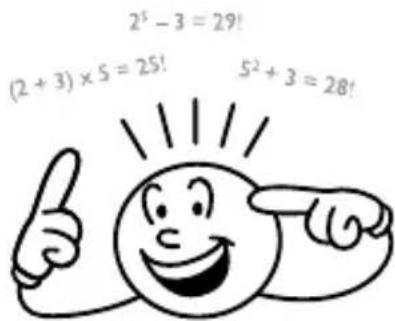
Player I shouts, "25!" (2 + 3) x 5
Player 2 shouts, "30!" 2 x 3 x 5
Player I shouts, "29!" 2 - 3
Player 2 shouts, "27!" (5 - 2)
Player I shouts, "28!" 5 + 3, hits the Target Number exactly, and wins the point.

Note how each number is used once and only once in each equation. This rule is especially important to understand when the numbers are used as powers. The player who hit 28 used the “2” to raise the 5 to the second power; the player who reached 27 used the “3” to raise (5 — 2) to the third power. The fun and flexibility of this game is in combining the three Scoring Numbers in the most creative ways to get the best answer.
Scoring:
Your goal is to beat your opponent by getting closer to the Target Number, faster. Once you have an answer you are satisfied with, call it out. The first player to call out an answer, claims that number. If the Target Number hasn't been reached, other players then have 15 seconds to respond with a new answer that is closer to the Target Number. (The player with the current best answer must remain silent while the other players try for a better answer.) This play continues, with an additional 15 seconds added after each improvement, until one player hits the Target Number exactly, the other players forfeit the point, or the time limit for calculating is reached.
The player with the closest number at the end of the point must state the equation he or she used to reach the answer. If it is correct, the point is won. If incorrect, the player with the next closest answer must state his or her equation, and gets the point if it is correct.
The first player to win four points wins the game. Note: If you are playing competitively, MathDice ™ is a “mental math” game...pencil, paper, or a calculator are not allowed.
Simpler Versions of Play:
MathDice ™ is a fun, educational game. The rules above describe competitive play. For your enjoyment, please feel free to relax the rules in any way that suits your group of players. To lower the average difficulty of the calculations, reduce the range of the Target Numbers.
To do this, you may:
• Roll only one 12-sided die to establish a Target
Number in the range between 1 and 12. This version makes a good game for players who are more confident with addition and subtraction skills, and just starting to get a mastery of multiplication.
- Roll two 12-sided dice, and add the two numbers together, to establish a Target Number in the range between 2 and 24. This version makes a good game for players who have confidence in their adding/subtracting/multiplying skills, but are not yet comfortable with more advanced operations.
For a more cooperative environment, choose from the following:
- Everyone who can match the best answer given on a turn, gets a point for that turn.
- Relax time constraints.
- Allow use of pencil and paper or calculators.
• Work together to find as many answers as you can that are close to the Target Number.
- Have fun exploring the numbers and their patterns!
MathDice ™ and the Flexibility of Numbers:
Numbers are incredible. As you play MathDice™ and your skills improve, you will come to discover patterns and relationships that will astound you. Really! To get you started down this path, we've developed eight Practice Tables that you can use to hone your skills. The first five tables each focus on a different operation, and the final three WOW! Tables show examples with multiple ways of reaching the Target Number. Once you work your way through these stretching drills, you're ready for action! (see Practice Tables Booklet)
Where It Started
MathDice™ was invented by Sam Ritchie, as a “Design a Game” math workshop project for his sixth grade
class. Now a teenager, Ritchie is on the United States Junior World Sprint Kayaking team, and hopes to compete in the Olympics some day. Ritchie's other hope is that MathDice™ will make math more fun and accessible for the generation of kids now in elementary and secondary schools across the country and around the world. Yeah!
Parents and Teachers
MathDice ™ is a great game in the classroom and for home schooling. To learn more about the education behind MathDice ™ , come visit our website at — www.ThinkFun.com/mathdice.
Contenuto:
Punteggio:
Résultat:
© 2010 ThinkFun Inc. All Rights Reserved.
Made in China, 106. #1510-GER. IN01.


Brand : ThinkFun
Model : Mathe Würfel
Category : Card game