Amelia BL100A - Sewing machine BABY LOCK - Free user manual and instructions
Find the device manual for free Amelia BL100A BABY LOCK in PDF.


| Product Type | Sewing Machine |
| Brand | Baby Lock |
| Model | Amelia BL100A |
| Dimensions (approx.) | 16 x 7 x 12 inches |
| Weight (approx.) | 15 lbs |
| Power Supply | 120V, 60Hz |
| Power Consumption | 85W |
| Built-in Stitches | 30 |
| Buttonhole Style | 1-Step Automatic |
| Needle Threader | Automatic |
| Bobbin System | Top Drop-in |
| Maximum Sewing Speed | 750 stitches per minute |
| Feed Dogs | 7-Point Drop Feed |
| Free Arm Capability | Yes |
| Lighting | LED |
| Maintenance | Clean bobbin area and oil regularly using sewing machine oil |
| Safety Features | Automatic safety stop; finger guard included |
| Accessories Included | Presser feet set, bobbins, needles, seam ripper, screwdriver |
| Repairability | Authorized Baby Lock service centers available; spare parts sold separately |
Frequently Asked Questions - Amelia BL100A BABY LOCK
User questions about Amelia BL100A BABY LOCK
0 question about this device. Answer the ones you know or ask your own.
Ask a new question about this device
Download the instructions for your Sewing machine in PDF format for free! Find your manual Amelia BL100A - BABY LOCK and take your electronic device back in hand. On this page are published all the documents necessary for the use of your device. Amelia BL100A by BABY LOCK.
USER MANUAL Amelia BL100A BABY LOCK
Amelia
A-LINE SERIES
Model BL100A
Instruction and Reference Guide

FOR THE LOVE OF SEWING
To register your machine warranty and receive Baby Lock product updates and offers, go to babylock.com/profile. If you have questions with registration, visit your Authorized Baby Lock Retailer.
Baby Lock Consumer Helpline: 800-313-4110
www.babylock.com
IMPORTANT SAFETY INSTRUCTIONS
When using this sewing machine, basic safety precautions should always be followed, including the following:
Read all instructions before using.
DANGER — To reduce the risk of electric shock.
1 This sewing machine should never be left unattended when plugged in. Always unplug this sewing machine from the electrical outlet immediately after using and before cleaning.
-
Do not reach for this sewing machine that has fallen into water. Unplug immediately.
-
Do not place or store sewing machine where it can fall or be pulled into a tub or sink. Do not place or drop into water or other liquid.
WARNING — — To reduce the risk of burns, fire, electric shock, or injury to persons.
1 Do not allow to be used as a toy. Close attention is necessary when this sewing machine is used by or near children.
-
Use this sewing machine only for its intended use as described in this manual. Use only attachments recommended by the manufacturer as contained in this manual.
-
Never operate this sewing machine if it has a damaged cord or plug, if it is not working properly, if it has been dropped or damaged, dropped into water. Return this sewing machine to the nearest authorized retailer for examination, repair, electrical or mechanical adjustment.
-
Never operate this sewing machine with any air openings blocked. Keep ventilation openings of this sewing machine and foot control free from the accumulation of lint, dust, and loose cloth.
-
Never drop or insert any object into any opening.
-
Do not use outdoors.
-
Do not operate where aerosol (spray) products are being used or where oxygen is being administered.
-
To disconnect, turn all controls to the off (O) position, then remove plug from outlet.
-
Do not unplug by pulling on cord. To unplug, grasp the plug, not the cord.
-
Keep fingers away from all moving parts. Special care is required around this sewing machine needle.
-
Always use proper needle plate. The incorrect or damaged plate can cause the needle to break.
-
Do not use bent needles.
-
Do not pull or push fabric while stitching. It may deflect the needle causing it to break.
-
Switch this sewing machine OFF( O ) when making any adjustments in the needle area, such as threading needle , changing needle , threading bobbin, or changing presser foot, etc.
-
Always unplug sewing machine from the electrical outlet when removing covers, lubricating, or when making any other user servicing adjustments mentioned in this instruction manual.
-
Never operate on a soft surface such as a bed or couch where the air openings may be blocked.
-
Do not use the machine near a heat source, such as a stove or iron; otherwise, the machine power cord or garment being sewn may ignite, resulting in fire or an electric shock.
-
When storing this machine, avoid direct sunlight and high humidity location. Do not use or store the machine near a space heater, iron, halogen lamp, or other hot objects in order to have a longer service life.
-
Appliance (110-120V) is provided.
CAUTION- Moving parts- To reduce risk of injury, switch off before servicing. Close cover before operating machine.
SAVE THESE INSTRUCTIONS
This product is for household use, or equivalent.
EU ONLY
RECYCLING
natural_image
Symbol of a trash bin crossed with no text or numbers, representing waste sorting or restriction (no text present)DO NOT THROW AWAY!
We are committed to the protection of the environment. We strive to minimize the environmental impact of our products by continuously improving product design and our manufacturing methods.
At end of life please dispose of this product in an environmentally responsible way.
The crossed-out wheelie bin symbol featured above and on the product's data-plate means that this product falls under the scope of the E.U. "Waste Electrical and Electronic Equipment" (WEEE) directive and "Restriction of the Use of Certain Hazardous Substances in Electrical and Electronic Equipment" (ROHS) directive and should not be disposed of with your household waste. At end of life, you must ensure that this product is disposed of in accordance with national and local legislation and that it is sorted as Category 2 "Small Domestic Appliances" WEEE. You may be liable under local and national laws for improper disposal of this product. Please consult the web, or a competent national or local body, for the return and collections systems available to you and the locations of your nearest recycling points. If you purchase a new product direct from us we will take your old product back, irrespective of the brand, if it is a like for like sale.
As an individual you can make a positive impact on reuse, recycling and other forms of recovery of WEEE. This will reduce use of landfill and minimize the environmental impact of the products you use.
Hazardous substances in electronic and electrical products can have a harmful impact on human health and on the environment.
MAIN PARTS 2
ACCESSORIES 4
OPENING THE ACCESSORY COMPARTMENT 4
REMOVING FLAT BED ATTACHMENT. 5
LARGE EXTENSION TABLE 5
CHANGING THE PRESSER FOOT 6
REMOVING THE PRESSER FOOT HOLDER 6
CHANGING THE NEEDLE 6
CONNECTING THE MACHINE 7
CONTROL BUTTONS 8
REVERSE STITCH BUTTON 8
NEEDLE UP/DOWN BUTTON 8
SEWING SPEED CONTROLLER 8
LOCK STITCH 8
START/STOP BUTTON 8
FOOT CONTROLLER 9
OPERATIONAL PANEL 10
BOBBIN WINDING....11
REMOVING THE BOBBIN 11
WINDING THE BOBBIN....11
INSERTING THE BOBBIN 12
THREADING THE MACHINE 13
THREADING THE UPPER THREAD 13
NEEDLE THREADER 14
DRAWING UP THE BOBBIN THREAD 14
STARTING TO SEW 15
START AND END OF SEAM 15
REVERSE STITCHING 16
TURNING CORNERS 16
SEWING HEAVY FABRIC 16
SEAM GUIDE ON THE STITCH PLATE 16
ADJUSTING THE THREAD TENSIONS 17
FABRIC, THREAD AND NEEDLE TABLE 18
STRAIGHT STITCH SEWING 19
ZIGZAG STITCH SEWING 20
FREE ARM SEWING 20
OVERCASTING-OVERLOCKING 21
USING THE ALL-PURPOSE FOOT 21
BLIND HEM STITCHING 22
BUTTONHOLE SEWING 23
CORDED BUTTONHOLES 24
MULTI-STITCH ZIGZAG 25
ELASTIC STITCH SEWING 25
INSERTING ZIPPERS AND PIPING 26
STRAIGHT STITCH SEAMING AND QUILTING . 27
DARNING 27
PATCH WORK 28
APPLIQUE 29
SCALLOP STITCH 29
SEWING LETTERS 30
CARING FOR YOUR MACHINE....31
CLEANING THE FEED DOGS AND HOOK AREA 31
HELPFUL HINTS 32
STITCH REFERENCE CHART 33-37
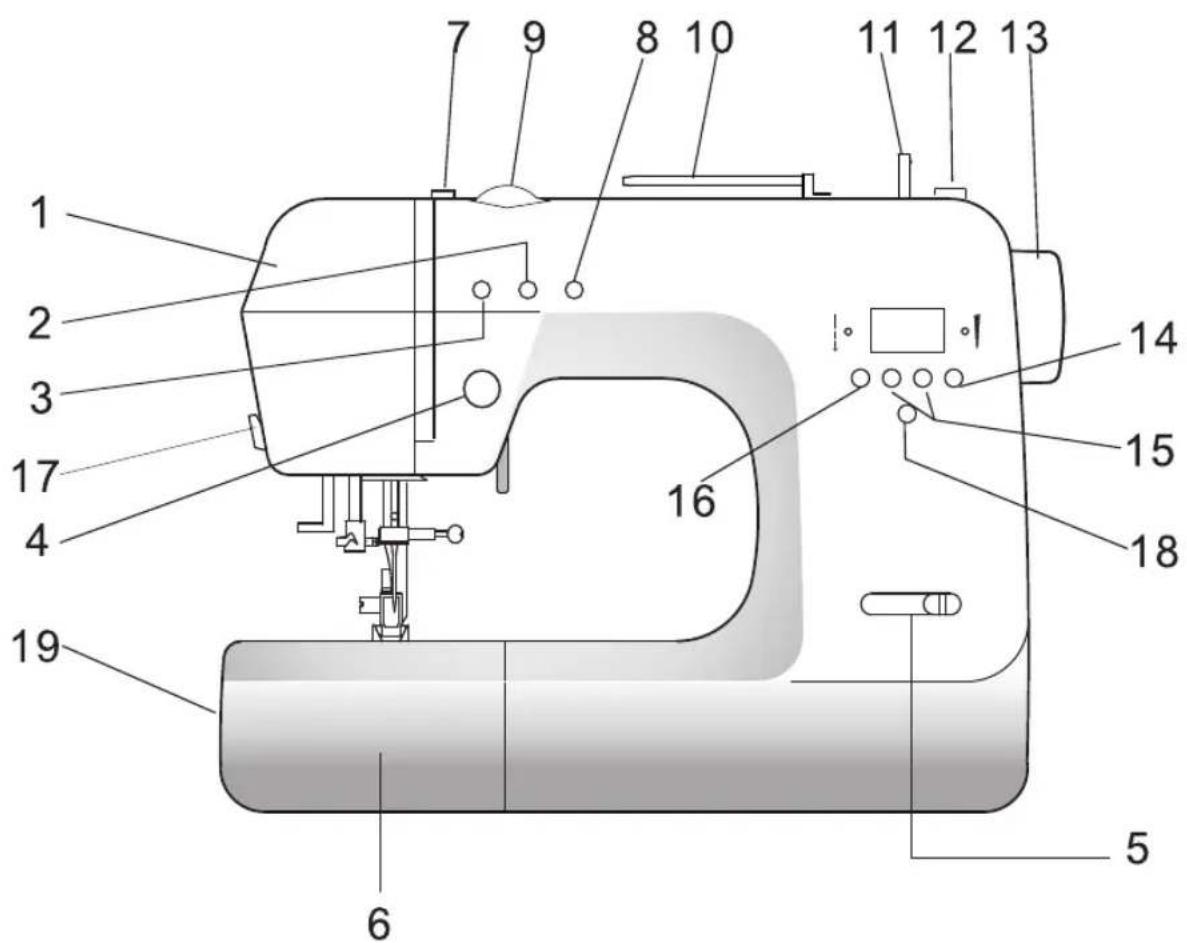
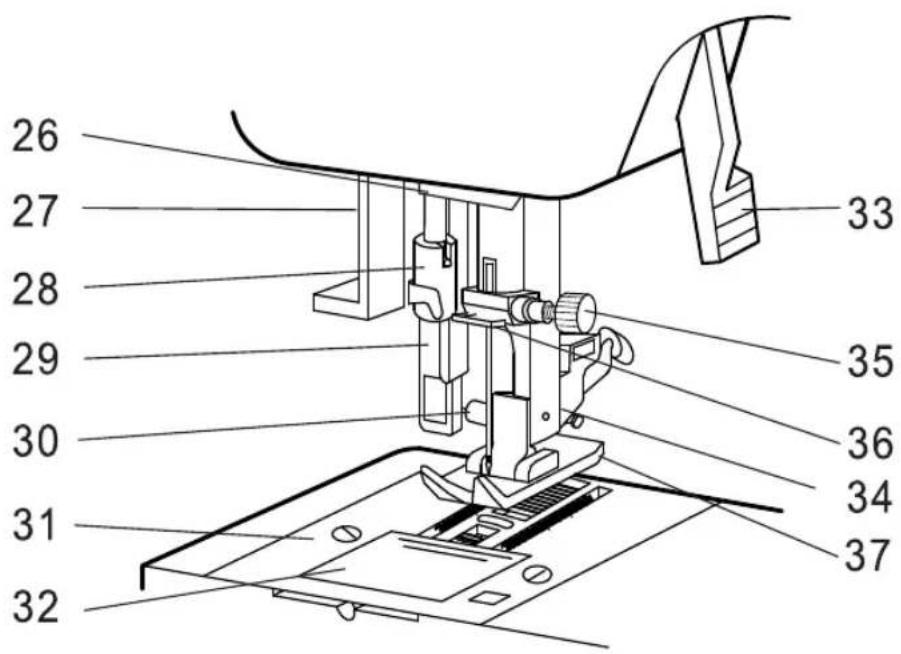
- Face Cover
- Reverse Stitch Button
- Lock Stitch Button
- Start/Stop Button
- Sewing Speed Controller
- Flat bed attachment with Accessory Compartment
- Upper Thread Guide
- Needle Up/Down Button
-
Thread Tension Dial
-
Horizontal Spool Pin
- Bobbin Winder Shaft
- Bobbin Winder Stop
- Handwheel
- Stitch Width Button
- Pattern Selector Buttons
- Stitch Length Button
- Thread Cutter
- Forward Button
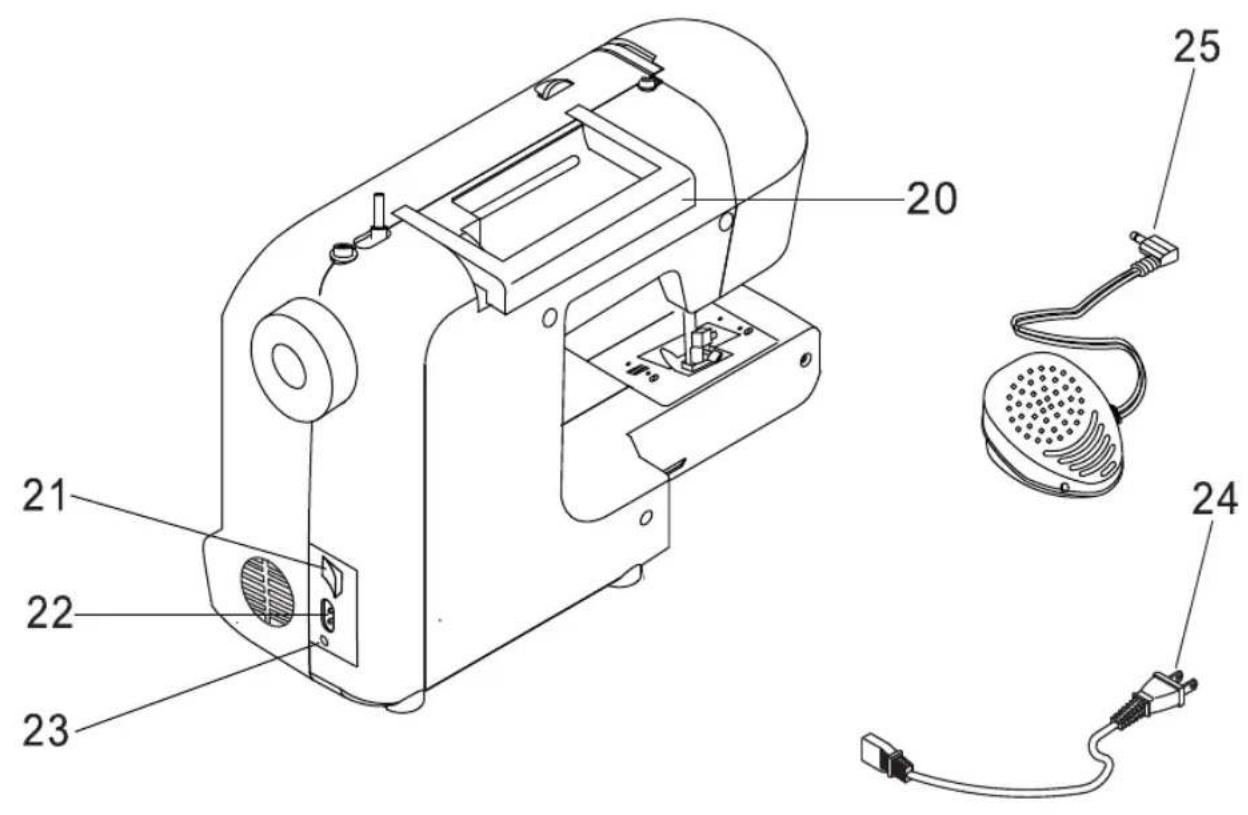
- Carrying Handle
- Main Power Switch
- Power Cord Receptacle
- Foot Controller Jack
- Power Cord
- Foot Controller
- Lower Thread Guide
- Needle Threader Lever
- Needle Threader
- Buttonhole Lever
- Presser Foot Holder Screw
- Needle Plate
- Bobbin Cover
- Presser Foot Lever
- Presser Foot Holder
- Needle Clamp Screw
- Needle Bar Thread Guide
- Presser Foot
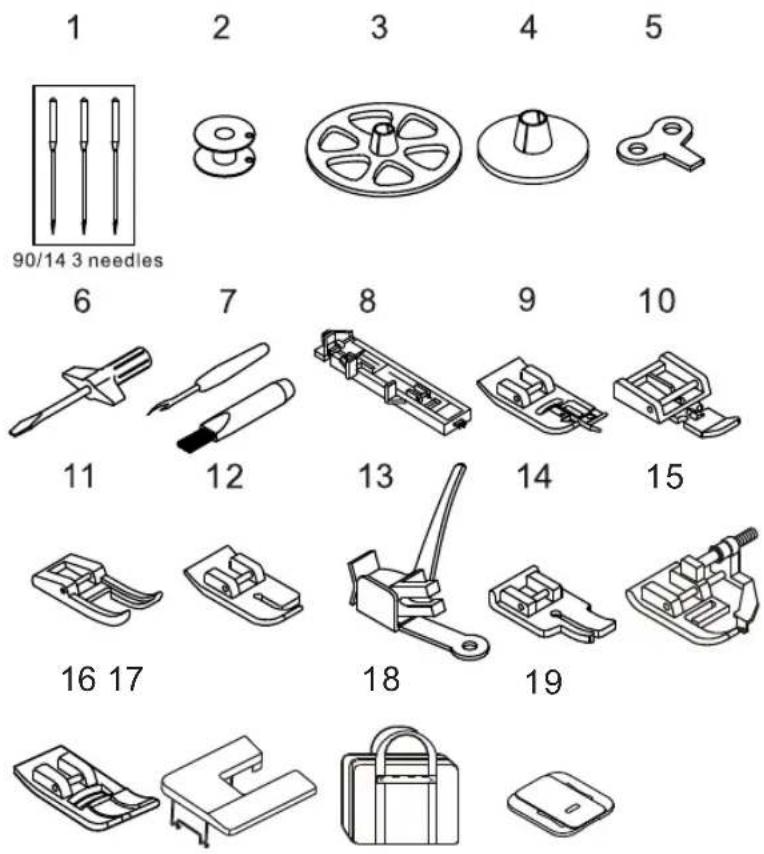
Some accessories are provided in the accessory case.
- Needle Set
- Bobbin(4) (one in machine)
- Spool Cap(large)
- Spool Cap(small)
- Needle Plate Screwdriver
- Screwdriver(small)
- Seam Ripper with Brush
- Buttonhole Foot
- Overcasting Foot
- Zipper Foot
- Open Toe Foot
- Straight Stitch Foot
- Darning Foot
- 1/4 Inch Foot
- Blind Hem Foot
- All Purpose Foot (on machine)
- Large Extension Table
- Tote Bag
- Darning Plate
FLAT BED ATTACHMENT WITH ACCESSORY COMPARTMENT
Accessories can be stored in the flat bed attachment within the accessory compartment.
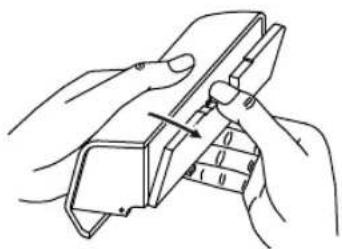
OPENING THE ACCESSORY COMPARTMENT
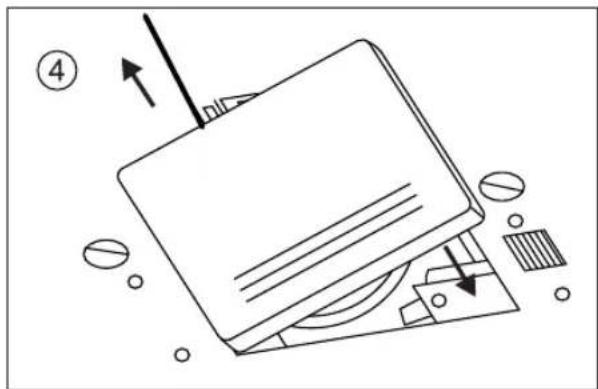
To open the accessory compartment, remove flat bed attachment from machine, turn attachment so the inside of the compartment is facing you. Slip thumb into opening and pull down.
natural_image
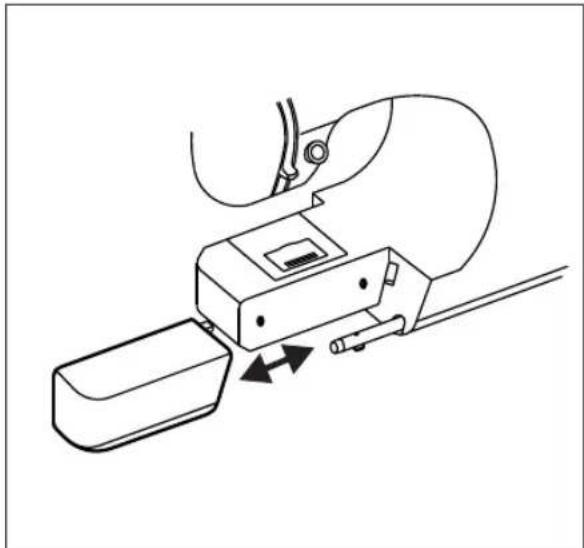
Line drawing of hands using a pliers to measure a tool (no text or symbols present)a.REMOVING THE FLAT BED ATTACHMENT
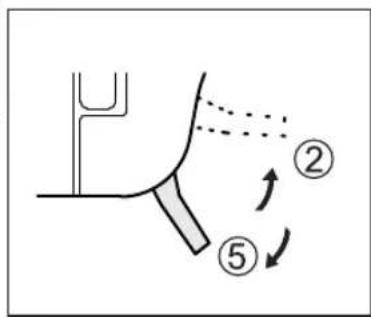
① Pull the flat bed attachment off to the left.
▶ With the flat bed attachment removed, free arm sewing is available for another sewing purpose.
② Install the flat bed attachment back in its original position.
natural_image
Technical line drawing of a mechanical device with two arrows indicating motion or movement (no text or symbols)LARGE EXTENSION TABLE
For a larger sewing surface, attach the large extension table.
① Pull the flat bed attachment off to the left.
② Lower the metal leg of the large extension table until it clicks into position.
③ Slide the large extension table to the right and into position.

natural_image
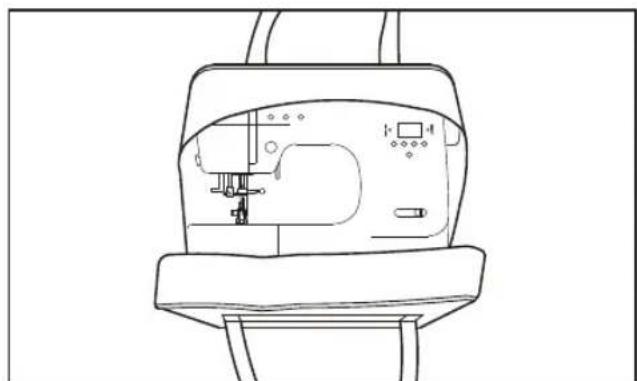
Technical line drawing of a mechanical assembly with no visible text or symbolsTOTE BAG
Unzip the tote bag for placing or removing the machine. Tote bag can be used for storing or carrying the machine.
natural_image
Line drawing of a sewing machine with no visible text or symbolsThe presser foot must be changed according to the stitch you sew, or work you do.

CAUTION: To prevent accidents.
Turn OFF the power switch before you change the presser foot.
- Turn the handwheel toward you until the needle is at its highest position.
- Raise the presser foot lever.
- Remove the presser foot by pushing the presser foot release lever toward you.
- Place desired foot with its pin Ⓐ directly under the slot Ⓑ in presser foot holder.
- Lower the presser foot lever and presser foot will snap into the place
REMOVING THE PRESSER FOOT HOLDER
You may need to remove the presser foot holder to use other presser feet.
To remove, raise the presser foot lever and loosen the presser foot holder screw (C).
To attach, tighten the screw after raising the presser foot holder.
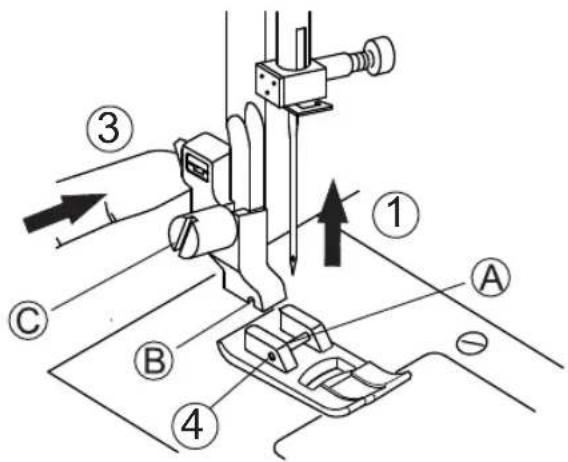
Ⓐ Presser foot pin
⑧ Presser foot holder slot
© Presser foot holder screw
CHANGING THE NEEDLE
Select a needle of the right type and size for the fabric to be sewn.
(See Fabric, Thread and Needle Table on page 18.)

CAUTION: To prevent accidents.
Turn OFF the power before removing the needle.
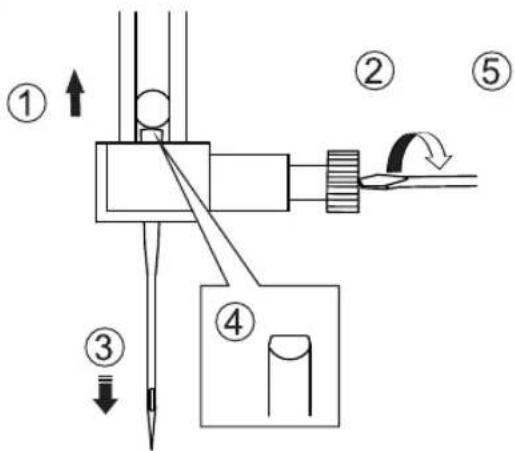
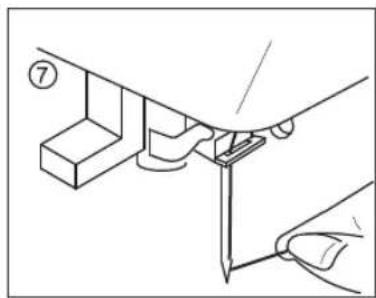
- Turn the handwheel toward you until the needle is at its highest position.
- Loosen the needle clamp screw with screwdriver.
- Remove the needle.
- Insert new needle into needle clamp with the flat side to the back and push it up as far as it will go.
- Tighten the needle clamp screw.
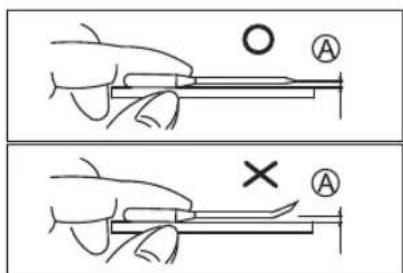
A. Place needle on a flat surface and check to see if bent.
Do Not use any bent or blunt needles.
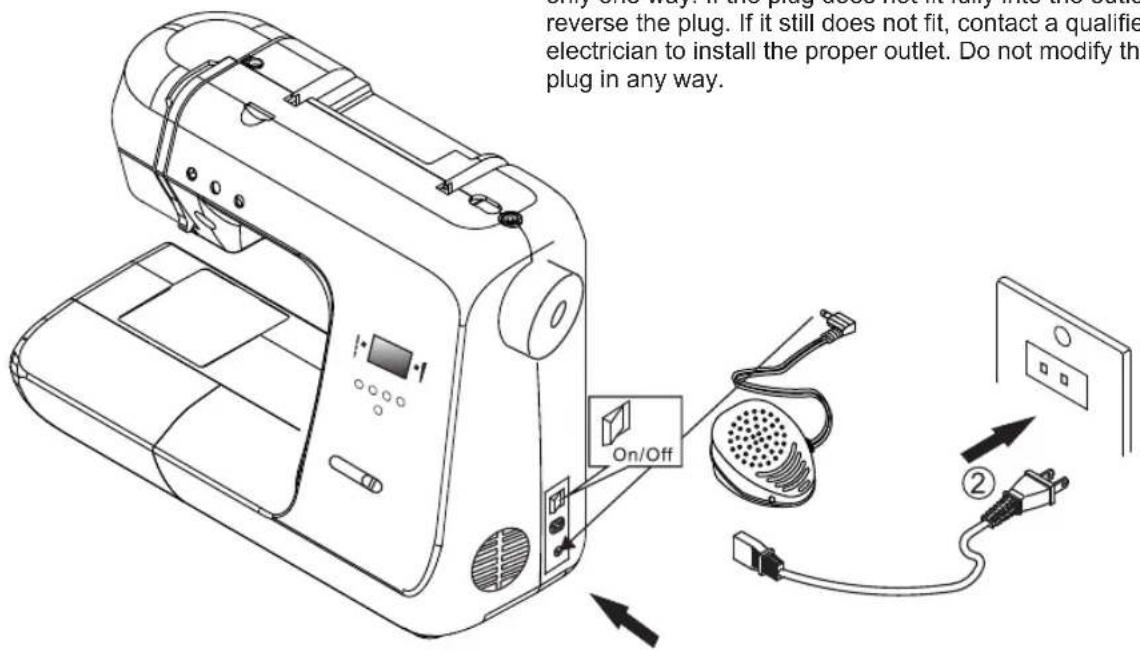
Place the machine on a stable table.
- Connect the power cord to the machine by inserting the 2-hole plug into the plug socket.
- Connect the power cord plug to the electric outlet.
- Turn "ON" the power switch.
- A lamp will light up when switch is turned on.
- To disconnect, turn the power switch to the "OFF" position, then remove plug from outlet.

Note
This appliance has a polarized plug(one blade wider than the other). To reduce the risk of electrical shock, this plug is intended to fit in a polarized outlet only one way. If the plug does not fit fully into the outlet reverse the plug. If it still does not fit, contact a qualified electrician to install the proper outlet. Do not modify the plug in any way.

DANGER:
-To reduce the risk of electric shock.
Never leave the machine unattended when plugged in. Always unplug this machine from the electric outlet immediately after using and before maintenance.

WARNING:
-To reduce the risk of burns, fire, electric shock, or injury to persons.
Do not unplug by pulling on the cord. To unplug, grasp the plug, not the cord.
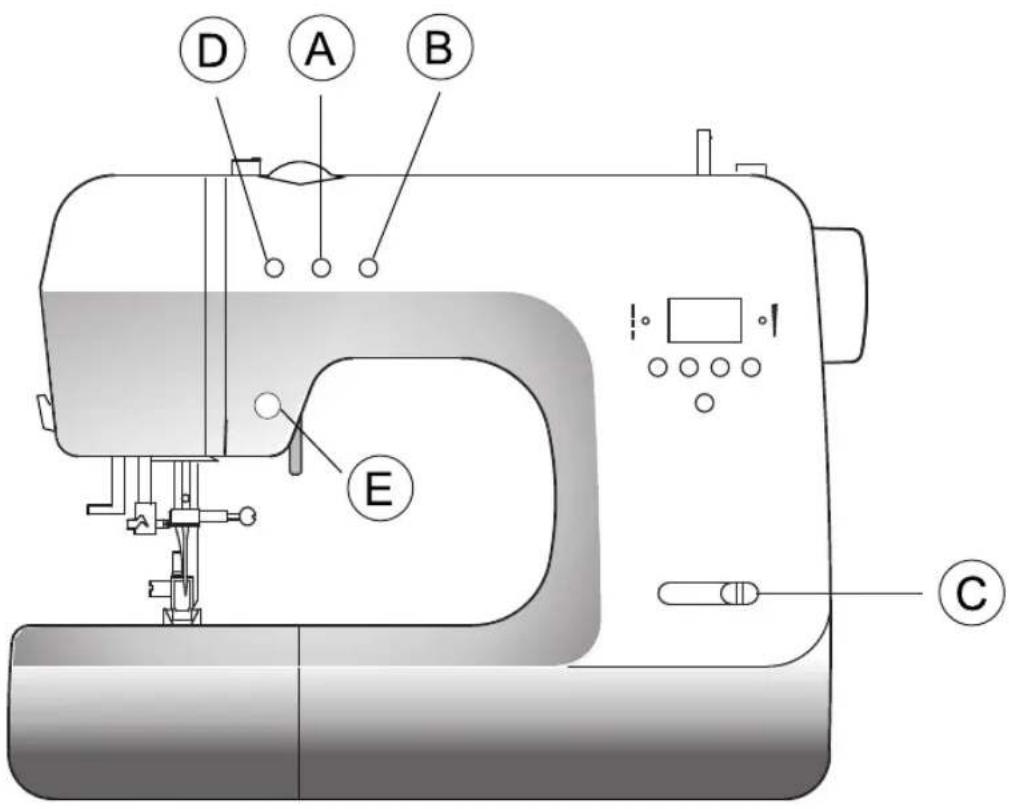
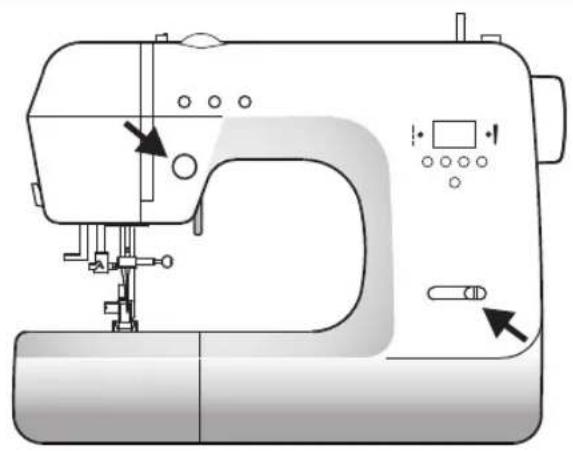
A. REVERSE STITCH BUTTON
- Stitches 1, 2 and 6: The REVERSE STITCH button will sew in reverse while the button is pressed and return to forward stitching when the button is released.
- Other stitches: The REVERSE STITCH button will sew 3-4 stitches to tie-off the stitching and then stop sewing. Continue sewing by pressing the START/STOP button or foot control.
B. NEEDLE UP/DOWN BUTTON
- Press the needle up /down button to raise or lower the needle. Pressing the button twice sews one stitch.
- The needle may be set so it will stop in the DOWN position or UP position.
C. SEWING SPEED CONTROLLER
Slide the sewing speed controller to right or left to adjust the sewing speed.
D. Ⓞ LOCK STITCH
Stop machine and then press Lock Stitch button to sew 4 tie-off stitches at same position. Machine will then automatically stop.
E. START/STOP BUTTON
The machine will start running when START/STOP button is pressed and will stop when pressed the second time. The machine will stitch slowly for the first 3 stitches.

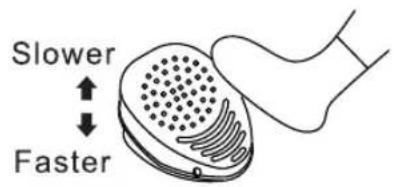
CAUTION: To prevent accidents.
- Turn off the power switch.
- Push foot controller plug into receptacle on machine.
- Place foot controller at your feet and turn on power switch. Sew faster by increasing the pressure on the controller. To stop, remove your foot from the controller.
natural_image
Line drawing of a sewing machine with control panel and buttons (no text or symbols)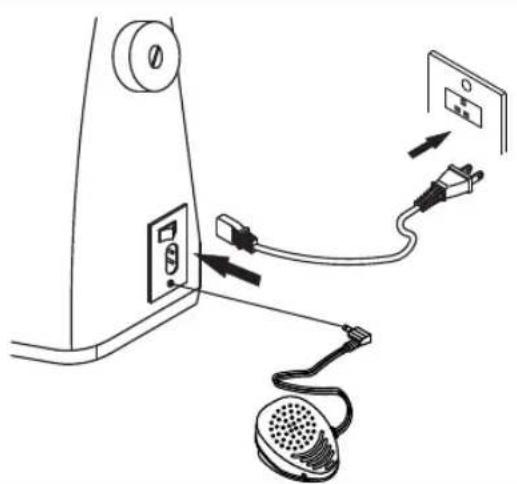
natural_image
Diagram showing connections between a speaker, cable, and wall-mounted device (no text or symbols present)CONTROL BUTTON FUNCTIONS
The control button functions described in previous page will change when the foot control is connected.
- START/STOP BUTTON
This button will be deactivated.
• REVERSE STITCH BUTTON
When using stitches 1,2 and 6, the machine will continue to sew reverse at slow speed while this button is pressed. When released, the machine will sew forward.
When sewing other stitches, the reverse stitch button is used as a reinforcement stitch.
• SEWING SPEED CONTROLLER
The sewing speed controller only functions while using the START/STOP button. It will not operate when foot control is being used.
SAFETY FEATURE OF ELECTRONIC MODEL
If the machine is jammed, it will stop with three beep sounds. After the cause of jamming is removed, step on the foot control and it will run in normal condition.

WARNING:
-To reduce the risk of burns, fire, electric shock, or injury to persons.
- Handle the foot controller with care and avoid dropping it on the floor. Be sure not to place anything on top of it.
- Use only foot controller provided with this machine. If replacement is necessary, use electronic Model YSD180034(USA only)
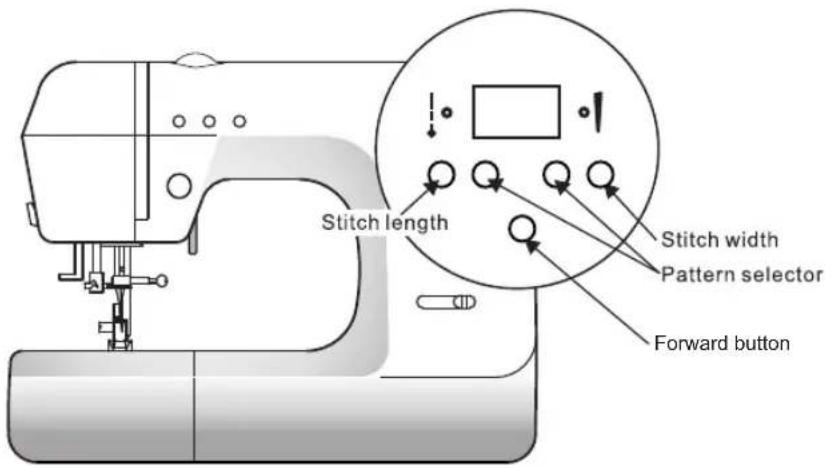
- Stitch length :
Press stitch length button, indicator light, LED display auto change to show the size of stitch length. - Stitch width :
Press stitch width button, indicator light, LED display auto change to show the size of stitch width.
- Pattern selector :
Press pattern selector button; LED displays number.
To choose the various pattern selections press the pattern selector buttons.
| 01 | 02 | 03 | 04 | 05 | 06 | 07 | 08 | 09 | 10 | 11 | 12 | 13 | 14 |
| 15 | 16 | 17 | 18 | 19 | 20 | 21 | 22 | 23 | 24 | 25 | 26 | 27 | 28 |
| 29 | 30 | 31 | 32 | 33 | 34 | 35 | 36 | 37 | 38 | 39 | 40 | 41 | 42 |
| 43 | 44 | 45 | 46 | 47 | 48 | 49 | 50 | 51 | 52 | 53 | 54 | 55 | 56 |
| 57 | 58 | 59 | 60 | 61 | 62 | 63 | 64 | 65 | 66 | 67 | 68 | 69 | 70 |
| 71 | 72 | 73 | 74 | 75 | 76 | 77 | 78 | 79 | 80 | 81 | 82 | 83 | 84 |
| H | I | J | K | L | M | N | O | P | Q | R | S | T | U |
| 85 | 86 | 87 | 88 | 89 | 90 | 91 | 92 | 93 | 94 | 95 | 96 | 97 | 98 |
| V | W | X | Y | Z | 0 | 1 | 2 | 3 | 4 | 5 | 6 | 7 | 8 |
| 99 | |||||||||||||
| 9 |
- Forward button :
By pressing the forward button, the pattern will jump 10 patterns each time the button is pressed. This allows easy access for selection of pattern.
REMOVING THE BOBBIN
-
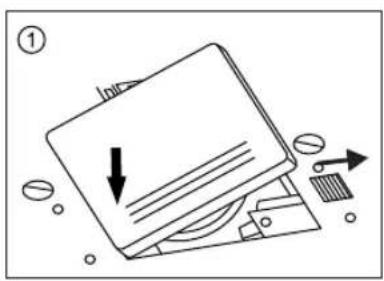
Remove the bobbin cover by sliding the bobbin cover latch to right and push down the left lower corner of this cover at same time.
-
Remove the bobbin from the machine.
natural_image
Diagram of a document being compressed with arrows indicating compression or dislocation (no text or symbols present)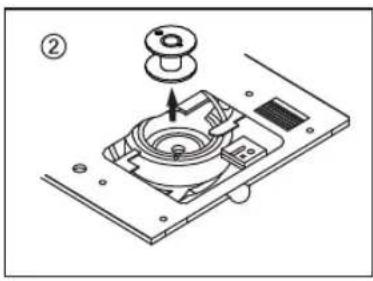
natural_image
Mechanical assembly diagram showing a component with a knob and housing (no text or symbols)WINDING THE BOBBIN
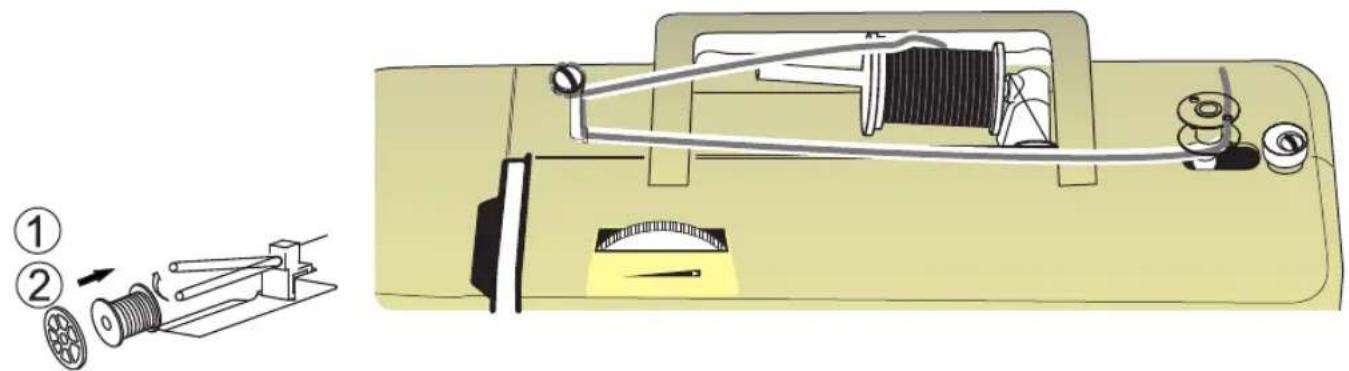
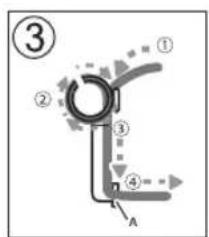
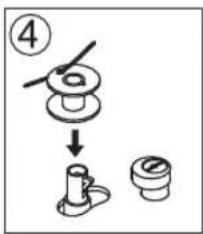
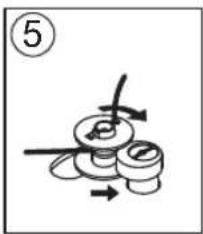
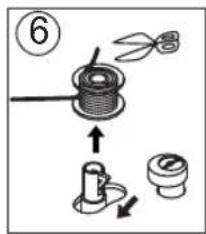
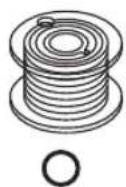
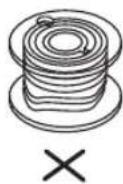

Use a bobbin that has been correctly wound with thread, otherwise the needle may break or the thread tension will be incorrect.
- Slightly raise horizontal spool pin.
- Slide a spool of thread onto the spool pin so the thread unwinds to the front from the top of the thread spool. Secure it with the spool cap that best fits the size of spool being used to ensure smooth flow of thread.
- Pass thread from spool around and under the upper thread guide as shown.
- Pull end of thread through hole in bobbin as shown.
- Make sure the bobbin winder shaft is in left position. Place bobbin onto shaft and rotate until it snaps into position with end of thread coming from top of bobbin.
- Start machine to wind bobbin. Stop machine after several turns to trim the thread tail with scissors. Bobbin will cease turning when completely filled. Cut thread and push shaft to the left to remove bobbin.
INSERTING THE BOBBIN
-
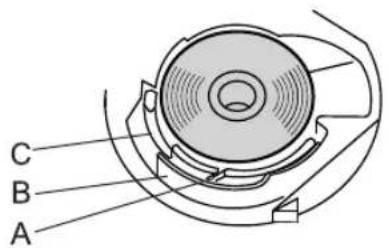
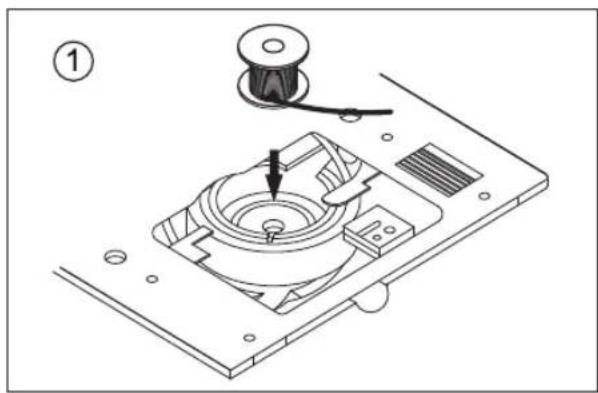
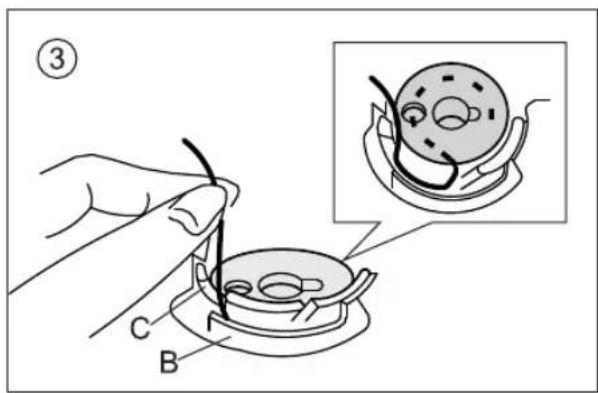
Insert the bobbin into bobbin case with the thread unwinding counterclockwise.
-
Draw thread into notch (A).
-
Pull thread toward the left and along the inside of spring (B) until it slips into notch (C) being sure that thread does not slip out of notch (A).
- Pull thread out about 10 inches and replace the bobbin cover.
natural_image
Technical line drawing of a mechanical device with a spool and internal components (no text or symbols)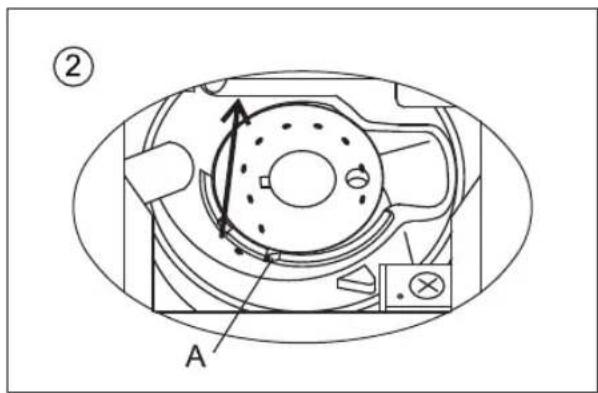
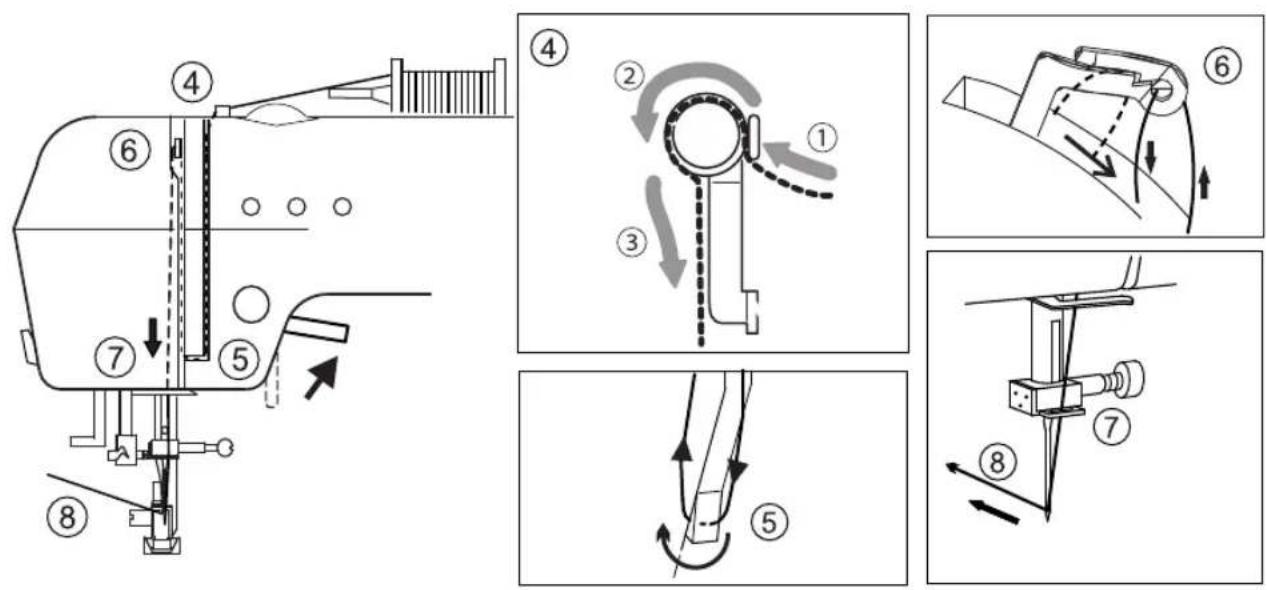
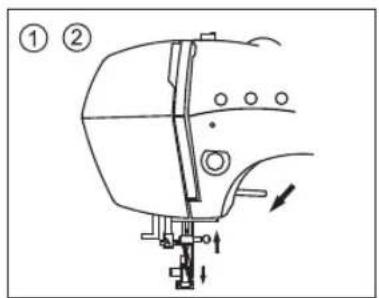
THREADING THE UPPER THREAD
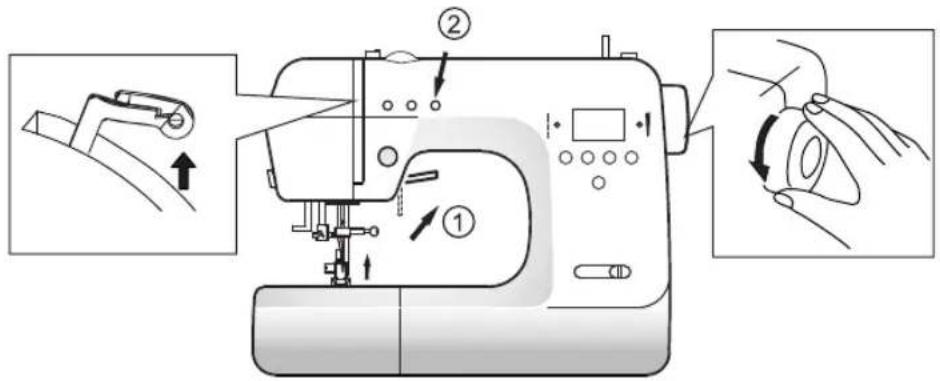
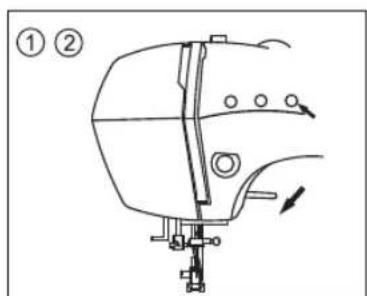
- Raise presser foot lever.
- Press the needle up/down button or rotate the handwheel toward you to raise the needle into the up position.
- Place a spool of thread onto the spool pin and secure with the proper size spool cap.(see page 11)
- Pass the thread around upper thread guide for upper threading.
- Bring thread forward down the right channel, then to the left and up the left channel.
- Pull the thread through and into the take-up lever from right to left.
- Pass the thread down the left channel and into the lower thread guide. Slide the thread from right to left into the thread guide on the needle clamp.
- Thread the needle from front to back or follow directions for using the needle threader.(see page 14)
NEEDLE THREADER
- Lower the presser foot.
- Set needle in up position.
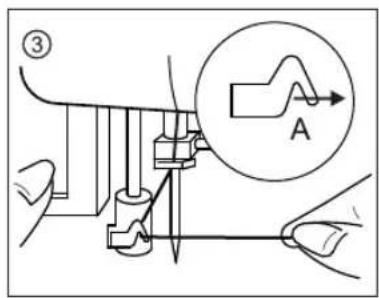
- Lower the threader slowly and draw thread through thread guide(A) and pull toward the right.
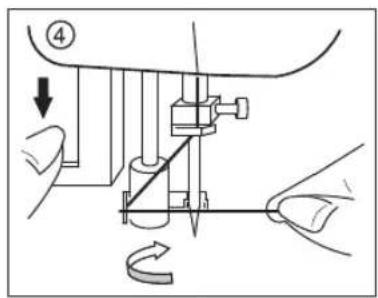
- Lower the lever as far as it will go so the threader turns and the hook pin will go through the needle eye.
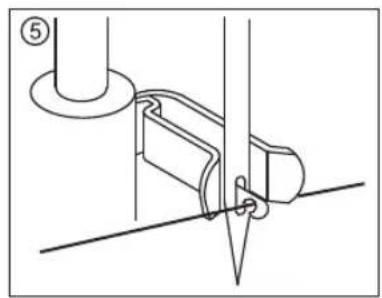
- Position thread below the needle eye and under the hook pin.
- Hold thread loosely and release the lever. Hook will turn and pass thread through needle eye while making a loop.
- Raise presser foot and pull thread out about 10 inches from needle eye. Note: The needle threader is used for needle sizes 11, 14 and 16.
natural_image
Technical line drawing of a mechanical assembly with no visible text or symbols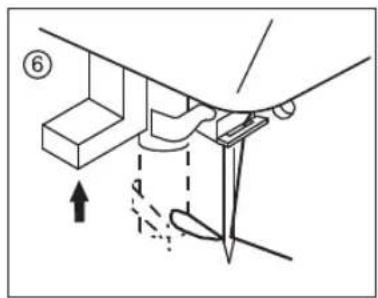
natural_image
Technical line drawing of a mechanical assembly with a tool inserted (no text or symbols)
CAUTION: To prevent accidents.
Do not lower the threader lever while machine is operating.
DRAWING UP THE BOBBIN THREAD
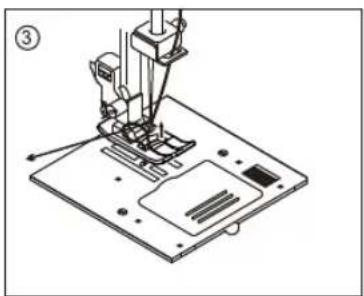
- Raise the presser foot.
2.Hold the upper thread loosely and press needle up/down button twice. The handwheel will turn one complete turn. - Pull upper thread lightly. Bobbin thread will come up in a loop.
- Pull both upper and bobbin threads about 10 inches toward the back and under the presser foot.
natural_image
Technical line drawing of a sewing machine on a base plate (no text or symbols)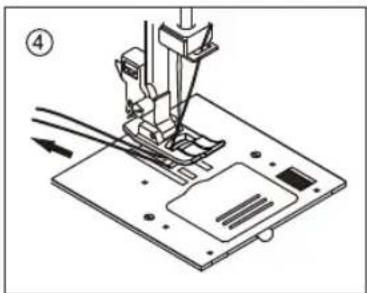
natural_image
Technical line drawing of a sewing machine needle stitching on a base plate (no text or symbols)The machine will be set at 01 automatically to sew straight stitches when power switch is turned on.
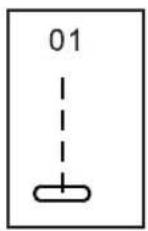

CAUTION: To prevent accidents.
While sewing, special care is required around the needle.
The machine will automatically feed the fabric, do not pull or push fabric.
Simply guide the fabric to sew straight.
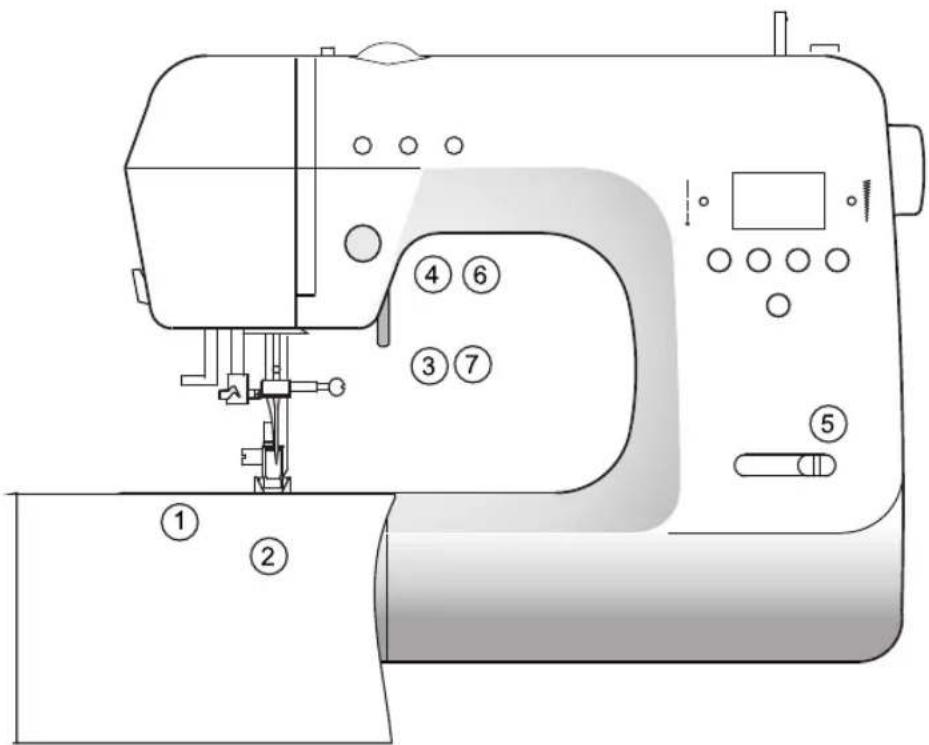
natural_image
Line drawing of a sewing machine needle insertion into a garment, showing no text or symbols- Check the presser foot (All Purpose Presser Foot). Refer to page 6 for changing the presser foot.
- Place the fabric under the presser foot.
- Lower the presser foot.
- Hold both threads to the back when starting to sew. Let threads go after sewing a few stitches.
- While sewing regulate the speed with sliding speed control lever or foot control.
- Stop machine when you reach end of seam.
- Raise the presser foot lifter.
- When you have reached the end of a seam, stop sewing and turn the handwheel toward you to bring the needle to highest position. Raise the presser foot and pull the fabric out from under the foot to the back of the machine.
Cut the threads with the thread cutter on left side of the machine.
REVERSE STITCHING
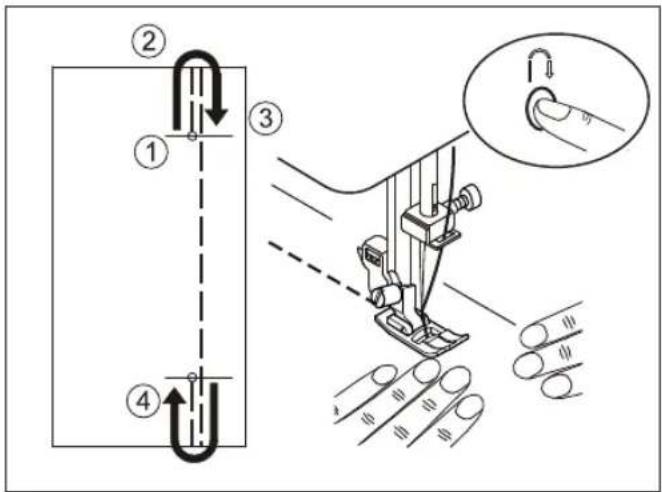
Reverse stitching is used for reinforcing the ends of the seams.
- Place the fabric in position where back stitching is to be made and lower the presser foot.
- Press reverse stitch button and sew 4-5 stitches. (If using foot control, press pedal while pressing reverse stitch button.)
- Press start button and resume sewing. (If using foot control, release reverse stitch button and press foot control to sew forward.)
- When you reach the end of seam, press reverse stitch button and sew 4-5 reverse stitches.
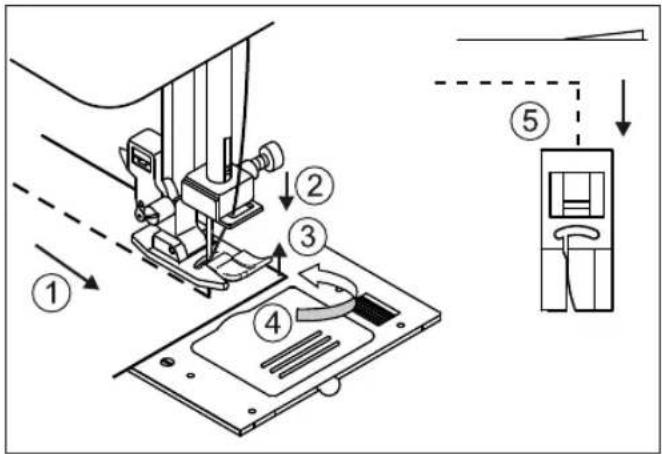
TURNING CORNERS
- Stop the machine when you reach a corner.
- Lower needle into the fabric.
To lower the needle, you can either use the needle up/down button or turn the handwheel toward you. - Raise the presser foot.
- Use the needle as a pivot and turn fabric.
- Lower the presser foot and resume sewing.
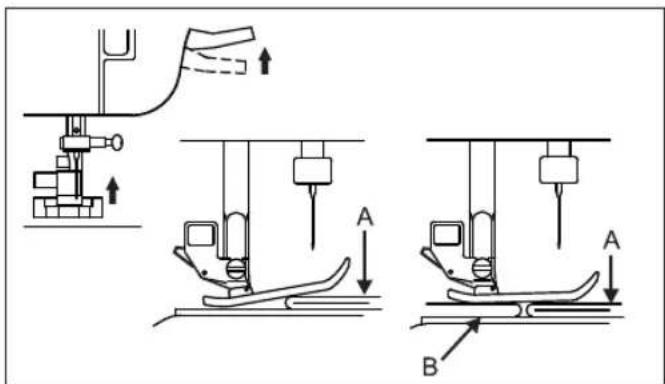
SEWING HEAVY FABRIC
When sewing heavy fabrics, the toe end of presser foot tends to lift up and sewing will hesitate at the point that the fabric is thicker. In this case, place a piece of cardboard or fabric of same thickness under the heel end of the presser foot.
- The presser foot lever can be raised 1 step higher for placing heavy materials under the presser foot easily.
Carefully guide the fabric with your hand when sewing over thick fabric areas.
A: Fabric B: Thick paper or fabric
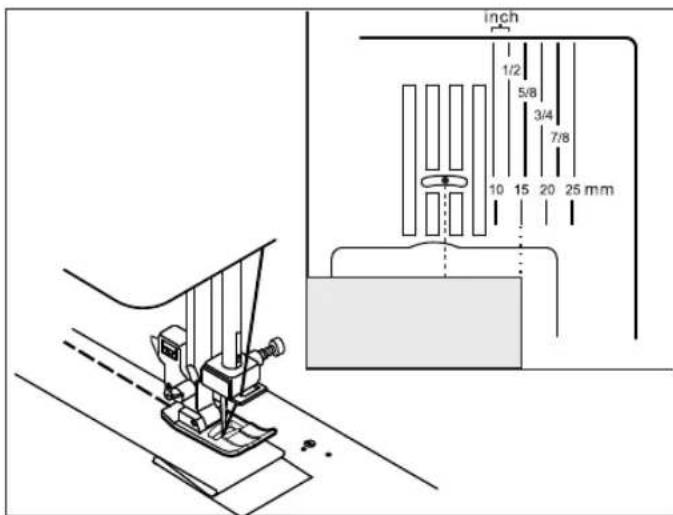
SEAM GUIDE ON THE STITCH PLATE
The figure on each guide line on the stitch plate indicates the distance between this guide line and the center needle position. Guide the fabric along the specific guide line in order to get the desired seam allowance between the stitching and the edge of the fabric.
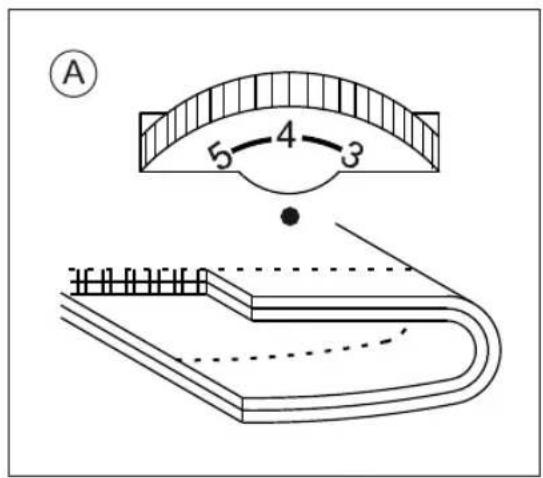
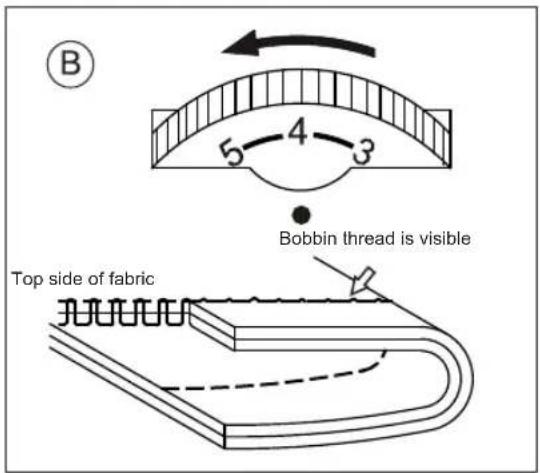
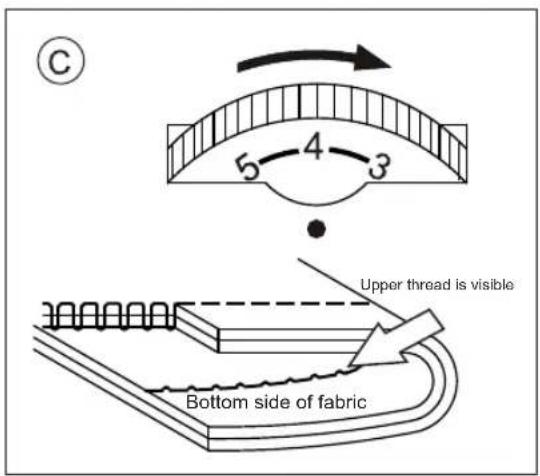
The thread tension must be properly balanced. If adjustment is required, it can be made by changing the upper thread tension.
A. Correct Thread Tension
Upper and bobbin threads should interlock approximately in the middle of fabric.
B. When bobbin thread appears on top side of fabric.
Turn the tension dial to a lower number to loosen the upper thread tension.
C. When upper thread appears on the bottom side of fabric.
Turn the tension dial to a higher number to tighten the upper thread tension
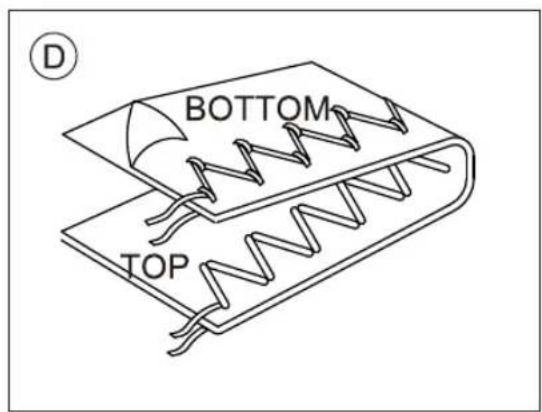
D.Thread Tension for Zigzag Stitches
To sew zigzag stitches, the thread tension should be set to a slightly weaker tension than when sewing straight stitches.
You will obtain a nicer stitch when upper thread appears slightly on bottom side of fabric.
- Helpful Hint
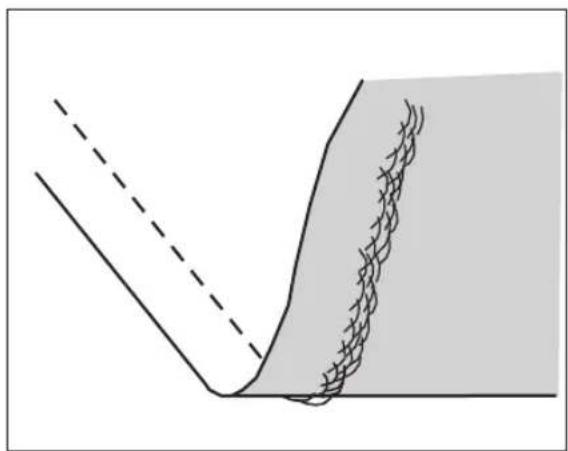
Like shown in drawing, stitches on top side of fabric are good but bottom side tends to have a bunch of thread, it usually means that the upper thread is not threaded correctly (especially threading of the upper thread tension regulator may not correct.) Refer to page 13 for correct threading.

CAUTION: To prevent accidents.
The feed dog will feed the fabric automatically. Do not pull or push on fabric with hands. It will cause needle breakages or poor quality stitches.
natural_image
Diagram showing a curved boundary with a shaded region and two dashed lines, no text or symbols present.FABRIC, THREAD AND NEEDLE TABLE
| Needle system | Needle size | ||||||||||||||||
| Ha×1 | 5 | 7 | 8 | 9 | 10 | 11 | 12 | 13 | 14 | 16 | 18 | 19 | 20 | 21 | 22 | 23 | |
| System 705 | 45 | 55 | 60 | 65 | 70 | 75 | 80 | 85 | 90 | 100 | 110 | 120 | 125 | 130 | 140 | 160 | |
Select size of thread and needle in accordance with fabric to be sewn.
| Type of Fabric | Thread Size | Needle Size |
| ● Light Weight-thin georgette, organdy, viole, taffeta, silk, etc. | Ctn.# 80 - 100Silk 60 - 80Syn. 80 - 100 | 70/09-75/1170/10-80/12 |
| ● Medium Weight-gingham, pique, linen, cotton, satin, thin corduroy, velvet | Ctn.# 50- 80Silk 50Syn. 50 - 80 | 80/12-90/14 |
| ● Heavy Weight-gabardine, tweed, denim, corduroy | Ctn.# 40 -50Silk 50Syn. 50 - 60 | 90/14-100/16 |
| ● Stretch-double knit, tricot, spandex, jersey | Ctn.# 50 - 80Silk 50Thread for knit | 80/12-90/14Needle for knit and synthetic fabric |
To change needle, see page 6.
Straight stitch patterns should be selected according to the type of fabric being sewn.
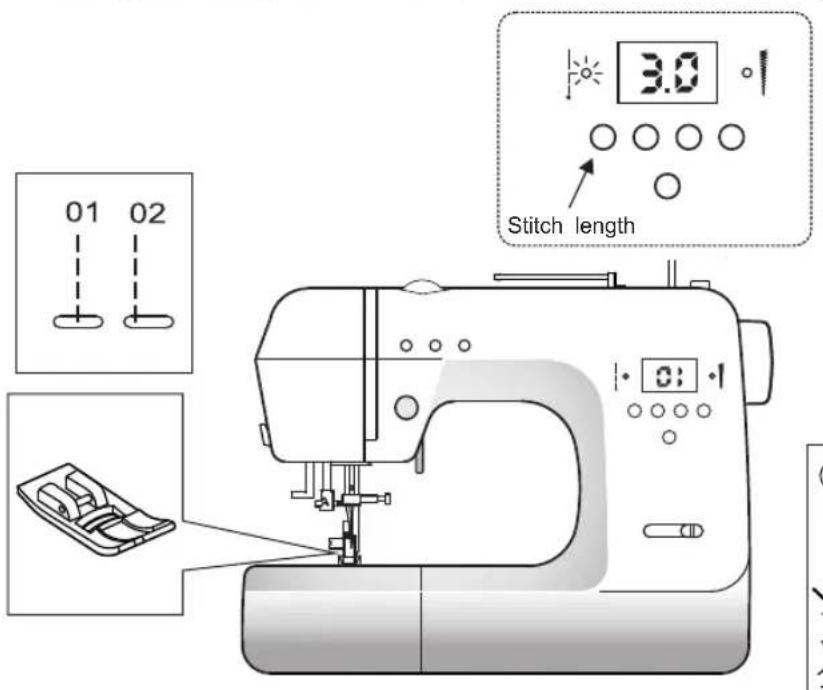
- Select the straight stitch pattern 01 or 02
- Attach all purpose foot.
- Adjust the stitch length and stitch width (see page 10) according to the type of fabric being sewn.
natural_image
Line drawing of a sewing machine needle being inserted into a hand (no text or symbols)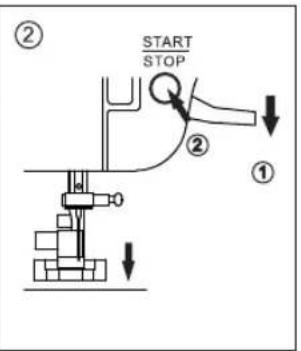
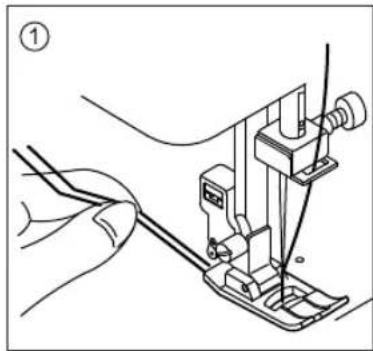
- Position the fabric under the presser foot and lower it. Hold the upper thread and bobbin thread loosely behind the presser foot.
-
Lower the presser foot lever and press START/STOP button to start sewing.
(When foot control is used, press the pedal.)
Place hand lightly on the fabric while sewing to guide the fabric. -
When you reach the end of seam, press the reverse button to sew 3-4 stitches.
-
Release the reverse button and stop sewing by pressing the START/STOP button (or releasing the pressure on foot control.)
-
Raise the presser foot and cut thread.
natural_image
Technical line drawing of a sewing machine on a cutting board, showing no text or symbols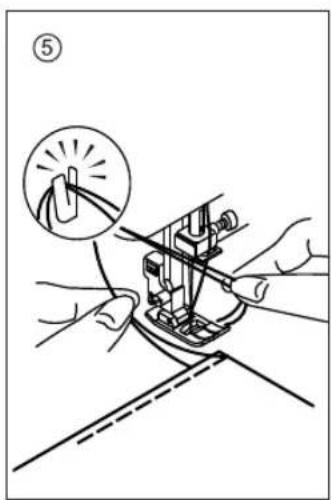
natural_image
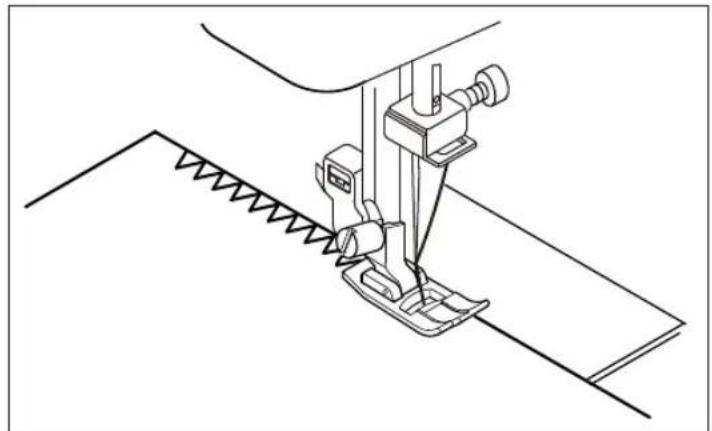
Illustration of hands operating a sewing machine with a magnified inset showing the tip and base (no text or symbols)Your machine can sew zigzag stitches of various widths and lengths by changing the settings of the stitch width and stitch length.
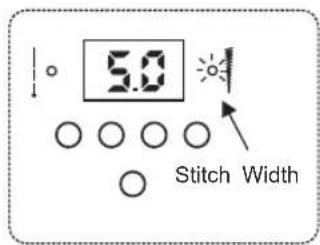
Zigzag stitches are very good for joining two pieces of fabrics, applique and sewing various decorative patterns.
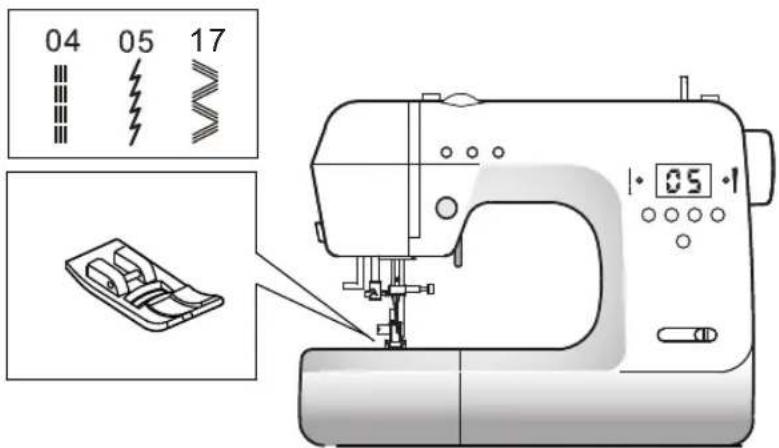
SATIN STITCHING
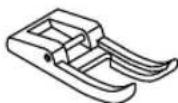
When you sew a satin stitch by shortening the stitch length, attach the open toe foot.
FREE ARM SEWING
natural_image
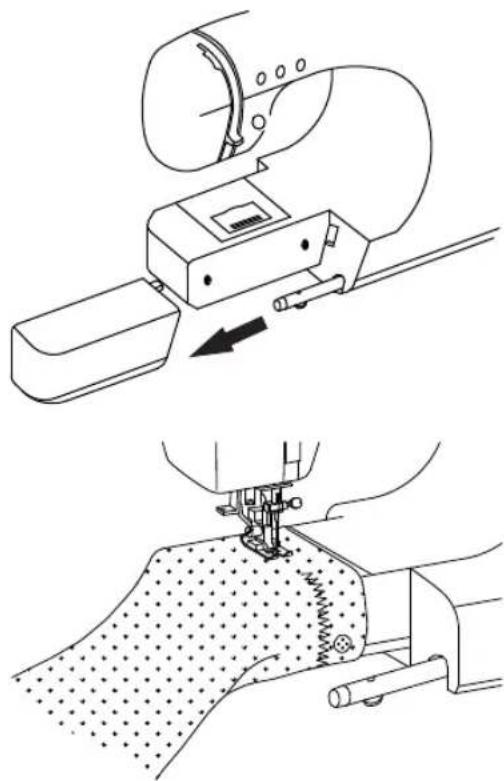
Line drawing of a sewing machine needle stitching fabric (no text or symbols)By simply removing the flat bed attachment, machine becomes a free arm machine making hard to reach areas readily accessible.
- Refer to page 5 for removing flat bed attachment.
natural_image
Technical line drawings of a sewing machine and fabric being sewn, showing mechanical components and fabric texture (no text or symbols)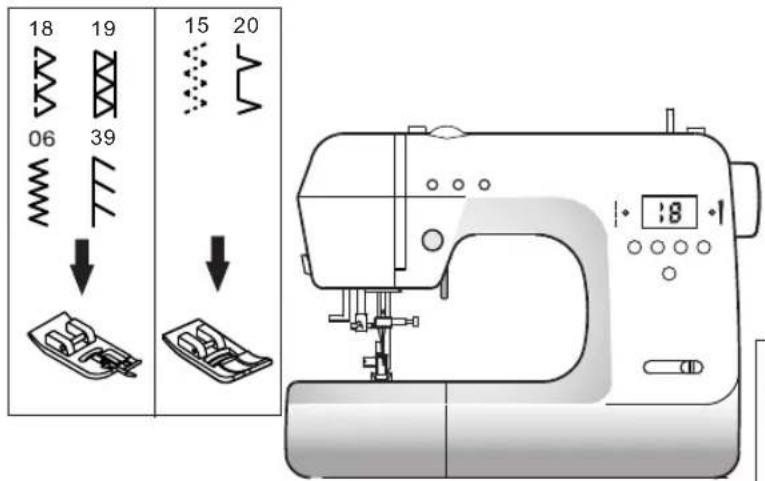
USING THE OVERCASTING FOOT
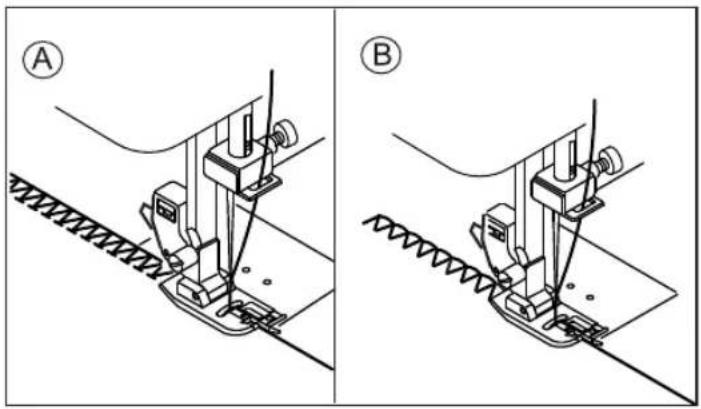
Position the fabric against the guide plate of the overcasting foot so that the needle falls near the edge of the fabric.
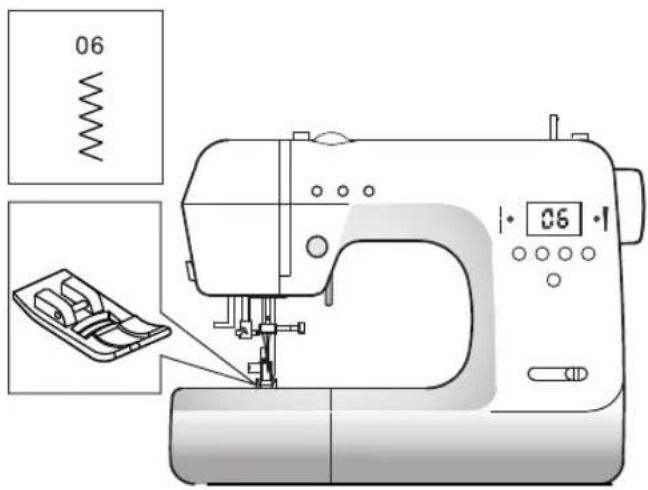
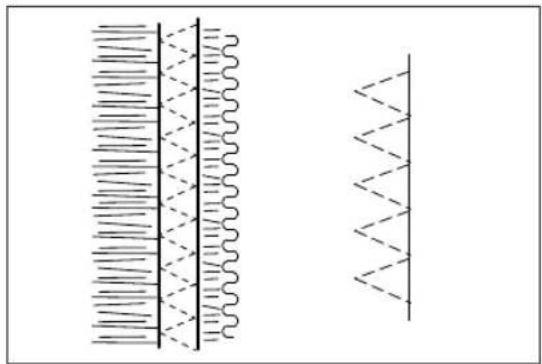
A. Overcasting stitches (width 7.0-5.0) are used for preventing raveling of fabrics.
B. Some stitches can sew the seam and overcasting at the same time. Therefore, it is convenient for sewing easy to ravel and stretch fabrics.

CAUTION: To prevent accidents.
Overcasting foot should be used for sewing patterns 06,18,19, and 39 only and do not change the stitch width narrower than 5.0 It is possible that needle could hit the presser foot and break when sewing other patterns and width.
USING THE ALL-PURPOSE FOOT
When using the all-purpose foot, place the fabric so that the needle will fall near the edge of fabric.
C. Use a narrower zigzag width for thin or fine fabrics.
D. Adjust the width and length for various weights of knit and stretch fabrics.(When using overcasting foot,do not change the width narrower than 5.0 mm
E. For 12 inch seam allowances, sew then trim the excess fabric close to the stitching. Be careful not to cut thread when cutting the fabric edge.
natural_image
Technical line drawing of a sewing machine with two views (A and B) showing mechanical components and stitching details (no text or symbols)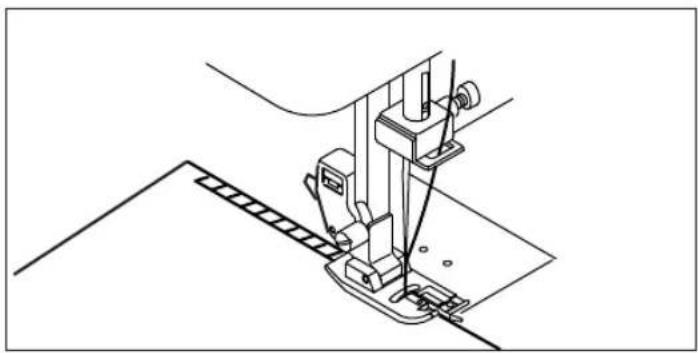
natural_image
Line drawing of a sewing machine needle stitching fabric (no text or symbols)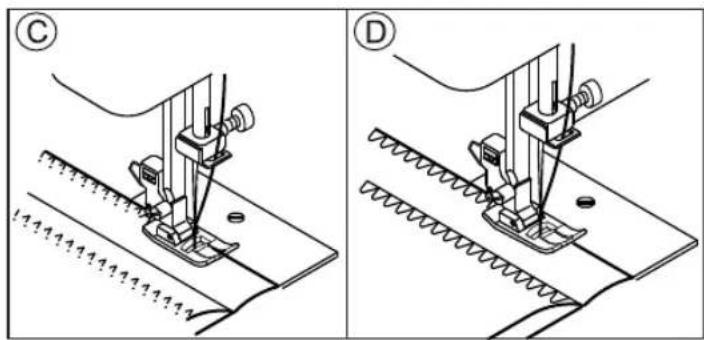
natural_image
Two technical line drawings of sewing machine stitching, labeled C and D, showing thread details without any text or symbols.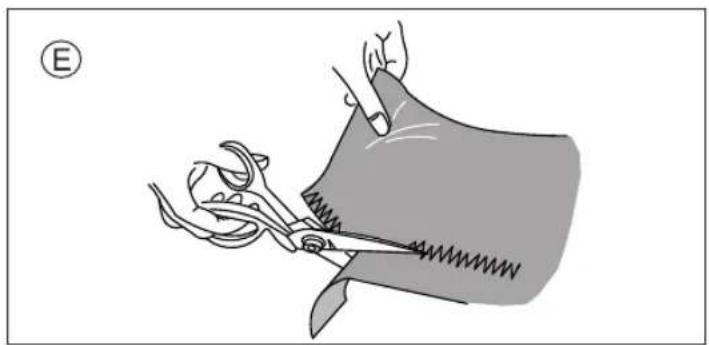
natural_image
Illustration of a hand using scissors to cut a piece of material, no text or symbols present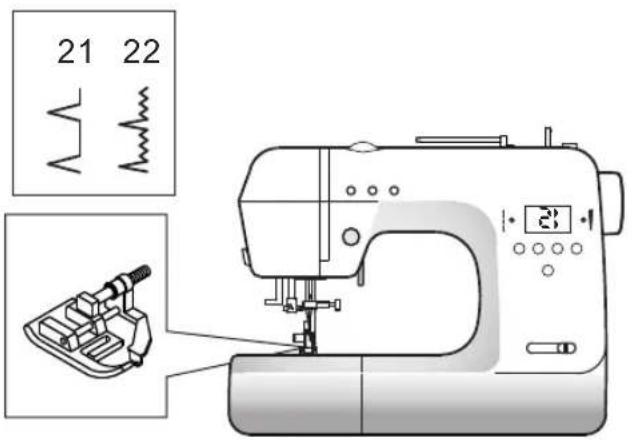
natural_image
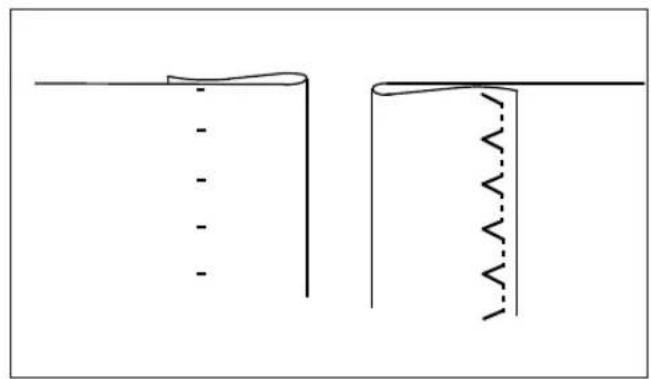
Pure technical line drawing of two mechanical joint configurations without any text or symbolsThis stitch will sew without stitches showing on right side of fabric.
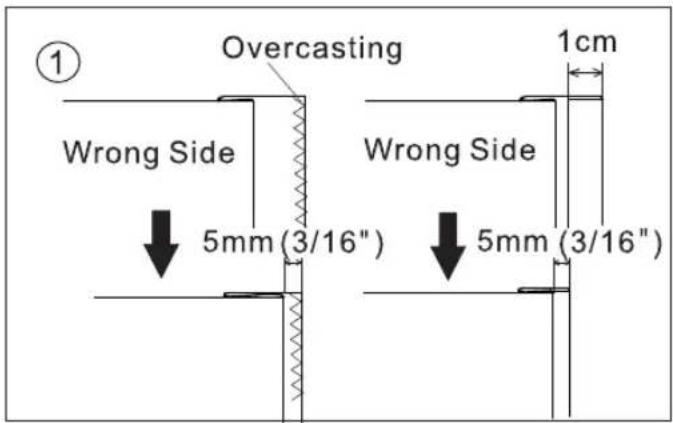
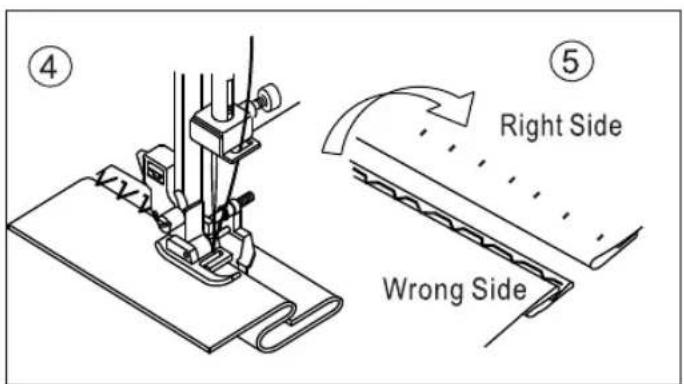
- Fold the fabric as shown on drawing. Leave 5mm (approximately 3/16 inch) extended past the folded edge.
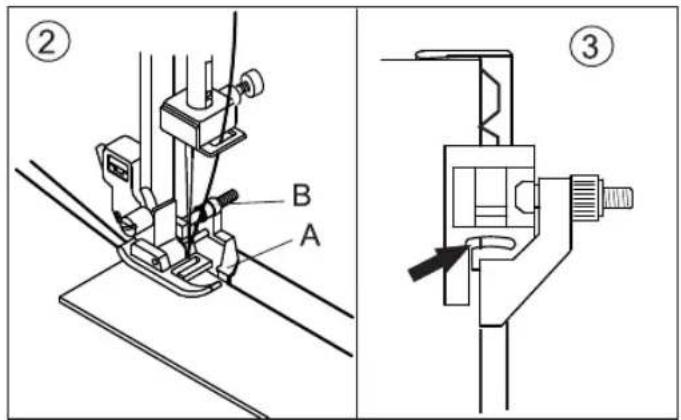
- The guide (A) on the blind hem foot ensures even feeding of the fabric when blind hem stitching. The guide (A) is adjusted by turning the adjusting screw (B).
- Place fabric so that the straight stitches are on the extended hem edge and the zigzag stitches just catch one thread of the folded edge. Turn the screw so that the guide barely touches the folded edge of fabric.
- Lower the presser foot and sew hem, guiding fabric evenly along the guide.
- Turn the fabric over when you have completed sewing.
Note:
If too much of the stitching shows on the right side of the fabric, change to a narrower stitch width or move the guide on the foot to the right.
If the zigzag does not meet the fold, widen the stitch width or move the guide on the foot to the left.
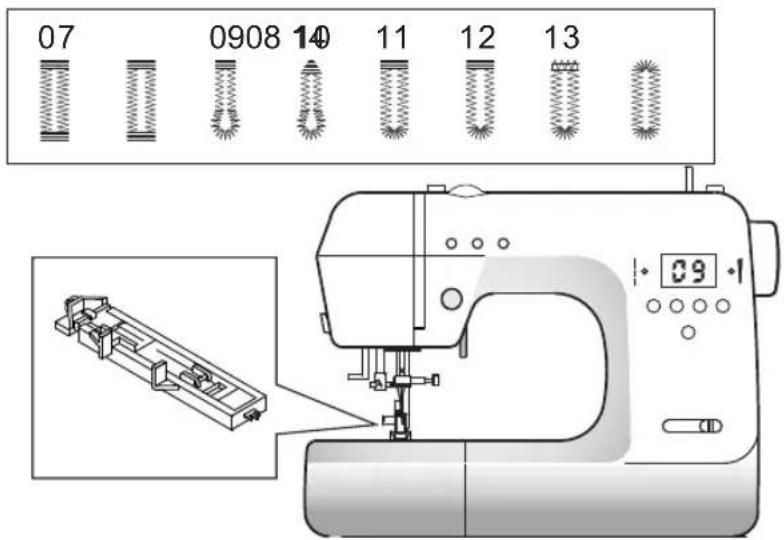
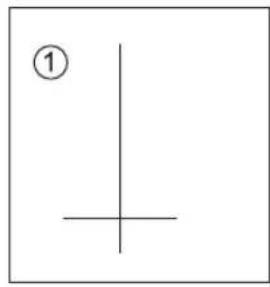
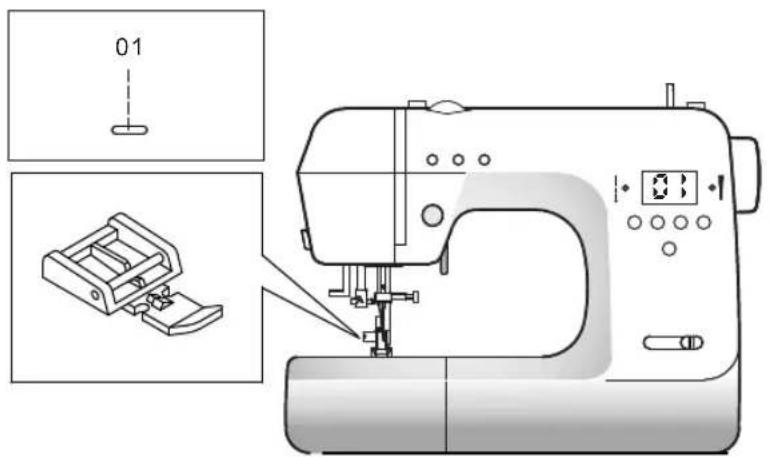
- Mark position and length of buttonhole on fabric.
- Set button on the base and slide base forward to secure button.
* If button does not fit on the base, adjust slide on base to diameter of button plus thickness of button.
a= Length of button + thickness
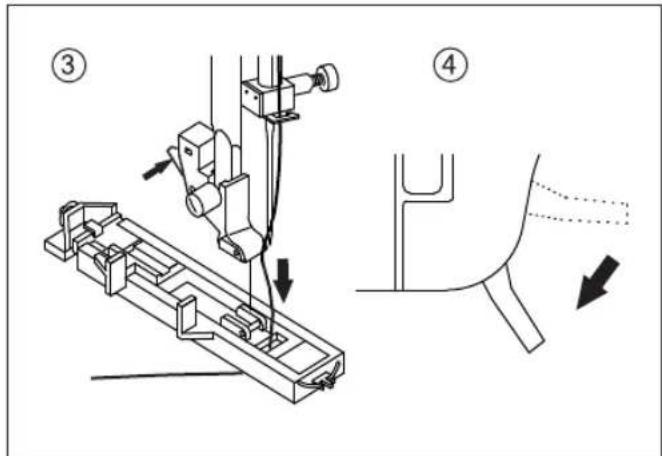
3.Pass upper thread through the hole of buttonhole foot and attach buttonhole foot to machine. Bring upper and bobbin threads to the left under foot.
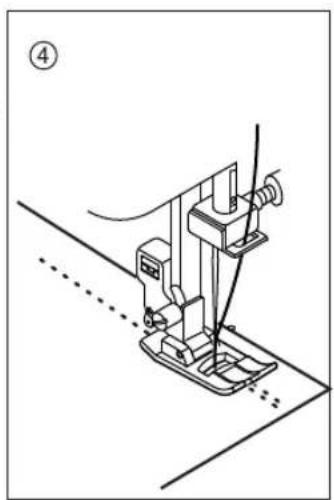
4. Position fabric under presser foot so that the center line mark is in the center of the needle opening in the buttonhole foot. With the main part of the foot pushed to the back lower the presser foot lever.
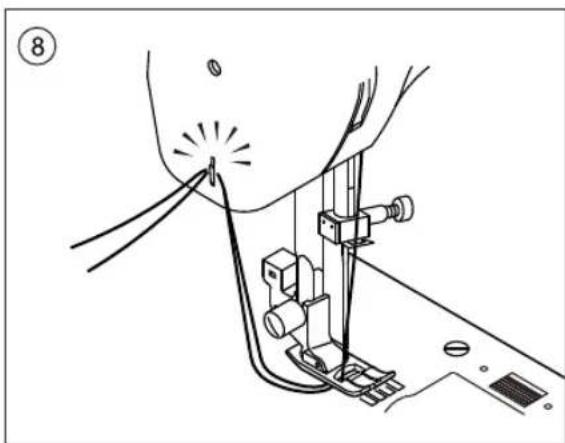
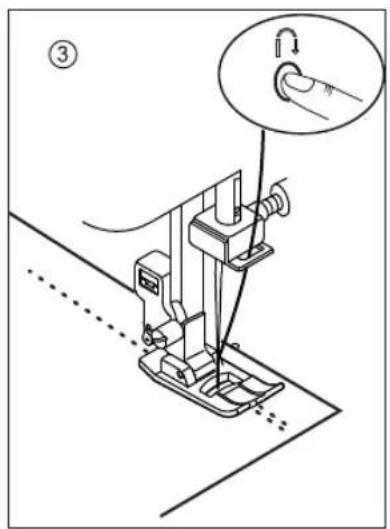
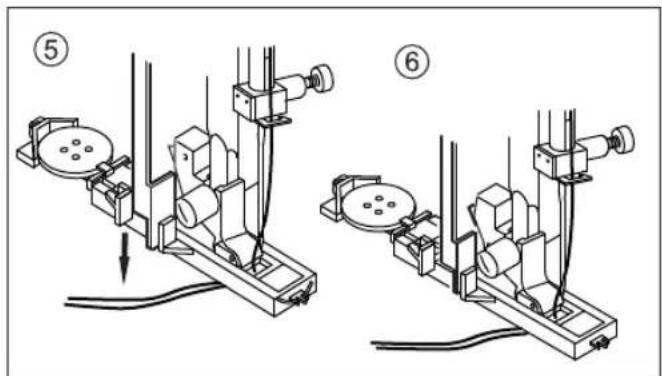
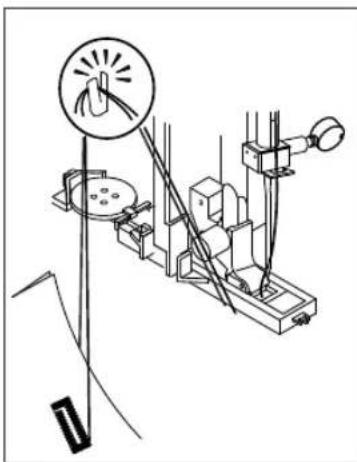
5. Lower the buttonhole foot lever so it is positioned behind the raised finger on the foot (see step 5 illustration).
If this lever is not in position, the number will be flashed on LED screen.
- Hold upper thread lightly and start the machine.
Note: Machine will not start to sew if buttonhole lever is not lowered properly or buttonhole foot is not positioned correctly.
natural_image
Simple geometric diagram with intersecting lines and a circled number 1, no text or symbols present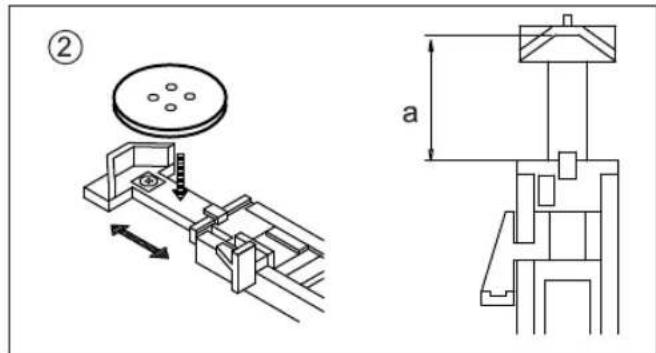

1
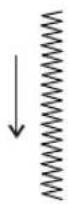
2
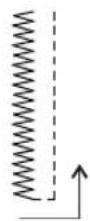
3
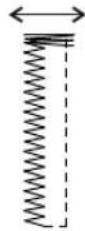
4
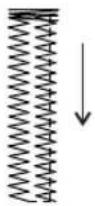
6
1
2
3
4
1
10
10
14
12
13
14
1

2
3
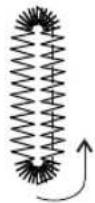
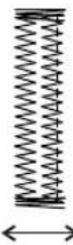
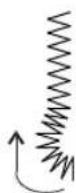
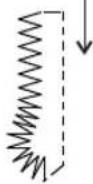
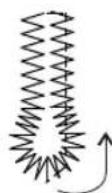
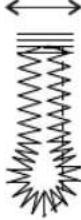
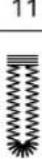
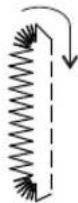
- Machine will sew the buttonhole in the order as shown and stop automatically when buttonhole is completed
- Raise the presser foot and cut threads. To sew same buttonhole, raise presser foot to return to buttonhole starting position.
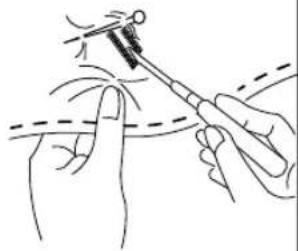
- With buttonhole cutter, cut center of buttonhole being careful not to cut stitches on either side. Use a pin as a stopper.
CAUTION: To prevent accidents.
When using buttonhole cutter, do not put your finger in the path of the cutter.
NOTE: When sewing stretch fabric
It is suggested that you use interfacing on the backside of the fabric.
Note: Density of buttonhole legs may be adjusted with stitch length control.
CORDED BUTTONHOLES
Hook the filler cord(crochet thread or buttonhole twist) to the spur in the back of the foot. Pull both ends of the cord forward and parallel under the guide.
Sew buttonhole in the way that zigzag stitches cover the cord. When completed, release the cord from foot.
Pull ends of the cord forward and snip off extra length.
natural_image
Technical line drawing of a mechanical device with no visible text or symbols⑨
natural_image
Illustration of a medical procedure with gloved hands using a tool to adjust or mark a patient's finger (no text or symbols present)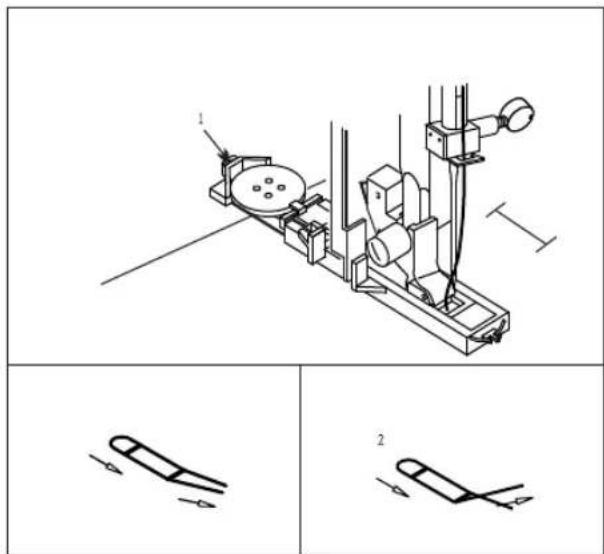
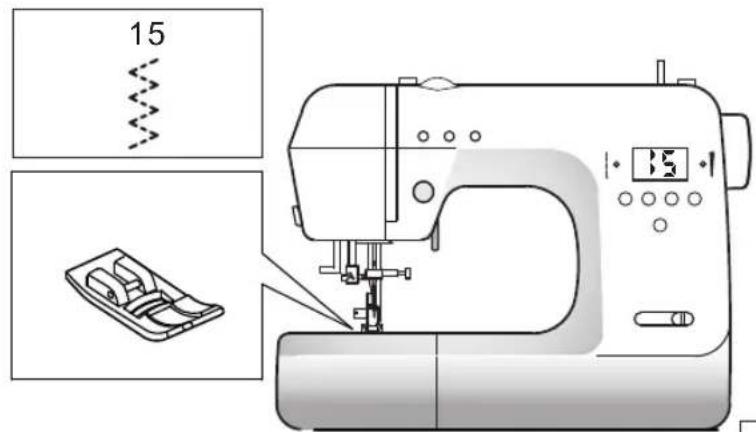
Used for sewing on elastic band and overcast stitching on knit fabrics.
A. Elastic Sewing
Stretch elastic in front and back of needle while sewing. Be careful not to bend needle while stitching.
B. Overcast stitching
Used for easy to ravel and knit fabrics.
Guide fabric so stitch on right side is at the edge on the fabric.
natural_image
Pure diagram of two vertical structures with wavy and zigzag lines, no text or symbols present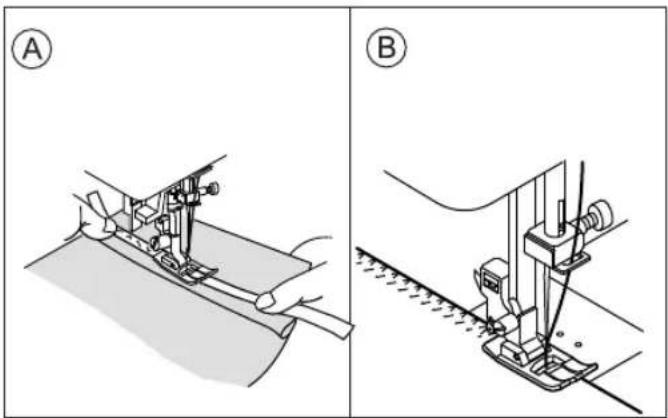
natural_image
Two technical diagrams showing sewing machine tool positioning (A) and lathe machine setup (B), with no visible text or symbols.ELASTIC STITCH SEWING
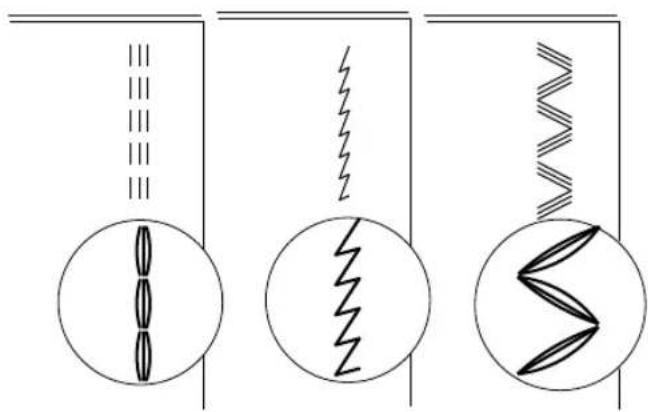
Elastic stitch sewing assures you of a stitch that is strong and flexible and will give with the fabric without breaking. Good for stretch or knit fabrics and seams that require flexibility. It is good for joining durable fabrics such as denims.
We recommend that you use a needle for knit and synthetic fabrics to prevent skipped stitches and thread breakages.
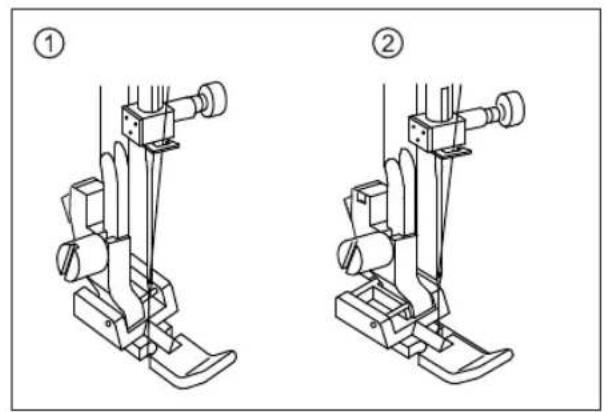
Align the right side or the left side of the zipper foot pin with the presser foot holder, lower the presser foot lever to attach the foot.
- Needle stitches to the left of foot.
-
Needle stitches to the right of foot.
-
To insert zippers, consult the zipper package for instructions on how to prepare zipper placket and place zipper. To sew close to the zipper on the right side, snap the zipper foot onto the presser foot holder on the left side so the needle passes through the opening on the left side of the foot. Snap the foot onto the presser foot holder on the other side of the foot to sew close to the left side of the zipper.
PIPING
To insert piping, purchase pre-made piping or cover cording with a bias strip of fabric using the zipper foot snapped on to the right side of the presser foot holder. Place the piping between two layers of fabric. Stitch with the piping next to the foot so the stitching is tight against the cord.
Note: You may use stitch # 02 if needle position has to be adjusted closer to your zipper or piping.
CAUTION: When using this stitch be extremely careful that the needle does not hit the presser foot. Turn handwheel towards you to insure the needle passes through the zipper foot opening. For the left side of the zipper foot it is recommended to adjust width no higher than 4.0 mm. For the right side of the zipper foot it is recommended to adjust width no lower than 3.5mm
natural_image
Technical line drawing of two sewing machine components (no text or symbols)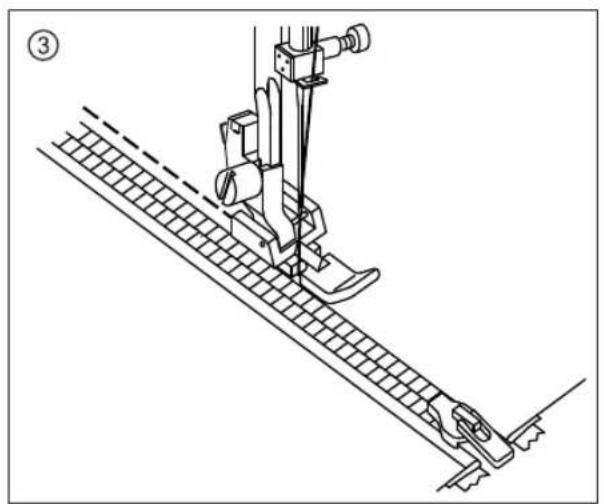
natural_image
Technical line drawing of a sewing machine needle stitching a slatted metal strip (no text or symbols)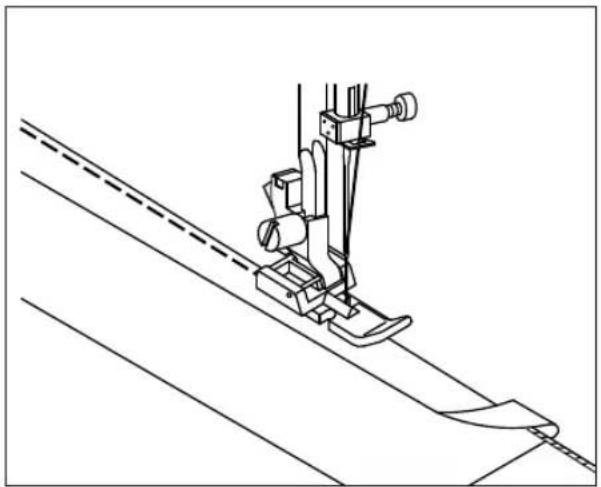
natural_image
Technical line drawing of a sewing machine on a sloped fabric (no text or symbols)STRAIGHT STITCH SEAMING AND QUILTING
Select stitch #1 in the center needle position.
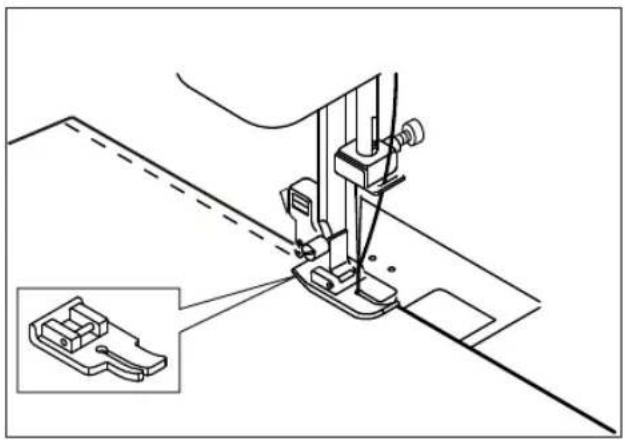
Because of the small opening, the straight stitch is the ONLY stitch to be used when sewing with the straight stitch, quilting or 1/4" foot. Turn the handwheel and watch that the needle will go into the needle hole of the foot.
STRAIGHT STITCH SEAMING
The straight stitch foot is designed with a small opening in the foot to provide additional support against the feed dog teeth when sewing lightweight fabrics.
QUILTING
The markings on the 1/4" foot are to aid in guiding fabric edges for perfect 1/16",1/8", or 1/4" seams.
Align the fabric edge with the marking of the foot for the appropriate seam width. Sew, guiding the fabric edge along the marking.
natural_image
Technical line drawing of a sewing machine needle and base assembly (no text or symbols)NOTE: When using stitch 03 thread monofilament in the upper thread and tighten the upper tension to 7. Sew at slow speed and the bobbin thread will appear on the surface of the fabric to resemble hand stitch quilting.
Darning
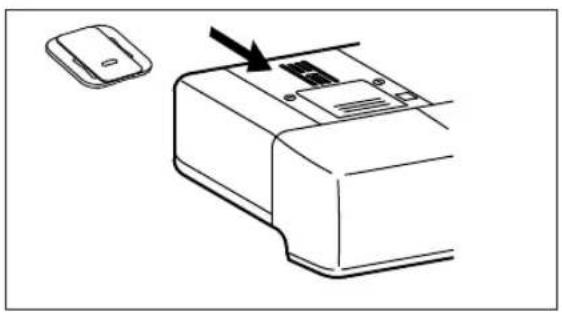
Select center needle position, straight stitch sewing stitch number 01. Set darning plate on the top of the needle plate over feed dog teeth. Align tabs on bottom of darning plate and snap into the two openings located on each side of feed dog teeth on needle plate.
Remove the presser foot and presser foot holder. Screw the darning foot onto the presser bar with the extended arm of the foot resting above the needle clamp screw. Holding the needle thread, take one stitch and pick up bobbin thread through the fabric.
Lower presser foot lever and start sewing at a slow to medium speed, moving the fabric back and forth with a steady rhythm. Turn fabric and sew another layer of stitching across the first layer of stitching.
CAUTION: When using darning foot on machine with zig-zag stitches do not set the stitch width any wider than 4.0. Otherwise needle may deflect and hit the darning foot causing damage to machine or possible injury.
natural_image
Line drawing of a printer with an arrow pointing to the top panel, next to a smartphone (no text or symbols present)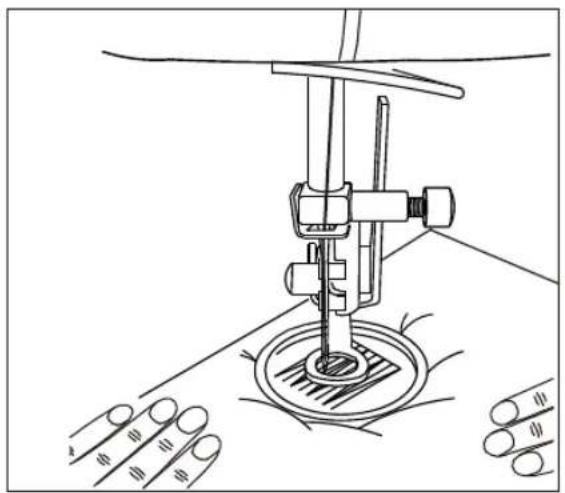
natural_image
Line drawing of a sewing machine needle stitching a circular base, with hands operating the mechanism (no text or symbols)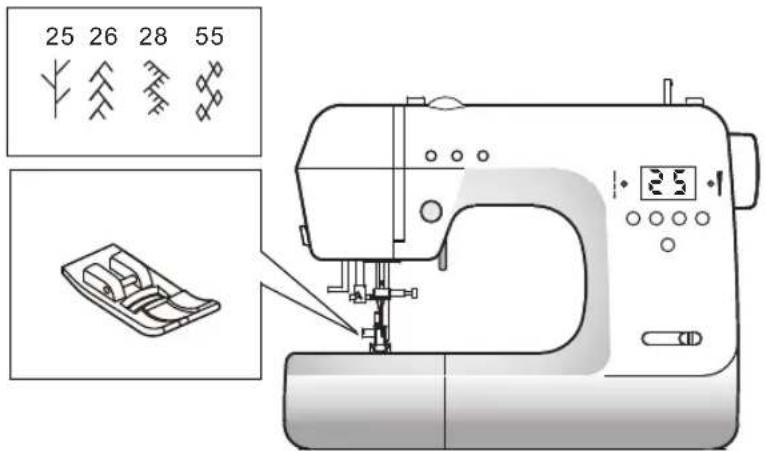
natural_image
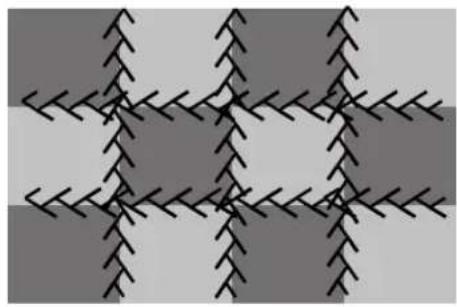
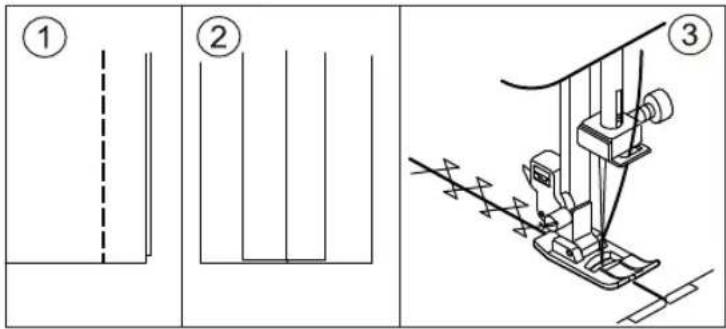
Abstract pattern of black zigzag lines on a gray background, no text or symbols presentFor additional decorative purposes, use a variety of different fabrics.
- Place two pieces of fabric right sides together and sew a basting stitch.
- Press the seam open.
- Place fabric right side up and stitch with the seam line in the center of the foot. Stitches should fall on both sides of the seam line.
APPLIQUE
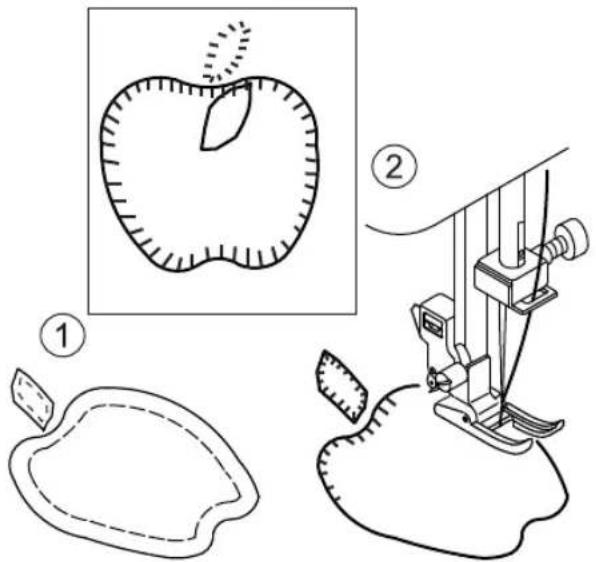
- Position the applique on fabric with fabric glue, fusible iron on stabilizer or basting stitches. (When using fabric with frayed edges for the applique, press under 1/4 inch on all the edges.)
- Sew along the edge of the applique. Align the straight part of the stitch with the edge of the applique to give this project a hand-made appearance.
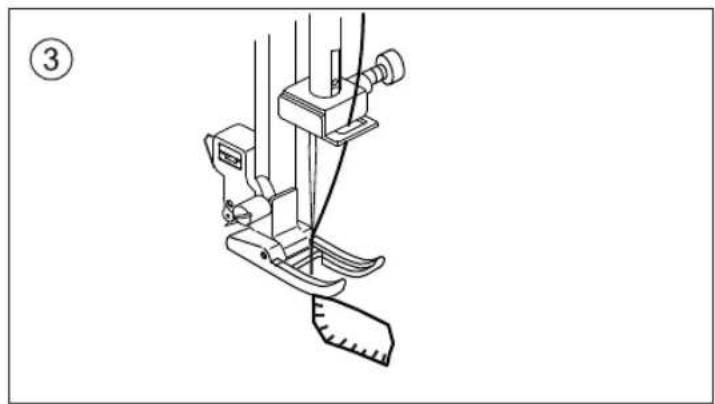
- When pivoting corners, lower the needle in the right side of the stitch. Raise the presser foot and use the needle to pivot and turn the fabric.
natural_image
Technical line drawing of a mechanical device with lever and base (no text or symbols)SCALLOP STITCH
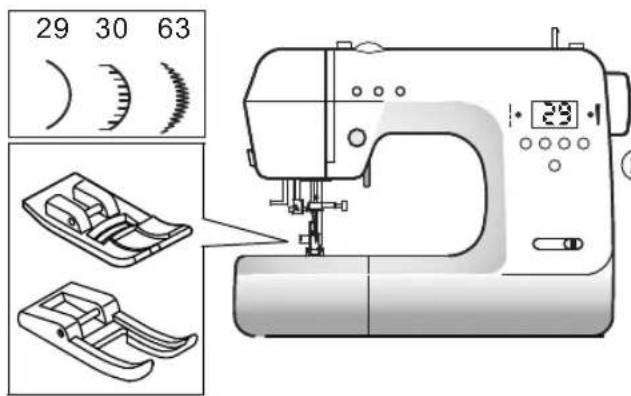
These stitches are used to sew a decorative edge on garments and table cloths.
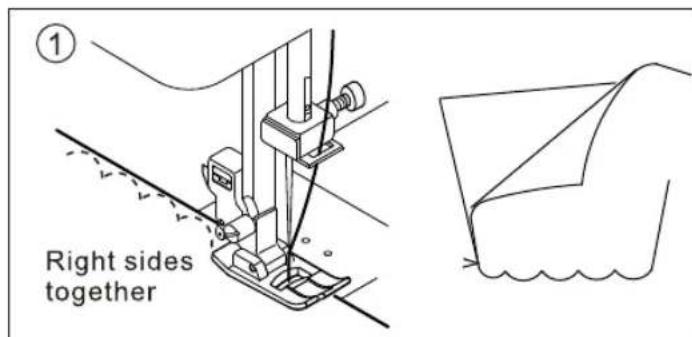
① SCALLOP HEM
- Fold the fabric with right sides together and sew near the edge.
- Cut the fabric along the seam leaving an allowance of 3 mm(1/8") for seaming. Notch the allowance.
- Turn fabric with right sides out and gently push out the curved seam then press.
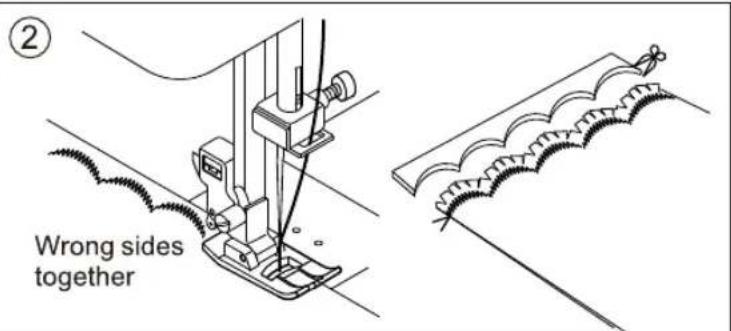
② DECORATIVE SCALLOP EDGE
- Place the fabric with wrong sides together and stitch near the edge.
- Trim along the outside edge of the stitching (being careful not to cut the stitching).
- Use seam sealant or fabric glue to secure edges of the scallop stitching.
SEWING LETTERS
-
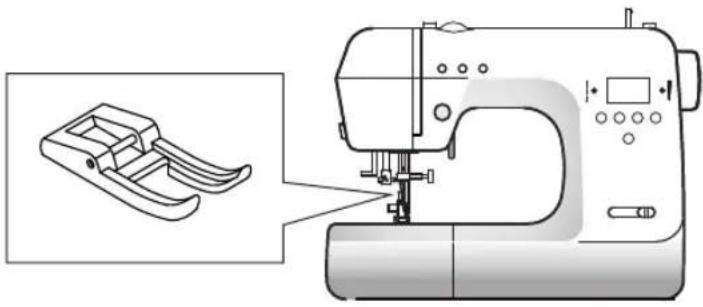
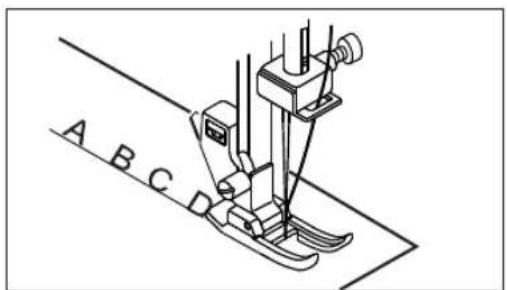
When you sew letters please use the open toe foot instead of all-purpose presser foot, it will have good effect and quality on your sewing.
-
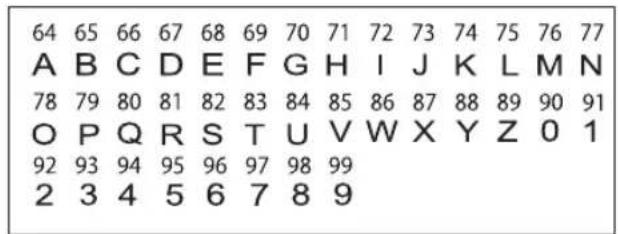
Please refer to letter chart to select numbers for the desired letters you want to sew.
-
For example, to sew
64 65 66 67
A B C D
Select desired letters by pressing pattern selector. Please refer to pattern chart on right side.
natural_image
Line drawing of a sewing machine with a close-up inset showing the handle mechanism (no text or symbols)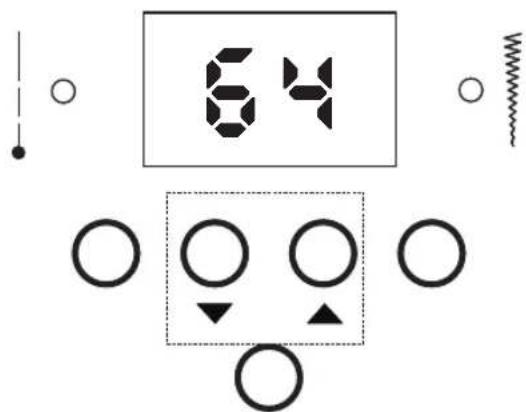
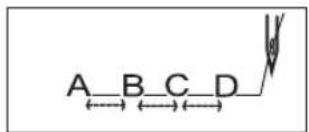
4.A letter will sew each time, you may measure the distance among letters before sewing.
To ensure the best possible operation of your machine, it is necessary to keep the essential parts clean at all times. Always disconnect the machine from power supply by removing the plug from the electric outlet.
CAUTION: To prevent accidents.
Please switch off the power and unplug from electric outlet before you start cleaning.
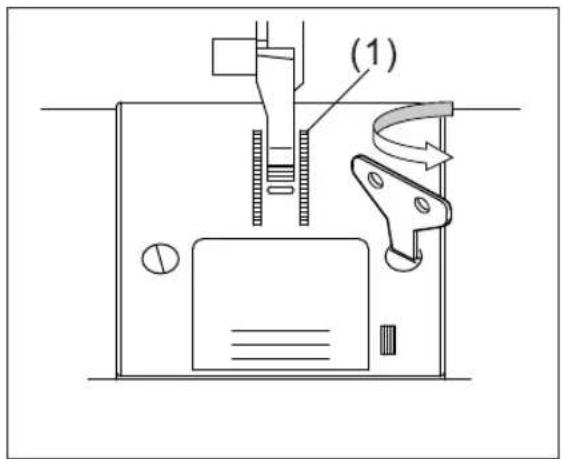
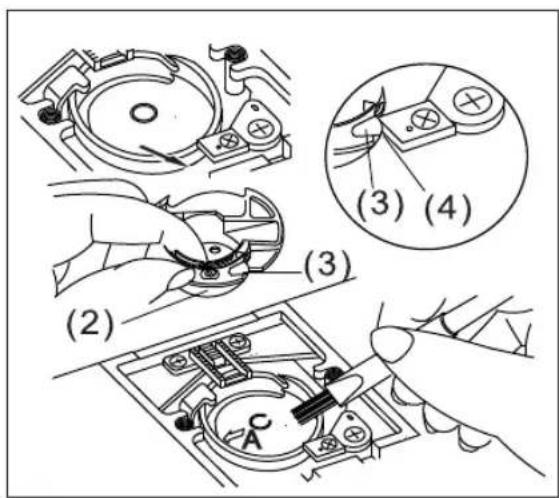
CLEANING THE FEED DOGS AND HOOK AREA
- Raise the needle to its highest position.
- Remove the needle plate (1)
- Remove the bobbin and bobbin case(2)
- Clean the feed dog and hook area with the lint brush.
NOTE: Put drop of sewing machine oil on the hook race as indicated by the arrow A. - Replace the bobbin case with the projection (3) positioned against the spring (4). Replace the needle plate.
| PROBLEM | CAUSE | CORRECTION | PAGE |
| Upper thread breaks | Machine not properly threaded.Thread entwined around bobbin.Needle inserted incorrectly.Thread tension too tight.Thread of incorrect size or poor quality. | Re-thread machine.Remove entwined thread.Re-insert needle.Readjust thread tension.Choose correct thread. | 131261718 |
| Lower thread breaks | Bobbin threaded incorrectly.Bobbin wound unevenly or too full.Dirt in the bobbin and hook area. | Re-thread the bobbin.Rewind the bobbin.Clean the bobbin and hook area. | 121131 |
| Machine skips stitches | Needle inserted incorrectly.Bent or blunt needle.Incorrect size of needle on stretch fabric. | Re-insert needle.Insert new needle.Choose correct size of needle for fabric.Use stretch needle | 661818 |
| Fabric puckers | Machine not properly threaded.Bobbin threaded incorrectly.Blunt needle.Thread tension too tight. | Re-thread machine.Re-thread the bobbin.Insert new needle.Readjust thread tension. | 1312617 |
| Machine makes loose stitches or loops | Bobbin threaded incorrectly.Machine not properly threaded.Tension not adjusted properly. | Re-thread the bobbin.Re-thread machine.Readjust thread tension. | 121317 |
| Threader does not thread needle eye | Needle is not raised.Needle inserted incorrectly.Bent needle. | Raise the needle.Re-insert needle.Insert new needle. | 866 |
| Machine does not feed properly | Darning plate attached.Lint and dust accumulated around feed dog. | Remove darning plate.Clean the feed dog area. | 2731 |
| Needle breaks | Fabric pulled while sewing.Needle is hitting the presser foot.Needle inserted incorrectly.Incorrect size needle or thread for fabric being sewn. | Do not pull fabric.Select correct foot and pattern.Re-insert needle.Choose correct size needle and thread. | 1519618 |
| Machine runs with difficulty | Dirt or lint accumulated in the hook race and feed dog. | Remove the needle plate and bobbin case and clean the hook race and feed dog. | 31 |
| Machine will not run | Cord not plugged into electrical outlet.Power switch is not turned on.Bobbin winder spindle is pushed to the right.Presser foot is not lowered.Buttonhole Sewing Mode;Buttonhole lever is not lowered completely.Buttonhole foot is not attached. | Insert plug fully into outlet.Turn on the power switch.Push spindle to the left.Lower the foot.-Lower the buttonhole lever.-Attach the buttonhole foot. | 7711152323 |
| Stitch name | Pattern | Application | Stitch Width (mm) | Stitch Length (mm) | ||
| Auto | Manual | Auto | Manual | |||
| Straight Stitch (Center) | [ZW52] | Attaching zippers, basic stitching and sewing gathers or pintucks,etc | 3.5 | 3.5 | 3.0 | 0.5-4.5 |
| Straight Stitch (Left,Center,Right) | [TZW6] | Basic stitching, sewing gathers or pintucks,etc | 0.0(Left) | 0.0.3.5.7.0(Left:150.00 P.P.18) | 3.0 | 0.5-4.5 |
| Quilt Stitch (Left,Center,Right) | Straight stitch quilting that looks hand-sewn | 3.5 | 0.0.3.5.7.0(Left:150.00 P.P.18) | 2.5 | 0.7-3.0 | |
| Triple Stitch | [Y84W] | Attaching sleeves, sewing inseams, sewing stretch fabrics and decorative stitching. | 3.5 | 0.0.3.5.7.0(Left:150.00 P.P.18) | 2.5 | 0.7-3.0 |
| Stretch Stitch | 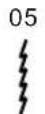 | Sewing stretch fabrics and decorative stitching | 3.0 | 1.0-5.0 | 3.0 | 1.5-3.5 |
| Zigzag | [C54Y] | Overcasting and attaching applique's | 5.0 | 0.0-7.0 | 2.5 | 0.0-4.5 |
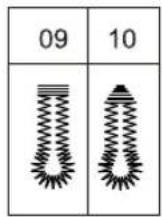
| Bartack buttonhole | Buttonholes for stretch fabric | 5.0 | 5.0 | 0.4 | 0.2-0.8 | |
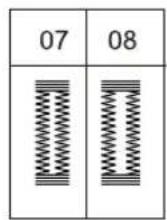
| Buttonhole | Buttonholes for stretch fabric | 6.0 | 6.0 | 0.4 | 0.2-0.8 | |
| Keyhole buttonhole | Keyhole buttonholes for thick or furry fabric | 7.0 | 7.0 | 0.4 | 0.3-0.8 | |
| Keyhole buttonhole | Keyhole buttonholes for thick or furry fabric | 7.0 | 7.0 | 0.4 | 0.3-0.8 | |
| Buttonhole | Buttonholes on thin, medium weight fabric | 5.0 | 5.0 | 0.5 | 0.3-0.8 | |
| Buttonhole | Buttonholes on thin, medium weight fabric | 6.0 | 6.0 | 0.4 | 0.3-0.8 | |
| Buttonhole | Horizontal buttonholes on thin, medium weight fabric | 5.0 | 5.0 | 0.4 | 0.3-0.8 | |
| Buttonhole | 14 | Buttonholes on thin, medium weight fabric | 6.0 | 6.0 | 0.4 | 0.3-0.8 |
| 3-step zigzag | 15 | Overcasting on medium weight or stretch fabric, attaching elastic, darning, etc | 6.0 | 3.0-7.0 | 1.0 | 0.5-2.0 |
| Satin stitch | 16 | Satin stitching | 6.0 | 3.0-7.0 | 1.0 | 0.5-2.0 |
| Rick-rack | 17 | Decorative stitching, elastic stitching | 6.0 | 3.0-7.0 | 2.5 | 1.0-3.0 |
| Over-lock | 18 | Overcasting on thin or medium weight fabric. Overcasting on thick fabrics. | 6.0 | 3.0-7.0 | 2.5 | 1.0-3.0 |
| Double-overlock | 19 | Decorative hemming on thin, medium weight and plain weave fabric, heirloom stitching, etc. | 6.0 | 3.0-7.0 | 2.5 | 1.0-3.0 |
| Shell | 20 | Overcasting on thin or medium weight fabrics | 4.0 | 2.0-6.0 | 2.0 | 1.0-3.5 |
| Blind hem | 21 | Blind hem stitching on medium weight fabric | 4.0 | 2.0-6.0 | 2.0 | 1.0-3.5 |
| Zigzag blind hem | 22 | Blind hem stitching on stretch fabric | 5.0 | 3.0-7.0 | 2.0 | 1.0-3.5 |
| Double action | 23 | Attaching elastic to stretch fabrics | 6.0 | 3.0-7.0 | 2.5 | 1.5-4.5 |
| Bridging | 24 | Patchwork stitching and decorative stitching | 6.0 | 3.0-7.0 | 2.0 | 1.0-3.0 |
| Feather | 25 | Decorative stitching, patchwork | 6.0 | 3.0-7.0 | 2.0 | 1.0-3.0 |
| Fagoting stitch | 26 | Fagoting, patchwork and decorative stitching | 7.0 | 3.0-7.0 | 2.5 | 1.0-3.0 |
| Decorative | [3782] | Decorative stitching | 7.0 | 3.0-7.0 | 2.5 | 1.0-3.0 |
| Faggoting stitch | 28[204W] | Decorative stitch | 7.0 | 5.0-7.0 | 2.0 | 1.0-2.0 |
| Decorative | 29[20WC] | Decorative stitching | 7.0 | 7.0 | 1.5 | 1.0-2.0 |
| Decorative | 30[4A4X] | Decorative stitching | 7.0 | 7.0 | 2.0 | 1.0-2.0 |
| Decorative | 31[W775] | Decorative stitching | 7.0 | 7.0 | 4.5 | 4.5 |
| Decorative | 32[X22D] | Decorative stitching | 7.0 | 5.0-7.0 | 2.0 | 1.0-2.0 |
| Decorative | 33[T02B] | Decorative stitch | 7.0 | 3.0-7.0 | 2.0 | 1.0-2.0 |
| Decorative | 34[22W7] | Decorative stitching | 6.0 | 3.0-7.0 | 2.5 | 1.0-3.0 |
| Decorative | 35 | Decorative stitching | 5.0 | 3.0-7.0 | 2.0 | 1.0-3.0 |
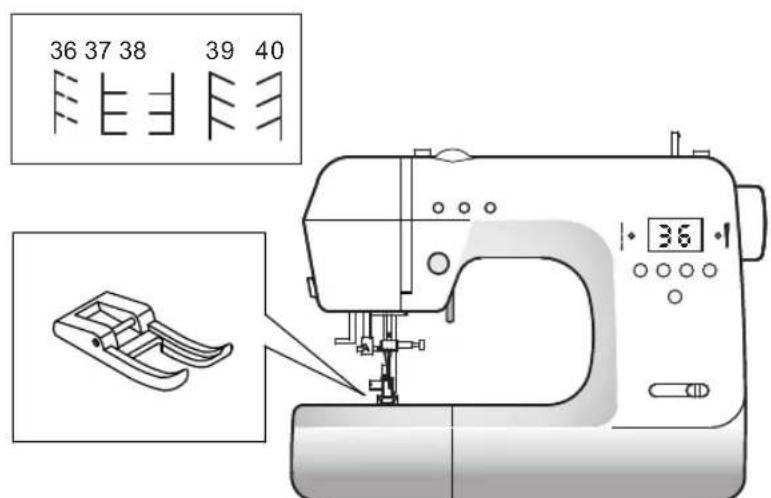
| Overcasting | 36[242K] | Overcasting on thick or stretch fabrics, applique | 5.0 | 3.0-7.0 | 2.5 | 1.5-3.5 |
| Decorative Applique | 37[4YWT]— | Applique, decorative stitching | 5.0 | 3.0-7.0 | 2.5 | 1.5-4.5 |
| Decorative | 38[T03D]— | Applique, decorative stitching | 5.0 | 3.0-7.0 | 2.5 | 1.5-4.5 |
| Decorative Overcasting | 39[Y33W] | Applique, decorative stitching | 5.0 | 3.0-7.0 | 2.0 | 1.0-3.0 |
| Decorative | 40[2714C] | Applique, decorative stitching | 5.0 | 3.0-7.0 | 2.0 | 1.0-3.0 |
| Decorative | 41[2220D] | Decorative hemming on thin medium weight and plain weave fabrics, heirloom stitching, etc. | 6.0 | 3.0-7.0 | 2.5 | 1.0-3.0 |
| Decorative | 42[7719E] | Decorative stitching | 7.0 | 7.0 | 4.5 | 4.5 |
| Decorative | 43[2628T] | Decorative stitching | 7.0 | 7.0 | 4.5 | 4.5 |
| Decorative | 44[1988W3] | Decorative stitching | 7.0 | 7.0 | 4.5 | 4.5 |
| Decorative | 45[1681K] | Decorative stitching | 7.0 | 7.0 | 4.5 | 4.5 |
| Decorative | 46[1671Z] | Decorative stitching | 7.0 | 7.0 | 4.5 | 4.5 |
| Decorative | 47[1714D] | Decorative stitching | 7.0 | 7.0 | 4.5 | 4.5 |
| Decorative | 48[2628F] | Decorative stitching | 7.0 | 3.0-7.0 | 2.5 | 0.7-2.5 |
| Decorative | 49[25100G] | Decorative stitching | 7.0 | 5.0-7.0 | 2.0 | 1.0-2.0 |
| Decorative | 50[1234H] | Decorative stitching | 7.0 | 3.0-7.0 | 3.5 | 1.5-3.5 |
| Decorative | 51[2473A] | Decorative stitching | 7.0 | 7.0 | 4.5 | 4.5 |
| Decorative | 52[1712Z] | Decorative stitching | 7.0 | 7.0 | 4.5 | 4.5 |
| Decorative | 53[H42X] | Decorative stitching | 7.0 | 5.0-7.0 | 2.5 | 1.5-2.0 |
| Decorative | 54[220T] | Decorative stitching | 7.0 | 3.0-7.0 | 3.5 | 1.5-3.5 |
| Decorative | 55[8760] | Decorative stitching | 7.0 | 5.0-7.0 | 2.0 | 1.0-2.0 |
| Decorative | 56[224S] | Decorative stitching | 7.0 | 5.0-7.0 | 2.0 | 1.0-2.0 |
| Decorative Cross stitch | 57 | Decorative and cross stitching | 7.0 | 5.0-7.0 | 2.0 | 1.0-2.0 |
| Decorative Cross stitch | 58[27KC] | Decorative and cross stitching | 6.0 | 3.0-7.0 | 3.0 | 1.0-3.0 |
| Decorative Cross stitch | 59[477Z] | Decorative and cross stitching | 7.0 | 5.0-7.0 | 2.0 | 1.0-2.0 |
| Decorative Cross stitch | 60[607K] | Decorative and cross stitching | 7.0 | 5.0-7.0 | 2.0 | 1.0-2.0 |
| Decorative Satin stitch | 61[844Y] | Decorative and satin stitching | 7.0 | 5.0-7.0 | 0.5 | 0.3-1.0 |
| Decorative Satin stitch | 62[220C] | Decorative and satin stitching | 7.0 | 5.0-7.0 | 0.5 | 0.3-1.0 |
| Decorative Satin stitch | 63[KYY] | Decorative and satin scallop stitching | 7.0 | 7.0 | 0.3 | 0.3-1.0 |
| Character stitches | 64~99A-Z0-9 | Character stitches | 7.0 | 7.0 | 4.5 | 4.5 |