
DFF1310J - Freezer DE DIETRICH - Free user manual and instructions
Find the device manual for free DFF1310J DE DIETRICH in PDF.


| Product Type | Upright Freezer |
| Brand | De Dietrich |
| Model | DFF1310J |
| Intended Use | Domestic |
| Climatic Class | SN, N, ST, T (subnormal, normal, subtropical, tropical) |
| Ambient Temperature Range | +10°C to +43°C (depending on class) |
| Adjustable Height | 82-90 cm via 4 adjustable legs |
| Control Panel | ON/OFF switch, continuous operation button, alarm off button |
| Operation Modes | Automatic (thermostat controlled) and Continuous (constant cooling) |
| Temperature Setting | Thermostat knob with range min (1) to max (7) |
| Freezing Compartment | For freezing fresh food |
| Storage Basket | For storing frozen food |
| Freezing Capacity | Up to 1 year storage for some foods (check rating plate for 24h freezing capacity) |
| Defrosting | Manual when ice layer reaches 3-5 mm |
| Cleaning Interior | Lukewarm water with vinegar |
| Cleaning Exterior | Mild detergent or alcohol-based cleaner |
| Condenser Cleaning | Periodically vacuum dust from condenser unit |
| Energy Saving Tips | Keep door closed, ensure ventilation, clean ice layer, avoid continuous operation when not needed |
| Safety Features | Do not freeze bottled drinks; lock break if replacing old appliance |
| Power Supply | Earthed socket; voltage and frequency on rating plate |
| Technical Assistance | Contact De Dietrich accredited service |
| Spare Parts | Certified original spare parts recommended |
| Environmental Care | Eco-friendly packaging; dispose via recycling |
Frequently Asked Questions - DFF1310J DE DIETRICH
User questions about DFF1310J DE DIETRICH
0 question about this device. Answer the ones you know or ask your own.
Ask a new question about this device
Download the instructions for your Freezer in PDF format for free! Find your manual DFF1310J - DE DIETRICH and take your electronic device back in hand. On this page are published all the documents necessary for the use of your device. DFF1310J by DE DIETRICH.
USER MANUAL DFF1310J DE DIETRICH
You have just acquired a DE DIETRICHfridge and we would like to thank you.
Our research teams have created this new generation of appliances for you. Their quality, design, features and technological advances make them exceptional products, and reveal our unique know-how.
Your new DE DIETRICHfridge will blend harmoniously into your kitchen and will perfectly combinefood preservation performance and ease of use. We wanted to offer you a product of excellence.
In the DE DIETRICHproduct range, you will also find a wide choice of hobs, ovens, microwaves, hoods, dishwashers, cookers, freezers, that you can coordinate with your new DE DIETRICHfridge.
Visit our website www.dedietrich-electromenager.com, where you will find our latest innovations as well as useful and complementary information.
DE DIETRICH
Setting New Values
As part of our commitment to constantly improving our products, we reserve the right to make changes to them based on technical advances to their technical and functional features and appearance.
Warning:
Before installing and using your appliance, please carefully read this Guide to Installation and Use, which will allow you to quickly familiarise yourself with its operation.
www.dedietrich-electromenager.com
Upright Freezer
GB
Thank you for the confidence you have shown by buying this appliance. We hope it will successfully serve its purpose for many years.
This upright freezer is intended for domestic use only, for freezing fresh food and for long-term storage of frozen food (up to one year, depending on the type of food).
Before putting into use.... 13
Instructions for use
Mounting instructions
We care for the environment
Tips for energy saving
Important.... 14
Disposing of the worn out appliance
Placing and installation 15
Choosing the right place
Connection to Power Supply
Adjusting the height of the appliance
Description of the appliance.... 16
Operation Control.... 16
Control panel
ON/OFF switch (1)
Continuous operation button (2)
Alarm off button and the red signal lamp (3)
Use.... 17
Starting the empty freezer
Freezing fresh food
Storage of frozen food
Defrosting of frozen food
Maintenance and Cleaning.... 18
Freezer defrosting
Cleaning the appliance
Switch off the appliance when not in use
Troubleshooting guide 19
Before putting into use
- Before connecting the appliance to the power mains, leave it stand for about 2 hours. This will reduce the probability of malfunctions in the cooling system due to transport and handling.
- Clean the appliance thoroughly, especially the interior (see Cleaning and maintenance).
Instructions for use
These instructions for use were prepared for the user. They describe the appliance and its correct and safe use. They were prepared for various types/models of appliances; therefore you might find in them descriptions of some functions and accessories that do not apply to your appliance.
Mountinginstructions
Integrated appliances are equipped with instructions for mounting the appliance into the kitchen unit.
The appliance should be professionally mounted by a qualified technician; mounting instructions are for his use only.
We care for the environment
- Our products use environmentally friendly packaging which can be either recycled or disposed of in an environmentally friendly manner. To this end, individual packaging materials are clearly marked.
• These instructions are printed either on recycled paper or chlorine-free bleached paper. - When your appliance finally wears out, please do not burden the environment with it; call your nearest authorised service agent (see Disposing of the worn out appliance).
Tips for energy saving
- Do not open the door too often, especially when the weather is wet and hot. Once you open the door, close it as soon as possible. This is especially important if you have an upright model.
- Check periodically if sufficient ventilation is provided (undisturbed circulation of air through the bottom rail openings).

- Turn the thermostat knob from higher to lower setting as soon as possible (depending on how loaded the appliance is, ambient temperature etc.).
- Never use continuous operation unless it is absolutely necessary; switch the operation mode
selector switch to the setting for automatic operation as soon as possible.
- Before freezing packages of fresh foods, make sure they are cooled to ambient temperature.
- Ice and frost layer increase energy consumption, so do clean the appliance as soon as the layer is 3-5 mm thick.
- If the gasket is damaged or if it turns out that the sealing is poor, the energy consumption is substantially higher. To restore efficiency, replace the gasket.
- Condenser at the bottom of the appliance must always be clean and dust free (see section Cleaning of the appliance).
- Always observe the instructions given in sections Positioning and Energy saving tips; otherwise the energy consumption may be substantially higher.
⚠️ Important
- This appliance is manufactured in compliance with relevant safety standards. However, it is still advisable it is not used without due supervision by persons with diminished physical, motoric, or mental capabilities or persons with inadequate experience or knowledge. The same recommendation applies to minors using the appliance.
- If you bought this appliance to replace an old one that was equipped with a lock that cannot be opened from the inside of the appliance (lock, bolt), make sure that the lock is broken. This will make it impossible for the children to lock themselves into the appliance and suffocate.
- Make sure you connect the appliance correctly to the power mains (see Connection to the power mains).
- Do not touch the cooled surfaces while the appliance operates, especially not with wet hands, because your skin might stick to the cold surfaces.
- Do not freeze bottled drinks, especially not fizzy ones such as mineral water, sparkling wine, beer, cola etc., because liquid expands during freezing and the glass bottle is very likely to blow up.
- Never try to eat frozen food (bread, fruit, vegetables), because you may get frostbite.
-
Carefully check the foods for colour and smell and if you are in doubt about their quality, throw them away because they may be spoiled and therefore dangerous to eat.
-
Disconnect the appliance from the power mains before any repairs (only a qualified technician should repair it) and before cleaning.
- Use only tools supplied with the appliance or tools recommended by the manufacturer.
- To protect your environment, be careful not to damage the rear wall of the appliance (the condenser unit or the tubes – for example when moving the appliance) or any part of the refrigeration system inside the appliance.
- The refrigeration system of the appliance is filled with refrigerant and lubricant. When the appliance is damaged, handle it with care and dispose it of in compliance with environment-protection precautions (see We care for the environment).
- Heating element integrated in the appliance, all around the rim, is controlled by the operation of the compressor and it prevents the door gasket to freeze onto the freezer housing.
- If the power supply cord is damaged, it must be replaced by the manufacturer or his service agent or a qualified person in order to avoid hazard.
- The rating plate is located in the interior or on the rear wall of the appliance.
- Warning! Ventilation slots on the appliance or a built-in element must always be clean and unobstructed.
- Warning! Do not use mechanical devices or tools to defrost the refrigerator, nor any other
methods except for those recommended by the manufacturer.
- Warning! When installing, cleaning, or removing the appliance, make sure the insulation on the refrigeration system parts is not damaged. Thus you will also prevent damage to the environment
- Warning! Do not use electric appliances in the refrigerator or freezer interior, except for those expressly allowed by the refrigerator-freezer manufacturer.
• After the installation, the appliance mains plug should be accessible!
The symbol on the product or on its packaging indicates that this product may not be treated as household waste.
Instead it shall be handed over to the applicable collection point for the recycling of electrical and electronic equipment. By ensuring this product is disposed of correctly, you will help prevent potential negative consequences for the environment and human health, which could otherwise be caused by inappropriate waste handling of this product. For more detailed information about recycling of this product, please contact your local city
office, your household waste disposal service or the shop where you purchased the product.
Storing time during power supply interruption Avoid opening the freezer in case of failure or power supply interruption unless the interruption is extended over longer period of time (15 hours).
Disposing of the worn out appliance
- When your appliance finally wears out, dispose of it. If the appliance has a lock, break it to prevent any accidents (danger of children getting locked inside the appliance).
- The refrigeration system of the appliance is filled with refrigerant and insulating substances which should be treated and processed separately. Call your nearest authorised service agent or specialised servicing centre. If you cannot find one, contact your local authorities or your distributor. Be careful not to damage the tubes on the rear wall of the appliance (danger of pollution).
- To avoid pollution of the environment make sure not to damage the hose at the bottom of the appliance.
Placing and installation
Choosing the right place
Place the appliance in a dry and well ventilated room. Allowed ambient temperature depends on the model (class) of the appliance and it is stated on the rating plate of the appliance. Never place the appliance near heat emitting devices (e.g. cooker, radiator, water heater and similar devices) and do not expose it to direct sunlight.
The appliance should be positioned at least 3 cm away from the electric or gas cooker and at least 30 cm away from the oil or coal stove. If this is not possible, use appropriate insulation.
| Class Ambient temperature |
| SN (sub-normal) from + 10°C to + 32°C |
| N (normal) from + 16°C to + 32°C |
| ST (sub-tropical) from + 16°C to + 38°C |
| T (tropical) from + 16°C to + 43°C |
Connection to Power Supply
Use the cable and plug to connect the appliance to the power supply socket outlet with a ground terminal (safety socket).
Required nominal voltage and frequency are indicated on the rating plate.
The connections to the mains supply and earthing have to be made according to relevant standards and regulations. The appliance resists temporary voltage fluctuations of up to +/- 6 %.
Adjusting the height of the appliance
The appliance is equipped with four adjustable legs which allow adjusting the height in the range from 82 to 90 cm. The height must be adjusted prior to building the appliance into the opening slot, and it should be set at such height that the top panel of the appliance fits exactly below the kitchen worktop (see Mounting instructions).
Description of the appliance

Freezing compartment (1)
is used for freezing fresh foods.
Storing basket (2)
is used for storing packages of frozen foods.
Control panel (3)
See Operation controls
Operation Control
The freezer is controlled with switches and the thermostat button incorporated in the bottom section of the appliance.
Control panel

1 ON/OFF switch (green signal lamp)
2 Continuous operation button (yellow signal lamp)
3 Alarm off button (red signal lamp)
ON/OFF switch (1)
The appliance is switched on – the green light is on.
The appliance is switched off – the green light is off.
Continuous operation button (2)
This switch is used to select one of the two operation modes: continuous or automatic.
Continuous operation – the yellow light is on. The cooling system operates continuously. Select this mode when you want to freeze large amounts of fresh foods and when you want to deep freeze already frozen foods.
Automatic operation - the yellow light is off.
The interior temperature is controlled by the thermostat which turns the cooling system on and off.
The frequency of switching the cooling system on and off depends on:
- the thermostat knob position (thermostat setting),
– how often you open the door, - ambient temperature.
Alarm off button and the red signal lamp (3)
The sound of the alarm is switched off by pressing the "alarm off" button. The alarm is activated because of high temperature inside the freezer (red signal lamp is on) or because of excessive layer of dust on the condenser unit (red signal lamp is off).
Consult the section Troubleshooting guide
Temperature selection
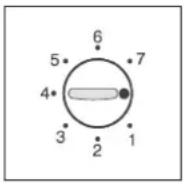
When the freezer operates automatically, the interior temperature is controlled by the thermostat. The most suitable thermostat position is in the middle between max (7) and min (1).
We recommend setting the thermostat to positions towards max (7) only in case you want to accelerate cooling, as for example before loading smaller amounts of fresh foods or when the operation mode needs to be adjusted to the ambient temperature.
Thermostat settings towards min (1) help you save energy provided that the freezer is loaded with a smaller amount of frozen food.
Changes of the ambient temperature affect temperature in the interior of the appliance. Choose the correct setting of the thermostat knob.
Use
Starting the empty freezer
Switch on the freezer. Sound alarm is on because of inappropriate temperature. It may be switched off by pressing the alarm button @.
Set the mode selection switch to the continuous operation position. All three signal lamps are on. Place fresh food into the freezer several hours after the red signal lamp has switched off.
Freezing fresh food
Proper use of the appliance, adequately packed food, correct temperature and hygienic precautions will substantially affect the quality of freezing of food or storing of frozen food.
- Carefully select the food to be frozen: it should be of adequate quality and suitable for freezing. - Choose correct packaging for each kind of food and pack it correctly.
- The packaging should be air tight and well sealed without leaking since this could cause substantial vitamin loss and dehydration.
- Foils and bags should be soft enough to tightly wrap around the food.
- Mark packages with following data: type and amount of foods and the date of loading.
- It is very important to freeze the food as quickly as possible. We therefore recommend the size of the package not to be too large and to cool the food before loading it into the freezer.
- The amount of fresh food that can be loaded into the freezer within 24 hours is stated on the rating plate. If the loaded amount is too large, the quality of freezing is reduced which affects the quality of frozen foods.
Proper freezing procedure
Freeze the food in the freezing compartment (see section Description of the appliance)
- 24 hours prior to freezing of fresh food switch on the continuous operation button (2) (yellow lamp is on). After 24 hours, load the fresh food into the freezing compartment.
• After 24 hours move the frozen food to the storage compartment of the freezer and repeat the freezing procedure with a new load if required. Fresh food should not touch the already frozen packages.
- Approximately 24 hours after the last loading of fresh food press the continuous operation button again (2) and switch to automatic operation (yellow signal lamp is off).
- In case of freezing minor quantities of fresh food (1-2 kg), it is not necessary to switch to continuous operation mode (2).
Storage of frozen food
Store the already frozen food in the storage compartment of the freezer. The bottom section of the appliance is also intended for storage purposes. Storage baskets may be removed and food may be placed directly on the cooling shelves.
Storing commercially frozen food
The storage time and recommended temperature for storing commercially frozen food is indicated on the packaging. For storing and use, observe manufacturer's instructions.
When shopping, be careful and choose only packages of food that are appropriately packed, provided with full information, and stored in freezers where the temperature is not higher than -18° C.
Do not buy packages of food covered with frost. This indicates that the package has been thawed before at least once. Make sure the packages do not start to thaw. Temperature rise shortens the storage time of commercially frozen foods.
Approximate storage time of frozen food
| Food Stora | ge time (in months) | |||||||||||
| 1 | 2 | 3 | 4 | 5 | 6 | 7 | 8 | 9 | 1 | 0 | 1 | |
| Vegetable + + + | ||||||||||||
| Fruit + + + | ||||||||||||
| Braed, Pastries + | ||||||||||||
| Milk + | ||||||||||||
| Ready-made meals + | ||||||||||||
| Meat: Beef | + | + | + | |||||||||
| Veal + + + | ||||||||||||
| Pork + + + | ||||||||||||
| Poultry | + | + | + | |||||||||
| Game + + + | ||||||||||||
| Minced meat + | ||||||||||||
| Smoked sausages | + | |||||||||||
| Fish: lean | + | |||||||||||
| fat | + | |||||||||||
| Offal | + | |||||||||||
Defrosting of frozen food
Partially thawed or defrosted foods should be used as soon as possible. Cold air preserves the food but it does not destroy microorganisms which
rapidly activate after defrosting and make foods perishable.
Partial defrosting reduces the nutritional value of foods, especially of fruits, vegetables and ready-made meals.
Maintenance and Cleaning
Freezer defrosting
Frost and ice layer deposited on the inner walls of the freezer should be defrosted when 3-5 mm thick.
- 24 hours prior defrosting press the continuous operation mode button (2) (yellow lamp is on) to provide extra low temperature of the food inside the freezer. After this period take the food out and protect it from thawing.
- Disconnect the appliance from the mains supply.
- Avoid using defrosting sprays, as they may damage the plastic parts and they may be hazardous to health.
- Water accumulated at the bottom basket of the appliance should be mopped with a sponge or highly absorbent cloth.
Cleaning the appliance
Before cleaning the appliance disconnect the cable from the power mains. Do not use abrasive cleaning agents.
- Clean the exterior of the appliance with water and liquid detergent.
Varnished surfaces are cleaned with a soft cloth and an alcohol based cleaning agent (for example glass cleaners). You may also use alcohol (ethanol or isopropyl alcohol).
The application of abrasive and especially aggressive cleaners, such as the stainless steel cleaners, is not appropriate for the cleaning of plastic and coated parts.
- Wash the interior with lukewarm water and some vinegar.
- The air openings in the bottom rail should be cleaned or vacuumed periodically.
- Sound alarm signals excessive layer of dust on the condenser unit. The alarm may be switched of by pressing the alarm off button (3).
Cleaning of the condenser
Dust from the condenser unit should be vacuumed in the following manner:
- push your finger through the opening in the bottom rail and release the fastener;
– pull the rail towards you and remove it;
– remove the bottom board of the kitchen cabinet;
– pull out the condenser dish; - use a vacuum cleaner to clean the dust from the condenser;
– replace the condenser dish and the bottom rail in the opposite order.

After you have cleaned the appliance, reconnect it to the power mains and put the food packages back to their place.
Periodical cleaning of the condenser
In order to optimize the operation of the appliance and save energy, it is recommended to periodically clean the dust from the condenser unit at the back of the appliance.
Disconnect the appliance from the power mains before you start cleaning it!
• Empty the contents of the appliance.
- Remove the support panel from the bottom of the kitchen cabinet.
- Remove the screws fixing the appliance to the kitchen worktop.
- Pull out the appliance to expose the condenser at the back of the appliance.
- Unscrew the screws from the condenser bonnet and remove the bonnet.
- Clean the dust and dirt from the condenser.

After cleaning return the appliance to its place, plug in the power cord and fill with food.
Switch off the appliance when not in use
If you do not intend to use the appliance for a longer period of time, disconnect the power supply, empty the appliance, defrost it and clean it. Leave the door slightly open.

Troubleshooting guide
During service, you may come across some problems that result in most cases from improper handling of the appliance and which can easy be eliminated.
The appliance fails to operate after connecting to the power mains
- Check the voltage in the socket and see if the appliance is switched on (green signal lamp is on).
Sound alarm, red signal lamp is on
If the temperature in the freezer is too high, this is signalled by the red signal lamp and the acoustic alarm which may be switched off by pressing the alarm off button (3). When the lamp goes off the interior of the freezer has again reached the appropriate temperature.
Another increase of temperature within the freezer is again signalled both by the red lamp and the sound alarm.
The reasons for this may be the following:
- The door was frequently opened or it was left opened for too long.
- The door is not properly closed (the door may sag; the gasket may be polluted or damaged).
- Power supply has been interrupted for a longer period of time.
• Perhaps you have overloaded the appliance with fresh food.
Acoustic alarm activated, red lamp is off
Excessive layer of dust on the condenser unit or around the air circulation openings in the bottom rail may activate the sound alarm. It may be switched off by pressing the alarm off button (3). Clean the condenser unit and the air circulation openings in the bottom rail (consult the section Cleaning of the appliance).

Cooling system is operating continuously
- Continuous operation mode is on (yellow lamp is on).
- Press the button (2) and switch off the continuous operation mode (yellow lamp goes off).
- Insufficient cooling of compressor and condenser. This is signalled by the sound alarm. Check the air circulation through the bottom rail openings and clean or vacuum the dust from the condenser unit if necessary. See section Cleaning and maintenance.
The door is hard to open
If you want to open the door that has just or recently been closed, you may find it hard to open. The reason why this happens is that when you open the door, warm air gets into the appliance and when it cools down, a slight vacuum is created which seals the door. After a few minutes (5-10), the door can easily be opened again.
Noise
Cooling in refrigerating-freezing appliances is enabled by the cooling system with a compressor which produces noise. How noisy the appliance is depends on where it is placed, how it is used and how old the appliance is.
- During the operation of the compressor the noise of liquid is heard and when the compressor is not operating, the refrigerant flow is heard. This is a normal condition and it has no influence whatsoever on the lifetime of the appliance.
- After starting the appliance, the operation of the compressor and the refrigerant flow may be louder, which does not mean that something is wrong with the appliance and it has no influence on the lifetime of the appliance. Gradually the noise is reduced.
WE RESERVE THE RIGHT TO ALTER THE SPECIFICATIONS THAT DO NOT AFFECT THE OPERATION OF THE APPLIANCE.
MAINTENANCE AND REPAIR
TECHNICAL ASSISTANCE DEPARTMENT
If you have already performed the indicated checks and your problem still persists, DO NOT ATTEMPT TO MAKE ANY REPAIRS YOURSELF. Contact your nearest Technical Assistance Department.
Any work on your appliance must be performed by a De Dietrich-accredited qualified professional.
When you call, please mention the complete reference for your machine (model, type, serial number): this information is provided on your guarantee certificate and the information plate on your appliance.
ORIGINAL SPARE PARTS

When any maintenance work is being performed, ask that only certified original spare parts be used.


- UPRIGHT FREEZER
- GB
- BEFORE PUTTING INTO USE.... 13
- IMPORTANT.... 14
- PLACING AND INSTALLATION 15
- DESCRIPTION OF THE APPLIANCE.... 16
- OPERATION CONTROL.... 16
- USE.... 17
- MAINTENANCE AND CLEANING.... 18
- TROUBLESHOOTING GUIDE 19
- BEFORE PUTTING INTO USE
- INSTRUCTIONS FOR USE
- MOUNTINGINSTRUCTIONS
- WE CARE FOR THE ENVIRONMENT
- TIPS FOR ENERGY SAVING
- ⚠️ IMPORTANT
- DISPOSING OF THE WORN OUT APPLIANCE
- PLACING AND INSTALLATION
- CHOOSING THE RIGHT PLACE
- CONNECTION TO POWER SUPPLY
- ADJUSTING THE HEIGHT OF THE APPLIANCE
- DESCRIPTION OF THE APPLIANCE
- OPERATION CONTROL
- ON/OFF SWITCH (1)
- CONTINUOUS OPERATION BUTTON (2)
- ALARM OFF BUTTON AND THE RED SIGNAL LAMP (3)
- TEMPERATURE SELECTION
- USE
- STARTING THE EMPTY FREEZER
- FREEZING FRESH FOOD
- PROPER FREEZING PROCEDURE
- STORAGE OF FROZEN FOOD
- STORING COMMERCIALLY FROZEN FOOD
- DEFROSTING OF FROZEN FOOD
- MAINTENANCE AND CLEANING
- FREEZER DEFROSTING
- CLEANING THE APPLIANCE
- CLEANING OF THE CONDENSER
- DUST FROM THE CONDENSER UNIT SHOULD BE VACUUMED IN THE FOLLOWING MANNER
- PERIODICAL CLEANING OF THE CONDENSER
- SWITCH OFF THE APPLIANCE WHEN NOT IN USE
- TROUBLESHOOTING GUIDE
- THE APPLIANCE FAILS TO OPERATE AFTER CONNECTING TO THE POWER MAINS
- SOUND ALARM, RED SIGNAL LAMP IS ON
- ACOUSTIC ALARM ACTIVATED, RED LAMP IS OFF
- COOLING SYSTEM IS OPERATING CONTINUOUSLY
- THE DOOR IS HARD TO OPEN
- NOISE
- MAINTENANCE AND REPAIR
- TECHNICAL ASSISTANCE DEPARTMENT
- ORIGINAL SPARE PARTS
Brand : DE DIETRICH
Model : DFF1310J
Category : Freezer