Caplio RR120 - Camera RICOH - Free user manual and instructions
Find the device manual for free Caplio RR120 RICOH in PDF.


| Product Type | Digital Camera |
| Brand | Ricoh |
| Model | Caplio RR120 |
| Effective Pixels | 4.0 Megapixels |
| Optical Zoom | 3x |
| Digital Zoom | 3.4x |
| LCD Screen Size | 1.8 inches |
| Image Sensor | 1/2.7-inch CCD |
| Maximum Aperture | f/3.1 - f/5.8 |
| Shutter Speed Range | 8 - 1/2000 sec |
| ISO Sensitivity | Auto, 100, 200, 400 |
| Memory Card Type | SD / MMC |
| Dimensions (W x H x D) | 103.5 x 65.0 x 34.5 mm |
| Weight (without batteries) | 150 g |
| Power Source | 2x AA batteries (rechargeable Ni-MH recommended) |
| Interface | USB 1.1 |
| Video Recording | 640x480 at 30 fps |
| Flash | Built-in |
| File Formats | JPEG, AVI |
| Care Instructions | Keep lens clean, avoid moisture |
| Safety Precautions | Do not disassemble, keep away from children |
| Spare Parts Availability | Batteries, charger, USB cable, SD card |
Frequently Asked Questions - Caplio RR120 RICOH
User questions about Caplio RR120 RICOH
0 question about this device. Answer the ones you know or ask your own.
Ask a new question about this device
Download the instructions for your Camera in PDF format for free! Find your manual Caplio RR120 - RICOH and take your electronic device back in hand. On this page are published all the documents necessary for the use of your device. Caplio RR120 by RICOH.
USER MANUAL Caplio RR120 RICOH
Before Reading This Manual
Thank you for purchasing the Caplio RR120.
To ensure that you use this camera safely and correctly, read this User's Manual carefully before you start using the camera. Once you have finished reading this User's Manual, keep it handy at all times.
Trademark Information
- MS-DOS, Windows, Windows 98, Windows 2000, Windows ME, Windows XP are registered trademarks of the Microsoft Corporation of the U.S. registered in the USA and other countries. Windows is an abbreviated term referring to the Microsoft Windows Operating System.
• Macintosh is a trademark of Apple Computer, Inc. - MGI PhotoSuite and MGI PhotoVista are registered trademarks of the MGI Software Corp.
- Acrobat Reader is a registered trademark of Adobe Systems Inc.
- SmartMedia is a trademark of Toshiba Corporation.
- Other companies or product names are trademarks or registered trademarks of the respective companies.
Conventions Used In This Manual
IMPORTANT
- Indicates items or details that you should observe to prevent loss of data, malfunction and impaired performance. Also indicates information relating to specifications and functions.
Note
- Indicates extra useful information.
About OS Abbreviations
- Windows 98
This abbreviation stands for the Microsoft® Windows® 98 operating system. - Windows 2000
This abbreviation stands for the Microsoft® Windows® 2000 operating system. - Windows ME
This abbreviation stands for the Microsoft ^® Windows ^® ME operating system. - Windows XP
This abbreviation stands for the Microsoft® Windows® XP operation system.
Contents
Preface
Before Reading This Manual 2
Contents.... 3
Safety Precautions 5
Using Your Camera Correctly 11
Features 13
Getting Ready
Accessories.... 14
Names of Parts 15
Attaching the Strap 19
Installing the Batteries.... 20
Loading the Batteries 20
Removing the Batteries 21
Using a Power Outlet 23
About SmartMedia™ Cards 24
Notes on SmartMedia™ Cards 24
Loading the SmartMedia™ Card 25
Removing the SmartMedia™ Card 26
Write Protection 27
Turning the Power ON/OFF 28
Turning the Power ON 28
Turning the Power OFF 28
LCD Monitor Display 29
In Photography Mode 29
In Manual Photography Mode 30
In Playback Mode 31
Basic Photography
How to Hold Your Camera 32
How to Press the Shutter Button.... 33
About the Viewfinder Lamp 35
Auto Photography 36
Using the Viewfinder.... 36
Using the LCD Monitor 37
Setting the Image Size and Quality.... 39
Zoom Photography 41
Digital Zoom Photography 42
Macro (Close-up) Photography 43
Self-timer Photography 44
Flash Photography 45
Multi-Image Photography 48
Long Exposure Photography 49
Manual Photography 50
W.B. (White Balance) 51
E.V. (Exposure Compensation) 52
Changing the Preset Conditions (REC MENU).... 53
REC. MODE 54
PREVIEW 55
ISO 55
BULB 55
SELF-TIMER 55
DISPLAY....56
LCD 56
Contents (continued)
Playing Back/Erasing Images
Playing Back Photographed Images
(Single-Frame Playback) 57
Enlarging Photographed Images
(Zoom Playback) 58
Displaying a List of Image Thumbnails 59
Slideshow Playback 60
Reducing the Image Size (Resize) 61
Compressing Images (Quality) 63
Selecting the Folder to Play Back 65
Erasing Images (Erase Frame) 67
Erasing All Images in a Folder (Erase All) 69
Formatting the SmartMedia™ Card 70
Protecting Images .... 71
Protecting an Image .... 71
Removing the Protection 73
Changing the Display Setting in Playback Mode . 74
Changing the LCD Setting in Playback Mode ..... 75
Other Applications
Basic Photographic Settings (SETUP mode) ..... 76
LANGUAGE 77
SOUND 77
TIME 78
AUTO-OFF 78
TV 79
IMAGE No. 79
DEFAULT....80
Adjusting the LCD Monitor Brightness 81
Taking and Playing Back Photographs on a TV ... 82
About the CD-ROM 84
Transferring Images to a PC 85
System Requirements 85
Installing the USB Driver (For Windows 98 Only) . 85
Installing the USB Driver
(For MAC OS 9.0 or higher) 86
Downloading Images 86
Editing Images 87
Using MGI PhotoSuite 87
Using MGI PhotoVista 88
Installing Acrobat Reader 91
Installing the User's Manual.... 92
Connecting to Other Devices 93
Additional Information
Specifications 94
Warnings and Messages Displayed on
LCD Monitor 97
Troubleshooting 98
Glossary 100
Telephone Support Numbers in Europe 101
Ricoh Service Offices.... 102
Safety Precautions
Read these safety precautions carefully before using the camera. These instructions contain valuable information on safe and proper use that will prevent harm and damage to the operator and other persons.
Make sure that you fully understand the following details (indications) before proceeding to the main descriptions in this manual.
Indication definitions
| Indication | Meaning |
 | This indicates the existence of a hazard that could result in death or serious bodily injury ^1 , if the safety instruction is not observed. |
 | This indicates the existence of a hazard that could result in bodily injury ^1 , if the safety instruction is not observed. |
 | This indicates the existence of a hazard that could result in bodily injury ^1 or property damage ^2 . |
Graphic symbol definitions
| Graphic symbol Meaning | |
 | Indicates a prohibited action that must not be carried out.The prohibited action is indicated graphically in or near the symbol or described in text. |
 | Indicates a necessary action that must be carried out.The necessary action is indicated graphically in or near the symbol or described in text |
*1: "Bodily injury" means injuries, burns, and shock which does not require hospitalization or prolonged treatment.
*2: "Property damage" means extended harm to home, household effects, domesticated animals, and pets.
Safety Precautions (continued)
! DANGER
Do not heat, disassemble or throw the batteries into fire or water.
Doing this might cause them to rupture, ignite or heat up, resulting in fire or major injury.
Do not strike the batteries with a hammer, or step on, drop, or subject the battery to strong impact.
Doing this might cause them to rupture, ignite or heat up, resulting in fire or major injury.


WARNING
Should you ever notice smoke, a strange odor or excessive heat coming from the camera, immediately turn OFF the power and remove the batteries and AC adapter.
Continued use in this state might cause fire, electric shock or burns. For details on repair, consult the store of purchase, or please contact the technical support number.

If foreign objects or water have entered the camera, immediately turn the power OFF and remove the batteries and AC adapter.
Continued use in this state might cause fire or electric shock. For details on repair, consult the store of purchase, or please contact the technical support number.

If the camera has fallen or its case is damaged, immediately turn the power OFF and remove the batteries and AC adapter.
Continued use in this state might cause fire or electric shock. For details on repair, consult the store of purchase, or please contact the technical support number.

Safety Precautions (continued)

WARNING
(continued)
Do not place the camera on wobbly, inclined or unstable surfaces.
This might cause the camera to fall or tilt over.

Do not use in areas near water.
This might cause fire or electric shock. Take special care during rain, snow, on the beach or near the shore.

Do not use the camera in the bath or shower.
This might cause a fire or electric shock.

Do not allow metallic objects or other flammable foreign matter inside the camera.
This might cause a fire or electric shock. Do not open the SmartMedia™ cover, and insert or allow such objects to fall inside.


WARNING
(continued)
Do not disassemble, change or repair the camera.
This might cause fire or electric shock. For details on repair and internal inspection, consult the store of purchase, or please contact the technical support number.

Do not touch power or TV antenna cords during a thunderstorm.
This might cause electric shock.

Do not use the camera while you are walking, driving or riding a motorcycle.
This might cause you to fall over or result in a traffic accident.

Use only the specified batteries or the specified AC adapter.
Use of a battery or AC adapter other than specified might cause fire, defects or malfunctions.

Safety Precautions (continued)

WARNING (continued)
Keep the batteries out of the reach of children.
If a child swallows a battery, this might result in poisoning. If a child swallows a battery, immediately consult a physician.

If battery fluid enters the eyes, immediately rinse with fresh water and consult a physician to receive treatment.
If left untreated, damage to the eye could be permanent.

Use the AC adapter only with the indicated power supply voltage (120V, 230V AC).
Use with any other power supply voltage might cause fire or electric shock.


CAUTION
If you want to use the camera on an airplane, consult the airline and follow their instructions.
Use of this camera is sometimes restricted due to potential radio interference.

Do not use the camera in humid, steamy, smoky or dusty places.
This might cause fire or electric shock.

Do not leave the camera in places where the temperature may rise significantly, such as inside a car.
This might adversely affect the case or the parts inside, resulting in fire.

Do not place or wrap the camera in cloth or blankets.
This might cause heat to build up and deform the case, resulting in fire. Use the camera in a well ventilated place.

Safety Precautions (continued)

CAUTION (continued)
Before you move the camera, disconnect cords and cables.
Failure to do this might damage cords and cables, resulting in fire or electric shock.

Do not drop or subject the camera to strong impact.
This might cause fire, electric shock or malfunctions.

Before you carry out maintenance on the camera, remove the batteries and AC adapter.
Leaving these attached might cause electric shock.

Remove the batteries and AC adapter if you plan not to use the camera for a long time.
This might cause fire.

Insert the batteries paying careful attention to the polarity (+ or −) of the terminals.
Inserting the batteries with polarities inverted might cause fire and injury, or damage the surrounding areas.


CAUTION (continued)
Do not look at the sun through the camera viewfinder.
This could damage the eyes.

Do not use the flash close to eyes.
This might cause temporary damage to eyesight.

Do not walk around with the camera swinging from the strap.
This might subject the camera to shock as it bumps into a person or an object, damaging the camera or causing an injury.

Before you store or dispose of used batteries tape the plus (+) and (−) terminals with insulating tape.
If stored or disposed of without doing this, the batteries may make contact with metal objects, resulting in fire or injury due to leaking of battery fluid, overheating or bursting of the battery.

Safety Precautions (continued)

CAUTION (continued)
Do not subject the status display to impact.
If the status display is impacted, the glass on the screen may be broken and internal fluid may leak.
If the internal fluid enters your eyes or sticks to your body or clothes, immediately rinse with fresh water. If the internal fluid enters your eyes, immediately consult a physician to receive treatment.

Consult your dealer regarding the internal cleaning of the camera once every two years.
If dust is allowed to accumulate inside the camera for a long time, this might result in fire or defects. Consult your dealer regarding the cleaning costs.

When replacing the batteries, replace all four batteries with new ones.
Not doing so might cause them to rupture, ignite or heat up, resulting in fire or major injury or damaging the camera.
The new batteries mean "unused batteries recently purchased" for alkaline batteries or lithium batteries, and "batteries recently recharged at the same time" for nickel metal hydride batteries or nickel-cadmium batteries.

CAUTION (continued)
Do not use different types of batteries together, or mix old and new batteries.
Not doing so might cause them to rupture, ignite or heat up, resulting in fire or major injury or damaging the camera.

Do not remove the batteries immediately after a prolonged use of the camera.
This might cause burns.

Do not leave dead or exhausted batteries in the camera.
Not doing so might cause them to rupture, ignite or heat up, resulting in fire, major injury or damaging the camera.


Using Your Camera Correctly
Notes On Handling Your Camera
- Avoid using or storing the camera in the following places:
- Places subject to humidity, dust and dirt
- Places subject to direct sunlight
- Places subject to high or low temperature
- Places filled with highly flammable gas
- Places near gasoline, benzene or paint thinner
- Places subject to strong vibrations
- Places subject to smoke or steam
- Places subject to strong magnetic fields (such as near motors, transformers or magnets)
- Places contacting chemicals such as pesticides or next to rubber or vinyl products
- Do not expose the camera to sand.
The camera is particularly sensitive to sand. If the camera comes into contact with sand, not only will the camera become damaged, it will also no longer be repairable.
Pay special attention when using the camera at the beach or where sand or sand dust is likely to be present.
- Notes On Condensation
Due to a sudden change in temperature, such as when you move the camera from a cold location to a warm one, water droplets (condensation) may form on the inside of the camera or on the lens. When this occurs, switch the camera OFF, and wait an hour before using the camera. Condensation may also form on the SmartMedia™ card. If this happens, remove the SmartMedia™ card, wipe off any water droplets and wait a short time before using it again.
- Carrying Out Maintenance on Your Camera
- To prevent the lens, surface of the status display or viewfinder from being scratched, blow off any dust on these parts with a blower brush and lightly wipe with a soft dry cloth.
- Clean the body of the camera with a soft dry cloth. Do not use volatile liquids such as paint thinner, benzene or insecticide, as these may react with the camera body and cause deformation or remove the coating.
Using Your Camera Correctly (continued)
Notes On Handling the AC Adapter
Be sure to use only the specified AC adapter (sold separately). Using a different AC adapter might cause the camera to malfunction.
When you use the AC adapter, carefully read and strictly observe the Safety Precautions and the notes described below.
- Use the AC adapter with the rating of the country/region where the camera is used.
- Be sure that you do not allow the AC adapter to contact any other metal object as this might cause a short circuit.
- To connect the AC adapter, firmly insert the plug on the end of the cable into the DC IN 5V terminal. Do not insert the plug into other terminals. This might cause the camera to malfunction.
- Before you disconnect the connector cable, turn the camera OFF and then disconnect the cable holding it by its plug. Do not disconnect the connector cable by pulling the actual cable.
- Do not drop the AC adapter or subject it to strong impacts.
- Do not use the AC adapter in very hot and humid locations.
- Do not plug in the AC adapter while you are using the battery. Switch the camera OFF first.
- The AC adapter is for indoor use only.
- Use only the specified AC adapter. Do not use other AC adapters.
- The AC adapter may sometimes become warm during use. This is normal and not a malfunction.
- Buzzing or whirring noises may come from inside the camera. This is normal and not a malfunction.
- Do not use the AC adapter near a radio as it could interfere with radio signal reception.
- If you remove the battery or AC adapter while the camera is in operation, the date may be lost from memory. If this happens, reset the date.
Features
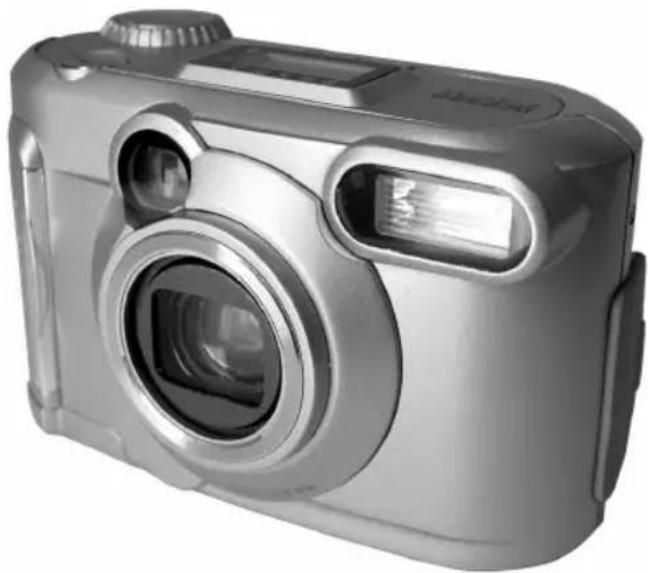
natural_image
Silver digital camera with lens and control panel (no visible text or symbols)- 3X zoom lens
- USB interface compatible
• High definition 2.2 million pixels - Extensive photographic functions
• Auto/Flash/Macro/Self-timer
- Multi mode (16 continuous images in one frame)
- Bulb mode for night and creative photography
• Color/Black-and-white photography, etc.
- Image size and quality easily selectable
- Size (1792 x 1200 or 896 x 600 pixels)
• Quality (FINE/NORMAL/BASIC)
- Status display
- Settings can be verified even when LCD monitor is OFF.
- SmartMedia™ card
- Up to 128MB capacity
- Compatibility
• Image recording method compliant with DCF.
Accessories
Make sure that you have all of the items below before you start using your camera.
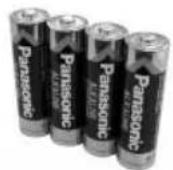
Batteries (4 size AA) Alkaline
Video cable
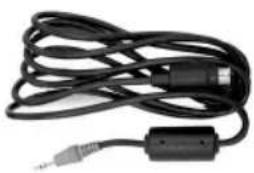
natural_image
Coiled black cable with a connector and plug, no visible text or symbolsUSB cable
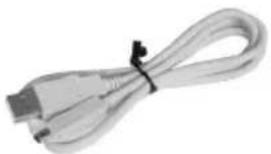
natural_image
Coiled white cable with a USB port, no visible text or symbolsSoft case
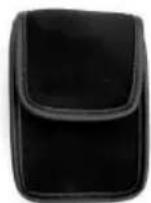
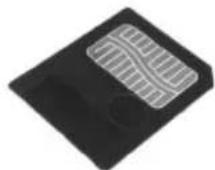
SmartMedia™ card (8MB, 3.3V) (1)
CD-ROM
- USB driver (for Windows 98)
- Software application
- User's manual - Acrobat reader
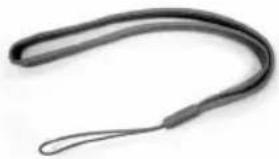
Wrist strap
natural_image
Close-up of a black curved object with a looped end, resembling a stylized hook or strap (no text or symbols visible)Lens cap (with lens strap)
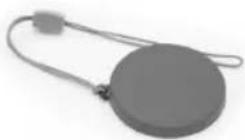
- Anti-static case (1)
- Index labels (2)
- Write-protect stickers (4)
AC adapter (Optional)
Names of Parts
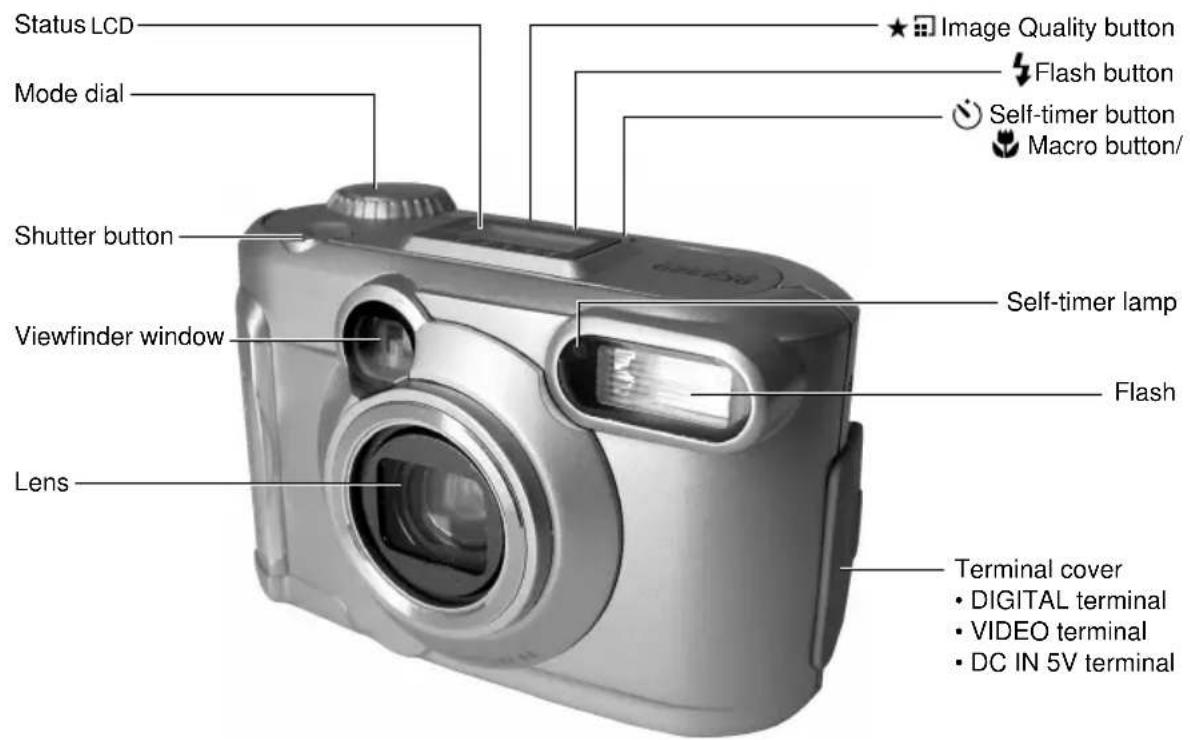
Names of Parts (continued)
![MENU button In Manual Photography mode, Auto Photography mode or Playback mode, press the ▼ ( ) button to display MENU. ENTER button Press the center of the button. (Use this button to confirm a selection.) ◄/►/▲/▼ (cross pad) button Press the button on the required side. (Use these buttons to select an item or an image.) Viewfinder Viewfinder lamp Power switch LCD monitor Zoom key Telephoto (zoom) Press [●] Wide Press [●●●] Erase button Strap eyelet Tripod mount Card door release Card door Battery cover](/content/2026/05/1065925/images/e66051ee0509195ae0c0c19b8878435819874b180145bca332d6cdb20bf04e39.jpg)
Names of Parts (continued)
Mode dial
Auto Photography mode
This is the most commonly used photography mode. In this mode, exposure (combination of shutter speed and aperture) is automatically controlled to facilitate photography.
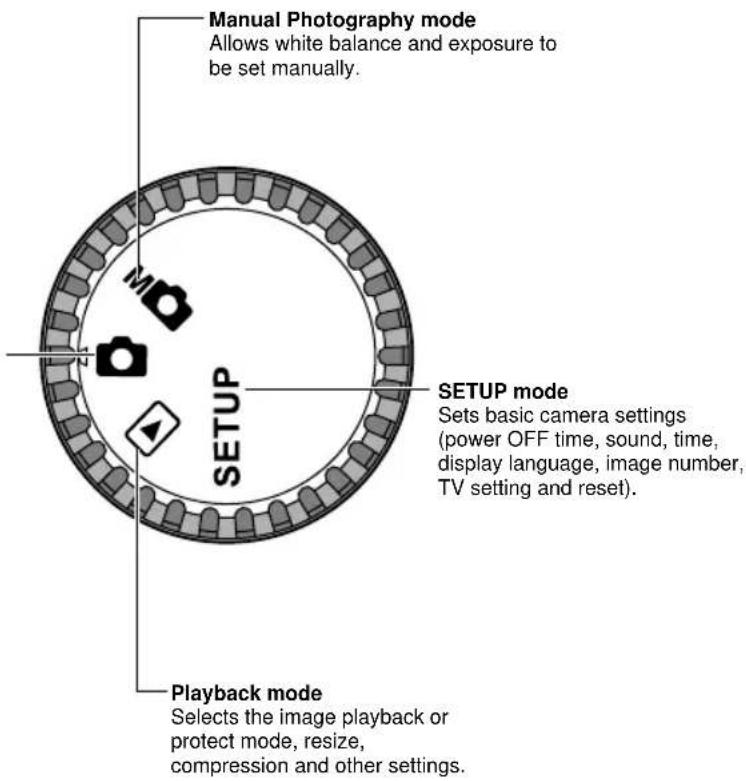
Names of Parts (continued)
Status display
This display indicates the camera's status. You can verify the camera's status even if the LCD monitor is not on.
The text, numbers and icons that are displayed vary according to the settings.
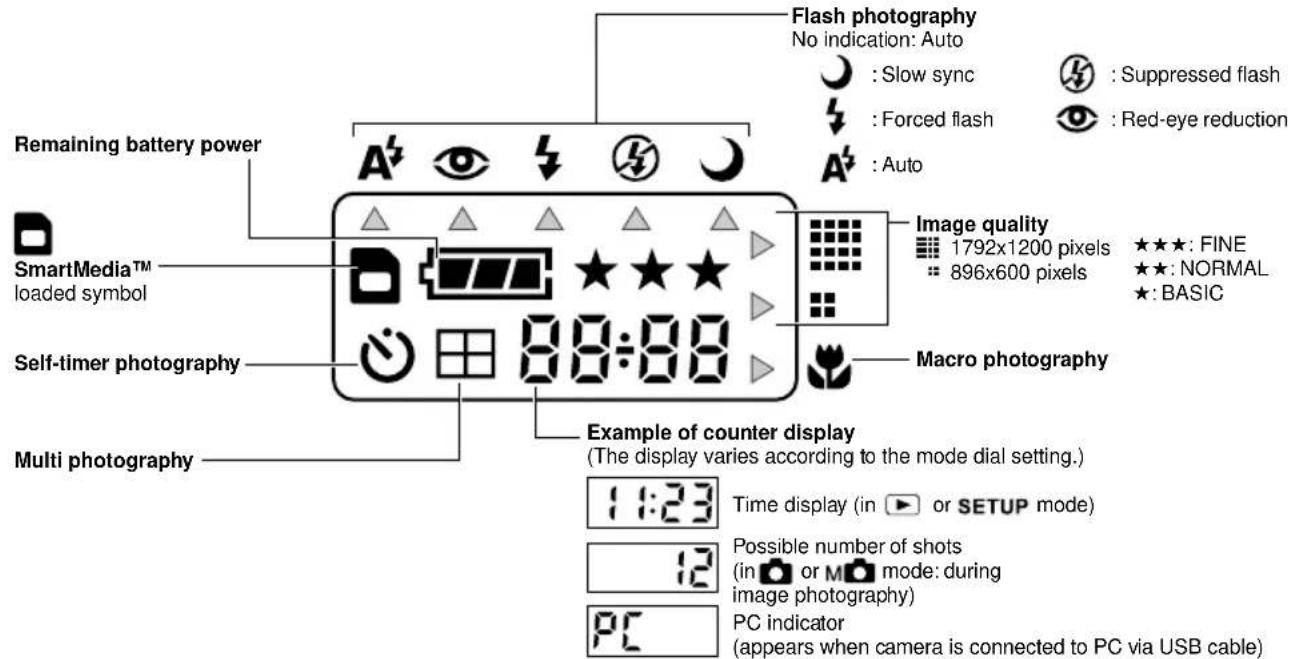
Attaching the Strap
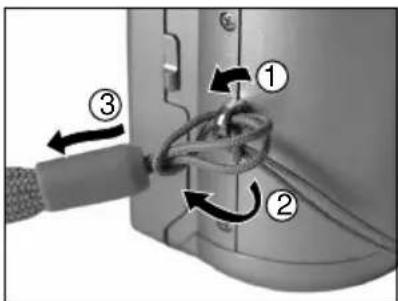
The two figures below illustrate how to attach the lens strap and wrist strap.
Attach the lens strap and cover the camera lens with the lens cap to protect the camera lens from any unexpected damages while the camera is not being used.
Attach the wrist strap and put it around your wrist to prevent your camera from slipping during use.
- Thread one end of the lens strap through the strap eyelet ① and pull the other end through the loop ② until the loop fits tightly against the strap eyelet ③.
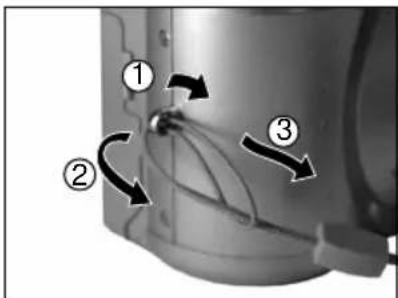
- Attach the wrist strap in the same way.
Installing the Batteries
This camera uses four (4) size AA batteries.
Loading the Batteries
IMPORTANT
- Before you load or remove the batteries, be sure to turn the camera off.
-
The camera may not start normally if you load batteries with the power on. If this happens, turn the camera off, then turn it on again.
-
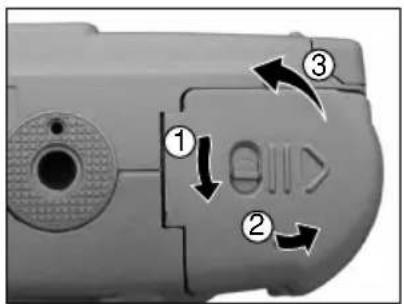
Slide the battery door in the direction of the arrow to open.
-
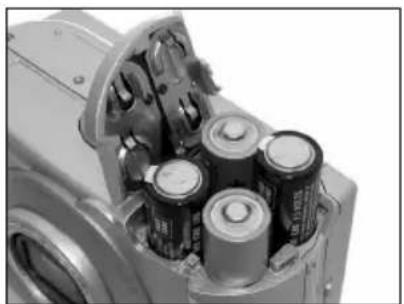
Load the batteries in the battery compartment, making sure that the polarities (+ and - signs) are correct.
natural_image
Interior view of a battery pack with multiple cylindrical batteries (no visible text or symbols)Installing the Batteries (continued)
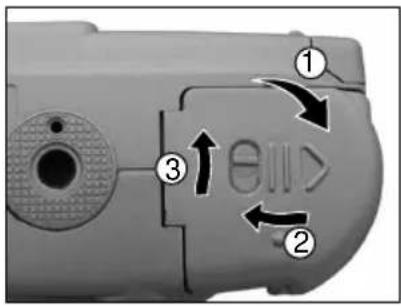
- Close the battery door and move the lock switch in the direction of the Lock arrow.
IMPORTANT
• Make sure that the battery door is firmly closed.
Removing the Batteries
Reverse the procedure for "Loading the Batteries" to remove the batteries.
IMPORTANT
- When removing the batteries, take care not to drop the camera or the batteries by mistake.
Installing the Batteries (continued)
Battery Wear
When the power is ON, the remaining battery power is displayed on the LCD monitor and the status display.
| LCD Monitor | Status Display | Remaining Battery Power |
 |  | [FULL] Sufficient battery power, or the AC adapter is connected. |
 |  | [HALF] Half battery power or less |
 |  | [LITTLE] Little battery power left |
 |  | [EMPTY] No battery power left. Replace with new batteries. |
IMPORTANT
- When you remove the batteries, the date and time may return to the default setting. If this happens, set them again when using the camera.
Using a Power Outlet
If you use the AC adapter in a room with a power outlet, you can take photographs for an extended period of time. This also prevents mechanical failures or data transfer failures due to battery wear.
IMPORTANT
- Before you connect or disconnect the AC adapter, be sure to turn the camera off. If the AC adapter is connected or disconnected with the power ON, the camera may malfunction or the recorded data may be erased (destroyed) even if the batteries are loaded.
-
The camera may not start normally if you load batteries with the power on. If this happens, turn the camera off, then turn it on again.
-
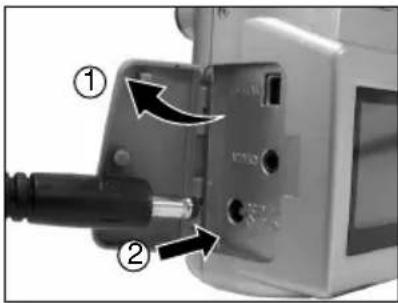
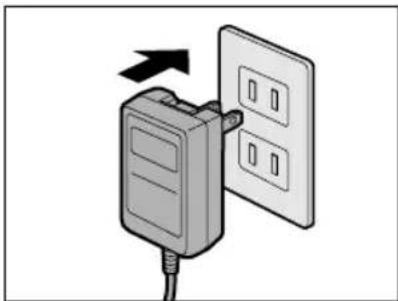
Open the terminal cover ①, and insert the AC adapter connector plug into the DC IN 5V terminal on the camera ②.
- Insert the AC adapter power plug into the power outlet.
natural_image
Illustration of a wall-mounted electrical outlet connected to a plug, with an arrow indicating direction (no text or symbols present)About SmartMedia™ Cards
The SmartMedia™ card is a storage medium for saving images that you have photographed. Even if the camera's power is turned OFF, the images saved on the SmartMedia™ card are not erased. SmartMedia™ cards can be repeatedly read and written.
SmartMedia™ cards having the following storage capacity can be used on your camera.
4MB/8MB (standard accessory)/16MB/32MB/64MB/128MB (all 3.3 V types)
Notes on SmartMedia™ Cards
- Recorded data may be erased (destroyed) in the situations listed below.
- When the SmartMedia™ card is used incorrectly by the user or a third party
- When the SmartMedia™ card is exposed to static electricity or electrical noise
-
When the SmartMedia™ card is removed or the camera is then switched OFF during data recording, data erasing, frame advance when images are being played back or during formatting of the SmartMedia™ card.
-
We recommend copying and saving important data onto another storage medium (floppy disk, hard disk, MO disk, etc.).
- Never remove the SmartMedia™ card or switch the camera OFF during data recording or during data erasing (SmartMedia™ card formatting). These actions might damage the SmartMedia™ card.
- Use only the SmartMedia™ cards specified for use with the camera. The use of other SmartMedia™ cards could damage the camera.
- SmartMedia™ cards are precision electronic devices. Do not bend, drop, or subject SmartMedia™ cards to excessive shocks. Also, do not carry SmartMedia™ cards in locations such as a trouser pocket. This might subject the SmartMedia™ card to excessive force when you sit down, damaging the SmartMedia™ card.
- Do not use or store SmartMedia™ cards in environments likely to be affected by strong static electricity or electrical noise.
- Do not use or store SmartMedia™ cards in very hot, humid or corrosive environments.
About SmartMedia™ Cards (continued)
Loading the SmartMedia™ Card
- Slide the power switch Ⓐ to turn off the power.
-
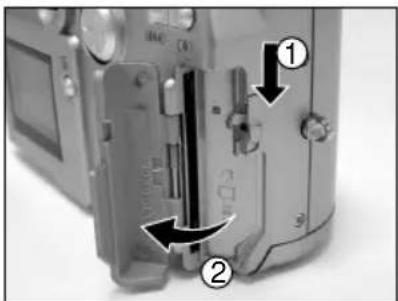
Slide the card door release in the direction of the arrow ① to open the cover ②.
-
Gently insert the SmartMedia™ card as far as it can go with the SmartMedia™ card electrodes (metal contacts) facing the front of the camera.
-
Close the card door. Before you use a new SmartMedia™ card, be sure to format the SmartMedia™ card.
natural_image
Close-up of a camera module showing internal components and directional arrows (no text or symbols)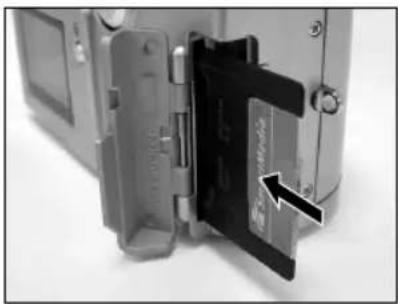
natural_image
Close-up of a camera module with a black plastic clip and an arrow pointing to it, no visible text or symbols.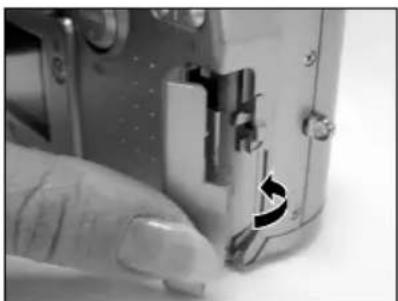
natural_image
Close-up of a hand operating a sewing machine needle with a black arrow indicating the angle (no text or symbols visible)About SmartMedia™ Cards (continued)
Removing the SmartMedia™ Card
IMPORTANT
- Never open the card door or remove the SmartMedia™ card while data is being recorded to the SmartMedia™ card (viewfinder lamp flashes). This might damage the SmartMedia™ card or corrupt the data on the SmartMedia™ card.
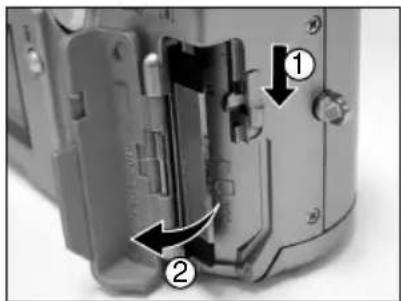
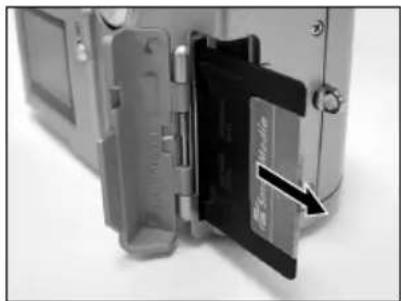
- Slide the power switch Ⓐ to turn off the power.
- Slide the card door release in the direction of the arrow ① to open the door ②.
-
Pull the SmartMedia™ card out with your fingers.
-
Close the card door.
natural_image
Close-up of a camera module showing a black-out drive with a white label and an arrow pointing to it (no readable text or symbols)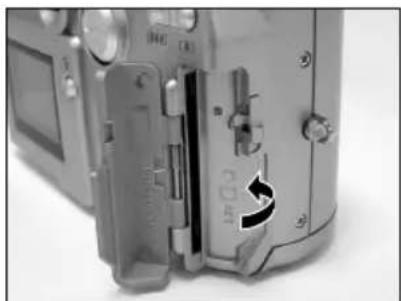
natural_image
Close-up of a digital camera module showing internal components and a circular arrow indicating rotation (no text or symbols visible)About SmartMedia™ Cards (continued)
Write Protection
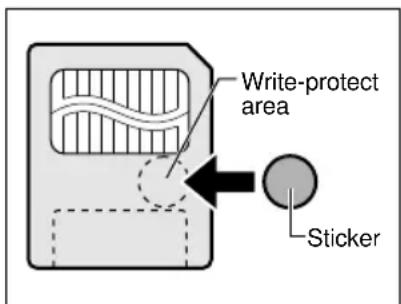
To prevent valuable data from being erased inadvertently, attach the write-protect sticker at the write-protect area. Data can no longer be recorded or erased from the SmartMedia™ card. To write or erase data from the SmartMedia™ card, peel off the sticker.
IMPORTANT
- The write protection may not function if the write-protect sticker becomes dirty. Use a soft dry cloth to wipe away any dirt. Once a sticker is peeled off it cannot be used again.
Turning the Power ON/OFF
Turning the Power ON
- Make sure that the SmartMedia™ card is correctly loaded.
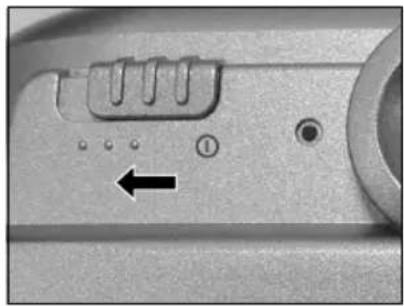
- Slide the power switch ① to turn on the power and set the mode dial to the desired mode.
Remove the lens cap during photography.
In the ☐ or ☐ modes, the lens extends from the camera body. When the camera is turned ON, the Auto Power OFF function starts to work.
natural_image
Close-up of a computer mouse with a button and indicator lights (no readable text or symbols)IMPORTANT
- If no operation is carried out for a fixed amount of time (default: about 1 minute), the power is turned off to prevent battery wear. This is called "Auto Power OFF".
Turning the Power OFF
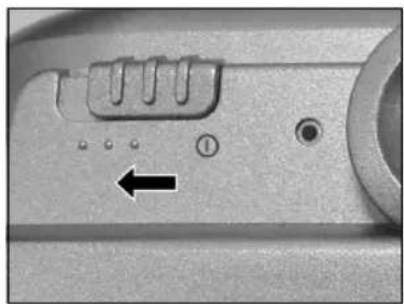
- Slide the power switch Ⓐ to turn off the power.
The power is turned off, and the lens returns to its original position in the body.
natural_image
Close-up of a device's internal component with no visible text or symbolsLCD Monitor Display
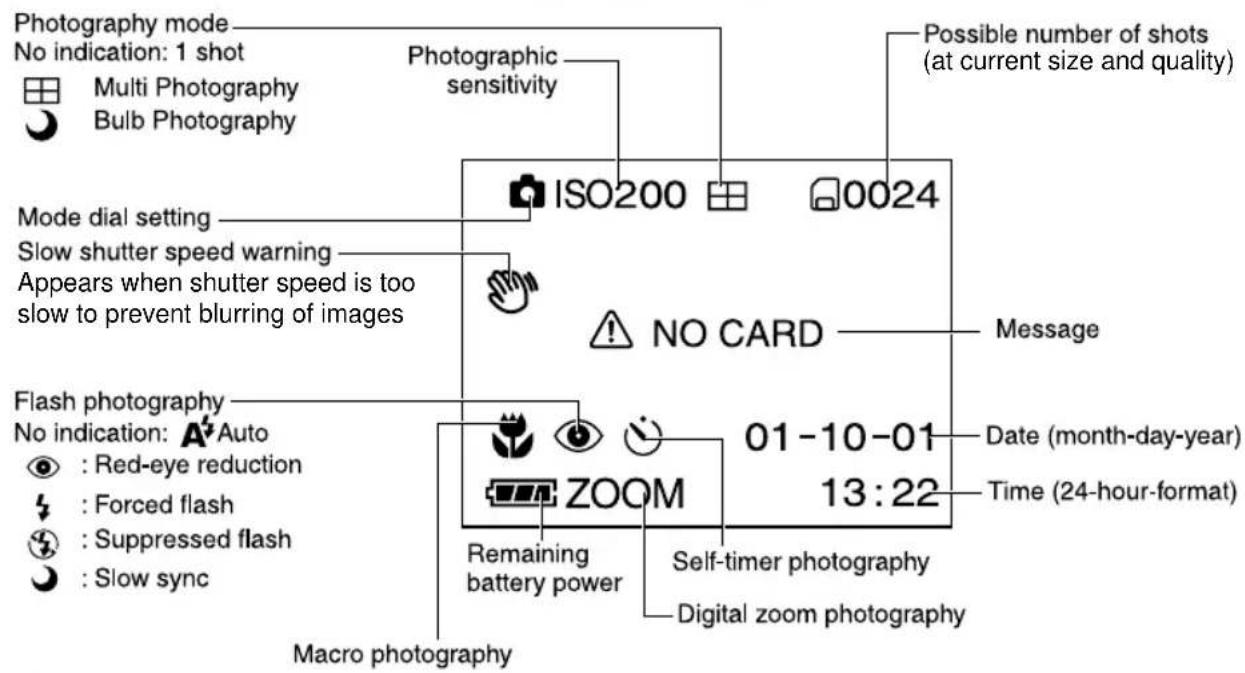
The text, numbers and icons that are displayed on the LCD monitor vary according to the current settings. To erase text currently displayed on the LCD monitor, use the DISPLAY function in the MENU. The LCD monitor automatically turns ON if necessary even if it is set to OFF.
In Photography Mode
Note
- The size of the data to be recorded varies according to the amount of detail in the subject image. So, the number of images that can be photographed after an image is recorded decreases. Sometimes this amount decreases by two images.
- The display is momentarily disrupted after recording an image or the mode is switched. This does not affect photography.
LCD Monitor Display (continued)
In Manual Photography Mode M
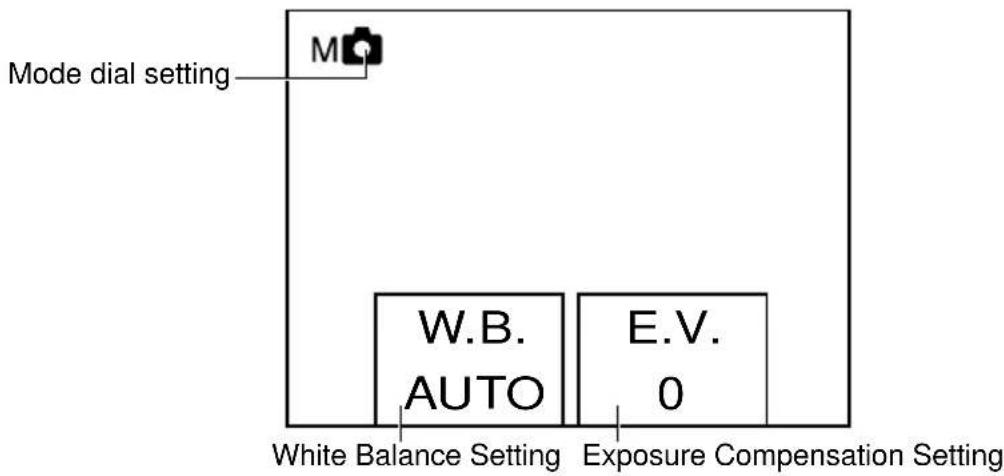
Note
- The display is momentarily disrupted after recording an image or the mode is switched. This does not affect photography.
LCD Monitor Display (continued)
In Playback Mode
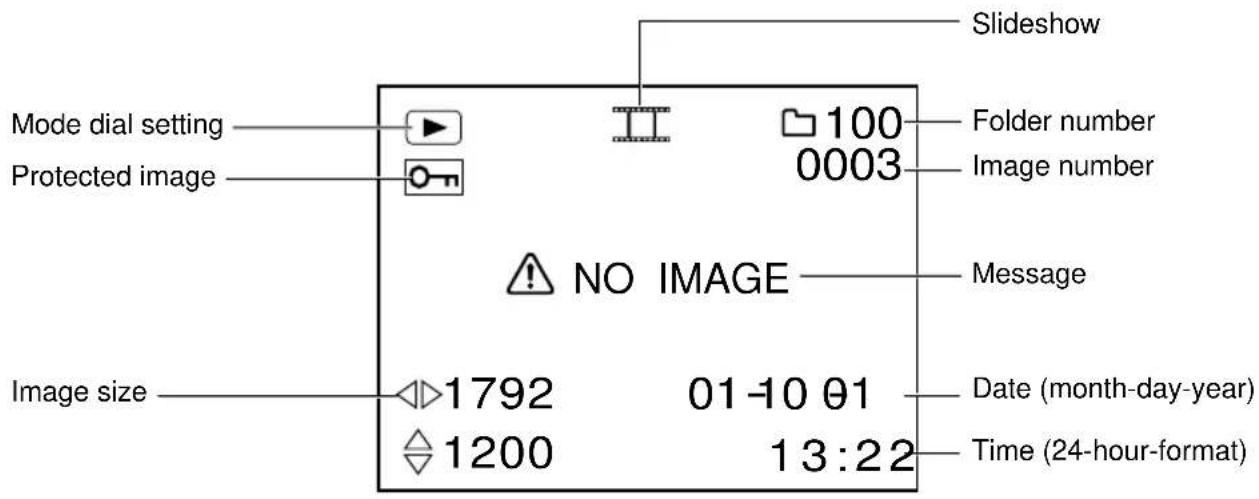
How to Hold Your Camera
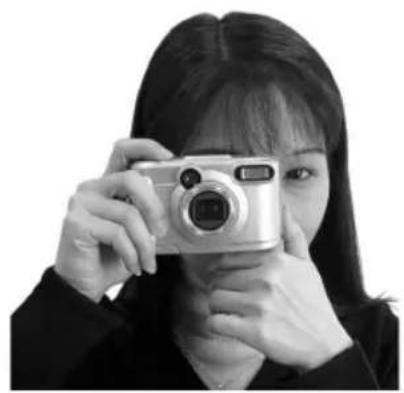
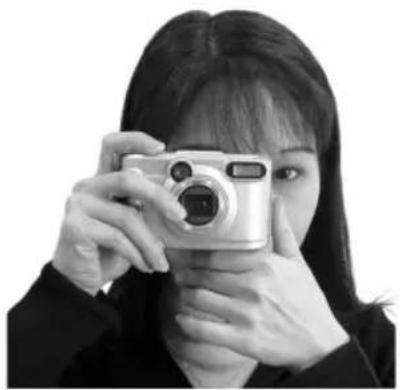
When taking a photograph, hold the camera firmly and prevent your finger or straps from covering the lens or flash.
Right
Camera held with both hands with your arms firmly held against the sides of your chest
Wrong
Fingers held over the lens
natural_image
Black-and-white photo of a person holding a digital camera, no visible text or symbols
natural_image
Black-and-white photo of a person holding a digital camera, no visible text or symbols
How to Press the Shutter Button
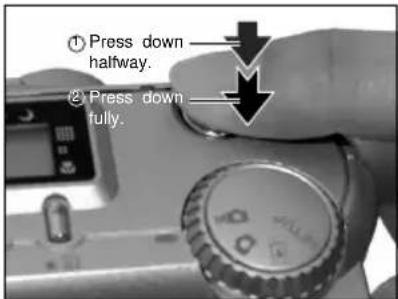
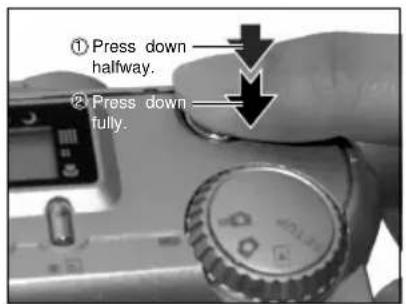
The shutter button can be pressed down in two stages: halfway down and fully down. When pressed halfway down, AF (auto-focus) and AE (auto exposure) are carried out. When pressed fully down, the camera takes a picture.
- Press the shutter button down halfway ①.
AF (auto-focus) and AE (auto exposure) start to function.
When AF or AE are locked, the beep tone sounds and the viewfinder lamp lights.
- Then press it the rest of the way down ②.
The camera takes a picture.
The viewfinder lamp flashes while image data is being recorded onto the SmartMedia™ card.
IMPORTANT
- Never open the card door or remove the SmartMedia™ card while an image is being recorded. This may corrupt the data on the SmartMedia™ card or damage the SmartMedia™ card itself.
How to Press the Shutter Button (continued)
Note
- If the shutter button is pressed all the way down, photographs cannot be taken until AF and AE are locked.
- The image in the LCD monitor sometimes darkens from the time that the shutter button is pressed down half way until the image becomes focused.
- To focus or expose a position outside the center of the screen frame, move the subject you are taking to the center of the screen frame, and press down the shutter button halfway and hold it until the camera beeps. Now, with the shutter button held down, return to the original picture that you composed and press the shutter button the rest of the way down. Moving the camera as you press the shutter button will result in a blurred image.
- The camera uses an accurate auto focus mechanism. However, the camera may have difficulty focusing or not be able to focus at all for subjects and situations such as the following:
- Subjects moving at high speed
- Very shiny subjects such as a mirror or car body
- Extremely low contrast subjects
- Subjects that have low contrast and merge into the background (such as white walls or subjects dressed in the same color as the background)
- When the subject is distant and dark
- When there are objects in front of or behind the subject (such as an animal in a cage or a person in front of a tree)
- Subjects with little reflection, such as a hair or fur
- Subjects with no solidity, such as smoke or flames
- Subjects viewed through glass
- If the image cannot be focused, the focus is automatically fixed to infinity. When the flash is necessary at this time, it is simultaneously fixed to illuminate objects five feet (1.5 meters) away.
About the Viewfinder Lamp
The viewfinder lamp indicates the state of the camera. The meaning of the lamp may differ according to the mode dial setting.
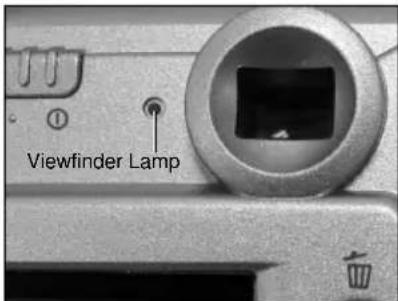
| Viewfinder Lamp | Meaning |
| State | |
| ON | For AF are locked with the shutter button held halfway down. |
| Flashing | [Power ON] Writing to SmartMedia card in progressDo not turn off the powerFor Me's cannot focus because of obstacle. |
Auto Photography
This is the most commonly used photography mode.
In this mode, exposure (combination of shutter speed and aperture) is automatically controlled to facilitate photography. There are two ways of taking photographs in this mode: using the viewfinder and using the LCD monitor.
Using the Viewfinder
- Get ready to take the photograph.
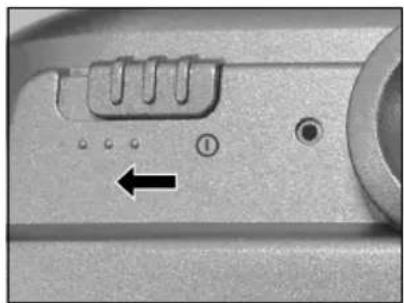
Load the batteries and the SmartMedia™ card into the camera. - Slide the power switch Ⓐ to turn on the power.
natural_image
Close-up of a device's internal components with a black arrow pointing to a specific area (no text or symbols visible)- Set the mode dial to

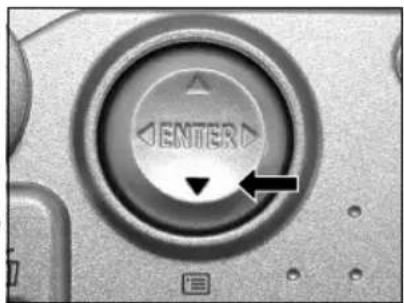
- Press the ▼ ( [ ] button. Use the ▲ buttons to select the DISPLAY item and press the ▶ button. Select OFF to turn the LCD monitor display off. To reduce the amount of battery wear, we recommend turning the LCD monitor display OFF, and using the viewfinder to take photographs.
Auto Photography (continued)
- Look through the viewfinder to compose the picture.
natural_image
Illustration of a German Shepherd dog sitting upright, no text or symbols present-
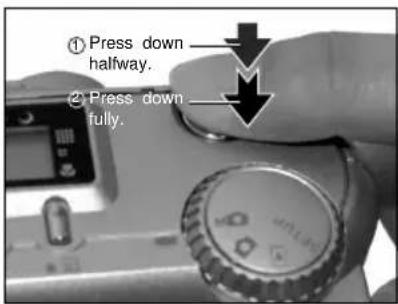
Press the shutter button down halfway ①, then press it the rest of the way down ②.
-
Pressing the shutter button down halfway adjusts the exposure, and pressing the shutter button the rest of the way down takes the shot.
- When the focus and exposure are adjusted, the viewfinder lamp lights.
- If you shoot a picture when preview is ON, a preview image is displayed on screen for about two seconds.
- The viewfinder lamp flashes while image data is being recorded onto the SmartMedia™card.
Using the LCD Monitor
- Get ready to take the photograph.
Load the batteries and the SmartMedia™ card into the camera. - Slide the power switch ① to turn on the power.
Auto Photography (continued)
- Set the mode dial to

-
Look at the image on the LCD monitor to compose the picture.
-
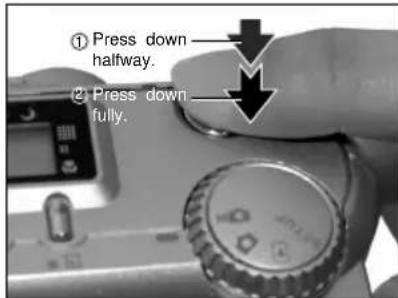
Press the shutter button down halfway ①, then press it the rest of the way down ②.
- Pressing the shutter button down halfway adjusts the exposure, and pressing the shutter button the rest of the way down takes the shot.
- When the focus and exposure are adjusted, the viewfinder lamp lights.
- If you shoot a picture when preview is ON, a preview image is displayed on screen for about two seconds.
- The viewfinder lamp flashes while image data is being recorded onto the SmartMedia™ card.
Note
- The LCD monitor sometimes displays bright, dark or colored spots at all times. This is not a malfunction. These spots do not appear in the photographed image.
- The image is not displayed on the LCD monitor while the shutter button is pressed down fully.
Setting the Image Size and Quality
Set the size (number of pixels) and quality (compression ratio) of the image to be photographed. Change the setting according to how the image is to be used and the remaining amount of space in the SmartMedia™ card.
- Slide the power switch ① to turn on the power.
- Set the mode dial to 📄 or M
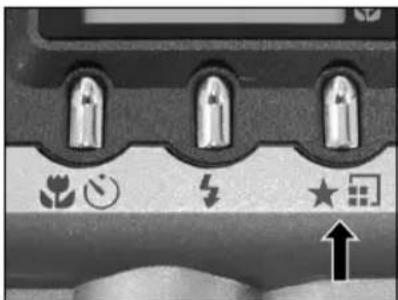
- Press the ★image quality button to set the required quality and size while viewing the image on the status display.
Pressing the image quality button displays the available qualities and sizes in order. Select from the available combinations of quality and size.
natural_image
Close-up of a mechanical component with three vertical slots and icons (no readable text or symbols)
flowchart
graph LR
    A["★★FULL (default)"] --> B["★★★FULL"]
    B --> C["★HALE"]
    C --> D["★★HALE"]
    D --> E["★★★HALF"]
    E --> F["★FULL"]
Quality ★★★ FINE : Low compression
[ ★★] NORMAL : Middle compression
[ ★] BASIC : High compression
The more stars there are, the better image quality becomes. Higher quality images, however, take up more memory space, reducing the number of images that can be taken.
Size [FULL] 1792 x 1200 pixels, [HALF] 896 x 600 pixels
The FULL setting improves the quality of the image. Higher quality images, however, take up more space, reducing the number of images that can be taken.
Setting the Image Size and Quality (continued)
4. Take the photograph.
Note
- To make the image become smaller, it is recommended that you reduce the image size first. If this step cannot meet your needs, then you can reduce the image quality as an additional means.
• After you have taken a photograph, you can change its size and quality. - The size of the image varies according to the subject.
- The settings are not canceled even if the camera is turned off or the Auto Power OFF function is activated.
- The settings are canceled when you remove or insert the batteries or disconnect or connect the AC adapter.
Zoom Photography
Zoom photography allows you to take telephoto and wide-angle shots.
- Slide the power switch ① to turn on the power.
- Set the mode dial to 📄 or M
-
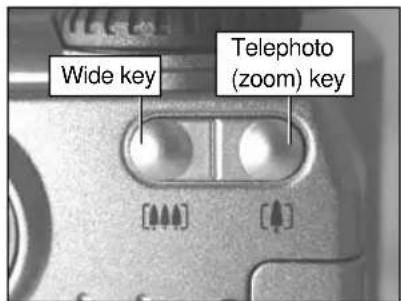
Compose the picture using the Zoom key.
-
Pressing the Telephoto (zoom) key zooms in on the subject, and enlarges the subject on the LCD monitor.
- Pressing the Wide key provides a wider angle picture.
- The lens position moves according to the Zoom key setting.
- Press the shutter button down halfway, then press it the rest of the way down.
Note
- The Zoom key setting is automatically canceled by either turning the camera off or by the activation of the Auto Power OFF function.
Digital Zoom Photography
This function enlarges the center of the image displayed on the screen so that it appears that the photographed image is enlarged twice its size.
The LCD monitor automatically turns ON in this mode. Take pictures while viewing the image in the LCD monitor.
- Set the mode dial to
In the Manual Photography mode, press the ENTER button to set the manual setup screen to non-display.
- Press the 📁Telephoto (zoom) key as far as it can go.
ZOOM is displayed in the LCD monitor and the center of the screen is enlarged to twice the original size. - Look at the image on the LCD monitor to compose the picture.
- Press the shutter button down halfway, then press it the rest of the way down.
- To cancel digital zoom photography, press the 📄Wide key.
Note
- The image size is fixed to HALF (896 x 600 pixels) in the Digital Zoom Photography mode. However, in the MULTI mode, you can take pictures even at FULL (1792 x 1200 pixels).
- Digital zoom photography is automatically canceled by either turning the camera off or by the activation of the Auto Power OFF function.
Macro (Close-up) Photography
The macro photography mode is used when the distance to the subject is between 8 cm and infinity at wide angle. In the macro photography mode, the LCD monitor automatically turns ON. Take the photograph while viewing the LCD monitor.
- Set the mode dial to
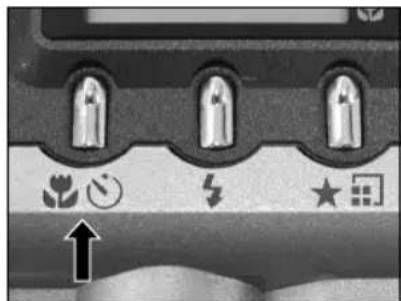
- Press the 🎨 button to set to the macro mode.
is displayed on the LCD and the arrow points to the Macro icon. In the Manual Photography mode, is not displayed on the LCD monitor when the manual setup screen is displayed. Press the ENTER button to set the manual setup screen to not display.


natural_image
Close-up of a device control panel with icons for plants, lightning, and navigation buttons (no readable text or symbols)Pressing the button displays the available Self-timer and Macro modes in order.

flowchart
graph LR
    A["Self-timer"] --> B["Macro"]
    B --> C["Self-timer & Macro"]
    C --> D["Off"]
-
Look at the image on the LCD monitor to compose the picture.
-
Press the shutter button down halfway, then press it the rest of the way down.
-
To cancel macro photography, press the 🎨 button until it turns off.
Note
- Macro photography is not canceled even if the camera is turned off or the Auto Power OFF function is activated.
- Only the ④ Suppressed Flash and Forced Flash modes can be set for flash photography.
- The settings are canceled when you remove or insert the batteries or disconnect or connect the AC adapter.
Self-timer Photography
When the self-timer is used, the shutter is automatically released after the preset time (two or ten seconds).
- Set the mode dial to
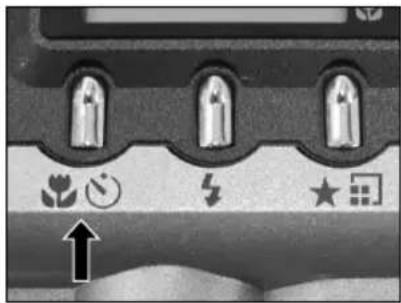
- Press the 📄 button to set to the self-timer mode. [ 🔊 is displayed on the LCD monitor and the status display. In the Manual Photography mode, 🔊 is not displayed on the LCD monitor when the manual setup screen is displayed. Press the ENTER button to set the manual setup screen to not display. Pressing the button displays the available Self-timer and Macro modes in order.

flowchart
graph LR
    A["Self-timer"] --> B["Macro"]
    B --> C["Self-timer & Macro"]
    C --> D["Off"]
natural_image
Close-up of a computer keyboard mode dial with icons for settings, navigation, and function buttons (no readable text or symbols)-
Compose the picture.
-
Press the shutter button down halfway, then press it the rest of the way down. The self-timer lamp will turn red, then start flashing. The photograph is then taken after the preset time (two or ten seconds). When photographs are taken using the LCD monitor, the count down is displayed. To cancel photography midway, press the ▼(□) button.
Note
• After you have set the self-timer, the setting is not canceled even if the camera is turned off or the Auto Power OFF function is activated.
- The setting is canceled when you execute the self-timer photography, remove or insert the batteries or disconnect or connect the AC adapter.
Flash Photography
In the default setting, the flash will be automatically set to function in dark places. No special setting is needed to set off the flash. The flash firing mode can be set to suit the conditions where the flash is to be fired. The effective range of the flash is approximately 1.3 ft (0.4 m) to 8.2 ft (2.5 m).
- Set the mode dial to
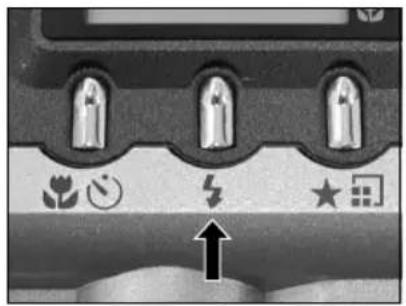
- Press the flash button to set to the desired mode while viewing the image on the LCD monitor or the status display.
The icon for the mode that you selected is displayed in the LCD monitor or the status display.
In the Manual Photography mode, the icon for the mode that you selected is not displayed on the LCD monitor when the manual setup screen is displayed.
Press the ENTER button to set the manual setup screen to not display.
Pressing the flash button displays the available flash modes in order.


natural_image
Close-up of a mechanical component with three vertical slots and icons (no readable text or symbols)A Auto → Red-Eye Reduction → Forced Flash → Suppressed Flash → Slow Sync
- Compose the picture. Press the shutter button down halfway ①, then press it the rest of the way down ②.
Flash photography (continued)
Auto
In this mode, the flash fires automatically according to the ambient conditions. This mode is ideal for general photography where you are not trying to achieve any particular effect (when using macro photography, the flash does not fire).
Red-Eye Reduction
Use this mode to avoid the red-eye effect when photographing people in low-light conditions.
The flash emits a pre-flash just before the picture is taken and then flashes again to take the actual picture.
Red-eye is reduced more effectively if the camera is pointed at the line of sight of the subject at as close a distance as possible.
Forced Flash
In this mode, the flash always fires. Use the Forced Flash mode to shoot pictures in artificial light (backlighting, fluorescent lighting, etc.).
The flash also fires during macro photography.
Suppressed Flash
Use the Suppressed Flash mode when you are taking pictures in indoor lighting at distances too great for the flash to have any effect, such as theater performances or indoor sporting events.
Slow Sync
The flash is fired at a slower shutter speed.
Flash photography (continued)
Note
- If you take a photograph in the Slow Sync mode at a place with a dark background or in the Suppressed Flash mode at a dark place, the shutter speed slows down, and the slow shutter speed warning is displayed. (When the shutter is pressed halfway down, the viewfinder lamp lights and the slow shutter speed mark is displayed in the LCD monitor.) We recommend using a tripod to prevent blurred image caused by shaking.
- Using the flash during multi-image photography and bulb photography is not possible.
- The flash setting is not canceled even if the camera is turned off or the Auto Power OFF function is activated.
- The settings are canceled when you remove or insert the batteries or disconnect or connect the AC adapter.
- It may take a few seconds to charge the flash. Photography by using the flash is not possible while the charging is in progress. Please wait until the charging is completed.
Multi-Image Photography
This mode takes 16 shots continuously at 0.25-second intervals. The 16 photographed images are saved as one image.
This mode is effective for continuously photographing moving subjects.
- Set the mode dial to


-
Set the REC. mode to MULTI.
-
Press the ▼ button.
- Use the ▲ or ▼ buttons to select REC.MODE and press the button.
- Use the ▲ or ▼ buttons to select MULTI and press the ENTER button.
- Press the ENTER button.
Is displayed in the LCD monitor or the status display.
In the Manual Photography mode, is not displayed on the LCD monitor when the manual setup screen is displayed.
Press the ENTER button to set the manual setup screen to not display.
- Compose the picture, press the shutter button down halfway, then press it the rest of the way down.
The shutter is opened and closed 16 times.
Note
- The photography interval changes according to the photographic conditions.
- Flash photography is not possible.
- The settings are not canceled even if the camera is turned off or the Auto Power OFF function is activated.
- The settings are canceled when you remove or insert the batteries or disconnect or connect the AC adapter.
Long Exposure Photography
This mode is used for taking subjects that require several seconds to photograph such as firework displays at night. When using this mode, be sure to use a tripod to keep the camera stable and prevent distorted images.
- Set the mode dial to 📄 .M
-
Set the REC mode to BULB.
-
Press the ▼ button.
-
Use the ▲ or buttons to select REC.MODE and press the button.
- Use the ▲ or buttons to select BULB and press the ENTER button.
- Press the ENTER button.
and are displayed in the LCD monitor and the arrow points to their icons.
In the Manual Photography mode, and are not displayed on the LCD monitor when the manual setup screen is displayed.
Press the ENTER button to set the manual setup screen to not display.
- Compose the picture, press the shutter button down halfway, then press it the rest of the way down.
The camera takes the picture at the set exposure time.
During the exposure, the viewfinder lamp flashes.
It takes about twice the set time to complete taking the photograph due to processing of the captured image.
Note
- Flash photography is not possible.
- The settings are not canceled even if the camera is turned off or the Auto Power OFF function is activated.
- The settings are canceled when you remove or insert the batteries or disconnect or connect the AC adapter.
Manual Photography
You can manually adjust conditions such as white balance and exposure compensation, and take photographs at these conditions. This is called "manual photography." Settings made in this mode are saved even if the camera is turned off.
IMPORTANT
- If you remove or insert the batteries or disconnect or connect the AC adapter, the manual photography settings will return to their defaults. If this happens, manually set the conditions again.
- The settings are not canceled even if the camera is turned off or the Auto Power off function is activated.
1. Set the mode dial to M.
The manual setup screen is displayed. Display or not display of the manual setup screen is toggled at each press of the ENTER button.
- Press the ◀ or buttons to select the setting item and the ▲ or ▼ buttons to select the set value.
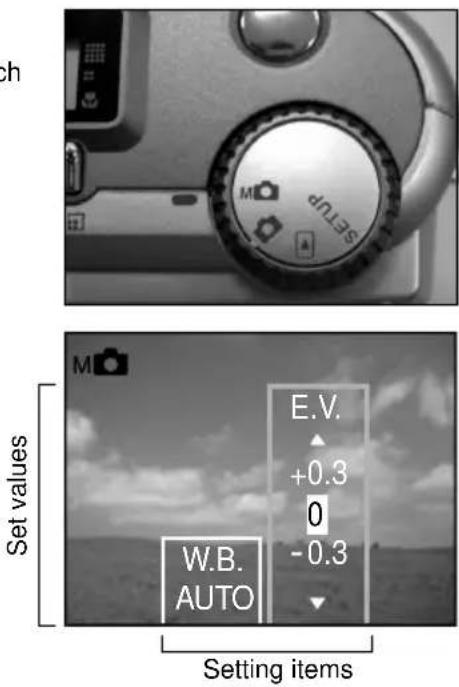
Manual Photography (continued)
3. Press the ENTER button.
This confirms the setting.
The camera is ready to take photographs.
4. Compose the picture, press the shutter button down halfway, then press it the rest of the way down ②.
The camera takes the picture.
Note
- Photography is also possible with the manual setup screen displayed.
W.B. (White Balance)
The camera determines the white balance by averaging the various kinds of light that enters the lens. This setting allows you to set the white balance when taking photographs under specific lighting conditions. This setting does not function when the flash is used to take photographs.
[ AUTO ] : Automatic adjustment (default)
[★: Photography outdoors
[1]: Photography in cool white fluorescent light
[12]: Photography in standard fluorescent light
[ ] : Photography in incandescent light
Manual Photography (continued)
E.V. (Exposure Compensation)
This setting allows you to lighten or darken the entire screen. Use this setting when the optimum brightness (exposure) cannot be obtained, for example, when there is a lot of contrast between the subject and the background or when the subject to photograph occupies only an extremely small part of the screen. Increasing E.V. lightens the screen, while decreasing E.V. darkens the screen.
$$ [ + 1. 5 / + 1. 2 / + 0. 9 / + 0. 6 / + 0. 3 / 0 (\text { default }) / - 0. 3 / - 0. 6 / - 0. 9 / - 1. 2 / - 1. 5 ] $$
The ideal brightness sometimes cannot be obtained even if a large E.V. value is set in dark photographic conditions.
Also, the brightness of moving images before they are photographed sometimes does not change if the subject itself is dark. In this case, press the shutter button, and check the brightness in the preview image (photographed image).
Effective Subjects and Set Values
• Positive (+) Compensation
- Copying of printed text (black characters on white paper) (+1.5)
- Backlit portraits (+0.6 to +1.5)
- Very bright scenes (such as snowfields) and highly reflective subjects (+0.9)
- Shots made up predominantly of sky (+0.9)
- Negative (−) Compensation
- Spotlit subjects, particularly against dark backgrounds (-0.6)
- Copying of printed text (white characters on black paper) (-0.6)
- Scenes with low reflectivity, such as shots of green or dark foliage (-0.6)
Changing the Preset Conditions (REC MENU)
This menu is for setting the basic settings to be used for photography in the automatic photography and manual photography mode.
The settings are not canceled even if the camera is turned OFF or the Auto Power OFF function is activated. The settings (except the LCD monitor brightness) are canceled when you remove or insert the batteries or disconnect or connect the AC adapter.
- Set the mode dial to 📄 . M
-
Press the ▼( ☐)button. The REC MENU is displayed.
-
Use the ▲ or buttons to select the desired setting item ① and press the ▶ button.
The tab menu ② is displayed. The image before the photograph is taken is displayed on the LCD monitor when selecting LCD.
REC. MODE
PREVIEW
ISO
BULB
SELF-TIMER
DISPLAY
LCD
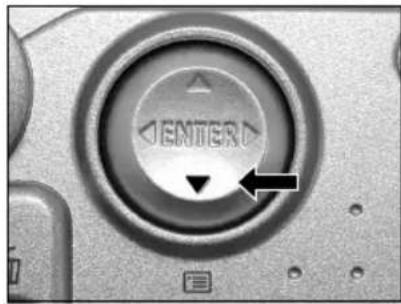
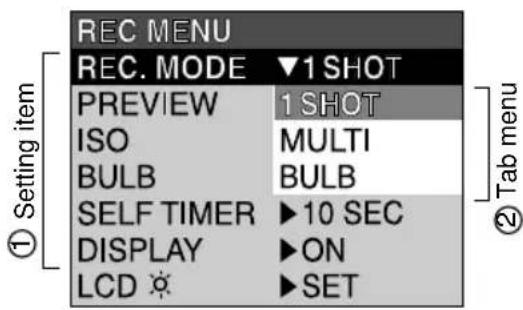
- Use the ▲ or buttons to select the desired setting from the tab menu, and press the ENTER button.
This saves the settings, and returns the display to the REC MENU.
Changing the Preset Conditions (REC MENU) (continued)
- To quit the REC MENU, press the ENTER button.
The camera is now ready to take photographs.
REC. MODE
Select from the following photography modes:
[1SHOT] : Regular photography, one shot at a time (default)
[ MULTI ] : Continuously taking 16 photographs as a single image
[ BULB ] : Taking photographs at a longer exposure time
Photography Mode and Functions
You can combine photography modes and the various functions for extra flexibility.
The following table shows the possible combinations of photography mode functions:
| Macro | Self-timer | Digital zoom | Flash | ||
| Photography Mode | 1SHOT | O | O | O | O |
| MULTI | O | O | O | X | |
| BULB | O | O | O | X | |
O: Possible
X: Not possible
Changing the Preset Conditions (REC MENU) (continued)
PREVIEW
This setting allows you to display a photographed image on the LCD monitor for two seconds immediately after you have taken the shot.
This allows you check the composition and brightness of the photographed image.
[ON] : Display preview (default)
[ OFF ] : Do not display preview
ISO
Sets the color mode and photographic sensitivity at which the image is to be recorded.
Warning: The amount of noise in the image increases when the ISO is changed to a higher setting.
[ ISO100 ]: Equivalent to color ISO100 (default)
[ ISO200 ]: High-sensitive photography equivalent to color ISO200
[ ISO400 ]: High-sensitive photography equivalent to color ISO400
[ B&W ] : Black and white
BULB
Sets the exposure time when taking pictures in the bulb photography mode.
[1SEC] : Opens shutter for about 1 second (default)
[2SEC]: Opens shutter for about 2 seconds
SELF-TIMER
Sets the delay time for when the photograph is taken after the shutter button is pressed during self-timer photography.
[10 _SEC ] : Picture taken after a 10-second delay (default)
[2SEC]: Picture taken after a 2-second delay
Changing the Preset Conditions (REC MENU) (continued)
DISPLAY
Sets the on-screen display status in REC MODE and PLAY MODE.
[ OFF ] : Both the LCD monitor and the on-screen display are turned off.
[ON] : Only the LCD monitor is turned on.
[ ALL ] : Both the LCD monitor and the on-screen display.
LCD
Adjusts the brightness of the LCD monitor. This adjustment does not adjust the brightness of the image to be recorded.
[-5 to +5]
Playing Back Photographed Images (Single-Frame Playback)
Play back photographed images one image at a time.
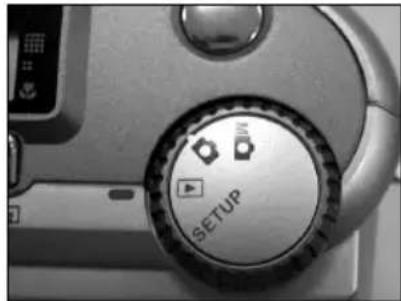
- Set the mode dial to ▶
The last image frame appears on the LCD monitor.
natural_image
Close-up of a camera setup knob with playback buttons and a 'SETUP' label (no readable text beyond the button)- Press the ◀ or ▶ buttons to move back and ahead.
◀ Move back/ ▶Move ahead
Holding down the ◀r buttons moves back or ahead continuously one frame at a time.
Note
- Pressing the button at the last image displays the first image, and pressing the button at the first image displays the last image.
Enlarging Photographed Images (Zoom Playback)
Enlarges selected portions of images being played back 3 times actual size. Images can be displayed enlarged when being played back one image at a time.
-
Set the mode dial to ▶ The last image frame appears on the LCD monitor.
-
Use the ◀ or buttons to select the frame you want to enlarge.
-
Enlarge the image by using the Zoom key. Pressing the Telephoto (zoom) key zooms to 3X. The image is displayed enlarged, and a white frame and green frame are displayed on the LCD monitor. The white frame indicates the entire image, while the green frame shows the location of the currently enlarged area.
-
Use the ▲, ▼or ◀buttons to select the area to enlarge. Adjust the display area to enlarge while viewing the white and green frames.
-
To return to the regular display, press the ENTER button.
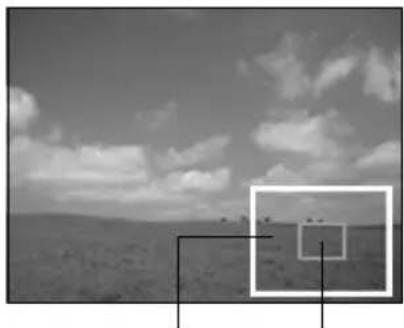
natural_image
Black-and-white landscape photo showing a vast field with scattered clouds and a highlighted rectangular overlay (no text or symbols)Entire image
Current
position of
enlargement
Note
• This function is not supported during TV playback.
- The Zoom Playback function is automatically canceled by either turning the camera off or by the activation of the Auto Power OFF function.
Displaying a List of Image Thumbnails
Nine reduced images are simultaneously displayed on the LCD monitor. This manual calls this display "thumbnail display."
This feature is useful when there are many images. After you have displayed the image thumbnails, you can select the desired image and display it in the regular display.
- Set the mode dial to
The last image frame appears on the LCD monitor.
- Press the ENTER button.
Nine images are displayed simultaneously.
- Use the ▲, ▼or◀buttons to move the cursor to select the image to be displayed at regular size.
The cursor lies on top of the image surrounded by a frame.
Pressing the buttons continuously moves the cursor continuously.
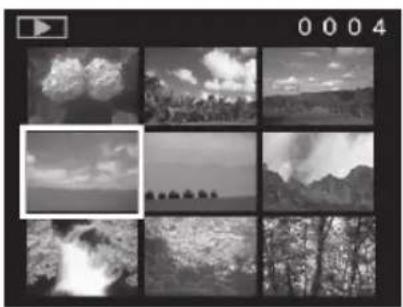
natural_image
Grid of black-and-white landscape photos showing mountains, clouds, and forested terrain (no text or symbols)- Press the ENTER button.
The selected image is displayed at its regular size.
Note
- The Thumbnail Display function is automatically canceled by either turning the camera off or by the activation of the Auto Power OFF function.
Slideshow Playback
Automatically play back one image at a time in order.
-
Set the mode dial to ▶ The last image frame appears on the LCD monitor.
-
Press the ▼ button. The PLAY MENU is displayed.
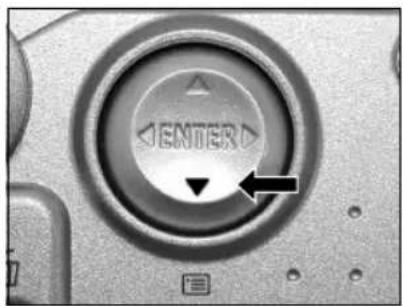
- Use the ▲ or ▶ buttons to select SLIDE and press the ▶ button.
The slideshow begins and Tis displayed on the LCD monitor. The next image is displayed every three seconds.
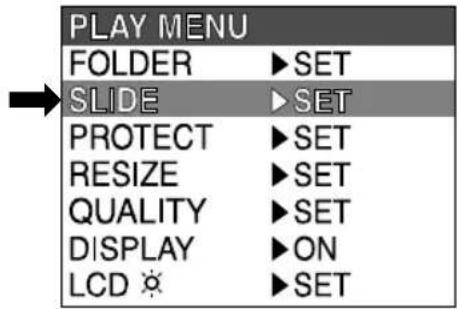
- To quit the slideshow, press the ENTER button. The slideshow is repeated until the ENTER button is pressed. The LCD monitor displays the image when the ENTER button is pressed.
Note
- The Auto Power OFF function does not operate during automatic playback.
Reducing the Image Size (Resize)
Changes the size of FULL size (1792 x 1200 pixels) images to half the size (896 x 600 pixels) in the horizontal and vertical directions, and overwrites the old FULL size image with the new size image. This is called "resizing" in this manual.
Resizing a previously saved image when the SmartMedia™ card has run out of storage space during photography increases space on SmartMedia™ so that you can continue taking photographs.
The following images cannot be resized:
- HALF size images
• Images taken with another camera - Protected images
-
Images cannot be resized when the SmartMedia™ card is write-protected.
-
Set the mode dial to ▶
The last image frame appears on the LCD monitor.
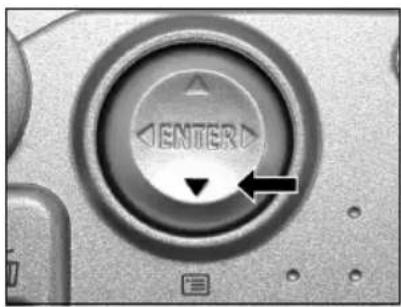
- Press the ▼ button.
The PLAY MENU is displayed.
Note
- Only FULL size (1792 x 1200 pixels) images can be reduced. Further reduction of HALF size (896 x 600 pixels) images is not possible.
Reducing the Image Size (Resize) (continued)
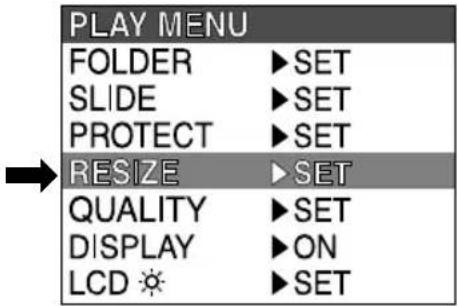
- Use the ▲ or ▼ buttons to select RESIZE and press the ▶ button.
The RESIZE menu is displayed.
If there are no images that can be resized, a message appears on screen and the screen returns to the PLAY MENU.
- Use the ◀ or ▶ buttons to select the image and press the ENTER button.
This confirms the image to be displayed, and □ is displayed under the image.
To cancel the selection, press the ENTER button again.
If you want to resize two or more images, repeat the procedure for each image.
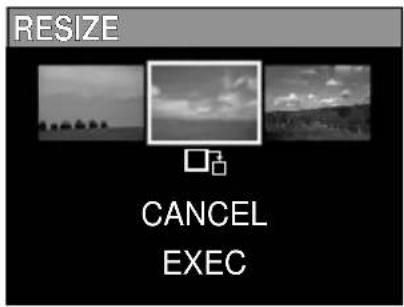
- Use the ▲ or buttons to select EXEC, and press the ENTER button.
The screen indicating that the image is being resized appears.
To quit resizing, select CANCEL.
When resizing ends, the screen returns to the PLAY MENU.
To quit the PLAY MENU, press the ENTER button.
Compressing Images (Quality)
Compresses images to half their size, and overwrites the old size image with the new compressed image. Compressing a previously saved image when the SmartMedia™ card has run out of storage space during photography increases space on SmartMedia™ card so that you can continue taking photographs.
The following images cannot be compressed:
• ★ (BASIC) image quality images
- Images taken with another camera
- Protected images
- Images cannot also be compressed when the SmartMedia™ is write-protected.
- Set the mode dial to ▶
The last image frame appears on the LCD monitor.
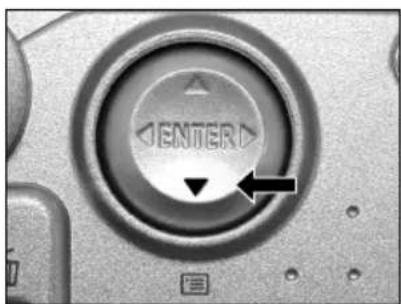
- Press the ▼ button.
The PLAY MENU is displayed.
Note
- Compression of images can be accomplished only in the following order:
★★★(FINE) → ★★(NORMAL) → ★(BASIC).
The reverse is not possible.
Compressing Images (Quality) (continued)
- Use the ▲ or ▼ buttons to select QUALITY, and press the ▶ button.
The QUALITY menu is displayed.
If there are no images that can be compressed, a message appears on screen and the screen returns to the PLAY MENU.
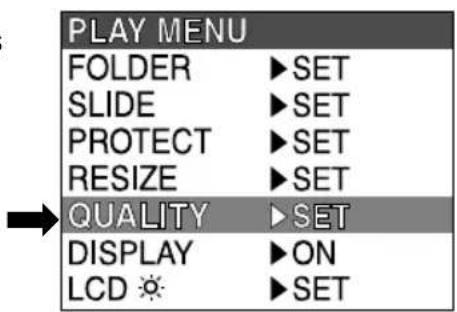
- The current compression ratio (quality) is displayed under the image.
Each press of the ENTER button changes the number of stars as follows:
If you want to compress two or more images, repeat the procedure for each image.
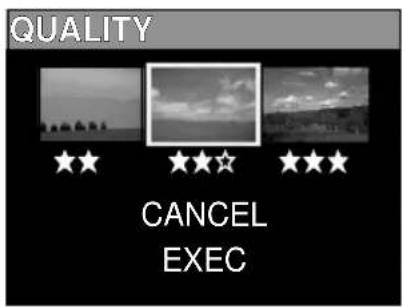
- Use the ▲ or buttons to select EXEC, and press the ENTER button.
The screen indicating that the image is being compressed appears. To quit compression, select CANCEL.
When compression ends, the screen returns to the PLAY MENU. To quit the PLAY MENU, press the ENTER button.
Selecting the Folder to Play Back
Select the folder to play back when the currently loaded SmartMedia™ card contains two or more folders.
- Set the mode dial to ▶
The last image frame or the thumbnail display appears on the LCD monitor.
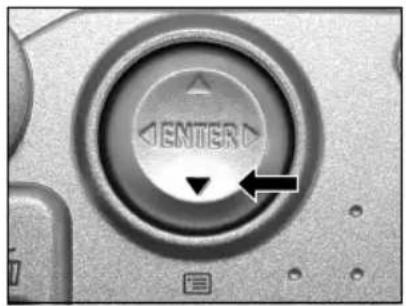
- Press the ▼ button.
The PLAY MENU is displayed.
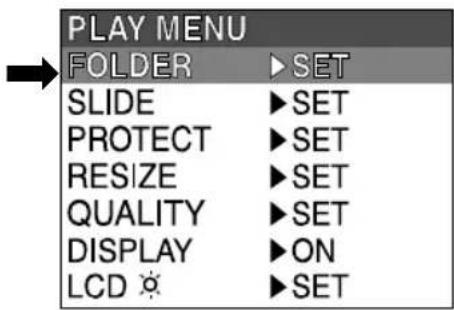
- Use the ▲ or ▼ buttons to select FOLDER, and press the ▶ button.
The names of the folders in the currently loaded SmartMedia™ card are displayed.
- Use the ▲ or buttons to select the folder to be displayed, and press the ENTER button.
Selecting the Folder to Play Back (continued)
About Folder Names
Images photographed on this camera are recorded to a folder. You cannot choose in which folder to store images. The [100] folder is created when you have photographed images. When the number of images reaches the largest number (9999), a new folder [101] is created.
When there are two or more folders, the playback folder default is the one whose folder number is greater.
Erasing Images (Erase Frame)
Erases one image at a time.
Note, however, that images cannot be erased when they are protected or the SmartMedia™ card is write-protected.
- Set the mode dial to


When ▶ is selected, the last image frame appears on the LCD monitor.
- When

selected, use the

buttons to select the image to be erased.
When ☐ is selected, the last image is selected.
- Press the

ase button.
FRAME or LAST is displayed at the bottom left of the screen.
- Use the ▲or
buttons to select YES, and press the
This erases the image and returns to the previous mode.
To cancel, select NO, and press the ENTER button.
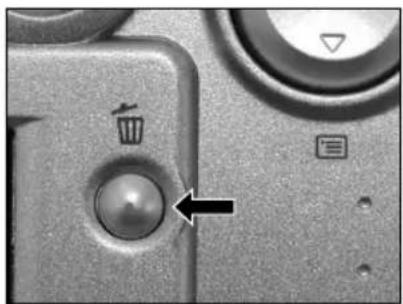
natural_image
Close-up of a camera control panel with a circular button labeled '左' and an arrow pointing to it (no readable text or symbols beyond basic icons)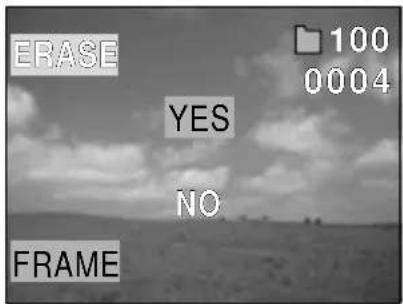
Erasing Images (Erase Frame)
- To continue erasing images, repeat the above procedure from step 2.
Note
- When [ PROTECT ] is displayed on the LCD monitor, cancel the protection.
- If you take a photograph after erasing an image, a number continuing from the last photographed image is assigned as the image number.
Erasing All Images in a Folder (Erase All)
Erases all images within the currently selected folder.
For details on folders, see "Selecting the Folder to Play Back".
Note, however, that images cannot be erased when they are protected or when the SmartMedia™ card is write-protected.
-
Set the mode dial to 📄 . M When 📋s selected, the last image frame appears on the LCD monitor.
-
Hold down the erase button for two seconds. The ERASE menu is displayed.
-
Use the ◀br ▶buttons to select ALL ① Make sure that [ALL] at the bottom center of the image is displayed in yellow.
-
Use the ▲ or ▼ buttons to select YES ②, and press the ENTER button.
This erases the images and returns to the previous mode. To cancel erasing of image data, select NO, and press the ENTER button.
When is selected, NO IMAGE is displayed after the images are erased (unless the SmartMedia™ contains protected images).
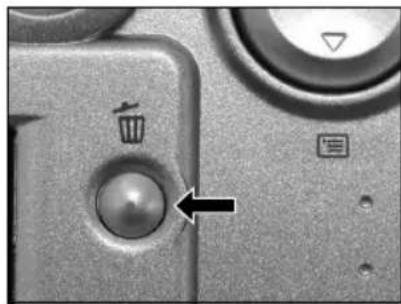
natural_image
Close-up of a camera control panel with a black arrow pointing to the button (no readable text or symbols)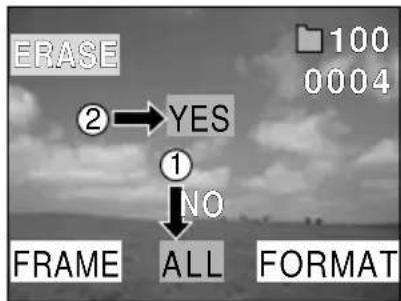
Note
- The folder is not erased even if you execute ERASE ALL. The camera does not display folders that do not contain any images.
• To erase the images in another folder, first specify the folder and then erase the images.
Formatting the SmartMedia™ Card
Formatting erases all images currently recorded on the SmartMedia™ card loaded on your camera. Protected images are also erased. The SmartMedia™ card cannot be formatted if it is write-protected.
IMPORTANT
- The SmartMedia™ card must be formatted on the camera before use.
- Set the mode dial to 📄 🔍 . ⬆ When ▶ is selected, the last image frame appears on the LCD monitor.
-
Hold down the erase button for two seconds. The ERASE menu is displayed.
-
Use the ◀ or ▶ buttons to select FORMAT ①. Make sure that [FORMAT] is displayed in yellow at the bottom right of the screen.
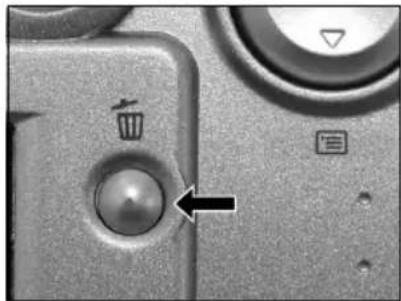
- Use the ▲ or buttons to select YES ②, and press the ENTER button. To cancel formatting, select NO, and press the ENTER button.
- To reset the image number, use the ▲or ▼buttons to select YES, and press the ENTER button. To cancel resetting of image numbers, select NO, and press the ENTER button.
natural_image
Close-up of a camera control panel with a black arrow pointing to the button (no readable text or symbols)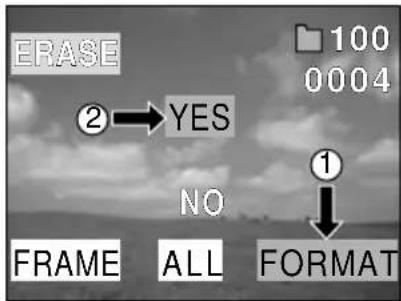
Protecting Images
This feature prevents images from being erased.
IMPORTANT
- Formatting erases all the images on a SmartMedia™ card, regardless of whether they are protected or not.
- T o protect the entire SmartMedia™ card, see "Write Protection".
Protecting an Image
- Set the mode dial to ▶ The last image frame appears on the LCD monitor.
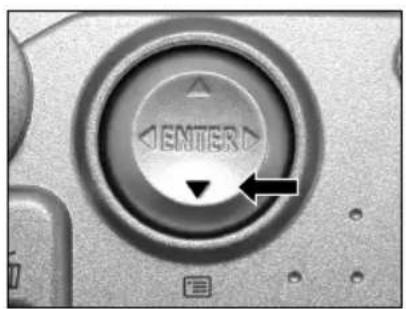
- Press the ▼ button. The PLAY MENU is displayed.
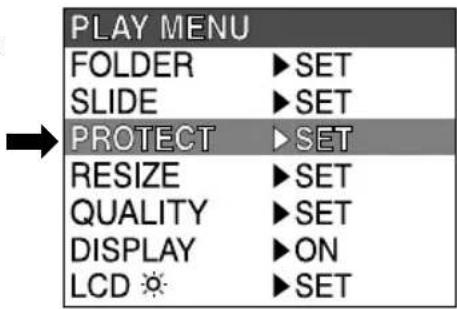
- Use the ▲ or buttons to select PROTECT and press the ▶ button.
The PROTECT menu is displayed.
Protecting Images (continued)
- Use the ◀r buttons to select the desired image to protect, and press the ENTER button.
This confirms the image to be protected, and Cis displayed under the image.
To cancel the selection, press the ENTER button again.
To write-protect two or more images, repeat this procedure for each image.
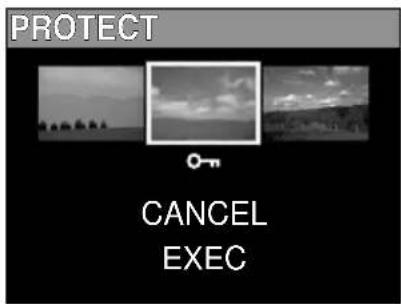
- Use the ▲ or ▼ buttons to select EXEC, and press the ENTER button.
To quit write-protection, select CANCEL.
When write-protection ends, the screen returns to the PLAY MENU.
To quit the PLAY MENU, press the ENTER button.
Note
- When the PROTECT setup screen is displayed again, 0-n is displayed under protected images.
- To remove the write-protection from an image, select the image, use the arrow keys to select EXEC, then press the ENTER button.
Protecting Images (continued)
Removing the Protection
- Carry out steps 1 to 3 in "Protecting An Image".
- Use the ◀ or ▶ buttons to select the image to unprotect, and press the ENTER button.
This fixes the images whose protection is to be removed, and under the image changes to ☐
To remove the protection from an image, press the ENTER button again.
To remove the protection from two or more images, repeat this procedure for the necessary number of images.
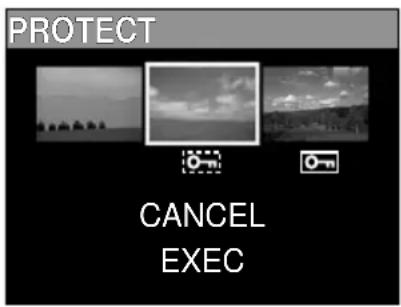
- Use the ▲ or ▼ buttons to select EXEC, and press the ENTER button.
To quit write-protection, select CANCEL.
When write-protection ends, the screen returns to the PLAY MENU.
To quit the PLAY MENU, press the ENTER button.
Changing the Display Setting in Playback Mode
This setting allows you to switch the on-screen display.
-
Set the mode dial to [▶] The last image frame appears on the LCD monitor.
-
Press the ▼ button. The PLAY MENU is displayed.
-
Use the ▲ or ▶ buttons to select [DISPLAY] and press the ▶ button. The tab menu is displayed.
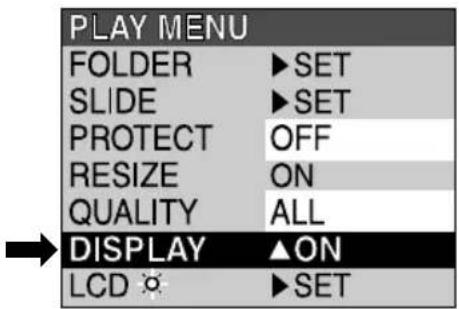
[OFF] : Only the LCD monitor is turned on. (To display the image only.) [ON] : Both the LCD monitor and the on-screen display (Simplified) are turned on. (To display the folder No. and image No.) [ALL] : Both the LCD monitor and the on-screen display (Detailed) are turned on. (To display the full on-screen display.)
- Use the ▲ or buttons to select the desired setting from the tab menu, and press the ENTER button. This saves the settings, and returns the display to the PLAY MENU.
Changing the LCD Setting in Playback Mode
This setting allows you to adjust the brightness of the LCD monitor. This adjustment does not adjust the brightness of the image to be recorded. [-5 to +5]
E
Basic Photographic Settings (SETUP mode)
This feature allows you to set up the environment for using your camera in addition to image-related settings. This is called "setup". The following items can be changed in the send:
LANGUAGE/SOUND/TIME/AUTO-OFF/TV/IMAGE No./DEFAULT
The details set here are held in memory even if the camera is turned OFF.
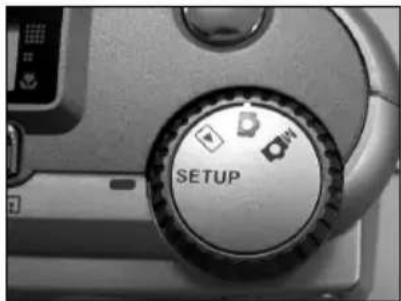
- Set the mode dial to SETUP The SET-UP menu appears.
natural_image
Close-up of a camera setup knob showing mode dial and control buttons (no readable text or symbols beyond the label)- Use the ▲ or buttons to select the item you want to set.
LANGUAGE
SOUND
TIME
AUTO-OFF
TV
IMAGE No.
DEFAULT
Setting item
| SET-UP | |
| LANGUAGE | English |
| SOUND | ON |
| TIME | SET |
| AUTO-OFF | 1MIN |
| TV | PAL |
| IMAGE No. | SET |
| DEFAULT | SET |
Basic Photographic Settings (SETUP mode) (continued)
-
Press the ▶ button. The tab menu is displayed.
-
Use the ▲ or ▼ buttons to change the setting in the tab menu, and press the ENTER button. To cancel changing of settings, press the ◀ button.
-
To quit the SETUP menu, change the mode dial setting.
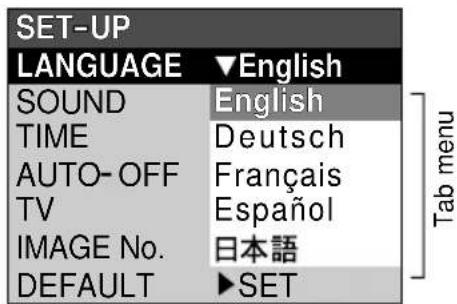
LANGUAGE
Sets the display language for menus displayed on the LCD monitor.
[English] (default) : English
[Deutsch] : German
[Français] : French
[Espanol] : Spanish
[日本]a Japanese
SOUND
Sets whether or not to sound the beep tone.
[ON] (default) : Sounds the beep tone according to the operating state or operation.
[OFF]: Does not sound the beep tone in any state.
Basic Photographic Settings (SETUP mode) (continued)
TIME
Sets the date and time.
(Seconds cannot be set.)
- Using the ◀ or ▶ buttons to select the item you want to set, and use the ▲ or ▼ buttons to set the value for each item.
Pressing the ▶ button advances the selection in the following order:
Month → Day → Year → Hour → Minute → SET → CANCEL

- Select SET and press the ENTER button.
To quit setting, select CANCEL.
TIME

: : 005512
CANCELSET
AUTO-OFF
If no operation is carried out for a fixed amount of time (default: about one minute), power consumption is set to its minimum state (power almost turned off) to prevent battery wear. This is called the Auto Power OFF mode. This setting allows you to set the time until the camera is set to the Auto Power OFF mode. This function is not activated during automatic playback or when transferring images to computers. To return to the normal state from the Auto Power OFF mode, either change the mode dial or press the shutter button down fully.
[1 MIN] (default)
[2 MIN]
[3 MIN]
Basic Photographic Settings (SETUP mode) (continued)
TV
Sets the video output format.
[NTSC] : NTSC video format (US, CANADA, JAPAN)
[PAL] : PAL video format (EUROPE)
IMAGE No.
Sets whether or not to reset the image number when you take photographs.
[CANCEL] : Does not reset the image number.
[RESET] : Reset the image number.
About Image Numbers and Folder Numbers
- When image numbering is reset, images are assigned a number starting from 0001 and stored in an empty folder. This folder will be assigned the lowest number available on the inserted SmartMedia™ card.
The folder number varies according to the state of the inserted SmartMedia™ card. To also reset the folder number, format the SmartMedia™ card first and reset the image number. - A consecutive number continuing from the last photographed image is assigned as the image number regardless of whether or not only one image or all images were erased.
- The largest image number is 9999. When this number is reached, a new folder is created, and the image number is assigned starting from 0001.
- The largest folder number is 999. When the folder number reaches 999, format the SmartMedia™ card.
- When you use SmartMedia™ card that was used for taking photographs on another camera, or swap between two or more SmartMedia™ card, the data held by this camera is given priority as the image number. The folder number is assigned according to the state of your camera or the SmartMedia™ card.
Basic Photographic Settings (SETUP mode) (continued)
DEFAULT
Sets whether or not to return the settings (except TIME, LANGUAGE, TV (video output format) and the LCD monitor brightness) to their defaults.
[CANCEL] : Does not return settings to their defaults.
[OK] : Returns settings to their defaults.
Adjusting the LCD Monitor Brightness
This adjusts the brightness of the LCD monitor and not the brightness of the recorded image.
- Set the mode dial to

- Press the ▼( button.
The REC MENU or PLAY MENU is displayed.
You can set the LCD monitor brightness in either of these menus.
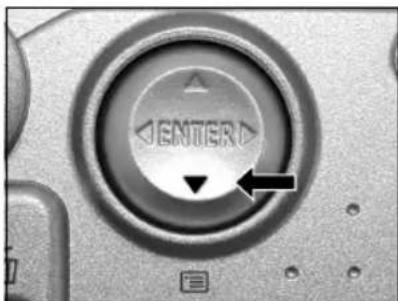
- Use the ▲ or ▼ buttons to select LCD and press the button.
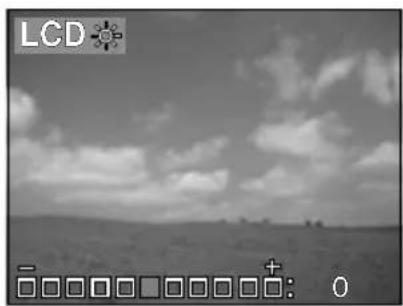
The image and the LCD menu are displayed.
- Use the ◀ or buttons to adjust the brightness.
Press the button to darken (−) the LCD monitor, or the button to lighten (+) the LCD monitor.
The LCD monitor can be adjusted within the range [-5] to [+5]. (Default is 0.)
- Press the ENTER button.
This returns the camera to the previous mode.
natural_image
Grayscale outdoor scene with cloudy sky and distant silhouettes, no visible text or symbolsTaking and Playing Back Photographs on a TV
Television sets can be used to compose images for photography or playback. To do this, the camera must first be connected to the TV. We recommend using the AC adapter on an indoor power outlet when available.
IMPORTANT
- Before you connect your camera to other equipment, be sure to turn all other connected equipment OFF. If you connect your camera to other equipment with the power still ON, the screen may flicker or the image may not be displayed normally.
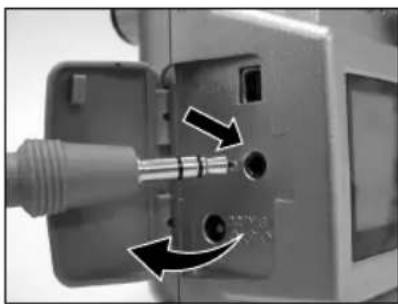
- Connect the plug of the video cable (provided) to the VIDEO terminal on the camera.
natural_image
Close-up of a mechanical component with arrows indicating direction of movement or assembly (no visible text or symbols)- Connect the video cable plug to the VIDEO IN terminal on the TV.
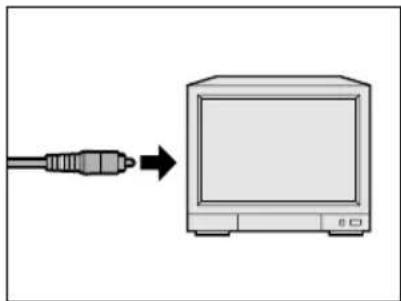
natural_image
Diagram showing a cable being inserted into a computer monitor (no text or symbols present)Taking and Playing Back Photographs on a TV (continued)
3. Take photographs or play them back.
Details of operation are the same as taking photographs and playing them back on the LCD monitor.
Note
- Nothing is displayed on the TV when the LCD monitor is set to OFF by turning the on-screen display off.
(To turn off the LCD monitor, switch the mode dial to REC /PLAY mode. Press the ( ) button. Use the ▲ or ▼ buttons to select [DISPLAY] and press the button. Use the or ▲ ▼ buttons to select OFF, and press the ENTER button. - Live images (moving image before photography) are less clear than playback images. (This is because they are displayed at a lower resolution.)
About the CD-ROM
You can install the following from the included CD-ROM.
• USB driver (for Windows 98 only)
Install this driver when you use the USB connector on your personal computer to import images.
The USB driver provided on the CD-ROM is exclusively for Windows 98. It is not necessary to install this driver on computers running Windows 2000, Windows ME, Windows XP or Mac OS 9.0 or higher.
- MGI PhotoSuite
This software allows you to edit and print imported still images.
- MGI PhotoVista
This software allows you to create spectacular 360° panoramic images.
- User's manual
Install this user's manual on your computer to view or print additional instructions about the camera.
- Acrobat Reader
Adobe Acrobat must be installed to view or print the user's manual.
Transferring Images to a PC
You can transfer images photographed on your camera to a PC using the packaged CD-ROM and cable set. The software and USB driver included on the CD-ROM must be installed to transfer images to a PC. Before transferring the images, make sure that your system meets the following minimum system requirements.
System Requirements
- Pentium 166 MHz processor or higher
• Windows 98/ME/2000/XP - PowerPC G3/G4
• MAC OS 9.0 or higher
• An available USB port - At least 32MB RAM
• 80 MB available hard disk space - A CD-ROM drive
• Color monitor (800 x 600 24-bit or higher recommended)
Installing the USB Driver (For Windows 98 Only)
Install this driver to use the USB cable. The USB driver provided on the CD-ROM is exclusively for Windows 98. Installing the USB driver for use in Windows 2000/ME/XP is not necessary.
- Insert the CD-ROM supplied with the package into the CD-ROM drive.
The welcome screen appears.
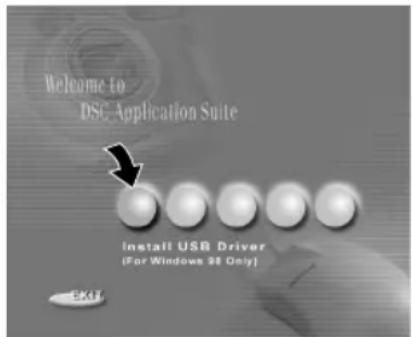
Transferring Images to a PC (continued)
2. Click "Install USB Driver".
Follow the on-screen instructions to complete the installation.
After the USB driver installation is complete, restart the computer.
Installing the USB Driver (For MAC OS 9.0 or higher)
A mass storage class-compliant USB driver is already installed on the MAC OS 9.0 or higher. The USB driver installation is not necessary.
Downloading Images
- Connect one end of the USB cable to your computer.
- Slide the power switch to turn on the camera power.
- Connect the other end of the USB cable to the camera.
- Double-click "My Computer" on the Desktop and find the removable disk. (For MAC users, double-click the removable disk on the desktop.)
- Drag and drop all the images in the removable disk to your computer.
Editing Images
Using MGI PhotoSuite
MGI PhotoSuite is a very user-friendly image-editing program. With PhotoSuite, you can breezily retouch, compose and organize your images in just seconds. It contains a variety of templates, such as photo frames, birthday cards, calendars and other fun stuff. Get your images ready and go explore this amazing program.
To install MGI PhotoSuite, follow the steps below:
- Insert the CD-ROM supplied with the package into the CD-ROM drive.
The welcome screen appears.
- Click "Install MGI PhotoSuite".
Follow the on-screen instructions to complete the installation.
To use the program, follow the steps below:
-
Launch MGI PhotoSuite.
-
Click the large "Get" button on the Welcome screen, or the "Get" button on the Navigation bar.
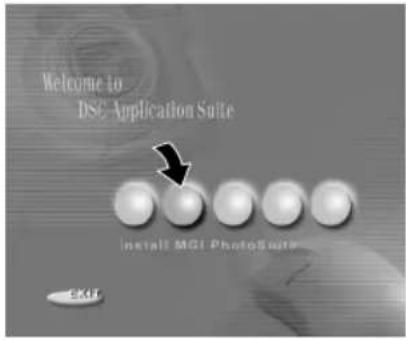
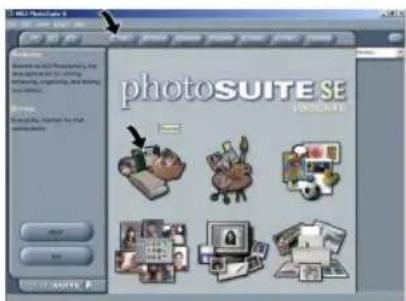
Editing Images (continued)
-
Choose a photo source (e.g. "Computer") and click the "Open" button.
-
Now you are able to process your images with all the tools provided by PhotoSuite.
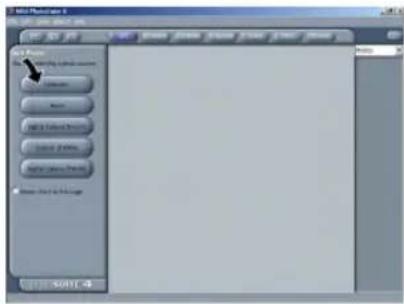
Using MGI PhotoVista
MGI PhotoVista is an easy-to-use program that lets you create spectacular 360° panoramic images in a snap. When you view these panoramas, you get the experience of being totally immersed in a realistic environment. PhotoVista's powerful engine quickly and automatically stitches images together, and its intuitive interface will let even a novice get great results in minutes.
To install MGI PhotoVista, follow the steps below:
-
Insert the CD-ROM supplied with the package into the CD-ROM drive. The welcome screen appears.
-
Click "Install MGI PhotoVista". Follow the on-screen instructions to complete the installation.
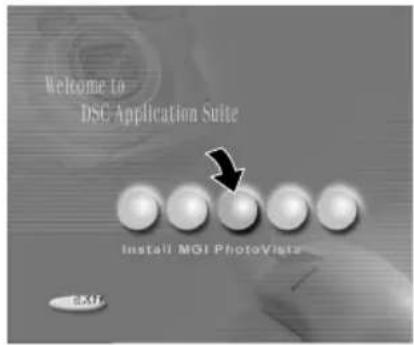
Editing Images (continued)
To use the program, follow the steps below:
- Open Source Images in MGI PhotoVista
MGI PhotoVista requires some overlap of source images to properly align them before a stitch. For best results, use a 20% to 50% overlap. The number of photos you need to shoot to achieve this overlap depends on the lens type you're using.
- Select the Lens
Click the "Select Lens" icon. The "Select Lens" dialog box appears. Select the proper lens type.
- Preview the Stitch
Click the "Stitch Panorama" icon. The "Stitch Options" dialog box appears. Click "Preview Stitch" button.
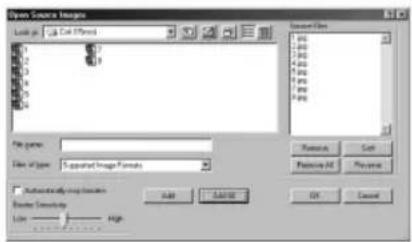
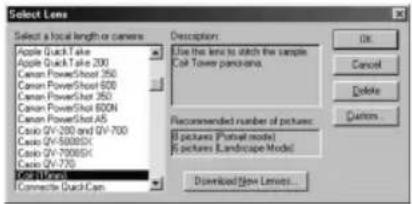
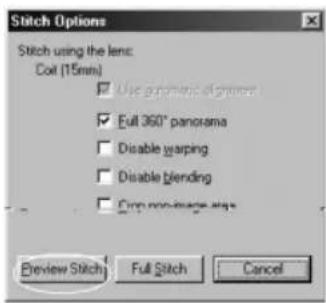
Editing Images (continued)
4. View the Panorama In Action
Choose "Show Viewer" from the "Panorama" menu. The "Stitch Preview" window changes to viewer mode. Press and drag the pointer over the panorama vertically and horizontally. Press "SHIFT" to zoom in or press "CTRL" to zoom out. Close the viewer window when you're done to return to the preview stitch.
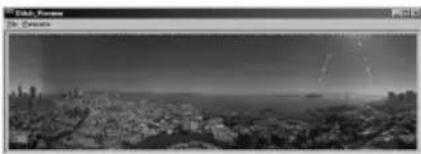
natural_image
Panoramic black-and-white cityscape at dusk with distant buildings and a visible sky (no text or symbols)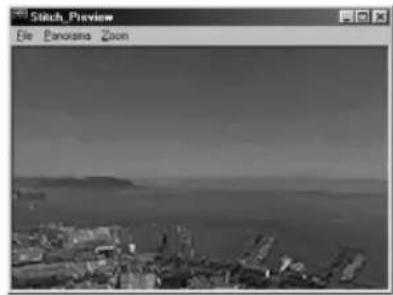
natural_image
Black-and-white aerial view of a coastal city with distant hills and buildings (no visible text or symbols)5. Create a Full Stitch
Click the Stitch "Panorama" icon. The "Stitch Options" dialog box appears. Click "Full Stitch" button. The "Stitch Progress" dialog box displays the progress of the stitch. Follow the procedure in Step 4 to view the panorama in action.
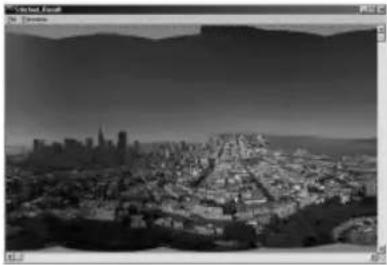
natural_image
Black-and-white aerial view of a cityscape with dense urban buildings and distant mountains (no visible text or symbols)6. Save a Panorama
After Step 5, you can save the panorama from the "Stitched Result" window as a BMP, Flashpix (FPX), or JPEG file. MGI PhotoVista also automatically creates an IVR file for you, which you use to play the panorama.
natural_image
Panoramic black-and-white cityscape with dense urban buildings and distant mountains, no visible text or symbolsInstalling Acrobat Reader
To view or print the user's manual in PDF format, you have to install the Acrobat Reader first. See the steps below:
- Insert the CD-ROM supplied with the package into the CD-ROM drive.
The welcome screen appears.
- Click "Install Acrobat Reader".
Follow the on-screen instructions to complete the installation.
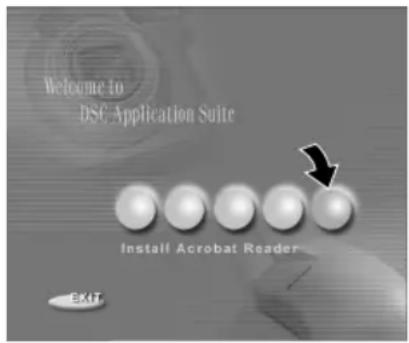
Steps for MAC users:
- Insert the CD-ROM supplied with the package into the CD-ROM drive.
- Select and double-click "Acrobat Reader".
-
Double-click the language you want to install.
-
Double-click the setup program and follow the on-screen instructions to complete the installation.
Installing the User's Manual
The user's manual on the supplied CD-ROM provides more information and advanced instructions about the camera. Before reading the user's manual, make sure to install the Acrobat Reader first. With Acrobat Reader, you can view or print exact copies of the original manual on any (supported) operating system.
Follow the steps below to install user's manual.
- Insert the CD-ROM supplied with the package into the CD-ROM drive.
The welcome screen appears.
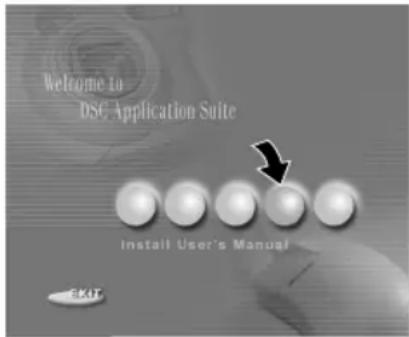
- Click "Install User's Manual".
Follow the on-screen instructions to complete the installation.
Steps for MAC users:
- Insert the CD-ROM supplied with the package into the CD-ROM drive.
- Select and double-click "User's Manual".
- Double-click the language you want to install.
- Double-click the PDF file to open the full version of user's manual.
- Copy the user's manual to your computer if necessary.
Connecting to Other Devices
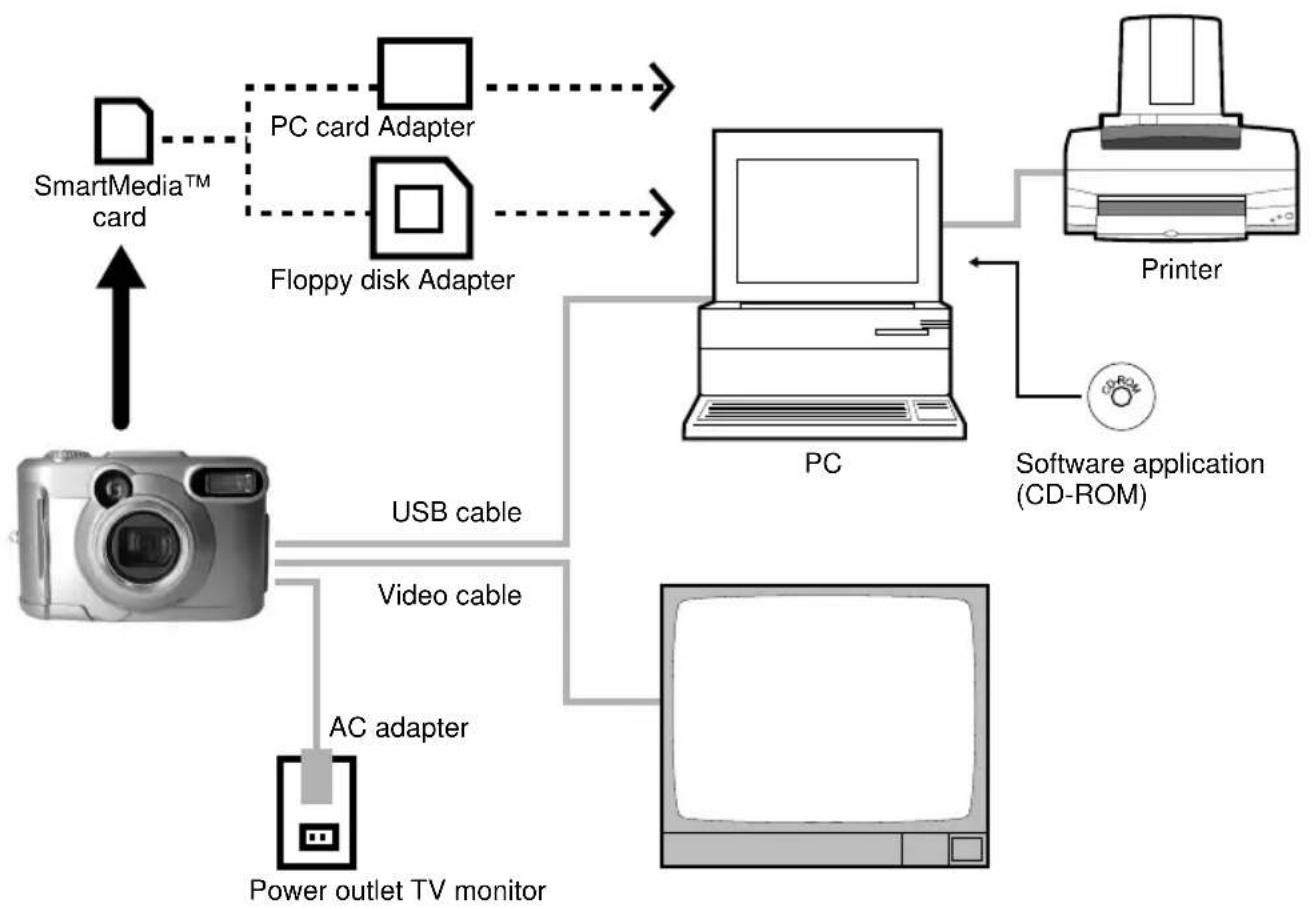
flowchart
graph TD
    A["SmartMedia™ card"] -->|PC card Adapter| B["PC"]
    A -->|Floppy disk Adapter| B
    C["Power outlet TV monitor"] -->|USB cable| D["PC"]
    E["Power outlet TV monitor"] -->|Video cable| D
    D --> F["Printer"]
    F --> G["Software application (CD-ROM)"]
    G --> H["PC"]
    H --> I["Printer"]
    I --> J["Printer"]
    style A fill:#f9f,stroke:#333
    style B fill:#ccf,stroke:#333
    style C fill:#cfc,stroke:#333
    style D fill:#fcc,stroke:#333
    style E fill:#cff,stroke:#333
    style F fill:#ffc,stroke:#333
    style G fill:#cfc,stroke:#333
    style H fill:#fcc,stroke:#333
    style I fill:#ffc,stroke:#333
Specifications
Camera Body
| Model | Digital Still Camera | |||||||
| Recording medium | SmartMediaTM card (3.3V) 4/8/16/32/64/128MB compatible | |||||||
| Compression system | JPEG-compliant | |||||||
| Image file format | Exif Ver.2.1-compliant | |||||||
| Number of frames (Approx.)FULL size:1792 x 1200 pixelsHALF size:896 x 600 pixels | Quality Mode | Image Size | 4MB | 8MB | 16MB | 32MB | 64MB | 128MB |
| ★★★FINE | FULL | 3 | 7 | 15 | 32 | 65 | 131 | |
| HALF | 14 | 29 | 60 | 121 | 243 | 486 | ||
| ★★NORMAL | FULL | 7 | 14 | 30 | 60 | 122 | 246 | |
| HALF | 28 | 58 | 117 | 236 | 475 | 951 | ||
| ★BASIC | FULL | 14 | 29 | 60 | 121 | 243 | 486 | |
| HALF | 55 | 112 | 225 | 453 | 907 | 1817 | ||
| Conversion rules | DCF Ver. 1.0-compliant | |||||||
IMPORTANT
- The number of images that can be photographed in the table above is only for reference. Actual capacity varies according to use.
- The size of the data to be recorded varies according to the amount of detail in the subject image. So, the number of images that can be photographed after an image is recorded decreases. Sometimes this amount decreases by two images.
Specifications (continued)
| Pickup elements | 1/2.6" CCD sensor (effective pixels: approx. 2.2 million) | ||
| Sensitivity | Equivalent to ISO 100/200/400 | ||
| Lens | 3X zoom lens W=F2.9/F6.9, T=F3.02/F6.9 | ||
| Focal length | f=6.2 mm - 18.6 mm (equivalent to 38mm - 114mm on a 35mm camera) | ||
| Viewfinder | Real image type zoom finder | ||
| Auto-focus | TTL system AF, focus adjusting range: approximately 3.15 in. (8 cm) to infinityDetection system: Contrast detection system | ||
| Metering system | TTL metering by image capture system | ||
| Exposure control | Program AE (exposure compensation available in Manual mode) | ||
| Shutter | 1/1000 to 1 sec. | ||
| White balance | Auto selectedSelectable in manual photography mode (outdoors, standard/cool white fluorescent light, incandescent light) | ||
| Focal range | Standard | Approx. 15.7 in. (40 cm) to infinity | |
| Macro | Approx. 3.15 in. (8cm) to infinity at wide angle | ||
| Self-Timer | 2 seconds/10 seconds selectable | ||
| Flash | Modes | Auto, Red-Eye Reduction, Forced Flash, Suppressed Flash, Slow Sync | |
| Flash intensity control | Automatic | ||
| Effective range | Approx. 1.3 ft. (0.4 m) - 8.2 ft. (2.5 m) | ||
Specifications (continued)
| Date/Time | Simultaneously recorded to image data (Exif file format) | |
| Automatic calendar function | Automatically adjusted until the year 2037 | |
| LCD monitor *1 | 1.5" TFT(61,600 pixels) | |
| I/O terminal | DC IN terminal | DC 5 V |
| DIGITAL terminal | USB | |
| VIDEO terminal | NTSC or PAL system | |
| Power supply | 4 x AA (Alkaline, Nickel Metal Hydride or Lithium) battery*2or AC adapter | |
| Operating conditions | Temperature | +41°F (+5°C) to +104°F (+40°C) (during operation)/-4°F (-20°C) to +140°F (+60°C) (during storage) |
| Humidity | 30 to 80% (during operation) no condensation | |
| Camera dimensions | 4.13 in. (105 mm) (W) x 2.68 in. (68 mm) (H) x 2.17 in. (55 mm) (D) (excluding protrusions) | |
| Weight | Approx.8.1 oz (230 g) (excluding accessories, batteries and SmartMediaTM card) | |
^*1 The LCD monitor on your digital camera is manufactured using advanced high-precision technology. Though fine spots may appear on the LCD monitor, this is not a malfunction. The LCD monitor can be used as it is.
^2 You cannot use manganese dry batteries in this camera.
SmartMedia™ card
| Type Image memory card for digital cameras (SmartMedia ^TM card) | |
| Type of memory NAND flash memory | |
| Operating conditions | Temperature +32°F (0°C) to +104°F (+40°C)Humidity 80% or less (no condensation) |
| Dimensions | 1- ^4/_9 in. (37 mm) (W) x ^3/_100 in. (0.76 mm) (H) x 1- ^7/_9 in. (45 mm) (D) |
| Accessories Anti-static case (×) | 1), index labels (×2), write-protect stickers (×4) |
Warnings and Messages Displayed on LCD Monitor
The following warnings, messages and icons are displayed on the LCD monitor and the status display.
| Display | Meaning | |
| LCD monitor | Status display | |
| Remaining battery power half or less | ||
| Little battery power left | ||
| No battery power left | ||
| ⚠ NO CARD | Flashing (photography mode) | No SmartMediaTM card is loadedSmartMediaTM card is loaded incorrectly |
| Nothing displayed (playback mode) | ||
| ⚠ CARD FULL | Flashing (photography mode) | No more space on the SmartMediaTM card.Recording is not possible. |
| Number of images displays 0 | ||
| ⚠ NO IMAGE | — | Nothing is recorded to the SmartMediaTM card. |
| ⚠ UNFORMATED CARD | — | The SmartMediaTM card is not formatted. (A message prompting you to format the SmartMediaTM card is displayed.) |
| ⚠ CARD ERROR | — | The SmartMediaTM card is damaged.The SmartMediaTM card format is incorrect. |
| ⚠ PROTECTED CARD | — | The SmartMediaTM card is write-protected. |
| ⚠ FRAME ERROR | — | An attempt was made to playback incorrectly recorded data. |
| ⚠ UNMATCHED DATA | — | An attempt was made to playback a frame not recorded on this camera. |
| ⚠ FRAME No. FULL | — | The frame number has reached 999-9999. |
| ⚠ PROTECT | — | An attempt was made to erase a protected image. |
| ⚠ FOLDER No. ERROR | — | A folder with the same number already exists. |
| ⚠ IMAGE No. ERROR | — | An image with the same frame number already exists in the folder. |
Troubleshooting
First check the warning displayed on the LCD monitor and the viewfinder lamp. Then check the following items.
| Problem | Causes | Remedy |
| No power supply | The batteries are exhausted. | Replace with new batteries. |
| The AC adapter plug has come out of the power outlet. | Plug the adapter back in. | |
| The power switch is not turned on. | Turn on the power switch. | |
| The camera turns OFF during operation. | The batteries are exhausted. | Replace with new batteries. |
| The battery runs out quickly. | You are using the camera in extremely cold conditions. | Put the battery in your pocket or another warm place to heat it and then load it into the camera just before you take a picture. |
| The terminals are dirty. | Wipe the battery terminals with a clean, dry cloth. | |
| The battery has reached the end of its effective life. | Replace with new batteries. | |
| No photograph is taken when the shutter button is pressed. | No SmartMediaTM card is loaded. | Load a SmartMediaTM card. |
| The SmartMediaTM card is loaded incorrectly. | Load the SmartMediaTM card correctly. | |
| Not enough space on the SmartMediaTM card | Load a new SmartMediaTM card.Erase photographed images or change the size and quality to increase space on the SmartMediaTM card. | |
| The SmartMediaTM card is write-protected. | Remove the write-protection or replace with a new SmartMediaTM card. | |
| The SmartMediaTM card is not formatted. | Format the SmartMediaTM card. | |
| The SmartMediaTM card is damaged. | Load a new SmartMediaTM card. | |
| The Auto Power OFF function is activated. | Either press the shutter button fully down, or change the mode dial setting. | |
| I cannot use the flash to take pictures. | The mode dial has been changed to another setting. | Set the mode dial to the correct setting. |
| The flash is set to Suppressed Flash mode. | Set the flash to Auto, Red-Eye Reduction or Forced Flash mode. | |
| You pressed the shutter button while the flash was charging. | Wait until charging is completed before pressing the shutter button. | |
| The flash will not charge. | The camera is set to Suppressed Flash mode. | Set the flash to Auto, Red-Eye Reduction or Forced Flash mode. |
| The batteries are exhausted. | Replace with new batteries. | |
| Images cannot be played back. | No images in selected folder. | Select a different folder to play back. |
| The playback image is too dark even though I used the flash. | The subject is too far away. | Move closer to the subject.(Approx. 1.3 ft.(0.4 m)-8.2 ft.(2.5 m)) |
| The playback image is blurred. | The lens is not clean. | Clean the lens. |
| The image is out of focus. | Set macro photography to ON or OFF according to the distance up to the subject. | |
| I cannot format the SmartMediaTM card. | The SmartMediaTM card is write-protected. | Remove the write-protection. |
| I cannot erase all the frames. | The frame is protected. | Remove the write-protection. |
| The SmartMediaTM card is write-protected | Remove the write-protection. | |
| Nothing happens when I use the buttons and switches. | Camera malfunction. | Turn the power OFF and remove the batteries once, and try again. |
| The mode dial is not at the correct position. | Set the mode dial to the correct setting. | |
| The camera is in the Auto Power OFF mode. | Either press the shutter button fully down, or change the mode dial setting. | |
| The set date and time disappears. | Both the batteries and AC adapter are removed with the power still ON. | Set the date and time again. |
Glossary
- AF/AE
AF (auto-focus) ... A function for automatically focusing your camera.
AE … A function for automatically setting your camera's exposure.
AF/AE lock … Locking of the focus and exposure settings.
- DCF (Design rule for Camera File System)
A file system standard defined by the JEIDA (Japan Electronic Industry Development Association) that is required for exchanging data between digital still cameras or a digital camera and a printer. This standard defines the hierarchy and file names used when storing image files on memory cards or other recording media.
- Exif File Format (Exchangeable Image File Format)
A color still image format for digital still cameras approved by the JEIDA (Japan Electronic Industry Development Association). JPEG-compliant, this format is compatible with TIFF and JPEG and can be used in image processing software for most personal computers.
- JPEG
A file format used for compressing and saving color images. The compression ratio can be selected, but the higher the compression ratio, the worse image quality becomes. This format is widely used in imaging software for PCs.
- PC Card
A generic term for cards that meet the PC Card Standard.
- Red-Eye Effect
The phenomenon where people's eyes sometimes appear red in the picture when you use a flash to photograph them in low-light conditions. This is caused by the light of the flash reflecting off the inside of the eye.
- White Balance
When the brightness of the light changes, the human eye adapts so that a white object still looks white. On the other hand, devices such as digital still cameras see a white subject as white by first adjusting the balance to suit the color of the ambient light around the subject. This adjustment process is referred to as matching the white balance.
- SmartMedia™ card
Name of a recording medium defined by the SSFDC Forum. This recording medium can be used over and over again.
- Formatting
Transforming the contents of the SmartMedia ^™ to a recordable state. (This is sometimes called “initialization”.)
- Exposure Compensation
When the screen contains an extremely bright or dark object, the camera automatically adjusts the brightness, resulting in the subject being reproduced darker or lighter. Exposure compensation adjusts for this.
Telephone Support Numbers in Europe
UK (from within the UK) 01844 219 342
(from outside of the UK) +44 1844 219 342
Ricoh Service Offices
Ricoh Company., Ltd.
3-2-3, Shin-yokohama
Kohoku-ku, Yokohama-shi 222-8530, Japan
Ricoh Factory Service Center
3235 Sunrise Blvd.,
Suite2 Rancho Cordova,
CA 95742
http://www.ricohzone.com/
RICOH EUROPE B.V. (PMMC EUROPE)
Oberrather Straße 6,
D-40472 Düsseldorf,
Germany
http://www.ricohpmmc.com
RICOH UK LTD. (PMMC UK)
Ricoh House, 1 Plane Tree Crescent,
Feltham, Middlesex, TW13 7HG,
England
RICOH FRANCE S.A. (PMMC FRANCE)
24/F., China Overseas Building
139 Hennessy Road, Wan Chai
Hong Kong
Ricoh Australia Pty. Ltd.
8 Rodborough Road
Frenchs Forrest, N.S.W. 2086
Australia
http://www.ricoh.com.au