
TMC260 - Sander Tryton - Free user manual and instructions
Find the device manual for free TMC260 Tryton in PDF.


| Product Type | Sander |
| Model | TMC260 |
| Brand | Tryton |
| Power Supply | 230 V ~ 50 Hz |
| Power Consumption | 300 W |
| No-Load Speed | 12 000 rpm |
| Sanding Base Size | 125 mm (5 in) |
| Sanding Paper Attachment | Hook-and-loop (Velcro) |
| Dust Collection | Dust bag included, compatible with vacuum |
| Vibration Level | < 7.5 m/s² |
| Sound Pressure Level | 85 dB(A) |
| Weight | 1.4 kg |
| Dimensions (L x W x H) | 200 x 120 x 150 mm |
| Cable Length | 2.5 m |
| Protection Class | Class II (double insulated) |
| Variable Speed | Yes |
| Soft Grip Handle | Yes |
| Suction Adapter Diameter | 35 mm |
| Package Contents | Sander, dust bag, sanding discs, manual |
Frequently Asked Questions - TMC260 Tryton
User questions about TMC260 Tryton
0 question about this device. Answer the ones you know or ask your own.
Ask a new question about this device
Download the instructions for your Sander in PDF format for free! Find your manual TMC260 - Tryton and take your electronic device back in hand. On this page are published all the documents necessary for the use of your device. TMC260 by Tryton.
USER MANUAL TMC260 Tryton
E E K T R O N A R Z I
natural_image
Technical illustration of a Tryton electric drill press with a base tray and power supply (no text or symbols)TMC260
TMC330
EN
Operating instruction
OSCILLATING HANDHELD GRINDER 4
PL


natural_image
Illustration of a power tool with a downward arrow indicating force or damage, mounted on a base plate (no text or symbols present)
BEFORE YOU START USING THE MACHINE READ THOROUGHLY THIS MANUAL.
Keep this document for future reference.

WARNING! Read all safety warnings marked with a symbol ⚠️ and all operating safety instructions.
To limit the risk of fire, electric shock and injury while using the device, follow all operating safety instructions and tips provided below.
Keep all work safety instructions and tips for future reference.
In warnings provided herein the expression "power tool" means a power tool powered from the mains (with a power cord) or a battery powered power tool (cordless).

WARNING! General work safety warnings for use of the tool.
Workplace safety:
a) Keep your workplace tidy and well lit. Untidiness and bad lighting result in higher accident rate.
b) Do not use the power tool in explosive environments, created by flammable liquids, gases or dusts. The power tool generates sparks that can ignite dust or vapors.
c) Keep children and unauthorized persons away from the place where the power tools are used. Inattention may result in losing control over your power tool.

WARNING! General warnings regarding the use of power tools.
Electric safety:
a) Plugs used in power tools must match wall outlets. Never modify the plug of your power tool. Do not use any extension cables when operating a power tool with a grounding/earthing conductor (PE). Any modifications of plugs and outlets increase the risk of electric shock.
b) Avoid touching earthed surfaces or grounded items like pipes, heaters, central heating radiators and refrigerators. Touching earthed or grounded surfaces increases the risk of electric shock.
c) Do not expose your power tool to rain or damp environments. Water penetrating the tool increases the risk of electric shock.
d) Do not damage the power cord. Never use the power cord to carry, pull the power tool and do not pull by its power cord to disconnect plug from the outlet. Keep the power cord away from sources of heat, oils, sharp edges and moving parts. Damaged or entangled power cords increase the risk of electric shock.
e) When your power tool is operated outdoors use extension cords intended for outdoor use only. Using an extension cable intended for outdoor use decreases the risk of electric shock.
f) It is recommended to connect the device to a mains supply equipped with a residual current device (RCD) with a rated current of 30 mA or less.
g) When it is unavoidable to use your power tool in a damp environment use an RCD (Residual Current Device) for protection. The use of RCDs decreases the risk of electric shock.

WARNING! General warnings regarding the use of power tools.
Personal safety:
a) This equipment is not intended for use by persons (including children) disabled physically, mentally, sensorial or persons with no experience and knowledge in operating the equipment unless they operate the equipment under supervision or follow user's instructions provided by persons responsible for their safety.
b) It is necessary to predict steps, watch and keep common sense when using power tools. Do not operate power tools when you are tired, under influence of drugs, medicine or alcohol. A moment of inattention while operating a power tool may result in serious personal injury.
c) Use personal protective equipment (PPE). Always wear safety goggles. Wearing personal protective equipment (PPE) including a dust mask, anti-slippery footwear, a helmet and ear protection reduces personal injury.
d) Avoid unexpected start up. Before connecting your power tool to the mains and/or inserting a battery make sure its power switch is in off position. Carrying your power tool with a finger on its power switch or without disconnecting it from the mains (switched on) may result in an accident.
e) Before starting your power tool remove any keys/wrenches. Leaving a key/wrench in the rotating part of your power tool may result in personal injury.
f) Do not lean forward too far. Always remain stable and maintain balance. It will allow you to have a better control over your power tool in unpredictable situations.
g) Wear appropriate clothing. Do not wear loose clothes or jewelry. Keep your hair tied. Keep your clothes away from moving parts. Loose clothes, jewelry or long hair may be caught by moving parts.
h) If your power tool allows for using an external dust extraction or collection system, make sure it is connected and used properly. Using dust collectors may reduce dust affected risks.
i) Do not let your skills gained through the frequent use of the power tool make you overconfident and disregard safety rules. Carelessness may cause injury in a fraction of a second.

WARNING! General warnings regarding the use of power tools.
Use and taking care of your power tool:
a) Do not overload your power tool. Use a power tool with power adjusted to work being done. An appropriately chosen power tool will allow you to work better and safer under load it has been designed for.
b) Do not use a power tool when its power switch is out of order (it does not switch it on or off). Any power tool with its power switch out of order is dangerous and must be repaired.
c) Always disconnect the plug from the power source and/or disconnect its battery before changing any settings, performing replacement or storage. Such preventive measures reduce the risk of accidental power tool start up.
d) Keep your power tool out of reach of children and do not allow unauthorized persons to use the power tool. Power tools in hands
of untrained persons can be dangerous.
e) Power tools require maintenance. Check power tools for concentricity or jamming of moving parts, any cracks and all other factors affecting the power tool work safety. If any damage to the power tool is detected, it should be repaired before use. Improper power tool maintenance is a reason for many accidents.
f) Cutting tools should be sharp and clean. Keeping sharp cutting edges in good condition reduces the risk of jamming and facilitates operation.
g) Power tools, equipment, working tools etc. should be used according to this user's manual taking into account operating conditions and the work to be done. Misusing a power tool can result in dangerous situations.
h) At low temperatures and after a long brakes in operation it is recommended to turn the power tool to operate it with no load for a few minutes to provide proper grease distribution inside its driving mechanism.
i) Use soft, damp (cannot be wet) cloth and soap to clean power tools. Do not use petrol, solvents and other agents that may damage your equipment.
j) Power tools can be stored/carried after making sure that all moving components are locked and protected against release with original devices intended for this purpose.
k) Store power tools in a dry, dust and water-protected place.
1) Carry your power tool in its original packaging to provide protection against mechanical damage.
m) Keep handles and grip surfaces clean and free from oil and grease. Secure grip and control over the tool in unexpected circumstances are impossible if handles and grip surfaces are slippery.

WARNING! General warnings regarding the use of power tools.
Repair:
a) Warranty and post-warranty repairs of its power tools are carried out by PROFIX Service, which guarantees the best quality or repair and use of genuine spare parts.

WARNING!
While operating power tools it is necessary to observe basic work safety rules to avoid fire, electric shock or mechanical injury.

OSCILLATING HANDHELD GRINDER
Additional safety tips useful for grinding:
a) The oscillating handheld grinder, referred to as 'the grinder' is not a waterproof device, therefore it can be used exclusively for dry grinding. Penetration of water into the electric tool interior may lead to electrocution.
b) Grinding of metals entails emission of sparks. One should make sure that the sparks splattered during grinding present no hazard to anybody and that all inflammable (combustible) materials are removed from the vicinity.
Sparking may also lead to self-ignition of grinding dust. The hazard is even more serious when the dust is mixed with remnants of paints, polyurethane or other chemicals and grinded material is hot after prolonged machining. It is why operators must avoid excessive heating
of treated material or the grinder as well as always remove dust during breaks and after completion of grinding jobs.
c) Workplace must be always kept clean and tidy. Mixtures of various materials are particularly hazardous. Dust of light metals may catch fire or explode.
d) Aspiration of grinding dust is harmful to health. Direct physical contact with dusts or their penetration to lungs can cause allergic reactions and/or respiratory system diseases of the operator or persons in the vicinity. Some materials, e.g. paint coatings with lead content, contain potentially toxic chemical substances. In order to reduce the impact of these substances, the workplace must be always well ventilated, and tested and safe protective measures must be used, such as safety dust filter masks with a P2 class absorber designed especially for filtering microscopic particles. Dust extraction should be used, if only possible.
e) Safety goggles must always be used in order to prevent dust from getting into eyes.
f) Use of hearing protectors is mandatory (headsets, earplugs). Long-term exposure to intense noise may lead to deafness.
g) Operators must wear protecting gloves and never touch the grinder shoe when the machine is in motion. It presents hazard of hand injuries.
h) While working with the electric tool operators must always hold it with two hands and keep safe position of the entire body. Operation of an electric tool with two hands is always safer.
i) Protect the object machined. It is safer to fix the object machined in a fixing device or a vice than holding it in your hand.
j) Hold power tool by insulated gripping surfaces, when performing an operation where the grinding accessory may contact hidden wiring or its own cord. Grinding accessory contacting a 'live' wire may make exposed metal parts of the power tool 'live' and could give the operator an electric shock.
k) After unexpected interruption of power voltage, e.g. after a voltage shutoff or unplugging the power cord, it is mandatory to unlock the On/Off trigger and release it to the Off position. It is the measure that prevents from unintentional activation of the electric tool.
1) Do not use a power tool with its power cord damaged. Do not touch the power cord when damaged; in case of damaging the power cord during operation unplug it from the mains. Damaged power cords increase the risk of electric shock.
ATTENTION! If a permanently fixed power cord becomes damaged, it must be replaced with a special cable or assembly available at the manufacturer's or at a specialized repair service point.
DESIGN AND APPLICATION AREA OF THE GRINDER:
The grinder is designed for dry grinding of wooden, wood-containing, metal or plastic surfaces as well as removing old paint coatings with use of abrasive paper with necessary grade and granulation (from 40 to 400).
CAUTION! Do never use the grinder for asbestos and graphite-containing materials. Do not apply for gypsum (joints of cardboard and gypsum panels) or similar materials. Fine dust penetrates into the machine interior and clogs ventilation paths, which leads to overheating of the motor and its eventual burning. Such defects
present the reason to make the guarantee rights null and void.
The tool is a device of the second class of electric protection (double insulation) and is driven with a single-phase motor.
The tool is designed only for household (DIY) application. Do never use the tool for applications that need use of professional equipment. The warranty terms are null and void when the tool is used at craftsman workshops, for industrial applications or in similar fields.
Any other application not in line with the intended use as specified above is forbidden and makes the guarantee rights null and void. The manufacturer shall not be held responsible for consequential impairments.
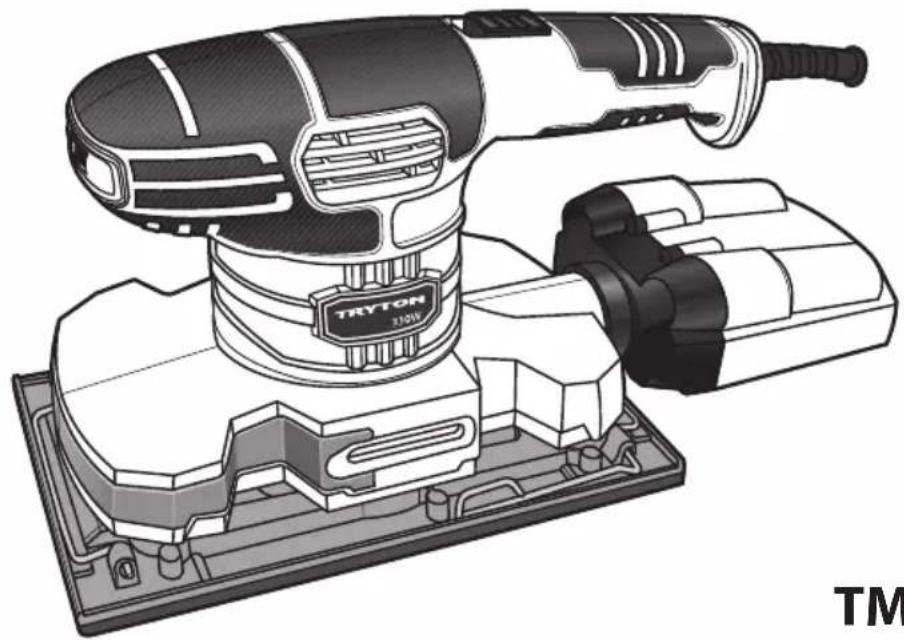
The grinder design is shown in Fig. A. Any unauthorized modifications of the device carried out by the users themselves release the manufacturer from any responsibility for failures or harms to humans or environment. The intended use of the grinder includes also its maintenance, storage, transportation and repairs.
The grinder can be repaired only by service workshops appointed by the manufacturer. Any tools supplied from the electric power network can be repaired exclusively by authorized electricians.
Specific residual risks cannot be eliminated despite proper use. The following threats may occur resulting from the design and structure of the machine:
- Hearing loss if necessary hearing protection is not used;
- Harmful emissions of wood dust in confined spaces;
- Risk to health during prolonged use of the power tool. In such circumstances, regular brakes are recommended.
■ Delivery kit
- Grinder – 1 pc.
• Abrasive paper – 2 sheets (gr. 80,120) - Perforating tool - 1 pc.
- Carbon brushes - 2 pcs.
- Warranty card - 1 pc.
- Operating Instruction - 1 pc.
■ Device components
The components are numbered according to the graphic images presented in pages 2-3 of this Operating Instruction.
Fig.A 1. Grinder shoe
- Speed adjustment knob (model TMC330)
- Auxiliary handle
- On/Off trigger
- Handle
- Power cord
- Dust container
- Clamps to fix abrasive paper
Fig.B 9. Dust suction openings
- Dust ejector nozzle
Fig.C 11. Abrasive sheet
Fig.E 12. Perforating tool
TECHNICAL DATA:
| MODEL | TMC260 | TMC330 |
| Rated voltage | 220-240V | |
| Rated frequency | 50 Hz | |
| Rated power | 260 W | 330 W |
| Operating speed (rpm) | 12000 | 6000-11000 |
| Abrasive surface | 90x187 mm | 115x230 mm |
| Protection class | II/☐ | |
| Length of the power cord | 3 m | |
| Weight | 1,9 kg | 2,1 kg |
| Sound pressure level (LpA), | 82 dB(A) | 82 dB(A) |
| Sound power level (LwA), | 93 dB(A) | 93 dB(A) |
| Measurement tolerance K_bA,K_wA | 3 dB(A) | |
| Average level of vibrations for the both handles to EN 62841-2-4 (measurement tolerance K=1,5 m/s2) | 5,467 m/s2 | 5,467 m/s2 |
The vibration level value given refers to basic application of the tool. If the tool is used for other applications or with other tools, or if it is not maintained properly, the vibration level may differ from the values given. The above-mentioned causes may lead to higher exposure to vibrations during the whole work time.
One must implement additional safety measures to protect the operators from exposure to vibrations, such as maintenance of the electric tool and work tools, assurance of proper hand temperature, or determination of the sequence of work operations.
The declared total vibrations and declared noise emissions were measured in accordance with a standard test method and may be used for tool comparison.
The declared total vibrations and noise emissions can be used in preliminary exposure assessment.
Warnings:
The vibrations and noise emissions during the actual use of the power tool may differ from the declared values depending on how the tool is used and on the type of the workpiece in particular.
Determine safeguards to protect the operator. They should be based on the estimated exposure under actual operational conditions (taking into account all parts of the operating cycle such as when the tool is switched off or idle except the start time).
PRIOR TO START WORKING:
- Make sure that parameters of the power voltage correspond to the ones of the specified on the rating plate of the device. grinder
• Make sure that the On/Off switch is in the Off position. - While working with a power cord extension make sure that parameters of the extension cable and cross-sections of its wires are sufficient for parameters of the grinder. It is recommended to use extension cables as short as possible and uncoil them to the full length.
CAUTION: Grinding operations must be always carried out with use of personal protection equipment for the upper respiratory tract (dust masks).
- Due to health reasons it is also mandatory to use a dust container (7)
or a vacuum cleaner of industrial type as a system for dust extraction. The suction hose of the vacuum cleaner must be connected directly to the dust ejector nozzle (10) (see Fig. B).
- Extreme caution must be taken while grinding painted surfaces. Some paints or varnishes contain hazardous substances, thus the collected dust must be disposed in the environment-safe manner.
- When grinding operations are carried out on surfaces coated with paints containing lead components it is mandatory to use dust masks capable to adsorb lead vapours. Children or pregnant women are not allowed to stay at such workplaces. No eating or drinking is allowed during such operations.
- The machine must never be applied to grind magnesium-coated surfaces.
■ Fitting of abrasive paper
WARNING! Disconnect the plug from the electric socket before you start any work on the power tool.
Clean debris and dust off the grinder shoe (1) with a brush before applying new abrasive paper.
The surface of the shoe () has hooks for quick and easy installation of 1 hook-and-loop abrasive paper.
Put a piece of abrasive paper against the shoe of the grinder () and press 1 firmly over the entire area.
Make sure the holes in the abrasive paper are aligned with dust holes ( ) 9 in the grinder shoe ( ) (Fig. ).1 B
Instructions for installing roll or cut abrasive paper:
- Unlock the fixing clamps (10).
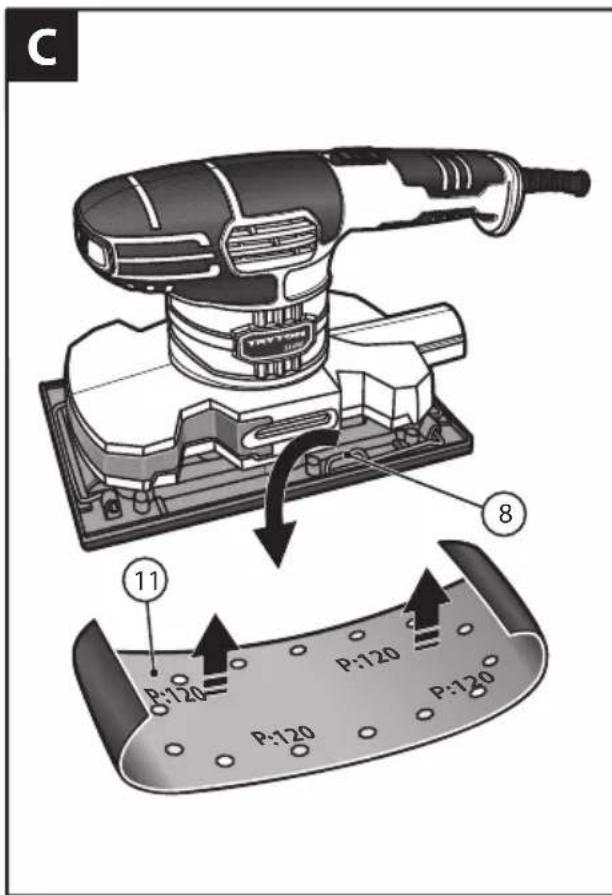
- Place a sheet of abrasive paper (11) on the grinder shoe (1) so that holes in the paper sheet would coincide with opening for dust suction (9) in the grinder shoe (see Fig. B-C). Fold edges of the paper and slide them into holders. Lock the fixing clamps (8). The paper must be fitted firmly and reliably.
Abrasive sheets without holes, e. g. from rolls or by the meter, can be punctured with the perforating tool (). For this, push the power tool 12 with the abrasivesheet mounted onto the perforating tool (see Fig. E).
■ Installing a dust container (see Fig. B)
Push the dust container (7) over the dust ejection nozzle (10) as far as it goes.
For best results of the integrated dust suction system, empty the dust container every 5-10 minutes of tool operation.
To empty the dust container remove it from the nozzle and tap it gently against a hard surface to separate dust from the walls. Empty the container through the seating opening.
Use a soft brush to clean the container filtering meshes.
OPERATION:
■ Switching on/off
- To turn the grinder on, move the on/off trigger (4) slider forward.
- To turn the grinder off, move the on/off trigger (4) slider back.
■ Speed selection (only for TMC330)
The tool is fitted with an electronic control system that makes it possible to select the frequency of rotation depending on the material processed.
The speed adjustment knob (2) can be set within the range from 1 (lowest oscillation frequency, e.g. when sanding surfaces sensitive to
high temperatures) to MAX (highest oscillation frequency). The required speed depends on the material and working conditions – it can be adjusted by the trial and error method only.
Grinding
Secure the machined piece on a steady surface or lock it in a vice. Switch the grinder on.
Drive the grinding shoe of the tool on the machined surface with small, elliptic movements. Do not apply any additional pressure, the own weight of the device is fully sufficient. Strong pressure onto the treated surface is not a measure that increases efficiency of grinding; instead, it leads to premature wear of both the tool and the abrasive paper.
Repeat several subsequent grinding operations using abrasive paper with lower granulation size each time.
NOTE: Only abrasive sheets of sound working condition guarantee satisfying performance of machining and protect the tool from possible failures.
STORAGE AND MAINTENANCE:

WARNING: Unplug the device from the electric network before any maintenance or repair operations.
Generally, this power tool does not require any special maintenance.
Store the machine in a place away from children, keep it clean and protect from humidity and dust. Storage conditions should exclude any mechanical damage and weathering.
■ Cleaning
In order to provide safe and efficient operation, case and ventilation gaps of the grinder should always be free of dust and fouling, if only possible. It is recommended to clean the tool immediately after each use.
Wipe off the grinder with a soft, damp rug with a minute amount of soap, or blow it through with compressed air at low pressure.
Do not use any cleaning agents or solvents; they can damage plastic parts of the grinder.
Take care to not let water inside the device.
■ Transport
Transport and store the device in a package protecting from humidity and dust. Secure the vents. Small elements penetrating the casing might damage the motor.
TROUBLESHOOTING GUIDE (TYPICAL PROBLEMS):
The tool does not work:
- check if the power cord is connected properly and check fuses. If the power tool cannot be turned on, send it to a service point. The addresses are provided in the warranty card.
MANUFACTURER:
PROFIX Ltd.,
34 Marywilska Street,
03-228 Warsaw, POLAND.
PROTECTION OF THE ENVIRONMENT:

NOTE: The symbol nearby denotes that old equipment must never be thrown away together with other waste (with the penalty of a fine). Hazardous components of electronic equipment may adversely affect the natural environment and
human health.
Each household may contribute to the recovery and reuse (recycling) of old machinery and equipment. Both in Poland and Europe a system for recovery of used equipment either exists or is being created. The system obliges all organizations that sell such equipment to collect the used machinery and appliances. Moreover, general purpose collecting points for such equipment are available.
PICTOGRAMS:

- «Read this instruction before switching on the power supply and starting the work»

— «Always wear appropriate eye protection»

— «Use appropriate hearing protection»

- «Always wear the anti-dust mask»

The policy of the PROFIX company consists in permanent improvements of the offered products and therefore the company reserves the right to make amendments to the product specification without a prior notice. The images included into the operation manual are only of the exemplary nature and may slightly differ from actual appearance of the device purchased. This instruction manual is protected by copyright. Copying it without the written consent of PROFIX Co. Ltd. is prohibited.

PRZED PRZYSTĄPIENIEM DO UŻYTKOWANIA NALEŻY ZAPOZNAĆ SIĘ Z NINIEJSZĄ INSTRUKCJĄ.
(EN) EC/EU DECLARATION OF CONFORMITY
(PL) DEKLARACJA ZGODNOŚCI WE/UE
(RO) DECLARATIE DE CONFORMITATE CE/UE
(LV) EK/ES ATBILSTIBAS DEKLARACIJA
(LT) EB/ES ATITIKTIES DEKLARACIJA
(CS) ES/EU PROHLÁŠENÍ O SHODĚ
(HU) EK/EU-MEGFELELŐSÉGI NYILATKOZATA
(EN)
MANUFACTURER
(PL)
PRODUCENT
(RO)
PRODUCĂTOR
(LV)
RAŽOTĀJS
(LT)
GAMINTOJAS
(CS)
VÝROBCE
(HU)
GYÁRTÓ
PROFIX Sp. z o.o. ul. Marywilska 34, 03-228 Warszawa
(EN) Person who was authorized to develop technical documentation:
(EN) 2006/42/EC (OJ L 157, 9.6.2006, p. 24–86); 2014/30/EU (OJ L 96, 29.3.2014, p. 79–106); 2011/65/EU of the European Parliament and of the Council of 8 June 2011 on the restriction of the use of certain hazardous substances in electrical and electronic equipment (OJ L 174, 1.7.2011, p. 88–110) change 2015/863/UE;
(EN) and have been manufactured in accordance with the standards:
Representative of the Board for Certification


- E E K T R O N A R Z I
- TMC260
- TMC330
- EN
- PL
- BEFORE YOU START USING THE MACHINE READ THOROUGHLY THIS MANUAL.
- WARNING! Read all safety warnings marked with a symbol ⚠️ and all operating safety instructions.
- Keep all work safety instructions and tips for future reference.
- WARNING! General work safety warnings for use of the tool.
- Workplace safety:
- WARNING! General warnings regarding the use of power tools.
- Electric safety:
- Personal safety:
- Use and taking care of your power tool:
- DESIGN AND APPLICATION AREA OF THE GRINDER:
- The tool is designed only for household (DIY) application. Do never use the tool for applications that need use of professional equipment. The warranty terms are null and void when the tool is used at craftsman workshops, for industrial applications or in similar fields.
- ■ Delivery kit
- ■ Device components
- Warnings:
- PRIOR TO START WORKING:
- ■ Fitting of abrasive paper
- ■ Installing a dust container (see Fig. B)
- OPERATION:
- ■ Switching on/off
- ■ Speed selection (only for TMC330)
- Grinding
- STORAGE AND MAINTENANCE:
- ■ Cleaning
- ■ Transport
- TROUBLESHOOTING GUIDE (TYPICAL PROBLEMS):
- The tool does not work:
- MANUFACTURER:
- PROTECTION OF THE ENVIRONMENT:
- PICTOGRAMS:
- PROFIX Sp. z o.o. ul. Marywilska 34, 03-228 Warszawa
Brand : Tryton
Model : TMC260
Category : Sander