KU4 - Microphone AEA - Free user manual and instructions
Find the device manual for free KU4 AEA in PDF.


| Product Type | Ribbon Microphone |
| Brand | AEA |
| Model | KU4 |
| Category | Microphone |
| Polar Pattern | Figure-8 |
| Frequency Response | 20 Hz – 20 kHz |
| Sensitivity | -52 dB re 1V/Pa (1.0 mV/Pa) |
| Impedance | 300 ohms (balanced) |
| Maximum SPL | 135 dB (1% THD @ 1 kHz) |
| Dimensions (Length x Diameter) | 180 mm x 25 mm |
| Weight | 0.35 kg (12.3 oz) |
| Connector | XLR-3M (male) |
| Phantom Power Required | No (passive) |
| Housing Material | Aluminum and steel |
| Included Accessories | Stand adapter, storage case |
| Polar Pattern Switch | No (fixed figure-8) |
| Self Noise | < 18 dB-A |
| Cleaning Instructions | Wipe with dry soft cloth; avoid moisture |
| Safety Warnings | Do not expose to extreme humidity or drops |
| Spare Parts Availability | Ribbon replacement available through AEA service centers |
| Warranty | 1 year limited warranty |
Frequently Asked Questions - KU4 AEA
User questions about KU4 AEA
0 question about this device. Answer the ones you know or ask your own.
Ask a new question about this device
Download the instructions for your Microphone in PDF format for free! Find your manual KU4 - AEA and take your electronic device back in hand. On this page are published all the documents necessary for the use of your device. KU4 by AEA.
USER MANUAL KU4 AEA
natural_image
Close-up of a black-and-white studio microphone with hexagonal grille and metallic shaft (no visible text or symbols)CLASSIC SUPERCARDIOID RIBBON MIC
Congratulations on your purchase of the AEA KU4 ribbon microphone and welcome to the AEA family! Unless you have used an original RCA KU3A (also known by its manufacturing number M-10001), the AEA KU4 is unlike any ribbon microphone you have ever experienced. This is due, in part, to its unique supercardioid polar pattern and character. With fewer than 600 KU3As manufactured, those that remain in existence are highly prized for their sensitivity, their rich lower midrange, and their surprisingly strong high-frequency presence.
Following our tradition of providing “reincarnations” of the RCA 44 microphone, AEA is proud to introduce the AEA KU4 studio ribbon microphone, featuring pure aluminum ribbon material, parts interchangeable with the original RCA KU3A, and the consistent and reliable performance for which our microphones have gained a world-wide reputation.
Your KU4 microphone is 100% handcrafted in Pasadena, CA. AEA is a family owned company with a small crew of skilled technicians - most of them being musicians themselves. Proudly independent, we still manufacture all our ribbon microphones and preamps by hand from locally sourced parts.
We hope that the KU4 will help you capture many magical performances that touch the heart. This manual will help ensure that you get the best sound and longevity from your new microphone. Please become part of the AEA community by sharing your experiences with the KU4 via e-mail, phone or our social media channels.
Wes Dooley
Founder of AEA
CONTENTS
2
4
4
5
8
10
WELCOME
INTRODUCTION
SUPPORT
GENERAL GUIDELINES
APPLICATION ADVICE
SPECIFICATIONS
INTRODUCTION
The KU4 is a side-address ribbon microphone with a supercardioid pickup pattern. The reduced rear-lobe of the supercardioid pattern means that, compared to a conventional bi-directional ribbon microphone, the KU4 will have less pickup of ambient sound from the rear. This makes it much easier to use in situations where isolation between instruments is important or under less than ideal acoustics. The angles of maximum off-axis sound rejection are at ±135^ , and you can use those angles effectively to minimize reflections caused by nearby surfaces. The KU4 has been designed to reduce proximity bass boost to facilitate closer mic placement. The lightly-tensioned, ultra low-mass ribbon produces response out to 20 kHz (-7 dB) with fast, accurate transients, and without the upper-midrange ringing common to condenser microphones. These characteristics make the KU4 well suited for modern studio music production, and ideal for low strings and brass instruments as well as vocals.
WARRANTY
Your KU4 comes with a one-year limited warranty on parts and labor, shipping not included. Registering your product with AEA will extend the warranty to a full three years.
Scan the QR code or visit our website to register.

text_image
QR code with embedded logo in center, likely for digital link or paymentSUPPORT
If you should encounter any problems with your KU4 microphone or have questions regarding specific applications, please contact our customer support team at orders@ribbonmics.com for the quickest response.
To contact us by phone, please call +1-800-798-9127 from 9:00 a.m.-5:00 p.m. PST Monday-Friday. AEA's repair center is located at 1029 N. Allen Ave, Pasadena, CA 91104, U.S.A.
GENERAL GUIDELINES
Your microphone is a valuable and important investment. Like most recording equipment and musical instruments, it requires common sense and basic care to keep it functioning properly. Given care, your new microphone will perform dependably for decades.
PHANTOM POWER
Phantom power is not required or recommended for the passive KU4. With a correctly wired cable and a properly working phantom power supply, there is actually little danger of damaging a KU4 microphone with phantom power. However, passive ribbons such as the KU4 can be damaged if ground (Pin 1) is accidentally shorted, miswired, or hot patched in a patch bay to (Pin 2) or (Pin 3). Using phantom power with a faulty or miswired cable or a defective supply can severely stretch or break a ribbon.
Since passive ribbon microphones and other transformer-coupled microphones can be particularly vulnerable to phantom-power, it is recommended to make disengaging phantom-power before plugging and unplugging (the microphone) a habit.
MICROPHONE STORAGE
Keep the microphone covered when it is not in use. This will reduce the damage that may result from a gust of air. Place the supplied protective bag over the microphone when it is not in use. For long-term storage, keep the microphone in its protective case. An unprotected ribbon microphone can attract minute iron particles, sometimes known as "tramp iron". If allowed, tramp iron can penetrate the screen of a ribbon mic, sufficiently build up in the magnetic gap and rub against the ribbon, causing distortion, electrical shorts or tearing of the ribbon.
AIR TURBULENCE
Avoid exposing the microphone to strong air turbulence. Ribbon microphones can withstand very high SPL (Sound Pressure Level), but can be damaged by a strong gust of air or high levels of very low frequency sound waves (from a kick drum or bass cabinet). This can stretch the ribbon, reducing overall output, especially at high frequencies.
Take precautions when recording any source that moves air. To avoid damage, follow "The Hand Test": put the back of your hand where the mic will be positioned; if you can feel the moving air, place a pop-filter between the microphone and the source or simply pull the mic farther back. When recording kick drums or bass guitar cabinets, angle the microphone so that no air blasts the microphone directly on-axis from the front or back.
Never blow directly into any microphone to test it. Not only does this force moisture and dirt into the microphone, strong air movement also can stretch the ribbon and while it may not break, it nonetheless could significantly degrade the microphone's performance. Though the ribbon in your KU4 is protected by a grille and acoustical fabric, which provides reasonable wind protection while still allowing good high-end response, take care to avoid high-wind outdoor environments.
STRAY MAGNETIC FIELDS
Ribbon microphones are fundamentally prone to picking up strong external magnetic fields generated by light dimmers or nearby power transformers. Though AEA designers paid much attention to suppressing such sensitivity, it is still possible that you might encounter this problem. If you should pick up a hum, try rotating or moving the microphone to find a spot where the hum disappears, and try eliminating potential sources of stray magnetic fields. Rotate or move the mic to find the point of peak interference.
The high-performance magnets used in AEA microphones are incredibly strong, and a significant amount of stray magnetic field lines surround the microphone. To prevent data loss caused by magnetic fields, avoid placing the microphone in close proximity to hard drives, credit cards, analog tape, or any other magnetically sensitive items.
MICROPHONE POSITIONING
Always use a sturdy microphone stand with the KU4. Weighing in at around 5lbs, the KU4 requires mounting on a strong, robust microphone stand with a heavy base or tripod. Large studio-booms with an appropriate counter-weight are recommended to prevent your KU4 from tipping-over and crashing, causing injury to itself, a musician, or a valuable musical instrument.
The integrated cushion mount was designed to keep structure-borne noise transmitted through the microphone stand and the cable away from the low-tuned ribbon transducer. For the shock mount to function as intended, it is important to vertically position the cushion mount off of the mic stand and to rotate the microphone within the yoke, as opposed to rotating the entire mic on the stand. This requires the use of a swivel mount or posi-lock when using a boom arm for positioning the microphone in a vertical configuration. Having the cushion mount reaching out horizontally on a boom will cause inferior vibration isolation and can also distort the cushion mount as time goes by.
APPLICATIONS ADVICE
We actively encourage users to visit AEAribbonmics.com to access our comprehensive collection of in-depth articles and tutorials featuring the KU4, along with a library of audio and video demonstrations of the KU4 in action.
PROXIMITY EFFECT
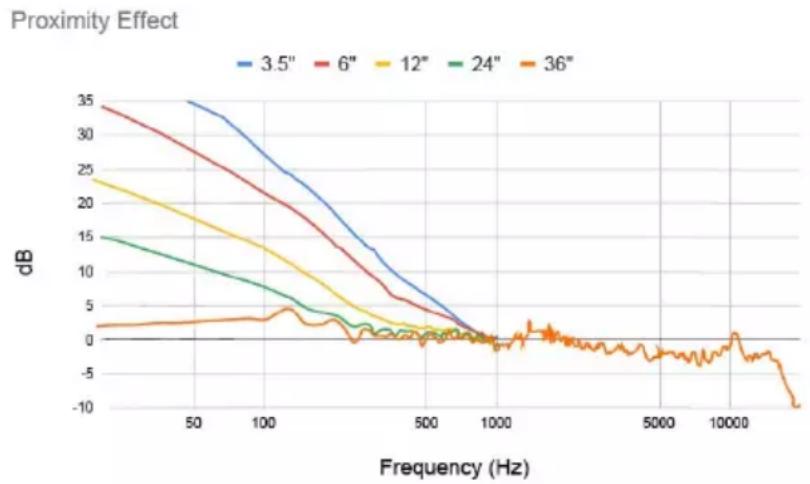
line
| Frequency (Hz) | 3.5" | 6" | 12" | 24" | 36" | | -------------- | ----- | ----- | ----- | ----- | ----- | | 0 | 35.0 | 34.0 | 24.0 | 15.0 | 2.0 | | 50 | 32.0 | 30.0 | 20.0 | 12.0 | 2.5 | | 100 | 28.0 | 25.0 | 16.0 | 9.0 | 3.0 | | 500 | 15.0 | 10.0 | 6.0 | 3.0 | -1.0 | | 1000 | 0.0 | 0.0 | 0.0 | 0.0 | -1.5 | | 5000 | -1.0 | -1.0 | -1.0 | -1.0 | -2.0 | | 10000 | -2.0 | -2.0 | -2.0 | -2.0 | -3.0 | | >1000 | -3.0 | -3.0 | -3.0 | -3.0 | -4.0 |(graph is a visualization, not a measurement)
Proximity effect, a characteristic of all directional microphones, is a rise in low-frequency response at closer working distances. This can be used to superb effect, particularly with deeper vocals to enhance richness and depth. A potential trade-off is reduced articulation resulting from the masking effect on the treble due to “excessive” bass boost.
HOW TO MINIMIZE BLEED
A significant and ever-present challenge in contemporary studio recording is minimizing “leakage” from nearby instruments into the various microphones. The deep nulls of ribbon microphones provide good rejection of unwanted sounds, which also can be beneficial in sound reinforcement situations where “feedback” is always a threat. While “gobos” can be effective in isolating performers from each other, they introduce their own set of problems - not the least of which are reflections in close proximity to the performers and/or microphones that result in comb-filter distortions. Because gobos usually are bulky and occupy valuable floor space, they also inhibit the ability of the musicians to hear and see each other easily. Such a setup requires complex and often cumbersome headphone monitor mixes for the musicians.
SUPERCARDIOID DIRECTIONALITY
Because the KU4 has a supercardioid pattern, it has nulls at approximately ±135^ from the principal (front) axis. Projected in three dimensions, these nulls produce a “cone of rejection” to the rear of the microphone that can be used effectively to reduce leakage. Simply arrange the musicians so that nearby instruments are placed in the “null” of their neighbor’s microphone, and vice versa. Although this does not entirely eliminate the need for gobos, it can significantly reduce their number.
SPECIFICATIONS
OperatingPrinciple: Pressure gradient transducer
Directional Pattern: Supercardioid
Frequency Range: <30 Hz to >20 kHz
Maximum SPL: 140+ dB SPL above 200 Hz for 1% third harmonic
Sensitivity: -52dBV (2.5 mV/Pa) (at 1 kHz into unloaded circuit)
Output Impedance: 300 Ω nominal
Load Impedance: 1.5 kΩ or greater
Phantom Power: Not required or recommended
Polarity: Pin 2 high for positive pressure on front of mic
Off Axis Response
Relative Output: -12 dB at 180^
Angle of Max Rejection: 135^
Transducer Element
Material: Pure aluminum corrugated ribbon
Thickness: 1.8 μm
Width: 0.082 in (2.1 mm)
Length: 1.25 in (28.6 mm)
Microphone Dimensions
Height: 12.6 in (32.00 cm)
Width: 4.6 in (11.68 cm)
Depth: 3.7 in (9.40 cm)
Weight: 4.7 lb (2.15 kg)
Ship Weight: 7.0 lb (3.20 kg)
Connector: XLR-3M wired to a 1.5m captive cable
Accessories Included: Storage case, stand adapter, user manual
POLAR PATTERN
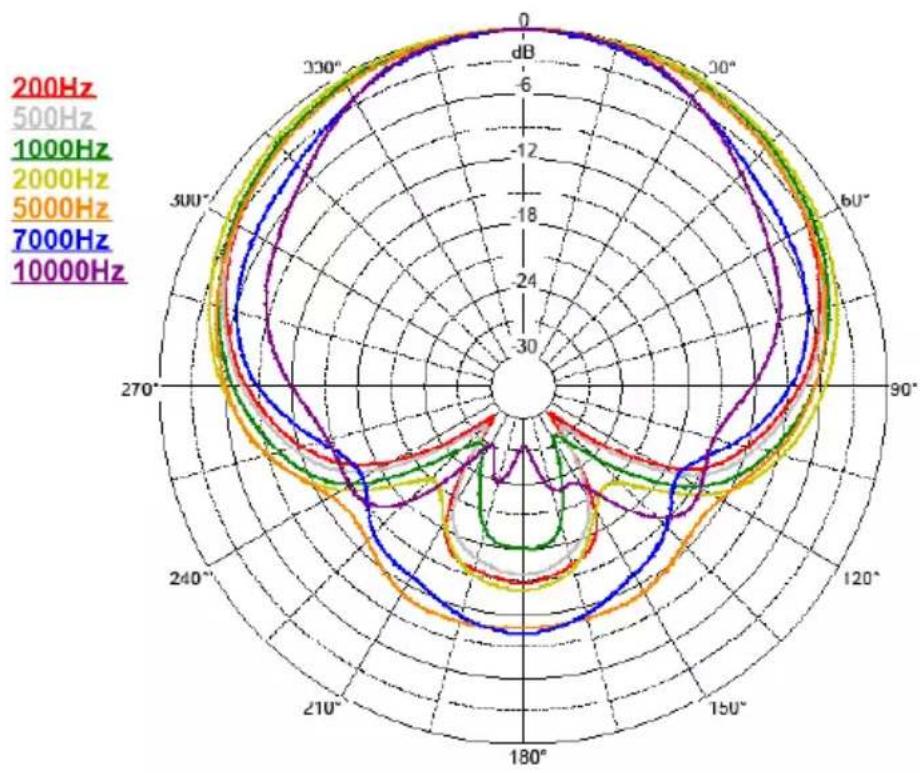
radar
| Angle | 200Hz | 500Hz | 1000Hz | 2000Hz | 5000Hz | 7000Hz | 10000Hz | |-------|-------|-------|--------|--------|--------|--------|---------| | 0° | -12 | -18 | -24 | -30 | -36 | -42 | -48 | | 30° | -12 | -18 | -24 | -30 | -36 | -42 | -48 | | 60° | -12 | -18 | -24 | -30 | -36 | -42 | -48 | | 90° | -12 | -18 | -24 | -30 | -36 | -42 | -48 | | 120° | -12 | -18 | -24 | -30 | -36 | -42 | -48 | | 150° | -12 | -18 | -24 | -30 | -36 | -42 | -48 | | 180° | -12 | -18 | -24 | -30 | -36 | -42 | -48 | | 210° | -12 | -18 | -24 | -30 | -36 | -42 | -48 | | 240° | -12 | -18 | -24 | -30 | -36 | -42 | -48 | | 270° | -12 | -18 | -24 | -30 | -36 | -42 | -48 | | 300° | -12 | -18 | -24 | -30 | -36 | -42 | -48 | | 330° | -12 | -18 | -24 | -30 | -36 | -42 | -48 | | 360° | -12 | -18 | -24 | -30 | -36 | -42 | -48 |FREQUENCY RESPONSE

line
| Time (ns) | Value | | --------- | ----- | | 200 | -2.5 | | 600 | -2.4 | | 900 | -2.3 | | 1200 | -2.5 | | 1500 | -2.4 | | 1800 | -2.3 | | 2100 | -2.5 | | 2400 | -3.5 | | 2700 | -4.5 | | 3000 | -3.5 | | 3300 | -3.0 | | 3600 | -2.5 | | 3900 | -2.0 | | 4200 | -1.5 | | 4500 | -1.0 | | 4800 | -0.5 | | 5100 | -1.0 | | 5400 | -1.5 | | 5700 | -2.0 | | 6000 | -2.5 | | 6300 | -3.0 | | 6600 | -3.5 | | 6900 | -4.0 | | 7200 | -4.5 | | 7500 | -5.0 | | 7800 | -5.5 | | 8100 | -6.0 | | 8400 | -6.5 | | 8700 | -7.0 | | 9000 | -7.5 | | 9300 | -8.0 | | 9600 | -8.5 | | 9900 | -9.0 | | 10200 | -9.5 | | 10500 | -10.0 | | 10800 | -10.5 | | 11100 | -11.0 | | 11400 | -11.5 | | 11700 | -12.0 | | 12000 | -12.5 | | 12300 | -13.0 | | 12600 | -13.5 | | 12900 | -14.0 | | 13200 | -14.5 | | 13500 | -15.0 | | 13800 | -15.5 | | 14100 | -16.0 | | 14400 | -16.5 | | 14700 | -17.0 | | 15000 | -17.5 | | 15300 | -18.0 | | 15600 | -18.5 | | 15900 | -19.0 | | 16200 | -19.5 | | 16500 | -20.0 | | 16800 | -20.5 | | 17100 | -21.0 | | 17400 | -21.5 | | 17700 | -22.0 | | 18000 | -22.5 | | 18300 | -23.0 | | 18600 | -23.5 | | 18900 | -24.0 | | 19200 | -24.5 | | 19500 | -25.0 | | 19800 | -25.5 | | 20100 | -26.0 | | 20400 | -26.5 | | 20700 | -27.0 | | 21000 | -27.5 | | 21300 | -28.0 | | 21600 | -28.5 | | 21900 | -29.0 | | 22200 | -29.5 | | 22500 | -30.0 | | 22800 | -30.5 | | 23100 | -31.0 | | 23400 | -31.5 | | 23700 | -32.0 | | 24000 | -32.5 | | 24300 | -33.0 | | 24600 | -33.5 | | 24900 | -34.0 | | 25200 | -34.5 | | 25500 | -35.0 | | 25800 | -35.5 | | 26100 | -36.0 | | 26400 | -36.5 | | 26700 | -37.0 | | 27000 | -37.5 | | 27300 | -38.0 | | 27600 | -38.5 | | 27900 | -39.0 | | 28200 | -39.5 | | 28500 | -40.0 | | 288₀ | -40.5 | | | |• Data below 200 Hz omitted due to measuring room restrictions
- 0 dVB is equivalent to 2.5 mV/Pa (-52 dBV)
• Normalized to 0 dB at 1kHz. 1/3 octave smoothing

text_image
AEH