N28 - Microphone AEA - Free user manual and instructions
Find the device manual for free N28 AEA in PDF.


User questions about N28 AEA
0 question about this device. Answer the ones you know or ask your own.
Ask a new question about this device
Download the instructions for your Microphone in PDF format for free! Find your manual N28 - AEA and take your electronic device back in hand. On this page are published all the documents necessary for the use of your device. N28 by AEA.
USER MANUAL N28 AEA
natural_image
Black NUVO brand brush tool with textured grip and logo (no readable text or symbols beyond branding)
text_image
HEHAEA N28
COMPACT ACTIVE STEREO RIBBON MICROPHONE

natural_image
Abstract circular logo design with stylized letter 'E' and arrow elements (no readable text)OWNER'S MANUAL
WELCOME
Congratulations on your purchase of an AEA N28 stereo ribbon microphone and welcome to the AEA family.
Using a stereo microphone is one of the easiest ways to capture natural stereo sound. The N28 offers an effortless way to capture natural stereo with its Blumlein imaging, providing an authentic representation of a performance in its environment. Distinguishing itself from other AEA Stereo Ribbon Mics, the N28 is compact, maneuverable, and easy to use, making it ideal for a wide range of applications without the need for a multi-mic setup.
Whether for drum overheads, room ambiance, or close-miked stringed instruments, the N28 delivers a phase-coherent, accurate response. Its mid-forward frequency response, tamed proximity effect, and quick transient response make it versatile across various sources. The N28 excels on darker sources and is a practical solution for capturing a stereo image without drawing attention to the mic itself.
Your N28 Stereo microphone is 100% handcrafted in Pasadena, CA. AEA is a family owned company with a small crew of skilled technicians - most of them being musicians themselves. Proudly independent, we still manufacture all our ribbon microphones and preamps by hand from locally sourced parts.
We hope your microphone will capture many magical performances that touch the heart. This manual will help ensure that you get the best sound and longevity from your new microphone. Please become part of the AEA community by sharing your experiences via e-mail, phone or social media.
The AEA Team

CONTENTS
2 WELCOME
4 WHAT'S IN THE BOX
5 INTRODUCTION/SUPPORT
6 GENERAL GUIDELINES
8 APPLICATION ADVICE
14 SPECIFICATIONS
WHAT'S IN THE BOX
Storage/Shipping Case
Custom N28 Windscreen
Shock Mount Clip
Soft Cloth Bag
15ft XLR Breakout Cable
INTRODUCTION
The AEA N28 is an active stereo microphone consisting of two matched bidirectional (or figure-of-8) ribbon transducers in a fixed Blumlein configuration. It features a more compact design, just shy of 2 inches longer than the other Nuvo microphones, in a discreet, easy to position matte black microphone body.
The N28 utilizes a fresh motor design featuring 1.13" long ribbons, Lehle 1:89 transformers, and a new impedance buffer amp topology. Small, easy to position, and optimally designed for medium-distance miking applications, the N28 is the perfect addition to the AEA NUVO line.
WARRANTY
Your N28 mic comes with a one year limited warranty on parts and labor*. Registering your product within 90 days will extend the warranty to three (3) years.
Scan the QR code or visit our website to register.
*AEA is not responsible for shipping costs.

text_image
QR code with embedded logo in center, likely for digital scanning and linking to online contentSUPPORT
If you should encounter any problems with your N28 microphone or have questions regarding specific applications, please contact our customer support team at support@ribbonmics.com for the quickest response.
To contact us by phone, please call +1 626-798-9128 from 9:00 a.m.- 5:00 p.m. PST Monday-Friday.
AEA's repair center is located at 1029 N. Allen Ave, Pasadena, CA 91104, U.S.A.
GENERAL GUIDELINES
Your microphone is a valuable and important investment. Like any piece of recording equipment or musical instrument, it requires common sense and good basic care to keep it working properly. Given simple, basic care, your new microphone will perform admirably for decades.
PHANTOM POWER
Although the N28 needs a phantom power source to operate, we recommend making a habit of disengaging phantom-power before plugging and unplugging the microphone.
AEA strongly recommends against using TRS or TT mic-level patch bays. The patching process shorts pin-2 and/or pin-3 of the cable to ground. Sometimes even with phantom power off, equipment can be damaged due to phantom power supply voltage bleed, which varies. For mic-level patching, we suggest always using an XLR patch bay.
The N28, as with all AEA active ribbon mics, requires a current draw of 7 milliamps. Some USB and battery-powered audio interfaces will not deliver the IEC-specified 10 milliamps per input. To ensure optimal performance, please verify that your unit can deliver at least 7, but preferably 10 milliamps.
MICROPHONE STORAGE
Keep the microphone covered when it is not in use. This will reduce the damage that may result from a sudden gust of air. Place the supplied protective bag over the microphone when it is not in use. For long term storage, place the microphone in its protective case. An unprotected ribbon microphone can attract minute iron particles, sometimes known as "tramp iron." If allowed, tramp iron can penetrate the screen of a ribbon mic, accumulate in the magnetic gap, and rub against the ribbon, causing distortion, electrical shorts or tearing of the ribbon.
AIR TURBULENCE
Avoid exposing the microphone to strong air turbulence. Ribbon microphones can withstand very high SPL (Sound Pressure Level), but can be damaged easily by a strong gust of air or high levels of very low frequency sound waves (from a kick drum or bass cabinet). This can stretch the ribbon, reducing overall output, especially at high frequencies. Sources that may produce strong blasts of air, such as the bass port on an electric guitar or bass amp, an instrument being plugged (or unplugged) while the amp level is turned fully up, or an on-axis kick-drum hole are potentially damaging.
To avoid possible damage, follow "The Hand Test": put the back of your hand where the mic will be; if you can feel the motion of air on your hand, place a pop-filter between the microphone and the source or simply pull the mic further back. When recording kick drums or bass guitar cabinets, angle the microphone to make sure that no wind blasts hit the microphone directly on-axis.
Never blow directly into any microphone to test it. Not only can this force moisture and dirt into the microphone, but strong air movement can stretch the ribbon and degrade the microphone's performance. The N28 is protected by an acoustically semi-transparent screen and grille cloth to provide extended frequency range. Take care to avoid high-wind outdoor environments.
For extra protection or if you plan to use your N28 in an outdoor or high-wind environment, we recommend using the included AEA N28 windscreen. This windscreen is designed specifically to the contours of the N28.
STRAY MAGNETIC FIELDS
Ribbon microphones are fundamentally prone to picking up strong external magnetic fields caused by light dimmers or nearby power transformers. Guitar players will know this phenomenon from single-coil pickups. Though AEA designers pay attention to suppressing such sensitivity, it is still possible to encounter this problem. If you experience hum, try rotating or moving the microphone to find a spot where the hum disappears, and try eliminating potential sources of stray magnetic fields.
APPLICATIONS ADVICE
MICROPHONE POSITIONING
The N28 works well with all standard microphone stands, but a high-quality boom stand will still make your life a little bit easier. Mounting the microphone on a strong, sturdy microphone stand with a heavy base (or tripod) is essential. If you are using a boom, make sure that it is properly balanced and that the tripod legs are positioned appropriately to prevent tipping.
The shock-mounted microphone clip supplied with the N28 helps isolate the ribbon transducers from structure-borne noise. For more detailed information on positioning the microphone, see 'Using the N28 in Blumlein" on Page 10.
We actively encourage users to visit AEAribbonmics.com to access our comprehensive collection of in-depth articles and tutorials featuring the N28 microphone, along with a library of audio and video demonstrations of the NUVO series in action.
WHICH PREAMP SHOULD I USE?
Ribbon microphones generally have low output level and require preamps that supply a high level of gain. If the preamp you use doesn't have enough gain, the signal might seem too soft or noisy. We recommend using a preamp with a gain range of at least +60dB.
To guarantee consistent, full-range ribbon sound, we recommend AEA's RPQ, TRP and 500 series preamps, which were specially designed for ribbon microphones. The TRP3 features a switchable high-pass filter to tame proximity, and the RPQ3 features an expanded EQ section which allows you to boost and cut both low and high frequencies. On quiet sound sources or for distance recording, an AEA preamp is highly recommended.
A FIGURE-OF-8 MICROPHONE
Figure-of-8 microphones are constructed with positive polarity on the front and negative polarity on the back. Positive pressure on the front side of the ribbon produces a positive voltage on Pin-2, with respect to Pin-3 on the breakout cable connectors. The N28 consists of two figure-of-8 transducers in a fixed Blumlein array.

text_image
Null Plane Null Plane Null Plane Back Lobe Null Plane Null Plane Principal Axis Front LobeA BLUMLEIN MICROPHONE
The stereo N28 is a coincident microphone system. Coincident mic techniques use two or more transducers placed closely together. Coincident systems have good time coherence between their channels which means that sounds from the same source all arrive at close to the same time. One advantage of time coherence is that when channels are summed to mono, there is very little comb-filtering effect.
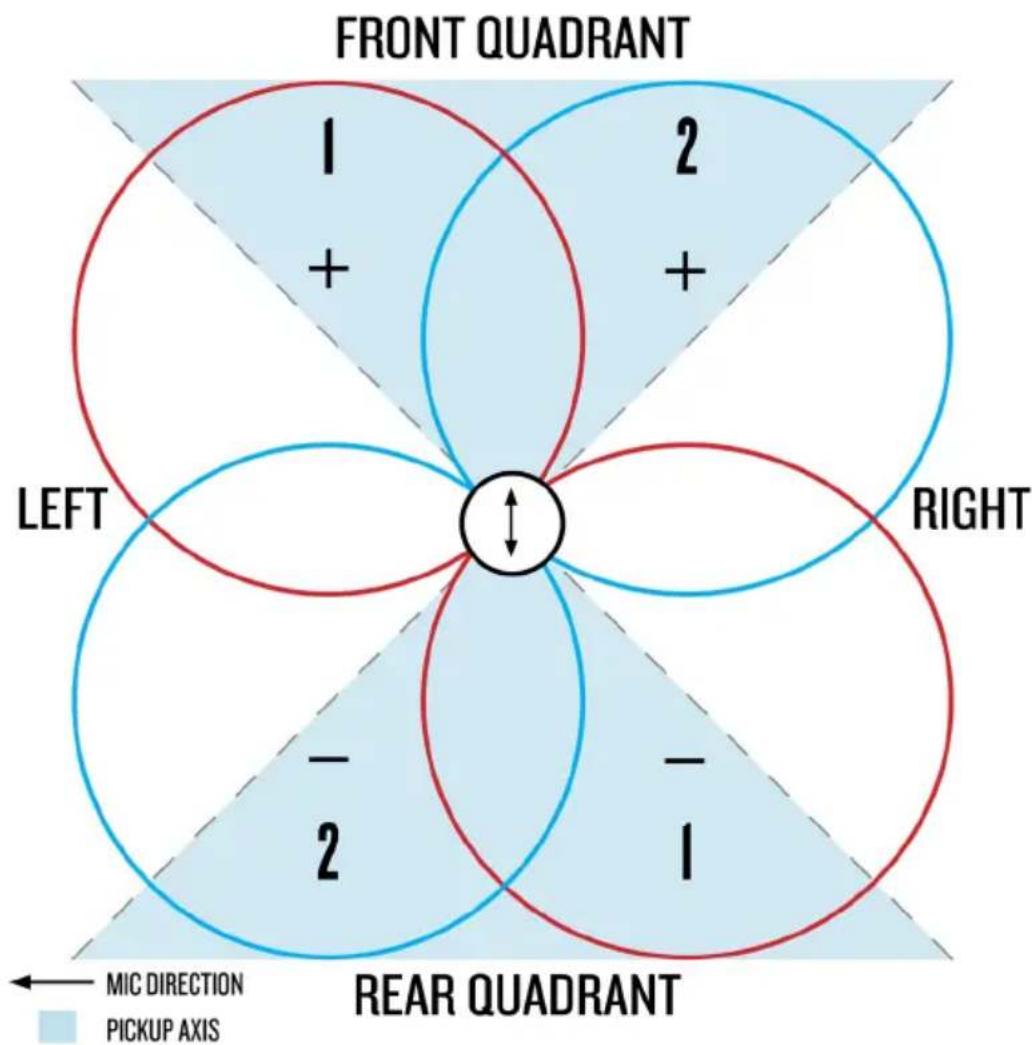
Blumlein is a type of coincident array technique that is configured with two vertically aligned figure-of-8 pattern microphones positioned 90-degrees to each other. In the N28 Channel 1 is on top of Channel 2. A Blumlein array delivers stable, in-phase sound stages from their front and rear quadrants with an excellent sense of depth.
USING THE N28 IN BLUMLEIN
The Blumlein "sweet spot" is the center point, directly in front of the white dot on the mic where channel 1 and 2 bisect. When placing the N28, position it so that the instruments are + or - 45 degrees from the centerline. Align the NUVO logo and white dot with the instrument or ensemble you are recording.
pie
| Quadrant | Left | Right | Center | Right Axis | | :--- | :--- | :--- | :--- | :--- | | 1 | 1 | 2 | 4 | 0 | | 2 | 1 | 2 | 4 | 0 | | 3 | 1 | 2 | 4 | 0 | | 4 | 1 | 2 | 4 | 0 |The front quadrant (pictured above) is the positive polarity stereo image, and the rear quadrant is the negative polarity stereo image. This distinction mirrors the difference in sound character when speaking into the front versus the rear of a mono bidirectional microphone. The waveform's polarity inversion turns what was initially a compression of air molecules into a rarefaction, and vice versa. Since music waves tend to be symmetrical, this difference is subtle.
More noticeable than the inversed polarity in the rear quadrant is the reversal of the left (ch 1) and right (ch 2) channels. Keep in mind the swapped rear lobes when placing sound sources in the rear (see Quadrant figure on pg10).
You can utilize both the front quadrant and the rear quadrant at the same time to record larger groups or multiple instruments with a single stereo mic. This technique has become very popular recently due to engineers such as John Cuniberti and his "OneMic Series" where a single R88 microphone is used to record everything in one take, with instruments and vocals arranged to balance the levels and stereo positioning.
When recording with this technique care is taken to avoid the left and right quadrants. The left and right quadrants are the "out-of-polarity" zones of the microphone. The positive lobe of one transducer is in one channel and the negative lobe of the second transducer is in the other channel. Sources recorded in this area will have low end cancellation and stereo imaging problems when played back over headphones or speakers. Additionally, it decreases the mono-compatibility of the microphone, as combining into mono results in electrical destructive interference. Prominent early reflections from these regions can cause an ill-defined and inaccurate stereo image. Take care not to place sound sources in these "out-of-polarity" zones.
The N28 will always pick up sound from the side quadrants. The ambiance and room sound material from the left and right quadrants is partially responsible for the sense of spaciousness that makes Blumlein so nice. Nevertheless, it is best to keep the sound sources in the front and/or rear quadrants to ensure consistency of polarity in your signal and an accurate stereo image.
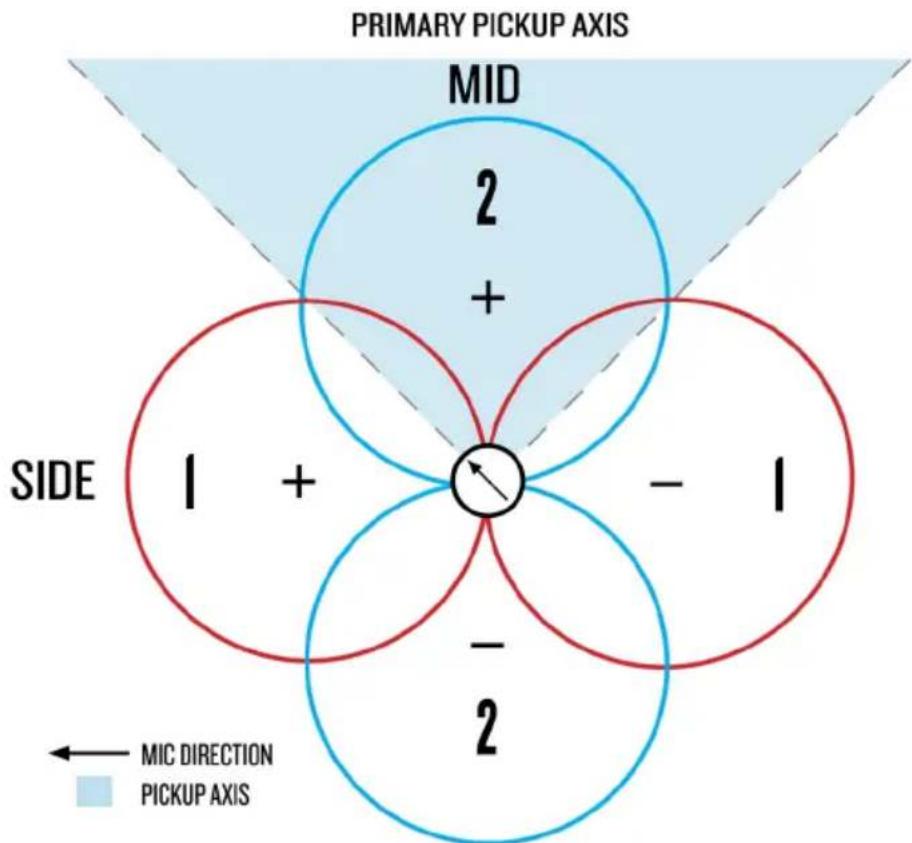
The N28 also works well with Mid-Side, or M/S, recording. M/S is worth experimenting with as it has the ability to control the stereo width by varying the Mid to Side ratio. This is especially convenient when recording a solo sound source where the emphasis is on the center of the stereo image.
Mid-Side recording requires a "decoding matrix". There are many popular M/S decoders available in hardware and software format.
other
| Intersection | Primary Pickup Axis | Secondary Pickup Axis | | ------------ | ------------------- | --------------------- | | Center | 1 | 2 | | Intersection | 1 | 2 | | Intersection | -1 | 2 | | Intersection | -2 | 2 |The positive polarity of the Mid or 'M' transducer is aligned on-axis to the primary sound source. The Side or 'S' is oriented 90-degrees to this axis. The positive polarity of the 'S' mic is typically aimed sound stage left. Such an orientation yields Left/Right stereo from a sum and difference matrix where Left = Mid + Side and Right = Mid - Side. This means that the right and left channels are hard panned and opposite polarity copies of each other, so they sound beautifully wide. If summed to mono, they perfectly cancel each other out, leaving just the Mid.
It couldn't be easier to set up an N28 for M/S. Simply rotate the mic 45 degrees to the left so that one transducer, ch 2, is pointed to the front and the other, ch 1, is pointed to the left.
PROXIMITY EFFECT
line
| Frequency (Hz) | 6" | 12" | 24" | 48" | | -------------- | ---- | ---- | ---- | ---- | | 50 | 20.0 | 15.0 | 7.0 | 2.5 | | 100 | 18.0 | 13.0 | 6.0 | 2.5 | | 500 | 5.0 | 3.0 | 2.0 | 1.0 | | 1000 | 0.0 | 0.0 | 0.0 | 0.0 | | 5000 | -5.0 | -5.0 | -5.0 | -5.0 | | 10000 | -10.0| -10.0| -10.0| -10.0|(graph is a visualization, not a measurement)
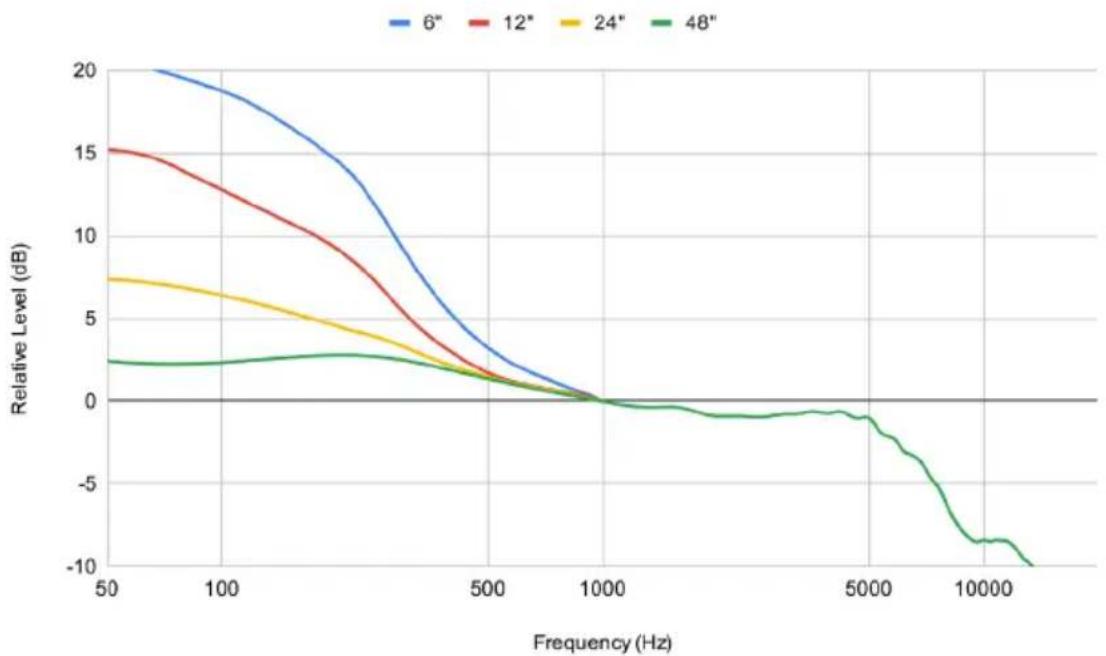
Proximity effect is a characteristic of all directional microphones; it is a rise in low-frequency response that increases at closer working distances. While this can be used to good effect, particularly with low-register voices to give them an enhanced richness and depth, the potential trade-off is reduced articulation or clarity that can result from the masking effect on the treble due to "excessive" bass boost.
As a stereo mid-field ribbon microphone, the N28 was designed to capture balanced sound at medium distances. From distances of 8 inches to 3 feet (\~0.2m – 1m), the mic retains its full spectrum and incredible low end. When positioned closer than 24 inches, the mic adds proximity effect. When carefully used, this proximity effect can beef up thin sounds – either voices or instruments.
When using an N28 at distances closer than 12 inches, the proximity effect may be too present. To reduce the negative attributes of this effect, corrective equalization can be applied. Use a high pass filter or low cut EQ to reduce the low frequencies and allow for a more balanced and natural sounding signal.
SPECIFICATIONS
| Operating Principle: | Pressure gradient transducer |
| Directional Pattern: | Two bidirectional in fixed Blumlein pair |
| Frequency Range: | <20 Hz to >20 kHz |
| Maximum SPL: | 135 dB SPL at 1 kHz |
| Sensitivity: | 6.10 mV/Pa (-44.3 dBV) |
| Output Impedance: | 92 Ω broadband |
| Load Impedance: | 1.0 kΩ or greater |
| Phantom Power: | P48 phantom power, 7mA |
| Polarity: | Pin 2 and 4 high for positive pressure at the front of the microphone |
Off-Axis Response
| Horizontal: | Level changes with angle, frequency response is consistent, -35dB null at 90° / 270° |
| Vertical: | Level changes with angle, reduced HF response above and below 0° / 180°, -25 dB null at 90° / 270° |
Transducer Element
| Material: | Aluminum corrugated ribbon |
| Thickness: | 1.8 μm |
| Width: | 0.086 in (2.2 mm) |
| Length: | 1.31 in (33.3 mm) |
Microphone Dimensions
| Height: | 10.6 in (270 mm) |
| Width: | 1.62" (412 mm) |
| Weight: | 14 oz (400 g) |
| Connector: | XLR-5M |
Included Accessories:
| Storage/Shipping Case |
| Custom Windscreen |
| Shock Mount Clip |
| Soft Cloth Bag |
| 15ft XLR Breakout Cable |
POLAR PATTERN

text_image
10.66" Ø 1.62" NUVO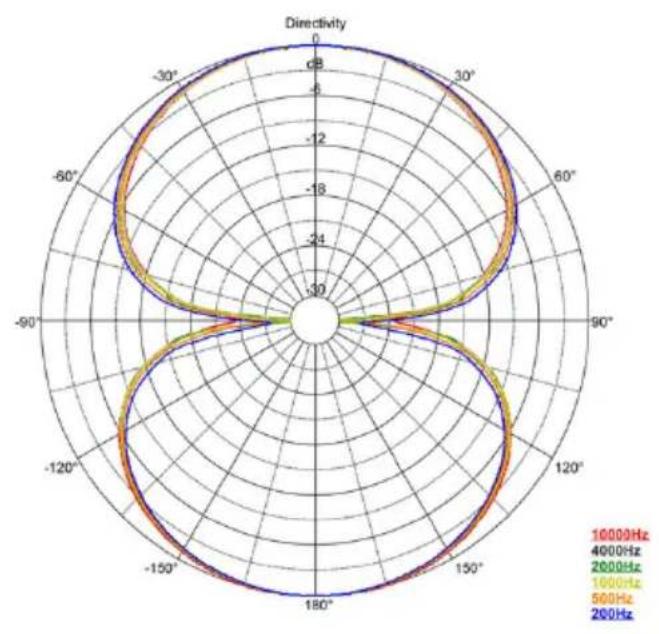
radar
| Angle | Frequency | |-------|---------| | 0° | 1000Hz | | 30° | 4000Hz | | 60° | 2000Hz | | 90° | 1000Hz | | 120° | 500Hz | | 150° | 200Hz | | 180° | 1000Hz | | 210° | 4000Hz | | 240° | 2000Hz | | 270° | 1000Hz | | 300° | 500Hz | | 330° | 200Hz |FREQUENCY RESPONSE
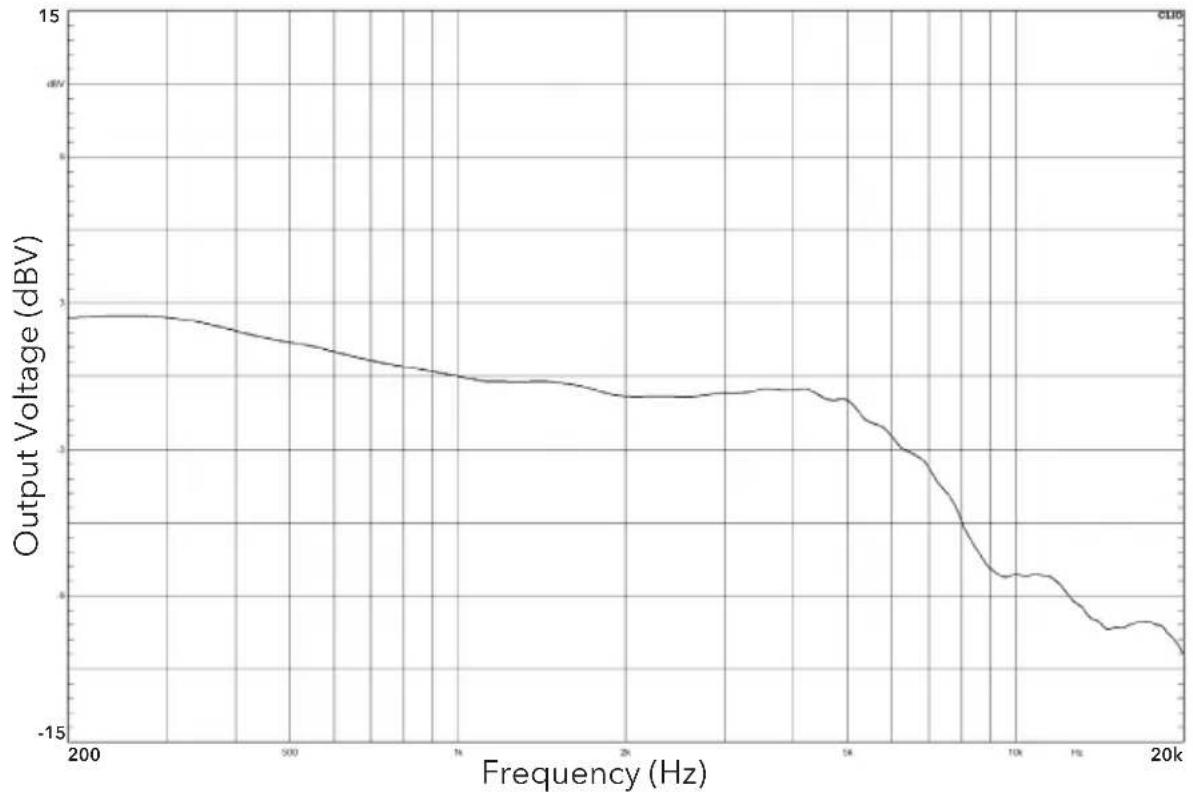
line
| Frequency (Hz) | Output Voltage (dBV) | | -------------- | -------------------- | | 200 | 3.0 | | 500 | 2.8 | | 1K | 2.7 | | 2K | 2.6 | | 5K | 2.5 | | 10K | 2.0 | | 15K | 1.5 | | 20K | 1.0 |*Data below 200 Hz omitted due to measuring room restrictions
*0 dVB is equivalent to 6.10 mV/Pa (-44.3 dBV)
*Normalized to 0 dB at 1kHz. 1/3 octave smoothing