Hi-Gain HWABN25 - Wi-Fi repeater Hawking Technologies - Free user manual and instructions
Find the device manual for free Hi-Gain HWABN25 Hawking Technologies in PDF.


| Product Type | Wi-Fi Repeater |
| Brand | Hawking Technologies |
| Model | Hi-Gain HWABN25 |
| Wireless Standards | IEEE 802.11b/g/n |
| Frequency Band | 2.4 GHz |
| Maximum Data Rate | 150 Mbps |
| Antenna Type | High-gain external antenna (detachable) |
| Antenna Gain | 5 dBi |
| Ports | 1x 10/100 Ethernet port |
| Power Supply | DC 5V / 1A |
| Dimensions (L x W x H) | 4.5 x 2.3 x 1.2 inches (11.4 x 5.8 x 3.0 cm) |
| Weight | 4.2 oz (120 g) |
| Operating Temperature | 0°C to 40°C (32°F to 104°F) |
| Security | WEP, WPA, WPA2 encryption; MAC address filtering |
| Functions | Wi-Fi repeating, access point mode, signal amplification |
| Setup | Web-based interface, WPS button |
| LED Indicators | Power, LAN, WLAN, Signal Strength |
| Certifications | FCC, CE |
| Spare Parts / Repairability | Replacement antennas available; limited user-serviceable parts |
| Maintenance | Keep dry and clean; avoid dust; unplug during cleaning |
Frequently Asked Questions - Hi-Gain HWABN25 Hawking Technologies
User questions about Hi-Gain HWABN25 Hawking Technologies
0 question about this device. Answer the ones you know or ask your own.
Ask a new question about this device
Download the instructions for your Wi-Fi repeater in PDF format for free! Find your manual Hi-Gain HWABN25 - Hawking Technologies and take your electronic device back in hand. On this page are published all the documents necessary for the use of your device. Hi-Gain HWABN25 by Hawking Technologies.
USER MANUAL Hi-Gain HWABN25 Hawking Technologies
Hi-Gain™ Wireless-300N Multi-Function Extender Pro HWABN25

natural_image
Abstract wireframe diagram of toroidal and circular geometric structures on a dark background (no text or symbols)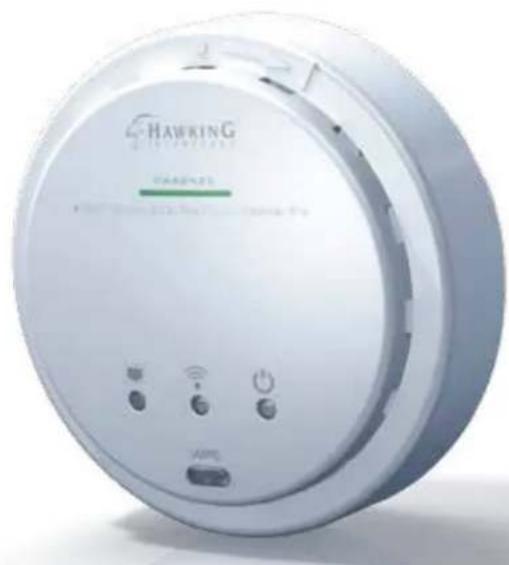
natural_image
Exterior view of a white HAWRING Smart Thermostat (no visible text or symbols on the device body)COPYRIGHT
Copyright ©2012 by Hawking Technologies, Inc. All rights reserved. No part of this publication may be reproduced, transmitted, transcribed, stored in a retrieval system, or translated into any language or computer language, in any form or by any means, electronic, mechanical, magnetic, optical, chemical, manual or otherwise, without the prior written permission of this company
LIMITED WARRANTY
Hawking Technology guarantees that every HWABN25 Hi-Gain™ Wireless-300N Multi-Function Extender Pro is free from physical defects in material and workmanship under normal use for one (1) year from the date of purchase. If the product proves defective during this one-year warranty period, call Hawking Customer Service in order to obtain a Return Authorization number. Warranty is for repair or replacement only. Hawking Technology does not issue any refunds. BE SURE TO HAVE YOUR PROOF OF PURCHASE. RETURN REQUESTS CAN NOT BE PROCESSED WITHOUT PROOF OF PURCHASE. When returning a product, mark the Return Authorization number clearly on the outside of the package and include your original proof of purchase.
IN NO EVENT SHALL HAWKING TECHNOLOGY'S LIABILITY EXCEED THE PRICE PAID FOR THE PRODUCT FROM DIRECT, INDIRECT, SPECIAL, INCIDENTAL OR CONSEQUENTIAL DAMAGES RESULTING FROM THE USE OF THE PRODUCT, ITS ACCOMPANYING SOFTWARE OR ITS DOCUMENTATION. Hawking Technology makes no warranty or representation, expressed, implied or statutory, with respect to its products or the contents or use of this documentation and all accompanying software, and specifically disclaims its quality, performance, merchantability, or fitness for any particular purpose. Hawking Technology reserves the right to revise or updates its products, software, or documentation without obligation to notify any individual or entity. Please direct all inquiries to: techsupport@hawkingtech.com
Federal Communication Commission Interference Statement
FCC Part 15
This equipment has been tested and found to comply with the limits for a Class B digital device, pursuant to Part 15 of FCC Rules. These limits are designed to provide reasonable protection against harmful interference in a residential installation. This equipment generates, uses, and can radiate radio frequency energy and, if not installed and used in accordance with the instructions, may cause harmful interference to radio
communications. However, there is no guarantee that interference will not occur in a particular installation. If this equipment does cause harmful interference to radio or television reception, which can be determined by turning the equipment off and on, the user is encouraged to try to correct the interference by one or more of the following measures:
- Reorient or relocate the receiving antenna.
- Increase the separation between the equipment and receiver.
- Connect the equipment into an outlet on a circuit different from that to which the receiver is connected.
- Consult the dealer or an experienced radio technician for help.
FCC Caution
This equipment must be installed and operated in accordance with provided instructions and a minimum 20 cm spacing must be provided between computer mounted antenna and person's body (excluding extremities of hands, wrist and feet) during wireless modes of operation.
This device complies with Part 15 of the FCC Rules. Operation is subject to the following two conditions: (1) this device may not cause harmful interference, and (2) this device must accept any interference received, including interference that may cause undesired operation.
Any changes or modifications not expressly approved by the party responsible for compliance could void the authority to operate equipment.
Federal Communication Commission (FCC) Radiation Exposure Statement
This equipment complies with FCC radiation exposure set forth for an uncontrolled environment. In order to avoid the possibility of exceeding the FCC radio frequency exposure limits, human proximity to the antenna shall not be less than 20cm (8 inches) during normal operation.
The antenna(s) used for this transmitter must not be co-located or operating in conjunction with any other antenna or transmitter.
R&TTE Compliance Statement
This equipment complies with all the requirements of DIRECTIVE 1999/5/EC OF THE EUROPEAN PARLIAMENT AND THE COUNCIL of March 9, 1999 on radio equipment and telecommunication terminal Equipment and the mutual recognition of their conformity (R&TTE).
The R&TTE Directive repeals and replaces in the directive 98/13/EEC (Telecommunications Terminal Equipment and Satellite Earth Station Equipment) As of April 8, 2000.
Safety
This equipment is designed with the utmost care for the safety of those who install and use it. However, special attention must be paid to the dangers of electric shock and static electricity when working with electrical equipment. All guidelines of this and of the computer manufacture must therefore be allowed at all times to ensure the safe use of the equipment.
EU Countries Intended for Use
The ETSI version of this device is intended for home and office use in Austria, Belgium, Denmark, Finland, France, Germany, Greece, Ireland, Italy, Luxembourg, the Netherlands, Portugal, Spain, Sweden, and the United Kingdom.
The ETSI version of this device is also authorized for use in EFTA member states: Iceland, Liechtenstein, Norway, and Switzerland.
EU Countries NOT intended for use
None.
Table of Contents
Chapter I: Product Information....7
1-1 Introduction and Safety Information 7
1-2 Safety Information....8
1-3 System Requirements 9
1-4 Package Contents.... 10
1-5 Product Overview....11
Chapter II: System and Network Setup 14
2-1 Build Network Connection.... 14
2-2 Definitions of the HWABN25 Supported Modes.... 15
2-3 Connecting to the HWABN25 via Web Browser 19
2-3-1 Windows 95/98/Me IP address setup 20
2-3-2 Windows 2000 IP address setup....21
2-3-3 Windows XP IP address setup.... 23
2-3-4 Windows Vista/7 IP address setup.... 25
2-3-5 Mac OS X IP Address Setup 27
2-3-6 Tablet/Smartphone Setup 28
2-3-7 Accessing the Web Page User Interface 31
2-4 'Quick Setup' 33
2-4-1 Setup Procedure for ‘Access Point’ 35
2-4-2 Setup Procedure ‘Station-Infrastructure’ (Wireless Bridge) 38
2-4-3 Setup procedure for 'AP Bridge-Point to Point': 40
2-4-4 Setup procedure for ‘AP Bridge-Point to Multi-Point’ 42
2-4-5 Setup Procedure for 'AP-Bridge WDS' 44
2-4-6 Setup Procedure for ‘Universal Repeater’ 46
Chapter III General Setup 49
3-1 Change Management password....50
3-2 Wired LAN Configuration....53
3-2-1 Local Network....54
3-2-2 DHCP Server: 55
3-3 Wireless Network 57
3-3-1 Basic Wireless Settings 57
3-3-2 Advanced Wireless Settings 68
3-3-3 Security Settings....71
3-3-4 Wireless Access Control....77
3-3-5 Wi-Fi Protected Setup (WPS) 80
3-3-6 Security Tips for Wireless Network 83
Chapter IV Status and Tools 84
4-1 System Status....84
4-1-1 System information and firmware version....84
4-1-2 Local Network....86
4-1-3 Statistics 88
4-2 Configuration Tools 89
4-3 Firmware Upgrade....90
4-4 System Reset....92
Chapter V: Appendix....93
5-1 Hardware Specification 93
5-2 Troubleshooting....94
5-3 Glossary 96
Chapter I: Product Information
1-1 Introduction and Safety Information
Thank you for purchasing the HWABN25 Hi-Gain™ Wireless-300N Multi-Function Extender Pro. This highly efficient access point is the best choice for Small office / Home office users. It allows computers and network devices to gain wireless access in several modes throughout their network. Easy install procedures allow any computer user to setup a network environment in a very short time.
All computers and wireless-enabled network devices (including PDA, cellular phone, game console, etc.) can connect to this Hi-Gain™ Wireless-300N Multi-Function Extender Pro without additional cabling. 802.11N wireless capability also gives you the highest wireless speeds.
Other features of the HWABN25 include:
- Provides IEEE 802.11b/g/Draft-N wireless LAN capability
- 6 different Wireless Modes: Access Point, Bridge Client, Bridge Point to Point, Bridge Point to Multi-Point, AP Bridge WDS modes, Universal Repeater
• Supports 64/128-bit WEP, WPA, and WPA2 wireless data encryption. - Supports MAC address filtering (Only allow specific wireless device of your choice to connect to this access point).
• One wired LAN port (10/100M)
• Auto MDI / MDI-X function for all wired Ethernet ports. - Provides IEEE 802.11a/b/g/n wireless LAN capability.
• Support DHCP (Server/Client) for easy IP-address setup. - Easy to use Web-based GUI for network configuration and management purposes.
1-2 Safety Information
In order to keep the safety of users and property, please follow these safety instructions:
- This access point is designed for indoor use only; DO NOT place this Extender outdoors.
- DO NOT put this Extender at or near hot or humid places, like kitchens or bathrooms. Also, do not leave this access point in the car in summer.
- DO NOT pull any connected cable with force; disconnect them from the access point first.
- If you want to place this Extender in a high place or hang on the wall, please make sure the Extender is firmly secured. Falling can damage the Extender and its accessories and the warranty will be void.
- Accessories of this Extender, such as the power supply, are a danger to small children under 3 years old. KEEP THIS EXTENDER OUT OF THE REACH OF CHILDREN!
- The Extender will become warm when used for a long period of time (This is normal and is not a malfunction). DO NOT put this access point on paper, cloth, or other flammable materials.
- There are no user-serviceable parts inside the Extender. If you have found that the Extender is not working properly, please contact technical support or your place of purchase and ask for help. DO NOT disassemble the Extender, or warranty will be void.
- If the Extender falls into water when it's powered on, DO NOT use your hands to pick it up. Switch the electrical power off before you do anything, or contact an experienced technician for help.
- If you smell something strange, or see smoke coming out from the Extender or power supply, remove the power supply or switch the electrical power off immediately, and call techsupport or your place of purchase for help.
1-3 System Requirements
• One computer (Mac or PC).
- Internet Web Browser (Internet Explorer, Safari, etc.)
- A Wired or Wireless network adapter (e.g. Airport card, built-in Ethernet adapter, etc.)
1-4 Package Contents
Before you start to use this Extender, please check if there's anything missing in the package, and contact your place of purchase or contact Hawking Technologies.
• 1x HWABN25 Hi-Gain™ Wireless-300N Multi-Function Extender Pro
• 1x AC Power Adapter (5V/2A)
- 1x Setup CD-ROM
• 1x Quick Installation Guide (QIG)
1-5 Product Overview
Top
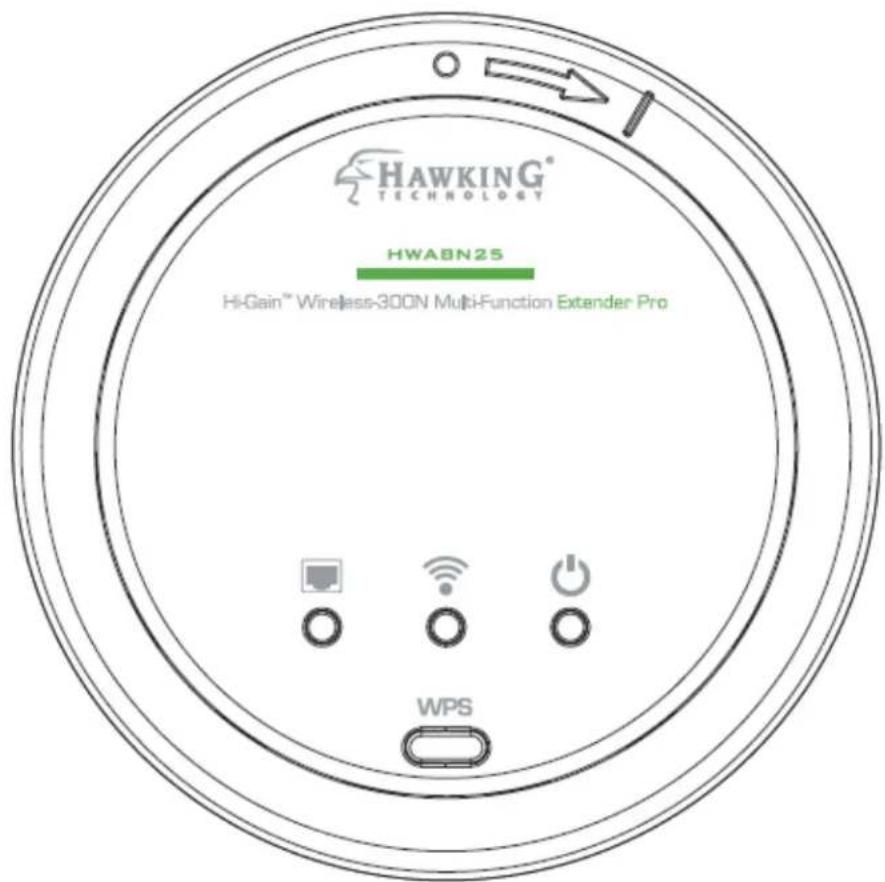
| LED Name | Light Status | Description |
PWR  | On The access | point is switched on and correctly powered. |
| Slow Blinking | System is reset to factory default, at the same time WLAN LED is on. | |
| Off | The access point is switched off. | |
| WLAN [2G46] | On | Wireless WPS mode is enabled. |
| Off | Wireless network is switched off. | |
| Flashing Wireless LAN activity (transferring or receiving data). | ||
| On LAN port is connected | ||
| Off LAN port is not connected | ||
| Flashing LAN activity (transferring or receiving data) | ||
| Item Name | Description |
| Reset / WPSWPS | Reset the router to factory default settings (clear all settings) or start WPS function. Press this button and hold for 10 seconds to restore all settings to factory defaults, and press this button for less than 5 seconds to start WPS function. |
Bottom
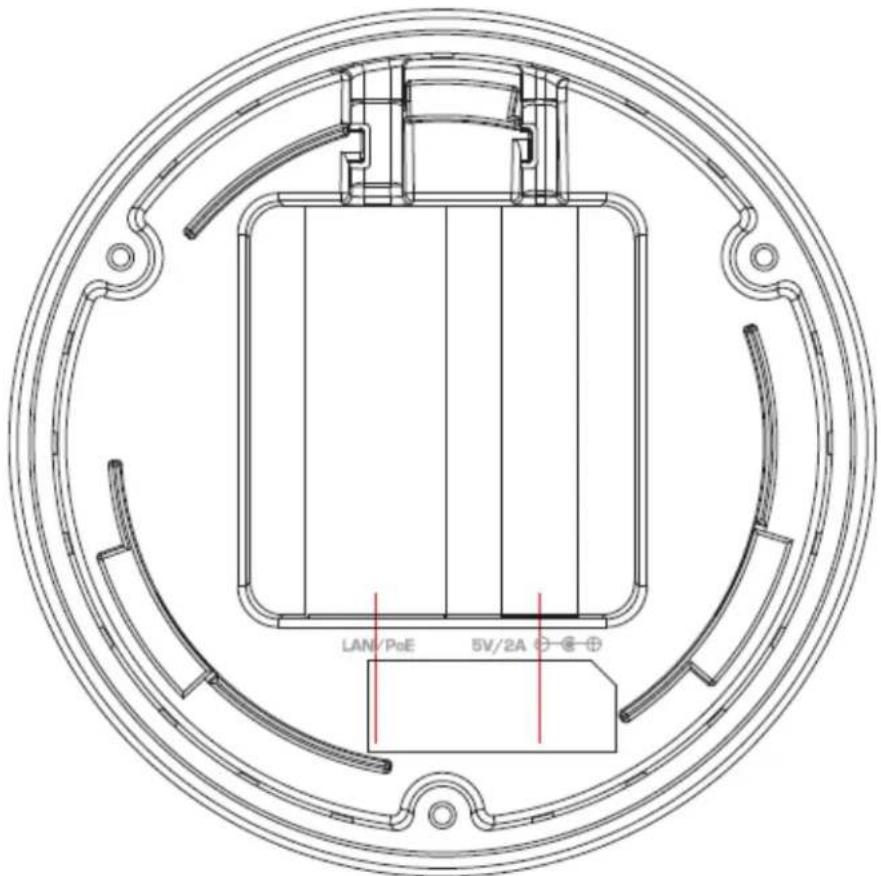
| Item Name | Description |
| Power 5V/2A Power connector, connects to A/C power adapter. | |
| Ethernet/PoE | Local Area Network (LAN) port. Can also function as a Power Over Ethernet port if you have a PoE power supply. (soldseparately) |
Chapter II: System and Network Setup
2-1 Build Network Connection
Please follow the following instructions to build the network connection between your new HWABN25 Hi-Gain™ Wireless-300N Multi-Function Extender Pro and your computers and other network devices:
-
Connect the A/C power adapter to the wall socket, and then connect it to the 'Power' socket of HWABN25 located on the bottom of the unit. You may need to remove the back panel on the HWABN25 to get to this power socket.
-
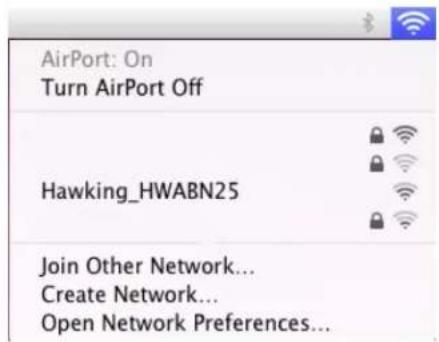
Connect your HWABN25's LAN port to an Ethernet cable. You can plug the other end into your computer. If you have a wireless device, you can also connect to the wireless network "Hawking_HWABN25".
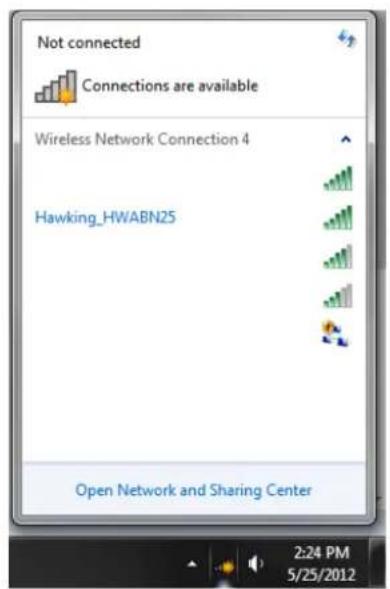
- Log into the setup page to configure the HWABN25. See section 2.3
2-2 Definitions of the HWABN25 Supported Modes
Modes
The HWABN25 supports 6 different modes.
Access Point: The HWABN25 will broadcast a WiFi signal for other computers and devices to connect to. Must be plugged into the router or network after setup.
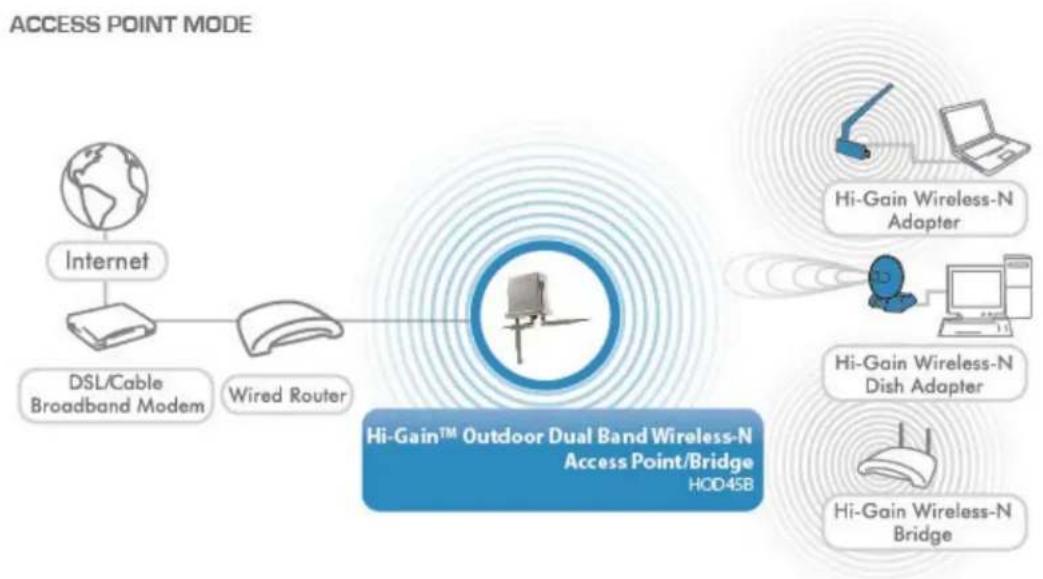
flowchart
graph LR
    A["Internet"] --> B["DSL/Cable Broadband Modem"]
    B --> C["Wired Router"]
    C --> D["Hi-Gain™ Outdoor Dual Band Wireless-N Access Point/Bridge HOD45B"]
    D --> E["Hi-Gain Wireless-N Adapter"]
    D --> F["Hi-Gain Wireless-N Dish Adapter"]
    D --> G["Hi-Gain Wireless-N Bridge"]
Station – Infrastructure (Bridge): The HWABN25 will allow you connect wired devices wirelessly to an existing wireless router or access point. It will “bridge” these devices wirelessly with your network. It will not broadcast any WiFi signal. It will only make a wireless connection between your wireless signal and the HWABN25.
Station - Infrastructure (Bridge Mode)
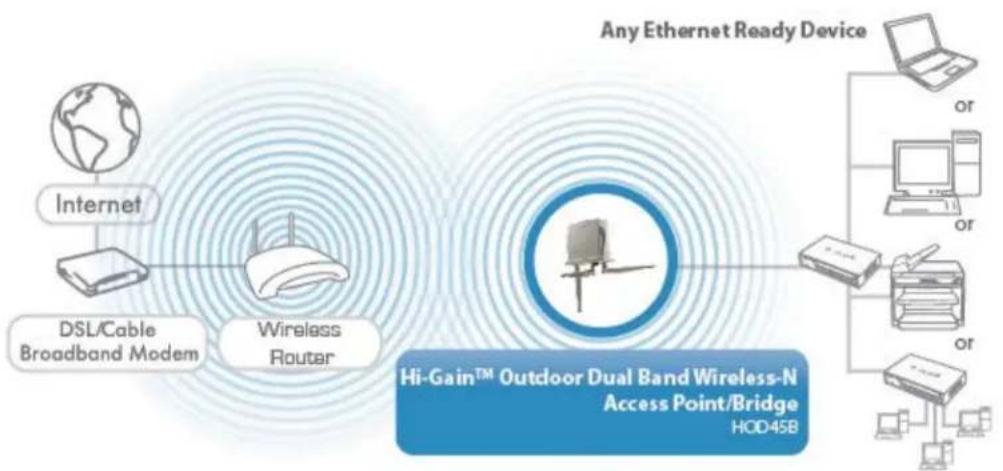
flowchart
graph LR
    A["Internet"] --> B["DSL/Cable Broadband Modem"]
    B --> C["Wireless Router"]
    C --> D["Any Ethernet Ready Device"]
    D --> E["Hi-Gain™ Outdoor Dual Band Wireless-N Access Point/Bridge HOD45B"]
    E --> F["Desktop Computer"]
    E --> G["Desktop Computer"]
    E --> H["Desktop Computer"]
    E --> I["Desktop Computer"]
    E --> J["Desktop Computer"]
AP Bridge – Point to Point: Similar to station-infrastructure, this requires two HWABN25's on each end. This will create a wireless bridge between these two points. No WiFi signal will be broadcast and it will only make a wireless connection between those two points.
AP BRIDGE - POINT TO POINT MODE
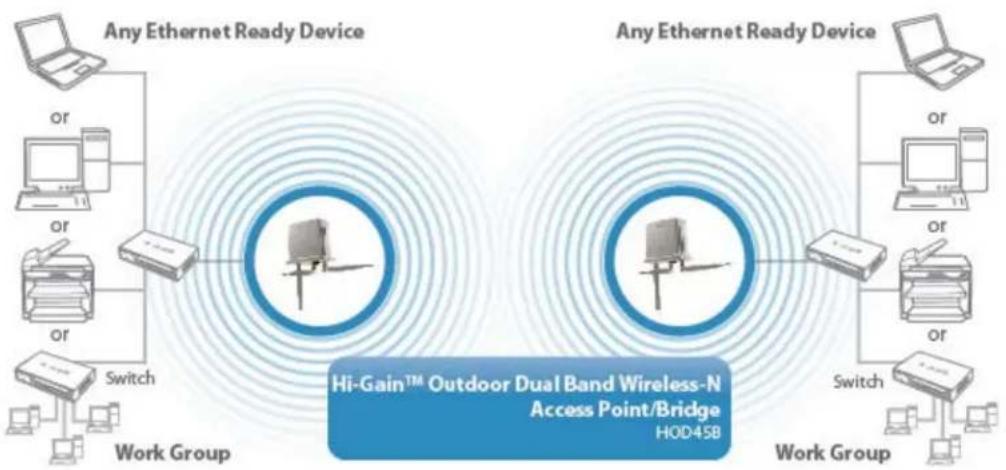
flowchart
graph TD
    subgraph "Any Ethernet Ready Device"
        A["Work Group"] -->|Switch| B["Switch"]
        C["Work Group"] -->|Switch| D["Switch"]
        E["Work Group"] -->|Switch| F["Switch"]
        G["Work Group"] -->|Switch| H["Switch"]
        I["Work Group"] -->|Switch| J["Switch"]
        K["Work Group"] -->|Switch| L["Switch"]
        M["Work Group"] -->|Switch| N["Switch"]
        O["Work Group"] -->|Switch| P["Switch"]
        Q["Work Group"] -->|Switch| R["Switch"]
        S["Work Group"] -->|Switch| T["Switch"]
        U["Work Group"] -->|Switch| V["Switch"]
        W["Work Group"] -->|Switch| X["Switch"]
        Y["Work Group"] -->|Switch| Z["Switch"]
        AA["Work Group"] -->|Switch| AB["Switch"]
        AC["Work Group"] -->|Switch| AD["Switch"]
        AE["Work Group"] -->|Switch| AF["Switch"]
        AG["Work Group"] -->|Switch| AH["Switch"]
        AI["Work Group"] -->|Switch| AJ["Switch"]
        AK["Work Group"] -->|Switch| AL["Switch"]
        AM["Work Group"] -->|Switch| AN["Switch"]
        AO["Work Group"] -->|Switch| AP["Switch"]
        AQ["Work Group"] -->|Switch| AR["Switch"]
        AS["Work Group"] -->|Switch| AT["Switch"]
        AU["Work Group"] -->|Switch| AV["Switch"]
        AW["Work Group"] -->|Switch| AX["Switch"]
        AY["Hi-Gain™ Outdoor Dual Band Wireless-N Access Point/Bridge HOD45B"]
    end
AP Bridge – Point to Multi-Point: Similar to AP Bridge – Point to Point, this allows you to connect several HWABN25's to one point. No WiFi signal will be broadcast and it will only make a wireless connection between the HWABN25s.
AP BRIDGE - POINT TO MULTIPLE POINT MODE
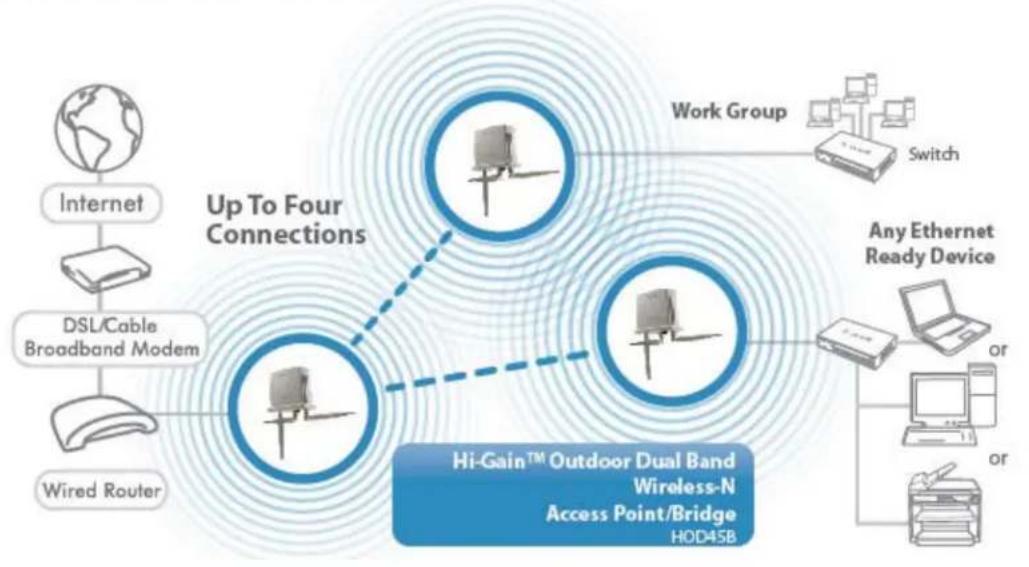
flowchart
graph TD
    A["Internet"] --> B["DSL/Cable Broadband Modem"]
    B --> C["Wired Router"]
    D["Work Group"] --> E["Switch"]
    F["Any Ethernet Ready Device"] --> G["or"]
    H["Hi-Gain™ Outdoor Dual Band Wireless-N Access Point/Bridge HOD45B"] --> I["Work Group"]
    style A fill:#f9f,stroke:#333
    style B fill:#f9f,stroke:#333
    style C fill:#f9f,stroke:#333
    style D fill:#f9f,stroke:#333
    style E fill:#f9f,stroke:#333
    style F fill:#f9f,stroke:#333
    style G fill:#f9f,stroke:#333
    style H fill:#f9f,stroke:#333
    style I fill:#f9f,stroke:#333
AP Bridge WDS: Wireless Distributing System. This allows you to create a wireless network using up to four HWABN25's using the same SSID (wireless name). It will broadcast a WiFi signal.
AP BRIDGE - WDS MODE
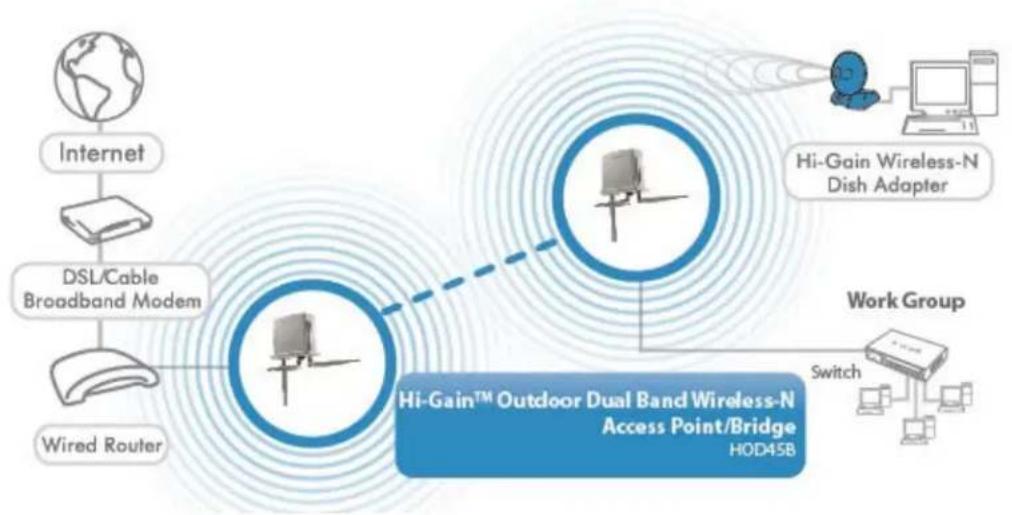
flowchart
graph TD
    A["Internet"] --> B["DSL/Cable Broadband Modem"]
    B --> C["Wired Router"]
    C --> D["Hi-Gain™ Outdoor Dual Band Wireless-N Access Point/Bridge HOD45B"]
    D --> E["Switch"]
    E --> F["Work Group"]
    F --> G["Hi-Gain Wireless-N Dish Adapter"]
    G --> H["Computer"]
    style D fill:#90EE90,stroke:#333
    style E fill:#E6F2FF,stroke:#333
Universal Repeater: In this mode, the HWABN25 will repeat the wireless signal of any existing wireless router/access point. It will act as a wireless relay and create a larger
and seamless network for your wireless devices to connect to.
UNIVERSAL REPEATER
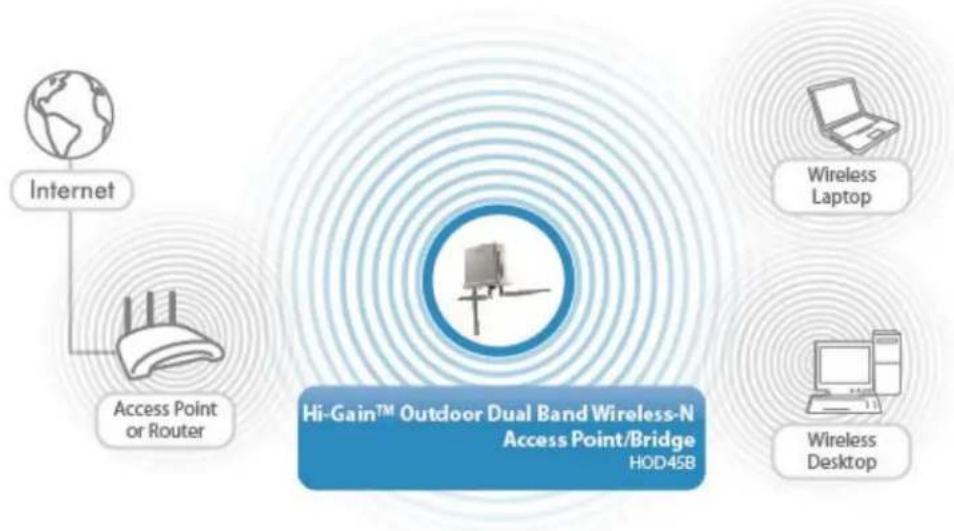
flowchart
graph TD
    A["Internet"] --> B["Access Point or Router"]
    B --> C["Hi-Gain™ Outdoor Dual Band Wireless-N Access Point/Bridge HOD45B"]
    D["Wireless Laptop"] --> E["Computer"]
    F["Wireless Desktop"] --> G["Desktop"]
2-3 Connecting to the HWABN25 via Web Browser
After the network connection is built, the next step you should do is setup the Extender with proper network parameters, so it can work properly in your network environment.
Before you can connect to the Extender and start configuration procedures, your computer must be set to obtain an IP automatically. Please follow the following instructions to configure your computer to use a static IP address:
If the operating system of your computer is....
| Windows 95/98/Me | - please go to section 2-3-1 |
| Windows 2000 | - please go to section 2-3-2 |
| Windows XP | - please go to section 2-3-3 |
| Windows Vista/7 | - please go to section 2-3-4 |
Mac OS - please go to section 2-3-5
Tablet/Smartphone - please go to section 2-3-6
2-3-1 Windows 95/98/Me IP address setup
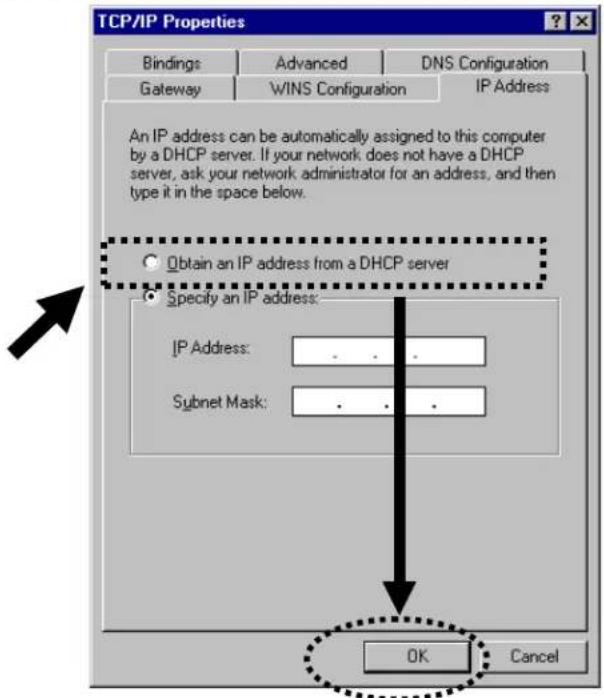
- Click 'Start' button (it should be located at lower-left corner of your computer), then click control panel. Double-click Network icon, and Network window will appear. Select 'TCP/IP', then click 'Properties'.
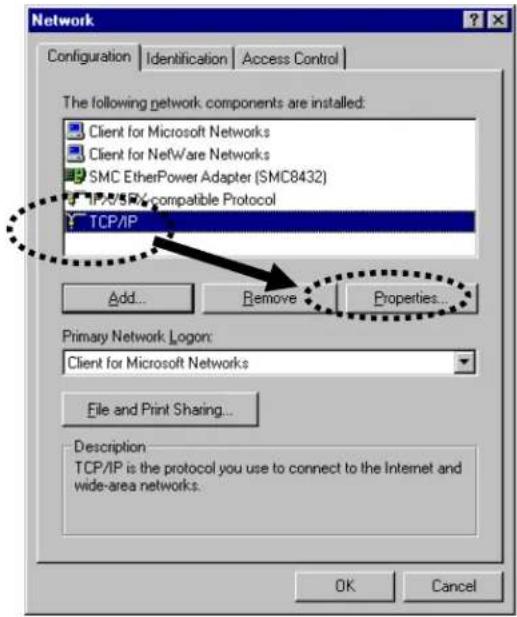
- Select 'Obtain an IP address from a DHCP server' and then click 'OK'.
2-3-2 Windows 2000 IP address setup
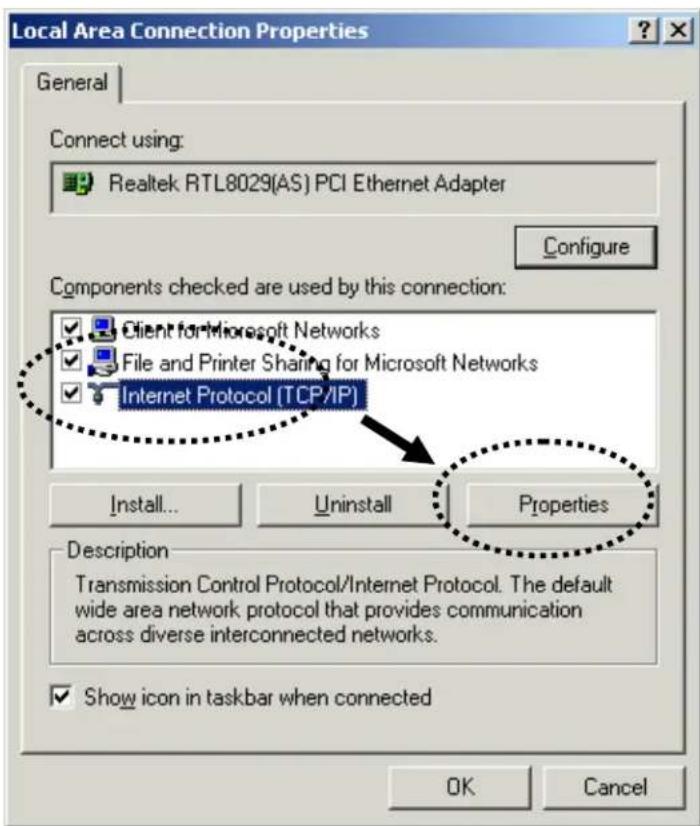
- Click ‘Start’ button (it should be located at lower-left corner of your computer), then click control panel. Double-click Network and Dial-up Connections icon; click Local Area Connection, and Local Area Connection Properties window will appear. Select ‘Internet Protocol (TCP/IP)’ and then click ‘Properties’
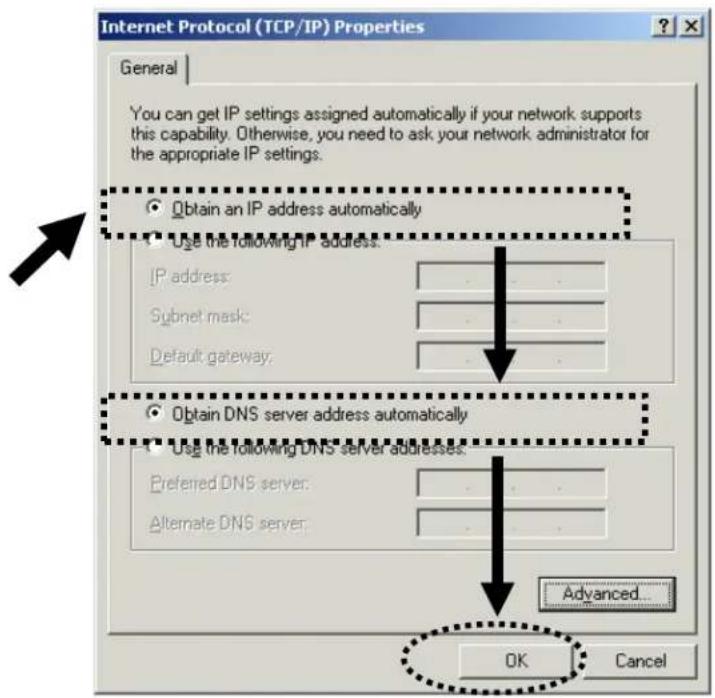
- Select 'Obtain an IP address automatically' and 'Obtain DNS server address automatically', then click 'OK'.
2-3-3 Windows XP IP address setup
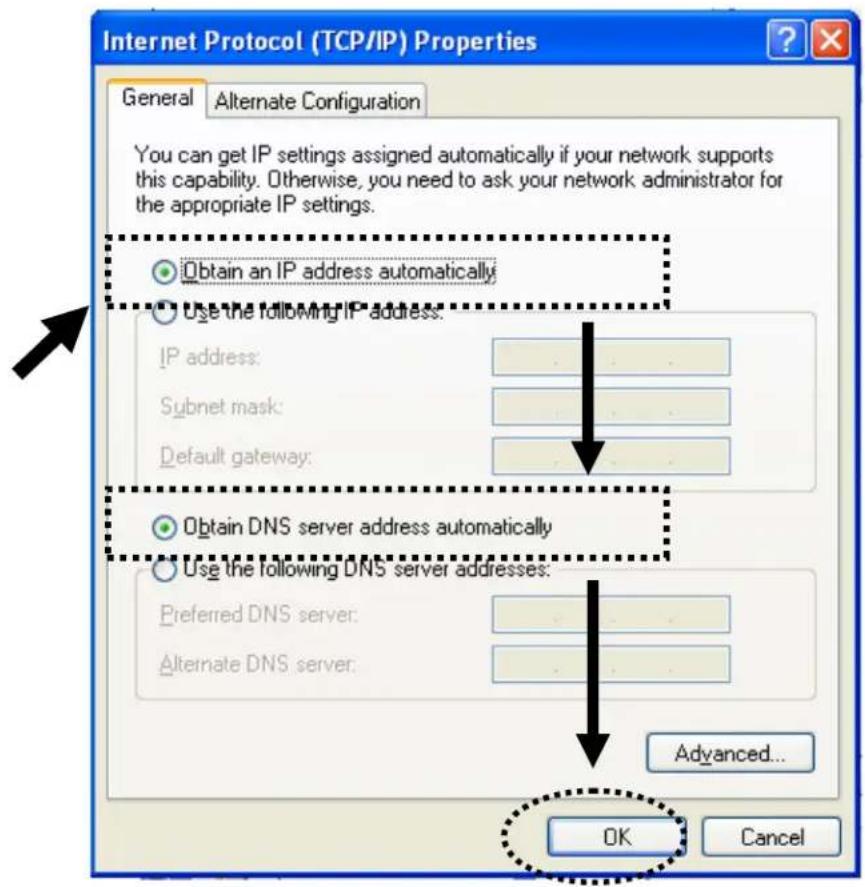
- Click ‘Start’ button (it should be located at lower-left corner of your computer), then click control panel. Double-click Network and Internet Connections icon, click Network Connections, and then double-click Local Area Connection, Local Area Connection Status window will appear, and then click ‘Properties’
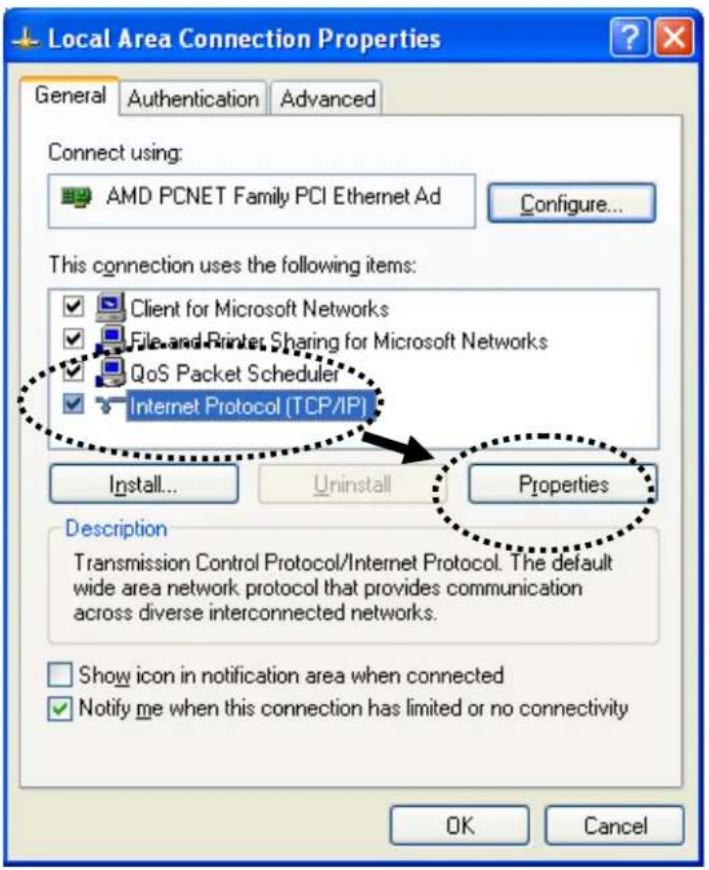
- Select 'Obtain an IP address automatically' and 'Obtain DNS server address automatically', then click 'OK'.
2-3-4 Windows Vista/7 IP address setup
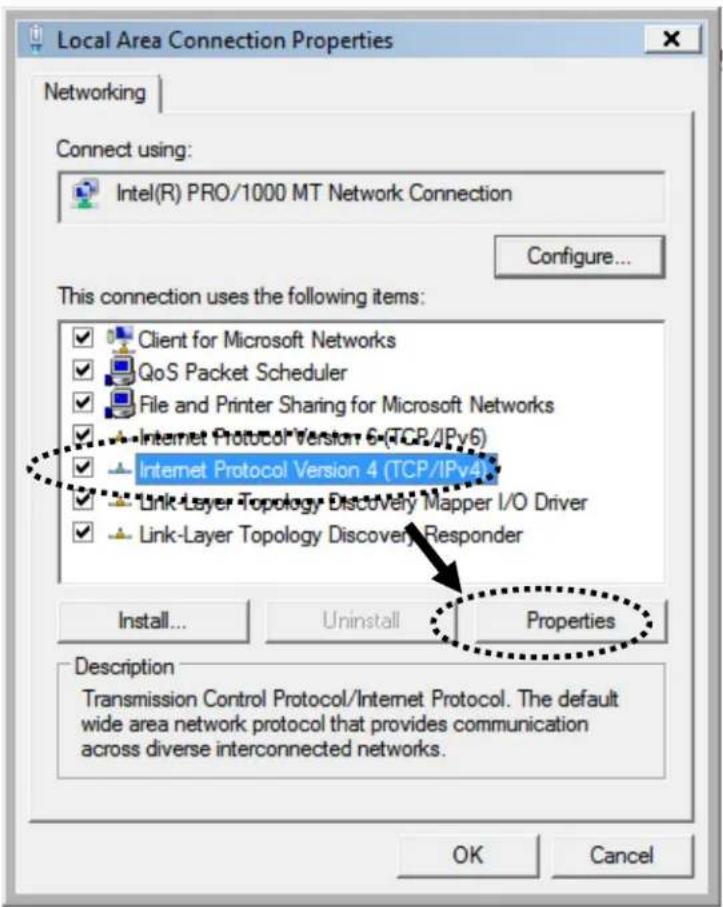
- Click ‘Start’ button (it should be located at lower-left corner of your computer), then click control panel. Click View Network Status and Tasks, and then click Manage Network Connections. Right-click Local Area Network, then select ‘Properties’. Local Area Connection Properties window will appear, select ‘Internet Protocol Version 4 (TCP / IPv4), and then click ‘Properties’
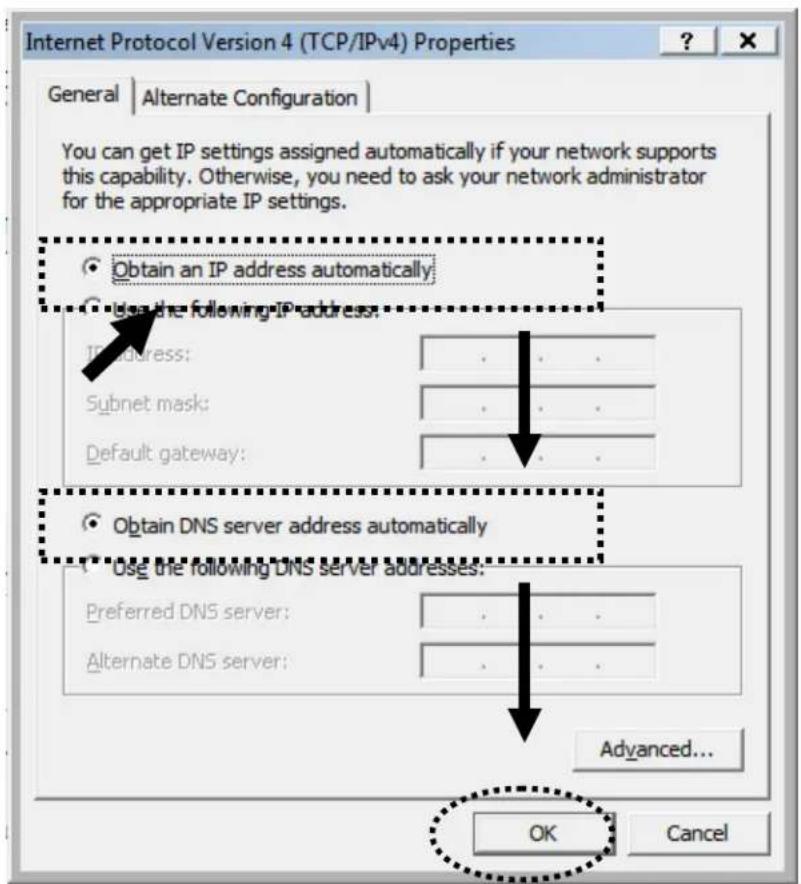
- Select ‘Obtain an IP address automatically’ and ‘Obtain DNS server address automatically’, then click ‘OK’.
2-3-5 Mac OS X IP Address Setup
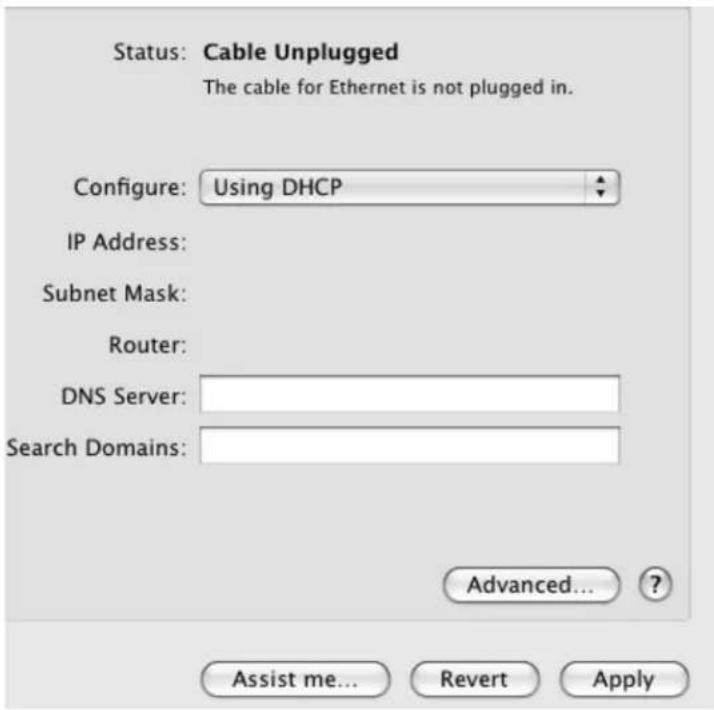
1) Go to your system preferences, go to network. Make sure next to “Configure”, you have it set under “Using DHCP”
2-3-6 Tablet/Smartphone Setup
iOS (iPhone or iPad)
Go to your settings on your tablet or smart phone
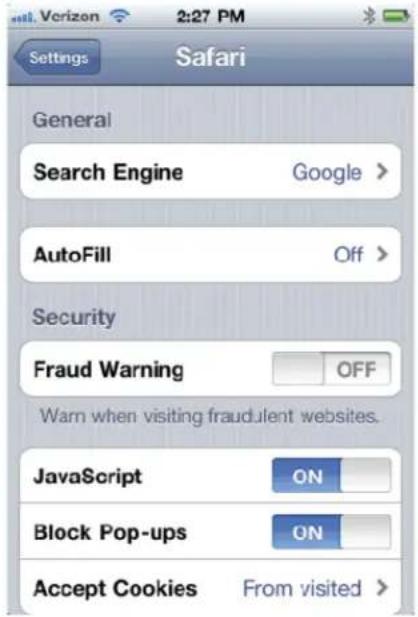
First, make sure JavaScript is On: Go to Settings icon Select Safari > make sure JavaScript is ON.
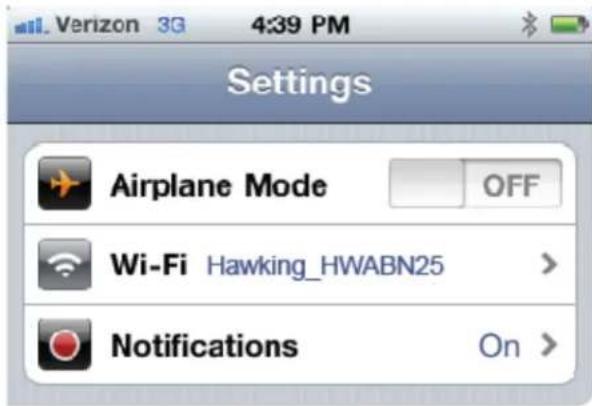
Go back to Home Screen > Select Settings > In Wi-Fi Networks, select "Hawking_HWABN25"
Android (Android 2.1 +)
Go to Settings
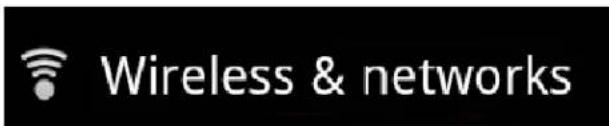
Go to Wireless & Networks
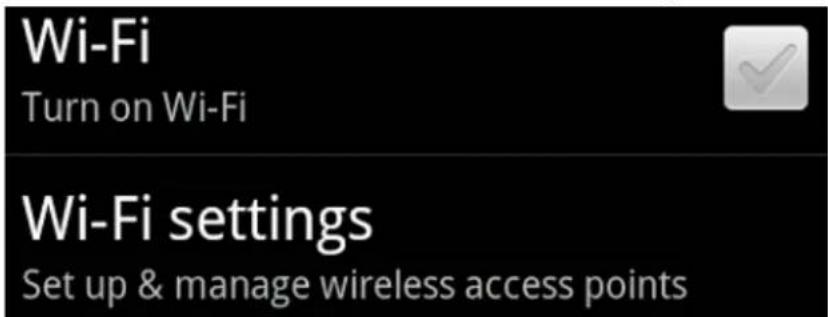
Check "Turn on Wi-Fi" and then click on Wi-Fi settings
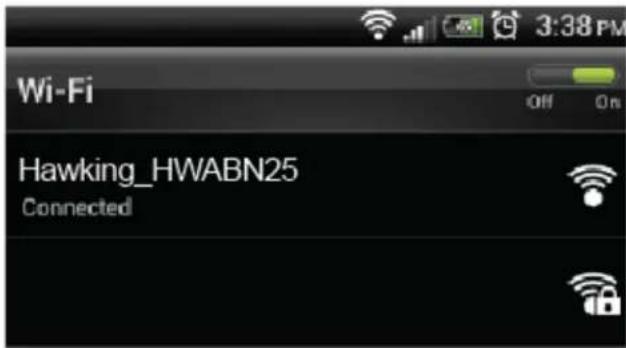
Look for Hawking_HWABN25, then select to connect
2-3-7 Accessing the Web Page User Interface
After the IP address setup is complete, please open your web browser.
In the address field, please type: '192.168.1.241' and press enter.
The following message should be shown:
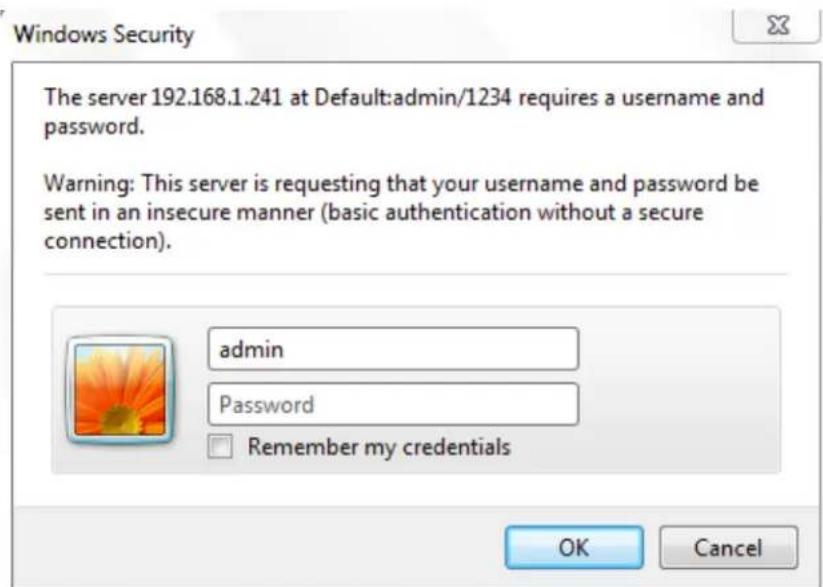
Please input user name and password in the field respectively,
Default Username: admin
Default Password: 1234
Press 'OK' button, and you will then see the management interface of this Extender:
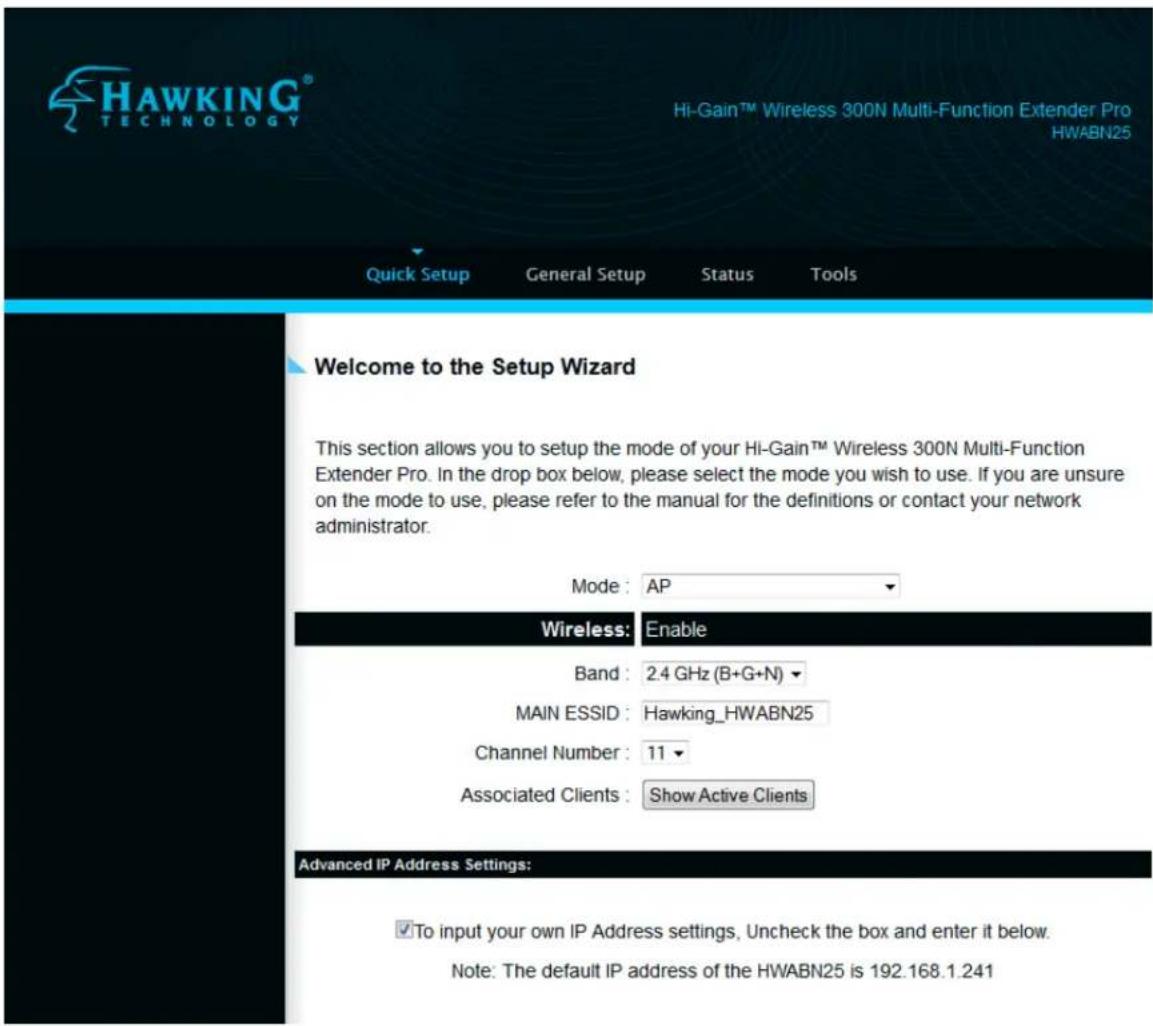
NOTE: If you can't see the web management interface, and you are being prompted to input user name and password again, it means you didn't input username and password correctly. Please retype user name and password again. If you are certain that user name and password you typed are correct, please go to '5-2 Troubleshooting' to perform a factory reset, to set the password back to default value.
2-4 'Quick Setup'
This Extender provides a ‘Quick Setup’ procedure, which will help you to complete all required settings you need to access the Internet in very short time. Please follow the following instructions to complete the ‘Quick Setup’:
Please go to Quick Setup Wizard menu by clicking 'Quick Setup' button.
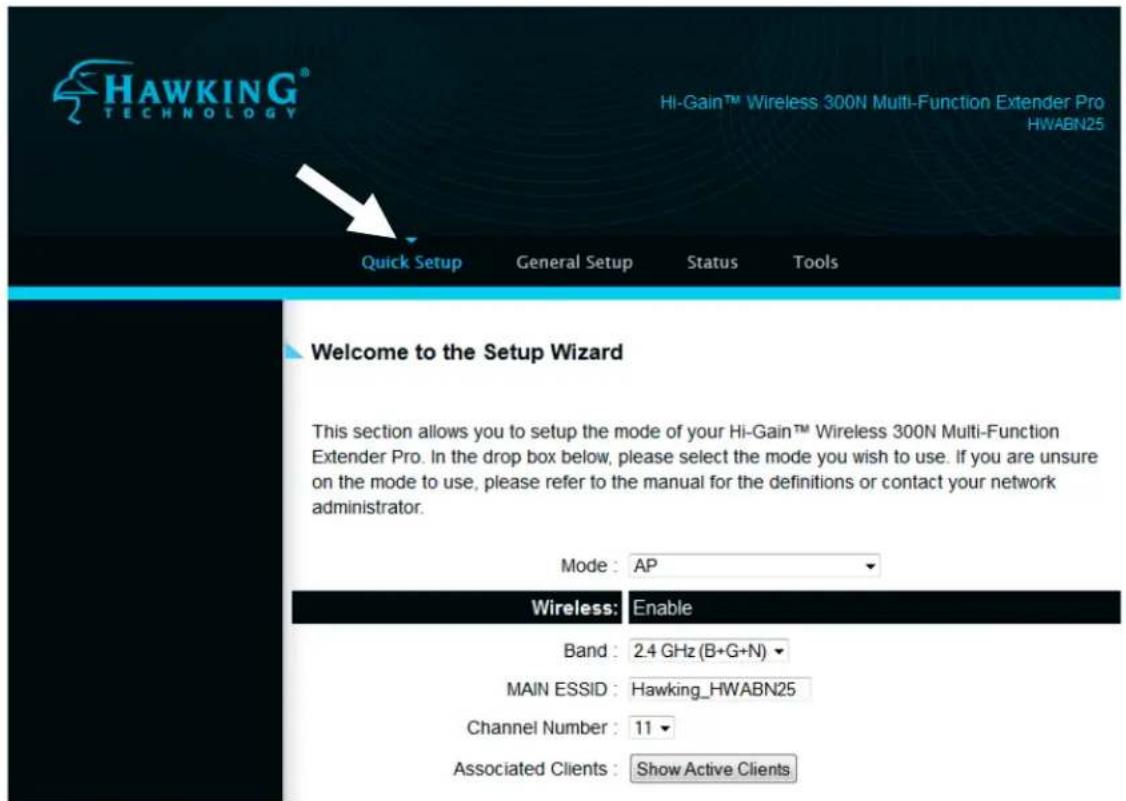
On the drop down box, please choose the wireless mode you wish to use. There are 6 modes that the HWABN25 supports:
| Access Point | - Please go to section 2-4-1 |
| Station-Infrastructure (Bridge) | - Please go to section 2-4-2 |
| Bridge Point to Point | - Please go to section 2-4-3 |
| Bridge Point to Multi-Point | - Please go to section 2-4-4 |
| Bridge WDS | - Please go to section 2-4-5 |
| Universal Repeater Mode | - Please go to section 2-4-6 |
If you're not sure, please contact your network administrator. Choosing a wrong mode will cause wireless and network issues.
2-4-1 Setup Procedure for 'Access Point'
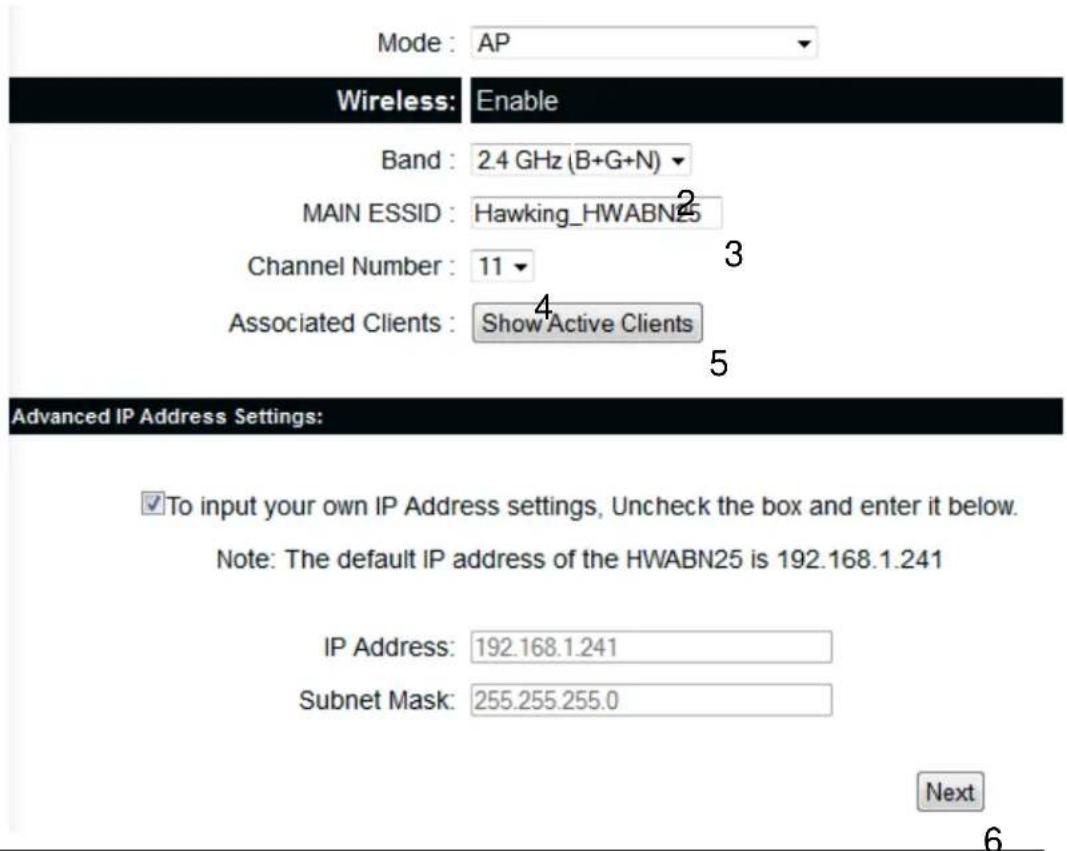
Wireless (1):
Shows you if the wireless is enabled/disabled
Band (2):
Please select the wireless band you wish to use. By selecting different band setting, you'll be able to allow or deny the wireless client of a certain band.
If you select 2.4GHz (B), 2.4GHz (N), or 2.4GHz (G), only wireless clients using the wireless band you select (802.11b, 802.11 Draft-N, or 802.11g) will be able to connect to this access point.
If you select 2.4GHz (B+G), then only wireless clients using 802.11b and 802.11g band will be able to connect to this access point.
If you want to allow 802.11b, 802.11g, and 802.11 Draft-N clients to connect to this access point, select 2.4GHz (B+G+N).
Main ESSID (3): Please input the ESSID (the name used to identify this wireless access point) for each frequency here. You can input up to 32 alphanumeric characters. PLEASE NOTE THAT ESSID IS CASE SENSITIVE. Default SSID: Hawking_HWABN25
Channel Number (4): Please select a channel number you wish to use. If you know a certain channel number is being used by other wireless access points nearby, please refrain from using the same channel number
Associated Clients (5): Click 'Show Active Clients' button and a new popup window will appear which contains the information about all wireless clients connected to this access point. You can click 'Refresh' button in popup window to keep information up-to-date.
Adv. IP Address (6) This section allows you to set an IP Address and subnet mask to fit your network if needed. Uncheck the box to input. Otherwise, the default IP Address is 192.168.1.241
After you finish with all settings, please click 'Next' (7) button.
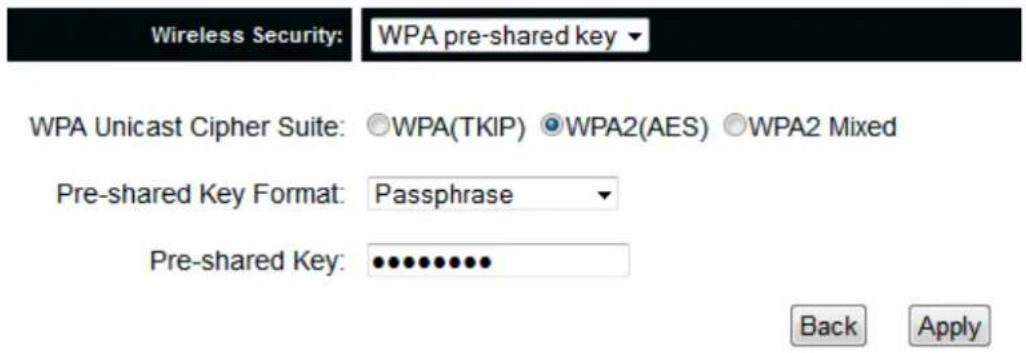
If you wish to have security, please select your level of security here. Refer to Section 3-4-3 for descriptions of security types. Click 'Apply' for the device to restart. Click
‘Back’ if you wish to make changes. Plug the HWABN25 into your router or network. Congratulations, you have set up the HWABN25 as an Access Point!
2-4-2 Setup Procedure 'Station-Infrastructure' (Wireless Bridge)
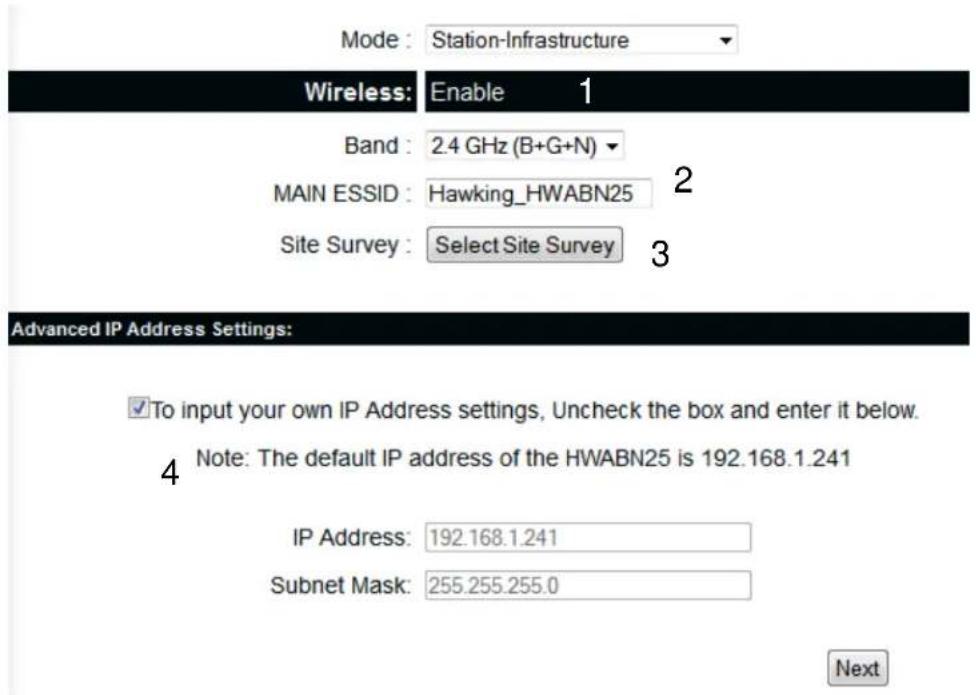
Wireless (1): Shows you if the wireless is enabled/disabled
Main ESSID (2): The wireless name of the network you wish to bridge to.
Site Survey (3): When you select bridge mode, you have to associate it with a working access point. Click 'Select Site Survey', a "Wireless Site Survey Table" will pop up and list all available access points nearby. Select one access point in the table and it will join wireless LAN through this access point.
Wireless Site Survey
This page provides tool to scan the wireless network. If any Access Point or IBSS is found, you could choose to connect it manually when client mode is enabled.
| Select | SSID | BSSID | Band | Channel | Connection Type | Encryption | Signal |
| ○ | HawkTech | 80:1f:02:2b:e5:80 | (B+G+N) | 3 | AP | WPA2-PSK | 82 |
| ○ | HawkTech | 80:1f:02:0d:ce:d0 | (B+G+N) | 3 | AP | WPA2-PSK | 79 |
| ○ | dlink | 14:d6:4d:ac:2b:37 | (B+G+N) | 5 | AP | WEP | 60 |
| Refresh Done Close | |||||||
When you finish with all settings, press 'Next'.
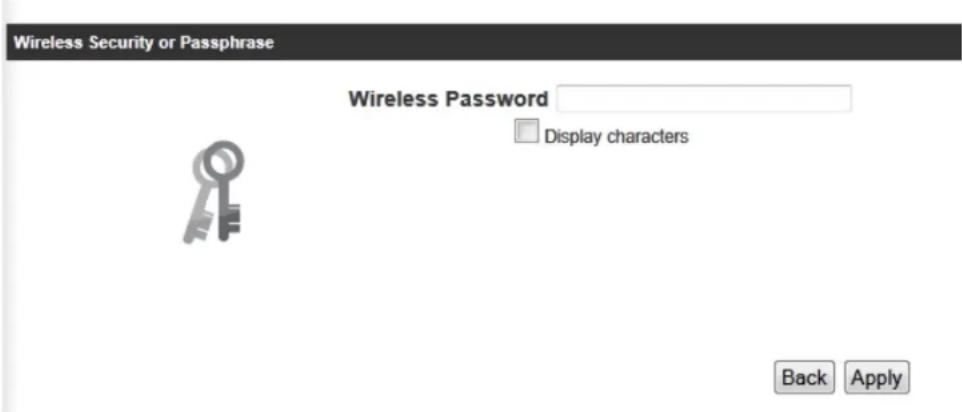
If the network you selected was a secure network, please enter the wireless password here. Be sure to type in the exact same key your wireless network is using otherwise the HWABN25 will not be able to connect. Click ‘Apply’ for the device to restart. Click ‘Back’ if you wish to make changes. As it is rebooting, plug in the wired ethernet devices that wish to use this as a Bridge. Congratulations, you have set up the HWABN25 as a Bridge!
2-4-3 Setup procedure for 'AP Bridge-Point to Point':
Mode : AP Bridge-Point to Point
Wireless: Enable 1
Band : 2.4 GHz (B+G+N) ▼ 2
Channel Number : 11 3
Device Mac Address: 80:1f:02:52:81:9a
MAC address 1: 000000000000 4
Set Security : Set Security 5
Advanced IP Address Settings:
To input your own IP Address settings, Uncheck the box and enter it below.
Note: The default IP address of the HWABN25 is 192.168.1.241
6
IP Address: 192.168.1.241
Subnet Mask: 255.255.255.0
Apply
7
Wireless (1): Shows you if the wireless is enabled/disabled
Band (2):
Please select the wireless band you wish to use. By selecting different band setting, you'll be able to allow or deny the wireless client of a certain band.
If you select 2.4GHz (B), 2.4GHz (N), or 2.4GHz (G), only wireless clients using the wireless band you select (802.11b, 802.11 Draft-N, or 802.11g) will be able to connect to this access point.
If you select 2.4GHz (B+G), then only wireless clients using 802.11b and 802.11g band will be able to connect to this access point.
If you want to allow 802.11b, 802.11g, and 802.11 Draft-N
clients to connect to this access point, select 2.4GHz (B+G+N).
Channel Number (3): Please select a channel number you wish to use. Please note that this should be the same channel as the other bridge you wish to connect to.
Mac Address (4): Please input the MAC address of the other bridge you wish to make a connection with
Set Security (5): Click this button to select an encryption mode for this wireless link, a new popup window will appear. Note: the security must be the same on the other bridge.
Adv. IP Address (6) This section allows you to set an IP Address and subnet mask to fit your network if needed. Uncheck the box to input. Otherwise, the default IP Address is 192.168.1.241
When you finish with all settings, please click 'Apply' (7); Plug in the devices that you wish to bridge. Note, you must setup another Bridge – point to point device in order for this to work properly in point to point. In that bridge, you will input the MAC address of this unit. Congratulations, you have set up the HWABN25 in AP Bridge-Point to Point!
2-4-4 Setup procedure for 'AP Bridge-Point to Multi-Point'
Mode : AP Bridge-Point to Multi-Point ▼
Wireless: Enable 1
Band : 2.4 GHz (B+G+N) ▼ 2
Channel Number: 11 3
Device Mac Address: 80:1f:02:52:81:9a
MAC address 1: 000000000000
MAC address 2: 000000000000
MAC address 3: 000000000000
MAC address 4 : 000000000000
Set Security : Set Security 5
4
Advanced IP Address Settings:
To input your own IP Address settings, Uncheck the box and enter it below.
Note: The default IP address of the HWABN25 is 192.168.1.241
6
IP Address: 192.168.1.241
Subnet Mask: 255.255.255.0
Apply
7
Wireless (1): Shows you if the wireless is enabled/disabled
Band (2):
Please select the wireless band you wish to use. By selecting different band setting, you'll be able to allow or deny the wireless client of a certain band.
If you select 2.4GHz (B), 2.4GHz (N), or 2.4GHz (G), only wireless clients using the wireless band you select (802.11b, 802.11 Draft-N, or 802.11g) will be able to connect to this access point.
If you select 2.4GHz (B+G), then only wireless clients using
802.11b and 802.11g band will be able to connect to this access point.
If you want to allow 802.11b, 802.11g, and 802.11 Draft-N clients to connect to this access point, select 2.4GHz (B+G+N).
Channel Number (3): Please select a channel number you wish to use. Please note that this should be the same channel as the other bridge you wish to connect to.
Mac Address (4): Please input the MAC addresses of the other bridges you wish to make a connection with.
Set Security (5): Click this button to select an encryption mode for this wireless link, a new popup window will appear. Note: the security must be the same on the other bridges.
Adv. IP Address (6) This section allows you to set an IP Address and subnet mask to fit your network if needed. Uncheck the box to input. Otherwise, the default IP Address is 192.168.1.241.
When you finish with all settings, please click ‘Apply’ (7); Plug in the devices that you wish to bridge. Note, you must also set up the other bridges for this product to work properly in a bridge-point to multi-point. Congratulations, you have set up the HWABN25 in AP Bridge-Point to Multi-point!
2-4-5 Setup Procedure for 'AP-Bridge WDS'
Mode : AP Bridge-WDS
Wireless: Enable 1
Band : 2.4 GHz (B+G+N) ▼ 2
MAIN ESSID : Hawking_HWABN25 3
Channel Number : 11 ▼ 4
Device Mac Address: 80:1f:02:52:81:9a
Associated Clients : Show Active Clients 5
MAC address 1 : 000000000000
MAC address 2: 000000000000
MAC address 3 : 000000000000
MAC address 4 : 000000000000
Set Security : Set Security 7
6
Advanced IP Address Settings:
To input your own IP Address settings, Uncheck the box and enter it below.
Note: The default IP address of the HWABN25 is 192.168.1.241
8
IP Address: 192.168.1.241
Subnet Mask: 255.255.255.0
Apply 9
Wireless (1): Shows you if the wireless is enabled/disabled
Band (2): If you select 2.4GHz (B), 2.4GHz (N), or 2.4GHz (G), only
wireless clients using the wireless band you select (802.11b, 802.11 Draft-N, or 802.11g) will be able to connect to this access point.
If you select 2.4GHz (B+G), then only wireless clients using 802.11b and 802.11g band will be able to connect to this access point.
If you want to allow 802.11b, 802.11g, and 802.11 Draft-N
clients to connect to this access point, select 2.4GHz (B+G+N).
Main SSID (3): Please input the ESSID (the name used to identify this wireless access point) here. You can input up to 32 alphanumeric characters. PLEASE NOTE THAT ESSID IS CASE SENSITIVE.
Channel Number (4): Please select a channel number you wish to use. Please note that this should be the same channel as the other WDS devices you plan to connect to.
Associated Clients (5): Click ‘Show Active Clients’ button and a new popup window will appear which contains the information about all wireless clients connected to this access point. You can click ‘Refresh’ button in popup window to keep information up-to-date.
Mac Address (6): Please input the MAC addresses of the other WDS devices you wish to make a connection with.
Set Security (7): Click this button to select an encryption mode for this wireless link, a new popup window will appear. Note: the security must be the same on the other WDS Devices
Adv. IP Address (8) This section allows you to set an IP Address and subnet mask to fit your network if needed. Uncheck the box to input. Otherwise, the default IP Address is 192.168.1.241.
When you finish with all settings, please click ‘Apply’ (9); Connect you’re your wireless devices to the WDS network. Note: You must setup other devices in WDS mode in order for this to work properly. Congratulations, you have set up the HWABN25 in AP Bridge-WDS!
2-4-6 Setup Procedure for 'Universal Repeater'
On the drop down box, please select "Universal Repeater". It may take a few seconds to load because once this mode is selected, it will scan for available networks to extend.
Step 1) This step will prompt you to create a custom name. By default, the Extender will be the same SSID as your original wireless network. If you wish to change it, please uncheck and manually input a custom name. Otherwise, leave checked.
By default, the HWABN25 will use the same SSID as your Home Wireless Connection.
Note: To name the extended SSID with a different SSID, please uncheck the box below:
MAIN ESSID : Hawking_HWABN25
Step 2) Please select your wireless network from the list below by selecting the network. If your wireless network does not appear, please click 'Scan' to rescan the wireless networks. You can also manually input your SSID and channel if you know them.
Scan for a wireless network to extend your WiFi network: Scan
Please choose your wireless network from the list below
| Select | SSID | Band | Chan | Encryption | Sign |
|  | HawkTech | (B+G+N) | 3 | WPA2-PSK | 91 |
|  | HawkTechC | (B+G+N) | 3 | WPA2-PSK | 80 |
-OR- If you want to manually input your SSID:
Source AP ID: Enter the SSID and channel of your original access point:
Channel Number: 3
Root AP SSID : HawkTechC
Step 3) After you select your network, press 'Connect' to proceed to the next step. If
you wish to change your IP address, refer to the Advanced IP settings before you select "Connect."
③ Select and click Connect
Connect
Advanced IP Address Settings:
To input your own IP Address settings, Uncheck the box and enter it below.
Note: The default IP address of the HWABN25 is 192.168.1.241
IP Address: 192.168.1.241
Subnet Mask: 255.255.255.0
Next
Adv. IP Address This section allows you to set an IP Address and subnet mask to fit your network if needed. Uncheck the box to input.
Otherwise, the default IP Address is 192.168.1.241 Then click "Connect".
Step 4) If your wireless network requires a password, the next page should prompt you to enter your wireless key. This key should be the exact same key as your wireless access point or wireless router. Please contact your network administrator if you do not know the security code.
Click ‘Continue’ to proceed to the next step or ‘Back’ if you wish to make some changes.
Welcome to the Setup Wizard
The wireless network you are trying to connect has wireless security enabled. Please enter the security code below:
If you do not know your security code, please contact the network administrator.

Security key or paraphrase:
□ Display characters
Back
Continue
Congratulations! Note: After setup, the HWABN25 will have the same name as the network you picked. This allows for a seamless WiFi network. Please disconnect any wired network cables and place it at a midpoint location.
Chapter III General Setup
In this chapter, you'll know how to change the major settings of the HWABN25. Log onto the device and click on 'General Setup'.
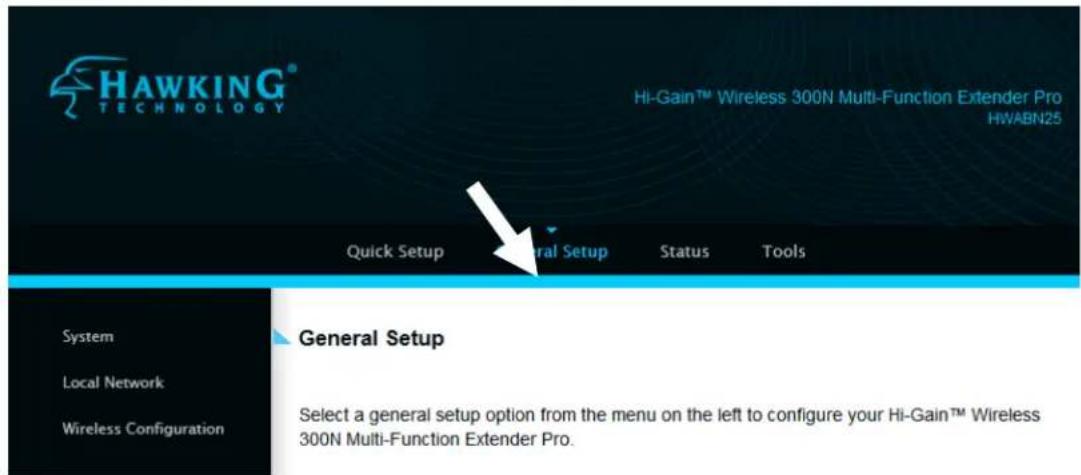
3-1 Change Management password
Default password of this access point is ‘1234’, and it’s displayed on the login prompt when accessed from the web browser. There’s a security risk if you don’t change the default password, since everyone can see it. This is very important when you have wireless function enabled.
To change password, please follow the instructions:
Please click ‘General Setup’ at top of web management interface, select ‘System’ tab on the left hand column, and then click ‘Password Settings’, and the following message will be displayed on your web browser:
Password Settings
You can change the password required while logging into the Hi-Gain™ Wireless 300N Multi-Function Extender's web-based management system. By default, the password is 1234.
Passwords can contain 0 to 30 alphanumeric characters and are case sensitive.
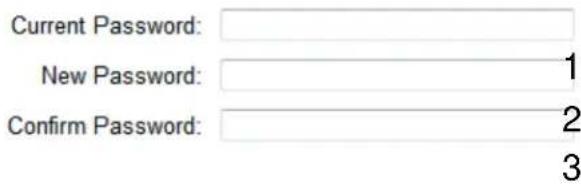

Current Please input current password here.
Password (1):
New Password (2): Please input new password here.
Confirm Please input new password here again.
Password (3):
If the password you typed in ‘New Password’ (2) and ‘Confirm Password’ (3) field are not the same, you’ll see the following message:
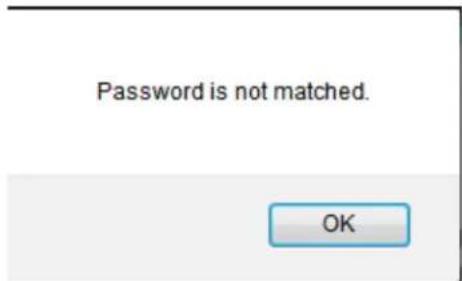
Please retype the new password again when you see above message.
If you see the following message:
ERROR: Password is not matched!
OK
It means the content in ‘Current Password’ field is wrong, please click ‘OK’ to go back to previous menu, and try to input current password again.
If the current and new passwords are correctly entered, after you click 'Apply', you'll be prompted to input your new password:
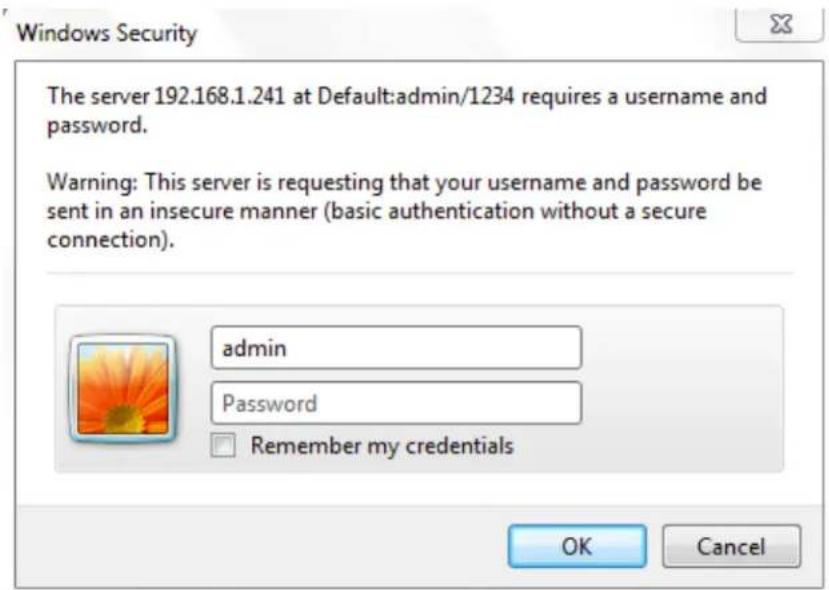
Please use new password to enter web management interface again, and you should be able to login with new password.
3-2 Wired LAN Configuration
Before all computers using wired Ethernet connection can communicate with each other and access Internet, they must have a valid IP address.
There are two ways to assign IP addresses to computers: static IP address (set the IP address for every computer manually), and dynamic IP address (IP address of computers will be assigned by access point automatically. It’s recommended for most computers to use dynamic IP address, it will save a lot of time on setting IP addresses for every computer, especially when there are a lot of computers in your network; for servers and network devices which will provide services to other computers and users that come from the Internet, a static IP address should be used.
Suggestions on IP Address numbering plan:
If you have no idea on how to define an IP address plan for your network, here are some suggestions.
- A valid IP address has 4 fields: a.b.c.d, for most of home and company users, it's suggested to use 192.168.c.d, where c is an integer between 0 and 254, and d is an integer between 1 and 254. This router is capable to work with up to 253 clients, so you can set 'd' field of IP address of router as 1 or 254 (or any number between 1 and 254), and pick a number between 0 and 254 for field 'c'.
- In most cases, you should use '255.255.255.0' as subnet mask, which allows up to 253 clients (this also meets router's capability of working with up to 253 clients).
- For all servers and network devices which will provide services to other people (like Internet service, print service, and file service), they should use static IP address. Give each of them a unique number between 1 and 253, and maintain a list, so everyone can locate those servers easily.
- For computers which are not dedicated to provide specific service to others, they should use dynamic IP address.
Please click 'General Setup' at the top of web management interface and click 'Local Network' on the left hand column.
There are two setup groups here: 'LAN IP' and 'DHCP Server'
3-2-1 Local Network
LAN IP
| IP Address: | 192.168.1.241 | 1 |
| Subnet Mask: | 255.255.255.0 | 2 |
| Gateway Address: | 0.0.0.0 | 3 |
| DHCP Server: | Disable ▼4 | |
IP address (1):
Please input the IP address of this access point.
Subnet Mask (2):
Please input subnet mask for this network.
Gateway Address (3):
Please input your gateway address for the network.
DHCP Server (4):
If you want to activate DHCP server function of this access point, select 'Enabled', or set it to 'Disabled'.
Recommended Value if you don't know what to fill:
IP Address: 192.168.1.241
DNS Server: (leave it blank)
Subnet Mask: 255.255.255.0
DHCP Server: Disabled
Gateway Address: (leave it blank)
3-2-2 DHCP Server:
DHCP Server
Lease Time: Half hour 1
Default Gateway IP: 0.0.0.0 2
Domain Name Server IP: 192.168.1.241 3
DHCP Client Start IP: 192.168.1.100 4
DHCP Client End IP: 192.168.1.200 5
Domain Name: 6
These settings are only available when 'DHCP Server' in 'LAN IP' section is 'Enabled'.
Lease Time (1):
Please choose a lease time (the duration that every computer can keep a specific IP address) of every IP address assigned by this access point from dropdown menu.
Default Gateway (2): Please input your default gateway address
Domain Server IP (3): Please input your DNS server address
Start IP (4): Please input the start IP address of the IP range.
End IP (5): Please input the end IP address of the IP range.
Domain Name (6): If you wish, you can also optionally input the domain name for your network. This is optional.
Recommended Value if you don't know what to fill:
Lease Time: Two Weeks (or 'Forever', if you have less than 20 computers)
Default Gateway: (leave it blank)
Domain Server IP: (leave it blank)
Start IP: 192.168.1.100
End IP: 192.168.1.200
Domain Name: (leave it blank)
NOTE:
- The number of the last field (mentioned 'd' field) of 'End IP' must be greater than 'Start IP', and can not be the same as router's IP address.
- The former three fields of IP address of 'Start IP', 'End IP', and 'IP Address of 'LAN IP' section (mentioned 'a', 'b', and 'c' field) should be the same.
- These settings will affect wireless clients too.
3-3 Wireless Network
If your computer, PDA, game console, or other network devices is equipped with a wireless network adapter, you can use the wireless function of this access point to let them connect to the Internet and share resources with other computers.
3-3-1 Basic Wireless Settings
Please click 'General Setup' menu at the top of web management interface, then click 'Wireless Configuration'. Choose 'Basic Settings'. Next to the Mode option, please select your Mode.
3-3-1-1 Access Point
The HWABN25 will broadcast a WiFi signal for other computers and devices to connect to. Must be plugged into the router or network after setup.
Basic Settings
This page allows you to define and configure the different wireless modes.
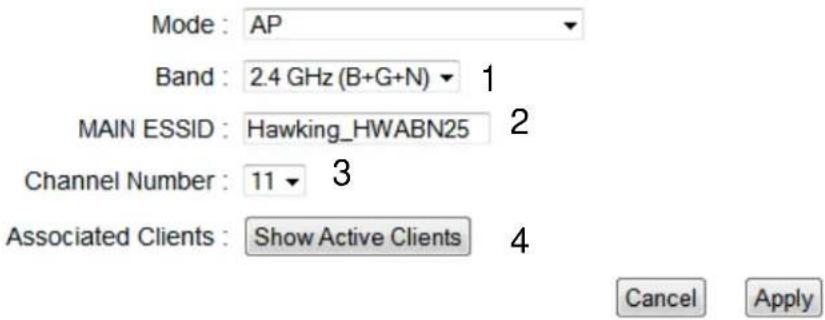
2.4 GHz (B) 2.4GHz band, only allows 802.11b wireless network clients to connect to this router (maximum transfer rate 11Mbps).
2.4 GHz (N) 2.4GHz band, only allows 802.11n wireless network clients to connect to this router (maximum transfer rate 300Mbps).
2.4 GHz (B+G) 2.4GHz band, only allows 802.11b and 802.11g wireless network clients to connect to this router (maximum transfer rate 11Mbps for 802.11b clients, and maximum 54Mbps for 802.11g clients).
2.4 GHz (G) 2.4GHz band, only allows 802.11g wireless network clients to connect to this router (maximum transfer rate 54Mbps).
2.4 GHz (B+G+N) 2.4GHz band, allows 802.11b, 802.11g, and 802.11n wireless network clients to connect to this router (maximum transfer rate 11Mbps for 802.11b clients, maximum 54Mbps for 802.11g clients, and maximum 300Mbps for 802.11n clients).
NOTE: If you don't have special reason to limit the type of allowed wireless clients, it's recommended to choose '2.4 GHz (B+G+N)
Main ESSID (2):
This is the name of wireless access point. You can type any alphanumerical characters here, maximum 32 characters.
ESSID is used to identify your own wireless access point from others when there are other wireless access points in the same area.
Default SSID: Hawking_HWABN25
It's recommended to change default ESSID value to the one which is meaningful to you, such as, 'myhome', 'office_room1', etc.
Channel Number (3): Please select a channel from the dropdown list of 'Channel Number', You can choose any channel number you want to use, and almost all wireless clients can locate the channel you're using automatically without any problem. However, it's still useful to remember the channel number you use, as some wireless clients support manual channel number selecting, and this would help in certain scenarios when there are radio communication conflicts.
TIP: You can try to change channel number to another one if you think the data transfer rate is too slow. There could be some other wireless routers using the same channel, which will disturb the radio communication between wireless client and the wireless router.
Associated Clients (4): Click ‘Show Active Clients’ button, then an “Active Wireless Client Table” will pop up. You can see the status of all active wireless stations that are connecting to the access point.
After you finish these wireless settings, please click 'Apply' button, button, and the following message will be displayed on your web browser:
Save settings successfully!
You may press CONTINUE button to continue configuring other settings or press APPLY button to restart the system to make the changes take effect.
CONTINUE APPLY
Please click ‘Go Back’ to go back to previous setup menu; to continue on access point setup, or click ‘Apply’ to reboot the access point so the settings will take effect. Please wait 30-60 seconds for the access point to reboot.
3-3-1-2 Station-Infrastructure (Bridge)
The HWABN25 will allow you connect wired devices wirelessly to an existing wireless router or access point. It will “bridge” these devices wirelessly with your network. It will not broadcast any WiFi signal. It will only make a wireless connection between the Access Point and the HWABN25.
Basic Settings
This page allows you to define and configure the different wireless modes.
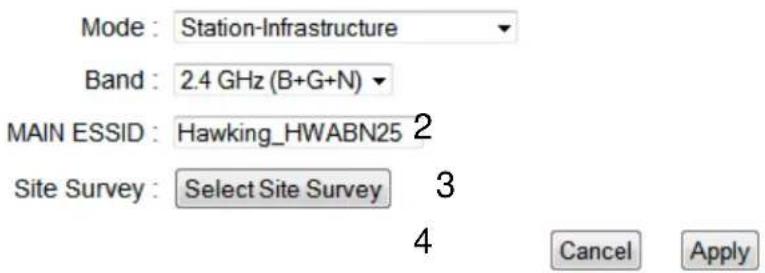
Band (2): Select the band you want to use. Refer to 3-3-1-1 for definitions.
SSID (3): This is the name of wireless network. You can type the SSID of the network you would like to connect here.
Site Survey (4): When you use this wireless router as a wireless station for Ethernet network device to have wireless capability, you have to associate it with a working access point. Click 'Select Site Survey' button, then a "Wireless Site Survey Table" will pop up. It will list all available access points near by. You can select one access point in the table and it will join wireless LAN through this access point.
3-4-1-3 AP Bridge-Point to Point
Similar to station-infrastructure, this requires two HWABN25's on each end. This will create a wireless bridge between these two points. No WiFi signal will be broadcast and it will only make a wireless connection between those two points.
Basic Settings
This page allows you to define and configure the different wireless modes.
Mode : AP Bridge-Point to Point
Band : 2.4 GHz (B+G+N) ▼ 2
Channel Number : 11 ▼ 3
MAC address 1: 000000000000 4
Set Security : Set Security 5
Cancel Apply
NOTE: Two HWABN25's must use the same mode, band, channel number, and security setting!
Band (2):
Select the band you want to use, the two HWABN25's must use the same setting. Refer to 3-3-1-1 for definitions.
Channel Number (3):
Select the channel you want to use, the two wireless
HWABN25s must use the same setting.
MAC Address (4):
Input the MAC address of another HWABN25
Security Settings (5):
Click to setting security for this connection
(Please go to section '3-3-3 Wireless Security')
for detailed instructions).
3-4-1-4 AP Bridge-Point to Multi-Point
Similar to AP Bridge – Point to Point, this allows you to connect several HWABN25's to one point. No WiFi signal will be broadcast and it will only make a wireless connection between the HWABN25s.
Basic Settings
This page allows you to define and configure the different wireless modes.
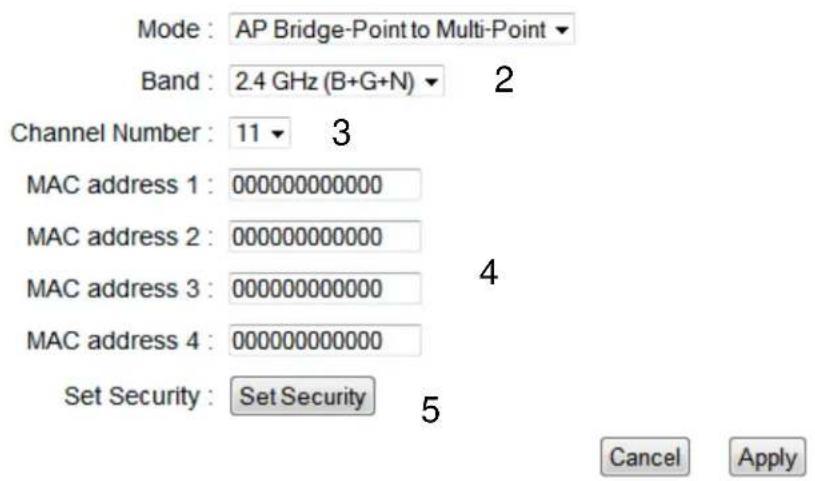
| Band (2): | Select the band you want to use, all HWABN25's must use the same setting. Refer to 3-4-1-1 for definitions. |
| Channel Number (3): | Select the channel you want to use, all HWABN25's must use the same setting |
| MAC address1 to 4: | Input the MAC address of other HWABN25s. |
| Security Settings (8): | Click to set security settings for this connection(Please go to section ‘3-4-3 Wireless Security’for detailed instructions). |
3-4-1-5 AP Bridge-WDS
Wireless Distributing System. This allows you to create a wireless network using up to four HWABN25's using the same SSID (wireless name). It will broadcast a WiFi signal.
NOTE: For WDS mode, the output signal nature is the same as that of normal AP mode.
Basic Settings
This page allows you to define and configure the different wireless modes.
Mode : AP Bridge-WDS
Band : 2.4 GHz (B+G+N) ▼
MAIN ESSID : Hawking_HWABN25 ^2
Channel Number : 11 ▼
3
Associated Clients : Show Active Clients
MAC address 1 : 000000000000
MAC address 2: 000000000000
MAC address 3 : 000000000000
MAC address 4 : 000000000000
Set Security : Set Security
7
5
6
Cancel
Apply
Band (2):
Select the band you want to use, all the HWBN25's must use the same setting. Refer to 3-3-1-1 for definitions.
SSID (3):
Input the SSID of your HWABN25's, the setting should be the same with other HWABN25's for the convenience of roaming.
Channel Number (4):
Select the channel you want to use, all the HWABN25's must use the same setting.
Associated Clients (5):
Click 'Show Active Clients' button, then an "Active Wireless
Client Table" will pop up. You can see the status of all active wireless stations that are connecting to the access point.
MAC address Input the MAC address of other HWABN25's 1 to 4 (6):
Security Click to set security settings for this connection
Setting (7): (Please go to section '3-3-3 Wireless Security' for detailed instructions).
3-4-1-6 Universal Repeater
In this mode, the HWABN25 will act as a wireless repeater; it can be a wireless bridge and access point at the same time. It can use bridge mode to connect to a Root access point and use the access point function to service all wireless stations within its coverage. In this mode, the HWABN25 will repeat the wireless signal of any existing wireless router/access point. It will act as a wireless relay and create a larger and seamless network for your wireless devices to connect to
NOTE: For Repeater Mode, this router will demodulate the received signal, checking if this signal is noise for the operating network then have the signal modulated and amplified again. The output power of this mode is the same as that of WDS and normal AP mode.
Basic Settings
This page allows you to define and configure the different wireless modes.
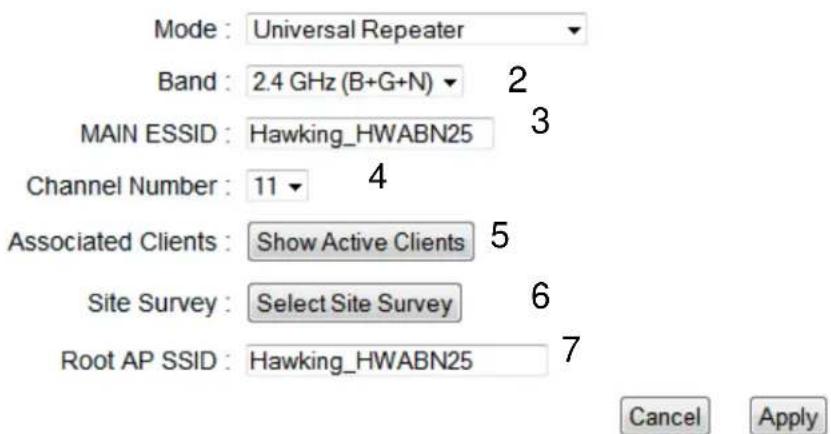
Band (2): Select the band you want to use, all the HWABN25's must use the same setting. Refer to 3-3-1-1 for definitions.
Main ESSID (3): This is the name of wireless router. You can type any alphanumeric characters here, maximum 32 characters. SSID
is used to identify your own wireless router from others when there are other wireless routers in the same area. Default SSID is 'Hawking_HWABN25', it's recommended to change default ESSID value to the one which is meaningful to you, like myhome, office_room1, etc.
Channel Select the channel you want to use, all the wireless
Number (4): clients must use the same setting as your original wireless signal
Associated Clients (5): Click ‘Show Active Clients’ button, then an “Active Wireless Client Table” will pop up. You can see the status of all active wireless stations that are connecting to the access point.
Root AP SSID (6): In ‘Universal Repeater’ mode, this device can act as a station to connect to a Root AP. You should assign the SSID of the Root AP here or click ‘Select Site Survey’ button to choose a Root AP. The Root AP is the name of the wireless signal you are trying to repeat.
Site Survey (7): Click ‘Select Site Survey’ button, then a “Wireless Site Survey Table” will pop up. It will list all available access points near by. You can select one access point in the table and the router will join wireless LAN through this access point.
After you finish the wireless setting, please click ‘Apply’ button, after you click ‘Apply’, the following message will be displayed on your web browser:
Save settings successfully!
You may press CONTINUE button to continue configuring other settings or press APPLY button to restart the system to make the changes take effect.
CONTINUE APPLY
Please click ‘Continue’ to back to previous setup menu; to continue on router setup, or click ‘Apply’ to reboot the router so the settings will take effect (Please wait for about 30 seconds while router is rebooting).
3-3-2 Advanced Wireless Settings
This access point provides some advanced control of wireless parameters, if you want to configure these settings, please click 'General Setup' at the top of web management interface and click 'Wireless Configuration' on the left hand column. Choose "Advanced Settings".
Advanced Settings
Advanced wireless settings for your Wireless Network.
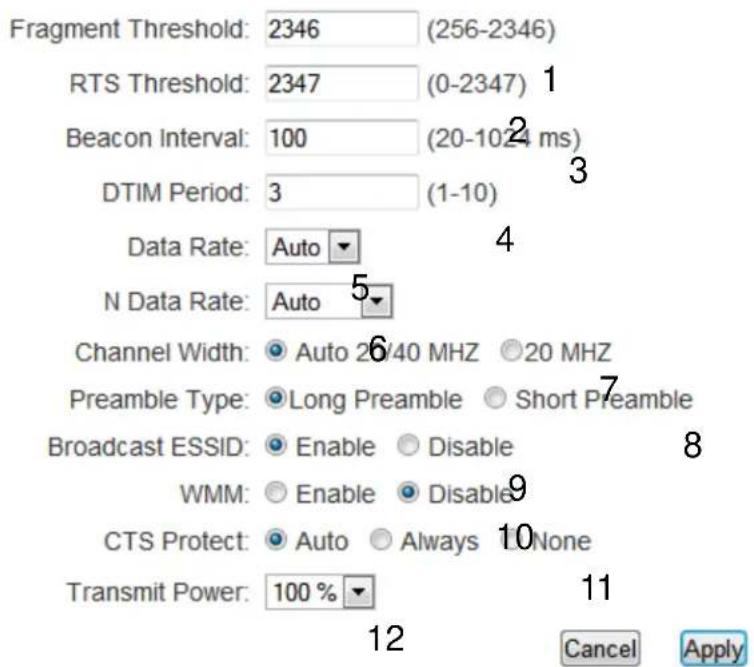
Fragment Threshold(1): Set the Fragment threshold of wireless radio.
Do not modify the default value if you do not understand the function, default value is '2346'.
RTS Threshold(2): Set the RTS threshold of wireless radio. Do not modify the default value if you do not understand the function, default value is '2347'.
| Beacon Interval(3): | Set the beacon interval of wireless radio. Do not modify the default value if you do not understand the function, default value is ‘100’. |
| DTIM Period(4): | Set the DTIM period of wireless radio. Do not modify the default value if you do not understand the function, default value is ‘3’. |
| Data Rate(5): | Set the wireless data transfer rate to a certain value. Since most of wireless devices will negotiate with each other and pick a proper data transfer rate automatically. It is not necessary to change this value unless you know what will happen after modification. |
| N Data Rate(6): | Same as above, but only for 802.11n clients. |
| Channel Width(7): | Set channel width of wireless radio. Do not modify the default value if you do not understand the function, default setting is ‘Auto 20/40 MHz’. |
| Preamble Type(8): | Set the type of preamble, do not modify the default value if you do not know what it is, default setting is ‘Short Preamble’. |
| Broadcast ESSID(9): | Decide if the wireless access point will broadcast its own ESSID or not. You can hide the ESSID of your wireless access point (set the option to ‘Disable’), so only those people who know the ESSID of your wireless access point can connect to the unit. |
| WMM(10): | Wi-Fi MultiMedia (WMM) will enhance the data transfer performance of multimedia contents when they are being transferred over a wireless network. If you do not understand the function, then it is safe to set this option to ‘Enable’, however, default value is ‘Disable’. |
| CTS Protect(11): | Enabling this setting will reduce the chance of radio signal |
collisions between 802.11b and 802.11g/n wireless access points. It is recommended to set this option to 'Auto' or 'Always'. However, if you set to 'None', your wireless access point should be able to function properly.
Transmit Power(12):
You can set the output power of wireless radio. Unless you are using this wireless access point in a large open space, you may not have to set output power to 100%. This will enhance security (malicious / unauthorized users in distance will not be able to reach your wireless access point).
After you finish these wireless settings, please click 'Apply' button, button, and the following message will be displayed on your web browser:
Save settings successfully!
You may press CONTINUE button to continue configuring other settings or press APPLY button to restart the system to make the changes take effect.
CONTINUE APPLY
Please click ‘Go Back’ to go back to previous setup menu; to continue on access point setup, or click ‘Apply’ to reboot the access point so the settings will take effect. Please wait 30-60 seconds for the access point to reboot.
3-3-3 Security Settings
It is important to set your wireless security settings properly! If you do not configure a wireless security setting, unauthorized users can use your network and/or obtain valuable data without your consent.
To set wireless security settings, please click 'General Setup' tab at the top of web management interface, then click 'Wireless Configuration' on the left hand column. Choose 'Security Settings'.
Please select an encryption method from the ‘Encryption’ dropdown menu, there are four options:
Disable -Please go to section 3-3-3-1
WEP -Please go to section 3-3-3-2
WPA -Please go to section 3-3-3-3
WPA Radius -Please go to section 3-3-3-4
3-3-3-1 Disable wireless security
When you select this mode, data encryption is disabled, and every wireless device in proximity will be able to connect your wireless access point if no other security measure is enabled (like MAC address access control - see section 3-4-4, or disable SSID broadcast).

Use this option only when you want to allow any user to use your wireless access point, and you are not concerned about unauthorized access to your files and/or transfers over your network.
3-3-3-2 WEP - Wired Equivalent Privacy
When you select this mode, the wireless access point will use WEP encryption, and the
following setup menu will be shown on your web browser:
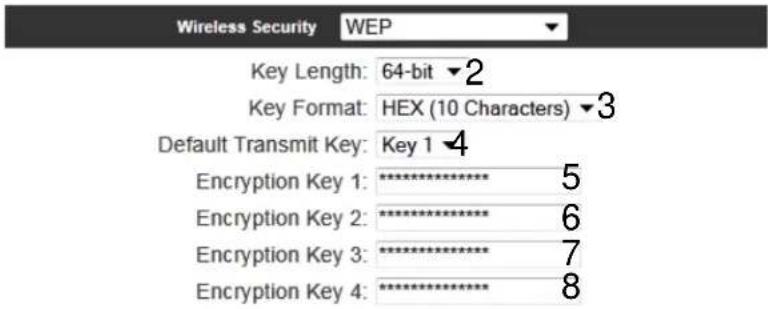
9
□ Enable 802.1x Authentication
RADIUS Server IP Address: 10
RADIUS Server Port: 1812 11
RADIUS Server Password: 12
Cancel Apply13
Key Length (2):
There are two types of WEP key length: 64-bit and 128-bit.
Using '128-bit' is safer than '64-bit', but will reduce some data transfer performance.
Key Format (3):
There are two types of key format: ASCII and Hex. When you
select a key format, the number of characters of key will be
displayed. For example, if you select '64-bit' as key length, and
'Hex' as key format, you'll see the message at the right of 'Key
Format' is 'Hex(10 characters), which means the length of WEP key is 10
characters.
Default Tx Key (4):
You can set up to four sets of WEP key, and you can decide
which key is being used by default here. If you don't know
which one you should use, select 'Key 1'.
Encryption Key
Input WEP key characters here, the number of
1 to 4 (5-8):
characters must be the same as the number displayed at 'Key
Format' field. You can use any alphanumerical characters (0-9,
a-z, and A-Z) if you select 'ASCII' key format, and if you select
'Hex' as key format, you can use characters 0-9, a-f, and A-F. You must enter at least one encryption key here, and if you entered multiple WEP keys, they should not be same with each other.
Enable 802.1x IEEE 802.1x is an authentication protocol. Every
Authentication (9): user must use a valid account to login to this wireless access point before accessing the wireless LAN. The authentication is processed by a RADIUS server. This mode only authenticates user by IEEE 802.1x, but it does not encryption the data during communication. If there is a RADIUS server in you environment, please enable this function. Check this box and another sub-menu will appear:
RADIUS Server Please input the IP address of RADIUS server here. IP address (10):
RADIUS Server Please input the port number of RADIUS server here. Port (11):
RADIUS Server Please input the password here. Password (12):
TIPS: Examples of WEP key
ASCII (5 characters): pilot phone 23561 2Hyux #@xml
ASCII (13 characters): digitalFAMILY 82Jh26xHy3m&n
Hex (10 characters): 287d2aa732 1152dabc85
Hex (26 characters): 9284bcda8427c9e036f7abcd84
To improve security level, do not use words that can be found in a dictionary or are easy to remember! Wireless clients will automatically remember the WEP key, so you only have to input the WEP key on wireless client once, and it is suggested that to use a complex WEP key to improve security level. Once you have chosen a password, write it down and keep it in a secure place.
After you finish WEP setting, please click 'Apply' (13) button and the following message
will be displayed on your web browser:
Save settings successfully!
You may press CONTINUE button to continue configuring other settings or press APPLY button to restart the system to make the changes take effect.
CONTINUE APPLY
Please click 'Go Back' to go back to previous setup menu, or click 'Apply' to reboot the access point so the settings will take effect. Please wait 30-60 seconds for the access point to reboot.
3-4-3-3 Wi-Fi Protected Access (WPA):
When you select this mode, the wireless access point will use WPA encryption, and the following setup menu will be shown on your web browser:
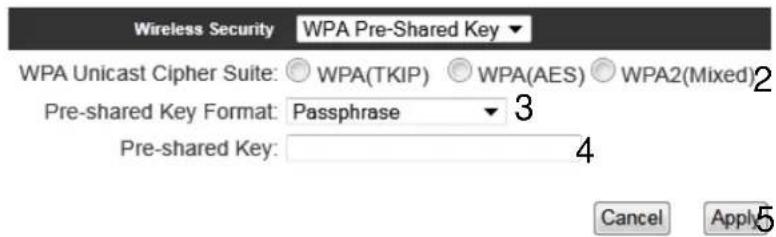
WPA Unicast Please select a type of WPA cipher suite.
Cipher Suite (2): Available options are: WPA (TKIP), WPA2 (AES), and WPA2
Mixed. You can select one of them, but you have to make sure your wireless client support the cipher you selected.
Pre-shared Select the type of pre-shared key, you
Key Format (3): can select Passphrase (8 or more alphanumeric characters, up to 63), or Hex (64 characters of 0-9, and a-f).
Pre-shared Please input the WPA passphrase here.
Key (4): It's not recommended to use a word that can be found in a dictionary due to security reason.
After you finish WPA Pre-shared key setting, please click 'Apply' button (5) and the following message will be displayed on your web browser:
Save settings successfully!
You may press CONTINUE button to continue configuring other settings or press APPLY button to restart the system to make the changes take effect.
CONTINUE APPLY
Please click 'Go Back' to go back to previous setup menu, or click 'Apply' to reboot the access point so the settings will take effect. Please wait 30-60 seconds for the access point to reboot.
NOTE: Some wireless clients (especially those manufactured before year 2003) only support WEP or WPA (TKIP) cipher. A driver upgrade would be needed for those clients to use WPA and WPA2 encryption.
3-4-3-4 WPA RADIUS:
If you have a RADIUS server, this access point can work with it and provide safer wireless authentication.
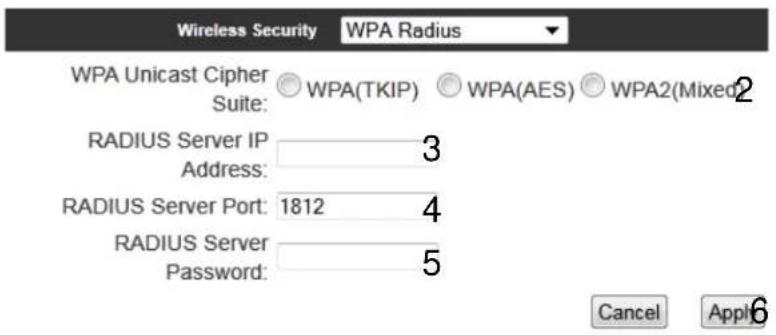
WPA Unicast
Please select a type of WPA cipher suite.
Cipher Suite: Available options are: WPA (TKIP), WPA2 (AES), and WPA2
Mixed. You can select one of them, but you have to make sure
your wireless client support the cipher you selected.
RADIUS Server Please input the IP address of your
IP address (3): Radius authentication server here.
RADIUS Server Please input the port number of your
Port (4): Radius authentication server here.
Default setting is 1812.
RADIUS Server Please input the password of your Radius
Password (5): authentication server here.
After you finish with all settings, please click 'Apply' (6) button and the following message will be displayed on your web browser:
Save settings successfully!
You may press CONTINUE button to continue configuring other settings or press APPLY button to restart the system to make the changes take effect.
CONTINUE APPLY
Please click ‘Go Back’ to go back to previous setup menu, or click ‘Apply’ to reboot the access point so the settings will take effect. Please wait 30-60 seconds for the access point to reboot.
3-3-4 Wireless Access Control
This function will help you prevent unauthorized users from connecting to your wireless access point; only those wireless devices who have a MAC address you assigned can gain access to your wireless access point. Use this function with other security measures described in previous section, to create a safer wireless environment.
You can add up to 20 MAC addresses by using this function. Please click 'General Setup' at the top of web management interface and click 'Wireless Configuration' on the left hand column. Select 'Access Control'.
Access Control
For additional security, the Hi-Gain™ Wireless 300N Multi-Function Extender features MAC Address Filtering that only allows authorized MAC Addresses to connect through the Repeater.
MAC Address Filtering Table - up to 20 entries.
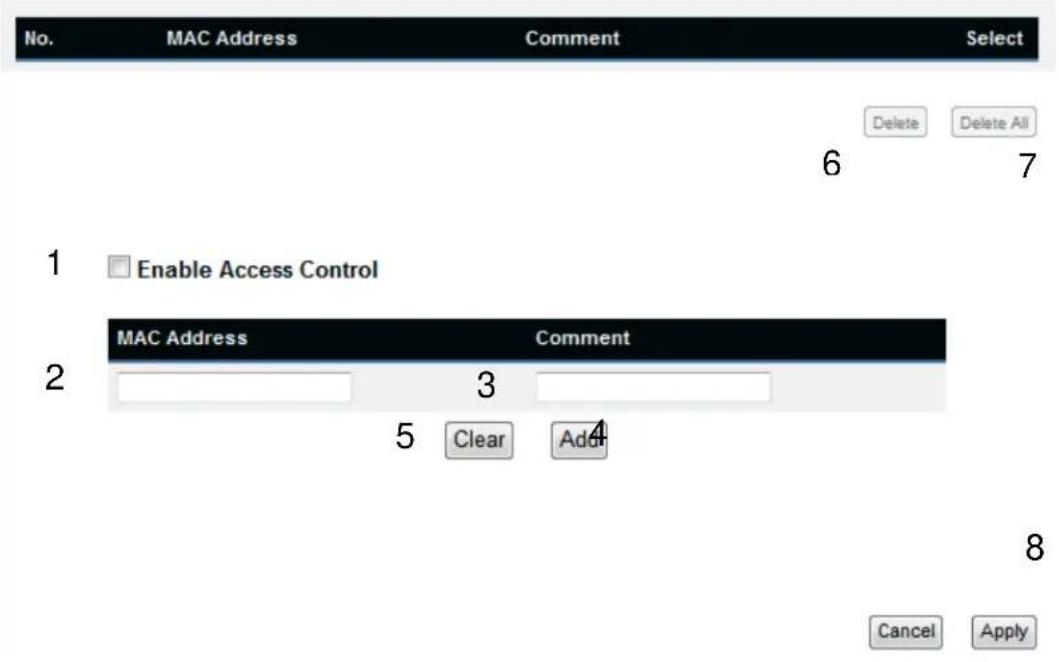
All allowed MAC addresses will be displayed in 'MAC Address Filtering Table.
| Enable Wireless To enforce MAC address filtering, you have to check | |
| Access Control (1): | ‘Enable Wireless Access Control’. When this item is unchecked, wireless access point will not enforce MAC address filtering of wireless clients. |
| MAC Address (2): | Input the MAC address of your wireless devices here, dash (-) or colon ( : ) are not required. (i.e. If the MAC address label of your wireless device indicates ‘aa-bb-cc-dd-ee-ff’ or ‘aa:bb:cc:dd:ee:ff’, just input ‘aabbccddeeff’. |
| Comment (3): | You can input any text here as the comment of this MAC address, like ‘ROOM 2A Computer’ or anything. You can input up to 16 alphanumeric characters here. This is optional and you can leave it blank, however, it’s recommended to use this field to write a comment for every MAC addresses as a memory aid. |
| Add (4): | Click ‘Apply’ button to add the MAC address and associated comment to the MAC address filtering table. |
| Clear (5): | Click ‘Clear’ to remove the value you inputted in MAC address and comment field. |
| Delete Selected (6): | If you want to delete a specific MAC address entry, check the ‘select’ box of the MAC address you want to delete, then click ‘Delete Selected’ button. (You can select more than one MAC addresses). |
| Delete All (7): | If you want to delete all MAC addresses listed here, please click ‘Delete All’ button. |
After you finish with all settings, please click 'Apply' (8) button and the following message will be displayed on your web browser:
Save settings successfully!
You may press CONTINUE button to continue configuring other settings or press APPLY button to restart the system to make the changes take effect
CONTINUE APPLY
Please click ‘Go Back’ to go back to previous setup menu, or click ‘Apply’ to reboot the access point so the settings will take effect. Please wait 30-60 seconds for the access point to reboot.
3-3-5 Wi-Fi Protected Setup (WPS)
Wi-Fi Protected Setup (WPS) is the simplest way to build connection between wireless network clients and this wireless access point. You don't have to select an encryption mode and input a long encryption passphrase every time when you need to set up a wireless client, you only have to press a button on the wireless client and this wireless access point, and the WPS will automatically configure for you.
This wireless access point supports two types of WPS: Push-Button Configuration (PBC), and PIN code. If you want to use PBC, you have to push a specific button on the wireless client to start WPS mode, and switch this wireless access point to WPS mode too. You can push Reset/WPS button of this wireless access point, or click 'Start PBC' button in the web configuration interface to do this; if you want to use PIN code, you have to know the PIN code of wireless client and switch it to WPS mode, then provide the PIN code of the wireless client you wish to connect to this wireless access point. The detailed instructions are listed follow:
Please click ‘General Setup’ at the top of web management interface and click ‘Wireless Configuration’ on the left hand column. Select ‘WPS’
Wi-Fi Protected Setup (WPS)
This section allows you to change the setting for Wi-Fi Protected Setup (WPS). Wi-Fi Protected Setup can help your wireless client automatically connect to the Hi-Gain™ Wireless 300N Multi-Function Extender.
1
Enable WPS
WPS Information
WPS Status: Configured
PinCode Self: 20767259
2
SSID: Hawking_HWABN25
Authentication Mode: WPA pre-shared key
Paraphrase Key:
Device Configure
Config Mode: Registrar ▼3
Configure by Push Button: Start PBC 4
Configure by Client PinCode: Start PIN 5
Enable WPS (1) Check this box to enable WPS function, uncheck it to disable WPS.
WPS Information (2)
WPS Status: If the wireless security (encryption) function of this wireless access point is properly set, you'll see 'Configured' message here. If wireless security function has not been set, you'll see 'Not configured'.
Self PIN code: This is the WPS PIN code of this wireless access point. This code is useful when you need to build wireless connection by WPS with other WPS-enabled wireless devices.
SSID: The SSID of this wireless access point will be displayed here.
Authentication Mode: The wireless security authentication mode
of this wireless access point will be displayed here. If you do not enable security function of the wireless access point before WPS is activated, the access point will auto set the security to WPA (AES) and generate a set passphrase key for WPS connection.
Passphrase Key: The wireless security key of the access point will be displayed here.
Config Mode (3) There are ‘Registrar’ and ‘Enrollee’ modes for the WPS connection. When ‘Registrar’ is enabled, the wireless clients will follow the access point’s wireless settings for WPS connection. When ‘Enrollee’ mode is enabled, the access point will follow the wireless settings of wireless client for WPS connection.
Configure Click 'Start PBC' to start Push-Button style WPS by Push Button (4) setup procedure. This wireless access point will wait for WPS requests from wireless clients for 2 minutes. The 'WLAN' LED light on the wireless access point will be steady for 2 minutes when this wireless access point is waiting for incoming WPS request.
Configure Please input the PIN code of the wireless client you by client wish to connect, and click 'Start PIN' button. PinCode (5) The 'WLAN' LED light on the wireless access point will be steady when this wireless access point is waiting for incoming WPS request.
3-3-6 Security Tips for Wireless Network
Here are some quick tips to help you improve the security level of your wireless network:
-
Never use simple words for your password, such as "password" or "1234567890".
-
A complicated (combination of numbers, alphabets, and even symbols) WEP key and WPA passphrase is more secure than simple and short words. Remember that the wireless client is capable of keeping the key or passphrase for you, so you only have to input the complicated key or passphrase once. Once you have chosen a password, write it down and keep it in a secure place.
-
You can hide the ESSID of this access point by setting the 'Broadcast ESSID' option to 'Disable'. Your wireless access point will not be found by other people in proximity if they are using the Access Point scanning function of their wireless client, and this can reduce unauthorized access.
-
Use ‘Access Control’ function, described in section 3-3-4, to allow authorized users access to the wireless access point using their specific MAC address.
Chapter IV Status and Tools
4-1 System Status
The functions described here will provide you with system related information. To enter system status menu, please either click 'Status' link located at top of web management interface.
4-1-1 System information and firmware version
You can use this function to know the system information and firmware version of this access point.
Please click 'Status' tab at the top of web management interface.
Status
The Hi-Gain™ Wireless 300N Multi-Function Extender's status information provides the following information: Hardware/Firmware version, Serial Number, and its current operating status.
System
Model: HWABN25
Up Time: 0day:1h:11m:24s
Hardware Version: Rev. A
Boot Code Version: 1.0
Firmware Version: 1.00
NOTE: Information displayed here may vary.
4-1-2 Local Network
You can use this function to know the status of your access point.
Please click 'Status' menu at the top of web management interface, and then click 'Local Network' on the left hand column.
Local Network
View the current status of the Hi-Gain™ Wireless 300N Multi-Function Extender.
Wireless Network Configuration
Mode: AP
ESSID: Hawking_HWABN25
Channel Number: 11
Security: WPA-shared key
Local Network Configuration
IP Address: 192.168.1.241
Subnet Mask: 255.255.255.0
DHCP Server: Disabled
MAC Address: 80:1f:02:52:81:9a
NOTE: Information displayed here may vary.
4-1-3 Statistics
You can use this function to check the statistics of wireless, LAN, and WAN interface of this access point.
Please click 'Status' menu at the top of web management interface, and then click 'Statistics' on the left hand column.
Statistics
This section shows the assigned IP address, MAC address and time expired for each DHCP leased client.
| Wireless LAN | Packet Sent: 40 |
| Packet Received: 193 | |
| Ethernet LAN | Packet Sent: 6137 |
| Packet Received: 18403 |
Refresh
You can click 'Refresh' button to display latest information.
4-2 Configuration Tools
You can back up all configurations of this access point to a file, so you can make several copied of access point configuration for security reason.
To backup or restore access point configuration, please follow the instructions:
Please click 'Tools' menu at the top of web management interface, and then click 'Configuration Tools' on the left hand column.
Configuration Tools
Use the "Backup" tool to save the Hi-Gain™ Wireless 300B Multi-Function Extender's current configurations to a file named "config.bin". You can then use the "Restore" tool to restore the saved configuration to the Multi-Function Extender. Alternatively, you can use the "Restore to Factory Default" tool to force the Multi-Function Extender to perform System Reset and restore the original factory settings.
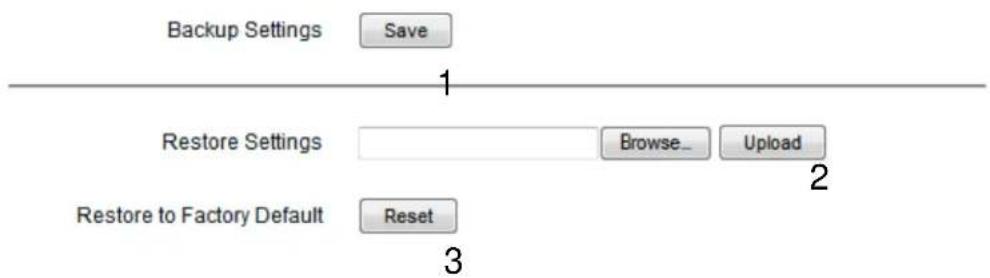
flowchart
graph TD
    A["Backup Settings"] --> B["Save"]
    C["Restore Settings"] --> D["Browse__"]
    C --> E["Upload"]
    F["Restore to Factory Default"] --> G["Reset"]
Backup Press 'Save...' button, and you'll be prompted to
Settings (1): download the configuration as a file, default filename is 'default.bin', you can please save it as another filename for different versions, and keep it in a safe place.
Restore Press 'Browse...' to pick a previously-saved
Settings (2): configuration file from your computer, and then click 'Upload' to transfer the configuration file to access point. After the configuration is uploaded, the access point's configuration will be replaced by the file you just uploaded.
Restore to Click this button to remove all settings you made, and
Factory Default (3): restore the configuration of this access point back to factory default settings.
4-3 Firmware Upgrade
The system software used by this access point is known as ‘firmware’, just like any applications on your computer, when you replace the old application with a new one; your computer will be equipped with new function. You can also use this firmware upgrade function to add new functions to your access point, even fix the bugs of this access point.
To upgrade firmware, please follow the instructions:
Please click ‘Tools’ menu at the top of web management interface, and then click ‘Firmware Upgrade’ on the left hand column.
Firmware Upgrade
This tool allows you to upgrade the Hi-Gain™ Wireless 300N Multi-Function Extender's system firmware. Enter the path and name of the upgrade file and then click the APPLY button below. You will be prompted to confirm the upgrade. See below for the Multi-Function Extender's current firmware. You can go to www.hawkingtech.com for the latest firmware files.
The system will automatically reboot the after you finished the firmware upgrade process. If you don't complete the firmware upgrade process in the next step, you have to manually restart the Multi-Function Extender.
Firmware Version: 1.00
Next
Click 'Next' button if you wish to upgrade your firmware.
Firmware Upgrade
This tool allows you to upgrade the Hi-Gain™ Wireless 300N Multi-Function Extender. Enter the path and name of the upgrade file and then click the Apply button below. You will be prompted to confirm the upgrade.
Browse
Apply
Click ‘Browse’ button, and you’ll be prompted to provide the filename of the firmware upgrade file. Please download the latest firmware file from the Hawking Technologies website at www.hawkingtech.com, and use it to upgrade your access point.
After a firmware upgrade file is selected, click 'Apply' button, and the access point will start firmware upgrade procedure automatically. The procedure may take several minutes, please be patient.
NOTE: Never interrupt the upgrade procedure by closing the web browser or physically disconnect your computer from router. If the firmware you uploaded is corrupt, the firmware upgrade will fail, and you may have to return this router to the dealer of purchase to ask for help. Warranty is void if you interrupt the upgrade procedure.
4-4 System Reset
If you think your network performance is bad or you find the behavior of the access point is strange, you can perform a reset. Sometimes it will solve the problem.
Please click ‘Tools’ menu at the top of web management interface, and then click ‘Reset’ on the left hand column.
Reset and Reboot
In the event that the system stops responding correctly or stops functioning, you can perform a Reboot. Your settings will not be changed. To perform the reboot, click on the Reboot button below. You will be asked to confirm your decision. The Reboot will be complete when the LED Power light stops blinking.
Reboot: Reboot
If resetting the Multi-Function Extender does not work you may attempt to reset the Multi-Function Extender back to factory default settings. Note that all your current settings will be erased.
Reset to Factory Default Setting: Reset
Please click 'Apply' to reset your HWABN25, and it will be available again after a few minutes, please be patient.
Chapter V: Appendix
5-1 Hardware Specification
SoC: Realtek RTL8196C + RTL8192CE
Flash: 2MB
SDRAM: 16MB
LAN Port: 10/100M UTP Port/PoE x 1
Antenna: Built in Antenna x 2
Power: 5VDC, 2A Switching Power Adapter/PoE capable
Dimension: 46(H) x 105(W) x 105(D) mm
Transmit Power: 11n:23dBm ± 1.5dBm, 11g:23dBm ± 1.5dBm, 11b:25 ± 1.5dBm
Temperature: 32\~104°F (0 \~ 40°C)
Humidity: 10-90% (NonCondensing)
5-2 Troubleshooting
If you find that the access point is working improperly or stops responding, check some of the FAQs below. You can also contact our support by email or phone.
| Scenario Solution | |
| Access point is not responding to me when I want to access it by web browser | a. Please check the connection of power cords and network cables of this access point. All cords and cables should be correctly and firmly inserted into the access point.b. If all LEDs on this access point are off, please check the status of A/C power adapter, and make sure it's correctly powered.c. You must use the same IP address section which access point uses.d. Are you using MAC or IP address filter? Try to connect the access point by another computer and see if it works; if not, please restore your access point to factory default settings (pressing ‘reset’ button for over 10 seconds).e. Set your computer to obtain an IP address automatically (DHCP), and see if your computer can get an IP address.f. If you did a firmware upgrade and this happens, contact your dealer of purchase for help.g. If all above solutions don't work, contact the dealer of purchase for help. |
| I can't locate my access point by my wireless client | a. ‘Broadcast ESSID’ set to off?b. All three antennas are properly secured.c. Are you too far from your access point? Try to get closer.d. Please remember that you have to input ESSID on your wireless client manually, if ESSID broadcast is disabled. |
| File download is very | a. Are you using QoS function? Try to disable it and |
| slow or breaks frequently try again.b. Internet is slow sometimes, be patient.c. Try to reset the access point and see if it's better after that.d. Try to know what computers do on your local network. If someone's transferring big files, other people will think Internet is really slow.e. If this has never happened before, call your Internet service provider to know if there is something wrong with their network. | |
| I can't log onto web management interface: password is wrong | a. Make sure you're connecting to the correct IP address of the access point!b. Password is case-sensitive. Make sure the 'Caps Lock' light is not illuminated.c. If you really forgot the password, do a hard reset. |
| Access point becomes hot | a. This is not a malfunction, as long as it is not so hot that you cannot touch it for a prolonged period of timeb. If you smell something wrong or see smoke coming out from access point or A/C power adapter, please disconnect the access point and A/C power adapter from utility power (make sure it's safe before you're doing this!), and call your dealer of purchase for help. |
| The date and time of all event logs are wrong | a. Adjust the internal clock of access point. |
5-3 Glossary
Default Gateway (Access point): Every non-access point IP device needs to configure a default gateway's IP address. When the device sends out an IP packet, if the destination is not on the same network, the device has to send the packet to its default gateway, which will then send it out towards the destination.
DHCP: Dynamic Host Configuration Protocol. This protocol automatically gives every computer on your home network an IP address.
DNS Server IP Address: DNS stands for Domain Name System, which allows Internet servers to have a domain name (such as www.Broadbandaccess point.com) and one or more IP addresses (such as 192.34.45.8). A DNS server keeps a database of Internet servers and their respective domain names and IP addresses, so that when a domain name is requested (as in typing "Broadbandaccess point.com" into your Internet browser), the user is sent to the proper IP address. The DNS server IP address used by the computers on your home network is the location of the DNS server your ISP has assigned to you.
DSL Modem: DSL stands for Digital Subscriber Line. A DSL modem uses your existing phone lines to transmit data at high speeds.
Ethernet: A standard for computer networks. Ethernet networks are connected by special cables and hubs, and move data around at up to 10/100 million bits per second (Mbps).
Idle Timeout: Idle Timeout is designed so that after there is no traffic to the Internet for a pre-configured amount of time, the connection will automatically be disconnected.
IP Address and Network (Subnet) Mask: IP stands for Internet Protocol. An IP address consists of a series of four numbers separated by periods, which identifies a single, unique Internet computer host in an IP network. Example: 192.168.1.254. It consists of 2 portions: the IP network address, and the host identifier.
The IP address is a 32-bit binary pattern, which can be represented as four cascaded decimal numbers separated by “.”: aaa.aaa.aaa.aaa, where each “aaa” can be anything from 000 to 255, or as four cascaded binary numbers separated by “.”:
bbbbbbb.bbbbbbbb.bbbbbbbb.bbbbbbbb, where each "b" can either be 0 or 1.
A network mask is also a 32-bit binary pattern, and consists of consecutive leading
1's followed by consecutive trailing 0's, such as
11111111.11111111.11111111.00000000. Therefore sometimes a network mask can also be described simply as "x" number of leading 1's.
When both are represented side by side in their binary forms, all bits in the IP address that correspond to 1's in the network mask become part of the IP network address, and the remaining bits correspond to the host ID.
For example, if the IP address for a device is, in its binary form,
11011001.10110000.10010000.00000111, and if its network mask is,
11111111.11111111.11110000.00000000
It means the device's network address is
11011001.10110000.10010000.00000000, and its host ID is,
00000000.00000000.00000000.00000111. This is a convenient and efficient method for access points to route IP packets to their destination.
ISP Gateway Address: (see ISP for definition). The ISP Gateway Address is an IP address for the Internet access point located at the ISP's office.
ISP: Internet Service Provider. An ISP is a business that provides connectivity to the Internet for individuals and other businesses or organizations.
LAN: Local Area Network. A LAN is a group of computers and devices connected together in a relatively small area (such as a house or an office). Your home network is considered a LAN.
MAC Address: MAC stands for Media Access Control. A MAC address is the hardware address of a device connected to a network. The MAC address is a unique identifier for a device with an Ethernet interface. It is comprised of two parts: 3 bytes of data that corresponds to the Manufacturer ID (unique for each manufacturer), plus 3 bytes that are often used as the product's serial number.
NAT: Network Address Translation. This process allows all of the computers on your home network to use one IP address. Using the broadband access point's NAT capability, you can access the Internet from any computer on your home network without having to purchase more IP addresses from your ISP.
Port: Network Clients (LAN PC) uses port numbers to distinguish one network application/protocol over another. Below is a list of common applications and protocol/port numbers:
| Application | Protocol | Port Number |
| Telnet | TCP | 23 |
| FTP TCP 21 | ||
| SMTP | TCP | 25 |
| POP3 TCP 110 | ||
| H.323 | TCP | 1720 |
| SNMP UCP 161 | ||
| SNMP Trap | UDP | 162 |
| HTTP TCP 80 | ||
| PPTP | TCP | 1723 |
| PC Anywhere | TCP 5631 | |
| PC Anywhere | UDP | 5632 |
PPPoE: Point-to-Point Protocol over Ethernet. Point-to-Point Protocol is a secure data transmission method originally created for dial-up connections; PPPoE is for Ethernet connections. PPPoE relies on two widely accepted standards, Ethernet and the Point-to-Point Protocol. It is a communications protocol for transmitting information over Ethernet between different manufacturers
Protocol: A protocol is a set of rules for interaction agreed upon between multiple parties so that when they interface with each other based on such a protocol, the interpretation of their behavior is well defined and can be made objectively, without confusion or misunderstanding.
Access point: A access point is an intelligent network device that forwards packets between different networks based on network layer address information such as IP addresses.
Subnet Mask: A subnet mask, which may be a part of the TCP/IP information provided by your ISP, is a set of four numbers (e.g. 255.255.255.0) configured like an IP address. It is used to create IP address numbers used only within a particular network (as opposed to valid IP address numbers recognized by the Internet, which must be assigned by InterNIC).
TCP/IP, UDP: Transmission Control Protocol/Internet Protocol (TCP/IP) and Unreliable Datagram Protocol (UDP). TCP/IP is the standard protocol for data transmission over the Internet. Both TCP and UDP are transport layer protocol. TCP performs proper error detection and error recovery, and thus is reliable. UDP on the other hand is not reliable. They both run on top of the IP (Internet Protocol), a network layer protocol.
WAN: Wide Area Network. A network that connects computers located in geographically separate areas (e.g. different buildings, cities, countries). The Internet is a wide area network.
Web-based management Graphical User Interface (GUI): Many devices support a graphical user interface that is based on the web browser. This means the user can use the familiar Netscape or Microsoft Internet Explorer to Control/configure or monitor the device being managed.