Urbano 50i - Scooter Genuine - Free user manual and instructions
Find the device manual for free Urbano 50i Genuine in PDF.


| Brand | Genuine |
| Model | Urbano 50i |
| Category | Scooter |
| Engine Displacement | 49.5 cc |
| Engine Type | 4-stroke, single cylinder |
| Fuel System | Fuel injection |
| Cooling System | Air cooled |
| Transmission | Automatic CVT |
| Starter | Electric and kick start |
| Front Brake | Disc brake |
| Rear Brake | Drum brake |
| Front Tire | 120/70-12 |
| Rear Tire | 130/70-12 |
| Length | 1870 mm |
| Width | 700 mm |
| Height | 1130 mm |
| Seat Height | 760 mm |
| Wheelbase | 1300 mm |
| Fuel Capacity | 5.7 L (1.5 gal) |
| Weight (dry) | 95 kg |
| Max Load | 150 kg |
| Colors Available | Black, White, Red, Blue |
Frequently Asked Questions - Urbano 50i Genuine
User questions about Urbano 50i Genuine
0 question about this device. Answer the ones you know or ask your own.
Ask a new question about this device
Download the instructions for your Scooter in PDF format for free! Find your manual Urbano 50i - Genuine and take your electronic device back in hand. On this page are published all the documents necessary for the use of your device. Urbano 50i by Genuine.
USER MANUAL Urbano 50i Genuine
URBANO50i
Owner's Manual
Notice

This owner's manual contains important safety, operational and maintenance information. Any person operating or riding as a passenger on your scooter should carefully read and fully understand the entire contents of this manual prior to riding the vehicle. For your safety, follow all safety warnings contained within the owner's manual and the labels applied to your scooter. You should always keep this owner's manual in your vehicle, and it should be considered a permanent part of the vehicle.
If you have any questions, please ask your dealer for assistance.
Safety symbols and notes. Please observe the following:

WARNING
Failure to follow instructions with a WARNING symbol could result in serious injury or death. Precautionary measures are required.

CAUTION
Important instructions and precautionary rules to avoid damage to the vehicle. Non-observance can lead to an unsafe vehicle condition.

NOTE
Special instructions and precautionary measures for better handling during operation, inspection, adjustment and service activities.

WARNING
California Proposition 65
Operating, servicing and maintaining a passenger vehicle or off-road vehicle can expose you to chemicals including engine exhaust, carbon monoxide, phthalates, and lead, which are known to the State of California to cause cancer and birth defects or other reproductive harm. To minimize exposure, avoid breathing exhaust, do not idle the engine except as necessary, service your vehicle in a well-ventilated area and wear gloves or wash your hands frequently when servicing your vehicle. For more information go to www.P65Warnings.ca.gov/passenger-vehicle.
Introduction

Congratulations on your purchase of the Genuine Scooter Company Urbano 50i.
Please read this manual carefully prior to riding so that you will understand how to safely operate your scooter, understand its capabilities and limitations and become aware of all vehicle controls and features.
This owner's manual contains important maintenance information. The efficiency and longevity of your scooter will depend heavily on your operating methods and periodic maintenance. Failure to operate and maintain your scooter as instructed in this owner's manual may void the limited warranty and reduce the efficiency and reliability of your vehicle.
The first 500 miles are the most important in the life of your scooter. Proper break-in during this time will ensure maximum life. Please refer to the break-in section for specific break-in procedures prior to riding.
You should always use original Genuine Scooter Company OEM parts for all maintenance and repairs as they have been designed specifically for your vehicle.
Genuine Motor Oil is the official lubricant of Genuine Scooter Company vehicles. Genuine Motor Oils have been specially formulated to keep your vehicle operating at maximum efficiency with minimal engine wear. Genuine Motor Oils are synthetic oils that utilize the best-known lubrication technology to increase fuel mileage and produce minimum exhaust emissions.
Prima is the official aftermarket parts and accessories supplier for Genuine Scooter Company vehicles. Prima accessories have been specifically designed to fit your Genuine Scooter.
Your authorized Genuine Scooter Company dealer is the primary resource for information, parts and service. If you have any questions, please ask your dealer for assistance.
Table of Contents

NOTICE.... 1
INTRODUCTION.... 2
TABLE OF CONTENTS 3
VEHICLE SAFETY
Accessories, Modification, Noise Regulation.... 4
Loading, Maintenance, Pre-ride Inspection 5
Carbon Monoxide Gas.... 5
SAFE RIDING
Wear Safety Gear, Make Yourself Visible.... 6
Know Your Limits, Road Conditions.... 6
IDENTIFICATION NUMBERS.... 7
VEHICLE LAYOUT
USBCharging, Ignition Switch 8
Dashboard.... 9
Dashboard and Clock....10,11
Handlebar Controls.... 12
Frontand Rear Brake Controls 13
Kick Start, Seat Lock.... 14
Storage, Bag Hook.... 15
Fuel Fill.... 16
PRE-RIDE INSPECTION
Pre-ride Inspection Checklist.... 17
Front Brake Inspection and Adjustment....18,19
Rear Brake Inspection and Adjustment.... 20
PRE-RIDE INSPECTION (CONTINUED)
Throttle Inspection and Adjustment.... 21
Engine Oil Type, Level Check, and Fill 22
Tire Inspection and Pressure Adjustment.... 23
Cable Inspection and Lubrication.... 24
Vehicle Center and Side Stand, Assembly Check.... 24
Fuel, Lighting, Switches, and Loading.... 25
OPERATION
Engine Starting 26
Engine Run-in, Engine Life 27
Engine Warm-up, Riding, Throttle.... 28
Braking.... 29
Engine Stop, Parking 30
PERIODIC MAINTENANCE
Periodic Maintenance Key 31
Periodic Maintenance Table.... 32
Periodic Maintenance Table Continued.... 33
Air Cleaner, Gear Oil, Transmission.... 34
Spark Plug, Front Brake.... 35
Brake Fluid, Suspension.... 36
Fuses, Battery.... 37
Maintenance Record.... 38
TECHNICAL DATA.... 39
REPORTING SAFETY DEFECTS.... 40
Vehicle Safety

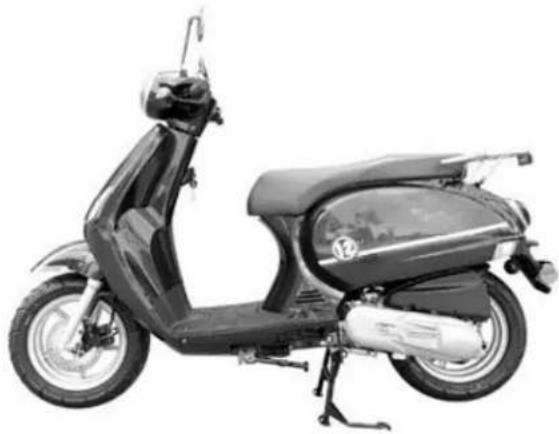
Accessories
The addition of unsuitable accessories can result in unsafe operating conditions.
Genuine Scooter Company approved accessories such as Prima brand have been designed for and approved by Genuine for use on your scooter. Always install Genuine approved accessories on your scooter. Your dealer can assist you in selecting and properly installing accessories.
natural_image
Side view of a black scooter with visible branding and front wheel (no text or symbols)Modification
Modification of your scooter or removal of original equipment may render the vehicle unsafe or illegal. Obey all applicable equipment laws and regulations. Only use accessories that have been approved by Genuine for this scooter.
Motorcycle Noise Regulation
TAMPERING WITH NOISE CONTROL SYSTEM PROHIBITED
Federal law prohibits the following acts or the causing thereof: (1) The removal or rendering inoperative by any person other than for purposes of maintenance, repair, or replacement of any device or element of design incorporated into any new vehicle for the purpose of noise control prior to its sale or delivery to the ultimate purchaser or while it is in use or (2) the use of the vehicle after such device or element of design has been removed or rendered inoperative by any person.
"AMONG THOSE ACTS PRESUMED TO CONSTITUTE TAMPERING ARE THE ACTS LISTED BELOW".
These acts include tampering with the following systems; i.e., modification, removal, etc.
Exhaust System - Muffler, Exhaust pipe, Silencer
Intake System - Air cleaner case, Air filter, Intake duct.
Vehicle Safety

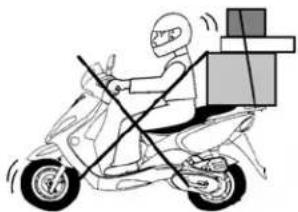
Properly Load Your Scooter
You and any passengers should utilize the floorboard and footrests for your feet. Do not exceed the load limits of the vehicle. Properly secure all cargo.
natural_image
Illustration of a person riding a scooter with a cross symbol indicating no change or restriction (no text or symbols present)Maintain Your Vehicle
Perform maintenance as required per the maintenance schedule or as otherwise necessary to keep your scooter in a safe operating condition. If you notice any leaks or notice odd sensations such as vibration, immediately stop your vehicle.
Pre-Ride Inspection
Always perform a pre-ride inspection of your scooter prior to each ride. Review the pre-ride inspection instruction section contained within this manual for more information.
WARNING
Not performing a pre-ride inspection, altering your vehicle from the stock configuration, or failure to properly maintain your vehicle can result in serious injury or death. Check your vehicle regularly and have any problems corrected as soon as possible.
Carbon Monoxide Gas
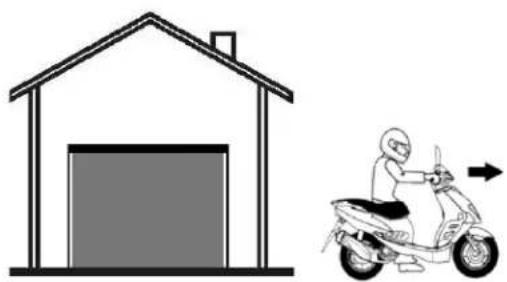
The exhaust gasses from this vehicle contain carbon monoxide, a colorless, odorless, and highly toxic gas.
An enclosed area such as a garage can quickly fill up with carbon monoxide gas. Do not run the engine in enclosed areas that are poorly ventilated. Move the vehicle outdoors before operation.
natural_image
Simple line drawing of a house with a door and a scooter, no text or symbols present.! WARNING
Carbon monoxide gas is toxic. Breathing carbon monoxide can cause unconsciousness and even kill you. Avoid running your engine within enclosed areas and other activities that expose you to carbon monoxide.
Safe Riding

Your scooter can provide many years of riding enjoyment. You must take responsibility for your own safety and the safety of others. There are many steps you can take to protect yourself and others while riding. Here are some very important safety precautions:
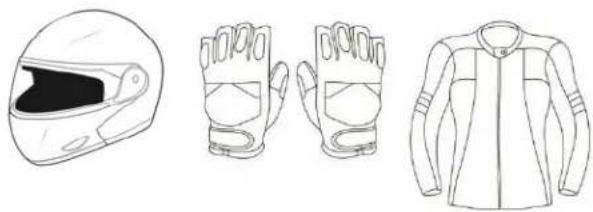
Wear a Helmet
Rider safety begins with quality head protection. A head injury is one of the most serious injuries that can occur. Always wear a quality DOT approved helmet that is properly buckled. If the helmet does not have a face shield, wear suitable eye protection.
Wear Riding Apparel
Choose quality gloves, boots, pants, jackets and other riding apparel specifically designed with protective features. Loose clothing can be unsafe when riding your scooter.
Make Yourself Visible
Wear bright, reflective apparel to make yourself more visible to fellow drivers. Position yourself on the road where other drivers can easily see you. Use your turn signals, hand signs, horn and other methods to help others locate you and understand your driving actions.
WARNING
Not wearing safety apparel increases the chance of serious injury or death in a crash. Be sure you and any passengers always wear helmets and protective gear properly.
natural_image
Line drawings of three types of sports helmets and sport gloves (no text or symbols)Know Your Limits
Ride within the boundaries of your own skill at all times. Do not ride under the influence of drugs or alcohol. Strictly observe all traffic regulations. Always adapt your riding to account for traffic and road conditions.
Road Conditions
Road conditions can vary greatly with weather, foreign material, elevation etc. Your riding stability and braking power are limited by the grip of the tires on the road surface.
When encountering slippery road surfaces, braking distance will increase significantly and riding stability will be reduced. Reduce vehicle speed and perform all actions in a gradual and deliberate manner to prevent accidents.
Use extreme caution on painted surfaces or metal objects such as manhole covers or train rails when they are wet.
Identification Numbers

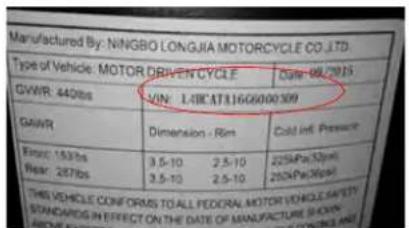
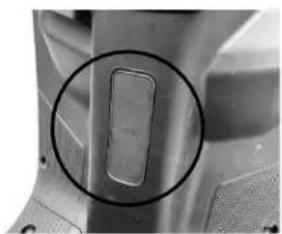
Vehicle Identification Number (VIN) is located on the VIN plate (1) or inside the inner front cover (2).
natural_image
Close-up of a mechanical component with a circular highlight highlighting a rectangular feature (no text or symbols visible)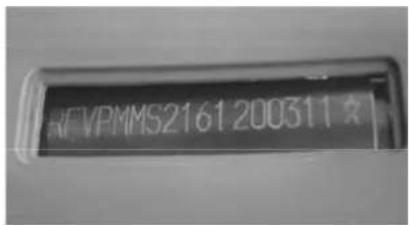
Record your Vehicle Identification Number:
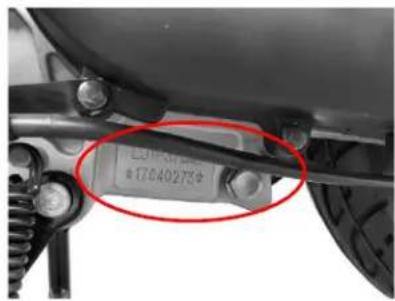
The Engine Serial Number (ESN) is located on the front left side of the engine (3).
Record your Engine Serial Number:
Vehicle Layout

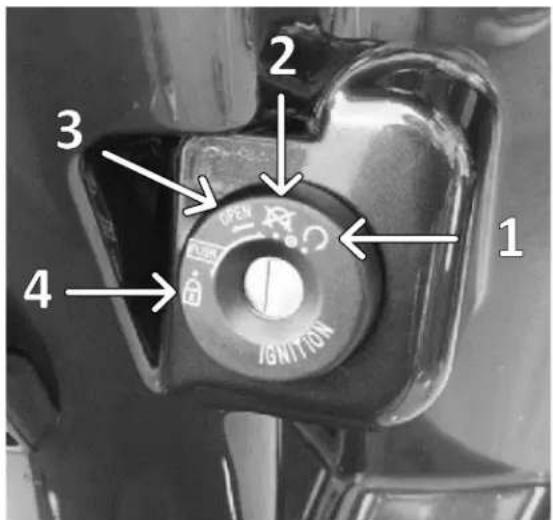
Ignition Switch Operation
Insert the key and select ON (1), OFF (2), OPEN (3), or (4) LOCK.
- Turn key to ON position (1) to operate the vehicle. In this position, the key cannot be removed. The vehicle will have power and the engine can be started.
- Turn key to OFF position (2) to cease vehicle operation. In this position, all vehicle power will be off, the engine will not run, and the key can be removed from the ignition switch.
- From OFF position (2), turn key left to OPEN position (3). The seat will unlatch to expose the under-seat storage compartment.
- Turn handlebars fully to the left steering-stop. With the key in the OFF position (2), press key inward toward front of the scooter and turn key left to LOCK position (4) to lock the handlebars as a theft deterrent. The fork is now locked and cannot be turned.
LOCK your vehicle whenever you leave it unattended. The key can be removed from the ignition switch in the LOCK position.
Vehicle Layout

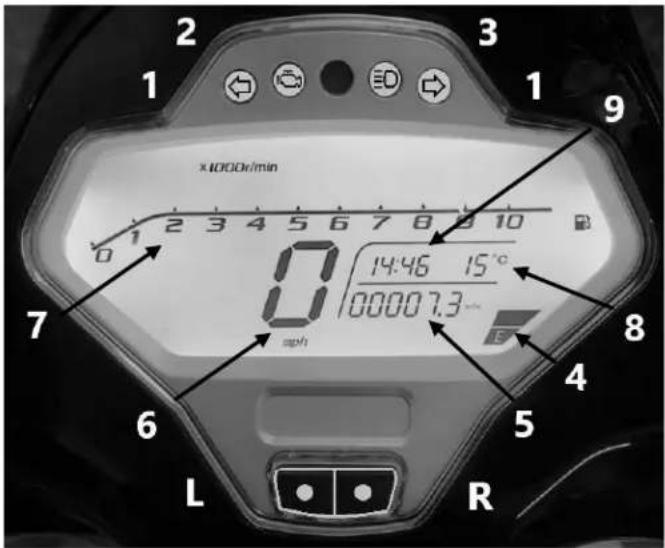
Dashboard
-
Directional Indicator Illuminates green when turn signal button is pressed to the left or right and signal is on.
-
Check Engine Indicator Illuminates orange if there is an engine problem.
-
High Beam Indicator Illuminates blue when high beam switch is selected.
-
Fuel Level Indicator Current fuel level indicated by F - Full to E - Empty.
-
Odometer / Trip Odometer Distance traveled during the life of the vehicle or current trip measured in miles or kilometers.
-
Speedometer Current vehicle speed in miles per hour (mph) or kilometers per hour (km/h).
-
Engine Speed Current engine speed measured in thousands of revolutions per minute (x1000 rpm).
-
Temperature Current ambient temperature in degrees Celsius (C).
-
Clock Current time in 24-hour military format.
Vehicle Layout

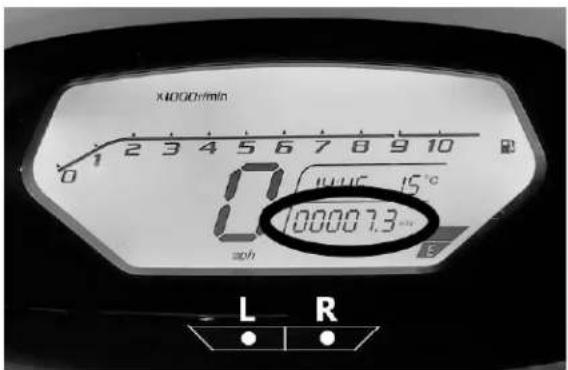
Odometer / Trip Odometer Selection
To change between odometer and trip odometer:
- Click the right button (R) to select odometer or trip odometer.
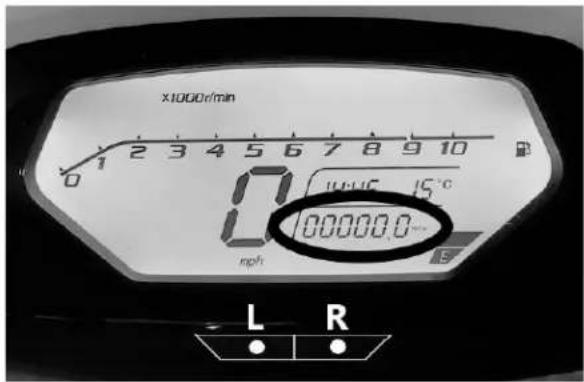
Trip Odometer Reset
While the trip odometer is visible:
- Hold the left button (L) down for 4 seconds to reset trip odometer.
Vehicle Layout

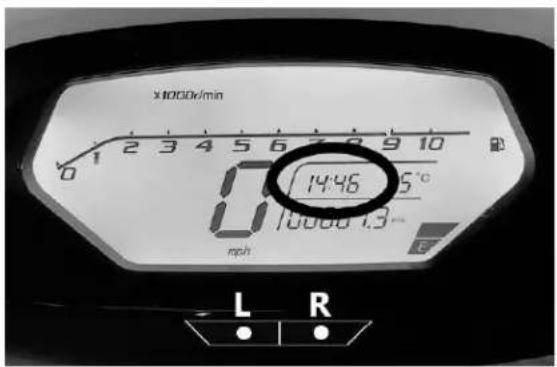
Clock set
Clock only displays in 24-hour format.
- Hold right button (R) for 4 seconds. Hour digits will flash.
- Click left button (L) repeatedly to change hours.
- Once hour is accurate, click right button (R) to switch to minutes.
- Click left button (L) repeatedly to change minutes.
- Click right button (R) once to exit.
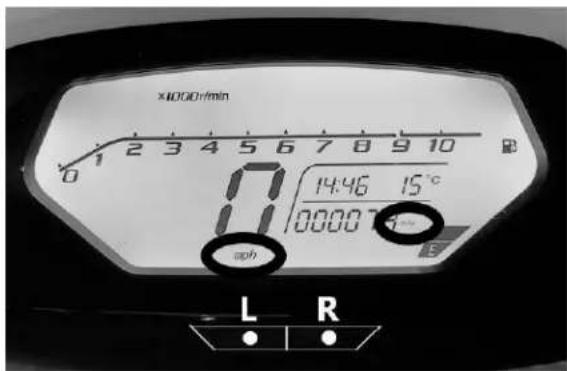
Miles / Kilometers Unit Selection
There are two options for unit selection:
- Distance measured in miles and speed measured in miles per hour (mph).
- Distance measured in kilometers (km) and speed measured in kilometers per hour (km/h).
To change from current unit option to the other unit option, hold the left button (L) down for 4 seconds.
Vehicle Layout

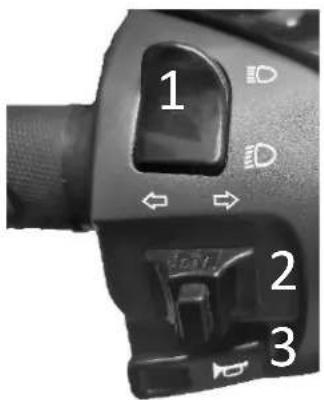
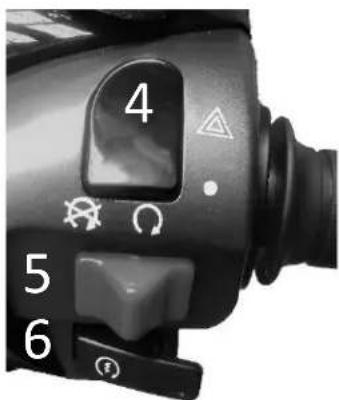
Handlebar Controls
- Headlight Switch
Press up for HIGH Beam
Press down for LOW Beam
- Turn Signal Switch
Press switch left to signal a LEFT turn.
Press switch right to signal a RIGHT turn.
Press center button to turn indicator OFF.
- Horn
Press in to sound the HORN.
- Hazzard Switch
Press up to turn on HAZZARD flashing turn signals.
Press down to turn OFF flashing turn signals.
- Emergency Stop Switch
Press switch right to select RUN position to operate vehicle.
In an emergency, press switch left to STOP to stop the engine.
- Engine Start Button
Press button in with the ignition key in ON position and at least one brake lever engaged in to START the engine.
Left Handlebar Controls
Right Handlebar Controls
Vehicle Layout

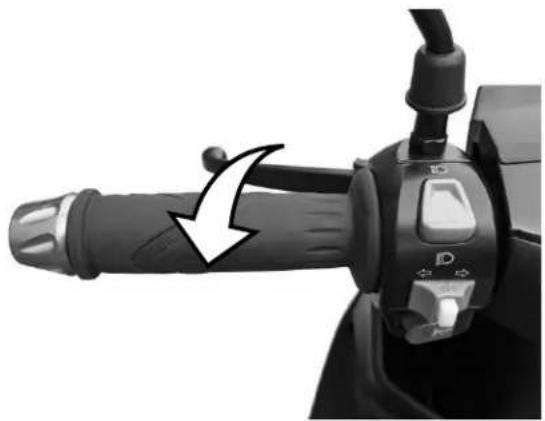
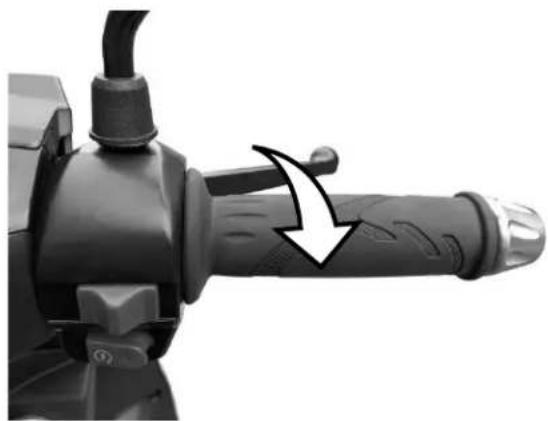
Front & Rear Brake Controls
Extend your fingers over the brake lever.
Pull lever toward the grip to actuate brake.
The brake lever will slow the vehicle with firm pressure.
REAR BRAKE LEVER
natural_image
Close-up of a black-and-white photo of a hand crank handle with a white arrow pointing to the left side (no text or symbols visible)FRONT BRAKE LEVER
natural_image
Close-up of a black hand crank handle with a white arrow pointing to the grip area (no text or symbols visible)WARNING
The brake lever should not touch the handlebar. If the brake lever feels soft or touches the handlebar, have your brake system inspected and adjusted or repaired immediately.
Vehicle Layout

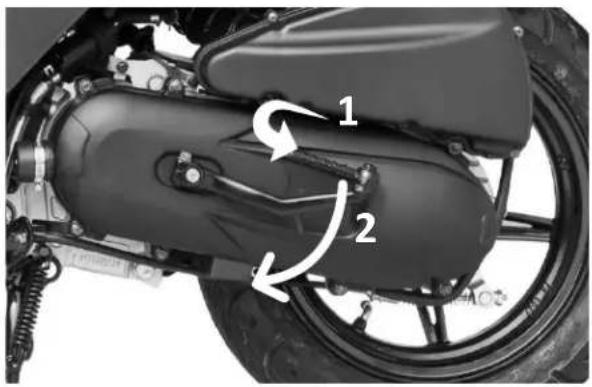
Kick Start
The kick-start lever can be used to start your engine as an alternative to the electric-start option.
Pull the kick-start foot peg (1) outward, away from the engine cover.
While facing forward and holding both handlebar grips, press down quickly with your foot to start the engine (2).
natural_image
Close-up of a motorcycle's internal components with numbered arrows indicating motion or assembly (no text or symbols present)Seat Lock
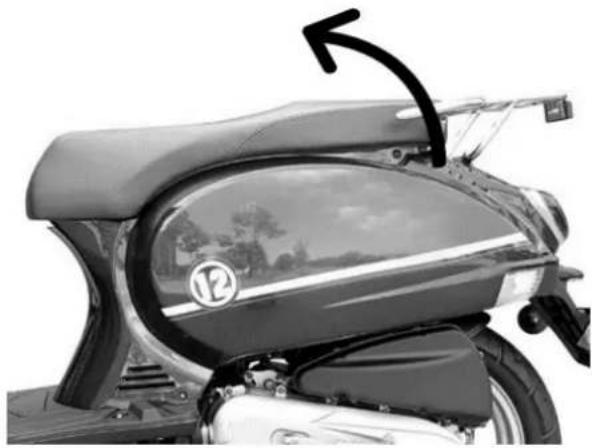
To access the under-seat storage area, insert key into the ignition and from the "OFF" position, press the key inward toward the front tire while simultaneously turning the key counterclockwise (1). The seat will release from its latch. Raise the seat forward toward the handlebar to expose the storage area (2).
Return the seat to rest on the latch and press down firmly on the rear portion of the seat to securely close it.
natural_image
Side view of a scooter's front bumper with visible branding and arrow indicator (no text or symbols beyond design)Vehicle Layout

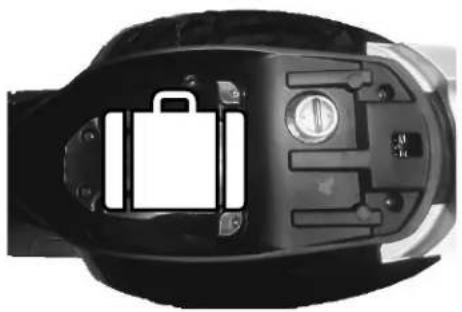
Primary Storage
The primary storage compartment is located under the seat.
The maximum storage load capacity is 20 lbs.
The storage compartment can become very hot when the ambient temperature is high, and the engine has been operating for a long period. Do not place perishable or temperature-sensitive items in the primary storage compartment.
The storage compartment is not waterproof. When it rains or after washing your vehicle, the storage compartment may get wet with moisture. Do not store water-sensitive items in the storage compartment.
natural_image
Top-down view of a scooter's front bumper with a white briefcase icon on the side (no text or symbols)Glovebox Storage
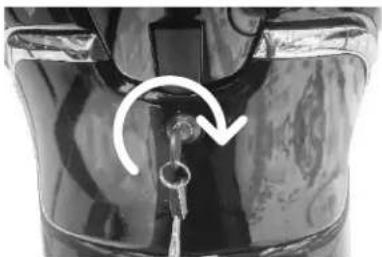
The glovebox is located under the ignition switch and the bag hook. Use the ignition key to open the glovebox by inserting key into the glovebox lock cylinder and turning to the right.
natural_image
Close-up of a mechanical component with a curved arrow indicating a motion or force (no text or symbols visible)After the glovebox is open, remove the key from the glovebox lock cylinder.
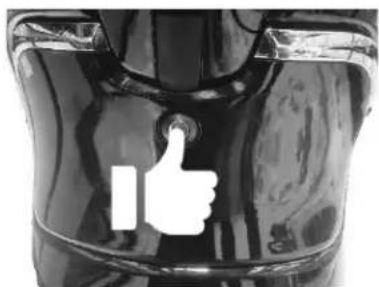
To close the glovebox, press firmly in the center of the glovebox lock cylinder with your thumb. The glovebox will latch closed.
natural_image
Close-up of a glossy black object with a white thumbs-up icon (no text or symbols)Vehicle Layout

Fuel Fill
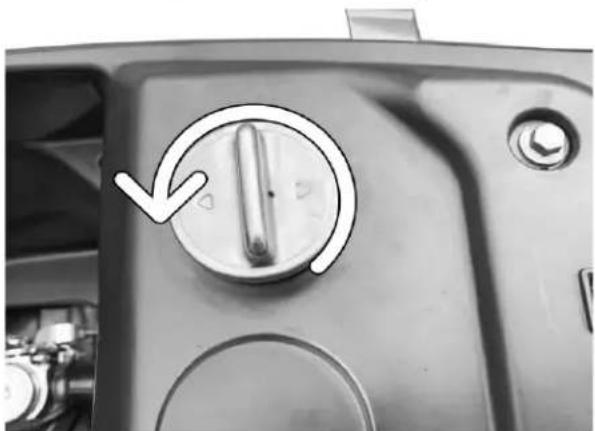
The fuel tank fill location is under the seat.
Insert key into ignition switch. From the OFF position, press key inward toward front wheel while turning key to the left to unlock the seat. Lift the seat to the upright position.
Turn the fuel cap counterclockwise to open.
natural_image
Close-up of a car battery casing with a circular dial indicator and arrow pointing to the left side (no text or symbols visible)Fill with unleaded fuel 91 octane or higher.
Take special care not to overfill fuel tank.
USB Charging
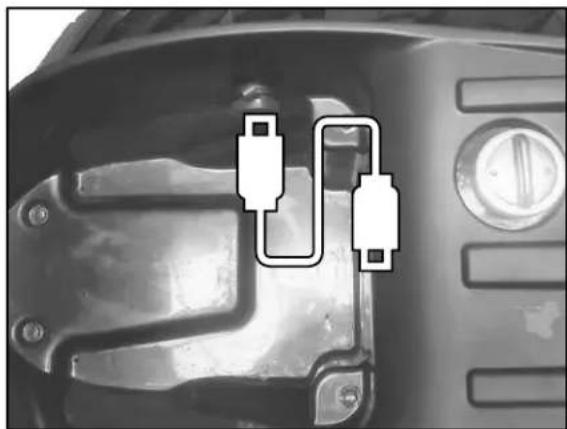
Your scooter is equipped with a USB Charging Port located in the under-seat storage compartment. Remove protective cover to expose USB charging port. This port is designed to charge small consumer electronics such as a cellular phone.
After use, cover the charging port with the protective rubber cover to prevent moisture and debris from entering the charging port.
natural_image
Close-up of a vehicle's front panel with two connected electrical connectors (no visible text or symbols)Pre-Ride Inspection

Perform a pre-ride inspection prior to every ride this is a checklist. Detailed procedures are in the pages that follow.
| ITEM | PROCEDURE |
| FRONT BRAKE | Check the brake function, clearance, brake-fluid level, inspect for fluid leaks, if necessary, add DOT 4 or higher brake fluid. Check brake lever free-play and adjust if necessary. Check brake pad wear. If the brake pads are worn down past the wear marks, replace pads immediately. |
| REAR BRAKE | Check the brake function, lever free-play and clearance. Make adjustments and lubricate cable if necessary. If the brake shoes are worn, replace immediately. |
| THROTTLE | Check to make sure the throttle actuates freely through the range. Lubricate throttle cable if necessary. Check throttle free-play. Adjust throttle cable tension if necessary. |
| LUBRICANTS | Check the engine oil level before each ride. If the engine oil level is low, refill with JASO MB 15W-40 engine oil |
| TIRES | Check tire pressure in both the front and rear tire, add air if necessary. Inspect tires. |
| CABLES | Check operation of all cables. Lubricate cables and adjust tension as necessary. |
| CENTER / SIDE STAND | Check center and side stands for operation, lubrication and secure mounting. |
| ASSEMBLY | Check all vehicle assembly to ensure fasteners are secure and assemblies function properly. |
| FUEL SYSTEM | Check fuel level. Fill if necessary. Ensure no fuel leaks are present. |
| LIGHTING | Check the function of all lights. Clean lenses as necessary. |
| SWITCHES | Check the function of all switches. |
| LOADING | Ensure your vehicle is not overloaded, is loaded in a balanced manner, and cargo is secured. |
Pre-Ride Inspection

Perform a pre-ride inspection prior to every ride.
Front Brake
The front brake is a hydraulic disk type. Inspect the brake system prior to each ride.
Properly functioning brake systems are vitally important to your personal safety.
Check for fluid leaks, fluid level, brake pad wear, and rotor condition. Also check lever free-play frequently.
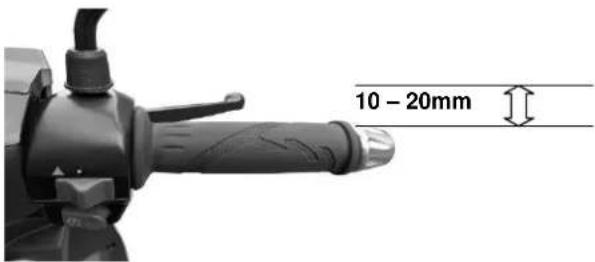
Pull the brake lever lightly until you feel tension, then check the lever free-play.
WARNING
A brake lever that is not firm when engaged implies there is a problem with the brake system. Do not drive your vehicle until the problem has been resolved. Bring the vehicle to your authorized Genuine Scooter Company dealer for repair.
Front Brake lever free-play: 10 - 20mm
If the brake lever has no free-play or is too loose, there is a potential brake system fault. Inspect brake system thoroughly.
Front Brake Fluid
Check all joints along the brake hose for any fluid leaking from the joint or the brake cylinder. Leakage has occurred if you see wet or oxidized fluid sludge.
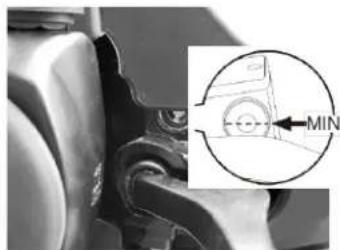
Check brake fluid level sight glass at base of lever to determine brake fluid level. Fluid should be above the bottom half of the sight glass.
Add brake fluid if necessary.
natural_image
Close-up of a mechanical component with an inset showing a circular detail labeled 'MIN' (no text or symbols on the main subject)Brake Fluid specification: DOT4
WARNING
Contact your Genuine Scooter Company dealer immediately to repair any brake fluid leaks. A leak could result in loss of hydraulic pressure to your brake system rendering the front brake useless.
Pre-Ride Inspection

Perform a pre-ride inspection prior to every ride.
Front Brake Disc and Pads
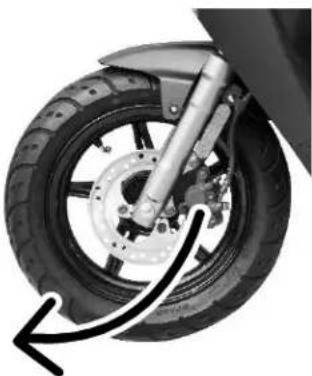
Inspect the brake disc for wear, glazing and/or warping. Inspect the brake pads to ensure the pad thickness is not beyond the wear limit:
Wear Limit: 2mm
If the brake pad wears entirely before replacement, damage to the disc and loss of braking ability can occur.
natural_image
Close-up of a motorcycle wheel and tire assembly with a curved arrow indicating motion direction (no text or symbols)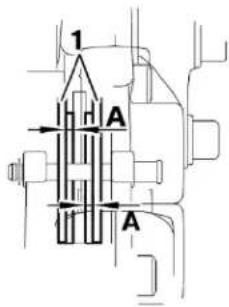
Rear Brake
The rear brake is a hydraulic disk type. Inspect the brake system prior to each ride.
Properly functioning brake systems are vitally important to your personal safety.
Check for fluid leaks, fluid level, brake pad wear, and rotor condition. Also check lever free-play frequently.
Pull the brake lever lightly until you feel tension, then check the lever free-play.
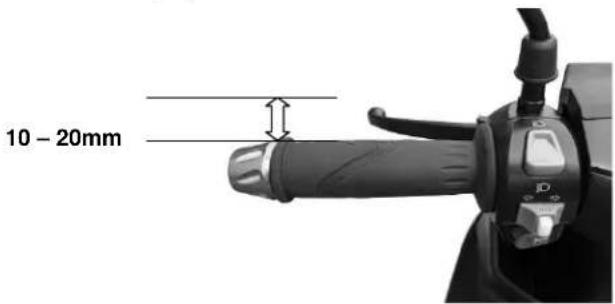
Rear Brake Lever Free-Play: 10 - 20mm
If the brake lever has no free-play or is too loose, there is a potential brake system fault. Inspect brake system.
Pre-Ride Inspection

Perform a pre-ride inspection prior to every ride.
Rear Brake Fluid
Check all joints along the brake hose for any fluid leaking from the joint or the brake cylinder. Leakage has occurred if you see wet or oxidized fluid sludge.
Check brake fluid level sight glass at base of lever to determine brake fluid level.
Fluid should be above the bottom half of the sight glass.
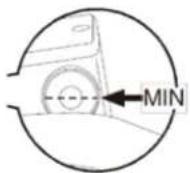
Add brake fluid if necessary.
Brake Fluid specification: DOT4

WARNING
Contact your Genuine Scooter Company dealer immediately to repair any brake fluid leaks. A leak could result in loss of hydraulic pressure to your brake system rendering the front brake useless.
Rear Brake Disc and Pads
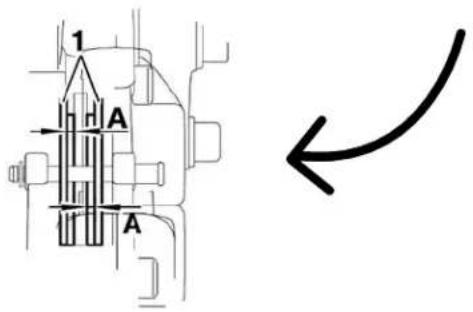
Inspect the brake disc for wear, glazing and/or warping. Inspect the brake pads to ensure the pad thickness is not beyond the wear limit.
Brake Pad Wear Limit: 2mm
If the brake pad wears entirely before replacement, damage to the disc and loss of braking ability can occur.
Pre-Ride Inspection

Perform a pre-ride inspection prior to every ride.
Throttle
Check the throttle cable for ease of movement by turning the twist grip from fully close to fully open.
Move the handlebar from left to right to ensure throttle is not applied when bars turn.
Measure throttle free-play by opening the grip slightly until resistance can be felt.
Throttle free-play: 1.5 - 3.5 mm
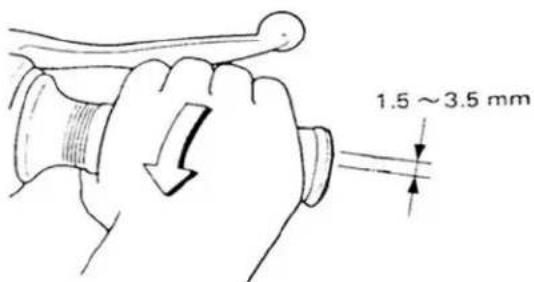
Adjust throttle as necessary to ensure proper free-play. Lubricate throttle cable tube and cable ends to ensure ease of operation.
Throttle Adjustment
Slide the protective rubber cover (1) to expose the throttle adjustment screw.
Loosen the lock nut (2) on the throttle cable.
Turn the adjustment screw (3) until the throttle free-play is within the proper range of movement.
Measure throttle free-play again by opening
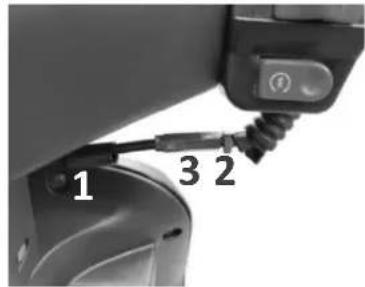
the grip slightly until resistance can be felt.
Throttle free-play: 1.5 - 3.5 mm
Once throttle free-play has been adjusted within the proper range, tighten lock nut (2).
Return the protective cover (1) to cover the throttle adjustment screw.

WARNING
An improperly adjusted throttle, non-lubricated or binding throttle cable is an extremely dangerous condition that can result in loss of control of your vehicle. Maintain and inspect frequently.
Pre-Ride Inspection

Perform a pre-ride inspection prior to every ride.
Engine Oil
Genuine Motor Oil is the oil brand recommended by Genuine Scooters. Your scooter operates under intense conditions, including higher engine speed, hotter temperatures, and higher compression ratios than other vehicle types. These extreme conditions subject the oil to significant operational stress and require a lubricant specifically designed for scooters.
Only use JASO MB 15W-40 engine oil.
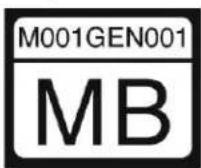
JASO MB oils are very low friction oils formulated for use in engines that do not have wet clutch systems. Other oil types may severely damage your engine and void any warranty. All JASO rated oils will display the JASO
oil classification on the bottle within an outlined border like the example above.
Many oils claim to "meet or exceed" JASO ratings but are not verified to meet these standards. If an oil does not have a 10-character oil code and the JASO MB rating prominently displayed on the label, then the oil has not been verified by the Japan Lubricating Oil Society and should not be used in your scooter.
Engine Oil Check
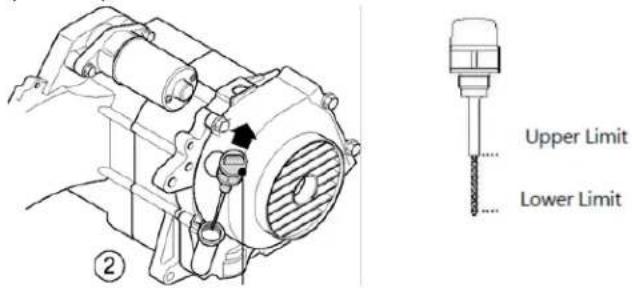
Start engine and run for 1 minute prior to checking oil level. The engine oil fill access is located near the lower right side of the vehicle. Remove the cap and check the oil level on the dipstick.
Add JASO MB 15W-40 engine oil if the oil level is low. Replace cap.

WARNING
Failure to use JASO MB 15W-40 oil and/or failure to maintain proper oil level in your engine may result in premature wear, severe engine damage or catastrophic engine failure.
Pre-Ride Inspection

Perform a pre-ride inspection prior to every ride.
Tires
Perform a physical inspection of both the front and rear tire. Inspect the tread depth to gauge tire wear.
Locate the initials "T.W.I." on the tire sidewall. This is the location of the Tread Wear Indicator.
Move inward toward the center of the tire to find the raised portion of the tire groove. This is the Tread Wear Indicator.
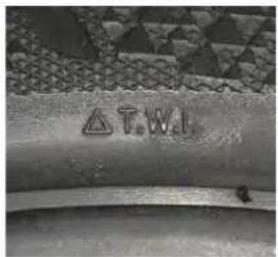
Replace tire when tread wear indicators come in contact with the road surface.
Inspect the tire for foreign material such as nails, screws, glass or other objects that may have become lodged in the tire. Visit a Genuine Scooter Company dealer for tire replacement if necessary.
Tire Pressure
Perform tire pressure checks while the tires are cold: Remove the valve stem caps. Check the tire pressure.
Standard Tire Pressure
Front: 32 psi
Rear: 32 psi
Adjust the tire pressure according to the total weight load. Re-install the valve caps.
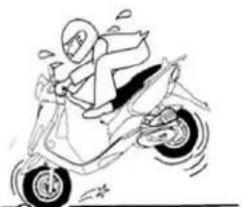
natural_image
Line drawing of a person riding a scooter with motion lines indicating speed (no text or symbols)TIRE PRESSURE TOO HIGH
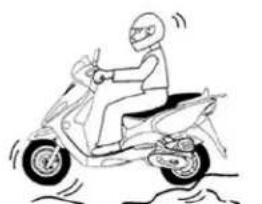
natural_image
Simple line drawing of a person riding a scooter with motion lines indicating speed (no text or symbols)TIRE PRESSURE TOO LOW
WARNING
Failure to maintain proper air pressure in your tires may result in tire failure and/or loss of control of your vehicle. Do not ride if your tire pressure is not at or near the recommended value.
Pre-Ride Inspection

Perform a pre-ride inspection prior to every ride.
Cables
Check all cables for integrity, connection and lubrication. If any fraying or other cable damage is observed, replace cable immediately.
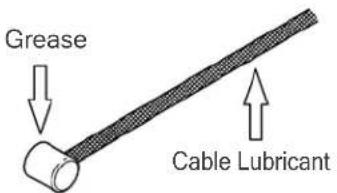
Use a cable specific lubricant on the braided portion of the cable. Use waterproof grease on the cable ends and pivot locations.
Center Stand and Side Stand
Inspect both the center stand and the side stand to ensure the mounting bolts securely fasten the stands to the frame and both stands are not loose.
Check spring tension to ensure stands will remain in stowed position when riding.
Assembly
Check all assemblies to ensure they are fastened tightly. This includes both a visual and physical inspection. Visually inspect the engine, fork assembly, wheel assemblies, handlebar, and other critical components.
Apply pressure in all directions for each assembly to check for unusual movement. If you notice any unusual vibration, shake or other indication that a problem may exist, have your vehicle towed to a Genuine Scooter Company dealer for inspection and resolution.
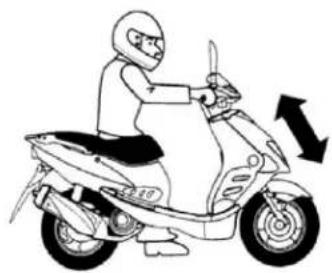
natural_image
Cartoon illustration of a person riding a scooter with motion arrows indicating speed (no text or symbols)FUNCTION CHECK
Pre-Ride Inspection

Fuel System
Check your fuel level prior to each ride.
Fuel Tank capacity: 5.5 liters
Fuel specification: Unleaded 91 octane or higher
Do not fill your fuel tank over the neck-line on the fuel tank inlet.
Fuel expands under the influence of heat. An over-filled fuel tank can cause fuel to spill when the vehicle is warm.
Inspect your fuel system including tank, hoses, petcock and filter for leaks. If a leak is found, repair immediately.

WARNING
Both fuel and fuel vapor are highly flammable. Do not smoke or bring an open flame near the fuel tank. Explosions can occur.
Lighting
Lighting is a very important safety feature that helps you navigate at night and communicate your actions with other drivers. Properly functioning lighting can make you more visible to other drivers, reducing the possibility of an accident.
Check the front and rear turn signal indicators, head light, tail - light, brake light, speedometer backlighting, and all indicator lights to assure they are in proper working order.
Make sure all lenses are clean of dirt and debris.
Switches
Check the function of all switches for lighting, signals, horn, etc. Repair as necessary.
Loading
Load your scooter properly. An improperly loaded scooter can cause an accident.
- Make sure the left-to-right weight distribution is balanced.
- Check that all fasteners are correct and tight.
- Do not transport bulky loads.
- Do not load your vehicle in a manner that covers lighting or impedes the movement of any vehicle component.
Operation

Vehicle Operation
Before starting your vehicle, you should be familiar with all operations and functions of this vehicle. You should have completed the pre-ride inspection, and you should be wearing safety gear.
If this is the first time you are operating your vehicle, you should thoroughly review the "Initial Engine Run-In" section on the next page.
Vehicle Start using Electric-Start Method
1) Ensure the kill switch is in the RUN position.
2) Insert the key into the Ignition Switch and turn to ON.
3) With the throttle completely closed, pull in either brake lever & simultaneously push and hold the start button. Once the engine starts, release the start button.
Do not press and hold start button for more than 5 seconds at a time as this can damage the start system. If the vehicle has difficulty starting after pressing the start button for 5 seconds, release the start button. Wait 10 seconds between attempts. Try to start the vehicle again for up to 5 seconds at a time.
If your vehicle does not start after several attempts, start your vehicle using the kick start method.
Vehicle Start using Kick-Start Method
1) Place vehicle on the center stand.
2) Ensure the kill switch is in the RUN position.
3) Insert the key into the ignition and turn to ON position.
4) Open the kick-start lever footpeg.
5) Grasp handlebar grips firmly, place your foot on the kick-start lever footpeg, and kick downward in a rapid motion.
6) Kick repeatedly until engine starts.
7) After starting, return kick-start lever footpeg to normal position.
| NOTE | |
| It is not necessary to hold the brake lever in when starting your vehicle with the kick-start method. | |
If your vehicle does not start after trying both the electric and kick start methods, you should contact your Genuine Scooter Company dealer for assistance.
Operation

Initial Engine Run-In
When your engine is new or when you have installed new engine components, it is very important to follow this run-in procedure. During this period, each part within the engine will obtain proper operating tolerances. Following this procedure will maximize engine life.

CAUTION
During the first 500 miles of operation, avoid wide-open throttle operation or any operation that may cause high engine temperatures.
0 - 100 miles
Avoid opening the throttle beyond 1/2 throttle. Cool down the engine for 10 minutes, after every 30 minutes of operation. Do not operate at a constant speed; change your speed regularly.
100 - 300 miles
Avoid opening the throttle beyond 1/2 throttle for extended periods of time. Do not open throttle beyond 3/4 throttle.
300 - 500 miles
Avoid opening the throttle beyond 3/4 throttle.
Over 500 miles
Avoid long periods of wide-open throttle operation.
Engine Life
Your engine life is highly dependent upon how you operate and maintain your vehicle.
Your scooter is equipped with a CVT transmission and your engine will operate at maximum RPM when you are at maximum speed at wide-open throttle.
If you operate your scooter at maximum RPM for a long period, you will damage your engine. This is not considered normal operation.
Keep your maximum speed operation to short periods of time. If you are travelling a longer distance, slow or stop your vehicle regularly to allow the engine to cool.
The quality of oil that you use in your vehicle will also determine longevity. Please reference the Engine Oil section in this manual for the proper specification.

CAUTION
Operating your vehicle at wide-open throttle for any long duration generates excessive heat that can damage your engine.
Be aware of the length of full throttle operation and slow down periodically to allow the engine to cool especially in hot climates.
Always use JASO MB 15W-40 engine oil in your vehicle.
Operation

Engine Warm-Up
After engine start, allow the engine to come up to operating temperature by idling the engine for at least 1 minute and then using mild acceleration during the first 3 minutes of operation.
While the engine is warming up, sit on the scooter and adjust the rear-view mirrors to be able to see clearly behind you from both the right and left sides.
Riding
After engine warm up, you are ready to ride. Be sure you have completed the pre-ride checklist before each ride.
Use the throttle for controlling the general speed of your vehicle.
Use the brakes for slowing and stopping your vehicle.
Use the handlebars to control the direction of the vehicle.
Rider inputs will determine the behavior of the vehicle. Make sure you consider the weather, riding surface, traffic and all other circumstances that may alter the amount of time it will take to accelerate, stop and turn your vehicle.
Hold the rear brake lever and push the vehicle forward off the center stand.
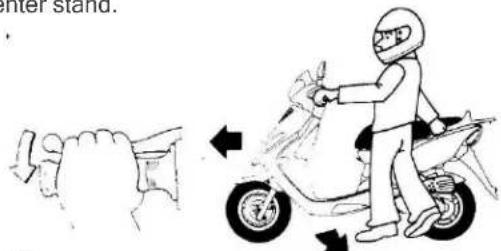
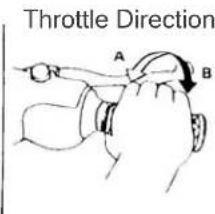
Throttle
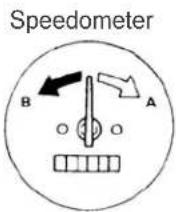
Gradually turn the throttle to accelerate.
A) Turning the throttle toward your body will increase your speed.
B) Turning the throttle away from your body will decrease speed.
Operation

Braking
You should always be prepared to use your brakes. Unexpected behavior of fellow motorists, road debris, animals and other obstacles can arise without notice. Becoming familiar with and actively covering your brakes while riding can drastically reduce braking distances and improve safety.
Applying the brakes
- Release the throttle
- Gradually pull the brake lever(s) toward the handlebar to apply the brake.
Applying both brakes simultaneously will result in a shorter stopping distance than actuating either brake individually.
The right-hand brake lever actuates the front brake.
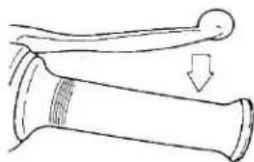
natural_image
Diagram of a mechanical component with a downward arrow indicating motion (no text or symbols)The left-hand brake lever actuates the rear brake.
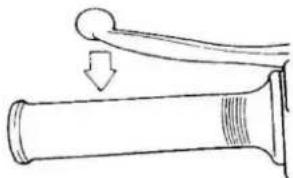
natural_image
Simple line drawing of a cylindrical object with a curved handle and an arrow indicating downward motion (no text or symbols)
WARNING
Applying the brake lever abruptly or forcefully can cause the wheel to stop suddenly which can result in a loss of control of your vehicle. This effect is more prominent when the road surface is wet, covered in dirt or other debris, or you are traveling over metal objects. Always maintain acute awareness and full control of the braking force you are applying. Consider all environmental circumstances when braking.
Operation

Engine Stop
To stop the engine, turn ignition key to OFF. (3) Remove the key.
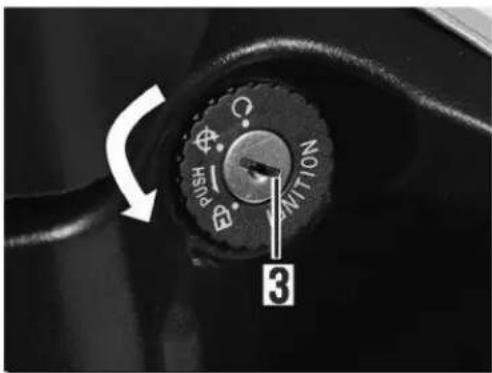
It is not recommended to use the kill switch for normal engine stops. Leave the kill switch in the RUN position under all normal vehicle operation. Use the kill switch for emergency engine stops.
Parking
Park your vehicle with the exhaust facing away from any pedestrian traffic.
natural_image
Side profile illustration of a scooter in motion (no text or symbols)Correct
natural_image
Illustration of a person riding a scooter with a dog nearby (no text or symbols)Incorrect
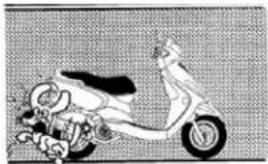
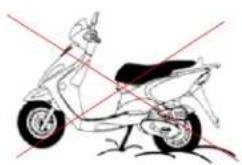
Place vehicle on the center stand whenever possible for the most stability.
If possible, park in front of larger vehicles so they can visibly see your parked vehicle.
Consider the firmness of the parking surface and any incline that may cause your vehicle to fall over.
natural_image
Line drawing of a scooter with red crosshair lines indicating lane or measurement (no text or symbols)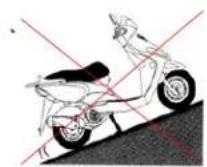
Periodic Maintenance

Periodic Maintenance and Repair
To ensure safe and effective performance of your vehicle, please check, adjust and lubricate your vehicle periodically. Safety should be every rider's priority and the maintenance table provided is an important guide.
Your vehicle is designed to be operated on normal paved surfaces. If you operate your vehicle in dusty, dirty and/or wet conditions, you will need to increase the maintenance frequency to account for the harsh operating conditions.
Failure to increase maintenance under harsh conditions will result in damage to the engine and other critical vehicle components.
If you are not technically skilled enough to perform any specific maintenance task, you should have the maintenance completed by an authorized Genuine Scooter Company dealer.
Items marked with a “#” symbol are recommended to be completed by an authorized Genuine Scooter dealer.
Periodic Maintenance Table
The following two pages contain a periodic maintenance table. Please review this thoroughly and follow all maintenance procedures as scheduled.
Once your vehicle exceeds the distances posted in the maintenance schedule, continue with the same periodic intervals for each item on the table.
CAUTION: IF YOU ARE UNFAMILIAR WITH PERFORMING THESE MAINTENANCE PROCEDURES, VISIT A GENUINE DEALER FOR ASSISTANCE.
| I = Inspection recommended, not requiredC = Clean or Replace if necessaryL = Lubrication | E = Mandatory Examination, Adjust/ Replace as necessaryR = Mandatory Replacement | ||||
| Component Assembly | Before each trip | 1st service after 800 km (497 mi) | Every 4000 km (2485 miles) or 6 months | Every 8000 km (4971 miles) or 12 months | Every 12,000 km (7456 miles) or 18 months |
| Air cleaner foam | I | E | R | ||
| Oil filter (screen) # | C | C | |||
| Engine oil use JASO MB 15W40 | Check oil level | R | R | ||
| Fuel filter | Check for Leaks | I | E | R | |
| Spark plug # | I | E | R | ||
| Ignition timing # | I | I | E | ||
| Valve clearance # | I | I | E | ||
| Compression check # | I | E | |||
| Idle speed # | I | I | E | ||
| Throttle cable adjustment | Check Free-Play | E | E | ||
| Transmission oil | Check fluid level | R | E | R | |
| Transmission check for leakage | Check for leaks | I | E | ||
| Crankcase check for leakage | Check for leaks | I | I | ||
| Crankcase ventilation Hoses | Check for leaks | I | I | ||
| Driving belt, Roller-weights # | E | E | R | ||
| Clutch discs # | E | E | R | ||
| I = Inspection recommended, not required E = Mandatory Examination, Adjust/ Replace as necessaryC = Clean or Replace if necessary R = Mandatory ReplacementL = Lubrication | |||||
| Component Assembly | Before each trip | 1st service after 800 km (497 mi) | Every 4000 km (2485 miles) or 6 months | Every 8000 km (4971 miles) or 12 months | Every 12,000 km (7456 miles) or 18 months |
| Bolts and nuts (engine) | Check Fasteners | I | E | ||
| Lighting system | Check Function | E | E | ||
| Exhaust system | Check for Leaks | I | I | ||
| Fuel tank, fuel hoses | Check for Leaks | I | I | ||
| Battery | Check for Leaks | I | I | ||
| Steering and bearings | Check for Play | E | E | ||
| Front and rear suspension | Check Play / Leaks | E | E | ||
| Shock absorption | Check Play / Leaks | E | E | ||
| Tire pressure | Check Pressure | E | E | ||
| Brake function, brake pads | Check Wear | E | E | ||
| Brake fluid | Check Level / Leaks | E | E | R / every 2 years | |
| Main-and side stand | Check Fasteners | E | E / L | ||
| Bolts and nuts (chassis) | Check Fasteners | I | I | ||
Periodic Maintenance

Air Cleaner and Air Filter
- Remove screws from air cleaner cover. (1)
- Clean housing of dirt and debris with a clean cloth.
- Inspect gasket for integrity.
- Inspect air filter and replace if dirty or maintenance interval has been reached.
- Reinstall air filter and cleaner cover, secure screws.
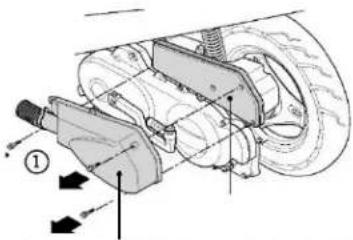
Gear Oil
Change the gear oil per the maintenance schedule and check level periodically.
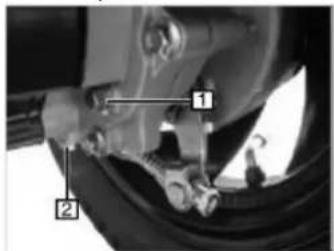
- Remove the fill screw (1) and drain screw (2). Drain all oil from gearbox.
- Reinsert drain screw (2) with new washer and tighten to torque specification.
- Fill with GL-4 85W-140 gear oil. Normal gear oil change volume is 130cc.
- Reinsert fill screw (1) and tighten to torque specification.
- Inspect for leaks on the shaft seals inside the transmission and on the output shaft near the rear wheel. If there is a leak, you will notice a build-up of oil and dirt. Resolve any leak immediately to prevent damage to the gearbox.
Transmission
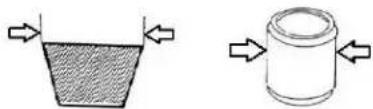
- Check the transmission for belt and roller wear.
- Rollers should not have major flat spots.
- Measure belt width to determine wear.
- Inspect belt for cracks, frays or other damage.
- Inspect clutch pads for wear, glazing.
natural_image
Two simple diagrams showing a container with arrows indicating flow or movement, next to a cylindrical container (no text or symbols)CAUTION: IF YOU ARE UNFAMILIAR WITH PERFORMING THESE MAINTENANCE PROCEDURES, VISIT A GENUINE DEALER FOR ASSISTANCE.
Periodic Maintenance

Spark Plug
The spark plug is one of the most important parts of the engine and it is easy to inspect.
The condition and color of your spark plug can provide important clues about the running condition of your engine. The ideal electrode color of a properly running vehicle is light brown. If the spark plug is white or black and wet, there may be a problem with your vehicle that needs to be resolved. Ask your Genuine Scooter Company dealer for assistance.
Standard spark plug: NGK CR6HSA
- Inspect the spark plug electrode. Replace if you see damage or extreme wear to the electrode.
- Clean the surface of the spark plug gently to avoid damage.
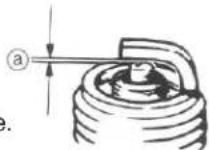
- Measure spark plug gap.
Spark plug gap: 0.7 - 0.8mm
- Reinstall spark plug and torque.
Torque: 11.7 N-m (8 ft-lb)
Brake Check
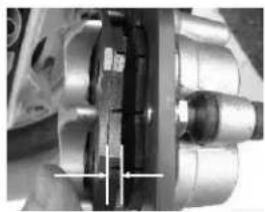
Actuate each brake for inspection. Observe the grooves in the pads. If the groove is gone or nearly gone, your brake pads need to be replaced.
1 Visually determine if the brake pads are worn to the bottom of the groove or measure the pad thickness.
If pad thickness is less than 2mm, replace the brake pads.
2 Visually inspect the brake rotor for scratches, warping, hotspots, or foreign material.
Any significant damage can indicate there is a problem with your brake system. Have your vehicle inspected immediately by an authorized Genuine dealer if any damage is observed.
natural_image
Close-up mechanical assembly showing a shaft and housing component (no visible text or symbols)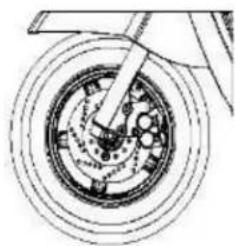
natural_image
Mechanical assembly diagram showing a rotating wheel with gear and shaft (no text or labels)CAUTION: IF YOU ARE UNFAMILIAR WITH PERFORMING THESE MAINTENANCE PROCEDURES, VISIT A GENUINE DEALER FOR ASSISTANCE.
Periodic Maintenance

Brake Fluid Check
Insufficient brake fluid will allow air into the brake system and may cause the brake system to fail. Please check the brake fluid level regularly and refill it if necessary.
- When checking the fluid level, please turn the handle bar to ensure the brake fluid indicator is horizontal.
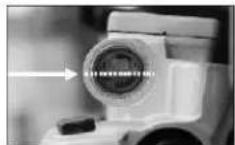
- Only use specified brake fluid, otherwise the oil seals will deteriorate. Deterioration can cause fluid leaks & loss of brake function.
Standard brake oil: FMVSS DOT4.

Caution: Do not mix brake fluid types.
-
Clean up any spilled brake fluid immediately with clean water. Brake fluid will erode painted surfaces and/or plastic.
-
If any problems are noticed with the fluid color, volume, leaking or any other problem with the brake system, have your Genuine Scooter Company dealer inspect immediately.
Suspension
Suspension is very important in vehicle stability. Malfunctioning suspension can cause your vehicle to behave in an unpredictable manner. Check regularly.
-
Check the inner surface of the front fork and rear shock for any wear, damage, or leakage.
-
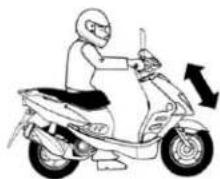
Park the vehicle on a flat surface prior to inspection. Hold the handlebar and keep the vehicle in a vertical position. Apply the front brake.
- Press and release the vehicle's front fork several times to check the front fork.
- Hold the rear grab-rail and press up and downseveral times to check the rear shock.
natural_image
Illustration of a person riding a scooter with a downward arrow indicating motion (no text or symbols)If the suspension functions are not smooth or any component is damaged, immediately contact your authorized Genuine Scooter Company dealer for service.
CAUTION: IF YOU ARE UNFAMILIAR WITH PERFORMING THESE MAINTENANCE PROCEDURES, VISIT A GENUINE DEALER FOR ASSISTANCE.
Periodic Maintenance

Fuse Replacement
- The main fuse is located next to the battery inside the floorboard section.
- In the event of a broken fuse, disconnect the main switch and any switch connected to circuits that have failed. Install a new fuse corresponding to the correct Amperage. Turn on the switch to check the function. If the new fuse burns immediately, contact your authorized Genuine Scooter Company dealer for service.

Caution
Do not use fuses that are out of specification compared to the original fuse. Any fuse installed that is not to specification can seriously damage the electrical system.
Battery
-
It is unnecessary to add any electrolyte or distilled water into the sealed battery installed on the vehicle. In case of any sign of leakage of battery acid, immediately contact your authorized Genuine Scooter Company dealer.
-
If the engine has difficulty starting, weak horn, dim lights, etc., remove the battery from the vehicle and follow the standard procedure to charge the battery.
Battery Maintenance
A trickle/maintenance charger is highly recommended if you do not use your vehicle daily. The battery will deplete over time if the vehicle is not run on a regular basis. Your Genuine Scooter Company dealer can recommend and install an appropriate charging device. You will be unable to start the vehicle with your electric start button if the battery has been depleted. Use the manual start option to start your vehicle.
Charge the vehicle's battery and fully disconnect the battery from the vehicle for long term storage such as winter. Store the battery in a warm location if possible. Charge the battery once every three months during this period.

Caution
Disassembling any sealed component on the battery can damage the battery. Never jump start the battery as this can damage vehicle electronics.
CAUTION: IF YOU ARE UNFAMILIAR WITH PERFORMING THESE MAINTENANCE PROCEDURES, VISIT A GENUINE DEALER FOR ASSISTANCE.
Periodic Maintenance

| Maintenance Plan Mileage | Actual Mileage | Date | Dealer Signature | Maintenance Plan Mileage | Actual Mileage | Date | Dealer Signature |
Periodic Maintenance

| Engine | Chassis | ||
| Type | LJ139QMB | Length | 1825 mm / 72 in |
| Displacement | 49.46cc | Width | 675 mm / 27 in |
| Bore | 37 mm | Height | 1145 mm / 45 in |
| Stroke | 46 mm | Wheelbase | 1280 mm / 50 in |
| Compression Ratio | 12:1 | Curb Weight | 94 kg / 207 lb |
| Cooling | Forced Air | Max Loading | 160 kg / 353 lb |
| Lubrication Method | Separated Pump | GVWR | 254 kg / 560 lb |
| Fuel Delivery | Electronic Fuel Injection (EFI) | GAWR - Front | 87 kg / 192 lb |
| Idle Speed | 2100 ± 100 rpm | GAWR - Rear | 167 kg / 368 lb |
| Spark Plug | NGK CR6HSA | Front Tire | 120/70-12 |
| Electrode Gap | 0.7-0.8 mm | Rear Tire | 120/70-12 |
| Start System | Electric and Manual Kick-Start | Electrical | |
| Transmission | Ignition System | EFI | |
| Type | Continuously Variable (CVT) | Generator | Flywheel Magnet Stator |
| Clutch | Dry, Centrifugal | Battery Type | 12V 7Ah MF |
| Fluids | Main Fuse | 15A Tube | |
| Engine Oil Type | JASO MB 15W-40 Motor oil | ||
| Engine Oil Capacity | ~ 1.0 Liter | ||
| Gear Oil Type | GL-4, 85W-140 | ||
| Gear Oil Capacity | 150cc (130cc replacement volume) | ||
| Fuel Type | Unleaded fuel, 91 Octane or higher | ||
| Fuel Capacity | 5.5 liters |
Reporting Safety Defects

If you believe that your vehicle has a defect which could cause a crash or could cause injury or death, you should immediately inform the National Highway Traffic Safety Administration (NHTSA) in addition to notifying Genuine Scooter Company.
If NHTSA receives similar complaints, it may open an investigation, and if it finds that a safety defect exists in a group of vehicles, it may order a recall and remedy campaign.
However, NHTSA cannot become involved in individual problems between you, your dealer, or Genuine Scooter Company.
To contact NHTSA, you may call the Vehicle Safety Hotline toll-free at 1-888-327-4236 (TTY: 1-800-424-9153); go to http://www.safercar.gov; or write to: Administrator, NHTSA, 400 Seventh Street, SW., Washington, DC 20590. You can also obtain other information about motor vehicle safety from http://www.safercar.gov.
WARRANTY INFORMATION
Your vehicle is covered by a manufacturer's Limited Warranty, an EPA Emissions Control System Warranty, and In California, a California Emissions Control System Warranty. Detailed warranty information can be found in your warranty booklet supplied separately from this manual.
This owner's manual should always remain in your vehicle for reference. This manual should be considered a permanent part of your vehicle. The information contained within this manual is the latest available at the time of publication. Genuine Scooter Company reserves the right to make changes to products and publications at any time without notice. There may be information in this manual that differs slightly from your vehicle as improvements and changes occur regularly.

GENUINESCOOTERS. COM 2700 W Grand Ave. Chicago, IL USA