
H-CDM8042 - Car radio HYUNDAI - Free user manual and instructions
Find the device manual for free H-CDM8042 HYUNDAI in PDF.


| Product Type | Car Stereo |
| Brand | Hyundai |
| Model | H-CDM8042 |
| Dimensions (W x H x D) | 178 x 50 x 160 mm (Single DIN) |
| Weight | Approx. 0.5 kg |
| Power Supply | 12V DC (negative ground) |
| Power Consumption | Max 15A (with full load) |
| Radio Bands | FM (87.5-108 MHz), AM (530-1710 kHz) |
| CD Player | Yes, supports CD, CD-R, CD-RW |
| USB Input | Front USB port for MP3/WMA playback |
| AUX Input | 3.5 mm front auxiliary input |
| Bluetooth | Yes, hands-free calling and audio streaming |
| Steering Wheel Control | Compatible with optional adapter |
| Display Type | LCD with white backlight |
| Remote Control | Included |
| Security | Detachable front panel with security code |
| Fuse Rating | 10A (blade type) |
| Maintenance | Clean with soft dry cloth; avoid solvents |
| Spare Parts Availability | Contact Hyundai service center |
| Repairability | Serviceable by qualified technicians |
Frequently Asked Questions - H-CDM8042 HYUNDAI
User questions about H-CDM8042 HYUNDAI
0 question about this device. Answer the ones you know or ask your own.
Ask a new question about this device
Download the instructions for your Car radio in PDF format for free! Find your manual H-CDM8042 - HYUNDAI and take your electronic device back in hand. On this page are published all the documents necessary for the use of your device. H-CDM8042 by HYUNDAI.
USER MANUAL H-CDM8042 HYUNDAI
CD/MP3/WMA-РЕСИВЕРСД/MP3/W
Table of contents
Dear customer!
Thank you for purchasing our product. For safety, it is strongly recommended to read this manual carefully before connecting, operating and/or adjusting the product and keep the manual for reference in the future.
Table of contents 2
Before you start 3
Utilization of the product 3
Important safeguards 3
Installation/Connection 4
Installation 4
General notes 4
Din Front/Rear-Mount 4
- DIN front-mount (Method A) 4
Dismantling the unit 4
Trim frame installation 5
- DIN rear-mount (Method B) 5
Detachable control panel 5
Anti-theft system 5
Connection 6
Connection diagram 6
ISO connection table 6
Operation 7
Control elements 7
Front panel 7
Inner panel 7
LCD layout 8
General operations.... 9
Turning on/off 9
Volume control 9
Mute function 9
Audio parameter setting 9
Beep 9
Loudness 9
Mode setting 9
AUX in jack 9
Radio operations 9
Band selection 9
Automatic tuning 9
Auto memory store 10
Preset scan 10
RDS function 10
AF (Alternative Frequencies)
function 10
TA (Traffic Alarm)/TP function.... 10
PTY (Program Type) 10
Other parameter setting 10
Local radio statino search 11
Other parameter setting 11
Disc/USB/SD/MMC operations 11
USB/SD/MMC notes 11
Insert/Eject disc 11
Inserting an SD/MMC card/
USB device 11
Stopping playback 11
Previous/net track 12
Fast forward/rewind 12
Playback modes 12
File/folder search 12
Notes on MP3 and WMA 12
Notes on creating your own CD-Rs
or CD-RWs containing MP3 files 13
General information 14
Handling compact discs 14
Cleaning discs 14
Cleaning the unit body 14
Accessories 14
Troubleshooting guide 15
Specification 16
Utilization of the product
If you want to dispose this product, do not mix it with general household waste. There is a separate collection system for used electronic products in accordance with legislation that requires proper treatment, recovery and recycling.
Please contact your local authorities for the correct method of disposal. By doing so, you will ensure that your disposed product undergoes the necessary treatment, recovery and recycling and thus prevent potential negative effects on the environment and human health.
Important safeguards
- Read carefully through the manual to familiarize yourself with this unit.
- Keep this manual handy as a reference for operating procedures and precautions. Do not allow persons who have not read through this manual to use this unit.
- "CLASS 1 LASER PRODUCT"
This product contains a laser diode of higher class than 1. Laser beams from the optical pickup are dangerous to the eyes. To ensure continued safety, do not remove any covers or attempt to gain access to the inside of the product. Refer all servicing to qualified personnel.
- Do not allow this unit to come into contact with liquids. Electrical shock could result. Also, damage to this unit, smoke, and overheating could result from contact with liquids or dust. Protect this unit from moisture.
- Make sure that foreign objects do not get inside the unit; they may cause malfunctions, or create safety hazards such as electrical shock or laser beam exposure.
- The beginning of operation is the moment of the unit installation. Before use the device in winter it is recommended to heat up the passenger compartment during 20 seconds or to the operation temperature.
• Using the unit with the temperature that goes beyond the operation temperature greatly
decreases the operation resource of the screen and other components of the unit and can result in an outage.
- Disconnect the vehicle's negative battery terminal while mounting and connecting the unit.
- The unit is designed for negative terminal of the battery, which is connected to the vehicle metal. Please ensure it before installation.
- When replacing the fuse, be sure to use one with an identical amperage rating. Using a fuse with a higher amperage rating may cause serious damage to the unit.
- Do not allow the speaker wires to be shorted together when the unit is switched on. Otherwise it may overload or burn out the power amplifier.
- Make sure you disconnect the power supply and aerial if you will not be using the system for a long period or during a thunderstorm.
- Make sure you disconnect the power supply if the system appears to be working incorrectly, is making an unusual sound, has a strange smell, has smoke emitting from it or liquids have got inside it. Let a qualified technician check the system.
• Always keep the volume low enough so that you can hear sounds from outside the vehicle. - Should this product fail to operate properly, contact your dealer or nearest service center.
Installation
General notes
- Choose the mounting location where the unit will not interfere with the normal driving function of the driver.
- Before finally installing the unit, connect the wiring and make sure that the unit works properly.
- Consult with your nearest dealer if installation requires the drilling of holes or other modifications of the vehicle.
- Install the unit where it does not get in the driver's way and cannot injure the passenger if there is a sudden stop, like an emergency stop.
- If installation angle exceeds 30° from horizontal, the unit may not perform properly.
- Avoid installing the unit where it would be subject to high temperature, such as from direct sunlight, or from hot air, from the heater, or where it would be subject to dust, dirt or excessive vibration.
Din Front/Rear-Mount
This unit can be properly installed either from 'Front' (conventional DIN Front-mount) or 'Rear' (DIN Rear-mount installation, utilizing threaded screw Holes at the sides of the unit chassis). For details, refer to the following illustrated installation methods.
1. DIN front-mount (Method A)
- Car dashboard
- Sleeve
- Screw
- Nut (5 mm)
- Spring washer
- Screw (5 x 25 mm)
- Metal strap
- Flat washer
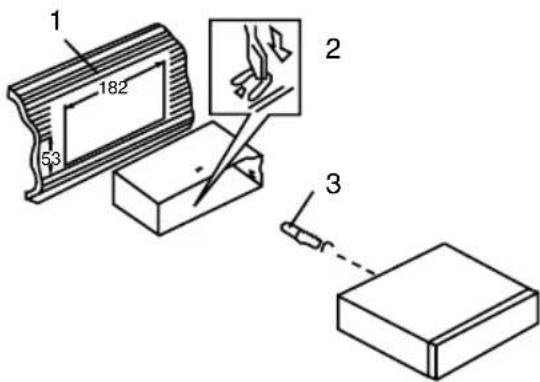
- Install the sleeve into the dashboard; ensure it is installed with the correct side and there are no obstacles (wires, dashboard elements, etc) for the unit installation.
- After installing the sleeve into the dashboard, bend tabs fitting to the size of the dashboard to fix the sleeve in place.
- Use the metal strap to fix the rear side of the unit. Determine a place for fixing and install the strap as shown in the picture. You can bend the strap to the needed angle with your hands.
- Make the necessary wire connections. Ensure the connections are correct.
- Install the unit into the sleeve until the side locks are fixed.

Dismantling the unit
a - Trim frame
b – Frame uninstall direction
c - Release key insertion
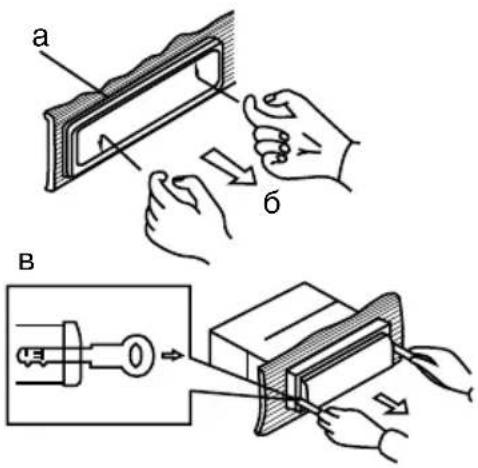
- Switch off the unit and detach the front panel.
- Insert your fingers into the groove in the front side of the trim frame (apply some effort to detach the frame). Pull the frame to detach it.
- Insert the supplied release keys into the both sides of the unit body to click, as shown in the picture. To extract the unit from the dashboard, pull the release keys or the unit body to pull it out. Before detaching the unit, ensure it is not fixed with the metal strap.
Trim frame installation
To install the trim frame, press it to the unit body and push it to fix it in place. This should be done before installing the front panel; otherwise you are not able to install the trim frame. When the trim frame being installed, the side with the groove should face down and fixed first.
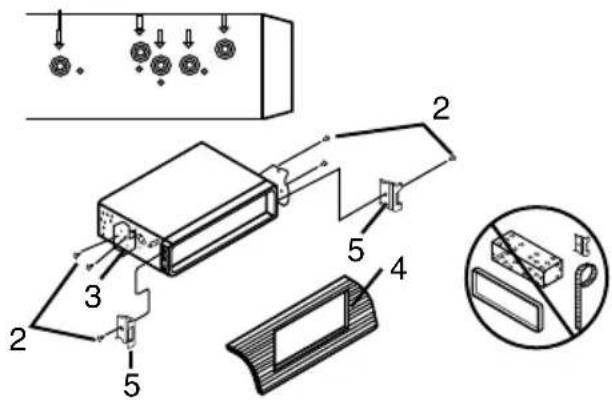
2. DIN rear-mount (Method B)
For this method, use the screw holes in the lateral sides of the unit. Fix the unit with the help of the factory radio mounting brackets.
- Select a position in which the screw holes of the brackets (3) are aligned with the screw holes in the unit body, and screw in two screws (2) in each side.
- Screw.
- Factory radio mounting brackets.
- Vehicle dashboard.
- Lock (remove this part).
The outer trim frame and mounting sleeve are not used for method of installation.
Detachable control panel
Insert the left locker of the body into the fixing hole on the side of the panel, then insert the right locker into the right hole of the panel. Press on the upper part of the panel until a click.
To detach the front panel, press OPEN button. Hold the panel at 45 degree angle and push it to the left to detach the right locker. Then detach the left locker.
The control panel can easily be damaged by shocks. After removing it, place it in a protective case and be careful not to drop it or subject it to strong shocks. The rear connector that connects the main unit and the control panel is an extremely important part. Be careful not to damage it by pressing on it with fingernails, pens, screwdrivers, etc.
If the control panel is dirty, wipe off the dirt with soft, dry cloth only. And use a cotton swab soaked in isopropyl alcohol to clean the socket on the back of the control panel.
Anti-theft system
The front panel of this unit can be stored in the included protective case when not in used and carried away when you leave the vehicle to deter theft.
Switch off the power of the unit. Detach the front panel, then put it to the protective case and take it with you.
Connection
Connection diagram
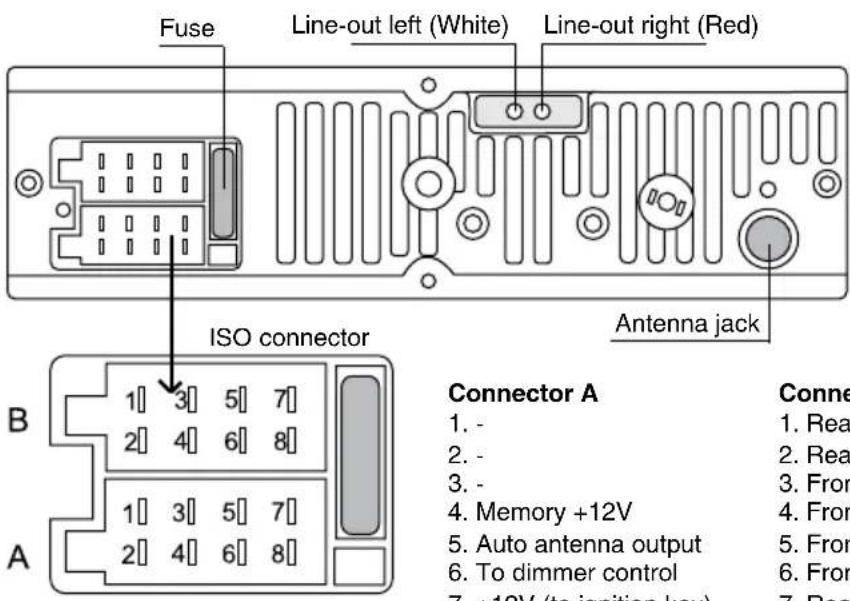
Connector A
-
-
-
- Memory +12V
- Auto antenna output
- To dimmer control
- +12V (to ignition key)
- Ground
Connector B
- Rear right speaker (+)
- Rear right speaker (-)
- Front right speaker (+)
- Front right speaker (-)
- Front left speaker (+)
- Front left speaker (-)
- Rear left speaker (+)
- Rear left speaker (-)
ISO connection table
| Location | Function | |
| Connector A | Connector B | |
| 1 | Rear Right(+)---Violet | |
| 2 | Rear Right(-)---Violet/Black Stripe | |
| 3 | Front Right(+)---Grey | |
| 4 | Battery 12V (+)/yellow | Front Right(-)---Grey/Black Stripe |
| 5 | Power Antenna/Blue | Front Left(+)---White |
| 6 | Dimmer/Orange | Front Left((-)---White/Black Stripe |
| 7 | ACC+/Red | Rear Left(+)---Green |
| 8 | Ground/Black | Rear Left(-)---Green/Black Stripe |
Power antenna wire is intended for power supply of the antenna and for remote control of an additional amplifier.
Control elements
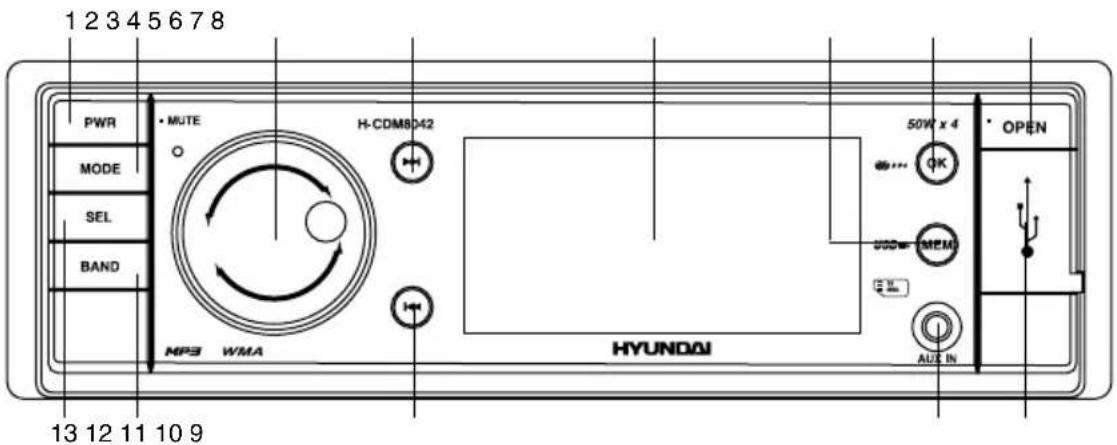
Front panel
- PWR/MUTE button
- MODE button
- VOLUME knob
- ▶ button
- Display
-
MEM button
-
OK button
- OPEN button
- USB slot
- AUX in jack
- ▶ button
- BAND button
- SEL button
Inner panel

- SD/MMC memory card slot
- EJECT button
- Panel status indicator
- RESET button (hole)
- Disc slot

Pressing RESET hole will erase the
clock setting and stored stations.
Panel status indicator lights up when you slide the panel down, flashes when you remove the panel.
LCD layout
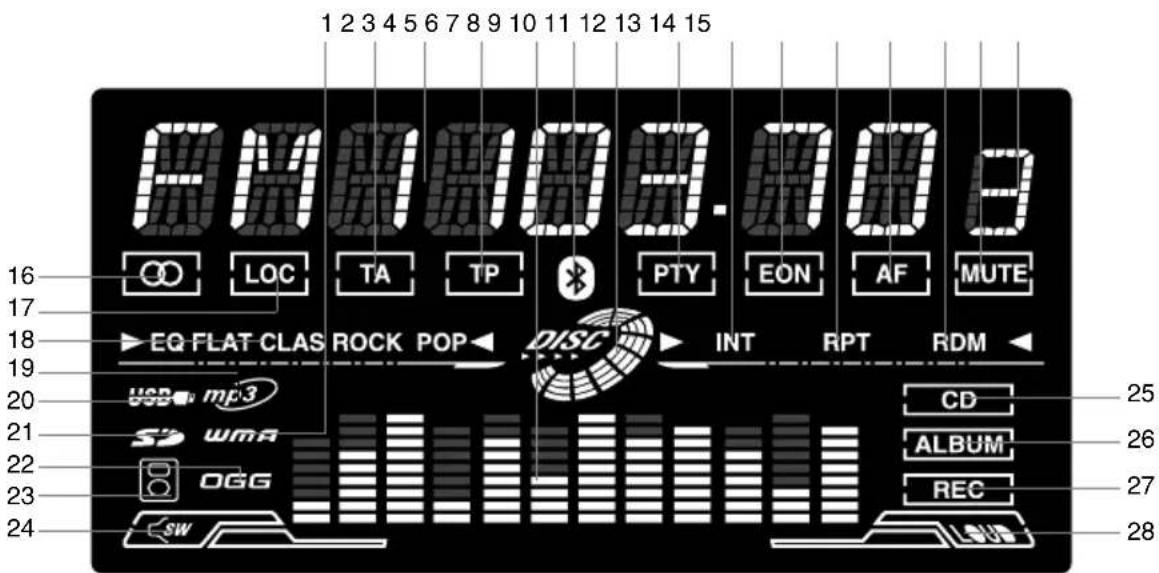
- WMA playback indicator
- TA function indicator
- Digit display
- TP function indicator
- Equalizer graphic indicator
- Not active
- Disc playback indicator
- PTY function indicator
- Intro playback indicator
- EON function indicator
- Repeat playback indicator
- AF function indicator
- Random playback indicator
-
Mute function indicator
-
Preset station number
- Stereo reception indicator
- Local reception indicator
- Active equalizer mode indicator
- MP3 playback indicator
- USB connection indicator
- Memory card connection indicator
- Not active
- Not active
- Subwoofer indicator (not active)
- CD playback indicator
- Not active
- Not active
- Loudness indicator
General operations
Turning on/off
Press any button (except OPEN button) to turn on the unit. Press and hold PWR/MUTE button to switch the unit off.
After the unit is off, the volume level and radio current settings will be memorized, and when you turn the unit on it will resume the stored status you previously set. To protect your ear from too loud sound, the unit volume level will turn to 50 automatically when you turn the unit on if current volume level setting is above 50 when your turn the unit off.
Volume control
Rotate VOLUME knob to adjust the volume level.
Mute function
Press PWR/MUTE button to turn the sound off. Press it again to turn the sound on.
Audio parameter setting
Press repeatedly SEL button to select the audio settings: VOLUME => BASS => TREBLE => BALANCE => FADER => DSP. Rotate VOLUME knob to adjust each setting.
For DSP: Choose DSP OFF => FLAT => CLASSICS => POP => ROCK => DSP OFF.
If the unit is turned off, all the settings of each mode will be saved. If cutting off battery power or resetting the unit, all the settings will return to factory default settings.
Beep
Press and hold SEL button to select BEEP ON; rotate VOLUME knob to toggle between BEEP ON (beep sound will be heard when buttons are pressed) and BEEP OFF.
Loudness
Press and hold SEL button, then press it repeatedly to select LOUD ON (LOUD OFF). Rotate VOLUME knob to select between
LOUD ON/LOUD OFF. LOUD function is to emphasize the bass output; the word LOUD ON indicates that the LOUD mode is on.
Mode setting
Press MODE button to select between unit operation modes: TUNER => CD => SD => USB => AUX.
USB, CARD, DISC modes will only show on the display when a USB device, memory card or a disc is inserted into the unit.
AUX jack
AUX-in jack is intended for connecting an external audio or video equipment to amplify the sound. If connection is made correctly, the audio signal from the external source will be translated through the acoustics of the head unit. This enables to adjust the volume and quality of the sounding. For example, you can connect an MP3-player to listen to tracks using the car acoustic system.
Radio operations
Band selection
Press repeatedly BAND button to select your desired radio band during RADIO mode: FM1, FM2, FM3, AM1 (M1), AM2 (M2). In each set of the bands you can store up to 6 preset stations, making total 30 preset memory stations.
Automatic tuning
To find a station, select a band first, then press and hold ◀◀/▶buttons, the automatic downward/upward search will start. It will play when a station is found.
Programming preset stations
- To store a station: Select a band (if needed); find a station by automatic tuning. Then press MEM button and rotate VOLUME knob to choose a memory position (1-6), and finally press OK button to confirm.
• To recall a station: Select a band (if
needed); press MEM button and rotate VOLUME knob to choose a number under which the needed station is stored (1-6), and finally press OK button to recall the station.
Auto memory store
Select a band, press and hold OK button to enter auto store mode. The radio will automatically store 6 stations to the 6 preset memories of the current band. To stop auto store, press this button again.
During auto station preset, the unit will search and store stations with the strong signal first, and then weaker signal stations until the memories are full.
Preset scan
Select a band, press OK button to scan all preset stations in the memories of the current band, each preset scan for 5 seconds. To stop preset scan, press the button again.
RDS function
RDS (Radio Data System) service availability varies with areas. Please understand if RDS service is not available in you area, the following service is not available, either.
AF (Alternative Frequencies) function
Press and hold SEL button, then press it repeatedly to select AF. Rotate VOLUME knob to set this function on/off. If the AF function is on, the display will show "AF".
When the radio signal strength is poor, enabling the AF function will allow the unit to automatically search another station with the same PI (Program Identification) as the current station but with stronger signal strength, so that you do not have to retune the stations when driving between different transmitter coverage areas. When AF symbol is on, it means RDS information is received; when AF symbol is flashing, it means RDS information is not yet received. If RDS service is not available in your area, turn off the AF mode.
TA (Travel Announcement) / TP (Travel Program Identification)
Enable or disable TA mode by pressing and holding BAND button. Default setting is OFF.
When TA function is activated, it will search the station with TA information automatically. If there is no TA information, it will search the station with TP information automatically, if there is no TP information either, it will return to the previous station after searching.
When receiving the station with TP information but without TA information, TP icon is on and TA icon keeps blinking; when receiving the station with TP and TA information, both TP and TA icons are on.
When playing in other mode and TA information is received, it will change to the radio mode automatically. After playing over, it will return to the previous mode.
PTY (Program Type) (for FM radio)
Press and hold MEM button to open PTY program type list, and turn VOLUME knob to select a PTY type. After selecting the program type you want, press MEM button to search. Press the button again to stop the PTY search. If PTY code is different or not available, then display blinks with "PTY NONE".
Press and hold SEL button, then press it repeatedly to select REG, then rotate VOLUME knob to set this function on/off. Default setting is off for REG.
When REG is enabled (on), the receiver accepts regional variants of the tuned station with REG icon turned on.
When REG is disabled (off), the receiver ignores regional variants.
Mono/Stereo control (in FM radio mode)
Press and hold SEL button, then press it repeatedly until the display shows STEREO (MONO). Turn VOLUME knob to switch between ON (stereo reception) or OFF (mono
reception). Improvement of reception of distant stations can be done by selecting mono mode, which may cut down some reception noise.
Local radio station search
Press and hold SEL button, then press it repeatedly until the display shows LOCAL (DISTANT). When the LOCAL function is on, the local stations (stations with weak radio signal) can be played. When the DISTANT function is on, both local and distant stations (stations with strong radio signal) can be played.
Setting other features
Press and hold SEL button, then press it repeatedly until the display shows one of these settings: MASK DPI => EON TA => TA VOL. Rotate VOLUME knob to adjust each setting, and press OK button to confirm the adjustment.
MASK DPI: During MASK DPI mode, the unit will mask only the AF which has different PI, this is the default mode; during MASK ALL mode, the unit will mask the AF which has different PI and no RDS signal with high field strength.
EON TA: Choose EON TA DX/LO. If you want to receive information from local stations only, select EON TA LO mode. Otherwise, select EON TA DX mode.
TA VOL: Adjust the volume for TA announcement.
Disc/USB/SD/MMC operations
USB/SD/MMC notes
USB functions (flash memory type) MP3 music play.
SD/MMC card support, 2in1 (SD/MMC) support.
USB flash memory.
FAT 12/ FAT 16/ FAT 32 is possible
- FAT 12/16 (dir: 200 support, file: 500 support),
• FAT 32 (dir: 200 support, file: 500 support).
- Filename: 32 byte/ Dir name: 32 byte.
- Tag (id3tag ver2.0).
• Title/ Artist/ Album: 32 byte support.
Multi card reader not support. USB 2.0 support.
USB format supports 2.0. Capacity: up to 4 Gb.
For correct and satisfactory operation, licensed SD/MMC memory cards of famous brands should be used with this unit. Avoid using memory cards of unknown brands. Capacity: up to 4 Gb.
Loading/Ejecting a disc
Open the front panel and insert a disc into the disc slot with label side up. The disc will be automatically loaded into the unit. The first file in the root folder will be played.
Open the front panel and press EJECT button to eject the disc from the slot. If the disc is not removed from the slot within several seconds, it will be automatically loaded into the slot again. When the disc is ejected and removed, the unit will automatically switch to another mode.
Inserting the SD/MMC card/USB device
Open the front panel and insert an SD/MMC memory card into the card slot. Open the USB slot cover on the front panel and insert a USB into the USB slot. Then the playing mode will be changed into MMC/SD or USB mode automatically. The first card/USB device track playback will start.
When SD/MMC card and USB device are both inserted, the playing mode will be changed into the mode of the device inserted later.
Stopping playback
The unit will automatically play from the first sound track recorded on a disc/SD/MMC/USB device. To ensure good system performance, wait until the unit finishes reading the disc/device information before proceeding. To stop playback, press MODE button and
select a different mode. When you go back to disc/USB/card playback mode, the playback will continue from the point it was stopped on.
Playing the previous/next track
During playback press button to play the previous track. Press ▶ button to play the next track.
Fast forward/rewind
Press and hold ▶buttons to select fast forward/backward playing. Release the button when the needed playback point of the track is reached.
When fast backward/forward playback reaches the previous or next track, the unit will resume normal playback.
Playback modes
Press and hold SEL button, then press it until FUNC is displayed. Rotate VOLUME knob to select SCAN/REPEAT/RANDOM/FUNC OFF and press OK button to confirm.
Scan: playing the first several seconds of each track.
Repeat: repeating the same track continuously.
Random: playing all the tracks in random order.
File/Folder Search Function (for MP3/WMA files)
The search modes only work with MP3/WMA discs and USB/SD/MMC with MP3/WMA files.
- File Number Search
Press MEM button once to enter file number search; symbol * blinks in middle of the display meaning the unit is ready to accept file number for search. Rotate VOLUME knob to input a digit (from 1 to total file number in the storage) of file you want to listen to. After completing input, press BAND button to play.
- File Name Search
Press MEM button twice; symbol * blinks on left side of the display. Rotate VOLUME knob to input the first alphabet (from A to Z) or digit (from 0 to 9) of file you want to listen to. Press SEL button to go to next digit. After completing input, press BAND button to play.
If there is no file found, the unit will return to initial input ready mode automatically.
- Folder Search
Press MEM button 3 times, "ROOT" will be displayed. Rotate VOLUME knob to choose between folders and subfolders.
The total number of folders on a disc/USB/memory card should not exceed 10.
Notes on MP3 and WMA
- MP3 is short for MPEG Audio Layer 3 and refers to an audio compression technology standard.
- This product allows playback of MP3 files on CD-ROM, CD-R or CD-RW discs.
- The unit can read MP3 files written in the format compliant with ISO 9660. However it does not support the MP3 data written by the method of packet write.
- The unit can not read an MP3 file that has a file extension other than “.mp3”.
- If you play a non-MP3 file that has the ".mp3" extension, you may hear some noise.
- In this manual, we refer to what are called "MP3 file" and "folder" in PC terminology as "track" and "album", respectively.
• Maximum number of directory level is 8, including the root directory. Maximum number of files and folders per disc is 256.
- The unit may not play tracks in the order of Track numbers.
- The unit plays only the audio tracks if a disc contains both audio tracks and MP3 files.
- When playing a disc of 8 kbps or "VBR", the elapsed playing time in the display window will not be correct and also the intro play may not function properly. "VBR": Variable Bit Rate.
- The unit supports the playback of WMA files. The playback of ID3 tags for WMA format is not guaranteed, it depends on versions and availability of Cyrillic alphabet.
- WMA (Windows Media Audio) – music data compression format, created by Microsoft Corporation. This format uses coding algorithm
for compression of initial audio-record, greatly decreasing the file size, but, saving the good sound quality even when the bit rate is low (for example, 64 Kbit/s).
- Remember that the unit may not play the tracks in order they are written on disc.
Notes on creating your own CD-Rs or CD-RWs containing MP3 files
- To enjoy high quality sound, we recommend converting to MP3 files with a sampling frequency of 44.1 kHz and a fixed bit rate of 128 kbps.
- Do not store more than 256 MP3 files per disc.
- For ISO 9660 - compliant format, the maximum allowable depth of nested folders is 8, including the root directory (folder).
- When CD-R disc is used, playback is possible only for discs, which have been finalized.
- Make sure that when MP3 CD-R or CD-RW is burned that it is formatted as a data disc and not as an audio disc.
- You should not write non-MP3 files or unneeded folders along with MP3 files on the disc otherwise it takes a long time until the unit starts to play MP3 files.
- With some CD-R or CD-RW media, data may not be properly written depending on their manufacturing quality. In this case, data may not be reproduced correctly. High quality CD-R or CD-RW disc is recommended.
- Up to 16 characters are displayed for the name of an Album or a Track. ID3TAG version 1.x is required.
• Note that the unit may not play tracks in the order that you wrote them to the disc.
Handling compact discs
- Do not insert anything other than a CD into the CD loading slot.
- Do not use cracked, chipped, warped, or otherwise damaged discs as they may cause skipping or noise damage the player.
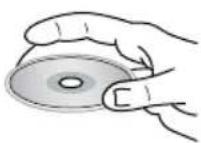
- Handle the disc only by the edges (as shown in the picture). To keep discs clean do not touch its surface.
• Store discs in their cases when not in use. - Do not expose discs to direct sunlight, high humidity, high temperature or dust.
- Prolonged exposure to extreme temperature (such as leaving the discs in your car during summertime) can wrap a disc.
- Do not attach labels, write on or apply chemicals to the surface of the discs.
- Do not touch the recorded surface of the discs.
- Use 12-cm CDs. Use only conventional, fully circular discs. Do not use shaped discs.

Cleaning discs
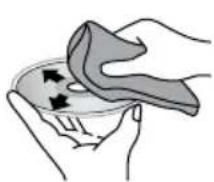
Fingerprints should be carefully wiped from the surface of disc with a soft cloth. Unlike conventional records, compact discs have no grooves to collect dust and macroscopic dirt, so gently wiping them with a soft cloth should remove must panicles. Wipe in a straight motion from the center to the edge.
Never use thinner benzine, record cleaner or anti static spray on a compact disc. Such chemicals can damage its plastic surface.

Cleaning the unit body
Wipe with a soft cloth. If the cabinet is very dampen (not dropping wet) the cloth with a weak solution of soapy water, and then wipe clean.
Accessories
- Receiver 1 pc
- Front panel 1 pc
- Protective case.... 1 pc
- ISO adaptor set 1 pc
- Mounting parts: Nut 5 mm.... 1 pc
Spring washer.... 1 pcs
Plain washer.... 1 pcs
Bolt 4 pcs
Screw 1 pc
Metal strap.... 1 pc
Release key 2 pcs
Mounting collar.... 1 pc
Trim frame.... 1 pc
Rubber cushion.... 1 pc
- Instruction manual 1 pc
- Warranty card 1 pc
- Consumer information 1 pc
Troubleshooting
Below is a table describing simple measures that can help you eliminate most problems likely to emerge when this unit is in use. If below measures do not help, turn to a service center or to the nearest dealer.
| Symptom Cause Solution | ||
| No power The car ignition is not on. If the power supply is properly connected to the car accessory switch the ignition key to “ACC”. | ||
| No sound Volume is in minimum. Adjust volume to a desired level. | ||
| Bad sound quality The installation angle is more than 30 degrees. | Adjust the installation angle to less than 30 degrees. | |
| Disc cannot be loaded or ejected | The unit already contains a disc. | Remove the disc in the player then put a new one. |
| Moisture condensation. Leave the unit idle for an hour, then retry. | ||
| Disc cannot be read | The disc is inserted upside down. | Insert the compact disc with the label side facing upward. |
| Compact disc is extremely dirty or defective. | Clean the disc or try to play a new one. | |
| Temperature inside the car is too high. | Cool off until the ambient temperature returns to normal. | |
| Buttons do not work | The built-in microcomputer is not operating properly. | Reset the unit with the help of RESET button. |
| Front panel is not properly fix into its place. | Install the front panel properly. | |
| The radio does not work | The antenna cable is not connected. | Insert the antenna cable properly. |
| The radio station automatic tuning does not work | The signals are too weak. Select stations manually. | |
| The display shows an error message (ERROR 1 – 11) one time. | Possible disc error. Reset the unit by pressing RESET hole.Ensure the disc is inserted correctly into the slot.Clean or change the disc. | |
| The display shows an error message (ERROR 1 – 11) repeatedly. | Unit operation error. Turn to a service center. | |
Specifications
General
Power supply 12 V DC
Current consumption max. 10 A
Maximum power output 50 W x 4 channels
Fuse 10A
Dimensions (L x W x H) 178 x 50 x 165 mm
Temperature range -20 ° C - +60 ° C
FM stereo radio
Frequency range 65.0 - 74.0/87.5 - 108.0 MHz
Presettable stations 18
Usable sensitivity 8 uV
MW Section
Frequency range 522 kHz-1620 kHz
Presetable stations 12
Usable sensitivity 30 dB
Disc player
System Compact disc audio system
Medium support CD/CD-R/CD-RW/USB/SD/MMC
Format support CDDA/MP3/WMA
Frequency characteristics 20 Hz - 20 kHz
ESP 40 sec. for CD/120 sec. for MP3/300
sec. for WMA
Mounting angle 0 - +/-30
Line out
Output: 2 channel RCA line-out (2V)
Specifications are subject to change without notice. Dimensions are approximate.
Снятие устройства
- Table of contents
- Dear customer
- Table of contents 2
- Before you start 3
- Installation/connection 4
- Operation 7
- General information 14
- Utilization of the product
- Important safeguards
- Installation
- General notes
- Din front/rear-mount
- Din front-mount (method a)
- Dismantling the unit
- Trim frame installation
- Din rear-mount (method b)
- Detachable control panel
- Anti-theft system
- Connection
- Connector a
- Connector b
- Control elements
- Front panel
- Inner panel
- Lcd layout
- General operations
- Turning on/off
- Volume control
- Mute function
- Audio parameter setting
- Beep
- Loudness
- Mode setting
- Aux jack
- Radio operations
- Band selection
- Automatic tuning
- Programming preset stations
- Auto memory store
- Preset scan
- Rds function
- Af (alternative frequencies) function
- Ta (travel announcement) / tp (travel program identification)
- Pty (program type) (for fm radio)
- Mono/stereo control (in fm radio mode)
- Local radio station search
- Setting other features
- Disc/usb/sd/mmc operations
- Usb/sd/mmc notes
- Loading/ejecting a disc
- Inserting the sd/mmc card/usb device
- Stopping playback
- Playing the previous/next track
- Fast forward/rewind
- Playback modes
- File/folder search function (for MP3/WMA files)
- Notes on MP3 and wma
- Notes on creating your own cd-rs or cd-rws containing MP3 files
- Handling compact discs
- Cleaning discs
- Cleaning the unit body
- Accessories
- Troubleshooting
- Specifications
- General
- Fm stereo radio
- Mw section
- Disc player
- Line out
- Снятие устройства
Brand : HYUNDAI
Model : H-CDM8042
Category : Car radio