CS50.4 - Receiver JBL - Free user manual and instructions
Find the device manual for free CS50.4 JBL in PDF.


User questions about CS50.4 JBL
0 question about this device. Answer the ones you know or ask your own.
Ask a new question about this device
Download the instructions for your Receiver in PDF format for free! Find your manual CS50.4 - JBL and take your electronic device back in hand. On this page are published all the documents necessary for the use of your device. CS50.4 by JBL.
USER MANUAL CS50.4 JBL
car audio power amplifier owner's manual

text_image
JBLtext_image
JBL CS SeriesTHANK YOU
for purchasing a JBL CS Series amplifier. In order that we may better serve you should you require warranty service for your new amplifier, please retain your original purchase receipt and return the enclosed warranty registration card.
INSTALLATION
WARNING: Playing loud music in an automobile can hinder your ability to hear traffic and permanently damage your hearing. We recommend listening at low or moderate levels while driving your car. JBL accepts no liability for hearing loss, bodily injury or property damage resulting from the use or misuse of this product.
IMPORTANT: To get the best performance from your JBL CS Series amplifiers, we strongly recommend that installation be entrusted to a qualified professional. Although these instructions explain how to install CS amplifiers in a general sense, they do not show specific installation methods that may be required for your particular vehicle. If you do not have the necessary tools or experience, do not attempt the installation yourself. Instead, please ask your authorized JBL car audio dealer about professional installation.
INSTALLATION WARNINGS AND TIPS
• Always wear protective eyewear when using tools.
- Turn off the audio system and other electrical devices before you start. Disconnect the (−) negative lead from your vehicle's battery.
- Check clearances on both sides of a planned mounting surface before drilling any holes or installing any screws. Remember that the screws can extend behind the surface.
- At the installation sites, locate and make a note of all fuel lines, hydraulic brake lines, vacuum lines and electrical wiring. Use extreme caution when cutting or drilling in and around these areas.
- Before drilling or cutting holes, use a utility knife to remove unwanted fabric or vinyl to keep material from snagging in a drill bit.
- When routing cables, keep input-signal cables away from power cables and speaker wires.
- When making connections, make certain they are secure and properly insulated.
- If the amplifier's fuse must be replaced, use only the same type and rating as that of the original. Do not substitute another kind.
CHOOSING A LOCATION AND MOUNTING THE AMPLIFIER
Choose a mounting location in the trunk or cargo area where the amplifier will not be damaged by shifting cargo. Amplifier cooling is essential for proper amplifier operation. If the amplifier is to be installed in an enclosed space, make sure there is sufficient air circulation for the amplifier to cool itself.
When mounting the amplifier under a seat, ensure that it is clear of all moving seat parts and does not affect the seat adjustments. Mount the amplifier so it is not damaged by the feet of backseat passengers. Make sure that the amplifier is mounted securely using nuts and bolts or the supplied mounting screws.
Mount the amplifier so that it remains dry – never mount an amplifier outside the vehicle or in the engine compartment.
POWER CONNECTIONS
The CS amplifiers require a reliable connection to the vehicle's electrical system in order to perform optimally. See Figure 1 for terminal connection locations. Please adhere to the following instructions carefully:
Ground Connection
Connect the amplifier's Ground (GND) terminal to a solid point on the vehicle's metal chassis, as close to the amplifier as possible. Refer to the chart below to determine minimum wire-gauge size. Sand away any paint from this location; use a star-type-lock washer to secure the connection.
Power Connection
Connect a wire (see chart at right for appropriate gauge) directly to the vehicle's positive battery terminal, and install an appropriate fuse holder within 18" of the battery terminal. Do not install the fuse at this time. Route the wire to the amplifier's location, and connect it to the amplifier's Positive (+12V) terminal. Be sure to use appropriate grommets whenever routing wires through the firewall or other sheet metal. Failure to adequately protect the positive wire from potential damage may result in a vehicle fire. When you are done routing and connecting this wire, you may install a 40A fuse at the battery.
Remote Connection
Connect the amplifier's Remote (REM) terminal to the source unit's Remote Turn-On lead using a minimum of 18-gauge wire.
NOTE: If your source unit does not have a remote turn-on connection, connect the amplifier's (REM) terminal to the vehicle's accessory circuit.
Speaker Connections
Refer to the application guides on the pages that follow. Speaker connections should be made using a minimum of 16-gauge wire.
Wire Gauge Chart
| Amplifier Maximum Minimum Model Current Draw Wire Gauge | |||
| CS50.4 | 40A | #8 | AWG |
| CS200.1 | 42A | #8 | AWG |
These recommendations assume 10' - 12' wire runs. If your installation differs markedly, you will need to adjust the wire gauge accordingly.
JBL
Figure 1. Terminal connection end plate.

text_image
GND REM +12V FUSE + - + POWER SPEAKER OUTPUTS CS200.1APPLICATIONS - CS200.1
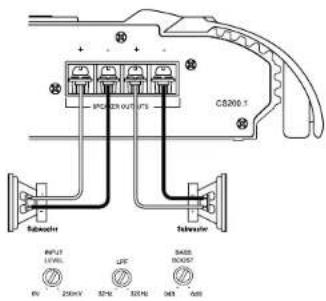
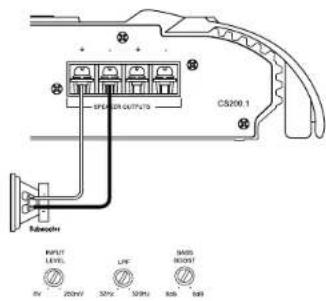
The CS subwoofer amplifier is a single-channel amplifier. There are two sets of terminals to make it easy to connect multiple woofers. Either set of (+/-) terminals may be used when connecting woofers.
To the right are two application diagrams to help plan your subwoofer system installation. Figures 2 and 3 show how to configure the CS200.1 subwoofer amplifier.
NOTE: For simplicity, Figures 2 and 3 do not show power, remote and input connections.
NOTE: Minimum speaker load is 2 ohms total.
text_image
S200.1 SPICUM OUT Subwoofer Subwoofer INPUT L/PAL EN 250V X 52Hz 320Hz 048 068 RASS BLOODFigure 2. CS subwoofer amplifier with two woofers connected.
text_image
CS200.1 INPUT LEVEL 0V 250V 30V 50PU 80S 649 LRF MASS BONIONFigure 3. CS subwoofer amplifier with one woofer connected.
APPLICATIONS - CS50.4
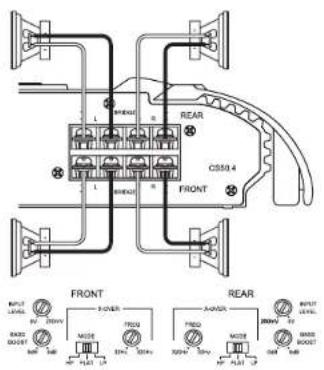
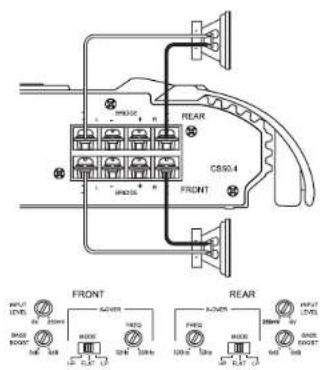
The CS50.4 can be set up for stereo 4-channel, 3-channel or bridged 2-channel operation, as shown in Figures 4 through 6.
NOTE: For simplicity, Figures 4 through 6 do not show power, remote and input connections.
NOTE: Minimum speaker impedance for stereo operation is 2 ohms. Minimum speaker impedance for bridged operation is 4 ohms.
text_image
REAR C550.4 FRONT FRONT MAX MAX MAX MAX MAX MAX MAX MAX MAX MAX MAX MAX MAX MAX MAX MAX MAX MAX MAX MAX MAX MAX MAX MAX MAX MAX MAX MAX MAX MAX MAX MAX MAX MAX MAX MAX MAX MAX MAX MAX MAX MAX MAX MAX MAX MAX MAX MAX MAX MAX Max Max Max Max Max Max Max Max Max Max Max Max Max Max Max Max Max Max Max Max Max Max Max Max Max Max Max Max Max Max Max Max Max Max Max Max Max MaxFigure 4. CS50.4 amplifier in 4-channel (stereo) operation to drive front and rear full-range speakers.

text_image
CS664 FRONT FRONT REAR RANGE R L M H R E F D W R V A B C D E F G H I J K L M N O P Q R S T U V A B C D E F G H I J K L M O P Q R S T U V A B C D E F G H I J K L M O P Q R S T U V A B C D E F G H I J K L M O P Q R SFigure 5. CS50.4 is set up for 3-channel operation to drive a set of full-range speakers and a subwoofer.
text_image
C690.4 FRONT REAR 120Ω 120Ω 120Ω 120Ω 120Ω 120Ω 120Ω 120Ω 120Ω 120Ω 120Ω 120Ω 120Ω 120Ω 120Ω 120Ω 120Ω 120Ω 120Ω 120Ω 120 Ω 120 Ω 120 Ω 120 Ω 120 Ω 120 Ω 120 Ω 120 Ω 120 Ω 120 Ω 120 Ω 120 Ω 120 Ω 120 Ω 120 Ω 120 Ω 120 Ω 125 Ω 125 Ω 125 Ω 125 Ω 125 Ω 125 Ω 125 Ω 125 Ω 125 Ω 125 Ω 125 Ω 125 Ω 125 Ω 125 Ω 125 Ω 125 Ω 125 Ω FRONT REARFigure 6. CS50.4 used in bridged 2-channel mode to drive a set of components or subwoofers. Set crossovers according to application.
JBL
CONTROLS AND SETUP
SETTING THE
CROSSOVER(S)
Determine your system plans and set the crossover mode switch accordingly. If your system design does not include a subwoofer with the CS50.4, set the crossover mode to FLAT and skip to "Setting Input Sensitivity."
Initially set the crossover frequency control midway. While listening to music, adjust the crossover for the least perceived distortion from the speakers, allowing them to reproduce as much bass as possible.
Systems using a separate subwoofer set the crossover mode to HP (high pass) for your full-range speakers. Adjust the crossover frequency to limit bass and provide increased system volume with less distortion.
For subwoofers, choose the highest frequency that removes vocal information from the sound of the subwoofer.
If using the CS50.4 to drive a subwoofer(s), set the crossover mode to LP (low pass).
SETTING INPUT
SENSITIVITY
-
Initially turn the INPUT LEVEL control(s) to minimum (counter clockwise).
-
Reconnect the (−) negative lead to the vehicle's battery. Apply power to the audio system and play a dynamic music track.
-
On the source unit, increase the volume control to 3/4 volume. Slowly increase the INPUT LEVEL control(s) toward three o'clock until you hear slight distortion in the music. Then reduce the INPUT LEVEL slightly until distortion is no longer heard.
NOTE: After the source unit is on, blue LEDs (on the top panel) will light, indicating the amplifier is on. If not, check the wiring, especially the remote connection from the source unit. Also refer to "Troubleshooting" guide below.
SPECIFICATIONS
CS200.1
• 236W RMS x 1 channel at 4 ohms and ≤1% THD + N
• Signal-to-noise ratio: 100dBA (reference 1W into 4 ohms)
• 338W RMS x 1 channel at 2 ohms, 14.4V supply and ≤1% THD + N
• Dynamic power: 464W at 2 ohms
• Effective damping factor: 6.395 at 4 ohms
• Frequency response: 10Hz – 302Hz (-3dB)
• Maximum input signal: 7.5V
• Maximum sensitivity: 260mV
• Output regulation: .073dB at 4 ohms
• Dimensions {L x W x H}: 11-5/8" x 12-5/16" x 2-3/8"
- Fuses: 20A x 2

CS50.4
- 67W RMS x 4 channels at 4 ohms and ≤1% THD + N
• Signal-to-noise ratio: 86dBA (reference 1W into 4 ohms)
- 82W RMS x 4 channels at 2 ohms, 14.4V supply and ≤1% THD + N
- 162W RMS x 2 channels at 4 ohms, 14.4V supply and ≤1% THD + N
• Dynamic power: 145W at 2 ohms
• Effective damping factor: 6.395 at 4 ohms
• Frequency response: 10Hz – 27kHz (-3dB)
• Maximum input signal: 6V
• Maximum sensitivity: 240mV
• Output regulation: .032dB at 4 ohms
• Dimensions {L x W x H}: 15-1/8" x 12-5/16" x 2-3/8"
- Fuses: 25A x 2
Declaration of Conformity

We, Harman Consumer International 2. route de Tours 72500 Chadau-du-Loir France
declare in own responsibility that the products described in the owner's manual are in compliance with technical standards. EN 55013-2001 EN 55020-2002

Emmanuel Milot Harman Consumer International Chateau-du-Loir, France 3/04
JBL Consumer Products
250 Crossways Park Drive, Woodbury, NY 11797 USA
© 2004 Harman International Industries, Incorporated
JBL is a registered trademark of Harman International Industries, Incorporated.
Part No. CSAMPOM3/04
H A Harman International Company
TROUBLESHOOTING
SYMPTOM LIKELY CAUSE SOLUTION
| No audio No voltage at BATT+ Check voltages at (POWER LEDs or REM terminals, amplifier terminals are off) or bad or no ground with VOM connection | ||
| No audio Amplifier is Make sure amplifier (POWER overheated LEDs are on) | cooling is not blocked | at mounting location; verify speaker-system impedance is within specified limits |
| Voltage more than 16V or less than 8.5V on BATT+ connection | Check vehicle charging system | |
Features, specifications and appearance are subject to change without notice.
SYMPTOM LIKELY CAUSE SOLUTION
| No audio (POWER LEDs flash) | Voltage less than 9V on BATT+ connection | Check vehicle charging system |
| DC voltage on amplifier output | Amplifier may need service; see enclosed warranty card for service information | |
| Distorted audio | Input sensitivity is not set properly, or amplifier or source unit is defective | Check INPUT LEVEL setting; or check speaker wires for shorts or grounds |
| Distorted audio and POWER LEDs flash | Short circuit in speaker or wire | Remove speaker leads one at a time to locate shorted speaker or wire, then repair |
| Music lacks "punch" connected properly | Speakers are not connections for | Check speaker proper polarity |
JBL
www.jbl.com