DHP-W313AV - Powerline Adapter D-LINK - Free user manual and instructions
Find the device manual for free DHP-W313AV D-LINK in PDF.


User questions about DHP-W313AV D-LINK
0 question about this device. Answer the ones you know or ask your own.
Ask a new question about this device
Download the instructions for your Powerline Adapter in PDF format for free! Find your manual DHP-W313AV - D-LINK and take your electronic device back in hand. On this page are published all the documents necessary for the use of your device. DHP-W313AV by D-LINK.
USER MANUAL DHP-W313AV D-LINK
natural_image
White electronic device with three green indicator lights labeled A, B, and C (no visible text or symbols on body)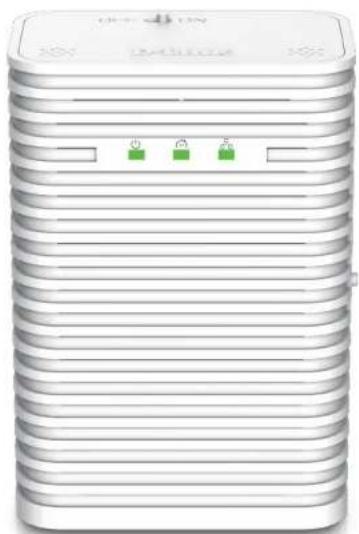
natural_image
White cylindrical electronic device with three green indicator lights on its side (no visible text or symbols)User Manual
Powerline AV 500 Wireless AC600 Starter Kit
DHP-W313AV
Preface
D-Link reserves the right to revise this publication and to make changes in the content hereof without obligation to notify any person or organization of such revisions or changes.
Manual Revisions
| Revision Date Description | |
| 1.0 05/20 /2015 • Initial release for A1 | version |
Trademarks
D-Link and the D-Link logo are trademarks or registered trademarks of D-Link Corporation or its subsidiaries in the United States or other countries. All other company or product names mentioned herein are trademarks or registered trademarks of their respective companies.
Copyright © 2015 by D-Link Corporation.
All rights reserved. This publication may not be reproduced, in whole or in part, without prior expressed written permission from D-Link Corporation, Inc.
This purpose of this product is to create a constant network connection for your devices. As such, it does not have a standby mode or use a power management mode. If you wish to power down this product, please simply unplug it from the power outlet.
Power Usage
This device is an Energy Related Product (ErP) with High Network Availability (HiNA), and automatically switches to a power-saving Network Standby mode within 1 minute of no packets being transmitted. If it is not needed during certain periods of time, it can be unplugged to save energy.
DHP-W312AV: Network Standby mode: 4.27W
DHP-308AV: Network Standby mode: 1.98W
Table of Contents
Preface....2
Manual Revisions....2
Trademarks 2
Power Usage 2
Product Overview....5
Package Contents 5
System Requirements....6
Introduction 6
Connections......8
DHP-W312AV 8
DHP-308AV 8
Top....9
LEDs 10
DHP-W312AV 10
DHP-308AV 10
Hardware Installation ....11
Wireless Installation Considerations 12
Powerline Installation Considerations....13
Safety....14
Configuration....15
Setup....15
Hybrid Link Setup....16
Wireless Settings 17
Network Settings....19
LAN Settings - Static IP 20
PLC Settings 21
Advanced 22
MAC Address Filter....22
Advanced Wireless....23
User Limit 24
Tools....25
Admin....25
Time 26
System....27
Firmware....28
System Check 29
Status....30
Device Info....30
Logs....31
Statistics....32
Wireless....33
IPv6....34
Wireless Security 35
What is WEP? 35
What is WPA?......36
Configuring WEP 37
Configuring WPA/WPA2 Personal....38
Connecting to a Wireless Network 39
Using Mac OS....39
Using Windows ^* 7....41
Using Windows 8 ....42
Table of Contents
Using Windows Vista ^® 46
Configuring Wireless Security....48
Using Windows ^a XP....50
Configuring WPA-PSK 51
Troubleshooting....53
Wireless Basics ....55
What is Wireless? 56
How does wireless work? 56
Wireless Local Area Network (WLAN) 56
Networking Basics....59
Check your IP address....59
Statically Assign an IP address....60
Technical Specifications 61
DHP-W312AV 61
DHP-308AV 63
Regulatory Information 64
Product Overview Package Contents

text_image
Vertical sequence of gray document icons with Chinese labels, likely representing a list or checklist system.D-Link DHP-W312AV PowerLine AV 500 Wireless AC600 Extender
Wi-Fi Configuration Card
Product Warranty
Quick Installation Guide
System Requirements
Network Requirements
- IEEE 802.11ac, 802.11n or 802.11g
• 10/100 Ethernet clients
Browser Requirements
- Internet Explorer 7.0 or higher
- Firefox 3.5 or higher
- Safari 4.0 or higher
- Chrome 8.0 or higher
Introduction
The DHP-W313AV Powerline AV 500 Wireless AC600 Starter Kit allows you to connect both wired and wireless computers, high-definition TVs, networking devices, and gaming consoles using the most pervasive medium in your home - the electrical wiring. Share Internet connections and experience smooth file transfers, streaming multimedia, online gaming and more. The Powerline AV 500 Wireless AC600 Starter Kit features easy plug-and-play installation and can be connected to any Ethernet-enabled device.
The Powerline AV 500 Wireless AC600 Starter Kit incorporates the latest technology to improve on the AV technology's data speeds over a home's existing electrical wiring. This fast transmission speed provides ample bandwidth suitable for streaming high-quality video HDTV signals while simultaneously providing high-speed Internet access throughout the home. With Quality of Service (QoS) support, the performance of applications which require real-time communication, such as VoIP phonecalls and multiplayer online games, will not be compromised even while streaming Internet TV and music.
Data Transmission Over electrical Wiring
The D-Link DHP-W313AV Powerline AV 500 Wireless AC600 Starter Kit, compliant with the HomePlug AV standard, uses your home's existing electrical wiring ^1 to create a network or extend your existing network. It turns every power outlet into a potential network connection to access digital media devices, game consoles, print servers, computers, and network storage devices throughout your home. Additionally, Wireless AC provides high speed transfers without the need for unsightly network cables.
Faster Wireless Speeds & Wider Operational Range
The Wireless AC technology incorporated into the DHP-W313AV kit offers increased speed and range beyond standard 802.11n technology. Initial wireless setup can be accomplished quickly, thanks to a convenient setup wizard. WPA and WPA2 encryption keep your network traffic safe and secure.
Ideal For Bandwidth-Intensive Applications
The DHP-W313AV kit is capable of delivering Powerline AV data transfer rates even higher than the old AV standard. This rapid transmission speed makes it ideal for bandwidth-intensive applications, guaranteeing smooth HD video streaming, clear VoIP calls, and lag-free online gaming experiences. In addition, it prioritizes Internet traffic, ensuring that multimedia applications do not experience glitches while web surfing and downloads are in progress. This device provides ample network bandwidth, enabling digital home consumers to tap into existing electrical wiring for high-quality multimedia streaming.
Convenient Setup and Secure Operation
The DHP-W313AV kit plugs directly into a power outlet, and does not require any additional cables. Extend your home network by connecting multiple devices in the farthest corners of your home via Ethernet cable or Wireless AC. For convenient setup, wired or wireless encryption keys can be quickly configured with the push of a button on top of the device. The adapter implements 128-bit AES data encryption to protect the network from unauthorized wiretapping. With hassle-free plug and play installation, the DHP-W313AV kit is an ideal solution to create a wall-to-wall home network.
Power outlets and electrical wiring must all be part of the same electrical system. Certain electrical conditions in your home, such as wiring condition and configuration, may affect the performance of this product. Additional D-Link Powerline AV adapters are required to add new devices to the network. A minimum of two D-Link Powerline AV Network Adapters are required to create a network. Connecting this product to a power strip with a surge protector may adversely affect the performance of this product. For best results, plug the adapter directly into a wall outlet.
Hardware Overview Connections
text_image
Diagram of a device component with numbered parts and labeled ports, likely for assembly or labeling.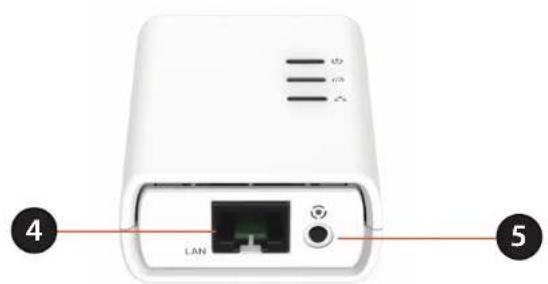
natural_image
Front view of a white wireless router with ports and an Ethernet port, labeled with numbers 4 and 5 pointing to the sides (no text or symbols on the device body beyond labels)| DHP-W312AV DHP-308AV | |||||
| 1 | Internet Connect | an Ethernet device such as a computer, switch, storage (NAS) device or game console. | 4 | LAN | Using an Ethernet cable, connect your broadband modem to this port. |
| 2 | Reset Using a paper clip, press and hold this button for 10 seconds to reset the DHP-W312AV to factory default. | 5 | WPS / Simple Connect | Press to start the WPS / Simple connect process and automatically create a secure connection to a WPS or Powerline device client. | |
| 3 | WPS / Simple Connect | Press to start the WPS / Simple connect process and automatically create a secure connection to a WPS or Powerline device. | |||
Hardware Overview Top

text_image
OFF ON DLink| 1 | ON/OFF | Turns the device ON or OFF |
Hardware Overview LEDs
| DHP-W312AV | ||
| 1 Power LED | A solid light indicates a proper connection to the power supply. A blinking light indicates it is in sleep mode or seeking a Powerline or WPS connection. | |
| 2 | Powerline LED | A solid light indicates that a Powerline connection is established. |
| 3 | Ethernet LED | A solid light indicates a connection to an Ethernet-enabled device. |
| DHP-308AV | ||
| 4 Power LED | A solid light indicates a proper connection to the power supply. A blinking light indicates it is in sleep mode or seeking a Powerline connection. | |
| 5 | Powerline LED | A solid light indicates that a Powerline connection is established. |
| 6 | Ethernet LED | A solid light indicates a connection to an Ethernet-enabled device. |
Hardware Installation
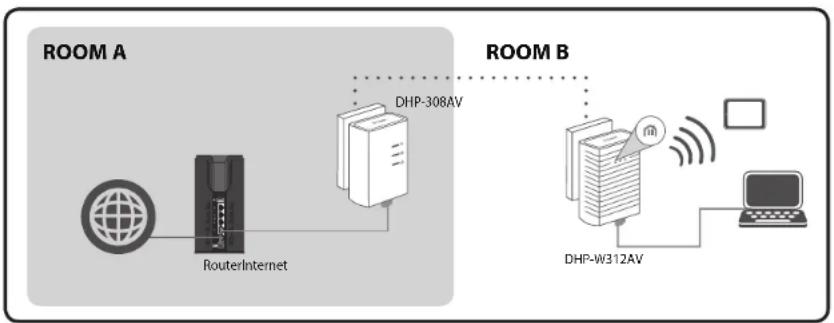
Note: Both DHP-W312AV and DHP-308AV are required to create a Powerline network.
Step 1:
- Ensure that the DHP-308AV is connected to your router, via an Ethernet cable and plugged into a nearby power outlet.
Step 2:
- Plug the DHP-W312AV into a wall outlet where you want to extend your network and connect it to a computer via Ethernet cable (for the setup wizard).
Step 3:
- Press the Simple Connect button on the DHP-308AV device for 3 seconds. Then, within two minutes, press the WPS (Simple Connect) button on the DHP-W312AV for 3 seconds. The Powerline devices will then reboot and connect.
Note: Network connectivity is confirmed when the Powerline LEDs indicators on both Powerline devices are steadily lit. This will indicate that your network is now secure.
flowchart
graph LR
    subgraph_ROOM_A["ROOM A"]
        A["RouterInternet"] --> B["DHP-308AV"]
    end
    subgraph_ROOM_B["ROOM B"]
        C["DHP-W312AV"] --> D["Computer"]
    end
Wireless Installation Considerations
The DHP-W312AV lets you access your network using a wireless connection from anywhere within the operating range of your wireless network. Keep in mind that the number, thickness and location of walls, ceilings, or other objects that the wireless signals must pass through may limit the range. Typical ranges vary depending on the types of materials and background RF (radio frequency) noise in your home or business. The key to maximizing wireless range is to follow these basic guidelines:
- Keep the number of walls and ceilings between the DHP-W312AV and other network devices to a minimum. Each wall or ceiling can reduce your adapter's range by 3-90 feet (1-30 meters.) Position your devices so that the number of walls or ceilings is minimized.
- Be aware of the direct line between network devices. A wall that is 1.5 feet thick (.5 meters) at a 45-degree angle appears to be almost 3 feet (1 meter) thick. At a 2-degree angle it looks over 42 feet (14 meters) thick! Position devices so that the signal will travel straight through a wall or ceiling (instead of at an angle) for better reception.
- Building materials make a difference. A solid metal door or aluminum studs may have a negative effect on range. Try to position the wireless DHP-W312AV and computers so that the signal passes through drywall or open doorways. Materials and objects such as glass, steel, metal, walls with insulation, water (fish tanks), mirrors, file cabinets, brick, and concrete will degrade your wireless signal.
- Keep your product away (at least 3-6 feet or 1-2 meters) from electrical devices or appliances that generate RF noise.
- If you are using 2.4 GHz cordless phones or wireless products such as ceiling fans, lights, and home security systems, your wireless connection may degrade dramatically or drop completely. Make sure your 2.4 GHz phone base is as far away from your wireless devices as possible. The base transmits a signal even if the phone is not in use.
- If you intend on using the 5 GHz network to connect the DHP-W313AV be aware that the network range does not reach as far as 2.4 GHz. However, devices such as 2.4 GHz cordless phones don't interfere with devices connected to the 5G Hz network and as a result you have faster Internet speeds.
Powerline Installation Considerations
Plan the location of your Powerline devices:
- Connect Powerline devices to electrical outlets that are not controlled by a wall switch to avoid accidentally turning off
power to the device.
-
Do not connect the Powerline devices to an extension cord, surge protector, or power strip as this might prevent it from working correctly, or negatively impact network performance.
-
Avoid using the Powerline devices in an electrical outlet that is located near an appliance that uses a lot of power, such as a washer or dryer, or a refrigerator. This may prevent the adapter from working correctly, or negatively impact network performance.
-
Verify that your Powerline devices are electrically rated to operate with the power available in your location.
-
To help prevent against electrical shock, be sure to plug the power cables into properly grounded electrical outlets.

text_image
Prohibition symbol with red prohibition sign over circuit board, indicating no protection or disapprovalSafety
Please read all of the safety and operating instructions before using your device:
- Do not open the device or attempt to repair or service the device.
- Ensure that the device is plugged into the wall in a vertical position.
- Use the device in a dry location, and avoid placing it in humid environments.
- Do not submerge the device in liquid or attempt to clean it with liquids or solvents. To clean the device, disconnect it from the power outlet and use a damp towel.
- Keep the device out of direct sunlight.
- Do not cover or block the vents on the device.
- Make sure that the device has adequate room for ventilation.
- Avoid placing the device near a heater or radiator.
Configuration Setup
If you wish to change the default settings or optimize the performance of the DHP-W312AV, you may use the web-based configuration utility.
To access the configuration utility, open a web browser such as Internet Explorer and enter either http://dlinkap.local. (this is on the Wi-Fi Configuration Card) or http://192.168.0.50 in the address field.
By default, Admin will be the User Name. Leave the password blank.
If you receive a "Page Cannot be Displayed" error, please refer to "Troubleshooting" on page 53 for assistance.
You will automatically proceed to the Setup heading after logging in.

text_image
Internet Explorer cannot display the webpage - Windows Internet Explorer http://dlinkap/ File Edit View Favorites Tools Help
text_image
LOGIN Log in to the Access Point: User Name : Admin Password : Log InHybrid Link Setup
Use the wizard's on-screen instructions to conveniently set up your network if you have not yet. You can also manually configure your network. Wi-Fi settings are covered at "Wireless Settings" on page 17 and Powerline settings are at "PLC Settings" on page 21.
HYBRID LINK
Enable the Hybrid Link feature allows the DHP-W312AV to use both Wi-Fi and powerline connections together to create a faster, more reliable connection to a hybrid router.
Internet

flowchart
graph LR
    A[" globe "] --> B[" Server "]
    B --> C[" Server "]
    C --> D[" Cloud Server "]
    style A fill:#fff,stroke:#000
    style D fill:#fff,stroke:#000
Powerline Device
Your Device
. Step 1: Create powerline network
. Step 2: Configure Wi-Fi security
. Step 3: Set your Device Password
. Step 4: Confirm your settings
Launch Hybrid Setup Wizard
Note: Some changes made using this Hybrid Setup Wizard may require you to change some settings on your Wi-Fi adapters so they can still connect to DHP-W312AV
Wireless Settings
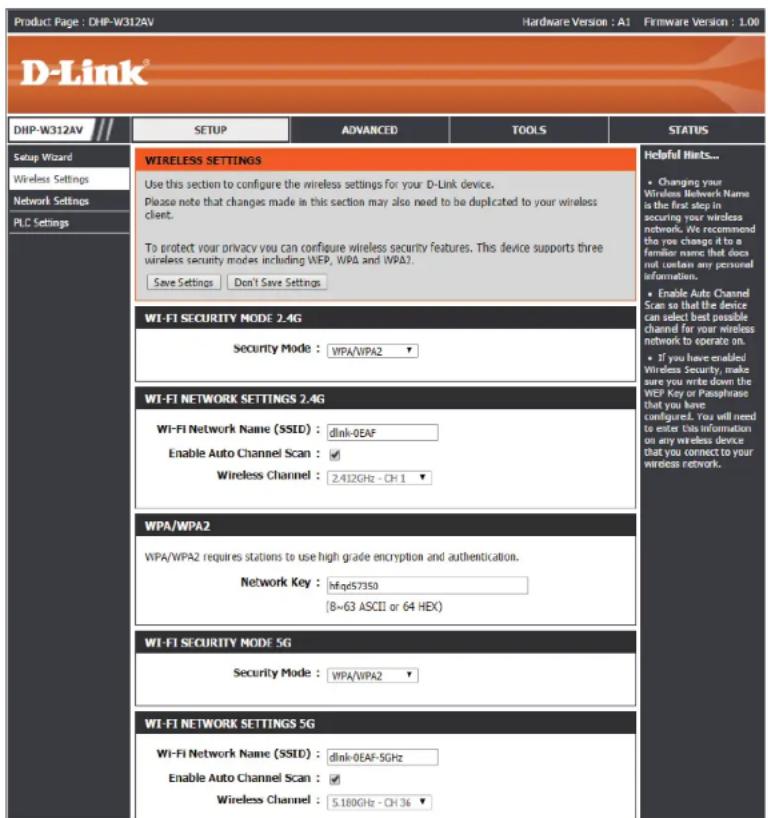
The DHP-W312AV lets you customize your wireless settings for your access point. By setting up the SSID and password for both your 2.4 GHz and 5 GHz network, you can connect devices to either network. 5 GHz is suitable to devices closer to your router that require high speed Internet such as a computer streaming movies live from the Internet. 2.4 GHz has a greater range than 5 GHz and is more suitable to everyday devices that do not require large bandwidth.
Security Mode for Select between WPA/WPA2, WEP, clone your 2.4G: Wi-Fi security or none (not recommended) for the 2.4 GHz frequency.
Wireless Network The Service Set Identifier (SSID) is the name of your wireless network. Create a name using up to 32 characters. The SSID is case-sensitive.
Enable Auto The auto channel selection setting can Channel Scan: be selected to allow this device to choose the channel with the least amount of interference.
Wireless Channel: By default the channel is set to 1. The Channel can be changed to fit the channel setting for an existing wireless network or to customize the wireless network. If you enable Auto Channel Selection, this option will be greyed out.
WPA/WPA2 Choose a password that is strong. A good Password: password uses both letters and numbers in unpredictable places. Example bad passwords could be password or 12345678.
Wi-Fi Security Select between WPA/WPA2, WEP, clone your Mode 5G: Wi-Fi security or none (not recommended) for the 5 GHz frequency.
text_image
Product Page : DHP-W312AV Hardware Version : A1 Firmware Version : 1.00 D-Link® DHP-W312AV Setup Wizard Wireless Settings Network Settings PLC Settings WIRELESS SETTINGS Use this section to configure the wireless settings for your D-Link device. Please note that changes made in this section may also need to be duplicated to your wireless client. To protect your privacy you can configure wireless security features. This device supports three wireless security modes including WEP, WPA and WPA2. Save Settings Don't Save Settings Helpful Hints... Changing your Wireless Network Name is the first step in securing your wireless network. We recommend she you change it to a familiar name that does not contain any personal information. Enable Auto Channel Scan so that the device can select best possible channel for your wireless network to operate on. If you have enabled Wireless Security, make sure you write down the WEP Key or Pasphrase that you have configured. You will need to enter this information on any wireless device that you connect to your wireless network. WI-FI SECURITY MODE 2.4G Security Mode : WPA/WPA2 WI-FI NETWORK SETTINGS 2.4G WI-FI Network Name (SSID) : dlink-0EAF Enable Auto Channel Scan : ✓ Wireless Channel : 2.412GHz - CH 1 WPA/WPA2 WPA/WPA2 requires stations to use high grade encryption and authentication. Network Key : hfqg57350 (8~63 ASCII or 64 HEX) WI-FI SECURITY MODE 5G Security Mode : WPA/WPA2 WI-FI NETWORK SETTINGS 5G WI-FI Network Name (SSID) : dlink-0EAF-5GHz Enable Auto Channel Scan : ✓ Wireless Channel : 5.180GHz - CH 36Section 3 - Configuration
Wireless Network The Service Set Identifier (SSID) is the name Name 5G: of your wireless network. Create a name using up to 32 characters. The SSID is case-sensitive.
WPA/WPA2 Choose a password that is strong. A good Password: password uses both letters and numbers in unpredictable places. Example bad passwords could be password or 12345678.
Click the Save Settings button to continue.
If you selected WEP mode for security:
For more details on configuring WEP see "Configuring WEP" on page 37.
WEP Encryption: Select between 64-bit or 128-bit encryption.
WEP Key: Type in your WEP Key.
Click the Save Settings button to continue.
If you selected Clone My Wi-Fi mode for security:
The DHP-W312AV will search for, and use your router's Wi-Fi settings.

text_image
WI-FI NETWORK SETTINGS 5G Wi-Fi Network Name (SSID) : dink-CEAF-5GHz Enable Auto Channel Scan : ✓ Wireless Channel : 5.180GHz - CH 36 ▼ WPA/WPA2 WPA/WPA2 requires stations to use high grade encryption and authentication. Network Key : hfqd57350 (8~63 ASCII or 64 HEX) Save Settings Don't Save Settings
text_image
WEP WEP is the wireless encryption standard. To use it you must enter the same key(s) into the AP and the wireless stations. For 64-bit keys you must enter 10 hex digits into each key box. For 128-bit keys you must enter 26 hex digits into each key box. A hex digit is either a number from 0 to 9 or a letter from A to F. For the most secure use of WEP set the authentication trpe to "Shared Key" when WEP is enabled. You may also enter any text string into a WEP key box, in which case it will be converted into a hexadecimal key using the ASCII values of the characters. A maximum of 5 text characters can be entered for 64-bit keys, and a maximum of 13 characters for 128-bit keys. WEP Encryption : 64D1 WEP Key : (5 ASCII or 10 HEX)Network Settings
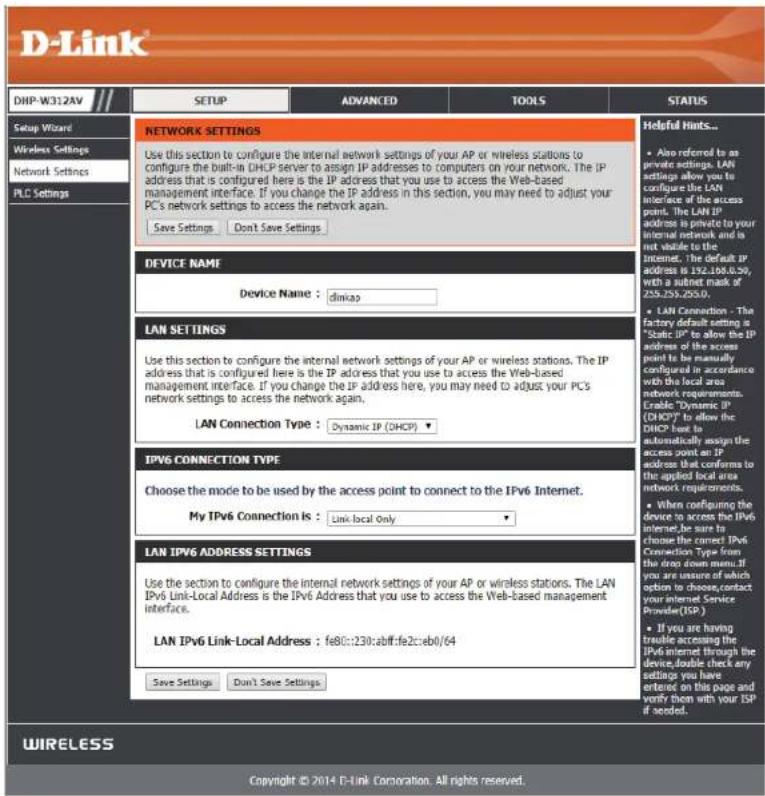
This section will allow you to change the local network settings of the DHP-W312AV and to configure the DHCP settings.
Device Name: Enter the Device Name for the DHP-W312AV. You will use this name to connect to it through a web browser. The default name is listed on your Wi-Fi Configuration Card.
LAN Settings: Use the drop-down menu to select Dynamic IP (DHCP) to automatically obtain an IP address on the LAN/private network. For Static IP setup, see the next page.
IPv6 Connection Your Internet Service Provider (ISP) may Type: require this to be set a certain way for Internet access. Contact your ISP regarding such requirements.
LAN IPv6 Address This shows the current IPv6 address of the Settings: DHP-W312AV on your network.
Save Settings: Click Save Settings to save and activate the new changes.
text_image
DHP-W312AV Setup Wizard Wireless Settings Network Settings PLC Settings NETWORK SETTINGS Use this section to configure the internal network settings of your AP or wireless stations to configure the built-in DHCP server to assign IP addresses to computers on your network. The IP address that is configured here is the IP address that you use to access the Web-based management interface. If you change the IP address in this section, you may need to adjust your PC's network settings to access the network again. Save Settings Don't Save Settings Device NAME Device Name : dimkip LAN SETTINGS Use this section to configure the internal network settings of your AP or wireless stations. The IP address that is configured here is the IP address that you use to access the Web-based management interface. If you change the IP address here, you may need to adjust your PC's network settings to access the network again. LAN Connection Type : Dynamic IP (DHCP) IPV6 CONNECTION TYPE Choose the mode to be used by the access point to connect to the IPv6 Internet. My IPv6 Connection Is : Link local Only LAN IPv6 ADDRESS SETTINGS Use the section to configure the internal network settings of your AP or wireless stations. The LAN IPv6 Link-Local Address is the IPv6 Address that you use to access the Web-based management interface. LAN IPv6 Link-Local Address : fe80::230:abff:fe2c:eb0/64 Save Settings Don't Save Settings Helpful Hints... • Also referred to as private settings. LAN settings allow you to configure the LAN interface of the access point. The LAN IP address is private to your internal network, and is not visible to the internet. The default IP address is 192.198.8.59, with a subnet mask of Z55.255.255.0. • LAN Connection - The factory default setting is "Static IP" to allow the IP address of the access point to be manually configured in accordance with the local area network requirements. Enable "Dynamic IP" (DHCP)" to allow the DHCP" has to automatically assign the access point an IP address that confirms to the applied local area network requirements. • When configuring the device to access the IPv6 internet, he sure to choose the correct IPv6 Connection Type from the drop down menu. If you are unsure of which option to choose,contact your Internet Service Provide(ISP ) • If you are having trouble accessing the IPv6 internet through the device,double check any settings you have enterce on this page and verify then with your ISP if needed. WIRELESS Copyright © 2014 D-Link Corporation. All rights reserved.LAN Settings - Static IP
Select Static IP to manually enter the IP address, subnet mask, and default gateway addresses.
LAN Connection Select Static IP from the drop-down menu. Type:
IP Address: Enter the IP address of the DHP-W312AV. The default IP address is 192.168.0.50. If you change the IP address, once you click Apply, you will need to enter the new IP address in your browser to return to the configuration utility. You can also connect with the device name. (See previous page.)
Subnet Mask: Enter the Subnet Mask.
Default Gateway: Enter the Gateway. This is usually the LAN or internal IP address of your router.
DNS Server: This is the Domain Name Server that looks up addresses on the Internet, you may have a specific one you need to connect to.
Save Settings: Click Save Settings to save and activate the new changes.
LAN SETTINGS
Use this section to configure the internal network settings of your AP or wireless stations. The IP address that is configured here is the IP address that you use to access the Web-based management interface. If you change the IP address here, you may need to adjust your PC's network settings to access the network again.
LAN Connection Type : Static IP
STATIC IP LAN CONNECTION TYPE
Enter the IPv4 address information.
| IPv4 Address : | 192.168.0.101 |
| Subnet Mask : | 255.255.255.0 |
| fault Gateway : | 0.0.0.0 |
| ry DNS Server : | 192.168.0.1 |
| ry DNS Server : |
PLC Settings
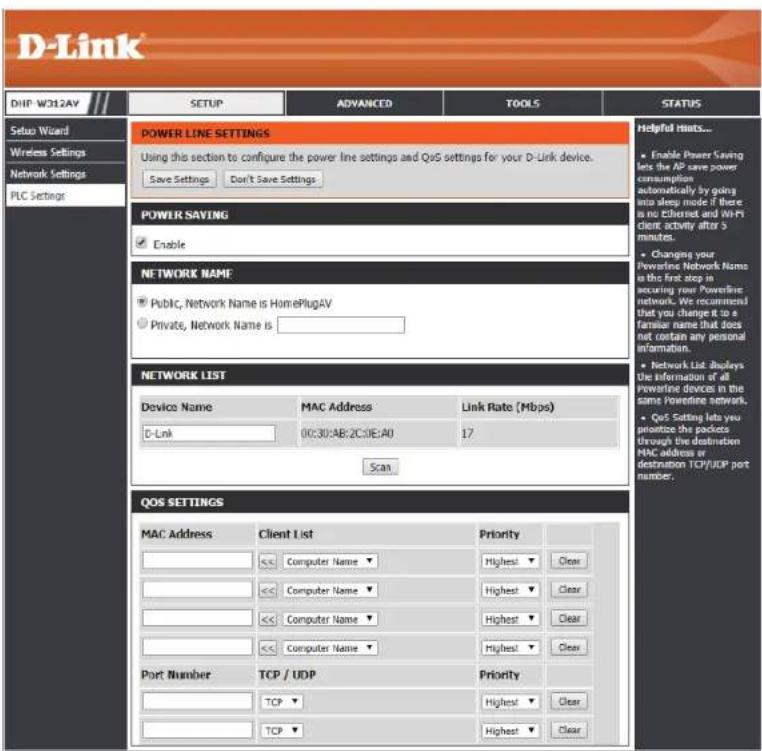
This section will show you how to configure your new D-Link Powerline AV using the web-based configuration utility.
Power Saving: Enable Power Save mode.
Network You can set the name of your network to make it Name: either public or private. Make sure the Network Name of all of the devices within your Powerline network is the same.
Public Select this option if you would like to set your Network Powerline network public with the default Name: Network Name of "HomePlugAV". Since this is a commonly used network name, it is less secure than a private Network Name.
Private Select this option if you wish to make your Network Powerline network more secure by using a Name: private Network Name.
Network List: This section provides information on the Powerline AV devices on your Powerline network.
Scan: Click this button to scan for new Powerline devices. This is automatically done periodically and upon loading this page.
QoS Settings: Here you can set the Quality of Service (QoS) settings for each network device. QoS helps you prioritize network traffic based on device or the port the traffic is on.
MAC Address/ Select a device from the Computer Name dropdown box and then click the << next to Computer Name to automatically fill in Port Number: the device's MAC Address. Or, set the priority for the device under the Priority dropdown box. Clear settings for a rule with the Clear button. Remember to click Save Settings after making changes.
text_image
D-Link DHIP-W312AV SETUP ADVANCED TOOLS STATUS Setup Wizard Wireless Settings Network Settings PLC Settings POWER LINE SETTINGS Using this section to configure the power line settings and QoS settings for your D-Link device. Save Settings Don't Save Settings POWER SAVING Enable NETWORK NAME Public, Network Name is HomePlugAV Private, Network Name is NETWORK LIST Device Name MAC Address Link Rate (Mbps) D-Link 00:30:AB:2C:9E:A0 17 Scan QOS SETTINGS MAC Address Client List Priority << Computer Name ▼ Highest ▼ Clear << Computer Name ▼ Highest ▼ Clear << Computer Name ▼ Highest ▼ Clear Port Number TCP / UDP Priority TCP ▼ Highest ▼ Clear TCP ▼ Highest ▼ Clear Helpful Hints... Enable Power Saving let the AP save power consumption automatically by going into sleep mode if there: is no Ethernet and Wi-Fi client activity after 5 minutes. Changing your Powerline Network Name is the first step in according your Powerline network. We recommend that you change it to a familiar name that does not contain any personal information. Network List displays the information of all Powerline devices in the same Powerline network. QoS Setting lets you prioritize the packets through the destination MAC address or destination TCP/UDP port number.Advanced MAC Address Filter
Use MAC (Media Access Control) Filters to authorize wireless clients to access your network using their MAC addresses. When enabled, you can choose to block or allow the listed devices access to your network.
MAC Filtering Set MAC Filtering to ALLOW, DENY, or Rules: OFF. ALLOW means only the devices listed can access the network. DENY means the devices listed cannot access the network. OFF means this function is currently disabled.
Description: You may make a note for your convenience, such as "My PC" or "My friend's smartphone"
MAC Address: Enter the MAC address you would like to filter. To find the MAC address on a computer, please refer to "Networking Basics" on page 59. Click Save Settings to activate and save.
Note: If you are filtering to ALLOW only the listed devices, make sure to add your own computer to the list or you will be denied access to the network and the configuration utility. If you DENY the listed addresses be sure not to include your computer.
Clear: Clear the rule from the list. Note you will have to save the settings in order for it to take effect.

text_image
Product Page : DHP-W312AV Hardware Version : AI Firmware Version : 1.00 D-Link DHP-W312AV SETUP ADVANCED TOOLS STATUS MAC ADDRESS FILTER The MAC (Media Access Controller) Address filter option is used to control network access based on the MAC. Address of the network adapter. A MAC address is a unique ID assigned by the manufacturer of the network adapter. This feature can be configured to ALLOW or DENY network/Internet access. Save Settings Don't Save Settings 25 -- MAC FILTERING RULES Configure MAC Filtering below: Turn MAC Filtering OFF Remaining number of rules that can be created: 25 Description MAC Address Clear 1 2 3 4 5 6 7 Helpful Hints... • Create a list of MAC addresses and choose whether to allow or deny them access to your network. • Compilers that have connected to JP through wireless will be in the Wireless Grid List. Select a device from the drop down menu and click the arrow to add that device's MAC to the list.Save Settings: Click Save Settings to save and activate the new changes.
Advanced Wireless
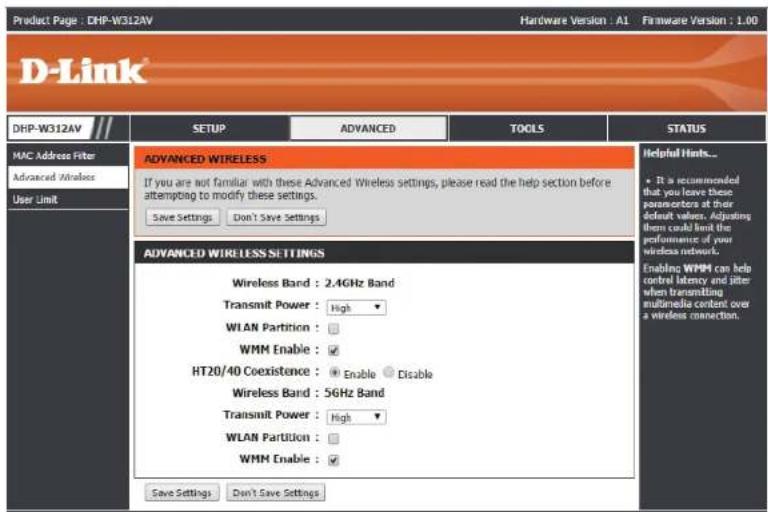
The Advanced Wireless section allows you to change several advanced settings on your DHP-W312AV. Most users will not need to modify this section.
Wireless Band: The wireless network frequency.
Transmit Power: Sets the transmit power of the antennas.
WLAN Partition: Select this checkbox to enable WLAN partition. If this feature is enabled, then there is no barrier between communication among wireless stations connecting to the DHP-W312AV. If this is disabled, wireless clients are not allowed to exchange data through the DHP-W312AV.
WMM Enable: WMM is a Quality of Service (QoS) system for your wireless network. Enabling this feature will improve the quality of video and voice applications for your wireless clients.
HT20/40 Enabling this function allows compatibility Coexistence: with both 802.11n devices as well as 802.11b/g at the cost of speed. Disabling this will give higher speeds but only allow 802.11n devices to function.
text_image
Product Page : DHP-W312AV Hardware Version : A1 - Firmware Version : 1.00 D-Link DHP-W312AV MAC Address Filter Advanced Wireless User Limit SETUP ADVANCED TOOLS STATUS ADVANCED WIRELESS If you are not familiar with these Advanced Wireless settings, please read the help section before attempting to modify these settings. Save Settings: Don't Save Settings ADVANCED WIRELESS SETTINGS Wireless Band : 2.4GHz Band Transmit Power : High WLAN Partition : WMM Enable : ✓ HT20/40 Coexistence : Enable ✓ Disable Wireless Band : 56GHz Band Transmit Power : High ✓ WLAN Partition : WMM Enable : ✓ Save Settings Don't Save Settings Helpful Hints... • It is recommended that you leave these parameters at their default values. Adjusting them could limit the performance of your wireless network. Enabling WMM can help control latency and jitter when transmitting multimedia content over a wireless connection.User Limit
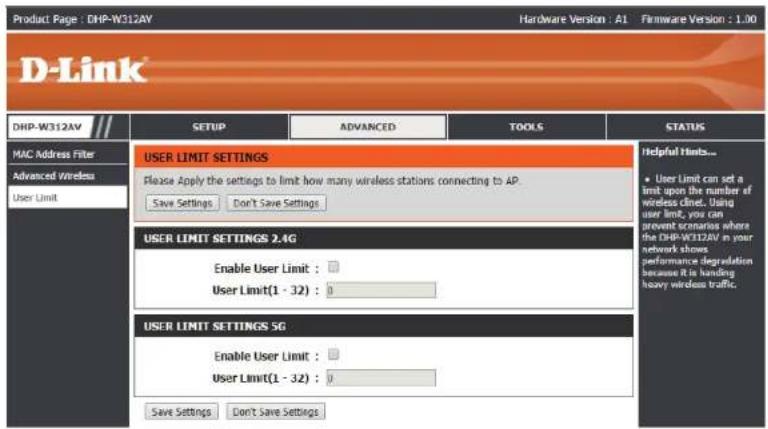
This screen lets you set the maximum number of wireless clients that can connect at one time to your 2.4G and 5G networks.
Enable User Check the Enable User Limit box to enable Limit: limiting the number of devices that can connect to the DHP-W312AV.
User Limit: Enter the maximum number of clients, between 1 and 32.
Save Click Save Settings to save and activate the Settings: new changes.
text_image
Product Page : DHP-W312AV Hardware Version : A1 Firmware Version : 1.00 D-Link® DHP-W312AV SETUP ADVANCED TOOLS STATUS MAC Address Filter Advanced Wireless User Limit USER LIMIT SETTINGS Please Apply the settings to limit how many wireless stations connecting to AP. Save Settings Don't Save Settings User LIMIT SETTINGS 2.4G Enable User Limit : User Limit(1 - 32) : User LIMIT SETTINGS 5G Enable User Limit : User Limit(1 - 32) : Save Settings Don't Save Settings Helpful Hints... • User Limit can set a limit upon the number of wireless Cintd. Using user limit, you can prevent scenarios where the DHP-W312AV in your network shows performance degradation because R is handling heavy wireless traffic.Tools Admin
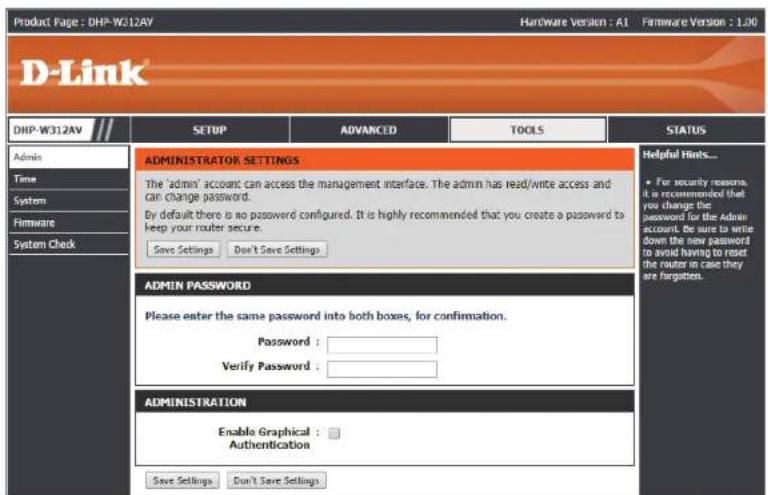
This page will allow you to change the administrator password, which is used to access the configuration interface and change settings.
Password: Enter a new password for the admin user name. The administrator account can change the configuration of the device.
Verify Enter the same password that you entered Password: in the previous textbox in order to confirm its accuracy.
Enable Enables a CAPTCHA verification which will Graphical require users to type letters or numbers Authentication: from a distorted image displayed on the screen to prevent online hackers and unauthorized users from gaining access to your device's configuration. This feature is disabled by default.
Save Settings: Click Save Settings to save and activate the new changes.
text_image
Product Page : DHP-W312AV Hardware Version : A1 Firmware Version : 1.00 D-Link DHP-W312AV Admin Time System Firmware System Check SETUP ADVANCED TOOLS STATUS ADMINISTRATOR SETTINGS The 'admin' account can access the management interface. The admin has read/write access and can change password. By default there is no password configured. It is highly recommended that you create a password to keep your router secure. Save Settings Don't Save Settings Helpful Vints... • For security response, it is recommended that you change the password for the Admin account. Be sure to write down the new password to avoid having to reset the router in case they are forgotten. ADMIN PASSWORD Please enter the same password into both boxes, for confirmation. Password : Verify Password : ADMINISTRATION Enable Graphical : Authentication Save Settings Don't Save SettingsTime
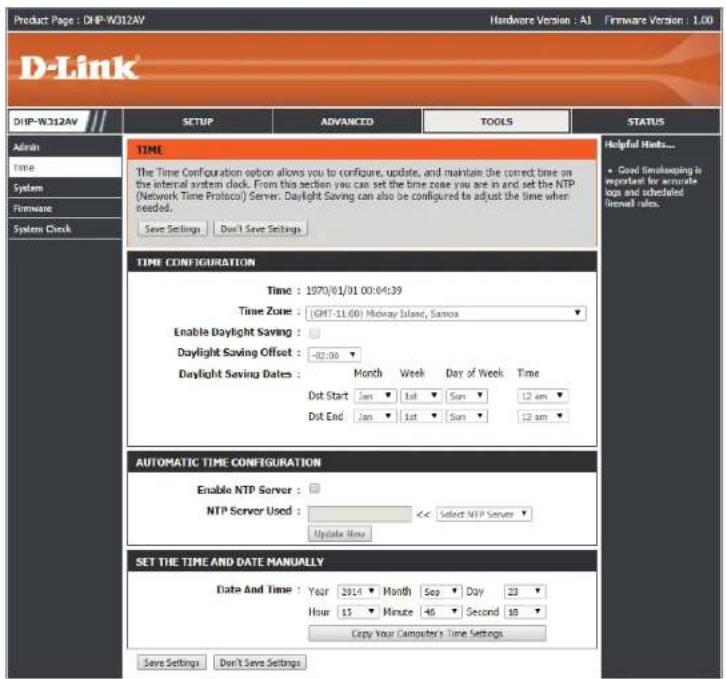
The Time Configuration option allows you to configure, update, and maintain the correct time on the internal system clock. From this section you can set the time zone that you are in. Daylight Saving can also be configured to automatically adjust the time when needed.
Time Zone: Select the Time Zone from the drop-down menu.
Daylight Saving: To enable Daylight Saving time adjustment, click the Enable Daylight Saving check box. Next, use the drop-down menu to select a Daylight Saving Offset and then enter a start date and an end date for daylight saving time.
Enable NTP Server: NTP (Network Time Protocol) allows the device to automatically set the system clock based on an Internet NTP server. Check this box to use a NTP server. This will only connect to a server on the Internet, not a local server.
NTP Server Used: Enter the NTP server or select one from the drop-down menu.
Date and Time: To manually input the time, enter the values in these fields for the Year, Month, Day, Hour, Minute, and Second and then click Save Settings. You can also click the Copy Your Computer's Time Settings button at the bottom of the screen.
Save Settings: Click Save Settings to save and activate the new changes.
text_image
Product Page : DHP-W312AV Hardware Version : A1 Firmware Version : 1.00 D-Link DHIP-W312AV SETUP ADVANCED TOOLS STATUS Admin Time System Firmware System Clock TIME The Time Configuration option allows you to configure, update, and maintain the correct time on the interval system clock. From this section you can set the time zone you are in and set the NTP (Network Time Protocol) Server. Daylight Saving can also be configured to adjust the time when needed. Save Settings Don't Save Settings Helpful Hinds... Good Simkeeping is important for accurate log and scheduled network rules. TIME CONFIGURATION Time : 1970/01/31 00:04:39 Time Zone : (GMT-11:00) Midway Island, Samoa Enable Daylight Saving : Daylight Saving Offset : -02:00 Daylight Saving Dates : Month Week Day of Week Time Dot Start Jan Jul Sun 12 am Dot End Jan Jul Sun 12 am AUTOMATIC TIME CONFIGURATION Enable NTP Server : NTP Server Used : << Select NTP Server Update Now SET THE TIME AND DATE MANUALLY Data And Time : Year 30/4 Month Sep Day 23 Hour 15 Minute 46 Second 10 Copy Your Computer's Time Settings Save Settings Don't Save SettingsSystem
This page lets you both save and delete settings on your DHP-W312AV.
Save Settings To Local Hard Drive:
Use this option to save the current DHP-W312AV configuration settings to a file on the computer you are using. Click the Save button. You will then see a file dialog where you can select a location and file name for the settings.
Load Settings From Local Hard Drive:
Use this option to load previously saved DHP-W312AV configuration settings. Click Choose File to find a previously saved configuration file. Then, click the Restore a Configuration from File button to transfer those settings to the DHP-W312AV.
Restore to Factory Default Settings:
This option will restore all configuration settings back to the settings that were in effect at the time the DHP-W312AV was shipped from the factory. Any settings that have not been saved will be lost, including any rules that you have created. If you would like to save the current DHP-W312AV configuration settings, use the Save button above.
Reboot the Click to reboot the DHP-W312AV. Device:

text_image
Product Page : DHP-W312AV Hardware Version : A1 - Firmware Version : 1.00 D-Link DHP-W312AV /// SETUP ADVANCED TOOLS STATUS Admin Time System Firmware System Check SYSTEM SETTINGS The System Settings section allows you to reboot the device, or restore the device to the factory default settings. Restoring the unit to the factory default settings will erase all settings, including any rules that you have created. The current system settings can be saved as a file onto the local hard drive. The saved file or any other saved setting file created by device can be uploaded into the unit. Helpful Hints... • Once your device is configured the way you want it, you can save the configuration settings to a configuration file. You might need this file so that you can load your configuration later in the event that the router's default settings are restored. To save the configuration, click the Save Configuration button. SYSTEM SETTINGS Save To Local Hard Drive : Save Configuration Load From Local Hard Drive : Choose File No file chosen Restore Configuration from File Restore To Factory Default : Restore Factory Defaults Restore all settings to the factory defaults. Reboots the Device : Reboot the Device WIRELESSFirmware
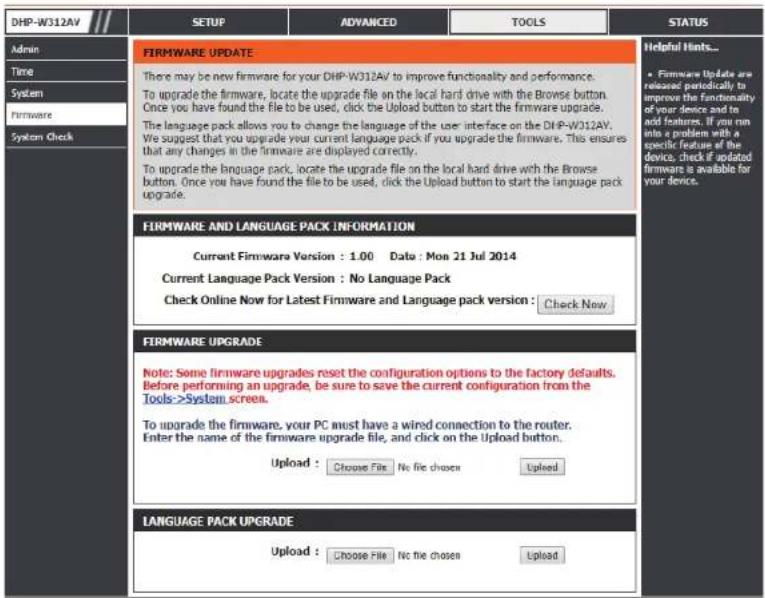
You can upgrade the firmware of the DHP-W312AV from this page. Make sure the firmware you would like to use is on the local hard drive of your computer. Click Choose File to locate the firmware file to be used for the update. Please check the D-Link support site for firmware updates at http://support.dlink.com. You can download firmware upgrades to your hard drive from the D-Link support site.
Firmware and This box displays your current firmware Language Pack information. Click the Check Now button Information: to check online for the latest firmware and language pack. If a new version exists, download the new firmware to your hard drive.
Firmware Upgrade: After you have downloaded the new firmware, click Choose File to locate the firmware update on your hard drive. Click Upload to complete the firmware upgrade.
Language Pack You can change the interface language of Upgrade: the device by uploading a language pack. To install a language pack, click the Choose File button to locate the D-Link language pack upgrade file on your computer. Once you have found the file, click the Upload button to begin the language pack upgrade process. This can take a minute or more. Finally, wait for the device to reboot. This process can take about 75 seconds.
text_image
DHP-W312AV Admin Time System Firmware System Check SETUP ADVANCED TOOLS STATUS FIRMWARE UPDATE There may be new firmware for your DHP-W312AV to improve functionality and performance. To upgrade the firmware, locate the upgrade file on the local hard drive with the Browse button. Once you have found the file to be used, click the Upload button to start the firmware upgrade. The language pack allows you to change the language of the user interface on the DHP-W312AV. We suggest that you upgrade your current language pack if you upgrade the firmware. This ensures that any changes in the firmware are displayed correctly. To upgrade the language pack, locate the upgrade file on the local hard drive with the Browse button. Once you have found the file to be used, click the Upload button to start the language pack upgrade. FIRMWARE AND LANGUAGE PACK INFORMATION Current Firmware Version : 1.00 Data : Mon 21 Jul 2014 Current Language Pack Version : No Language Pack Check Online Now for Latest Firmware and Language pack version : Check Now FIRMWARE UPGRADE Note: Some firmware upgrades reset the configuration options to the factory defaults. Before performing an upgrade, be sure to save the current configuration from the Tools->System screen. To upgrade the firmware, your PC must have a wired connection to the router. Enter the name of the firmware upgrade file, and click on the Upload button. Upload : Choose File No file chosen Upload LANGUAGE PACK UPGRADE Upload : Choose File No file chosen UploadSystem Check
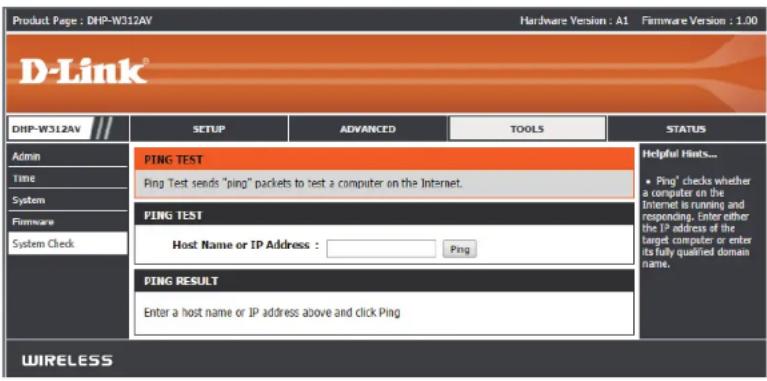
This page helps you to diagnose connection problems.
Ping Test: A ping test sends a tiny bit of information to a website and anticipates a response. Pinging an extremely stable site such as your favorite search engine or news site can help tell you if your Internet connection is working properly. If you can ping a site or address from here but your computer is getting no connectivity, then the DHP-W312AV is working properly but there is the problem with the computer.
Ping Result: "Ping timeout" means that the site did not respond. This happens if the site is down or does not exist, but also if you do not have Internet connectivity. If you ping several common websites and all result in a timeout then there is likely an issue with your Internet connection. If the result says a site is alive, then your Internet connection is working.
text_image
Product Page : DHP-W312AV Hardware Version : A1 Firmware Version : 1.00 D-Link® DHP-W312AV Setup ADVANCED TOOLS STATUS Admin Time System Firmware System Check PING TEST Ping Test sends "ping" packets to test a computer on the Internet. PING TEST Host Name or IP Address : Ping PING RESULT Enter a host name or IP address above and click Ping Helpful Fints... • Ping' checks whether a computer on the Internet is running and responding. Enter other the IP address of the target computer or enter its fully qualified domain name. WIRELESSStatus
Device Info
This page displays the current information for the DHP-W312AV. It will display the LAN and wireless LAN information.
General: Displays the DHP-W312AV's time and firmware version.
LAN: Displays the MAC address and the private (local) IP settings for the DHP-W312AV.
Wireless LAN 2.4G: Displays the wireless 2.4G MAC address and your wireless settings such as SSID and Channel.
Wireless LAN 5G: Displays the wireless 5G MAC address and your wireless settings such as SSID and Channel.
Powerline: Shows the DHP-W312AV's Powerline Connection settings.

text_image
DHP-W312AV DEVICE INFORMATION All of your network connection details are displayed on this page. The firmware version is also displayed here. GENERAL Time : 1970/01/01 00:06:12 Firmware Version : 1.04 Mon 21 Jul 2014 LAN Connection Type : DHCP Client MAC Address : 00:30:ab:2c:8e:bl IP Address : 192.168.0.101 Subnet Mask : 255.255.255.0 Default Gateway : 192.168.0.1 WIRELESS LAN 2.4G Wireless Radio : Enabled MAC Address : 00:30:ab:2c:8e:bl 802.11 Mode : Mixed 802.11b, 802.11g and 802.11n Channel Width : 20/40MHz Channel : 2.6 Network Name (SSID) : dink-0CAF Wi-Fi Protected Setup : Enabled/Configured Security : WPA/WPA2-PSK WIRELESS LAN 5G Wireless Radio : Enabled MAC Address : 00:30:ab:2c:8e:bl 802.11 Mode : Mixed 802.11a, 802.11n and 802.11a Channel Width : 20/40/80MHz Channel : 36,40,44,48 Network Name (SSID) : dink-0CAF-5GHz Wi-Fi Protected Setup : Enabled/Configured Security : WPA/WPA2-PSK POWERLINE MAC Address : 00:30:ab:2c:8e:af Password : QFZT-NLBH-DPYH-HOCTLogs
The DHP-W312AV keeps a running log of events and activities occurring on the DHP-W312AV. If the AP is rebooted, the logs are automatically cleared. You can save the log files prior to clearing them.
Log Options: You can select the types of messages that you would like to display from the log: System Activity, Debug Information, Attacks, Dropped Packets, Notice. Select the types you want to view and click Apply Log Setting Now.
First Page: Go to the first page of the log.
Last Page: Go to the last page of the log.
Previous: Go to the previous page of the log.
Next: Go to the next page of the log.
Refresh: Refresh the page.
Clear: This button clears all current log content.
Email Now: Click this button to email a log record to a designated email address.
Save Log: Save the log to your hard drive.

text_image
DHP-W312AV SETUP ADVANCED TOOLS STATUS Device Info Logs Statistics Wireless IPv6 LOGS Use this option to view the router logs. You can define what types of events you want to view and the event levels to view. This router also has internal syslog server support so you can send the log files to a computer on your network that is running a syslog utility. LOG OPTIONS Log Type: System Activity Debug Information Attacks Dropped Packets Notice Apply Log Setting Now LOG DETAILS First page Last page Previous Next Refresh Cxer Email Now Save Log 1 / 5 Time Message Type 1970-01- 01T00:00:51 syslog: PLC connect 00:65:80:05:20:01 data transmission only (RX=0) 1970-01- 01T00:00:51 syslog: PLC connect 00:30:AB:2C:0E:A0 data transmission only (RX=11) 1970-01- 01T00:00:51 syslog: PLC connect CC:82:55:03:C1:70 data transmission only (RX=11) 1970-01- 01T00:01:08 syslog: Web login success from 70:73:95:0e:3c:41 1970-01- 01T00:01:09 syslog: PLC connect 00:65:80:05:20:01 data transmission only (RX=0) 1970-01- 01T00:01:27 syslog: PLC connect 00:65:80:05:20:01 data transmission only (RX=0) Helpful Hints... Check the log frequently to detect unauthorized network usage.Statistics
The DHP-W312AV keeps statistics on the traffic that passes through it. You can view the amount of packets that pass through the LAN and wireless portions of the network. The traffic counter will reset if the DHP-W312AV is rebooted.
| DHP-W312AV | SETUP | ADVANCED | TOOLS | STATUS |
| Device Info | TRAFFIC STATISTICS | Helpful Hints... | ||
| Logs | Traffic Statistics displays Receive and Transmit packets passing through the device. | - This is a summary displaying the number of packets that have passed between the Internet and the LAN since the AP or wireless stations was last initialized. | ||
| Statistics | Refresh Reset | |||
| Wireless | ||||
| IPv6 | LAN STATISTICS | |||
| TX Packet Numbers: 69176 RX Packet Numbers: 7746 TX Packets Dropped: 0 RX Packets Dropped: 0 TX Packets Bytes: 95466647 RX Packets Bytes: 4077790 | ||||
| WIRELESS STATISTICS 2.4G | ||||
| Sent: 277 Received: 22826 TX Packets Dropped: 0 RX Packets Dropped: 0 Errors: 0 | ||||
| WIRELESS STATISTICS 5G | ||||
| Sent: 99 Received: 17984 TX Packets Dropped: 0 RX Packets Dropped: 0 Errors: 0 | ||||
| PLC STATISTICS | ||||
| TX Packet Numbers: 0 RX Packet Numbers: 0 TX Packets Dropped: 0 RX Packets Dropped: 0 TX Packets Bytes: 0 RX Packets Bytes: 0 | ||||
Wireless
This section allows you to view the wireless devices that are connected to your wireless DHP-W312AV.
Number of Displays the number of devices that are Wireless Clients connected to the DHP-W312AV via the 2.4 GHz 2.4 GHz: wireless network.
Number of Displays the number of devices that are Wireless Clients connected to the DHP-W312AV via the 5 GHz 5 GHz: wireless network.
MAC Address: Displays the Ethernet ID (MAC address) of the wireless client.
Mode: Shows the mode the device is using to connect to your DHP-W312AV. This should be 11b, 11g, or 11n.
Rate: Shows data transfer rate.
Signal (%): This shows the strength of your device's connection.

text_image
Product Page : DHP-W312AV Hardware Version : A1 Firmware Version : 1.00 D-Link DHP-W312AV SETUP ADVANCED TOOLS STATUS Device Info WIRELESS Use this option to view the wireless clients that are connected to your wireless router. Helpful Hosts... • This is a bit of all wireless clients that are currently connected to your AP. Wireless NUMBER OF WIRELESSS CLIENTS - 2.4GHZ BAND: 0 MAC Address Mode Rate Signal(%) IPV6 NUMBER OF WIRELESSS CLIENTS - 5GHz BAND: 0 MAC Address Mode Rate Signal(%)IPv6
This section will display all of your IPv6 Internet and network connection details.
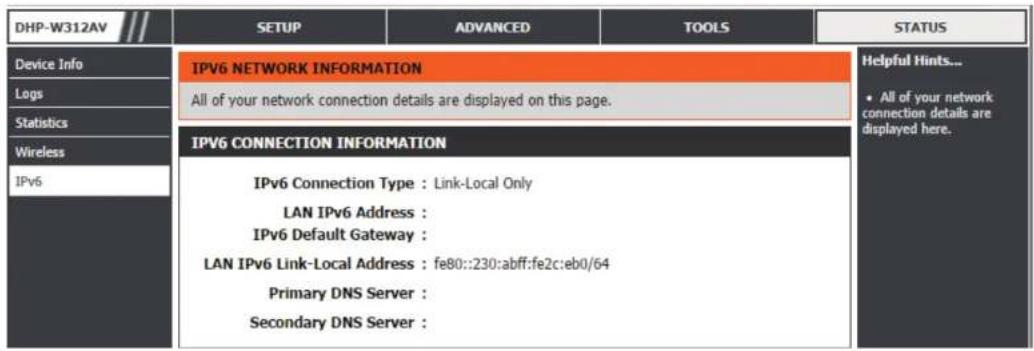
text_image
DHP-W312AV SETUP ADVANCED TOOLS STATUS Device Info IPv6 NETWORK INFORMATION All of your network connection details are displayed on this page. Helpful Hints... • All of your network connection details are displayed here. Logs Statistics Wireless IPv6 IPv6 CONNECTION INFORMATION IPv6 Connection Type : Link-Local Only LAN IPv6 Address : IPv6 Default Gateway : LAN IPv6 Link-Local Address : fe80::230:abff:fe2c:eb0/64 Primary DNS Server : Secondary DNS Server :Wireless Security
This section will show you the different levels of security you can use to protect your data from intruders. The DHP-W312AV offers the following types of security:
• WPA2 (Wi-Fi Protected Access 2) • WPA2-PSK (Pre-Shared Key)
- WPA (Wi-Fi Protected Access) • WPA-PSK (Pre-Shared Key)
• WEP (Wired Equivalent Privacy)
What is WEP?
WEP stands for Wired Equivalent Privacy. It is based on the IEEE 802.11 standard and uses the RC4 encryption algorithm. WEP provides security by encrypting data over your wireless network so that it is protected as it is transmitted from one wireless device to another.
To gain access to a WEP network, you must know the key. The key is a string of characters that you create. When using WEP, you must determine the level of encryption. The type of encryption determines the key length. 128-bit encryption requires a longer key than 64-bit encryption. Keys are defined by entering in a string in HEX (hexadecimal - using characters 0-9, A-F) or ASCII (American Standard Code for Information Interchange – alphanumeric characters) format. ASCII format is provided so you can enter a string that is easier to remember. The ASCII string is converted to HEX for use over the network. Four keys can be defined so that you can change keys easily.
What is WPA?
WPA, or Wi-Fi Protected Access, is a Wi-Fi standard that was designed to improve the security features of WEP (Wired Equivalent Privacy). The 2 major improvements over WEP:
- Improved data encryption through the Temporal Key Integrity Protocol (TKIP). TKIP scrambles the keys using a hashing algorithm and, by adding an integrity-checking feature, ensures that the keys haven't been tampered with. WPA2 is based on 802.11i and uses Advanced Encryption Standard (AES) instead of TKIP.
- User authentication, which is generally missing in WEP, through the extensible authentication protocol (EAP). WEP regulates access to a wireless network based on a computer's hardware-specific MAC address, which is relatively simple to be sniffed out and stolen. EAP is built on a more secure public-key encryption system to ensure that only authorized network users can access the network.
WPA-PSK/WPA2-PSK uses a passphrase or key to authenticate your wireless connection. The key is an alpha-numeric password between 8 and 63 characters long. This key must be the exact same key entered on your wireless bridge or DHP-W312AV.
WPA/WPA2 incorporates user authentication through the Extensible Authentication Protocol (EAP). EAP is built on a more secure public key encryption system to ensure that only authorized network users can access the network.
Configuring WEP
It is recommended to enable encryption on your wireless DHP-W312AV before your wireless network adapters. Please establish wireless connectivity before enabling encryption. Your wireless signal may degrade when enabling encryption due to the added overhead.
- Log into the web-based configuration by opening a web browser and entering http://dlinkap.local. (on the Wi-Fi Configuration Card) or the IP address of the DHP-W312AV (192.168.0.50). Click on Setup and then click Wireless Settings on the left side.
- Next to Security Mode in the Wireless Security Mode section, select WEP Mode.
- Next to WEP Encryption, select 64-bit or 128-bit encryption.
- Next to WEP Key 1, enter a WEP key that you create. Make sure you enter this key exactly on all your wireless devices.
- Next to Authentication, select Both or Shared Key.
WIRELESS SETTINGS
Use this section to configure the wireless settings for your D-Link device.
Please note that changes made in this section may also need to be duplicated to your wireless client.
To protect your privacy you can configure wireless security features. This device supports three wireless security modes including WEP, WPA and WPA2.
Save Settings Don't Save Settings
WI-FI SECURITY MODE 2.4G
Security Mode : WEP
WEP
WEP is the wireless encryption standard. To use it you must enter the same key(s) into the AP and the wireless stations. For 64-bit keys you must enter 10 hex digits into each key box. For 128-bit keys you must enter 26 hex digits into each key box. A hex digit is either a number from 0 to 9 or a letter from A to F. For the most secure use of WEP set the authentication type to "Shared Key" when WEP is enabled.
You may also enter any text string into a WEP key box, in which case it will be converted into a hexadecimal key using the ASCII values of the characters. A maximum of 5 text characters can be entered for 64-bit keys, and a maximum of 13 characters for 128-bit keys.

Configuring WPA/WPA2 Personal
It is recommended to enable encryption on your wireless DHP-W312AV before your wireless network adapters. Please establish wireless connectivity before enabling encryption. Your wireless signal may degrade when enabling encryption due to the added overhead.
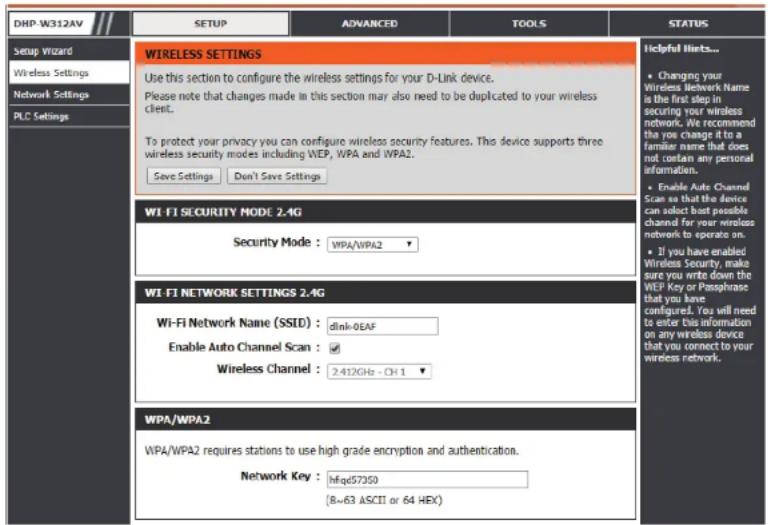
- Log into the web-based configuration by opening a web browser and entering the IP address of the DHP-W312AV (192.168.0.50) or http://dlinkap.local. (on the Wi-Fi Configuration Card) then click on Setup and then click Wireless Settings on the left side.
- For Security Mode, select WPA/WPA2Personal.
- For Wi-Fi Password, enter a key. The password must be between 8-63 characters and use numbers, letters, and/or special characters.
- Click Save Settings at the bottom of the window to save your settings. If you are configuring the DHP-W312AV with a wireless adapter, you will lose connectivity until you enable WPA on your adapter and enter the same passphrase as you did on the DHP-W312AV.
text_image
DHP W312AV SETUP ADVANCED TOOLS STATUS Setup Wizard Wireless Settings Network Settings PLC Settings WIRELESS SETTINGS Use this section to configure the wireless settings for your D-Link device. Please note that changes made in this section may also need to be duplicated to your wireless client. To protect your privacy you can configure wireless security features. This device supports three wireless security modes including WEP, WPA and WPA2. Save Settings Don't Save Settings Helpful hints... Changing your Wireless Network Name is the first step in securing your wireless network. We recommend the you change it to a familiar name that does not contain any personal information. Enable Auto Channel Scan so that the device can select best possible channel for your wireless network to operate on. If you have enabled Wireless Security, make sure you write down the WEP Key or Passphrase that you have configured. You will need to enter this information on any wireless device that you connect to your wireless network. WI-FI SECURITY MODE 2.4G Security Mode : WPA/WPA2 ▼ WI-FI NETWORK SETTINGS 2.4G Wi-Fi Network Name (SSID) : dlink-0EAF Enable Auto Channel Scan : ✓ Wireless Channel : 2.412GHz - CH 1 ▼ WPA/WPA2 WPA/WPA2 requires stations to use high grade encryption and authentication. Network Key : hfqd57J50 (B=63 ASCII or 64 HEX)Connecting to a Wireless Network Using Mac OS
It is recommended to enable wireless security (WPA/WPA2) on your wireless router or access point before configuring your wireless adapter. If you are joining an existing network, you will need to know the security key (Wi-Fi password) being used.
To quickly access your Wi-Fi information and settings, click the Wi-Fi icon on the menu bar.
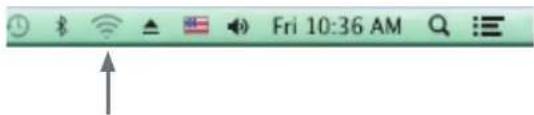
text_image
Fri 10:36 AMClicking on this icon will display a list of all wireless networks within range of your computer. Select the desired network by clicking on the network name.
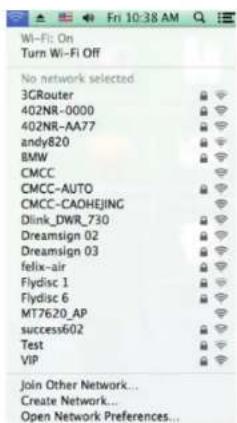
text_image
Wi-Fi On Turn Wi-Fi Off No network selected 3GRouter 402NR-0000 402NR-AA77 andy820 BMW CMCC CMCC-AUTO CMCC-CAOHEJING Dlink_DWR_730 Dreamsign 02 Dreamsign 03 felix-air Flydisc 1 Flydisc 6 MT7620_AP success602 Test VIP Join Other Network... Create Network... Open Network Preferences...Section 3 - Configuration
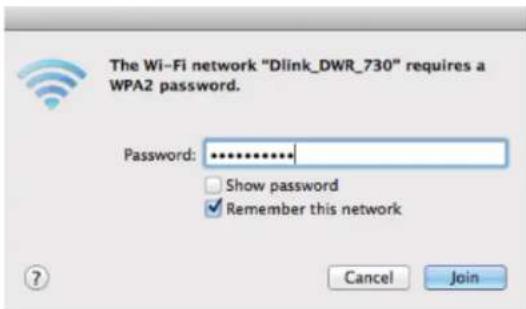
You will then be prompted to enter the network security key (Wi-Fi password) for the wireless network. Enter the password into the box and click Join.
Note: To avoid having to enter your network security key each time you connect, check Remember this network.
text_image
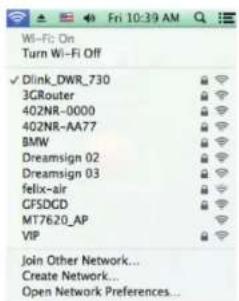
The Wi-Fi network "Dlink_DWR_730" requires a WPA2 password. Password: ********** Show password Remember this network Cancel JoinOnce the connection is successfully established, you will see a check by the name of your wireless network.
text_image
Wi-Fi On Turn Wi-Fi Off ✓ Dlink_DWR_730 3GRouter 402NR-0000 402NR-AA77 BMW Dreamsign 02 Dreamsign 03 felix-air CF5DDG MT7620_AP VIP Join Other Network... Create Network... Open Network Preferences...Using Windows® 7
It is recommended to enable wireless security (WPA/WPA2) on your DHP-W312AV before configuring your wireless adapter. If you are joining an existing network, you will need to know the security key or passphrase being used.
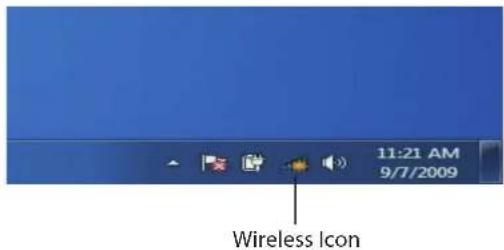
Click on the wireless icon in your system tray (lower-right corner).
text_image
11:21 AM 9/7/2009 Wireless IconThe utility will display any available wireless networks in your area.

text_image
Not connected Connections are available Wireless Network Connection dlink kay2690_24 AllenH DIR-655 SD6_WLAN DAP-2690g wpstest1 BEIQ633304WPA2 Eddie_APNAS Open Network and Sharing CenterUsing Windows 8
It is recommended to enable wireless security (WPA/WPA2) on your wireless router or access point before configuring your wireless adapter. If you are joining an existing network, you will need to know the security key (Wi-Fi password) being used.
To join an existing network, locate the wireless network icon in the taskbar, next to the time display.

text_image
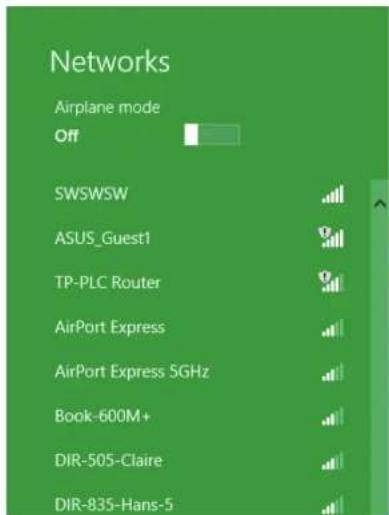
11:35 AM 1/21/2013 Wireless IconClicking on this icon will display a list of wireless networks which are within connecting proximity of your computer. Select the desired network by clicking on the network name.
text_image
Networks Airplane mode Off SWSWSW ASUS_Guest1 TP-PLC Router AirPort Express AirPort Express 5GHz Book-600M+ DIR-505-Claire DIR-835-Hans-5Section 3 - Configuration
You will then be prompted to enter the network security key (Wi-Fi password) for the wireless network. Enter the password into the box and click Next.
If you wish to use Wi-Fi Protected Setup (WPS) to connect to the router, you can also press the WPS button on your router at this point to enable the WPS function.
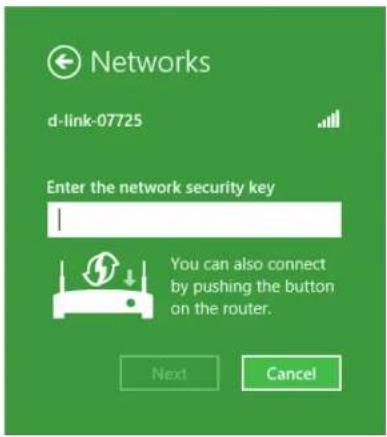
text_image
Networks d-link-07725 Enter the network security key You can also connect by pushing the button on the router. Next CancelWhen you have established a successful connection to a wireless network, the word Connected will appear next to the name of the network to which you are connected.

text_image
Networks Airplane mode Off Wi-Fi d-link-07725 ConnectedSection 3 - Configuration
Highlight the wireless network (SSID) you would like to connect to and click the Connect button. The Wi-Fi Configuration Card will list your device's specific network, it will not be simply dlink.
If you get a good signal but cannot access the Internet, check your TCP/IP settings for your wireless adapter. Refer to the Networking Basics section in this manual for more information.
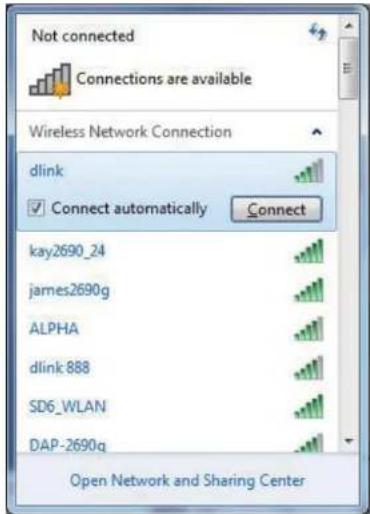
text_image
Not connected Connections are available Wireless Network Connection dlink Connect automatically Connect kay2690_24 james2690g ALPHA dlink 888 SD6_WLAN DAP-2690q Open Network and Sharing CenterThe following window appears while your computer tries to connect to the router.
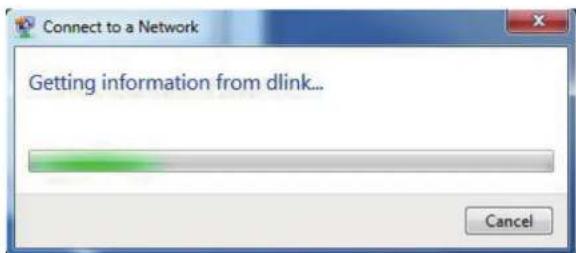
text_image
Connecting to a Network Getting information from dlink... CancelSection 3 - Configuration
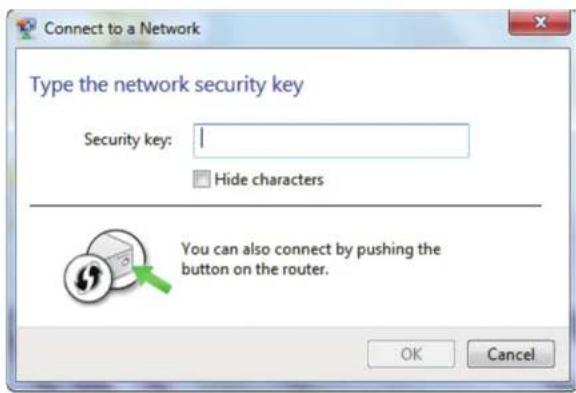
Enter the same security key or passphrase that is on your DHP-W312AV and click Connect.
It may take 20-30 seconds to connect to the wireless network. If the connection fails, please verify that the security settings are correct. The key or passphrase must be exactly the same as on the wireless router.
Additionally, you may connect using Wi-Fi Protected Setup (WPS) and Push Button Configuration (PBC). When the window to the right is displayed, press the Common Connect Button on the DHP-W312AV.
text_image
Connect to a Network Type the network security key Security key: 1 Hide characters You can also connect by pushing the button on the router. OK CancelUsing Windows Vista®
Windows Vista® users may use the convenient, built-in wireless utility. Follow these instructions:
From the Start menu, go to Control Panel, and then click on Network and Sharing Center.
The utility will display any available wireless networks in your area. Click on a network (displayed using the SSID) and click the Connect button. The Wi-Fi Configuration Card will list your device's specific network, it will not be simply dlink.
If you get a good signal but cannot access the Internet, check you TCP/IP settings for your wireless adapter. Refer to the Networking Basics section in this manual for more information.
Click Connect Anyway to continue.

text_image
Network and Internet - Network and Sharing Center Multi-LIFTP This computer Internet Not connected Video networks are available. Connect to a network
text_image
Connect for a network Select a network to connect to Show All Wireless Network Connection vanilla Security-enabled network ecdb5G Security-enabled network drink Unsecured network Set up a connection to network Open Network and Sharing Center Connect CancelSection 3 - Configuration
The utility will display the following window to indicate a connection is being made.
The final window indicates the establishment of a successful connection.
The next two pages display the windows used to connect to either a WEP or a WPA-PSK wireless network.

text_image
Connect to a network Connecting to dlink CancelConfiguring Wireless Security
It is recommended to enable wireless security (WPA/WPA2) on your wireless router or DHP-W312AV before configuring your wireless adapter. If you are joining an existing network, you will need to know the security key or passphrase being used.
-
Open the Windows Vista ^™ Wireless Utility by right-clicking on the wireless computer icon in your system tray (lower right corner of screen). Select Connect to a network.
-
Highlight the wireless network (SSID) you would like to connect to and click Connect.
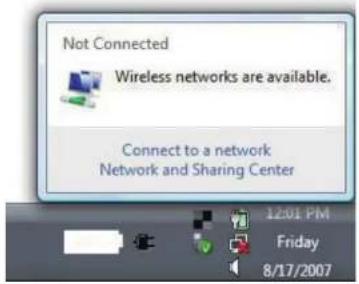
text_image
Not Connected Wireless networks are available. Connect to a network Network and Sharing Center 12:01 PM Friday 8/17/2007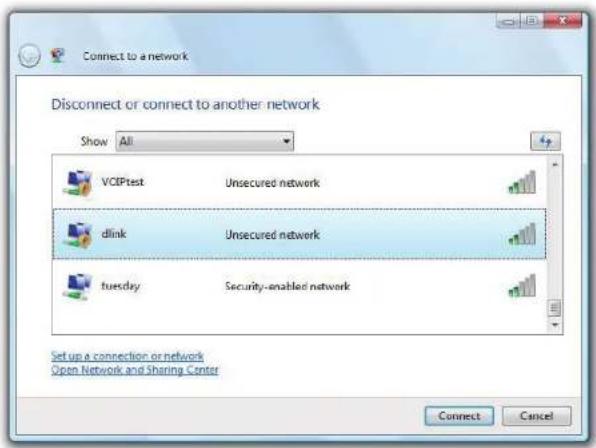
text_image
Connect to a network Disconnect or connect to another network Show All VCEPtest Unsecured network dlink Unsecured network tuesday Security-enabled network Set up a connection or network Open Network and Sharing Center Connect CancelSection 3 - Configuration
- Enter the same security key or passphrase that is on your router and click Connect.
It may take 20-30 seconds to connect to the wireless network. If the connection fails, please verify that the security settings are correct. The key or passphrase must be exactly the same as on the wireless router.
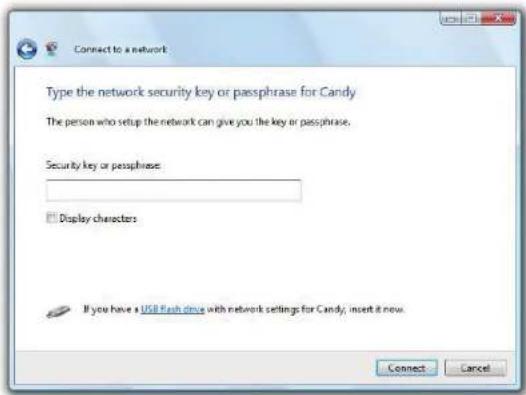
text_image
Connect to a network Type the network security key or passphrase for Candy The person who setup the network can give you the key or passphrase. Security key or passphrase: □ Display characters If you have a USB Flash drive with network settings for Candy, insert it now. Connect CancelConnecting to a Wireless Network Using Windows® XP
Windows XP users may use the built-in wireless utility (Zero Configuration Utility). The following instructions are for Service Pack 2 users. If you are using another company's utility or Windows 2000, please refer to the user manual of your wireless adapter for help with connecting to a wireless network. Most utilities will have a "site survey" option similar to the Windows XP utility as seen below.
If you receive the Wireless Networks Detected bubble, click on the center of the bubble to access the utility.
or
Right-click on the wireless computer icon in your system tray (lower right corner next to the time). Select View Available Wireless Networks.
The utility will display any available wireless networks in your area. Click on a network (displayed using the SSID) and click the Connect button. The Wi-Fi Configuration Card will list your device's specific network, it will not be simply dlink.
If you get a good signal but cannot access the Internet, check your TCP/IP settings for your wireless adapter. Refer to the Networking Basics section in this manual for more information.
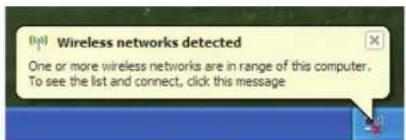
text_image
(p) Wireless networks detected One or more wireless networks are in range of this computer. To see the list and connect, click this message.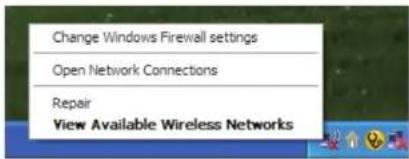
text_image
Change Windows Firewall settings Open Network Connections Repair View Available Wireless Networks
text_image
Wireless Network Connection 6 Choose a wireless network Click wireless in the list below to connect to a wireless network average or to get more information. Test Unsecured wireless network default Unsecured wireless network salestreet Security-enabled wireless network test1 Security-enabled wireless network The network requires a network key. If you want to connect to this network, click Connect. DIGL-8580 ConnectConfiguring WPA-PSK
It is recommended to enable encryption on your wireless router or DHP-W312AV before configuring your wireless adapter. If you are joining an existing network, you will need to know the passphrase being used.
-
Open the Windows' XP Wireless Utility by right-clicking on the wireless computer icon in your system tray (lower-right corner of screen). Select View Available Wireless Networks.
-
Highlight the wireless network (SSID) you would like to connect to and click Connect.

text_image
Change Windows Firewall settings Open Network Connections Repair View Available Wireless Networks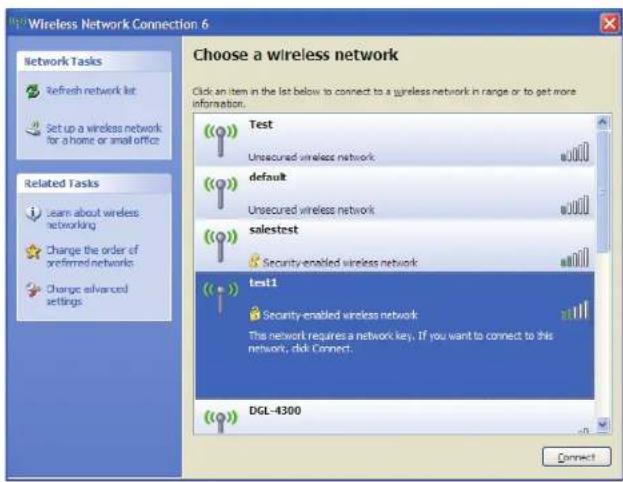
text_image
Wireless Network Connection 6 Choose a wireless network Click an item in the let below to connect to a wireless network in range or to get more information. Network Tasks Refresh network list Set up a wireless network for a home or small office Related Tasks Learn about wireless networking Change the order of preferred networks Change advanced settings Test Unsecured wireless network default Unsecured wireless network salestest Security-enabled wireless network test1 Security-enabled wireless network This network requires a network key. If you want to connect to this network, click Connect. DGL-4300 ConnectSection 3 - Configuration
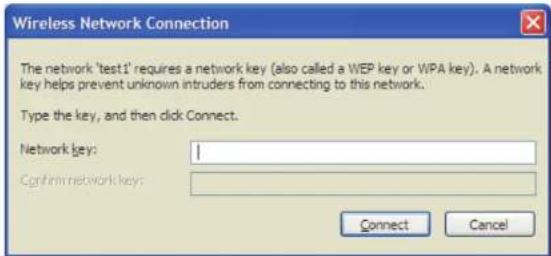
- The Wireless Network Connection box will appear. Enter the WPA-PSK passphrase and click Connect.
It may take 20-30 seconds to connect to the wireless network. If the connection fails, please verify that the WPA-PSK settings are correct. The WPA-PSK passphrase must be exactly the same as on the wireless router.
text_image
Wireless Network Connection The network 'test1' requires a network key (also called a WEP key or WPA key). A network key helps prevent unknown intruders from connecting to this network. Type the key, and then click Connect. Network key: Cgriffim network key: Connect CancelTroubleshooting
This chapter provides solutions to problems that can occur during the installation and operation of the DHP-W312AV. Read the following descriptions if you are having problems. (The examples below are illustrated in Windows® XP. If you have a different operating system, the screenshots on your computer will look similar to the following examples.)
1. Why am I unable to access the web-based configuration utility?
When entering the IP address of the D-Link DHP-W312AV (192.168.0.50), you are not connecting to a website on the Internet or have to be connected to the Internet. The device has the utility built-in from the factory. Your computer must be on the same IP subnet to connect to the web-based utility. You may also enter http://dlinkap.local. (on the Wi-Fi Configuration Card) instead of the IP address.
- Make sure you have an updated Java-enabled web browser. We recommend the following:
- Microsoft Internet Explorer ^® 7.0 and higher
- Mozilla Firefox 3.5 and higher
- Google™ Chrome 8.0 and higher
-
Apple Safari 4.0 and higher
-
Verify physical connectivity by checking for solid link lights on the device. If you do not get a solid link light, try using a different cable or connect to a different port on the device if possible. If the computer is turned off, the link light may not be on.
- Disable any Internet security software running on the computer. Software firewalls such as Zone Alarm, Black Ice, Sygate, Norton Personal Firewall, and Windows® XP firewall may block access to the configuration pages. Check the help files included with your firewall software for more information on disabling or configuring it.
Section 4 - Troubleshooting
- Configure your Internet settings:
- Go to Start > Settings > Control Panel. Double-click the Internet Options Icon. From the Security tab, click the button to restore the settings to their defaults.
- Click the Connection tab and set the dial-up option to Never Dial a Connection. Click the LAN Settings button. Make sure nothing is checked. Click OK.
- Go to the Advanced tab and click the Reset... button to restore these settings to their defaults. Click OK three times.
- Close your web browser (if open) and open it.
- Access the web management. Open your web browser and enter the IP address of your D-Link DHP-W312AV in the address bar. This should open the login page for your the web management.
- If you still cannot access the configuration, unplug the power to the DHP-W312AV for 10 seconds and plug back in. Wait about 30 seconds and try accessing the configuration. If you have multiple computers, try connecting using a different computer.
2. What can I do if I forgot my password?
If you forgot your password, you must reset your DHP-W312AV. Unfortunately this process will change all your settings back to the factory defaults. To reset the DHP-W312AV, locate the reset button (hole) on the rear panel of the unit. With the DHP-W312AV powered on, use a paperclip to hold the button down for 5 seconds. Release the button and the DHP-W312AV will go through its reboot process. Wait about 30 seconds to access the DHP-W312AV. The default IP address is 192.168.0.50. When logging in, the username is Admin and leave the password box empty
3. Why can't my Powerline AV device detect my other Powerline AV devices?
This may due to the accidental change of the device password. Use the web-based configuration utility and select Setup > PLC SETTINGS. Fill in the password in the blank. Then repeat the same procedure to the other Powerline AV device via web-based configuration utility.
4. I cannot start my Powerline AV device.
Please check your power supply is working. Powerline AV device operates from the power supplied by the home electrical wiring and can not operate without a working power supply.
Wireless Basics
D-Link wireless products are based on industry standards to provide easy-to-use and compatible high-speed wireless connectivity within your home, business or public access wireless networks. Strictly adhering to the IEEE standard, the D-Link wireless family of products will allow you to securely access the data you want, when and where you want it. You will be able to enjoy the freedom that wireless networking delivers.
A wireless local area network (WLAN) is a cellular computer network that transmits and receives data with radio signals instead of wires. Wireless LANs are used increasingly in both home and office environments, and public areas such as airports, coffee shops and universities. Innovative ways to utilize WLAN technology are helping people to work and communicate more efficiently. Increased mobility and the absence of cabling and other fixed infrastructure have proven to be beneficial for many users.
Wireless users can use the same applications they use on a wired network. Wireless adapter cards used on laptop and desktop systems support the same protocols as Ethernet adapter cards. Under many circumstances, it may be desirable for mobile network devices to link to a conventional Ethernet LAN in order to use servers, printers or an Internet connection supplied through the wired LAN.
What is Wireless?
Wireless or Wi-Fi technology is another way of connecting your computer to the network without using wires. Wi-Fi uses radio frequency to connect wirelessly, so you have the freedom to connect computers anywhere in your home or office.
D-Link is the worldwide leader and award winning designer, developer, and manufacturer of networking products. D-Link delivers the performance you need at a price you can afford. D-Link has all the products you need to build your network.
How does wireless work?
Wireless works similar to how cordless phone work, through radio signals to transmit data from one point A to point B. But wireless technology has restrictions as to how you can access the network. You must be within the wireless network range area to be able to connect your computer. There are two different types of wireless networks Wireless Local Area Network (WLAN), and Wireless Personal Area Network (WPAN).
Wireless Local Area Network (WLAN)
In a wireless local area network, a device called an DHP-W312AV (AP) connects computers to the network. The DHP-W312AV has a small antenna attached to it, which allows it to transmit data back and forth over radio signals. With an indoor DHP-W312AV as seen in the picture, the signal can travel up to 300 feet. With an outdoor DHP-W312AV the signal can reach out up to 30 miles to serve places like manufacturing plants, industrial locations, college and high school campuses, airports, golf courses, and many other outdoor venues.
Section 4 - Troubleshooting
Who uses wireless?
Wireless technology has become so popular in recent years that almost everyone is using it. Whether it's for home, or office D-Link has a wireless solution for it.
Home
• Gives everyone at home broadband access
- Surf the web, check email, instant message, etc.
- Gets rid of the cables around the house
• Simple and easy to use
Small Office and Home Office
- Stay on top of everything at home as you would at office
- Remotely access your office network from home
- Share Internet connection and printer with multiple computers
- No need to dedicate office space
Section 4 - Troubleshooting
Where is wireless used?
Wireless technology is expanding everywhere not just at home or office. People like the freedom of mobility and it's becoming so popular that more and more public facilities now provide wireless access to attract people. The wireless connection in public places is usually called "hotspots".
Using a D-Link Cardbus Adapter with your laptop, you can access the hotspot to connect to Internet from remote locations like: Airports, Hotels, Coffee Shops, Libraries, Restaurants, and Convention Centers.
A wireless network is easy to setup, but if you're installing it for the first time it could be quite a task not knowing where to start. That's why we've put together a few setup steps and tips to help you through the process of setting up a wireless network.
Tips
Here are a few things to keep in mind, when you install a wireless network.
Centralize your DHP-W312AV
Make sure you place the bridge/DHP-W312AV in a centralized location within your network for the best performance. Try to place the bridge/DHP-W312AV as high as possible in the room, so the signal gets dispersed throughout your home. If you have a two-story home, you may need a repeater to boost the signal to extend the range.
Eliminate Interference
Place home appliances such as cordless telephones, microwaves, wireless speakers, and televisions as far away as possible from the bridge/DHP-W312AV. This would significantly reduce any interference that the appliances might cause since they operate on same frequency.
Security
Don't let your next-door neighbors or intruders connect to your wireless network. Secure your wireless network by turning on the WPA, WPA2, or WEP security feature on the DHP-W312AV.
Networking Basics Check your IP address
After you install your new D-Link adapter, by default, the TCP/IP settings should be set to obtain an IP address from a DHCP server (i.e. wireless router) automatically. To verify your IP address, please follow the steps below.
Click on Start > Run. In the run box type cmd and click OK. (Windows® 7/Vista® users type cmd in the Start Search box.)
At the prompt, type ipconfig and press Enter.
This will display the IP address, subnet mask, and the default gateway of your adapter.
If the address is 0.0.0.0, check your adapter installation, security settings, and the settings on your DHP-W312AV. Some firewall software programs may block a DHCP request on newly installed adapters.
If you are connecting to a wireless network at a hotspot (e.g. hotel, coffee shop, airport), please contact an employee or administrator to verify their wireless network settings.
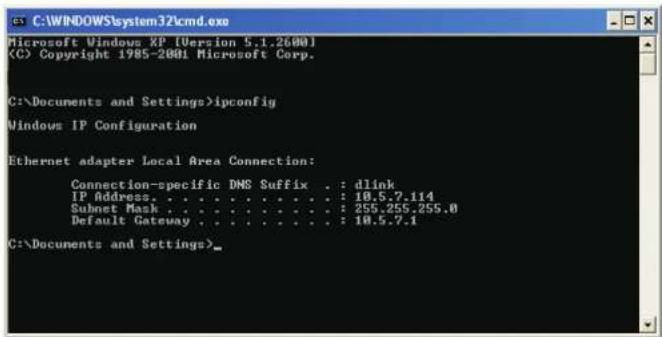
text_image
C:\Documents and Settings>ipconfig Windows IP Configuration Ethernet adapter Local Area Connection: Connection-specific DMS Suffix . : dlink IP Address. . . . . . . . . . . . . : 10.5.7.114 Subnet Mask . . . . . . . . . . . . : 255.255.255.0 Default Gateway . . . . . . . . . . : 10.5.7.1 C:\Documents and Settings>Statically Assign an IP address
If you are not using a DHCP capable gateway/DHP-W312AV, or you need to assign a static IP address, please follow the steps below:
Step 1
Windows Vista ^® - Click on Start > Control Panel > Network and Internet > Network and Sharing Center > Manage Network Connections.
Windows ^® XP - Click on Start > Control Panel > Network Connections.
Windows® 2000 - From the desktop, right-click My Network Places > Properties.
Step 2
Right-click on the Local Area Connection which represents your D-Link network adapter and select Properties.
Step 3
Highlight Internet Protocol (TCP/IP) and click Properties.
Step 4
Click Use the following IP address and enter an IP address that is on the same subnet as your network or the LAN IP address on your router. Example: If the AP's LAN IP address is 192.168.0.50, make your IP address 192.168.0.X where X is a number between 2 and 99 (excluding the number 50). Make sure that the number you choose is not in use on the network. Set Default Gateway the same as the LAN IP address of your router (192.168.0.1).
Set Primary DNS the same as the LAN IP address of your router (192.168.0.1).
The Secondary DNS is not needed or you may enter a DNS server from your ISP.
Step 5
Click OK twice to save your settings.
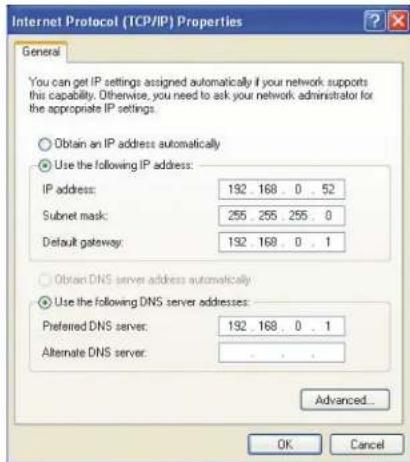
text_image
Internet Protocol (TCP/IP) Properties General You can get IP settings assigned automatically if your network supports this capability. Otherwise, you need to ask your network administrator for the appropriate IP settings. Obtain an IP address automatically Use the following IP address: IP address: 192 168 0 . 52 Subnet mask: 255 255 255 0 Default gateway: 192 168 0 . 1 Obtain DNS server address automatically Use the following DNS server addresses: Preferred DNS server: 192 168 0 . 1 Alternate DNS server: . Advanced... OK CancelTechnical Specifications DHP-W312AV
Standards
• IEEE 802.11ac
• IEEE 802.11n
• IEEE 802.11g
• IEEE 802.3
• IEEE 802.3u
• IEEE P1905.1 draft
• IEEE 1901
Network Interfaces
• 1 x 10/100 Ethernet port
- Wireless AC
- Powerline
AC Input
• 100 - 240 VAC 50/60 Hz
Security
• WPA • WEP
• WPA2
Wireless Signal Rates\*
• 300 Mbps • 12 Mbps
• 108 Mbps • 11 Mbps
• 54 Mbps • 9 Mbps
• 48 Mbps • 6 Mbps
• 36 Mbps • 5.5 Mbps
• 18 Mbps • 2 Mbps
• 24 Mbps • 1 Mbps
* Maximum wireless signal rate derived from IEEE Standard 802.11ac specifications. Actual data throughput will vary. Network conditions and environmental factors, including volume of network traffic, building materials and construction, and network overhead, lower actual data throughput rate. Environmental factors will adversely affect wireless signal range.
MSC (0-15)
• 130 Mbps (270) • 117 Mbps (243)
• 104 Mbps (216) • 78 Mbps (162)
• 66 Mbps (135) • 58.5 Mbps (121.5)
• 52 Mbps (108) • 39 Mbps (81)
• 26 Mbps (54) • 19.5 Mbps (40.5)
• 12 Mbps (27) • 6.5 Mbps (13.5)
Frequency Range
• 2.4 GHz to 2.497 GHz
• 5.15 to 5.25 GHz and 5.725 to 5.85 GHz
Encryption
• 128-bit AES
• WEP/WPA/WPA2
Operating Temperature
• 32 to 104 °F (0 to 40 °C)
Storage Temperature
• 14 to 158 °F (-10 to 70 °C)
Humidity
• Operation: 10% to 90% Relative Humidity
• Storage: 5% to 90% Relative Humidity
Transmitter Output Power
• 13 dBm (+/- 2 dB)
Appendix A - Technical Specifications
LEDs
- Power • Ethernet
- WLAN - Powerline
Safety & Emissions
• FCC
• CE
• RoHS
• UL, CE LVD
Dimensions
- 101 x 75 x 45 mm (3.54 x 2.56 x 1.97 inches)
Weight
• 181 g (0.39 lbs)
DHP-308AV
Network Interfaces
- 1 x 10/100 Ethernet port
- Powerline
AC Input
• 100 - 240 VAC 50/60 Hz
Operating Temperature
• 32 to 104 °F (0 to 40 °C)
Storage Temperature
-4 to 149 °F (-20 to 65 °C)
Humidity
• Operation: 10% to 90% Relative Humidity
• Storage: 5% to 95% Relative Humidity
Transmitter Output Power
• 13 dBm (+/- 2 dB)
LEDs
- Power - Ethernet
- Powerline
Safety & Emissions
• FCC
• CE
• RoHS
• UL, CE LVD
Dimensions
- 70 x 52 x 26 mm (2.83 x 2.04 x 1.02 inches)
Weight
• 101.7 g (.22 lbs)
Regulatory Information
Caution: Do not remove the plug and connect it to a power outlet by itself; always attach the plug to the power adaptor first before connecting it to a power outlet.
Federal Communication Commission Interference Statement:
This equipment has been tested and found to comply with the limits for a Class B digital device, pursuant to Part 15 of the FCC Rules. These limits are designed to provide reasonable protection against harmful interference in a residential installation. This equipment generates, uses and can radiate radio frequency energy and, if not installed and used in accordance with the instructions, may cause harmful interference to radio communications. However, there is no guarantee that interference will not occur in a particular installation. If this equipment does cause harmful interference to radio or television reception, which can be determined by turning the equipment off and on, the user is encouraged to try to correct the interference by one of the following measures:
- Reorient or relocate the receiving antenna.
- Increase the separation between the equipment and receiver.
- Connect the equipment into an outlet on a circuit different from that to which the receiver is connected.
- Consult the dealer or an experienced radio/TV technician for help.
Non-modifications Statement:
Any changes or modifications not expressly approved by the party responsible for compliance could void the user's authority to operate this equipment.
Caution:
This device complies with Part 15 of the FCC Rules. Operation is subject to the following two conditions: (1) This device may not cause harmful interference, and (2) this device must accept any interference received, including interference that may cause undesired operation.
For product available in the USA/Canada market, only channel 1\~11 can be operated. Selection of other channels is not possible. This device and its antenna(s) must not be co-located or operating in conjunction with any other antenna or transmitter except in accordance with FCC multi-transmitter product procedures.
Note:
The country code selection is for non-US model only and is not available to all US model. Per FCC regulation, all Wi-Fi product marketed in US must fixed to US operation channels only.
RF Frequency Requirements:
This device is for indoor use only when using all channels in the 5.150-5.250 GHz, 5.725-5.850 GHz frequency ranges. High power radars are allocated as primary users of the 5.150-5.250 GHz, 5.725-5.850 GHz bands. These radar stations can cause interference with and/or damage this device. This device will not operate on channels which overlap the 5600-5650 MHz band. It is restricted in indoor environments only.
IMPORTANT NOTE:
FCC Radiation Exposure Statement:
This equipment complies with FCC radiation exposure limits set forth for an uncontrolled environment. This equipment should be installed and operated with minimum distance 25 cm between the radiator and your body.
Customer Information:
(1) This equipment complies with Part 68 of the FCC rules and the requirements adopted by the ACTA. On bottom of this equipment is a label that contains, among other information, a product identifier of 0. If requested, this number must be provided to the telephone company.
(2) If this equipment 0 causes harm to the telephone network, the telephone company will notify you in advance that temporary discontinuance of service may be required. But if advance notice isn't practical, the telephone company will notify the customer as soon as possible. Also you will be advised of your right to file a complaint with the FCC if you believe it is necessary.
(3) The telephone company may make changes in its facilities, equipment, operations or procedures that could affect the operation of the equipment. If this happens, the telephone company will provide advance notice in order for you to make necessary modification to maintain uninterrupted service.
(4) If you experience trouble with this equipment, you disconnect it from the network until the problem has been corrected or until you are sure that the equipment is not malfunctioning.
(5) Please follow instructions for repairing if any (e.g. battery replacement section); otherwise do not alternate or repair any parts of device except specified.
(6) Connection to party line service is subject to state tariffs. Contact the state public utility commission, public service commission or corporation commission for information.
(7) If the telephone company requests information on what equipment is connected to their lines, inform them of:
(a) The telephone number that this unit is connected to,
(b) The ringer equivalence number 0
(c) The USOC jack required 0 and
(d) The FCC Registration Number 0
Items (b) and (d) are indicated on the label. The ringer equivalence number (REN) is used to determine how many devices can be connected to your telephone line. In most areas, the sum of the RENs of all devices on any one line should not exceed five (5.0). If too many devices are attached, they may not ring properly.
(8) If your home has specially wired alarm equipment connected to the telephone line, ensure the installation of this equipment does not disable alarm equipment, consult your telephone company or a qualified installer.
Industry Canada Statement:
This device complies with Industry Canada licence-exempt RSS standard(s). Operation is subject to the following two conditions:
(1) this device may not cause interference, and
(2) this device must accept any interference, including interference that may cause undesired operation of the device.
(i) the device for operation in the band 5150-5250 MHz is only for indoor use to reduce the potential for harmful interference to co-channel mobile satellite systems.
Avertissement:
Radiation Exposure Statement
This equipment complies with IC radiation exposure limits set forth for an uncontrolled environment. This equipment should be installed and operated with minimum distance 20 cm between the radiator & your body.
5 GHz Wireless Frequency and Channel Operation in EEC Countries:
| Allowable 802.11a Frequencies and Channels Countries | |
| 5.15-5.25 GHz(Channels 36, 40, 44, 48) | Liechtenstein |
| 5.15-5.25 Ghz & 5.725-5.875 Ghz(Channels 36, 40, 44, 48, 149, 153, 157, 161, 165, 169) | Austria |
| 5.15-5.35 GHz(Channels 36, 40, 44, 48, 52, 56, 60, 64) | France |
| 5.15-5.35 & 5.47-5.725 GHz(Channels 36, 40, 44, 48, 52, 56, 60, 64, 100, 104, 108, 112, 116, 120, 124, 128, 132, 136, 140) | Denmark, Germany, Iceland, Finland, Netherlands, Norway, Poland, Sweden, Slovenia, Luxembourg, U.K., Ireland, Slovak, Switzerland, Hungary, Italy |
| 5.15-5.35 Ghz & 5.725-5.875 Ghz(Channels 36, 40, 44, 48, 52, 56, 60, 64, 149, 153, 157, 161, 165, 169) | Czech Republic |
European Community Declaration of Conformity:
| Česky [Czech] | D-Link tímto prohlašuje, že tento DHP-313AV je ve shodě se základními požadavky a dalšími příslušnými ustanoveními směrnice 1999/5/ES. |
| Dansk [Danish] | Undertegnede D-Link erklærer herved, at følgende udstyr DHP-313AV overholder de væsentlige krav og øvrige relevante krav i direktiv 1999/5/EF. |
| Deutsch [German] | Hiermit erklärt D-Link, dass sich das Gerät DHP-313AV in Übereinstimmung mit den grundlegenden Anforderungen und den übrigen einschlägigen Bestimmungen der Richtlinie 1999/5/EG befindet. |
| Eesti [Estonian] | Käesolevaga kinnitab D-Link seadme DHP-313AV vastavust direktiivi 1999/5/EÜ põhinõuetele ja nimetatud direktiivist tulenevatele teistele asjakohastele sätetele. |
| English | Hereby, D-Link, declares that this DHP-313AV is in compliance with the essential requirements and other relevant provisions of Directive 1999/5/EC. |
| Español [Spanish] | Por medio de la presente D-Link declara que el DHP-313AV cumple con los requisitos esenciales y cualesquiera otras disposiciones aplicables o exigibles de la Directiva 1999/5/CE. |
| Ελληνική [Greek] | ΜΕ ΤΗΝ ΠΑΡΟΥΣΑ D-Link ΔΗΛΩΝΕΙ ΟΤΙ DHP-313AV ΣΥΜΜΟΡΦΩΝΕΤΑΙ ΠΡΟΣ ΤΙΣ ΟΥΣΙΩΔΕΙΣ ΑΠΑΙΤΗΣΕΙΣ ΚΑΙ ΤΙΣ ΛΟΙΠΕΣ ΣΧΕΤΙΚΕΣ ΔΙΑΤΑΞΕΙΣ ΤΗΣ ΟΔΗΓΙΑΣ 1999/5/EK. |
| Français [French] | Par la présente D-Link déclare que l'appareil DHP-313AV est conforme aux exigences essentielles et aux autres dispositions pertinentes de la directive 1999/5/CE. |
| Italiano [Italian] | Con la presente D-Link dichiara che questo DHP-313AV è conforme ai requisiti essenziali ed alle altre disposizioni pertinenti stabilite dalla direttiva 1999/5/CE. |
| Latviski [Latvian] | Ar šo D-Link deklarē, ka DHP-313AV atbilst Direktīvas 1999/5/EK būtiskajām prasībām un citiem ar to saistītajiem noteikumiem. |
| Lietuvių [Lithuanian] | Šiuo D-Link deklaruoja, kad šis DHP-313AV atitinka esminius reikalavimus ir kitas 1999/5/EB Direktyvos nuostatas. |
| Nederlands [Dutch] | Hierbij verklaart D-Link dat het toestel DHP-313AV in overeenstemming is met de essentiële eisen en de andere relevante bepalingen van richtlijn 1999/5/EG. |
Appendix B: Regulatory Information
| Malti [Maltese] | Hawnhekk, D-Link, jiddikjara li dan DHP-313AV jikkonforma mal-ħtiġijiet essenzjali u ma provvedimenti oħrajn relevanti li hemm fid-Dirrettiva 1999/5/EC. |
| Magyar [Hungarian] | Alulírott, D-Link nyilatkozom, hogy a DHP-313AV megfelel a vonatkozó alapvető követelményeknek és az 1999/5/EC irányelv egyéb előírásainak. |
| Polski [Polish] | Niniejszym D-Link oświadcza, że DHP-313AV jest zgodny z zasadniczymi wymogami oraz pozostałymi stosownymi postanowieniami Dyrektywy 1999/5/EC. |
| Português [Portuguese] | D-Link declara que este DHP-313AV está conforme com os requisitos essenciais e outras disposições da Directiva 1999/5/CE. |
| Slovensko [Slovenian] | D-Link izjavlja, da je ta DHP-313AV v skladu z bistvenimi zahtevami in ostalimi relevantnimi določili direktive 1999/5/ES. |
| Slovensky [Slovak] | D-Link týmto vyhlasuje, že DHP-313AV splňa základné požiadavky a všetky príslušné ustanovenia Smernice 1999/5/ES. |
| Suomi [Finnish] | D-Link vakuuttaa täten että DHP-313AV tyyppinen laite on direktiivin 1999/5/EY oleellisten vaatimusten ja sitä koskevien direktiivin muiden ehtojen mukainen. |
Warning Statement:
The power outlet should be near the device and easily accessible.

Safety Instructions
Please adhere to the following safety guidelines to help ensure your own personal safety and protect your system from potential damage. Any acts taken that are inconsistent with ordinary use of the product, including improper testing, etc., and those not expressly approved by D-Link may result in the loss of product warranty.
Unless expressly approved by an authorized representative of D-Link in writing, you may not and may not permit others to:
- Disassemble or reverse engineer the device or attempt to derive source code (underlying ideas, algorithms, or structure) from the device or from any other information provided by D-Link, except to the extent that this restriction is expressly prohibited by local law.
- Modify or alter the device.
- Remove from the device any product identification or other notices, including copyright notices and patent markings, if any. To reduce the risk of bodily injury, electrical shock, fire, and damage to the device and other equipment, observe the following precautions:
Power Sources
- Observe and follow service markings.
- Do not push any objects into the openings of your device unless consistent with the authorized operation of the device. Doing so can cause a fire or an electrical shock by shorting out interior components.
- The powering of this device must adhere to the power specifications indicated for this product.
- Do not overload wall outlets and/or extension cords as this will increase the risk of fire or electrical shock.
- Do not rest anything on the power cord or on the device (unless the device is made and expressly approved as suitable for stacking).
- Position system cables and power cables carefully; route cables so that they cannot be stepped on or tripped over. Be sure that nothing rests on any cables.
- Operate the device only from the type of external power source indicated on the electrical ratings label.
- To help avoid damaging your device, be sure the voltage selection switch (if provided) on the power supply is set to match the power available at your location.
- Also be sure that attached devices are electrically rated to operate with the power available in your location.
- Use only approved power cable(s). If you have not been provided a power cable for your device or for any AC -powered option intended for your device, purchase a power cable that is approved for use in your country and is suitable for use with your device. The power cable must be rated for the device and for the voltage and current marked on the device's electrical ratings label. The voltage and current rating of the cable should be greater than the ratings marked on the device.
• To help prevent an electrical shock, plug the device and peripheral power cables into properly grounded electrical outlets. These cables are equipped with three-prong plugs to help ensure proper grounding. Do not use adapter plugs or remove the grounding prong from a cable. If you must use an extension cable, use a 3-wire cable with properly grounded plugs.
- Observe extension cable and power strip ratings. Ensure that the total ampere rating of all products plugged into the extension cable or power strip does not exceed 80 percent of the ampere ratings limit for the extension cable or power strip.
• To help protect your device from sudden, transient increases and decreases in electrical power, use a surge suppressor, line conditioner, or uninterruptible power supply (UPS).
- Do not modify power cables or plugs. Consult a licensed electrician or your power company for site modifications. Always follow your local/national wiring rules.
- When connecting or disconnecting power to hot-pluggable power supplies, if offered with your device, observe the following guidelines.
• Install the power supply before connecting the power cable to the power supply.
- Unplug the power cable before removing the power supply.
- If the system has multiple sources of power, disconnect power from the device by unplugging all power cables from the power supplies.
Servicing/Disassembling
- Do not service any product except as expressly set forth in your system documentation.
- Opening or removing covers that are marked with the triangular symbol with a lightning bolt may expose you to an electrical shock. Only a trained service technician should service components inside these compartments.
• To reduce the risk of electrical shock, never disassemble this device. None of its internal parts are user-replaceable; therefore, there is no reason to access the interior. - Do not spill food or liquids on your system components, and never operate the device in a wet environment. If the device gets wet, see the appropriate section in your troubleshooting guide or contact your trained service provider.
- Use the device only with approved equipment.
- Move products with care; ensure that all casters and/or stabilizers are firmly connected to the system. Avoid sudden stops and uneven surfaces.
Environment
- Do not use this device near water (e.g. near a bathtub, sink, laundry tub, fish tank, in a wet basement or near a swimming pool).
-
Do not use this device in areas with high humidity.
-
This device must not be subjected to water or condensation.
- Keep your device away from radiators and heat sources. Also, do not block cooling vents.
Cleaning
• Always unplug the power before cleaning this device.
- Do not use liquid or aerosol cleaners of any kind. Use only compressed air that is recommended for electronic devices.
- Use a dry cloth for cleaning.
Protecting Against Electrostatic Discharge
Static electricity can harm delicate components inside your system. To prevent static damage, discharge static electricity from your body before you touch any of the electronic components, such as the microprocessor. You can do so by periodically touching an unpainted metal surface on the chassis.
You can also take the following steps to help prevent damage from electrostatic discharge (ESD):
- When unpacking a static-sensitive component from its shipping carton, do not remove the component from the antistatic packing material until you are ready to install the component in your system. Just before unwrapping the antistatic packaging, be sure to discharge static electricity from your body.
- When transporting a sensitive component, first place it in an antistatic container or packaging.
- Handle all sensitive components in a static-safe area. If possible, use antistatic floor pads, workbench pads, and an antistatic grounding strap.
Environmental
This product may contain a battery. Recycle or dispose of batteries in accordance with the battery manufacturer's instructions and local/national disposal and recycling regulations. For more information, please refer to the warranty guide.
Disposing of and Recycling Your Product
ENGLISH

This symbol on the product or packaging means that according to local laws and regulations this product should be not be disposed of in the household waste but sent for recycling. Please take it to a collection point designated by your local authorities once it has reached the end of its life, some will accept products for free. By recycling the product and its packaging in this manner you help to conserve the environment and protect human health.
D-Link and the Environment
At D-Link, we understand and are committed to reducing any impact our operations and products may have on the environment. To minimise this impact D-Link designs and builds its products to be as environmentally friendly as possible, by using recyclable, low toxic materials in both products and packaging.
D-Link recommends that you always switch off or unplug your D-Link products when they are not in use. By doing so you will help to save energy and reduce CO2 emissions.
To learn more about our environmentally responsible products and packaging please visit www.dlinkgreen.com
DEUTSCH
DE